

Submitted:
06 January 2026
Posted:
07 January 2026
You are already at the latest version
Abstract
Background and Aims: Since the early 2000s, scholarship and policy analysis on Nigeria’s extractive sectors have expanded beyond oil bunkering to encompass the illegal mining of solid minerals, artisanal economies and environmental degradation. These developments have produced new framings and critiques of the “resource curse,” linking extraction to governance, security and justice. This paper aims to elucidate how the idea of “resource governance” has been discussed and perceived across Nigerian scholarly and policy texts from 1999 to 2025. Methods: Terms like “resource governance in Nigeria,” “extractive industries,” “mining” and “illegal mining" were searched across academic databases and institutional repositories. 36 english-language publications explicitly or implicitly addressing Nigeria’s extractive governance, published from 1999 to 2025, were included in the final analysis. Texts were analyzed for discursive themes using a combined scoping review and critical discourse analysis framework. Metadata related to author identity, geography, institutional affiliation, and publication type were also recorded. Results: The criminal-economy discourse (linking extraction to illegality and insecurity) dominated the archive. Other discourses include ecological justice (framing harm as both environmental and moral) and displacement (highlighting exclusion and inequality). Conclusion: Findings indicate that resource governance in Nigeria is framed less as a technical challenge than as a field of political struggle and moral negotiation. These discourses collectively reveal how coercive governance, legitimized through security and reform narratives, helps sustain extractive inequality. The results underscore the need to integrate local agency and justice frameworks into national and transnational debates over resource policy.
Keywords:
resource governance
; resource curse
; extractive industries
; mining and illegal mining
Introduction
A growing body of literature emphasizes the role of political institutions and elite behavior in shaping the developmental trajectory of resource-rich states. In many African states such as Nigeria, political elites often leverage identity cleavages; ethnicity and religion to obscure the underlying contestation over access to and control of economic and natural resources (Alumona & Azom, 2018; Etefa, 2019). This identity politics is thus used to mobilize support and suppress dissent, which in the long run transforms political competition into existential struggles.
In many African countries, colonial legacies remain very evident and continue to shape postcolonial governance, which centers on maintaining cycles of exclusion and dependence. (Mamdani 1996; Rodney 1982). Wallerstein (1974) and Arrighi (1994) situate African resource economies within the broader capitalist world-system, and with this exists structural constraints imposed by global markets and the asymmetrical power relations that define North-South interactions. Within this frame, political elites undermine inclusive development by monopolizing resource rents for personal gain (Robinson et al. 2012). The spatial distribution of natural resources further heightens the likelihood of violent conflict occurring, most especially when control over resource-rich territories becomes a strategic objective for both state and non-state actors (Le Billon, 2001).
Despite numerous studies linking natural resource wealth to conflict, there is limited research applying critical discourse analysis (CDA) specifically to how resource curse scholarship and government reports construct narratives around natural resource governance. This gap is particularly significant considering that Nigeria is one of the largest oil producers in Africa: yet suffers some of the highest rates of oil theft and pipeline vandalism in the world. Through illegal bunkering, an estimated 470,000 barrels are lost daily, resulting in a monthly financial loss of approximately $700 million (Awodezi & Mohammed, 2023). This situation highlights the significant disconnect between the country’s natural resource wealth and its state capacity.
Material and Method
This study combines a scoping review with critical discourse analysis (CDA) to capture both the breadth and depth of discursive constructions surrounding resource governance in Nigeria. Critical Discourse Analysis (CDA) to examine how scholarly literature constructs, legitimizes and contests meanings around resource governance in Nigeria. Rather than analyzing a single state-produced policy text, the analysis focuses on a corpus of peer-reviewed academic publications, policy research papers and institutional reports that collectively shape the intellectual and policy discourse on extractive governance. These texts represent a crucial “knowledge infrastructure” through which academic authority intersects with policy power and development imaginaries. A thematic analysis was conducted to identify recurring discursive patterns and framing tendencies across the selected literature.
The analysis is guided by the methodological principles of CDA as articulated by Fairclough (2013) and van Dijk (1993) which emphasize the dialectical relationship between discourse and social structures. Upon these premises this study examines how key actors: the Nigerian state and mining communities are positioned within academic narratives. Following Fischer’s (2003) framework for critical policy analysis, the study situates academic discourse as a site of meaning-making where legitimacy, expertise and responsibility are discursively constructed. Attention is paid to linguistic and rhetorical strategies such as framing, modality, intertextuality and lexical choice that reveal underlying assumptions about corruption, sustainability, sovereignty, and accountability. The textual corpus was compiled through a scoping review following the methodological framework of Arksey and O’Malley (2005) and subsequent enhancements by Levac et al. (2010). A scoping review is well-suited to examining the diverse forms of evidence: policy documents, reports and scholarly literature that inform ongoing debates. The goal is to map the existing body of literature on resource governance in Nigeria to inform the selection of texts for critical discourse analysis.
A scoping review search of academic databases (Scopus, JSTOR, and Google Scholar) using keywords such as “resource governance in Nigeria,” “extractive industries,” “mining,” and “illegal mining". Publications from 1999 to 2025 were selected to capture the evolution of discourse from the post-structural adjustment era to the present, with emphasis on articles and reports that explicitly discuss governance, regulation, and socio-political implications of extractive activity in Nigeria. A total of 186 texts were initially identified. After removing duplicates and non-relevant materials, 72 texts underwent abstract and full-text screening. Of these, 36 met the inclusion criteria and were retained for final analysis. Figure 1 illustrates the simplified PRISMA-style flow of the selection process.
Results
Archive Demographics
Most publications in this review are scholarly works by researchers and policy analysts focused on Nigeria’s extractive economy from 1999 to 2025 (see Table 1). The archive, therefore, reflects a recent surge of academic and policy attention to the intersection of extractive activity, governance, and security. While several foundational studies on the Niger Delta continue to shape the debate, newer works have expanded the geographic and conceptual scope to include illegal mining, banditry, and rural livelihoods in Northern and Central Nigeria.
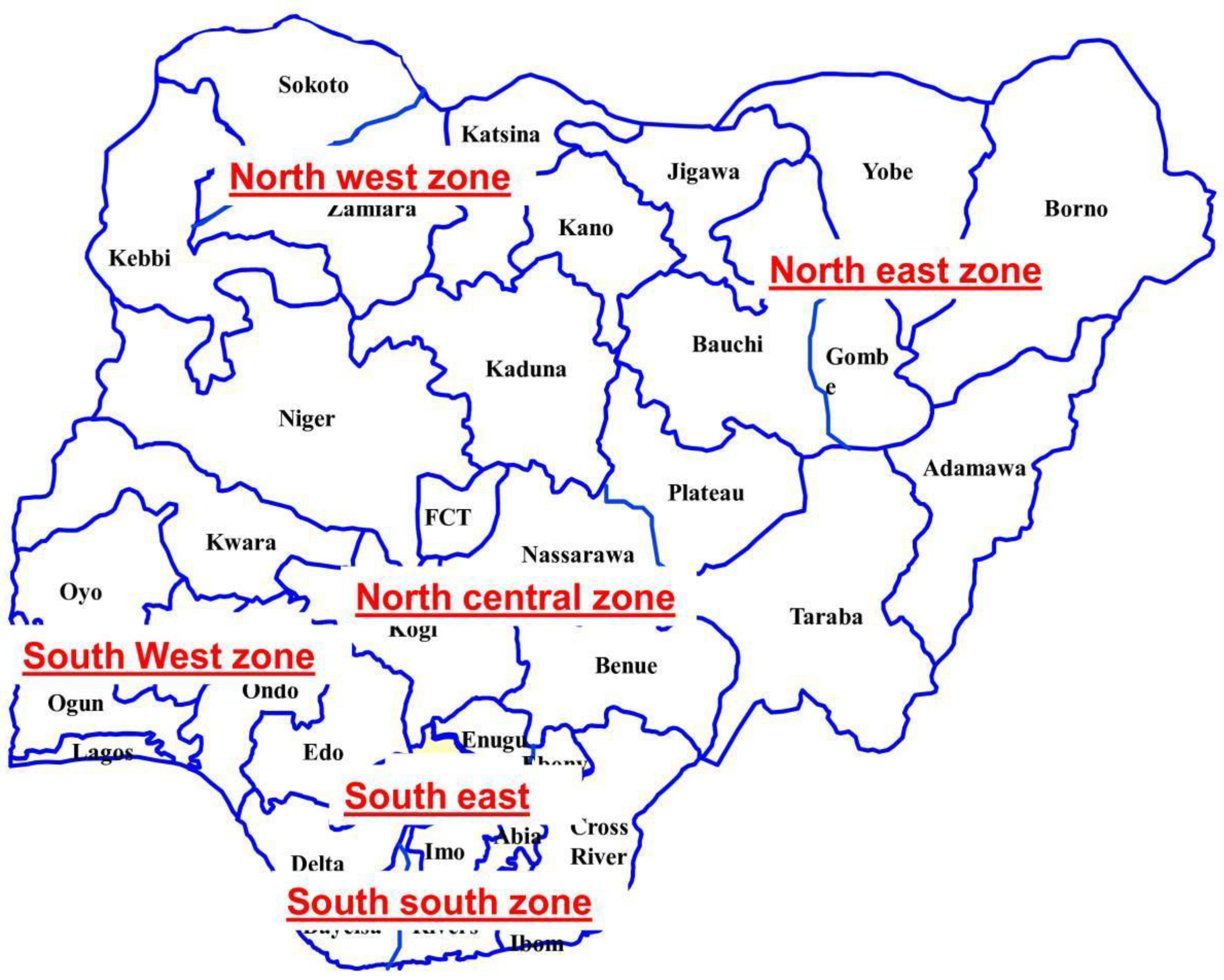
Figure 2.
Map of Nigeria showing the six geopolitical zones and key regions referenced in the reviewed literature.
Figure 2.
Map of Nigeria showing the six geopolitical zones and key regions referenced in the reviewed literature.
Ecological-Justice Discourse
The most dominant theme of this discourse is environmental degradation and dispossession. Within this framing, oil spills, gas flaring and mining induced deforestation are portrayed as ecological and social crises that undermine community well-being. Closely related are justice and reparative claims, where environmental harm is interpreted through the language of rights. In these texts, justice extends beyond compensation to encompass recognition of dignity, heritage and collective survival. To offer a more detailed distinction of environmental and justice discourses, Table 2 outlines how texts describe extraction and its ecological consequences. Most sources frame oil exploration and illegal mining as an activity that exacerbates environmental degradation, which also destroys the means of livelihoods of farmers and fishermen. Discussions of harm often shift from material degradation to questions of rights, accountability, and reparation. The meaning of “ecological justice” varies across the literature. In some texts, it refers to the biophysical recovery of polluted landscapes, while in others it represents a moral and political claim for fairness and restitution.
Another recurring feature is community resistance and activism. Local movements and civil society actors demand remediation and redistribution of resource benefits. These mobilizations are often rooted in historical memory, linking present-day struggles to colonial and corporate patterns of exploitation. A smaller but emerging strand of writing introduces post-extractive imagination, envisioning sustainable alternatives to the fossil-fuel economy.
Displacement Discourse
The displacement discourse frames resource wealth as a selective blessing that benefits political elites and their networks while excluding the majority from its gains. Resource rents, rather than driving national development are frequently absorbed into elite consumption and patronage. This pattern reflects broader trends observed across many resource-rich African states, where governance institutions consolidate rentier privilege instead of redistributing wealth (Ijere 2015). In Table 3, the resource curse is redefined as a lived condition of exclusion in which prosperity for a few coincides with deepening poverty and dispossession for many.
A central feature of this discourse is its focus on the social consequences of exclusion. Mismanaged resource rents generate both material deprivation and symbolic injustice: thereby fostering resentment among young people who see little benefit from the nation’s wealth. Reports from the African Security Sector Network (2023) and the United Nations Security Council (2022) describe how unemployment, pollution and the loss of farmland have combined to make youth in affected communities more vulnerable to criminal recruitment. The analysis by Ajide and Alimi (2021) connects ecological decline to cycles of violence, showing that economic marginalization and weak governance together create fertile ground for insecurity.
The displacement discourse also highlights how global capital reinforces these patterns of inequality. Reports frequently cite the involvement of Chinese mining firms in Maradun and other localities where foreign actors collaborate with politically exposed persons. These partnerships displace local farmers, strip communities of land and integrate Nigeria’s extractive peripheries into global supply chains of accumulation. The discourse also identifies a generational dimension to displacement. In areas such as Plateau and Zamfara, children are drawn into artisanal mining as families lose agricultural land and economic alternatives. The National Early Warning Centre (2025) links these developments to school dropout, child labor and food insecurity. This portrayal casts youth as both victims and participants in disorder. Such framing reinforces state narratives that justify militarized interventions while obscuring the structural neglect that underlies youth vulnerability.
Criminal-Economy Discourse
While overlap among discourses linking extraction, insecurity and governance failure was expected, the analysis shows that the criminal-economy discourse carries distinct ideological and rhetorical features. Take for instance the translation of “Illicit economies of extraction” with “Securitization of informality”, which produces subtle yet significant differences in how illegality is represented: in both, mining is framed as a problem of disorder, but the former highlights its economic networks while the latter stresses a threat to sovereignty. A similar tension appears between "Elite complicity and state capture" and "Moral economy of corruption"; and while both examine the entanglement of governance and illegality, they differ on who they apportion blame. The first focuses on the misconduct of individual actors such as politicians, security forces, and local elites, while the second highlights a systemic tolerance of corruption as a mode of rule.
These thematic differences reveal that illegal mining is not simply a matter of law enforcement, but a moral and political category shaped by discourse. By portraying artisanal miners as “criminal actors masquerading as miners” (see table 4) and and framing banditry as an externalized threat, state narratives produce a geography of moral distinction between the lawful center and the unruly periphery. Such framing allows coercive governance to appear necessary and even benevolent; in this sense the criminal-economy discourse operates as a technology of power that legitimizes the militarization of resource spaces while deflecting scrutiny from the institutional and economic conditions that make informal extraction possible.
As Table 5 shows, in recent years Zamfara State in northwestern Nigeria has emerged as a hotspot in the convergence of illicit mining, banditry, and terrorism, as many security officials assert that the surge in rural banditry in the area is due to violent criminal factions competing for control over these mineral resources. These criminal groups often operate with the aid of some local chieftains, political figures, and foreign actors to escalate local violence to create conditions favorable for continued exploitation of mineral resources (Kleffmann et. al. 2024; Ojewale, 2025). According to Nigeria's Presidential Artisanal Gold Mining Development Initiative (PAGMI), between 2012 and 2018, about 97 tons of gold valued at over $3 billion were smuggled out of Nigeria, much of it believed to originate from Zamfara and other mineral-rich regions. This dynamic illustrates how illegal mining of mineral resources in Nigeria becoming a significant funding stream for non-state armed groups.
In many West and Central African countries, terrorist financing is increasingly linked to direct involvement in illegal mining rather than exclusive dependence on external sponsors or diaspora funding (UN Security Council, 2022). These groups typically thrive where state capacity is weak and legal frameworks for resource management are inadequate or easily circumvented (African Union, 2024). Groups like Boko Haram and Islamic State West Africa Province have evolved from occasional resource raiding to seeking control over mining sites (UN Security Council, 2022). Proceeds from such ventures are then laundered through informal financial systems, making detection and disruption difficult (UN Security Council, 2022).
Active and Passive Discourses of Resource Governance
The scoped literature frames “resource governance” largely in active terms, emphasizing what can be done to manage or reform extractive sectors. These include discourses on ecological justice and insecurity, both of which assume that policy intervention or improved governance can mitigate inequality and violence. The absence of passive framings that portray extractive outcomes as inevitable or beyond institutional control extends the critiques of the resource curse thesis and how underdevelopment is understood. Few texts describe structural constraints such as global commodity dependence, historical patterns of extraction, or colonial legacies as fixed determinants of current realities. Most studies instead attribute Nigeria’s extractive challenges to correctable governance failures, implying that political will and institutional design remain decisive.
Who Controls the Resources?
The discourses reveal a persistent tension between state-centered control and community autonomy in resource governance. The criminal economy discourse emphasizes the authority of the state and its agencies to manage extraction through regulation, enforcement and surveillance. These narratives construct the government as the legitimate guardian of national resources, even when the same texts acknowledge corruption and weak institutional capacity. In contrast, ecological-justice and displacement discourses highlight community struggles for participation and recognition; framing control as a matter of distributive and procedural justice rather than mere regulation.
While policy and government publications often portray state intervention as essential for restoring order, academic and civil-society perspectives advocate for more inclusive governance, arguing that communities should have a meaningful voice in decisions about resource access and environmental remediation. This tension illustrates the contested nature of control in Nigeria’s extractive landscape, where both state and non-state actors claim legitimacy over natural resources. In practice, the balance of control frequently favors political and economic elites, yet ecological justice discourses continue to challenge this dominance by asserting alternative visions of stewardship, accountability and shared ownership.
The Community’s Voice
Majority of the texts in the archive rely on policy analysis, quantitative data, or secondary materials, leaving limited attention to lived experience and local narratives. This limited representation may be due to the security risk involved in conducting ethnographic studies or interviews in these mining communities. Despite this scarcity of direct community authorship, the community’s voice is relatively present throughout the archive, mediated through researchers, journalists and civil-society organizations and expressed through various innovative methodologies.
Across these mediated accounts, communities are consistently portrayed as victims of dispossession, pollution, and exclusion from decision-making. The most common themes associated with community perspectives include calls for environmental justice, equitable redistribution of resource revenues and protection of local livelihoods. In the Niger Delta and the North-West mining belts, these voices emphasize autonomy, survival and dignity in the face of ecological degradation and state neglect. Through these discourses, the community emerges not only as a subject of suffering but also as a moral agent seeking recognition, fairness and control over its environmental and economic future.
Discussion
Resource governance in Nigeria is deeply entangled with questions of power, legitimacy and control. The “resource curse,” often framed as an economic pathology, is reconstituted in the scoped literature as a crisis of political control and institutional fragility. Resource management becomes a means of exercising authority, defining legitimacy and asserting sovereignty in regions where state presence is often thin or contested. With ecological-justice discourses framing extraction as a violation of both human and environmental integrity, the literature on the Niger Delta and emerging mining regions links ecological degradation to social dislocation, health crises and the erosion of communal autonomy (Watts, 2010; Awodezi and Mohammed, 2023).
The criminal-economy discourse illustrates how control over extraction shifts from the state to armed networks, criminal cartels, and local elites. The 2025 NEWC report depicts this as a form of fragmented sovereignty: where armed groups and political patrons sustain joint ventures that blur the line between legality and criminality. This parallels earlier analyses by Ross (2003) and Le Billon (2001) but extends the framework by positioning extraction as a mode of governance itself. In this view, illegal mining and banditry do not merely resist state control; they replicate and mirror it, creating alternative orders of taxation, labor regulation, and security.
Within the criminal discourse, intergovernmental organizations echo the technocratic optimism of the liberal peacebuilding model. These approaches emphasize transparency, accountability and state rebuilding as remedies for corruption and violence: a stance typified in the African Union (2024) and the World Bank (2011) reports. However, as Akinola (2018) and Natorski (2011) suggest these solutions often reproduce dependency on external expertise and overlook the structural inequalities that enable extractive violence in the first place.
Conclusion
While the resource curse remains a persistent theme across many developing economies, it is not a universal; some peripheral states exemplify a judiciously use of their natural wealth. For instance, Botswana, despite its peripheral position in the global economy, has effectively governed its diamond sector, achieving steady economic growth (Gandu, 2011). Similarly, several countries in the MENA region such as Oman, Bahrain, and the United Arab Emirates have leveraged oil revenues to promote relative economic stability (Drine, 2012). The experiences of these countries highlight the centrality of institutional quality, accountability and governance capacity in mediating the impacts of resource wealth (Mehlum, Moene, & Torvik, 2006).
In the case of Nigeria, the discourse reveals a complex interplay between global extraction regimes, local power structures and limited community agency (Watts, 2010; Obi, 2010). In much of the scoped literature, local voices remain marginalized in decision-making and scholarly framing. However, the increasing use of satellite imagery to monitor mining activities offers new methodological avenues for capturing on-the-ground realities (Charou et al., 2010; Davie, 2024; Avtar et al., 2021). A compelling case is the use of satellite imagery in capturing the ongoing struggles over control of gold mines in Sudan, particularly in Darfur, and more recently in RSF (Rapid Response Force)-controlled regions. where struggles over control of gold mines have been widely documented. Satellite-based monitoring has been instrumental in revealing the spatial expansion of mining sites and associated patterns of violence: resulting in both human casualties and severe ecological degradation (Wang et al., 2013).
Appendix A. Literature Included in the Scoping Review (1999–2025).
| Author(s) and Year | Title / Report | Source / Publisher | Type | |
| 1 | Ojewale (2025) | Undermining Peace: Banditry, Gold, and Elite Collusion in Northwest Nigeria | Deviant Behavior | Peer-Reviewed Journal |
| 2 | Kleffmann et al. (2024) | Banditry Violence in Nigeria’s Northwest: Insights from Affected Communities | UNIDIR | IGO Report |
| 3 | NEWC (2025) | Blood and Treasure Report | Office for Strategic Preparedness and Resilience | Government Report |
| 4 | Ogbonnaya (2020) | Illegal Mining and Rural Banditry in North West Nigeria | Policy Brief | Policy Report |
| 5 | Ikelegbe (2006) | The Economy of Conflict in the Oil-Rich Niger Delta | Nordic Journal of African Studies | Journal Article |
| 6 | Watts (2010) | Resource Curse? Governmentality, Oil and Power in the Niger Delta | Geopolitics | Journal Article |
| 7 | Akinola (2018) | Globalization, Democracy and Oil Sector Reform in Nigeria | Palgrave Macmillan | Book |
| 8 | Aderonmu (2010) | Rural Poverty Alleviation and Democracy in Nigeria’s Fourth Republic | Current Research Journal of Social Science | Journal Article |
| 9 | Awodezi & Mohammed (2023) | Oil Pipelines Vandalism and Oil Theft: Security Threat to Nigerian Economy and Environment | Journal of Environmental Law and Policy | Journal Article |
| 10 | Ijere (2015) | The Resource Curse in Nigeria: Lessons and Policy Options | Int. J. of Research in Humanities and Social Studies | Journal Article |
| 11 | Azgaku & Osuala (2015) |
The Socio-Economic Effects of Colonial Tin Mining on the Jos Plateau (1904–1960) |
Developing Country Studies | Journal Article |
| 12 | James, Olaniyi, & Olatubosun (2022) | Investigating the Environmental Sustainability Issues of Oil and Gas Operations in the Niger Delta | Sustainable Energy and Allied Disciplines | Journal Article |
| 13 | Klieman (2012) | U.S. Oil Companies, the Nigerian Civil War, and the Origins of Opacity | Journal of American History | Journal Article |
| 14 | Ogunsola (2023) | Cost of Governance and Economic Development in Nigeria | Journal of Business Management & Accounting | Journal Article |
| 15 | African Liberty (2019) | Nigerian Lawmakers Are Eating the Country’s Wealth with Insane Allowances | African Liberty | NGO/Media Source |
| 16 | Stober (2018) | Nigeria’s Senators and Their Jumbo Pay | ResearchGate | Commentary |
| 17 | African Union (2024) | Enhancing Mechanisms for Curbing Illegal Exploitation of Natural Resources | AU Commission | IGO Report |
| 18 | UN Security Council (2022) | Proceeds from Exploitation and Terrorism Financing | United Nations | IGO Report |
| 19 | NRGI (2015) | The Resource Curse Revisited | Natural Resource Governance Institute | Policy Report |
| 20 | African Security Sector Network (2023) | Youth, Violence, Exclusion and Injustice | ASSN | Regional Policy Report |
| 21 | Gandu (2012) | Analytical Basis for Botswana’s Diamond-Enclave Growth: Lessons for Nigeria | Research Paper | Comparative Study |
| 22 | NEITI (2022a) | Oil and Gas Industry Audit Report | Nigeria Extractive Industries Transparency Initiative | National Report |
| 23 | NEITI (2022b) | Solid Minerals Industry Report | Nigeria Extractive Industries Transparency Initiative | National Report |
| 24 | PAGMI (2021) | Framework and Progress Report | Presidential Artisanal Gold Mining Development Initiative | National Report |
| 25 | MMSD (2016) | Roadmap for the Growth and Development of the Nigerian Mining Industry | Federal Ministry of Mines & Steel Development | Policy Document |
| 26 | NDDC (2004) | Niger Delta Regional Development Master Plan | Niger Delta Development Commission | Development Plan |
| 27 | NOSDRA (2020) | Annual Oil Spill Data Report | National Oil Spill Detection and Response Agency | Environmental Report |
| 28 | NEITI–EITI (2019) | Nigeria EITI Validation Report | Extractive Industries Transparency Initiative | Validation Report |
| 29 | NUPRC (2023) | Annual Report | Nigerian Upstream Petroleum Regulatory Commission | Annual Report |
| 30 | Kyowe et al. (2024) | Index of heavy metal pollution and health risk assessment with respect to artisanal gold mining operations in Ibodi-Ijesa, Southwest Nigeria | Journal of Trace Elements and Minerals | Journal Article |
| 31 | International Crisis Group (2022) | Violence in Nigeria’s North West: Rolling Back the Mayhem | ICG | Conflict Report |
| 32 | Amnesty International (2009) | Nigeria: Petroleum, Pollution and Poverty in the Niger Delta | Amnesty International | NGO Report |
| 33 | Human Rights Watch (1999) | The Price of Oil: Corporate Responsibility and Human Rights Violations in Nigeria | HRW | NGO Report |
| 34 | Amos (2025) | Digging into the Future | ATHENA Centre (Nigeria) | Policy Report |
| 35 | World Bank (2011) | World Development Report: Conflict, Security and Development | World Bank | Global Report |
| 36 | AfDB | Africa’s natural resources: The paradox of plenty | African Development Bank | Report |
References
- Abbink, J. Being young in Africa: The politics of despair and renewal. In Vanguard or vandals: Youth, politics and conflict in Africa; Abbink, J., van Kessel, I., Eds.; Brill, 2005; pp. 1–34. [Google Scholar]
- Ajide, K. B.; Alimi, O. Y. Environmental impact of natural resources on terrorism in Africa. Resources Policy 2021, 73, 102133. [Google Scholar] [CrossRef]
- Aderonmu, Jonathan. Rural Poverty Alleviation and Democracy in Nigeria’s Fourth Republic (1999-2009). Current Research Journal of Social Science 2010. [Google Scholar]
- African Development Bank. (2007). Africa’s natural resources: The paradox of plenty (Chap. 4). In African development report 2007 (pp. 96–138). African Development Bank Group. https://www.afdb.org/fileadmin/uploads/afdb/documents/publications/(e)%20africanbank%202007%20ch4.pdf.
- African Security Sector Network. (2023). Youth, Violence, Exclusion and Injustice: Knowledge and Lessons Learnt from Africa for Positioning Inclusive Democratic Governance. https://www.africansecuritynetwork.org/.
- African Union. Discussion on enhancing mechanisms for curbing illegal exploitation of natural resources by armed and terrorist groups. 2024. [Google Scholar]
- Akinola, A.O. The Structure and Nature of the Nigerian State. In Globalization, Democracy and Oil Sector Reform in Nigeria. African Histories and Modernities; Palgrave Macmillan: Cham, 2018. [Google Scholar] [CrossRef]
- Arksey, H.; O’Malley, L. Scoping studies: Towards a methodological framework. International Journal of Social Research Methodology 2005, 8(1), 19–32. [Google Scholar] [CrossRef]
- Avtar, R.; Kouser, A.; Kumar, A.; Singh, D.; Misra, P.; Gupta, A.; Yunus, A. P.; Kumar, P.; Johnson, B. A.; Dasgupta, R.; Sahu, N.; Besse Rimba, A. Remote Sensing for International Peace and Security: Its Role and Implications. Remote Sensing 2021, 13(3), 439. [Google Scholar] [CrossRef]
- Awodezi, H.; Mohammed, S. U. Oil pipelines vandalism and oil theft: Security threat to Nigerian economy and environment. Journal of Environmental Law and Policy 2023, 3(1), 171–188. [Google Scholar] [CrossRef]
- Arrighi, G. The long twentieth century: Money, power, and the origins of our times; Verso, 1994. [Google Scholar]
- Alumona, I.M.; Azom, S.N. Politics of Identity and the Crisis of Nation-Building in Africa. In The Palgrave Handbook of African Politics, Governance and Development; Oloruntoba, S., Falola, T., Eds.; Palgrave Macmillan: New York, 2018. [Google Scholar] [CrossRef]
- Autesserre, S. The trouble with the Congo: Local violence and the failure of international peacebuilding; Cambridge University Press, 2010. [Google Scholar]
- Auty, R.M. Sustaining Development in Mineral Economies: The Resource Curse Thesis. Routledge, London, 1993. [Google Scholar]
- Azgaku, C. B. A.; Osuala, U. S. The socio-economic effects of colonial tin mining on the Jos-Plateau: 1904-- 1960. Developing Country Studies 2015, 15 5(14). [Google Scholar]
- Badeeb, R. A.; Lean, H. H.; Clark, J. The evolution of the natural resource curse thesis: A critical literature survey. Resources Policy 51 2017, 123–134. [Google Scholar] [CrossRef]
- Boege, V.; Brown, A.; Clements, K. Hybrid political orders, not fragile states: State formation in the context of ‘fragility’; Berghof Research Center for Constructive Conflict Management: Berlin, 2009. [Google Scholar]
- Bunker, Stephen G.; Ciccantell, Paul S. Globalization and the Race for Resources; The Johns Hopkins University Press: Baltimore, MD, 2005. [Google Scholar]
- Bunker, Stephen G.; Ciccantell, Paul S. East Asia and the Global Economy: Japan’s Ascent, with Implications for China’s Future; The Johns Hopkins University Press: Baltimore, MD, 2007. [Google Scholar]
- Cederman, L.; Wimmer, A.; Min, B. Why Do Ethnic Groups Rebel?: New Data and Analysis. World Politics 2010, 62(1), 87–119. [Google Scholar] [CrossRef]
- Charou, E.; Stefouli, M.; Dimitrakopoulos, D.; et al. Using Remote Sensing to Assess Impact of Mining Activities on Land and Water Resources. Mine Water Environ 2010, 29, 45–52. [Google Scholar] [CrossRef]
- Collier, P.; Hoeffler, A. Resource Rents, Governance, and Conflict. The Journal of Conflict Resolution 2005, 49(4), 625–633. http://www.jstor.org/stable/30045133. [CrossRef]
- Loria, Davie. Remote sensing and armed conflict a unique humanitarian role for geophysics; EarthScope Consortium, 22 July 2024; Volume 23. [Google Scholar]
- Dauvergne, P. Loggers and degradation in the Asia-Pacific: Corporations and environmental management; Cambridge University Press, 2001. [Google Scholar]
- De Waal, A. (Ed.). (2007). War in Darfur and the search for peace. Global Equity Initiative, Harvard University, in association with Justice Africa.
- Drine, I. ‘Successful’ Development Models in the MENA Region. Research Papers in Economics. 2012. https://ideas.repec.org/p/unu/wpaper/wp-2012-052.html.
- 27; Elbadawi, I.; Soto, R. Resource rents, institutions and violent civil conflicts. Defence and Peace Economics 2015, 26(1), 89–113. [Google Scholar] [CrossRef]
- Etefa, T. Ethnicity as a Tool: The Root Causes of Ethnic Conflict in Africa—A Critical Introduction. In The Origins of Ethnic Conflict in Africa. African Histories and M odernities; Palgrave Macmillan: Cham, 2019. [Google Scholar] [CrossRef]
- Fairclough, N. Critical discourse analysis: The critical study of language, 2nd ed.; Routledge, 2013. [Google Scholar]
- Fischer, F. Reframing public policy: Discursive politics and deliberative practices; Oxford University Press, 2003. [Google Scholar]
- Flint, J.; De Waal, A. Darfur: A new history of a long war; Zed Books, 2008. [Google Scholar] [CrossRef]
- Foster, J. B. Marx’s ecology: Materialism and nature; Monthly Review Press, 2000. [Google Scholar]
- Gandu, Y.K. An Analytical Basis for Botswana's Diamond-Enclave Sustainable Economic Growth And Wellbeing: Lessons For Nigeria; 2012. [Google Scholar]
- Ijere, M. The Resource Curse in Nigeria: Lessons and Policy Options. International Journal of Research in Humanities and Social Studies 2015, 2(8), 35–44. https://www.ijrhss.org/pdf/v2-i8/5.pdf.
- Honwana, A. The time of youth: Work, social change, and politics in Africa; Kumarian Press, 2012. [Google Scholar]
- Ikelegbe, Augustine. The Economy of Conflict in the Oil Rich Niger Delta Region of Nigeria. African and Asian Studies 2006, 5, 23–56. [Google Scholar] [CrossRef]
- James, R. T.; Olaniyi, T. K.; Olatubosun, P. Investigating the environmental sustainability issues of oil and gas operations in the Niger Delta region of Nigeria. In Sustainable Energy and Allied Disciplines; 2022. [Google Scholar]
- Klieman, K. A. U.S. Oil Companies, the Nigerian Civil War, and the Origins of Opacity in the Nigerian Oil Industry. The Journal of American History 2012, 99(1), 155–165. http://www.jstor.org/stable/41510311. [CrossRef]
- Le Billon, P. The political ecology of war: Natural resources and armed conflicts. Political Geography 2001, 20(5), 561–584. [Google Scholar] [CrossRef]
- Levac, D.; Colquhoun, H.; O’Brien, K. K. Scoping studies: Advancing the methodology. Implementation Science 2010, 5, 69. [Google Scholar] [CrossRef]
- Kara, Siddharth. Cobalt Red: How the Blood of the Congo Powers Our Lives; St. Martin’s Press: New York, 2023. [Google Scholar]
- Kleffmann, J.; Ramachandran, S.; Cohen, N.; O’Neil, S.; Bukar, M.; Batault, F.; Van Broeckhoven, K. Banditry violence in Nigeria’s Northwest: Insights from affected communities (Findings Report No. 36); UNIDIR, 2024. [Google Scholar] [CrossRef]
- Costello, Matthew. Oil Ownership and Domestic Terrorism. In Non-State Violent Actors and Social Movement Organizations: Influence, Adaptation, and Change; 2017. [Google Scholar]
- Mamdani, M. Citizen and subject: Contemporary Africa and the legacy of late colonialism; Princeton University Press, 1996. [Google Scholar]
- Mehlum, H.; Moene, K.; Torvik, R. Institutions and the resource curse. The Economic Journal 2006, 116(508), 1–20. [Google Scholar] [CrossRef]
- Moore, J. W. Capitalism in the web of life: Ecology and the accumulation of capital; Verso, 2015. [Google Scholar]
- Tahir, Muhammad; Khan, Muhammad Mumtaz. Do natural resources invite terrorism: evidence from resource-rich region. Journal of Economic and Administrative Sciences 2024. [Google Scholar] [CrossRef]
- Natorski, M. The liberal peacebuilding approach: debates and models. In The European Union Peacebuilding Approach: Governance and Practices of the Instrument for Stability; Peace Research Institute Frankfurt, 2011; pp. 3–7. http://www.jstor.org/stable/resrep14480.4.
- National Early Warning Centre (NEWC). Blood and Treasure report; Office for Strategic Preparedness and Resilience, 2025. [Google Scholar]
- Natural Resource Governance Institute (NRGI). The Resource Curse Revisited. 2015. https://resourcegovernance.org/sites/default/files/nrgi_Resource-Curse.pdf.
- Obi, C. Oil extraction, dispossession, resistance, and conflict in Nigeria’s oil-rich Niger Delta. Canadian Journal of Development Studies 2010, 30(1–2), 219–236. [Google Scholar] [CrossRef]
- Ogbonnaya. Illegal mining and rural banditry in North West Nigeria (Policy Brief) 2020.
- Onah, Emmanuel; Nwali, Uche. Monetisation of electoral politics and the challenge of political exclusion in Nigeria. Commonwealth & Comparative Politics 2018, 56. 1–22. [Google Scholar] [CrossRef]
- Ogunsola, A. Cost of governance and economic development in Nigeria: An empirical analysis of the presidency, the national assembly, and the judiciary expenditure. Journal of Business Management & Accounting 2023, 13(1), 31–55. https://www.researchgate.net/publication/367544637.
- Ojewale, O. Undermining Peace: Banditry, Gold, and Elite Collusion in Northwest Nigeria. Deviant Behavior 2025, 1–20. [Google Scholar] [CrossRef]
- Vesco, Paola; Dasgupta, Shouro; De Cian, Enrica; Carraro, Carlo. Natural resources and conflict: A meta-analysis of the empirical literature. In Ecological Economics; 2020; Volume 172. [Google Scholar] [CrossRef]
- Riaz, M. F.; Liaqat, S.; Bashir, F.; Boota, M. From Shadows to Structures: Unveiling the Terrorism-Corruption Nexus in Developing Countries through Structural Equations Modeling (SEMs). Pakistan Journal of Humanities and Social Sciences 2024, 12(2), 1658–1666. [Google Scholar] [CrossRef]
- Richards, P. No peace, no war: An anthropology of contemporary armed conflicts; Ohio University Press, 2005. [Google Scholar]
- Robinson, James; Acemoglu, Daron. Why Nations Fail: The Origins of Power, Prosperity, and Poverty; Random House, 2012; http://www.randomhouse.com.
- Rodney, W. How Europe underdeveloped Africa, 2nd ed.; Verso, 2018. [Google Scholar]
- Ross, M. The Natural Resource Curse: How Wealth Can Make You Poor. In Natural Resources and Violent Conflict: OPTIONS AND ACTIONS; Bannon, I., Collier, P., Eds.; World Bank, 2003; pp. 17–42. http://www.jstor.org/stable/resrep02485.7.
- 62; Ross, M. L. What Do We Know about Natural Resources and Civil War? Journal of Peace Research 2004, 41(3), 337–356. [Google Scholar] [CrossRef]
- Sachs, J. D.; Warner, A. M. The curse of natural resources. European Economic Review 2001, 45(4–6), 827–838. [Google Scholar] [CrossRef]
- Ghatak, Sambuddha; Karakaya, Suveyda. Terrorists as rebels: Territorial goals, oil resources, and civil war onset in terrorist campaigns. In Foreign Policy Analysis; 2021. [Google Scholar] [CrossRef]
- Shore, C., & Wright, S. (Eds.). (1997). Anthropology of policy: Critical perspectives on governance and power. Routledge.
- Sommers, M. Stuck: Rwandan youth and the struggle for adulthood; University of Georgia Press, 2011. [Google Scholar]
- Stearns, J. K. Dancing in the glory of monsters: The collapse of the Congo and the great war of Africa; PublicAffairs, 2011. [Google Scholar]
- UN Security Council. Concerns over the use of proceeds from the exploitation, trade and trafficking of natural resources for terrorism financing. 2022. [Google Scholar]
- Uvin, P. Aiding violence: The development enterprise in Rwanda; Kumarian Press, 1998. [Google Scholar]
- Wallerstein, I. The modern world-system: Capitalist agriculture and the origins of the European world-economy in the sixteenth century (Vol. I); Academic Press, 1974. [Google Scholar]
- Wang, B.Y.; Raymond, N.; Gould, G.; Baker, I. Problems from Hell, Solution in the Heavens?:Identifying Obstacles and Opportunities for Employing Geospatial Technologies to Document and Mitigate Mass Atrocities. Stability: International Journal of Security and Development 2013, 2(3), Art. 53. [Google Scholar]
- Watts, M. Resource curse? Governmentality, oil and power in the Niger Delta. Geopolitics 2010, 9(1), 50–80. [Google Scholar] [CrossRef]
- World Bank. World Development Report 2011: Conflict, security and development; World Bank: Washington, DC, 2011. [Google Scholar]
Figure 1.
Flow of Literature Identification and Selection.
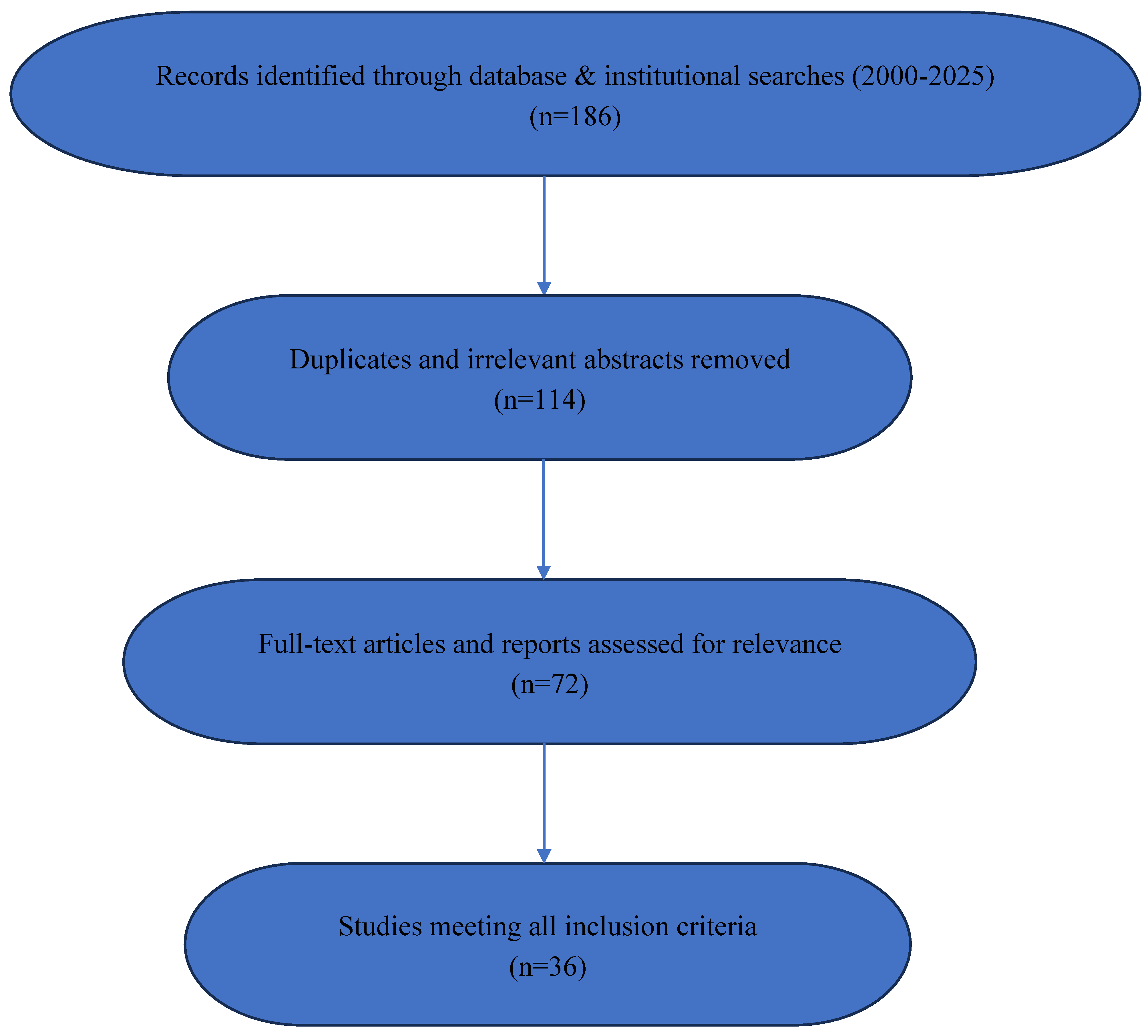

Table 1.
Archive demographics.
| Subgroups | # of Texts (Total = 36) | |
|---|---|---|
| Author Identity | Researcher / Academic |
24 |
| Policy Analyst / Think-Tank Author (e.g., Ogbonnaya, NRGI, AfDB) |
6 | |
| Government Agency (e.g., NEWC, OSPRE) | 3 | |
|
Intergovernmental Organization (e.g., AU, World Bank) |
2 |
|
| NGO Representative / Civil Society |
1 | |
| Decade of Publication | 1999–2010 | 8 |
| 2011–2020 | 12 | |
| 2021–2025 | 16 | |
| Geographic Focus | Niger Delta (Rivers, Bayelsa, Delta, Akwa Ibom, Cross River, Edo) | 8 |
| Zamfara State (North-West) | 14 | |
| Plateau State (Jos Plateau) | 4 | |
| Kaduna / Katsina / Sokoto (North-West) | 3 | |
| Nasarawa / Kogi / Niger (North-Central) | 3 | |
| Borno / Yobe (North-East) | 2 | |
| Abuja (Federal Capital Territory) and national |
2 | |
| Publication Type | Peer-Reviewed Journal Article | 10 |
| Policy or Research Report | 12 | |
| Book Chapter / Monograph | 5 | |
| Government Publication | 6 | |
| NGO / Institutional Publication | 3 |
Table 2.
Ecological-Justice Discourse.
| Theme | Description | Representative Quotations from Archive Literature | No. of Texts (Cited in Archive) |
|---|---|---|---|
| Environmental degradation and dispossession | Connects extraction to pollution, land loss, and declining community health, especially in the Niger Delta. |
“The heart of the ecological harms stem from oil spills-either from the pipelines which criss-cross Ogoniland...” “If you want to go fishing, you have to paddle for about four hours through several rivers before you can get to where you can catch fish and the spill is lesser…some of the fishes we catch, when you open the stomach, it smells of crude oil.” |
9 |
| Community resistance and activism | Highlights local mobilizations demanding remediation and redistribution of resource benefits. |
“In Delta state, youths have been known to demand development levy for the land occupied and employment for community youths from oil companies and other firms”. “Youths from the Umuechem community demanded provision of electricity, water, roads, and other compensation for oil pollution of crops and water supplies”. |
7 |
Table 3.
Displacement Discourse.
| Theme | Description | Representative Quotations from Archive Literature | No. of Texts (Cited in Archive) |
|---|---|---|---|
| Youth Marginalization and Unemployment | Links exclusion from resource benefits to youth frustration, unemployment, and vulnerability to violence. | “Young people are made vulnerable to exploitation by the state and forced to partner with government actors who have little legitimacy within their community, in order to gain access to the resources they require for their work”. “Mining activities often attract entire families displaced by poverty or environmental stress, drawn to mining areas in search of livelihood”. |
7 |
| Livelihood Loss and Displacement |
Shows how extraction and land acquisition push communities into poverty and dislocation. |
“When mining concessions are granted—often without adequate resettlement planning—entire communities are uprooted” “Land expropriation by government creates scarcity of land which negatively affects the traditional occupation of the people which could also lead to communal clashes and violence” |
5 |
Table 4.
Criminal-Economy Discourse.
| Theme | Description | Representative Quotations from Archive Literature | No. of Texts (Cited in Archive) |
|---|---|---|---|
| Illicit economies of extraction | Positions artisanal and small-scale mining (ASM) as a criminalized economy intertwined with violence and informal taxation. | “The illicit enterprise has drawn in local and foreign migrants and led criminal syndicates to resort to deadly violence in protecting their access to minerals” “Bandit leaders operate parallel systems of taxation over mining communities.” |
10 |
| Elite complicity | Frames political elites, military officers, and traditional leaders as beneficiaries of illegal extraction networks. | “Illegal miners front for politically connected individuals who collaborate with foreign nationals and corporations to smuggle and sell gold via neighbouring countries”. “Traditional authorities act as silent shareholders in illegal mining ventures.” |
8 |
| Moral economy of corruption | Depicts corruption not as deviation but as a normalized governance practice within resource frontiers. | “a regime of violent and armed resistance by youth militias and militant groups principally in response to state repression and corporate violence and as part of actions to compel concessions in respect of self-determination, regional autonomy, resource control and greater oil-based benefits”. “Local miners pay levies to both bandits and security agents in exchange for safety and access to sites, creating a complex web of informal governance”. |
7 |
| Securitization of informality | Treats artisanal miners as security threats, legitimizing state coercion and militarized responses. | “Criminal actors masquerading as miners must be neutralized to protect state sovereignty.” | 4 |
Table 5.
The Geography of Mining and Conflict.
| Region | Mineral Resource(s) | Conflict Actor(s) | Key Features |
|---|---|---|---|
| Zamfara (NW) | Gold, laterite | Armed bandits, Fulani militias | Epicenter of extractive conflict, declared terrorist zone by FG |
| Shiroro, Niger State (NC) | Gold | Boko Haram, ISWAP factions | Mining sites used as abduction zones |
| Benue (NC) | Gold, lithium | Local militias, foreign-linked cartels | Illegal mining intertwined with boundary disputes and land grabs |
| Oyo (SW) | Gold, tourmaline | Corporate actors, criminal networks | Urban explosion (Ibadan) tied to black-market explosives for mining |
| Birnin Gwari, Kaduna (NW) | Tin, sapphire | Bandits, terrorist collaborators | Cross-border refuge zone for militants from Zamfara |
| Plateau State (NC) | Tin, uranium | Historical site of resource conflict | Sites now reoccupied by ASM and affected by radioactive contamination |
Source: Created by author using the Office for Strategic Preparedness & Resilience report, 2025.
Disclaimer/Publisher’s Note: The statements, opinions and data contained in all publications are solely those of the individual author(s) and contributor(s) and not of MDPI and/or the editor(s). MDPI and/or the editor(s) disclaim responsibility for any injury to people or property resulting from any ideas, methods, instructions or products referred to in the content. |
© 2026 by the author. Licensee MDPI, Basel, Switzerland. This article is an open access article distributed under the terms and conditions of the Creative Commons Attribution (CC BY) license.
Copyright: This open access article is published under a Creative Commons CC BY 4.0 license, which permit the free download, distribution, and reuse, provided that the author and preprint are cited in any reuse.


