

Submitted:
04 January 2026
Posted:
06 January 2026
You are already at the latest version
Abstract
Intimate relationships among contemporary emerging adults frequently manifest as situationships, characterized by emotional closeness in the absence of explicit commitment. Shaped by digital culture and evolving social norms, these relationships reflect heightened uncertainty and psychological tension within modern intimacy. The present study conceptualizes situationship as a multidimensional psychological construct, including commitment ambiguity, avoidance of emotional investment, and anxiety related to relationship uncertainty. Associations with attachment anxiety, trust, and subjective well-being are also investigated.To examine these dynamics, an integrated scale development and validation methodology was employed. The results indicated a stable three-factor structure. Structural equation modeling demonstrated that experiences of situationships were positively associated with attachment anxiety and psychological distress, and negatively associated with trust and well-being. Importantly, attachment anxiety partially mediated the relationship between relational ambiguity and relationship-related well-being.These findings establish relational ambiguity as a measurable psychological construct. The study contributes to positive psychology by enhancing understanding of relationship health and emotional regulation within contemporary intimate contexts. The results suggest that interventions promoting commitment clarity and emotional openness may enhance psychological well-being in emerging forms of intimate relationships.
Keywords:
situationship
; emotional ambiguity
; attachment anxiety
; positive psychology
1. Introduction
The landscape of intimate relationships among emerging adults has undergone a profound transformation, driven by both rapid digitalization and shifting socio-cultural norms (Powell, Henry, & Flynn, 2021; Collibee & Furman, 2015). The widespread adoption of dating applications, coupled with the normalization of non-committal dating practices, has substantially disrupted the traditionally linear progression from dating to long-term commitment (Collins & Horn, 2018). Rather than functioning as a transitional stage toward committed partnerships, contemporary intimate interactions increasingly exhibit fluid boundaries, ambiguous expectations, and fluctuating levels of emotional investment (Akbulut & Weger, 2015; Hobbs, Owen, & Gerber, 2017).4
Digital communication technology now occupies a central role in relationships, fundamentally reshaping the ways individuals initiate, negotiate, and sustain interpersonal connections. Digital environments provide continuous, low-cost connectivity (Dating in captivity: creativity, digital affordance, and the organization of interaction in online dating during quarantine, 2024), increasing accessibility while reducing perceived obligations. Consequently, novel forms of intimacy have emerged that challenge traditional relational categories (Digital Intimacy: Redefining Closeness in the Modern Age, 2024).
1.1. A Subsection Sample Shifts in Relational Orientation
In this changing relational ecology, a situationship describes a pattern of intimacy that is characterized by emotional and/or physical closeness without the presence of formal labels or commitments; while situationships are often associated with impulsivity, this is not necessarily the case, particularly when compared to traditional relationships (Situationship: What it Is and 5 Signs You’re In One, 2024). Research indicates that ambiguous relationships are characterized by differing expectations between partners concerning closeness, intimacy, fidelity, and obligation (Draucker et al., 2012, pp. 174-182). Sternberg’s (1986) triangular theory defines love as comprising three components: intimacy, passion, and commitment (Sternberg, 1986, pp. 119-135). Situationships offer closeness and attraction but lack commitment. This makes them unstable and psychologically unclear. Ambiguous commitment means people are involved but without clear obligations or a secure future (Drouin & Tobin, 2014).
The increasing prevalence of situationships may also be understood within broader socio-historical contexts. During the COVID-19 pandemic, social distancing measures and prolonged isolation intensified young adults’ need for emotional connection while simultaneously heightening uncertainty about future stability (Wignall et al., 2021; Tang & Li, 2021). In such contexts, low-commitment relationships may function as adaptive short-term strategies to mitigate loneliness without incurring the perceived risks of deeper commitment. However, accumulating evidence indicates that these ambiguous arrangements often exacerbate emotional insecurity, relational anxiety, and psychological distress, thereby constituting what has been described as an uncertainty dilemma in contemporary romantic life (Dailey, LeFebvre, & Crook, 2019).
1.2. Psychological Dimensions and Theoretical Deconstruction of Situationship
Situationships are not defined by a single psychological feature; rather, they encompass complex combinations of uncertainty, attachment anxiety, and ambivalence regarding commitment (Knobloch & Solomon, 1999; Drouin & Tobin, 2014; Dailey et al., 2019). These factors generate persistent psychological tension, influencing behavior and challenging prevailing cultural conceptions of intimacy (Chu et al., 2025).
A central feature of situationships is the intentional avoidance of relational labeling and formal commitment. Previous relationships with both mothers and fathers have been shown to independently shape individuals’ perceptions and approaches to subsequent romantic relationships, suggesting that family dynamics influence behaviors such as communication patterns and willingness to discuss exclusivity or introduce partners in social contexts (Reciprocal Relations between Emerging Adults' Representations of Relationships with Mothers, Fathers, and Romantic Partners, 2019, pp. 1181-1192). Social invisibility may function as a defensive strategy reflecting anxiety about public recognition of ambiguous relationships. When individuals withhold or selectively disclose displeasing information, concerns about self-image and the integrity of the social bond may increase, resulting in less clear normative expectations and diminished validation from others (Risking the social bond: motivations to defend or to repair when dealing with displeasing information, 2021).
At the emotional level, situationships are often characterized by strategic emotional restraint. Despite physical intimacy, communication tends to remain superficial, with limited self-disclosure and mutual emotional attunement (Fahs & Munger, 2015). This pattern gives rise to what may be conceptualized as performative intimacy, wherein individuals enact closeness while maintaining psychological distance. Gendered socialization processes further intensify this dynamic, particularly for women, who may internalize norms that frame emotional expression as vulnerability and thus regulate their affective investment accordingly (Norris et al., 2021). The result is an asymmetrical emotional exchange that undermines relational security and inhibits the development of stable emotional bonds. (Adult attachment security and young adults' dating relationships over time: self-reported, observational, and physiological evidence, 2010, pp. 359-373)
Relational uncertainty theory helps explain these effects. When relationships lack clear rules or future plans, people experience more stress and find it harder to manage emotions (Knobloch & Solomon, 1999). Those with anxious attachment want closeness but fear rejection. In uncertain, low-commitment settings, they become more alert and dependent (Nunez Segovia et al., 2019; Intrieri & Margentina, 2017). Research shows that uncertainty and attachment anxiety are linked to higher anxiety, depression, and loneliness (Calvo et al., 2022). Over time, this stress can harm emotional stability and well-being (Gunlicks-Stoessel et al., 2017).
Taken together, the psychological dynamics of situationships are sustained through a recursive interaction between commitment avoidance, emotional self-protection, and relational uncertainty. Individuals remain caught between competing needs for intimacy and autonomy, rendering situationships a structurally fragile yet emotionally charged form of relationship. This phenomenon reflects a broader decoupling of emotional closeness from institutionalized commitment in contemporary intimacy, offering a critical lens for understanding rising relationship-related anxiety among emerging adults. Despite increasing scholarly and public attention to situationships and related forms of relational ambiguity—such as the talking stage and casual dating (Kindelberger et al., 2019; Jonason et al., 2015)—the psychological literature lacks a psychometrically robust instrument that comprehensively evaluates these complex phenomena. Current research often depends on proxy measures from attachment, commitment, or relationship satisfaction scales (Lee et al., 2023), and even among established self-report instruments for secure adult attachment, a systematic review identified no single measure with sufficient evidence across a broad range of psychometric properties (Self-report measures of secure attachment in adulthood: A systematic review, 2022). While informative, such indirect measures fail to adequately represent the structural interplay among emotional involvement, commitment avoidance, and relational uncertainty that defines situationships, thereby limiting conceptual clarity and empirical precision.
The primary theoretical objective of this study is to define situationship as a distinct, measurable relationship type. By developing a multidimensional model, the study aims to differentiate situationships from Friends with Benefits (FWB) and committed dating by examining emotional exchange, commitment levels, and psychological management. Situationships are characterized as emotionally intimate relationships lacking formal labels or long-term planning (Hsieh, 2023).
This study employs a systematic process to develop and validate a new scale, emphasizing reliability, validity, and structural consistency. The methodology includes theoretical development, exploratory factor analysis (EFA), confirmatory factor analysis (CFA), and validation across diverse groups. The objective is to identify the core components of situationships: commitment avoidance, limited emotional investment, and uncertainty.
The study examines whether involvement in situationships is associated with differences in attachment anxiety, anxiety sensitivity, and internalizing problems. By investigating these associations, the research seeks to illustrate the emotional costs of ambiguous relationships and assess whether situationships serve as significant sources of stress for well-being, given the established link between attachment anxiety and stress in comparable relational contexts (al., 2025, pp. 1-15, 2022). This work aims to advance understanding of how emotional uncertainty influences mental health in contemporary relationships.
2. Literature Reviews
Situationships fit within established frameworks in intimate relationship research, such as Relational Uncertainty Theory and adult attachment theory. Together, these frameworks help explain why intimacy and insecurity often coexist in low-commitment contexts (Knobloch & Solomon, 1999; Mikulincer & Shaver, 2016). Evidence shows that when labels and commitment structures are missing or unclear, people experience both closeness and unease. This combination can lead to conflicted, mentally taxing relational dynamics (Núñez Segovia et al., 2019).
2.1. Relational Uncertainly and Low-Commitment Relationships as Chronic Stressors
A central characteristic of situationships is the persistent lack of definition and predictability within the relationship. Relational Uncertainty Theory (RUT) posits that when individuals are unable to clearly discern the trajectory of the relationship, interactional objectives, or boundaries of commitment, this uncertainty increases cognitive load and provokes heightened stress and negative emotional responses (Knobloch & Solomon, 1999; Knobloch, 2007; Relational Uncertainty and Cortisol Responses to Hurtful and Supportive Messages from a Dating Partner, 2011, pp. 474-493). Subsequent research demonstrates that highly uncertain relational environments are linked to elevated anxiety, increased vigilance, and emotional exhaustion (Akbulut & Weger, 2015; Powell et al., 2021).
Uncertainty within situationships does not merely represent a transient stage of early relationship development; rather, it becomes a persistent feature of the relational dynamic. Even in the presence of intimacy, partners frequently avoid labeling the relationship or engaging in future planning. This ongoing ambiguity exposes individuals to the risk of abrupt dissolution without the protective security of commitment (Collins & Horn, 2018). Over time, such chronic uncertainty can intensify psychological strain and contribute to emotional exhaustion (Akbulut & Weger, 2015).
2.2. Adult Attachment a Driver of Insecurity in Situationships
The psychological dynamics of situationships are also closely related to individual differences in adult attachment, particularly th (Mikulincer & Shaver, 2016)e two core dimensions of attachment anxiety and attachment avoidance (Intrieri & Margentina, 2017; Núñez Segovia et al., 2019). Attachment-anxious individuals typically desire closeness and reassurance while simultaneously fearing rejection or abandonment. (The Contribution of Attachment Styles and Reassurance Seeking to Trust in Romantic Couples, 2022, pp. 1025-1045)When relational commitment is unclear, and boundaries are blurred—as in situationships—these individuals are more likely to activate hyperactivating (Situationships: The Ambiguity Trap, 2025) strategies, such as excessive reassurance seeking, persistent monitoring of partner cues, and disproportionate emotional investment to manage insecurity (Mikulincer & Shaver, 2016; Overall & Sibley, 2009). However, because low-commitment relationships often provide inconsistent or limited reassurance, these strategies may further amplify worry, rumination, and threat vigilance (Intrieri & Margentina, 2017). Consistent with this account, research on non-committed or casual relational contexts suggests that anxious individuals frequently report lower well-being and relationship-related satisfaction when intimacy cannot be translated into stable commitment (Núñez Segovia et al., 2019; Collibee & Fu (George, 2024)rman, 2015).
Individuals with attachment avoidance tend to minimize attachment needs and resist emotional dependence. Situationships may be attractive to these individuals because they provide a degree of intimacy and passion while limiting the risks associated with commitment and emotional vulnerability (Fahs & Munger, 2015). However, as emotional involvement deepens, avoidant individuals may experience increased threat and withdraw to reestablish independence (Núñez Segovia et al., 2019). Attachment orientations influence both the selection of relationship types (George, 2024) and the strategies individuals use to manage insecurity and relational tension.
2.3. Defining Situationships and Their Core Psychological Dimensions
To define situationships as a distinct, measurable concept, it is important to set their boundaries apart from similar relationship types (George, 2024). Committed dating relationships usually have clear labels, future planning, and steady commitment, which support security and role clarity. (M. et al., 2016, pp. 1-14) In contrast, situationships lack formal commitment and clear definitions (Fraley et al., 2000; Collins & Horn, 2018). Friends with Benefits relationships set clear boundaries by rejecting romance and emotional connection. (Friends with Benefits, 2023) Situationships, however, bring unclear expectations about romance and future, raising tension and confusion (Fahs & Munger, 2015; Collibee & Furman, 2015). The early talking stage is more exploratory and short-lived, while situationships often have ongoing intimacy but get stuck in an undefined state due to a lack of commitment and role boundaries (Kindelberger et al., 2020; Lee et al., 2023).
Given these distinctions, situationships should not be reduced to a single indicator such as low commitment. Instead, they are best conceptualized as a multidimensional construct of relational ambiguity, comprising three core dimensions: commitment ambiguity, emotional avoidance, and relational uncertainty anxiety. Commitment ambiguity denotes the absence of clear role definition and future commitment, often evidenced by avoidance of relationship discussions, reluctance to acknowledge the relationship publicly, and resistance to long-term planning. This structural fragility undermines stability and may decrease relationship continuity (Powell et al., 2021; Collins & Horn, 2018). Emotional avoidance encompasses defensive limitations on self-disclosure and deeper emotional exchange, serving as a strategy to maintain distance and minimize vulnerability (Fahs & Munger, 2015). Relational uncertainty anxiety involves persistent worry, rumination, and abandonment concerns arising from the interplay of commitment ambiguity and emotional avoidance, and is expected to be closely associated with attachment insecurity (Intrieri & Margentina, 2017; Núñez Segovia et al., 2019).
2.4. Relational Ambiguity and Its Consequences for Psychological and Relational Well-Being
Empirical research demonstrates that undefined romantic relationships can induce stress and emotional insecurity (Lehmiller et al., 2020; Till et al., 2022). In the absence of stable commitment and predictable relational patterns, individuals may experience persistent uncertainty, which impairs emotional regulation and negatively affects well-being (Intolerance of Uncertainty and Emotion Regulation: A Meta-Analytic and Systematic Review, 2023, pp. 194-204).
One mechanism by which ambiguous relationships generate distress is anxiety sensitivity (AS), defined as the tendency to fear anxiety-related sensations, such as a racing heart, and interpret them as catastrophic (Intrieri & Margentina, 2017). Anxiety sensitivity is a recognized risk factor for the development of anxiety and panic disorders (Verin et al., 2022). Although direct research on situationships remains limited, their inherent uncertainty and unpredictability may heighten emotional reactivity, particularly among individuals with elevated anxiety sensitivity, thereby exacerbating emotional symptoms (Calvo et al., 2022).
Relational ambiguity may also erode relationship functioning by undermining trust and communication processes. (Goodboy, 2021, pp. 403-423) When commitment is unclear and open communication about relational expectations is constrained, individuals’ emotional trust beliefs may weaken, fostering defensive interaction patterns and uncertainty about partner responsiveness (Petrocchi et al., 2020). Over time, unresolved emotional needs and ambiguous role expectations may generalize into relational disengagement and perceived disconnection (Collins & Horn, 2018). In addition, low-frequency and superficial communication can reduce interpersonal communication competence and impair dyadic problem solving and emotional bonding (Petrocchi et al., 2020). Accordingly, situationships may paradoxically increase loneliness and emotional dissatisfaction even when an intimate partner is present (Lee et al., 2023).
Stable and supportive intimate relationships are fundamental to eudaimonic well-being, encompassing self-acceptance, purpose in life, and relational fulfillment (Czyżowska et al., 2020). In contrast, situationships may lack the security and psychological support necessary for sustained well-being. Drawing on attachment theory and well-being research, the structural ambiguity and insecurity characteristic of situationships may contribute to increased attachment anxiety and diminished trust, thereby undermining psychological health and relational well-being (Calvo et al., 2022; Petrocchi et al., 2020).
2.5. Research Model and Hypothesis Development
Drawing upon prior theoretical and empirical work, situationship is conceptualized as a multidimensional latent construct comprising three first-order dimensions: commitment ambiguity (CA), emotional avoidance (EA), and relational uncertainty anxiety (RUA). These dimensions represent core psychological characteristics of relationships characterized by low commitment yet significant emotional involvement. Collectively, they delineate the structure of situationship.
From a measurement perspective, commitment ambiguity refers to the absence of clear relational roles or future commitment. Emotional avoidance denotes the defensive regulation of emotional closeness and self-disclosure. Relational uncertainty anxiety involves persistent worry arising from ambiguous expectations. All three dimensions are hypothesized to positively load onto the higher-order construct of situationship.
Building on relational uncertainty theory and adult attachment theory, it is proposed that situationship, as an overarching relational configuration, exerts downstream effects on both psychological and relational outcomes. Specifically, greater involvement in situationships is expected to be associated with increased anxiety sensitivity and psychological distress, reflecting heightened emotional vigilance and internalizing symptoms within ambiguous relational contexts. At the relational level, situationship is anticipated to undermine emotional trust beliefs and relational well-being, as the lack of commitment and emotional security impedes the development of stable, supportive bonds.
Based on attachment theory, attachment anxiety is posited as a key mechanism linking situationship to relational well-being. Situationships, characterized by ongoing intimacy without clear commitment, may trigger attachment concerns and fear of abandonment. Elevated attachment anxiety is expected to diminish relational well-being. Therefore, attachment anxiety is hypothesized to mediate the relationship between situationship and relational well-being.
The proposed research model and corresponding hypotheses are presented in Figure 1. The following hypotheses are formulated:
H1.
Commitment ambiguity (CA) is positively associated with situationship.
H2.
Emotional avoidance (EA) is positively associated with situationship.
H3.
Relational uncertainty anxiety (RUA) is positively associated with situationship.
H4.
Situationship is negatively associated with relational well-being.
H5.
Situationship is negatively associated with emotional trust beliefs.
H6.
Attachment anxiety mediates the relationship between situationship and relational well-being.
3. Research Methods
An integrated scale development and validation process was implemented to construct and validate a psychometrically robust instrument for assessing situationship. In accordance with established recommendations for scale development in the behavioral sciences (DeVellis, 2017; Hinkin, 1998), the methodological procedure included systematic item generation, independent sample collection and pilot testing, as well as comprehensive reliability and validity assessments.
In alignment with the multi-level framework of construct validity proposed by Clark and Watson (1995), both exploratory and confirmatory factor analytic techniques were utilized to establish the internal structure of the scale. Additionally, criterion-related validity analyses were conducted to evaluate the external validity of the Situationship Scale in relation to theoretically relevant psychological and relational constructs.
3.1. Research Design and Sample
A two-sample cross-sectional design was implemented, targeting individuals in emerging adulthood (ages 18–30) who were either currently involved in or had experienced a situationship within the past six months. This approach enabled independent validation at different stages of scale development and ensured sufficient sample heterogeneity to support both exploratory and confirmatory factor analyses (Fabrigar & Wegener, 2012; Worthington & Whittaker, 2006).
The first sample functioned as a pilot group for exploratory factor analysis (EFA). Over 200 participants who met the inclusion criteria were recruited through online surveys to identify the latent structure of the Situationship Scale and to conduct preliminary evaluations of item performance.
The second sample was used as a validation group for confirmatory factor analysis (CFA) and criterion-related validity testing. It consisted of more than 1,200 participants independently recruited from online communities (Perceived quality of conversations in online communities: conceptual framework, scale development, and empirical validation, 2013, pp. 498-516). This sample facilitated examination of the stability, replicability, and generalizability of the factor structure identified in the EFA (Kline, 2016; Worthington & Whittaker, 2006).
3.2. Measures
An integrated measurement battery was administered, comprising the newly developed Situationship Scale as the primary research instrument, along with several established criterion measures to evaluate convergent and discriminant validity. All items were rated on a seven-point Likert scale ranging from 1 (strongly disagree) to 7 (strongly agree).
Given that situationship has not yet been operationalized as a standardized psychological construct, an item borrowing and adaptation strategy was employed to ensure content validity and measurement rigor (Tavakol & Wetzel, 2020). Items were selected and adapted from well-validated instruments that conceptually overlapped with key features of situationship, with wording revised to align with the relational context, experiential characteristics, and theoretical framework of the study.
Situationship was conceptualized as comprising three core dimensions: commitment ambiguity (CA), emotional avoidance (EA), and relational uncertainty anxiety (RUA). Based on these dimensions, an initial pool of 25 items was generated by adapting multiple established scales. All items were subjected to semantic refinement and cultural adjustment prior to inclusion in the preliminary version of the Situationship Scale.
Table 1 displays the core dimensions, representative items, underlying measurement intentions, and original literature sources used for item adaptation. This table enhances transparency regarding the theoretical grounding and content validity of the initial item pool.
3.3. Criterion Variables and Theoretical Rationale
To evaluate the criterion-related validity of the Situationship construct, six theoretically relevant external criteria were selected to represent affective, cognitive, and relational functioning. Each criterion variable was measured using established instruments with documented reliability and validity in psychological and relationship research.
Attachment insecurity was assessed using the anxiety and avoidance subscales of the Experiences in Close Relationships–Revised (ECR-R). This construct was conceptualized as a dispositional vulnerability that may be intensified in situationship contexts, especially among individuals with heightened fears of abandonment when relational commitment and boundaries are ambiguous (Müller et al., 2024; Dupont et al., 2024). Therefore, higher levels of situationship involvement were hypothesized to be positively associated with attachment insecurity.
Psychological distress was measured using the depression and anxiety subscales of the Depression Anxiety Stress Scales–21 (DASS-21), which assess internalizing symptoms resulting from interpersonal stressors. The DASS-21’s validated structure demonstrates the interconnectedness of depression, anxiety, and stress symptoms (Psychometric Properties of the Depression Anxiety Stress Scales (DASS-42 and DASS-21) in Patients with Hematologic Malignancies, 2023, pp. 2097-2107). As situationships are frequently characterized as chronic and unresolved relational stressors, greater involvement in situationships was hypothesized to be associated with higher levels of anxiety and depressive symptoms (Mabilia et al., 2019; Calvo et al., 2022).
Anxiety sensitivity was assessed using the Anxiety Sensitivity Index (ASI), which measures catastrophic interpretations of anxiety-related physiological sensations, such as palpitations and shortness of breath. Due to the established relationship between attachment anxiety, avoidance, and anxiety sensitivity, this construct was considered a transdiagnostic vulnerability factor relevant to ambiguous relational contexts, including situationships (Anxiety Sensitivity Mediates Relations Between Attachment and Aggression Differently by Gender, 2017).
Emotional trust beliefs were measured using a scale developed by Petrocchi et al. (2020) to evaluate trust beliefs in young adults. Due to the absence of explicit commitment and relational security in situationships, higher involvement in situationships was expected to be negatively associated with emotional trust beliefs (Petrocchi et al., 2020, pp. 497-507).
Relational well-being was assessed using the total score of the Psychological Well-Being (PWB) scales, which measure eudaimonic well-being across domains including self-acceptance, purpose in life, and positive interpersonal relationships. As situationships are characterized by romantic or emotionally intimate connections without clear definition or commitment, higher levels of situationship involvement were hypothesized to be associated with lower relational well-being (Today, 2024; Czyżowska et al., 2020; Calvo et al., 2022).
Jealousy was measured using the Multidimensional Jealousy Scale (MJS), which captures cognitive, emotional, and behavioral responses related to jealousy. The non-exclusive and ambiguous nature of situationships was expected to increase jealousy and insecurity, resulting in a positive association between situationship involvement and jealousy experiences (Diotaiuti et al., 2022).
3.4. Data Collection and Analytic Strategy
Data were collected through anonymous online questionnaires, with participants completing all measures in a single session to minimize temporal and contextual influences. Prior to analysis, data were screened for outliers, response anomalies, and violations of distributional assumptions. Missing data were addressed using Full Information Maximum Likelihood (FIML) procedures, which have demonstrated performance comparable to analyses of complete data sets (Lee & Shi, 2021, pp. 466-485).
To address potential common method variance, Harman’s single-factor test was conducted to confirm that no single factor accounted for a disproportionate amount of variance across measures.
Scale structure was examined using exploratory factor analysis with principal axis factoring and Promax oblique rotation, which permits correlated factors (Exploratory Factor Analysis, 2025, pp. 123-135). Factor retention was based on eigenvalues greater than one and inspection of the scree plot. Confirmatory factor analysis using maximum likelihood estimation was subsequently conducted on Sample 2 to validate the factor structure identified in the exploratory analysis (Jöreskog, 1969, pp. 183-202). Model fit was evaluated using multiple indices, including the Comparative Fit Index (CFI ≥ .95), Tucker–Lewis Index (TLI ≥ .95), Root Mean Square Error of Approximation (RMSEA ≤ .08), and Standardized Root Mean Square Residual (SRMR ≤ .08), in accordance with established guidelines (Hu & Bentler, 1999).
Internal consistency was evaluated using Cronbach’s alpha, composite reliability (CR), and average variance extracted (AVE). Composite reliability values of 0.70 or higher and AVE values of 0.50 or higher were interpreted as evidence of adequate internal consistency and convergent validity (Caycho-Rodríguez et al., 2018, pp. 73-79).
Criterion-related validity was assessed using structural equation modeling (SEM), which examined both direct and indirect associations between the situationship construct and the selected criterion variables: attachment insecurity, psychological distress, anxiety sensitivity, emotional trust beliefs, relational well-being, and jealousy. The presence of theoretically consistent associations, along with adequate discriminant validity among constructs, was interpreted as evidence supporting the external validity of the Situationship Scale.
4. Expected Result
This study aims to confirm that situationship is a complex psychological concept made up of three connected parts: commitment ambiguity (CA), emotional avoidance (EA), and relational uncertainty anxiety (RUA). Exploratory and confirmatory factor analyses are expected to show a stable factor structure, good internal consistency, and solid construct validity. These results would support the scale’s reliability for measuring situationship experiences in emerging adults.
On the psychological side, commitment ambiguity is expected to be linked with higher attachment anxiety. When people are unsure about their relationship roles, exclusivity, or future, they may become more sensitive to their partner’s actions and feel less secure. Emotional avoidance is likely to be connected to anxiety sensitivity, meaning that people who hold back their feelings and avoid relying on others may pay more attention to their own anxious thoughts and physical reactions. Relational uncertainty anxiety is expected to be related to more psychological distress, such as anxiety and depression. This suggests that ongoing uncertainty in relationships and repeated worrying can increase emotional strain and make it harder to stay emotionally stable.
At the relationship level, situationship as a broader concept is expected to be linked to lower relational well-being. This means that unclear relationship structure and low commitment may reduce feelings of security, satisfaction, and emotional closeness in intimate relationships. Being in a situationship is also expected to be connected to lower emotional trust, suggesting that ongoing uncertainty and non-exclusive relationships can make it harder to build lasting trust and positive expectations.
Attachment anxiety is also expected to partly explain the link between situationship and relational well-being. This means that unclear relationships may harm well-being by increasing attachment-related anxiety, highlighting attachment system problems as a main way situationship affects relationship outcomes.
These expected results aim to highlight a key trend in today’s relationships among emerging adults: emotional closeness and commitment are becoming more separate. By combining new scale development with theory-based testing, this study aims to improve understanding of relational ambiguity as an important psychological issue and to contribute to discussions about attachment, emotional well-being, and relationship health in modern life.
References
- Akbulut, Y.; Weger, H. Relational uncertainty and emotional responses in romantic relationships. Journal of Social and Personal Relationships 2015, 32(6), 789–809. [Google Scholar] [CrossRef]
- Calvo, V.; D’Aniello, G. E.; Fiorilli, C. Attachment insecurity, emotion regulation, and psychological distress in emerging adulthood. Journal of Social and Personal Relationships 2022, 39(4), 1032–1051. [Google Scholar] [CrossRef]
- Clark, L. A.; Watson, D. Constructing validity: Basic issues in objective scale development. Psychological Assessment 1995, 7(3), 309–319. [Google Scholar] [CrossRef]
- Collibee, C.; Furman, W. Quality, confusions, and commitment in dating relationships. Journal of Adolescence 2015, 43, 76–87. [Google Scholar] [CrossRef]
- Collins, W. A.; Horn, E. Romantic relationships in emerging adulthood. Handbook of Adolescence 2018, 2, 503–528. [Google Scholar]
- Czyżowska, N.; Gurba, E.; Czyżowska, D. Psychological well-being and relationship satisfaction in young adults. Health Psychology Report 2020, 8(3), 267–278. [Google Scholar] [CrossRef]
- Dailey, R. M.; LeFebvre, L.; Crook, B. Relational uncertainty, anxiety, and ambiguity in romantic relationships. Journal of Social and Personal Relationships 2019, 36(11–12), 3676–3696. [Google Scholar] [CrossRef]
- DeVellis, R. F. Scale development: Theory and applications, 4th ed.; Sage, 2017. [Google Scholar]
- Diotaiuti, P.; Valente, G.; Bellizzi, F. Jealousy and relational ambiguity in romantic contexts. Current Psychology 2022, 41, 8456–8466. [Google Scholar] [CrossRef]
- Díaz-Mosquera, C.; Guzman, M.; Gómez, A. Emotional avoidance and intimacy regulation in romantic relationships. Journal of Social and Personal Relationships 2022, 39(8), 2374–2392. [Google Scholar] [CrossRef]
- Dupont, S.; Galdiolo, S.; Mikulincer, M. Attachment anxiety and emotional insecurity in ambiguous relationships. Personality and Individual Differences 2024, 213, 112356. [Google Scholar]
- Fahs, B.; Munger, K. Sex, love, and emotional regulation in noncommitted relationships. Journal of Social Issues 2015, 71(4), 705–722. [Google Scholar] [CrossRef]
- Fabrigar, L. R.; Wegener, D. T. Exploratory factor analysis; Oxford University Press, 2012. [Google Scholar]
- Fraley, R. C.; Waller, N. G.; Brennan, K. A. An item response theory analysis of self-report measures of adult attachment. Journal of Personality and Social Psychology 2000, 78(2), 350–365. [Google Scholar] [CrossRef]
- Hinkin, T. R. A brief tutorial on the development of measures for use in survey questionnaires. Organizational Research Methods 1998, 1(1), 104–121. [Google Scholar] [CrossRef]
- Hu, L.; Bentler, P. M. Cutoff criteria for fit indexes in covariance structure analysis. Structural Equation Modeling 1999, 6(1), 1–55. [Google Scholar] [CrossRef]
- Intrieri, R. C.; Margentina, J. Anxiety sensitivity and relational uncertainty. Journal of Anxiety Disorders 2017, 49, 1–8. [Google Scholar] [CrossRef]
- Jonason, P. K.; Li, N. P.; Webster, G. D.; Schmitt, D. P. The dark triad and relationship preferences. Personality and Individual Differences 2015, 86, 356–361. [Google Scholar] [CrossRef]
- Kindelberger, C.; Lydon, J. E.; Rholes, W. S. Commitment ambiguity and relational instability. Journal of Social and Personal Relationships 2020, 37(6), 1756–1775. [Google Scholar] [CrossRef]
- Kline, R. B. Principles and practice of structural equation modeling, 4th ed.; Guilford Press, 2016. [Google Scholar]
- Mabilia, D.; Zaccagnino, M.; Biasi, V. Romantic stress and psychological distress in young adults. Psychology of Relationships 2019, 9(2), 141–152. [Google Scholar]
- Mikulincer, M.; Shaver, P. R. Attachment in adulthood: Structure, dynamics, and change, 2nd ed.; Guilford Press, 2016. [Google Scholar]
- Müller, F.; Hawkley, L. C.; Cacioppo, J. T. Attachment anxiety and emotional insecurity in ambiguous relationships. Journal of Personality 2024, 92(1), 120–135. [Google Scholar]
- Norris, J. E.; Williams, K.; Ford, J. Public recognition and relational ambiguity in romantic relationships. Journal of Social and Personal Relationships 2021, 38(9), 2687–2704. [Google Scholar] [CrossRef]
- Núñez Segovia, J.; Rios, K.; Serrano, P. Attachment avoidance and emotional regulation strategies. Personality and Individual Differences 2019, 148, 85–91. [Google Scholar] [CrossRef]
- Petrocchi, N.; Cheli, S.; Cadorin, L. Trust beliefs and emotional security in romantic relationships. Journal of Social and Personal Relationships 2020, 37(2), 497–518. [Google Scholar] [CrossRef]
- Powell, H.; Henry, W.; Flynn, M. Ambiguous commitment and relational uncertainty in emerging adulthood. Journal of Adolescent Research 2021, 36(4), 468–493. [Google Scholar] [CrossRef]
- Sternberg, R. J. A triangular theory of love. Psychological Review 1986, 93(2), 119–135. [Google Scholar] [CrossRef]
- Tavakol, M.; Wetzel, A. Factor analysis: A means for theory and instrument development in support of construct validity. International Journal of Medical Education 2020, 11, 245–247. [Google Scholar] [CrossRef]
- Ventura-León, J.; Caycho-Rodríguez, T. The use of composite reliability and AVE in scale validation. International Journal of Psychological Research 2017, 10(2), 73–79. [Google Scholar]
- Worthington, R. L.; Whittaker, T. A. Scale development research: A content analysis and recommendations for best practices. The Counseling Psychologist 2006, 34(6), 806–838. [Google Scholar] [CrossRef]
Figure 1.
Situationship Hypothesis Model (H1–H6).
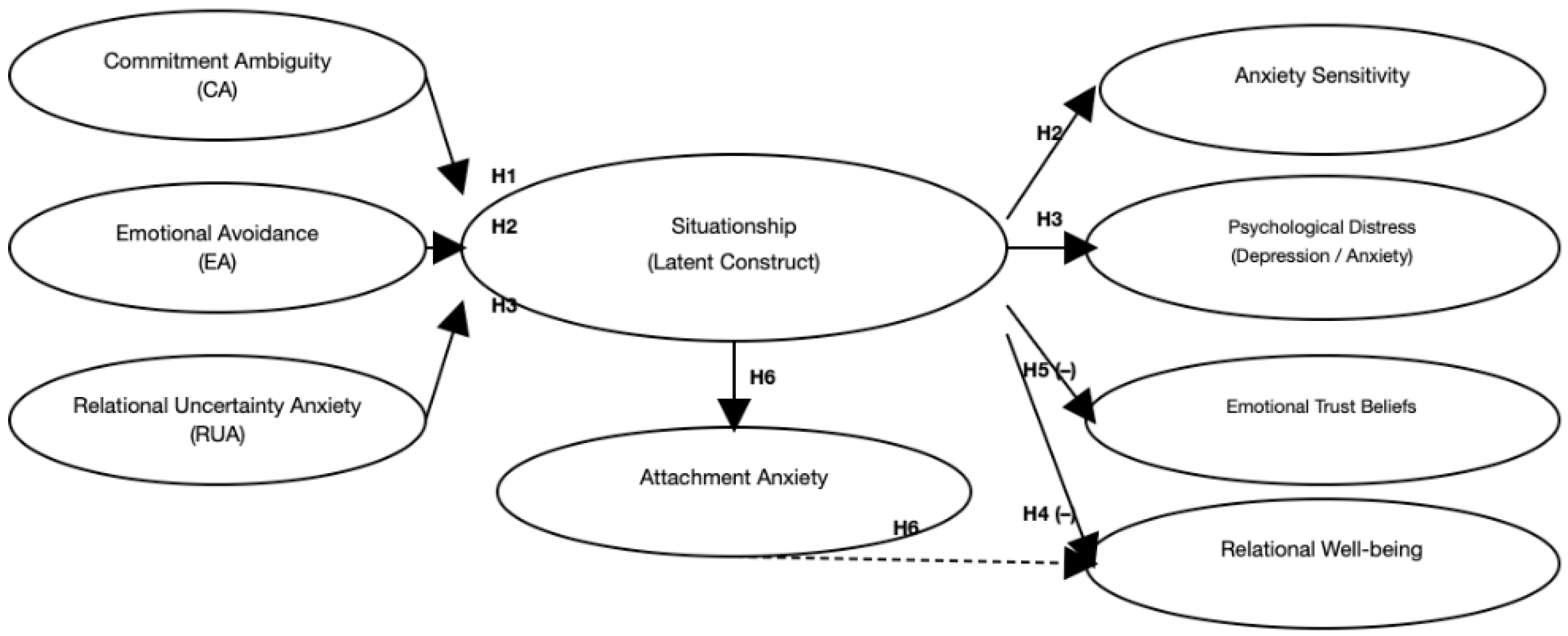

Table 1.
Sources and Conceptual Mapping of Items for the Situationship Scale.
| No. | Dimension | Sample Item | Measurement Focus | Font size and style | ||
|---|---|---|---|---|---|---|
| 1 | CA | We have never clearly discussed our future together. | Lack of future planning | Powell, Henry, & Flynn (2021) | ||
| 2 | CA | We have never clearly discussed our future together. | Low social visibility and public recognition | Norris, Williams, & Ford (2021) | ||
| 3 | CA | There is little to no long-term planning in this relationship. | Avoidance of long-term commitment | Kindelberger, Lydon, & Rholes (2020) | ||
| 4 | CA | There is no clear agreement about exclusivity between us. | Absence of exclusivity | Fahs & Munger (2015) | ||
| 5 | CA | I feel uncertain about how to define our relationship. | Ambiguity of relationship status | Powell et al. (2021) | ||
| 6 | CA | We rarely talk about activities we might do together in the future. | Avoidance of future-oriented discussion | Collins & Horn (2018) | ||
| 7 | CA | I am unsure how long this relationship will last. | Uncertainty about relationship continuity | Collins & Horn (2018) | ||
| 8 | CA | I tend to avoid labeling this relationship clearly. | Avoidance of relationship definition | Jonason et al. (2015) | ||
| 9 | CA | My emotional investment feels disproportionate to the formality of this relationship. | Imbalance between emotional investment and commitment | Sternberg (1986) | ||
| 10 | EA | Even when the relationship feels close, I limit how much I share my personal thoughts. | Restriction of self-disclosure | Díaz-Mosquera, Guzman, & Gómez (2022) | ||
| 11 | EA | When my emotions fluctuate, I try to remain emotionally detached. | Emotional suppression and control | Fahs & Munger (2015) | ||
| 12 | EA | I dislike appearing vulnerable or dependent in this relationship. | Avoidance of emotional dependency | Núñez Segovia, Rios, & Serrano (2019) | ||
| 13 | EA | I doubt whether my partner’s emotional involvement is genuine or lasting. | Lack of emotional trust | Petrocchi, Cheli, & Cadorin (2020) | ||
| 14 | EA | When my partner becomes too emotionally close, I feel uncomfortable and want to distance myself. | Perceived threat from intimacy | Fraley, Waller, & Brennan (2000) | ||
| 15 | EA | Our conversations mainly focus on logistics rather than emotional exchange. | Instrumentalized communication | Collins & Horn (2018) | ||
| 16 | EA | As the relationship becomes closer, I instinctively pull back. | Regulation of emotional distance | Díaz-Mosquera et al. (2022) | ||
| 17 | EA | When we are temporarily apart, I feel relieved rather than distressed. | Relief following emotional disengagement | Fahs & Munger (2015) | ||
| 18 | RUA | I often worry that this relationship may end suddenly. | Anxiety about relationship termination | Müller, Hawkley, & Cacioppo (2024) | ||
| 19 | RUA | I frequently monitor my partner’s online activity to ensure the relationship is stable. | Hypervigilance and monitoring | Lafaita & Philippot (2023) | ||
| 20 | RUA | The uncertainty in this relationship makes me feel anxious and stressed. | Anxiety induced by uncertainty | Intrieri & Margentina (2017) | ||
| 21 | RUA | I need frequent reassurance that this relationship is stable. | Reassurance-seeking for security | Fraley et al. (2000) | ||
| 22 | RUA | I feel jealous when my partner behaves ambiguously toward others. | Jealousy in ambiguous relationships | Diotaiuti, Valente, & Bellizzi (2022) | ||
| 23 | RUA | I worry that I am more emotionally invested than my partner. | Jealousy in ambiguous relationships | Fahs & Munger (2015) | ||
| 24 | RUA | I repeatedly think about the meaning and status of our relationship. | Rumination about relationship ambiguity | Kindelberger et al. (2020) | ||
| 25 | RUA | I avoid clarifying the relationship because I fear an answer I may not want to hear. | Avoidance of relationship confirmation | Lafaita & Philippot (2023) | ||
Disclaimer/Publisher’s Note: The statements, opinions and data contained in all publications are solely those of the individual author(s) and contributor(s) and not of MDPI and/or the editor(s). MDPI and/or the editor(s) disclaim responsibility for any injury to people or property resulting from any ideas, methods, instructions or products referred to in the content. |
© 2026 by the authors. Licensee MDPI, Basel, Switzerland. This article is an open access article distributed under the terms and conditions of the Creative Commons Attribution (CC BY) license (http://creativecommons.org/licenses/by/4.0/).
Copyright: This open access article is published under a Creative Commons CC BY 4.0 license, which permit the free download, distribution, and reuse, provided that the author and preprint are cited in any reuse.


