

Submitted:
02 August 2023
Posted:
04 August 2023
You are already at the latest version
Preprints on COVID-19 and SARS-CoV-2
Abstract
Pandemic restrictions and reduced social opportunities led to increased loneliness throughout affected countries. Considering that stressful situations activate the attachment system and engage various coping strategies, the present study explored the role of attachment dimensions and coping styles in perceived social isolation and the subsequent effect on emotional distress. Data was collected using an online survey between the third and fourth waves in Romania during the second year of the pandemic. Correlational analyses presented significant relationships between all variables measured. Regression analysis showed that attachment insecurity could predict up to half of the variance in loneliness and one-third of emotional distress. Coping styles that predicted both loneliness and emotional distress were problem-focused and socially supported coping, though the effect was minimal. Emotion-focused coping presented a protective role against loneliness. Finally, moderation analysis revealed how loneliness fully mediated the relationship between insecure attachment styles and emotional distress. Further implications for research on loneliness, and pandemic resilience are discussed.
Keywords:
loneliness
; covid-19
; attachment
; coping
; mental health
1. Introduction
The emergence in late 2019 and rapid spread throughout 2020 of the SARS-CoV-2 virus has led to an unprecedented public health crisis in the modern world [1]. Despite the general availability of vaccines beginning in 2021, political, legislative, and societal factors contributed to pandemic fatigue and vaccine hesitancy during the second year of the pandemic [2]. This led to a third wave in spring 2021 and a catastrophic fourth one beginning in October 2021 [3]. with the period in between characterized by fluctuating restrictions, partial lockdown measures, and uncertainty. Since the pandemic’s early days, the indirect toll (e.g., through saturation of public health measures, lockdowns, or restrictions) has been signaled [4,5]. Prior pandemics have shown that actions undertaken to control the spread can precipitate mental health issues and reduce compliance down the line [6]. Comparing suicide statistics around the 2003 SARS outbreak in Hong-Kong, these grew between 2002 and 2003, yet failed to return to pre-outbreak levels even after the outbreak ended [7]. A pandemic’s psychological footprint can be more extensive than its medical one [8]. Even after restrictions were lifted in China, most people continued to self-isolate to some degree [9]. Despite the heterogeneity of distribution, an increase in loneliness compared to pre-pandemic times was described in a meta-analysis [10].
While social isolation describes the objective absence of social interactions [11], loneliness, refers to the subjective experience arising from the discrepancy between one’s desires and received social interactions [12]. Though conceptually separate constructs, objective and perceived social isolation are interrelated, with the former a risk factor for the latter [11,13]. Even before the full brunt of the pandemic, loneliness has been described as an epidemic affecting developed countries [14,15]. It has been identified as a risk factor for somatic illness [11,16,17], neurodegenerative symptoms [18] and psychiatric disorders [11,13]. A comparative analysis of loneliness throughout Europe found that former Soviet Countries had an even higher incidence of loneliness than the rest of Europe in all age brackets [19]. This is important because the pandemic came superimposed on prior risk factors [20]. Compared to pre-pandemic times, some risk groups for loneliness remained the same (e.g., women living alone), other groups experienced greater risk (e.g., younger people), and groups previously safe became at risk (e.g., students) [21].
Ainsworth and Bowlby’s attachment theory emerges as a variant of object relations theory, aimed at studying human development via the initial bonding between children and primary caregivers [22]. ). Using the behavioral patterns Ainsworth described, Hazan and Shaver (1987) described three types of adult attachment: secure, avoidant, and anxious [23]. Attachment styles have been linked to loneliness through social skills [24,25], with insecure attachment linked to worse social skills [26]. Thus, attachment appears to predicate loneliness [26,27] with greater loneliness associated with insecure attachment styles [23,26,28] and secure attachment predicting the lowest levels of perceived loneliness [23,29].
The attachment system reflects how individuals regulate their affect, especially in novel or threatening situations [30]. Bowlby’s theory also stipulated that novel or threatening conditions, like a pandemic, automatically trigger the attachment system [31]. Securely attached individuals will seek close partners for comfort and support, helping them cope with distress. Meanwhile, avoidantly attached individuals will try to minimize distress and retreat, while anxiously attached individuals cope by persistently signaling distress and seeking reassurance [30]. During the Covid-19 pandemic, anxious attachment predicted more suicidal ideation and loneliness during a longitudinal study [32]. Meanwhile, avoidant attachment was associated with loneliness, perceived stress [33] and suicidal ideation [32].
After primary and secondary appraisals of stressors, Lazarus in 1966 described the coping process [34]. This process is fluid, with both threat appraisal and employed strategies undergoing multiple reappraisals [35]. The efficiency of coping strategies can also depend on external factors: Park and colleagues pointed out that problem-focused coping substantially impacts positive mood in high-control situations, whereas emotion-focused strategies seem more suitable for uncontrollable stressors [36]. Problem-focused coping, alternative seeking, and social support were commonly used during the prior epidemics [37]. Studies measuring coping strategies employed during the Covid-19 pandemic have revealed mixed results, partially due to the different models employed. Thus, more distress was associated with passive coping [38], self-blame, venting and disengagement [39], wishful thinking [40], and stronger problem-focused coping [41,42]. In line with Park’s suggestion, Fluharty and colleagues [43] found that problem-focused, avoidant, and emotion-focused coping strategies were not associated with faster mental health improvements during the pandemic, while socially supported coping was associated with faster decrease in afective symptoms.
Taking it all together, our study focused on the general population of Romania between the third and fourth Covid-19 outbreaks and aimed to investigate: (i) attachment, coping, and their relationship to loneliness and emotional distress; (ii) loneliness as a mediator between attachment dimensions and emotional distress. Secondary goals included measuring the impact of gender and age.
2. Materials and Methods
2.1. Study Design
The general population of Romania during the second year of the Covid-19 pandemic represented the current study’s target. Utilizing a cross-sectional design, data was collected between April 2021 and September 2021 using an online questionnaire. The institutional Review Board of the Cluj-Napoca Military Emergency Hospital reviewed and approved the study before release.
Concordant with the Checklist for Reporting Results in Internet E-Surveys (CHERRIES) checklist [44] we report that the entire questionnaire was available online and disseminated via social media and informal channels. Participation in the study was preceded by an online consent form, during which pariticants were instructed on the goals and methods of the study as well as data storage. Though no time limit for completion was set, participants had to finish the questionnaire in one sitting. The questionnaire was tested before publishing by the main author. No incentives were offered.
2.2. Sample Demographics
The sample was composed of 141 responders who completed the online survey. Ages ranged from 19 to 71 (M = 35.18, SD = 10.64). Most participants were female (75.5%). Education was skewed upwards, with the majority owning a university degree (87.7%) describing themselves as employed (76.9%) or freelancers (12.9%)
2.3. Measurements
Emotional distress was assessed via Lovibond and Lovibond’s Depression, Anxiety and Stress Scale (DASS-21) [45]. The DASS-21 contains 21 self-report items (7 items per subscale), including: “I couldn’t seem to experience any positive feelings at all” (depression), “I experienced trembling (e.g., in the hands)” (anxiety), and “I tended to overreact to situations” (stress). Higher scores suggest a greater frequency of depressive, anxiety, and stress symptoms, whereas low scores suggest a lower frequency. In our sample, the total calculated score presented excellent reliability results (α =.95, M = 17.9, SD = 12.9)
Loneliness was measured using the University of California, Los Angeles Loneliness Scale [46]. Modeled on the conceptualization of loneliness as, first and foremost, a subjective emotion, this self-reported scale uses 20 items representing Likert-type scales. The scale has repeatedly demonstrated good construct validity and reliability and has been extensively used on younger populations. Higher scores reflect higher perceived social isolation. Completion of the scale was mandatory for all participants. Reliability analysis of the scale in our sample revealed excellent results (α = .95, M = 22.43, SD =13.38).
Attachment was measured using the Revised Adult Attachment Scale (RAAS) [47], a questionnaire in which the individual, through self-report, provides a graded assessment of his or her skills in forming relationships. The 18 items on this scale are rated on a 5-point Likert scale ranging from 1 (“not at all characteristic of me”) to 5 (“very characteristic of me”). The scale can be divided into an anxiety subscale composed of six items, measuring the extent to which a person is worried about being rejected or unloved, and an avoidance subscale composed of twelve items, measuring how uncomfortable the person is with closeness and dependence on others. The anxiety subscale in our sample presented excellent validity (α = .88, M = 14.02, SD = 6.33), with similar results for the avoidance subscale (α = .81, M = , SD = 33.17, SD = 8.44).
Coping strategies were measured using the self-administered Brief COPE Inventory (B-COPE) [48], an abbreviated version of the original 60-item COPE inventory [49]. The 28 items load onto 14 factors or coping styles: Self-distraction; Active Coping; Denial; Substance use; Use of emotional support; Use of Instrumental support; Behavioral disengagement; venting; Positive reframing; Humor; Acceptance; Religion, and Self-blame. The B-COPE has been used to evaluate coping strategies during previous infectious disease outbreaks [50], and its Romanian adaptation presented good psychometric characteristics in prior studies [51]. In our sample, the scale showed good internal consistency, α=.88. Prior studies regarding coping strategies have used all 14 coping strategies in the scale or several coping styles categorized following conceptual or theoretical models by authors. Congruent with prior studies on coping during the pandemic [43], we used the 4-factor model by Bose and colleagues [52] to diminish these limitations. This 4-factor model consists of the following dimensions: problem-focused coping (active coping, planning), emotion-focused coping (positive reframing, acceptance, humor, religion), avoidant coping (behavioral disengagement, denial, substance use), and socially supportive coping (emotional support, instrumental support, and venting).
2.4. Statistical Analysis
Gender differences were measured via multiple independent sample t-tests comparing dependent and independent variables by gender. Two-tailed Pearson correlational analyses were used to the relationships between age, loneliness, emotional distress, attachment, and coping styles.
Four different regression models were performed, testing how attachment and coping affect loneliness and emotional distress while considering age as a covariate. Multicollinearity analysis was also performed, with no Variance Inflation Factor (VIF) larger than five being discovered. All analyses were performed using SPSS version 23. Finally, mediation analysis was performed using the PROCESS macro for SPSS [53]. The indirect effect was tested using a percentile bootstrap estimation approach using 10000 samples. Two models were tested: model 1 measured the mediating effect of loneliness between attachment anxiety and emotional distress, whereas model 2 measured the mediating effect of loneliness between attachment avoidance and emotional distress.
3. Results
3.1. Gender Differences
Independent-sample t-tests were conducted to compare age, loneliness, emotional distress, avoidance, and coping styles between genders. Significant differences in the scores for problem-focused coping were found between male (M=8.06, SD=4.05) and female responders (M=10.23, SD=4.34), t(139)=-2.45, p = .014). Male participants also presented lower scores (M=33, SD=14.84) versus female participants (M = 41.08, SD = 14.31) on emotion-focused coping, t(139) = -2.60, p = .010. Avoidant coping presented significant gender differences between male (M = 22.50, SD = 9.21) and female participants (M=27.32, SD=10.61), t(139) = -2.29, p= .023. Finally, gender differences were also found for socially supported coping between males (M=15.50, SD=7.47) and females (M=19.43, SD = 9.94). Statistical analysis failed to reveal gender differences for age, loneliness, emotional distress, and attachment. Results are summarized in Table 1.
3.2. Correlational Analyses
Pearson correlation coefficients were computed to assess the linear relationships between loneliness, emotional distress, attachment, and coping styles. Loneliness presented positive correlations with emotional distress (r(139) = .70, p <.001), attachment anxiety (r(139) = .63, p <.001) and avoidance (r(139) = .51, p <.001), along with problem-focused coping (r(139) = .21, p <.013) and socially supported coping (r(139) = .20, p <.016). Emotional distress presented positive correlations with attachment anxiety (r(139) = .53, p <.001) and attachment avoidance (r(139) = .41, p <.001), as well as problem-focused coping (r(139) = .24, p = .004) and socially supported coping (r(139) = .26, p = .002). Results are summarized in Table 2.
3.3. Regression Analysis
Attachment as Predictor of Loneliness and emotional distress
Multiple linear regression analysis was used to test if attachment styles significantly predicted loneliness while also correcting for age. The results of the regression indicated that the two predictors explained 42.3% of the variance (R2 = .42, F(3, 137)=33.54, p < .001). Model coefficients (see Table 3) indicated that attachment anxiety (b= 1.07, SE = .17, β = .50, t(137) = p < .001) and attachment avoidance (b = 3.83, SE= 1.55, β = .20, t(137) = 2.46, p =.015) predicted loneliness.
The model for emotional distress was also significant, explaining 30.9% of the variance (R2 = .30, F(3, 137) = 20.39, p < .001). Individual coefficients (see Table 3) indicated that only attachment anxiety (b = .87, SE = .18, β = .42, t(137) = 4.72, p < .001) predicted emotional distress.
Coping styles as predictors of loneliness and emotional distress
We conducted a similar analysis using coping styles as the predictor of interest, once more controlling for age as a covariate. The overall model for depression was statistically significant, explaining 11.8% of the variance (R2 = .11, F(5, 135) = 3.64, p = .004). Individual coefficients revealed that problem-focused coping (b = 1.03, SE = .36, β = .33, t(135) = 2.79, p = .006), emotion-focused coping (b = -.34, SE = .14, β = -.38, t(135) = -2.42, p = .015) and socially supported coping (b = .39, SE = .16, β = .28, t(135) = 2.38, p = .019) predicted loneliness.
Our emotional distress model achieved statistical significance, predicting 18.8% of the variance (R2 = .18, F(5, 135) = 6.23, p < .001). Model coefficients revealed only problem-focused coping (b = .91, SE =, β = .30, t(135) = 2.67, p = .008), socially supported coping (b = .61, SE = .15, β = .45, t(135) = 3.93, p < .001) and age (b = -.31, SE = .10, β = -.24, t(135) = -3.01, p = .003) predicted emotional distress.
Model 1
The results of our mediation analysis indicated that attachment anxiety was a significant predictor of loneliness (B = 1.33, SE = .13, 95% CI[1.05,1.60], β = .63, p <.001) and loneliness was a significant predictor of emotional distress (B = .58, SE = .07, 95% CI[.44, .73], p<.001]. With the inclusion of loneliness as a mediator, attachment anxiety no longer significantly predicted emotional distress (B=.30, SE=.15, 95% CI[-.00,.61], p = .054), consistent with complete mediation. The predictors accounted for approximately 50.3% of the variance (R2 = .50).
The indirect effect was tested using a percentile bootstrap estimation approach using 10000 samples, implemented via the PROCESS macro (Hayes, 2017). These results indicated that the indirect coefficient was significant (B=.73, SE = .15, 95% CI[.49,1.09], standardized β = .38. Standardized coefficients are presented in Figure 1.
Model 2
The results of our second mediation analysis revealed that attachment avoidance was a significant predictor of loneliness (B = .81, SE = .11, 95% CI[.58,.1.03], β = .51), and loneliness was again a significant predictor for emotional distress (B = .64, SE = .06, 95% CI[.50,.77], p < .001). Once loneliness was introduced as a mediator, attachment avoidance no longer significantly predicted emotional distress (B=1.22, SE=.10, 95% CI[-.08,.33], p = .25), consistent with complete mediation. Approximately 49.9% of the variance was accounted for by the two predictors (R2 = .49).
The bootstrapped results for indirect effect indicate that it achieved statistical significance (B = .51, SE = .11, 95% CI [.30,75], standardized β = .33. Standardized coefficients are presented in Figure 2.
4. Discussion
The Covid-19 pandemic, and the public health measures that accompanied it, came superimposed over what was already being described as a loneliness epidemic in developed countries [15]. The persistence of socially isolating behavior and perceived isolation after the release of pandemic measures could be explained by a wide variety of factors, from learned helplessness, global and economic stressors [54] to social withdrawal as a coping mechanism[55]. The pandemic’s widespread psychological footprint is still being discussed, though some have already argued for the emergence of a Pandemic Disengagement Syndrome [56]. The present study, undertaken during the second year of the pandemic in Romania, set out to measure the general population’s emotional distress and loneliness while accounting for predisposing factors like attachment, coping styles, and demographic variables like age and gender.
Demographic factors in our study revealed weak to statistically insignificant results. Correlational analysis showed that age presented statistically significant, albeit minimal-to-low strength negative correlations with emotional distress, attachment anxiety, problem-, emotion-focused, and avoidant coping. Our results align with prior research that named young adults at risk for more mental health symptoms during the pandemic [57,58,59]. Age, however, was a significant predictor of emotional distress when considered alongside coping, but not attachment, suggesting the latter plays a more salient role in the resilience of older age groups during the pandemic. This aligns with Okely and colleagues’ [60] suggestions that with age, more refined emotional and cognitive skills provide individuals with better ways of coping with the lockdown. One of the mechanisms Okely mentioned was emotional stability, which has been consistently linked to attachment theory [61,62], as our results indicate a small yet significant decrease in attachment anxiety with age. Adult attachment is not set in stone [63,64]). Parent-child bonds can predict attachment stability for the first fifteen years, yet said stability diminishes past that point [65]. Our study found no significant differences between genders in our samples for emotional distress, loneliness, or attachment dimensions. Gender differences in attachment are still being debated [66] and are subject to important cross-cultural factors [67], and the similar scores for attachment dimensions reported by both men and women could account for the lack of group differences regarding loneliness, or emotional distress, contrary to most reports on women being as greater risk than men for both loneliness [21] and mental health symptoms [68,69]. Our sample’s predominantly female, predominantly younger distribution could explain the minor effects and lack of statistical significance.
Consistent with previous studies, insecure attachment influences emotional distress [33,70,71]. The attachment styles are closely tied to how an individual handles their affect, especially during novel and/or threatening conditions [30] and are linked to both the sympathetic nervous system stress response [72] and the hypothalamic-pituitary-adrenergic stress response [72,73], and partially depend on relationship context (Pietromonaco & Beck, 2019). Considering the restrictions imposed by social distancing, partner presence and relationship quality might have become a critical support pillar for some individuals. Moreover, attachment styles predict potentially protective or damaging behaviors arising in response to stressors [74]. These secondary attachment strategies [75,76] vary according to attachment, with anxiously attached individuals displaying hyperactivating strategies and those avoidantly attached employing deactivating strategies. Predisposing, precipitating, and crisis-state factors can mediate the link between attachment insecurity and suicidality [77]. Loneliness has been found to mediate the effect between insecure attachment and the medical lethality of suicide attempts [78].
Individuals high in attachment anxiety perceive others to be emotionally unpredictable and unreliably responding to their affective needs, closely monitoring significant others for cues of emotional unavailability [33,79]. This hyperactivation strategy leads to further activation of the attachment system and inhibition of exploratory behavior [33]. Our regression analysis showed that attachment anxiety and avoidance explained nearly half the variance in perceived social isolation, with the former displaying an effect twice as strong as the latter. Attachment anxiety also significantly predicted nearly one-third of emotional distress symptoms, though attachment avoidance failed to reach the significance threshold. Furthermore, our first mediation model revealed that attachment anxiety fully predicted emotional distress via loneliness, with the direct effect becoming insignificant once the mediator was introduced. Individuals that score high on attachment anxiety tend to use hyperactivating strategies that lead to increased perception and expression of threatening signals making them more prone to developing anxiety disorders [80,81], post-traumatic stress symptoms [82,83] and post-natal depression [84].
Conversely, individuals high in attachment avoidance present a different attachment strategy: deactivation, inhibiting the attachment system, and minimizing perceived frustration and distress [79]. Attachment avoidance presented a statistically significant predictor for loneliness in our regression analysis, albeit not as strong as attachment anxiety. Relationship quality is more related to avoidance rather than attachment anxiety [85], with avoidant individuals experiencing their partners as less supportive [86]. Considering the restrained social options during the pandemic, it would explain why those more avoidantly attached perceived themselves as lacking support and described themselves as lonely. Our regression analysis failed to find a significant effect for attachment avoidance of emotional distress once attachment anxiety was considered. However, our subsequent mediation model revealed a significant, fully mediated path from attachment avoidance to emotional distress via loneliness. Attachment avoidance has been linked with the risk of depression [83] and suicide ideation [62,87]. Finally, since both attachment avoidance and anxiety presented essential effects on mental health, a synergistic effect cannot be disconfirmed. This is conceptually equivalent to This is conceptually equivalent to Bartholomew’s ‘fearful’ type [88] which feature individuals with high attachment anxiety (model of self) and high avoidance (model of other) and is conceptually similar to the disorganized attachment style observed further described by Main and Solomon [89]. Though disorganized attachment is less studied in adults [90], it has been shown to be associated with high levels of attachment avoidance and anxiety [91] and clinically associated with more severe personality traits [92].
In contrast, correlation and regression analyses revealed more mixed, weaker interactions between coping, loneliness, and emotional distress. Notably, problem-focused and socially supported coping was associated with more loneliness and perceived emotional distress. Our results align with those of Fluharty and colleagues [43], which found that participants with higher scores for problem-focused and socially supportive coping had higher mental health symptoms at the start of the pandemic lockdown in the UK. Socially supportive coping is known to be associated with better mental health and increased resilience[93], as are problem-focused strategies [94]. During the pandemic, coping strategies mediated the relationship between uncertainty and psychological distress [95]. As the period between the third and fourth waves was marked by uncertainty and mixed messaging from the media and authorities, it is possible that outward-focused, reactive strategies like active coping and planning might have proved insufficient and detrimental for the individual. Similarly, socially supported coping, by depending on the presence of others, might have proven inefficient a strategy during a time marked by restrictions and reduced social opportunities. Meanwhile, emotion-focused coping seemed to have a negative predictive effect on loneliness alone but not on perceived emotional distress. Because loneliness is defined as the reduced perceived quality of social support, it would be reasonable to assume those that focused on addressing the emotions of the situation would have a better-perceived quality of social interactions with peers or partners. These results again reinforce Park’s [36] suggestion that context is essential in determining the efficacy of coping strategies.
Our study is not without strengths or limitations. The dimensional approach and utilizing an attachment scale focused on romantic attachment strategies can be considered a fundamental strength of our study. To the best of our knowledge, aside from an ongoing study by Edjolo and colleagues [96], this is the only pandemic-related study to measure attachment and coping styles in the same sample. Similarly, exploring loneliness in Romania, an at-risk country, is a developing field to which our research will hopefully contribute. Among the more important limitations, we mention our sample’s predominantly female and more educated distribution, which restricts its application to the general population. The cross-sectional design also severely restricts any causal inferences from being drawn. Finally, selection bias inherent in online questionnaires cannot be disconsidered.
Loneliness is not only a symptom of social isolation. Future research should consider the importance of dyadic relationships, the role of partners, or lack thereof, in emotion regulation, and how childhood attachment is pivotal between received and perceived support. Furthermore, coping strategies should not be automatically segregated into ‘adaptive’ or ‘dysfunctional,’ as the controllability of the context plays a crucial role in the efficacy of the strategies employed.
5. Conclusions
Insecure attachment predicted a significant percentage of emotional distress during the pandemic, even when correcting for age, whereas coping strategies predicted a smaller percentage of variation. Attachment anxiety and avoidance are essential predictors of emotional distress during the second year of the pandemic, with loneliness completely mediating the relationship for both. Meanwhile, problem-focused and socially supportive coping presented as risk factors, predicting a smaller percentage of emotional distress. Further research should, therefore, focus on attachment as a component of stress resilience and consider external contexts when measuring the efficiency of coping mechanisms.
Author Contributions
AHP worked on conceptualization, methodology, formal analysis and wrote the original manuscript; MFS helped write the original manuscript, in review and editing; MM oversaw conceptualization, review, and supervision.
Funding
This research received no external funding.
Institutional Review Board Statement
The study was conducted in accordance with the Declaration of Helsinki, and approved by the Institutional Review Board of the ”C. Papilian” Military Emergency Hospital, Cluj-Napoca.
Informed Consent Statement
Informed consent was obtained from all subjects involved in the study.
Data Availability Statement
Research data is available upon reasonable requests for future studies.
Conflicts of Interest
The authors declare no conflict of interest.
References
- Dong, L.; Bouey, J. Public mental health crisis during COVID-19 pandemic, China. Emerging infectious diseases. 2020, 26, 1616. [Google Scholar] [CrossRef] [PubMed]
- Dascalu, S.; Geambasu, O.; Raiu, C.V.; Azoicai, D.; Popovici, E.D.; Apetrei, C. COVID-19 in Romania: What Went Wrong? Front. Public Heal. 2021, 9, 813941. [Google Scholar] [CrossRef] [PubMed]
- Thorpe, N. Covid: Romania’s health system torn apart by pandemic.BBC. 23 October 2021. 23 October. Available online: https://www.bbc.com/news/world-europe-58992090.
- Campion, J.; Javed, A.; Sartorius, N.; Marmot, M. Addressing the public mental health challenge of COVID-19. Lancet Psychiatry 2020, 7, 657–659. [Google Scholar] [CrossRef] [PubMed]
- Cullen, W.; Gulati, G.; Kelly, B.D. Mental health in the COVID-19 pandemic. QJM: An International Journal of Medicine 2020, 113, 311–312. [Google Scholar] [CrossRef]
- DiGiovanni, C.; Conley, J.; Chiu, D.; Zaborski, J. Factors Influencing Compliance with Quarantine in Toronto During the 2003 SARS Outbreak. Biosecurity Bioterrorism Biodefense Strategy Pract. Sci. 2004, 2, 265–272. [Google Scholar] [CrossRef]
- Cheung, Y.T.; Chau, P.H.; Yip, P.S. A revisit on older adults suicides and Severe Acute Respiratory Syndrome (SARS) epidemic in Hong Kong. International Journal of Geriatric Psychiatry: A journal of the psychiatry of late life and allied sciences. 2008, 23, 1231–1238. [Google Scholar] [CrossRef]
- Taylor, S. The psychology of pandemics. Annual review of clinical psychology 2022, 18, 581–609. [Google Scholar] [CrossRef]
- Zhou, T.; Nguyen, T.-V.T.; Zhong, J.; Liu, J. A COVID-19 descriptive study of life after lockdown in Wuhan, China. R. Soc. Open Sci. 2020, 7. [Google Scholar] [CrossRef]
- Ernst, M.; Niederer, D.; Werner, A.M.; Czaja, S.J.; Mikton, C.; Ong, A.D.; Rosen, T.; Brähler, E.; Beutel, M.E. Loneliness before and during the COVID-19 pandemic: A systematic review with meta-analysis. Am. Psychol. 2022, 77, 660–677. [Google Scholar] [CrossRef]
- Leigh-Hunt, N.; Bagguley, D.; Bash, K.; Turner, V.; Turnbull, S.; Valtorta, N.; Caan, W. An overview of systematic reviews on the public health consequences of social isolation and loneliness. Public Heal. 2017, 152, 157–171. [Google Scholar] [CrossRef]
- Perlman, D.; Peplau, L.A. Toward a social psychology of loneliness. Personal relationships 1981, 3, 31–56. [Google Scholar]
- Hawkley, L.C.; Cacioppo, J.T. Loneliness Matters: A Theoretical and Empirical Review of Consequences and Mechanisms. Ann. Behav. Med. 2010, 40, 218–227. [Google Scholar] [CrossRef]
- Williams, S.E.; Braun, B. Loneliness and social isolation-a private problem, a public issue. Journal of Family and Consumer Sciences. 2019, 111, 7–14. [Google Scholar] [CrossRef]
- Jeste, D.V.; Lee, E.E.; Cacioppo, S. Battling the modern behavioral epidemic of loneliness: suggestions for research and interventions. JAMA psychiatry 2020, 77, 553–554. [Google Scholar] [CrossRef] [PubMed]
- Foti, S.A.; Khambaty, T.; Birnbaum-Weitzman, O.; Arguelles, W.; Penedo, F.; Giacinto, R.A.E.; Gutierrez, A.P.; Gallo, L.C.; Giachello, A.L.; Schneiderman, N.; et al. Loneliness, Cardiovascular Disease, and Diabetes Prevalence in the Hispanic Community Health Study/Study of Latinos Sociocultural Ancillary Study. J. Immigr. Minor. Heal. 2020, 22, 345–352. [Google Scholar] [CrossRef]
- Abdellaoui, A.; Sanchez-Roige, S.; Sealock, J.; Treur, J.L.; Dennis, J.; Fontanillas, P.; Elson, S. 23andme Research Team, Nivard MG, Ip HF, van der Zee M. Phenome-wide investigation of health outcomes associated with genetic predisposition to loneliness. Human molecular genetics. 2019, 28, 3853–3865. [Google Scholar] [CrossRef] [PubMed]
- Buchman, A.S.; Boyle, A.; Wilson, R.S.; James, B.D.; Leurgans, S.E.; Arnold, S.E.; Bennett, D.A. Loneliness and the rate of motor decline in old age: the rush memory and aging project, a community-based cohort study. BMC Geriatr. 2010, 10, 77. [Google Scholar] [CrossRef]
- Yang, K.; Victor, C. Age and loneliness in 25 European nations. Ageing Soc. 2011, 31, 1368–1388. [Google Scholar] [CrossRef]
- Baarck, J.; D’Hombres, B.; Tintori, G. Loneliness in Europe before and during the COVID-19 pandemic. Heal. Policy 2022, 126, 1124–1129. [Google Scholar] [CrossRef]
- Bu, F.; Steptoe, A.; Fancourt, D. Who is lonely in lockdown? Cross-cohort analyses of predictors of loneliness before and during the COVID-19 pandemic. Public Heal. 2020, 186, 31–34. [Google Scholar] [CrossRef]
- Ainsworth, M.S.; Bowlby, J. An ethological approach to personality development. American psychologist. 1991, 46, 333. [Google Scholar] [CrossRef]
- Hazan, C. Conceptualizing romantic love as an attachment process. Journal of personality and social psychology. 1987, 52, 511–524. [Google Scholar] [CrossRef] [PubMed]
- Larose, S.; Guay, F.; Boivin, M. Attachment, Social Support, and Loneliness in Young Adulthood: A Test of Two Models. Pers. Soc. Psychol. Bull. 2002, 28, 684–693. [Google Scholar] [CrossRef]
- Mallinckrodt, B. Attachment, Social Competencies, Social Support, and Interpersonal Process in Psychotherapy. Psychother. Res. 2000, 10, 239–266. [Google Scholar] [CrossRef]
- Deniz, M.E.; Hamarta, E.; Ari, R. An Investigation of Social Skills and Loneliness Levels of University Students with Respect to Their Attachment Styles in a Sample of Turkish Students. Soc. Behav. Pers. Int. J. 2005, 33, 19–32. [Google Scholar] [CrossRef]
- Russell, D.; Cutrona, C.E.; Rose, J.; Yurko, K. Social and emotional loneliness: an examination of Weiss’s typology of loneliness. Journal of personality and social psychology. 1984, 46, 1313. [Google Scholar] [CrossRef]
- Margalit M, Margalit M. Loneliness Conceptualization. Lonely Children and Adolescents: Self-Perceptions, Social Exclusion, and Hope. 2010:1-28.
- Bernardon, S.; Babb, K.A.; Hakim-Larson, J.; Gragg, M. Loneliness, attachment, and the perception and use of social support in university students. Canadian Journal of Behavioural Science/Revue canadienne des sciences du comportement. 2011, 43, 40. [Google Scholar] [CrossRef]
- Pietromonaco, P.R.; Beck, L.A. Attachment processes in adult romantic relationships. InAPA handbook of personality and social psychology, Volume 3: Interpersonal relations. 2015 (pp. 33-64). American Psychological Association. . [CrossRef]
- Bowlby, J. Attachment and loss. Volume II. Separation, anxiety and anger. InAttachment and loss. volume II. Separation, anxiety and anger 1973 (pp. 429-p).
- Lewis, K.C.; Roche, M.J.; Brown, F.; Tillman, J.G. Attachment, loneliness, and social connection as prospective predictors of suicidal ideation during the COVID-19 pandemic: A relational diathesis-stress experience sampling study. Suicide and Life-Threatening Behavior. 2023, 53, 64–74. [Google Scholar] [CrossRef]
- Rollè, L.; Trombetta, T.; Calabrese, C.; Vismara, L.; Sechi, C. Adult attachment, loneliness, COVID-19 risk perception and perceived stress during COVID-19 pandemic. Mediterranean Journal of Clinical Psychology. 2022, 10. [Google Scholar]
- Lazarus, R.S. Psychological stress and the coping process, 1984.
- Carver, C.S.; Scheier, M.F.; Weintraub, J.K. Assessing coping strategies: a theoretically based approach. Journal of personality and social psychology. 1989, 56, 267. [Google Scholar] [CrossRef] [PubMed]
- Park, C.L.; Armeli, S.; Tennen, H. Appraisal-Coping Goodness of Fit: A Daily Internet Study. Pers. Soc. Psychol. Bull. 2004, 30, 558–569. [Google Scholar] [CrossRef] [PubMed]
- Chew, Q.H.; Wei, K.C.; Vasoo, S.; Chua, H.C.; Sim, K. Narrative synthesis of psychological and coping responses towards emerging infectious disease outbreaks in the general population: Practical considerations for the COVID-19 pandemic. Singap. Med J. 2020, 61, 350–356. [Google Scholar] [CrossRef] [PubMed]
- Wang, C.; Havewala, M.; Zhu, Q. COVID-19 stressful life events and mental health: Personality and coping styles as moderators. J. Am. Coll. Heal. 2022, 1–10. [Google Scholar] [CrossRef] [PubMed]
- Gurvich, C.; Thomas, N.; Thomas, E.H.; Hudaib, A.-R.; Sood, L.; Fabiatos, K.; Sutton, K.; Isaacs, A.; Arunogiri, S.; Sharp, G.; et al. Coping styles and mental health in response to societal changes during the COVID-19 pandemic. Int. J. Soc. Psychiatry 2021, 67, 540–549. [Google Scholar] [CrossRef]
- Garbóczy, S.; Szemán-Nagy, A.; Ahmad, M.S.; Harsányi, S.; Ocsenás, D.; Rekenyi, V.; Al-Tammemi, A.A.; Kolozsvári, L.R. Health anxiety, perceived stress, and coping styles in the shadow of the COVID-19. BMC psychology. 2021, 9, 1–3. [Google Scholar] [CrossRef]
- Ciuhan, G.C.; Nicolau, R.G.; Iliescu, D. Perceived stress and wellbeing in Romanian teachers during the COVID-19 pandemic: The intervening effects of job crafting and problem-focused coping. Psychol. Sch. 2022, 59, 1844–1855. [Google Scholar] [CrossRef]
- Ding, Y.; Fu, X.; Liu, R.; Hwang, J.; Hong, W.; Wang, J. The Impact of Different Coping Styles on Psychological Distress during the COVID-19: The Mediating Role of Perceived Stress. Int. J. Environ. Res. Public Heal. 2021, 18, 10947. [Google Scholar] [CrossRef]
- Fluharty, M.; Bu, F.; Steptoe, A.; Fancourt, D. Coping strategies and mental health trajectories during the first 21 weeks of COVID-19 lockdown in the United Kingdom. Soc. Sci. Med. 2021, 279, 113958–113958. [Google Scholar] [CrossRef]
- Eysenbach, G. Improving the quality of Web surveys: the Checklist for Reporting Results of Internet E-Surveys (CHERRIES). Journal of medical Internet research. 2004, 6, e34. [Google Scholar] [CrossRef]
- Lovibond, P.F.; Lovibond, S.H. The structure of negative emotional states: Comparison of the Depression Anxiety Stress Scales (DASS) with the Beck Depression and Anxiety Inventories. Behav. Res. Ther. 1995, 33, 335–343. [Google Scholar] [CrossRef] [PubMed]
- Russell, D. UCLA Loneliness Scale (Version 3): Reliability, Validity, and Factor Structure. J. Pers. Assess. 1996, 66, 20–40. [Google Scholar] [CrossRef] [PubMed]
- Collins, N.L. Revised Adult Attachment Scale. 1996. [Google Scholar] [CrossRef]
- Carver, C.S. You want to measure coping but your protocol’s too long: Consider the Brief COPE. Int. J. Behav. Med. 1997, 4, 92–100. [Google Scholar] [CrossRef] [PubMed]
- Carver, C.S.; Scheier, M.F.; Weintraub, J.K. Assessing coping strategies: a theoretically based approach. Journal of personality and social psychology. 1989, 56, 267. [Google Scholar] [CrossRef]
- Wong, T.W.; Yau, J.K.; Chan, C.L.; Kwong, R.S.; Ho, S.M.; Lau, C.C.; Lau, F.L.; Lit, C.H. The psychological impact of severe acute respiratory syndrome outbreak on healthcare workers in emergency departments and how they cope. Eur. J. Emerg. Med. 2005, 12, 13–18. [Google Scholar] [CrossRef]
- Crasovan, D.I.; Sava, F.A. Translation, adaptation, and validation on Romanian population of COPE questionnaire for coping mechanisms analysis. Cognition, Brain, Behavior. 2013, 17, 61. [Google Scholar]
- Bose, C.N.; Bjorling, G.; Elfstrom, M.L.; Persson, H.; Saboonchi, F. Assessment of Coping Strategies and Their Associations With Health Related Quality of Life in Patients With Chronic Heart Failure: the Brief COPE Restructured. Cardiol. Res. 2015, 6, 239–248. [Google Scholar] [CrossRef]
- Hayes, AF. Introduction to mediation, moderation, and conditional process analysis: A regression-based approach. Guilford publications; 2017 Oct 30.
- Pieh, C.; O´ Rourke, T.; Budimir, S.; Probst, T. Relationship quality and mental health during COVID-19 lockdown. PloS ONE 2020, 15, e0238906. [Google Scholar] [CrossRef]
- Zaidi, A.; Ali, A.Z. Living under the shadow of a pandemic: The psychological challenges underlying social distancing and awareness raising. Psychol. Trauma: Theory, Res. Pr. Policy 2020, 12, 508–510. [Google Scholar] [CrossRef]
- Prati, G.; Mancini, A.D. Social and behavioral consequences of the COVID-19 pandemic: Validation of a Pandemic Disengagement Syndrome Scale (PDSS) in four national contexts. Psychol. Assess. 2023. [Google Scholar] [CrossRef]
- Kauhanen, L.; Yunus, W.M.A.W.M.; Lempinen, L.; Peltonen, K.; Gyllenberg, D.; Mishina, K.; Gilbert, S.; Bastola, K.; Brown, J.S.L.; Sourander, A. A systematic review of the mental health changes of children and young people before and during the COVID-19 pandemic. Eur. Child Adolesc. Psychiatry 2023, 32, 995–1013. [Google Scholar] [CrossRef] [PubMed]
- Na, L.; Yang, L.; Mezo, P.G.; Liu, R. Age disparities in mental health during the COVID19 pandemic: The roles of resilience and coping. Soc. Sci. Med. 2022, 305, 115031–115031. [Google Scholar] [CrossRef]
- O’Connor, R.C.; Wetherall, K.; Cleare, S.; McClelland, H.; Melson, A.J.; Niedzwiedz, C.L.; O’Carroll, R.E.; O’Connor, D.B.; Platt, S.; Scowcroft, E.; et al. Mental health and well-being during the COVID-19 pandemic: Longitudinal analyses of adults in the UK COVID-19 Mental Health & Wellbeing study. Br. J. Psychiatry 2021, 218, 326–333. [Google Scholar] [CrossRef] [PubMed]
- Okely, J.A.; Corley, J.; Welstead, M.; Taylor, A.M.; Page, D.; Skarabela, B.; Redmond, P.; Cox, S.R.; Russ, T.C. Change in Physical Activity, Sleep Quality, and Psychosocial Variables during COVID-19 Lockdown: Evidence from the Lothian Birth Cohort 1936. Int. J. Environ. Res. Public Heal. 2021, 18, 210. [Google Scholar] [CrossRef] [PubMed]
- Shaver, P.R.; Mikulincer, M. An overview of adult attachment theory. Attachment theory and research in clinical work with adults. 2009, 17–45. [Google Scholar]
- Turton, H.; Berry, K.; Danquah, A.; Green, J.; Pratt, D. An investigation of whether emotion regulation mediates the relationship between attachment insecurity and suicidal ideation and behaviour. Clin. Psychol. Psychother. 2022, 29, 1587–1598. [Google Scholar] [CrossRef] [PubMed]
- Davila, J.; Burge, D.; Hammen, C. Why does attachment style change? Journal of personality and social psychology. 1997, 73, 826. [Google Scholar] [CrossRef] [PubMed]
- Thompson, R.A.; Simpson, J.A.; Berlin, L.J. Taking perspective on attachment theory and research: nine fundamental questions. Attach. Hum. Dev. 2022, 24, 543–560. [Google Scholar] [CrossRef]
- Pinquart, M.; Feußner, C.; Ahnert, L. Meta-analytic evidence for stability in attachments from infancy to early adulthood. Attach. Hum. Dev. 2013, 15, 189–218. [Google Scholar] [CrossRef]
- Bakermans-Kranenburg, M.J.; Van Ijzendoorn, M.H. No reliable gender differences in attachment across the lifespan. Behavioral and Brain Sciences. 2009, 32, 22–23. [Google Scholar] [CrossRef]
- Hasson-Ohayon, I.; Goldzweig, G.; Sela-Oren, T.; Pizem, N.; Bar-Sela, G.; Wolf, I. Attachment style, social support and finding meaning among spouses of colorectal cancer patients: Gender differences. Palliat. Support. Care 2015, 13, 527–535. [Google Scholar] [CrossRef] [PubMed]
- Beutel, M.E.; Hettich, N.; Ernst, M.; Schmutzer, G.; Tibubos, A.N.; Braehler, E. Mental health and loneliness in the German general population during the COVID-19 pandemic compared to a representative pre-pandemic assessment. Sci. Rep. 2021, 11, 1–9. [Google Scholar] [CrossRef]
- Fernández, R.S.; Crivelli, L.; Guimet, N.M.; Allegri, R.F.; Pedreira, M.E. Psychological distress associated with COVID-19 quarantine: Latent profile analysis, outcome prediction and mediation analysis. J. Affect. Disord. 2020, 277, 75–84. [Google Scholar] [CrossRef] [PubMed]
- Shaver, P.R.; Mikulincer, M.; Sahdra, B.; Gross, J. Attachment security as a foundation for kindness toward self and others. The Oxford handbook of hypo-egoic phenomena. 2016 Oct 5;10. [CrossRef]
- Powers, S.I.; Pietromonaco, P.R.; Gunlicks, M.; Sayer, A. Dating couples’ attachment styles and patterns of cortisol reactivity and recovery in response to a relationship conflict. J. Pers. Soc. Psychol. 2006, 90, 613–628. [Google Scholar] [CrossRef] [PubMed]
- Diamond, L.M.; Fagundes, C.P. Psychobiological research on attachment. Journal of Social and Personal Relationships. 2010, 27, 218–225. [Google Scholar] [CrossRef]
- Cacioppo, J.T.; Berntson, G.G.; Adolphs, R.; Carter, C.S.; Davidson, R.J.; McClintock, M.; McEwen, B.S.; Meaney, M.; Schacter, D.L.; Sternberg, E.M.; et al. Neuroendocrine Perspectives on Social Attachment and Love. Psychoneuroendocrinology 1998, 23, 779–818. [Google Scholar] [CrossRef]
- Pietromonaco, P.R.; A Beck, L. Adult attachment and physical health. Curr. Opin. Psychol. 2019, 25, 115–120. [Google Scholar] [CrossRef]
- Mikulincer, M.; Shaver, P.R. The Attachment Behavioral System In Adulthood: Activation, Psychodynamics, and Interpersonal Processes. In Advances in Experimental Social Psychology; Zanna, M.P., Ed.; Academic Press: New York, NY, USA, 2003; Volume 35, pp. 53–152. [Google Scholar]
- Lopez, F.G.; Brennan, K.A. Dynamic processes underlying adult attachment organization: Toward an attachment theoretical perspective on the healthy and effective self. Journal of Counseling Psychology. 2000, 47, 283. [Google Scholar] [CrossRef]
- Green, J.; Berry, K.; Danquah, A.; Pratt, D. The role of psychological and social factors in the relationship between attachment and suicide: A systematic review. Clin. Psychol. Psychother. 2020, 27, 463–488. [Google Scholar] [CrossRef]
- Levi-Belz, Y.; Gvion, Y.; Horesh, N.; Apter, A. Attachment Patterns in Medically Serious Suicide Attempts: The Mediating Role of Self-Disclosure and Loneliness. Suicide Life-Threatening Behav. 2013, 43, 511–522. [Google Scholar] [CrossRef]
- Campbell, L.; Marshall, T. Anxious Attachment and Relationship Processes: An Interactionist Perspective. J. Pers. 2011, 79, 1219–1250. [Google Scholar] [CrossRef]
- Marazziti, D.; Dell’Osso, B.; Dell’Osso, M.C.; Consoli, G.; Del Debbio, A.; Mungai, F.; Vivarelli, L.; Albanese, F.; Piccinni, A.; Rucci, P.; et al. Romantic Attachment in Patients with Mood and Anxiety Disorders. CNS Spectrums 2007, 12, 751–756. [Google Scholar] [CrossRef] [PubMed]
- Eng, W.; Heimberg, R.G.; Hart, T.A.; Schneier, F.R.; Liebowitz, M.R. Attachment in individuals with social anxiety disorder: the relationship among adult attachment styles, social anxiety, and depression. Emotion. 2001, 1, 365. [Google Scholar] [CrossRef] [PubMed]
- Woodhouse, S.; Ayers, S.; Field, A.P. The relationship between adult attachment style and post-traumatic stress symptoms: A meta-analysis. J. Anxiety Disord. 2015, 35, 103–117. [Google Scholar] [CrossRef] [PubMed]
- Ostacoli, L.; Cosma, S.; Bevilacqua, F.; Berchialla, P.; Bovetti, M.; Carosso, A.R.; Malandrone, F.; Carletto, S.; Benedetto, C. Psychosocial factors associated with postpartum psychological distress during the Covid-19 pandemic: a cross-sectional study. BMC Pregnancy Childbirth 2020, 20, 1–8. [Google Scholar] [CrossRef]
- Warfa, N.; Harper, M.; Nicolais, G.; Bhui, K. Adult attachment style as a risk factor for maternal postnatal depression: a systematic review. BMC Psychol. 2014, 2, 56. [Google Scholar] [CrossRef]
- Shaver, P.R.; Schachner, D.A.; Mikulincer, M. Attachment style, excessive reassurance seeking, relationship processes, and depression. Personality and Social Psychology Bulletin. 2005, 31, 343–359. [Google Scholar] [CrossRef]
- Vowels, L.M.; Carnelley, K.B. Attachment styles, negotiation of goal conflict, and perceived partner support during COVID-19. Pers. Individ. Differ. 2021, 171, 110505–110505. [Google Scholar] [CrossRef]
- Grunebaum, M.F.; Galfalvy, H.C.; Mortenson, L.Y.; Burke, A.K.; Oquendo, M.A.; Mann, J.J. Attachment and social adjustment: Relationships to suicide attempt and major depressive episode in a prospective study. J. Affect. Disord. 2010, 123, 123–130. [Google Scholar] [CrossRef]
- Bartholomew, K.; Horowitz, L.M. Attachment styles among young adults: a test of a four-category model. Journal of personality and social psychology. 1991, 61, 226. [Google Scholar] [CrossRef]
- Main, M.; Solomon, J. Procedures for identifying infants as disorganized/disoriented during the Ainsworth Strange Situation. Attachment in the preschool years: Theory, research, and intervention 1990, 1, 121–160. [Google Scholar]
- Briere, J.; Runtz, M.; Eadie, E.M.; Bigras, N.; Godbout, N. The Disorganized Response Scale: Construct validity of a potential self-report measure of disorganized attachment. Psychol. Trauma: Theory, Res. Pr. Policy 2019, 11, 486–494. [Google Scholar] [CrossRef] [PubMed]
- Paetzold, R.L.; Rholes, W.S.; Kohn, J.L. Disorganized Attachment in Adulthood: Theory, Measurement, and Implications for Romantic Relationships. Rev. Gen. Psychol. 2015, 19, 146–156. [Google Scholar] [CrossRef]
- Beeney, J.E.; Wright, A.G.; Stepp, S.D.; Hallquist, M.N.; Lazarus, S.A.; Beeney, J.R.; Scott, L.N.; Pilkonis, P.A. Disorganized attachment and personality functioning in adults: A latent class analysis. Personality Disorders: Theory, Research, and Treatment. 2017, 8, 206. [Google Scholar] [CrossRef] [PubMed]
- Dumont, M.; Provost, M.A. Resilience in Adolescents: Protective Role of Social Support, Coping Strategies, Self-Esteem, and Social Activities on Experience of Stress and Depression. J. Youth Adolesc. 1999, 28, 343–363. [Google Scholar] [CrossRef]
- Folkman, S.; Lazarus, R.S. Coping and emotion. Stress and coping: An anthology 1991 Dec 31 (pp. 207-227). Columbia University Press.
- Rettie, H.; Daniels, J. Coping and tolerance of uncertainty: Predictors and mediators of mental health during the COVID-19 pandemic. Am. Psychol. 2021, 76, 427–437. [Google Scholar] [CrossRef] [PubMed]
- Edjolo, A.; Dorey, J.-M.; Herrmann, M.; Perrot, C.; Lebrun-Givois, C.; Buisson, A.; El Haouari, H.; Laurent, B.; Pongan, E.; Rouch, I. Stress, Personality, Attachment, and Coping Strategies During the COVID-19 Pandemic: The STERACOVID Prospective Cohort Study Protocol. Front. Psychiatry 2022, 13, 918428. [Google Scholar] [CrossRef] [PubMed]
Figure 1.
Standardized regression coefficients for the relationship between attachment anxiety and emotional distress, total effect (above), and mediated by loneliness (below).
Figure 1.
Standardized regression coefficients for the relationship between attachment anxiety and emotional distress, total effect (above), and mediated by loneliness (below).
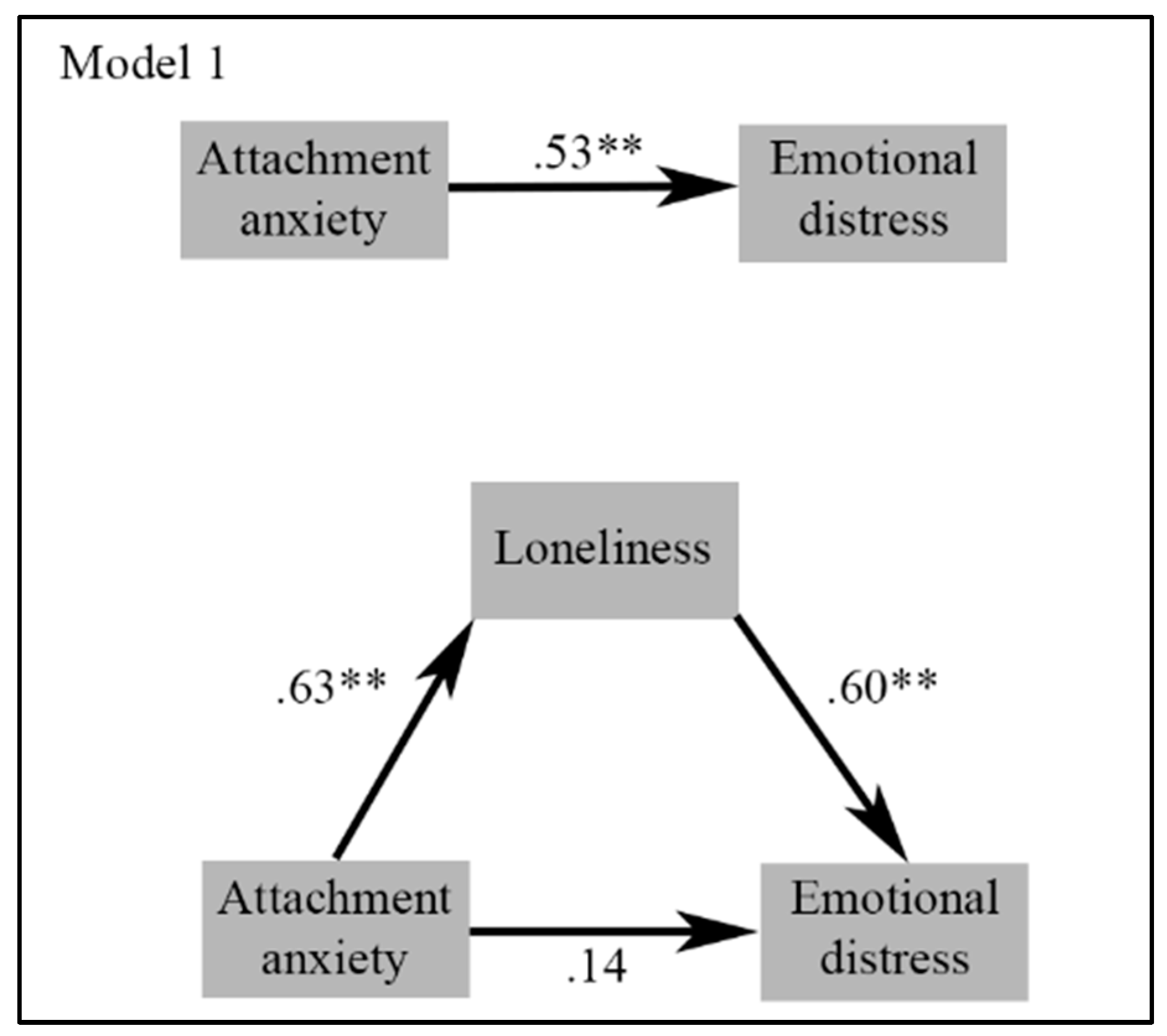
Figure 2.
Standardized regression coefficients for the relationship between attachment avoidance and emotional distress, total effect (above), and mediated by loneliness (below).
Figure 2.
Standardized regression coefficients for the relationship between attachment avoidance and emotional distress, total effect (above), and mediated by loneliness (below).
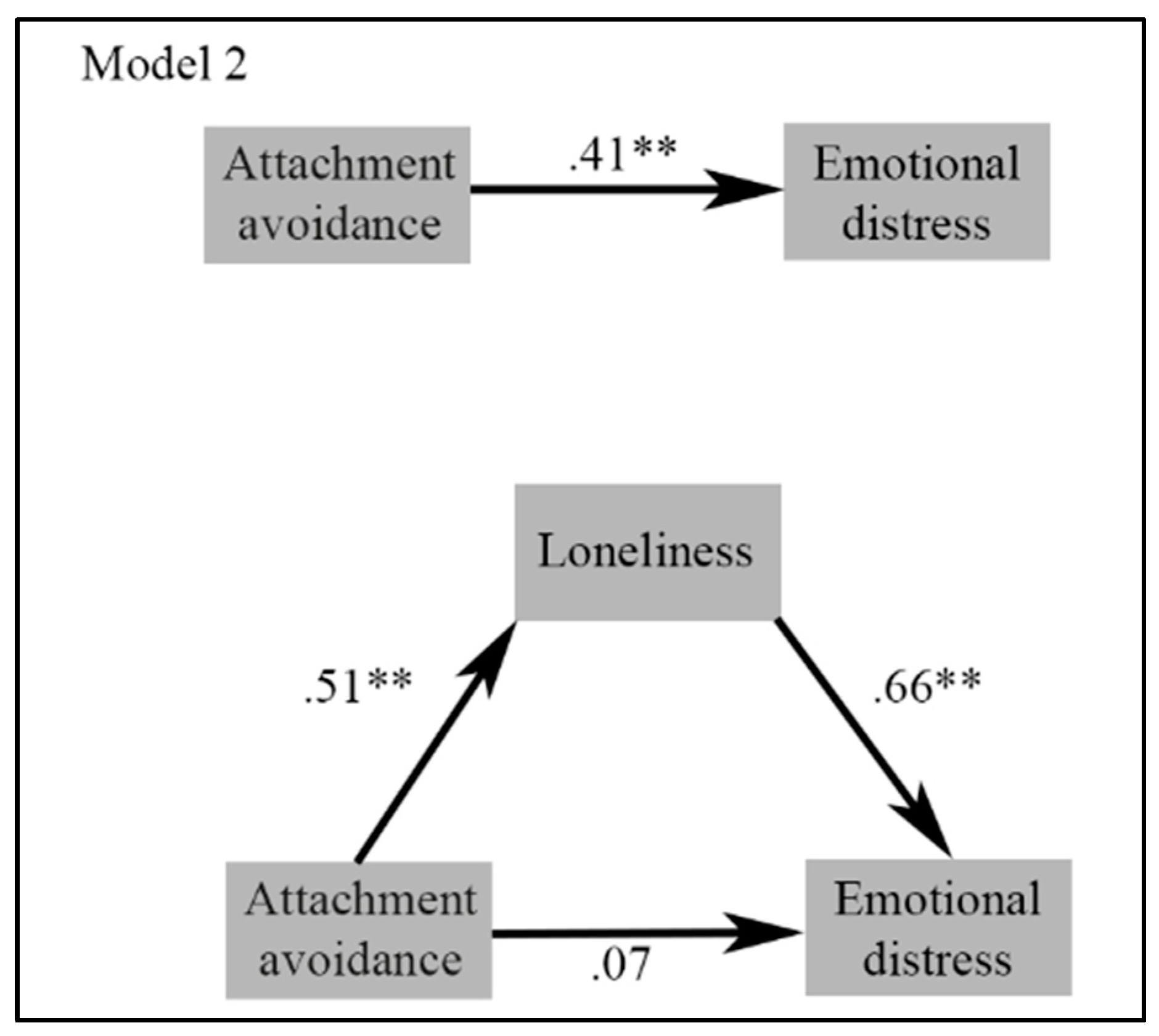

Table 1.
Gender differences.
| Male (N=30) |
Female (N=111) |
t-test |
|||
| Mean | SD | Mean | SD | p | |
| Age | 35.22 | 10.80 | 35.03 | 10.23 | .00 |
| Loneliness | 21 | 13.69 | 22.81 | 13.32 | .513 |
| Emotional distres | 17.9 | 13.40 | 17.89 | 12.86 | .998 |
| Attachment anxiety | 13.43 | 5.32 | 14.18 | 6.59 | .568 |
| Attachment avoidance | 33.56 | 7.36 | 33.06 | 8.74 | .773 |
| Problem-focused | 8.06 | 4.05 | 10.23 | 4.35 | .015 |
| Emotion-focused | 33.33 | 14.94 | 41.08 | 14.31 | .001 |
| Avoidant | 22.50 | 9.21 | 27.37 | 10.61 | .023 |
| Socially supported | 15.50 | 7.47 | 19.43 | 9.94 | .046 |
Table 2.
Correlation matrix.
| N=141 | 1 | 2 | 3 | 4 | 5 | 6 | 7 | 8 | 9 |
| 1. Age | - | ||||||||
| 2. Loneliness | -.13 | - | |||||||
| 3. Emotional distress | -.20* | .70*** | - | ||||||
| 4. Attachment anxiety | -.19* | .63*** | .53*** | - | |||||
| 5. Attachment avoidance | -.15 | .51*** | .41*** | .61*** | - | ||||
| 6. Problem-focused coping | -.17* | .21* | .24** | .05 | .11 | - | |||
| 7. Avoidant coping | -.22** | .10 | .22 | .16 | -.03 | .47*** | - | ||
| 8. Emotion-focused coping | -17* | .08 | .13 | .17 | .00 | .73*** | .71*** | - | |
| 9. Socially supported coping | -.00 | .20* | .26** | -.02 | .09 | .42*** | .69*** | .62*** | - |
| * represents p < .05 ** represents p < .01 *** represents p<.001 |
Table 3.
Attachment dimensions as predictors of loneliness and emotional distress.
|
Loneliness R.sq = .42, p<.001 |
Emotional distress R.sq = .30, p<.001 |
|||||
| β | T | p | β | T | p | |
| Attachment anxiety | .50 | 6.13 | .000 | .42 | 4.72 | .000 |
| Attachment avoidance | .20 | 2.46 | .015 | .14 | 1.59 | .113 |
| Age | -.005 | -.08 | .935 | -.10 | -1.41 | .160 |
Table 4.
Coping styles as predictors of loneliness and emotional distress.
|
Loneliness R.sq .11, p<.01 |
Emotional distress R.sq = .18, p<.001 |
|||||
| β | T | p | β | T | p | |
| Problem-focused | .33 | 2.79 | .006 | .30 | 2.67 | .008 |
| Emotion-focused | -.38 | -2.47 | .015 | -.25 | -1.73 | .083 |
| Avoidant | .01 | .12 | .903 | -.23 | -1.82 | .070 |
| Socially supported | .28 | 2.38 | .019 | .45 | 3.93 | .000 |
| Age | -.13 | -1.57 | .117 | -.24 | -3.01 | .003 |
Disclaimer/Publisher’s Note: The statements, opinions and data contained in all publications are solely those of the individual author(s) and contributor(s) and not of MDPI and/or the editor(s). MDPI and/or the editor(s) disclaim responsibility for any injury to people or property resulting from any ideas, methods, instructions or products referred to in the content. |
© 2023 by the authors. Licensee MDPI, Basel, Switzerland. This article is an open access article distributed under the terms and conditions of the Creative Commons Attribution (CC BY) license (http://creativecommons.org/licenses/by/4.0/).
Copyright: This open access article is published under a Creative Commons CC BY 4.0 license, which permit the free download, distribution, and reuse, provided that the author and preprint are cited in any reuse.


