

Submitted:
05 January 2026
Posted:
06 January 2026
You are already at the latest version
Abstract
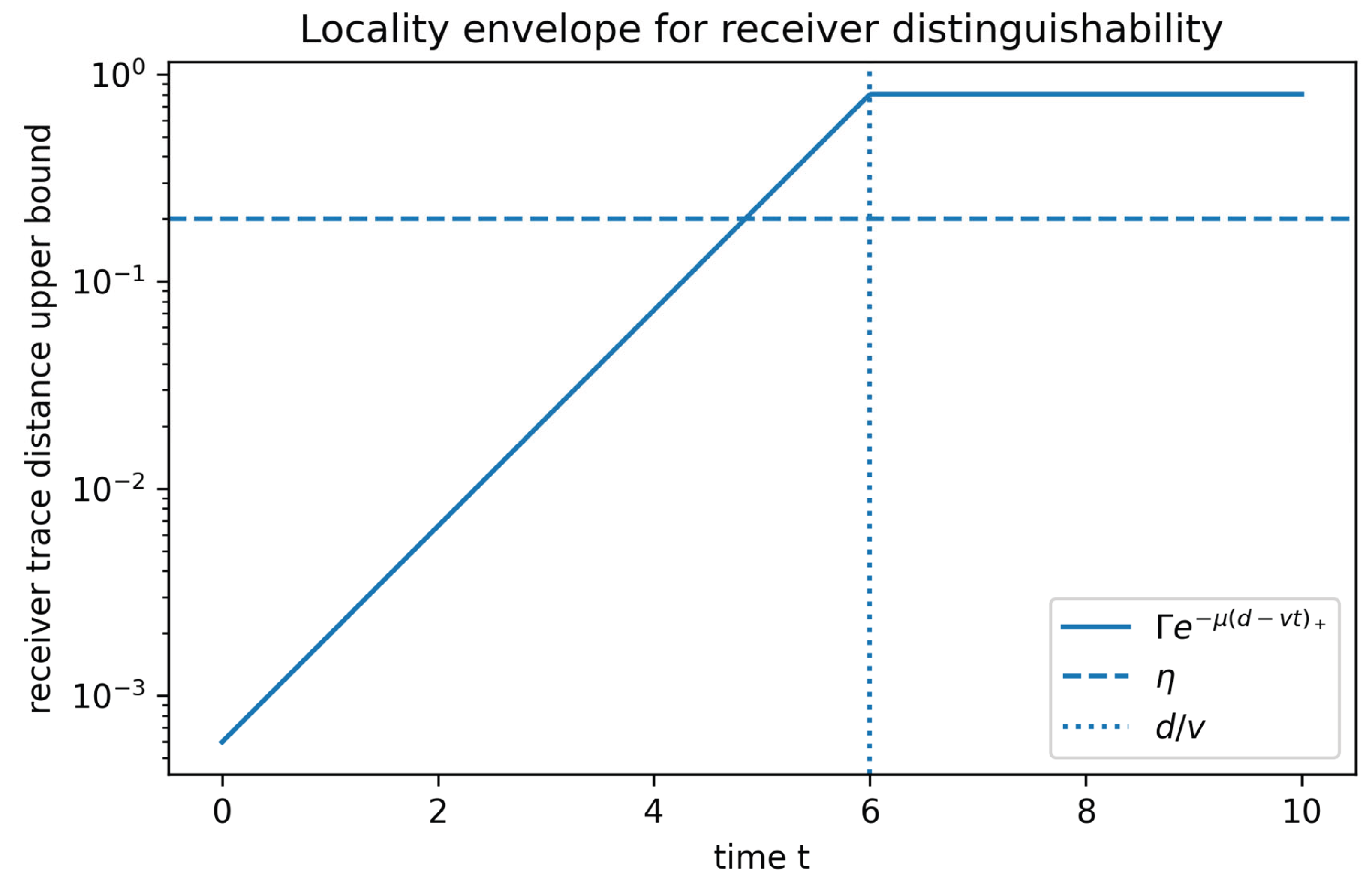
We develop an operational certification framework for micro–macro modeling in local quantum systems. Audited closure is defined as a uniform discrepancy bound between microscopic and surrogate predictions over a declared observable suite on a declared domain of states. A receiver-region copy time τ_copy(η;A→B) is defined as the earliest time at which a finite receiver region B can distinguish—at trace-distance threshold η—a localized perturbation supported on A. Under explicit Lieb–Robinson hypotheses for Hamiltonian or Lindbladian generators, we derive an exponential receiver distinguishability envelope and an explicit time-to-threshold lower bound, including the regime η≥Γ where the threshold is provably never reached and τ_copy=+∞. As an achieved-closure demonstration, we analyze a split-step quantum walk lifted to quasi-free lattice fermions and provide computable dispersion and two-point density audit bounds on a band-limited quasi-free domain. As a signature contribution beyond a repackaging of locality, we prove a locality–mixing separation theorem for primitive Lindbladians with a log-Sobolev (or mixing) rate λ: the receiver distinguishability is bounded by the minimum of a ballistic LR tail and an intrinsic mixing contraction, yielding a measurable crossover time and an operational separation between unitary and dissipative dynamics.
Keywords:
1. Introduction
2. Framework: Audited Closure and Bridge Maps
3. Receiver-Region Copy Time and Locality Lower Bounds
4. Signature Result: Locality–Mixing Separation for Primitive Lindbladians
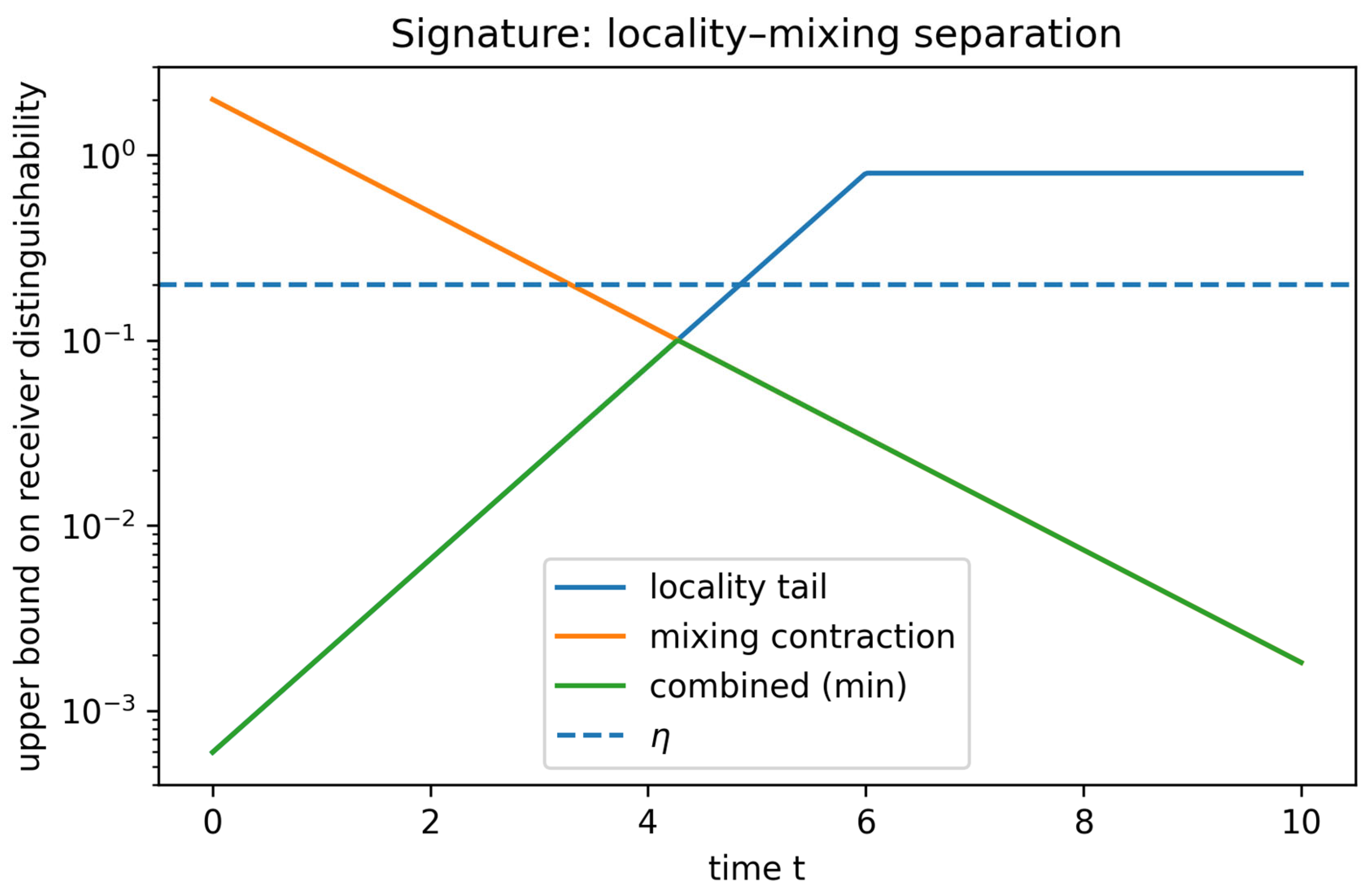
5. Numerical Demonstration: Operational Gap and Mixing-Rate Constraint
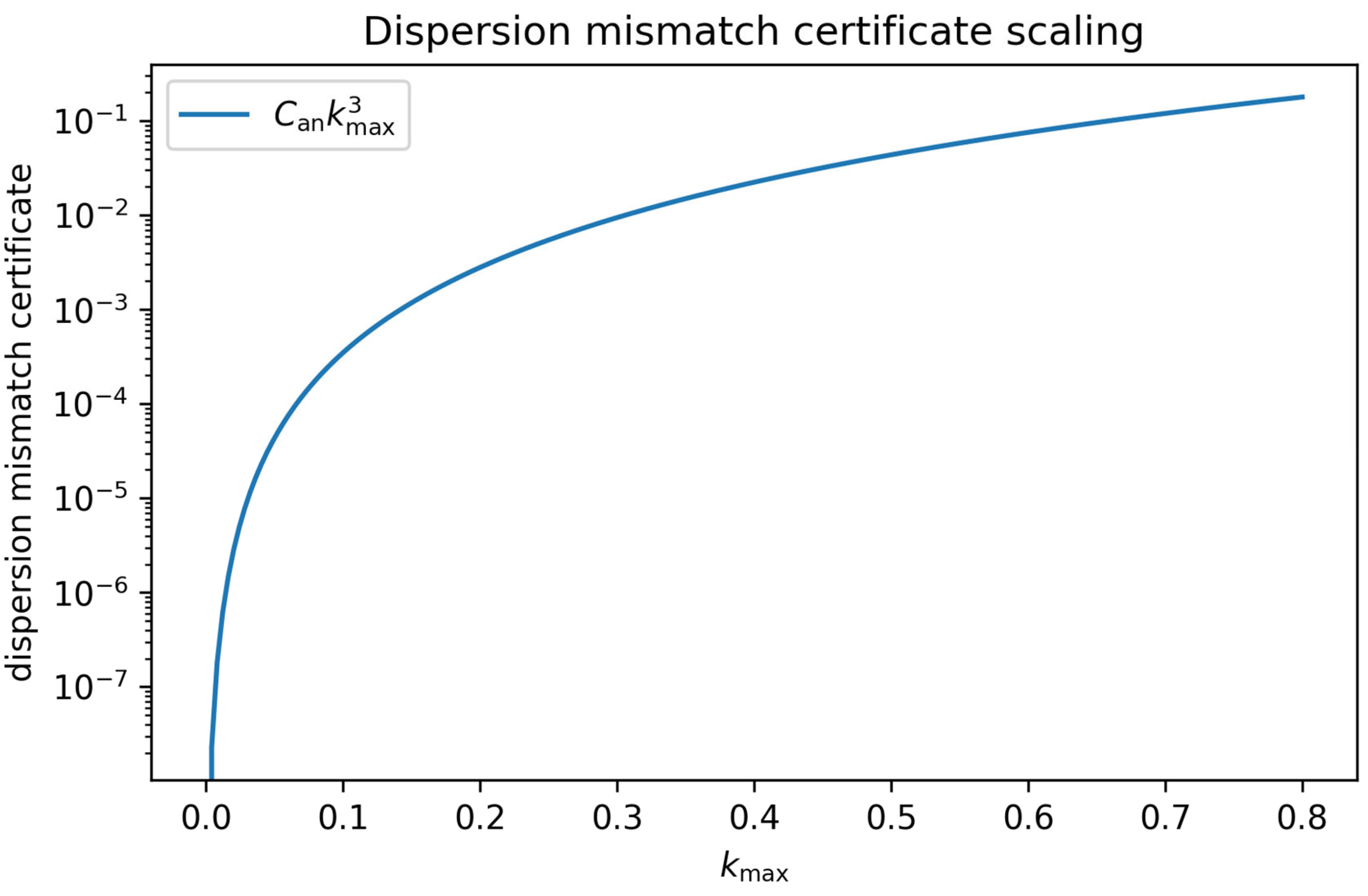
6. Achieved Closure Example: Split-Step Walk → Dirac Surrogate in Quasi-Free Fermions
7. Weak-Interaction Extension (g≠0): Stability of Audited Closure
8. Statistical Audit Layer
9. Concrete Use Case: Cooling Lindbladian on a Defected Fermionic Chain
10. Discussion and Conclusions
Supplementary Materials
Author Contributions
Funding
Institutional Review Board Statement
Informed Consent Statement
Data Availability Statement
Conflicts of Interest
References
- Lieb, E.H.; Robinson, D.W. The finite group velocity of quantum spin systems. Commun. Math. Phys. 1972, 28, 251–257. [CrossRef]
- Bravyi, S.; Hastings, M.B.; Verstraete, F. Lieb-Robinson Bounds and the Generation of Correlations and Topological Quantum Order. Phys. Rev. Lett. 2006, 97, 050401. [CrossRef]
- Nachtergaele, B.; Sims, R.; Ueltschi, D. Lieb-Robinson bounds in quantum many-body physics. Contemp. Math. 2010, 529.
- Poulin, D. Lieb-Robinson Bound and Locality for General Markovian Quantum Dynamics. Phys. Rev. Lett. 2010, 104, 190401. [CrossRef]
- Barthel, T.; Kliesch, M. Quasilocality and Efficient Simulation of Markovian Quantum Dynamics. Phys. Rev. Lett. 2012, 108, 230504. [CrossRef]
- Helstrom, C.W. Quantum detection and estimation theory. J. Stat. Phys. 1969, 1, 231–252. [CrossRef]
- Fuchs, C.; van de Graaf, J. Cryptographic distinguishability measures for quantum-mechanical states. IEEE Trans. Inf. Theory 1999, 45, 1216–1227. [CrossRef]
- Peschel, I. Calculation of reduced density matrices from correlation functions. J. Phys. A: Math. Gen. 2003, 36, L205–L208. [CrossRef]
- Bravyi, S. Lagrangian representation for fermionic linear optics. Quantum Inf. Comput. 2005, 5, 216–238. [CrossRef]
- Kitagawa, T.; Rudner, M.S.; Berg, E.; Demler, E. Exploring topological phases with quantum walks. Phys. Rev. A 2010, 82, 033429. [CrossRef]
- Asbóth, J.K.; Oroszlány, L.; Pályi, A. A Short Course on Topological Insulators; Springer Nature: Durham, NC, United States, 2016; ISBN: 9783319256054.
- Hoeffding, W. Probability inequalities for sums of bounded random variables. JASA 1963, 58, 13–30.
- Azuma, K. Weighted sums of certain dependent random variables. Tohoku Math. J. 1967, 19, 357–367. [CrossRef]
- McDiarmid, C. On the method of bounded differences. Surveys in Combinatorics 1989.
- Temme, K.; et al. (placeholder for log-Sobolev / mixing references for quantum Markov semigroups, to be specified).

Disclaimer/Publisher’s Note: The statements, opinions and data contained in all publications are solely those of the individual author(s) and contributor(s) and not of MDPI and/or the editor(s). MDPI and/or the editor(s) disclaim responsibility for any injury to people or property resulting from any ideas, methods, instructions or products referred to in the content. |
© 2026 by the author. Licensee MDPI, Basel, Switzerland. This article is an open access article distributed under the terms and conditions of the Creative Commons Attribution (CC BY) license.