

Submitted:
05 January 2026
Posted:
05 January 2026
You are already at the latest version
Abstract
Maintenance organizations face growing volumes of spare parts, requiring robust classification methodologies to support decision-making. Practitioners continue reliance on simple and single-criterion-specialized methodologies, while research advances toward criteria and threshold specialized classification optimization for operationally visible spare parts or predefined classes revealing criteria dependencies and data completeness requirements. The literature review identifies a gap showing that existing classification methodologies lack inclusion of all spare parts with maintainable asset relevance, consequently excluding, under-prioritizing, or misclassifying essential spare parts leading to the wrong forecasts and inventory policies. Applying design science research, this study develops a holistic spare parts portfolio classification methodology that increases spare parts inclusion and enables class-based decision-making strategy development to address the gap. The methodology classifies spare parts based on their absence and presence across equipment bill of materials, maintenance history, inventory, and inventory policies, enabling identification and inclusion of operationally invisible spare parts. A case study of 32,521 spare parts demonstrates the interventional effects of the methodology. The intervention improved decision-making efficiency by 91%, increased decision throughput ninefold, and transformed a non-transparent decision-making approach with 9% scope completion and 1.7% stock value increase into a transparent strategy-based approach yielding full scope completion and 33.6% scope stock value reduction.
Keywords:
spare parts management (SPM)
; portfolio management
; classification
; decision-making
; decision-support
; case study
; design science research (DSR)
; maintenance
1. Introduction
Equipment-intensive maintenance organizations depends on effective spare parts management (SPM) for planning, monitoring and controlling spare parts supporting maintenance activities [1]. Ineffective SPM results in spare part unavailability leading to revenue losses and unproductive downtime [2]. To reach effective SPM, classification approaches are needed to support forecasting and inventory policies allocation [3,4,5].
Several issues challenge organizations in managing spare parts portfolios with strategic inventory control. Some of these issues concern increasing portfolio size and complexity and excessive information volumes in decision-making [2,6,7,8]. Management of large portfolios require grouping spare parts and differentiated inventory policies, supported by robust classification approaches [1]. However, effective classification depends on criteria availability, leaving existing classification methodologies only partially applicable for the full spare parts portfolios. While empirical data in maintenance organizations are fragmented, existing methodologies primarily focus on predefined criteria and threshold-based allocations of operational visible demand and inventory parts into narrow predefined classes. Main contributors to this data unavailability are part demands remaining intermittent and erratic [9,10], while obsolescence rates reach around 23% annually [6].
Although different classification methodologies effectively classify certain portfolio segments, existing methodologies often apply the same principles across all parts, assuming homogeneous data and parts characteristics. Despite numerous existing and advanced classification methodologies, organizations continue to rely on simple methods such as fundamental single-criterion ABC classifications or stock-pilling [7,11,12]. The literature review reveals a gap showing that existing classification methodologies may exclude, under-prioritize, or misclassify in cases of low history, zero demand, and non-stock parts. Furthermore, they lack the ability to consider all maintainable asset-relevant spare parts, as they are either focused on operationally visible spare parts or limited by specific criteria or dataset completeness requirements. While conventional classification focuses on grouping spare parts into classes to be demand forecasted and inventory policy allocation, a need exists for differentiated decision-making to consider all relevant spare parts despite diverse characteristics and data unavailability.
This paper proposes a holistic spare parts portfolio classification methodology that defines the portfolio using empirical CMMS data and classifies spare parts into 16 scenario-classes based on their presence and absence across the four dimensions equipment bill-of-materials (BOMs), historical maintenance, physical inventory, and inventory policies. The classification enables scenario-class-based decision-making strategy development, allocation of decision-making capacity, direction of support methodologies matching data availability, and continuous inventory policy compliance and BOM obsolescence monitoring. The following research questions guided this study:
- How can spare parts portfolios be defined in a maintenance organization using empirical data?
- How can a full spare parts portfolio be classified to facilitate differentiated decision-making strategy allocation?
- How can classification be utilized as a strategic tool for ongoing spare parts portfolio control and compliance assessment?
The paper proceeds by first describing the research methodology, then a literature review of existing spare parts classification methodologies, followed by introducing the proposed classification methodology and a case study revealing its interventional effects in practices. Lastly, a discussion and conclusion are drawn upon this.
2. Research Methodology
This study adopts the Design Science Research (DSR) methodology to approach the research questions, as it supports developing and validating the usefulness of an artifact for solving real-world problems [13,14]. In this study, the proposed holistic spare parts portfolio classification methodology is the studied artifact, integrating empirical data to support decision-making, guide decision-making strategies, and direct existing supportive classification methodologies.
A literature review investigates existing spare parts management (SPM) and classification literature to examine how existing methodologies include, exclude, and prioritize spare parts. Thus, revealing their capabilities for classifying all maintainable assets-relevant spare parts while understanding the advantages, limitations, advancements, and purpose of classification in SPM. Web of Science and Scopus were the primary sources for the literature searches.
The proposed methodology was evaluated through a case study in an equipment-intensive offshore oil and gas company on a scope of 32,521 spare parts. The organization needed a systematic approach to distribute limited expert decision-making capacity and apply supportive classification methodologies for inventory policy decision-making. The case company historically relies on stockpiling, periodically disparate inventory clean-ups, expert decision-making, and simple support techniques such as decision-trees, rule-of-thumb, and fundamental single-criterion classification. The company experienced continuous stock level increases and lost overview of spare parts variety.
Existing classification methodologies were not found adequately supporting the needed scope classification. Instead, a mix of multiple decision-making strategies focusing the expert decision-making capacity and the existing supportive means were needed to review the defined spare parts scope. Thus, a methodology was needed for developing and allocating decision-making strategies and directing supportive means across the different spare parts portfolio segments.
The proposed methodology was applied, iterated, and tested using company data with high variability. Data concerning the company maintenance processes, spare parts consumption, inventory control, and SPM practices were derived from internal documents, semi-structured interview, and the computerized maintenance management system (CMMS). Four primary CMMS data sources were used to model the proposed methodology, including equipment BOM records, historical maintenance records, inventory records, and spare parts master data with current inventory policies. The CMMS data were extracted to include a 12 years operational time span.
The proposed methodology was validated through workshops, semi-structured interviews, and meetings with industry experts from the maintenance planning, logistics, and procurement departments.
3. Literature Review
This literature review investigates existing literature on spare parts management (SPM) classification methodologies assessing their inclusion, exclusion, and prioritization of spare parts.
3.1. Management and Classification of Spare Parts
The investigated SPM literature reflects and defines spare parts through various focal points depending on the object of analysis. In general, spare parts and inventories exist to support maintenance activities and ensure continuous operations [2,8].
Grouping spare parts into classes and applying inventory policies are necessary for organization managing large numbers of spare parts [15]. Many inventory management studies emphasize the importance of considering spare parts through their dynamic criteria characteristics such as lead time, cost, and demand [1].
To perform effective SPM, inventories must be developed and matured through deliberate incurred risk and informed decision-making. Studies by Cavalieri et al. [4] and Bacchetti and Saccani [3] present systematic SPM practicing approaches comprising the steps of classification, then demand forecasting, followed by inventory policy allocation.
Much research has focused on spare parts classification as the main methodology for facilitating demand forecasting and inventory policies allocation [3,8]. Bhalla et al. [16] note classification and forecasting as support activities to inventory control, while the systematic approaches present classification as the supporting step to enable forecasting.
This perspective is also reflected by Bacchetti and Saccani [3] and Boylan and Syntetos [17], stressing a needed relation between classification and forecasting. However, this assumes that classified parts must be forecastable, which is contradicting to as noted by Amirkolaii et al. [18], Turrini and Meissner [9], and Kulshrestha et al [1], that demand forecasting mainly applies to intermittent, lumpy, erratic, or smooth demand spare parts. Thus, spare parts with low or fragmented history or zero-demand may be under-prioritized. According to Boylan and Syntetos [17], a link should exist between inventory policy decisions, classification, and forecasting. Thus, reflecting a need for classification to encompass all spare parts with inventory policies including low or fragmented history and zero demand parts. Ensuring that the full range of maintainable asset-relevant spare parts are considered is essential to prevent unplanned downtime from stockouts.
Many inventory-management studies define spare parts scopes as parts managed in inventory. Hu et al. [19] share this perception, defining spare parts as inventory items required for maintenance. Thus, drawing the boundaries of classification by what exists in inventory. Van Horenbeek et al. [20] note that maintenance demand determines the inventory size. However, these perceptions remain highly inventory- and demand-focused, potentially overlooking operationally invisible spare parts outside current records.
Stip and Van Houtum [21] discuss equipment bill of material (BOM) information which indicate that relevant spare parts to consider in classification exist as equipment BOM components. Zhang et al. [22] note that demand fluctuates over the product life-cycle, increasing in the end-of-life phase. Thus, historical maintenance records contain different relevant spare parts for the equipment life-cycle to be considered. Further, Bacchetti et al. [7], Ferreira et al. [15], and Cakmak and Guney [12] confirm that historical spare part demand is important, underlining that demanded spare parts are relevant to consider. This indicates that existing classification research may overlook spare parts, not visible in current operational inventory- and demand-records.
As a first step, Cavalieri et al. [4] highlight parts coding, a step of registering spare parts into CMMS, implying that spare parts must exist in CMMS to be classified and that CMMS holds relevant parts for consideration. However, Cavalieri et al. [4] also state that classification categorizes spare parts used in plants to reveal the once needing most attention. Hence, presenting the scope to be limited to only consider active demand record and a decision-making prioritization on a subset of these active demand parts. This scope limitation includes risk of under-prioritization or exclusion of critical spare parts.
These findings indicate that SPM classification literature is often either demand- or inventory-focused and that classification methodologies are considered specialized to support demand forecasting and inventory policy allocation, limiting its spare parts scope and potentially excluding or under-prioritizing essential insurance spare parts. This is considered a contradiction to classification methods being regarded as a main improving factor for critical spare parts identification and optimization [1,23,24]. Consequently, this spare part scope limitation may expose maintenance organizations to unplanned down-time from critical parts stockouts.
The following subsection therefore investigates existing spare parts classification methodology literature to unfold and expose this indicated spare parts scope limitation.
3.2. Existing Spare Parts Classification Methodologies
While classification methodologies are widely applied through practical case studies, methodological limitations persist involving inconsistent criteria and threshold definition between studies and between industry and research [2,16,25]. Faulty inventory policy allocation and insufficient forecasts remain major issues for multiple companies [7,26]. Spare parts classification studies are often criteria focused due to each methodology relies on specific criteria to function. Consequently, data scarcity remains a common issue in maintenance organizations, limiting the applicability of the methodologies [7].
For example, Bhalla et al. [16] describe classification as a sequence of criteria selection, classes definition, and method application. This sequence produces a rigid approach with fixed criteria and static classes as boundaries for spare parts to fit within. The methodologies remain selected to work with these fixed and static constraints, risking underprioritizing, excluding or misclassifying spare parts not fitting within these constraints.
By reviewing recent spare parts classification literature, two methodological areas were noted as (1) fundamental single-criterion classification and (2) multi-criteria and advanced analytical classification methodologies.
3.2.1. Fundamental Single-Criterion Classification Methodologies
The earliest and most widely industry adopted classification methodologies rely on a single criterion, either quantitative (based on data) or qualitative (based on expert evaluation) [15,23]. Four fundamental single-criterion classification methodologies were identified, typically specialized for inventory items and focused on one dominant criterion such as criticality, unit value, or movement rate [2,27].
The VED (Vital, Essential, Desirable) classification, described by Roda et al. [2] and Mor et al. [28] ranks spare parts from expert-evaluated part criticality. The methodology is applicable even when quantitative data are lacking, but it is prone to subjectivity and has limited scalability due to manual decision-making. In relation, Ernst and Cohen [29] highlight that strategic system performance control and monitoring are difficult when analyses are conducted on individual-part-level.
The XYZ classification included by Stoll et al. [30], Mor et al. [31], Dhoka and Choudary [32] quantitatively assesses demand predictability by ranging spare parts from stable (X) to random (Z) demand using demand variability. This methodology is often combined with others, highly forecast focused, and relying on demand records
The FSN (Fast-, Slow-, Non-moving) classification noted by Cavalieri et al. [4] and Teixeira et al. [23] is a quantitative methodology applying spare part movement rates to distribute spare parts into the fast-, slow-, or non-moving classes. Obsolescence and low inventory turnover-rate can be identified using this methodology, but it relies on historical transaction accuracy and may overlook non-moving yet critical insurance spare parts.
The ABC (Always, Better, and Control) discussed by Tanwari et al. [33], Teixeira et al. [23], Partovi and Burton [34], and Huiskonen [35] is based on the pareto (80/20) principle commonly using the dollar usage also called the cost-volume criterion [36]. Spare parts are distributed into A (high), B (Medium), and C (Low) classes based on the annual demand or usage rate multiplied by the unit cost. Vazquez Hernandez and Elizondo Rojas [10] and Cakmak and Guney [12] note ABC classification as the most preferred and applied method in industry due to its simplicity and comprehensibility.
Bacchetti et al. [7] note that practitioners prefer easy-to-use and implementable solutions and that complex mathematical methods holds a low practical applicability. Teunter et al. [37] add that large volumes of spare parts may influence ABC classification to be applied oppose to more part specific methods. However, as Hu et al. [38] argue many criteria remain excluded in single-criterion classification, limiting their ability to include all relevant SPM dimensions. Similarity, Braglia et al. [5] reflect that these methods are incapable of differentiating all key criteria across the divers spare parts collection.
Modern ERP systems embed these fundamental methods [5], highlighting that current IT systems support fundamental but limited classification capabilities. Teixeira et al. [23] argue that fundamental ABC classification is not considered good practice in research.
Collectively, these single-criterion classification methodologies are specialized yet generic, focusing on specific but few limited SPM criteria and predefined classes. They are considered fundamental to spare parts classification research and modern ERP systems, but their reliance on criteria availability or manual decisions limit their spare parts coverage, potentially leading to exclusion, under-prioritization, or misclassification of essential parts. These methodologies are often found as the predefined classes combined with other more advanced classifications methodologies [16].
3.2.2. Multi-Criteria and Advanced Analytical Classification Methodologies
While ABC classification remains the most applied methodology, more advanced methods exist to overcome the limitations of single-criterion methodologies. These advanced methods can according to Cakmak and Guney [12] be categorized as mathematical models, artificial intelligence, and multi-criteria decision-making (MCDM) methods. The multi-criteria perspective for methodology advancements has been acknowledge by Researchers as essential considering parts with many distinct characteristics [35,39].
Simple extensions of single-criterion methodologies combine cost and criticality. Ramani and Kutty [40] and Duchessi et al. [41] examine a combined ABC-VED, while Flores and Whybark [36,42] vary bi-dimensional combinatory matrices with cost, lead time, criticality, and obsolescence criteria. These matrix-based multi-criteria methodologies dimensionally improve prioritization of parts, adding more criteria and classes, while remaining simple to apply in practice. However, computational limitations are met with more than 2 criteria, leaving the methodology type either generic or specialized.
Ernst and Cohen [29] propose Operations Related Groups (ORGs), a statistical clustering methodology that group spare parts by attribute similarities and statistical distances. It extends the number of classes and criteria applied, enabling classification of large spare part volumes and generic inventory policy allocation. However, such methods rely on complete quantitative datasets and are sensitive to scaling and normalization of the input data. Excessive data preparation is required and its initial step of defining the number of criteria and classes introduce subjectivity. Thus, incomplete data and biased criteria and class selection may cause under-prioritization and misclassification.
Bacchetti et al. [7] and Teixeira et al. [8,23] propose hierarchical decision-trees to deductively classify parts and allocate inventory policies with multiple linguistic represented criteria. Their deductive nature and use of linguistic criteria makes them intuitive and simple to apply, while including both qualitative and quantitative SPM criteria through the ABC (cost), VED (Criticality), and FSN (lead time) combination [23]. However, such decisions-trees remain prone to decision-maker subjectivity, criteria threshold sensitive from predetermined threshold values, and under-prioritizing criteria tradeoffs through sequential decision-making.
To improve threshold values, class assignment and address subjectivity, several weighted optimization models have been developed. Ramanathan [43], Ng [44], and Zhou and Fan [45] present linear optimization to weight multiple criteria and optimized ABC classification, which offers a quantitative and objective criteria weighting with low computational requirement. However, it relies on data completeness and lack ability to consider qualitative data, and criteria tradeoffs. Çelebi et al. [46] and Hadi-Vencheh [47] extent with non-linear optimization, enabling the criteria weight effects to be maintained but adds computational complexity. Liu and Huang [48] adopt Data Envelopment Analysis (DEA) for ABC classification, linearly and quantitatively optimizing on relative efficiency for weighting and class assignment. Ishizaka et al. [49] propose DEASort, combining DEA with the Analytical Hierarchy Process (AHP) to integrate qualitative data and expert evaluation in the weighting, but it increases subjectivity, manual processing, and computational complexity. While these improve criteria, their thresholds and weighting, they depend on complete datasets and are specialized for few fixed ABC classes.
AHP is in research one of the most recognized MCDM methodologies due to its ability to determine weights, integrate qualitative and quantitative data, handle criteria tradeoffs and quantify subjective criteria [2,23]. It performs parallel comparison in hierarchical structures, producing relative criteria and spare part importance ranking. Partovi and Burton [34] examine AHP-ABC cost prioritization, while Gajpal et al. [50], Molenaers et al. [51], and Ayu Nariswari et al. [25] examine AHP-VED criticality prioritization. Braglia et al. [5] combine AHP with decision-trees to propose the MASTA approach, improving applicability in practice by increasing transparency. While AHP effectively handles multiple criteria and their tradeoffs, it requires data completeness and decision-makers, which potentially inflicting scalability issues and subjectivity. Thus, revealing uncertainty and potential misclassification when data is scarce.
The fuzzy set theory is often found extending the classification methodologies, as an effective mathematical method that address uncertainty in decision-making [12]. It allows decision-makers to apply linguistics rather than numerical values while offering numerical criteria ranges opposed to fixed single values. Rezaei and Dowlatshahi [52] note that data and weight parameters are often not precise and available in practice, and that practitioners prefer linguistics representations. Variations include, Fuzzy-ABC [53], Fuzzy-AHP [15,54,55], hybrid Fuzzy-AHP-DEA for ABC classification [56], a Fuzzy linear assignment methodology [57], and fuzzy logic and linguistic value inputs to a rule-based inference system [52]. While fuzzy logic extensions advance methods by applying comparison rations that reduce subjectivity and data uncertainty, it increases computational complexity and does not handle data scarcity and part exclusion. Consequently, it practical applicability is considered difficult [2,25].
Studies also explore more advanced computational methodologies. Altay and Erel [58] present a genetic algorithm optimizing criteria weights and thresholds by learning from historical categorization, Partovi and Anandarajan [59] propose optimizing ABC classification using Artificial Neural Networks (ANN), Tsai and Yeh [60] apply multi-objective particle swarm optimization for determining optimal inventory class groupings, and Lolli et al. [61] examine machine learning as a supervised classifier for intermittent-demand spare parts. Further, Yu [62] investigates the Artificial Intelligence-based (AI) methods Support Vector Machines (SVM), Backpropagation Networks (BPN), and K-Nearest Neighbor (K-NN) for classification. By introducing advanced computational reasoning, these methodologies are scalable and effectively handle large data volumes, complex pattens and criteria tradeoffs. However, they rely on complete, quantitative, historical data while not disregarding subjective criteria in their weight scorings [12]. Furthermore, their black box processing limits decision-making transparency. Consequently, their practical applicability is considered low [2].
3.2.3. Literature Summary
Existing classification methodologies focus primarily on optimizing predefined criteria thresholds, weighting, or allocation of operationally visible inventory and demand parts to predefined classes like ABC and generic inventory policies. The reviewed methodologies remain either generic or specialized for specific predefined criteria, fixed classes, or specific part characteristics. Either they are mathematically or computationally complex, limiting their practical applicability. Else they are simple to apply but also prone to subjectivity, criteria dependent, decision-maker dependent, relying on static criteria thresholds, or inefficient for large volumes of spare part and criteria. While each methodology may effectively classify their intended scope, existing methodologies remain criteria and optimization specialized, limited to few static classes, criteria dependent, and reliant on data completeness.
Collectively, this literature review reveals the gap that existing classification methodologies lack in ensuring inclusion of all potential maintainable asset-relevant spare parts in maintenance organization. Consequently, edge cases such as low or fragmented history, non-stock and zero-demand spare parts may be under-prioritized, excluded or misclassified from the lack of criteria coverage and historical data.
While literature considers classification as means to support demand forecasting and policy allocation, this paper addresses the gap from a holistic classification perspective. Rather than viewing spare parts through their operational demand and inventory visibility, a holistic approach is needed for capturing and classifying all maintainable asset-relevant spare parts despite their operational demand and inventory invisibility, data and criteria coverage, and their absence and presence in their relation to maintainable assets and IT systems. This emphasizes that all parts must be considered, though each part may require different means of consideration and thereby different decision-making strategies.
4. A Holistic Spare Parts Portfolio Classification Methodology
Increasing spare part portfolio size and complexity continues to challenge maintenance organization. While robust classification is crucial for managing these large portfolios, companies continue to rely on simple fundamental classification methodologies and stock-pilling, which are not considered as best practice [1,7,10,11,12,23]. Despite numerous methodological advancements, the literature review demonstrates a gap showing that these methodologies lack inclusion of all maintainable asset-relevant spare parts consequently excluding, misclassifying, or under-prioritizing operationally invisible cases of low or fragmented history, non-stock, and zero-demand spare parts due to data scarcity. While existing methodologies may effectively classify segments of spare parts, they need to be directed toward the appropriate portfolio segments to add value.
To address the identified gap, a holistic spare parts portfolio classification methodology has been developed using the design science research approach and empirical SPM CMMS data through explorative research. To establish the methodology, first the range of spare parts existing in the organization is captured, constituting a fact-based documentation of the full spare parts portfolio. Then, the full range of possible portfolio-state scenario-classes are defined as archetype classes. These archetype classes are then allocated across the dimensions of part stocking and part application. Lastly, the derivative effects of the spare parts position in the archetype classes and portfolio segments are described, followed by a highlight of how these classes may enable potential decision-making strategy assignments and compliance assessments.
4.1. Spare Parts Portfolio Scope Definition
A Spare parts portfolio in maintenance organizations encompasses the complete set of parts applicable for asset maintenance. A spare part may be defined in accordance to DS/EN 13306 (2017) [63], as the object intended for replacement of an item to ensure that original item functionality is maintained. From this definition several sub definitions of spare part types have been introduced in literature, such as generic, specific, consumable, and strategic spare parts [4]. Teixeira et al. [8] refers to these as maintenance materials, which aligns with Scarf et al. [64] stating that facilitation of maintenance is the reason for the existence of spare parts inventories. In this study, spare parts are referred to as all items either utilized in maintenance or with the potential of being utilized in maintenance.
Spare parts portfolios are in classification literature often perceived as the resulting classified spare parts with policies matching different spare part characteristics. What defines a spare part to be part of the portfolio is not limited to its physical nature and presence in stock or at the supplier, but also its function in maintenance and the potential usage in maintenance of assets. Maintenance organizations hold empirical data on these spare part dimensions in the CMMS.
Several studies present spare parts to be related to historical maintenance demand and consumption information [2]. The full range of this data defines the full range of actual spare parts usage through the asset history. Stip and Van Houtum [21] presents that equipment are installed with bill of material (BOM) lists of components which may be usable in future equipment maintenance. The total collection of these lists adds to having a full range of spare parts applicable to the maintainable asset. Studies also mention the existence of inventory records of parts held to facilitate maintenance [64], as well as inventory policy allocations resulting in spare parts to be held physically in stock [8].
By investigating empirical data from the company CMMS on these dimensions, the spare parts included to constitute a full spare parts portfolio are found within the portfolio segments presented in Figure 1.
The portfolio segments presented in the figure are (A) parts registered on equipment bill of materials (BOMs), (B) parts mentioned in historical maintenance records, (C) Physically stocked parts, and (D) parts designated to be stocked by the inventory policy.
The ideal state of the portfolio is where all spare parts with a potential usage application in the maintainable asset are registered on BOMs, as reflect in the left part of the figure. As a result, segment A sets the boundaries for the range of potential spare parts in the organization based on the maintainable asset. Some of these spare parts may not exist in historical maintenance, while others in segment B do. Some spare parts are physically stocked, where some are related to historical maintenance. Lastly, parts with an inventory policy for stock keeping of the part are also physically stocked. The ideal portfolio-state sets an example of what maintenance organizations thrive to reach through effective SPM practices. However, due to the dynamic nature of SPM, the portfolio-state constantly changes, and the ideal portfolio-state is highly difficult to reach in practice.
The right part of the figure presents a generalization of the portfolio segment states which enables capturing the full range spare parts across all possible portfolio-state scenarios. These scenarios are detailed in following section, where they reflect both the absence and presence of data for each scenario to reveal data availability and guide decision-making and allocation of supportive means when assessing the entire spare part portfolio.
4.2. The 16 Possible Spare Part Portfolio Classification Scenarios
The generalized portfolio segment model reflects the extended range of segment-overlaps in a Venn diagram. While the segments reflect presence of spare part in segments, their absence is as valuable. For a spare part to be part of the portfolio, it must exist in at least one of the segments. The existence in one segment, and the absence in another, positions the spare part in the portfolio. Figure 2 presents the derived 16 different scenario-classes of possible spare parts positions across the spare parts portfolio segments.
The figure locates the scenarios in the Venn diagram and describes them through the four binary empirical dimensions previously defined as segment A to D. Each spare part in a maintenance organization should fit within one of the 16 defined scenario-classes to reflect its presence or absence in the portfolio. Thereby, the 16 positioning scenarios functions as portfolio-state scenario-class archetypes.
Scenario 1 represents spare parts with no factual presence, deeming them excluded from the portfolio. The single-segment scenario-classes 2 to 5 include parts exclusively found on equipment BOMs (2), in historical demand (3), physically present in stock (4), and with a policy requiring stocking (5), respectively.
The two-segment scenario-classes 6 to 11 include parts found on equipment BOMs and in historical demand (6), on equipment BOMs and physically present in stock (7), on equipment BOMs and with a policy requiring stocking (8), in historical demand and physically present in stock (9), in historical demand and with a policy requiring stocking (10), and physically present in stock and with a policy requiring stocking (11), respectively.
The three-segment scenario-classes 12 to 15 include parts found on equipment BOMs, in historical demand, and physically present in stock (12), on equipment BOMs, in historical demand, and with a policy requiring stocking (13), on equipment BOMs, physically present in stock, and with a policy requiring stocking (14), and lastly in historical demand, physically present in stock, and with a policy requiring stocking (15), respectively. Scenario-class 16 represents the presence of a spare part in all portfolio segments at once.
The first scenario-class is the only one defining spare parts to be excluded from the portfolio, while the 15 other scenario-classes reflect the spare parts to be considered present in the portfolio. The scenario-classes 2 to 15 reflect a partial portfolio segment fulfillment for all identified spare parts, while spare parts found in scenario-class 16 reflect full portfolio segment coverage. The portfolio segment coverage should be perceived as a defining factor for what information is available for the individual spare parts and whether the spare parts are currently part of the managed inventory program. The classification scenarios are built upon both the presence and absence of empirical data on each spare part mentioned in the organization CMMS. Thus, the position of the spare parts in each of the scenario-classes remains a binary question resulting in a Boolean-based approach.
4.3. From Classification Scenarios to Decision-Making Strategies
The defined range of scenario-classes positioning spare parts across the identified portfolio segments reveal the presence or absence of a spare part in relation to physical stock record, inventory policy records, historical maintenance demand records, and equipment BOM lists.
To assess the portfolio segment coverage of the scenario-classified spare parts, the part stocking and part application dimensions are applied to range scenario-classes and assess their segment fulfillments. Part stocking combines the two segments of physical stocking and policy stocking, while part application combines the two segments of parts in equipment BOMs and parts in historical maintenance. The two dimensions are ranged in the order of no part presence, partial part presence, and full part presence in each of the segments. By ranging the identified 16 scenario-classes across the two dimensions, the holistic spare parts portfolio classification methodology for decision-making strategy assignment is presented in Figure 3.
The figure shows each of the 16 scenario-classes ranged across the part application dimension in the x-axis, and the part stocking dimension in the y-axis. The part application ranges from no part application, partial part application with no demand history but BOM information, partial part application with demand history but no BOM information, to full part application with both demand history and BOM information. The part stocking dimension ranges from not stocked, physically stocked but not policy stocked, policy stocked but not physically stocked, and to fully policy and physically stocked.
For the partial part applications, the lack of historical demand with the presence of BOM information reflects a lower part application level than the opposite. This is reasoned by the principle that a part application area is not applicably verified before it has been historically proven. Whereas a BOM spare part without any maintenance history only reflects intended application.
For the partial part stocking areas of the part stocking dimension, the physical stock segment is ranged lower than policy stocking. This is reasoned by the principle that policy stocking remains a strategic choice reflecting the future part stocking, while unjustified physical stock is perceived as redundant stock or shadow stock.
Figure 3 reveals six derivative effects in relation to navigating the portfolio segments and combining the scenario-classes to enable decision-making strategizing. Moving horizontally from full part application to no part application increases stockout impact uncertainty, as the data volume for maintainable asset and part relation decreases. The opposite direction increases the contextualization of the part application, which enhances fact-based decision-making and applicability relevance verification of spare parts. When moving vertically between the policy stocking and physically stocking dimension areas, a stock rebalancing need is revealed when physically stocked parts are not policy designated stock, and vice versa. Moving spare parts vertically from non-stock toward fully policy and physically stocking increases associated stock investments while the opposite direction increases the stock reduction impact but also the supplier reliability.
Decision-making for the corner scenario-classes hold most potential financial and risk impacts and either most or least data availability for decision-support. The middle classes highlight the inventory policy and physical inventory compliance, as well as the historical demand and BOM part alignment.
Selecting the adequate decision-making strategy and supportive classification methodology for inventory policy allocation on specific portfolio segments may be based on both a clear decision-making purpose and the availability of data to support the working principle of the supportive means. The proposed methodology presented in Figure 3 may serve as a guiding basis to develop and assign decision-making strategies with appropriate supportive means considering data availability and portfolio segment requirements.
The developed holistic spare parts portfolio classification methodology is considered an extent to the systematic SPM approaches by Cavalieri et al. [4] and Bacchetti and Saccani [3] adding a broad portfolio classification prior to applying existing classification methodologies to expand spare parts inclusion and direct existing methodologies toward appropriate portfolio segments covering need data support. Furthermore, it adds a continuous portfolio assessment approach for policy evaluation. The holistic principle of the proposed methodology is to direct and diversify decision-making capacity and existing supportive classification methodologies toward segments of the portfolio rather than applying a single approach and methodology on the entire spare parts portfolio or portfolio scope.
5. Case Study
This case study examines the practical application of the proposed holistic spare parts portfolio classification methodology and its interventional effects on an explicitly selected pilot case study scope of 32,521 spare parts in a case company review project. The initial as-is approach represents current practices, and it is compared to the post-interventional effects of introducing the proposed methodology.
The case company is a major oil and gas operator with more than 50 active North Sea assets containing hundreds of thousands of interconnected maintainable equipment. The company operates a complex logistics setup involving their own internal warehouses, onshore-offshore supply chain, and collaboration with external vendors and warehouses within a mixed contract-based and open-market supplier network.
Maintenance and spare parts management (SPM) operations are controlled and documented in a major vendor-based computerized maintenance management system (CMMS), while analyses and reporting are typically produced as static and disparate spreadsheets or business intelligence (BI) reports. Because operational process data are scattered across multiple sources, decision-making is mostly based on expert judgement and simple techniques such as fundamental single-criterion classification, decision trees, and rule-of-thumb approaches.
Several organizational challenges motivated the company to execute a major spare parts revision, including historically high inventory levels, low spare part coverage across equipment, increasing cost pressure, and low part availability at maintenance execution.
A company-wide reengineering initiative launched a large spare parts revision project to increase inventory reliability for equipment, while reducing excess inventory by reviewing inventory policies. The maintenance department was responsible for ensuring that all critical spare parts were adequately evaluated.
The company initiated the project using an initial as-is approach described in the following section. However, this approach was deemed insufficient and misaligned with project objectives. Thus, a reformed approach was applied using the proposed holistic spare parts portfolio classification methodology as an intervention to reclassify the parts and to form objective aligned decision-making strategies.
The following sections present first the initial as-is review approach, then the intervention reformed approach using the proposed methodology for strategy definition and allocation. Lastly, a comparison of the two approaches highlights the impact of the proposed methodology.
5.1. Initial AS-IS Spare Parts Review Approach
The project was initiated using two external maintenance-oriented spare parts specialists appointed as project leads. They structured the review of the 32,521 spare parts by grouping them according to equipment BOMs, producing a vital group of 18,394 spare parts and a non-vital group of 14,127 spare parts. The vital group was reviewed through system and equipment strategy workshops with the internal maintenance planners that are equipment specialists. The non-vital group was distributed across the maintenance planners as spreadsheets for individual review.
For both groups, decisions were supported by a simple deductive decision tree and fundamental single-criterion classification methodologies. The main classifications applied were a mix of equipment grouping, a VIS (Vital, Important, Secondary) variant of the VED (Vital, Essential, Desirable) methodology, and a variation of the FSN (Fast, Slow, Non-moving) methodology. The FSN variant, FASD (Fast-, Active-, Slow-moving, and Dead), classified parts moved within six months as fast, between six months and two years as active, between two and five years as slow, and between five and eight years as dead.
A general policy grouping was defined to include capital and security parts with low or no movement, medium cost parts with fluctuating consumption, and low cost and low technicality parts with regular consumption. This loose movement-, cost-, and technicality-based grouping worked as a fourth classification attempt relying solely on linguistic terms for the spare part characteristics.
Further, data such as commonality across BOMs, five-years accumulative preventive maintenance (PM) and corrective maintenance (CM) part unit consumption, stock level, unit value, and lead time were available. However, data practices were found challenged by information fragmentation and high data gathering requirements. Many CMMS searches were required for each part by the decision-makers to verify data availability, to ensure the support methods validity, and the adequate decision-making approach.
Many disparate spreadsheets containing static CMMS data, analytical techniques, classification results, and decisions were scattered between decision-makers, causing data, decision, and classification obsolescence and subjectivity. The long data-gathering time was the most dominant reason for the slow decision-making progress, as each of the 32,521 spare parts required additional information for decision-making.
The rational was that the equipment experts were the most adequate decision-makers, and that the deductive decision tree supported by known classifications would be sufficient. However, the decision-makers faced enormous spare part volumes with various parts outside their technical specialization, leading to slow and inconsistent decision-making. Further, the collective set of utilized classification techniques produced various part views and under-prioritized or misclassified parts due to difference in criteria coverage and part characteristics. As an example, 12,696 parts deemed non-vital were found vital, while 1,343 vital were found non-vital. Unit value and lead time uncertainty affected 13,605 and 26,441 spare parts respectively due to limited data history.
Only 9% of the scope was completed, involving 7,865 decisions requiring 1 full time equivalent (FTE) and resulting in a 1.7% stock value increase. Linear projection indicated full scope completion would require 11,53 FTEs and lead to a 17.6% stock value increase.
The initial as-is approach suffered from low decision-making efficiency, slow progress, non-transparent decision-making, and increasing capital investments. Decision-making capacity did not suffice for the scope size, which led the case company to adopt a new reformed approach using the proposed methodology.
5.2. The Holistic Spare Parts Classification Methodology Intervention
The case company paused the project and applied the holistic classification methodology to redistribute the spare parts into new classes. The parts were quickly distributed across the 16 scenario classes presented in Figure 3. Decision-making strategies were developed to address each class segment aligned with the project objective and available decision-making capacity. The objective was unchanged, and the decision-making capacity remained to rely on maintenance planners as expert decision-makers.
The project managers expected that all spare part needed either manual expert review or quality assurance of assigned inventory policies by an internal maintenance decision-maker with experience in maintenance operations. As decision-trees and rule-based approaches were already integrated and acceptable, they were expected to be applied if they could provide value. Thus, the decision-making strategies were developed incorporating rule-based approaches, fast-track batch decisions with quality assurance, and expert reviews supported by fundamental classification techniques already integrated in the company, but only where data were available.
To operationalize the proposed methodology, several CMMS data sources were applied, including historical maintenance records, equipment BOM records, inventory records, and spare parts master data with current inventory policies. A five-years operational time span was defined by the company as the cut-off for part demand relevance, but data extracted enabled special case investigation considering a 12 year operational time span.
The spare parts were classified using the Boolean-based approach of the proposed methodology where the absence and presence of spare parts in each of the four data sources contributed to class allocation. As presented in Figure 4, the full 32,521 spare parts scope was classified across the 16 scenario-classes and then clustered into four main decision-making strategies (A-D), three compliance strategies (E-G), and three discontinuation strategies (H-J).
The figure presents the distribution of all 32,521 spare parts across the 16 portfolio-state scenario classes along the part stocking dimension (y-axis) and part application dimension (x-axis) described in Section 4. All classes hold spare parts except scenario class nine, which consist of non-stock policy parts physically in stock with a demand history but no BOM information.
Further, the figure illustrates the decision-making strategy A-J allocation, which guided full scope decision-making and the resulting project completion. The figure content and these strategies are detailed in following three subsections.
5.2.1. Main Decision-Making Strategy A-D
Strategy A was a low context, fast-track, rule-based batch review strategy covering 20,478 non-stock spare parts with no application or only a BOM application basis. The decision-making required a single designated decision-maker reviewing whether a just-in-time non-stock policy was sufficient, verified through a BOM criticality check and a special cases screening of the 12 years operational time span. Parts flagged for uncertainty were transferred to expert decision-makers.
Strategy B was a high context, fast-track batch review of 3,095 non-stock parts with partial or full part application including either only historical part demand or both BOM and historical part demand information. A single designated decision-maker screened the parts using maintenance demand, FSN classification, and demand-based criticality. Lead time was considered to ensure compliance with the historical demand response time requirements.
Strategy C was a low context expert review of 6,174 policy stocked parts with no or partial part application through BOM information. Obsolete and insurance parts were hidden within these classes. While no maintenance history was available, decisions relied on BOM information and expert decision-makers with equipment experience. Special cases of repairable parts were identified through vendor movements, while part commonality across equipment BOMs indicated broader relevance. Each spare part was to be reviewed by equipment expert decision-makers considering commonality, applicability, special cases of repairability, obsolescence, and critical cases within the 12 years.
Strategy D was a high context, expert review of 2,514 policy stocked spare parts with partial or full part application including either historical part demand or both BOM and historical part demand. Each spare part was to be reviewed by equipment expert decision-makers considering the same aspects as in strategy C but guided by demand history, demand-based criticality classification, and assessment of lead time compliance with historical demand response time requirements.
While these decision-making strategies do not prescribe inventory policies, their value lies in clarifying the decision basis and guiding what to consider in parts comparison and decision-making. As it was required that decisions remain expert-based, the objective of the classification and strategies was to guide and scope the decision-making rather than prescribe class-specific outputs.
While strategy C and D required manual expert decision-making, the number of such requirements were drastically reduced by adopting a strategy-based approach enabled by the proposed holistic spare parts portfolio classification methodology. This increased the decision-making objective and process transparency for each class of spare parts, while it clarified available supportive means.
5.2.2. Compliance Decision-Making Strategy E-G
The main decision-making strategies (A-D) constituted as the main project progress and completion contributors. In addition, three compliance strategies were derived from the proposed methodology. These closely align with the policy test and validation step highlighted by Cavalieri et al. [4] and the performance assessment step mentioned by Bacchetti et al. [3], both referring to the systematic SPM approach.
The strategies holistically evaluate the spare parts portfolio for excess inventory unjustified by current inventory policies, inventory policy incompliance for where spare parts should be physically in stock but are absent, and maintenance part demand lacking BOM relation, which indicate potential BOM obsolescence or missing equipment part link.
Strategy E was an inventory policy compliance review for identifying spare parts that according to the current inventory policy should be in stock but are absent. A total of 2,475 were flagged to be stocked unless their inventory policies changed.
Strategy F was an excess stock review for identifying spare parts physically in stock without an inventory policy justification. A total of 197 spare parts were identified to be removed unless their inventory policies changed to require stocking.
Strategy G was a historical maintenance demand-based equipment BOM review. A total of 68 spare parts were identified for potential BOM obsolescence as the spare parts had been historically demanded for maintenance on equipment where these parts did not occur on the BOM.
These strategies focused on ensuring alignment of inventory policies and inventory as well as equipment BOM parts and demand parts when updating CMMS with decisions. Furthermore, they provided an approach for the case company to perform ongoing simple inventory policy compliance control and monitoring and demand-based BOM assessment for targeted spare parts scopes.
5.2.3. Discontinuation Decision-Making Strategy H-J
The final strategies targeted spare parts with increased discontinuation potential.
Strategy H was a future application relevance review focusing on spare parts listed on equipment BOMs but never used in historical maintenance. Their demand absence indicates limited operational relevance, potential insurance part purpose, or BOM obsolescence. These could be batch reviewed considering preventive maintenance (PM) strategies, late life asset strategies, and equipment or system discontinuations.
Strategy I was a stock obsolescence and insurance part review, examining spare parts with no part application lacking both equipment BOM and historical maintenance demand yet policy designated as stock and in some cases physically in stock, which indicate insurance part stocking. Cases where spare parts are not physically stocked may indicate legacy initiatives, data obsolescence, and project stock leftovers. Expert decision-makers were needed to identify any critical future maintenance application despite the absence of information.
Strategy J reviewed non-stock spare parts without any part application. These spare parts were to be discontinued as decision-making capacity should not be wasted on spare parts that are either not application-relevant or indicated from previous inventory policy decisions to be stock-relevant.
These strategies are not claimed to be the only possible combination of the scenario-classes and approaches. They represent archetype strategy configurations addressing the relevant scenario-classes that match the available decision-making capacity and objective. Therefore, the strategies may need to be adjusted to fit the situation in other companies.
However, the proposed holistic spare parts portfolio classification methodology was proven highly effective for scoping and developing decision-making strategies across portfolio segments, enhancing comparability and decision-support in each segment by only focusing supportive means and data usage where they bring value.
5.3. Intervention Results and Outcomes
The methodology was applied first using a simple tabular format and later integrated into the business intelligence (BI) project reports. The Boolean principle of the methodology requires no advanced computational capacity accommodating practitioner preferences for simple and easy-to-apply methodologies [7].
The proposed methodology intervention transformed the review project from a slow progressing, non-transparent, and investment heavy decision-making approach into a highly efficient, low resource requiring, transparent decision-making, and capital freeing project approach and completion.
Table 1 summarizes the operational and financial impacts of moving from the initial as-is approach to the reformed post-intervention approach.
While the initial as-is approach required 1 FTE for a 9% scope completion, the reformed post-intervention approach required 1.08 FTEs to reaching full scope completion. Assuming linear progression, full scope completion using the initial approach would have required 11.53 FTEs equivalent to 20,481 hours. From this, the reformed approach yielded 91% FTE improvements and saved a potential of 18,564 hours expert decision-making workload. While the initial approach required experts involved for all part, the reformed approach removed 67% of the parts from the expert decision-making workload, achieving a ninefold decision throughput with fewer FTE resources.
The initial as-is approach resulted in a 1.7% scope stock value increase from the 9% scope completion, suggesting a 17.6% scope stock value increase assuming linear progression. In contrast, the intervention reformed approach yielded a 33.6% scope stock value reduction.
Nine decision-making strategies were defined applying the proposed methodology, including four main strategies enabling fast-tracked, rule-based batch reviews, and targeted expert decision-maker reviews. Three compliance-oriented strategies for continuous inventory policy compliance control and monitoring, and demand-based BOM alignment. And lastly, three strategies specialized for potential spare parts discontinuations.
Prior to the intervention, decision-making was highly part-centric and equipment BOM-focused, requiring all spare parts to be reviewed sequentially. Post intervention, the decision-making became increasingly part application-oriented, integrating equipment data from both historical maintenance demand and equipment BOMs. Furthermore, the decision-support means became class-based applications rather than general one-size-fits-all techniques. The absence of data became meaningful information provision rather than limitations. The methodology also guided company integrated support classification techniques toward portfolio segments where they would be valid, thereby reducing chances of spare parts under-prioritization or misclassification from these methodologies.
Overall, the intervention shifted the focus from asking what offshore systems or equipment required stocking of spare parts to when a spare part is critical to stock, how to prioritize expert decision-making capacity, and that knowing the decision objective and support boundaries enhances decision-making transparency.
6. Discussion & Conclusions
Equipment-intensive maintenance organizations face challenges of growing and increasingly complex spare parts portfolios, and excessive information volumes to consider in SPM decision-making practices [2,6,7,8]. Grouping and allocation of diverse inventory policies are needed using robust classification approaches [1]. Despite the many existing classification methodologies in literature, organizations still rely on stock-pilling [11] and simple fundamental single-criterion methodologies [7,10,12] embedded in ERP systems [5]. While research has advanced toward multi-criteria methods and advanced analytics, they remain limited by criteria specialization, few narrow static classes, and data completeness requirements. They are often focused on optimizing predefined criteria, thresholds, weightings, or allocation of operationally visible spare parts to generic inventory policies or predefined classes. As a result, their methodological applicability remains limited due to data scarcity in maintenance organization [7], and the inconsistencies between practice and research and across studies for definition these criteria [2,16,25].
The literature review revealed a gap showing existing classification methodologies lack inclusion of all maintainable asset-relevant spare parts. Their focus on operationally visible spare parts, predefined or fixed classification objectives, and criteria and data completeness dependencies, limits their ability to properly classify when lacking empirical data. Consequently, non-stock, zero demand, or low or fragmented history spare parts may be under-prioritized, excluded or misclassified.
To approach this gap, this study proposes a holistic spare parts classification methodology that expands the classification scope beyond operational visible spare parts. It classifies spare parts based on their absence and presence across inventory records, inventory policy records, historical maintenance demand records, and equipment BOM lists. Rather than replacing existing classification techniques, the methodology introduces a holistic pre-classification layer that classifies the portfolio into 16 classes, enabling targeted decision-making strategies to be developed and assigned to apply more effective use of existing data, decision-making capacity, and decision-support means. This extends the systematic SPM approaches by Cavalieri et al. [4] and Bacchetti and Saccani [3] by supporting early and broad portfolio classification and subsequent late inventory policy compliance control and monitoring, offering continues portfolio assessment.
The proposed methodology was tested as an intervention in a large-scale inventory policy review of 32,521 spare parts. Nine decision-making strategies were developed, transforming the project from a non-transparent decision-making approach resulting in stock value increase and low decision-making efficiency into a fully completed project with transparent decision-making, increased decision-making efficiency, and a drastic stock value reduction.
6.1. Implication for Research
Systematic SPM often rely on classification to support demand forecasting, inventory policy allocation and evaluation [3,4]. This study advances the field by providing a holistic spare parts portfolio classification methodology applied prior to existing classification methodologies, enabling differentiated decision-making strategies and avoiding a one-size-fits-all classification methodology approach. It focuses decision-making capacity and the supportive means such as classification and forecasting toward specific segments of the portfolio.
The methodology improves the consideration of portfolio diversity and inclusion of operationally invisible low or fragmented history, zero demand, non-stock spare part corner cases which existing classification methodologies are found limited in doing.
Its industrial relevance was demonstrated through a large pilot case study of 32.521 spare part subject to inventory policy renewal. The full scope was classified using four CMMS data sources across equipment BOMs lists, inventory records, spare parts master data containing current inventory policies, and 12 years of maintenance records.
6.2. Implication for Practice
Practitioners often prefer and rely on simple and easy-to-use single-criterion classification methodologies [7,10,12]. The proposed methodology accommodates this requirement by classifying spare parts portfolios across 16 portfolio-state scenario-classes using simple Boolean logic in spreadsheets or simple business intelligence (BI) software to model four CMMS data sources.
A key improvement from the case study was the ability to redirect decision-making capacity toward most critical spare parts, while removing excessive decision-making workload from expert decision-makers. It furthered the use and trust in already integrated classification methodologies in the case company by guiding their respective use cases suitable for their supportive function and working principle.
The case study demonstrates a high practical value of the methodology for practitioners focusing on large-scale spare part reviews, inventory audits, and re-evaluation of specific portfolio segments by enabling a more efficient, transparent, and financially beneficial decision-making through class-based decision-making strategy assignments.
6.3. Limitations and Future Research
The proposed methodology was validated through a pilot case study of 32,521 spare parts viewed as a critical portfolio representation. It was selected as many expert decision-makers were able to validate the effectiveness of the proposed methodology, and to establish need governance prior to further portfolio application. However, the strategies applied depended on expert decision-making capacity and their competencies. Future research should explore decision-making automation, integration of more of the existing advanced classification methodologies, and application across diverse maintenance industries and larger spare parts portfolios.
Four methodology derived strategies were highly case specific. The project objective was fixed by management requirements for expert decision-making capacity usage, thereby introducing subjectivity to the final decisions. Therefore, future research should examine how decision-making strategies may differ between organizations.
The methodology offers a classification basis for decision-making strategies development and assignment of supportive classification methods toward portfolio segment based on data availability and spare parts characteristics targets. Testing the methodology in combination with existing advanced classification techniques in future research may further its ability to direct such methods effectively and improve spare parts inclusion.
Author Contributions
Equal contribution was invested by all authors for developing and validating the proposed methodology presented in this article. Conceptualization, S.K.D., K.W.S., N.H.M., C.B.J.; methodology, S.K.D., K.W.S., N.H.M..; software, S.K.D., K.W.S.; validation, S.K.D., K.W.S., N.H.M., C.B.J.; formal analysis, S.K.D., K.W.S.; investigation, S.K.D., K.W.S., N.H.M., C.B.J.; resources, S.K.D., K.W.S., N.H.M., C.B.J.; data curation, S.K.D., K.W.S., C.B.J.; writing—original draft preparation, S.K.D., K.W.S., N.H.M.; writing—review and editing, S.K.D., K.W.S., N.H.M., C.B.J.; visualization, S.K.D.; supervision, N.H.M.; project administration, S.K.D.; funding acquisition, N.H.M. All authors have read and agreed to the published version of the manuscript.
Funding
This research was funded by the Danish Offshore Technology Centre (DTU Offshore) and the APC was funded by the Technical University of Denmark (DTU).
Institutional Review Board Statement
Not applicable, as no personal health or sensitive data was involved.
Informed Consent Statement
Informed consent was obtained from all subjects involved in the study.
Data Availability Statement
The contribution of this study is presented and available within the article. Due to company confidentiality agreements, the raw CMMS records used to derive the resulting classification in the case study are not available. For further data availability inquiries, please contact the corresponding author.
Acknowledgments
The Danish Offshore Technology Centre (DTU Offshore) are acknowledged for funding this study. The authors further acknowledge the case company for enabling test and evaluation of the proposed methodology.
Conflicts of Interest
The authors declare no conflicts of interest.
Abbreviations
The following abbreviations are used in this manuscript:
| ABC | Always, better, and control |
| AHP | Analytical hierarchy process |
| AI | Artificial intelligence |
| ANN | Artificial neural network |
| BI | business intelligence |
| BOM | Bill of material |
| BPN | Backpropagation network |
| CM | Corrective maintenance |
| CMMS | Computerized maintenance management system |
| DEA | Data envelopment analysis |
| DSR | Design science research |
| FASD | Fast-, active-, low-moving, and dead |
| FSN | Fast-, slow-, non-moving |
| FTE | Full time equivalent |
| K-NN | K-Nearest Neighbor |
| MCDM | Multi-criteria decision-making |
| ORG | Operations related groups |
| PM | Preventive maintenance |
| SPM | Spare parts management |
| SVM | Support vector machine |
| VED | Vital, essential, desirable |
| VIS | Vital, important, secondary |
References
- Kulshrestha, N.; Agrawal, S.; Shree, D. Spare Parts Management in Industry 4.0 Era: A Literature Review. Journal of Quality in Maintenance Engineering 2024. [CrossRef]
- Roda, I.; Macchi, M.; Fumagalli, L.; Viveros, P. A Review of Multi-Criteria Classification of Spare Parts. Journal of Manufacturing Technology Management 2014, 25, 528–549. [CrossRef]
- Bacchetti, A.; Saccani, N. Spare Parts Classification and Demand Forecasting for Stock Control: Investigating the Gap between Research and Practice. Omega 2012, 40, 722–737. [CrossRef]
- Cavalieri, S.; Garetti, M.; MacChi, M.; Pinto, R. A Decision-Making Framework for Managing Maintenance Spare Parts. Production Planning & Control 2008, 19, 379–396. [CrossRef]
- Braglia, M.; Grassi, A.; Montanari, R. Multi-attribute Classification Method for Spare Parts Inventory Management. Journal of Quality in Maintenance Engineering 2004, 10, 55–65. [CrossRef]
- Cohen, M.A.; Agrawal, N.; Agrawal, V. Winning in the Aftermarket. Harvard Business Review 2006, 84, 129–138.
- Bacchetti, A.; Plebani, F.; Saccani, N.; Syntetos, A.A. Empirically-Driven Hierarchical Classification of Stock Keeping Units. International Journal of Production Economics 2013, 143, 263–274. [CrossRef]
- Teixeira, C.; Lopes, I.; Figueiredo, M. Spare Parts Stock Management: Classification and Policy Assignment. FME Transactions 2024, 52, 257–270. [CrossRef]
- Turrini, L.; Meissner, J. Spare Parts Inventory Management: New Evidence from Distribution Fitting. European Journal of Operational Research 2019, 273, 118–130. [CrossRef]
- Vazquez Hernandez, J.; Elizondo Rojas, M.D. Improving Spare Parts (MRO) Inventory Management Policies after COVID-19 Pandemic: A Lean Six Sigma 4.0 Project. The TQM Journal 2024, 36, 1627–1650. [CrossRef]
- Gembarski, P.C.; Kammler, F. Mass Customizing for Circular and Sharing Economies: A Resource-Based View on Outside of the Box Scenarios. In Towards Sustainable Customization: Bridging Smart Products and Manufacturing Systems; Andersen, A.-L., Andersen, R., Brunoe, T.D., Larsen, M.S.S., Nielsen, K., Napoleone, A., Kjeldgaard, S., Eds.; Lecture Notes in Mechanical Engineering; Springer International Publishing: Cham, 2022; pp. 1039–1046 ISBN 978-3-030-90699-3.
- Cakmak, E.; Guney, E. Spare Parts Inventory Classification Using Neutrosophic Fuzzy EDAS Method in the Aviation Industry. Expert Systems with Applications 2023, 224, 120008. [CrossRef]
- Blessing, L.T.M.; Chakrabarti, A. DRM, a Design Research Methodology; DRM, a Design Research Methodology. Springer 2009; p. 1-397. [CrossRef]
- Hevner, A.R.; March, S.T.; Park, J.; Ram, S. Design Science in Information Systems Research. MIS Quarterly 2004, 28, 75-105. [CrossRef]
- Ferreira, L.M.D.F.; Maganha, I.; Magalhães, V.S.M.; Almeida, M. A Multicriteria Decision Framework for the Management of Maintenance Spares - A Case Study. IFAC-PapersOnLine 2018, 51, 531–537. [CrossRef]
- Bhalla, S.; Alfnes, E.; Hvolby, H.H.; Sgarbossa, F. Advances in Spare Parts Classification and Forecasting for Inventory Control: A Literature Review. IFAC-PapersOnLine 2021, 54, 982–987. [CrossRef]
- Boylan, J.E.; Syntetos, A.A. Spare Parts Management: A Review of Forecasting Research and Extensions. IMA Journal of Management Mathematics 2010, 21, 227–237. [CrossRef]
- Amirkolaii, K.N.; Baboli, A.; Shahzad, M.K.; Tonadre, R. Demand Forecasting for Irregular Demands in Business Aircraft Spare Parts Supply Chains by Using Artificial Intelligence (AI). IFAC-PapersOnLine 2017, 50, 15221–15226. [CrossRef]
- Hu, Q.; Chakhar, S.; Siraj, S.; Labib, A. Spare Parts Classification in Industrial Manufacturing Using the Dominance-Based Rough Set Approach. European Journal of Operational Research 2017, 262, 1136–1163. [CrossRef]
- Van Horenbeek, A.; Buré, J.; Cattrysse, D.; Pintelon, L.; Vansteenwegen, P. Joint Maintenance and Inventory Optimization Systems: A Review. International Journal of Production Economics 2013, 143, 499–508. [CrossRef]
- Stip, J.; Van Houtum, G.J. On a Method to Improve Your Service BOMs within Spare Parts Management. International Journal of Production Economics 2020, 221, 107466–107466. [CrossRef]
- Zhang, S.; Huang, K.; Yuan, Y. Spare Parts Inventory Management: A Literature Review. Sustainability 2021, 13, 2460–2460. [CrossRef]
- Teixeira, C.; Lopes, I.; Figueiredo, M. Multi-Criteria Classification for Spare Parts Management: A Case Study. Procedia Manufacturing 2017, 11, 1560–1567. [CrossRef]
- Antosz, K.; Ratnayake, R.M.C. Spare Parts’ Criticality Assessment and Prioritization for Enhancing Manufacturing Systems’ Availability and Reliability. Journal of Manufacturing Systems 2019, 50, 212–225. [CrossRef]
- Ayu Nariswari, N.P.; Bamford, D.; Dehe, B. Testing an AHP Model for Aircraft Spare Parts. Production Planning & Control 2019, 30, 329–344. [CrossRef]
- Boone, C.A.; Craighead, C.W.; Hanna, J.B. Critical Challenges of Inventory Management in Service Parts Supply: A Delphi Study. Operations Management Research 2008, 1, 31–39. [CrossRef]
- Torre, N.M.M.; Salomon, V.A.P.; Florek-Paszkowska, A.K. Multi-Criteria Classification of Spare Parts in the Steel Industry. BJO&PM 2025, 22, 2344. [CrossRef]
- Mor, R.S.; Kumar, D.; Yadav, S.; Jaiswal, S.K. Achieving Cost Efficiency through Increased Inventory Leanness: Evidence from Manufacturing Industry. Production Engineering Archives 2021, 27, 42–49. [CrossRef]
- Ernst, R.; Cohen, M.A. Operations Related Groups (ORGs): A Clustering Procedure for Production/ Inventory Systems. JOURNAL OF OPERATIONS MANAGEMENT 1990, 9. [CrossRef]
- Stoll, J.; Kopf, R.; Schneider, J.; Lanza, G. Criticality Analysis of Spare Parts Management: A Multi-Criteria Classification Regarding a Cross-Plant Central Warehouse Strategy. Production Engineering 2015, 9, 225–235. [CrossRef]
- Mor, R.S.; Bhardwaj, A.; Kharka, V.; Kharub, M. Spare Parts Inventory Management in Warehouse: A Lean Approach. International Journal of Industrial Engineering & Production Research 2021, 32, 0–0. [CrossRef]
- Dhoka, D. K.; Dr. Choudary, Y. L. “XYZ” Inventory Classification & Challenges. IOSR-JEF 2013, 2, 23–26. [CrossRef]
- Tanwari, A.; Lakhiar, A.Q.; Shaikh, G.Y. ABC Analysis as a Inventory Control Technique. Quaid-e-Awam University Research Journal of Engineering, Science & Technology 2000.
- Partovi, F.Y.; Burton, J. Using the Analytic Hierarchy Process for ABC Analysis. International Journal of Operations & Production Management 1993, 13, 29–44. [CrossRef]
- Huiskonen, J. Maintenance Spare Parts Logistics: Special Characteristics and Strategic Choices. International Journal of Production Economics 2001, 71, 125–133. [CrossRef]
- Flores, B.E.; Clay Whybark, D. Multiple Criteria ABC Analysis. International Journal of Operations & Production Management 1986, 6, 38–46. [CrossRef]
- Teunter, R.H.; Babai, M.Z.; Syntetos, A.A. ABC Classification: Service Levels and Inventory Costs. Production and Operations Management 2010, 19, 343–352. [CrossRef]
- Hu, Q.; Boylan, J.E.; Chen, H.; Labib, A. OR in Spare Parts Management: A Review. European Journal of Operational Research 2018, 266, 395–414. [CrossRef]
- Khan, J.; Ishizaka, A.; Babai, M.Z. Enhancing Multi-Criteria Inventory Classification: Resolving Boundary Issues with VIKOR-Fuzzy Sorting. International Journal of Production Economics 2025, 281, 109526. [CrossRef]
- Ramani, S.; Kutty, K.V.K. Management of Multi-Item, Multi-Group Inventories with Multiple Criteria under Service Level Constraints. Engineering Costs and Production Economics 1985, 9, 59–64. [CrossRef]
- Duchessi, P.; Tayi, G.K.; Levy, J.B. A Conceptual Approach for Managing of Spare Parts. International Journal of Physical Distribution & Materials Management 1988, 18, 8–15. [CrossRef]
- Flores, B.E.; Whybark, D.C. Implementing Multiple Criteria ABC Analysis. Journal of Operations Management 1987, 7, 79–85. [CrossRef]
- Ramanathan, R. ABC Inventory Classification with Multiple-Criteria Using Weighted Linear Optimization. Computers & Operations Research 2006, 33, 695–700. [CrossRef]
- Ng, W.L. A Simple Classifier for Multiple Criteria ABC Analysis. European Journal of Operational Research 2007, 177, 344–353. [CrossRef]
- Zhou, P.; Fan, L. A Note on Multi-Criteria ABC Inventory Classification Using Weighted Linear Optimization. European Journal of Operational Research 2007, 182, 1488–1491. [CrossRef]
- Çelebi, D.; Bayraktar, D.; Aykaç, D.S.Ö. Multi Criteria Classification for Spare Parts Inventory. In proceedings of the 38th In-ternational Conference on Computers and Industrial Engineering, 2008; Vol. 2, pp. 1780–1787.
- Hadi-Vencheh, A. An Improvement to Multiple Criteria ABC Inventory Classification. European Journal of Operational Research 2010, 201, 962–965. [CrossRef]
- Liu, Q.; Huang, D. Classifying ABC Inventory with Multicriteria Using a Data Envelopment Analysis Approach. In Proceedings of the Sixth International Conference on Intelligent Systems Design and Applications; October 2006; Vol. 1, pp. 1185–1190.
- Ishizaka, A.; Lolli, F.; Balugani, E.; Cavallieri, R.; Gamberini, R. DEASort: Assigning Items with Data Envelopment Analysis in ABC Classes. International Journal of Production Economics 2018, 199, 7–15. [CrossRef]
- Gajpal, P.P.; Ganesh, L.S.; Rajendran, C. Criticality Analysis of Spare Parts Using the Analytic Hierarchy Process. International Journal of Production Economics 1994, 35, 293–297. [CrossRef]
- Molenaers, A.; Baets, H.; Pintelon, L.; Waeyenbergh, G. Criticality Classification of Spare Parts: A Case Study. International Journal of Production Economics 2012, 140, 570–578. [CrossRef]
- Rezaei, H.; Baboli, A.; Shahzad, M.K.; Tonadre, R. A New Methodology to Optimize Target Stock Level for Unpredictable Demand of Spare Parts: A Case Study in Business Aircrafts’ Industry. IFAC-PapersOnLine 2018, 51, 538–543. [CrossRef]
- Chu, C.-W.; Liang, G.-S.; Liao, C.-T. Controlling Inventory by Combining ABC Analysis and Fuzzy Classification. Computers & Industrial Engineering 2008, 55, 841–851. [CrossRef]
- Cakir, O.; Canbolat, M.S. A Web-Based Decision Support System for Multi-Criteria Inventory Classification Using Fuzzy AHP Methodology. Expert Systems with Applications 2008, 35, 1367–1378. [CrossRef]
- Zeng, Y.-R.; Wang, L.; He, J. A Novel Approach for Evaluating Control Criticality of Spare Parts Using Fuzzy Comprehensive Evaluation and GRA. Int. J. Fuzzy Syst. 2012, 14, 392–401.
- Hadi-Vencheh, A.; Mohamadghasemi, A. A Fuzzy AHP-DEA Approach for Multiple Criteria ABC Inventory Classification. Expert Systems with Applications 2011, 38, 3346–3352. [CrossRef]
- Baykasoğlu, A.; Subulan, K.; Karaslan, F.S. A New Fuzzy Linear Assignment Method for Multi-Attribute Decision Making with an Application to Spare Parts Inventory Classification. Applied Soft Computing 2016, 42, 1–17. [CrossRef]
- Altay Guvenir, H.; Erel, E. Multicriteria Inventory Classification Using a Genetic Algorithm. European Journal of Operational Research 1998, 105, 29–37. [CrossRef]
- Partovi, F.Y.; Anandarajan, M. Classifying Inventory Using an Artificial Neural Network Approach. Computers & Industrial Engineering 2002, 41, 389–404. [CrossRef]
- Tsai, C.-Y.; Yeh, S.-W. A Multiple Objective Particle Swarm Optimization Approach for Inventory Classification. International Journal of Production Economics 2008, 114, 656–666. [CrossRef]
- Lolli, F.; Balugani, E.; Ishizaka, A.; Gamberini, R.; Rimini, B.; Regattieri, A. Machine Learning for Multi-Criteria Inventory Classification Applied to Intermittent Demand. Production Planning & Control 2019, 30, 76–89. [CrossRef]
- Yu, M.-C. Multi-Criteria ABC Analysis Using Artificial-Intelligence-Based Classification Techniques. Expert Systems with Applications 2011, 38, 3416–3421. [CrossRef]
- DS_EN 13306: Maintenance terminology; 2017.
- Scarf, P.; Syntetos, A.; Teunter, R. Joint Maintenance and Spare-Parts Inventory Models: A Review and Discussion of Practical Stock-Keeping Rules. IMA Journal of Management Mathematics 2023, 35, 83–109. [CrossRef]
Figure 1.
Segments defining the spare parts portfolio in maintenance organizations.
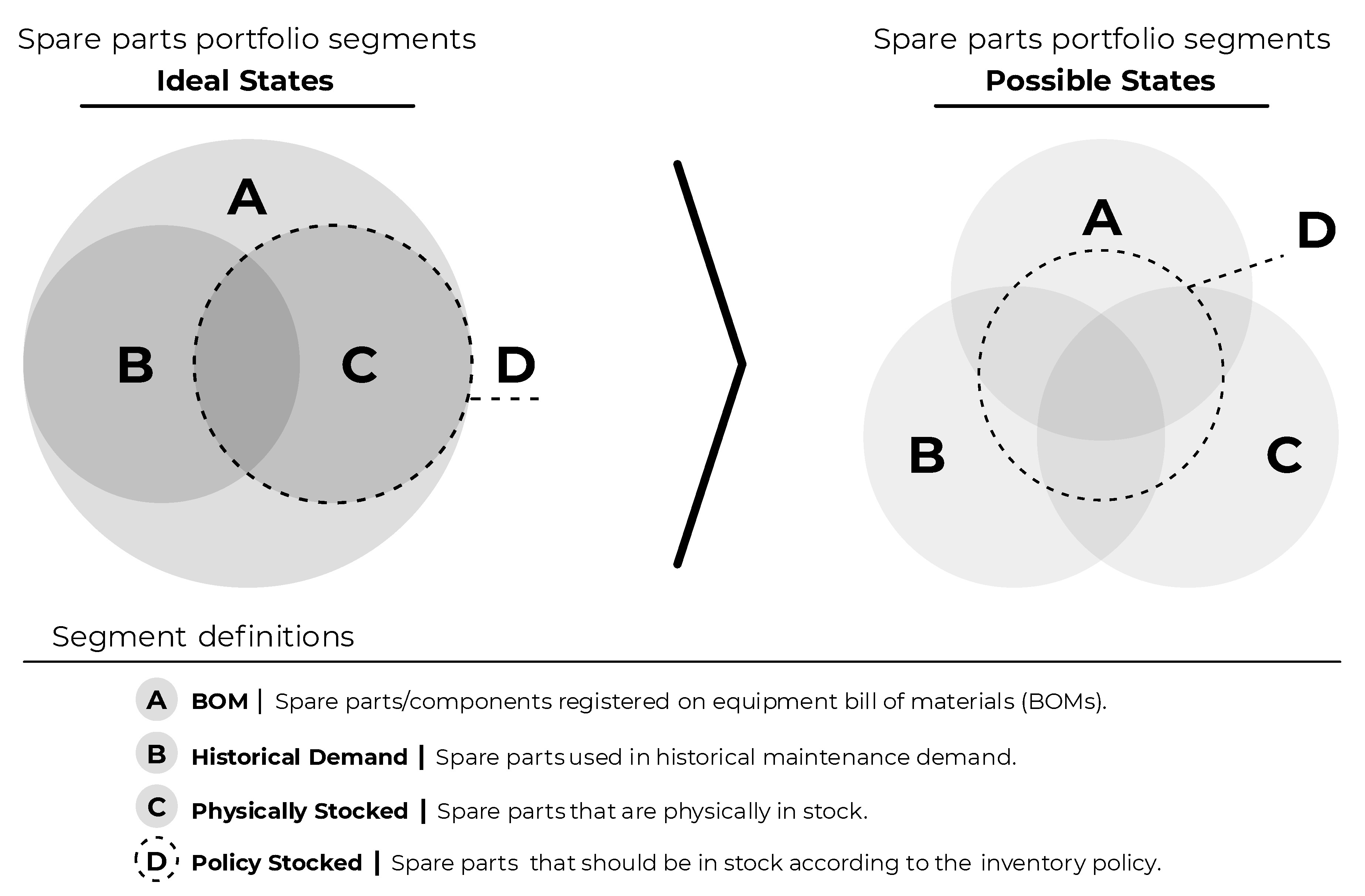
Figure 2.
The 16 possible scenario-classes of spare part positions in spare parts portfolios.
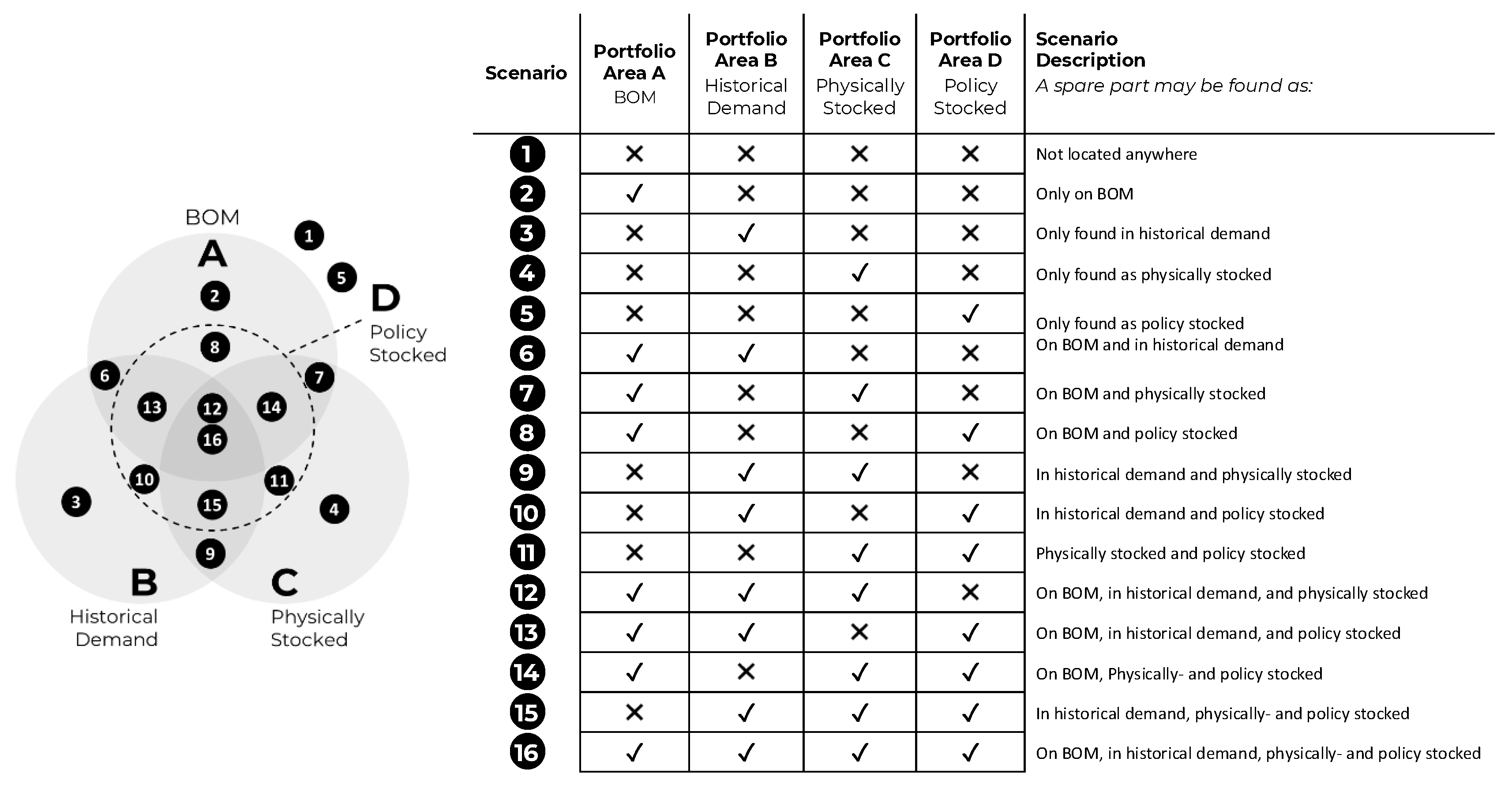
Figure 3.
The proposed holistic spare parts portfolio classification methodology that classifies all maintainable asset-relevant spare parts into 16 scenario-classes across the part application dimension (x-axis) and the part stocking dimension (y-axis).
Figure 3.
The proposed holistic spare parts portfolio classification methodology that classifies all maintainable asset-relevant spare parts into 16 scenario-classes across the part application dimension (x-axis) and the part stocking dimension (y-axis).
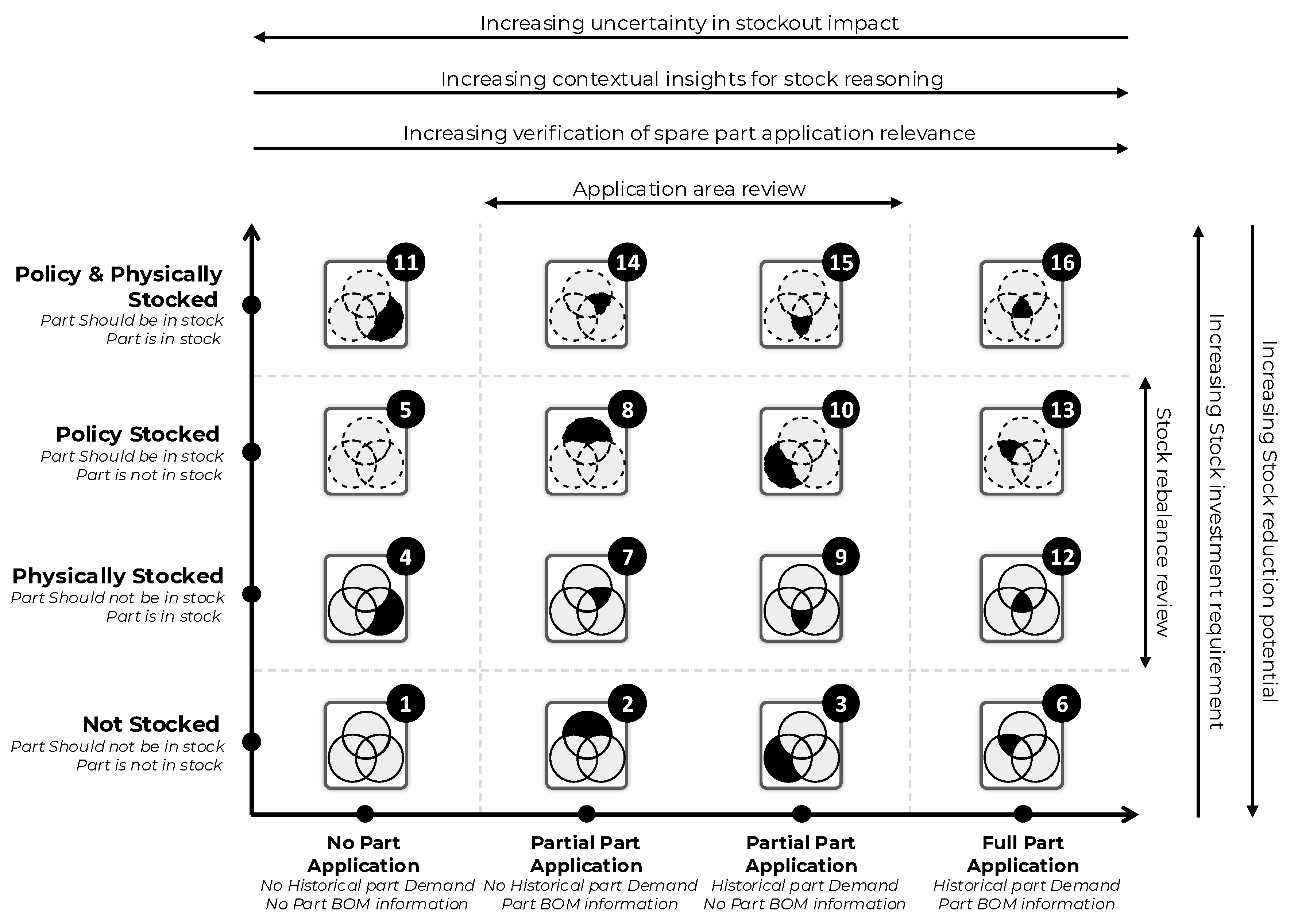
Figure 4.
Classification of the 32,521 project scope spare parts into the 16 portfolio-state scenario-classes, allocated decision strategy A-J using the proposed holistic classification methodology.
Figure 4.
Classification of the 32,521 project scope spare parts into the 16 portfolio-state scenario-classes, allocated decision strategy A-J using the proposed holistic classification methodology.
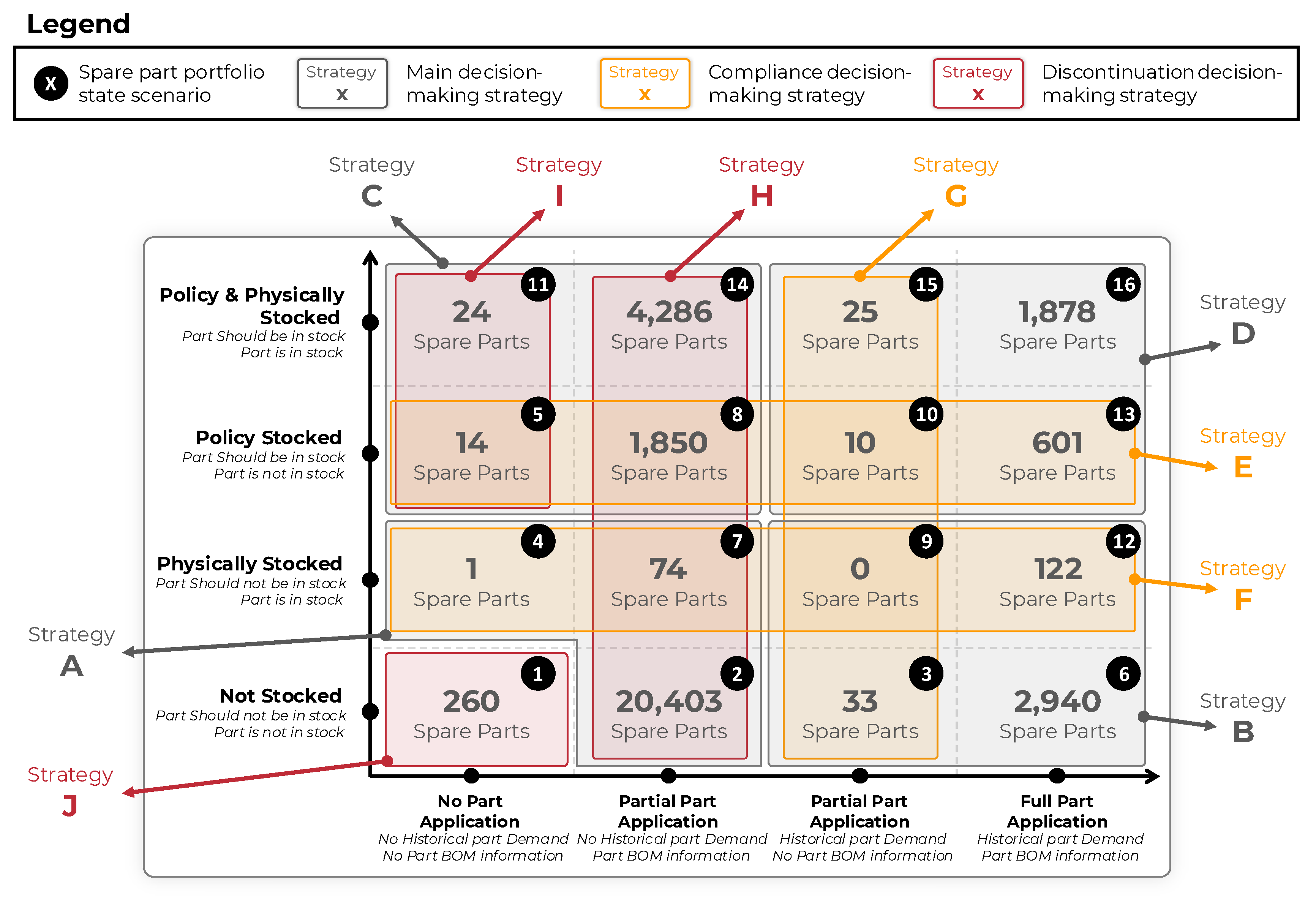

Table 1.
A case study summary table showing operational and financial impact by comparing the initial as-is approach and the reformed post-intervention approach.
Table 1.
A case study summary table showing operational and financial impact by comparing the initial as-is approach and the reformed post-intervention approach.
| Initial AS-IS Approach |
Reformed Post-Intervention Approach |
Impact/Effect | |
|---|---|---|---|
| Spare parts review scope | 32,521 | ||
| Operational results | |||
| Percentage scope completed | 9% | 100% | Full scope completion through the approach. |
| Total FTE* required | 11.53 FTEs | 1.08 FTEs | 91% FTE improvement rate. |
| FTE* used | 1 FTE | 1.08 FTEs | Similar FTE usage but covering a larger scope. |
| Total workhours required | 20,481 hours | 1,917 hours | ~10 times faster execution saving 18,564 hours of expert decision-maker workload. |
| Percentage of spare parts requiring expert decision-making | 100% | 33% | 67% fewer parts require labor intensive evaluation. |
| Number of decisions made | 7,865 | 78,369 | Ninefold decision throughput increases from less FTEs. |
| Financial results | |||
| Percentage scope stock value change | Stock increase | Stock decrease | A 35.3% difference moving from stock increase to stock decrease. |
| +1.7% | -33.6% | ||
| Percentage expected scope stock value change | +17.6% | - | Initial as-is approach projected increased stock value (From linear assumptions) |
* Full time equivalent defined as worked hours divided by 1,776 hours/year.
Disclaimer/Publisher’s Note: The statements, opinions and data contained in all publications are solely those of the individual author(s) and contributor(s) and not of MDPI and/or the editor(s). MDPI and/or the editor(s) disclaim responsibility for any injury to people or property resulting from any ideas, methods, instructions or products referred to in the content. |
© 2026 by the authors. Licensee MDPI, Basel, Switzerland. This article is an open access article distributed under the terms and conditions of the Creative Commons Attribution (CC BY) license.
Copyright: This open access article is published under a Creative Commons CC BY 4.0 license, which permit the free download, distribution, and reuse, provided that the author and preprint are cited in any reuse.


