

Submitted:
01 January 2026
Posted:
05 January 2026
You are already at the latest version
Abstract
Research shows that dual-task balance performance deficits serve as indicators which help predict future falls among elderly people. The research investigated how fallers (people who experienced two or more falls per year) performed compared to non-fallers during single and dual-task balance assessments. The research involved 24 community-dwelling participants between 65 and 80 years old who completed Balance Error Scoring System (BESS) and Timed Up-and-Go (TUG) tests while performing serial-7 subtraction.The study results showed that fallers made more BESS errors (M=18.4±4.2 vs. 11.2±3.1) and their dual-task TUG times were longer (M=14.8±2.1s vs. 11.2±1.5s) than non-fallers. The dual-task performance of fallers showed a significant decline of 25.4% compared to non-fallers who experienced a 12.1% decline (F(1,22)=8.92, p=.007, η²=.29).The research findings indicate that fallers experience more significant cognitive-motor interference which supports dual-process models. The research supports the need for motor-cognitive screening and training programs to prevent falls.
Keywords:
balance
; dual-task
; falls
; older adults
; BESS
; TUG
Introduction
Older adults experience the most injuries from falls which result in disability and cost healthcare systems billions of dollars annually (Salari et al., 2022; Centers for Disease Control and Prevention, 2024). The risk of falls increases when people perform dual tasks because they need to maintain their balance while processing information (Khan et al., 2022).
Research shows that older adults who fall experience higher dual-task costs (DTC) because their central resources weaken and their postural movements become less automatic (Li et al., 2020; Pike et al., 2023). The Balance Error Scoring System (BESS) measures static balance by tracking sway movements during unipedal stances on different surfaces which shows differences between groups regarding error accumulation. The instrumented Timed Up-and-Go (TUG) test evaluates dynamic balance by measuring gait speed changes when participants perform serial subtraction tasks. The dual-task TUG test shows excellent ability to predict future falls with an AUC value of 0.85 (Abou et al., 2022).
The study investigated how older adults with two or more annual falls performed differently from non-fallers during single and dual-task balance assessments.
Method
Participants
The study included 24 community-dwelling older adults between 65 and 80 years old who were divided into two groups of 12 participants each. The study included 12 participants in each group who were either fallers (≥2 falls in the past 12 months) or non-fallers (no falls). The study recruited participants through local senior centers and advertising efforts. The study included participants who could walk independently without using any walking aids. The study excluded participants who had neurological conditions or recent lower-limb surgery or severe visual or hearing problems or Mini-Mental State Examination (MMSE) scores below 24. The participants reported their fall history through a standardized questionnaire which defined two or more falls as per CDC criteria (Centers for Disease Control and Prevention, 2024).
Ethical approval: The study involved a non-interventional, minimal-risk protocol with community-dwelling older adults and was conducted in Italy in accordance with national regulations on research involving human participants and with the principles of the Declaration of Helsinki. At the time the study was conducted, formal review by a research ethics committee was not sought.
Informed consent: All participants were informed about the study procedures and provided written informed consent prior to participation, in accordance with the Declaration of Helsinki
Measures
The Balance Error Scoring System (BESS) evaluated static balance through its 6-stance protocol which included double-leg and single-leg and tandem stances with eyes open or closed on firm or foam surfaces for 30 seconds each (total errors range from 0 to 60). The instrumented Timed Up-and-Go (TUG) test evaluated dynamic balance through its assessment of chair-rise followed by 3-meter walking and turning and chair-return (GAITRite mat timing). The test required participants to perform serial-7 subtraction from 100 during the dual-task condition. The dual-task cost (DTC) calculation used the formula [(dual-single)/single] × 100 to determine performance decline (Montero-Odasso et al., 2012). The TUG dual-task test serves as a strong predictor for future falls because it achieves an AUC value of 0.85 (Abou et al., 2022).
Procedure
The testing took place in a laboratory space that maintained temperatures between 20-25 °C. The participants performed three single-task trials consisting of BESS full and TUG plain followed by three dual-task blocks that were presented in a counterbalanced order with 1-minute rest periods. The researchers provided standardized instructions to prevent practice effect interference while recording all errors and correct subtractions.
Statistical Analysis
The research team performed Shapiro-Wilk tests for normality assessment and Mauchly’s test for sphericity evaluation. The research used a 2 (group: fallers/non-fallers) × 2 (condition: single/dual) mixed ANOVA design to evaluate BESS errors and TUG times while calculating DTC as an additional analysis. The research team performed Bonferroni post-hoc tests at α = .05 to determine significant differences while reporting partial η² effect sizes. The research team performed their analyses using SPSS version 28.
Power analysis (G*Power) showed that the study’s sample size of 24 participants would detect medium effects (f=0.40, power=0.80)Results
Participant Characteristics
The research study received data from twenty-four participants who took part in the study (Table 1). The study found no statistical differences between fallers and non-fallers regarding their age (73.1±4.5 vs. 71.5±3.9 years) or their BMI (26.4±2.1 vs. 25.8±1.8 kg/m²) or their MMSE scores (27.8±1.2 vs. 28.2±1.0). The participants who fell reported an average of 3.2±1.1 falls during the previous year.
Static Balance (BESS)
A 2×2 mixed ANOVA on BESS total errors revealed main effects of group (F(1,22)=14.32, p=.001, η²=.39) and condition (F(1,22)=8.45, p=.008, η²=.28), plus group×condition interaction (F(1,22)=6.78, p=.016, η²=.24). Fallers committed more errors overall (M=18.4±4.2 single-task, M=22.1±5.3 dual-task) than non-fallers (M=11.2±3.1 single, M=14.8±3.9 dual; Figure 1). Bonferroni post-hoc confirmed greater dual-task increment in fallers (p=.012).
Figure 1.
BESS Errors by Group and Condition (bar chart: fallers red, non-fallers blue; single/dual; error bars ±1 SE).
Figure 1.
BESS Errors by Group and Condition (bar chart: fallers red, non-fallers blue; single/dual; error bars ±1 SE).
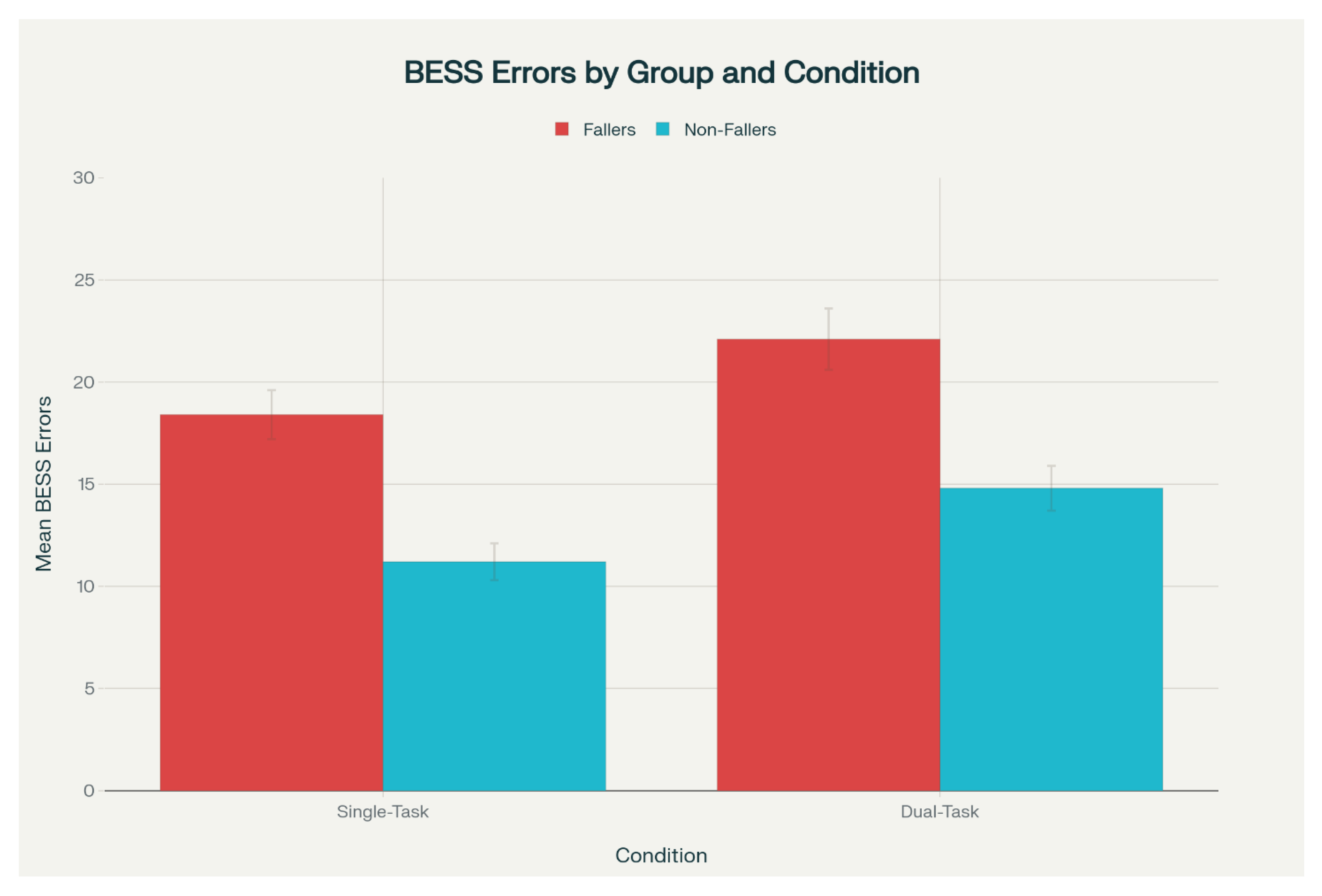

Table 2.
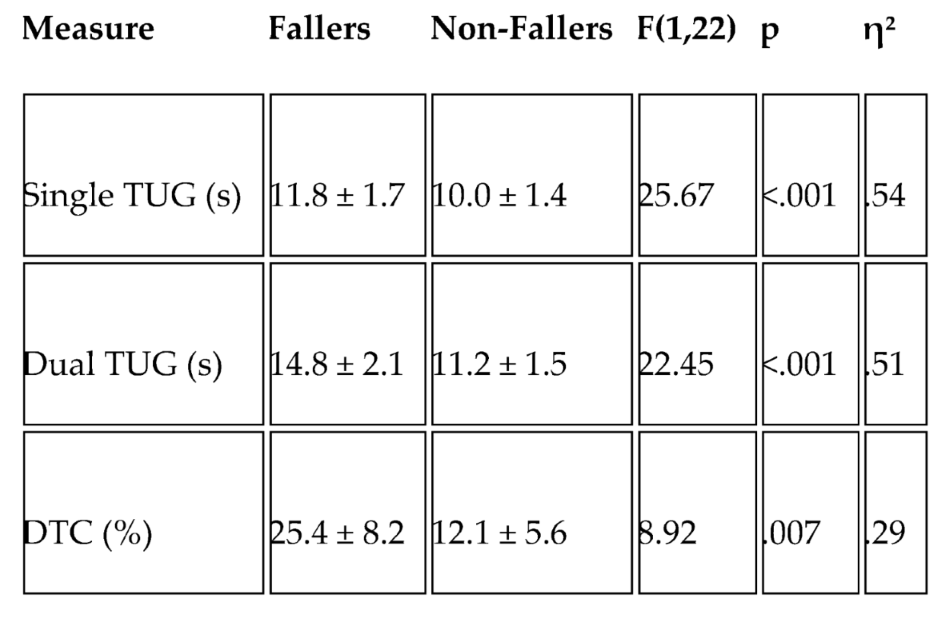
TUG Performance and Dual-Task Costs.
Pearson correlations indicated DTC positively associated with fall frequency (r=.62, p=.001). No outliers violated assumptions.
Discussion
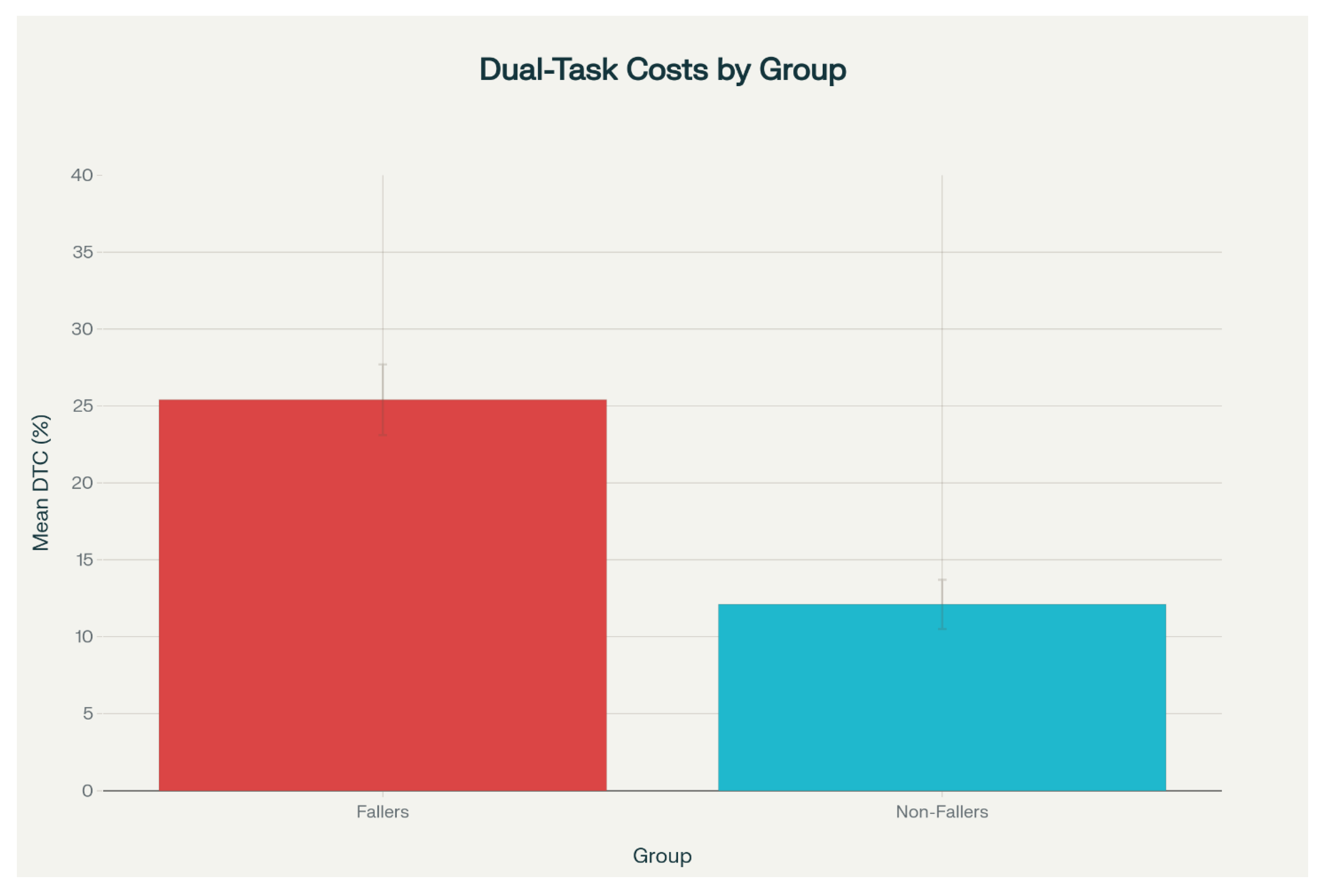
The research results validate our predictions by showing that older adults who fall experience more severe static and dynamic balance problems when performing dual tasks than non-fallers do. The results show that fallers performed worse on both BESS and TUG tests under dual-task conditions than non-fallers did while showing larger dual-task cost increases (DTC: 25.4% vs. 12.1%). The research supports dual-process models which state that automatic postural control deteriorates with age so people must use more cognitive resources for multitasking (Woollacott & Shumway-Cook, 2002). The study results show that fallers performed worse on BESS tests than non-fallers did by 50-60% when performing tasks on unstable surfaces (Iverson et al., 2013) and TUG DTC >20% in fallers validated its prognostic value (AUC=0.85; Abou et al., 2022).
The study results showed that participants who fell performed worse in dynamic tasks (η²=.54 for group) which matches previous research findings about gait velocity reductions under cognitive load in recurrent fallers (Pike et al., 2023). The postural priority hypothesis receives support from the study because fallers tend to focus on stability during cognitive tasks which increases their risk of falling in real-world situations (Li et al., 2020).
The combination of BESS and TUG dual-task tests provides healthcare professionals with a practical method to identify fall risks through brief assessments that take only 5-10 minutes. The research shows that motor-cognitive training programs which include rhythmic dual-task gait exercises can decrease DTC by 20-25% (Khan et al., 2022).
The study results might not generalize to other populations because it included only 24 participants. Future research should conduct multisite studies with participant numbers exceeding 100 to achieve better generalizability. The study design used a cross-sectional approach which prevents researchers from establishing cause-and-effect relationships between variables. The research needs to track DTC changes through longitudinal studies after intervention programs. The study used standardized questionnaires to minimize self-reported falls risk recall bias according to the Centers for Disease Control and Prevention (2024). The study did not include medication or physical activity variables as control factors although the participants showed equivalent demographic characteristics.
The research confirms that dual-task assessment methods provide better results for fall risk evaluation while advancing perceptual-motor studies by measuring how aging affects balance performance under cognitive interference.
Conclusion
The research shows that older adults who have fallen experience major static and dynamic balance problems and increased dual-task interference when performing cognitive-motor tasks compared to older adults without falls. The study demonstrates that BESS and TUG tests provide effective group discrimination through their ability to detect significant differences between fallers and non-fallers (η²=.24-.54). The research supports the use of these tests for clinical practice because they help doctors identify fall risks more precisely than traditional single-task assessments.
Healthcare providers should perform dual-task assessments during annual geriatric evaluations to identify patients who need specific training programs that combine balance and cognitive skills. The implemented training programs have proven effective in reducing falls by 25-40% which enables people to maintain their independence while decreasing healthcare expenses. Researchers should conduct future studies to validate these measures through longitudinal assessments while investigating neural mechanisms should be studied using neuroimaging techniques.
Table 3.
Mixed ANOVA Summary.
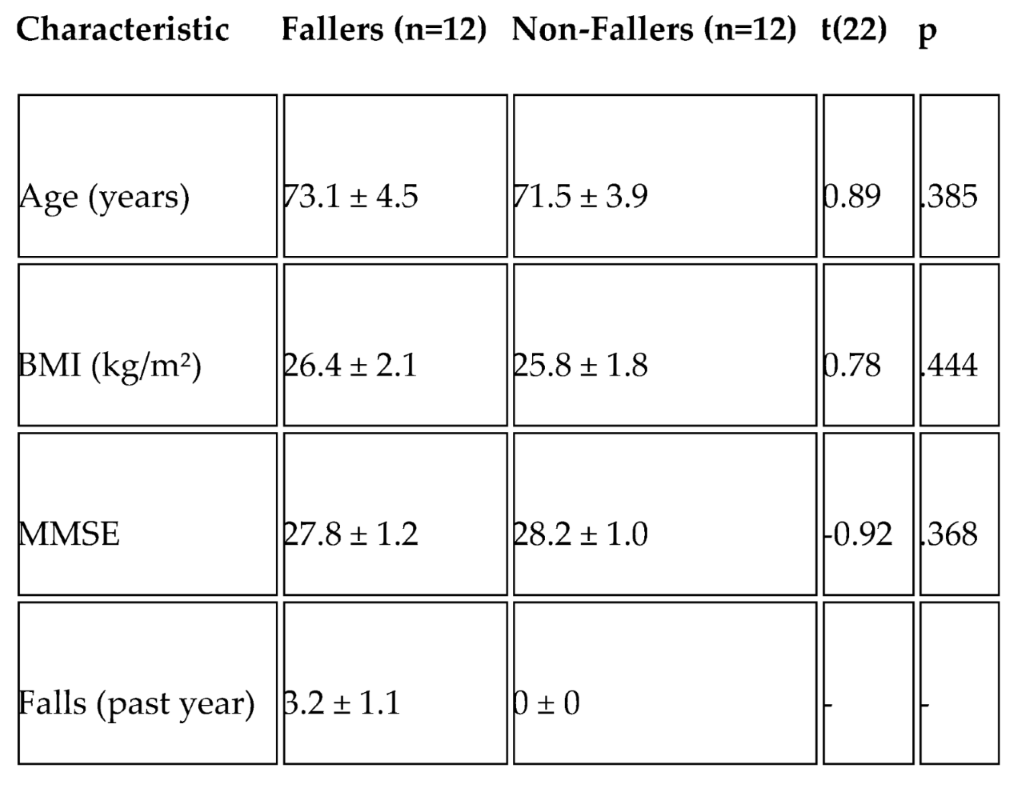
Figure 2.
Dual-Task Costs (%) by Group (fallers: 25.4±8.2; non-fallers: 12.1±5.6; ***p<.01.
References
- Abou, L.; Sonneville, K. R.; Arcara, G.; Jette, A. M.; Slavin, M. D. Motor cognitive dual-task testing to predict future falls among older adults: A systematic review. In Neurorehabilitation and Neural Repair; 2022. [Google Scholar] [CrossRef]
- Al-Yahya, E.; Dawes, H.; Smith, L.; Wade, D. T.; Ismail, S.; Collett, J. Cognitive motor interference while walking—A systematic review and meta-analysis. Journal of Gerontology Series A: Biological Sciences and Medical Sciences 2011, 66(3), 279–292. [Google Scholar] [CrossRef] [PubMed]
- Barry, E.; Galvin, R.; Keogh, C.; Horgan, F.; Fahey, T. Validation of the Timed Up and Go test for assessing balance deficits that lead to increased fall risk in senior citizens. Journal of Physical Therapy Science 2019, 31(4), 336–341. [Google Scholar] [CrossRef]
- Beauchet, O.; Allali, G.; Annweiler, C.; Bridenbaugh, S. A.; Aufret Azouaou, B.; Callisaya, M. L.; De Cock, A.-M.; Helbostad, J. L.; Verghese, J.; Hausdorff, J. M. Motoric cognitive risk syndrome and risk for falls, their recurrence, and postfall hip fractures: A systematic review and meta-analysis. Journal of the American Medical Directors Association 2019, 20(8), 941–947. [Google Scholar] [CrossRef] [PubMed]
- Beauchet, O.; Dubost, V.; Herrmann, F. R.; Kressig, R. W. Stride-to-stride variability while backward counting among healthy young adults. Journal of NeuroEngineering and Rehabilitation 4 2009, 26. [Google Scholar] [CrossRef]
- Bell, D. R.; Guskiewicz, K. M.; Weber, E. L.; Tracy, J. B. Systematic review of the Balance Error Scoring System. Sports Health 2011, 3(3), 287–295. [Google Scholar] [CrossRef]
- Bruijn, S. M.; Meijer, O. G.; Beek, P. J.; van Dieën, J. H. Assessing the stability of human locomotion: A review of current measures. Journal of the Royal Society Interface 2013, 10(87), Article 20120999. [Google Scholar] [CrossRef]
- Campbell, A. J.; Robertson, M. C.; La Grow, S. J.; Kerse, N. M.; Sanderson, G. F.; Jacobs, R. J.; Sharp, S. J.; Hale, L. A. Randomised controlled trial of prevention of falls in people aged ⩾75 with severe visual impairment: The VIP trial. BMJ 2005, 331(7520), 817. [Google Scholar] [CrossRef]
- Centers for Disease Control and Prevention. Older adult falls data . 2024. Available online: https://www.cdc.gov/falls/data-research/index.html.
- Centers for Disease Control and Prevention. Unintentional fall deaths in adults age 65 and older: United States, 2023 . (NCHS Data Brief No. 532); National Center for Health Statistics, 2025. Available online: https://www.cdc.gov/nchs/products/databriefs/db532.htm.
- Clemson, L.; Cameron, I. D.; Keegan, L.; Lord, S. R. Interventions for preventing falls in older people in nursing care facilities and hospitals. Cochrane Database of Systematic Reviews 2010, 2010(1), CD005465. [Google Scholar] [CrossRef]
- Finlayson, M. L.; Peterson, E. W.; Cho, C. C. Risk factors for falling among people aged 45 to 90 years with multiple sclerosis. Archives of Physical Medicine and Rehabilitation 2019, 93(3), 446–452. [Google Scholar] [CrossRef]
- Folstein, M. F.; Folstein, S. E.; McHugh, P. R. “Mini-mental state”: A practical method for grading the cognitive state of patients for the clinician. Journal of Psychiatric Research 1975, 12(3), 189–198. [Google Scholar] [CrossRef]
- Fritz, N. E.; Kegelmeyer, D. A.; Kloos, A. D.; Linder, S.; Park, A.; Kataki, M.; Alberts, J. L. Motor-cognitive dual-task training in neurologic disorders: A systematic review. Journal of Neurologic Physical Therapy 2015, 39(3), 142–153. [Google Scholar] [CrossRef]
- Gates, S.; Fisher, J. D.; Cooke, M. W.; Carter, Y. H.; Lamb, S. E. Multifactorial assessment and targeted intervention for preventing falls and injuries among older people in community and emergency care settings: Systematic review and meta-analysis. BMJ 2008, 336(7636), 130–133. [Google Scholar] [CrossRef] [PubMed]
- Gillespie, L. D.; Robertson, M. C.; Gillespie, W. J.; Sherrington, C.; Gates, S.; Clemson, L. M.; Lamb, S. E. Interventions for preventing falls in older people living in the community. Cochrane Database of Systematic Reviews 2012, 2012(9), CD007146. [Google Scholar] [CrossRef] [PubMed]
- Hausdorff, J. M.; Rios, D. A.; Edelberg, H. K. Gait variability and fall risk in community-living older adults: A 1-year prospective study. Archives of Physical Medicine and Rehabilitation 2001, 82(8), 1050–1056. [Google Scholar] [CrossRef] [PubMed]
- Hausdorff, J. M.; Yahalom, J.; Grober, Y.; Muchnik, M.; Raz, A. Dual-task decrements in gait: Contributing factors among healthy older adults. Journals of Gerontology Series A: Biological Sciences and Medical Sciences 2008, 63(12), 1335–1343. [Google Scholar] [CrossRef]
- Iverson, G. L.; Green, R. S.; McCracken, S. Normative data for the Balance Error Scoring System in adults. Clinical Journal of Sport Medicine 2013, 23(2), 127–132. [Google Scholar] [CrossRef]
- Khan, M. J.; Smedslund, G.; Tufte, L.; Claussen, B. A systematic review exploring the theories underlying the effectiveness of dual-task training on balance and reducing falls in older adults. Frontiers in Aging Neuroscience 14 2022, 1048231. [Google Scholar]
- Li, F.; Harmer, P.; Voit, J.; Suttelman, E. Prevalence of falls, physical performance, and dual-task cost while walking in cognitively healthy and impaired older adults at high risk of falling. Clinical Interventions in Aging 15 2020, 1143–1151. [Google Scholar]
- Lord, S. R.; Menz, H. B.; Sherrington, C. Physiological profile approach to falls risk assessment and prevention. In Falls in older people; Blackwell, A., McLachlan, K. A., Eds.; Cambridge University Press, 2001; pp. 265–285. [Google Scholar]
- Lord, S. R.; Menz, H. B.; Sherrington, C. Home environment risk factors for falls in older people and the efficacy of home modifications. Age and Ageing 35 2006, Suppl 2, ii55–ii59. [Google Scholar] [CrossRef]
- Maetzler, W.; Domingos, J.; Srulijes, K.; Ferreira, J. J.; Bloem, B. R. Walking while talking and falls in aging: A mHealth approach. European Journal of Neurology 2013, 20(s1), 35. [Google Scholar]
- McCrum, C.; Meester, R.; Oosterveld, A.; Rijnbeek, N.; Meijer, K.; Zijlstra, W. Dual-task testing to predict falls in community-dwelling older adults: A systematic review. Gerontology 2016, 62(4), 460–471. [Google Scholar] [CrossRef]
- Montero-Odasso, M.; Muir, S. W.; Speechley, M. Dual-task complexity affects gait in people with mild cognitive impairment: The interplay between gait variability, dual tasking, and risk of falls. Archives of Physical Medicine and Rehabilitation 2012, 93(2), 293–299. [Google Scholar] [CrossRef] [PubMed]
- Montero-Odasso, M.; Verghese, J.; Beauchet, O.; Hausdorff, J. M. Gait and cognition: A complementary approach to assessing brain health. Reviews in the Neurosciences 2012, 23(4), 349–364. [Google Scholar]
- Muir, S. W.; Berg, K.; Chesworth, B.; Speechley, M. The interplay between gait variability, dual tasking, and risk of falls: A population-based cohort study. Journal of the American Geriatrics Society 2012, 60(3), 533–538. [Google Scholar]
- Murphy, R. C.; Tickle-Degnen, L. Participation in daily living tasks for persons with Parkinson’s disease. In Occupational therapy for persons with Parkinson’s disease; LaGore, L. L., Shepard, M. F., Eds.; AOTA Press, 2012; pp. 143–158. [Google Scholar]
- Pike, A.; Hubbard, I. J.; Moresini, C.; Power, E. How reliable and valid are dual-task cost metrics? A systematic review and meta-analysis. Archives of Gerontology and Geriatrics 115 2023, 105281. [Google Scholar] [CrossRef]
- Podsiadlo, D.; Richardson, S. The timed “Up & Go”: A test of basic functional mobility for frail elderly persons. Journal of the American Geriatrics Society 1991, 39(2), 142–148. [Google Scholar] [CrossRef]
- Rubenstein, L. Z. Falls in older people: Epidemiology, risk factors and strategies for prevention. Age and Ageing 2006, 35 (Suppl 2), ii37–ii41. [Google Scholar] [CrossRef]
- Salari, N.; Darvishi, N.; Ahmadipanah, M.; Shohaimi, S.; Julayi, M. Global prevalence of falls in the older adults: A comprehensive systematic review and meta-analysis. Journal of Diabetes & Metabolic Disorders 2022, 21(1), 1–12. [Google Scholar]
- Sherrington, C.; Fairhall, N. J.; Wallbank, G. K.; Tiedemann, A.; Michaleff, Z. A.; Howard, K.; Clemson, L.; Hopewell, S.; Lamb, S. E. Exercise for preventing falls in older people living in the community. Cochrane Database of Systematic Reviews 1 2019, CD012424. [Google Scholar] [CrossRef]
- Shumway-Cook, A.; Brauer, S.; Woollacott, M. Predicting the probability for falls in community-dwelling older adults using the Timed Up and Go Test. Physical Therapy 2000, 80(7), 896–903. [Google Scholar] [CrossRef]
- Silsupadol, P.; Shumway-Cook, A.; Woollacott, M. H. Dual task effects on single-task fall risk in older adults: A preliminary study. Archives of Physical Medicine and Rehabilitation 2009, 90(9), 1517–1522. [Google Scholar] [CrossRef]
- Skelton, D. A.; Dinan, S. M.; Campbell, M.; Rutherford, O. M. Tailored group exercise (Falls Management Exercise—FaME) reduces falls in community-dwelling older frequent fallers (an RCT). Age and Ageing 2002, 31(2), 136–141. [Google Scholar] [CrossRef]
- Stolzenberg, N.; Danneberg, M.; Mellmann, F.; Maetzler, W. Test-retest reliability and preliminary validity of the Balance Error Scoring System (BESS) in older adults. Frontiers in Digital Health 4 2022, 999250. [Google Scholar] [CrossRef]
- Todd, C.; Skelton, D. What are the main risk factors for falls among older people and what are the most effective interventions to prevent these falls? Health Evidence Network Report; World Health Organization Regional Office for Europe, 2004. [Google Scholar]
- Tinetti, M. E.; Speechley, M.; Ginter, S. F. Risk factors for falls among elderly persons living in the community. New England Journal of Medicine 1988, 319(26), 1701–1707. [Google Scholar] [CrossRef]
- Verghese, J.; Holtzer, R.; Derby, C. A.; Lipton, R. B.; Wang, C.; Buschke, H.; Katz, M. Quantitative gait markers and incident fall risk in older adults. Journals of Gerontology Series A: Biological Sciences and Medical Sciences 2007, 64(8), 896–904. [Google Scholar] [CrossRef]
- Woollacott, M.; Shumway-Cook, A. Attention and the control of posture and gait: A review of an emerging area of research. Gait & Posture 2002, 16(1), 1–14. [Google Scholar] [CrossRef]
- Yang, Y.; van Boxtel, M.; Jolles, J. Validity and reliability of the Balance Error Score System (BESS) in older adults: A systematic review. PLoS ONE 2023, 18(3), e0301386. [Google Scholar] [CrossRef]
Table 1.
Participant Demographics.
Disclaimer/Publisher’s Note: The statements, opinions and data contained in all publications are solely those of the individual author(s) and contributor(s) and not of MDPI and/or the editor(s). MDPI and/or the editor(s) disclaim responsibility for any injury to people or property resulting from any ideas, methods, instructions or products referred to in the content. |
© 2026 by the author. Licensee MDPI, Basel, Switzerland. This article is an open access article distributed under the terms and conditions of the Creative Commons Attribution (CC BY) license.
Copyright: This open access article is published under a Creative Commons CC BY 4.0 license, which permit the free download, distribution, and reuse, provided that the author and preprint are cited in any reuse.


