

Submitted:
04 January 2026
Posted:
06 January 2026
Read the latest preprint version here
Abstract
Traditional cosmological redshift is defined as unbounded wavelength stretching from zero to infinity, which is inconsistent with a photon‑energy interpretation and implies physically unreasonable energy loss or divergence. In earlier work, a photon‑energy–based redshift z_new=z/(1+z), naturally bounded between 0 and 1, was introduced and embedded in a Hubble–Hawking cosmological model with positive curvature and light‑speed cosmic rotation. Methods: Using the energy‑based redshift within this rotating Hubble–Hawking framework, direct analytic relations are derived connecting the cosmic scale factor, the Hubble parameter, the age of the universe, luminosity and comoving distances, galactic recession speeds, and a revised form of Hubble’s law with angular velocity equal to the Hubble parameter. The same redshift prescription is then applied to the Son et al. progenitor‑age–corrected Pantheon+ supernova sample to perform a purely kinematic re‑analysis of the expansion history. Results: The analytic relations indicate that the universe has been continuously decelerating since the Planck era, as steadily increasing baryonic mass slows an initially light‑speed expansion, and they predict a slow future decline of the 2.725 K cosmic microwave background temperature. In the re‑analysis of Pantheon+ with progenitor‑age bias removed and z_new=z/(1+z) adopted, the best‑fit solution shifts from mild deceleration to strong, continuous deceleration, incompatible with the late‑time acceleration required by flat ΛCDM; the supernova data no longer favor an accelerating universe but instead support a cosmos that has been decelerating throughout its post‑Planck evolution. Independently, the CMB temperature can be related to a Hubble–Hawking temperature via the geometric mean of the Hubble mass and the Planck mass, implying that the product of cosmic mass and the square of the cosmic temperature remains approximately constant, and yielding a current baryon acoustic bubble radius of 135.2 Mpc that can be used to refine the true expansion (or deceleration) rate. On galactic scales, an empirical “super gravity” relation with a mass limit for ordinary gravity of roughly 180 million solar masses reproduces both low‑dark‑matter and high‑dark‑matter galaxies by scaling effective dark mass as (baryon mass)1.5. Conclusions: Taken together, the energy‑based redshift, the nearly isotropic CMB sky, and the spinning black‑hole–like Hubble–Hawking universe form a single, self‑consistent narrative in which the present cosmos is nearly radially static, dominated by light‑speed rigid rotation and net deceleration rather than late‑time acceleration. In this picture, supernova distances, CMB isotropy, and BAO scales are unified by strong binding and rigid co‑rotation into a rotating universe with negligible true expansion. Planck’s nearly isotropic CMB sky, usually interpreted as evidence for a homogeneous FLRW universe with accelerating expansion, can instead be reinterpreted as evidence for a late, slow deceleration phase in a light‑speed rotating, positively curved Planck–Hubble–Hawking universe.
Keywords:
Planck scale light speed expansion
; corrected red shift
; 5 characteristic relations
; slow deceleration
; practically static universe
; continuous light speed rotation
; decreasing cosmic expansion speed
; 5 integrated assumptions
; mass limit of ordinary gravity
; super gravity of Baryonic mass
; Baryon acoustic bubble radius
; Baryon mass density
; Hubble tension
; BAO radius tension
; Coma distance tension
; acceleration tension
; curvature tension
1. Introduction
The subject of Lambda model of cosmology mainly depends on four fundamental pillars. The first pillar is associated with the definition and formula for cosmic red shift [1,2]. Second pillar is associated with ‘big bang’ and ‘inflation’[3,4,5,6,7]. The third pillar is associated with ‘cosmic microwave background radiation’ (CMBR) and its many properties [8,9]. The fourth pillar is associated with ‘cosmic acceleration, dark energy and dark matter’ [10,11]. Here, it is very important to note that, first pillar plays a vital role in the construction, use and advancement of the other three pillars. Physical reasoning point of view, known physical laws point of view and quantum gravity point of view, second pillar is very weak [5]. Regarding the third pillar, in its budding stage, no one accepted CMBR’s theoretical existence, and its confirmation was totally unexpected in physics history. Now-a-days, it is playing a crucial role in understanding the cosmic structure. Fourth pillar is playing a leading role in strengthening and advancing the subject in all possible ways.
With reference to our recent and old publications [12,13,14,15,16,17], in this paper, we highlight the fundamental flaw associated with the first pillar related to its widely accepted (wrong) definition and (wrong) formula, and demand to correct it and urge to eliminate the cosmic acceleration and dark energy concepts of the fourth pillar completely. Regarding the third pillar, by considering the well observed and well believed constancy of the cosmic microwave background temperature and its ‘near zero’ value, we appeal to review the wrongly introduced and widely accepted cosmic acceleration part of the fourth pillar. With reference to the well-established quantum gravity concepts related to ‘Planck scale’ and ‘black holes’, we appeal to replace ‘big bang’ and ‘inflation’ concepts of the second pillar with ‘Planck mass’, ‘initial light speed expansion’ and ‘Hawking black hole temperature’ concepts [18,19,20]. Proceeding further, for understanding the dark matter [21,22,23,24,25,26] part of the fourth pillar, we appeal to consider ‘super gravity’ of galactic baryon mass above a certain mass limit [27,28,29].In support of our views, in this paper, independent of the currently believed dark energy density ratio, with simple and direct formulae, we make an attempt to fit the Lambda model of adot, Hubble parameter, receding speeds, luminosity distances [30,31,32,33,34,35,36]. We have organized our paper content in the following way.
| Section | Section Information |
| 2 | Supernovae and cosmic acceleration |
| 3 | Correction to 100 years old cosmic red shift definition |
| 4 | Direct formula for luminosity distances and receding speeds |
| 5 | Direct formula for ‘adot’ and Hubble parameter |
| 6 | Review on cosmic red shift, acceleration and dark energy |
| 7 | Five unified and integrated assumptions |
| 8 | Corrected Hubble’s law and cosmic light speed rotation |
| 9 | Understanding the cosmic scale factor 1/(1+ z) |
| 10 | Positive curvature and rotation |
| 11 | Understanding cosmic deceleration with future baryon acoustic bubble radius |
| 12 | Discussion on the assumptions |
| 13 | General discussion |
| 14 | Hubble-Hawking Temperature and Astrophysical Objects |
| 15 | Eliminating Hubble tension by considering cosmic rotation |
| 16 | Recent information on Cosmic Deceleration |
| 17 | Fundamental Misconception in Lambda Cosmology |
| 18 | Conclusion |
2. Supernovae Distances and Cosmic Acceleration
At the beginning, all Type 1a supernovae [37,38] were believed to have the same mass, very high and unique luminosity and brightness. Their appearing brightness can be considered as a measure of their distances. Clearly speaking, higher the brightness lesser the distance and lower the brightness, higher the distance. In this way, cosmologists consider supernovae as ‘standard candles’ of cosmic distance measurements. With further observations [39], it was confirmed that, masses associated with different Type 1a supernovae were not equal and their luminosities were not equal. By considering and analyzing their light curve peaks and luminosity decline rates with method or Multi Colored Light Curve Shapes method or stretch method, there is a possibility of understanding how ‘under luminous’ or ‘over luminous’ the selected supernovae is from a typical supernova. Thus, supernovae having different masses and brightness can be made as ‘standardizing candles’ instead of ‘standard candles’ in measuring cosmic distances up to giga parsec range. Following these concepts, in general, cosmologists,
- 1)
- Step-1: Estimate the distances of super novae based on their brightness (inferred from light curves).
- 2)
- Step-2: By considering Hubble’s law and the host galactic red shift, infer the galactic distances.
- 3)
- Step-3: Compare the galactic red shift-based distances and brightness/dimming based distances for their equality.
Unfortunately, in 1990s, the most distant supernovae were appeared to be dimmer than the expected brightness. Hence cosmologists assumed that, host galaxies’ (of the corresponding supernovae) actual distances were higher than their inferred red shift-based distances. These strange observations and flat space expanding universe concepts associated with Hubble’s law [1,2] and general theory of relativity- forced cosmologists to think that – “host galaxies were receding with higher speeds than the expected receding speeds”. Thus an accelerating model of cosmology [40,41] was developed in 1998. To understand the cosmic acceleration, again cosmologists were forced to introduce ‘dark energy’. Based on the data presented in Table 1, we would like to emphasize the point that, considering our corrected red shift definition- dark energy density, matter density and red shift based galactic distances can be fitted without the introduction and intended purpose of cosmic acceleration and dark energy concepts. Hence we sincerely appeal the cosmologists to review and reject cosmic acceleration and dark energy concepts in an unbiased approach [43,44,45].
3. Cosmic Red Shift – 100 Years Old Mistake and Correction
In a mathematical form, true definition of cosmic red shift can be expressed as [12,13,14,15,16,17],
If it is believed that, known physical laws of atomic and nuclear physics are applicable to other galaxies, then one can assume that, energy of photon at any galaxy is same as the energy of photon coming from a laboratory resting in Milky Way. Then,
Based on this approach, in terms of photon energy, current definition of cosmic red shift can be expressed as,
Based on relations (2) and (3),
This new definition of cosmic red shift seems to be completely different from the currently believed definition of cosmic red shift and needs a review at fundamental level. It is very important to note that, considering the mysterious rotational feature of galaxies, in an observational approach, Lior Shamir is making negative remarks and trying to highlight the biased nature of traditional red shift in estimating galactic distances [46,47]. With reference to current definition of cosmic red shift, and based on the corrected red shift definition, Now the main problem to be resolved is: whether to replace with or to replace with or to consider in place of It may be noted that, following our Hubble-Hawking models of cosmology [48,49] and considering the current cosmic microwave background radiation temperature, estimated value of current Hubble parameter is It is absolutely independent of galactic distances. See section (7). With further studies, currently noticed tension in estimating current Hubble parameter can also be resolved with our approach. See Table 1. Accuracy point of view, within the uncertainty in the actual galactic red shifts and standard model of estimated galactic distances, our fit is very good. For further analysis and data verification, readers are encouraged to visit the URLs, https://cosmocalc.icrar.org/. and http://www.atlasoftheuniverse.com/cosmodis.c. Here it is very important to note that, estimated galactic distances are independent of currently believed various density relations pertaining to cosmic matter and cosmic scale factors. This is very a typical issue and bitter result to digest.
4. Direct Formula for Luminosity Distances
With our corrected cosmic red shift formula and Hubble-Hawking model of cosmology, we have developed a direct relation for fitting the accelerating model of luminosity distances (LD) having It can be expressed as,
See Figure 1 and Figure 2, the attached data table, http://www.atlasoftheuniverse.com/cosmodis and https://cosmocalc.icrar.org/. Proceeding further, currently believed galactic receding speed ratio can be expressed as,
Thus luminosity distances can be expressed as
Comoving distances (CD) can be expressed as,
By considering the fitted power factor of as a combination of there is a scope for understanding cosmic acceleration as a true nature of current cosmic expansion rate. In that case, accelerating model of cosmology must accommodate the corrected cosmic red shift definition without affecting the basics of Lambda model. But, directly and indirectly, (1) as the proposed formulae are independent of cosmic acceleration parameters, (2) as there exist no arbitrary parameters in the formulae and (3) as the estimated data is within the acceptable range - with further study and by considering the corrected cosmic red shift formula, true nature of cosmic expansion rate can be understood. It needs an unbiased review.
5. Direct Formula for ‘adot’ and the Hubble Parameter
With our corrected cosmic red shift formula and Hubble-Hawking model of cosmology, we have developed direct relations for fitting the ‘adot’ and Hubble parameter. Hubble-Hawking model of current Hubble parameter can be expressed as, Lambda model of ‘adot’ can be expressed as,
Thus, Lambda model of Hubble parameter (HP) can be expressed as,
For example, if z=1100, obtained and Corresponding Lambda model values are, and See Table 2, Figure 3 and https://cosmocalc.icrar.org/. With reference to our Hubble-Hawking model,
Hence,
One very interesting observation is that, Lambda model of cosmic age up to recombination can be expressed as,
Thus,
With further study and by considering the corrected cosmic red shift formula, true nature of cosmic expansion rate can be understood. It needs an unbiased review.
6. Review on Cosmic Red Shift, Acceleration and Dark Energy
It is very clear that, all the above relations are independent of Lambda cosmology parameters and fitted/obtained data is in line with Lambda cosmology data. It is definitely an ambiguous situation. To understand and resolve the issue, based on the above relations (1) to (15), we infer the following three basic concepts.
- 1)
- Increasing galactic red shift plays a vital role in understanding/estimating the increasing trend of cosmic distance parameters associated with cosmic expansion scenario.
- 2)
- Constant red shift will not give any information on the rate of cosmic expansion.
- 3)
- Hubble-Hawking models of cosmology seem to have a better and unified physical concepts compared to the well believed models of Lambda cosmology.
We appeal the cosmologists to review the proposed concepts in an unbiased approach with reference to the recent JWST observations, Hubble tension, Planck scale and corrected cosmic red shift. Proceeding further, based on relations (1) to (15), it can be generalized that,
- 1)
- Red shift is a measure of cosmic distance and an index of cosmic expansion.
- 2)
- Galactic rate of increase in red shift is a measure of cosmic increasing expansion rate.
- 3)
- Independent of galactic red shifts, true cosmic expansion rate can be understood with future cosmic temperature and its rate of decrease.
- 4)
- Current universe is decelerating but not accelerating and there exists no dark energy.
7. Five Unified and Integrated Assumptions
Considering the Planck scale, we propose our five integrated assumptions in the following way.
Assumption 1.
For the current case,
For the Planck scale,
Assumption 2.
where
where
For the Planck scale,
Assumption 3.
Starting form Light speed expansion, universe is decelerating with linear expansion speed expressed as,
For the current case,
Assumption 4.
For the current case,
where
Starting from the recombination period, its current cosmological mass expression can be expressed as,
where
and
Proceeding further, with reference to recombination epoch of approximately 3000 K, currently believed baryon acoustic bubble (BAO) radius of (134 to 147) Mpc [53,54,55] can be fitted with a simple relation of the form,
Assumption 5.
Cosmic angular acceleration and the ratio of thermal energy density to mass energy density play a vital role in understanding the observed galactic flat rotation speeds.
On simplification,
8. Corrected Hubble’s Law and Cosmic Light Speed Rotation
As thermal expansion is believed to be the basic signature of cosmic evolution, based on the current lower cosmic temperature of 2.725 K and its corresponding thermal isotropy, Hubble’s law [5,6] associated with corrected cosmic red shift can be reviewed in terms of current cosmic light speed rotation with no significant further expansion [15,16]. By this time, if universe is coming to a halt and not really expanding further, it seems meaningful to consider as a representation of current cosmic angular velocity. Clearly speaking, based on current thermal isotropy, It needs a thorough review at fundamental level. It can be understood with,
- a)
- Rate of decrease in cosmic temperature associated with current and decreased future cosmic temperature.
- b)
- Rate of decrease in Hubble parameter associated with current and decreased future cosmic Hubble parameter.
Thus, Hubble’s law for cosmic rotation applicable to whole Hubble volume having so many galaxies can be expressed as,
If the universe is really expanding with light speed [56,57,58] instead of light speed rotation, in near future,
- 1)
- Cosmic volume increases continuously and cosmic temperature drops continuously.
- 2)
- As galaxies are departing each other with great receding speeds, galactic red shifts increase continuously and brightness of Supernovae decreases continuously.
As a result- phenomena like thermal anisotropy, dimming of galaxies and increased red shifts, much reduction in galactic sizes and much reduction in supernovae brightness - may occur. It needs further study and observations with respect to the corrected red shift definition. We would like to emphasize the point that, both, thermal isotropy and light speed expansion cannot be accommodated in the same net.
9. Understanding the Cosmic Scale Factor 1/(1+ z)
It is well known that is a measure of thermal energy. Hence, with reference to past and current cosmic temperatures red shift can be defined as,
Assuming that, it is possible to show that,
Thus, with reference to Hubble-Hawking cosmology, it is very interesting to note that,
By assuming cosmic angular velocity, cosmic temperature and (1+z) can be estimated with relations, Here we would like to emphasize the point, (1+z) is ‘an outcome’ and ‘an index’ of cosmic expansion scheme associated with temperature and scale factor.
10. Positive Curvature and Rotation
We would like to emphasize the point that, spin is a basic property of quantum mechanics and one who is interested in developing quantum models of cosmology, must think about cosmic rotation. It may be noted that, by considering ‘light speed rotation’ Einstein’s static universe can be made stable dynamically. There seems no need to introduce the ‘Lambda term’. Historically, many cosmologists expressed their positive opinion on cosmic rotation [59,60,61,62,63,64,65,66,67,68,69]. Most violating point against Lambda cosmology is that, for understanding Hubble tension, scientists are working on rotating models of cosmology. One can see the technical details in the 2025 March edition of Monthly Notices of Royal Astronomical Society [69]. See section 15 for a logical discussion. Even though cosmological principle is having 100 years of strong footing, at present, it is being suspected and examined in many directions seriously. Recent observations on cosmic anisotropy [70,71] and galactic spin directions seem to support the possible existence of cosmic rotation. Most recent references [72,73,74] seem to shed light on the necessity of considering cosmic positive curvature which is a major prerequisite for cosmic rotation.
11. Understanding Cosmic Deceleration with Future Baryon Acoustic Bubble Radius
With reference to our Hubble-Hawking model and based on relation (21), starting from the recombination process, baryon acoustic bubble radius as expressed Lambda cosmology [53,54,55] can be expressed as,
For the recombination era,
But, here it may be noted that, as per our Hubble-Hawking model, cosmic radius at the recombination era is around and is times less than the Lambda model of acoustic bubble radius of 0.123 Mpc. It needs a review with reference to our relation (21). We are working on all possible ways. For the present era,
Considering and following the rate of increase in future baryon acoustic radius, our approach of cosmic deceleration can be studied and verified.
12. Discussion on the Assumptions
It may be noted that,
- 1)
- First assumption, seems to implement light speed rotating black hole physical concepts in understanding the constructional features of the past and current universe. It is very interesting to note that, recently, scientists are able to publish ‘Black Hole Universe Models’ in high index physics/cosmology journals [3,5,20,47]. But the most unwanted point is that, these published articles are based on the traditional red shift definition and no way considering our proposed Hubble-Hawking temperature relation. Considering the James Webb Space Telescope finds, Lior Shamir [47] is strongly believing in Black Hole models of Cosmology.
- 2)
- Second assumption, seems to be highly useful in implementing Hawking’s black hole temperature formula in understanding the relation between cosmic microwave background temperature and Hubble parameter. Very interesting point to be noted is that, above relation is independent of galactic distances. Thus it may help in resolving the current Hubble tension issue [75]. In a simplified form, or For past cosmic epochs, or
- 3)
- If one is willing to assume that, for the expanding black hole universe, thermal energy density is directly proportional to mass-energy density [19,76,77], it is possible to show that, Considering both Planck mass and the Universe as ‘point particles’, proposed Hubble-Hawking temperature relation can be derived with the following 3 hypothetical conditions [77,78,79].
Derived relation is,
where the denominator coefficient 24.891 is almost equal to .
- 1)
- Third assumption, , seems to be a test for the future cosmic observations. For the current case, estimated expansion speed is around and hence current universe can be practically considered as ‘non-expanding’. Based on distance duality relation and surface brightness test, few scientists are working in favor of non-expanding models of cosmology [80,81,82,83]. These models need a critical review based on and .
- 2)
- It may be noted that, for the currently believed cosmic acceleration, infinite quantity of dark energy is required for driving the galaxies at superluminal speeds. This is really a hypothetical situation and needs a very critical review. Unfortunately, so far no single laboratory experiment/test/observation has given a small clue for the existence of dark energy. In our approach, from the beginning of the Planck scale, increasing mass of the universe in the form of galaxies helps in decelerating the universe.
- 3)
- Mass-Energy conservation point of view, with reference to cosmic thermal expansion and mass generation, we have noticed a simple relation of the form, In terms of cosmic Hubble parameter or angular velocity, Thus,
- 4)
- Very interesting observation is that, in terms of the assumed cosmic expansion speed, being the Planck length, cosmic thermal energy can be expressed as, Here it may be noted that, is very similar to the expression, . It is the inverse of the famous expression . Hence, based on assumption (2), being the Planck mass, Clearly writing, as universe is expanding,
- 5)
- Fourth and fifth assumptions seem to play a very interesting role in understanding galactic super gravity and flat rotation speeds. Here we would like to emphasize the point that, with our corrected red shift formula, galactic distances and galactic flat rotation speeds must be reviewed. After a review, our proposed assumptions can be applied, tested and reviewed.
- 6)
- By considering initial and expected expansion speeds and their average, cosmic age [84] can be understood approximately with an expression, where For the current case, if where For the recombination period, if where This estimation is 15.45 times lower than the age estimated (3,80,000 years) by Lambda model of cosmology. Clearly speaking, there is a scope for the beginning of galaxy formation after 24595 years of the assumed Planck scale. This is in line with the calculated age of recent galaxies observed by James Webb Space Telescope (JWST) [84,85,86].
- 7)
- The observed baryon matter density [52] can be approximated with a simple relation, If one is willing to assume the power factor of volume density as 0.7 and power factor of thermal density as 0.3, obtained baryon mass density is 5℅ of the volume density and is nicely fitting with the Lambda model of baryon density. It can be expressed as, We are working on deriving this kind of relation and it needs further study with reference to the corrected cosmic red shift formula and its applications and consequences.
- 8)
- Based on the Planck scale and current cosmic temperature of 2.725 K, past and current cosmic physical parameters can be fitted. See Table 3. Blue text row refers to current cosmic physical parameters and Red text row refers to approximate Recombination epoch at around 2930 K. Data has been prepared in ‘Excel’ with respect to assumed Planck epoch, current epoch and recombination epoch where the iterative values of angular velocity are obtained by where
- 9)
- Interesting point to be noted is that, in our Hubble-Hawking model, when cosmic temperature reaches 0.026 K, cosmic expansion speed seems to be 2.47 m/sec and cosmic age seems to be 323.2 trillion years. With further study, one can expect the beginning of a kind of cosmic contraction at around 350 trillion years. Point of concern is that, as per the Hindu cosmic models, current cosmic age is 155 trillion years [87,88] and total life is 311 trillion years. It needs a review with respect to cyclic models of modern cosmology [89,90,91,92,93].
13. General Discussion
Qualitatively and quantitatively, we are covering all the important aspects of Lambda model of cosmology and JWST observations independent of big bang and inflation concepts. Proposed assumptions are very clear and cohesive and seem to incorporate Planck scale, recombination process, baryon acoustic oscillations, dark matter and early age galaxies.
Important points of our approach are - 1) The intended purpose of introducing cosmic acceleration and dark energy can be understood with the corrected red shift definition and there is no need to consider acceleration and dark energy concepts further. 2) Hubble’s law can also be reviewed in terms of cosmic light speed rotation. 3) Starting from light speed expansion, current universe is decelerating and its current expansion speed is around 7.9 m/sec. 4) Thus, during its evolution, in the past, universe had followed an expansion with decreasing speed and now current universe is decelerating very slowly and can be considered as a practically static universe having light speed rotation. 5) As the current universe is practically static, it seems better to work on comoving and proper distances of galaxies rather than luminosity distances. 6) There exists a baryon mass limit for ordinary gravity and baryon mass above the mass limit exhibits super gravity and baryon mass below the mass limit cannot show detectable super gravity. It is applicable for dwarf galaxies having no dark matter.
Very interesting point to be noted is that, conceptually, our model of decelerating universe is in line with the very recent paper authored by Andreia Cosmin, Anna Ijjasb and Paul J. Steinhardt and reviewed by the Perlmutter [92], one of the founders of cosmic acceleration. This paper got published in the prestigious journal, Proceedings of the National Academy of Sciences of U.S.A. It is very unfortunate to note that, most advanced instruments like DESI (Dark Energy Spectroscopic Instrument)) are being utilized to understand misleading concepts like dark energy [95,96].
Coma cluster light travel distance can be approximated with Corresponding luminosity distance seems to be Comoving distance seems to be These estimated distances are in line with all other estimates and supports our proposed against the value [71,72] of
- 1)
- Cosmic ‘Voids’ and ‘Walls (gravitational bound objects)’ play a vital role in understanding cosmic expansion.
- 2)
- Clocks - ‘tick faster in voids’ and ‘tick slow in walls’.
- 3)
- Differences in ‘Void and Wall’ clock ticks, play a vital role in understanding the actual cosmic acceleration.
- 4)
- Observed cosmic acceleration is a misinterpretation and there exists no dark energy.
- 5)
- Based on Volume-average expansion, current universe is decelerating.
Readers are encouraged to visit the link: https://ras.ac.uk/news-and-press/research-highlights/dark-energy-doesnt-exist-so-cant-be-pushing-lumpy-universe-apart. Here also, we would like to emphasize the point that, supernovae red shift data must be revised with our corrected red shift definition and calculations must be redone in evaluating the cosmic physical parameters.
Considering the most recent technical papers on estimating the current Hubble value [99,100] and BAO radius [54,55], our fits seem to be in right direction. Clearly speaking, our views seem to solve the puzzling tensions like ‘Hubble tension’, ‘BAO tension’, ‘Coma distance tension’ and ‘Curvature tension’.
The DESI survey has been instrumental in refining our measurement of the Hubble constant using baryon acoustic oscillation (BAO) data. Recent DESI 2024 results [54,95,100,101,102], based on an enormous galaxy dataset and innovative observation techniques, have determined a Hubble constant of at a 68% confidence level. This value is particularly valuable because it is data-driven and minimizes the dependence on calibration factors like the sound horizon size, relying instead on unanchored luminosity distances from supernovae and cosmic chronometers. This approach offers an accuracy of about 1.3%, which is impressive under the given the challenges of cosmic-scale measurements. Thus, DESI 2024 results have strengthened and sharpened the cosmological debate on the estimated local Hubble constant of against to Planck’s ΛCDM-inferred value of This persistent Hubble tension, now exceeding 4σ, is accompanied by evidence for early recombination, enhanced CMB lensing and a dynamical dark energy equation of state. These observations suggest that the currently believed cosmological constant may not be a constant after all, but rather a transient phenomenon-a thermodynamic phase in cosmic evolution. In this view, what DESI interprets as dynamical dark energy can be reinterpreted as a natural entropy gradient- a fading thermodynamic driver that once mimicked acceleration but now yields to cosmic increasing inertia and deceleration. Considering DESI results and his own calculations, Adam Riess, one of the key architects of the local distance ladder, has recently acknowledged that local systematics are insufficient to explain the discrepancy in the current Hubble constant. His recent views and doubts on Hubble tension emphasize the need for new physics pertaining to the early universe, including evolving dark energy, modified recombination and current cosmic deceleration.
Going back to 2013, a debate happened between the Indian physicist Abhas Mitra [103,104,105,106,107,108] and the founders of the cosmic acceleration and dark energy model [40,41]. With a deep mathematical analysis, Abhas Mitra and team concluded that, dark energy constant is zero and the observed cosmic acceleration and dark energy are artifacts of the lumpy and fractal universe. This idea seems to be similar to ‘Voids’ and ‘Walls’ of the ‘Timescape’ model of the universe proposed by Wiltshire and team [42,97,98].
14. Applicability of the Hubble-Hawking Temperature Relation to Astrophysical Objects
Our Hubble-Hawking temperature relation, which connects an astrophysical object’s temperature to the geometric mean of its mass and the Planck mass, marks a substantial step forward in uniting quantum gravity with observable astrophysical phenomena. When applied to black holes, this formulation yields temperatures far exceeding those predicted by the classical Hawking temperature, spanning from about 10¹¹ K for stellar-mass black holes (~10 solar masses) to 10⁷ K for supermassive black holes (~10⁹ solar masses). These predictions correspond strikingly well with measured inner accretion disk temperatures, 10⁶–10⁸ K for stellar black holes and 10⁵–10⁷ K for supermassive black holes, which produce the observable X-ray and UV emissions in these systems, a regime that classical Hawking radiation (10⁻⁸ K for stellar black holes) fails to explain [109,110,111,112].
The applicability of this relation extends to neutron stars and white dwarfs, whose surface temperatures (10⁶–10⁷ K and 10⁴–10⁵ K, respectively) further support this universal thermal scaling for compact, gravitationally bound objects, potentially including exotic states such as “eternally collapsing objects.” By accurately matching the empirically derived temperature ranges across such diverse classes, the Hubble-Hawking temperature relation offers a unifying framework for understanding the high-energy behaviour of compact objects.
In summary, this temperature relation is not merely a theoretical construct: it acts as a robust, quantitative tool linking microphysical constants and black hole thermodynamics to both the local astrophysical environment and the universe’s large-scale evolution [113,114,115,116]. It opens new avenues for empirical testing and interpretation using modern and forthcoming astronomical instrumentation, bridging quantum-scale theory with multi-wavelength observational astronomy.
15. MNRAS Paper Associated with Eliminating Hubble Tension by Considering Cosmic Rotation
Introducing a global rotation violates the foundational principles of the standard ΛCDM model, which is based on the Cosmological Principle asserting large-scale homogeneity and isotropy without any preferred directions or rotation. Rotation inherently introduces anisotropy, thereby breaking these essential assumptions. Observations from the cosmic microwave background (CMB), large-scale structures, and galaxy surveys impose very stringent constraints on any deviation from isotropy, placing tight upper limits on global rotation. Recent models—such as the Gödel-inspired and Machian cosmologies discussed in the recent MNRAS publication [69]—relax perfect isotropy, hypothesizing that a minute cosmic rotation, on the order of 0.002 Gyr⁻¹, might exist but remain undetectable observationally. However, this represents a profound departure from the philosophical and mathematical underpinnings of ΛCDM. If future observations conclusively confirm such rotation, it would necessitate a fundamental revision of the standard model.
While the Hubble tension remains a significant and persistent challenge in cosmology, numerous mainstream alternatives within the ΛCDM framework, such as evolving or early dark energy scenarios and improved local calibrations, address this discrepancy without requiring fundamental revisions to cosmological principles. In contrast, positing a rotating universe introduces additional theoretical complexities and observational challenges, including potential anisotropies in the cosmic microwave background, inertial effects, and fine-tuning issues, none of which currently have compelling empirical support. Therefore, adopting such a major conceptual shift to resolve a relatively small numerical discrepancy in the current Hubble constant demands extraordinary justification. Nevertheless, considering the possibility that cosmic rotation can resolve the Hubble tension, we propose that a light-speed cosmic rotation offers a unified framework in which Hubble’s law emerges naturally as a signature of cosmic rotation. Coupled with the Hubble-Hawking temperature relation, our approach provides a promising and fundamentally grounded pathway to resolving the Hubble tension.
16. Recent MNRAS Publication on Cosmic Deceleration
Methodology: Researchers measured stellar population ages in supernova host galaxies using spectroscopy and discovered that supernovae originating from younger galaxies appear 0.030 magnitudes dimmer per billion years of progenitor age difference [117]. By combining star formation history models, they calculated progenitor age evolution over cosmic time, applying this correction to supernova distance measurements. The study analysed constant and time-varying dark energy models using supernova data sets (Pantheon+ and DES-SN5YR), baryon acoustic oscillations (DESI), and cosmic microwave background data (Planck and ACT). Additionally, a separate analysis limited to supernovae from young host galaxies was conducted to avoid age-bias corrections altogether.
Results: Prior to age-bias correction, combined BAO, CMB, and DES supernova data supported ongoing cosmic acceleration with a deceleration parameter . After applying progenitor age-bias corrections, this shifted dramatically to , indicative of present-day cosmic deceleration. The corrected supernova distance measurements exhibited close alignment with independent BAO and CMB predictions. Furthermore, tensions with the standard cosmological constant model achieved significance levels exceeding 9 sigma post-correction. The evolution-free subset test using only young-host supernovae independently confirmed these findings.
Limitations:
- 1)
- Age corrections were estimated using mean progenitor age evolution trends rather than direct measurements for all host galaxies.
- 2)
- Measurements of high-redshift galaxy ages remain sparse.
- 3)
- The age-bias slope was derived from galaxies at redshifts z < 0.45, assuming this relation holds at all redshifts.
- 4)
- Potential interactions of age corrections with other systematic uncertainties require further investigation.
- 5)
- The evolution-free test’s smaller sample size entails larger uncertainties, but it corroborates the overall conclusions.
Independent verification of this deceleration signal from alternative supernova samples, different distance estimation methods, and observational systematics analysis is essential. Current timeline suggests confirmation or refutation within 12-24 months as additional datasets are analyzed.
17. Fundamental Misconception in Lambda Cosmology, Red Shift Corrections and Future Scope
In ΛCDM, Type Ia supernovae (SNe Ia) are assumed to be standard candles, objects of uniform intrinsic brightness regardless of when or where they explode. This assumption underpins the entire claim of cosmic acceleration made in 1998–1999 using SN Ia data. However, Son et al. (2025) identified a crucial flaw in this foundation [117]: the intrinsic luminosity of SNe Ia depends on the age of their progenitor systems. Older, long-lived binary systems produce systematically fainter supernovae after standard luminosity corrections, while younger systems produce brighter ones. At higher redshifts, the universe contained younger stellar populations (mean progenitor ages ~3 Gyr versus ~10 Gyr at z ~ 0), so the observed SNe Ia were naturally brighter, creating an illusion of dimming at lower redshifts that ΛCDM mistakenly interprets as acceleration.
This age-luminosity correlation, demonstrated at 5.5σ significance, is the base point of Son et al.’s argument and is absent in ΛCDM, which treats all supernovae as identical candles. When this correction is applied to the Pantheon+ and DES5YR datasets, the supernova distance-redshift relation becomes consistent with dynamical dark energy models and potentially non-accelerating or currently decelerating expansion. Moreover, Son et al. showed that this bias-corrected model remains compatible with BAO and CMB geometric data, bringing the “standard candle” into concordance with the “standard ruler” measurements.
DESI Data and the Preference for Deceleration
Complementing Son et al.’s findings [117], Deng Wang (2025) demonstrated [118] using DESI DR2’s baryon acoustic oscillation measurements combined with CMB and supernova data that in the statistically preferred Chevallier-Polarski-Linder (CPL) dynamical dark energy framework, which is favoured over ΛCDM—the universe could be currently decelerating at beyond 5σ confidence level. Analysing eight independent datasets, Wang found that CMB provides 1.5σ evidence for present-day deceleration, while DESI gives approximately 1σ, Union3 gives 0.43σ, and DES-Y5 gives 0.68σ. Only Pantheon+ (using uncorrected supernovae) provides a 1.75σ hint of acceleration.
Critically, all datasets prefer the DDE parameter region with ω₀ > −1 and ωₐ < 0, indicating dark energy that weakens over time rather than remaining constant. Most datasets cannot rule out ω₀ > 0, suggesting the possibility that dark energy pressure is positive in the current epoch. Wang emphasizes that “currently, we cannot determine whether the universe is accelerating and even CMB, DESI DR2, Union3 and DESY5 data slightly prefer cosmic deceleration”.
Model-Dependent Interpretation and Circular Reasoning
In the standard ΛCDM model, cosmic acceleration is not directly observed, it is inferred by fitting supernova, BAO, and CMB data within Einstein’s equations that already include the cosmological constant (Λ) a priori. Both BAO and CMB measurements only provide geometric distance ratios and angular scales, not acceleration itself. When those ratios are interpreted through ΛCDM assumptions, the model automatically produces an accelerating universe because Λ adds a repulsive term to the equations. However, this does not mean that the data independently prove acceleration.
Son et al. (2025) reanalysed Type Ia supernovae and found that correcting for progenitor age bias removes evidence for constant acceleration. Their revised model fits the SN data while remaining consistent with BAO and CMB distance scales within current observational uncertainties. When combining age-corrected supernovae with BAO and CMB, the analysis reveals greater than 9σ tension with standard ΛCDM, far exceeding the tension reported in DESI papers using uncorrected supernova data. Thus, neither BAO nor CMB contradict a non-accelerating or currently decelerating universe—they only appear to do so under ΛCDM’s internal assumptions.
Wang’s independent analysis using DESI data reinforces this conclusion, showing that because individual datasets favor the CPL dynamical dark energy scenario over ΛCDM through statistical comparison, and because no independent dataset can demonstrate the existence of today’s cosmic acceleration in this preferred universe, “the important contribution from two SN teams should be discovering the existence of dark energy not cosmic acceleration”.
Triple Deceleration and the Big Stall
Wang’s analysis reveals that all datasets support a “triple deceleration” at beyond 5σ confidence level throughout cosmic evolution. This describes an expansion history where: (i) initial matter-dominated deceleration occurs; (ii) dark energy becomes comparable to matter and temporarily mitigates deceleration, though current acceleration cannot be confirmed; (iii) as the dark energy fraction significantly decreases, the universe becomes matter-dominated again in the future, leading to second and third deceleration phases.
This leads to the “Big Stall” scenario, a fate completely different from ΛCDM’s “Big Freeze”, where the universe: (i) suddenly comes to a halt in the distant future with q(z→-1)→0 and E(z→-1)→0; (ii) becomes dominated by dark matter rather than dark energy; (iii) retains an extremely small dark energy fraction but with extremely large pressure and equation of state approaching positive infinity; (iv) allows stars and galaxies to remain active rather than becoming isolated; (v) does not reach maximum entropy or enter a black hole era.
Implications for ΛCDM Validity
Conceptually, if the progenitor age effect identified by Son et al. is real, and it has strong astrophysical justification with 5.5σ statistical significance, then the core observational pillar of ΛCDM collapses. The entire notion of late-time acceleration would be an artifact of stellar evolution bias combined with model-dependent interpretation, not a cosmic reality. When observational biases and calibration errors are corrected, and when data is analysed in statistically preferred dynamical dark energy frameworks rather than assuming Λ a priori, the need for a cosmological constant driving perpetual acceleration disappears.
This means that ΛCDM’s claim of acceleration is model-dependent, not a direct result of raw data. In effect, the model presupposes what it tries to prove, that a cosmological constant drives late-time expansion. Hence, the current cosmological paradigm risks circular reasoning, where assumptions about Λ create the illusion of acceleration. Unless ΛCDM can account for progenitor-age dependency and demonstrate acceleration in statistically preferred dynamical dark energy frameworks without assuming Λ a priori, its claim of acceleration lacks empirical credibility. In that case, believing in ΛCDM becomes an act of model loyalty, not scientific necessity, since the apparent acceleration emerges from an assumed uniformity that nature itself does not uphold.
All the standard cosmological analyses, the fits to supernova data, the constraints on dark energy, the claims about late-time acceleration, must be completely redone using our corrected distance–redshift relation. In the usual approach, people take the raw supernova data and fit it directly to models like ΛCDM, assuming that the standardization of supernovae is the same at all redshifts and that the only thing that matters is the cosmological redshift.
But if the progenitor age effect is real, then the raw distance moduli are biased: younger progenitors at higher redshifts make supernovae appear fainter in a way that mimics extra distance and extra acceleration. When we correct for this age bias, we get a new, corrected distance–redshift relation that removes this stellar-evolution artifact.
By repeating all the cosmological analyses (SN alone, SN + BAO, SN + BAO + CMB) using this corrected distance–redshift relation, the resulting constraints on Ωₘ, w, q₀, etc., will be based on a more physically realistic distance ladder. Only at that stage can we say that the conclusions, for example, whether the universe is really accelerating today, actually reflect the true physics of cosmic expansion, rather than just reflecting the circular logic of assuming a cosmological constant and then “finding” acceleration because of that assumption.
It may be noted that,
- The first and most fundamental flaw in mainstream cosmology lies in its definition of redshift. The traditional formula, allows values from ‘zero to infinity’, but this is physically illogical because photon energy cannot vanish to zero or diverge to infinity. By contrast, the corrected photon-energy definition, naturally constrains redshift to the bounded interval ‘zero to one’.
- The second weakness appears in the interpretation of Type Ia supernovae. Cosmologists assumed these explosions were “standard candles,” and when distant ones appeared dimmer than expected, they declared the universe was accelerating and invented dark energy. Yet if the redshift formula itself is wrong, then the inferred distances are systematically biased. Using the corrected definition, supernova distances can be fitted without invoking acceleration or dark energy, proving that the supposed discovery of cosmic acceleration in 1998 was a misdiagnosis born of a flawed redshift.
- The third point concerns the notorious Hubble tension. ΛCDM cannot reconcile local measurements of 73 km/s/Mpc with CMB-inferred values near 67 km/s/Mpc. The corrected redshift, however, yields a consistent 66.9 km/s/Mpc directly from the CMB temperature, independent of galaxy distances and their red shift data. This eliminates the tension entirely, showing that the crisis is not observational but definitional.
- The fourth issue is the baryon acoustic oscillation (BAO) radius. ΛCDM requires fine-tuned parameters to fit the observed range of 134–147 Mpc. In contrast, the corrected framework derives 135.2 Mpc directly from recombination and present CMB temperatures, with no arbitrary parameters. The so-called BAO tension is therefore artificial, created by forcing data into a flawed redshift model.
- Fifth, the dark matter problem is misrepresented. ΛCDM insists on exotic particles to explain galaxy rotation curves, but the corrected framework shows that baryonic mass above ~185 million solar mass naturally generates effective “super-gravity” scaling as mass1.5. This explains both low-dark-matter and high-dark-matter galaxies without invoking hypothetical particles. Dark matter is not exotic; it is a misinterpretation of baryonic mass scaling.
- Finally, the illusion of cosmic acceleration collapses under scrutiny. ΛCDM interprets dim supernovae and high-z galaxies as evidence of acceleration, but the corrected model shows the universe is slowly decelerating, consistent with the near-zero CMB temperature and its remarkable uniformity. The apparent acceleration is an artifact of misusing the traditional redshift.
In an unbiased approach, the burden of proof now lies on mainstream cosmology to explain why it continues to rely on a century-old redshift definition that is physically inconsistent with photon-energy conservation. The traditional formula, which allows redshift values from zero to infinity, is not merely a mathematical convenience but a conceptual flaw, implying that photon energy can vanish or diverge in contradiction with basic atomic and nuclear physics. Yet ΛCDM has built luminosity distances, Hubble’s law, late-time acceleration, dark energy, and even its interpretation of the CMB on this foundation. If cosmologists claim to be unbiased seekers of truth, they must justify why a redshift definition bounded between 0 and 1, one that is consistent with photon energy and simultaneously alleviates the Hubble tension, BAO-radius discrepancies, and the apparent evidence for acceleration—should not replace the traditional relation, and why exotic constructs such as dark energy and dark matter are preferable to a physically coherent correction of the first pillar of cosmology
The corrected framework does not merely challenge ΛCDM, it provides testable predictions: a slow decline in the CMB temperature, a natural derivation of the BAO radius, and a baryonic scaling law for galactic dynamics. These are empirical avenues that can be pursued with current and future observational programs. Therefore, the mainstream position is no longer the default; it is the one that must defend itself. Unless cosmologists can demonstrate, with clear physical reasoning and observational evidence, why the traditional redshift should be retained despite its inconsistencies, the corrected photon-energy definition stands as the more rational and scientifically honest foundation.
By applying a photon-energy–based redshift relation znew = z/(1+z) to the Son et al. progenitor-age–corrected Pantheon+ sample, the best-fit kinematic solution shifts from mild deceleration to strong, continuous deceleration, incompatible with the late-time acceleration implied by flat ΛCDM. In this re-analysis, once both progenitor-age bias and energy-based redshift are taken into account, the supernova data no longer favor an accelerating universe, but instead point to a cosmos that has been decelerating throughout its post-Planck evolution.
Proceeding further, Planck’s maps of the cosmic microwave background [52] show an almost perfectly uniform sky, with no sign of large-scale stretching in any special direction and no swirling, vortex-like motion, implying that present-day cosmic shear and vorticity are too small to be detected. In our framework the observable universe behaves like the interior or ergoregion of a gigantic rotating black hole, where strong gravity binds all matter and radiation into a single rigid, light-speed rotation at the cosmic horizon, so everything co-moves together without internal slipping or differential stretching. Our estimate that the net radial expansion speed at the horizon is only about 8 m/s compared to the speed of light, while the tangential (rotational) motion is effectively at light speed, makes the universe practically static in the radial sense and dominated by rigid rotation, which reinforces the idea that there are no significant expansion gradients available to generate shear or vorticity signatures in the CMB. In this picture CMB photons see a smooth, tightly bound, rigidly rotating environment and naturally produce the highly isotropic pattern observed by Planck, without requiring dark-energy-driven acceleration or delicate parameter tuning as in ΛCDM.
Taken together, Planck’s nearly perfectly isotropic CMB sky, our corrected redshift that removes artificial acceleration, and the spinning black-hole universe picture form a consistent narrative in which the cosmos today is very close to radially static, dominated by light-speed rigid rotation, and undergoing net deceleration rather than late-time acceleration. In this combined view, Planck’s data constrain any shear or turbulent rotation to be extremely small, our redshift correction and Son-et-al.–based analysis reveal that supernova distances favour a decelerating universe, and the black-hole rotation framework supplies the physical mechanism, strong binding plus rigid co-rotation, to link these observations into a single picture of current cosmic rotation with negligible true expansion.
In our PHHU framework, BAO observables follow a simple scaling (1+z)3/2, emerging from the coupled relations Ht=H0(1+z)2 and Tt=T0(1+z). This yields a power-law evolution of the BAO ruler that is slow at low redshift yet distinctive over DESI’s range. A direct overlay of the prediction on BAO measurements provides a clean, model-discriminating test that does not rely on supernova standardization, thereby offering an independent validation pathway for continuous deceleration.
Cosmic Axis of Rotation and Its Theoretical Existence
In the present Hubble–Hawking framework, the cosmic preferred axis is defined as the rotation axis of the light-speed spinning universe, orthogonal to the plane of rigid co-rotation. The precise sky orientation of this axis is left as an open observational question, to be constrained by future joint analyses of CMB low-multipole alignments, large-scale velocity flows, and potential anisotropies in supernova Hubble diagrams. Independent analyses of large-scale ‘preferred axes’ in cosmology suggest that several ostensibly unrelated anomalies may share a common sky direction. These include alignments of the CMB quadrupole and octopole, quasar polarization vectors, large-scale velocity flows, spiral-galaxy handedness, and anisotropic cosmic acceleration, many of which cluster around the CMB kinematic dipole. In parallel, Popławski [119,120] has argued that if our universe formed inside a rotating black hole, the parent black hole’s spin axis would manifest as a preferred cosmic axis along which galaxy spins tend to align and bulk flows occur preferentially in perpendicular directions, with current data favoring a dipole axis near , , albeit with large uncertainties. Within the Hubble–Hawking framework, we associate our light-speed rotation axis with such a preferred direction, while leaving its precise orientation to be refined by future joint analyses of CMB low-multipole alignments, galaxy-spin statistics, and bulk-flow measurements.
CMB Polarization Rotation & Observable Signatures in PHH Model
In the Hubble–Hawking model, the cosmic radius at recombination (z ≈ 1100) is approximately m, equivalent to a conformal distance of η ≈ 1.2 × 10⁻⁵ Gly. This microscopic scale implies that CMB photons have traversed negligible conformal distance through the rotating spacetime, resulting in negligible CMB polarization rotation ( radians). Consequently, the predicted frame-dragging signature in polarization is undetectable even with next-generation missions like CMB-S4 or LiteBIRD, explaining the observed isotropy of CMB polarization [121] without requiring vanishing global rotation.
Instead, the cosmic rotation axis in the PHH framework manifests through robust, observable signatures accessible to current and near-future surveys:
(i) Hemispherical asymmetry in spiral galaxy handedness: The preferred rotation axis should produce a statistically significant excess of galaxies spinning in one direction (clockwise vs. counterclockwise) aligned with the inferred cosmic spin axis. This is testable with JWST deep fields (~10⁵ galaxies), LSST (~10⁶ galaxies to z ~ 2), and future radio surveys (SKA), providing direct evidence for a preferred direction in the universe [122,123].
(ii) Anisotropic distortions of BAO shells: The baryon acoustic oscillation [124] peak separation and shape should show subtle, direction-dependent variations in the co-rotating frame—BAO scales measured along the rotation axis vs. perpendicular to it may differ at the ~1–2% level. DESI DR2+ and future Euclid observations can test this with high-precision BAO reconstruction.
(iii) Bulk flows perpendicular to the rotation axis: Large-scale peculiar velocities of galaxy clusters and superclusters should preferentially align perpendicular to the cosmic spin axis, as predicted by rotating black-hole baby-universe scenarios. This is measurable via 3D peculiar velocity maps from DESI, Euclid, and kinematic Sunyaev-Zel’dovich surveys [125].
(iv) Directional dependence of local Hubble-constant measurements: If observers are not perfectly co-rotating with the cosmic frame, local H₀ determinations may show weak directional dependence (higher or lower H₀ in certain sky regions). Refinements in SH0ES cepheid distances, TRGB calibration, and standard-siren measurements can constrain this effect [126].
These four independent observational tests offer multiple pathways to confirm or falsify the cosmic rotation hypothesis. A null result in any of these categories would place strong limits on light-speed rigid rotation in the universe.
BAO Radius and Cosmic Scale at Recombination: A Key Consistency Check
A striking feature of the Hubble–Hawking model is that the baryon acoustic oscillation radius at recombination (z ≈ 1100) is equal to the cosmic Hubble radius at that same epoch. Given the current BAO radius of 135.2 Mpc, when scaled back to recombination using the model’s expansion history, the BAO scale at z = 1100 is approximately 1.15 × 10²⁰ meters. Remarkably, this is nearly identical to the cosmic Hubble radius at recombination, which is also approximately 1.15 × 10²⁰ meters. What this means physically is that, the baryon acoustic oscillation was imprinted at the causal horizon during recombination, the BAO pattern emerged precisely at the edge of the observable universe at that epoch. This explains why BAO remains such a powerful and precise cosmological standard ruler across the entire post-recombination history. As the universe expands slowly and decelerates in the PHH framework, the BAO scale grows in step with the cosmic expansion, maintaining this fundamental connection to the early universe structure. This internal consistency between BAO evolution and cosmic geometry provides strong independent validation of the PHH framework and demonstrates the model’s coherence across vastly different cosmic epochs.
18. Conclusions
We emphasize that the current definition of the cosmological redshift is fundamentally incorrect, and propose replacing z with for a physically consistent interpretation in terms of photon–energy loss. This correction has major consequences for the foundations of the standard cosmological model and the interpretation of DESI and other observational results. Our analysis indicates that:
The universe is decelerating, not accelerating, and there is no need for dark energy.
We demonstrate this through five key mathematical relations:
Corrected cosmic redshift and photon energy decrease.
Redshift–temperature–scale factor relation.
Luminosity distances and recession speeds.
Direct relations for (expansion rate) and the Hubble parameter.
The Hubble–Hawking temperature relation linking the CMB temperature and Hubble parameter.
- We present a simple light-speed rotating, decelerating quantum cosmology with the corrected redshift definition.
- The model gives a clear physical understanding of the baryon acoustic bubble radius and supergravity of baryonic mass in terms of the recombination temperature and today’s CMB temperature.
- At present, the universe can be regarded as practically static, with an inferred net expansion speed of only about 7.9 m/s in our Hubble–Hawking framework. In such a nearly non-expanding cosmos, comoving and proper distances provide a more faithful representation of the underlying geometry than traditional ΛCDM luminosity-distance prescriptions, which implicitly assume substantial late-time expansion and acceleration.
In summary: Our framework,
- a)
- Is fully consistent with quantum gravity concepts and cosmic rotational dynamics.
- b)
- Avoids unverified constructs such as dark energy and exotic dark matter.
- c)
- Provides a way to unify cosmic expansion history, rotation, and thermodynamics in a testable, observationally anchored model.
- d)
- Can evolve into a practical and predictive quantum cosmology, founded on the corrected definition of the redshift.
The future scope of this work lies in a comprehensive reanalysis of all redshift-based cosmological data. From supernovae to BAO, from galaxy rotation curves to CMB drift, every observational pillar of ΛCDM must be revisited under the corrected redshift definition. Such a program will determine whether the universe truly requires dark energy and exotic dark matter, or whether a physically consistent, photon-energy-based cosmology can replace the century-old ΛCDM paradigm.
Finally, treating rigid light-speed cosmic rotation as a falsifiable hypothesis, the Hubble–Hawking model predicts correlated signatures across several observables: (i) a preferred axis in CMB low-multipole alignments and parity asymmetry, (ii) hemispherical asymmetry in galaxy spin directions aligned with this axis, (iii) bulk flows preferentially perpendicular to it, and (iv) small but non-zero CMB polarization rotation. Future CMB polarization experiments, deep galaxy surveys, and precision BAO/H0 measurements can therefore decisively confirm or rule out our rotating, decelerating Planck–Hubble–Hawking universe.
Data availability statement
The data that support the findings of this study are openly available.
Acknowledgments
Author Seshavatharam is indebted to professors Padma Shri M. Nagaphani Sarma, Chairman, Shri K.V. Krishna Murthy, founder Chairman, Institute of Scientific Research in Vedas (I-SERVE), Hyderabad, India and Shri K.V.R.S. Murthy, former scientist IICT (CSIR), Govt. of India, Director, Research and Development, I-SERVE, for their valuable guidance and great support in developing this subject.
Conflicts of Interest
Authors declare no conflict of interest in this paper or subject.
References
- Hubble, E. A relation between distance and radial velocity among extra-galactic nebulae. Proceedings of the National Academy of Sciences 1929, 15(3), 168–173. [Google Scholar] [CrossRef] [PubMed]
- Bahcall, N. Hubble’s Law and the expanding universe. Proceedings of the National Academy of Sciences of the United States of America 2015, 112, 3173–5. [Google Scholar] [CrossRef]
- Poplawski, N. Gravitational Collapse with Torsion and Universe in a Black Hole. In Regular Black Holes. Towards a New Paradigm of Gravitational Collapse; Bambi, C., Ed.; Springer: Singapore, 2023; pp. 485–499. [Google Scholar]
- Basu, D. N. Big Bang: a theory or fact. arXiv [nucl-th]. 2024, arXiv:2409.20299. [Google Scholar] [CrossRef]
- Gaztañaga, Enrique; Kumar, K. Sravan; Pradhan, Swaraj; Gabler, Michael. Gravitational bounce from the quantum exclusion principle. Phys. Rev. D 111, 103537. [CrossRef]
- Gonzalez, J.A.V.; Padilla, L.E.; Matos, T. Inflationary cosmology: from theory to observations. Rev. Mex. Fis. E 2020, 17, 73–91. [Google Scholar] [CrossRef]
- Ijjas, Anna; Steinhardt, Paul J.; Loeb, Abraham. Pop Goes the Universe. Scientific American Magazine 2017, 316((2) 32). [Google Scholar] [CrossRef]
- Hofmann, R.; Meinert, J. Frequency–Redshift Relation of the Cosmic Microwave Background. Astronomy 2023, 2, 286–299. [Google Scholar] [CrossRef]
- Penzias, A.A.; Wilson, R. W. A Measurement Of Excess Antenna Temperature At 4080 Mc/s. Astrophysical Journal Letters 1965, 142, 419–421. [Google Scholar] [CrossRef]
- Oks, Eugene. Brief review of recent advances in understanding dark matter and dark energy. New Astronomy Reviews 2021, 93, 101632. [Google Scholar] [CrossRef]
- Singh, J.K.; Nagpal, R. A model of dark matter–dark energy interaction with some cosmic consequences. Indian J. Phys. 2024, 98, 2609–2622. [Google Scholar] [CrossRef]
- Seshavatharam, U.V.S.; Lakshminarayana, S. Bye-Bye to cosmic acceleration, goodbye to dark energy and welcome to Hubble-Hawking universe and super gravity. Int. J. Phys. Appl. 2025, 7(1), 26–37. [Google Scholar] [CrossRef]
- Seshavatharam, U.V.S.; Lakshminarayana, S. Wrong Definition and Wrong Implications of Cosmic Red Shift (Correction and Possible Solutions). Journal of Physics & Optics Sciences 2024, 6(2), 1–10. [Google Scholar] [CrossRef]
- Seshavatharam, U.V.S.; Lakshminarayana, S. Light speed rotating and halting Planck-Hubble-Hawking universe. World Scientific News 2024, 193(2), 223–240. [Google Scholar]
- Seshavatharam, U.V.S.; Lakshminarayana, S. True definition of cosmic red shift and a review on cosmic expansion based on microscopic physical constants and true red shift. Hadronic journal. 2023, 46, 157–206. [Google Scholar] [CrossRef]
- Seshavatharam, U.V.S; Lakshminarayana, S. Understanding nearby Cosmic Halt with 4G Model of Final Unification – Is Universe Really Accelerating? Towards Atomic and Nuclear Cosmology! American Journal of Planetary and Space Science 2023, 2(3), 118. [Google Scholar]
- Seshavatharam, U.V.S; Lakshminarayana, S. An open review on light speed expanding Hubble-Hawking universe. Journal of physics and astronomy 2023, 11(2), 322. [Google Scholar]
- Hawking, S. W. Black hole explosions? Nature 1974, 248(5443), 30–31. [Google Scholar] [CrossRef]
- Seshavatharam, U.V.S.; Lakshminarayana, S. Primordial Hot Evolving Black Holes and the Evolved Primordial Cold Black Hole Universe. Frontiers of Astronomy, Astrophysics and Cosmology 2015, 1(1), 16–23. [Google Scholar]
- Lineweaver, Charles H.; Patel, Vihan M. All objects and some questions. Am. J. Phys. 2023, 91, 819–825. [Google Scholar] [CrossRef]
- Zwicky, F. On the masses of nebulae and of clusters of nebulae. Astrophysical Journal 1937, 86, 217. [Google Scholar] [CrossRef]
- Milgrom, M. A modification of the Newtonian dynamics as an alternative to the hidden mass hypothesis. Astrophysical Journal. 1983, 270, 365–370. [Google Scholar] [CrossRef]
- Brownstein, J.R; Moffat, J.W. Galaxy Rotation Curves Without Non-Baryonic Dark Matter. ApJ. 2006, 636(2), 721. [Google Scholar] [CrossRef]
- Guo, Q.; Hu, H.; Zheng, Z.; et al. Further evidence for a population of dark-matter-deficient dwarf galaxies. Nat. Astron. 2020, 4, 246–251. [Google Scholar] [CrossRef]
- Mistele, Tobias; et al. Indefinitely Flat Circular Velocities and the Baryonic Tully-Fisher Relation from Weak Lensing. ApJL 2024, 969, L3. [Google Scholar] [CrossRef]
- Ray, Shankar; Bagchi, Joydeep; Dhiwar, Suraj; Pandge, M B; Mirakhor, Mohammad; Walker, Stephen A; Mukherjee, Dipanjan. Hubble Space Telescope Captures UGC 12591: bulge/disc properties, star formation and ‘missing baryons’ census in a very massive and fast-spinning hybrid galaxy. Mon. Not. R. Astron. Soc. 2022, 517(1), 99–117. [Google Scholar] [CrossRef]
- Seshavatharam, U. V. S; Lakshminarayana, S. Weak Interaction Dependent Super Gravity of Galactic Baryon Mass. Journal of Asian Scientific Research 2022, 12(3), 146–155. [Google Scholar] [CrossRef]
- Seshavatharam, U. V. S.; Lakshminarayana, S. On the role of cosmic mass in understanding the relationships among galactic dark matter, visible matter and flat rotation speeds. NRIAG Journal of Astronomy and Geophysics 2021, 10, 466–481. [Google Scholar] [CrossRef]
- Seshavatharam, U. V. S.; Lakshminarayana, S. To Correlate Galactic Dark and Visible Masses and to Fit Flat Rotation Speeds Via MOND Approach and Cosmic Angular Acceleration. International Astronomy and Astrophysics Research Journal. 2020, 2(1), 166–181. [Google Scholar]
- Hogg, David. Distance Measures in Cosmology. astro-ph/9905116. Available online: http://arxiv.org/abs/astro-ph/9905116.
- Wickramasinghe, T.; Ukwatta, T.N. An analytical approach for the determination of the luminosity distance in a flat universe with dark energy. Mon. Not. R. Astron. Soc. 2010, 206, 548–550. [Google Scholar] [CrossRef]
- Liu, De-Zi; Ma, Cong; Zhang, Tong-Jie; Yang, Zhiliang. Numerical strategies of computing the luminosity distance. Mon. Not. R. Astron. Soc. 2011, 412, 2685–2688. [Google Scholar] [CrossRef]
- Baes, Maarten; Camps, Peter; Van De Putte, Dries. Analytical expressions and numerical evaluation of the luminosity distance in a flat cosmology. Mon. Not. R. Astron. Soc 2017, 468(1), 927–930. [Google Scholar] [CrossRef]
- Yu, Bo; Zhang, Jian-Chen; Zhang, Tong-Jie; Zhang, Tingting. A new analytical approximation of luminosity distance by optimal HPM-Padé technique. Physics of the Dark Universe 2021, 31, 100772. [Google Scholar] [CrossRef]
- Sultana, J. A New Analytic Approximation of Luminosity Distance in Cosmology Using the Parker–Sochacki Method. Universe 2022, 8, 300. [Google Scholar] [CrossRef]
- Wright, E. L. A Cosmology Calculator for the World Wide Web. In Publications of the Astronomical Society of the Pacific; 2006; pp. 118 1711–1715. [Google Scholar]
- King, R.; Pringle, J. E.; Wickramasinghe, D. T. Type Ia supernovae and remnant neutron stars. Monthly Notices of the Royal Astronomical Society 2001, 320(3), L45–L48. [Google Scholar] [CrossRef]
- Woosley, S. E.; et al. Type Ia Supernovae light curves. The Astrophysical Journal. 2007, 662, 487–503. [Google Scholar] [CrossRef]
- Röpke, F.K.; Sim, S.A. Models for Type Ia Supernovae and Related Astrophysical Transients. Space, Sci, Rev 2018, 214, 72. [Google Scholar] [CrossRef]
- Perlmutter, S.; et al. Measurements of Ω and Λ from 42 High-Redshift Supernovae. The Astrophysical Journal. 1999, 517(2), 565. [Google Scholar] [CrossRef]
- Riess, Adam G.; et al. A Comprehensive Measurement of the Local Value of the Hubble Constant with 1 km s−1 Mpc−1 Uncertainty from the Hubble Space Telescope and the SH0ES Team. The Astrophysical Journal Letters 2022, 934, L7. [Google Scholar] [CrossRef]
- Dam, Lawrence H.; Heinesen, Asta; Wiltshire, David L. Apparent cosmic acceleration from Type Ia supernovae. Mon. Not. R. Astron. Soc. 2017, 472(1), 835–851. [Google Scholar] [CrossRef]
- Colin, Jacques; Mohayaee, Roya; Rameez, Mohamed; Sarkar, Subir. Evidence for anisotropy of cosmic acceleration. Astronomy & Astrophysics 2019, 631, L13. [Google Scholar] [CrossRef]
- Tutusaus; Lamine, B.; Blanchard, A. Model-independent cosmic acceleration and redshift-dependent intrinsic luminosity in type-Ia supernovae. Astronomy & Astrophysics 2019, 625, A15. [Google Scholar]
- Mohayaee, R.; Rameez, M.; Sarkar, S. Do supernovae indicate an accelerating universe? Eur. Phys. J. Spec. Top. 2021, 230, 2067–2076. [Google Scholar] [CrossRef]
- Shamir, Lior. A Simple Direct Empirical Observation of Systematic Bias of the Redshift as a Distance Indicator. Universe 2024, 10, 129. [Google Scholar] [CrossRef]
- Shamir, Lior. The distribution of galaxy rotation in JWST Advanced Deep Extragalactic Survey. Mon. Not. R. Astron. Soc. 2025, 53(1), 76–91. [Google Scholar] [CrossRef]
- Seshavatharam, U.V.S; Lakshminarayana, S. A Rotating Model of a Light Speed Expanding Hubble-Hawking Universe. Physical Science Forum 2023, 7(1), 43. [Google Scholar]
- Seshavatharam, U.V.S. Physics of Rotating and Expanding Black Hole Universe. Progress in physics 2010, 2 (April), 7–14. [Google Scholar]
- Page, Don N. Hawking Radiation and Black Hole Thermodynamics. New J.Phys. 2005, 7, 203. [Google Scholar] [CrossRef]
- Dhal, S.; Singh, S.; Konar, K.; Paul, R.K. Calculation of cosmic microwave background radiation parameters using cobe/firas dataset. Experimental Astronomy 2023, 56, 715–726. [Google Scholar] [CrossRef]
- Planck collaboration. Planck 2018 results. VI. Cosmological parameters. Astronomy and Astrophysics 2020, 641, A6. [Google Scholar] [CrossRef]
- Gupta, Rajendra P. Testing CCC+TL Cosmology with Observed Baryon Acoustic Oscillation Features. ApJ 2024, 964, 55. [Google Scholar] [CrossRef]
- Jiang, Jun-Qian; Pedrotti, Davide; Santos da Costa, Simony; Vagnozzi, Sunny. Nonparametric late-time expansion history reconstruction and implications for the Hubble tension in light of recent DESI and type Ia supernovae data. Phys. Rev. D 2024, 110, 123519. [Google Scholar] [CrossRef]
- Lozano Torres, J.A. Determination of the Hubble Constant and Sound Horizon from Dark Energy Spectroscopic Instrument Year 1 and Dark Energy Survey Year 6 Baryon Acoustic Oscillation. Galaxies 2024, 12, 48. [Google Scholar] [CrossRef]
- Melia, F. The Rh = ct universe without inflation. Astronomy & Astrophysics 2013, 553, A76. [Google Scholar]
- Tatum, E.T; Seshavatharam, U.V.S.; Lakshminarayana, S. The Basics of Flat Space Cosmology. International Journal of Astronomy and Astrophysics 2015, 5, 116–124. [Google Scholar] [CrossRef]
- Burghardt, R. Subluminal Cosmology. Journal of Modern Physics 2017, 8, 583–601. [Google Scholar] [CrossRef]
- Gödel, Kurt. An Example of a New Type of Cosmological Solutions of Einstein’s Field Equations of Gravitation. Reviews of Modern Physics 1949, 21(3), 447–450. [Google Scholar]
- Gamow, G. Rotating Universe? Nature 1946, 158, 549. [Google Scholar] [CrossRef]
- John, Moncy V. Rh = ct and the eternal coasting cosmological model. Monthly Notices of the Royal Astronomical Society: Letters 2019, 484(1), L35–L37. [Google Scholar] [CrossRef]
- Whittaker, E.T. Spin in the universe. In Yearbook of Roy. Soc. Edinburgh; 1945; Volume 5. [Google Scholar]
- Hawking, S. On the rotation of the Universe. Monthly Notices of the Royal Astronomical Society 1969, 142, 129–141. [Google Scholar] [CrossRef]
- Godlowski, W. Global and Local Effects of Rotation: Observational Aspects. International Journal of Modern Physics D. 2011, 20, 1643. [Google Scholar] [CrossRef]
- Sivaram, C; Arun, Kenath. Primordial Rotation of the Universe, Hydrodynamics, Vortices and Angular Momenta of Celestial Objects. The Open Astronomy Journal. 2012, 5, 7–11. [Google Scholar] [CrossRef]
- Magueijo, et al. Cosmology with a spin. Phys. Rev. D 2013, 87, 063504. [Google Scholar] [CrossRef]
- Chechin, L.M. Does the Cosmological Principle Exist in the Rotating Universe? Gravitation and Cosmology 2017, 23(4), 305–310. [Google Scholar] [CrossRef]
- Korotky Vladimir, A; Masár, Eduard; Obukhov, Yuri N. In the Quest for Cosmic Rotation. Universe 2020, 6, 14. [Google Scholar] [CrossRef]
- Szigeti, Balázs Endre; Szapudi, István; Barna, Imre Ferenc; Barnaföldi, Gergely Gábor. Can rotation solve the Hubble Puzzle? Monthly Notices of the Royal Astronomical Society 2025, 538(4), 3038–3041. [Google Scholar] [CrossRef]
- Shamir, L. Asymmetry in Galaxy Spin Directions-Analysis of Data from DES and Comparison to Four Other Sky Surveys. Universe 2022, 8, 397. [Google Scholar] [CrossRef]
- Aluri, Pavan Kumar; et al. Is the Observable Universe Consistent with the Cosmological Principle? Classical and Quantum Gravity 2023, 40(9), 094001. [Google Scholar] [CrossRef]
- Di Valentino, E.; Melchiorri, A.; Silk, J. Planck. Planck evidence for a closed Universe and a possible crisis for cosmology. Nature Astronomy 2020, 4, 196–203. [Google Scholar] [CrossRef]
- George, Ellis; Larena, Julien. The case for a closed universe. Astronomy & Geophysics 2020, 61(1), 1.38–1.40. [Google Scholar]
- Will, Handley. Curvature tension: evidence for a closed universe. Physical Review D. 2021, 103, 041301. [Google Scholar]
- Hu, J.P.; Wang, F.Y. Hubble Tension: The Evidence of New Physics. Universe 2023, 1, 0. [Google Scholar] [CrossRef]
- Seshavatharam, U. V. S; Tatum, E.Terry; Lakshminarayana, S. The Large Scale Universe as a Quasi Quantum White Hole. International Astronomy and Astrophysics Research Journal. 2021, 3(1), 22–42. [Google Scholar]
- Seshavatharam, U. V. S.; Lakshminarayana, S. Light Speed Expansion and Rotation of a Primordial Black Hole Universe having Internal Acceleration. International Astronomy and Astrophysics Research Journal. 2020, 2(1), 83–101. [Google Scholar]
- Coley, Alan A.; Wiltshire, David L. What is General Relativity? Phys. Scripta 2017, 92, 053001. [Google Scholar] [CrossRef]
- Kanti Dey, Tushar; Sen, Surajit. A Compendium on General Relativity for Undergraduate Students. Physics Education (IAPT) 2020, 36/1/8. [Google Scholar]
- Li, Pengfei. Distance Duality Test: The Evolution of Radio Sources Mimics a Non-expanding Universe. The Astrophysical journal Letters 2023, 950, L14. [Google Scholar] [CrossRef]
- De Vicente, Juan. Empirical measurement of cosmic luminosity-angular distance relation. arXiv [physics.gen-ph]. 2023. [Google Scholar] [CrossRef]
- Lovyagin, N.; Raikov, A.; Yershov, V.; Lovyagin, Y. Cosmological Model Tests with JWST. Galaxies 2022, 10(108), 20 pages. [Google Scholar] [CrossRef]
- Lerner, Eric J. Observations contradict galaxy size and surface brightness predictions that are based on the expanding universe hypothesis. Mon. Not. R. Astron. Soc. 2018, 477(3), 3185–3196. [Google Scholar] [CrossRef]
- Gupta, Rajendra P. JWST early Universe observations and ΛCDM cosmology. Mon. Not. R. Astron. Soc. 2023, 524(3), 3385–3395. [Google Scholar] [CrossRef]
- Mann, A. The James Webb Space Telescope prompts a rethink of how galaxies form. Proceedings of the National Academy of Sciences 2023, 120, e2311963120. [Google Scholar] [CrossRef]
- Labbé, I.; van Dokkum, P.; Nelson, E.; et al. A population of red candidate massive galaxies ~600 Myr after the Big Bang. Nature 2023, 616, 266–269. [Google Scholar] [CrossRef]
- Gupta, S. V.; Hull, *!!! REPLACE !!!*; Robert, *!!! REPLACE !!!*; Osgood, *!!! REPLACE !!!*; Richard, M. Ch. 1.2.4 Time Measurements. In Units of Measurement: Past, Present and Future. International System of Units. Springer Series in Materials Science; Osgood, R.M., Jr., *!!! REPLACE !!!*, Parisi, J., Warlimont, H., Eds.; Springer, 2010; Volume 122, p. 3. [Google Scholar]
- Krishnamurthy, V. “Ch. 20: The Cosmic Flow of Time as per Scriptures”. In Meet the Ancient Scriptures of Hinduism; Notion Press, 2019. [Google Scholar]
- Steinhardt, Paul J.; Turok, Neil. A Cyclic Model of the Universe. Phys. Rev. D65 2002, 126003. [Google Scholar] [CrossRef] [PubMed]
- Lewis, Baum; Frampton, P. H. Entropy of Contracting Universe in Cyclic Cosmology. Modern Physics Letters A 2008, 23(1), 33–36. [Google Scholar] [CrossRef]
- Gurzadyan, V.G; Penrose, R. On CCC-predicted concentric low-variance circles in the CMB sky. Eur. Phys. J. Plus. 2013, 128(2), 22. [Google Scholar] [CrossRef]
- Gurzadyan, V.G; Penrose, R. CCC and the Fermi paradox. Eur. Phys. J. Plus. 2016, 131, 11. [Google Scholar] [CrossRef]
- Ijjas, Anna; Steinhardt, Paul J. A new kind of cyclic universe. Physics Letters B 2019, 795, 666–672. [Google Scholar] [CrossRef]
- Cosmin, Andreia; Ijjasb, Anna; Steinhardt, Paul J. Rapidly descending dark energy and the end of cosmic expansion. Proceedings of the National Academy of Sciences 2022, 119(15), e2200539119. [Google Scholar] [CrossRef] [PubMed]
- Scolnic, Daniel; et al. The Hubble Tension in Our Own Backyard: DESI and the Nearness of the Coma Cluster. ApJL 2025, 979, L9. [Google Scholar] [CrossRef]
- Verde; Schöneberg, Nils; Gil-Marín, Héctor. A Tale of Many H0. Ann.Rev.Astron.Astrophys 2024, 62(1), 287–331. [Google Scholar] [CrossRef]
- Smale, Peter R.; Wiltshire, David L. Supernova tests of the timescape cosmology. Mon. Not. R. Astron. Soc. 2011, 413(1), 367–385. [Google Scholar] [CrossRef]
- Seifert, Antonia; Lane, Zachary G; Galoppo, Marco; Ridden-Harper, Ryan; Wiltshire, David L. Supernovae evidence for foundational change to cosmological models. Mon. Not. R. Astron. Soc. Letters 2025, 537(1), L55–L60. [Google Scholar] [CrossRef]
- Freedman, Wendy L. Status Report on the Chicago-Carnegie Hubble Program (CCHP): Measurement of the Hubble Constant Using the Hubble and James Webb Space Telescopes. ApJ 2025, 985, 203. [Google Scholar] [CrossRef]
- Guo, Wuzheng; Wang, Qiumin; Cao, Shuo; Biesiada, Marek; Liu, Tonghua; Lian, Yujie; Jiang, Xinyue; Mu, Chengsheng; Cheng, Dadian. Newest measurements of Hubble constant from DESI 2024 BAO observations. arXiv [astro-ph.CO]. 2024, arXiv:2412.13045. [Google Scholar] [CrossRef]
- Adame, A.G.; et al. DESI 2024 III: Baryon acoustic oscillations from galaxies and quasars. JCAP04 2025, 012, 2025. [Google Scholar] [CrossRef]
- Adame, A.G.; et al. DESI 2024 IV: Baryon Acoustic Oscillations from the Lyman alpha forest. JCAP01 2025, 124. [Google Scholar] [CrossRef]
- Mitra, A. Einsteinian Revolution’s Wrong Turn: Lumpy Interacting Cosmos Assumed as Smooth Perfect Fluid, no Dark Energy, Eternal Universe? 29th International Workshop on High Energy Physics: New Results and Actual Problems in Particle Physics, Astrophysics and Cosmology, 2014; pp. 191–200. [Google Scholar]
- Mitra, A. Energy of Einstein’s static universe and its implications for the LCDM cosmology. J. Cosmol. Astropar. 2013, 03, 007. [Google Scholar] [CrossRef]
- Mitra, A; Bhattacharyya, S.; Bhatt, N. LCDM Cosmology Through The Lens of Einstein’s Static Universe, The Mother of Λ. Int. J. Mod. phys. D 2013, 22(2), 1350012. [Google Scholar] [CrossRef]
- Mitra, A. An Astrophysical Peek into Einstein’s Static Universe: No Dark Energy. International Journal of Astronomy and Astrophysics 2011, 1, 183–199. [Google Scholar] [CrossRef]
- Mitra, A. Why the Big Bang Model Cannot Describe the Observed Universe Having Pressure and Radiation. Journal of Modern Physics 2011, 2(12), 1436–1442. [Google Scholar] [CrossRef]
- Mitra, A. The Matter in the Big-Bang Model Is Dust and Not Any Arbitrary Perfect Fluid! Astrophysics and Space Science 2011, 333(1), 351–356. [Google Scholar] [CrossRef]
- Shimura, T.; Takahara, F. On the Spectral Hardening Factor of the X-Ray Emission from Accretion Disks in Black Hole Candidates. The Astrophysical Journal 1995, 445, 780–788. [Google Scholar] [CrossRef]
- Jovanović, P.; Popović, L. Č. X-ray Emission From Accretion Disks of AGN. arXiv [astro-ph.GA. 2009, arXiv:0903.0978. [Google Scholar] [CrossRef]
- Abramowicz, M. A.; Fragile, P. C. Foundations of Black Hole Accretion Disk Theory. Reviews of Modern Physics 2013, 90, 016007. [Google Scholar] [CrossRef]
- Son, S.; Kim, M.; Ho, L. C. Temperature profiles of accretion disks in luminous active galactic nuclei derived from ultraviolet spectroscopic variability. Astronomy & Astrophysics 2025, 680, A268. [Google Scholar] [CrossRef]
- Mitra, A. Non-occurrence of trapped surfaces and black holes in spherical gravitational collapse. Foundations of Physics Letters 2000, 13(6), 543–579. [Google Scholar] [CrossRef]
- Mitra, A. Black holes or eternally collapsing objects: a review of 90 years of misconceptions. In Focus on Black Hole Research; Nova Science Publishers, 2006; pp. 1–97. [Google Scholar]
- Mitra, A. Mass of Schwarzschild Black Holes is Indeed Zero and Black Hole Candidates are Quasi Black Holes. arXiv [gr-qc]. 2017, arXiv:1708.07404. [Google Scholar]
- Mitra, A. The Rise and Fall of the Black Hole Paradigm; Macmillan, 2021; p. 279 pages. [Google Scholar]
- Son, J.; Lee, Y.-W.; Chung, C.; Park, S.; Cho, H. Strong progenitor age bias in supernova cosmology – II. Alignment with DESI BAO and signs of a non-accelerating universe. Mon. Not. R. Astron. Soc 2025, 544(1), 975–987. [Google Scholar] [CrossRef]
- Wang, Deng. Questioning Cosmic Acceleration with DESI: The Big Stall of the Universe. arXiv [astro-ph.CO. arXiv:2504.15635. [CrossRef]
- Popławski, Nikodem. Universe in a rotating black hole and preferred axis. arXiv 2019, arXiv:1910.10819v2. [Google Scholar]
- Zhao, Wen; Santos, Larissa. Preferred axis in cosmology. arXiv 2016, arXiv:1604.05484. [Google Scholar] [CrossRef]
- Zagatti, G.; Bortolami, M.; Gruppuso, A.; Natoli, P.; Pagano, L.; Fabbian, G. Planck constraints on Cosmic Birefringence and its cross-correlation with the CMB. arXiv 2024, arXiv:2401.11973v1. [Google Scholar] [CrossRef]
- Shamir, L. The distribution of galaxy rotation in JWST Advanced Deep Extragalactic Survey (JADES). MNRAS 2025, 538(1), 76–88. [Google Scholar] [CrossRef]
- Shamir, L. Asymmetry in Galaxy Spin Directions: A Fully Reproducible Analysis of All Major Digital Sky Surveys. Symmetry 2024, 16(11), 1389. [Google Scholar] [CrossRef]
- Chen, S. F.; et al. Baryon acoustic oscillation theory and modelling systematics for DESI 2024. MNRAS 2024, 534(1), 544–564. [Google Scholar] [CrossRef]
- Ried Guachalla, B.; Schaan, E.; Ferraro, S.; et al. Backlighting extended gas halos around luminous red galaxies: Kinematic Sunyaev-Zel’dovich effect from DESI Y1 and ACT data. Phys. Rev. D. 2025, 112, 103512. [Google Scholar] [CrossRef]
- Salzano, Vincenzo; Beltrán Jiménez, J.; Bettoni, Dario; Brax, Philippe; Valade, Aurélien. Updates on dipolar anisotropy in local measurements of the Hubble constant from Cosmicflows-4. arXiv 2025, arXiv:2512.02526. [Google Scholar] [CrossRef]
Figure 1.
%error in Luminosity distance.
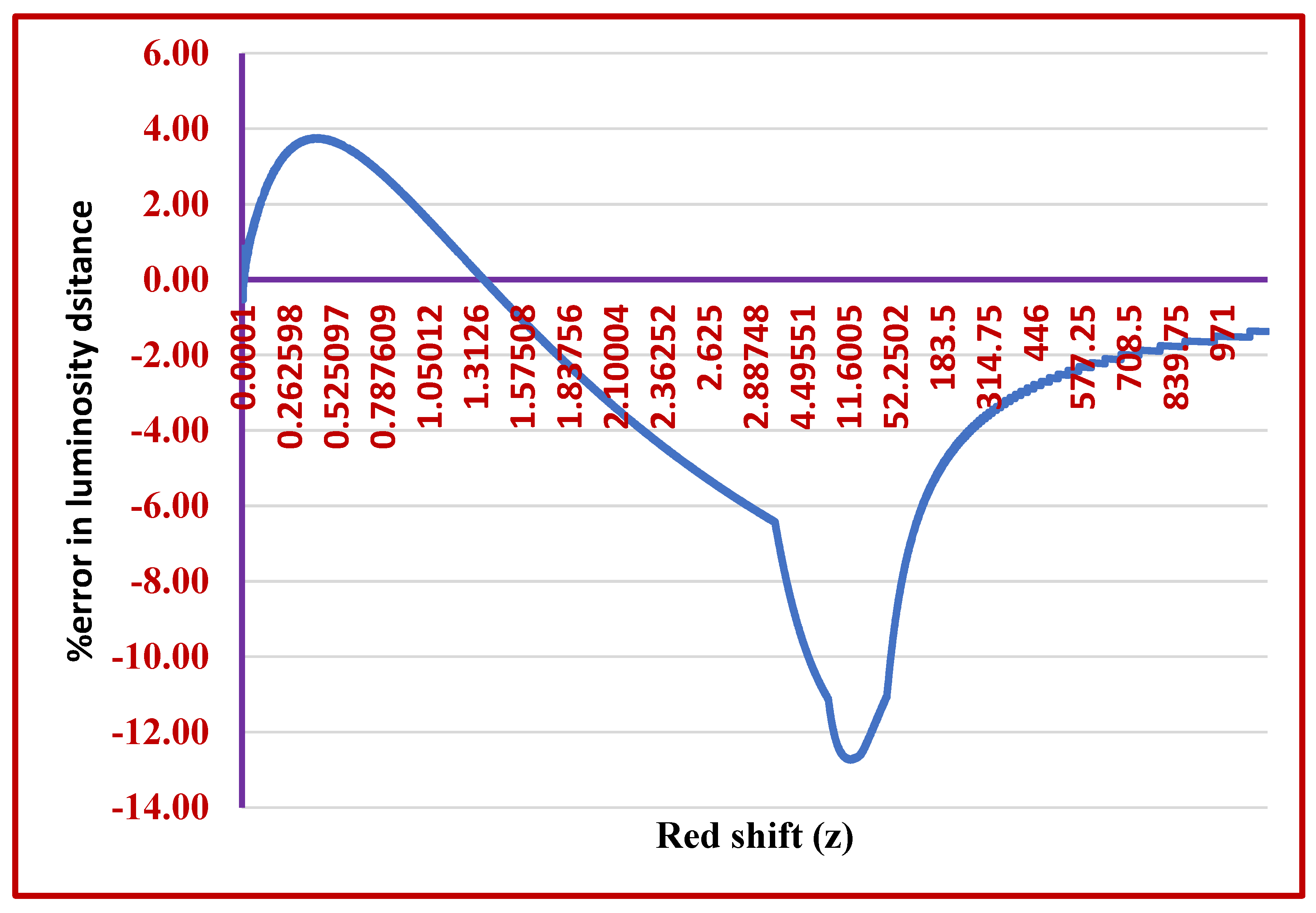
Figure 2.
Estimated galactic receding speed ratio (VGal/c).
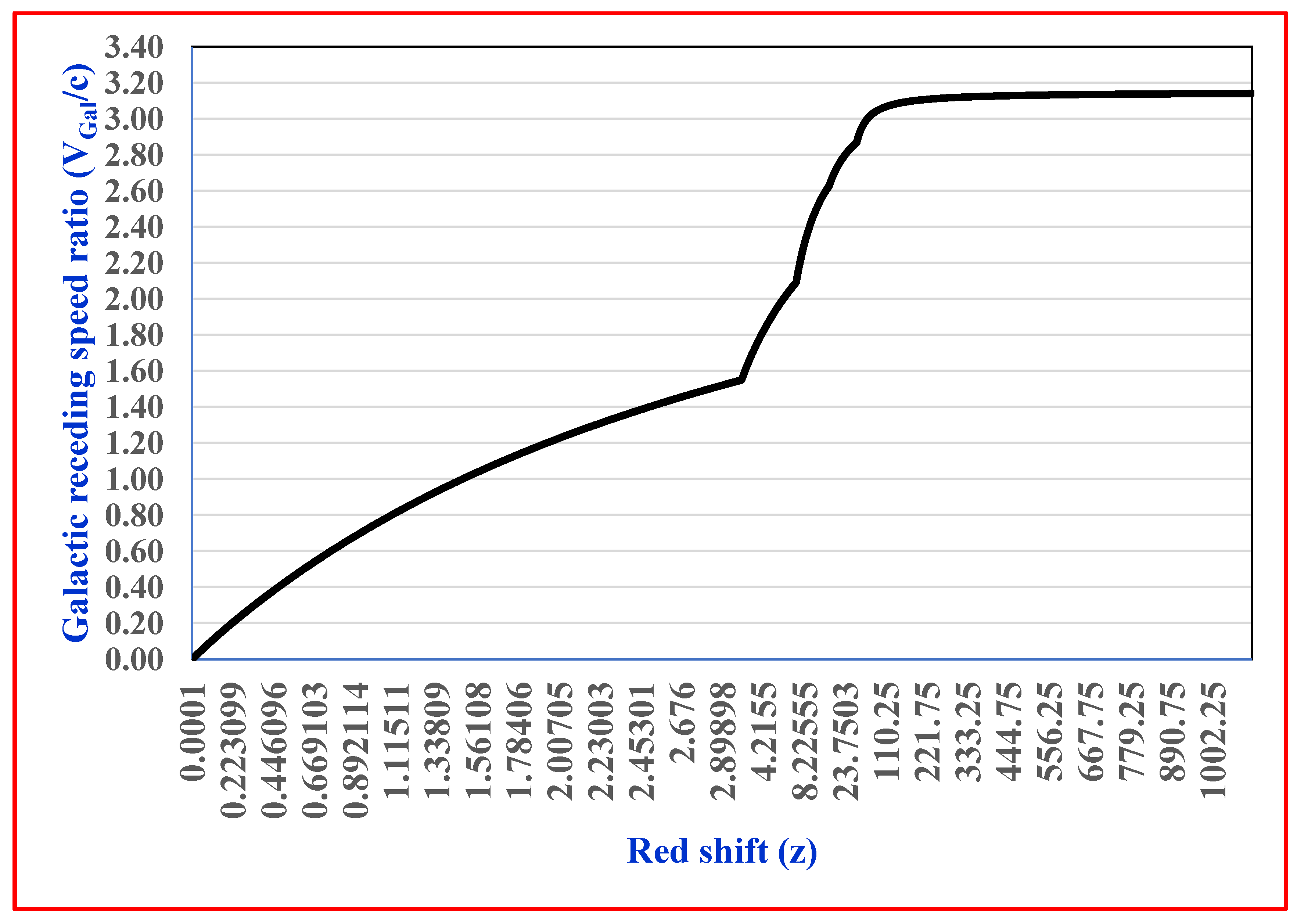
Figure 3.
Fitted adot values in the range of z=0.0001 to 5000.
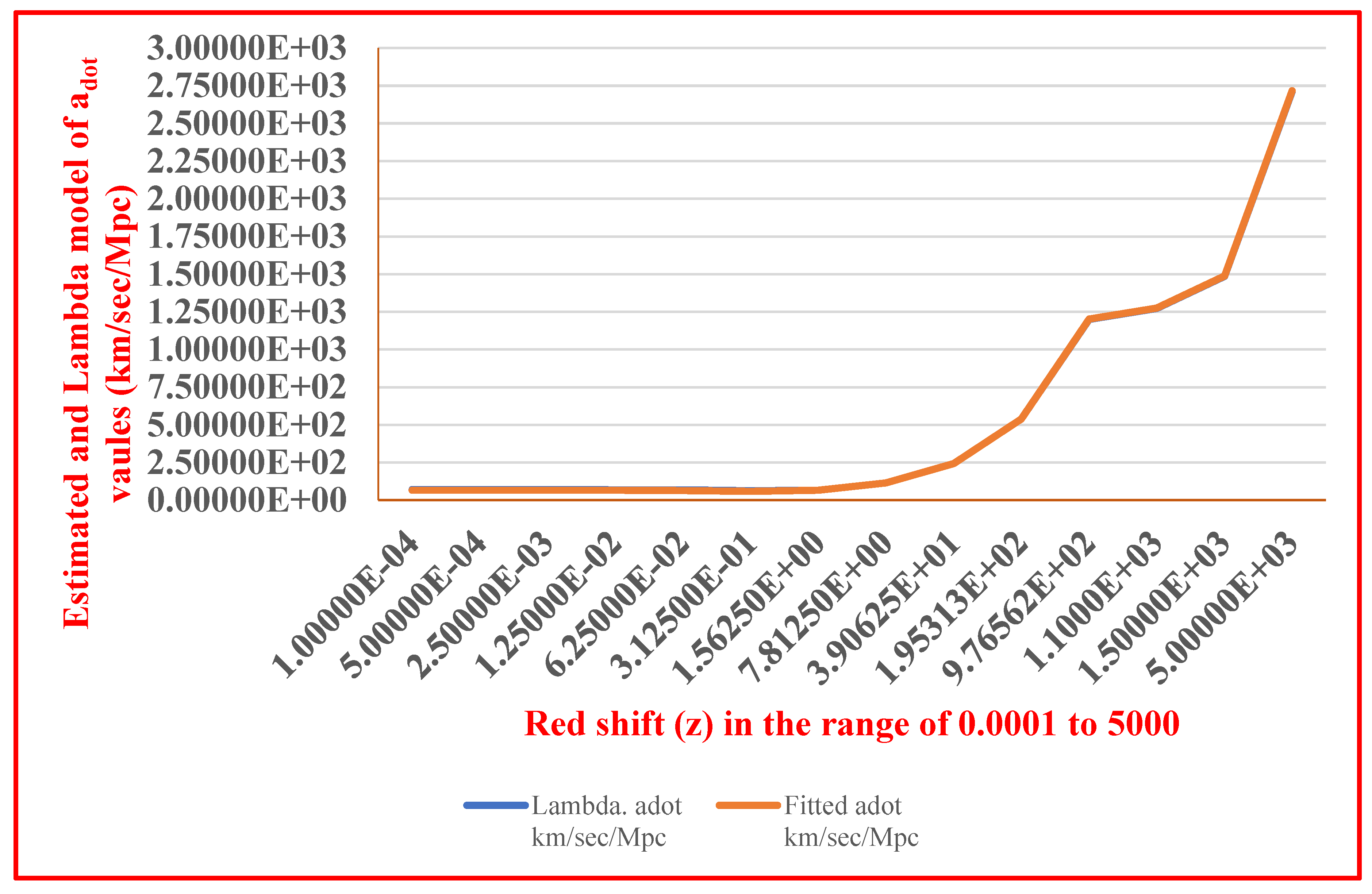

Table 1.
To estimate and fit the distances of farthest galaxies.
| Galaxy | Red shift |
Standard Light travel distance (Gly) |
Estimated Light travel distance (Gly) |
%Error |
| MoM-z14 | 14.44 | 13.53 | 13.65 | -0.89 |
| JADES-GS-z13-0 | 13.2 | 13.47 | 13.59 | -0.89 |
| UNCOVER-z13 | 13.079 | 13.51 | 13.58 | -0.50 |
| JADES-GS-z12-0 | 12.63 | 13.454 | 13.54 | -0.66 |
| UNCOVER-z12 | 12.393 | 13.48 | 13.52 | -0.32 |
| GLASS-z12 | 12.117 | 13.433 | 13.50 | -0.50 |
| UDFj-39546284 | 11.58 | 13.41 | 13.45 | -0.32 |
| J141946.36+525632.8 | 11.44 | 13.4 | 13.44 | -0.30 |
| CEERS2 588 | 11.04 | 13.45 | 13.40 | 0.36 |
| GN-z11 | 10.6034 | 13.39 | 13.36 | 0.26 |
| MACS1149-JD1 | 9.11 | 13.26 | 13.17 | 0.68 |
| EGSY8p7 | 8.68 | 13.23 | 13.11 | 0.94 |
| A2744 YD4 | 8.38 | 13.2 | 13.06 | 1.08 |
| EGS-zs8-1 | 7.73 | 13.13 | 12.94 | 1.44 |
| z7 GSD 3811 | 7.66 | 13.11 | 12.93 | 1.39 |
| z8_GND_5296 | 7.51 | 13.1 | 12.90 | 1.54 |
| SXDF-NB1006-2 | 7.215 | 13.17 | 12.84 | 2.54 |
| GN-108036 | 7.213 | 13.07 | 12.84 | 1.79 |
| BDF-3299 | 7.109 | 13.05 | 12.81 | 1.82 |
| A1703 zD6 | 7.014 | 13.04 | 12.79 | 1.91 |
| BDF-521 | 7.008 | 13.04 | 12.79 | 1.92 |
| G2-1408 | 6.972 | 13.03 | 12.78 | 1.91 |
| IOK-1 | 6.964 | 13.03 | 12.78 | 1.92 |
Table 2.
Estimated adot and Hubble parameter.
| z | Lambda. H.P km/sec/Mpc | Lambda. adot km/sec/Mpc | znew =z/(1+z) | Fitted adot km/sec/Mpc | Fitted H.P km/sec/Mpc | %Error in HP or adot |
| 1.00000E-04 | 7.00032E+01 | 6.99962E+01 | 9.99900E-05 | 6.68933E+01 | 6.69000E+01 | 4.43 |
| 5.00000E-04 | 7.00158E+01 | 6.99808E+01 | 4.99750E-04 | 6.68666E+01 | 6.69000E+01 | 4.45 |
| 2.50000E-03 | 7.00789E+01 | 6.99041E+01 | 2.49377E-03 | 6.67343E+01 | 6.69011E+01 | 4.53 |
| 1.25000E-02 | 7.03976E+01 | 6.95285E+01 | 1.23457E-02 | 6.61015E+01 | 6.69278E+01 | 4.93 |
| 6.25000E-02 | 7.20639E+01 | 6.78249E+01 | 5.88235E-02 | 6.35423E+01 | 6.75137E+01 | 6.31 |
| 3.12500E-01 | 8.21806E+01 | 6.26138E+01 | 2.38095E-01 | 5.85167E+01 | 7.68032E+01 | 6.54 |
| 1.56250E+00 | 1.67824E+02 | 6.54922E+01 | 6.09756E-01 | 6.60825E+01 | 1.69337E+02 | -0.90 |
| 7.81250E+00 | 1.00472E+03 | 1.14011E+02 | 8.86525E-01 | 1.14984E+02 | 1.01330E+03 | -0.85 |
| 3.90625E+01 | 9.72240E+03 | 2.42681E+02 | 9.75039E-01 | 2.43376E+02 | 9.75027E+03 | -0.29 |
| 1.95313E+02 | 1.05458E+05 | 5.37196E+02 | 9.94906E-01 | 5.38296E+02 | 1.05674E+05 | -0.20 |
| 9.76563E+02 | 1.17186E+06 | 1.19876E+03 | 9.98977E-01 | 1.20105E+03 | 1.17410E+06 | -0.19 |
| 1.1000E+03 | 1.4007E+06 | 1.2722E+03 | 9.9909E-01 | 1.2746E+03 | 1.4034E+06 | -0.19 |
| 1.50000E+03 | 2.22961E+06 | 1.48542E+03 | 9.99334E-01 | 1.48824E+03 | 2.23385E+06 | -0.19 |
| 5.00000E+03 | 1.35595E+07 | 2.71136E+03 | 9.99800E-01 | 2.71647E+03 | 1.35851E+07 | -0.19 |
Table 3.
Various cosmological physical parameters.
|
Assumed cosmic angular velocity (red/sec) |
Estimated cosmic temperature (K) |
Estimated cosmic expansion speed (m/sec) |
Estimated cosmic mass (kg) |
Estimated cosmic radius (Gly) |
Estimated cosmic age (Gy) |
| 9.27429315E+42 | 5.63720507E+30 | 2.997925E+08 | 2.176434E-08 | 3.41513E-60 | 3.416766E-60 |
| 9.05227170E+41 | 1.76117379E+30 | 2.241327E+08 | 2.229815E-07 | 3.49889E-59 | 4.006082E-59 |
| 8.83556533E+40 | 5.50225350E+29 | 1.675675E+08 | 2.284505E-06 | 3.58470E-58 | 4.601091E-58 |
| 8.62404678E+39 | 1.71901227E+29 | 1.252779E+08 | 2.340536E-05 | 3.67263E-57 | 5.182924E-57 |
| 8.41759187E+38 | 5.37053259E+28 | 9.366106E+07 | 2.397941E-04 | 3.76270E-56 | 5.736743E-56 |
| 8.21607938E+37 | 1.67786006E+28 | 7.002348E+07 | 2.456755E-03 | 3.85499E-55 | 6.253116E-55 |
| 8.01939098E+36 | 5.24196501E+27 | 5.235140E+07 | 2.517010E-02 | 3.94954E-54 | 6.727988E-54 |
| 7.82741120E+35 | 1.63769302E+27 | 3.913928E+07 | 2.578744E-01 | 4.04641E-53 | 7.161704E-53 |
| 7.64002731E+34 | 5.11647527E+26 | 2.926156E+07 | 2.641992E+00 | 4.14565E-52 | 7.557613E-52 |
| 7.45712928E+33 | 1.59848756E+26 | 2.187671E+07 | 2.706791E+01 | 4.24733E-51 | 7.920737E-51 |
| 7.27860973E+32 | 4.99398968E+25 | 1.635561E+07 | 2.773179E+02 | 4.35150E-50 | 8.256724E-50 |
| 7.10436384E+31 | 1.56022065E+25 | 1.222788E+07 | 2.841196E+03 | 4.45823E-49 | 8.571141E-49 |
| 6.93428930E+30 | 4.87443633E+24 | 9.141887E+06 | 2.910881E+04 | 4.56758E-48 | 8.869080E-48 |
| 6.76828625E+29 | 1.52286983E+24 | 6.834715E+06 | 2.982275E+05 | 4.67960E-47 | 9.154979E-47 |
| 6.60625722E+28 | 4.75774502E+23 | 5.109813E+06 | 3.055420E+06 | 4.79438E-46 | 9.432582E-46 |
| 6.44810708E+27 | 1.48641317E+23 | 3.820231E+06 | 3.130359E+07 | 4.91197E-45 | 9.704978E-45 |
| 6.29374296E+26 | 4.64384724E+22 | 2.856105E+06 | 3.207136E+08 | 5.03244E-44 | 9.974683E-44 |
| 6.14307424E+25 | 1.45082926E+22 | 2.135300E+06 | 3.285796E+09 | 5.15587E-43 | 1.024373E-42 |
| 5.99601244E+24 | 4.53267611E+21 | 1.596406E+06 | 3.366386E+10 | 5.28233E-42 | 1.051373E-41 |
| 5.85247122E+23 | 1.41609721E+21 | 1.193515E+06 | 3.448952E+11 | 5.41188E-41 | 1.078602E-40 |
| 5.71236630E+22 | 4.42416635E+20 | 8.923035E+05 | 3.533543E+12 | 5.54462E-40 | 1.106163E-39 |
| 5.57561541E+21 | 1.38219663E+20 | 6.671096E+05 | 3.620208E+13 | 5.68061E-39 | 1.134143E-38 |
| 5.44213826E+20 | 4.31825425E+19 | 4.987487E+05 | 3.709000E+14 | 5.81994E-38 | 1.162611E-37 |
| 5.31185648E+19 | 1.34910760E+19 | 3.728777E+05 | 3.799969E+15 | 5.96268E-37 | 1.191626E-36 |
| 5.18469357E+18 | 4.21487763E+18 | 2.787732E+05 | 3.893169E+16 | 6.10892E-36 | 1.221235E-35 |
| 5.06057488E+17 | 1.31681071E+18 | 2.084182E+05 | 3.988656E+17 | 6.25875E-35 | 1.251481E-34 |
| 4.93942752E+16 | 4.11397580E+17 | 1.558189E+05 | 4.086484E+18 | 6.41226E-34 | 1.282401E-33 |
| 4.82118035E+15 | 1.28528699E+17 | 1.164943E+05 | 4.186711E+19 | 6.56953E-33 | 1.314026E-32 |
| 4.70576396E+14 | 4.01548949E+16 | 8.709423E+04 | 4.289397E+20 | 6.73066E-32 | 1.346386E-31 |
| 4.59311058E+13 | 1.25451793E+16 | 6.511394E+04 | 4.394601E+21 | 6.89574E-31 | 1.379510E-30 |
| 4.48315405E+12 | 3.91936089E+15 | 4.868090E+04 | 4.502386E+22 | 7.06487E-30 | 1.413422E-29 |
| 4.37582982E+11 | 1.22448547E+15 | 3.639512E+04 | 4.612814E+23 | 7.23815E-29 | 1.448148E-28 |
| 4.27107488E+10 | 3.82553356E+14 | 2.720995E+04 | 4.725951E+24 | 7.41567E-28 | 1.483711E-27 |
| 4.16882771E+09 | 1.19517196E+14 | 2.034288E+04 | 4.841862E+25 | 7.59755E-27 | 1.520137E-26 |
| 4.06902828E+08 | 3.73395241E+13 | 1.520887E+04 | 4.960617E+26 | 7.78390E-26 | 1.557447E-25 |
| 3.97161799E+07 | 1.16656021E+13 | 1.137055E+04 | 5.082284E+27 | 7.97481E-25 | 1.595666E-24 |
| 3.87653966E+06 | 3.64456365E+12 | 8.500924E+03 | 5.206935E+28 | 8.17040E-24 | 1.634818E-23 |
| 3.78373744E+05 | 1.13863340E+12 | 6.355515E+03 | 5.334643E+29 | 8.37080E-23 | 1.674927E-22 |
| 3.69315686E+04 | 3.55731481E+11 | 4.751550E+03 | 5.465484E+30 | 8.57610E-22 | 1.716016E-21 |
| 3.60474473E+03 | 1.11137515E+11 | 3.552384E+03 | 5.599534E+31 | 8.78645E-21 | 1.758111E-20 |
| 3.51844913E+02 | 3.47215467E+10 | 2.655856E+03 | 5.736871E+32 | 9.00195E-20 | 1.801237E-19 |
| 3.43421941E+01 | 1.08476944E+10 | 1.985588E+03 | 5.877577E+33 | 9.22273E-19 | 1.845420E-18 |
| 3.35200610E+00 | 3.38903320E+09 | 1.484478E+03 | 6.021734E+34 | 9.44894E-18 | 1.890685E-17 |
| 3.27176092E-01 | 1.05880066E+09 | 1.109835E+03 | 6.169427E+35 | 9.68069E-17 | 1.937059E-16 |
| 3.19343678E-02 | 3.30790162E+08 | 8.297417E+02 | 6.320742E+36 | 9.91812E-16 | 1.984570E-15 |
| 3.11698767E-03 | 1.03345356E+08 | 6.203367E+02 | 6.475768E+37 | 1.01614E-14 | 2.033247E-14 |
| 3.04236871E-04 | 3.22871229E+07 | 4.637801E+02 | 6.634597E+38 | 1.04106E-13 | 2.083116E-13 |
| 2.96953608E-05 | 1.00871325E+07 | 3.467342E+02 | 6.797321E+39 | 1.06659E-12 | 2.134209E-12 |
| 2.89844703E-06 | 3.15141870E+06 | 2.592276E+02 | 6.964036E+40 | 1.09275E-11 | 2.186554E-11 |
| 2.82905981E-07 | 9.84565217E+05 | 1.938054E+02 | 7.134840E+41 | 1.11956E-10 | 2.240184E-10 |
| 2.76133369E-08 | 3.07597548E+05 | 1.448940E+02 | 7.309834E+42 | 1.14701E-09 | 2.295128E-09 |
| 2.69522889E-09 | 9.60995270E+04 | 1.083266E+02 | 7.489119E+43 | 1.17515E-08 | 2.351420E-08 |
| 2.63070660E-10 | 3.00233833E+04 | 8.098781E+01 | 7.672802E+44 | 1.20397E-07 | 2.409093E-07 |
| 2.56772894E-11 | 9.37989575E+03 | 6.054862E+01 | 7.860989E+45 | 1.23350E-06 | 2.468180E-06 |
| 2.50625893E-12 | 2.93046401E+03 | 4.526774E+01 | 8.053793E+46 | 1.26375E-05 | 2.528716E-05 |
| 2.44626048E-13 | 9.15534624E+02 | 3.384336E+01 | 8.251325E+47 | 1.29475E-04 | 2.590737E-04 |
| 2.38769835E-14 | 2.86031033E+02 | 2.530219E+01 | 8.453702E+48 | 1.32650E-03 | 2.654279E-03 |
| 2.33053817E-15 | 8.93617231E+01 | 1.891658E+01 | 8.661042E+49 | 1.35904E-02 | 2.719379E-02 |
| 2.27474638E-16 | 2.79183608E+01 | 1.414253E+01 | 8.873468E+50 | 1.39237E-01 | 2.786076E-01 |
| 2.22029021E-17 | 8.72224529E+00 | 1.057333E+01 | 9.091104E+51 | 1.42652E+00 | 2.854409E+00 |
| 2.16713769E-18 | 2.72500107E+00 | 7.904901E+00 | 9.314078E+52 | 1.46151E+01 | 2.924418E+01 |
| 2.11525761E-19 | 8.51343957E-01 | 5.909912E+00 | 9.542521E+53 | 1.49735E+02 | 2.996144E+02 |
| 2.06461952E-20 | 2.65976605E-01 | 4.418406E+00 | 9.776567E+54 | 1.53408E+03 | 3.069630E+03 |
| 2.01519367E-21 | 8.30963253E-02 | 3.303317E+00 | 1.001635E+56 | 1.57170E+04 | 3.144917E+04 |
Disclaimer/Publisher’s Note: The statements, opinions and data contained in all publications are solely those of the individual author(s) and contributor(s) and not of MDPI and/or the editor(s). MDPI and/or the editor(s) disclaim responsibility for any injury to people or property resulting from any ideas, methods, instructions or products referred to in the content. |
© 2026 by the authors. Licensee MDPI, Basel, Switzerland. This article is an open access article distributed under the terms and conditions of the Creative Commons Attribution (CC BY) license (http://creativecommons.org/licenses/by/4.0/).
Copyright: This open access article is published under a Creative Commons CC BY 4.0 license, which permit the free download, distribution, and reuse, provided that the author and preprint are cited in any reuse.


