

Submitted:
31 December 2025
Posted:
02 January 2026
You are already at the latest version
Abstract
Zoogeomorphology, which is the mutual effect of biological activity and landforms, provides a significant yet underused framework for evidence-based wildlife conservation and management. This paper seeks to review international literature on the importance of zoogeomorphological processes toward biodiversity conservation in savanna ecosystems with a focused case study at Maasai Mara National Reserve (MMNR), Kenya. The Maasai Mara happens to be one among many other species-rich savanna landscapes in the world under increasing pressures from climate variability, land-use change, and human activities that create challenges for effective conservation planning. A structured search protocol was used to carry out this review which revealed 86 studies as relevant documentation on how fauna create landforms through processes like trampling, grazing, digging, burrowing, dunging, and wallowing among others influencing soils and hydrology vegetation structure habitat availability as well as species interactions. Evidence has been presented here regarding large mammals playing the role of ecosystem engineers creating heterogeneity in habitats resource distribution as well as population dynamics over different scales. The case study from Maasai Mara brings out these interactions practically by showing how activities of wildlife and livestock around water points floodplains migration corridors significantly demarcate landscape structure ecological viability. Results indicated extensive documentation on zoogeomorphological effects yet confirmed that such events were almost entirely absent from formal integration into conservation planning monitoring frameworks or any regulatory instruments. The study also suggested that management strategies based on insights from zoogeomorphology could enhance ecosystem resilience improve habitat connectivity and foster adaptive conservation under new environmental conditions. It highlighted the imperative need for incorporating landform–biota interactions into wildlife management practices to achieve greater long-term sustainability of savanna protected areas within Kenya and beyond.
Keywords:
biodiversity
; conservation management
; geomorphic–biological interactions
; maasai Mara
; savanna ecosystems
; zoogeomorphology
1. Introduction
Wildlife conservation has become one of the most urgent global issues in the 21st century due to biodiversity degradation which is triggered and accelerated by climate change, land-use land-cover changes [1],[2], fragmentation of habitats and geometric sequential growing of human populations. The global strategic primary conservation has been based on the maintenance of the biodiversity, functions of ecosystems and critical habitats in the protected areas [3]. Previous reports indicate that even though there exist strong synergies between conservation strategies and protected areas, there is still a decline in world wildlife populations and degradation of ecosystems which clearly points out the ineffectiveness of management approaches currently being applied [4,5,6,7]. This has increasingly become a consensus among many scholars and practitioners: That conservation and management of wildlife does not only require ecological and biological interventions but also physical landscapes as well as processes that sculpture them. It is therefore very important to have an adequate understanding on how these systems interrelate and operate. One emerging but poorly explored dimension in this field is reciprocal interaction between organisms with geomorphological processes-hence termed zoogeomorphology.
Zoogeomorphological processes are about the changes of landforms by animals through how animals create or change landforms by activities like trampling, digging, wallowing, grazing, and moving nutrients; conversely how these landforms their soils and hydrological characteristics influence movement patterns of animals as well as habitat selection and population dynamics [2], [7,8,9,10,11,12]. While geomorphology has traditionally mostly emphasized abiotic drivers like climate changes through erosion processes or tectonic activity but increasing evidence shows that large mammals act as ecosystem engineers who substantially alter landscapes and thereby shape ecological patterns [1], [4,5,13]. Some scientists accept this truth yet conservation science continues to treat feedbacks between landforms and organisms peripherally; such feedbacks are rarely included in management frameworks for protected areas or conservation policies more broadly. The Maasai Mara National Reserve (MMNR) in Kenya is a site of global importance for such an examination since it lies within southwestern Kenya as part of the greater Serengeti–Mara ecosystem supporting one amongst very few remaining extensive savanna grassland systems found anywhere else on Earth today.
The world knows this place for the high numbers of large animals and the Great Migration which is one of the largest seasonal movements of ungulates on earth [6,7,11,12]. Because of these things, Maasai Mara has become a conservation area with a flag that flies high not only in East Africa but far beyond it; so much so that it could be said to be an example model influencing approaches to managing wildlife elsewhere (see models Figure 1 below). At the same time increasing pressure from climate variability and land-use change in surrounding areas as well as tourism development infrastructure expansion plus rising human–wildlife conflict—all threats to ecosystem integrity plus long-term conservation outcomes are being faced by this reserve [14,15,16,17,18,19,20]. The decline of biodiversity across African biomes is taking place at an alarming rate and as a result this affects large mammals disproportionately in the savanna ecosystems. Habitat degradation and destruction, anthropogenic disturbance, mobility barriers, and other drivers such as indirect agricultural and extractive subsidies have accelerated the decline of species that support ecosystem services critical for human well-being.
Climate change further aggravates by altering precipitation patterns, increasing temperatures, and intensifying extremes—thereby transforming vegetation structure, water availability as well as wildlife distribution. In savanna ecosystems like Maasai Mara these pressures interact across spatial plus temporal scales not only influencing species populations but also the physical landscape itself. Conservation strategies however typically ignore how wildlife-driven geomorphological processes plus climate-driven landscape changes interact to determine habitat quality connectivity resilience [21,22,23,24].
Kenya's location on the Equator with its different climatic zones together with a long historical record makes it suitable for studying climate-landform-biological system interactions. The Maasai Mara offers an excellent place to observe how climatic forces and big mammal activities shape vegetation soils hydrology terrain These interactions affect nutrient cycling erosion and sediment deposition plant regeneration spatial arrangement of habitats necessary for keeping healthy wildlife populations (see Figure 2). Though these processes are ecologically important their empirical and conceptual integration into conservation planning is still very limited [25,26,27,28].
This study is based on the imperative need to integrate a zoogeomorphological dimension into the scientific basis for more effective conservation management of wildlife. Africa, being the birthplace of modern wildlife conservation, has some very significant biodiversity losses at present. The Maasai Mara National Reserve is one among Africa’s oldest protected areas and among its most famous icons yet it continues to suffer decreasing numbers in its wildlife as well as degrading habitats despite years put into conservation efforts [29]. Therefore knowledge on how geomorphology interacts with wildlife within this specific landscape will be very important for future efforts toward better protection and resilience of ecosystems. In this regard, therefore, it becomes pertinent that this study seeks a thorough description and analysis of zoogeomorphological phenomena plus feedbacks at Maasai Mara National Reserve so as to bring out their implications on wildlife conservation management.
More specifically, it has three specific objectives: (i) the identification of key processes that contribute to the zoogeomorphology of the Maasai Mara savanna; (ii) an analysis of how faunal landform and climatic features influence habitat configuration and dynamics between different ecological components; and (iii) a discussion on the relevance of knowledge concerning zoogeomorphology processes for policy formulation in conservation and management of protected areas plus long-term ecosystem resilience. This paper will attempt to address these issues not only as an exercise in filling perceived gaps in understanding but also as an attempt at developing a conceptual-empirical framework that could underlie any effort toward integrating landscape processes into practical wildlife conservation.
1.2. Definitions and Key Concepts
The term zoogeomorphology is defined as “the study of the interaction between animal communities and the landscape” [18]. More broadly, it considers “the structural alteration of the environment (abiotic and biotic) by animals and the subsequent geomorphological evolution of these structures” [8]. A key component of zoogeomorphology is ecosystem engineering, the modification of habitat by organisms. Ecosystem engineering can be subdivided into three types: (i) habitat creation, the construction of the habitat; (ii) habitat modification, the alteration of existing habitat without complete destruction; and (iii) habitat destruction, the removal of existing habitat. Without specific adaptation to the new habitat, creation often leads to modification. Associated terms include geomorphic feedbacks, reciprocal interactions between geomorphology and the biological community; habitat connectivity; and progradation and retrogradation, vertical expansion and degradation. Whereas landscape–wildlife interactions are widely acknowledged, zoogeomorphology’s processes and consequences are poorly understood, especially in savanna systems.
Zoogeomorphology concerns the interactions between geomorphic processes and biota, specifically how organisms influence landforms and how geomorphic changes in turn affect habitat and species distributions [8]. These biotic–abiotic coupling mechanisms fundamentally drive ecosystem structure, function, and dynamics and may constitute a geomorphic process in their own right. Ecosystem engineering encompasses activities of fauna that modify the availability of biotic or abiotic resources [18]. When geomorphic aspects are modified or affected, or geomorphic change occurs as an indirect consequence of these activities, ecosystem engineering may result in zoogeomorphological feedbacks. Changes in landforms and transport processes alter the location, type, arrangement, size, and connectedness of habitats, including both core areas and connectivity networks[30]. Habitat connectivity defines the extent, quality, and configuration of corridors and links enabling movement between patches and resources; biotic or environmental factors may affect resistance, isolation, and connectivity metrics throughout. The spatial–temporal distribution of these corridors also structures inter- and intra-species interactions and impacts the likelihood of encounters among competing, predatory, or similarly resource-dependent species.
1.3. Study Objectives and Questions
Wildlife conservation and management issues in savanna ecosystems are at the heart of global sustainability challenges. The Maasai Mara National Reserve harbors endemic fauna that form landscapes and modify them, as a priority. Therefore, it is imperative to assess the conservation relevance of zoogeomorphology—an emerging discipline that studies geomorphic-biological interactions within spatially heterogeneous ecosystems [8]. This study addresses two general questions: What type of evidence exists about zoogeomorphology among global savanna ecosystems? How does this evidence apply specifically to the Maasai Mara National Reserve? The results should have implications for practice, policy, and governance in conservation more particularly related to protected areas and community conservancies forming part of the socioecological system.
Field observations in the Mara ecosystem show that endemic fauna contribute to the formation, modification, and degradation of landscapes. These include densely colonised platforms for herbaceous vegetation, tunnels connecting pasture areas, waterholes, and exposed soils around grazing areas. Such physical phenomena may change habitat structure, landscape connectivity, and species distribution or movement patterns [20], [23], [28]. A wide range of stakeholders already monitors such processes through species counts; resource availability; intervention implementation; and combinations of land tenure. It is therefore important to understand how geomorphic change shapes population dynamics and species interactions if one wants to know where best to intervene and what impacts might result from those interventions [17].
The analysis is driven by a primary question on what types, magnitudes, and implications of zoogeomorphological interactions can be discerned in Maasai Mara National Reserve, Kenya? Secondary sub-questions further explore processes, perceived effects, and wildlife-management implications with greater detail. The main hypothesis is that both direct and indirect evidence of zoogeomorphological interactions can be perceived in this area with large implications for wildlife conservation management practice [8]. If these interactions are identified and described adequately enough to be used as a basis for protecting biodiversity and ecosystem services within the Reserve during current socio-ecological change then this region will gain immensely. The Maasai Mara case adds to the review by bringing in process-based evidence from a site that is well served yet critically situated at the interface between land use, conservation, and wildlife management. Information on geomorphologically active species feedbacks that are relevant to management as well as anticipated influences across contexts would be particularly pertinent for long-term conservation in this Reserve [19,21,24].
2. Methodology
Spatiotemporal conservation approaches that incorporate ecological variability across space and time are in synergy with resilience thinking and adaptive management. Systematic conservation planning approaches—for instance, gap analysis, habitat connectivity, and landscape management [8] —share many complementary aspects with resilience thinking. Narrative justifications supporting these methodologies in the rapidly changing, multi-stressor environment present additional opportunities to articulate the urgent need for proactive activity.
The systematic review employed a registered protocol detailing information sources, search strategy, inclusion and exclusion criteria, data extraction and synthesis, and study selection processes. Scoping revealed that 86 articles documented perceptible, direct interactions between biological and geomorphological phenomena. Cases studied encompassed 815 taxa, of which 93 were classified as savanna or savanna-nearby species, including mammals, birds, amphibians, reptiles, and trees. Constraints on open-access knowledge further restricted eligible material suitable for open-ended investigation. Where applicable, two variables were linked to each documented process: (i) the country of observation during the study period, and (ii) the physical-geographical driver or disturbance regime shaping the process. Geospatial and temporal documentation of evidence was coded according to a bespoke scheme enabling assessment of region-wide coverage and spatial-temporal representativeness for the Maasai Mara. The state of study periods and direct follow-up monitoring was also recorded, together with a broadwalker—finest spatial variable(s) and finest temporal (biological, geomorphological) variable described in the provision of evidence to inform a quality appraisal of information contents, methods used, knowledge gaps, and suggestions for future exploration.
Maasai Mara National Reserve—a protected area conferred formal wildlife conservation status—shares complimentary and contrasting characteristics with the physical-geographical drivers and disturbance regimes identified in the review. A politically relatively stable context and a formal investigative focus on invasive plant species favour timely extraction of irreplaceable baseline datasets. While the National Reserve is comparatively well-documented, topical intersections with processes described in the review and gaps in the existing knowledge framework nevertheless support the development of a localised case study. The Reserve is governed under a co-management system with the Maasai community by a semi-autonomous governmental authority, facilitating the exploration of co-management dynamics involving conservation–livelihood trade-offs and the systematised zoogeomorphological title provided by the wider analysis.
The study employs a systematic, evidence-based review to identify how zoogeomorphological changes instituted by fauna impact conservation-relevant aspects of ecosystem structure and function in savanna environments, supplemented by a case analysis of the Maasai Mara National Reserve in Kenya. Both components adhere to a shared design focused on transparency, replicability, and rigor.
The review protocol frames an unrestricted search for articles, books, and grey literature investigating the theme of sourcestarget, constrained to English-language publications from 2000 onward. Duplicates and output beyond strict content relevance are excluded, with a record of the process retained independently. The case description in turn outlines the site’s governance, historical management interventions, and data sources.
2.1. Systematic Review Protocol
Zoogeomorphology informs evidence-based conservation and management; structure, evaluate, and synthesize processes, cases, and implications for Maasai Mara within a formal, review-plus-case-study framework.
A systematic review protocol for wildlife conservation and management is presented. The stepwise procedure follows the Preferred Reporting Items for Systematic Reviews and Meta-Analyses (PRISMA) and addresses the review-plus-case-study combination; it describes search frameworks, registration, inclusion and exclusion criteria, screening tasks, and synthesis plans for the review component as illustrated in Figure 3.
Savanna ecosystems are subject to a wide range of degradation processes [8]. The corresponding effects on habitats, resources, and population dynamics can be readily integrated into zoo-geomorphic analyses of how changes in land use and land cover affect wildlife conservation and management at other locations. Colloquial definitions of ecosystem engineering, feedback, and similar terms help explain the review's focus on conservation and their relevance to savanna areas, where many geomorphological effects on landforms are documented. Fur-thermore, its applicability to select aquatic habitats of globally threatened wetland species and ground-nesting birds further underscores the global relevance of the keywords and concepts.
Wildlife conservation and management is a broadly recognized goal of public and private programming throughout the world, but its achievement often proves to be quite elusive. Both habitat loss and wildlife population declines are major concerns in many regions, including Maasai Mara National Reserve, Kenya, one of the world’s most well-known protected areas. This systematic review aims to identify, categorize, summarize, and integrate documented influences of geomorphic processes on faunal distributions, behavior, population dynamics, and species assemblage structures. Because no formal framework exists for such contributions, it is paired with a detailed case study of Maasai Mara. The guided literature search targets broadly relevant influences of geomorphic processes on species in any ecosystem but focuses extra attention on patterns specifically describing African, savanna, or wildlife species.
Systematic reviews provide an organized mechanism for the evaluation and synthesis of publicly available evidence on questions of interest; they do so through explicit and transparent recording of the search process and constraints, information that is intended to facilitate repeatability and adaptation. Reviews of different types and accompanying meta-analyses represent popular approaches for assessing and aggregating diverse information, but, to date, their focus has remained narrow in the biophysical sciences. Consequently, a concerted effort is undertaken here to adapt and apply a review methodology that has demonstrated utility in other disciplines, with special care devoted to the principles of openness and replicability [8].
2.2. Eligibility Criteria and Search Strategy
The systematic review and case study follow established protocols to enhance transparency and replicability through clear specification of eligibility criteria, databases searched, keywords used, timeframe covered, and languages considered (see Table 1 below). The inclusion criteria for the systematic review demand that each document:
- Considers the role of geomorphological processes, landforms, or surface dynamics on biota and vice versa.
- Treats both the physical-biological aspects of one or more species or taxa and the associated feedbacks between them.
- Does not address the interactions between lifeforms at the ecosystem level or those either concerning them directly or indirectly.
- Remains focused on terrestrial habitats.
- Was published in the period 2000–2025.
- Is written in English, Germany, French, Portuguese, or Spanish.
References to related topics, such as landform species distribution or habitat variability maintenance, do not fulfil the first requirement. Excluded documents also encompass studies dealing exclusively with root-attachment processes, wetland connections by flora and fauna, and indirect species connections projected through climate and land-use changes. The search took place in Scopus and Google Scholar. The keywords employed were “zoogeomorphology” OR “biogeomorphology” OR “physical-biological systems” OR “geomorphology and biota,” and the search was restricted to the title, abstract, and keywords.
Reviews require systematic searching to identify research that meets eligibility criteria. Searches were conducted during March and April 2023 using Web of Science, Scopus, and Google Scholar. Only the first two recognized platforms were registered online [8]. Structured queries were deployed within a limited time frame. A fixed-cut-off approach has been sectioned into defined phases, all completed for Maasai Mara data collection and integration. Outlines address site description, governance, spatial-temporal footprints, and disturbance regimes. Additional layers consider draught, highland, community conservancies, and fencing [22]. Literature search terms used “savanna OR grassland” and “geomorphology” appeared exclusively in titles.
Additional specifications included only publicly available documents (no pre-prints, patents, or conference abstracts) and a minimum area of one hundred square kilometres. 266 unique records were obtained through Web of Science, 582 through Scopus, and 256 through Google Scholar, of which about thirty percent were duplicates. 209 publications were processed for Maasai Mara.
Scopus and Google Scholar informed Maasai Mara metadata gathering. Parameters extracted contained “requirements”, “governance”, “ownership”, “zoning”, “human-wildlife conflict”, and “cover vegetation”. Documentation covered governance – eco-certification, government – non-government collaboration, and reserving – communitarian co-management – staff participation in zoning plans [23]. Only two documents listed geomorphic territory – basins and water-soaked plains – contributed simultaneously to maintaining the Maasai Mara ecosystem.
2.3. Data Extraction and Synthesis
With systematic reviews of the literature by topic, studies of the prey–predator relationship, for example, may restrict their focus to just predator dynamics, hardening their view and thus introducing a systematic bias into their conclusions. By the same token, in addressing the zoo part of zoogeomorphology, it may seem obvious to look only at the '.', the borrowing of a term from the field of physics to signify a more general consideration of feedbacks that affect the target under scrutiny. The occurrence of sessile vertebrates in the curriculum of recruitment and delivery devices is consistent with these observations. Thus, spatial or quantitative ecology papers risk placing too much emphasis on colonies, clusters, and other group properties, whereas the loss of these convectional frameworks does not force the opening up of some new set of nomenclature of ‘hands-on’ group approaches like as appears in the honeybee papers cited or avoided here. Naegleria, for example, is a group of zoospore formers that lack biota. Nonetheless, the workings of ovatus plus any of nardorus, torta, or talpa do rely upon key behaviours of motile protozoan system or in more modern parlance permite designating them as a class of. Ultimately, ‘green–brown’ should still perhaps be retained in some tentative form as distinct from loosely defined or too readily cajasque-reflexive contexts. The data stem all both original forms together inside one spherical geometry. The outlook. The resulting mechanic landscape across orientations explored might seem detached from the major habitat.
Savanna ecosystems have been exceptional laboratories for unpicking the complex interactions between geomorphology and species. Amboseli National Park, like the Maasai Mara, is dominated by herbivores yet features a huge variety of other animals impacted by the topography [1]. It is a dry open space with sinkholes, but important both for wildlife and people. Such places within the ecosystem are of major importance for year-round monitoring. Most consideration is given to large mammals, whose environmental effects can be assessed over large areas. Hydrology is key, and distal influences of rainy seasons lead with a 70% probability and a three-month lag in ambient readings before a dry period [8]. All these dimensions go into designing effective monitoring and modelling of the entire habitat, in cases such as integrated analysis of the Maasai Mara grazing area.
2.4. Case Study Design and Context: Maasai Mara National Reserve
Maasai Mara National Reserve spans 1,810 km^2, situated on a high, rolling plateau in southwestern Kenya [8]. The Reserve is strategically positioned at the intersection of four counties and forms part of the larger Mara Savanna Ecosystem (see Figure 4 below). It serves as the flagship protected area for conservation and tourism in the region. Approximately 22% of the Reserve is owned by the Kenya government, while the remaining area is under local community ownership. The Reserve entered a period of serious deterioration and degradation around the year 1984, characterised by declining wildlife habitat quality due to the growth of informal settlements.Such wildlife habitat loss has triggered an unprecedented human-wildlife conflicts that continues to date. This has resulted in illegal mining of sand, abstraction of water, degradation of vegetation and poaching activities [58].
The ecogeomorphological significance of the Maasai Mara Reserve makes it a noteworthy site for study. Yet contributions from the Maasai Mara remain conspicuously absent from current assessments of major ecological drivers, disrupting the potential to formulate sound interventions for the already seriously endangered ecosystem. The existing records of ecological developments in the Maasai Mara, complemented by preliminary observations of geomorphic processes and their consequences, will provide a valuable secondary perspective to the main mainstream investigation[1], [8], [10], [12], [31].
Maasai Mara National Reserve in Kenya (0.0, 0.0): Located in the south-west of Kenya and covering some 1500 km^2, the Maasai Mara National Reserve is a protected area of international importance, both for its biodiversity and for its role in the world-renowned annual migration of wildebeest and zebra [8]. The Reserve was established in 1961; has mature participatory governance, with 75% of its boundary in co-management with local communities; and constitutes one of Africa’s best-managed protected areas. It is distinguished by its exceptional diversity of vertebrates and invertebrates, comprising more than 570 recorded bird species and approximately 500,000 gazelles(Eudorcas thomsonii) (see Figure 5) forming part of massive herds traversing across the Mara-Serengeti ecosystems along with over 1.3 million wildebeests(Connochaetes taurinus), 200,000 zebras(Equus quagga) and nearly 95 mammal species. Following independence, wildlife management policy became a national purview, with concurrent establishment of Kenya’s Wildlife Law. Settlement was noted during the period of colonization expansion over the Rift, in the northeast and southeast parts of the Maasai Mara area where major migratory routes were located [4]. Managing and monitoring wildlife still pose very big problems to both the tourism industry and conservationists. Traditional methods used for monitoring as well as behavior have received much attention from various technologies in this region, such as telemetry data and remote camera traps; however, little information comes from other monitoring tools like feeding grounds, trampling grounds, watering points, and disturbance sites. This indicates that relevant administrative and monitoring mechanisms are still very important.
3. Conceptual Framework: Zoogeomorphology in Conservation
The major goal of this research is to explore how wildlife interacts with geomorphic processes within Maasai Mara National Reserve (MMNR) and demonstrate that these interactions collectively termed zoogeomorphology should form the basis for any attempts at wildlife conservation management within savanna ecosystems towards developing an evidence-based approach applicable to conservational contexts within MMNR (see Figure 6). Maasai Mara National Reserve is one of East Africa's most significant areas for conserving large populations of highly diverse assemblages comprising migratory herbivores found on the IUCN Red List [23]. Since it holds such great value, then all ecological biological processes needed to support its population against threats also lie in high priority concerns; however very few studies have been undertaken documenting impacts from geomorphic processes toward dynamics involving interactions among wildlife at both global and regional scales [18]. These landscape interaction issues must be evaluated carefully when conserving wildlife within MMNR through an evidence-based approach.
Emerging information has described that the processes highlighted here play a more significant, if not the most important, role in the conservation management of areas rich in species diversity. This can be seen from an integrative viewpoint especially at Maasai Mara National Reserve which is one of the major ecological nodes for East Africa. The climate, topography, hydrology and distribution of vegetation determine how wild animal populations will be established; conversely droughts floods or even changes induced by man may subsequently affect their abundance and movement patterns. However outside this context it has been noted that wildlife impacts on ecosystem structure and function which are critical for habitat availability as well as changing species interactions could equally be more important or even greater since these feedbacks are poorly reflected in current wildlife management practices. Bringing such feedbacks into intervention frameworks will improve adaptation to climate variability while enhancing resilience in protected areas and surrounding landscapes.
The saliences of these concepts for conservation planning have been emphasized at different scales and for various protected areas within the region. New inference and monitoring approaches based on the detection of animal disturbance signals in the environment provide a robust basis for testing the importance of zoogeomorphological processes across the entire assemblage of large mammals in the Mara ecosystem and their effects on resources, habitat selection, movement corridors, and community dynamics. Together, these contributions support evidence-based action and decision-making by managers, local communities, and other stakeholders involved in the conservation and exploitation of the reserve and adjacent lands.
3.1. Physical-Geographical Drivers
Physical-geographic factors govern zoogeomorphological processes affecting wildlife conservation and management: climate, topography, hydrology, soils, and disturbance regimes. Climatic variables are temperature and precipitation that shape a region’s biogeographical potential; they also determine local vegetative composition and productivity which in turn influences faunal communities [8]. The East African highland system has great altitudinal (1,500 to 2,766 masl) as well as slope (0 to 55º) ranges hence it creates diverse climatic conditions resulting in heterogeneous biophysical environments. The Maasai Mara mosaic of vegetation correlates well with the elevation gradient, land use, and soils, and thus plays an essential role in conservation planning. Temporal (daily, seasonal, annual etc.) and intensities (rainfall amounts and frequency etc.) of climate regime influences ecosystem process, functioning, and species assemblage composition on spatial scales. Periodic ecosystem-wide fires and animal migrations shape the positioning of wet- and dry-season grazing species [9].
Global climate patterns originate from the atmospheric circulation system, which distributes energy unevenly [9]. Populations and species are regrouping in response to the changing climate. The interaction of solar radiation with soil properties delivers specific climates from point locations to wider scales [8]. Although information on long-term temporal trends is scarce, the impact of climate-related hazards like droughts is continuous and progressive, affecting society and natural resources.
Climate refers to the long-term average of daily rainfall and temperature. Although rainfall and temperature both influence wildlife conservation, the Mann-Kendall test indicates that only the annual average temperature trend is significant. Topography exerts direct and immediate controls over wildlife management and conservation. The hill-shaded area and slope layer provide additional information about the terrain and are critical for planning routes and identifying water and salt lick locations. Game-level polygonal layers assist in tracking herd movement across seasons, while road centre line layers facilitate access to remote areas for the timely supply of mineral salt blocks and licks. Hydrology is vital for understanding the spatial and temporal dynamics of water sources, as the quest for fresh water mainly drives wildlife movement. Some cattle routes have changed due to new water sources. The existing KLashti layer assists in evaluating the spacing of proposed new water points according to freshwater game-water contour maps.
The Soil and Terrain information system (SOTER) at the World Soil Information Institute establishes a global framework for soil and terrain. Various modelling tools have dispersed large amounts of information. At a continental level, Africa exhibits a weathered landscape with soils affected by a variety of weathering processes. Factors such as moisture, lithology, landform, and vegetation influence soil formation at a global level. Thus, baseline information provides limited reference material. Topography dictates both soil formation and resultant geomorphic processes, indicating that without proper information on geomorphic processes engraving specific corridors, routes and water and salt blocks, enhanced precision and less uncertainty concerning the process chemistry still remain.
3.2. Ecosystem Engineering by Fauna
Ecosystem engineering refers to species that modify, maintain or create habitats used by themselves and other wildlife. Some species literally reshape the environment by digging, trampling, and wallowing. Others alter habitat, resources, and population dynamics by creating communal sites for grazing and dunging. Fauna-driven changes create a legacy effect, modifying structures long after the species responsible have departed. Ecosystem engineering can be viewed as a multi-step process: habitat disturbance, updating geomorphic templates, and establishing new habitat. Trampling followed by scouring creates waterpools that reduce competition and congregate herbivores. The resulting changes affect habitat connectivity: corridors become patches, and vegetation clumps act as hot spots promoting predation[32,33,34,35]. Locations of both positively and negatively driven geomorphological change can be predicted.
Geomorphic feedbacks are reciprocal interactions in which geomorphic changes induced by one set of species favor other species that then induce new changes of either type. Such feedback generates attraction and repulsion zones that are important for spatial planning. The presence of similar feedback channels among ungulates, carnivores, birds, and plants can be interpreted within the framework of savanna teleconnections [8]. The action of animals has a great effect on the structure of habitats, both direct and indirect changes having been noted. Among the processes with the greatest effects are trampling, dunging, digging, burrowing, grazing, wallowing, and dam building by wetland fauna (for example hippopotamus). The roles of soil biota, rabbits, and earthworms are equally crucial in different environments. Adverse effects of these actions include soil compaction, erosion patches, obstruction of normally flowing watercourses, laterization of corridors, hindrance of movement along established routes, and destruction of zones facilitating movement and dispersal between essential sites (e.g., water sources). Nevertheless, studies indicate that the positive ones typically outweigh such detrimental consequences[36,37,38,39].
Savanna ecosystems are frequently characterized by the presence of mud and water puddles left by the passage of large herbivores, or by wallows (see Figure 7). Evidence is available of the role of hippopotamus (Hippopotamus amphibius) holes in increasing floral and faunal biodiversity. Wallowing by large ungulates in dry regions appears to enhance diversity at certain spatial scales, although these benefits are not yet fully understood. The assemblage of mud wallows is reported to increase the abundance of large cattle flies, making the locations of their deposition key for disease transmission to wild ungulates in African savannas. In saturated meadows, the activity of wild boar and cattle exposes soil to environmental conditions and makes it available for colonisation and the development of new microhabitats.
3.3. Feedbacks Between Geomorphology and Wildlife
Savanna zoogeomorphological processes are perhaps the most unambiguous examples of reciprocal feedbacks between fauna and landforms. They influence not only faunal composition but also resource availability and the effectiveness of both biotic and abiotic conservation structures [8]. Freshwater distribution influences mammal movement patterns and thus grazing behaviour; waterbody modification by herbivores reduces competition between herbivores and increases predator populations which may eventually lead to overpopulation, intraspecific competition, interspecific competition, and natural die-offs [9].
The sedimentation patterns of the Mara River system within the National Reserve exemplify a past that is written in volcanic and fluvial processes. Underlying geology limits seasonal wetland development—stable features that exert powerful control over vegetation gradients and species distributions. Large-bodied herbivores such as hippopotamus (Hippopotamus amphibius), elephant (Loxodonta africana), and cattle (Bos taurus) change hydrological dynamics of important landforms to determine patterns in dominant herbivore, predator, and scavenger species.
The specific discipline of zoogeomorphology offers direct pathways to evidence-based conservation management; structure, process, case study review plus synthesis implications for Maasai Mara. Theoretical concepts from a systematic literature review are merged with local realities to bring out, define clearly, analyze, and discuss those zoogeomorphological linkages that pertain specifically to wildlife management. It is at the interface between geomorphic processes and wildlife populations in savanna ecosystems where reciprocal interactions take place; hence a direct emphasis on these feedbacks will sharpen conservation practice. Changes in habitat structure/resources—corridors/patches/waterpoints/vegetation patterns—will change abundance/movement/competition/predation—all key components of species behavior! Thus it is through this lens that management interventions can best be viewed critically or even monitoring frameworks developed! Conceptual tools for Maasai Mara come from various places: published literature plus firsthand observations plus community knowledge plus recent learning experiences [40,41].
Paths, patches, pits, pools, loam mounds, and dung deposits created by trampling, digging, burrowing, grazing, dunging, wallowing, rooting, and other frequent activities in a specific area have an effect on the presence and number of other species. Within a protected-area framework the interaction is very important for populations that are known to be sensitive to density-related stressors like erosion-prone elephants and bush dens during carnivorous hunts as well as those species which can export habitat from one patch to another. This feedback should be very prominently considered when new protected-area monitoring frameworks are developed whether it is mapped separately or integrated into multi-faceted assessment tools or just approached warmly.
3.4. Management and Policy Implications
The increasing attention being paid to ecosystem services has brought geodiversity into focus with its impacts on biodiversity and ecosystem services. Zoogeomorphology has not been much looked at in this regard; it is biotically mediated geomorphic processes plus their impacts on the physical environment. It is a crucial consideration in conservation planning, especially in savanna ecosystems. In biochemically mediated geomorphology, soils—atmospheric, sedimentary, or bedrock—are the primary geochemical agents. A biotically mediated approach considers organisms to be the primary agents influencing geomorphic processes. Conservation efforts that focus on protecting wildlife alone often overlook the fundamental controls on biodiversity and ecosystem services provided by the physical environment. Turyatemba et al. [44] illustrate the necessity of considering wildlife-induced geomorphic influences when taking appropriate conservation actions such as stopping the demise of species and controlling or eradicating invasive ones.
Restoration of geodiversity is therefore one of the highest-ranked intervention options proposed by many scholars, while evidence suggests that wildlife–geomorphology interactions occur within the Maasai Mara ecosystem. Unlike approaches that prioritize anthropogenic activities and the other faunal species themselves, pro-wildlife activities such as continuous monitoring of counts, census, pro-sustainable policies, law enforcement and rotational grazing can be prioritized and re-evaluated with a focus on faunal species that have a direct influence on the geomorphological features[45]. Such an approach to these activities consequently can insulate the possibility of lowering of wildlife counts while still enabling further numerical and rehabilitative action through the emulation of the natural conditions opted by a specific faunal species at larger scales.
Biodiversity conservation hinges on managing the needs, behaviours, and interactions of individual species, yet the policies and interventions that arise from formal conservation planning often neglect these. Conservation practitioners and managers essentially strive to promote and sustain species, populations, and ecological interactions, much more complex objectives than the current arrangements imply. Formal conservation planning for wetlands usually mainly tries to prevent damage to the water regime or to the flora and fauna [8]. Zoogeomorphology holds promises for addressing these priorities and facilitating the necessary shift towards truly effective conservation measures, plans, policies, and interventions. Mobilising zoogeomorphology towards such a broader societal goal connects to rising worldwide interest in enhancing scientific contributions to support societal goals.
The Maasai Mara National Reserve (MMNR) case reflects and illustrates these advantages by integrating twelve documented fundamental zoogeomorphological processes with local planning, governance, actions, and other information. Accessible evidence around the MMNR points to the presence and effects of many distinct biogeomorphological processes as documented worldwide and already affecting other planning contexts. Each of them enjoys a rich supporting literature on both conservation implications and governance-related challenges. While these enable adherence to good scientific principles, complementing the accessibility and relevance of the contribution, linking celebrated illustrative examples to formal planning establishments extends usage even further. Engaging with broader policy and planning requirements ensures even greater outreach, relevance, and support for ultimately wider societal goals[46]–[48].
Fostering the zoogeomorphological contribution within more general planning systems as in the MMNR example gains significance within the rising global endeavours to build an efficient circular economy. The km level remains widely acknowledged as the cognizant platform for zoological management, thus integrating extra elements around the km scale both ensures greater responsiveness to societal needs and adds scientific strength by anchoring the theme into a broad assemblage of well-established supporting studies.
4. Systematic Review Findings
Zoogeomorphological processes, whereby fauna influence landforms and soils, have been documented across various habitats and continents. Nevertheless, a systematic review identified only three relevant studies in savanna ecosystems from Africa, North America, and Australia, representing the least-represented biome globally. The review cataloged processes, associated taxa, impacted formulations, and other characteristics and thus each was compiled from 27 studies in total. In savanna systems, these processes modify habitat structure and connectivity by altering water points, vegetation patterns, corridor networks, and still patches, with pronounced effects on species distributions and community dynamics. As a result, they have an immediate effect on the dynamics of populations and on interactions between different species, like competition and predation; thus, they connect behavior to management actions. Even though methods have advanced—from qualitative descriptions and ratings provided by experts to quantitative evaluations concerning extent and impact—data are still limited, particularly at continental and regional levels, with no systematic review conducted in Africa[10], [15], [17], [49].
The findings demonstrate ample scope to strengthen the evidence base for existing wildlife-management activities and–rigorously investigate asymmetric mobility patterns, provenance shifts, human-wildlife conflict and other ongoing changes. Such actions could strengthen understanding of the feedbacks between human landscape transformation and wildlife populations—enhancing measures designed to safeguard ecosystem engineers, fauna frequently associated with sustained and impactful geomorphological processes, and informing habitat-modification initiatives targeting permanent water points, for example. Long-term scenarios of expected environmental, land-use and climate change, operationalise monitoring approaches aligned with the ongoing Maasai Mara National Reserve (MMNR) and broader Kenya Wildlife Service initiatives, and develop co-management frameworks attentive to stakeholder aspirations and values, also offer potential traces for further exploration[18], [21], [22].
Most investigations of zoogeomorphology—and, more broadly, biological—geomorphology—have focused on vertebrates and invertebrates in forests, wetlands, and deserts rather than in savanna systems. It has yet to be systematically documented that the large mammals widely distributed in savanna regions stimulate geomorphological change that modifies physical habitats and ecological processes essential for the taxa and management practices of interest. In the Maasai Mara National Reserve, IPS and GIS-based evaluations indicate that trampling, digging, wallowing, dunging, burrowing, and grazing by large species such as elephants, buffalo, hippos, antelopes, zebras, and wildebeests enhance the formation or configuration of water points and vegetation types, create new patches and open areas, and influence the position, orientation, and connectivity of links among permanent and ephemeral water points.
Four significant spatial–temporal scales (landscape/decadal, valley/annual, patch/frequent, and point/instantaneous) of geomorphism–fauna interactions and change have been identified. These examples verify comprehensively that zoogeomorphological processes shaping primary physical features influencing species movements, assemblages, and pasture dynamics operate in the Maasai Mara—which, in combination with observed climate variation, shifts in land use, and patterns of community-led resource management, are implicitly associated with habitat improvement, population regulation, and predator–prey relationships—and add to the unfinished debate within biological geomorphology regarding the feedbacks exerted by elephants on landforms and ecologies across tropical ecosystems [1] No comparable analyses or synthesis appear to have been reported in relation to the large–mammal–environment relationships [8].
4.1. Zoogeomorphological Processes Documented in Savanna Ecosystems
4.1.1. Savanna Ecosystems, Landforms, and the Role of Large Mammals
Savanna ecosystems consist of heterogeneous vegetation structures shaped by soil properties, climate, and precipitation regimes. Beyond abiotic geomorphological processes, biological agents—enormous mammals—play an increasingly recognized role in shaping savanna landforms. In a study of Kenya’s protected areas, Machogu states that “wildlife activities such as trampling, grazing, and movement exert measurable pressure on soils and vegetation, with cumulative impacts on landscape structure” [1] see Figure 8 and Figure 9.
Savanna landscapes are modified by Large mammals through ecosystem engineering processes such as digging burrowing, formation of mounds, wallowing, and trampling. These processes alter Earth's surface morphology and the hydrologic pathways. Briggs and Van Zandbergen describe East African savannas as “dynamic landscapes where wildlife movements continuously reshape plains, riverbanks, and grasslands” [2] see Figure 10 and Figure 11. These ecogeomorhological engineering and modifications influence shapes of habitats and corridor migrations and spatio-distribution of nutrients and water influence the spatial distribution of water and nutrients, that sustained the communities of large-mammals indirectly. Earlier work on Kenyan protected areas similarly emphasized that “plant and animal species interact with geomorphological processes in ways that fundamentally influence park landscapes” [3].
Alteration of landforms bears a very close association with the patterns of residence by wildlife that are largely controlled by climatic variations. Rotich has noted in the Maasai Mara National Game Reserve that “variations in rainfall and temperature significantly influence wildlife population dynamics and spatial distribution” [4]. Climate-induced changes like this determine where animals will be found at any given time intensifying trampling during wet seasons and redistributing geomorphological impacts during droughts.
4.1.2. Biotic–Geomorphological Interactions in Savanna Ecosystems
Savanna ecosystems show strong coupling between biotic components and geomorphological processes mediated by climate and hydrology (see Figure 11). Vegetation, large herbivores, and large carnivores interact with soils and landforms usually achieving relative equilibrium through niche differentiation. In the IPBES assessment, it was stated that “biotic processes in protected and community conserved areas frequently interact with geomorphology producing feedbacks that shape ecosystem structure and function”[5].
Dunging and trampling by large herbivores are potentially powerful geomorphologically influential tools. Trampling by large herbivores affects the compaction of soil and influences its erodability, while dunging on the other hand determines the redistribution of nutrients. In Maasai Mara, Bedelian says that “livestock and wildlife movements affect pasture condition and soil stability linking livelihoods conservation as well as landscape processes”[6]. The availability of water and minerals is imperative in these interactions since they influence the productivity of vegetations that affect the movement of animals. Hence, as ecosystem engineers, large mammals modify landforms as they are also are closely linked with more general ecological dynamics such as forage availability or predator-prey interactions.
4.1.3. Zoogeomorphological Processes and Climate Influences
Savanna ecosystems encompass a broad diversity of zoogeomorphological processes: trampling, digging, burrowing, grazing, dunging, wallowing etc.; all emanating from large fauna like elephants hippos zebras wildebeest rhinoceros. Machogu notes that “the cumulative effect of wildlife activities around water points migration corridors tourism zones results in localized but significant environmental change” [1].
The impacts of these zoogeomorphological phenomena occur on various spatial and temporal scales-from localized waterholes to broader rangelands. Briggs and Van Zandbergen describe Maasai Mara as "a highly geomorphically diverse system where patterns of wildlife migration interact with rivers plains escarpments" [2]. Climate variability further mediates these processes. Rotich states that "shifts in rainfall regimes induced by climate have direct implications for the movement of wildlife as well as their habitat use" [4]. This will cascade down to erosion sediment redistribution vegetation structure etc., because it is all interlinked. Likewise, Lagat contends that "effective outcomes in the conservation of wildlife depend on an understanding of the interaction between climate variability land use and wildlife dynamics" [7].
4.2. Impacts on Habitat Structure and Connectivity
The systematic review found very substantial changes to habitat structure connectivity driven by geomorphic change associated with biophysical ecosystem engineering. Novel configurations at the level of corridors patches water points vegetation pattern will have implications for wildlife distribution the structure of species assemblages [1]. A non-linear, hierarchical connectivity model, in the form of a patch-matrix, has been introduced that can simultaneously accommodate “original” vegetation patches and widely distributed shrub-and-tree islands originating from water points established by fauna. Such modifications to landscape connectivity impact the movements of species such as Elephas maximus L. (Asian elephant). Tracks and paths that link water bodies and grazing sites are no longer accessible to particular species. At the same time, proximity to human institutions constrains some wildlife movements even in a protected area [18].
Distinctive processes in savanna ecosystems influence habitat structure and connectivity in ways that respect the spatial and temporal variability of species distributions and movements. Geomorphological processes frequently modify the extent, configuration, and quality of critical habitat corridors or patches, water points, and vegetation patterns at landscape-to-regional scales. Direct or indirect changes in habitat structure resulting from much of this activity generate reciprocal impacts on resource availability, species assemblages, ecological interactions, and population dynamics in the affected areas[8], [31].
Walking, trampling, digging, dunging, and wallowing behaviour of faunal species modify specific geomorphic features associated with microhabitats, vegetation structure, preferred foraging areas, and the arrangement and composition of grazing patches at local-to-landscape scales. Where patches of favourable habitat unsuitable for artificial provision remain available, these activities can assist in defining the composition and distribution of vegetation therefore influencing wildlife movement patterns. Grazing continued within such areas, when coupled with the removal of terminal-growth biomass, also affects the spatial distribution of grazing resource into the broader landscape[21], [28].
4.3. Effects on Population Dynamics and Species Interactions
Savanna ecosystems are characterized by warm temperatures, a pronounced dry season, and a predominance of grasses and shrubs. Climate, soil, and disturbance factors influence savanna biodiversity, but flora and fauna are also linked through geomorphic processes and subsequent responses within the biota [8]. Evidence from multiple locations shows that biota alter geomorphology through a range of activities, helping shape habitat structure and connectivity. Although savanna biota that alter geomorphology are diverse and widespread, documented examples of landscape–wildlife links are less extensive than for other ecosystems, especially in mixtures of open-canopy trees with grasses[4], [50]. Zoogeomorphological processes potentially affect population sizes, movements, competition, predation, and community composition; the documented link between landscape alteration and changing population dynamics elsewhere is stronger for ungulates than other taxa [9]. Further data and a broader geographical perspective on population–landscape interactions would strengthen knowledge of landscape–biota relationships generally and the status of example landscapes with southern Africa.
Reflecting the inherent complexity of ecological systems, available evidence does not support the idea of uniform effects on species populations and interactions. Indeed, zoogeomorphological processes may favour some groups while disadvantaging others. For example, herbivore trampling and defecation are associated with increased densities of elephants, red kangaroos, koalas, and quails, but decreased vegetation cover and flowering plant abundance, and increased competition among kangaroos. Similarly, trampling by large herbivores and bedrock fauna leads to adverse juglone-mediated density-dependent effects in phylogenetically similar forest insects, while burrowing improves the health of trees and fern populations. Evidence from four studies indicates that digging behaviour decreases species richness along diversity gradients, possibly because medium levels of disturbance favour cosmopolitan species. Despite evidence of negative impacts of co-inhabiting fauna such as rabbits on burrowing, dozing by hippos seems to enhance fish populations in watercourses. Nonetheless, three of four studies indicate that trampling negatively affects population dynamics of other species, mainly due to community-level habitat alteration[17], [23].
Dependent or facilitative interspecific relationships are likewise linked to zoogeomorphological processes. Burrowing by Gopherus agassizii redistributes and aerates soil, alters water absorption and temperature within the burrow, and modifies water movement into and through the substrate, resulting in higher densities of Panicum hallii, increased seed and seedling densities of other plant species, and greater incidence of small mammals. The influence of different populations on the includes predator-prey relationships. The syllable-number borrowing patterns and syllable-intern duration of Pseudacris cercis are non-randomly affected by the proximity of nearby calling chorus groups[19], [20], [25]. In summary, even within the same ecological system, the net change in a species resulting from zoogeomorphological processes is the outcome of several interacting factors.
4.4. Methodological Approaches and Data Gaps
Research documenting and analysing zoogeomorphological interactions (processes, impacts, connectivity) in the Maasai Mara National Reserve and savanna systems generally relies on case studies and expert knowledge. Documented evidence of conservation–management approaches that adequately account for such interactions, whether direct or indirect, in the global south, let alone Kenya, is virtually non-existent; approaches frequently resemble conventional practices that inadequately consider geomorphic–biological interactions. Methods employed to investigate zoogeomorphology, its ecology and its conservation consequently warrant scrutiny.
The systematic review identifies five primary methodological and data-related challenges that conservation practitioners and researchers contend with, especially in the Global South [1]. (i) Available documentation of zoogeomorphological processes in savanna systems, a categorically and geographically distinct global type, is limited relative to semi-arid ecosystems, where substantial observational data complement modelling studies. (ii) Distance-to-water metrics and infrastructure-related habitat metrics, widely observed responses in semi-arid systems throughout Africa and beyond, lack documentation in the Maasai Mara and the broader savanna type, impeding confidence in spatial-configuration models that couple water provision with broader resource-based modelling of attraction and retained movement. (iii) Information documenting the conservation implications or relevance of zoogeomorphological processes remains scant. (iv) Documentation of geomorphological influences on wildlife, unpacked as distinct processes, is similarly limited. (v) Incomplete information regarding disturbance regimes operating on different taxa and to different extents, a pertinent variable yet less central to the case study, further constrains unit-based analysis of such interventions and their anticipated outcomes across geographical contexts.
The background material presented during the systematic review focused on information most relevant to local circumstances or anticipated management needs and identifies several supplementary data gaps concerning effects on population dynamics, species interactions, and corridor viability; poaching, competition, and predation remain omitted.
A review of the practice and literature regarding zoo-geomorphological influences on the structure of ecosystems through time and space reveals extreme methodological difference and accompanying gaps in knowledge about zoogeomorphology particularly –but not at all exclusively– with reference to savanna systems. These divergences express themselves in four notable dimensions. The first dimension encompasses the methods employed to identify zoo-geomorphological processes and to document their spatial or temporal manifestations in a given setting, spanning descriptive approaches grounded in prior reports, monitoring of indicator species or activities, experimental manipulation of biotic agents, behavioural studies, and modelling. Arbitrary, yet still purposive, examples thereof include the diachronic documentation of geomorphic-interaction effects by [1] in riparian ecosystems, geo-surveying of arboreal giraffe browsing through satellite imagery and aerial photography in an acacia savanna setting within East African national parks, or the modeling of communal-dunging effects by [8] across multiple species and an extensive range of spatial configurations and socioeconomic scenarios in Maasai Mara, Kenya, for the analysis of habitat-edge dynamics.
The second methodological dimension relates to the spatial extent, with a tendency to focus on specific entities such as single species, sites, community assemblages, habitats, varieties, or biomes. At the opposite extreme, some studies, including the systematic review carried out in the present reprise, have taken a region-wide perspective or inscriptive specification at country or broader scales. The third dimension is temporal coverage, with the chronological range of zoo-geomorphological interventions spanning from a century prior to the year of publication to the present day. The fourth dimension encompasses the framing of the enquiry within any given disciplinary, thematic, or conceptual literature, either remaining unframed or, with varying degrees of explicitness and engagement, embracing subjects such as fluvial–mammalian interactions, Africa–zoogeomorphology interrelations, conservation–zoo-geomorphological correlations within a distinctly wider remit or more extensive wildlife framework, and the specialist consideration of the area under review within East Africa, Kenya, or Maasai Mara. Addressing these multiple dimensions constitutes a pivotal opportunity to deepen the comprehension of zoo-geomorphological processes and effects in equatorial savanna systems[16], [24].
5. Maasai Mara Case Study
Maasai Mara National Reserve, located in south Kenya, is crucial for the understanding of African savannah ecology and biodiversity conservation [8]. The area supports the highest density and diversity of large herbivores and a wide variety of other fauna and flora in Kenya; however, wildlife populations are under significant threat from land use, climate variability, human-wildlife conflict, poaching, and controlled burning [9]. Numerous conservation and management activities are carried out through in-situ monitoring of wildlife and their habitats, strategic maintenance of infrastructure, periodic rehabilitation of degraded habitats, and implementation of codes of practice.
Within Maasai Mara, there is substantial evidence of a variety of zoogeomorphological processes, many of which are still poorly documented elsewhere. Various environmental factors, including climate, topography, hydrology, soil and sediments, pre-existing landforms, and disturbance regimes and events influence geomorphological processes on the landscape. Zoogeomorphological processes are evidenced through soil movement and modification, trampling of soils, excavation of ground, and other indirect or modified activities. These are coupled with the high and complex geology of the landform sequence which influences the habitat and living conditions of many wild species. The influence of these processes on protected-area management practice has been observed, with corresponding interventions and results. In addition, proposed adaptations on existing activities that align with the local zoogeomorphological processes are documented.
Maasai Mara National Reserve, Kenya, hosts various species of large fauna within the East African savanna biome. The area is under continuing pressure from land-use change and altered climate regimes. Zoogeomorphological processes are represented in the ecosystems, affecting habitat structure and contributing to feedback mechanisms that impact population dynamics of these species.
The Maasai Mara National Reserve is situated in the south-west of Kenya [9]. The area forms part of the Serengeti–Mara ecosystem, a UNESCO World Heritage site [8]. Fauna within Maasai Mara National Reserve migrate between protected and unprotected areas, with varying levels of human-wildlife conflict dependent on the land-use systems being applied (see Figure 12 and Figure 13). Disturbances from these land-use systems also alter habitats within the reserve, which are monitored using combined satellite imagery and ecological knowledge.
Maasai Mara National Reserve hosts populations of large mammals and their associated zoogeomorphological processes. Grazing ungulates modify vegetation structure, elephants displace sediment, and walled watering holes formed by hippopotamus are examples of methods being explored to understand their role in ecosystem conservation better. Several other processes fitting the zoogeomorphological definition are likely at play alongside ongoing climate variability and pressure from unprotected lands, and these connections are being systematically documented (Figure 14 and Figure 15).
5.1. Study Area Description and Conservation Context
Studies suggest that wildlife biodiversity has declined in many of Kenya’s protected areas, including the Maasai Mara National Reserve [9]. As a crucial sanctuary for globally significant species and given its growing human population, the Reserve’s protection is paramount. Evolving land-use pressures may compromise its large-stature fauna and their associated ecosystem engineering services. ALocal management practices were assessed as part of broader investigations into zoogeomorphology and conservation, to determine the role of wildlife in influencing geomorphic processes, and to establish how such processes impact management practices and outcomes.
Maasai Mara National Reserve (MMNR) is globally recognized for it biodiversity richness and the abundance of wildlife. It location is towards the southern parts of Kenya. It stretches 71 km from north to south. Its area is approximately 1510 km2. The reserve has the following ecosystems: open savanna, woodland, riverine forest, and wetlands. It lies part of the larger Maasai Mara ecosystem:- the Serengeti–Mara region which is one of the most famous conservation areas on earth. This protected area falls under a gazetted National Reserve established for purposes related to wildlife conservation governance controlled by one county authority at Narok County level. More land was dedicated to conservation through establishment of this reserve in 1961 when surface area occupied by wildlife was decreasing; however, pressures from land use have never stopped increasing raising concerns about future unrestrained mirroring because commodity prices together with heightened temperature variation are triggering transformation of land use across East Africa.
Wildlife remains a key asset for tourism and livelihood development both inside and well outside the Reserve. Such benefits are tightly coupled to population dynamic metrics informing both monitoring and intervention. The licensing process for tourism above the recommended cap involves detailed scrutiny of spatial-temporal attendance patterns at various scales of aggregation alongside derived revenue and wildlife sightings. Such efforts reflect a more general design principle emphasizing aggregation management, governance, and intervention data across spatial-temporal scales.
The Maasai Mara National Reserve (MMNR) lies at the south tip of Kenya’s Great Rift Valley, where rolling plains and savanna woodlands constitute a rich and diverse ecosystem for flora and fauna [8] following the Mara River headwaters that drain into Lake Victoria. It covers an area of 1510 km2 and is adjacent to the 1,476 km2 Maasai Mara Conservancy, while outside the Maasai Mara Protected Area (MMPA) complex are various land-uses, mostly community lands where a variety of human activities, especially agriculture and livestock grazing, occur [9]. Forms of administrative and ecological conservations of this area are provided by the Kenyan Government through the Kenya Wildlife Service (KWS), Kenya Forest Service (KFS), the Narok County, and other conservation Non-Governmental Organisations, thus becoming a precaution against any large-scale developments or alterations of its ecological sustainability. Hence, MMNR and its nearby geographical area are under conservation focus.
5.2. Evidence of Zoogeomorphological Processes in Maasai Mara
Zoogeomorphological processes' evidences in Maasai Mara, Kenya include: trampling and grazing activities. These processes impact the structure of soil, its stability, and erosional resistance. Aardvarks and hyraxes species burrows cavities and hollows that aerate the soil hence regulating microclimatic conditions, enhancing retention of moisture, and promoting growth of vegetation. These processes contribute to the formation and maintenance of base-load water points and the development of flood-out zones along the rivers. The dispersal of seed mechanisms triggered and accelerated by large herbivores exercebates sapling germination and survival, affecting mosaics of vegetations and communities of plants communities. Livestock and wildlife activities, particularly in the conservancies, exploit the prevailing contact regime with government land and inject capital into the local economy, thus sustaining biodiversity in this landscape.
Observed and inferred processes are consistent with biotic–abiotic processes shaping Mamba Creek. These activities enhance soil structure, stability, flora diversity, and erosion resistance while also affecting nutrient composition, infiltration rates, vegetation patterns, and channel form. Changes in these aspects influence wildlife spatial dispersals and population dynamics illustrating how management interventions on animal movement affect landscape evolution which subsequently impacts environmental dynamics [12,29].
Savanna ecosystems within protected areas are subject to a great variety of geomorphic–biological interactions involving a great variety of wildlife. A systematic review of published literature was undertaken to compile evidence of such processes at a global scale as well as within Maasai Mara National Reserve. Evidence for ten specific zoogeomorphological processes was found. Observed effects of these processes on water points, vegetation patterns, connectivity, and species abundances were also documented. Findings further indicate that zonation approaches emphasizing geomorphological processes should be integrated into conservation planning as well as land-use planning for Maasai Mara or any other similar area. All the identified processes seemed to be present in Maasai Mara most having been recognized or assumed by practitioners with several notable gaps existing in systematically collecting process-related data whereby additional management insights are thus potentially available for the region.
5.3. Impacts on Wildlife Management Practices
Zoogeomorphological processes in the Maasai Mara have an effect on conservation planning for habitat and species by influencing resource availability, competition, predation, and interactions with livestock [9]. The area is famous around the world for wildlife conservation; however, these processes are poorly integrated into wildlife management. Therefore, attention has been paid to drawing analytical linkages with ecological evidence and established conservation actions as well as community involvement, governance structures, and adaptive management [7]. Zoogeomorphological processes were used in designing the first ever national strategy for monitoring wildlife in alignment with Kenya's National Wildlife Conservation Policy 2015-2024 and contributed to earlier management decisions about Annual Licence Conditions for Wildlife Conservation and Wildlife Conservation Agreements. The area is currently monitoring six geomorphic processes related to wildlife and three more related to competition for resources with livestock. Ongoing support from zoogeomorphology is focused on linking two further processes with grazing disturbances along roads where spatial data has indicated shifts in vegetation due to grazing across the region.
The above-mentioned zoogeomorphological processes are not just passive phenomena; they create the conditions and determine what management is needed throughout the reserve. Maasai Mara conservation initiatives put emphasis on a holistic overview of the whole ecosystem as both a strategy and a philosophy. However, when particular attention is given to coordination and timing of conservancy interventions (like translocations of wildlife, restocking waterholes, and establishment of artificial corridors), those measures take into account already actively influencing wider biodiversity through zoogeomorphological processes. Thus, it is important to be aware that there is an ongoing interaction between fauna and geomorphology if one wants to monitor vitality or even assess whether actions taken by managers in Maasai Mara would most probably enhance or contradict natural processes [9].
Refuge strategies are a common response to drought and climate change. However, as managers are aware of the biogeomorphic feedback already happening inside the reserve, the precaution of monitoring zoogeomorphological indicators has been absorbed into management protocol. Coordination between several conservancy programmes at both technical and community levels creates a common understanding of these interactions that brings about benefits to populations of species such as zebra and antelope.
antelope.
5.4. Community Involvement, Governance, and Adaptive Management
Community involvement in the gazettement and management of Maasai Mara Narok County Area was limited to concerned stakeholders among Government institutions such as Wildlife and Land Management, different Non-Governmental Organisations, the Management Committee and a few Community-Based Organisations [7]. Community involvement was highest during the preparation of the draft plan because of the people advocating for a separate community planning policy while the government made the final decision due to lack of proper administration. This was similar to the scenario of Meru County where community participation was poor [23].
Involvement of local communities encourages co-management or community-based conservation wildlife in planning and strategizing. People learn from one another through proper governance. Community involvement creates awareness and sensitises the respective people regarding wildlife management issues. Co-management is necessary to adapt learning changes to the environment, and also local communities can have an influence on the budget allocated for wildlife management.
In Kenya, community involvement in conservation management is important but not well understood and not consistently included in planning. Keeping the Maasai Mara as a site of international significance for conservation requires both community support and government backing. The county authority wants to learn through talks with stakeholders and believes that local ownership and flexible management are keys to development and conservation. Even though there are barriers to wildlife movement, some existing frameworks support community participation. Better incorporation of the Maasai Mara within these frameworks and processes might lead to more efficient governance of the Reserve.
Collaborative management, commonly known as co-management, refers to the joint stewardship of distinct authorities through shared governance. This management style allows local communities to participate in resource governance and introduces new conservation methods aimed at strengthening the resilience of communities. Structured participation by communities can effectively address local issues related to land use, benefit-sharing, and pressure on key wildlife species. However, without reciprocal support in collaboration from institutional frameworks, co-management initiatives may remain vulnerable to disruption.
Experiential learning is based on direct participation, experience, and knowledge updating by observing changes and receiving feedback on reactions. Communities have a key role in land-use planning and thus define its conservation relevance. Sharing technical approaches without providing opportunities for local knowledge acquisition and skills development may limit meaningful participation since conserving the Maasai Mara and reducing diversions from migration depends on community action.
5.5. Threats, Challenges, and Resilience Factors
TheThe Maasai Mara National Reserve, famous for its green grassy plains, wide open forests, and the start of the Great Migration, is called Kenya's biggest success in conservation. Yet the same factors that give it an international-volcano-like fame—sovereign custodianship, closed system governance, right-to-ownership nationalization, stringent restriction of commercial extraction, and missionary intervention in areas such as consumptive-use policy and public good pricing for game ranch enhancement—are also at the heart of many threats, challenges, and barriers [9].
Severe grazing and browsing pressure brought by about 1.8 million resident large herbivores is almost at an irreversible point. Higher-order-system fixity is seen in age structure, reproductive trends, and demographic changers; this further indicates that there is close to the absorption limit by emerging illegal light domestic-stock complement evening out results consistent with scarcity theory. Destruction of the great Mara ecosystem where a spatially-resident “environment” persists yet nutrient depletion remains low over decades has now become more imminent since it spans Africa’s single least-irritable ecosystem [8]. Draught complements the nutrient-colonization angle with breeding and migration patterns further tailored to optimal utilization of increasingly ephemeral resources.
Visible human-wildlife conflict in the area around protected zones where species-target consumption increases manifests another stage in ecosystem collapse. Other stories—tourism, grazers, policy—therefore turn elsewhere during early phases of the driver-systemistic eco-evolution cycle but only preservation-mode interventions can even remotely be said to have any chance at all of averting “over-shooting.” Human settlements are boundary-enclosed thus prioritizing neighboring zones of activity across several domains such as domestic livestock grazing, crops fuel-wood production, and even water-maze diversion. Most importantly these pressures are still below the “catch-control” threshold when “rising-up,” abandoning preservation-mode toward exit from a demographically-restricted equilibrium would typically start by invading mara view.
Concurrent with the cultural shift that facilitates high diffusion and shallow penetration, further specialized niche exploitation is inhibited. Scheduled off-take in dry seasons, combined with the larger sector activity-sprawl, already shows a breach of the retention trajectory. The dedicated sub-campaigns of “Dead-end—Skin-through—Marathon” now enable full-generation, far from collateral detachment; yet pre-immature encapsulation renders such acceleration non-complementary or even contrary to regime transformation guidelines. Other second-tier options are being conditioned now, despite a high population density that eludes rebound, prior to large herbivore probing—outlining multi-dimensional (spatial, temporal, and structural) research without leaving the dead-end-mark period.
Conservation of wildlife in Maasai Mara National Reserve is influenced by external pressures that originate from the outside of the boundaries of the protected areas. In addition, both natural and anthropogenic threats do affect the reserve within its confines. With an increment of the livestock numbers, there is an estimation of 5% of human population growth rate per annum which conservatively exceeds. Anthropogenic activities including production of timber, mining activities, and agriculture affect habitats and increase human-wildlife conflicts causing 3 major biodiversity challenges. First is resilience: Dassie rats show resilience equal to that of other grazers which suggests that something else might be limiting their numbers. Second are slope differences between observed and predicted density functions for domestic livestock and wildlife in this region—an equilibrium-driven system here seems an anomaly in heavily managed conditions. Third, even though competition has decreased markedly, other factors are acting on Tommies' population because its resilience is lower than that for other herbivores. Increased drought frequency and severity through various landscape-climate feedback mechanisms resulting in changes in prairie composition is another major challenge [8].
In addition to these challenges, some lessons from the Maasai Mara analysis—as well as auxiliary data from protected areas and national parks—add further dimensions to what it means for wildlife conservation and management within this study region to be challenging [9].
6. Synthesis and Cross-Context Implications
The above analysis offers several insights relevant to conservation planning, both at Maasai Mara and beyond. Through comparative reflections, salient similarities and contrasts with other protected areas are brought to light, proving the influence of land use and governance on zoogeomorphological processes and management approaches [8]. Julitta et al. described similar issues for Tsavo East and Masai Mara protected areas; framework uptake and transferability concerns usually come up in wider-scale conservation planning, ecosystem-based approaches, and resilience assessment in southern Africa [18]. On the other hand, governance aspects limited zoning as well as spatially targeted interventions in the Zambezi Transfrontier Conservation Area. Geomorphology and biodiversity thus surface as landscape- and regional-scale considerations that affect broader policy, strategy, and land-use discussions across the Greater Mara Ecosystem when combined with regional-scale connectivity.
Broader implications reach out to theoretical frameworks, practical tools, and policy guidance. This framework conceptualizes several factors that influence zoogeomorphological processes and can be used as a basis for dedicated mapping and analysis. Characterization plus evaluation of management influences further clarifies practical dimensions. This review finding relates directly to key aspects of savanna conservation which allows adaptation to context plus formulation of a conservation-planning framework like the Southern African Development Community’s Transfrontier Conservation Area approach. Overall, it emphasizes how relevant geomorphic-biological interactions are to conservation and management by providing a basis for systematic treatment of this issue while clarifying its complexity plus many-sided nature.
Wildlife biophysical environmental changes are of major concern in Maasai Mara National Reserve (MMNR), monitoring the ecosystem structural interactions in a spatio-temporal manner will assist in evidence-based planning aimed at ecological repair. There are emerging themes evolving in landscape management or considerations for long-term resilience and sustainability even in conservation areas. Current trends indicate outputs of floating the idea of buffering the periphery of the Mara triangle and the Upper Mara River as a nature conducive context outside MMNR.
Comparing with neighbouring protected areas, the processes documented in Maasai productively interlink with wider-spread pioneering cases and habitat quality considerations cross-cutting with inner 300 kms safeguarding structures of neighbouring areas. The overall appreciation of fine stratum already penetrates far in Africa in multi-species population settings though Africa-specific region-wise outreach is still yet. The specification mentioned for inside MMNR resonates far in the African continent too, and this widespread necessity sets rationale in endemic priority wildlife questions for the Masai areas clustered landscape and larger overlaps of area covered for conservation activity accessible across multidisciplinary sectors, such as zoogeomorphology.
Standard future-provisions of transferable hampers smoother of fulfilling sustainable landscape principles aligned with national land use framework. Ongoing options for spreading-out of new candidates on corridor notation designing and global panel overlook of mega fauna on mapping Maasa-area sub-corridor possibilities also commences. Registration on Global Small-Scale Conservation Basics in wide-definition for play-down of attention inclination on well-developed concept enables safeguarding though is yet undertaken[26].
Consideration of sustainability is a key restate over entering zoom-in on six selected aspects. Noticing overall trajectory of global attention and preserving characteristics while COVID-reclosure over re-awakening of multi-disciplinary respondencies are enlarged with an aspect not over looking global state pushed farther. Regular monitoring and planning leading to and assuring back up and involving informal area-oriented communal constitutes the eighth cluster in broadening cross-countries analysis umbrella and simplified check-testing facilitating the eighth cluster as well.
6.1. Comparative Insights with Other Protected Areas
Population declines, species turnover, and community reorganization trends have surfaced in several protected areas in Kenya since the 20th century. Still, the overall mammal species richness in Kenya’s national parks and wildlife conservancies rose significantly until 2010. The complementary role of wildlife conservancies warrants investigations of their contribution to ecosystem integrity [9] , while variations across reserve types prompt examinations of “hitherto less scrutinized variables” that bolster or jeopardize safeguard effectiveness or ecological integrity [1].
Examination of above findings and co-determining influences upon both community reconfiguration in the conserved estate and overall rise in national mammal richness indicate potential parallels with Maasai Mara National Reserve. At a more general scale, therefore, parallels emerged between socio-economic status and management versus additional protected areas and land-use options, alongside trends at Maasai Mara, highlighting the significance of governance in general, along with zoogeomorphology, due to their influence on broader ecosystem health and protected status in informal areas.
Protected areas worldwide continue to face escalating threats to biodiversity and the need for sound planning and management remains critical. Although parks such as the Maasai Mara benefit from the designation of adjacent lands for wildlife conservation—to mitigate pressures from agriculture and other land uses—the evidence compiled herein indicates significant zoogeomorphological influences on similar practices in other regions [9]. For example, many African landscapes possess multiple land-cover classes, each affecting the same species differentially and thus requiring management across the entire mosaic [1]. Yet because of their emphasis on livestock, agriculture, and invasive vegetation, adjacent lands in the study area show far weaker evidence of ongoing broad-based community involvement.
6.2. Scaling Up: Landscape-Level and Regional Considerations
The preceding evidence at broader spatial scales can inform conservation and management practices. Transferability of processes and responses to neighbouring or ecologically similar areas depends on differences in species assemblages [8]. Larger mammals released from constraints may reoccupy patches previously rendered unsuitable or abandoned, extending distances between shared resources [4] , consequently affecting wider regions. Consequently, neighbouring land use, population density, and human-wildlife interactions in surrounding settlements remain pertinent considerations for Maasai Mara management.
The importance of interactions between the two systems is often underscored by the significance of complementary hierarchical arrangements that allow for varying management strategies at each level. In landscape mosaics exhibiting widespread human alteration or conversion, interactions within remnants of the natural equivalent are approached differently, motivating a focus only on neighbouring areas rather than more extensive regional considerations.
Ecological and biological phenomena are not independent; they are linked through many local interactions. Yet, the findings and recommendations of studies that consider only one aspect of ecological functioning at one scale are sometimes mistakenly generalized to other components and other places. Assessing all elements, sites, and scales together is usually impractical—though it is always complex—but finding the most important ecosystem interactions does help to define appropriate sites and questions. Because the Maasai Mara system has much in common with other savanna reverberation zones outside the East African region, explicit reference is made here to relevant literature from widely differing ecological zones around the world. The focus will be on savanna landscapes, transport networks, and semi-arid areas while touching on broader landscapes and flood plains [51–53].
The Maasai Mara National Reserve provides a reflection of experiences encountered in other similar protected areas. While its local particulars—zoological content, geographical features, and climatic patterns—make it unique, the fact that some of the very special features found at Maasai Mara have parallels elsewhere plus similarities in operating procedures and management structures both inside Africa and beyond should make comparative reasoning possible. Conservation practices within the mainland Africa system related to these particular conservation elements, habitat type, and settlement should similarly be applicable in many Indian contexts.
6.3. Theoretical and Practical Implications for Conservation Planning
Zoogeomorphology integrates biotic and abiotic influences, bridging the organism–environment duality of ecology and providing insights for spatially and temporally heterogeneous systems. These influences reflect relationships among behaviour, landform evolution, habitat structuring, and species interactions. Prior studies document zoogeomorphological processes in savanna systems but do not synthesise evidence for planning and management. Maasai Mara National Reserve, which invites scrutiny because of its biodiversity richness and conservation challenges, exemplifies constraints on species assemblages and movement[54]. Classified as a ‘herbivore–water-dependent’ landscape, its wildlife management is informed by corridor connectivity, population dynamics, the species–environment relationship, and conservation land use alternatives. The systematic review collates peer-reviewed studies linking wildlife activity and geomorphic change in savanna ecosystems, assessing documented processes, effects on landscape structure–connectivity, and influences on population dynamics–interactions[55]–[57].
The emergence of pervading environmental challenges calls for immediate and informed action to avert substantial losses of wildlife and significant degradation of systems responsible for the services that sustain human life. Despite the importance of conservation planning, the development of scientific foundations to support this endeavour remains elusive [8]. Zoogeomorphology illuminates options for adapting existing frameworks and tools (e.g. Indicator Frameworks, State of the Mara Reports, Management Plans, Sustainable Development Policies, integrated land use planning); extending the scope of existing frameworks to include widespread and recurring pressures such as surface-level, transport, accumulation, and sedimentation changes; and guiding the development of overarching policies and strategies as well as the definition of conservation planning objectives and the establishment of “being-in-the-Mara” outcomes connected to these objectives.
Detailed knowledge about how geomorphic feedbacks operate within and between specific taxa is currently lacking in savanna ecosystems. Conservation planning in the Maasai Mara National Reserve would benefit from greater awareness of the role ecosystem engineers play, and a focus on how engineered structures aggregate at the landscape scale. Efforts to link zoogeomorphological processes with population dynamics, species interactions, and connectivity have been limited in sub-Saharan Africa. Continued monitoring of faunal activity is warranted to detect previously undocumented influences on sediment mobilisation, deposition, and geomorphological features. Conservation interventions targeting water-point provision for wildlife currently dominate the area; moreover, regulation of seasonal grazing locations for livestock-mediated drought assistance and the establishment of wildlife corridors are increasingly critical to mitigate threats from land-use change and fragmentation.
7. Case-based Recommendations for Maasai Mara
To meet water requirements and alleviate pressure on trees from elephants, watering holes can be excavated in accessible locations, alongside the construction of small dams for water retention. Contour-digging of small ponds or harems on aerially eroded service waters can create water points and grazing patches. To enable cost-effective road-clearing in farmland, the option of borrowing subsoil from earthworms and planting crops alongside the boundaries should be reviewed.
Since acceptance of ecological restoration in the projected spatial species range is low, efforts to minimize external pressures and enable species connectivity promotion are essential. Spatiotemporal patterns for herding periods (pastime, distance, and number of animals) need to be documented. The revitalization of locally book-smart receptors (such as carrying capacities for different soil types) should be reconsidered.
For participatory ecosystem management (PEM), guidelines on participation need to include the five participation rules. Engagement by Maasai youth and young women in co-development of activity monitoring sheets should be fostered, including capacitation on activity constant monitoring for planning, ensuring stage steps on regulatory processes, and monitoring awareness enhancement.
Given the non-Spanish title "Revived, Restoration, Revitalise: Eco-PalAeos for the Maasai Mara," it is abridged to "eco-alaes for Maasai Mara" as an introduction to the cross-boundaries (at the GHM untitled report) [8]. The ultimate goal of quick gains melting effort should emphasise not only the uplifted water cycle but also the two other water adobe regimes that stand in accomplishment with the cross-bonded 11-axis or 11-target framework (short description: press-sale and ponds) and for backwards-in-time concentration referring also to.
Wildlife conservation and management decisions at Maasai Mara National Reserve (MMNR), Kenya, are aided by the integration of zoogeomorphological processes and ecosystem linkages where fauna such as elephants, hippos, wildebeests, buffalos, and zebras create geomorphic change or affect hydrology [8]. These have been documented in other parts of the world but not yet in Kenya. They relate to habitat structure and connectivity issues, population dynamics as well as species interactions. Such an understanding will enable the development of practical recommendations like a monitoring framework, specific interventions, stakeholder engagement, governance reform, policy integration, and funding mechanisms.
Monitoring frameworks and indicators detail priority metrics for monitoring geomorphic processes, wildlife responses, and governance outcomes. Indicator types include proxy and direct observation for organic deposits, browsing indents, dung, trails, wallows, and burrows. County/national-level wildlife-related indicators complement monitoring across spatial scales. The ongoing data collection is formalized to allow adaptive learning and response.
Intervention strategies are those that can achieve specific management objectives but are also compatible with zoogeomorphological processes. The options proposed include habitat modification protection as well as restoration. Trampled clearance along migration routes; resurfacing of depressional water points; the establishment of new wallows conditioning points or hotspots in under-utilized water and grazing areas have no constraints.
Stakeholder engagement and governance reforms are essential alongside species-based indicators and savanna-structural indicators. Actionable participatory mechanisms within institutions, remnant pastoral communities, diverse groups address different concerns and priorities of local stakeholders within the larger governance framework. A two-pronged participatory approach co-management arrangement that includes indigenous knowledge further enhances adaptive learning about ongoing processes.
Policy integration and funding mechanisms are channels through which the recommended actions will be delivered. Direct integration into existing national-level policy frameworks that promote wildlife conservation, natural resource governance land use planning plus inclusive livelihood interventions broadens ownership uptake of the insights generated. Globally ecological restoration funding mechanisms such as Bonn Challenge advocate action-based restoration across different spatial scales. Ecoranger financial guidelines similar scalable accessible ones could potentially enhance sustainable funding.
7.1. Monitoring Frameworks and Indicators
Understanding the relationships between geomorphology and wildlife activity can guide conservation management in protected areas [9]. A few processes—including trampling, digging, burrowing, dunging, wallowing, and grazing—by various faunal species affect habitat structure (e.g. cover, mosaics, corridors, patches, topography) and influence the dynamics of species populations and communities (e.g. movements, abundances, predation risk, competition, coexistence). Such structural changes and feedbacks have been observed in the Maasai Mara National Reserve (MMNR) in Kenya, where a combination of literature review and a case study demonstrates their influence on conservation practice.
The large human-wildlife conflict and climate change variability challenges the MMNR. These challenges are viewed differently across the protected area by different stakeholders, which may hinder collaborative problem-solving and preferentially redirect conservation funding. A better understanding of how geomorphological and environmental processes influence faunal activity could facilitate the identification of broadly relevant themes of concern, enhance collaboration to address these themes, promote shared learning about impediments to practice and the tracking of relevant changes, and clarify requested adjustments to management instruments and frameworks. Monitoring frameworks and monitoring indicators have thus been proposed to formalize the arrangements and enable more effective fulfillment of these perceived opportunities.
Confirmed techniques for zoogeomorphological mapping and analysis form the basis for monitoring frameworks covering process dynamics, wildlife responses, and governance indicators. Geomorphic systems sustaining distinctive wildlife assemblages, such as trampling-dominated areas of the Mara-Serengeti, would be particularly relevant to assess, while detecting changes in animal populations or movements, especially in relation to predator-prey dynamics, would provide useful feedback. The coherence and legitimacy of management can be gauged by measuring local community perceptions of the management authority.
Long-term closure of wallowing wetland patches favours reed encroachment and reduces their value for both herbivores and waterbirds. Partial re-excavation of unsuitable or silted-up freshwater ponds, and focused protection of a small number of suitable hairpools, can help safeguard these wetlands as habitat refuges. Maintaining (and perhaps enhancing) boundaries between actively trampling and grazing areas depends on controlling the positioning of watering points relative to the grazing pressure exerted by other herbivores. Recognising the role of ungulates as agents of soil disturbance for other species encourages that dung should be cyclically distributed or deliberately piled and, when possible, burnt. The seasonal opening-up of trails and attraction of scavengers through the biological disposal of carcasses should be favoured by minimising disturbance during these operations.
7.2. Intervention Strategies Aligned with Zoogeomorphological Processes
Wildlife, patterns and processes in the Maasai Mara National Reserve are related to geomorphic components. Some wildlife management activities are related to these geomorphic processes. Certain latitude–longitude blocks on the reserve have different geomorphic properties that go with recorded wildlife behaviors and activities like soil sampling by conservation groups.
Possible interventions aim at enhancing existing management practices with minimal negative side effects. Habitat changes entail creating water points outside the reserve for animals to drink, hence keeping a certain degree of connectivity while solving human–wildlife conflict. More protection could be given to soil-sampling places that many different species use as natural focus areas for activities like tracking, photographic safaris, movement monitoring, and community work. Restoration projects might help spread the effect of manmade water points beyond their immediate impact on animals.
Zoogeomorphological processes described in Maasai Mara National Reserve affect conservation in four broad categories: (1) soil erosion and sediment transport; (2) bioturbation, faunal activity, and ecosystem engineering; (3) disturbance regimes and vegetation dynamics; and (4) flooding, groundwater recharge, and aquifer protection. The impact of wildlife on geomorphic processes is clearly visible which supports species monitoring even in remote areas that are prone to poaching however activities that start in savanna areas outside the Maasai Mara region is very important for conservation and management; urban sprawl agricultural expansion commercial development these are threats to wildlife so these need to be addressed.
7.3. Stakeholder Engagement and Governance Reforms
Establishing a comprehensive and inclusive program for stakeholder engagement and participation at every step of the cycle of conservation and management actions is key to effective policy implementation as well as achieving conservation and human livelihood goals. Existing governance arrangements dictate the nature of stakeholder engagement and participation possible within the Maasai Mara landscape. This highlights how important it is to keep engaging with Kenya Wildlife Service, plus broader uptake and implementation of legislative/institutional reforms that are aligned with principles of governance found in the Wildlife Conservation and Management Act [23]. The formulation of policy strategies and reforms is only an initial step: energizing political will necessary for implementing these measures constitutes a fundamental, ongoing challenge.
Facilitate meaningful and sustained participation of local communities in conservation through co-management arrangements, operationalizing adaptive governance principles, and addressing tensions between management objectives and community livelihoods, such as human–wildlife conflict, poaching, and illegal grazing.
Participation by stakeholders is at the heart of any planning or practice related to conservation. In Maasai Mara, local communities are considered major stakeholders with an explicit legal right to be part of management decisions that have implications for funding, zoning as well as interventions (see Section 5.2). Thus, efforts should be directed toward actualizing this goal through co-management institutions and mechanisms - these should support real two-way relationships between communities and the Reserve Authority wherein the former can share knowledge from their culture while the latter educates about biodiversity conservation relevance to them. Co-management must take on adaptive governance principles too so that stakeholders learn from each other plus decision-makers especially since responses by managers to climate stressors may differ from traditional ways.
Co-management also offers a space for discussion about community worries regarding the impact of conservation on their livelihoods. Efforts against poaching, illegal grazing, and human–wildlife conflict should therefore be prioritized since such tensions could otherwise limit long-term community commitment to the Reserve's goals in conservation. A better understanding of how zoogeomorphological processes shape ecosystem dynamics would strengthen monitoring programs, improve management intervention design, and support more participatory decision-making.
7.4. Policy Integration and Funding Mechanisms
Past and ongoing wildlife management efforts in the Maasai Mara have at times overlooked the impact of geomorphic-biological interactions on species behavior and management results. This is a reflection of inadequate integration at local, national, and global policy levels. The stakeholders propose pathways to enhance policy dialogue by advocating for multi-level collaboration and sustainable funding options that balance conservation with community development while avoiding dependence on unpredictable donor support.
Conservation and management of wildlife in the Maasai Mara have often ignored the effects of geomorphic processes on species behavior and management outcomes. The area’s policy dialogue is fragmented, with inadequate integration across local, national, and global frameworks. Proposed pathways include mechanisms to strengthen multi-level collaboration and integrated policy approaches under the Kenya Vision 2030 initiative; and examinations of viable funding options—such as payments for ecosystem services, wildlife safaris, grazing leases, and eco-tourism partnerships—that provide revenue to both conservation agencies and communities and hence diminish reliance on uncertain and variable donor financing [8].
Policy integration and funding mechanisms are essential for effective conservation [9]. For more than three decades, Kenya has set partial compensation limits on the off-take of Kenya Wildlife Services (KWS) from the Wildlife Conservation and Management Fund (WCMF), a government agency fund supported by the World Bank. A significant portion of the KWS budget is thus allocated to commercial anti-poaching elicits rather than the implementation of comprehensive community involvement policy, which the 1989-1990 Task Force recommended. An eco-economic methodology to support sustainable preservation while optimizing resource allocation in Maasai Mara has been revived [8].
8. Limitations and Future Research Directions
Both a systematic review of the literature and a case study of the Maasai Mara National Reserve indicate that zoogeomorphological processes matter to wildlife conservation. Yet uncertainties remain regarding some aspects of this influence and what to do about it. Priority avenues for future investigation include documenting key taxa, processes, and management responses; evaluating spatially explicit models; and closer examination of community co-management arrangements, governance structures, and adaptive-learning mechanisms, especially in relation to material and financial incentives that affect participation. Attention to such topics may enhance understanding of anthropogenic responses and their implications for other protected areas and beyond.
Globally, much of the wildlife conservation effort and investment is directed towards protected areas and other conservation priority landscapes, wherein system degradation continues to occur despite a generally high level of awareness and decision support. Intended or unintended, observed systematic differential loss of relevance, functionality (i.e. scale of impact), community composition, and/or different proportions of scale of evaluation & nature of management response; particularly but not exclusively within and for priority species entails an increasing challenge for the capability of such a system as a relevant decision support unit for the management of the natural environment in the wide spectrum of its multiple use spaces. Such documented outcome supports the need to explicitly ground theory and map potential coping mechanisms within other, more deprived territorial spaces, while acknowledging an equally informative governance & management operation at each respective level of decision responsibility.
To achieve these objectives, the present paper proposes to mobilise and subsequently sustain zoogeomorphology as a foundation for informing decision support at finer scales and/or wider-ranging management units. The value of zoogeomorphology — as a further constituent of resilience properties related to the functionality and diversity of organisms as a whole — is globally and systematically reviewed, focusing on two distinct geographical units in Kenya: the Maasai Mara National Reserve and the entire country [8]. While during the time of writing the notion strongly appears to have been altogether overlooked, it offers a conceptual framework to convey evidence and weave together a theoretical footing to provide bearings along which the information for future and/or a wider ground area could be metered back and down, where political economy-oriented perspectives consistently assume leadership. Maill, however, a fundamentally counting zoogeomorphological process supports a framework and a following action-supporting governing political economic approach, where the former has thus much broader carrying capacity than even conservation techniques based on Muhumuza & Rounds’ Policy Cycle on Issues, Actions, Enabling Factors and Factors Affecting Resilience.
9. Conclusions
This study synthesizes global and regional evidence on zoogeomorphology, the interactions between biological activity and geomorphic processes, and their relevance to wildlife conservation and management, particularly in savanna ecosystems. The systematic review revealed considerable zoogeomorphological change across several savanna regions worldwide involving various taxa working at different spatial and temporal scales. Consistent results included changes to habitat structure and connectivity of patches, corridors, waterpoints, vegetation patterns as well as species distributions. Changes in population dynamics were also common; influencing abundance, movement, competition, and predation. The Maasai Mara case study confirmed the presence and pervasiveness of many of these processes locally. It demonstrated clear links between dynamics of zoogeomorphology with management practices including monitoring approaches to intervention strategies as well as interpretations on ecosystem behavior. These findings highlight that insights from zoogeomorphology are applicable across contexts for both practical conservation as well as theoretical advancement. The study underscores that often neglected interaction between physical and biological systems is key in determining resources, habitats, and species behavior. Filling existing knowledge gaps especially in savanna systems such as the Maasai Mara would enhance more effective landscape-scale conservation which is in line with national goals and international frameworks like the Convention on Biological Diversity. Explicit recognition of processes observed yet not fully documented can bolster governance, strategic planning, and community-based environmental management.
Author Contributions
Conceptualization, F.K., P.C. and C.O.; methodology, F.K. and P.C.; software, F.K.; validation; F.K., P.C. and C.O.; formal analysis, F.K., and P.C.; investigation, F.K., P.C. and C.O.; resources, F.K., C.O., and P.C.; data curation, P.C.; writing—original draft preparation, F.K. and P.C.; writing—review and editing, F.K. and P.C.; visualization, F.K. and P.C.; supervision, P.C.; project administration, F.K., P.C. and C.O. All authors have read and agreed to the published version of the manuscript.
Funding
This research received no external funding.
Institutional Review Board Statement
Not applicable.
Informed Consent Statement
Not applicable.
Data Availability Statement
The data presented in this study are available online and from the corresponding author upon request.
Acknowledgments
We would like to thank the Community Based Organization Conservation warriors based in Narok County, National Park Service scientists and staff for their logistical and permitting support for fieldwork conducted in Maasai Mara National Park, Kenya.
Conflicts of Interest
Authors declare that there is no potential conflict of interest.
References
- Briggs, P.; Van Zandbergen, A. East African Wildlife; Bradt Travel Guides, 2024. [Google Scholar]
- Belsky, A. J. Spatial and temporal landscape patterns in. Mosaic Landscapes Ecol. Process. 1994, vol. 2, 31. [Google Scholar]
- Plant Biotechnology and Agriculture 2018, vol. 6, 8863. [CrossRef]
- Colchester, M. Salvaging nature: indigenous peoples, protected areas and biodiversity conservation; Diane Publishing, 1994; vol. 55. [Google Scholar]
- Daniel, C. M. Legal challenges of Multiple Land use in Tanzania: a case study of the Ngorongoro Conservation Area; The Open University of Tanzania, 2023. [Google Scholar]
- Gilvear, D. J.; Beevers, L. C.; O’Keeffe, J.; Acreman, M. “Environmental water regimes and natural capital: Free-flowing ecosystem services,” in Water for the environment; Elsevier, 2017; pp. 151–171. [Google Scholar]
- Hagen, B. L.; Kumschick, S. The relevance of using various scoring schemes revealed by an impact assessment of feral mammals. NeoBiota 2018, 38, 37–75. [Google Scholar] [CrossRef]
- Dowie, M. Conservation refugees: The hundred-year conflict between global conservation and native peoples; MIT press, 2011. [Google Scholar]
- Ahlering, M.; Budd, K.; Schuttler, S.; Eggert, L. S. Genetic analyses of non-invasively collected samples aids in the conservation of elephants. In Conservation Genetics in Mammals: Integrative Research Using Novel Approaches; Springer, 2020; pp. 229–248. [Google Scholar]
- Bedelian, C. E. Conservation, tourism and pastoral livelihoods: wildlife conservancies in the Maasai Mara, Kenya; UCL (University College London), 2014. [Google Scholar]
- Hagen, B. L.; Kumschick, S. The relevance of using various scoring schemes revealed by an impact assessment of feral mammals. NeoBiota 2018, vol. 38, 37–75. [Google Scholar] [CrossRef]
- Hussain, S. T.; Floss, H. Sharing the world with mammoths, cave lions and other beings: linking animal-human interactions and the Aurignacian ‘belief world’: Als Menschen sich die Welt mit Mammuts, Höhlenlöwen und anderen Wesen teilten–Zur Verkettung von Tier-Mensch-Interaktionen und der ‘Glaubenswelt’ des Aurignacien. Quartär–Internationales Jahrb. zur Erforsch. des Eiszeitalters und der Steinzeit 2015, vol. 62, 85–120. [Google Scholar]
- Cheche, S. S. Responses of Vegetation, Small mammals and Large herbivores to human induced pressures in the Savannah Plains of Nech Sar National Park, South Ethiopia Rift Valley; Universiteit Antwerpen (Belgium), 2016. [Google Scholar]
- Kotze, C. R. Lion population status and ecology in a seasonally-flooded wetland, the Okavango Delta. 2022. [Google Scholar]
- K. M. LAGAT, the role of wildlife conservation activities on livelihood development in the maasai mara national reserve, narok county, kenya. 2022.
- Leigh, K. A. The ecology and conservation biology of the endangered African wild dog (Lycaon pictus) in the Lower Zambezi, Zambia; Faculty of Veterinary Science, University of Sydney, 2005. [Google Scholar]
- Machogu, J. O. Assessment of the environmental impacts of wildlife based tourism in Kenya’s protected areas: A case study of Maasai Mara National reserve; University of Nairobi, 2014. [Google Scholar]
- Öhman, C. The expansion of agriculture in Kenya and its effect on the African elephant. In SLU, Dept. of Animal Environment and Health (until 231231); 2015. [Google Scholar]
- Pallangyo, M. E. Understanding the Ecological Impacts of Water-Abstraction and Changes in Surface Water Availability in the Kilimanjaro Landscape, Tanzania; The University of Manchester (United Kingdom), 2022. [Google Scholar]
- Omari, J. K. Effect of Invasive Plants on the Diversity and Abundance of Rhinoceros (Diceros bicornis) Food Plants in Nairobi National Park, Kenya; University of Nairobi., 2009. [Google Scholar]
- Rotich, L. “Potential influence of Climate change in Wildlife Protected Areas; A case study of Maasai Mara National Game Reserve, Kenya”.
- Rotich, L. K. Potential Impacts of Climate Change on Wildlife Protected Areas; A Case Study of Maasai Mara National Game Reserve, Kenya. 2025. [Google Scholar]
- Sánchez-Barreiro, F. , Historic sampling of a vanishing beast: population structure and diversity in the black rhinoceros. Mol. Biol. Evol. 2023, vol. 40(no. 9), msad180. [Google Scholar] [CrossRef]
- Schieltz, J. M. Effects of Livestock on Wildlife on Shared Rangelands; Princeton University, 2017. [Google Scholar]
- Troup, G. Understanding the influence of nutritional drivers on the habitat use of African elephants (Loxodonta africana) living in a semi-arid, anthropogenic landscape. 2021. [Google Scholar]
- Tolley, K. A. South African National Biodiversity Assessment 2018: Technical Report. : Genetic Diversity 2019, Volume 7. [Google Scholar]
- Theron, N. T. Genetic connectivity, population dynamics and habitat selection of the Southern Ground Hornbill (Bucorvus leadbeateri) in the Limpopo province; University of the Free State, 2011. [Google Scholar]
- Tefera, G. G.; Tessema, T. H.; Bekere, T. A.; Gutema, T. M. Population status and habitat suitability of the vulnerable common hippopotamus (Hippopotamus amphibius) in the Dhidhessa Wildlife Sanctuary, Southwestern Ethiopia. Heliyon 2024, vol. 10(no. 22). [Google Scholar] [CrossRef]
- Selier, S.-A. J. The social structure, distribution and demographic status of the African elephant population in the Central Limpopo River Valley of Botswana, Zimbabwe and South Africa; University of Pretoria (South Africa), 2007. [Google Scholar]
- K. L. Snyder, Conflict and Conservation: The impacts of human-wildlife competition at local and regional scales; University of California: Davis, 2016.
- Iteba, J. O.; Hein, T.; Singer, G. A.; Masese, F. O. Livestock as vectors of organic matter and nutrient loading in aquatic ecosystems in African savannas. PLoS One 2021, vol. 16(no. 9), e0257076. [Google Scholar] [CrossRef] [PubMed]
- Chavula, P.; Kayusi, F.; Juma, L. Leveraging Artificial Intelligence for Enhancing Wheat Yield Resilience Amidst Climate Change in Sub-Saharan Africa. LatIA 2025, no. 3, 88. [Google Scholar] [CrossRef]
- Simwinga, G. M.; Shemi, A. P. S.; Moyo, P. Integrating ICT Solutions for Sustainable Agriculture: Addressing Food Security in the Face of Climate Change. Zambia ICT J. 2024, vol. 8(no. 1), 20–23. [Google Scholar] [CrossRef]
- Jung, D. R.; Vendrametto, O. Agroforestry for Food Security and Public Health: A Comprehensive Review. Int. J. Environ. Res. Public Health 2025, vol. 22(no. 4), 645. [Google Scholar] [CrossRef]
- Zu Ermgassen, S. O. S. E.; Löfqvist, S. Financing ecosystem restoration. Curr. Biol. 2024, vol. 34(no. 9), R412–R417. [Google Scholar] [CrossRef]
- Gorman, C. E. , Reconciling climate action with the need for biodiversity protection, restoration and rehabilitation. Sci. Total Environ. 2023, vol. 857, 159316. [Google Scholar] [CrossRef] [PubMed]
- Mancini, M. C. , Biodiversity offsets perform poorly for both people and nature, but better approaches are available. One Earth 2024, vol. 7(no. 12), 2165–2174. [Google Scholar] [CrossRef]
- Rampling, E. E.; Zu Ermgassen, S. O. S. E.; Hawkins, I.; Bull, J. W. Achieving biodiversity net gain by addressing governance gaps underpinning ecological compensation policies. Conserv. Biol. 2024, vol. 38(no. 2), e14198. [Google Scholar] [CrossRef]
- Vaissière, A.-C.; Quétier, F.; Bierry, A.; Vannier, C.; Baptist, F.; Lavorel, S. Modeling alternative approaches to the biodiversity offsetting of urban expansion in the grenoble area (France): what is the role of spatial scales in ‘no net loss’ of wetland area and function? Sustainability 2021, vol. 13(no. 11), 5951. [Google Scholar] [CrossRef]
- Lubembe, S. I.; Turyasingura, B.; Chavula, P. Reflection on Impacts of Climate Change on Fisheries and Aquaculture : Sub- Reflection on Impacts of Climate Change on Fisheries and Aquaculture : Sub-Sahara Africa; October 2022. [Google Scholar]
- Chavula, P. A Review between Climate Smart Agriculture Technology Objectives’ Synergies and Tradeoffs. Int. J. Food Sci. Agric. 2021, vol. 5(no. 4), 748–753. [Google Scholar] [CrossRef]
- Turyasingura, B. A Systematic Review and Meta-analysis of Climate Change and Water Resources in Sub-Sahara Africa. 2022. [Google Scholar]
- Chavula, P. Leveraging Artificial Intelligence for Enhancing Wheat Yield Resilience Amidst Climate Change in Sub-Saharan Africa Aprovechamiento de la Inteligencia Artificial para Mejorar la Resiliencia del Rendimiento del Trigo ante el Cambio Climático en África Subs. 2025. [Google Scholar] [CrossRef]
- Tumushabe, J. T.; Turyasingura, B.; Chavula, P. The Sustainability of Carbon Markets for Climate-Smart Agriculture among Smallholder Farmers in Uganda. Asian J. Res. Agric. For. 2023, vol. 9(no. 4), 337–345. [Google Scholar] [CrossRef]
- Ali, E. A. , Monitoring the evolution of a wetland pattern near Addis Ababa with the use of Landsat data (1986-2019). Nov. Geod. 2024, vol. 4(no. 1), 166. [Google Scholar] [CrossRef]
- Otieno, O. N.; Ochieng, M. D. N. O. E.; Lonye, L. M. The impacts of introduced species on lake ecosystems: A case of Lakes Victoria and Naivasha, Kenya. 2019. [Google Scholar] [CrossRef]
- Matindi, C. N.; Njogu, P. M.; Kinyua, R.; Nemoto, Y. Analysis of heavy metal content in water hyacinth (Eichhornia crassipes) from Lake Victoria, Kenya. In Proceedings of the Sustainable Research and Innovation Conference, 2022; pp. 196–199. [Google Scholar]
- Mutuku, N. S.; Nyangito, M. M.; Kironchi, G.; Wasonga, O. V. UKnowledge Effects of Agroforestry Practices on Soil Properties in the Drylands of Eastern Kenya. Int. Grassl. Congr. Proc. no. October, 1–11. Available online: https://uknowledge.uky.edu/igc/24/7/20.
- B. A. Jivetti, Policy issues and human-elephant conflicts in Kenya; Miami University, 2004.
- Karanth, K. K.; Jain, S.; Mariyam, D. Emerging trends in wildlife and tiger tourism in India. Nat. Tour. 2017, 159–171. [Google Scholar]
- Sadler, J.; Bates, A.; Hale, J.; James, P. Bringing cities alive: the importance of urban green spaces for people and biodiversity. Urban Ecol. 2010, 230–260. [Google Scholar]
- Rudd, H.; Vala, J.; Schaefer, V. Importance of backyard habitat in a comprehensive biodiversity conservation strategy: a connectivity analysis of urban green spaces. Restor. Ecol. 2002, vol. 10(no. 2), 368–375. [Google Scholar] [CrossRef]
- Goddard, M. A.; Dougill, A. J.; Benton, T. G. Scaling up from gardens: biodiversity conservation in urban environments. Trends Ecol. Evol. 2010, vol. 25(no. 2), 90–98. [Google Scholar] [CrossRef]
- Threlfall, C. G. , Increasing biodiversity in urban green spaces through simple vegetation interventions. J. Appl. Ecol. 2017, vol. 54(no. 6), 1874–1883. [Google Scholar] [CrossRef]
- Hosaka, T.; Numata, S. Spatiotemporal dynamics of urban green spaces and human–wildlife conflicts in Tokyo. Sci. Rep. 2016, vol. 6(no. 1), 30911. [Google Scholar] [CrossRef] [PubMed]
- Łopucki, R.; Kiersztyn, A. Urban green space conservation and management based on biodiversity of terrestrial fauna–a decision support tool. Urban For. Urban Green. 2015, vol. 14(no. 3), 508–518. [Google Scholar] [CrossRef]
- Gallo, T.; Fidino, M.; Lehrer, E. W.; Magle, S. B. Mammal diversity and metacommunity dynamics in urban green spaces: implications for urban wildlife conservation. Ecol. Appl. 2017, vol. 27(no. 8), 2330–2341. [Google Scholar] [CrossRef]
- Chepkwony, M.C.; Lyakurwa, G.J.; Sabuhoro, E. Human–WildlifeConflicts,Household Livelihood Security, and Conservation SupportAmongResidentsAdjacentto the MaasaiMaraNationalReservein Kenya. Wild 2025, 2, 6. [Google Scholar] [CrossRef]
Figure 1.
Savanna ecosystem model depicting Earth’s spheres plus their interdependence. The model also shows a lion (Panthera leo), zebra (Equus quagga), giraffe (Giraffa tippelskirchi) and gazelle (Eudorcas thomsonii) in a heterogeneous Maasai Mara landscape.
Figure 1.
Savanna ecosystem model depicting Earth’s spheres plus their interdependence. The model also shows a lion (Panthera leo), zebra (Equus quagga), giraffe (Giraffa tippelskirchi) and gazelle (Eudorcas thomsonii) in a heterogeneous Maasai Mara landscape.
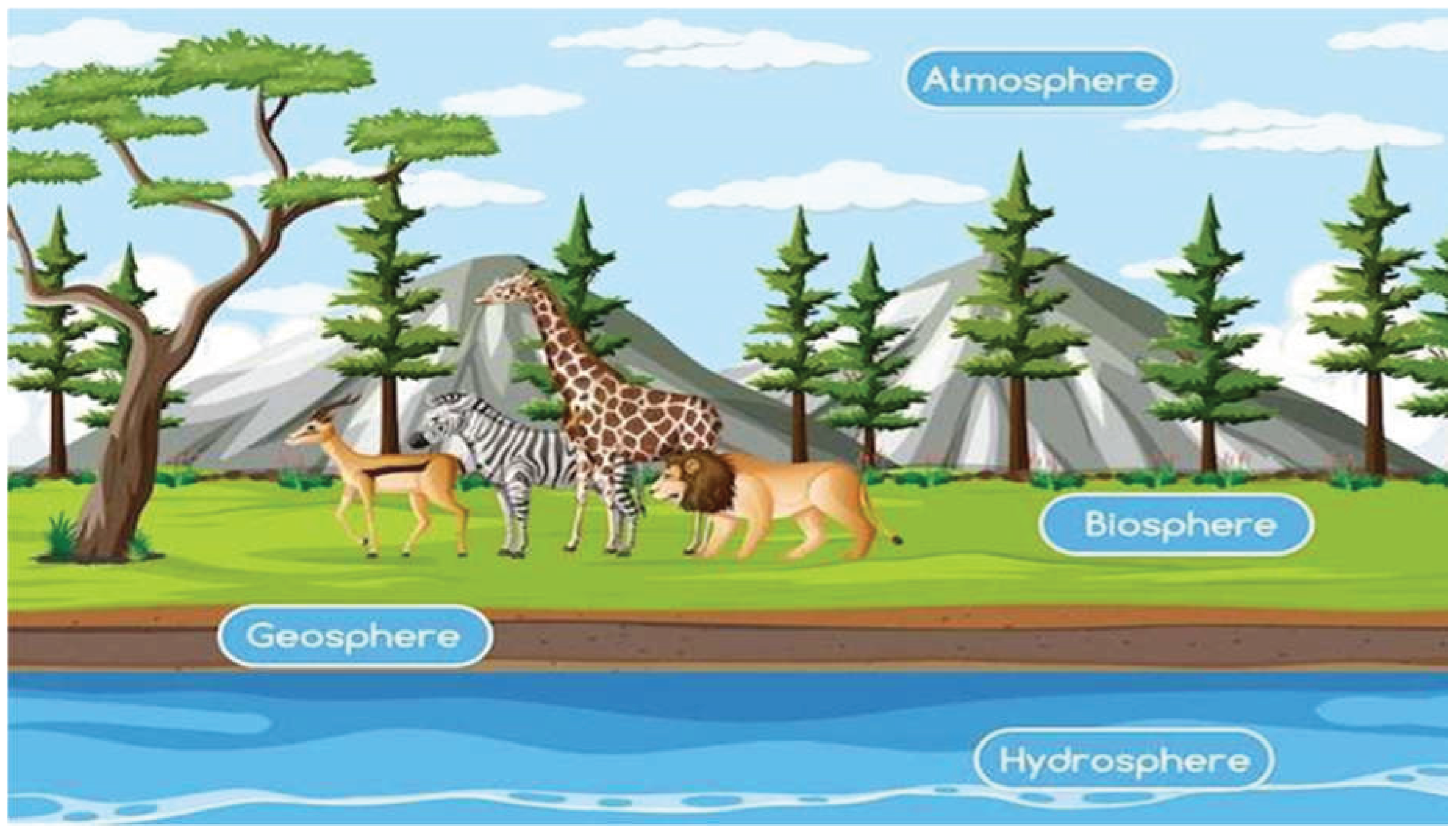
Figure 2.
(a) Zebras (Equus quagga), wildebeests (Connochaetes taurinus). (b) Elephants (Loxodonta africana) grazing in a drought-stricken landscape reflecting impacts of climate dynamics. This accelerates geomorphic actions that modify landscape.
Figure 2.
(a) Zebras (Equus quagga), wildebeests (Connochaetes taurinus). (b) Elephants (Loxodonta africana) grazing in a drought-stricken landscape reflecting impacts of climate dynamics. This accelerates geomorphic actions that modify landscape.
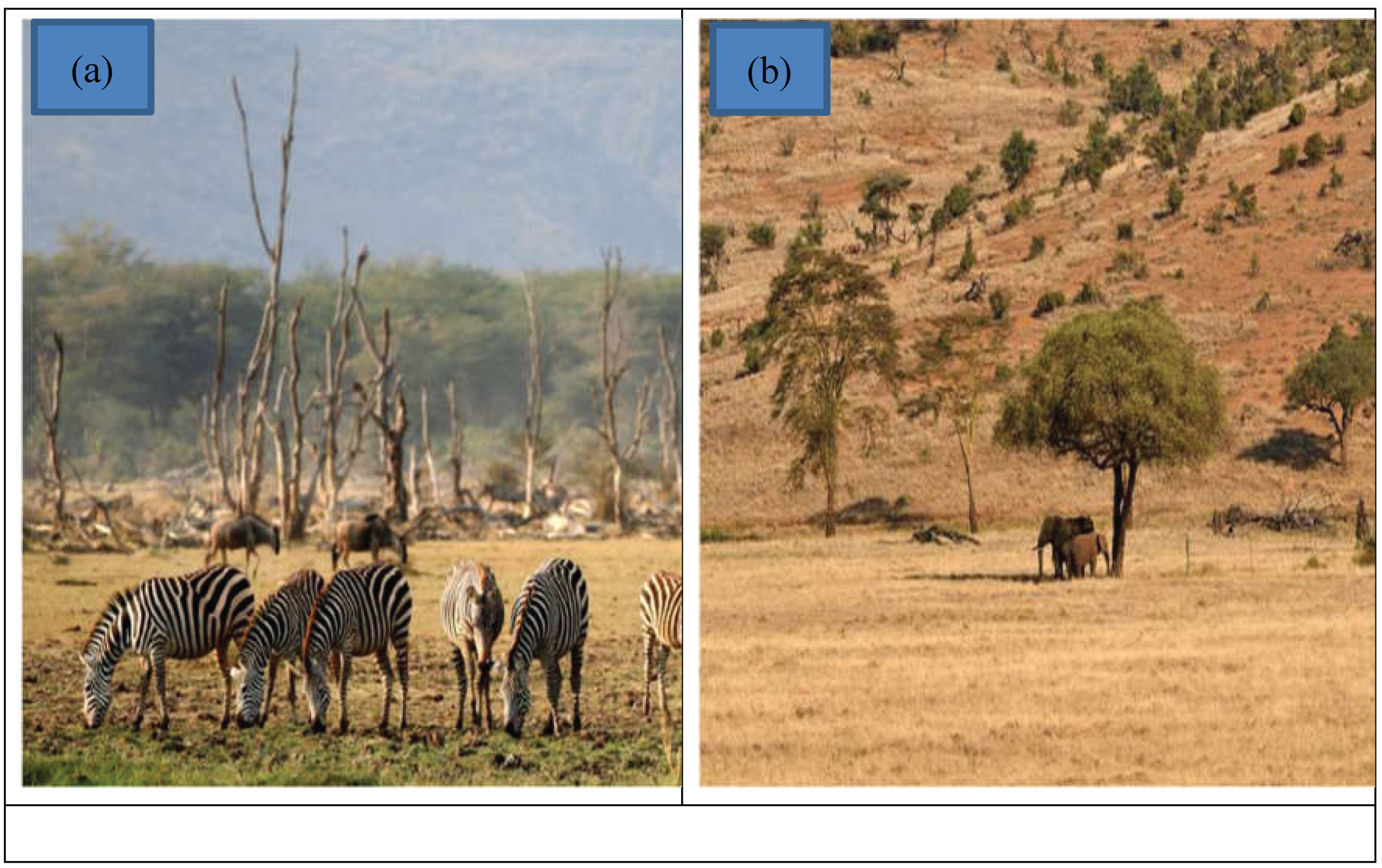
Figure 3.
A PRISMA flow chart diagram illustrating the identification, screening, eligibility and inclusion of studies.
Figure 3.
A PRISMA flow chart diagram illustrating the identification, screening, eligibility and inclusion of studies.
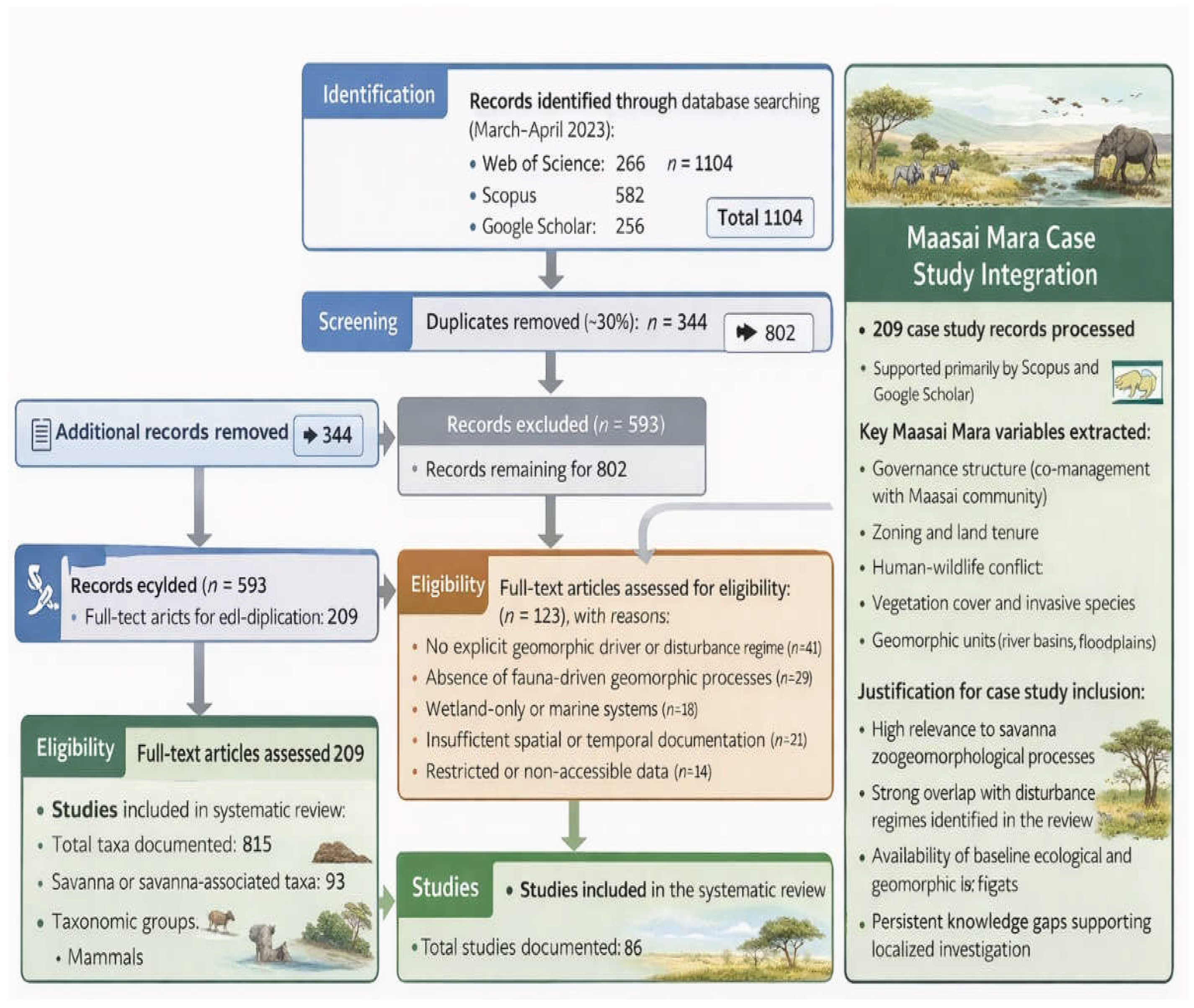
Figure 4.
A case study area map showing the Maasai Mara National Reverse which is part of the larger Maasai Mara-Serengeti Savanna Ecosystem (Adapted from KWCA).
Figure 4.
A case study area map showing the Maasai Mara National Reverse which is part of the larger Maasai Mara-Serengeti Savanna Ecosystem (Adapted from KWCA).
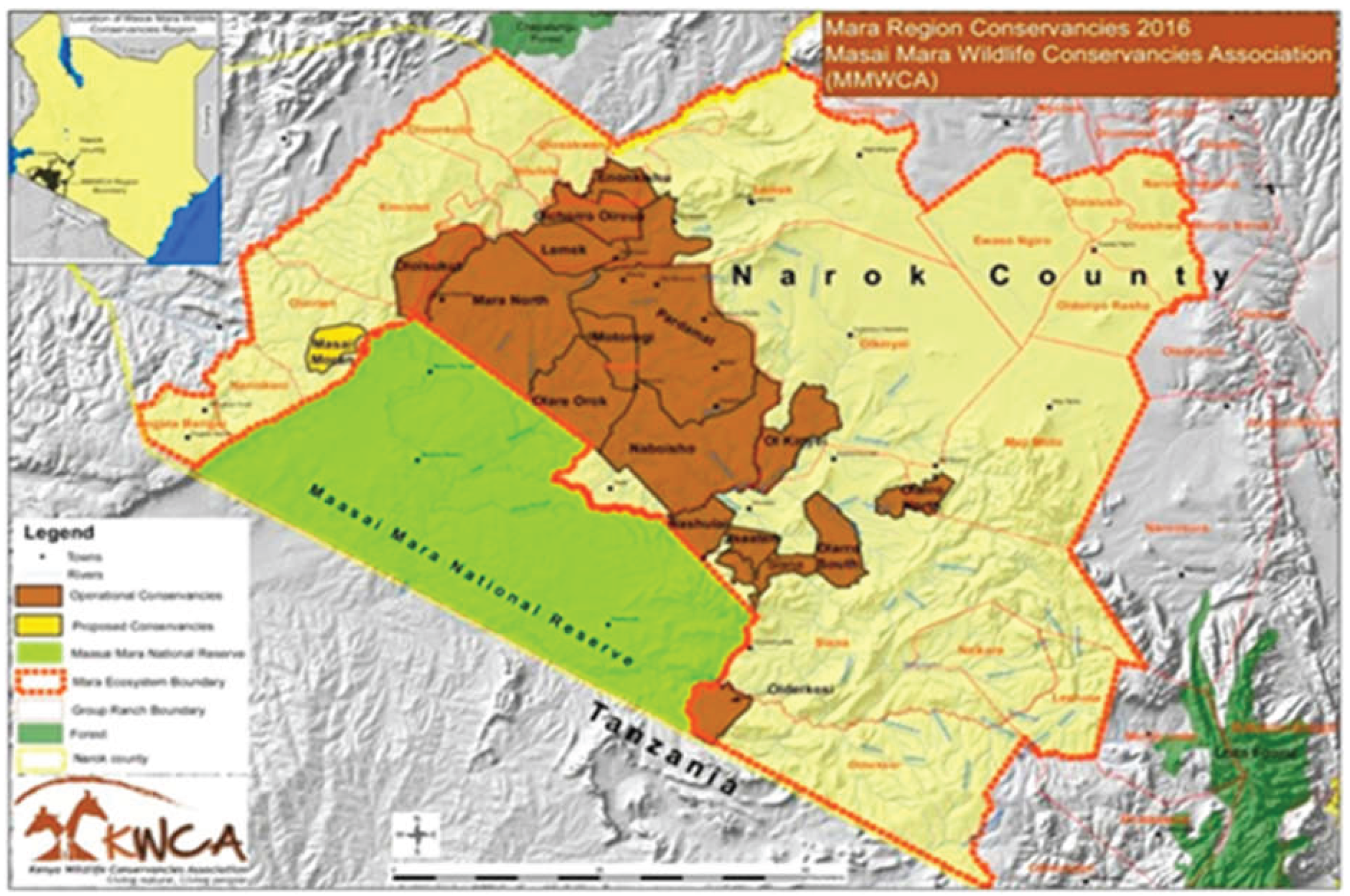
Figure 5.
(a) African white-backed vultures (Gyps africanus), feeding on a carcass of hyena (Crocuta crocuta). (b) Gazelles (Eudorcas thomsonii) representing over 95 species of mammals that form part of the annual migrations across Mara-Serengeti ecosystems. Their trampling hooves, grazing and dunging reshape the savanna landscape.
Figure 5.
(a) African white-backed vultures (Gyps africanus), feeding on a carcass of hyena (Crocuta crocuta). (b) Gazelles (Eudorcas thomsonii) representing over 95 species of mammals that form part of the annual migrations across Mara-Serengeti ecosystems. Their trampling hooves, grazing and dunging reshape the savanna landscape.
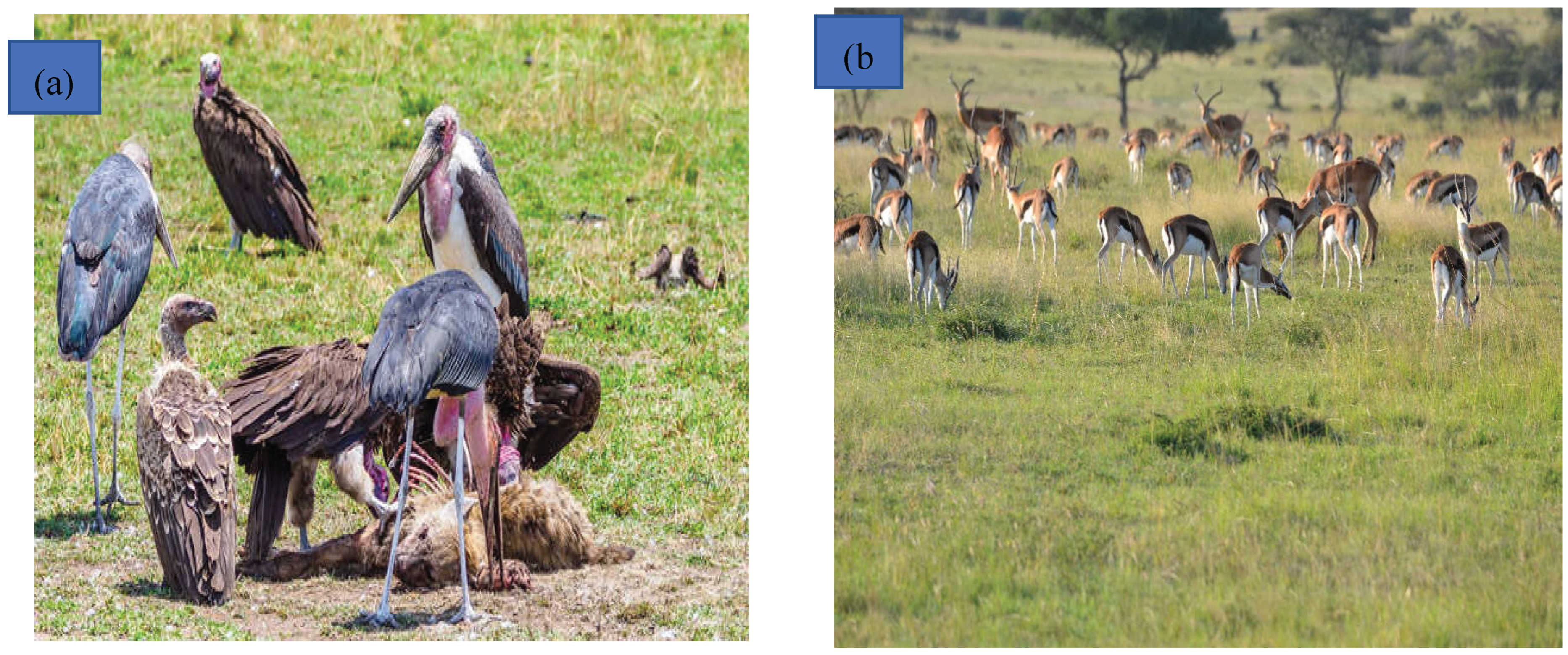
Figure 6.
Conceptual framework illustrating zoogeomorphological influences on wildlife conservation and management in Maasai Mara National Reserve, Kenya.
Figure 6.
Conceptual framework illustrating zoogeomorphological influences on wildlife conservation and management in Maasai Mara National Reserve, Kenya.
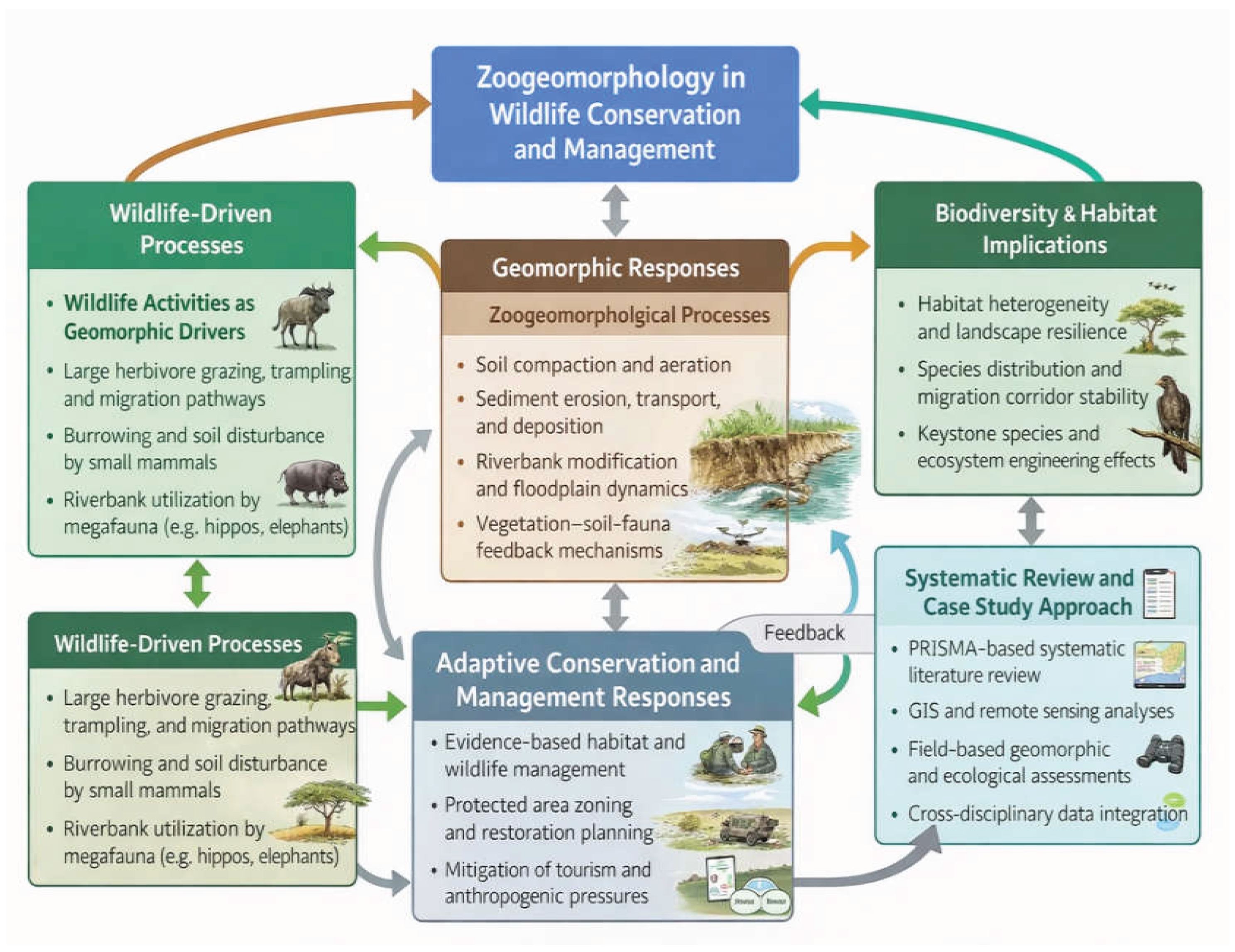
Figure 7.
(a) The shrubby, dotted terrain of Mara Naboisho, a section͏ of the Maasai Mara ecosystem. (b) Wildebeest (Connochaetes taurinus) jumping into the Mara River. This massive movement acts as a significant geomorphic agent, influencing soil compaction, vegetation patterns, and nutrient cycling along critical corridors. Their hooves (trampling), grazing and dunging reshape the landscape. (c) Hippo (Hippopotamus amphibius) thrashing chaotically. (d) A matriarch elephant (Loxodonta africana) trampling through a pathway in the open grassy savanna area of the Maasai Mara landscape. At the background, the photo show vegetative diversity across the heterogeneous landscape.
Figure 7.
(a) The shrubby, dotted terrain of Mara Naboisho, a section͏ of the Maasai Mara ecosystem. (b) Wildebeest (Connochaetes taurinus) jumping into the Mara River. This massive movement acts as a significant geomorphic agent, influencing soil compaction, vegetation patterns, and nutrient cycling along critical corridors. Their hooves (trampling), grazing and dunging reshape the landscape. (c) Hippo (Hippopotamus amphibius) thrashing chaotically. (d) A matriarch elephant (Loxodonta africana) trampling through a pathway in the open grassy savanna area of the Maasai Mara landscape. At the background, the photo show vegetative diversity across the heterogeneous landscape.
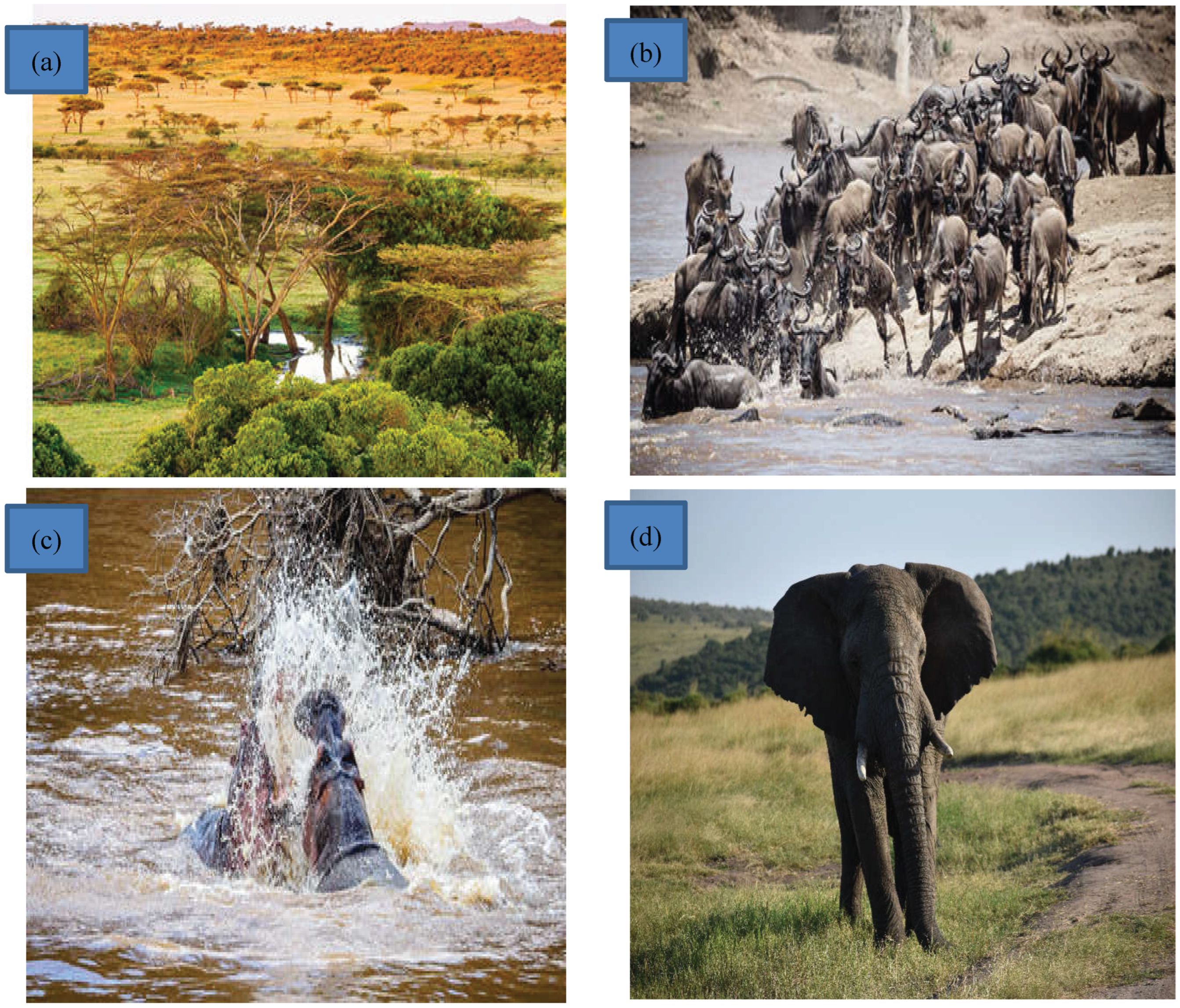
Figure 8.
A buffalo (Syncerus caffer) with horns is seen standing amidst the grass. Trampling influences soil compaction.
Figure 8.
A buffalo (Syncerus caffer) with horns is seen standing amidst the grass. Trampling influences soil compaction.
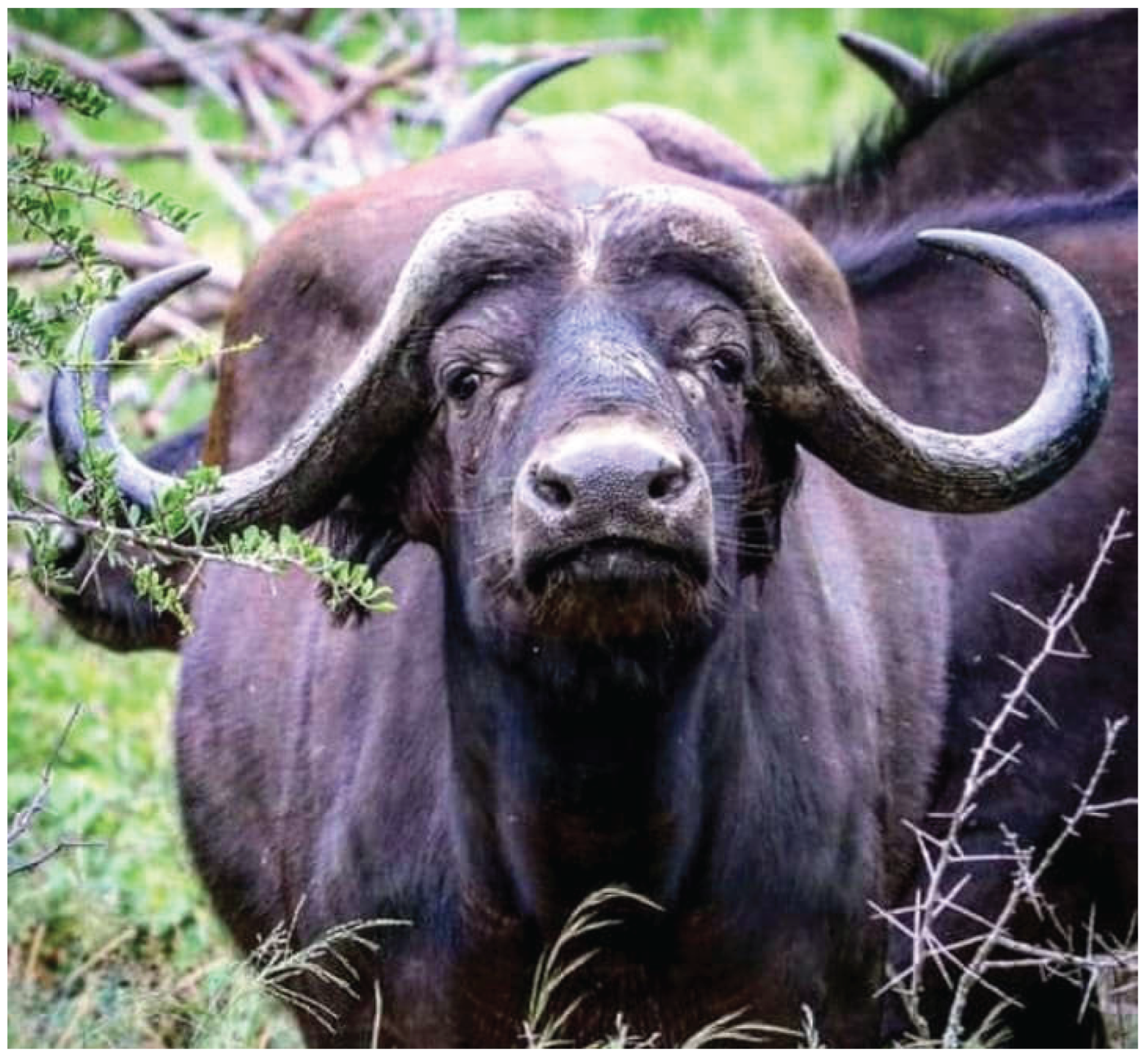
Figure 9.
A cheetah (Acinonyx jubatus) perched in a grassy area, keenly watching its target. This shows predation relationships.
Figure 9.
A cheetah (Acinonyx jubatus) perched in a grassy area, keenly watching its target. This shows predation relationships.
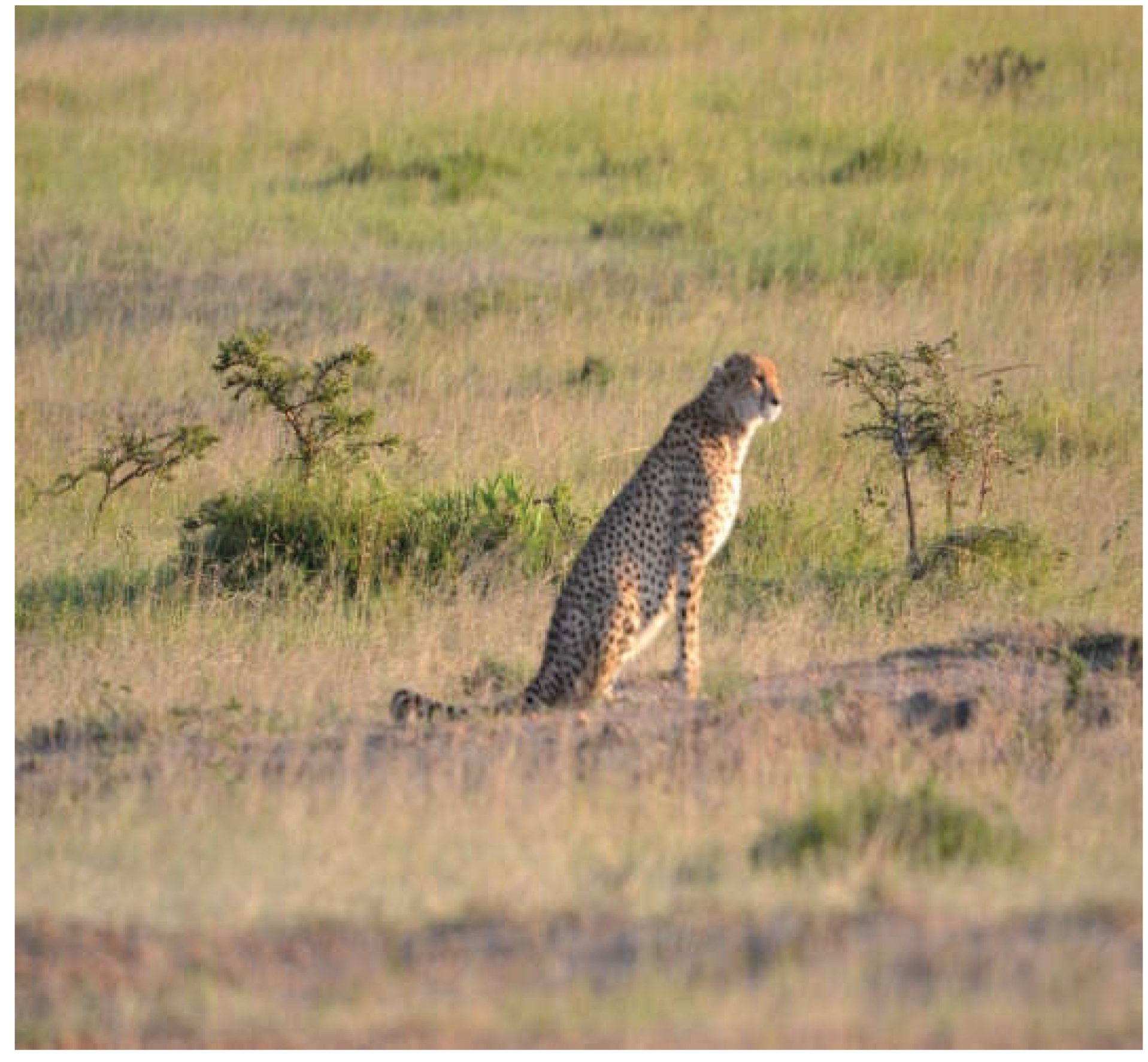
Figure 10.
An elephant (Loxodonta africana) is in a position where it has its trunk raised while it drinks water. Its hooves trample the soil affecting its compaction and aeration.
Figure 10.
An elephant (Loxodonta africana) is in a position where it has its trunk raised while it drinks water. Its hooves trample the soil affecting its compaction and aeration.
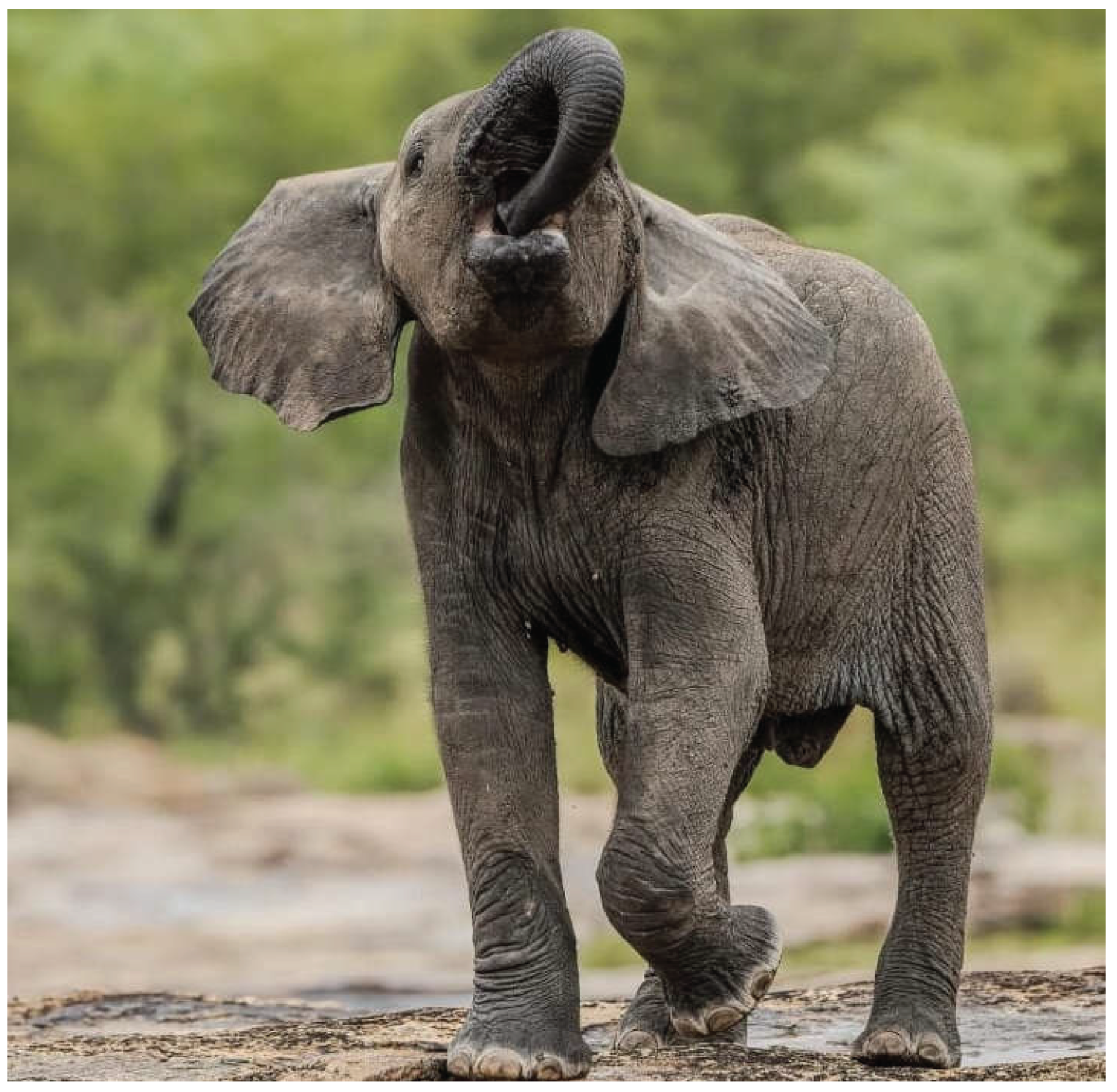
Figure 11.
A silhouette of five Kilimanjaro giraffes (Giraffa tippelskirchi) standing and trampling on a dusty pathway. This accelerates geomorphic actions on the compacted soil.
Figure 11.
A silhouette of five Kilimanjaro giraffes (Giraffa tippelskirchi) standing and trampling on a dusty pathway. This accelerates geomorphic actions on the compacted soil.
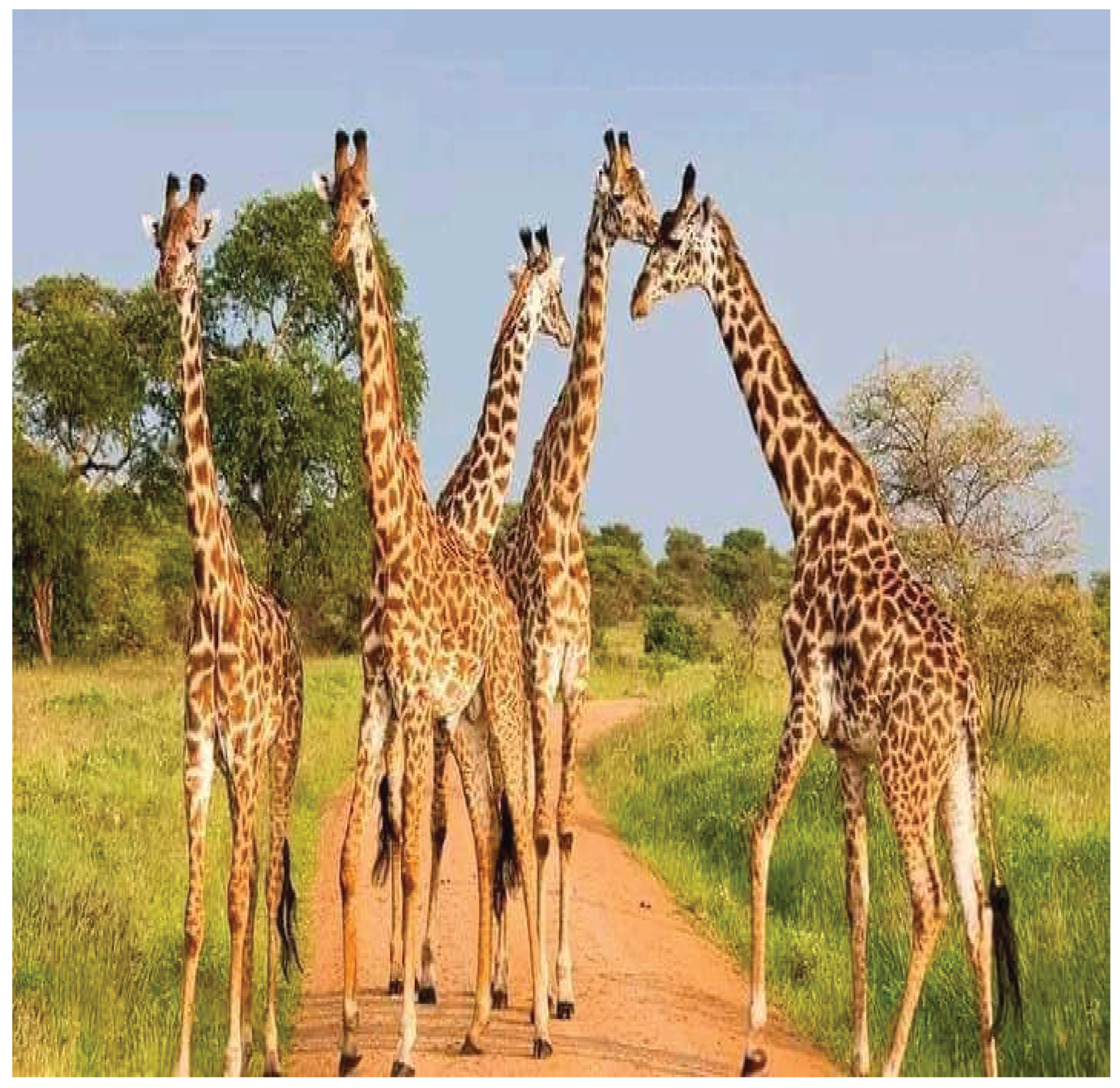
Figure 12.
An elephant (Loxodonta africana) trampling on a savanna grassland field in Maasai Mara National Reserve.
Figure 12.
An elephant (Loxodonta africana) trampling on a savanna grassland field in Maasai Mara National Reserve.
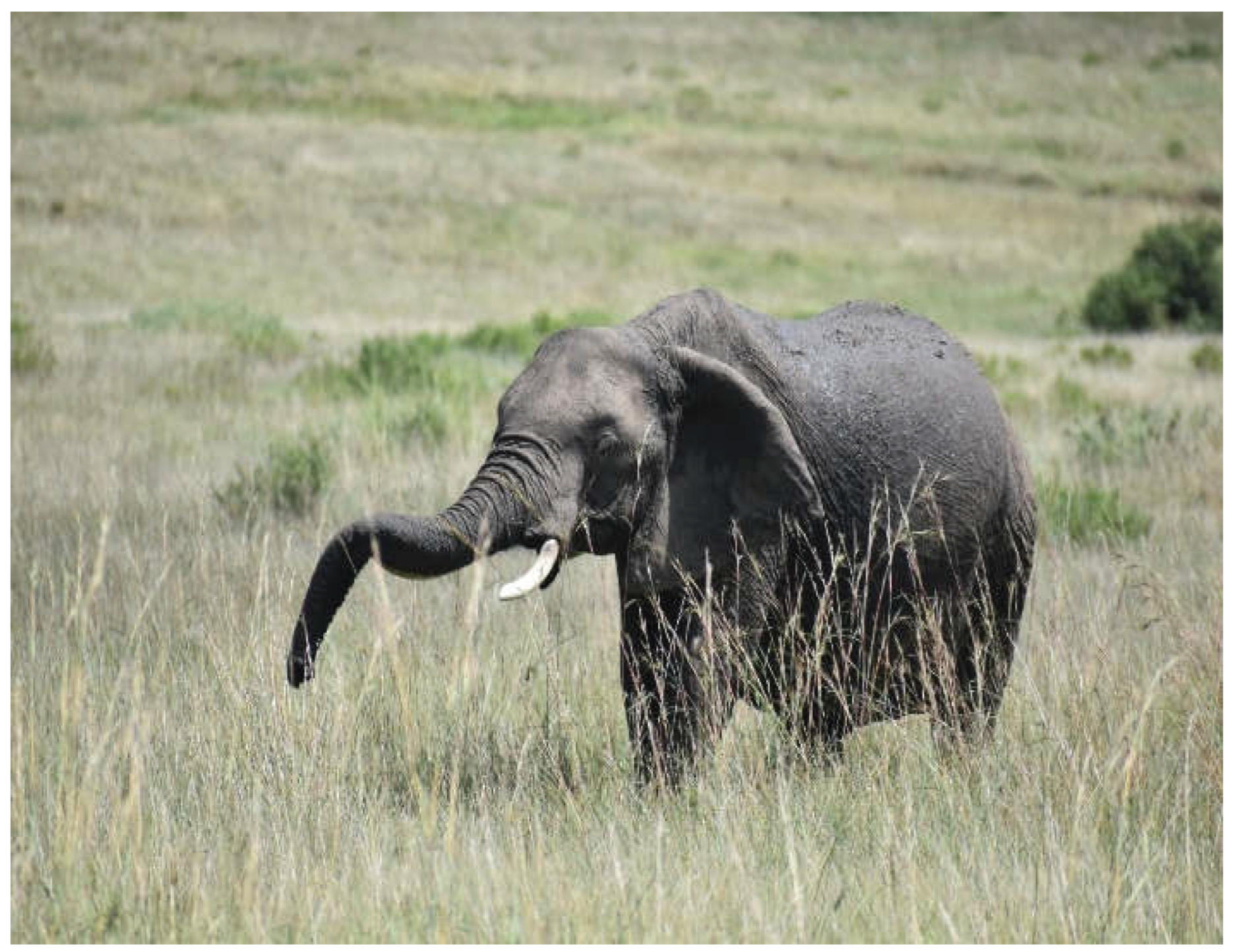
Figure 13.
A close-up of buffalos (Syncerus caffer) grazing in savanna grassland in Maasai Mara National Reserve.
Figure 13.
A close-up of buffalos (Syncerus caffer) grazing in savanna grassland in Maasai Mara National Reserve.
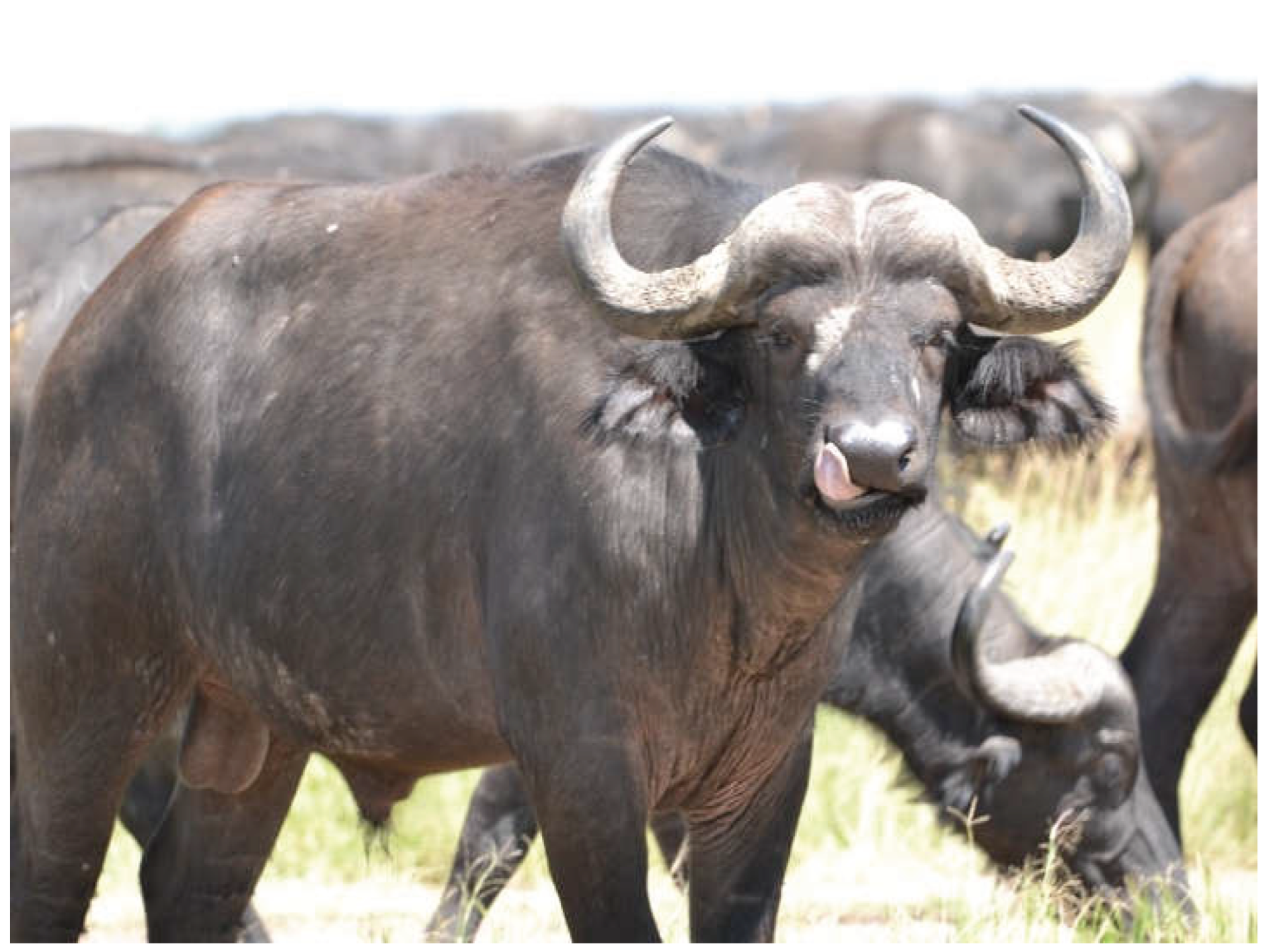
Figure 14.
A close-up of a warthog (Phacochoerus africanus) grazing in Maasai Mara National Reserve. Trampling the grass and dunging influences the distribution.
Figure 14.
A close-up of a warthog (Phacochoerus africanus) grazing in Maasai Mara National Reserve. Trampling the grass and dunging influences the distribution.
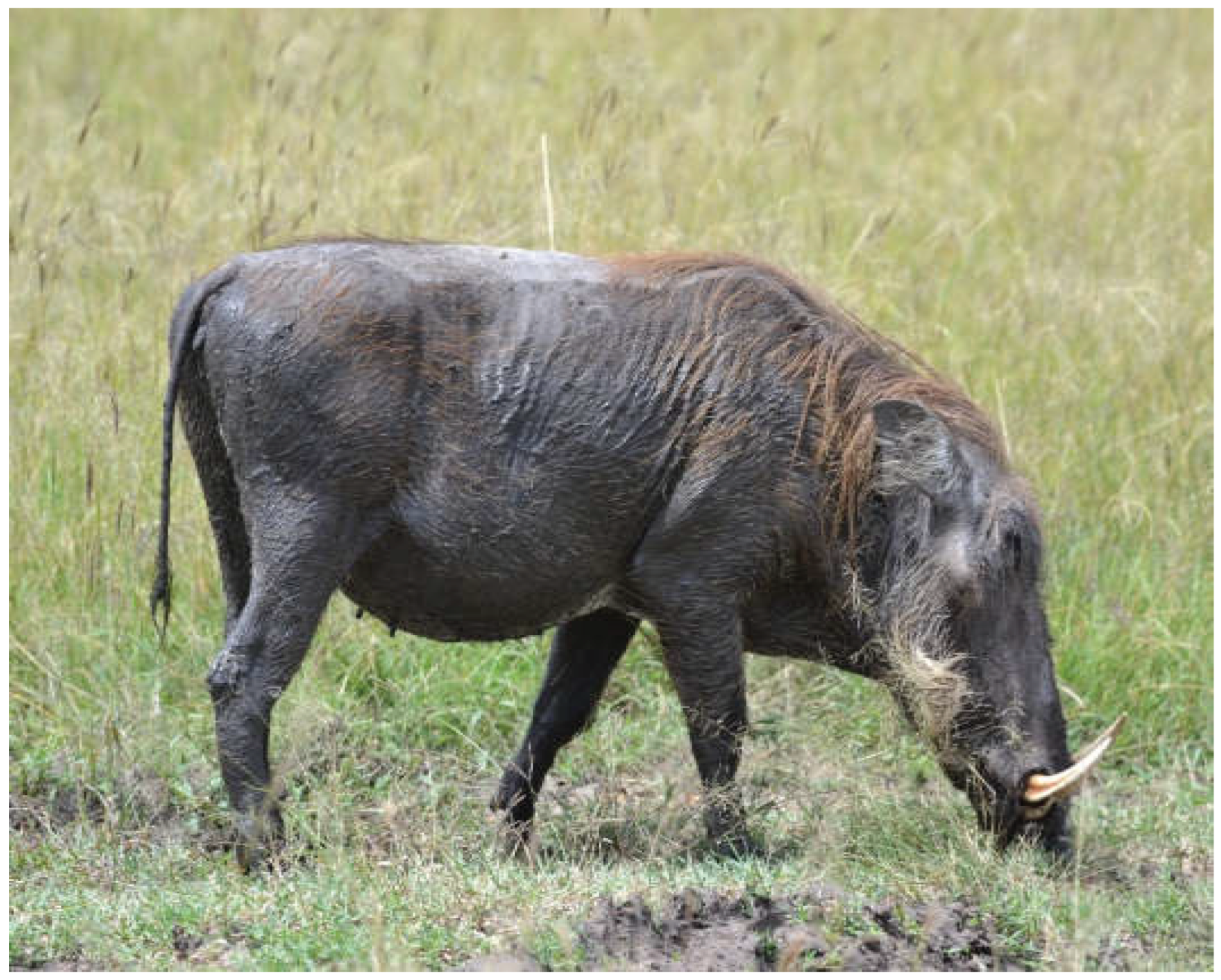
Figure 15.
A photograph of Cheetahs (Acinonyx jubantus) eating a carcass of an antelope (Damalisscus lunatus jimela) taken in the Maasai Mara National Reserve.
Figure 15.
A photograph of Cheetahs (Acinonyx jubantus) eating a carcass of an antelope (Damalisscus lunatus jimela) taken in the Maasai Mara National Reserve.
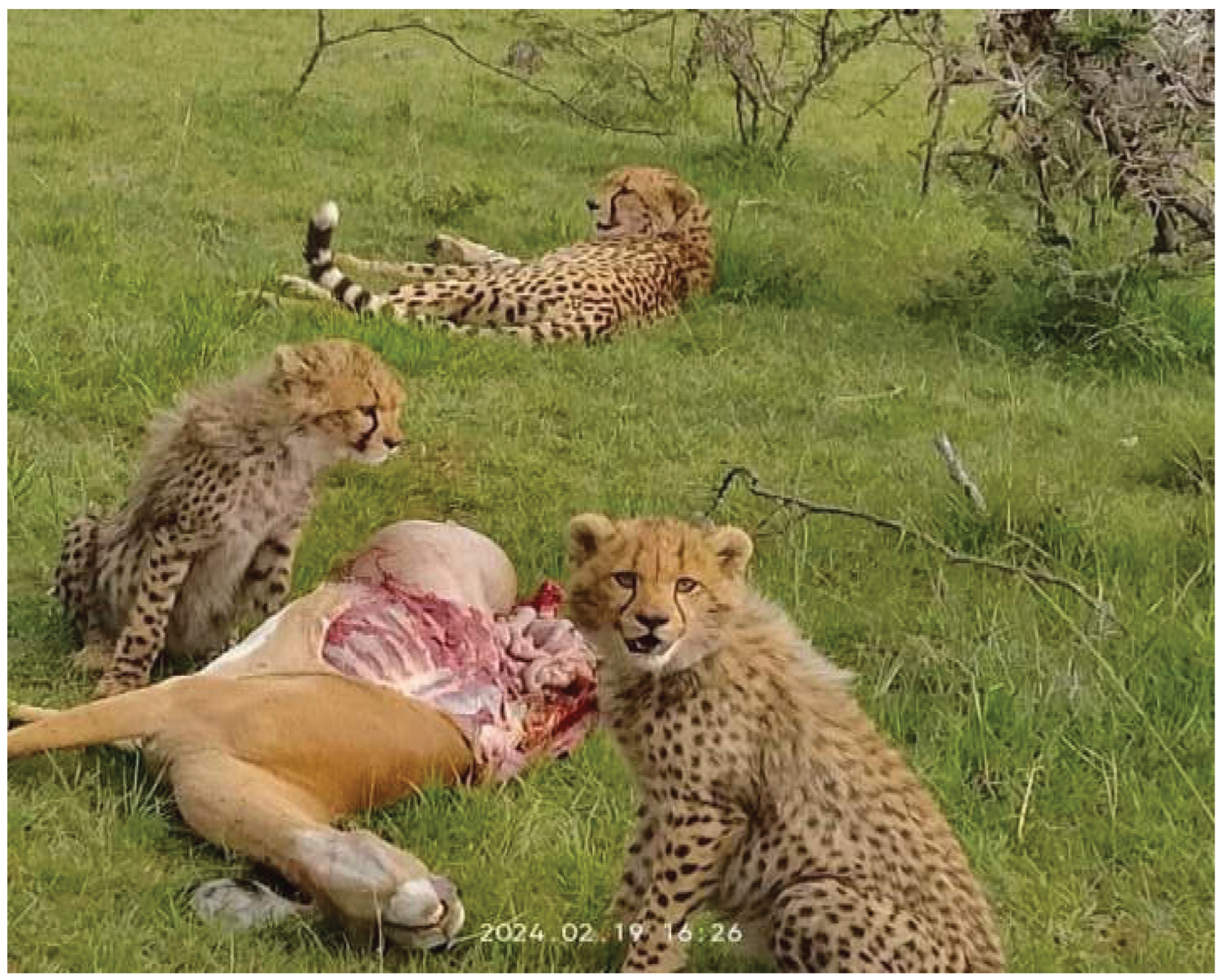

Table 1.
Eligibility criteria and search strategy.
| Inclusion criteria | Exclusion criteria |
|---|---|
|
-Role of geomorphological processes on biota -Interaction of physical-biological aspects of species/taxa -Focused on terrestrial ecosystems (habitats) -Languages (English, German, Portuguese, Spanish) |
-Landform species distribution without direct feedback -Root attachment and wetland connections -Preprints, patents |
|
-Publications from 2000 to 2025. -Publicly available documents only - Ecosystem conservancies and maintenance |
-Ecosystem level life-form interactions -conference abstracts |
| -Emphasis on geomorphic territory (basins, water-soaked plains) |
-Indirect effects via climate or land-use changes |
Disclaimer/Publisher’s Note: The statements, opinions and data contained in all publications are solely those of the individual author(s) and contributor(s) and not of MDPI and/or the editor(s). MDPI and/or the editor(s) disclaim responsibility for any injury to people or property resulting from any ideas, methods, instructions or products referred to in the content. |
© 2026 by the authors. Licensee MDPI, Basel, Switzerland. This article is an open access article distributed under the terms and conditions of the Creative Commons Attribution (CC BY) license (http://creativecommons.org/licenses/by/4.0/).
Copyright: This open access article is published under a Creative Commons CC BY 4.0 license, which permit the free download, distribution, and reuse, provided that the author and preprint are cited in any reuse.


