

Submitted:
13 June 2025
Posted:
17 June 2025
You are already at the latest version
Abstract
Central Queensland (CQ) is characterised by low-density koala populations, primarily inhabiting large cattle properties. We were interested in better understanding what encounters various stakeholders (mainly landholders) have had with koalas across CQ in order to find out more about the koalas' conservation needs. Therefore, we based our research on obtaining substantial qualitative interview data and corroborating that data with some historical and scientific literature. This essentially reflects the hybrid approach we took in researching and writing the paper, that reveals a unique picture of relationships between people and koalas in Central Queensland. This study investigates the status and trends of koalas in this region through the voices of local stakeholders. Semi-structured interviews were conducted with 88 landholders, community members and conservation officers across CQ. An analysis of the interview data revealed emergent topics that provide insight into the challenges, opportunities and conservation efforts related to koala management in the region. This research offers a nuanced understanding of the complex relationships between koalas, land use, and local communities, informing effective conservation strategies for this iconic species and giving hope for the conservation of the species in this region through stakeholder collaboration.
Keywords:
conservation
; fire
; habitat
; koala
; landholders
; threats
1. Introduction
The koala is listed as an endangered species across New South Wales, the Australian Capital Territory and Queensland, indeed most of its range [1]. The greatest ongoing threat to the long-term survival of the koala is the loss and fragmentation of its habitat [2]. Other threats such as global warming, fires, droughts, collisions with vehicles and dog attacks have been identified as being of varying concern across the specie’s range and in need of being addressed as part of koala conservation strategies [3,4], planning [5] and habitat management [6]. Anthropogenic pressures are constantly increasing on the koala and its habitat across most of its range while some areas in Central Queensland (CQ) are seen as potential refugia for the species [7]. However, some pressures on the species persist in this area as well, especially those associated with extractive industries, alternative energy projects and large agricultural ventures and their associated infrastructures [8].
Large private grazing properties are home to most of CQ’s koala populations and therefore, the attitude and actions of landholders are critical to the survival of these populations. This paper is based on a qualitative study involving semi-structured interviews with 50 landholders, 27 community members and 11 conservation officers from across CQ. Collectively these participants hold important and legitimate information about koalas that can broaden our understanding of the conservation needs of the species. The paper explores their anecdotes, stories and perspectives about, and encounters with, koalas; stakeholders’ observations and knowledge that can support better koala conservation and science. This information provided insight on historical records and trends, current koala presence/abundance/habitat and ongoing threats in relation to koalas in CQ where not much is yet known about this often-cryptic species. Some of the koala populations have survived in CQ over the duration of time that is captured by the interviewees, albeit with fluctuations in numbers. Others are revealed to have once been present in certain localities but are now likely to be locally extinct. Insights are also provided on why koalas have backer-emerged in some areas but not in others.
The interviews also provided an insight into the interviewees’ perceptions, insights and knowledge of koalas based on their close connections with these animals on their land or from past close encounters by their families. These stakeholders have firsthand knowledge about changes to koala habitat, koala numbers, threats, conservation needs, as well as basic trends observed over time. A previous mail survey [9] of selected properties in a sub-region (the Clarke-Connors Range) of CQ showed that landholders there, generally had a high regard for koalas and they expressed a desire to see them better protected with some landholders actively ‘improving’ their land to help koala survival. Here we expand on this initial survey by conducting individual interviews of a larger cohort and widening it to encompass all CQ.
2. Method
Between 2022 and 2024 we interviewed a total of 88 people across CQ. They included 50 landholders (the main group of interviewees with most of their properties being large cattle properties, typical of CQ), 27 community members and 11 conservation officers. We designed several open-ended interview questions to elucidate information regarding participants’ encounters with, and attitudes towards, koalas around where they live(d). The interviews were conducted by phone and face-to-face.
Participants were recruited in various ways. The authors of this paper travel around CQ extensively while conducting koala conservation research. During this time, interviews were conducted with landholders and other stakeholders, opportunistically. When staying in a locality, efforts are made to communicate to the community and other stakeholders, such as conservation officers, our interest in obtaining koala anecdotes from people. We also approached landholders where we conducted ecological research and received referrals from these and other stakeholders. In addition, for a separate project, we conducted an on-line survey of residents in CQ; participants who were interested in follow-up interviews were contacted. During the interviews we welcomed elaborations through narratives as it was expected that interviewees would share important information that could lead to improvement in procedures, services, information exchange and future collaboration. While set questions to interviewees were about where (including habitat type) and when they encountered koalas, conditions of those koalas, how they feel about koalas and what they see as major threats to koalas, the interviews were largely open-ended, and topics were probed as they came up, which expanded both the information given and topics identified. Interviews were transcribed by Landmark Transcription Inc. We note that while we did not keep a record of the exact number of people we approached for interviews, we estimate our approaches to have been in the many hundreds. Participants in the study had the option to remain anonymous. Interestingly, despite the offer of anonymity, most landholders who we approached declined to be interviewed because of the fear of some for what government officials could potentially ‘do’ if they knew koalas were present on their properties.
We became familiar with the depth and breadth of the transcribed interview data through repeated reading of the transcripts in order to identify meaning, context and patterns within the data. We were then able to identify key topics. We collated participant quotes by the key topics, which we present and discuss in the paper. The key topics are koala sightings, numbers, habitat and encounters; perceptions of, and attitudes towards, koalas; threats to koalas; koalas and fire; management issues; past and future translocations; and other key issues.
2.1. Study Area
Our study area of CQ is an imprecisely defined geographical region in Queensland (Map 1). Also known as Capricornia, the region's major centre is Rockhampton. CQ straddles the Tropic of Capricorn from east to west, from the Capricorn Coast west to the Central Highlands at Emerald, north to the Mackay Regional Council southern boundary, and south to Gladstone. It is one of Australia's main coal exporting regions and agriculture is dominated by cattle grazing. CQ covers an area of about 380,000 square km and has a human population of about 228,000 [10]. Tourism is also important for the region and there are many state forests and national parks. Some of the information provided about koalas in this study fell just outside CQ.
Map 1: Places in Central Queensland near where interviewees mentioned koala sightings (map created by M. Hewson).
Map 1: Places in Central Queensland near where interviewees mentioned koala sightings (map created by M. Hewson).
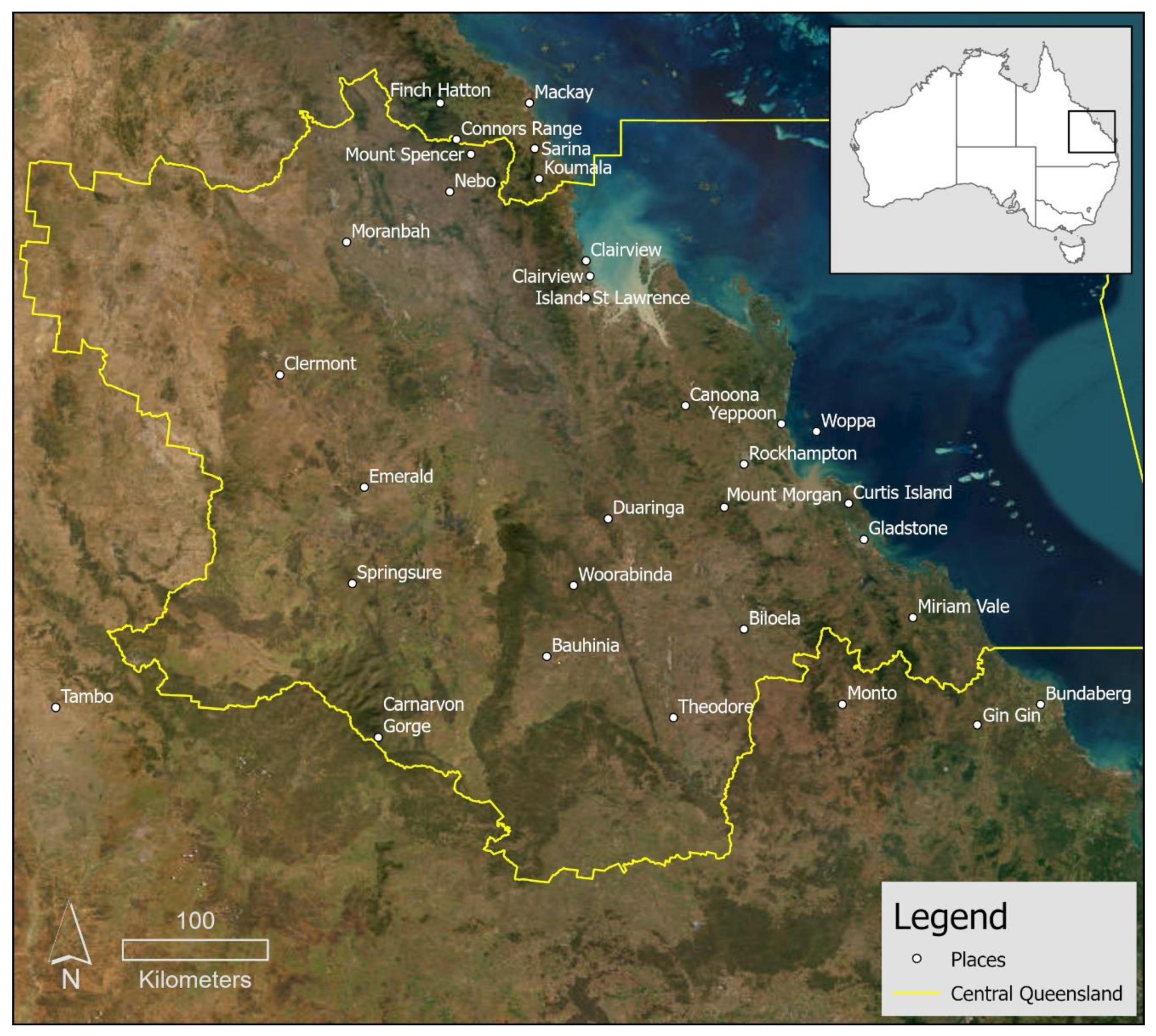
Koalas used to be widespread across CQ during the early period of European colonisation [11] before populations were decimated for the fur trade during intermittent open seasons from 1906 to 1927 [12]. Koalas recovered in some areas before being severely affected again, especially in the west of the region, during extended droughts, for example, between 2001-2007 [13]. Today, small koala populations persist across the region apart from the greater Rockhampton area (including Yeppoon). There are noteworthy populations in the greater Clarke-Connors Range and around Nebo [9,14].
3. Results and Discussion
As mentioned, the topics are koala sightings, numbers, habitat and encounters; perceptions of, and attitudes towards, koalas; threats to koalas; koalas and fire; management issues; past and future translocations; and other key issues. Each topic is analysed with the findings in turn.
3.1. Koala Sightings, Numbers, Habitat and Encounters
Interview data, especially oral history from landholders and community members as well as local histories, bring to light an imagined past of significant koala populations living in many parts of CQ during the late 1800s/early 1900s. Then came the fur harvest, peaking in the late 1920s, and being responsible for the largest single cause of decline in koala numbers. Then followed, and often interwoven by, disease, significant land clearing for six decades at least, and consequently koalas disappeared to a large extent.
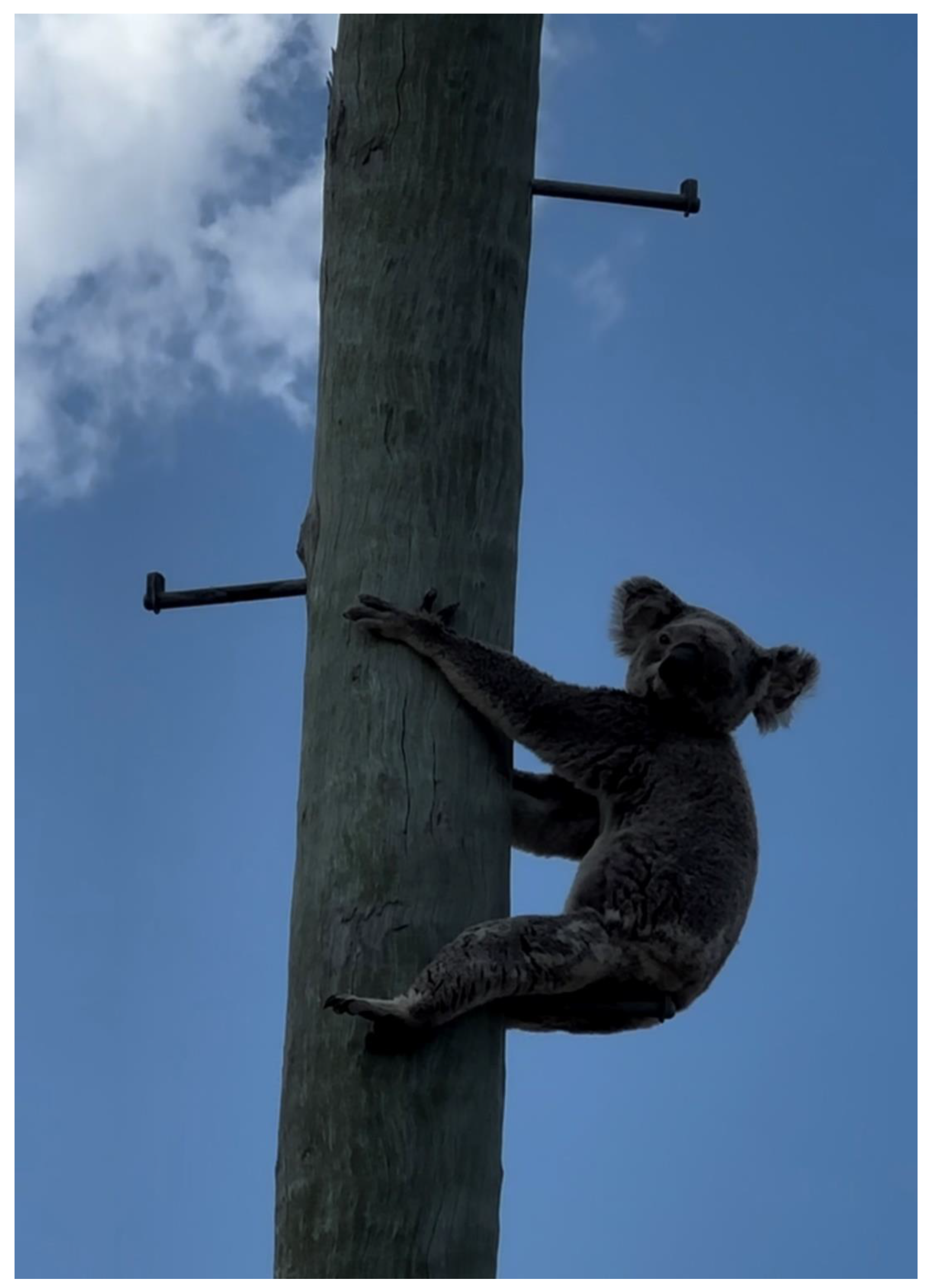
Participants commonly mentioned that koalas are very difficult to see to the untrained eye, more so because koalas in CQ mostly occur in low densities [15]. The landholders do not usually search for koalas. Koalas are generally sighted only when they are easily visible by landowners while working or when they are seen moving along the ground, hence, their numbers could be higher than what people are reporting. Koalas are seen in all kinds of places (Photograph 1). Sometimes koalas are heard, or even smelt rather than seen, especially at night. Most of the interviewees mentioned having sighted only a few koalas on their properties, thus indicating that the frequency of sightings is generally low. However, most sighted koalas were said to be healthy looking. Some interviewees said they are more aware of looking for koalas now because of their increased interest. However, they acknowledge that it can be challenging to spot them as koalas move around a lot and are often not in the same place where they were once sighted. Koalas are most likely seen in eucalypts such as blue gums along creeks or in ironbark areas on higher ground. Other tree species where koalas have been observed in CQ were spotted gum, bloodwood, blackbutt poplar box and lancewood. They are rarely seen in dry areas or around cane farms.
Photograph 1: Koala up a power pole near Nebo (photo taken by C. Geddes).
This analysis shows mixed reports about occurrence of koala sightings in CQ. Some people said they have not seen so many koalas in recent times compared to years gone by. Most of the interviewees however said they see more koalas now than they did in the past (but only in certain areas). For example, a landholder along the Peak Downs Highway (PDH) at the bottom of the Eaton Range has noticed koalas on their property only in the last 4-5 years. Likewise, a landholder 15 km to the west of St Lawrence and running into the bottom of the Clarke-Connors Range (CCR), observes koalas but more so in the last 10-15 years compared to earlier times; he hears them at night too. He added that they look healthy, and the numbers might be increasing because of reduced land clearing. Another landholder with a property close to St Lawrence said he has observed up to 24 koalas on his property in recent times. There are examples of stories attesting that significant revegetation by landholders, especially in riparian zones, has seen koala numbers come back and flourish. Where once they saw no koalas for twenty years on a property about seven km south of Sarina, they are now sighting them since 2021. The current sightings are in the revegetated areas along the creek where the trees are mature. These koalas look healthy as well.
The increased sightings could also be partly due to an increased awareness and to improved spotting skills. The general view is that there are more koalas in the northern parts of CQ now compared to 10-30 years ago, indicating that in many areas their numbers appear to be recovering. For example, it was said that koala numbers are once again on the increase in the St Lawrence area, which might be due to drought further west forcing koalas to move eastwards. Typically, koalas move towards wetter areas during drought [16]. One interviewee from St Lawrence said she thought Cyclone Debbie in March 2017 severely diminished strong colonies of koala in that area by excessive flooding. But the koala activity is slowly increasing since then. Some interviewees from in and around Nebo said that there used to be many koalas around about 50 years ago, then they almost disappeared, and now they are coming back. Other property owners near Nebo have made similar comments, for example, koalas are always on their property because of the many ironbarks and blue gums along the creek. Another mentioned that she sees a lot of male koalas passing through forests near Nebo.
The previous owner of a property near Nebo, who has been a local grazier all his life, said that in the past, they have never seen the large number of koalas that we see now. He said that they never used to see them very much at all and now he sees them along the PDH regularly. He thought that their numbers must be increasing to be so noticeable. Even our daughter saw two in two trees beside a spot with road works a week ago on the way from Nebo to Mackay. My wife counted five in the trees on our way to town recently. We certainly believe there is more koala activity today than we saw here in Nebo eight years ago when we moved here. I am not sure that development is impacting their environment, there is not a lot of development happening along the highway that I am aware of. However, it seems that as they are increasing in numbers and we are seeing more, unfortunately also there are more road kills due to the high traffic volume on the PDH. We have heard that they are quite common in Moranbah township so it might be that there is habitat between Nebo and Moranbah and even beyond that may also be significant and perhaps not so well documented. A grazier near Nebo said that koalas are seen in backyards of houses in the Moranbah township.
Creek environments around Nebo have a lot of koalas according to several interviewees. This also relates to the large number of koalas killed by vehicles along the section of PDH that runs between Nebo and Mackay [15,17,18]. A Nebo resident also added that people were finding them dead on the ground with no apparent cause of death. A property owner near Koumala, said he has seen more koalas than ever in the last five years. This trend fits with other reports from CCR’s landholders. One landholder said there are plenty of koalas on their property in the greater CCR. Seeing more koalas increases people’s ability to spot them. Several koalas were reported along Clarke Creek, west of St Lawrence. Some areas, for example around Nebo and Clarke Creek, have seen a change in vegetation patterns with more ironbark dominated hillsides becoming highly utilised koala habitat in addition to the blue gum dominated riparian areas. Issues are found in landscapes that are absent of the ironbark and may only have the blue gum riparian habitats. Not all farmers appreciate the benefits of trees in their paddocks, however.
The owner of Clairview Island has observed five healthy koalas on the island at one time in recent years and said that there are also dingoes and feral pigs on the island [19]. He has recently stopped grazing cattle on the island and has expressed an interest in planting more Eucalyptus trees, as well as gifting the island to appropriate management authorities as a koala sanctuary [19]. Reef catchment staff have also spotted koalas on the island and have found signs of koala scats in other locations throughout the central areas of the island [20]. The island contains a high diversity of koala food trees (about a third is covered in Eucalyptus woodlands) as well as dams that can be used as watering points for koalas during extreme drought [20]. Further south, but still north of Rockhampton around Canoona, a few koalas have been sighted during dry times. These koalas were reported as being unwell and often found on the ground at the base of trees.
Koala sightings were reported to us by a few interviewees in areas between Gladstone and Bundaberg and around Miriam Vale and Gin Gin. It was reported that some local koalas were admitted into care at Gladstone Wildlife after being struck by vehicles. It was also mentioned that a koala was sighted in Bulburin National Park west of Gladstone in 2022. The same interviewee also saw one at Anakie Caravan Park, but none around Rockhampton where she lives. One of the interviewees said he recalled seeing healthy koalas in trees beside the Yandaran Creek in the Rosedale/Avondale area north of Bundaberg in the 1980s. Koalas were still found there 10-12 years later, so he thinks the population is persisting. He said a colleague saw some koalas in trees along the Capricorn Highway between Blackwater and Comet. The owner of a large high-value conservation property on the Bucca Range near Gin Gin has seen koalas there. She and her family regularly heard and saw koalas on the property when they first bought it 30 years ago. Then a lot of land clearing occurred in the area before tighter vegetation management laws came in, which resulted in seeing far fewer koalas, and they moved into restricted pockets. She has not seen any koalas on her property for two years now but believes there are still koalas in the nearby Watalgan National Park and state forests. Land clearing and fires were said to be the biggest threats to koalas in these areas.
Koalas are ‘thin on the ground’ in other parts of CQ where once they were common, for example, around Springsure, Tambo, Taroom and Emerald due to large-scale historical land clearing after the large-scale hunting of koalas in the early 1900s. Some long-term residents of these districts say they haven’t seen a koala for decades and blame drought and predation by dingoes. One of two rangers we interviewed, who has been engaged with bush heritage at Carnarvon Station, has never seen a koala in those parts and thinks they have not returned there because of land clearing and predation. The other ranger saw a koala in that area in 2021 and added that others have seen a couple too. One landholder reported regularly seeing healthy koalas on his property, midway between Emerald and Springsure, especially along creeks where the vegetation has not been cleared. His neighbours say the same. His property is almost 50% remnant, and he is doing more selective clearing. This is also valuable to cattle, as it provides them with more shade, and cattle actually browse on brigalow as part of their diet. A First Nations elder of Country at Springsure has been witnessing the decline of the koala in that area since he was a child. He added that there were heaps of koalas at Minerva Creek but over the last 30 years they’ve declined to almost nothing; just see a couple along the creek these days. He says fires and tree clearing are the major threats. Dryer and hotter periods as a result of climate change are also linked to declines in these areas. Interestingly, in 2014 a property near Theodore was advertised for the enjoyment of seeing koalas; “Cattle creek frontage with gliders and koalas present” [21]. An interviewee told us he often saw koalas between Biloela and Monto before he moved from the district in 1991. These koalas were mostly in ironbark, spotted gum and blue gum.
A property owner near Duaringa said koala numbers do drop after very dry spells and droughts, then they pick up slowly when it gets wetter. He has seen a few on his property along roadsides and fence lines, and where water is, when it gets very dry. His grandparents used to see a lot of koalas in this area many years ago, but said their numbers were decimated because of Chlamydia. They noticed lots of sick koalas at the bottom of trees. Chlamydia is still affecting koalas in this area, he said. One interviewee said he saw his first koala in the wild near Duaringa in the late 1980s (wintertime). He assumed the koala had been displaced because of significant tree clearing going on in the area. Koalas have also been sighted near Woorabinda. It was reported that when tree clearing was being carried out near Bauhinia about 30-40 years ago koalas were relocated to nearby bush and apparently the population persists.
Koalas are probably locally extinct close to Rockhampton and Yeppoon because of the combined results of hunting, drought, fires, habitat clearing and disease over many decades. However, several interviewees have indicated that the greater Rockhampton region, as well as in and around Rockhampton, was home to many koalas in the past. Historical documents suggest the same. A passage in Scarlet Pillows, tales from a nurse from 1893 to 1898 [22] (p. 17) says: “There were plenty of koalas about in the bush (next to the children’s hospital in Agnes Street on the Range) and some were curled up in our gate posts. These dear little animals chatter in a lamenting way, not like monkeys or opossums, but more like little children crying. When I first heard this, I thought that some of the children in the ward were whimpering but found them all quietly sleeping”. Koalas were shot for enjoyment during excursions from Rockhampton to Yeppoon in the late 1800s as reported in the local newspaper. Near Jim Crow Mountain (now Baga) “a hapless koala is shot dead one evening” [23] (p. 5).
A person who has lived at Cawarral, between Rockhampton and Yeppoon, for 45 years has never seen a koala despite a lot of searching. He did say that when he moved there, there were no trees whereas now it is lush with eucalypts. This tree clearing might have caused the decline of the koala there. Nearly all the interviewees resident in Rockhampton and Yeppoon say they have never seen a koala in the wild in those areas. However, one Rockhampton resident claims she once saw a koala in a tree in the suburb of Koongal about twenty years ago. She thinks it might have come down from the Berserker Ranges to the creek looking for better leaves during a dry spell. There have been some koala sightings since 2004, as well as evidence of scats and claw marks on trees, in the hills west of Mt Morgan. However, one interviewee said there were plenty of koalas in this area in the distant past. The landholder in this vicinity who we interviewed, and other interviewees, are concerned that wind farms are going in the wrong places and are destroying koala habitat through tree clearing in higher country.

Table 1.
Vicinities in which koalas were seen; when they were seen; approximate number/abundance; and habitat type/tree species. Current means since 2015.
Table 1.
Vicinities in which koalas were seen; when they were seen; approximate number/abundance; and habitat type/tree species. Current means since 2015.
| Place/Vicinity | When | Number/Abundance | Habitat type/tree species |
| Biloela/Monto | Early 1990s, current | Low-density | Ironbark, spotted gum and blue gum |
| Canoona | Current | Low-density | Blue gum |
| CCR/Mount Spencer | Current | A lot | Ironbark, blue gum and poplar gum |
| Clairview/Clairview Island | Current | Low-density | Eucalyptus woodlands |
| Clermont/Emerald | Current | Low-density, with sightings becoming less frequent over the last decade | Ironbark, poplar box and blue gum |
| Curtis Island/Woppa | Last seen in the 1960s | Locally extinct | Moderate quality habitat. Ironbark, spotted gum, blue gum |
| Duaringa/Bauhinia/Woorabinda | Current | Low-density | Tall eucalypts, ironbark, poplar box |
| Gladstone/Miriam Vale/Gin Gin | Current | Small numbers | Eucalypts |
| Koumala | Current | Low-density and increasing | Blue gum in wetter areas |
| Mt Morgan | Current | Low-density | In the mountains west of Mt Morgan; mostly ironbark communities |
| Nebo/Moranbah | Current | Plentiful | Mostly along creeks in blue gum; in ironbark, bloodwood |
| Rockhampton/Yeppoon | Early-mid 20th century | Believed to be locally extinct | Eucalypts, predominantly blue gum |
| Sarina | Current | Low-density, but seem to be increasing | Along creeks in blue gum; in ironbark |
| Springsure/Tambo/Theodore/Carnarvon Gorge | Current | Low-density and declining | In the hills of state forests and national parks. Along creeks with remnant vegetation (blue gum, river red gum and coolabah) |
| St Lawrence | Current | A lot, increasing | Riparian zones, ironbark |
In summary, the analysis has confirmed small koala populations persisting across some of CQ with generally good quality habitat, a message that must be clearly communicated to governments so that these populations are not neglected, and better conservation practices are put in place to ensure their protection and survival. Northeast CQ around Nebo, CCR, Sarina and St Lawrence are the areas with the largest koala populations according to the interview data, where they were described as plentiful and on the rise. The analysis also shows that after natural disasters koalas do return to areas (interviewees tell us this), but only if there is sufficient habitat, revegetation and the risk of threats are reduced. In western areas of CQ koala numbers appear to be on the decline. Some landholders are passionate conservationists who are actively bringing habitat back for the koalas. It was mentioned that koalas could be on land that will be developed, noting the need for better protection measures, caveats and honest consultants.
3.2. Perceptions of, and Attitudes Towards, Koalas
The landholders we interviewed predominately indicated that they love their koalas and are protective of them through leaving their habitat undisturbed. They like to know they have koalas and take pride in this knowledge. This fits with the idea that the koala is a flagship species for conservation [24,25]. Many landholders said they are concerned for the well-being of koalas on their properties and added that they would not willingly destroy koala habitat. For example, a landholder who encountered koalas on his property near Duaringa during clearing operations purposely left those trees with koalas in them and a small number of other trees around them. A grazier from Mt Spencer said his dozer operator leaves different varieties and ages of trees for koalas. Another dozer operator, who cleared vegetation around Westwood (west of Rockhampton), always carried two hessian bags for translocating koalas to nearby properties. Apparently 40-50 koalas were translocated in this manner. This positive view of koalas can help their conservation on such properties and is evidence of landholders, in isolated cases admittedly, taking ownership of koala conservation. However, koalas in CQ have large home ranges and if other trees are destroyed then koalas still suffer. There seems to be more selective tree clearing going on now rather than wholesale clearing, although indiscriminate clearing was reported to still be taking place.
The graziers also perceive koalas as no threat to their farm operations. Koalas are not perceived as a pest nor an objectionable animal. Generally, koalas are not considered as competition to the operations of cattle grazing however, needing to retain habitat may be an issue for some. In contrast, other animals (native and introduced) like dogs, foxes, pigs and kangaroos are often hunted because they are perceived to ‘compete’ with farm operations. However, it is known that cattle have trampled koalas that are moving along the ground because the cattle see the koala as a threat [26,27,28,29].
Some graziers who are self-confessed conservationists said they have turned parts of their properties into nature refuges and graze cattle in a regenerative way in the hope more wildlife, including koalas, return. Often community members say that when they encounter a koala in the wild, it excites them and appeals to their sense of curiosity. Some landholders like to show ‘their’ koalas to children. One interviewee said that international students and tourists to CQ want to see koalas. Other perceptions exist that are less glowing, such as koalas can lash out with their sharp claws, are smelly and are not as cute and cuddly like the wombat.
In summary, the interviewees predominantly perceive koalas as loveable animals which they say they want to see protected. People are also sorry/saddened about the shooting of koalas in the past, which suggests they are glad those days have passed us and should never happen again. While they acknowledge the economic reasons for the fur trade, many view it as a national shame because of the alarming number of koala deaths that it caused, and the fact that populations have never recovered to even near those levels.
3.3. Threats to Koalas
A variety of threats to koalas were mentioned, most of which are well-documented in the literature. Firstly, road traffic is a significant threat to koalas in some areas as reported by interviewees, for example, along the PDH [8,17,18] and around Nebo, Marlborough and St Lawrence. There were many reported cases of road traffic hitting koalas in these areas. A resident from Nebo is shocked and surprised at the number of koalas killed by road traffic every day/night. The road kills also imply a relatively large number of koalas live in this area. The need for better protective roadside barriers is urgent [30], but such fauna sensitive infrastructure is not always straightforward in saving koalas from vehicle strikes [8,18].
One landholder said fencing would be the only practical solution to allow koalas and human traffic to co-exist. However, the koala fencing bridge projects were too expensive to further contemplate fencing the entire PDH. The landholder wondered if corrugated iron has been suggested for fencing. Koalas cannot climb it and it is durable and used for fencing Australia-wide. She suggested that if you could engage the numerous local coal mining companies and enlist their moral and financial support, maybe you could encourage a donation program whereby the koala fencing project could be utilised as an 'offset' against their vegetation habitat obligations and/or emissions trading schemes. She added that no one who uses the PDH wants to endanger koalas. We simply must learn to co-habitat and be committed to make it work. This landholder would be happy to affix less expensive and less complex fencing to their already existing farm fences. This highlights a willingness of some landholders to contribute to koala conservation through fencing.
Literature suggests that fencing must be at least 5 km in length on either side of a wildlife under or over-pass [31]. With koala habitat along the PDH being homogeneous and koalas basically getting killed or injured anywhere along that road [18] and current fencing along the few existing underpasses being only a few 100m long [25], a large financial investment is needed to extend these fences, or other innovative solutions need to be found.
Coal trains were mentioned as a significant threat by a property owner near Sarina. The mines themselves have also been major threats to koalas over the years as trees are cleared for mine infrastructure. As part of these operations, koalas were sometimes rescued and relocated to bush elsewhere. Dogs (wild and domestic) are a major threat but not considered a threat to koalas where there are ample habitat linkages (meaning koalas rarely must move along the ground for long durations) and/or where regular baiting is performed. Otherwise, wild dogs are said to be a major threat, and their numbers have got out of hand. It was said by one interviewee that a feral cat will take a young koala.
Native animals too were mentioned as threats to koalas such as dingoes, particularly in open country, and native birds. In the late 1800s landholders in the Duaringa district noted “we have seen them (wedge-tailed eagles) kill native bears” [32] (p. 257). This reference also notes a similarity between the Powerful Owl and First Nations people; “they both hunted Native Bear at night” [32] (p. 258). However, research suggests that the impact on koala populations as a result of hunting by Indigenous people would, at best, have been minimal as their hunting practices were sustainable, the extent to which koalas were used varied across regions and between language groups and was subject to certain rules, and that the koala held great spiritual significance which can be traced directly to epic creation stories [11,33,34]. Another example of wedge-tailed eagles taking koalas at Stanwell near Rockhampton is mentioned later in the section on translocations. One interviewee from a property at Clarke Creek recalls the first time he saw a koala there. A mob of cockatoos was attacking a koala in a tree, that drew his attention. This was in the 1990s and he has seen several koalas along the creek since then. Another interviewee mentioned white cockatoos harassing a koala in a tree.
Wildfires were commonly said to be a threat to koalas. Even fuel reduction burns that are not done properly can be a major threat. A veterinarian raised the point that controlled burns sometimes cause deaths of koalas or severe injuries if the intensity of the fire is not properly controlled [35]. This is a contentious issue which has important implications for fire management practices. Several landowners stressed the importance of fuel reduction burns, saying they undertake them, but also added that cattle help to keep fuel loads down. It is the country where the cattle do not graze (in the rangelands and thick forest) that can pose the greatest risk of wildfire. One elderly grazier noted there was too much paperwork to complete before you can get a permit to back burn on your property. Also, droughts and floods were mentioned as threats to koalas.
Chlamydia is said to be ever present and common amongst koalas in many areas, but not prevalent in the areas west of Rockhampton. A landholder with koalas on his property close to St Lawrence said he has seen evidence of Chlamydia there since he was a child (in the 1950s). During an interview, Melzer [26] stated that when koalas are stressed, Chlamydia becomes more overt, and koalas can die as a result. While there is no direct established link between stress and Chlamydia, it is known that chronic stress negatively affects the immune system and increases the likelihood of disease occurrence [36] with the loss and fragmentation of habitat identified as a major stressor for koalas making them prone to outbreaks of Chlamydia [37]. However, Chlamydia and injuries have shown to increase levels of stress in koalas [38].
As anthropogenic climate change continues, areas in CQ are showing trends of becoming hotter and dryer. Consequently, koala populations are contracting eastwards and southwards. This has been more evident from the millennium drought of the early 2000s [13]. A koala ecologist spoke about the dramatic decline in koalas around Springsure because of climate consequences like more severe droughts, heat waves and fires [26]. Aquifers ran dry, then fodder trees would die [39]. So, ground-water dependent trees are especially susceptible to climate change. Melzer [26] said all the koalas at his Tambo study site died out due to the long drought that started in about 2011/2012 and lasted over a decade. Likewise, an interviewee from Tambo said koalas used to be seen more frequently [when she was young] but clearing of vegetation and especially drought have taken a toll. You might find the odd one along the river/creeks, especially during breeding time and possibly there might be a population out in the scrub off the Dawson Developmental Road.
Tree clearing is a serious threat to CQ koalas, but was more prevalent in the past, with more recent legislation helping to protect native vegetation. However, habitat reduction/fragmentation causes koalas to move further and more frequently, and they can face dangers such as vehicles and dogs when they do. The owner of a property at Nankin between Rockhampton and Emu Park mentions habitat fragmentation in the Yeppoon area where most blue gums are now gone from the creeks. Koalas have not been sighted in this district for many generations. When the linkages and complex layering in vegetation assemblages are removed, koalas are forced to the ground and become more exposed to predatory threats such as dogs. Likewise, fatal injuries sometimes emerge from fights between koalas when one moves into other’s territory. The frequency of such interaction is likely to increase as a result of a reduction in available habitat. An interviewee who lives in Yeppoon said we need more covenants to protect habitats and wildlife corridors. It was also reported that some graziers do not consider ironbark as eucalypts (and therefore koala fodder) and clear them.
Interestingly, some interviewees referred to the koala harvests (for the international fur trade) of 1906-1927 in Queensland [40] and acknowledge that the loss of more than a million koalas during these years from both permitted and illegal harvesting would have decimated the population in their general area and that such numbers have never come back (Figure 1). At the Rockhampton wharves bales of marsupial skins (possums and koalas) between the early 1900s and the 1930s fluctuated less than the more valuable bales of wool from the west or cotton from the Dawson Valley in later years [41]. The fur trade was not only about the supply of fur for an export industry, but also a way for many people to survive in harsh economic times. Seasonal hunts would supplement a meagre income for the fathers or grandfathers of some of the people we interviewed. Even the Rewan Station1 police employees, who were responsible for protecting the Carnarvon Gorge nature reserve, engaged in the hunting frenzy in the 1920s and justified their participation by citing low police salaries [42].
Some landholders acknowledge historical wrongs in the treatment of koalas and, in parts, their habitat. In particular, several stories from interviewees mentioned their father or grandfather shooting koalas during the open seasons and feeling ‘bad’ or distraught about what they did, including suffering from nightmares after hearing the baby-like cries of the koala. For example, one interviewee told us that his grandfather had one day shot a female and unbeknown to him she had a joey. The joey started to cry, and his grandfather told him it sounded just like a human baby crying and that was the last koala he shot. Orphan bears crying like babies was mentioned by another interviewee. Even koalas that were shot cried like babies, and the experience left a lasting sad feeling for those that shot the animal. A 77-year-old man we interviewed explained how his father shot koalas between Yeppoon and Kunwarara during the Depression as an income. His father always had nightmares later about shooting them because they make a crying noise when shot. His father said there were koala bears everywhere in Yeppoon and surrounds at that time. We know there were a lot of koalas in the Yeppoon area in the first half of the twentieth century, but their numbers have not come back, yet koalas are present in low-density numbers in many other places in CQ. One interviewee said his grandfather shot koalas near Finch Hatton in the 1920s where the area was thick with koalas.
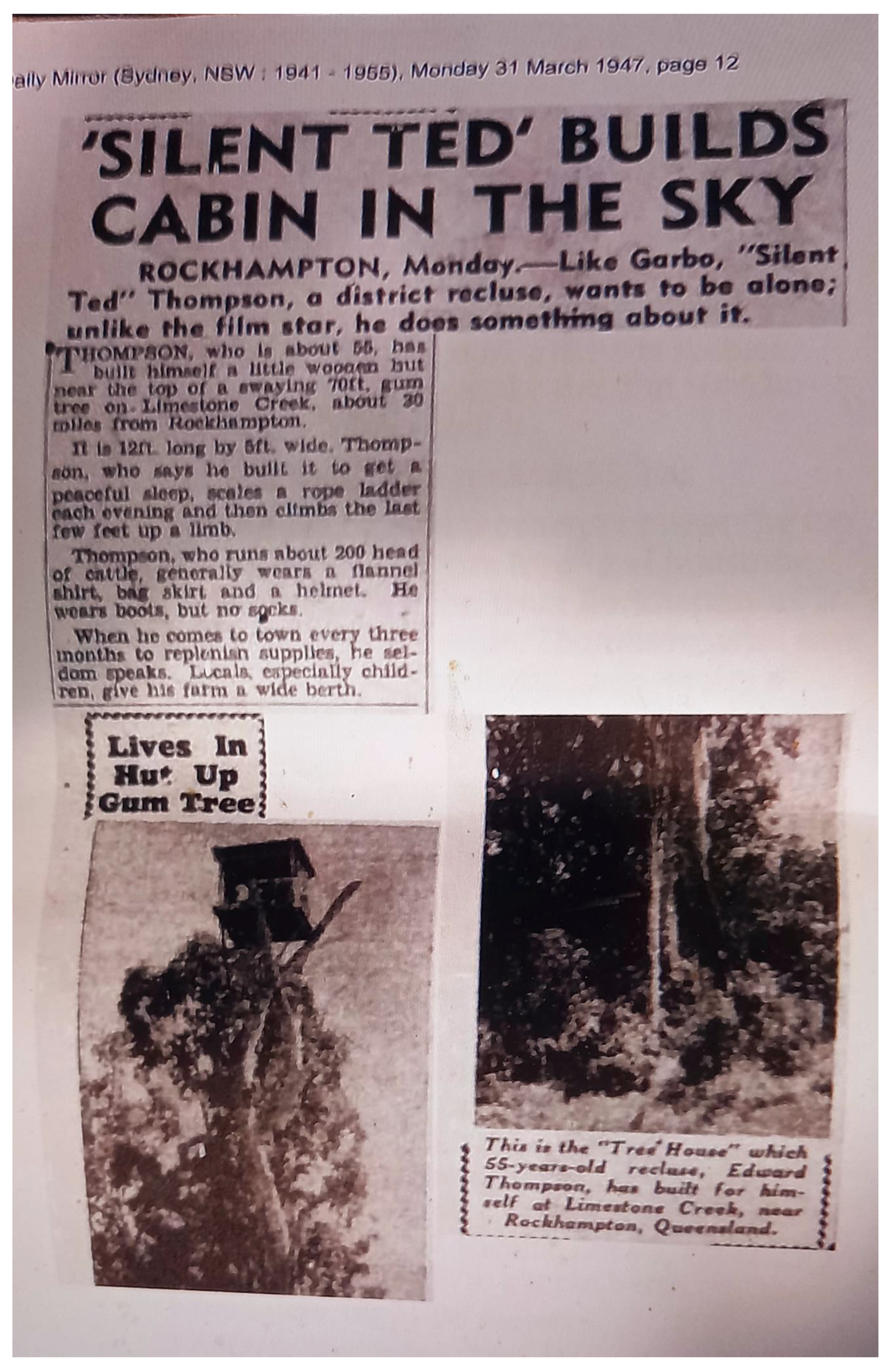
An older interviewee with a property 20 km south of St Lawrence recalled that his parents used to hunt koalas during the infamous open seasons. Another story passed down and told to us was about a man referred to as Silent Ted. It was said he shot koalas out of season and then hid the illegal pelts in his tree house near Limestone Creek between Rockhampton and Yeppoon. When police came out Ted would pull up the rope ladder and hide in the tree house atop a tall blue gum and stay there until they disappeared. The infamous tree house (Figure 2) survived until 1947 at least [44]. Another participant informed us that koala pelts were hidden in caves around Carnarvon Gorge in anticipation of the season reopening. It was also reported in the Brisbane Courier [45] (p. 15) “that the slaughter of the koala had been going on in the Carnarvon Ranges for some time, in anticipation of the opening of the season, and a heavy toll had already been taken”.
Many of the interviewees said after the hunting was finally banned koala numbers came back, but not to the same extent. Then disease went through populations about 50 years ago, decimating populations. Then about 15 years ago, populations increased. A similar observation came from a landholder with a property on the shores of Teemburra Dam near Nebo. She said soon after (the fur trade ended) Chlamydia went through and wiped them out because the population was still high, and their fodder was limited causing stress. Then they have slowly recovered.
Despite the pervasiveness of the fur trade in Queensland, there were groups at the time petitioning the government to protect the koala. In 1929 the Chairman of the Nature Lovers League wrote to the Minister for Agriculture with a summary of data surveyed from several CQ Shire Councils, Dingo Boards and Municipal Councils in 1928 about the impacts of the fur trade on koala numbers [46]. The survey results largely indicated that “bears were practically exterminated or very scarce, and bears should be protected” [46]. The only local body not in favour of the protection of the bear was the Belyando Shire Council (Clermont) [46]. Even earlier in 1908, according to one prominent landholder, comments from members of Shire Councils and Marsupial Boards in CQ, as well as from other landowners, were made suggesting the “government should protect the Native Bears for all time” [47] (p. 216).
In summary, according to the interviewees, the main threats impacting the survival of koalas across CQ are climate change, collisions with vehicles, tree clearing, disease, wild dogs, drought and fire (discussed below). CQ does not appear to be atypical regarding these ongoing and serious threats.
3.4. Fire
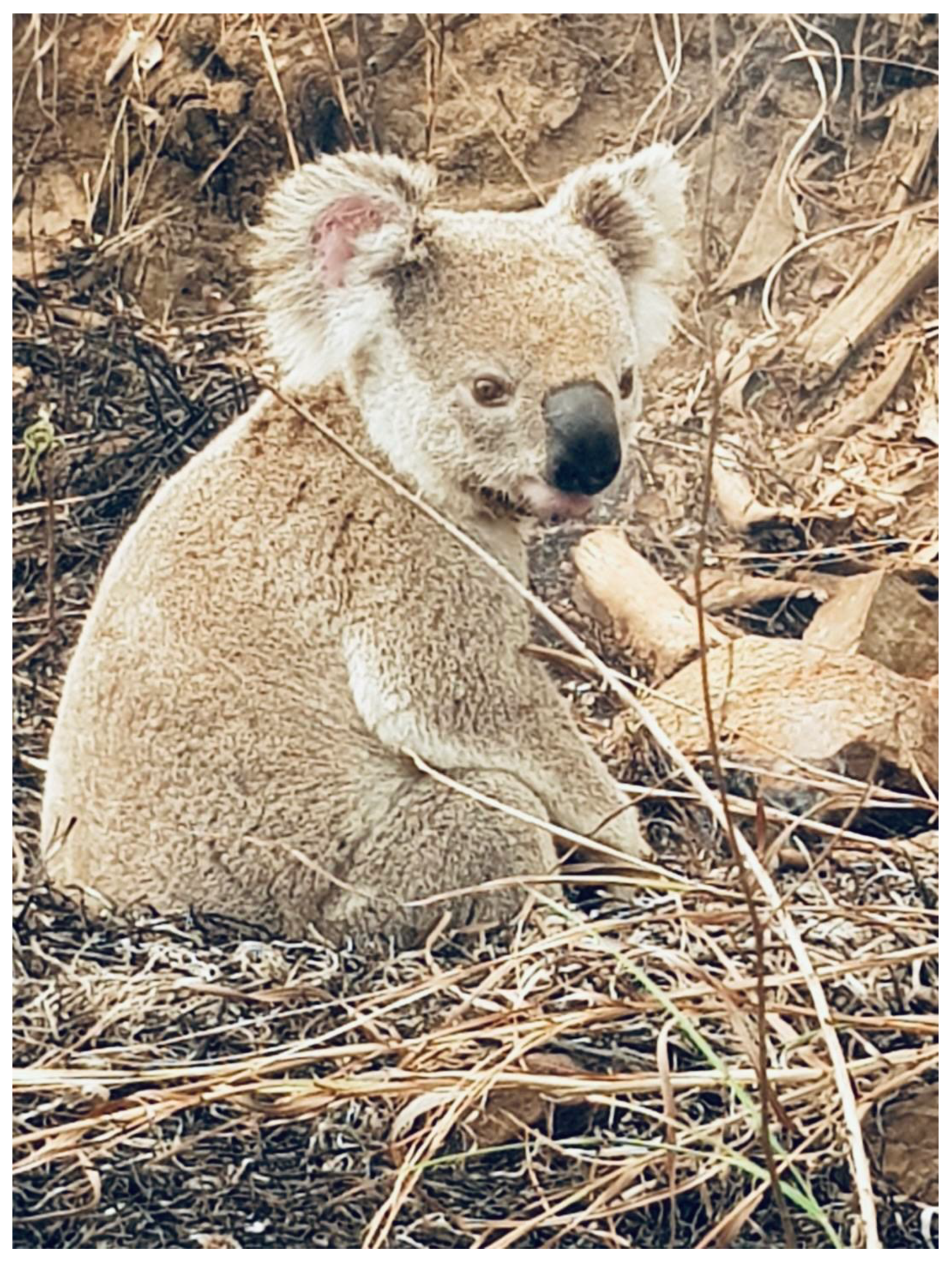
Fire is a major threat to koalas in some areas of the CQ landscapes and several interviewees remarked on the seriousness of fire to koalas. Fires are often caused by human error or are deliberately started. For example, it was reported that occasionally some graziers would, and still do, set their land alight to encourage green pick. But the fire has often got out of control with large areas burnt, including neighbouring properties and national parks. Several landholders told us that they advocate and implement hazard reduction burns in the cooler months as well as establish firebreaks on their properties. This reflects their realisation that fire is a major issue for koalas, as well as for property and livestock. One landowner near Nebo added that Parks and Wildlife are understaffed and under resourced to do this work. The fire threat is exacerbated with global warming and climate change. The media attention from the impact of the Black Summer bushfires (2019-2020) on koalas in places like Kangaroo Island has left a lasting impression on some of the interviewees. Catastrophic fires like these put the plight of koalas front of mind, something that is useful to persuade authorities to do more for koala protection [48]. Landholders are more aware now how such fires can devastate koala populations, and say they want to prevent large fires if possible. Some of the interviewees have seen first-hand the results of intense fires on koalas, which has made them feel uncomfortable (Photograph 2).
Photograph 2: Koala affected by a severe wildfire in October 2018 on a property near Nebo (photo supplied by property owners T & I Shelley).
Photograph 2: Koala affected by a severe wildfire in October 2018 on a property near Nebo (photo supplied by property owners T & I Shelley).
At the same time, many landholders told us that they do not burn as frequently as they have done in the past. Some properties close to the coast tend not to have much fuel, so it was mentioned that there is no need to undertake hazard reduction burns. Moreover, it was mentioned that cattle keep grass loads down, which prevents large fires. Sometimes lightning causes wildfires. For example, a landholder told us about a severe fire caused by lightning in October 2018 destroying about 10,000 acres on their property near Nebo. Another landholder from Mount Spencer along the PDH said he noticed several koalas up a single tree during a large intense fire. He noticed signs (scratch marks) of koalas back in the area within 12-18 months of the fire that significantly burnt the area.
As the analysis shows, fire destroying koalas and their habitats is an ongoing problem in some parts of CQ. As climate change worsens, extreme fire events are expected to increase. Fire management must be a priority for all landholders and local authorities if koalas are to fare better.
3.5. Management Issues
The koala management issues raised in the interviews all revolve around minimising and mitigating the multiple threats that have been identified by the participants. These include hotter and dryer times, fire, tree clearing, pests (lantana and feral dogs particularly) and vehicle strikes. What can the government realistically do and what is each landholder/community member capable of doing? These questions should inform policy making decisions. Some landholders told us they do engage in positive land management practices such as undertaking controlled fuel reduction burns and keeping lantana at bay. Lantana control on cattle properties in the greater CCR has been a recent target by government working with catchment management organisations, through offering financial support to landholders for the removal of the weed to aid koala conservation by reducing fuel load and the risk of fire [49,50,51].
3.6. Translocations and Future Translocations
Some interviewees from Queensland islands spoke about the subject of potential koala translocations there as a survival strategy, which is a sensitive topic having both pros and cons. Two interviewees, who own large properties on Curtis Island, said they would like to see koalas reintroduced to the island if conditions were right. Such places might be able to become refugia for koalas. One of the landholders said his property has plenty of ironbark, spotted gum and blue gum, species preferred by koalas. The Principal Ranger for the Southern Great Barrier Reef also agrees that there is potential for translocating koalas to Curtis Island with caveats about pest control programs being put in place. Koalas were once native to Curtis Island [52] and were hunted there in the hundreds during the open seasons as well as illegally during closed seasons [47]. On the other hand, an environmental officer who we interviewed does not think Curtis Island is suitable for koala reintroductions because it does not have sufficient habitat to sustain populations. He also advised that specific management programs are needed on the island to prevent large-scale fires, as well as saying that dog and other pest control programs would have to be adapted to accommodate the koala.
One of the traditional owners of Woppa, formerly Great Keppel Island, is in favour of koalas being translocated there again. However, he also said translocations should only be considered on the proviso that sufficient quality habitat exists and that the koalas would have a very good chance of survival. Moreover, he stated that better land and pest management would need to occur first. For example, rid Woppa of possums and goats before koalas could be reintroduced. Additionally, pet dogs should no longer be allowed on the island, and proper Indigenous burns should be carried out to prevent wildfires. While there is some speculation about whether koalas were native to Woppa, they were officially introduced there in 1928 as part of the restocking scheme [52]. The Woppa traditional owner mentioned he has been told stories by both First Nations and non-Indigenous people about koalas once existing on the island. He thinks they might have disappeared after possums were introduced and the competition for leaves wiped them out.
Historic koala translocations were undertaken in CQ, though it was rare for any of these koala populations to survive long-term [52]. For example, in 1928, additional koalas (the exact numbers unknown, but typically these numbers were around 10-20) were translocated to “Keppel Island Sanctuary” (now Woppa) by Crown land rangers for the restocking of populations following the end of the koala fur harvest [40]. Sanctuaries were proclaimed in an effort to protect populations of possums and koalas, especially in the 1920s [40]. In October 1927, the Minister for Agriculture and Stock in Queensland announced that a scheme had begun for restocking districts denuded of their native fauna with fauna from districts where it was still plentiful [40], explaining why these koalas were translocated to Woppa in 1928, possibly the first island in Queensland to receive koalas as part of the scheme. This did little for the koala population on Woppa though, because the last documented sightings of koalas there were said to have occurred in the 1960s during land clearing activities for resort style accommodation, then “the koala bears disappeared” [53] (p. 24).
This observation corroborates another recollection by an interviewee who used to stay on the island in the early 1960s. At night we stay outside and quite often we see koalas run across the ground to get to another tree. Koalas used to be just there, don’t know how they got there. You only used to see one scarper across. Never seen a koala with a baby, we went there several times a year. Koalas looked healthy not sick; they were running around. It is a fairly big island, not a lot of trees. Much was cleared for cattle. We just saw them but didn’t know from where they originated. In our day koalas were reasonably common as were a lot of the birds that have all disappeared today.
Another example of a failed koala translocation came to light involving the Stanwell Power Corporation, just west of Rockhampton. In 2001 four koalas were released on a nature reserve near Stanwell Power Station as part of a trial. The nature refuge was in part established for the reestablishment of koalas (koalas were once abundant in this area and to recognise that fact Stanwell State School introduced Stanley the Koala as their mascot in 1998). The koalas were brought in from care and placed in an enclosure for at least two weeks. They were cared for by the volunteers, with supervision from a koala expert. After the initial holding period the gate was opened allowing the koalas to leave if they so wished. Daily feeding continued until such time as the animal stopped returning. Each animal was fitted with ear tags and a radio transmitter. Once the koala had departed the compound it was radio-located to ascertain its dispersal pattern. Four koalas were put through the system. Three were adults, one was a juvenile raised in captivity as an orphan. The three adults dispersed after a short period of residency around the compound. They left the local area and were lost to the study. The juvenile set up a small home range around the compound, slowly expanding the range over time. The animal was taken from the canopy by a wedge-tailed eagle during radio tracking and the volunteers tracked the signal to the eagle's feeding perch. The project was discontinued after that as the volunteers were disheartened [54].
Koala distribution in Queensland is predicted to dramatically contract southward and to the coast over the next 50 years under a high global emissions scenario due to droughts and heatwaves [55]. The National Recovery Plan for the Koala does mention conservation translocations as part of their strategic thinking [55]. We acknowledge that koala translocations to other places either as insurance populations, or as breeding populations for future return can be a contentious topic. Future translocations of koalas to certain areas such as Queensland islands as a strategy to ensure they survive is topical, but opinion is divided amongst participants. Some favour translocations but only if conditions are right such as enough food trees being present, while others are not in favour. Translocating koalas is a complex issue and requires research to see if it can be viable and sustainable. As we have seen in this paper, some past translocations of koalas have failed.
3.7. Other Key Issues
Some landholders say they feel threatened if knowledge of koalas on their properties gets back to government authorities because the presence of koalas might add to the restrictions on land clearing. As one landholder put it: most people are very wary of having people on their places to investigate koalas. They worry about the implications. Whether this is a fear based on fact or just a perception is unclear. A North Rockhampton resident with an interest in nature shared her perception:
I think farmers would be very secretive about letting the government know they have koalas. They would be very careful in what they said was going on because they wouldn’t want more restrictions happening on their properties. Which is quite sad because I think that is an educational thing. I think that they just perceive that the government will come in and try and control what they do. I don’t know whether it is a thing that would really happen. I just don’t know how you would ever change that mindset.
Another landholder who is concerned about potential controls on tree clearing said koalas may threaten their livelihood. He added there is limited trust amongst some landholders with the Department of Environment possibly becoming too heavy-handed. Therefore, several interviewees were secretive about koalas on their properties. Some landholders even declined to be interviewed because of this fear. A few interviewees do not like the idea that people can come onto their properties to check koalas out and then potentially introduce weeds. One interviewee said he had a bad experience when researchers came onto his property in the 1970s to catch and weigh koalas. He claimed, these activities stressed the koalas and as a result some died.
In short, some landholders do not want to admit to having koalas on their land even though we know that they are present. As mentioned, this is because they are afraid that governmental authorities may interfere with their land management, restrict what they can do on their land, take land off them or otherwise tell them what to do. Others are reluctant to talk about certain aspects of koala presence on their property or to go on record, and some opt to stay anonymous. Interestingly, more landholders who we approached for an interview declined the interview than gave an interview. However, some landholders are more proactive and openly koala conservation minded. These sentiments generally point to limited trust between landholder and government. Historically, farmers were forced to clear the land by government legislation, but now they are prohibited from clearing some types of vegetation, and they are looking for compensation. Some compensation is obtained by accepting off-setting funds from industry for the vegetation they do not touch on their land or from payments received to host alternative energy infrastructure on their land. Often this involves clearing of koala habitat, which can be problematic in addition to the land-use classification potentially changing from agricultural to industrial. There may also be in an issue with tenure of freehold land versus leasehold and what landholders are permitted to do with vegetation.
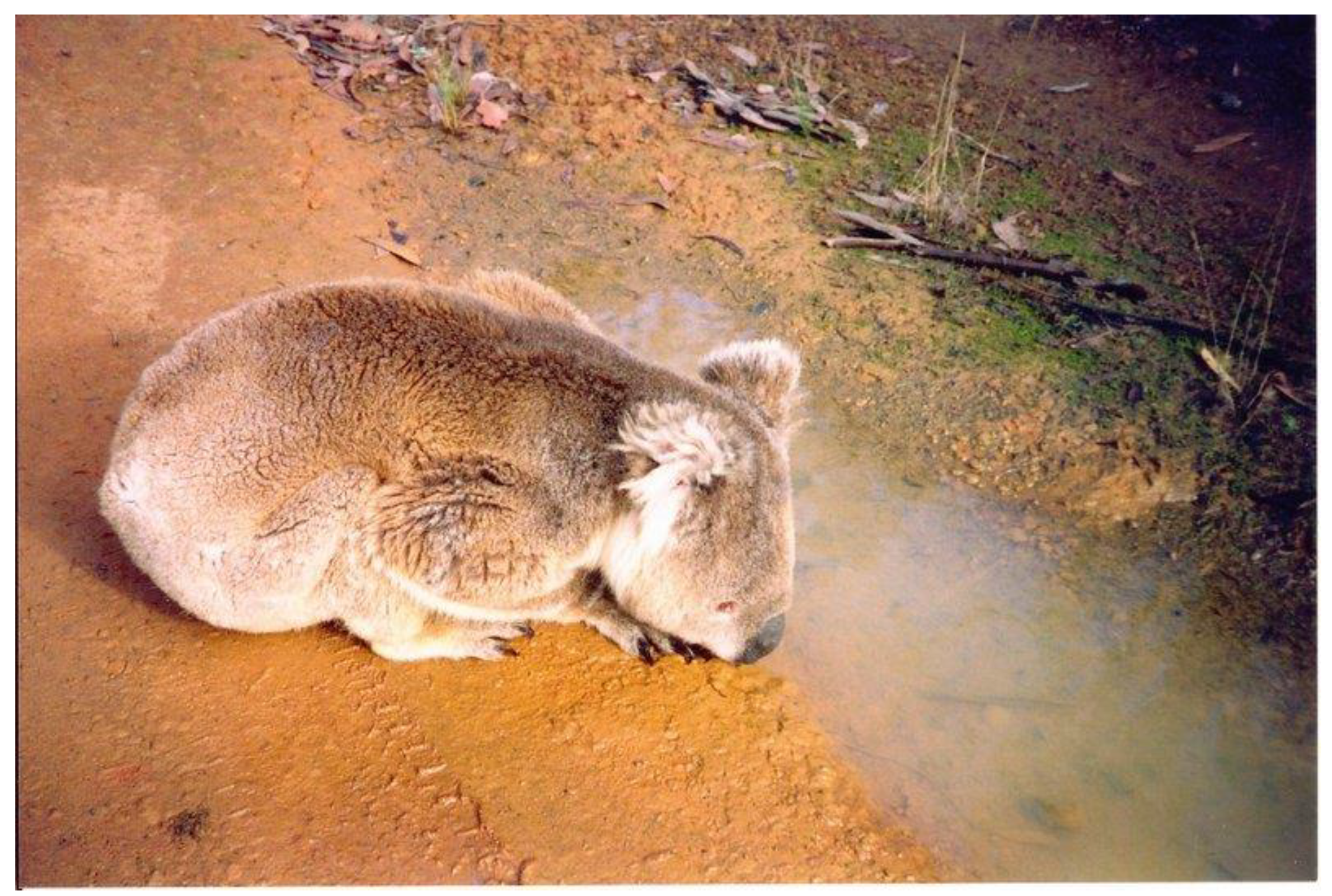
A few interviewees said watering points such as dams or troughs are used by koalas during extreme hot weather and droughts. They have encountered koalas going to drink or have seen them on the ground looking for water during very dry spells. One interviewee told us that a koala came to his camp site near St Lawrence every night to drink from a bowl of water that he left out. This was during a drought in the summer of 2005/2006. Confirmation of these encounters helps to build up a more accurate picture of koalas at times drinking free water. One interesting side note is that it is a popular theory that koalas do not drink water, but another interviewee said that his stepfather, whilst working on a property in the Dingo region during the 1990s, photographed a koala drinking from a puddle of water on a boundary fire break. Other interviewees also mentioned seeing koalas drinking water from different sources during droughts. One interviewee for example has seen a koala drinking from a dam. Koalas do not generally depend on free surface water, however, in areas of low rainfall koalas may be exposed to some water stress when their fodder trees are deprived of water [56]. It is in such situations that individuals have been observed supplementing their water intake from other sources and it is suggested that in hot weather koalas need regular access to free water [57,58].
Photograph 3: Koala drinking water from a puddle (photo taken by R. Schlagloth).
Large properties appear to have plenty of quality koala habitat, according to interviewees. This implies they are critical sanctuaries for koalas if fire and other threats can be managed, and tree clearing is minimised. Some of the landholders we interviewed across CQ actively plant eucalypts as part of revegetation goals. These people are passionate about trying to bring back koala habitat after decades of clearing. One of these landholders, with a property about 30 km west of Rockhampton (that had koalas in the 1930s) said that the younger families on the land tend to be passionate about saving koalas. He is also worried that wind farms will destroy valuable koala habitat (e.g. the proposed Boulder Creek and Moah Creek wind farms on land west of Rockhampton where koalas have been sighted up to fifteen years ago). A Nankin resident said, landholders with good intent are the regenerative farming people who have embraced the idea that putting trees and habitat back in the landscape is actually good for productivity. Koala populations have come back around the PDH, and this is because of good habitat that is being fostered and maintained by landowners.
In terms of the other key issues raised by the interviewees the main one is that some landholders are concerned about potential government interference/restrictions if they admit there are koalas on their property. Consequently, there is a need for an education program to allay these fears. Since most of CQ’s koala populations are on privately-owned landholdings, it is important that there are good relationships with those landholders in order to encourage conservation efforts that also do not jeopardise their ability to make a living. In many ways, the future of koalas lies with these landholders. Conservation action depends on positive partnerships, not on antagonism or alienation. As a society, we also need to ask landowners how we can help them to conserve koalas.
4. Conclusions
Using qualitative data from semi-structured interviews with 50 landholders, 27 community members and 11 conservation officers from across CQ, this paper has explored their anecdotes, stories and perspectives about, and encounters with, koalas. In most parts of CQ koalas are only rarely seen unless there are large expanses of forests that have seen limited impact from habitat removal and fragmentation; these areas are usually on hills or ranges and were too steep for historical development. It might be different these days for mining and alternative energy developments. Otherwise, drought seems to hit koala populations hard which also worsens diseases in the species. Wild dogs and dingoes are seen as threats to koalas, especially in the more open landscape. Rare sightings of individual koalas are often associated with water, either permanent or seasonal rivers and creeks. This is different in the CCR and around Nebo where, at least for the last twenty odd years, koalas seem to be thriving. The large tracts of koala habitat are facilitating a larger koala population; however, disease has been spotted in some koalas and some people argue that disease is cyclic in these environments and koala populations fluctuate because of this. The interview data shows that many landholders respect our national icon with several also being committed to some degree of nature conservation on their properties. However, it is of concern that many stakeholders that we approached for interviews were unwilling to share their views. This is especially the case while Queensland is still experiencing ongoing and extensive loss and fragmentation of habitat, not only for koalas.
Funding
The funding for this research was supported by Central Queensland University under its internal research grant scheme [number RSH/6387]. Ethical clearance to conduct some of the research presented in this paper (Recollections and anecdotes of historical interactions with koalas in Central Queensland) was provided by the Human Research Ethics Committee Research Division, Central Queensland University in 2022. Central Queensland University Human ethics permit number: 0000022950.
| 1 | Rewan Station was a police horse breeding farm located near Springsure. It reared and broke in horses for use in the Native Mounted police force [42]. |
References
- Department of the Environment. (2022). Phascolarctos cinereus (Combined Populations of Qld, NSW and the ACT) in Species Profile and Threats Database. Canberra: Department of the Environment. https://www.environment.gov.au/sprat.
- McAlpine, C.A., Rhodes, J.R., Callaghan, J.G., Bowen, M.E., Lunney, D., Mitchell, D.L., ... & Possingham, H.P. (2006). The importance of forest area and configuration relative to local habitat factors for conserving forest mammals: a case study of koalas in Queensland, Australia. Biological Conservation, 132(2), 153-165. [CrossRef]
- Australian and New Zealand Environment and Conservation Council. 1998. National Koala Conservation Strategy. Canberra: Australian Capital Territory.
- National Resource Management Ministerial Council (Australia). 2009. National Koala Conservation and Management Strategy 2009-2014. Canberra: Department of the Environment, Water, Heritage and the Arts.
- Schlagloth, R., Morgan, E.A., Cadman, T., Santamaria, F., McGinnis, G., Thomson, H., ... & Mcewan, A. (2022). Applying landscape-level principles to koala management in Australia: a comparative analysis. Journal of Environmental Planning and Management, 67(3), 542-563. [CrossRef]
- Januchowski, S.R., McAlpine, C.A., Callaghan, J.G., Griffin, C.B., Bowen, M., Mitchell, D., & Lunney, D. (2008). Identifying multiscale habitat factors influencing koala (Phascolarctos cinereus) occurrence and management in Ballarat, Victoria, Australia. Ecological Management & Restoration, 9(2), 134-142. [CrossRef]
- Adams-Hosking, C., Grantham, H.S., Rhodes, J.R., McAlpine, C.A., & Moss. P.T. (2011). Modelling Climate-Change-Induced Shifts in the Distribution of the Koala. Wildlife Research, 38(2), 122–130. [CrossRef]
- Schlagloth, R., Santamaria, F., Harte, M., Keatley, M.R., Geddes, C., & Kerlin, D.H. (2024). Landscape Homogeneity May Drive the Distribution of Koala Vehicle Collisions on a Major Highway in the Clarke-Connors Range in Central Queensland, Australia. Animals, 14(19), 2902. [CrossRef]
- Schlagloth, R., Hewson, M., Schultz, M., Danaher, M., & Santamaria, F. (2023). Gauging landholder attitudes and willingness towards koala conservation in a Central Queensland region. Australasian Journal of Environmental Management, 30(1), 68-87. [CrossRef]
- Queensland Government. (2025). Trade and Investment Queensland. https://www.tiq.qld.gov.au/why-queensland/region-profiles/central-queensland.
- Cahir, F., Schlagloth, R., & Clark, I.D. (2022). The importance of the koala in Aboriginal society in nineteenth-century Queensland (Australia): A reconsideration of the archival record. Anthrozoös, 35(1), 75-89. [CrossRef]
- Hrdina, F., and Gordon, G. (2005). Koala and Possum Populations in Queensland during the Harvest Period, 1906-1936. Australian Zoologist, 33(1), 69-99. [CrossRef]
- Seabrook, L., McAlpine, C.A., Baxter, G.S., Rhodes, J., Bradley, A.J., & Lunney, D. (2011). Drought-driven change in wildlife distribution and numbers: a case study of koalas in southwest Queensland. Wildlife Research, 38(6), 509-524. [CrossRef]
- Ellis, W., Melzer, A., FitzGibbon, S., Hulse, L., Gillett, A., & Barth, B. (2022). Koalas of the Clarke Connors Range. Australian Mammalogy, 45(2), 160-170. [CrossRef]
- Danaher, M., Schlagloth, R., Hewson, M., & Geddes, C. (2023). One person and a camera: a relatively non-intrusive approach to Koala citizen science. Australian Zoologist, 43(1), 52-66. [CrossRef]
- Kotzur, I., Moore, B.D., Meakin, C., Evans, M.J., & Youngentob, K.N. (2024). Identifying Habitat Productivity Thresholds to Assess the Effects of Drought on a Specialist Folivore. Remote Sensing, 16(17), 3279.
- Melzer, A., and Black, L. (2022). Koala road kills are linked to landscape attributes on Central Queensland’s Peak Downs Highway. Australian Mammalogy, 44(3), 319-327. [CrossRef]
- Schlagloth, R., Santamaria, F., Hewson, M., Danaher, M., Geddes, C., & Kerlin, D.H. (2024). Monitoring the effectiveness of fauna sensitive infrastructure along the Peak Downs Highway in Central Queensland reveals mixed results for koala conservation. Australasian Journal of Environmental Management, 1–30. [CrossRef]
- Poole, G. (2022). Owner of Clairview Island, interview, 22 October 2022.
- Reef Catchments, Kuril and Currawong Ecology and Koinmerburra Aboriginal Corporation. (2022). Clairview Island: Baseline Report & Property Management Plan. Mackay.
- Realestate.com.au. (2014). https://www.realestate.com.au/sold/property-mixed+farming-qld-theodore-7475523.
- Bird, Ann Stafford. (1984). Scarlet Pillows: An Australian Nurse’s Tales of Long Ago. Hesperian Press, Carlisle, WA.
- Morning Bulletin, Wednesday 24 February 1886, p. 5. https://trove.nla.gov.au/newspaper/article/54888557?browse=ndp%3Abrowse%2Ftitle%2FM%2Ftitle%2F77%2F1886%2F02%2F24%2Fpage%2F5035075%2Farticle%2F54888557.
- Schlagloth, R., Santamaria, F., Golding, B., & Thomson, H. (2018). Why is it important to use flagship species in community education? The Koala as a case study, Animal Studies Journal, 7(1), 127-148. http://ro.uow.edu.au/asj/vol7/iss1/7.
- Schlagloth, R., Golding, B., Kentish, B., Mcginnis, G., Clark, I.D., Cadman, T., Cahir F., & Santamaria, F. (2022). Koalas-Agents for Change: A Case Study from Regional Victoria. Journal of Sustainability Education, 26(2), 1–16.
- Melzer, Alistair, (2019). Alistair Melzer interviewed by Gregg Borschmann for the Koala - saving an Australian icon oral history project. Recorded on 16, 17, 18 and 19 August 2019 at St Bees Island, Whitsunday Islands, Queensland. Digital master available; National Library of Australia; nla.obj-1733049407.
- Hill, A., Keogh, S., & Anderson, B. (2019). Case study: Cattle-associated traumatic injuries in koalas (Phascolarctos cinereus), 2010–2016. Journal of Wildlife Rehabilitation, 39(1), 11-15.
- Jiang, A., Tribe, A., Phillips, C.J., & Murray, P.J. (2021). Do livestock injure and kill koalas? Insights from wildlife hospital and rescue group admissions and an online survey of livestock–koala conflicts. Animals, 11(9), 1-17, 2684. [CrossRef]
- Jiang, A.Z., Tribe, A., Phillips, C.J., & Murray, P.J. (2022). Insights from koala–cattle interaction experiments: Koalas and cattle may see each other as a disturbance. Animals, 12(7), 872. [CrossRef]
- Taylor, B. (2023). The Evolution of Wildlife Crossings in Eastern Australia and a Guide to 57 Iconic Sites. Cambridge Scholars Publishing.
- Huijser, M.P., Fairbank, E.R., Camel-Means, W., Graham, J., Watson, V., Basting, P., & Becker, D. (2016). Effectiveness of Short Sections of Wildlife Fencing and Crossing Structures along Highways in Reducing Wildlife–Vehicle Collisions and Providing Safe Crossing Opportunities for Large Mammals. Biological Conservation, 197, 61-68. [CrossRef]
- Barnard, Chas. (1925). “A Review of the Bird Life on Coomooboolaroo Station, Duaringa District, Queensland, During the past Fifty years” in Birds of Coomooboolaroo. Emu, 24, 252-265.
- Schlagloth, R., Cahir, F., & Clark, I.D. (2018). The importance of the koala in Aboriginal society in nineteenth-century Victoria (Australia): A reconsideration of the archival record. Anthrozoös, 31(4), 433-441. [CrossRef]
- Cahir, F., Schlagloth, R., & Clark, I.D. (2020). The historic importance of the koala in Aboriginal society in New South Wales, Australia: An exploration of the archival record. ab-Original: Journal of Indigenous Studies and First Nations and First Peoples' Cultures, 3(2), 172-191. [CrossRef]
- Bee, Ali. (2023). Veterinarian and founder of Magnetic Island Koala Hospital, personal communications, 14 August 2023.
- Romero, L.M. (2004). Physiological stress in ecology: lessons from biomedical research. Trends in Ecology & Evolution, 19(5), 249-255. [CrossRef]
- Department of Environment, Tourism, Science and Innovation (2025). Koala threats and how to help. Retrieved 24/03/25 from https://www.ehp.qld.gov.au/wildlife/koalas/koala-threats.html.
- Santamaria, F., Schlagloth, R., Valenza, L., Palme, R., de Villiers, D., & Henning, J. (2023). The effect of disease and injury on faecal cortisol metabolites, as an indicator of stress in wild hospitalised koalas, endangered Australian marsupials. Veterinary Sciences, 10(1), 65. [CrossRef]
- Centre for Environmental Management. (2010). Annual Report 2009. Central Queensland University, Gladstone.
- Hrdina, F., and Gordon, G. (2004). The Koala and Possum Trade in Queensland, 1906-1936. Australian Zoologist, 32(4), 543-585. [CrossRef]
- McDonald, Lorna. 1981. Rockhampton: A history of city and district, University of Queensland Press, Brisbane.
- Synge, Lesley. (2024). Know Their Names: the Queensland Government’s Aboriginal Workers and the system that exploited them. Zing Stories, Brisbane.
- Morning Bulletin, Friday 5 August 1927, p. 10. https://trove.nla.gov.au/newspaper/article/54605872?browse=ndp%3Abrowse%2Ftitle%2FM%2Ftitle%2F77%2F1927%2F08%2F05%2Fpage%2F5271030%2Farticle%2F54605872.
- Daily Mirror, Monday 31 March 1947, p. 12. https://trove.nla.gov.au/newspaper/article/272982384.
- Brisbane Courier, Monday 25 July 1927, p. 15. https://trove.nla.gov.au/newspaper/article/21865218/1644878.
- Nature Lovers League. (1929). Letter from Chairman of Nature Lovers League to the Minister of Agriculture dated 25 February 1929. Queensland State Archives.
- Huf, Liz, McDonald, Lorna and Myers, David (Eds). (1993). Sin, Sweat and Sorrow: The Making of Capricornia Queensland 1840s-1940s, University of Central Queensland Press, Rockhampton.
- Caldwell, M., and Henry, P.C. (2020). How cultural branding, story-telling, and personification can save the iconic Australian koala. Psychology & Marketing, 37(12), 1781-1789. [CrossRef]
- Department of Climate Change, Energy, the Environment and Water. (2024). Saving Koalas Fund. https://www.dcceew.gov.au/environment/biodiversity/threatened/species/koalas/saving-koalas-fund#:~:text=The%20Saving%20Koalas%20Fund%20provides,and%20the%20Natural%20Heritage%20Trust.
- FBA. (2025). Local Koalas in good hands. Fitzroy Basin Association. https://fba.org.au/local-koalas-in-good-hands.
- NRM Regions Queensland. (2025). Large-scale koala habitat improvement projects underway. https://www.nrmrq.org.au/large-scale-koala-habitat-improvement-projects-underway/#:~:text=Fitzroy%20Basin%20Association%20(FBA)%20received,koala%20populations%20in%20regional%20Queensland.
- Danaher, M., Shanks, B., Jones, B.T., & Schlagloth, R. (2023). How did they get there? A history of koalas on Queensland’s islands. Australian Zoologist, 43(2), 390–408. [CrossRef]
- Morris, A.J. 1989. My Island in the Sun: An Early History of Great Keppel Island. Alan J. Morris, Emu Park. 6447692.
- Melzer, Alistair. (2024). Email correspondence, 25 January 2024.
- Australian Government, Department of Agriculture, Water and the Environment. (2022). National Recovery Plan for the Koala Phascolarctos cinereus (combined populations of Queensland, New South Wales and the Australian Capital Territory). Accessed 2 August 2023. https://www.dcceew.gov.au/sites/default/files/documents/recovery-plan-koala-2022.pdf.
- Ellis, W., Melzer, A., Green, B., Newgrain, K., Hindell, M.A., & Carrick, F.N. (1995). Seasonal variation in water flux, field metabolic rate and food consumption of free-ranging koalas (Phascolarctos cinereus). Australian Journal of Zoology, 43(1), 59-68. [CrossRef]
- Mella, V.S., McArthur, C., Krockenberger, M.B., Frend, R., & Crowther, M.S. (2019). Needing a drink: Rainfall and temperature drive the use of free water by a threatened arboreal folivore. PLoS One, 14(5). [CrossRef]
- Mella, V.S., Orr, C., Hall, L., Velasco, S., & Madani, G. (2020). An insight into natural koala drinking behaviour. Ethology, 126(8), 858-863. [CrossRef]
Figure 1.
Advertisement for koala skins during Black August in the last year of legal trade when about 600,000 koala pelts were collected in that month alone: [43] (p. 10).
Figure 1.
Advertisement for koala skins during Black August in the last year of legal trade when about 600,000 koala pelts were collected in that month alone: [43] (p. 10).
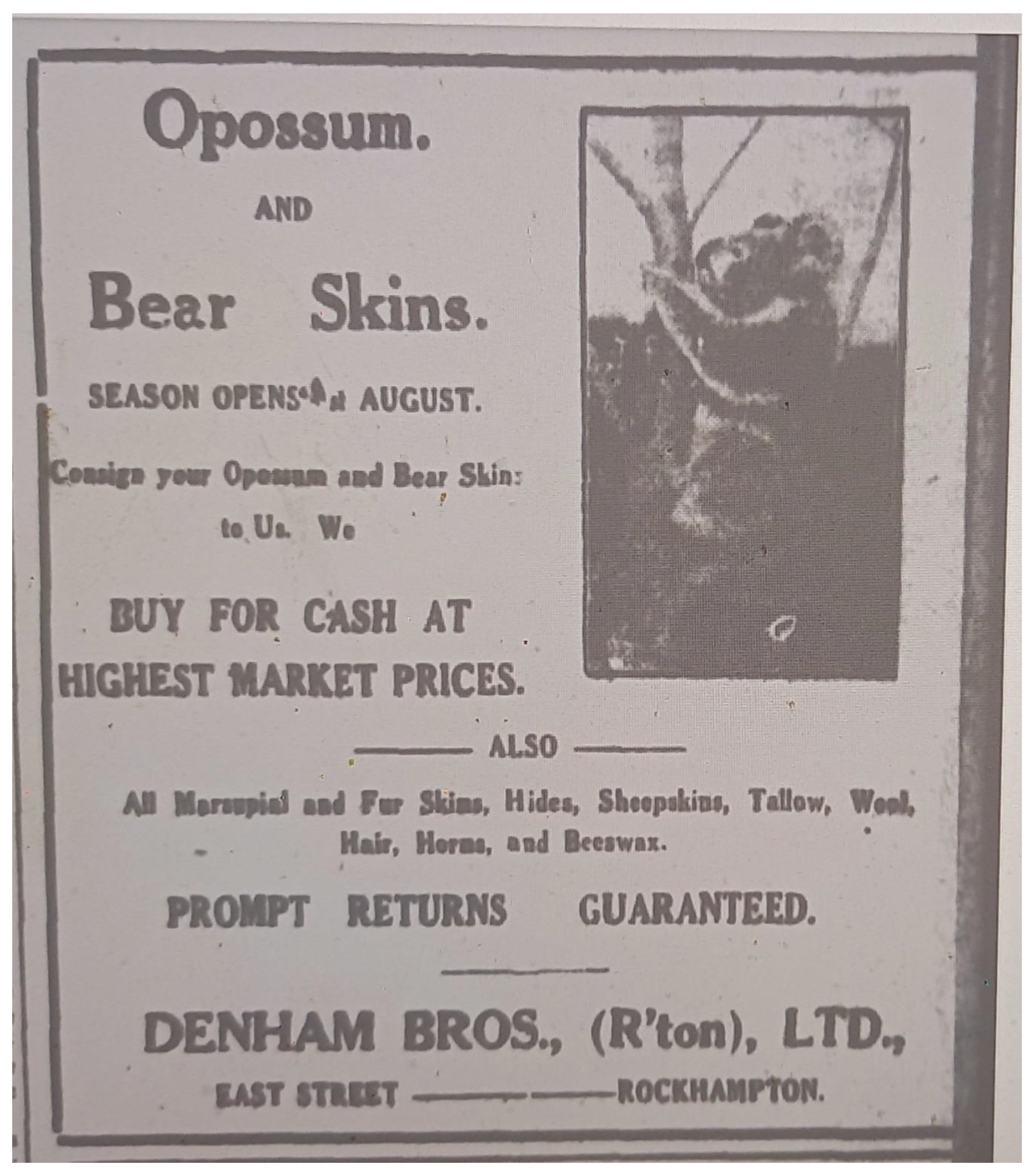
Figure 2.
Story about Silent Ted and his tree house: [44] (p. 12). .
Figure 2.
Story about Silent Ted and his tree house: [44] (p. 12). .
Disclaimer/Publisher’s Note: The statements, opinions and data contained in all publications are solely those of the individual author(s) and contributor(s) and not of MDPI and/or the editor(s). MDPI and/or the editor(s) disclaim responsibility for any injury to people or property resulting from any ideas, methods, instructions or products referred to in the content. |
© 2025 by the authors. Licensee MDPI, Basel, Switzerland. This article is an open access article distributed under the terms and conditions of the Creative Commons Attribution (CC BY) license (http://creativecommons.org/licenses/by/4.0/).
Copyright: This open access article is published under a Creative Commons CC BY 4.0 license, which permit the free download, distribution, and reuse, provided that the author and preprint are cited in any reuse.


