

Submitted:
01 January 2026
Posted:
02 January 2026
You are already at the latest version
Abstract
This paper consolidates our previous work and articulates Scheme C, a constitutional architecture designed to resolve deadlocks and instability in fragmented democracies by synthesising previous findings into a self-contained theoretical framework. The scheme's centrepiece is a game-based investiture rule that guarantees the appointment of a prime minister through a strategic nomination process, eliminating the risk of investiture-related collapse. Central to this system is also a bifurcated confidence structure -- assigning the prime minister either type I (majority) or type II (minority) status -- managed by a dynamic no-confidence mechanism. Stability is reinforced by a synchronised electoral rhythm and a Westminster-style dissolution mechanism that protects cohesive assemblies while resulting in contingent, quasi-midterm elections. To ensure continuity, a novel hybrid caretaker office bridges Westminster and Presidential traditions by automatically converting a departing prime minister into a tenure-secured, though authority-attenuated, caretaker. This "converted" logic is balanced by a presidential-style "acting" appointment mode for vacancies, ensuring administrative resilience throughout the electoral cycle. Ultimately, Scheme C provides a resilient architecture that ensures unyielding governmental functionality and rigorous legislative oversight regardless of the underlying electoral system or party landscape.
Keywords:
semi-presidentialism
; game-based constitutional design
; minority government
; formal confidence types
; two-tier no-confidence
1. Introduction
Parliamentary fragmentation is an inherent challenge in semi-presidential systems, stemming from the necessity of proportional representation (PR) to avoid the instability caused by a pure First-Past-the-Post (FPTP) system. Pure FPTP tends to produce a bi-party structure (Duverger 1980), which can lead to polarised cohabitation, where the opposing executive leaders are locked in conflict, threatening the stability of the constitutional framework (Shugart 2005).
Thus, fragmentation is the institutional cost that comes with a semi-presidential system. It cannot be eliminated entirely, and political actors must accept it, focusing instead on managing its complexities.
Some unfavourable consequences of severe fragmentation include:
- Inability to Form a Stable Majority Government: High fragmentation often prevents any single party or coalition from securing an absolute legislative majority, leading to government crises, prolonged interregnum periods, and weak, unstable minority governments (Sartori 1976).
- Government Instability: The frequent collapse of minority or unstable coalition governments results in political volatility and repeated elections (Carozzi et al. 2020,Warwick 1994).
- Increased Coalition Bargaining Costs and Policy Incoherence: The difficulty of forming a majority increases negotiation costs, forcing coalitions to adopt incoherent compromises (Sartori 1976).
- Policy Gridlock: The inability to secure a stable majority hampers the passage of substantial, long-term legislation (Lijphart 1999,Tsebelis 2002).
- Reduced Clarity of Political Accountability: Voters struggle to assign responsibility when governments are short-lived or composed of numerous shifting partners (King 1997).
The traditional response to a highly fragmented parliament that cannot form or sustain a majority government is to dissolve the legislature and call early elections. However, the new elections may reproduce a similarly fragmented parliament, leading to a costly cycle of instability (Carozzi et al. 2020).
Therefore, alternative solutions to address parliamentary fragmentation must be explored. And this paper, along with the author’s previous work Cheng (2025a, 2025b, 2025c), represents an effort to contribute to this exploration.
Interestingly, the original aim of Cheng (2025a) was not to address parliamentary fragmentation. It was inspired by South Korea’s constitutional structure, where the prime minister must be chosen from the president’s political camp but also requires approval from the assembly – an inherent contradiction, as observed by the author. In response, a game-based scheme for the approval of South Korea’s prime minister was proposed in Cheng (2025a), with the primary goal of eliminating deadlocks. A few months later, the author realised that the same mechanism could be adapted to semi-presidential systems to directly address parliamentary fragmentation. This led to the development of Cheng (2025b), which described two game-based schemes: Schemes A and B. Recently, the author discovered that Schemes A and B could be further improved, resulting in Scheme C. This new scheme, as described in Cheng (2025c), offers a significantly enhanced prime-ministerial countercheck against parliament and introduces various other improvements.
This paper consolidates the findings and arguments presented in the aforementioned work Cheng (2025a, 2025b, 2025c) to achieve a unified theoretical framework. The necessity of a separate consolidated paper is outlined below:
- Necessity of a Self-Contained and Current Argument: While the final scheme presented here closely resembles the latest version Cheng (2025c), the complete and necessary explanations for that scheme are currently scattered across the earlier papers Cheng (2025a, 2025b). This consolidation ensures the reader can access a self-contained, comprehensive understanding without requiring cross-referencing.
- Elimination of Obsolete Material: The developmental process across the earlier papers involved introducing and subsequently discarding several features. Readers referencing the previous work would find it challenging and confusing to determine which explanations and features remain valid and which are now obsolete or superseded by the final scheme.
- Integration of Advanced Refinements: This version introduces a series of final improvements that fundamentally elevate the model’s internal consistency. These innovations refine the executive-legislative interface and administrative continuity mechanisms, ensuring that this consolidated framework possesses a level of theoretical rigour and practical utility far beyond that of its predecessors.
The paper is structured into seven sections. Section 2 offers a brief literature review. To provide greater clarity than in previous work, the consolidated scheme description is divided into three parts: Section 3 (Background and Framework), Section 4 (Main Investiture Articles), and Section 5 (Complementary Articles). New comparative studies are provided in Section 6. The paper concludes with Section 7.
2. Literature Review
The scheme presented in this paper is compatible with both unicameral and bicameral systems. Therefore, for precise analysis, the term “assembly” will be used throughout to denote the entire legislative body in unicameral systems or, specifically, the lower house in bicameral systems.
This specific usage is necessary because our scheme’s proposed mechanisms do not involve the upper house. We therefore use “assembly” instead of “parliament”, as the latter typically refers to the legislature as a whole (i.e., encompassing both houses in a bicameral context), which does not align with the defined scope of our analysis.
2.1. Investiture Rules
Investiture rules govern the procedure by which a prime minister and cabinet are installed, and they significantly determine a government’s stability. A comprehensive survey of these rules has been provided in Rasch et al. (2015), with a similar comparative analysis also detailed in our earlier work Cheng (2025b). While the existing literature offers extensive comparative studies on how different rules (e.g., simple majority vs. absolute majority, presidential nomination vs. parliamentary proposal) impact the duration and composition of governments, it exhibits a notable gap: there are few, if any, substantial proposals for institutional reform aimed at proactively resolving investiture deadlocks and guaranteeing the formation of viable executives in highly fragmented environments. This literature, therefore, establishes the problem but typically stops short of offering novel rule-based solutions, which is the precise objective of the scheme presented in this paper.
2.2. No-Confidence Rules
The rules governing the removal of the prime minister and government are crucial for balancing executive accountability against governmental stability. The traditional simple vote of no-confidence (found in many parliamentary systems) is known to produce high instability and short government tenures. Scholars advocate for the constructive vote of no-confidence (CVNC), exemplified by Germany’s system, which requires the legislature to simultaneously name a successor prime minister when removing the incumbent. The CVNC significantly enhances stability by making prime-minister removal more difficult, thereby discouraging opportunistic challenges (Shugart 2005).
2.3. Assembly Dissolution Rules
Assembly dissolution – the power of the executive (president or prime minister) to call early elections – is the primary institutional mechanism for breaking legislative deadlock or resolving government instability. It is often seen as a necessary threat that compels legislative cooperation. However, dissolution is fundamentally an incomplete solution (Warwick 1994). In fragmented systems, new elections frequently reproduce a similarly dispersed assembly, perpetuating the cycle of instability (Carozzi et al. 2020).
The variables governing these rules, including the conditions under which dissolution can be triggered and whether the head of state possesses discretion in its application, have been previously analysed in our work (Cheng 2025c). While dissolution can temporarily reset the political cycle, its reliance on a future electoral outcome is inherently risky. In semi-presidential systems, the president must use this power strategically, as an ill-timed dissolution can easily strengthen the opposition majority, thereby intensifying subsequent cohabitation conflict (Shugart and Carey 1992). The literature thus establishes the limits of dissolution in achieving lasting stability, highlighting the need for institutional mechanisms that resolve conflict within the current legislative cycle.
2.4. Presidential Dismissal Rules
The power of the president to dismiss the prime minister is a crucial variable in classifying and assessing semi-presidential regimes (Shugart and Carey 1992). This dismissal authority is commonplace in president-parliamentary systems (where the president is politically dominant), but it is far less common in premier-presidential systems (where the prime minister is more politically dominant) (Shugart 2005). The presence and scope of this power directly impacts the prime minister’s autonomy and the stability of cohabitation (Elgie 2011). Consequently, whether the president should possess this unilateral dismissal authority, and what restrictions or counter-checks should be applied to that power, remain essential topics of debate and institutional design within the comparative politics literature.
3. Scheme C: Background Rules and Framework Articles
This section and the following two sections (Section 4 and 5) describe Scheme C, as originally proposed in Cheng (2025c), incorporating latest improvements and providing self-contained explanations necessary for a consolidated presentation.
The scheme is formulated as a single, unified series of consecutively numbered constitutional rules, each prefixed with “C” (e.g., Article C1, Provision C2). For clarity, a rule is styled as an Article when it is complete and self-contained enough to stand alone in an actual constitution, while a less comprehensive rule is styled as a Provision. Each article or provision is immediately followed by its necessary explanation. Although nearly all the rules are drawn from Cheng (2025c), a different ordering has been adopted here to facilitate this new, clearer presentation.
For consistency with our previous work Cheng (2025a, 2025b, 2025c), the official name of the assembly used in the formal articles and provisions is “National Assembly”.
This section is dedicated to the description of the background rules (which are mostly standard defaults in semi-presidential systems) and the framework-setting articles.
3.1. Semi-Presidential Rules
The present scheme is designed for semi-presidential systems and rests upon several constitutional rules common to nearly all such systems worldwide. These fundamental rules, assumed to be in effect in the scheme, are stated here in informal language, not as formal articles or provisions.
- Asymmetrical Accountability (President and Assembly): The president cannot be removed by the assembly through a vote of no-confidence (only via exceptional procedures like impeachment), while the president retains the conditional power to dissolve the assembly and call for early legislative elections.
- Ministerial Appointments: The president appoints and dismisses ordinary ministers solely on the proposal of the prime minister; no separate parliamentary approval is required for such appointments or dismissals.
- Dual Accountability of the Cabinet: The cabinet (the prime minister and the ministers) is accountable to two separate authorities: primarily the assembly and secondarily the president.
- Independent Tenures within the Executive: The term of the president, the tenure of the prime minister, and the tenure of ordinary ministers are mutually independent.
3.2. Strengthened Presidential Power Rules
The present scheme is designed to accommodate potential minority governments that may inherently lack stable parliamentary support. To ensure the continuity and effectiveness of the executive in such circumstances, the president is granted two specific reinforcing powers designed to bolster the government’s bargaining position in the legislative and policy processes:
- Legislative Veto Power: The president may veto legislation, subject to the usual constitutional override mechanisms. This power, comparable to that exercised by the presidents of Poland, Portugal, and Ukraine, significantly improves the government’s negotiating leverage with parliamentary factions.
- Reserved Domain of Defence and Foreign Affairs: The president retains final authority over the appointment of the Ministers of Defence and Foreign Affairs, as well as the direction of military and foreign policy. This crucial presidential reserved domain, following the well-established French model and practices in several other semi-presidential systems, ensures strategic policy coherence regardless of the domestic political configuration.
3.3. Parliamentary Rules
The “Ministerial Appointments” rule introduced in SubSection 3.1 invites further precision regarding the scope of presidential discretion. In the French Fifth Republic, historical precedents exist where the president rejected a prime minister’s ministerial proposals, creating a constitutional ambiguity that often undermined government cohesion. This scheme explicitly removes that vagueness: the prime minister’s proposals for the appointment or dismissal of ministers – excluding those within the president’s reserved domain – are binding on the president. The logic behind this binding nature, including the distinction between formal submission and informal consultation, is analysed in detail in SubSection 5.4.5.
3.4. Election and Terming Articles
A hallmark innovation of Scheme C is the requirement of electoral concurrency: presidential and assembly elections are held on the same day. This concurrency is achieved by providing that an assembly elected at an extraordinary (early) election serves only the remainder of the original term, thereby ensuring that the next assembly election again coincides with the presidential election.


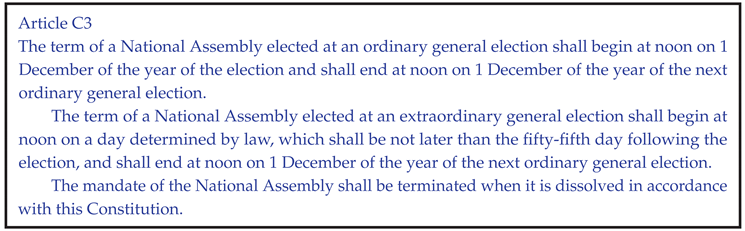
The above Election Article (Article C1) and Terming Articles (Articles C2 and C3) need some explanation.
3.4.1. Purposes of Adopting Electoral Concurrency
The well-established political advantages of electoral concurrency (or electoral synchronisation) have been extensively discussed in comparative politics literature (Cheibub 2007,Shugart and Carey 1992), and thus will not be repeated here. Although simultaneous presidential-legislative elections are common in pure presidential systems, their systematic use in a genuinely semi-presidential framework is exceedingly rare. We adopt electoral concurrency not only to realise the cited political advantages, but also, critically, to guarantee the systemic rigour of the scheme. Asynchronous elections would create intricate variations in the timing of the president’s and assembly’s respective transitions (commencements and departures), making it virtually impossible to ensure a procedurally bug-free scheme. A systematic discussion of this issue is provided in SubSection 5.4.4.
3.4.2. Note on the Specific Dates
The choice of the second Tuesday of October for ordinary general elections and the December inauguration dates are not essential features of the scheme. They have been selected as realistic, turnout-friendly, and logistically convenient defaults that can be adopted without modification in most countries. They may, however, be freely adjusted to suit local traditions, climate, or administrative circumstances without affecting the core constitutional logic of the model.
3.4.3. Note on Possible Presidential Run-Off
The articles above assume that the president (and vice president) are elected in a single round. Countries that adopt a two-round majority run-off system may easily accommodate it by providing that, if no candidate obtains the required majority in the first round, a run-off between the two leading candidates shall be held two weeks thereafter. The inauguration date of the president (and vice president) requires no adjustment even if a run-off is held. The interval from a late-October or early-November run-off to mid-December remains sufficient for result certification, legal challenges, and an orderly transition.
3.4.4. The Five-Year Term Length
The five-year term length defined by these articles is considered optimal for the stability and accountability of the entire system, and we recommend against modification. A four-year term is inadequate for the assembly because, following an early dissolution, the resultant truncated term would often fall significantly below the threshold necessary for legislative stability and institutional development. Conversely, a six-year term is generally too long for both the president and the assembly, risking diminished executive accountability and reduced legislative responsiveness to the electorate, given that both are usually expected to serve their full term.
3.5. The Presidential Authority over Prime Minister Provision
The president’s authority over the prime minister’s tenure is deliberately established through a series of complementary provisions, beginning with this foundational grant of power. This first provision serves as the constitutional source of the president’s authority – the enabling prerogative – which is typically located within the article defining the “Powers of the President”.
While the president’s authority to appoint the prime minister is universal in semi-presidential systems, the corresponding authority to dismiss is not. Several semi-presidential systems (France, Poland, Romania, Sri Lanka, and Ukraine) grant the president no dismissal authority at all. It is for this particular reason that this enabling provision is explicitly included in the present scheme.

Subsequent articles will detail the investiture procedure and introduce the Dismissal-Disabling Article (Article C11). Together, these provisions define the complete, nuanced framework governing the president’s authority over the appointment and removal of the prime minister.
4. Scheme C: Main Investiture Articles
The Main Investiture Articles include the Core Investiture Article, the Caretaker Prime Minister Article, and the Composition of Cabinet Article.
4.1. The Core Investiture Article
The Core Investiture Article, which is given below, governs the procedure of investiture understood in its narrow sense, i.e., the process through which the assembly and the president fill a vacancy in the office of Prime Minister.
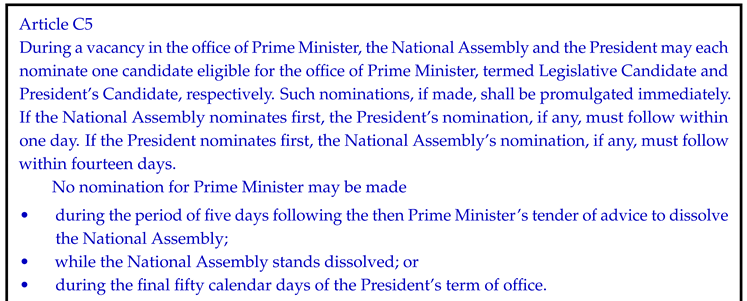
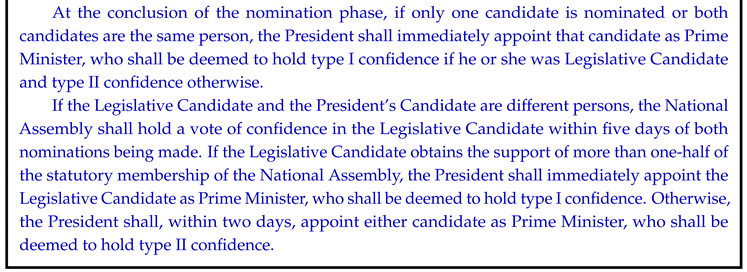
This article employs a game-based design in which both the assembly and the president compete to install their preferred candidate. Central to the scheme, it embodies several significant innovations and demands a thorough and detailed analysis.
4.1.1. Full Adherence to the Absolute Majority Principle
This article adopts the absolute majority criterion, a standard employed in nearly all parliamentary and semi-presidential constitutions. The foundational principle is straightforward: If the assembly agrees upon a candidate supported by an absolute majority, that individual is designated as the new prime minister. The president’s role becomes relevant only when the assembly is fragmented and fails to secure absolute majority support for any candidate. The universal acceptance of the absolute majority standard is likely driven by two key considerations:
- Electoral Mandate: A parliamentary majority signifies the prime minister has majority support among the electorate.
- Effective Governance: A parliamentary majority promises stable support during legislation, which is essential for effective governance.
4.1.2. Disuse of Other Majority Types
Besides the absolute majority, many constitutions utilise two other standard forms of majority: the simple majority (more votes for than against) and the relative majority or plurality (the most votes among all candidates).
- Simple Majority: The simple majority is frequently employed as a fallback mechanism. For instance, in many European countries, if an absolute majority fails to be achieved in the first round of investiture, a simple majority is sought for success in the second round.
- Relative Majority: The relative majority is used in countries where the selection process resembles a presidential election rather than a European-style investiture. For example, in Andorra, Finland, and Japan, the prime minister is effectively elected by achieving the relative majority of the votes cast.
Neither of these two weaker forms of majority is utilised in the current scheme. Instead, the process dictates that when an absolute majority cannot be achieved, the president’s participation is involved to resolve the impasse.
4.1.3. The Challenges of Traditional, Coupled Investiture
The traditional European-style investiture process is characterised by a sequential and highly coupled candidate selection procedure: the head of state nominates a candidate, and the legislature then holds a confidence vote. This iteration repeats until the required majority is achieved. This coupled model presents several significant drawbacks:
- Ambiguity in Responsibility and Delay: Delays can occur on the part of either the head of state or the legislature. Should the process fail before the constitutional deadline, the coupled nature makes it difficult to assign blame and determine which party’s delay caused the failure.
- Potential for Presidential Abuse: The head of state may exploit this power by strategically withholding highly qualified or consensus candidates, instead nominating only his/her personally favoured candidates. While often a mere theoretical possibility in robust parliamentary democracies, this feature has been systematically used for political leverage in some semi-presidential and authoritarian systems.
- Risk of Systemic Failure: Critically, the sequential process lacks a built-in mechanism to guarantee success, leaving open the non-trivial possibility of parliamentary dissolution and resulting in political instability.
4.1.4. Scheme C: Decoupled and Deadlock-Free Process
Scheme C resolves the challenges of coupled investiture by implementing a decoupled and parallel candidate selection process. In this scheme, the assembly and the president select and nominate their respective candidates concurrently and independently. This decoupling provides several major advantages:
- Clear Accountability: Neither party can legitimately claim that the other obstructed its nomination process, as both procedures unfold in parallel.
- Guaranteed Candidate Availability (Deadlock-Free): Even if the assembly fails to coalesce around a single nominee, the president’s nomination – being the result of a single-person decision – is always available. A critical advantage of this parallel structure is the virtual impossibility of a complete lack of candidates. Since either party is inherently incentivised to install their preferred candidate, the scenario that both the assembly and the president purposefully delay to the point of deadlock is a mere theoretical possibility.
4.1.5. Why Must the President’s Nomination Precede the Vote?
The constitutional sequence is vital. Consider the alternative rule: “First let the assembly find someone who can pass an absolute majority confidence vote, thereby securing the appointment. If this fails, the president is granted unfettered discretion to appoint the prime minister.” This alternative carries a significant risk: it grants the president a substantive probability of freely appointing the prime minister if the legislature is fragmented. By arranging the confidence vote on the legislative candidate after the president submits his/her nomination, the confidence vote is transformed. It is not a vote on that candidate in isolation, but rather a comparative vote between the legislative candidate and the president’s nominee. This dynamic forces both branches to put forward their strongest possible candidates, thus elevating the quality of government formation.
4.1.6. Thoughtful Candidate Selection
In sharp contrast to the rigid, constitutionally entrenched nature of traditional investiture procedures, Scheme C provides crucial flexibility for the legislature. Under this scheme, the assembly can, and is incentivised to, establish an internal procedure for selecting its nominee. Since this internal procedure is not enshrined in the constitution, it can be easily adapted, iterated, and constantly improved.
- Legislative Candidate Quality: The internal selection process may involve multiple rounds of voting. Although these preliminary internal votes are not constitutionally recognised as formal confidence votes, they nonetheless reflect the genuine opinion of the assembly members and are thus equally valuable indicators of support. Therefore, even though the constitution does not mandate any voting before the assembly’s final nomination, the resulting candidate is still the product of a deliberate and thoughtful internal process.
- President’s Candidate Quality: Similarly, the president’s candidate is the result of an equally intensive and strategic assessment. The president is strongly incentivised to nominate a highly viable candidate because a poorly chosen nominee would be easily defeated in the subsequent official vote between the two competing candidates.
This design ensures that both the assembly and the president submit nominees who have been rigorously vetted, whether through internal legislative consensus or through strategic executive calculation.
4.1.7. How Can the Legislative Candidate Lose a Vote Held by the Legislature Itself?
While it may seem counter-intuitive for this to happen, it is a practical possibility in highly fragmented legislatures. The outcome is driven by the fact that members typically vote according to partisan alignment rather than institutional loyalty. Consider this scenario: Left-wing Party: 45%, Centrist Party: 35%, and Right-wing Party: 20%. If the assembly, due to the disorganisation or low strategic priority given to the internal nomination by the non-Left factions, nominates the Left-wing leader (the largest faction), and the president nominates the Centrist leader, the Left-wing nominee may fail. This occurs because the Right-wing and Centrist party members, despite their previous carelessness in coordinating an internal alternative, will nonetheless instinctively oppose the Left-wing nominee. Their predictable partisan decision is to withhold their support (by abstaining or casting negative vote), ensuring the Left-wing leader fails to secure the required absolute majority.
4.1.8. Why No Formal Option of Acceptance?
In traditional constitutional frameworks where the prime minister is not elected directly by the legislature, the assembly is typically restricted to a binary choice: accepting or rejecting the president’s nominee. Scheme C streamlines this process by integrating the power of acceptance into the nomination mechanism itself. Rather than requiring a separate procedural step, functional acceptance is achieved through two distinct pathways:
- Active Functional Acceptance: The assembly may nominate the same candidate proposed by the president. This “matching nomination” serves as a formal signal of inter-branch consensus and moves the process forward immediately, bypassing the need for a separate confidence vote.
- Passive Functional Acceptance: The assembly may choose not to propose a rival candidate. By allowing the constitutional deadline to expire without a counter-nomination, the assembly effectively defaults to the president’s choice. This is a slower path, as the system must wait for the deadline to pass to ensure the assembly’s right to nominate has been fully afforded.
This logic is symmetric: the president exercises the same functional choice when responding to an assembly-led nomination. Consequently, Scheme C does not lack the capacity for acceptance; rather, it provides equivalent and nearly equivalent options that allow for both proactive endorsement and silent acquiescence.
While both pathways result in the same individual becoming prime minister, the choice of method may carry different implications for the prime minister’s initial confidence status, a distinction we will discuss in SubSection 4.1.12.
4.1.9. Why not Allow the Assembly to Nominate Multiple Candidates?
An alternative design to ensure a deadlock-free investiture involves allowing the assembly to nominate a prioritised list of candidates. In this hypothetical procedure, the president’s nominee is either appended to the end of the assembly’s list or, if already present, serves as a “cutoff point” – effectively removing any candidates ranked behind him/her. The assembly then holds successive confidence votes in the order of the list. If a candidate secures an absolute majority, he/she is appointed. Otherwise, the president may appoint that candidate, appoint any predecessor on the list, or decline to appoint anyone and proceed to the next candidate. Should the list be exhausted without an appointment, the president must select and appoint one individual from the list. While mechanically functional, this procedure is fundamentally flawed:
- Near Irrelevance of Presidential Nomination: By allowing the assembly to “flood” the process, the president’s nominee is relegated to the end of a long voting queue or rendered redundant if he/she was already included in the assembly’s list. The president’s nomination is nearly irrelevant.
- Redundancy in Cohesive Scenarios: If a cohesive absolute majority exists, the assembly’s primary nominee will inevitably secure confirmation. In this scenario, a multiple-candidate model is superfluous, as it produces the same result as a single-candidate model.
- Instability in Fragmented Scenarios: The only scenario where this model would alter the outcome – which is highly improbable – is if the assembly’s top pick fails, but a “middle-ground” candidate, ranked above the president’s choice, secures a majority. Such a winner would lack the president’s endorsement; he/she was not the president’s choice, but was instead prioritised by the assembly specifically as an alternative. Furthermore, the majority achieved during the vote would likely be temporary and opportunistic, as the candidate had already been defeated in the internal nomination contest by the top-ranked candidate (who failed to secure a majority). Consequently, such a prime minister would face a strained relationship with the president and possess only brittle support from the assembly, making effective governance extremely challenging.
Therefore, while the “multiple-assembly-candidate” design maximises the viability of a legislative outcome, we do not view it as a superior option for semi-presidential systems where a stable government requires either stable parliamentary support or reliable presidential backing.
4.1.10. Why Is the Failed Legislative Candidate Still Constitutionally Permitted to Be Appointed?
Even after the legislative candidate fails to secure an absolute majority, the constitution grants the president the discretion to appoint either candidate. While we anticipate that instances of the president appointing the legislative nominee will be rare in practice, this constitutional latitude is crucial and should be actively encouraged.
A critical point is that assembly members who withhold support from the legislative candidate are not automatically supporters of the president’s nominee. Specifically, if the vote count for the legislative candidate is close to absolute majority and is coupled with a considerable number of abstentions or absences, the result suggests that the president’s candidate lacks the needed support within the assembly. Appointing the president’s own candidate in such a scenario carries a high risk of him/her being quickly toppled by a subsequent vote of no-confidence.
In this specific, high-risk situation, the president’s pragmatic choice is to appoint the legislative candidate. Doing so acknowledges the assembly’s near-majority and mitigates the immediate threat of instability, demonstrating wise presidential statesmanship.
4.1.11. The Formal Confidence Types
We define two constitutional statuses, type I confidence and type II confidence, which determine a prime minister’s security of tenure. They are collectively called Formal Confidence Types. The term “formal” is chosen because the confidence status is constitutionally assigned, granted possibly even without an actual confidence vote.
- Type I Confidence (Stronger Mandate): A prime minister obtains type I confidence if he/she was the legislative candidate who faced no competition from a presidential nominee or secured an absolute majority in the confidence vote against the president’s nominee.
- Type II Confidence (Weaker Mandate): A prime minister holds type II confidence if he/she did not meet the type I conditions. This status, while weaker, is still recognised as confidence because the holder was either nominated by the assembly or the assembly’s nominee failed to defeat the holder in the confidence vote.
In a later article, we will stipulate that a prime minister holding type I confidence cannot be dismissed by the president.
4.1.12. Rationale for the Scheme Adjustment Regarding Formal Confidence
Previously, as stipulated in earlier work Cheng (2025b, 2025c), a president’s candidate appointed in the absence of an assembly nominee was granted type I confidence. In this latest version of the scheme, that appointee now only holds type II confidence.
This adjustment is deliberate and critical for managing strategic incentives. Under the previous rule, if the president nominates a strong candidate, there may be two scenarios regarding the state of the assembly:
- Inability Case: The assembly is genuinely unable to find a viable rival candidate.
- Acquiescence Case: The assembly is unwilling to nominate a rival because it agrees with the president’s choice.
Regardless of the cause, the assembly may desire to deny the president the leverage of the dismissal power over the new prime minister. To achieve this denial, the assembly had two options under the old rule:
- Passive Conduct: Delay its own nomination until the deadline passes (while perhaps still trying desperately to find a viable rival candidate), resulting in the president’s candidate being appointed by default. This action strategically hurts government efficiency.
- Active Conduct: Nominate the president’s candidate itself.
The new stipulation eliminates the perverse incentive of the first choice by making the assembly’s passive conduct void for type I purposes. If the assembly wishes to deny the president the dismissal power and ensure the prime minister holds the non-dismissible type I status, it must now take active ownership by formally nominating the president’s candidate itself. This adjustment compels the legislature toward explicit, responsible political action rather than rewarding passive delay.
Substantively, it was a significant inconsistency that, under the old rule, the assembly’s indefinite delay (demonstrating no affirmative support) resulted in the president’s candidate being awarded type I confidence. The new rule corrects this by interpreting such a delay as a lack of definitive endorsement for the president’s nominee, thus awarding the candidate only type II confidence. This correction ensures that the confidence status accurately reflects the assembly’s actual political stance, providing a more transparent and logically sound basis for the prime minister’s mandate.
Conversely, if the assembly’s nomination precedes that of the president, the two paths of presidential acceptance – active (by nominating the same candidate) and passive (by declining to nominate any alternative) – lead to an identical constitutional result, differing only in the timing of the appointment. This outcome reinforces the scheme’s core principle: that the government’s primary source of confidence resides within the assembly.
4.1.13. The Double-Relative Deadlines and Their Asymmetry
The double-relative deadlines design employed in Scheme C is a seminal innovation first proposed in Cheng (2025b). Previously, a single-relative deadlines design (president first, assembly second) was utilised in Cheng (2025a), whereby the president was required to nominate a candidate within a deadline relative to the occurrence of the vacancy (an absolute deadline), while the assembly was asked to nominate its candidate within a deadline relative to the president’s nomination (a relative deadline). Other theoretical alternatives include a reversed sequence (assembly first, president second) or a double-absolute design, in which both the president and the assembly must nominate candidates within respective deadlines measured from the initial vacancy. These latter two options have not been adopted in any existing scheme.
All alternative options are significantly more rigid than the current design and prove impractical for both constitutional drafting and practice. Because the precise moment a vacancy occurs is often difficult to determine, such systems risk triggering severe constitutional disputes.
The asymmetric deadlines (waiting periods, or delays) in Scheme C for the assembly and the president align with common sense. Nominating a prime-ministerial candidate is significantly more time-consuming for the assembly than for the president. Therefore, if the president nominates first, the assembly is allowed a longer delay (14 days) to respond with its nomination than the president is allowed if the assembly nominates first. A one-day delay is sufficient for the president, who likely has a candidate prepared at that stage.
4.1.14. Conditions Precluding Nomination
The scheme formally prohibits the nomination of a prime minister under three specific circumstances:
- Suspension for Anti-Forestallment: This clause functions as a systemic patch to eliminate a specific procedural bug. While it addresses a much shorter window of only five days and is of much lower practical frequency than the other two conditions, it remains necessary for logical completeness. Its underlying rationale is examined in SubSection 5.2.5.
- Suspension Due to Assembly Dissolution: When the assembly is dissolved, it is unable to perform its function of nomination. To maintain constitutional balance, the president’s right of nomination is symmetrically suspended during this period.
- Suspension Due to Term-End Proximity: This restriction is part of a coordinated framework; Articles C8 and C11, introduced later, contain analogous prohibition clauses. These three rules ensure that the system remains free of cross-term conflicts – such as a candidate nominated by an outgoing president being forced upon an incoming president. These constraints are detailed in SubSection 5.4.3, and their underlying rationales are provided in SubSection 5.4.4.
Consequently, should a prime-ministerial vacancy occur immediately prior to or during the latter two kinds of periods, the vacancy shall persist for several weeks. This interval is not classified as a deadlock, as the delay is constitutionally mandated. To ensure continuity of governance, a caretaker prime minister is needed, and an article to address this is introduced in SubSection 4.2.
A phenomenon distinct from these legal prohibitions is the intentional administrative delay. Brief delays in nomination – on the scale of several days – are institutionally tolerated when necessitated by practical impediments. Examples include the assembly being in recess (rendering immediate convention impractical) or the president being temporarily incapacitated. In such instances, the unimpeded party is expected to exercise institutional courtesy by temporarily refraining from nomination until the other branch is capable of proceeding. Such periods of practical necessity are not regarded as deadlocks, but rather as necessary suspensions to preserve institutional balance.
4.1.15. Why Is There No Mention of a Governmental Programme or Cabinet Composition?
Many constitutions contain provisions mandating that the prime-ministerial candidate must present a formal governmental programme and/or a detailed composition of the future cabinet prior to the legislature’s confidence vote.
This requirement is deliberately omitted from the current scheme because it is considered nonessential and potentially rigid for the following reasons:
- Policy Transparency: The candidate’s fundamental policy orientations are already well-established and known to the legislature and the nation. A separate, formal programme document is thus considered superfluous.
- Executive Flexibility: The prime minister retains the power to change or reshuffle the cabinet post-investiture, and there is typically no penalty for deviating from a promised composition. Mandating a pre-vote cabinet list provides a false sense of commitment.
- Alignment with Separated Tenure: The scheme upholds the principle that the tenure of individual cabinet members is independent from that of the prime minister. Omitting the requirement for a pre-vote cabinet composition is thus consistent with and reinforces this principle.
4.2. The Caretaker Prime Minister Article
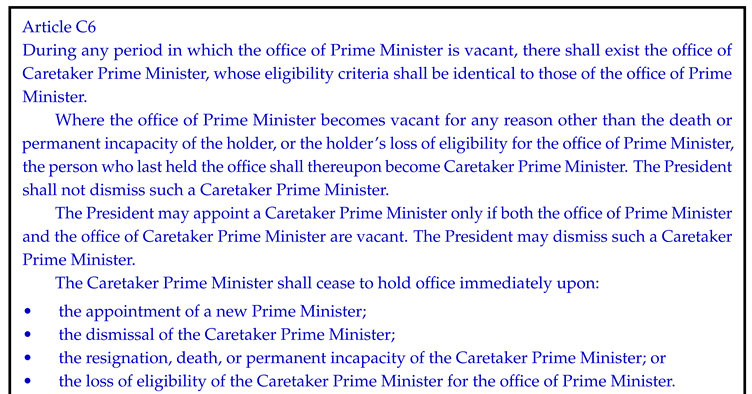
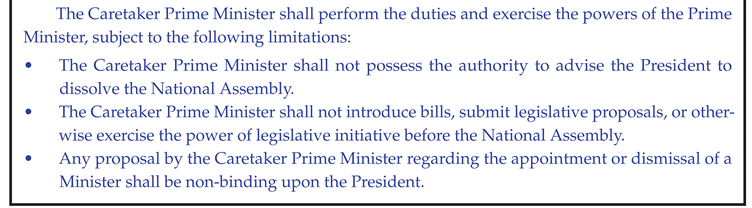
4.2.1. Conversion and Appointment of the Caretaker Prime Minister
The office of Caretaker Prime Minister (CPM) is a provisional executive role designed for institutional continuity. Its occupancy is primarily achieved through the automatic conversion of a departing prime minister. An incumbent who vacates the premiership – whether through resignation, dismissal by the president, or a legislative vote of no-confidence – instantly assumes the status of CPM.
The secondary path to this office is via direct presidential appointment. Given the CPM’s restricted mandate and the necessity for executive celerity, the president exercises appointment and dismissal power with full discretion. To ensure the office can be filled promptly, this power is exempt from legislative confirmation and subject only to basic constitutional eligibility.
Compared to previous iterations Cheng (2025b, 2025c) of this model, this framework introduces three critical distinctions to the appointment and dismissal regime:
- Formalisation of Office Status: The CPM is now defined as a formal “office” rather than a mere “position”. This shift reflects the office’s constitutional weight and its potential multi-month duration during prolonged transition periods, necessitating a stable legal foundation.
- Non-Dismissibility of Converted CPMs: A CPM who attains the office via conversion from an official prime minister is irremovable by the president. The president’s power of dismissal applies exclusively to a CPM whom the president directly appointed. This distinction recognises that a converted CPM retains the residual legitimacy of prior parliamentary vetting, whereas a directly appointed CPM – lacking such a mandate – must remain subject to presidential oversight.
- The “Double Vacancy” Rule: In this latest iteration, the president may appoint a CPM only when both the office of Prime Minister and the office of Caretaker Prime Minister are vacant. This represents a significant departure from previous iterations (Cheng 2025b,Cheng 2025c), where the ability to appoint a CPM without the prior dismissal or vacancy of the incumbent was an intentional feature designed for maximum procedural efficiency. That feature is now discarded, as it contradicts our newly established principle of non-dismissibility for converted CPMs.
Some may question the apparent paradox where many official prime ministers are dismissible, yet a converted caretaker is not. The answer lies in the fact that these two “dismissals” differ in severity. Dismissing an official prime minister merely relegates him/her to caretaker status, whereas dismissing a caretaker prime minister removes him/her from power entirely, leaving him/her officeless. Furthermore, the converted CPM’s tenure is not indefinite; he/she is removed automatically upon the appointment of a new prime minister, which serves as a form of automatic dismissal.
Critics may also question the non-dismissibility of the converted CPM, citing a perceived lack of mechanisms to penalise executive misconduct. This concern, however, is mitigated by two primary factors.
- Functioning Assembly Scenario: In the presence of a functioning assembly, the caretaker period is inherently brief; the converted CPM is typically replaced by a new official prime minister within days as the investiture process concludes.
- Dissolved Assembly Scenario: If the assembly is dissolved, the caretaker mandate coincides with the national election cycle. As the converted CPM is invariably his/her party’s campaign leader, he/she operates under intense public scrutiny. In this context, any misconduct would likely contribute to an electoral sanction – the defeat of the CPM’s party at the polls. Thus, political pressure substitutes for the formal power of dismissal.
The provision for the president to appoint a CPM when a converted CPM is unavailable represents a pragmatic compromise for the sake of legal clarity. While such an appointee would typically be replaced within days if the assembly were sitting, a CPM appointed during dissolution could remain in office for up to two months. Although Scheme C mirrors the Westminster model in most aspects of tenure, it opts for the French approach in this specific instance – granting the president a direct power of appointment – primarily because it offers the cleanest and most codifiable solution.
Several factors make this compromise acceptable: First, the statistical probability of a prime minister dying during a campaign is extremely low, meaning this mechanism is rarely triggered. Second, the president’s choice remains subject to immediate public and political scrutiny; any appointment perceived as unfair or partisan would likely trigger a backlash at the polls, resulting in an electoral defeat for the president’s own party.
It should be noted that this is not a core feature of the constitutional framework. Future drafters are welcome to explore different strategies for this specific contingency, provided that any alternative remains elegant to maintain the overall style and internal logic of Scheme C.
4.2.2. Powers of the Caretaker Prime Minister
We categorise the powers common to parliamentary or semi-presidential systems into the following domains to determine their status under a caretaker mandate:
- Dissolution Powers: The CPM should be denied the authority to advise the dissolution of the assembly.
- Legislative Initiative: The authority of a CPM should mirror that of a prime minister operating during a parliamentary dissolution. Under this logic, all powers related to legislative initiative and parliamentary manoeuvre must be removed. By treating the CPM as an executive operating in a “legislative vacuum”, the constitution prevents a temporary steward from enacting permanent policy shifts or altering the political landscape before a new mandate is established. Consequently, the CPM is stripped of the right to introduce new bills or submit legislative proposals.
- Cabinet Personnel Proposals: This iteration of Scheme C stipulates that a CPM’s cabinet proposals are non-binding upon the president. This contrasts with the official prime minister, whose proposals carry binding authority. However, we recommend that the presidential discretion exercised here is strictly veto-based (reactive) discretion; the president may veto or delay a proposal but cannot seize the initiative to appoint a minister of his/her own choosing. This remains distinct from the president’s reserved domain (e.g., Defence or Foreign Affairs), where the president retains unilateral discretion and the power of initiative regardless of whether he/she is working with an official or caretaker prime minister.
- Miscellaneous and Country-Specific Authorities: Powers involving emergency handling, ceremonial duties, the signing of routine executive orders, or specific regulatory oversight should be generally retained unless they intersect with sensitive political reforms. As these often vary by jurisdiction, they are not analysed in detail here but should be subjected to an “incompatibility audit” during national constitutional drafting.
4.3. The Composition of Cabinet Article
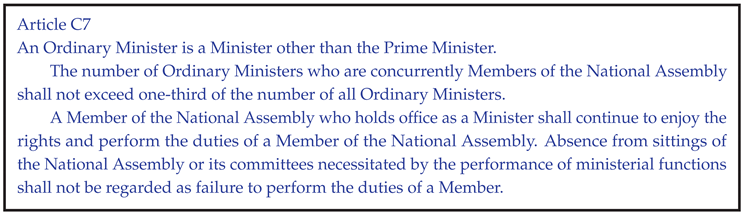
This article imposes a strict ceiling on the proportion of ordinary ministers drawn from the assembly. This constraint is termed the Capped Legislative-Executive Overlap. It aims to achieve a balanced compromise between the need for technocratic expertise and the political demands of coalition formation. This model aligns with the practice observed in most contemporary semi-presidential systems (e.g., France, Portugal, Poland, Romania).
Other structural choices regarding overlap are also compatible with the overall scheme:
- Strict Separation: Borrowed from presidential systems (zero overlap).
- Uncapped Overlap: Borrowed from parliamentary systems (full overlap).
The choice of overlap degree is therefore a feature of constitutional flexibility, not a fundamental structural constraint or core defining feature of the overall model presented here. The central innovations of the scheme lie instead in the specific rules governing investiture, removal, and dissolution.
But this article is nonetheless an indispensable component of the scheme because, in any system that moves away from a strict separation of powers, the constitution must provide a clear mechanism for managing the dual mandate – where an individual serves in both the executive and legislative branches. There are three primary constitutional pathways for addressing this overlap:
- Seat Retention: The minister retains his/her legislative seat and voting rights while serving in the cabinet.
- Seat Suspension with Substitute: The minister’s legislative functions are suspended for the duration of his/her cabinet tenure, with his/her seat temporarily filled by a substitute.
- Seat Suspension without Substitute: The minister’s seat is suspended without a substitute, effectively leaving the seat empty while he/she serves in the cabinet.
The choice of model has significant implications for the functional quorum of the legislature. Under the first two models – Seat Retention and Seat Suspension with Substitute – the total number of voting members remains equal to the statutory number. However, if the third option (suspension without substitute) is adopted, the actual number of sitting members falls below the statutory number.
This creates a “number problem” that would fundamentally alter the drafting of the entire constitution, as every article governing voting thresholds, supermajorities, and quorums would need to be modified to account for the fluctuating denominator. Consequently, this article is included as an essential component of the scheme to resolve these structural dependencies.
While this specific implementation utilises the Seat Retention model as its baseline to avoid such procedural complexities, the scheme’s core logic remains robust even if other options are chosen.
5. Scheme C: Complementary Articles
The Main Investiture Articles cannot operate in isolation; they must be complemented by provisions governing prime-ministerial removal (including no-confidence, dismissal, and mandatory resignation) and parliamentary dissolution. Furthermore, the design of these Complementary Articles is not independent: the specific mechanisms chosen for investiture impose a narrow range of permissible design choices for the removal and dissolution articles. Therefore, while not part of the investiture procedure in the strictest sense, these articles are indispensable and integral to the overall constitutional scheme.
5.1. The No-Confidence Article
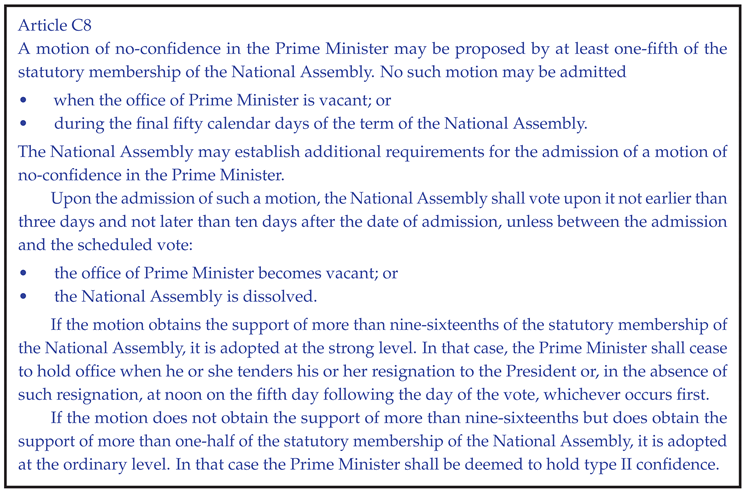
5.1.1. Note on Safeguards against Frivolous Motions
This article explicitly implements only one safeguard against frivolous no-confidence motions: a minimum signature threshold required to initiate the motion. The article is designed to maximise procedural flexibility, encouraging the assembly to introduce additional measures as necessary to deter abuse.
5.1.2. Why Two Levels of Adoption?
The current investiture rule represents a shift away from traditional European-style requirements, making it systematically more permissive toward minority governments. While this change successfully prevents the deadlocks and snap dissolutions that were once common, it introduces a new vulnerability: these governments are easily toppled by simple (non-constructive) votes of no-confidence. Therefore, a higher standard for the no-confidence rule must be considered to ensure governmental stability.
Previously, we considered the constructive vote of no-confidence, but a comparison shows that it shares the same underlying logic as the current investiture rule: “if a candidate is supported by an absolute majority, his/her installation is assured”. This means that the threshold for installing a new prime minister is identical, whether the office is vacant (investiture) or occupied (no-confidence). While achieving a new government based on an absolute majority is democratically sound, this common standard is detrimental to stability. Furthermore, the ease of removal prevents the maturation of governance, as most policies require a stable duration to manifest their intended effects before they are judged by a hostile majority.
It is hence necessary to employ a standard higher than both non-constructive and constructive absolute majority to remove the prime minister. We implement this higher standard through the ordinary (non-constructive) vote of no-confidence, choosing it over the constructive version because the ordinary mechanism is inherently much simpler.
The proposed mechanism introduces a two-tiered outcome. When the no-confidence motion achieves only the old standard (absolute majority), it does not result in removal, but instead sets the prime minister’s confidence status to type II. Whether this represents a downgrade depends on the prime minister’s original status.
By holding type II confidence, the prime minister is exposed to the risk of dismissal by the president. Thus, if the prime minister is opposed by the president, the effective threshold for removal by the assembly remains identical to the conventional absolute majority vote of no-confidence.
5.1.3. Choice of the Threshold for Removal
In this article, we set the threshold for the immediate removal of the prime minister at 9/16 (56.25%). This supermajority was selected because it represents an elegant value that is unmistakably higher than 50%, yet is not so high as to make the removal process excessively difficult. This specific threshold is also utilised in Scheme B of the author’s previous work Cheng (2025b) for a similar purpose. It reflects our reasoned design intuition; its optimality can only be fully assessed after extended real-world application of the scheme. Nearby fractions such as 5/9 (≈ 55.56 %) and 4/7 (≈ 57.14 %) may be plausible alternatives.
Moreover, this threshold T for immediate removal must be calibrated against the president’s legislative authority. Ideally, the margin by which this threshold exceeds a simple majority () should correspond to the percentage of assembly members the executive alliance can influence through political bargaining. Ultimately, a government’s survival depends on more than just defeating a no-confidence motion; poor governance creates a political deficit that will eventually make the government unsustainable.
5.1.4. Why Grant the Ousted Prime Minister Four Days to Vacate Office?
Paragraph 3 of this article allows the prime minister to remain in office for 4.5–5.5 days after a motion of no-confidence has been adopted at the strong level. This brief grace period is intentional: It gives the prime minister the necessary time to arrange and hold the meeting with the president, which is required to formally advise dissolution of the assembly (should he/she so decides). Without these four days, the prime minister would be instantly removed upon the vote and would lose the constitutional authority to call an early election. We will discuss dissolution in the next subsection.
5.1.5. Argument Against Stand-Alone Confidence Votes
As argued in (Cheng 2025c, Subsection 4.3), the assembly should never hold a vote whose sole purpose is to test confidence. This test must remain a by-product of a substantive act (investiture or vote of no-confidence). There should be no provision for a prime minister to initiate a “motion of confidence” simply to secure type I confidence to shield himself/herself from presidential dismissal, for four reasons:
- Institutional Friction: Seeking a shield against dismissal appears as an attempt to “break free from presidential shackles”, which would poison the working relationship between the two leaders.
- Different Standards: An investiture vote is essentially a comparison between two candidates, whereas a prime-minister-initiated confidence vote is an absolute judgment on one individual involving no comparison. Their standards for passage are conceptually different; consequently, the result of the latter is not sufficiently convincing.
- Structural Redundancy: If a prime minister commands the absolute majority required to win a confidence vote, should the president exercise the dismissal power, that same majority can simply reinstall him/her with type I confidence that shields him/her from further dismissal. That makes a preemptive shield appear unnecessary.
- Difficulty of Avoiding Abuse: The failure of a confidence motion does not constitute a no-confidence at either level; therefore, a prime minister incurs no loss regardless of the outcome. We believe it difficult (if not impossible) to design an effective and elegant penalty mechanism for such motions. Substantive waste of parliamentary resources may be expected if such motions are institutionally facilitated.
5.2. The Executive Dissolution Article
5.2.1. Contingent, Flexible-Timing Midterm Elections
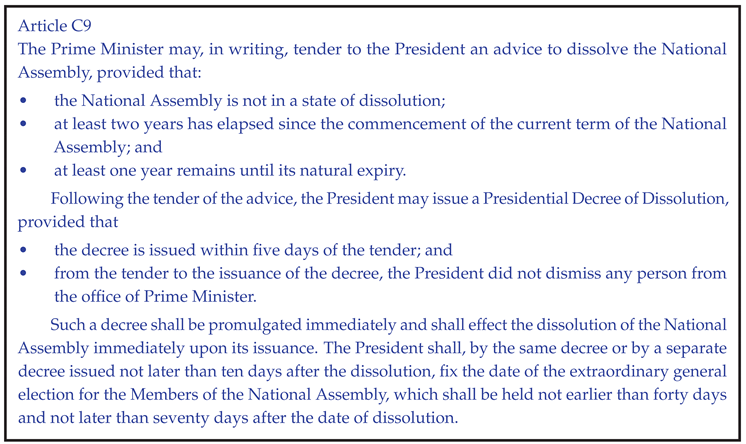
Although never stated outright, the twin restrictions (at least two years served and at least one year remaining) together guarantee that within a normal five-year term there can be at most one dissolution and therefore at most one snap election (although a secondary dissolution mechanism will be introduced later, it serves as a “nuclear weapon” intended for structural integrity rather than active use, and is not expected to be invoked during the normal life of the state). We deliberately avoided an explicit “only once per term” rule. The implicit version is superior because it automatically produces two reasonably balanced parliamentary terms. This creates a genuine midterm parliamentary election – a feature normally found only in pure presidential systems – but with two important distinctions: ours is flexible – it occurs “around the middle” rather than rigidly at the halfway mark, and it is contingent and infrequent rather than automatic and guaranteed every term. Hence, the result is a hybrid mechanism that borrows the stabilising rhythm of American-style midterms while preserving full parliamentary logic and avoiding the forced, mechanical cadence of fixed-term presidential legislatures.
5.2.2. Prime-Ministerial Initiative Subject to Presidential Discretion
Placing the initiative with the prime minister (rather than the president) is a deliberate and crucial safeguard. Given the president’s higher ceremonial rank, if the president had the initiative to dissolve the assembly, the prime minister’s opinion would become purely advisory and easily dismissible. The president may thus unilaterally dissolve a hostile, cohesive assembly to advance his/her agenda. But in the current scheme, this is impossible, because a prime minister with a cohesive majority has no incentive to advise their own removal, dissolution is hence functionally restricted to instances of parliamentary impasse or fragmentation.
Building on the prime minister’s role in protecting a cohesive assembly, our design ensures that dissolution remains a “dual-key” process. While the prime minister acts as the initial gatekeeper, the president must exercise the discretion to grant the request. This structure does not strictly prohibit a unified executive from seeking a stronger mandate to advance a bold agenda (an unlikely occurrence given that the resulting assembly serves only the remainder of the original term), but it ensures that any such move carries the joint accountability of both offices. By requiring this mutual consent, the system effectively shields a functional legislature from unilateral overreach while allowing for electoral recourse in cases of acute deadlock. In our view, this internal executive balance and the defined time-window provide sufficient structural anchors, arguably rendering additional triggers or restrictions unnecessary.
5.2.3. Concern Over the Assembly’s Average Actual Term Length
A legitimate concern is that, while the probability density of dissolution at any single moment is extremely low, the two-year window is long enough for the cumulative probability to become significant. This cumulative effect could potentially shorten the assembly’s average actual term length considerably below its mandated five-year full term, suggesting a need for additional restrictions.
We remain cautiously sceptical regarding the necessity of new restrictions. The introduction of further constraints must be weighed against the need to preserve the political leadership’s capacity to resolve an acute institutional crisis quickly and decisively. Furthermore, we submit two key points to mitigate this concern:
- Comparative Frequency (The US Example): Even in the event of one snap election during a single five-year term, the average interval between elections would be years, meaning that elections are still less frequent than the regular biennial elections for the U.S. House of Representatives.
- Political Deterrent of Accountability: Any prime minister who advises dissolution on insufficient or partisan grounds will face intense political fallout, resulting in strong disapproval from the deputies and severely damaging his/her chances of reelection as prime minister. This heavy political cost, driven by the need for accountability and institutional stability, constitutes a powerful and self-enforcing deterrent against abusive or premature dissolutions.
5.2.4. Evolution of the Protection Mechanism for the Prime Minister Initiating Dissolution
Condition 2 in Paragraph 2 of this article may appear enigmatic at first glance, but it serves a vital purpose. Conventionally, upon the dissolution of the assembly, the prime minister is expected to lead the governing coalition’s electoral campaign. Retaining the office throughout this period is both natural and a matter of public expectation.
While the latest update of Article C6 ensures that a dismissed prime minister immediately converts into a caretaker, and maintains his/her role as head of government throughout the entire campaign, the act of dismissal remains a disruptive force. A prime minister who tenders advice for dissolution does so under an expectation of executive collaboration; a subsequent dismissal signifies a profound institutional fracture and executive tension. The flexibility afforded by a presidential dismissal power in this window does not outweigh the potential for administrative chaos and negative electoral signaling. Consequently, Scheme C establishes a procedural barrier: the dismissal of the prime minister effectively vetoes the dissolution decree, forcing the president to choose between executive unity or maintaining the current assembly.
In the predecessor to this study Cheng (2025c), a parallel provision offered explicit protection for caretaker prime ministers who were relegated to that status via a motion of no-confidence. Such a specific “immunity” clause is rendered superfluous in the current iteration; the prime minister’s tenure is now inherently protected by the internal logic of Article C6, which provides a universal framework for caretaker security that requires no secondary protective layers within the dissolution process itself.
5.2.5. Rationale for the Anti-Forestallment Clause on Nomination (Article C5)
In SubSection 4.1 and SubSection 4.1.14, Article C5, the Core Investiture Article, establishes a prohibition on the nomination of a new prime minister “during the period of five days following the then Prime Minister’s tender of advice to dissolve the National Assembly”.
This clause is an essential anti-forestallment measure designed to prevent the president from unilaterally appointing a prime minister. Consider the following scenarios without this clause:
- Scenario 1: The prime minister tenders an advice for dissolution, but then immediately resigns. The president quickly nominate a favoured candidate for prime minister, and then proceed to grant the dissolution.
- Scenario 2: A motion of no-confidence is adopted at the strong level and the prime minister tenders an advice for dissolution. After the prime minister is officially removed from office but before the five-day period expires, the president could preemptively nominate a candidate for prime minister and then grant the dissolution.
In both scenarios, the assembly would be unable to nominate its own alternative candidate, and then the president would be able to unilaterally appoint his/her own preferred choice as prime minister. This clause is meant to close that loophole.
5.2.6. The Caretaker Role: Westminster Conventions vs. Scheme C Codification
Westminster systems do not formally recognise an office titled “Caretaker Prime Minister” because they lack a codified investiture process; the head of state simply appoints the individual deemed most likely to command a parliamentary majority. However, the “caretaker” concept exists as a powerful constitutional convention. Upon the dissolution of parliament, the incumbent prime minister assumes a caretaker status – a conventional role rather than a formal title – signifying that the government lacks the ability to advance a legislative agenda without a sitting parliament.
Under Scheme C, however, the “Caretaker Prime Minister” is an established constitutional office. This formalisation is necessitated by the temporal gaps inherent in the scheme: while a standard investiture may span several weeks, the dissolution and end-of-term periods can last several months. All these may result in prolonged periods of prime-ministerial vacancy, requiring a stable caretaker framework to manage the state.
Despite these differences, their shared parliamentary features still enable Scheme C to draw inspiration from Westminster tradition. Specifically, the functional authority of a caretaker should mirror that of a caretaker in the Westminster sense – namely, an official prime minister during a dissolution period. This guiding principle was implemented in Article C6 in SubSection 4.2.2.
5.3. The Self-Dissolution Article
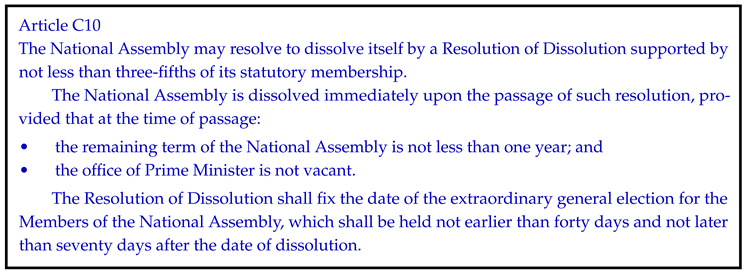
This article is designed as the Self-Dissolution Article and serves as a complement to the foregoing Executive Dissolution Article. Its purpose is to provide a constitutional emergency mechanism for dissolving the assembly when extraordinary political circumstances demand a fresh electoral mandate.
Some key provisions are explained below.
- No Minimum Service Requirement: The restriction that the assembly must have served at least two years is not present in this article. This allows for an election in the rare event of a profound national crisis occurring early in the assembly’s term, ensuring that a necessary electoral mandate is constitutionally permissible.
- Retention of Remaining Term Restriction: The restriction that the assembly must have at least one year remaining in its term is retained. This is because an early election is unwarranted if the ordinary general election is already imminent. While the one-year benchmark provides strong justification, drafters retain the flexibility to adjust this length (e.g., to six months) if deemed appropriate for the specific political cycle.
- The Occupied PM-Office Condition: The requirement that the office of Prime Minister be filled ensures the assembly has no pending nominations or outstanding confidence votes at the time of its dissolution, and closes any loophole that would allow the president to unilaterally change the prime minister. By guaranteeing executive continuity, this condition eliminates the need for a complex “buffer period” legislative session. Because Scheme C facilitates a failproof appointment process regardless of parliamentary fragmentation, this requirement poses no practical hurdle to dissolution. Politically, it secures the state against a leadership vacuum during the extraordinary election cycle.
- Safety Mechanism: To prevent misuse of this power, a 3/5 majority is required for the dissolution resolution. This threshold aligns with contemporary constitutional precedents, which utilise varying thresholds for self-dissolution: from an absolute majority (1/2) in Austria, Croatia, and Israel, to a 3/5 majority in Turkey, and a 2/3 majority in Poland. We tentatively adopt the 3/5 threshold as a balanced safeguard. While a 60% majority may appear attainable in theory, it represents a formidable barrier in practice. First, an assembly necessitating dissolution is, by definition, deeply fragmented. Second, since a premature dissolution terminates the legislators’ own mandates, securing a supermajority for an act that so directly contradicts their personal and professional self-interest is inherently difficult. This requirement ensures that such an extreme measure is invoked only when a broad cross-party consensus concludes that the legislature has become fundamentally dysfunctional.
To sum up, the Self-Dissolution Article acts as a critical safety valve for national crises. It ensures an election can be called at nearly any time during the assembly’s term, provided there is overwhelming political consensus.
5.4. The Dismissal-Disabling Article
5.4.1. Rationale for Presidential Dismissal Power
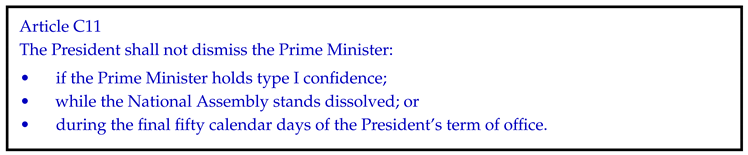
The distinction between the two types (type I and type II) of confidence defines the limits of presidential action. Where the prime minister holds type I confidence (parliamentary majority support), the cabinet is sustained by the assembly alone, and the president has no grounds for dismissal. Where the prime minister holds type II confidence (parliamentary minority support), the sustained authority of the government rests on the president’s support. Therefore, the president must possess the corresponding discretionary authority to withdraw this support and terminate the prime minister’s tenure, except in the two cases defined in the article, to be discussed later.
5.4.2. Rationale for Disabling Dismissal During the Dissolution Period
The logic of Article C9 prevents a specific strategic exploit: the president cannot dismiss the prime minister to secure strengthened control over the government before heading into an early election. During the period of parliamentary dissolution, there is an even more compelling reason to forbid such a dismissal.
Since the early election pertains exclusively to the assembly, the prohibition of dismissal serves two primary functions:
- Preventing Institutional Weakening: Dismissing the prime minister – thereby relegating him/her to caretaker status – undermines his/her authority at the exact moment he/she must lead a campaign. Such an act by the president would weaken the prime minister’s standing and could directly contribute to his/her electoral defeat.
- Maintaining Parliamentary Focus: The focus of this period should remain squarely on political parties competing for legislative seats. It should not be distracted by a presidential presence in the government or executive restructuring. Disabling the dismissal power aligns with this objective.
Ultimately, the dismissal option is disallowed because the potential for political harm and electoral interference outweighs any need for presidential flexibility.
5.4.3. Prime-Ministerial Freeze Near End-of-Term
Articles C5, C8, and C11 establish a 50-day freeze on the actions concerning the office of Prime Minister relative to the end of the president’s term. This comprehensive freeze encompasses three key actions: nomination (the necessary precursor to appointment), dismissal, and removal via a no-confidence vote.
- Article C5 prohibits the nomination of a prime minister during the final calendar days of the president’s term.
- Article C11 prohibits the dismissal of the prime minister during the final calendar days of the president’s term.
- Article C8 prohibits the admission of a no-confidence motion during the final calendar days of the assembly’s term.
Constitutional deadlines are generally interpreted using the formula . This approach is the established standard because it is more permissive and practical than a strict 24-hour requirement. Defining a day as exactly 24 hours is administratively awkward, as it necessitates knowing the precise instant of a source event to calculate the expiration of a deadline.
While this standard day-count method removes ambiguity regarding the length of a period, ambiguity can still arise when “day” refers to a specific time range. Because our terms of office begin and end at noon to facilitate transition, a “day” could be interpreted as either a midnight-to-midnight calendar day or a noon-to-noon day. For this reason, Articles C5, C8, and C11 explicitly use the term “calendar day” to ensure clarity. The trade-off of this approach is that the transition day is shared: the outgoing term occupies the first half of the calendar day, and the incoming term occupies the second half. Nevertheless, it remains legally correct to state that the transition day constitutes the final calendar day of the outgoing term and the first calendar day of the incoming term.
For the sake of precision, we adopt a notation where day denotes the final calendar day of a term, day denotes the day immediately preceding it, and so forth. This convention, derived from Python’s negative array indexing, is particularly advantageous here as it allows for consistent referencing of the term’s conclusion regardless of its total duration.
We now return to the logic of the prime-ministerial “freeze”. For internal consistency, FNN and FND are equalised. As stipulated, the latest possible date for the admission of a no-confidence motion is day of the assembly’s term, which corresponds to day of the president’s term. Thus, the latest possible date for a removal via no-confidence is day . To ensure that the final FND days of the presidency remain entirely insulated, this value must be more negative (earlier) than . Thus, the condition must be satisfied. We have set . While the smallest mathematically acceptable value for FNA is 46, it is set to 50 for symmetry and ease of recall.
During the final 14 days of the president’s term, the assembly, which is newly-seated, is also prohibited from admitting no-confidence motions, because, as mandated by the subsequent Prime-Ministerial Resignation Article, the office of Prime Minister is vacant throughout these final two weeks of the transition.
Therefore, these articles effectively establish a prime-ministerial “freeze period” during which nominations, dismissals, and removals via no-confidence are absent. While there is no ban on appointments, an appointment can only follow a nomination. This means a prime-ministerial appointment can only take place during the first 15 days of the freeze. If a vacancy arises just before the freeze begins, the president could theoretically nominate a candidate and, if the assembly fails to produce a rival nominee before the freeze, which normally is the case, proceed with a unilateral appointment. However, such an act is typically not unilateral in a political sense; rather, it may be a coordinated effort involving the speaker and faction leaders, as this seemingly unilateral appointment is due to constitutional mandate. Even in a truly unilateral scenario, the resulting tenure would be extremely insignificant. Consider the two extreme scenarios where the 14-day nomination window is affected by the freeze:
- Shortest Tenure Scenario: The president nominates a candidate on day -51. If the assembly were to respond, it would have to do so also on day -51, because of the freeze beginning at day -50 (00:00), but being totally unprepared, it gives up. The 14-day waiting period expires at day -36 (00:00), triggering the appointment. This results in a tenure of 21.5 days and an Unfrozen Nomination Time of 0 days, as the entire window elapsed during the freeze.
- Longest Tenure Scenario: The president nominates a candidate on day -64. Suppose the assembly requires the full 14 days to complete a nomination, but the freeze begins at day -50 (00:00), giving it only 13 days of functional time. Sidelined by the freeze before it can finish, the assembly cannot nominate. The waiting period expires at day -49 (00:00), triggering the appointment. This results in a tenure of 34.5 days and an Unfrozen Nomination Time of 13 days.
As such, the president’s “unilateral” appointee serves for 21.5 to 34.5 days. Virtually no president would be interested in installing a prime minister for so short a period, especially since an official prime minister offers no functional advantage over a caretaker. Because an assembly near the end of its term is normally no longer engaged in passing laws, an official prime minister is no more effective at advancing a legislative agenda than a caretaker would be. Furthermore, an official prime minister’s stronger mandate can actually weaken the president’s control over the cabinet compared to a caretaker. Consequently, this “loophole” is neither harmful nor a practical reality of governance, making a constitutional “fix” unnecessary.
Despite the freeze, the office of Prime Minister may still become vacant due to death, incapacity, resignation, or conviction. In such an event, the outgoing prime minister may convert to a caretaker role or, should the vacancy be absolute, a new caretaker shall be appointed to ensure executive continuity. However, the president remains unable to appoint an official prime minister, as the freeze period prohibits both the president and the assembly from initiating the necessary nomination.
5.4.4. Rationale for the End-of-Term Freeze
The end-of-term freeze is necessitated by two primary considerations: administrative proportionality and systemic integrity. Our subsequent discussion of the freeze is confined to the prohibition of nomination. The prohibitions of the other two actions follow as a natural consequence: dismissals and removals via a motion of no-confidence are political acts that, without the possibility of a subsequent nomination and appointment, carry no systemic weight near the end of a presidential term.
First, the freeze prevents the initiation of an intensive investiture process for a government whose tenure would be disproportionately brief. Since a prime minister’s mandate expires upon the convening of a new assembly, a nomination made in the final weeks of a term would result in a government lasting only a few days. The administrative costs and political friction of the investiture formality are deemed to outweigh the utility of such a short-lived administration.
Second, and more fundamentally, the freeze ensures that the entire investiture cycle – from nomination to the vote of confidence and final appointment – is contained within the mandate of exactly one president and exactly one assembly. This prevents the “cross-term conflict” wherein a process initiated by an outgoing authority is forced upon an incoming one.
To determine the necessary duration of this freeze, we calculate the maximum latency of the investiture process. Let represent the day of the initial nomination. Under the worst-case scenario:
- A second nomination occurs on day .
- The confidence vote occurs on day .
- The final appointment occurs on day .
Using the negative index notation relative to the end of the presidential term, to ensure the appointment is finalised before the transition, we require . (We exclude day as it is shared with the succeeding term). This yields .
Furthermore, since this investiture starts within the coterminous assembly’s term (because , and the coterminous assembly’s term expires on day of the president’s term), we must ensure the process concludes also before that boundary. Thus, we require , yielding . Consequently, a prohibition of at least 36 days is required to guarantee that the longest possible investiture remains entirely within the current president’s and the coterminous assembly’s mandates. To allow a newly appointed prime minister a meaningful, albeit brief, period of governance, the prohibition period is established at 50 days.
The prohibition period is not extended significantly beyond 50 days to avoid triggering the freeze before the ordinary general election. By ensuring the 50-day window begins only after the election, the freeze does not interfere with the election itself, and allows the governing party the necessary flexibility to respond to the voters’ mandate and organise their leadership transitions.
It is interesting to note that no real constitutions have a similar provision. But the issue of “cross-term conflict” is still there for the semi-presidential constitutions having investiture. This is probably due to the fact that they have relied on courtesy and political convention to avoid this issue. However, if they one day want to avoid this issue using constitutional stipulations, the task would be mathematically formidable, as they unanimously use asynchronous elections. Within an asynchronous framework, where presidential and legislative cycles are staggered, any codified solution would require a series of fragmented investiture-initiation bans scattered across the calendars, or a “revocation” mechanism that allows a new authority to nullify a process started by their predecessor. These workarounds ultimately sacrifice government stability to fix cross-term conflict. By contrast, Scheme C, by employing synchronised elections, avoids these inelegant trade-offs by aligning the mandates, allowing for a single, mathematically sound transition window that preserves the integrity of both branches.
5.4.5. Preserving the Integrity of the Dismissal Mechanism
In this framework, the president’s power to dismiss the prime minister who holds mere type II confidence serves as a critical presidential leverage. If this leverage can be bypassed or simulated through other presidential powers, the integrity of the design is compromised.
Such a risk exists in several semi-presidential systems. In France, for example, the president exercises discretion over the prime minister’s proposals for the appointment and dismissal of ministers. A president could potentially weaponise this discretion to undermine or humiliate the prime minister, effectively forcing a resignation through frustration. Such an arrangement would render the conditional dismissal mechanism in the present scheme nearly meaningless.
To ensure structural consistency, the current scheme incorporates a background rule in SubSection 3.3 – modelled on parliamentary standards – stipulating that the prime minister’s cabinet proposals (excluding the reserved domain) are binding upon the president. By adopting this requirement, the framework ensures that presidential influence remains concentrated in the formal power of conditional dismissal rather than being diffused through administrative interference in cabinet composition. This insulation prevents the president from utilising personnel vetoes as a “backdoor” to force a prime minister’s resignation.
The requirement that a prime minister’s cabinet proposals be binding is supported by the principle of intellectual and political parity between the two heads of the executive. There is no structural or meritocratic basis to assume that a prime minister is inherently less wise, less capable, or less committed to the national interest than the president. By making cabinet proposals binding, the constitution respects the prime minister’s professional judgment and ensures that the person held accountable for the government’s success has the undisputed authority to select the team required to achieve it.
Meanwhile, the requirement that the prime minister’s cabinet proposals be binding is primarily formal in nature. In practice, the submission of a formal list is the final step in a broader consultative process. Before any proposal is submitted in writing, the president and prime minister would typically engage in private, high-level deliberations to reach a consensus. During these informal stages, the president can exercise significant influence, offering counsel or voicing concerns that a prime minister would naturally consider to maintain a harmonious executive. However, once the proposal is formally presented, the president must honour the prime minister’s final judgment. This ensures that while the president’s perspective is integrated through consultation, the prime minister’s ultimate authority over the cabinet remains legally clear.
Another practice that must be addressed is the use of “fake resignations” facilitated by undated letters. In this scenario, a president requires a prime-ministerial candidate to submit a signed, undated resignation letter as a prerequisite for his/her nomination. This enables the president to unilaterally announce the prime minister’s “resignation” at any moment, regardless of the prime minister’s actual intent to remain in office.
This practice impacts prime ministers holding type I confidence (nominated by both the president and the assembly). Under this scheme, such a prime minister is explicitly shielded from arbitrary dismissal; however, if recognised as valid, an undated letter would allow a president to bypass these constitutional safeguards and force the prime minister out by stealth. To protect the integrity of the conditional dismissal mechanism, such preemptive letters must be recognised as legally null and void. The supreme or constitutional court should treat a resignation as valid only if it is proven to be a contemporaneous and voluntary act, ensuring the president cannot employ administrative loopholes to override the assembly’s mandate.
5.5. The Prime-Ministerial Resignation Article

5.5.1. Rationale for Prime-Ministerial Resignation
The tenure arrangements, as laid out in SubSection 3.1, stand in direct contrast to the United States model. In the U.S., the entire administration’s authority expires the moment the president leaves office, ensuring the incoming president inherits a clean slate of vacant cabinet posts. Under the proposed scheme, however, the prime minister and ministers do not automatically vacate their positions upon a change of president or prime minister. Instead, they remain in office until they either formally resign or are dismissed.
In parliamentary and semi-presidential systems, mandatory resignation upon the convening of a new parliament is uncommon. The prevailing assumption is that a defeated prime minister will either resign voluntarily or be swiftly removed via a standard vote of no-confidence. As a result, a formal requirement to resign is often viewed as redundant.
However, the present scheme explicitly requires the prime minister to resign when the newly elected assembly convenes. This safeguard is necessary because, under Article C8, removing an incumbent requires a supermajority. Without mandatory resignation, a defeated prime minister could theoretically cling to power indefinitely. This requirement ensures that an electoral defeat effectively and automatically terminates the previous mandate.
Ultimately, the scheme establishes one definitive dependency: the tenure of the prime minister is inextricably linked to the term of the assembly.
5.5.2. The Optimality of End-of-Term Resignation Coupled with Electoral Synchronisation
The prime minister must maintain a functional relationship with both the assembly and the president. Setting aside stability considerations, optimal governmental performance is best served when a change in either the assembly or the presidency triggers a corresponding change in the prime minister.
By adopting concurrent parliamentary and presidential elections, the system eliminates the need for a separate change of prime minister to accommodate a newly elected president. This alignment ensures that the administration begins with a unified mandate, thereby dramatically enhancing government stability.
5.5.3. Prime-Ministerial Transition Following an Ordinary General Election
When the general election is an ordinary one, the president who receives the prime minister’s resignation is still the outgoing president; the president-elect takes office only two weeks later. During this brief interregnum, Article C5 prohibits the nomination of a new prime minister; the office remains vacant, and the preceding prime minister continues as caretaker prime minister. However, the newly convened assembly is free to immediately begin its own internal proceedings – including the official nomination process at parliamentary level: debates, and any required hearings or votes – while informal consultations and inter-party negotiations may of course continue in parallel.
The 14-day head start ensures that the assembly and the president-elect reach operational readiness nearly simultaneously. By the time the president is inaugurated, the assembly has already cleared its internal hurdles, allowing both branches to engage the investiture process from a position of near-equal progress. Whether the assembly nominates a candidate the moment the president assumes office, or the president exercises the power of initiative immediately upon inauguration, this synchronisation minimises time wastage and ensures the formal appointment of a new government can occur within days.
This strategic advantage is notably absent in traditional European-style investitures, where the assembly’s formal voting process typically requires a prior presidential nomination to be triggered. In such systems, the assembly remains largely reactive, unable to officially move toward a vote until the head of state acts. In contrast, Scheme C allows the assembly to conduct its own official nomination process – including debates, hearings, and votes – independently and in private before any presidential involvement. This allows the legislative branch to finalise its position in parallel with the presidential transition, ensuring that the “equal progress” mentioned above is a matter of formal record rather than mere informal negotiation.
6. Comparative Studies
While the comparative analyses established in Cheng (2025c) remain valid, this section introduces two additional comparative studies tailored to the latest refinements of the scheme.
6.1. Comparison Between the Latest Scheme C and Its Previous Version
6.2. Comparison Between Scheme C and French Fifth Republic over Presidential Authority
While Scheme C shares fundamental structural characteristics with the French Fifth Republic, it diverges significantly in its power allocation – most notably regarding the scope of presidential prerogative. Table 2 contrasts the two models.
Ultimately, this comparison underscores the divergent philosophies of the two models. While the French Fifth Republic relies heavily on political tradition and executive latitude, Scheme C is governed by the principle of maximal codification; it remains as rule-based as possible, reserving discretionary authority exclusively for scenarios where reality demands flexibility.
In addition, the French Fifth Republic grants the president broad discretionary authority based on the belief that he/she acts as a neutral national figure above party politics. Scheme C, however, follows the U.S. approach by assuming the opposite: that the president is a political actor driven by party platforms, partisan goals, and even personal interests.
7. Conclusions
Scheme C offers a robust and coherent architecture, specifically engineered to resolve the deadlocks, power imbalances, and accountability deficits common in modern democratic systems. By fundamentally reimagining the investiture procedure and expertly engineering its complementary mechanisms, the scheme achieves a high degree of resilience in the face of legislative fragmentation.
The system is defined by the following integrated features:
- The Game-Based Investiture Rule: As the centrepiece of this model, the game-based investiture rule eliminates the chronic deadlocks and premature dissolutions that plague traditional parliamentarism. Under this rule, the assembly and the president may each nominate a candidate. If the nominations coincide, the appointment is immediate. In the event of a split, the assembly’s nominee undergoes a confidence vote; an absolute majority secures his/her appointment. Should the candidate fail to secure this majority, the president is empowered to appoint either nominee. This “game” ensures a guaranteed outcome, incentivises the nomination of consensus-builders, and assigns the prime minister an initial confidence status from the outset.
- Formal Confidence Types: Crucial to this scheme is a formal categorisation of the prime minister’s status: type I confidence (signifying majority support) or type II confidence (lacking a formal majority). The prime minister’s initial status is assigned as a direct result of the investiture process. However, this status is not invariable; a vote of no-confidence may change it. Specifically, a no-confidence motion can lead to three distinct outcomes: “strong adoption” (triggering immediate removal), “ordinary adoption” (reclassifying the executive as type II), or “no-adoption”. This design protects the continuity of minority governments and prevents administrative collapse while preserving the legislature’s ultimate right to withdraw support.
- Synchronised Electoral Rhythm and Westminster-Style Dissolution: The system adopts a synchronised, periodic schedule for presidential and legislative elections to minimise conflicting legitimacy claims. This is paired with a Westminster-style dissolution mechanism: the prime minister holds the initiative to request dissolution, and the president retains discretionary authority to grant or withhold it. This requirement ensures that cohesive assemblies remain protected from arbitrary dismissal. When combined with specific time-window requirements, the result is a system of contingent, quasi-midterm elections that mirror the mid-cycle electoral check found in American-style presidential systems.
- The Coherent Tenure System: A prime minister’s term begins at investiture and terminates mandatorily at the first sitting of a newly elected assembly. Between these points, tenure is inextricably linked to confidence status: the assembly may oust a prime minister via “strong adoption”, while the president’s dismissal power is restricted to those holding type II confidence. Crucially, the passage of a vote of no-confidence via ordinary adoption transitions the prime minister to this type II status, enabling the president to effect an immediate dismissal. To ensure procedural rigour, these powers are suspended during a “freeze period” late in the presidential term.
-
A Brand-New Caretaker Office: Under Scheme C, the Caretaker Premiership is reimagined as a distinct constitutional office – a hybrid construct that synthesises the Westminster-style Caretaker with the presidential-style Acting Prime Minister. The nature of the office depends on the “mode” of entry:
- -
- The Westminster-Style “Converted” Caretaker: When a prime minister departs office but is still qualified for caretaking, he/she is automatically converted into a caretaker and enjoys non-dismissibility. Like the Westminster model, this ensures continuity of government and secures the individual’s role as the primary campaigner, though his/her authority is recalibrated to be non-binding to reflect the status downgrade and the temporary nature of the office.
- -
- The Presidential-Style “Appointed” Acting PM: In scenarios where a vacancy cannot be filled by conversion, the president appoints a caretaker. This reflects a presidential logic, where the appointee functions effectively as an acting prime minister, being appointed and dismissed at the president’s full discretion.
This “Brand-New Office” thus serves as a flexible stabiliser: it protects the political mandate of an existing leader while providing the president with an appointive “safety valve” to ensure the state remains functional.
While Scheme C focuses on the executive-legislative core, its architecture is designed to be modular and compatible with a wide range of institutional choices. Whether the legislature is unicameral or bicameral, the scheme’s logic remains intact. Furthermore, the system accommodates diverse models for the appointment of heads of independent agencies, ranging from the French model of shared presidential-legislative quotas to the American model of presidential nomination with senatorial confirmation. Because these appointments are distinct from the prime minister’s political mandate, they can be tailored to fit various constitutional traditions. Most critically, the system is compatible with fiscal rules that resolve budget deadlocks through automatic “stop-gap” spending or executive-led provisional budgets, ensuring fiscal continuity without necessitating an extra-constitutional parliamentary dissolution.
Although Scheme C was originally articulated for democracies prone to legislative fragmentation, its coherent and balanced design offers significant advantages even to systems where such fragmentation is merely a possibility. The scheme’s complementary mechanisms address institutional friction beyond simple seat distribution; they provide critical value even in traditional two-party systems where legislative obstruction can still paralyse the executive. Therefore, the utility of this model extends beyond states utilising proportional representation to those employing pure First-Past-The-Post (FPTP) elections. Ultimately, Scheme C stands as a high-performance, resilient architecture for any nation seeking to transcend the classic deadlocks of semi-presidentialism, balancing unyielding governmental functionality with rigorous democratic accountability.
References
- Carozzi, Felipe, Davide Cipullo, and Luca Repetto. 2020. Divided they fall: Fragmented parliaments and government stability. CESifo Working Paper Series (8548). [Google Scholar]
- Cheibub, José José. 2007. Presidentialism, Parliamentarism and Democracy . In Especially Chapter 5 on minority governments and parliamentary systems. Cambridge: Cambridge University Press. [Google Scholar]
- Cheng, Yiping. 2025a. A game-based scheme for prime minister approval in Korea-like presidential systems. Preprint, Preprints.org. [Google Scholar] [CrossRef]
- Cheng, Yiping. 2025b. Game-based schemes for prime minister selection in multi-party semi-presidential systems. Preprint, Preprints.org. [Google Scholar] [CrossRef]
- Cheng, Yiping. 2025c. Bolstering prime-ministerial countercheck: A new game-based investiture scheme for semi-presidential systems. Preprint, Preprints.org. [Google Scholar] [CrossRef]
- Duverger, Maurice. 1980. A new political system model: Semi-presidential government. European Journal of Political Research 8, 2: 165–187. [Google Scholar] [CrossRef]
- Elgie, Robert. 2011. Semi-Presidentialism: Sub-Types and Democratic Performance. Oxford University Press. [Google Scholar]
- King, Anthony. 1997. The British Constitution Often cited in this context for its clarity-of-accountability arguments, contrasting with fragmentation. Oxford: Oxford University Press. [Google Scholar]
- Lijphart, Arend. 1999. Patterns of Democracy: Government Forms and Performance in Thirty-Six Countries. New Haven, CT: Yale University Press. [Google Scholar]
- Parliaments and Government Formation: Unpacking Investiture Rules. 2015. Rasch, Bjørn Erik, Shane Martin, and José Antonio Cheibub, eds. Oxford University Press. [Google Scholar] [CrossRef]
- Sartori, Giovanni. 1976. Parties and Party Systems: A Framework for Analysis, Volume I. Cambridge: Cambridge University Press. [Google Scholar]
- Shugart, Matthew Soberg. 2005. Semi-presidential systems: Dual executive and mixed authority patterns. French Politics 3, 3: 323–351. [Google Scholar] [CrossRef]
- Shugart, Matthew Soberg, and John M. Carey. 1992. Presidents and Assemblies: Constitutional Design and Electoral Dynamics. Cambridge University Press. [Google Scholar]
- Tsebelis, George. 2002. Veto Players: How Political Institutions Work. Princeton, NJ: Princeton University Press. [Google Scholar]
- Warwick, Paul V. 1994. Government Survival in Parliamentary Democracies. Cambridge: Cambridge University Press. [Google Scholar]

Table 1.
Evolution of the Scheme: Scheme C Latest vs. Previous
| Aspect | Art. Latest | Art. Previous | Refinements |
| Background Rules | NA | NA | Mandates that the prime minister’s cabinet proposals be binding, excluding the reserved domain. |
| Elections and Terming | Articles C1–C3 | Articles C4–C6 | Enhances rigour by defining dissolution as mandate-terminating. |
| Presidential Authority | Provision C4 | Provision C9 | None |
| Investiture (Vacancy) | Article C5 | Article C1 | Fixes confidence assignment bug; standardises “type I” and “type II” nomenclature; increases post-nomination interval. |
| Caretaker PM | Article C6 | Article C2 | Establishes office status for caretaker and automatic conversion to caretaker status on PM’s removal; reintroduces double-vacancy as prerequisite for appointment; disables further presidential dismissal of converted caretaker PMs; disables caretaker PM’s legislative participation; downgrades caretaker PM’s cabinet proposals to non-binding. |
| Composition of Cabinet | Article C7 | Article C3 | Transitions to a proportional ceiling for ministerial appointments; exempts the prime minister from the headcount to ensure leadership flexibility. |
| Vote of No-Confidence | Article C8 | Article C7 | Restricts motions to occupied offices; coordinates scattered end-of-term freezes into a unified 50-day window to ensure procedural rigour. |
| Executive Dissolution | Article C9 | Article C8 | Deletes redundant caretaker PM protection clauses, relying on Article C6’s immunity of dismissal for converted caretaker PMs; prevents redundant dissolution orders when the assembly is already dissolved. |
| Self-Dissolution | Article C10 | None | Introduces a safety valve for national crises. |
| Dismissal-Disabling | Article C11 | Article C10 | Deletes redundant caretaker PM protection clauses, relying on Article C6’s immunity of dismissal for converted caretaker PMs. |
| PM Resignation | Article C12 | Article C11 | None |
Table 2.
Presidential Authority: Scheme C vs. French Fifth Republic.
| Feature | Scheme C (Latest) | French Fifth Republic |
| Appointment of PM | Acts only as a secondary tie-breaker in fragmented parliaments; possesses no primary selection initiative. | Exercises significant unilateral discretion (Art. 8); typically selects the PM, though usually guided by parliamentary majorities. |
| Dismissal of PM | Holds formal dismissal authority, but cannot exercise it if the PM retains majority confidence, if parliament is dissolved, or during end-of-term freezes. | Possesses no formal dismissal authority, but obtains the same result de facto by requesting resignations (extending Art. 8). |
| Cabinet Appointments | Must accept binding PM proposals outside the reserved domain; retains full discretion within the reserved domain. | Shares selection discretion with the PM; retains full discretion within the reserved domain. |
| Dissolution | Acts purely reactively; only upon the formal advice of the prime minister, and may do so at most once per five-year term. No trigger is required. | Exercises broad discretionary power (Art. 12); may dissolve the assembly once per year. No trigger is required. |
| Emergency Powers | Possesses no authority to suspend constitutional rules, as such design is inconsistent with the spirit of Scheme C. | Assumes near-absolute authority during crises via Art. 16, centralising all state power in the person of the president. |
| Legislative Role | Exercises a formal veto subject to override; may be granted additional influence measures by country-specific constitutional or statutory provisions. | Dominates the process via Art. 49.3, allowing the president’s government to bypass votes unless the assembly passes a censure motion. |
Disclaimer/Publisher’s Note: The statements, opinions and data contained in all publications are solely those of the individual author(s) and contributor(s) and not of MDPI and/or the editor(s). MDPI and/or the editor(s) disclaim responsibility for any injury to people or property resulting from any ideas, methods, instructions or products referred to in the content. |
© 2026 by the authors. Licensee MDPI, Basel, Switzerland. This article is an open access article distributed under the terms and conditions of the Creative Commons Attribution (CC BY) license (http://creativecommons.org/licenses/by/4.0/).
Copyright: This open access article is published under a Creative Commons CC BY 4.0 license, which permit the free download, distribution, and reuse, provided that the author and preprint are cited in any reuse.


