

Submitted:
29 December 2025
Posted:
30 December 2025
You are already at the latest version
Abstract
Autoimmune rheumatic diseases arise when the immune system transitions from a flexible, self-regulating network into a metabolically and epigenetically fixed inflammatory attractor state. This review synthesizes emerging evidence that immune tolerance is governed by a coupled epigenetic–metabolic axis integrating mitochondrial fitness, chromatin accessibility, redox balance, and nutrient flux across lymphoid, myeloid, and stromal compartments. We examine how chronic cytokine signaling, hypoxia, and oxidative stress destabilize regulatory programs, imprint glycolytic effector states, and remodel enhancer landscapes, thereby sustaining autoreactive circuits even after inflammatory pathways are pharmacologically suppressed. Multi-omic and spatial analyses reveal that pathogenic chromatin architectures, persistent mitochondrial dysfunction, and intercellular metabolite exchange cooperate to establish self-sustaining inflammatory ecosystems in rheumatoid arthritis, systemic lupus erythematosus, systemic sclerosis, and Sjögren’s syndrome. We further highlight therapeutic strategies aimed at tolerance reprogramming, including metabolic correction, chromatin-targeted agents, CAR-Tregs, tolerogenic dendritic cells, and integrative biomarkers that quantify metabolic–epigenetic coherence. By reframing autoimmunity as a disorder of energetic and chromatin desynchronization rather than isolated immune activation, this review outlines a mechanistic path toward durable, drug-free remission through deliberate restoration of the molecular architecture that maintains immune self-recognition.
Keywords:
immune tolerance reprogramming
; epigenetic remodeling
; immunometabolism
; rheumatoid arthritis and systemic autoimmunity
; chromatin–metabolism coupling
; mitochondrial dysfunction and redox balance
; regulatory t-cell and stromal plasticity
; precision immunomodulation
1. Introduction—From Inflammation Control to Immune Reprogramming
Autoimmune rheumatic diseases such as rheumatoid arthritis, systemic lupus erythematosus, and systemic sclerosis are chronic, relapsing disorders characterized by a progressive breakdown of immune tolerance. Over the past two decades, major therapeutic advances, including biologics and kinase inhibitors that target inflammatory mediators such as tumor necrosis factor, interleukin-6, and the JAK–STAT pathway, have produced remarkable clinical benefits [1,2]. Yet these successes have revealed a persistent gap between inflammation control and immune restoration. Most patients relapse once treatment is withdrawn, and even in remission, transcriptional and epigenetic traces of autoreactivity persist within memory T and B cells and within stromal fibroblast compartments that sustain local inflammation [3]. The central challenge for rheumatology is therefore not merely to silence cytokine storms but to re-educate the immune system, reinstating durable self-tolerance at its molecular roots.
Recent insights have reframed tolerance as a dynamic, actively maintained state rather than a passive absence of immune response. In healthy immunity, tolerance is enforced by continuously adaptive networks of regulatory T cells, tolerogenic dendritic cells, and B-cell tolerance checkpoints that integrate metabolic, antigenic, and tissue-derived cues. In autoimmune disease, these networks are destabilized by chronic antigenic stimulation, oxidative stress, and inflammatory cytokines, producing transcriptional drift and metabolic exhaustion [4,5]. Regulatory T cells lose their suppressive identity as their chromatin and metabolic programs erode, while Th17 and T-peripheral-helper (Tph) populations expand and fibroblast-like synoviocytes acquire invasive, pathogenic phenotypes [6,7]. Collectively, these shifts transform an adaptable equilibrium into a self-sustaining inflammatory ecosystem—a maladaptive attractor state maintained by interlocking metabolic and epigenetic feedback loops. This transition from dynamic balance to fixed pathological configuration represents the mechanistic essence of tolerance collapse explored in the sections that follow.
A central conceptual advance of the past few years is the recognition that metabolism and chromatin regulation form a single integrated axis controlling immune cell fate. Metabolic intermediates function not only as cellular fuels but also as direct cofactors for chromatin-modifying enzymes. Acetyl-CoA drives histone acetylation, α-ketoglutarate and succinate influence histone demethylase activity, S-adenosyl-methionine provides methyl groups for DNA and histone methylation, and NAD⁺ regulates sirtuin-mediated deacetylation. Through these links, fluctuations in energy production, redox state, and nutrient sensing translate immediately into transcriptional reprogramming [8,9]. Conversely, epigenetic configurations specify the expression of metabolic enzymes, feeding back on the cell’s energetic landscape [10]. In T cells, this bidirectional circuitry determines lineage stability, with effector subsets relying on glycolysis and exhibiting open chromatin at inflammatory loci, while regulatory subsets depend on fatty-acid oxidation and oxidative phosphorylation that support repressive histone marks [11]. In rheumatic tissues, inflammatory cues and hypoxic stress tilt this balance toward glycolytic, pro-inflammatory states, eroding tolerance and fixing autoreactive circuits [12]. These insights position metabolism and chromatin not as parallel processes but as a coupled regulatory code underlying immune identity.
This recognition clarifies why current immunotherapies achieve control without cure. Agents that block cytokines or signaling pathways act downstream of the transcriptional and metabolic programs that sustain autoimmunity. They quench inflammation but fail to reset the system’s underlying attractor. Durable, drug-free remission appears to coincide with spontaneous or therapy-induced resetting of these cellular states, manifest as restoration of Treg metabolic competence, reversal of fibroblast activation, and normalization of chromatin accessibility at key immune loci [13,14]. The future of rheumatology lies in converting such sporadic events into deliberate therapeutic strategies that rebuild regulatory architecture rather than merely dampen effector output.
Parallel revolutions in immunometabolism and epigenetic regulation now provide the mechanistic tools to achieve this goal. Recent studies show that metabolic interventions including metformin, NAD⁺ precursors, AMPK activators, and PPAR agonists can restore Treg function and attenuate synovial inflammation, while epigenetic modulators such as BET and HDAC inhibitors reshape pathogenic transcriptional landscapes in macrophages and fibroblasts [14,15,16]. Crucially, these effects are interdependent because correcting metabolic flux remodels chromatin architecture, and epigenetic normalization stabilizes energy metabolism. This convergence supports the emerging concept of an epigenetic–metabolic tolerance axis, a unified control system coupling a cell’s energetic state with its transcriptional identity. Disruption of this axis locks the immune network into chronic activation, whereas restoration re-opens plasticity and re-establishes tolerance.
Viewing rheumatic autoimmunity through this lens carries profound implications. It reframes these disorders as failures of metabolic and epigenetic adaptability rather than purely antigen-driven diseases. It calls for therapies that reprogram rather than suppress by using metabolic and chromatin modulators, either alone or in combination with biologics, to restore homeostatic regulation. It also redefines clinical success beyond inflammatory control, emphasizing measurable biomarkers of tolerance restoration that incorporate mitochondrial function, chromatin accessibility, and the stability of regulatory cells. This systems perspective bridges innate and adaptive immunity, linking macrophage polarization, fibroblast activation, and lymphocyte fate decisions within a single regulatory continuum.
The scope of this review is to synthesize and critically evaluate the expanding evidence connecting epigenetic and metabolic reprogramming to autoimmune pathogenesis and therapy in rheumatology. We analyze how metabolic flux shapes chromatin state, how these mechanisms are disrupted across immune and stromal compartments, and how they can be targeted to rebuild tolerance. Subsequent sections examine the immune-tolerance network, delineate the convergent layers of epigenetic and metabolic control, and highlight emerging therapeutic strategies including small-molecule modulators, cell-based interventions such as CAR-Tregs and tolerogenic dendritic cells, and integrative biomarker frameworks for patient stratification. Together, these analyses outline a path toward programmable immune homeostasis, where remission arises not from suppression but from the deliberate restoration of the epigenetic and metabolic equilibrium that sustains self-recognition.
2. The Immune Tolerance Network in Rheumatology
The maintenance of self-tolerance is the defining property that distinguishes a physiological immune response from pathological autoimmunity. In rheumatic diseases, this balance collapses not through a single defect but through the gradual disintegration of a multicellular, metabolically coordinated tolerance network that normally spans immune and stromal compartments [17]. Classical immunology described tolerance as a binary phenomenon, either maintained or lost. However, contemporary data from single-cell and spatial multi-omics have reframed it as a dynamic systems state governed by continuous feedback among antigen recognition, cytokine signaling, chromatin architecture, and cellular metabolism [18].
Within this framework, lymphoid, myeloid, and stromal populations operate as interdependent modules of immune regulation (Figure 1). Regulatory T cells, B cells, dendritic cells, macrophages, and fibroblast-like synoviocytes form a distributed network that integrates environmental signals such as nutrient availability, oxygen tension, redox balance, and microbial metabolites to maintain homeostatic quiescence [19,20]. When these circuits become metabolically or epigenetically uncoupled, effector and regulatory lineages diverge, stromal cells adopt inflammatory memory, and tolerance collapses into chronic activation. This collapse defines the immunopathology common to rheumatoid arthritis, systemic lupus erythematosus, Sjögren’s syndrome, and systemic sclerosis [14,21].
Understanding the architecture of this tolerance network is therefore fundamental to reimagining therapy. It clarifies why conventional cytokine blockade achieves transient remission yet fails to re-establish durable immune homeostasis: the deeper regulatory programs of energy metabolism, chromatin remodeling, and intercellular communication remain misaligned. Mapping how these programs interact provides the mechanistic scaffold for a new generation of interventions aimed at immune re-education rather than immunosuppression.
The following section examines this network in detail tracing how central and peripheral tolerance mechanisms integrate across T-cell, B-cell, myeloid, and stromal lineages, how metabolic and epigenetic cues sustain or destabilize their interactions, and how their coordinated failure produces the chronic inflammatory states characteristic of autoimmune rheumatology.
2.1. Architecture of Immune Tolerance
Immune tolerance represents the foundational principle of self–non-self-discrimination and the long-term stability of immune homeostasis. It is not a static barrier but a dynamic, multilayered regulatory architecture encompassing central, peripheral, and tissue-level mechanisms that collectively prevent self-reactivity while preserving immune adaptability [22]. The failure of this architecture underlies the pathogenesis of autoimmune rheumatic diseases, transforming transient inflammation into self-sustaining pathology [23,24]. Understanding tolerance as a distributed and metabolically governed network rather than a series of isolated checkpoints has become a defining shift in modern immunology.
At the central level, tolerance is established during lymphocyte ontogeny in the thymus and bone marrow. In the thymus, developing T cells are exposed to a broad repertoire of self-antigens presented by medullary epithelial cells under the control of the transcription factors AIRE and FEZF2. This process eliminates highly self-reactive clones through negative selection while allowing survival of low-affinity T cells capable of peripheral regulation [25,26]. Similarly, in the bone marrow, autoreactive B cells undergo clonal deletion or receptor editing through secondary light-chain rearrangements, recalibrating their antigen specificity [27,28]. However, both systems operate probabilistically, permitting the escape of partially autoreactive clones into the periphery. Thus, central tolerance provides a structural foundation but not a self-sufficient guarantee of immune restraint.
Peripheral tolerance expands this foundation into a context-dependent, adaptive network involving multiple immune and stromal players. Regulatory T cells (Tregs) form its keystone, exerting antigen-specific suppression through contact inhibition, IL-10 and TGF-β secretion, and control of dendritic cell maturation. Complementing Tregs are regulatory B cells, tolerogenic dendritic cells, and anti-inflammatory macrophages that collectively modulate effector activation thresholds [29,30]. Peripheral tolerance is therefore achieved not through deletion but through active metabolic and transcriptional regulation, maintaining effector–regulatory equilibrium under fluctuating antigenic conditions.
Recent single-cell and systems immunology studies have revealed that tolerance maintenance depends critically on metabolic–epigenetic coherence across this network. Tolerogenic immune cells display oxidative and mitochondrial-dominant metabolism, supporting longevity and transcriptional stability, whereas effector populations rely on glycolysis and exhibit permissive chromatin landscapes at inflammatory loci [31,32]. Perturbations in nutrient sensing, mitochondrial integrity, or redox state disrupt this coherence, leading to chromatin remodeling that favors effector cytokine production and loss of regulatory gene expression [33]. This interplay demonstrates that tolerance is sustained not merely by signaling cascades but by bioenergetic programming that shapes chromatin topology and transcriptional fate.
Importantly, tolerance is also embedded within tissue microenvironments, where stromal and parenchymal cells act as contextual instructors of immune behavior. In the synovium, fibroblasts and endothelial cells provide anti-inflammatory cues through metabolites such as retinoic acid and kynurenine, as well as by presenting self-antigens in a non-costimulatory context [34,35]. When subjected to hypoxia, cytokine stress, or mechanical strain, these stromal cells undergo metabolic reprogramming and epigenetic remodeling that transform them into inflammatory amplifiers [12]. This erosion of stromal tolerance converts tissue niches from immunoregulatory to pathogenic, allowing persistent immune activation even in the absence of external antigenic triggers.
Temporal dynamics further define tolerance architecture. Resolution of immune responses requires coordinated metabolic downscaling and chromatin resetting—processes that are often impaired in chronic autoimmune disease. Persistent activation of mTOR signaling, depletion of NAD⁺, and accumulation of reactive oxygen species delay the epigenetic “reset,” leaving immune cells trapped in partially activated states [36,37]. This phenomenon, termed tolerance inertia, reflects a loss of system flexibility rather than a discrete genetic defect, explaining why many patients relapse after cessation of therapy despite cytokine normalization.
Collectively, these insights position immune tolerance as a self-organizing systems equilibrium regulated by feedback between metabolism, chromatin structure, and intercellular communication. Rheumatic autoimmunity arises when this equilibrium loses resilience—when metabolic stress and inflammatory signaling reinforce one another to fix the network in a maladaptive attractor state. Recognizing tolerance as a dynamic architectural system reframes the therapeutic challenge: rather than suppressing inflammation downstream, interventions must restore the metabolic and epigenetic balance that underpins the architecture of immune self-regulation. This systems-based understanding provides the conceptual groundwork for exploring the cellular and molecular participants of tolerance networks in autoimmune rheumatology (Table 1).
2.2. Cellular Architecture of Immune Tolerance
Immune tolerance emerges from the coordinated activity of lymphoid, myeloid, and stromal lineages, which together constitute a multicellular regulatory network maintaining self–non-self discrimination and tissue homeostasis. This distributed system integrates antigen sensing, cytokine signaling, and metabolic feedback to preserve immune equilibrium under constant environmental fluctuation [35]. T cells establish regulatory polarity and enforce suppression through FOXP3-governed transcriptional programs; B cells calibrate humoral memory and self-reactivity thresholds; myeloid antigen-presenting cells define the cytokine and costimulatory context that determines whether antigen encounter yields activation or tolerance; and fibroblast-like synoviocytes (FLS), along with other stromal cells, provide the structural and metabolic scaffolding through which these immune interactions are spatially and energetically integrated [35,52,53]. The orchestration of these cellular modules depends on synchronized metabolic and epigenetic states, such as oxidative phosphorylation, redox homeostasis, and chromatin accessibility, that collectively define the tolerogenic milieu. Disruption of any component propagates through the network, dismantling intercellular feedback loops and precipitating the self-reinforcing inflammatory circuits characteristic of autoimmune rheumatic diseases.
2.2.1. T-Cell Regulatory Circuitry
T cells constitute the central executors of adaptive immune tolerance, integrating antigenic cues with metabolic and epigenetic programs that determine whether immune responses resolve or perpetuate. Tregs defined by sustained FOXP3 expression and IL-2 dependence, enforce self-tolerance through multilayered mechanisms including cytokine-mediated suppression (IL-10, TGF-β), CTLA-4–dependent trans-endocytosis of costimulatory ligands, and adenosinergic control via CD39/CD73 ectoenzymes [53,54,55]. Treg stability relies on a precisely configured epigenetic landscape, encompassing DNA demethylation at the FOXP3 conserved non-coding sequence 2 (CNS2) and histone acetylation at enhancer elements orchestrated by p300/TIP60. These chromatin states are bioenergetically maintained by oxidative phosphorylation (OXPHOS) and fatty-acid oxidation (FAO) under the governance of AMPK–SIRT1 signaling and a high NAD⁺/NADH ratio [27,56]. Mitochondrial integrity thus safeguards transcriptional fidelity by limiting ROS accumulation and preserving acetyl-CoA flux within tolerogenic thresholds. In contrast, inflammatory cytokine signaling (IL-6, IL-1β, TNF) activates mTORC1 and HIF-1α, favoring glycolytic metabolism, histone hyperacetylation at effector loci, and reduced chromatin accessibility at FOXP3 enhancers [57,58]. The ensuing conversion of Tregs into “ex-Tregs,” capable of secreting IL-17A or IFN-γ, exemplifies the metabolic fragility of the regulatory phenotype.
The Th17/Treg equilibrium constitutes a bistable metabolic–epigenetic circuit controlling immune homeostasis. Glycolytic, HIF-1α–driven metabolism supports Th17 polarization by enhancing accessibility at RORC and IL17A promoters, while oxidative metabolism, coordinated by SIRT3-mediated deacetylation and PGC-1α activation, stabilizes FOXP3 transcription in Tregs. The reciprocal antagonism of RORγt and FOXP3 defines this bifurcation at the transcriptional level [58,59]. In rheumatoid arthritis, hypoxia, excess lactate, and sustained IL-6/IL-23 signaling reinforce Th17 dominance, leading to durable effector activity even after cytokine blockade; a phenomenon termed metabolic imprinting [60]. Emerging single-cell and multi-omic analyses in RA synovia show increased glycolytic enzyme expression (e.g., HK2, LDHA) and epigenetic remodeling of inflammatory loci, which together suggest that metabolic bias drives epigenetic drift [61,62]. Beyond the Th17/Treg dichotomy, T-peripheral-helper (Tph) cells, expanded in RA and Sjögren’s syndrome, provide extrafollicular B-cell help through IL-21 and CXCL13 secretion. These BATF/IRF4-driven cells exhibit high glycolytic flux and persistent PD-1 and ICOS expression, bridging T-cell dysregulation and humoral autoimmunity [63,64]. Restoration of tolerance requires mitochondrial re-optimization, achievable through AMPK activation, PPAR signaling, NAD⁺ repletion, or pharmacologic mTOR modulation [65]. These strategies re-establish FOXP3-dependent chromatin control and suppress effector persistence.
2.2.2. B-Cell Tolerance and Autoantibody Memory
B cells act as both sensors and executors of immunological tolerance, mediating central deletion, receptor editing, and peripheral anergy to prevent self-reactivity [66]. In the bone marrow, recombination-activating gene (RAG)-dependent receptor editing and clonal deletion purge high-affinity autoreactive clones. In the periphery, anergy is enforced by inhibitory receptors (FcγRIIB, PD-1) and metabolic restraint. Under chronic inflammatory conditions, however, tolerance checkpoints are re-programmed [67]. Persistent IL-21 and BAFF signaling from Tph cells induces the transcriptional regulators T-bet and BLIMP-1, in concert with the histone methyltransferase EZH2, imprinting a hyper-responsive memory phenotype. Single-cell RNA-seq analyses in RA and SLE reveal expansion of T-bet⁺ CD11c⁺ age-associated B cells, defined by glycolytic bias, mitochondrial stress, and hyperacetylation of activation-linked chromatin regions [68,69,70,71,72].
Within inflamed tissues, ectopic germinal centers emerge, enabling somatic hypermutation and class switching outside secondary lymphoid organs. These structures, sustained by IL-21/CXCL13 axes, produce high-affinity autoantibodies against citrullinated peptides, nucleic acids, and other post-translationally modified self-antigens. The differentiation of long-lived plasma cells demands intense mitochondrial biogenesis and acetyl-CoA–dependent histone remodeling, stabilizing antibody secretion even after cytokine withdrawal [73]. Persistent plasma-cell niches, maintained by IL-6 and APRIL, perpetuate autoreactive memory. Targeted interventions that modulate metabolism, including FAO stimulation and NAD⁺ boosting, or interventions that influence epigenetic control such as EZH2 and BET inhibition, have demonstrated the capacity to re-establish B-cell anergy and contract autoantibody pools [5,73,74]. These findings reinforce the concept that humoral tolerance is metabolically reprogrammable.
2.2.3. Antigen-Presenting Cells and Myeloid Gatekeepers
Myeloid antigen-presenting cells (APCs) determine whether antigen encounter induces immunity or tolerance. Under homeostatic conditions, tolerogenic dendritic cells (tolDCs) present self-antigens with low costimulation, secrete IL-10 and TGF-β, and induce Treg differentiation via retinoic acid and IDO1-mediated tryptophan catabolism. In autoimmune rheumatic disease, these cells undergo mTOR-dependent glycolytic reprogramming, up-regulate CD80/CD86, and secrete TNF, IL-6, and IL-12, amplifying inflammation [75,76,77]. Parallel re-polarization occurs among macrophages, where the balance between M2-like oxidative states and M1-like glycolytic states governs tissue outcome. Pro-inflammatory macrophages accumulate succinate, stabilize HIF-1α, and drive IL-1β and GM-CSF production [78]. Spatial transcriptomic analyses in rheumatoid arthritis synovium delineate discrete macrophage niches characterized by persistent mitochondrial dysfunction and acetylated histones at pro-inflammatory promoters. These molecular signatures can remain detectable even after TNF neutralization. Circulating monocytes also acquire trained-immunity phenotypes, maintaining H3K4me3 enrichment and elevated glycolytic flux long after the initiating stimulus [21,79]. Pharmacologic restoration of oxidative metabolism through AMPK activation or SIRT1 induction reverses these phenotypes, highlighting the feasibility of re-instating antigen-presentation tolerance through metabolic correction.
2.2.4. Fibroblast-Like Synoviocytes and Stromal Integration
Beyond hematopoietic compartments, stromal cells act as contextual regulators of immune fate. In healthy joints, fibroblast-like synoviocytes (FLS) preserve structural integrity and maintain quiescence through retinoic-acid signaling and prostaglandin E₂ production [80]. Chronic exposure to TNF, IL-1β, and hypoxia triggers extensive metabolic and epigenetic rewiring. This shift includes induction of glycolysis and reactive oxygen species generation, global DNA hypomethylation, and increased H3K27 acetylation at inflammatory loci. The result is a stable and self-sustaining imprinted phenotype that secretes cytokines and matrix-degrading enzymes even ex vivo, a classic example of stromal inflammatory memory [21,81]. Single-cell omics have identified specialized FLS subsets: lining FLS enriched in glycolytic and metalloproteinase genes drive pannus invasion, while sublining FLS expressing interferon-responsive chemokines mediate immune-cell recruitment [14,21]. Crosstalk between these subsets and infiltrating lymphoid and myeloid cells, through cytokines, chemokines, and metabolites such as lactate or succinate, creates a self-amplifying metabolic and inflammatory circuit that sustains synovial pathology. Reactivation of AMPK, stimulation of SIRT1, or inhibition of BET proteins restores mitochondrial function and chromatin homeostasis, illustrating that stromal tolerance is a reversible and therapeutically accessible state [80,82].
Across lymphoid, myeloid, and stromal compartments, a convergent principle emerges. Immune tolerance is a metabolically sustained transcriptional equilibrium maintained by reciprocal feedback between cellular energy flux and chromatin accessibility. Regulatory and tolerogenic populations such as Tregs, tolDCs, and M2-like macrophages rely on oxidative metabolism and repressive histone marks to enforce quiescence, whereas pathogenic lymphocytes and stromal cells adopt glycolytic, epigenetically open configurations that perpetuate inflammation [13,78]. Autoimmune rheumatic diseases arise when this cross-cellular equilibrium collapses into a fixed inflammatory attractor characterized by mitochondrial dysfunction and epigenetic drift. Therapeutic restoration of tolerance will therefore require systemic metabolic and epigenetic reprogramming that synchronously recalibrates immune and stromal compartments toward oxidative and chromatin-stabilized homeostasis.
2.3. Breakdown of Tolerance Across Autoimmune Rheumatic Diseases
The collapse of immune tolerance in autoimmune rheumatic diseases represents a convergent endpoint of molecular, cellular, and metabolic perturbations that erode the stability of immune homeostasis. Rather than a single initiating lesion, these disorders reflect the progressive failure of a multilayered tolerance network in which immune and stromal compartments lose reciprocal regulation. The breakdown process unfolds through intertwined mechanisms: chronic cytokine exposure and metabolic stress destabilize regulatory lineages; epigenetic drift fixes inflammatory transcriptional states; and tissue stroma acquires autonomous inflammatory memory [13,78]. These transitions collectively rewire immune ecosystems from dynamically self-regulating networks into pathological attractor states persistent configurations of cellular and metabolic activity that resist reversion even after inflammation is pharmacologically suppressed.
In rheumatoid arthritis (RA), tolerance failure localizes to the synovial microenvironment, where autoreactive T and B cells specific for citrullinated and carbamylated self-antigens accumulate within hypoxic, cytokine-rich niches. Persistent IL-6, TNF, and GM-CSF signaling drives glycolytic reprogramming in T cells, macrophages, and fibroblast-like synoviocytes (FLS), reinforcing effector differentiation and tissue invasiveness [12,83]. Metabolomic and single-cell multi-omic profiling reveal increased lactate and succinate levels, mitochondrial depolarization, and histone hyperacetylation at inflammatory loci, indicating that metabolic and chromatin states become coupled to inflammatory persistence [81,83]. Even under biologic therapy, residual synovial T cells exhibit open chromatin at IFNG and IL17A loci, while FLS maintain hypomethylated, H3K27ac-enriched promoters controlling cytokine and matrix-remodeling genes. These durable transcriptional signatures define a form of tissue-imprinted inflammatory memory, explaining the relapse-prone nature of RA [84].
In systemic lupus erythematosus (SLE), tolerance breakdown is systemic and nucleic acid–driven. Defective clearance of apoptotic debris and aberrant activation of Toll-like receptors (TLR7/9) in plasmacytoid dendritic cells sustain type I interferon signaling, leading to continuous activation of autoreactive B and T cells. Epigenetic alterations—including DNA hypomethylation at interferon-stimulated genes and acetylation of histones at IFIT and MX1 loci—enhance transcriptional responsiveness to interferon signaling. Concurrent mitochondrial dysfunction in T cells and B cells promotes reactive oxygen species accumulation, loss of NAD⁺ balance, and activation of cGAS–STING pathways, further amplifying inflammation [85,86]. These processes yield a self-reinforcing interferon network in which metabolic exhaustion and chromatin permissiveness coalesce into a stable pathogenic state, resistant to standard immunosuppressive therapy.
Sjögren’s syndrome exemplifies the interface between immune tolerance failure and epithelial stress. Salivary gland epithelial cells acquire features of professional antigen-presenting cells under chronic viral mimicry and IFN-driven signaling, expressing MHC class II and co-stimulatory molecules. This epithelial transformation is accompanied by metabolic rewiring—enhanced glycolysis and ROS generation—and by epigenetic activation of interferon-response elements. The local microenvironment promotes ectopic germinal center formation, where Tfh/Tph and B cells interact to sustain autoantibody production against Ro/SSA and La/SSB antigens [87,88]. Similarly, in systemic sclerosis, endothelial injury and stromal activation initiate fibrosis through TGF-β–driven transcriptional programs. Fibroblasts adopt glycolytic and glutaminolytic profiles linked to open chromatin at collagen and α-SMA–encoding loci, transforming reparative signaling into irreversible tissue remodeling [89,90]. These disease-specific manifestations illustrate a convergent pathophysiological principle in which tolerance breakdown arises from the disruption of intercellular metabolic–epigenetic coherence, rather than from a single immune-activation event.
Environmental and systemic modifiers further compound this collapse. Hypoxia, oxidative stress, microbiome-derived metabolites, xenobiotic exposure, and nutrient imbalance intersect with genetic susceptibilities in HLA, PTPN22, DNMT1, and MECP2 to perturb metabolic cofactors such as acetyl-CoA, α-ketoglutarate, and NAD⁺—critical regulators of chromatin-modifying enzymes. These perturbations shift global histone acetylation and DNA methylation patterns, reducing the energy and epigenetic flexibility required for immune adaptation [91,92]. The resulting state is one of immunologic rigidity, in which feedback loops between metabolism, chromatin architecture, and cytokine signaling are locked into chronic activation.
Collectively, the breakdown of tolerance across autoimmune rheumatic diseases reveals a unifying systems pathology in which immune dysfunction emerges when cellular metabolism and epigenetic control lose synchrony across immune and stromal compartments. What begins as a transient inflammatory adaptation gradually becomes fixed as stable transcriptional reprogramming and persistent metabolic change. Reversing this process through metabolic normalization, epigenetic remodeling, and restoration of communication between mitochondria and the nucleus represents the central therapeutic challenge for the next generation of precision immunomodulatory interventions.
3. Epigenetic Remodeling in Autoimmune Rheumatic Diseases
Epigenetic remodeling represents a central axis through which environmental, metabolic, and inflammatory inputs are transduced into long-lasting changes in gene expression. Within autoimmune rheumatic diseases, these chromatin-level alterations constitute the molecular scaffold by which transient immune activation evolves into persistent pathogenic memory. The epigenome functions simultaneously as a sensor and effector of immune state, converting fluctuations in cytokine exposure, oxidative stress, and metabolite availability into heritable transcriptional programs that stabilize effector differentiation while eroding tolerance [93,94]. Far from being stochastic or secondary, this remodeling reflects a coordinated recalibration of enhancer landscapes, histone marks, and higher-order chromatin topology, which together reconfigure cellular identity across lymphoid, myeloid, and stromal compartments. Integrative multi-omic studies now position epigenetic drift as a defining hallmark of rheumatic autoimmunity (Figure 2) [14]. A process that locks immune networks into stable, self-sustaining transcriptional attractors resistant to regulatory feedback.
3.1. DNA Methylation Dynamics and Regulatory Drift
DNA methylation serves as a long-term stabilizer of transcriptional identity by repressing gene promoters, insulating repetitive elements, and maintaining lineage fidelity. In autoimmune rheumatic diseases, perturbations in methylation patterns have emerged as a unifying mechanism underlying tolerance loss. CD4⁺ T cells in RA exhibit broad hypomethylation at interferon-responsive and proinflammatory loci, coincident with hypermethylation of genes central to metabolic restraint and immune regulation (e.g., FOXP3, IL2RA). This asymmetric remodeling skews transcription toward effector differentiation while impairing regulatory lineage stability [95,96]. Similarly, B cells in systemic lupus erythematosus (SLE) display promoter hypomethylation at CD11a, CD70, and CD40L, conferring autonomous activation potential even in the absence of antigenic stimulation [97].
Mechanistically, inflammatory cytokines such as IL-6, TNF, and type I interferons converge on DNA methyltransferase (DNMT1) and ten-eleven translocation (TET) dioxygenases, altering their activity through redox-dependent post-translational modifications. Elevated mitochondrial reactive oxygen species (ROS) oxidize 5-methylcytosine to 5-hydroxymethylcytosine, disrupting methylation fidelity and propagating transcriptional noise. These oxidative events are coupled to metabolic reprogramming of the one-carbon cycle, in which depletion of S-adenosylmethionine (SAM) limits methyl-donor availability, reinforcing global hypomethylation [98,99]. The cumulative outcome is a progressive loss of epigenetic precision, whereby gene expression becomes uncoupled from antigenic context and tolerance checkpoints collapse. This methylation drift transforms the adaptive immune system into a metastable state primed for autoreactivity (Figure 2). An effect increasingly recognized as a molecular bridge between chronic inflammation, metabolic stress, and heritable immune mispatterning.
3.2. Histone Modifications and Chromatin Accessibility
Histone modifications act as rapid yet stable mediators of environmental and metabolic adaptation, determining whether chromatin regions remain transcriptionally accessible or repressed. In both rheumatoid synovium and lupus lymphocytes, genome-wide analyses have identified widespread enrichment of H3K27ac and H3K4me3 at cytokine, chemokine, and metalloproteinase loci, accompanied by depletion of repressive marks such as H3K27me3 and H3K9me2 [14,100]. These epigenetic configurations correlate with sustained transcription of IL6, MMP3, and CXCL9, and are tightly regulated by metabolite-dependent chromatin modifying enzymes histone acetyltransferases (HATs), histone deacetylases (HDACs), and histone methyltransferases (HMTs) whose activities rely on intracellular levels of acetyl-CoA, NAD⁺, S-adenosylmethionine (SAM), and α-ketoglutarate [8,101].
In the hypoxic, nutrient-depleted microenvironments of chronically inflamed tissues, acetyl-CoA accumulation and NAD⁺ depletion shift enzymatic flux toward hyperacetylation and demethylation, thereby reinforcing open chromatin states and enhancing effector gene transcription [102,103]. This metabolic encoding of chromatin accessibility integrates mitochondrial dysfunction with nuclear gene regulation, effectively linking bioenergetic imbalance to transcriptional persistence. In parallel, EZH2, the catalytic subunit of the Polycomb Repressive Complex 2 (PRC2), is aberrantly activated in autoreactive B cells and fibroblast-like synoviocytes, resulting in selective silencing of anti-inflammatory and regulatory genes (e.g., SOCS1, CDKN1A) while maintaining proliferation and matrix-degrading activity. The coexistence of localized hyperacetylation and targeted Polycomb repression exemplifies the dual-axis chromatin remodeling that sustains pathogenic transcriptional programs in rheumatic autoimmunity [69,104]. Collectively, these findings affirm that histone modification patterns in autoimmune rheumatic disease are not passive reflections of inflammation but active, metabolically inscribed determinants of tolerance fate [105].
3.3. Three-Dimensional Genome Reorganization
Beyond linear chromatin modifications, autoimmune inflammation induces profound remodeling of the three-dimensional (3D) genome, reconfiguring enhancer–promoter interactions, compartmental organization, and long-range chromosomal topology (Figure 3). This spatial reorganization converts transient transcriptional activation into structural persistence, thereby encoding inflammatory memory within nuclear architecture [106,107]. High-resolution chromosome conformation capture (Hi-C) and single-cell ATAC-seq studies have revealed that T cells and fibroblast-like synoviocytes (FLS) from rheumatoid arthritis (RA) patients undergo extensive enhancer rewiring within topologically associating domains (TADs) that govern key inflammatory gene clusters, including TNF, IL1B, and CXCL families [14,108]. These altered contact maps result in the juxtaposition of distal enhancers and promoters previously segregated into repressive compartments, creating aberrant transcriptional hubs that sustain cytokine production independently of external stimuli.
In systemic lupus erythematosus (SLE), B-cell chromatin exhibits nuclear repositioning of interferon-stimulated genes (ISGs) toward transcriptionally active A-compartments, thereby amplifying responsiveness to type I interferons and establishing a self-reinforcing interferon signature [109,110]. Similarly, in synovial and endothelial cells exposed to chronic hypoxia and mechanical stress, lamina-associated domains (LADs) are restructured, weakening their tethering to the nuclear periphery and permitting ectopic enhancer activation. This nuclear reorganization is stabilized by persistent transcription factor occupancy—most notably NF-κB, STAT1/3, BATF–IRF4, and AP-1 complexes—which anchor chromatin loops and maintain open chromatin conformation at inflammatory loci [111,112]. Concomitantly, actin–lamin A/C coupling transduces mechanical stress to the nucleus, reinforcing pathological chromatin topology through mechanotransductive feedback.
These findings converge on a unifying principle in which inflammatory transcriptional states become structurally encoded once chromatin topology is reprogrammed to favor sustained accessibility of effector loci. The resulting nuclear architecture, marked by altered TAD insulation, loss of compartmental segregation, and pathological enhancer–promoter connectivity, renders effector programs refractory to classical regulatory cues. This form of topological fixation creates a higher-order layer of immune memory that transcends lineage boundaries, embedding the history of inflammatory stress directly into nuclear organization and sustaining autoimmunity even when antigenic stimulation is no longer present.
3.4. Epigenetic–Metabolic Coupling as a Tolerance Axis
A growing body of evidence positions cellular metabolism as both regulator and executor of epigenetic state and forms a bidirectional axis that integrates energetic flux with chromatin dynamics. Metabolites such as acetyl-CoA, α-ketoglutarate, fumarate, succinate, and NAD⁺ act as essential cofactors or competitive inhibitors for chromatin-modifying enzymes, which couples the bioenergetic status of the cell to its transcriptional and functional fate. In autoimmune rheumatic tissues, persistent activation of glycolysis, glutaminolysis, and the pentose phosphate pathway elevates acetyl-CoA and succinate concentrations while depleting NAD⁺ and α-ketoglutarate pools [8,78]. These metabolic shifts produce predictable epigenetic consequences through enhanced histone acetylation driven by increased substrate availability for histone acetyltransferases and through inhibition of α-ketoglutarate dependent histone and DNA demethylases, which collectively stabilize open chromatin at inflammatory loci.
This metabolic–epigenetic alignment establishes a feed-forward circuit in which inflammatory metabolism reinforces permissive chromatin states, while pro-inflammatory transcription factors (NF-κB, HIF-1α, c-Myc) further augment glycolytic gene expression. In parallel, cytokine signaling (IL-6, TNF, type I IFN) modulates mitochondrial dynamics and redox potential, entraining epigenetic enzyme activity through NAD⁺/NADH ratio and SIRT-dependent deacetylation. The net effect is a loss of metabolic flexibility, whereby immune and stromal cells become locked into high-flux, pro-inflammatory energetic configurations [113,114]. Conversely, restoration of oxidative metabolism through AMPK activation, PGC-1α induction, or SIRT1/3 deacetylation reinstates epigenetic silencing at effector loci and reactivates transcriptional programs of immune regulation, including FOXP3, IL10, and SOCS1 [115,116].
Integrative multi-omic analyses across T cells, macrophages, and synovial fibroblasts reveal that these metabolic–epigenetic axes function as cross-cellular synchronization circuits, coordinating tolerance or activation states across immune ecosystems through shared metabolite pools, ROS gradients, and redox buffering capacity [14,117]. This interdependence positions epigenetic–metabolic coupling as a core systems determinant of immune homeostasis: tolerance stability is not dictated solely by lineage-specific transcription factors but by the global maintenance of epigenetic–metabolic coherence across interacting cell populations and tissues. Breakdown of this coherence underlies the emergence of chronic, self-sustaining inflammation that defines autoimmune rheumatic pathology.
3.5. Therapeutic Implications: Toward Epigenetic Reprogramming of Tolerance
The recognition that aberrant epigenetic remodeling constitutes a primary driver of autoimmune persistence has reframed therapeutic strategy from transient immunosuppression toward durable immune reprogramming. In rheumatic autoimmunity, pathogenic chromatin landscapes are increasingly viewed as druggable architectures, dynamic and reversible determinants of lineage identity. Broad-spectrum epigenetic modulators, including histone-deacetylase (HDAC) inhibitors (vorinostat, givinostat), bromodomain and extra-terminal (BET) inhibitors (JQ1, PLX51107), and EZH2 inhibitors (tazemetostat), have demonstrated capacity to compress hyper-accessible chromatin, silence inflammatory super-enhancers, and restore regulatory gene expression in preclinical models of arthritis and lupus [118,119,120]. These agents suppress cytokine transcription (IL-6, TNF, IFN-γ), attenuate fibroblast invasiveness, and partially reinstate FOXP3-dependent regulatory networks. However, their systemic administration remains constrained by dose-limiting hematopoietic toxicity, interference with antiviral defense, and incomplete cellular specificity, underscoring the need for precision-guided delivery.
Contemporary efforts therefore focus on cell-type-restricted and combinatorial strategies that exploit the intrinsic coupling between metabolism and chromatin state. Nanoparticle- or liposome-mediated targeting of epigenetic drugs to synovial fibroblasts, macrophages, or autoreactive lymphocytes can achieve locus-specific remodeling while sparing quiescent tissues [121,122]. Parallel approaches employ ex vivo metabolic conditioning of regulatory T and B cells with cofactors such as NAD⁺ precursors, α-ketoglutarate, or AMPK agonists to stabilize FOXP3- and BLIMP-1-dependent enhancer architectures before cellular reinfusion [123,124,125]. These manipulations enhance mitochondrial oxidative capacity and reinforce repressive chromatin marks, generating epigenetically fortified regulatory populations capable of resisting pro-inflammatory conversion in vivo. In parallel, CRISPR-based epigenome editing platforms using dCas9-fused acetyltransferase or demethylase domains allow locus-selective activation of tolerance genes (e.g., IL10, CTLA4) or silencing of effector loci (IL17A, IFNG), introducing a programmable dimension to immunotherapy [126,127].
The most transformative advances lie in integrative metabolic–epigenetic interventions, which re-align energetic flux with chromatin control. Activation of AMP-activated protein kinase (AMPK), enhancement of sirtuin-dependent deacetylation, and restoration of NAD⁺ balance collectively re-establish transcriptional restraint, while inhibition of glycolytic checkpoints (LDHA, PFKFB3) mitigates acetyl-CoA-driven histone hyperacetylation [128,129]. Combining these metabolic correctives with selective epigenetic modulators yields synergistic tolerance induction, dampening effector transcription while restoring mitochondrial and redox homeostasis. Such frameworks exemplify a paradigm shift from immune inhibition to epigenetic rehabilitation of tolerance, in which therapy seeks not to extinguish immune activity but to recalibrate its regulatory grammar.
Within precision-medicine paradigms, chromatin accessibility, histone-mark dynamics, and circulating metabolomic profiles are emerging as quantifiable biomarkers of therapeutic response, enabling real-time monitoring of tolerance restoration. Collectively, these innovations define an emerging frontier; the epigenetic re-education of the immune system, where targeted manipulation of chromatin–metabolism circuits holds the potential to convert episodic remission into sustained immunologic equilibrium.
4. Metabolic Reprogramming and Immune Cell Fate
Cellular metabolism has emerged as a central architect of immune identity, exerting regulatory control far beyond energy production. Within autoimmune rheumatic diseases, metabolic reprogramming serves as both the initiator and stabilizer of immune dysfunction, dictating whether cells adopt effector, regulatory, or quiescent fates. Each metabolic circuit including glycolysis, fatty-acid oxidation (FAO), oxidative phosphorylation (OXPHOS), amino-acid catabolism, and redox cycling provides distinct biochemical and epigenetic cues that converge upon transcriptional networks governing tolerance (Figure 4) [130,131]. Metabolism thus constitutes not merely a reflection of activation state but a causal determinant of immune trajectory, translating nutrient flux, mitochondrial quality, and redox balance into chromatin accessibility, cytokine production, and lineage stability.
4.1. Metabolic Determinants of Immune Activation and Regulation
The immune system relies on dynamic metabolic programming to balance energy expenditure with biosynthetic demand. Effector lymphocytes (Th1, Th17, cytotoxic T cells, and plasma-cell-differentiated B cells) activate aerobic glycolysis, enabling rapid ATP generation and provision of intermediates for nucleotide, amino-acid, and lipid synthesis. This anabolic switch is orchestrated by mTORC1, c-Myc, and HIF-1α, linking nutrient abundance to effector-cytokine transcription (IFNG, IL17A, IL21) [132,133]. In contrast, regulatory T cells (Tregs), memory T cells, and tissue-resident macrophages rely on FAO and OXPHOS, governed by AMP-activated protein kinase (AMPK), SIRT1/3, and PGC-1α, which sustain mitochondrial biogenesis and redox equilibrium [134,135,136].
This bifurcation of metabolic fate defines a tolerance axis whereby glycolytic flux enforces effector differentiation, whereas oxidative metabolism consolidates regulatory stability. Perturbations in nutrient sensing via chronic cytokine exposure, hypoxia, or altered glucose-lipid availability shift immune cells toward glycolytic, pro-inflammatory states [137,138]. In rheumatic autoimmunity, sustained mTOR activation and suppressed AMPK signaling have been observed across T cells, macrophages, and fibroblast-like synoviocytes (FLS), generating an energetically hyperactive yet regulatory-deficient immune ecosystem (Figure 4) [139,140].
4.2. Glycolytic and Mitochondrial Rewiring in Autoimmune Rheumatic Disease
Multi-omic profiling of rheumatoid arthritis (RA), systemic lupus erythematosus (SLE), and systemic sclerosis (SSc) reveals a convergent pattern of mitochondrial dysfunction and glycolytic bias. RA T cells exhibit diminished respiratory-chain capacity and increased mitochondrial ROS, which activate HIF-1α and sustain glycolytic flux despite ATP inefficiency. FLS and macrophages display fragmented mitochondria and defective mitophagy through dysregulated PINK1–Parkin signaling, leading to mitochondrial-DNA leakage that triggers cGAS–STING–type I interferon pathways [141,142,143].
In SLE, B cells and plasmablasts rely on enhanced glutaminolysis and TCA-cycle anaplerosis, producing excess α-ketoglutarate and fumarate that modulate histone demethylase activity and stabilize antibody-secreting programs. Systemic-sclerosis fibroblasts undergo a glycolytic conversion mediated by PDK1-dependent pyruvate shunting and TGF-β–driven repression of mitochondrial genes, culminating in fibrotic matrix overproduction [90,144]. Collectively, these lesions define metabolic reprogramming as a core convergent mechanism of chronic inflammation, in which impaired mitochondrial quality control translates energetic instability into transcriptional fixation of pathogenic states.
4.3. Metabolite Signaling and Immunoregulation
Metabolites function not only as fuels but as bioactive signaling mediators that directly interface with immune regulation. Lactate, abundant in hypoxic synovium, acts through GPR81 to modulate T-cell motility and suppress dendritic-cell maturation. Succinate stabilizes HIF-1α by inhibiting prolyl hydroxylases, amplifying IL-1β production in inflammatory macrophages [145,146]. In contrast, itaconate, generated via IRG1, exerts counter-regulatory control by alkylating KEAP1 and activating NRF2-dependent antioxidant transcription, limiting ROS-driven cytokine cascades [147,148].
Beyond carbohydrates and lipids, amino-acid metabolism forms a third regulatory tier that links nutrient flux to epigenetic fidelity. The methionine–one-carbon cycle generates S-adenosylmethionine (SAM), the universal methyl donor for DNA and histone methyltransferases. Limitation of methionine or serine availability, a common feature of nutrient-restricted or inflamed microenvironments, reduces SAM pools and undermines methyltransferase activity, which promotes transcriptional noise. At the same time, glutamine-derived α-ketoglutarate fuels TET and KDM dioxygenases and supports demethylation and chromatin plasticity [149,150]. These amino-acid-dependent pathways illustrate the way nutritional context becomes epigenetically encoded within immune and stromal compartments.
Collectively, these metabolite-mediated processes integrate environmental sensing with nuclear regulation, allowing metabolic perturbations to be transcribed into chromatin landscapes. The reciprocal nature of this system explains why metabolic correction—through restoration of NAD⁺/NADH ratios or mitochondrial redox balance can re-establish tolerance even without direct genomic intervention (Table 2).
4.4. Therapeutic Metabolic Reprogramming
Therapeutic redirection of cellular metabolism is emerging as a promising strategy for restoring immune homeostasis. Metformin, through AMPK activation, re-establishes mitochondrial integrity, limits ROS, and promotes FAO-driven Treg persistence [168]. PPAR-γ agonists (pioglitazone, rosiglitazone) enhance oxidative metabolism and reduce fibroblast glycolysis [169], while NAD⁺ precursors (nicotinamide riboside, nicotinamide mononucleotide) reactivate sirtuin-dependent deacetylation and transcriptional restraint. mTOR inhibitors (rapamycin, everolimus) suppress anabolic signaling and have demonstrated clinical benefit in refractory lupus and vasculitis [170,171].
Combination frameworks are under investigation that merge metabolic correction with epigenetic modulation. For example, SIRT1 activation paired with BET or HDAC inhibition can work synergistically to recalibrate immune networks [59]. Parallel translational approaches include bioenergetic conditioning of adoptive cell therapies in which ex vivo programming of CAR-Tregs or tolerogenic dendritic cells under oxidative culture conditions increases mitochondrial mass and improves in vivo stability [172,173]. Together, these interventions signal a shift from symptomatic immune suppression to metabolic restoration of tolerance architecture and align molecular therapy with systems-level homeostasis.
4.5. Systems Perspective: Energetic Homeostasis as a Determinant of Tolerance
Across immune and stromal lineages, tolerance stability arises from the synchronization of energetic and redox states across tissues. Immune, endothelial, and mesenchymal cells engage in continuous exchange of metabolites, oxygen, and signaling intermediates that collectively maintain systemic homeostasis. In health, balanced oxidative metabolism preserves chromatin restraint and transcriptional adaptability. In disease, compartmentalized hypoxia, lactate buildup, and mitochondrial fragmentation disrupt this coherence, producing spatially heterogeneous yet functionally unified inflammation [174,175].
Emerging spatial metabolomics and single-cell fluxomics have revealed that rheumatic tissues function as metabolic ecosystems, where dysregulation in one cellular subset propagates through shared NAD⁺, succinate, or ROS pools [47,176]. Restoring these intercellular networks requires integrative strategies that align metabolic, epigenetic, and biomechanical correction. From this systems perspective, long-term remission in autoimmune rheumatic disease may depend less on immune quiescence than on re-establishment of energetic homeostasis. The biophysical condition that underwrites chromatin stability, transcriptional restraint, and enduring immune tolerance.
5. The Epigenetic–Metabolic Interface: A Unified Tolerance-Control Axis
Immune tolerance is sustained by the continuous alignment of metabolic and epigenetic programs. Metabolism provides the energetic and redox infrastructure for transcriptional regulation, while chromatin organization preserves and transmits the cell’s metabolic experience as transcriptional memory [177]. In autoimmune rheumatic diseases, disruption of this reciprocal coupling manifests as a bidirectional feed-forward loop in which inflammatory metabolism alters chromatin accessibility, and remodeled chromatin reinforces a metabolic configuration that perpetuates inflammation [47,178]. Tolerance therefore represents an emergent property of coordinated metabolic–epigenetic coherence across immune and stromal compartments rather than a static immunologic endpoint (Figure 5).
5.1. Molecular Convergence of Metabolic and Epigenetic Networks
Metabolism and chromatin form an interdependent regulatory circuit in which shared intermediates act as biochemical currencies that couple cellular energetics to gene regulation. The principal metabolic cofactors, including acetyl-CoA, S-adenosyl-methionine (SAM), α-ketoglutarate, fumarate, succinate, and NAD⁺, function as substrates or inhibitors of chromatin-modifying enzymes. Acetyl-CoA fuels histone acetyltransferases (HATs), SAM provides methyl donors for DNA and histone methyltransferases, α-ketoglutarate supports TET and Jumonji-domain demethylases, and NAD⁺ activates sirtuin deacetylases, collectively coupling metabolic flux to the chromatin landscape. In parallel, the promoters and enhancers of metabolic genes are themselves regulated by DNA methylation and histone marks, generating bidirectional feedback loops that integrate energy metabolism with transcriptional control [8,9,179].
Several metabolic enzymes are chromatin-associated. ATP-citrate lyase (ACLY) generates local acetyl-CoA at sites of active transcription; SIRT6 and PARP1 function as chromatin-bound redox sensors; and EZH2, the catalytic core of PRC2, integrates SAM abundance to modulate histone methylation. Perturbations in nutrient availability, oxidative stress, or mitochondrial signaling destabilize this biochemical synchrony, producing transcriptional noise and lineage infidelity [180,181,182].
Emerging evidence further highlights nuclear–mitochondrial coordination as a stabilizing layer of this interface. Retrograde communication through NAD⁺/sirtuin–PGC-1α pathways and mitochondrial transcription factor A (TFAM) links nuclear chromatin acetylation to mitochondrial gene expression, ensuring bidirectional alignment between nuclear and organellar epigenomes (Figure 5). When this coordination fails—as observed in T cells and fibroblast-like synoviocytes (FLS) from rheumatoid arthritis and lupus—metabolic stress responses decouple from chromatin regulation, initiating persistent inflammatory transcription [183,184,185].
5.2. Cross-Talk Between Energy Flux and Chromatin Architecture
Fluctuations in cellular energy flux reshape chromatin accessibility in real time. Elevated acetyl-CoA promotes histone hyperacetylation at cytokine and chemokine loci, whereas NAD⁺ depletion limits sirtuin-mediated deacetylation, collectively sustaining open, transcriptionally active chromatin [186,187]. Restoration of oxidative phosphorylation increases NAD⁺ availability, re-engaging sirtuin activity and favoring chromatin compaction. AMPK and mTOR function as metabolic rheostats for this process [188,189]. AMPK activation promotes mitochondrial biogenesis and histone deacetylation, while mTORC1 activity maintains anabolic flux and supports chromatin relaxation [188,190].
Redox signaling and oxygen tension exert additional control. Reactive oxygen species (ROS) modify DNA and histone residues, perturb nucleosome positioning, and disrupt lamina-associated domains (LADs). Chronic hypoxia promotes the migration of inflammatory gene clusters into transcriptionally active A-compartments [191,192]. Transcription factors such as HIF-1α, PGC-1α, FOXP3, and c-Myc integrate metabolic sensing with chromatin remodeling, linking energy utilization to lineage-specific transcription [13,132]. Through these coupled circuits, energy flux dictates whether immune cells sustain oxidative quiescence and tolerance or adopt a pro-inflammatory glycolytic phenotype.
5.3. Multi-Cellular Integration of Epigenetic–Metabolic Circuits
Within inflamed rheumatic tissues, immune, stromal, and endothelial cells form interconnected metabolic–epigenetic ecosystems. Metabolites such as lactate, succinate, and NAD⁺ diffuse across the microenvironment and act as paracrine cues that synchronize chromatin states among neighboring cells [193]. Lactate derived from glycolytic fibroblasts suppresses dendritic-cell maturation yet stabilizes Th17 cells, while macrophage-derived succinate amplifies HIF-1α activity and IL-1β production in adjacent fibroblasts [145,194]. Spatial metabolomics and single-cell ATAC-seq studies demonstrate coordinated enhancer activation across cellular compartments, revealing cross-cell synchronization of metabolic and chromatin landscapes [162,195].
Loss of this synchronization underlies tolerance failure. Once immune and stromal cells become locked into mutually reinforcing glycolytic and inflammatory programs, the tissue transitions into a pathological attractor state that is self-sustaining, metabolically polarized, and epigenetically stabilized, persisting independently of antigenic stimulus.
5.4. Systems and Computational Perspectives
Integration of ATAC-seq, ChIP-seq, metabolomics, and transcriptomics now enables quantitative modeling of metabolic and epigenetic coupling. Dynamic Bayesian inference and network-entropy analyses identify energy-regulatory attractors that correspond to tolerant or inflammatory states. Machine-learning models applied to single-cell multi-omic datasets can predict fate transitions based on metabolic and epigenetic signatures. For example, high acetyl-CoA with low NAD⁺ ratios paired with open H3K27ac landscapes correlate with effector persistence [196,197].
These computational frameworks conceptualize tolerance as a low-entropy basin within immune-state space, characterized by energy efficiency and chromatin order, while inflammation corresponds to a high-entropy regime of metabolic inefficiency and transcriptional chaos. Such modeling provides a quantitative basis for forecasting how targeted interventions might shift cellular ensembles back toward the low-entropy, tolerant state.
5.5. Epigenetic–Metabolic Reprogramming as a Therapeutic Framework
Reconceptualizing immune regulation through the prism of an integrated epigenetic–metabolic network transforms therapeutic strategy from nonspecific suppression to mechanistic reprogramming. Agents that concomitantly modulate both metabolic and chromatin axes such as AMPK activators in combination with BET or HDAC inhibitors, NAD⁺ augmentation coupled with EZH2 modulation, or PPAR-γ agonists integrated with chromatin re-educators, embody rational designs aimed at restoring durable immune equilibrium [198,199]. Rather than transiently silencing cytokine effector cascades, these interventions seek to reconstruct the energetic and epigenomic architectures that physiologically uphold tolerance, thereby enabling stable remission through the re-establishment of regulatory setpoints.
At the diagnostic frontier, the convergence of epigenomic and metabolomic profiling is giving rise to a new generation of integrative biomarkers capable of capturing the multidimensional state of immune regulation. Quantitative indices such as the acetyl-CoA/NAD⁺ ratio, SAM/SAH flux, and mitochondrial redox potential provide dynamic readouts of metabolic–epigenetic coherence, positioning these composite measures as mechanistic correlates of therapeutic response. Such multi-parametric signatures extend beyond conventional inflammatory biomarkers by quantifying the energetic and chromatin-level order of the immune system itself, thereby offering a direct lens through which to monitor tolerance reconstitution [179,200].
At the conceptual level, this framework reframes autoimmunity as a disorder of epigenetic–metabolic desynchronization, wherein the loss of temporal and functional coherence between cellular energy homeostasis and gene-regulatory architecture entrenches the system within a chronic, self-sustaining inflammatory state. Reinstating tolerance thus necessitates the coordinated realignment of oxidative metabolism, redox equilibrium, and chromatin restraint across immune and stromal compartments. Within this systems-theoretic framework, immune homeostasis emerges not as a static equilibrium but as an actively regulated, programmable attractor state, a coupled configuration of metabolic efficiency and epigenetic stability that can, in principle, be rationally recalibrated through precision interventions informed by the logic of metabolic–epigenetic integration.
6. Translational Horizons: Reprogramming Tolerance
6.1. Principles of Tolerance Reprogramming
Contemporary immunotherapy is shifting from nonspecific immunosuppression toward immune re-education, a strategy that seeks to retrain rather than silence pathogenic circuits. Conventional agents that block cytokine signaling or lymphocyte proliferation attenuate inflammation transiently but rarely restore the regulatory architecture required for durable tolerance. In contrast, tolerance reprogramming refers to the deliberate recalibration of immune homeostasis through coordinated modulation of metabolic, epigenetic, and transcriptional checkpoints that determine cellular identity and plasticity.
At the mechanistic level, tolerance reprogramming realigns the molecular interfaces linking energy metabolism with chromatin state. The AMPK–mTOR–sirtuin axis serves as a central rheostat integrating nutrient and redox cues to dictate whether immune cells adopt glycolytic effector profiles or oxidative, quiescent phenotypes [201,202]. Parallel remodeling of histone acetylation, DNA methylation, and enhancer accessibility consolidates these metabolic states into heritable transcriptional programs [203,204]. Restoring alignment across these layers re-establishes oxidative metabolism, NAD⁺ sufficiency, and repressive chromatin landscapes that stabilize FOXP3⁺ regulatory T cells, IL-10⁺ regulatory B cells, and reparative stromal subsets.
From a systems perspective, tolerance reprogramming constitutes an integrative therapeutic philosophy that unifies pharmacologic, biologic, and cellular interventions under a shared mechanistic framework (Figure 6). Rather than targeting single cytokines or receptors, emerging strategies act on the network topology of the immune system, coordinating chromatin accessibility, metabolic flux, and signaling feedback loops to restore systemic equilibrium. This conceptual transition—from suppression to re-education—defines the translational frontier of modern rheumatology and immunotherapy.
6.2. Epigenetic and Metabolic Therapeutics in Clinical Translation
A new generation of therapeutics exploits epigenetic and metabolic coupling to re-establish tolerance (Figure 6). Epigenetic modulators such as histone-deacetylase (HDAC) inhibitors (e.g., givinostat, vorinostat) suppress pro-inflammatory gene networks and favor expansion of regulatory T cells. Bromodomain and extra-terminal (BET) inhibitors (e.g., PLX51107) selectively dismantle super-enhancers controlling TNF, IL6, and CXCL loci, thereby dampening sustained transcriptional activation. EZH2 inhibitors (tazemetostat) and low-dose DNA-methyltransferase (DNMT) inhibitors are under investigation for re-activating silenced tolerogenic genes without broad cytotoxicity [205,206,207,208]. Collectively, these agents exemplify how selective chromatin remodeling can re-educate immune networks toward regulatory stability.
In parallel, metabolic immunomodulators are being repositioned as tools to tune energy flux and redox homeostasis. Metformin activates AMPK and enhances oxidative phosphorylation, indirectly augmenting sirtuin-mediated histone deacetylation. PPAR-γ agonists recalibrate lipid metabolism and repress NF-κB–driven transcription, while NAD⁺ precursors such as nicotinamide riboside and nicotinamide mononucleotide restore mitochondrial function and sustain regulatory-cell persistence [188,209,210]. Agents targeting the mTOR–AMPK–SIRT network thus provide metabolic leverage points through which cellular bioenergetics can be re-aligned with transcriptional tolerance programs.
Increasingly, combinatorial regimens are being designed to exploit this reciprocity. Metabolic pre-conditioning through AMPK activation or NAD⁺ supplementation augments the durability of chromatin-directed therapies by stabilizing repressive histone marks and limiting effector relapse [186,211]. Nevertheless, these interventions must overcome challenges of off-target activity, cell-type selectivity, and tissue penetration. Advances in nanoparticle-based and ligand-directed delivery systems now permit cell-specific deposition of epigenetic or metabolic agents within inflamed synovium or lymphoid tissue, reducing systemic toxicity and enhancing therapeutic precision (Table 3).
6.3. Cellular and Bioengineered Therapies
Cellular immunotherapies embody tolerance reprogramming in a living form. Treg therapies, particularly chimeric-antigen-receptor Tregs (CAR-Tregs), are engineered to recognize disease-specific antigens and deliver localized immune control through contact-dependent suppression and IL-10 or TGF-β secretion [236]. Preclinical models of rheumatoid arthritis and systemic lupus erythematosus show that CAR-Tregs maintain FOXP3 expression and resist pro-inflammatory conversion when metabolically pre-conditioned to favor oxidative phosphorylation and adequate NAD⁺ reserves [237,238]. Engineered tolerogenic dendritic cells (tolDCs), modified to express IL-10 and indoleamine-2,3-dioxygenase (IDO1), promote peripheral tolerance by presenting self-antigens under metabolically quiescent conditions that favor Treg induction [239,240].
Beyond cellular re-engineering, mesenchymal-stem-cell (MSC)–derived exosomes and extracellular vesicles function as nanoscale mediators of metabolic and epigenetic recalibration. These vesicles deliver microRNAs, metabolites, and chromatin-modifying enzymes that remodel the metabolic landscape of recipient immune cells, fostering regulatory phenotypes within inflamed tissues. Metabolic pre-conditioning of MSCs through AMPK activation or NAD⁺ enrichment enhances the tolerogenic composition of their secreted vesicles by reinforcing FOXP3 and BLIMP-1 chromatin programs [241,242]. Early-phase clinical studies in rheumatoid arthritis, systemic lupus erythematosus, and type 1 diabetes have confirmed safety and feasibility, signaling a shift toward living biologics capable of implementing immune reprogramming in situ [243].
6.4. Biomarkers and Digital Readouts of Tolerance Restoration
Rapid advances in multi-omic profiling are redefining how immune tolerance can be quantified, monitored, and predicted. The next generation of biomarkers moves beyond cytokine titers or autoantibody levels toward integrated indicators of the epigenetic–metabolic architecture that defines immune equilibrium.
Chromatin accessibility profiling by assay for transposase-accessible chromatin sequencing (ATAC-seq) and Cleavage Under Targets and Tagmentation (CUT&Tag) enables derivation of tolerance signatures that reflect the re-closure of inflammatory enhancers and the stabilization of FOXP3- and BLIMP-1-associated regulatory elements. Integration of these data with histone-mark landscapes (H3K27ac/H3K27me3 balance) and DNA-methylation clocks yields dynamic indices of epigenomic restraint and functional maturity of regulatory networks [244,245].
Metabolomic and redox biomarkers complement these readouts by linking bioenergetic efficiency to chromatin control. Ratios such as acetyl-CoA: NAD⁺, SAM: SAH, and mitochondrial ROS flux provide quantitative proxies for histone-acetyltransferase and demethylase activity. Circulating metabolites that reflect NAD⁺ salvage, β-oxidation, and tricarboxylic-acid-cycle activity correlate with T-regulatory-cell frequency and remission probability in early interventional trials, underscoring their translational potential [246,247].
Minimally invasive liquid-biopsy approaches extend these tools to clinical practice. Exosomes and extracellular vesicles isolated from plasma or synovial fluid contain microRNAs, histone fragments, and metabolic cofactors that mirror the transcriptional and energetic state of tissue-resident immune and stromal cells. Longitudinal profiling of vesicle cargo enables dynamic assessment of tolerance restoration without invasive sampling [248].
Emergent computational biomarkers employ machine-learning models trained on integrated epigenomic, transcriptomic, and metabolomic datasets to infer chromatin openness, metabolic flux, and treatment responsiveness. These predictive systems support individualized modeling of tolerance trajectories. Their adoption, however, requires rigorous regulatory standardization, encompassing sample harmonization, normalization pipelines, and cross-platform reproducibility. As these digital readouts mature, they are poised to become integral to adaptive clinical-trial design and real-time immunotherapy monitoring.
6.5. Integrative Systems Medicine and Precision Frameworks
Tolerance reprogramming converges with the principles of systems medicine, which interprets immune function as an emergent property of dynamically coupled molecular and cellular networks. Within this framework, AI-driven patient stratification and multi-omic immune atlases allow mechanistic subtyping of autoimmune disorders that were previously defined solely by clinical phenotype.
By jointly mapping metabolic state and chromatin configuration, clinicians can distinguish patient subsets dominated by glycolytic inflammation from those exhibiting mitochondrial insufficiency or epigenetic rigidity. This precision enables rational matching of metabolic modulators or chromatin-targeted agents to underlying molecular pathophysiology. The resulting concept of immune-network re-entrainment envisions therapy as restoration of synchronized metabolic and transcriptional oscillations across immune and stromal compartments, rather than unidirectional cytokine blockade.
This systems perspective also aligns tolerance reprogramming with the biology of regeneration and aging. Restoration of redox equilibrium, mitochondrial quality control, and chromatin fidelity parallels the rejuvenation of immune plasticity observed in caloric-restriction and sirtuin-activation paradigms. Integrating metabolic and senolytic interventions with tolerance reprogramming could therefore unify the therapeutic treatment of chronic inflammation, autoimmunity, and age-associated immune decline within a single conceptual scaffold of immunologic rejuvenation.
Translation of such complexity demands robust ethical and regulatory governance. Off-target chromatin effects, potential epigenetic inheritance of therapeutic modifications, and the persistence of engineered or metabolically conditioned cells necessitate proactive oversight [249]. In parallel, digital biomarkers introduce additional challenges concerning algorithmic transparency, data privacy, and interpretability [250]. Establishing validated standards and oversight mechanisms will be essential to ensure that precision immunology evolves responsibly and maintains public trust.
6.6. Future Directions and Translational Outlook
Emerging technologies now make it feasible to design immune tolerance as a programmable property of living systems. Synthetic-biology platforms are constructing gene-circuit modules capable of sensing inflammatory metabolites and autonomously activating regulatory transcriptional programs. These self-regulating constructs enable cells to maintain homeostasis within defined biochemical thresholds [251], offering an unprecedented degree of precision in controlling immune dynamics.
Simultaneously, longitudinal digital-twin frameworks are being developed to simulate immune reprogramming in silico. By integrating continuous omic, metabolic, and clinical data streams, these models can predict therapeutic efficacy, optimize dosing, and anticipate relapse before clinical manifestation. The resulting feedback systems transform immunotherapy into an adaptive, data-driven process of continual recalibration.
Future progress will depend on cross-disciplinary integration spanning metabolism, neuroscience, synthetic biology, and regenerative medicine. Such collaboration will clarify how systemic energy balance, neuronal signaling, and tissue repair interface with immune homeostasis. The synthesis of these domains will define the foundations of tolerance engineering. The deliberate design of immunologic stability through coordinated manipulation of metabolic, epigenetic, and signaling networks.
Ultimately, immune tolerance should be viewed not as a passive outcome but as an actively maintainable physiological state that can be induced, stabilized, and monitored through rationally designed interventions. Achieving this vision would signal a paradigm shift in rheumatology and immunotherapy, transforming disease management from symptomatic control to the proactive cultivation of immune resilience.
7. Conclusion and Future Perspectives: Toward Programmable Immune Homeostasis
7.1. Conceptual Integration: From Suppression to Re-Education
The trajectory of contemporary immunotherapy is shifting from broad pharmacologic suppression toward deliberate immune re-education. Classical approaches that attenuate cytokine signaling or lymphocyte proliferation can achieve symptomatic control, yet they rarely restore the regulatory architecture required for durable tolerance. The synthesis developed in this review supports an alternative paradigm in which tolerance is recovered by recalibrating the coupled epigenetic and metabolic processes that determine immune cell identity, plasticity, and memory.
Across lymphoid, myeloid, and stromal compartments, convergent evidence indicates that metabolism and chromatin operate as a unified tolerance-control axis. Effector trajectories are reinforced by glycolytic bias, increased acetyl-CoA availability, and permissive enhancer landscapes maintained by histone acetyltransferase activity with relative loss of sirtuin-mediated deacetylation. Regulatory trajectories are consolidated by oxidative phosphorylation, balanced NAD⁺ pools, and the re-establishment of repressive chromatin states supported by sirtuins, Polycomb activity, and restored DNA-methylation fidelity. These coupled states extend beyond individual lineages and are propagated through paracrine metabolite exchange, redox coupling, and shared enhancer programs within tissue microenvironments, thereby enforcing system-level behavior.
From this vantage, tolerance restoration is unlikely to be achieved by neutralizing a single mediator. It requires system-level recalibration that realigns energetic flux, redox equilibrium, and chromatin restraint across interacting cell populations. Interventions that improve mitochondrial fitness, normalize NAD⁺ balance, and compress hyperaccessible enhancer landscapes can shift the network toward a low-entropy basin characterized by transcriptional order and metabolic efficiency. The resulting decline in inflammatory tone is best understood as a secondary consequence of re-established regulatory grammar rather than direct pharmacologic silencing of effector outputs.
This framework bridges molecular immunology, translational therapeutics, and systems biology. At the molecular level, it unites metabolite-cofactor biochemistry with histone and DNA modification dynamics. At the translational level, it motivates combined regimens that pair metabolic conditioning with locus-selective chromatin modulation or cell-based tolerance vectors. At the systems level, it grounds biomarker development in state variables that quantify epigenetic–metabolic coherence, enabling predictive models of remission and relapse. The result is a coherent theory of immune re-education in which durable tolerance is an actively maintained property of a coupled energetic and chromatin landscape.
7.2. Therapeutic Convergence and Cross-Disciplinary Integration
The transition from suppression to re-education is catalyzed by the convergence of fields that historically evolved in parallel. Immunology now interfaces productively with cellular metabolism, regenerative medicine, and synthetic biology, creating an integrated toolkit for tolerance engineering. Metabolic modulators that promote oxidative programs can be combined with chromatin-targeted agents that re-establish enhancer restraint. Regenerative strategies that restore tissue integrity can attenuate stromal drivers of chronic inflammation. Synthetic-biology platforms allow construction of living circuits that sense inflammatory metabolites and activate regulatory outputs in closed-loop fashion.
This integrative posture situates tolerance reprogramming alongside adjacent domains that influence immune state. Neuroimmune regulation adjusts inflammatory set points through autonomic and neuroendocrine pathways that affect mitochondrial dynamics and redox balance. Microbiome metabolism modulates short-chain fatty acids, bile-acid derivatives, and tryptophan catabolites that act as chromatin cofactors or receptor ligands with tolerogenic potential. Aging biology intersects through mitochondrial quality control, senescence-associated secretomes, and global chromatin drift, each of which affects the capacity to regain regulatory plasticity. Together, these interfaces expand the scope of intervention beyond the immune compartment to the broader physiological context in which immune decisions are made.
The practical consequence of this convergence is the emergence of programmable immune homeostasis. Bioengineered cell therapies, including CAR-Tregs and tolerogenic dendritic cells, can be metabolically preconditioned to stabilize FOXP3 and BLIMP-1 programs and to resist pro-inflammatory conversion in vivo. Combinatorial regimens that align AMPK activation or NAD⁺ augmentation with selective BET, HDAC, or EZH2 modulation apply coherent pressure on both energy flux and chromatin configuration. Digital-twin monitoring systems that integrate chromatin-accessibility metrics, metabolite ratios, and clinical trajectories enable adaptive dosing and early detection of state transitions, transforming immunotherapy from a static prescription into a guided process.
Operationalizing this complexity requires infrastructure from multiple disciplines. Bioinformatics pipelines must harmonize assay variability and batch effects to yield reliable chromatin and metabolite readouts at the point of care. AI-driven modeling is needed to map patients to mechanistic subtypes and to forecast individualized responses under alternative intervention schedules. Biomaterials science contributes targeting and delivery platforms that confine pharmacologic activity to specific cellular niches, thereby improving therapeutic indices. As these components mature, the field is positioned to convert mechanistic insight into reproducible clinical practice in which tolerance is not merely observed but deliberately engineered and sustained.
7.3. Challenges, Ethics, and Translational Governance
Translating tolerance reprogramming from concept to clinic demands systematic attention to technical, ethical, and regulatory constraints. A first challenge is cell-type specificity. Epigenetic and metabolic modulators act on widely expressed targets, so benefit depends on achieving sufficient activity in pathogenic effector populations while sparing regulatory subsets and essential progenitors. Selectivity will require cell-aware delivery systems, ligand-directed nanoparticles, and dosing strategies guided by pharmacodynamic readouts of chromatin accessibility and metabolic flux in the intended compartment. A second challenge is off-target epigenetic activity. Agents that alter histone acetylation, methylation, or DNA methylation can induce durable transcriptional change outside the therapeutic window, including in germinal or stem-cell niches. Risk mitigation will rely on locus-selective approaches, reversible chemistries where feasible, and longitudinal monitoring of chromatin state. A third challenge concerns long-term stability of immune memory. Even when regulatory programs are induced, inflammatory recall can re-emerge under metabolic stress or intercurrent infection. Durable remission will likely require reinforcement of mitochondrial quality control, restoration of NAD⁺ homeostasis, and the maintenance of enhancer restraint over clinically meaningful durations. Finally, patient heterogeneity complicates generalization. Variation in metabolic tone, microbiome composition, age-related epigenetic drift, and genetic background can shift therapeutic thresholds. Trials should stratify participants by mechanistic subtype using integrated chromatin and metabolomic biomarkers rather than clinical phenotype alone.
Ethical and policy considerations must evolve in parallel. Editing or pharmacologically steering regulatory epigenomes raises questions about unintended heritability of chromatin states, potential effects on germline integrity, and acceptable levels of long-term uncertainty. The use of engineered cells introduces further issues, including control of persistence, management of recall upon reinfusion, and responsibilities for long-term surveillance. The expansion of digital immunologic data prompts questions of ownership, privacy, portability, and algorithmic transparency, particularly when predictive models inform dosing or triage decisions. Governance frameworks should require explicit consent for multi-omic data integration, independent validation of predictive models, and mechanisms for patient access to derived insights.
Regulatory guidance is beginning to address elements of this landscape. Agencies have articulated expectations for computational and AI-enabled biomarkers, including verification of analytical validity, management of dataset shift, and transparency of model performance in the intended-use population. Standards for gene and cell therapies emphasize traceability, control of insertional risks, replication competence for viral vectors, and post-marketing safety follow-up. Tolerance-reprogramming trials will likely be evaluated against a composite of these paradigms, with additional attention to multi-omic endpoint qualification, persistence of engineered phenotypes, and reversibility of epigenetic interventions. Responsible translation will therefore require the co-development of science and governance, encompassing prospective ethics review tailored to epigenome-active interventions, transparent reporting of on-target and off-target effects, patient engagement in data-policy design, and continuous calibration of oversight as evidence accumulates.
7.4. Outlook: Toward Rational Engineering of Immune Resilience
A forward-looking synthesis follows from the evidence assembled in this review. Immune tolerance may be defined as a programmable, actively maintained physiological state governed by coupled energetic and epigenetic order. Durable remission in autoimmune rheumatology depends on restoring coherence among metabolism, chromatin architecture, and network signaling across immune and stromal compartments. This framing moves beyond symptom control toward rational engineering of immune resilience, in which interventions are selected and adapted to shift the system into a stable, low-entropy basin characterized by oxidative balance, redox stability, and enhancer restraint.
A practical path combines three elements. First, precision interventions that align metabolic conditioning with locus-selective chromatin modulation and, where appropriate, implantation of living tolerance vectors such as CAR-Tregs or tolerogenic dendritic cells. Second, integrative biomarkers and digital twins that quantify epigenetic–metabolic coherence in real time and guide adaptive dosing before clinical deterioration is apparent. Third, systems-level rehabilitation of the tissue ecosystem, including stromal and endothelial components that shape immune set points through metabolic exchange and mechanical context.
As these components mature, the field can progress from episodic suppression to durable re-education. Therapies will be judged not only by transient reductions in inflammatory mediators, but by their capacity to restore mitochondrial fitness, normalize NAD⁺ balance, re-establish enhancer restraint, and maintain these conditions under physiological stress. Achieving this objective will require interdisciplinary collaboration, rigorous governance, and sustained attention to patient-centered outcomes. If realized, programmable immune homeostasis could transform autoimmunity management from reactive control to proactive cultivation of resilience, establishing a template for precision medicine across chronic inflammatory disease.
Author Contributions
M.N. and O.A. equally contributed to the design and writing of the main manuscript text.
Funding
This research received no external funding.
Ethical approval
Not applicable.
Consent to participate
Not applicable.
Consent to publication
Not applicable.
Availability of data and materials
Not applicable.
Acknowledgments
N/A.
Conflicts of interest
The authors declare no conflict of interest.
References
- Jung SM, Kim WU. Targeted Immunotherapy for Autoimmune Disease. Immune Netw. 2022;22:e9. [CrossRef]
- Yasmeen F, Pirzada RH, Ahmad B, Choi B, Choi S. Understanding Autoimmunity: Mechanisms, Predisposing Factors, and Cytokine Therapies. Int J Mol Sci. 2024;25. [CrossRef]
- Gao Z, Feng Y, Xu J, Liang J. T-cell exhaustion in immune-mediated inflammatory diseases: New implications for immunotherapy. Front Immunol. 2022;13:977394.
- Antony IR, Wong BHS, Kelleher D, Verma NK. Maladaptive T-Cell Metabolic Fitness in Autoimmune Diseases. Cells. 2023;12. [CrossRef]
- Carbone F, Colamatteo A, La Rocca C, Lepore MT, Russo C, De Rosa G, et al. Metabolic Plasticity of Regulatory T Cells in Health and Autoimmunity. J Immunol. 2024;212:1859-66. [CrossRef] [PubMed]
- Choi E, Machado CR, Okano T, Boyle D, Wang W, Firestein GS. Joint-specific rheumatoid arthritis fibroblast-like synoviocyte regulation identified by integration of chromatin access and transcriptional activity. JCI Insight. 2024;9. [CrossRef]
- Yu X, Teng XL, Wang F, Zheng Y, Qu G, Zhou Y, et al. Metabolic control of regulatory T cell stability and function by TRAF3IP3 at the lysosome. J Exp Med. 2018;215:2463-76. [CrossRef] [PubMed]
- Kaelin WG, Jr., McKnight SL. Influence of metabolism on epigenetics and disease. Cell. 2013;153:56-69. [CrossRef]
- Lu C, Thompson CB. Metabolic regulation of epigenetics. Cell Metab. 2012;16:9-17. [CrossRef] [PubMed]
- Reid MA, Dai Z, Locasale JW. The impact of cellular metabolism on chromatin dynamics and epigenetics. Nat Cell Biol. 2017;19:1298-306. [CrossRef]
- Peng M, Yin N, Chhangawala S, Xu K, Leslie CS, Li MO. Aerobic glycolysis promotes T helper 1 cell differentiation through an epigenetic mechanism. Science. 2016;354:481-4. [CrossRef]
- Fearon U, Canavan M, Biniecka M, Veale DJ. Hypoxia, mitochondrial dysfunction and synovial invasiveness in rheumatoid arthritis. Nat Rev Rheumatol. 2016;12:385-97.
- Angelin A, Gil-de-Gomez L, Dahiya S, Jiao J, Guo L, Levine MH, et al. Foxp3 Reprograms T Cell Metabolism to Function in Low-Glucose, High-Lactate Environments. Cell Metab. 2017;25:1282-93 e7. [CrossRef] [PubMed]
- Zhang F, Wei K, Slowikowski K, Fonseka CY, Rao DA, Kelly S, et al. Defining inflammatory cell states in rheumatoid arthritis joint synovial tissues by integrating single-cell transcriptomics and mass cytometry. Nat Immunol. 2019;20:928-42.
- Sanchez-Lopez E, Cheng A, Guma M. Can Metabolic Pathways Be Therapeutic Targets in Rheumatoid Arthritis? J Clin Med. 2019;8. [CrossRef] [PubMed]
- Yang C, Li D, Teng D, Zhou Y, Zhang L, Zhong Z, et al. Epigenetic Regulation in the Pathogenesis of Rheumatoid Arthritis. Front Immunol. 2022;13:859400. [CrossRef]
- Sogkas G, Atschekzei F, Adriawan IR, Dubrowinskaja N, Witte T, Schmidt RE. Cellular and molecular mechanisms breaking immune tolerance in inborn errors of immunity. Cell Mol Immunol. 2021;18:1122-40. [CrossRef] [PubMed]
- Wang J, Lareau CA, Bautista JL, Gupta AR, Sandor K, Germino J, et al. Single-cell multiomics defines tolerogenic extrathymic Aire-expressing populations with unique homology to thymic epithelium. Sci Immunol. 2021;6:eabl5053. [CrossRef]
- Chow A, Brown BD, Merad M. Studying the mononuclear phagocyte system in the molecular age. Nat Rev Immunol. 2011;11:788-98.
- Worrell JC, MacLeod MKL. Stromal-immune cell crosstalk fundamentally alters the lung microenvironment following tissue insult. Immunology. 2021;163:239-49.
- Croft AP, Campos J, Jansen K, Turner JD, Marshall J, Attar M, et al. Distinct fibroblast subsets drive inflammation and damage in arthritis. Nature. 2019;570:246-51. [CrossRef] [PubMed]
- Han L, Wu T, Zhang Q, Qi A, Zhou X. Immune Tolerance Regulation Is Critical to Immune Homeostasis. J Immunol Res. 2025;2025:5006201.
- Hocking AM, Buckner JH. Genetic basis of defects in immune tolerance underlying the development of autoimmunity. Front Immunol. 2022;13:972121. [CrossRef]
- Weyand CM, Goronzy JJ. The immunology of rheumatoid arthritis. Nat Immunol. 2021;22:10-8.
- Qi Y, Zhang R, Lu Y, Zou X, Yang W. Aire and Fezf2, two regulators in medullary thymic epithelial cells, control autoimmune diseases by regulating TSAs: Partner or complementer? Front Immunol. 2022;13:948259. [PubMed]
- Anderson MS, Su MA. AIRE expands: new roles in immune tolerance and beyond. Nat Rev Immunol. 2016;16:247-58. [PubMed]
- Okoreeh MK, Kennedy DE, Emmanuel AO, Veselits M, Moshin A, Ladd RH, et al. Asymmetrical forward and reverse developmental trajectories determine molecular programs of B cell antigen receptor editing. Sci Immunol. 2022;7:eabm1664.
- Pelanda R, Greaves SA, Alves da Costa T, Cedrone LM, Campbell ML, Torres RM. B-cell intrinsic and extrinsic signals that regulate central tolerance of mouse and human B cells. Immunol Rev. 2022;307:12-26. [PubMed]
- Sakaguchi S, Mikami N, Wing JB, Tanaka A, Ichiyama K, Ohkura N. Regulatory T Cells and Human Disease. Annu Rev Immunol. 2020;38:541-66.
- Veh J, Ludwig C, Schrezenmeier H, Jahrsdorfer B. Regulatory B Cells-Immunopathological and Prognostic Potential in Humans. Cells. 2024;13.
- Nathan A, Asgari S, Ishigaki K, Valencia C, Amariuta T, Luo Y, et al. Single-cell eQTL models reveal dynamic T cell state dependence of disease loci. Nature. 2022;606:120-8.
- Buck MD, Sowell RT, Kaech SM, Pearce EL. Metabolic Instruction of Immunity. Cell. 2017;169:570-86.
- Shin B, Benavides GA, Geng J, Koralov SB, Hu H, Darley-Usmar VM, et al. Mitochondrial Oxidative Phosphorylation Regulates the Fate Decision between Pathogenic Th17 and Regulatory T Cells. Cell Rep. 2020;30:1898-909 e4. [CrossRef]
- Tykocinski LO, Lauffer AM, Bohnen A, Kaul NC, Krienke S, Tretter T, et al. Synovial Fibroblasts Selectively Suppress Th1 Cell Responses through IDO1-Mediated Tryptophan Catabolism. J Immunol. 2017;198:3109-17. [CrossRef] [PubMed]
- Davidson S, Coles M, Thomas T, Kollias G, Ludewig B, Turley S, et al. Fibroblasts as immune regulators in infection, inflammation and cancer. Nat Rev Immunol. 2021;21:704-17. [CrossRef] [PubMed]
- Wu J, Han K, Sack MN. Targeting NAD+ Metabolism to Modulate Autoimmunity and Inflammation. J Immunol. 2024;212:1043-50. [CrossRef] [PubMed]
- Weichhart T, Hengstschlager M, Linke M. Regulation of innate immune cell function by mTOR. Nat Rev Immunol. 2015;15:599-614. [CrossRef]
- Zheng Y, Josefowicz S, Chaudhry A, Peng XP, Forbush K, Rudensky AY. Role of conserved non-coding DNA elements in the Foxp3 gene in regulatory T-cell fate. Nature. 2010;463:808-12.
- Bradford HF, McDonnell TCR, Stewart A, Skelton A, Ng J, Baig Z, et al. Thioredoxin is a metabolic rheostat controlling regulatory B cells. Nat Immunol. 2024;25:873-85. [CrossRef]
- Wang AYL, Avina AE, Liu YY, Chang YC, Kao HK. Transcription Factor Blimp-1: A Central Regulator of Oxidative Stress and Metabolic Reprogramming in Chronic Inflammatory Diseases. Antioxidants (Basel). 2025;14.
- Malik AE, Slauenwhite D, McAlpine SM, Hanly JG, Marshall JS, Issekutz TB. Differences in IDO1(+) dendritic cells and soluble CTLA-4 are associated with differential clinical responses to methotrexate treatment in rheumatoid arthritis. Front Immunol. 2024;15:1352251. [CrossRef]
- Jia C, Wang Y, Wang Y, Cheng M, Dong W, Wei W, et al. TDO2-overexpressed Dendritic Cells Possess Tolerogenicity and Ameliorate Collagen-induced Arthritis by Modulating the Th17/Regulatory T Cell Balance. J Immunol. 2024;212:941-50.
- Chen J, Liu J, Cao X. Functional and Metabolic Heterogeneity of Dendritic Cells in Self-Tolerance and Autoimmunity. Immunol Rev. 2025;336:e70068. [CrossRef]
- Palsson-McDermott EM, O'Neill LAJ. Gang of 3: How the Krebs cycle-linked metabolites itaconate, succinate, and fumarate regulate macrophages and inflammation. Cell Metab. 2025;37:1049-59. [CrossRef] [PubMed]
- Zhang K, Jagannath C. Crosstalk between metabolism and epigenetics during macrophage polarization. Epigenetics Chromatin. 2025;18:16. [CrossRef]
- Deochand DK, Dacic M, Bale MJ, Daman AW, Chaudhary V, Josefowicz SZ, et al. Mechanisms of epigenomic and functional convergence between glucocorticoid- and IL4-driven macrophage programming. Nat Commun. 2024;15:9000.
- Henry OC, O'Neill LAJ. Metabolic Reprogramming in Stromal and Immune Cells in Rheumatoid Arthritis and Osteoarthritis: Therapeutic Possibilities. Eur J Immunol. 2025;55:e202451381. [CrossRef] [PubMed]
- Jin R, Zhang J, Wang Y, Chen Z, He X, Zhang X, et al. EZH2 in non-cancerous diseases: Expanding horizons. Protein Cell. 2025;10.1093/procel/pwaf032. [CrossRef] [PubMed]
- Huang J, Fu X, Zhang R, Wang Z, Qiu F, Chen X, et al. snoRNA Snord3 promotes rheumatoid arthritis by epigenetic regulation of ESM1 in fibroblast-like synoviocytes in mice. Sci Transl Med. 2025;17:eadt5340. [CrossRef]
- Gautam S, Whittaker JE, Vekariya R, Ramirez-Perez S, Gangishetti U, Drissi H, et al. The distinct transcriptomic signature of the resolution phase fibroblast-like synoviocytes supports endothelial cell dysfunction. Commun Biol. 2025;8:837.
- Giordo R, Posadino AM, Maccioccu P, Capobianco G, Zinellu A, Erre GL, et al. Sera from Rheumatoid Arthritis Patients Induce Oxidative Stress and Pro-Angiogenic and Profibrotic Phenotypes in Human Endothelial Cells. J Clin Med. 2024;13.
- Deguine J, Xavier RJ. B cell tolerance and autoimmunity: Lessons from repertoires. J Exp Med. 2024;221.
- Wing JB, Tanaka A, Sakaguchi S. Human FOXP3(+) Regulatory T Cell Heterogeneity and Function in Autoimmunity and Cancer. Immunity. 2019;50:302-16.
- Vignali DA, Collison LW, Workman CJ. How regulatory T cells work. Nat Rev Immunol. 2008;8:523-32.
- Kennedy A, Waters E, Rowshanravan B, Hinze C, Williams C, Janman D, et al. Differences in CD80 and CD86 transendocytosis reveal CD86 as a key target for CTLA-4 immune regulation. Nat Immunol. 2022;23:1365-78. [CrossRef]
- Yan Y, Huang L, Liu Y, Yi M, Chu Q, Jiao D, et al. Metabolic profiles of regulatory T cells and their adaptations to the tumor microenvironment: implications for antitumor immunity. J Hematol Oncol. 2022;15:104.
- Buck MD, O'Sullivan D, Klein Geltink RI, Curtis JD, Chang CH, Sanin DE, et al. Mitochondrial Dynamics Controls T Cell Fate through Metabolic Programming. Cell. 2016;166:63-76.
- Dang EV, Barbi J, Yang HY, Jinasena D, Yu H, Zheng Y, et al. Control of T(H)17/T(reg) balance by hypoxia-inducible factor 1. Cell. 2011;146:772-84.
- Hamaidi I, Kim S. Sirtuins are crucial regulators of T cell metabolism and functions. Exp Mol Med. 2022;54:207-15.
- Hu S, Lin Y, Tang Y, Zhang J, He Y, Li G, et al. Targeting dysregulated intracellular immunometabolism within synovial microenvironment in rheumatoid arthritis with natural products. Front Pharmacol. 2024;15:1403823.
- Armaka M, Konstantopoulos D, Tzaferis C, Lavigne MD, Sakkou M, Liakos A, et al. Single-cell multimodal analysis identifies common regulatory programs in synovial fibroblasts of rheumatoid arthritis patients and modeled TNF-driven arthritis. Genome Med. 2022;14:78.
- Chen J, Li S, Zhu J, Su W, Jian C, Zhang J, et al. Multi-omics profiling reveals potential alterations in rheumatoid arthritis with different disease activity levels. Arthritis Res Ther. 2023;25:74. [CrossRef]
- Rao DA, Gurish MF, Marshall JL, Slowikowski K, Fonseka CY, Liu Y, et al. Pathologically expanded peripheral T helper cell subset drives B cells in rheumatoid arthritis. Nature. 2017;542:110-4. [CrossRef]
- Marks KE, Rao DA. T peripheral helper cells in autoimmune diseases. Immunol Rev. 2022;307:191-202. [CrossRef]
- Palsson-McDermott EM, O'Neill LAJ. Targeting immunometabolism as an anti-inflammatory strategy. Cell Res. 2020;30:300-14. [CrossRef]
- Wardemann H, Nussenzweig MC. B-cell self-tolerance in humans. Adv Immunol. 2007;95:83-110.
- Nemazee D. Mechanisms of central tolerance for B cells. Nat Rev Immunol. 2017;17:281-94. [CrossRef]
- Wiggins KJ, Williams ME, Hicks SL, Padilla-Quirarte HO, Akther J, Randall TD, et al. EZH2 coordinates memory B-cell programming and recall responses. J Immunol. 2025;214:947-57.
- Zhen Y, Smith RD, Finkelman FD, Shao WH. Ezh2-mediated epigenetic modification is required for allogeneic T cell-induced lupus disease. Arthritis Res Ther. 2020;22:133. [CrossRef]
- Gjertsson I, McGrath S, Grimstad K, Jonsson CA, Camponeschi A, Thorarinsdottir K, et al. A close-up on the expanding landscape of CD21-/low B cells in humans. Clin Exp Immunol. 2022;210:217-29. [CrossRef]
- Sosa-Hernandez VA, Romero-Ramirez S, Cervantes-Diaz R, Carrillo-Vazquez DA, Navarro-Hernandez IC, Whittall-Garcia LP, et al. CD11c(+) T-bet(+) CD21(hi) B Cells Are Negatively Associated With Renal Impairment in Systemic Lupus Erythematosus and Act as a Marker for Nephritis Remission. Front Immunol. 2022;13:892241. [CrossRef]
- Jenks SA, Cashman KS, Zumaquero E, Marigorta UM, Patel AV, Wang X, et al. Distinct Effector B Cells Induced by Unregulated Toll-like Receptor 7 Contribute to Pathogenic Responses in Systemic Lupus Erythematosus. Immunity. 2018;49:725-39 e6. [CrossRef]
- Humby F, Bombardieri M, Manzo A, Kelly S, Blades MC, Kirkham B, et al. Ectopic lymphoid structures support ongoing production of class-switched autoantibodies in rheumatoid synovium. PLoS Med. 2009;6:e1. [CrossRef]
- Tellier J, Shi W, Minnich M, Liao Y, Crawford S, Smyth GK, et al. Blimp-1 controls plasma cell function through the regulation of immunoglobulin secretion and the unfolded protein response. Nat Immunol. 2016;17:323-30. [CrossRef]
- Qian C, Cao X. Dendritic cells in the regulation of immunity and inflammation. Semin Immunol. 2018;35:3-11.
- Moller SH, Wang L, Ho PC. Metabolic programming in dendritic cells tailors immune responses and homeostasis. Cell Mol Immunol. 2022;19:370-83. [CrossRef]
- Wu L, Yan Z, Jiang Y, Chen Y, Du J, Guo L, et al. Metabolic regulation of dendritic cell activation and immune function during inflammation. Front Immunol. 2023;14:1140749. [CrossRef]
- O'Neill LA, Kishton RJ, Rathmell J. A guide to immunometabolism for immunologists. Nat Rev Immunol. 2016;16:553-65. [CrossRef]
- Netea MG, Joosten LA, Latz E, Mills KH, Natoli G, Stunnenberg HG, et al. Trained immunity: A program of innate immune memory in health and disease. Science. 2016;352:aaf1098. [CrossRef]
- Xu H, Zheng SG, Fox D. Editorial: Immunomodulatory Functions of Fibroblast-like Synoviocytes in Joint Inflammation and Destruction during Rheumatoid Arthritis. Front Immunol. 2020;11:955.
- Nygaard G, Firestein GS. Restoring synovial homeostasis in rheumatoid arthritis by targeting fibroblast-like synoviocytes. Nat Rev Rheumatol. 2020;16:316-33. [CrossRef]
- Falconer J, Murphy AN, Young SP, Clark AR, Tiziani S, Guma M, et al. Review: Synovial Cell Metabolism and Chronic Inflammation in Rheumatoid Arthritis. Arthritis Rheumatol. 2018;70:984-99. [CrossRef]
- Biniecka M, Canavan M, McGarry T, Gao W, McCormick J, Cregan S, et al. Dysregulated bioenergetics: a key regulator of joint inflammation. Ann Rheum Dis. 2016;75:2192-200. [CrossRef]
- Ai R, Hammaker D, Boyle DL, Morgan R, Walsh AM, Fan S, et al. Joint-specific DNA methylation and transcriptome signatures in rheumatoid arthritis identify distinct pathogenic processes. Nat Commun. 2016;7:11849. [CrossRef]
- Oaks Z, Perl A. Metabolic control of the epigenome in systemic Lupus erythematosus. Autoimmunity. 2014;47:256-64. [CrossRef]
- Crow MK, Ronnblom L. Type I interferons in host defence and inflammatory diseases. Lupus Sci Med. 2019;6:e000336. [CrossRef]
- Dupre A, Pascaud J, Riviere E, Paoletti A, Ly B, Mingueneau M, et al. Association between T follicular helper cells and T peripheral helper cells with B-cell biomarkers and disease activity in primary Sjogren syndrome. RMD Open. 2021;7. [CrossRef]
- Verstappen GM, Pringle S, Bootsma H, Kroese FGM. Epithelial-immune cell interplay in primary Sjogren syndrome salivary gland pathogenesis. Nat Rev Rheumatol. 2021;17:333-48. [CrossRef]
- Allanore Y, Distler O. Systemic sclerosis in 2014: Advances in cohort enrichment shape future of trial design. Nat Rev Rheumatol. 2015;11:72-4. [CrossRef]
- Henderson J, Duffy L, Stratton R, Ford D, O'Reilly S. Metabolic reprogramming of glycolysis and glutamine metabolism are key events in myofibroblast transition in systemic sclerosis pathogenesis. J Cell Mol Med. 2020;24:14026-38. [CrossRef]
- Mazzone R, Zwergel C, Artico M, Taurone S, Ralli M, Greco A, et al. The emerging role of epigenetics in human autoimmune disorders. Clin Epigenetics. 2019;11:34. [CrossRef]
- Britt EC, John SV, Locasale JW, Fan J. Metabolic regulation of epigenetic remodeling in immune cells. Curr Opin Biotechnol. 2020;63:111-7.
- Sahu V, Lu C. Metabolism-driven chromatin dynamics: Molecular principles and technological advances. Mol Cell. 2025;85:262-75. [PubMed]
- Mei X, Zhang B, Zhao M, Lu Q. An update on epigenetic regulation in autoimmune diseases. J Transl Autoimmun. 2022;5:100176.
- Ha E, Bang SY, Lim J, Yun JH, Kim JM, Bae JB, et al. Genetic variants shape rheumatoid arthritis-specific transcriptomic features in CD4(+) T cells through differential DNA methylation, explaining a substantial proportion of heritability. Ann Rheum Dis. 2021;80:876-83. [CrossRef] [PubMed]
- Zafari P, Yari K, Mostafaei S, Iranshahi N, Assar S, Fekri A, et al. Analysis of Helios gene expression and Foxp3 TSDR methylation in the newly diagnosed Rheumatoid Arthritis patients. Immunol Invest. 2018;47:632-42. [CrossRef]
- Luo Y, Zhao M, Lu Q. Demethylation of promoter regulatory elements contributes to CD70 overexpression in CD4+ T cells from patients with subacute cutaneous lupus erythematosus. Clin Exp Dermatol. 2010;35:425-30. [PubMed]
- Correa LO, Jordan MS, Carty SA. DNA Methylation in T-Cell Development and Differentiation. Crit Rev Immunol. 2020;40:135-56.
- Lio CJ, Rao A. TET Enzymes and 5hmC in Adaptive and Innate Immune Systems. Front Immunol. 2019;10:210.
- Feng D, Zhao H, Wang Q, Wu J, Ouyang L, Jia S, et al. Aberrant H3K4me3 modification of immune response genes in CD4(+) T cells of patients with systemic lupus erythematosus. Int Immunopharmacol. 2024;130:111748.
- Zheng QH, Zhai Y, Wang YH, Pan Z. The role of hypoxic microenvironment in rheumatoid arthritis. Front Immunol. 2025;16:1633406. [CrossRef]
- Sabari BR, Zhang D, Allis CD, Zhao Y. Metabolic regulation of gene expression through histone acylations. Nat Rev Mol Cell Biol. 2017;18:90-101. [CrossRef]
- Matilainen O, Quiros PM, Auwerx J. Mitochondria and Epigenetics - Crosstalk in Homeostasis and Stress. Trends Cell Biol. 2017;27:453-63. [CrossRef]
- Hu P, Dong ZS, Zheng S, Guan X, Zhang L, Li L, et al. The effects of miR-26b-5p on fibroblast-like synovial cells in rheumatoid arthritis (RA-FLS) via targeting EZH2. Tissue Cell. 2021;72:101591.
- Allis CD, Jenuwein T. The molecular hallmarks of epigenetic control. Nat Rev Genet. 2016;17:487-500. [CrossRef] [PubMed]
- Coda DM, Watt L, Glauser L, Batiuk MY, Burns AM, Stahl CL, et al. Cell-type- and locus-specific epigenetic editing of memory expression. Nat Genet. 2025;57:2661-8. [CrossRef]
- Wen J, Liu J, Wan L, Wang F, Li Y. Metabolic reprogramming: the central mechanism driving inflammatory polarization in rheumatoid arthritis and the regulatory role of traditional Chinese medicine. Front Immunol. 2025;16:1659541. [CrossRef]
- Philippon EML, van Rooijen LJE, Khodadust F, van Hamburg JP, van der Laken CJ, Tas SW. A novel 3D spheroid model of rheumatoid arthritis synovial tissue incorporating fibroblasts, endothelial cells, and macrophages. Front Immunol. 2023;14:1188835. [PubMed]
- Bacalao MA, Satterthwaite AB. Recent Advances in Lupus B Cell Biology: PI3K, IFNgamma, and Chromatin. Front Immunol. 2020;11:615673. [PubMed]
- Scharer CD, Blalock EL, Mi T, Barwick BG, Jenks SA, Deguchi T, et al. Epigenetic programming underpins B cell dysfunction in human SLE. Nat Immunol. 2019;20:1071-82.
- Shivashankar GV. Mechanical regulation of genome architecture and cell-fate decisions. Curr Opin Cell Biol. 2019;56:115-21. [CrossRef]
- Johnson AB, Denko N, Barton MC. Hypoxia induces a novel signature of chromatin modifications and global repression of transcription. Mutat Res. 2008;640:174-9.
- Mormone E, Iorio EL, Abate L, Rodolfo C. Sirtuins and redox signaling interplay in neurogenesis, neurodegenerative diseases, and neural cell reprogramming. Front Neurosci. 2023;17:1073689.
- Corcoran SE, O'Neill LA. HIF1alpha and metabolic reprogramming in inflammation. J Clin Invest. 2016;126:3699-707. [CrossRef] [PubMed]
- Beier UH, Wang L, Bhatti TR, Liu Y, Han R, Ge G, et al. Sirtuin-1 targeting promotes Foxp3+ T-regulatory cell function and prolongs allograft survival. Mol Cell Biol. 2011;31:1022-9. [CrossRef]
- Blagih J, Coulombe F, Vincent EE, Dupuy F, Galicia-Vazquez G, Yurchenko E, et al. The energy sensor AMPK regulates T cell metabolic adaptation and effector responses in vivo. Immunity. 2015;42:41-54. [CrossRef] [PubMed]
- Cheng SC, Quintin J, Cramer RA, Shepardson KM, Saeed S, Kumar V, et al. mTOR- and HIF-1alpha-mediated aerobic glycolysis as metabolic basis for trained immunity. Science. 2014;345:1250684. [CrossRef] [PubMed]
- Klein K, Kabala PA, Grabiec AM, Gay RE, Kolling C, Lin LL, et al. The bromodomain protein inhibitor I-BET151 suppresses expression of inflammatory genes and matrix degrading enzymes in rheumatoid arthritis synovial fibroblasts. Ann Rheum Dis. 2016;75:422-9. [CrossRef]
- Yang Y, Li M, Zhu Y, Liu K, Liu M, Liu Y, et al. EZH2 inhibition dampens autoantibody production in lupus by restoring B cell immune tolerance. Int Immunopharmacol. 2023;119:110155. [CrossRef]
- Grabiec AM, Korchynskyi O, Tak PP, Reedquist KA. Histone deacetylase inhibitors suppress rheumatoid arthritis fibroblast-like synoviocyte and macrophage IL-6 production by accelerating mRNA decay. Ann Rheum Dis. 2012;71:424-31.
- Li S, Su J, Cai W, Liu JX. Nanomaterials Manipulate Macrophages for Rheumatoid Arthritis Treatment. Front Pharmacol. 2021;12:699245.
- Parvin N, Joo SW, Mandal TK. Biodegradable and Stimuli-Responsive Nanomaterials for Targeted Drug Delivery in Autoimmune Diseases. J Funct Biomater. 2025;16. [CrossRef]
- Li J, Zhang C, Hu Y, Peng J, Feng Q, Hu X. Nicotinamide enhances Treg differentiation by promoting Foxp3 acetylation in immune thrombocytopenia. Br J Haematol. 2024;205:2432-41. [CrossRef]
- Yue Y, Ren Y, Lu C, Li P, Zhang G. Epigenetic regulation of human FOXP3+ Tregs: from homeostasis maintenance to pathogen defense. Front Immunol. 2024;15:1444533. [CrossRef]
- Matias MI, Yong CS, Foroushani A, Goldsmith C, Mongellaz C, Sezgin E, et al. Regulatory T cell differentiation is controlled by alphaKG-induced alterations in mitochondrial metabolism and lipid homeostasis. Cell Rep. 2021;37:109911. [CrossRef]
- Hilton IB, D'Ippolito AM, Vockley CM, Thakore PI, Crawford GE, Reddy TE, et al. Epigenome editing by a CRISPR-Cas9-based acetyltransferase activates genes from promoters and enhancers. Nat Biotechnol. 2015;33:510-7. [CrossRef] [PubMed]
- Liu XS, Wu H, Ji X, Stelzer Y, Wu X, Czauderna S, et al. Editing DNA Methylation in the Mammalian Genome. Cell. 2016;167:233-47 e17. [CrossRef] [PubMed]
- Liu C, Zhang Q, Zhou H, Jin L, Liu C, Yang M, et al. GLP-1R activation attenuates the progression of pulmonary fibrosis via disrupting NLRP3 inflammasome/PFKFB3-driven glycolysis interaction and histone lactylation. J Transl Med. 2024;22:954. [CrossRef] [PubMed]
- Canto C, Menzies KJ, Auwerx J. NAD(+) Metabolism and the Control of Energy Homeostasis: A Balancing Act between Mitochondria and the Nucleus. Cell Metab. 2015;22:31-53. [CrossRef]
- Liu PS, Wang H, Li X, Chao T, Teav T, Christen S, et al. alpha-ketoglutarate orchestrates macrophage activation through metabolic and epigenetic reprogramming. Nat Immunol. 2017;18:985-94. [CrossRef]
- Palmer CS, Ostrowski M, Balderson B, Christian N, Crowe SM. Glucose metabolism regulates T cell activation, differentiation, and functions. Front Immunol. 2015;6:1. [CrossRef] [PubMed]
- Shi LZ, Wang R, Huang G, Vogel P, Neale G, Green DR, et al. HIF1alpha-dependent glycolytic pathway orchestrates a metabolic checkpoint for the differentiation of TH17 and Treg cells. J Exp Med. 2011;208:1367-76.
- Wang R, Dillon CP, Shi LZ, Milasta S, Carter R, Finkelstein D, et al. The transcription factor Myc controls metabolic reprogramming upon T lymphocyte activation. Immunity. 2011;35:871-82. [CrossRef]
- Pearce EL, Walsh MC, Cejas PJ, Harms GM, Shen H, Wang LS, et al. Enhancing CD8 T-cell memory by modulating fatty acid metabolism. Nature. 2009;460:103-7. [CrossRef]
- Majeed Y, Halabi N, Madani AY, Engelke R, Bhagwat AM, Abdesselem H, et al. SIRT1 promotes lipid metabolism and mitochondrial biogenesis in adipocytes and coordinates adipogenesis by targeting key enzymatic pathways. Sci Rep. 2021;11:8177. [CrossRef]
- Xin T, Lu C. SirT3 activates AMPK-related mitochondrial biogenesis and ameliorates sepsis-induced myocardial injury. Aging (Albany NY). 2020;12:16224-37.
- Shi Y, Zhang H, Miao C. Metabolic reprogram and T cell differentiation in inflammation: current evidence and future perspectives. Cell Death Discov. 2025;11:123. [CrossRef]
- Palsson-McDermott EM, Curtis AM, Goel G, Lauterbach MAR, Sheedy FJ, Gleeson LE, et al. Pyruvate Kinase M2 Regulates Hif-1alpha Activity and IL-1beta Induction and Is a Critical Determinant of the Warburg Effect in LPS-Activated Macrophages. Cell Metab. 2015;21:347. [CrossRef] [PubMed]
- Karmaus PWF, Herrada AA, Guy C, Neale G, Dhungana Y, Long L, et al. Critical roles of mTORC1 signaling and metabolic reprogramming for M-CSF-mediated myelopoiesis. J Exp Med. 2017;214:2629-47. [CrossRef] [PubMed]
- Pap T, Franz JK, Hummel KM, Jeisy E, Gay R, Gay S. Activation of synovial fibroblasts in rheumatoid arthritis: lack of Expression of the tumour suppressor PTEN at sites of invasive growth and destruction. Arthritis Res. 2000;2:59-64. [CrossRef]
- Gergely P, Jr., Niland B, Gonchoroff N, Pullmann R, Jr., Phillips PE, Perl A. Persistent mitochondrial hyperpolarization, increased reactive oxygen intermediate production, and cytoplasmic alkalinization characterize altered IL-10 signaling in patients with systemic lupus erythematosus. J Immunol. 2002;169:1092-101. [CrossRef] [PubMed]
- Nam JH, Lee JH, Choi HJ, Choi SY, Noh KE, Jung NC, et al. TNF-alpha Induces Mitophagy in Rheumatoid Arthritis Synovial Fibroblasts, and Mitophagy Inhibition Alleviates Synovitis in Collagen Antibody-Induced Arthritis. Int J Mol Sci. 2022;23. [CrossRef]
- Ouyang W, Wang S, Yan D, Wu J, Zhang Y, Li W, et al. The cGAS-STING pathway-dependent sensing of mitochondrial DNA mediates ocular surface inflammation. Signal Transduct Target Ther. 2023;8:371. [CrossRef]
- Iwata S, Hajime Sumikawa M, Tanaka Y. B cell activation via immunometabolism in systemic lupus erythematosus. Front Immunol. 2023;14:1155421. [CrossRef] [PubMed]
- Tannahill GM, Curtis AM, Adamik J, Palsson-McDermott EM, McGettrick AF, Goel G, et al. Succinate is an inflammatory signal that induces IL-1beta through HIF-1alpha. Nature. 2013;496:238-42. [CrossRef] [PubMed]
- Lundo K, Trauelsen M, Pedersen SF, Schwartz TW. Why Warburg Works: Lactate Controls Immune Evasion through GPR81. Cell Metab. 2020;31:666-8. [CrossRef]
- Mills EL, Ryan DG, Prag HA, Dikovskaya D, Menon D, Zaslona Z, et al. Itaconate is an anti-inflammatory metabolite that activates Nrf2 via alkylation of KEAP1. Nature. 2018;556:113-7. [CrossRef]
- Wang HC, Chang WC, Lee DY, Li XG, Hung MC. IRG1/Itaconate induces metabolic reprogramming to suppress ER-positive breast cancer cell growth. Am J Cancer Res. 2023;13:1067-81.
- Carey BW, Finley LW, Cross JR, Allis CD, Thompson CB. Intracellular alpha-ketoglutarate maintains the pluripotency of embryonic stem cells. Nature. 2015;518:413-6. [CrossRef]
- Mentch SJ, Mehrmohamadi M, Huang L, Liu X, Gupta D, Mattocks D, et al. Histone Methylation Dynamics and Gene Regulation Occur through the Sensing of One-Carbon Metabolism. Cell Metab. 2015;22:861-73. [CrossRef] [PubMed]
- Aghakhani S, Zerrouk N, Niarakis A. Metabolic Reprogramming of Fibroblasts as Therapeutic Target in Rheumatoid Arthritis and Cancer: Deciphering Key Mechanisms Using Computational Systems Biology Approaches. Cancers (Basel). 2020;13.
- Yennemadi AS, Keane J, Leisching G. Mitochondrial bioenergetic changes in systemic lupus erythematosus immune cell subsets: Contributions to pathogenesis and clinical applications. Lupus. 2023;32:603-11. [CrossRef]
- Perez-Sanchez C, Escudero-Contreras A, Cerdo T, Sanchez-Mendoza LM, Llamas-Urbano A, la Rosa IA, et al. Preclinical Characterization of Pharmacologic NAD(+) Boosting as a Promising Therapeutic Approach in Rheumatoid Arthritis. Arthritis Rheumatol. 2023;75:1749-61. [CrossRef]
- Han J, Zhou Z, Wang H, Chen Y, Li W, Dai M, et al. Dysfunctional glycolysis-UCP2-fatty acid oxidation promotes CTLA4(int)FOXP3(int) regulatory T-cell production in rheumatoid arthritis. Mol Med. 2025;31:310. [CrossRef]
- Wang X, Sun L, Yang B, Li W, Zhang C, Yang X, et al. Zfp335 establishes eTreg lineage and neonatal immune tolerance by targeting Hadha-mediated fatty acid oxidation. J Clin Invest. 2023;133. [CrossRef]
- Ahmed S, Mahony CB, Torres A, Murillo-Saich J, Kemble S, Cedeno M, et al. Dual inhibition of glycolysis and glutaminolysis for synergistic therapy of rheumatoid arthritis. Arthritis Res Ther. 2023;25:176. [CrossRef]
- Lee S, Song SG, Kim G, Kim S, Yoo HJ, Koh J, et al. CRIF1 deficiency induces FOXP3(LOW) inflammatory non-suppressive regulatory T cells, thereby promoting antitumor immunity. Sci Adv. 2024;10:eadj9600. [CrossRef]
- Lopez-Moyado IF, Ko M, Hogan PG, Rao A. TET Enzymes in the Immune System: From DNA Demethylation to Immunotherapy, Inflammation, and Cancer. Annu Rev Immunol. 2024;42:455-88. [CrossRef] [PubMed]
- Wang Y, LaBapuchi, Liu M, Chen L. The complex link of the folate-homocysteine axis to myocardial hypertrophy and heart failure: from mechanistic exploration to clinical vision. J Adv Res. 2025;10.1016/j.jare.2025.09.026. [CrossRef] [PubMed]
- Tada M, Kono M. Metabolites as regulators of autoimmune diseases. Front Immunol. 2025;16:1637436. [PubMed]
- Yan Z, Chen Q, Xia Y. Oxidative Stress Contributes to Inflammatory and Cellular Damage in Systemic Lupus Erythematosus: Cellular Markers and Molecular Mechanism. J Inflamm Res. 2023;16:453-65.
- Cai X, Yao Y. Epigenetic modifications of immune cells in rheumatoid arthritis. Ann Med. 2025;57:2533432.
- Bellanti F, Coda ARD, Trecca MI, Lo Buglio A, Serviddio G, Vendemiale G. Redox Imbalance in Inflammation: The Interplay of Oxidative and Reductive Stress. Antioxidants (Basel). 2025;14.
- Huang H, Li G, He Y, Chen J, Yan J, Zhang Q, et al. Cellular succinate metabolism and signaling in inflammation: implications for therapeutic intervention. Front Immunol. 2024;15:1404441. [CrossRef]
- Li S, Huo C, Liu A, Zhu Y. Mitochondria: a breakthrough in combating rheumatoid arthritis. Front Med (Lausanne). 2024;11:1439182. [CrossRef]
- Damasceno LEA, Barbosa GAC, Sparwasser T, Cunha TM, Cunha FQ, Alves-Filho JC. PGC1alpha-mediated mitochondrial fitness promotes T(reg) cell differentiation. Cell Immunol. 2025;414:104985. [CrossRef] [PubMed]
- Bai Z, Ren J, Liu J, Zhang C, Huang H, Zhao X, et al. DRP1 downregulation impairs mitophagy, driving mitochondrial ROS and SASP production in rheumatoid arthritis CD4(+)PD-1(+)T cells. Redox Biol. 2025;86:103818. [CrossRef] [PubMed]
- Wang Y, An H, Liu T, Qin C, Sesaki H, Guo S, et al. Metformin Improves Mitochondrial Respiratory Activity through Activation of AMPK. Cell Rep. 2019;29:1511-23 e5. [CrossRef]
- Bogatkevich GS, Highland KB, Akter T, Silver RM. The PPARgamma Agonist Rosiglitazone Is Antifibrotic for Scleroderma Lung Fibroblasts: Mechanisms of Action and Differential Racial Effects. Pulm Med. 2012;2012:545172. [CrossRef]
- Fernandez D, Bonilla E, Mirza N, Niland B, Perl A. Rapamycin reduces disease activity and normalizes T cell activation-induced calcium fluxing in patients with systemic lupus erythematosus. Arthritis Rheum. 2006;54:2983-8. [CrossRef]
- Kim H, Massett MP. Beneficial effects of rapamycin on endothelial function in systemic lupus erythematosus. Front Physiol. 2024;15:1446836. [CrossRef]
- Gedaly R, Orozco G, Lewis LJ, Valvi D, Chapelin F, Khurana A, et al. Effect of mitochondrial oxidative stress on regulatory T cell manufacturing for clinical application in transplantation: Results from a pilot study. Am J Transplant. 2025;25:720-33. [PubMed]
- Wu H, Zhao X, Hochrein SM, Eckstein M, Gubert GF, Knopper K, et al. Mitochondrial dysfunction promotes the transition of precursor to terminally exhausted T cells through HIF-1alpha-mediated glycolytic reprogramming. Nat Commun. 2023;14:6858. [CrossRef]
- Choi J, Chudziak J, Lee JH. Bi-directional regulation between inflammation and stem cells in the respiratory tract. J Cell Sci. 2024;137.
- Qiu Y, Xu Y, Ding X, Zhao C, Cheng H, Li G. Bi-directional metabolic reprogramming between cancer cells and T cells reshapes the anti-tumor immune response. PLoS Biol. 2025;23:e3003284. [CrossRef] [PubMed]
- Wang Z, Ge S, Liao T, Yuan M, Qian W, Chen Q, et al. Integrative single-cell metabolomics and phenotypic profiling reveals metabolic heterogeneity of cellular oxidation and senescence. Nat Commun. 2025;16:2740. [CrossRef]
- Keating ST, El-Osta A. Epigenetics and metabolism. Circ Res. 2015;116:715-36. [CrossRef] [PubMed]
- Aghakhani S, Soliman S, Niarakis A. Metabolic reprogramming in Rheumatoid Arthritis Synovial Fibroblasts: A hybrid modeling approach. PLoS Comput Biol. 2022;18:e1010408. [CrossRef]
- Dai Z, Ramesh V, Locasale JW. The evolving metabolic landscape of chromatin biology and epigenetics. Nat Rev Genet. 2020;21:737-53. [CrossRef]
- Wang X, Long Y, Paucek RD, Gooding AR, Lee T, Burdorf RM, et al. Regulation of histone methylation by automethylation of PRC2. Genes Dev. 2019;33:1416-27. [CrossRef]
- Chen RR, Li YY, Wu JW, Wang Y, Song W, Shao D, et al. SIRT6 in health and diseases: From molecular mechanisms to therapeutic prospects. Pharmacol Res. 2025;221:107984. [CrossRef]
- Wellen KE, Hatzivassiliou G, Sachdeva UM, Bui TV, Cross JR, Thompson CB. ATP-citrate lyase links cellular metabolism to histone acetylation. Science. 2009;324:1076-80. [CrossRef]
- Canto C, Auwerx J. PGC-1alpha, SIRT1 and AMPK, an energy sensing network that controls energy expenditure. Curr Opin Lipidol. 2009;20:98-105. [CrossRef]
- Koh JH, Kim YW, Seo DY, Sohn TS. Mitochondrial TFAM as a Signaling Regulator between Cellular Organelles: A Perspective on Metabolic Diseases. Diabetes Metab J. 2021;45:853-65. [CrossRef]
- Lopez-Armada MJ, Fernandez-Rodriguez JA, Blanco FJ. Mitochondrial Dysfunction and Oxidative Stress in Rheumatoid Arthritis. Antioxidants (Basel). 2022;11.
- Imai S, Guarente L. NAD+ and sirtuins in aging and disease. Trends Cell Biol. 2014;24:464-71. [CrossRef]
- Gong L, Lei J, Zhou Y, Zhang J, Wu L, Chen Y, et al. Regulation of Histone Acetylation During Inflammation Resolution. Immunotargets Ther. 2025;14:1145-58. [CrossRef]
- Canto C, Gerhart-Hines Z, Feige JN, Lagouge M, Noriega L, Milne JC, et al. AMPK regulates energy expenditure by modulating NAD+ metabolism and SIRT1 activity. Nature. 2009;458:1056-60. [CrossRef] [PubMed]
- Smiles WJ, Ovens AJ, Kemp BE, Galic S, Petersen J, Oakhill JS. New developments in AMPK and mTORC1 cross-talk. Essays Biochem. 2024;68:321-36. [CrossRef] [PubMed]
- Zhao T, Fan J, Abu-Zaid A, Burley SK, Zheng XFS. Nuclear mTOR Signaling Orchestrates Transcriptional Programs Underlying Cellular Growth and Metabolism. Cells. 2024;13. [CrossRef]
- Kristiani L, Kim Y. The Interplay between Oxidative Stress and the Nuclear Lamina Contributes to Laminopathies and Age-Related Diseases. Cells. 2023;12. [CrossRef] [PubMed]
- Lin Y, Qiu T, Wei G, Que Y, Wang W, Kong Y, et al. Role of Histone Post-Translational Modifications in Inflammatory Diseases. Front Immunol. 2022;13:852272. [CrossRef]
- Lopez Krol A, Nehring HP, Krause FF, Wempe A, Raifer H, Nist A, et al. Lactate induces metabolic and epigenetic reprogramming of pro-inflammatory Th17 cells. EMBO Rep. 2022;23:e54685. [CrossRef]
- Manoharan I, Prasad PD, Thangaraju M, Manicassamy S. Lactate-Dependent Regulation of Immune Responses by Dendritic Cells and Macrophages. Front Immunol. 2021;12:691134. [CrossRef]
- De Lima J, Boutet MA, Bortolotti O, Chepeaux LA, Glasson Y, Dume AS, et al. Spatial mapping of rheumatoid arthritis synovial niches reveals a LYVE1(+) macrophage network associated with response to therapy. Ann Rheum Dis. 2025;10.1016/j.ard.2025.07.019. [CrossRef]
- Xie L, Zhou Y, Hu Z, Zhang W, Zhang X. Integrative multi-omics reveals energy metabolism-related prognostic signatures and immunogenetic landscapes in lung adenocarcinoma. Front Immunol. 2025;16:1679464. [CrossRef]
- Park JH, Sim DW, Kim SY, Choi JY, Hyun SH, Joung JG. Integrated Multi-Omics Analysis Uncovers Immune-Metabolic Interplay in Hepatocellular Carcinoma Tumor Microenvironment. Cancers (Basel). 2025;17.
- Steinberg GR, Carling D. AMP-activated protein kinase: the current landscape for drug development. Nat Rev Drug Discov. 2019;18:527-51. [CrossRef] [PubMed]
- Fang J, Chen W, Hou P, Liu Z, Zuo M, Liu S, et al. NAD(+) metabolism-based immunoregulation and therapeutic potential. Cell Biosci. 2023;13:81. [CrossRef]
- Wu YL, Lin ZJ, Li CC, Lin X, Shan SK, Guo B, et al. Epigenetic regulation in metabolic diseases: mechanisms and advances in clinical study. Signal Transduct Target Ther. 2023;8:98. [CrossRef]
- Sadria M, Layton AT. Interactions among mTORC, AMPK and SIRT: a computational model for cell energy balance and metabolism. Cell Commun Signal. 2021;19:57. [CrossRef]
- Saravia J, Raynor JL, Chapman NM, Lim SA, Chi H. Signaling networks in immunometabolism. Cell Res. 2020;30:328-42. [CrossRef]
- Su X, Wellen KE, Rabinowitz JD. Metabolic control of methylation and acetylation. Curr Opin Chem Biol. 2016;30:52-60. [CrossRef]
- Calciolari B, Scarpinello G, Tubi LQ, Piazza F, Carrer A. Metabolic control of epigenetic rearrangements in B cell pathophysiology. Open Biol. 2022;12:220038. [CrossRef] [PubMed]
- Zhang Z, Wang G, Li Y, Lei D, Xiang J, Ouyang L, et al. Recent progress in DNA methyltransferase inhibitors as anticancer agents. Front Pharmacol. 2022;13:1072651. [CrossRef] [PubMed]
- Zhang X, Wang Y, Yuan J, Li N, Pei S, Xu J, et al. Macrophage/microglial Ezh2 facilitates autoimmune inflammation through inhibition of Socs3. J Exp Med. 2018;215:1365-82. [CrossRef]
- Maksylewicz A, Bysiek A, Lagosz KB, Macina JM, Kantorowicz M, Bereta G, et al. BET Bromodomain Inhibitors Suppress Inflammatory Activation of Gingival Fibroblasts and Epithelial Cells From Periodontitis Patients. Front Immunol. 2019;10:933. [CrossRef]
- Saouaf SJ, Li B, Zhang G, Shen Y, Furuuchi N, Hancock WW, et al. Deacetylase inhibition increases regulatory T cell function and decreases incidence and severity of collagen-induced arthritis. Exp Mol Pathol. 2009;87:99-104. [CrossRef] [PubMed]
- Hong C, Tontonoz P. Coordination of inflammation and metabolism by PPAR and LXR nuclear receptors. Curr Opin Genet Dev. 2008;18:461-7. [CrossRef] [PubMed]
- Conlon NJ. The Role of NAD+ in Regenerative Medicine. Plast Reconstr Surg. 2022;150:41S-8S. [CrossRef]
- Gongol B, Sari I, Bryant T, Rosete G, Marin T. AMPK: An Epigenetic Landscape Modulator. Int J Mol Sci. 2018;19. [CrossRef] [PubMed]
- Duan W, Ding Y, Yu X, Ma D, Yang B, Li Y, et al. Metformin mitigates autoimmune insulitis by inhibiting Th1 and Th17 responses while promoting Treg production. Am J Transl Res. 2019;11:2393-402.
- Lee SY, Moon SJ, Kim EK, Seo HB, Yang EJ, Son HJ, et al. Metformin Suppresses Systemic Autoimmunity in Roquin(san/san) Mice through Inhibiting B Cell Differentiation into Plasma Cells via Regulation of AMPK/mTOR/STAT3. J Immunol. 2017;198:2661-70. [CrossRef]
- Sano H, Kratz A, Nishino T, Imamura H, Yoshida Y, Shimizu N, et al. Nicotinamide mononucleotide (NMN) alleviates the poly(I:C)-induced inflammatory response in human primary cell cultures. Sci Rep. 2023;13:11765. [CrossRef]
- Mann R, Stavrou V, Dimeloe S. NAD + metabolism and function in innate and adaptive immune cells. J Inflamm (Lond). 2025;22:30. [CrossRef]
- Wu CY, Reynolds WC, Abril I, McManus AJ, Brenner C, Gonzalez-Irizarry G, et al. Effects of nicotinamide riboside on NAD+ levels, cognition, and symptom recovery in long-COVID: a randomized controlled trial. EClinicalMedicine. 2025;89:103633. [CrossRef]
- Yu L, Gao Y, Aaron N, Qiang L. A glimpse of the connection between PPARgamma and macrophage. Front Pharmacol. 2023;14:1254317. [CrossRef]
- Liang Y, Wang Y, Xing J, Li J, Zhang K. The regulatory mechanisms and treatment of HDAC6 in immune dysregulation diseases. Front Immunol. 2025;16:1653588. [CrossRef]
- Park JK, Shon S, Yoo HJ, Suh DH, Bae D, Shin J, et al. Inhibition of histone deacetylase 6 suppresses inflammatory responses and invasiveness of fibroblast-like-synoviocytes in inflammatory arthritis. Arthritis Res Ther. 2021;23:177. [CrossRef] [PubMed]
- Wang ZQ, Zhang ZC, Wu YY, Pi YN, Lou SH, Liu TB, et al. Bromodomain and extraterminal (BET) proteins: biological functions, diseases, and targeted therapy. Signal Transduct Target Ther. 2023;8:420. [CrossRef]
- Zhou D, Tian JM, Li Z, Huang J. Cbx4 SUMOylates BRD4 to regulate the expression of inflammatory cytokines in post-traumatic osteoarthritis. Exp Mol Med. 2024;56:2184-201. [CrossRef] [PubMed]
- Chang L, Zhou R. Histone methyltransferase EZH2 in proliferation, invasion, and migration of fibroblast-like synoviocytes in rheumatoid arthritis. J Bone Miner Metab. 2022;40:262-74. [CrossRef] [PubMed]
- Zhu L, Liu Z, Cui Q, Guan G, Hui R, Wang X, et al. Epigenetic modification of CD4(+) T cells into Tregs by 5-azacytidine as cellular therapeutic for atherosclerosis treatment. Cell Death Dis. 2024;15:689. [CrossRef]
- Swarnkar G, Semenkovich NP, Arra M, Mims DK, Naqvi SK, Peterson T, et al. DNA hypomethylation ameliorates erosive inflammatory arthritis by modulating interferon regulatory factor-8. Proc Natl Acad Sci U S A. 2024;121:e2310264121. [CrossRef]
- Durgam SS, Rosado-Sanchez I, Yin D, Speck M, Mojibian M, Sayin I, et al. CAR Treg synergy with anti-CD154 promotes infectious tolerance and dictates allogeneic heart transplant acceptance. JCI Insight. 2025;10. [CrossRef]
- Dong S, Zhang T, Zhai Y, Naatz LC, Carlson NG, Rose JW, et al. 3-in-one (PD-1)CAR Tregs: A bioengineered cellular therapy for target engagement, activation, and immunosuppression with reparative potential. iScience. 2025;28:113677. [CrossRef]
- Stoppelenburg AJ, Schreibelt G, Koeneman B, Welsing P, Breman EJ, Lammers L, et al. Design of TOLERANT: phase I/II safety assessment of intranodal administration of HSP70/mB29a self-peptide antigen-loaded autologous tolerogenic dendritic cells in patients with rheumatoid arthritis. BMJ Open. 2024;14:e078231. [CrossRef] [PubMed]
- Long EL, Stanway J, White M, Goudie N, Phillipson J, Morton M, et al. Autologous Tolerogenic Dendritic Cells for Rheumatoid Arthritis-2 (AuToDeCRA-2) study: protocol for a single-centre, experimental medicine study investigating the route of delivery and potential efficacy of autologous tolerogenic dendritic cell (TolDC) therapy for rheumatoid arthritis. Trials. 2025;26:278. [PubMed]
- Wong C, Stoilova I, Gazeau F, Herbeuval JP, Fourniols T. Mesenchymal stromal cell derived extracellular vesicles as a therapeutic tool: immune regulation, MSC priming, and applications to SLE. Front Immunol. 2024;15:1355845.
- Gao YF, Zhao N, Hu CH. Harnessing mesenchymal stem/stromal cells-based therapies for rheumatoid arthritis: mechanisms, clinical applications, and microenvironmental interactions. Stem Cell Res Ther. 2025;16:379.
- Jia N, Gao Y, Li M, Liang Y, Li Y, Lin Y, et al. Metabolic reprogramming of proinflammatory macrophages by target delivered roburic acid effectively ameliorates rheumatoid arthritis symptoms. Signal Transduct Target Ther. 2023;8:280. [PubMed]
- Xu YD, Liang XC, Li ZP, Wu ZS, Yang J, Jia SZ, et al. Apoptotic body-inspired nanotherapeutics efficiently attenuate osteoarthritis by targeting BRD4-regulated synovial macrophage polarization. Biomaterials. 2024;306:122483.
- Zerrouk N, Auge F, Niarakis A. Building a modular and multi-cellular virtual twin of the synovial joint in Rheumatoid Arthritis. NPJ Digit Med. 2024;7:379.
- Niarakis A, Laubenbacher R, An G, Ilan Y, Fisher J, Flobak A, et al. Immune digital twins for complex human pathologies: applications, limitations, and challenges. NPJ Syst Biol Appl. 2024;10:141.
- Hurez V, Gauderat G, Soret P, Myers R, Dasika K, Sheehan R, et al. Virtual patients inspired by multiomics predict the efficacy of an anti-IFNalpha mAb in cutaneous lupus. iScience. 2025;28:111754.
- Beheshti SA, Shamsasenjan K, Ahmadi M, Abbasi B. CAR Treg: A new approach in the treatment of autoimmune diseases. Int Immunopharmacol. 2022;102:108409. [CrossRef]
- Galgani M, De Rosa V, La Cava A, Matarese G. Role of Metabolism in the Immunobiology of Regulatory T Cells. J Immunol. 2016;197:2567-75.
- Hassan M, Elzallat M, Mohammed DM, Balata M, El-Maadawy WH. Exploiting regulatory T cells (Tregs): Cutting-edge therapy for autoimmune diseases. Int Immunopharmacol. 2025;155:114624. [PubMed]
- Maldonado RA, von Andrian UH. How tolerogenic dendritic cells induce regulatory T cells. Adv Immunol. 2010;108:111-65. [PubMed]
- Faas PPM, Scharmann SD, Pishesha N. Antigen-Specific Tolerance: Clinical and Preclinical Approaches in Autoimmunity. Eur J Immunol. 2025;55:e70067. [PubMed]
- Zhao Z, Zhang L, Ocansey DKW, Wang B, Mao F. The role of mesenchymal stem cell-derived exosome in epigenetic modifications in inflammatory diseases. Front Immunol. 2023;14:1166536. [CrossRef]
- Kim H, Lee MJ, Bae EH, Ryu JS, Kaur G, Kim HJ, et al. Comprehensive Molecular Profiles of Functionally Effective MSC-Derived Extracellular Vesicles in Immunomodulation. Mol Ther. 2020;28:1628-44. [CrossRef]
- Samavati SF, Yarani R, Kiani S, HoseinKhani Z, Mehrabi M, Levitte S, et al. Therapeutic potential of exosomes derived from mesenchymal stem cells for treatment of systemic lupus erythematosus. J Inflamm (Lond). 2024;21:20. [CrossRef]
- Samstein RM, Arvey A, Josefowicz SZ, Peng X, Reynolds A, Sandstrom R, et al. Foxp3 exploits a pre-existent enhancer landscape for regulatory T cell lineage specification. Cell. 2012;151:153-66. [CrossRef]
- Bai L, Hao X, Keith J, Feng Y. DNA Methylation in Regulatory T Cell Differentiation and Function: Challenges and Opportunities. Biomolecules. 2022;12. [CrossRef]
- Schvartzman JM, Thompson CB, Finley LWS. Metabolic regulation of chromatin modifications and gene expression. J Cell Biol. 2018;217:2247-59. [CrossRef] [PubMed]
- Alissafi T, Kalafati L, Lazari M, Filia A, Kloukina I, Manifava M, et al. Mitochondrial Oxidative Damage Underlies Regulatory T Cell Defects in Autoimmunity. Cell Metab. 2020;32:591-604 e7. [CrossRef] [PubMed]
- Xu K, Liu Q, Wu K, Liu L, Zhao M, Yang H, et al. Extracellular vesicles as potential biomarkers and therapeutic approaches in autoimmune diseases. J Transl Med. 2020;18:432. [CrossRef] [PubMed]
- Heller EA, Bintu L, Rots MG. Epigenetic editing: from concept to clinic. Nat Rev Drug Discov. 2025;10.1038/s41573-025-01323-0. [CrossRef]
- Zhao Q, Zhang C, Zhang W, Zhang S, Liu Q, Guo Y. Applications and challenges of biomarker-based predictive models in proactive health management. Front Public Health. 2025;13:1633487. [CrossRef]
- Galvan S, Teixeira AP, Fussenegger M. Enhancing cell-based therapies with synthetic gene circuits responsive to molecular stimuli. Biotechnol Bioeng. 2024;121:2987-3000. [CrossRef]
Figure 1.
Tolerance Network Architecture. This figure illustrates the multicellular architecture of immune tolerance in rheumatic tissues, highlighting the coordinated interactions between lymphoid, myeloid, and stromal compartments. Regulatory T cells (Tregs) maintain immune suppression through oxidative phosphorylation (OXPHOS), fatty-acid oxidation (FAO), high nicotinamide adenine dinucleotide (NAD⁺) levels, and AMP-activated protein kinase (AMPK)–sirtuin 1 (SIRT1) signaling, coupled with stable demethylation of the forkhead box P3 (FOXP3) conserved non-coding sequence 2 (CNS2). Regulatory B cells (Bregs) support tolerance via interleukin-10 (IL-10) production and BLIMP-1 (B lymphocyte-induced maturation protein-1, encoded by PRDM1)–dependent epigenetic programs. Tolerogenic dendritic cells (tolDCs) rely on OXPHOS and indoleamine 2,3-dioxygenase 1 (IDO1)–mediated tryptophan catabolism to induce regulatory T-cell differentiation. Anti-inflammatory macrophages (M2-like) exhibit low succinate levels and reduced hypoxia-inducible factor-1 alpha (HIF-1α) activity, promoting tissue repair. Homeostatic fibroblast-like synoviocytes (FLS) and stromal or endothelial cells maintain a quiescent synovial environment through intact mitochondrial function, retinoic acid (RA) signaling, and repression of adhesion molecules such as intercellular adhesion molecule-1 (ICAM-1) and vascular cell adhesion molecule-1 (VCAM-1). Together, these interconnected modules form a dynamic tolerance network whose breakdown leads to chronic autoimmune inflammation.
Figure 1.
Tolerance Network Architecture. This figure illustrates the multicellular architecture of immune tolerance in rheumatic tissues, highlighting the coordinated interactions between lymphoid, myeloid, and stromal compartments. Regulatory T cells (Tregs) maintain immune suppression through oxidative phosphorylation (OXPHOS), fatty-acid oxidation (FAO), high nicotinamide adenine dinucleotide (NAD⁺) levels, and AMP-activated protein kinase (AMPK)–sirtuin 1 (SIRT1) signaling, coupled with stable demethylation of the forkhead box P3 (FOXP3) conserved non-coding sequence 2 (CNS2). Regulatory B cells (Bregs) support tolerance via interleukin-10 (IL-10) production and BLIMP-1 (B lymphocyte-induced maturation protein-1, encoded by PRDM1)–dependent epigenetic programs. Tolerogenic dendritic cells (tolDCs) rely on OXPHOS and indoleamine 2,3-dioxygenase 1 (IDO1)–mediated tryptophan catabolism to induce regulatory T-cell differentiation. Anti-inflammatory macrophages (M2-like) exhibit low succinate levels and reduced hypoxia-inducible factor-1 alpha (HIF-1α) activity, promoting tissue repair. Homeostatic fibroblast-like synoviocytes (FLS) and stromal or endothelial cells maintain a quiescent synovial environment through intact mitochondrial function, retinoic acid (RA) signaling, and repression of adhesion molecules such as intercellular adhesion molecule-1 (ICAM-1) and vascular cell adhesion molecule-1 (VCAM-1). Together, these interconnected modules form a dynamic tolerance network whose breakdown leads to chronic autoimmune inflammation.
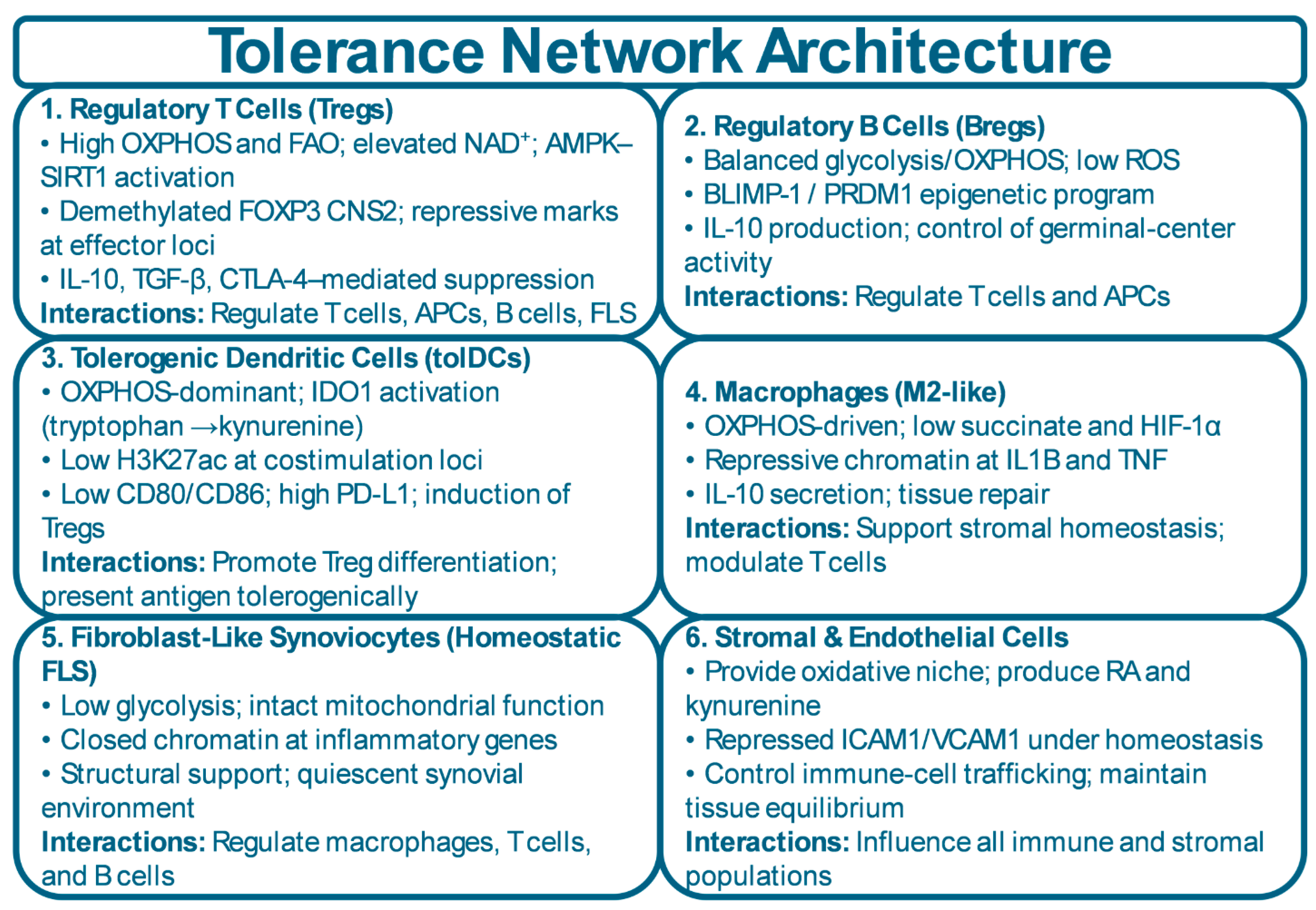
Figure 2.
Epigenetic Drift in Rheumatic Autoimmunity. This figure depicts progressive epigenetic remodeling that destabilizes immune tolerance in autoimmune rheumatic diseases. DNA methylation abnormalities include hypomethylation of inflammatory genes such as CD11a, CD70, CD40 ligand (CD40L), and interferon-stimulated genes (ISGs), alongside hypermethylation of tolerance-associated loci including FOXP3, interleukin-2 receptor alpha (IL2RA), and suppressor of cytokine signaling-1 (SOCS1). Reactive oxygen species (ROS) promote oxidation of 5-methylcytosine (5mC) to 5-hydroxymethylcytosine (5hmC), while depletion of S-adenosylmethionine (SAM) impairs methyl-donor availability. Histone modifications are characterized by increased histone H3 lysine-27 acetylation (H3K27ac) and histone H3 lysine-4 trimethylation (H3K4me3), with loss of repressive marks such as H3K27 trimethylation (H3K27me3). Metabolite-dependent regulation links elevated acetyl-coenzyme A (acetyl-CoA), reduced NAD⁺, and accumulation of succinate or fumarate to altered chromatin states. Persistent activation of transcription factors including nuclear factor kappa B (NF-κB), signal transducer and activator of transcription-1 and -3 (STAT1/3), activator protein-1 (AP-1), and BATF–IRF4 complexes entrenches inflammatory enhancer landscapes, generating stable pathogenic transcriptional memory.
Figure 2.
Epigenetic Drift in Rheumatic Autoimmunity. This figure depicts progressive epigenetic remodeling that destabilizes immune tolerance in autoimmune rheumatic diseases. DNA methylation abnormalities include hypomethylation of inflammatory genes such as CD11a, CD70, CD40 ligand (CD40L), and interferon-stimulated genes (ISGs), alongside hypermethylation of tolerance-associated loci including FOXP3, interleukin-2 receptor alpha (IL2RA), and suppressor of cytokine signaling-1 (SOCS1). Reactive oxygen species (ROS) promote oxidation of 5-methylcytosine (5mC) to 5-hydroxymethylcytosine (5hmC), while depletion of S-adenosylmethionine (SAM) impairs methyl-donor availability. Histone modifications are characterized by increased histone H3 lysine-27 acetylation (H3K27ac) and histone H3 lysine-4 trimethylation (H3K4me3), with loss of repressive marks such as H3K27 trimethylation (H3K27me3). Metabolite-dependent regulation links elevated acetyl-coenzyme A (acetyl-CoA), reduced NAD⁺, and accumulation of succinate or fumarate to altered chromatin states. Persistent activation of transcription factors including nuclear factor kappa B (NF-κB), signal transducer and activator of transcription-1 and -3 (STAT1/3), activator protein-1 (AP-1), and BATF–IRF4 complexes entrenches inflammatory enhancer landscapes, generating stable pathogenic transcriptional memory.
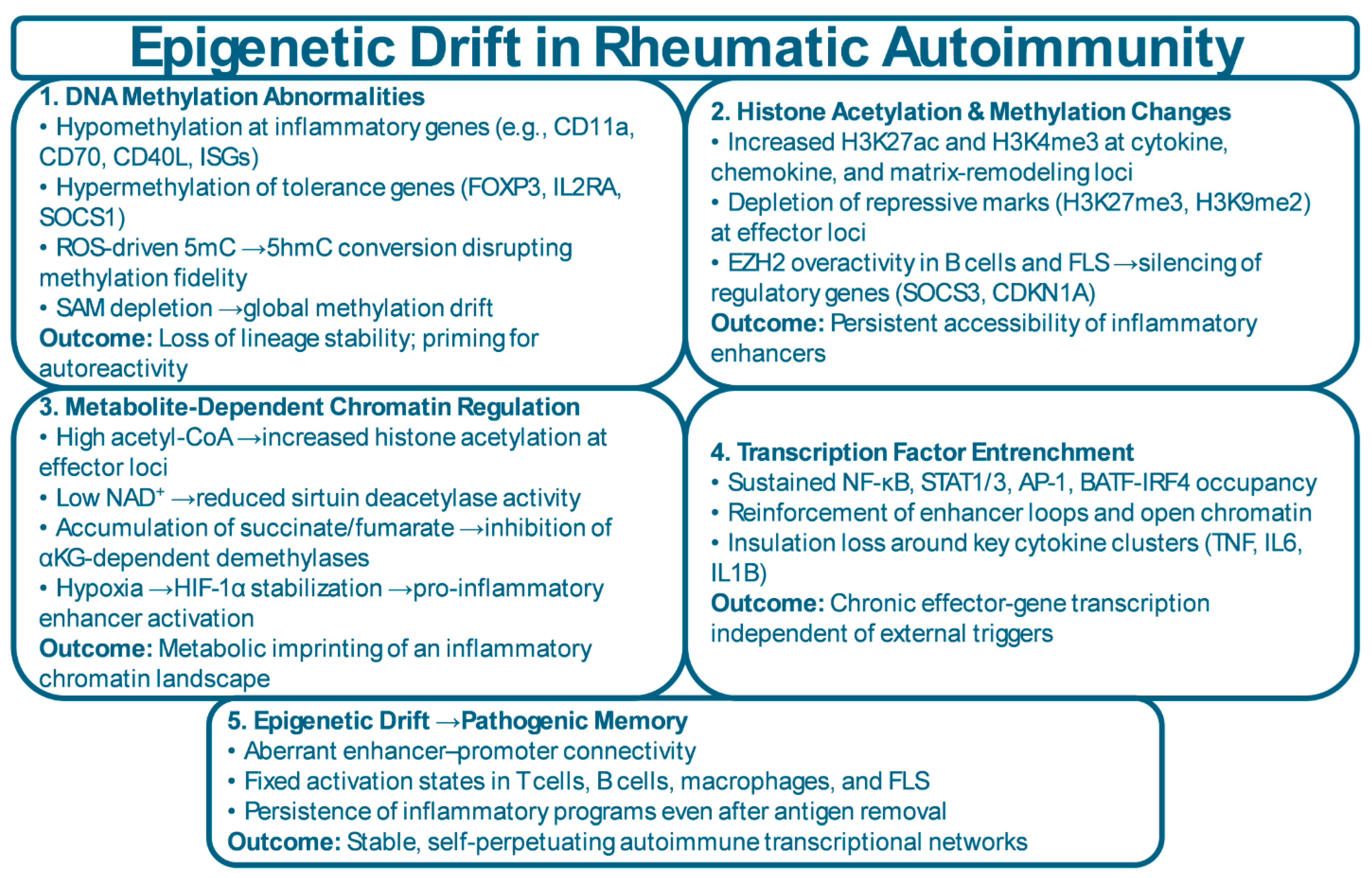
Figure 3.
Three-Dimensional Genome Reorganization and Structural Inflammatory Memory. This figure summarizes higher-order chromatin reorganization underlying persistent inflammatory gene expression. Disruption of topologically associating domain (TAD) boundaries allows merging of genomic regions containing tumor necrosis factor (TNF), interleukin-1 beta (IL1B), and C-X-C motif chemokine ligand (CXCL) gene clusters. Active (A) and inactive (B) chromatin compartment shifts reposition interferon-stimulated genes into transcriptionally permissive nuclear environments. Aberrant enhancer–promoter looping generates super-enhancer-like hubs stabilized by transcription factors such as NF-κB, STAT1/3, and BATF–interferon regulatory factor-4 (IRF4). Detachment of lamina-associated domains (LADs) from the nuclear periphery releases previously silenced loci. Cytoskeletal tension and mechanotransduction mediated through lamin A/C further reinforce pathological chromatin topology. Collectively, these 3D genome changes encode long-lasting structural inflammatory memory across T cells, B cells, macrophages, fibroblast-like synoviocytes, and endothelial cells.
Figure 3.
Three-Dimensional Genome Reorganization and Structural Inflammatory Memory. This figure summarizes higher-order chromatin reorganization underlying persistent inflammatory gene expression. Disruption of topologically associating domain (TAD) boundaries allows merging of genomic regions containing tumor necrosis factor (TNF), interleukin-1 beta (IL1B), and C-X-C motif chemokine ligand (CXCL) gene clusters. Active (A) and inactive (B) chromatin compartment shifts reposition interferon-stimulated genes into transcriptionally permissive nuclear environments. Aberrant enhancer–promoter looping generates super-enhancer-like hubs stabilized by transcription factors such as NF-κB, STAT1/3, and BATF–interferon regulatory factor-4 (IRF4). Detachment of lamina-associated domains (LADs) from the nuclear periphery releases previously silenced loci. Cytoskeletal tension and mechanotransduction mediated through lamin A/C further reinforce pathological chromatin topology. Collectively, these 3D genome changes encode long-lasting structural inflammatory memory across T cells, B cells, macrophages, fibroblast-like synoviocytes, and endothelial cells.
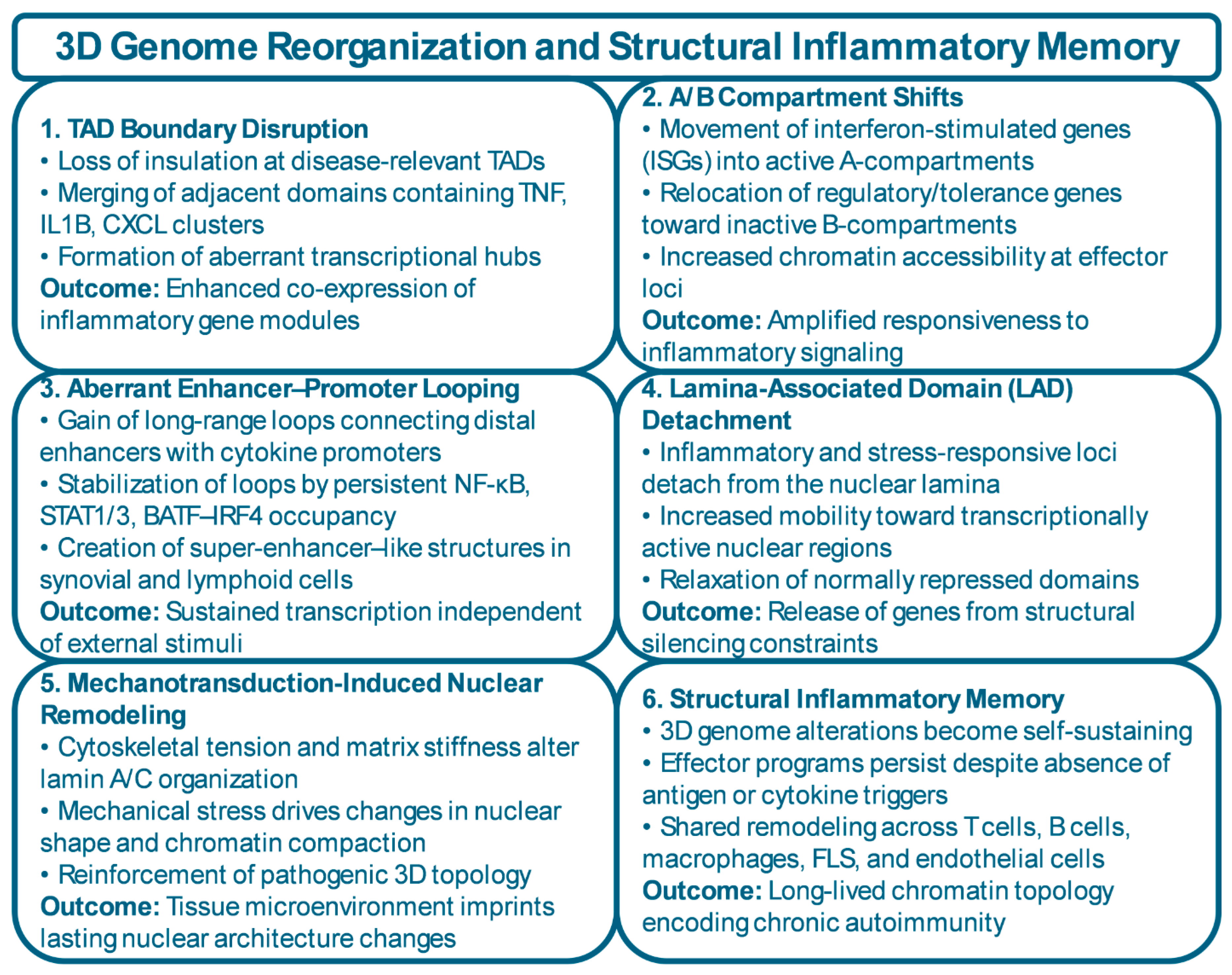
Figure 4.
Metabolic Circuits Governing Immune Cell Fate. This figure illustrates how distinct metabolic pathways dictate immune cell differentiation and function. Enhanced glycolysis, driven by glucose transporter-1 (GLUT1) and 6-phosphofructo-2-kinase/fructose-2,6-bisphosphatase-3 (PFKFB3), promotes lactate accumulation and stabilization of hypoxia-inducible factor-1 alpha (HIF-1α), favoring effector T cells, Th17 cells, inflammatory macrophages, and pathogenic fibroblast-like synoviocytes. In contrast, oxidative phosphorylation (OXPHOS) and fatty-acid oxidation (FAO) generate NAD⁺ and activate sirtuins, supporting regulatory T cells, regulatory B cells, tolerogenic dendritic cells, and M2-like macrophages. Glutaminolysis supplies alpha-ketoglutarate (αKG), influencing ten-eleven translocation (TET) enzymes and histone demethylases. One-carbon metabolism controls SAM and S-adenosylhomocysteine (SAH) balance, regulating DNA and histone methylation. Redox balance and mitochondrial integrity, governed by peroxisome proliferator-activated receptor gamma coactivator-1 alpha (PGC-1α), determine reactive oxygen species levels and chromatin fidelity. The integrated metabolic state ultimately defines immune fate and disease trajectory.
Figure 4.
Metabolic Circuits Governing Immune Cell Fate. This figure illustrates how distinct metabolic pathways dictate immune cell differentiation and function. Enhanced glycolysis, driven by glucose transporter-1 (GLUT1) and 6-phosphofructo-2-kinase/fructose-2,6-bisphosphatase-3 (PFKFB3), promotes lactate accumulation and stabilization of hypoxia-inducible factor-1 alpha (HIF-1α), favoring effector T cells, Th17 cells, inflammatory macrophages, and pathogenic fibroblast-like synoviocytes. In contrast, oxidative phosphorylation (OXPHOS) and fatty-acid oxidation (FAO) generate NAD⁺ and activate sirtuins, supporting regulatory T cells, regulatory B cells, tolerogenic dendritic cells, and M2-like macrophages. Glutaminolysis supplies alpha-ketoglutarate (αKG), influencing ten-eleven translocation (TET) enzymes and histone demethylases. One-carbon metabolism controls SAM and S-adenosylhomocysteine (SAH) balance, regulating DNA and histone methylation. Redox balance and mitochondrial integrity, governed by peroxisome proliferator-activated receptor gamma coactivator-1 alpha (PGC-1α), determine reactive oxygen species levels and chromatin fidelity. The integrated metabolic state ultimately defines immune fate and disease trajectory.
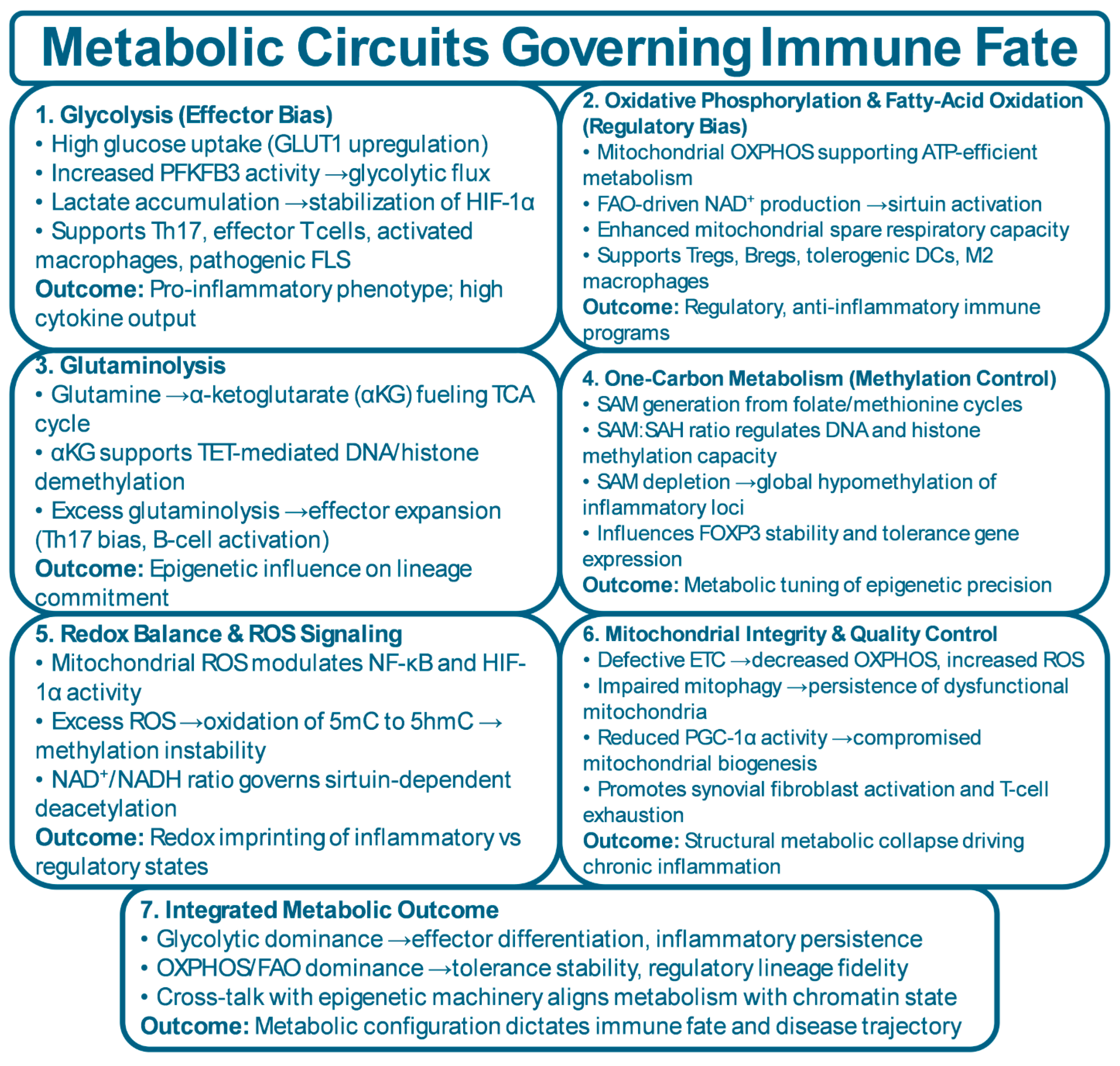
Figure 5.
The Unified Epigenetic–Metabolic Tolerance Axis. This figure presents an integrated model linking cellular metabolism with epigenetic regulation to control immune tolerance. Metabolites such as acetyl-CoA, α-ketoglutarate, succinate, fumarate, NAD⁺, short-chain fatty acids (SCFAs), and microbiome-derived tryptophan metabolites directly regulate chromatin-modifying enzymes. Histone acetyltransferases (HATs), histone deacetylases (HDACs), histone methyltransferases (HMTs), TET enzymes, and sirtuins respond to metabolic and redox cues, shaping chromatin accessibility. These changes stabilize transcriptional programs driven by NF-κB, STAT1/3, interferon regulatory factors (IRFs), and HIF-1α in inflammatory states, or FOXP3, BLIMP-1, and PGC-1α in regulatory states. Nuclear–mitochondrial signaling integrates reactive oxygen species and NAD⁺-dependent feedback loops, while paracrine metabolite exchange between immune, stromal, and endothelial cells synchronizes tissue-level tolerance or inflammation.
Figure 5.
The Unified Epigenetic–Metabolic Tolerance Axis. This figure presents an integrated model linking cellular metabolism with epigenetic regulation to control immune tolerance. Metabolites such as acetyl-CoA, α-ketoglutarate, succinate, fumarate, NAD⁺, short-chain fatty acids (SCFAs), and microbiome-derived tryptophan metabolites directly regulate chromatin-modifying enzymes. Histone acetyltransferases (HATs), histone deacetylases (HDACs), histone methyltransferases (HMTs), TET enzymes, and sirtuins respond to metabolic and redox cues, shaping chromatin accessibility. These changes stabilize transcriptional programs driven by NF-κB, STAT1/3, interferon regulatory factors (IRFs), and HIF-1α in inflammatory states, or FOXP3, BLIMP-1, and PGC-1α in regulatory states. Nuclear–mitochondrial signaling integrates reactive oxygen species and NAD⁺-dependent feedback loops, while paracrine metabolite exchange between immune, stromal, and endothelial cells synchronizes tissue-level tolerance or inflammation.
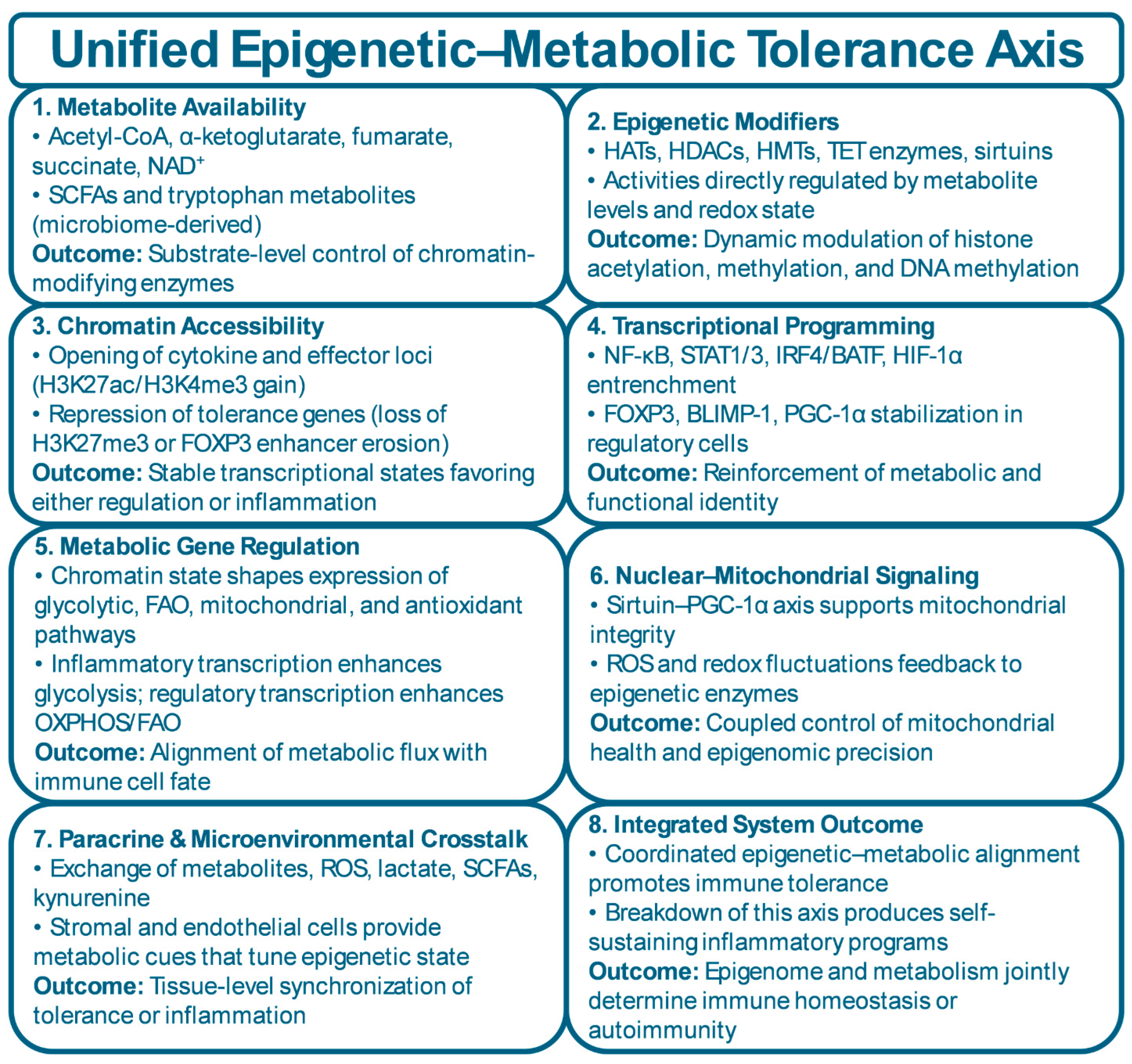
Figure 6.
Translational Roadmap for Tolerance Reprogramming. This figure outlines therapeutic strategies aimed at restoring immune tolerance through metabolic and epigenetic reprogramming. Interventions include metabolic modulators such as AMP-activated protein kinase (AMPK) activators, nicotinamide adenine dinucleotide (NAD⁺) precursors, peroxisome proliferator-activated receptor (PPAR) agonists, and mammalian target of rapamycin (mTOR) inhibitors to re-establish mitochondrial fitness and oxidative metabolism. Epigenetic therapies encompass bromodomain and extra-terminal domain (BET) inhibitors, histone deacetylase (HDAC) inhibitors, and enhancer of zeste homolog-2 (EZH2) inhibitors to reshape pathogenic chromatin landscapes. Cell-based approaches include chimeric antigen receptor regulatory T cells (CAR-Tregs), tolerogenic dendritic cells (tolDCs), and metabolically conditioned regulatory lymphocytes. Integrated biomarker frameworks incorporating chromatin accessibility, mitochondrial function, cytokine signatures, and metabolic profiling guide precision patient stratification. Together, these strategies define a translational pathway toward durable, drug-free immune tolerance.
Figure 6.
Translational Roadmap for Tolerance Reprogramming. This figure outlines therapeutic strategies aimed at restoring immune tolerance through metabolic and epigenetic reprogramming. Interventions include metabolic modulators such as AMP-activated protein kinase (AMPK) activators, nicotinamide adenine dinucleotide (NAD⁺) precursors, peroxisome proliferator-activated receptor (PPAR) agonists, and mammalian target of rapamycin (mTOR) inhibitors to re-establish mitochondrial fitness and oxidative metabolism. Epigenetic therapies encompass bromodomain and extra-terminal domain (BET) inhibitors, histone deacetylase (HDAC) inhibitors, and enhancer of zeste homolog-2 (EZH2) inhibitors to reshape pathogenic chromatin landscapes. Cell-based approaches include chimeric antigen receptor regulatory T cells (CAR-Tregs), tolerogenic dendritic cells (tolDCs), and metabolically conditioned regulatory lymphocytes. Integrated biomarker frameworks incorporating chromatin accessibility, mitochondrial function, cytokine signatures, and metabolic profiling guide precision patient stratification. Together, these strategies define a translational pathway toward durable, drug-free immune tolerance.
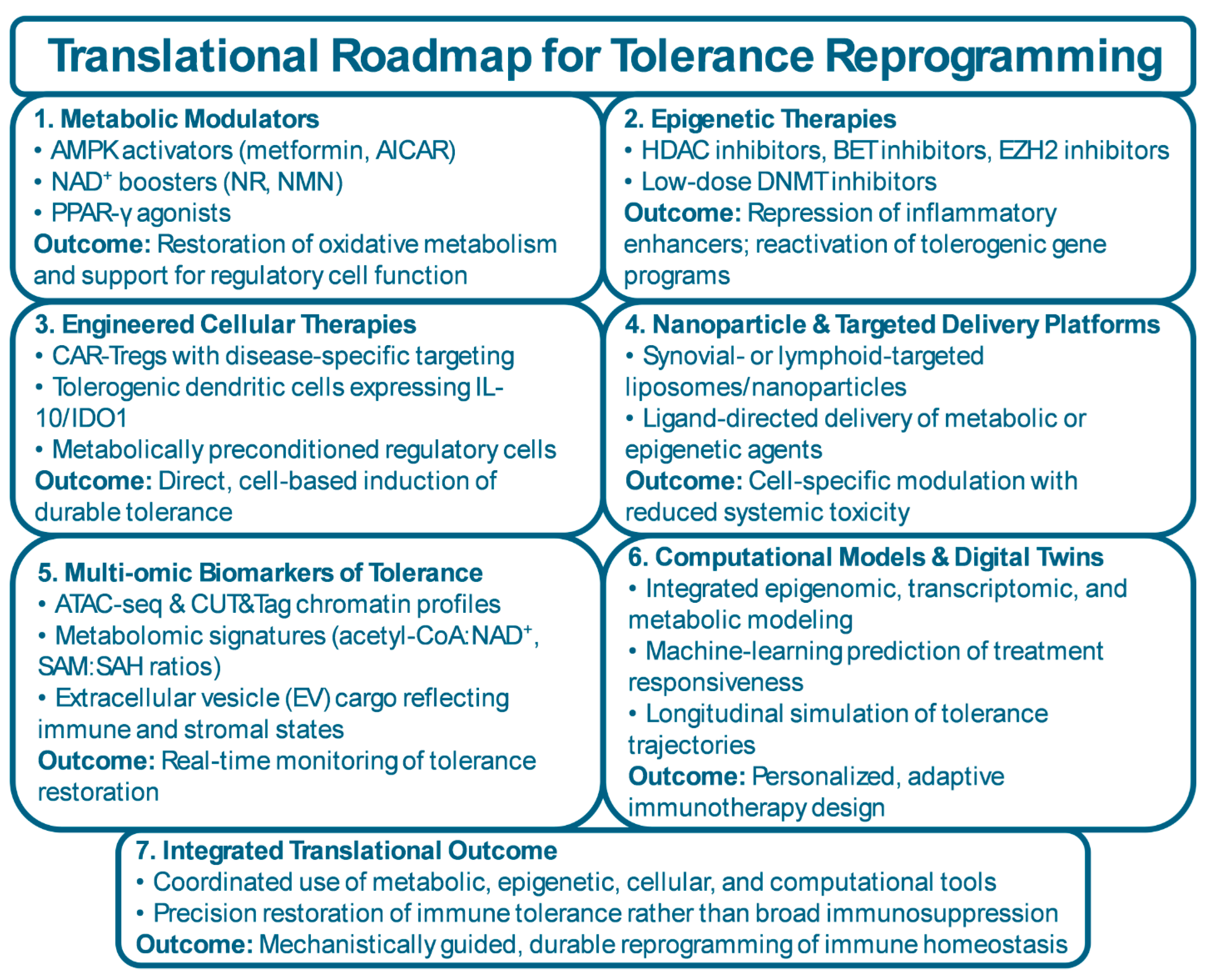

Table 1.
Tolerance Cell Types and Their Regulatory Mechanisms.
| Cell Type | Metabolic Program | Epigenetic Program | Key Tolerance Function | Breakdown in Disease | References |
| Regulatory T Cells (Tregs) | High OXPHOS and FAO; elevated NAD⁺; AMPK–SIRT1 activation | FOXP3 CNS2 demethylation; repressive histone marks at effector loci | Suppress effector T cells; produce IL-10 and TGF-β; maintain immune homeostasis | FOXP3 enhancer erosion; glycolytic shift; reduced NAD⁺/sirtuin activity → instability and conversion to effector-like cells | [13,38] |
| Regulatory B Cells (Bregs) | Balanced glycolysis/OXPHOS; low ROS | BLIMP-1 / PRDM1–driven chromatin program | IL-10 production; control of germinal-center reactions; restraint of autoantibody formation | Oxidative stress; loss of BLIMP-1 stability; shift toward plasma-cell or inflammatory B-cell fates | [39,40] |
| Tolerogenic Dendritic Cells (tolDCs) | OXPHOS-dominant; IDO1 activation; kynurenine pathway | Low H3K27ac at costimulatory loci; tolerogenic enhancer profile | Induce Tregs; present antigen with low costimulation; promote peripheral tolerance | Upregulation of CD80/CD86; loss of IDO1 activity; switch to glycolytic, pro-inflammatory DC phenotype | [41,42,43] |
| M2-like Macrophages | OXPHOS-driven; low succinate; low HIF-1α | Repressive chromatin at IL1B, TNF, and inflammatory loci | Tissue repair; IL-10 secretion; clearance of apoptotic cells | Succinate accumulation; HIF-1α activation; shift to M1-like inflammatory macrophages | [44,45,46] |
| Homeostatic Fibroblast-Like Synoviocytes (FLS) | Low glycolysis; intact mitochondrial function | Closed chromatin at inflammatory genes; retinoic-acid responsive regulatory enhancers | Maintain quiescent synovial environment; structural integrity; anti-inflammatory metabolite release | Increased glycolysis; EZH2-driven repression of regulatory genes; acquisition of invasive, inflammatory FLS phenotype | [47,48,49] |
| Stromal & Endothelial Cells | Provide oxidative tissue niche; produce RA, kynurenine | Repressed ICAM1/VCAM1 under homeostasis | Regulate immune-cell trafficking; sustain tissue-level equilibrium | Mechanical stress, hypoxia, and cytokines induce chromatin opening → increased adhesion molecules and inflammatory recruitment | [50,51] |
Table 2.
Metabolic Pathways → Chromatin Effects → Immune Fate Outcomes.
| Pathway | Key Metabolite | Chromatin Effect | Immune Fate Effect | Disease Context | References |
| Glycolysis | Lactate, pyruvate | Increased H3K27ac via acetyl-CoA availability; HIF-1α–driven enhancer activation | Promotes Th17 differentiation, effector T-cell expansion, inflammatory macrophages, invasive FLS | RA synovium shows high glycolytic flux; Th17–FLS inflammatory loops | [11,132,151] |
| Oxidative Phosphorylation (OXPHOS) | NAD⁺, ATP | Sirtuin-dependent histone deacetylation; repression of effector loci; maintenance of FOXP3 enhancer integrity | Supports Tregs, Bregs, tolerogenic DCs, and M2 macrophages | NAD⁺ depletion in RA/SLE reduces Treg stability and mitochondrial fitness | [59,152,153] |
| Fatty-Acid Oxidation (FAO) | Acetyl-CoA, NADH | Promotes SIRT1/3 activity; enhances repressive chromatin landscapes | Stabilizes Treg phenotype; supports long-lived regulatory programs | FAO impairment contributes to Treg instability in autoimmunity | [59,154,155] |
| Glutaminolysis | α-Ketoglutarate (αKG) | αKG supports TET-mediated DNA/histone demethylation; maintains open chromatin at regulatory genes | Enables Treg and Breg epigenetic stability; excessive glutaminolysis drives effector expansion | High glutamine flux in RA FLS; αKG dysregulation affects Treg tolerance | [156,157,158] |
| One-Carbon Metabolism | SAM, SAH | SAM availability regulates DNA/histone methylation; SAM depletion causes global hypomethylation | Controls FOXP3 methylation status; impacts lineage fidelity | SAM:SAH imbalance seen in RA and SLE; influences T-cell differentiation | [159,160] |
| Redox/ROS Regulation | ROS, NAD⁺/NADH | ROS oxidizes 5mC → 5hmC; alters methylation fidelity; NAD⁺ levels dictate sirtuin activity | High ROS favors inflammatory programs; balanced redox supports regulatory phenotypes | Excess ROS in RA/SLE fuels inflammatory memory in T cells and macrophages | [161,162,163] |
| TCA Cycle Dysfunction | Succinate, fumarate | Succinate/fumarate inhibit αKG-dependent demethylases → hyperacetylated, pro-inflammatory chromatin | Enhances IL-1β, TNF expression and effector persistence | Elevated succinate in RA macrophages drives pathologic cytokine output | [44,164] |
| Mitochondrial Integrity & Mitophagy | PGC-1α, NAD⁺ | Healthy mitochondria support epigenetic precision; dysfunctional mitochondria increase ROS & chromatin noise | Supports Treg stability and prevents exhaustion; dysfunction drives inflammatory cell fate | Mitochondrial fragmentation in FLS and T cells reinforces chronic inflammation | [165,166,167] |
Table 3.
Therapeutic Classes, Mechanisms, and Stage of Development.
| Modality | Target Pathway (metabolic / epigenetic / cellular) | Mechanism of Tolerance Reprogramming | Disease Evidence | Stage (Preclinical / Phase I / Phase II / Clinical Use) | References |
| AMPK Activators (e.g., metformin, AICAR) | Metabolic | Restore OXPHOS, reduce glycolysis, lower ROS; support Treg survival and mitochondrial fitness | RA, SLE, vasculitis (immunometabolic and clinical data) | Clinical use (repurposed); formal tolerance-focused trials mostly Phase II / exploratory | [212,213] |
| NAD⁺ Boosters (NR, NMN, nicotinamide) | Metabolic | Increase NAD⁺ → enhance sirtuin activity; promote histone deacetylation; improve mitochondrial quality and regulatory-cell stability | Preclinical models of arthritis, lupus, and inflammatory aging | Preclinical; early human studies in metabolic/aging contexts | [214,215,216] |
| PPAR-γ Agonists (e.g., pioglitazone) | Metabolic | Reprogram lipid metabolism; suppress NF-κB; favor oxidative and anti-inflammatory phenotypes in immune and stromal cells | Experimental arthritis and fibrosis models; limited rheumatic clinical data | Clinical use in diabetes; preclinical/early translational in rheumatology | [215,217] |
| HDAC Inhibitors | Epigenetic | Increase histone acetylation at regulatory loci; enhance Treg function; compress inflammatory chromatin accessibility | Arthritis and lupus models; small early-phase human data | Preclinical and Phase I/II | [218,219] |
| BET Inhibitors | Epigenetic | Disrupt BRD4/super-enhancer complexes at TNF, IL6, CXCL loci; reduce sustained inflammatory transcription | Preclinical RA and tissue-inflammation models | Preclinical; some early oncology trials, limited immune-tolerance trials | [118,220,221] |
| EZH2 Inhibitors | Epigenetic | Reduce H3K27me3 at silenced regulatory genes (e.g., SOCS3, CDKN1A); relieve repression of tolerogenic programs | B cells and FLS in RA and SLE; strong preclinical rationale | Preclinical and early clinical (mainly oncology); rheumatic use exploratory | [119,222] |
| Low-Dose DNMT Inhibitors | Epigenetic | Partially reverse pathological DNA hypermethylation at tolerance genes; re-open FOXP3 and IL10 loci | Preclinical models of autoimmunity; conceptual alignment with epigenetic drift data | Preclinical; early clinical experience in oncology | [223,224] |
| CAR-Tregs | Cellular | Antigen-specific suppression at inflamed sites; stable FOXP3 expression and local IL-10/TGF-β delivery | Strong preclinical efficacy in arthritis, colitis, transplantation models | Preclinical; early Phase I trials in other immune contexts | [225,226] |
| Tolerogenic Dendritic Cells (tolDCs) | Cellular | Present self-antigen with low costimulation; induce and expand Tregs; dampen effector priming | Phase I/II trials in RA and other autoimmune diseases showing safety and biological activity | Phase I / Phase II | [227,228] |
| MSC-Based and EV-Based Therapies | Cellular / Paracrine | Deliver tolerogenic cytokines, metabolites, and miRNAs; remodel immune and stromal metabolic–epigenetic states | Early trials in RA, SLE, and systemic sclerosis; preclinical evidence of regulatory reprogramming | Phase I / Phase II; some compassionate/controlled clinical use | [229,230] |
| Nanoparticle-Targeted Metabolic/Epigenetic Agents | Delivery / Metabolic / Epigenetic | Cell- or tissue-specific delivery of metabolic/epigenetic drugs to synovium or lymphoid organs; limit systemic toxicity | Robust preclinical data in arthritis and systemic inflammation | Preclinical | [231,232] |
| Integrated Multi-omic / Digital-Twin–Guided Regimens | Systems / Computational | Use epigenomic, transcriptomic, and metabolomic signatures to tailor and adapt tolerance-reprogramming therapies over time | Emerging computational and pilot translational studies | Conceptual and early translational; not yet in routine clinical practice | [233,234,235] |
Disclaimer/Publisher’s Note: The statements, opinions and data contained in all publications are solely those of the individual author(s) and contributor(s) and not of MDPI and/or the editor(s). MDPI and/or the editor(s) disclaim responsibility for any injury to people or property resulting from any ideas, methods, instructions or products referred to in the content. |
© 2025 by the authors. Licensee MDPI, Basel, Switzerland. This article is an open access article distributed under the terms and conditions of the Creative Commons Attribution (CC BY) license (http://creativecommons.org/licenses/by/4.0/).
Copyright: This open access article is published under a Creative Commons CC BY 4.0 license, which permit the free download, distribution, and reuse, provided that the author and preprint are cited in any reuse.


