

Submitted:
29 December 2025
Posted:
31 December 2025
You are already at the latest version
Abstract
Travel-associated Legionnaires’ disease (TALD) events can generate public concern when environmental surveillance findings are communicated without adequate ex-planation of the results. This study examined how surveillance data on Legionella spp. were framed and amplified during a TALD-related investigation in Crete, Greece, between June and July 2025. A mixed infodemiology and environmental surveillance approach was applied, including analysis of 95 online media items across nine lan-guages, Google Trends search-interest data, and hotel water-system surveillance data from epidemiologically linked facilities. Sampling conducted in a limited number of hotels associated with TALD cases indicated that approximately 50% of water samples exceeded the laboratory reporting limit of ≥50 CFU/L, a numerically correct but con-text-specific finding. Numerical misframing occurred in 83.7%, 41.7%, and 18.2% of Greek, German, and English language items, respectively, with significant differences across language markets (χ² (8) = 43.75, p < 0.0001; Cramér’s V = 0.679). Public search-interest signals were transient and geographically limited. Environmental sur-veillance showed no increase in Legionella pneumophila risk, with similar proportions of samples ≥50 CFU/L in the pre-/peri-infodemic (Jan–Jul 2025) and post-infodemic (Aug–Nov 2025) periods (23.11% [95% CI: 18.21–28.87] vs. 24.45% [19.34–30.41]) and similar exceedance of ≥1000 CFU/L (13.45% [9.69–18.36] vs. 14.41% [10.45–19.55]). Overall, loss of contextual interpretation of surveillance results and conflation of laboratory re-porting limits with regulatory thresholds were associated with inconsistent public risk perception, without evidence of increased environmental hazard.
Keywords:
Legionella
; travel-associated Legionnaires' disease
; infodemiology
; malinformation
; misinformation
; risk communication
; Crete
; numerical misframing
1. Introduction
Legionnaires’ disease (LD) is a severe form of pneumonia primarily caused by Legionella pneumophila, an aquatic Gram-negative opportunistic bacterium that colonizes engineered water systems and is transmitted through the inhalation of contaminated aerosols. Travel-associated Legionnaires’ disease (TALD) presents a distinct public health challenge, as exposure often occurs outside the country of diagnosis, complicating epidemiological attribution and response. Given the ubiquity of Legionella spp. in building water systems, particularly in complex tourism-related premises such as hotels, cruise ships, and other large accommodation facilities, where periods of reduced occupancy, limited system operation, and disrupted routine controls during the COVID-19 pandemic favored the development of microbial colonization, the subsequent resumption of normal activity in the post-pandemic period revealed pre-existing system vulnerabilities. In this context, the interpretation of environmental surveillance results is critically dependent on regulatory thresholds, sampling frameworks, and exposure context, as inadequate communication of these parameters may lead to suboptimal risk management decisions and distorted public perception of risk [1,2,3,4,5,6,7,8,9,10,11,12,13,14,15,16,17].
Beyond microbiological risk and clinical response, contemporary public health events unfold within an ecosystem of rapid and amplified information circulation. Infodemiology, originally introduced by Eysenbach to describe the study of information distribution and determinants in digital environments, has evolved into a core component of the World Health Organization (WHO) infodemic management framework [18,19,20].
Within this framework, misinformation refers to false or inaccurate information shared without intent to cause harm; disinformation denotes deliberately fabricated or manipulated content; and malinformation describes factually correct information presented without essential contextual qualifiers in ways that mislead public understanding and erode institutional trust. This distinction is particularly relevant for environmental surveillance, where numerically correct findings may become misleading when they are detached from their outbreak-specific sampling frame, a phenomenon commonly described as loss of denominator or loss of sampling-frame context [21,22,23,24].
The dynamics discussed are particularly pertinent in regions reliant on tourism, where localized public health incidents can swiftly gain international attention. In these contexts, media amplification may exceed the actual epidemiological significance of an event, thereby affecting traveler behavior, regulatory measures, and institutional trust. Given its extensive tourism infrastructure and international connectivity, Greece, and specifically Crete, exemplifies a setting where localized health signals are highly vulnerable to cross-border information amplification [25,26,27,28,29,30].
This vulnerability was exemplified by a severe TALD case in Crete in 2025, requiring admission to the intensive care unit (ICU) and mechanical ventilation, which attracted extensive media attention. Prior to this disclosure, epidemiological investigations had already been conducted in several TALD-linked hotels but had not been publicly communicated in order to avoid undue public concern. Following media reporting of the case, public health authorities referenced these previously collected findings, including that approximately 50% of samples exceeded the laboratory reporting limit of ≥50 CFU/L as part of routine surveillance for Legionella spp., in order to prompt heightened vigilance among hotel operators. Although numerically accurate, this context-dependent information was subsequently misinterpreted and amplified in media narratives as evidence of generalized contamination, omitting the restricted sampling frame and conflating laboratory reporting limits with regulatory action thresholds, thereby initiating an infodemic centered on "50% positivity" [31,32,33,34].
Crete ranks among Greece's most prominent tourist destinations, accommodating 1,643 hotel units that encompass 196,877 beds and 99,592 rooms, with a significant proportion of these being three-, four-, and five-star establishments. This concentration of large-scale accommodation facilities not only enhances the technical complexity of hotel water systems but also increases the public visibility of any health-related signals detected through environmental surveillance, thereby amplifying the potential impact of numerical misframing in public discourse [35,36].
The expansion of this numerically framed narrative extended beyond media discourse, leading to parliamentary scrutiny and the issuance of a dedicated national circular to clarify the interpretation of surveillance and regulatory practices. Consequently, this episode serves as a well-defined case study to investigate how epidemiologically restricted environmental surveillance findings, referenced in public communication following media reporting of the ICU case, can be transformed into disproportionate public risk narratives through the loss of epidemiological and regulatory contexts. This study aims to (i) characterize the multilingual media amplification and typology of numerical misframing associated with the "50% positivity" narrative, (ii) examine the temporal relationship between media output and public information-seeking behavior, and (iii) contextualize these communication dynamics against longitudinal environmental surveillance data from TALD-linked hotels before and after the infodemic period.
2. Materials and Methods
2.1. Study Design and Trigger Events
This mixed quantitative–qualitative infodemiology and environmental surveillance study focused exclusively on hotel water systems in Crete, Greece, which were linked to at least one TALD case in 2025 and inspected by the regional public health authorities of Crete following official notification from the European Centre for Disease Prevention and Control (ECDC) and the National Public Health Organization (NPHO).
The trigger event was the admission of a traveler with severe TALD to an ICU requiring mechanical ventilation in Crete. Following media disclosure of the ICU admission, public reporting referred to environmental inspection findings that had been conducted up to that point as part of routine surveillance, indicating that approximately 50% of collected water samples exceeded the laboratory reporting limit (≥50 CFU/L) for Legionella spp. These findings were publicly cited in conjunction with the severe clinical outcome, reinforcing the message that increased attention and vigilance were warranted, rather than reflecting results derived from newly initiated inspections. This numerically correct but context-dependent finding was subsequently generalized in public communication and media coverage into broader claims, including assertions that "50% of hotel water in Crete" or "50% of pool water in Crete" was contaminated, and in some reports was incorrectly attributed to domestic split-unit air-conditioning systems, reviving the misnomer "air-conditioner disease".
2.2. Media Corpus
A structured multilingual search strategy was applied using combinations of the terms “Legionella”, “Crete”, “hotel(s)”, “pool(s)” and “50%”, and equivalent phrases, using general web search engines. The primary search window covered June 15 to July 15, 2025, to capture the main amplification burst, and additional eligible items linked to the same event (e.g., later institutional, legal, advisory or explanatory coverage) were included when retrieved during screening and snowballing. The final corpus spanned April 1 to November 1, 2025 .
Items were eligible if they (i) explicitly referred to Legionella in hotels or swimming pools in Crete and (ii) either reproduced or interpreted the “50% positivity” figure, or if they provided case-focused, institutional, legal or explanatory coverage of the same event without numerical amplification. Duplicate URLs, mirrored republications of identical content, and inaccessible paywalled items without full text were excluded.
The final, deduplicated corpus comprised 95 unique online items that were locked prior to the analysis.
2.3. Content Analysis and Infodemic Typology
Qualitative content analysis was performed using a structured codebook adapted from the WHO’s infodemic-management typology. Each item was coded separately at the headline and the body-text level into one of four operational categories used in this study: accurate; malinformation (numerically correct claims presented without essential contextual qualifiers, such as the targeted, case-linked sampling frame); misinformation (factually incorrect or misleading statements disseminated without demonstrable intent to deceive), and disinformation (false or misleading content deliberately fabricated, manipulated, or strategically framed with the intent to mislead or cause harm, as evidenced by source patterns, repetition, or coordination) [37,38,39,40].
Additional coding assessed whether items distinguished indicators from regulatory thresholds, acknowledged that the “50% positivity” figure derived from sampling in epidemiologically linked hotels, referred to hotels, pools or both, revived the “air-conditioner disease” misnomer, or cited or contradicted official public health or scientific sources. The codebook was applied by two independent coders following the initial calibration. Intercoder agreement was assessed using Cohen’s kappa coefficient [41].
2.4. Published Hotel Surveillance Data
Published environmental surveillance data from hotels in Crete were used to contextualize the “50% positivity” figure reported before the infodemic onset. These data confirm hotel-specific findings from TALD-associated facilities and originate our prior study, which reported Legionella colonization patterns in Cretan hotels based on sampling rounds conducted between March 2020 and March 2025.
However, for the purposes of the present analysis, the 2025 environmental dataset was organized into three analytically distinct subsets reflecting investigation context and timeline: (i) an early-2025 subset from epidemiologically linked hotels (4 hotels; 157 water samples), (ii) a pre-/peri-infodemic period (January–July 2025; 7 hotels; 238 water samples), and (iii) a post-infodemic period (August–November 2025; 12 hotels; 229 valid water samples). These samples were collected using standardized potable-water and building-water protocols aligned with European technical guidance for Legionella prevention and control, analyzed by culture according to ISO 11731:2017 (laboratory reporting limit: 50 CFU/L) by the Regional Public Health Laboratory of Crete, and classified into three standard concentration bands (<50, 50–999, and ≥1000 CFU/L) [42]. Notably, the early-2025 subset reflects case-triggered investigations in epidemiologically linked hotels, in which 59.23% of samples were reported at or above the laboratory reporting limit (≥50 CFU/L), consistent with expectations for epidemiologically linked hotel settings rather than population-level routine surveillance.
Next, in our previous study additional contextual information was provided, which described Legionella colonization patterns in TALD-associated hotels in Crete across multiple years and demonstrated that positivity is typically higher in case-triggered sampling than in routine monitoring [33]. These findings are cited here solely to contextualize long-term trends in hotel positivity and to clarify that elevated positivity levels are an expected feature of epidemiologically linked hotels, rather than an indication of island-wide conditions.
These published data are cited here to contextualize positivity patterns in TALD-associated and epidemiologically linked hotels and to clarify the distinction between (i) routine environmental surveillance findings and (ii) increased positivity in epidemiologically linked hotels. The latter serves as the basis for the numerically accurate—but contextually misinterpreted— “50% positivity” figure that was subsequently amplified in media reports.
2.5. Post-infodemic Hotel Surveillance
Environmental investigations in hotels epidemiologically linked to TALD cases were already ongoing as part of public health response activities and continued throughout 2025, up to November 2025, including during and after the period of intense media attention. These inspections were not initiated because of the infodemic, nevertheless represented the continuation of routine control measures implemented as part of routine public health control measures following TALD case notification.
The resulting post-infodemic analytical subset comprised 229 valid water samples collected from 12 hotels in Crete between August and November 2025. Sampling sites included storage tanks, hot-water boilers, showers, room taps, and pools or spa outlets. Samples were collected in sterile 1L containers containing sodium thiosulfate and handled according to established procedures for potable water and building water sampling, aligned with the European Technical Guidelines for the Prevention, Control, and Investigation of Infections Caused by Legionella spp.
The free residual chlorine and hot and cold water temperatures were measured on-site using calibrated portable instruments immediately after collection. The sampling location, outlet characteristics, and basic system descriptors of each sample were recorded. The samples were transported at 5 ± 3 °C and processed within 24 hours in the Regional Public Health Laboratory of Crete.
The microbiological analysis followed the ISO 11731:2017 culture method. The water samples were concentrated by membrane filtration, and the concentrates were inoculated onto selective and non-selective media and incubated at 36 ± 1 °C under humid, CO2-enriched conditions. Presumptive Legionella colonies were confirmed using the standard phenotypic criteria and MALDI-TOF mass spectrometry. Similar to the pre-infodemic datasets, Legionella positivity was defined as detection at or above the laboratory reporting limit of 50 CFU/L, with a second dichotomous variable identifying samples ≥1000 CFU/L, corresponding to the regulatory action threshold [26].
2.6. Statistical Analysis and Regulatory/Communication Timelines
Descriptive statistical methods were applied to the environmental and infodemiology components. For the environmental datasets, positivity was defined as the proportion of water samples with Legionella counts ≥50 CFU/L and ≥1000 CFU/L. Wilson 95% confidence intervals (CIs) were calculated for these proportions in the post-infodemic dataset. Given the observational design, comparisons between pre-/peri-infodemic hotel findings (January–July 2025) and post-infodemic sampling were presented using tables and graphical summaries, without multivariable modeling.
For the infodemiology component, media-item frequencies and normalized search-interest indices were summarized descriptively. Media reporting, official public health communications, and key regulatory actions were mapped over time and aligned with major milestones (Figure 1). Where appropriate, exploratory chi-squared tests were used to compare the prevalence of distorted numerical framing across language groups. No proprietary media monitoring or social listening platform was used; only freely available tools (Google Search, Google News, Google Trends) and manual keyword-based searches of open online media and social platforms were used.
Statistical analyses were performed using IBM SPSS Statistics v30.0 (IBM Corp., Armonk, NY, USA) and Epi Info v7.2.7.0 (Centers for Disease Control and Prevention, Atlanta, GA, USA).
3. Results
3.1. Media Amplification of the Narrative of “50% Positivity”
Between June 15 and November 1, 2025, a total of 95 unique online items across nine languages reproduced or contextualized the “50% positivity” narrative, where 59.23% of water samples (93/157) exceeded the ≥50 CFU/L laboratory reporting limit following the ICU hospitalization of a British tourist in Crete, Greece, which led to public reference to environmental findings from epidemiologically linked hotels already under investigation.
Across the full corpus (n = 95), using the predefined infodemic typology applied separately to headlines and body text and summarized as the “worst case” classification per item, 49/95 (51.6%) were classified as accurate, 41/95 (43.2%) as malinformation, and 5/95 (5.3%) as misinformation.
The corpus was dominated by Greek language sources (45.3%, n = 43). Among the Greek items, the overall (worst case) classification was malinformation (32/43, 74.4%), misinformation (4/43, 9.3%), and accuracy (7/43, 16.3%). German language amplification accounted for 12.6% (n = 12), with 41.7% malinformation (5/12) and 58.3% accuracy (7/12). English language items (UK) accounted for 23.2% (n = 22) and were predominantly accurate (18/22, 81.8%) with limited numerical distortion (3/22, 13.6% malinformation; 1/22, 4.5% misinformation). HE items accounted for 4.2% (n = 4) with limited uptake (1/4, 25.0% malinformation; 3/4, 75.0% accurate). The other languages showed limited uptake and were largely accurate (Table 1).
3.2. Temporal Amplification Dynamics
Media activity showed a highly concentrated early burst, with a clear language specific timing pattern. In the Greek language corpus (EL), publication volume peaked on June 19, 2025 (n = 28 items/day), preceded by less activity on June 17–18 (n = 4 items/day), followed by residual output on June 20, 2025 (n = 3). German language coverage (DE) peaked on June 22–23, 2025 (n = 2 items/day). English language coverage (UK) exhibited a short-lived burst peaking on June 20, 2025 (n = 5 items/day), with a secondary rise on June 23, 2025 (n = 4 items/day), consistent with patient-centric spillover rather than sustained numerical pickup.
When aligned with Google Trends peak search interest (used here as a proxy of audience attention/ “readership”), the search peak in Greece occurred four days after the Greek media peak (June 23, 2025, vs. June 19, 2025), suggesting delayed conversion of media exposure into active information seeking. In Germany, the search peak (June 22, 2025) coincided with the onset of the German media peak window (June 22–23, 2025), indicating a near-synchronous amplification. In the UK, search interest peaked substantially later (July 5, 2025), that is, 15 days after the English language media peak (June 20, 2025), consistent with the attention driven by subsequent case related developments rather than the numerical claim itself (Table 2).
3.3. Source Categorization Across Infodemic Typology Categories
Across the corpus, malinformation was characterized by reproduction of the “50%” figure without explicit reference to the targeted, sampling conducted in epidemiologically linked hotels. At the title level, titles were 61.1% accurate (58/95), 34.7% malinformation (33/95), and 4.2% misinformation (4/95), whereas content level classification showed 53.7% accurate (51/95), 43.2% malinformation (41/95), and 3.2% misinformation (3/95).
Headline and body-text classifications were concordant for 82/95 (86.3%) items. Discordance occurred in 13/95 (13.7%), most commonly reflecting accurate headlines paired with malinformative body text (eight items), indicating that contextual qualifiers in titles did not consistently carry into the narrative framing of the full article (Table 3).
3.4. Infodemic Containment Pattern
The cross-language pickup showed a clear containment gradient. Distorted numerical framing (malinformation plus misinformation; “worst case” item-level classification) was the highest in the original language market (Greek: 36/43, 83.7%), decreased in German (5/12, 41.7%), and remained limited to English language coverage (UK: 4/22, 18.2%) and Hebrew-language pickup (1/4, 25.0%). In the remaining languages represented in the corpus (Italian, French, Danish, Norwegian, and Swedish), no distorted numerical pickup was observed (0%), with items being predominantly explanatory or case focused. English dissemination remained largely patient-centric, with 81.8% of the UK items classified as accurate and omitting the “50%” claim.
As illustrated in Figure 2 and supported by the Google Trends timing analysis in Table 2, audience attention (search interest) followed media activity with market-specific lags (Greece: +4 days; Germany: 0 days; UK: +15 days) [43]. In addition, Google Trends indicated no measurable worldwide search interest for the numerical narrative query analyzed globally (Table 2/Trends analysis), despite the volume of online items.
A chi-square test confirmed that the prevalence of distorted numerical framing differed significantly across languages (χ² (8) = 43.75, p < 0.0001; Cramér’s V = 0.68), consistent with a language-dependent containment pattern.
3.5. Post-infodemic Hotel Surveillance Findings
Environmental investigations of hotels epidemiologically linked to TALD cases continued during and after the period of intense media attention. A post-infodemic analytical subset comprising 229 valid water samples was collected from 12 hotels in Crete between August and November 2025, as part of ongoing public health control activities in epidemiologically linked hotels rather than in response to the infodemic itself.
In this post-infodemic subset, 24.45% of samples were reported at or above the laboratory reporting limit, and 14.41% exceeded the legislated threshold. These values were comparable to those observed in the pre-/peri-infodemic January–July 2025 period and substantially lower than the early 2025 epidemiologically linked subset, in which approximately 59% of samples exceeded the laboratory reporting limit. A comparative overview of case-triggered, pre-infodemic, and post-infodemic surveillance datasets is provided in Table 4.
Operational feedback indicated that many hotels implemented corrective measures during and after the infodemic period, including systematic flushing, thermal optimization, disinfection procedures, and outlet replacement. Despite these intensified control efforts and heightened regulatory scrutiny, overlapping 95% confidence intervals between pre- and post-infodemic datasets indicate no statistically demonstrable change in overall Legionella colonization risk.
As illustrated in Figure 3, L. pneumophila positivity showed pronounced peaks during periods of intensified investigation in epidemiologically linked hotels, followed by a return toward baseline levels consistent with routine surveillance in epidemiologically linked hotels.
3.6. Microbiological and Physicochemical Risk Characteristics
Comparison of microbiological and physicochemical indicators before and after the infodemic showed largely stable colonization patterns. Detection of L. pneumophila serogroup 1 remained low, whereas serogroups 2–15 predominated in both periods, with overlapping confidence intervals.
Thermal control showed partial improvement, with reductions in the proportion of hot water outlets below 55 °C and cold water outlets above 25 °C. In contrast, the proportion of outlets with free residual chlorine <0.2 mg/L increased, likely reflecting frequent flushing and hydraulic disturbance during remedial actions.
Overall, these findings indicate a stable Legionella risk, modest improvements in temperature control and reduced disinfectant persistence following the infodemic period.
A detailed comparison of the microbiological and physicochemical risk indicators before and after the infodemic period is presented in Table 5.
3.7. Institutional Response
Media amplification of the “50% positivity” narrative prompted formal parliamentary scrutiny and coordinated responses from national and regional public health authorities. Official communications clarified that the reported figure derived from environmental investigations conducted in a limited number of epidemiologically linked hotels in a limited number of epidemiologically linked hotels and did not represent population-level environmental surveillance.
This amplification was followed by the issuance, on 16 June 2025, of a national circular entitled “Reminder of the circular on public health protection measures against Legionnaires’ disease”, addressed to inspection and public-health control services. The circular reaffirmed that precautionary measures and control actions may be implemented on the basis of documented risk assessment, even in the absence of positive microbiological findings, thereby clarifying the interpretation of environmental surveillance results within the existing regulatory framework [44].
In parallel, international public health advisories, including those issued by UK authorities, focused strictly on case detection and accommodation exposure history, without reference to generalized positivity rates. Together, these institutional responses illustrate the contrast between structured public health communication grounded in surveillance context and the generalized numerical claims disseminated through media narratives.
4. Discussion
Effective management of TALD events depends on accurate interpretation of environmental surveillance findings and proportionate, context aware communication. The Cretan infodemic illustrates an epidemiologically restricted observation—approximately 50% of samples exceeding the laboratory reporting limit in a limited number of TALD-linked hotels—was rapidly transformed into generalized narratives suggesting widespread contamination across Crete. This represents a phenomenon, whereby case-linked findings are misinterpreted as population-level evidence when detached from their sampling frame [45,46,47,48,49,50,51,52,53].
Within the WHO infodemic-management framework, this pattern is best characterized as malinformation: correct data presented without essential contextual qualifiers. In the present case, numerical exceedance at the laboratory reporting level was repeatedly conflated with exceedance of legislated thresholds, erasing the regulatory distinction that underpins risk-based decision-making for Legionella control. Rather than reiterating definitions provided in the Methods, these findings highlight the operational consequences of such conflation, particularly within Greek-language media and, to a lesser extent, in secondary German-language amplification [54,55,56,57,58,59,60,61,62,63,64,65,66].
Tourism-dependent regions such as Crete are especially vulnerable to this form of numerical misframing. Localized public health signals can rapidly acquire international visibility, with media amplification extending well beyond the epidemiological significance of the initiating event. In the present case, English-language coverage, largely oriented toward the clinical course of the affected traveler, showed substantially lower numerical distortion, underscoring how market proximity, language, and audience framing shape infodemic dynamics [67,68].
Longitudinal environmental surveillance data from TALD-associated hotels provide essential context for interpreting this narrative distortion. As previously documented by Papadakis et al. (2025a), Legionella positivity in hotel water systems exhibits expected temporal variability, with pronounced peaks during case-triggered investigations and reopening-related stagnation phases. Outside these periods, surveillance indicators remain substantially lower and stable. Within this established framework, the widely publicized “~50% positivity” figure corresponds to a limited case-related subset rather than baseline or island-wide environmental conditions [9,33,69].
A central question addressed by this study was whether the infodemic itself translated into measurable improvements in environmental Legionella outcomes. Comparison of pre- and post-infodemic hotel surveillance data did not support a reduction in microbiological positivity. Exceedance proportions before and after the infodemic period showed overlapping confidence intervals, indicating no demonstrable change in overall colonization risk. These findings suggest that heightened public and media attention should not be interpreted as a proxy for improved environmental outcomes.
Nonetheless, operational indicators reflect a responsive governance environment rather than environmental deterioration. Improvements in thermal control parameters are consistent with intensified management and compliance efforts under regulatory scrutiny, whereas reduced persistence of free residual chlorine likely reflects frequent flushing and hydraulic disturbance during remedial actions. Together, these patterns indicate active risk management rather than systemic failure of hotel water systems, while underscoring that precautionary interventions do not equate to immediate microbiological improvement [56,57,58,59,70].
The infodemic also revived persistent misconceptions regarding the Legionella transmission pathways. Several media reports incorrectly attributed risk to domestic split-unit air-conditioning systems, reviving a long-standing misinterpretation of the historical term ‘air-conditioner disease’. Such misattribution diverts attention from established high-risk water-based systems and may undermine effective prevention strategies by focusing on public concerns regarding irrelevant exposure routes [71,72,73,74,75,76,77,78,79].
From a governance perspective, the episode triggered substantial institutional responses, including parliamentary scrutiny and coordinated clarification by national and regional authorities. Official communications and a subsequent national circular explicitly reintroduced the sampling frame and regulatory context, reaffirming that precautionary measures may be implemented on the basis of documented risk assessment, even in the absence of positive microbiological findings. These actions illustrate the contrast between structured public health communication and generalized numerical claims disseminated through media narratives.
Overall, this case highlights a critical vulnerability at the interface between environmental surveillance and public communication. Proactive, precautionary governance actions may be misinterpreted as evidence of widespread danger unless technical findings, thresholds, and decision rationales are communicated transparently and coherently. Without such clarity, technically valid surveillance outputs risk evolving into infodemics that erode institutional trust without reflecting true changes in environmental hazard.
5. Conclusions
The June–July 2025 Legionella infodemic in Crete shows how context-dependent environmental surveillance outputs, derived from epidemiologically restricted investigations and referenced in precautionary public communication, can be amplified into population-level risk narratives when sampling frames and regulatory context are not clearly conveyed. In tourism-dependent regions, such amplification extends beyond public health implications, generating reputational pressure and behavioral responses disproportionate to the documented environmental risk. The systematic use of social listening tools alongside complementary platforms like Google Trends is therefore critical for public health authorities to assess the societal impact of emerging narratives in real time and to mitigate escalation through timely, proportionate communication.
These findings reaffirm that effective Legionella prevention cannot rely on microbiological results in isolation. Environmental findings below legislated thresholds or below laboratory reporting limits do not indicate absence of risk, given the intermittent nature of colonization and the limitations of snapshot sampling; structured risk assessment remains the primary instrument for meaningful risk management. Finally, consistent with evidence from this and other TALD investigations, which overwhelmingly implicate L. pneumophila, the continued use of a single legislated threshold framed generically for Legionella spp. warrants reconsideration, as it may drive disproportionate regulatory responses, increased analytical and monitoring costs, and risk communication practices that prioritize numerical exceedance over epidemiological relevance.
Author Contributions
Conceptualization, A.P. (Antonios Papadakis) and Ε.Κ.; methodology, A.P.; investigation, A.P., E.K., N.R., G.P., and A.K; formal analysis, A.P.; data curation, A.P., Ε.Κ. and D.C.; writing—original draft preparation, A.P.; writing—review and editing, A.P., E.K., D.C., A.P. and A.L.; visualization, A.P., N.R., G.P., and A.K.; validation A.P., E.K., N.R., G.P., and A.K.; supervision, D.C., A.P., and A.L.; project administration, A.P. All authors have read and agreed to the published version of the manuscript.
Funding
This research received no external funding.
Institutional Review Board Statement
Not applicable.
Informed Consent Statement
Not applicable.
Data Availability Statement
Not applicable.
Acknowledgments
We would like to thank all the environmental health inspectors of the Local Public Health Authorities of Crete Island who collected the environmental samples.
Conflicts of Interest
The authors declare no conflicts of interest.
Abbreviations
| CI | Confidence interval |
| CFU | Colony-forming units |
| ECDC | European Centre for Disease Prevention and Control |
| ICU | Intensive Care Unit |
| ISO | International Organization for Standardization |
| LD | Legionnaires’ disease |
| NPHO | National Public Health Organization (Greece) |
| SG | Serogroup |
| TALD | Travel-associated Legionnaires’ disease |
| UKHSA | UK Health Security Agency |
| WHO | World Health Organization |
References
- Controlling Legionella in Potable Water Systems | Control Legionella | CDC. Available online: https://www.cdc.gov/control-legionella/php/toolkit/potable-water-systems-module.html (accessed on 15 September 2025).
- Cunha, B.A.; Burillo, A.; Bouza, E. Legionnaires’ Disease. The Lancet 2016, 387, 376–385. [Google Scholar] [CrossRef] [PubMed]
- Franzin, L.; Scolfaro, C.; Cabodi, D.; Valera, M.; Tovo, P.A. Legionella Pneumophila Pneumonia in a Newborn after Water Birth: A New Mode of Transmission. Clin Infect Dis 2001, 33. [Google Scholar] [CrossRef] [PubMed]
- Ortiz, A.P.; Hahn, C.; Schaible, T.; Rafat, N.; Lange, B. Severe Pneumonia in Neonates Associated with Legionella Pneumophila: Case Report and Review of the Literature. Pathogens 2021, Vol. 10 10, 1031. [Google Scholar] [CrossRef]
- Mouchtouri, V.A.; Rudge, J.W. Legionnaires’ Disease in Hotels and Passenger Ships: A Systematic Review of Evidence, Sources, and Contributing Factors. J Travel Med 2015, 22, 325–337. [Google Scholar] [CrossRef]
- Whiley, H.; Bentham, R.; Brown, M.H. Legionella Persistence in Manufactured Water Systems: Pasteurization Potentially Selecting for Thermal Tolerance. Front Microbiol 2017, 8. [Google Scholar] [CrossRef]
- Fragou, K.; Kokkinos, P.; Gogos, C.; Alamanos, Y.; Vantarakis, A. Prevalence of Legionella Spp. in Water Systems of Hospitals and Hotels in South Western Greece. Int J Environ Health Res 2012, 22, 340–354. [Google Scholar] [CrossRef]
- Marrie, T. Legionella : Molecular Microbiology. Emerg Infect Dis 2009, 15, 139a–1139. [Google Scholar] [CrossRef]
- Papadakis, A.; Chochlakis, D.; Sandalakis, V.; Keramarou, M.; Tselentis, Y.; Psaroulaki, A. Legionella Spp. Risk Assessment in Recreational and Garden Areas of Hotels. International Journal of Environmental Research and Public Health 2018, Vol. 15 15, 598. [Google Scholar] [CrossRef]
- McDade, J.E. Legionella and the Prevention of Legionellosis. Emerg Infect Dis 2008, 14, 1006a–11006. [Google Scholar] [CrossRef]
- Fields, B.S.; Benson, R.F.; Besser, R.E. Legionella and Legionnaires’ Disease: 25 Years of Investigation. Clin Microbiol Rev 2002, 15, 506–526. [Google Scholar] [CrossRef]
- Prussin, A.J.; Schwake, D.O.; Marr, L.C. Ten Questions Concerning the Aerosolization and Transmission of Legionella in the Built Environment. Build Environ 2017, 123, 684–695. [Google Scholar] [CrossRef] [PubMed]
- Nisar, M.A.; Ross, K.E.; Brown, M.H.; Bentham, R.; Best, G.; Whiley, H. Detection and Quantification of Viable but Non-Culturable Legionella Pneumophila from Water Samples Using Flow Cytometry-Cell Sorting and Quantitative PCR. Front Microbiol 2023, 14, 1094877. [Google Scholar] [CrossRef] [PubMed]
- Stout, J.E.; Muder, R.R.; Mietzner, S.; Wagener, M.M.; Perri, M.B.; DeRoos, K.; Goodrich, D.; Arnold, W.; Williamson, T.; Ruark, O.; et al. Role of Environmental Surveillance in Determining the Risk of Hospital-Acquired Legionellosis: A National Surveillance Study With Clinical Correlations. Infect Control Hosp Epidemiol 2007, 28, 818–824. [Google Scholar] [CrossRef] [PubMed]
- Vaccaro, L.; Izquierdo, F.; Magnet, A.; Hurtado, C.; Salinas, M.A.; Gomes, T.S.; Angulo, S.; Salso, S.; Pelaez, J.; Tejeda, M.I.; et al. First Case of Legionnaire’s Disease Caused by Legionella Anisa in Spain and the Limitations on the Diagnosis of Legionella Non-Pneumophila Infections. PLoS One 2016, 11. [Google Scholar] [CrossRef]
- Mouchtouri, V.A.; Dirksen-Fischer, M.; Hadjichristodoulou, C. Health Measures to Travellers and Cruise Ships in Response to COVID-19. J Travel Med 2020, 27. [Google Scholar] [CrossRef]
- Anagnostopoulos, L.; Kourentis, L.; Papadakis, A.; Mouchtouri, V.A. Re-Starting the Cruise Sector during the COVID-19 Pandemic in Greece: Assessing Effectiveness of Port Contingency Planning. Int J Environ Res Public Health 2022, 19, 13262. [Google Scholar] [CrossRef]
- Benis, A.; Haghi, M.; Tamburis, O.; Darmoni, S.J.; Grosjean, J.; Deserno, T.M. Digital Emergency Management for a Complex One Health Landscape: The Need for Standardization, Integration, and Interoperability. Yearb Med Inform 2023, 32, 27–35. [Google Scholar] [CrossRef]
- Eysenbach, G. Infodemiology: The Epidemiology of (Mis)Information. American Journal of Medicine 2002, 113, 763–765. [Google Scholar] [CrossRef]
- Criteria for Assessing the Quality of Health Information on the Internet. Am J Public Health 2001, 91, 513–514. [CrossRef]
- Cantarelli, P.; Belle, N.; Belardinelli, P. Behavioral Public HR: Experimental Evidence on Cognitive Biases and Debiasing Interventions. Rev Public Pers Adm 2020, 40, 56–81. [Google Scholar] [CrossRef]
- Liu, S.; Chen, B.; Kuo, A. Monitoring Physical Activity Levels Using Twitter Data: Infodemiology Study. J Med Internet Res 2019, 21, e12394. [Google Scholar] [CrossRef]
- Klimiuk, K.B.; Balwicki, Ł.W. What Is Infodemiology? An Overview and Its Role in Public Health. Przegląd Epidemiologiczny - Epidemiological Review 2024, 78, 81–89. [Google Scholar] [CrossRef] [PubMed]
- Barros, J.M.; Duggan, J.; Rebholz-Schuhmann, D. The Application of Internet-Based Sources for Public Health Surveillance (Infoveillance): Systematic Review. J Med Internet Res 22((3) 22), e13680. Available online: https://www.jmir.org/2020/3/e13680. [CrossRef] [PubMed]
- Papadakis, A.A.; Tsirigotakis, I.; Katranitsa, S.; Donousis, C.; Papalexis, P.; Keramydas, D.; Chaidoutis, E.; Georgakopoulou, V.E.; Spandidos, D.A.; Constantinidis, T.C. Assessing the Impact of the COVID-19 Pandemic Health Protocols on the Hygiene Status of Swimming Pools of Hotel Units. Medicine International 2023, 3, 1–10. [Google Scholar] [CrossRef] [PubMed]
- Papadakis, A.; Chochlakis, D.; Koufakis, E.; Carayanni, V.; Psaroulaki, A. Recreational Water Safety in Hotels: Lessons from the COVID-19 Pandemic and the Way Forward for a Safe Aquatic Environment. Tourism and Hospitality 2024, Vol. 5 5, Pages 1167-1181 2024 1167–1181. [Google Scholar] [CrossRef]
- Poulaki, I.; Nikas, I.A. Measuring Tourist Behavioral Intentions after the First Outbreak of COVID-19 Pandemic Crisis. Prima Facie Evidence from the Greek Market. International Journal of Tourism Cities 2021, 7, 845–860. [Google Scholar] [CrossRef]
- Han, H.; Lho, L.H.; Raposo, A.; Radic, A.; Ngah, A.H. Halal Food Performance and Its Influence on Patron Retention Process at Tourism Destination. International Journal of Environmental Research and Public Health 2021, Vol. 18 18, 3034 2021 3034. [Google Scholar] [CrossRef]
- Xu, H.; Law, R.; Lovett, J.; Luo, J.M.; Liu, L. Tourist Acceptance of ChatGPT in Travel Services: The Mediating Role of Parasocial Interaction. Journal of Travel & Tourism Marketing 2024, 41, 955–972. [Google Scholar] [CrossRef]
- Alexander, G. Role of Social Media Influencers in Shaping Public Opinion and Consumer Behavior in Greece. International Journal of Communication and Public Relation 2024, 9, 13–26. [Google Scholar] [CrossRef]
- Renwick, D.V.; Heinrich, A.; Weisman, R.; Arvanaghi, H.; Rotert, K. Potential Public Health Impacts of Deteriorating Distribution System Infrastructure. J Am Water Works Assoc 2019, 111, 42–53. [Google Scholar] [CrossRef]
- Papadakis, A.; Koufakis, E.; Chaidoutis, E.A.; Chochlakis, D.; Psaroulaki, A. Comparative Risk Assessment of Legionella Spp. Colonization in Water Distribution Systems Across Hotels, Passenger Ships, and Healthcare Facilities During the COVID-19 Era. Water (Switzerland) 2025, 17, 2149. [Google Scholar] [CrossRef]
- Papadakis, A.; Koufakis, E.; Nakoulas, V.; Kourentis, L.; Manouras, T.; Kokkinomagoula, A.; Ntoula, A.; Malliarou, M.; Gerakoudis, K.; Tsilipounidaki, K.; et al. Beyond Microbiological Analysis: The Essential Role of Risk Assessment in Travel-Associated Legionnaires’ Disease Outbreak Investigations. Pathogens 2025, Vol. 14 14, 1059 2025 1059. [Google Scholar] [CrossRef] [PubMed]
- Borella, P.; Montagna, M.T.; Stampi, S.; Stancanelli, G.; Romano-Spica, V.; Triassi, M.; Marchesi, I.; Bargellini, A.; Tatò, D.; Napoli, C.; et al. Legionella Contamination in Hot Water of Italian Hotels. Appl Environ Microbiol 2005, 71, 5805–5813. [Google Scholar] [CrossRef] [PubMed] [PubMed Central]
- Ingram, H.; Daskalakis, G. Measuring Quality Gaps in Hotels: The Case of Crete. International Journal of Contemporary Hospitality Management 1999, 11, 24–30. [Google Scholar] [CrossRef]
- Hellenic Chamber of Hotels – The Hellenic Chamber of Hotels. Available online: https://www.grhotels.gr/ (accessed on 24 December 2025).
- Rubinelli, S.; Purnat, T.D.; Wihelm, E.; Traicoff, D.; Namageyo-Funa, A.; Thomson, A.; Wardle, C.; Lamichhane, J.; Briand, S.; Nguyen, T. WHO Competency Framework for Health Authorities and Institutions to Manage Infodemics: Its Development and Features. Hum Resour Health 2022, 20. [Google Scholar] [CrossRef]
- WHO Chief Warns against Misinformation over Global Pandemic Accord | UN News. Available online: https://news.un.org/en/story/2023/03/1134967 (accessed on 24 December 2025).
- Combatting Misinformation Online. Available online: https://www.who.int/teams/digital-health-and-innovation/digital-channels/combatting-misinformation-online (accessed on 24 December 2025).
- Disinformation and Public Health. Available online: https://www.who.int/news-room/questions-and-answers/item/disinformation-and-public-health (accessed on 24 December 2025).
- McHugh, M.L. Interrater Reliability: The Kappa Statistic. Biochem Med (Zagreb) 2012, 22, 276. [Google Scholar] [CrossRef]
- Water Quality — Enumeration of Legionella. Available online: https://www.iso.org/standard/61782.html (accessed on 24 December 2025).
- Google Trends. Available online: https://trends.google.com/trends/ (accessed on 25 December 2025).
- Reminder of the Circular on Measures for the Protection of Public Health from Legionnaires' Disease - Protection of Water for Human Consumption - Ministry of Health. Available online: https://www.moh.gov.gr/articles/health/dieythynsh-dhmosias-ygieinhs/ygieinh-periballontos/prostasia-poiothtas-ydatwn/prostasia-neroy-anthrwpinhs-katanalwshs/13422-ypenthymish-egkyklioy-peri-metrwn-prostasias-ths-dhmosias-ygeias-apo-th-noso-twn-legewnariwna-h-odhgia (accessed on 26 December 2025).
- Romano Spica, V.; Borella, P.; Bruno, A.; Carboni, C.; Exner, M.; Hartemann, P.; Gianfranceschi, G.; Laganà, P.; Mansi, A.; Montagna, M.T.; et al. Legionnaires’ Disease Surveillance and Public Health Policies in Italy: A Mathematical Model for Assessing Prevention Strategies. Water (Switzerland) 2024, 16, 2167. [Google Scholar] [CrossRef]
- Surveillance Reports on Legionnaires’ Disease. Available online: https://www.ecdc.europa.eu/en/legionnaires-disease/surveillance-and-disease-data/surveillance (accessed on 25 December 2025).
- Ricketts, K.D.; Joseph, C.A. Legionnaires Disease in Europe: 2005-2006. Euro Surveill 2007, 12. [Google Scholar] [CrossRef]
- Joseph, C.A.; Ricketts, K.D. Legionnaires’ Disease in Europe 2007-2008. Eurosurveillance 2010, 15, 1–8. [Google Scholar] [CrossRef]
- EU Water Law. Available online: http://www.era-comm.eu/eu_water_law/part_2/index.html (accessed on 25 December 2025).
- Drinking Water - Environment - European Commission. Available online: https://environment.ec.europa.eu/topics/water/drinking-water_en (accessed on 25 December 2025).
- Directive - 2020/2184 - EN - EUR-Lex. Available online: https://eur-lex.europa.eu/eli/dir/2020/2184/oj/eng (accessed on 25 December 2025).
- Chowdhury, A.; Kabir, K.H.; Abdulai, A.R.; Alam, M.F. Systematic Review of Misinformation in Social and Online Media for the Development of an Analytical Framework for Agri-Food Sector. Sustainability 2023, Vol. 15 15, 4753. [Google Scholar] [CrossRef]
- Baron, I.Z.; Ish-Shalom, P. Exploring the Threat of Fake News: Facts, Opinions, and Judgement. Polit Res Q 2024, 77, 620–632. [Google Scholar] [CrossRef]
- Sciuto, E.L.; Laganà, P.; Filice, S.; Scalese, S.; Libertino, S.; Corso, D.; Faro, G.; Coniglio, M.A. Environmental Management of Legionella in Domestic Water Systems: Consolidated and Innovative Approaches for Disinfection Methods and Risk Assessment. Microorganisms 2021, Vol. 9 9, 577. [Google Scholar] [CrossRef]
- Sathasivan, A.; Chiang, J.; Nolan, P. Temperature Dependence of Chemical and Microbiological Chloramine Decay in Bulk Waters of Distribution System. Water Sci Technol Water Supply 2009, 9, 493–499. [Google Scholar] [CrossRef]
- Salako, A.O.; Fabuyi, J.A.; Aideyan, N.T.; Selesi-Aina, O.; Dapo-Oyewole, D.L.; Olaniyi, O.O. Advancing Information Governance in AI-Driven Cloud Ecosystem: Strategies for Enhancing Data Security and Meeting Regulatory Compliance. Asian Journal of Research in Computer Science 2024, 17, 66–88. [Google Scholar] [CrossRef]
- Efunniyi, C.P.; Abhulimen, A.O.; Obiki-Osafiele, A.N.; Osundare, O.S.; Agu, E.E.; Adeniran, I.A. Strengthening Corporate Governance and Financial Compliance: Enhancing Accountability and Transparency. Finance & Accounting Research Journal 2024, 6, 1597–1616. [Google Scholar] [CrossRef]
- Johnson, W.G. Caught in Quicksand? Compliance and Legitimacy Challenges in Using Regulatory Sandboxes to Manage Emerging Technologies. In Regul Gov; JOURNAL:JOURNAL:17485991: WGROUP; STRING:PUBLICATION, 2023; Volume 17, pp. 709–725. [Google Scholar] [CrossRef]
- Olawale, H.O.; Isibor, N.J.; Fiemotongha, J.E. A Cultural Conduct Risk Assessment Model for Embedding Ethical Governance in Financial and Insurance Sales Practices. Int J Sci Res Sci Technol 2024, 11, 1033–1045. [Google Scholar] [CrossRef]
- Asamoah, D.A.; Sharda, R. What Should I Believe? Exploring Information Validity on Social Network Platforms. J Bus Res 2021, 122, 567–581. [Google Scholar] [CrossRef]
- Vese, D. Governing Fake News: The Regulation of Social Media and the Right to Freedom of Expression in the Era of Emergency. European Journal of Risk Regulation 2022, 13, 477–513. [Google Scholar] [CrossRef]
- Tomassi, A.; Falegnami, A.; Romano, E. Mapping Automatic Social Media Information Disorder. The Role of Bots and AI in Spreading Misleading Information in Society. PLoS One 2024, 19, e0303183. [Google Scholar] [CrossRef]
- Yavetz, G.; Aharony, N. Social Media in Government Offices: Usage and Strategies. Aslib Journal of Information Management 2020, 72, 445–462. [Google Scholar] [CrossRef]
- Zhang, W.; Lu, J.; Huang, Y. Research on the Dissemination of Public Opinion on the Internet Based on the News Channels. 2021 18th International Computer Conference on Wavelet Active Media Technology and Information Processing; ICCWAMTIP 2021 2021, pp. 485–488. [CrossRef]
- Needham, A. Word of Mouth, Youth and Their Brands. Young Consumers 2008, 9, 60–62. [Google Scholar] [CrossRef]
- Zhang, X.S.; Zhang, X.; Kaparthi, P. Combat Information Overload Problem in Social Networks with Intelligent Information-Sharing and Response Mechanisms. IEEE Trans Comput Soc Syst 2020, 7, 924–939. [Google Scholar] [CrossRef]
- de Vere Hunt, I.; Linos, E. Social Media for Public Health: Framework for Social Media–Based Public Health Campaigns. J Med Internet Res 2022, 24, e42179. [Google Scholar] [CrossRef] [PubMed]
- Zhuravskaya, E.; Petrova, M.; Enikolopov, R. Political Effects of the Internet and Social Media. Annu Rev Econom 2020, 12, 415–438. [Google Scholar] [CrossRef]
- Papadakis, A.; Keramarou, M.; Chochlakis, D.; Sandalakis, V.; Mouchtouri, V.A.; Psaroulaki, A. Legionella Spp. Colonization in Water Systems of Hotels Linked with Travel-Associated Legionnaires’ Disease. Water (Switzerland) 2021, 13, 2243. [Google Scholar] [CrossRef]
- Ajayi, J.O.; Erigha, E.D.; Obuse, E.; Ayanbode, N.; Cadet, E. Adaptive ESG Risk Forecasting Models for Infrastructure Planning Using AI and Regulatory Signal Detection. International Journal of Scientific Research in Humanities and Social Sciences 2024, 1, 644–667. [Google Scholar] [CrossRef]
- Spitale, G.; Merten, S.; Jafflin, K.; Schwind, B.; Kaiser-Grolimund, A.; Biller-Andorno, N. A Novel Risk and Crisis Communication Platform to Bridge the Gap Between Policy Makers and the Public in the Context of the COVID-19 Crisis (PubliCo): Protocol for a Mixed Methods Study. JMIR Res Protoc 2021, 10, e33653. [Google Scholar] [CrossRef]
- Sandell, T.; Sebar, B.; Harris, N. Framing Risk: Communication Messages in the Australian and Swedish Print Media Surrounding the 2009 H1N1 Pandemic. Scand J Public Health 2013, 41, 860–865. [Google Scholar] [CrossRef]
- Lee, S.T.; Basnyat, I. From Press Release to News: Mapping the Framing of the 2009 H1N1 A Influenza Pandemic. Health Commun 2013, 28, 119–132. [Google Scholar] [CrossRef]
- Lovari, A. Spreading (Dis)Trust: Covid-19 Misinformation and Government Intervention in Italy. Media Commun 2020, 8, 458–461. [Google Scholar] [CrossRef]
- Pagoto, S.L.; Palmer, L.; Horwitz-Willis, N. The Next Infodemic: Abortion Misinformation. J Med Internet Res 2023, 25, e42582. [Google Scholar] [CrossRef]
- Parr, A.; Whitney, E.A.; Berkelman, R.L. Legionellosis on the Rise: A Review of Guidelines for Prevention in the United States. Journal of Public Health Management and Practice 2015, 21, E17–E26. [Google Scholar] [CrossRef]
- Hou, Z.; Du, F.; Zhou, X.; Jiang, H.; Martin, S.; Larson, H.; Lin, L. Cross-Country Comparison of Public Awareness, Rumors, and Behavioral Responses to the COVID-19 Epidemic: Infodemiology Study. J Med Internet Res 2020, 22, e21143. [Google Scholar] [CrossRef]
- Lin, L.; Savoia, E.; Agboola, F.; Viswanath, K. What Have We Learned about Communication Inequalities during the H1N1 Pandemic: A Systematic Review of the Literature. BMC Public Health 2014, 14. [Google Scholar] [CrossRef]
- Albreiki, B.; Habuza, T.; Shuqfa, Z.; Serhani, M.A.; Zaki, N.; Harous, S. Customized Rule-Based Model to Identify At-Risk Students and Propose Rational Remedial Actions. Big Data and Cognitive Computing 2021, Vol. 5 5, 71. [Google Scholar] [CrossRef]
Figure 1.
Timeline of key communication, regulatory, and environmental-investigation events during the 2025 Legionella infodemic in Crete, from the initial TALD notification to the subsequent trend of environmental positivity and TALD detections toward pre-infodemic baseline levels.
Figure 1.
Timeline of key communication, regulatory, and environmental-investigation events during the 2025 Legionella infodemic in Crete, from the initial TALD notification to the subsequent trend of environmental positivity and TALD detections toward pre-infodemic baseline levels.
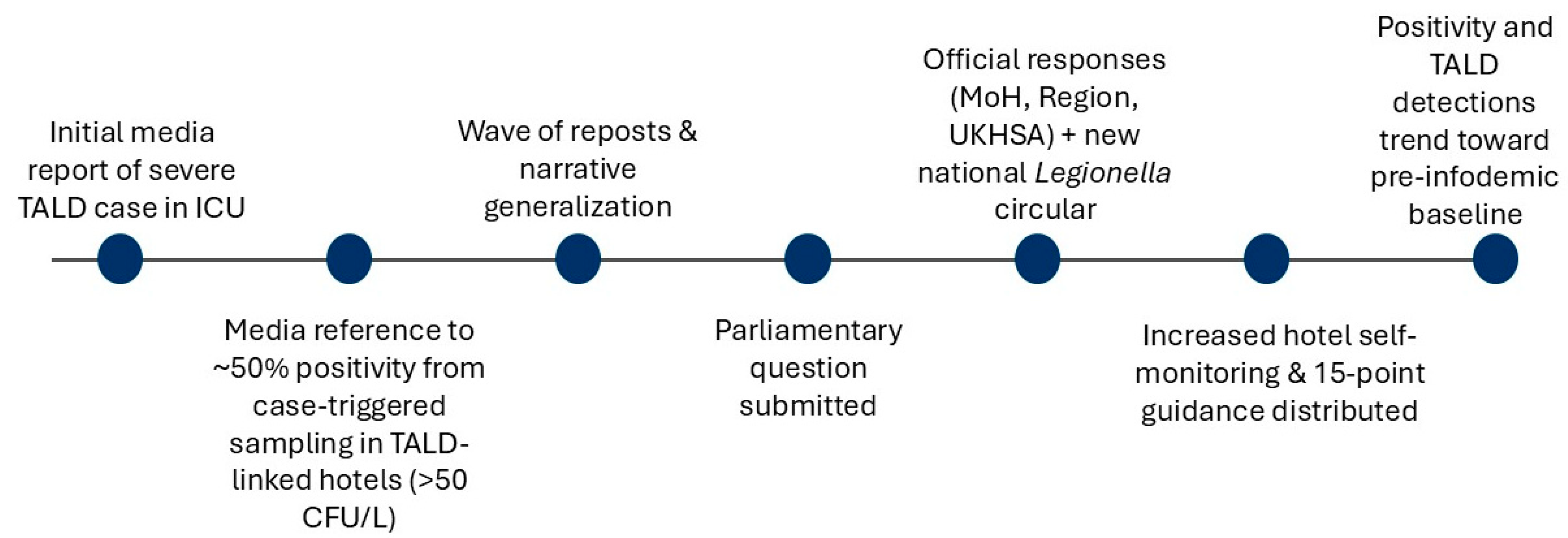
Figure 2.
Language-dependent gradient of numerical distortion across media markets.
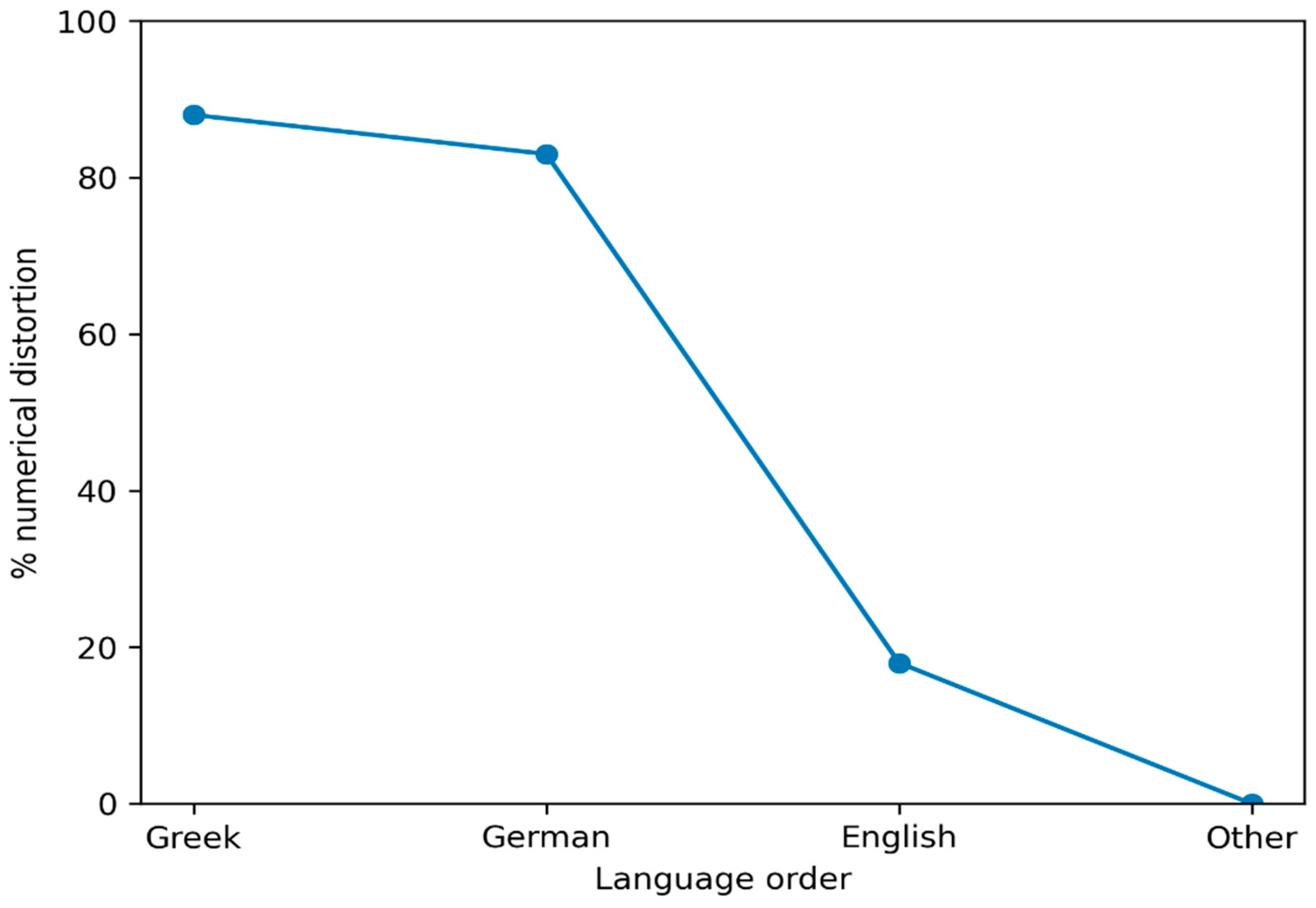
Figure 3.
Annual Legionella positivity (≥50 CFU/L) in hotel water samples from Crete, 2020–2025, with an additional post-infodemic sampling point.
Figure 3.
Annual Legionella positivity (≥50 CFU/L) in hotel water samples from Crete, 2020–2025, with an additional post-infodemic sampling point.
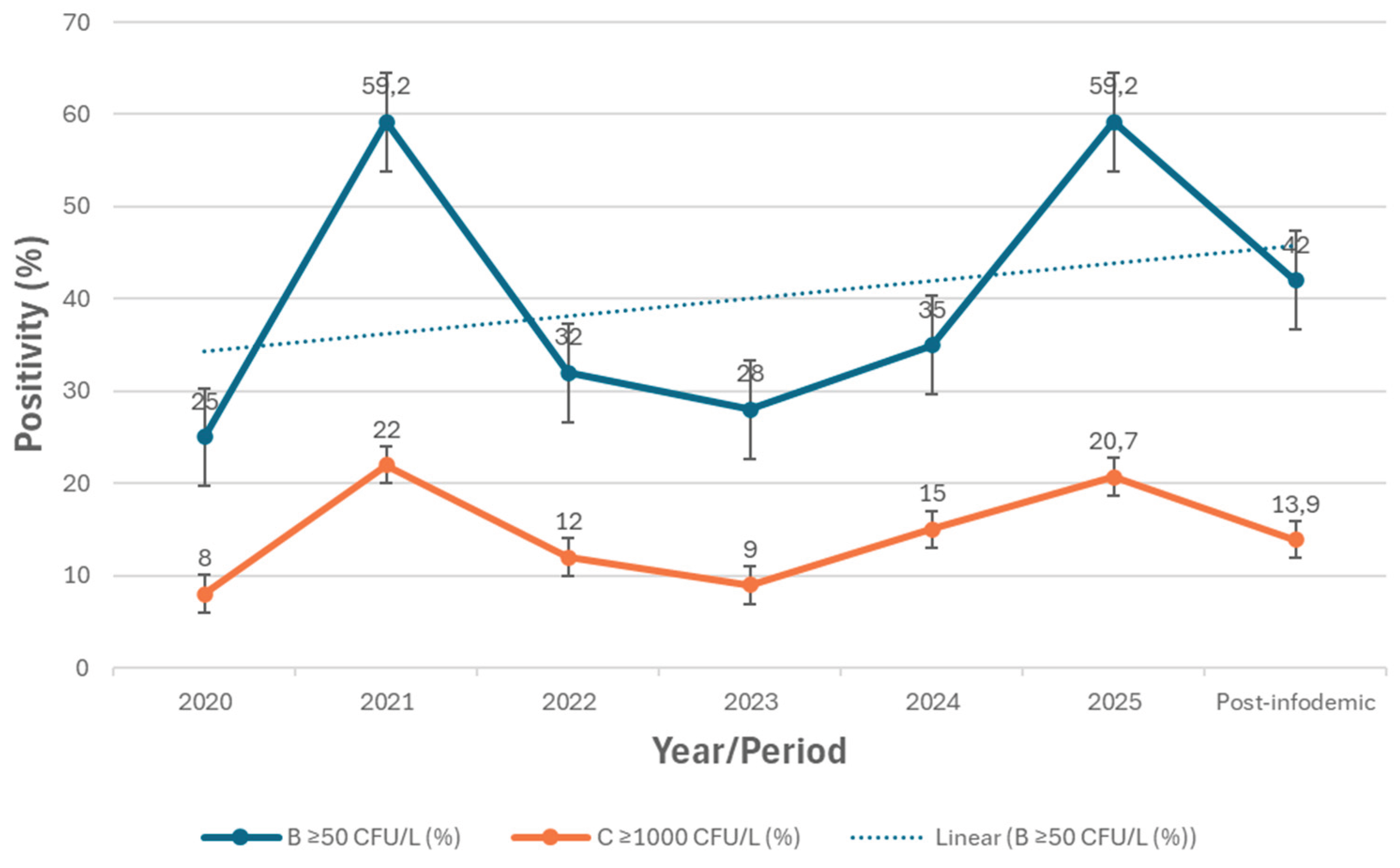

Table 1.
Multilingual amplification of the narrative of “50% positivity” (n = 95).
| Language | Sites (n) | Distorted Framing n (%) | Malinformation n (%) | Misinformation n (%) | Accurate n (%) | Peak Publication Date(s) (2025) |
|---|---|---|---|---|---|---|
| Greek | 43 | 36 (83.7%) | 32 (74.4%) | 4 (9.3%) | 7 (16.3%) | 2025-06-19 |
| English (UK unified) | 22 | 4 (18.2%) | 3 (13.6%) | 1 (4.5%) | 18 (81.8%) | 2025-06-20 |
| German | 12 | 5 (41.7%) | 5 (41.7%) | 0 (0.0%) | 7 (58.3%) | 2025-06-22, 2025-06-23 |
| Italian | 5 | 0 (0.0%) | 0 (0.0%) | 0 (0.0%) | 5 (100.0%) | 2025-07-01 |
| Hebrew | 4 | 1 (25.0%) | 1 (25.0%) | 0 (0.0%) | 3 (75.0%) | 2025-06-21 |
| Danish | 3 | 0 (0.0%) | 0 (0.0%) | 0 (0.0%) | 3 (100.0%) | 2025-06-23, 2025-06-24, 2025-06-25 |
| French | 3 | 0 (0.0%) | 0 (0.0%) | 0 (0.0%) | 3 (100.0%) | 2025-04-01, 2025-05-01 |
| Norwegian | 2 | 0 (0.0%) | 0 (0.0%) | 0 (0.0%) | 2 (100.0%) | 2025-06-01, 2025-11-01 |
| Swedish | 1 | 0 (0.0%) | 0 (0.0%) | 0 (0.0%) | 1 (100.0%) | n/a (undated) |
| Total | 95 | 46 (48.4%) | 41 (43.2%) | 5 (5.3%) | 49 (51.6%) | — |
*Peak publication date(s) = date(s) with the highest within language item count in 2025 (ties shown as ranges).
Table 2.
Temporal synchronization between media peaks and search interest.
| Market/Language Group | Media Peak Date (from Corpus) | Media Peak Intensity (Max Items/day) | Google Trends Query (as Analyzed) | Trends Peak Date | Lag (Trends Peak – Media Peak), days |
|---|---|---|---|---|---|
| Greece/Greek (EL) | 2025-06-19 | 28 | "50% positivity Crete" (Greek-language query) | 2025-06-23 | +4 |
| Germany/German (DE) | 2025-06-22 to 2025-06-23 | 2 | "Legionella Kreta" | 2025-06-22 | 0 |
| UK/English (UK) | 2025-06-20 | 5 | "Legionella Crete" | 2025-07-05 | +15 |
Table 3.
Title vs. content distortion analysis (full corpus, n = 95).
| Metric | Accurate | Malinformation | Misinformation |
|---|---|---|---|
| Title Category (Recoded) | 58 (61.1%) | 33 (34.7%) | 4 (4.2%) |
| Content Category (Recoded) | 51 (53.7%) | 41 (43.2%) | 3 (3.2%) |
| Concordance (Title = Content) | 82/95 (86.3%) | ||
| Discordance (Title ≠ Content) | 13/95 (13.7%) |
Table 4.
Legionella colonization in hotel water systems before and after the infodemic (Crete, 2025).
Table 4.
Legionella colonization in hotel water systems before and after the infodemic (Crete, 2025).
| Dataset/Period | Hotels (n) | Samples (n) | ≥50 CFU/L | 95% CI | ≥1000 CFU/L | 95% CI | Key notes |
|---|---|---|---|---|---|---|---|
| Early-2025 subset from epidemiologically linked hotels | 4 | 157 | 59.23% | 51.42% – 66.61% | 7.64% | 4.43% – 12.88% | Sampling in epidemiologically linked hotels; not population-level |
| Pre-/peri-infodemic Jan–Jul 2025 | 7 | 238 | 23.11% | 18.21–28.87% | 13.45% | 9.69–18.36% | Passive, case-linked investigations |
| Post-infodemic Aug–Nov 2025 | 12 | 229 | 24.45% | 19.34–30.41% | 14.41% | 10.45–19.55% | Continued investigations; remedial actions |
Table 5.
Microbiological and physicochemical indicators before vs after the infodemic.
| Indicator | Pre-Infodemic (n=238) | 95% CI | Post-Infodemic (n=229) | 95% CI | Interpretation |
|---|---|---|---|---|---|
| L. pneumophila SG1 | 5.88% | 3.25–9.67% | 3.93% | 1.81–7.33% | Stable, low |
| L. pneumophila SG2–15 | 17.23% | 12.92–22.57% | 19.65% | 14.69–25.59% | Stable |
| Hot water <55 °C | 79.80% | 73.96–84.53% | 65.30% | 57.57–72.40% | ↓ Improvement |
| Cold water >25 °C | 54.31% | 44.81–63.59% | 48.11% | 38.30–58.03% | ↓ Improvement |
| Free chlorine <0.2 mg/L | 15.74% | 9.45–24.00% | 31.46% | 22.03–42.17% | ↑ Worsening |
Disclaimer/Publisher’s Note: The statements, opinions and data contained in all publications are solely those of the individual author(s) and contributor(s) and not of MDPI and/or the editor(s). MDPI and/or the editor(s) disclaim responsibility for any injury to people or property resulting from any ideas, methods, instructions or products referred to in the content. |
© 2025 by the authors. Licensee MDPI, Basel, Switzerland. This article is an open access article distributed under the terms and conditions of the Creative Commons Attribution (CC BY) license (http://creativecommons.org/licenses/by/4.0/).
Copyright: This open access article is published under a Creative Commons CC BY 4.0 license, which permit the free download, distribution, and reuse, provided that the author and preprint are cited in any reuse.


