
Submitted:
28 December 2025
Posted:
29 December 2025
You are already at the latest version
Abstract
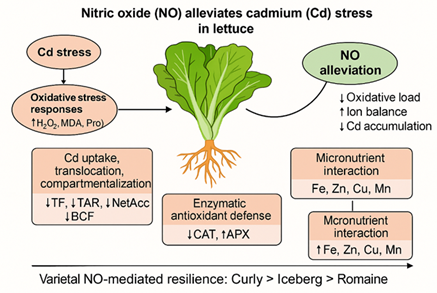
Cadmium (Cd) toxicity represents a major constraint on plant growth and food safety by disrupting photosynthesis, redox homeostasis, and ion transport. This study investigated the modulatory role of nitric oxide (NO), supplied via sodium nitroprusside (SNP), in alleviating Cd-induced stress in three lettuce varieties (Lactuca sativa L.): curly (var. crispa), romaine (var. longifolia), and iceberg (var. capitate). Plants were exposed to 200 and 500 µM Cd with or without SNP application under controlled greenhouse conditions. Cd exposure significantly decreased biomass production, photosynthetic pigment contents, and the accumulation of essential mineral nutrients, including potassium (K⁺), calcium (Ca²⁺), iron (Fe), zinc (Zn), copper (Cu), and manganese (Mn), while significantly enhancing oxidative stress indicators such as hydrogen peroxide (H₂O₂), melondyaldehyde (MDA), membrane permeability (MP), and proline content. Antioxidant enzyme activities responded differentially to Cd exposure: catalase (CAT) activity was stimulated, whereas ascorbate peroxidase (APX) activity was suppressed, indicating a pronounced redox imbalance. Exogenous SNP application effectively restored CAT and APX activity, stabilized cellular membranes, and attenuated oxidative damage. Cd accumulation indices—translocation factor (TF), total accumulation rate (TAR), net accumulation (NetAcc), and bio-concentration factor (BCF)—revealed substantial Cd uptake and translocation, particularly in curly and iceberg lettuce. Notably, SNP significantly reduced these indices, suggesting NO-mediated restriction of Cd mobility through enhanced root sequestration and vacuolar detoxification mechanisms. Moreover, SNP improved the homeostasis of K⁺, Ca²⁺, Fe²⁺, and Mn²⁺, highlighting its role in maintaining selective ion transport and redox balance under Cd stress. Among the varieties, curly lettuce exhibited the highest NO-induced tolerance, followed by iceberg and romaine lettuce, demonstrating genotype-dependent regulation of antioxidant defense and detoxification pathways. Overall, the findings identify NO as a multifaceted regulator that integrates redox control, ionic stability, and Cd detoxification to enhance physiological resilience and reduce Cd accumulation in lettuce.
Keywords:
1. Introduction
2. Materials and Methods
2.1. Plant Materials and Experimental Design
2.2. Sampling and Harvest of Plants
2.3. Determination of Photosynthetic Pigments
2.4. Determination of Membrane Damage
2.5. Determination of Hydrogen Peroxide Content and Proline Accumulation
2.6. Enzyme Extraction and Assay
2.7. Determination of Concentrations, Accumulations, and Translocations
2.8. Statistical analysis
3. Results
3.1. Effects of Cd and SNP on Biomass Accumulation in Lettuce Varieties
3.2. Effects of Cd and SNP on Photosynthetic Pigment Contents in Lettuce Varieties
3.3. Effects of Cadmium and SNP on Oxidative Stress Markers in Lettuce Varieties
3.4. Effects of Cadmium and SNP on Catalase (CAT) and Ascorbate Peroxidase (APX) Activities
3.5. Effects of Cadmium and SNP on Concentration, Translocation, and Accumulation Parameters of Cadmium
3.6. Effects of Cadmium and SNP on Net Accumulation (NetAcc) of Metallic Ions
Net Accumulation (NetAcc) of Iron (Fe) via Roots
Net Accumulation (NetAcc) of Zinc (Zn) via Roots
Net Accumulation (NetAcc) of Copper (Cu) via Roots
Net Accumulation (NetAcc) of Manganese (Mn) via Roots
3.7. Correlation Analyses
4. Discussion
4.1. Growth and Oxidative Stress Responses
4.2. Enzymatic Antioxidant Defense
4.3. Ion and Nutrient Homeostasis
4.4. Integrated Ionic Regulation under NO
4.5. Cd Uptake, Translocation, and Detoxification Mechanisms
5. Conclusion
Funding information
CRediT Authorship contribution statement
Data availability
Declaration of competing interest
Declaration of generative AI and AI-assisted technologies in the manuscript preparation process
References
- Benavides, M. P.; Gallego, S. M.; Tomaro, M.L. Cadmium toxicity in plants. Braz. J. Plant Physiol. 2005, 17(1), 21–34. [CrossRef]
- Gill, S.S.; Tuteja, N. Reactive oxygen species and antioxidant machinery in abiotic stress tolerance in crop plants. Plant Physiol. Biochem. 2010, 48(12), 909–930. [CrossRef]
- Chatterjee, J.; Chatterjee, C. Phytotoxicity of cobalt, chromium, and copper in cauliflower. Environ. Pollut. 2005, 109(1), 69–74. [CrossRef]
- Lux, A.; Martinka, M.; Vaculík, M.; White, P.J. Root responses to cadmium in the rhizosphere: A review. J. Exp. Bot. 2011, 62, 21–37. [CrossRef]
- Liu, J.; Feng, X.; Qiu, G.; Li, H.; Wang, Y.; Chen, X.; Fu, Q.; Guo, B. Inhibition roles of calcium in cadmium uptake and translocation in rice: A review. Int. J. Mol. Sci. 2023, 24(14), 11587. [CrossRef]
- Mittler, R. ROS are good. Trends Plant Sci. 2017, 22(1), 11–19. [CrossRef]
- Arasimowicz-Jelonek, M.; Floryszak-Wieczorek, J.; Gwóźdź, E. A. The message of nitric oxide in cadmium-challenged plants. Plant Sci. 2011, 181(5), 612-620. [CrossRef]
- Hancock, J.T.; Neill, S.J. Nitric oxide: Its generation and interactions with other reactive signaling compounds. Plant Cell Environ. 2019, 42(3), 782–794. [CrossRef]
- Hasanuzzaman, M.; Inafuku, M.; Nahar, K.; Fujita, M.; Oku, H. Nitric oxide regulates plant growth, physiology, antioxidant defense, and ion homeostasis to confer salt tolerance in the mangrove species, Kandelia obovata. Antioxidants 2021, 10(4), 611. [CrossRef]
- Grün, S.; Lindermayr, C.; Sell, S.; Durner, J. Nitric oxide and gene regulation in plants. J. Exp. Bot. 2006, 57(3), 507-516. [CrossRef]
- Sharma, A.; Soares, C.; Sousa, B.; Martins, M.; Kumar, V.; Shahzad, B.; Sidhu, G.P.S.; Bali, A.S.; Asgher, M.; Bhardwaj, R.; Thukral, A.K.; Fidalgo, F.; Zheng, B. Nitric oxide-mediated regulation of oxidative stress in plants under metal stress: a review on molecular and biochemical aspects. Physiol. Plant. 2020, 168(2), 318-344. [CrossRef]
- Khan, M.; Ali, S.; Al Azzawi, T.N. I.; Yun, B.W. Nitric oxide acts as a key signaling molecule in plant development under stressful conditions. Int. J. Mol. Sci. 2023, 24(5), 4782. [CrossRef]
- Xiong, J.; An, L.; Lu, H.; Zhu, C. Exogenous nitric oxide enhances cadmium tolerance of rice by regulating antioxidative capacity. Plant Growth Regul. 2012, 68, 83–92. [CrossRef]
- Zhang, L.; Chen, Z.; Zhu, C. Endogenous nitric oxide mediates alleviation of cadmium toxicity induced by calcium in rice seedlings. J. Environ. Sci. 2012, 24(5), 940-948. [CrossRef]
- Cherian, R.M.; Dhakar, M.K.; Kumar, M. Exogenous nitric oxide enhances cadmium tolerance and uptake in Ricinus communis L. through improved photosynthesis and antioxidant defense. Int. J. Phytoremediation 2025, 1–13. [CrossRef]
- Kim, M.J.; Moon, Y.; Tou, J.C.; Mou, B.; Waterland, N.L. Nutritional value, bioactive compounds, and health benefits of lettuce (Lactuca sativa L.). J. Food Compos. Anal. 2016, 49, 19-34. [CrossRef]
- Loi, N.N.; Sanzharova, N.I.; Shchagina, N.I.; Mironova, M.P. The effect of cadmium toxicity on the development of lettuce plants on contaminated sod-podzolic soil. Russ. Agric. Sci. 2018, 44(1), 49-52. [CrossRef]
- Monteiro, C.; Santos, C.; Pinho, S.; Oliveira, H.; Pedrosa, T.; Dias, M.C. Cadmium-induced cyto-and genotoxicity are organ-dependent in lettuce. Chem. Res. Toxicol. 2012, 25(7), 1423-1434. [CrossRef]
- Tang, Y.; Xie, Y.; Sun, G.;Tan, H.; Lin, L.; Li, H.; Liao, M.; Wang, Z.; Lv, X.; Liang, D.; Xia, H.; Wang, X.; Wang, J.; Xiong, B.; Zheng, Y.; He, Z.; Tu, L. Cadmium-accumulator straw application alleviates cadmium stress of lettuce (Lactuca sativa) by promoting photosynthetic activity and antioxidative enzyme activities. Environ. Sci. Pollut. Res. 2018, 25(30), 30671-30679. [CrossRef]
- Zorrig, W.; Cornu, J.Y.; Maisonneuve, B.; Rouached, A.; Sarrobert, C.; Shahzad, Z.; Abdelly, C.; Davidian, J.; Berthomieu, P. Genetic analysis of cadmium accumulation in lettuce (Lactuca sativa). Plant Physiol. Biochem. 2019. 136, 67-75. [CrossRef]
- Altas, S.; Uzal, O. Mitigation of negative impacts of cadmium stress on physiological parameters of curly lettuce (Lactuca sativa var. Crispa) by proline treatments. J. Elem. 2022, 27(2), 351-365. [CrossRef]
- Hoagland, D.R.; Arnon, D.I. The water-culture method for growing plants without soil. California Agricultural Experiment Station. 1950, Circ. 347, 1–32.
- Lichtenthaler, H.K. Chlorophylls and carotenoids: pigments of photosynthetic biomembranes. Methods. Methods Enzymol. 1987, 148, 350-382. [CrossRef]
- Yan, B.; Dai, Q.; Liu, X.; Huang, S.; Wang, Z. Flooding-induced membrane damage, lipid oxidation, and activated oxygen generation in corn leaves. Plant Soil 1996, 179, 261-268. [CrossRef]
- Hodges, D.M.; De Long, J.M.; Forney, C.F.; Prange, R.K. Improving the thiobarbituric acid-reactive-substances assay for estimating lipid peroxidation in plant tissues containing anthocyanin and other interfering compounds. Planta 1999, 207, 604-611. [CrossRef]
- Mukherjee, S.P.; Choudhuri, M.A. Implications of water stress-induced changes in the levels of endogenous ascorbic acid and hydrogen peroxide in Vigna seedlings. Physiol. Plant 1983, 58(2), 166-170. [CrossRef]
- Bates, L.S.; Waldren, R.P.; Teare, I.D. 1973. Rapid Determination of Free Proline for Water-Stress Studies. Plant Soil. 1973, 39, 205-207. [CrossRef]
- Shigeoka, S.; Ishikawa, T.; Tamoi, M.; Miyagawa, Y.; Takeda, T.; Yabuta, Y.; Yoshimura, K. Regulation and function of ascorbate peroxidase isoenzymes. J. Exp. Bot. 2002, 53(372), 1305-1319. [CrossRef]
- Chance, B.; Maehly, A.C. Assay of catalases and peroxidases. Methods Enzymol. 1955, 2, 764-775. [CrossRef]
- Nakano, Y.; Asada, K. Hydrogen peroxide is scavenged by ascorbate-specific peroxidase in spinach chloroplasts. Plant Cell Physiol. 1981, 22, 867-880. [CrossRef]
- Miller, R.O. High-temperature oxidation: dry ashing. 1998, p. 66-69. In Kalra, P.Y. (ed.) Handbook of reference methods for plant analysis. Taylor and Francis/CRC Press, Boca Raton, Florida, USA.
- Cikili, Y.; Samet, H.; Dursun, S. Cadmium toxicity and its effects on growth and metal nutrient ion accumulation in Solanaceae plants. J. Agric. Sci. 2016, 22, 576-587. [CrossRef]
- Shi, G.; Liu, C.; Cai, Q.; Liu, Q.; Hou, C. Cadmium accumulation and tolerance of two safflower cultivars in relation to photosynthesis and antioxidative enzymes. B. Environ. Contam. Tox. 2010, 85, 256-263. [CrossRef]
- Moradi, L.; Ehsanzadeh, P. Effects of Cd on photosynthesis and growth of safflower (Carthamus tinctorius L.) genotypes. Photosynthetica 2015, 53(4), 506-518. [CrossRef]
- Hsu, Y.T.; Kao, C.H. Cadmium toxicity is reduced by nitric oxide in rice leaves. Plant Growth Regul. 2004, 42, 227–238. [CrossRef]
- Singh, H.P.; Batish, D.R.; Kaur, G.; Arora, K.; Kohli, R.K. Nitric oxide (as sodium nitroprusside) supplementation ameliorates Cd toxicity in hydroponically grown wheat roots. Environ. Exp. Bot. 2008, 63(1-3), 158-167. [CrossRef]
- Xu, J.; Yin, H. X.; Liu, X. J.; Yuan, T.; Mi, Q.; Yang, L. L.; Xie, Z.X.; Wang, W. Y. Nitric oxide alleviates Fe deficiency-induced stress in Solanum nigrum. Biol. Plant. 2009, 53(4), 784-788. [CrossRef]
- Besson-Bard, A.; Gravot, A.; Richaud, P.; Auroy, P.; Duc, C.; Gaymard, F.; Taconnat, L.; Renou, J.; Pugin, A.; Wendehenne, D. Nitric oxide contributes to cadmium toxicity in Arabidopsis by promoting cadmium accumulation in roots and by up-regulating genes related to iron uptake. Plant Physiol. 2009, 149(3), 1302-1315. [CrossRef]
- Zhou, J.; Zhang, C.; Du, B.; Cui, H.; Fan, X.; Zhou, D.; Zhou, J. Soil and foliar applications of silicon and selenium effects on cadmium accumulation and plant growth by modulation of antioxidant system and Cd translocation: Comparison of soft vs. durum wheat varieties. J. Hazard. Mater. 2021, 402, 123546. [CrossRef]
- Rodríguez-Serrano, M.; Romero-Puertas, M.C.; Pazmino, D.M.; Testillano, P.S.; Risueño, M.C.; Del Río, L.A.; Sandalio, L.M. Cellular response of pea plants to cadmium toxicity: cross-talk between reactive oxygen species, nitric oxide, and calcium. Plant Physiol. 2009, 150(1), 229-243. [CrossRef]
- Li, X.; Zhao, M.; Guo, L.; Huang, L. Effect of cadmium on photosynthetic pigments, lipid peroxidation, antioxidants, and artemisinin in hydroponically grown Artemisia annua. J. Environ. Sci. 2012, 24(8), 1511-1518. [CrossRef]
- Esringu, A.; Aksakal, O.; Tabay, D.; Kara, A. A. Effects of sodium nitroprusside (SNP) pretreatment on UV-B stress tolerance in lettuce (Lactuca sativa L.) seedlings. Environ. Sci. Pollut. Res. 2016, 23(1), 589-597. [CrossRef]
- Verma, S.; Dubey, R.S. Lead toxicity induces lipid peroxidation and alters antioxidant enzymes in growing rice plants. Plant Sci. 2003, 164, 645–655. [CrossRef]
- Clemens, S. Metal ligands in plant metal homeostasis and detoxification. Plant Cell Environ. 2019, 42(10), 2909–2923. [CrossRef]
- Huang, Q.N.; An, H.; Yang, Y.J.; Liang, Y.; Shao, G.S. Effects of Mn-Cd antagonistic interaction on Cd accumulation and major agronomic traits in rice genotypes by different Mn forms. Plant Growth Regul. 2017, 82(2), 317-331. [CrossRef]
- Gong, B.; Nie, W.; Yan, Y.; Gao, Z.; Shi, Q. Unravelling cadmium toxicity and nitric oxide-induced tolerance in Cucumis sativus: insight into regulatory mechanisms using proteomics. J. Hazard. Mater. 2017, 336, 202-213. [CrossRef]
- Hall, J. Á.; Williams, L. E. Transition metal transporters in plants. J. Exp. Bot. 2003, 54(393), 2601-2613. [CrossRef]
- Rodríguez-Serrano, M.; Romero-Puertas, M. C.; Pazmino, D. M.; Testillano, P. S.; Risueño, M.C.; Del Río, L.A.; Sandalio, L. M. Cellular response of pea plants to cadmium toxicity: cross talk between reactive oxygen species, nitric oxide, and calcium. Plant physiology, 2009, 150(1), 229-243. [CrossRef]

| Treatments | Cd concentration (mg kg-1) | BCF of Cd |
TF of Cd % |
TAR of Cd (μg g-1 DW day-1) | ||
| Shoot | Root | Shoot | Root | |||
| Curly lettuce (Lactuca sativa L. var. crispa) | ||||||
| Control | 0.81±0.16 e | 5.60±0.21 e | 80.9±15.7 b | 561.5±21.1 a | 14.6±3.26 c | 0.22±0.08 |
| Cd100 | 168.03±2.52 c | 377.10±4.49 c | 15.0±0.23 c | 33.6±0.40 c | 44.6±0.71 a | 13.98±2.67 |
| Cd500 | 332.52±39.20 a | 1162.2±58.50 a | 6.6±0.14 c | 20.7±1.04 c | 31.9±1.12 b | 19.32±4.82 |
| SNP | 1.23±0.05 e | 4.40±0.14 e | 122.73±4.4 a | 438.0±13.7 b | 28.1±1.71 b | 0.16±0.02 |
| SNP+Cd100 | 75.13±0.49 d | 256.80±10.40 d | 6.7±0.04 c | 22.8±0.93 c | 29.3±1.02 b | 7.92±1.85 |
| SNP+Cd500 | 269.29±0.65 b | 902.90±47.60 b | 4.8±0.01 c | 16.1±0.85 c | 30.0±1.66 b | 24.39±1.37 |
| ANOVA (F – Values) | ||||||
| Cd | 176.92*** | 572,62*** | 132.30*** | 1435.20*** | 38.71*** | 39.51*** |
| SNP | 15,7** | 24.93*** | 3.81 ns | 30.42*** | 0.69 ns | 0.03 ns |
| Cd*SNP | 4,42* | 8,6** | 8.39 ** | 21.23*** | 32.37*** | 2.61 ns |
| Romanie lettuce (Lactuca sativa L. var. longifolia) | ||||||
| Control | 0.49±0.11 | 3.89±0.37 e | 49.13±10.9 b | 388.3±37.3 | 13.16±3.36 | 0.57±0.07 |
| Cd100 | 154.16±2.93 | 385.13±17.5 c | 13.7±0.26 bc | 34.3±1.55 | 40.15±1.44 | 24.65±3.97 |
| Cd500 | 181.60±37.1 | 944.80±34.3 a | 3.2±0.66 c | 16.8±0.61 | 19.54±4.75 | 26.07±6.05 |
| SNP | 1.15±0.27 | 4.72±0.73 e | 115.2±27.5 a | 471.4±73.4 | 26.27±7.30 | 0.46±0.08 |
| SNP+Cd100 | 90.74±1.09 | 236.73±0.85 d | 8.1±0.10 c | 21.1±0.08 | 38.33±0.34 | 27.24±7.57 |
| SNP+Cd500 | 174.96±5.73 | 597.20±16.9 b | 3.1±0.10 c | 10.6±0.30 | 29.32±0.87 | 41.29±21.4 |
| ANOVA (F – Values) | ||||||
| Cd | 69.55*** | 1012.49*** | 25.93*** | 98.74*** | 622.63*** | 6.38* |
| SNP | 3.39 ns | 138.93*** | 4.15 ns | 0.60 ns | 4.92* | 0.55 ns |
| Cd*SNP | 2.60 ns | 51.94*** | 5.45* | 1.27 ns | 2.04 ns | 0.35 ns |
| Iceberg lettuce (Lactuca sativa L. var. capitata) | ||||||
| Control | 0.74±0.12 e | 5.37±0.25 e | 73.8±12.3 | 537.0±24.4 a | 13.60±1.74 c | 0.75±0.17 |
| Cd100 | 155.73±1.59 c | 284.33±7.29 c | 13.9±0.14 | 25.3±0.65 c | 54.84±1.29 b | 29.12±1.41 |
| Cd500 | 309.00±4.05 a | 835.30±1.44 a | 5.5±0.07 | 14.9±0.03 c | 37.00±0.55 bc | 23.71±6.19 |
| SNP | 0.90±0.05 e | 1.08±0.27 e | 89.67±3.47 | 108.4±26.5 b | 92.65±21.0 a | 0.21±0.02 |
| SNP+Cd100 | 53.01±4.12 d | 133.80±14.7 d | 4.7 b±0.36 | 11.9±1.30 c | 40.44±4.92 bc | 13.77±3.95 |
| SNP+Cd500 | 182.20±7.13 b | 699.53±64.0 b | 3.2 b±0.13 | 12.5±1.14 c | 26.62±3.17 c | 34.65±12.01 |
| ANOVA (F – Values) | ||||||
| Cd | 2089.57*** | 429.72*** | 137.66*** | 289.09*** | 3.06 ns | 13.02*** |
| SNP | 606.75*** | 19.34*** | 0.12 ns | 151.79*** | 6.13* | 0.12 ns |
| Cd*SNP | 157.33*** | 4.45* | 3.06 ns | 136.10*** | 17.42*** | 2.56 ns |
| Treatments | Net ion accumulation via roots (NetAcc) (µg/g DM) | ||||
| Cd | Fe | Zn | Cu | Mn | |
| Curly lettuce (Lactuca sativa L. var. crispa) | |||||
| Control | 9.6±0.47 e | 562.7±23.8 c | 633.8±32.1 | 33.0±1.93 | 205.8±16.0 b |
| Cd100 | 1022.4±29.2 c | 428.2±16.1 d | 715.8±35.6 | 27.0±2.64 | 274.6±17.0 a |
| Cd500 | 2025.3±171 a | 352.5±12.0 d | 570.2±49.8 | 21.5±1.85 | 148.3±8.9 cd |
| SNP | 11.0±0.13 e | 979.1±33.5 ab | 541.7±24.6 | 35.3±2.53 | 311.3±21.4 a |
| SNP+Cd100 | 530.1±20.0 d | 1056.8±60.2 a | 541.9±39.6 | 30.6±1.05 | 180.3±7.8 bc |
| SNP+Cd500 | 1717.9±86.3 b | 929.7±31.6 b | 524.9±18.0 | 22.2±1.23 | 133.3±9.3 d |
| ANOVA (F – Values) | |||||
| Cd | 277.93*** | 8.33** | 2.73ns | 19.54*** | 36.13*** |
| SNP | 16.87** | 391.96*** | 13.31** | 1.75 ns | 0.01 ns |
| Cd*SNP | 4.94* | 5.48* | 1.74 ns | 0.27 ns | 24.50*** |
| Romanie lettuce (Lactuca sativa L. var. longifolia) | |||||
| Control | 5.6±0.38 e | 437.4±19.0 c | 83.7±9.2 b | 17.4±0.6 bc | 125.2±7.2 |
| Cd100 | 740.0±14.1 c | 214.7±3.7 d | 52.9±1.6 c | 13.7±0.9 c | 88.6±2.6 |
| Cd500 | 1443.9±87.7 a | 245.5±36.1 d | 72.8±13.0 bc | 19.0±3.5 b | 77.4±15.2 |
| SNP | 9.7±2.0 e | 878.9±78.8 a | 139.3±15.2 a | 26.6±1.3 a | 193.1±26.2 |
| SNP+Cd100 | 459.6±11.2 d | 801.9±19.9 a | 69.5±5.0 bc | 12.5±0.5 c | 120.1±8.4 |
| SNP+Cd500 | 1028.8±13.0 b | 609.9±9.9 b | 51.0±2.8 c | 14.8±7.2 bc | 121.0±6.3 |
| ANOVA (F – Values) | |||||
| Cd | 553.62*** | 19.60*** | 19.17*** | 15.59*** | 12.07*** |
| SNP | 58.38*** | 231.69*** | 4.90* | 0.93 ns | 19.04*** |
| Cd*SNP | 16.80*** | 4.59* | 8.64** | 9.59** | 0.94 ns |
| Iceberg lettuce (Lactuca sativa L. var. capitata) | |||||
| Control | 9.3±0.97 | 446.1±27.1 | 501.1±25.7 a | 27.9±1.7 a | 202.2±16.3 |
| Cd100 | 795.4±16.9 | 331.5±6.8 | 206.1±6.5 c | 17.7±1.5 c | 206.6±4.8 |
| Cd500 | 1671.6±227.0 | 228.9±34.7 | 165.1±34.7 c | 21.0±2.2 bc | 110.1±19.8 |
| SNP | 5.2±0.47 | 778.5±29.5 | 286.5±9.6 b | 27.9±1.1 a | 225.6±12.6 |
| SNP+Cd100 | 324.4±23.2 | 682.0±15.8 | 168.2±3.8 c | 23.3±0.3 b | 167.7±4.1 |
| SNP+Cd500 | 1327.1±43.4 | 647.5±26.4 | 293.4±10.4 b | 19.0±0.4 c | 112.5±4.2 |
| ANOVA (F – Values) | |||||
| Cd | 125.41*** | 24.29*** | 67.06*** | 21.10*** | 38.86*** |
| SNP | 12.34** | 319.16*** | 7.22* | 1.13 ns | 0.20 ns |
| Cd*SNP | 3.21 ns | 1.63 ns | 41.33*** | 4.22* | 3.45 ns |
Disclaimer/Publisher’s Note: The statements, opinions and data contained in all publications are solely those of the individual author(s) and contributor(s) and not of MDPI and/or the editor(s). MDPI and/or the editor(s) disclaim responsibility for any injury to people or property resulting from any ideas, methods, instructions or products referred to in the content. |
© 2026 by the authors. Licensee MDPI, Basel, Switzerland. This article is an open access article distributed under the terms and conditions of the Creative Commons Attribution (CC BY) license.