1. Introduction
One of today’s educational debates is trapped in deep tension. On the one hand, there is a global consensus on the urging need to integrate Information and Communication Technologies (ICT) and to develop digital competence as a driver of innovative education, aligned with the demands of the knowledge society, and as a means to promote personal and professional development [
1]. On the other hand, there is a growing recognition, both in scientific literature and within the educational communities’ concerns, of the negative impact that a passive and decontextualized use of screens can have on students’ cognitive and socio-emotional development [
2,
3], as well as the limitations they present by exacerbating existing inequalities in our society [
4]. This profound pedagogical dilemma defines one of the key challenges for 21st-century schools: how can we embrace digital innovation without falling into its negative effects? How can we build a model of digital education that is pedagogically sustainable, inclusive, and truly meaningful?
In this scenario, the Sustainable Development Goals (SDG) bring a reference framework to face this situation, where sustainable digital education must guarantee not only technological access, but equality, educational quality, and academic preparation for students to address global challenges, such as social justice, gender equality, or environmental sustainability [
5,
6]. It is about ensuring effective digital educational strategies that do not reproduce inequalities, but rather contribute to building fair societies, moving away from the reductionist view of th pedagogical integration of ICT [
7]. The challenge is to place principles, such as inclusion, sustainability and well-being, at the centre of the currimulum design [
4].
There is an urgent need to identify and analyze pedagogical models that integrate technology with educational purposes in a coherent project, instead of adopting it uncritically. It consists of including renewed and sustainable perspectives when designing and structuring learning and teaching processes in the curriculum [
8] and finding proposals in which students make responsible, critical, ethical and sustainable use of ICT, so that the necessary digital competence is developed within a significant pedagogical framework [
5].
To the above, it must be added that this debate is also framed within a context in which initial teacher education shows significant shortcomings regarding the sustainable integration of ICT. Future teachers perceive themselves as competent in creativity and in the use of digital tools, but they acknowledge limitations when it comes to designing educational projects with an e-sustainability approach [
9]. This training deficit, also highlighted in other studies [
7,
10,
11,
12], highlights the need for school environments to offer real opportunities for professional learning in this area.
With this aim, the present study analyzes the Amara Berri System (ABS), a recognized and innovative benchmark school model in Spain [
13], in order to examine its approach to digital education. The ABS provides a paradigmatic example of “sustainable pedagogy,” where ICT are not an end in themselves but rather a tool in the service of inclusion, creativity, and student empowerment, functioning as an effective pedagogical response to the passive consumption of screens [
14].
To comprehend the ABS technological approach, it is essential to understand that it is not an “ICT methodology”, but rather a logical outcome of its underlying philosophy, grounded in a holistic project endorsed shaped by the culture of “we” [
15]. This systematic vision means that every element, including ICT, makes sense because of its interconnection with the rest of the elements of the educational model.
The cornerstone of this structure is the organization of learning into “vital contexts”, spaces that simulate real social settings (the press, the radio, the neighborhood, etc.) where students develop meaningful activities [
15]. Within this educational architecture, the “Audiovisual Media Room” is more than just a simple computer laboratory; it is the heart of the communicative dimension of the ABS model. This space, fully managed by students from primary levels onwards, functions as the social “output” of the learnings achieved in the rest of contexts. The radio programs, the digital newspapers, or the television cuts they produce are not artificial tasks; they are the channels through which the work developed at school becomes visible and achieves a real communicative purpose [
16].
This design has two main implications for the sustainability of the digital model. First, it subordinates the tool to the project: technology is used because it is necessary to produce a radio program or lay out a newspaper, not the other way around. Second, it transforms the student’s relationship with technology: they shift from being a passive content consumer to an active and creative producer.
This approach also impacts teachers who are engaged in a continuous learning process focused on the pedagogically sustainable use of technology. Teachers learn from the everyday practice, and in the ABS they do it in a coordinated way during seminars and other environments, or at moments when they must dynamize the press, the radio or the school television contexts [
15]. It is not just about acquiring technical skills, but also about understanding how technology can be integrated into the curriculum so that students use it for critical and social purposes. Thus, the model fosters teachers to develop their digital competences in context, linked to inclusion and educational sustainability [
16].
The link among the ABS and the international framework of sustainability is clear: by transforming technology into a means of creative production, the model contributes to SDGs 4 (quality education), 5 (gender equality), and 10 (reduced inequalities). This way, the ABS offers more than an innovative approach; it shows how coherent pedagogical structures are a necessary condition for digital innovation to be sustainable [
5].
Other authors [
17] warn about the risk of limiting digitalization into an instrumental approach, without critically rethinking teaching-learning processes. The ABS exemplifies how digitalization can become a driver of sustainable innovation in the service of equity when integrating technology in a global and coherent project [
4]. From this perspective emerges the central question of this study:
can the Amara Berri model become not only a proposal for an inclusive and innovative school, but also a formative framework that promotes the sustainable use of ICT?
2. Materials and Methods
The study follows an interpretive-hermeneutic approach, which conceives educational knowledge as the result of the teaching experience and the contexts in which it is exercised.
A mixed-methods methodological design of an explanatory and sequential nature was adopted; it was non-experimental and cross-sectional and was approved by the Ethics Committee at the University of La Rioja (CE_107_2025).
In the quantitative stage, the reference population was composed of Pre-School and Primary Education teachers from the 25 schools that belong to the Amara Berri network. Using non-probabilistic self-selection sampling, a sample of 292 teachers was obtained, representing 25,9% of the estimated population. The sample profile showed a majority of women (78,4%), a predominance of teachers aged between 41 and 50, and a working experience in education of more than ten years in 69,9% of the cases. Length of service within the network varied, ranging from fewer than five to more than twenty years, which made it possible to analyze differences according to the time spent in the model.
Data were collected through a questionnaire adapted from a validated instrument [
18]. The applied version included six thematic blocks, related to educational inclusion, initial training, and teaching practices, among which the pedagogically sustainable integration of ICT was included. The questionnaire consisted of 56 five-point Likert-type items and showed high reliability (α = .891) and a high content validity index (CVI = .985).
Statistical analysis was carried out using SPSS v.28. After confirming the non-normal distribution of most variables (Kolmogorov–Smirnov), non-parametric tests were applied: Mann-Whitney U (gender) and Kruskal-Wallis with Bonferroni adjustment (length of service in the network). In addition, effect sizes (Rosenthal’s r and η²) were calculated and interpreted according to Cohen’s thresholds [
19]. The analysis was complemented with Spearman correlations and multiple linear regression to explore the relationship between length of service in the Amara Berri System and variables such as teacher coordination, perceived improvement in training, and the development of inclusive practices. All hypothesis tests were conducted at a significance level of p < .05.
To further explore the quantitative findings, a second qualitative phase was conducted consisting of a focus group with an intentional sample of eight teachers (n=8) with heterogeneous profiles in terms of age, gender, and years of experience. The session, lasting 90 minutes, was audio-recorded and transcribed.
The transcript was analyzed using a categorical content analysis process supported by ATLAS.ti software. An inductive-deductive procedure was followed to create a system of categories, which was subjected to a rigorous validation process through expert judgment. Using Cohen’s Kappa coefficient, a substantial level of agreement was obtained between the principal researcher and all experts (between 0.6 and 0.8). Regarding agreement among the participating experts, the level of concordance was good in all cases (Fleiss’ Kappa between 0.61 and 0.80).
3. Results
The data analysis reveals two main findings in relation to teachers of the Amara Berri network. First, there is a significant gap between the assessment of the initial training received, and the formative impact attributed to the experience at the school. Second, a positive perception on the use and impact of ICT, whose implementation is shaped by the length of service within the system.
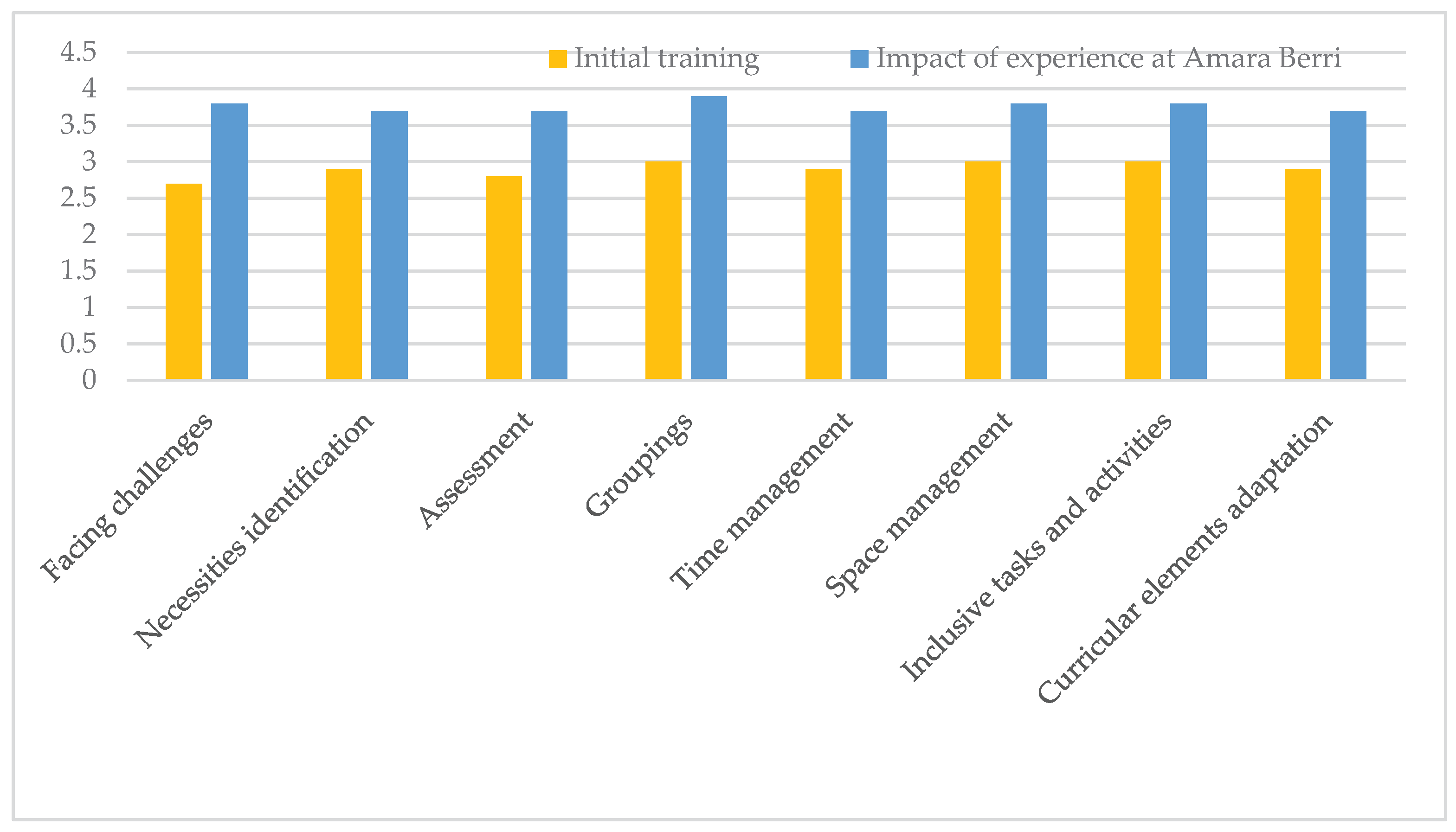
Concerning teaching training, results show a clear dichotomy. Initial training in special needs and attention diversity reach the lowest scores across the entire questionnaire, with most items scoring below 3 in a 0-5 scale (e.g. facing challenges, X̄ = 2.72). In contrast, the experience in Amara Berri is positively assessed, with mean scores ranging between 3.68 y 3.89. In addition, the linear regression analysis confirms that length of service significantly predicts this improvement, accounting for up to 12.7% of the variance in perceived progress in measures for attention to diversity (R² = .127), as shown in
Figure 1.
Regarding digital innovation, results show a general positive perception. In a 0-5 scale, the practice of “ICT inclusion in the classroom or in the school dynamics” reaches a mean score of X̄ = 3.42, acknowledging a common use. At the same time, the perception of its impact on improvements in attention to diversity is equally positive, with a mean score of X̄ = 3.52.
The inferential analysis performed with the Kruskal-Wallis test revealed that there are significant differences in the inclusion of ICT (H(2) = 15.496, p < .001). Teachers with ≥ 16 years of teaching experience scored significantly higher than the novice group with ≤ 5 years (p adjusted= .022; r = 0.157, small effect) and also outperformed the intermediate group with 6–15 years experience (p adjusted= .002; r = 0.200, small effect).
Regarding the perceived impact of ICT inclusion on attention to diversity, the statistics revealed significant differences (H(2) = 8.218, p = .016), with a small-to-moderate effect size (η² = .025). Dunn test with Bonferroni correction revealed that those significant differences appeared between ≥ 16 years and ≤ 5 years (p = .022) and between ≥ 16 years and 6–15 years (p = .002).
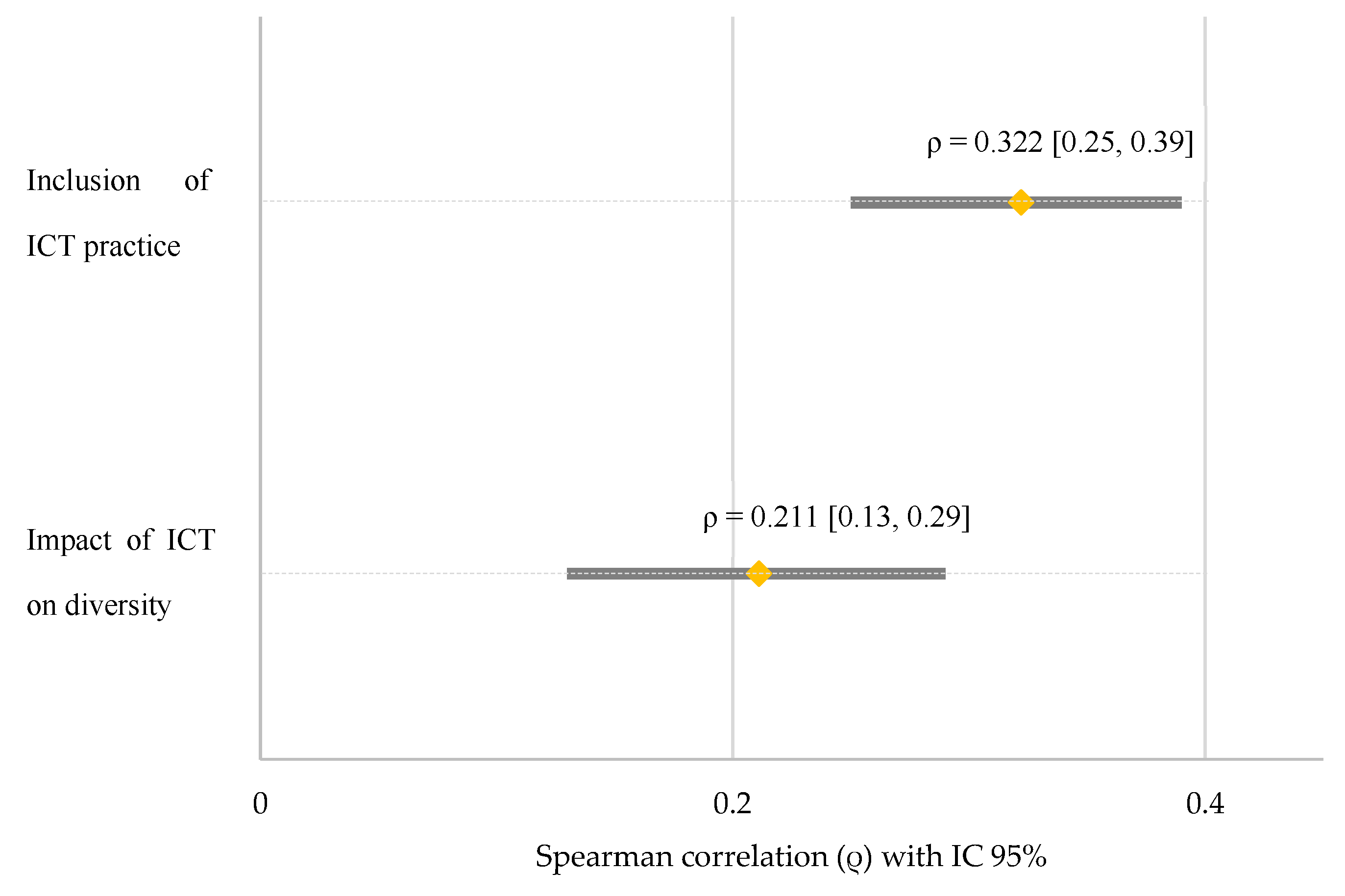
Figure 2 shows that the subsequent correlational analysis showed positive and statistically significant relationships between the teachers’ length of service in the system and the frequency they implement inclusive practices with the use of ICT (ρ = .322, p < .001), and the assessment of the impact of ICT on attention to diversity (ρ = .211, p < .001).
This finding is reinforced by the linear regression analyses, which show that length of service at the institution not only predicts the use of ICT (F(1,290) = 28.809, p < .001, R² = .090) but also the perception of the positive impact on attention to diversity (F(1,290) = 9.059, p = .003, R² = .030). Although this last effect presents a modest magnitude, it appears to be relevant to understand how teachers’ digital competence is built in a progressive and contextualized way within the Amara Berri system, by integrating a pedagogical, inclusive and sustainable use of technology.
In order to reveal the pedagogical mechanisms underlying these data, the qualitative analysis of the discussion group shows that the success of the model does not lie in the technology or the training themselves, but in the coherence of the project which endorses them. Thus, categories within which the use of ICT is framed, such as Methodological Strategies, Student Autonomy and Teacher Role Development and Autonomy, emerged. Some statements that refer to these categories are shown below:
Statement 1.
Because there are multiple options for action, it is not just the classroom. They can also go to the “Media”, show what they have done in class, become the technicians... There are many options. [Category Methodological Strategies. Participant 1].
Statement 2.
Students themselves can, sometimes, explain: ‘Well, look, I am doing this, and I am doing that’. [Category Student Autonomy. Participant 4].
Statement 3.
Not having teachers present 100% of the time allows each student to be themselves. Because not all of us act the same way if the teacher is in front. [Category Teacher Role Development and Autonomy. Participant 7].
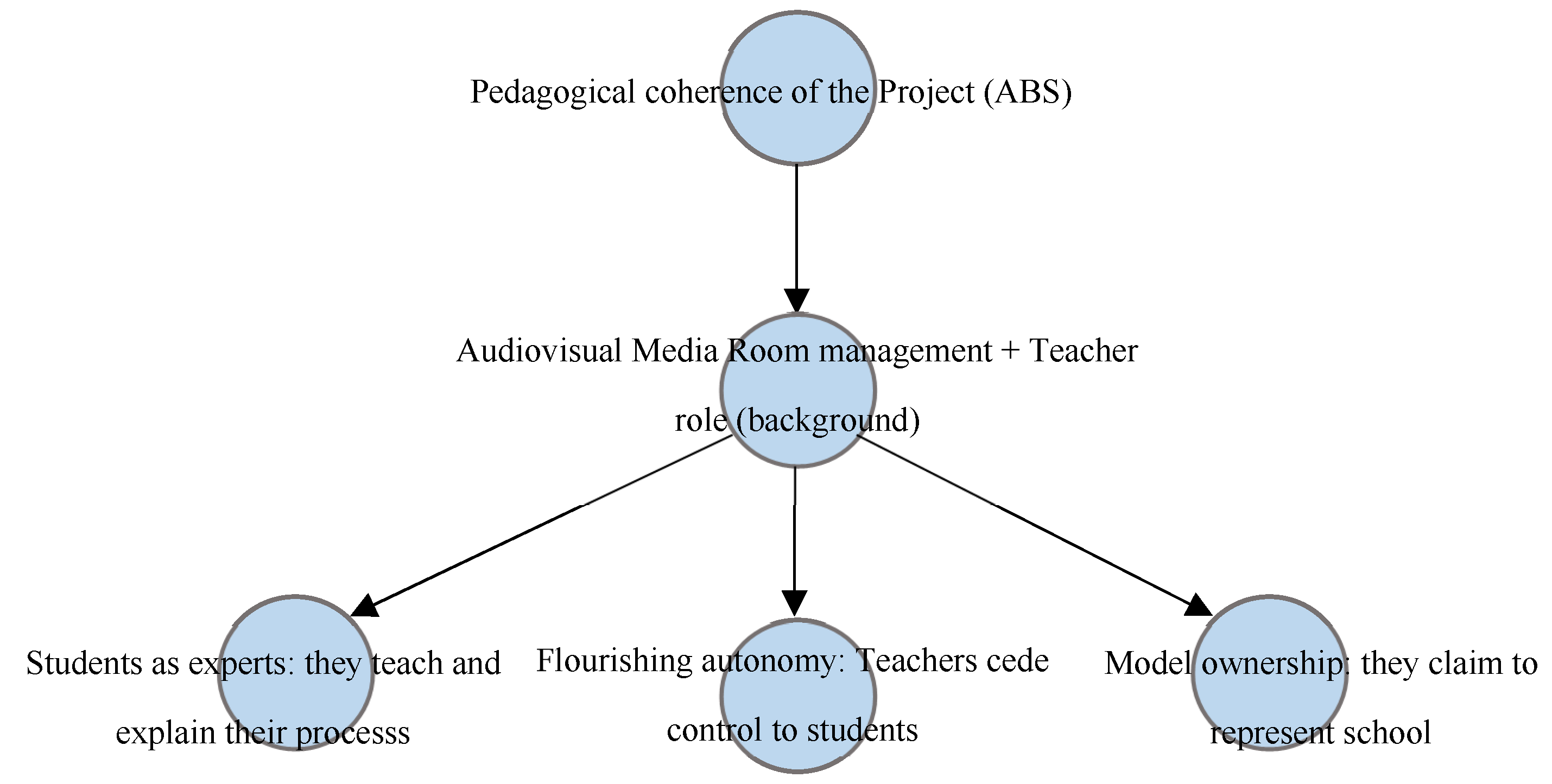
All statements include a key transversal concept: student empowerment. Participants explain how the student management of the “Audiovisual Media Room” turnsthem into the true experts, able to take the lead and explain their own learning process. The anecdote that best illustrates this approval rate belongs to the students themselves who, after knowing about a congress on their own model, claimed their rights to attend as speakers, as can be read in the following statement:
Statement 4.
That students in 5th or 6th grade say: ‘hey, we should attend that congress ourselves, because we are the ones who know the most’. There they were [Participant 8].
The empowerment of students can therefore be seen as a result of the entire process of maintaining consistency in the pedagogical model, as shown in
Figure 3.
Concerning teachers’ training, participants state that initial university training is disconnected from the real practice:
Statement 5. I don’t know about the teachers they have now, but those of our generation, most of them had never been in a school classroom. So, what kind of pedagogy are you going to talk to me about if you’ve never been in a classroom with 23 children? I mean, they theorize and you think… (they laugh) no... [Participant 5].
Also, participants highlight that professional knowledge is mainly built through practice, through the immersion in the school center structures –stages, seminars, shared tutoring-:
Statement 5. How do we learn to work in Amara Berri? By participating in the structures [Participant 1].
In this regard, other participants stress the importance of peer learning and welcoming of new colleagues as a process of joint construction:
Statement 6. Because if new people come to school... we have to talk about it again. Yes, again. Because you are carrying another backpack and you are going to contribute something new. [Participant 8].
Additionally, this shared experience makes the acquisition of a common pedagogical discourse possible, which brings the team together, and projects the learning directly into the classroom:
Statement 7. It has one advantage: having a common language. We all belong to a school network, and when you talk about everything we talked about here today, tomorrow, in your class, something is going to change. [Participant 8].
Next,
Table 1 shows the Frequency of Categories related to ICT inclusion and teacher training in the ABS, considering the factors being analyzed in the study.
4. Discussion
The traingulation of the quantitative and qualitative data of this study makes it possible to confirm that the sustainability of digital innovation at schools does not lie in the quality of the devices, but in the depth and coherence of the pedagogical project on which it is based. In an educational reality characterized by the tension between digitalization and the concern over the passive use of screens [
2], the challenge does not remain at a theoretical level but involves the everyday experience at schools and educational centers. This challenge is heightened where the concerns over digitalization are explicitly expressed by teachers. In the framework of the current investigation, teachers with cast experience in contexts of innovation note with concern how the domestic use of technology is affecting children’s socialization dynamics from early stages, as can be read below:
Statement 8.
We have a problem with screens. The other day, a colleague from the 5-year-old classroom said that her students set the table at the ‘house corner’. They set the table beautifully, with the plates, the napkins..., and they also propped the mobile phone up against the glass of water. Mobile phones that do not work, toy phones, but there they were, they were pretending to have lunch, and they had their phones with them. [Participant 5].
This anecdote illustrates how technology has even colonialized symbolic play. It represents the difficult crossroads that schools need to face nowadays: it is not about prohibiting, but about re-signifying. In this context, the ABS offers a model able to integrate ICT in a significant, inclusive and sustainable way, in line with the Sustainable Development Goals [
5].
The main mechanism that can explain this success is the resignification of technology since ICT are not an end in itself within the ABS, but rather a tool to empower the students. The qualitative analysis reveals that the school provides a model which is radically opposed to the individualistic use and consumption of technology. It presents a collective and creative use for social purposes. This practice is enabled by a redefinition of the teacher’s role, which moves to the background, deliberately ceding control so that student autonomy can thrive. As it is based on production and managed by the students themselves, the “Audiovisual Media Room” becomes a space for student empowerment where technology turns into a tool for the Universal Design of Activities, offering multiple forms of representation and expression. By giving students a real purpose (to communicate, to inform, to create for an audience), the system transforms the use of ICT from a technical exercise into an act of digital citizenship. This approach aligns with the most advanced views of digitalization, which demand that we surpass the instrumental approach in order to critically rethink teaching-learning processes [
4,
17].
Results show that the ABS provide sustainability precisely because it articulates structural, pedagogical, and organizational dimensions in a coherent way. This discovery is supported by the inferential findings, which show significant differences in the use and perception of the impact of ICT, depending on the length of service in the system. Dunn test with Bonferroni correction indicates that the group with ≥ 16 years of experience rates significantly higher scores than the groups with less years of experience, which suggests that inclusive digital cometence is built progressively in real contexts of pedagogical innovation.
In this sense, a polyhedric and holistic approach to digitalization in the curriculum should be proposed [
4]: from the macro (values and educational mission) to the micro (school projects and specific practices). Implementing this perspective makes it possible to understand that experiences such as the ABS provide sustainability because they properly integrate all these levels. Similarly, the commitment with sustainable and inclusive education requires not only methodological innovations but also changes in the school culture and teacher training [
20]. Along this line, results of this study can be taken as a practical example of how to overcome the reductionist view of technology to progress towards a sustainable, critical and pluralistic citizenship model.
On the other hand, diverse studies have highlighted the urgent need to desing training programs that enhance teachers’ digital competence at all levels, and not only in its instrumental dimension, as it should give special attention to the capacity of using technology with an educational, inclusive and sustainable purpose [
1]. Moreover, the collective reflection through the ABS’s structures- which are the mail pillar of the model- contributes to reinforce the ethical awareness of teachers on the impact of digital platforms, an aspect that has been identified as weak and underdeveloped in initial teacher training [
7,
9].
The above information is reflected in one of the most important implications of the findings obtained from this study, which is within the scope of teacher training. Quantitative data showed a significant gap between the poor appreciation of initial teacher training and the high formative impact attributed to school experience. This suggests that the ABS is not only a model of inclusive education for students, but also a powerful formative space for teachers. Considering the educational context as a privileged learning setting [
21], the experience at Amara Berri becomes an example of tacit and situated teacher training.
This finding corresponds to several emerging categories in the qualitative analysis –Methodological strategies, Teacher role development, and Learning or improvement through practice-, which signal to the progressive construction of digital and professional competences within a contextualized framework. In this sense, the model does not depend on teachers starting with a high level of prior digital competence; it is the system itself that generates these competencies through everyday practice. The management of school media teaches both students and teachers to use technology in a pedagogical, inclusive, and sustainable way, which illustrates the coherence between qualitative and quantitative findings.
In conclusion, this study offers valuable implications for the debate on sustainable digital education. It demonstrates that it is possible to build a model where technology acts as an ally of inclusion and sustainability. As shown throughout the paper, the key lies not in what type of technology is used, but in how it is integrated into a pedagogical project that gives it meaning. The findings suggest that, to move toward truly sustainable digital education, efforts should focus not only on the endowment of resources, but on the transformation of school cultures and structures. It is therefore necessary to promote models, such as the one analyzed here, which foster student autonomy, teacher collaboration, and, above all, deep reflection on the “why” of innovation. Only in this way can we ensure that the digital revolution in classrooms is, above all, a sustainable pedagogical revolution.
Author Contributions
Conceptualization, A.B.O.O., C.M.P., R.A.A.R., M.G.P. and M.Á.V.S.E.; methodology, A.B.O.O., C.M.P., R.A.A.R., M.G.P. and M.Á.V.S.E; software, A.B.O.O. and M.G.P.; validation, C.M.P., R.A.A.R. and M.Á.V.S.E; formal analysis, A.B.O.O., C.M.P., R.A.A.R., M.G.P. and M.Á.V.S.E; investigation A.B.O.O., C.M.P., R.A.A.R., M.G.P. and M.Á.V.S.E., resources, C.M.P. and M.G.P.; data curation, R.A.A.R. and M.Á.V.S.E; writing—original draft preparation, A.B.O.O. and R.A.A.R.; writing—review and editing, C.M.P.; visualization, M.G.P. and M.Á.V.S.E; supervision, R.A.A.R. and M.Á.V.S.E; project administration, A.B.O.O., C.M.P., R.A.A.R., M.G.P. and M.Á.V.S.E; funding acquisition, A.B.O.O., C.M.P., R.A.A.R., M.G.P. and M.Á.V.S.E. All authors have read and agreed to the published version of the manuscript.
Funding
This research received no external funding.
Institutional Review Board Statement
The entire procedure was reviewed and approved by the Ethics Committee of the UNIVERSITY OF LA RIOJA, under code CE_107_2025.
Informed Consent Statement
Informed consent was obtained from all subjects involved in the study.
Data Availability Statement
The original contributions presented in this study are included in the article/supplementary material. Further inquiries can be directed to the corresponding author(s).
Acknowledgments
The authors would like to thank all the participants in the study, members of the Amara Berri network for their time, collaboration, and valuable contributions to this research.
Conflicts of Interest
The authors declare no conflicts of interest.
Abbreviations
The following abbreviations are used in this manuscript:
ICT
ABS |
Information and Communication Technologies
Amara Berri System |
| SDG |
Sustainable Development Goals |
References
- Sánchez-Caballé, A. La competencia digital dels estudiants universitaris: conceptualització i avaluació. El cas de la URV. Thesis, Universitat Rovira i Virgili, Tarragona, Spain, 2020.
- Liu, J., Riesch, S., Tien, J., Lipman, T, Pinto-Martin, J. y O´Sullivan, A. Screen media overuse and associated physical, cognitive and emotional/behavioral outcomes in children and adolescents: an integrative review. Journal of pediatric health care 2022, 36(2), 99-109. [CrossRef]
- Vasconcellos, R. P., Sanders, T., Lonsdale, C., Parker, P., Conigrave, J., Tang, S., del Pozo Cruz, B., Biddle, S.J.H., Taylor, R., Innes-Hughes, C., Salmela-Aro, K., Vasconcellos, D., Wilhite, K, Tremaine, E., Booker, B. y Noetel, M. Electronic screen use and children´s socioemotional problems: a systematic review and meta-analysis of longitudinal studies. Psychological bulletin 2025, 151(5), 513-543. [CrossRef]
- Arroyo Sagasta, A. y Larraz Rada, V. La digitalización en el currículum: una llamada a la integración para impulsar la educación sostenible e inclusiva. UTE Teaching & Technology 2025, 1, e4133. [CrossRef]
- Bresolí, E., Gandia, M., Suñé, X., Almira, P. y Valls, C. Programación y sostenibilidad: los ODS con Scratch junior en educación infantil y primaria. UTE Teaching & Technology 2025, 2, e3958. [CrossRef]
- UNESCO. Más allá de los compromisos: Cómo los países implementan el ODS 4, 1st ed.; UNESCO: Paris, France, 2019. https://unesdoc.unesco.org/ark:/48223/pf0000369851.
- González-Mingot, S., & Marín, V. I. La gestión de datos digitales en la educación primaria catalana: Percepciones del profesorado. Edutec. Revista Electrónica de Tecnología Educativa 2023, 86, 81-95. [CrossRef]
- Vélez-Holguín, R.M., Rendón-Urrea, D.L., Gómez-Molina, S., Toro-Vanegas, E., López Tovar, P., Oré-León, J.A.A. y Rojas-Arias, J. Diseño del currículo en el contexto del Mobile Learning: un análisis bibliométrico. Revista Ibérica de Sistemas e Tecnologías de Informação 2022, E50, 619–630.
- Urrea-Solano, M., Baena-Morales, S., & Bautista-Peña, A. Las competencias en e-sostenibilidad del alumnado del Grado en Maestro en Educación Infantil y Primaria. In Nuevos retos educativos en la enseñanza superior frente al desafío COVID-19, Satorre Cuerda, R., Ed.; Octaedro: Barcelona, Spain, 2021; pp. 805–815.
- Colás-Bravo, P., Magnoler, P. y Conde-Jiménez, J. Identification of levels of sustainable consciousness of teachers in training through an e-portfolio. Sustainability 2018, 10(10), 1-18. [CrossRef]
- Sánchez-Caballé, A, Gil-Mediavilla, M. y Martínez-Valderey, V. La competencia digital docente de los estudiantes de tercer ciclo en una universidad online española: un estudio piloto. In Nuevos horizontes para la digitalización sostenible en educación, García-Valcárcel & Casillas, S., Dir.; Dykinson: Madrid, Spain, 2021; pp.176-183.
- Valderrama-Hernández, R.; Alcántara Rubio, L.; Sánchez-Carracedo, F.; Caballero, D.; Serrate, S.; Gil-Doménech, D.; Vidal-Raméntol, S. y Miñano, R. ¿Forma en sostenibilidad el sistema universitario español? Visión del alumnado de cuatro universidades. Educación XXI 2020, 23(1), 221-245. [CrossRef]
- Karrera, I., Arguiñano, A., Basasoro, M., Y Castillo, P. Innovative pedagogical experiences at Basque Country inclusive schools. British Journal of Educational Studies 2020, 68(6), 753–770. [CrossRef]
- Cerda Jopia, J. L., Vizcarra Morales, M. T., Rekalde Rodríguez, I. y Sánchez Letelier, M. E. Algunas propuestas para mejorar la formación del profesorado de Chile a la luz de las prácticas pedagógicas de éxito en el País Vasco. Tendencias pedagógicas 2021, 38, 98-111. [CrossRef]
- Anaut, L. Sobre el sistema Amara Berri, 1st ed.; Servicio Central de Publicaciones del Gobierno Vasco: Vitoria-Gasteiz, Spain, 2004.
- Gorosmendi, M. Sistema Amara Berri. Aprendizaje en contextos vitales. Participación educativa 2020, 7(10), 91-106.
- Castañeda, L. y Selwyn, N. Reiniciando la universidad. Buscando un modelo de universidad en tiempos digitales, 1st ed.; UOC: Barcelona, Spain, 2019.
- Colmenero, M. J. & Pegalajar, M. C. Cuestionario para futuros docentes de Educación Secundaria acerca de las percepciones sobre atención a la diversidad construcción y validación del instrumento. ESE: Estudios sobre educación 2015, 29, 165-189. [CrossRef]
- Cohen, J. Statistical power analysis for the behavioral sciences, 2nd ed.; Lawrence Erlbaum Associates: Mahwah, United States, 1988.
- Prada-Nuñez, R., Hernández Suárez, C.A., & Hernández-Albarracín, J.D. Educar en el siglo XXI: reflexiones y percepciones desde la digitalización hasta la inclusión, 23rd ed.; Editorial Cielo: Cúcuta, Colombia, 2023.
- Villaescusa, A. El reto de la formación continua del profesorado para la inclusión. RINED: Revista de Recursos para la Inclusión Educativa 2021, 1(1), 20-28.
|
Disclaimer/Publisher’s Note: The statements, opinions and data contained in all publications are solely those of the individual author(s) and contributor(s) and not of MDPI and/or the editor(s). MDPI and/or the editor(s) disclaim responsibility for any injury to people or property resulting from any ideas, methods, instructions or products referred to in the content. |
© 2025 by the authors. Licensee MDPI, Basel, Switzerland. This article is an open access article distributed under the terms and conditions of the Creative Commons Attribution (CC BY) license (http://creativecommons.org/licenses/by/4.0/).