

Submitted:
07 April 2025
Posted:
08 April 2025
You are already at the latest version
Abstract
Digital participation is now a fundamental human right. Both UNESCO and the European Union emphasize the importance of diversity, inclusion, equity, and accessibility (DEIA) as essential for active citizenship in a digital and sustainable society. The United Nations’ Sustainable Development Goal 4 and the 2030 Agenda advocate for inclusive, high-quality education that leaves no one behind, prioritizing DEIA and lifelong learning. The research article presents the results of ERASMUS+ project Digital Inclusion for All Learners (DI4ALL) (2022–2024), which aimed to ensure digital inclusion in education by providing equal opportunities for all students. Target groups included students, school staff, educational institutions, and national agencies. A specialized training course, intended to promote digital inclusion at all education stages and increase awareness about modern technologies, was delivered in cooperation with Vytautas Magnus University in Lithuania. The feedback from the training course participants showed significant competency gains among 278 educators, particularly in digital systems, Open Educational Resources (OER), AI, and innovative assessment methods. Nearly two-thirds of participants effectively applied their knowledge, advancing high-quality, flexible online education. Based on the DI4ALL initiative outputs and analysis of teachers’ questionnaires, recommendations for teachers, education specialists and policy makers are provided.
Keywords:
inclusion
; digital
; DI4ALL
; school
; SDG
; equity
; social justice
; OER
; life skills
; sustainability
1. Introduction
In today’s interconnected world, digital participation has become a fundamental human right. This perspective is advocated by both UNESCO and the European Union, which emphasize the importance of diversity, inclusion, equality and accessibility (DEIA) in promoting active citizenship in a digitally advanced, sustainable society, especially in the context of rapid advances in artificial intelligence. These principles are deeply embedded in the United Nations’ fourth Sustainable Development Goal (SDG4) and the 2030 Agenda [1,2], which aim to provide quality education for all and ensure that no one is left behind. DEIA, quality education and lifelong learning are central to achieving this vision.
In line with these global goals, the European Commission (EC) has identified three main pillars to support the development of active citizens: digital transformation, green sustainability, and diversity and inclusion. The EC has issued supporting documents to promote the effective implementation of these pillars. One of them is the Digital Decade policy program [3], which targets multiple areas of citizen’s life, such as digital infrastructure, modern technology-based solutions for business, and more convenient and widespread e-government services that increase social inclusion and democratic participation in decision-making. Moreover, digital skills are a great necessity for the mentioned transformations. The next document, the Green Deal, is a comprehensive response of Europe to climate change and sustainability-related issues [4]. Finally, discrimination is tackled, and diversity and inclusion are promoted in the EU anti-racism Action Plan [5]. These mentioned pillars emphasize the need to equip people with the skills and knowledge they need to succeed in an increasingly digital and environmentally conscious world. According to Nordregio (2024a) [6], in the dynamic digital landscape of the Nordic and Baltic regions, inclusion is not just a goal but a necessity. For this reason, The Nordic Council of Ministers developed the action plan for Vision 2030 [7] in order to promote sustainable development, gender equality, and children’s rights in Nordic countries and to share the good experience with other countries, including the Baltic States. Moreover, Nordregio (2024b) [8] pointed out that in the 2021-2023 period, Nordic and Baltic countries published 19 new strategies on digital inclusion. This fact evidences the growing importance of digitalization for practitioners and policymakers of the Nordic and Baltic Sea Region. Besides conforming to EU policies, it shows their motivation to distinguish and solve region-specific issues in this field.
Next, it is worth taking a look at the academic resources on the analysed topic. According to the Clarivate Analytics database, since 2000 the number of publications on digital inclusion exceeds 15000. Since 2019 a rapid growth of publications is noticed - the annual number of records in the database has crossed 1000. The key fields of research, in the context of which the digital inclusion is analysed are computer science, engineering, education, health care and business economics. Particularly, in the field of education there are more than 1500 publications on digital inclusion, evidencing a growing necessity for a scientific analysis of this process. Moreover, some studies are highly innovative, analysing such elements as adaptive platforms [9], engagement of parents in learning support [10], music therapy [11], the inclusion in the society of young people with developmental disabilities [12] and digital storytelling [13,14].
However, DEIA has not received much attention among scholars, and the majority of publications belong to a very recent period. Overall, in the Clarivate Analytics database, there are 14 publications on DEIA, where it is understood in its classical meaning as diversity, equity, inclusion and accessibility. Senel (2023) [15] presents the application of DEIA in the classroom while teaching languages. Bethea et al. (2024) [16] propose a practical implementation of this engaging idea and point out how to set up a committee on diversity, equity, inclusion, and accessibility in a higher education institution in order to promote a vibrant academic community. Hersugondo et al. (2024) [17] investigated the influence of DEIA on job satisfaction of employees with disabilities. Some researchers transferred this quite soft phenomena to a very “hard” area - design of buildings [18]. Moreover, in several most recent publications, particularly related to pharmaceutical education and analysing U.S. situation, DEIA is transcribed as diversity, equity, inclusion and anti-racism [19,20]. There are only 6 publications in Clarivate Analytics with this approach. Along with that, two researchers broadened the DEIA term beyond diversity, equity, inclusion and accessibility and used DEIA+ acronym, meaning that it may include more additional elements that are in line with the same values [21]. Such an approach could foster even broader analysis of the DEIA and related issues in academic research. Regardless of the above-mentioned modern points of view, we will perceive DEIA in the current research in its classic meaning set up by UNESCO.
As part of the European Digital Education Hub and its Squad on Diversity, Equity and Inclusion, Van der Steer, Ossiannilsson, et al. [22] argued that everyone should have equal opportunities to participate in education. They emphasized that the need for Diversity, Equity, Inclusion (DEI) also applies to digital education, where there are different challenges compared to traditional education - unequal access to digital devices, poor internet connectivity in certain areas or insufficient training in digital skills, to name a few. Their research focused on how DEI can improve digital education and vice versa. In addition, they looked at the digital divide and promoting digital equity, as well as marginalized groups in digital education and how DEI can limit technostress and increase well-being.
After analysing the scientific and practical literature on diversity and inclusion, it is clear that this research area is underinvestigated and needs greater academic and practical attention. Within this framework, outlined in the reviewed policy documents and research publications, the ERASMUS+ project Digital Inclusion for All Learners (DI4ALL), running from 2022 to 2024, aimed to improve the learning outcomes of young students by promoting quality improvements and innovative practices in educational institutions [23]. The project pursued two goals: to ensure digital inclusion in education and thus create equal opportunities for all students and to combat disinformation through comprehensive training for teachers and educators. The target groups of this initiative included students, school staff, educational institutions, public bodies and national agencies.
A key component of the DI4ALL project was the development and delivery of a training course that reflects current international trends and initiatives in innovative learning landscapes and scenarios, and is strongly aligned with UNESCO and European Commission guidelines. This course was integrated into the National Life Skills Program of Vytautas Magnus University in Lithuania.
This research article examines the results and findings arising from participation in the DI4ALL initiative and the National Life Skills Program at Vytautas Magnus University. The particular outcomes were studies on digital inclusiveness in Lithuania and in Sweden, including international initiatives and best practice cases from each country, and the training course for school teachers. Moreover, a substantial attention is paid to the survey of teachers who participated in the training course under the National Life Skills Program. The survey data from 278 respondents show that adult educators’ competencies have improved significantly, particularly in areas such as digital education systems, Open Educational Resources (OER), artificial intelligence (AI), learning assessment procedures and the provision of high quality, flexible and remote online learning. In addition, the results show that around two thirds of the participating teachers have successfully applied the knowledge acquired in the training, with a focus on the use of digital systems, OER, the integration of AI, innovative assessment methods and the improvement of online learning platforms.
This study aims to contribute to the ongoing discourse on digital inclusion and quality education. It provides valuable insights into the effectiveness of the DI4ALL project, the practical implementation of the DEIA concept in education and the broader implications for educational practice in the digital age.
After this brief introduction, the methods applied in the research are described. The results are then presented and explained. This is followed by a discussion and conclusion.
2. Materials and Methods
2.1. The Methodology for the Study on Digital Inclusiveness, the Training Course and a Guidance
This Study on Digital Inclusiveness represents the main result of the O1 activity of the DI4ALL project and consists of three main parts: 1) International and European initiatives; 2) A country report – Study cases Sweden; 3) A country report – Study cases Lithuania. In the first part, the most important initiatives and publications of international organisations, such as UNESCO, United Nations, the OECD and the Council of Europe, the Joint Research Centre and CEDEFOP were examined as desktop research. In the second and third part, the analysis of study cases in each country, qualitative and quantitative data is analysed. Finally, practical ideas about digital inclusion for all learners, as well as best practices and recommendations for broader digital inclusion are provided.
The Guidance for Digital Inclusion for all Learners in Schools, which is the result of O2 activity of the project, represents the content of the training course for teachers and a guide to implementing the initiative Digital Inclusion for All. The course deals with current international education trends and initiatives. UNESCO and European initiatives form the basis for the course. Other modules, such as artificial intelligence tools and quality framework for open, flexible online and distance learning are also used in the Guidance. The prepared document provides step-by-step instructions, case studies, and best practices on implementing digital tools and inclusive strategies in the classroom. The Guidance also represents a framework that can be used in the National Life Skills Program in Lithuania and in similar programs abroad.
2.2. The Methodology for the Questionnaire Survey About the Training Course “Digital Inclusion for All”
2.2.1. Preparation of the Questionnaire
To obtain information from the respondents, the survey method was chosen. Questionnaire is a standardized method with strict rules. The questionnaire consists of a group of interrelated questions to which the respondents need to answer. The questionnaire itself does not have a strict form. The content, quantity and order of the questions depend on the research objectives.
When formulating the questions, the responsible researcher must ensure that:
- the formulation of the questions would be understandable to the respondents who will be interviewed;
- the interviewees should be able to answer the questions in such a way as to best reflect the point of view they wish to express;
- the style of the questionnaire should be appropriate, i.e., questions must be stated in clear, understandable and very polite language.
When creating a questionnaire, it is important to properly formulate the questions. The success of the research largely depends on the formulation of the question. The questions must be clear to all respondents. Ambiguity should be avoided when it is not clear exactly what is being asked. Both closed and open type questions can be submitted in the questionnaire.
The questionnaire of this study consisted of 11 questions:
- 4 closed type questions;
- 4 open-ended questions;
- 3 questions requiring responses on a Likert scale.
All questions, grouped according to three themes and purposes, are presented in Figure 1.
2.2.2. Methods of Analysis of Research Results
The MS Excel program was used to process and analyze the data obtained during the questionnaire survey of this study. The results of the answers are represented using tables and charts. Descriptive statistics is also used. Analyzing responses to questions where statements were asked to be rated on a Likert scale from 1 to 5, as recommended in scientific literature and practical sources [24,25,26,27], statistical parameters were calculated - mean, mode, median, and standard deviation. A correlational analysis of the evaluations of the statements was also carried out.
2.2.3. Research Ethics
When conducting research, it is important to take into account the following ethical principles [28,29]:
-
The principle of benevolence. This principle consists of the following dimensions:
- The right to be inviolable. The questions that make up the questionnaire are well thought out; phrases, concepts, and terms would not cause the informants anxiety, fear, or otherwise damage their personality.
- The right not to be exploited. Information security was ensured for the respondents. Also, filling out the questionnaire will not cause any negative consequences in the future.
-
The principle of respect for the dignity of the person. This principle consists of the following dimensions:
- The right of personal self-determination. Respondents had the right to make their own decisions about voluntary participation in the survey. The respondents were able to express their opinion of their own free will, without being forced or prompted by anyone. Respondents had the right to stop filling out the questionnaire at any time.
- The right to be informed. The study objectives were explained to the respondents. Also, the opportunity to get acquainted with the summarized research results later was explained to the respondents.
-
The principle of justice. This principle is based on the following dimension:
- Right to privacy. The respondents were guaranteed confidentiality and anonymity regarding the information provided during the research.
-
The right to receive accurate information. This principle is based on the following dimensions:
- Research objective. When sending the invitation to participate in the survey, the purpose of the study was explained in detail in the invitation letter.
- Research procedures. The interviewees were informed about the method of information collection and the duration of the investigation.
- Ensuring privacy. It was explained to the respondents that their privacy will be protected. The questionnaire does not ask for any personal information that could identify them. It was also emphasized that the researchers and institutions participating in the study undertake to comply with the EU General Data Protection Regulation (GDPR).
- Volunteering. The text of the invitation emphasizes that participation is voluntary.
- Contact information. The contact information provided to the invited respondents is an e-mail that they could use to contact the survey team in case of technical difficulties in completing the questionnaire or for any information related to the study.
3. Results
3.1. The Study on Digital Inclusiveness
In the dynamic digital landscape of the Nordic and Baltic regions, inclusion is not just a goal, but a necessity, and a human right to be an active citizen with a sense of belonging. As these societies become increasingly digitized, it is crucial that everyone, regardless of their background or circumstances, can fully participate in the digital revolution. According to Nordregio (2024a) [6], the statistics speak volumes. Looking at the Digital Economy and Society Index (DESI Index) 2023, we can see that Finland is at the top of the European rankings for basic digital skills among its citizens, while Denmark and Sweden are not far behind [30,31]. The same applies to internet access, where the countries score well. The picture is also positive when it comes to government services: the use of electronic government services is high and exceeds the EU average. However, increasing digitalization also increases the risk of some citizens being left behind. While the Nordic and Baltic countries are largely considered digital pioneers, DESI 2023 and other recent studies also estimate that a large proportion of the Nordic and Baltic population is at risk of digital exclusion. Such observation results in a Nordic and Baltic paradigm, namely the risk that increasing digitalization will lead to a growing digital divide. As our societies become increasingly digitalized, it is imperative to ensure that no one is left behind in the digital dust.
In order to compare the level of development of digital inclusion in several countries, the DESI index is a convenient and comprehensive measure. However, since 2023 the DESI methodology, indicators and dimensions have changed. DESI became integrated into the State of the Digital Decade report and aimed to assess how the EU reaches the digital objectives.
As we can see from the comparison of previous and new DESI index composition (Figure 2), the number of dimensions remained the same (4) but their titles have changed, the number of sub-dimensions decreased from 10 to 9, and the number of indicators remained the same - 32 [30,31]. Some of the indicators were eliminated (such as female ICT specialists), others were newly created (such as mobile friendliness), some were re-scheduled to other sub-dimensions (such as Enterprises providing ICT training). Some sub-dimensions were extended (e-Government) or newly added (e-Health) (Figure 2). In 2024, DESI index composition was changed once again in order to better comply with EU digital targets. DESI 2024 consists of 36 indicators, 15 of which are the Digital Decade key performance indicators (KPIs). Dimensions and sub-dimensions remained the same in 2024, compared to 2023, but the indicators comprising them have slightly changed.
At the time of preparation of the Study on Digital Inclusiveness under the DI4ALL project, only DESI 2022 metrics were available. Sweden ranked 4th out of 27 EU member states in 2022 according to overall digital inclusion. It performs well and has done so in recent years and is above the EU average, even if progress is not as fast as it used to be. Lithuania occupies the 14th position out of 27 EU Member States. The country demonstrates strong performance in digital public services, while its human capital and integration of digital technology are close to the EU average. While comparing the situation of 2022 in two countries, it is clear that Sweden greatly outpaces Lithuania in the overall DESI index, as well as in 3 out of 4 dimensions (Figure 3). Sweden remains a frontrunner in digital public services, but Lithuanian performance is very similar in this field. Talking about Sweden, the decentralized model it uses to implement its strategies has advantages and disadvantages, and the country is actively trying to eliminate the latter. To make progress here, Sweden must ensure greater coherence and interoperability where necessary and continue to implement and expand its open data policy. Even if Lithuanian progress in the delivery of digital public services is evident, further enhancements are required to improve their quality, user-friendliness, and accessibility. A more coordinated approach and concerted efforts concerning e-services would facilitate easier access for the public and businesses, enabling government bodies to establish new services and further automate existing ones.
It is also worth comparing both countries according to DESI 2024, its dimensions, sub-dimensions and indicators (Figure 4 and Figure 5).
Figure 4 shows that both Sweden and Lithuania have improved according to the overall DESI 2024 index compared to DESI 2022. Since their titles and composing indicators have changed, dimensions cannot be comprehensively compared. However, the last dimension, the digitalization of public services, retained its sense. We can see that Sweden has improved a lot in this field, but its score in Lithuania decreased, mainly due to the new indicator of mobile-friendliness. Comparing the two analyzed countries according to sub-dimensions, it is clear that Sweden outpaces Lithuania (Figure 5). The greatest difference is in advanced skills and development, and the lowest difference is in the e-commerce sub-dimension. According to separate indicators, the greatest difference is in 5G spectrum (83.89 for Sweden and 47.22 for Lithuania), and the lowest difference in digital public services for business (95.97 for Sweden and 95.94 for Lithuania) [31].
Digital inclusion tends to be complex and multilayered, meaning that there often are many reasons for individuals becoming digitally excluded. A range of demographic factors might simultaneously contribute to the likelihood of digital exclusion [32]. Civil society actors play a crucial role in bridging the digital divide. Their work on the diverse needs of at-risk groups should not be overlooked. The Nordregio research project entitled “Digital Inclusion in Action” [6] examines the important role of civil society actors in tackling digital exclusion in the Nordic-Baltic region. They argue that as civil society gains traction in ensuring and promoting equal access to the digitized society, the unique challenges and successes of non-governmental organizations helping diverse groups need to be explored. In the research from Nordregio (2024b) they argue that young people are at risk of digital exclusion due to potential barriers such as a lack of awareness or understanding of e-governance systems [8]. In addition, socio-economic factors and inequalities in access to technology and digital literacy can further marginalize certain young populations and hinder their ability to fully participate in digital transactions and services.
3.2. International Initiatives and Best Practice Cases from Sweden and Lithuania
Many European and international organizations, such as UNESCO, OECD, the Council of Europe and others, adopt various initiatives, related to open and inclusive education. For example, OECD developed The Learning Compass for 2030 [33]. It is an evolving learning framework that sets out an ambitious vision for the future of education. It offers points of reference for the future we want: individual and collective well-being. Further, Mezzanotte and Calvel (2023) [34] explore how the input-process-outcome model can be used to measure inclusion in education, along with identifying key indicators that schools and education systems can use. The authors also address important considerations for policymakers, including how widely the indicators can be applied, challenges related to data disaggregation, and the importance of considering intersectional approaches to inclusion. In 2019, the Council of Europe launched their initiative on being online, wellbeing online, rights online and published a Digital Citizenship Education Handbook [35]. It includes helpful recommendations for citizens regarding their online behaviour, including online education, in order to stay safe and gain as much utility as possible. The handbook covers such sub-topics as Access and inclusion, Learning and creation, Media and information literacy, Ethics and empathy, Health and wellbeing, Presence and communication, Active participation, Rights and responsibilities, Privacy and security, Consumer awareness.
There are other relevant European initiatives on digital education. For example, the Joint Research Center first published DigComp, The Digital Competence framework for citizens, in 2013 [36]. Other versions followed later, such as DigComp 2.2 [37], which was translated into Swedish in 2022. Other, more specialised frameworks for developing competences include the EntreComp, the LifeComp, and the GreenComp, though they were not directly related to recommendations on the digital life [38,39,40]. However, the DigComp also has given rise to some particular practical tools and technologies, such as DigCompOrg, DigCompConsumers, DigCompEdu and DigCompSat [41,42,43,44,45].
Next, we will describe the Swedish initiatives, tools and organisations in the field of digital education:
- Digital lektioner (Digital lessons) is an open digital learning resource, containing ready-made lessons in various subject areas for all stages in primary school. This pool of resources meets the curriculum’s writings linked to digital competence and programming.
- Gratis lektioner (Lektion.se) for almost 20 years has been a platform where teachers have made their best material available. The website became an extensive teaching database.
- The Internet Foundation’s Internet knowledge (Internetkunskap) is an independent, business-driven, non-profit organization. The platform presents free and easy information and guides on how to become a more conscious Internet user on the following topics: Artificial Intelligence (AI), Safety on Internet, Sustainability, Parenthood, Integrity, Source Criticism, Cyber Hate and Freedom of Expression, and That’s how the Internet Works.
- The Swedish Postal and Telecommunications Agency (Post och Telestyrelsen, PTS) is the authority that oversees electronic communications and postal services in Sweden. The PTS has developed Digital Support (Digitalhjälpen). It includes dimensions such as shopping online, identifying yourself online, paper support, sign language support and becoming a digital coach.
- The Swedish National Agency for Education (Skolverket) offers education-related films and podcasts, explaining what has changed in the relevant documents and what digital literacy is. Also, there are videos available where teachers reflect on their use of digital tools in the classroom.
- The Digitization Council (Digitaliseringsrådet) is an important function to collect and disseminate knowledge about current changes and needs in this area. The Council’s work aims to promote the implementation of the general digitalization policy and the digitalization of public administration.
Lithuania has the following initiatives on digital education:
- ATRASK.EU is a community-based tourism platform to promote lesser-known regions of Lithuania and their unique cultural and natural heritage. The platform was financed by the LEADER funding. The platform offers educational materials for visitors and local residents. Also, in terms of this project, a table game for kids was created, named “Atrask.eu”, designed to test their knowledge of the local legends and history of the Aukštadvaris region. Overall, the ATRASK.EU initiative covers the website (https://atrask.eu/), board game “Velnių takais” (Devil’s Trails), designed to engage players in discovering the region’s folklore and history while fostering curiosity and creativity, and a book titled “Aukštadvario Gidas” (Guide to Aukštadvaris), providing interactive tasks and information about the area’s nature, people, and cultural landmarks.
- “Safer Internet Centre Lithuania: draugiskasinternetas.lt” is the action under the “Connecting Europe Facility” (CEF Telecom) programme whilst implementing Safer Internet centre’s (SIC) generic services. The overall objective is to deploy services that help make the Internet a trusted environment for children through actions that empower and protect them online.
- Media Literacy in the Baltics was a two-year program (October 2019 - September 2021) of the U.S. Department of State, administered by the International Research & Exchanges Board (IREX). The program aims to train citizens in three Baltic countries to be better able to engage critically with multiple forms of media. IREX has also launched an open access online course on media literacy to help people in the Baltics identify and use good quality information, curb the spread of mis- and disinformation, and recognize and avoid manipulative information and hate speech.
- The National Education Agency’s Educational Technologies (EdTech) Center, established in 2024, oversees the consistent digital development of education in Lithuania. One of the essential goals of the EdTech Center is to promote collaboration between digitalization experts – developers – and teachers, students, and the entire education system. The EdTech Center provides opportunities for educators to participate in IT studies, improve practical skills, creates new digital teaching tools, organizes local and international events, internships, helps schools test the latest educational technologies, supplies educational institutions with computer equipment, and carries out other activities related to the education sector.
3.3. The Training Course
The main objective of the training course “Digital Inclusion for All” conducted as a part of the National Life Skills Program was to promote digital inclusion at all education stages and ensure that modern technologies and digital skills are accessible to everyone, regardless of social, economic, or geographical situation. Given such a focus on inclusion, the program served as a valuable helping tool in highlighting the needs of people in the process of learning. It provided helpful examples of adapting the teaching materials and methods to successfully reach all learners, including adults and youth at risk or refugees. The training course consisted of several important topics, such as the UN Sustainable Development Goals, the prioritized areas by the EC and especially the areas of focus for ERASMUS+ programs, such as active citizenship, digital transformation, inclusion, equity, and green sustainability, the European Year of Skills, the digital systems for education, recommendations for Open Educational Resources (OER), the use of artificial intelligence (AI), learning assessment methods, and the development of open, flexible distance-learning systems of good quality. The course was offered to 720 school teachers in Lithuania. The training and course materials were available under Creative Commons Licence CC BY SA. All topics of the training course will be briefly presented in this section.
3.3.1. UN Sustainable Development Goals
Since UNESCO presented its 2030 sustainable development agenda, it needed a more precise plan to achieve its objectives [46]. Thus, the 17 Sustainable Development Goals and 169 targets were elaborated [47]. The 2030 Agenda focuses on five key dimensions: People, Prosperity, Planet, Partnership and Peace, also known as the 5Ps. Similarly, the 17 goals are interlinked, apply to all countries and must be implemented by all stakeholders – governments, the private sector, civil society, the United Nations system and others – working in partnership. The agenda and sustainability goals are of great importance for educators, thus, proper attention was given to these topics, along with other related documents and initiatives.
3.3.2. ERASMUS+ Objectives of the European Commission. European Year of Skills
Erasmus+ program seeks to support the educational, professional and personal development of people in the fields of education, training, youth and sport using various proactive initiatives. The program focuses on four main priorities: (i) inclusion and diversity; (ii) digital transformation; (iii) environment and the fight against climate change, and (iv) participation in democratic life [48]. The mentioned priorities and particular means of their implementation are of utmost importance for contemporary educators, thus, they were included into the training course.
2023 was announced as the European Year of Skills by the European Commission [49], which perfectly coincided with the DI4ALL implementation period. Such initiative aims at promoting a reskilling and upskilling mentality and helping people acquire the right skills for quality jobs. Skilled employees contribute to sustainable growth, promote innovation and improve the competitiveness of companies. Basically, skills are divided into general and transversal. Digital skills are commonly attributed to general skills, but some areas of digital skills, such as media and information literacy, can also be a transversal skill [50].
3.3.3. Digital Systems for Education
In the training course we have used many of the frameworks developed and recommended by the European Commission for digital inclusion for all, most of which are based on DigComp2.2 (or earlier versions), such as: DigCompEdu, SELFIE for teachers and for schools, MyDigiSkills, EntreComp, Skillify, and Universal design for learning [38,43,44,51,52,53,54]. These tools are useful for teaching and learning, since they can facilitate the learning process, increase digital competences of students, promote critical thinking, broaden the accessibility of education, and identify areas for further development of teachers’ and learners’ digital skills.
3.3.4. Open Educational Resources
Open Educational Resources (OER) are learning, teaching and research materials in any format and medium that reside in the public domain or are under copyright that have been released under an open license, that permit no-cost access, re-use, re-purpose, adaptation and redistribution by others. This definition of OER, along with its objectives and areas of implementation, was proposed in the Recommendation on OER adopted by UNESCO in 2019 [55]. This Recommendation addresses five objectives: (i) building capacity of stakeholders to create, access, re-use, adapt and redistribute OER; (ii) developing supportive policy; (iii) encouraging inclusive and equitable quality OER; (iv) nurturing the creation of sustainability models for OER, and (v) facilitating international cooperation.
3.3.5. Artificial Intelligence (AI) + CHAT GPT
With constantly advancing technologies, already for some period of time, AI has been interacting with education through such tools as gamification, student performance analysis, scheduling, learning patterns and knowledge levels, plagiarism detection, learning analytics, AI-powered assessments and other tools. While exploring opportunities to use AI in teaching and learning and make the most of its advantages to enhance digital inclusion, still, some of its application aspects should be considered with caution. Several European policies should be taken into account to ensure safety, data privacy and human rights while applying AI, namely, The European AI Strategy [56] and the AI Act [57]. Thus, educators need proper knowledge on AI, including one of its most popular tools, ChatGPT, to ensure it is used professionally, ethically, sustainably and equitably.
3.3.6. Learning Assessment Methods and Opportunities
Constructivist learning theorists have for many decades promoted the benefits of self-directed learning or autodidactism. The New South Wales (Australia) Education Standards Authority provides a good summary of “assessment for, as, and of learning” [58]. This organization claims that assessment of learning assists teachers in using evidence of student learning to assess achievement against outcomes and standards. Assessment for learning involves teachers using evidence about students’ knowledge, understanding, and skills to inform their teaching. Assessment as learning occurs when students are their own assessors. If teachers want to encourage their learners to become more autodidactic, it would then seem reasonable to shift from assessment of learning to assessment for learning and ultimately get to assessment as learning.
3.3.7. High-Quality Systems of Open, Flexible, and Distance Learning Online
A selection of quality frameworks for open, online and distance learning is an important element of education. During the training, the holistic approach was emphasized as well as the ecosystem of open, flexible and distance learning for access, inclusion, diversity and equity. Many of the models presented are further described in a report prepared by Ossiannilsson et al. in 2015 [59]. Whatever framework is used, it should be ensured that the following dimensions are emphasized: multifaceted, dynamic, mainstreaming, representative, and multifunctional. Some holistic quality models have different levels as macro, meso, micro and nano, in order to consider all stakeholders at all levels. Most of them also take the learners’ perspectives [60,61]. Also, during the training course it was offered to include new quality factors, such as commitment, engagement, ethics, equity, inclusion, innovation, satisfaction, socioemotional dimensions, sustainability and well-being. Additional quality dimensions for developing a culture of quality, such as communication, leadership, involvement, and ownership, were discussed. The proposed improvements of quality frameworks can be used to enrich the process of learning in the digital era.
3.4. The Assessment of the Training Course
In order to evaluate the utility of the training course for the teachers, the questionnaire was prepared and training participants were asked to fill it. The questionnaire contained 11 questions for teachers, as presented earlier in the text in Figure 1. Three questions were of a closed type in order to determine whether the competencies of the teachers have improved, as well as to evaluate the quality of the organization of the training and the content of the training itself according to the Likert scale with points from 1 to 5, where 1 is the worst rating, and 5 is the best. The next question was aimed at finding out whether the teachers applied the acquired knowledge in practice, and one more question was about how they plan to use the learned methods in the future. There was also an open question about possible comments and suggestions for the program. The remaining questions aimed to obtain information about the gender, age, work experience, subject taught, and place of residence of the training participants. However, in order to better disclose the utility of the training course, the answers to the questions will not be analysed in the same sequence as they appeared in the questionnaire. The questionnaire was distributed to the training course participants via email in February, 2024. A total of 278 teachers answered the questionnaire, which amounts to a 38,6% response rate.
The presented analysis of the survey will give some insight into the usefulness of training programs for teachers in terms of the purposeful application of innovative digital technologies for their work.
3.4.1. Demographic Information of Respondents
First, it is worth analysing the demographic data of respondents. 258 women and 20 men participated in the survey. Most teachers were aged 51-60 years old (around 41%). A slightly lower part, almost 33% of participants, fell into the age category of 41-50 years old. Almost 60% of teachers who participated in the training program and subsequently – in the survey – have more than 20 years of experience (Table 1). According to their place of residence, most of the teachers participated from the big cities - Vilnius and Klaipėda, slightly less - from Kaunas and Šiauliai. There were few participants from the districts and small towns.
After examining the most common subjects taught by teachers at school (Figure 6), we notice that the majority of training participants teach the subject of life skills at school. Given this remark, we can conclude that the topic of digital inclusion is the most relevant for teachers teaching the life skills program. Very often this subject is not the only one taught by the teacher. Life skills are usually taught together with nature, moral education, human safety, ethics, physical education, and citizenship. There were also quite a few interviewed teachers who teach students biology and chemistry, moral education and history, as well as social pedagogues, for whom the knowledge of digital inclusion in education is also relevant and valuable.
3.4.2. Competencies, Knowledge and Its Application
One of the most important questions, related to the improvement of teachers’ competencies, was “How much have your competencies in diversity, equality, and inclusion in the listed areas increased after the training?”. The generalized results of teachers’ answers are presented in Table 2.
The results presented in Table 2 show the magnitude of the increase in teachers’ competencies in the listed field, according to their self-assessment. The average value, median, and mode of all 278 responses are presented. Since median and mode are equal for all seven listed areas, the average is the only parameter that can show a slight difference. It can be noticed that the highest average value belongs to the topic of High-quality systems of open, flexible, and distance learning online (3.82 points), which indicates that teachers, on average, learned the most in this field. The lowest average value is 3.54 and belongs to the theme ERASMUS+ objectives of the European Commission. European Year of Skills. In this field, teachers’ competencies increased at a slower pace. However, it could also mean that this topic was not so relevant to them. Anyway, the difference between the highest and lowest average values is minimal. Thus, no theme is significantly prioritized according to the answers to this question.
The standard deviation shows the spread of values around the mean. The higher it is, the farther the values are from the average; in other words, the respondents’ opinions are very different. In the analysed case of seven topics, standard deviation values vary from 0.87 to 0.97. Thus, it can be noted that the opinion about Learning assessment methods and opportunities is treated more uniformly. On the other hand, the highest standard deviation appears for the topic ERASMUS+ objectives of the European Commission. European Year of Skills. This means that teachers mostly disagree about the increase in their competence in this area. A slightly lower than maximum standard deviation belongs to the topic Artificial Intelligence (AI) + CHAT GPT. For this reason, we can conclude that the competencies of using AI in the learning process have not increased so uniformly in all participating teachers’ cases. The cause of that may lie in the difficulty of understanding modern AI tools and their application.
Next, it is worth taking a look at the correlation coefficients among teachers’ answers about the increase of their competencies in all seven fields. We can see that the increase of the teachers’ competencies in the fields of UN Sustainable Development Goals and ERASMUS+ objectives of the European Commission. European Year of Skills have correlated a lot. Also, a high correlation coefficient belongs to the pair of topics about Digital systems for education and Open educational resources. It is quite natural, because both of them are related to the modern methods of teaching and learning.

Table 3.
Correlation coefficients of the increase of competence assessment.
| Topic 1 | Topic 2 | Topic 3 | Topic 4 | Topic 5 | Topic 6 | Topic 7 | |
|---|---|---|---|---|---|---|---|
| Topic 1 | 1 | ||||||
| Topic 2 | 0.8294 | 1 | |||||
| Topic 3 | 0.7223 | 0.6841 | 1 | ||||
| Topic 4 | 0.6373 | 0.6344 | 0.7598 | 1 | |||
| Topic 5 | 0.4844 | 0.4995 | 0.6034 | 0.6324 | 1 | ||
| Topic 6 | 0.5811 | 0.5491 | 0.6714 | 0.6832 | 0.6292 | 1 | |
| Topic 7 | 0.6024 | 0.6319 | 0.6421 | 0.6564 | 0.5450 | 0.7088 | 1 |
Note: topic numbers correspond to the topic titles in Table 2.
To perform a deeper analysis, an assumption has been made that the increase of teachers’ competencies may depend on the duration of their work experience. For this reason, the average and standard deviation of competencies increase assessments were calculated separately for each group of work experience of the respondents (Table 4).
From Table 4 we can see that participants of the training with experience less than 5 years generally show the lowest increase of competencies in all 7 topics, according to their own assessment. The highest average value of their points is only 3.7, while in other experience categories we can meet 3.8, 3.9 and even 4.1 points’ average assessment. Comparing assessments throughout all five experience categories, it is clear that the group having experience from 16 to 20 years provides the best assessments of all their competencies’ increase. Even the lowest increase of their competences amounts to 3.7 points. The lowest standard deviation belongs to the assessment of Topic 6 in the group having an experience of more than 20 years. However, the highest standard deviation is also noticed in that group of experience, for assessments of Topic 1 and Topic 2. Combined with low average assessments of these topics, we can conclude that older teachers treat the utility of these two topics very differently. Moreover, we can notice that in the breakdown analysis according to the groups of experience there are higher standard deviations than in the overall dataset. In Table 4, around a half of all standard deviations exceed 1, while in Table 2 all of them are below 1.
The next question aimed to determine whether teachers have already applied the obtained knowledge in practice. Again, the answers were broken down according to each topic of training. The results are presented graphically in Figure 7.
We can see that the teachers mostly applied in practice the knowledge gained on the topics of Digital systems for education (217 teachers, or 79%) and Learning assessment methods and opportunities (216 teachers, or 78%). The theme of Open educational resources was also among the highly applicable topics. It has been applied in practice by 198 teachers, or 72% of the respondents. On the contrary, ERASMUS+ objectives of the European Commission. European Year of Skills has not been applied in practice very often. It was used by 102 teachers or 37% of the participants.
Again, similarly to the assessment of the increase of teachers’ competences, we can look deeply at the breakdown of answers according to the experience of respondents (Figure 8). UN Sustainable development goals and Erasmus+ objectives along with the European year of skills achieved the lowest percentage of applications throughout all experience categories. Digital systems for education were applied to a great extent by the group having the highest experience. Open educational resources were popular among 11-15 and 16-20 years’ of experience groups. Artificial intelligence tools were mostly applied by the experience group of 16-20 years, amounting to more than 80% of such teachers, but were not so popular among respondents that had less than 5 years of experience. Learning assessment methods and opportunities are of great interest for people having average experience (11-20 years). Systems for open, flexible and distance learning interest the respondents with 16-20 years of experience, while teachers having the least years of experience do not apply these systems very often.
The next question about the competencies and their application was: “Do you plan to apply the techniques you learned in the future? If so, which specific methodologies do you intend to use?” It was an open question, so the respondents were able to choose whether to answer it and to indicate the particular methods. Out of 278 respondents, 182 answered “yes” to this question, which is as much as 65% of the respondents. 20 respondents answered that they are not sure or still need more information. 5 teachers answered that they did not intend to apply the learned methods. 71 teachers left the question unanswered. A frequent answer was that respondents will apply the knowledge gained about Chat GPT. Several teachers indicated they would use the information about the UN Sustainable Development Goals and apply Digital systems for education.
3.4.3. Quality of the Training Course
In the group of quality assessment questions, there were two Likert scale questions and one open question. The first question was about the quality of the training organization. It was assessed according to four criteria (Table 5). All criteria were assessed quite similarly, with communication having slightly lower average value but higher mode. The handout quality was evaluated very positively, with the highest average value and lowest standard deviation, meaning that the respondents generally agree on the assessment of this criterion.
The second question was about the general quality of the training (Table 6). According to the estimated parameters, the training was assessed well. The relevance of received information obtained the greatest average, and the greatest mode value. Benefits of training for direct work was evaluated by slightly lower average value - 3.8, and higher standard deviation, in comparison to other three criteria, meaning that the opinion on this criterion differed among participants.
Finally, there was an open-ended question about the overall remarks of teachers regarding the training. The results of this question reflect various opinions and suggestions of the participants about the organization of training, content, and quality of teaching. Many respondents expressed gratitude for the useful and interesting lectures, but constructive suggestions and criticism were also given. Participants appreciated the high professionalism of the teachers, the relevance of the topics, and the valuable information provided during the training. Several participants emphasized that the training provided them with new knowledge and ideas that can be applied in practice. Teachers preferred the training to be more focused on practical application, have a more explicit structure, and be easier to apply in the school environment, especially in life skills classes.
4. Discussion
With the fast development of digital technologies in recent decades, training intended to develop digital competencies of people of various ages has been widely conducted and analysed. Chohan and Hu described the completed training on e-government services in Pakistan, which contributed to increased digital inclusion [62]. There were different studies on the digital inclusion of various separate groups of people, such as marginalised populations [63], rural communities [64], or older adults [65]. Researchers actively sought ways to promote digital inclusion and literacy in education. For example, the results of the study performed by Kim et al. show that to improve digital inclusion in schools, we need proper digital infrastructure, confident and skilled teachers who can use various modern technological tools in teaching, and strong digital skills for both teachers and students [66]. Mkhize and Davids agree with the digital infrastructure and skills factors but also add the opinions of school stakeholders as an element to consider [67]. Alternatively, Marcus-Quinn and Hourigan [68] stated that digital resources are one of the most critical factors for proper online education. Finally, Pušnik et al., after a broad literature analysis, distinguished 24 factors in six categories that make an impact on digital inclusion [69].
A separate issue covered by the literature was a disruption in education during the COVID-19 pandemic and the related necessity to switch to online or distance learning [67,70]. Livingston et al. distinguished barriers and challenges in the transition to online education, as well as possible solutions [71]. Moreover, according to Pittman et al., the COVID-19 crisis showed that any educational changes, including the broader integration of various technological and digital elements, should be made by combining the efforts and cooperation of learners, teachers, educators, and leaders [72].
Overall, the findings of our research are in line with the previous studies. It is evident that digital or ICT training lowers digital exclusion, promotes active citizenship, and spreads the online use of public services among different social groups of citizens. Continuous education in digital literacy, especially for learners with fewer opportunities, such as older people, people with special needs, and the unemployed, represents an implementation of lifelong learning principles and serves as an investment in human capital [73]. But in order to bridge the digital divide in the future, educators must act today and solve digital exclusion issues at school. In this sense, our research points out the necessity of directing more efforts to teachers by extending their competencies. Moreover, teachers should be educated not only on the particular digital teaching tools, as broadly advised in literature, but also in the fields that indirectly contribute to digital competencies and facilitate their work, such as new assessment techniques or sustainability principles.
4.1. Theoretical Implications
Both key results of the DI4ALL project, The Study on Digital Inclusiveness and The Guidance for Digital Inclusion for all Learners in Schools, are useful for educators from the theoretical and methodological point of view. The study elaborates on international, Swedish and Lithuanian initiatives, and the guidance presents a structured material for training in the field of digital inclusion. The presented material can not only be applied in practice, but serves as a great platform for future methods’ development. Also, the analysis of teachers’ feedback presents a good practice for assessment of similar trainings’ quality.
4.2. Practical Implications
It is worth noting that even if the National Life Skills Program “Digital Inclusion for All” was intended for teachers who work with children at school, it can be beneficial for educators working with adults. The techniques and methods proposed for school learning could be easily applicable to working with people of all ages, thus promoting their upskilling and corresponding to the principle of life-long learning. Moreover, the program stresses teaching digital skills and promoting inclusion – it means not leaving behind any person in the class. This viewpoint is directly applicable to adults at risk, with fewer opportunities, and refugees, who, due to their lack of knowledge in language or digital skills, often are not fully integrated into the classwork and thus lose valuable knowledge. Using the experience and evidence gained during the “Digital Inclusion for All” training, many valuable insights and best-practice elements for the future projects and various practical initiatives could be drawn.
4.3. Limitations and Future Research Directions
Along with a broad analysis of international initiatives, the national peculiarities were examined only in two countries - Lithuania and Sweden. It would be beneficial to perform such analysis in more European countries and compare the results. Since digitalization and its application possibilities in education is a quickly evolving area, future training should not be limited to the presented seven topics. The training could include more topical issues on the research agenda in Europe. Also, in future digital inclusion research, more attention should be paid to digital skills and learning methods for students with special needs.
5. Conclusions
The research presented in this article based on the ERASMUS+ project DI4All shows that Sweden is still a pioneer in digital public services, but Lithuania’s performance in this area is very similar. As for Sweden, the decentralized model it uses to implement its strategies has advantages and disadvantages, and the country is actively trying to eliminate the latter. To make even greater progress, Sweden needs to ensure coherence and interoperability where necessary and continue to implement and develop its open data policy. Although Lithuania is making progress in the provision of digital public services, further improvements are needed to raise their quality, usability and accessibility. A more structured approach and efforts combined by many institutions in the area of e-services would facilitate access for the public and businesses and enable public authorities to set up new services and further improve the existing ones.
Different European and international organizations have many initiatives aimed at digital and inclusive education. Moreover, Sweden and Lithuania have their own original initiatives. It is advisable for educators to actively integrate them into the learning process, to make it more modern and engaging.
The training course “Digital Inclusion for All”, conducted as a part of the National Life Skills Program in Lithuania, addressed seven relevant topics. Teachers generally responded positively about the quality of the training and indicated the increase of their competencies in these fields. The majority of teachers already applied the obtained knowledge in practice, and 65% say they will apply the learned techniques in their future work.
Based on the conducted research, we will give the following recommendations to consider for similar training in the future. In the future, training content should be further tailored to the individual needs of participants, taking into account their prior experience, field of work, subjects, and teaching styles. An individual approach would increase the effectiveness and inclusiveness of training. Also, lecturers should use the latest teaching technologies and new methodologies to ensure high interactivity and practical applicability of training. It is particularly important to promote the use of artificial intelligence, open educational resources, and digital learning platforms. From the organizational point of view, for better experience, it is advised to improve communication with participants before training, ensure precise time planning, and organize training effectively. It is essential to enable the participants to familiarize themselves with the content and objectives of the training in advance. An ongoing feedback collection and evaluation system should be developed that allows for rapid response to participant needs and real-time program improvement. Such a system would allow the organizers of the training to evaluate not only the content of the training but also the organizational execution. And finally, interdisciplinary cooperation between different representatives of the education sector should be actively promoted to create universal curricula that reflect the needs of various fields and the latest trends in education.
Author Contributions
Conceptualization, E.O., E.C. and G.K.; methodology, E.O., E.C., and V.S.; validation, E.O.; formal analysis, E.O., and V.S.; resources, G.K.; data curation, V.S., and E.C.; writing—original draft preparation, E.O., E.C., and V.S.; writing—review and editing, E.O., E.C., and V.S.; visualization, V.S.; supervision, E.O., and G.K.; project administration, E.O., E.C., V.S. and G.K.; funding acquisition, E.O., E.C., V.S. and G.K. All authors have read and agreed to the published version of the manuscript.
Funding
This research was co-funded by The European Union, Erasmus+, grant number KA2 2021-2-SE01-KA210-SCH-000050728. Views and opinions expressed are however those of the author(s) only and do not necessarily reflect those of the European Union or the European Education and Culture Executive Agency (EACEA). Neither the European Union nor EACEA can be held responsible for them.
Informed Consent Statement
Informed consent was obtained from all subjects involved in the study.
Data Availability Statement
The data presented in this study are available on request from the corresponding author.
Acknowledgments
The authors would like to thank the ERASMUS+ program for granting the DI4ALL project and for the opportunity to work with DI4ALL learners and develop opportunities for guidance. Appreciation is also due to all stakeholders, learners, teachers, rectors, and authorities involved in the project. Thanks are also due to Vytautas Magnus University (Lithuania). The authors would also like to thank Lina Bakšytė and Neda Monstytė for their help in project coordination.
Conflicts of Interest
The authors declare no conflicts of interest.
References
- United Nations. The 17 Goals. Available online: https://sdgs.un.org/goals (accessed on 12 September 2024).
- United Nations. Transforming our world: the 2030 Agenda for Sustainable Development. Available online: https://sdgs.un.org/2030agenda (accessed on 14 September 2024).
- European Commission. Europe’s Digital Decade. Available online: https://digital-strategy.ec.europa.eu/en/policies/europes-digital-decade#tab_1 (accessed on 15 September 2024).
- European Commission. Communication from the Commission to the European Parliament, the European Council, the Council, the European Economic and Social Committee and The Committee of the Regions. The European Green Deal. Available online: https://eur-lex.europa.eu/legal-content/EN/TXT/?uri=COM%3A2019%3A640%3AFIN (accessed on 15 September 2024).
- European Commission. A Union of Equality: EU anti-racism action plan 2020–2025. Available online: https://commission.europa.eu/strategy-and-policy/policies/justice-and-fundamental-rights/combatting-discrimination/racism-and-xenophobia/eu-anti-racism-action-plan-2020-2025_en (accessed on 18 September 2024).
- Nordregio. Bytes and Rights. Civil society’s role in digital inclusion. Available online: https://storymaps.arcgis.com/collections/f249f0dcad2246de88b9cf0e9dad16ef?item=1 (accessed on 10 September 2024).
- Nordic Co-Operation. The Nordic Region – towards being the most sustainable and integrated region in the world. Available online: https://www.norden.org/en/publication/nordic-region-towards-being-most-sustainable-and-integrated-region-world (accessed on 10 September 2024).
- Nordregio. National Digital Inclusion Initiatives in the Nordic and Baltic Countries. Available online: http://norden.diva-portal.org/smash/get/diva2:1832437/FULLTEXT01.pdf (accessed on 10 September 2024).
- dos Santos, R.; Martinati, A.Z. The contributions of adaptive platforms in the digital inclusion of teachers. Revista Contemporanea De Educacao 2023, 18(42), 104-116. [CrossRef]
- Owens, M.; Ravi, V.; Hunter, E. Digital Inclusion as a Lens for Equitable Parent Engagement. TechTrends 2023, Online ahead of print. [CrossRef]
- Amaral, A.; Daniel, D.; Moreira, R.; Duarte, Z.; Gil, H. Digital Technologies, Music Therapy and Inclusion. Proceedings of the 2019 International Symposium on Computers in Education (SIIE), 2019. [CrossRef]
- Khanlou, N.; Khan, A.; Vazquez, L.M.; Zangeneh, M. Digital Literacy, Access to Technology and Inclusion for Young Adults with Developmental Disabilities. Journal of Developmental and Physical Disabilities 2021, 33(1), 1-25. [CrossRef]
- Akyar, O.Y.; Demirhan, G.; Oyelere, S.S.; Flores, M.; Jauregui, V.C. Digital Storytelling in Teacher Education for Inclusion. Trends and Innovations in Information Systems and Technologies 2020, 1161(3), 367-376. [CrossRef]
- Simsek, B.; Akyar, O.Y. In Search of Active Life Through Digital Storytelling: Inclusion in Theory and Practice for the Physical Education Teachers. Trends and Innovations in Information Systems and Technologies 2020, 1161(3), 377-386. [CrossRef]
- Senel, M.T. Contextualizing DEIA in the German language classroom: Terminology and history, DDGC and recent developments, and practices and resources. Die Unterrichtspraxis/Teaching German 2023, 56(2), 157-172. [CrossRef]
- Bethea, M.; Silvers, S.; Franklin, L. et al. A guide to establishing, implementing, and optimizing diversity, equity, inclusion, and accessibility (DEIA) committees. American Journal of Physiology-Heart and Circulatory Physiology 2024, 326(3), H786-H796. [CrossRef]
- Hersugondo, H.; Batu, K.L.; Jabbour, C.J.C.; Jabbour, A.B.L.D.; Latan, H. Navigating Job Satisfaction: Unveiling the Nexus of Diversity, Equity, Inclusion, Accessibility (DEIA), Perceived Supervisory Support, and Intrinsic Work Experience. Public Personnel Management 2024, Early Access. [CrossRef]
- Zallio, M.; Clarkson, P.J. Inclusion, diversity, equity and accessibility in the built environment: A study of architectural design practice. Building and Environment 2021, 206, 108352. [CrossRef]
- Abdelhakiem, A.K.; Wollen, J.; El-Desoky, R. Perceptions of Diversity, Equity, Inclusion, and Anti-Racism Among Pharmacy Faculty by Racial and Ethnic Identity. American Journal of Pharmaceutical Education 2024, 88, 101280. [CrossRef]
- Assaker, N.; Unni, E.; Moore, T. Incorporation of Diversity, equity, inclusion and anti-racism (DEIA) principles into the pharmacy classroom: An exploratory review. Currents in Pharmacy Teaching and Learning 2025, 17, 102209. [CrossRef]
- de la Hoz, J.F.; Khalil, K.A. Environmental Identity and DEIA+ in Aquariums: Framing the Conversation, Journal of Museum Education 2024, 49(3), 266-274. [CrossRef]
- van der Steer, V.; Ossiannilsson, E.; Leffler, Z.; Senos, S.; Niewint Gori, J.; Özden, G.; Tsaldari, S.; Lazarou, E.; Symeonidou, E.; Dragoci, S.; Butler, B.; Marcus-Quinn, A.; Huber, D.; Perwitasar, A. Setting the scene on how diversity, equity and inclusion can enhance digital education and vice versa. European Digital Education Hub, Squad on Diversity, Equity and Inclusion, 2024.
- Digital Inclusion for All Learners. Available online: https://di4all.eu/ (accessed on 25 August 2024).
- Boone, H.N.; Boone, D.A. Analyzing Likert Data. The Journal of Extension 2012, 50(2), 48. [CrossRef]
- Joshi, A.; Kale, S.; Chandel, S.; Pal, D.K. Likert Scale: Explored and Explained. British Journal of Applied Science & Technology 2015, 7(4), 396-403. [CrossRef]
- Surveyplanet. Likert scale interpretation: How to analyze the data with examples. Available online: https://blog.surveyplanet.com/likert-scale-how-to-interpret-the-results-of-a-satisfaction-survey-scale (accessed on 25 September 2024).
- SurveyMonkey. What is a Likert scale? Available online: https://www.surveymonkey.com/mp/likert-scale/ (accessed on 25 September 2024).
- Panter, A.T; Sterba, S.K. Handbook of Ethics in Quantitative Methodology. Taylor & Francis Group, LLC: New York, 2011. [CrossRef]
- ALLEA - All European Academies. The European Code of Conduct for Research Integrity. Revised Edition. Berlin, Germany. 22 p. Available online: https://www.allea.org/wp-content/uploads/2017/05/ALLEA-European-Code-of-Conduct-for-Research-Integrity-2017.pdf (accessed on 27 September 2024).
- European Commission. The Digital Economy and Society Index (DESI). Available online: https://digital-strategy.ec.europa.eu/en/policies/desi (accessed on 20 September 2024).
- European Commission. DESI dashboard for the Digital Decade (2023 onwards). Available online: https://digital-decade-desi.digital-strategy.ec.europa.eu/datasets/desi/charts (accessed on 23 September 2024).
- Wilson-Menzfeld, G.; Erfani, G.; Young-Murphy, L.; Charlton, W.; De Luca, H.; Brittain, K.; Steven, A. Identifying and understanding digital exclusion: a mixed-methods study. Behaviour & Information Technology 2024, 1–18. [CrossRef]
- OECD. The OECD Learning Compass 2030. Available online: https://www.oecd.org/en/data/tools/oecd-learning-compass-2030.html (accessed on 10 October 2024).
- Mezzanotte, C.; Calvel, C. Indicators of inclusion in education: A framework for analysis. OECD Education Working Papers, No. 300; OECD Publishing: Paris, 2023. [CrossRef]
- The Council of Europe. Digital Citizenship Education Handbook. Being online, Well-being online, Rights online. Available online: https://rm.coe.int/16809382f9 (accessed 12 October 2024).
- Joint Research Centre. DigComp Framework. Available online: https://joint-research-centre.ec.europa.eu/digcomp/digcomp-framework_en (accessed 15 October 2024).
- Vuorikari, R.; Kluzer, S.; Punie, Y. DigComp 2.2: The Digital Competence Framework for Citizens - With new examples of knowledge, skills and attitudes, EUR 31006 EN, Publications Office of the European Union, Luxembourg, 2022. [CrossRef]
- European Commission: Joint Research Centre, Bacigalupo, M.; Kampylis, P.; Punie, Y.; Brande, G. EntreComp – The entrepreneurship competence framework, Publications Office, 2016, https://data.europa.eu/doi/10.2791/160811.
- European Commission: Joint Research Centre, Sala, A.; Punie, Y.; Garkov, V.; Cabrera, M. LifeComp – The European Framework for personal, social and learning to learn key competence, Publications Office of the European Union, 2020, https://data.europa.eu/doi/10.2760/302967.
- European Commission: Joint Research Centre, GreenComp, the European sustainability competence framework, Publications Office of the European Union, 2022, https://data.europa.eu/doi/10.2760/13286.
- Kampylis, P.; Punie, Y.; Devine, J. Promoting Effective Digital-Age Learning: A European Framework for Digitally-Competent Educational Organisations, EUR 27599 EN; Publications Office of the European Union: Luxembourg, 2015. [CrossRef]
- Brečko, B.; Ferrari, A. Edited by Vuorikari R.; Punie Y. The Digital Competence Framework for Consumers. Joint Research Centre Science for Policy Report, EUR 28133 EN, 2016. [CrossRef]
- Joint Research Centre. DigCompEdu: The Digital Competence Framework for Educators. Available online: https://joint-research-centre.ec.europa.eu/digcompedu_en (accessed on 22 October 2024).
- Joint Research Centre. DigCompEdu translations. Available online: https://joint-research-centre.ec.europa.eu/digcompedu/digcompedu-framework/digcompedu-translations_en (accessed on 22 October 2024).
- Clifford, I.; Kluzer, S.; Troia, S.; Jakobsone, M.; Zandbergs, U. DigCompSat. Publications Office of the European Union, Luxembourg, JRC123226, 2020. [CrossRef]
- United Nations. Transforming our world: the 2030 Agenda for Sustainable Development. Available online: https://sdgs.un.org/2030agenda (accessed on 5 November 2024).
- United Nations. The 17 Goals. Available online: https://sdgs.un.org/goals (accessed on 5 November 2024).
- European Commission. Priorities of the Erasmus+ Programme. Available online: https://erasmus-plus.ec.europa.eu/programme-guide/part-a/priorities-of-the-erasmus-programme (accessed on 8 November 2024).
- European Commission. European Year of Skills. Available online: https://commission.europa.eu/strategy-and-policy/priorities-2019-2024/europe-fit-digital-age/european-year-skills-2023_en (accessed on 10 November 2024).
- Skills & Education Groups. Transversal skills: what are they and why are they so important? Available online: https://www.skillsandeducationgroup.co.uk/transversal-skills-what-are-they-and-why-are-they-so-important/ (accessed on 10 November 2024).
- SELFIE for Teachers. Available online: https://educators-go-digital.jrc.ec.europa.eu/ (accessed on 12 November 2024).
- SELFIE. Available online: https://education.ec.europa.eu/selfie (accessed on 12 November 2024).
- MyDigiSkills. Available online: https://mydigiskills.eu/ (accessed on 14 November 2024).
- CAST. Universal Design for Learning. Available online: https://www.cast.org/what-we-do/universal-design-for-learning/ (accessed on 14 November 2024).
- UNESCO. Recommendation on Open Educational Resources (OER). Available online: https://www.unesco.org/en/legal-affairs/recommendation-open-educational-resources-oer (accessed on 17 November 2024).
- European Commission. Artificial Intelligence for Europe. Available online: https://eur-lex.europa.eu/legal-content/EN/TXT/?uri=COM:2018:237:FIN (accessed on 20 November 2024).
- Regulation (EU) 2024/1689 of the European Parliament and of the Council of 13 June 2024 (Artificial Intelligence Act). Available online: https://eur-lex.europa.eu/legal-content/EN/TXT/?uri=CELEX%3A32024R1689 (accessed on 20 November 2024).
- NSW Government. Assessment for, as and of Learning. Available online: https://educationstandards.nsw.edu.au/wps/portal/nesa/k-10/understanding-the-curriculum/assessment/approaches (accessed on 21 January 2025).
- Ossiannilsson, E.; Williams, K.; Camilleri, A.; Brown, M. Quality models in online and open education around the globe. State of the art and recommendations. Oslo: International Council for Open and Distance Education (ICDE), 2015. Available online: https://www.icde.org/publication/quality-models-in-online-and-open-education-around-the-globe/ (accessed 17 January 2025).
- Ossiannilsson, E. Benchmarking: A Method for Quality Assessment and Enhancement in Higher Education. In: Spector, M., Lockee, B., Childress, M. (eds) Learning, Design, and Technology. Springer, Cham, 2016. [CrossRef]
- Ossiannilsson, E. Increasing access, social inclusion, and quality through mobile learning, International Journal of Advanced Pervasive and Ubiquitous Computing 2018, 10(4), 29-44. [CrossRef]
- Chohan, S.R.; Hu, G. Strengthening digital inclusion through e-government: cohesive ICT training programs to intensify digital competency, Information Technology for Development 2022, 28(1), 16-38. [CrossRef]
- Choudhary, H. Building bridges to digital inclusion: implications for curriculum development of digital literacy training programs, International Journal of Technology Enhanced Learning 2024, 16(3), 282-296. [CrossRef]
- Wagg, S.; Simeonova, B. A policy-level perspective to tackle rural digital inclusion, Information Technology & People 2022, 35(7), 1884-1911. [CrossRef]
- van Leeuwen, C.; Jacobs, A.; Mariën, I. Catching the Digital Train on Time: Older Adults, Continuity, and Digital Inclusion, Social Inclusion 2023, 11(3), 239-250. [CrossRef]
- Kim, H.J.; Yi, P.; Hong, J.I. Are schools digitally inclusive for all? Profiles of school digital inclusion using PISA 2018, Computers & Education 2021, 170, 104226. [CrossRef]
- Mkhize, T.R.; Davids, M.N. Towards a Digital Resource Mobilisation Approach for Digital Inclusion During COVID-19 and Beyond: A Case of a Township School in South Africa. Educational Research for Social Change 2021, 10 (2), 18-32. [CrossRef]
- Marcus-Quinn, A.; Hourigan, T. Digital inclusion and accessibility considerations in digital teaching and learning materials for the second-level classroom, Irish Educational Studies 2022, 41(1), 161-169. [CrossRef]
- Pušnik, M.; Kous, K.; Welzer Družovec, T.; Šumak, B. Identification and Analysis of Factors Impacting e-Inclusion in Higher Education, Frontiers in Artificial Intelligence and Applications. In Information Modelling and Knowledge Bases XXXV, Tropmann-Frick, M. et al., Eds.; IOS Press, 2024; Volume 380, pp. 308-317. [CrossRef]
- Möhlen, L.-K.; Prummer, S. Vulnerable Students, Inclusion, and Digital Education in the Covid-19 Pandemic: A Qualitative Case Study From Austria, Social Inclusion 2023, 11(1), 102-112. [CrossRef]
- Livingston, E.; Houston, E.; Carradine, J.; Fallon, B.; Akmeemana, C.; Nizam, M.; McNab, A. Global student perspectives on digital inclusion in education during COVID-19, Global Studies of Childhood 2023, 13(4), 341-357. [CrossRef]
- Pittman, J.; Severino, L.; DeCarlo-Tecce, M.J.; Kiosoglous, C. An action research case study: digital equity and educational inclusion during an emergent COVID-19 divide, Journal for Multicultural Education 2021, 15(1), 68-84. [CrossRef]
- Tomczyk, Ł.; Mróz, A.; Potyrała, K.; Wnęk-Gozdek, J. Digital inclusion from the perspective of teachers of older adults - expectations, experiences, challenges and supporting measures, Gerontology & Geriatrics Education 2022, 43(1), 132-147. [CrossRef]
Figure 1.
The structure of the questionnaire. Source: created by the authors.
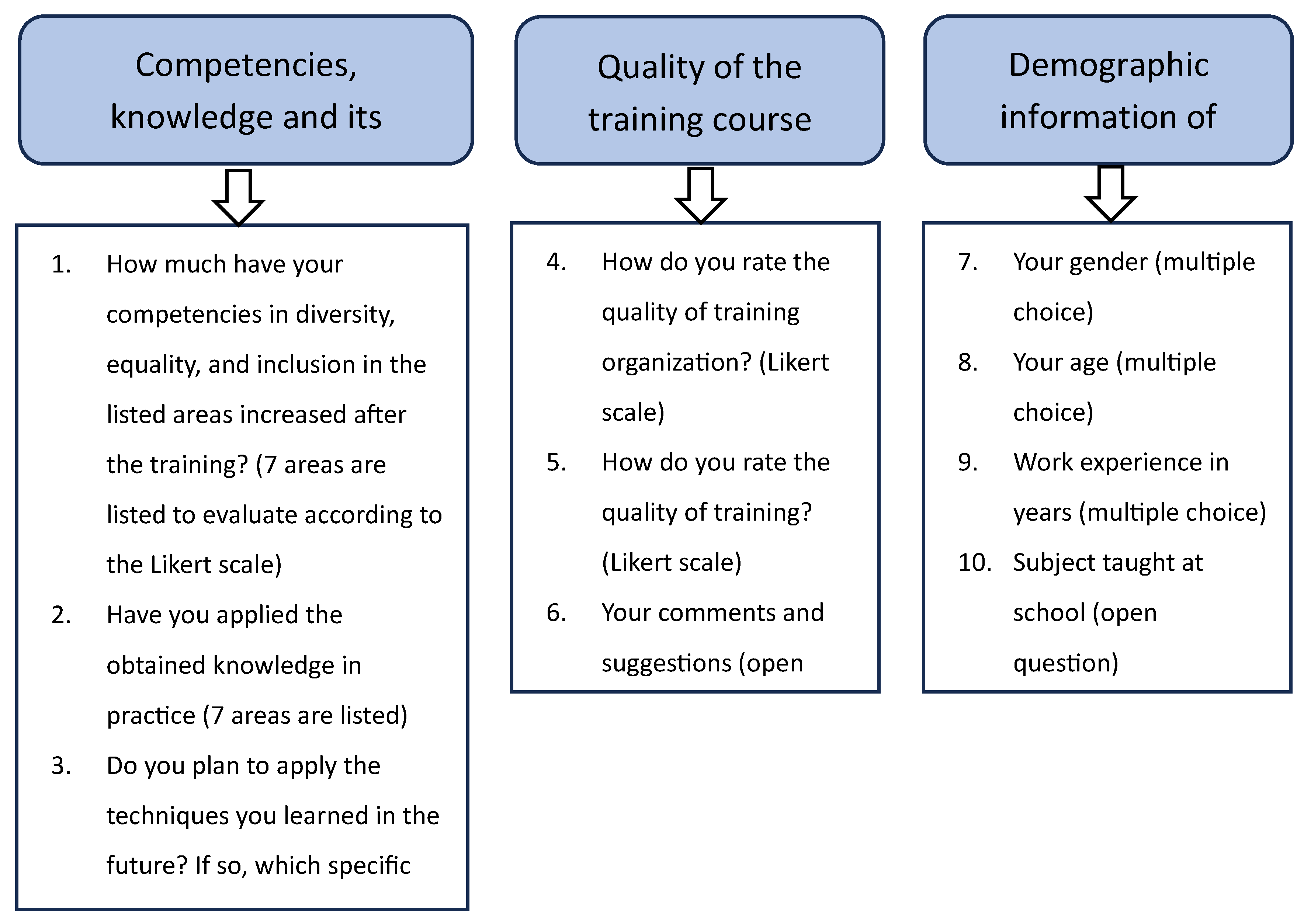
Figure 2.
Comparison of DESI 2022 and DESI 2023 onwards structure. Source: created by the authors using [30,31].
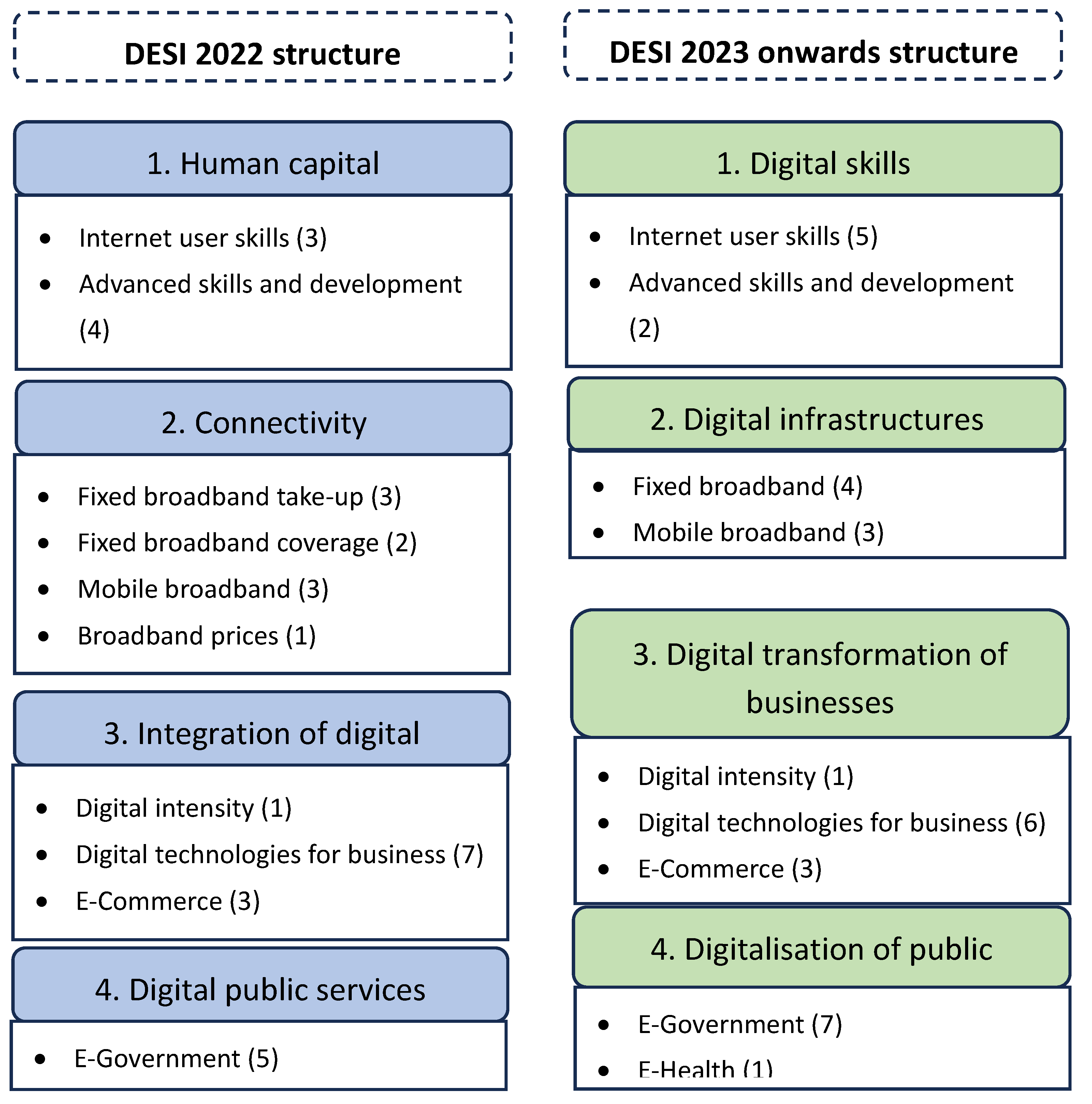
Figure 3.
Comparison of Sweden and Lithuania according to DESI 2022 and its dimensions (index scores). Source: created by the authors using [31].
Figure 3.
Comparison of Sweden and Lithuania according to DESI 2022 and its dimensions (index scores). Source: created by the authors using [31].
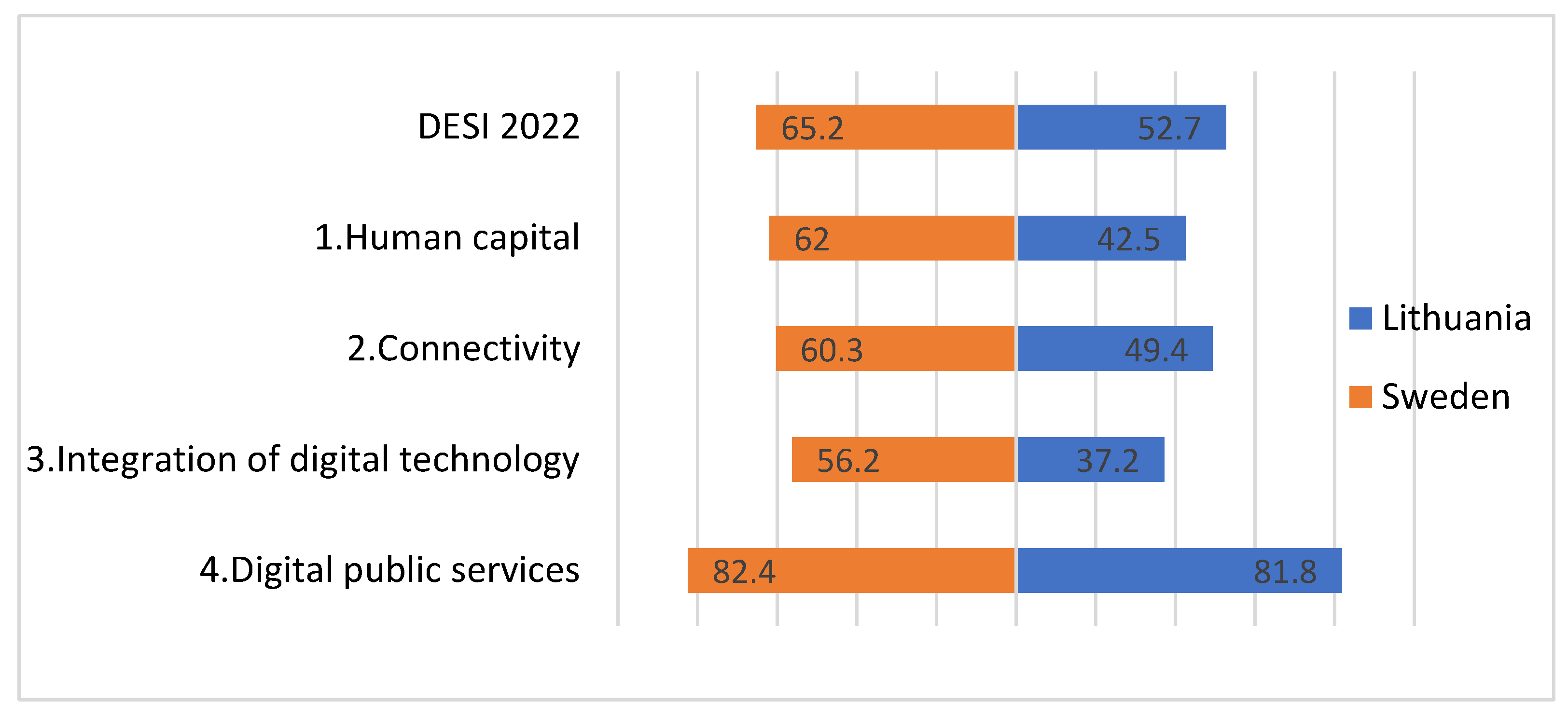
Figure 4.
Comparison of Sweden and Lithuania according to DESI 2024 and its dimensions (index scores). Source: created by the authors using [31].
Figure 4.
Comparison of Sweden and Lithuania according to DESI 2024 and its dimensions (index scores). Source: created by the authors using [31].
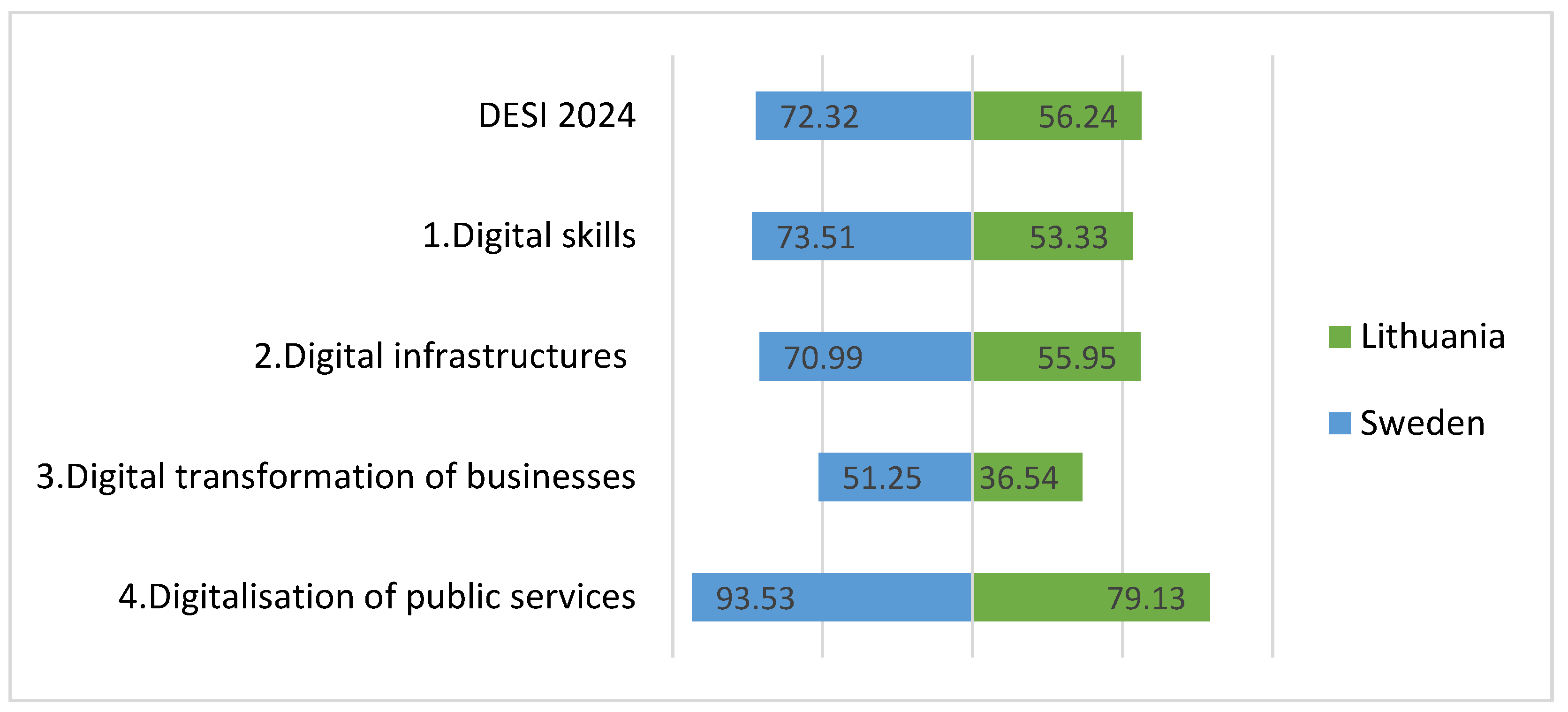
Figure 5.
Comparison of Sweden and Lithuania according to DESI 2024 sub-dimensions (scores). Source: created by the authors using [31].
Figure 5.
Comparison of Sweden and Lithuania according to DESI 2024 sub-dimensions (scores). Source: created by the authors using [31].
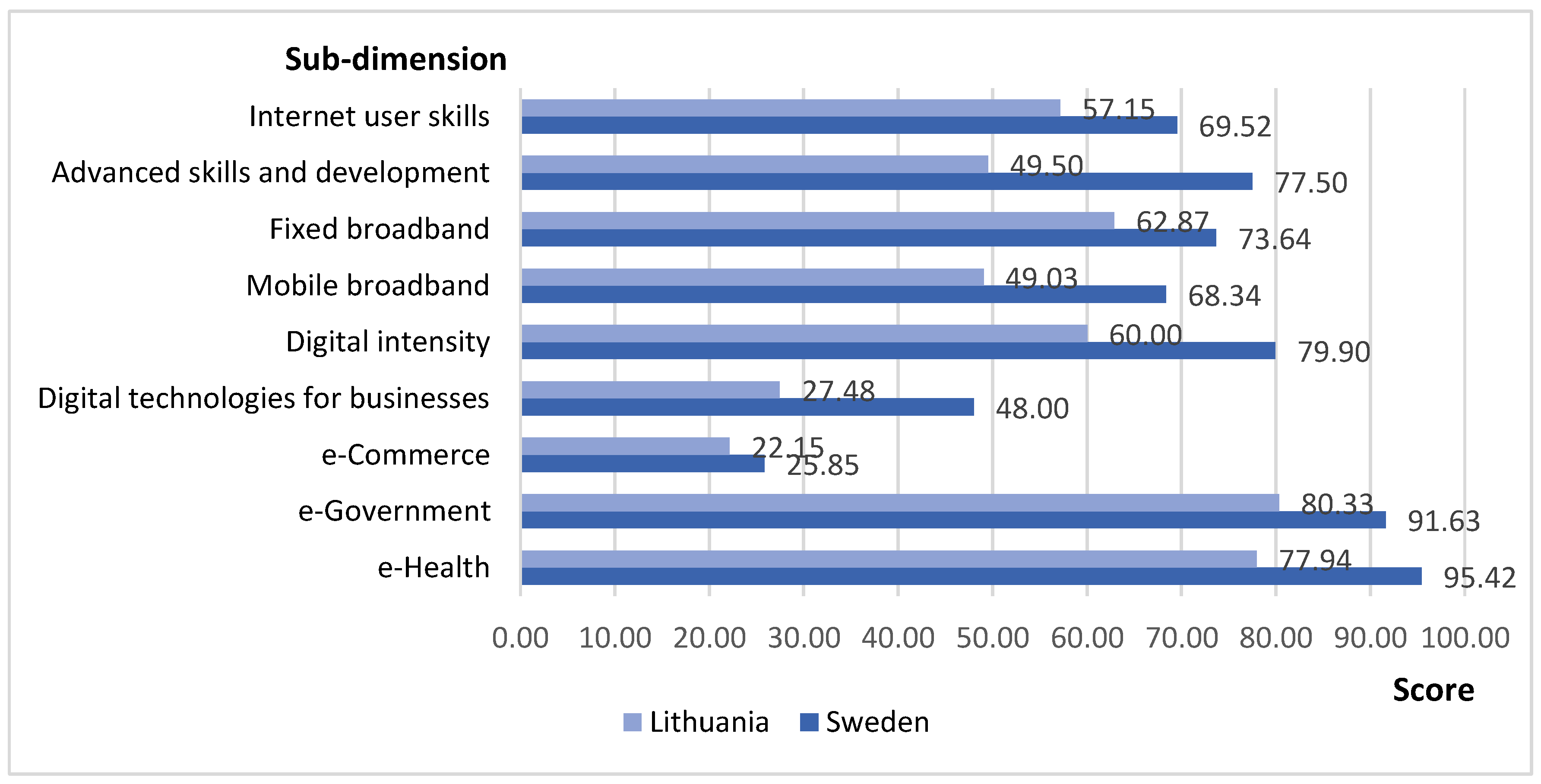
Figure 6.
Subjects taught by the respondent teachers at the schools.
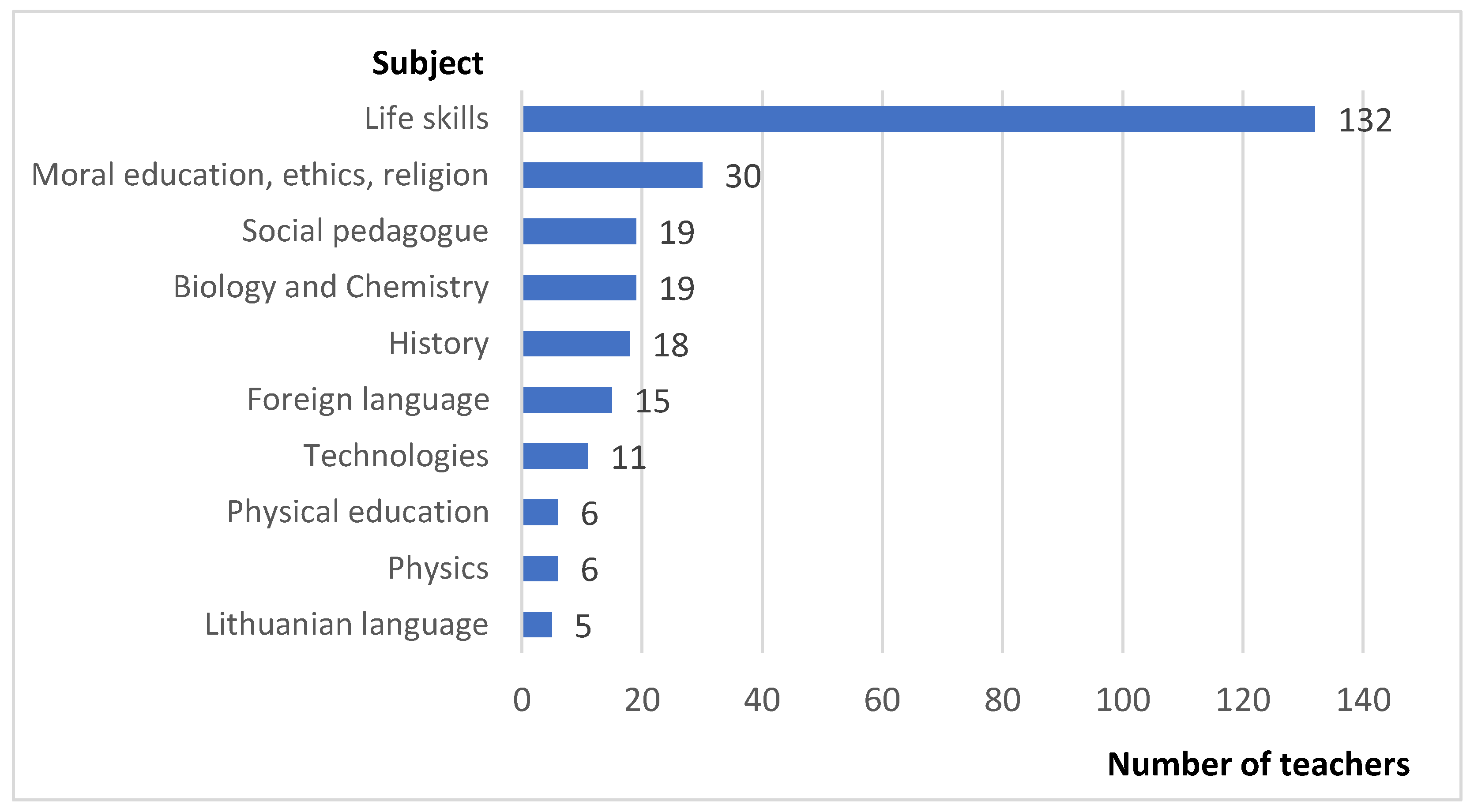
Figure 7.
Number and percentage of teachers who applied the obtained knowledge in practice.
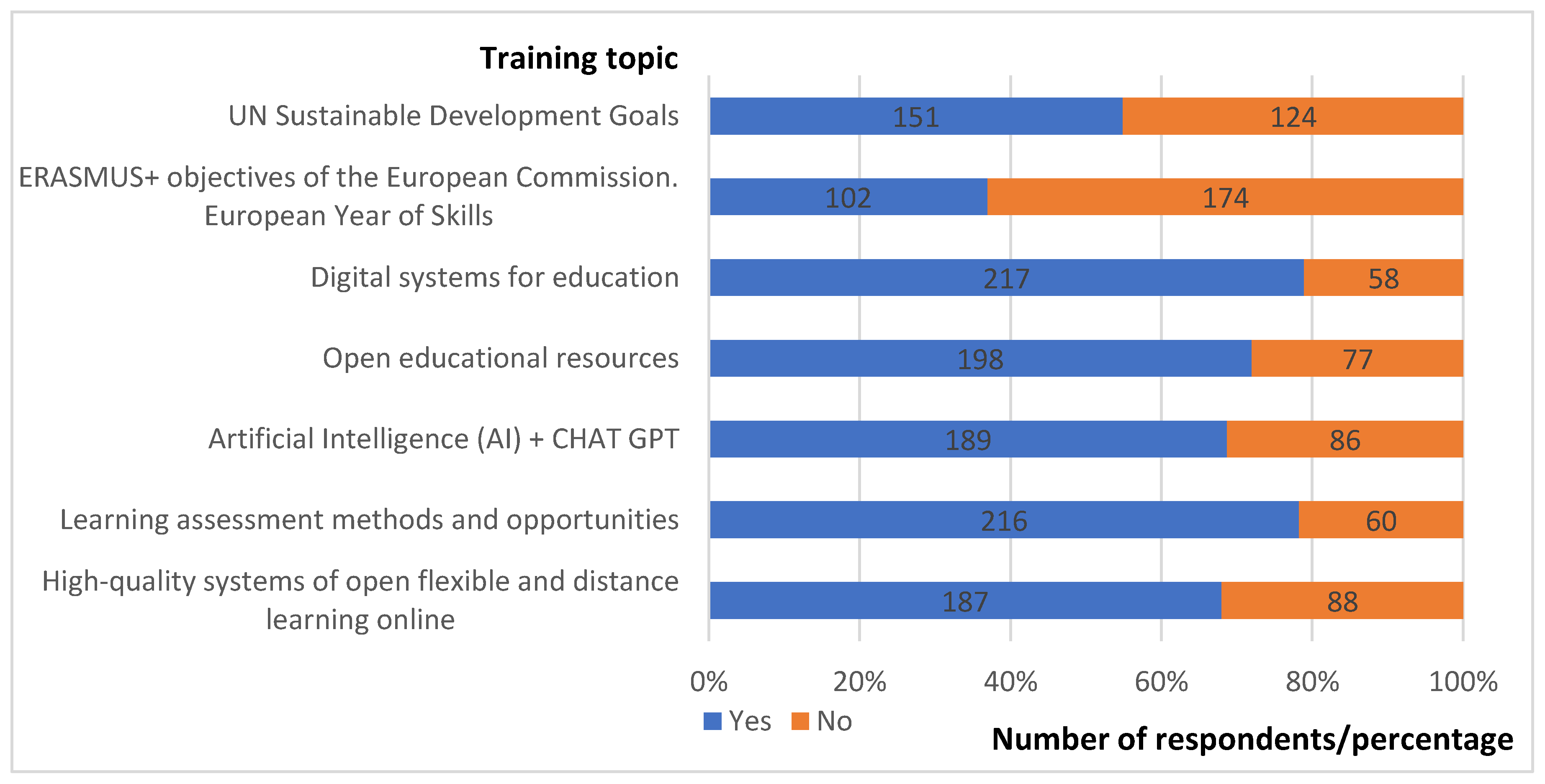
Figure 8.
Percentage of teachers who applied the obtained knowledge in practice, according to work experience.
Figure 8.
Percentage of teachers who applied the obtained knowledge in practice, according to work experience.
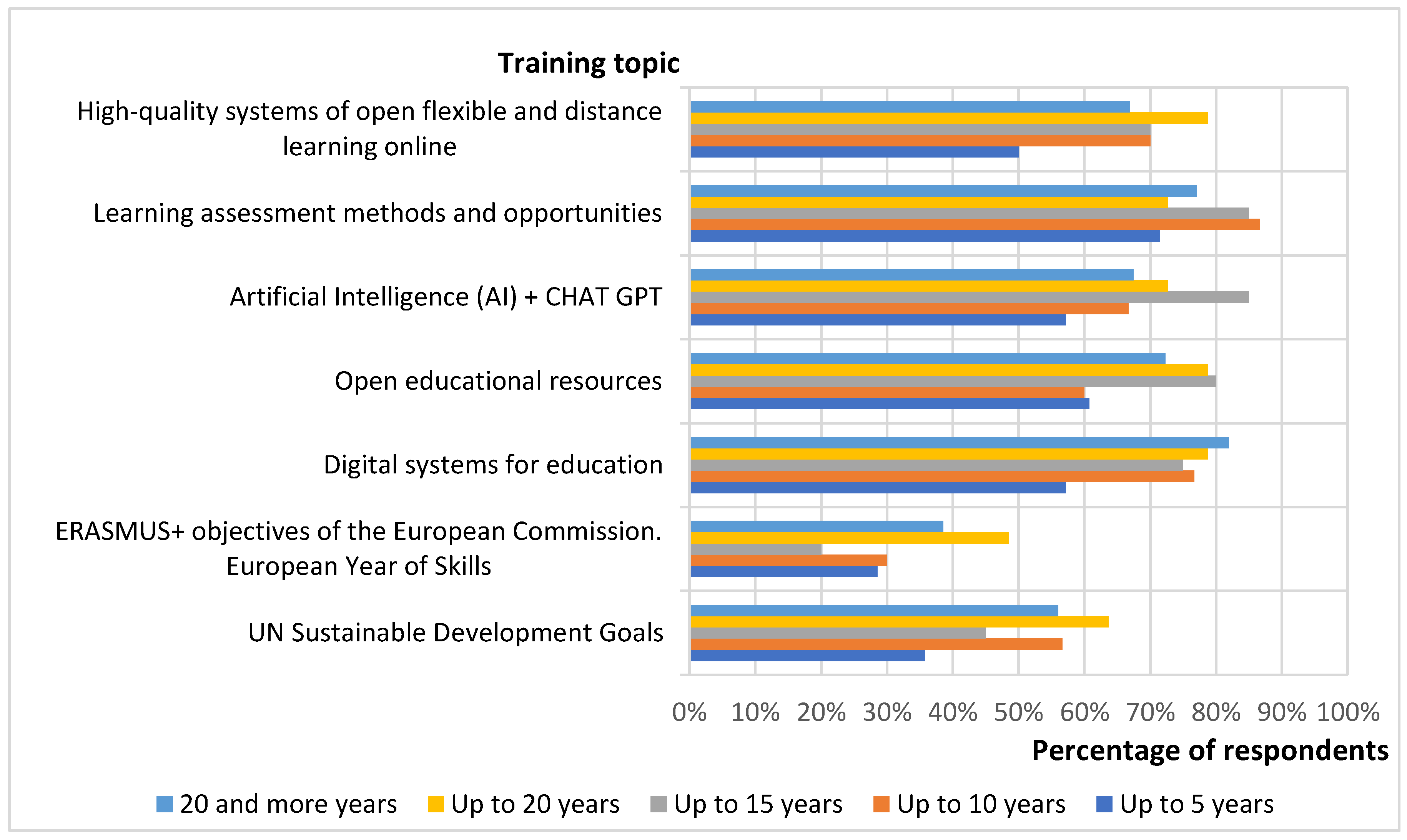
Table 1.
Demographic information about survey participants.
| Answer Category | Answer | Sample Size | Percentage (%) |
|---|---|---|---|
| Gender | Man | 20 | 7.19 |
| Woman | 258 | 92.81 | |
| Age | Below 30 years old | 6 | 2.16 |
| 31-40 years old | 51 | 18.35 | |
| 41-50 years old | 91 | 32.73 | |
| 51-60 years old | 115 | 41.37 | |
| Over 61 years old | 14 | 5.04 | |
| No answer | 1 | 0.36 | |
| Years of experience | Up to 5 years | 28 | 10.07 |
| Up to 10 years | 30 | 10.79 | |
| Up to 15 years | 20 | 7.19 | |
| Up to 20 years | 33 | 11.87 | |
| 20 and more years | 166 | 59.71 | |
| No answer | 1 | 0.36 |
Table 2.
Statistical parameters of the increase of competence assessment.
| No | The Topic of the Training | Average | Median | Mode | Stdev. |
|---|---|---|---|---|---|
| 1 | UN Sustainable Development Goals | 3.619 | 4 | 4 | 0.9479 |
| 2 | ERASMUS+ objectives of the European Commission. European Year of Skills | 3.5474 | 4 | 4 | 0.9794 |
| 3 | Digital systems for education | 3.7754 | 4 | 4 | 0.9027 |
| 4 | Open educational resources | 3.7164 | 4 | 4 | 0.9239 |
| 5 | Artificial Intelligence (AI) + CHAT GPT | 3.8007 | 4 | 4 | 0.9724 |
| 6 | Learning assessment methods and opportunities | 3.8007 | 4 | 4 | 0.8739 |
| 7 | High-quality systems of open, flexible, and distance learning online | 3.8225 | 4 | 4 | 0.9348 |
Table 4.
Average and standard deviation values of the increase of competence assessment, according to work experience.
Table 4.
Average and standard deviation values of the increase of competence assessment, according to work experience.
| Experience | Up to 5 years | Up to 10 years | Up to 15 years | |||
| Average | Stdev. | Average | Stdev. | Average | Stdev. | |
| Topic 1 | 3.3704 | 1.0111 | 3.6667 | 1.0753 | 3.6842 | 1.0616 |
| Topic 2 | 3.1786 | 1.0495 | 3.4333 | 1.0571 | 3.6842 | 1.0595 |
| Topic 3 | 3.5000 | 0.9388 | 3.8000 | 0.9555 | 3.7368 | 0.9348 |
| Topic 4 | 3.5185 | 0.9520 | 3.7667 | 1.0085 | 3.8421 | 0.9869 |
| Topic 5 | 3.6429 | 1.0135 | 3.9333 | 1.0377 | 3.6316 | 1.0049 |
| Topic 6 | 3.7143 | 0.9376 | 3.8000 | 0.9349 | 3.5789 | 0.9145 |
| Topic 7 | 3.6071 | 0.9685 | 3.8333 | 0.9839 | 3.5263 | 0.9754 |
| Experience | Up to 20 years | 20 and more years | ||||
| Average | Stdev. | Average | Stdev. | |||
| Topic 1 | 3.8125 | 1.0538 | 3.6098 | 1.0981 | ||
| Topic 2 | 3.6875 | 1.0620 | 3.5915 | 1.0875 | ||
| Topic 3 | 4.0606 | 0.9727 | 3.7697 | 0.9910 | ||
| Topic 4 | 3.9091 | 1.0165 | 3.6909 | 1.0400 | ||
| Topic 5 | 3.9697 | 1.0447 | 3.7879 | 0.9812 | ||
| Topic 6 | 3.8788 | 0.9426 | 3.8242 | 0.8902 | ||
| Topic 7 | 3.8485 | 1.0142 | 3.8848 | 0.9849 | ||
Table 5.
Statistical parameters of training organization assessment.
| Criteria | Average | Median | Mode | Stdev. |
|---|---|---|---|---|
| Training duration | 4.0073 | 4 | 4 | 0.9297 |
| Training time management (breaks, etc.) | 4.1091 | 4 | 5 | 0.8975 |
| Communication before training | 3.9891 | 4 | 5 | 1.0018 |
| Handout quality | 4.1527 | 4 | 4 | 0.8577 |
Table 6.
Statistical parameters of training quality assessment.
| Criteria | Average | Median | Mode | Stdev. |
|---|---|---|---|---|
| Relevance of received information | 4.0432 | 4 | 5 | 0.9528 |
| Content of training | 3.9856 | 4 | 4 | 0.8991 |
| Benefits of training for direct work | 3.8381 | 4 | 4 | 1.0402 |
| Forms of information presentation, variety of work methods | 4.0252 | 4 | 4 | 0.9089 |
Disclaimer/Publisher’s Note: The statements, opinions and data contained in all publications are solely those of the individual author(s) and contributor(s) and not of MDPI and/or the editor(s). MDPI and/or the editor(s) disclaim responsibility for any injury to people or property resulting from any ideas, methods, instructions or products referred to in the content. |
© 2025 by the authors. Licensee MDPI, Basel, Switzerland. This article is an open access article distributed under the terms and conditions of the Creative Commons Attribution (CC BY) license (http://creativecommons.org/licenses/by/4.0/).
Copyright: This open access article is published under a Creative Commons CC BY 4.0 license, which permit the free download, distribution, and reuse, provided that the author and preprint are cited in any reuse.


