

Submitted:
24 December 2025
Posted:
25 December 2025
You are already at the latest version
Abstract
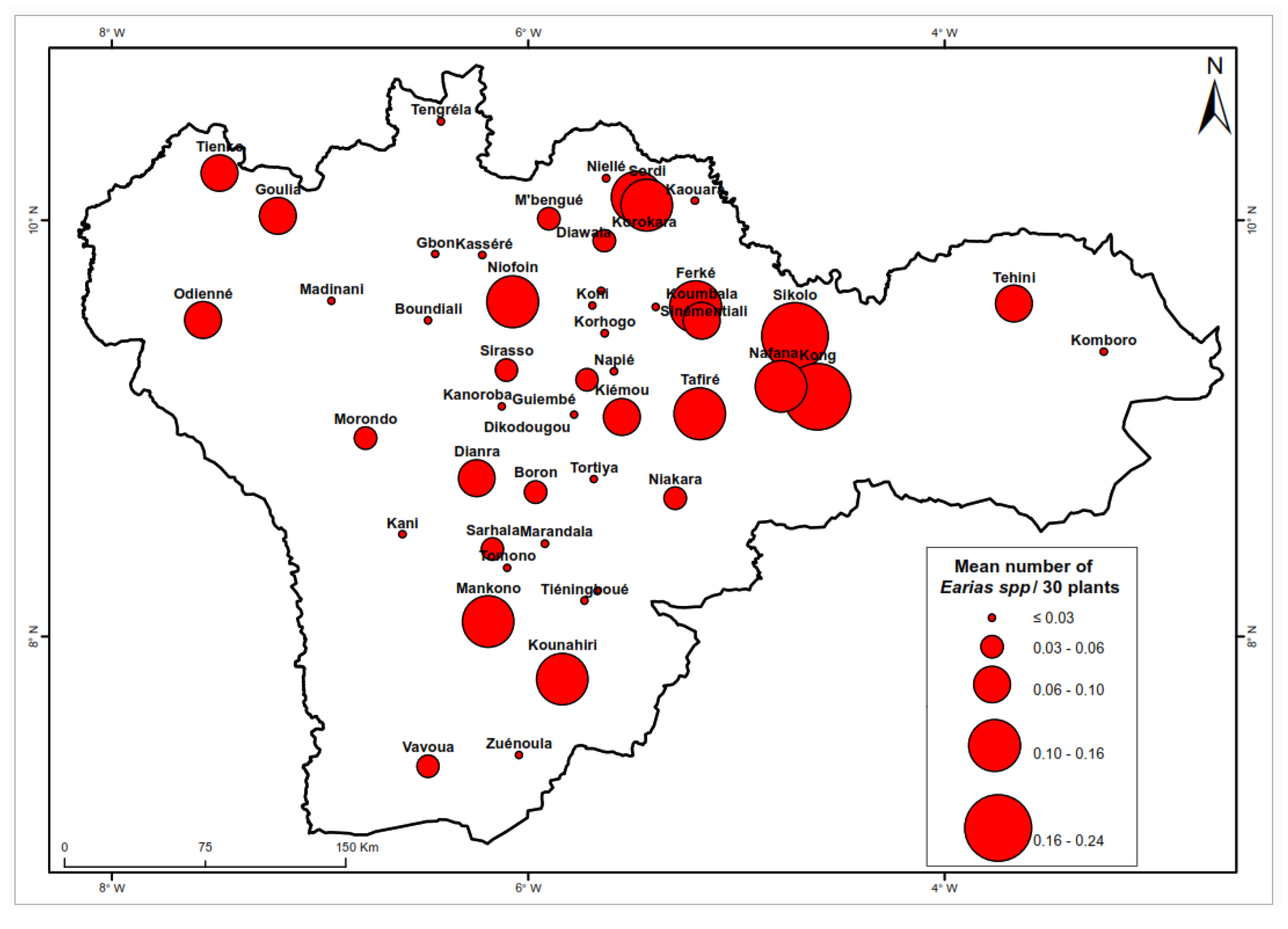
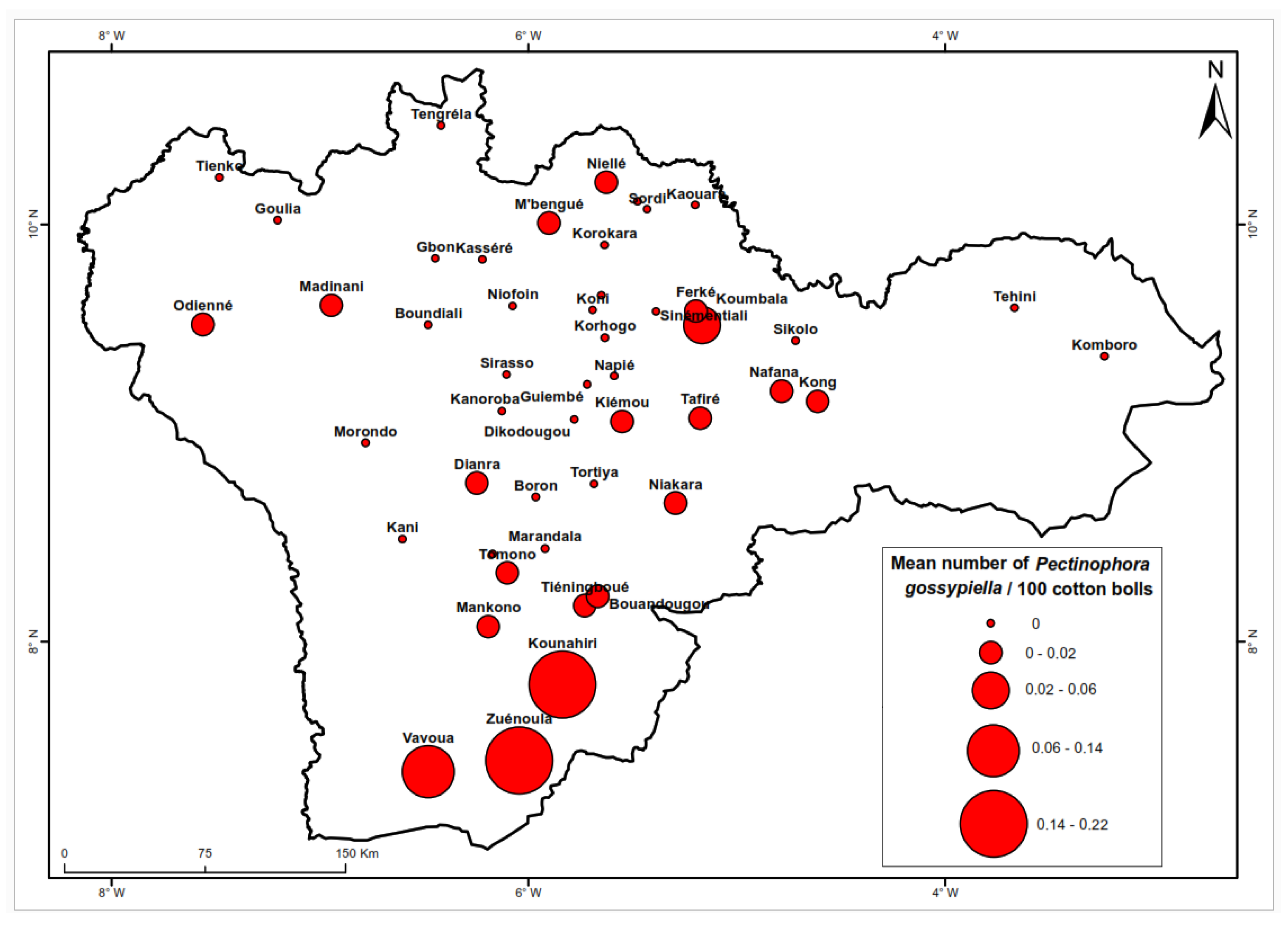
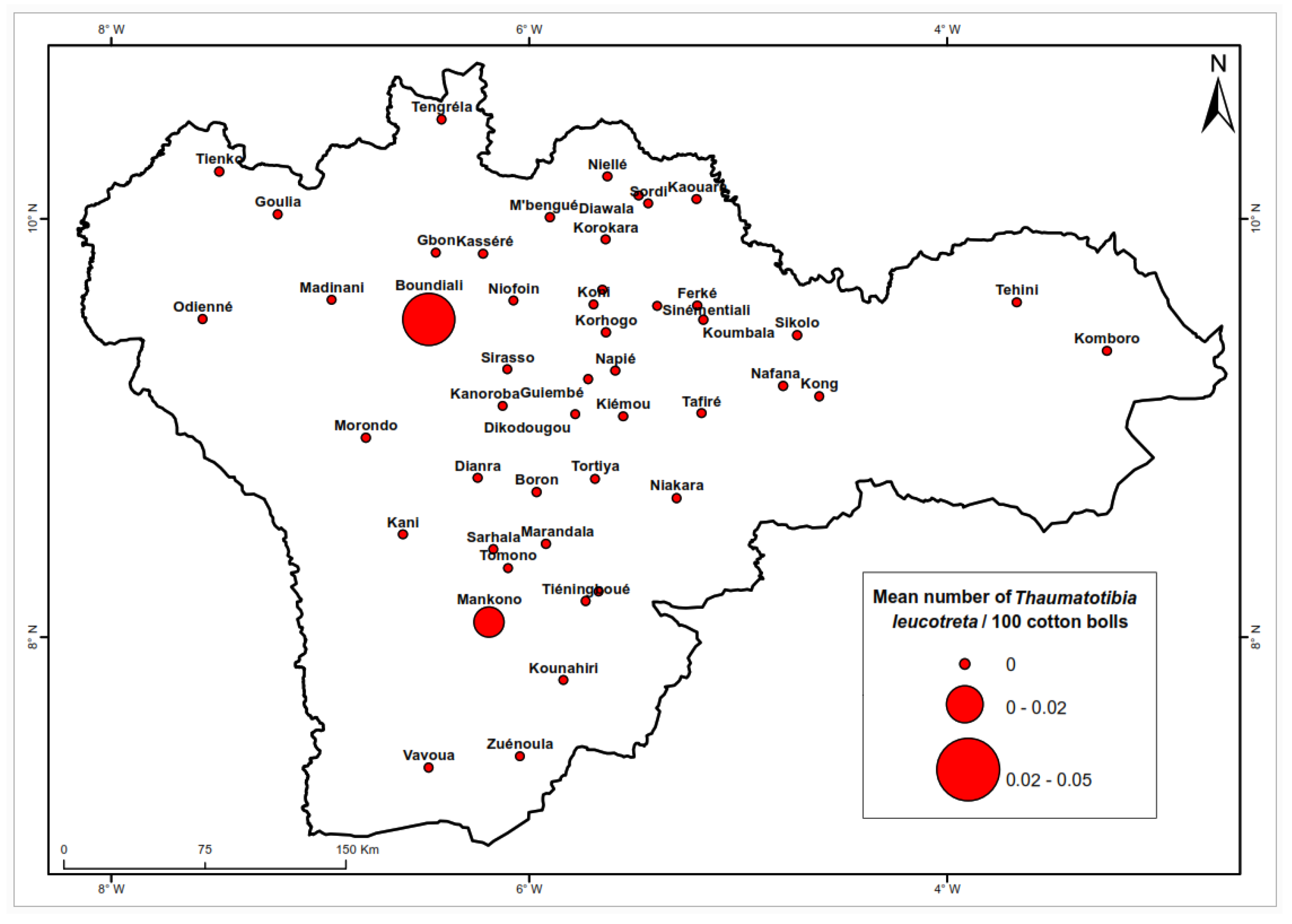
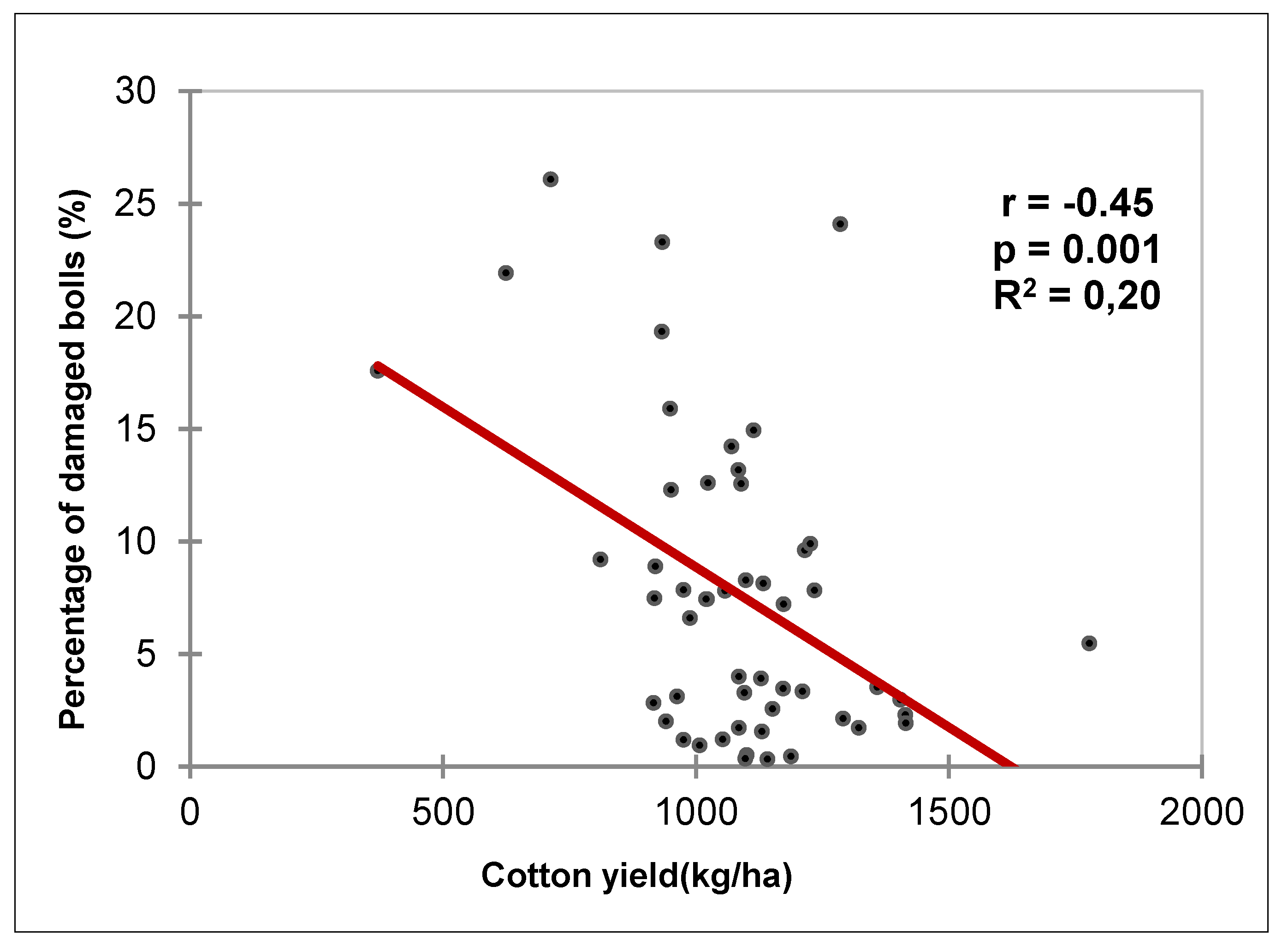
Cotton is integral to the rural economy of Côte d'Ivoire. However, it faces challenges such as pest infestations, notably carpophagous Lepidoptera. The recent incursion of the leafhopper Amrasca biguttula has disrupted existing plant protection strategies, resulting in the resurgence of key lepidopteran pests. This study aimed to evaluate the extent of damage inflicted by the primary species of bollworms on cotton crops within this altered context. The results indicated that Helicoverpa armigera remained the most prevalent exocarpic Lepidoptera species, followed by Earias spp. and Diparopsis watersi. Helicoverpa armigera infestations are more severe in the late planting stage, and this species is present throughout the cotton-growing region. Earias spp. and Diparopsis watersi larvae were more abundant in the northeastern cotton-growing area. Among the two endocarpic Lepidoptera species, Pectinophora gossypiella was more prevalent than Thaumatotibia leucotreta. A negative and significant correlation (r = -0.45; p = 0.001) was observed between damage by bollworms and seed cotton yield, underscoring the economic importance of these pests. These findings underscore the necessity of tailoring protection strategies to align with the specific species present, the characteristics of the production areas, and the timing of the sowing periods.
Keywords:
1. Introduction
2. Materials and Methods
2.1. Study Area
2.2. Plots Selection
2.3. Sampling and Observations
- Counting of bollworms on cotton plants
- Sanitary analysis of green bolls
- Harvest and estimation of cotton yield
2.3. Statistical Analyses of the Data
3. Results
3.1. Average Abundances of Cotton Bollworms
3.2. Annual Variations in the Abundance of Cotton Bollworms
3.2.1. Variation of Exocarpic Bollworms
3.2.2. Variation of Endocarpic Bollworms
3.3. Impact of the Production Area on the Larval Densities of Cotton Bollworms
3.3.1. Impact of the Production Area on Exocarpic Bollworms
3.3.2. Impact of the Production Area on Endocarpic Bollworms
3.4. Influence of the Sowing Period on the Density of Cotton Bollworms
3.5. Influence of Bollworms on the Sanitary Condition of Green Bolls and Cotton Yield
- Influence on the rate of perforated bolls
- Influence on the rate of internal damage in cotton bolls
4. Discussion
5. Conclusions
Author Contributions
Funding
Data Availability Statement
Conflicts of Interest
References
- INTERCOTON. « Flash d’information statistiques ». APROCOT-CI, 29 février 2024. Consulté le: 25 octobre 2025. [En ligne]. Disponible sur : https://www.intercoton.ci/wp-content/uploads/2024/03/Flash_Stats_n%C2%B003-au-29-fevrier-2024.pdf.
- Kouadio, E.N.; Koffi, E.K.; Julien, K.B.; Messoum, G.F.; Brou, K. et N’guessan, D.B. « Diagnostic de l’Etat de Fertilité des Sols Sous Culture Cotonnière Dans les Principaux Bassins de Production de Côte d’Ivoire », Eur. Sci. J. ESJ, vol. 14, no 33, p. 221, nov. 2018. [CrossRef]
- Dekoula, C.S.; Kouame, B.; N’goran, E.K.; Yao, F.G.; Ehounou, J.N. et Soro, N. « Impact De La Variabilité Pluviométrique Sur La Saison Culturale Dans La Zone De Production Cotonnière En Côte d’Ivoire », Eur. Sci. J. ESJ, vol. 14, no 12, p. 143, avr. 2018. [CrossRef]
- Hillocks, R.J. « Main Pests and Diseases of Cotton in Sub-Saharan Africa. By M. Vaissayre and J. Cauquil. Montpellier: CIRAD-CTA (2000), pp.60, FF100.00. ISBN 2-87614-16-6. », Exp. Agric., vol. 37, no 3, p. 429-432, juill. 2001. [CrossRef]
- Silvie, P.J. et Papierok, B. Les arthropodes du cotonnier: Diversité et modalités de gestion des ravageurs. éditions Quæ, 2024. [CrossRef]
- CABI. « Amrasca biguttula ». in CABI Compendium. CABI Publishing, 19 septembre 2022. [CrossRef]
- Kouadio, H.; Kouakou, M.; Bini, K.K.N.; Ouattara, M.A.N.; Adepo-Gourène, B.A. et Ochou, O.G. « Diagnosis of jassid attacks on okra and eggplant plots in the Center and Center-West of Côte d’Ivoire », Int. J. Innov. Appl. Stud., vol. 38, no 2, p. 408-416, déc. 2022.
- Gouzou, D.R.J.; Norbert, B.K.K.; Malanno, K.; Woklin, K.P.E. et Houphouët, K. « Effectiveness of a formulation based on Indoxacarb 120 g/l + flonicamid 200 g/l (SC) in controlling sucking biting insects and carpophagous Lepidoptera larvae of cotton in Côte d'Ivoire », J. Entomol. Zool. Stud., vol. 12, no 5, p. 235-241, sept. 2024. [CrossRef]
- Morita, M.; Ueda, T.; Yoneda, T.; Koyanagi, T. et Haga, T. « Flonicamid, a novel insecticide with a rapid inhibitory effect on aphid feeding », Pest Manag. Sci., vol. 63, no 10, p. 969-973, 2007. [CrossRef]
- Halle B. et Bruzon, V. « Profil Environnemental de la Côte d’Ivoire ». https://fr.scribd.com/document/148957688/Profil-Environnemental-Ci. Consulté le: 25 octobre 2025. [En ligne]. Disponible sur: https://fr.scribd.com/document/148957688/Profil-Environnemental-Ci.
- Amangoua N.F.; Essoi, N.; Kouakou, M.; Kouakou, B.J.; Kouadio, N.E.; Bini, K.K.N.; Ochou, O.G. « Etude des caractéristiques agro-morphologiques et technologiques de cinq variétés de cotonniers sélectionnées en Côte d’Ivoire », Int. Jouranl Biol. Chem. Sci., vol. 16, no 5, p. 2102-2124, oct. 2022.
- Nibouche, S.; Beyo, J. et Goze, E. « Mise au point de plans d’échantillonnage pour la protection sur seuil contre les chenilles de la capsule du cotonnier ». Consulté le: 26 juillet 2025. [En ligne]. Disponible sur: https://publications.cirad.fr/une_notice.php?dk=509800.
- Wang, H.; Shi, Y.; Wang, L.; Liu, S.; Wu, S. « CYP6AE gene cluster knockout in Helicoverpa armigera reveals role in detoxification of phytochemicals and insecticides », Nat. Commun., vol. 9, no 1, p. 4820, nov. 2018. [CrossRef]
- Firempong S. Zalucki, M. « Host Plant Preferences of Populations of Helicoverpa-Armigera (Hubner) (Lepidoptera, Noctuidae) From Different Geographic Locations », Aust. J. Zool., vol. 37, no 6, p. 665-673, nov. 1989. [CrossRef]
- Zhang, J.; Zhang, F.; Tae, W.T.; Robin, C.; Chi, Y. « Population genomics provides insights into lineage divergence and local adaptation within the cotton bollworm », Mol. Ecol. Resour., vol. 22, no 5, p. 1875-1891, juill. 2022. [CrossRef]
- Gonçalves, R.M.; Mastrangelo, T.; Rodriges, J.C.; Paulo, D.F.; Omoto, C.; Corêa, A.S.; De Azeredo-Espin, A. « Invasion origin, rapid population expansion, and the lack of genetic structure of cotton bollworm ( Helicoverpa armigera ) in the Americas », Ecol. Evol., vol. 9, no 13, p. 7378-7401, juill. 2019. [CrossRef]
- Caporale, A.; Romanowski, H.P. et Mega, N.O. « Winter is coming: Diapause in the subtropical swallowtail butterfly Euryades corethrus (Lepidoptera, Papilionidae) is triggered by the shortening of day length and reinforced by low temperatures », J. Exp. Zool. Part Ecol. Integr. Physiol., vol. 327, no 4, p. 182-188, avr. 2017. [CrossRef]
- Pener, M.P. « Environmental Cues, Endocrine Factors, and Reproductive Diapause in Male Insects », Chronobiol. Int., vol. 9, no 2, p. 102-113, janv. 1992. [CrossRef]
- Karp, X. « Hormonal Regulation of Diapause and Development in Nematodes, Insects, and Fishes », Front. Ecol. Evol., vol. 9, p. 735924, sept. 2021. [CrossRef]
- Busnoor, A.V.; Wadaskar, R.M.; Pillai, T.; Mahule, D.J.; Prasad, Y.G. « Laboratory evaluation of toxicity of selected insecticides against egg and larval stages of cotton pink bollworm, Pectinophora gossypiella (Saunders) (Lepidoptera: Gelechiidae) », J. Cotton Res., vol. 7, no 1, p. 2, janv. 2024. [CrossRef]
- Ali, H.; Hafez, S.; Aly, A.; El-hadek, M. et Allam, R. « Comparative efficacy and Resistance Levels to Certain Organophosphates Insecticide in the Pink Bollworm (Pectinophora gossypiella) », J. Sohag Agriscience JSAS, vol. 8, no 2, p. 363-369, déc. 2023. [CrossRef]
- Ghauri, Z.A. Anwar, H. et Ahmad, F. « Mating disruption of pink bollworm, Pectinophora gossypiella (saunders) using pb rope dispensers in cotton growing areas of punjab, pakistan », Plant Prot., vol. 3, no 3, p. 117-123, déc. 2019. [CrossRef]
- M. Arshad, M. Irfan Ullah, M. Wasim Abbas, A. Abdullah, et U. Hassan, « Mass trapping of Pectinophora gossypiella (Saunders) (Lepidoptera: Gelechiidae) using light and sex-pheromone traps in cotton », Enfoque UTE, vol. 11, no 4, p. 27-36, oct. 2020. [CrossRef]
- Lakshmi, V.N.; Ratnakar, V. et Veeranna, G. « Management of Pink Bollworm Pectinophora gossypiella (Saunders) in Cotton », Indian J. Entomol., p. 1-3, mars 2022. [CrossRef]
- Rakhesh, S.; Kumar, A.; Santhosha, K.M.; Krishi, V.K. Hanumanamatti, Haveri, Karnataka-581115, India « A brief review on integrated pest management of pink bollworm, Pectinophora gossypiella (Saunders) in cotton », Insect Environ., vol. 26, no 3, sept. 2023. [CrossRef]
- Narendar, G.; Madhushekar, B.R. et Kumar, K.A. « Strategies for Management of Pink Boll Worm Pectinophora gossypiella (Saunders) in Cotton through Different Methods », Int. J. Environ. Clim. Change, vol. 13, no 11, p. 2522-2527, nov. 2023. [CrossRef]
- Kouakou, M.; Bini, K.K.N.; Ouattara, B.M. et Ochou, O.G. « New subdivision of cotton production area of Côte d’Ivoire based on the infestation of main arthropod pests », J. Entomol. Zool. Stud., vol. 9, no 3, p. 50-57, mai 2021. [CrossRef]
- Liu, Z.; Liu, B.; Yu, H.; Zhang, Z.; He, Z. et Z. Zhuo, « The Effects of Global Climate Warming on the Developmental Parameters of Helicoverpa armigera (Hübner, 1808) (Lepidoptera: Noctuidae) », Insects, vol. 15, no 11, p. 888, nov. 2024. [CrossRef]
- Patterson, D.T.; Westbrook, J.K.; Joyce†, R.J.V.; Lingren, P.D.et Rogasik, J. « Weeds, Insects, and Diseases », Clim. Change, vol. 43, no 4, p. 711-727, déc. 1999. [CrossRef]
- Kouadio, H.; Kouakou, M. et Bini, K.K.N. « Annual and geographical variations in the specific composition of jassids and their damage on cotton in Ivory Coast », Scientifi Reports, p. 1-12, 2094 2024.
- Malanno, K.; Norbert, B.K.K. et Houphouët, K. « Efficient dose of thiamethoxam as a seed treatment product to reduce early damage of cotton leafhoppers Amrasca biguttula (Hemiptera: Cicadellidae) in Côte d'Ivoire », J. Entomol. Zool. Stud., vol. 13, no 1, p. 32-35, janv. 2025. [CrossRef]
- Brévault, T.; Badiane, D.; Goebel, R.; Renou, R.; Téréta, T. et Clouvel, P. « Repenser la gestion des ravageurs du cotonnier en Afrique de l’Ouest », Cah. Agric., vol. 28, p. 25, 2019. [CrossRef]

| Groupes | Species | Minimum | Maximum | Average | Standard deviation |
| Exocapic Lepidopteran larvae | Diparopsis watersi (mean/30 plants) | 0.000 | 1.000 | 0.038 | 0.011 |
| Helicoverpa armigera (mean/30 plants) | 0.000 | 2.923 | 0.143 | 0.061 | |
| Earias spp (mean/30 plants) | 0.000 | 0.909 | 0.064 | 0.012 | |
| Endocarpic Lepidoptran larvae | Pectinophora gossypiella (mean/100 green bolls) | 0.000 | 0.667 | 0.014 | 0.003 |
| Thaumatotibia leucotreta (mean/100 green bolls) | 0.000 | 0.429 | 0.001 | 0.000 |
| Years |
Exocarpic Lepidopteran larvae (mean/30 cotton plants) |
Endocarpic Lepidopteran larvae (mean/100 green bolls) |
|||
| D. watersi | H. armigera | Earias spp | P. gossypiella | T. leucotreta | |
| 2021 | 0.03 ± 0.00 a | 0.11 ± 0.04 b | 0.07 ± 0.02 b | 0.006 ± 0.00 a | 0.000 ± 0.00 |
| 2022 | 0.04 ± 0.01 ab | 0.06 ± 0.03 a | 0.05 ± 0.01 a | 0.009 ± 0.00 a | 0.002 ± 0.00 |
| 2023 | 0.03 ± 0.01 a | 0.22 ± 0.09 c | 0.06 ± 0.00 b | 0.02 ± 0.01 b | 0.002 ± 0.00 |
| 2024 | 0.07 ± 0.01 b | 0.13 ± 0.05 b | 0.07 ± 0.01 b | 0.01 ± 0.00 ab | 0.000 ± 0.00 |
| F | 3.97 | 31.14 | 3.38 | 5.75 | 0.14 |
| p | 0.008 | <0.001 | 0.018 | <0.001 | 0.332 |
| Production area |
Exocarpic Lepidopteran larvae (mean/30 cotton plants) |
Endocarpic Lepidopteran larvae (mean/100 green bolls) |
|||
| D. watersi | H. armigera | Earias spp | P. gossypiella | T. leucotreta | |
| North | 0.06 ± 0,01 | 0.16 ± 0,07 | 0.07 ± 0.01 | 0.01 ± 0,00 | 0.00 ± 0.00 |
| South | 0.00 ± 0,00 | 0.10 ± 0,03 | 0.05 ± 0.01 | 0.03 ± 0,01 | 0.01 ± 0.00 |
| t | 8.51 | 4.35 | 2.64 | 7,55 | 0,75 |
| p | <0.001 | <0.001 | 0.008 | <0.001 | 0.454 |
| Sowing period |
Exocarpic Lepidopteran larvae (mean/30 cotton plants) |
Endocarpic Lepidopteran larvae (mean/100 green bolls) |
|||
| D. watersi | H. armigera | Earias spp | P. gossypiella | T. leucotreta | |
| D1 (20-31 may) | 0.01 ± 0.00 | 0.06 ± 0.01 a | 0.09 ± 0.02 | 0.00 ± 0.00 | 0.000 ± 0.00 |
| D2 (01-10 jun) | 0.03 ± 0.01 | 0.11 ± 0.03 a | 0.07 ± 0.01 | 0.02 ± 0.00 | 0.003 ± 0.00 |
| D3 (11-20 jun) | 0.04 ± 0.01 | 0.13 ± 0.04 ab | 0.06 ± 0.01 | 0.01 ± 0.00 | 0.001 ± 0.00 |
| D4 (21-30 jun) | 0.05 ± 0.01 | 0.18 ± 0.11 b | 0.07 ± 0.01 | 0.01 ± 0.00 | 0.001 ± 0.00 |
| D5 (01-10 july) | 0.04 ± 0.02 | 0.13 ± 0.07 ab | 0.07 ± 0.02 | 0.02 ± 0.00 | 0.002 ± 0.00 |
| D6 (11-20 July) | 0.04 ± 0.01 | 0.11 ± 0.03 a | 0.03 ± 0.00 | 0.03 ± 0.01 | 0.000 ± 0.00 |
| F | 1.22 | 3.59 | 0.83 | 0.84 | 0.73 |
| p | 0.299 | 0.003 | 0.529 | 0.524 | 0.598 |
| Variables | β | SE | t | Pr > |t| | IC (95%) | β std |
| Intercept | 0.82 | 0.069 | 11.791 | <0.0001 | [0.68 ; 0.95] | |
| Diparopsis watersi (mean/30 plants) | 4.10 | 0.545 | 7.508 | <0.0001 | [3.03 ; 5.17] | 0.21 |
| Helicoverpa armigera (mean/30 plants) | 0.90 | 0.225 | 4.002 | <0.0001 | [0.46 ; 1.34] | 0.11 |
| Earias spp (mean/30 plants) | 1.32 | 0.528 | 2.505 | 0.012 | [0.29 ; 2.36] | 0.07 |
| Pectinophora gossypiella (mean/100 green bolls) | 5.40 | 0.942 | 5.724 | <0.0001 | [3.546 ; 7.24] | 0.15 |
| Pectinophora gossypiella (mean/100 green bolls) | 0.80 | 3.210 | 0.248 | 0.805 | [-5.50 ; 7.09] | 0.01 |
| Variables | β | SE | t | Pr > |t| | IC (95%) | β std |
| Intercept | 7,001 | 0,270 | 25,893 | <0,0001 | [6.47 ; 7.53] | |
| Diparopsis watersi (mean/30 plants) | -7,540 | 2,133 | -3,535 | 0,000 | [-11.73 ; -3.36] | -0,10 |
| Helicoverpa armigera (mean/30 plants) | -1,843 | 0,878 | -2,099 | 0,036 | [-3.57 ; -0.12] | -0,06 |
| Earias spp (mean/30 plants) | -3,849 | 2,066 | -1,863 | 0,063 | [-7.90 ; 0.21] | -0,05 |
| Pectinophora gossypiella (mean/100 green bolls) | 12,066 | 3,686 | 3,273 | 0,001 | [4.83 ; 19,30] | 0,09 |
| Pectinophora gossypiella (mean/100 green bolls) | 37,836 | 12,554 | 3,014 | 0,003 | [13,21 ; 62.47] | 0,08 |
Disclaimer/Publisher’s Note: The statements, opinions and data contained in all publications are solely those of the individual author(s) and contributor(s) and not of MDPI and/or the editor(s). MDPI and/or the editor(s) disclaim responsibility for any injury to people or property resulting from any ideas, methods, instructions or products referred to in the content. |
© 2025 by the authors. Licensee MDPI, Basel, Switzerland. This article is an open access article distributed under the terms and conditions of the Creative Commons Attribution (CC BY) license (http://creativecommons.org/licenses/by/4.0/).