

Submitted:
24 December 2025
Posted:
26 December 2025
You are already at the latest version
Abstract
Still, there are limitations that various approaches have not been attempted to conduct studies examining the market orientation in the hotel industry. It would therefore be mandatory to conduct active studies based on a variety of perspectives, methods and environments in association with the market orientation and business performance in the tourist hotels. Thus, this quantitative study was conducted to identify correlations between the market orientation, differentiation strategy and business performance based on published studies in top-class tourist hotels located in the metropolitan areas. A self-reporting questionnaire survey was performed for assistant managers or their higher-level officers who are engaged in tourist hotels located in the metropolitan areas between April 14 and May 13, 2019. The current study postulated that the market orientation might have an effect on the differentiation strategy, the low-price strategy and business performance. Moreover, it also postulated that the differentiation or low-price strategy might have an effect on the business performance. The current results showed that the path coefficient of each variable exceeded the limit of the acceptance range. Thus, all the five hypotheses were accepted. Further studies are warranted to integrate various approaches, which is essential for establishing the current results.
Keywords:
market orientation
; low-price strategy
; differentiation strategy
; business performance
; top-class hotel
1. Introduction
Recently, there have been marked changes in business environment, accompanied by uncertainty for the future. Companies have therefore prepared themselves to take active measures against crisis; their strategic measures include innovative changes, differential professionalism, globalization, advantageous competitiveness, brand image enhancement, creation of corporate culture and value and customer satisfaction-oriented marketing. Consequently, diverse types of internal and external factors that may affect the business performance of a company have been incorporated with market orientation in an effort to raise its market share [1,2,3,4,5,6,7].
Market orientation arises from the expectation that a company might achieve a relatively higher level of business performance by not only actively understanding customers’ needs but also providing them with products and services to their satisfaction [4]. Moreover, market orientation is closely associated with whether a company collects high-quality information about customers and transfers such information to its marketing department and how the marketing department will efficiently use it [4,8]. Therefore, the effects of market orientation on business performance deserve special attention. This is not only because internal factors, such as low-price strategy, may have an impact on business performance arising from service orientation but also because external factors, such as relationship with a competitor and customer satisfaction, are key factors that are needed to take appropriate measures against market environment [4,9]. To date, many previous studies have been conducted in this series, most of which have focused on factors forming market orientation, customer orientation, job satisfaction, job commitment, emotional imbalance and job performance, in employees of service-providing companies [10,11,12,13].
In particular, studies examining market orientation in hotel industry have revealed limitations that no diverse types of research approaches have been attempted. For example, according to an analysis of previous studies about service orientation in hotel industry, there are limitations in that such studies have explored relationships between service orientation and business performance, those of service orientation with job satisfaction and organizational commitment and those between the diverse variables (e.g., job satisfaction, personal characteristics, hotel organization, customer orientation, market orientation, marketing expertise, business performance, career characteristics, career commitment and customer orientation) [14,15,16,17,18,19,20,21,22,23]. Moreover, studies about the impact of market orientation on business performance performed an analysis of content variables of market orientation, mediating variables of business performance and components of business performance [23,24].
Given the above background, this study has speculated that it would be mandatory to conduct active studies based on diverse perspectives, methodologies and environment that are closely associated with the impact of market orientation on business performance in a tourist hotel. Therefore, the current study attempts to perform an analysis of correlations between market orientation, differentiation strategy, low-price strategy and business performance through an extensive review of the previous published studies in a top-tier tourist hotel. To do this, it analyzed the possible impact of market orientation on differentiation strategy, low-price strategy and business performance.
2. Theoretical Background
2.1. Market Orientation and Its Correlation with Business Performance
Over several decades, there has been an increased interest in ‘‘market orientation’’ according to an extensive review of the previous published studies [2,24]. Moreover, its positive correlation with business performance has also been described in the literature. Market orientation is an essential factor for business success, although it is only recently that systematic approaches have been made to an in-depth understanding of its positive impact on profitability. This is followed by empirical studies analyzing the relationships of market orientation with business performance, market share, success of new products and customer satisfaction [2,4,7,13,23,25,26,27]. Thus, the scope of studies exploring the positive role of market orientation in business success has been expanded to diverse types of business sectors, such as manufacturing, financial services, health care services and architectural services [2,28,29].
Prior to discussing market orientation, it is necessary to define the marketing concept; it is defined as a distinct organizational culture or business philosophy focusing on consumer orientation in association with the strategy and operation of a company [2,13]. Moreover, it is composed of three elements, such as customer philosophy, goal attainment and integrated marketing organization, all of which are deeply based on customer satisfaction [2,30]. Based on the definition and components of the marketing concept, the conceptualization of market orientation is based on three factors, such as intelligence generation, intelligence dissemination and responsiveness to market intelligence [25,28].
On the other hand, it has been reported that market orientation is composed of three elements, such as customer orientation, competitor orientation and inter-functional coordination [31,32,33]. In addition, its level is closely associated with collection and efficient use of customer information, development of customer-oriented strategy and implementation of the strategy in response to customer needs [4,13,23,34]. Studies about the relationship between market orientation and business performance have concluded that customer orientation, innovativeness and a supportive company culture are essential elements that are needed to improve business performance [2,3,4,6,13,18,23,25,28,31,36,37,38,39,40,41,42,43,44,45,46,47].
2.2. Market Orientation in the Hotel Industry
Over the past decades, the hotel industry has experienced the globalization process. As a result, competition in the hotel industry has become steeper. The long-term survival of the hotel industry would therefore depend on the efficient and effective resolution of customer issue particularly in such a competitive environment [17,20,48,49,50,51,52,53]. As defined earlier, market orientation is composed of company-wide collection and use of customer information in response to customers’ current and future needs. In more detail, market orientation is an essential factor for the hotel industry seeking to create superior customer value through the accumulation of knowledge and information about customers and competitors [54,55,56,57,58,59,60,61,62,63]. It has been reported, however, that the hotel industry was less likely to accept market orientation as a management principle as compared with other business sectors, such as banking, insurance or retail distribution [2,23,33]. It can therefore be inferred that market orientation in the hotel industry should be treated as it deserves because it is closely associated with business performance.
3. Materials and Methods
3.1. Study Design
3.2. Study Subjects and a Self-Reporting Questionnaire Study
The current study included a total of 670 respondents (n=670) who were managers or higher-level officers of tourist hotels located in the metropolitan areas in Korea, for whom a self-reporting questionnaire survey was performed between April 14 and May 13, 2019.
The respondents were informed of purposes and implications of the current study. Before study participation, they provided a verbal consent.
The self-reporting questionnaire survey was performed with the help of a research company, for which a total of 670 questionnaire sheets were distibuted to them and 524 of them were collected. After the exclusion of 71 incomplete responses, a total of 453 valid responses (n=453) were finally analyzed.
3.3. Study Hypothesis
For the current study, market orientation and business performance served as an independent variable and a dependent one, respectively. In addition, differentiation strategy, low-price policy and customer satisfaction served as a mediating variable. Then, the following hypotheses were proposed:
Hypothesis 1-1.
Market orientation has a positive impact on differentiation strategy.
Hypothesis 1-2.
Market orientation has a positive impact on low-price policy.
Hypothesis 1-3.
Market orientation has a positive impact on business performance.
Hypothesis 2.
Differentiation strategy has a positive impact on business performance.
Hypothesis 3.
Low-price policy has a positive impact on business performance.
3.4. Outcome Measures
Outcome measures include market orientation (4 items: information creation, information forwarding, response design and response implementation), differentiation strategy (4 items: marketing, business alliance, customer service and chain), low-price policy (4 items: price, development of low-price products, production cost and cost of food ingredients), business performance (5 items: profitability, growth rate of sales, market share, room occupancy rate and overall business performance). Respondents were instructed to respond to a questionnaire based on a 5-point Likert scale (0=“Never” and 4=“Always”).
3.5. Statistical Analysis
Data was presented as mean±standard deviation or number with percentage, where appropriate. The SPSS for windows Ver. 18.0 (SPSS Inc., Chicago, IL) and AMOS Ver. 18.0 (IBM Co., Armonk, NY) were used to analyze the data. A P-value of<0.05 was considered statistically significant.
Baseline characteristics of the respondents, such as age, sex, years of education, mean monthly income, department, position and years of working, were analyzed using a frequency analysis.
Factors that may affect the impact of market orientation on business performance were analyzed using the Pearson’s correlation analysis. In addition, χ2-test was performed to assess the model-fit. Using a structural equation model, the degree of freedom (df), the estimation of variables (Q), goodness-of-fit indices (GFI), adjusted goodness-of-fit indices (AGFI), root-mean-square error approximation (RMSEA), normed fit index (NFI) and comparative fit index (CFI) were calculated. For questions of outcome measures, unstandardized coefficient, factor loading, statistical significance, squared multiple correlations (SMCs), average variance extracted (AVE) and confidence were also calculated. The validity of each outcome measure was analyzed using exploratory factor analysis.
4. Results
4.1. Baseline Characteristics of the Respondents
The eligible respondents (n=453) participating in the current study comprise 231 men (51.0%) and 222 women (49.0), whose age distributions include ≤29 years old (n=96; 21.2%), 30-39 years old (n=221; 48.8%), 40-49 years old (n=77; 17.0%) and ≥50 years old (n=59; 13.0%). Their baseline characteristics are summarized in Table 1.
4.2. Reliability and Validity of Outcome Measures
Following an analysis of the reliability and validity of outcome measures, they exceeded a level of general acceptance of 0.7. This indicates that reliable and valid outcome measures served as variables (Table 2).
To assess the validity of outcome measures, a confirmatory factor analysis was performed using a correlation matrix plot. This showed that the degree of model appropriateness reached the level of general acceptance. Moreover, unstandardized regression coefficient, factor loading, critical ratio; squared multiple correlation, average variance extracted and construct reliability of each question exceeded the level of general acceptance. Thus, valid outcome measures were analyzed (Table 3).
Additionally, the current study analyzed a discriminant validity. That is, when each outcome measure had values of mean and standard deviation that are greater than square of correlation coefficient between the two concepts, it was speculated that there was a discriminant validity between the two concepts. Thus, the current study performed an analysis of correlations between the outcome measures (Table 4).
4.5. Hypothesis Testing
To test hypotheses, structural equation model was analyzed using the AMOS. This showed that the overall appropriateness of the model exceeded the level of general acceptance. Thus, results of hypothesis testing were of fair degree. It was therefore determined that the model was appropriate for hypothesis testing (Table 5).
5. Discussion
Contemporary companies experience marked changes in business environment, such as diversification of customer needs, a sudden change in the technology and intensification of competition [69,70,71,72,73,74,75]. Moreover, with recent changes in market and technology, competitive advantage of low-price strategy based on economy of scale cannot further be a source of their competitiveness. It is therefore imperative that companies improve business performance through principles of business administration based on market orientation rather than low-price strategy through innovation [2,23]. Furthermore, company-wide marketing activities should be promoted according to changes in business environment. Therefore, there has been an increased in the implementation of marketing policy based on the concept of marketing among experts in academic and business areas. This is accompanied by active studies about market orientation as a novel concept [2,4,13,28,47,54,76,77,78,79,80,81,82,83,84,85,86,87].
The concept of marketing has emerged as a principle of business administration, and it is defined as recognition and satisfaction of needs of the target market. It therefore arises from satisfaction of customer needs and customer orientation. According to previous studies, it is defined as every effort a company makes to meet customers’ needs from perspectives of profitability while combining marketing activities with other business ones for the purposes of maximizing long-term sales [4]. It has also been described as business activities to design, manufacture and provide a product and thereby to achieve a goal the most efficiently through an understanding of cost to satisfy potential customers’ needs [2,4,88,89,90,91,92]. In more detail, it is the most essential aspect of the concept of marketing to maximize the profit through such activities as customer orientation, company-wide efforts and customer satisfaction. Due to vagueness of the concept of marketing, however, it failed in providing definite solutions to the intensification of competition as well as sudden changes in and diversification of customers’ needs. It is therefore imperative that a more practical approach be adopted to establish principles of business administration [23,54].
Market orientation is more active and definite as compared with the concept of marketing. Moreover, it has also been described as the level of the implementation of the concept of marketing [2,23,93].
With representative studies that have defined and measured market orientation, market orientation has been conceptualized to consist of customer orientation, competitor orientation and coordination between the departments. Other studies have also defined market orientation as an entity comprising information creation, information forwarding and responsiveness. Furthermore, it has also been described as a combination of customer-satisfaction-, competitor- and customer-understanding-orientation [2,23,93,94].
To date, studies have also been conducted to identify prerequisites for and performances of market orientation; these include (1) the relationship between the form of organization and market orientation, (2) impacts of market orientation on employees’ job satisfaction and business performance and (3) those of competitive environment in mediating that between market orientation and business performance [2,3,4,6,13,18,23,25,28,31,36,37,38,39,40,41,42,43,44,45,46,47].
According to a review of literatures, it was shown that top management, dynamics between the departments and organization system served as prerequisites for market orientation. Such studies have also shown that market orientation had a great impact on business performance irrespective of market turbulence, the intensity of competitiveness and technological turbulence. On the other hand, market orientation was also defined as the appropriate level of responsiveness as well as company-wide creation and forwarding of information encompassing current and future needs of customers [3,8,13,23,71,95,96,97,98,99,100,101,102,103,104,105,106,107,108,109].
Based on the previous published studies, the current study was conducted to demonstrate the impact of market orientation on low-price policy, differentiation strategy and business performance [2,3,4,6,13,18,23,25,28,31,36,37,38,39,40,41,42,43,44,45,46,47]. Unlike such studies, however, the current study speculated that market orientation (information creation, information forwarding, response design and response implementation) might have a positive impact on low-price policy (price, the development of low-price products, production cost and cost of food ingredients), differentiation strategy (marketing, business alliance, customer service and chain) and business performance (profitability, growth rate of sales, market share, room occupancy rate and overall business performance) [9,23]. Thus, the current results confirmed that market orientation had a positive impact on differentiation strategy, low-price policy and business performance. It was also shown that differentiation strategy and low-price policy were outcome measures affecting business performance [9,23,66,67,110].
Based on the above results, it can be inferred that market orientation is closely associated with low-price policy, differentiation strategy and business performance. Moreover, the current results also indicate that both low-price policy and differentiation strategy have also an impact on business performance, which are in agreement with previous published studies. Taken together, the current study suggests the importance of strategic management in the hotel industry.
Implications of the current study are as follows:
- (1)
- Market orientation reflecting customers’ expectations and needs provides a basis of low-price policy.
- (2)
- Differentiation strategy arises from market orientation.
- (3)
- Market orientation reflecting customers’ expectations and needs has a positive impact on profitability, growth rate of sales, market share, room occupancy rate and overall business performance in the hotel industry.
- (4)
- Low-price policy is directly associated with business performance.
- (5)
- Differentiation strategy is directly associated with business performance.
Based on the results of the current study, it can be inferred that market orientation leading to information creation, information forwarding, design and implementation of the response to customers’ needs will have a close relationship with low-price policy leading to development of low-price products, production cost and cost of food ingredients and differentiation strategy leading to marketing, business alliance, customer service and chain. This also leads to the speculation that market orientation has a positive impact on profitability, growth rate of sales, market share and room occupancy rate, all of which serve as an indicator of business performance, in the hotel industry.
The current results cannot be generalized; there are several limitations as follows: First, the current study included assistant managers or their higher-level officers of hotels located in metropolitan areas. Therefore, the possibility of selection bias could not be completely ruled out. Second, market orientation is composed of the creation and forwarding of information about customers and the response to their needs on a company-wide level; its outcomes cannot appear for short periods of time but it requires long-term, cumulative efforts [2,23]. Further studies are therefore warranted to establish the current results in a longitudinal setting rather than a cross-sectional one. Third, the current study failed to objectively measure the degree of business performance based on financial or quantitative indicators because there was a limited access to them.
6. Conclusions
In conclusion, the current results indicate that it would be mandatory to establish the strategy of market orientation for customer satisfaction for the purposes of improving business performance. But further studies are warranted to corroborate the current results through an efficient combination of diverse approaches with valid mediating variables and outcome measures.
Funding
Not applicable.
Competing of Interest
The author reports no competing interests to declare.
Acknowledgments
The author thanks Laon Medi Solution Inc. (Seoul, Republic of Korea) and KDH Medical Inc. (Gwangmyeong, Gyeonggi, Republic of Korea) for additional support of this study.
References
- Nagy, J.; Oláh, J.; Erdei, E.; Máté, D.; Popp, J. The Role and Impact of Industry 4.0 and the Internet of Things on the Business Strategy of the Value Chain—The Case of Hungary. Sustainability 2018, 10, 3491. [CrossRef]
- Lučić, A. Measuring Sustainable Marketing Orientation—Scale Development Process. Sustainability 2020, 12, 1734. [CrossRef]
- Ferro-Soto, C.; Macías-Quintana, L.A.; Vázquez-Rodríguez, P. Effect of Stakeholders-Oriented Behavior on the Performance of Sustainable Business. Sustainability 2018, 10, 4724.
- Kang, S.; Na, Y.K. Effects of Strategy Characteristics for Sustainable Competitive Advantage in Sharing Economy Businesses on Creating Shared Value and Performance. Sustainability 2020, 12, 1397. [CrossRef]
- Ajour El Zein, S.; Consolacion-Segura, C.; Huertas-Garcia, R. The Role of Sustainability in Brand Equity Value in the Financial Sector. Sustainability 2020, 12, 254.
- Weng, H.-H.R.; Chen, J.-S.; Chen, P.-C. Effects of Green Innovation on Environmental and Corporate Performance: A Stakeholder Perspective. Sustainability 2015, 7, 4997-5026.
- Shen, J.; Sha, Z.; Wu, Y.J. Enterprise Adaptive Marketing Capabilities and Sustainable Innovation Performance: An Opportunity–Resource Integration Perspective. Sustainability 2020, 12, 469. [CrossRef]
- Hosseini, A.S.; Soltani, S.; Mehdizadeh, M. Competitive Advantage and Its Impact on New Product Development Strategy (Case Study: Toos Nirro Technical Firm). J. Open Innov. Technol. Mark. Complex. 2018, 4, 17.
- Chen, J.; Liu, L. Profiting from Green Innovation: The Moderating Effect of Competitive Strategy. Sustainability 2019, 11, 15.
- Gyurák Babeľová, Z.; Stareček, A.; Koltnerová, K.; Cagáňová, D. Perceived Organizational Performance in Recruiting and Retaining Employees with Respect to Different Generational Groups of Employees and Sustainable Human Resource Management. Sustainability 2020, 12, 574. [CrossRef]
- Gragnano, A.; Simbula, S.; Miglioretti, M. Work–Life Balance: Weighing the Importance of Work–Family and Work–Health Balance. Int. J. Environ. Res. Public Health 2020, 17, 907.
- García-Buades, M.E.; Peiró, J.M.; Montañez-Juan, M.I.; Kozusznik, M.W.; Ortiz-Bonnín, S. Happy-Productive Teams and Work Units: A Systematic Review of the ‘Happy-Productive Worker Thesis’. Int. J. Environ. Res. Public Health 2020, 17, 69.
- Yeo, C.; Hur, C.; Ji, S. The Customer Orientation of Salesperson for Performance in Korean Market Case: A Relationship between Customer Orientation and Adaptive Selling. Sustainability 2019, 11, 6115. [CrossRef]
- Liu, W.; Ji, R.; Nian, C.P.; Ryu, K. Identifying the Types and Impact of Service Provider’s Responses to Online Negative Reviews in the Sharing Economy: Evidence from B&Bs in China. Sustainability 2020, 12, 2285.
- Boronat-Navarro, M.; Pérez-Aranda, J.A. Analyzing Willingness to Pay More to Stay in a Sustainable Hotel. Sustainability 2020, 12, 3730.
- Hong, I.; Yoo, C. Analyzing Spatial Variance of Airbnb Pricing Determinants Using Multiscale GWR Approach. Sustainability 2020, 12, 4710.
- Alipour, H.; Safaeimanesh, F.; Soosan, A. Investigating Sustainable Practices in Hotel Industry-from Employees’ Perspective: Evidence from a Mediterranean Island. Sustainability 2019, 11, 6556. [CrossRef]
- Nasifoglu Elidemir, S.; Ozturen, A.; Bayighomog, S.W. Innovative Behaviors, Employee Creativity, and Sustainable Competitive Advantage: A Moderated Mediation. Sustainability 2020, 12, 3295.
- Kim, S.Y.; Kim, J.U.; Park, S.C. The Effects of Perceived Value, Website Trust and Hotel Trust on Online Hotel Booking Intention. Sustainability 2017, 9, 2262. [CrossRef]
- Horng, J.-S.; Wang, C.-J.; Liu, C.-H.; Chou, S.-F.; Tsai, C.-Y. The Role of Sustainable Service Innovation in Crafting the Vision of the Hospitality Industry. Sustainability 2016, 8, 223.
- Arasli, H.; Arici, H.E.; Kole, E. Constructive Leadership and Employee Innovative Behaviors: A Serial Mediation Model. Sustainability 2020, 12, 2592. [CrossRef]
- Espino-Rodríguez, T.F.; Ramírez-Fierro, J.C. The Relationship Between Strategic Orientation Dimensions and Hotel Outsourcing and Its Impact on Organizational Performance. An Application in a Tourism Destination. Sustainability 2018, 10, 1769.
- Na, Y.K.; Kang, S.; Jeong, H.Y. The Effect of Market Orientation on Performance of Sharing Economy Business: Focusing on Marketing Innovation and Sustainable Competitive Advantage. Sustainability 2019, 11, 729. [CrossRef]
- Wymer, W. The Influence of Marketing Scholarship’s Legacy on Nonprofit Marketing. Int. J. Financial Stud. 2013, 1, 102-118.
- Cho, Y.H.; Lee, J.-H. A Study on the Effects of Entrepreneurial Orientation and Learning Orientation on Financial Performance: Focusing on Mediating Effects of Market Orientation. Sustainability 2020, 12, 4594. [CrossRef]
- Lei, L.; Wu, X.; Fu, Y. Effects of Sustainability and Technology Orientations on Firm Growth: Evidence from Chinese Manufacturing. Sustainability 2019, 11, 4406.
- Liu, S.; Chang, Y.-T. Manufacturers’ Closed-Loop Orientation for Green Supply Chain Management. Sustainability 2017, 9, 222.
- Yang, T.-K.; Yan, M.-R. Exploring the Enablers of Strategic Orientation for Technology-Driven Business Innovation Ecosystems. Sustainability 2019, 11, 5779. [CrossRef]
- Kryvinska, N.; Bickel, L. Scenario-Based Analysis of IT Enterprises Servitization as a Part of Digital Transformation of Modern Economy. Appl. Sci. 2020, 10, 1076.
- Górska-Warsewicz, H.; Kulykovets, O. Hotel Brand Loyalty—A Systematic Literature Review. Sustainability 2020, 12, 4810.
- Mpandare, M.; Li, G. Utilising Enterprise Social Media for Product Innovation: The Role of Market Orientation. Sustainability 2020, 12, 3913. [CrossRef]
- Huang, L.; Chang, K.-Y.; Yeh, Y.-C. How Can Travel Agencies Create Sustainable Competitive Advantages? Perspective on Employee Role Stress and Initiative Behavior. Sustainability 2020, 12, 4557.
- Tseng, C.-H.; Chang, K.-H.; Chen, H.-W. Strategic Orientation, Environmental Innovation Capability, and Environmental Sustainability Performance: The Case of Taiwanese Suppliers. Sustainability 2019, 11, 1127.
- Li, J.; Zhang, F.; Sun, S. Building Consumer-Oriented CSR Differentiation Strategy. Sustainability 2019, 11, 664.
- Xue, W.; Li, H.; Ali, R.; Rehman, R.U. Knowledge Mapping of Corporate Financial Performance Research: A Visual Analysis Using Cite Space and Ucinet. Sustainability 2020, 12, 3554.
- Chen, Z.; Huang, S.; Liu, C.; Min, M.; Zhou, L. Fit between Organizational Culture and Innovation Strategy: Implications for Innovation Performance. Sustainability 2018, 10, 3378. [CrossRef]
- He, J.; Chen, H.; Tsai, F.-S. Strategy Orientation, Innovation Capacity Endowment, and International R&D Intensity of Listed Companies in China. Sustainability 2020, 12, 344.
- Abbas, J.; Zhang, Q.; Hussain, I.; Akram, S.; Afaq, A.; Shad, M.A. Sustainable Innovation in Small Medium Enterprises: The Impact of Knowledge Management on Organizational Innovation through a Mediation Analysis by Using SEM Approach. Sustainability 2020, 12, 2407.
- Ameer, F.; Khan, N.R. Manager’s Age, Sustainable Entrepreneurial Orientation and Sustainable Performance: A Conceptual Outlook. Sustainability 2020, 12, 3196. [CrossRef]
- Thongsri, N.; Chang, A. .-H. Interactions Among Factors Influencing Product Innovation and Innovation Behaviour: Market Orientation, Managerial Ties, and Government Support. Sustainability 2019, 11, 2793.
- Erkmen, T.; Günsel, A.; Altındağ, E. The Role of Innovative Climate in the Relationship between Sustainable IT Capability and Firm Performance. Sustainability 2020, 12, 4058.
- Peng, M. .-P.; Lin, K.-H.; Peng, D.L.; Chen, P. Linking Organizational Ambidexterity and Performance: The Drivers of Sustainability in High-Tech Firms. Sustainability 2019, 11, 3931.
- Xing, X.; Liu, T.; Shen, L.; Wang, J. Linking Environmental Regulation and Financial Performance: The Mediating Role of Green Dynamic Capability and Sustainable Innovation. Sustainability 2020, 12, 1007. [CrossRef]
- Zhai, Y.-M.; Sun, W.-Q.; Tsai, S.-B.; Wang, Z.; Zhao, Y.; Chen, Q. An Empirical Study on Entrepreneurial Orientation, Absorptive Capacity, and SMEs’ Innovation Performance: A Sustainable Perspective. Sustainability 2018, 10, 314.
- Rafiq, M.; Zhang, X.; Yuan, J.; Naz, S.; Maqbool, S. Impact of a Balanced Scorecard as a Strategic Management System Tool to Improve Sustainable Development: Measuring the Mediation of Organizational Performance through PLS-Smart. Sustainability 2020, 12, 1365.
- Tian, Q.; Zhang, S.; Yu, H.; Cao, G. Exploring the Factors Influencing Business Model Innovation Using Grounded Theory: The Case of a Chinese High-End Equipment Manufacturer. Sustainability 2019, 11, 1455. [CrossRef]
- Minatogawa, V.L.F.; Franco, M.M.V.; Rampasso, I.S.; Anholon, R.; Quadros, R.; Durán, O.; Batocchio, A. Operationalizing Business Model Innovation through Big Data Analytics for Sustainable Organizations. Sustainability 2020, 12, 277.
- Aznar, J.P.; Sayeras, J.M.; Galiana, J.; Rocafort, A. Sustainability Commitment, New Competitors’ Presence, and Hotel Performance: The Hotel Industry in Barcelona. Sustainability 2016, 8, 755.
- Rodríguez-Antón, J.M.; Alonso-Almeida, M.M. The Circular Economy Strategy in Hospitality: A Multicase Approach. Sustainability 2019, 11, 5665.
- Cismaru, L.; Iunius, R. Bridging the Generational Gap in the Hospitality Industry: Reverse Mentoring—An Innovative Talent Management Practice for Present and Future Generations of Employees. Sustainability 2020, 12, 263.
- Abokhamis Mousavi, S.; Hoşkara, E.; Woosnam, K.M. Developing a Model for Sustainable Hotels in Northern Cyprus. Sustainability 2017, 9, 2101. [CrossRef]
- Aznar, J.P.; Sayeras, J.M.; Galiana, J.; Rocafort, A. Sustainability Commitment, New Competitors’ Presence, and Hotel Performance: The Hotel Industry in Barcelona. Sustainability 2016, 8, 755.
- Morales-Contreras, M.-F.; Bilbao-Calabuig, P.; Meneses-Falcón, C.; Labajo-González, V. Evaluating Sustainable Purchasing Processes in the Hotel Industry. Sustainability 2019, 11, 4262.
- Krizanova, A.; Lăzăroiu, G.; Gajanova, L.; Kliestikova, J.; Nadanyiova, M.; Moravcikova, D. The Effectiveness of Marketing Communication and Importance of Its Evaluation in an Online Environment. Sustainability 2019, 11, 7016.
- Anser, M.K.; Yousaf, Z.; Usman, M.; Yousaf, S. Towards Strategic Business Performance of the Hospitality Sector: Nexus of ICT, E-Marketing and Organizational Readiness. Sustainability 2020, 12, 1346.
- Mariño-Romero, J.M.; Hernández-Mogollón, J.M.; Campón-Cerro, A.M.; Folgado-Fernández, J.A. Corporate Social Responsibility in Hotels: A Proposal of a Measurement of its Performance through Marketing Variables. Sustainability 2020, 12, 2961.
- Baum, T.; Cheung, C.; Kong, H.; Kralj, A.; Mooney, S.; Nguyễn Thị Thanh, H.; Ramachandran, S.; Dropulić Ružić, M.; Siow, M.L. Sustainability and the Tourism and Hospitality Workforce: A Thematic Analysis. Sustainability 2016, 8, 809. [CrossRef]
- Cheah, S.; Ho, Y.-P.; Li, S. Business Model Innovation for Sustainable Performance in Retail and Hospitality Industries. Sustainability 2018, 10, 3952.
- Higuerey, A.; Viñan-Merecí, C.; Malo-Montoya, Z.; Martínez-Fernández, V.-A. Data Envelopment Analysis (DEA) for Measuring the Efficiency of the Hotel Industry in Ecuador. Sustainability 2020, 12, 1590. [CrossRef]
- Yılmaz, Y.; Üngüren, E.; Kaçmaz, Y.Y. Determination of Managers’ Attitudes Towards Eco-Labeling Applied in the Context of Sustainable Tourism and Evaluation of the Effects of Eco-Labeling on Accommodation Enterprises. Sustainability 2019, 11, 5069.
- Kantabutra, S. Achieving Corporate Sustainability: Toward a Practical Theory. Sustainability 2019, 11, 4155. [CrossRef]
- Sáez-Fernández, F.J.; Jiménez-Hernández, I.; Ostos-Rey, M.S. Seasonality and Efficiency of the Hotel Industry in the Balearic Islands: Implications for Economic and Environmental Sustainability. Sustainability 2020, 12, 3506.
- Hussain, I.; Mu, S.; Mohiuddin, M.; Danish, R.Q.; Sair, S.A. Effects of Sustainable Brand Equity and Marketing Innovation on Market Performance in Hospitality Industry: Mediating Effects of Sustainable Competitive Advantage. Sustainability 2020, 12, 2939.
- Vigolo, V.; Sallaku, R.; Testa, F. Drivers and Barriers to Clean Cooking: A Systematic Literature Review from a Consumer Behavior Perspective. Sustainability 2018, 10, 4322. [CrossRef]
- Vokoun, M.; Píchová, R. Market Orientation and Marketing Innovation Activities in the Czech Manufacturing Sector. Int. J. Financial Stud. 2020, 8, 10.
- Haseeb, M.; Lis, M.; Haouas, I.; WW Mihardjo, L. The Mediating Role of Business Strategies between Management Control Systems Package and Firms Stability: Evidence from SMEs in Malaysia. Sustainability 2019, 11, 4705.
- Yi, H.D.; Park, S.; Kim, J. The Effects of Business Strategy and Inventory on the Relationship between Sales Manipulation and Future Profitability. Sustainability 2019, 11, 2377. [CrossRef]
- Zhong, T.; Sun, F.; Zhou, H.; Lee, J.Y. Business Strategy, State-Owned Equity and Cost Stickiness: Evidence from Chinese Firms. Sustainability 2020, 12, 1850.
- Lv, W.-D.; Tian, D.; Wei, Y.; Xi, R.-X. Innovation Resilience: A New Approach for Managing Uncertainties Concerned with Sustainable Innovation. Sustainability 2018, 10, 3641.
- Sima, V.; Gheorghe, I.G.; Subić, J.; Nancu, D. Influences of the Industry 4.0 Revolution on the Human Capital Development and Consumer Behavior: A Systematic Review. Sustainability 2020, 12, 4035.
- Anastasiu, L.; Gavriş, O.; Maier, D. Is Human Capital Ready for Change? A Strategic Approach Adapting Porter’s Five Forces to Human Resources. Sustainability 2020, 12, 2300. [CrossRef]
- Liu, Y.; Kim, J.; Yoo, J. Intangible Resources and Internationalization for the Innovation Performance of Chinese High-Tech Firms. J. Open Innov. Technol. Mark. Complex. 2019, 5, 52.
- Brenner, B. Transformative Sustainable Business Models in the Light of the Digital Imperative—A Global Business Economics Perspective. Sustainability 2018, 10, 4428.
- Kim, J.; Chun, M. .-S.; Nhung, D.T.H.; Lee, J. The Transition of Samsung Electronics through Its M&A with Harman International. J. Open Innov. Technol. Mark. Complex. 2019, 5, 51.
- Min, H.; Yun, J.; Geum, Y. Analyzing Dynamic Change in Customer Requirements: An Approach Using Review-Based Kano Analysis. Sustainability 2018, 10, 746.
- Kemper, J.A.; Hall, C.M.; Ballantine, P.W. Marketing and Sustainability: Business as Usual or Changing Worldviews? Sustainability 2019, 11, 780.
- Kargas, A.; Tsokos, A. Employer Branding Implementation and Human Resource Management in Greek Telecommunication Industry. Adm. Sci. 2020, 10, 17. [CrossRef]
- Kotkova Striteska, M.; Prokop, V. Dynamic Innovation Strategy Model in Practice of Innovation Leaders and Followers in CEE Countries—A Prerequisite for Building Innovative Ecosystems. Sustainability 2020, 12, 3918.
- Cavazos-Arroyo, J.; Puente-Diaz, R. The Influence of Marketing Capability in Mexican Social Enterprises. Sustainability 2019, 11, 4668.
- Dumitriu, D.; Militaru, G.; Deselnicu, D.C.; Niculescu, A.; Popescu, M. .-M. A Perspective Over Modern SMEs: Managing Brand Equity, Growth and Sustainability Through Digital Marketing Tools and Techniques. Sustainability 2019, 11, 2111.
- Yan, M.-R.; Wang, C.-H.; Cruz Flores, N.J.; Su, Y.-Y. Targeting Open Market with Strategic Business Innovations: A Case Study of Growth Dynamics in Essential Oil and Aromatherapy Industry. J. Open Innov. Technol. Mark. Complex. 2019, 5, 7. [CrossRef]
- Uusitalo, P.; Lavikka, R. Overcoming Path Dependency in an Industrialised House-Building Company through Entrepreneurial Orientation. Buildings 2020, 10, 45.
- Chamberlin, L.; Boks, C. Marketing Approaches for a Circular Economy: Using Design Frameworks to Interpret Online Communications. Sustainability 2018, 10, 2070.
- Molinillo, S.; Mercadé-Melé, P.; De Noronha, T. Cause-Related Marketing Influence on Consumer Loyalty in a Medium-Sized City. Sustainability 2020, 12, 3632.
- Herrera, J.; de las Heras-Rosas, C. Corporate Social Responsibility and Human Resource Management: Towards Sustainable Business Organizations. Sustainability 2020, 12, 841.
- Lorenzo-Romero, C.; Cordente-Rodríguez, M.; Alarcón-del-Amo, M.-D.-C. Open Collaboration as Marketing Transformation Strategy in Online Markets: The Case of the Fashion Sector. Resources 2019, 8, 167. [CrossRef]
- Khan, E.A.; Royhan, P.; Rahman, M.A.; Rahman, M.M.; Mostafa, A. The Impact of Enviropreneurial Orientation on Small Firms’ Business Performance: The Mediation of Green Marketing Mix and Eco-Labeling Strategies. Sustainability 2020, 12, 221.
- Rosen, M.A.; Kishawy, H.A. Sustainable Manufacturing and Design: Concepts, Practices and Needs. Sustainability 2012, 4, 154-174.
- Moravcikova, D.; Krizanova, A.; Kliestikova, J.; Rypakova, M. Green Marketing as the Source of the Competitive Advantage of the Business. Sustainability 2017, 9, 2218.
- Akadiri, P.O.; Chinyio, E.A.; Olomolaiye, P.O. Design of A Sustainable Building: A Conceptual Framework for Implementing Sustainability in the Building Sector. Buildings 2012, 2, 126-152. [CrossRef]
- Nosratabadi, S.; Mosavi, A.; Shamshirband, S.; Kazimieras Zavadskas, E.; Rakotonirainy, A.; Chau, K.W. Sustainable Business Models: A Review. Sustainability 2019, 11, 1663.
- Li, X.; Cao, J.; Liu, Z.; Luo, X. Sustainable Business Model Based on Digital Twin Platform Network: The Inspiration from Haier’s Case Study in China. Sustainability 2020, 12, 936.
- Valero-Amaro, V.; Galera-Casquet, C.; Barroso-Méndez, M.J. Market Orientation in NGDOs: Construction of a Scale Focused on Their Stakeholders. Soc. Sci. 2019, 8, 237. [CrossRef]
- Drosos, D.; Kyriakopoulos, G.L.; Arabatzis, G.; Tsotsolas, N. Evaluating Customer Satisfaction in Energy Markets Using a Multicriteria Method: The Case of Electricity Market in Greece. Sustainability 2020, 12, 3862.
- Felipe, C.M.; Roldán, J.L.; Leal-Rodríguez, A.L. Impact of Organizational Culture Values on Organizational Agility. Sustainability 2017, 9, 2354.
- Munodawafa, R.T.; Johl, S.K. A Systematic Review of Eco-Innovation and Performance from the Resource-Based and Stakeholder Perspectives. Sustainability 2019, 11, 6067.
- Zeng, F.; Lee, S.H.N.; Lo, C.K.Y. The Role of Information Systems in the Sustainable Development of Enterprises: A Systematic Literature Network Analysis. Sustainability 2020, 12, 3337.
- Ciszewska-Mlinarič, M.; Trąpczyński, P. Foreign Market Adaptation and Performance: The Role of Institutional Distance and Organizational Capabilities. Sustainability 2019, 11, 1793. [CrossRef]
- Urbancová, H.; Vnoučková, L.; Linhart, Z.; Ježková Petrů, G.; Zuzák, R.; Holečková, L.; Prostějovská, Z. Impact of Age Management on Sustainability in Czech Organisations. Sustainability 2020, 12, 1064.
- Taliento, M.; Favino, C.; Netti, A. Impact of Environmental, Social, and Governance Information on Economic Performance: Evidence of a Corporate ‘Sustainability Advantage’ from Europe. Sustainability 2019, 11, 1738.
- Shin, N.; Park, S.H.; Park, S. Partnership-Based Supply Chain Collaboration: Impact on Commitment, Innovation, and Firm Performance. Sustainability 2019, 11, 449.
- Gao, A.; Lin, Y.; Zhou, Y. Does an Innovative Climate Help to Sustain Competitiveness? The Moderating Effect of Government Support and Market Competition. Sustainability 2020, 12, 2029. [CrossRef]
- Forés, B. Beyond Gathering the ‘Low-Hanging Fruit’ of Green Technology for Improved Environmental Performance: an Empirical Examination of the Moderating Effects of Proactive Environmental Management and Business Strategies. Sustainability 2019, 11, 6299.
- Hyun, E.; Yang, D.; Jung, H.; Hong, K. Women on Boards and Corporate Social Responsibility. Sustainability 2016, 8, 300.
- Cho, Y.S.; Linderman, K. Resource-Based Product and Process Innovation Model: Theory Development and Empirical Validation. Sustainability 2020, 12, 913. [CrossRef]
- Nuryyev, G.; Wang, Y.-P.; Achyldurdyyeva, J.; Jaw, B.-S.; Yeh, Y.-S.; Lin, H.-T.; Wu, L.-F. Blockchain Technology Adoption Behavior and Sustainability of the Business in Tourism and Hospitality SMEs: An Empirical Study. Sustainability 2020, 12, 1256.
- Lau, A.K.W.; Lee, S.H.N.; Jung, S. The Role of the Institutional Environment in the Relationship between CSR and Operational Performance: An Empirical Study in Korean Manufacturing Industries. Sustainability 2018, 10, 834.
- Ingenbleek, P.T.M.; Dentoni, D. Learning from Stakeholder Pressure and Embeddedness: The Roles of Absorptive Capacity in the Corporate Social Responsibility of Dutch Agribusinesses. Sustainability 2016, 8, 1026.
- Degong, M.; Ullah, F.; Khattak, M.S.; Anwar, M. Do International Capabilities and Resources Configure Firm’s Sustainable Competitive Performance? Research within Pakistani SMEs. Sustainability 2018, 10, 4298. [CrossRef]
- Lee, N.; Lee, J. Differentiation Strategy, R&D Intensity, and Sustainability of Accounting Earnings: With a Focus on Biotech Firms. Sustainability 2019, 11, 1902.
Figure 1.
Factors affecting business performance.
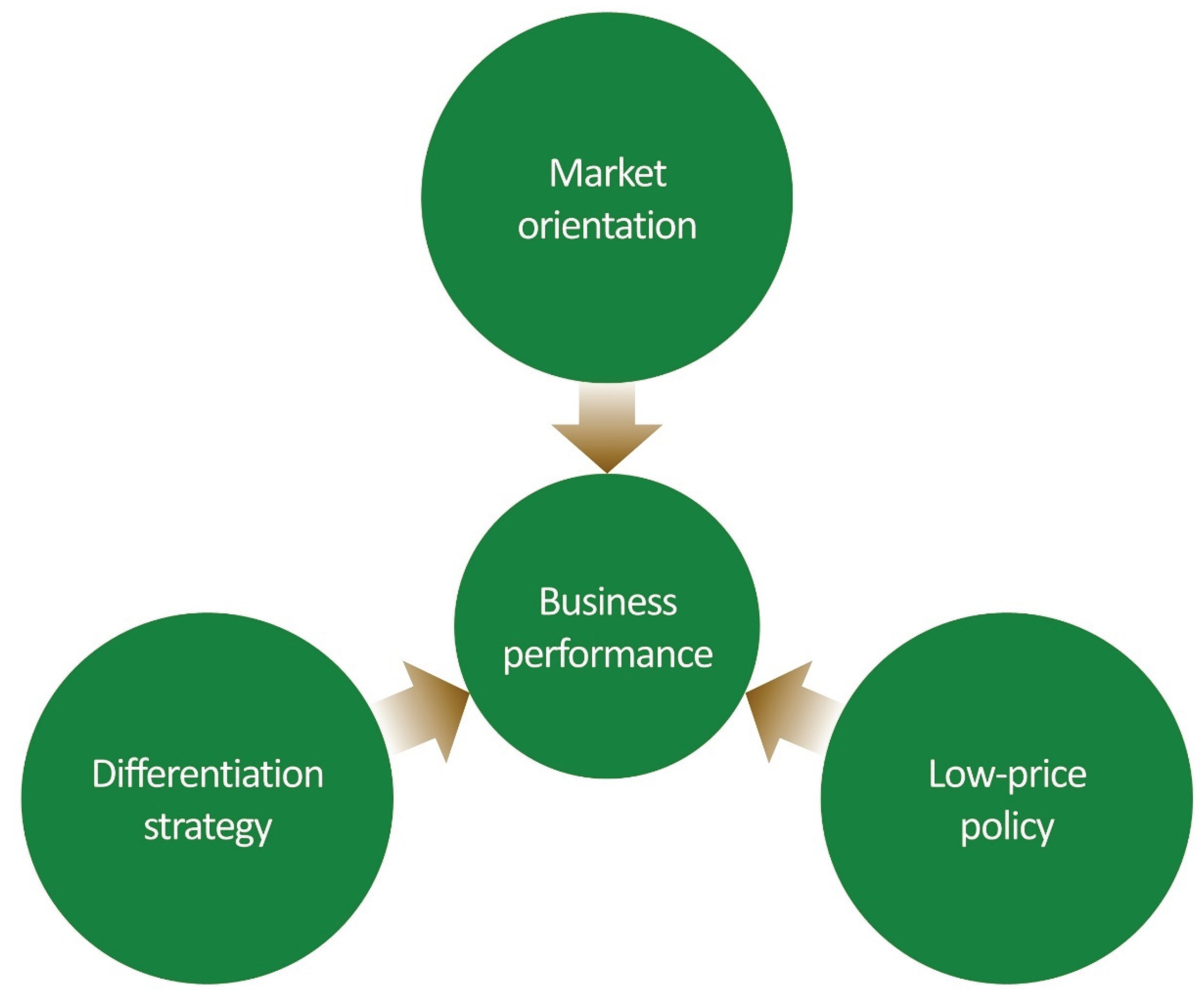

Table 1.
Baseline characteristics of the respondents.
| Variables | Frequency | Proportion (%) | |
|---|---|---|---|
| Sex | Men Women |
231 222 |
51.0 49.0 |
| Age (years) | ≤29 30-39 40-49 ≥50 |
96 221 77 59 |
21.2 48.8 17.0 13.0 |
| Years of education | High school College Graduate school |
41 329 83 |
9.1 72.6 18.3 |
| Mean monthly income (USD) | ≤1,658 2,486-3,232 3,315-4,061 ≥4,144 |
84 187 151 31 |
18.5 41.3 33.3 6.8 |
| Working department | Food/beverage Room Marketing/promotion Management Others |
66 64 86 223 14 |
14.6 14.1 19.0 49.2 3.1 |
| Position | Assistant manager Manager Deputy general manager General manager |
216 121 83 33 |
47.7 26.7 18.3 7.3 |
| Years of working | ≤5 6-10 11-20 ≥21 |
179 83 62 129 |
39.5 18.3 13.7 28.5 |
Table 2.
Reliability and validity of outcome measures.
| Outcome measures | The initial number of questions | The final number of questions | Cronbach’s α |
|---|---|---|---|
| Market orientation Differentiation strategy Low-price policy Business performance |
6 5 6 5 |
4 4 4 5 |
0.946 0.866 0.878 0.917 |
Table 3.
Results of a confirmatory factor analysis.
| Outcome measures | Items | URC | FL | CR (t) | SMC | AVE | CR |
|---|---|---|---|---|---|---|---|
| Market orientation | Information creation Information forwarding Response design Response implementation |
0.932 0.998 0.919 0.823 |
0.843 0.936 0.848 0.774 |
25.544 n/a 24.952 20.241 |
0.768 0.831 0.754 0.676 |
0.544 | 0.959 |
| Differentiation strategy | Marketing Business alliance Customer service Chain |
0.945 0.789 0.858 0.913 |
0.752 0.647 0.744 0.798 |
13.441 14.727 13.616 14.166 |
0.566 0.524 0.556 0.634 |
0.525 | 0.918 |
| Low-price policy | Price Development of low-price products Production cost Cost of food ingredients |
0.918 0.843 0.949 0.936 |
0.704 0.951 0.821 0.889 |
15.176 15.290 20.511 18.804 |
0.527 0.725 0.655 0.765 |
0.599 | 0.926 |
| Business performance | Profitability Growth rate of sales Market share Room occupancy rate Overall business performance |
0.91 1.00 0.846 0.866 0.838 |
0.754 0.867 0.733 0.759 0.773 |
16.125 n/a 16.147 16.834 16.677 |
0.733 0.567 0.555 0.587 0.543 |
0.547 | 0.933 |
χ2=979.723 (df=536, P=0.00),Q=1.832,GFI=0.897, AGFI=0.925, RMSEA=0.048, NFI=0.977, CFI=0.958. Abbreviations: URC, unstandardized regression coefficient; FL, factor loading; CR (t), critical ratio (t); SMC, squared multiple correlation; AVE, average variance extracted; CR, construct reliability.
Table 4.
Results of correlation analysis.
| Outcome measures | Market orientation | Differentiation strategy |
Low-price policy | Business performance | M | SD |
| Market orientation | 1.000 | 3.535 | 0.535 | |||
| Differentiation strategy | 0.699*** | 1.000 | 3.561 | 0.627 | ||
| Low-price policy | 0.684*** | 0.673*** | 1.000 | 3.692 | 0.669 | |
| Business performance | 0.629*** | 0.324** | 0.487*** | 1.000 | 3.288 | 0.683 |
Abbreviations: M. mean; SD, standard deviation. *P<0.05, **P<0.01, ***P<0.001.
Table 5.
Hypothesis testing.
| Hypothesis | Path | PC | CR (t) | SMC | Results |
|---|---|---|---|---|---|
| 1-1 | Market orientation → Differentiation strategy |
0.317 | 4.599*** | 0.466 | Accept |
| 1-2 | Market orientation → Low-price policy |
0.411 | 7.276*** | 0.458 | Accept |
| 1-3 | Market orientation → Business performance |
0.196 | 2.533** | Accept | |
| 2 | Differentiation strategy → Business performance |
0.184 | 2.227* | 0.549 | Accept |
| 3 | Low-price policy → Business performance |
0.256 | 3.159** | Accept |
χ2=979.723 (df=536, P=0.00),Q=1.832,GFI=0.897, AGFI=0.925, RMSEA=0.048, NFI=0.977, CFI=0.958. Abbreviations: PC, unstandardized path coefficient; CR (t), critical ratio (t); SMC, squared multiple correlation; AVE, average variance extracted. *P<0.05, **P<0.01, ***P<0.001.
Disclaimer/Publisher’s Note: The statements, opinions and data contained in all publications are solely those of the individual author(s) and contributor(s) and not of MDPI and/or the editor(s). MDPI and/or the editor(s) disclaim responsibility for any injury to people or property resulting from any ideas, methods, instructions or products referred to in the content. |
© 2025 by the authors. Licensee MDPI, Basel, Switzerland. This article is an open access article distributed under the terms and conditions of the Creative Commons Attribution (CC BY) license (http://creativecommons.org/licenses/by/4.0/).
Copyright: This open access article is published under a Creative Commons CC BY 4.0 license, which permit the free download, distribution, and reuse, provided that the author and preprint are cited in any reuse.


