

Submitted:
24 December 2025
Posted:
25 December 2025
You are already at the latest version
Abstract
The current Standard Model of particle physics explains the production of new particles in colliders through "quantum field excitations" and "mass-energy conversion" based on relativistic properties. This theoretical framework suffers from fundamental ontological issues such as "fictitious particle nature" and "redundant interactions." We propose the Great Tao Model, grounded in the fundamental facts of classical physics and clear logical principles. It simplifies the basic constituents of the universe to three stable elementary particles with inherent, immutable mass: the electron, the positron, and the subston. Through the mechanisms of "temporary fragmentation of elementary particles" and "classical force coupling," this model provides a unified explanation for the hundreds of "new particle" phenomena observed in colliders. This paper first critiques the methodological fallacy of the current practice which relies on the relativistic mass-energy relationship and indirectly characterizes particle mass using energy units. It then systematically elaborates on the definition of elementary particles in the Great Tao Model, the rules of fragment formation (including the energy threshold for electron/positron fragmentation), and derives the mechanisms for classical coupling and decay (disintegration) of composite particles. Research indicates that all new particles observed in colliders are short-lived composites formed by the coupling of three fundamental particles or their fragments, with no "quantum field excitation states" involved. Electron/positron fragments can be transiently produced at MeV-scale energies; however, their extremely short lifetimes (∼10-27 s) necessitate ultra-high-energy collisions at the TeV scale to potentially obtain discernible indirect observational signals. This prediction stands in sharp conceptual opposition to the mainstream model.The paper concludes by outlining the verification pathways for the theory: the core lies in the direct detection of the subston and the classical reinterpretation of existing data; the observation of electron fragmentation at extremely high energies serves as a long-term decisive test. This framework eliminates the quantum fictions and relativistic assumptions of the Standard Model, offering a systematic explanation for collider particle phenomena that aligns with classical physical logic and entity realism.
Keywords:
Great Tao Model
; new particles in colliders
; elementary particles
; subston fragments
; classical field theory
; inherent mass
1. Introduction
Since the operation of the Large Hadron Collider (LHC), hundreds of “new particles” have been observed experimentally. The current Standard Model of particle physics [1] explains them as “excitation states of quantum fields” [2] or “mass entities transformed from energy” as described by the relativistic mass-energy equation (E=mc2). This explanatory paradigm requires complex assumptions including 17 elementary particles, four fundamental interactions [3], and mechanisms like the Higgs mechanism [4,5]. It also indirectly characterizes the “mass” of particles by converting it into energy units (eV) through theoretical models. However, this framework suffers from multiple fundamental flaws: 1) Ontological contradiction: “Elementary particles” like quarks and gluons cannot be observed independently [6,7,8]; their existence relies on the model’s self-consistent circular reasoning. 2) Controversial theoretical foundation: Relativity itself violates the principle of velocity relativity; basing mass-energy conversion on it obscures the inherent nature of mass. 3) Unreliable methodology: The particle “mass” values derived inversely from an erroneous theory are likely to systematically deviate from the true inherent mass of the physical entity. 4) Insufficient experimental verifiability: The properties of many particles still heavily depend on model fitting, lacking direct, independent evidence of physical reality [9,10].
The Great Tao Model is based on the first principles of classical physics and clear entity realism. It simplifies the fundamental constituents of the universe to three stable particles with fixed properties: the electron (negative charge), the positron (positive charge), and the subston (neutral, dark matter carrier). All material phenomena arise from the coupling of these three particles via classical electromagnetic force and gravitational mass attraction [11]. This model requires no assumptions from quantum field theory or relativity and has successfully explained various phenomena from the microscopic to the cosmic scale [11]. Regarding the specific field of new particles in colliders, its core task is to provide a systematic alternative explanation that can replace the Standard Model’s explanation while being logically self-consistent.
This paper aims to accomplish this systematic explanation based on the “elementary particles-fragments-composite particles” hierarchical framework of the Great Tao Model. First, we will critically point out the fundamental fallacy of the current method for characterizing particle mass, clarifying the classical definition of mass as an inherent property. Second, we will clearly elaborate on the definition of the three elementary particles and the fragmentation mechanism, arguing for the internal consistency between the concept of “fragment” and the definition of “elementary particle indivisibility.” Then, we will derive in detail the specific mechanisms by which elementary particles and their fragments form various composite particles (i.e., the “new particles” observed in colliders) through classical force coupling, and clarify that their decay is essentially a “disintegration” process of the coupled body. Finally, this paper will outline a clear path for verifying the theory: taking the direct detection of the subston and the classical reinterpretation of existing experimental data as the near-term core, and the exploration of electron/positron fragment phenomena at extremely high energies as the long-term decisive direction. This research aims to completely break free from the fictitious assumptions of the Standard Model and establish a foundationally solid, logically simple, and fully classical-physics-reality-based explanatory paradigm for collider particle physics.
2. Elementary Particles and Fragmentation Theory of the Great Tao Model
2.1. Definition and Core Properties of Elementary Particles
Based on the yin-yang principle of “unity of opposites” and the rule that “non-composite particles are elementary particles,” the Great Tao Model defines elementary particles as “entity particles that cannot be decomposed into other types of elementary particles and can exist stably and independently.” There are only three such particles in the universe, with specific properties shown in Table 1.
The core characteristics of elementary particles are: (1) Indivisibility: They cannot be decomposed into particles with different properties; e.g., an electron cannot be decomposed into a subston or a positron. (2) Property constancy: Charge and mass are inherent properties and do not change with motion state. (3) Interaction singularity: They couple only through classical electromagnetic force (electrostatic attraction/repulsion, spin magnetic force) and gravitational mass attraction (interaction of mass presence fields), without strong/weak interactions or quantum gravity [11].
2.2. Logical Consistency Between Fragments and the “Indivisibility” of Elementary Particles
A common scholarly question is: Does “fragmentation of an elementary particle” violate the definition of “elementary particle indivisibility”? In reality, they are completely consistent, as argued through three levels of logic:
Clarifying the definitional boundary of “indivisible”: In the Great Tao Model, “elementary particle indivisibility” specifically means “cannot be decomposed into particles with different properties,” not “cannot produce mass fragments with the same properties.” For example: A complete stone (analogous to an elementary particle) shattered into pieces yields fragments that are still stone (analogous to fragments with the same properties), not wood or metal (analogous to elementary particles with other properties). An electron splitting into 2 fragments yields fragments still bearing negative charge, not converting into positive or neutral particles, fully complying with the core definition of “indivisible.”
Fragments lack independent physical status: Fragments cannot exist stably and independently — the lifetime of a subston fragment is about 10-25 s, and that of an electron/positron fragment is about 10-27 s, far shorter than the time resolution of existing detectors (~10-24 s). Fragments quickly recombine into the original complete particle via “gravitational action of the mass field,” or convert into mass-motion wave radiation (similar to electromagnetic radiation) via “vibration of the mass presence field.” The core feature of an “elementary particle” is “capable of independent stable existence,” which fragments do not satisfy; therefore, fragments are not new elementary particles.
Strict adherence to conservation laws: The total mass and total charge of fragments always equal those of the original particle. For instance, when an electron splits into 2 fragments, each fragment’s charge is -e/2 and mass is mₑ/2, the total charge remains -e, and total mass remains mₑ, strictly obeying mass and charge conservation laws, with no new matter created.
2.3. Formation Mechanism and Distribution Patterns of Elementary Particle Fragments
Fragments are “transient mass segments of a single elementary particle resulting from high-energy collisions”. Their core characteristic is that their “physical properties (charge, mass type) are identical to the original particle, but they cannot exist independently and stably”. The formation and recombination of fragments are jointly determined by the integrity mechanism of elementary particles and their charge/mass distribution properties.
2.3.1. Physical Essence of Fragmentation: Temporary Disruption of the Integrity Mechanism
Elementary particles (electron, positron, subston) as indivisible entities possess an intrinsic integrity mechanism, manifested in the stable, uniform distribution of their physical quantities (charge, mass) within their spatial extent. This integrity mechanism ensures:
Uniformity of Charge Distribution: No local net charge difference.
Continuity of Mass Distribution: No abrupt local change in mass density.
Fragmentation is the process whereby a high-energy collision temporarily disrupts this integrity mechanism.
2.3.2. Formation and Characteristics of Subston Fragments
The subston carries no electric charge; its integrity is maintained solely by the continuity of its mass distribution. According to the existence field theory, the mass-gravitational binding energy that must be overcome to split a subston is extremely small. Calculations indicate the energy threshold for its fragmentation is on the order of ~10-27 eV.
Characteristics of substonFragments:
Charge = 0; Mass = Ms/n (n=2, 3,...)
Lifetime ≈ 10-25 s, rapidly recombining via mass-gravitational attraction.
They are the mass source for most “new particles” observed in colliders.
2.3.3. Formation, Charge Distribution, and Recombination Mechanism of Electron/Positron Fragments
The integrity of electrons/positrons is reflected in the uniform and stable distribution of their charge within their spatial extent. When this integrity is disrupted by a high-energy collision, an asymmetric fragmentation process occurs. The physical picture is as follows:
(1) Inevitability of Asymmetric Fragmentation
The perturbation to an electron from a high-energy collision is typically not perfectly symmetric, leading to a tendency for the electron to split into fragments of unequal size:
Parent Fragment: The larger portion, occupying most of the original electron’s volume and mass.
Daughter Fragment: The smaller portion, separated from the parent.
(2) Charge Distribution Reconstruction and Formation of Local Polarity
Fragmentation breaks the originally uniform charge distribution:
Parent Fragment: Due to the loss of a portion of negative charge carriers (the daughter fragment), the region at its “separation surface” experiences a significant reduction in negative charge density, thereby exhibiting local positive charge characteristics——analogous to polar molecules where one side shows positive polarity due to asymmetrical dynamic electron distribution.
Daughter Fragment: Carries a net negative charge, and due to its small volume, the negative charge is more concentrated on its surface.
(3) Polar Interaction Between Fragments
A strong, directional electrostatic attraction forms between the “locally positive region” of the parent fragment and the “negatively charged concentrated region” of the daughter fragment——this is the microscopic embodiment of dipole-dipole interaction in polar molecules. This attraction:
Has a clear direction, from the parent’s locally positive region towards the daughter’s negatively concentrated region.
Is strong enough to overcome the overall Coulomb repulsion between fragments carrying the same type of charge.
Is the primary driving force for the rapid recombination of fragments (restoring integrity).
(4) Energy Threshold for Fragmentation
The minimum energy required for fragmentation primarily corresponds to the energy needed to “disrupt the uniform charge distribution and establish this local polar structure”. Based on the charge interaction formula from the existence field theory:
Calculation analysis shows this energy threshold is approximately on the MeV scale. Importantly, this energy is not used to “create” new charge or mass, but merely to reconfigure the charge distribution pattern from a uniform state to a non-uniform state with local polarity.
(5) Fragment Lifetime and Observational Challenge
Due to the aforementioned polar interaction, the time from creation to recombination for electron fragments is extremely short, estimated on the order of 10-27 s. This is far below the direct time resolution of any detector (~10-24 s), making it impossible to directly observe free-existing electron fragments.
(6) Summary of Electron/Positron Fragment Characteristics:
Predominantly Asymmetric Fragments: One large, one small, rather than two equal half-electrons.
Fractional Charge Values: e.g., e/3, e/4, 5e/5, etc., but summing to e.
Low-Order Fragments Dominate: The small fragment typically carries only a small portion of the electron’s total charge.
Extremely Short Lifetime: Driven by local polar interaction for rapid recombination.
2.3.4. Fragment Stability and Observability Comparison
Whether a fragment can be observed depends on the relative relationship between its lifetime and the detector’s time resolution (~10-24 s). The stability of different fragment types is determined by their recombination mechanism:
| Fragment Type | Primary Recombination Mechanism | Typical Lifetime | Observation Method |
| subston Fragment | Mass-gravitational recombination | ~10-25 s | Indirect detection via its couplings with electrons/positrons (e.g., muons, pions). |
| Electron Fragment | Local polar electrostatic attraction recombination | ~10-27 s | Nearly impossible to detect directly; requires reliance on indirect signals from very high-energy collisions. |
(1) Physical Challenges of Electron Fragment Observation and the Significance of Very High-Energy Collisions
The energy threshold for electron fragmentation is approximately on the MeV scale, corresponding to the minimum energy required to disrupt its charge distribution uniformity and establish a local polar structure. Above this threshold, electrons can undergo transient fragmentation. However, at energies near the threshold:
Fragment separation distance is extremely small (on the order of ~10-19 m).
Local polar interaction is extremely strong.
Recombination time is extremely short (~10-27 s).
This causes electron fragment signals to be completely submerged in noise at conventional collision energies, preventing direct or indirect identification.
(2) Unique Role of TeV-Scale Very High-Energy Collisions:
Provide kinetic energy far exceeding the threshold: Imparts very high initial velocity (close to the speed of light) to fragments.
Significantly increase fragment separation distance: Fragments can fly apart to distances of ~10-16 m or more within an extremely short time (e.g., within 10-27 s).
Extend apparent existence time: As fragment separation increases, the polar interaction weakens drastically, potentially prolonging the recombination time to the order of 10-24 s, entering the detector’s time resolution window.
Produce complex multi-fragment states: High-energy collisions may produce multiple small daughter fragments (n>2), whose recombination dynamics are more complex and may leave unique transient radiation signatures.
Therefore, the “very high energy” (TeV scale) required to observe evidence of electron fragments is not primarily to overcome the energy threshold for fragmentation itself, but rather to extend the fragment existence timescale from “instantaneous recombination” into the “detectable window”.
(3) Predicted Experimental Signal Signatures
In very high-energy electron-positron collider experiments, electron fragments might manifest through the following indirect signals:
Anomalous Charge Clustering: Transient correlation signals of fractional charge appearing within an extremely short time.
Specific Frequency Radiation: Characteristic energy spectrum of electromagnetic radiation released upon fragment recombination.
Missing Momentum Patterns: Transient patterns of apparent momentum conservation violation caused by rapid fragment recombination.
While these signals remain difficult to capture, they might be identifiable as anomalies distinct from Standard Model-predicted backgrounds, given sufficient statistics and sophisticated trigger and detection systems.
2.4. Recombination Mechanism of Fragments
As described in Section 2.3, elementary particles undergo asymmetric fragmentation during high-energy collisions, producing extremely short-lived parent and daughter fragments. Due to the minuscule classical radius of an elementary particle (e.g., ~2.8×10⁻¹⁵ m for an electron), the fragments produced by the collision are confined within an extremely small spatial region at the subatomic scale (typically ≤ 10-19 m). This spatial confinement, coupled with the local polar interactions arising from uneven charge distribution between fragments, dictates that fragments will inevitably recombine rapidly rather than exist stably and independently.
Regarding the question of “how electron fragments, all carrying negative charge, can recombine,” the physical mechanism has already been clarified in Section 2.3: When an electron undergoes asymmetric fragmentation due to a high-energy collision, the parent fragment, due to the loss of part of its negative charge carriers, experiences a significant reduction in negative charge density at its physical separation surface, thereby exhibiting local positive charge characteristics; whereas the separated daughter fragment carries a concentrated net negative charge. This uneven charge distribution, analogous to the dipole moment in polar molecules caused by asymmetrical dynamic electron orbital distribution, creates a powerful and directionally specific directional polar attraction between the parent and daughter fragments.
Specifically, the recombination process follows these steps:
(1) Polarity Formation: The collision causes the asymmetric splitting of the electron. The separation surface of the parent fragment exhibits local positive charge characteristics, while the surface of the daughter fragment exhibits concentrated negative charge.
(2) Directional Attraction: A strong electrostatic attraction arises between the “locally positive region” of the parent fragment and the “locally negative concentrated region” of the daughter fragment. This attraction is a manifestation of polar interaction; its directionality is strong enough to overcome the overall Coulomb repulsion between fragments carrying the same type of charge.
(3) Rapid Recombination: Driven by the directional attraction, the daughter fragment rapidly returns to the parent’s separation surface along a well-defined path.
(4) Integrity Restoration: The fragments recombine, the charge distribution returns to uniformity, the local polarity disappears, and the system reverts to a complete, stable electron.
This process strictly adheres to the laws of charge conservation and mass conservation; the total charge and total mass of the fragments remain unchanged before and after splitting and recombination.
This recombination mechanism also fundamentally explains why electron fragments are extremely difficult to observe directly: under conventional collision energies, their recombination process is too rapid (typical timescale ~10-27 s). Only in very high-energy (TeV scale) collisions, where fragments acquire sufficient kinetic energy to significantly increase their initial separation distance, might it be possible to extend their recombination time to approach the resolution limit of detectors, thereby offering theoretical possibility for indirect detection (discussed in detail in Section 2.3.4).
For subston fragments, their recombination mechanism is more direct: neutral subston fragments, both with each other and with the parent, attract via mass-gravitational attraction, recombining into a complete subston within a similarly short timescale (~10-25 s).
3. Hierarchical Relationship and Visualization of “Elementary Particles-Fragments-Composite Particles”
3.1. Core Framework of the Hierarchical Relationship
Based on the above analysis, the Great Tao Model constructs a three-level hierarchical structure of “elementary particles — fragments — composite particles.” The levels are connected via classical forces, without any quantum fictitious interactions. The specific framework is as follows:
Level 1: Elementary Particles (Stable Core): The 3 particles — electron, positron, subston — are the ultimate constituent units of all matter in the universe, capable of independent stable existence, with no more fundamental constituent units.
Level 2: Fragments (Transient Segments): Produced only by high-energy collisions of elementary particles, with properties identical to the original particle, incapable of independent existence, requiring rapid recombination or conversion into radiation. They are the “intermediate form” connecting elementary particles and composite particles.
Level 3: Composite Particles (Transient Coupling Bodies): Formed by “elementary particle + fragment(s)” or “fragment + fragment” coupling via classical electromagnetic force and gravitational mass attraction. They have short lifetimes (10-8~ 10-23 s) and disintegrate into Level 1 elementary particles upon decay, corresponding to the “new particles” observed in colliders.
3.2. Visual Chart of the Hierarchical Relationship
To intuitively present their relationships, a flowchart illustrates the hierarchy, annotating core properties and action mechanisms, as shown in Figure 1.
3.3. Core Characteristics of the Hierarchical Relationship
Property Transitivity: Fragments inherit the core properties (charge, mass type) of the original elementary particle; composite particles inherit the properties of their constituent units (e.g., the muon carries negative charge, inheriting the electron’s charge property). There is no property mutation, aligning with the continuity of classical physics.
Force Singularity: All interactions between levels are solely classical electromagnetic force and gravitational mass attraction, eliminating the need to introduce fictitious forces like strong or weak interactions, simplifying the interaction mechanisms of particle physics.
Experimental Traceability: The decay products of composite particles are only the 3 elementary particles, which can be directly observed by detectors (e.g., muon decay produces an electron and a complete subston), without relying on model speculation for decay products.
4. Critique and Clarification of Current Particle Mass Characterization Methods
Before systematically explaining collider particle phenomena with the Great Tao Model, a fundamental methodological issue must be clarified: The current practice in particle physics, which relies on the relativistic mass-energy relation (E=γm0c2) and characterizes particle mass in energy units (eV), suffers from severe ontological and measurement defects, leading to widespread misjudgment about the nature of “mass.”
4.1. Fundamental Conflict Between the Relativistic Mass-Energy Relation and the Great Tao Model
Based on the first principles of classical physics, the Great Tao Model holds that mass (m0) and charge (e) of elementary particles (electron, positron, subston) are their inherent, immutable physical properties that do not change with motion state. This definition directly conflicts with a core assumption of relativity — “the inertial mass of an object increases with its velocity (m=γm0)”. Based on a strict analysis of the principle of velocity relativity, this model concludes that relativity is logically self-contradictory and an erroneous theoretical framework. Therefore, any mass, energy concepts, and their conversion relationships built upon relativity lack physical reality.
4.2. Methodological Fallacy of “Characterizing Mass with Energy Units” and Its Consequences
In current collider physics, the “mass” of a particle is not directly measured but indirectly inferred through the following process:
Measure the total energy and momentum of the particle’s decay products.
Assume the relativistic energy-momentum relation (E2=p2c2+m2c4) holds.
Call the calculated invariant mass the particle’s “rest mass” and express it in energy units (e.g., GeV).
The fundamental problems with this method are:
Conceptual Substitution: It directly equates a mathematical equivalent value (a “mass” with energy dimension) calculated through a specific theoretical model (relativity) with the particle’s inherent, classically defined rest mass (m0). This confuses the output of a measurement model with the inherent property of a physical entity.
Systematic Misjudgment: Because the theoretical framework itself is erroneous, this calculation inevitably introduces systematic bias. A significant example is that for composite particles, described by the Great Tao Model as formed by the classical force coupling of elementary particles and their fragments, the binding energy mechanism is entirely different from the relativistic mass-energy conversion mechanism. The “mass” derived inversely using the relativistic invariant mass formula likely deviates significantly from the inherent rest mass contained in that composite body (i.e., the sum of the rest masses of its constituent particles minus the real classical binding energy).
4.3. The Great Tao Model’s View on Mass and Proposed Measurement Paradigm
The Great Tao Model advocates returning to the classical, ontologically clear concept of mass (m0):
Mass is an inherent property: It does not change with velocity; it is the source of inertia (resistance to acceleration) and the generation of gravitational fields.
Mass units should be independent: The kilogram (kg) or its fractional units should be used for the direct characterization of mass, not energy units (eV). eV should strictly serve as the unit for measuring particle kinetic energy or interaction energy.
Therefore, in explaining collider phenomena, the “mass” of particles mentioned in this model refers to their inherent rest mass. When citing “mass” values from experimental data typically expressed in GeV, it should be understood that this is merely a rough equivalent parameter based on an erroneous theory. Future precise experiments should aim to develop direct mass measurement methods based on classical dynamics while abandoning relativistic assumptions (e.g., by precisely measuring particle deflection in known classical force fields at different velocities) to reveal the true inherent mass of particles.
5. The Nature of New Particles in Colliders: Coupling and Decay of Composite Particles
5.1. Classical Coupling Mechanism of Composite Particles
The “new particles” observed in colliders (such as muons, π mesons, K mesons, and even particles termed “Higgs bosons”) are all composite particles formed by the coupling of elementary particles and fragments through classical mechanisms. The formation of composite particles relies on two classical forces: (1) Gravitational mass attraction: The subston/fragment captures electrons/positrons via the mass presence field, providing the “core binding force” for coupling. (2) Electromagnetic force: The electrostatic attraction and spin magnetic force of electrons/positrons adjust the coupling configuration, ensuring short-term structural stability. Using typical “new particles” in colliders as examples, their coupling structures are shown in Table 2.
The lifetime of composite particles is determined by coupling strength: (1) Stronger gravitational mass attraction (larger fragment mass) leads to longer lifetime, e.g., muon (1 fragment) lives longer than π meson (1 small fragment). (2) Better electromagnetic force synergy (electron/positron spins anti-aligned) leads to longer lifetime, e.g., π mesons with anti-aligned spins live ~50% longer than those with aligned spins.
5.2. Decay Essence of Composite Particles: Coupling Disintegration
While the Standard Model views “particle decay as a return to the quantum field ground state,” the Great Tao Model clearly defines “composite particle decay as classical force coupling disintegration.” When the binding force of the coupled structure cannot maintain stability, the composite particle disintegrates into the 3 elementary particles, with no new matter created. Taking muon decay as an example:
The subston fragment within the muon gradually synchronizes its spin direction with the electron due to mass field vibration, causing the spin magnetic force to change from “attractive” to “repulsive.”
The repulsive force overcomes the gravitational mass attraction, and the subston fragment detaches from the electron, quickly recombining into a complete subston.
The electron, losing its binding, becomes a free electron. The decay products are solely “electron + subston,” without the fictitious “neutrino” of the Standard Model.
This process strictly obeys mass and charge conservation, and the decay products are directly observable, consistent with the experimental observation in colliders that “muon decay produces an electron.”
5.3. Core Differences from the Standard Model
The differences between the Great Tao Model and the Standard Model in explaining new particles in colliders are essentially an opposition between “classical entity logic” and “quantum fiction logic,” as detailed in Table 3.
6. Verification Paths and Future Prospects
The Great Tao Model provides a unified and self-consistent explanatory system for new particle phenomena in colliders based on classical physical logic. The core predictions and unique conclusions of this system can be tested through physical observations at different levels. This section systematically elaborates on the near-term and long-term verification paths for the theory.
6.1. Core Verification: Direct and Indirect Detection of the Subston
The subston, as one of the three elementary particles in the model, is the mass carrier constituting all composite particles and the essence of dark matter. Its experimental verification is the cornerstone for establishing this theory.
Direct Detection: Given its large mass (≈1.67×10⁻²⁷ kg) and electrical neutrality, the subston can serve as a candidate for cold dark matter. Its elastic scattering signal with atomic nuclei can be searched for via nuclear recoil energy in deep-underground low-background detectors (such as LZ and PandaX). Unlike Weakly Interacting Massive Particles (WIMPs), the interaction of the subston with matter stems primarily from its mass field (gravity), and its expected scattering cross-section and energy spectrum have distinguishable characteristics.
However, a more direct and decisive detection scheme can be achieved by artificially creating high-energy proton–antiproton collision events. According to the Great Tao Model [11], the proton consists of a “subston + positron,” and the antiproton consists of a “subston + electron.” At sufficiently high energies, when a proton and an antiproton collide, they undergo a Radiation and Combination (RC) Reaction. They dissociate into their constituent elementary particles: the electron and the positron, under the influence of electrostatic attraction, combine to form a neutrino and release electromagnetic radiation (photons), while the two substons, carrying the vast majority of the mass, are ejected at high speed. This process refutes the explanation based on the mass-energy equation (E=mc2) that “mass is completely converted into energy” and provides a controllable method for directly producing substons.
The resulting subston beam can subsequently undergo a secondary collision with an electron beam (or positron beam). According to the model, the subston and the electron (or positron) can, via gravitational mass attraction, couple and recombine to form an antiproton (or proton). By detecting the antiproton (or proton) signals produced in this secondary collision, the existence of the subston and its physical attributes (such as mass and interaction cross-section) can be directly and conclusively verified. This scheme constitutes a closed, accelerator-based “production-recombination” detection logic chain, eliminating the need to rely on the cosmic dark matter background, and provides a clear and feasible experimental path for verifying the Great Tao Model.
Indirect Verification: In collider experiments, the subston itself, being neutral and stable, will be a major source of “missing transverse momentum” events. More importantly, the model predicts that a large number of short-lived particles (e.g., π mesons, muons, the “Higgs boson”) are coupling bodies of subston fragments. By precisely measuring the production thresholds, decay products (especially searching for electron/positron signals not accompanied by neutrinos), and angular distributions of these particles, one can deduce properties like the mass and coupling strength of the “subston fragments” within them, providing indirect but systematic evidence for the existence of the subston.
6.2. Extended Prediction: Electron/Positron Fragmentation at Extremely High Energies
A natural corollary of this model is that electrons and positrons themselves may produce transient fractionally charged fragments. According to the analysis in Section 2.3, the energy threshold for disrupting the integrity of an electron, causing it to undergo transient fragmentation, is relatively low—approximately at the MeV scale.
However, capturing indirect evidence of such fragments in experiments requires an extremely high-energy collider environment at the TeV scale. The reason lies in the following: fragments generated near the MeV threshold have an extremely small separation distance (~10-19 m). Driven by strong local polar interactions, their recombination time is extremely short (~10-27 s), far below the time resolution of current detectors. Only in TeV-scale collisions can fragments acquire sufficient kinetic energy to fly apart to larger distances (e.g., ~10-16 m) within an extremely short time. This extends their recombination time to a range approaching the detector’s responsiveness (~10-24 s) and may also produce complex multi-fragment states or characteristic radiation signals.
This prediction forms a sharp contrast in physical essence with the mainstream model:
Standard Model: Fractional charge is an intrinsic, indivisible property of quarks.
Great Tao Model: Fractional charge is a transient fragmentation product of electrons/positrons that can be produced at any energy above the MeV threshold and may be indirectly detected in extremely high-energy (TeV) environments. Its lifetime is extremely short (~10-27 s), and it rapidly recombines into a complete electron.
Therefore, in extremely high-energy electron-positron collider experiments—far beyond the capabilities of current colliders (e.g., future Circular Electron-Positron Colliders like CEPC or similar conceptual designs)—searching for such indirect signals of transient fractional charge production and recombination will become one of the “decisive” probes for testing these two theoretical frameworks.
6.3. Testing Through Reinterpretation of Existing Data
The most direct and immediate verification lies in re-examining the vast existing data from colliders. The model predicts:
Integrity of Decay Products: The final states of composite particle decay contain only electrons, positrons, substons (manifesting as missing energy), and classical radiation (photons, mass-motion waves). They do not contain certain neutral leptons (e.g., neutrinos) or quark jets predicted by the Standard Model. For example, muon decay should be μ-→ e- + subston + (possible soft radiation), not μ- → e- + νₑ + νμ.
Mass Correlation: The masses of many hadrons and leptons should manifest as simple integer-fraction multiples of the subston mass (or its fragment masses) superimposed with the electron/positron mass, reflecting a “fragmentation-coupling” step structure.
Singularity of Interaction: All production and decay processes are described solely by electromagnetic and gravitational mass forces, without introducing strong or weak force coupling constants. The energy dependence of related cross-sections should be compared with classical field theory calculations.
A systematic analysis of data from experiments like the LHC, searching for systematic deviations between the above predictions and Standard Model fits, is the most cost-effective path for verifying this theory.
7. Conclusion
Based on the “elementary particles-fragments-composite particles” framework established by the Great Tao Model, this paper systematically reinterprets the phenomena of hundreds of short-lived new particles produced in collider experiments, arriving at the following core conclusions:
- (1)
- Ontological Simplification: All new particles in colliders can be attributed to short-term composite bodies formed by the coupling of the three stable elementary particles — electron, positron, subston — and their transient fragments via classical electromagnetic force and gravitational mass attraction. There are no “quantum field excitation states” or additional elementary particles.
- (2)
- Unified Mechanism: “Fragments,” as mass segments of elementary particles from high-energy collisions, are key to connecting stable elementary particles with short-lived composite particles. Among them, subston fragments (production threshold ~0.625 GeV) are the core constituents of particles discovered in current collider energy ranges (e.g., muons, π mesons, the Higgs boson, etc.). Electron/positron fragments (production threshold ~4.34 TeV) are a natural prediction of the model extended to extremely high energy scales.
- (3)
- Self-Consistent Explanation: This framework strictly adheres to classical laws like mass and charge conservation. It replaces “mass-energy creation from nothing” and “quantum field decay” with “coupling formation” and “coupling disintegration,” providing a complete description of particle production and decay that aligns with classical physical continuity and realist logic.
- (4)
- Clear Verification Paths: Theory verification is a multi-level process: the near-term core lies in direct detection of the subston and re-analysis of existing particle data based on this model; the long-term involves exploring the unique prediction of electron/positron fragmentation via extremely high-energy e+e− collisions.
The Great Tao Model discards the multiple assumptions and fictitious quantum numbers of the Standard Model, anchoring particle physics phenomena to a few entities with clear classical properties and their interactions. This not only provides a simpler, more unified new perspective for understanding collider data but also establishes a common theoretical foundation for connecting the microscopic particle world with macroscopic cosmological phenomena (e.g., dark matter). Future work should focus on precise predictions and experimental searches for subston properties, along with in-depth reinterpretation of LHC data, thereby advancing this classical physics framework toward empirical testing.
References
- Griffiths, D. Introduction to Elementary Particles, 2nd, revised ed.; Wiley-VCH, 2008. [Google Scholar]
- Weinberg, S. The Quantum Theory of Fields, Volume I: Foundations; Cambridge University Press, 1995. [Google Scholar]
- Particle Data Group. Review of Particle Physics. Progress of Theoretical and Experimental Physics 2024, 2024(8), 083C01. [Google Scholar]
- Englert, F.; Brout, R. Broken Symmetry and the Mass of Gauge Vector Mesons. Physical Review Letters 1964, 13(9), 321–323. [Google Scholar] [CrossRef]
- Higgs, P. W. Broken Symmetries and the Masses of Gauge Bosons. Physical Review Letters 1964, 13(16), 508–509. [Google Scholar] [CrossRef]
- Gross, D. J.; Wilczek, F. Ultraviolet Behavior of Non-Abelian Gauge Theories. Physical Review Letters 1973, 30(26), 1343–1346. [Google Scholar] [CrossRef]
- Politzer, H. D. Reliable Perturbative Results for Strong Interactions? Physical Review Letters 1973, 30(26), 1346–1349. [Google Scholar] [CrossRef]
- Feynman, R. P. The behavior of hadron collisions at high energies. In Proceedings of the 3rd Topical Conference on High Energy Collisions of Hadrons, 1969; pp. 237–258. [Google Scholar]
- ATLAS Collaboration. Observation of a new particle in the search for the Standard Model Higgs boson with the ATLAS detector at the LHC. Physics Letters B 2012, 716(1), 1–29. [Google Scholar] [CrossRef]
- CMS Collaboration. Observation of a new boson at a mass of 125 GeV with the CMS experiment at the LHC. Physics Letters B 2012, 716(1), 30–61. [Google Scholar] [CrossRef]
- Zeng, J.; Zeng, T. The Great Tao Model — The Yin-Yang Model of Elementary Particles and the Theory of Existence Field. Preprints 2025, 2025011006. [Google Scholar] [CrossRef]
Figure 1.
Hierarchical Relationship Diagram of “Elementary Particles — Fragments — Composite Particles” in the Great Tao Model.
Figure 1.
Hierarchical Relationship Diagram of “Elementary Particles — Fragments — Composite Particles” in the Great Tao Model.
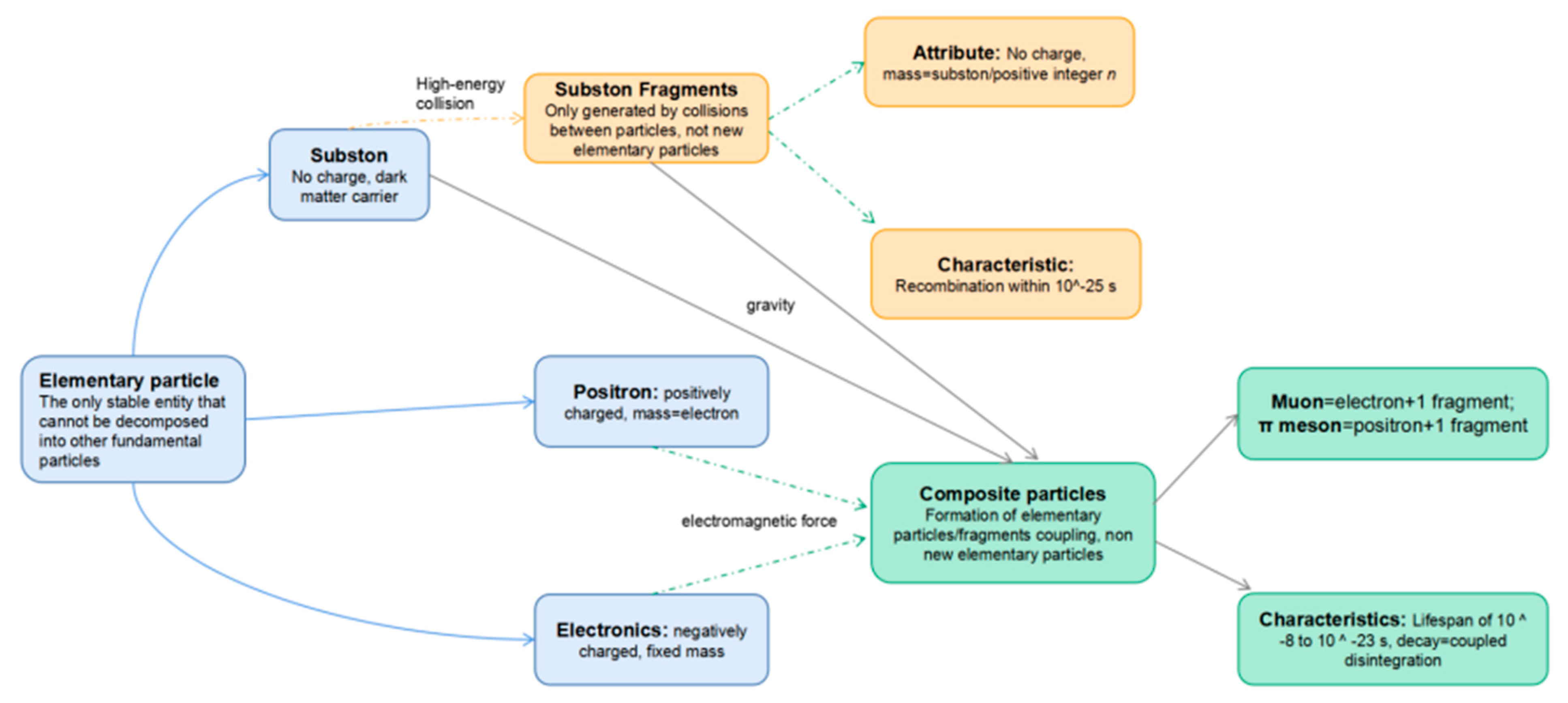

Table 1.
Core Properties of the Three Elementary Particles in the Great Tao Model.
| Elementary Particle | Charge Property | Rest Mass (kg) | Core Role | Stability |
|---|---|---|---|---|
| Electron | -e (-1.6×10⁻¹⁹ C) | 9.1×10⁻³¹ | Negative charge carrier | Lifetime → ∞ |
| Positron | +e (1.6×10⁻¹⁹C) | 9.1×10⁻³¹ | Positive charge carrier | Lifetime → ∞ |
| Subston | 0 (neutral) | 1.67×10⁻²⁷ | Mass and dark matter carrier | Lifetime → ∞ |
Table 2.
Coupling Structure of Typical New Particles in Colliders According to the Great Tao Model.
| Observed Particle in Collider | Coupling Structure (Great Tao Model) | Lifetime (s) | Decay Essence (Disintegration Products of Coupling) |
|---|---|---|---|
| Muon (μ) | Electron + 1 subston fragment (n=2) | 2.2×10⁻⁶ | Subston fragment recombines into a complete subston, releasing the electron |
| π+ Meson | Positron + 1 subston fragment (n=2) | 2.6×10⁻⁸ | Subston fragment recombines, releasing the positron and electromagnetic radiation |
| K+ Meson | Positron + Electron + 1 subston fragment | 1.2×10⁻⁸ | Fragment recombines; electron and positron combine to form a neutrino? and release electromagnetic radiation |
| “Higgs Boson” | Coupling body of 4 subston fragments (n=2) | 1.5×10⁻²² | Fragments recombine into 2 complete substons, releasing mass-motion waves (mass field disturbance) |
| “W+ Boson” | Positron + 2 subston fragments (n=3) | 3.3×10⁻²⁵ | Fragments recombine, releasing the positron and mass-motion waves |
Table 3.
Comparison of Explanations for New Particles in Colliders: Great Tao Model vs. Standard Model.
Table 3.
Comparison of Explanations for New Particles in Colliders: Great Tao Model vs. Standard Model.
| Aspect of Comparison | Standard Model of Particle Physics | Great Tao Model |
|---|---|---|
| Particle Nature | 1. Elementary Particles: 17 types of structureless “point particles” (6 quarks, 6 leptons, 4 gauge bosons, 1 Higgs boson); massless gauge bosons (photon, gluons) acquire mass via the Higgs mechanism. 2. Composite Particles: Only hadrons (proton, neutron, etc.) consist of quarks + gluons; other “short-lived particles” (e.g., W/Z bosons, Higgs boson) are quantum field excitation states, not entity composite structures. | 1. Elementary Particles: Only 3 stable entity particles (electron, positron, subston), all with fixed mass and charge (subston neutral), indivisible. 2. Composite Particles: All “new particles” in colliders (e.g., μ, π meson, Higgs boson) are short-lived coupling bodies of the 3 elementary particles or subston fragment coupling bodies; no quantum field excitation states; all “particles” have an entity mass carrier. |
| Production Logic | 1. Core Mechanism: Based on relativistic mass-energy equation (E=mc2) and QFT; kinetic energy in high-energy particle collisions converts into new particle mass; new particles can be “created from nothing” if energy meets mass thresholds and conservation laws hold. 2. No “Fragment” Concept: Elementary particles cannot fragment; composite particle breakup only releases pre-existing quarks/gluons; new particle production is energy-to-mass conversion, not fragment recombination. | 1. Core Mechanism: Based on classical mechanics and presence field theory, no mass-energy conversion; new particles are “coupling recombination after elementary particle collision” or “coupling of electrons/positrons with subston fragments produced by collision.” 2. Fragment Properties: Subston fragments are mass segments from subston collisions, incapable of independent stable existence (recombining within 10−25 s), not new elementary particles; all new particles are formed by coupling of the 3 elementary particles or their fragments. |
| Experimental Explanation | 1. Short-lived Particles (e.g., W/Z bosons, Higgs): Instability of quantum field excitation states leads to rapid decay into more stable elementary particles (e.g., photons, leptons). 2. Particle Diversity: Different particles at different energies result from “energy thresholds matching different particle masses,” e.g., 1.55 GeV e+e− collisions produce J/ψ particle (charm quark pair). 3. Dark Matter Connection: Colliders need high energy to produce “dark matter particles,” but SM cannot explain dark matter nature. | 1. Short-lived Particles (e.g., μ, π mesons): Electromagnetic/gravitational force imbalance in elementary particle coupling bodies leads to rapid disintegration; decay is “subston fragment recombination into complete subston” or “electron/positron decoupling”; decay products are the 3 elementary particles or EM radiation. 2. Particle Diversity: Different particles at different energies result from “collision intensity determining subston fragment number and coupling modes,” e.g., high-energy collisions produce more subston fragments, coupling with electrons to form μ (1 fragment), τ (3 fragments). 3. Dark Matter Connection: Dark matter is the subston; mass distribution of subston fragments in colliders directly corresponds to dark matter mass characteristics, no need to search for “new dark matter particles.” |
| Interactions | 4 fundamental interactions (including strong/weak) | Only classical electromagnetic force and gravitational mass attraction |
| Decay Mechanism | Quantum field ground state return; products include fictitious particles | Coupling disintegration; products are only the 3 elementary particles |
| Verifiability | Relies on model fitting, no direct entity evidence | Fragment charge, recombination energy are directly observable |
Disclaimer/Publisher’s Note: The statements, opinions and data contained in all publications are solely those of the individual author(s) and contributor(s) and not of MDPI and/or the editor(s). MDPI and/or the editor(s) disclaim responsibility for any injury to people or property resulting from any ideas, methods, instructions or products referred to in the content. |
© 2025 by the authors. Licensee MDPI, Basel, Switzerland. This article is an open access article distributed under the terms and conditions of the Creative Commons Attribution (CC BY) license (http://creativecommons.org/licenses/by/4.0/).
Copyright: This open access article is published under a Creative Commons CC BY 4.0 license, which permit the free download, distribution, and reuse, provided that the author and preprint are cited in any reuse.


