

Submitted:
23 December 2025
Posted:
23 December 2025
You are already at the latest version
Abstract
Tourism is increasingly regarded as a strategic instrument for economic diversification and regional development; however, in many emerging economies, growth in tourist arrivals does not always translate into proportional economic gains. This study examines the sustainable development of domestic tourism in Kazakhstan by analyzing revenue efficiency, structural constraints, and productivity-related factors. Using national statistical data for the period 2014–2024, a log–log regression model estimated by ordinary least squares was applied to assess the elasticity of tourism revenue with respect to tourist flows and investment in tourism-related fixed assets. The results indicate a moderate positive elasticity of tourism revenue with respect to tourist arrivals (0.56), suggesting that increases in visitor numbers lead to relatively modest income growth. In contrast, investment in tourism-related fixed assets exhibits a short-term negative elasticity (0.39), indicating that additional investment does not immediately translate into higher revenue, likely due to adjustment lags. Sectoral analysis shows that tourism revenues are heavily concentrated in transport and accommodation services, while higher value-added activities remain underdeveloped. These findings imply that policy should shift from volume-oriented growth toward diversification, productivity enhancement, and the development of higher value-added tourism activities, thereby strengthening tourism’s contribution to sustainable economic growth in Kazakhstan.
Keywords:
domestic tourism
; tourism revenue elasticity
; labor productivity
; value-added tourism
; sustainable tourism development
; Kazakhstan
1. Introduction
Today, tourism is recognized not only as a sector for leisure and travel but also as a strategic industry that contributes to job creation, stimulates regional development, and supports economic growth (OECD, 2020; UNWTO/WTO/WTTC, 2018). Its performance is influenced by multiple factors, including economic crises, political instability, rising consumer prices, unemployment, population changes, strikes, security concerns, financial instability, reduction in private consumption, environmental degradation, bankruptcy of tourism companies, and tightening of tourism regulations (UNWTO, 2021). Globally, tourism flows have been disrupted by natural disasters, armed conflicts, terrorist attacks, and pandemics. Notable examples include natural disasters in Romania (2002), Italy and Indonesia (2004), and France (2016); terrorist attacks in the United States (2001) and Spain (2004); political unrest in Egypt (2011) and Ukraine (2014); and health crises such as avian flu (2003), swine flu (2009), and COVID-19 (2019–2020) (Gössling et al., 2020). The recent escalation of the Palestine-Israel conflict in 2023 has further negatively impacted tourism in the Middle East, as political instability and perceived risk deter travel intentions and reduce destination attractiveness (Grigoriadis et al., 2025). These global events reveal the vulnerability of tourism to external shocks and internal structural weaknesses.
Kazakhstan, located at the crossroads of Europe and Asia and historically part of the Silk Road, possesses significant tourism potential due to its diverse natural landscapes, including the Bozjyra and Ustyurt plateaus, the Sharyn Canyon, the Altai and Tien Shan mountains, lakes such as Balkhash, Alakol, Burabay, Kaindy, and Kolsai, and the Caspian Sea coastline, as well as a rich cultural and historical heritage and ethnic diversity (Islamjanova et al., 2017). The country’s geographic position also enables cross-border tourism with China, Russia, Kyrgyzstan, Turkmenistan, and Uzbekistan, further expanding potential market opportunities. Despite these advantages, tourism’s contribution to Kazakhstan’s GDP remains modest: in 2023, the tourism sector’s share of GDP was approximately 2.9 %, based on World Bank Data360 estimates drawing from WTTC methodology, reflecting the relatively low economic weight of the industry compared to sectors such as real estate and services (World Bank, 2024). Average per-tourist spending has fluctuated in recent years, reflecting both domestic and international demand patterns, and special events such as EXPO-2017 in Astana show the potential for organized activities to increase tourist engagement and spending (Baizholova & Kaldarbek, 2023). Current trends indicate that most visitors undertake short stays of 3–4 days or use the country primarily for transit purposes, emphasizing the need to develop tourism entrepreneurship, diversify products, and upgrade infrastructure to extend visitor stays and increase per-capita spending. Initiatives such as the Burabay Special Economic Zone, which provided tax incentives and infrastructure support, have successfully attracted tourists and investors, though the discontinuation of the program in 2017 illustrates the challenges of maintaining consistent government support for long-term tourism development (Government of the Republic of Kazakhstan, 2006). State programs subsidizing transportation costs for tourists and investing in the construction and renovation of tourism facilities have been effective in increasing domestic tourism engagement, but insufficient program offerings and limited marketing strategies continue to constrain revenue growth. Tourism product diversity and evidence-based marketing strategies play an important role in market development (OECD, 2022).
Tourism efficiency is strongly influenced by labor productivity and the skills of personnel. Between 2022 and 2024, productivity in the tourism sector increased modestly from 96.5 % to 97 % relative to the base year index, highlighting the importance of professional development and service specialization. Current expenditures on cultural and shopping-related activities account for a relatively small share of total tourist spending (approximately 2%), suggesting that increasing the attractiveness of these services could substantially boost per-tourist income and overall revenue. Simulation estimates indicate that a 20% improvement in service attractiveness could increase per-tourist spending and total tourism revenue, potentially raising the sector’s GDP share significantly within three years (National Statistics Bureau of the Agency for Strategic Planning and Reforms of the Republic of Kazakhstan, 2025).
Historically, Kazakhstan’s tourism has evolved through distinct stages shaped by political, economic, and socio-cultural transformations. Tourism infrastructure such as tourist bases, sanatoriums, and recreational camps began forming in the Soviet period, where tourism functioned as part of social policy and state-managed leisure, laying the foundations for later development (Glukhovtsev & Yermekbayeva, 2001). Following independence in 1991, the tourism sector underwent market-oriented reforms and legislative restructuring, although early progress was hindered by limited infrastructure and promotional activity (Government of the Republic of Kazakhstan, 2001). From the early 2000s onwards, macroeconomic growth and increasing investment supported tourism expansion under state programs such as the Programme for the Development of the Tourism Industry 2003–2005, which aimed to enhance infrastructure, service quality, and competitiveness (Government of the Republic of Kazakhstan, 2002). Since 2010, the government has prioritized tourism governance, focusing on improving regulatory frameworks and addressing institutional barriers to development (Sakypbek et al., 2025). High-profile events such as EXPO-2017 further boosted infrastructure development, investment, and global visibility. During the EXPO period, Astana experienced notable increases in foreign tourist arrivals and service demand, helped by eased visa policies and international exposure (Seitzhanova, 2018). The chain growth rate of tourism services in Kazakhstan increased during the EXPO-2017 period, followed by noticeable fluctuations and a gradual recovery trend, reflecting the combined effects of policy initiatives and external shocks (Figure 1).
Nevertheless, the sector faces ongoing challenges, including uneven service quality, organizational inefficiencies, limited management capacity, and emerging global trends such as the green economy, evolving international tourism patterns, and the lasting effects of COVID-19 (Berdibekov et al., 2023). Controversial issues remain regarding the optimal balance between government intervention and market-driven development, the effectiveness of targeted investment programs, and strategies to maximize domestic and international tourist flows. Overall, Kazakhstan’s tourism has transitioned from a state-controlled, recreational model to a market-oriented, internationally competitive, and potentially sustainable sector. Quantitative indicators, including international arrivals, infrastructure investments, labor productivity, and revenue generation, illustrate both the progress achieved and the areas requiring further strategic planning.
This study contributes to the tourism economics literature in three ways. First, it provides a long-term econometric assessment of tourism revenue elasticity with respect to tourist arrivals in Kazakhstan over a 20-year period. Second, it combines national-level regression analysis with a detailed examination of regional tourism revenue structures, highlighting differences in value-added generation across destinations. Third, it explicitly links revenue performance to labor productivity and service composition, offering new empirical evidence on the structural factors limiting income growth in emerging tourism economies.
2. Literature Review
The sustainable development of domestic tourism has been widely examined as a key driver of economic diversification, regional development, and employment generation, particularly in emerging economies. Tourism contributes not only to income growth but also to social cohesion and the preservation of cultural and natural heritage, making sustainability a central concept in contemporary tourism research (Sharpley, 2020). Within this framework, domestic tourism has gained increasing importance as a stabilizing force during periods of external shocks, including economic crises and global health emergencies (OECD, 2020).
A substantial body of literature emphasizes the role of government intervention in shaping tourism development outcomes. Public policies such as tax incentives, infrastructure investment, transport subsidies, and destination marketing have been shown to significantly influence tourism demand, service quality, and sectoral competitiveness. Conversely, inconsistent regulatory frameworks and fragmented policy implementation may weaken tourism enterprises and reduce the sector’s contribution to national economic performance (OECD, 2020). In the context of domestic tourism, government support is particularly critical in stimulating demand, reducing travel costs, and encouraging private sector participation, especially during periods of declining international travel.
Labor productivity and human capital development represent another central theme in tourism research (Nakipova et al., 2021). Moreover, there is evidence that improvements in skills and employment quality in the tourism and cultural sector contribute to better labour outcomes and enhance the capacity of destinations to generate economic benefits (Stacey, 2015). However, empirical evidence from emerging economies suggests that productivity growth in tourism often lags behind other service sectors, limiting its ability to generate high value-added output. The weak revenue elasticity observed in Kazakhstan is consistent with findings for other transition economies (Serikbayeva et al., 2025).
The COVID-19 pandemic further reinforced the strategic importance of domestic tourism. While international tourism experienced unprecedented declines, domestic tourism played a compensatory role in sustaining demand and mitigating revenue losses in many countries (UNWTO, 2021). During this period, government measures such as financial support, promotional campaigns, and flexible booking policies were instrumental in maintaining tourism activity. In Kazakhstan, similar interventions helped stabilize domestic tourism (Berdibekov et al., 2023).
Recent studies also underline the growing significance of digitalization and technological innovation in tourism development. The adoption of digital marketing tools, online booking systems, and data-driven management practices enhances operational efficiency and improves tourist experiences (Omarova et al., 2025). At the same time, digital technologies enable more precise monitoring and evaluation of tourism policies, contributing to more sustainable and evidence-based decision-making.
In Kazakhstan, existing research largely examines the general development of the tourism sector, including its structural characteristics, institutional framework, and long-term challenges (Orymbassar et al., 2025). The economic and tourism-related effects of large-scale international events, particularly EXPO-2017, have been analyzed separately, with emphasis on their contribution to infrastructure development and broader economic outcomes. In addition, recent studies have investigated the impact of the COVID-19 pandemic on tourism activity in Kazakhstan, documenting declines in tourist flows and assessing recovery dynamics in the post-pandemic period (Berdibekov et al., 2023).
Despite providing valuable insights into tourism development in Kazakhstan, existing studies largely adopt descriptive or event-based perspectives, focusing on policy frameworks or the impacts of specific events such as EXPO-2017 and the COVID-19 pandemic. As a result, there remains a lack of comprehensive quantitative research that combines long-term econometric analysis with an assessment of regional tourism revenue structures and productivity indicators.
3. Methodology
3.1. Data and Variables
The empirical analysis is based on secondary data obtained from official and publicly available sources, primarily the National Statistics Bureau of the Agency for Strategic Planning and Reforms of the Republic of Kazakhstan and the United Nations World Tourism Organization (UNWTO). The study period covers 2014–2024, which allows the identification of long-term trends, structural changes, and the effects of external shocks on domestic tourism development.
Tourism revenue (REV) is used as the dependent variable and is measured as the total revenue generated by tourism-related services. The set of explanatory variables includes the number of tourists served (TOUR) and investment in tourism-related fixed assets (INV), proxied by public expenditures on tourism development programs and infrastructure. All monetary variables were converted into comparable values to ensure consistency over time.
To reduce heteroskedasticity and allow the interpretation of estimated coefficients as elasticities, all continuous variables were transformed into natural logarithms prior to estimation. Given the short annual time series and the focus on estimating elasticities rather than long-run causality, formal unit root tests were not emphasized. The log–log specification and robustness checks across sub-periods help mitigate potential non-stationarity concerns, which is a common approach in applied studies of tourism demand and revenue with limited annual observations. Nevertheless, all series were tested for stationarity using the Augmented Dickey-Fuller (ADF) test; results indicated that the levels of all series were non-stationary, and therefore, their first differences were employed in subsequent analysis.
3.2. Econometric Model
To quantify the relationship between tourism demand, investment, and revenue generation, a log–log multiple regression model was estimated. This functional form allows the estimated coefficients to be interpreted as elasticities. The model is specified as follows:
REV — tourism revenue
TOUR — number of tourists served
INV — investment in tourism-related fixed assets
where denotes total tourism revenue, represents the number of tourists served, and refers to investment in tourism-related fixed assets. is the error term. The parameters of the model were estimated using ordinary least squares (OLS).
Due to limitations in data availability, investment data () for some years were approximated using proxy indicators derived from capital investments in the accommodation and hospitality sectors. This proxy approach was adopted to ensure a consistent and complete time series for analysis.
3.3. Descriptive Methods
In addition, descriptive and comparative statistical methods were employed to examine trends in tourism development, regional differences, and changes in the structure of tourism services over time. Graphical analysis was used to illustrate relationships between tourist flows and revenue dynamics across different phases of sector development.
3.4. Robustness
The robustness of the estimated relationships was evaluated through alternative model specifications, including the exclusion of extreme observations and the division of the sample into sub-periods corresponding to pre-pandemic, pandemic, and post-pandemic phases. Standard diagnostic checks were conducted to ensure the internal consistency of the model, including examination of residual patterns and sensitivity of coefficients to alternative specifications, which did not reveal qualitatively different results. The consistency of coefficient signs and statistical significance across these specifications supports the stability and reliability of the empirical results.
Given the limited number of annual observations available for the post-pandemic period (2014–2024), the regression results should be interpreted as indicative rather than predictive. The primary objective of the econometric analysis is to identify structural relationships and elasticity patterns rather than to produce precise forecasts. This approach is consistent with empirical tourism studies focusing on transition and emerging economies, where data constraints often necessitate parsimonious model specifications and cautious interpretation of estimated coefficients.
4. Results
Over the study period, tourism-related services in Kazakhstan demonstrated a generally upward trend, with noticeable fluctuations associated with external shocks. The post-pandemic recovery phase was characterized by faster growth in service volumes compared to tourism revenue indicators, suggesting differences in demand recovery and value generation dynamics.
In Kazakhstan, tourism has increasingly been positioned as a priority sector within national development strategies, particularly in the context of economic diversification and regional development. However, the empirical results of this study suggest that policy-driven expansion of tourism activity does not automatically translate into proportional revenue growth, highlighting the importance of complementary measures aimed at value creation and productivity enhancement.
The level of services provided in the tourism sector has shown a steady upward trend over the study period, driven primarily by the expansion of accommodation and catering services, supported by favorable investment conditions and targeted government support measures (Figure 2). By 2024, the volume of services provided in tourism-related activities increased substantially, reflecting the gradual recovery of demand following the pandemic-related decline.
By 2024, Kazakhstan recorded more than 9 million domestic and inbound tourist trips, approaching the strategic target of 11 million visitors by 2029. According to the World Travel and Tourism Council methodology, the total contribution of tourism to GDP reached 5.6% in 2019 and is projected to increase further in the medium term. At the same time, tourism-related business activity expanded notably: hotel revenues increased by 27%, reaching KZT 224 billion, while the number of accommodation facilities rose to 4,315 units, with total bed capacity exceeding 226,000 places. These indicators show a clear expansion of tourism supply and capacity.
However, despite positive dynamics in tourist flows and service provision, tourism’s relative contribution to GDP remains constrained, with the share of gross value added generated by tourism industries amounting to approximately 4.9% in 2024 (Figure 3).
Investment activity represents a key indicator of tourism development. In 2024, investment in tourism-related fixed assets exceeded KZT 777 billion, representing a 27% increase compared to the previous year. Investment was directed primarily toward accommodation facilities, transport infrastructure, and the renovation of tourism assets. Nevertheless, the increase in investment was not matched by a proportional rise in tourism revenues, suggesting limitations in the efficiency with which capital inputs are transformed into value-added output.
The dynamics of international and outbound tourism provide further insight into structural characteristics of demand. Inbound tourist arrivals increased significantly after 2017, largely due to the hosting of EXPO-2017 in Astana, which attracted approximately 4 million visitors, including more than 500,000 international participants, and stimulated tourism infrastructure development, eased visa regulations, and enhanced Kazakhstan’s international visibility (Figure 4). Following EXPO-2017, inbound tourism continued to grow until the global tourism crisis in 2020, when international arrivals declined by 74% compared to 2019.
The pandemic led to a sharp contraction in both international and domestic tourism consumption, with a decline of approximately 75%. Government crisis-response measures—including tax holidays, deferred loan payments, and wage support—helped mitigate the negative effects on tourism enterprises. By the first quarter of 2022, the number of tourists served by accommodation facilities increased by more than 21% compared to 2021, indicating a gradual recovery toward pre-pandemic levels.
The relationship between tourist flows and tourism revenue is illustrated by trends in tourist arrivals and income from tourism services between 2014 and 2024, highlighting that although tourist numbers recovered relatively quickly after the pandemic, revenue growth remained comparatively flat, with tourist arrivals recovering faster than tourism revenues (Figure 5).
Kazakhstan’s tourism products—including nomadic and culinary culture, natural attractions, and historical and cultural heritage—remained in demand during and after the pandemic. Certain service categories, such as leisure, entertainment, cultural and sports activities, recorded growth of up to 67% compared to 2019–2020. During the pandemic period, the structure of tourism services consisted primarily of accommodation services (41.9%), leisure and cultural activities (36.5%), and tour operator services (11.3%). Nevertheless, a large share of international visitors continued to use Kazakhstan as a transit destination, particularly travelers from Russia, Uzbekistan, Kyrgyzstan, and Turkey.
Targeted tourism initiatives contributed to shifts in inbound tourism composition. The removal of visa restrictions and the designation of 2024 as the “Year of Kazakhstan Tourism in China” led to a 78% increase in tourist arrivals from China. However, tourist flows remained spatially concentrated, with Almaty and Astana accounting for 16% and 20% of total arrivals, respectively, due to their well-developed infrastructure and concentration of events.
Government support measures in 2024 included KZT 2.1 billion allocated to tourism facilities and transport assets, alongside the completion of 119 investment projects worth KZT 120.4 billion. These initiatives contributed to employment creation and infrastructure modernization. Kazakhstan’s international tourism ranking improved from 80th in 2019 to 52nd among 119 countries, reflecting progress in competitiveness and destination development.
Figure 6 illustrates the empirical relationships specified in Equation (1), showing the joint dynamics of tourist arrivals, tourism revenue, investment, and employment. The visualization supports the regression results by demonstrating the low elasticity of tourism revenue with respect to tourist flows and investment.
Despite plans to implement 181 investment projects worth more than KZT 1.1 trillion and to increase employment to 800,000 people, tourism revenue remains relatively stable. This pattern suggests that the attractiveness, diversity, and value-added nature of tourism services remain insufficient to convert increased demand into higher income.
Table 1 reports the estimation results of the log–log regression model examining the relationship between tourism revenue, tourist flows, and investment in tourism-related fixed assets in Kazakhstan over the period 2014–2024. The model was estimated using 10 annual observations. Despite the limited sample size, the regression results provide insights into the elasticity of tourism revenue with respect to tourist arrivals and investment.
The regression model demonstrates a reasonably good fit, with an R-squared of 0.71 and an adjusted R-squared of 0.63, indicating that the explanatory variables explain a substantial portion of the variation in tourism revenue during the studied period. The F-statistic of 8.76 (p = 0.012) confirms the overall statistical significance of the model.
The estimated coefficients indicate that a 1% increase in the number of tourists (ln_TOUR) is associated with an approximately 0.56% increase in tourism revenue, holding investment constant. Conversely, a 1% increase in investment in tourism-related fixed assets (ln_INV) is associated with a 0.39% decrease in tourism revenue, ceteris paribus. Both coefficients are statistically significant at the 5% level, as indicated by their t-statistics and p-values.
All series (ln_REV, ln_TOUR, ln_INV) were tested for stationarity using the Augmented Dickey-Fuller (ADF) test. Results indicate that the levels of all series are non-stationary (ln_REV: t = -1.58, p = 0.158; ln_TOUR: t = -1.59, p = 0.156; ln_INV: t = -0.87, p = 0.412). Therefore, the first differences of these series were used in further analysis to ensure stationarity.
The model results highlight the significant role of tourist arrivals in driving tourism revenue in Kazakhstan, while the short-run effect of investment in fixed assets appears to be negative, which may reflect adjustment costs or lagged returns on investment.
Table 2 presents tourism revenue by region in Kazakhstan in 2024, including the number of tourist arrivals (Arriv) and total tourism revenue in thousand Kazakhstani tenge (Rev). The revenue structure is disaggregated by service categories: transportation services (Trans), accommodation (Accom), tourist enterprise services (TourServ), food and beverage services (F&B), shopping (Shop), recreational, sports, and cultural activities (RecEvt), and other services (Other). Transportation services account for the largest share of total tourism revenue (62.9%), followed by accommodation (18.1%) and food and beverage services (9.3%), while the remaining categories contribute smaller shares across regions.
Regions with developed infrastructure and diversified tourism offerings—such as Almaty city, Astana city, Mangystau, East Kazakhstan, Karagandy, and Zhambyl—generate the highest tourism revenues. In contrast, several destinations with substantial natural and cultural potential operate well below capacity. This underutilization points to gaps in marketing efforts, infrastructure provision, and the range of available services.
Survey results further reflect dissatisfaction with excursion and guiding services, underscoring deficiencies in professional training and service quality. Figure 7 shows that transportation and food services receive higher satisfaction ratings, while guided tours are frequently rated poorly.
Finally, one of the key tourism sectors analyzed, including accommodation and transport services, shows a weak proportional relationship between tourist arrivals and revenue generation (Figure 8), reinforcing the conclusion that increasing tourist numbers alone is insufficient to enhance tourism’s economic contribution without parallel improvements in service quality and diversification.
5. Discussion
The findings demonstrate that Kazakhstan’s tourism sector remains characterized by a volume-oriented growth model, in which increases in tourist arrivals are not matched by proportional gains in economic output. The implementation of the Concept for the Development of the Tourism Industry of the Republic of Kazakhstan for 2023–2029 reflects the government’s intention to strengthen tourism’s contribution to the national economy by emphasizing infrastructure development, service quality improvement, and regional competitiveness. The estimated low revenue elasticity is consistent with empirical evidence from other transition and emerging economies, where tourism expansion is often driven by quantitative indicators rather than value creation (Cárdenas-García et al., 2024; OECD, 2020).
The negative elasticity of tourism revenue with respect to investment does not imply that investment is inherently detrimental to tourism development. Rather, it reflects structural and temporal inefficiencies in capital allocation. A substantial share of tourism-related investment in Kazakhstan is directed toward transport infrastructure and accommodation capacity, which primarily supports visitor volumes rather than high value-added consumption. In addition, the revenue effects of capital investment are often subject to time lags, while short-term operational efficiency and service quality play a more immediate role in revenue generation. Similar patterns have been documented in emerging tourism destinations, where capital deepening without parallel service diversification leads to weak or delayed revenue responses.
One of the most significant structural constraints identified in this study is the dominance of transport and accommodation services in the revenue structure. While these services are essential, they generate relatively low value added compared to experience-based tourism products, such as cultural events, excursions, and creative industries. Similar patterns have been observed in Central and Eastern Europe, where insufficient diversification limits tourism’s contribution to regional development (OECD, 2022). Compared to other transition economies in Central and Eastern Europe, Kazakhstan exhibits a more pronounced gap between tourist volume growth and revenue generation, highlighting persistent structural inefficiencies.
Spatial concentration further reduces tourism’s inclusive economic impact. Compared to other emerging tourism economies in Central Asia and Eastern Europe, Kazakhstan exhibits a particularly pronounced gap between the growth of tourist volumes and the generation of tourism revenues. While several transition economies have gradually shifted toward experience-based and creative tourism models, Kazakhstan’s revenue structure remains heavily dominated by transport and accommodation services. This comparative perspective highlights that the challenge faced by Kazakhstan is not merely quantitative but structural, reinforcing the importance of policy measures aimed at value creation, service innovation, and regional diversification rather than continued expansion of visitor numbers alone. Astana and Almaty function as primary tourism hubs due to superior infrastructure, connectivity, and event-based demand, while peripheral regions with substantial natural and cultural assets remain underutilized. This imbalance constrains the multiplier effects of tourism and limits income generation in rural and peripheral areas.
The strong influence of labor productivity on tourism revenue underscores the importance of human capital development. Survey evidence reveals dissatisfaction with guiding and excursion services, reflecting gaps in professional training and service standards. International experience suggests that certification systems, continuous training, and service quality monitoring are essential for enhancing tourist satisfaction and expenditure (Stacey, 2015).
The findings suggest that investment in infrastructure, while important, does not by itself ensure sustainable tourism growth. Policy measures that focus solely on physical development may therefore have limited impact unless they are accompanied by support for entrepreneurship, service innovation, and diversification of tourism products. In this context, forms of tourism such as eco-tourism, agrotourism, rural tourism, and inclusive tourism appear particularly relevant, as they are associated with longer stays, higher per-capita expenditure, and broader regional involvement.
In Kazakhstan, focusing on value creation rather than simply increasing tourist numbers could strengthen tourism’s contribution to the economy. The growth of arrivals alone is unlikely to have a substantial impact on GDP unless accompanied by structural improvements toward higher value-added services, such as enhanced service quality, diversified products, and better-trained personnel.
6. Conclusions
In conclusion, while tourism represents an important component of Kazakhstan’s service economy, its direct contribution to gross domestic product remains relatively modest when compared with other high value-added service sectors such as real estate–related activities, information technology and consulting, and engineering services. The analysis confirms that although domestic tourism consumption has increased in recent years, its overall economic impact continues to be constrained by structural inefficiencies within the sector.
Empirical evidence confirms a persistent imbalance between the growth of tourist arrivals and tourism-generated revenues. Despite rising domestic and inbound tourism expenditures and substantial public investment in infrastructure and accommodation capacity, revenue growth has not been proportional to increases in visitor numbers. This finding reflects limited diversification of tourism products and a low share of value-added services, particularly in excursion activities, cultural experiences, and locally organized tourism services.
Government support measures, including infrastructure investment, transport subsidies, and targeted development programs, have contributed positively to tourism recovery and regional development. However, their effectiveness varies across regions and tourism segments, suggesting that existing policy instruments are not equally well aligned with specific local conditions or outcomes. The results further emphasize the critical role of human capital and labor productivity, as service quality remains a key determinant of tourist satisfaction, expenditure levels, and overall sector efficiency.
A predominantly volume-oriented approach appears insufficient for advancing sustainable tourism development in Kazakhstan. Increases in tourist arrivals alone do not necessarily strengthen the sector’s economic contribution. More attention to service quality, diversification of tourism products, entrepreneurial support, and professional training is therefore needed. Closer links between tourism and cultural heritage, agriculture, and natural resource-based activities—including eco-tourism, agrotourism, rural tourism, and inclusive tourism—can also help broaden regional participation and support more stable income generation.
The findings suggest that with coordinated public – private efforts, improved institutional capacity, and a stronger focus on value creation, tourism can play a more substantial role in Kazakhstan’s long-term economic diversification and sustainable development. Future research should focus on assessing tourism multipliers across different segments, evaluating the effectiveness of marketing strategies, and examining the long-term environmental and socio-cultural impacts of tourism growth to ensure its resilience and inclusiveness.
Author Contributions
Conceptualization, Z.D.; methodology, Z.D. and A.O.; software, A.O.; validation, Z.D., G.A., and A.Z.; formal analysis (statistical analysis), Z.D.; investigation, Z.D. and G.A.; resources, G.A.; data curation, A.Z.; writing—original draft preparation, Z.D.; writing—review & editing, A.O. and G.A.; visualization, A.O.; supervision, Z.D.; project administration, Z.D. All authors have read and agreed to the published version of the manuscript.
Funding
This research received no external funding.
Institutional Review Board Statement
Not applicable.
Informed Consent Statement
Not applicable.
Data Availability Statement
Publicly available datasets were analyzed in this study. The data were obtained from the Bureau of National Statistics of the Agency for Strategic Planning and Reforms of the Republic of Kazakhstan.
Acknowledgments
Not applicable.
Conflicts of Interest
The authors declare no conflicts of interest.
References
- Baizholova, R.; Kaldarbek, B. The economic effect of the EXPO exhibitions in foreign countries and Kazakhstan. ECONOMIC Series of the Bulletin of the L N Gumilyov ENU 2023, 1, 19–29. Available online: https://bulecon.enu.kz/index.php/main/article/view/146.
- Berdibekov, D.; Lashkareva, O.; Maidyrova, A. The impact of the COVID-19 pandemic on the tourism industry of Kazakhstan. J. Environ. Manag. Tour. 2023, 14, 2148–2153. [CrossRef]
- Cárdenas-García, P.J.; Brida, J.G.; Segarra, V. Modeling the link between tourism and economic development: Evidence from homogeneous panels of countries. Humanit. Soc. Sci. Commun. 2024, 11, 302. [CrossRef]
- Glukhovtsev, I.; Yermekbayeva, K. Integrating biodiversity into the tourism sector: Best practice and country case studies: Kazakhstan. Secretariat of the Convention on Biological Diversity, 2001. Available online: https://www.cbd.int/doc/nbsap/tourism/kazakhstan%28tourism%29.pdf.
- Gössling, S.; Scott, D.; Hall, C.M. Pandemics, tourism and global change: A rapid assessment of COVID-19. J. Sustain. Tour. 2020, 29, 1–20. [CrossRef]
- Government of the Republic of Kazakhstan. On the Programme for the Development of the Tourism Industry for 2001–2005, Decree No. 1591; Government of the Republic of Kazakhstan: Astana, 7 December 2002. Available online: https://adilet.zan.kz/kaz/docs/P010001591_ (accessed on 8 December 2025). (in Kazakh).
- Government of the Republic of Kazakhstan. On the Programme for the Development of the Tourism Industry for 2003–2005, Decree No. 1445; Government of the Republic of Kazakhstan: Astana, 29 December 2002. Available online: https://adilet.zan.kz/kaz/docs/P020001445_ (accessed on 8 December 2025). (in Kazakh).
- Government of the Republic of Kazakhstan. State program for tourism development in the Republic of Kazakhstan for 2007–2011: Commentary on Presidential Decree No. 231. Adilet Legal Information System, 2006. Available online: https://adilet.zan.kz/kaz/docs/T060000231_ (accessed on 13 September 2025). (in Kazakh).
- Grigoriadis, P.; Salepaki, A.; Angelou, I.; Kourkouridis, D. Risk and Resilience in Tourism: How Political Instability and Social Conditions Influence Destination Choices. Tourism and Hospitality 2025, 6, 83. [CrossRef]
- Islamjanova, A.; Iddrisu, I.; Suy, R. The impact of Silk Road Economic Belt on economic development of the Republic of Kazakhstan: The case of Khorgos City. J. Soc. Sci. Stud. 2017, 4, 1–12. [CrossRef]
- Nakipova, G.; Arynova, Z.; Kunyazov, E.; Berezyuk, V.; Zhunusova, A.; Syzdykbaeva, B. Influence of Human Capital on the Development of Tourism Industry. J. Environ. Manag. Tour. 2021, 12, 1694–1706. [CrossRef]
- National Statistics Bureau of the Agency for Strategic Planning and Reforms of the Republic of Kazakhstan. Tourism Satellite Account of the Republic of Kazakhstan. 2025. Available online: https://stat.gov.kz/upload/iblock/3e4/rbh6uyxdqqp7dvwl2fkevno8uk902adb/%D0%92-01-06-%D0%93%20%28eng%29.pdf (accessed on 25 September 2025).
- National Statistics Bureau of the Agency for Strategic Planning and Reforms of the Republic of Kazakhstan. Tourism statistics. 2024. Available online: https://stat.gov.kz/en/industries/business-statistics/stat-tourism/spreadsheets/?year=2024&name=40634&period=&type= (accessed on 25 September 2025).
- National Statistics Bureau of the Agency for Strategic Planning and Reforms of the Republic of Kazakhstan. Tourism statistics datasets. 2025. Available online: https://stat.gov.kz/industries/business-statistics/stat-tourism/spreadsheets/ (accessed on 10 November 2025). (in Kazakh).
- OECD. OECD Tourism Trends and Policies 2020; OECD Publishing: Paris, France, 2020. [CrossRef]
- OECD. Tourism Policy Responses to the Coronavirus (COVID-19); OECD Publishing: Paris, France, 2020. [CrossRef]
- OECD. OECD Tourism Trends and Policies 2022; OECD Publishing: Paris, France, 2022. [CrossRef]
- Omarova, A.; Borbasova, Z.; Ulakov, C. Economic aspects of the digital transformation of Kazakhstan’s tourism industry. ECONOMIC Series of the Bulletin of the L N Gumilyov ENU 2025, 3, 383–396. [CrossRef]
- Orymbassar, Zh.; Nurasheva, K.; Moldashbaeva, L. Trends and prospects for the development of domestic tourism in the regions of Kazakhstan. ECONOMIC Series of the Bulletin of the L N Gumilyov ENU 2025, 1, 239–256. [CrossRef]
- Sakypbek, M.; Assipova, Z.; Minnaert, L.; Yessenov, M.; Aktymbayeva, A. Governance Barriers to Sustainable Tourism Development in Almaty City and Region: Evidence from Stakeholder Interviews (2018 and 2024) Conducted in Kazakhstan. Tour. Hosp. 2025, 6, 238. [CrossRef]
- Seitzhanova, A.Z. The Impact of Astana Expo2017 on Tourist Destinations. Athens J. Tour. 2018, 5, 305–316. [CrossRef]
- Serikbayeva, S.; Akimov, Z.; Bissariyeva, S.; Anuarkhan, M.; Kenzhebayeva, G. Econometric Analysis of the Tourist Flow in Kazakhstan: Trends, Factors and Forecasts. Eur. J. Econ. Bus. Stud. 2025, 69, 47–63. [CrossRef]
- Sharpley, R. Tourism, sustainable development and the theoretical divide: 20 years on. Tour. Manag. 2020, 79, 104120. [CrossRef]
- Stacey, J. Supporting Quality Jobs in Tourism. OECD Tourism Papers 2015, 2015/02. OECD Publishing: Paris, France. [CrossRef]
- UNWTO. International Tourism Highlights, 2020 Edition; UNWTO: Madrid, 2021. [CrossRef]
- UNWTO/WTO/WTTC. Tourism and Global Economic Growth; UNWTO: Madrid, Spain, 2018. Available online: https://www.unwto.org/global/press-release/2018-10-08/tourism-trade-and-wto-joint-communication-unwto-wto-itc-and-wttc (accessed on 6 August 2025).
- World Bank. Data360 Economy Snapshot: Tourism contribution to GDP, Kazakhstan, 2023; World Bank: Washington, DC, USA, 2024. Available online: https://documents1.worldbank.org/curated/en/099738011202431166/pdf/IDU-414760de-17f6a-149e-01a64019b17b99e98aa.pdf (accessed on 10 May 2025).
Figure 1.
Chain Growth Rate of Tourism in Kazakhstan, 2003–2024, %.
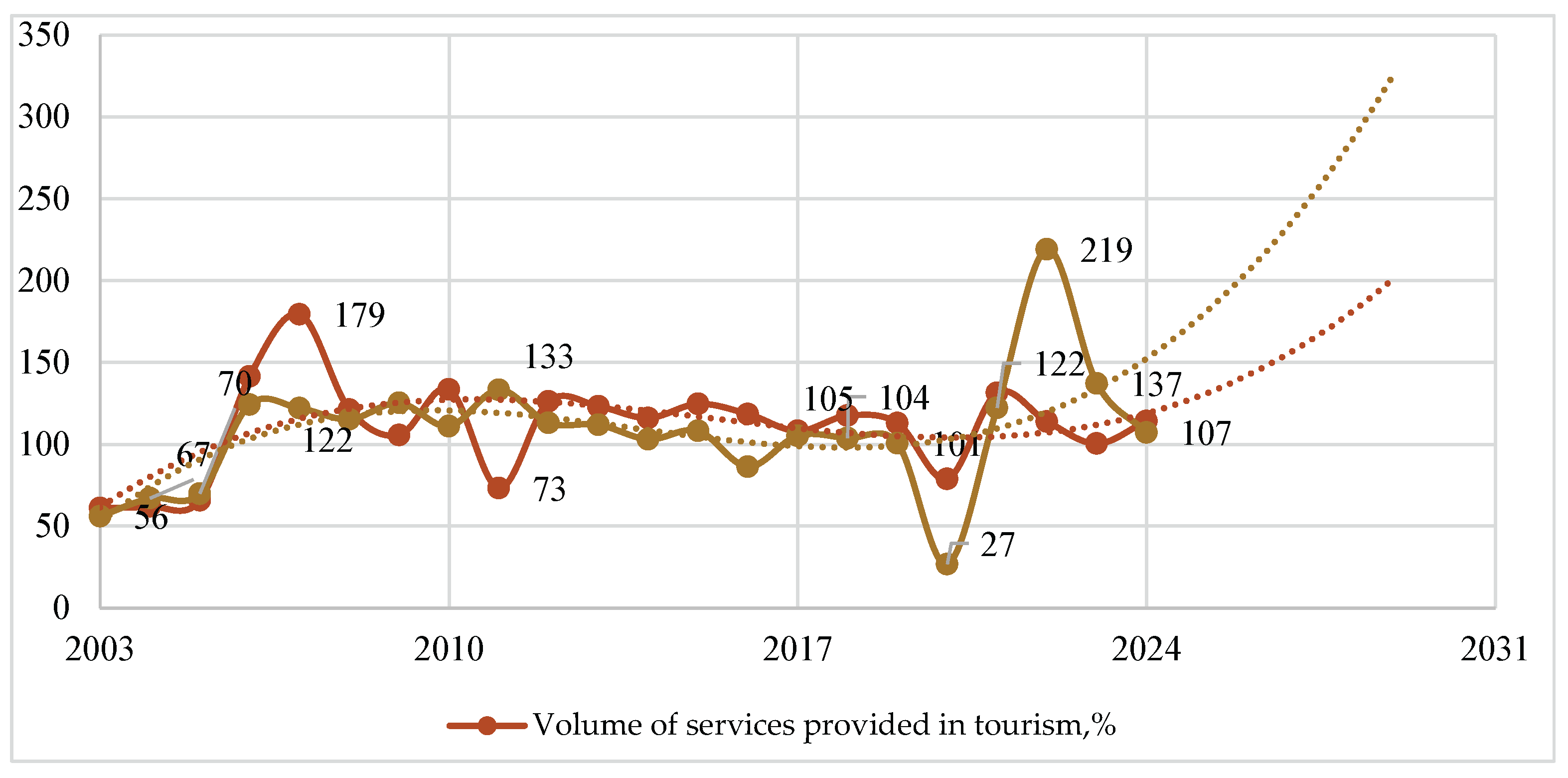
Figure 2.
Level of Services Provided in the Tourism Sector.
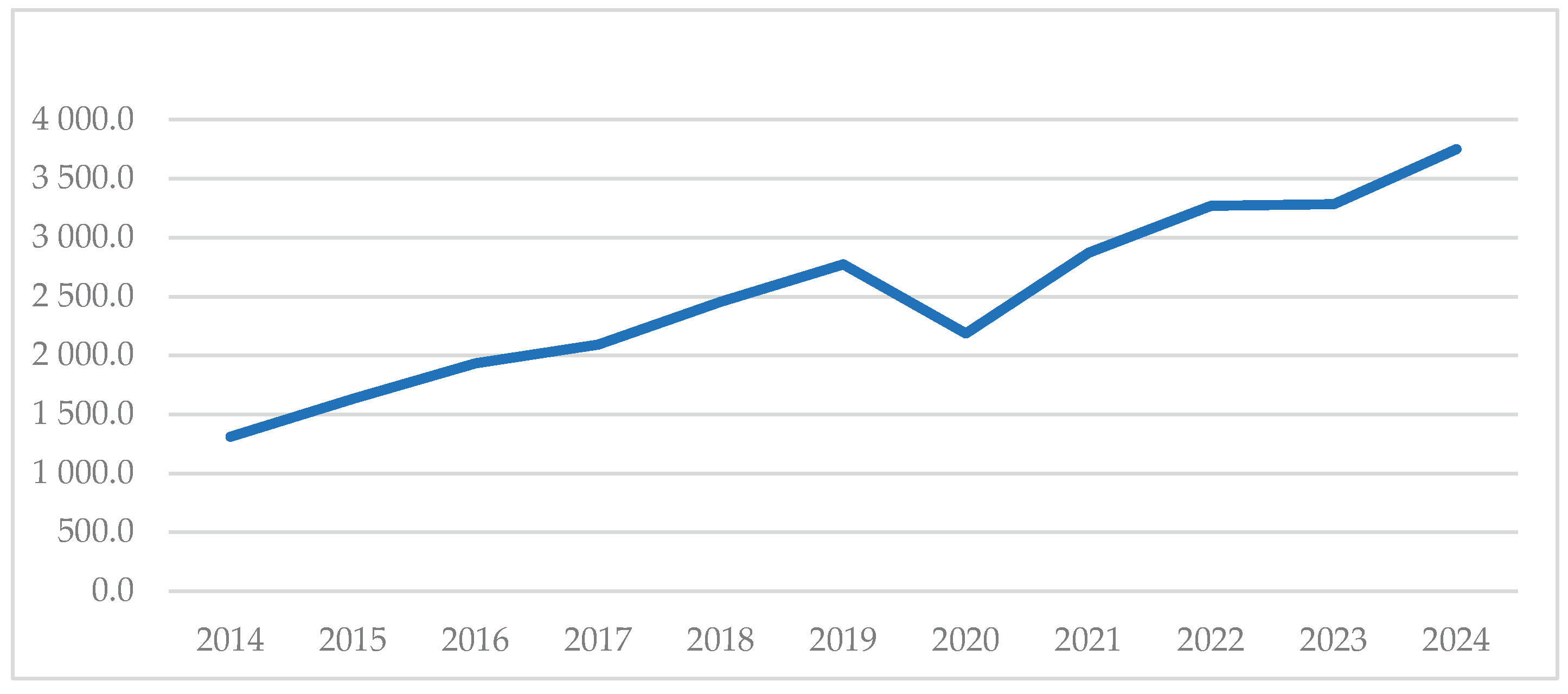
Figure 3.
The share of Gross Value Added of tourism industries in Gross domestic product.
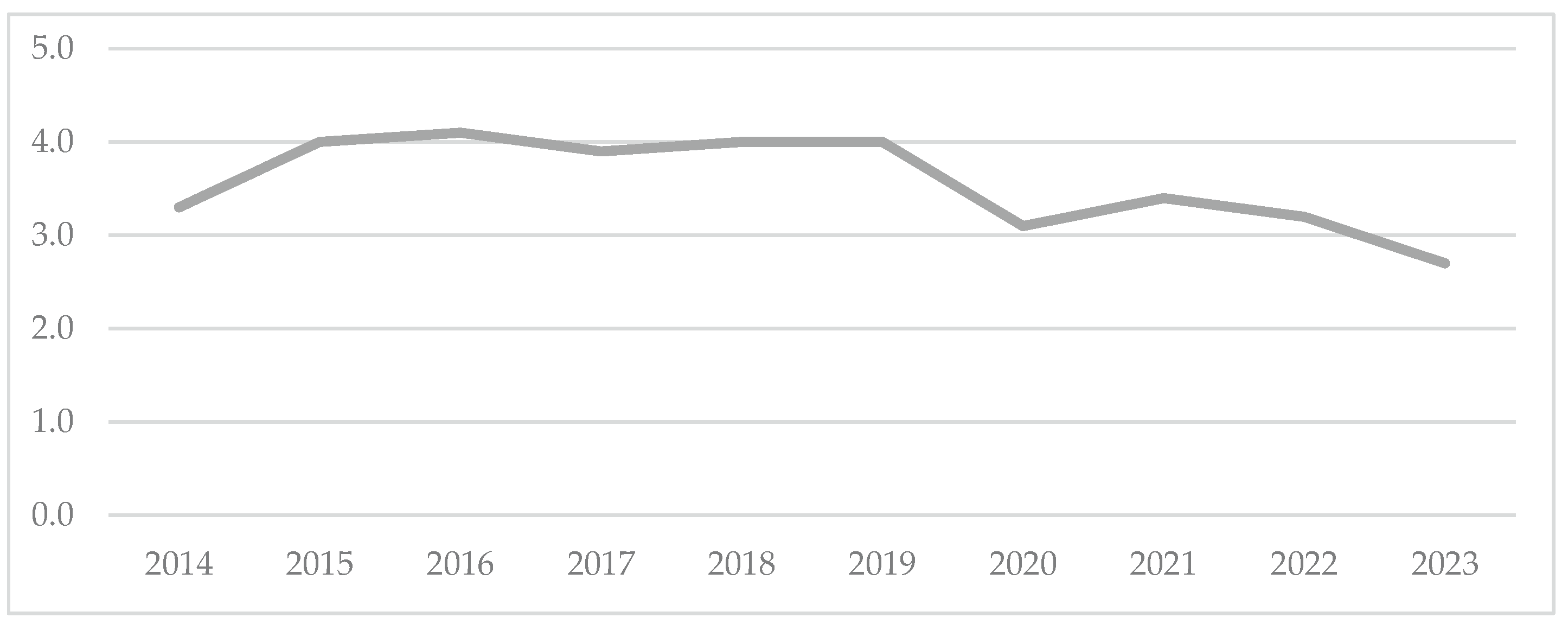
Figure 4.
Comparison of Inbound Tourist Arrivals to Kazakhstan and Outbound Tourist Trips of the Resident Population, 2014–2024.
Figure 4.
Comparison of Inbound Tourist Arrivals to Kazakhstan and Outbound Tourist Trips of the Resident Population, 2014–2024.
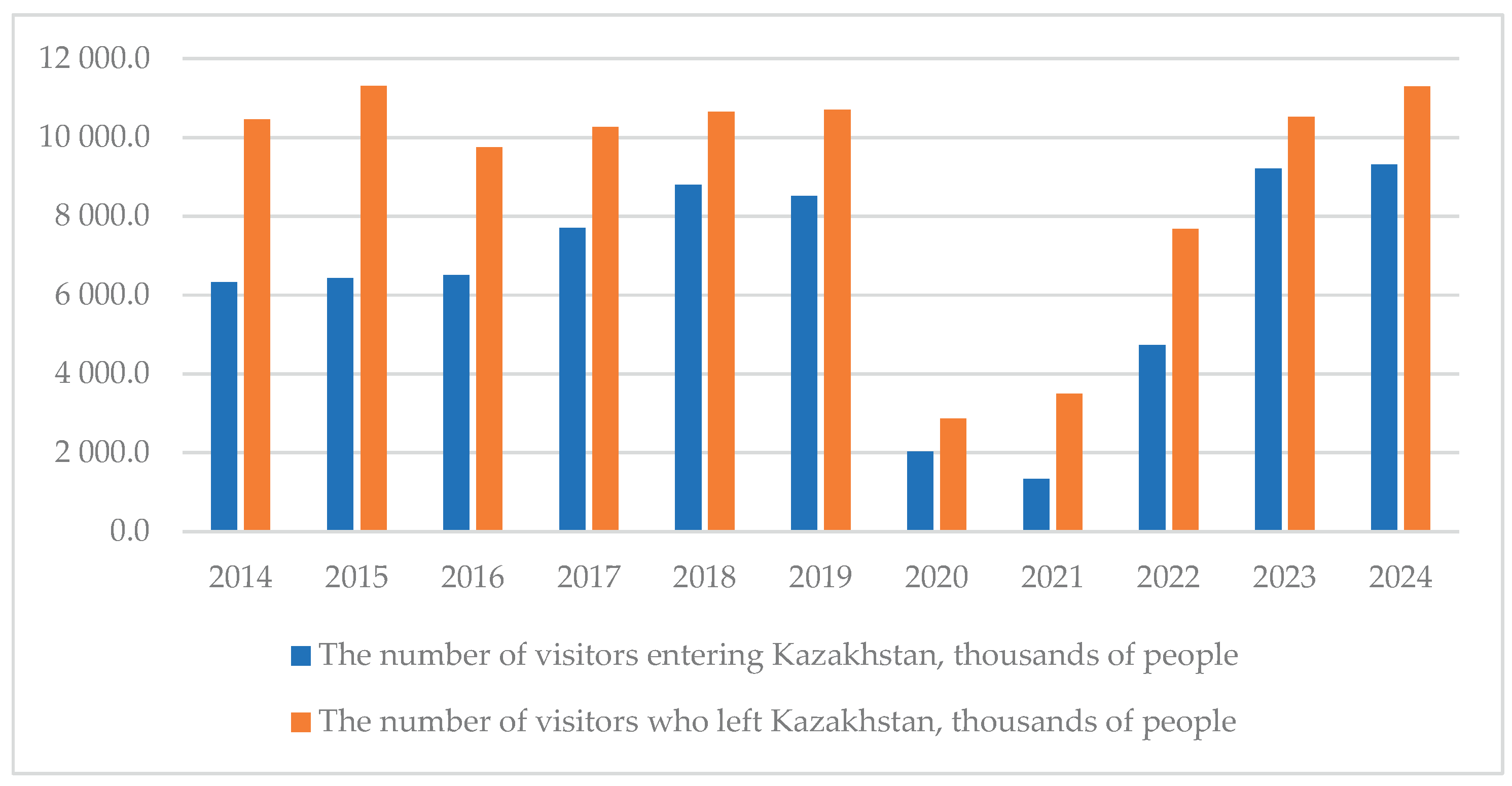
Figure 5.
Trends in the Relationship Between Tourist Arrivals and Revenue in Kazakhstan, 2014–2024.
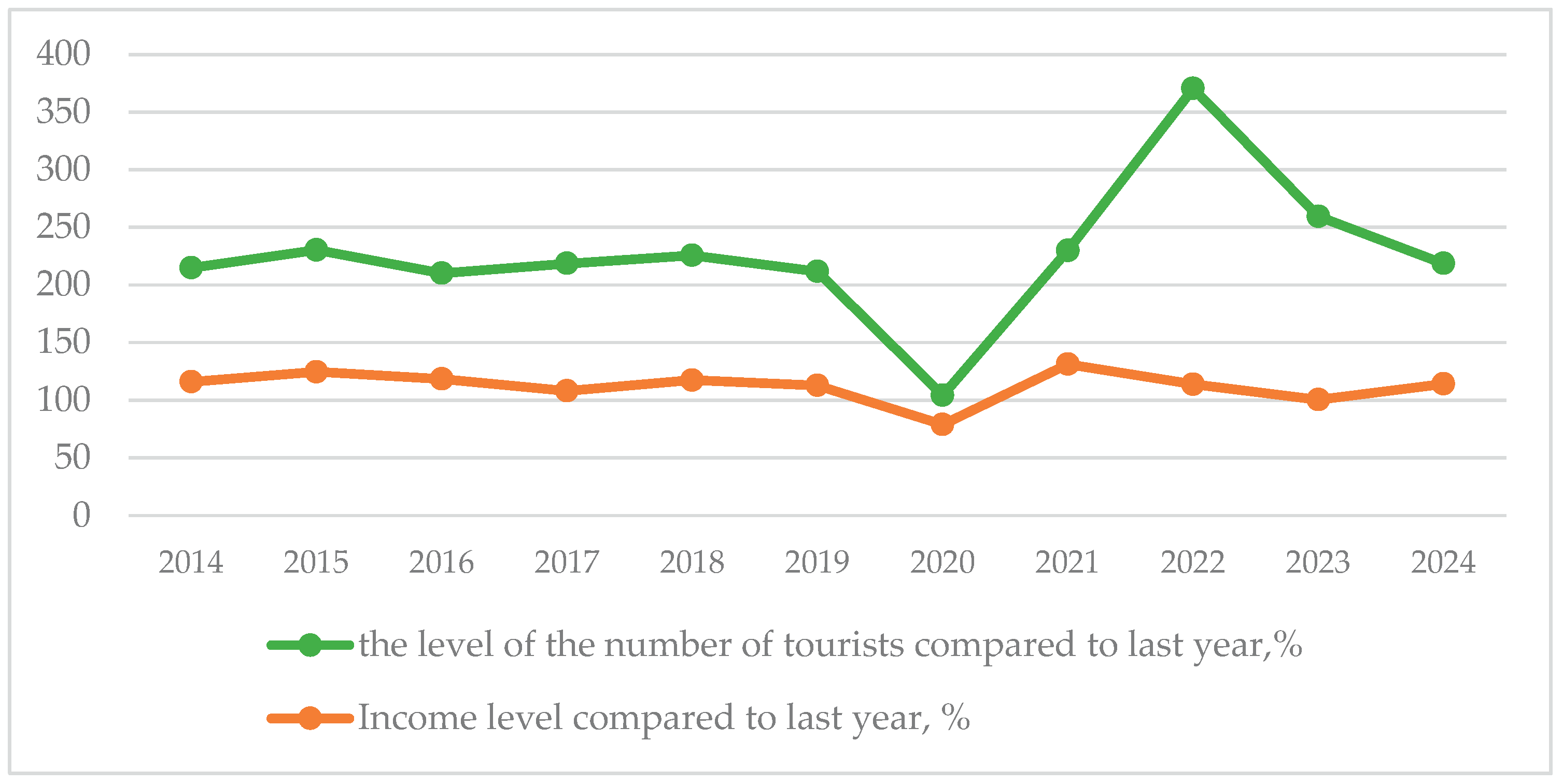
Figure 6.
Development of Kazakhstan’s Tourism Sector, 2014–2024.
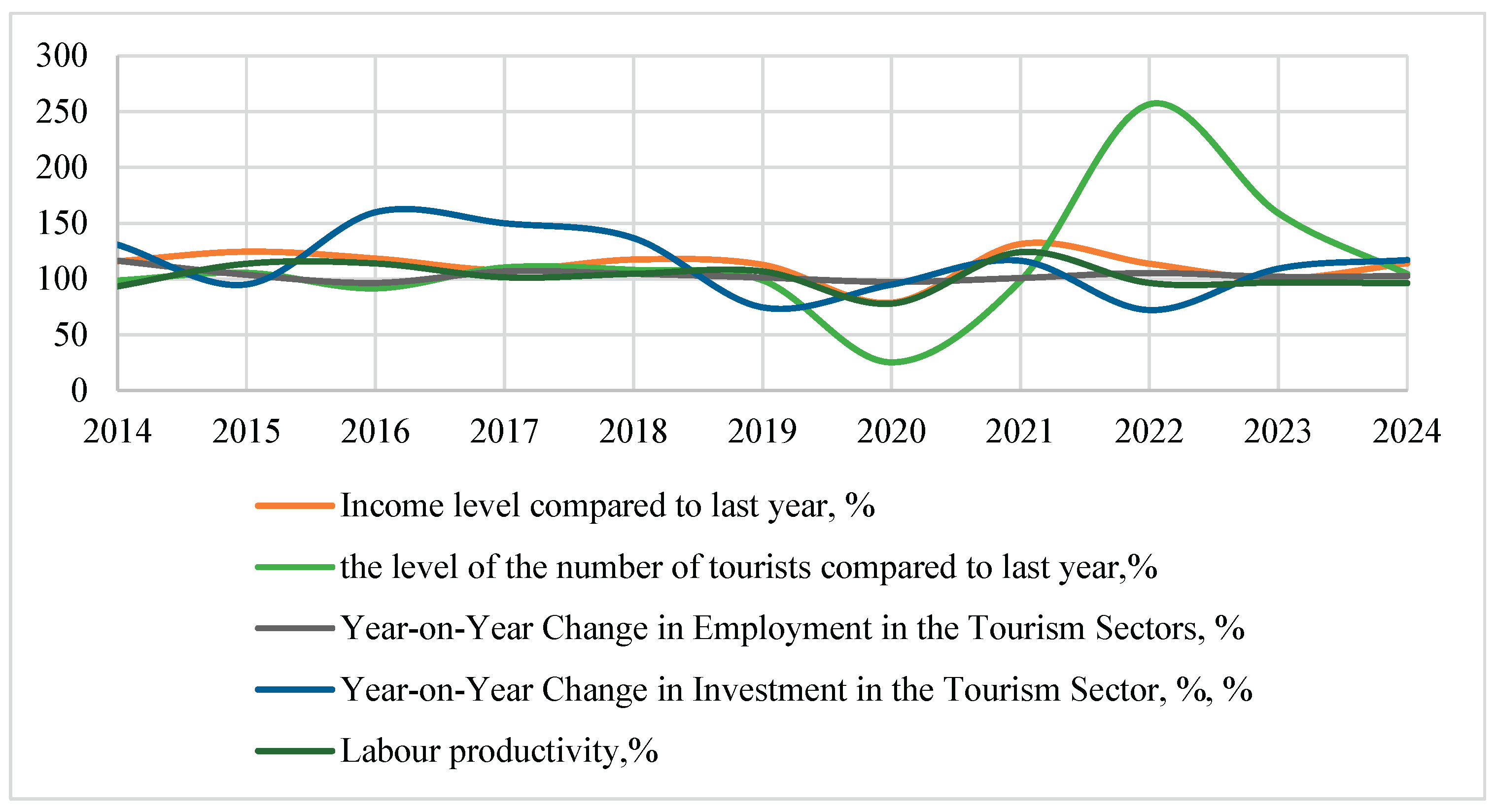
Figure 7.
Levels of Tourist Satisfaction with Services Consumed in Kazakhstan’s Domestic Tourism Sector (%).
Figure 7.
Levels of Tourist Satisfaction with Services Consumed in Kazakhstan’s Domestic Tourism Sector (%).
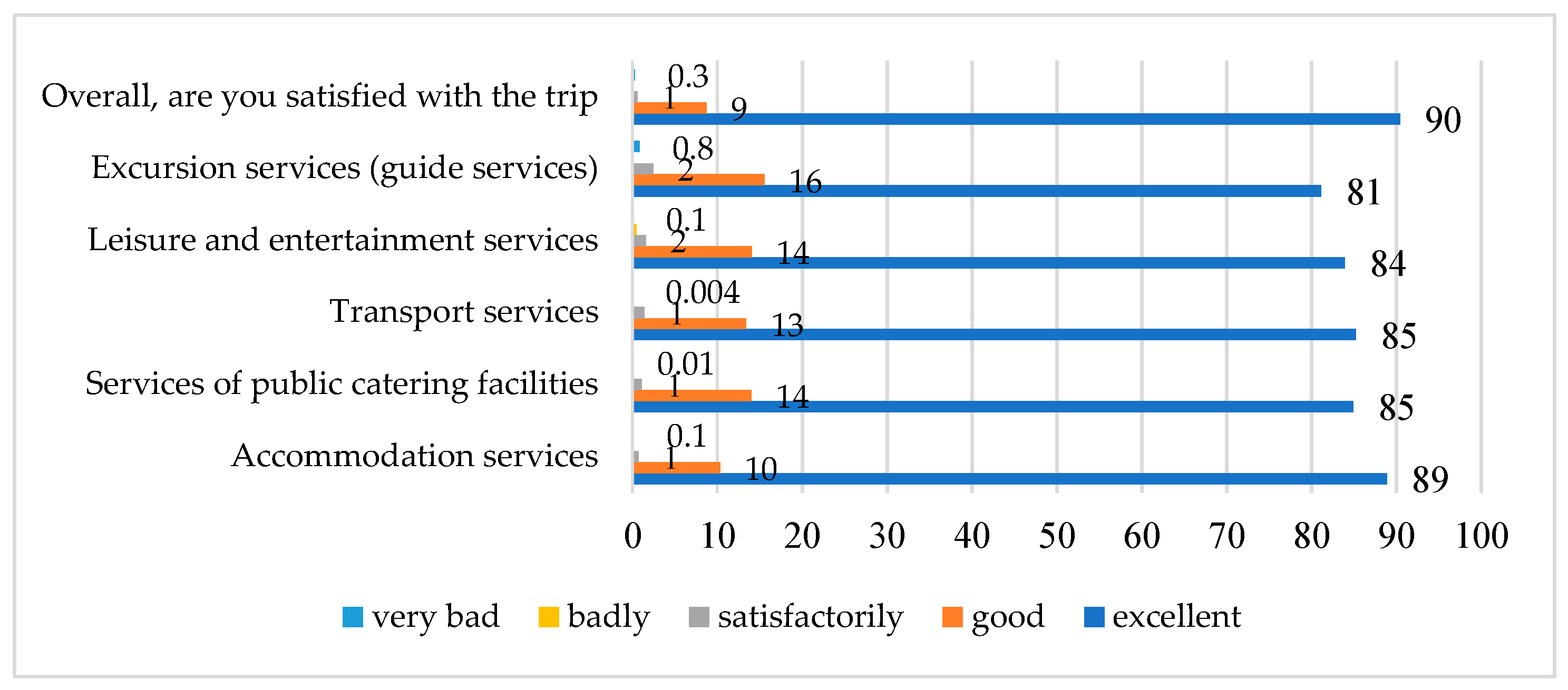
Figure 8.
Level of Proportional Correlation between Number of Visitors and Revenue Generated in Kazakhstan (%).
Figure 8.
Level of Proportional Correlation between Number of Visitors and Revenue Generated in Kazakhstan (%).
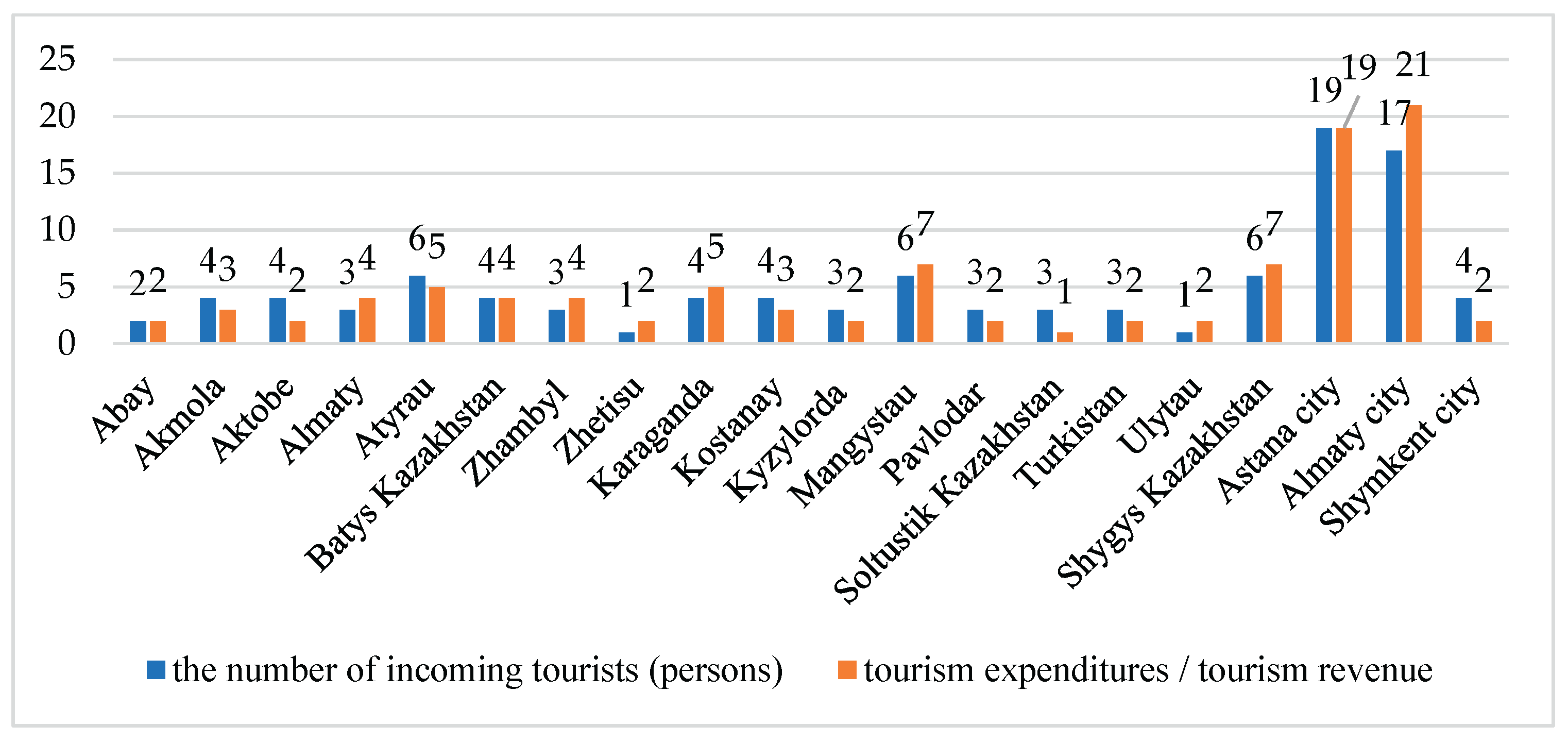

Table 1.
Results of the log–log regression model for tourism revenue in Kazakhstan (2014–2024).
| Variable | Coefficient | Std. Error | t-Statistic | p-Value | 95% Confidence Interval |
|---|---|---|---|---|---|
| Intercept | 4.6507 | 1.9934 | 2.3330 | 0.0524 | [-0.0630, 9.3644] |
| ln(TOUR) | 0.5563 | 0.2081 | 2.6734 | 0.0318 | [0.0642, 1.0484] |
| ln(INV) | -0.3911 | 0.1251 | -3.1274 | 0.0167 | [-0.6869, -0.0954] |
Source: Data were obtained from the Bureau of National Statistics of the Republic of Kazakhstan, including Tourism Satellite Account indicators for 2014–2024. Note: Coefficients represent elasticities in the log–log model. Significance levels: p < 0.05.
Table 2.
Regional structure of tourism revenues in Kazakhstan in 2024.
| Location | Arrivals (thousand) | Revenue (million KZT) | Revenue Breakdown | |||||||||||||||
| Trans | Accom | TourServ | F&B | Shop | RecEvt | Other | ||||||||||||
| Kazakhstan | 22 839 | 1 253 752 | 789 172 | 226 811 | 1 498 | 116 785 | 87 741 | 24 776 | 6 969 | |||||||||
| Share, % | 62.9 | 18.1 | 0.1 | 9.3 | 7 | 2 | 0.6 | |||||||||||
| Abay Region | 388 | 20 093 | 11 471 | 2 850 | 0 | 1 254 | 3 219 | 1 219 | 80 | |||||||||
| Akmola Region | 984 | 7 145 | 4 339 | 1 812 | 0 | 400 | 474 | 50 | 70 | |||||||||
| Aktobe Region | 883 | 14 176 | 8 880 | 1 724 | 0 | 1 229 | 1 495 | 650 | 198 | |||||||||
| Almaty Region | 711 | 17 325 | 11 037 | 3 277 | 0 | 1 604 | 1 372 | 35 | 0 | |||||||||
| Atyrau Region | 1 265 | 76 555 | 48 413 | 14 568 | 0 | 5 193 | 7 199 | 1 073 | 108 | |||||||||
| West Kazakhstan Region | 899 | 104 229 | 67 306 | 24 274 | 0 | 5 959 | 3 357 | 565 | 2 767 | |||||||||
| Zhambyl Region | 666 | 90 223 | 66 306 | 10 087 | 0 | 7 673 | 3 757 | 2 151 | 248 | |||||||||
| Zhetisu Region | 233 | 56 085 | 45 491 | 3 917 | 0 | 5 657 | 810 | 20 | 189 | |||||||||
| Karagandy Region | 891 | 22 432 | 10 270 | 5 570 | 0 | 2 529 | 2 663 | 1 401 | 0 | |||||||||
| Kostanay Region | 958 | 7 624 | 4 893 | 925 | 0 | 654 | 806 | 133 | 213 | |||||||||
| Kyzylorda Region | 632 | 34 603 | 27 535 | 4 566 | 0 | 1 248 | 663 | 590 | 0 | |||||||||
| Mangystau Region | 1 374 | 24 415 | 13 974 | 6 120 | 0 | 2 985 | 940 | 215 | 180 | |||||||||
| Pavlodar Region | 757 | 3 521 | 889 | 1 169 | 0 | 979 | 293 | 20 | 171 | |||||||||
| North Kazakhstan Region | 764 | 4 877 | 1 060 | 1 214 | 0 | 653 | 1 656 | 80 | 214 | |||||||||
| Turkistan Region | 594 | 9 745 | 6 274 | 1 170 | 0 | 592 | 874 | 835 | 0 | |||||||||
| Ulytau Region | 221 | 62 999 | 40 854 | 11 608 | 317 | 7 358 | 2 032 | 654 | 176 | |||||||||
| East Kazakhstan Region | 1 333 | 129 288 | 92 586 | 17 114 | 0 | 6 825 | 8 855 | 2 986 | 921 | |||||||||
| Astana (City) | 4 449 | 291 993 | 165 066 | 74 027 | 905 | 34 118 | 12 596 | 5 280 | 0 | |||||||||
| Almaty (City) | 3 989 | 251 418 | 147 701 | 36 949 | 276 | 26 615 | 32 640 | 6 239 | 999 | |||||||||
| Shymkent (City) | 848 | 25 007 | 14 823 | 3 870 | 0 | 3 260 | 2 040 | 579 | 435 | |||||||||
Source: Data from the National Statistics Bureau of the Agency for Strategic Planning and Reforms of the Republic of Kazakhstan. Note: Regions refer to the administrative regions of the Republic of Kazakhstan. Astana, Almaty, and Shymkent are cities of republican significance.
Disclaimer/Publisher’s Note: The statements, opinions and data contained in all publications are solely those of the individual author(s) and contributor(s) and not of MDPI and/or the editor(s). MDPI and/or the editor(s) disclaim responsibility for any injury to people or property resulting from any ideas, methods, instructions or products referred to in the content. |
© 2025 by the authors. Licensee MDPI, Basel, Switzerland. This article is an open access article distributed under the terms and conditions of the Creative Commons Attribution (CC BY) license (http://creativecommons.org/licenses/by/4.0/).
Copyright: This open access article is published under a Creative Commons CC BY 4.0 license, which permit the free download, distribution, and reuse, provided that the author and preprint are cited in any reuse.


