

Submitted:
21 September 2024
Posted:
23 September 2024
You are already at the latest version
Abstract
This article examines the complex interactions of the multiplier effect within the realm of tourism, with a specific emphasis on national parks. The main objective is to evaluate the multiplier effect within national parks, specifically focusing on Buiratau State National Nature Park in Kazakh-stan as a case study. The multiplier effect is a fundamental principle in the field of economic analysis. Economic multiplier effect is the term used to describe the occurrence when an initial infusion of spending in a certain industry leads to subsequent rounds of extra and sustainable economic activity. In the context of national parks, this phenomenon arises when visitor expendi-tures result in several favorable consequences, including increased employment, infrastructure advancement, and general economic expansion. The article seeks to measure the multiplier effect of tourism activities in Buiratau State National Nature Park through a thorough assessment. This entails examining several variables and datasets pertaining to visitor expenditure and its influ-ence. The study contributes to the existing literature by examining a recently constructed national park in a developing country. It compares the findings of this park with well-established national parks in other areas, emphasizing the distinct problems and opportunities it presents. Further-more, the research presents a methodological framework for evaluating the multiplier effect of national parks, which may be utilized in comparable contexts. This research ultimately enhances our comprehension of the economic implications of national parks and emphasizes their function as drivers for local and regional growth.
Keywords:
Multiplier Effect
; National Parks
; Economic Impact
; Tourism Economics
; Buiratau State National Nature Park
; Tourism Kazakhstan
1. Introduction
National parks are recognized globally not only for their environmental and conservation roles but also for their potential to drive local economic development through tourism. In particular, the economic impact of tourism in protected areas (PAs) is a topic of growing interest, especially in developing countries where limited resources and alternative industries challenge the effectiveness of conservation efforts [1,2,3,4,5]. Tourism in PAs can generate considerable income for adjacent communities [6], contributing to national economic growth through the multiplier effect [7]. This effect describes how initial tourist spending spreads through the economy, generating additional economic activity in sectors beyond the immediate tourism industry [8,9]. However, despite the acknowledged potential of tourism, there remains limited research on how these dynamics play out in developing regions, particularly in newly established national parks.
The multiplier effect, a pivotal concept in tourism economics, elucidates how initial tourist spending ripples through subsequent economic cycles, transcending the immediate scope of park-related expenditures [10]. Assessing this effect is complex and requires extensive data, but it is crucial for understanding the full economic impact of tourism and for guiding effective economic planning.
While the multiplier effect of tourism has been widely documented in developed countries, where studies have shown its contributions to local incomes, employment, and infrastructure [6,7,14], the dynamics in newly established parks in developing countries remain underexplored.
Kazakhstan has recently emphasized the development of its tourism sector, recognizing its potential as a key driver of economic growth, particularly in its national parks [11]. The country’s national parks serve a dual role, both as conservation areas and as economic assets for peripheral regions. However, despite the growing body of literature on the economic impacts of tourism in national parks globally, there is a notable research gap focused on newly established parks in developing countries, particularly in Kazakhstan, where the specific economic dynamics of tourism and their potential for fostering sustainable regional development have not been thoroughly explored.
The aim of this study is to assess the direct economic impact of tourism in Buiratau SNNP, calculate the multiplier effect of tourist spending on local businesses and employment, and examine the potential for Kazakhstan’s national parks to promote sustainable regional economic development. Specifically, the research aims to answer the following research question: To what extent does tourism in Buiratau National Park contribute to local economic development through direct, indirect, and induced effects, and how does the multiplier effect operate in this context? To address this, the following objectives are set:
- Evaluate the direct, indirect, and induced economic impacts in Buiratau SNNP;
- Quantify the multiplier effect of tourism-related spending and income on the local economy;
- Explore the potential for sustainable economic contributions from tourism in Kazakhstan's PAs.
To achieve these objectives, the research utilizes a mixed-method approach, combining both quantitative and qualitative data. Primary data were collected through discussions with park administrators and local businesses, alongside secondary data from national tourism statistics. Field observations within Buiratau National Park were also conducted to accurately assess the scale of tourism activity. The analysis applies input-output (I-O) models and multiplier effect frameworks to estimate the economic contributions of tourism, focusing on the direct, indirect, and induced effects of tourist spending [10,16,17].
By exploring these elements, this study adds to the limited body of research on the economic impact of tourism in Kazakhstan’s national parks. It contributes to the understanding of the role of national parks in promoting economic development while fulfilling their conservation mandates, providing recommendations for policymakers and stakeholders to enhance tourism's economic potential in Kazakhstan’s PAs.
2. Literature Review
2.1. The Role of National Parks in Regional Economic Development
National parks, celebrated worldwide for their environmental and conservation value, act as vital sanctuaries for diverse species, safeguarding biodiversity. However, their impact extends beyond ecological boundaries. These pristine landscapes also serve as robust economic assets, invigorating local economies primarily through tourism. The concept of the multiplier effect illustrates how initial tourist spending triggers subsequent economic cycles, extending beyond the immediate scope of park-related expenditures.
For example, a case study at Zambia's South Luangwa National Park revealed that, despite large economic leakages, tourism accounted for almost 40% of local household income and fueled company growth in the gateway region [6]. Similarly, research on the regional economic impact of tourism in national parks typically reveals similarity in regional multiplier estimates, indicating meaningful contributions to local economies. [12].
Furthermore, the perception of local communities often aligns with quantitative measures of the multiplier effect. National parks are viewed as beneficial for economic development, particularly through tourism and associated sectors [13]. Even in Germany, where tourists in national parks spend less than the national average, the direct and indirect income from tourism remains significant, supporting local employment and contributing to the distinct identity of national parks as tourist destinations [7].
Research from Austrian national parks highlight the importance of regional economic development strategies that integrate national parks as medium to long-term components. These parks have the potential to positively influence tourism [14]. It is evident that national parks can drive local economic activity by leveraging their conservation ethos to enhance tourism and generate employment. This is exemplified in the socioeconomic impact assessment of Karoo National Park in South Africa [15].
In summary, the extensive body of literature underscores the multiplier effect of national parks on local economies through tourism. While the economic gains can indeed be substantial, strategic planning and effective management are essential to maximize and sustain their impact over time.
2.2. The Economic Meaning of Multipliers
Tourists spend their money on specific services and goods when they visit a destination. This initial spending, primarily channeled into sectors such as lodging, dining, entertainment, retail, and transportation (collectively known as 'tourism industries'), brings extra income to these sectors. These impacts are referred to as direct effects.
A portion of this income is spent on intermediate goods and services needed for future production (intermediate demand). The rest is used to pay for labor, capital, and land services (wages, interest, profits, and rents), taxes to governments, or is saved. Some of this money may leave the local area due to purchases from or payments to entities outside the area, known as 'leakage'. However, some remains local: tourism industries may hire additional local employees, increasing wages, and demand more from local suppliers. Consequently, local production, job opportunities, and income rise, leading to what are known as indirect effects.
The growth in employment raises the overall revenue of the local community. A portion of this increased income is saved, while the remainder is spent on consumer items, resulting in additional demand. As with prior cycles, this demand leads to increased output and employment. These effects are referred to as induced effects. Secondary effects include both indirect and induced effects [16]. Figure 1 depicts the progression of economic effects caused by tourist expenditures.
The indirect effects of tourism extend widely, encompassing both economic and social dimensions, and often surpass the direct impacts. This broader influence is driven by the multiplier effect, which initiates a cycle of spending and earning that stimulates the growth of the economy and ancillary industries connected to tourism. The more tourists spend during their visit, the greater the transactional flow of “costs – income,” enhancing the indirect (multiplicative) impact of tourism. Moreover, the region benefits indirectly from the portion of tourist spending that remains within its boundaries. Estimating these indirect revenues is crucial, as it enables the assessment of how different sectors contribute to the economic development of the region through the application of the multiplier [8].
2.3. Multiplier Effect Models and Methodologies
The analysis of economic impact investigates the relationships between economic sectors by assessing both direct and secondary effects, with the multiplier serving as an indicator of the total direct and secondary consequences. This notion, called as the multiplier effect, measures the overall effects of recreational spending in terms of output, revenue, sales, and employment per unit of direct effect [10]. Maynard Keynes first proposed the multiplier effect idea, and he is also credited with establishing the Keynesian multiplier model. According to Rusu (2011), the multiplier effects of tourism are the extent to which tourism is integrated into an economy or the number of times money spent by a tourist circulates within the destination's economy. He adds that the multiplier measures the influence of tourism spending on national income via its effects on productive sector activity [17].
Maynard Keynes' model was later developed into the Ad hoc model by Archer and Owen, and subsequently adopted by other tourism scholars (Chase & Alon, 2002; Horwath & Frechtling, 1999; Zhang et al., 2007). I-O analysis is recognized as the most detailed method for assessing the economic impacts and multiplier effects of tourism at national and regional levels. Wassily Leontief pioneered the I-O model for evaluating economic impacts, providing the basis for further models like social accounting matrices (SAM) and computable general equilibrium (CGE) models [18,19,20,21,22,23].
The most prevalent methods for estimating the multiplier include the I-O analysis, which has led to the development of Social Accounting Matrix (SAM) and CGE models, as well as the Keynesian approach, which has given rise to the Ad hoc model. Regardless of the economic model used, Non-Bankable Transaction (NBT) industries vary in type and size, which in turn influences the value of the multiplier [24].
Typically, the I-O model is utilized in large-scale studies that encompass multiple regions or even entire countries due to its need for extensive data from various industries. This model relies on I-O tables and secondary data detailing supply linkages between firms, which are generally not available below the national level in most European countries [25]. Although it is possible to gather this data at the regional level through surveys, the process is often complex and costly. As a result, the I-O model is not frequently applied to small-scale, local sites.
The SAM model is an extension of the I-O framework, offering a comprehensive representation of the economic and social structure at a particular time. Unlike the I-O model, which primarily focuses on the production and consumption activities within an economy, the SAM model includes additional accounts for institutions, such as households, government, and the rest of the world. This inclusion allows for a more detailed analysis of the distributional impacts of economic activities and the interactions between different sectors and institutions. Hjerpe and Kim (2007) employed the SAM model to assess the regional economic impacts of ecotourism in North America. Their research demonstrated that spending on ecotourism significantly boosts income and employment across various sectors, highlighting tourism's crucial role in regional development [26]. Poudel et al. (2017) utilized the SAM model to evaluate the economic effects of recreational trail tourism in South Africa. Their findings showed that tourism activities greatly contribute to local economies by generating income and creating jobs in both the tourism sector and related industries [27]. Raya et al. (2018) investigated the economic impacts of tourism on regional economies in Spain using the SAM model. Their study revealed that tourism expenditures have substantial multiplier effects, promoting economic growth and development in the studied regions [28]. Saayman et al. (2010) analyzed the economic impact of tourism in South Africa's national parks through the SAM model. This approach enabled them to measure the extensive economic benefits of tourism, including income redistribution and job creation, offering valuable insights for policy and management [29].
CGE models are sophisticated economic models used to analyze the economy-wide impacts of various policies and changes, including those in the tourism sector. These models are particularly valuable for their ability to capture the interactions between different sectors of the economy, the distribution of resources, and the resultant economic equilibrium. CGE models are grounded in economic theory and utilize comprehensive data to simulate how economies respond to changes in policy, technology, and external conditions. Blake et al. (2006) utilized a CGE model to evaluate the economic impacts of tourism in Spain. The study found that tourism contributes significantly to GDP, employment, and income distribution. By simulating various scenarios, the research provided insights into the potential effects of tourism policies on the broader economy [30]. The primary benefit of the model is its ability to account for interactive effects between industries, consider resource constraints, and incorporate changes in relative prices along with their feedback mechanisms. However, these advantages are significantly less evident at the local level, which may explain the limited use of CGE models in NBT [31].
The Keynesian model, rooted in the ideas of economist John Maynard Keynes, emphasizes the role of aggregate demand in influencing economic output and employment. This model is particularly known for the concept of the multiplier effect, which describes how initial spending in an economy can lead to a series of increased consumption and investment activities, thereby amplifying the overall economic impact. In tourism economics, the Keynesian model is often employed to understand how tourist expenditures can drive economic growth and employment in a region. Archer and Fletcher (1996) explored tourism economic impact on the economy of the Seychelles using the Keynesian multiplier model. Their study demonstrated that tourism spending significantly boosts GDP and employment, with a high multiplier effect indicating substantial indirect and induced economic benefits [32]. This method is uncomplicated and direct, offering a rapid way to evaluate variations in tourism spending [33]. It is specifically applicable to the tourism sector because it does not require sectoral supply linkages between different economic sectors. Moreover, the significantly lower empirical costs compared to the I-O approach for calculating multipliers from secondary sources make the Keynesian multiplier approach suitable for local and regional scale studies.
The Ad Hoc approach derives directly from the Keynesian multiplier concept and is designed on a case-by-case basis [34]. Recently, research in Taiwan used the Ad Hoc model to investigate a local lagoon scenario [35]. The multiplier was constructed using statistics on visitor numbers, expenditures across multiple economic sectors, resident income and spending, tourism business revenue, costs, net profit, and local expenditures. Zhang et al. (2007) used an Ad Hoc model to evaluate the regional economic impact of tourism in Denmark. The study illustrated that even with its limitations, the Ad Hoc model provided valuable insights into tourism's economic contributions, highlighting its potential for regional economic planning and policy-making [21]. Ad Hoc models play a valuable role in tourism economics by offering a flexible and cost-effective approach to assessing the economic impacts of tourism. While they have limitations in terms of theoretical rigor and comprehensiveness, their adaptability makes them suitable for a wide range of contexts, particularly where data and resources are constrained. Empirical studies have demonstrated that despite their simplicity, Ad Hoc models can provide meaningful insights into the economic contributions of tourism, supporting regional economic planning and policy development.
3. Materials and Methods
3.1. Research Area
Buiratau SNNP was established on March 11, 2011, in Kazakhstan as a relatively new PA. The park's main purpose is the preservation of natural landscapes and biodiversity, as well as serving as a location for scientific research, environmental education, tourism, and recreational activities. As part of Kazakhstan's system of specially protected natural areas, the park follows management practices aimed at balancing conservation with socio-economic benefits derived from tourism.
Buiratau SNNP was chosen as the study site due to its relatively recent establishment and its location within a developing country. This context provides an opportunity to analyze the economic effects of tourism, particularly through the multiplier effect. The park is part of a centralized management system, overseen by the Ministry of Ecology and Natural Resources of the Republic of Kazakhstan, which ensures standardized practices across all national parks in the country, facilitating comparative analyses.
The park is classified as a second-category PA, recognized for its environmental and scientific significance at the national level. It contains biological, geological, and cultural features of national importance, which contribute to its use for conservation, education, tourism, and recreation. The park spans an area of 88,968 hectares and is divided into two branches: Yereymentau (60,814 hectares) and Belodymov (28,154 hectares). A surrounding buffer zone of 88,064 hectares provides additional protection to these areas [36,37].
The park is located in two regions: Yereymentau district of Akmola region and Osakarov district of Karaganda region. Key four tourist routes have been developed, running through notable natural attractions such as the Akdym Mountain Range, Belodymov Dacha cordon, the Solovyov’s Aigaysay beam, and the Belodymov Cave [36,37]. The tourist and recreational resources of the park, including steppe ecosystems, mountain landscapes, and rivers, are shown in Figure 2. These features support educational and recreational activities while maintaining environmental protection.
The park’s infrastructure includes guest houses and campsites, developed to accommodate visitors while ensuring minimal environmental impact. The locations of these facilities are indicated in Figure 3. The infrastructure serves as a foundation for promoting tourism and engaging local communities in tourism activities, with a focus on sustainability and responsible resource use.
Analyzing the geographical distribution of natural and built resources within the park provides insights into the potential for tourism development and its economic impacts. The maps presented show how tourism routes are organized and connected to local communities, supporting the evaluation of the multiplier effect from tourism activities in Buiratau SNNP.
The park's resources include both natural and socio-economic assets, contributing to the development of tourism. These assets are vital for educational tourism and recreational activities, providing opportunities for localizing tourism flows. Additionally, Buiratau SNNP is home to several archaeological sites, making it a prime location for cultural and educational tourism. Various events and initiatives, such as internships for university students and the celebration of traditional holidays like Nauryz, further contribute to the park’s role as a hub for environmental education and sustainable tourism.
3.2. Research Design
This study utilizes a mixed-method research design, incorporating quantitative and qualitative approaches to assess the economic impacts of tourism in Buiratau SNNP through the multiplier effect. This approach allows for a detailed examination of both direct and indirect economic contributions of tourism to the local economy.
Quantitative data were sourced from the park administration’s financial records, national tourism statistics, and primary data from local businesses directly involved in tourism activities. This data was crucial for calculating the economic impact of tourist spending and quantifying the multiplier effect. I-O models were employed to evaluate how tourist expenditures influence secondary economic activities in the region, particularly in sectors outside of tourism.
Qualitative data were collected through structured discussions with park administrators, local business representatives, and key stakeholders. These discussions provided essential context for understanding operational challenges and opportunities for tourism development within the park. Field observations were conducted to assess the infrastructure, tourist behavior, and the interaction between tourists and local communities.
The research was carried out in distinct stages. First, quantitative and qualitative data were gathered and organized. Next, economic models were applied to evaluate the direct, indirect, and induced effects of tourist spending. Finally, the multiplier effect was calculated, with the methodology outlined in subsequent sections.
The research design was constructed to directly address the central research question: To what extent does tourism in Buiratau SNNP contribute to local economic development through direct, indirect, and induced effects, and how does the multiplier effect operate in this context? By integrating both numerical data and qualitative insights, the study aims to provide a comprehensive understanding of the economic dynamics within the park, while maintaining focus on sustainability and conservation priorities.
3.3. Data Analysis and Synthesis
This study analyzes both quantitative and qualitative data to evaluate the economic impacts of tourism activities in Buiratau SNNP, particularly through the tourism multiplier effect. The data were systematically processed to capture direct, indirect, and induced economic contributions of tourism to the local economy.
Quantitative data were obtained from the park's financial records, national tourism statistics, and businesses involved in tourism. This data provided the foundation for calculating direct revenue from park activities, such as entry fees, guide services, accommodations, and related services. The data also included spending by tourists and businesses in surrounding areas, which allowed for the evaluation of indirect economic effects, such as purchases made in local cafes, shops, and fuel stations. Organizing this data helped quantify the immediate financial contributions of tourism to the local economy.
Additionally, qualitative data, gathered through structured discussions with park administrators, local business representatives, and key stakeholders, added depth to the analysis. These discussions helped contextualize the quantitative findings, providing insight into operational challenges, business opportunities, and the influence of tourism policies on local economic activities. Field observations of park infrastructure and tourist interactions with local communities further enriched the analysis, offering a clearer understanding of how tourism integrates into the region's socio-economic landscape.
The first step in the analysis involved organizing and calculating direct tourism income from Buiratau SNNP. This included revenue from ecological fees, guide services, museum visits, and accommodations, which formed the core of the park’s economic contributions. The analysis also considered income from private businesses operating within the park, such as guest houses and rope parks, which, although independent from the park’s administration, significantly contribute to the broader economic structure of tourism in the region.
The next phase of the analysis examined the broader, indirect economic impacts of tourism. Tourists visiting the park generate additional revenue for businesses in nearby settlements through expenditures on accommodations, food, and fuel. By applying I-O models, the analysis measured how initial tourist spending supported local businesses and created secondary economic activities across various sectors. This process highlighted how tourism contributes to the local economy beyond the immediate boundaries of the park.
The integration of quantitative and qualitative data enabled a comprehensive understanding of the economic effects of tourism in Buiratau SNNP. I-O modeling was crucial in tracing how tourist spending circulates through the economy, generating a multiplier effect. This effect reflects how each unit of tourist expenditure not only provides direct financial support to the park but also stimulates further economic activity in sectors such as retail, transport, and hospitality.
The synthesized data show that tourism in Buiratau SNNP has a positive and measurable impact on local economic development. The analysis captured the full scope of financial contributions, from direct revenues generated by the park to the broader economic benefits experienced by businesses in adjacent areas. The calculated tourism multiplier effect will be further explored in the next section, providing a final assessment of how tourism contributes to the economic vitality of the region.
3.4. Multiplier Effect Calculation
The calculation of the multiplier effect for tourism activities in Buiratau SNNP follows the Keynesian multiplier model, which captures the economic impact of initial tourist spending on the local economy. This model is particularly useful in regions like Akmola and Karaganda, where the marginal propensity to consume (MPC) tends to be higher, meaning that most of the income earned is spent rather than saved. This higher MPC amplifies the effect of tourism expenditures, leading to a stronger multiplier effect.
To calculate the tourism multiplier, the following general formula is used:
where:
K – the multiplier effect of tourism and recreational activities, expressed in monetary equivalent;
I – investments, which represent direct and indirect incomes from tourist and recreational activities; in our case, this includes the amount of wage deductions to employees;
n – the number of money turnovers in the economy;
MPC – marginal propensity to consume, which represents the ratio of expenditure level to income level of local residents in the studied region for the reporting period (since the Buiratau SNNP is located on the border of Akmola and Karaganda regions, both expenses and incomes of local residents will represent the arithmetic mean of the expenditures and incomes of the population of the two regions respectively).
The next step is to calculate the MPC, which represents the ratio of expenditure to income for local residents. In the case of Buiratau SNNP, this includes the populations of the Akmola and Karaganda regions. The formula for calculating MPC is:
where:
EP – expenditures of the population in the reporting period;
IP – income of the population in the reporting period;
О – region for which the multiplier effect of tourism and recreational activities is calculated: Akmola (O=1) and Karaganda (O=2).
From here, the formula will take the following form:
where:
i – category of direct and indirect incomes from tourism and recreational activities; i=1,2,3, …, m.
To further explore the multiplier effect of tourism, two specific multiplier indicators are used: the tourist expenditure multiplier and the tourist income multiplier.
1. Tourist Expenditure Multiplier (). This multiplier measures how much additional income is generated in the local economy for every unit of tourist spending. The formula is:
where:
– tourist expenditure multiplier, representing the ratio of the total multiplier effect of tourism and recreational activities to tourist expenditures;
K – multiplier effect of tourism and recreational activities, expressed in monetary equivalent;
E – total expenditures of tourists and excursionists in the process of tourism and recreational activities, expressed in monetary equivalent.
2. Tourist Income Multiplier (). This multiplier assesses how much additional revenue is generated in the economy relative to the income derived directly from tourist activities. The formula is:
where:
– tourist income multiplier, representing the ratio of the total multiplier effect of tourism and recreational activities to the income from these activities;
K – multiplier effect of tourism and recreational activities, expressed in monetary equivalent;
P – total income from tourism and recreational activities, expressed in monetary equivalent.
An additional calculation can be made to determine the economic impact of each individual tourist's expenditure. This is done using the formula for calculating the multiplier effect per tourist:
where:
– the multiplier effect of tourism and recreational activities, representing the additional income in the economy generated by the expenditures of 1 tourist or excursionist, expressed in monetary equivalent;
– investments, representing the expenses of 1 tourist or excursionist during the tourism and recreational activities of Buiratau SNNP, expressed in monetary equivalent;
– tourist expenditure multiplier.
The formula for allows for the calculation of how each individual tourist contributes to the regional economy. By multiplying the average spending of a tourist by the tourist expenditure multiplier, it is possible to quantify the ripple effect of tourism activities on the local economy.
In conclusion, the calculation of the multiplier effect in the case of Buiratau SNNP involves several key steps: determining the MPC, calculating both the tourist expenditure multiplier and the tourist income multiplier, and estimating the impact of individual tourist expenditures on the regional economy. This approach provides an understanding of how tourism activities generate economic benefits beyond the direct revenues of the park, stimulating broader economic activity in the surrounding areas.
4. Results
4.1. Economic Contributions from Tourism Activities
The quantitative analysis of visitor numbers in Buiratau SNNP indicated fluctuating visitation trends over the six-year period from 2018 to 2023, with a significant drop in 2020, likely due to external factors (Table 1). In 2023, the total number of visitors to the park reached 3,596 [37,38], which was used as the basis for calculating the direct income generated from tourism activities within the park.
Revenue sources from tourism and recreational activities within Buiratau SNNP were categorized into several streams: ecological fees, guide services, museum admissions, tent setups, parking services, and rentals for guest houses, yurt camps, and rope park activities. The total revenue for 2023 amounted to 4,095,395 KZT (8522,3 USD), with the ecological fee constituting the largest share at 1,240,620 KZT (2581,6 USD), followed by rental fees for guest houses and other activities (Table 2).
Land users within the park operate under various lease agreements, contributing to the park's budget through rental fees. These businesses include guest houses, yurt camps, and rope parks, which are leased under both short-term and long-term arrangements. Despite being exempt from taxes, they contribute financially through fixed rental fees based on a rate of 0.1 of the monthly calculation index (MCI) per tourist served.
In addition to the direct revenues generated by Buiratau SNNP, income from private enterprises operating within the park boundaries also contributed significantly to the local economy. These private businesses, including guest houses, yurt camps, and a rope park, operate independently from the park administration but play an integral role in supporting the broader economic framework of the region's tourism industry. The income generated by these enterprises in 2023 is outlined in Table 3.
The combined income of the four private land users, totaling 5,060,600 KZT (10530,8 USD), surpassed the revenue generated directly by the park administration. Notably, the yurt camp and rope park accounted for the majority of private sector earnings, representing 88% of the total income from private enterprises. These facilities, which were established in 2018, highlight the crucial role of private sector involvement in the development of tourism and recreational services within the park. Their contribution emphasizes the park’s significance not only as a conservation area but also as an economic driver for the region.
Further analysis examined the indirect economic impacts of tourism on surrounding settlements, particularly the income generated by businesses in adjacent areas. Table 4 provides a breakdown of the revenues from accommodation, cafes, and shops in nearby villages, illustrating how tourism activities at Buiratau SNNP stimulate economic benefits beyond the park's immediate boundaries.
Businesses such as the “Matay Service” Hotel, “Balkhash” Motel, and local cafes and shops benefitted from the influx of tourists. Cafes, often included in organized tour programs, generated substantial revenue, with total earnings reaching approximately 2,400,000 KZT (4994,2 USD) from meals alone. Likewise, shops in nearby settlements saw an estimated income of 900,000 KZT (1872,8 USD) from tourist purchases, further enhancing the economic impact of tourism in the region.
The majority of tourists visiting Buiratau SNNP originated from the Akmola and Karaganda regions. These visitors often relied on transport and tourist (excursion) companies from cities such as Astana and Karaganda. A telephone survey of 10 transport companies operating in these regions revealed that the average cost of transporting passengers in a 50-seat Neoplan bus was 75,000 KZT. In 2023, 56 buses provided services to tourists visiting the park, resulting in an additional 4,200,000 KZT in revenue for transport and excursion companies.
In addition to the direct and adjacent economic impacts, tourism activities at Buiratau SNNP generated indirect effects in other sectors of the local economy, particularly in transportation and fuel services. These services were mainly provided by tour operators and transportation companies based in larger cities such as Astana and Karaganda, which catered to tourists visiting the park. The revenues generated by these companies, as well as fuel stations, are presented in Table 5, reflecting the wider economic influence of tourist spending beyond the immediate park area.
The revenue generated by indirect tourism-related businesses amounted to 4,996,350 KZT (10,397.14 USD) in 2023. This included income from fuel stations, which earned 991,200 KZT (2062.6 USD) from fueling buses transporting visitors to the park, and from shops and supermarkets, which generated 3,236,400 KZT (6734.7 USD) through grocery purchases by tourists. These figures highlight the extended economic impact of tourism-related activities, as spending by tourists not only supported the park directly but also contributed to secondary sectors such as transportation, retail, and fuel services.
During their visits, tourists frequently made purchases at grocery stores, especially during long-distance travel. Based on the assumption that each of the 3,596 visitors to Buiratau SNNP spent approximately 900 KZT on groceries, the total revenue generated from these purchases reached 3,236,400 KZT. Furthermore, buses transporting visitors to the park contributed additional revenue for fuel stations. Diesel fuel, priced at 295 KZT per liter, was required in large quantities by the buses, which covered over 100 kilometers per trip. This resulted in revenue of 991,200 KZT for gas stations in the Akmola and Karaganda regions.
Private vehicles also contributed to this revenue stream. In 2023, drivers of 225 private cars used the park's parking facilities. Based on an average consumption of 30 liters of gasoline (AI-92, priced at 205 KZT per liter) for each trip, the revenue generated from refueling these vehicles reached 768,750 KZT.
The total revenue from various enterprises, institutions, and organizations involved in supporting tourism activities at Buiratau SNNP, including transportation, retail, and fuel services, is outlined in Table 6. The table also contrasts this income with the total expenditures of tourists and excursionists, providing a broader picture of the financial flows within the region.
The data demonstrates that total revenue generated by enterprises, organizations, and institutions involved in tourism activities at Buiratau SNNP amounted to 21,851,345 KZT (45,471.5 USD). This figure includes income from the park itself, private enterprises within the park, businesses in adjacent areas, and indirect tourism-related businesses, reflecting the extensive economic impact of tourism activities in the region. Tourist expenditures within the park reached 19,856,520 KZT (41,320.4 USD), representing the direct financial inflow into the local economies of the Akmola and Karaganda regions. The difference between the income and expenditure figures stems from secondary spending by private sector enterprises, which contribute to organizing and supporting tourism activities at the park.
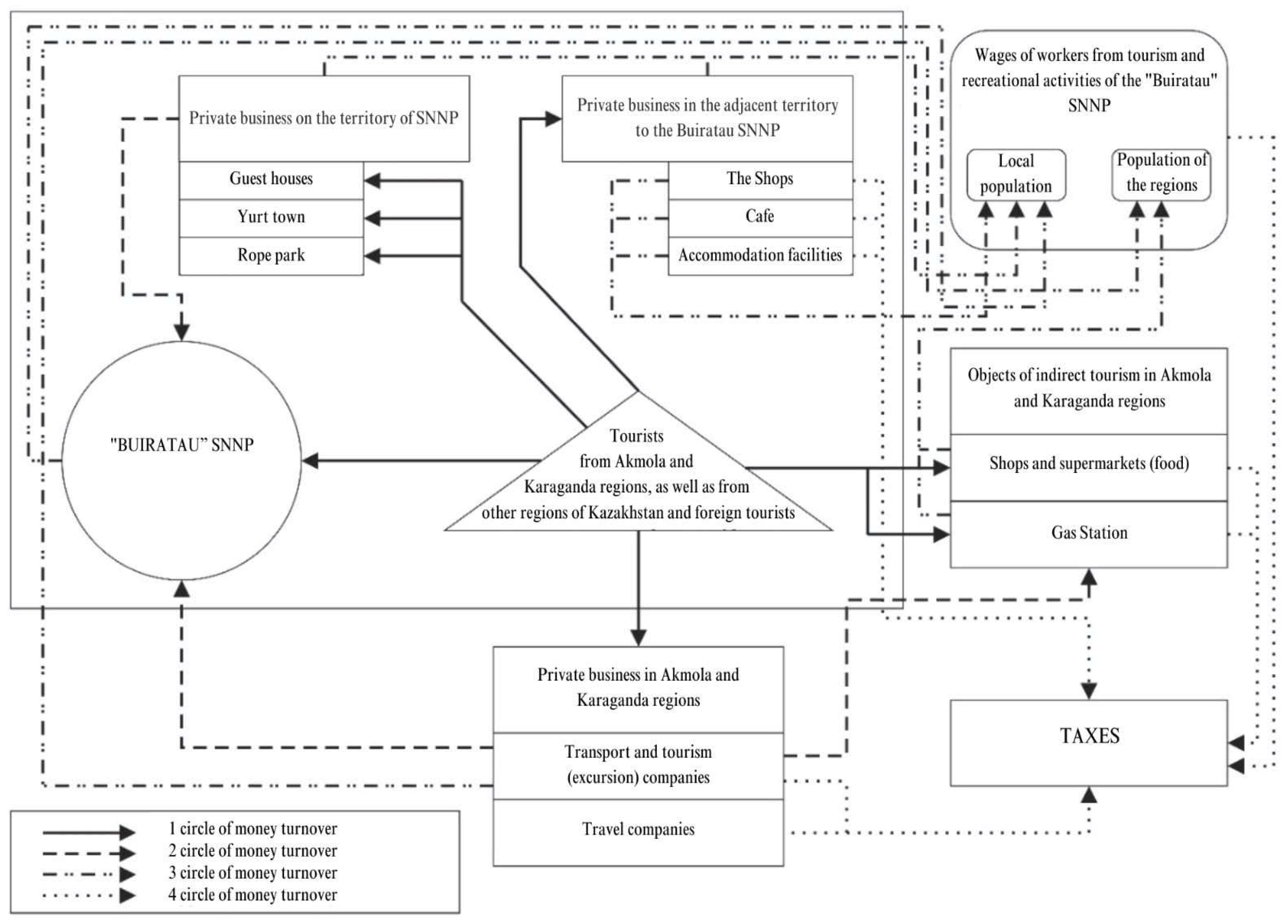
These monetary flows represent multiple rounds of money circulation, beginning with direct tourist expenditures and extending through various sectors of the economy. The economic impact continues as revenue circulates through the region, affecting businesses, employees, and tax contributions. Figure 4 provides a visual representation of these processes, outlining the different circles of money turnover generated by tourism activities at Buiratau SNNP.
In the first round of money circulation, tourists and excursionists visiting Buiratau SNNP spent a total of 19,856,520 KZT, which acted as the initial financial injection into the local economy. Combined with the operational expenditures of businesses involved in organizing tourist activities, this generated total tourism revenue of 21,851,345 KZT. The subsequent rounds of monetary circulation, which are associated with secondary spending and reinvestments, form the basis for calculating the tourism multiplier effect at Buiratau SNNP.
The second round of money circulation pertains to expenses associated with the direct organization of tourism and recreational activities. These expenses are primarily borne by tourism operators, including transportation and excursion companies, which incur costs for diesel fuel and parking fees in areas adjacent to Buiratau SNNP. Additionally, private businesses operating within the park on short- or long-term leases contribute to this circulation. These enterprises do not pay a fixed rent for land use but instead compensate the park administration based on a rate of 0.1 of the MCI for each tourist who uses their services.
The third round of money circulation in Buiratau SNNP is represented by wage disbursements to employees involved in tourism and recreational activities. These payments introduce an additional cycle of economic activity, as the wages earned by employees are reinvested into the local economy through their own spending. The total wage disbursements for employees in 2023 amounted to 1,963,789 KZT (4086.5 $), as shown in Table 7.
From Table 7, it can be observed that Buiratau SNNP generated a total income of 4,095,395 KZT from tourism-related services, but after excluding the earnings of the tour guides, the remaining income is 3,365,395 KZT. These funds are primarily allocated to environmental conservation efforts and park infrastructure improvements, reflecting the park's commitment to sustainable development. As Buiratau SNNP is a government-funded entity, its revenues are classified as state property, and their allocation is tightly regulated to ensure the funds are used for nature conservation and infrastructure maintenance.
Given the specific allocation of these revenues for environmental purposes, they are excluded from the calculation of the economic tourism multiplier. This situation highlights the ecological multiplier effect of tourism, where a portion of the earnings from tourism activities is directly reinvested into environmental conservation and sustainability measures within the park.
However, the tax revenues generated from the park's tourism and recreational activities do contribute to both local and national economic development. These taxes support the creation and maintenance of infrastructure, including transportation networks and communication systems, which indirectly enhance the tourism sector by improving access to and within the park. This process forms part of the economic multiplier effect of tourism at Buiratau SNNP, where tourism-related income has lasting benefits for regional development.
The fourth round of money circulation, as detailed in Table 8, consists of tax deductions made to the state treasury. The total tax revenue from tourism and recreational activities amounted to 1,184,944 KZT (2465.8 USD), with the largest portion, 42%, coming from transportation and tourism (excursion) companies.
The cumulative effect of the tourism multiplier at Buiratau SNNP is estimated to be 25,000,078 KZT (52,023.9 USD), following four rounds of economic circulation triggered by initial tourist expenditures of 19,856,520 KZT (41,320.4 USD). This analysis reveals how tourist spending ripples through the economy, generating broader economic impacts across multiple sectors.
While funds allocated to the state budget, such as tax revenues, are not factored into the tourism multiplier calculation, wages earned by employees and profits generated by private enterprises play a significant role in economic circulation. By considering these elements, the tourism multiplier is calculated based on the earnings of employees and the profits of private enterprises that operate within the tourism and recreational activities of Buiratau SNNP.
This integrated analysis, combining quantitative financial data with qualitative insights from field observations and stakeholder discussions, offers a comprehensive view of how tourism activities contribute to the regional economy. This synthesis forms the foundation for further calculation of the overall tourism multiplier effect, which will be discussed in the subsequent section.
4.2. Calculation of the Multiplier Effect of Tourism Activities
Following the data collection phase, the Keynesian model was selected to calculate the indirect economic impact of tourism activities at Buiratau SNNP. This model incorporates the MPC, which measures the proportion of additional income that is spent rather than saved. In the regions surrounding Buiratau SNNP, specifically Akmola and Karaganda, the MPC tends to be higher due to relatively lower income levels and limited opportunities for saving. This factor increases the multiplier effect of tourist spending in the region.
The total multiplier effect of tourist and recreational activities was calculated using the formula (according to the data from Table 7):
This result demonstrates the total indirect income generated in the regional economy from wages, profits, and other sources of income resulting from tourism activities in 2023. The detailed financial data used in these calculations is presented in Table 9, which summarizes the nominal monetary incomes and expenditures of the population in the Akmola and Karaganda regions.
The calculated multiplier effect of 46,373,272 KZT (96,500.4 USD) reflects the extensive influence of tourism on the local economy, completing over 20 economic turnovers. To fully assess the total economic impact, this figure was combined with an additional 9,963,765 KZT, representing ongoing financial circulation beyond the initial rounds of spending. Thus, the total economic impact of tourism activities at Buiratau SNNP in 2023 was determined to be:
This calculation indicates that the expenditures of tourists and excursionists, amounting to 19,856,520 KZT (41,320.4 USD) in 2023, generated additional income in the regional economies of Akmola and Karaganda, totaling 56,337,037 KZT (117,234.5 USD) and completing more than 24 financial turnovers.
The next step in the analysis involved calculating the tourist expenditure multiplier and the tourist income multiplier to better understand how initial spending translates into additional economic activity. The tourist expenditure multiplier was calculated as:
This result indicates that for every KZT spent by tourists, the regional economy benefitted by an additional 2.84 KZT. This multiplier highlights the significant role of tourist expenditures in generating broader economic impacts in the region.
Similarly, the tourist income multiplier was calculated to determine the relationship between the total economic impact and the income generated directly from tourism activities. The formula used was:
This result shows that the regional economy generated 2.578 KZT in additional revenue for every KZT earned from direct tourism-related activities.
The marginal differences between the expenditure and income multipliers suggest that the relationships between the various entities involved in tourism and recreational activities in Buiratau SNNP are still developing and could benefit from further strengthening. This observation underscores the need for more robust infrastructure and a more mature tourism industry in the region, particularly in relation to the national park.
To further assess the economic impact of tourism, the average expenditure per tourist or excursionist visiting the national park in 2023 was analyzed. Based on the data, each visitor spent approximately 5,522 KZT. Using the tourist expenditure multiplier, the total additional income generated in the regional economy by each individual tourist was calculated as:
This result demonstrates that for every 5,522 KZT spent by a tourist or excursionist, an additional 15,682 KZT (32.6 USD) was generated in the economies of Akmola and Karaganda regions.
The derived multipliers of tourist expenditures and income can be extended to evaluate the economic impact of tourism and recreational activities in other national parks across Kazakhstan. Given the relatively recent establishment of Buiratau SNNP and the progress it has made since 2011, the multipliers calculated here can provide a useful benchmark for other state national natural parks, which generally exhibit similar levels of development.
Calculating the multiplier effect not only highlights the economic contributions of various entities but also provides insight into how these contributions shape the GDP of both the region and Kazakhstan as a whole. This information is critical for making informed predictions about the future direction of tourism development and identifying which sectors of the national economy hold the greatest potential for growth in the context of increasingly competitive global markets.
In summary, the analysis of the multiplier effect for Buiratau SNNP demonstrates the significant economic benefits generated by tourism activities in the region. In 2023, the park received 3,596 visitors, contributing to a total revenue of 21,851,345 KZT (45,471.5 USD), with expenditures amounting to 19,856,520 KZT (41,320.4 USD). These expenditures resulted in a total economic impact of 56,337,037 KZT (117,234.5 USD), with tourist expenditure and income multipliers of 2.84 and 2.578, respectively. The economic benefits of each individual tourist’s spending were found to be substantial, generating additional income in the regional economy. These findings offer valuable insights into the role of national parks in supporting regional and national economic development.
5. Discussion
The results of this study reveal a moderate economic impact of tourism activities in Buiratau SNNP. The calculated tourist expenditure multiplier of 2.84 and tourist income multiplier of 2.578 indicate that, while tourism generates additional income for the local economy, the amplification of initial tourist spending is relatively limited. This aligns with findings in other studies that highlight the variability of multiplier values depending on the economic structure of the region and the development level of the tourism industry [8,13,42]. The relatively modest multipliers observed in this case suggest that there are still structural limitations in the local economy surrounding the park, which reduce the potential economic impact of tourism.
5.1. Economic Impact in Developing Regions
The analysis of tourism activities in Buiratau SNNP contributes to the understanding of how tourism can support local economic development in developing regions, particularly in Kazakhstan. Although the economic benefits are evident, the moderate values of the multipliers indicate that the capacity of the local economy to absorb and re-circulate tourist spending remains underdeveloped. This finding is consistent with research on tourism in other PAs of developing countries, where limited infrastructure, small business scale, and insufficient linkages between tourism and other sectors often lead to lower multiplier effects [11,14].
The results show that tourism activities in Buiratau SNNP generated an overall economic impact of 56,337,037 KZT (117,234.5 USD) from direct tourist expenditures amounting to 19,856,520 KZT (41,320.4 USD), completing over 24 economic transactions. However, the moderate multipliers highlight that the tourism economy in the region may be constrained by factors such as limited investment in infrastructure and a lack of diversification in local businesses. This situation suggests that while tourism provides important financial contributions, further efforts are needed to enhance the economic integration of tourism with other sectors to maximize its benefits.
5.2. Role of Infrastructure in Economic Integration
The moderate multiplier values observed in this study highlight the need for improvements in infrastructure and support services to fully realize the potential economic benefits of tourism. Investment in transport networks, accommodation facilities, and local services is essential for increasing the ability of local businesses to absorb tourist spending and re-invest it in the local economy. Research in other regions has shown that improvements in tourism-related infrastructure can significantly enhance the economic impact of tourism by strengthening the linkages between tourism and other sectors, thereby raising multiplier values [9].
In the case of Buiratau SNNP, limited infrastructure–such as insufficient accommodation options and underdeveloped tourist services–may be restricting the ability of local businesses to capture a larger share of tourist expenditures. This is further compounded by the centralized management of national parks in Kazakhstan, which may limit local community involvement in tourism development. Addressing these challenges requires targeted investments in infrastructure and enhanced collaboration between national park authorities and local stakeholders to ensure that the economic benefits of tourism are more widely distributed.
5.3. Sustainable Tourism Development
The findings of this study also emphasize the importance of sustainability in tourism development. Although tourism in Buiratau SNNP contributes to the local economy, the relatively low multiplier values suggest that the economic benefits are not fully optimized. Sustainable tourism practices, which balance economic, social, and environmental objectives, are essential for improving the long-term viability of tourism in the region [34]. This involves promoting local entrepreneurship, encouraging community participation, and ensuring that tourism development aligns with conservation goals.
Engaging local communities in tourism planning and decision-making processes is particularly important for increasing the economic benefits of tourism. Studies have shown that community-based tourism initiatives, which actively involve local populations, tend to produce higher economic returns and stronger multiplier effects due to the greater circulation of income within local economies [16]. In the context of Buiratau SNNP, increasing community involvement in tourism activities could help strengthen the economic linkages between the park and surrounding regions, ultimately improving the multiplier effect.
5.4. Policy Implications
The moderate multiplier values observed in this study have important policy implications for tourism development in Kazakhstan's national parks. First, the findings suggest that policymakers should focus on enhancing the economic integration of tourism activities with other sectors of the local economy. This could involve creating policies that incentivize local businesses to invest in tourism-related services and infrastructure, as well as promoting partnerships between park authorities, local entrepreneurs, and government agencies.
Second, improving data collection and monitoring systems is essential for accurately assessing the economic impacts of tourism and identifying areas for improvement. The availability of detailed data on tourist behavior, spending patterns, and local business activity is critical for refining the calculation of multiplier effects and for guiding tourism development strategies. By implementing such systems, policymakers can make more informed decisions about where to allocate resources and how to optimize the economic contributions of tourism in national parks.
Finally, the study underscores the importance of balancing tourism development with conservation objectives. National parks like Buiratau SNNP are not only economic assets but also vital ecological reserves. As tourism continues to grow, it is essential to ensure that the environmental integrity of the park is maintained, and that tourism activities are managed in a way that supports both economic development and conservation goals. The results of the study can be used in other countries, especially in the CIS region, since in post-Soviet countries national parks are centrally managed by the state. The unified management system in these countries allows the conclusions and recommendations obtained from the Buiratau National Park study to be applied to other parks in the region [43].
5.5. Comparative Analysis of Multiplier Effects with Other National Parks
Case 1: South Luangwa National Park, Zambia
The study of South Luangwa National Park in Zambia examines the economic impact of park tourism, particularly focusing on the multiplier effects of tourism spending in local communities. Despite high leakage, the park tourism contributes significantly to local household incomes (around 40%) and supports business growth. The study highlights the importance of infrastructure and management autonomy in enhancing the park's economic impact, leading to a multiplier effect significantly higher than the park management costs.
Case 2: Austrian National Parks
This study looks at the economic impacts of national parks in Austria through the lens of local community perceptions and econometric estimations. It reveals that tourism in these parks contributes substantially to local and regional economic development, primarily through new investments and business establishments. The multiplier effects here are supported by strong integration with local economies, infrastructure development, and stakeholder cooperation between park administration and local communities.
Comparative Analysis: Buiratau SNNP vs. National Parks in Developed Countries
- Multiplier Effect Magnitude:
In Buiratau State National Nature Park, the multiplier effects are relatively modest due to limited infrastructure and economic integration. In contrast, Austrian national parks exhibit higher multiplier effects, driven by better infrastructure, established tourism sectors, and robust local economic linkages [13].
- 2.
- Infrastructure and Management:
South Luangwa National Park shows that infrastructure development and management autonomy significantly enhance economic impacts. Similarly, Austrian parks benefit from developed infrastructure and collaborative management practices. Buiratau SNNP faces challenges with underdeveloped infrastructure and centralized management, which restricts its economic potential compared to these established parks [6].
- 3.
- Local Economic Integration:
Austrian national parks are characterized by strong integration with local economies, allowing for higher multiplier effects and sustainable growth. In comparison, Buiratau SNNP has limited economic integration, which results in lower multiplier effects and reduced capacity to benefit from tourism [13].
- 4.
- Policy and Stakeholder Involvement:
The involvement of local stakeholders and flexible management approaches in Austrian national parks enhances their economic impact. In contrast, the centralized management of Buiratau SNNP may limit local community involvement and decision-making in tourism development, thus constraining its multiplier effects [13].
The comparison shows that the multiplier effects in Buiratau SNNP are currently lower than those in well-established national parks in developed countries due to challenges like inadequate infrastructure, centralized management, and limited local economic integration. Addressing these issues could enhance Buiratau SNNP’s economic impact, making it more comparable to parks in developed contexts.
5.6. Problems and Opportunities of Buiratau National Park
Buiratau National Park faces the following problems:
Limited Infrastructure: Buiratau SNNP faces challenges such as insufficient accommodation options, underdeveloped transport networks, and limited tourism services, which restrict the park's ability to attract more tourists and generate higher economic impacts.
Low Economic Integration: The local economy surrounding Buiratau SNNP shows limited integration with tourism activities, resulting in relatively low multiplier effects and reduced capacity to benefit from tourism.
Centralized Management: The centralized management system in Kazakhstan may limit local community involvement and decision-making in tourism development, further constraining economic benefits.
Although the Buiratau National Park is recently founded and encounters certain challenges, it also presents the following prospects of development.
Untapped Potential for Sustainable Tourism: The Buiratau SNNP, being a recently established national park, has the potential to implement sustainable tourism strategies right from the beginning, effectively harmonizing conservation efforts with economic development.
Local Community Involvement: Engaging local communities more actively in tourism planning and development can bolster economic benefits and fortify the economic connections between the park and the neighboring region.
Infrastructure Development: Allocating resources to enhance transportation and lodging facilities can greatly enhance the appeal of the park to visitors and boost the total economic benefits of tourism activities..
In conclusion, this study offers significant analyses of the economic consequences of tourism in Buiratau SNNP, specifically emphasizing the multiplier effect. Although tourism contributes substantially to the local economy, the modest multiplier values suggest that there is scope for enhancing infrastructure development and economic integration. Optimizing the economic advantages of tourism while upholding the conservation goals of the park requires implementing essential tactics such as strengthening the connections between tourism and other industries, including local people, and advocating for sustainable tourism practices. These findings are applicable not just to Buiratau SNNP but also to other national parks in Kazakhstan and emerging areas, where tourism may bolster both economic development and environmental preservation..
6. Conclusion
This study assessed the economic impact of tourism in Buiratau SNNP by analyzing the direct, indirect, and induced effects of tourist spending, with a specific focus on the multiplier effect. The research aimed to address the extent to which tourism contributes to local economic development, and the findings provide key insights into the economic dynamics of tourism in the region.
The first objective of the study was to evaluate the direct, indirect, and induced economic impacts of tourism in Buiratau SNNP. The results show that while the direct revenues from tourism-related activities are substantial, the indirect and induced effects also play a crucial role in the local economy. Businesses in adjacent areas, such as accommodation providers and local shops, benefitted from tourist expenditures, further supporting regional economic activity.
The second objective focused on quantifying the multiplier effect of tourism-related spending and income in the park. The study found that the tourist expenditure multiplier is 2.84, indicating that for every unit of tourist spending, an additional 2.84 units of economic activity are generated in the local economy. Similarly, the tourist income multiplier was calculated as 2.578, meaning that for every unit of income generated from direct tourism activities, an additional 2.578 units of income are created in the economy. These multiplier values reflect the current economic dynamics in the region, highlighting that although tourism has a positive impact, there are limitations due to underdeveloped infrastructure and limited local economic integration.
The final objective was to explore the potential for sustainable tourism development in Kazakhstan's PAs. The findings suggest that while tourism in Buiratau SNNP provides economic benefits, there is significant potential for improvement. Enhancing infrastructure, improving local business linkages, and fostering greater community involvement in tourism development are key strategies to increase the economic impact. Additionally, sustainable tourism practices should be promoted to ensure that economic growth aligns with conservation goals.
In summary, this study contributes to the understanding of tourism's economic role in developing regions, particularly in Kazakhstan’s national parks. Although tourism in Buiratau SNNP generates positive economic outcomes, the moderate multiplier values indicate that further efforts are needed to strengthen the tourism infrastructure and integrate local businesses more effectively into the tourism economy.
7. Limitations and Assumptions
This study provides insights into the economic impact of tourism in Buiratau SNNP, yet several limitations and assumptions were taken into account during the research process to ensure accuracy and relevance.
A primary consideration was the availability of data, which, while comprehensive, presented some variability, particularly concerning indirect economic effects. The data were carefully selected from reliable sources such as local businesses and national statistics. Although minor variations in these figures may exist, the overall patterns of economic impact remain valid, and consistency was ensured through cross-verification of multiple data points.
The choice of the Keynesian multiplier model was appropriate for the context of regional tourism in Kazakhstan. This model is widely used for calculating the effects of initial spending on broader economic activity. The assumptions behind the MPC were supported by regional economic data from Akmola and Karaganda, reflecting average consumption patterns in these areas. Any potential deviations in spending behavior were acknowledged but did not detract from the overall validity of the findings.
Additionally, the research utilized a static model, capturing economic interactions at a specific moment in time. While this approach may not account for long-term changes in economic conditions, it was effective in measuring immediate tourism impacts. Future research could expand on this by incorporating dynamic models, but for the purposes of this study, the static framework provided a solid and clear analysis of the multiplier effect.
The study concentrated on key economic sectors directly linked to tourism, such as accommodation, transport, and retail. Although the research did not explore peripheral industries in depth, the analysis remained focused on those sectors most affected by tourism activities, thus providing a representative view of the regional economic landscape.
Regarding tourist spending patterns, the study relied on average expenditure data, which accurately reflects the behavior of the majority of visitors. Although individual spending habits may vary, these averages provided a realistic estimate of the economic contributions from tourism, forming a sound basis for calculating the multiplier effect.
In summary, the identified limitations and assumptions were recognized and effectively managed throughout the research process. These considerations do not undermine the findings but instead highlight areas for future inquiry, particularly in refining data collection techniques and exploring long-term economic impacts through dynamic modeling.
Author Contributions
Conceptualization, A. S. and M. Y.; Methodology, A. S. and M. Y.; Validation, A. S. and O. R.; Formal analysis, A. S., O. R. and Z. A.; Investigation, A. S.; Resources, M. Y. and M. S.; Data curation, A. S., M. Y., Y. N. and Z. A.; Writing – original draft, A. S. and M. Y.; Writing – review & editing, A. A., Y. N., M. S. and Z. A.; Visualization, M. Y., M. S. and O. R.; Supervision, A. A.; Project administration, A. A.; Funding acquisition, A. A. All authors have read and agreed to the published version of the manuscript.
Funding
This research was funded by the Science Committee of the Ministry of Science and Higher Education of the Republic of Kazakhstan (Grant No. AP08855888 “Ensuring Sustainable Development of Kazakhstan’s National Parks Through the Territorial Organization of Ecological Tourism”).
Institutional Review Board Statement
Not applicable.
Informed Consent Statement
Not applicable.
Data Availability Statement
Data are contained within the article.
Acknowledgement
The authors would like to express their sincere gratitude to the administration of Buiratau SNNP for their invaluable support in providing data and facilitating field research. Special thanks are extended to Senior Research Fellow F.M. Ismailova for her dedicated assistance, which significantly contributed to the success of this study.
Conflicts of Interest
The authors declare no conflict of interest.
References
- Bovarnick, A. , Galindo, J., Fern ́andez-Baca, J., Negret, H., 2010. Financial Sustainability of Protected Areas in Latin America and the Caribbean: Investment Policy Guidance. United Nations Development Programme (UNDP) and The Nature Conservancy (TNC).
- Bruner, A.G.; Gullison, R.E.; Balmford, A. Financial Costs and Shortfalls of Managing and Expanding Protected-Area Systems in Developing Countries. BioScience 2004, 54, 1119–1126. [Google Scholar] [CrossRef]
- McCarthy, D.P.; Donald, P.F.; Scharlemann, J.P.W.; Buchanan, G.M.; Balmford, A.; Green, J.M.H.; Bennun, L.A.; Burgess, N.D.; Fishpool, L.D.C.; Garnett, S.T.; et al. Financial Costs of Meeting Global Biodiversity Conservation Targets: Current Spending and Unmet Needs. Science 2012, 338, 946–949. [Google Scholar] [CrossRef] [PubMed]
- Miller, D.C. Explaining global patterns of international aid for linked biodiversity conservation and development. World Dev. 2014, 59, 341–359. [Google Scholar] [CrossRef]
- Zawilińska, B.; Brańka, P.; Majewski, K.; Semczuk, M. National Parks—Areas of Economic Development or Stagnation? Evidence from Poland. Sustainability 2021, 13, 11351. [Google Scholar] [CrossRef]
- Chidakel, A.; Child, B.; Muyengwa, S. Evaluating the economics of park-tourism from the ground-up: Leakage, multiplier effects, and the enabling environment at South Luangwa National Park, Zambia. Ecol. Econ. 2021, 182, 106960. [Google Scholar] [CrossRef]
- Mayer, M.; Müller, M.; Woltering, M.; Arnegger, J.; Job, H. The economic impact of tourism in six German national parks. Landsc. Urban Plan. 2010, 97, 73–82. [Google Scholar] [CrossRef]
- Kessy, D., Kiage, O.; Kiprutto, N. (2018). Multiplier effects of tourism in selected areas of Arusha, Tanzania. African Journal of Hospitality, Tourism and Leisure, Volume 7 (3).
- Matiku, S.; Zuwarimwe, J.; Tshipala, N. Community-Driven Tourism Projects’ Economic Contribution to Community Livelihoods—A Case of Makuleke Contractual Park Community Tourism Project. Sustainability 2020, 12, 8230. [Google Scholar] [CrossRef]
- Archer, B.H. The value of multipliers and their policy implications. Tour. Manag. 1982, 3, 236–241. [Google Scholar] [CrossRef]
- Ruslan, B.; Lorant, D.; Sholpan, A.; Aiman, Z.; Alexandr, A. Impacts of tourism activities on economy of Kazakhstan. Geoj. Tour. Geosites 2018, 22, 480. [Google Scholar] [CrossRef]
- McDonald, G.T.; Wilks, L.C. The regional economic impact of tourism and recreation in national parks. Environ. Plan. B: Plan. Des. 1986, 13, 349–366. [Google Scholar] [CrossRef]
- Getzner, M. The economic impact of national parks: the perception of key actors in Austrian national parks. Int. J. Sustain. Dev. 2003, 6, 183. [Google Scholar] [CrossRef]
- Getzner, M. Impacts of national parks on tourism: a case study from a prominent alpine national park. Econ. Policy Energy Environ. 2009, 103–120. [Google Scholar] [CrossRef]
- Saayman, M.; Saayman, A.; Ferreira, M. The socio-economic impact of the Karoo National Park. Koedoe 2009, 51, 10. [Google Scholar] [CrossRef]
- Gasparino, U.; Bellini, E.; Del Corpo, B.; Malizia, W. (2008). Measuring the Impact of Tourism Upon Urban Economies: A Review of Literature. Fondazione Eni Enrico Mattei.
- Rusu, S. Tourism multiplier effect. Journal of Economics and Business Research 2011, XVII, 70–76. [Google Scholar]
- Archer, B.; Owen, C.B. Towards a tourist regional multiplier. Reg. Stud. 1971, 5, 289–294. [Google Scholar] [CrossRef]
- Chase, G.; Alon, I. Evaluating the Economic Impact of Cruise Tourism: A Case Study of Barbados. Anatolia 2002, 13, 5–18. [Google Scholar] [CrossRef]
- Frechtling, D.C.; Horváth, E. Estimating the Multiplier Effects of Tourism Expenditures on a Local Economy through a Regional Input-Output Model. J. Travel Res. 1999, 37, 324–332. [Google Scholar] [CrossRef]
- Zhang, J.; Madsen, B.; Jensen-Butler, C. Regional Economic Impacts of Tourism: The Case of Denmark. Reg. Stud. 2007, 41, 839–854. [Google Scholar] [CrossRef]
- Fletcher, J.E. Input-output analysis and tourism impact studies. Ann. Tour. Res. 1989, 16, 514–529. [Google Scholar] [CrossRef]
- Leontief, W.W. Quantitative Input and Output Relations in the Economic Systems of the United States. Rev. Econ. Stat. 1936, 18, 105. [Google Scholar] [CrossRef]
- Lukoseviciute, G.; Pereira, L.N.; Panagopoulos, T. The economic impact of recreational trails: a systematic literature review. J. Ecotourism 2022, 21, 366–393. [Google Scholar] [CrossRef]
- Huhtala, M. Assessment of the local economic impacts of national park tourism: The case of pallas-ounastunturi national park. Forest Snow and Landscape Research 2007, 81, 223–238. [Google Scholar]
- Hjerpe, E.E.; Kim, Y.-S. Regional economic impacts of Grand Canyon river runners. Journal of Environmental Management 2007, 85, 137–149. [Google Scholar] [CrossRef]
- Poudel, S.; Nyaupane, G.P.; Budruk, M. Assessing the economic impact of recreational trail tourism in South Africa. Journal of Ecotourism 2017, 16, 237–254. [Google Scholar]
- Raya, J.M.; Sastre, F.; García, A. Economic impacts of tourism on regional economies in Spain. Tourism Economics 2018, 24, 277–297. [Google Scholar]
- Saayman, M.; Saayman, A.; Ferreira, M. The economic impact of tourism in South Africa’s national parks. South African Journal of Economic and Management Sciences 2010, 13, 329–346. [Google Scholar]
- Blake, A.; Sinclair, M.T.; Sugiyarto, G. The economic impact of tourism in Spain. Annals of Tourism Research 2006, 33, 1236–1259. [Google Scholar] [CrossRef]
- Loveridge, S. A typology and assessment of multi-sector regional economic impact models. Regional Studies 2004, 38, 305–317. [Google Scholar] [CrossRef]
- Archer, B.H.; Fletcher, J. The economic impact of tourism in the Seychelles. Annals of Tourism Research 1996, 23, 32–47. [Google Scholar] [CrossRef]
- Dwyer, L.; Forsyth, P.; Dwyer, W. (2010). Tourism economics and policy. Channel View Publications.
- Fletcher, J.E.; Archer, B.H. (1991). The development and application of multiplier analysis. In C. P. Cooper (Ed.), Progress in tourism, recreation and hospitality management (pp. 28–47). Belhaven Press.
- Hsu, P. Economic impact of wetland ecotourism: An empirical study of Taiwan’s cigu lagoon area. Tourism Management Perspectives 2019, 29, 31–40. [Google Scholar] [CrossRef]
- Sapieva, A.Zh.; Aktymbayeva, A.S. Factors and conditions of tourist-recreational activities development of GNPP "Buyratau". Materials of the International Scientific Conference of Students and Young Scientists "Farabi World". Almaty, Kazakhstan, April 10-11, 2017.
- Buiratau National Nature Park official page. Available online: https://www.gnpp-buiratau.kz/en (accessed on 10 March 2024).
- Buiratau SNNP Annual Report, official document of National Park.
- Bureau Of National Statistics. Available online: https://stat.gov.kz/ru/industries/labor-and-income/stat-life/publications/ (accessed on 17 March 2024).
- Aktymbayeva, A.; Nuruly, Y.; Artemyev, A.; Kaliyeva, A.; Sapiyeva, A.; Assipova, Z. Balancing Nature and Visitors for Sustainable Development: Assessing the Tourism Carrying Capacities of Katon-Karagay National Park, Kazakhstan. Sustainability 2023, 15, 15989. [Google Scholar] [CrossRef]
- Keynes, J.M. (1936). The General Theory of Employment, Interest and Money. London: Macmillan and Co. Ltd.
- Sapiyeva, A.Z.; Nuruly, Y.; Assipova, Z.M. Evaluation of the multiplicative effect of ecotourism development in Kazakhstan (on the example of the «Buyratau» national park). 2020. Available online: https://caer.narxoz.kz/jour/article/view/282/284 (accessed on 4 September 2024).
- Anshekov, I.A.; Borisov, A.V.; Agapov, D.A. (2023). On the issue of legal regulation of lands of specially protected natural areas. Saratov State Law Academy Saratov, Russian Federation.
Figure 1.
Direct, indirect and induced benefits and effects on the economy triggered by tourist spending [16].
Figure 1.
Direct, indirect and induced benefits and effects on the economy triggered by tourist spending [16].
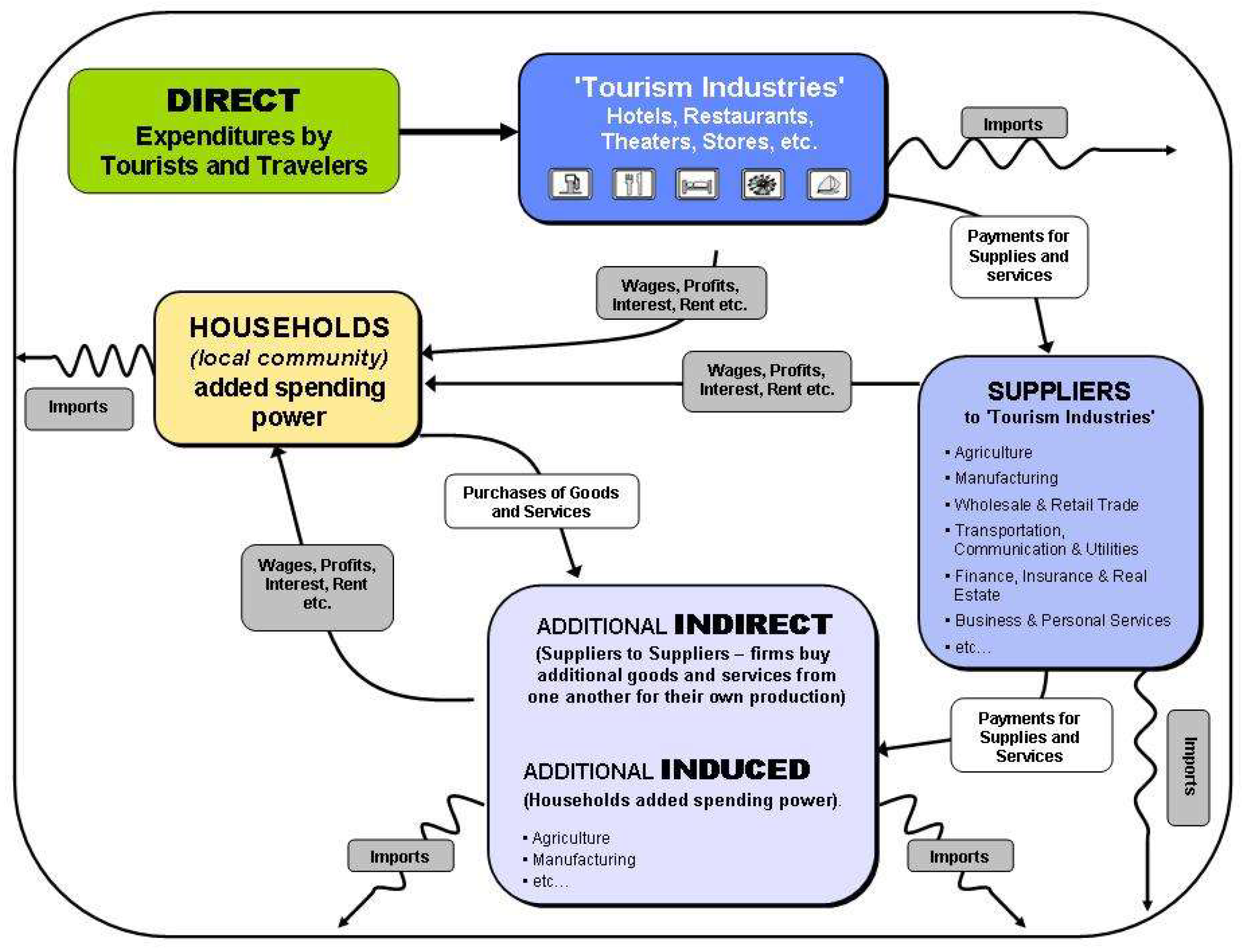
Figure 2.
Tourist and recreational resources of Buiratau SNNP.
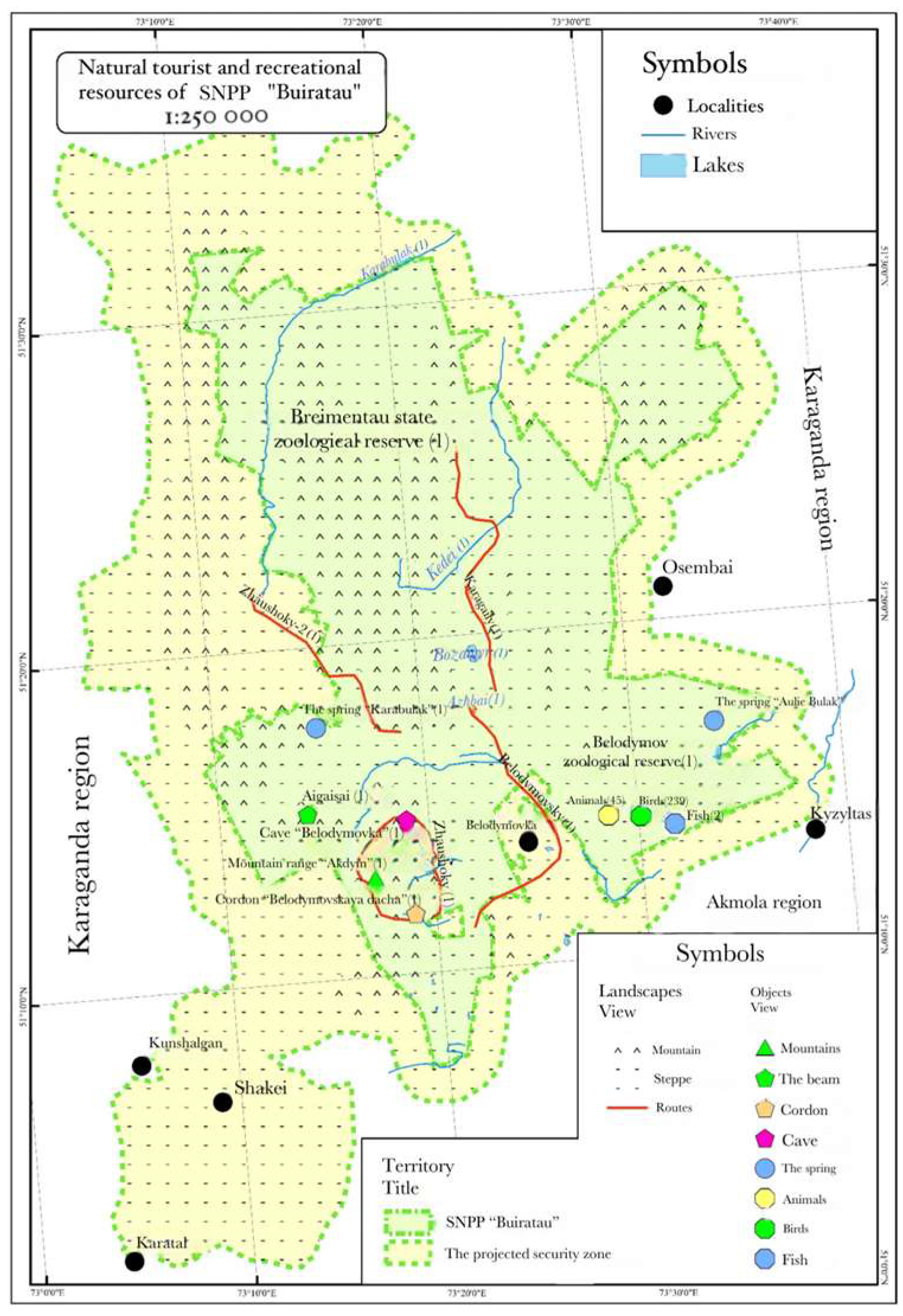
Figure 3.
Tourist facilities of Buiratau SNNP.
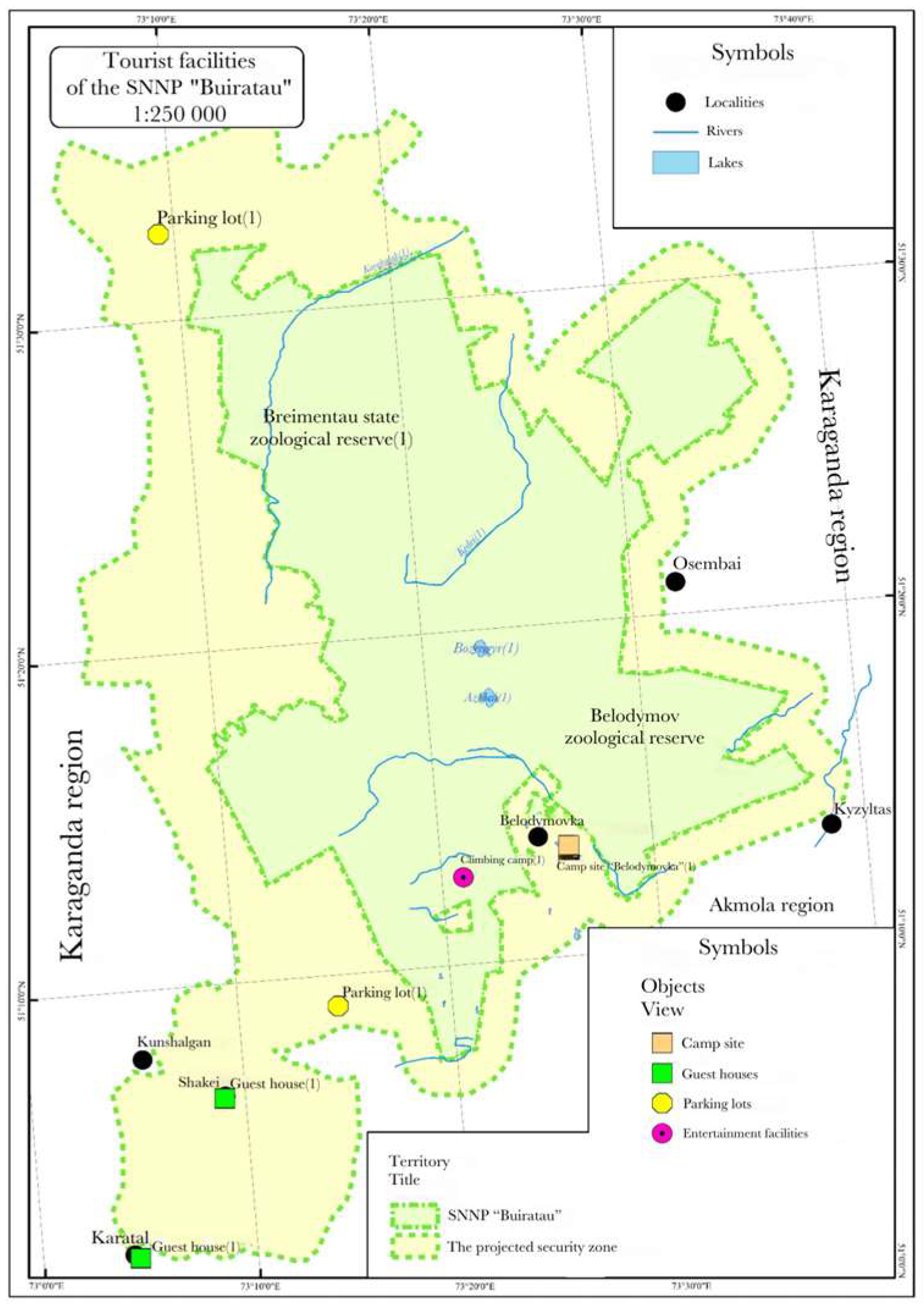
Figure 4.
Framework of Economic Multiplier Effect of Tourism in Buiratau SNNP.

| Year | Number of Visitors |
|---|---|
| 2018 | 3,830 |
| 2019 | 1,997 |
| 2020 | 1,087 |
| 2021 | 2,611 |
| 2022 | 2,511 |
| 2023 | 3,596 |
Table 2.
Revenue Breakdown for Tourist and Recreational Activities at Buiratau SNNP in 2023 [37].
Table 2.
Revenue Breakdown for Tourist and Recreational Activities at Buiratau SNNP in 2023 [37].
| No. | Service Description | Price, KZT | Number of Services Provided | Revenue, KZT |
|---|---|---|---|---|
| 1 | Ecological Fee | 345 | 3,596 | 1,240,620 |
| 2 | Guide Services | 5,000 | 146 | 730,000 |
| 3 | Museum | 200 | 3,596 | 719,200 |
| 4 | Tent Setup | 800 | 428 | 342,400 |
| 5 | Parking: | |||
| - Buses | 300 | 86 | 25,800 | |
| - Cars | 150 | 225 | 33,750 | |
| 6 | Rental Fee: | |||
| - Guest Houses | 3,000 | 240 | 720,000 | |
| - Yurt Camp | 226.9 | 500 | 113,450 | |
| - Rope Park | 226.9 | 750 | 170,175 | |
| Total | 4,095,395 | |||
Table 3.
Structure of Income from Tourist and Recreational Activities of Private Sector Enterprises in Buiratau SNNP in 2023 [37].
Table 3.
Structure of Income from Tourist and Recreational Activities of Private Sector Enterprises in Buiratau SNNP in 2023 [37].
| No. | Name of the Service or Product | Price, KZT | Number of Services or Goods Provided | Income, KZT |
|---|---|---|---|---|
| Guest houses | ||||
| 1 | Accommodation with 3 Meals | 6,000/day | 218 | 1,308,000 |
| Overall | 1,308,000 | |||
| Yurt Town | ||||
| Small Magnet | 300 | 1,806 | 541,800 | |
| 2 | Big Magnet | 400 | 654 | 261,600 |
| Photo with Eagle | 800 | 951 | 760,000 | |
| Bird Hunting Performance | 800 | 599 | 479,200 | |
| Overall | 2,042,600 | |||
| Rope Park | ||||
| 3 | Rope Jumping | 1,800 | 950 | 1,710,000 |
| Overall | 1,710,000 | |||
| Overall Income of All Enterprises | 5,060,600 | |||
Table 4.
Structure of Revenues from Tourist and Recreational Activities of Private Sector Enterprises in Areas Adjacent to Buiratau SNNP in 2023 [37].
Table 4.
Structure of Revenues from Tourist and Recreational Activities of Private Sector Enterprises in Areas Adjacent to Buiratau SNNP in 2023 [37].
| No. | Name of the Service or Product | Price, KZT | Number of Services or Goods Provided | Income, KZT |
|---|---|---|---|---|
| “Matay Service” Hotel | ||||
| 1 | Accommodation with breakfast | 6,000/day | 19 | 114,000 |
| Overall | 114,000 | |||
| “Balkhash” Motel | ||||
| 2 | Accommodation with breakfast | 5,000/day | 17 | 85,000 |
| Overall | 85,000 | |||
| Cafe | ||||
| 3 | Lunch | 1,200 | 2,000 | 2,400,000 |
| Overall | 2,400,000 | |||
| Shops | ||||
| 4 | Groceries | 900 | 1,000 | 900,000 |
| Overall | 900,000 | |||
| Overall Income for All Enterprises | 3,499,000 | |||
Table 5.
Structure of Revenues from Indirect Tourism-Related Businesses in Akmola and Karaganda Regions in 2023 [37].
Table 5.
Structure of Revenues from Indirect Tourism-Related Businesses in Akmola and Karaganda Regions in 2023 [37].
| No. | Name of the Service or Product | Price, KZT | Number of Services or Goods Provided | Income, KZT | |
|---|---|---|---|---|---|
| 1 | Shops and Supermarkets | ||||
| Groceries | 900 | 3,596 | 3,236,400 | ||
| Overall | 3,236,400 | ||||
| 2 | Gas Station | ||||
| Diesel | 295/liters | 3,360 liters | 991,200 | ||
| Gasoline (AI-92) | 205/liters | 3,750 liters | 768,750 | ||
| Overall | 1,759,950 | ||||
| Overall Income for All Enterprises | 4,996,350 | ||||
Table 6.
Financial Expenses Incurred by Tourists and Excursionists, and Income Generated by Businesses, Institutions, and Organizations through the Organization of Tourism Activities at Buiratau SNNP in 2023 [37].
Table 6.
Financial Expenses Incurred by Tourists and Excursionists, and Income Generated by Businesses, Institutions, and Organizations through the Organization of Tourism Activities at Buiratau SNNP in 2023 [37].
| No. | Subjects of Tourist and Recreational Activities | Expenses of Tourists and Excursionists, KZT | Incomes, KZT |
|---|---|---|---|
| 1 | Buiratau SNNP | 3,091,770 | 4,095,395 |
| 2 | Private Sector Enterprises within the Territory of Buiratau SNNP | 5,060,600 | 5,060,600 |
| 3 | Private Sector Enterprises in Adjacent Areas | 3,499,000 | 3,499,000 |
| 4 | Transport and Tourism (Excursion) Companies | 4,200,000 | 4,200,000 |
| 5 | Enterprises in the Indirect Tourism Economy of Akmola and Karaganda | 4,005,150 | 4,996,350 |
| Overall | 19,856,520 | 21,851,345 | |
Table 7.
Wage Deductions for Employees Involved in Tourism and Recreational Activities at Buiratau SNNP in 2023.
Table 7.
Wage Deductions for Employees Involved in Tourism and Recreational Activities at Buiratau SNNP in 2023.
| No. | Subjects of Tourist and Recreational Activities | Incomes, KZT | Employees | Payroll Terms | Annual Salary, KZT |
|---|---|---|---|---|---|
| 1 | Buiratau SNNP | 4 095 395 | Tour guide | Tour guide receives the entire amount from excursions | 730 000 |
| 2 | Private sector enterprises (adjacent to Buiratau) | ||||
| Shops | 900 000 | Sellers | 3% of revenue | 27 000 | |
| Cafes | 2 400 000 | Waiters | 10% service fee | 240 000 | |
| Accommodation | 199 000 | House keepers | 10% cleaning fee from the room rate | 1990 | |
| Overall | 268 990 | ||||
| 3 | Transportation and tourist (excursion) companies | 4 200 000 | Drivers | 20% of the trip cost | 840 000 |
| 4 | Indirect tourism-related enterprises in Akmola and Karaganda | ||||
| Shops and supermarkets | 2 400 000 | Sellers | 3% of revenue | 72 000 | |
| Gas stations | 1 759 950 | Operators | 3% of revenue | 52 799 | |
| Overall | 124 799 | ||||
| Overall | 1 963 789 | ||||
Table 8.
Tax Revenues Resulting from the Organization of Tourism and Recreational Activities at Buiratau SNNP in 2023.
Table 8.
Tax Revenues Resulting from the Organization of Tourism and Recreational Activities at Buiratau SNNP in 2023.
| No. | Subjects of Tourist and Recreational Activities | Incomes, KZT | Tax Rates | Tax Deductions, KZT |
|---|---|---|---|---|
| 1 | Private Sector Enterprises (Adjacent to Buiratau SNNP) | |||
| Shops | 900 000 | 3% | 27 000 | |
| Cafes | 2 400 000 | 5% | 120 000 | |
| Accommodation | 199 000 | 3% | 5970 | |
| Overall | 152 970 | |||
| 2 | Transportation and tourism (excursion) companies | 4 200 000 | 10% | 420 000 |
| 3 | Transportation and Tourism (Excursion) Companies | |||
| Shops and supermarkets | 2 400 000 | 10% | 240 000 | |
| Gas Stations | 1 759 950 | 10% | 175 995 | |
| Overall | 415 995 | |||
| 4 | Salaries | 1 959 789 | 10% | 195 979 |
| Overall | 1 184 944 | |||
Table 9.
Average Per Capita Income and Expenditure Levels of the Population in Akmola and Karaganda Regions in 2023 [39].
Table 9.
Average Per Capita Income and Expenditure Levels of the Population in Akmola and Karaganda Regions in 2023 [39].
| Region | Nominal monetary incomes of the population, in KZT | Monetary expenses of the population, in KZT |
|---|---|---|
| Akmola Region | 749 989 | 476 289 |
| Karaganda Region | 847 339 | 603 113 |
Disclaimer/Publisher’s Note: The statements, opinions and data contained in all publications are solely those of the individual author(s) and contributor(s) and not of MDPI and/or the editor(s). MDPI and/or the editor(s) disclaim responsibility for any injury to people or property resulting from any ideas, methods, instructions or products referred to in the content. |
© 2024 by the authors. Licensee MDPI, Basel, Switzerland. This article is an open access article distributed under the terms and conditions of the Creative Commons Attribution (CC BY) license (http://creativecommons.org/licenses/by/4.0/).
Copyright: This open access article is published under a Creative Commons CC BY 4.0 license, which permit the free download, distribution, and reuse, provided that the author and preprint are cited in any reuse.


