

Submitted:
22 December 2025
Posted:
24 December 2025
You are already at the latest version
Abstract
Mealybug Trabutina serpentina has two generations in southeastern Kazakhstan. Second instars of the second generation overwinter. Between 2003 and 2005, for the second time in 50 years, a large reproduction of this pseudococcid was seen in the Ile River valley. This species should be removed from the list of potential biocontrol agents for Tamarix ramosissima that are considered suitable in the USA, due to its potential to harm American populations of T. aphylla. Nonetheless, the species might be used for biological control of tamarisk in South Africa, Australia, and other countries.
Keywords:
biological control
; Saltcedar
; Central Asia
; Trabutina serpentina
1. Introduction
Tamarisk was first identified in the area now known as the United States during the early 19th century. Since the late 1920s, the invasion of tamarisk into natural river valley ecosystems has rapidly increased, causing significant damage to native habitats and agricultural lands. Ten species of the genus Tamarix, introduced from the Palearctic, have been documented in the U.S. [1,2], with Tamarix ramosissima, which naturally occurs over a broad region of the Old World from eastern Turkey to central China, becoming the dominant species in North America. Advances in molecular systematics have enabled scientists to identify some populations of T. ramosissima as T. canariensis or, at least, as hybrids of these two, along with hybrids of T. ramosissima and T. chinensis [3,4,5,6]. Another species, T. parviflora, which is relatively common in the western United States, is also recognized as harmful by American experts. Of the ten tamarisk species introduced to North America, T. aphylla is beneficial to people. While T. aphylla is not considered harmful in the U.S., despite its high potential for widespread dispersal, it is regarded as a serious pest in Australia. It is managed through biocontrol efforts by relevant authorities.
This publication is based on our research from the late 1990s to the present as part of the USDA ARS international project on biological control of tamarisk in the USA. One goal of this research in Kazakhstan was to identify the most suitable phytophagous insect species for controlling the main target weed, T. ramosissima. A key criterion for selecting insect species was ensuring the safety of another tamarisk species, T. aphylla, on the American continent. Therefore, potential biological control agents needed to be monophagous or, at a minimum, narrowly oligophagous on T. ramosissima. As a result of the research, about a dozen species were identified as suitable biocontrol agents, including mealybug Trabutina serpentina (Green, 1919). This publication builds on our previous work on potential biocontrol agents for tamarisk in the USA [7,8,9,10,11].
2. Materials and Methods
The research material includes results from observations, collections, and testing conducted during field seasons from 1994 to 2018 in the Ile River valley and at the Institute of Zoology of the Republic of Kazakhstan in Almaty. Observations and monitoring of the two large populations of T. serpentina in the wild were mostly carried out at two floodplain sites in the mountain valleys of the Ile Alatau Ridge (Northern Tien Shan) (Figure 1 and Figure 2):
1) Chilik population (near Masak village, 10 km east of Chilik settlement, on the Chilik River floodplain).
2) Buryndysu population (monitoring site “Hot Spring,” near Buryndysu village, 33 km east of Chilik settlement).
Various garden and laboratory tests were carried out at the Institute of Zoology in Almaty from 1996 to 2012 to assess the acceptability and potential harm to 10 U.S. accessions of T. ramosissima and two accessions of athel, as well as to develop methods for cultivating T. serpentina if or when it is introduced into the U.S.
During the study, traditional entomological methods were used to search for, collect, preserve, observe, and test insects for host-plant specialization [12].
3. Results
Distribution. T. serpentina is found in Egypt, the Sinai Peninsula, Palestine, Iraq, Southern Armenia, Turkmenistan, Tajikistan, Uzbekistan, southern and southeastern Kazakhstan, Baluchistan, and India [13,14,15,16]. G.Ya. Matesova first identified this species in southeastern Kazakhstan, in the floodplains of the Usek River east of Zharkent (formerly Panfilov) and near the Ile River by the Singing Dune (Kalkan). According to our data, the mealybug occurs in isolated patches throughout the Ile River and in the middle and lower reaches of the Karatal River.
Habitat. The mealybug lives on tamarisk trees that grow in clay, sandy, and saline deserts, as well as in riparian forests (tugai) and other moist environments.
Host plants. It is a narrow oligophage of tamarisk; the mealybug feeds on T. ramosissima, T. leptostachys, T. gracilis, and other closely related tamarisk species found in the Southern Balkhash region.
3.1. Biological and Phenological Peculiarities of the Mealybug Trabutina serpentina
In southeastern Kazakhstan, this species produces two generations each year. The second instars of the second generation overwinter. The primary overwintering sites in nature are probably cracks in the bark of the upper, near-surface roots. The location of the larvae on experimental seedlings in open ground can help identify this. However, we did not find many larvae on the roots in the wild. Some individual larvae were found in leaf litter at the base of grasses. In early spring, they are sometimes found in overwintered egg sacs during relatively mild winters. One shelter for overwintering larvae is a relatively large, spherical gall formed by moss mites from the family Eriophyidae, as long as the larvae and mites share the same environment. These galls, measuring 0.5-2 cm in diameter, consist of many tightly packed thin shoots or scales. The larvae are located in inter-scale cavities—former chambers and passages of the mite. When the galls are opened, 8 to 50 well-fed larvae are typically found inside.
Depending on spring weather, overwintered larvae appear on the tamarisk crown in late April, early May, or mid-May. For example, in 2003, overwintered second instars appeared on the plant crowns in mid-May. By early June, many young females covered with a thin felt-like layer, without any signs of developing felt sacs, were already present (Figure 3). During mass infestations, some larvae near the base of green shoots often migrate to other shoots or new buds, which can lead to the formation of small colonies or solitary females.
The female lays her eggs in special disc-shaped packets, which are attached sequentially to the tip of the abdomen and fastened together around the edges with longitudinal wax threads. This forms a tubular egg sac that can reach up to 40 mm in length in some females; the average length is 15-25 mm. The number of eggs in the egg sac of females from the second (overwintering) generation ranges from about 800 to 2500. In young females, eggs were observed in the first 1-3 packets from June 8-11. Since females typically settle in colonies, their egg sacs, intertwining with each other, form white, felt-like clusters (Figure 4). Nearly all young colonies are maintained by ants. The number of females in a colony varies widely: the minimum is 2, the maximum is 60, and the average is 15. In large colonies, some females die due to overcrowding. Solitary females are also quite common.
By the end of June, in the second decade, egg sacs are already quite developed, measuring 0.5 to 1.5 cm in length, with 0.5 to 1 cm being most common. Almost all are coiled into a ring (Figure 5, left). Sacs measuring 1.5 cm contain 15-18 egg packets, while 1 cm sacs hold 10-14 packets. Each packet includes 10-15 eggs. Sacs between 0.5 and 0.7 cm typically have 7-9 packets. By the end of June, the egg sacs grow to 1.5-2 cm, and larvae begin to appear in the upper packets (3% of the eggs have hatched). By July 5-6, 70% of the eggs have hatched into larvae. During this period, most larvae leave the sacs, disperse across the plant, and start new colonies (Figure 5, right). The females of the second generation are semi-alive, but many have already died. By this time, up to 60 eggs can be found in the top packets on the female’s abdomen, indicating increased fertility as she nears the end of her life. Young first-generation females are observed from late July through August, and occasionally in the first half of September. Throughout the first half of August, the females grew slowly, and egg sac formation began between August 17 and 20. Oviposition continued through the end of August and into early September, with the 1st and 2nd instars observed from mid-August to mid- or late September. First-generation larvae attach themselves to new sprouting buds at the base of assimilating twigs and green shoots. By mid-September, a small number of eggs and 2nd instars were found in the egg sacs of some females. However, in most females, the sacs were empty, with a few larvae crawling on their surface. At the end of September, they completely disappeared and entered hibernation.
Between 2003 and 2005, for the second time in the past 50 years, mass reproduction of this mealybug occurred in the Ile River valley. The initial outbreaks were recorded in 1953 in the Middle Ile Valley, near Iliysk Town and the former resort of Ayakkalkan [16]. Later, both sites were flooded by the Kapchagay reservoir. For several decades afterward, the mealybug was regularly found in small, scattered patches in the basins of the Ile and Karatal rivers.
However, in 2003, two prominent centers of mass reproduction were observed, which had not been seen here before. The first center was near Buryndysu village in the “Hot Spring” monitoring area. The second was near Masak village in the Chilik River floodplain. A key feature of these centers is that the first appeared on a plateau in a clay-saline desert, and the second in the waterlogged floodplain of the Chilik River (left bank). In previous years, there were no visible signs of mass reproduction of the mealybug until 2003. In the autumn of 2002, scattered individual bushes with a few females were found at both centers. Second instars of the second generation hibernated in the first half of September. They apparently overwintered successfully because the winter was relatively warm. Some live larvae overwintered and were found in early spring on the crown of tamarisk, within egg sacs of females that had remained from autumn.
Data on tamarisk bush infestations with mealybugs at the “Hot Spring” monitoring site in the clay-saline desert are presented in Table 1.
Both in dense thickets and on individual bushes, there is considerable variation in the number of scale insects per plant. In dense tamarisk thickets, the number of colonies ranged from 3 to 275, with an average of 87.7 per bush. On individual bushes, the number ranged from 0 to 92 specimens, with an average of 23.9. In dense thickets, the infestation rate of bushes with colonies is 3.7 times higher than on individual bushes. In sparse groves, many plants are not infested with scale insects at all. This can partly be explained by the fact that in dense thickets, there is a higher likelihood that neighboring plants will be infested by scale insect larvae, which have a relatively low ability to disperse over long distances.
In the second, even more intense, Chilik infestation site, the mealybug development cycle in 2003 lagged behind that in Burundysu by 7-10 days. At this location, on July 18-19, isolated early stages of colony formation by overwintered female scale insects were observed, whereas in Burundysu, colony formation was already nearing completion. The bush infestation at the Chilik site was so dense that counting individual colonies was practically impossible. The assessment used a five-point scale to evaluate branches infested with scale insects, averaging 15 colonies per branch. During the survey in the floodplain, all plants along a 100-meter route from the southern edge of the thickets northward to the water’s edge were examined: 1 point – infestation of 2 to 10 branches per bush; 2 points – 10 to 20 branches; 3 points – 20 to 30 branches; 4 points – 30 to 40 branches; 5 points – 40 to 50 or more infested branches. There were 19 uninfested bushes; 15 with a score of 1 point; 10 with a score of 2; 6 with a score of 3; 4 with a score of 4; and only 1 bush with a score of 5 points. Overall, more than 60% of the bushes were affected by mealybugs to varying degrees.
The survey conducted along a parallel route 50 meters west of the first one yielded the following results: 1 point – 5 bushes; 2 points – 3 bushes; 3 points – 5 bushes; 4 points – none; and 5 points – 4 bushes. This indicates the northwestern boundary of the infestation. The southeastern boundary, located away from the main route, was nearly free of mealybugs. The infestation on the left bank of the Chilik River covered no more than 2.5 hectares, with varying levels of tamarisk infestation by mealybugs. Unaffected bushes on the original survey route were mostly clustered in the coastal strip (from the 46th to the 55th bush), which was flooded last year during the release of excess water from the Bartogai reservoir.
During the development of the second generation, the number of mealybugs was expected to more than double. However, this does not happen in nature due to the underdevelopment of egg sacs in many females caused by colony overcrowding and infestation with numerous parasitoids: Hymenoptera from the families Aphelinidae, Encyrtidae, Pteromalidae (Pachyneuron sp.), as well as predation by ladybug larvae, Oxynychus alexandrae (Coleoptera, Coccinellidae). The fly Leucopis sogdiana (Diptera, Chamaemyiidae) was also observed as a parasitoid. Infected mealybug females were placed in cages for parasitoid emergence (August 17, 2003). All parasitoids emerged between August 22 and 24. Overall, parasitism and ladybug infestation affected nearly all bushes, reaching 50-70%.
In 2004, the number of mealybugs in both populations started to decline sharply. Based on spring observations in the Chilik and Buryndysu populations, overwintered larvae began to emerge onto the tamarisk canopy in mid-May. The formation of colonies of young females was observed between May 20-22, and by the first ten days of June, the females’ egg sacs had reached 1 cm in length, containing a small number of eggs. During June and July, the development of the second generation was completed. By mid-July, new single colonies of young females from the first generation appeared on 3 out of 30 bushes examined during the route survey. The young females had no rudimentary egg sacs; their bodies were covered with a thin, felt-like shell. All the older females had died by this time. Single males appeared later, around the time the females reached sexual maturity.
According to survey data from August 4th (following last year’s route), of 30 bushes examined in the Chilik population, only 7 showed a small number of scale insect colonies. In the remaining areas of last year’s infestation, no females were observed. Mostly single females were found; only in two cases were colonies with 6 and 13 females observed. The egg sacs ranged from 0.5 to 1 cm in length. Of the 10 sacs examined, only two contained eggs – 118 and 407 eggs, respectively; no eggs were found in the other sacs.
After 10 days (August 14, 2004), most of the examined egg sacs contained few or no eggs, and there were no first instars. Still, larvae of the ladybug beetle Oxynychus alexandrae, which fed on both eggs and females, became more common. A week later (August 22), the egg sacs still held few eggs, first instars appeared, and the ladybug beetle larvae had grown quite large and were close to pupation. A fly, Leucopis sogdiana, ready to hatch, was found inside one of the females. The females secreted a large amount of thick secretion (“honeydew”), which did not run off or fall to the ground but stayed in the colony and contaminated it (Figure 6). For some reason, the “honeydew” was avoided by ants, which are usually constantly nearby females and readily feed on the secretion. The females in this infestation were probably infected with some pathogen. In females infected with parasitoids and certain infections, the egg sacs contained no eggs or very few eggs.
After 17 days (September 8, 2004), live females were found with eggs, with up to 9 packets per egg sac. Most females had already died; at this time, second instars predominated, forming dense colonies at the base of the assimilating twigs branching off from the thin woody branches. These colonies mainly formed beneath the egg sacs, with 5 to 83 individuals surrounding the green twig’s base. Small local ants of the genus Tetramorium accompanied them. However, some females were still found with egg sacs up to 2 cm long, each containing 22 egg packets. Each packet held 16-20 eggs. In the upper (terminal) packets, newly hatched first-instar individuals, which had not yet left the egg sacs, were observed. Most of these upper packets, however, were empty. Only one egg sac was found that contained over 800 eggs. Colonies with first instars attached to the base of the green twigs were also observed; like the second instars, they preferred to hide under the felt-like egg sacs of the females. Occasionally, empty cocoons of the fly Leucopis sogdiana were found in the colonies. Females infected with parasitoids usually have underdeveloped, short egg sacs.
Two weeks later (September 24, 2004), most of the opened egg sacs were empty, with only a few individual eggs and a small number of first instar larvae remaining. Ladybug larvae were also scarce, but they continued preying on the mealybug larvae. At both the Chilik and Buryndysu sites, only a few small colonies of female mealybugs were found on the plant crowns. The mealybug population had nearly disappeared.
Overall, the mass reproduction outbreak lasted only one season and nearly disappeared due to heavy parasitoid and predator infestations.
3.2. Testing of the Mealybug Trabutina serpentina on American and Local Biotypes of Tamarix
The initial test of the mealybug on American biotypes of T. ramosissima and T. aphylla was carried out in 2001 in an open-air insectarium at the Institute of Zoology in Almaty. The survival rate of the mealybug on T. ramosissima was very high, ranging from 60% to 100%. The mealybug did not survive on T. aphylla. The T. ramosissima biotype from the Delta, Utah (100% infestation), along with the T. aphylla biotype, was transferred to the laboratory for winter maintenance. In November-December, the Utah biotype completely died, after which the mealybug larvae migrated to neighboring T. aphylla biotypes, where single females with underdeveloped egg sacs appeared in January-February 2002. Later, all the females on this plant died. Based on these results, it seems that T. aphylla is unfavorable for this mealybug species and could be used as a biocontrol agent for T. ramosissima in the USA. However, experiments in 2003 (see Table 2) showed that T. aphylla can also be highly susceptible to T. serpentina and therefore cannot be used as a biocontrol agent for T. ramosissima in North America. Despite these testing results, the mealybug might still be utilized for biological control of tamarisk in Australia and South Africa.
The transfer of egg sacs of T. serpentina, taken from the Buryndysu population, to American biotypes of T. ramosissima, T. parviflora, and T. aphylla was performed on June 28, 2003. The egg sacs initially contained only eggs. After 10 days, hatched larvae mostly dominated the sacs, beginning to spread across the shoots and form colonies (Figure 7 and Figure 8). The development of larvae and females lasted longer than in natural conditions. Egg sacs appeared at the end of August; they were fully developed by the first half of September, and from September 17-20, both eggs and larvae were observed at a 1:1 ratio. In some sacs, eggs were still present in early October. The extended development of the mealybugs under experimental conditions is mainly due to the cooler, shadier environment of the seedling’s location at the Institute of Zoology. Still, the infestation levels across all experimental plants remained relatively high.
A total of 232 female mealybug colonies were found on eight American T. ramosissima seedlings, 135 on nine T. aphylla shrubs, and 75 on three T. parviflora plants. The preference of this mealybug species for T. ramosissima under experimental conditions matches its preference in natural environments. Additionally, tests show that T. aphylla is well suited for the mealybug’s feeding and complete life cycle.
On October 18, 2003, all tested seedlings were moved indoors to the Institute of Zoology building for the winter. The larval diapause lasted about two months, until mid-December, after which the larvae began migrating from the roots of the plants to the assimilating branches, settling in leaf axils in groups of 1-2 larvae, rarely 3. A week later, individual females covered with loose felt-like material started to appear. Throughout the winter of 2004, they developed very slowly, producing secretions as round, transparent droplets of varying sizes that gradually thickened and spontaneously detached from the tip of the abdomen (Figure 9). Initially, many appeared on each plant, but about a third did not survive until spring. The remaining females, although they looked well-nourished and healthy, did not form egg sacs—only their rudiments were visible. Only some females’ sacs grew to 2-3 mm by the end of April, but no eggs were present. It was assumed that females transferred back to natural conditions would “revive” and produce offspring.
However, this did not occur; they all died in June. The suspected reasons for their deaths include:
1. The absence of a typical diapause involving a “freezing” period.
2. Disruption of the normal rhythm of the developmental cycle, which has been refined through the evolution of the species in its northeastern marginal populations.
3. The absence of an optimal light schedule and temperature conditions.
Generally, during the winter, these females lacked the conditions necessary for the expected completion of the mealybug life cycle.
3.3. Techniques of Transportation and Breeding of the Mealybug Trabutina serpentina
Experiments show that the best time for testing experimental plants and transporting the mealybugs is with the females of the overwintering generation, collected naturally at the end of June. Plants with colonies of egg-laying females should be tied to the trunks and branches of tamarisk. According to our observations, twigs containing colonies of egg-laying females should be placed in water to keep sap flow going and transferred to a cool container (+8 to +12 °C) suitable for transportation. Under these conditions, the females live for 10-12 days.
4. Discussion
Trabutina serpentina is a narrow oligophagous insect that feeds on tamarisk, specifically on Tamarix ramosissima, T. leptostachys, T. gracilis, and other closely related tamarisk species. In southeastern Kazakhstan, this species develops two generations per year. The second instars of the second generation overwinter. The main overwintering sites include cracks in the bark of the upper, near-soil parts of the roots, the basal sections of grasses in leaf litter, and egg sacs and large spherical galls of eriophyid mites (family Eriophyidae). Overwintered larvae emerge on the tamarisk canopy at the end of April, early or mid-May, and young females covered with a thin, felt-like layer are seen in early June. The female lays eggs from June 8-11 in special disc-shaped packets, which are placed sequentially from the tip of the abdomen and sealed around the circumference with longitudinal wax threads. The number of eggs in the egg sac of females from the second (overwintered) generation ranges from 800 to 2500. The first larvae hatch at the end of June, with mass hatching occurring on July 5-6. Young females of the first generation are observed from late July to August, and sometimes in the first half of September. The formation of egg sacs begins in mid-August and continues until early September; first and second instars are seen from mid-August to the end of September. By the end of September, second instars enter hibernation.
In 2003, a significant outbreak of mealybugs occurred in two habitats: the open desert and the waterlogged floodplain. In 2004, due to underdeveloped egg sacs in many females caused by overcrowding of colonies, along with pressure from parasitoids (Aphelinidae, Encyrtidae, Pteromalidae - Pachyneuron sp.) and predators (Coccinellidae: Oxynychus alexandrae), the mealybug population sharply declined and returned to the 2002 levels.
Trabutina serpentina cannot be used as a biocontrol agent for T. ramosissima in North America because it easily infects T. aphylla. However, the mealybug T. serpentina can be used for biological control of tamarisk in other countries.
The best time to transport and test experimental plants is during the female phase of the overwintering generation, which is collected in nature at the end of June.
Author Contributions
Conceptualization and methodology, R.J. and C.J.D.; investigation, R.J. and V.I.; writing—original draft preparation, R.J. and V.I.; writing—review and editing, C.J.D. and W.Y.; visualization — R.J. All authors have read and agreed to the published version of the manuscript.
Funding
This research was initiated through a program on weed biological control and was funded by the U.S. Department of Agriculture (USDA). Funding from this program was also allocated to the Agricultural Research Service (USDA—ARS), with some support specifically designated for overseas research, along with additional funding mainly provided by the U.S. Bureau of Reclamation, managed by Dr. Fred Nibling. Dr. Lloyd Andres of USDA-ARS in Albany, CA, directed overseas research. This study, titled «Information system development for wild animals’ cadastre maintaining of Western Tien Shan for the conservation and sustainable use purposes», has been partially funded by the Committee of Science of the Ministry of Science and Higher Education of the Republic of Kazakhstan (Grant No. BR24993060) and by the Chinese Academy of Science President’s International Fellowship Initiative (PIFI) for 2023-2025.
Data Availability Statement
Data will be made available on request.
Acknowledgments
The authors sincerely thank Ivan Mitjaev (Institute of Zoology, Almaty), who shared his extensive entomological research experience in Central Eurasia and participated in field research focused on potential agents for Tamarix biocontrol from 1994 to 2012. Sadly, Prof. Mitjaev passed away in January 2015 and was unable to continue his collaboration with the authors of this publication. The authors also thank Ekaterina Roschektayeva for her technical support during laboratory observations and field collection of materials.
Conflicts of Interest
The authors declare no conflicts of interest. The funders had no role in the design of the study; in the collection, analyses, or interpretation of data; in the writing of the manuscript; or in the decision to publish the results.
References
- Baum, B.R. Introduced and naturalized tamarisks in the United States and Canada (Tamaricaceae). Baileya 1967, 15, 19–25. [Google Scholar]
- Crins, W.L. The Tamaricaceae in the southeastern United States. J. Arnold Arboretum 1989, 70, 403–425. [Google Scholar] [CrossRef]
- Gaskin, J.F.; Schaal, B.A. Hybrid Tamarix widespread in U.S. invasion and undetected in native Asian range. Proc. Nat. Acad. of Sci. 2002, 99, 11256–11259. [Google Scholar] [CrossRef]
- Gaskin, J.F.; Schaal, B.A. Molecular phylogenetic investigation of U.S. invasive Tamarix. Systematic Botany 2003, 28, 86–95. [Google Scholar]
- Gaskin, J.F. Molecular systematics and the control of invasive plants: A case study of Tamarix (Tamaricaceae). Ann. Missouri Bot. Gard. 2003, 90, 109–118. [Google Scholar] [CrossRef]
- Gaskin, J.F.; Shafroth, P.B. Hybridization of Tamarix ramosissima and T. chinensis (saltcedars) with T. aphylla (athel) (Family Tamaricaceae) in the southwestern USA determined from DNA sequence data. Madroño 2005, 52, 1–10. [Google Scholar] [CrossRef]
- Mityaev, I.D.; Jashenko, R.V. Nasekomye vrediteli tamariska v Yugo-Vostochnom Kazakhstane (=Insects – Pests of Saltcedar in South-East Kazakhstan); Tethys: Almaty, Kazakhstan, 2007; pp. 1–180. [Google Scholar]
- Jashenko, R.V.; Mityaev, I.D. About mass reproduction of two scale species Trabutina serpentina (Green) and Adiscodiaspis tamaricicola Malenotti (Homoptera, Coccinea) on Saltcedar in middle part of Ili River valley in southeastern Kazakhstan. Tethys Entomol. Research 2004, 10, 9–20. [Google Scholar]
- DeLoach, C.J.; Carruthers, R.I.; Dudley, T.L.; Eberts, D.; Kazmer, D.J.; Knutson, A.E.; Bean, D.W.; Knight, J.; Lewis, P.A.; Milbrath, L.R.; et al. First results for control of saltcedar (Tamarix spp.) in the open field in the western United States. In Proceedings of the XI International Symposium on Biological Control of Weeds, Canberra, Australia, 2004; CSIRO Entomology; pp. 505–513. [Google Scholar]
- Jashenko, R.V.; Mityaev, I.D.; DeLoach, C.J. New potential agents for tamarisk biocontrol in US. 2006 Tamarisk Research Conference: Current Status and Future Directions, Ft. Collins, Colorado, USA, 3-4 October 2006; p. 75. [Google Scholar]
- Jashenko, R.V.; Mityaev, I.D.; DeLoach, C.J. Tamarix biocontrol in US: New biocontrol agents from Kazakhstan. In Proceedings of the XII International Symposium on Biological Control of Weeds, Le Grand Motte, France, 22–27 April 2007; p. 253. [Google Scholar]
- Fasulati, K.K. Polevoe Izuchenie Nazemnykh Bespozvonochnykh (=Field Study of Terrestrial Invertebrates); Vyshaya shkola: Moscow, Russia, 1961; pp. 1–304. [Google Scholar]
- Archangelskaya, A.D. Koktsidy Sredney Azii (=The Scale Insects of Middle Asia); Tashkent, Uzbekistan, 1937; pp. 1–159. [Google Scholar]
- Vrednye Zhivotnye Sredney Azii; Pavlovskiy, E.N., Ed.; USSR Academy of Sciences: Leningrad, Moscow, 1949; pp. 1–404. [Google Scholar]
- Matesova, G.Y. Zametki po Biologii Chervetsov i Schitovok (Homoptera, Coccoidea) Yugo-Vostochnogo Kazakhstana (= Notes on the Biology of Scale Insects (Homoptera, Coccoidea) of the Southeastern Kazakhstan). In Trudy Instituta Zoologii Akademii Nauk Kazakhskoy SSR; Institute of Zoology: Alma-Ata, Kazakhstan, 1958; pp. 130–137. [Google Scholar]
- Mityaev, I.D. Obzor Nasekomukh – Vrediteley Tamariskov Balkhash-Alakolskoy Vpadiny (=Review of Insects Harming Tamarisks of Balkhash-Alakol Depression). In Trudy Instituta Zoologii Akademii Nauk Kazakhskoy SSR; Institute of Zoology: Alma-Ata, Kazakhstan, 1958; pp. 74–97. [Google Scholar]
Figure 1.
Map-scheme of two monitoring populations of Trabutina serpentina in southeastern Kazakhstan.
Figure 1.
Map-scheme of two monitoring populations of Trabutina serpentina in southeastern Kazakhstan.
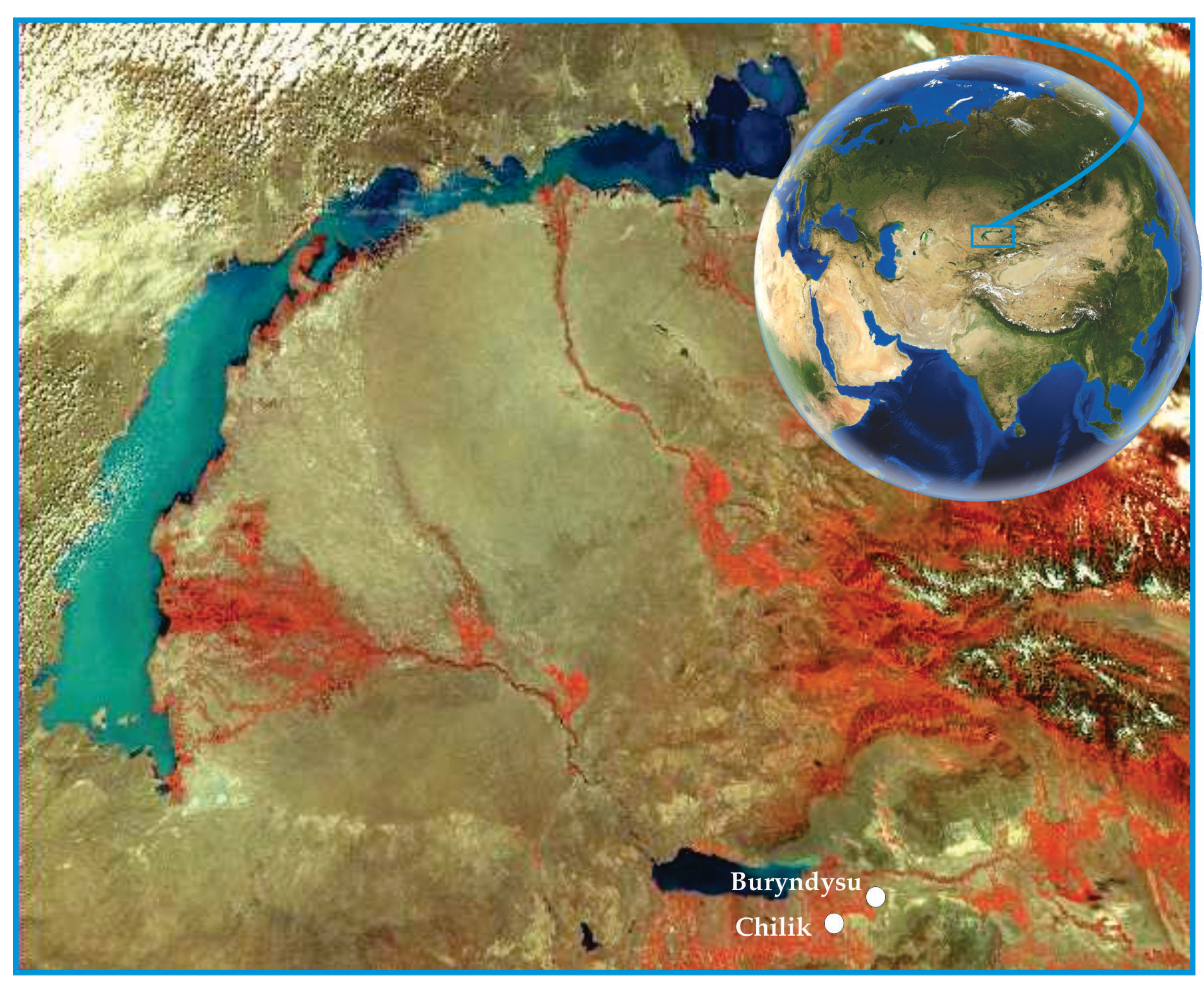
Figure 2.
Trabutina serpentina, Chilik (up), and Buryndysu (down) monitoring sites 2001.
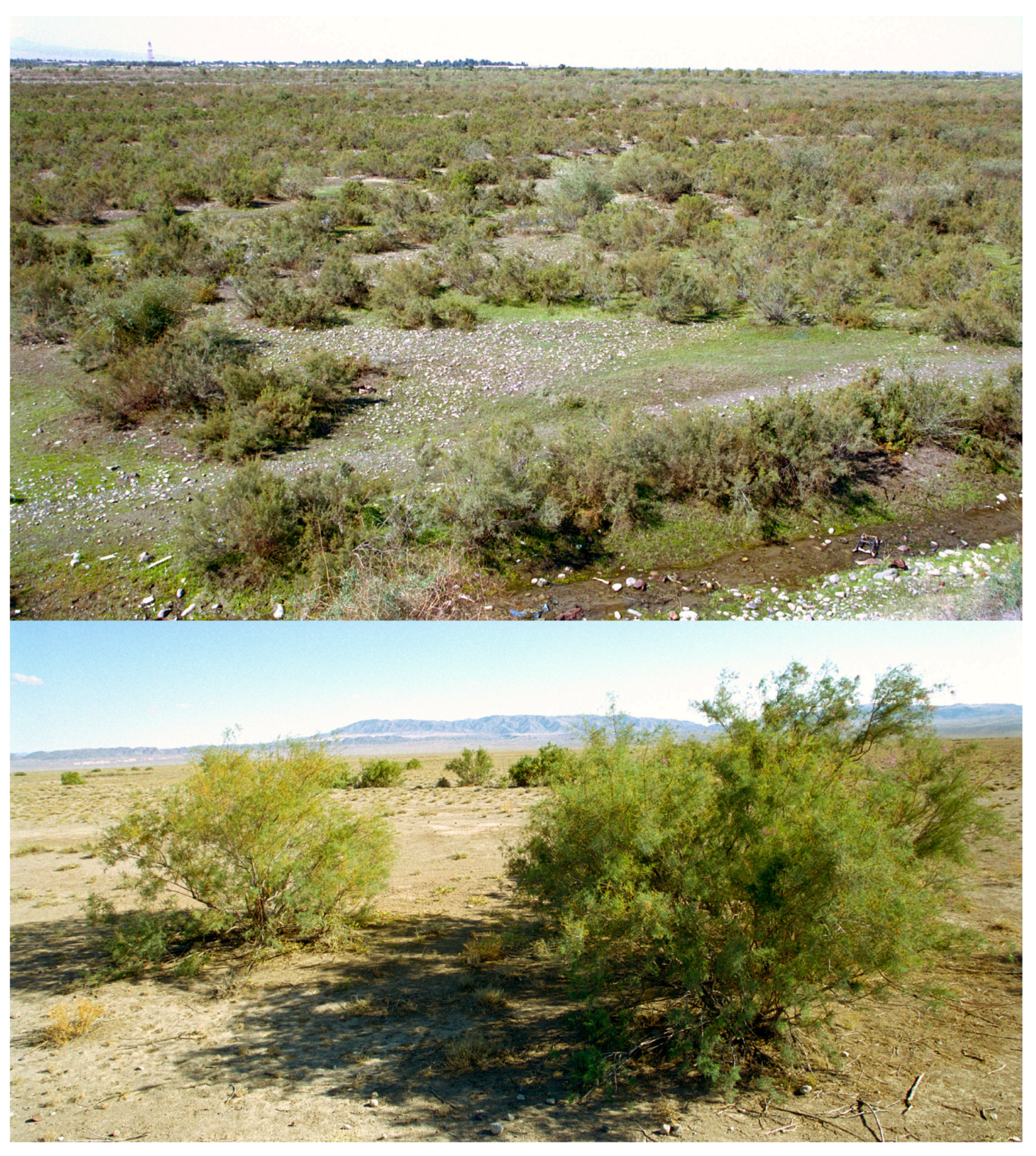
Figure 3.
Trabutina serpentina, young females, Buryndysu, June 2003.
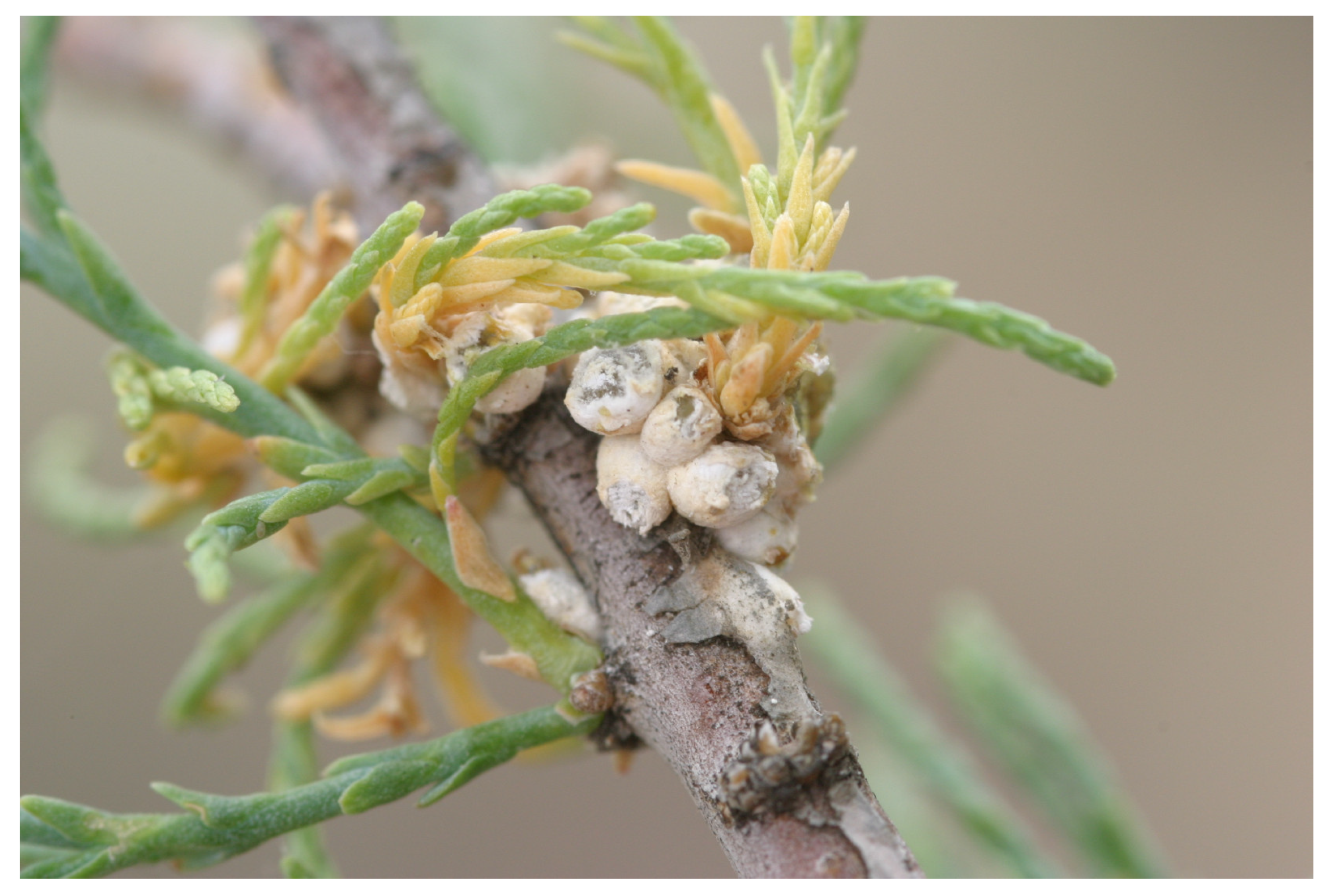
Figure 4.
Trabutina serpentina, Chilik, July 2000.
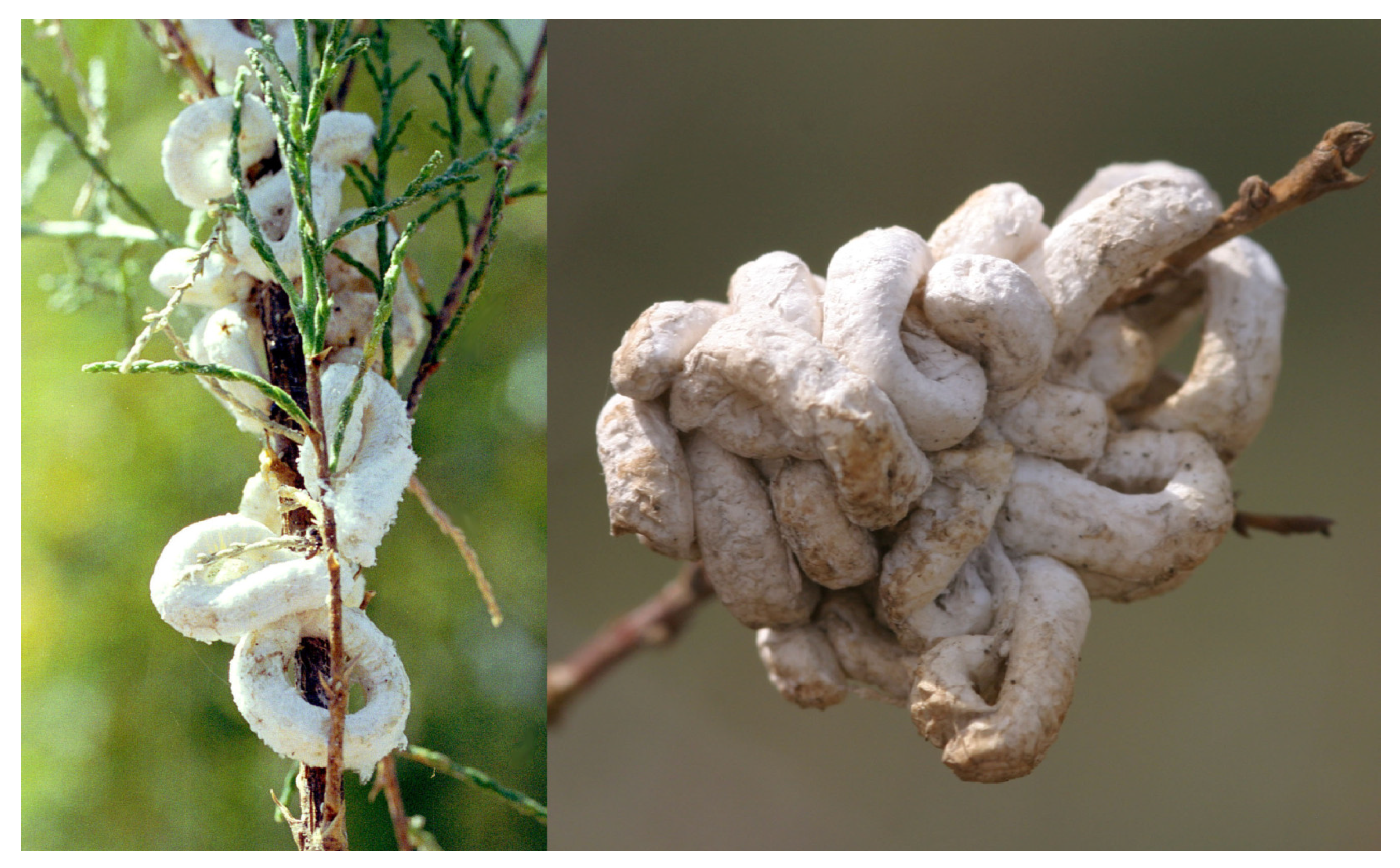
Figure 5.
Trabutina serpentina, left: infestation, Chilik, July 2003; right: last larvae and young females, Buryndysu, July 2006.
Figure 5.
Trabutina serpentina, left: infestation, Chilik, July 2003; right: last larvae and young females, Buryndysu, July 2006.
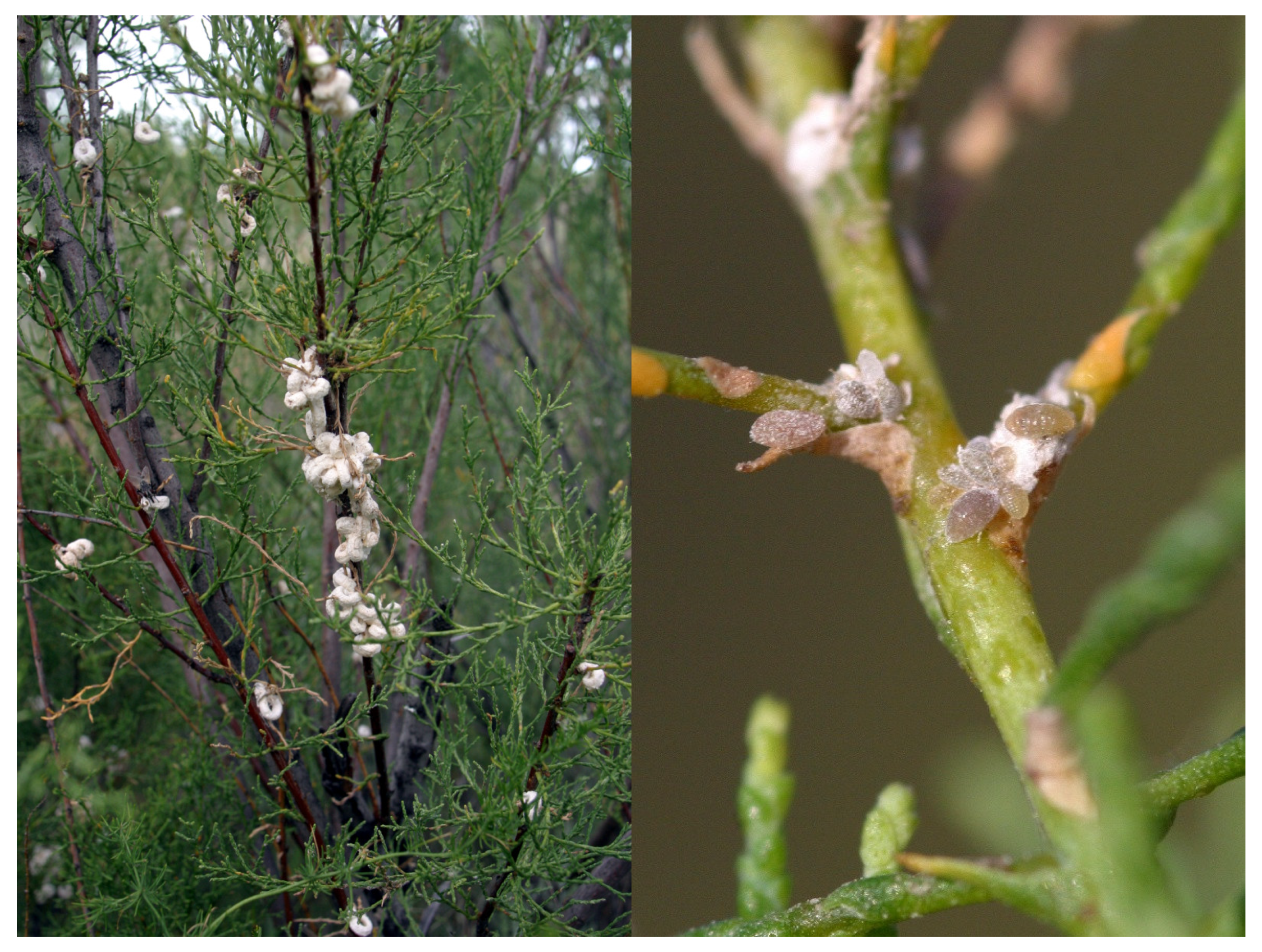
Figure 6.
Trabutina serpentina, females with secretion, Buryndysu, August 2004.
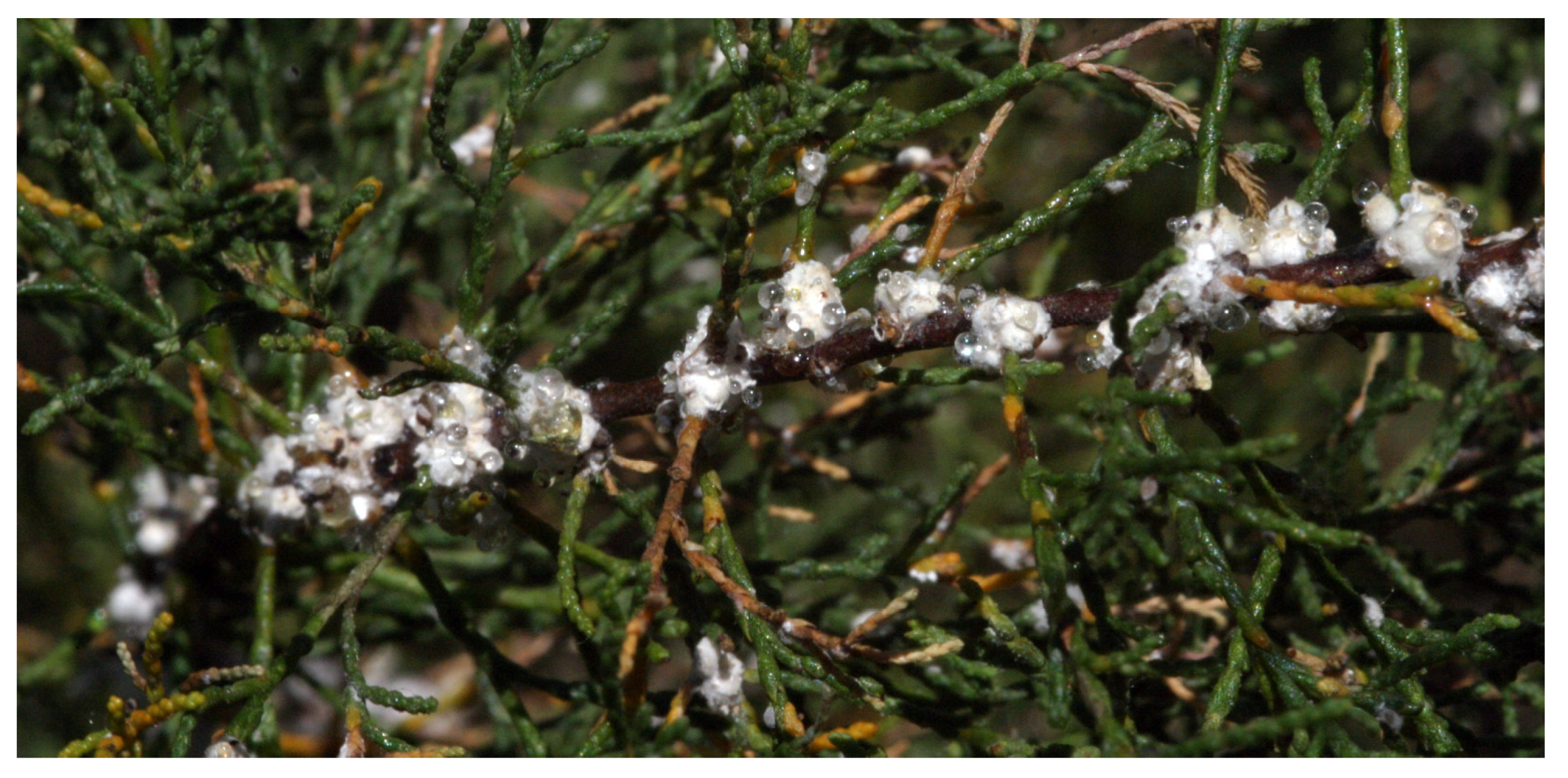
Figure 7.
Trabutina serpentina, infestation on American biotypes of T aphyllum, September 2003.
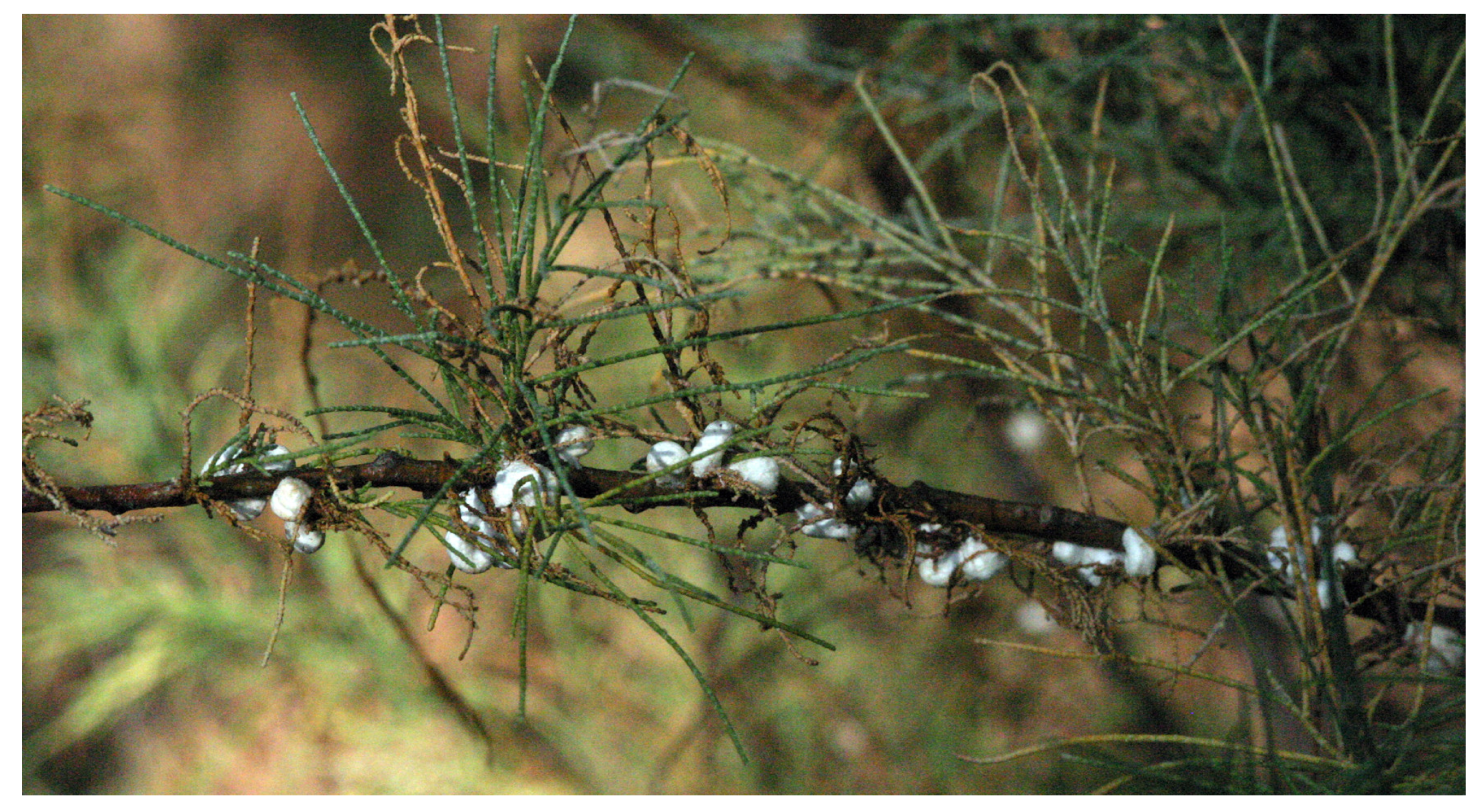
Figure 8.
Trabutina serpentina, infestation on American biotypes of T ramosissima, September 2003.
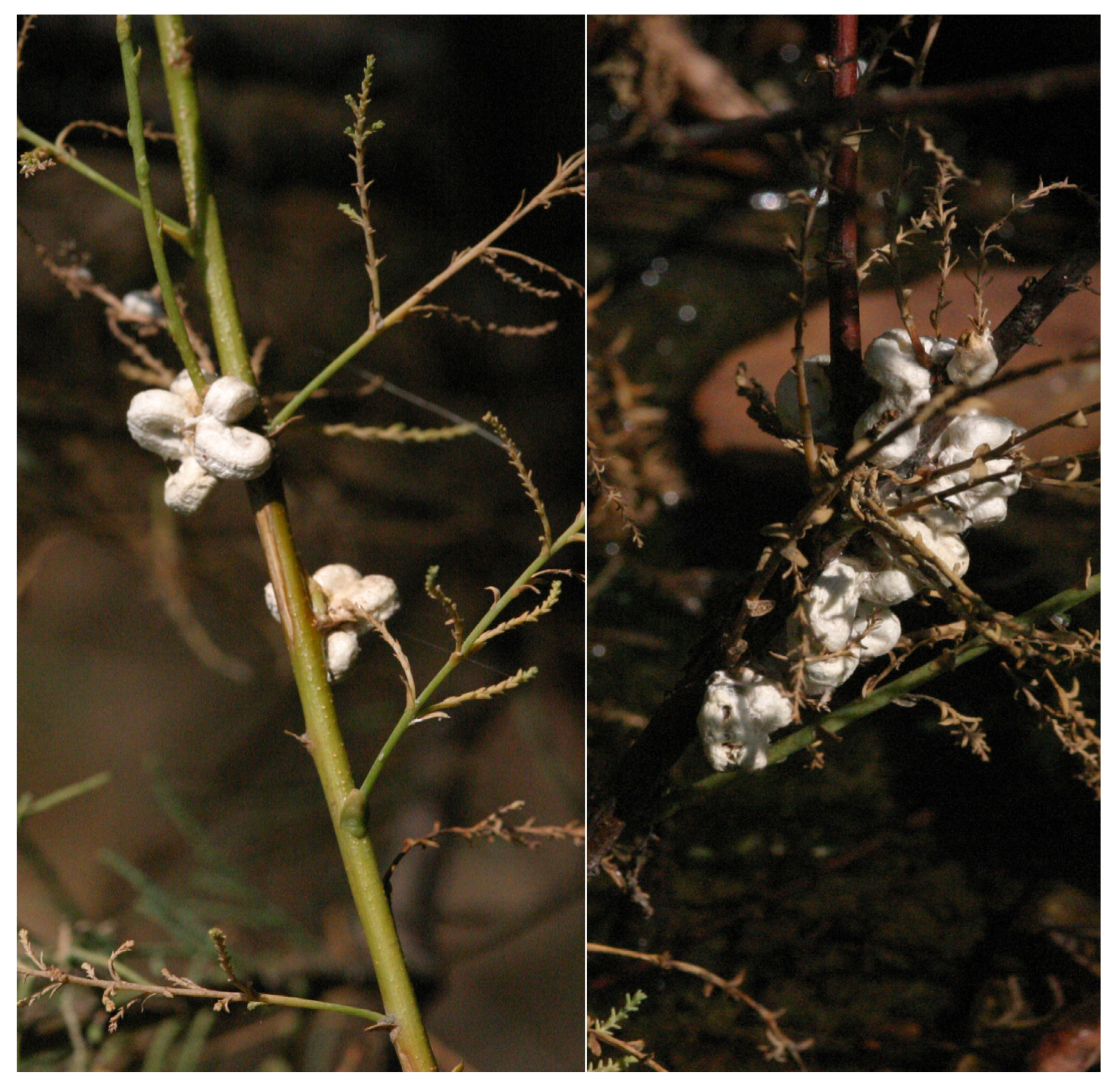
Figure 9.
Trabutina serpentina, American biotype T. aphylla, March 2004.
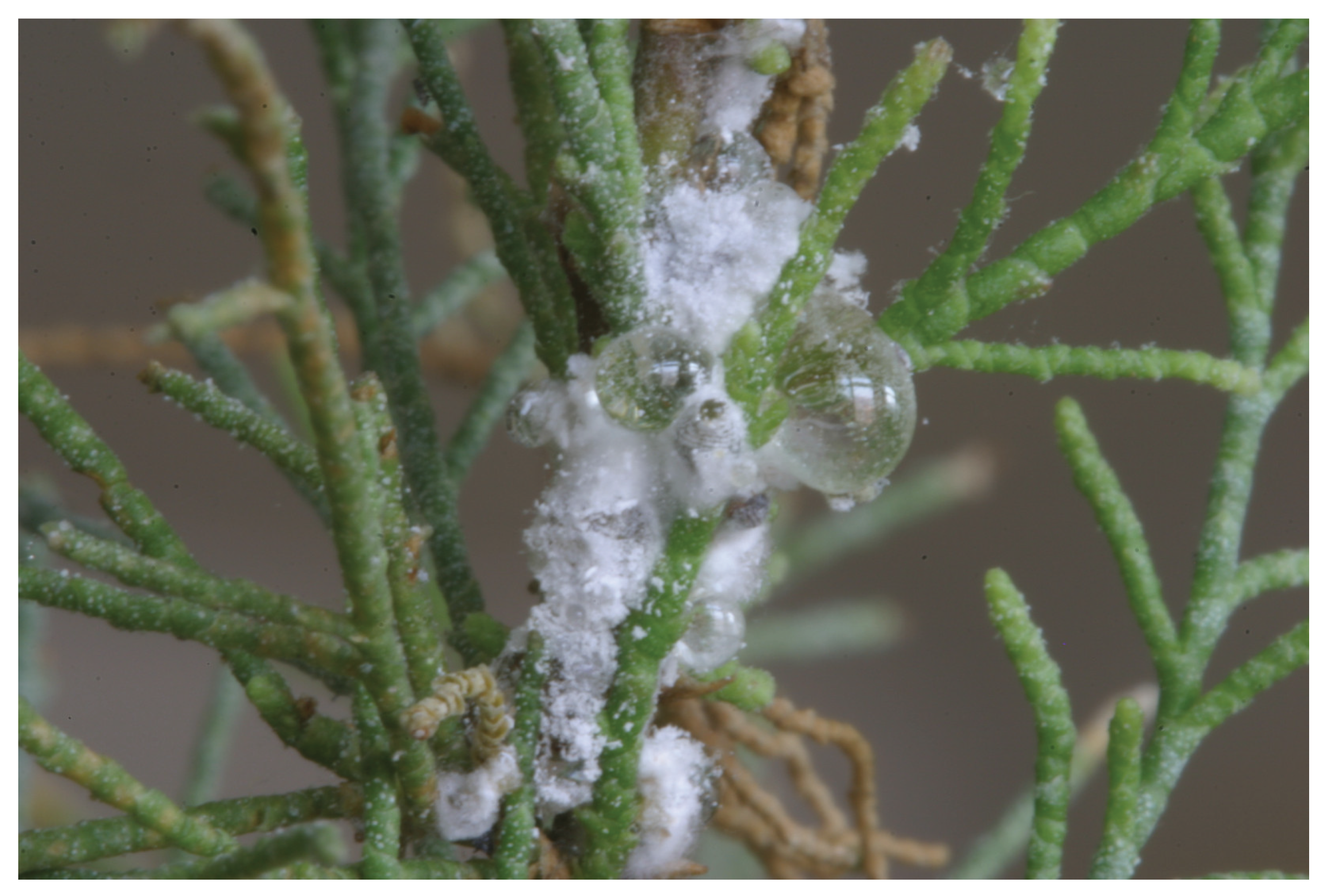

Table 1.
Infestation of Tamarix ramosissima bushes by the mealybug Trabutina serpentina near the village of Buryndysu (on June 19, 2003).
Table 1.
Infestation of Tamarix ramosissima bushes by the mealybug Trabutina serpentina near the village of Buryndysu (on June 19, 2003).
| Dense Thickets | Individual Bushes | ||||||
|---|---|---|---|---|---|---|---|
| Bush ID | Bush Height (in Meters) |
Bush Diameter (in Meters) |
The Number of Mealybug Colonies | Bush ID | Bush Height (in Meters) |
Bush Diameter (in Meters) |
The Number of Mealybug Colonies |
| 1 | 2.0 | 5.0 | 205 | 11 | 1.8 | 0.5 | 11 |
| 2 | 3.0 | 1.5 | 3 | 12 | 1.7 | 0.5 | 6 |
| 3 | 3.0 | 2.0 | 59 | 13 | 2.0 | 1.0 | 0 |
| 4 | 2.5 | 2.0 | 49 | 14 | 1.6 | 0.5 | 12 |
| 5 | 3.0 | 3.0 | 275 | 15 | 1.6 | 0.5 | 58 |
| 6 | 3.0 | 3.0 | 10 | 16 | 2.0 | 2.5 | 39 |
| 7 | 2.0 | 1.5 | 56 | 17 | 1.7 | 0.5 | 0 |
| 8 | 2.0 | 1.5 | 74 | 18 | 2.0 | 0.7 | 21 |
| 9 | 3.0 | 2.0 | 105 | 19 | 1.0 | 0.5 | 0 |
| 10 | 2.5 | 1.5 | 41 | 20 | 2.0 | 0.5 | 92 |
| Total: | 877 | 239 | |||||
Table 2.
Counting the T. serpentina colonies on American tamarisk seedling biotypes, September 19, 2003.
Table 2.
Counting the T. serpentina colonies on American tamarisk seedling biotypes, September 19, 2003.
| Nr. | American Biotype of Tamarisk | Number of Colonies | Number of Egg Sacs in the Colony | Notes |
|---|---|---|---|---|
| 1 | T. ramosissima, Lovell, Wyoming | 30 | 2,3,8,9,10 | The ratio of egg sacs is approximately equal. |
| 2 | T. ramosissima, Lovell, Wyoming | 12 | 1,2,3 | Single sacs predominate. |
| 3 | T. ramosissima, Apache, New Mexico | 43 | 1-3, 6-11 | Colonies with 6-11 sacs predominate. The distribution on the plant is even. |
| 4 | T. ramosissima, Apache, New Mexico | 34 | 1-2, 3-6 | Colonies with 3 to 6 sacs predominate. |
| 5 | T. ramosissima, Trego County, Kansas: | 42 | 1-2, 19 | Colonies with 1-2 sacs predominate, mostly at the top of the plant |
| 6 | T. ramosissima, Stlew, Nevada | 7 | 2,7,14 | Plants with 2 sacs located at the bottom of the plant predominate |
| 7 | T. ramosissima, Stlew, Nevada | 32 | 1-3, 4-8, 14 | The distribution of sacs is even |
| 8 | T. ramosissima, Stlew, Nevada | 32 | 1-3,7-8 | Two colonies (7-8) at the top of the plant |
| 9 | T. aphylla, Uvalde, Texas | 10 | 1, 2-14 | Single sacs predominate |
| 10 | T. aphylla, Uvalde, Texas | 8 | 1, 2-5 | Half of the sacs are single |
| 11 | T. aphylla, Uvalde, Texas | 5 | 1,1,2,3,12 | The distribution of sacs along the stem is scattered |
| 12 | T. aphylla, Uvalde, Texas | 18 | 2,3,4, 8-15 | Colonies with 8-15 sacs predominate on young shoots |
| 13 | T. aphylla, Uvalde, Texas | 23 | 1,2,3,4 | The distribution along the stem is even |
| 14 | T. aphylla, Uvalde, Texas | 4 | 1,1,2,3 | The distribution along the stem is even |
| 15 | T. aphylla, Uvalde, Texas | 20 | 1-3-4 | The distribution is mosaic |
| 16 | T. aphylla, Phoenix, Arizona | 24 | 1-2, 4-16 | 12 colonies of 4 to 16 sacs, some are single and double. Concentration of colonies in the lower part of the plant |
| 17 | T. aphylla, Phoenix Arizona | 19 | 1-3, 4-26 | 6 colonies of 4 to 26 sacs. Concentration at the bottom |
| 18 | T. parviflora, Cache Creak, California | 20 | 1,2,4,5 | Single and double egg sacs predominate. |
| 19 | T. parviflora, Cache Creak, California | 34 | 1,2, 5-16 | 11 colonies with 5 to 16 egg sacs, the rest are single and double. |
| 20 | T. parviflora, Cache Creak, California | 21 | 1-3, 5-12 | 7 colonies with 5 to 12 sacs, the rest are single, double and triple. |
Disclaimer/Publisher’s Note: The statements, opinions and data contained in all publications are solely those of the individual author(s) and contributor(s) and not of MDPI and/or the editor(s). MDPI and/or the editor(s) disclaim responsibility for any injury to people or property resulting from any ideas, methods, instructions or products referred to in the content. |
© 2026 by the authors. Licensee MDPI, Basel, Switzerland. This article is an open access article distributed under the terms and conditions of the Creative Commons Attribution (CC BY) license.
Copyright: This open access article is published under a Creative Commons CC BY 4.0 license, which permit the free download, distribution, and reuse, provided that the author and preprint are cited in any reuse.


