

Submitted:
19 December 2025
Posted:
22 December 2025
You are already at the latest version
Abstract
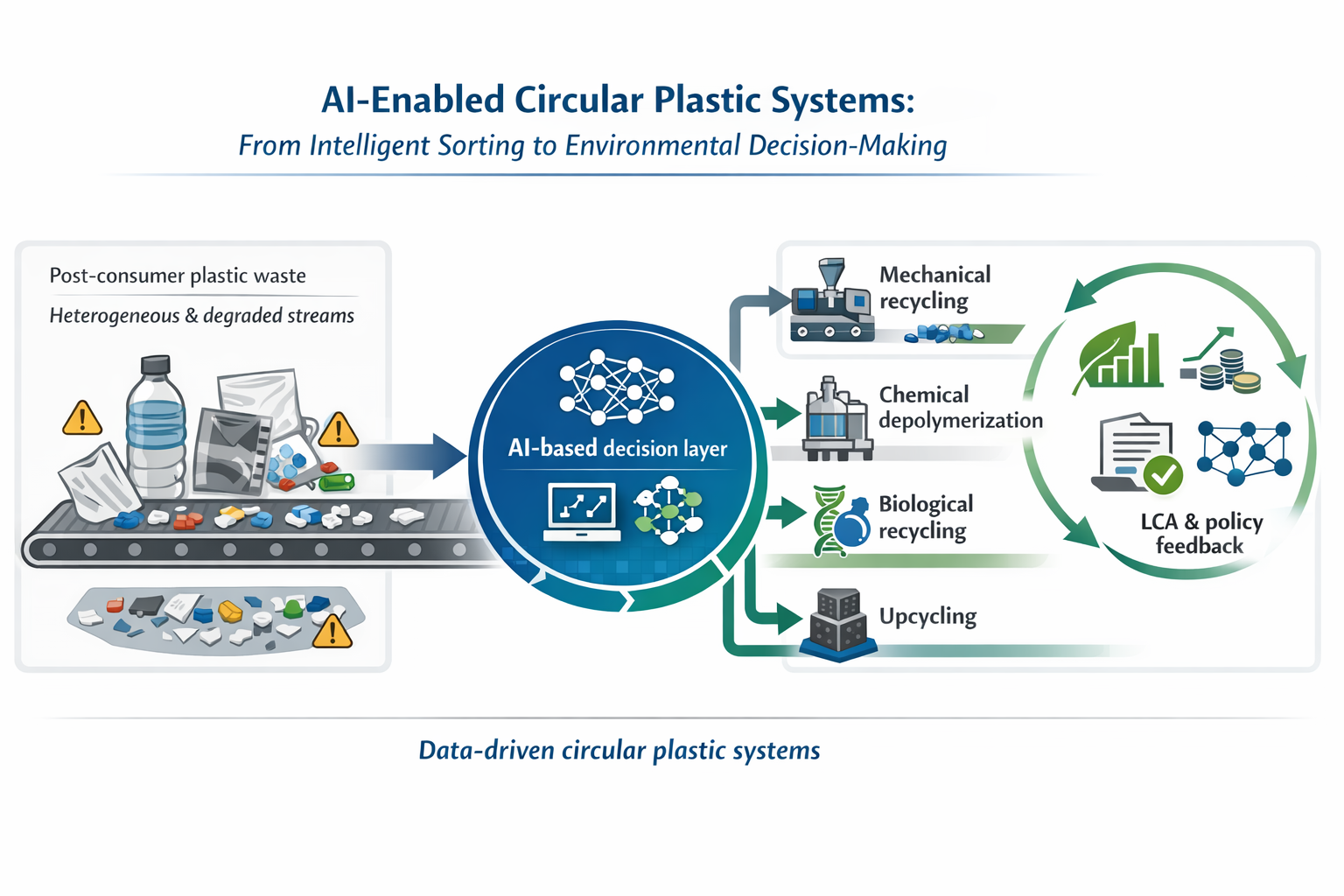
The increasing urgency to mitigate plastic pollution has accelerated the shift from linear manufacturing toward circular systems. This review synthesizes current advances in mechanical, chemical, biological, and upcycling pathways, emphasizing how artificial intelligence (AI) is reshaping decision-making, performance prediction, and system-level optimization. Intelligent sensing technologies — such as FTIR, Raman spectroscopy, hyperspectral imaging, and LIBS — combined with machine-learning classifiers have improved material identification, reduced reject rates, and enhanced sorting precision. AI-assisted kinetic modeling, catalyst performance prediction, and enzyme design tools have improved process intensification for pyrolysis, solvolysis, depolymerization, and biocatalysis. Life Cycle Assessment (LCA)–integrated datasets reveal that environmental benefits depend strongly on functional-unit selection, energy decarbonization, and substitution factors rather than mass-based comparisons alone. Case studies across Europe, Latin America, and Asia show that digital traceability, Extended Producer Responsibility (EPR), and full-system costing are pivotal to robust circular outcomes. Upcycling strategies increasingly generate high-value materials and composites, supported by digital twins and surrogate models. Collectively, evidence indicates that AI moves from supportive instrumentation to a structural enabler of transparency, performance assurance, and predictive environmental planning. The convergence of AI-based design, standardized LCA frameworks, and inclusive governance emerges as a necessary foundation for scaling circular plastic systems sustainably.
Keywords:
circular plastic systems
; artificial intelligence in recycling
; chemical and biological depolymerization
; upcycling of plastics
; life cycle assessment
; intelligent sorting technology
1. Circular Strategies for Plastic: Concepts and Global Context
The circular economy (CE) represents a systemic shift from traditional linear production models toward regenerative cycles in which materials retain value for as long as possible. This transition relies on strategies such as reuse, repair, refurbishment, remanufacturing, and recycling, aiming to minimize waste generation and extend product lifetimes through multiple value loops [1]. The relevance of circularity becomes particularly evident when considering the historical trajectory of plastics: early biobased materials such as natural rubber and shellac gave way to synthetic polymers that, during and after the Second World War, were engineered to be lightweight, durable, hygienic, chemically resistant, and easily manufacturable at scale [2]. These advantages accelerated global demand and positioned plastics as indispensable in modern life. However, this very success also entrenched highly linear patterns of production and disposal. Since the 1950s, plastic production has increased more than 230-fold, reaching nearly 400 Mt in 2022, while recycling rates remain below 10% and landfilling persists as the dominant waste pathway [3].
While plastic pollution is often associated with post-consumer residues, a substantial share of plastic volume accumulates before products even reach use. Industrial surpluses, idle inventories, and stockpiled goods contribute to long-term material accumulation, creating a hidden reservoir of future waste that is rarely considered in conventional waste models. As shown by Geyer et al. [4], in 2015, 105 Mt of plastics entered global stock without fulfilling their intended functions, highlighting the need for early recovery strategies and improved resource stewardship. The dominance of a limited set of polymers—PE, PP, PET, PVC, PS, HDPE, and LDPE—across packaging, construction, textiles, automotive, and electronics further underscores the scale of the challenge. The packaging sector alone accounts for ~40% of annual production, but multilayer structures, pigments, additives, and volatile compounds significantly hinder recyclability and contaminate material streams, reducing the effectiveness of mechanical recovery [3,5,6]
Environmental and health risks add additional layers of complexity. According to Sunil et al. [7], plastic pollution affects both terrestrial and aquatic environments, with microplastics and nanoplastics raising concerns due to their mobility, bioaccumulation potential, and capacity to transport harmful additives or absorbed toxins [8]. Degradation processes—including thermal oxidation, UV-induced fragmentation, and biological weathering—can also release greenhouse gases such as CO₂, linking plastic mismanagement to climate change [6,9]. These risks reinforce the need to expand the focus on circularity from end-of-life management to full-life-cycle optimization, encompassing product design, material selection, performance during use, and emissions control throughout the system [10].
Circularity in plastics is structured around a set of technical recirculation loops that define how value can be retained over multiple cycles. As outlined by Bucknall [3] and the Ellen MacArthur Foundation [11], these loops range from prevention through ecodesign and reuse, to mechanical recycling, upcycling, and chemical or biological depolymerization, with energy recovery as a last resort. Each loop requires specific interventions, infrastructure, and quality thresholds, making it essential to understand their interactions and limitations before examining contemporary CE models or proposing new technological strategies.
Within this evolving landscape, emerging digital technologies—including artificial intelligence—are rapidly transforming circularity practices and creating new opportunities for optimization across the plastic value chain. AI, encompassing machine learning, deep learning, computer vision, robotics, and natural language processing, enables systems to process large, complex datasets, detect hidden patterns, predict system behavior, and automate decision-making at multiple levels [12]. In plastics management, AI can enhance material sorting accuracy, forecast waste generation, optimize collection and logistics, improve contamination detection, and support life-cycle modeling. These capabilities position AI as a key enabler for advancing from traditional linear systems toward data-driven, high-efficiency circular models.
2. Advanced Sensing and Intelligent Sorting of Plastics
2.1. The Strategic Role of Intelligent Sorting in Circular Plastic Systems
Intelligent sorting is a decisive stage in circular plastic value chains, determining both the quality of recovered materials and the feasibility of directing each stream to mechanical, chemical, or upcycling routes. Naeim et al. [13] outline that recycling pathways—mechanical, chemical, thermal, physical, and biological—present distinct performance constraints that depend heavily on input purity. Mechanical recycling, widely used due to its simplicity and low cost, is sensitive to degradation, contamination, and the presence of mixed polymers. Chemical and biological depolymerization can treat more complex residues but require high energy input or controlled conditions. These variations underscore the centrality of robust sorting methods, where AI plays a critical role by improving accuracy, compensating for hardware limitations, and enabling automated decision-making.
Complementary to recycling processes, Schyns and Shaver [14] classify valorization into four levels: primary (re-extrusion of pure streams), secondary (mechanical recycling with acceptable property retention), tertiary (chemical depolymerization), and quaternary (energy recovery). Effective sorting increases the probability of retaining materials in higher-value loops, making AI-enabled classification, contamination detection, and spectral interpretation essential in industrial circularity [15,16].
2.2. FTIR Spectroscopy and AI-Enhanced Signal Separation
Fourier-transform Infrared Spectroscopy (FTIR) is a core technique for polymer identification, owing to characteristic absorption bands in the mid-infrared region (4000–400 cm⁻¹) [17]. However, environmental samples often contain sediments, fibers, and organic residues, which can generate overlapping spectra. When microplastic particles are filtered, the membrane itself introduces a confounding spectral signature.
To address this challenge, Buauk et al. [18] applied dictionary learning, an interpretable machine learning technique that decomposes mixed spectra into “spectral atoms” representing filter and polymer contributions. This digital separation reconstructs clean polymer signals even at low concentrations or under noisy conditions. Unlike deep neural networks, dictionary learning retains chemical interpretability and provides transparency into classification decisions—an advantage in regulatory or industrial contexts. These capabilities position FTIR combined with AI as a powerful tool for automated microplastic identification and high-precision sorting.
2.3. NIR Spectroscopy, Minuaturization, and Machine Learning and AI-Enhanced Signal Separation
Near-infrared spectroscopy (NIR) has become essential for real-time sorting thanks to device miniaturization, enabling use outside laboratory environments. Although portable NIR units sacrifice spectral resolution, machine learning compensates for incomplete or noisy signals, enabling accurate classification.
Fang et al. [5] demonstrate that hyperspectral NIR combined with multivariate models effectively discriminates polymers such as PE, PP, PET, and PLA, though performance declines in dark-colored plastics or highly heterogeneous streams. van Hoorn et al. [19] evaluated low-cost devices (e.g., Plastic Scanner). They found that hardware constraints—gaps between emission bands, low-power LEDs, and limited detector sensitivity—often produce misclassification despite advanced algorithms. Laboratory-grade NIR models reached ~97% accuracy, while mid-range devices achieved ~93% and low-cost devices ~70%
These findings confirm that algorithmic sophistication cannot compensate for severe hardware limitations, but that machine learning significantly enhances classification when spectral quality is moderate. Broader illumination sources and improved detectors could elevate portable NIR to industry-grade performance, making ML-enhanced NIR a cornerstone of accessible intelligent sorting systems.
2.4. Raman Spectroscopy Supported by Preprocessing and IA Algorithms
Raman spectroscopy provides chemically specific vibrational fingerprints and is less affected by moisture or matrix complexity than NIR, making it valuable for heterogeneous or degraded plastics [7]. Fang et al. [5] evaluated three machine learning models—nearest neighbors, random forest, and artificial neural networks—trained on Raman spectra of standardized plastics. Fluorescence was the principal challenge, leading to baseline drift and noise that impeded the identification of ABS, PET, POM, and PVA. However, preprocessing (smoothing, baseline correction, normalization) dramatically improved accuracy.
Among the algorithms, the nearest neighbors model delivered the best balance of accuracy and speed, achieving 100% accuracy in controlled tests with processing times of ~4 ms, and combining spectral peak areas and statistical descriptors further improved robustness. These results demonstrate that AI-enabled Raman systems can deliver rapid, high-precision identification, supporting allocation of plastics across mechanical, chemical, and upcycling loops[5,7,20,21].
2.5. LIBS: Elemental Fingerprinting and AI for Complex Waste Stream
Laser-induced breakdown spectroscopy (LIBS) has gained prominence for sorting complex or contaminated plastics, particularly those from electrical and electronic waste, where flame retardants or inorganic fillers must be detected. LIBS generates microplasmas that emit atomic signatures, enabling rapid identification.
Das et al. [22] analyzed 1800 LIBS spectra from six resin categories. They demonstrated that support vector machines and multilayer perceptron neural networks achieved 92–96% accuracy, reaching >98% under dynamic conditions simulating conveyor belt operation. LIBS combined with AI is especially effective where vibrational techniques fail due to overlapping molecular signatures or heavy additive content. Its robustness under variable color, texture, and composition makes it a strategic technology for the most complex sorting scenarios in circular systems.
The key elements described across sections 2.1-2.5 converge in a unified workflow, illustrated in Figure 1. This diagram illustrates how advanced sensing techniques combined with artificial intelligence enhance accuracy, robustness, and efficiency in circular plastic sorting systems.
3. Optimization of Mechanical, Chemical, and Biological Recycling Routes 320.
Optimizing recycling routes within circular plastic systems requires addressing degradation pathways, improving material performance retention, and managing feedstock heterogeneity, as these conditions ultimately determine process viability, yield quality, and circular value recovery. Under CE principles, plastics are reincorporated into multiple-use cycles through mechanical, chemical, or biological routes, each of which requires tailored optimization strategies to increase recovery efficiency, reduce energy consumption, and sustain material performance across repeated loops. These recycling pathways present distinct operational boundaries driven by degradation history, contamination level, and polymer compatibility [23,24]. However, all are increasingly strengthened by emerging tools such as predictive modeling, catalyst-informed process design, and advanced bioengineering strategies that improve decision-making during sorting, processing, and final allocation.
3.1. Optimization of Mechanical Recycling
Mechanical recycling remains the most widespread and industrially implemented strategy due to simplicity, low capital expenditure, and compatibility with existing infrastructure [3,25]. However, its performance strongly depends on the polymer history, contamination level, and the degree of thermo-oxidative degradation accumulated over the service life [14,26].
Recent advances demonstrate that process optimization begins at the extrusion stage. Edeleva et al. [6,27] report that control of residence time, screw configuration, melt rheology, and stabilizer dosing governs chain scission, crosslinking, and viscosity loss. When properly controlled, these variables improve the integrity of the recyclate and energy efficiency during extrusion.
Material compatibility is another key driver of optimization for mixed streams [28]. Hassanian-Moghaddam et al. [29] highlight that olefin-block compatibilizers, covalent-adaptable networks, and specific fillers expand the applicability of recycled polyolefins by improving interfacial adhesion. These stabilization strategies are especially relevant when transitioning from post-industrial PI to heterogeneous post-consumer PC flows. These approaches expand circularity thresholds for mixed polyolefin streams, often associated with packaging, automotive, and consumer goods waste [3,6].
Economically, mechanical recycling remains preferable when contamination is low and when feedstock quality supports high-value direct reuse. Uekert et al. [30] report that mechanical recycling outperforms other closed-loop options when sorting quality is adequate, and degradation remains below mechanical-property critical limits. Their analysis further indicates that the transition to chemical pathways occurs when the recyclate quality falls below the reprocessing grade specifications.
Moreover, integrating real-time monitoring with predictive algorithms enables decision-making before irreversible degradation occurs. Inline FTIR/NIR analysis, melt-flow index tracking, and residency-time prediction models allow assigning materials to appropriate loops before quality losses accumulate—improving yield retention and energy efficiency. Overall, mechanical optimization converges on:
- Minimizing thermo-mechanical degradation [6],
- Enhancing inter-polymer phase compatibility,
- Minimization of mass losses along washing, melting, and filtration steps, and
- Integrating predictive extrusion-quality models.
3.2. Optimization of Chemical Recycling
Chemical routes—particularly pyrolysis, solvolysis, hydrogenolysis, and depolymerization—support recovery when waste is highly heterogeneous or degraded, making mechanical pathways unsuitable [13]. Catalyst engineering and the integration of kinetic models are central to improving purity-product curves.
Huang et al. [31] emphasize that process intensification through catalyst selection governs selectivity, hydrocarbon distribution, and coke formation. Catalyst–product relationships show that zeolites enhance aromatics, silica–alumina systems improve cracking balance, and fluid-catalytic designs accelerate conversion while reducing tar formation.
Life-cycle trade-offs relative to mechanical approaches have been quantified by Jeswani et al. [32], who conclude that environmental competitiveness improves only when thermal integration and selective upgrading steps are incorporated.
From an industrial perspective, Kumagai et al. (2025) highlight three optimization priorities:
- Catalyst robustness across mixed streams,
- Reduction of energy intensity per ton converted, and
- Validation of lab kinetic performance at pilot-plant scales
Data-guided pyrolysis optimization is emerging as the most transformative area. Paavani et al. [33] and Tomme et al. [34] show that machine-learning frameworks accurately predict wax, gas, aromatics, and fuel fractions based on input composition. These datasets establish predictive routes to maximize monomer-grade output while minimizing operating conditions via automated search spaces. A significant advance in the optimization of AI-assisted thermochemical pathways is the study by Cheng et al. [35], which developed machine-learning models to accurately predict products from continuous non-catalytic pyrolysis of plastic waste. To do this, they compiled a database derived from 93 experimental studies and evaluated four supervised algorithms: decision trees, artificial neural networks, support vector machines, and Gaussian processes. Its objective was to identify which variables allow the performance of solids, liquids, and gases to be predicted more accurately, as well as the specific compositions within each fraction. The results show that decision tree-based models far outperform the other approaches, achieving coefficients of determination greater than 0.99 for predicting waxes, aromatics, gasoline, light gases, and condensable fractions.
Collectively, optimization of chemical routes depends on:
- Kinetic-parameter predictive models,
- Catalyst recombinations studies,
- Integrated heat-exchange schemes, and
- Selective downstream purification.
3.3. Optimization of Biological Routes
Bacteria and fungi can fragment polymers under aerobic or anaerobic conditions, generating low-molecular-weight compounds that are integrated into metabolic pathways or transformed into products by metabolic engineering under mild conditions, thereby reducing the energy load relative to thermochemical conversion [36,37]. However, their adoption remains limited mainly to polyester-based waste streams such as PET.
Enzymatic hydrolysis studies demonstrate that PETases and MHETases yield high-purity monomers, though structural crystallinity substantially limits reaction kinetics [8]. Thus, preprocessing steps—e.g., amorphization, grinding, surface oxidation—are essential to increase accessibility.
Chen et al. [38] indicate that biologically driven valorization is most effective under hybrid schemes combining controlled oxidation followed by microbial conversion. An example is the study by Zhan et al. [36], which showed that polyethylene, one of the most recalcitrant polymers due to the stability of its C–C bonds, can be chemically oxidized to generate C4–C6 diacids that subsequently serve as substrates for metabolically redesigned Corynebacterium glutamicum. Similarly, Uekert et al. [30] show that Techno-economic analysis of LCA metrics position enzymatic conversion as optimal when solvent volumes, wash-water load, and enzyme consumption are minimized.
A structural limitation persists: unlike mechanical or chemical routes, biological optimization suffers from a limited enzyme dataset. There is limited availability of:
- PETase mutational libraries,
- Kinetic profiles across crystalline grades, and
- Validation of ML-guided enzyme-design workflows.
This absence presents an opportunity to accelerate the development of circular platforms. Jiang et al. [39] developed PEZy-Miner, a machine learning-powered computational framework designed to discover enzymes with plastic-degrading potential from uncharacterized sequences. The approach combines protein language models that encode implicit structural properties within sequences with supervised classifiers that predict an enzyme’s degradative capacity across 11 polymer types.
3.4. Cross-Route Optimization Perspective
Across loops, optimization is influenced by feedstock state, compatibility requirements, and targeted product quality thresholds:
- Mechanical loops maximize value when polymer memory is known, and degradation is minimal.
- Chemical loops maximize value when the waste stream is heterogeneous, multilayered, or contaminated.
- Biological loops uniquely deliver monomer-grade purity but require substrate accessibility and bio-catalyst engineering.
At present, convergent industry trends emphasize integrating:
- ML-assisted condition prediction,
- TEA-LCA indicators, and
- Quality-based routing logic.
This provides decision frameworks where each stream feeds into the most favorable loop based on circular-value recovery rather than cost alone.
3.5. Integrative Resources: Comparative Table and Conceptual Diagram
To elucidate the interactions among optimization pathways within circular systems, Figure 2 presents a conceptual decision framework for allocating post-consumer and post-industrial plastics to mechanical, chemical, or biological recycling routes. Allocation criteria include material condition, processing constraints, and anticipated value retention. Complementarily, Table 1 provides a structured comparative summary of technological levers, quantitative descriptors, and performance indicators documented in recent literature, enabling systematic evaluation of optimization priorities.
Importantly, route selection is not predetermined; it is informed by predictive decision-support models that integrate material quality, environmental impacts, techno-economic assessments, and digitally enabled diagnostics. Mechanical recycling performance is primarily governed by melt stability and compatibilization strategies, whereas chemical pathways depend on catalyst selectivity, reactor configuration, and energy intensity. Biological routes emphasize enzymatic efficiency, polymer accessibility, and hybrid integration for monomer recovery. These indicators collectively support the classification and prioritization of processing routes within circular-economy decision frameworks.
4. Upcycling Pathways for High-Value Recycled Polymer Materials
Upcycling emerged as a counterproposal to traditional recycling practices and was widely introduced by Michael Braungart and William McDonough in Cradle to Cradle: Remaking the Way We Make Things [40,41], where they proposed transforming discarded materials into products of higher added value through creative, ecologically oriented design [42]. Unlike conventional recycling—where materials degrade progressively, and experience reduced mechanical or economic performance after successive cycles—upcycling introduces the opposite logic: transforming waste into products with superior functional, aesthetic, or economic attributes [43].
This paradigm aligns with the principles of the circular economy by integrating design strategies that anticipate multiple life cycles, minimize waste from the outset, and encourage modularity and reusability. As a result, upcycling reduces energy consumption, prevents premature disposal, enables the creation of unique high-quality products, and fosters innovation from the design stage [44].
When applied to plastic waste, upcycling offers pathways to recover high-value molecules, functional materials, and specialized products that often outperform conventional polymer resins. While traditional recycling—particularly for post-consumer plastics—faces challenges such as contamination, structural degradation, and water-intensive cleaning stages [45], upcycling leverages chemical, thermal, electrochemical, biological, or hybrid conversion routes to transform carbon-rich residues into valuable resources rather than simply diverting them from landfill
4.1. Technical Pathways for Plastic Upcycling
4.1.1. Chemical Routes
These involve depolymerization or selective bond cleavage, including glycolysis, solvolysis, hydrolysis, alcoholysis, aminolysis, oxidation, and hydrogenolysis [40]. Polyester-based plastics (e.g., PET, PLA) exhibit high selectivity toward monomers such as terephthalic acid, dimethyl terephthalate, or ethylene glycol [46].
4.1.2. Thermal and Thermochemical Process
Research on pyrolysis and gasification of plastics has emerged as a critical area of inquiry due to the escalating environmental challenges posed by plastic waste accumulation and the urgent need for a sustainable energy recovery method. Pyrolysis, which involves the thermal decomposition of plastics in the absence of oxygen to produce high-purity fuels and monomers, is a practical approach [47]. Since the early 2000s, thermochemical conversion technologies have evolved from conventional pyrolysis to advanced catalytic and microwave-assisted processes, enhancing energy efficiency and product selectivity. This versatile method converts plastics into gas by partial oxidation at temperatures above 800 °C, producing fuels or chemicals [35,48]. Despite advances, the efficient valorization of plastic waste through pyrolysis and gasification remains challenging, particularly in optimizing catalysts, reducing energy consumption, and ensuring product quality [49].
4.1.3. Electrochemical Upgrading
Research on the electrochemical upgrading of polyethylene terephthalate (PET) and polylactic acid (PLA) derivatives has emerged as a critical area of inquiry, with the potential to address plastic pollution while producing valuable chemicals and green hydrogen. The field has evolved from initial studies on PET hydrolysate oxidation to advanced catalyst designs enabling industrial-scale current densities and high selectivity for products such as formate, glycolate, and hydrogen [50,51,52]. Despite progress, challenges remain in achieving efficient, selective, and economically viable electrochemical conversion of PET and PLA derivatives. Key knowledge gaps include developing cost-effective catalysts with high activity and stability at industrially relevant current densities, understanding the mechanistic pathways of selective oxidation, and optimizing process efficiency for simultaneous hydrogen production [51,53].
4.1.4. Biological Upcycling
Research on the enzymatic degradation of plastics by cutinases, lipases, and carboxylesterases has emerged as a key subject of investigation due to the escalating environmental impact of plastic waste accumulation and the limitations of conventional recycling methods [54,55]. Since the 1990s, advances in understanding microbial and enzymatic degradation mechanisms have evolved, with early studies focusing on natural polymer degradation and recent efforts targeting synthetic polymers such as polyethylene terephthalate (PET) and poly(butylene adipate-co-terephthalate) (PBAT) [55,56].
Despite progress, enzymatic degradation of plastics faces critical challenges, including low catalytic efficiency on highly crystalline polymers, enzyme instability under industrial conditions, and limited understanding of the roles of microbial consortia in plastic upcycling. While cutinases and lipases have demonstrated activity against various polyesters, their performance on persistent plastics such as polyethylene and polypropylene remains [54,55,56,57].
4.1.4. Polymer Blending and Compatibilization
Mixed plastic waste typically includes a variety of polymers, such as PE, PP, PS, and PET. These materials are often recycled from uncleaned, unsorted waste, leading to a heterogeneous mixture that complicates recycling efforts. The inherent incompatibility among these polymers results in poor mechanical properties and phase segregation when they are blended without a compatibilizer [58]; the introduction of compatibilizers, such as organic esters, acids, or modified polymers, is needed to improve the mechanical properties [8,57,58,59]. Plastic waste can be utilized in construction materials, such as concrete mixtures and block manufacturing, to produce durable, heat-resistant, and water-resistant products. The combination of plastic waste with solid waste materials such as furnace slag and fly ash can produce composite building materials that are non-toxic, odorless, and recyclable, aligning with the clean production principle [60].
4.2. Artificial Intelligence as an Optimization Driver in Upcycling
Due to the high variability of plastic waste, process uncertainties, and nonlinear conversion mechanisms, upcycling systems benefit significantly from AI-enabled optimization. Machine learning (ML) supports predictive modeling, material discovery, and reactor-level control, helping overcome processing inefficiencies. Means et al. [61] conducted a large-scale data mining analysis of more than 10,000 published works, using natural-language processing to classify technological evolution trends. The analysis revealed that polyethylene and polypropylene are the most studied targets, that pyrolysis-based valorization is the dominant route, and that ML model integration is increasing for prediction and optimization.

Table 2.
Representative applications of artificial intelligence (AI) tools in plastic upcycling, highlighting optimization strategies, target processes, and performance outcomes across chemical, biological, and materials-design pathways.
Table 2.
Representative applications of artificial intelligence (AI) tools in plastic upcycling, highlighting optimization strategies, target processes, and performance outcomes across chemical, biological, and materials-design pathways.
| Authors | Application of IA | Results |
|---|---|---|
| Wang et al. [62] | SERDA, SVR, PSO, XGBoost | Optimization of pyrolysis catalytic conditions to maximize fuels |
| Wang et al. [63] | Predictive models | Transformation of medical waste into activated carbon with high CO₂ capture performance |
| Huang & Lee [64] | Optimización estructural | Production of electrodes from PP mask |
| Cui et al. [65] | Algorithm-assisted design | Selective photocatalysts for depolymerization |
| Rezaei et al. [66] | Practical bioinformatic | Prioritization of metabolic pathways for biodegradation |
| Li et al. . [67] | Neural Networks | Porous carbon optimization with maximum CO₂ sorption |
Li et al. [67] analyzed the impact of the COVID-19 pandemic on the proliferation of medical plastic waste. They proposed four axes for the upcycling of plastic waste: a) increase the biodegradability of materials, b) transform plastics into high-value products through chemical processes, c) promote closed recycling with biodegradation, and d) link renewable energies.
It was highlighted that AI can be integrated into catalyst design and the optimization of chemical processes, especially for predicting reaction selectivity and efficiency. However, these are conceptual proposals rather than experimental applications.
The upcycling of recycled plastics, combined with residual biomass derived from agro-industrial waste, enables the production of sustainable polymers and compounds with mechanical properties comparable to, and in some cases superior to, those of virgin materials. For them, it is necessary to use artificial intelligence tools that allow the optimization of 3D printing parameters, as well as the incorporation of additives —compatibilizers, stabilizers, surface modifiers, etc.— to improve mechanical strength, thermal stability, and adhesiveness, while reducing dependence on virgin materials; opening new possibilities for the creation of innovative and sustainable materials [68].
Qian and Ren [69] reviewed thermal and thermochemical upcycling technologies, including incineration, gasification, and pyrolysis, and complemented them with process optimization methodologies. The authors highlight the use of tools such as experimental design, superstructure optimization, and green supply chain management, emphasizing that artificial intelligence tools and computational models, such as neural networks and vector support machines, are essential for evaluating and optimizing conversion routes of plastics into high-value products. However, they are still in stages of conceptual integration.
Khairul Anuar et al. [70] reviewed advances in recycling and upcycling of hazardous plastics, including mechanical, chemical, and biological methods. These authors highlight innovations such as enzymatic depolymerization of PET, conversion of plastic waste into carbon nanomaterials (graphene and nanotubes), and photocatalytic processes. Although they recognize limitations in scalability and economic viability, they point out that artificial intelligence and machine learning are emerging as support tools for waste classification and the optimization of chemical processes, opening the way to overcome technical and regulatory barriers in the sustainable management of plastics.
In summary, artificial intelligence tools can be used in the optimization, prediction, and design of chemical, photocatalytic, biological, and simulation processes for the upcycling of plastics, opening the possibility of the recovery of high-value-added materials, as well as new materials with novel properties in the transition towards a circular economy of plastics.
4.3. Emerging Technological and Research Trajectories
Emerging technological trajectories in plastic upcycling increasingly position artificial intelligence (AI) as an enabling tool for optimizing system performance and scaling industrial deployment. AI contributes to multi-objective optimization—considering yield, purity, carbon conversion, and selectivity—while improving reactor control, predictive maintenance, and data-driven decision-making. In parallel, advanced computational tools, such as protein language models, are accelerating bio-pathway discovery, particularly in enzyme identification and metabolic engineering for polymer depolymerization. Hybrid simulations combining computational fluid dynamics and machine-learning frameworks further support process intensification under realistic industrial constraints.
Beyond purely technological advances, research is shifting toward integrating upcycled plastics with agro-industrial byproducts to produce composite biopolymers with superior properties. This direction is reinforced through AI-assisted optimization of 3D-printing parameters, simulation-driven additive selection, automated prediction of stabilizer and compatibilizer performance, and mechanochemical modeling to estimate long-term durability. As emphasized by Qian & Ren [69] and Khairul Anuar et al. [70], AI-guided optimization remains fundamental for scaling both thermochemical and biological upcycling systems to viable industrial levels, particularly in contexts where techno-economic viability, process reproducibility, and regulatory requirements still present significant challenges.
Upcycling provides value-positive material circularity by transforming post-consumer plastics into monomers, carbon-rich nanomaterials, high-performance composites, and functional biochemicals. Artificial-intelligence-enabled strategies accelerate process efficiency, enhance selectivity, and guide new-material discovery, creating a technological pathway toward viable, scalable, high-value circularity.
This combination of design thinking, catalytic innovation, hybrid conversion routes, and AI-assisted decision systems positions upcycling as a cornerstone for the future of circular plastic systems.
5. Life Cycle Assessment and Environmental Metrics in Circular Plastic Systems
Life Cycle Assessment (LCA) has emerged as a fundamental analytical tool for evaluating the environmental burdens associated with plastics throughout their life cycles. Its methodological foundations evolved from early Resource and Environmental Profile Analyses (REPA) during the 1960s–70s [71], originally applied to compare beverage packaging alternatives, leading eventually to the standardized framework established under ISO 14040 and ISO 14044 during the 1990s, defining requirements for goal definition, functional units, system boundaries, inventory compilation, and impact interpretation (ISO, 2006; SETAC, 1991). These standards formalized requirements for system boundaries, functional units, life-cycle inventory development, and impact interpretation, enabling methodological transparency across material systems.
In the context of plastics, LCA has gained prominence due to increased attention to emissions from petrochemical-origin polymers, landfill persistence, and microplastic generation [72]. Mechanical recycling often yields favorable environmental outcomes and lower GWP than virgin polymer production. However, its effectiveness is constrained by feedstock heterogeneity, accumulated degradation, loss of mechanical performance, and contamination effects [73]. In contrast, chemical recycling—especially pyrolysis and depolymerization pathways—enables monomer-level recovery and higher substitution equivalence but typically exhibits greater energy demands and process-related emissions, which vary significantly depending on reactor configuration and energy source [74]. Emerging enzymatic and biological depolymerization pathways provide monomers of high purity, although current energy limitations and uncertain industrial scalability introduce environmental trade-offs [75]. Upcycling systems, exceptionally when engineered for enhanced performance and extended product lifetime, can yield environmental gains, provided that substituted virgin materials are explicitly accounted for [76].
5.1. System Boundaries Relevant to Plastic Circularity
The environmental interpretation of recovery routes depends heavily on the selection of system boundaries. The classification most commonly applied in plastics LCA literature includes Cradle-to-Gate, Gate-to-Gate, Cradle-to-Grave, and Cradle-to-Cradle boundaries [77]. These boundaries determine whether environmental burdens will be attributed only to conversion stages or also to storage, use phase, and subsequent end-of-life pathways.
A comparative summary is presented in Table 1 to facilitate alignment among the recovery process type, the intended system scope, and the methodological rationale.
Table 3.
System boundaries applied to LCA of circular plastics, functional purpose and representative literature.
Table 3.
System boundaries applied to LCA of circular plastics, functional purpose and representative literature.
| System Boundary | Description | Typical Use Case | Representative Literature |
|---|---|---|---|
| Cradle-to-Gate | Covers the transformation from raw feedstock or collected waste to the production of usable recycled resin | Comparative assessments of mechanical vs chemical vs bioconversion technologies; benchmarking efficiency of pyrolysis units | Jeswani et. al.[32]; Huang et. al.[31]; Chen et. al. [78] |
| Gate-to-Gate | Focused exclusively on intra-plant processes such as washing, extrusion, catalytic depolimerization, pelletization | Optimizing specific unit operations, industrial diagnostics, and energy allocation analysis. | Martínez-Narro et. al. [79] |
| Cradle-to-Grave | Includes production, use, and end-of-life scenarios, including landfill disposal, incineration, and recycling. | Packaging evaluations; comparisons of polymer alternatives for equivalent protection performance. | Jeswani et. al.[32]; OECD [80] |
| Cradle-to-Cradle | Incorporates full circular feedback; recovered product reenters the system with a virgin equivalent | “Bottle-to-bottle” PET system; chemical recycling routes returning monomer substitutes | Tang. [30]; Uekert et al. [30] |
5.2. Performance Characterization of Chemical Recycling Routes
Chemical valorization routes—such as catalytic pyrolysis, glycolysis, methanolysis, alcoholysis, and oxidative fragmentation—restore polymer-derived carbon into usable precursor molecules. LCA outcomes demonstrate that the environmental benefits of chemical recycling depend strongly on conversion yield, energy source, solvent recirculation rates, catalyst life, and product recovery efficiency [74]. Under fossil-derived heating, thermochemical conversion may exceed the energy demand of mechanical recycling; however, when powered by electrified low-carbon energy systems, monomer-grade outputs exceed the virgin displacement threshold and yield net GWP reductions [74,75].
5.3. Life-Cycle Implications of Upcycling Processes
Upcycling enables the recovery of value-enhanced outputs, such as nanocomposites, compatibilized blends, high-performance carbonaceous materials, and additive-modified formulations, yielding products that outperform the original resins [76]. Unlike classical recycling, which typically reduces mechanical performance and polymer chain integrity over time, upcycling extends the life cycle and delays disposal. LCA comparisons show that when performance equivalence with high-grade virgin resin is achieved, avoided burdens outweigh additional material additions; however, the evaluation must quantify emissions associated with compatibilizers, catalyst synthesis, and dispersive processing.
5.4. Digital-Twin-Based LCAs and Computational Attribution
Recent studies incorporate digital twin models in LCA frameworks to simulate reactor thermodynamics, conversion yield distributions, degradation kinetics, and catalyst regeneration cycles [74]. These models reduce allocation uncertainty by incorporating real-time process data. Simulation-assisted LCAs have quantified up to 25% variation in unit energy impacts depending on residence time and waste-composition fluctuation scenarios, strengthening scenario-based environmental predictions linked to industrial adoption readiness.
5.5. Comparative Findings Across Recycling Pathways
Cross-method assessment indicates that no individual technological pathway offers uniform environmental superiority. Mechanical recycling has the lowest energy intensity but suffers from quality attrition when input contamination exceeds thresholds [73]. Chemical recycling achieves the highest monomer purity and closed-loop value recovery but involves energy-intensive stages whose net benefit materializes only under adequate purification and solvent recovery conditions [74]. Biological depolymerization offers maximal theoretical circularity by producing monomers equivalent to virgin stock with minimal toxins [75]; however, maturity and processing yield limitations remain. Upcycling, when linked to demonstrable substitution of engineering-grade resins, appears promising in long-horizon LCA scenarios [76]. Instead, systemic decisions must be informed by environmental metrics derived from robust LCA approaches. Across technologies, environmental trade-offs arise from differences in energy demand, process intensification, additive impacts, and the substitutability of recycled materials. For instance, although mechanical recycling provides significant reductions in energy consumption and greenhouse gas emissions relative to virgin resin [73], its benefits diminish rapidly when feedstock heterogeneity, contamination, or polymer degradation degrades material quality. Conversely, chemical routes—particularly pyrolysis and depolymerization—enable high-purity outputs and valorization of complex waste streams, but they involve thermal hotspots that increase energy burden and emissions unless improved energy integration and catalytic optimization are implemented [74]. Recent studies report that closed-loop depolymerization routes can match virgin performance from a functional perspective; however, their environmental profiles depend on the energy sources and conversion efficiencies used [31,32].
Bioconversion-based routes have emerged as highly promising pathways, particularly for PET, where enzymatic depolymerization produces monomers with minimal compositional variability. In LCA scenarios, biocatalytic depolymerization shows potential to outperform chemical pyrolysis due to lower thermal requirements and higher molecular circularity, provided that conversion rates, retention yields, and enzyme stability are optimized [78]. Nonetheless, uncertainty persists, as large-scale enzyme production introduces environmental burdens associated with nutrient media, purification, and temperature control—requirements often overlooked in conventional impact models[81]. In this context, policy frameworks must facilitate industrial deployment by accounting for upstream burdens and incentivizing stable energy integration, renewable-based heating, and local valorization cycles.
Upcycling represents a differentiated scenario. While material quality frequently surpasses that of standard recyclate, environmental burdens depend on additives, nanofillers, compatibilizers, and stabilizers, whose production may have non-negligible impacts [76]. Studies integrating consequential LCA trends indicate that upcycling is justified when it demonstrably prevents production of energy-intensive virgin substitutes, particularly in packaging, electronics, engineered parts, and hybrid biodegradable composites [61,69]. Under such conditions, substitutability factors improve significantly, allowing circular materials to displace virgin grades at ratios of 0.8-1.0 based on mechanical properties, processability, and durability [82]. This makes upcycling strategically relevant for countries with limited high-quality sorting infrastructure, since value addition compensates for feedstock limitations.
From a policy standpoint, regulatory instruments must integrate environmental metrics, technological maturity, and evidence of substitutability. EPR schemes have demonstrated measurable improvements in recovery rates when linked to material quality requirements and LCA-based incentives [77]. However, EPR remains insufficient without digital traceability that can attribute environmental burdens to specific waste sources. Recent frameworks incorporating blockchain-based material passports and AI-based sorting quality indices indicate that traceability correlates with improved recyclate consistency, reduced rejection fractions, and decreased transport-induced emissions [61].
International guidelines also recommend adopting harmonized functional units that reflect real service performance rather than simple mass equivalence (ISO 14040; ISO 14044). Studies comparing one kg-gate outputs of recycled resin display bias when downstream performance differs substantially, especially under mechanical degradation or quality downgrading. Alternative functional units—such as equivalent protection time in packaging, mechanical strength-adjusted kilogram equivalents, or normalized service lifetime—yield clearer environmental profiles [83]. New methodological work on circularity metrics advocates integrating substitutability factors (αrec:vir), material retention coefficients, and cumulative energy demand to identify optimal technology deployment scenarios.
In addition to policy and methodological standardization, institutional stability is essential. Countries that have achieved consistent circularity gains—including Germany, The Netherlands, and Japan—share three structural elements:
- long-term regulatory planning;
- industrial-academic knowledge networks that reduce technological uncertainty;
Implementing these mechanisms in Latin American contexts requires adaptation to regional socioeconomic conditions, informal waste systems, and infrastructure constraints. Finally, the integration of AI enhances environmental decision-making through multiple mechanisms. ML-based predictive allocation models reduce losses in sorting, increase material purity, and support dynamic LCA scenarios. Surrogate-based energy predictions currently allow estimating reactor-level sensitivity (~20–40% reductions reported in pyrolysis optimization scenarios), while digital twins enable anticipatory maintenance, reduced batch rejection, and quality-tracking feedback loops. Such improvements demonstrate measurable reductions in environmental hotspots across recycling and upcycling chains [33,34].
In synthesis, achieving environmentally robust circular plastic systems requires: (i) coupling LCA-based decision frameworks with technology-specific operational data; (ii)promoting substitutability-validated outputs rather than generalized recycling rates; (iii) systematically applying AI for efficiency gains and uncertainty reduction; and (iv) integrating policies that internalize environmental externalities rather than shifting them between stages.
With these combined strategies, circularity transitions become not only technologically plausible but also socio-environmentally resilient, widening opportunities for carbon mitigation, waste reduction, and regenerative material flows.
6. Policy Instruments, Institutional Frameworks, and Circular Governance Mechanisms
Circular systems for plastics require not only technological innovation and advanced recycling pathways, but also robust institutional architectures that enable accountability, traceability, and economic viability. Among these instruments, EPR has emerged as a central regulatory pillar, complemented by market incentives, infrastructure development strategies, and supply-chain alignment policies. These tools aim to internalize the environmental costs of post-consumer plastic flows and to foster investment in durable, circular systems[86,87]. Below, we summarize the key operational and governance mechanisms associated with circularity, emphasizing their structure, purpose, and implementation challenges.
6.1. Extended Producer Responsibility
EPR is a regulatory approach that reallocates the burden of waste management to those who introduce products to the market, rather than to municipalities or end consumers. This principle ensures that producers assume financial and operational responsibility throughout the life cycle of their products, facilitating better material recovery, eco-design, and transparent accountability mechanisms. Its conceptual foundations are rooted in environmental economics, particularly the principle “who pollutes pays” [88].
EPR programs typically pursue four strategic goals: (i) Waste prevention by extending product durability and encouraging reparability, (ii) Redesign based on recyclability, modularity, and reduced toxicity of components, (iii) increased material recovery through funded collection systems, reverse logistics, and valorization chains, and (iv) Internalization of environmental externalities into business models. These objectives are operationalized through instruments such as organized collection systems, eco-contributions, selective return programs, deposit-refund schemes, and voluntary or mandatory take-back programs [89].
6.2. Regulatory Framework for EPR Implementation
Formal adoption of EPR requires legal definitions for producers, categories of regulated products, financial obligations, traceability tools, and sanction structures. Regulatory frameworks typically define: (i) what constitutes a “producer”, (ii) target product categories (e.g., packaging, electronics, tires, batteries), (iii) collection and recycling quotas, (iv) reporting obligations and traceability systems, and (v) penalty schemes in cases of non-compliance
This framework ensures institutional enforceability and prevents competitive asymmetries. Existing Latin American frameworks still exhibit fragmentation; in Mexico, regulatory implementation remains limited due to weak sanction systems, but recently, a law on EPR and bioeconomy was announced by deputies [90,91]
Recent federal initiatives propose the strengthening of EPR within the legal architecture of a national circular economy policy, including fiscal incentives, mandatory recovery targets for specified products, harmonized registries, and institutional coordination among municipalities, states, and federal agencies.
6.3. Refuse-Derived Fuel and Energy Valorization Pathways
Refuse-Derived Fuel (RDF) has gained prominence as a strategy for energy recovery from mixed municipal waste streams, serving as an alternative when mechanical or chemical recycling is not viable. RDF is generated through a sequence of separation, size reduction, drying, and purification stages, yielding a combustible fraction suitable for industrial kilns and co-combustion systems [92,93]. A central benefit of RDF is its capacity to displace conventional fossil fuels—particularly coal, diesel, and natural gas—in high-temperature industrial processes, thereby reducing direct process emissions and facilitating lower-carbon energy matrices[94]. Its use in cement kilns and power plants has demonstrated measurable rates of fossil fuel substitution, aligning with decarbonization objectives in energy-intensive sectors[95,96].
From an operational perspective, RDF valorizes non-recyclable fractions—such as composite plastics, laminated papers, textiles, and contaminated post-consumer residues—through mechanical refinement and thermochemical stabilization [97,98]. This redirection of non-recoverable waste into energy streams reduces environmental burdens associated with unmanaged disposal. It mitigates long-term impacts, such as methane emissions, leachate generation, and land occupation, in landfill facilities [94,99]. Additionally, RDF production supports integrated waste management frameworks by prioritizing material recovery, segregation, and recycling of high-value fractions while reserving residual material for energetic valorization [96].
Crucially, pre-treatment operations confer greater uniformity in physico-chemical characteristics, resulting in fuel with predictable calorific values, moisture content, and ash composition[100]. This stabilization enhances combustion stability and facilitates its integration into industrial systems designed for coal-based inputs. Standardization initiatives—including classification guidelines developed by entities such as the National Centre for Resource Recovery—aim to establish accepted performance thresholds that foster wider market acceptance and cross-plant interchangeability [97].
Despite these benefits, widespread RDF deployment faces persistent challenges, including feedstock heterogeneity, emission control during combustion, public perception issues, and regulatory limitations in some jurisdictions. The environmental performance of RDF systems depends strongly on the consistency of pre-treatment, the co-combustion technology, and the pollutant mitigation infrastructure. Consequently, ongoing technological improvement, targeted regulatory incentives, and long-term industrial planning remain necessary to increase RDF uptake and fully integrate it as a complementary pathway within circular waste-to-resource frameworks [94,95].
6.4. Municipal Solid Waste (MSW) Systems in Circular Transitions
MSW is the primary input stream from which recyclable fractions of commercial value are extracted. Its composition varies depending on socioeconomic development, urbanization, climate, and consumption patterns. However, typical profiles report between 40–60% organic residues, approximately 10–15% plastics, and smaller proportions of metals, glass, textiles, and inert fractions [101,102,103]. When MSW is not managed adequately, its accumulation generates methane emissions, promotes soil and groundwater contamination, and increases public expenditure due to landfill expansion and transport logistics [104,105,106].
Circular transitions in USW governance have shifted away from solely end-of-pipe disposal strategies toward integrated systems that begin at the household and commercial source. Contemporary systems promote mandatory source separation to increase recovery efficiency, while organic fractions are increasingly managed through composting and anaerobic digestion programs, reducing landfill loads while generating biofertilizers or biogas. Recyclable flows are routed to classification centers that increasingly use optical sensors and AI-driven sorting algorithms to differentiate polymer grades, colors, contaminants, and degradation states in real time. Mixed residual streams are treated through controlled energy-valorization schemes, particularly in regions lacking infrastructure for extensive mechanical recovery. Additionally, financial instruments such as pay-per-generation tariffs are being implemented to internalize environmental costs and incentivize behavioral change.
Current international guidelines emphasize that the evolution of USW systems must be evaluated not only by diversion rates but also by environmental–economic performance metrics, including emission reductions, avoided land occupation, and the efficiency of material recirculation [107,108,109]. In this context, aligning USW systems with circularity principles transforms waste from a municipal liability into a strategic asset that feeds industrial recovery chains, supports localized job creation, and enables measurable sustainability gains [107,110].
6.5. Materials Recovery Facilities (MRFs)
Materials Recovery Facilities (MRFs) constitute the operational backbone of circular plastic systems because they separate recyclable fractions at an industrial scale and ensure that materials reach downstream recovery processes under acceptable quality conditions. These facilities operate under two predominant modalities: those receiving pre-segregated recyclable flows, often referred to as clean MRFs, and those that process unsorted municipal solid waste through intensive sorting operations, commonly known as dirty MRFs. Independent of the modality, MRFs integrate sequential processing stages that may include magnetic separation for ferrous metals, optical and spectroscopic classification to differentiate polymer types, pneumatic systems for density-based fractionation, and quality-assurance lines where manual or automated inspection removes contaminants before bale consolidation [15,111].
Optimizing MRF performance directly supports reductions in landfill volumes, increases in recyclate purity, and improvements in the commercial value of post-consumer secondary materials. Beyond environmental benefits, improved MRF throughput contributes to regional economic activity by creating jobs and stabilizing supply chains for recycled resin. Recent assessments emphasize that financial feasibility is highly dependent on scalability and geographical context; in urban or metropolitan areas with high material density, economies of scale enable recovery efficiencies and revenue levels unattainable in smaller, more dispersed territories [112,113]. Thus, MRFs not only serve as sorting infrastructures but also as platforms that influence the quality, flow consistency, and long-term viability of circular plastic markets.
6.6. Supply Chain Management (SCM) for Circular Materials
Circular supply chains encompass the coordinated return of materials, quality-assured feedstock flows, and dynamic logistical planning to reduce losses and stabilize secondary-material markets. In modern systems, supply-chain operations are increasingly mediated by digital infrastructures that track material performance across the entire reverse logistics pathway. This includes integrating IoT-enabled monitoring for real-time assessment of processing conditions, enterprise-level ERP platforms that synchronize procurement and post-consumer feedstock allocation, and blockchain-based traceability modules that secure chain-of-custody information and compliance records. Additionally, advanced predictive analytics allow forecasting of demand, availability, and degradation risk, enabling allocation of recycled resin to suitable applications before quality loss occurs. When combined with reverse logistics networks that efficiently return materials from distributed collection points, these tools improve forecasting accuracy, optimize transportation scheduling, reduce losses from contamination or storage delays, and facilitate near-real-time environmental accounting. SCM integration has proven fundamental to increasing competitiveness in recycling-dependent industries [114,115,116].
The instruments described above are not isolated components; instead, they operate synergistically to support the evolution towards high-performance circular systems. EPR incentives drive eco-design; MSW and MRF infrastructures provide the practical material streams for recovery; RDF strategies ensure energetic valorization of non-recoverable mixed fractions; and SCM frameworks enable reliable flow management, value retention, and economic integration.
When deployed consistently within long-term institutional planning horizons, these policies and industrial mechanisms promote structural circularity, reduce environmental burdens, and increase the substitution of secondary materials for virgin feedstocks.
7. Case Studies, Future Directions, and Framework for Circular Plastic Systems
Addressing the global plastic crisis requires systemic evolution from linear take–make–dispose models toward circular configurations that preserve material value through design, reuse, and technologically enabled recovery pathways. CE frameworks provide the methodological structure to close resource loops, reduce environmental burdens, and generate economic value from previously discarded assets [117]. The evidence increasingly shows that circularity performance depends not only on technological optimization but also on institutional stability, traceability infrastructures, and economic incentives that reinforce recycling behaviors [80,118]
7.1. Global Case Studies: Insights and Quantitative Evidence
The transition toward circular plastics has progressed unevenly across regions, but a growing body of international experiences offers valuable lessons for technical viability, policy design, and system integration. The following case studies highlight approaches undertaken across different geographies, revealing trends in technology adoption, governance structures, and the role of economic and social factors in implementing CE strategies for plastics.
7.1.1. Middle Eastern Industrial Circularity: SABIC and Aramco Initiatives
In Saudi Arabia, SABIC and Aramco have consolidated industrial-scale initiatives focused on polymer depolymerization, catalytic pyrolysis, polymer-to-polymer recovery, and monomer purification [119]. Pilot-scale analyses indicate that pyrolysis oils and recovered olefinic streams attain quality comparable to that of virgin feedstocks when integrated with post-processing purification [120]. LCA estimates report that process impacts are highly dependent on the energy mix; when low-carbon energy is introduced, net cradle-to-gate GWP reductions of 12–22% relative to virgin resin production are achieved [119,121]. The lesson from these programs highlights that the success of circularity at an industrial scale requires: (i) digitalization for material traceability, (ii) unified standards for recycled polymer quality, and (iii) synergistic interactions between private and public shareholders [119]. They also underscore the challenge of balancing the energy-intensive chemical recycling process with climate mitigation goals, emphasizing the need to decarbonize energy sources.
7.1.2. Thailand’s Rayong Multi-Stakeholder System: The Central Role of Informality
The Rayong province in Thailand offers a contrasting case, emphasizing the importance of socioeconomic factors. Here, a multi-actor recycling system comprising households, community groups, informal collectors, and small sorting centers achieves material recovery rates ranging from 11.3% to 64.1%, depending on the waste stream and participation levels [122]. The Thai experience shows that recognizing and supporting informal collections networks can enhance income generation for workers in low- and middle-income settings [123]. However, the observed variability also reveals vulnerabilities, including inconsistent source separation, insufficient enforcement of waste management regulations, and market volatility in recyclable materials. The Rayong case underscores that technology alone cannot achieve circularity; it must be accompanied by equitable governance, long-term social integration, and economic incentives [122,124].
7.1.3. Malaysia’s P-Graph–Integrated EPR Evaluation for Circular Plastics
Malaysia’s integration of mathematical optimization into EPR evaluation provides a notable example of how circular policy outcomes can shift when full external costs are incorporated. Using the P-graph methodology, Malaysian analysts quantified the environmental and economic consequences of different end-of-life pathways, revealing that mechanical recycling produces a positive externality of approximately +12.10 USD per ton. In comparison, incineration generates a negative externality of around –199.58 USD per ton [125]. These results illustrate that strategies that appear favorable when evaluated solely on direct operational costs may, in fact, impose broader socio-environmental burdens.
The P-graph framework contributes uniquely to this assessment by formally representing the complex interactions among producers, recyclers, logistics operators, and policy agents. Its capability to map optimal pathways in multi-actor networks strengthens EPR schemes by clarifying how economic and environmental responsibilities should be distributed across the system [125]. Beyond quantifying externalities, the methodology improves decision-making by distinguishing pathways that genuinely add net value from those whose performance depends on unpriced external costs.
Broader implications of this approach extend beyond Malaysia. Evidence from comparative studies suggests that variability in EPR performance often emerges from differences in how responsibility is allocated, particularly when financial responsibility systems are not aligned with physical responsibility outcomes [126]. Likewise, the effectiveness of EPR schemes is influenced by producer-level incentives—where individual-based schemes generally outperform collective systems due to more transparent accountability for product design and end-of-life returns [86,87,126]. Taken together, these findings reinforce the need for circular transition pathways to account not only for direct processing costs but also for externalities, governance structures, and incentive mechanisms that determine system durability and economic fairness.
7.1.4. The PHOENIX Framework in the European Union: Design for Plasmix Circularity
Within the European Union, the PHOENIX project introduced a comprehensive framework for addressing the circularity of plasmix, a heterogeneous fraction of post-consumer plastics traditionally considered unsuitable for high-value recycling [127]. This framework integrates product design principles, market-acceptance criteria, and multi-criteria decision-making tools to evaluate circular solutions. PHOENIX highlights the potential of design for recycling and of design-from-recycling strategies to enable the valorization of mixed plastic waste streams. Its relevance to global circularity lies in demonstrating that systemic design, rather than material purity alone, can unlock new pathways for circular markets, particularly for regions with high waste heterogeneity [127,128,129]. However, challenges remain, such as the need for improved sorting technologies and the development of markets for recycled products, which are critical for achieving higher recycling rates and closing the plastic loop [130]
7.1.5. PET Circularity Through LCA and MFA Integration
A global comparative study on PET circularity illustrates how integrating LCA and MFA can reveal trade-offs among different recycling technologies. Enzymatic depolymerization consumes approximately 57 MJ/kg PET, while methanolysis requires 38 MJ/kg PET, with associated greenhouse gas emissions of ~3.0 and ~2.0 kg CO2e/kg, respectively. Hybrid scenarios combining mechanical and chemical recycling show the potential to reduce virgin PET demand by 56% and waste generation by 64%. These results highlight that chemical pathways can complement mechanical recycling but must be evaluated under energy decarbonization scenarios to ensure climate benefits [26,30,48,82,131].
7.1.6. Cameroon’s Emerging Circularity Efforts
In Cameroon, longitudinal studies show that the circular plastics sector is still in an embryonic stage, constrained by limited institutional capacity, insufficient infrastructure, and underdeveloped markets. Nonetheless, pilot initiatives involving community sorting programs and small-scale recycling cooperatives reflect early opportunities to build bottom-up models. Lessons from Cameroon warn that without foundational policy alignment, data systems, and supportive governance structures, circularity efforts risk stagnation [132,133,134]. While the circular plastics sector in Cameroon faces significant challenges, the potential for community-driven initiatives to contribute to a circular economy is evident. However, without the necessary policy support and infrastructure development, these efforts may not reach their full potential.
7.2. Latin America Case Studies: Policy, Socioeconomic Context, and Circularity Pathways
Latin America exhibits diverse trajectories in adopting circular plastic practices. While several countries have advanced regulatory frameworks or industry initiatives, the region also faces systemic challenges, including informality, infrastructure limitations, and inconsistent enforcement.
7.2.1. México
Mexico has one of the highest PET recovery rates in the region, exceeding 60%, driven primarily by private-sector initiatives and a robust PET recycling industry. The informal sector — estimated at over 35,000 workers — plays a crucial role in supplying recyclables. Despite the existence of CE-oriented guidelines, significant gaps persist in harmonizing EPR implementation and ensuring nationwide traceability systems. However, the recently enacted law on EPR and bioeconomy could reduce these gaps [91]. Mexico’s progress suggests that strong industry involvement can accelerate circularity but requires unified policy frameworks to ensure long-term system stability [123,134,135,136,137]
7.2.2. SubAmerica
Brazil illustrates one of the most complex contexts for circular plastic transitions. Although national recycling rates remain near 1%, the informal sector contributes up to 90% of recovered materials, forming the backbone of local supply chains. Studies on HDPE indicate a recovery of nearly 38%. However, rejection rates approach 29% due to contamination and insufficient sorting, reinforcing the need for subsidized infrastructure, cooperative models such as PUES, and gradual formalization pathways [138,139,140]. While the informal sector plays a pivotal role in Brazil’s recycling efforts, the transition to a circular economy faces significant challenges. These include the need for improved infrastructure, policy support, and technological innovations to enhance material quality and reduce rejection rates.
Chile represents a contrasting scenario, being the only country in the region with a formally enacted EPR law for packaging. This milestone has accelerated efforts toward traceability, blockchain-enabled monitoring, and standardization of recyclate quality, though early implementation still depends on stronger compliance mechanisms and reliable monitoring systems [141,142]. While the EPR law in Chile represents a progressive step towards sustainable waste management, its effectiveness depends on overcoming compliance and monitoring challenges.
Colombia has advanced PET circularity through producer agreements and private-sector investment. Systems dynamics analyses show that feedback loops among collection capacity, recovery rates, and market demand determine long-term performance, highlighting the need for coordinated policy-industry alignment[125]. Despite these advancements, significant challenges persist, including Colombia’s low overall recycling rate of 17%. Such limitations underscore the urgent need to strengthen public engagement and expand infrastructure to achieve more effective waste management.
In Argentina and Peru, CE policies exist on the planning agenda, but implementation remains limited. Regulatory discontinuity, weak infrastructure, and insufficient incentives constrain the scalability of recovery systems [143].
Costa Rica shows promising environmental awareness and potential for community-based circular initiatives; however, the absence of unified material-traceability systems restricts operational deployment. Strengthened institutional frameworks will be required to translate CE discourse into measurable outcomes [143,144]. Costa Rica faces challenges in implementing circular economy strategies, but the potential for success is significant with the proper institutional and technological support. The integration of advanced technologies and improved regulatory frameworks can facilitate this transition, enhancing resource efficiency and sustainability.
Together, these cases demonstrate that advancing circularity relies not only on technology but on regulatory stability, infrastructure investment, and equitable inclusion—particularly of informal workers—to sustain long-term material recovery and recycling outcomes in Latin America.
7.3. Cross-Cutting Lesson from Global and Regional Experiences
Analysis of these case studies reveals several key patterns. First, informal networks are critical in developing economies: In Latin America and Southeast Asia, informality accounts for the majority of material recovery, and excluding informal actors risks collapsing existing value chains. Second, external costs fundamentally alter optimal system design; Malaysia’s experience demonstrates that accounting for environmental and social impacts transforms both cost calculations and technology preferences. Third, circularity does not inherently guarantee climate benefits, since the energy intensity of chemical and biological recycling can exceed that of mechanical routes unless supported by low-carbon energy sources. Fourth, data and traceability systems are foundational, as the absence of a unified data infrastructure limits effective monitoring and compliance enforcement, as well as the development of recycled polymers markets. Finally, systemic design enables effective management of material heterogeneity: frameworks such as PHOENIX demonstrate that mixed plastics (plasmix) can achieve circularity when product design, separation strategies, and market acceptance criteria are jointly integrated.
7.4. Future Directions for Circular Plastic Systems
Future directions for circular plastic systems emphasize the growing importance of digitalization, advanced recycling technologies, social inclusion, and standardized assessment frameworks. Progress in circularity will increasingly rely on Industry 4.0 tools — such as advanced sorting, AI-enabled sorting, blockchain-based traceability, and digital twins — which are essential for ensuring chain-of-custody compliance, verifying recycled content, and improving system-wide efficiency. At the same time, high-value chemical and biological recycling technologies, including solvolysis, glycolysis, methanolysis, and enzymatic hydrolysis, are expected to expand, particularly for PET and polyamides; however, their effective deployment depends on decarbonized energy systems and harmonized life-cycle assessments to safeguard environmental integrity. Equally critical is the advancement of socially inclusive circularity models: evidence from Latin America and Africa demonstrates that cooperatives, share-infrastructure arrangements, and micro-franchising can strengthen socioeconomic resilience, ensure fair compensation, and improve occupational safety for workers who sustain material recovery. Finally, the future of circular plastics requires standardized metrics and harmonized LCA/TEA methodologies to enable consistent comparison across technologies, as well as policy alignment—through coherent EPR regulations, market incentives, and trade measures—to secure the competitiveness of recycled polymers relative to virgin materials.
7.5. Toward a Coherent and Inclusive Framework for Circular Plastic Systems
Building on the case studies and analytical evidence, an integrated framework for circular plastic systems must operate across multiple levels of decision-making. At the strategic level, the ReSOLVE framework — comprising the actions Regenerate, Share, Optimize, Loop, Virtualize, and Exchange — provides a macro-level structure for planning circularity pathways and identifying leverage points for system transformation. At the design and product level, the PHOENIX framework offers guidance for addressing material heterogeneity and enabling design for recycling and design from recycling strategies, particularly for complex fractins such as plasmix. Optimization and decision support should incorporate P-graph methodologies to evaluate system-wide performance under economic, environmental, and social externalities. Environmental assessment requires harmonized integration of LCA and MFA to quantify impacts consistently and guide investment and policy prioritization. Finally, operational deployment depends on digital traceability infrastructure—including blockchain, digital tagging, and AI-enabled sorting—that ensures chain-of-custody integrity, quality control, and compliance with recycled-content standards. Together, these components form a coherent, data-driven, and socially inclusive framework capable of supporting circular economy transitions from national policy design to local recycling operations.
8. Discussion
Despite sustained global advances in technologies and governance mechanisms for circular plastics, important systemic gaps remain that constrain measurable environmental outcomes. The integration of mechanical, chemical, and biological pathways has generated diverse circular options. Nevertheless, their real environmental benefits often remain uncertain when full life-cycle performance, substitution rates, and degradation-dependent quality declines are considered [80,109,122,130]. In practice, most LCAs still rely on mass-equivalent functional units, a limitation that obscures key performance differences among recycled resin grades, particularly in packaging and engineering-level applications [83,132]. Evidence increasingly suggests that service-life-equivalent functional units, durability-normalized metrics, and barrier-performance-based evaluations yield clearer environmental signals, especially when recyclate properties deviate from virgin benchmarks [85,135].
Chemical recycling has emerged as a strategically relevant complement to mechanical systems, especially for heterogeneous streams and multilayer structures. However, upscaling remains hampered by energy demand, catalyst turnover, and carbon intensity associated with high-temperature depolymerization [31]. These inefficiencies are not merely technological; they reflect weaknesses in analytical integration, as TEA-LCA coupling rarely accounts for real-world catalyst loss, downtime, or suboptimal conversion fractions [136]. Similarly, enzymatic depolymerization remains promising but immature. Although advances in sequence-level engineering of PET hydrolases continue, industrial tolerance to pigments, multilayer adhesives, and food-contact residues remains under-evaluated [30,123,137]. Consequently, the scalability of biological conversion remains conditional on purification logistics, energy decarbonization, and robust enzyme-stability models.
A structural modification persists in the governance and traceability of recycled materials. Many countries lack integrated digital platforms that authenticate material custody, verify recycled content, and assign economic value according to process history [82,120]. This is particularly evident in regions where informal labor sustains the majority of material recovery. In Latin America, Southeast Asia, and parts of Africa, informal pickers deliver >60% of post-consumer plastic feedstock, yet the lack of traceability undermines fair payment and limits compliance verification [115,121,138]. Experience from Malaysia demonstrates that when externalities are internalized—rather than evaluating only direct costs—economic rankings of waste-management options are reversed, revealing that incineration is systematically loss-inducing. At the same time, mechanical recycling generates net positive externalities [111]. The implications indicate that circular-economy policy must deploy full-system costing to avoid distorted technology prioritization.
IA emerges as one of the strongest corrective instruments for these gaps. Its influence is visible across operational, design-level, and governance layers. At the operational level, machine-learning-based process control has demonstrated reductions of 20–40% in pyrolysis energy demand through temperature-yield optimization, catalyst-selectivity prediction, and real-time parameter adjustment [57,127]. In mechanical systems, AI-enabled classification has reduced reject rates by up to one-third. At the same time, predictive analytics have been used to anticipate reductions in washing water and stabilizer consumption, as well as MFI-dependent failure modes [105,135]]. These applications convert uncertainty into actionable optimization and materially shift recovery-to-waste ratios.
At the material design level, AI-driven surrogate modeling enables virtual screening of formulations before pilot-scale testing. Molecular-level prediction of tensile modulus decay, crystallinity loss, and long-term aging kinetics now enables high-value upcycling strategies to be evaluated computationally, reducing physical testing cycles and R&D emissions footprints [127,135,140]. Likewise, integrating machine-learning-assisted TEA-LCA forecasting enables scenario-dependent environmental planning, in which variations in electricity decarbonization, infrastructure scaling, or substitute-grade performance are evaluated before deployment [140].
From a governance and enforcement perspective, AI is enabling stronger compliance frameworks through digital signature-based traceability, automated quality scoring, and blockchain-linked certificate auditing [131,136]. These tools enable regulatory interoperability among municipalities, industries, and informal collectors—thus addressing the persistent bottleneck in chain-of-custody transparency.
Overall, future circular-plastic architectures will require more than technical optimization—they must align environmental accounting, digital traceability, operational feasibility, and social inclusion. The case evidence demonstrates that systems achieve durable performance only when policies ensure regulatory continuity, market incentives secure stable demand for recycled materials, and digital systems authenticate real-time material flows [120,135]. Under these conditions, artificial intelligence shifts from a supplemental optimization instrument to a structural enabler of transparency, comparability, and performance assurance. Without continued convergence of AI-supported platforms, standardized LCAs, and inclusive labor frameworks, circularity gains will remain partial and technologically fragile rather than systemic.
9. Conclusions
Circular plastic systems are undergoing a structural transition driven by the convergence of digital intelligence, advanced recycling technologies, and sustainability-oriented governance. Across mechanical, chemical, biological, and upcycling pathways, evidence shows that AI has moved from an auxiliary analytical function to an essential component enabling predictive decision-making, improved system efficiency, and higher-value circular outputs. AI strengthens material quality assurance through intelligent sorting, enhances process performance by predicting degradation and reaction behavior, and improves environmental planning by enabling TEA–LCA–based forecasting that accounts for realistic substitution and energy-integration scenarios.
However, the review reveals persistent systemic gaps. Recycling outcomes remain highly dependent on feedstock variability, degradation accumulation, and insufficient traceability across supply chains. Many LCAs still apply mass-based functional units that fail to reflect durability, barrier performance, or service-life equivalence of secondary materials. Likewise, biological and thermochemical routes exhibit promising environmental advantages but require technological maturation, energy decarbonization, and validated catalyst/enzyme stability to achieve scalable performance.
The cases analyzed demonstrate that successful circularity is not solely technology-dependent; it is reinforced by policy continuity, full-system costing of externalities, and the inclusion of informal labor systems that currently sustain material recovery in many regions. Harmonized regulatory frameworks—particularly those integrating digital tracking, quality standards, and EPR-linked incentives—emerge as critical enablers for stable secondary-material markets.
Overall, future circular plastic systems will be defined by (i) AI-enabled diagnostic and decision infrastructures; (ii) validated substitution performance of secondary materials; (iii) low-carbon integration of emerging recycling routes; and (iv) governance models ensuring transparency and equitable value distribution. Under these conditions, circularity becomes technically viable, environmentally consistent, and economically competitive, positioning AI-assisted frameworks as foundational for long-term global scaling of circular plastics.
Author Contributions
Conceptualization, A.V.V.B. and E.F.H.; methodology, A.V.V.B., C.L.G. and R.A.G.S.; validation, A.V.V.B., C.L.G. and E.F.H.; formal analysis, C.L.G., R.A.G.S. and L.A.G.S.; investigation, A.V.V.B., C.L.G., R.A.G.S., L.A.G.S. and J.A.C.G.; resources, J.A.C.G.; data curation, L.A.G.S. and C.L.G.; writing—original draft preparation, A.V.V.B., C.L.G., R.A.G.S., L.A.G.S. and J.A.C.G.; writing—review and editing, E.F.H.; visualization, A.V.V.B. and R.A.G.S.; supervision, E.F.H.; project administration, E.F.H. All authors have read and agreed to the published version of the manuscript.
Funding
This research received no external funding.
Acknowledgments
The E.F.H. and R.A.G.S. acknowledged the scholarship granted for COFAA-IPN.
Abbreviations
The following abbreviations are used in this manuscript:
| AI | Artificial Intelligence |
| CE | Circular Economy |
| CED | Cumulative Energy Demand |
| GEP | Global Warming Potential |
| HDPE | High-density polyethylene |
| LCA | Life Cycle Assessment |
| LICA | Life Cycle Impact Assessment |
| LCI | Life Cycle Inventory |
| LDPE | Low-density polyethylene |
| ML | Machine Learning |
| MFA | Material Flow Analysis |
| MRFs | Material Recovery Facilities |
| MSW | Municipal Solid Waste |
| P-graph | P-graph Model |
| PHOENIX | PHOENIX Framework |
| PE | Polyethylene |
| PET | Polyethylene terephthalate |
| PLA | Polylactic Acid |
| PP | Polypropylene |
| PS | Polystyrene |
| PVC | Polyvinyl chloride |
| RDF | Refuse-Derived Fuel |
| TEA | Techno-Economic Analysis |
References
- Kara, S.; Hauschild, M.; Sutherland, J.; McAloone, T. Closed-Loop Systems to Circular Economy: A Pathway to Environmental Sustainability? CIRP Annals 2022, 71, 505–528. [Google Scholar] [CrossRef]
- Stanley, J.; Culliton, D.; Jovani-Sancho, A.-J.; Neves, A.C. The Journey of Plastics: Historical Development, Environmental Challenges, and the Emergence of Bioplastics for Single-Use Products. Eng 2025, 6, 17. [Google Scholar] [CrossRef]
- Bucknall, D.G. Plastics as a Materials System in a Circular Economy. Philosophical Transactions of the Royal Society A: Mathematical, Physical and Engineering Sciences 2020, 378, 20190268. [Google Scholar] [CrossRef] [PubMed]
- Geyer, R.; Jambeck, J.R.; Law, K.L. Production, Use, and Fate of All Plastics Ever Made. Sci Adv 2017, 3. [Google Scholar] [CrossRef]
- Fang, Z.; Chen, D.; Hu, X.; Deng, Z.; Xu, J.; Wang, Y.; Qiao, Y.; Hu, S.; Xiang, J. Rapid Detection and Identification of Plastic Waste Based on Multi-Wavelength Laser Raman Spectroscopy Combining Machine Learning Methods. Spectrochim Acta A Mol Biomol Spectrosc 2025, 340, 126316. [Google Scholar] [CrossRef]
- Lee, J.E.; Lee, D.; Lee, J.; Park, Y.-K. Current Methods for Plastic Waste Recycling: Challenges and Opportunities. Chemosphere 2025, 370, 143978. [Google Scholar] [CrossRef]
- Sunil, M.; Pallikkavaliyaveetil, N.; MIthun., N; Gopinath, A.; Chidangil, S.; Kumar, S.; Lukose, J. Machine Learning Assisted Raman Spectroscopy: A Viable Approach for the Detection of Microplastics. Journal of Water Process Engineering 2024, 60, 105150. [Google Scholar] [CrossRef]
- Fuente-Ballesteros, A.; Ciulu, M.; Haque, S.M.; Syrgabek, Y.; Basaran, B. Honeybees as Active Bioindicators of Plastic Pollution: Environmental Exposure, Analytical Strategies, and Monitoring Perspectives. Science of The Total Environment 2025, 1003, 180722. [Google Scholar] [CrossRef]
- Deekshitha, K.; Hetman, I.; Neli, Ö.U.; Jayarama, A.; Pinto, R. AI-Accelerated Innovations in Photodegradation and Depolymerization of Waste Plastics: A Critical Review on Mechanistic Insights, Environmental Impact, and Future Perspectives. Eur Polym J 2025, 239, 114278. [Google Scholar] [CrossRef]
- King, S.; Locock, K.E.S. A Circular Economy Framework for Plastics: A Semi-Systematic Review. J Clean Prod 2022, 364, 132503. [Google Scholar] [CrossRef]
- Velenturf, A.P.M.; Archer, S.A.; Gomes, H.I.; Christgen, B.; Lag-Brotons, A.J.; Purnell, P. Circular Economy and the Matter of Integrated Resources. Science of The Total Environment 2019, 689, 963–969. [Google Scholar] [CrossRef] [PubMed]
- Raut, S.; Hossain, N.U.I.; Kouhizadeh, M.; Fazio, S.A. Application of Artificial Intelligence in Circular Economy: A Critical Analysis of the Current Research. Sustainable Futures 2025, 9, 100784. [Google Scholar] [CrossRef]
- Naeim, H.; Mahdavian, F.; Rodrigue, D. Review on Electrospinning of Recycled Polymer-Derived Fibers: A Road towards Sustainability, Production and Applications. J Environ Chem Eng 2025, 13, 119283. [Google Scholar] [CrossRef]
- Schyns, Z.O.G.; Shaver, M.P. Mechanical Recycling of Packaging Plastics: A Review. Macromol Rapid Commun 2021, 42. [Google Scholar] [CrossRef]
- Lubongo, C.; Bin Daej, M.A.A.; Alexandridis, P. Recent Developments in Technology for Sorting Plastic for Recycling: The Emergence of Artificial Intelligence and the Rise of the Robots. Recycling 2024, 9, 59. [Google Scholar] [CrossRef]
- Chattaraj, S.; Mitra, D.; Madan, A.; Pellegrini, M.; Choudhury, T. Conclusion of AI Technologies for Enhancing Recycling Processes. Advances in Environmental Engineering and Green Technologies Book Series 2025, 16, 531–536. [Google Scholar]
- Pasieczna-Patkowska, S.; Cichy, M.; Flieger, J. Application of Fourier Transform Infrared (FTIR) Spectroscopy in Characterization of Green Synthesized Nanoparticles. Molecules 2025, 30, 684. [Google Scholar] [CrossRef]
- Buaruk, S.; Somnuake, P.; Gulyanon, S.; Deepaisarn, S.; Laitrakun, S.; Opaprakasit, P. Membrane Filter Removal in FTIR Spectra through Dictionary Learning for Exploring Explainable Environmental Microplastic Analysis. Sci Rep 2024, 14, 20297. [Google Scholar] [CrossRef]
- van Hoorn, H.; Pourmohammadi, F.; de Leeuw, A.-W.; Vasulkar, A.; de Vos, J.; van den Berg, S. Machine Learning-Based Identification of Plastic Types Using Handheld Spectrometers. Sensors 2025, 25, 3777. [Google Scholar] [CrossRef]
- Liu, X.; Wang, L.; Li, W.; Wan, J. Rapid Identification of Plastic Beverage Bottles by Using Raman Spectroscopy Combined With Machine Learning Algorithm. Journal of Raman Spectroscopy 2025, 56, 381–388. [Google Scholar] [CrossRef]
- Musu, W.; Tsuchida, A.; Kawazumi, H.; Oka, N. Application of PCA-SVM and ANN Techniques for Plastic Identification by Raman Spectroscopy. In Proceedings of the 2019 1st International Conference on Cybernetics and Intelligent System (ICORIS), August 2019; IEEE; pp. 114–118. [Google Scholar]
- Das, P.; Zeng, Q.; Sirven, J.-B.; Lee, J.-M.; Gabriel, J.-C.P. AI-Enabled Spectral Classification of Plastic Resins from E-Waste via Laser-Induced Breakdown Spectroscopy for Advanced Sorting Applications. Resour Conserv Recycl 2026, 226, 108660. [Google Scholar] [CrossRef]
- Alrazen, H.A.; Aminossadati, S.M.; Mahmood, H.A.; Hussein, A.K.; Ahmad, K.A.; Dol, S.S.; Jabbar, S.; Algayyim, S.J.M.; Konarova, M.; Fattah, I.M.R. A Review of the Pathways, Limitations, and Perspectives of Plastic Waste Recycling. Mater Renew Sustain Energy 2025, 14, 50. [Google Scholar] [CrossRef]
- Nyam, T.T.; Ayeleru, O.O.; Ramatsa, Ishmael Matala; Olubambi1, P.A. Management Strategies for Plastic Wastes: A Roadmap Toward Circular Economy and Environmental Sustainability. In Plastic Waste Management; Wiley, 2024; pp. 31–54. [Google Scholar]
- Van Camp, N.; Lase, I.S.; De Meester, S.; Hoozée, S.; Ragaert, K. Exposing the Pitfalls of Plastics Mechanical Recycling through Cost Calculation. Waste Management 2024, 189, 300–313. [Google Scholar] [CrossRef]
- Ragaert, K.; Delva, L.; Van Geem, K. Mechanical and Chemical Recycling of Solid Plastic Waste. Waste Management 2017, 69, 24–58. [Google Scholar] [CrossRef]
- Edeleva, M.; De Smit, K.; Debrie, S.; Verberckmoes, A.; Marien, Y.W.; D’hooge, D.R. Molecular Scale-Driven Upgrading of Extrusion Technology for Sustainable Polymer Processing and Recycling. Curr Opin Green Sustain Chem 2023, 43, 100848. [Google Scholar] [CrossRef]
- Titone, V.; Botta, L.; La Mantia, F.P. Mechanical Recycling of New and Challenging Polymer Systems: A Brief Overview. Macromol Mater Eng 2025, 310. [Google Scholar] [CrossRef]
- Hassanian-Moghaddam, D.; Asghari, N.; Ahmadi, M. Circular Polyolefins: Advances toward a Sustainable Future. Macromolecules 2023, 56, 5679–5697. [Google Scholar] [CrossRef]
- Uekert, T.; Singh, A.; DesVeaux, J.S.; Ghosh, T.; Bhatt, A.; Yadav, G.; Afzal, S.; Walzberg, J.; Knauer, K.M.; Nicholson, S.R.; et al. Technical, Economic, and Environmental Comparison of Closed-Loop Recycling Technologies for Common Plastics. ACS Sustain Chem Eng 2023, 11, 965–978. [Google Scholar] [CrossRef]
- Huang, J.; Veksha, A.; Chan, W.P.; Giannis, A.; Lisak, G. Chemical Recycling of Plastic Waste for Sustainable Material Management: A Prospective Review on Catalysts and Processes. Renewable and Sustainable Energy Reviews 2022, 154, 111866. [Google Scholar] [CrossRef]
- Jeswani, H.; Krüger, C.; Russ, M.; Horlacher, M.; Antony, F.; Hann, S.; Azapagic, A. Life Cycle Environmental Impacts of Chemical Recycling via Pyrolysis of Mixed Plastic Waste in Comparison with Mechanical Recycling and Energy Recovery. Science of The Total Environment 2021, 769, 144483. [Google Scholar] [CrossRef]
- Paavani, K.; Agarwal, K.; Alam, S.S.; Dinda, S.; Abrar, I. Advances in Plastic to Fuel Conversion: Reactor Design, Operational Optimization, and Machine Learning Integration. Sustain Energy Fuels 2025, 9, 54–71. [Google Scholar] [CrossRef]
- Tomme, L.; Ureel, Y.; Dobbelaere, M.R.; Lengyel, I.; Vermeire, F.H.; Stevens, C. V.; Van Geem, K.M. Machine Learning Applications for Thermochemical and Kinetic Property Prediction. Reviews in Chemical Engineering 2025, 41, 419–449. [Google Scholar] [CrossRef] [PubMed]
- Cheng, Y.; Ekici, E.; Yildiz, G.; Yang, Y.; Coward, B.; Wang, J. Applied Machine Learning for Prediction of Waste Plastic Pyrolysis towards Valuable Fuel and Chemicals Production. J Anal Appl Pyrolysis 2023, 169, 105857. [Google Scholar] [CrossRef]
- Zhan, C.; Lan, G.; Dan, Q.; Qin, N.; Pearson, A.; Mellinger, P.; Liu, Y.; Wang, Z.; Cheong, S.; Dou, C.; et al. Hybrid Biological-Chemical Strategy for Converting Polyethylene into a Recyclable Plastic Monomer Using Engineered Corynebacterium Glutamicum. Metab Eng 2025, 90, 106–116. [Google Scholar] [CrossRef] [PubMed]
- 37; Silva, R.R.A.; Marques, C.S.; Arruda, T.R.; Teixeira, S.C.; de Oliveira, T.V. Biodegradation of Polymers: Stages, Measurement, Standards and Prospects. Macromol 2023, 3, 371–399. [Google Scholar] [CrossRef]
- 38; Chen, L.; Zhao, C.; Yuan, X.; Zhang, H.; Senanayake, M.; Mašek, O.; He, C.; Ok, Y.S. Sustainable Thermochemical Plastic Valorization towards a Circular Economy: A Critical Review. Green Chemistry 2025, 27, 4867–4897. [Google Scholar] [CrossRef]
- 39; Jiang, R.; Yue, Z.; Shang, L.; Wang, D.; Wei, N. PEZy-Miner: An Artificial Intelligence Driven Approach for the Discovery of Plastic-Degrading Enzyme Candidates. Metab Eng Commun 2024, 19, e00248. [Google Scholar] [CrossRef]
- 40. Kunz, N.C. Positive Steps to Living Green The Upcycle Beyond Sustainability—Designing for Abundance William McDonough and Michael Braungart North Point Press, 2013. 254 Pp. Science (1979) 2014, 345, 258–259. [CrossRef]
- Bolus, J.J.; Platin, R.; Semisch, C. MBDC Cradle to Cradle® Product Evaluation and Certification Program. In Chemical Alternatives Assessments; The Royal Society of Chemistry, 2013; pp. 67–87. [Google Scholar]
- Wegener, C. Upcycling. In Creativity — A New Vocabulary; Palgrave Macmillan UK: London, 2016; pp. 181–188. [Google Scholar]
- Liu, X.; Park, H.; Ackermann, Y.S.; Avérous, L.; Ballerstedt, H.; Besenmatter, W.; Blázquez, B.; Bornscheuer, U.T.; Branson, Y.; Casey, W.; et al. Exploring Biotechnology for Plastic Recycling, Degradation and Upcycling for a Sustainable Future. Biotechnol Adv 2025, 81, 108544. [Google Scholar] [CrossRef]
- Habeeb, T.H.; Farooq, U. Advanced Strategies for Plastic Upcycling: Unlocking Sustainable Waste Valorization Pathways for a Green and Sustainable Environment. Catal Sci Technol 2025, 15, 5602–5634. [Google Scholar] [CrossRef]
- Alrazen, H.A.; Aminossadati, S.M.; Mahmood, H.A.; Hussein, A.K.; Ahmad, K.A.; Dol, S.S.; Jabbar, S.; Algayyim, S.J.M.; Konarova, M.; Fattah, I.M.R. A Review of the Pathways, Limitations, and Perspectives of Plastic Waste Recycling. Mater Renew Sustain Energy 2025, 14, 50. [Google Scholar] [CrossRef]
- Hu, Y.; Tian, Y.; Zou, C.; Moon, T.S. The Current Progress of Tandem Chemical and Biological Plastic Upcycling. Biotechnol Adv 2024, 77, 108462. [Google Scholar] [CrossRef]
- Bandi, F.; Sulttan, S.; Rohani, S. Modeling and Simulation of Microwave Assisted Catalytic Pyrolysis System of Waste Plastics Polymer for Fuel Production. Finite Elements in Analysis and Design 2024, 229, 104073. [Google Scholar] [CrossRef]
- 48; Zhang, F.; Wang, F.; Wei, X.; Yang, Y.; Xu, S.; Deng, D.; Wang, Y.-Z. From Trash to Treasure: Chemical Recycling and Upcycling of Commodity Plastic Waste to Fuels, High-Valued Chemicals and Advanced Materials. Journal of Energy Chemistry 2022, 69, 369–388. [Google Scholar] [CrossRef]
- Yang, C.; Shang, H.; Li, J.; Fan, X.; Sun, J.; Duan, A. A Review on the Microwave-Assisted Pyrolysis of Waste Plastics. Processes 2023, 11, 1487. [Google Scholar] [CrossRef]
- Kim, J.; Masoumilari, S.; Park, Y.; Lee, S.; Kyung, D.; Masoumi, Z. Advancements in the Electrochemical Upcycling of Waste Plastics into High-Value Products. Crystals (Basel) 2025, 15, 293. [Google Scholar] [CrossRef]
- Xiang, D.; Zhou, K.; Huang, J.; Kang, Q.; Li, H.; Duan, Y.; Du, J.; Liu, H. Electrochemical Upgrading of Waste Polylactic Acid Plastic for the Coproduction of C2 Chemicals and Green Hydrogen. Molecules 2024, 29, 5323. [Google Scholar] [CrossRef]
- Zhou, H.; Ren, Y.; Li, Z.; Xu, M.; Wang, Y.; Ge, R.; Kong, X.; Zheng, L.; Duan, H. Electrocatalytic Upcycling of Polyethylene Terephthalate to Commodity Chemicals and H2 Fuel. Nat Commun 2021, 12, 4679. [Google Scholar] [CrossRef]
- Liu, K.; Wang, Y.; Liu, F.; Liu, C.; Shi, R.; Chen, Y. Selective Electrocatalytic Reforming of PET-Derived Ethylene Glycol to Formate with a Faraday Efficiency of 93.2% at Industrial-Level Current Densities. Chemical Engineering Journal 2023, 473, 145292. [Google Scholar] [CrossRef]
- Ballerstedt, H.; Tiso, T.; Wierckx, N.; Wei, R.; Averous, L.; Bornscheuer, U.; O’Connor, K.; Floehr, T.; Jupke, A.; Klankermayer, J.; et al. MIXed Plastics Biodegradation and UPcycling Using Microbial Communities: EU Horizon 2020 Project MIX-UP Started January 2020. Environ Sci Eur 2021, 33, 99. [Google Scholar] [CrossRef]
- Tournier, V.; Duquesne, S.; Guillamot, F.; Cramail, H.; Taton, D.; Marty, A.; André, I. Enzymes’ Power for Plastics Degradation. Chem Rev 2023, 123, 5612–5701. [Google Scholar] [CrossRef] [PubMed]
- Chen, C.-C.; Dai, L.; Ma, L.; Guo, R.-T. Enzymatic Degradation of Plant Biomass and Synthetic Polymers. Nat Rev Chem 2020, 4, 114–126. [Google Scholar] [CrossRef]
- Yue, X.-H.; Zhang, F.-S.; Wu, L.; Zhang, C.-C.; Qian, P. Upcycling of Blending Waste Plastics as Flexible Growing Substrate with Superabsorbing Property. Chemical Engineering Journal 2022, 435, 134622. [Google Scholar] [CrossRef]
- Rajasekaran, D.; Maji, P.K. Recycling of Plastic Wastes with Poly (Ethylene-Co-Methacrylic Acid) Copolymer as Compatibilizer and Their Conversion into High-End Product. Waste Management 2018, 74, 135–143. [Google Scholar] [CrossRef]
- Titone, V.; Gulino, E.F.; La Mantia, F.P. Recycling of Heterogeneous Mixed Waste Polymers through Reactive Mixing. Polymers (Basel) 2023, 15, 1367. [Google Scholar] [CrossRef]
- Pawar, S.; Gurani, K.; -, V.O.B.; -, V.O.B. Utilization Of Plastic Waste As Construction Material. International Journal For Multidisciplinary Research 2025, 7. [Google Scholar] [CrossRef]
- Means, N.C.; Lekse, J.W.; Wang, P.; Gray, M.; Shi, F. A Big Data Analysis for Waste Plastic Recycling/Upcycling Technology: An Overview of Results and Discussions.
- Wang, J.; Li, S.; Deng, S.; Cheng, Z.; Hu, X.; Wan Mahari, W.A.; Lam, S.S.; Yuan, X. Upcycling Medical Plastic Waste into Activated Carbons toward Environmental Safety and Sustainability. Curr Opin Environ Sci Health 2023, 33, 100470. [Google Scholar] [CrossRef]
- Wang, J.; Li, S.; Deng, S.; Cheng, Z.; Hu, X.; Wan Mahari, W.A.; Lam, S.S.; Yuan, X. Upcycling Medical Plastic Waste into Activated Carbons toward Environmental Safety and Sustainability. Curr Opin Environ Sci Health 2023, 33, 100470. [Google Scholar] [CrossRef]
- Huang, C.-C.; Lee, M.-H. Flexible Dry Electrocardiography Electrodes Obtained from Waste Face Masks, PEDOT:PSS, and Biosynthetic Polymers. Surfaces and Interfaces 2025, 61, 106108. [Google Scholar] [CrossRef]
- Cui, H.; Chen, X.; Lan, F.; An, B.; Zhang, X. Photocatalysis as a Tool for Upcycling of Polymers. Trends Chem 2024, 6, 392–405. [Google Scholar] [CrossRef]
- Rezaei, Z.; Dinani, A.S.; Moghimi, H. Cutting-Edge Developments in Plastic Biodegradation and Upcycling via Engineering Approaches. Metab Eng Commun 2024, 19, e00256. [Google Scholar] [CrossRef] [PubMed]
- Li, A.; Cui, H.; Sheng, Y.; Qiao, J.; Li, X.; Huang, H. Global Plastic Upcycling during and after the COVID-19 Pandemic: The Status and Perspective. J Environ Chem Eng 2023, 11, 110092. [Google Scholar] [CrossRef] [PubMed]
- Hassan, M.; Mohanty, A.K.; Misra, M. 3D Printing in Upcycling Plastic and Biomass Waste to Sustainable Polymer Blends and Composites: A Review. Mater Des 2024, 237, 112558. [Google Scholar] [CrossRef]
- Qian, Q.; Ren, J. From Plastic Waste to Potential Wealth: Upcycling Technologies, Process Synthesis, Assessment and Optimization. Science of The Total Environment 2024, 907, 167897. [Google Scholar] [CrossRef]
- Khairul Anuar, S.Z.; Nordin, A.H.; Nur Husna, S.M.; Yusoff, A.H.; Paiman, S.H.; Md Noor, S.F.; Nordin, M.L.; Ali, S.N.; Nazir Syah Ismail, Y.M. Recent Advances in Recycling and Upcycling of Hazardous Plastic Waste: A Review. J Environ Manage 2025, 380, 124867. [Google Scholar] [CrossRef]
- Guinée, J.B.; Heijungs, R.; Huppes, G.; Zamagni, A.; Masoni, P.; Buonamici, R.; Ekvall, T.; Rydberg, T. Life Cycle Assessment: Past, Present, and Future. Environ Sci Technol 2011, 45, 90–96. [Google Scholar] [CrossRef]
- Huijbregts, M.A.J.; Steinmann, Z.J.N.; Elshout, P.M.F.; Stam, G.; Verones, F.; Vieira, M.; Zijp, M.; Hollander, A.; van Zelm, R. ReCiPe2016: A Harmonised Life Cycle Impact Assessment Method at Midpoint and Endpoint Level. The International Journal of Life Cycle Assessment 2016, 2016 22:2 22, 138–147. [Google Scholar] [CrossRef]
- Schyns, Z.O.G.; Shaver, M.P. Mechanical Recycling of Packaging Plastics: A Review. Macromol Rapid Commun 2021, 42. [Google Scholar] [CrossRef]
- Vinci, G.; Gobbi, L.; Porcaro, D.; Pinzi, S.; Carmona-Cabello, M.; Ruggeri, M. Environmental Evaluation of Chemical Plastic Waste Recycling: A Life Cycle Assessment Approach. Resources 2024, 13, 176. [Google Scholar] [CrossRef]
- Uekert, T.; DesVeaux, J.S.; Singh, A.; Nicholson, S.R.; Lamers, P.; Ghosh, T.; McGeehan, J.E.; Carpenter, A.C.; Beckham, G.T. Life Cycle Assessment of Enzymatic Poly(Ethylene Terephthalate) Recycling. Green Chemistry 2022, 24, 6531–6543. [Google Scholar] [CrossRef]
- Grant, Andy.; Cordle, Mark.; Bridgwater, Eric.; Canfora, Paolo.; Dri, Marco.; Antonopoulos, Ioannis.; Pierre, Gaudillat. Quality of Recycling - Towards an Operational Definition. 2020. [Google Scholar] [CrossRef]
- OECD Extended Producer Responsibility: Updated Guidance for Efficient Waste Management. 2016.
- Chen, G.; Li, J.; Sun, Y.; Wang, Z.; Leeke, G.A.; Moretti, C.; Cheng, Z.; Wang, Y.; Li, N.; Mu, L.; et al. Replacing Traditional Plastics with Biodegradable Plastics: Impact on Carbon Emissions. Engineering 2024, 32, 152–162. [Google Scholar] [CrossRef]
- Martínez-Narro, G.; Hassan, S.; Phan, A.N. Chemical Recycling of Plastic Waste for Sustainable Polymer Manufacturing – A Critical Review. J Environ Chem Eng 2024, 12, 112323. [Google Scholar] [CrossRef]
- OECD Towards Eliminating Plastic Pollution by 2040; Paris, France, 2023.
- Liang, H.; Dong, H.; Zhang, C.; Geng, Y.; Liu, X.; Liu, G.; Zhong, C. Combining LCA-MFA Models to Identify China’s Plastic Value Chain Environmental Impact Mitigation Pathways. iScience 2023, 26, 107701. [Google Scholar] [CrossRef]
- Go, Y.-J.; Kang, D.-H.; Park, H.-J.; Lee, J.-H.; Shim, J.-K. Meta-Analysis of Life Cycle Assessment Studies for Polyethylene Terephthalate Water Bottle System. Sustainability 2024, 16, 535. [Google Scholar] [CrossRef]
- Lin, G.; Yuan, J.; Li, X.; Zhao, S.; Wang, S.; Chang, H.; Zhao, Y. Strategic Choice of the Management of Disposable Meal Boxes from the Perspectives of Life Cycle Impact Assessment: Recycling Fossil Plastics or Promoting Biogenic Plastics. Resour Conserv Recycl 2024, 204, 107477. [Google Scholar] [CrossRef]
- van Schaick, J. Bridging Gaps with a Spatial Strategy for the Circularity Transition: Practice Review from Zuid-Holland, The Netherlands. Planning Practice & Research 2024, 1–25. [Google Scholar] [CrossRef]
- Montag, L. Roadmap to a Circular Economy by 2030: A Comparative Review of Circular Business Model Visions in Germany and Japan. Sustainability 2023, 15, 5374. [Google Scholar] [CrossRef]
- Ceroni, E. The Role Of Extended Producer Responsibility (Epr) In The Transition To A Circular Economy; 25 November 2024; pp. 293–300. [Google Scholar]
- Vermeulen, W.J.V.; Campbell-Johnston, K. Extended Producer Responsibility. In Handbook of Recycling; Elsevier, 2024; pp. 587–600. [Google Scholar]
- OECD Extended Producer Responsibility: A Policy Principle to Promote Environmental Improvements through Product Design. 2005.
- Laubinger, F.; Dubois, M.; Börkey, P. Deposit-Refund Systems and the Interplay with Additional Mandatory Extended Producer Responsibility Policies. 2022, 89. [Google Scholar]
- Chamber of Deputies Law Published in No. 299 Bis of the Official Gazette of Mexico City. CDMX 2020.
- México. Congress of the Unión General Law on Circular Economy (Ley de Economía Circular). Diario Oficial de La Federación 2021.
- Nowak, M. Features of Refuse Derived Fuel in Poland – Physicochemical Properties and Availability of Refuse Derived Fuel. Journal of Ecological Engineering 2023, 24, 1–9. [Google Scholar] [CrossRef] [PubMed]
- Tcobanoglous, G.; Kreith, F. Handbook of Solid Waste Management, 2nd Ed. ed; 2002. [Google Scholar]
- Phogat, P. Waste- and Refuse-Derived Fuels: Circular Energy Solutions from Waste Streams. Journal of Material Science and Technology Research 2025, 12, 22–44. [Google Scholar] [CrossRef]
- Shehata, N.; Obaideen, K.; Sayed, E.T.; Abdelkareem, M.A.; Mahmoud, M.S.; El-Salamony, A.-H.R.; Mahmoud, H.M.; Olabi, A.G. Role of Refuse-Derived Fuel in Circular Economy and Sustainable Development Goals. Process Safety and Environmental Protection 2022, 163, 558–573. [Google Scholar] [CrossRef]
- Sarquah, K.; Narra, S.; Beck, G.; Bassey, U.; Antwi, E.; Hartmann, M.; Derkyi, N.S.A.; Awafo, E.A.; Nelles, M. Characterization of Municipal Solid Waste and Assessment of Its Potential for Refuse-Derived Fuel (RDF) Valorization. Energies (Basel) 2022, 16, 200. [Google Scholar] [CrossRef]
- Buekens, A. Refuse-Derived Fuel; 2013; pp. 71–76. [Google Scholar]
- Frankenhaeuser, M.; Manninen, H. Fuel Recovery: Valorization of RDF and PDF. In The Science of Composting; Springer Netherlands: Dordrecht, 1996; pp. 813–821. [Google Scholar]
- Ribeiro, A.; Soares, M.; Castro, C.; Mota, A.; Araújo, J.; Vilarinho, C.; Carvalho, J. Waste-to-Energy Technologies Applied for Refuse Derived Fuel (RDF) Valorisation; 2019; pp. 641–647. [Google Scholar]
- Tihin, G.L.; Mo, K.H.; Onn, C.C.; Ong, H.C.; Taufiq-Yap, Y.H.; Lee, H.V. Overview of Municipal Solid Wastes-Derived Refuse-Derived Fuels for Cement Co-Processing. Alexandria Engineering Journal 2023, 84, 153–174. [Google Scholar] [CrossRef]
- Cazares-Carrión, K.Y.; Peñafiel-Arcos, P.; Herrera-Feijoo, R.J.; Reyes-Villacrés, J. Transformación Sostenible de Residuos Urbanos En Energía: Una Evaluación de La Producción de Metano En Puyo, Pastaza. Código Científico Revista de Investigación 2024, 5, 29–48. [Google Scholar] [CrossRef]
- Okori, F.; Lederer, J.; Komakech, A.J.; Schwarzböck, T.; Fellner, J. Plastics and Other Extraneous Matter in Municipal Solid Waste Compost: A Systematic Review of Sources, Occurrence, Implications, and Fate in Amended Soils. Environmental Advances 2024, 15, 100494. [Google Scholar] [CrossRef]
- Karak, T.; Bhagat, R.M.; Bhattacharyya, P. Municipal Solid Waste Generation, Composition, and Management: The World Scenario. Crit Rev Environ Sci Technol 2013, 43, 215–215. [Google Scholar] [CrossRef]
- Ramírez Ríos, L.F.; Becerra Moreno, D.; Ortega Contreras, J.Y. Potential Use of Methane Gas from the Villavicencio Sanitary Landfill, Colombia. Ingeniería y Competitividad 2024, 26. [Google Scholar] [CrossRef]
- Gonzalez Moguel, R.; Douglas, P.M.J.; Asomaning, J.; Reid, E.; Romanic, D.; Vogel, F.; Ars, S.; Gillespie, L.; Huang, Y. Four Years of Mobile Monitoring Show That Urban Waste Is the Primary Source of Large Methane Emissions Hotspots in Montreal, Canada. Environ Res Commun 2025, 7, 091002. [Google Scholar] [CrossRef]
- Díaz-Nigenda, E.; Venegas-Sandoval, A.; Vázquez-Morales, W.; Nájera-Aguilar, H.A.; Morales-Iglesias, H.; Vázquez Ovando, C. Emisiones de Metano Por La Disposición de Residuos Sólidos Urbanos: El Caso de Tuxtla Gutiérrez, Chiapas, México. Acta Univ 2022, 32, 1–14. [Google Scholar] [CrossRef]
- Aiguobarueghian, Ikponmwosa; Adanma, Uwaga Monica; Ogunbiyi, Emmanuel Olurotimi. Nko Okina Solomon Waste Management and Circular Economy: A Review of Sustainable Practices and Economic Benefits. World Journal of Advanced Research and Reviews 2024, 22, 1708–1719. [Google Scholar] [CrossRef]
- Yabbarova, R.I. Closed-cycle Economics in the Field of Municipal Solid Waste Management: Main Factors and Criteria for Evaluating Efficiency. In ecology, development; South of Russia, 2025; Volume 20, pp. 195–203. [Google Scholar] [CrossRef]
- González-Sánchez, R.; Alonso-Muñoz, S.; Medina-Salgado, M.S. Circularity in Waste Management: A Research Proposal to Achieve the 2030 Agenda. Operations Management Research 2023, 16, 1520–1540. [Google Scholar] [CrossRef]
- Cavalletti, B.; Corsi, M. By Diversion Rate Alone: The Inconsistency and Inequity of Waste Management Evaluation in a Single-indicator System. Papers in Regional Science 2019, 98, 307–330. [Google Scholar] [CrossRef]
- Blasenbauer, D.; Lipp, A.-M.; Fellner, J.; Tischberger-Aldrian, A.; Stipanović, H.; Lederer, J. Recovery of Plastic Packaging from Mixed Municipal Solid Waste. A Case Study from Austria. Waste Management 2024, 180, 9–22. [Google Scholar] [CrossRef]
- Al-Athamin, E.A.; Hemidat, S.; Al-Hamaiedeh, H.; Aljbour, S.H.; El-Hasan, T.; Nassour, A. A Techno-Economic Analysis of Sustainable Material Recovery Facilities: The Case of Al-Karak Solid Waste Sorting Plant, Jordan. Sustainability 2021, 13, 13043. [Google Scholar] [CrossRef]
- Bradshaw, S.L.; Aguirre-Villegas, H.A.; Boxman, S.E.; Benson, C.H. Material Recovery Facilities (MRFs) in the United States: Operations, Revenue, and the Impact of Scale. Waste Management 2025, 193, 317–327. [Google Scholar] [CrossRef]
- Yu, Z.; Waqas, M.; Tabish, M.; Tanveer, M.; Haq, I.U.; Khan, S.A.R. Sustainable Supply Chain Management and Green Technologies: A Bibliometric Review of Literature. Environmental Science and Pollution Research 2022, 29, 58454–58470. [Google Scholar] [CrossRef]
- Alsolbi, I.; Shavaki, F.H.; Agarwal, R.; Bharathy, G.K.; Prakash, S.; Prasad, M. Big Data Optimisation and Management in Supply Chain Management: A Systematic Literature Review. Artif Intell Rev 2023, 56, 253–284. [Google Scholar] [CrossRef]
- Knemeyer, A.M. Logistics and Supply Chain Management: Creating Value-Adding Networks, Third Edition. Transportation Journal 2006, 45, 61–62. [Google Scholar] [CrossRef]
- Aristi Capetillo, A.; Bauer, F.; Chaminade, C. Emerging Technologies Supporting the Transition to a Circular Economy in the Plastic Materials Value Chain. Circular Economy and Sustainability 2023, 3, 953–982. [Google Scholar] [CrossRef]
- Schulte, U. Circular Systems Transitions: Industrial Models, Traceability Strategies, and Policy Stability; Springer Nature: Berlin, 2024. [Google Scholar]
- Galan-Sanchez, L.; Dittrich, C.; van Zijl, A.; Housmans, T.; Soliman, M.; Kuijpers, F. Chemical Recycling of Mixed Plastic Waste for the Production of Aromatics and Olefins as Monomers for Circular Polyolefins and Polycarbonate. SABIC TRUCIRCLE TM (Case Study). In Industrial Arene Chemistry; Wiley, 2023; pp. 2143–2162. [Google Scholar]
- Batlles-de-la-Fuente, A.; Belmonte-Ureña, L.J.; Plaza-Úbeda, J.A.; Abad-Segura, E. Research Trends of the Management of Solid Waste in the Context of Circular Economy. In Handbook of Solid Waste Management; Springer Nature Singapore: Singapore, 2022; pp. 37–68. [Google Scholar]
- Frączak, D. Chemical Recycling of Polyolefins (PE, PP): Modern Technologies and Products. In Waste Material Recycling in the Circular Economy - Challenges and Developments; IntechOpen, 2022. [Google Scholar]
- Samitthiwetcharong, S.; Kullavanijaya, P.; Suwanteep, K.; Chavalparit, O. Towards Sustainability through the Circular Economy of Plastic Packaging Waste Management in Rayong Province, Thailand. J Mater Cycles Waste Manag 2023, 25, 1824–1840. [Google Scholar] [CrossRef] [PubMed]
- Gutberlet, J.; Carenzo, S. Waste Pickers at the Heart of the Circular Economy: A Perspective of Inclusive Recycling from the Global South. Worldwide Waste 2020, 3, 6. [Google Scholar] [CrossRef]
- Chaiya, C.; Pinthong, P. Integrating Environmental and Socioeconomic Factors for a Sustainable Circular Economy in Thailand. Sustainability 2024, 16, 10748. [Google Scholar] [CrossRef]
- Phuang, Z.X.; Mulya, K.S.; Hoy, Z.X.; Woon, K.S. Moving towards Plastic Waste Circularity: Redefining Extended Producer Responsibility with Externality Consideration via P-Graph-Life Cycle Optimization Framework. Resour Conserv Recycl 2023, 198, 107187. [Google Scholar] [CrossRef]
- Rau, H.; Bisnar, A.R.; Velasco, J.P. Physical Responsibility Versus Financial Responsibility of Producers for E-Wastes. Sustainability 2020, 12, 4037. [Google Scholar] [CrossRef]
- Fiore, E.; Tamborrini, P. PHOENIX: Towards a Circular Economy of Plasmix Waste—A Systemic Design Approach. Circular Economy 2024, 3, 100075. [Google Scholar] [CrossRef]
- Zilia, F.; Andreottola, F.G.; Orsi, L.; Parolini, M.; Bacenetti, J. Trash or Treasure? A Circular Business Model of Recycling Plasmix. Circular Economy 2024, 3, 100089. [Google Scholar] [CrossRef]
- Berwald, A.; Dimitrova, G.; Feenstra, T.; Onnekink, J.; Peters, H.; Vyncke, G.; Ragaert, K. Design for Circularity Guidelines for the EEE Sector. Sustainability 2021, 13, 3923. [Google Scholar] [CrossRef]
- Eriksen, M.K.; Damgaard, A.; Boldrin, A.; Astrup, T.F. Quality Assessment and Circularity Potential of Recovery Systems for Household Plastic Waste. J Ind Ecol 2019, 23, 156–168. [Google Scholar] [CrossRef]
- Gracida-Alvarez, U.R.; Xu, H.; Benavides, P.T.; Wang, M.; Hawkins, T.R. Circular Economy Sustainability Analysis Framework for Plastics: Application for Poly(Ethylene Terephthalate) (PET). ACS Sustain Chem Eng 2023, 11, 514–524. [Google Scholar] [CrossRef]
- Emmanuel, K.M. Circular Economy Approaches for Plastic Waste Management in Africa: Opportunities and Challenges. RESEARCH INVENTION JOURNAL OF ENGINEERING AND PHYSICAL SCIENCES 2025, 4, 1–6. [Google Scholar] [CrossRef]
- Nyam, T.T.; Ayeleru, O.O.; Ramatsa, Ishmael Matala; Olubambi1, P.A. Management Strategies for Plastic Wastes: A Roadmap Toward Circular Economy and Environmental Sustainability. In Plastic Waste Management; Wiley, 2024; pp. 31–54. [Google Scholar]
- Hapeman, P.; Fugh, A.; Falk, E.; Case, R.; Yeatter, D.; Balasubramanian, G.; Mehta, K. Community Approaches To Recycling Plastics. In Proceedings of the 2019 IEEE Global Humanitarian Technology Conference (GHTC), October 2019; IEEE; pp. 1–7. [Google Scholar]
- Velis, C.A.; Hardesty, B.D.; Cottom, J.W.; Wilcox, C. Enabling the Informal Recycling Sector to Prevent Plastic Pollution and Deliver an Inclusive Circular Economy. Environ Sci Policy 2022, 138, 20–25. [Google Scholar] [CrossRef]
- FEMSA Alpla Und Coca-Cola Femsa Bauen Eine Neue Recyclinganlage in Mexiko. CIRCULAR ECONOMY 2024, 43, 18–18. [CrossRef]
- Reyes Arzola, E. 5S Para El Acopio y Reciclaje Del PET En Instalaciones Públicas y Privadas En México. Ciencia Latina Revista Científica Multidisciplinar 2022, 6, 2432–2447. [Google Scholar] [CrossRef]
- Rutkowski, E.W.; Velis, C.A. Systems Analysis of Packaging HDPE Plastic Recycling Chain – an Informal Sector Circular Economy Case in Brazil; Stakeholder Dynamics, Material Quality, Rejects and Value Appropriation: Global South, 2024; Volume 138. [Google Scholar]
- Velis, C.A.; Hardesty, B.D.; Cottom, J.W.; Wilcox, C. Enabling the Informal Recycling Sector to Prevent Plastic Pollution and Deliver an Inclusive Circular Economy. Environ Sci Policy 2022, 138, 20–25. [Google Scholar] [CrossRef]
- Campelo, A.; Silva, J. LOGÍSTICA REVERSA DE EMBALAGENS PÓS-CONSUMO: IMPACTOS AO MEIO AMBIENTE. Revista VOX METROPOLITANA 2024, 140, 106–121. [Google Scholar] [CrossRef]
- Silva, U.; Baigorrotegui, G. The Chilean Regulation of Waste Electrical and Electronic Equipment (WEEE): Some of the Challenges and Opportunities to Incorporate Informal E-Waste Recyclers. In Handbook of Electronic Waste Management; Elsevier, 2020; pp. 517–531. [Google Scholar]
- Sekhri, P. Harvesting the Plastic We Have Sowed: Costs and Challenges in, and a Novel Application of Blockchain for Implementing Extended Producer Responsibility in Chile. In MASSACHUSETTS INSTITUTE; 2018; Volume 142. [Google Scholar]
- Estache, A.; Serebrisky, T. Updating Infrastructure Regulation for the 21st Century in Latin America and the Caribbean; 2020. [Google Scholar]
- Navarro Jiménez, A. Overcoming Waste Management Challenges in Costa Rica: Evaluating Practices, Government Initiatives, and Future Strategies. Preprints.org 2024. [Google Scholar]
Figure 1.
AI-enabled sensing and sorting framework for circular plastic systems. The diagram illustrates the integration of advanced sensing techniques (FTIR, NIR, Raman, LIBS, hyperspectral imaging) with machine learning algorithms for preprocessing, feature extraction, and classification. AI enhances identification accuracy, contamination detection, and routing decisions, enabling plastics to be directed toward the highest-value circular loops (mechanical recycling, chemical depolymerization, biological pathways, or upcycling).
Figure 1.
AI-enabled sensing and sorting framework for circular plastic systems. The diagram illustrates the integration of advanced sensing techniques (FTIR, NIR, Raman, LIBS, hyperspectral imaging) with machine learning algorithms for preprocessing, feature extraction, and classification. AI enhances identification accuracy, contamination detection, and routing decisions, enabling plastics to be directed toward the highest-value circular loops (mechanical recycling, chemical depolymerization, biological pathways, or upcycling).
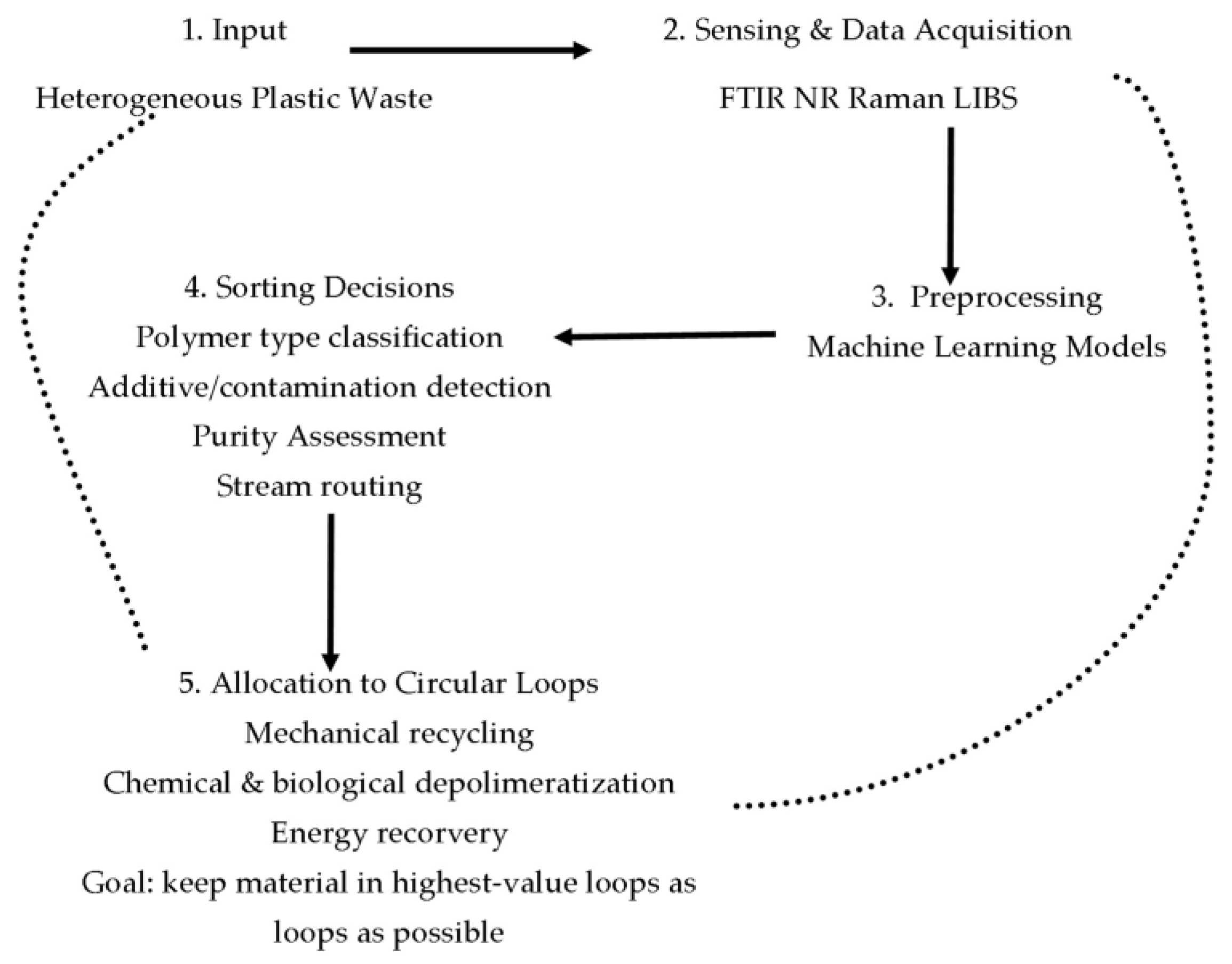
Figure 2.
Comparative optimization routes in circular plastic processing.
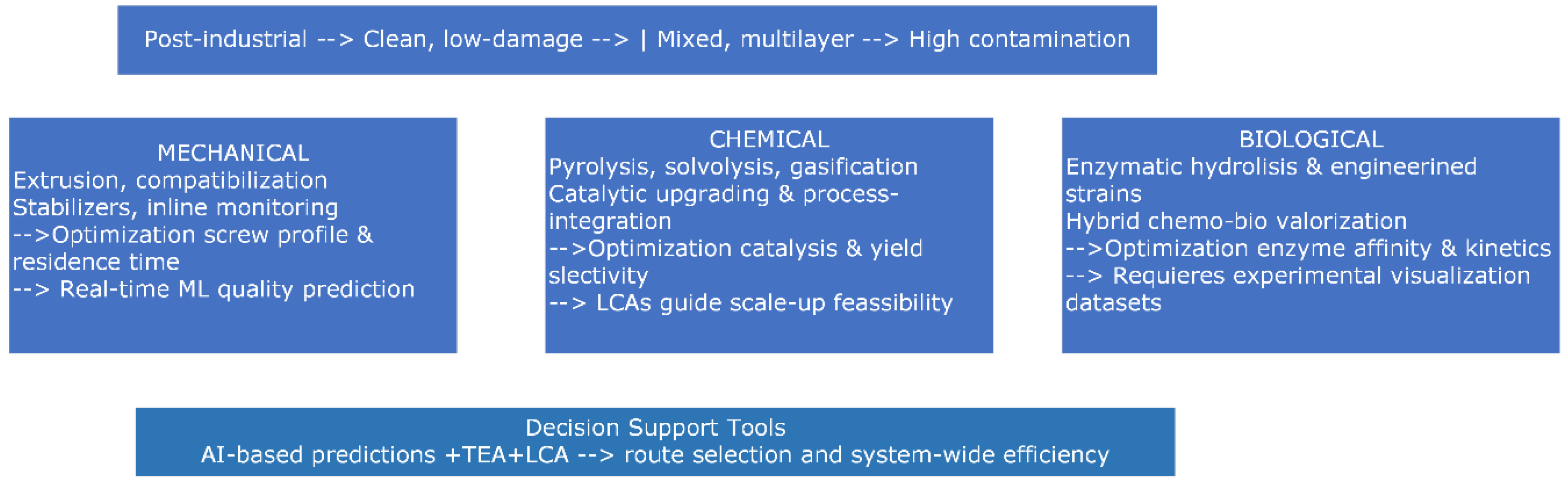
Table 1.
Comparative framework of mechanical, chemical, and biological recycling routes, summarizing the core process, significant operational constraints, and typical product outputs.
Table 1.
Comparative framework of mechanical, chemical, and biological recycling routes, summarizing the core process, significant operational constraints, and typical product outputs.
| Mechanical | Chemical | Biological |
|---|---|---|
| Extrusion process Compatibilization Thermal stabilizaction |
Pyrolysis, solvolysis Gasification |
Enzymatic hydrolysis Microbial conversion |
| Catalytic cracking | Chemo-bio hybrids | |
| Optimization by: Screw profile Residence time Real-time ML |
Optimization by: Catalysis formulation Kinetic control Energy integration |
Optimization by: Enzyme affinity Crystallinity reduction Pathway redesign |
| Key contrainsts: Degradation Propetier loss |
Key contrainsts: | Key contrainsts: |
| High energy | Slow kinetics | |
| Complex mixtures | Lack of datasets | |
| Typical outputs: Regranulate |
Typical outputs: | Typical outputs: |
| Monomers/hydrocarbons | Monomers/intermediates | |
| ⇓ | ||
| Decision-support point (TEA+LAC+IA-based yield prediction) ⇓ Maximized circular value |
Disclaimer/Publisher’s Note: The statements, opinions and data contained in all publications are solely those of the individual author(s) and contributor(s) and not of MDPI and/or the editor(s). MDPI and/or the editor(s) disclaim responsibility for any injury to people or property resulting from any ideas, methods, instructions or products referred to in the content. |
© 2025 by the authors. Licensee MDPI, Basel, Switzerland. This article is an open access article distributed under the terms and conditions of the Creative Commons Attribution (CC BY) license (http://creativecommons.org/licenses/by/4.0/).
Copyright: This open access article is published under a Creative Commons CC BY 4.0 license, which permit the free download, distribution, and reuse, provided that the author and preprint are cited in any reuse.


