

Submitted:
25 December 2025
Posted:
25 December 2025
You are already at the latest version
Abstract
In the Earth–Moon–Sun system, the Newtonian gravitational force exerted by the Sun on the Moon exceeds the force exerted by the Earth. A naive force-magnitude interpretation might therefore suggest that the Moon should be classified as a planet orbiting the Sun rather than as a satellite of the Earth. Newtonian mechanics resolves this situation through relative motion and stability analysis; however, it does not introduce a primitive scalar criterion that determines binding dominance in multi-body systems. This paper presents Desmos theory as an axiomatic framework that embeds Newtonian gravity as a strict special case, connects consistently with General Relativity through a metric-based transformation, and admits a formal correspondence with energy quantization. Desmos is interpreted as a causal and explanatory layer that classifies structural binding prior to dynamics, geometry, or quantization.
Keywords:
Desmos theory
; binding dominance
; Newtonian gravity
; general relativity
; energy
; causality
; Moon
; satellites
; cosmology
; philosophy
; mathematics
1. Introduction
Gravitational systems frequently involve multiple competing influences rather than isolated two-body interactions. Desmos specifies a primitive scalar criterion that determines which interaction is causally dominant in multi-body systems. Structural classifications such as planet, satellite, binary companion, or Trojan object typically emerge only after detailed dynamical analysis.
The Earth–Moon–Sun system illustrates this limitation clearly: although the Sun exerts a larger Newtonian force on the Moon than the Earth does, the Moon remains an Earth satellite. Desmos theory addresses this conceptual gap by introducing a scalar binding-dominance functional that operates at the source level of causality.
2. Newtonian Gravity and Its Explanatory Domain
Newtonian gravity defines the pairwise force
and the equations of motion
This framework predicts trajectories and stability accurately. Desmos introduces a primitive scalar measure that ranks competing interactions in multi-body systems. Binding classifications therefore arise indirectly through post-dynamical reasoning.
3. Desmos Theory and the Interaction Functional
Desmos theory introduces a generalized interaction functional (Bond interaction)
with the energy mapping
The quantity is postulated as a primitive binding-dominance functional. It is not interpreted as a force or an energy, but as a scalar ordering measure that determines structural attachment independently of dynamical trajectories.
4. Newtonian Gravity as a Special Case of Desmos Theory
Newtonian gravity is recovered exactly as a special case of Desmos theory.
Imposing
yields
Thus, Newtonian gravity is embedded as a strict limiting case of Desmos theory.
5. The Moon Case
Although
Desmos theory yields
classifying the Moon as Earth-bound at the interaction level. Newtonian mechanics remains correct but reaches this conclusion only indirectly.
6. Axiomatic Status of Binding Dominance
Axiom (Binding Dominance): In any gravitational system composed of more than two bodies, there exists a scalar interaction functional that orders pairwise bindings and determines structural attachment independently of dynamical trajectories.
Axiom (Desmos Functional):
Newtonian gravity emerges as a corollary under the inverse-square limit.
7. Desmos as a Connection Theory: A Holistic View of Causality
Desmos theory can be interpreted as a connection framework linking Newtonian gravity, General Relativity, and energetic (including quantum) descriptions within a unified causal structure.
7.1. Desmos to General Relativity
In the weak-field limit, the spacetime metric satisfies
where is the Newtonian gravitational potential. A relativistic potential proxy compatible with Desmos is defined as
In the weak-field regime,
recovering the Desmos potential input. Substitution yields a GR-consistent Desmos interaction:
7.2. Energetic and Quantum Correspondence
Since Desmos is explicitly formulated in terms of energy, a formal correspondence with quantized energy may be introduced:
which implies
Substitution into the Desmos functional yields
This correspondence does not imply quantum dynamics of macroscopic motion; it indicates that energetic discreteness may influence structural binding.
Desmos therefore acts as a causal and explanatory layer preceding dynamics, geometry, and quantization.
8. Conclusions
The Moon is not a planet orbiting the Sun because its dominant interaction, in the Desmos sense, is with the Earth. Desmos theory embeds Newtonian gravity, connects consistently with General Relativity, and admits a formal energetic correspondence, thereby functioning as a holistic causality and explanation framework. Detailed relativistic and cosmological implications are left for future work.
Appendix A
Below are the proofs:
In Newtonian gravity, the pairwise force law is:
The acceleration of body is given by the vector sum of forces:
Newtonian gravity therefore determines motion through an -body dynamical problem. Furthermore,Desmos introduces a primitive scalar criterion of binding dominance for classification. Instead, notions such as “satellite” emerge from analysis of relative motion and stability (e.g., Hill stability).
Desmos theory introduces a generalized interaction form (Bond interaction):
where the energy mapping is given by:
Substituting and , thus:
The quantity functions as a scalar interaction measure, which can be used to rank binding dominance directly. Newtonian gravity is recovered exactly from the Desmos/Bond interaction under suitable parameter constraints.
Start from the Desmos/Bond interaction:
Impose the inverse-square exponent
and calibrate the prefactor by requiring
Then,
Recognizing the right-hand side as the Newtonian force magnitude,
Thus, Newtonian gravity is a strict special case of Desmos theory under and .
Desmos theory defines binding dominance through the scalar ranking of . For the Earth–Moon and Moon–Sun pairs, Desmos theory yields the dominance condition
This inequality expresses that the Earth–Moon binding interaction is stronger in the Desmos sense than the Moon–Sun interaction, even if the Newtonian force exerted by the Sun on the Moon is larger than that exerted by the Earth on the Moon.
Therefore, within Desmos theory, the Moon is fundamentally classified as Earth-bound (satellite) rather than Sun-bound as a planet.
This section is included to eliminate conceptual doubt. It is not used to reject Newtonian gravity, but to prove that the statement
is not a valid Newtonian implication.
Let be the Earth–Sun distance and the Earth–Moon distance with . Newtonian solar acceleration at distance from the Sun is
The disruptive component for Earth-binding is the difference between solar acceleration on the Moon and on the Earth:
Using a first-order Taylor approximation for ,
Thus,
Earth’s gravitational acceleration on the Moon is
Earth-binding is stable when the binding acceleration exceeds the tidal disruption scale:
Substituting,
Cancel and rearrange:
The criterion for Earth-binding involves the differential solar effect , not the total solar force magnitude. Therefore, the fact that the Sun’s Newtonian force on the Moon is larger than the Earth’s does not imply that the Moon must be classified as a planet orbiting the Sun. The classification emerges from relative dynamics and stability, not from comparing raw force magnitudes.
Thus, for the parameter choice and , representative results are:
and
Hence the dominance ratio in the Desmos sense is
Thus, the Earth–Moon interaction is approximately three orders of magnitude stronger than Moon–Sun under the Desmos interaction functional.
Representative Newtonian force magnitudes are:
and
Therefore, the Newtonian force ratio is
This shows that the Sun’s Newtonian pull on the Moon is larger than Earth’s by a factor of about , while the Desmos interaction functional ranks Earth–Moon as far more strongly bound than Moon–Sun. Within the context of the Moon’s paradox, Desmos theory clarifies the causal hierarchy underlying gravitational phenomena by operating at a level prior to dynamics, geometry, and quantization. This establishes Desmos as a unifying causality and explanation theory with structural explanatory power across classical, realitivistic and quantum domains.
Appendix B
Derivation of the Desmos Interaction Results:
arise from explicit substitutions in the Desmos (Bond) framework.
Definition of the Desmos Interaction:
The Desmos (Bond) interaction between two bodies and is defined as:
where:
• are the energy states of the bodies,
• is their separation,
• is the distance–decay exponent,
• is a dimensionless bond coefficient.
Energy Definition:
The energy of a body is defined as:
with the potential-like term:
Thus,
Reference Distance Substitution:
For the numerical evaluation, the reference distance is fixed as:
Hence,
For celestial bodies, inertial and gravitational masses are identified:
Therefore,
Energy Product:
The product of energies becomes:
Fixing the Distance Exponent:
For the Earth–Moon and Moon–Sun comparison, the parameter is chosen as:
Thus, the Desmos interaction reduces to:
Earth–Moon System:
Substituting:
Thus,
Moon–Sun System:
Substituting:
Then,
Dominance Ratio:
The ratio of the two interactions is:
Although the Newtonian force exerted by the Sun on the Moon is larger than that exerted by the Earth, the Desmos interaction is governed by squared mass and squared distansce scaling. The much smaller Earth–Moon separation dominates the interaction, leading to a stronger Earth–Moon binding and justifying the Moon’s classification as a satellite rather than a planet.
Appendix C
Energy Dominance over Mass in the Desmos Framework:
In the Desmos (Bond) formulation, interaction strength is governed by energy rather than by mass alone. This represents a fundamental departure from classical Newtonian gravity, where mass is the primary source of gravitational interaction.
The Desmos interaction is defined as:
Using the energy definition:
and fixing the reference distance , then:
Identifying inertial and gravitational mass (), the energy scales as:
Therefore, the Desmos interaction becomes:
This result shows that the interaction scales with the square of the mass squared, i.e. , rather than linearly with mass as in classical gravity.
Comparison with Newtonian Gravity. The classical Newtonian force between two bodies is:
which depends linearly on the product of masses.
Desmos interaction satisfies:
Thus, in Desmos theory:
- mass enters through energy,
- energy, not mass, is the fundamental carrier of interaction,
- distance modulates energy coupling rather than force magnitude.
This energy dominance explains why systems with smaller separation but lower total mass (such as Earth–Moon) can be more strongly bound than systems with larger mass but much greater separation (such as Moon–Sun). The interaction reflects a spacetime–energy bond rather than a purely attractive force.
Hence, Desmos gravity is an energy based theory of interaction, and furthermore a mass–based force law.
Appendix D

Table A1.
Symbols, physical meaning, and SI units used throughout the paper.
| Symbol | Physical meaning | SI unit |
|---|---|---|
| Mass of body | kg | |
| Source mass generating gravitational field | kg | |
| Distance between bodies and | m | |
| Radial distance from source mass | m | |
| Newtonian gravitational constant | ||
| Speed of light in vacuum | m | |
| Newtonian gravitational force | N (kg m ) | |
| Acceleration of body | m | |
| Newtonian gravitational potential | ||
| Desmos potential proxy () | ||
| Desmos energy variable () | J (kg ) | |
| Desmos binding-dominance functional | ||
| Desmos interaction scaling constant | ||
| Desmos interaction exponent | dimensionless | |
| Time–time metric component (GR) | dimensionless | |
| Relativistic Desmos potential proxy | ||
| Reduced Planck constant | J s | |
| Angular frequency (quantum correspondence) | ||
| Quantum occupation number (formal correspondence) | dimensionless | |
| GR-consistent Desmos interaction |
Appendix E
- (A)
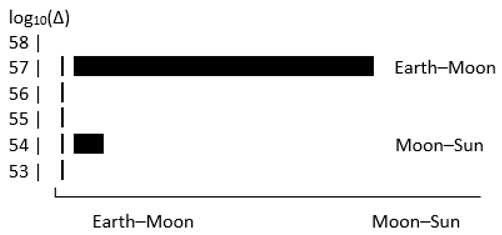
- Desmos Interaction Functional Δ:
Numerical placement:
log10() ≈ 57.16
log10() ≈ 54.03
Dominance:
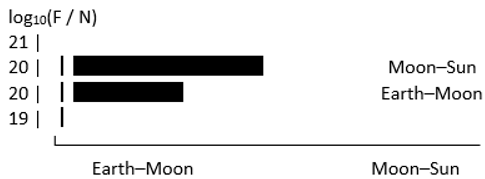
- (B) Newtonian Gravitational Force F:
Numerical placement:
log10() ≈ 20.30
log10() ≈ 20.64
Ratio:
References
- Malek, A. Quō Vādis theoretical physics and cosmology? from Newton’s Metaphysics to Einstein’s Theology. Ann. Math. Phys. 2023, 6, 065–070. [Google Scholar] [CrossRef]
- Aguilera, M.; Moosavi, S.A.; Shimazaki, H. A unifying framework for mean-field theories of asymmetric kinetic Ising systems. Nat. Commun. 2021, 12, 1–12. [Google Scholar] [CrossRef]
- Alazard, D.; Sanfedino, F.; Kassarian, E. Non-linear dynamics of multibody systems: a system-based approach. arXiv Retrieved from. 2025, abs/2505.0. [Google Scholar] [CrossRef]
- Ashman, L. Physics in Minerva’s Academy: early to mid-eighteenth-century appropriations of Isaac Newton’s natural philosophy at the University of Leiden and in the Dutch Republic at large, 1687–c.1750. Intellect. Hist. Rev. 2025, 35, 853–856. [Google Scholar] [CrossRef]
- Aurrekoetxea, J.C.; Clough, K.; Lim, E.A. Cosmology using numerical relativity. Living Rev. Relativ. 2025, 28, 1–90. [Google Scholar] [CrossRef]
- Babichev, E.; Izumi, K.; Noui, K.; Tanahashi, N.; Yamaguchi, M. Generalization of conformal-disformal transformations of the metric in scalar-tensor theories. Phys. Rev. D 2024, 110, 064063. [Google Scholar] [CrossRef]
- Barrow, J.D. Non-Euclidean Newtonian cosmology. Class. Quantum Gravity 2020, 37, 125007. [Google Scholar] [CrossRef]
- Bartlett, R. Quantum Consciousness, Anesthesia, and Cosmological Entanglement. Ipi Lett. 2025, C1–C2. [Google Scholar] [CrossRef]
- Bini, D.; Damour, T.; Geralico, A. Novel Approach to Binary Dynamics: Application to the Fifth Post-Newtonian Level. Phys. Rev. Lett. 2019, 123, 231104. [Google Scholar] [CrossRef] [PubMed]
- Bini, D.; Damour, T.; Geralico, A. Sixth post-Newtonian local-in-time dynamics of binary systems. Phys. Rev. D 2020, 102, 024061. [Google Scholar] [CrossRef]
- Blümlein, J.; Maier, A.; Marquard, P.; Schäfer, G. Fourth post-Newtonian Hamiltonian dynamics of two-body systems from an effective field theory approach. Nucl. Phys. B 2020, 955. [Google Scholar] [CrossRef]
- Blümlein, J.; Maier, A.; Marquard, P.; Schäfer, G. The fifth-order post-Newtonian Hamiltonian dynamics of two-body systems from an effective field theory approach. Nucl. Phys. B 2022, 983. [Google Scholar] [CrossRef]
- Bose, A.; Walters, P.L. A multisite decomposition of the tensor network path integrals. J. Chem. Phys. 2022, 156, 024101. [Google Scholar] [CrossRef]
- Brasch, F.E. The Isaac Newton Collection. Publ. Astron. Soc. Pac. 1962, 74, 366. [Google Scholar] [CrossRef]
- Cai, Z.-T.; Li, H.-D.; Chen, W. Quantum-Classical Correspondence of Non-Hermitian Symmetry Breaking. Phys. Rev. Lett. 2025, 134, 240201. [Google Scholar] [CrossRef]
- Cerveny, L.; Einstein, A. BUILDING TRUST. Tao Te Ching. 2020. [CrossRef]
- Challoumis, C. Panphysics Enopiisis. Edelweiss Appl. Sci. Technol. 2024, 8, 9356–9375. [Google Scholar] [CrossRef]
- Chen, B.; Sun, H.; Zheng, Y.-F. Quantization of Carrollian conformal scalar theories. Phys. Rev. D 2024, 110. [Google Scholar] [CrossRef]
- Chen, E.K. Does quantum theory imply the entire Universe is preordained? Nature 2023, 624, 513–515. [Google Scholar] [CrossRef] [PubMed]
- Chen, Z.-Q.; Ni, R.-H.; Song, Y.; Huang, L.; Wang, J.; Casati, G. Correspondence Principle, Ergodicity, and Finite-Time Dynamics. Phys. Rev. Lett. 2025, 134, 130402. [Google Scholar] [CrossRef] [PubMed]
- Chruściel, P.T. Elements of General Relativity; Springer Nature: Dordrecht, GX, Netherlands, 2019; ISBN 9783030284152. [Google Scholar]
- Close, F. A walk on the wild side. Nature 2004, 432, 277–277. [Google Scholar] [CrossRef]
- Cohen, H.F. Stock and bulk in the latest Newton scholarship. Br. J. Hist. Sci. 2018, 51, 687–701. [Google Scholar] [CrossRef]
- Cun, Y. A Theoretical Framework for Back-Propagation. 1988. Available online: https://consensus.app/papers/a-theoretical-framework-for-backpropagation-cun/a73d81505d9459b9851c580c9288ec9f/.
- D’aMbrosio, F.; Heisenberg, L.; Kuhn, S. Revisiting cosmologies in teleparallelism. Class. Quantum Gravity 2021, 39, 025013. [Google Scholar] [CrossRef]
- Das, S.; Fridman, M.; Lambiase, G. Testing the quantum equivalence principle with gravitational waves. J. High Energy Astrophys. 2025, 48. [Google Scholar] [CrossRef]
- De Angelis, A. Galileo Galilei’s “Two New Sciences”. In History of Physics; Springer Nature: Dordrecht, GX, Netherlands; ISBN, 2021. [Google Scholar]
- de Haro, J. Relations between Newtonian and Relativistic Cosmology. Universe 2024, 10, 263. [Google Scholar] [CrossRef]
- Rainich, G.Y.; Einstein, A. The Meaning of Relativity. Am. Math. Mon. 1946, 53, 93. [Google Scholar] [CrossRef]
- Einstein, A. Einstein’s 1912 manuscript on the special theory of relativity : a facsimile. 2004. Available online: https://consensus.app/papers/einsteins-1912-manuscript-on-the-special-theory-of-einstein/65d18c179b09570a94db7c37b14d39cc/.
- Einstein, A. Albert Einstein to Michele Besso. Phys. Today 2005, 58, 14–14. [Google Scholar] [CrossRef]
- Einstein, A. On the Relativity Problem. Boston Studies in the Philosophy of Science 2007, 250, 1528–1536. [Google Scholar] [CrossRef]
- Einstein, A. Relativity: The Special and the General Theory, 100th Anniversary Edition. 2015a. Available online: https://consensus.app/papers/relativity-the-special-and-the-general-theory-100th-einstein/b27c2697bb9559cf98df9843d3bdcd00/.
- Einstein, A. Relativity; JSTOR: New York, NY, United States, 2015. [Google Scholar] [CrossRef]
- Einstein, A; Hawking, S. The Essential Einstein: His Greatest Works. 1995. Available online: https://consensus.app/papers/the-essential-einstein-his-greatest-works-einstein-hawking/47961fe0f91f548ba3742c11f0a7e70b/.
- Einstein, A.; Rosen, N. The Particle Problem in the General Theory of Relativity. Phys. Rev. B 1935, 48, 73–77. [Google Scholar] [CrossRef]
- Einstein, A. The Bianchi Identities in the Generalized Theory of Gravitation. Can. J. Math. 1950, 2, 120–128. [Google Scholar] [CrossRef]
- Fields, C.; Friston, K.; Glazebrook, J.F.; Levin, M. A free energy principle for generic quantum systems. Prog. Biophys. Mol. Biol. 2022, 173, 36–59. [Google Scholar] [CrossRef]
- Gielen, S. Frozen formalism and canonical quantization in group field theory. Phys. Rev. D 2021, 104, 106011. [Google Scholar] [CrossRef]
- Isaac Newton and Natural Philosophy. Renaiss. Reform. 2018, 41, 229–232. [CrossRef]
- Hashimoto, K.; Sugishita, S.; Tanaka, A.; Tomiya, A. Deep learning and the AdS/CFT correspondence. Phys. Rev. D 2018, 98, 046019. [Google Scholar] [CrossRef]
- Heisenberg, L. A systematic approach to generalisations of General Relativity and their cosmological implications. Phys. Rep. 2019, 796, 1–113. [Google Scholar] [CrossRef]
- Hess, P. Alternatives to Einstein’s General Relativity Theory. Prog. Part. Nucl. Phys. 2020, 114. [Google Scholar] [CrossRef]
- Järv, L.; Kuusk, P.; Saal, M.; Vilson, O. Transformation properties and general relativity regime in scalar–tensor theories. Class. Quantum Gravity 2015, 32, 235013. [Google Scholar] [CrossRef]
- Järv, L.; Rünkla, M.; Saal, M.; Vilson, O. Nonmetricity formulation of general relativity and its scalar-tensor extension. Phys. Rev. D 2018, 97, 124025. [Google Scholar] [CrossRef]
- Jiménez, J.B.; Heisenberg, L.; Koivisto, T.S. The Geometrical Trinity of Gravity. Universe 2019, 5, 173. [Google Scholar] [CrossRef]
- Wightman, W.P.D.; Koyre, A. Book Reviews: From the Closed World to the Infinite Universe. Philos. Q. 1959, 9, 381. [Google Scholar] [CrossRef]
- Leigh, N.W.C.; Wegsman, S. Illustrating chaos: a schematic discretization of the general three-body problem in Newtonian gravity. Mon. Not. R. Astron. Soc. 2018, 476, 336–343. [Google Scholar] [CrossRef]
- Levi, M. Effective field theories of post-Newtonian gravity: a comprehensive review*. Rep. Prog. Phys. 2020, 83, 075901. [Google Scholar] [CrossRef]
- Li, X.; Lyu, S.-X.; Wang, Y.; Xu, R.-X.; Zheng, X.; Yan, Y. Toward quantum simulation of non-Markovian open quantum dynamics: A universal and compact theory. Phys. Rev. A 2024, 110, 032620. [Google Scholar] [CrossRef]
- Lin, S.-Y.; Liu, H.-Y.; Nguyen, D.K.; Tran, N.T.T.; Pham, H.D.; Chang, S.-L.; Lin, C.-Y.; Lin, M.-F. The theoretical frameworks. Retrieved from. [CrossRef] [PubMed]
- McTague, J.; Foley, J.J. Non-Hermitian cavity quantum electrodynamics–configuration interaction singles approach for polaritonic structure with ab initio molecular Hamiltonians. J. Chem. Phys. 2022, 156, 154103. [Google Scholar] [CrossRef]
- Mocz, P.; Lancaster, L.; Fialkov, A.; Becerra, F.; Chavanis, P.-H. Schrödinger-Poisson–Vlasov-Poisson correspondence. Phys. Rev. D 2018, 97, 083519. [Google Scholar] [CrossRef]
- Murray, R.; Orr, B.; Al-Khateeb, S.; Agarwal, N. Constructing a multi-theoretical framework for mob modeling. Soc. Netw. Anal. Min. 2025, 15, 1–15. [Google Scholar] [CrossRef]
- Naruko, A.; Saito, R.; Tanahashi, N.; Yamauchi, D. Ostrogradsky mode in scalar–tensor theories with higher-order derivative couplings to matter. Prog. Theor. Exp. Phys. 2023, 2023. [Google Scholar] [CrossRef]
- Nashed, G.; Bamba, K. Properties of compact objects in quadratic non-metricity gravity. Ann. Phys. 2025, 481. [Google Scholar] [CrossRef]
- Năstase, H. Cosmology and String Theory; Springer Nature: Dordrecht, GX, Netherlands, 2019; ISBN 9783030150761. [Google Scholar]
- Ovalle, J. Decoupling gravitational sources in general relativity: The extended case. Phys. Lett. B 2019, 788, 213–218. [Google Scholar] [CrossRef]
- Palariev, V.; Shtirbu, A. Theoretical framework of grape irrigation: a review. Collected Works of Uman National University of Horticulture. Retrieved from. 2025. [CrossRef]
- Rehman, A.; Naseer, T.; Dayanandan, B. Interpretation of complexity for spherically symmetric fluid composition within the context of modified gravity theory. Nucl. Phys. B 2025, 1013. [Google Scholar] [CrossRef]
- Rutkin, H.D. Sapientia Astrologica: Astrology, Magic and Natural Knowledge, ca. 1250-1800; Springer Nature: Dordrecht, GX, Netherlands, 2019; ISBN 9783030107789. [Google Scholar]
- Sasmal, S.; Vendrell, O. Non-adiabatic quantum dynamics without potential energy surfaces based on second-quantized electrons: Application within the framework of the MCTDH method. J. Chem. Phys. 2020, 153, 154110. [Google Scholar] [CrossRef]
- Scali, F. The cosmological constant problem: from Newtonian cosmology to the greatest puzzle of modern theoretical cosmology. Philosophical Transactions. Series A, Mathematical, Physical, and Engineering Sciences 2025, 383, 20230292. [Google Scholar]
- Shank, J. Between Isaac Newton and Enlightenment Newtonianism. Science Without God? 2019. [Google Scholar] [CrossRef]
- Snobelen, S. The Cambridge Companion to Newton. Isis, 2003. [Google Scholar] [CrossRef]
- Snobelen, S. Apocalyptic themes in Isaac Newton. astronomical physics, 2020; 1, 95–104. [Google Scholar] [CrossRef]
- Vacaru, S.I. Inconsistencies of Nonmetric Einstein–Dirac–Maxwell Theories and a Cure for Geometric Flows of f(Q) Black Ellipsoid, Toroid, and Wormhole Solutions. Fortschritte der Phys. 2025, 73. [Google Scholar] [CrossRef]
- Wang, S.-X.; Yan, Z. General theory for infernal points in non-Hermitian systems. Phys. Rev. B 2024, 110. [Google Scholar] [CrossRef]
- Wiese, U.-J.; Einstein, A. Statistical Mechanics. Manual for Theoretical Chemistry. 2021. [CrossRef]
- Yang, Y.; Ren, X.; Wang, Q.; Lu, Z.; Zhang, D.; Cai, Y.-F.; Saridakis, E.N. Quintom cosmology and modified gravity after DESI 2024. Sci. Bull. 2024, 69, 2698–2704. [Google Scholar] [CrossRef] [PubMed]
Disclaimer/Publisher’s Note: The statements, opinions and data contained in all publications are solely those of the individual author(s) and contributor(s) and not of MDPI and/or the editor(s). MDPI and/or the editor(s) disclaim responsibility for any injury to people or property resulting from any ideas, methods, instructions or products referred to in the content. |
© 2025 by the authors. Licensee MDPI, Basel, Switzerland. This article is an open access article distributed under the terms and conditions of the Creative Commons Attribution (CC BY) license (http://creativecommons.org/licenses/by/4.0/).
Copyright: This open access article is published under a Creative Commons CC BY 4.0 license, which permit the free download, distribution, and reuse, provided that the author and preprint are cited in any reuse.


