

Submitted:
09 December 2025
Posted:
17 December 2025
You are already at the latest version
Abstract
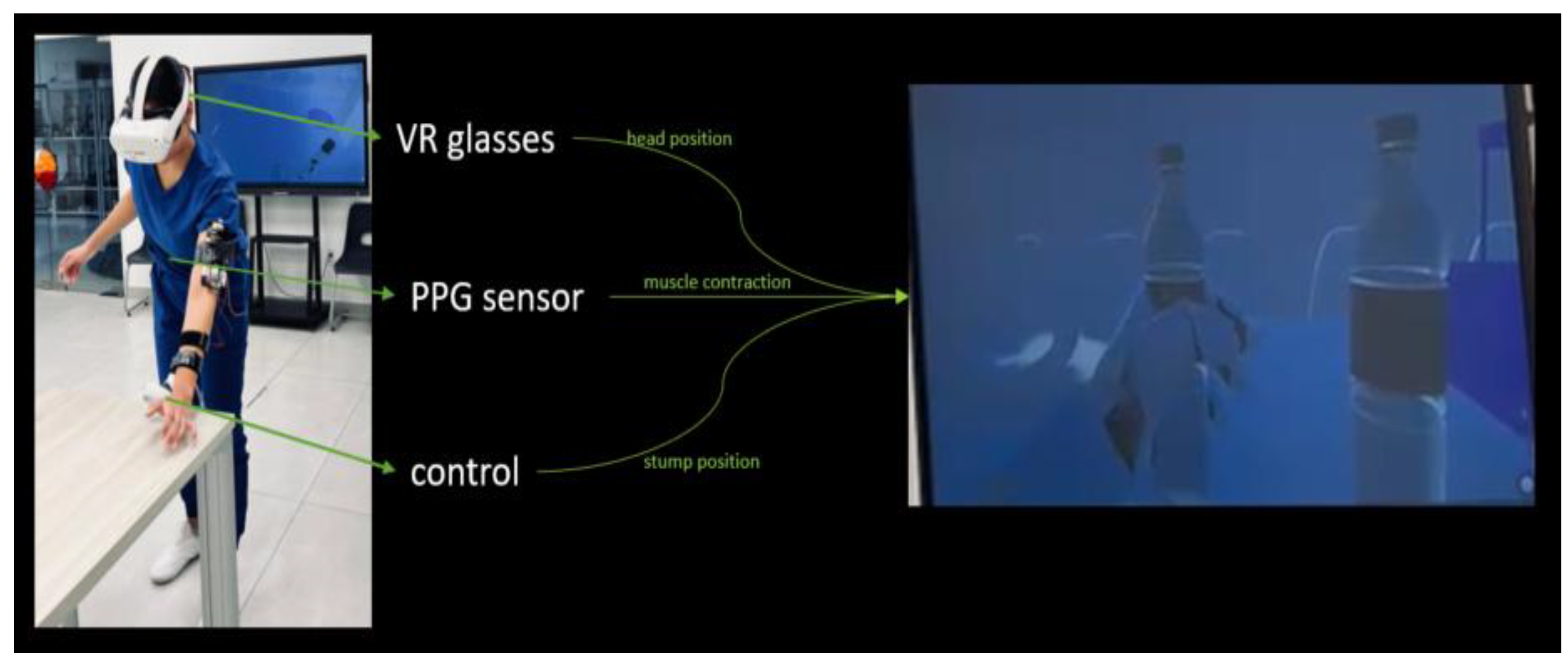
The functional integration of the upper-limb prosthesis is critical for long-term user satisfaction, yet high rates of device abandonment persist. Primary factors contributing to this trend are high cognitive load and difficulties associated with learning muscle control. To address these challenges, a proposal for the development and preliminary evaluation of an Extended Reality (XR) training scenario is presented. The prototype uses an adaptation of a PPG sensor to measure residual limb muscle activity, mapping these signals to control a virtual prosthetic hand. The XR environment represents a controlled platform for trainees to practice gripping in a variety of virtual objects. The approach allows real-time biofeedback enhancing control for the user, aiming to establish a more effective training to improve the adoption and functional outcomes of upper-limb prostheses.
Keywords:
1. Introduction
2. Related Work
3. XR Prototype Circuit
4. Materials and Methods
4.1. Able-Bodied Participants’ Tests
Discussion
4.2. Amputee Participant Test
4.3. Discussion
5. Conclusions
References
- Biddiss, E. A.; Chau, T. T. ‘Upper limb prosthesis use and abandonment’. Prosthet Orthot Int 2007, vol. 31(no. 3), 236–257. [Google Scholar] [CrossRef] [PubMed]
- Bates, T. J.; Fergason, J. R.; Pierrie, S. N. ‘Technological Advances in Prosthesis Design and Rehabilitation Following Upper Extremity Limb Loss’. Curr Rev Musculoskelet Med 2020, vol. 13(no. 4), 485–493. [Google Scholar] [CrossRef]
- Lauren. Deus, ‘Augmented Reality for Advanced Prosthetic Training in Non-Amputees’. Dissertation/Thesis, University of Rhode Island, Rhode Island, 2023. [Google Scholar]
- Gaballa, A.; Cavalcante, R. S.; Lamounier, E.; Soares, A.; Cabibihan, J.-J. ‘Extended Reality “X-Reality” for Prosthesis Training of Upper-Limb Amputees: A Review on Current and Future Clinical Potential’. IEEE Transactions on Neural Systems and Rehabilitation Engineering 2022, vol. 30, 1652–1663. [Google Scholar] [CrossRef]
- Milgram, P. ; K. F. ‘A taxonomy of mixed reality visual displays’. IEICE TRANSACTIONS on Information and Systems 1994, vol. 77(no. 12), 1321–1329. [Google Scholar]
- Perry, B. N. , ‘Virtual Integration Environment as an Advanced Prosthetic Limb Training Platform’. Front Neurol 2018, vol. 9. [Google Scholar] [CrossRef] [PubMed]
- Calvo Sanz, J. , ‘Training in the Use of Myoelectric Prostheses Through the Combined Application of Immersive Virtual Reality, Cross-education, and Mirror Therapy’. JPO Journal of Prosthetics and Orthotics 2025, vol. 37(no. 3), 141–147. [Google Scholar] [CrossRef]
- Boschmann, A.; Neuhaus, D.; Vogt, S.; Kaltschmidt, C.; Platzner, M.; Dosen, S. ‘Immersive augmented reality system for the training of pattern classification control with a myoelectric prosthesis’. J Neuroeng Rehabil 2021, vol. 18(no. 1), 25. [Google Scholar] [CrossRef] [PubMed]
- El Raghibi, L. , ‘Virtual reality can mediate the learning phase of upper limb prostheses supporting a better-informed selection process’. Journal on Multimodal User Interfaces 2023, vol. 17(no. 1), 33–46. [Google Scholar] [CrossRef]
- Sharma, A. , ‘A Mixed-Reality Training Environment for Upper Limb Prosthesis Control’. 2018 IEEE Biomedical Circuits and Systems Conference (BioCAS), Oct. 2018; IEEE; pp. 1–4. [Google Scholar] [CrossRef]
- Triwiyanto, T. , ‘State-of-the-Art Method in Prosthetic Hand Design: A Review’. Journal of Biomimetics, Biomaterials and Biomedical Engineering 2021, vol. 50, 15–24. [Google Scholar] [CrossRef]
- Chen, Z.; Min, H.; Wang, D.; Xia, Z.; Sun, F.; Fang, B. ‘A Review of Myoelectric Control for Prosthetic Hand Manipulation’. Biomimetics 2023, vol. 8(no. 3), 328. [Google Scholar] [CrossRef]
- Scardulla, F. , ‘Photoplethysmograhic sensors, potential and limitations: Is it time for regulation? A comprehensive review’. Measurement 2023, vol. 218, 113150. [Google Scholar] [CrossRef]
- Caserta, G. , ‘Benefits of the Cybathlon 2020 experience for a prosthetic hand user: a case study on the Hannes system’. J Neuroeng Rehabil 2022, vol. 19(no. 1), 68. [Google Scholar] [CrossRef] [PubMed]
- Conner, N. O. , ‘Virtual Reality Induced Symptoms and Effects: Concerns, Causes, Assessment & Mitigation’. Virtual Worlds 2022, vol. 1(no. 2), 130–146. [Google Scholar] [CrossRef]
- MacIsaac, C.; Nguyen, M.; Uy, A.; Kong, T.; Hedayatipour, A. ‘A Programmable Gain Calibration Method to Mitigate Skin Tone Bias in PPG Sensors’. Biosensors (Basel) 2025, vol. 15(no. 7), 423. [Google Scholar] [CrossRef] [PubMed]
- E. Monk, ‘The Monk Skin Tone Scale’. 2023. [CrossRef]
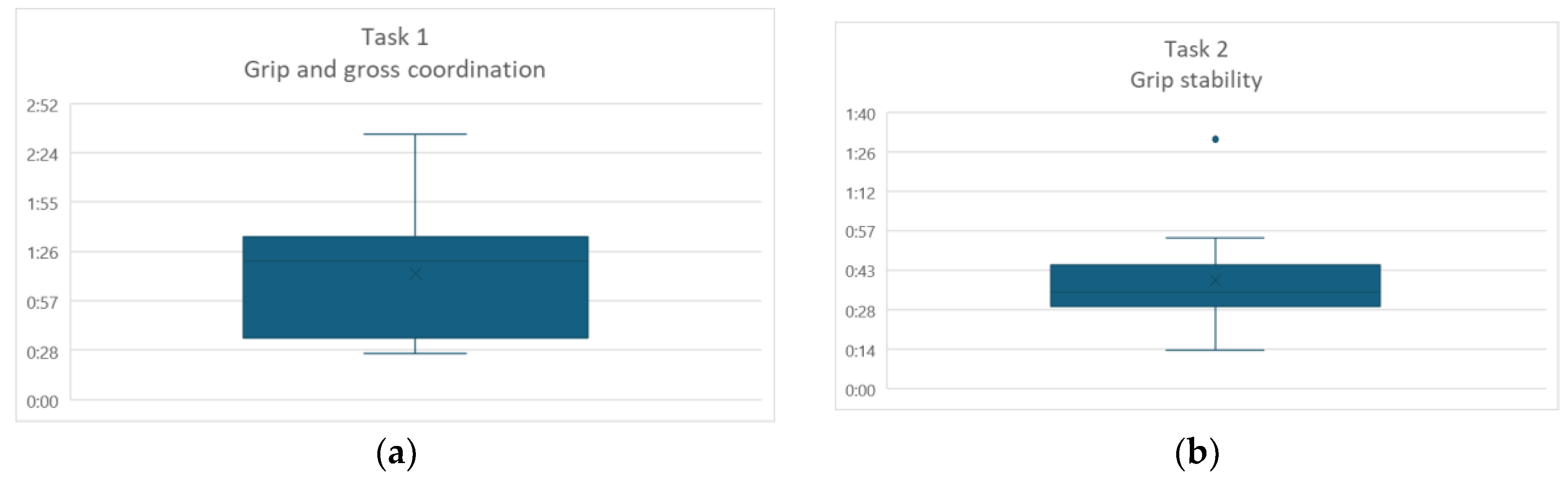
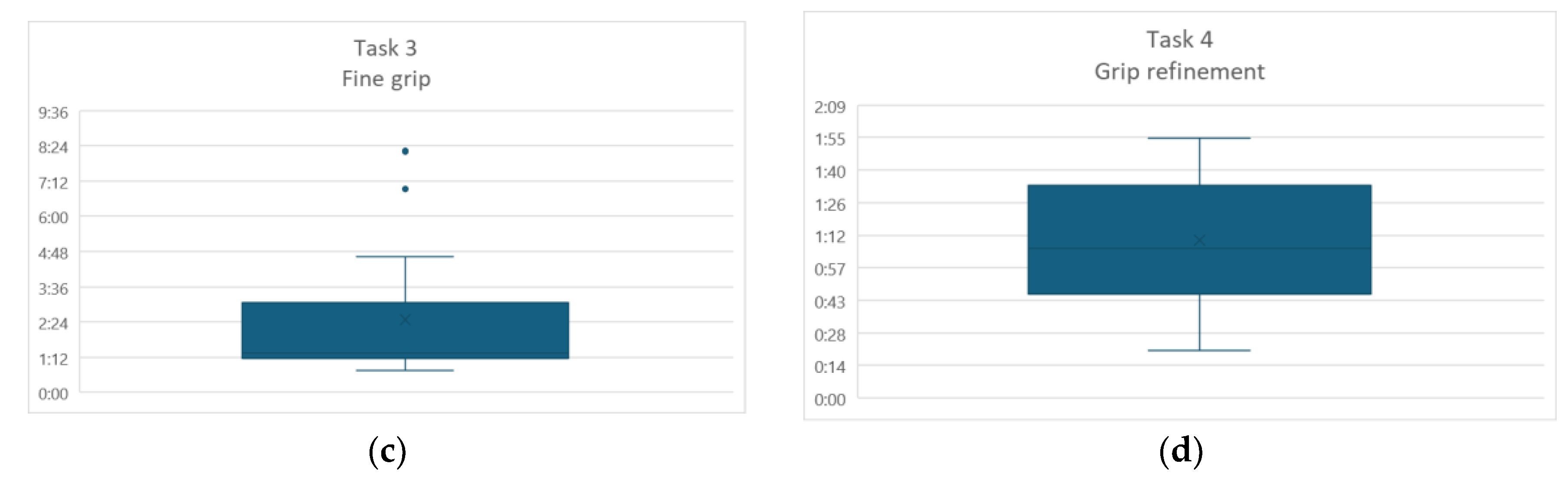

| Grip type | Task description | Materials |
| Grip and gross coordination |
Placing bottles into a rack | 4 Bottles 1 Rack 1 Table |
|
Grip stability (holding the grip) |
Move the rack | 4 Bottles 1 Rack 2 Tables |
|
Fine grip |
Move small objects | 1 Glass 1 Plate 1 Fork 2 Tables |
|
Grip refinement |
Taking out bottles from the rack | 4 Bottles 1 Rack 1 Table |
|
ID |
Sex |
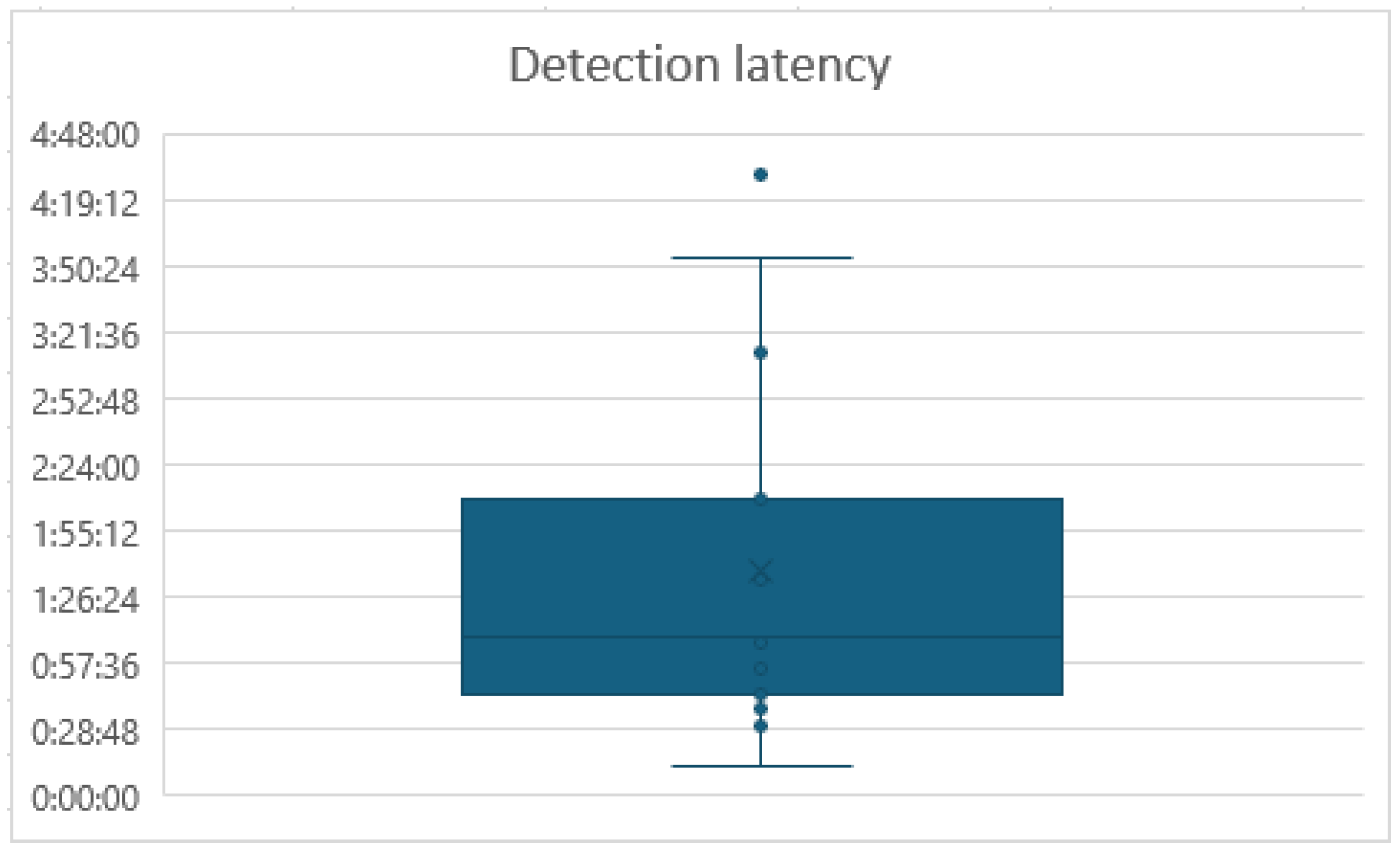
Detection latency |
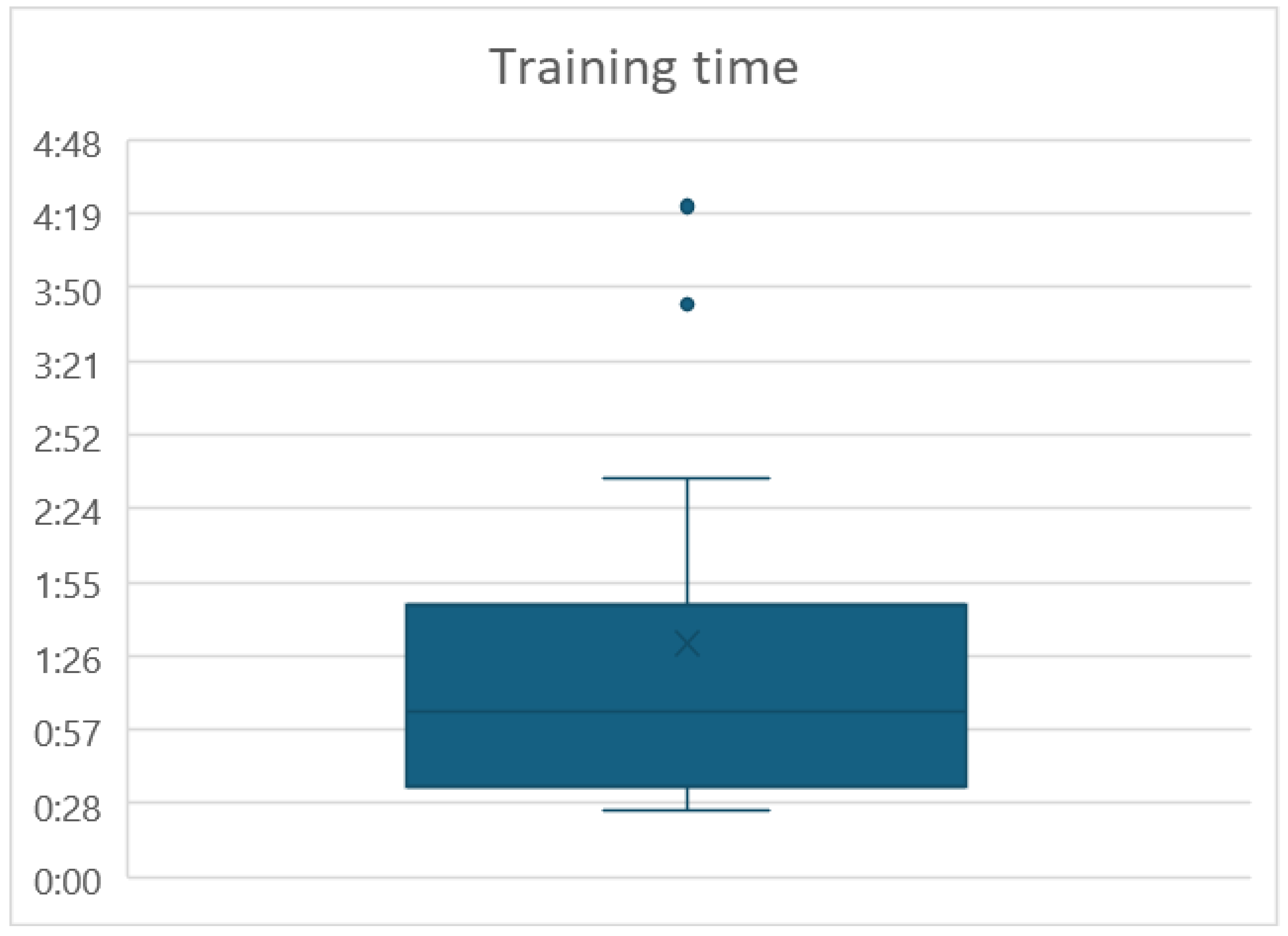
Training time |
MST |
| 1 | M | 00:55 | 03:44 | 2 |
| 2 | M | 02:09 | 02:36 | 4 |
| 3 | M | 01:34 | 00:59 | 5 |
| 4 | M | 03:54 | 04:22 | 4 |
| 5 | M | 00:30 | 01:46 | 5 |
| 6 | M | 00:57 | 00:39 | 6 |
| 7 | M | 01:09 | 00:26 | 8 |
| 8 | M | 01:06 | 00:35 | 4 |
| 9 | M | 00:13 | 01:45 | 3 |
| 10 | F | 03:12 | 00:31 | 3 |
| 11 | F | 01:09 | 01:15 | 2 |
| 12 | F | 00:38 | 01:03 | 2 |
| 13 | F | 04:30 | 01:05 | 2 |
| 14 | F | 01:37 | 01:32 | 2 |
| 15 | F | 00:44 | 00:33 | 2 |
| ID | Grip and gross coordination | Grip stability | Fine grip | Grip refinement |
| 1 | 01:30 | 00:30 | 01:06 | 01:55 |
| 2 | 00:36 | 00:53 | 01:20 | 00:40 |
| 3 | 01:28 | 00:45 | 01:39 | 00:52 |
| 4 | 01:50 | 00:35 | 00:45 | 01:20 |
| 5 | 01:21 | 00:30 | 03:04 | 01:51 |
| 6 | 00:34 | 00:32 | 01:11 | 00:35 |
| 7 | 00:41 | 00:41 | 01:12 | 00:21 |
| 8 | 01:27 | 00:24 | 00:52 | 01:32 |
| 9 | 00:34 | 00:30 | 01:46 | 01:02 |
| 10 | 01:35 | 00:14 | 04:38 | 01:08 |
| 11 | 02:24 | 00:36 | 06:56 | 00:46 |
| 12 | 00:27 | 01:31 | 01:56 | 01:45 |
| 13 | 00:43 | 00:55 | 01:10 | 01:34 |
| 14 | 00:36 | 00:45 | 01:21 | 01:06 |
| 15 | 02:35 | 00:32 | 08:13 | 01:01 |
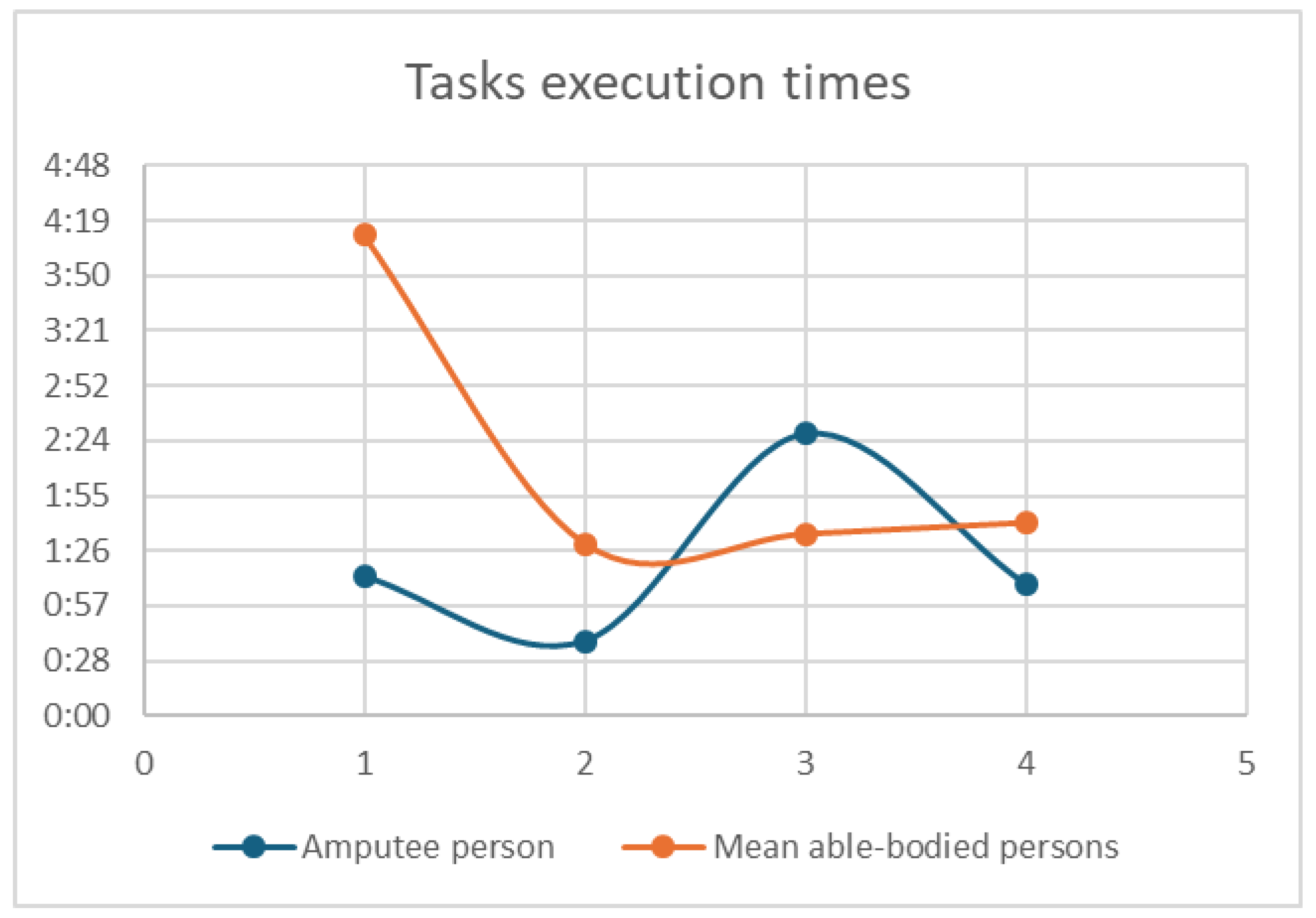
| x̄ | 01:13 | 00:39 | 02:28 | 01:09 |
| s | 00:41 | 00:17 | 02:18 | 00:29 |
| Grip and gross coordination | Grip stability | Fine grip | Grip refinement |
| 04:12 | 01:30 | 01:35 | 01:41 |
Disclaimer/Publisher’s Note: The statements, opinions and data contained in all publications are solely those of the individual author(s) and contributor(s) and not of MDPI and/or the editor(s). MDPI and/or the editor(s) disclaim responsibility for any injury to people or property resulting from any ideas, methods, instructions or products referred to in the content. |
© 2025 by the authors. Licensee MDPI, Basel, Switzerland. This article is an open access article distributed under the terms and conditions of the Creative Commons Attribution (CC BY) license (http://creativecommons.org/licenses/by/4.0/).


