

Submitted:
16 December 2025
Posted:
16 December 2025
You are already at the latest version
Abstract
The increasing demand for seafood recorded over the years led to an increase in the by-products produced by the seafood processing sector. These by-products, which can represent up to 70% of the processed product, are rich in nutrients and bioactive compounds, so if recovered, by means of eco-friendly methods, they can be used in lot of sectors, such as food, packaging, cosmetics and pharmaceutics. In the present work, two lactic acid bacteria (Lactobacillus lactis and L. brevis) and the yeast Yarrowia lipolytica, able to produce organic acids and proteases during the fermentation process, were used to extract chitin from deep-water shrimp (Aristeus antennatus) by-products. The results showed that L. lactis was the most effective microorganism in removing both the mineral and protein fractions, being chosen for the optimization of the extraction technique of chitin, eventually converted in chitosan. The chitosan showed a deacetylation degree (DD) of 82%, which led to good film-forming capacity. The developed biological technique allowed valorizing shrimp by-products by recovering chitin and chitosan, which was able to produce biofilm to be employed to prolong seafood shelf life, in a circular economy point of view, contributing even more to increase the sustainability of the production sector.
Keywords:
chitin
; chitosan-based film
; green extraction method
; shrimp by-products
; sustainability
; lactic acid bacteria
; yeast
; fermentation
; Aristeus antennatus
1. Introduction
Over the last decades, global fisheries and aquaculture production has been increasing, reaching 223.2 million tons in 2022 [1], in order to satisfy the rising demand for seafood. Indeed, human consumption of seafood was equivalent to an estimated 20.7 kg per capita in 2022, and it is foreseen to grow further in the future. Overall, in high-income countries, seafood are mostly processed, so by-products production has increased as well, but instead of being discarded as waste, the by-products are increasingly used for food or non-food products, accounting up to 34 and 53 percent of the total production of fish meal and fish oil, respectively [1]. Despite this, the Marine Ingredients Organization (IFFO) reported there is still a large proportion of seafood by-product, almost 12 million tons, wasted instead of being turned into high value products. In this context, it has to be highlighted that disposal can be a serious problem for enterprises, in terms of costs, moreover, if not done properly it can have negative impacts on the environment, in terms of pollution. Therefore, to improve the seafood industry income and sustainability, it is important to make the effort to valorize seafood by-products considering that they represent great part of the processed product. For instance, in the fish-processing sector, by-products, such as heads skins, bones, scales and viscera, can represent up to 70 percent of the whole fish, while the by-products from shrimp processing account up to 60 percent of the whole shrimp. Considering the importance of valorizing seafood by-products, to increase the economic and environmental sustainability of the production sector, researchers and enterprises have increasingly been paying attention on extracting from them bioactive compounds such as polyunsaturated fatty acids of the n-3 series, fish enzymes, collagen, carotenoids, chitin, chitosan, glucosamine, functional foods, nutraceuticals, fish protein hydrolysates and fish protein concentrates, to be used in the food industry and for the human nutrition and health [2]. Moreover, these compounds could help improving seafood shelf life by means of their bioactive properties that in turn can help reducing fish loss and waste estimated annually up to 35% of global fisheries and aquaculture production [1]. For this purpose, chitin and chitosan are applied as antioxidants, antibacterial and antifungal agents in the food industry.
Chitin is the second most available polysaccharide after cellulose, being a fairly ubiquitous compound found in the fungi and algae cell walls, insects exoskeletons, endoskeleton of cephalopods and crustaceans shells. However, commercial chitin is mainly obtained by the by-products produced by the crustacean processing industry, considering that more than 6 million tons of crustacean waste are produced every year [3]. Chitin is obtained by the exoskeletons of crustaceans by the steps of demineralization and deproteinization, in order to remove the mineral and protein fractions, respectively, from the shell material, followed by a decoloration step, if a colorless product is wanted. To obtain chitin, two types of methods are used: chemical and biological (microbial) methods. The former shows several disadvantages, because it is unecomomical, eco-unfriendly and negatively affect the physical-chemical properties of chitin, moreover the removed proteins and minerals, although potentially valuable supplements for human foods and animal feeds, are sufficiently damaged that they are no longer appropriate for these applications [4,5]. Therefore, it is increasingly important to use the biological methods since they are a safer and cheaper treatment for chitin recovery. Lactic-acid and proteases producing microorganisms have been used for the demineralization and deproteinization steps because of the proteases and organic acids produced by the microorganisms that contribute to remove minerals and proteins from the crustacean shell waste. The biological treatment consists in a fermentation of the crustacean biowaste by different species of lactic or non-lactic bacteria [4,5]. High deproteinization and demineralization degrees of shrimp wastes were obtained by using bacteria of the genus Lactobacillus, alone or in combination with other microorganisms [6,7,8].
In the present study, the green extraction of chitin from by-products of deep-water red shrimp Aristeus antennatus was applied by using two lactic acid bacteria, i.e. Lactobacillus lactic and Lactobacillus brevis, and the yeast Yarrowia lipolytica. Moreover, the biological method of chitin extraction was optimized and the chitin obtained was converted in chitosan to produce a biofilm with antioxidant and antimicrobial properties able to prolong seafood shelf life in the circular economy point of view.
2. Results
2.1. Proximate Composition of Shrimp By-Products
The proximate composition of A. antennatus by-products is shown in Table 1. These findings were similar to those obtained by Liu et al. [9] who analyzed the meat and by-products composition of five species of shrimps. Composition of A. antennatus by-products indicated they represent a rich source of bioactive compounds that could be employed in the nutraceutical, food and packaging sectors.
2.2. Physical-Chemical Characterization of Extracted Chitin and Fermentation Efficacy
The results showed that shrimp waste fermentation with L. lactis led to a drastic reduction in ash and protein contents, with a DDM and DDP of 81.8 and 85.8% respectively (Table 2). Moreover, pH drastically decreased during the 3-day treatment period (Table 1), and significant differences in pH were observed among treatments (p<0.05). In particular, L. lactis was the microorganism that led to the lowest pH after three days of incubation (p<0.05), leading also to the highest percentage of demineralization.
After 3 days of incubation with the selected microorganisms, the viability of the microorganisms was evaluated. The results showed that the number of both L. lactis and L. brevis increased slightly after three days of the fermentative treatment, with no significant differences compared to the initial inoculum size (108 cfu/g) (data not shown). These findings revealed that both LABs were not inhibited in the acidic environment and that they had not entered the autolysis stage yet, suggesting that prolonging the treatment time could have helped reducing minerals and proteins contents. Indeed, the duration of the fermentation process is a factor, along with the inoculum size and sugar concentration, which can affect the efficacy of fermentation.
Taking this into account, considering L. lactis was the most effective microorganism in terms of removing both the mineral and protein fractions, this lactic acid bacterium was selected for the optimization of the chitin extraction technique in order to obtain a product with less than 1% of proteins and minerals. In fact, in order to obtain chitosan with good film-forming properties, it is necessary to remove most of these components during the chitin extraction process. In particular, after 7 days of treatment, L. lactis contributed to lower the pH from 4.73 to 4.29, reaching the lowest ash content of 5.2% and a DDM of 88%. Significant differences were observed between the 3-day and 7-day fermentative treatment periods in terms of ash content and percentage of demineralization (p<0.05), but no significant differences (p>0.05) were observed in terms of protein content and percentage of deproteinization (data not shown). After 7 days, the number of L. lactis decreased slightly without significant differences compared to the initial inoculum size (p>0.05). The D,L-lactic acid analysis showed a concentration of 11.2 g/kg after 7 days of incubation, higher than what observed in other studies aimed at extracting chitin from shrimp by-products using other lactic acid bacteria [10]. The chitin obtained from A. antennatus by-products incubated with L. lactis for 7 days was converted in chitosan that was characterized and used to produce biofilm.
2.3. ATR - FTIR Spectroscopy
The ATR - FTIR Spectroscopy was used to assess the functional groups present in the chitosan . In Figure 1, we can observe the infrared spectrum of chitosan. A strong band in the region 3293–3359 cm−1 corresponds to N-H and O-H stretching, as well as the intramolecular hydrogen bonds. The absorption bands at 2877 cm−1 can be attributed to C-H asymmetric stretching, found in other polysaccharide spectra [11]. The presence of residual N-acetyl groups was confirmed by the bands at around 1649 cm−1 (C=O stretching of amide I) and 1322 cm−1 (C-N stretching of amide III), respectively.
A band at 1588 cm−1 corresponds to the N-H bending of the primary amine [12]. The CH2 bending and CH3 symmetrical deformations were confirmed by the presence of bands at around 1420 and 1375 cm−1, respectively. The absorption band at 1149 cm−1 can be attributed to asymmetric stretching of the C-O-C bridge. The bands at 1058 and 1027 cm−1 correspond to C-O stretching. All bands are found in the spectra of chitosan samples reported in other studies [13].
Samples of chitosan obtained from chitin extracted by the microbial method showed a deacetylation degree of 81.89%, with no significant differences (p>0.05) with chitosan obtained from chitin extracted by the chemical method (82.01%).
2.4 Film-Forming Capacity Assays
The complete solubilization of the chitosan samples in acetic acid solution was achieved without the use of ultrasounds. Therefore, the high degree of deacetylation observed in chitosan samples could have contributed to increase significantly the solubility in the acetic acid solution, thus confirming the correlation between the deacetylation degree and solubility in acidic solutions [14]. Moreover, chitosan samples showed excellent film-forming properties and the films obtained were both uniform and resistant (Figure 2).
The chitosan-based biofilms showed some clusters of particles in certain areas of the film (Figure 3b), but overall the surface was fairly homogeneous and smooth (Figure 3a). The homogeneous and smooth surface indicated good dispersion of the chitosan in the used solvents and the structural integrity of the chitosan.
3. Discussion
In order to study innovative green extraction methods of chitin from crustaceans by-products, microbial methods could help obtaining chitin with good physical-chemical properties and proteins and minerals that can potentially be employed as supplements for the animal and human consumption. In this case, homolactic and heterolactic bacteria are employed in lactic acid fermentation to extract chitin from crustaceans biomass. Indeed, in the process of shell demineralization, the lactic acid generated through bacteria metabolism will dissolve the calcium carbonate, facilitating the formation of calcium lactate, which can be separated by washing. Moreover, proteolytic enzymes produced by lactic acid bacteria or proteases present in the by-products, if not subjected to heat treatment to deactivate enzymes, are the main causes of deproteinization of the by-products and the liquefaction of shrimp proteins [15]. Several factors such as the inoculum size, sugar concentration, the initial pH and the pH changes throughout fermentation, the incubation temperature, and the duration of the fermentation process can affect the efficacy of fermentation. As lactic acid is produced during bacterial catabolism through the decomposition of glucose and that shrimp by-products have a low content of fermentable sugars, an energy source needs to be added to the crustaceans by-products. In a previous study [16] media containing date syrup, glucose, and sucrose, yielded demineralization degrees of 82%, 75%, and 71% respectively. In the present study, glucose was added as a energy source, yielding an higher demineralization degree (88%) when shrimp by-products was incubated with L. lactis considering an inoculum size of 109 ufc/mL for seven days at 30 °C. In Khorrami et al. the inoculation of shimp by products with L. plantarum using glucose as energy source led to a sharp decrease in pH after seven days of incubation comparable to what obtained in the present study. The pH reduction led to the mineral removal from shrimp by-products because of the formation of carbon lactate. In the present work a sugar concentration of 20% (w/w) was used, according to what reported in previous studies that indicated a concentration of supplemented sugars at least 7.5% (w/w) to ensure that the pH drops below 5.6 and that the fermentation process is not contaminated when using unpasteurized shrimp by-products [17]. Incubating shrimp by-products for three days with the other lactic acid bacteria, i.e. L. brevis yielded DDM% lower than that obtained by using other LABs [16,17]. In addition to bacteria, fungi, such as Yarowia lipolytica, Candida tropicalis, and Pichia kudriavzevii were also investigate for the extraction of chitin from shrimp by-products through fermentation. These studies demonstrated that yeast species could effectively reduce the concentrations of protein and minerals in shrimp heads [18]. In particular, Ta et al. [18] observed that Y. lipolytica expressed the highest protease activity, with 1.5 folds than Bacillus subtilis and 5.5 folds than C. tropicalis and P. kudriavzevii. In according to that, in the present study, Y. lipolytica was the microorganisms that contributed to reach the highest deproteinization degree (93.40%), compared to what obtained on batch cultures of inoculated Litopenaeus vannamei heads by Tan et al. [18], i.e. a deproteinization degree of 85.8% after 5 days of incubation. In terms of demineralization, in the present study was obtained a demineralization degree of 43.20, comparable to that what obtained by Tan et al. [18], i.e. a DDM% of 49.4% after 5 days of incubation. The removal of minerals due to Y. lipolytica fermentation of shrimp by-products is due to the production of organic acids, as citric acid, which reacts with calcium carbonate, the principal mineral in shrimp waste to transfer it to soluble form which is then eliminated by washing [18,19]. In the present study the carbohydrate addition for stimulation of acid accumulation in Y. lipolytica did not ameliorate the efficiency of the process. In this context, in the future, in order to reach higher deproteinization and demineralization degrees, the extraction of chitin from shrimp by-products may be divided into two separate stages: demineralization and deproteinization, considering the most performing microorganisms for each stage evaluated in the present work.
The chitin, obtained from shrimp by-products by the fermentative process carried out by employing L. lactis, was eventually converted in chitosan in order to be used it to produce biofilm. Indeed, one of the most promising application areas for biodegradable natural polymers such as chitosan is the food packaging sector, in particular the fish processing sector, considering also the interesting properties of this polysaccharide, i.e. antioxidant capacity, that can help prolonging seafood shelf life, in a perfect circular economy point of view. Moreover, chitosan derived from shrimp shell waste exhibits significant antimicrobial activity against both grams negative (e.g., Escherichia coli and Pseudomonas aeruginosa) and grams positive (e.g., Staphylococcus aureus and Streptococcus mutans) [20]. Another important aspect is that chitosan can be obtained relatively easily from abundant natural sources, such as shrimp and crab shells, exhibiting also good thermal and chemical stability, which make it highly suitable for the development of biobased packaging films [21].
As far as the chitosan was concerned, its complete solubility in acetic acid was achieved without the use of ultrasounds. As reported in literature [14,22], chitosan solubility in acetic acid is influenced by residual ash content; indeed, the lower the ash content, the higher the solubility [22]. Moreover, there was observed a correlation between the deacetylation degree and solubility in acidic solutions [14], which was confirmed by the results obtained in present study. Indeed, in this work, the parameters applied for the deacetylation process contributed to obtain chitosan with an high deacetylation degree (81.89%), that in turn led to an high solubility in acetic acid solutions. Moreover, chitosan samples showed good film-forming capacity, indeed, resistant films, without discontinuities and with an acceptable thickness (83.2 ± 14.2 µm) were produced. In this case, physical-chemical properties of chitosan such as a deacetylation degree between 80–90% ensures good film-forming capability and simultaneous antimicrobial function [23,24].
In the future, antimicrobial and antioxidant properties of the chitosan-based biofilm will be evaluated, moreover the biofilms will be applied, to prolong shelf life of high perishable food product, such as seafood.
4. Materials and Methods
4.1. Shrimp Shell Waste
Shrimp shell waste (heads, shells with tails) of deep-water red shrimp (Aristeus antennatus) were supplied by local restaurants in Campania (Italy), immediately transported to the laboratory under refrigerated conditions and frozen at -18 °C until use.
For the extraction of chitin from A. antennatus by-products, the samples, after thawing, were washed several times with distilled water to remove impurities, dried in a oven at 55 °C for 12 h and then homogenised by using a mixer (Bosch VitaPower Serie 4).
4.2. Microorganisms and Inoculation
Two different strains of Lactic Acid Bacteria (LAB) namely Lactobacillus lactis ATCC 11454 and Lactobacillus brevis ATCC 8287 and a strain of yeast namely Yarrowia lipolytica Y6 were from the microorganism collection of the Food Safety Division of the Experimental Station for the Food Preserving Industry (PR, Italy), isolated and identified from food products. For preparation of start culture, the yeast was cultured in Malt Extract Broth (MEB) medium while the LAB in (De Man, Rogosa e Sharpe) MRS medium.
The shrimp by-products fermentation was carried out by inoculating 15 g of by-products with the aforementioned microorganisms (108 cfu/g) and 5 mL of glucose (20%). Batch cultures were incubated for 3 at 30°C at 150 rpm. In the second batch cultures, where a selected microorganism was used for the shrimp by-products fermentation in order to obtain pure chitin to be converted in chitosan, 15 g of by-products was inoculated with a suspension of L. lactis (109 cfu/g) and 15 mL of glucose (20%) and incubated for 7 days at 30°C at 150 rpm. For each batch, at the end of the incubation period, the samples were centrifuged, washed several times with distilled water, and dried at 55°C.
4.3. Chemical Extraction of Chitin
For chemical deproteinization, shrimp shell waste was treated with 0.75 M NaOH at a ratio of 1:6 (g/ml) for 24h at room temperature under constant agitation (80 rpm).
As for the chemical demineralization, the samples were treated with 1.25 M HCl at a ratio of 1:10 (g/ml) for 1h at room temperature under constant stirring (200 rpm).
After reactions, the samples were drained, washed several times with distilled water until neutral pH and oven-dried at 55 oC.
4.4. Deacetylation of Chitin to Obtain Chitosan
In order to obtain colourless powders, biological and chemical chitin samples were treated with 90% ethanol (1:60 g/mL) at 70°C for 30 minutes at 200 rpm. Finally, the pure chitin was converted into chitosan through a deacetylation process carried out with 19 N NaOH (1:45 g/mL) at 90 °C for 6 hours at 200 rpm. After each reaction, the samples were centrifuged, rinsed with distilled water until pH neutral, and placed in an oven at 55 °C.
4.5. Physical-Chemical Analyses
The shrimp shell waste and chitin extracted were analysed in order to determine total nitrogen, chitin content, total lipids, proteins, ash and moisture contents.
The analyses were carried out in triplicate by the following methods: moisture by the AOAC 90.15:1993, lipid content by the Soxhlet method (AOAC 920.39), total nitrogen by AOAC 954.01/988.05 and the ash content by AOAC 938.08. Chitin and protein contents were evaluated by determining total nitrogen (Nt) and non-nitrogen compounds (i. e. ash, moisture and lipids) as described above and applying the following equations [25]:
Chitin % = (Nt ∙ Cp + K – 100) ∙ Cq / (Cp – Cq)
Protein % = (Nt ∙ Cq + K - 100) ∙ Cp / (Cq - Cp),
where K is equal to the sum of the non-nitrogen compounds, while Cp (6.25) and Cq (14.5) are conversion coefficients that relate the mass fraction of nitrogen with protein and chitin, respectively [25].
4.5.1. pH Measurements
The pH was determined using a pH meter (CRISON – GLP21). Before analyses, the system is usually calibrated using two certified buffer solutions, at pH 4.01 and 7.00 (Chemifarm - Parma).
4.5.2. Lactic Acid Determination
The sum of D- and L- Lactic acid contents were determined by the kit EnzytecTM (R-Biopharm). Briefly, the assay is based on the reaction of both lactic acids in the presence of NAD and D- or L-Lactate dehydrogenase to pyruvate and NADH. The NADH formed is equivalent to the amount of D- and L-lactic acid converted.
4.6. Determination of Fermentation Efficacy
The demineralization and deproteinization degrees (DDM% and DDP%, respectively) were calculated by using the following equations:
DDM % = [(Initial ash – final ash) / Initial ash] ∙ 100
DDP % = [(Initial total protein – final total protein) / Initial total protein] ∙ 100
4.7. ATR - FTIR Spectroscopy
All chitosan samples were analysed by the Fourier transform (FTIR) infrared spectroscopy using an infrared spectrophotometer FT-IR Microscope Spotlight 200i (PerkinElmer, Inc., Shelton, Connecticut, U.S.) equipped with a Spectrum v10.7.2 software.
The FTIR spectra were measured between 650 and 4000/cm with a resolution of 4/cm and acquired in attenuated total reflectance (ATR), using a special accessory (micro-ATR), which allows even opaque samples to be characterized by placing the germanium crystal directly on the sample. The penetration depth of the crystal is generally less than 6 µm.
The deacetylation degree (DDA%) of the samples was calculated using the following formula:
DDA % = 100 – [(A1560 / A1027) ∙ 100],
where A1560 is the absorbance at 1560/cm and A1027 is the absorbance at 1027/cm) according to Duarte et al. [26].
4.8. Film-Forming Capacity Assays
Solubility tests were carried out by dissolving chitosan samples in a 1% acetic acid solution. Then, their film-forming capacity was evaluated by dissolving chitosan (1% w/v) in a 1% acetic acid solution with glycerol in a proportion of 30% (w/w) relative to the chitosan mass. This formulation was developed and optimized in previous research projects by the Packaging Division of SSICA [27], using chitosan samples obtained from other sources.
The solution was kept under stirring at room temperature for at least 6 hours, then overnight at 4° C, until complete dissolution of the chitosan [23]. This solution was then deposited on a flat surface with a circular shape of 12 cm in diameter and allowed to dry in air at room temperature until the solvent was completely evaporated.
4.9. Scanning Electron Microscope (SEM) Micrographs
The microstructures of the edible chitosan-based films were evaluated with a scanning electron microscope, combined with qualitative X-ray microanalysis (JSM-IT 300, Jeol Ltd, Tokyo, Japan) at the Packaging Division of SSICA. The samples were mounted on stubs and coated them with gold-palladium under high vacuum conditions. The SEM micrographs were taken at 100x magnification.
4.10. Statistical Analysis
Experiments and analyses were carried out in triplicate. One-way analysis of variance (ANOVA) and Tukey HSD multiple comparisons were performed using RStudio software (2023.12.1+402) to analyse significant differences (p < 0.05).
5. Conclusions
The chemical method remains the predominant technique for the extraction and preparation of chitin/chitosan from shrimp shells. Nevertheless, the fermentation method offers a promising approach to sustainably recovering chitin from shrimp by-products. Indeed, environmentally friendly, efficient, and gentle extraction processes are demanded to make the process more sustainable, and obtain supplements that can be used for animal and human consumption. In order to ameliorate the extraction of chitin from shrimp by-products, it is crucial to optimize the conditions of fermentation and up-scaling the process, that is nowadays restricted to laboratory scale to be competitive with the chemical methods. In this case, it is important to employ efficient bacteria, supplemented carbon sources that can help reaching chitin with high purity. In the present work, the extraction procedure of chitin from shrimp by-products based on the fermentation method operated by a strain of L. lactis resulted in chitin with high purity. This chitin was successfully converted in chitosan with a good degree of deacetylation and suitable for the subsequent film production phase. Future work will be focused on upscaling the process and testing the chitosan-based biofilm to prolong seafood shelf life, in order to make the seafood production sector more sustainable and profitable.
Author Contributions
Conceptualization, G.F. and D.C.; methodology, G.F.; validation G.F., E.P.; formal analysis G.F., I. C., E.P.; investigation G.F.; resources D.C., C.Z.; data curation G.F., D.C., C.Z.; writing—original draft preparation, G.F., I.C., E.P.; writing—review and editing, G.F., D.C., C.Z.; visualization, G.F., I.C.; supervision, G.F., D.C., C.Z.; project administration, G.F., D.C.; funding acquisition, D.C., C.Z. All authors have read and agreed to the published version of the manuscript.
Funding
This research received no external funding
Acknowledgments
The authors would like to acknowledge dr. B. Franceschini that provided us with the lactic acid bacteria and the yeast used in the present work.
Conflicts of Interest
The authors declare no conflicts of interest.
References
- FAO. The State of World Fisheries and Aquaculture (SOFIA). FAO: Rome, 2024. https://openknowledge.fao.org/handle/20.500.14283/cd0683en.
- Ranadheera, C. S.; Vidanarachchi, J. K. Food Applications of By-Products From the Sea. In Seafood Science, 1st Ed.; Se Kwon Kim; CRC Press: Boca Raton, 2014; 376. [CrossRef]
- Vidal, J. L.; Jin, T.; Lam, E.; Kerton, F.; Moores, A. Blue is the new green: Valorization of crustacean waste. Curr. Res. Green Sustain. Chem. 2022, 5, 100330. [CrossRef]
- Islam N., Hoque M., Taharat S.F., (2023), Recent advances in extraction of chitin and chitosan. World J Microbiol Biotechnol. 2023, 39(1), 28. [CrossRef]
- Mohan, K.; Ganesan, A. R.; Ezhilarasi, P. N.; Kondamareddy, K. K.; Rajan, D. K.; Sathishkumar, P.; Rajarajeswaran, J.; Conterno, L. Green and eco-friendly approaches for the extraction of chitin and chitosan: A review. Carbohydr. Polym. 2022, 287, 119349. [CrossRef]
- Tan, J. S.; Abbasiliasi, S.; Lee, C. K.; Phapugrangkul, P. Chitin extraction from shrimp wastes by single step fermentation with Lactobacillus acidophilus FTDC3871 using response surface methodology. J. Food Process. Preserv. 2020, 44(11), e14895. [CrossRef]
- Duan, S.; Li, L.; Zhuang, Z.; Wu, W.; Hong, S.; Zhou, J. Improved production of chitin from shrimp waste by fermentation with epiphytic lactic acid bacteria. Carbohydr. Polym. 2012, 89(4), 1283-1288. [CrossRef]
- Liu, Y.; Xing, R.; Yang, H.; Liu, S.; Qin, Y.; Li, K.; Yu, H.; Li, P. Chitin extraction from shrimp (Litopenaeus vannamei) shells by successive two-step fermentation with Lactobacillus rhamnoides and Bacillus amyloliquefaciens. Int. J Biol. Macromol. 2020, 148, 424-433. [CrossRef]
- Liu, Z.; Liu, Q.; Zhang, D.; Wei, S.; Sun, Q.; Xia, Q.; Shi, W.; Ji, H.; Liu S. Comparison of the proximate composition and nutritional profile of by-products and edible parts of five species of shrimp. Foods 2021, 10. [CrossRef]
- Us-Medina, U.; Poot-Mateo, I. A.; Martín-López, H.; Jimenez-Morales, K.; Ayora-Talavera, T.; López-Vidaña, E. C.; Herrera-Pool, E.; Pacheco, N. Chitin and by-products production from shrimp residues via lactic acid fermentation, sonication, and solar drying. MRS Advances 2025, 1-9. [CrossRef]
- Melo-Silveira, R.F.; Fidelis, G.P.; Costa, M.S.S.P.; Telles, C.B.S.; Dantas-Santos, N.; Elias, S.O.; Ribeiro, V.B.; Barth, A.L.; Macedo, A.J.; Leite, E.L.; et al. In Vitro Antioxidant, Anticoagulant and Antimicrobial Activity and in Inhibition of Cancer Cell Proliferation by Xylan Extracted from Corn Cobs. Int. J. Mol. Sci. 2012, 13, 409–426. [CrossRef]
- Dahmane, E.M.; Taourirte, M.; Eladlani, N.; M. Rhazi. Extraction and characterization of chitin and chitosan from Parapenaeus longirostris from Moroccan local sources. Int. J. Polym. Anal. Charact. 2014, 19(4):342–351. [CrossRef]
- Queiroz, M. F.; Teodosio Melo, K. R.; Sabry, D. A.; Sassaki, G. L.; Rocha, H. A. O. Does the use of chitosan contribute to oxalate kidney stone formation?. Mar. drugs 2014, 13(1), 141-158. [CrossRef]
- Roy, J. C.; Salaün, F.; Giraud, S.; Ferri, A.; Chen, G.; Guan, J. Solubility of Chitin: Solvents, Solution Behaviors and. In Solubility of polysaccharides; Zhenbo Xu; InTech: Croatia, 2017; 109. [CrossRef]
- Ta, T. M. N.; Nguyen, T. M. N. Microbial fermentation for chitin recovery from shrimp by-products–A review. IOP Conf. Ser.: Earth Environ. Sci. 2025, 1465(1), 012014. [CrossRef]
- Khorrami, M.; Najafpour, G. D.; Younesi, H.; Amini, G. H. Growth kinetics and demineralization of shrimp shell using Lactobacillus plantarum PTCC 1058 on various carbon sources. IJEE 2011, 2(4), e64363.
- Cira, L. A.; Huerta, S.; Hall, G. M.; Shirai, K. Pilot scale lactic acid fermentation of shrimp wastes for chitin recovery. Process Biochem. 2002, 37(12), 1359-1366. [CrossRef]
- Ta, T. M. N.; Bui, H. H.; Trinh, T. T. N.; Nguyen, T. M. N.; Nguyen, H. N. Investigation of chitin recovery from shrimp waste by yeast fermentation IOP Conf. Ser.: Earth Environ. Sci. 2023, 1155.012012. [CrossRef]
- Beopoulos, A.; Cescut, J.; Haddouche, R.; Uribelarrea, J. L.; Molina-Jouve, C.; Nicaud, J. M. Yarrowia lipolytica as a model for bio-oil production. Prog. Lipid Res. 2009, 48(6), 375-387. [CrossRef]
- Resmi, R.; Yoonus, J.; Beena, B. Anticancer and antibacterial activity of chitosan extracted from shrimp shell waste. Mater. Today Proc. 2021, 41, 570–576. [CrossRef]
- Yoshida, C.M.P.; Junior, E.N.O.; Franco, T.T. Chitosan tailor-made films: The effects of additives on barrier and mechanical properties. Packag. Technol. Sci. 2009, 22, 161–170. [CrossRef]
- Francisco, F. C.; Simora, R. M. C.; Nuñal, S. N. Deproteination and demineralization of shrimp waste using lactic acid bacteria for the production of crude chitin and chitosan. AACL, 2015, 8(1), 107-115.
- Elsabee, M.Z.; E.S. Abdou. Chitosan based edible films and coatings: A review. Mater. Sci. Eng. 2013, 33: 1819-1841. [CrossRef]
- Mania, S.; Banach-Kopeć, A.; Staszczyk, K.; Kulesza, J.; Augustin, E.; Tylingo, R. An influence of molecular weight, deacetylation degree of chitosan xerogels on their antimicrobial activity and cytotoxicity. Comparison of chitosan materials obtained using lactic acid and CO2 saturation. Carbohydr. Res. 2023, 534, 108973. [CrossRef]
- Díaz-Rojas, E.I.; Argüelles-Monal, W.M.; Higuera-Ciapara, I.; Hernández, J.; Lizardi-Mendoza, J.; Goycoolea, F.M. Determination of chitin and protein contents during the isolation of chitin from shrimp waste. Macromol. Biosci 2006, 6, 340-347. [CrossRef]
- Duarte, M.L.; Ferreira, M.C.; Marvao, M.R.; Rocha, J. An optimised method to determine the degree of acetylation of chitin and chitosan by FTIR spectroscopy. Int. J. Biol. Macromol. 2002, 31, 1-8. [CrossRef]
- Previdi, M.P.; Franceschini, B.; Umiltà, E.; Zurlini, C.; Bovis, N.; Brutti, A.; Montanari, A. Effect of Chitosan Film and Coating on Microbiological Characteristics of Fresh Fish and Fish Burger during Storage at Refrigerated Condition. J Food Process. Technol. 2018, .9: 1000745.
Figure 1.
FTIR spectrum of chitosan from chitin extracted from A. antennatus by-products by L. lactis.
Figure 1.
FTIR spectrum of chitosan from chitin extracted from A. antennatus by-products by L. lactis.
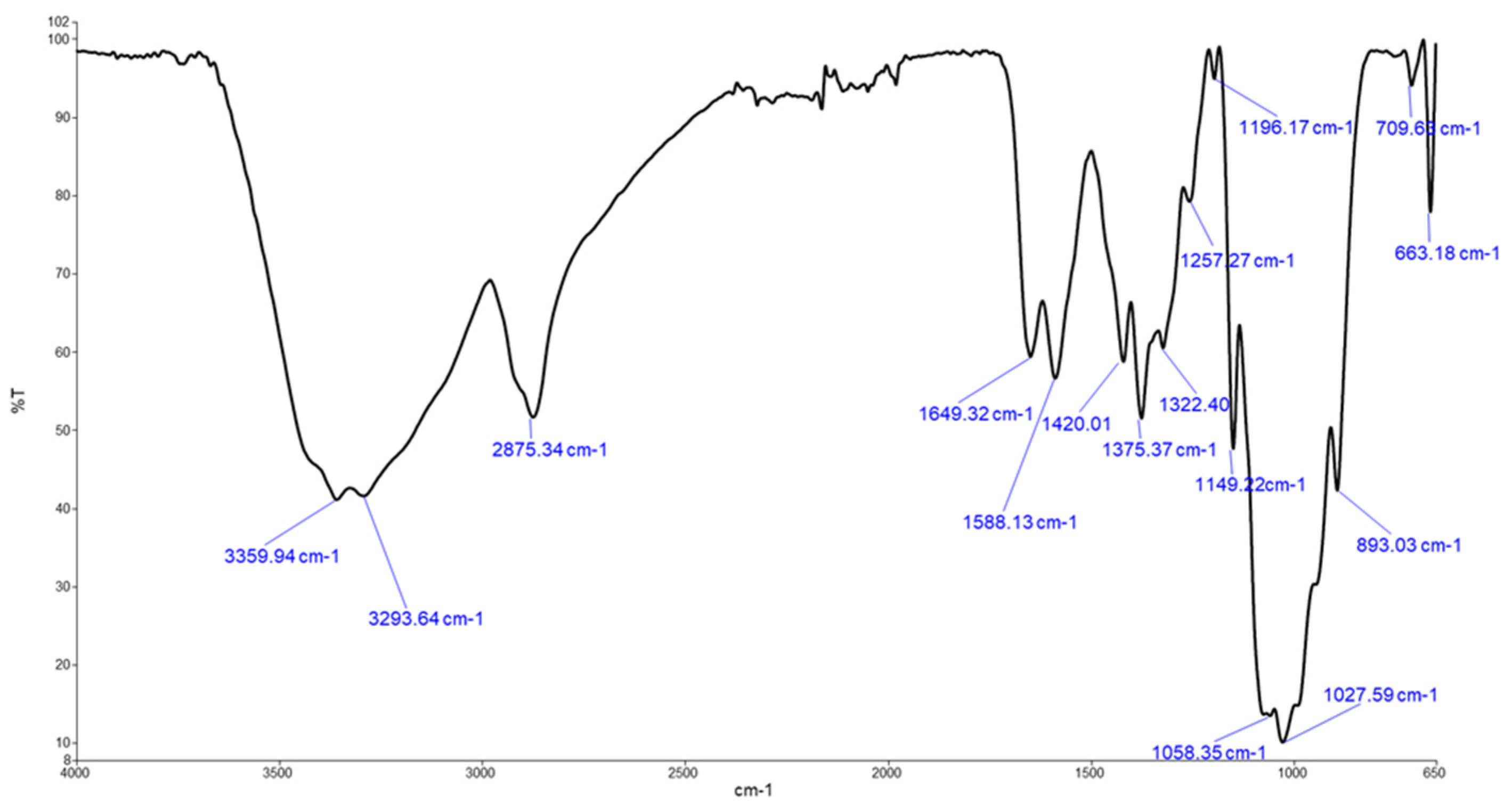
Figure 2.
Chitosan-based biofilm obtained from shrimp chitin extracted by the microbial method.
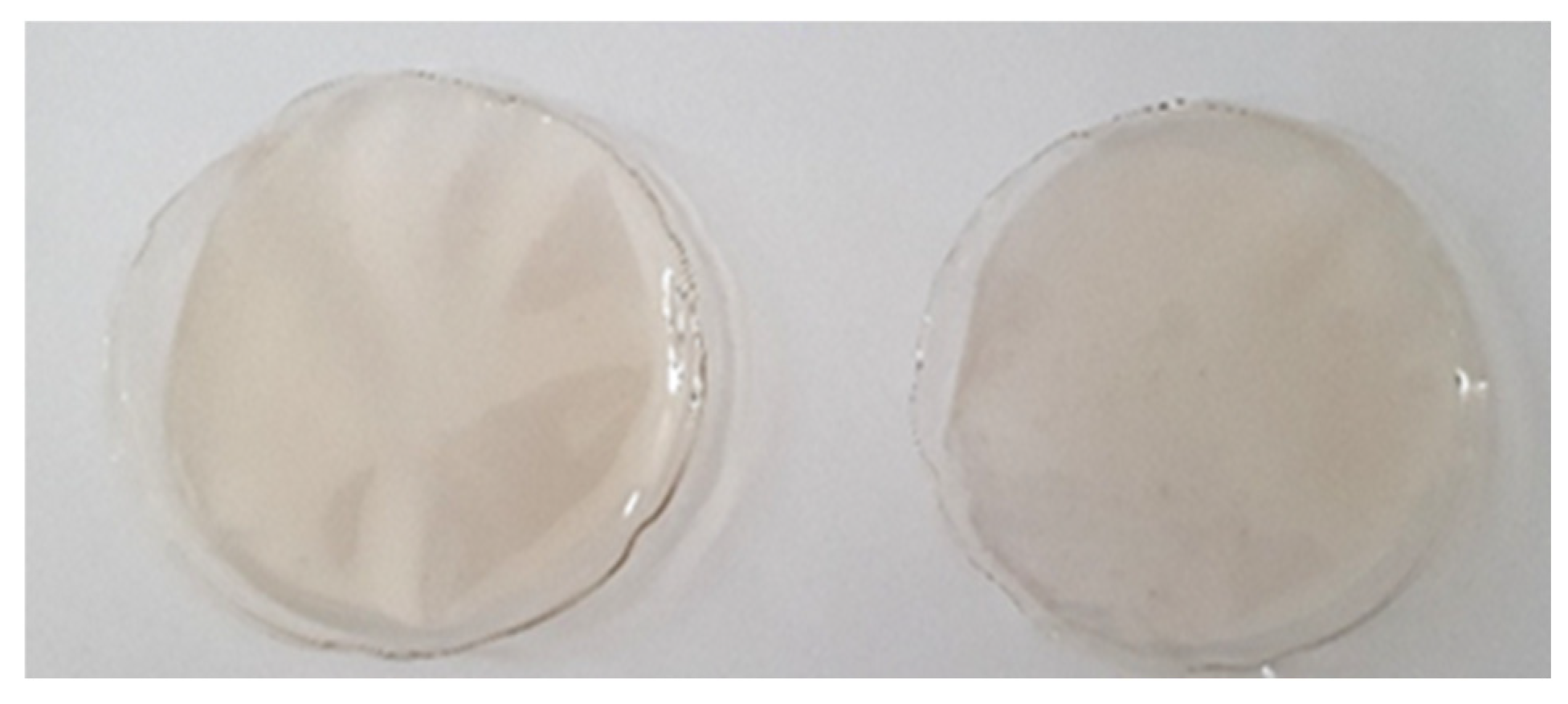
Figure 3.
a) SEM image of chitosan-based biofilm from shrimp chitin; b) Clusters in the chitosan-based biofilm from shrimp chitin.
Figure 3.
a) SEM image of chitosan-based biofilm from shrimp chitin; b) Clusters in the chitosan-based biofilm from shrimp chitin.
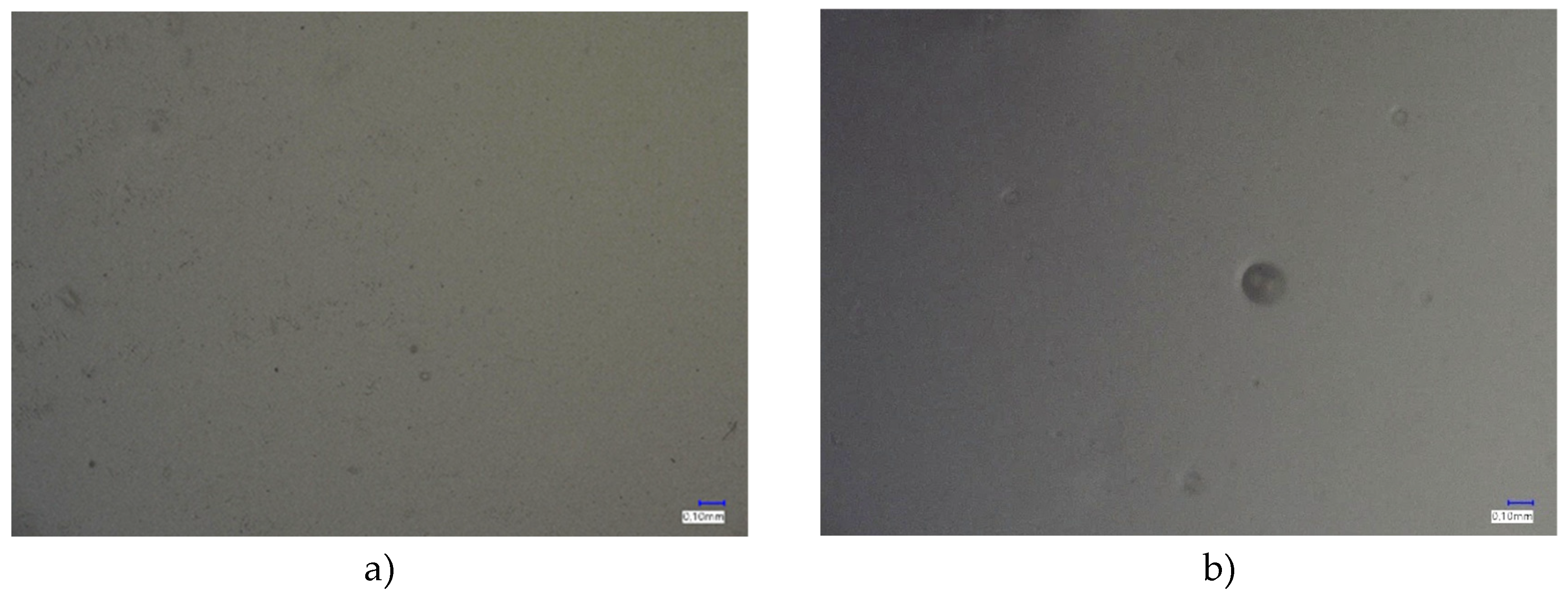

Table 1.
Proximate Composition of shrimp by-products (heads, shells with tails).
| Proximate composition | g/100 g of by-products |
|---|---|
| Protein | 6.10 ± 0.12 |
| Fat | 1.42 ± 0.03 |
| Ash | 15.30 ± 0.10 |
| Chitin | 12.48 ± 0.34 |
| Moisture | 64.70 ± 0.07 |
Table 2.
Changes of total nitrogen, chitin, protein, ash contents (on a dry weight basis), DDP (%), DDM (%) and pH after three days of fermentation with LABs and Y. lipolytica and after chemical extraction.
Table 2.
Changes of total nitrogen, chitin, protein, ash contents (on a dry weight basis), DDP (%), DDM (%) and pH after three days of fermentation with LABs and Y. lipolytica and after chemical extraction.
| Total Nitrogen (%) | Proteins (%) | Ash (%) | Chitin (%) | DDM (%) | DDP (%) | pH | |
|---|---|---|---|---|---|---|---|
| Shrimp waste | 5.16±0.02A | 17.00±0.24A | 43.34±0.15A | 35.60±0.48A | n.d. | n.d. | 7.72±0.01A |
| L. lactis | 6.53±0.05B | 2.41±0.35B | 8.49±0.24B | 89.10±0.20B | 81.80±0.25A | 85.80±0.55A | 4.73±0.02B |
| L. brevis | 4.89±0.14C | 2.86±0.42B | 15.93±0.44C | 81.21±0.18C | 63.10±0.05B | 83.20±0.87A | 4.86±0.01C |
| Y. lipolytica | 5.28±0.07A | 1.13±0.02C | 24.92±0.16D | 73.95±0.09D | 43.20±0.08C | 93.40±0.52B | 5.01±0.03D |
| Chemical | 6.80±0.21B | 1.01±0.05C | 0.00±0.00E | 96.00±0.11E | 100±0.00D | 96±0.75B | n.d. |
| Different letters (A, B, C…) indicate significant differences between treatments (p < 0.05) | |||||||
Disclaimer/Publisher’s Note: The statements, opinions and data contained in all publications are solely those of the individual author(s) and contributor(s) and not of MDPI and/or the editor(s). MDPI and/or the editor(s) disclaim responsibility for any injury to people or property resulting from any ideas, methods, instructions or products referred to in the content. |
© 2025 by the authors. Licensee MDPI, Basel, Switzerland. This article is an open access article distributed under the terms and conditions of the Creative Commons Attribution (CC BY) license (http://creativecommons.org/licenses/by/4.0/).
Copyright: This open access article is published under a Creative Commons CC BY 4.0 license, which permit the free download, distribution, and reuse, provided that the author and preprint are cited in any reuse.


