

Submitted:
11 December 2025
Posted:
12 December 2025
You are already at the latest version
Abstract
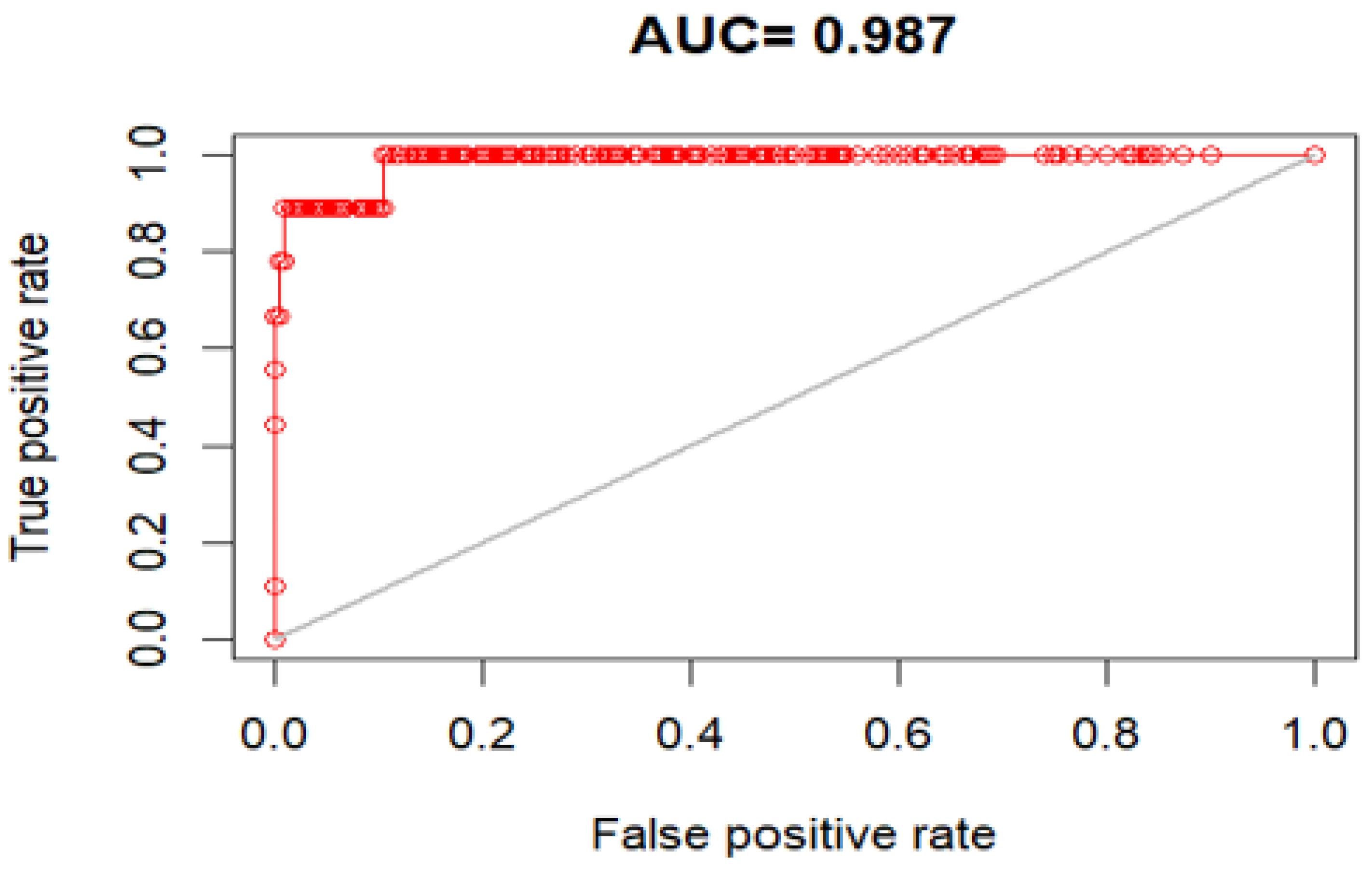
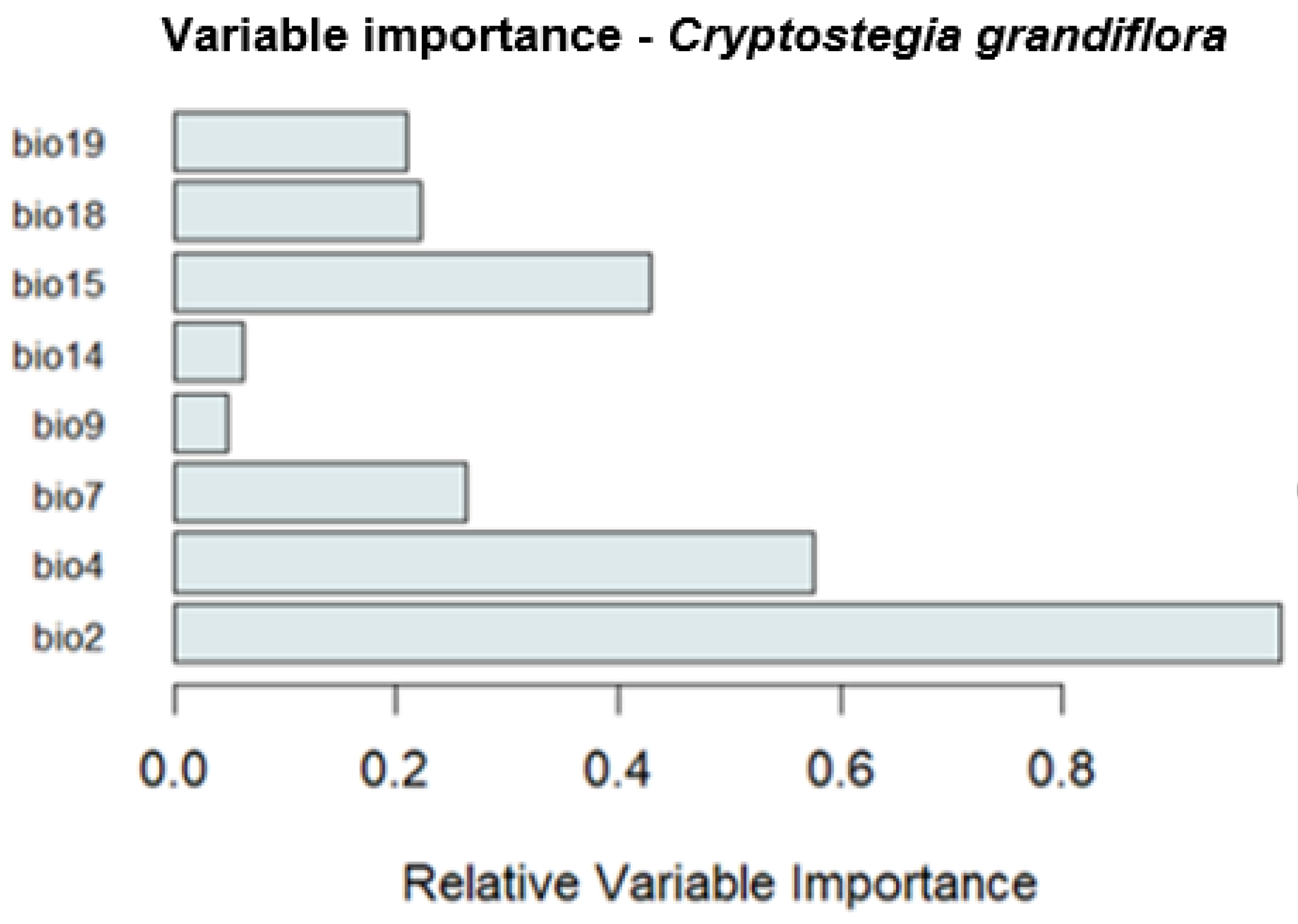
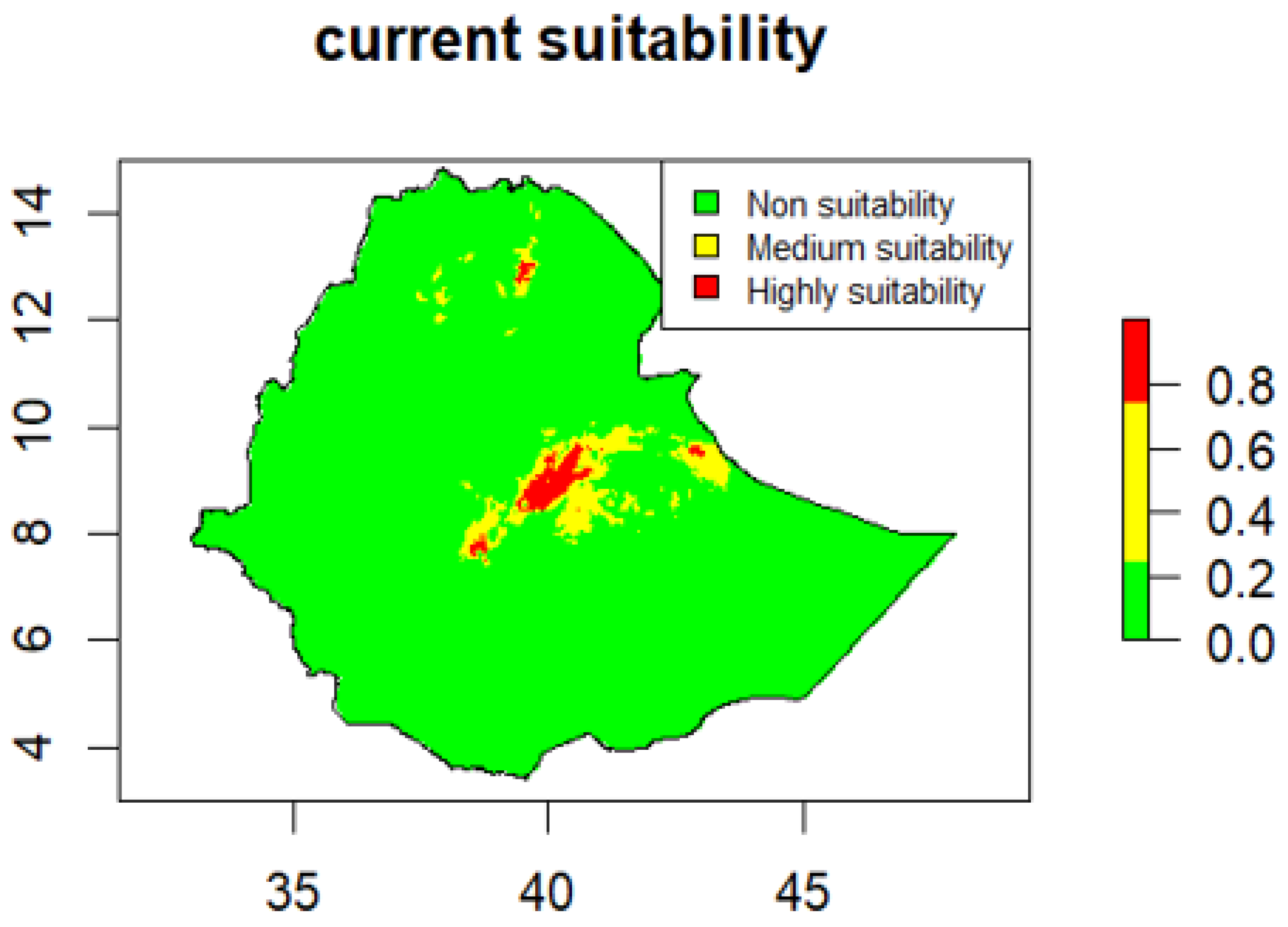
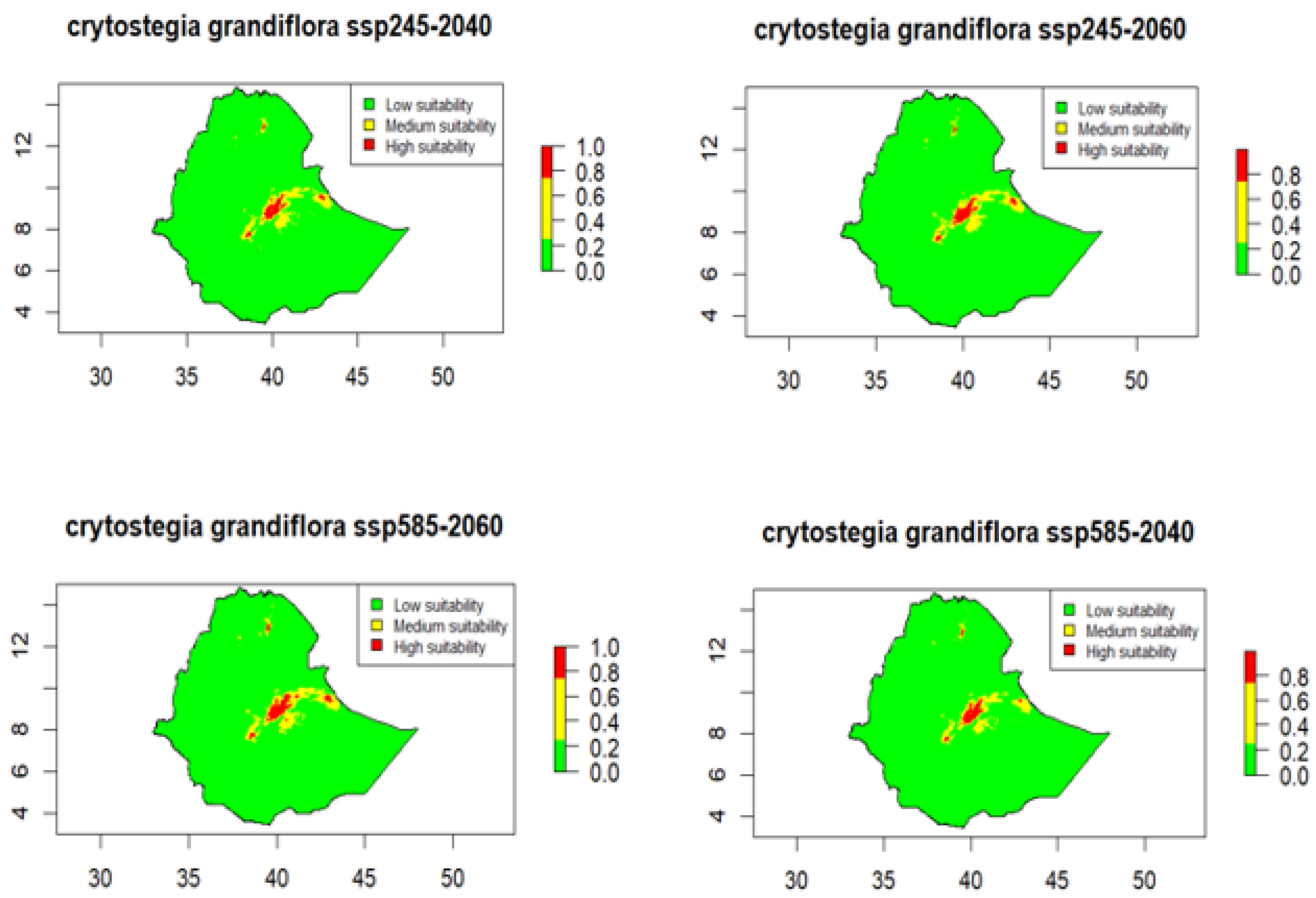
Ethiopia, a biodiversity-rich country in the Horn of Africa, faces growing threats from invasive alien plant species, notably Cryptostegia grandiflora (rubber vine). This study assessed the current and projected future distribution of Cryptostegia grandiflora under climate change scenarios using ensemble species distribution models (MaxEnt, GLM, and Random Forest) and eight key bioclimatic variables. Model performance was high, with a mean AUC of 0.96 and a mean TSS of 0.88. The most influential predictors were mean diurnal temperature range, temperature seasonality, and precipitation seasonality. Under current climate conditions, 98% of Ethiopia (2018932.7 km²) is climatically unsuitable for the species, with suitable habitats concentrated in the central highlands and limited northern pockets. Future projections indicate substantial expansion of suitable habitat. By 2040, highly suitable areas are projected to increase by 162.0% under SSP2-4.5 and 131.2% under SSP5-8.5. By 2060, these areas are expected to expand further by 232.3% and 226.6%, respectively, relative to current climatic conditions. These projected shifts indicate an elevated invasion risk in central and southeastern Ethiopia, with significant ecological and socio-economic challenges, including suppression of native vegetation, reduced pasture productivity, and threats to pastoral livelihoods. Therefore, this study highlights the need for proactive monitoring, early containment, and climate-informed management strategies to mitigate future impacts of Cryptostegia grandiflora on biodiversity and ecosystem services.
Keywords:
1. Introduction
2. Research Methods and Design
2.1. Study Site Description
2.2. Cryptostegia grandiflora Occurrence Data
2.3. Predictor Bioclimatic Variables
2.4. Modeling Species Distribution and Evaluation of Model Performance
2.5. Change Detection
3. Results
3.1. Model Performance
3.2. Variable Importance Analysis
3.3. Current Distributions of Cryptostegia Grandiflora
3.3. Future Predicted Distributions of Cryptostegia Grandiflora
4. Discussion
4.1. Effects of Climatic Variables on the Spatial Distribution of Cryptostegia Grandiflora
4.2. Suitable Habitat for Cryptostegia Grandiflora in the Current Climate Conditions
4.3. Projection of Suitable Habitat for Cryptostegia Grandiflora in The Future Climate Change Under Four Representative Concentration Pathways
4.4. Management Implications for Cryptostegia Grandiflora
5. Conclusion
Data Availability Statement
Acknowledgments
Conflicts of Interest
References
- Allouche, O.; Tsoar, A.; Kadmon, R. Assessing the accuracy of species distribution models: Prevalence, kappa and the true skill statistic (TSS). Journal of Applied Ecology 2006, 43(6), 1223–1232. [Google Scholar] [CrossRef]
- Araújo, M. B.; New, M. Ensemble forecasting of species distributions. Trends in Ecology & Evolution 2007, 22(1), 42–47. [Google Scholar] [CrossRef]
- Beaury, E.M.; Fusco, E.J.; Jackson, M.R. Incorporating climate change into invasive species management: insights from managers. Biol Invasions. 2020, 22, 233–252. [Google Scholar] [CrossRef]
- Belayneh, B.; Taye, T.; Rezene, F. Spatial distribution and abundance of invasive alien plant species in Gamo Gofa Zone, Ethiopia. International Journal of Innovative Research and Development 5 2016, 23–33. [Google Scholar]
- Bellard, C.; Jeschke, J. M.; Leroy, B.; Mace, G. M. Insights from modeling studies on how climate change affects invasive alien species geography. Ecology and Evolution 2018, 8(11), 5688–5700. [Google Scholar] [CrossRef]
- Chippendale, J. F. The potential economic returns to research into rubber vine (Cryptostegia grandiflora R. Br.) in North Queensland. Unpublished master’s thesis, University of Queensland, Brisbane, Australia, 1991. [Google Scholar]
- Christensen, J. H.; Hewitson, B.; Busuioc, A.; Chen, X.; Gao, X.; Held, R.; Whetton, P. Solomon, S., et al., Eds.; Regional climate projections. In Climate Change 2007: The physical science basis; Cambridge University Press, 2007; pp. 847–940. [Google Scholar]
- Elith, J.; Graham, C. H.; Anderson, R. P.; Dudík, M.; Ferrier, S.; Guisan, A.; Lehmann, A. Novel methods improve prediction of species’ distributions from occurrence data. Ecography 2006, 29(2), 129–151. [Google Scholar] [CrossRef]
- Ethiopian Biodiversity Institute (EBI). Sixth national report on the implementation of the NBSAP (2015–2020).; Ethiopian Biodiversity Institute, 2021. [Google Scholar]
- Gebretsadik, G.; Animut, G.; Tegegne, F. Assessment of the potential of cactus pear (Opuntia ficus-indica) as livestock feed in Northern Ethiopia. Livestock Research for Rural Development 2013, 25(2), Article 21. [Google Scholar]
- Global Invasive Species Database. Cryptostegia grandiflora species profile. 2018.
- Hejda, M.; Pyšek, P.; Jarošík, V. Impacts of invasive plants on the species richness, diversity and composition of invaded communities. Journal of Ecology 2009, 97(3), 393–403. [Google Scholar] [CrossRef]
- Hellmann, J. J.; Byers, J. E.; Bierwagen, B. G.; Dukes, J. S. Five potential consequences of climate change for invasive species. Conservation Biology 2008, 22(3), 534–543. [Google Scholar] [CrossRef] [PubMed]
- Hernández, O. G.; Guisan, A.; Thuiller, W. Habitat suitability and distribution models: With applications in R.; Cambridge University Press, 2017. [Google Scholar]
- Invasive Species Compendium. Cryptostegia grandiflora datasheet.; CABI, 2014. [Google Scholar]
- Jemal, T.; Tessema, T. Abundance and distribution of invasive alien plant species in Illu Ababora Zone, Ethiopia. Journal of Agricultural Science and Food Technology 2015, 1(7), 94–100. [Google Scholar]
- Kosicki, J. Z. Generalised additive models and random forest approach as effective methods for predictive species density and functional species richness. Environmental and Ecological Statistics 27 2020, 273–292. [Google Scholar] [CrossRef]
- Kriticos, D. J.; Sutherst, R.W.; Brown, J.R.; Adkins, S.W.; Maywald, G.F. Climate change and biotic invasions: a case history of a tropical. Biological Invasions 2003, 5, 145–165. [Google Scholar] [CrossRef]
- Kueffer, C. Plant invasions in the Anthropocene. 2017, 358(6364), 724–725. [Google Scholar] [CrossRef]
- Kuma, M.; Achiso, Z.; Chinasho, A.; Yaya, D.; Tessema, S. Floristics and diversity of invasive alien plant species in Humbo District, South Ethiopia. International Journal of Ecology 2021 2021, 1–10. [Google Scholar] [CrossRef]
- Luizza, M. W.; Young, H.; Kuroiwa, C.; Evangelista, P.; Worede, A.; Bussmann, R. W.; Weimer, A. Local knowledge of plants and their uses among women in the Bale Mountains, Ethiopia. Ethnobotany Research and Applications 11 2013, 315–339. [Google Scholar]
- Mackey, A. P. Rubber vine (Cryptostegia grandiflora) in Queensland.; Queensland Department of Natural Resources, 1996. [Google Scholar]
- Moss, R. H.; Edmonds, J. A.; Hibbard, K. A.; Manning, M. R.; Rose, S. K.; van Vuuren, D. P.; Wilbanks, T. J. The next generation of scenarios for climate change research and assessment. Nature 2010, 463(7282), 747–756. [Google Scholar] [CrossRef]
- Naimi, B.; Araújo, M. B. sdm: A reproducible and extensible R platform for species distribution modelling. Ecography 2016, 39(4), 368–375. [Google Scholar] [CrossRef]
- Parsons, W. T.; Cuthbertson, E. G. Noxious weeds of Australia.; Inkata Press, 1992. [Google Scholar]
- Phillips, S. J.; Anderson, R. P.; Schapire, R. E. Maximum entropy modeling of species geographic distributions. Ecological Modelling 2006, 190(3–4), 231–259. [Google Scholar] [CrossRef]
- Podda, L.; Santo, A.; Leone, C.; Mayoral, O.; Bacchetta, G. Seed germination, salt stress tolerance and seedling growth of Opuntia ficus-indica. Flora 229 2017, 50–57. [Google Scholar] [CrossRef]
- Rai, P. K. Paradigm of plant invasion: A multifaceted review on sustainable management. Environmental Monitoring and Assessment 187 2015, 759. [Google Scholar] [CrossRef] [PubMed]
- Rai, P. K.; Kim, K.-H.; Lee, S. S.; Lee, J.-H. Molecular mechanisms in phytoremediation of environmental contaminants and prospects of engineered transgenic plants and microbes. Science of the Total Environment 705 2020, 135858. [Google Scholar] [CrossRef]
- Rathore, P.; Roy, A.; Karnatak, H. Modelling the vulnerability of Taxus wallichiana to climate change scenarios. Ecological Indicators 102 2019, 199–207. [Google Scholar] [CrossRef]
- Rogelj, J.; Meinshausen, M.; Knutti, R. Global warming under old and new scenarios using IPCC climate sensitivity range estimates. Nature Climate Change 2012, 2(4), 248–253. [Google Scholar] [CrossRef]
- Ruiz-Navarro, A.; Gillingham, P. K.; Britton, J. R. Predicting shifts in the climate space of freshwater fishes. Biological Conservation 203 2016, 33–42. [Google Scholar] [CrossRef]
- Shiferaw, W.; Demissew, S.; Bekele, T. Invasive alien plant species in Ethiopia: ecological impacts on biodiversity a review paper. International Journal of Molecular Biology. 2018, 3(4), 169–176. [Google Scholar] [CrossRef]
- Shonga, E. New pests challenging the current pest management support system and need for reinvigorate the system. In Proceedings of the 21st Annual Conference, Addis Ababa, Ethiopia; 2014. [Google Scholar]
- Simberloff, D.; Martin, J. L.; Genovesi, P.; Maris, V.; Wardle, D. A.; Aronson, J.; Vilà, M. Impacts of biological invasions: What’s what and the way forward. Trends in Ecology & Evolution 2013, 28(1), 58–66. [Google Scholar] [CrossRef]
- Sintayehu, D. W.; Dalle, G.; Bobasa, A. F. Impacts of climate change on current and future invasion of Prosopis juliflora in Ethiopia. Heliyon 2020, 6(8), e04596. [Google Scholar] [CrossRef]
- Tesfaye, B.; Seifu, A.; Ayenew, A. Impacts of invasive plant Cryptostegia grandiflora on species diversity. International Journal of Agriculture Innovations and Research 2019, 7(5), 1–10. [Google Scholar]
- Thamaga, KH; Dube, T. Understanding seasonal dynamicsof invasive water hyacinth (Eichhornia crassipes) in the GreaterLetaba river system using Sentinel-2 satellite data. GIScience and Remote Sensing 2019, 56(8), 1355–1377. [Google Scholar] [CrossRef]
- Valavi, R.; Elith, J.; Lahoz-Monfort, J. J. Modelling species presence-only data with random forests. Ecography 44 2021, 1731–1742. [Google Scholar] [CrossRef]
- Zeleke, W.; Merawi, E.; Bekele, T.; Goshu, B.; Emishaw, Y.; Ayehune, A. Medicinal plants: Traditional knowledge and practices in Ethiopia. International Journal of Ecotoxicology and Ecobiology 2017, 2(2), 56–60. [Google Scholar]
- Zeppel, M. J. B.; Wilks, J. V.; Lewis, J. D. Impacts of extreme precipitation and seasonal changes in precipitation on plants. Biogeosciences 2014, 11, 3083–3093. [Google Scholar] [CrossRef]
- Zhang, L.; Liu, S.; Sun, P.; Wang, T.; Wang, G.; Zhang, X.; Wang, L. Consensus forecasting of species distributions. PLoS ONE 2015, 10(3), e0120056. [Google Scholar] [CrossRef]
- Zhang, W.; Brandt, M.; Tong, X.; Tian, Q.; Fensholt, R. Impacts of the seasonal distribution of rainfall on vegetation productivity across the Sahel. Biogeosciences 15 2018, 319–330. [Google Scholar] [CrossRef]

| Code | Predictor bioclimatic Variable |
| Bio1 | Annual mean temperature |
| Bio2 | Mean diurnal range |
| Bio3 | Isothermality |
| Bio4 | Temperature seasonality |
| Bio5 | Max temperature of warmest month |
| Bio6 | Min temperature of coldest month |
| Bio7 | Temperature annual range |
| Bio8 | Mean temperature of wettest quarter |
| Bio9 | Mean temperature of driest quarter |
| Bio10 | Mean temperature of warmest quarter |
| Bio11 | Mean temperature of coldest quarter |
| Bio12 | Annual precipitation |
| Bio13 | Precipitation of wettest month |
| Bio14 | Precipitation of driest month |
| Bio15 | Precipitation seasonality |
| Bio16 | Precipitation of wettest quarter |
| Bio17 | Precipitation of driest quarter |
| Bio18 | Precipitation of warmest quarter |
| Bio19 | Precipitation of coldest quarter |
| Methods | AUC | COR | TSS | Deviance |
| GLM | 0.93 | 0.67 | 0.83 | 0.21 |
| RF | 0.98 | 0.81 | 0.89 | 0.12 |
| MaxEnt | 0.97 | 0.79 | 0.92 | 0.13 |
| Years | Scenarios | Suitability area in Km2 (%) | |||||||
| Not suitable | Moderately suitable | Highly suitable | |||||||
| Current | 2018932.7 | 98.04% | 36278.5 | 1.76% | 4107 | 0.20% | |||
| 2040 | SSP2-4.5 | 1098921.6 | 95.21% | 44021.9 | 3.85% | 10759.5 | 0.94% | ||
| SSP5-8.5 | 1093873.8 | 95.62% | 40620.8 | 3.55% | 9497.4 | 0.83% | |||
| 2060 | SSP2-4.5 | 1086301.5 | 94.96% | 44043.3 | 3.85% | 13647.2 | 1.19% | ||
| SSP5-8.5 | 1080889.7 | 94.48% | 49690.4 | 4.34% | 13411.9 | 1.17% | |||
| Year | Scenario | Suitability change in (%) | ||
| Not suitable | Moderate | High | ||
| Current | - | - | - | - |
| 2040 | SSP2-4.5 | −45.6 | 21.3 | 162.0 |
| SSP5-8.5 | −45.8 | 12.0 | 131.2 | |
| 2060 | SSP2-4.5 | −46.2 | 21.4 | 232.3 |
| SSP5-8.5 | −46.5 | 37.0 | 226.6 | |
| Year | Scenario | Vulnerability of suitable habitat area in (%) | ||
| Not suitable | Moderate | High | ||
| Current | - | - | - | - |
| 2040 | SSP2-4.5 | −83.7 | 17.6 | 61.8 |
| SSP5-8.5 | −84.6 | 10.7 | 56.8 | |
| 2060 | SSP2-4.5 | −85.9 | 17.6 | 69.9 |
| SSP5-8.5 | −86.8 | 27.0 | 69.4 | |
Disclaimer/Publisher’s Note: The statements, opinions and data contained in all publications are solely those of the individual author(s) and contributor(s) and not of MDPI and/or the editor(s). MDPI and/or the editor(s) disclaim responsibility for any injury to people or property resulting from any ideas, methods, instructions or products referred to in the content. |
© 2025 by the authors. Licensee MDPI, Basel, Switzerland. This article is an open access article distributed under the terms and conditions of the Creative Commons Attribution (CC BY) license (http://creativecommons.org/licenses/by/4.0/).