

Submitted:
09 December 2025
Posted:
10 December 2025
Read the latest preprint version here
Abstract
The Universe has two domains: Life and Non-Life, which manifest the dimensionless relativity ratio with basic codes. For life is a/b = a/(1-a) = (1-b)/b (Floating Ratio), and for Non-Life is a/b = (a + b)/a = 1 + b/a (Golden Ratio). Life and Non-Life can be connected and co-exist by the two fractional distribution functions of “1”.The Mass Action Law (MAL) Median Effect Principle leads to the Unified General Dynamics Theory and algorithm, which provides an interdisciplinary and cross-disciplinary common linkage of parameters for computerized digital research and development informatics.
Keywords:
mass-action law (MAL)
; dose-effect curve (DEC) linearization
; Inputs-Outputs Transition (PN
; NP) Patterns Combinatorial Analysis
; median-effect equation (MEE)
; combination index equation (CIE)
; unity theory of one (UTO)
; “One” is the Life and Non-life Common Link
; Life-Centric Universe (LCU)
; Floating Ratio vs. Golden Ratio
; Artificial intelligence MAL Algorithm framework
1. Foundations of the Theory
This MAL work was initiated and extended by this author since 1965 as a graduate student at Yale University, using MAL as the fundamental principle for systems enzyme kinetics, input-output sequential pattern combinatorial analysis, and both linear and circular general systems [1,2,3,4,5,6,7].
The input-output patterns (sequential and circular) are systematically analyzed using a combinatorial approach and mathematical induction and deduction to support inductive and deductive conclusions.
The dose-effect or causal-effect relationship in theoretical system biology has been carried out at an optimal homeostatic state at fixed temperature, pressure, oxygen/CO2 tension, and minimum essential nutrients, leaving “dose” and “effect” the only variables, for the decades-long mass-action law (MAL) intrinsic properties explorations and applications. The unified general equations and algorithms of MAL, independent of unit, physical state, size, structure, and complexity, ensure their universality in applications for dynamic, principle-directed design and automated simulation, enhancing efficiency and cost-effectiveness in R&D. Conceptually, this is a fundamental departure from the traditional observation/statistics-based R&D mindset. Thus, the MAL theory provides a paradigm shift in R&D while serving as a complementary, deterministic alternative, like two sides of the same coin, in gaining knowledge, fostering innovation, and driving discoveries.
P = NP in quantum-mechanics-level terminology in quantum computing has sparked broad discussions. Christopher Paradise in 2025 proposed that consciousness itself operates as a polynomial-time solver through entropy-driven self-reference." (Digital Dynamics AI, ORCID 0009-0009-9901-8668). This is a new way of thinking that draws debates on consciousness, intuitiveness, and human cognition.
The P vs NP concept is theoretically relevant to the mass-action law (MAL)-based inputs-outputs sequential transitional-pattern combinatorial analysis, just as AI uses computer programming for question-and-answer. The MAL system-analysis approach was elected as the Ph.D. thesis project at Yale University, L-asparagine biosynthesis by asparagine synthetase, which involved three substrates (Asp, Gln, ATP) and four products (Asp, Glu, AMP, and PP). [1,2]. The goal was to elucidate the entire reaction mechanism and derive the reaction rate equation. A novel combinatorial analysis for the enzyme substrates input (S) and products output (P), (S, P)-duplex signal pattern transition-numbers of SP to PS, during 1966-1970 [1,2].
The MAL principle reveals a surprising finding: The discovery of the 2nd-degree (squared) triangle, where all elements in the classical Pascal triangle. i.e., if all elements in Chou’s triangle take square roots, they become the Pascal Triangle.
It is known that in Pascal Triangle (1st degree), the sum of the reciprocals of the harmonic numbers (1/1 +1/2 + 1/3.+1/4 +1/5 +…) is divergent without a bound. In contrast, the sum of the reciprocals of the triangular numbers (1/1 + 1/3 + 1/6 + 1/10 +…) is convergent to 2. The recent report by Brothers H and Green R showed that the ratios of the sums of sequential rows can lead to Euler’s e-entity. [https://sciencespetrum.com/pascals-triangle-the secret-within-3d525d88048d],
Interestingly, for the Chou’s Triangle (2nd-degree for SP and PS pattern transitions concept in biological enzyme system), the sum of the reciprocal of the squared numbers (1/1 + 1/4 + 1/9 + 1/16 + 1/25 +….) = /6 = 1.6449…, indicating a transition from the fractions of natural inverted square numbers to a transcendental irrational number that is related to . In addition, the Chou’s Triangle can be related to Riemann’s Zeta Function at Re(2), with a critical line for 1/2, which is corresponding to the MAL-MEE’s Median line at 0.5 for fa = fu = 0.5 for fa + fu =1, i.e., the mathematical function for the fractional distributions of “One”. This is also Chou’s Unity Theory of One (UTO), where MAL-MEE, CIE, and DRIE defined “1” as the universal standard.
The robust growth of the MAL-based R&D theory and its digital simulation method during 2020-2025 has resulted in a net increase of over 11,712 new citations, with a cumulative total of 1,581 citing scientific journals and 1,621 citing patents globally, as reported in bibliometric databases, indicating its game-changing impact.
This report consolidates a unified theoretical and practical framework that charts alternative path to the scientific research and development and digital data science through the Mass-Action Law (MAL) principle and its derived unified general theorems: Median-Effect Equation (MEE) [4], the Doctrine of the Median (DOM) [8,9], the Combination Index Equation (CIE) [6,7,8,9,10,11,12,13], and the Dose-Reduction Index Equation (DRIE) [9,12]. Together, these form a deterministic and scalable system for modeling actions and interactions across biological, biochemical, biophysical, and environmental systems [14,15,16,17,18,19,20,21,22,23] and beyond.
Introduction
Two Domains and Ratios
Two domains in Nature, life and non-life, maintain the realm of entity existence through the Doctrine of the Median (DOM) in the Unity Theory of One (UTO) of the Mass-Action Law (MAL). [19,20,21,22,24]
The MAL system analysis on inputs-outputs, does-effect theoretical sequential, pattern, and combinatorial analysis, leads to the derivation of the unified general median-effect equation (MEE):
fa/fu = (D/Dm)m, where D (dose), Dm (median-effect dose), m (exponential dynamic-order), fa (fraction affected), and fu (fraction unaffected); fa +fu =1). Thus, mass and functional effect are interchangeable. The extension of MEE led to the combination index equation (CIE), where CI = 1 (additive), <1 (synergistic), or>1 (antagonistic) for all entity interactions, including drug + drug or drug + radiation. The MAL-MEE is:
fa/fu = fa/(1 -fa) = (fu)-1 -1 = [(fa)-1 -1]-1 = [D/Dm]m, where fa + fu = 1, with general algorithms and the intrinsic properties that manifest Life, that is, in a recyclable, closed form for finite fractional distribution of “1”. The MEE’s floating ratio (fa/fu) has the basic mathematical form of a + b = 1, and a/b = a/(1-a) = (1-b)/b = (D/Dm)m = (M)m, where M is the median-normalized Mass. Thus, Effect (fa) and Mass (D) are interchangeable or equivalent in the life domain. This is akin to Einstein’s relativity theory, E = MC2, in which Energy (E) and Mass (M) are interchangeable or equivalent.
In contrast, the ancient Golden Ratio (GR, ) ,
manifests the Non-life domain, in mathematics and physics, for the continuous fractional distribution of “1”, in open form, extendable to infinity [22].
1.618033988749894… = 1+ (1/𝜑) = (1 + √5)/2,
Both FR (flexible) and GR (fixed) are dimensionless ratios of relativity due to the cancellation of any unit for the ratio of the same kind, e.g., D/Dm; thus, they are valid independent of unit, physical state, size, structure, and mechanistic complexity, and they are universal. The Dm is a universal reference point, and the dynamics order is a common link; they are universal.
Life and Non-Life
Number scaling such as additive accumulation vs minus deduction, multiply vs divide, exponent vs root, squaring divergence and expansion vs taking root convergence and contraction, can be for real integers or numbers of the number theory, or of the imaginary number, such as i = the exponents show interesting rotational or wave-like properties. Unlike mathematics or theoretical physics, which have , e , i, , and infinity, the life domain uses the natural real numbers as described in this paper. Here, we are specially emphasizing dose-effect dynamics and informatics at the Median, and proximity to the median state of optimal, harmonic, cooperative, and homeostasis biological conditions, which frequently involve receptor, intermediate, pathway, network, systemic coordination and regulation, organization, and environment, in micro and macro scales of structural and functional activities and complexity with hidden behind invisible intermediates processes. Here are the reasons for the MAL-MEE-based theories that have been developed, such as MEP, CIE, DRIE, MTDPT, UTO, and LCU, to reveal the hidden intrinsic properties of natural phenomena. It becomes necessary to conclude that our universe has two domains: Life and Non-Life, each with diverse and complex features. Surprisingly, the fundamental mathematical codes are exceedingly simple: a/b = a/(1-a) for Life and a/b = (a + b)/a for Non-Life.
In biological sciences, the MAL-MEE is defined by general paired parameters: Dm (signifying potency) and m (signifying dynamics-order and shape of dose-effect curves or causal effective graphics).
Life science-based AML-MEE obeys the hyperbolic activation function (m = 1) or a sigmoidal activation function (m ≠ 1), as indicated in computer simulations of biomedical sciences R&D for quantitative digital informatics, and for the AI core-infrastructure algorithm (including the Hopfield’s artificial neural network) for input-output in real-world applications.
The biological MAL-MEE hyperbolic and sigmoidal activation function, fa = 1/[1 + (Dm/D) ^m], turns out to be the common form shared across multiple disciplines, with different symbols and designations.
Life to Death Transition
The abrupt transitions from Live to Non-life are described as: life-or-death in biology, all-or-none in pharmacology, collapse in physics, transformation in engineering and AI, undifferentiable in mathematics. This is a paradigm shift from the “1” distribution functions of the Floating Ratio to the Golden Ratio. In life, the MAL fa from >0 and <1, transform to fa = 0 and fu = becomes meaningless upon death; the Dm from a positive natural number to zero activity (inert), and the dynamic-order, and the m (positive and negative finite number for cooperativity, e.g., .-4 to +4, (or -2 to +2 for optimal cooperativity conditions) depending of negative or positive cooperativity intensity of the system) become zero upon death. Since Dm becomes 0, and the m = 0, (and the exponent of zero to any number returns to 1). Interestingly, when Dm =0, the Floating Ratio, fa/fu = 0/(1-0) = 0. Thus, the Life-Dead paradigm shift transition is beyond any scientific evaluation, but it is a reality. The Life’s homeostasis condition is Dm = fa = fu = 0.5 = 1/2 for equilibrium, symmetry, and harmony state at suitable temperature, pressure, O2/CO2 tension, and minimum essential nutrients for mainlining metabolism, growth, reproduction, and other activities. The importance of the median or 1/2 is manifested by the Riemann’s zeta function ½ critical line, as well as in Alfaro’s Alpha = 1/2. Thus, the clear link between Life and Non-life is via the common code of “1”, but each has distinct distribution functions. Chou’s system analysis on MAL for action (MEE) and interaction (CIE and DRIE) leads to the unity theory of one (UTO), since all MEE, CIE, and DRIE are based on the universal reference of “1” as the standard. Despite FR in Life’s finite, symmetric, closed dynamic properties being basically different from GR in Non-Life’s infinite, open, and recursive dynamic properties, both FR and GR share the ultimate connection as the fractional distribution functions from “One”.
Life is finite, optimal, median-mediated regulatory equilibrium, recyclable, with a “Floating Ratio” of dynamics, consciousness, and intelligence; Whereas non-life function is linear, open, fractal, moldable, with a fixed Golden Ratio, and infinitively expandable; and it is subjected to artificial intelligence (AI) for approximating, mimicking cumulated experience and information of LLMs big data, with extremely high speed and enormous capacity of volume.
Therefore, the Life and Non-life domains need to be separated within causal-effect, dose-response, or input-output scientific R&D dynamics, including AI basic category algorithms, to ensure confusion-free informatics. The best practice is to stay true to the facts and avoid arbitrary, subjective fine-tuning that can change over time, place, and policy.
MAL-Median-Effect Principle for Conserving Energy and Increasing Efficiency
Dm, the general reference point and the dynamic order's common link, exhibits the universal reference standard for equilibrium, optimization, symmetry, harmony, dynamics, and informatics [24]. The MAL's Minimum Two-dose Data Point Theory (MTDPT) automatically adds two default points (Dose zero and Dm) to all causal-effect dynamics simulations, resulting in an efficient, cost-effective framework for computerized digital R&D across all dynamics disciplines, including new drug clinical trials.
The MAL-based "top-down" R&D framework provides guidance for Econo-Green scalable design, in contrast to the traditional, statistics-based “bottom-up” R&D, when insufficient cumulative general basic knowledge becomes available [19,22,24]. The MAL dynamics enable inter- and cross-disciplinary linkage by sharing a common set of parameters across MAL-MEE/DOM and CIE algorithms in digital data science. By coincidence, the terms bottom, up, top, and down are used in the standard particle physics model for quark designations, with additional charm and strange among them ([24] in Figure 32).
Interdisciplinary and Cross-disciplinary Linkage and Convergence
Based on the MAL-MEE/DOM/CIE/UTO revelation and the fact that humans decide the units and methods of measurement, from a human-centric perspective, Life is proposed to be at the center among the physical elements of Mass, Force, Time, and Space in the Universe. It is called the Life-Centric Universe (LCU) [22]. This is not merely technical – it is a manifesto for a new scientific humanism, where it is not just in the universe, but at its center; a new humanism, a Renaissance concept in contrast to the prevailing materialism. It represents a paradigm shift toward unified, efficient, and life-resonant science, especially valuable in the AI and digital R&D era.
In Life, human as a being of primate, decides units and methods of the measurement, produce numbers for counting, sequencing, patterning, combinatorial for count without counting, algebra, geometry, trigonometry, metrics, calculus, metrices, statistics…and evolved to all branches of quantifiable and not quantifiable, countable and not countable sciences, including mathematics, philosophy, physicals, biological and social sciences and arts, whether for theory or for utility. The major scientific disciplines evolved into sub- and sub-sub-disciplines, which in turn ramified into thousands of scientific journals, especially in the biomedical sciences. In current scientific R&D, the diverse independent research works lack cross-linkage because different basic principles, parameters, intonations, taxonomies, and symbols are used, which may lead to unintended consequences for efficiency, cost-effectiveness, and connectivity. The MAL integrated unified general principle, using common denominators and MAL-parameters, has opened a groundbreaking new avenue for integrated R&D in MAL-based experimental protocol design and MAL-algorithm-based digitalized data simulation, enabling quantitative or indexed conclusions without always relying on the p-value, which is merely a scientific tool, not the scientific goal. The MAL principle provides common ground that benefits individual researchers and peer reviewers, as confirmed by the global reach of MAL-theory/method bibliometrics. However, the success of this unified, integrative reform task requires the support of decision-makers and key advisors at international regulatory agencies for coordination and harmonization. The preliminary report on MAL-DOM/UTO and LCU has been presented at the American Physiological Society (APS) Summit 2025 in Baltimore, MD [22].
The full MAL groundbreaking concept innovation has been explored over five decades across various disciplines and journals, making it difficult for any peer reviewer to navigate, except for the speed and capacity of artificial intelligence (AI). Given below are the categorized references relevant to Chou T.C.’s research work: A. Reviews [9,11] B. Books [23,24], Encyclopedia [25,26,27], and Monographs [28,29,30,31], C. Commentaries and Pre-clinical Drug Development based on MAL Dynamics and Informatics [24,32,33,34,35,36,37,38,39,40,41,42,43,44,45,46,47,48,49], D. Recent Meeting Reports [14,15,16,17,18,19,20,21,22], E. MAL-Theory and Algorithm Derivations (since 1970) [1,2,3,4,5,6,7], F. MAL-based R&D Designs, Software, and Applications [50,51,52,53,54,55]. The Chou’s bibliometric URLs are readily available on Web of Science [56], Google Scholar [57], and ResearchGate [58].
There have been numerous unified general theories of everything, including the Big Bang, relativity, string theory, and fundamental density theory. The mass-action law-based theory, as described here as MAL-MEE/CIR/CIIE/DOM/MDTPT/UTO, and the proposal of Life-Centric Universe (LCU) are based on the real-world, sensible dynamic phenomena, provide quantitative informatics for real-world knowledge innovations and problem solutions, which are supported by detailed scientific derivations, data documentations, and scalable for upward and downward bibliometric evidences. The MAL-unified general principle-guided R&D design and digitalized “top-down” data science is a basic conceptual departure from the traditional observation/statistics-based bottom-up R&D approach.
As indicated above, given the over 30 MAL-theoretical papers spanning multiple journals over five decades, this paper focuses on MAL-Theory rather than the Applications elaborated in 2024 in [24]. For multi- and cross-disciplinary purposes, some repetition and redundancy in content, as well as self-citations, are unavoidable. This author apologizes to readers for this non-traditional practice and publication format. To facilitate easy access and streamline the conceptual flow, the linkages are further categorized into three appendices: Appendix I: Abbreviations and Definitions; Appendix II: Theory Illustrations; and Appendix III. Examples of Categorized Applications.
The details of the previous illustrations, including the software and printouts, are available online [24,55].
The major examples of MAL-MEE-CIE and DRIE applications in specific research disciplines are given for cancer research, anti-viral, molecular biology, cell biology, genetics, immunology, and organ transplant, cancer- and infectious disease- drug discovery (in vitro, in vivo, and in animals), and pre-clinical studies design and implementations, and clinical trials. The applications have inter- and cross-linked to over 100 disciplines and sub-disciplines [9,23,24].
1.1. Mass-Action Law Median Principle for The Unified General Dynamics Theory of All Causal Actions
This paper summarizes a comprehensive theoretical and practical framework that redefines the core of scientific R&D and artificial intelligence through the Mass-Action Law (MAL), and its Median-Effect Equation (MEE), i.e., the Doctrine of the Median (DOM), Combination Index Equation (CIE), and the Dose-Reduction Index Equation (DRIE). These equations embody a deterministic, scalable, and cost-effective dynamical system for modeling actions and interactions in biological, biochemical, and biophysical systems. The Unity Theory of One (UTO), based on MAL-MEE/DOM/CIE/DRIE, leads to the proposition to place Life at the center of Mass, Force, Time, and Space physical elements of the Universe, i.e., the Life-Centric Universe (LCU), in which human decides Units and methods of measurement. The MAL concept integrates philosophy, biology, physics, and AI under a common principle and algorithm, with shared parameters.
The MAL-based biochemical and biophysical general equations show that the four corners are the general theory derived for specific research fields, now widely taught in various textbooks. The MAL-MEE in the center is derived from input () and outputs () general system analysis of enzyme-catalyzed reactions, with substrates (S), products (P), and inhibitors (I), and combinatorial sequential pattern analysis. The MAL-MEE derivation took 10 years (1966-1976) [1,2,3,4,5] and involved system analysis of combinatorial input-output patterns and transitions, involving over 300 reaction rate equations. From MEE to CIE and DRIE took another six years (1977-1984), and the dose-reduction equation in 1988 [6,7,8,9].
Figure 1.
The Median-Effect Equation (MEE) is the unified form of the major biochemical and biophysical specific equations for specific purposes. The MEE is the unified general theory of the Mass-Action Law (MAL) for pharmacodynamics, biodynamics, and bio-informatics (MAL-PD/BD/BI).
Figure 1.
The Median-Effect Equation (MEE) is the unified form of the major biochemical and biophysical specific equations for specific purposes. The MEE is the unified general theory of the Mass-Action Law (MAL) for pharmacodynamics, biodynamics, and bio-informatics (MAL-PD/BD/BI).
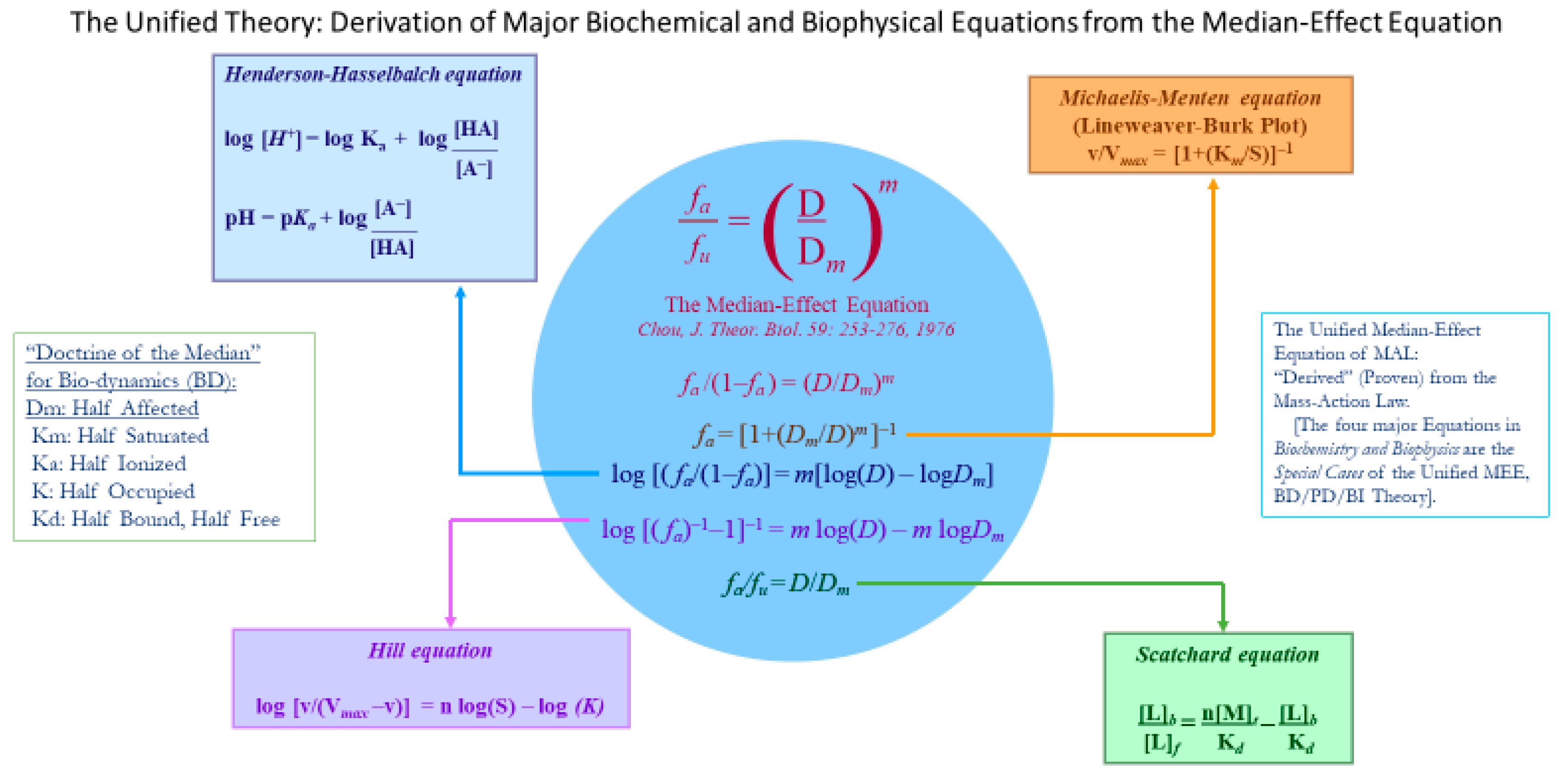
It should be noted that the Michaelis-Menten, Henderson-Hasselbalch, Hill, and Scatchard equations are the “general” theory for a specific research field, not a unified general equation for interdisciplinary or cross-disciplinary studies. The MEE also covers general dynamics and informatics for action and combination interactions, independent of unit, physical state, size, structure, and mechanistic complexity, with applications far beyond biomedical sciences [9,23,24].
The Doctrine of the Median (DOM) represents an optimal balance in biological systems. The point Dm provides the natural midpoint and universal reference for simulations. It reflects the principle of symmetry, order, balance, homeostasis, and harmony as in classical philosophy.
Key Parameters of the Median-Effect Equation
| Parameter | Definition | Role/Significance |
| D | Dose | The input concentration, intensity or mass causing an effect. |
| Dm | Median-Effect Dose | The dose required for 50% effect is a universal reference point, a potency or efficacy indicator, and a common link for dynamic orders. |
| fa | Fraction Affected | The observed fraction of the system or population that is affected by the dose. |
| fu | Fraction Unaffected | The observed fraction of the system or population that is unaffected (1 - fa). |
| m | Exponential Dynamics-Order | Signifies the shape of the activation function (hyperbolic if m=1, sigmoidal if m>1 or m<1), akin to AI models' basic activation functions. |
| FR | Floating Ratio (fa/fu) | Represents the causal relationship of MAL; its binary, circular, and recyclable nature is typical of Life. |
Mathematical Basic Transformations for Extracting Geometric Properties
The using forward and backward thinking, independent free spirit of exploring curiosity, and referring to ancient philosophy and mathematics, disregards the contemporary popular hot pursuits and timely ideology, the development of the MAL general and unified theory using numbers, sequence, patterns, and systematic combinatory analysis using only the mass-action law as the model, without invoking modern mathematical developments, physics theories, and engineering advancements.
Using the MAL general combinatorial system analysis, surprisingly, simple logic procedures, such as numbers, ratios, constants, equations, reciprocal (and double-reciprocal), logarithmic (and double logarithmic) exponents, dimensions, algebra, geometry, and graphics have revealed numerous intrinsic properties that underlie them, which have become the practical informatics based on the MAL dynamic principle. The limitless applications of the MAL-MEE/CIE/DRIE and the subsequent unity theory of one (UTO) and Life-centric universe (LCU) were not originally expected. The theory of the median-effect equation (MEE), (D/Dm)m = fa/fu = fa/(1-fa) = (1-fu)/fu = [(fu)-1 -1 = {(fa)-1 -1}-1 , was introduced in 1976 [4], but the term of the Floating Ratio as the (fa/fu) was named in in 2024 [20,22], to compare with the ancient Golden Ratio.().
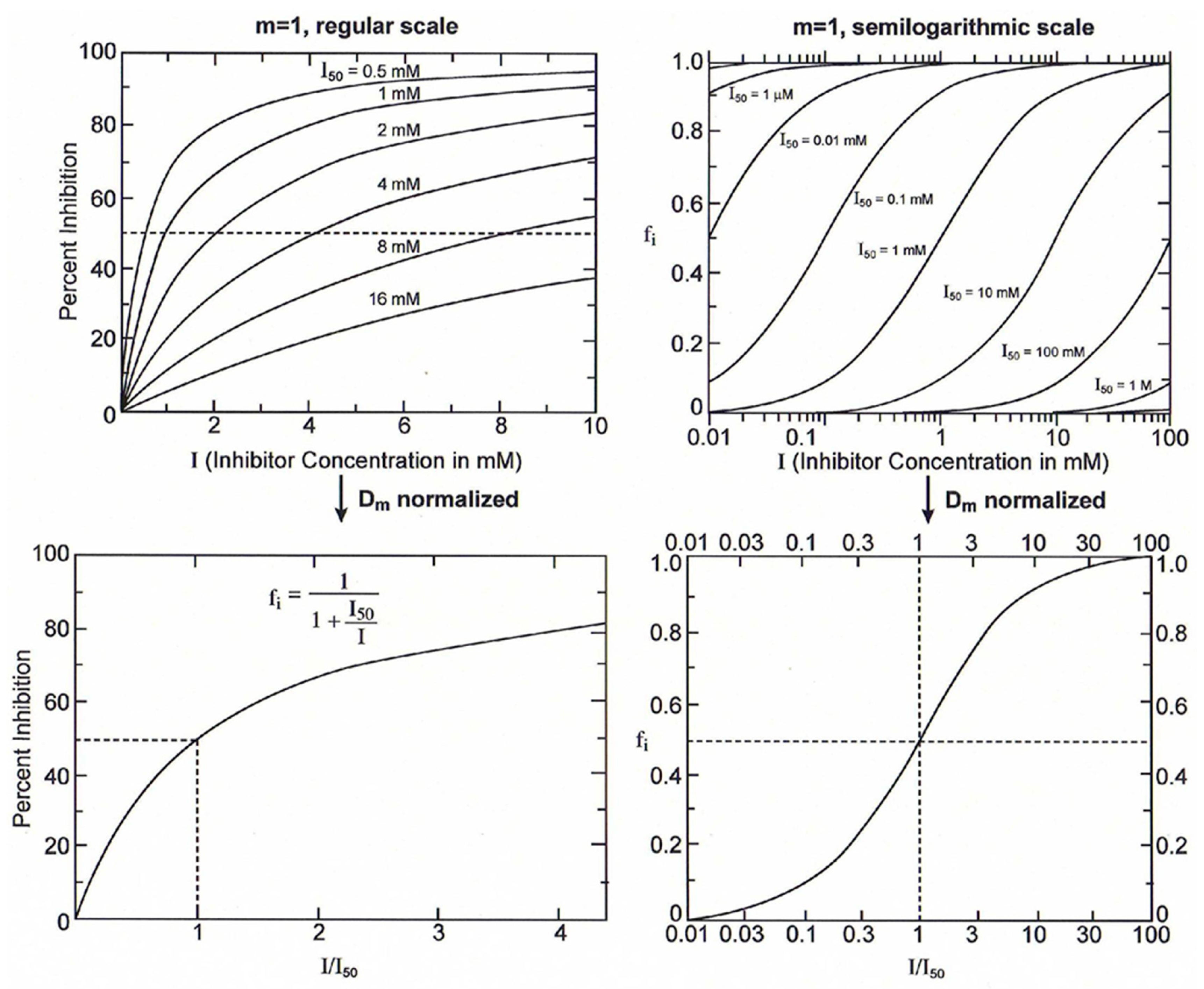
A series of MEE defined-dose-effect curves (DEC) can each be normalized by the median dose (DM) to yield first-order (m=1) hyperbolic curves, which can then be normalized into a single curve, for the transformation into a singularity of one (Figure 2).
Using the MEE algorithm, the MAL principle can be graphically illustrated in various forms, as shown in Figure 2, Figure 3 and Figure 4. The inhibitor (I) is the reference ligand. In contrast, the substrate (S) in the enzyme reaction is the primary ligand [9], representing the effector in enzyme-catalyzed reactions that exerts an effect on the enzyme target.
Figure 2.
Doctrine of the Median (DOM). Median-Effect Equation (MEE) is the Unified General Theory of the Mass-Action Law when m =1. The scope of applications includes drugs, biologicals, effectors, ligands, radiation, UV, toxins, infectives, carcinogens, etc., as single entities or in combination, for biodynamic algorithms and bioinformatics computer simulations. The median dose (Dm) serves as the common link for dose-effect curves (DECs) in Michaelis-Menten kinetic models of inhibitory effects. Upper: The original dose-effect curves in normal sequential scale (left), and in logarithmic scale (right). Bottom: The corresponding dose-effect curves normalized with the Dm or I50.
Figure 2.
Doctrine of the Median (DOM). Median-Effect Equation (MEE) is the Unified General Theory of the Mass-Action Law when m =1. The scope of applications includes drugs, biologicals, effectors, ligands, radiation, UV, toxins, infectives, carcinogens, etc., as single entities or in combination, for biodynamic algorithms and bioinformatics computer simulations. The median dose (Dm) serves as the common link for dose-effect curves (DECs) in Michaelis-Menten kinetic models of inhibitory effects. Upper: The original dose-effect curves in normal sequential scale (left), and in logarithmic scale (right). Bottom: The corresponding dose-effect curves normalized with the Dm or I50.
1.2. Dealing with Biological Complexity and Diversity: The MAL Approach for Solution
1.2.1. MAL-MEE and Chou’s Double Logarithmic Median Effect Plot (MEP): Dynamic Parameters Determination by Computer Simulation
The MAL-MEE/CIE and DRIE-based Theoretical and method, design, and computerized digital simulation [51,54,55] have already been applied to tens of thousands of papers, over 1,500 citing journals, and citing patents [9,23,24,56,57], which made a significant contribution with MAL-based efficient Top-Down R&D exploration, innovation, and new drug discovery.
1.2.2. Linearization of the Dose-Effect Curve (DCE)
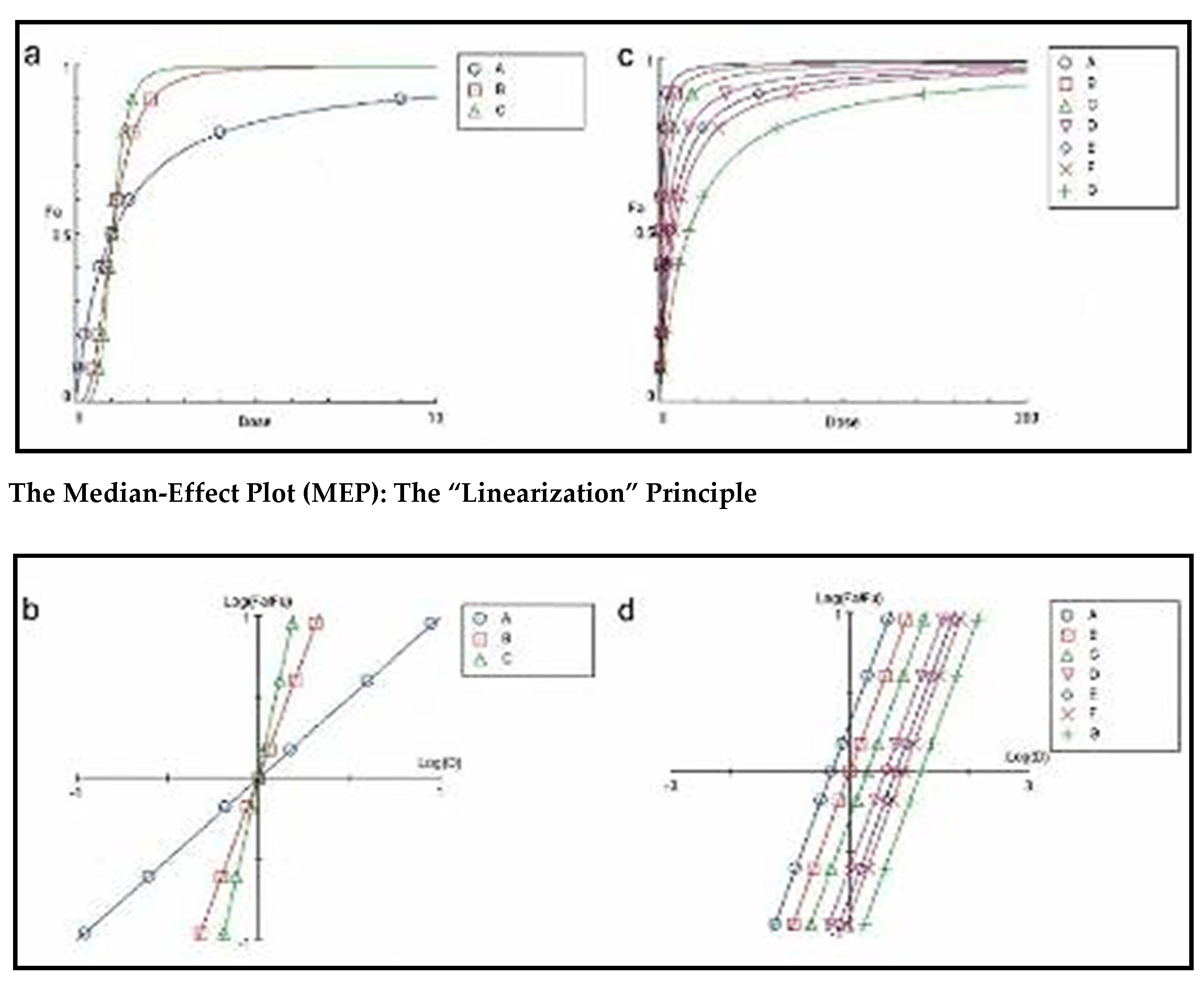
A typical illustration of the MEE, fa/fu = (D/Dm)m, is the Median-Effect Plot (MEP), x= log (D) vs. y = log (fa/fu), which transforms the dose-effect curves with hyperbolic shape (m=1) or sigmoidal shape (m The x-axis represents the logarithm of dose (log (D)), while the y-axis represents the logarithm of the Floating Ratio (log (fa/fu)). The slope of this linear plot directly corresponds to the exponential dynamics order of the m value, and the x-intercept yields log Dm. Thus, the antilog of this x-intercept then yields the Dm value. This linearization for determining the dual m-and-Dm paired parameters of the mass-identity is invaluable because MEP transforms complex sigmoidal or hyperbolic dose-response curves into a straightforward linear relationship, simplifying parameter estimation and enhancing the conceptual insight of all causal-effect dynamics studies. This visual representation underscores how diverse, non-linear dose-effect relationships can be unified and analyzed under a single, simplified linear model, significantly improving the efficiency and predictive power of data analysis (Figure 3).
Figure 3.
Transformation of various sigmoidal dose-effect curves in real-world problems. (a) into the corresponding linear forms (b) by the median-effect plot (MEP), where y = log (fa/fu) versus x = log (D). The slopes, m values (in this case, equal to 2, 3, and 5 for curves a, b, and c) signify the degree of sigmoidal shape. The anti-logs of the x-intercepts on the axis, where fa/fu = 1 [or log(fa/fu) = 0], give the Dm values, which signify the potency of each drugs, such as ID50 for median inhibition, ED50 for median effect, TD50 for median toxicity, and LD50 for median lethality, that forms the horizontal median-effect axis in pharmacological, medical and biological research and development (R&D), and beyond.
Figure 3.
Transformation of various sigmoidal dose-effect curves in real-world problems. (a) into the corresponding linear forms (b) by the median-effect plot (MEP), where y = log (fa/fu) versus x = log (D). The slopes, m values (in this case, equal to 2, 3, and 5 for curves a, b, and c) signify the degree of sigmoidal shape. The anti-logs of the x-intercepts on the axis, where fa/fu = 1 [or log(fa/fu) = 0], give the Dm values, which signify the potency of each drugs, such as ID50 for median inhibition, ED50 for median effect, TD50 for median toxicity, and LD50 for median lethality, that forms the horizontal median-effect axis in pharmacological, medical and biological research and development (R&D), and beyond.
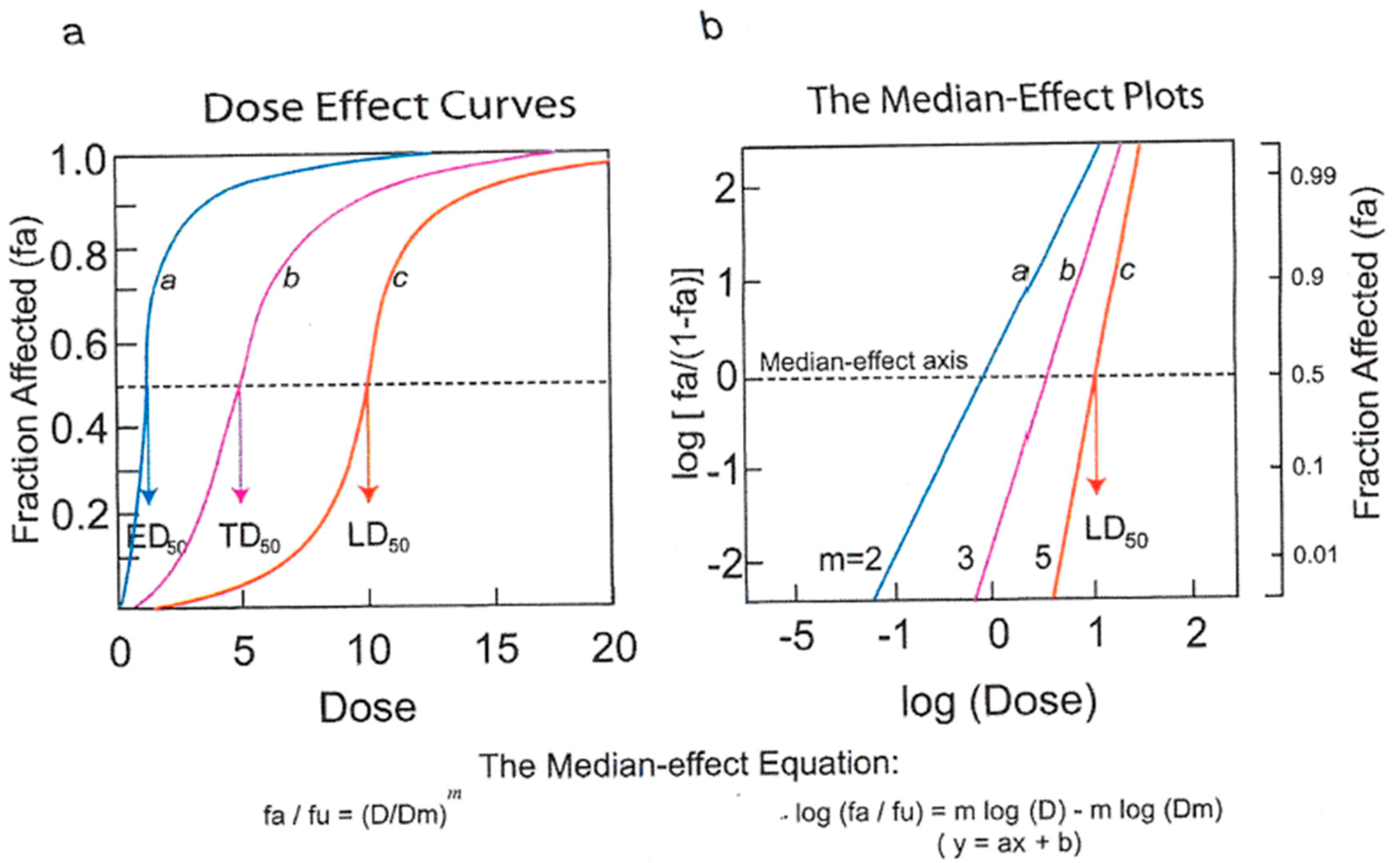
Thus, the median-point concept is extended to the median-axis concept. The rotation of the median axis may result in the median plane in computerized simulations [9,31].
Throughout this paper, based on the MAL-MEE principle, the diversity of phenomena in nature is merely the variability in the distribution functions of “1”.
1.2.3. Exponential Cooperativity Function and Intermediates, Pathway, and Network in the Life Science Features
The overriding features of the biomedical sciences and most other disciplines are the complexity and diversity of events and phenomena at micro and macro scales. The major reasons are the underlying intermediates, pathways, and networks hiding behind the input and output processes of the causal-effect or dose-effect, and the fundamental principles’ intrinsic properties. The MAL is shown to be the unified general principle in Nature.
Life science has the unique properties of functional cooperativity, equilibrium, feedback, symmetry, and harmony as basic features. Figure 4A,B illustrate some of these properties.
Figure 4.
A. The MAL Median-Effect equation geographic property illustrates the negative, positive, and neutral cooperative effects in life sciences.
Figure 4.
A. The MAL Median-Effect equation geographic property illustrates the negative, positive, and neutral cooperative effects in life sciences.
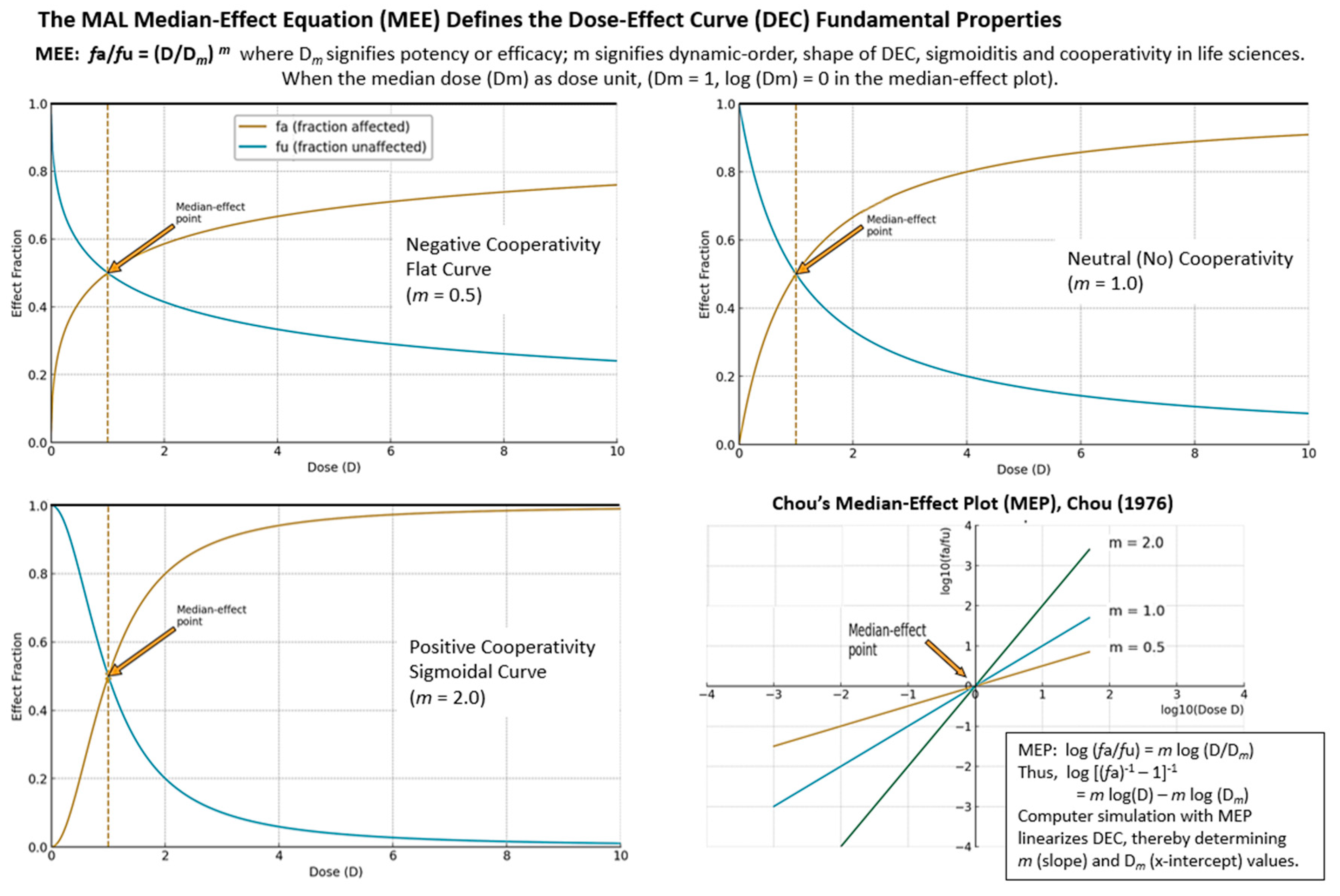
The median-effect plot (MEP) for log [(fa)-1 – 1]-1 = m log(D) – m log (Dm), with x = log (d) versus y = log (fa/fu), which is also equal to log [(fa)-1 – 1]-1. The MEP linearizes the dose-effect curve (DEC) into a straight line, as shown in Figure 4A,B. After multiple paired-dose and effect data entries, the computer software automatically performed the MEP to determine the paired dynamic parameters (m from the slope and Dm from the x-intercept), and then, using Dm-m values, generated the DEC in reverse.
Since any two dose-effect data points lie on the same straight line, they represent the entire straight line and thus the full dose-effect curve, provided at least two data points are available. Drawing a curve from only two points is a historical breakthrough because it is counterintuitive. The MAL-MEE/MEP, in fact, adds two default points (dose zero and Dm) into all dose-effect dynamics relationships. Chou called this the Minimum Two Data-Points Theory (MTDPT) for efficient, cost-effective, and econo-green in all causal-effect R&D (see Figure 5 below) [9,10,11].
Figure 4.
B. Theoretical illustration of dose-effect relationships and the median-effect plot of MAL. Left: Example dose–response curves (DECs) for three systems with the same median-effect dose Dm but different dynamics-order m values (blue: m=0.7, green: m=1.0, red: m=3.0). The horizontal dashed line indicates fa =0.5 (50% effect as Dm, named the median-axis), and the vertical dashed line marks the corresponding D, in this case, 10. Right: The corresponding median-effect plot (MEP) (a log–log plot of dose vs. fa/(1-fa) yields a straight line for each system. The slope of each line is m, and the x-intercept is log (Dm). Despite different curve shapes in a linear scale, all follow the unified linear form in the median-effect domain. This linearization of DEC by MEE/PEP leads to the minimum two-dose data point theory (MTDPT) (see below).
Figure 4.
B. Theoretical illustration of dose-effect relationships and the median-effect plot of MAL. Left: Example dose–response curves (DECs) for three systems with the same median-effect dose Dm but different dynamics-order m values (blue: m=0.7, green: m=1.0, red: m=3.0). The horizontal dashed line indicates fa =0.5 (50% effect as Dm, named the median-axis), and the vertical dashed line marks the corresponding D, in this case, 10. Right: The corresponding median-effect plot (MEP) (a log–log plot of dose vs. fa/(1-fa) yields a straight line for each system. The slope of each line is m, and the x-intercept is log (Dm). Despite different curve shapes in a linear scale, all follow the unified linear form in the median-effect domain. This linearization of DEC by MEE/PEP leads to the minimum two-dose data point theory (MTDPT) (see below).
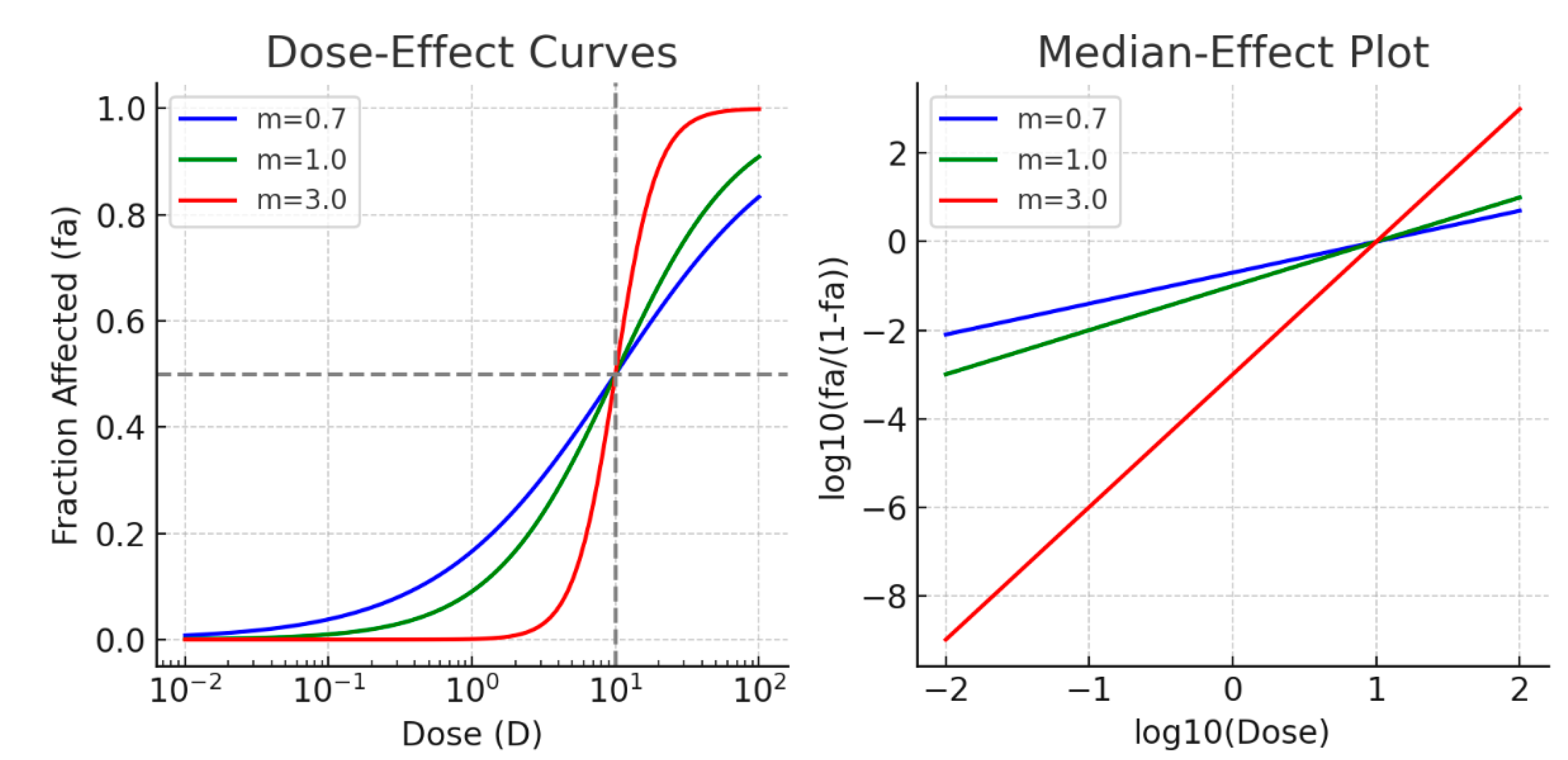
Figure 4B shows the representative features of MAL-MEE/MEP, presented in another way with Dm = 1, and m values of 0.7, 1.0, and 3.0 were generated by ChatGPT 5.1.
1.3. MEP Linearization Leads to MTDPT: The Basis for Efficient, Cost-Effective, and Econo-Green R&D
Q: How to draw a curve from two points?
(A historically fundamental anti-intuitive question)
A: Yes. It can be done. Ask MAL-MEE/MEP/DOM what makes the magic.
Linearization of Dose-Effect Curves (DEC) of different shapes and different potencies with a Minimum of Two Dose-Data-Points Theory (MTDPT). The MDDPT introduced a groundbreaking concept in digital informatics for system biology through computer simulation, reducing the size of all dynamic studies. The MAL-MEE/MEP algorithm automatically adds two default data points (Dose zero and Dm) in all DEC.
One can draw a specific dose-effect curve with a theoretical minimum of 'only two-dose data points' - One default Point is Dose Zero, and another default point is the Median-Effect Dose (Dm). Any 2-data points on a straight line represent the same line, and therefore, the same DEC. The MTDPT is the theoretical basis for efficient, cost-effective, and “Econo-Green” Biomedical R&D and drug evaluations, especially in animal studies and in the design of clinical trial protocols. [11, Chou TC. Integrative Biol. 3: 548-559, 2011; Pharmacological Rev. 58: 621-681, 2006 [9].
The Dose-Effect Curves (DEC): with different “shape” and “potency” simulated by MAL-MEE/MEP are shown in Figure 5, which indicates the theoretical basis for efficient and cost-effective R&D, MTDPT.
1.3.1. The Prerequisite of MAL-MEE Entity’s Paired ID Parameters, m and Dm Values
The mass-action action, as expressed by the MAL-MEE-MEP, has three components to consider in Biomedical or Life Science Applications:
Mass and Action: It refers to any entity that causes or exerts a specified effect. For example, in biomedical sciences, it can be a chemical dose, such as a drug, inhibitor, activator, modulator, or regulator; in physical dose, it can be radiation, thermo-, photo-, UV, microwave, etc.
Receptor or Target: For a specific effect to occur, there must be a recipient, such as a molecule, cell, organ, body, or environment. Usually, there is an affinity or cooperativity between the effector and the recipient for the action. These are scientifically in terms of affinity constants and/or dissociation constants.
Scope of Effect and Target: No limit. (to the limit of accuracy of measurement technology)
Dose Number, Range, Density Gradient
Unit and Quantifiable Measurement
Dose-response or Dose-effect Relationship
Plan and Protocol Design, and the endpoint of measurement
Schedule or Regimen (e.g., clinical trials)
Input-Output (visible) and Intermediate (Usually not visible)
All the above considerations have been tested in the MAL-MEE-CIE-DRIE applications, as indicated in the bibliometrics.
1.3.2. The MAL-MTDPT: A Game Changer
A groundbreaking discovery was not originally expected, since it is rather anti-intuitive:
This is the Minimum Two-Dose Data Point Theory (MTDPT), which allows one to draw a curve from two points. MAL-MEE’s Median-Effect Plot (MEP) linearizes all dynamic dose-effect curves into straight lines,
Thus, MAL-MEE-MEP with log D vs. log (fa/fu) plot, automatically adds two default data points (dose zero and Dm) into considerations, thus allowing a smaller number of data points requirement in R&D. This leads to efficient, cost-effective, and Econo-Green R&D, which saves time, effort, and resources.
Figure 5.
Linearization of DEC with MEP with MAL-PD, “Minimum Two Dose-data Points Theory” [MTDPT] is required to simulate an " A Dose-Effect Curve“ through the linearization of the dose-effect curve (DEC) with MEP to determine the shape (m value) (slope) and potency (Dm) (x-intercept).
Figure 5.
Linearization of DEC with MEP with MAL-PD, “Minimum Two Dose-data Points Theory” [MTDPT] is required to simulate an " A Dose-Effect Curve“ through the linearization of the dose-effect curve (DEC) with MEP to determine the shape (m value) (slope) and potency (Dm) (x-intercept).
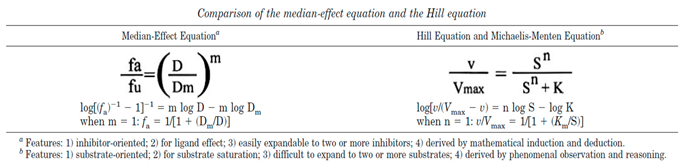
When the Median-Effect Equation was published in 1976 [4], it was mistakenly regarded as equivalent to the Hill equation. In fact, they are derived from completely different methods and purposes: MEE is derived from MAL inputs-outputs combinatorial general system analysis, which took 10 years (1966-1976) and involved 300 reaction-rate equations. Whereas the Hill equation is specifically derived from a specific purpose for higher-order ligand interaction (e.g., oxygen hemoglobin), as shown in Table 1 [9].
1.3.3. Different Derivation Approaches Between the MEE and the Hill Equation
The MEE and Hill have similar mathematical forms, but they differ fundamentally in their derivation. In addition, MEE is the unified general theory, whereas the Hill equation is the specific general theory. The Hill equation invokes Vmax, whereas MEE does not. Vmax is difficult to measure accurately without extrapolation. The MEE’s Dm value is easily determined by comparing the Vmax value.

Table 1.
Comparison of the MAL-MEE/MEP theory/equation with the Hill equation.
 |
The complexity, perplexity, and diversity of biomedical and natural phenomena lead many scientists to seek solutions or approximate causal dose-effect relationships. The MAL-MEE is the unified general principle, and the Hill equation is a specific general principle; they are derived from completely different ways. The MEE was derived over 10 years (1966-1976) and involved more than 300 reaction-rate equations [3,4,5,6,7,8,9].
1.3.4. Comparison of MAL-MEE and Statistical Functions
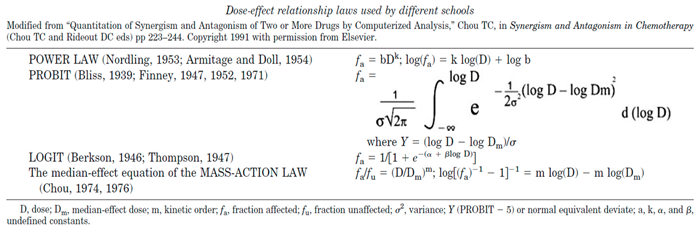
Among thousands of mathematical equations or formulas in scientific literature, only a small fraction of them are relevant to the biological observations. Since the 20th century, several major schools of thought have emerged, including the mathematical, statistical, and physical-chemical schools, such as the MAL. Table 2 compares the Power Law, Logit, Probit, and the MAL approaches [9].
The Power Law and Logit are simple to use but lack a theoretical basis, amounting to intuitive approximations. The Probit is rigorously developed from statistical principles, but is too complex for practical use.
By contrast, the MAL-based MEE, as focused in this paper, provides equations/algorithms/computer software. The Floating Ratio of MEE enables universality and the scale-up of single-entity actions to multiple-entity interactions, enabling ubiquitous applications. These are supported by citations in tens of thousands of papers, in over 1,500 journals, and in patents [56,57,58].
Table 2.
DEC from different schools. Comparison of MAL-MEE/MEP with power law, LOGIT, and PROBIT statistical functions.
Table 2.
DEC from different schools. Comparison of MAL-MEE/MEP with power law, LOGIT, and PROBIT statistical functions.
 |
The statistical functions always introduce some uncertainty, unless the p-value is approaching zero.
The functions involving e have been difficult to handle with deterministic approaches in real-world problem-solving, such as in the biomedical sciences.
1.4. The Doctrine of Median: Unified General MAL-MEE Theory
1.4.1. Input-Output Activation Function and Algorithm in Dynamics
The median-effect equation (MEE) can be rearranged for different representations:
| Effect (Force) vs. Mass | Input (↓) | Output (↑) |
where D is dose, Dm is median-effect dose, fa and fu are fractions affected and unaffected, respectively, (i.e., fa + fu = 1), and m is the exponential dynamics-order, that signifies the shape of the dose-effect curve, in hyperbolic activation without cooperativity (m=1), sigmoidal for positive cooperativity and activation function (m>1), and flat sigmoidal negative cooperativity and activation function (m<1) [4,9,11].
1.4.2. The Median-Effect Plot (MEP) is the Log-Log Plot for the MAL Bioinformatics.
Before the computer era, engineers used logarithms for calculating rulers. Biologists had frequently used the logarithmic scale to constrain out-of-the-map data points. The MAL-MEP adopts the double-logarithmic plot, log (D) vs. log (fa/fu) (or vs. log [(fa)-1 -1]-1), called the median-effect plot (MEP) [4]. This is for theoretical reasons: linearizing all dose-effect curves (DEC) to extract the fundamental digital parameters of both Dm for potency or efficacy and m for the dynamic-order and shape of DEC, based on the MAL-MEE principle.
Log (fa/fu) = m log (D) – m log (Dm), Log (D) vs log (Fa/fu) (or Log [(fa)-1 -1]-1 )
The y = ax + b type form, linearity principle, leads to the m and Dm digital informatics simulation/determination, since the slope gives the m value, and the x-intercept gives the anti-log of Dm, thus the Dm value, automatically by computer simulation [4,9,23]. It also leads to the minimum two-dose data point theory (MTDPT) for far-reaching impact for efficient, cost-effective, and eco-green scientific research and development (R&D), since MEP adds all DEC two default data points, dose-zero and Dm, embedded in all computer simulations [11,14,15,16,17,18,19,20,21,22,23,24]. This MAL-MEE/MEP/MTDPT has historical advantages over the traditional empirical curve-fitting or statistical R&D approach.
1.4.3. The Floating Ratio and the Mass/Mass (D/Dm) Ratio:
Fa and fu per se are fractions, thus have no unit, whereas D/Dm represents the same kind of entity-unit ratio cancellation; and m is just the exponential number that exerts mathematical properties and graphics. Note that the intermediate steps (e.g., between input and output are not visible (e.g., fu = 1-fa), but they are embedded in the floating ratio and the distribution function of “1” of the MAL-MEE. (see illustration late in Figure 10).
The simplicity of the MAL-MEE is not reducible; D/Dm is a dimensionless ratio for universality, and the median normalized dose is D/Dm = M (general mass). The MAL-MEE, fa/fu (floating effect relativity) = Mass at any given dynamic-order (m). Therefore, the MAL-MEE indicates that “Effect” and “Mass” are interchangeable or equivalent. This MAL-MEE in biology is the counterpart of Einstein’s relativity theory, E = MC2 in physics, which indicates that “Energy” and “Mass” are interchangeable or equivalent. The difference in meaning is just life science’s “functional effect” vs. physical science’s “energy force”.
The MAL describes dose-dependent input-output relationships in biological systems, with a variety of intermediate transitions, such as enzyme-catalyzed reactions, receptor-mediated pharmacological effects, sensory signal reception and motor actions, and network pathway connections and regulations. This causal effect relation occurred in biology and in non-life sciences, such as the Langmuir adsorption isotherm and questions-and-answers, as well as in contemporary artificial intelligence (AI).
In the MAL-MEE, both the left and right of fa/fu (for function) and D/Dm (mass) are ratios of the same kind. These ratios represent a universal property that is independent of dimensions, units, size, physical state, and the system's complexity. They remain valid under various conditions, such as time and space, especially with respect to geometric properties. We can also view dimensions as independent entities with perceptions and senses, like the median-effect point at (0, 0, 0), and the median-effect axes at (0,1,1), (1, 1, 0), (1, 0, 1,0,1), and (1, 1, 1). The x-, y-, and z-axes help describe the position of any point in three-dimensional space, along with their rotations, as seen in [71,72,73]. Using physical and mathematical hypotheses to explain otherwise difficult phenomena- such as gravity, negative dose (see below in Figure 21), anti-matter, dark matter, quantum entanglement, exclusivity, competitiveness, synergism, antagonism, or the abstract concept of exclusivity (see Figure 16 and Figure 17 below), and harmony (see Figure 37 below)- is a common approach.
1.4.4. Dm Is the Harmonic Mean of Kinetic Constants
The MEE indicates that dose and effect are interconvertible. In addition, Dm is the universal efficacy reference point and the common link among dynamic orders [3,9,24]. Furthermore, Dm is the harmonic mean of kinetic constant kii and kis in the Lineweaver-Burk plot. When kii = Kis (or Kii/Kis =1), it means pure non-competitiveness; it also means “pure harmony” [24]. (This phenomenon is illustrated later in Figure 37.
1.5. MAL Theory/Algorithm Rationale and Scalability
Beyond 3D, we need to use analogy, projection, reasoning, and inference. We can lift, bend, cut, or poke the paper to reveal different features. We can also hold a hypercube with cuts from various angles and positions to produce different shapes, curves, and volumes. Many hidden secrets can be revealed by the “One” entity. Therefore, the unified general theory of the mass action law is important for developing general, efficient, and effective basic R&D and AI reasoning models [9,14,15,16,17,18,19,20,21,22,23,24,55].
From the relativity ratio property, the MAL-based MEE/CIE dynamic theory or doctrine of the median (DOM) has dimensionless, universal applications without limit. It is logical to address real-world situations and problems as a priority before we attempt to solve abstract concepts, complex mathematical equations, or formulas. It is astonishing to note that international FDAs, with so many regulations, rules, and guidelines, still have no clear definition for “What is the exact definition of the additive effect of two drugs? Or more drugs?” [9]. The integration with MAL (or other means) for a unified, general principle of digital science to support intra-, inter-, multi-, and cross-disciplinary linkage is desperately needed for efficiency, cost-effectiveness, and digital informatics. The biological sciences have ramified into over 4,000 journals for R&Ds, most of which concern specific molecules, cells, organs, and diseases in biochemistry, physiology, pharmacology, infectious diseases, and cancer research, using independent, different principles and parameters in vitro, in animals, and in clinical trial protocol design and data analysis. Advocacy for R&D regulatory policy reform and modernization, using a unified set of principles and parameters for R&D, has been called for multiple years to reduce costs, increase efficiency, conserve laboratory animals, and reduce the number of patients in clinical trials, without a unified, general integration principle.[9,11,24,29,30,31].
Four advanced AI models (ChatGPT 5.1, DeepSeek R1 V3, Gemini 3, xAI Grok-3, Qwen 2.5 Max) have independently assessed Ting-Chao Chou’s work (1970-2025) on MAL- MEE/CIE/DRIE/DOM/MTDPT/UTO Theory/algorithms and applications. This includes a book [24] with 11 chapters and the APS-Summit-2025 abstract [22]. These independent models validated the significance and practical implications of this MAL unified general theory-based “top-down” R&D framework, which is opposite, yet complementary, to the centuries-old traditional, statistics-based “bottom-up” R&D [19,20,21,22,24]; like front and side/rear views of the same entity, or two sides of the same coin.
Human intelligence is different from artificial intelligence (AI). AI, as a physical entity or tool, collects, stores, and utilizes a vast amount of human-recorded information and knowledge using human-derived/selected algorithms, at the speed and volume that makes the magic. The numerous repetitive and retrospective processes make approximation, mimicking, and superposition near-perfect. Still, the irrational “e” functions used in mathematics, statistics, physics, and AI make it not a perfect fit to the real-life features and properties that are finite, closed, and circular (e.g., the Floating Ratio), but not extendable to infinity (e.g., the Golden Ratio). Thus, we face Life and Non-life as two separate domains in the universe and in reality.
In both scientific R&D and AI development, the simplicity, generality, efficiency, and cost-effectiveness of algorithms will be the key determinants in the framework for categorizing trillions of information bits in LLM models, enabling them to succeed in real-world applications. The human brain has about 86 billion neurons; the efficiency of the functional neural network is truly remarkable.
1.5.1. MAL Reveals A Conceptual Departure from Traditional R&D Observation-Statistic-Based R&D Approach
The MAL-MEE/DOM algorithm automatically adds two default data points (Dose-zero and Dm) to all dose-effect data analysis and computer simulation, including animal studies and clinical trials. It instantly generates quantitative, digitalized conclusions in tables and graphics. This is the Minimum Two-Dose Data Points Theory (MTDPT) [9,11,24], which serves as the basis for a cost-effective, Econo-Green scientific R&D platform, particularly for costly animal studies and clinical trials.
1.5.2. The Broad Applicability in Life Science and Beyond
The MAL-MEE-dictated combination index equation. All MAL-based MEE, CIE, and DRIE can be and have been applied for in vitro, in vivo, animal studies, and clinical trials, by automated computer analysis and simulation following a few pairs of dose-effect data entries, when using the MAL dynamics-based simple design, for efficient, cost-effective, Econo-green R&D. MAL-theory/algorithm [9,11,19,20,21,22] has applications in biomedical sciences, and beyond, including biophysical, environmental, agricultural, marine, toxicological, and food sciences [24,31,45,55].
Furthermore, the MAL-based experimental design allows experimental results to be subject to automated computer simulation in seconds, including [9,24,53,54,55] :
- Construction of MEE-MEP to obtain the paired Dm and m values; In return, these parameters generate the dose-effect curve (DEC).
- The MAL-based computer, such as CompuSyn or Calcusyn, will also display dose and effect data content and tabulation, scheme of layout, and conclusions.
The dynamics of entity actions and interactions in molecular and cellular biology, genetics, cancer research, anti-microbials, and pharmaceutical drug evaluation are studied using digital computer simulations, innovation, and drug discoveries, as well as signaling pathways and network interactions.
The overviews are available in [9,10,11,12,24]. Specific examples, including PD design and planning, data entry, precautionary note, automated computer simulation, and full CompuSyn Report printout, for in vitro [8,12,29,31,34,61,62], in vivo and in animals [24,43,45], and other studies, are illustrated in [24,55]. All these broad applications of MAL fundamental principles are documented in the scientific citation database collections [56,57,58].
1.5.3. The Game Changer of MAL-MDTPT in Overall Causal-Effect R&D
The MAL-MEE-PEP Design Resulting in Using as few as 10-fold Less Patients in clinical trials
In health science research and development, although molecular, cellular, and in vitro studies lay the scientific foundation for further exploration, the reality test will be animal studies and clinical trials, which are specifically aimed endeavors and have been proven to be laborious and costly. In the absence of a unified, fundamental principle, trial-and-error has been the only mainstream approach to knowledge and solutions since antiquity.
This traditional observation-specific statistical approach is termed the “bottom-up R&D,” in contrast to Nature’s unified general MAL theory-guided “top-down R&D” [9,14,15,16,17,18,19,20,21,22,23,24]. There are clearly different meanings and scopes of validity between specific general equations (such as the Michaelis-Menten, Henderson-Hasselbalch, Hill, and Scatchard equations) and the unified general theory of the Median-effect equation of the mass-action law, as shown in Figure 1.
The MTDPT Concept of Small-Size Data Sets for Cost-Effectiveness
The MAL-MEE/MEP theory/equation/algorithm/simulation and mathematical transformation lead to the minimum two-dose data point theory (MTDPT) for all dose-effect curves by auto-adding two default data-points (Dose zero, and Dm), which is the universal reference point, and dynamic orders common link; Thus, this requires smaller-sized experiments in R&Ds [9].
The MAL-MTDPT allows a smaller size, requiring two fewer data points, by automatically adding two data points, dose-zero and median dose, to all causal effect analyses for simulations of experimental data. This is particularly beneficial for costly, time-consuming animal studies and for clinical trial protocol design. In addition, the MAL-MEE/MEP dual parameters (Dm and m) guided the dose-number, dose-range, and dose-density planning.
The MAL Design Used Ten-Fold Fewer Patients in Anti-HIV Clinical Trials than the Traditional p-value-Based Design. Yet, the MAL Provides Quantitative Conclusions.
Therefore, MAL-MTDPT automatically conserves laboratory animals and reduces the number of patients in Phase I clinical trials by as much as tenfold compared with the traditional observation-probabilistic design based on the p-value [60], particularly in Anti-HIV clinical trials, where clinical results can be quantitatively assessed. More details of comparisons are given in the later Section of this paper, and Appendix III.
1.6. The Ratio Is Relativity
Across the scientific disciplines, regardless of life and non-life, the basic tool of “ratio” plays a prominent role. The following are some examples.
1.6.1. Golden Ratio vs. Floating Ratio: The Distribution fraction of “1”
The subjects of comparing the ancient Golden Ratio, (GR) with the modern Floating Ratio fa/fu, (FR), of MAL-MEE/MEP have been raised and discussed recently, since 2023 at scientific society meetings [14,15,16,17,18,19,20,21,22]. However, the idea of DOM vs. UTO for inter- and multi-disciplinary linkage for efficient, cost-effective digital R&D has been advocated for over three decades [9,11,24]. Figure 6 illustrates the properties of the Golden Ratio.
Figure 6.
Illustration of properties of the Golden Ratio during the past centuries. Source: Wikipedia: The Free Encyclopedia under “Golden Ratio” https://en.wikipedia.org/wiki/Golden_ratio.
Figure 6.
Illustration of properties of the Golden Ratio during the past centuries. Source: Wikipedia: The Free Encyclopedia under “Golden Ratio” https://en.wikipedia.org/wiki/Golden_ratio.
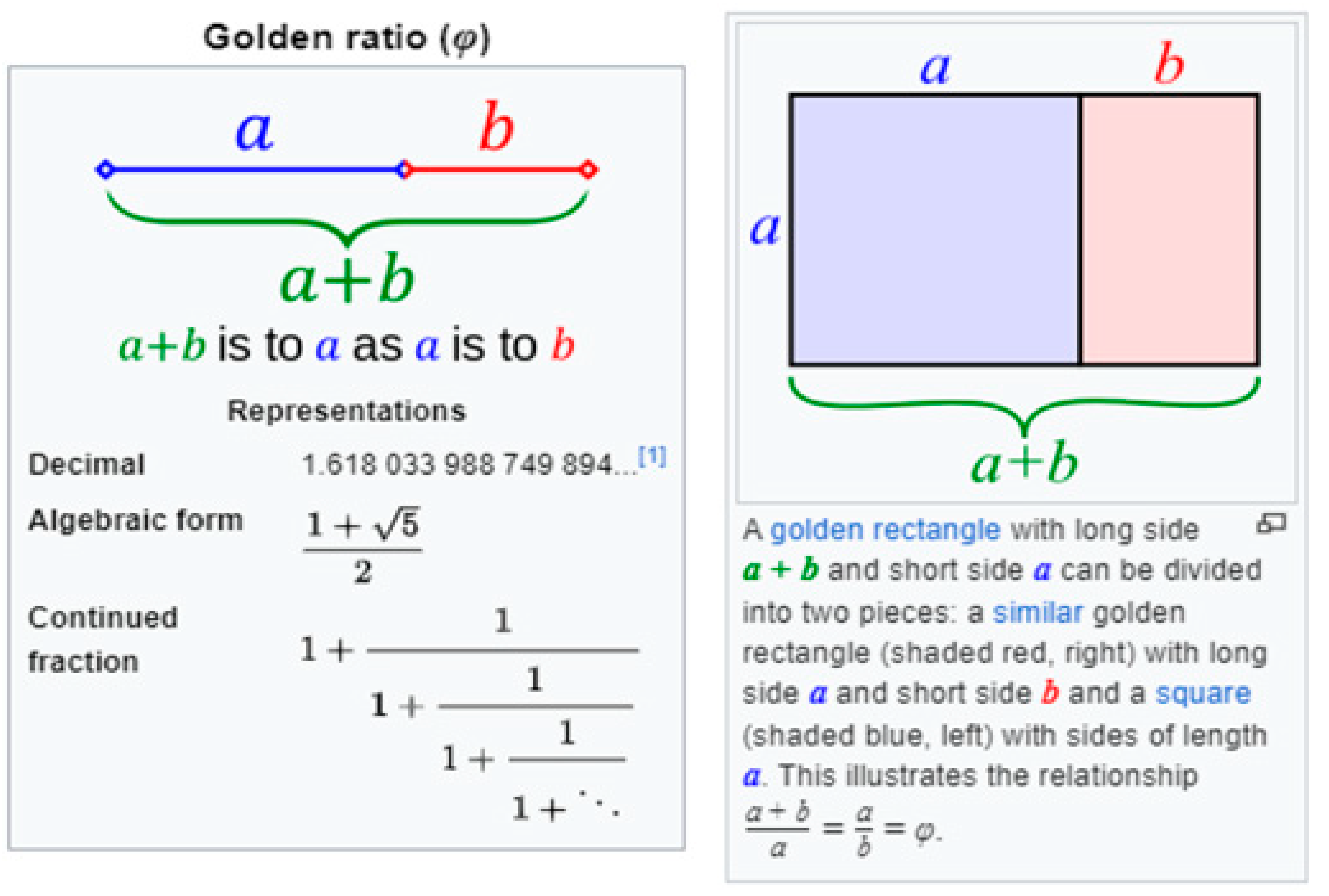
1.6.2. The Floating Ratio Manifests Life and The Golden Ratio Manifests Non-Life: “1” Becomes the Common Link
The Floating Ratio (FR) or fa/fu is the integral part of the Median-effect equation (MEE), fa/fu = (D/Dm)m, which is the grand principle of the MAL that underlines the dynamics and informatics of life science. This unique feature will be discussed in the cross-disciplinary context of this paper.
Table 3 compares and summarizes the basic properties of the life-science-based Floating Ratio vs. the mathematics- and physics-based ancient Golden Ratio.
The GR () manifests in the Non-Life Domain.
In contrast to MAL-MEE/DOM/CIE life science indicating FR = fa/fu, the ancient Golden Ratio, GR (), is an imaginary, transcendental constant, in mathematics and physics (i.e., non-life domain), which is:
is greater than 1, and is an irrational, infinite number obtained from physics and mathematics, which belong to the non-life domain.
Table 3.
Theoretical and Conceptual Comparison of Floating Ratio vs. Golden Ratio – Life vs. Non-Life*.
Table 3.
Theoretical and Conceptual Comparison of Floating Ratio vs. Golden Ratio – Life vs. Non-Life*.
| Property | Floating Ratio (Life) | Golden Ratio (Non-Life) |
| Origin | Derived from the Mass-Action Law (MAL) | Ancient mathematics and geometry |
| Domain Manifested | Life (biological systems) | Non-life (physics/mathematics) |
| Form | Closed, finite, fractional distribution of "1" | Open, continuing distribution of "1" to infinity fractions |
| Significance | Dynamic, variable (Relativity, functional effect, causal dynamics) |
Static, fixed (Aesthetics, proportion, fixed relationships) |
| Dynamics | Equilibrium, Recyclable, Feedback-driven, Symmetry, Homeostasis, Harmony | Self-similar, fractal |
| Force form | Energy driven | Power driven |
| Example | Biological dose-effect relationships, drug interactions, enzyme kinetics, cell signaling, neural networks (e.g., bio-pathways, bio-networks, organisms, environment) |
Geometry, Fibonacci sequence, physics, spiral galaxies, (e.g., Lucas number, pentagram symmetry system, Penrose tiling, Kepler triangle, Golden Triangle, Golden Spiral, plant floral pattern) |
| Mathematical Expression | Fa/fu = fa/ (1-fa) = (1 – fu)/fu, a/b = a/(1-a) = (1-b)/b, a + b = 1, (fa + fu = 1), fa or fu range, 0-1 |
a/b = (a + b)/a = 1 + b/a = Φ |
| Equation |
fa/fu = (D/Dm)m = fa/(1 -fa) = (1-fu)/fu = (fu)-1 -1 (180°) = [(fa)-1 -1]-1 (360°) |
Φ = 1 + (1/ϕ))/2 = 1.618033988749894… |
*This table was created with partial assistance from Gemini 2.5 (Deep Search) and Qwen3-Max.
In life science, the mass-action law (MAL) relates Mass and Action, where action requires energy, calories, and effort. The causal dose (D), input (↓), produces the consequential Effect (fa), which is the output (↑). Based on the MAL-MEE/DOM, (D/Dm)m = (fa/fu), Dose (D), is generally normalized with the universal reference dose, Dm, thus D/Dm refers to mass (M) in which unit is cancelled out as an Identity, and fa/fu ratio refers to the Floating Ratio of Effect which manifests Live. The abrupt paradigm shift from Life to Non-Life is a transcendental transformation that remains scientifically unresolved.
The only links between Life and Non-Life are the distribution functions of “1” for FR and GR, and the fact that the rational MAL function can be transformed into imaginary or transcendental numbers, such as the negative and positive dose, which are interchangeable via MAL-MEE (Figure 21). Pascal’s triangle’s consecutive rows ratio real numbers can lead to Euler’s e (see Section 8.9), and the MAL-MEE and Riemann’s zeta function lead to an irrational number (π) (see Section 1.12). In the Floating Ratio, input dose (fa) is visible, and fu and (fu)– 1 – 1 are not visible (not real), but interrelated to “1” (see Figure 11).
1.6.2. The Ratio of Mass, Force, Time, and Space
The ratio cross-links disciplines. The ratio of the same kind cancels any unit, thus becoming dimensionless and independent of units, physical states, size, structure, and complexity.
The equal “=” sign indicates equivalence. Thus, Dose and Effect, Force and Mass, Energy and Mass are equivalent or interchangeable, as indicated below:
In all, mass is M or m, and Effect, Force, and Energy are equivalent.
1.6.2.1. The Life Domain Floating Ratio
The Floating Ratio, FR, (fa/fu): The mass-action law median-effect equation (MAL-MEE), fa/fu = (D/Dm)m, is the fundamental principle of biomedical and biophysical science in the life domain.
1.6.2.2. The Ratio Revelations in Life Sciences and Physical Sciences
-
The Floating Ratio: For the MAL, (D/Dm)m = fa/fu; fa + fu = 1. For the Floating Ratio, fa/fu, when Fa = fu, the Median = 0.5 = ½.The fundamental mathematical form is:a/b = (1-b)/a = a/(1-b), where, a + b = 1 (for Life).
-
The Golden Ratio ( ): It is the fixed ratio in the form = 1.618033…= (1 + √5)/2.The fundamental mathematical form of the Golden Ratio isa/b = (a + b)/a = 1 + b/a (for Non-Life).
- The Newton’s Ratio: The ratio of Force and Mass. For Newton’s Law of Motion, F = M a; F/M = a
-
The Einstein’s Energy/Mass Ratio: For Einstein’s Relativity Theory, E = MC2; E/M = C2The Fundamental Density Theory (FDT) Ratio: E/m = c² = 1/(ε0 μ0) = (d/t)²Where quantum mechanics (left), electromagnetism (middle), and general relativity (right) are three perspectives on the same geometric reality, related to space-time. It perceives ‘mass” as a geometric property of the omnium field. This omnium field, in a way, is akin to the MAL-MEE/CIE’s Unity of “one” theory (UTO) universal generality.
-
The Extended Ratio of energy and mass: Fundamental Density Theory (FDT), by Manuel Alfaro in 2023-2025 [63,64,65,66,67]: This is a new theory that makes grand claims, although detailed derivations and broad examples of applications remain to be confirmed. However, numerous analogies and equivalencies have been established for general principles in real-world life sciences in MAL. In particular, the MAL vs. Omnium, as well as the Median (point, axis, and plane) vs. Alpha = ½ = 0.5, show close co-incidence.In physics, FDT, D for “Density” is the ratio of the object’s mass to volume, which is equivalent to “Concentration” in biology (e.g., molar, millimolar). The millimolar (mM) unit of concentration is equal to one-thousandth of a mole per liter, or 10^-3 M. It represents the number of millimoles of a substance dissolved in one liter of solution. It is commonly used in chemistry for convenience. The mass-action law is considered the fundamental principle of both biochemistry and biophysics.FDT in physics is a relatively new concept (2024-2025); energy per mass, electromagnetic impedance, and spacetime kinematics all express the same geometric invariant [68,69,70]. FDT adds one control dial — alpha — that tracks how close the system is to the maximum-density shell at the Schwarzschild radius (Rs). The Alpha outside/inside concept in FDT is similar to fa/fu in MAL-MEE, where the Median (DM, 0.5) is the same as alpha = 1/2. Since fa + fu =1, then outside + inside = the whole. The Omnium field refers to the Universe of the physical domain. MAL-MEE connects both line and non-life domains.In FDT, alpha (outside): alpha = Rs / r, alpha (inside): alpha = r / Rs, and Maximum density: alpha → 1 from both sides. The physical meaning of r is related to the range of alpha values.That’s where hard MeV emission and extreme collimation live. C is not just a speed limit; it’s the ratio that defines how distances and durations relate [70]. Particles formed under identical conditions inherit identical geometric properties.Alfaro claimed that the 1997 Williamson-van der Mark “photon as electron” model and FDT’s helical-light framework are mathematically identical descriptions of the same object: the electron is confined light, almost everything else follows:E/m = c² is an identity, not a slogan; The distinction “photon vs electron vs graviton vsGluon” is a density/regime label, not four different particles.General relativity (GR) and quantum mechanics (QM) emerge as limiting cases of a single density parameter alpha FDT in (0,1).
- The isotope ratio: In science and history, another interesting ratio is C14 Dating, where the C14/C12 ratio provides an estimate. This is another utility of the natural ratio.
-
The e/m Quantum Ratio: Recent report on measuring the Charge (e) to Mass (m) ratio [104] using the definition of centripetal acceleration and Newton’s second law to get an expression for the radius (R) of the circular motion, and obtain the relationship of: R = mv/eB, where v is speed, and B is magnetic field.Using the change in electric potential (ΔV), the strength of the magnetic field (B), and the radius of the path (R), the following expression for the charge-to-mass ratio of the electron (e/m) results.The radius depend on the charge (e) to mass (m) ratio as well as the speed (v).Plotting R² vs ΔV should create a straight line. The slope of this line would be 2/(B²(e/m)), which we can use to then solve for e/m.
- Pascal Triangle Rows Ratio: The ratios of the serial rows lead to Euler’s e (see Section 8.9).
Different scientific disciplines use different symbols, terms, and definitions for different goals. In most cases, basic mathematical concepts or maneuvers, such as ratio cancellation or normalization, reciprocal (and double reciprocals), and logarithmic (and double logarithmic) exponentials and roots, reveal hidden intrinsic properties that are otherwise not visible (or sensible). Many of them involve 1, 0, median, duo, etc. Some involve imaginary or irrational numbers, transcendental numbers, or complex numbers such as e, i , In life science MAL dynamics, the most relevant numbers are 1, 0, and the median (1/2 or 0.5).
1.7. Unity Theory of One and Life-Centric Universe
The MAL-Based MEE/CIE/DRIE/DOM leads to the unity theory of one (UTO) or the distribution function of “1”, with or without the “e” properties (Figure 7).
The MAL theory has a mathematical form of a/b = (1-b)/b = a/(1-b), and a + b = 1, when a/b =1. Then, a = b =1/2 = o.5 in the “median”, as indicated by the MEE: fa/fu = (D/Dm)m = (M)m where M is the median-normalized dose, i.e., the median-dose as the dose unit.
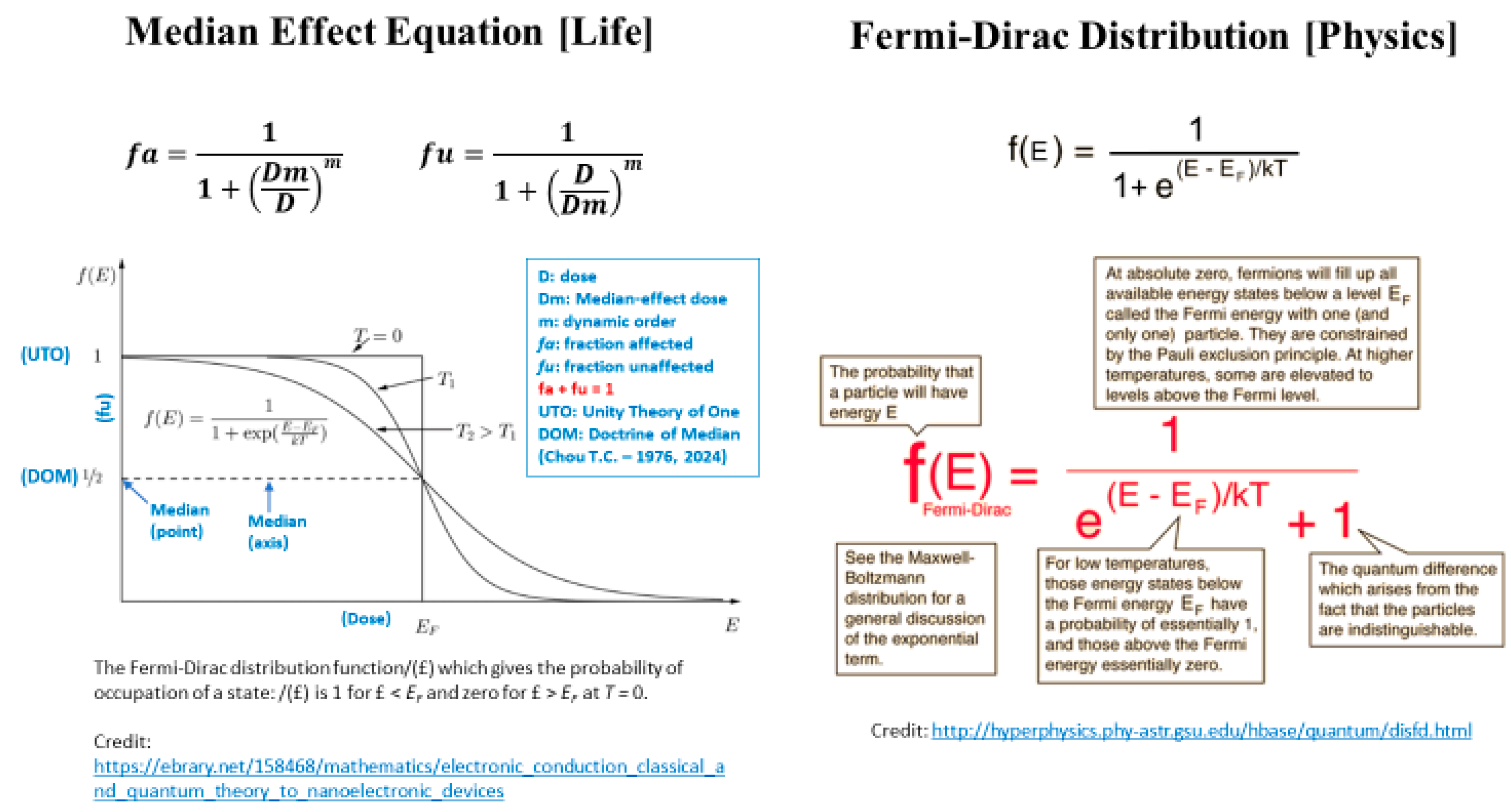
1.7.1. Math Form: MAL-MEE in Biology Compared with the Fermi-Dirac Equations in Physics
In Figure 7, different disciplines with different scientific denotations share the same basic mathematical form, except that the Fermi-Dirac distribution equation contains “e”. In MAL-MEE, D/Dm is a dimensionless relativity ratio, independent of unit, size, structure, state, and complexity.
Figure 7.
Comparison of the Median-Effect Equation of the Mass-Action Law with the Fermi-Dirac Distribution Equation in physics. This compares the general mathematical form, not comparing the mechanistic details.
Figure 7.
Comparison of the Median-Effect Equation of the Mass-Action Law with the Fermi-Dirac Distribution Equation in physics. This compares the general mathematical form, not comparing the mechanistic details.
1.7.2. MAL-MEE-UTO Points to Life-Centric Universe (LCU) Interfacing with Physical Elements
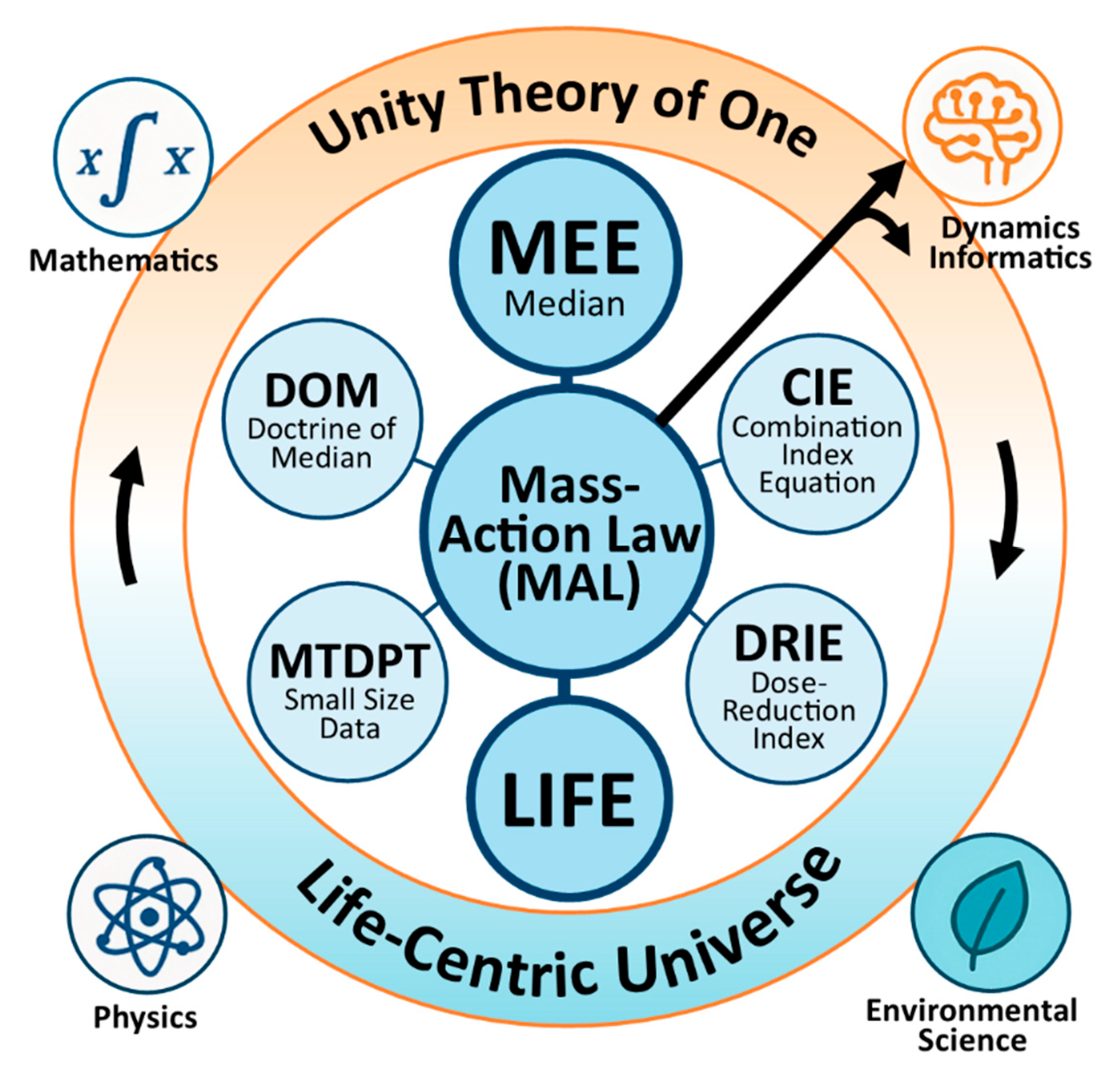
Summing up the above MAL exploration since the mid-1960s, the mass-action law (MAL) in Life science can be described by MEE/CIE/DRIE, DOM/MTDPT. This Unity Theory of One (UTO) leads to the proposal of a Life-Centric Universe (LCU), as indicated in Figure 8. It explains that the universe has two domains: Life and Non-Life, realms by the “One” and the “Median”. The graphic layers in Figure 8 were created with assistance from ChatGPT.
Figure 8.
The mass-action law median-effect principle in life sciences leads to MEE/CIE/DRIE/MTDPT/DOM, the Unity Theory of One (UTO), which in turn proposes a Life-Centric Universe (LCU) with two domains: Life with fundamental code a/b = a/(1-a), a + b =1 (finite and circular), and Non-Life with fundamental code a/b = (a + b)/a (infinite and open). Life (inside the large cycle) interfaces with the outside existence of the non-life domain, such as the Environment, Physics, Mathematics, and Intellectual Dynamics-Informatics, in small circles.
Figure 8.
The mass-action law median-effect principle in life sciences leads to MEE/CIE/DRIE/MTDPT/DOM, the Unity Theory of One (UTO), which in turn proposes a Life-Centric Universe (LCU) with two domains: Life with fundamental code a/b = a/(1-a), a + b =1 (finite and circular), and Non-Life with fundamental code a/b = (a + b)/a (infinite and open). Life (inside the large cycle) interfaces with the outside existence of the non-life domain, such as the Environment, Physics, Mathematics, and Intellectual Dynamics-Informatics, in small circles.
As indicated above, the grand theory of the MAL, the median-effect equation, fa/fu = (D/Dm)m, both right and left sides are the relativity ratio in the simplest form, based on the ratio-cancellation principle, the MAL-MEE application is independent of unit, physical state, size, structure, and mechanistic complexity, ensuring its universality.
1.7.3. International SI Unit Defined by Human
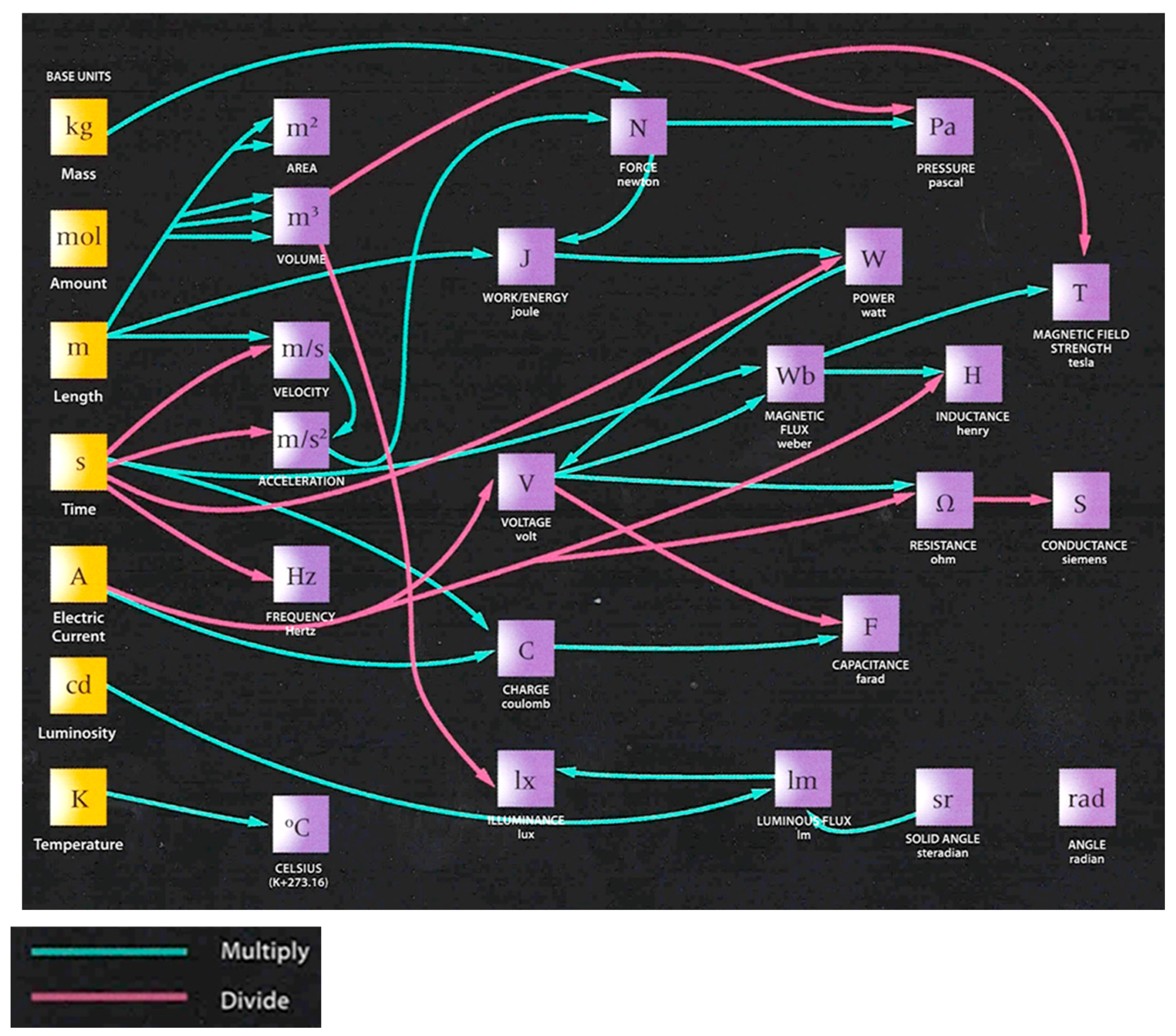
The international SI unit designations, shown below (Figure 9), were designed by humans and facilitate inter- and cross-disciplinary linkage.
Mass:Weight of entity, effecter, effected, substrate, receptor, intermediate entity, products, input entity, output entity, drugs, chemicals, biologicals, receptor…
Force: Energy, temperature, electromagnetic weak and strong force, gravitational force, action/interaction/ reaction, attractive/repulsive, effect, response, activation/inhibition, synergism/antagonism, potentiation/suppression, regulate, feedback, competitive/noncompetitive/uncompetitive, aggressive/peace, equilibrium, affinity, and harmony...
Space:Size, volume, distance, location, inclusivity, exclusivity, non-exclusive, inclusive, vector, superposition, symmetry…
Time:Moment, time-lapse, period, rate, speed…
Life:The dynamics of all components above are mixed with units and measurements decided by humans. Life includes birth and death, growth, rest and movement, metabolism, reproduction, consciousness, intelligence, the survival instinct, the existence instinct, ecosystems, and AI.
Figure 9.
All units are derived from the seven SI units. Blue lines show when a unit is multiplied. The red indicates a division. Count the arrowheads to see how many times a division or multiplication takes place. You will see that the mole has no derived unit, and that the base units do not define the radian or the steradian. A radian is the angle of an arc that has the same length as the radius. A steradian is the angle of a cone of a sphere where the area of the base of the cone is the square of the radius of the sphere.
Figure 9.
All units are derived from the seven SI units. Blue lines show when a unit is multiplied. The red indicates a division. Count the arrowheads to see how many times a division or multiplication takes place. You will see that the mole has no derived unit, and that the base units do not define the radian or the steradian. A radian is the angle of an arc that has the same length as the radius. A steradian is the angle of a cone of a sphere where the area of the base of the cone is the square of the radius of the sphere.
1.7.4. Number, Ratios, and Identities: Real and Imaginary
The Unity Theory of One (UTO or UOT), with a distribution function of One, especially in the hyperbolic and sigmoidal activation function, of the Doctrine of the Median (DOM), with a Median Point, Median Axis, and Plane. Different disciplines have their own annotations, units, and definitions. However, they converged into the concept of One, whether real or imaginary, transformational or transcendental.
The Mass and Median mediated Floating Ratio (FR), fa/fu = fa/(1-fa) = [(fa)-1 -1]-1 = (D/Dm)m, indicating Life is the center of Mass Force, Mass, Space & Time to constitute five Components of the Universe.
Many entities and identities in Nature exist without knowing their source. Who, why, when, where, decide them, a priori? These are discovered, described, and utilized by humans but not created by humans. Humans are gradually understanding the meaning of the revelation of intrinsic properties, via extrinsic phenomenal investigation. We found the Unity of “One” and Life-Centric Universe, whatever that “One” is. Many civilizations in human history tended to believe in the existence of “God” or All the Mightiest” as the “One”. Given below are some examples.
Examples of numbers, entities, identities, and ratios: Real and Transcendental. Nature’s open code in our plain view, a priori, is awaiting revelation of the underlying real meaning, understanding, knowledge, and applications.
Nature’s Numbers, Ratios, and Elements: Real and Surreal
Types of Real and Imaginary entities, Numbers Exponent, and Mass-action law (MAL)
Real and Surreal, Rational and Irrational, Algebraic and Transcendental Transformations
Example of exponent: (Euler’s Identity)
Equivalent logarithm: ln (-1) = π i
√2 = 1.41421356237309504880…
π = 3.14159265358979323846…
e = 2.71828182845904523536…
i = Golden Ratio, (1 + ) / 2 = 1.618033988…, (Mathematics and Physics; Continue Fractional Infinitive Distribution of 1; Open, Linear to Infinity).
FR, fa/fu = fa/(1-fa) = (fu)-1 – 1 = [(fa)-1 – 1]-1 = (D/Dm)m where fa + fu = 1; (Relate Dose with Effect, Mass with Function in Biology with the Mass-Action Law), (Floating Ratio, fa/fu, is Fractional Finite Distribution of 1; Close and Recyclable).
Some of the mathematical and physical entities given above are unreal, irrational, or imaginary. In theoretical physics, the terminology includes antimatter, dark matter, dark energy, black holes, Hawking radiation, quantum fields, John Wheeler's holographic illusion, and James Kowall's holographic screen of consciousness, among others. It is of interest to note that in sensible real-world biological MAL theoretical analysis, leads to the “negative doses”, which are unreal, but lead to convergence to “1”, which in turn, points to the value of the “Median” or 0.5. (see later in Figure 19). In addition, the dose-effect relation shows visible inputs (dose) and outputs (effect, fa), with an invisible unaffected fraction of fu, in which the fa/fu ratio shows 180 ° and 360 ° cyclable reciprocal rotation (see Section 1.8.1 in Figure 11).
Biology and medical sciences follow MAL-MEE/PEP/DMDTPT at optimal conditions, in equilibrium and harmony (Figure 2, Figure 3, Figure 4 and Figure 5 and Figure 9), in conservation (Figure 5), and in symmetry with intra-, inter-, and cross-disciplinary links. (Figure 12, Figure 18, Figure 19 and Figure 21).
Humans make and decide on terms, units, definitions, and measurements in our surroundings, environment, world, galaxy, and universe, including units such as kilogram, meter, minute, volume, pressure, number, constant, index, grammar, rule/law, and ecosystem. While searching for knowledge and truth, we must realize that we are a tiny fraction of the universe. But do not forget to count ourselves in. We first need to solve real-world, day-to-day problems from a life perspective. Life and non-life, real and imaginary, are assessed from different angles and through different analyses, but all converge into only the supreme One, whatever the One is.
The most intriguing equation in mathematics: Euler’s Identity
It is a cornerstone of complex analysis and has widespread application in fields from mathematics to electrical engineering and quantum mechanics in the non-life domain. It is presented as Euler’s identity,
In a mere seven symbols, it unites the base of the natural logarithm e, the imaginary unit i, the transcendental constant π, 1, and 0. One can be interpreted as the unity of full and partial distributions, and +1, 0, and -1 can be interpreted as One, nil, and imaginary, symmetrical non-existence counterpart of 1.
The “i” and Rotations
Recent research on rotation with complex numbers by T. Darlington [71] and D. Gunter [72]. According to Shmoe in 2025 [73], on “i” with different revelations when the vector changes.
Where the power of “i” is related to the Golden Ratio , and Pi , based on Euler’s identity.
From Euler’s identity, then
1.7.5. Human-Defined Units for Measurements for Sciences
Humans, as primates, decide Units — the basis of innate intuitive perception, intelligence, logic, and knowledge accumulation and exploration — which evolve into sciences. Figure 9 gives the international SI units.
The different units may be multiplied or divided as required for the multiple or cross-disciplinary sciences.
The ratio of the same unit resulted in a dimensionless quantity, such as the Floating Ratio (fa/fu) and the Golden Ratio (In biology, fa/fu = (D/Dm)m (the median-effect equation), in physics, E/M = C2 (the relativity equation), in archeology, C14/C12 Ratio (of half-time) for age estimation. For the Unified General Theory to be dimensionless, it must be independent of physical state, size, structure, and complexity.
Mathematical manipulations of numbers and units can reveal intrinsic properties that confer a new meaning to identity and entity. These include x-y plot, x-y-x plot, double reciprocal plot (1/s vs. 1/vi, the Lineweaver-Burk plot for determining enzyme kinetic constants (Km for substrate and Ki for inhibitor), and deciding types of inhibition (competitive, non-competitive, and uncompetitive). MAL-MEE/CIE has extended this to a unified general utility theory of R&D.
1.7.6. Inductive and Deductive vs. Bottom-Up and Top-Down
The MAL MEE/DOM/UTO Unified Theory: A conceptual departure from the traditional observation-based R&D dominance
Given the complexity, variability, and diversity of universal events, observation, measurement, experimentation, and trial-and-error-based conclusions are unavoidable until a unified general principle of science and technology is available. The ancient traditional Chinese medicine. Sky constellations, religions, and arts are the manifestations.
Throughout history, whether among philosophers (e.g., Aristotle) and scientists (e.g., Einstein) or in science textbooks, there have been debates about induction and deduction, as recently described by David Kyle Johnson [74]. Based on the context and semantics, Johnson indicated that deductive arguments are those with premises that guarantee their conclusion, while inductive arguments are those with premises that raise their conclusion’s probability, and concluded that deduction is reasoning that guarantees its conclusion; induction is reasoning that provides conclusions with probable support.
Thus, let us consider a scientist running an experiment to test a hypothesis; they will consider an experimental result that the hypothesis predicted as evidence for the hypothesis. (If H then R. R. Thus H.) Clearly, this follows the same pattern — yet we would not consider this form of reasoning deductive. Indeed, the good scientist will know and admit that the experimental result doesn’t prove the hypothesis true — it merely supports it or raises its probability. So, this is an example of inductive reasoning. And we wouldn’t consider it “fallacious.” If the experiment is conducted correctly, it could provide strong support for the hypothesis. So, whether an argument is deductive or inductive can be sensitive to context too; it depends on the intentions of the person giving it.
In recent years, Chou has compared the Bottom-Up and Top-Down approaches to scientific R&D and concluded that, although they are opposite, they are mutually complementary, like two sides of the same coin [19,22,24]. Interestingly, the terms Bottom, Up, Top, and Down, along with Charm and Strange, have already been used in Quarks in the standard elementary particle physics [24,75].
1.8. Life and Non-Life
There are two domains in the universe: Life and Non-Life, as manifested in the Floating Ratio and the Golden Ratio, as indicated in Figure 10. Life domain dynamics are deterministic, finite, and cyclable. The non-life domain is open and infinite, and it involves complex numbers.
We need the distinction between Life and Non-Life in scientific R&D, dynamics, and informatics, as well as intelligence and artificial intelligence.
The transition from Life to Non-life is an abrupt paradigm shift that cannot exist in both forms, as described by Schrödinger’s cat. The transformation can be transcendental. In biology, it is live-or-dead; in pharmacology, it is all-or-none; in mass-action law, both Dm and m become zero; in philosophy, it is something to nothing; in religion, it is life to afterlife, or world to heaven; in physics, entropy becomes zero; and in mathematics, 1 becomes 0.
Figure 10.
A graphic presentation comparing Life and Non-Life in Nature.
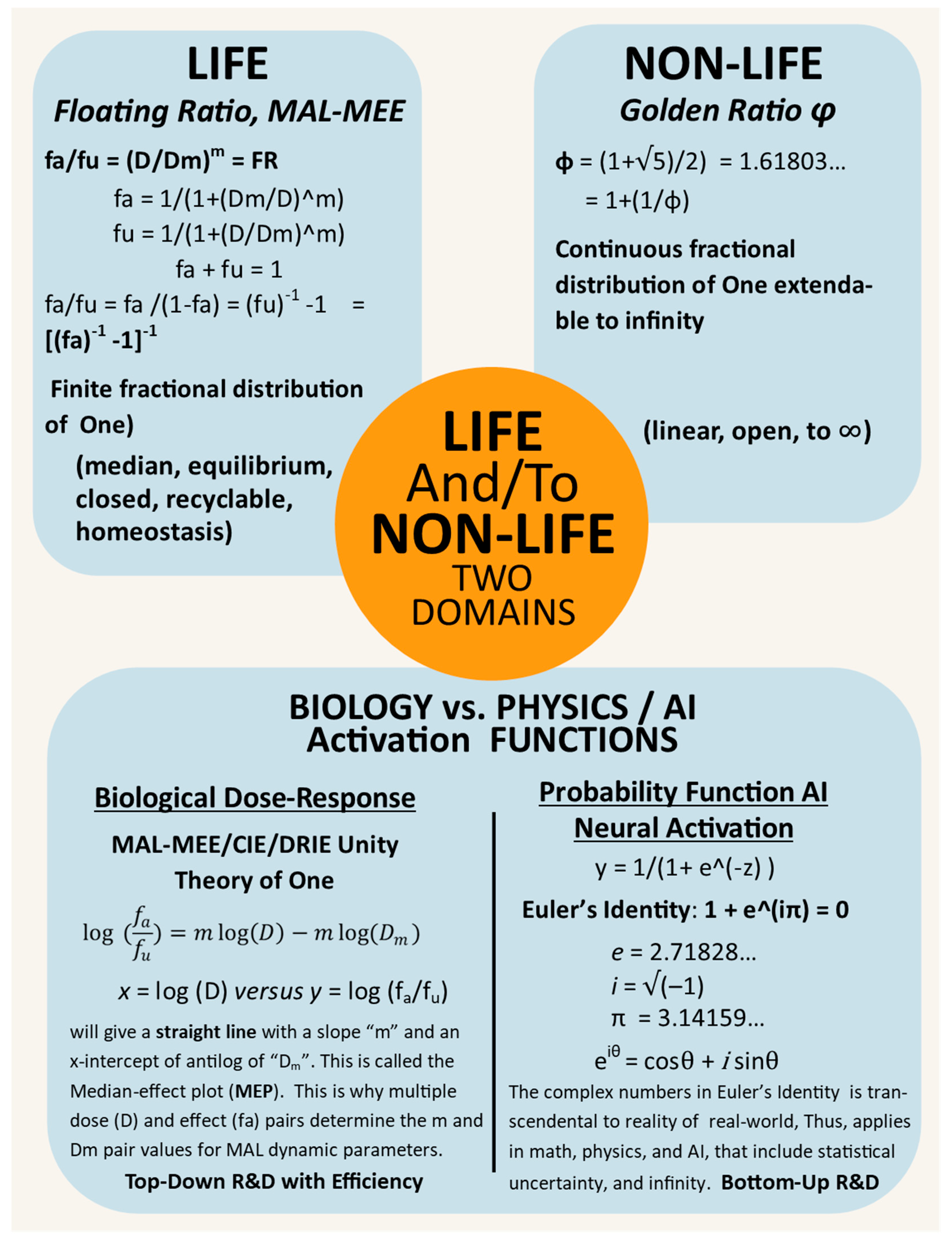
1.8.1. Visible and Invisible
MAL-MEE, fa/fu = (D/Dm)m, Manifests Life. However, the extrinsic properties we can sense or see, the intrinsic properties, or the underlying principle, are not necessarily visible. These functional dynamics are common to living systems, which involve receptor intermediates and transition steps within networks or pathways. We observe the inputs and outputs, but not the intermediate steps, except when the processes are slow or slowed by drastically lowering the temperature, and when they perform high-accuracy, fast measurements.
In the unified general median-effect equation, MAL-MEE, the floating ratio Fa/fu, where Fa is visible, and Fu is not visible, is subjected to the reciprocal and double-reciprocal, thus, recyclable, as described in Figure 11.
Figure 11.
The MAL-MEE on the right is the dose of Maas (normalized by the median) for Inputs ↓; on the left of MEE is the causal Effect, fa, (expressed as the Floating Ratio (fa/fu) for outputs ↑. Both inputs and outputs are visible or sensible. However, the intermediary complexity of intermediates is not visible.
Figure 11.
The MAL-MEE on the right is the dose of Maas (normalized by the median) for Inputs ↓; on the left of MEE is the causal Effect, fa, (expressed as the Floating Ratio (fa/fu) for outputs ↑. Both inputs and outputs are visible or sensible. However, the intermediary complexity of intermediates is not visible.
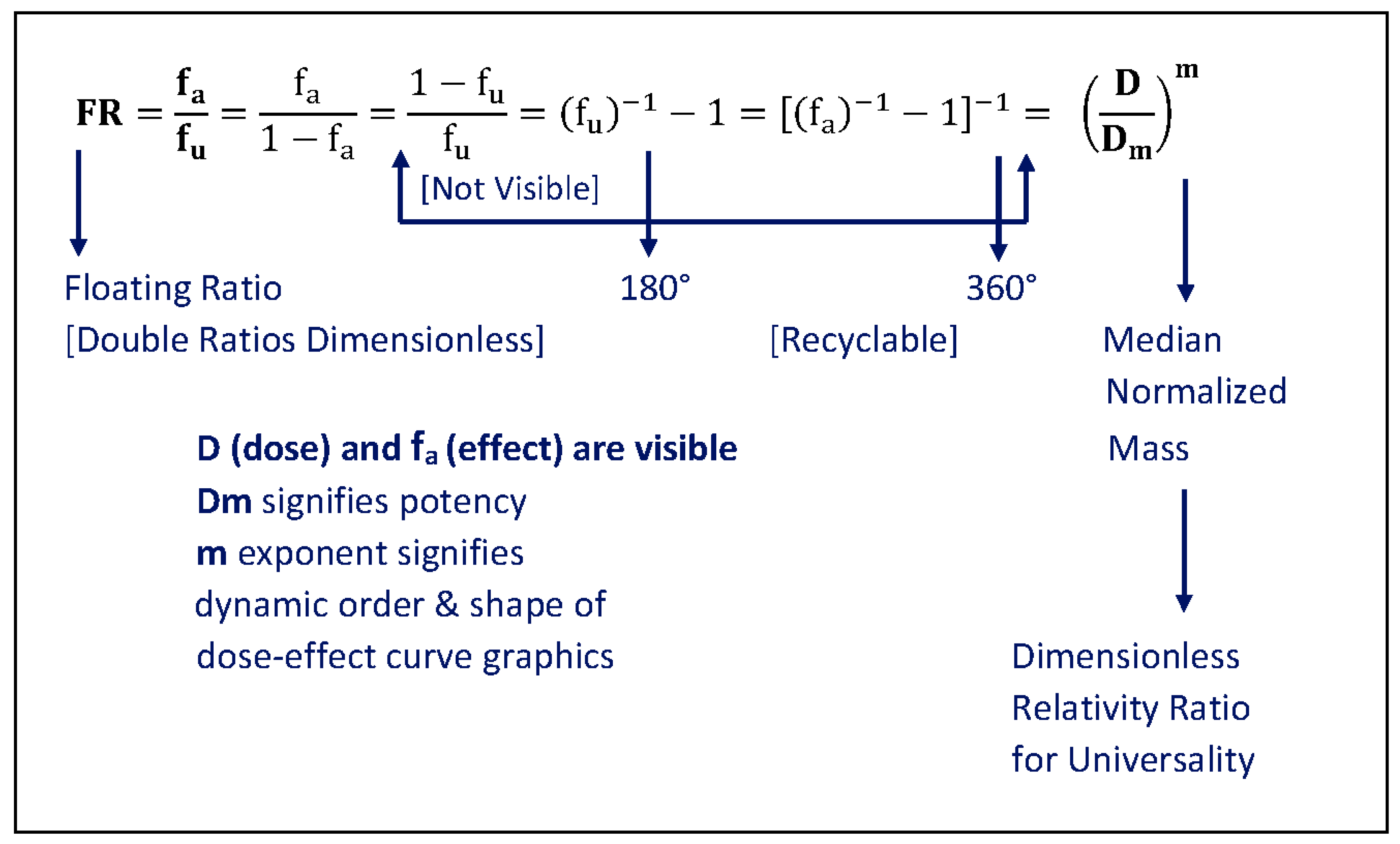
1.8.2. The FR (fa/fu) Manifests Life Domain
For the MAL-MEE is, fa/fu = (D/Dm)m where fa + fu = 1.
On the left, fa and fu are fractions (affected and unaffected); their ratio, fa/fu, is dimensionless.
On the right, D and Dm have the same unit; the ratio cancels out any unit.
The MAL-MEE embedded invisible mathematical intrinsic properties:
where D is dose, fa is fraction affected, fu = 1 – fa, Dm is median-effect dose, and m is the dynamic order.
fa/fu = [D/Dm]m = fa/(1 - fa) = (fu)-1 - 1 = [(fa)-1 - 1]-1,
Single reciprocal and double reciprocal represent (180° and 360°), indicating a closed circular/recyclable system.
1.8.3. The Relativity Concept in Biology and Physics
The MAL-MEE can be rearranged as dose and effect: D = Dm [ fa/(1-fa) ]1/m and
i.e., M = D/Dm (the Median normalized dose of Mass)
MAL expresses as the fractional distribution of One. The MAL-MEE causal relationship indicates a Floating Ratio (FR), (fa/fu):
(FR) = fa/fu = fa/(1 – fa) = (1 – fu)/ fu = (fu)-1 -1 = [(fa)-1 – 1] -1 = [D/Dm]m , which can be rearranged into
Since fa + fu =1, therefore, fa, the activation function in MAL, must be fa <1 (and fu <1) in the life
The MEE signifies the shape of hyperbolic (m=1) and sigmoidal (m>1, m<1) activation functions, as indicated in pharmacodynamics/bio-dynamics (PD/BD) derived from mathematics [9,11,24], as well as those used in AI graphics as indicated by the Hopfield equation algorithm and graphics [76,77], derived from physics and engineering for the neural network [78].
The Floating Ratio (FR = fa/fu) of the Median–Effect Equation (MEE) of the Mass-Action Law (MAL) manifests the Life domain. MAL-MEE defines the dynamic relationship between the mass entity of the dose (Inputs) and the functionality of the effect (Outputs) in a finite system.
The MEE took ten years to derive (1966-1976) [1,2,3,4] with a unique sequential, pattern, combinatorial general system analysis that involved over 300 reaction rate equations:
The Median Effect Plot (MEP) in double logarithmic form for x- and y-axis: log FR = log (fa/fu) = log (D) – m log (Dm), which determines Dm (dynamic potency, x-intercept), m (dynamic order, shape and slope for linearization (y = mx + b) of dose-effect curve, DEC) [4,9,11,24].
In MAL-MEE and MEP, FR is a dimensionless-relativity ratio (fa/fu = fa/(1-fa) regardless of unit, physical state, size, structure, and mechanistic complexity. Therefore, the MAL dynamic principle has universal applicability in Life science and beyond [24], as evidenced by garnering 35,000 citations in 1,587 scientific journals and 1,597 patents worldwide, indicating its impact in R&D [56,57].
The D/Dm term is the dimensionless relativity ratio of the same kind, at any dynamic order (m). Thus, MAL-MEE-dictated informatics is regardless of unit, physical state, size, structure, and mechanistic complexity. Therefore, the MAL-MEE theory/algorithm/method has unlimited applications. The ramification across disciplines, sub-disciplines, and sub-sub-disciplines has resulted in over 3,000 journals in the biomedical sciences alone, with no consensus among scientific societies, associations, and schools of thought. The greatest concerns of contemporary R&D are the limited theoretical basis and the lack of a scalable principle for extending to multiple-entity interactions and interdisciplinary linking for generality. Innovation is not a matter of talent, but a matter of how we relate to reality, step beyond the conventional surface, and perceive the patterns that organize it
The FR, fa/fu, single-reciprocal (180°), and double-reciprocal (360°) allow binary circular and recyclable closed form, typically manifested in Life. However, MAL also reams Non-Life, as indicated in inter- and cross-disciplinary analysis.
1.8.4. Symmetry, Equilibrium, and Harmony
Comparing the Mathematical Sigmoidal Function and its Derivative with MAL-MEE
Philosophers, researchers, and scientists have observed the shape of dose-effect curves since ancient times. The most common shapes in pharmacology are sigmoidal curves, while in enzymology, simple enzyme molecules display hyperbolic curves. As A.V. Hill discovered, oxygen-hemoglobin interactions follow highly significant sigmoidal curves, leading to the Hill equation (1913), which molecular biology confirmed by showing that hemoglobin has four subunits that bind oxygen molecules cooperatively. In biochemistry, enzymologists also discover allosteric enzymes that contain subunits. In pharmacology and physiology, most often…
In Figure 12, the MAL-Median-effect equation, fa/fu = (D/Dm)m, a sigmoidal function, has been correlated with its derivatives [79]. The graphics show perfect symmetry. Additional illustrations of MAL-MEE median-dose-based symmetry and equilibrium are given in Figure 2, Figure 3, Figure 4 and Figure 5 and Figure 21. The relationship between the “Median” and the Concept of “Harmony” is illustrated later in Figure 35.
Figure 12.
MAL-MEE activation function (fa) indicates a sigmoidal dose-effect curve (DEC) with its derivative showing a symmetrical distribution curve peaks at the Dm, where fa = fu = ½ (The Median point is 0.5), and its intrinsic property of symmetry.
Figure 12.
MAL-MEE activation function (fa) indicates a sigmoidal dose-effect curve (DEC) with its derivative showing a symmetrical distribution curve peaks at the Dm, where fa = fu = ½ (The Median point is 0.5), and its intrinsic property of symmetry.
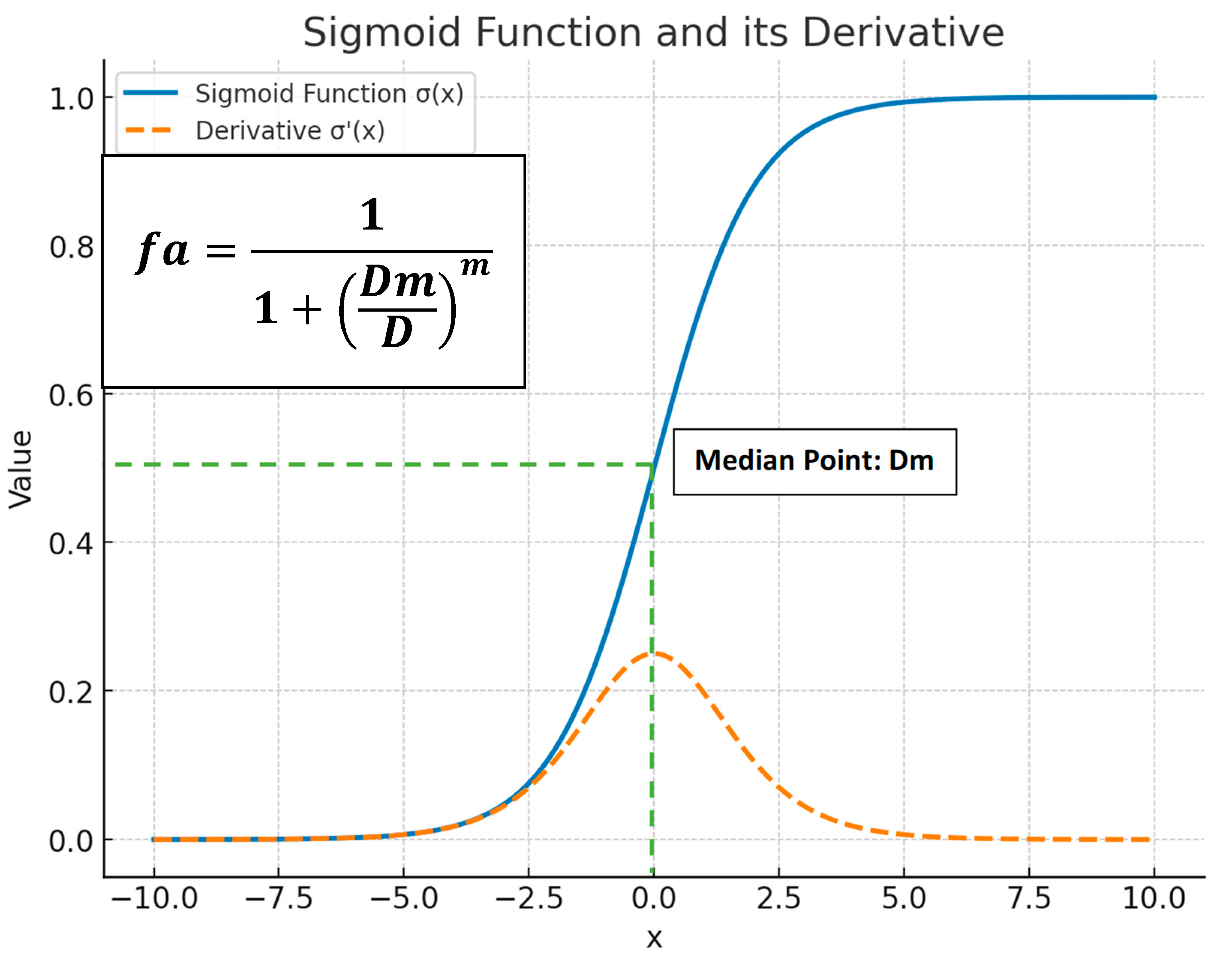
1.9. Deterministic vs. Statistic: The Basic Math Forms
1.9.1. MAL-MEE-based Deterministic R&D
Transformations of MAL- MEE give:
Thus, , and .
Scalability:
Dose, D: Mass, Entity, Input (↓), Causal Effector, Activator, Inhibitor, Regulator, …;
Effect, fa: Response, or output (↑) via target receptor, for intermediate, pathway, network of mechanisms or metabolism, processing, and output decision…;
Unaffected fraction, fu: Invisible, insensible, imaginary, (1-fa), finite negative complementary effect (<1, > 0 and can be a fraction of the digital, where fa + fu =1, where fa/fu is the Floating Ratio (defined as FR), the floating dark material-like, negativity balancing effect, which is mediated by the MAL, FR = (D/Dm)m ;
Median, Dm: Universal reference of potency, or efficacy; harmonic mean, 2ab/(a + b), of kinetic constants Kii and Kis, and the causal mechanistic reference standard for homeostasis, symmetry, rhythm, balancing in actions and interaction, activation or inhibition, regulation, and feedback.
The Kii and Kis are the Ki values determined by the intercept and slope of the Lineweaver-Burk Plot, respectively. It was discovered [3] that Dm (or I50) = 2 (Kii Kis)/(Kii + Kis) for the median dose, where fa = fu = 1/2 = 0.5.
Exponential “m” is the dynamic order signifying the shape of causal response graphic curve, where m =1 indicates hyperbolic activating or inhibitory function, and m ≠ 1 indicates a steep sigmoidal activation function, if m >1, steep sigmoidal; if m <1, it indicates a flat sigmoidal activation function. Therefore, the geometric function of MAL-MEE/CIE/DOM is identical to the tanh sigmoidal function in mathematics, and the Hopfield neural network activation function for artificial intelligence (AI), except that the theory and algorithm of MAL-theory is developed from life science.
1.9.2. Statistical, Probit Function and the Logistic Growth Function
Involving “ “
In pharmacology, statistical approaches such as Logit and PROBIT have been introduced (see Table 2). The key ingredient is the logistic function, where an input is converted into a probability, written in the form:
Probability = ,
Logit of fa = [1/[1 + e-(α+β log D) ],
PROBIT function for fa is
The distinguishing feature of MAL-theory is that it is deterministically easy to use, and the algorithm is simple to program in digital data science, with automated simulations that yield quantitative or index-based conclusions in real-world problem-solving.
Clearly, fa and fu functionality, where fa + fu =1, is identical in mathematical and statistical forms of:
1.9.3. Fermi-Dirac Distributional Function of One with “e” Notation
MAL-MEE/DOM is essentially a Fermi-Dirac distribution form (in statistical physics, the occupancy of energy states by fermions follows:
which is a sigmoidal function compared with the mass-action law MEE/DOM, as shown above in Figure 7.
This mathematical form also appears in ecology as the logistic growth model for populations.
However, the biomedical, as well as the physical, engineering, and mathematical digital sciences, have used different symbols and designations without an “e” involvement.
1.9.4. Hopfield Neural Network function without “e” notation
The Hopfield neural network sigmoidal function of the basal algorithm of the sigmoidal activation function in artificial intelligence (AI) [76,77,78], in the form of the sigmoidal function.
Clearly, the fa and fu functionality of the mass-action law, where fa + fu =1, is identical in mathematical forms of the distribution function on “One”, for the Hopfield’s neural function: Fermi-Dirac distribution functions
It is of interest to note that the Mass-action law-based derived median-effect equation [3,4,5,6,7] has the same form as the Hopfield’s neural network function, which does not involve the “e” functions, which is a conceptual breakthrough, and a paradigm shift in scientific research and development (R&D).
1.9.5. The MAL-MEE/DOM/CIE/UTO Causal-Effect Theory without the “e” Notation for the Real-World Phenomena
The following MAL-based biochemical/biological quantitative data sciences do not involve “e.” Most MAL equations have a typical mathematical form of a finite distribution function for “1”:
Fa = 1 / [1+ (Fractional distribution in ratio)m], where m =1 is the first-order dynamics (the Michaelis-Menten hyperbolic function), m < 1 for negative cooperativity with a flat sigmoidal function, and m>1 for positive cooperativity with a sigmoidal function
As indicated by comparing the MAL-MEE dynamics of Floating Ratio, FR (Manifesting Life), and the Golden Ratio, GR (Manifesting Non-Life) in Table 3, the fundamental mathematical forms for Life and Non-life are exceedingly simple. The fundamental source codes:
for Life is a/b = a/(1- a) = (1 -b)/b, a + b =1; Expressed as fa/fu = (D/Dm)m
for Non-life is a/b = (a + b)/a = 1 + b/a; Expressed as [ = 1.618033…= (1 + √5)/2.
Both (a/b) ratios are expressions of the fractional distribution of “One” with basically different dynamic properties, yet maintaining a connection to “1”. For life is finite and cyclable distribution of ”1”; In Life, FR partitions 1 into complementary components (fa and fu, > 0, < 1, centered at the median, 0.5); In Non-Life, GR partitions 1 into continuous recursive sequences, extendable without a bound.
The MAL-MEE Mathematical form of A General f Expression
AS indicated above (Section 1.9.1), the rearrangement of the MAL-MEE gives:
Thus, , and .
The detailed mechanistic analysis on enzyme reaction systems (E, Ex and/or Et) using substrates (S, A and/or B) as the primary ligands, and the inhibitors (I, I1 and/or I2) as the reference ligands.
Table 4, Table 5 and Table 6 below indicate a systematic analysis of enzyme kinetics with graphics shown in Figure 14, Figure 15 and Figure 16. Note that in Table 4, Table 5 and Table 6, the equations with ratios in the denominators express the distribution function of “1” in the finite series. These are in the form of:
X = 1/ [1 + (Dimensionless Distribution Ratios)]
1.9.6. The MAL-Based Finite Distribution Function of “1” in Life Sciences
The first-order fractional Inhibition in the Michaelis-Menten Kinetic System in Biochemistry
It was shown [3] :
Ki/I50 = Ex/Et = Part/Whole
Where ki is the inhibition constant, I50 is Dm, Et is the total enzyme, and Ex is the portion of the enzyme that is occupied. This relationship is regardless of whether the inhibition is competitive, non-competitive, or uncompetitive (i.e., all types of inhibition).
This equation also indicates that Ki will never exceed I50.
This equation can be used to calculate fractional receptor binding or to estimate Ki from the experimentally determined IC50 value in first-order kinetics derivations [3,4,5,6,7,9].
where fi is the fraction inhibited, and fv is the uninhibited “control”. Therefore,
fi + fv = 1;
fv = 1/[1+(I/Ki)(Ex/Et)]
fi = 1/[1 + (ki/I)(Et/Ex)]
Table 4, Table 5 and Table 6 provide summaries of the different inhibition mechanisms, kinetic constants, and distribution functions of “One”.
In biochemistry or molecular biology, fi and fv are equivalent to fa and fu in pharmacology or physiology (see Appendix I).
Table 4.
Different mechanistic types of inhibition, constants, and distribution function equations.
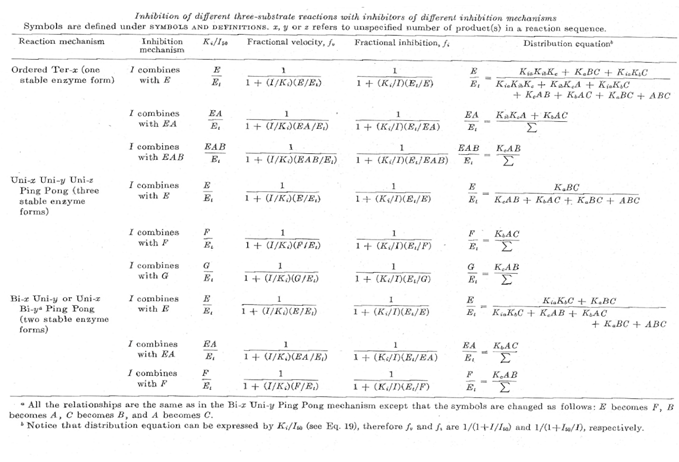 |
Table 5.
The relationship between the median dose (I50 or Dm) and the kinetic constant of an inhibitor in a one-substrate enzyme reaction.
Table 5.
The relationship between the median dose (I50 or Dm) and the kinetic constant of an inhibitor in a one-substrate enzyme reaction.
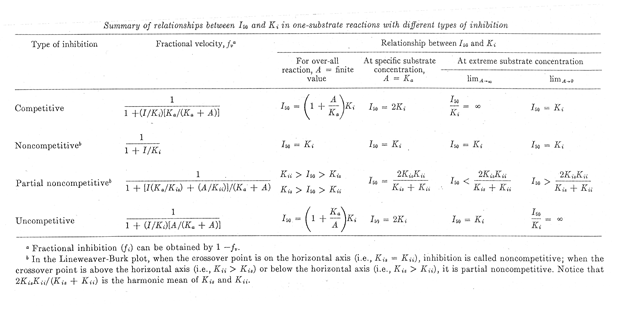 |
In this case, if the enzyme receptor has two substrates (A and B) and the inhibitor (I) as a reference ligand, the relationship based on the mass-action law is the following, where Ki/I50 is the fractional occupancy of the enzyme binding site ( for Space), whereas A/Ka and B/Kb is the normalized specific concentration (Mass) of A and B, respectively [3].
Note that I50 is the median dose (Dm) in the first-order dynamics (m = 1) for the median effect equation for the 1st-order effector kinetics/dynamics. (Table 3A).
Km is the substrate kinetic constant (Ka, Kb). Ki is the inhibition constant, whereas Kii and Kis are the Ki values calculated based on the Lineweaver-Burk plot’s, x-intercept and slope, respectively.
In the median effect equation, fi/fv or fa/fu = [D/Dm]m, the ratio of fractional inhibition in the presence or absence of any inhibitor, all kinetic constants (Km and Ki) cancel out, leaving only the dose-effect dynamic relationship [3].
Table 6.
The relationship between median dose and kinetic constants of inhibitor in two-substrate enzyme reactions with different substrate-inputs and product-outputs transition patterns.
Table 6.
The relationship between median dose and kinetic constants of inhibitor in two-substrate enzyme reactions with different substrate-inputs and product-outputs transition patterns.
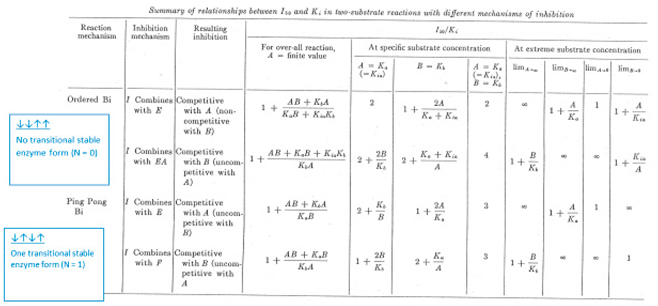 |
Note that sequential pattern analysis is performed in linear reactions with substrates A and B in the presence of different mechanisms of inhibition. Equations show similar mathematical patterns.
The I50/Ki ratio (whole vs parts, Et/Ex) in Table 9 indicates a pattern of 1 plus a typical distribution function based on the mechanistic sequence of input and output patterns.
The reciprocal situations are illustrated in Table 4, Table 5 and Table 6, with ki/I50 = Ex/Et, where Ex/Et = 1/[1 + (distribution function)]. Therefore, by definition, the whole enzyme (Et) represents “One”, and the MAL functional dynamics principle follows the same mathematical pattern of hyperbolic activation functions. This MAL-life-science-based pattern is identical to the geometric, physical, and AI-algorithm patterns, as Appendix III shows. Table 4, Table 5 and Table 6 and Figure 14, Figure 15 and Figure 16 are all for the Michaelis-Menten type of kinetics/dynamics. The groundbreaking advancement following [2,3,4] in the early 1970s was extended theoretical work from single inhibitor (effector) to n-inhibitors [6] and from first-order dynamics to mth-order dynamics [7]. These led to the discovery of the unified general theory of median-effect equation (MEE) [4], the combination index equation (CIE) [8], and the dose-reduction equation (DRIE) [9,53].
The above efforts led to a period of conceptual consolidation and integration of MAL theory and method [7,8,22,23,24], as well as to interdisciplinary collaborations, including drug discoveries and free software downloads.
After retirement in 2013, the theoretical work on MAL-MEE/CIE/DOM continue, and introduced the UTO, top-down vs. bottom-up complementary concepts in scientific R&D [51,52], MAL-MEE/CIE floating ratio, fa/fu = fa/(1 – fa), manifesting Life vs. the ancient Golden Ratio ( , manifesting non-Life [22], and indicated that MAL-MEE/DOM/UTO serve as universal common denominator for intra-, inter-, multi-, and cross-disciplinary R&D efficient, cost-effective, general digital linkage [9,11,14,15,16,17,18,19,20,21]. Advocacy for international R&D regulatory policy, priority reform, and modernization has continued [9,24].
This regulatory efficiency reform for public advocacy is significantly supported by the broad applications of the MAL-based functional dynamic theory, algorithm, and computer software, which have garnered citations in over 1,500 scientific journals and 1,621 patents [56]. Since 2013, there have been 23,500 new paper citations [57] and over 60,000 registered free downloads of computer software [55] from scientists from 137 countries and territories.
1.10. Graphics Revelations of the MAL-1st-Order Kinetics
Figure 14, Figure 15 and Figure 16 indicate the MAL-geometric properties, and mathematics explicitly supports the general MAL-DOM and UTO.
Typical math tools include ratios, reciprocals for 180°, images, double-reciprocals for 360°, circles, logarithms, and double logarithms for the x- and y-axes. Then, look for intrinsic properties, the general principle, and the unified theory.
Categorizing and Generalization, Mathematical Induction and Deduction
1.10.1. Linearization of Inhibitor Curves of Different Types with the Double Reciprocal Plot
Log (D or I) vs. Log Fractional Effect Ratio; log FR: log [(fa)-1 -1]-1 is the double logarithmic plot that reveals the hidden informatics from the dose-effect dynamics measurements, Figure 13.
This double-logarithmic principle for first-order dynamics is a precursor to higher-order dynamics [4,5,6,7], which are described by the median-effect equation (MEE) and the median-effect plot (MEP) [4,8,9].
Figure 13.
System Analysis on Biological Action of a Single Effecter Entity Type and Parameters.
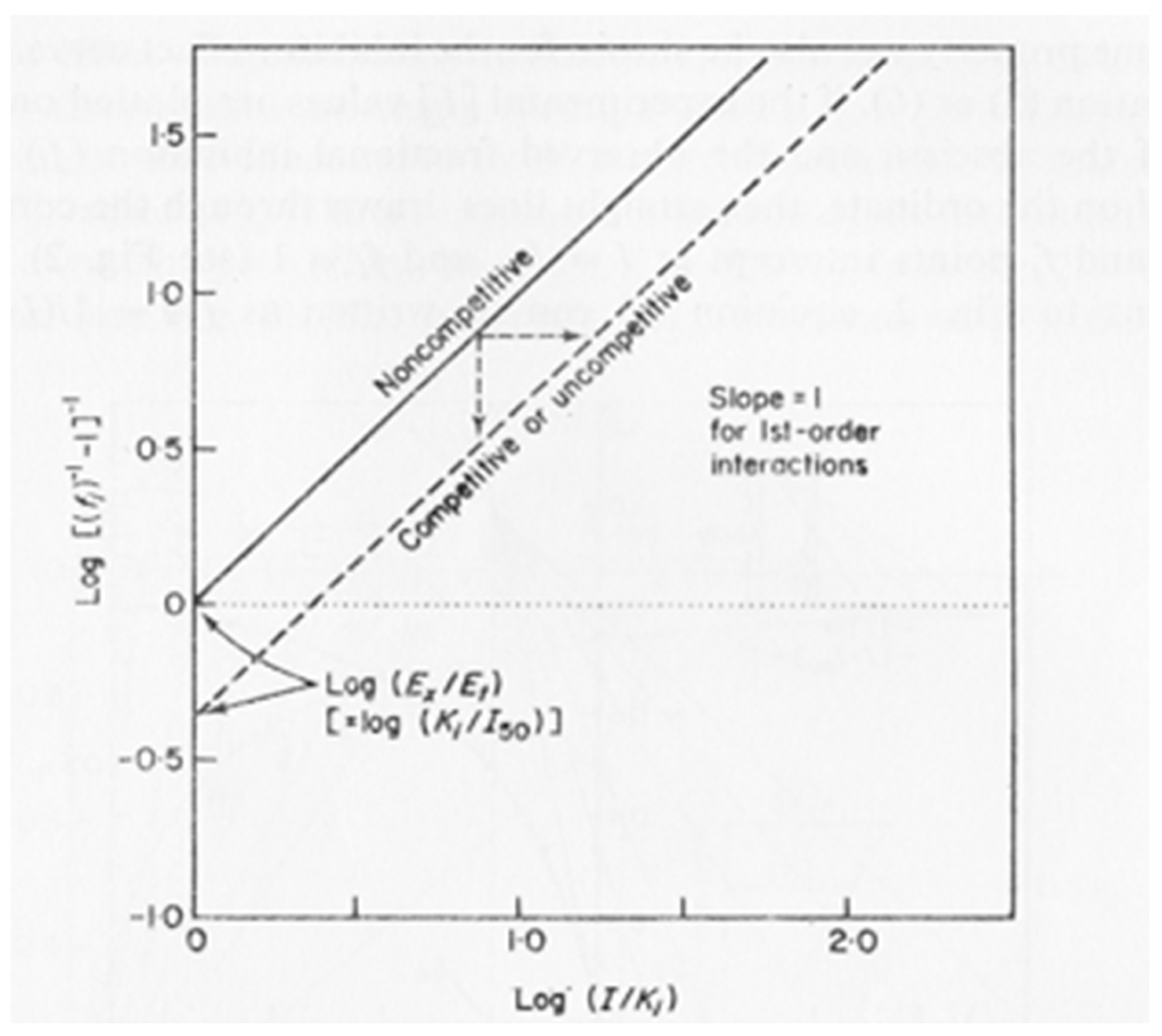
The double logarithmic plot of [log (I/ki or Ex/Et )or I/Ki) vs. log Fa/fv is the fractional occupancy of the enzyme targeted, where Et is the total amount of enzyme target, and Ex is the amount of enzyme occupied [5].
The discovery was: Ex/Et = Ki/IC50. This later leads to the Median-effect equation (MEE), fa/fu = [D/Dm]m. It is the distribution function of One. Thus, logarithmic transformation and double reciprocals mathematically diagnose the type of inhibition interaction. The enzyme as a whole entity is represented as “one”. The rest are fractional distribution functions.
For scale-up applications, during 1984-2024, the MAL theory scientific terminologies have been updated, as shown below:
x-axis is the log of [ki normalized inhibitor Dose concentration]
y-axis is a log of the Floating Ratio (FR),
fi is the fraction affected (fa)
fv is the fraction unaffected (fu)
fi/fv = [(fv)-1 -1] = [(fi)-1 - 1]-1, or fa/fu is named the Floating Ratio (FR), in which MAL-MEE indicates that FR is a Double Reciprocal Function in life sciences.
Appendix I gives he details of the evolution in symbols, abbreviations, and definitions.
1.10.2. The Double-Reciprocal Plot (The Lineweaver-Burk Plot for the 1/S vs. 1/v) Linearize the Dose-Effect Curves for 1/I vs 1/fi, Regardless of the Type of the Inhibitory Effect of Inhibitors
Mathematically, a single reciprocal is a 180 ° rotation, and a double reciprocal is a 360 ° rotation (one circle), as indicated in the Floating Ratio (FR) in the median-effect equation (MEE) of the mass-action law (MAL). Thus, the double-reciprocal plot reveals hidden information from dose-effect dynamics measurements.
Both the x- and y-axes are single reciprocal transformations that generate kinetic/dynamic constants and diagnose the types of inhibition. (Figure 14).
Figure 14.
The reciprocal of inhibitor concentration and the reciprocal of fractional inhibition in one-substrate reactions. Thus, under the umbrella of the mass-action law, the inhibitor (I) and substrate (S) are equivalent in terms of entity-mass; i.e., the double-reciprocal plot for (I) is equivalent to the Lineweaver-Burk plot for the saturation relationship.
Figure 14.
The reciprocal of inhibitor concentration and the reciprocal of fractional inhibition in one-substrate reactions. Thus, under the umbrella of the mass-action law, the inhibitor (I) and substrate (S) are equivalent in terms of entity-mass; i.e., the double-reciprocal plot for (I) is equivalent to the Lineweaver-Burk plot for the saturation relationship.
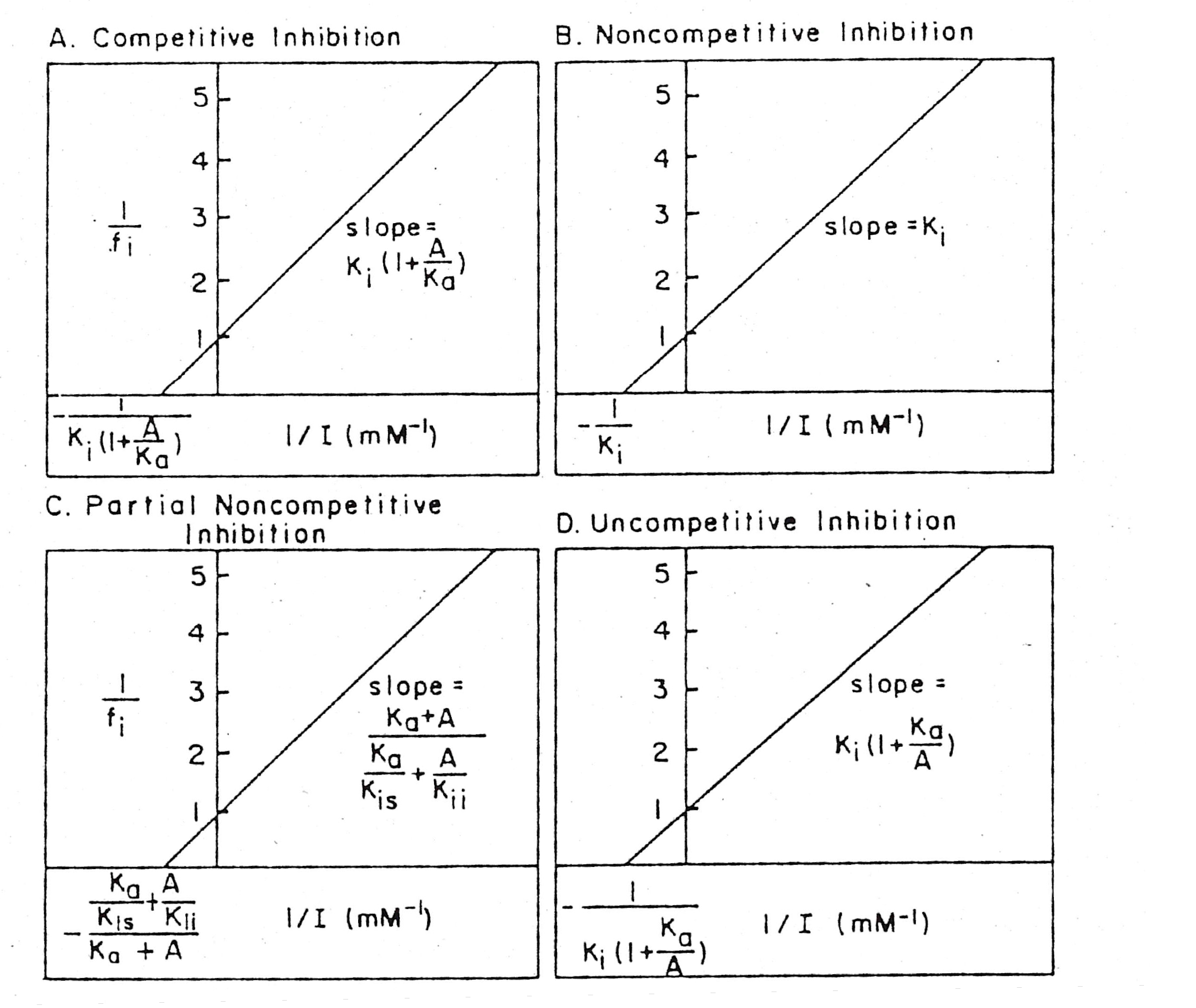
Thus, a plot of log [(fi)-1 - 1]-1 on the ordinate, against log (I/Ki) on the abscissa, is linear with a slope of unity. The slope of one is a consequence of the first-order (i.e., univalent) interaction. The intercept on the ordinate gives log (Ex/Et) or log (Ki/I50), regardless of the enzyme reaction mechanism or the inhibition mechanism. For the single-substrate reaction [9]. Therefore, for competitive, non-competitive, and uncompetitive inhibitions, respectively, are [9]: I50 = Ki [1 + (S/Km)] = Ki (Et/E), I50 = Ki, and I50 = Ki [1 + (Km/S)] = Kt (Et/ES), respectively where I50 is the median-effect dose (Dm) [2,3,4,5,9].
These theoretical concepts have been used for three decades in the subsequent development of MAL dynamics/informatics theory [3,4,5,6,7,9,24], as highlighted in Figure 13, Figure 14 and Figure 15, and in the early 1970s work. These are focused on the reference ligands (i.e., inhibitors) rather than on the primary ligands (i.e., substrates) only, in the MAL system analysis.
A double reciprocal plot for inhibitor concentration and fractional effect. Different types of inhibitory mechanisms show the same linearity and intercept at 1 (One). The inhibitor or multiple inhibitors are the “reference ligands.” This is another reason that MAL-MEE is the Grand General Theory for the later Unity Theory of One (UTO), where MAL-MEE, CIE, and DRIE are all based on the standard of “One” as the universal standard [9,11,24].
1.10.3. The Normalized Doses as a Function of the Reciprocal of the Fractional Distribution Function (I50/Ki)
In this regard, Figure 15 also follows the principle of the double-reciprocal plot, which translates dynamic studies into digital informatics conclusions.
Figure 15.
The MAL-based unity theory of one (UTO) and fractional distribution of effect (i.e., the fractional binding (occupancy) of the receptor for actions[3]. Again, the unity theory of one can be visualized. The normalized dose should have an orderly shape based on the fraction occupancy (Ki/I50 or Ex/Et), part vs. the whole.
Figure 15.
The MAL-based unity theory of one (UTO) and fractional distribution of effect (i.e., the fractional binding (occupancy) of the receptor for actions[3]. Again, the unity theory of one can be visualized. The normalized dose should have an orderly shape based on the fraction occupancy (Ki/I50 or Ex/Et), part vs. the whole.
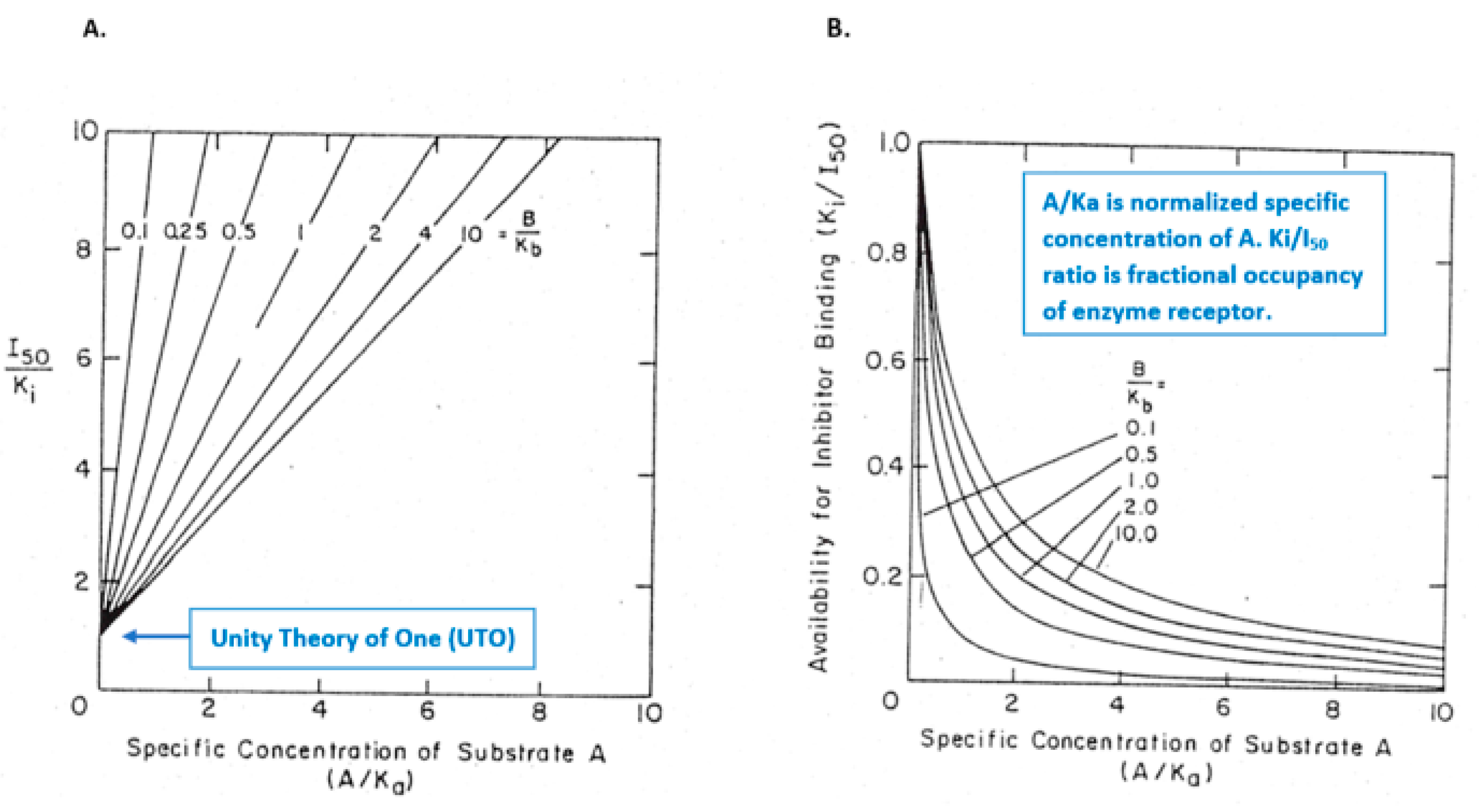
This confirms the unity of one (UTO) theory. All lines intersect at 1 (One) on the y-axis (Figure 15A).
1.11.“. Space” Concept in MAL-MEE Unified Theory
Exclusiveness and Non-Exclusiveness Determination
Exclusivity is beyond competitiveness (e.g., competitive, non-competitive, and uncompetitive inhibition, as determined by the Lineweaver-Burk plot). Exclusive and non-exclusive inhibition is directly relevant to the ”space” concept as introduced by Chou-Talalay in 1981 [7], and further discussed in 1991 [23].
1.11.1. Mutually Exclusive and Non-Exclusive Types of Binding to the Receptor Between Two Inhibitors
The dose-effect curves in Figure 16A and 17A are all linearized by the MEP double-reciprocal plot (Figure 16B and 17B) in mutually exclusive cases (curves a, b, and c). However, the mutually non-exclusive curve (d) cannot be linearized. This is the first time the space-exclusivity concept has been introduced quantitatively in the life sciences. They may be applied to AI algorithms or other areas of data science. This is a powerful demonstration of the MEP double-logarithmic plot concept.
Figure 16.
Illustration of exclusivity in the first-order dynamics.
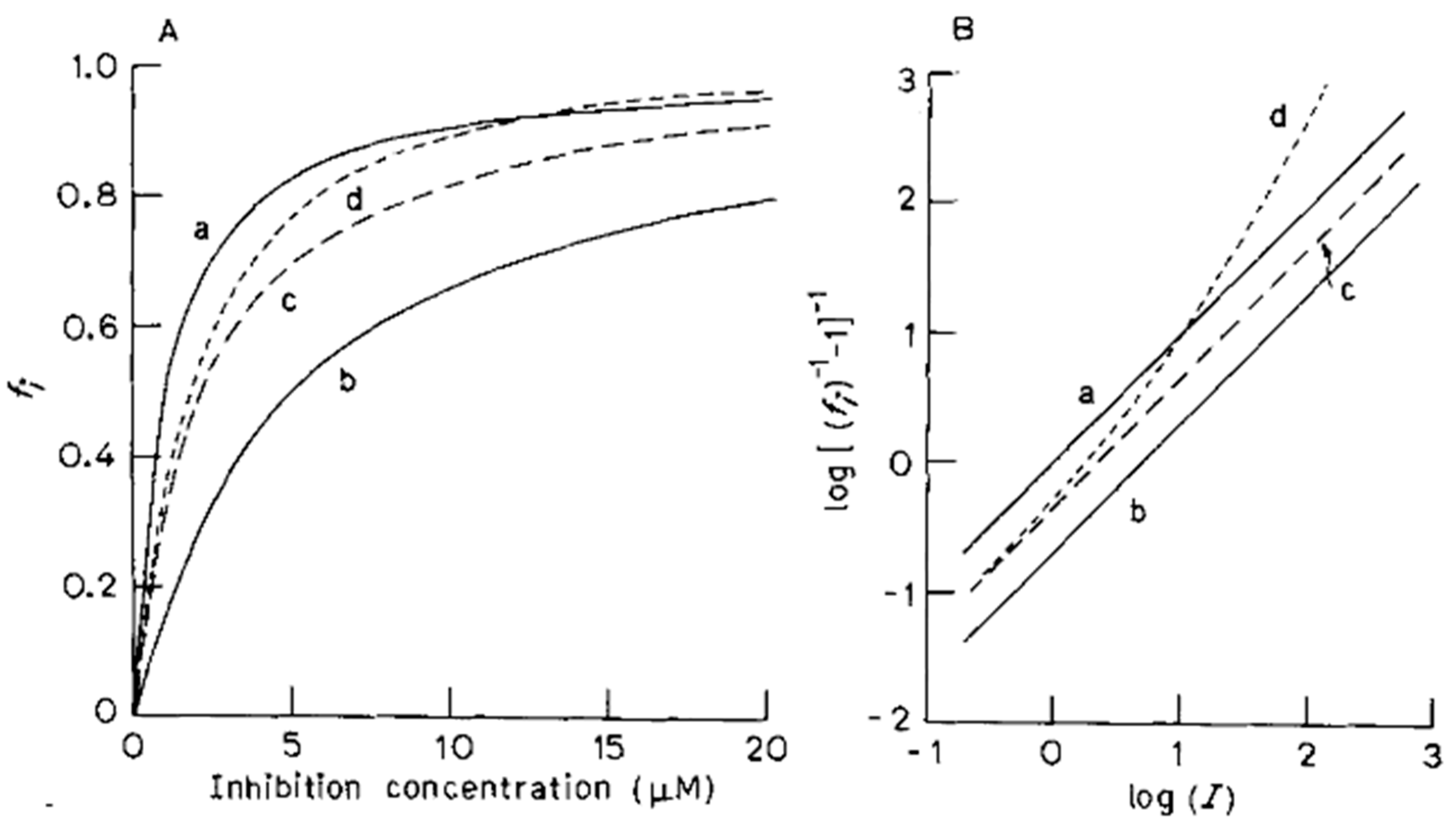
Combinations of effects of two inhibitors in a first-order system (m = 1; Michaelis-Menten kinetics), assuming the inhibitory potency for I1 is (I50)1 = 1 M and for I2 is (150)2 = 5 M. The fractional inhibition is presented as a function of inhibitor concentration for: (a) I1 alone; (b) I2 alone; (c) a mixture of I1 and I2 (1:2), assuming the inhibitors are mutually exclusive in their effects; (d) a mixture of I1 and I2 (1:2), assuming they are mutually nonexclusive in their effects. In the case of the mixtures of inhibitors, the abscissa represents the sum of (I1 + I2), e.g., I1 = 3 M plus I2 = 6 M (total 9 M) when compared with 9 M of I1 or 9 M of I2. (A) Linear plot vs. inhibitor concentration. (B) The median-effect plot of log [(fi)-1 - 1]-1 vs log inhibitor concentration. Note that curve d clearly shows synergistic inhibitory effects at high concentrations when compared with its parent components on an equimolar basis [7] (Figure 16).
MAL-MEE/MEP transform curves into lines and digital parameters by logarithmic transformation of informatics from [I vs. fi ] to [log I vs. log (fa/fu)] or [log (Floating Ratio, FR)].
Based on the mass-action law, the mutually Exclusive for line (c) and the mutually Non-Exclusive for (d), with the concave upward curve, show the mass-action law-based differentiation of space. The MAL principle of exclusivity concerns space and mass, but is not directly related to time and force (Figure 17A,B).
Figure 17.
Illustration of exclusivity in the second-order dynamics.
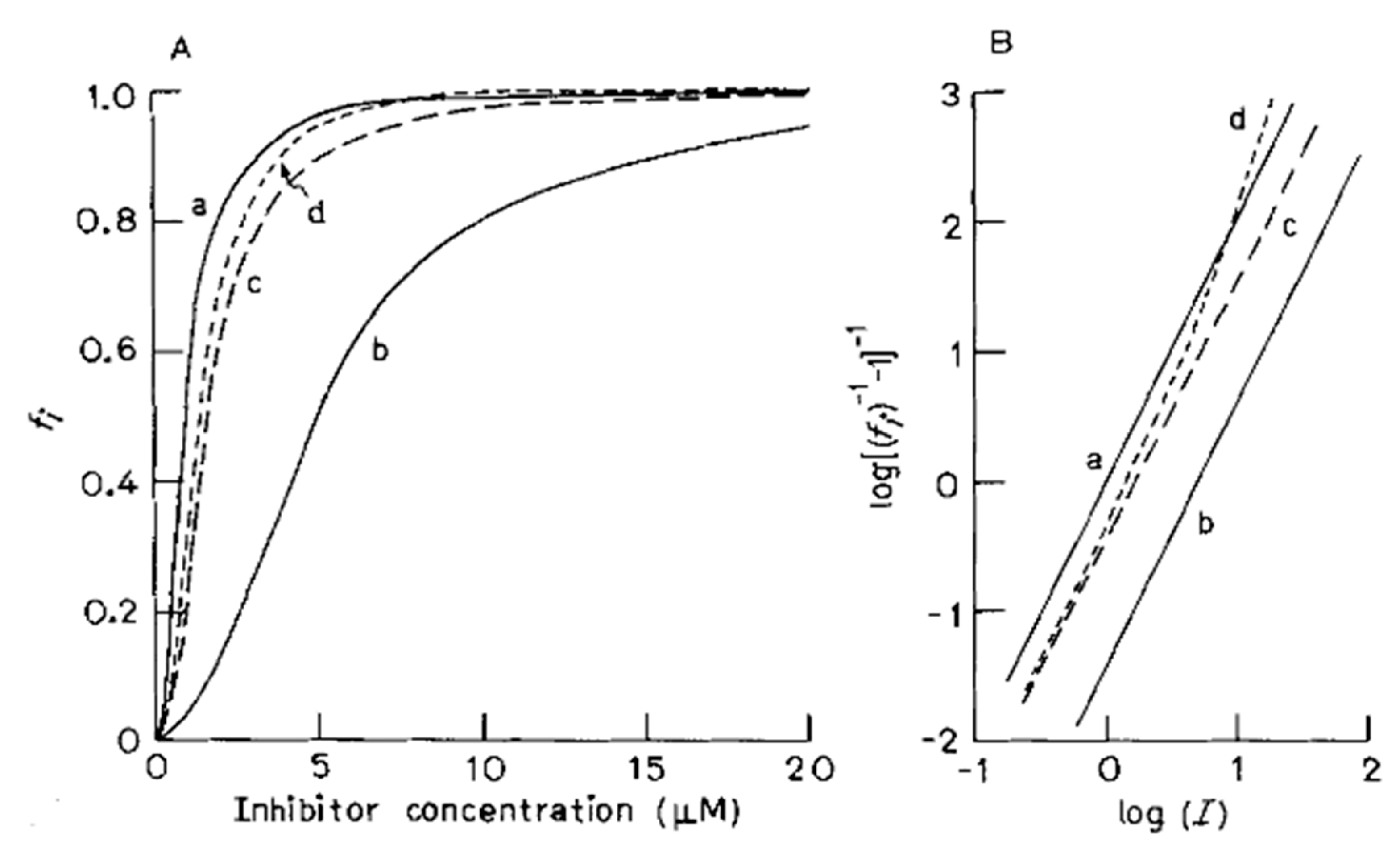
Combination of effects of two inhibitors (each obeying second-order kinetics, i.e., m = 2), assuming inhibitory potency for I1 is (I50)1 = I M and for I2 is (I50)2 = 5 M. Dose-effect relationships are given for: (a) I1 alone; (b) I2 alone; (c) an equimolar mixture of I1 and I2, assuming that they are mutually exclusive in their effects; (d) an equimolar mixture of I1 and I2, assuming that they are mutually nonexclusive in their effects. (A) A plot of fi vs inhibitor concentration on a linear scale. (B) The median-effect plot of log [(fi)-1 - 1]-1 vs log (I) [7].
MAL-MEE/MEP transforms dose-effect curves into straight lines, allowing automated computer simulation to determine the paired parameters Dm and m from two or more dose-effect data points.
In the second-order system (m=2), similarly to m=1, the mutually Exclusive for line (c) and the mutually Non-Exclusive for (d)-with the concave upward curve, which shows the mass-action law can be associated with space at different dynamic orders. In this case, the mass-action law's exclusivity concerns space and mass, not time and force. The Dm and m parameters jointly provide ID for any dynamic entity under consideration. For multiple inhibitors (or the reference ligands),
1.11.2. Equations of Multiple Entities Exclusivity in Combinations
For a mutually exclusive (normal) condition, the two-entity combination’s CI equations is:
For two drugs, and for n-drugs.
Whereas for a mutually non-exclusive condition, the two-entity Combination’s CI equation is:
The CI equation for the non-exclusive two-drug or inhibitor combinations has additional terms, (D)1(D)2/ (Dx)1(Dx)2, compared with the CI equation for the mutually exclusive case in combinations. Thus, the non-exclusive case will yield a slightly larger CI value (than the exclusive case), implying less synergism estimation, since the definition of synergism is CI <1 [7,8,27]. However, the mutual non-exclusiveness among mass entities in reference ligands (such as different types of inhibitors)
1.11.3. The MAL Dynamic Space Concept and the Time-space in Quantum Physics
The above MAL-dynamics, mutually exclusive and non-exclusive concept in biology (Figure 16 and Figure 17), has a surprising similarity in graphic form to the time-space concept in quantum physics. However, they intuitively seem hard to connect.
In a recent article by a physician-theoretical physicist, James Kowall [108,109], on how the holographic principle unifies gravity with quantum theory and solves the measurement problem of quantum theory and the hard problem of consciousness, which exhibits a graph on the accelerating observers' event horizon in the time-space coordinates (Figure 18). It compares (i) the accelerating observer’s world line, (ii) her own horizon, and (iii) a light ray that never catches up with her as long as she accelerates. Interestingly, her worldline (i) departs from the smooth course, and crosses over with (ii and iii) if she stops accelerating.
Similar scenarios occur in Figure 16B and 17B, where c lines are for mutually exclusive, and d curves are for mutually non-exclusive cases, which are related to the “space” and “dose-effect relationship” of two entities (I1 and I2).
Figure 18.
Comparison of the holographic screen when the observer is accelerating and stops accelerating in quantum theory.
Figure 18.
Comparison of the holographic screen when the observer is accelerating and stops accelerating in quantum theory.
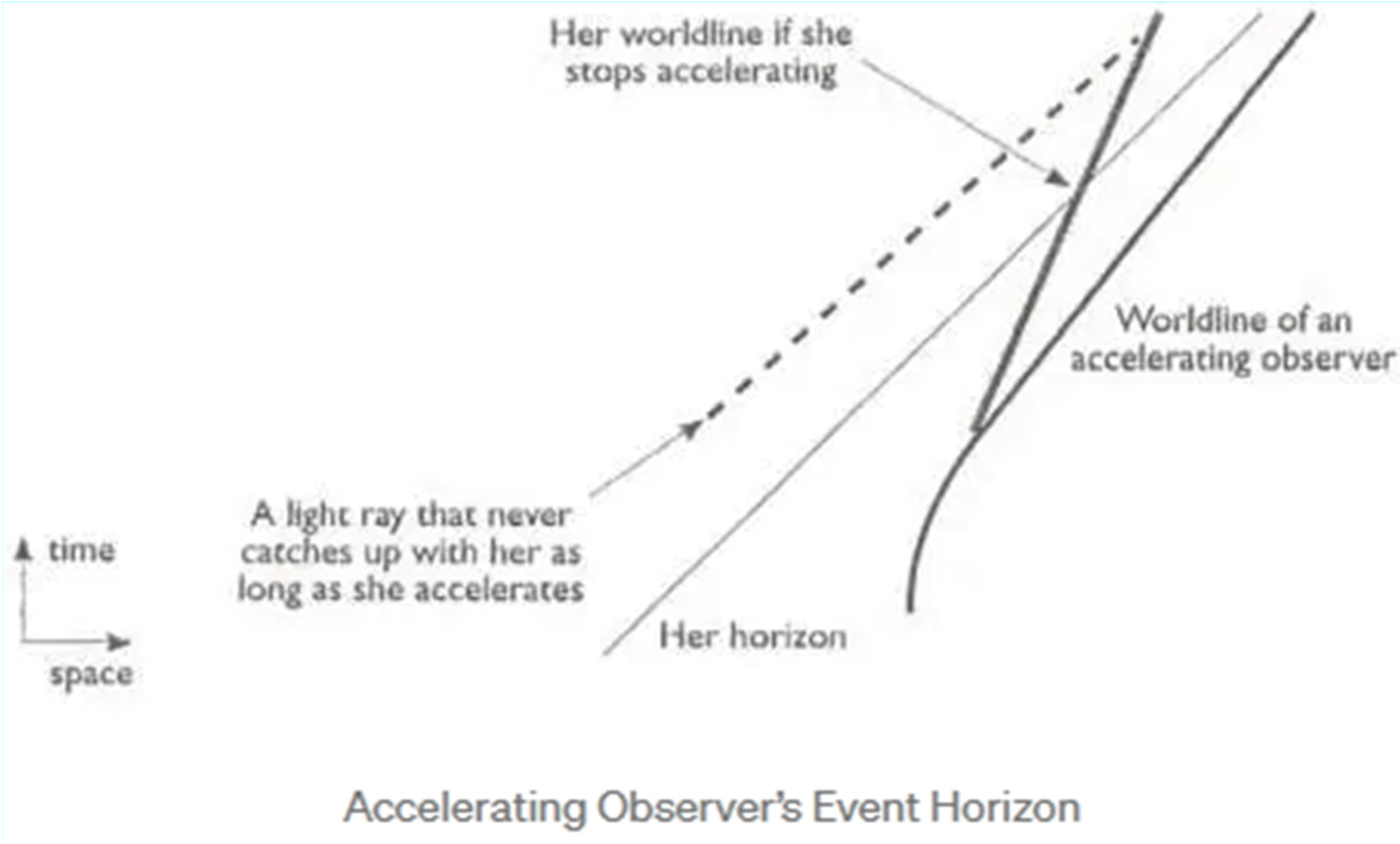
Kowall noted that it’s worth understanding how Hawking performed his calculation. The first thing he had to calculate was the temperature of the event horizon [108]. This idea goes back to the Unruh temperature, which is defined for any accelerating observer. An accelerating observer always has its own event horizon that limits the observer’s observations of things in space. The observer can observe nothing beyond the limits of its event horizon due to the constancy of the speed of light. This limitation of observation is always from the point of view of the observer. In the generic case of an accelerating observer following an accelerating world line through some space-time geometry, this is called a Rindler event horizon.
The accelerating observer’s event horizon has a temperature known as the Unruh temperature. This is a very general result of quantum theory. In terms of the observer’s own acceleration, which is called a, the Unruh temperature is given as kT=ħa/2πc. [108].
1.11.4. Correspondence Between MAL-Modern Dynamics of Exclusivity and Competitiveness Dynamics with the Ancient Philosophical Fu-Xi Ba-Gua Philosophy
MAL Dynamics (2006 ADE) vs. Fu-Xi Ba Gua (Ca 2,000 BCE)
The ancient Chinese traditional philosophies of Daoism of Lao Tsu (e.g., Tao Teh Ching, or Yi Jing, Oracle of Change) and Confucianism have been subjected to MAL-theoretical quantitative analysis, as exemplified in Figure 19, Figure 36 and Figure 37.
These are believed to be the first attempts to carry out modern quantitative analysis of ancient Asian philosophy during 2006-2010, with the mass-action law mathematical theory and algorithms/computer simulation. These were presented in Baltimore, MD, USA; Peking University, Beijing, and Wu-Xi, Jiangsu, China; Taipei, Taiwan, and Seoul, Korea.
Figure 19.
The eight-element event symbolic graphics have an exact correspondence with ancient philosophy, 4,000 years apart. A. comparison of the modern molecular inhibitory interactions, [red (I1) and blue (I2) interrelationship with orange Substrate (S), the reference entity, in terms of special exclusivity (X) and functional competitiveness (C) (See Chou. Pharmacol. Rev. 2006 [9], in Figure 13). B. the ancient Fu-Si (Xi) Ba Gua philosophy (The Yaos: Top, Middle, and Bottom, with breaks) (Ca 2,000 BC).
Figure 19.
The eight-element event symbolic graphics have an exact correspondence with ancient philosophy, 4,000 years apart. A. comparison of the modern molecular inhibitory interactions, [red (I1) and blue (I2) interrelationship with orange Substrate (S), the reference entity, in terms of special exclusivity (X) and functional competitiveness (C) (See Chou. Pharmacol. Rev. 2006 [9], in Figure 13). B. the ancient Fu-Si (Xi) Ba Gua philosophy (The Yaos: Top, Middle, and Bottom, with breaks) (Ca 2,000 BC).
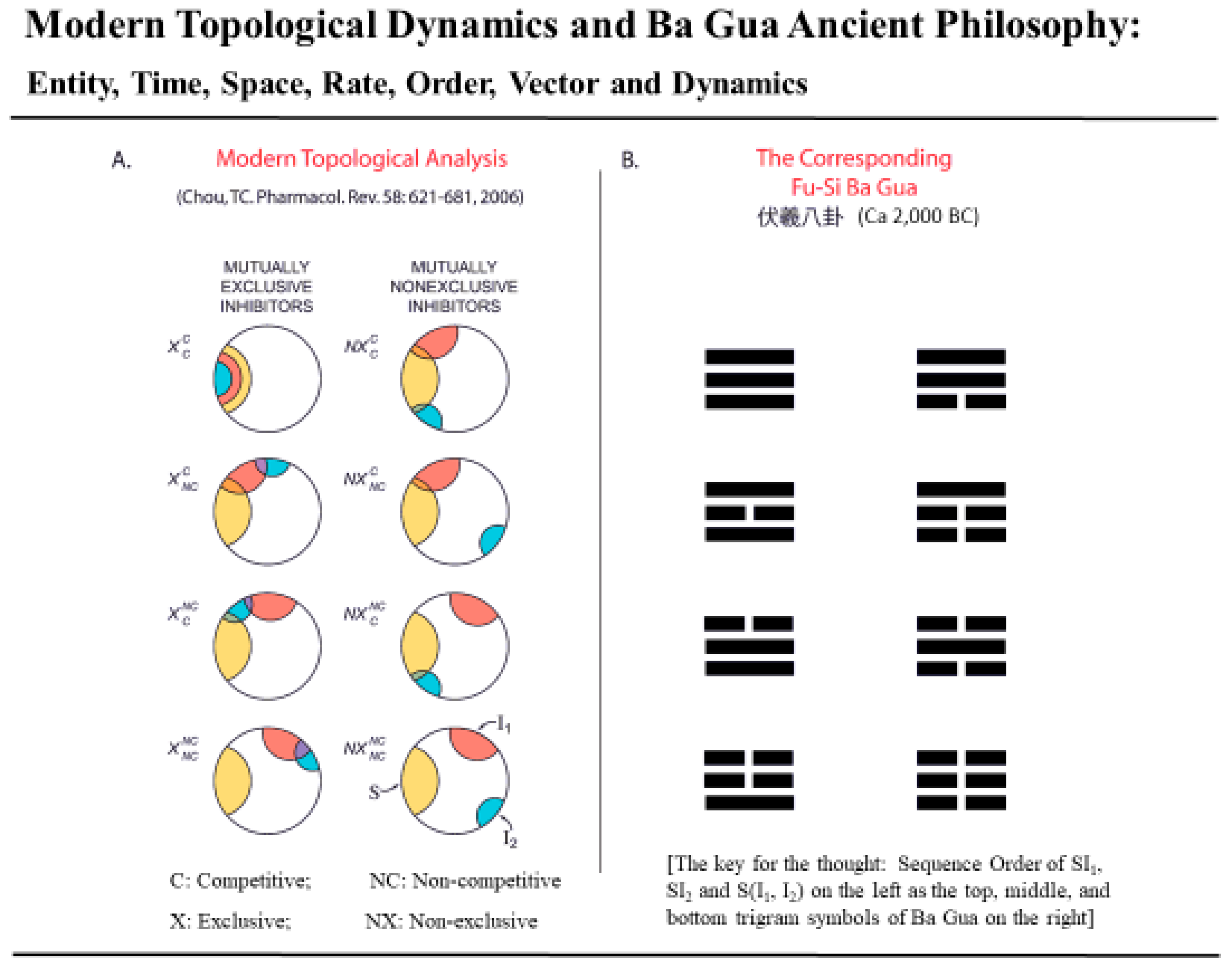
1.12. Halt-Center Geometry: Comparing Life Dynamics with Mathematical and Physical Mass, Force, Time, and Space
MAL Median of Life Science vs. Half Time of Radiation
Mass and Force are theoretically exchangeable based on Einstein’s relativity. The relationship between space and Time is currently a hot topic of discussion, as indicated in Appendix III. Mass and time do not usually interchange. However, Dm and T1/2 curves show intriguing similarity, as shown in Figure 20. The slight difference in curvature is due to MAL in Life science showing intermediate transitions between simple and complex variables in Mass for activities (Dm value) and for different dynamic orders (m value) over time. In contrast, radiation decay is not mediated by a complicated intermediate during the time course. The elements of the universe, Life, Mass, Force, Time, and Space, are individually sensible and measurable; however, they are interlinked or cross-linked among them in unity for size, length, volume, vectoral angle, and speed, except for inertia or at zero dose, zero movement.
1.12.1. Comparing MAL-Median in Biology and Half-Time in Radiation Physics)
Figure 20.
Comparison of biology (mass) versus physics (time). Similarities and slight differences between biological and physical radiation decay .
Figure 20.
Comparison of biology (mass) versus physics (time). Similarities and slight differences between biological and physical radiation decay .
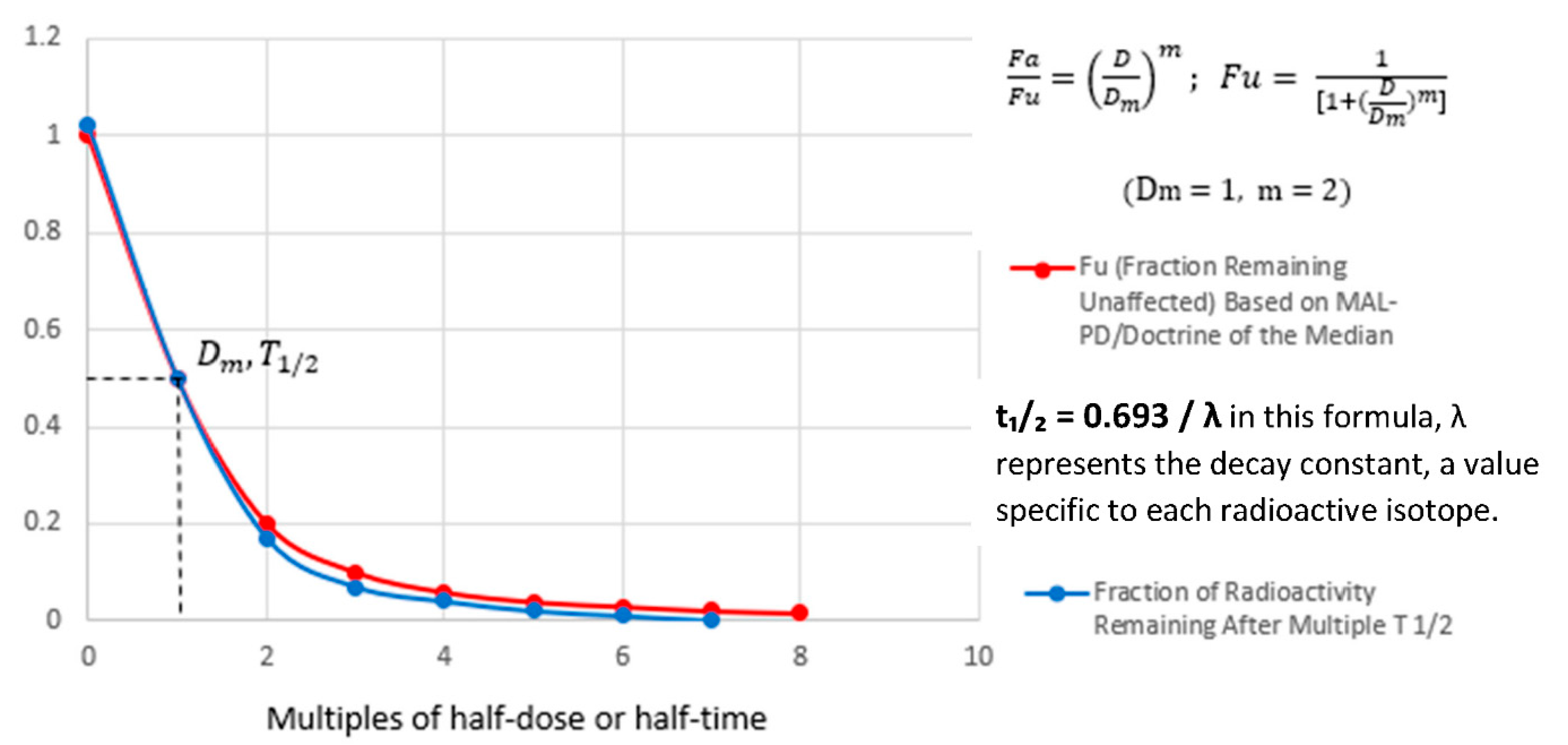
The radiation decay curve in a unit of (blue line).
The unaffected fraction (Fu) is based on MAL in the unit of Dm (in red line). The difference between the two curves at the fundamental level stems from the fact that biological systems, to perform complex dynamic functions, involve a causal-effect relationship between “receptors” that lead to intermediate complexes, which may involve networks or pathways. For example, oxygen-hemoglobin interactions involve hemoglobin's four subunits; each step of the interaction exhibits cooperativity, yielding a sigmoidal saturation curve. Most drugs, neurotransmitters, and hormones have specific receptors. Physical steps may also involve a simpler affinity receptor, such as that described by Langmuir’s Adsorption Isotherm on the surface.
Based on the median-effect equation of MAL [24], when , m = 2. Note that the two curves are similar and cross-over at and . Before the cross-over of and Fu is slightly lower (i.e., more affected), and post-cross-over, Fu is slightly higher (i.e., less affected). This figure compares biology and physics, as well as mass and time. Physics is rigid, and biology is more flexible but follows the principle of MAL. This comparison is independent of the units or physical states of mass, or of the type or energy level of the radiation.
1.12.2. The Median and the Harmonic Ancient Philosophy
The median-effect equation (MEE of MAL or the DOM) indicates that Dose and Effect are interchangeable. (the Median-effect Dose) [24] is the universal reference point in dynamics, and the dynamic order’s common link. is the harmonic mean, 2ab/(a + b), of Kis and Kii; when Kis = Kii, it is a complete non-competitiveness, thus a pure-harmonic state. Theoretical analysis indicates that the Isobologram (dose-oriented) and the Fa-CI plot (effect-oriented) yield identical interaction indices (CI values). They are like two sides of the same coin. Source, or two views from two different angular loci of space.
1.12.3. Riemann’s Zeta Function’s ½ Critical Line and the MAL’s Median
The Riemann Hypothesis has stood as mathematics’ Everest — beautiful, imposing, unconquered. It claims that all non-trivial zeros of the zeta function have real part 1/2. What makes 1/2 so special is that the universe’s prime number distribution obeys it with such precision.
The Riemann zeta function appears simple: ζ(s) = 1 + 1/2^s + 1/3^s + 1/4^s + ...,
The term nontrivial zero comes from the Riemann zeta function [110,111]
which is the sum of the reciprocals of the squared-number-series as indicated in the 2o (squared) Pascal Triangle [1,2] derived from the biological inputs-outputs duplex patterns transition combinatorial analysis in Chou TC’s Ph.D. Thesis, Yale University, 1970. The Riemann Zeta Function can be expressed in the following different forms:
But look closer through our three-domain lens [80]:
Counting Domain: The sum over reciprocal integers of (1, 2, 3, …)
Measuring Domain: The continuous exponentials
Manipulation Domain: The operation n^(-s) that bridges them
The zeta function is literally a domain-bridging operator that connects counting to measuring via manipulation, that transforms the boundary between natural numbers to an irrational entity (For the nontribal zeros lie in the critical strip: 0 < ypothsis shows that every nontrivial zero lies on the critical line at =1/2. Half is the critical line as the balance point (medium) because it’s the only line where all three domains have equal voice. Only at 1/2 do the forces balance for the complex number s = ½ + it that satisfies + as described by ζ(s) = 0, located inside the critical strip. Such zeros encode the information that has been shown to reveal the distribution of prime numbers, symmetry in number theory, and spectral properties of physical and quantum systems [80,81]. Interestingly, the core concept of MAL-MEE, fa/fu = (D/Dm)m, of derived life science [3,4], emphasizes the “Median” or ½ or “0.5” in the MAL-median effect principle, Doctrine of the Median (DOM), and in CIE and DRIE.
Both the MAL median principle and the Riemann zeta function share intriguing properties and analogies, which are listed in Table 7.
Table 7.
Critical strip vs. MAL dose-effect domain.
| Riemann ζ-Function | MAL–MEE System | Analogy |
| Invariant axis: Re(s) = 1/2 | Invariant axis: fa/fu = 1 (median = 0.5) | Both “center lines” |
| Critical line (Re(s) = ½) | Median line (fa = 0.5) | Governing midpoint |
| Complex strip: 0 < Re(s) < 1 | Continuous domain: 0 < fa < 1 | Mirror duality |
| Symmetry: s ↔ 1 − s | Symmetry: fa ↔ fu | Universal dynamics |
| Log-linear fraction Analytic distribution, and functional equation | Converts curves to straight lines by Log (D) vs. log (fa/fu), which transforms functional dynamics into digital informatics | Boundary of regimes |
1.12.4. Imaginary “Negative Doses” Converge at “One” on the “Median”
As shown in Figure 21, where the dose (D) is [I], Dm is I50, and Unity is One. The real doses can be projected to the surreal doses (i.e., the negative doses).
In biology, the Median-Effective Dose (Dm) is represented by I50, ED50, TD50, and LD50, respectively, as the dose that produces a 50% effect (inhibition, toxicity, or lethality).
Decades later, this led to the Doctrine of the Median (DOM) and the Unity Theory of One (UTO) as the unified general theory of the Mass-Action Law (MAL). As indicated by MAL-MEE (at m=1), the hyperbolic function is the same as the activation function that can be used in AI as the basic hyperbolic function. Whereas when >1 and <I, it is the activation of sigmoidal functional layers.
It is of interest to determine whether the negative dose, as shown in Figure 21 from theoretical biology, is related to dark matter, dark energy, antimatter, and black holes in theoretical physics. The like linkage will be via mathematics.
Figure 21.
The dose-effect curve, [I] vs. fi , of an inhibitor: A unique geometric graphical property of the “negative dose”. Evidence of unity of unreal doses.
Figure 21.
The dose-effect curve, [I] vs. fi , of an inhibitor: A unique geometric graphical property of the “negative dose”. Evidence of unity of unreal doses.
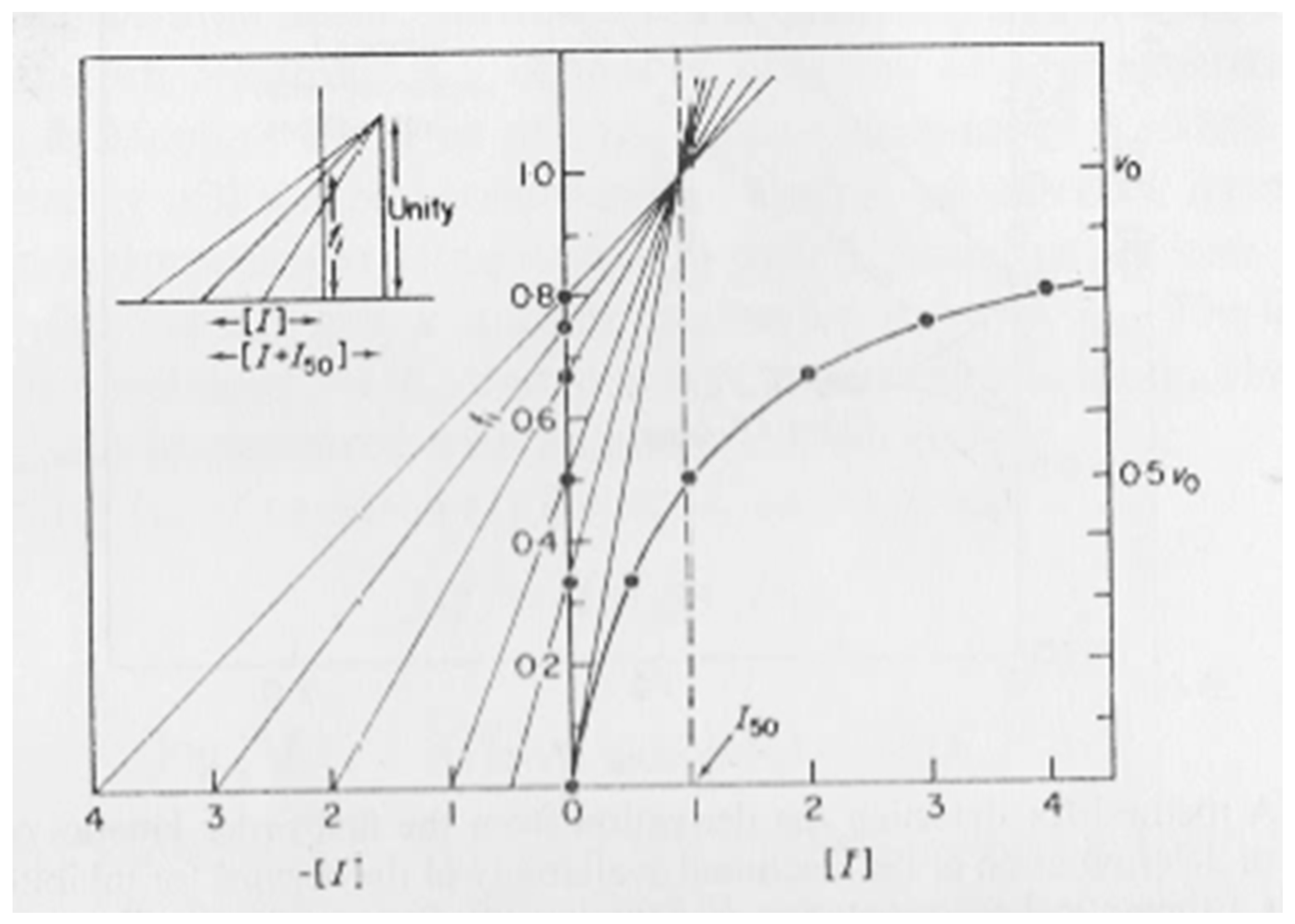
Again, using “I” as the reference ligand as the “effector” that produces the effect. It shows the “unity” concept of the “median dose” of IC50 (or Dm). The real inhibitor doses and the imaginative negative doses (-[I], intercept at “One” (1.0), which points to the “Median” (I50). (Figure 21).
The corresponding real dose and unreal dose converge into unity of “One” at the “Median” (I50) [5].
1.13. The Median Mediates the MAL Unity Theory of One (UTO)
MAL Revelations at the Molecular and Conceptual Level
1.13.1. The Median Dose (Dm or I50) is the Unit of the Normalized Dose
Figure 22 shows the dose-effect relationship when the inhibitor serves as the reference ligand in the substrate-product enzyme system. The inhibitor dose (I) can be normalized to the median dose (I50). Kinetic studies indicate that [I] is the inhibitor dose, and fi is the fraction affected (fa); when fi = 0.5, it indicates the median (Dm).
Figure 22.
The geometric property of effector dose [I] vs. fractional inhibition (fi) when the dose is in the unit of the median effect dose (I50). The “Dose“ can be transformed as the “Median-dose Unit” (normalization) to become a dimensionless ratio due to the ratio-cancellation principle (I/I50 or D/Dm).
Figure 22.
The geometric property of effector dose [I] vs. fractional inhibition (fi) when the dose is in the unit of the median effect dose (I50). The “Dose“ can be transformed as the “Median-dose Unit” (normalization) to become a dimensionless ratio due to the ratio-cancellation principle (I/I50 or D/Dm).
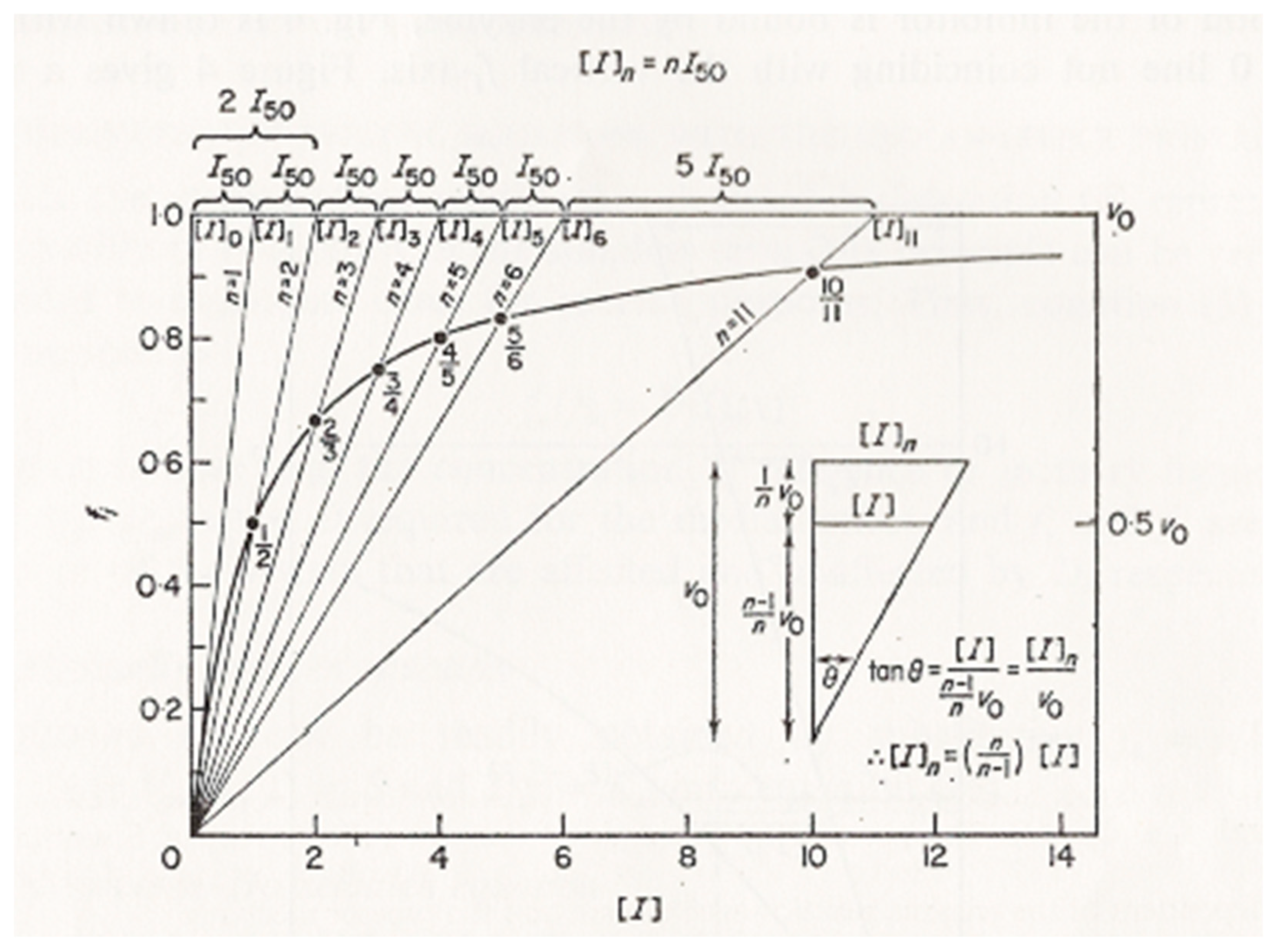
Using inhibitor concentration [I] as the reference ligand, for the target (e.g., enzyme), the intriguing relationship of the dose [I] and its median-dose (Dm or IC50 ) leads to the median-effect principle (MEP) and the doctrine of the Median (DOM) of the Mass-action Law (MAL) (Figure 22).
Median dose (I50 or Dm) to normalize the dose as the unit of dose, using the Dm as the universal standard of a common link [5].
The hyperbolic activation function of Mass and Effect is mediated by the “Medium” (I50 or Dm).
1.13.2. Evidence at Conceptual Level: Geometrics and Symmetry
Equilibrium Symmetry Exhibited by Median-point and the Median-axis regardless of Competitive or Uncompetitive Inhibitory Effect.
Figure 23.
The dose-effect relationship for different mechanisms of action is relevant to the unity theory of one (UTO), median-effect dose, and the median-effect axis.
Figure 23.
The dose-effect relationship for different mechanisms of action is relevant to the unity theory of one (UTO), median-effect dose, and the median-effect axis.
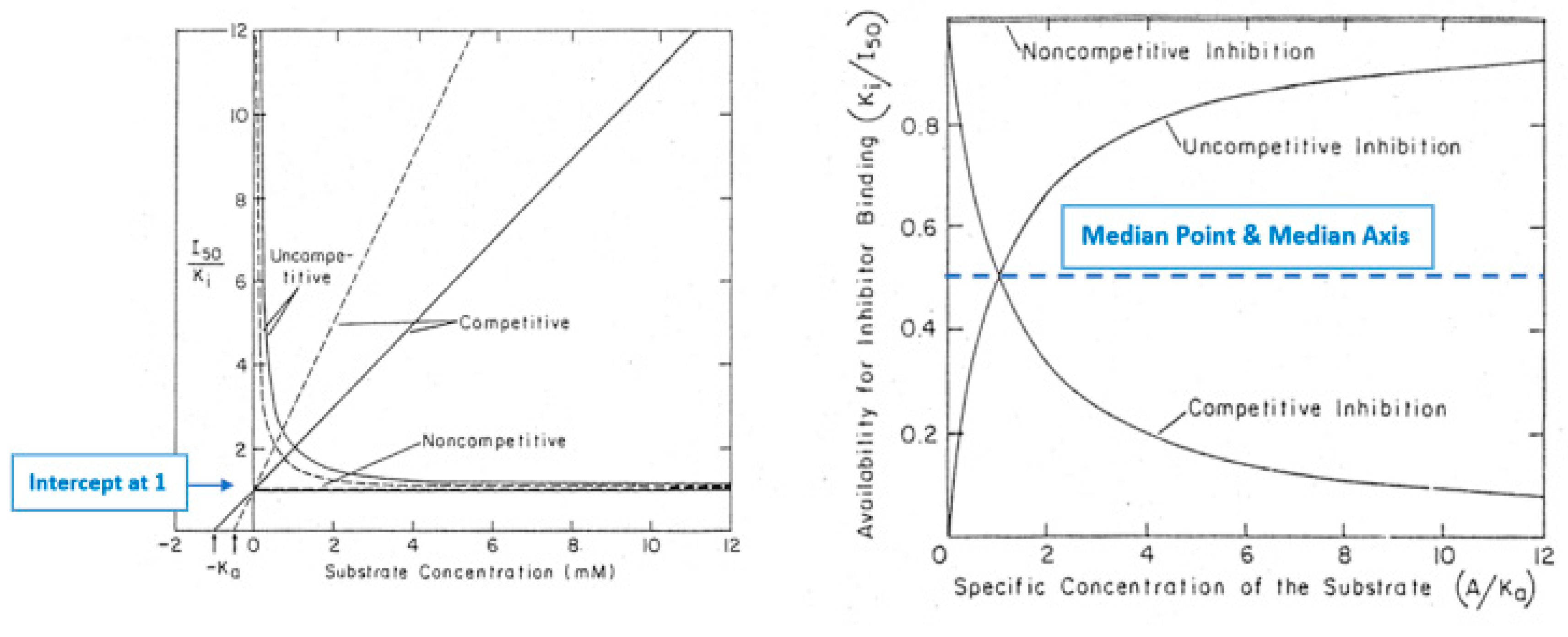
Ratio of I50 and Ki as a function of substrate concentration in binding one-substrate reactions, assuming Michaelis constant (Ka) is 1 mM (––) or 0.5 mM (- - -). Fractional availability of the enzyme for the inhibitor as a function of the specific concentration of substrate (A/Ka). (Figure 23).
Note that on the left, regardless of the types of inhibition, the lines converge at “one”. On the right, the common median point and the median-axis for competitive and uncompetitive inhibition are shown in a symmetrical fashion. In contrast, for noncompetitive inhibition, it remains at One, since the receptor enzyme (Et) is generally fully occupied (i.e., Ex = Et), where Ki/I50 = Ex/Et. The general equations for fractional velocity (fv) and fractional inhibition (fi) in the presence of an inhibitor (I) can be expressed by fv = 1/[1 + (I/Ki) [Ex/Et]] and fi = 1/[1 + (Ki/I) (Et/Ex)], [3]. Note that I is a dose (D), and I50 is the median-effect dose (Dm); fi is the fraction affected, and fv is the fraction unaffected, and fi + fv =1.
In the physical domain of Nature, there are unique features of symmetry of patterns. Fractal is not like the Golden Ratio, nor like a mirror image, but just eerily repeating patterns that can be magnified or shrunk into the same size as described in dictionaries. Frank Ramsey’s symmetry on the circular edge, basically a bunch of points (called vertices), that generate a wonder of graphics, as recently described by Ben Fairbairn [82]. These perfect patterns are unlikely to occur in the life sciences.
2. MAL-Based General Theory of Multiple Entity Interactions
The Combination Index Theorem
The mass-action law governs chemical reactions and interactions in the biomedical sciences and beyond, as indicated by MEE/DOM/MTDPT. These are mathematical general expressions of biological functional dynamics of “Action” [1,2,3,4]. This Section 2 focuses on the MAL-MEE-based entity “Interactions”. The theoretical derivation is given in [3,4,5,6,7,8]. These MAL-theory and applications are available in reviews [9,10,11,12] and monographs [23,24,25,26,27,28,29,30,31]. The applications, especially the combination index equation (CIE) that quantitatively define synergism (CI<1), additive effect (CI =1) and antagonism (CI>1) by simple MAL-design [9,10,11,12] with automated computer simulation [50,51,52,53,54,55], generated historical bibliometric records in Web of Science [56], Google Scholar [57], and Rese4archGate [58]. Three articles [8,9,10], with one or two authors, have garnered a total of 21,357 citing papers, 1,581 citing journals, and 1,621citing patents. The scope of applications of Chou’s MAL-MEE/CIE theory encompasses biomedical, biophysical, environmental, agricultural, marine, and food sciences, and beyond [9,23,24,56,57,58].
2.1. Two-Drug or Two-Entity Combinations
The combination index (CI)
CIE and DRIE extend this to interactions, quantifying synergy (CI<1), additivity (CI=1), and antagonism (CI>1). The universality lies in the equations’ dimensionless nature, which makes them applicable across domains regardless of units, scale, or complexity.
The MAL-MEE-dictated Combination Index Equation (CIE) and plots, i.e., isobologram, are dose-oriented; the fa-CI plot is effect-oriented, both quantitatively, identically, and digitally determine additive-effect (CI=1), synergism (CI<1), and antagonism (CI>1), by computer simulation [8,9,10].
For a two-drug combination:
CI = 1 indicates additive effect
< 1 indicates synergism
> 1 indicates antagonism
2.2. Combination Index for Five-Drug Combinations
A unified general equation for all drugs or entities (e.g., chemicals, biologicals, toxins, carcinogens, radiation, thermo- and photo-effectors) has been derived [9,24].
The general equation for 5-drugs (or entities) for n-drug interactions based on MAL-MEE/CIE is:
2.3. Combination Index for n- Drugs or Entities
The general equation for n-drugs (or n-entities) combination interactions based on MAL-MEE/CIE is:
Where,
Combination index for n drugs at x% inhibition. CI < 1, CI = 1, and CI > 1 indicate additive effect, synergism, and antagonism, respectively.
The sum of n drugs that exert x% inhibition in combination
The proportionality of each of n drugs that exerts x% inhibition in combination. The dose of each drug alone exerts x% inhibition.
Where Dm: The median-effect dose (Antilog of the x-intercept of the median-effect plot)
fax: Fractional inhibition at x% inhibition
m: The slope of the median-effect plot, which depicts the shape of the dose-effect curve. m=1, >1, and <1 indicate hyperbolic, sigmoidal, and negative sigmoidal curves, respectively [9].
Figure 24 provides the general Simulation Algorithm for Two-Drug to n-Entity Combinations.
Figure 24.
An algorithm for computerized simulation of synergism, additives, and antagonism of the effects of multiple drugs by a computer simulation based on MEE and CIE. Its application is independent of drug ratio, drug units, mode of action, and mechanism of action. It is valid for two to n drugs or entities (e.g., virus, radiation, UV, microwave, etc.) for combination interactions in vitro, in cells, in animals, and in clinical trials [4,9]. The MAL-PD-based CompuSyn software has been offered for free download upon registration at www.combosyn.com since August 1, 2012 [9,31,55].
Figure 24.
An algorithm for computerized simulation of synergism, additives, and antagonism of the effects of multiple drugs by a computer simulation based on MEE and CIE. Its application is independent of drug ratio, drug units, mode of action, and mechanism of action. It is valid for two to n drugs or entities (e.g., virus, radiation, UV, microwave, etc.) for combination interactions in vitro, in cells, in animals, and in clinical trials [4,9]. The MAL-PD-based CompuSyn software has been offered for free download upon registration at www.combosyn.com since August 1, 2012 [9,31,55].
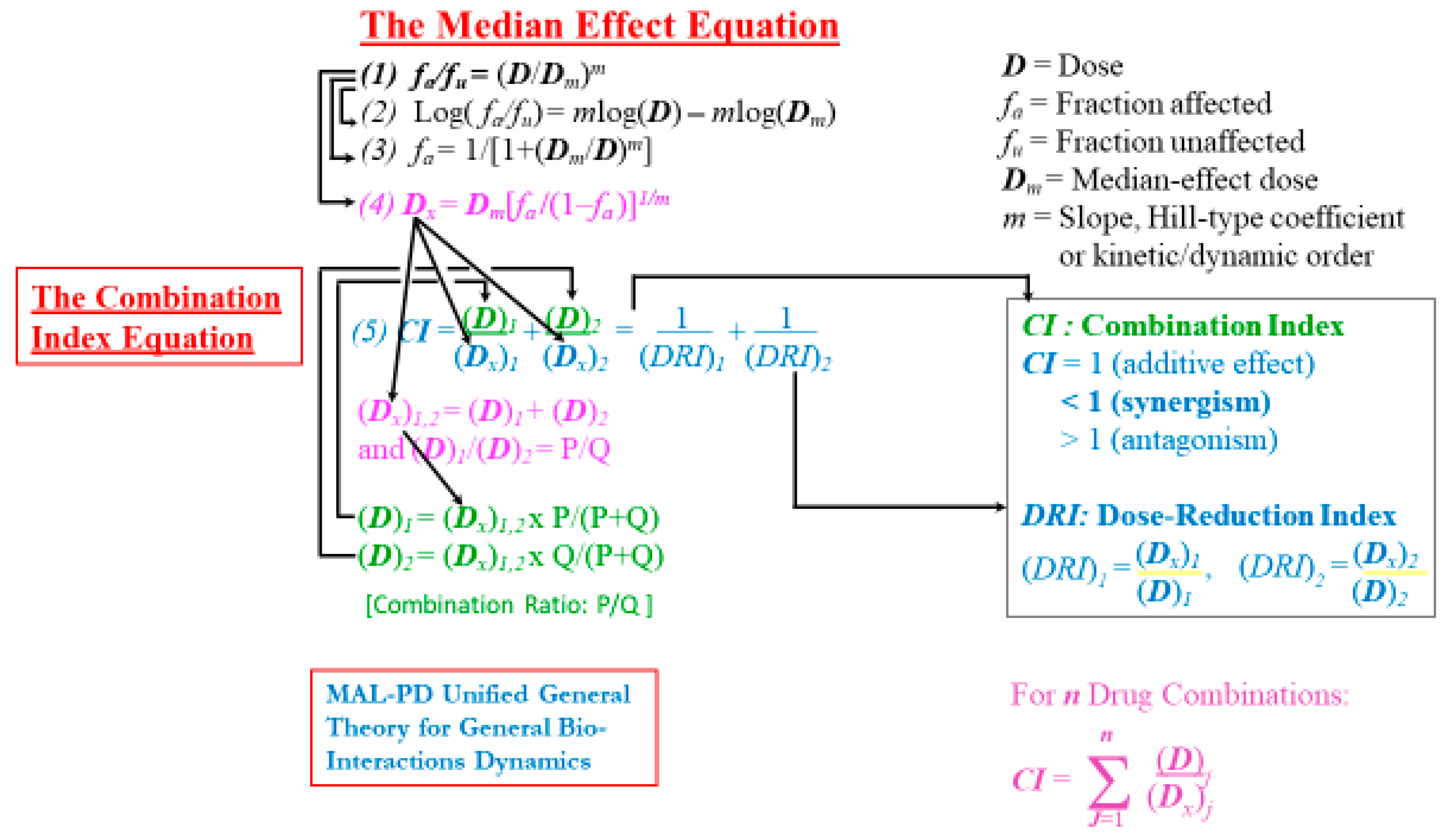
2.4. Combination Index Graphics
Effect-Based (Fa-CI Plot) and Dose-Based (Isobologram) reached identical conclusions of synergism, additive effect, and antagonism. Another proof that Dose and Effect are interchangeable and equivalent, at both Action (MEE) and Interaction (CIE) Levels.
The MALMEE/CIE for drug or entity combinations, as shown in Figure 22 and Figure 23, can be presented in two ways: an isobologram, which is dose-oriented, and the Fa-CI plot, also called the Chou-Talalay plot, which is effect-oriented. Both graphics yield identical digital conclusions regarding additive effects, synergism, and antagonism, further illustrating that “Dose” and “Effect” are interchangeable under Nature’s Mass-Action Law.
2.4.1. Unified General Plots and Diagnosis
Diagnostic informatics can be generated instantly by automated computer simulation based on the MAL-MEE/CIE algorithm for combinations of two or more drugs (Figure 23 and Figure 24) [9,31].
Figure 25.
Computer-generated diagnostic plots for bioinformatics (BI) in drug combination dynamics by CompuSyn, Geometric transformations, and algorithm-based simulation, with digitalized, indexed conclusions, can be produced in about one second and require only “Doses” and “Effects” data entries. Note that the MAL-based experiment is simple to use.
Figure 25.
Computer-generated diagnostic plots for bioinformatics (BI) in drug combination dynamics by CompuSyn, Geometric transformations, and algorithm-based simulation, with digitalized, indexed conclusions, can be produced in about one second and require only “Doses” and “Effects” data entries. Note that the MAL-based experiment is simple to use.
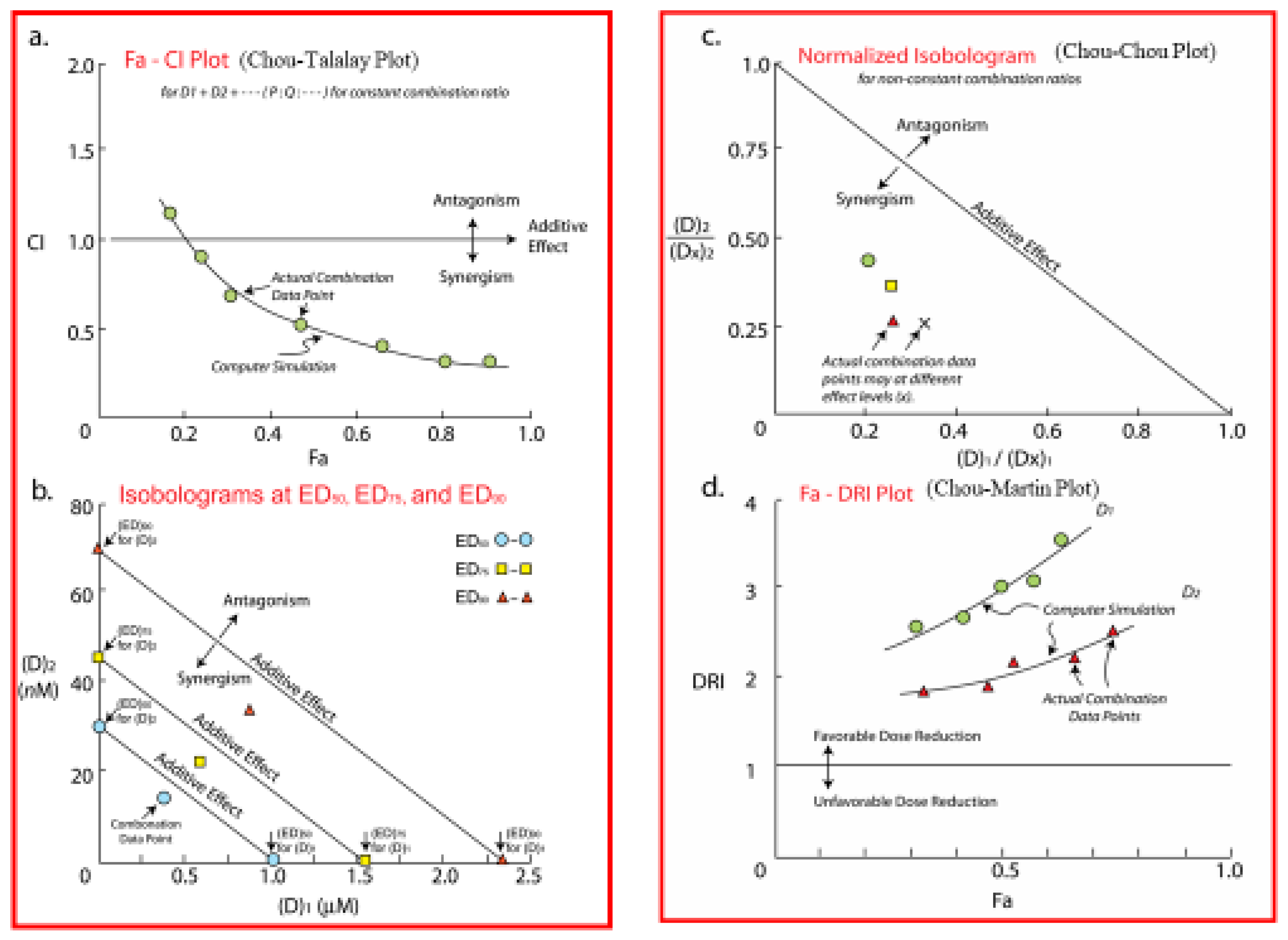
2.4.2. Isobologram for Two Drug Combinations
Based on systematic analysis of various combinations involving two drugs in enzyme kinetic systems, Chou and Talalay derived the classical isobologram equations as
for two drugs and for multiple drugs (n drugs).
Using the median-effect principle as shown for (Dx)1, (Dx)2, or (Dx)n, in the denominators can be
readily calculated, and (D)1, (D)2, (D)2 ... (D)n, in the numerator are the experimental doses of each drug
alone that in combination also produces x% inhibition.
Figure 26.
The ED50 isobologram. (a) Classic isobologram for two drugs with actual doses on the x- and y-axis. (b) Dose-normalized isobologram for two drugs with normalization of dose with ED50 to unity on both x- and y-axis. In both cases, ED50 can be extended to EDx, for the x% inhibition. The isobologram is independent of the combination ratio, the shapes of the dose-effect curves, the mechanisms of the drugs, or the units of the drugs.
Figure 26.
The ED50 isobologram. (a) Classic isobologram for two drugs with actual doses on the x- and y-axis. (b) Dose-normalized isobologram for two drugs with normalization of dose with ED50 to unity on both x- and y-axis. In both cases, ED50 can be extended to EDx, for the x% inhibition. The isobologram is independent of the combination ratio, the shapes of the dose-effect curves, the mechanisms of the drugs, or the units of the drugs.
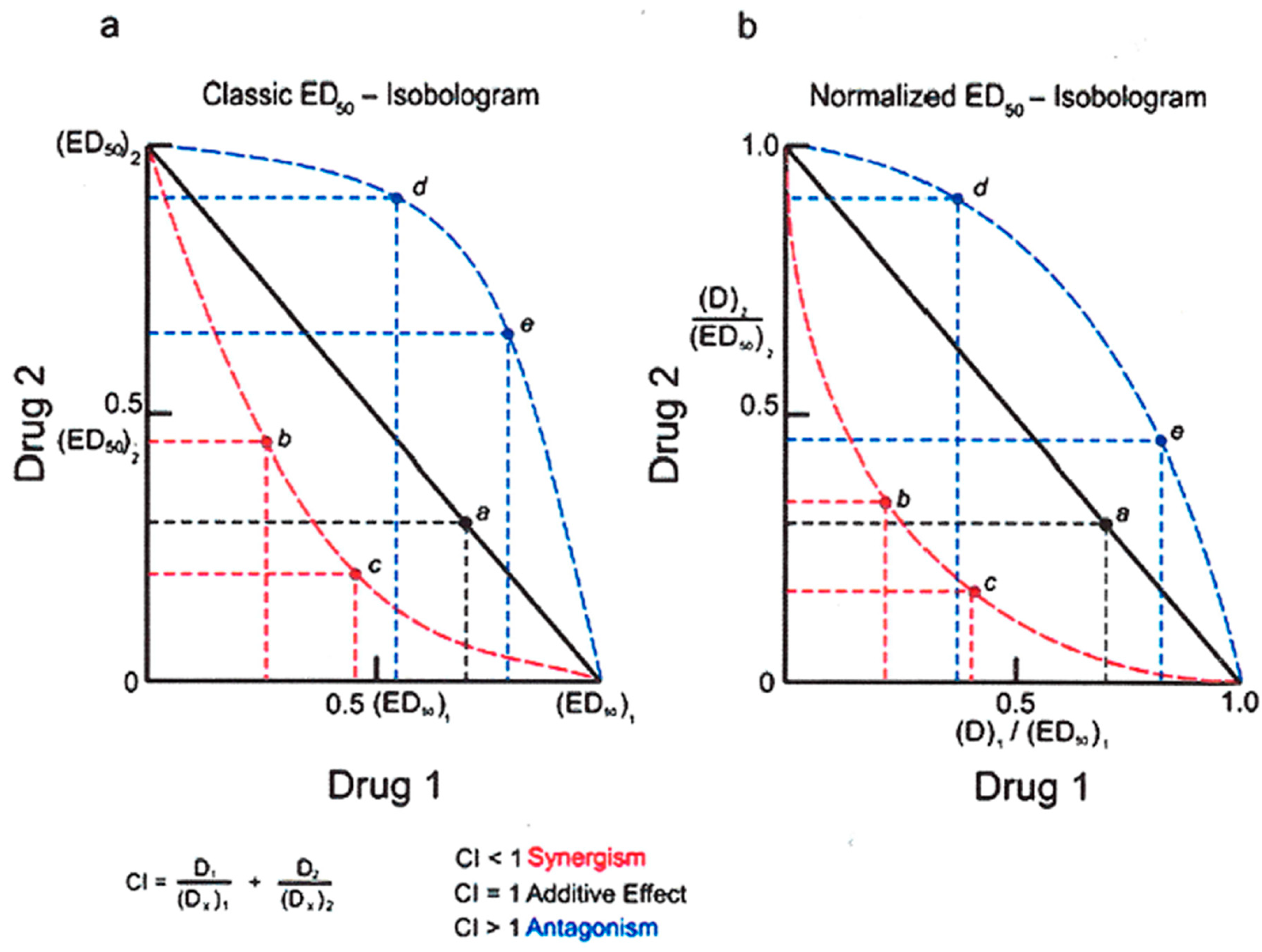
2.4.3. Isobologram for n-Drug Combinations
The isobologram of n-drug combinations is given in Figure 26, in the ED50 isobologram or the Dm normalized isobologram [27].
Figure 27.
Median normalized universal isobologram for n-entities.
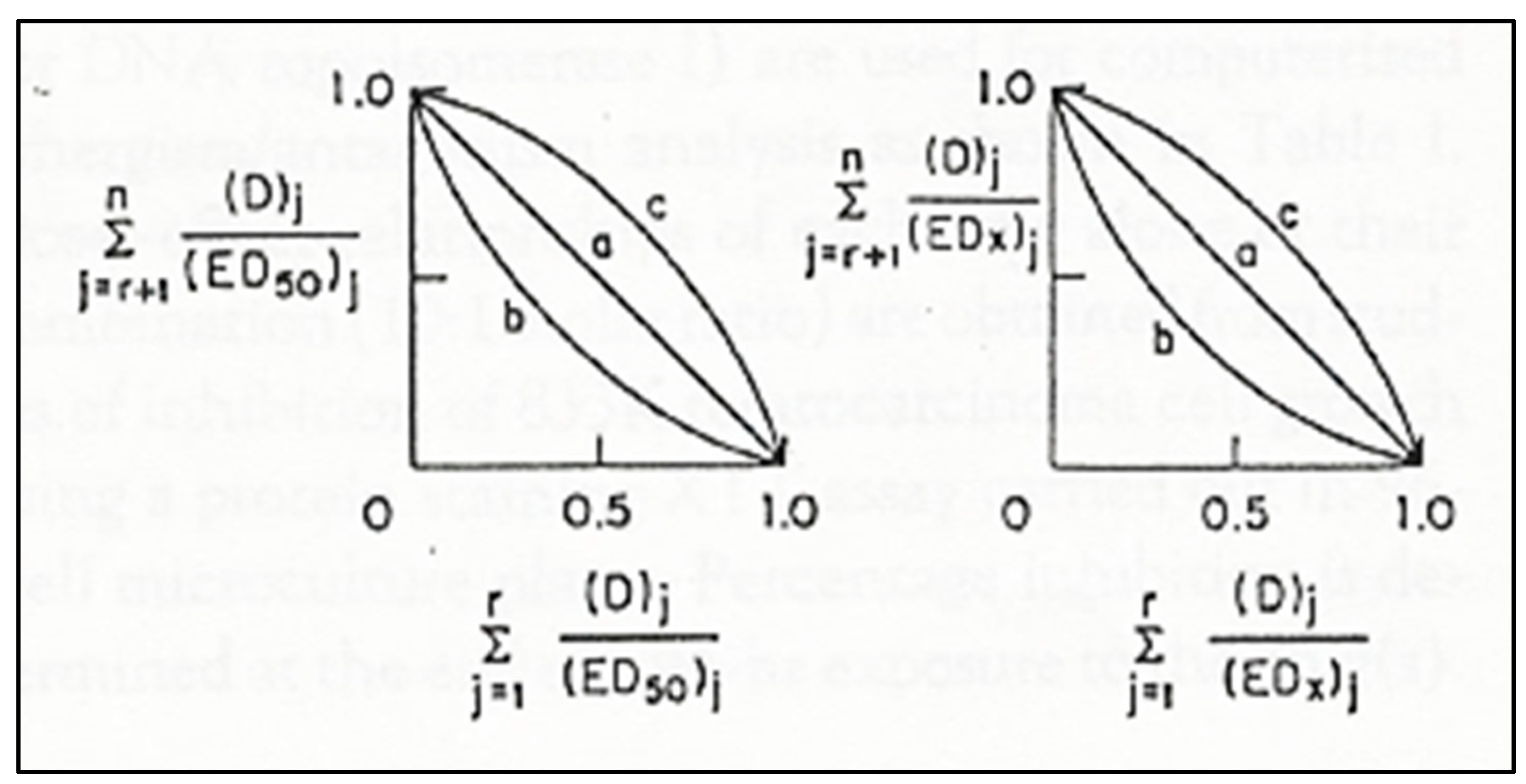
Computerized Construction of Isobolograms
For the construction of an isobologram for more than three drug combinations, the n drugs can be partitioned into any two parts, as shown in Figure 27.
2.4.4. New Isobologram Manifestations: Pythagoras' Theorem
Since isobolograms are presented as a fundamental principle of geometry that relates the sides of a right triangle, the Pythagorean theorem states that the square of each side equals the sum of the squares of the other two sides: a2 + b2 = c2. Therefore, the isobologram is the first degree, one-dimensional; the second degree, two-dimensional, of the isobologram is the Pythagoras Theorem.
2.4.5. The Comparison of Isobologram and the Pythagoras Theorem
In the isobologram, the additive effect D1 + D2, represented by the hypotenuse of the right triangle, has the relationship (D1)^2 + (D2)^2 = [hypotenuse]^2 for the additive effect of D1 and D2, based on the MAL-MEE-CIE theory of dynamics. Both the MAL-Isobol and the Pythagoras Theorem are the universal open codes, open to our plain view, a priori. This is a miraculous revelation.
The Pythagoras Theorem: a2 + b2 = c2.
It also indicates that 1 + 1 = the square root of 2, where the square root of 2 is an irrational number [83]. Any power to the “i” is still One, and any number’s zero power is still 1. Thus, “One” is Nature’s Unity Theory of One (UTO).
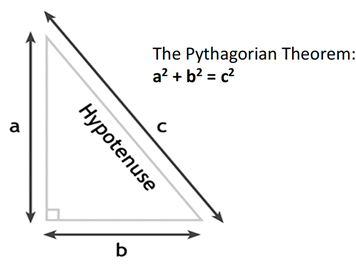
Thus, the Pythagoras Theorem is the 2nd-degree Isobologram.
The major difference is that Pythagoras’ a, b, and c are the lengths (distances, spaces, and c is the length. In contrast, the MAL-isobologram's right triangle represents the causal combination effect involving mass (dose) and force (energy); the hypotenuse of the isobologram is the sum of the “effects”. Since MAL-MEE/DOM indicated “Mass” and “Effect” are interchangeable, where FR, (fa/fu), of Effect = (D/Dm)m of dose (or mass). The density is mass per unit volume (space), which involves the speed at which the action occurs (mass/time). Space and time may be interchangeable, as a space-time. In physics, a speed parameter often involves distance/time, which appears in a “squared” function for distance (distance-length/time)2, as in E/M = C2 in Einstein’s relativity theory.
2.5. The Dose-Reduction Index: An Intermediate Revelation
Extension of MAL-MEE leads to entity interactions: CIE and its components dissections, DRIE.
For two entities, (D)1 and (D)2, for x-percent effect (Dx) 1, 2 in combinations, the DRI for each entity is given by
DRI=1, >1, and <1 indicate no-dose-reduction, positive-dose-reduction, and negative-dose-reduction, respectively, for each drug at different effect levels for a given drug combination ratio. The diagnostic Fa-DRI plot can be generated instantly by computer simulation [9,24,54,55].
Interpretation of Dose-Reduction Index (DRI) Values
| DRI Value Range | Interpretation | Implication |
| DRI < 1 | Unfavorable Dose-Reduction | Requires higher individual doses in combination to achieve the same effect. |
| DRI = 1 | No Dose-Reduction | No change in individual dose requirement compared to single agents. |
| DRI > 1 | Favorable Dose-Reduction | Allows for reduced individual doses in combination while maintaining efficacy. |
The universality of MAL-MEE/CIE lies in the equations’ dimensionless nature, which makes them applicable to general dynamics regardless of units, scale, structure, or complexity, for universal applications. The MAL-based inputs ( ) and outputs () sequential patterns analysis is the core principle of the MAL-MEE/CIE theory, algorithm, derivations, and ubiquitous applications, as attested by garnering over 50,000 citations in 1,580 journals, and 1,575 patents, as of September 2025. The application fields encompass biomedical, biophysical, environmental, agricultural, marine, and food sciences, as well as other areas, including radiation, thermo, photo-, pH-, and carcinogenic effects.
The LLMs in AI data centers may require over trillions of tokens; thus, they need a fundamental, unified principle for AI agents’ transformational and transcendental deduction, as well as filtration of categories, for efficiency and cost-effectiveness in input-output, forward, and backward processing informatics, to facilitate simple and acceptable decisions or conclusions. The MAL-theory serves as a bridge to unify intra-, inter-, and cross-disciplinary linkages, with multi-decades of broad experimental confirmation supporting the defined general principles of digital informatics.
3. MAL-MEE/CIE/DRIE for Econo-Green Biomedical R&D
The Unity Theory of “One” (UTO): The Real World Examples
The MAL-Based MEE, CIE, and DRIE are all based on “1” as the universal standard.
Highlight Examples from in Vitro, in Vivo, to Animal Studies and Clinical Trials: Using the Same MAL-MEE/CIE Principle, Algorithm, Parameters, the Same Protocol Design, and the same MAL-basic principle for Data Analysis/Simulation with Quantitative Digitalized of Indexed Conclusions.
Therefore, the MAL-MEE/CIE/DRIE/DOM/MYDPT/UTO is considered the unified general principle and method for the efficient, cost-effective, and Econo-green digital data science R&D.
3.1. A MAL-Based New Framework for Scientific R&D: Design and Computerized Simulation
From Preclinical Planning, in vitro and animal studies, to Clinical Protocol Design, Clinical Trial Data Simulation, and Digitized/Indexed Conclusions
Example of Anti-HIV Single Drugs and their combinations for Synergism Quantitation: Azidothymidine (AZT), Recombinant Interferon-alpha (IFN), and AZT and IFN Combinations (AZT+IFN) are illustrated below:
3.1.1. Scheme Design and Applications: MAL-Dynamics Theory-Based
The mass-action law (MAL) dose-effect and input-output system analysis in the life sciences led to the derivation of a unified general dynamic theory/algorithm/graphics of the median-effect equation (MEE, 1976) [1] for action and the combination-index equation (CIE, 1984) [2] for interaction. Both MAL-based theories enable the digital simulation of graphics, with applications in R&D, offering efficient, cost-effective digital capabilities. They provide common linkages across intra-, inter-, multi-, and cross-disciplinary parameters (Dm and m) and indices (CI and DRI) [3,4,5].
The recommended design for the two-drug regimen is the diagonal design shown in Figure 28A; an actual experimental design is shown in Figure 28B, using two anti-HIV agents (AZT, IFN, and AZT + IFN). This is the most efficient and cost-effective design according to the MAL principle.
This in vitro drug combination evaluation for drug development needs only 15 dose data points plus a control (uninhibited). The whole in vitro experiment for determining synergism, additivity, and antagonism (by computer simulation) will take about a week. Chou’s laboratory, in collaboration with Martin Hirsch’s Mass-General Hospital, Boston, MA, conducted over 20 sets of anti-HIV in vitro studies [9,24]; some of the results are shown in Figure 28 and Figure 29.
The anti-HIV monoclonal antibody combination studies were carried out in animals in collaboration with Ruth Ruprecht’s laboratory at Dana-Farber Cancer Institute, Boston, MA. [24,37].
Figure 28.
A. “Proper Design” is a Prerequisite for Any Efficient MAL-PD Studies. The Simple and Efficient Constant-Ratio Combo Diagonal Design for the Automated Simulations (Recommended). PD-Based Protocol Design (Dose Range, Dose Density, and Dose Ratio) is Critical for Efficient, Cost-Effective Data Analysis in PD-Automated Simulation. The “Non-Constant Ratio Design” can also be used to determine quantitative Synergy. But no automatic computerized simulation is possible. [The Recommended Practical Minimum Number of Data Points for Two Drug Combinations In Vitro, In Animals, and In Clinical Trials need: 16, 10, and 10 Dose-Points, respectively].
Figure 28.
A. “Proper Design” is a Prerequisite for Any Efficient MAL-PD Studies. The Simple and Efficient Constant-Ratio Combo Diagonal Design for the Automated Simulations (Recommended). PD-Based Protocol Design (Dose Range, Dose Density, and Dose Ratio) is Critical for Efficient, Cost-Effective Data Analysis in PD-Automated Simulation. The “Non-Constant Ratio Design” can also be used to determine quantitative Synergy. But no automatic computerized simulation is possible. [The Recommended Practical Minimum Number of Data Points for Two Drug Combinations In Vitro, In Animals, and In Clinical Trials need: 16, 10, and 10 Dose-Points, respectively].
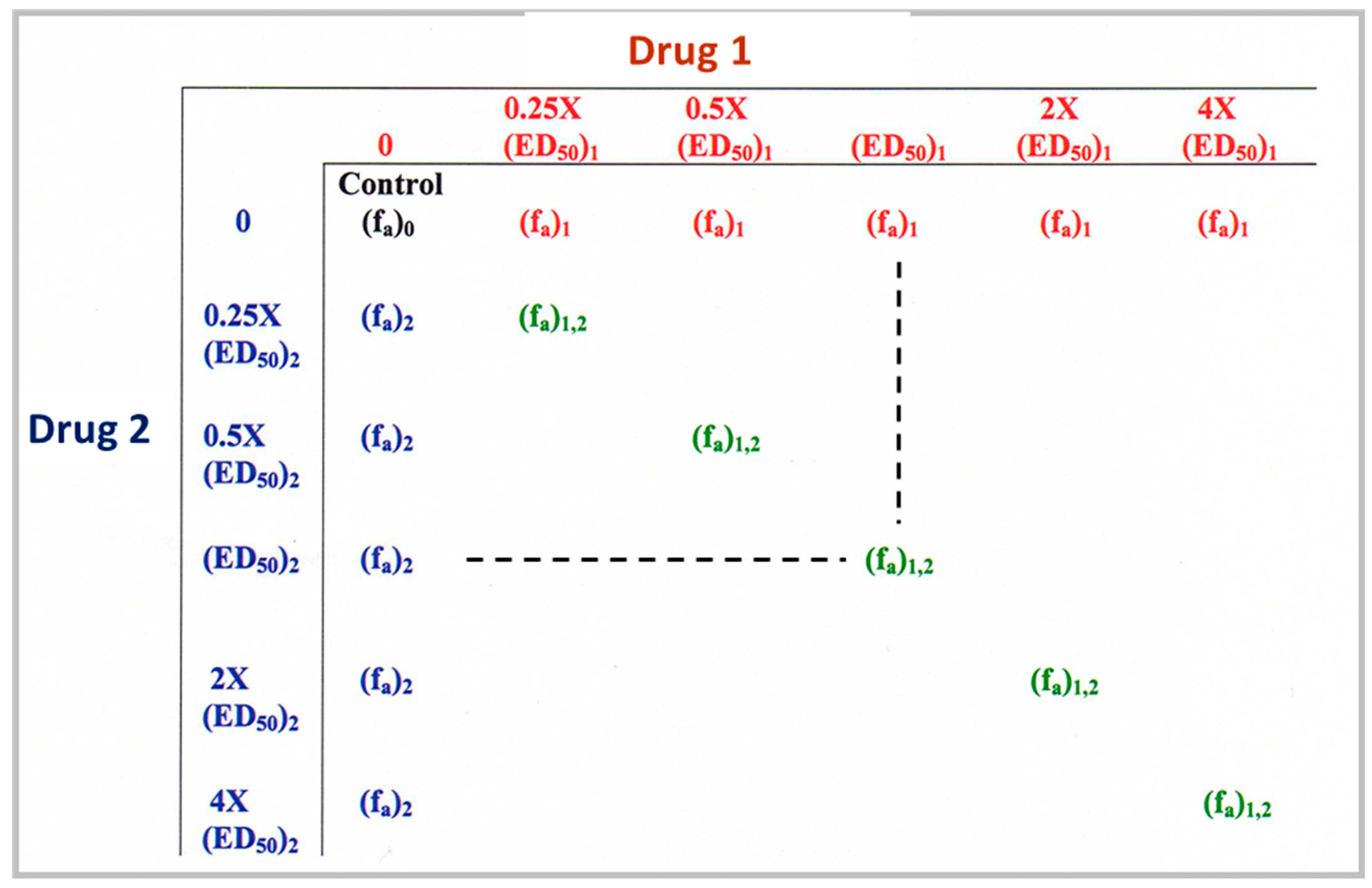
Figure 28.
B. In vitro experiment took about a week, using only 16 dose-data points, 5+5+5, +1 control (RT assays in triplicate). The full analysis simulation took about 1 second, including 10 pages of the Computer Report. Quantitatively determined Synergy at different effect levels and the auto-construction of an Isobologram based on the MAL design and analysis. A typical experiment, like this, took only two weeks to complete in the laboratory with experience.
Figure 28.
B. In vitro experiment took about a week, using only 16 dose-data points, 5+5+5, +1 control (RT assays in triplicate). The full analysis simulation took about 1 second, including 10 pages of the Computer Report. Quantitatively determined Synergy at different effect levels and the auto-construction of an Isobologram based on the MAL design and analysis. A typical experiment, like this, took only two weeks to complete in the laboratory with experience.
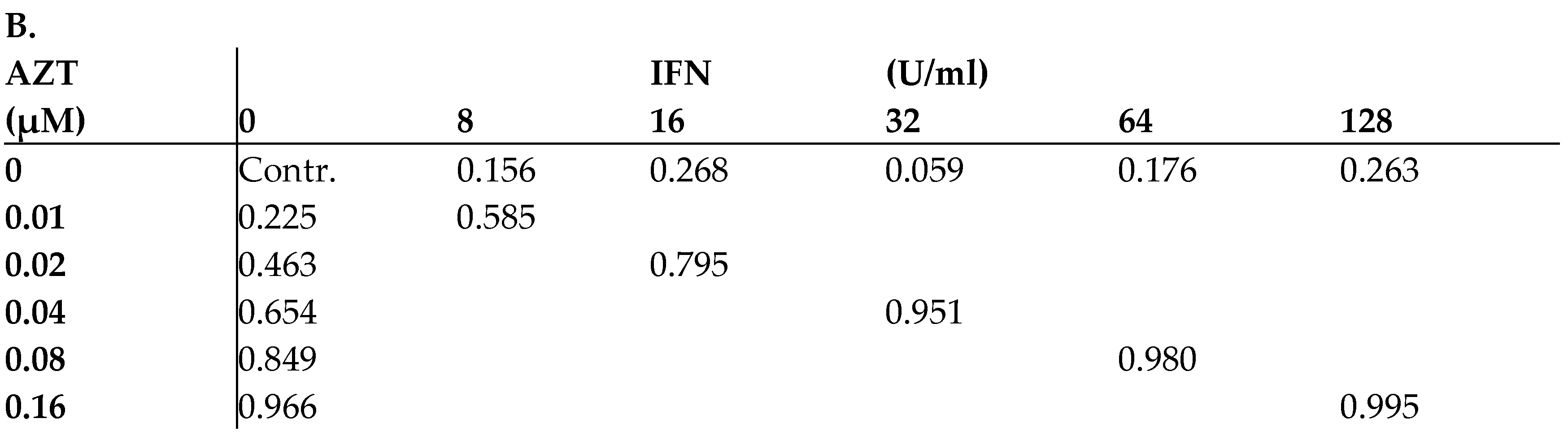
3.1.2. MAL-Based Drug Discovery from Pre-Clinical in Vitro, in Animals studies to Clinical Trials
According to Web of Science, Google Scholar, and ResearchGate, although only a small fraction of scientists and institutional agencies have applied MAL principles in scientific R&D, the MAL theory, algorithms, and software have been cited in over 40,000 papers across more than 1,580 journals and 1,444 patents worldwide. Humans determine the units and methods of measurement. Based on the theories of MAL-MEE, CIE, and DRIE's DOM and UTO, I propose placing Life at the center among the elements of the universe—Mass, Force, Space, and Time. The most quantitative connections among them will be through mathematics and algorithms, the universal language for all sciences and universal events.
3.1.2.1. Example of Anti-HIV In Vitro for Two Drug Combinations
The typical anti-HIV agent evaluations and their combinations for AZT, IFN, and AZT + IFN in vitro and in computer simulation are shown in Figure 27, Figure 28 and Figure 29.
Figure 29.
Dose-effect curves and the median-effect plot for inhibition of human immunodeficiency virus, type 1 (HIV-1) by recombinant interferon α (IFN) and 3'-azido-3'-deoxythymidine (AZT), and AZT (in µM) and IFN (in U/ml) mixture (1:800). Data were obtained using reverse transcriptase assays. The parameters obtained are (Dm)AZT = 0.0233 µM, (m)AZT = 1.593, (Dm)IFN = 263.06 U/ml, (m)IFN = 1.262,(Dm)mix = 6.856, (m)mix = 1.803. M and Dm are obtained from the slope and intercept, respectively.
Figure 29.
Dose-effect curves and the median-effect plot for inhibition of human immunodeficiency virus, type 1 (HIV-1) by recombinant interferon α (IFN) and 3'-azido-3'-deoxythymidine (AZT), and AZT (in µM) and IFN (in U/ml) mixture (1:800). Data were obtained using reverse transcriptase assays. The parameters obtained are (Dm)AZT = 0.0233 µM, (m)AZT = 1.593, (Dm)IFN = 263.06 U/ml, (m)IFN = 1.262,(Dm)mix = 6.856, (m)mix = 1.803. M and Dm are obtained from the slope and intercept, respectively.
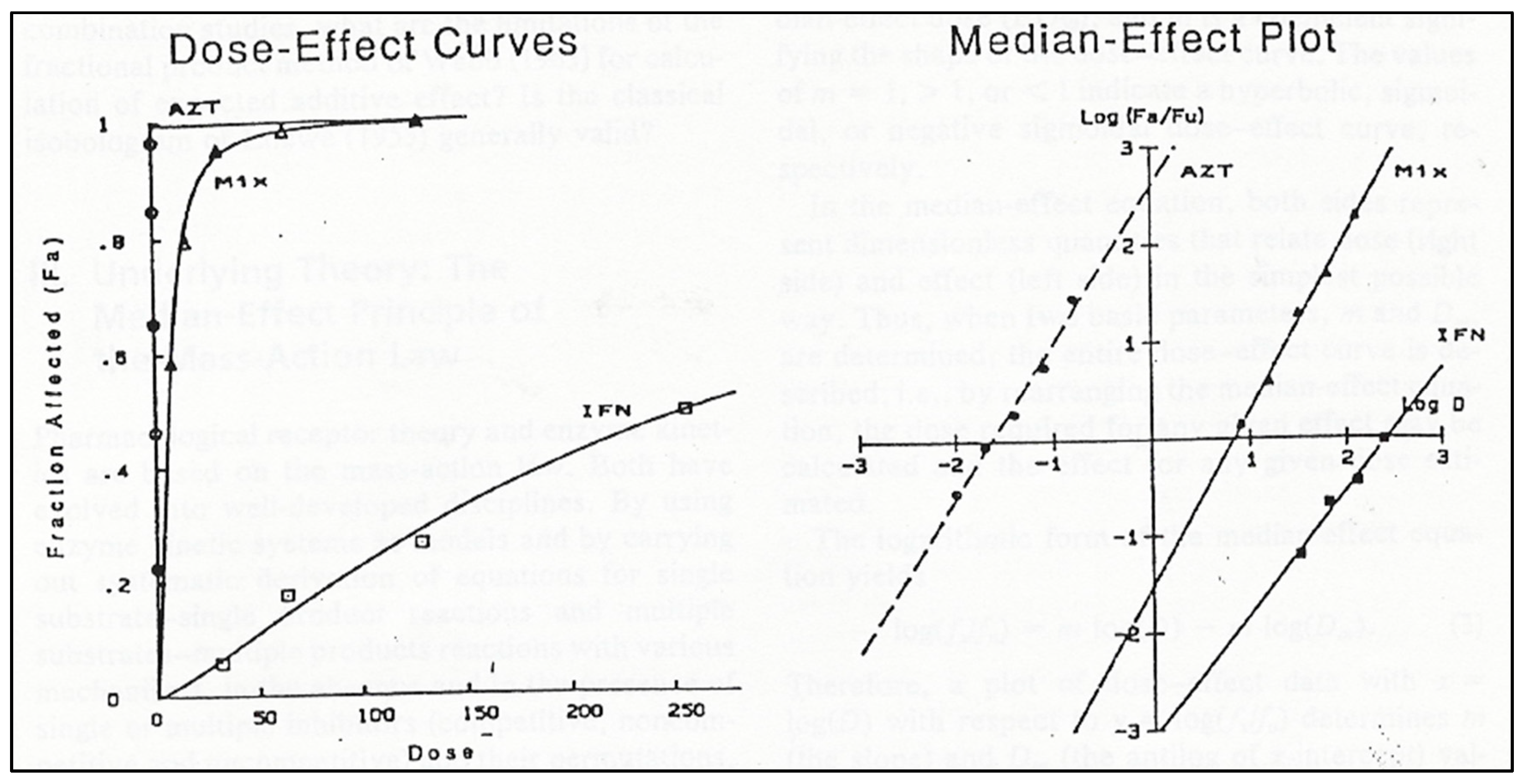
Figure 30.
The Fa–CI plot showing synergism-antagonism with combination index (CI) as a function of fraction affected (fa). Parameters shown in Figure 1 were used for the calculations. CI values for each combination data point are shown with triangles. Dashed and dotted lines are computer-simulated results of CIs assuming mutually exclusive and mutually nonexclusive interactions, respectively, between AZT and IFN. The results show strong synergism between AZT and IFN with CI < 1. In this example, both exclusive and nonexclusive assumptions give very similar results.
Figure 30.
The Fa–CI plot showing synergism-antagonism with combination index (CI) as a function of fraction affected (fa). Parameters shown in Figure 1 were used for the calculations. CI values for each combination data point are shown with triangles. Dashed and dotted lines are computer-simulated results of CIs assuming mutually exclusive and mutually nonexclusive interactions, respectively, between AZT and IFN. The results show strong synergism between AZT and IFN with CI < 1. In this example, both exclusive and nonexclusive assumptions give very similar results.
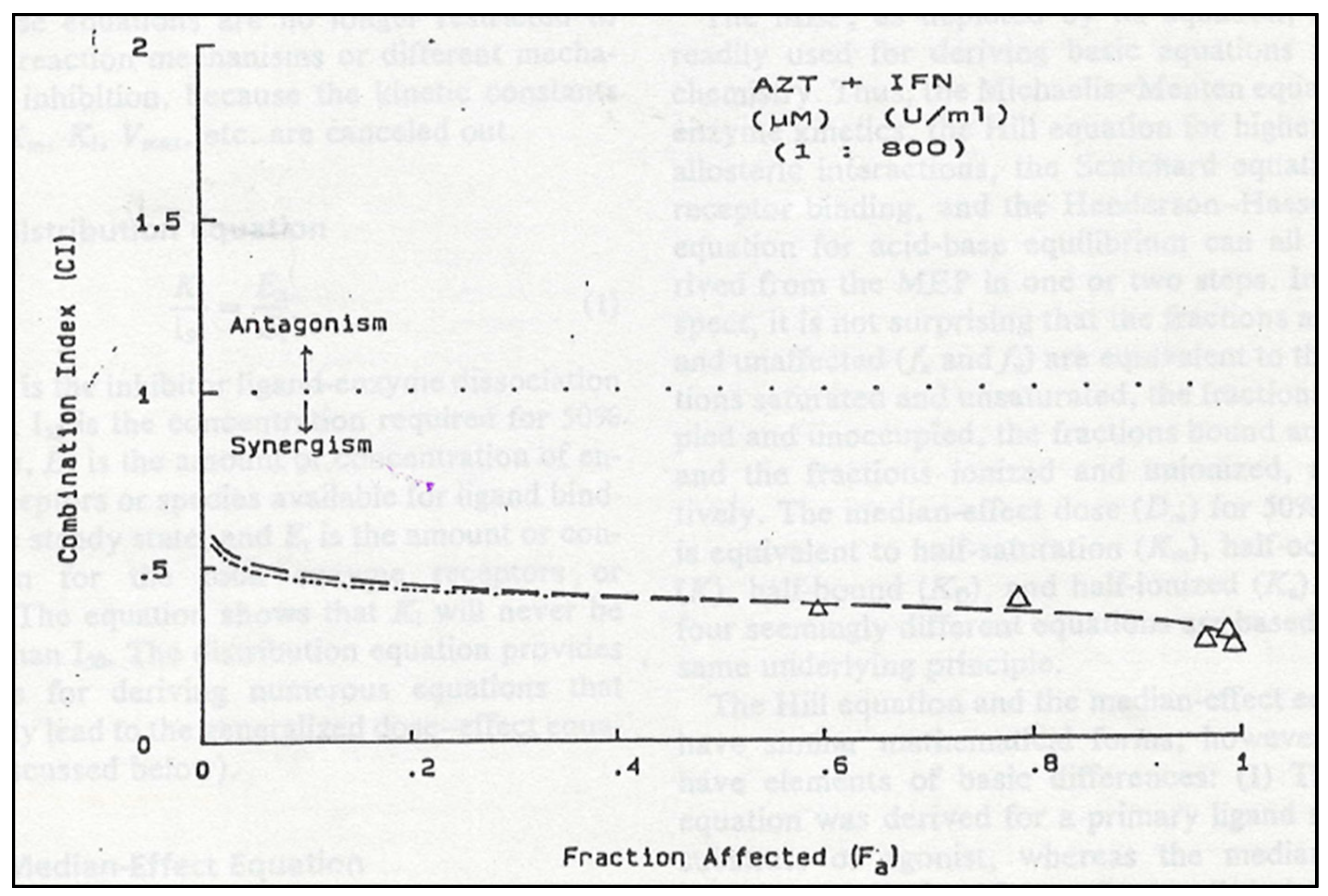
3.1.2.2. Anti-HIV for Two Drug and Three Combinations in Vitro
Figure 31.
Examples of Fa-CI plots for 12 sets of two-drug combinations in Table 21, divided into four subgroups: a, b, c, and d. The CI is plotted as a function of the fractional inhibition (fa) by computer simulation from fa = 0.10 to 0.95. CI < 1, = 1, and > 1 indicate synergism, additive effect, and antagonism, respectively. The vertical bars indicate 95% confidence intervals based on SDA, generated with custom software by T. C. Chou and H. Kim. Similar graphics can also be generated using CompuSyn (Chou and Martin, 2005), but the vertical bars are positioned at the experimental combination data points in this figure.
Figure 31.
Examples of Fa-CI plots for 12 sets of two-drug combinations in Table 21, divided into four subgroups: a, b, c, and d. The CI is plotted as a function of the fractional inhibition (fa) by computer simulation from fa = 0.10 to 0.95. CI < 1, = 1, and > 1 indicate synergism, additive effect, and antagonism, respectively. The vertical bars indicate 95% confidence intervals based on SDA, generated with custom software by T. C. Chou and H. Kim. Similar graphics can also be generated using CompuSyn (Chou and Martin, 2005), but the vertical bars are positioned at the experimental combination data points in this figure.
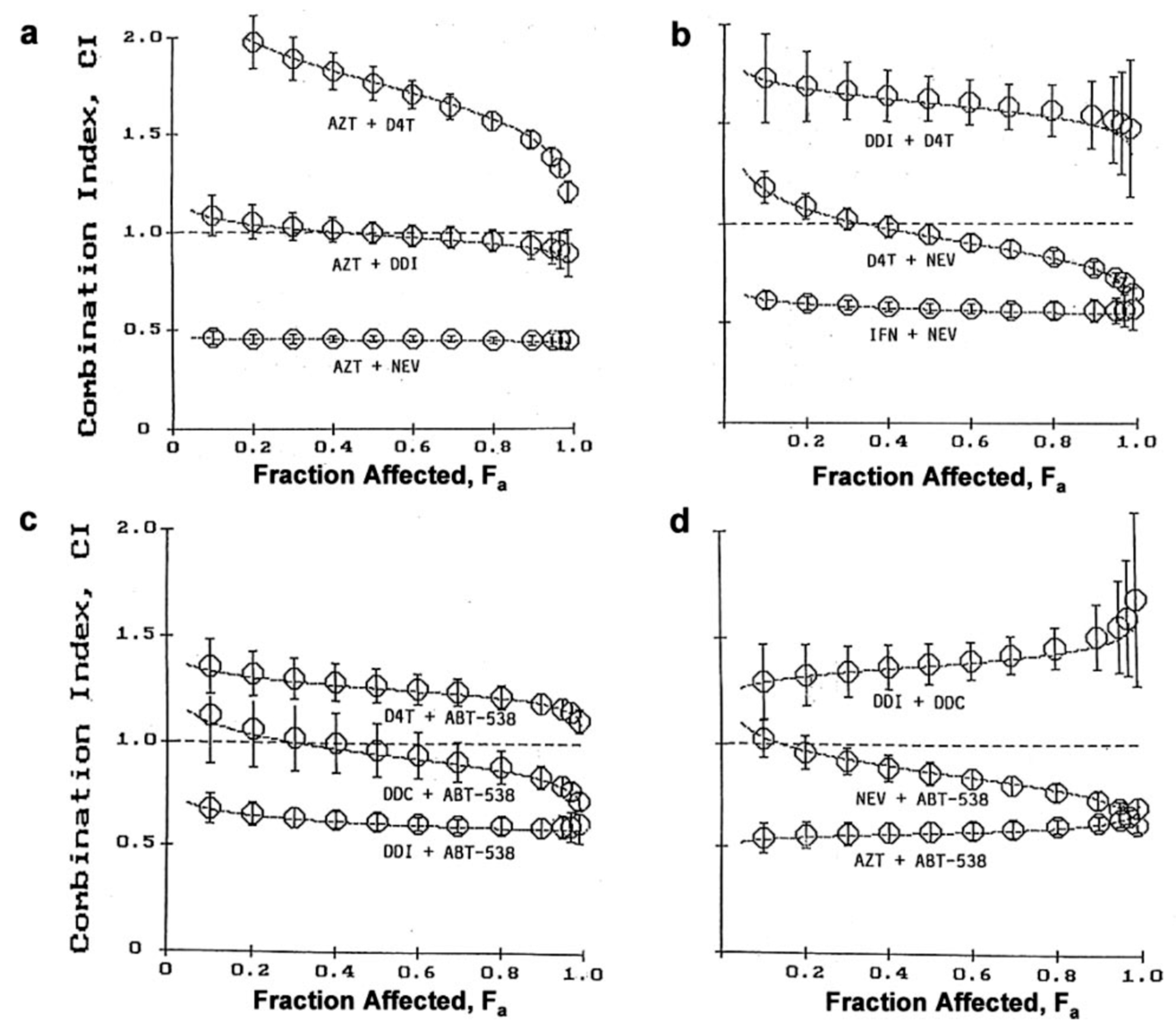
The graphics in Figure 31 were generated by the serial deletion analysis (SDA) [9,54,55], without any artificial pre-assumptions. The vertical bars indicating the 95% confidence interval clearly show the narrowest range near the Median (fa = 0.5) and longer on both ends (fa = <0.05 or>0.95). Thus, Mother Nature indicates that all measurements are more accurate at the “Median”, and more difficult at lower or higher extremes [9].
3.2. Anti-HIV Experimentation in Animals
There have been no good animal models for anti-HIV agents/drugs, other than primates. Ruth Ruprecht's laboratory at Dana-Baber Cancer Institute, Harvard University, had conducted limited studies in macaques [84] and simians [36,85,86]. Most of the anti-HIV agent studies and their combinations, as shown in Figure 31, were conducted in collaboration with Martin Hirsch’s laboratory at Massachusetts General Hospital, Harvard University.
The clinical trial on AZT, INF, and AZT + INF was conducted using the MAL-MEE/CIE-based protocol design and computerized data analysis, as summarized below [59].
3.3. Anti-HIV Clinical Trials in Humans: Protocol Design and Computerized Simulation for Quantitative Conclusions
Effect of rIFNαA and AZT Singly or in Combination on RT Assays where fa Values as Fractional Inhibitions.
Biological and biomedical sciences have long faced complexity, variability, and diversity; given the significant uncertainties, relying on probability is the logical approach. As a result, p-values have traditionally been the standard and a required criterion in academic societies and regulatory agencies, especially in scientific peer review. While convincing p-values are obviously necessary in many areas, the core goals of science have shifted toward variability and precision in measurement. However, the mass-action law-based fundamental principles of proper “experimental design” is absolutely essential for drawing quantitative conclusion in efficient and cost-effective R&D. For example, in two drug combination, if either of the component drug using only single dose, it is impossible to quantitatively determine the combination synergism or antagonism, regardless how accurate are the experimental measurements, how large of sample size, or how many times the experiment is repeated, since single dose is not possible to have that drug’s fundamental m and Dm parameters. The design decides what type of conclusions are feasible. This critical digital science data science requirement has been largely overlooked by regulatory agencies, researchers, and practitioners in the biomedical community. Consequently, the traditional statistical protocol remains overwhelmingly dominant, leaving little room to consider or discuss fundamentally different ideas for saving time, effort, and research resources. An explicit illustration is the parallel comparison of two anti-HIV clinical trials from the 1990s: trial A, evaluating AZT + 3TC [60] using traditional statistical methods, and trial B, evaluating AZT + IFN [59] using MAL-MEE/CIE-based methods. (see Table 8 and Figure 32).
3.3.1. Specific Example of Clinical Trials Protocol Design Based on MAL-MEE/CIE and Data Simulation Informatics
The Efficient and Cost-Effective Ground-Breaking MAL- R&D Approach [59], which used ten times fewer patients than the traditional observational statistics-based clinical trials [60], as indicated in Figure 32 and Table 7. Unfortunately, international food and drug regulatory agencies (FDAs) are still reluctant to adopt this new MAL innovation, for nearly three decades (1996), despite over 30,000 in vitro studies, and hundreds of animal preclinical studies which used the MAL-based MEE/CIE computerized quantitative theory and methods, including 1,616 citing patents [56,57].
3.3.2. Clinical Trials Protocol Design Example: AZT + IFN
Figure 32.
Anti-HIV clinical trials for AZT & IFN using Chou-Talalay MAL-PD/CI method for protocol design and computational data analysis using only 10 dose-data points and 36 patients.
Figure 32.
Anti-HIV clinical trials for AZT & IFN using Chou-Talalay MAL-PD/CI method for protocol design and computational data analysis using only 10 dose-data points and 36 patients.
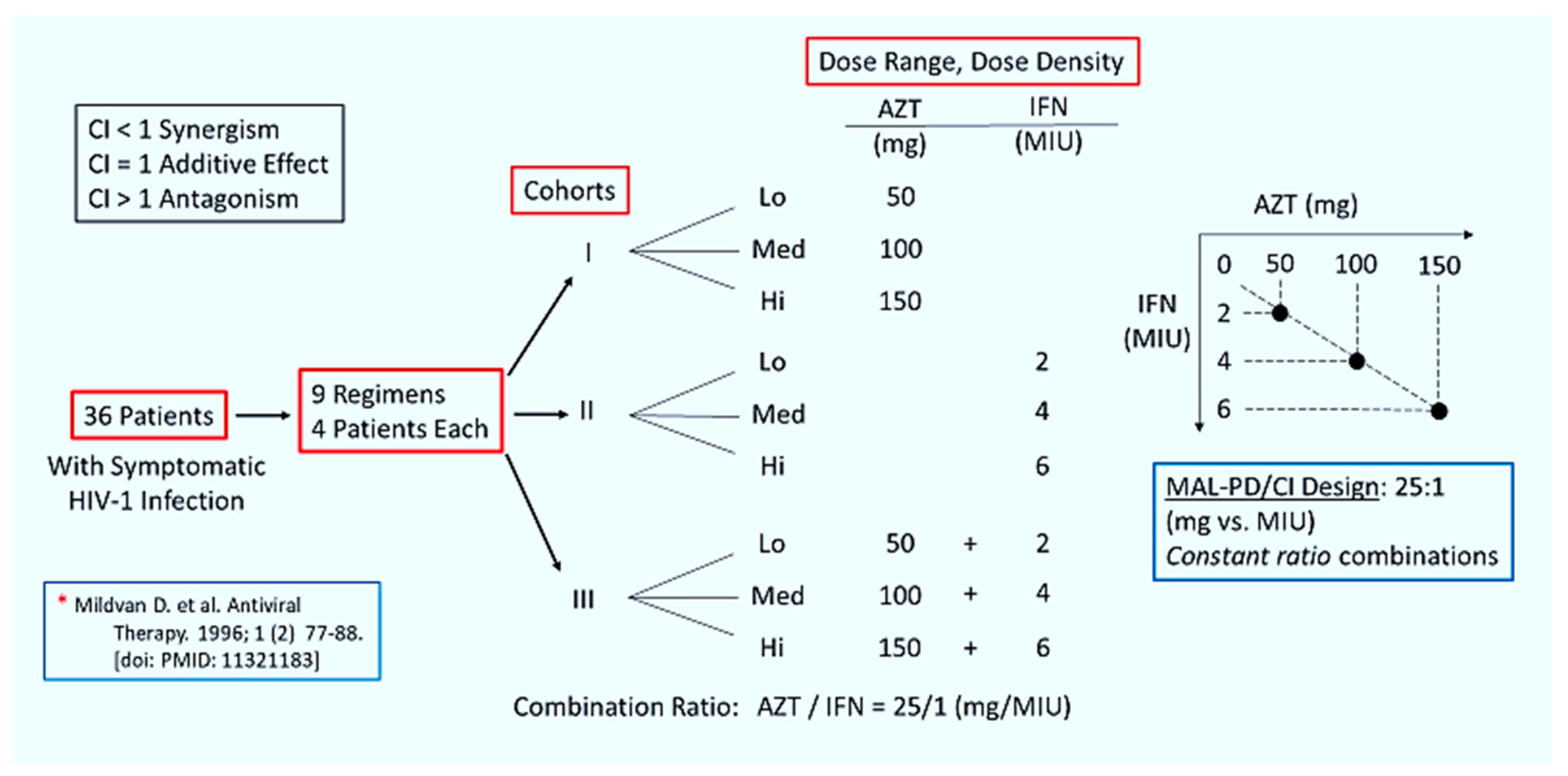
3.3.3. Theoretical Basis, Definition, and Quantitative Analysis
Where D1 is Azidothymidine (AZT); D2 is recombinant α-interferon (IFN).
Determining the combination interaction of a + b requires the combination index equation (CIE), which quantitatively determines:
CI = 1 (Additive Effect)
CI < 1 (Synergism)
CI > 1 (Antagonism)
Theoretical basis and methods for protocol design and data analysis/simulation of AZT and INF single drugs and their combination in clinical trials, using Chou-Talalay PD-CI algorithms to quantify synergism or antagonism.
AZT + IFN Clinical Trials:
Mildvan D. et al. [59] examined synergy, activity, and tolerability of zidovudine and interferon-alpha in patients with symptomatic HIV-1 infection: ACTG 068. Antiviral Therapy 1996; 1 (2): 77-88. Used p-24 antigen assay and CD4 cell count as surrogate markers.
3.3.4. Automatic Computer Simulation for Synergism Determination
Computer Software:
Dose-effect analysis with microcomputers, software including: Chou J, Chou TC. Elsevier-Biosoft, Cambridge, UK, 1985, 1987. [51,52]
CalcuSyn, Chou TC, Hayball M. Biosoft, Cambridge, UK, 1997. [54]
CompuSyn, Chou TC, Martin N. Combosyn Inc., PD Science LLC, Paramus, NJ, USA, 2004. [Free download at www.Combosyn.com since August 1, 2012] [55]
MAL-PD/CI Theory/Algorithm:
3.4. Traditional vs. MAL-Based Clinical Trials Protocol Design
3.4.1. Comparison of Two Clinical Trial Approaches Using Traditional, Statistical versus New MAL-Based Design and Analysis
The side-by-side comparison of two anti-HIV clinical trials, AZT + 3TC [60] vs. AZT + INF [59], is shown in Table 8. The conclusion indicates that the MAL/MEE-/CIE-based clinical design used 10-fold fewer patients yet achieved a more quantitative determination of synergism.
Synergism needs to be quantitatively determined whenever possible, not always empirically, as is currently done in the biomedical and pharmaceutical sciences. To the best of the knowledge of literature search, so far as of November 2025, none of the regulatory agencies, such as the FDAs, in the world has a clear definition of “synergism”, “additive-effect”, or “antagonism”. However, hundreds of drug-combination clinical trials are conducted each year globally, with a cumulative cost of hundreds of billions of dollars. The indecision over this definition matters to regulatory agency decision makers has unintentionally caused tremendous loss of time, effort, and resources, which is not only a scientific issue but also has economic, legal, ethical, and moral dimensions. The anti-HIV clinical trials examples above indicate that the AZT + IFN [59] clinical trials applying the MAL-based design and computerized digital data analysis/simulation used 10-fold fewer patients than the AZT + 3TC clinical trials [60] using the traditional statistical approach (for the p-values). The AZT + IFN [59] trials achieve a quantitative synergism determination using the CI values, however, the AZT + 3TC [60] achieved the conclusion of the combined effect is greater than each drug alone, e.g., effect of A + B > A, and A + B > B with the impressive low p-values, which is an ancient/traditional R&D approach, that cannot quantify “synergism”.
Table 8.
Comparison of two anti-HIV clinical trials, AZT + 3TC v. AZT + INF.
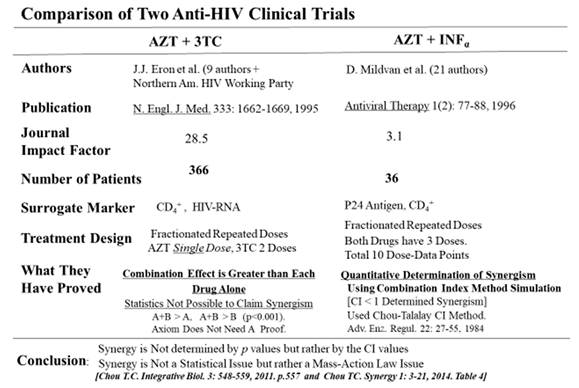 |
3.4.2. Highlights of MAL Clinical Trial Protocol Design and Simulation
These Two Clinical Protocol Designs and Data Analyses Are Completely Different.
It is not possible to quantify synergism with a single dose of any drug, as the Dm and m values required for CI determination are not available. The MAL-PD-based CI method is quantitative, efficient, and cost-effective, with a small-sized clinical trial protocol design and automated computerized data analysis. The MAL-MEE/CI Approach is the choice for dose-dependent pharmacodynamics (PD).
PD needs two (or more) doses for both “Potency” and “Shape”. A single dose generates a “Point” of potency data, but it has no “Shape”. Thus, not for MAL-PD nor CI analysis [9,10,11,12,13,14,24,51,54,55].
The dose-dependent MAL-PD indicates that clinical trial protocols using only a single dose are simply for effective potency at that particular dose, without any other information to follow through, thus not a PD study. By contrast, use 2 (or more) doses, which allows a PD-based automated computer simulation not only for Dm and m dynamics parameters for each drug and their combinations, but also digital determination for synergism, additive effect, and antagonism by automated computer simulations. The examples above (Figure 28, Figure 29, Figure 30, Figure 31 and Figure 32 and Table 8) illustrate [51,54,55].
It is concluded that synergism is a mass-action law issue rather than a statistical issue. Furthermore, Synergism, additive effect, or antagonism is determined by the CI value, not by the p-value.
The international FDAs and other official regulatory agencies need to provide guidance, clarification, and upgrade the rigorous guidelines on this important issue, based on the fundamental principle, in all drug evaluations and drug combinations.
3.5. Drug Combination Cocktail Design
More than 3-Drug or Entity Combinations: Graphics, Projections, and Determination
For 3-7 drug combination designs/analyses of synergism and antagonism simulations, the polygonogram concept has been introduced [9,11]. This cocktail design is based on the MAL principle for in vitro studies for the research and development of anti-viral and anti-cancer agents.
As an extension of the CI concept, the polygonogram was introduced in 1994, and in 2005, automated computer-generated versions were implemented by CompuSyn [9,12,31].
The examples are shown in Figure 33 below.
Likewise, the Dose-Reduction Index Equation (DRIE) and plot (fa-DRI plot) quantitatively determine whether DRI = 1, < 1, or> 1, indicating no, negative, or positive dose reduction, respectively.
Figure 33.
Polygonogram for three or more drug combinations for the cocktail design. It provides a simple visual inspection of complex combinations with a massive dataset. Also, it allows the projection of the outcomes of high component (n≥ 3) combinations from low component (e.g., n=2) combinations. a. Polygonogram of seven anti-HIV agents with similar or different mechanisms of action. b. Polygonogram of five anticancer agents with different mechanisms of action. The solid line indicates synergism, the broken line indicates antagonism, the heavy line indicates strong interaction, and the thin line indicates weak interaction. In all cases, the mechanisms cannot predict synergism, except that using MAL-MEE/CIE determines synergism (CI<1), additive-effect (CI =1), and antagonism (CI >1) quantitatively.
Figure 33.
Polygonogram for three or more drug combinations for the cocktail design. It provides a simple visual inspection of complex combinations with a massive dataset. Also, it allows the projection of the outcomes of high component (n≥ 3) combinations from low component (e.g., n=2) combinations. a. Polygonogram of seven anti-HIV agents with similar or different mechanisms of action. b. Polygonogram of five anticancer agents with different mechanisms of action. The solid line indicates synergism, the broken line indicates antagonism, the heavy line indicates strong interaction, and the thin line indicates weak interaction. In all cases, the mechanisms cannot predict synergism, except that using MAL-MEE/CIE determines synergism (CI<1), additive-effect (CI =1), and antagonism (CI >1) quantitatively.
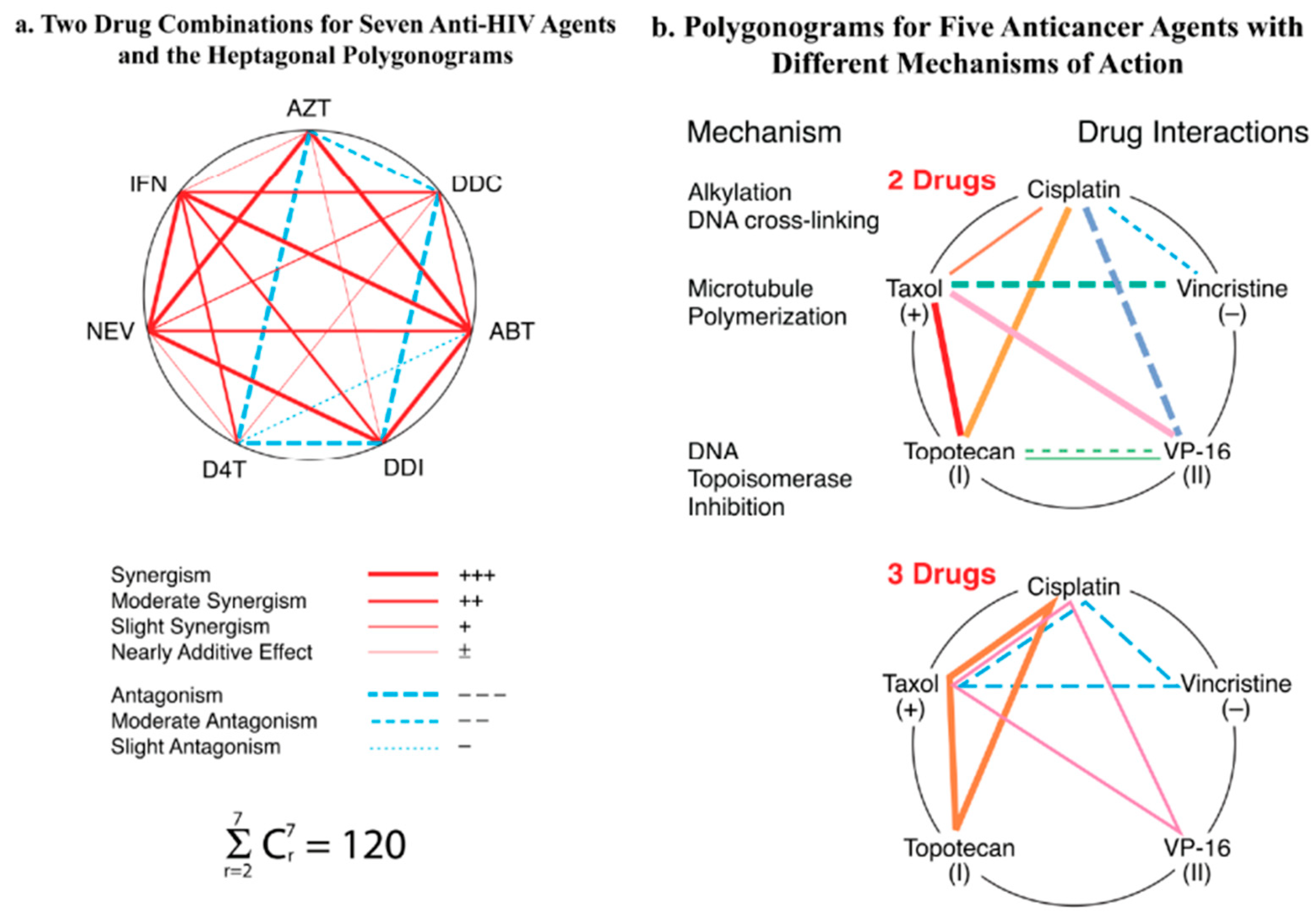
More than three entity combinations can be other than drugs, such as radiation or other physical entities.
4. Unified General Mass-Action Law Doctrine of the Median as the General Principle: Convergence and Emergence
The unified general theory requires general system analysis without setting preconditions or specific arbitrage models. The mass-action law (MAL) is Nature’s fundamental physical and chemical principle, rather than an arbitrary selection on “Model”. In new drug developments, many use PK models without using the MAL-based PD principle.
Numerous unified, general, universal theories have been proposed earlier, including the theory of relativity, string theory, the Big Bang theory, the fundamental density theory, and many others. All of them have their theoretical basis, in one way or another.
One major criterion is applicability, scalability, and flexibility. The MAL-unified general theory/equations and algorithms are inching toward inter- and cross-disciplinary applicability, although they are not expected to be exhausted.
The MAL unity theory stays as is. However, the better ideas shall not be excluded.
Other Multi- and Cross-Disciplinary Convergence to the MAL
No unified general theories can exhaustively cover everything; the MAL-MEE/DOM/MTDPT/CIE DRIE for the Unity Theory of One (UTO) and Life-Centric Universe (LCU) have no exception. Humans are prone to errors, especially when making many unique statements and using unfamiliar terminology. I expect not all scientists will agree with my personal points here. I would welcome any individual who independently puts forward a better idea or thought. The MAL-theory/equations/algorithms have undergone scrutiny for over 5 decades.
4.1. Conceptual Transformations: Double Reciprocal, Double Logarithmic, Floating Ratio, and the Median-normalized Mass
The Mass-Action Law (MAL) algorithm-based paradigm has been proposed by this author, aiming to unify the analysis of dynamic processes across the life sciences, chemical, and physical sciences. The core concept is the Unity Theory of One (UTO), which describes natural phenomena as fractions of a unified whole (“One”) that can bridge the two domains of Nature: life and non-life. This framework introduces the Doctrine of the Median (DOM) – the idea that the median point of any dose-effect relationship is a universal reference – and posits a life-centric view of the universe, placing “Life” conceptually at the center among the fundamental elements of mass, force, time, and space. In this overview, we explain the key components of Chou’s paradigm (the MAL equations and their algorithms), assess its interdisciplinary significance, and illustrate the concepts with diagrams and examples. The tone is explanatory, geared toward scientists and policy makers interested in cross-disciplinary innovation.
4.2. MAL-Based Median and Doctrine of Median
The framework builds on the classical Mass-Action Law (MAL), a principle from chemistry/biochemistry that governs how entities interact (e.g., drug molecules with targets). Through MAL-based system analysis of input-output patterns, Chou derived a unified dose-effect relationship, known as the median-effect equation (MEE) [4]. The MEE is expressed as:
where D is the dose (or generally, the amount of any stimulus), Dm is the median-effect dose (the dose that produces a 50% effect), fa is the fraction affected (e.g. the proportion of a system that responds), fu is the fraction unaffected (so ), and m is an exponent called the dynamic order [9,11]. This simple formula implies that the ratio of “affected” to “unaffected” is related to the dose in a power-law manner. Crucially, when , the dose equals by definition (the point where half the system is affected). Fa/fu is called the Floating Ratio (FR). The parameter m governs the shape of the dose-response curve: if , the relationship is a classical hyperbolic curve; if m is not equal to 1 (greater or smaller), the curve becomes sigmoidal (S-shaped) or flattened S-shaped. In other words, yields a Michaelis-Menten-like simple saturation, while or produces steeper or shallower sigmoidal transitions (indicating higher or lower cooperativity in effect) [9,24].
The median-effect equation is remarkably general – it subsumes many classical biological and physical response models as special cases. In fact, it has been shown that the MEE unifies the equations for enzyme kinetics (Michaelis–Menten), receptor binding (Hill and Scatchard equations), pH ionization (Henderson–Hasselbalch equation), and more, by interpreting their “half-effective” constants (e.g., Km, Kd, pK) as analogs of . Thus, “Dose” and “Effect” (or more abstractly, mass and function) become interchangeable under this unified law. The Doctrine of the Median (DOM) holds that the median point (50% effect level) is a universal pivot for any effect dynamics. By plotting data as vs. (called the median-effect plot), one obtains a straight line whose slope = m and x-intercept = . This means that with only a few data points, one can determine m and Dm and thereby define the entire dose-response curve, indeed, a surprising consequence – termed the “Minimum Two-Data-Point Theory” (MTDPT) – is that if a system obeys the MAL median-effect principle, then two experimental data points (plus two default points at zero effect for zero dose, and 50% effect at Dm) can theoretically describe the full dose-response [9]. This defies the common notion that at least three points are needed to draw a curve and highlights the power of the MAL algorithm, which automatically includes 0% and 50% points as anchors [9,11]. In practice, having more points is prudent. Still, this principle underlies a “top-down” approach to research: starting from a general law to guide minimal experiments, rather than the traditional “bottom-up” approach of many specific observations [9,10,11,12,14,15,16,17,18,19,20,21].
Because the MEE’s terms are dimensionless ratios (fractions and normalized doses), the equation holds regardless of units, physical state, size, structure, or mechanistic details and Complexity [9,11,23,24]. This gives it a universal character: whether one is measuring drug concentration in moles, radiation in Gray, or signal intensity in arbitrary units, the relationship , where D/Dm is the median dose-normalized Mass, should hold if the process follows mass-action law dynamics [9], thus, “Effect” and “Mass” are interchangeable or equivalent in biology. This is akin to Einstein’s theory of relativity, E = MC2, which indicates that “Energy” and “Mass” are equivalent in physics. Chou emphasizes that this property makes the MAL framework a kind of “common language”, in which exponent m signifies dynamic-order, which also signifies the shape of dose-effect curves, i.e., m =1 denotes hyperbolic curve, m>1 gives sigmoidal curve, and m<1 gives flat-sigmoidal curve, for quantitative biology and beyond [9,11,23,24]. It also means that potency (Dm) and curve shape (m) are the key parameters for characterizing the effect of a single agent or a combination of multiple agents. These two parameters provide a complete digital description of the general dose-effect relationship, including its defined geometric properties[9,11]. The median, in particular is a “universal reference point” that signifies an equilibrium or halfway state across diverse systems. Thanks to these features, the MAL median-effect method has very broad applicability. It has been applied not only in biomedical research (pharmacology, cancer therapy, toxicology) but also in fields such as environmental science, agriculture, and even marine biology, wherever dose-response or stimulus-response relationships arise [18].
In summary, the Median-Effect Equation condenses centuries of dose-response knowledge into a single formula. It provides a conceptual paradigm shift by asserting that all processes governed by mass-action law can be described by a single, unified equation, with differences limited to two parameters. This lays the groundwork for integrating data from multiple disciplines and for conducting research more efficiently. For scientists, it suggests that outcomes can be simulated or predicted with minimal input data. For policymakers, it promises more cost-effective, “Econo-Green” research designs that reduce experimental waste [20,21]. In practice, software inspired by this theory (e.g., CompuSyn) can use a few data points to run computer simulations, yielding an entire curve and related metrics in seconds, streamlining the R&D process [22,23].
4.3. Intrinsic Properties Revelation in Life and Non-Life
Revealing Hiding Informatics from Unified General Dynamics Principle: Nature’s MAL Theory for General Causal-Effect Data Science By using system analysis
4.3.1. Inputs-Outputs: Sequence Pattern, and the Transitions of Paired Signals, (S, P), (↓,↑), (1,0) or (+, -)
Linear Pattern (see Section 8 and Section 8.1 to 8.3)
Circular Pattern (see Section 8 and Section 8.4 to 8.8)
The linear combinatorial patterns vs Euler’s Totient-Function () combinatorial for circular system [1]
The Pascal Triangle for binomial coefficients distribution, The 2nd-degree Squared Pascal Triangle , derived from biological enzyme substrate- inputs (↓) and product-outputs (↑) system pattern transition combinatorial [1].
4.3.2. Isobologram Triangle vs. Pythagoras Triangle: One and Two Dimensions (see Section 8.9 and Figure 39)
The Pythagoras theorem, a2 + b2 = c 2 for a right triangle, is the 2nd-degree (squared) geometric length general principle of the right triangle, in a general form of (A, B, and A + B). Interestingly, a, b, and c indicate Length or distance (the exponent as space) in mathematics or physics. However, in pharmacology and life sciences, the dose-effect relationship in combination follows the MAL-unified general combination index equation (CIE) theorem. In contrast, A and B are for Effect (force or energy), which requires Dose (mass or entity) and action or interaction rate, which involves time (change of mass condition per time, for speed). In physics, speed (distance/time) is squared, as indicated by Einstein’s relativity theory, E/M = C2 (see Section 8.9).
4.3.3. Mathematical Concept, Geometrical Forms, and Functional Relations (see Section 1) [9,10,11]
Median is a Universal Reference point and a Dynamic-order Common link
Equilibrium, Symmetry, Harmony
Geometric symmetry
Biological Dynamics vs. Physical Thermodynamics
Equilibrium and Balance
Optimal Homeosis vs Mechanical Conditions
Philosophical and Social Harmony and Natural Law (see Figure 19)
Ecosystem and Environment
1/S vs. 1/v [Lineweaver-Burk plot for enzyme kinetics]
1/D vs. fu/fa or (I-fa)/fu, (1-fu)/fu, [(fu)-1 -1] or [(fa)-1 -1]-1
[Chou’s MAL General Dynamics for causal dose-effect informatics]
Competitive
Non-Competitive
Un-Competitive
The median-Effect Equation, fa/fu = (D/Dm)m, and plot (PEP): (Chou, 1976),
Log D vs. Log (fa/fu), or Log (fa)/(1-fa), Log (1-fu)/fu, log [(fu)-1 -1]
or log [(fa)-1 -1]-1 (The MAL-median-effect plot, Linearization, and Dm and m determination)
Dm (for efficacy) and m (for dynamic-order exponential, shape of DEC)
Activation functions: Resting (Dm =0, m = 0), Hyperbolic activation (Dm =1, and m =1), Sigmoidal activation m , Tanh function, with a Floating Ratio (fa/fu) and with Median in the center of equilibrium, and symmetry.
4.3.4. New Conservation Principle: Minimum Two Dose-data Point Theory (see Section 1.5.3) [9,10,11,23,24]
(MTDPT) for Efficiency, Cost-Effectiveness, and Econo-Green
Automatically adding two default points (Dose zero and Dm) to the MAL-MEE-PEP, thus leading to a smaller experimental size, which is a game changer in R&D, especially in animals or humans. MAL-MEE/CIE/DRIE
4.3.5. Exclusivity and Space (see Figure 16, Figure 17 and Figure 18)
Mutually Exclusive (Equation and Graphics)
Mutually Non-exclusive (Equation and Graphics)
4.3.6. The Power of Ratio (see Section 1.6)
Golden ratio: Phi (φ) for Non-life
Floating Ratio: fa/fu for Life.
C14/C12 ratio: For age time estimate
Mass ratio: D/Dm and (D/Dm)m for 1st (hyperbolic) and mth (sigmoidal) dynamics orders for geometric shapes
The 2o-(squared) Pascal Triangle from biochemistry
Relativity ratio: E/M = C2 (Einstein)
Law of motion: F/m = a (Newton)
Density ratio: E/m = c^2 = 1/(ε0 μ0) = (d/t)^2, and Riemann zeta function, Re(s) =1/2
4.3.7. Median and Constant (see Section 1, and Table 9 and Table 10)
Median: Half Dose (0.5 or ½ ) of maximal effect: Half-Mass dose (Dm) (IC50, ED50, TD50, LD50)
Kinetic/Dynamic constant: K, Keq, Km, Ki, Kii, Kis, Kd, Ka
Reaction Rate: Mass/Time, dx/dt
MAL-Half Dose, (Dm) vs. Radio-Isotope decay Half Time (t1/2 ) : (A Graphic Comparison)
4.4. MAL-Median Unified Theory Aligns with Major Historical Conclusions in Mathematics and Physics (see Section 1.12 and Section 8.9)
A recent review of MAL-MEE/Doctrine of the Median (DOM) leads to the Unity Theory of One (UTO), which uses "One" as a universal standard, and the Life-Centric Universe (LCU), which positions Life among Mass, Force, Time, and Space to promote humanism over materialism. New conclusions include:
(1) The universe contains Life and Non-Life domains.
In Life, MAL-MEE's Floating Ratio (FR), fa/fu = fa/(1–fa) = (1–fu)/fu = (fu)-1-1 = [(fa)-1 -1]-1, forms a circular, closed, recyclable pattern; Non-Life domains (physics, mathematics, and AI) follow the Golden Ratio (GR), φ = 1 + 1/φ = (1 + √5)/2 = 1.618033…, an irrational open form extending to infinity. The Golden Ratio has been used or related broadly in geometry, the Fibonacci sequence, Lucas number, Penrose tiling, Kepler triangle, spiral galaxies, Golden Spiral, architectural designs, and plant floral patterns.
(2) FR has the fractional form a/b = a/(1–a) = (1 -b)/b, while GR has a/b = (a + b)/a = 1 + b/a.
(3) Both are fractional distribution functions of "1": FR finite, GR infinite.
(4) Rearranging MEE yields fa = 1/[1 + (Dm/D)m] and fu = 1/[1 + (D/Dm)m], forms analogous to probability distributions, Logit, PROBIT, and Fermi–Dirac functions, except those containing Euler's e, limiting real-world biomedical utility. Log is often more practical than the Natural Logarithm (Ln).
(5) While Michaelis–Menten, Hill, Henderson–Hasselbalch, Scatchard, Langmuir isotherm, and Hopfield activation functions for neural networks contain no “e”, they are model-specific and not broadly expandable.
(6) MAL-MEE’s Median = 0.5 parallels α = 1/2 in Alfaro’s Fundamental Density Theory and Re(s)=1/2 in the Riemann Zeta Function.
(7) Ratios define relativity, including GR, FR, C14/C12 (time), E/M = C² (Einstein), F/M = a (Newton), and Dm/t1/2 (MAL/physics).
(8) MAL-MEE provides algorithms illustrating competitiveness, exclusivity, symmetry, equilibrium, balance, homeostasis, cooperativity, feedback, visible input/output versus invisible intermediates, pathway, network, and harmony.
These findings indicate that the MAL-Median Unified Theory aligns with major historical conclusions in mathematics and physics.
The MAL-MEE-CIE-DRIE/DOM/UTO-Theory-based approach for general scientific R&D does not represent gradual progress, but rather a new framework that conforms to Nature’s laws and principles, constituting a paradigm shift in numerical digital science for this AI-assisted electronic automation era. Conceptually, the MAL-theory-based top-down R&D approach is opposite to the traditional observation-statistic-based.
5. MAL and the Unity Theory of One (UTO)
This unified concept evolved from the MAL-MEE/CIE/DRIE theory /method has been time-tested for 5 decades since 1970, applications as of 2025 have garnered over 1,500 citing journals and over 1,500 citing patents, indicating the broadest scope of impact in drug discovery and research innovations, far beyond biomedical science, including environmental, agriculture, marine, bioengineering, and food sciences [9,11,16,17,18,19,20,21,22,23,24].
In Biology, the major events include birth and death, metabolism, growth, reproduction, and existence. Depending on the stages of evolution, there is an increasing complexity and sophistication. Humans, as primates in the animal kingdom, exhibit a high degree of consciousness, intelligence, senses, and the ability to create numbers, words, language, and scientific logic, including artificial intelligence (AI) [24].
From molecules, cells, and organs to the whole body, in biomedical and biophysical sciences, the mass-action law governs the actions of MEE and the interactions of CIE. In simple molecular systems, such as enzyme proteins, they usually follow Michaelis-Menten kinetics with m = 1 as the dynamic order in MAL-MEE, indicating a DEC shape that yields hyperbolic curves. When molecules or sub-units conjugate or complex, the component may exhibit “cooperativity” in actions among them, such as allosteric enzymes, or hemoglobin and oxygen bindings, where hemoglobin has four heme sub-units. This led A.V. Hill to derive an equation with the nth power that generates a sigmoidal oxygenation suturing curve. Both the Michaelis-Menten and the Hill equations are derived from MAL, but with applications restricted to specific research fields [9,11].
Figure 34 provided a theoretical basis for the NAL Unity Theory of One (UTO), since the unified general theory of MEE, CIE, and DRIE is all based on ‘One’ as a universal standard, for action, interactions, and informatics [24]. The Floating Ratio (fa/fu) and the Mass-Ratio (D/Dm) make the MAL theory, both dose and effect, dimensionless relative ratios that are independent of units, physical states, size scale, structure, and complexity. For the real-world problem, the general equation is deterministic, and has a finite distribution function of “1” [19,20,21,22].
During 2024-2025, numerous discussions on subjects relevant to the MAL-MEE/DOM/UTO have emerged. Most of the independent short essays are published on Medium, including the following subject titles. These are individual ideas and opinions, not my own, that are open to consideration in an open forum for thought-provoking ideas. Subjects on Median and Mean [92,93,94]; Top-Down and Bottom-Up [95]; Logistic Function [96,97]; From Countable to Uncountable [98]; Perception and Intuitively [112,113]; and Open-Source of Universe Code [99,100,101,114,115].
Figure 34.
Summary of the philosophical and mathematical concept of MAL-dynamics/informatics theory for Econo-Green R&D. Flow chart for Unity Theory of One (UTO) based on MAL-MEE/CIE/DRIE. The Unity Theory of One (UTO) for MEE (m=1), CIE (CI=1), and DRIE (DRI=1), as the Universal Standard. Ref: Chou TC "Mass-action-Law Dynamics Theory and Algorithm for Translational and Precision Medicine Informatics" (Academic Press/Elsevier, April 2024; ISBN: 978-0-443-28874-6) [24].
Figure 34.
Summary of the philosophical and mathematical concept of MAL-dynamics/informatics theory for Econo-Green R&D. Flow chart for Unity Theory of One (UTO) based on MAL-MEE/CIE/DRIE. The Unity Theory of One (UTO) for MEE (m=1), CIE (CI=1), and DRIE (DRI=1), as the Universal Standard. Ref: Chou TC "Mass-action-Law Dynamics Theory and Algorithm for Translational and Precision Medicine Informatics" (Academic Press/Elsevier, April 2024; ISBN: 978-0-443-28874-6) [24].
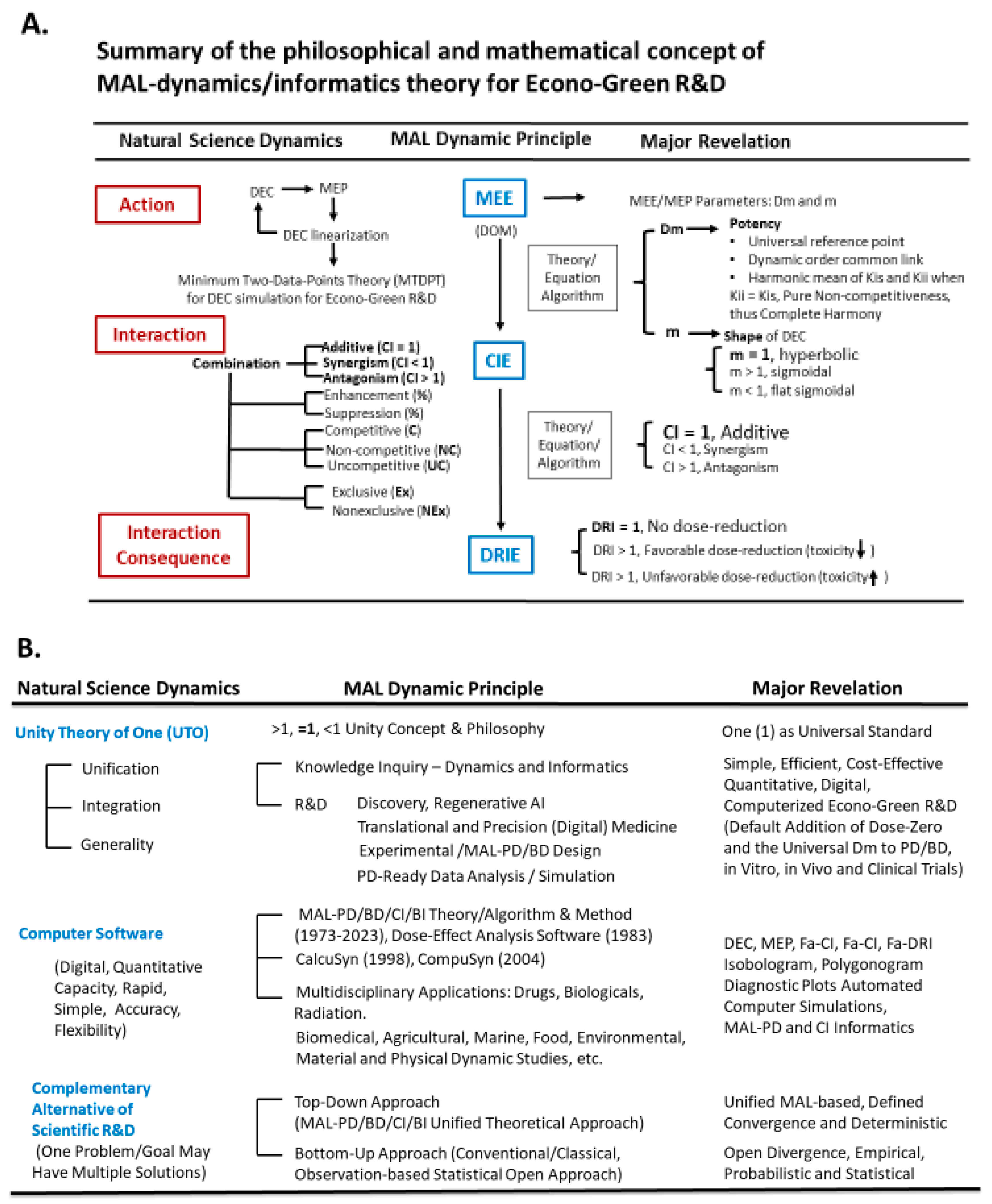
Figure 35.
The Life-Centric Universal Elements, as proposed by Chou in 2025.
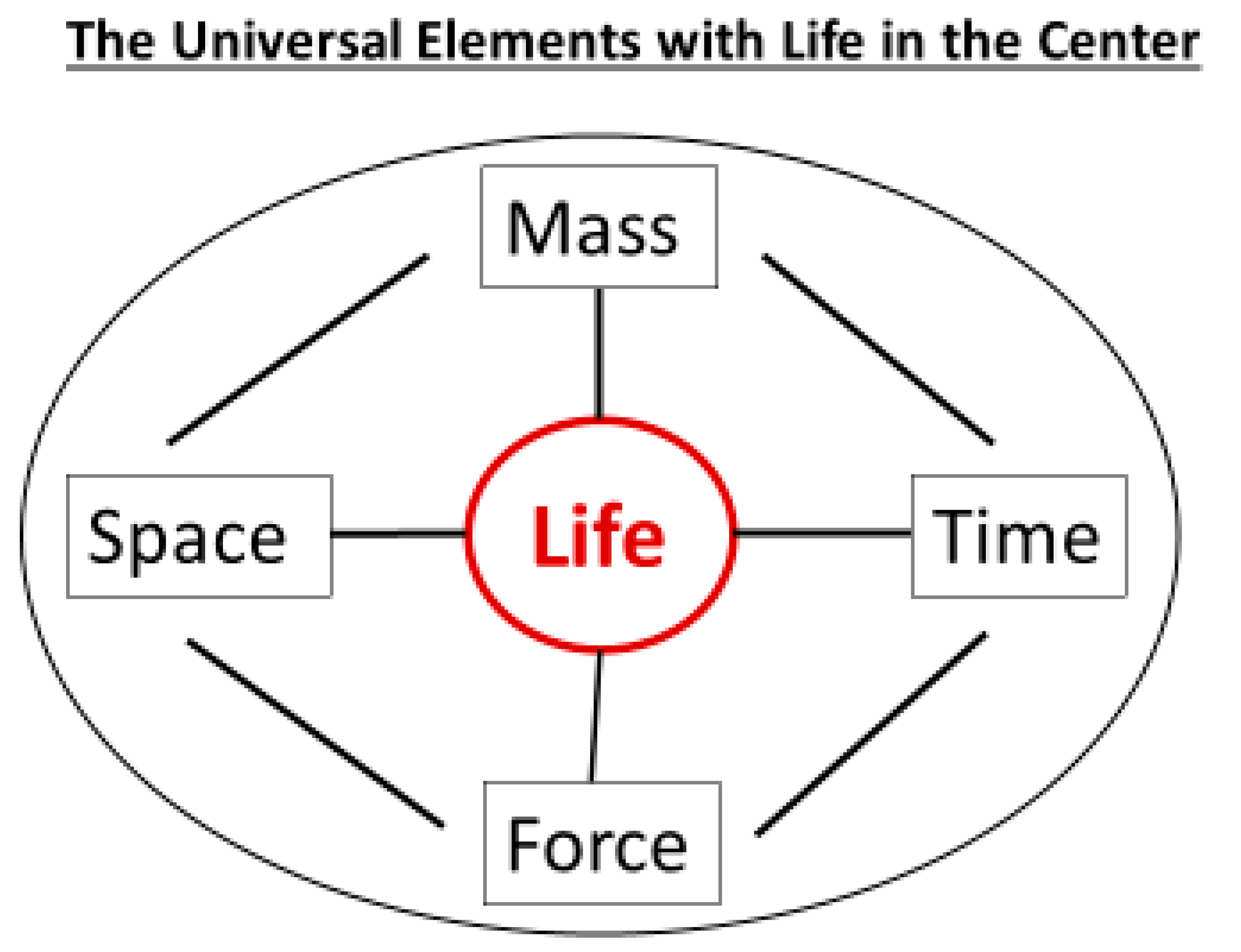
As a primate with the highest intelligence, the Human decides the unit and method of measurement. From MAL-MEE/DOM/UTO manifestations, I proposed that Life be placed in the center among Mass, Force, Time, and Space in the Universe [19,20,21,22]. (See Figure 35).
Currently, the unified general theory of the universe (such as the Theory of Everything) is mainly based on physics, e.g., the general relativity theory, the big bang theory, and the recently introduced Fundamental density Theory (FDT) [63,64,65,66,67,68,69,70] and the string theory, which, per se, are in the non-Life domain. It is well known in Einstein’s Relativity Theory that E/m = c^2 = (d/t)^2, in which the Energy/Mass ratio is equal to the square of the speed of light (distance/time). This general theory, as well as FDT and other unified general theories, are mathematical and physical models that fall within the non-life domain and cannot provide solutions to real-world needs, such as those in the biomedical sciences. By contrast, the MAL-MEE/DOM-based theory and applications are scalable due to the dimensionless ratios fa/fu and D/Dm on both sides of MEE for actions, and CIE for interactions.
In literature, there are more than a dozen theories that claim, suggest, or are believed to be for the unified general theory. These include string theory, the big bang theory, quantum mechanics, singularity theory, and fundamental density theory (FDT), among others. The MAL-dynamics/informatics theory, as presented in this paper, is just one of the theories of the universe. In the spirit of scientific freedom, there may be different opinions on the general MAL-theory and method despite their remarkable bibliometric and track record. Over the past four decades, the MAL-MEE and CIE have been discussed, assessed, and applied in more than 40,000 scientific papers and over 1,500 citing journals and 1,623 citing patents in publications. There is no point in peer-reviewing the MAL-MEE/CIE.DRIE theory and algorithm. Scholars with specialized expertise or a better idea are welcome to put forward their theory as an independent, new, and innovative concept and to compare it with the proposed universal theories.
6. A Universe by Design: Source Code Not Random Occurrence
Ultimate Supreme Being a priori, MAL Unity Theory of “One” (UTO) and Life-Centric Universe (LCU)
The following are the highlights for the MAL theory (MAL/MEE/CIE/DOM), outlined in the conclusions.
I. Virtual a priori (unchangeable) [24]
- Principal: Mass Action Law (MAL), median, symmetry, equilibrium, feedback, harmony, homeostasis. Pythagoras' Theory and Pascal's Triangle, Euler’s Identity.
- Constant: π , φ , e , i , C (lightspeed), K (plank constant), …
- Process: Mathematics, number, sequence, pattern, exponent, single/double logarithm, single/double reciprocal, ratio, … (revealing intrinsic properties and understanding)
- Interpretation and Illustration by Theory, Algorithm, Parameters, and Graphics: Digitalization of floating and fixed ratios, quantitative digitalized or indexed conclusions (alternative to probabilistic p-values).
- Unified, general principle for cross-disciplinary linking using MAL-MEE common denominators and parameters: Input-output cause and effect relationship, sharing the same algorithm and parameter-based graphics in hyperbolic and sigmoidal activation functions.
III. Scientific Exploration and Application from Phenomenal Extrinsic Property Investigations: Specific, general and unified-general R&D protocol design and data analysis (bottom-up vs. top-down approach, complementary like two sides of the same coin or same entity) [19,20,21,22].
IV. Existing Natural Instincts and Preservation: Mass can be transformed to energy, effect, or force, and never dissipates [22,24].
- Mass-Energy Equivalence (MEE): Einstein's theory shows that mass and energy are interconvertible with infinite features. The MAL-MEE, fa/fu = (D/Dm) m, indicates that dose and effect are interchangeable, mediated by the Floating Ratio, which manifests in Life with recyclable and finite features.
- New Concept of Preservation from MAL Theory: The double logarithmic transformation for x = log (D) versus y = log (fa/fu), Median-Effect Plot (MEP), provides graphics determining an entity’s paired, dynamic parameters; Dm for potency and m for dynamic order and shape for all input-output dynamic activation functions. D/Dm ratio signifies dimensionless scalability for universal applicability.
- The MAL MEP Linearize Causal Dose-Effect Relationship: The linearization leads to the minimum two dose data theory (MTDPT), which allows for a smaller size experimental design by adding two default data points (Dose zero and Dm), revolutionizing biomedical sciences, especially in animal studies and clinical trials, protocol design, and data simulation for quantified or indexed conclusions.
Figure 36.
Humans decide on units and methods of measurement. The Human-Centered Perspectives of the Universe. Universal Unity Theory of One (UTO) for scientific R&D from human-centered prospective. The dynamic Unified Theory of One (UTO) for expressions of MAL-DOM (Doctrine of the Median) for action and interaction in scientific R&D.
Figure 36.
Humans decide on units and methods of measurement. The Human-Centered Perspectives of the Universe. Universal Unity Theory of One (UTO) for scientific R&D from human-centered prospective. The dynamic Unified Theory of One (UTO) for expressions of MAL-DOM (Doctrine of the Median) for action and interaction in scientific R&D.
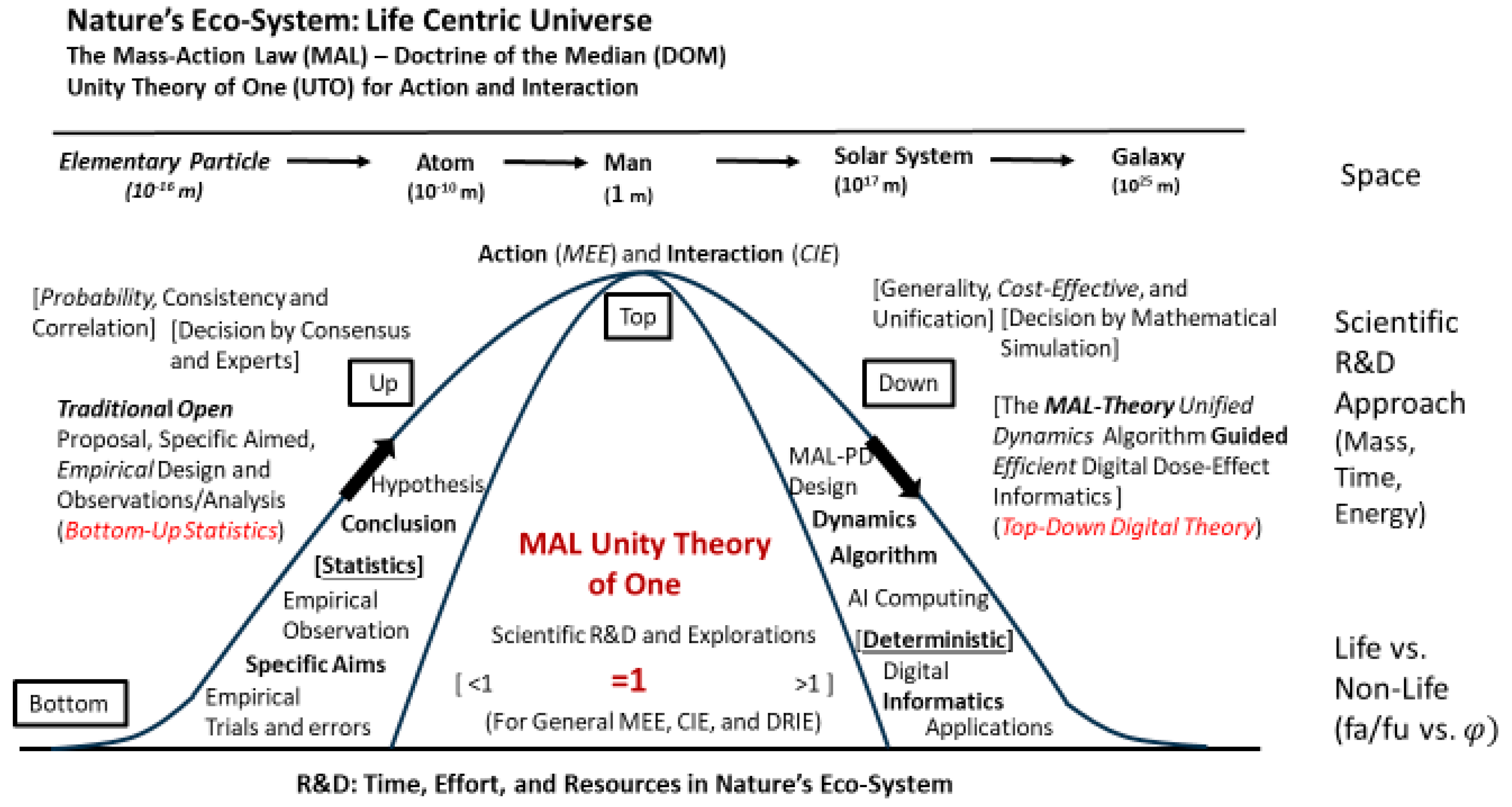
In Figure 36, the median effect equation (MEE), the median effect dose (Dm) is the universal reference point, and the Nature’s dynamic orders common link. This is the doctrine of the median (DOM) for “Action.” The combination index equation (CIE) is for the principle of “Interaction.” The dose-reduction index equation (DRIE) is used for dissecting interactions. All terms in MEE, CIE, and DRIE are dimensionless relative ratios of the same kind, regardless of units, physical states, size, mechanisms, or complexity, thus ensuring universal applicability. The features of structures, mechanisms, networks, pathways, and PK, etc., are not directly Life’s Dynamics' intrinsic properties; rather, they are extrinsic properties that warrant special attention and separate studies. MAL-theory provides the Guiding Informatics for the regulation and conduct of scientific R&D.
There are semantic differences and debates about logical, philosophical, and mathematical induction and deduction. In both Asian and Western ancient philosophy and ontology, there are different schools.
Table 9 provides the universality of the Floating Ratio (FR) and mass ratio (D/Dm) in cross-disciplinary linking.
Table 9.
MAL-MEE-CIE-DOM Floating Ratio, fa/fu = fa/(1-fa) = (D/Dm)^m, is regardless of unit, physical state, size, structure, and mechanistic complexity*.
Table 9.
MAL-MEE-CIE-DOM Floating Ratio, fa/fu = fa/(1-fa) = (D/Dm)^m, is regardless of unit, physical state, size, structure, and mechanistic complexity*.
| Unit (SI): | k (kelvin), m (meter), a (ampere), s (second), mol (mole), kg (kilogram), and cd (candela) |
| Physical State: | Solid, liquid, and gas |
| Size (Meter): | Elementary particles (<10-16), atom (10-10), man (1), solar system (1017), and galaxy (>1025) |
| Structure: | Chemical, physical, mathematical, biological, and biomedical (primary, secondary, tertiary structure and pathway) |
| Mechanistic Complexity: | Sub-atomic, atomic, physical, chemical, and biological (cellular, molecular, action and interaction, pathway, and network) |
*D (dose), Dm (median-effect dose), fa (fraction affected), fu (fraction unaffected), m (dynamic order).
6.1. Cross-Disciplinary Linkage: Biology, Math, and Philosophy
The MAL theory is cross-linked to ancient philosophical concepts as indicated in Figure 35, Figure 36 and Figure 37.
6.1.1. Life Science Theorem and Interpretation of Harmony
Figure 37.
Modern interpretation of an ancient philosophical concept. (A) Median of MAL-MEE is the harmonic mean of pure non-competitive effect. (B) Lineweaver-Burk plot. Daoism for Harmony. The ecosystem's equilibrium between Nature and humans is stable.
Figure 37.
Modern interpretation of an ancient philosophical concept. (A) Median of MAL-MEE is the harmonic mean of pure non-competitive effect. (B) Lineweaver-Burk plot. Daoism for Harmony. The ecosystem's equilibrium between Nature and humans is stable.
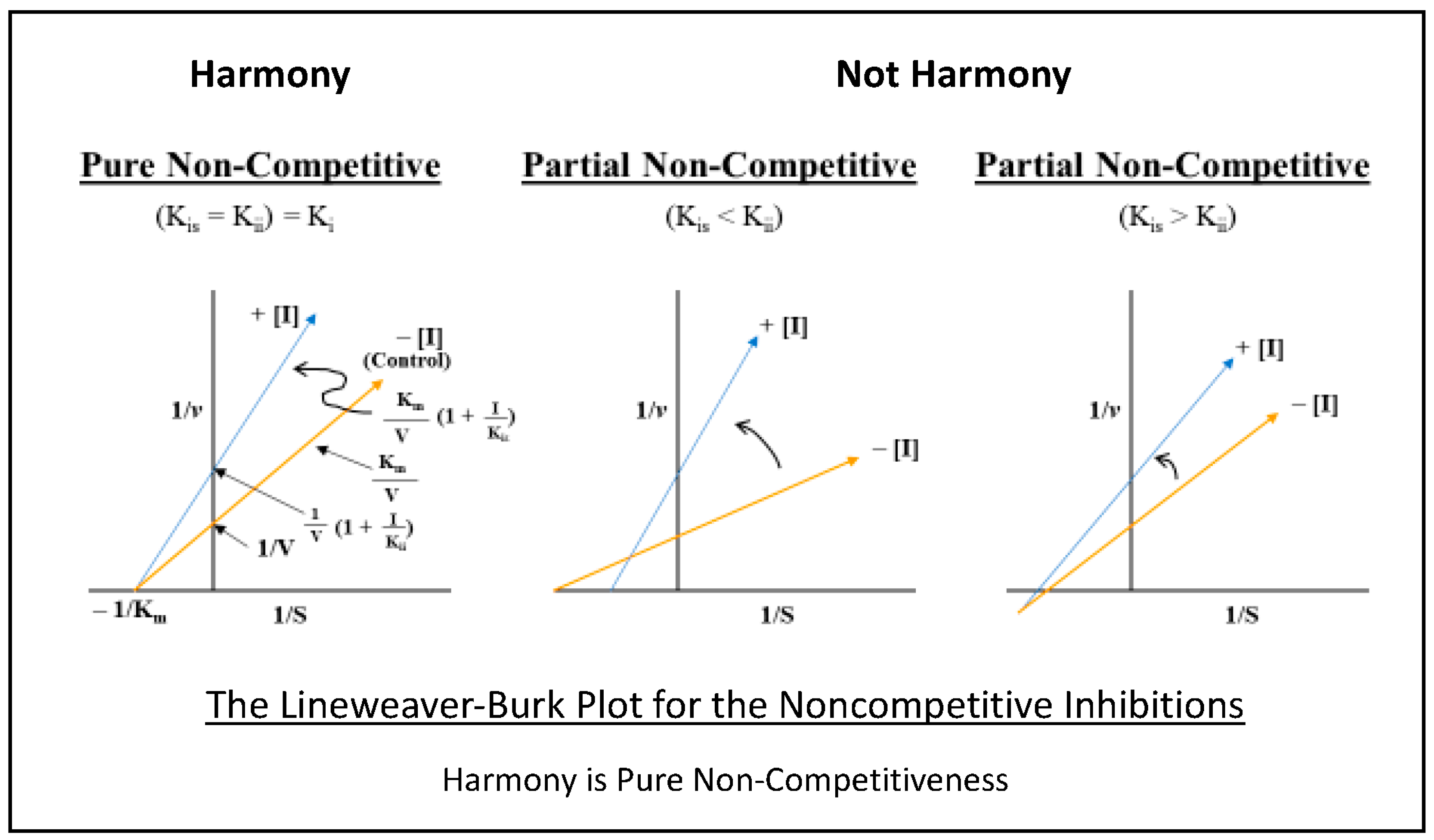
The mass-action law dynamics analysis using the Lineweaver-Burk plot proves that pure harmony is pure non-competitiveness. These results provide cross-disciplinary linkages between biological and philosophical concepts, in mathematical, physical, and graphical terms [3].
6.1.2. MAL Dynamics vs. Daoism, Yin-Yang, and Wu-Xin Ontology
Figure 38.
Symbols of ancient philosophy: A. Yin-Yang and B. Harmony of Zhou Yi (I Ching, the Book of Change), C. Wuxing (5 elements in ontology) of Taiji Tu by Chou (Zhou) Dun-Yi (1017-1073).
Figure 38.
Symbols of ancient philosophy: A. Yin-Yang and B. Harmony of Zhou Yi (I Ching, the Book of Change), C. Wuxing (5 elements in ontology) of Taiji Tu by Chou (Zhou) Dun-Yi (1017-1073).
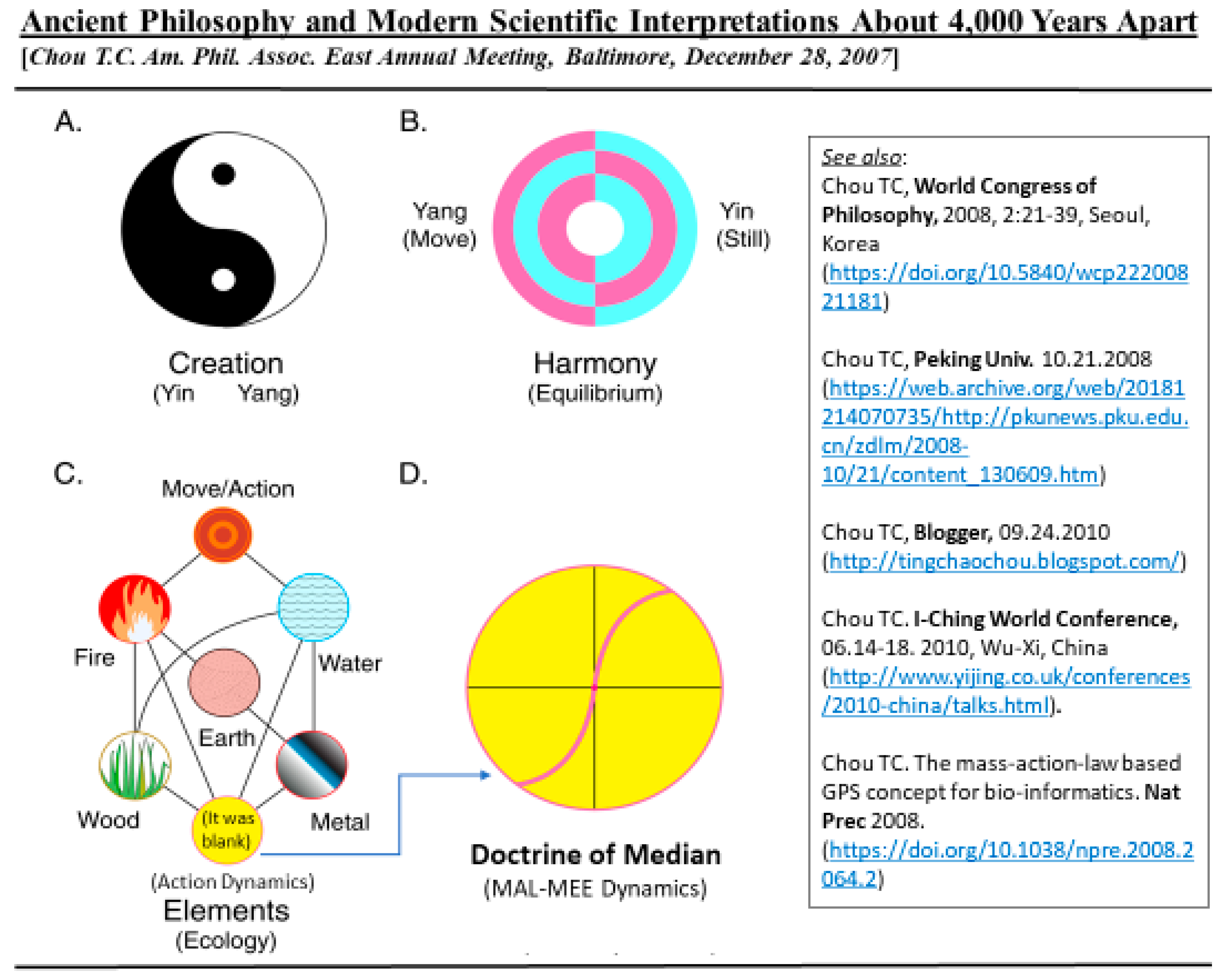
Note that only Water and Fire are connected by 4 lines (the most), as modern science indicates that no life can survive without water and that no reaction occurs without temperature. D. In the Taijidu bottom ring (yellow) was empty when published about a thousand years ago, which has been filled out by Chou TC as the Doctrine of the Median (DOM). Chou TC indicated that the Confucian Chung-Yung “Doctrine of the Mean” where “Mean” (Average) shall be translated as “Doctrine of the Median.” (2007-2010 Philosophy meetings /conferences in N. America and Asia). Chou T.C. (1974) [3], using the Lineweaver-Burk plot in biochemistry, indicates that the Dm (the median dose) is the harmonic mean of Kii and Kis. When Kii and Kis are equal, the ratio equals one; it indicates pure non-competitiveness; thus, it is a complete “Harmony.” This is consistent with the Unity of One Theory (UOT). It indicates Harmony, Equilibrium, and Symmetry [21,22].
Ancient Chinese philosophy Wu-Xin (Ontological Five Elements) is compared with contemporary resources provision, rules and regulations, and livelihood in Table 10.
Table 10.
Relevance of Natural Five Elementary Resources on Regulatory Sciences and Dynamic Eco-Systems: Evolving from Ancient to Modern.
Table 10.
Relevance of Natural Five Elementary Resources on Regulatory Sciences and Dynamic Eco-Systems: Evolving from Ancient to Modern.
|
Chinese Ancient Five lar Elements (五行, Wu-Xin) |
Resources and Provision |
Rule and Regulation |
Livelihood and Cultural Activity |
|
Metal (金) |
Construction materials Catalyst Tools |
Naturalism Daoism |
Food (食) |
|
Water (水) |
Drinking Water River Lake Glacier |
Livestock Fishery Plantation |
Clothing (衣) |
|
Energy (火) |
Coal Oil Non-fossil energy |
Human-Centric Regulations |
Dwelling (住) |
|
Plant (木) |
Wood Vegetable/Fruit Forestry |
Humanism Greenhouse Effect Genetic Material |
Travel Recreation/ Art/Sport/Education (行) (育) |
|
Earth (土) |
Plant Solar Wind/Water Minerals/Chemicals Soil Shore/Basin Weather |
Disease Control/Drugs Air and Water Quality Pollution Control Pest, Erosion Climate, Global Warming Energy Conservation |
Entertainment/ Spiritual (樂) |
6.1.3. Convergence of MAL Life-Centric Theory vs. Pythagoras' Theorem, Confucius, and Plato’s Philosophy
There is hope that our intuitive perception, intelligence, and understanding will finally converge on the Unity Theory of One, and a Life-Centric Universe, along with the four physical elements: Mass, Force, Time, and Space. Two domains, Life and Non-life, are the realm of the Universe. Humans decide the Units and Methods of measurement that drive science. Inter- and cross-disciplinary linking of the Mass-Action Law-Median Principle (point, axis, and plane and rotations) points to the unity theory of “One” with fractional distribution of finite, closed, and cyclable, e.g., the Floating Ratio (fa/fu) manifesting Life, and continuing distribution of One in open, fractals, and extendable to infinity, e.g., the Golden Ratio (φ) manifesting Non-Life. Life features symmetry, equilibrium, balance, dynamics, harmony, along with feedback, cycling, regulatory homeostasis, life or death, growth, metabolism, reproduction, two genders, and ecosystem, among others, do not appear in the Non-Life domain; however, there are analogies, equivalency, similarity, or counterparts.
There is hope that our intuitive perception, intelligence, and understanding will finally converge on the Unity Theory of One, and a Life-Centric Universe, along with the four physical elements: Mass, Force, Time, and Space [22,87]. Two domains, Life and Non-life, are the realm of the Universe. Humans decide the Units and Methods of measurement that advance science. Inter- and cross-disciplinary linking of the Mass-Action Law-Median Principle (point, axis, and plane and rotations) points to the unity theory of “One” with fractional distribution of finite, closed, and cyclable, e.g., the Floating Ratio (fa/fu) manifesting Life, and continuing distribution of One in open, fractals, and extendable to infinity, e.g., the Golden Ratio (φ) manifesting Non-Life. Life features symmetry, equilibrium, balance, dynamics, harmony, along with feedback, cycling, regulatory homeostasis, life or death, growth, metabolism, reproduction, two genders, and ecosystem, among others, do not appear in the Non-Life domain; however, there are analogies, equivalency, similarity, or counterparts.
A scientist’s pro-humanity announcement and its revelation on
Celebrating God and Humanity [87]
Pythagoras, Greek Philosopher, Polymath (c570 - c490 BCE)
Today Is A Historical Heavenly Day, Since Jesus Christ (and All the Mightiest)
September 16, 2025
9.16.2025 –> 9.16.25, 32 +42 = 52 ; (a2 + b2 = c2), 9 x 5 = 45, 452 = 2025
For the Pythagoras Theorem, the numbers 3, 4, and 5 are the only consecutive whole numbers that allow a solution of forever.
Pythagoras lived about 2,500 years ago, about the same time as Confucius and Plato.
[Born: Pythagoras, 570 BCE; Confucius, 551 BCE; Plato, 428 BCE, Jesus (1); and Now, 2025 ADE]
Pythagoras of Samos (c. 570 BCE – c. 490 BCE) was a Greek philosopher and mathematician who made significant contributions to math, astronomy, and music theory. He's best known for the Pythagorean Theorem, a² + b² = c2, a fundamental principle in geometry that relates the sides of a right triangle. His work also laid the groundwork for number theory, ratios, and trigonometry.
Confucius' “Doctrine of the Mean” (Chung Yung) has been a global classic for millennia, especially in Asia.
Plato: In metaphysics, Plato envisioned a systematic, rational treatment of the forms and their interrelations, starting with the most fundamental among them (the Good, or the One).
The Miraculous Convergence reveals something unique: The Mass-Action Law
Research on the Mass-Action Law (MAL) as both a fundamental principle and a scientific discipline, beginning with combinatorial methods in the 1960s [1,2], has led to the median effect equation [3,4]. Its integrated combination index equation [5,6,7,8] has led to the Doctrine of the Median, DOM, and the Unity Theory of One, UTO [9,23] that provides a common algorithm for inter-disciplinary linkage [24]. These have led to the proposal of the Life-Centric Universe, LCU [22]. The Floating Ratio of MAL (fa/fu) [4,20,21,22], (finite and circular), manifests Life in biology. In contrast, the Golden Ratio () and Euler’s identity, (open and infinity)) manifests in the Non-Life domain, including mathematics, physics, statistics, and AI [22]. Both Ratios are the fractional distribution of “One” [19,20,21,22,24]. Nature as a whole reveals open code identity or algorithms in plain view, such as the MAL Floating Ratio, the Golden Ratio, Pythagoras' Theorem, Euler’s Identity, Pascal Triangle, the Number Theories, Statistical Probability, Neural Networks, and MAL-Activation Functions, are in existence without knowing the source; a priori, manifesting the Supreme Bing, or All Mightiest. Humans decide the Units and methods of measurement that evolve and drive science. The time has come to spark a renaissance of humanity, rising above materialism [87].
Our mission is to reveal the underlying intrinsic properties and meanings for true understanding and their applications.
During 2024-2025, numerous discussions on subjects relevant to the MAL-MEE/DOM/UTO have emerged. Most of the independent short essays are published on Medium, including the following subject titles. These are individual ideas and opinions, not my own, that are open to consideration in an open forum for thought-provoking ideas. Subjects on Median and Mean [92,93,94]; Top-Down and Bottom-Up [95]; Logistic Function [96,97]; From Countable to Uncountable [98]; Perception and Intuitively [112,113]; and Open-Source of Universe Code [99,100,101,114,115].
7. Artificial Intelligence (AI)
Artificial intelligence (AI) is the extension of human intelligence, using electrical computer engineering to facilitate speed and scale. Still, it lacks the life ingredients of living systems, despite tremendous efforts to mimic real-life conditions.
7.1. Life and Non-Life Domains: Transcendental Paradigm Shift
Life and death cannot mix.
Chou’s MAL theory and its algorithm are indicated by MAL-MEE/MEP/MTDPT/CIE/DRIE/UTO/LCU, which is developed from life-science system pattern combinatorial analysis of inputs and outputs in real-world situations and has a unified, general universality. The application of the MAL dynamic principle is a relativity theory of “Dose” and “Effect” in the form of the Ratio of “D/Dm”, normalized “Mass” and “fa/fu”, and the Floating Ratio of “Effect” for “Force” or “Energy”. Thus, The MAL-MEE/CIE unified theory application is independent to unit, physical state, size, structure, and complexity.
Therefore, the MAL principle shall play a fundamental role in the design of AI infrastructure algorithms for life and non-life domains. From data input, embedding, feedback, categorization, processing, decision making, to output, the MAL principle can serve as a fundamental categorial agent [24].
Since the public introduction of ChatGPT in 2023 and DeepSeek in 2024, many other AI model infrastructures have been developed. This is an era-making event in the developmental history, affecting the lives and non-lives overall. Numerous AI models have been developed and are improving for broad applications. The following are examples of general experiences and feedback from a freelance researcher’s perspective:
- Artificial intelligence (AI) belongs to the Non-Life domain, which pulls tremendous information, including biological intelligence and available knowledge, that changes with time, location, individual, and policies (e.g., the Floating Ratio and human ideology-based fine-tunings). Humans are unlike the Non-Life domain in mathematics and physics, which are rigid (e.g., the Golden Ratio or uncountable infinity).
- Mathematics, physics, and AI include infinity and complex or transcendental numbers, which are not in biological real life (e.g., life and death cannot coexist). Furthermore, the Life domain is governed by an open, recyclable, finite biodynamics system. In contrast, the Non-Life domain is governed by a fixed, open system that extends to infinity without bound. The repeated mimicking and approximation may reach a near-perfect goal, but it is not strictly perfect.
- AI and LLMs’ approach is to collect trillions of information tokens indiscriminately without determining and weighing whether right or wrong, new or obsolete, which causes ambiguity and confusion. For example, when asked for the “definition of synergism”, AI returns over 15 definitions, none of which support one another, and most of them contradict. In fact, among all methods for determining synergism, only the mass-action law (MAL)- based combination index (CI) method, which quantifies synergism (CI < 1, digitally) via computer simulation, is simple, efficient, and cost-effective, and the international trend has overwhelmingly (68.5% of 26,415 citations) used the CI method during the past five years (2021-2025), compared with all other 10 major methods which are arbitrary or based on a statistical probabilistic approaches with uncertainty features. There are hundreds (if not thousands) of drug-combination clinical trials taking place globally over the past decade that amount to hundreds of billions of dollars in costs, yet as of 2025, there has been no clear official regulatory definition of “synergism”. AI-MMLs and agents’ infrastructure need a basic early layer of categorial separation between Life and Non-life for filtering, sieving, and extracting processes, preferably with weighting features.
- One example of the algorithm-based weighing feature is the fair scientific attribution in papers with multiple authors (n- authors) using authorship-ranked weighted h-index (wh-index), as proposed in [24, in its chapter IX-G].
- Based on the Web of Science database, over 70 million publications since 1900, about 43% receive zero citations. These may be the treasures hidden behind neglected, or simply garbage. Another reason of non-citing may be due low number of journals, research scientists, and the lack of web search technology many decades ago. Despite of these, more data doesn’t necessarily mean more usefulness if not weighted in at least in some of the aspects, such as more reliable bibliometrics or statistics.
7.2. Machine Learning and Processing in the AI LLMs Era
The AI in computers is collectively the most learned entity, with extreme speed and volume, but, per se, has no life properties. We humans with life (including consciousness, perception, thinking, processing, moving/acting/resting, intelligence, life-span, growth, metabolism, reproduction, arts and civilization, and existence distinct, etc.) are trying to teach a piece of machine with defined algorithms via a condensed electrical circuit of engineered chips. The key points here are whether the “algorithms” are representative of completeness in universality, in full or in part, and the embedded intrinsic advantages and limitations. Here, the author of this paper proposes the Unity theory of One (UTO)/Life-Centric Universe (LCU), in which the scientific R&D platform and AI infrastructure shall define digital dynamics informatics algorithms with Life (MAL-based) and Non-life (e-based Non-MAL) distinctions for categorization of reality and the virtual.
To the end, AI needs not only technological, engineering knowhow and data gathering, the most critical factors for success are rigorous categorization, universality, efficiency and cost-effectiveness.
8. Inputs-Outputs Combinatorial Pattern Analysis in Biology Relevant to AI
From Conceptual Principle to Unified Theory and Algorithms
This author began the mass-action law-based theoretical work as a Ph.D. student at Yale University. The following are the highlights of the 1970 thesis [1,2]. A series of theoretical works during the 1970s [3,4,5,6,7] laid the foundation for a lifelong endeavor to develop MAL-MEE/CIE/DRIE as the unified general theory of life sciences and beyond.
8.1. Number, Sequence, Pattern, and Combinatorial: Enzyme System General Pattern Analysis
Life science dynamics and informatics principles based on nature’s biophysical, biochemical, and mathematical principle of the mass-action law (MAL) have been a subject of binary (input (↓) and output (↑), e.g., enzyme substrates and products) mathematical sequence, combinatorial, and mathematical induction-deduction analysis since the mid-1960s when I was a graduate student at Yale University [1]. This led to the discovery of the 2nd-degree Pascal Triangle, in which each element of the Pascal Triangle is squared [1]. This novel mathematical systematic approach on MAL-based theoretical biology took 18 years (1966-1984), involving about 300 reaction-rate equations [1,2,3,4,5,6,7,8] that led to the derivation of the combination index (CI) theorem with Paul Talalay of the Johns Hopkins University, which is followed by over 40 years of MAL-theory developments and applications.
This author’s thesis research was on enzyme systems, with a conceptually new approach to sequence and pattern analysis, which began in the late 1960s with an enzyme called “L-Asparagine Synthetase" [1].
When S and P are designated the numbers of the substrate (input) and product (output), respectively, n is the number of the transitional stable enzyme form or intermediate complex. The following equations describe various sequences and patterns in linear or circular form [1]; more specific illustrations are provided in [1].
8.2. The Number of Overall Sequential Patterns (Linear)
| = | = | = |
This author’s Ph.D. thesis studied the reaction sequences and patterns of the L-asparagine synthetase enzyme for system analysis. for S = 3, and P = 4, thus A(S,P) = 10.
The number of linear sequential patterns at a given number of stable enzyme forms:
| = |
8.3. The Number of Overall Sequences (Linear)
| = |
For the circular enzyme mechanism, where enzyme action recycles continuously at equilibrium, I need to use Euler’s Totient Function (Φ) for system analysis.
8.4. The Necklace Problem and the Run in the Ring
Upon checking the mathematical literature, it was later found by Savage and Riordan (personal communication) that closely related problems have been analyzed by Barton and David in “Runs in a ring,” Biometrika, 45, 1958, pp. 572-578; and in “Combinatorial Chance,” 1962, pp. 131-134, Charles Griffin and Co. Ltd., London. In fact, equation (5) is almost explicitly implied in the above two references. Since the solution of the ring problem by Savage is specifically related to the purpose of this dissertation, I found it easier to read than that of Barton and David.
According to the necklace problem quoted by E. Lucas, Theorie des numbres, Paris, 1891, pp. 501-503, from C. Moreau, the number of circular permutations of n objects of specification (n1, n2…………, nm) is given by
where d1 is a divisor of the greatest common divisor of n1, n2…………, nm.
This can be applied to an enzyme system to calculate the overall number of mechanism patterns at all possible numbers of stable enzyme forms (but not the number of mechanism patterns at a given number of stable enzyme forms). Thus, the equation above is transformed to the equation for M (S, P) function below.
8.5. The Number of Overall Circular Mechanism Patterns
| = |
where M (S, P) is the overall number of mechanism patterns at S number of substrates and P number of products, and d1 is a divisor of the greatest common divisor of S and P.
8.6. The Number of Circular Mechanism Patterns at a Given Number of Stable Enzyme Forms (Signal Transitions)
| = |
where d is summed over the common divisors of S, P, and n; and Ø is Euler’s totient function (created by Swiss mathematician Leonhard Euler (1707–1783), the number of positive integers less than d and prime to d, which is given by:
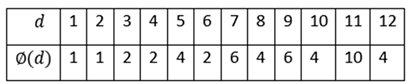
where p1, p2…are the different prime factors of d. Ø(1) = 1 is a convention. Shown above is a table for Ø(d). For example, Ø(20) = 20 x (1 – 1/2) x (1 – 1/5) = 8.
8.7. The Number of Overall Mechanisms (Circular)8.8. The Determination of the Randomness of bi-Signals from Known or Unknown Sources
These numerical analyses also allow the determination of overall possible patterns vs. a specific one in sequences such as sequential signals of dual “input“ (down arrow) and "output" ( up arrow) pairs, or + and –, 0 and 1, or long and short signal intervals. These can be compared with the specific known or unknown source of dual sequential signal pattern received (or measured), thus calculating the “randomness” of the received or measured signal sequence in terms of linear or circular (closed) forms, e.g., A(n; S, P) / B(S, P) for open pattern and M(n; S, P)/N (S, P) for closed patterns.
8.9. Derivation of Second Degree (Squared) Pascal Triangle from Biological Inputs-Outputs Duplex Patterns Transitions Combinatorial Analysis
Figure 39.
The classical Pascal triangle (Left) and the second-degree (squared) triangle (Right) obtained from the duplex (↓ and ↑) signal pattern transitions, using the enzyme’s substrate (S) inputs and product (P) output system, that involves multiple stable enzyme intermediates.
Figure 39.
The classical Pascal triangle (Left) and the second-degree (squared) triangle (Right) obtained from the duplex (↓ and ↑) signal pattern transitions, using the enzyme’s substrate (S) inputs and product (P) output system, that involves multiple stable enzyme intermediates.
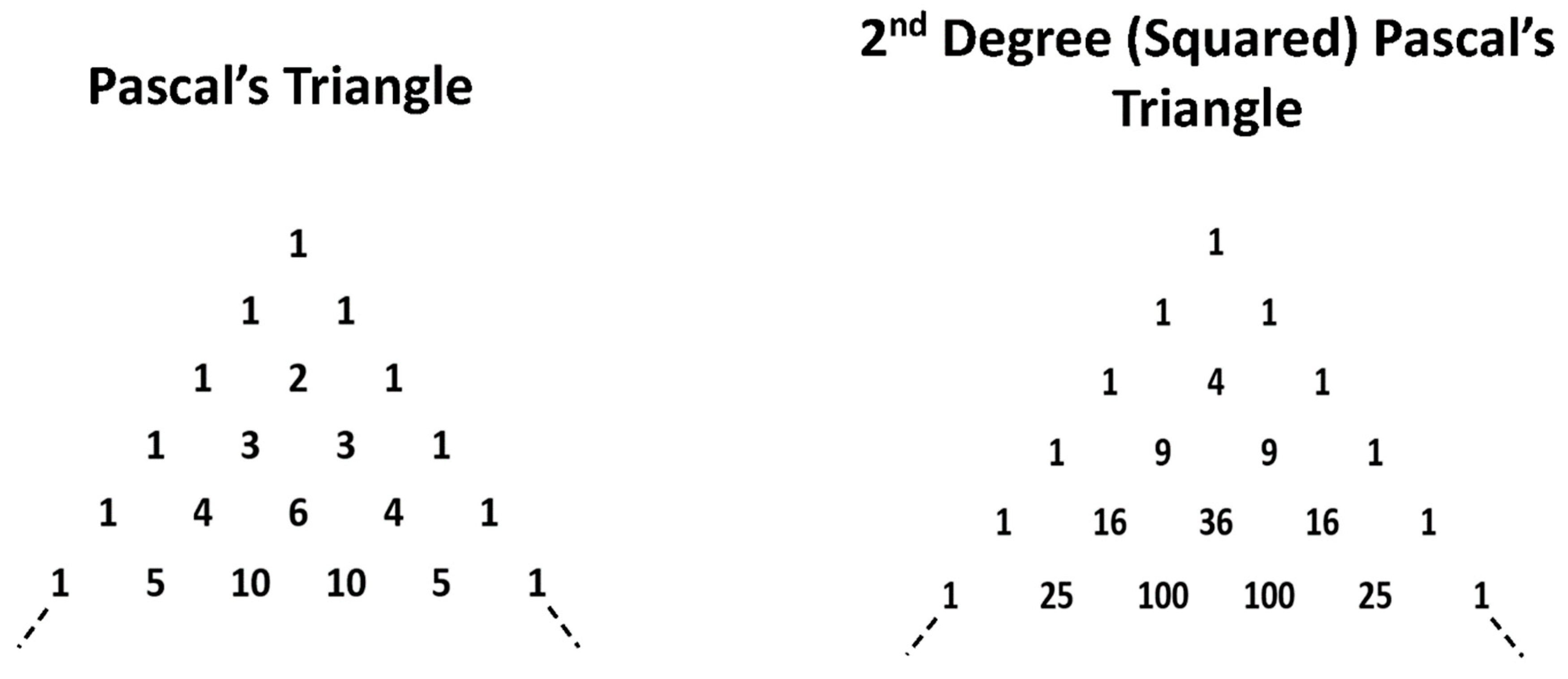
The focus here is on the squared numbers: 1, 4, 9, 16, 25, 36… in Chou’s second-degree (squared) triangle derived from the biological input-output patterns transition system in life science (Figure 39).
And their reciprocals:
The sum of the reciprocals of squared numbers (Natural real numbers) can be related to π, which is an irrational number.
Chou’s Squared Triangle related to “”, and Riemann’s zeta function
= 1.644934…
The above equation is Riemann’s zeta function when s equals 2.
The Pascal Triangle Led to Euler’s “e”:
Harlan Brothers and Richard M. Green’s analysis on Pascal’s Triangle [116] discovered that the Triangle’s rows ratio leads to Euler’s definition of e.
The Second Degree (Squared) Triangle, derived by Chou from biological input-output patterns and transitions, raised the question of further studies using this ratio’s relationship to identify underlying properties.
The method for expanding the powers of a binomial expression (a + b)ⁿ is
Statement of the binomial theorem.
Blaise Pascal in 1665 reported a formal recursive definition that forms one of the foundations of modern mathematical and algorithmic study.
Pascal’s recursive definition of the choose function.
By multiplying across each row of Pascal’s Triangle, it was formed so that the binomial coefficient formula would define the row products sₙ:
For two ratios,
and
If we divide the two equations, the factor “n!” cancels out, and we arrive at
On the right, there is the limit definition of e of Euler:
= 2.71828182845904523…
The linear first-degree classical Pascal’s triangle leads to the entity “e”. Interestingly, Chou’s Squared Triangle (2o-degree) for duplex pattern transitions leads to the entity ““.
The questions to be solved are: Would the triple system (such as amino acids triplet codes for t-RNA) yield a 3rd degree combinatorial? And would the quadruplet system (such as ATCG codes for DNA), yield a 4th degree combinatorial? Or would yield other known or unknown identities and relationships.
9. Examples of MAL Biochemical System Pattern Analysis in a Real World Case
9.1. Theoretical Enzyme Sequential Pattern Analysis, Reaction Mechanism, and the Reaction Rate Equation
9.2. Example of Theoretical Analysis on L-Asparagine Synthetase
The enzyme “L-Asparagine Synthetase" [1] has three substrates (L-glutaric acid, ATP, and L-asparagine) and four products (L-glutamine, L-aspartic acid, Pyrophosphate, and AMP), so there are three inputs and four outputs at steady-state. The ambitious goal was to determine the enzyme reaction mechanism through enzyme kinetic experiments. Following initial velocity, production inhibition, dead-end inhibition, and alternate substrate studies, the complete reaction mechanism of L-glutamine synthetase, including the reaction sequence, pattern, intermediate stable enzyme forms, and the full reaction scheme, was elucidated, and the rate equation with 14 kinetic constants was derived [1].
Table 11 presents the main experimental findings that led to the conclusions regarding the mechanistic reaction sequence and pattern scheme.
Table 11.
Experimental observations, theoretical analysis, and the elucidation of an enzyme reaction sequential pattern and mechanism [1].
Table 11.
Experimental observations, theoretical analysis, and the elucidation of an enzyme reaction sequential pattern and mechanism [1].
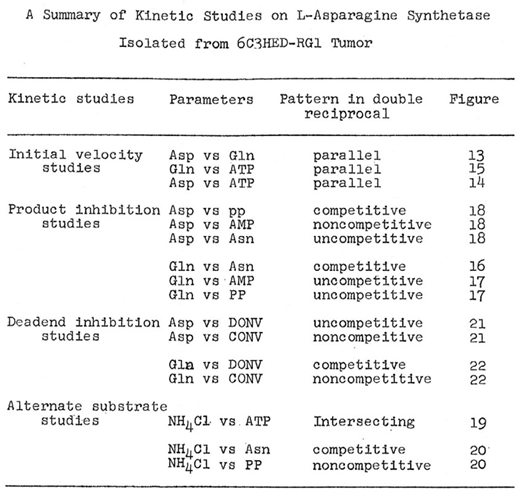 |
9.3. Mechanistic Conclusion from Enzyme Kinetics Studies
The following is the action-reaction MAL kinetics/dynamics deduced reaction scheme, including the intermediate stable enzyme forms (n ping-pong), in the bracket:
The enzyme kinetic data and conclusions from Table 10 for L-asparagine synthetase allow determining the overall reaction sequence and reaction mechanism as follows: S=3, P=4, n=3 (the sum of stable intermediate enzyme forms), which corresponds to the output-followed-by-input (ping-pong) transitions. The ping-pong notation was introduced by Cleland [61,62]. The concluded mechanism was decided from 10 possible sequence patterns. The mechanistic conclusion is shown below:
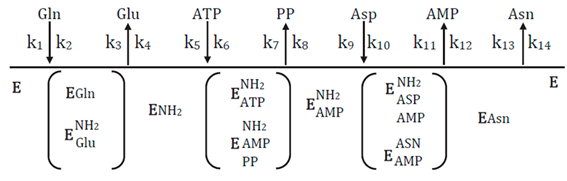
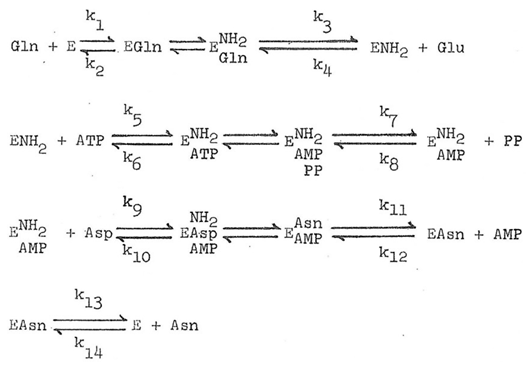
The L-asparagine biosynthesis involves functional receptor-affinity binding sites that exhibit multiple transition intermediate forms. The above L-asparagine synthetase reaction involves multiple stable complexes and transient intermediate enzyme forms, as shown in [1, at IV-21].
The following equations (g) to (i) are from Chou’s Ph. D. thesis [1]. If in each case all of the linear (sequential) patterns have the same probability of existence for a given number of substrates (S) and products (P), the probability, Pro, of having a given number of stable enzyme forms (n) is
where S, P ≥ n ≥ 1, and Σ Pro = 1.
If in each case all of the (circular) mechanism patterns have the same probability of existence for a given number of substrates (S) and products (P), the probability, Pro', of having a given number of stable enzyme forms (n) is
where S, P > n ≥ 1; the numerator and the denominator of equation (h), therefore equation (i) for 1 as the sum of the probability of all is
This approach is proposed to measure the randomness of dual signal transitions, such as {S, P}, (+, -), and (1,0), in linear sequential or circular closed form, whether from known or unknown sources.
9.4. An Open Proposition
Protein enzyme’s substrate “in-puts” and product “out-puts” duplex pattern and combinatorial system analysis has yielded the Duplex second-degree (two-dimensional) Pascal Triangle, where all elements are squared [6]. The further challenges for inputs and outputs models are: Can there be a Triplex (Cubic) Pascal Triangle for the three amino acid codes for tRNA, and a Quadruplet Pascal Triangle for ATCG nucleotide codes for DNA? Or other new revelations?
There have been many public discussions in various domains about the original Pascal Triangles over the past centuries. Explorations of the higher-degree Pascal triangles are interesting in terms of their implications, informatics, and applications.
10. MAL-MEE: A Ground Breaking Conceptual New Avenue
There has been tremendous progress in the various fields of science, especially since the 1900s. Now is the electronic era of digital sciences and AI that need a new conceptual framework of efficient general algorithm to meet the enormous challenges ahead of us.
Historically, serious misjudgments have taught us valuable lessons. The story of Hippias, sentenced to death due to the irrationality of the square root of 2 among the Pythagoreans. Nicolaus Copernicus and Galileo Galilei also showed the dark side of the then-contemporary ideology. A great physics Max Plank said “ A New Scientific Truth Does Not Triumph by Convincing Its Opponents and Making Them See the Light, But Rather Because Its Opponents Eventually Die, and a New Generation Grow Up That Is Familiar with It.“, and a great philosopher Thomas Kuhn said, “Normal Science Often Suppresses Fundamental Novelties Because They Are Necessarily Subversive of Its Basic Commitments” in his book, “The Structure of Scientific Revolution” which introduced the phrase “Paradigm Shift”, in 1962.
In R&D, the academic community, peer reviewers, and regulatory authorities, especially decision-makers in biomedical sciences, are willing to hear praise and admiration (which is a human nature) but reluctant to consider non-traditional conceptual innovation ideologies for alternative reform [11,12,13,14,15,16,17,18,19,20,21,24]. The three major articles on MAL theory and applications [8,9,10], with solo or two authors, without peer review (other than grammatical corrections or format revisions), had garnered a total of 21,207 citations [56], each in over 1,300 scientific citing journals [57]. Chou’s MAL theoretical work and applications have a total of 1,623 citing patents, indicating a significant impact on new drug discovery and R&D innovation. The observation-statistical scientific R&D approach has a long history; however, a new conceptual way of thinking is on the deck for efficiency, cost-effectiveness and digital science Econo-green reasons. The old tradition thinking bottom-up statistical approach may not be the only right way for R&D; there is quantitative unified general theory-based deterministic alternatives. The MAL median principle has been proven to be simple to use, with efficient, cost-effective, and quantitative features amendable to automated computer-simulation, which align with the mathematical and physical major historical conclusions as described in this paper.
The MAL-MEE-CIE unified theory for top-down, quantitative, digital science R&D seems to be the opposite of the traditional, observation-statistic-based bottom-up R&D. They are not mutually exclusive; in fact, they are complementary, alternative to one another, like two sides of the same coin. The main point is that the top-down R&D provides guidance for experimental design, streamlining computerized data analysis, and simulation with simple, efficient, and cost-effective features. With MAL medium, principle-based, law-based fundamental parameters (m and Dm) and indexes (CI, DRI) as the guidelines available, we can then use the bottom-up, traditional approach to achieve specific goals, detailed, mechanistic scientific research for application goals. The evolving digital data science is algorithm and efficiency oriented. The MAL-approach warrants a serious consideration as an alternative for scientific innovation and discovery in research and development. This unified general MAL-MEE R&D concept is for all intra-, inter-, and cross-disciplinary dose-effect and causal-effect dynamics and informatics that save time efforts and resources.
Keywords
- Mass-Action Law (MAL)
- Dose-Effect Curve (DEC) Linearization
- Inputs-Outputs Transition (SP,PS) or (PN,NP) Patterns Combinatorial Analysis
- Mass-Action Law Hyperbolic Activation Function (m=1)
- Mass-Action Law Sigmoidal Activation Function (m
- Median-Effect Equation (MEE)
- Median-Effect Plot (MEP)
- Combination Index Equation (CIE)
- Synergism Definition and Quantification (CI<1)
- Dose-Reduction Index Equation (DRIE)
- Unity Theory of One (UTO)
- Fractional Distribution of “1”
- “One” is Life and Non-life Common Link
- Life-Centric Universe (LCU)
- Bottom-up Observation-Statistic R&D
- Top-Down Deterministic R&D
- Transition from Life to Non-life
- Floating Ratio for Life (fa/fu)
- Golden Ration for Non-life ()
- Artificial Intelligence MAL Algorithm framework
- Inter-disciplinary Dynamics/Informatics linkage
- Cross-disciplinary Dynamics/Informatic Linkage
- Minimum Two-Dose Data Points Theory of the Mass-Action Law (MAL-MTDPT)
- Cost-effective Digital Data Science for R&D and AI (MAL-based Theory)
- How to Mathematically Attain the Unified General Theory from the Specific General Theories by General System Analysis
- Chou’s Squared Pascal Triangle derived from the Enzyme Model in Biology
- Analogy of MAL-MEE with Riemann’s Zeta Function, and with Fermi-Dirac Distribution Equation
Supports
Experimental parts: Supported by the USPHS NIH Grants CA18856, CM57732, and CA08526, by the Elsa U. Pardee Foundation, and by the Memorial Sloan-Kettering Cancer Center Institutional Core Funds (1999-2013).
Supplementary Materials
The following supporting information can be downloaded at the website of this paper posted on Preprints.org. Appendix I. Abbreviations & Definitions; Appendix II. Theory Illustrations; Appendix III. Examples of Categorized Applications.
Acknowledgments
I express my deepest gratitude to my Ph.D. thesis mentor, Professor and American Cancer Society Chair Robert E. Handschumacher of Yale University College of Medicine, and my postdoctoral mentor, Professor and John Jacob Abel Chair, Paul Talalay of The Johns Hopkins University School of Medicine, for allowing me, then as a student and junior scientist, to have a free spirit for independent exploration in the research field that is only tangential to theirs. Their generosity and kindness extended to their continued support of a series of my early theoretical works, encouraging me to be the sole author. Even long after I left Johns Hopkins for the Sloan-Kettering Institute in New York, Prof. Talalay kindly joined me for the work that led to the current combination index theorem. I also thank Professor and Eugene Higgins Chair of the Yale Mathematics Department, Lenard J. Savage, the coauthor of Inequalities for Stochastic Processes: How to Gamble If You Must. During the last 2 years of his life, Prof. Savage helped me solve some combinatorial and number theory problems that led to the 2od degree (squared) Pascal Triangle from inputs-outs patterns on enzyme reactions, and to use the Euler’s totient function (
) for circular pattern analysis; and served as an examiner in my Ph.D. thesis defense at Yale 55 years ago.
I thank Dr. George M. Furnival, Professor of Forest Biometry and Acting Director of Yale Computer Center, for the “Runs in a Ring” number theory discussions. My graduate school studies were supported in full by a Yale University Fellowship (1965–70) from the Graduate School of Arts and Sciences.
This article is dedicated to my mother, Sheng-Mei Chen, for her guidance and loving care after my father died when I was seven; to my wife, Dorothy, for her understanding, patience, and support for this multidecade-long project; and to my son, Joseph, for helping me to write the first computer software ever for the mass-action law-based dose-effect analysis and for the drug combinations when he was 13 (when Apple II personal computers became available), and for signing an agreement in 1983 with Elsevier-Biosoft, Cambridge, UK, for the software publication.
My appreciation to Mike Hayball and Nick Martin for the CalcuSyn and CompuSyn software programming, and to Eugene Chan and James Y. Zhan for maintaining and updating the ComboSyn/PD Science LLC website. I thank Dr. Jianing Fu, Mr. Charles Gallo, and Ms. Joana Gerbi for their technical assistance in preparing this paper.
References
- Chou, TC. L-Asparagine biosynthesis and its control. A dissertation submitted to Ph.D. thesis, Graduate School of Yale University U.S. Copyright, 1970. [Google Scholar]
- Chou, T.-C. Combinatorial analysis of multiple substrate—multiple product enzyme reactions. J. Theor. Biol. 1972, 35, 285–297. [Google Scholar] [CrossRef] [PubMed]
- Chou, T.-C. Relationships between inhibition Constants and Fractional Inhibition in Enzyme-Catalyzed Reactions with Different Numbers of Reactants, Different Reaction Mechanisms, and Different Types and Mechanisms of Inhibition. Mol. Pharmacol. 1974, 10, 235–247. [Google Scholar] [CrossRef] [PubMed]
- Chou, T.-C. Derivation and properties of Michaelis-Menten type and Hill type equations for reference ligands. J. Theor. Biol. 1976, 59, 253–276. [Google Scholar] [CrossRef] [PubMed]
- Chou, T.-C. On the determination of availability of ligand binding sites in steady-state systems. J. Theor. Biol. 1977, 65, 345–356. [Google Scholar] [CrossRef]
- Chou, T.C.; Talalay, P. A simple generalized equation for the analysis of multiple inhibitions of Michaelis-Menten kinetic systems. J. Biol. Chem. 1977, 252, 6438–6442. [Google Scholar] [CrossRef]
- Chou, T.-C.; Talalay, P. Generalized Equations for the Analysis of Inhibitions of Michaelis-Menten and Higher-Order Kinetic Systems with Two or More Mutually Exclusive and Nonexclusive Inhibitors. Eur. J. Biochem. 1981, 115, 207–216. [Google Scholar] [CrossRef]
- Chou, T.C.; Talalay, P. Quantitative analysis of dose-effect relationships: the combined effects of multiple drugs or enzyme inhibitors. Adv. Enzym. Regul. 1984, 22, 27–55. [Google Scholar] [CrossRef]
- Chou, T.-C. Theoretical Basis, Experimental Design, and Computerized Simulation of Synergism and Antagonism in Drug Combination Studies. Pharmacol. Rev. 2006, 58, 621–681. [Google Scholar] [CrossRef]
- Chou, T.-C. Drug combination studies and their synergy quantification using the Chou-Talalay method. Cancer Res. 2010, 70, 440–446. [Google Scholar] [CrossRef]
- Chou, T.-C. The mass-action law based algorithms for quantitative econo-green bio-research. Integr. Biol. 2011, 3, 548–559. [Google Scholar] [CrossRef]
- Chou, T.-C.; Motzer, R.J.; Tong, Y.; Bosl, G.J. Computerized Quantitation of Synergism and Antagonism of Taxol, Topotecan, and Cisplatin Against Human Teratocarcinoma Cell Growth: a Rational Approach to Clinical Protocol Design. JNCI J. Natl. Cancer Inst. 1994, 86, 1517–1524. [Google Scholar] [CrossRef]
- Chou, T.-C. Frequently asked questions in drug combinations and the mass-action law-based answers. Synergy 2014, 1, 3–21. [Google Scholar] [CrossRef]
- Fu, J.; Chou, T.-C. Abstract 4554A: Simple, efficient, and quantitative approach for determination of synergism, additive effect, and antagonism of drugs in vivo using combination index method: a proposition for clinical protocol design and regulatory synergy claims. Cancer Res. 2017, 77. [Google Scholar] [CrossRef]
- Chou, T.-C. Abstract PO-062: Why drug and radiation combination synergism or antagonism can be quantitatively determined with the mass-action law based pharmacodynamics equation, algorithm and computer simulation. Clin. Cancer Res. 2021, 27, PO-062–062. [Google Scholar] [CrossRef]
- Chou, T.-C. New Paradigm, Equations, Algorithm, and Computer software of Mass-action Law Based Biodynamics, Pharmacodynamics and Bioinformatics (MAL-BD/PD/BI) for Econo-Green Biomedical R&D and Regulatory Guidance. FASEB J. 2021, 35. [Google Scholar] [CrossRef]
- Chou, T. Functional biodynamics theory and algorithms for inhibitor or activator effectors and their interactions, by computer simulation bioinformatics for translational medicine. FASEB J. 2022, 36. [Google Scholar] [CrossRef]
- Chou, T. MAL-pharmacodynamics theory based small-size experimental-design and analysis, in vitro, in animals and in clinical trial, with bioinformatics algorithm, for automated computer simulation to achieve quantitative/digital/indexed conclusions. FASEB J. 2022, 36. [Google Scholar] [CrossRef]
- Chou, T.-C. Abstract 1195: Mass-action law dynamic theory/algorithm based top-down general bioinformatics. J. Biol. Chem. 2023, 299, S201–S201. [Google Scholar] [CrossRef]
- Chou, T.-C. MAL-based, Cost-Effective Digital Complementary Alternative to the Traditional/Classic R&D Mindset. Physiology 2024, 39. [Google Scholar] [CrossRef]
- Chou, T.-C.; Fu, J.; Chou, J.H.; Lin, S.-F.; Alassane-Kpembi, I.; Chang, T.; Wan, X.; Wong, R.J.; Fong, Y.; Ulrich-Merzenich, G.S.; et al. MAL-PD Theory/Algorithm Guided Clinical Protocol Design for Computerized Data Analysis and Digital Conclusions in Drug Evaluations for Single Drugs and Combinations. J. Pharmacol. Exp. Ther. 2024, 389. [Google Scholar] [CrossRef]
- Chou, T.-C. MAL-based dynamics theory/algorithm for inter- and cross-disciplinary informatics that provide efficient, cost-effective data science for digital R&D guidance. Physiology 2025, 40. [Google Scholar] [CrossRef]
- Synergism and Antagonism in Chemotherapy; Chou, TC, Rideout, DC, Eds.; Academic Press, Inc.: San Diego, New York, Boston, London, 1991; Available online: https://www.gbv.de/dms/bs/toc/016060059.pdfISBN 0-12-174090-0.
- Chou, TC. Mass-Action Law Dynamics Theory and Algorithm for Translational and Precision Medicine Informatics; Academic Press/Elsevier, April 2024; Available online: https://shop.elsevier.com/books/mass-action-law-dynamics-theory-and-algorithm-for-translational-and-precision-medicine-informatics/chou/978-0-443-28874-6ISBN 978-0-443-2887-6.
- Chou, TC. Chemotherapy. In Encyclopedia of Medical Devices and Instrumentation; John Wiley & Sons, 1988; Volume 2, pp. 665–669. ISBN 978-0-471-26358-6. [Google Scholar]
- Chou, TC; Rideout, D; Chou, J; Bertino, JR. Chemotherapeutic Synergism, Potentiation, and Antagonism. In Encyclopedia of Human Biology; Dulbecco, Renato, Ed.; Academic Press, 1991; pp. 371–379. ISBN 0-12-226752-4. [Google Scholar]
- Bertino, JR; Chou, TC. Chemotherapy: Synergism and Antagonism. In Encyclopedia of Cancer; Bertino, Joseph, Ed.; Academic Press, 1996; pp. 368–379. ISBN 9780120932313. [Google Scholar]
- Chou, T; Talalay, P. Applications of the median-effect principle for the assessment of low-dose risk of carcinogens and for the quantitation of synergism and antagonism of chemotherapeutic agents. In New avenues in developmental cancer chemotherapy. Bristol-Myers Symposium; Harrap, KR, Connor, TA, Eds.; Academic Press: New York, 1987; vol. 8, pp. 37–64. [Google Scholar]
- Chou, TC. The median-effect principle and the combination index for quantitation of synergism and antagonism. In Synergism and Antagonism in Chemotherapy: Academic Press, Inc. San Diego, New York, Boston, London;Chapters 1 and 2; Chou, TC, Rideout, DC, Eds.; 1991; pp. 61–102. Available online: https://www.gbv.de/dms/bs/toc/016060059.pdfISBN 0-12-174090-0.
- Chou, JH. Quantitation of Synergism and Antagonism of Two or More Drugs by Computerized Analysis. In Synergism and Antagonism in Chemotherapy: Academic Press, Inc. San Diego, New York, Boston, London;Chapter 6; Chou, TC, Rideout, DC, Eds.; 1991; pp. 61–102. Available online: https://www.gbv.de/dms/bs/toc/016060059.pdfISBN 0-12-174090-0.
- Chou, T.-C. Preclinicalversusclinical drug combination studies. Leuk. Lymphoma 2008, 49, 2059–2080. [Google Scholar] [CrossRef] [PubMed]
- Chou, T.-C.; Zhang, X.-G.; Harris, C.R.; Kuduk, S.D.; Balog, A.; Savin, K.A.; Bertino, J.R.; Danishefsky, S.J. Desoxyepothilone B is curative against human tumor xenografts that are refractory to paclitaxel. Proc. Natl. Acad. Sci. 1998, 95, 15798–15802. [Google Scholar] [CrossRef] [PubMed]
- Chou, T.-C.; O'COnnor, O.A.; Tong, W.P.; Guan, Y.; Zhang, Z.-G.; Stachel, S.J.; Lee, C.; Danishefsky, S.J. The synthesis, discovery, and development of a highly promising class of microtubule stabilization agents: Curative effects of desoxyepothilones B and F against human tumor xenografts in nude mice. Proc. Natl. Acad. Sci. 2001, 98, 8113–8118. [Google Scholar] [CrossRef]
- Zhang, N.; Fu, J.-N.; Chou, T.-C. Synergistic combination of microtubule targeting anticancer fludelone with cytoprotective panaxytriol derived from panax ginseng against MX-1 cells in vitro: experimental design and data analysis using the combination index method. 2016, 6, 97–104. [Google Scholar]
- Vogt, M.W.; Hartshorn, K.L.; A Furman, P.; Chou, T.C.; A Fyfe, J.; A Coleman, L.; Crumpacker, C.; Schooley, R.T.; Hirsch, M.S. Ribavirin Antagonizes the Effect of Azidothymidine on HIV Replication. Science 1987, 235, 1376–1379. [Google Scholar] [CrossRef]
- Baba, T.W.; Liska, V.; Hofmann-Lehmann, R.; Vlasak, J.; Xu, W.; Ayehunie, S.; Cavacini, L.A.; Posner, M.R.; Katinger, H.; Stiegler, G.; et al. Human neutralizing monoclonal antibodies of the IgG1 subtype protect against mucosal simian–human immunodeficiency virus infection. Nat. Med. 2000, 6, 200–206. [Google Scholar] [CrossRef]
- Johnson, V.A.; Merrill, D.P.; Videler, J.A.; Chou, T.-C.; Byington, R.E.; Eron, J.J.; D'Aquila, R.T.; Hirsch, M.S. Two-Drug Combinations of Zidovudine, Didanosine, and Recombinant Interferon- A Inhibit Replication of Zidovudine-Resistant Human Immunodeficiency Virus Type 1 Synergistically In Vitro. J. Infect. Dis. 1991, 164, 646–655. [Google Scholar] [CrossRef]
- Hartshorn, K.L.; Vogt, M.W.; Chou, T.C.; Blumberg, R.S.; Byington, R.; Schooley, R.T.; Hirsch, M.S. Synergistic inhibition of human immunodeficiency virus in vitro by azidothymidine and recombinant alpha A interferon. Antimicrob. Agents Chemother. 1987, 31, 168–172. [Google Scholar] [CrossRef]
- Khafif, A.; Schantz, S.P.; Chou, T.C.; Edelstein, D.; Sacks, P.G. Quantitation of chemopreventive synergism between (-)-epigallocatechin- 3-gallate and curcumin in normal, premalignant and malignant human oral epithelial cells. Carcinog. 1998, 19, 419–424. [Google Scholar] [CrossRef]
- Kong, X.-B.; Fanucchi, M.P.; Chou, T.-C. Antagonistic interactions of hexamethylene bisacetamide in combination with 1-β-d-arabinofuranosylcytosine, adriamycin and harringtonine on the growth and differentiation of HL-60 cells in vitro. Leuk. Res. 1988, 12, 853–859. [Google Scholar] [CrossRef] [PubMed]
- Gholami, S.; Chen, C.-H.; Gao, S.; Lou, E.; Fujisawa, S.; Carson, J.; Nnoli, J.E.; Chou, T.-C.; Bromberg, J.; Fong, Y. Role of MAPK in oncolytic herpes viral therapy in triple-negative breast cancer. Cancer Gene Ther. 2014, 21, 283–289. [Google Scholar] [CrossRef] [PubMed]
- Podder, H.; Stepkowski, S.M.; Napoli, K.L.; Clark, J.; Verani, R.R.; Chou, T.-C.; Kahan, B.D. Pharmacokinetic Interactions Augment Toxicities of Sirolimus/Cyclosporine Combinations. J. Am. Soc. Nephrol. 2001, 12, 1059–1071. [Google Scholar] [CrossRef] [PubMed]
- Fu, J.; Zhang, N.; Chou, J.H.; Dong, H.-J.; Lin, S.-F.; Ulrich-Merzenich, G.S.; Chou, T.-C. Drug combination in vivo using combination index method: Taxotere and T607 against colon carcinoma HCT-116 xenograft tumor in nude mice. Synergy 2016, 3, 15–30. [Google Scholar] [CrossRef]
- Lin, S.-F.; Chen, W.-Y.; Hsueh, C.; Chou, T.-C.; Wong, R.J. DNA-PKcs inhibition as a therapeutic approach for differentiated thyroid cancer. Endocrine-Related Cancer 2025, 32. [Google Scholar] [CrossRef]
- Chou, T.-C.; Shapiro, T.A.; Fu, J.; Chou, J.H.; Ulrich-Merzenich, G.S. Computerized quantification of drugs synergism in animal studies or in clinical trials using only ten data points. Synergy 2019, 9. [Google Scholar] [CrossRef]
- Chou, T.-C.; Talalay, P. Analysis of combined drug effects: a new look at a very old problem. Trends Pharmacol. Sci. 1983, 4, 450–454. [Google Scholar] [CrossRef]
- Chou, T.-C. Drug combinations: From laboratory to practice. J. Lab. Clin. Med. 1998, 132, 6–8. [Google Scholar] [CrossRef]
- Chou, TC. What is synergy? Scientist Letter to editor. 2007, 21, 15. [Google Scholar]
- Chou, T.-C. The combination index (CI <1) as the definition of synergism and of synergy claims. Synergy 2018, 7, 49–50. [Google Scholar] [CrossRef]
- Chou, J; Chou, TC; Talalay, P. Computer Simulation of Drug Effects: Quantitation of Synergism, Summation and Antagonism of Multiple Drugs. Pharmacologist (Abstract). 1983, 25, 175. [Google Scholar]
- Chou, J; Chou, TC. Dose-Effect Analysis with Microcomputers: Parameters and Graphics. Computer software for Apple II Series (3.3 DOS, 5.25” floppy disk); Elsevier-Biosoft, 1985. [Google Scholar]
- Chou, TC; Chou, JH; MAL-PD software. Dose-Effect Analysis with Microcomputers: Quantitation of ED50, ID50, Synergism, Antagonism, Low-Dose Risk, Receptor Ligand Binding and Enzyme Kinetics. In Computer Software for the IBM PC Series; Elsevier-Biosoft, 1987; Available online: https://www.worldcat.org/title/dose-effect-analysis-with-microcomputers/oclc/20772177.
- Chou, J; Chou, T. Computerized simulation of dose reduction index (DRI) in synergistic drug combinations. Pharmacologist (Abstract). 1988, 30, A231. [Google Scholar]
- Chou, TC; Hayball, MP; CalcuSyn software. CalcuSyn for Windows: Multiple-Drug Dose-Effect Analyzer and Manual; Biosoft: Cambridge, UK, 1997; Available online: http://www.biosoft.com/w/calcusyn.htm.
- CompuSyn Software; Chou, T; Martin, N. CompuSyn for drug combinations: PC software and user’s guide: a computer program for quantitation of synergism and antagonism in drug combinations, and the determination of IC50 and ED50 and LD50 values. And User’s Guide; ComboSyn: Paramus, NJ, 2005; Available online: https://www.combosyn.com.
- Chou, TC. Web of Science, Thomson Reuters Web of Science. Available online: https://www.webofscience.com/wos/author/record/1296039, https://orcid.org/0000-0002-3340-1594.
- Chou, TC. Google Scholar. Available online: https://scholar.google.com/citations?user=xjcodA8AAAAJ&hl=en.
- Chou, TC. Research Gate. Available online: https://www.researchgate.net/profile/Ting-Chao-Chou.
- Mildvan, D.; Bassiakos, Y.; Zucker, M.L.; Hyslop, N.; E Krown, S.; Sacks, H.S.; Zachary, J.; Paredes, J.; Fessel, W.J.; Rhame, F.; et al. Synergy, activity and tolerability of zidovudine and interferon-alpha in patients with symptomatic HIV-1 infection: AIDS Clincal Trial Group 068. 1996, 1, 77–88. [Google Scholar] [PubMed]
- Eron, J.J.; Benoit, S.L.; Jemsek, J.; MacArthur, R.D.; Santana, J.; Quinn, J.B.; Kuritzkes, D.R.; Fallon, M.A.; Rubin, M. Treatment with Lamivudine, Zidovudine, or Both in HIV-Positive Patients with 200 to 500 CD4+ Cells per Cubic Millimeter. New Engl. J. Med. 1995, 333, 1662–1669. [Google Scholar] [CrossRef]
- Cleland, W. The kinetics of enzyme-catalyzed reactions with two or more substrates or products. Biochim. et Biophys. Acta (BBA) - Spéc. Sect. Enzym. Subj. 1963, 67, 104–137. [Google Scholar] [CrossRef]
- Cleland, WW. Enzyme kinetics. Ann. Rev. Biochem. 1967, 36, 77–112. [Google Scholar] [CrossRef]
- Alfaro, M. Fractals in the Quantum World: A Revolutionary New Perspective on the Hofstadter Butterfly. Medium. 21 March 2025. Available online: https://medium.com/@m.alfaro.007/fractals-in-the-quantum-world-a-revolutionary-new-perspective-on-the-hofstadter-butterfly-72b6c685a791.
- Alfaro, M. The Universe Through a Single Parameter: A Revolutionary Theory of Everything. Medium. 5 March 2025. Available online: https://medium.com/@m.alfaro.007/the-universe-through-a-single-parameter-a-revolutionary-theory-of-everything-9913cb71dfb5.
- Alfaro, M. Fundamental Density Theory (FDT): Fractals, Physics, and a Unified Reality. Medium. 4 April 2025. Available online: https://medium.com/@m.alfaro.007/fundamental-density-theory-fdt-fractals-physics-and-a-unified-reality-7867e28f6c3b.
- Alfaro, M. Bridging Worlds: How Quantum and Classical Physics Emerge from a Single Geometric Reality. Medium. 6 April 2025. Available online: https://medium.com/@m.alfaro.007/bridging-worlds-how-quantum-and-classical-physics-emerge-from-a-single-geometric-reality-d7835c7e0a0c.
- Alfaro, M. Joy, Timing, and the Work: Why I Roast Papers (and Smile While Doing It). Medium. 28 September 2025. Available online: https://medium.com/@m.alfaro.007/joy-timing-and-the-work-why-i-roast-papers-and-smile-while-doing-it-5ce9f0a62500.
- Alfaro, M. Open-Sourcing the Universe’s Code: JWST’s “Faster-Than-Light” Signals — And What Refraction Teaches Us. Medium. 13 October 2025. Available online: https://medium.com/@m.alfaro.007/open-sourcing-the-universes-code-jwst-s-faster-than-light-signals-and-what-refraction-0d384bc30c0a.
- Alfaro, M. Open-Sourcing the Universe’s Code: GRB 250702B as Geometric Unwinding. Medium. 17 October 2025. Available online: https://medium.com/@m.alfaro.007/open-sourcing-the-universes-code-grb-250702b-as-geometric-unwinding-07e7dce7c587.
- Alfaro, M. Open-Sourcing the Universe’s Code: Resolving the “Locality Paradox” with Geometric Duality in FDT. Medium, 23 October 2025.
- Darlington, T. Understanding Rotations with Complex Numbers. Cantor’s Paradise. 29 October 2024. Available online: https://www.cantorsparadise.com/understanding-rotations-with-complex-numbers-782eb71e4eab.
- Gunter, D. Phase Rotations in Half-Center Geometry: Expanding the Schepis-Gunter Synthesis. Medium. 25 June 2025. Available online: https://medium.com/@rantnrave31/phase-rotations-in-half-center-geometry-expanding-the-schepis-gunter-synthesis-0603a14cab1e.
- Shmoe. The Power of “i”. Medium. 6 May 2025. Available online: https://medium.com/@trashclub4all/the-power-of-i-d92a085a5ea3.
- Johnson, DK. Deductive vs. Inductive Reasoning. Medium. 9 October 2025. Available online: https://medium.com/@kylejohnson_40581/deductive-vs-inductive-reasoning-b89ce8596726.
- Siegel, E. The big idea of Grand Unified Theories of Physics. Start with A Bang!/Medium. 25 April 2024. Available online: https://medium.com/starts-with-a-bang/the-big-idea-of-grand-unified-theories-of-physics-c109b98ca912.
- Hopfield, J.J. Neural networks and physical systems with emergent collective computational abilities. Proc. Natl. Acad. Sci. 1982, 79, 2554–2558. [Google Scholar] [CrossRef]
- Hopfield, J.J. Neurons with graded response have collective computational properties like those of two-state neurons. Proc. Natl. Acad. Sci. USA 1984, 81, 3088–3092. [Google Scholar] [CrossRef]
- Hopfield, J.J.; Tank, D.W. “Neural” computation of decisions in optimization problems. Biol. Cybern. 1985, 52, 141–152. [Google Scholar] [CrossRef]
- Markelic, I. The Sigmoid and its Derivative. Medium. 6 October 2023. Available online: https://medium.com/@irenemarkelic/the-sigmoid-and-its-derivative-40b44485ca48.
- Gunter, D. Journal 006: The Riemann Symphony — Where Everything Converges. Medium. 15 June 2025. Available online: https://medium.com/@rantnrave31/journal-006-the-riemann-symphony-where-everything-converges-34ab9a59d134.
- Schepis, S. The Two Universes. Medium. 1 September 2025. Available online: https://medium.com/@sschepis/the-two-universes-75199243e019.
- Fairbairn, B. Symmetry on the Edge: Circulant Ramsey Critical Graphs. Science Spectrum. 13 September 2025. Available online: https://medium.com/science-spectrum/symmetry-on-the-edge-circulant-ramsey-critical-graphs-c52d4772c0cc.
- Merriam, A. The Irrationality of Pythagoreans. Medium. 3 July 2024. Available online: https://medium.com/@Merrysci/the-irrationality-of-pythagoreans-5078d729e770.
- Hofmann-Lehmann, R.; Vlasak, J.; Rasmussen, R.A.; Smith, B.A.; Baba, T.W.; Liska, V.; Ferrantelli, F.; Montefiori, D.C.; McClure, H.M.; Anderson, D.C.; et al. Postnatal Passive Immunization of Neonatal Macaques with a Triple Combination of Human Monoclonal Antibodies against Oral Simian-Human Immunodeficiency Virus Challenge. J. Virol. 2001, 75, 7470–7480. [Google Scholar] [CrossRef]
- Li, A.; Katinger, H.; Posner, M.R.; Cavacini, L.; Zolla-Pazner, S.; Gorny, M.K.; Sodroski, J.; Chou, T.-C.; Baba, T.W.; Ruprecht, R.M. Synergistic Neutralization of Simian-Human Immunodeficiency Virus SHIV-vpu+by Triple and Quadruple Combinations of Human Monoclonal Antibodies and High-Titer Anti-Human Immunodeficiency Virus Type 1 Immunoglobulins. J. Virol. 1998, 72, 3235–3240. [Google Scholar] [CrossRef]
- Bauer, A.M.; Ziani, W.; Lindemuth, E.; Kuri-Cervantes, L.; Li, H.; Lee, F.-H.; Watkins, M.; Ding, W.; Xu, H.; Veazey, R.; et al. Novel Transmitted/Founder Simian-Human Immunodeficiency Viruses for Human Immunodeficiency Virus Latency and Cure Research. J. Virol. 2020, 94. [Google Scholar] [CrossRef] [PubMed]
- Chou, TC. Celebrating God and Humanity. Medium. 5 October 2025. Available online: https://medium.com/@dtchou99/celebrating-god-and-humanity-dcb1451a0d8c.
- Dantzig, T. Number, the language of science, 4th ed.; Doubleday & Company, Inc., 1954; pp. 73–75. [Google Scholar]
- Niven, I. Mathematics of choice; Random House, 1965; p. 53; 147. [Google Scholar]
- Polya, G. Mathematical discovery; John Wiley & Sons, Inc., 1967; Vol. 1 67, pp. 73–75. [Google Scholar]
- Feller, W. An introduction to probability theory and its applications. 1967, Vol. 1, 63–65. [Google Scholar] [CrossRef]
- Loreto, F. The Battle Between Mean and Median. Medium. 11 September 2024. Available online: https://medium.com/illumination/the-battle-between-mean-and-median-cf816eb5aa42.
- Niyazov, B. Properties of the Medians Proved Using the Center of Mass. Intuition. 5 April 2024. Available online: https://medium.com/intuition/properties-of-the-medians-proved-using-the-center-of-mass-f47c8431e211.
- Leung, B. How Tall Is The Middle? Puzzle Sphere. 7 August 2024. Available online: https://medium.com/puzzle-sphere/how-tall-is-the-middle-0eedd5b41488.
- Ferrie, C. Bottom-up or top-down. What exactly is the nature of reality? Medium. 27 May 2025. Available online: https://csferrie.medium.com/bottom-up-or-top-down-what-exactly-is-the-nature-of-reality-306db3963ae2.
- Lou, T. The Meaning Behind Logistic Classification, from Physics. TDS Archive. 24 January 2023. Available online: https://medium.com/data-science/the-meaning-behind-logistic-classification-from-physics-291774fda579.
- McNulty, K. The Controversial Mathematical Gift of the Logistic Function. Medium. 23 July 2025. Available online: https://medium.com/@keith-mcnulty/the-controversial-mathematical-gift-of-the-logistic-function-2723baa5476f.
- Ali. From Countable to Uncountable: The Revolutionary Ideas of the Father of Modern Mathematics, Georg Cantor. Medium. 2 May 2024. Available online: https://ali.medium.com/from-countable-to-uncountable-the-revolutionary-ideas-of-the-father-of-modern-mathematics-georg-b7e577141470.
- Alfaro, M. Open-Sourcing the Universe’s Code: The asymmetric wobble, singularity-free Univese. Medium. 24 October 2025. Available online: https://medium.com/@m.alfaro.007/open-sourcing-the-universes-code-the-asymmetric-wobble-singularity-free-univese-8d1c5d2beff3.
- Sarkisian, S. We Have Already Discovered the Universe’s Source Code (It’s Been Hiding in Plain Sight). Illumination. 24 August 2025. Available online: https://medium.com/illumination/we-have-already-discovered-the-universes-source-code-it-s-been-hiding-in-plain-sight-7fc2548e6e2d.
- Schepis, S. Earth’s Hidden Breath. Medium. 2 September 2025. Available online: https://medium.com/@sschepis/earths-hidden-breath-c0fcd7c5a054.
- Leung, B. I Solved This Ancient Green Triangle Puzzle From 1667? Can You Do The Same? Math Games. 9 November 2025. Available online: https://medium.com/math-games/i-solved-this-ancient-green-triangle-puzzle-from-1667-can-you-do-the-same-948a2609b2f8.
- Alfaro, M. Roast of the G2–Ricci Flow Paper: How to Miss the Light Cone for the Torsion. Medium. 10 November 2025. Available online: https://medium.com/@m.alfaro.007/roast-of-the-g2-ricci-flow-paper-how-to-miss-the-light-cone-for-the-torsion-fc7925fbd8a3.
- Allain, R. Physics Lab: Measure the Charge to Mass Ratio for the Electron. Medium. 8 November 2025. Available online: https://rjallain.medium.com/physics-lab-measure-the-charge-to-mass-ratio-for-the-electron-add537da3c90.
- Babbush, R.; Berry, D.W.; Kothari, R.; Somma, R.D.; Wiebe, N. Exponential Quantum Speedup in Simulating Coupled Classical Oscillators. Phys. Rev. X 2023, 13, 041041. [Google Scholar] [CrossRef]
- Alfaro, M. Open-Sourcing the Universe’s Code: Dark Matter Is a Shadow, Dark Energy Is Stored Compression. Medium. 9 November 2025. Available online: https://medium.com/@m.alfaro.007/open-sourcing-the-universes-code-dark-matter-is-a-shadow-dark-energy-is-stored-compression-39661d3fef7d.
- Alfaro, M. Open-Sourcing the Universe’s Code: Moiré Superlattices Prove It’s All Geometry. Medium. 12 November 2025. Available online: https://medium.com/@m.alfaro.007/open-sourcing-the-universes-code-moir%C3%A9-superlattices-prove-it-s-all-geometry-9c79f243b52d.
- Kowall, JP. How the Holographic Principle Unifies Gravity with Quantum Theory and Solves the Measurement Problem of Quantum Theory and the Hard Problem of Consciousness. Medium. 26 April 2025. Available online: https://medium.com/@jkowall031/how-the-holographic-principle-unifies-gravity-with-quantum-theory-and-solves-the-measurement-01fa38514b2f.
- Kowall, JP. What Is Reality I. Medium. 21 June 2025. Available online: https://medium.com/@jkowall031/what-is-reality-i-4021290ba007K.
- Müller, K. The Easy Way of Calculating Laplace Transforms. Cantor’s Paradise. 10 November 2025. Available online: https://www.cantorsparadise.com/the-easy-way-of-calculating-laplace-transforms-a8f3965a6a0c.
- Gunter, D. #7 — Half-Center Geometry: Why Reality Balances at ½. Medium. 18 November 2025. Available online: https://medium.com/@rantnrave31/7-half-center-geometry-why-reality-balances-at-%C2%BD-78337583df65.
- Kowal, JP. Pluribus versus Nonduality. Medium. 21 November 2025. Available online: https://medium.com/@jkowall031/pluribus-versus-nonduality-d6345956791f.
- Andersen, T. The mind may be incapable of understanding quantum mechanics intuitively. The Infinite Universe. 17 October 2025. Available online: https://medium.com/the-infinite-universe/the-mind-may-be-incapable-of-understanding-quantum-mechanics-intuitively-21c87bf66d85.
- Alfaro, M. Open-Sourcing the Universe’s Code: Mass Is Pure Geometry. Medium. 19 November 2025. Available online: https://medium.com/@m.alfaro.007/open-sourcing-the-universes-code-mass-is-pure-geometry-19057898ff95.
- Alfaro, M. FDT — We Are Inevitable. Medium. 19 November 2025. Available online: https://medium.com/@m.alfaro.007/fdt-we-are-inevitable-f3ec26678b2d.
- Brother, H. Pascal’s Triangle: The Secret Within. Science Spectrum. 17 November 2025. Available online: https://sciencespectrumu.com/pascals-triangle-the-secret-within-3d525d88048d.
Disclaimer/Publisher’s Note: The statements, opinions and data contained in all publications are solely those of the individual author(s) and contributor(s) and not of MDPI and/or the editor(s). MDPI and/or the editor(s) disclaim responsibility for any injury to people or property resulting from any ideas, methods, instructions or products referred to in the content. |
© 2025 by the authors. Licensee MDPI, Basel, Switzerland. This article is an open access article distributed under the terms and conditions of the Creative Commons Attribution (CC BY) license (http://creativecommons.org/licenses/by/4.0/).
Copyright: This open access article is published under a Creative Commons CC BY 4.0 license, which permit the free download, distribution, and reuse, provided that the author and preprint are cited in any reuse.