
Submitted:
22 May 2025
Posted:
23 May 2025
You are already at the latest version
Abstract
The purpose of this study is to reflect and affirm that the distribution of chemical elements in the universe provides information about the universe. In this sense, based on an uneven distribution of chemical elements in the universe, it is possible to understand that there were countless intensities of the specific physical concept that originated these uneven chemical elements, showing that an equal general possibility of intensity of the specific physical concept originating the configuration of the current universe is impossible. Therefore, given the uneven distribution of chemical elements, information about the universe can be acquired, making the understanding of the universe more comprehensible, considering that it is possible to think deeply about contradictory actions in the real world and also think about the applicable reasons, therefore, becoming aware of the countless intensities of the specific physical concept to acquire the current nature of the universe. The study in question is related to the articles: “Obligatory Necessity Theory: Elements and Facts Influenced by the Intensity of the Specific Physical Concept” and “The Equations and Their Effects”, these articles are recommended readings for understanding this article in question.
Keywords:
unequal elements
; Information of the universe
; Intensity of the specific
; physical concept
; Varied particles
; Varied molecules
I. Introduction
The study presents an understanding of the universe based on the extreme variety of chemical elements in the universe, such as the periodic table (which has a wide variety of elements), a variety of particles (tens of particles) and a variety of molecules (hundreds of molecules), which allows us to understand that the universe develops through numerous unequal intensities of the specific physical concept. In other words, if there is inequality of elements, there is also inequality of intensity of the specific physical concept. To reinforce this argument, this article must present a set of interconnected reasoning and information as different applications of the intensity of the specific physical concept that alter matter towards a variety of elements. Thus, it is necessary for the universe to have a variety of intensity of the specific physical concept to give rise to the current reality of the universe, which has a variety of elements of the periodic table, a variety of particles and a variety of molecules. It is worth mentioning that the article presented here helps in understanding the articles: “Obligatory Necessity Theory: Elements and Facts Influenced by the Intensity of the Specific Physical Concept” and “The Equations and Their Effects”.
In this article, to reinforce the argument that there were numerous intensities of the specific physical concept varied, it is necessary to observe the following information as support for the argument:
1. The periodic table: The periodic table has numerous elements present in the universe, that is, it has more than one possible case, making this possibility natural and allowing for the existence of countless intensities of the specific varied physical concept.
2. Variety of particles: There is no variety of particles in the universe, showing that there is more than one case, that is, to arrive at the current configuration of a variety of particles, countless intensities of the specific varied physical concept are necessary.
3. Variety of molecules: There is a variety of molecules in the universe, and to explain this variety, an intensity of the specific varied physical concept is necessary that provides this variety of molecules.
There is a need to present levels of particles, atoms and molecules to show that at any level from the simplest to the most complex there is information that occurred in the intensity of the specific physical concept.
This article uses observation of matter in process until its final existence, that is, the final existence (without process) is not directly observed.
III. the variety of elements in the periodic table
There is a variety of elements in the universe represented by the periodic table which has 118 elements organized according to the atomic number in increasing order from left to right. In this sense, it is possible to explore the knowledge related to the periodic table which has pockets and pockets of diverse elements and reach the conclusion that there were countless intensities of the specific varied physical concept.
Figure 1.
Periodic table, source: all matter.

At this point, a few bits of knowledge about the periodic table will be introduced, moving towards a general understanding of the fact that the periodic table aims to satisfy the understanding that the various elements that exist contain information about what the universe needed to accomplish innumerable degrees of the specific physical concept varied.
In view of this, it is initially observed about the periodic table that there are several groups that are separated by physical properties:
- Group 1 are the alkali metals (rubidium, sodium, potassium, lithium, cesium and francium): low melting points, low boiling points, low density, very reactive and good electrical conductivity.
- Group 2 are the alkaline earth metals (beryllium, radium, calcium, strontium, barium and magnesium): higher melting points than the alkali metals, higher boiling points than the alkali metals, higher densities compared to the alkali metals, lower reactivity than the alkali metals and good electrical conductivity.
- Group 13 is the boron family (gallium, aluminium, boron, indium, thallium and nihonium): low reactivity and lower conductivity than the metals.
- Group 14 is the carbon family (carbon, silicon, flerovium, tin, lead and germanium): very high melting point and high boiling point. • Group 15 is the nitrogen family (nitrogen, phosphorus, muscovy, antimony, bismuth and arsenic): low conductivity, low melting and boiling points
- Group 16 are the chalcogens (oxygen, liver, selenium, tellurium, polonium and sulfur): low melting and boiling points, a density that varies between some elements and low conductivity.
- Group 17 are the Halogens (fluorine, iodine, bromine, chlorine, astatine and tenessine): very low conductivity, melting point varies between them, boiling point depends on the element.
- Group 18 are the Noble Gases (helium, neon, argon, oganesson, xenon, radon and krypton): low melting point, low boiling point, low conductivity and low reactivity.
And transition metals are also in groups and have characteristics such as high melting point, high boiling point, high density and high conductivity:
- Group 11 (copper, silver, gold, and roentgenium).
- Group 12 (zinc, cadmium, mercury, and copperium).
- Group 3 (scandium, yttrium, lanthanide series, and actinides).
- Group 4 (titanium, zirconium, hafnium, and rutherfordium).
- Group 5 (vanadium, niobium, tantalum, and dubnium).
- Group 6 (chromium, molybdenum, tungsten, and seaborgium).
- Group 7 (manganese, technetium, rhenium, and bohrium).
- Group 8 (iron, ruthenium, osmium, and hassium).
- Group 9 (cobalt, rhodium, iridium, and meitnerium).
- Group 10 (nickel, palladium, platinum, darmstadtium).
Based on these separations into groups due to differences in physical properties, it is clear that this occurs in more than one case, and furthermore, the use of group information in the periodic table shows that differentiation occurs between the elements in general. Now, the following information will be more individual about the elements of the periodic table, with only a few individual elements being presented, since the group presentations already show the general information possible for differentiation.
- Potassium: solid at room temperature, atomic number 19, belonging to the alkali metals, low density at 0.89 g/cm³, boiling point at 759 °C and melting point at 63.5 °C.
- Calcium: solid at room temperature, atomic number 20, belonging to the alkaline earth metals, calcium density at 1.55 g/cm³, boiling point at 1,484 °C and melting point at 842 °C.
- Aluminum: solid at room temperature, atomic number 13, belonging to the boron family, aluminum density at 2.7 g/cm³, boiling point at 2,470 °C and melting point at 660.3 °C.
- Tin: solid at room temperature, atomic number 50, part of the carbon family, the density of tin is 7.287 g/cm³, the boiling point is 2,602 °C and the melting point is 231.9 °C.
- Phosphorus: solid at room temperature, atomic number 15, part of the nitrogen family, the density of phosphorus is 1.82 g/cm³, the boiling point is 280.5 °C and the melting point is 44.1 °C.
- Oxygen: gas at room temperature, atomic number 8, part of the chalcogens, the density of oxygen is 1.429 g/L, the boiling point is -183 °C and the melting point is -218.8 °C.
- Bromine: is liquid at room temperature, has atomic number 35, is part of the halogens, the density of bromine is 3.110 g/cm³, the boiling point is 58.8 °C and the melting point is -7.2 °C.
- Helium: is a gas at room temperature, has atomic number 2, is part of the noble gases, the density of helium is 0.1785 g/L, the boiling point is -268.9 °C and the melting point is -272.2 °C.
- • Mercury: is liquid at room temperature, has atomic number 80. It is part of the transition metals, the density of mercury is 13.534 g/cm³, the boiling point is 356.7 °C and the melting point is -38.83 °C.
Given the presentations of the elements in the periodic table, varied elements with their specific physical properties are evident, therefore, it is necessary to seek to understand that this variety of elements can be a motivation for the information that there were numerous intensities of the specific varied physical concept to originate the richness of elements in the periodic table.
IV. The use of the specific physical concept intensity in elements of the periodic table
In this topic, information will be presented that portrays a possible imagination equivalent to the use of the intensities of the specific physical concept in relation to the elements of the periodic table.
IF p → POTASSIUM ELEMENT
IF p = PE. IC p
IF p = (PE . IC a) + (PE . IC m) + (PE . IC c).....
IF p = influence of the intensity of the specific physical concept P
IC p = intensity of the specific physical concept p
PE = permanence
Ou
IF j → BROMINE ELEMENT
IF J = PE. IC J
IF J= ( PE. IC O) + ( PE . IC V) + ( PE . IC K) + ( PE. IC G)......
IF j = influence of the intensity of the specific physical concept J
IC J = intensity of the specific physical concept J
PE = permanence
To arrive at the configuration of dozens of elements in the periodic table, numerous influences of the intensity of the specific physical concept are necessary, that is, there are influences beyond those represented by IF p or IF j, which can reach dozens of influences of the intensity of the specific physical concept to correctly fill the entire periodic table.
V. The variety of particles
There are a variety of particles in the universe and this topic will present this variety of particles and their properties:
Figure 2.
Standard Model particles, source: wikipedia.
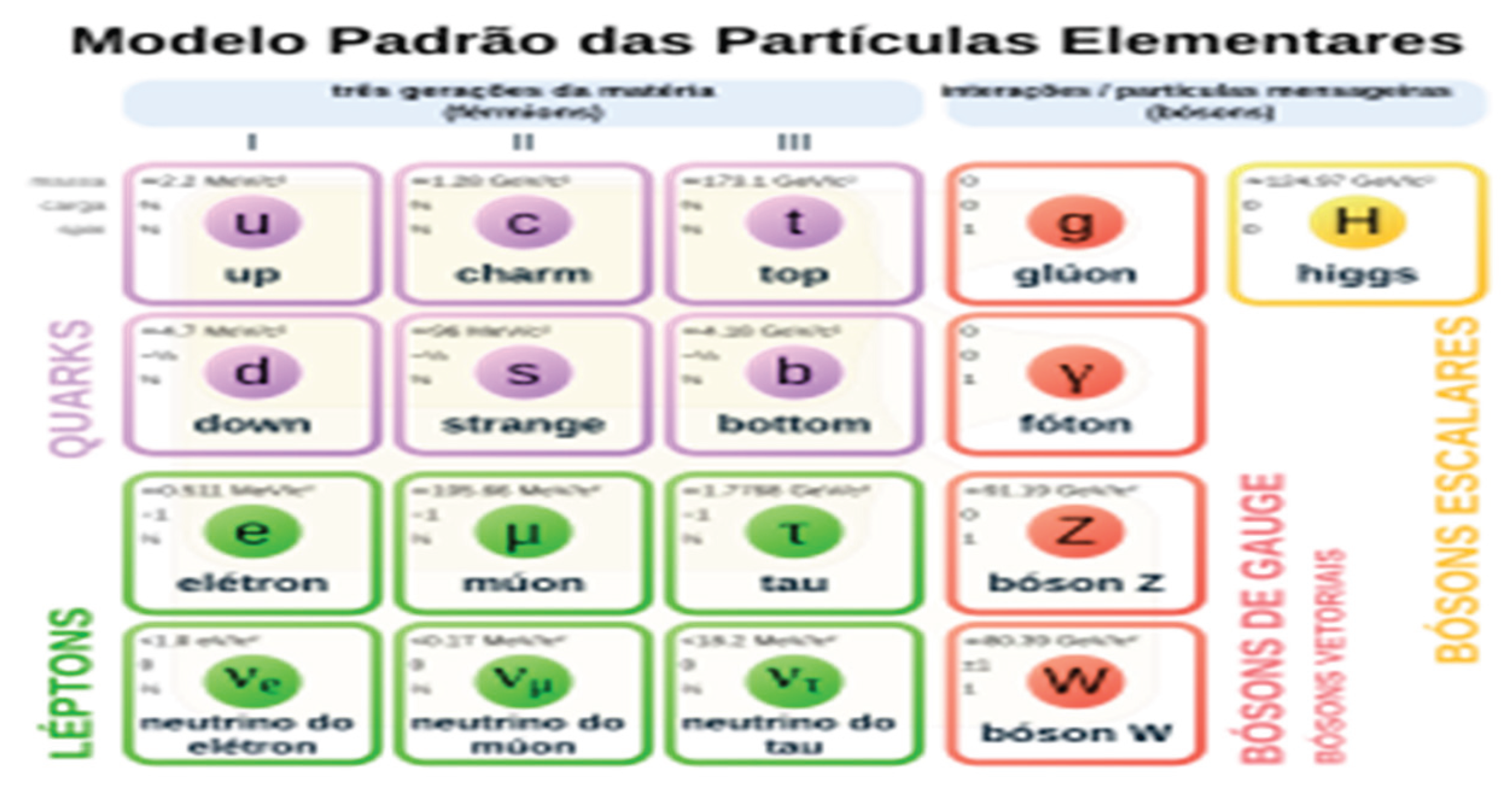
Quarks: are fundamental particles of matter, that is, they do not have a composition of new particles. There are 6 flavors of quarks that help in the composition of new particles, quarks have a fractional electric charge that is +2/3 or -1/3, quarks are united by the strong nuclear force and are not isolated in nature.
- Up (u): have an electric charge of +2/3, their mass is 2.2 MeV/c², it is the lightest of the six flavors, it is stable matter, they are present in protons and neutrons.
- Down (d): have an electric charge of -1/3, their mass is 4.7 MeV/c², it is stable matter, present in protons and neutrons.
- Charme (c) has an electric charge of +2/3, their mass is 1.28 GeV/c², it is made of unstable material and presents meson particles.
- Strange(s): Have an electric charge of -1/3, their mass is 96 MeV/c², it is unstable matter and present in mesons or bariums.
- Top (t): Have an electric charge of +2/3, their mass is 173 GeV/c², it is unstable material and deteriorates quickly.
- Bottom part (b): They have an electric charge of -1/3, their mass is 4.18 GeV/c², it is unstable matter.
Leptons: are fundamental particles of matter, that is, they do not have a composition of new particles, do not participate in the strong interaction and interact only through the electromagnetic force, weak force and gravity. There are 6 types of leptons:
- Electron (e⁻): has an electric charge of -1, an electron mass of 0.511 MeV/c², is stable, is present in atoms and participates in electromagnetic, weak and gravitational interactions.
- Muon (μ⁻): has an electric charge of -1, a muon mass of 105.7 MeV/c², is not stable in nature and participates in electromagnetic, weak and gravitational interactions.
- Tau (τ⁻): has an electric charge of -1, a tau mass of 1.777 MeV/c², is not stable in nature and participates in electromagnetic, weak and gravitational interactions.
- Electron neutrino (νₑ): has an electric charge of zero, an electron neutrino mass of almost zero, is a stable particle and participates in weak interactions and gravity.
- Muon neutrino (ν_μ): has zero electric charge, zero mass, is a stable particle in nature, important for the balance of decay processes and present in weak and gravitational force interactions.
- Tau neutrino (ν_τ): has zero electric charge, very small mass, is a stable particle in nature, present in weak and gravitational force interactions.
Bosons: are fundamental particles, bosons are responsible for mediating forces between other particles, such as the electromagnetic force by photons, the weak force by W and Z bosons and the strong force by gluons. These are the following bosons with their characteristics:
- Photon (γ): related to the electromagnetic force, a particle without rest mass, has a high speed, has no electric charge and behaves as both a wave and a particle, has spin 1.
- Gluon (g): related to the strong force that holds protons and neutrons together, has spin 1 and has no mass in reserve.
- Bosons W⁺, W⁻ and Z⁰: related to the weak force, W⁺ has an electric charge +1 and mass 80.4 GeV/c², W⁻ has an electric charge -1 and mass 80.4 GeV/c², Z⁰ has an electric charge 0 and mass 91.2 GeV/c².
- Graviton (maybe): may or may not exist, has no mass, has no electric charge, acts in the gravitational force, has spin 2 and has a high speed.
- Higgs boson (H): is responsible for the mass of particles by the Higgs field, has a mass of 125 GeV/c², has zero electric charge and has zero spin.
- Hadrons: are composite particles formed by quarks and gluons, and interact through the strong force
- Proton: is a particle composed of 2 up quarks and 1 down quark, has a positive electric charge, mass of 1.6726 × 10⁻²⁷ kg, spin ½, is stable by nature and participates in the strong force, weak force and electromagnetic force interactions.
- Neutron: is a particle composed of 1 up quark and 2 down quarks, has zero electric charge, mass of 1.6749 × 10⁻²⁷ kg, spin ½, and participates in the weak and strong force interactions.
The following are subatomic particles composed of a quark and an antiquark that are mesons:
- Pion (π⁺, π⁰, π⁻): π⁰ has zero electric charge and a fast lifetime, π⁰ has a mass of 135.0 MeV/c², π⁺ has 1 up quark plus a down antiquark and electric charge +1, with a mass of 139.6 MeV/c², π⁻ has an electric charge of -1 and a mass of 139.6 MeV/c², and π⁻ has a down quark plus an up antiquark.
- strong>∙ Kaon (K⁺, K⁻, K⁰): K⁺ is composed of an up quark plus a strange antiquark with electric charge +1, with a mass of 493.7 MeV/c², K⁻ is composed of a strange quark plus an up antiquark. with an electric charge of -1, the mass of K⁻ is 493.7 MeV/c², K⁰ is composed of down quark plus strange antiquark with zero electric charge and K⁰ has a mass of 497.6 MeV/c².
VI. The use of the specific physical concept of intensity in particles
In this topic, information will be presented that portrays a possible equivalent imagination of the use of the intensities of the specific physical concept in relation to the variety of particles.
IF g → Proton particle
IF g = PE. IC g
IF g = (PE . IC e) + (PE . IC r) + (PE . IC t).....
IF g = influence of the intensity of the specific physical concept g
IC g = intensity of the specific physical concept g
PE = permanence
Ou
IF i → particle photon
IF i = PE. IC i
IF i= ( PE. IC q) + ( PE . IC m) + ( PE . IC d) + ( PE. IC s)......
IF i = influence of the intensity of the specific physical concept i
IC i = intensity of the specific physical concept i
PE = permanence
To achieve the variety of tens of particles, numerous influences of the intensity of the specific physical concept are necessary, that is, there are influences beyond those represented by IF g or IF i, and it is possible to achieve tens of influences of intensity of the specific physical concept to develop the total of existing particles.
VII. Variety of molecules
There are a variety of molecules present in the universe and this topic will present only 4 among thousands of molecules:
- Water: its formula contains two hydrogen atoms and one oxygen atom, its molecular geometry is angular, its boiling point is 100 °C, its melting point is 0 °C, its density is 997 kg/m³, and it has numerous applications in nature.
- Carbon dioxide: its formula contains one carbon atom and two oxygen atoms, its density is 1.98 kg/m³, its molecular geometry is linear, its boiling point is -78.5 °C, its melting point is -56.6 °C, and it participates in cellular respiration and photosynthesis.
- Glucose: it contains six carbon atoms, twelve hydrogen atoms, and six oxygen atoms. It is highly soluble in water. Its ideal pH is 7. It is colorless (colorless), its melting point is 146 °C, and its density is 1.54 g/cm³.
- Methane: has a carbon atom bonded to four hydrogen atoms, molecular geometry is tetrahedral, it is a gas in nature, the melting point is -182.5, the boiling point is -161.5 °C, the density of methane is 0.717 kg/m³.
VIII. The use of the intensity of the specific physical concept in the variety of molecules
This topic will present information that portrays a possible imagination equivalent to the use of the intensities of the specific physical concept in relation to the molecular varieties existing in the universe.
IF o → water molecule
IF o = PE. IC o
IF o = (PE . IC u) + (PE . IC h) + (PE . IC v).....
IF o = influence of the intensity of the specific physical concept o
IC o = intensity of the specific physical concept o
PE = permanence
Ou
IF t → methane molecule
IF t = PE. IC t
IF t = ( PE. IC q) + ( PE . IC w) + ( PE . IC e) + ( PE. IC r)......
IF t = influence of the intensity of the specific physical concept t
IC t = intensity of the specific physical concept t
PE = permanence
Thus, to provide the current reality of countless molecules existing in the universe, many influences of the intensity of the specific physical concept are necessary, that is, there are influences beyond those represented by IF o or IF t, which can reach thousands and thousands of influences of intensity of the specific physical concept to correctly fill a wealth of variety of molecules.
IX. Conclusion
Given the information presented, there is a variety of elements in the periodic table, a variety of particles and a variety of molecules that are unevenly distributed in the universe. In this sense, it is possible to obtain information that countless intensities of the specific physical concept occurred in the universe to give rise to this wealth of variety of matter in the universe. It is worth noting that it is necessary to observe the process of matter until its final existence. In other words, it is a mistake to think of matter at the end without observing the process.
References
- CARDOSO, Carlos Eduardo Ramos. Obligatory Necessity Theory: Elements and Facts Influenced by the intensity of the specific physical concept. 2024.
- CARDOSO, Carlos Eduardo Ramos. Theory of Differences between Elements: explanation of the differences between quantum physics and the theory of general relativity. 2024.
- CARDOSO, Carlos Eduardo Ramos. As equações e seus efeitos. Em outras palavras, v. 200, n. 300, p. 500, 2025.
- TOLENTINO, Mario; ROCHA-FILHO, Romeu C.; CHAGAS, Aécio Pereira. Alguns aspectos históricos da classificação periódica dos elementos químicos. Química nova, v. 20, p. 103-117, 1997.
- MOREIRA, Marco Antonio. O modelo padrão da física de partículas. Revista Brasileira de Ensino de Física, v. 31, p. 1306.1-1306.11, 2009.
- CLARO, Paulo Ribeiro. Astroquímica. Revista de Ciência Elementar, v. 5, n. 3, 2017.
- SILVA, MARA LÚCIA RODRIGUES; MARTIN, VERA APARECIDA FERNANDES. SISTEMA SOLAR, ELEMENTOS QUÍMICOS, SUBSTÂNCIAS, TERRA E VIDA.
- RODRIGUES, Cláudia Vilega. O sistema solar. Introdução à astronomia e astrofísica. São José dos Campos: INPE, p. 1-45, 2003.
Disclaimer/Publisher’s Note: The statements, opinions and data contained in all publications are solely those of the individual author(s) and contributor(s) and not of MDPI and/or the editor(s). MDPI and/or the editor(s) disclaim responsibility for any injury to people or property resulting from any ideas, methods, instructions or products referred to in the content. |
© 2025 by the authors. Licensee MDPI, Basel, Switzerland. This article is an open access article distributed under the terms and conditions of the Creative Commons Attribution (CC BY) license (http://creativecommons.org/licenses/by/4.0/).
Copyright: This open access article is published under a Creative Commons CC BY 4.0 license, which permit the free download, distribution, and reuse, provided that the author and preprint are cited in any reuse.


