

Submitted:
30 November 2025
Posted:
09 December 2025
You are already at the latest version
Abstract
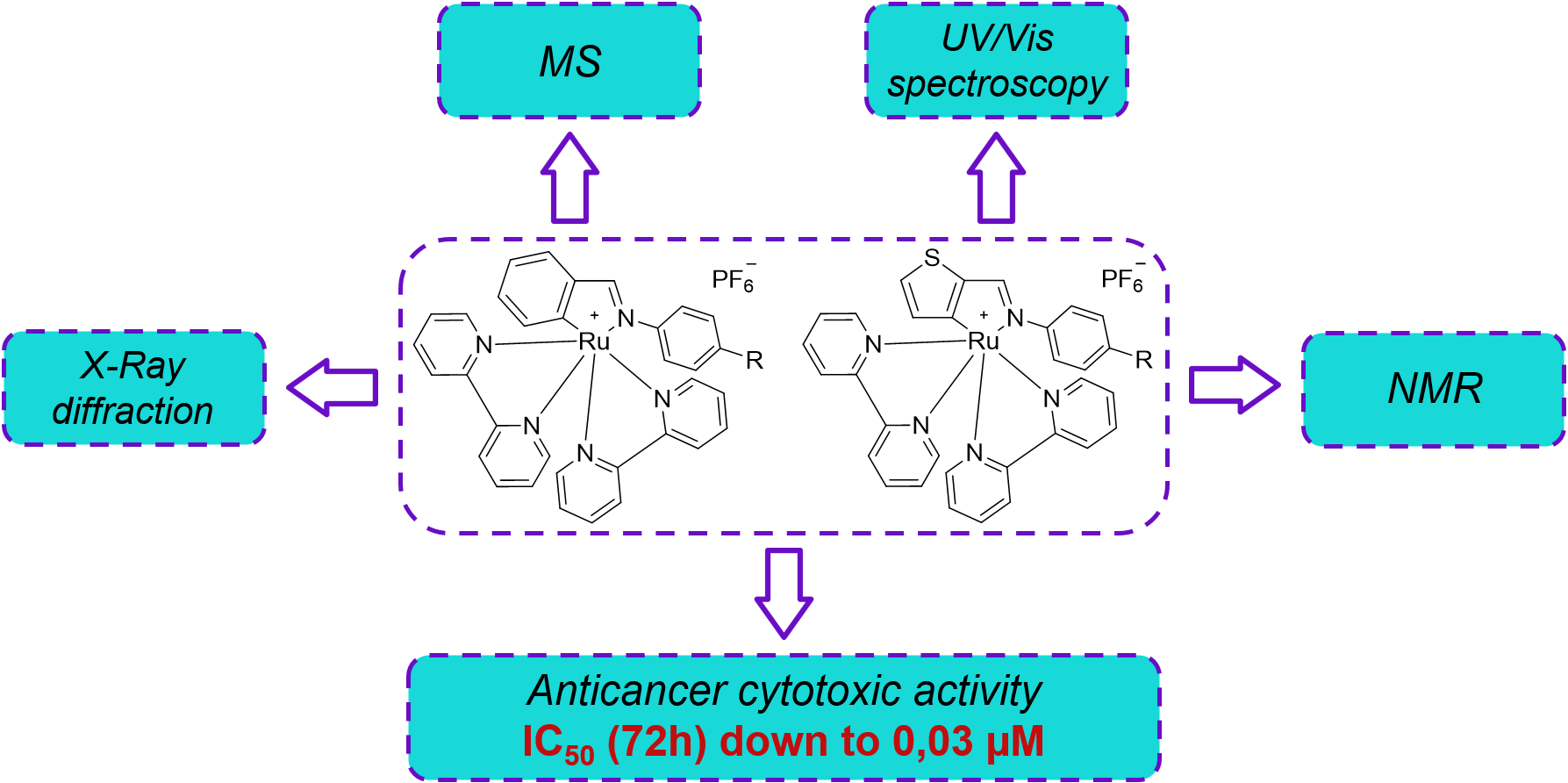
A new series of promising and easily accessible antiproliferative agents based on cy-cloruthenated imines of benzene and thiophene carbaldehydes has been developed and fully characterized using UV-Vis spectroscopy, X-ray diffraction, NMR, HRMS, and cyclic voltammetry. The biological activity of these compounds was tested against A2780, cis-platin-resistant A2780, and HEK293 cell lines, and they exhibited nanomolar IC50 values. They also showed a selectivity index of up to 2.5, indicating their potential as promising antiproliferative compounds.
Keywords:
cycloruthenated complexes
; imines
; benzene
; thiophene
; cytotoxicity
1. Introduction
Despite global efforts to treat cancer, global mortality rates and newly diagnosed cancers continue to rise steadily. Malignant tumors remain a key factor limiting life expectancy. Chemotherapy is a traditional and widely used method of cancer treatment. Some of the most popular anticancer drugs are platinum compounds: cisplatin, carboplatin, and others. They have proven their effectiveness; however, despite their advantages, they can cause serious side effects, including hepatotoxicity, neurotoxicity, ototoxicity, and others [1,2]. Therefore, the scientific community is faced with the task of creating analogues of platinum compounds devoid of the above-mentioned drawbacks. Other transition metals, such as copper, iridium, osmium, gold, and ruthenium compounds, are being actively studied as anticancer agents [3,4]. Ruthenium is the most promising in this series, since it has broad coordination capabilities, unique mechanisms of anticancer activity in living cells, and its compounds are more accessible for commercial use than iridium or platinum precursors. Several families of anticancer drugs have already been developed based on ruthenium, including wide-layered complexes such as the NAMI type [5] and the RAPTA-type [6]. Photosensitizers based on ruthenium complexes can also be used for photodynamic cancer therapy [7,8]. A large number of ruthenium cyclometallic compounds containing a metal-carbon bond have been described in the literature. They are often used as dyes for DSSCs[9], as well as catalysts for oxidation [10] and cross-coupling [11]. At the same time, the literature also contains examples of the use of cycloruthenated complexes as anticancer drugs [12,13,14,15,16,17,18,19,20,21] Several years ago, we published a paper in which we synthesized ruthenium cyclometallic compounds containing a thiophene moiety [22]. A study of their anticancer properties showed that they are an order of magnitude more cytotoxic than the model drug cisplatin [23]. The role of substituents in the thiophene ring was studied, and it was shown that halogen substituents have virtually no effect on the IC50 values. However, the effect of substituents in the aniline fragment on cytotoxicity remains unexplored. Furthermore, it was necessary to study the effect of replacing the aldehyde moiety with the benzene moiety.
2. Results and Discussion
2.1. Synthesis
All intermediate compounds and target complexes were obtained using methods similar to those described previously [23] (Scheme 1). Cycloruthenated complexes 3a-o were synthesized with moderate to good yields by a two-step procedure by cyclometallation of imines and chelation of the resulting acetonitrile complexes 2a-o. The remaining coordination sites were occupied by 2,2′-bipyridines to stabilize ruthenium in the (II) oxidation state, while aromatic ligands increase lipophilicity, facilitating transport across biological membranes. It is believed that ruthenium anticancer agents can bind to nuclear DNA via intercalation interactions; therefore, the presence of aromatic ligands enables stacking interactions between the ruthenium ring and nitrogenous base pairs.
2.2. Crystallography
From a crystallographic point of view, the obtained complexes have a similar structure (Table S1, Figures S30-S51). Thus, the lengths of the Ru-C bonds are in the range of 2.008-2.032 Å, Ru-N(aniline) - 2.062–2.123 Å, Ru-N, located opposite the Ru-C bond - 2.132–2.172 Å (Table 1). The plane of the aniline ring is inclined relative to the plane of the five-membered ring with the ruthenium atom with the dihedral angle 40.65–65.66 °. The sign of this angle is not characteristic, either for acetonitrile, or for bipyridine complexes. It is worth noting that the formation of the bipyridine complex decreases the modulus of the dihedral angle by an average of 10 ° (cf. 2a and 3a, 2b and 3b, 2e and 3e, 2f and 3f). In bipyridine complexes, one fragment is more distorted than the other. The dihedral angle between the two pyridine rings ranges from 1.85° to 10.77°. The dihedral angle of the second fragment is approximately 1°.
2.3. UV-vis Examination
UV spectra were recorded for complexes 3a–3o in acetonitrile (Figure 1) to determine their optical properties. All absorption spectra in acetonitrile exhibit two intensity bands: 250–300 nm (corresponding to the absorption bands of aromatic systems) and 450–600 nm (arising after metal coordination with 2,2′-bipyridine). This can be visually observed: during the reaction, acetonitriles are replaced by bipyridines, and the compounds change from orange to dark purple.
Stability of 3a-o was also assessed in 0.5% DMSO solution in aqueous phosphate buffer (pH 7.4, 37 °C, 100 μM NaCl, 77.4 μM Na2HPO4, 22.6 μM NaH2PO4) or saline by comparing the UV spectrum of solutions of complexes 3a-o, recorded immediately after solution preparation, and the UV spectrum of the same solution after 18 h of incubation at room temperature (Figures S52-S53). The spectra were compatible for all the complexes, indicating that they were sufficiently stable. A slight change in the intensity of signals is due to the slow degradation of ruthenium complexes with the formation of aqua- and oxo-complexes, as well as partial precipitation, which is typical for ruthenium compounds [24].
2.4. Electrochemistry
The introduction of electron-withdrawing substituents increases the E1/2ox1 value of the Ru2+/Ru3+ transition by an average of 40-60 mV (Table 2). The electron-donating methoxy group (3f and 3l) weakly reduces this potential. When comparing the nitro group in the thiophene ring [23] with the nitro group in the aniline ring, the latter shifts the oxidation potential less strongly (257 mV vs 215 mV). Overall, the oxidation potentials for the phenyl and thiophene derivatives are close to each other, except for the ethoxycarbonyl derivatives 3g and 3m, for which the potential differs by almost a factor of two.
2.5. Biological Study
The in vitro antiproliferative activity of the synthesized Ru-organometallic compounds and several starting ligands was evaluated against three human cell lines using the MTT assay. We selected a small panel of cell lines that provided insights into the efficacy and potential therapeutic utility of the compounds. The panel includes the A2780 human ovarian carcinoma cell line, which is sensitive to cisplatin, its cisplatin-resistant counterpart, A2780cis, also a non-malignant human embryonic kidney cell line, HEK293. The use of A2780 and A2780cis paired cell lines allowed us to directly assess the ability of the compounds to overcome resistance mechanisms. The inclusion of the HEK293 cell line can give us preliminary indication of selectivity against non-cancerous cells. Cisplatin, a clinically used drug, was used as a positive control in all experiments. All studies were performed in triplicate and repeated in three independent experiments. The results, expressed as the half-maximal inhibitory concentration after 72 h incubation (IC50), are summarized in Table 3.
Based on the initial analysis of the data, we can conclude that the IC50 values for all Ru compounds fall within the medium to high nanomolar range, suggesting a high level of cytotoxicity against both malignant and non-malignant cells. Moreover, the organometallic compounds appear to be several times more cytotoxic than cisplatin, approximately 10 times or more, although their selectivity for cancer cells is only moderate. The selectivity index for these compounds does not exceed 2.5, compared to 8.3 for cisplatin.
The presence of a ruthenium atom in a complex determines its biological activity. The data show that ligands such as 1b, 1f, and 1g do not exhibit any cytotoxicity, but the cytotoxicity of N-benzylideneaniline complexes (3b-i) and thiophenylimine compounds (3j-o) against A2780 is virtually identical. On the other hand, thiophenylidenimine ruthenacycles (against A2780cis) are several times more cytotoxic than N-benzylideneaniline complexes. This makes them a promising treatment for cisplatin-resistant tumors.
If we look at the structure of the ligands, we can draw the following conclusions about their activity: the electron-donating OMe group slightly increases cytotoxicity, while the acceptors NO2 and CF3 reduce cytotoxicity. At the same time, alkyl substituents (except for tBu) increase the cytotoxicity of both the benzylideneaniline and thiophenylidenimine families of complexes. This can be attributed to their increased lipophilicity.
3. Experimental Section
3.1. General Procedure for Compounds 2a-2o.
Imine 1 (0.40 mmol, 2 eq) dissolved in acetonitrile (15 ml) was added to a three-necked flask equipped with a reflux condenser with [Ru(C6H6)Cl2]2 (0.20 mmol, 1 eq), potassium hexafluorophosphate (0.80 mmol, 4 eq), potassium acetate (0.60 mmol, 3 eq) and refluxed in an argon atmosphere for 24 hours. The reaction mixture was evaporated, residue was dissolved in DCM (15 ml) and of water (10 ml), organic layer was separated, aqueous layer was washed with DCM (5 ml), organic phases were combined, dried over sodium sulfate and evaporated to dryness. Crude product was purified with column chromatography on silica gel (CHCl3:CH3CN 10:1). Crystals suitable for X-ray analysis were grown by diethyl ether vapor diffusion on acetonitrile solution of complexes.
Tetrakis(acetonitrile)[N-((phenyl-κC2)methyliden]aniline-κN]ruthenium(II) hexafluorophosphate (2a).
Orange powder. Yield 60%.
1H NMR (300 MHz, Acetonitrile-d3) δ 8.46 (s, 1H), 8.03 (d, J = 7.5 Hz, 1H), 7.64 (dd, J = 7.5, 1.1 Hz, 1H), 7.49–7.42 (m, 2H), 7.39–7.34 (m, 1H), 7.34–7.28 (m, 2H), 7.13 (td, J = 7.4, 1.5 Hz, 1H), 6.96 (td, J = 7.3, 1.2 Hz, 1H), 2.51 (s, 3H), 2.12 (s, 6H), 1.96 (s, 3H).
13C NМR (76 MHz, Acetonitrile-d3): 191.61, 176.62, 152.09, 149.52, 138.15, 129.68, 128.76, 126.63, 124.03, 122.69, 121.81, 120.57, 117.35, 65.30, 14.66, 3.41, 2.93.
HRMS-ESI: calc for [C19H19N4Ru-CH3CN]+ 405.0647, found 405.0643
Tetrakis(acetonitrile)[N-((phenyl-κC2)methyliden]-4-fluoroaniline-κN]ruthenium(II) hexafluorophosphate (2b).
Orange powder. Yield 73%.
1H NMR (300 MHz, Acetonitrile-d3) δ 8.45 (s, 1H), 8.02 (d, J = 7.5 Hz, 1H), 7.63 (d, J = 7.4 Hz, 1H), 7.35–7.28 (m, 2H), 7.22–7.10 (m, 3H), 6.96 (t, J = 7.3 Hz, 1H), 2.51 (s, 3H), 2.12 (s, 6H), 1.96 (s, 3H).
13C NМR (151 MHz, Acetonitrile-d3): 191.83, 176.98, 162.05, 160.44, 149.45, 148.55, 138.21, 129.83, 128.73, 124.55, 121.91, 120.63, 117.40, 115.22, 3.41, 2.94.
HRMS-ESI: calc for [C19H18FN14Ru-CH3CN]+ 423.0534, found 423.0568.
Tetrakis(acetonitrile)[N-((phenyl-κC2)methyliden]-4-methylaniline-κN]ruthenium(II) hexafluorophosphate (2c).
Orange powder. Yield 65%.
1H NMR (300 MHz, Acetonitrile-d3) δ 8.43 (s, 1H), 8.01 (d, J = 7.5 Hz, 1H), 7.61 (dd, J = 7.5, 1.1 Hz, 1H), 7.26 (d, J = 8.3 Hz, 2H), 7.19 (d, J = 8.4 Hz, 2H), 7.12 (td, J = 7.4, 1.5 Hz, 1H), 6.96 (td, J = 7.3, 1.1 Hz, 1H), 2.51 (s, 3H), 2.39 (s, 3H), 2.11 (s, 6H), 1.96 (s, 3H).
13C NМR (151 MHz, Acetonitrile-d3): 191.40, 176.19, 149.80, 138.14, 136.59, 129.52, 129.20, 128.53, 123.97, 122.54, 121.76, 120.57, 117.36, 20.11, 3.45, 2.96.
HRMS-ESI: calc for [C20H21N4Ru-CH3CN]+ 419.0822, found 419.0814.
Tetrakis(acetonitrile)[N-((phenyl-κC2)methyliden]-4-ethylaniline-κN]ruthenium(II) hexafluorophosphate (2d)
Orange powder. Yield 48%.
1H NMR (300 MHz, Acetonitrile-d3) δ 8.44 (s, 1H), 8.01 (d, J = 7.5 Hz, 1H), 7.63–7.58 (m, 1H), 7.29 (d, J = 8.2 Hz, 2H), 7.21 (d, J = 8.3 Hz, 2H), 7.12 (t, J = 7.3 Hz, 1H), 6.96 (t, J = 7.3 Hz, 1H), 2.70 (q, J = 7.6 Hz, 2H), 2.51 (s, 3H), 2.12 (s, 6H), 1.96 (s, 3H), 1.26 (t, J = 7.6 Hz, 3H).
13C NМR (151 MHz, Acetonitrile-d3): 191.39, 176.22, 149.97, 149.58, 143.02, 138.14, 129.54, 128.55, 128.08, 123.98, 122.63, 121.77, 120.57, 117.36, 28.10, 15.25, 3.44, 2.97.
HRMS-ESI: calc for [C21H23N4Ru-CH3CN]+ 433.1210, found 433.1215
Tetrakis(acetonitrile)[N-((phenyl-κC2)methyliden]-4-(tert-butyl)aniline-κN]ruthenium(II) hexafluorophosphate (2e).
Orange powder. Yield 56%.
1H NMR (300 MHz, Acetonitrile-d3) δ 8.45 (s, 1H), 8.01 (d, J = 7.4 Hz, 1H), 7.62 (d, J = 7.4 Hz, 1H), 7.48 (d, J = 8.5 Hz, 2H), 7.24 (d, J = 8.4 Hz, 2H), 7.12 (t, J = 7.3 Hz, 1H), 6.96 (t, J = 7.3 Hz, 1H), 2.51 (s, 3H), 2.12 (s, 6H), 1.96 (s, 3H), 1.37 (s, 9H).
13C NМR (151 MHz, Acetonitrile-d3): 191.43, 176.25, 149.73, 138.15, 129.57, 128.57, 125.58, 124.00, 122.31, 121.79, 120.59, 117.38, 34.30, 30.68, 3.43, 2.96.
HRMS-ESI: calc for [C23H27N4Ru-CH3CN]+ 315.6547, found 315.6548.
Tetrakis(acetonitrile)[N-((phenyl-κC2)methyliden]-4-methoxyaniline-κN]ruthenium(II) hexafluorophosphate (2f).
Orange powder. Yield 40%.
1H NMR (300 MHz, Acetonitrile-d3) δ 8.42 (s, 1H), 8.01 (d, J = 7.5 Hz, 1H), 7.61 (d, J = 7.4 Hz, 1H), 7.26 (d, J = 8.8 Hz, 2H), 7.11 (t, J = 7.3 Hz, 1H), 7.00–6.92 (m, 3H), 3.84 (s, 3H), 2.51 (s, 3H), 2.11 (s, 6H), 1.96 (s, 3H).
13C NМR (151 MHz, Acetonitrile-d3): 191.19, 175.85, 158.52, 149.61, 145.56, 138.10, 129.41, 128.45, 123.79, 121.74, 120.57, 117.36, 113.75, 55.28, 2.99.
HRMS-ESI: calc for [C19H18N4ORu]+ 419.0812, found 419.0814.
Tetrakis(acetonitrile)[N-((phenyl-κC2)methyliden]-4-ethoxycarbonylaniline-κN]ruthenium(II) hexafluorophosphate (2g).
Orange powder. Yield 50%.
1H NMR (300 MHz, Acetonitrile-d3) δ 8.50 (s, 1H), 8.10–8.02 (m, 3H), 7.67 (d, J = 7.3 Hz, 1H), 7.38 (d, J = 8.4 Hz, 2H), 7.14 (t, J = 7.4 Hz, 1H), 6.98 (t, J = 7.3 Hz, 1H), 4.37 (q, J = 7.1 Hz, 2H), 2.52 (s, 3H), 2.12 (s, 6H), 1.96 (s, 3H), 1.38 (t, J = 7.1 Hz, 3H).
13C NМR (151 MHz, Acetonitrile-d3): 192.72, 177.59, 165.84, 155.89, 149.44, 138.28, 130.31, 130.03, 128.98, 124.23, 123.06, 122.02, 120.71, 117.38, 61.00, 13.68, 3.45, 2.96.
HRMS-ESI: calc for [C22H23N4O2Ru-CH3CN]+ 477.0853, found 477.0859.
Tetrakis(acetonitrile)[N-((phenyl-κC2)methyliden]-4-nitroaniline-κN]ruthenium(II) hexafluorophosphate (2h).
Orange powder. Yield 45%.
1H NMR (300 MHz, Acetonitrile-d3) δ 8.54 (s, 1H), 8.33–8.27 (m, 2H),
8.06 (d, J = 7.5 Hz, 1H), 7.71 (dd, J = 7.5, 1.1 Hz, 1H), 7.51–7.46 (m, 2H), 7.16 (td, J = 7.3, 1.4 Hz, 1H), 6.99 (td, J = 7.4, 1.1 Hz, 1H), 2.52 (s, 3H), 2.13 (s, 6H), 1.96 (s, 3H).13C NМR (151 MHz, Acetonitrile-d3): 193.64, 178.56, 157.44, 149.33, 146.21, 138.35, 130. 82, 129.27, 124.44, 123.99, 122.18, 120.82, 117.37, 3.46, 2.99.
HRMS-ESI: calc for [C19H18N5O2Ru-CH3CN]+ 435.0765, found 435.0766.
Tetrakis(acetonitrile)[N-((phenyl-κC2)methyliden]-4-(trifluoromethyl)aniline-κN]ruthenium(II) hexafluorophosphate (2i).
Orange powder. Yield 42%.
1H NMR (300 MHz, Acetonitrile-d3) δ 8.51 (s, 1H), 8.04 (d, J = 7.5 Hz, 1H), 7.77 (d, J = 8.4 Hz, 2H), 7.68 (d, J = 7.5 Hz, 1H), 7.46 (d, J = 8.3 Hz, 2H), 7.15 (t, J = 7.4 Hz, 1H), 6.98 (t, J = 7.4 Hz, 1H), 2.52 (s, 3H), 2.12 (s, 6H), 1.96 (s, 3H).
13C NМR (151 MHz, Acetonitrile-d3): 192.73, 177.99, 155.22, 149.38, 138.29, 130.39, 129.05, 126.01, 124.27, 123.64, 122.06, 120.74, 117.37, 3.46, 2.99.
HRMS-ESI: calc for [C20H18F3N4Ru-CH3CN]+ 473.0528, 473.0524.
Tetrakis(acetonitrile)[N-((thiophene-2-yl-κC2)methyliden]-4-fluoroaniline-κN]ruthenium(II) hexafluorophosphate (2j).
Orange powder. Yield 59%.
1H NMR (300 MHz, Acetonitrile-d3) δ 8.38 (s, 1H), 7.82 (d, J = 4.6 Hz, 1H), 7.63 (d, J = 4.1 Hz, 1H), 7.34–7.27 (m, 2H), 7.20–7.13 (m, 2H), 2.51 (s, 3H), 2.12 (s, 6H), 1.96 (s, 3H).
13C NMR (76 MHz, Acetonitrile-d3) δ 202.67, 168.15, 163.47, 160.26, 149.81, 149.78, 138.48, 137.04, 134.08, 125.66, 125.55, 125.23, 123.44, 116.33, 116.04, 31.61, 30.35, 4.32, 3.89, 1.77.
HRMS-ESI: calc for [C19H19BrN5RuS-CH3CN]+ 470.0387, found 470.0397
Tetrakis(acetonitrile)[N-((thiophene-2-yl-κC2)methyliden]-4-methylaniline-κN]ruthenium(II) hexafluorophosphate (2k).
Orange powder. Yield 48%.
1H NMR (300 MHz, Acetonitrile-d3) δ 8.38 (s, 1H), 7.80 (d, J = 4.6 Hz, 1H), 7.62 (d, J = 4.6 Hz, 1H), 7.25–7.16 (m, 4H), 2.51 (s, 3H), 2.38 (s, 3H), 2.12 (s, 6H), 1.96 (s, 3H).
13C NMR (75 MHz, Acetonitrile-d3) δ 201.70, 167.47, 151.03, 138.48, 136.98, 136.91, 133.58, 130.16, 125.11, 123.73, 123.29, 21.05, 4.34, 3.91, 1.77.
HRMS-ESI: calc for [C19H19BrN5RuS-CH3CN]+ 425.0372, found 425.0362.
Tetrakis(acetonitrile)[N-((thiophene-2-yl-κC2)methyliden]-4-methoxyaniline-κN]ruthenium(II) hexafluorophosphate (2l).
Orange powder. Yield 43%.
1H NMR (300 MHz, Acetonitrile-d3) δ 8.39 (s, 1H), 7.82 (d, J = 4.6 Hz, 1H), 7.64 (d, J = 4.6 Hz, 1H), 7.30–7.23 (m, 2H), 7.02–6.96 (m, 2H), 3.86 (s, 3H), 2.54 (s, 3H), 2.14 (s, 6H), 1.99 (s, 3H).
13C NMR (76 MHz, Acetonitrile-d3) δ 201.18, 167.17, 159.05, 146.78, 138.41, 136.93, 133.36, 132.27, 129.73, 125.06, 124.87, 123.27, 114.69, 56.19, 4.34, 3.92.
HRMS-ESI: calc for [C19H19BrN5RuS-CH3CN]+ 482.0587, found 482.0595.
Tetrakis(acetonitrile)[N-((thiophene-2-yl-κC2)methyliden]-4-ethoxycarbonylaniline-κN]ruthenium(II) hexafluorophosphate (2m).
Orange powder. Yield 32%.
1H NMR (300 MHz, Acetonitrile-d3) δ 8.45 (s, 1H), 8.05 (d, J = 8.5 Hz, 2H), 7.88 (d, J = 4.7 Hz, 1H), 7.66 (d, J = 4.7 Hz, 1H), 7.39 (d, J = 8.4 Hz, 2H), 4.36 (q, J = 7.1 Hz, 2H), 2.52 (s, 3H), 2.12 (s, 6H), 1.96 (s, 3H), 1.38 (t, J = 7.1 Hz, 3H).
13C NMR (76 MHz, Acetonitrile-d3) δ 204.97, 168.66, 166.87, 157.31, 138.94, 137.13, 135.02, 130.96, 129.02, 125.33, 124.17, 123.56, 61.85, 14.63, 4.37, 3.92.
HRMS-ESI: calc for [C19H19BrN5RuS-CH3CN]+ 524.0694, found 524.0695.
Tetrakis(acetonitrile)[N-((thiophene-2-yl-κC2)methyliden]-4-nitroaniline-κN]ruthenium(II) hexafluorophosphate (2n).
Orange powder. Yield 42%.
1H NMR (300 MHz, Acetonitrile-d3) δ 8.50 (s, 1H), 8.27 (d, J = 9.0 Hz, 2H), 7.92 (d, J = 4.7 Hz, 1H), 7.68 (d, J = 4.7 Hz, 1H), 7.49 (d, J = 9.0 Hz, 2H), 2.52 (s, 3H), 2.12 (s, 6H), 1.96 (s, 3H).
13C NMR (76 MHz, Acetonitrile-d3) δ 207.50, 169.44, 159.04, 146.53, 139.30, 137.28, 136.07, 125.48, 125.39, 124.97, 123.77, 31.59, 30.34, 4.37, 3.94, 1.77.
HRMS-ESI: calc for [C19H19BrN5RuS-CH3CN]+ 497.0332, found 497.0344.
Tetrakis(acetonitrile)[N-((thiophene-2-yl-κC2)methyliden]-4-(trifluoromethyl)aniline-κN]ruthenium(II) hexafluorophosphate (2o).
Orange powder. Yield 46%.
1H NMR (300 MHz, Acetonitrile-d3) δ 8.46 (s, 1H), 7.88 (d, J = 4.6 Hz, 1H), 7.74 (d, J = 8.3 Hz, 2H), 7.66 (d, J = 4.6 Hz, 1H), 7.46 (d, J = 8.2 Hz, 2H), 2.52 (s, 3H), 2.12 (s, 6H), 1.96 (s, 3H).
13C NMR (76 MHz, Acetonitrile-d3) δ 205.10, 169.01, 156.59, 138.89, 137.13, 135.13, 128.29, 127.86, 126.88 (q, J = 3.8 Hz), 125.36, 124.75, 123.60, 4.38, 3.94.
HRMS-ESI: calc for [C19H19BrN5RuS-CH3CN]+ 520.0356, found 520.0367.
3.1. General Procedure for Compounds 3a-3o.
Complex 2 (0.30 mmol, 1 eq) and 2,2’-bipyridine (0.60 mmol, 2 eq) were introduced into a flask equipped with a reflux condenser, ethanol (18 ml) was added, and the mixture was refluxed in an argon atmosphere for 4 hours. The reaction mixture was evaporated and purified with column chromatography on silica gel (CHCl3:CH3CN 10:1). The product was dissolved in minimal volume of CH3CN and added dropwise to large excess of diethyl ether under vigorous stirring. The precipitate was filtered, washed with diethyl ether and dried in vacuo for 3 h. Crystals suitable for X-ray analysis were grown by diethyl ether vapor diffusion on acetonitrile solution of complexes.
Bis(2,2՛-bipiridine)[N-((phenyl-κC2)methyliden]aniline-κN]ruthenium(II) hexafluorophosphate (3a).
Dark purple powder. Yield 75%.
1H NMR (300 MHz, Acetonitrile-d3) δ 8.73 (s, 1H), 8.63 (d, J = 5.7 Hz, 1H), 8.33 (d, J = 8.2 Hz, 2H), 8.13 (d, J = 8.2 Hz, 1H), 8.00 (dd, J = 12.8, 6.9 Hz, 2H), 7.84 (p, J = 7.7 Hz, 3H), 7.78–7.64 (m, 4H), 7.40 (t, J = 6.6 Hz, 1H), 7.31 (t, J = 6.6 Hz, 1H), 7.19 (t, J = 6.5 Hz, 2H), 7.02–6.81 (m, 5H), 6.53 (dd, J = 12.5, 7.3 Hz, 3H).
13C NМR (151 MHz, Acetonitrile-d3): 201.76, 176.18, 158.78, 158.01, 157.64, 155.56, 155.43, 153.29, 151.82, 151.24, 150.07, 149.36, 136.77, 136.36, 136.09, 135.10, 134.81, 131.82, 130.09, 129.47, 127.43, 127.39, 127.35, 127.16, 127.05, 124.02, 123.67, 123.21, 122.64, 121.63.
CHN calc. for С33H26N5RuPF6*0.2C4H10O: C: 53.29; H: 3.53; N: 9.31. Obs. C: 53.29; H: 3.52; N: 9.39.
Bis(2,2՛-bipiridine)[N-((phenyl-κC2)methyliden]-4-fluoroaniline-κN]ruthenium(II) hexafluorophosphate (3b).
Dark purple powder. Yield 77%.
1H NMR (300 MHz, Acetonitrile-d3) δ 8.72 (s, 1H), 8.59 (d, J = 5.7 Hz, 1H), 8.34 (d, J = 8.1 Hz, 2H), 8.15 (d, J = 8.1 Hz, 1H), 8.05 (d, J = 8.2 Hz, 1H), 7.96 (d, J = 5.6 Hz, 1H), 7.84 (p, J = 7.2 Hz, 3H), 7.78–7.70 (m, 3H), 7.66 (d, J = 5.3 Hz, 1H), 7.39 (t, J = 6.6 Hz, 1H), 7.31 (t, J = 6.7 Hz, 1H), 7.20 (q, J = 6.2 Hz, 2H), 6.87 (p, J = 7.4 Hz, 2H), 6.66 (t, J = 8.7 Hz, 2H), 6.58–6.47 (m, 3H).
13C NМR (151 MHz, Acetonitrile-d3): 200.85, 175.57, 161.43, 159.82, 157.77, 157.04, 156.67, 154.49, 152.32, 150.34, 149.15, 148.33, 147.22, 135.94, 135.21, 134.22, 133.92, 130.96, 129.22, 126.58, 123.49, 122.37, 120.73, 117.38, 115.10.
CHN calc. for C33H25N5RuPF7: C: 52.39; H: 3.33; N: 9.26. Obs. C: 52.23; H: 3.21; N: 9.09.
Bis(2,2՛-bipiridine)[N-((phenyl-κC2)methyliden]-4-methylaniline-κN]ruthenium(II) hexafluorophosphate (3c).
Dark purple powder. Yield 82%.
1H NMR (300 MHz, Acetonitrile-d3) δ 8.70 (s, 1H), 8.61 (d, J = 5.7 Hz, 1H), 8.33 (d, J = 8.2 Hz, 2H), 8.14 (d, J = 8.1 Hz, 1H), 8.04 (d, J = 8.1 Hz, 1H), 7.96 (d, J = 5.6 Hz, 1H), 7.88–7.78 (m, 3H), 7.76–7.68 (m, 3H), 7.66 (d, J = 5.3 Hz, 1H), 7.39 (t, J = 6.7 Hz, 1H), 7.30 (t, J = 6.7 Hz, 1H), 7.22–7.16 (m, 2H), 6.91–6.80 (m, 2H), 6.73 (d, J = 8.0 Hz, 2H), 6.52 (d, J = 7.1 Hz, 1H), 6.41 (d, J = 8.0 Hz, 2H), 2.12 (s, 3H).
13C NМR (76 MHz, Acetonitrile-d3): 200.41, 174.77, 157.82, 157.03, 156.67, 154.60, 154.43, 152.31, 150.23, 149.08, 148.62, 148.44, 136.06, 135.78, 135.38, 135.05, 134.08, 133.79, 130.62, 128.91, 126.40, 126.17, 123.02, 122.70, 122.29, 121.47, 120.68, 117.36, 19.80.
CHN calc. for C34H28N5RuPF6: C: 54.26; H: 3.75; N: 9.30. Obs. C: 54.07; H: 3.70; N: 9.34.
Bis(2,2՛-bipiridine)[N-((phenyl-κC2)methyliden]-4-ethylaniline-κN]ruthenium(II) hexafluorophosphate (3d).
Dark purple powder. Yield 85%.
1H NMR (300 MHz, Acetonitrile-d3) δ 8.71 (s, 1H), 8.62 (d, J = 5.5 Hz, 1H), 8.33 (d, J = 8.3 Hz, 2H), 8.12 (d, J = 8.1 Hz, 1H), 8.02–7.95 (m, 2H), 7.89–7.78 (m, 3H), 7.76–7.63 (m, 4H), 7.39 (ddd, J = 7.3, 5.7, 1.4 Hz, 1H), 7.30 (ddd, J = 7.3, 5.7, 1.4 Hz, 1H), 7.19 (ddd, J = 7.5, 6.0, 1.1 Hz, 2H), 6.89 (td, J = 7.3, 1.5 Hz, 1H), 6.83 (td, J = 7.2, 1.7 Hz, 1H), 6.76–6.71 (m, 2H), 6.56–6.51 (m, 1H), 6.41–6.36 (m, 2H), 2.42 (q, J = 7.6 Hz, 2H), 1.05 (t, J = 7.6 Hz, 3H).
13C NМR (76 MHz, Acetonitrile-d3): 200.43, 174.66, 157.85, 157.04, 156.66, 154.40, 152.33, 150.29, 149.07, 148.48, 142.53, 135.77, 135.33, 135.05, 134.04, 133.76, 130.61, 129.01, 127.76, 126.40, 126.15, 123.03, 122.63, 122.22, 121.52, 120.64, 117.35, 27.80, 15.28.
CHN calc. for C35H30N5RuPF6: C: 54.66; H: 3.94; N: 9.31. Obs. C: 54.87; H: 3.93; N :9.13.
Bis(2,2՛-bipiridine)[N-((phenyl-κC2)methyliden]-4-(tert-butyl)aniline-κN]ruthenium(II) hexafluorophosphate (3e).
Dark purple powder. Yield 78%.
1H NMR (300 MHz, Acetonitrile-d3) δ 8.71 (s, 1H), 8.64 (d, J = 5.8 Hz, 1H), 8.34 (d, J = 8.1 Hz, 2H), 8.09 (d, J = 8.1 Hz, 1H), 7.98 (d, J = 5.7 Hz, 1H), 7.94 (d, J = 8.1 Hz, 1H), 7.89–7.77 (m, 4H), 7.73 (d, J = 7.3 Hz, 1H), 7.67 (t, J = 7.8 Hz, 1H), 7.62 (d, J = 5.3 Hz, 1H), 7.39 (t, J = 6.6 Hz, 1H), 7.30 (t, J = 6.6 Hz, 1H), 7.19 (q, J = 6.0 Hz, 2H), 6.92–6.81 (m, 4H), 6.55 (d, J = 7.2 Hz, 1H), 6.33 (d, J = 8.0 Hz, 2H), 1.15 (s, 9H).
13C NМR (76 MHz, Acetonitrile-d3): 205.61, 179.79, 163.22, 162.35, 161.97, 159.96, 159.68, 157.66, 155.67, 154.44, 154.39, 153.81, 153.10, 141.05, 140.62, 140.38, 139.31, 139.03, 135.87, 134.34, 131.42, 130.49, 128.36, 127.86, 127.48, 126.43, 125.94, 122.66, 39.21, 35.77.
CHN calc. for C37H34N5PF6Ru: C: 55.92; H: 3.84; N: 8.73. Obs. C: 55.90; H: 4.24; N :9.10.
Bis(2,2՛-bipiridine)[N-((phenyl-κC2)methyliden]-4-methoxyaniline-κN]ruthenium(II) hexafluorophosphate (3f).
Dark purple powder. Yield 84%.
1H NMR (300 MHz, Acetonitrile-d3) δ 8.69 (s, 1H), 8.60 (d, J = 5.0 Hz, 1H), 8.33 (d, J = 8.2 Hz, 2H), 8.14 (d, J = 8.1 Hz, 1H), 8.05 (d, J = 8.2 Hz, 1H), 7.98–7.94 (m, 1H), 7.88–7.78 (m, 3H), 7.76–7.70 (m, 3H), 7.68–7.65 (m, 1H), 7.39 (ddd, J = 7.3, 5.7, 1.4 Hz, 1H), 7.30 (ddd, J = 7.4, 5.7, 1.4 Hz, 1H), 7.23–7.16 (m, 2H), 6.88 (td, J = 7.2, 1.5 Hz, 1H), 6.82 (td, J = 7.2, 1.7 Hz, 1H), 6.55–6.50 (m, 1H), 6.45 (s, 4H), 3.62 (s, 3H).
13C NМR (151 MHz, Acetonitrile-d3): 200.28, 174.42, 157.92, 157.83, 157.07, 156.71, 154.68, 154.42, 152.33, 150.31, 149.09, 148.46, 144.23, 135.82, 135.32, 135.04, 134.08, 133.78, 130.53, 128.94, 126.45, 126.19, 123.06, 122.71, 120.66, 117.37, 113.52, 55.12.
CHN calc. for C34H28N5ORuPF6: C: 53.13; H: 3.67; N: 9.11. Obs. C: 52.87; H: 3.76; N: 9.17.
Bis(2,2՛-bipiridine)[N-((phenyl-κC2)methyliden]-4-ethoxycarbonylaniline-κN]ruthenium(II) hexafluorophosphate (3g).
Dark purple powder. Yield 75%.
1H NMR (300 MHz, Acetonitrile-d3) δ 8.78 (s, 1H), 8.60 (dd, J = 5.7, 0.7 Hz, 1H), 8.34 (dq, J = 8.2, 1.2 Hz, 2H), 8.14 (d, J = 8.0 Hz, 1H), 8.02 (d, J = 8.2 Hz, 1H), 7.97–7.94 (m, 1H), 7.90–7.78 (m, 4H), 7.73–7.65 (m, 3H), 7.57–7.52 (m, 2H), 7.40 (ddd, J = 7.3, 5.7, 1.4 Hz, 1H), 7.32 (ddd, J = 7.3, 5.7, 1.4 Hz, 1H), 7.24–7.17 (m, 2H), 6.91 (td, J = 7.3, 1.5 Hz, 1H), 6.86 (td, J = 7.3, 1.7 Hz, 1H), 6.63–6.56 (m, 3H), 4.25 (q, J = 7.1 Hz, 2H), 1.30 (t, J = 7.1 Hz, 3H).
13C NМR (76 MHz, Acetonitrile-d3): 201.83, 176.20, 165.42, 157.69, 157.00, 156.65, 154.68, 154.52, 152.36, 150.30, 149.12, 148.29, 135.94, 135.50, 135.29, 134.32, 134.01, 131.44, 129.69, 129.41, 128.07, 126.62, 126.25, 123.10, 122.82, 122.38, 122.02, 120.77, 117.35, 60.92, 13.54.
CHN calc. for C36H30N5O2RuPF6*0.16CHCl3: C: 52.13; H:3.88; N: 8.71. Obs. C: 52.40; H:3.84; N: 8.73.
Bis(2,2՛-bipiridine)[N-((phenyl-κC2)methyliden]-4-nitroaniline-κN]ruthenium(II) hexafluorophosphate (3h).
Dark purple powder. Yield 79%.
1H NMR (300 MHz, Acetonitrile-d3) δ 8.85–8.78 (m, 1H), 8.60–8.53 (m, 1H), 8.38–8.31 (m, 2H), 8.15–8.09 (m, 1H), 8.04–7.98 (m, 1H), 7.93 (t, J = 5.6 Hz, 1H), 7.90–7.79 (m, 4H), 7.77–7.64 (m, 5H), 7.43–7.36 (m, 1H), 7.33 (t, J = 6.6 Hz, 1H), 7.27–7.17 (m, 2H), 6.96–6.83 (m, 2H), 6.72–6.64 (m, 2H), 6.63–6.57 (m, 1H).
13C NМR (151 MHz, Acetonitrile-d3): 202.80, 177.17, 157.64, 157.02, 156.67, 156.18, 154.60, 154.42, 152.42, 150.40, 149.12, 148.25, 145.46, 136.15, 135.60, 135.46, 134.51, 134.19, 131.98, 129.73, 126.87, 126.72, 126.50, 126.31, 124.05, 123.20, 123.16, 122.95, 122.60, 120.87, 117.35.
CHN calc. for C33H25N6O2PF6Ru*0.44CHCl3*0.34C4H10O: C: 48.51; H: 3.38; N: 9.75. Obs. C: 48.51; H: 3.21; N :9.75.
Bis(2,2՛-bipiridine)[N-((phenyl-κC2)methyliden]-4-(trifluoromethyl)aniline-κN]ruthenium(II) hexafluorophosphate (3i).
Dark purple powder. Yield 82%.
1H NMR (300 MHz, Acetonitrile-d3) δ 8.78 (s, 1H), 8.59 (d, J = 5.7 Hz, 1H), 8.34 (d, J = 8.1 Hz, 2H), 8.13 (d, J = 8.1 Hz, 1H), 8.02–7.95 (m, 2H), 7.91–7.78 (m, 4H), 7.74–7.63 (m, 3H), 7.40 (t, J = 6.7 Hz, 1H), 7.33 (t, J = 6.7 Hz, 1H), 7.25–7.17 (m, 4H), 6.89 (q, J = 6.6 Hz, 2H), 6.64 (d, J = 8.0 Hz, 2H), 6.59 (d, J = 6.9 Hz, 1H).
13C NМR (76 MHz, Acetonitrile-d3): 201.70, 176.46, 157.69, 157.00, 156.63, 154.57, 152.34, 150.34, 149.16, 148.27, 135.92, 135.52, 135.34, 135.27, 134.34, 134.04, 131.46, 129.48, 126.64, 126.42, 126.24, 125.65, 123.11, 122.82, 122.53, 122.33, 120.80, 117.34.
CHN calc. for C34H25N5RuPF9*0.16CH3CN: C: 50.47; H: 3.15; N: 8.85. Obs. C: 50.47; H: 3.15; N: 8.84.
Bis(2,2՛-bipiridine)[N-((thiophene-2-yl-κC2)methyliden]-4-fluoroaniline-κN]ruthenium(II) hexafluorophosphate (3j).
Dark purple powder. Yield 82%.
1H NMR (300 MHz, Acetonitrile-d3) δ 8.64 (s, 1H), 8.51 (d, J = 4.9 Hz, 1H), 8.32 (d, J = 8.1 Hz, 2H), 8.14 (d, J = 8.0 Hz, 1H), 8.07 (d, J = 8.2 Hz, 1H), 7.91–7.71 (m, 6H), 7.68 (d, J = 4.7 Hz, 1H), 7.61 (d, J = 4.7 Hz, 1H), 7.41 (ddd, 1H), 7.31 (ddd, 1H), 7.26–7.16 (m, 2H), 6.68–6.58 (m, 2H), 6.51–6.43 (m, 3H).
13C NMR (76 MHz, Acetonitrile-d3) δ 212.13, 166.43, 162.82, 159.60, 158.52, 158.39, 157.85, 155.74, 155.42, 153.95, 151.77, 150.03, 148.60, 148.56, 138.59, 136.93, 136.22, 135.82, 135.46, 135.18, 134.74, 127.58, 127.50, 127.31, 127.16, 124.61, 124.50, 124.03, 123.85, 123.69, 123.38, 116.06, 115.76.
CHN calc. for C31H23F7N5OPRuS: C: 48.82; H: 3.04; N: 9.18 Obs. C: 48.83; H: 3.04; N: 9.18.
Bis(2,2՛-bipiridine)[N-((thiophene-2-yl-κC2)methyliden]-4-methylaniline-κN]ruthenium(II) hexafluorophosphate (3k).
Dark purple powder. Yield 80%.
1H NMR (300 MHz, Acetonitrile-d3) δ 8.63 (s, 1H), 8.53 (d, J = 5.7 Hz, 1H), 8.31 (d, J = 8.1 Hz, 2H), 8.14 (d, J = 8.0 Hz, 1H), 8.06 (d, J = 8.1 Hz, 1H), 7.90–7.69 (m, 6H), 7.67–7.63 (m, 1H), 7.61 (d, J = 5.4 Hz, 1H), 7.44–7.36 (m, 1H), 7.33–7.26 (m, 1H), 7.19 (q, 2H), 6.71 (d, J = 8.1 Hz, 2H), 6.45 (d, J = 4.6 Hz, 1H), 6.39 (d, J = 8.3 Hz, 2H), 2.11 (s, 3H).
13C NMR (76 MHz, Acetonitrile-d3) δ 211.31, 165.81, 158.60, 158.40, 157.88, 155.77, 155.43, 153.94, 151.67, 149.99, 138.53, 136.81, 136.32, 136.08, 135.36, 135.33, 135.08, 134.70, 129.90, 127.44, 127.37, 127.28, 127.16, 123.99, 123.80, 123.65, 123.34, 122.66, 20.75.
CHN calc. for C32H26F6N5PRuS: C: 50.66; H: 3.45; N: 9.23 Obs. C: 50.48; H: 3.48; N: 9.20.
Bis(2,2՛-bipiridine)[N-((thiophene-2-yl-κC2)methyliden]-4-methoxyaniline-κN]ruthenium(II) hexafluorophosphate (3l).
Dark purple powder. Yield 77%.
1H NMR (300 MHz, Acetonitrile-d3) δ 8.61 (s, 1H), 8.53 (d, J = 4.9 Hz, 1H), 8.31 (d, J = 8.1 Hz, 2H), 8.14 (d, J = 8.1 Hz, 1H), 8.06 (d, J = 8.2 Hz, 1H), 7.90–7.70 (m, 6H), 7.64 (d, J = 4.6 Hz, 1H), 7.61 (d, J = 4.6 Hz, 1H), 7.40 (ddd, J = 7.3, 5.7, 1.4 Hz, 1H), 7.30 (ddd, J = 7.3, 5.7, 1.4 Hz, 1H), 7.25–7.15 (m, 2H), 6.45 (d, J = 4.6 Hz, 1H), 6.42 (br.s, 3H), 3.61 (s, 3H).
13C NMR (76 MHz, Acetonitrile-d3) δ 210.71, 165.46, 158.59, 158.44, 158.41, 157.88, 155.82, 155.39, 153.93, 151.72, 149.99, 145.56, 138.48, 136.82, 136.06, 135.32, 135.10, 135.04, 134.66, 127.45, 127.37, 127.27, 127.13, 123.99, 123.81, 123.61, 123.32, 114.48, 56.03, 15.64.
CHN calc. for C32H26F6N5OPRuS: C: 49.61; H: 3.38; N: 9.04 Obs. C: 49.60; H: 3.39; N: 9.08.
Bis(2,2՛-bipiridine)[N-((thiophene-2-yl-κC2)methyliden]-4-ethoxycarbonylaniline-κN]ruthenium(II) hexafluorophosphate (3m).
Dark purple powder. Yield 77%.
1H NMR (300 MHz, Acetonitrile-d3) δ 8.72 (s, 1H), 8.50 (d, J = 4.9 Hz, 1H), 8.33 (d, J = 8.4 Hz, 2H), 8.13 (d, J = 8.1 Hz, 1H), 8.05 (d, J = 8.2 Hz, 1H), 7.92–7.70 (m, 7H), 7.63 (d, J = 4.7 Hz, 1H), 7.55–7.49 (m, 2H), 7.42 (ddd, J = 7.3, 5.7, 1.4 Hz, 1H), 7.32 (ddd, J = 7.3, 5.7, 1.4 Hz, 1H), 7.25 (ddd, J = 7.5, 5.4, 1.2 Hz, 1H), 7.19 (ddd, J = 7.3, 5.7, 1.4 Hz, 1H), 6.63–6.56 (m, 2H), 6.49 (d, J = 4.6 Hz, 1H), 4.24 (q, J = 7.1 Hz, 2H), 1.29 (t, J = 7.1 Hz, 3H).
13C NMR (76 MHz, Acetonitrile-d3) δ 166.89, 166.51, 158.46, 158.41, 157.89, 156.34, 155.61, 155.45, 154.08, 151.80, 150.05, 137.02, 136.80, 136.35, 135.63, 135.37, 134.88, 130.66, 128.29, 127.70, 127.53, 127.36, 127.25, 124.07, 123.90, 123.76, 123.46, 123.19, 61.80, 14.52.
CHN calc. for C34H28F6N5O2PRuS: C: 50.00; H: 3.46; N: 8.57 Obs. C: 50.03; H: 3.48; N: 8.56.
Bis(2,2՛-bipiridine)[N-((thiophene-2-yl-κC2)methyliden]-4-nitroaniline-κN]ruthenium(II) hexafluorophosphate (3n).
Dark purple powder. Yield 65%.
1H NMR (300 MHz, Acetonitrile-d3) δ 8.78 (s, 1H), 8.48 (d, J = 5.6 Hz, 1H), 8.34 (d, J = 7.6 Hz, 2H), 8.12 (d, J = 8.0 Hz, 1H), 8.05 (d, J = 8.2 Hz, 1H), 7.95–7.71 (m, 9H), 7.64 (d, J = 5.3 Hz, 1H), 7.43 (t, J = 6.6 Hz, 1H), 7.35–7.26 (m, 2H), 7.20 (t, J = 6.7 Hz, 1H), 6.68 (d, J = 9.0 Hz, 2H), 6.52 (d, J = 4.7 Hz, 1H).
13C NMR (76 MHz, Acetonitrile-d3) δ 217.12, 167.65, 158.41, 158.36, 158.11, 157.88, 155.48, 155.42, 154.14, 151.90, 149.98, 145.73, 139.52, 137.86, 137.24, 136.52, 135.82, 135.56, 135.02, 127.96, 127.64, 127.43, 127.30, 125.02, 124.13, 124.00, 123.95, 123.86, 123.67.
CHN calc. for C31H23F6N6O2PRuS: C: 47.15; H: 2.94; N: 10.64 Obs. C: 46.99; H: 2.96; N: 10.61.
Bis(2,2՛-bipiridine)[N-((thiophene-2-yl-κC2)methyliden]-4-(trifluoromethyl)aniline-κN]ruthenium(II) hexafluorophosphate (3o).
Dark purple powder. Yield 96%.
1H NMR (300 MHz, Acetonitrile-d3) δ 8.73 (s, 1H), 8.51 (d, J = 4.9 Hz, 1H), 8.33 (d, J = 7.2 Hz, 2H), 8.13 (d, J = 8.1 Hz, 1H), 8.04 (d, J = 8.2 Hz, 1H), 7.93–7.70 (m, 7H), 7.62 (d, J = 4.8 Hz, 1H), 7.42 (ddd, J = 7.4, 5.7, 1.4 Hz, 1H), 7.32 (ddd, J = 7.3, 5.7, 1.4 Hz, 1H), 7.27–7.17 (m, 4H), 6.63 (d, J = 8.0 Hz, 2H), 6.51 (d, J = 4.7 Hz, 1H).
13C NMR (76 MHz, Acetonitrile-d3) δ 214.53, 167.20, 158.45, 158.41, 157.87, 155.63, 155.49, 155.38, 154.06, 151.82, 150.06, 139.05, 137.01, 136.87, 136.40, 135.65, 135.38, 134.87, 127.73, 127.59, 127.37, 127.23, 126.64, 126.59, 126.54, 126.48, 124.09, 123.92, 123.76, 123.71, 123.41.
CHN calc. for C32H23F9N5PRuS: C: 47.30; H: 2.85; N: 8.62 Obs. C: 47.28; H: 2.79; N: 8.63.
4. Conclusions
Two bisheteroleptic ruthenium(II) compounds containing different types of the simplest cyclometallated imines of 2-thiophenecarboxaldehyde and benzaldehyde were synthesized and characterized by NMR, MS, elemental analysis and UV-vis spectroscopy and cyclic voltammetry. The structure of 22 complexes described was proved by means of single crystal X-ray data. Cytotoxic activity was measured on two cancer and one non-cancerous cell line, and the proportion of cell death was measured using the MTT assay. The cytotoxicity of all ruthenium complexes is significantly higher than that of cisplatin, but they have less selectivity.
Supplementary Materials
The following supporting information can be downloaded at: Preprints.org, Experimental details: pp. S2-S4; NMR spectra: pp. S5-S34; Crystallography: pp S35-S52; Stability in PBS: pp S53-S54.
Author Contributions
Conceptualization Vasil’ev A.A., Medved’ko A.V.; investigation, Vasil’ev A.A., Troshin A.I., Shangin P.G., Voroshilkina K.M., Shutkov I.A., Medved’ko A.V.; writing—original draft preparation, Vasil’ev A.A., Troshin A.I.; writing—Nazarov A.A., Medved’ko A.V.; funding acquisition, Medved’ko A.V. All authors have read and agreed to the published version of the manuscript.
Funding
This research was funded by Russian Science Foundation, grant number 24-23-00066.
Institutional Review Board Statement
Not applicable.
Data Availability Statement
Data is contained within the article or supplementary material.
Acknowledgments
Crystal structure determination was performed in the Department of Structural Studies of Zelinsky Institute of Organic Chemistry, Moscow. The authors acknowledge support from the M.V. Lomonosov Moscow State University Program of Development («Feyond-A400» microplate reader (Allsheng, China)) and automated pipetting system «EzMate» (Blue-Ray Biotech , Taiwan).
Conflicts of Interest
The authors declare no conflicts of interest
References
- Oun, R.; Moussa, Y.E.; Wheate, N.J. The Side Effects of Platinum-Based Chemotherapy Drugs: A Review for Chemists. Dalt. Trans. 2018, 47, 6645–6653. [Google Scholar] [CrossRef]
- Barabas, K.; Milner, R.; Lurie, D.; Adin, C. Cisplatin: A Review of Toxicities and Therapeutic Applications. Vet. Comp. Oncol. 2008, 6, 1–18. [Google Scholar] [CrossRef] [PubMed]
- Deo, K.; Pages, B.; Ang, D.; Gordon, C.; Aldrich-Wright, J. Transition Metal Intercalators as Anticancer Agents—Recent Advances. Int. J. Mol. Sci. 2016, 17, 1818. [Google Scholar] [CrossRef]
- Adhikari, S.; Nath, P.; Das, A.; Datta, A.; Baildya, N.; Duttaroy, A.K.; Pathak, S. A Review on Metal Complexes and Its Anti-Cancer Activities: Recent Updates from in Vivo Studies. Biomed. Pharmacother. 2024, 171, 116211. [Google Scholar] [CrossRef]
- Alessio, E.; Messori, L. NAMI-A and KP1019/1339, Two Iconic Ruthenium Anticancer Drug Candidates Face-to-Face: A Case Story in Medicinal Inorganic Chemistry. Molecules 2019, 24, 1995. [Google Scholar] [CrossRef]
- Weiss, A.; Berndsen, R.H.; Dubois, M.; Müller, C.; Schibli, R.; Griffioen, A.W.; Dyson, P.J.; Nowak-Sliwinska, P. In Vivo Anti-Tumor Activity of the Organometallic Ruthenium( Ii )-Arene Complex [Ru(η 6 - p -Cymene)Cl 2 (Pta)] (RAPTA-C) in Human Ovarian and Colorectal Carcinomas. Chem. Sci. 2014, 5, 4742–4748. [Google Scholar] [CrossRef]
- McKenzie, L.K.; Bryant, H.E.; Weinstein, J.A. Transition Metal Complexes as Photosensitisers in One- and Two-Photon Photodynamic Therapy. Coord. Chem. Rev. 2019, 379, 2–29. [Google Scholar] [CrossRef]
- Shi, G.; Monro, S.; Hennigar, R.; Colpitts, J.; Fong, J.; Kasimova, K.; Yin, H.; DeCoste, R.; Spencer, C.; Chamberlain, L.; et al. Ru(II) Dyads Derived from α-Oligothiophenes: A New Class of Potent and Versatile Photosensitizers for PDT. Coord. Chem. Rev. 2015, 282–283, 127–138. [Google Scholar] [CrossRef]
- Green, M.A.; Emery, K.; Hishikawa, Y.; Warta, W.; Dunlop, E.D. Solar Cell Efficiency Tables (Version 46). Prog. Photovoltaics Res. Appl. 2015, 23, 805–812. [Google Scholar] [CrossRef]
- Chang, X.; Chuan, L.W.; Yongxin, L.; Pullarkat, S.A. One-Pot β-Alkylation of Secondary Alcohols with Primary Alcohols Catalyzed by Ruthenacycles. Tetrahedron Lett. 2012, 53, 1450–1455. [Google Scholar] [CrossRef]
- Findlay, M.T.; Domingo-Legarda, P.; McArthur, G.; Yen, A.; Larrosa, I. Catalysis with Cycloruthenated Complexes. Chem. Sci. 2022, 13, 3335–3362. [Google Scholar] [CrossRef]
- Lin, K.; Zhao, Z.Z.; Bo, H. Ben; Hao, X.J.; Wang, J.Q. Applications of Ruthenium Complex in Tumor Diagnosis and Therapy. Front. Pharmacol. 2018, 9, 1–10. [Google Scholar] [CrossRef]
- Parveen, S. Recent Advances in Anticancer Ruthenium Schiff Base Complexes. Appl. Organomet. Chem. 2020, 34, 1–23. [Google Scholar] [CrossRef]
- Gaiddon, C.; Pfeffer, M. The Fate of Cycloruthenated Compounds: From C–H Activation to Innovative Anticancer Therapy. Eur. J. Inorg. Chem. 2017, 2017, 1639–1654. [Google Scholar] [CrossRef]
- Li, J.; Zeng, L.; Wang, Z.; Chen, H.; Fang, S.; Wang, J.; Cai, C.Y.; Xing, E.; Liao, X.; Li, Z.W.; et al. Cycloruthenated Self-Assembly with Metabolic Inhibition to Efficiently Overcome Multidrug Resistance in Cancers. Adv. Mater. 2022, 34. [Google Scholar] [CrossRef] [PubMed]
- Sui, L.Z.; Yang, W.W.; Yao, C.J.; Xie, H.Y.; Zhong, Y.W. Charge Delocalization of 1,4-Benzenedicyclometalated Ruthenium: A Comparison between Tris-Bidentate and Bis-Tridentate Complexes. Inorg. Chem. 2012, 51, 1590–1598. [Google Scholar] [CrossRef]
- Cuesta, L.; Maluenda, I.; Soler, T.; Navarro, R.; Urriolabeitia, E.P. Novel Thiophene-Based Cycloruthenated Compounds: Synthesis, Characterization, and Reactivity. Inorg. Chem. 2011, 50, 37–45. [Google Scholar] [CrossRef] [PubMed]
- Gaiddon, C.; Jeannequin, P.; Bischoff, P.; Pfeffer, M.; Sirlin, C.; Loeffler, J.P. Ruthenium (II)-Derived Organometallic Compounds Induce Cytostatic and Cytotoxic Effects on Mammalian Cancer Cell Lines through P53-Dependent and P53-Independent Mechanisms. J. Pharmacol. Exp. Ther. 2005, 315, 1403–1411. [Google Scholar] [CrossRef]
- Matsui, T.; Sugiyama, H.; Nakai, M.; Nakabayashi, Y. DNA Interaction and Cytotoxicity of Cyclometalated Ruthenium(II) Complexes as Potential Anticancer Drugs. Chem. Pharm. Bull. (Tokyo). 2016, 64, 282–286. [Google Scholar] [CrossRef]
- Peña, B.; David, A.; Pavani, C.; Baptista, M.S.; Pellois, J.P.; Turro, C.; Dunbar, K.R. Cytotoxicity Studies of Cyclometallated Ruthenium(II) Compounds: New Applications for Ruthenium Dyes. Organometallics 2014, 33, 1100–1103. [Google Scholar] [CrossRef]
- Riegel, G.; Orvain, C.; Recberlik, S.; Spaety, M.-E.; Poschet, G.; Venkatasamy, A.; Yamamoto, M.; Nomura, S.; Tsukamoto, T.; Masson, M.; et al. The Unfolded Protein Response-Glutathione Metabolism Axis: A Novel Target of a Cycloruthenated Complexes Bypassing Tumor Resistance Mechanisms. Cancer Lett. 2024, 585, 216671. [Google Scholar] [CrossRef] [PubMed]
- Medved’ko, A.V.; Ivanov, V.K.; Kiskin, M.A.; Sadovnikov, A.A.; Apostolova, E.S.; Grinberg, V.A.; Emets, V.V.; Chizhov, A.O.; Nikitin, O.M.; Magdesieva, T.V.; et al. The Design and Synthesis of Thiophene-Based Ruthenium(II) Complexes as Promising Sensitizers for Dye-Sensitized Solar Cells. Dye. Pigment. 2017, 140, 169–178. [Google Scholar] [CrossRef]
- Medved’ko, A. V.; Vasil’ev, A.A.; Kiskin, M.A.; Syroeshkin, M.A.; Balycheva, V.A.; Melnichuk, N.A.; Nazarov, A.A.; Vatsadze, S.Z. Cycloruthenated Thiophene-Imines: Novel Anticancer Agents. J. Organomet. Chem. 2025, 1038, 123726. [Google Scholar] [CrossRef]
- Su, X.; Zeng, R.; Li, X.; Dang, W.; Yao, K.; Tang, D. Cycloruthenated Complexes: PH-Dependent Reversible Cyclometallation and Reactions with Nitrite at Octahedral Ruthenium Centers. Dalt. Trans. 2016, 45, 7450–7459. [Google Scholar] [CrossRef] [PubMed]
Scheme 1.
Preparation of ruthenium complexes.
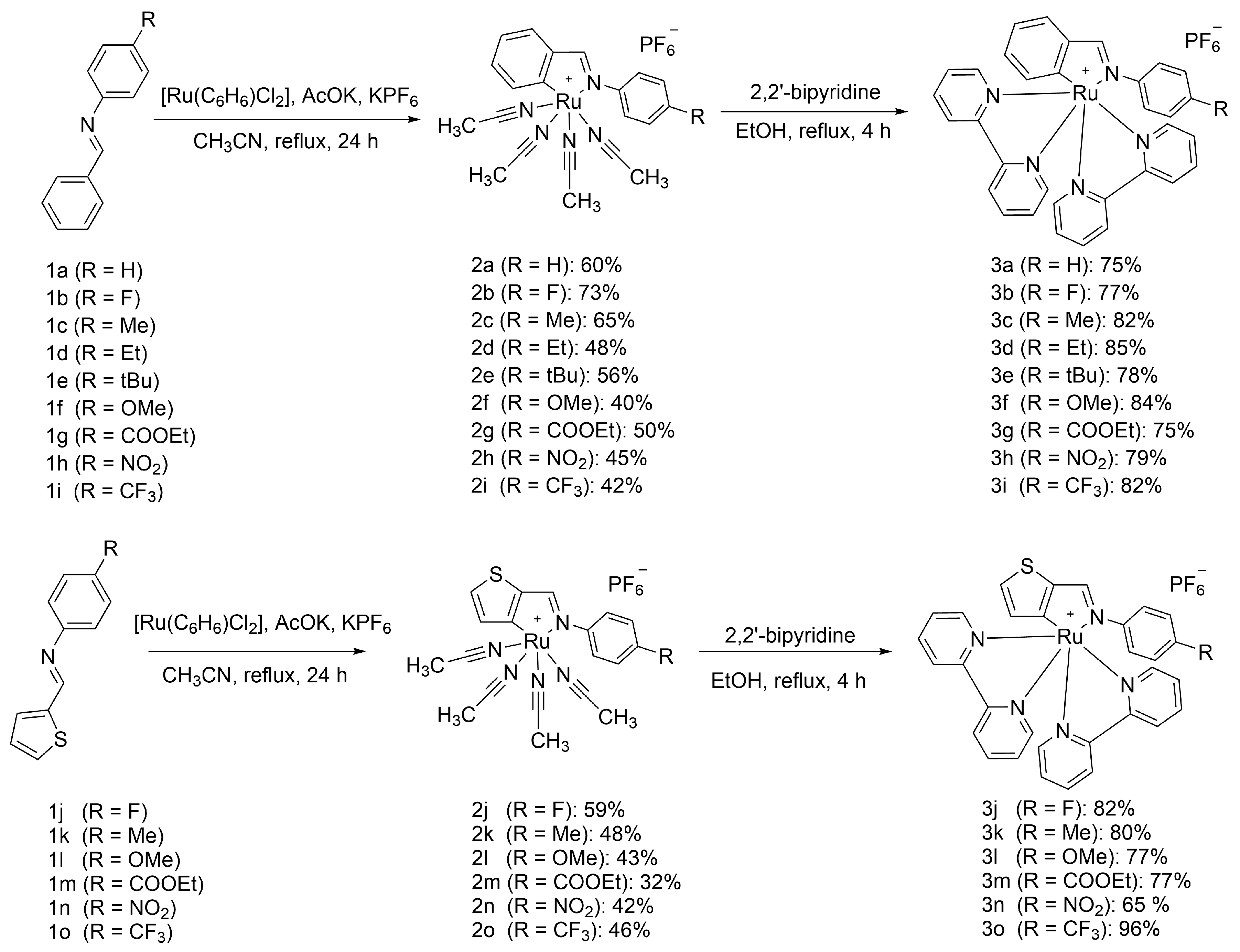
Figure 1.
UV-vis spectra of 3a-3o in acetonitrile, concentration 3.4*10-5 M.
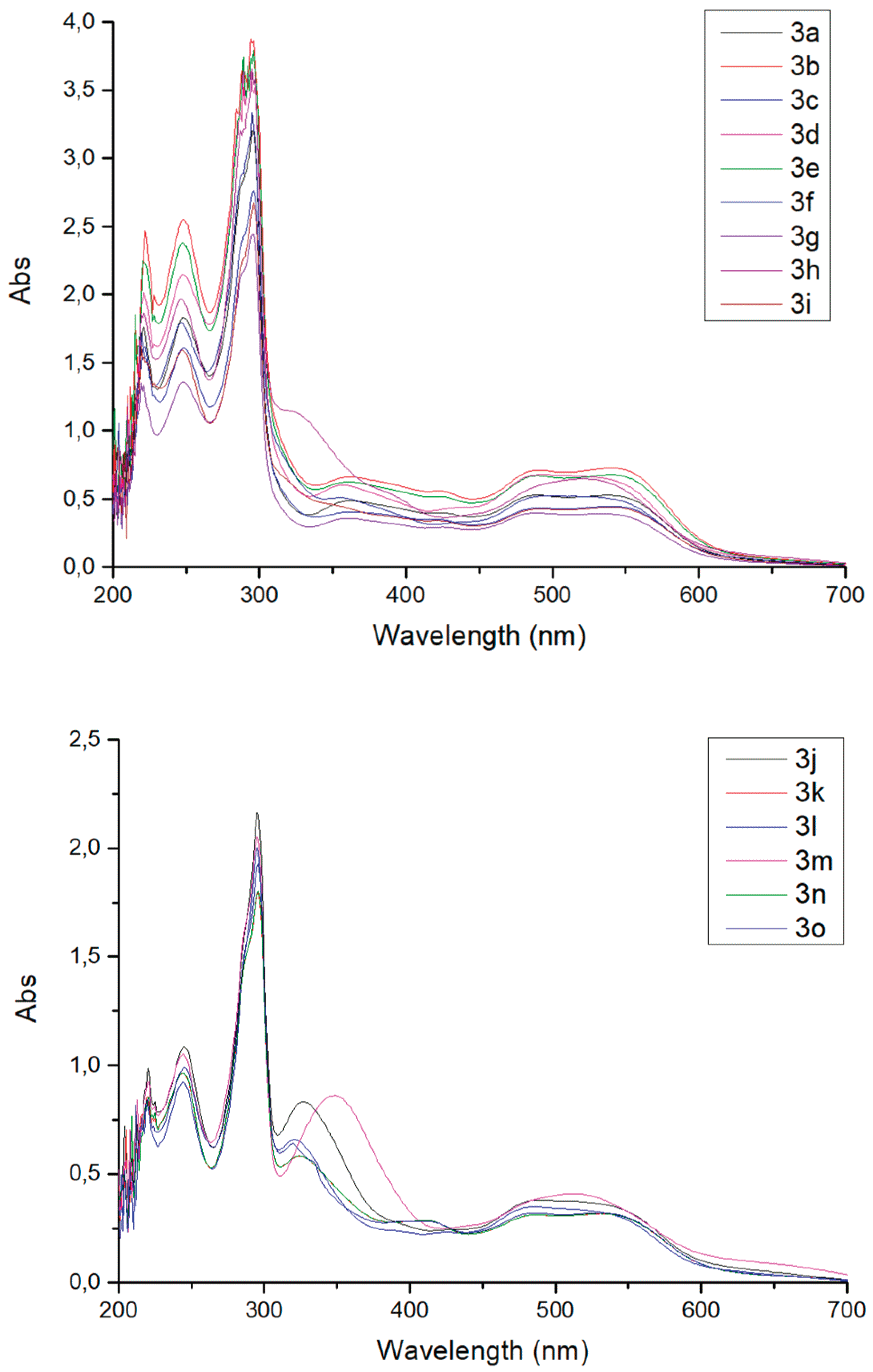

Table 1.
Selected bond lengths and angles of ruthenium complexes.
| Aniline-(Ru-N) Dihedral Angle, ° | Py-Py Dihedral Angle, ° | Ru-N(aniline), Å | Ru-N, Å a | Ru-C, Å | |
|---|---|---|---|---|---|
| 2a (H) | +65.66 | 2.071 | 2.151 | 2.026 | |
| 2b (F) | +58.36 | 2.065 | 2.155 | 2.035 | |
| 2d (Et) | -52.43 | 2.069 | 2.142 | 2.027 | |
| 2e (tBu) | -57.51 | 2.069 | 2.155 | 2.025 | |
| 2f (OMe) | -61.74 | 2.066 | 2.152 | 2.019 | |
| 2g (CO2Et)b | -51.97 +40.65 |
2.062 2.079 |
2.158 2.159 |
2.023 2.017 |
|
| 2h (NO2)b | +42.47 +41.62 |
2.096 2.071 |
2.157 2.172 |
2.019 2.008 |
|
| 2i (CF3) | -51.20 | 2.063 | 2.153 | 2.022 | |
| 2j (F) | -47.59 | 2.102 | 2.139 | 2.019 | |
| 2k (Me) | -49.30 | 2.096 | 2.136 | 2.022 | |
| 2l (OMe) b | +52.94 +41.76 |
2.093 2.114 |
2.132 2.139 |
2.018 2.015 |
|
| 2n (NO2) | -47.17 | 2.105 | 2.140 | 2.020 | |
| 3a (H) | +45.61 | 4.22 | 2.111 | 2.146 | 2.031 |
| 3b (F) | +49.65 | 1.85 | 2.104 | 2.136 | 2.030 |
| 3c (Me) | +39.77 | 5.01 | 2.117 | 2.152 | 2.031 |
| 3e (tBu) | +48.29 | 7.07 | 2.085 | 2.146 | 2.029 |
| 3f (OMe) | -55.21 | 3.52 | 2.063 | 2.155 | 2.036 |
| 3h (NO2) | -52.22 | 3.96 | 2.091 | 2.156 | 2.031 |
| 3j (F) | +43.78 | 8.91 | 2.123 | 2.137 | 2.025 |
| 3l (OMe) | +48.94 | 10.77 | 2.117 | 2.148 | 2.010 |
| 3m (CO2Et) | -58.58 | 5.47 | 2.110 | 2.137 | 2.018 |
| 3o (CF3) | +55.99 | 3.79 | 2.106 | 2.127 | 2.019 |
a located opposite the Ru-C bond. b two independent molecules.
Table 2.
The E1/2 values (mV vs. Fc/Fc+) of reduction and oxidation of the studied compounds in 0.1 M Bu4NPF6/MeCN were determined as the half-sum of the potentials of the forward and reverse peaks of the CV curves recorded for solutions with a concentration of 2.5 10-3 M at a potential scan rate of 100 mV s-1 on a glassy carbon working electrode at 298 K (for irreversible processes marked with an asterisk, the peak potentials are given).
Table 2.
The E1/2 values (mV vs. Fc/Fc+) of reduction and oxidation of the studied compounds in 0.1 M Bu4NPF6/MeCN were determined as the half-sum of the potentials of the forward and reverse peaks of the CV curves recorded for solutions with a concentration of 2.5 10-3 M at a potential scan rate of 100 mV s-1 on a glassy carbon working electrode at 298 K (for irreversible processes marked with an asterisk, the peak potentials are given).
| Additional peaks | |||||
|---|---|---|---|---|---|
| 3a (H) | -2277 (-2234) | -2022 (-1981) | 139 (95) | 1565 | |
| 3b (F) | -2264 (-2219) | -2010 (-1969) | 155 (111) | 1607 | -2828 |
| 3c (Me) | -2015 (-1973) | -2268 (-2226) | 144 (99) | 1570 | |
| 3d (Et) | -2278 (-2233) | -2020 (-1981) | 136 (92) | 1551 | -2905 |
| 3e (tBu) | -2280 (-2236) | -2026 (-1984) | 128 (88) | 1556 | -2864 |
| 3f (OMe) | -2277 (-2235) | -2022 (-1984) | 117 (78) | 1352 | |
| 3ga (CO2Et) | -2242 | -2009 (-1961) | 189 (135) | 1635 | -2551 (C=O reduction) |
| 3hb (NO2) | - | - | 200 (161) | 1679 | -1507 (-1467) -NO2 reduction -1970 |
| 3i (CF3) | -2245 (-2198) | -1996 (-1959) | 181 (139) | 1611 | -2640 (C-F cleavage) |
| 3j (F) | -2245 (-2202) | -1997 (-1956) | 145 (102) | 1422 | |
| 3k (Me) | -2253 (-2213) | -2002 (-1962) | 117 (77) | 1364 | -2909 |
| 3l (OMe) | -2256 (-2216) | -2003 (-1962) | 107 (70) | 1183 (1129) | -2874 (shoulder) |
| 3mc (CO2Et) | -2226 (-2167) | -1989 (-1931) | 78 (127) | 1517 | -2582 (C=O reduction) |
| 3nd (NO2) | - | - | 215 (165) | 1545 | -1534 (-1488) (-NO2 reduction) |
| 3o (CF3) | -2213 (-2175) | -1976 (-1936) | 181 (143) | 1460 | -2582 (C-F cleavage) |
a C=O reduction is reversible, but too distorted, also affects peak reversibility. b After first reduction of -NO2 further curve is uninterpretable. c C=O reduction is reversible, but too distorted. d Very distorted and .
Table 3.
Antiproliferative activity of ruthenium complexes with thiophene-based imines 2a-e, ligands S4a-e and cisplatin against various human cancer cells Rf showed resistance coefficient (calculated as IC50 on A2780cis divided on IC50 on A2780 cell line). The results are the mean values ± SD of three independent experiments, each of which was done in triplicate. The Selectivity Index is calculated as IC50 on HEK293 divided on IC50 on A2780 cell line.
Table 3.
Antiproliferative activity of ruthenium complexes with thiophene-based imines 2a-e, ligands S4a-e and cisplatin against various human cancer cells Rf showed resistance coefficient (calculated as IC50 on A2780cis divided on IC50 on A2780 cell line). The results are the mean values ± SD of three independent experiments, each of which was done in triplicate. The Selectivity Index is calculated as IC50 on HEK293 divided on IC50 on A2780 cell line.
| IC50 (72 h)/nМ | |||||
|---|---|---|---|---|---|
| Compound | А2780 | A2780Cis | Rf | HEK293 | Selectivity Index, SI |
| Cisplatin | 2640±350 | 1560±210 | 5.9 | 22000±4000 | 8.3 |
| 3b (F) | 90 ± 30 | 250 ± 60 | 2.8 | 100 ± 30 | 1.1 |
| 3c (Me) | 70 ± 6 | 120 ± 10 | 1.7 | 70 ± 10 | 1.0 |
| 3d (Et) | 45 ± 5 | 150 ± 10 | 3.3 | 80 ± 10 | 1.8 |
| 3e (tBu) | 70 ± 30 | 170 ± 30 | 2.4 | 68 ± 6 | 1.0 |
| 3f (OMe) | 65 ± 4 | 120 ± 40 | 1.8 | 64 ± 7 | 1.0 |
| 3g (CO2Et) | 100 ± 20 | 230 ± 20 | 2.3 | 140 ± 20 | 1.4 |
| 3h (NO2) | 250 ± 30 | 760 ± 80 | 3.0 | 370 ± 80 | 1.5 |
| 3i (CF3) | 80 ± 10 | 240 ± 20 | 3.0 | 107 ± 8 | 1.3 |
| 3j (F) | 43±3 | 91±9 | 2.1 | 60 ± 10 | 1.4 |
| 3k (Me) | 30±2 | 10±0.4 | 0.3 | 70 ± 30 | 2.3 |
| 3l (OMe) | 39±3 | 39±10 | 1.0 | 40 ± 10 | 1.0 |
| 3m (CO2Et) | 57±20 | 84±12 | 1.5 | 140 ± 10 | 2.5 |
| 3n (NO2) | 270±4 | 960±100 | 3.6 | 530 ± 30 | 2.0 |
| 3o (CF3) | 96±3 | 150±5 | 6.4 | 160 ± 30 | 1.7 |
| 1b (F) | > 200000 | > 100000 | - | 21610 | - |
| 1f (OMe) | > 200000 | > 100000 | - | > 200000 | - |
| 1g (CO2Et) | 42090 | > 100000 | - | 25430 | - |
Disclaimer/Publisher’s Note: The statements, opinions and data contained in all publications are solely those of the individual author(s) and contributor(s) and not of MDPI and/or the editor(s). MDPI and/or the editor(s) disclaim responsibility for any injury to people or property resulting from any ideas, methods, instructions or products referred to in the content. |
© 2025 by the authors. Licensee MDPI, Basel, Switzerland. This article is an open access article distributed under the terms and conditions of the Creative Commons Attribution (CC BY) license (http://creativecommons.org/licenses/by/4.0/).
Copyright: This open access article is published under a Creative Commons CC BY 4.0 license, which permit the free download, distribution, and reuse, provided that the author and preprint are cited in any reuse.


