

Submitted:
02 December 2025
Posted:
05 December 2025
Read the latest preprint version here
Abstract
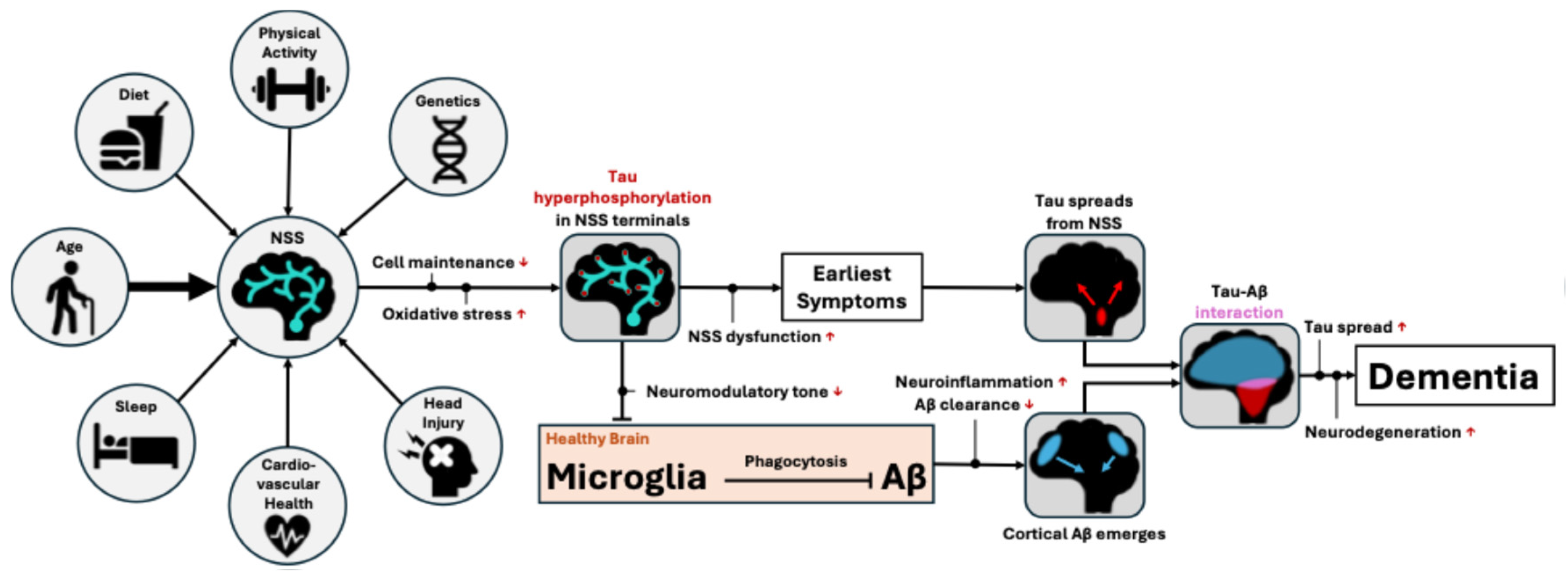
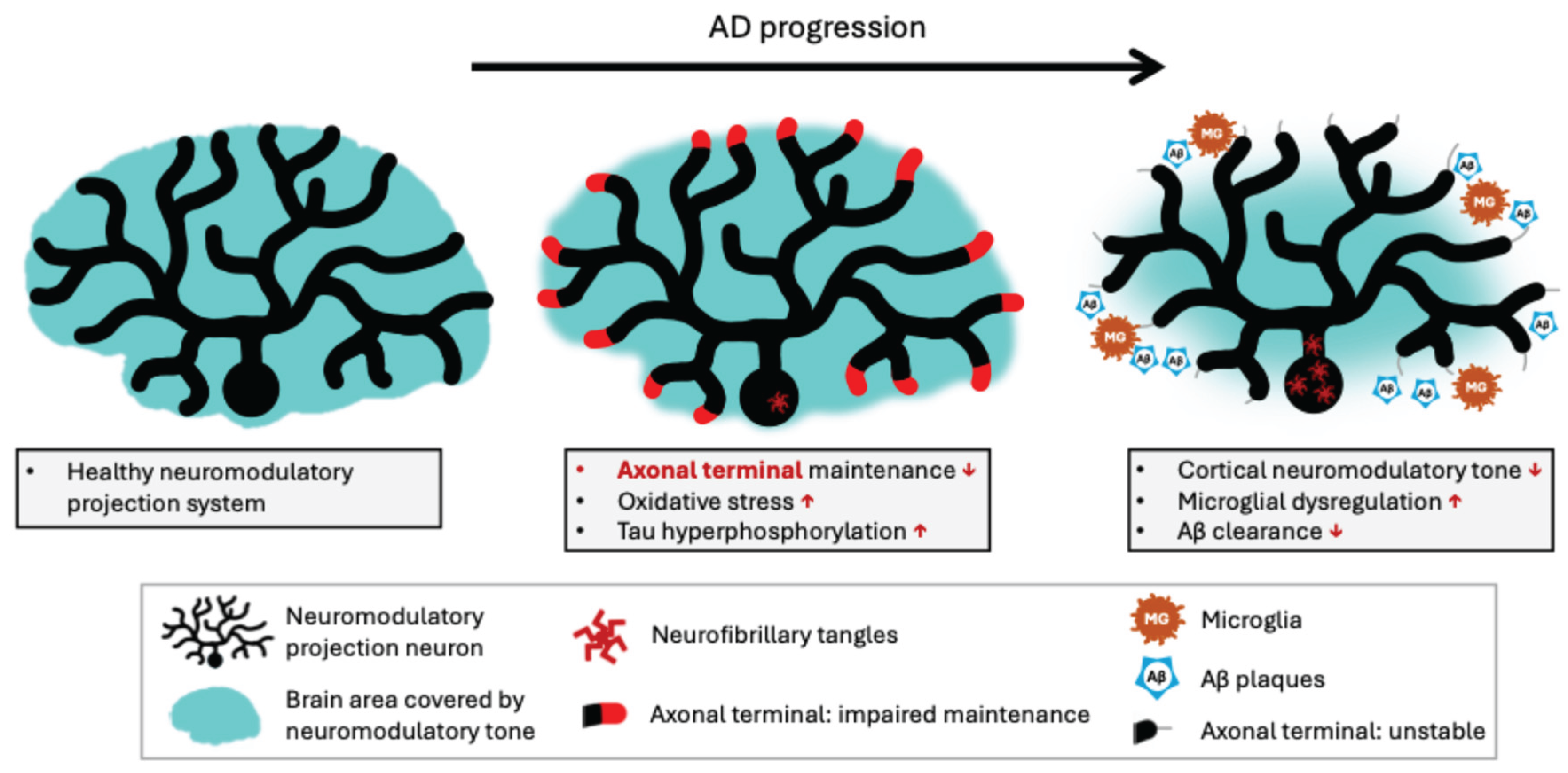
Sporadic Alzheimer’s disease (AD) is associated with numerous risk factors, yet its precise cause remains unclear. Here, we describe a novel framework for AD pathogenesis, whereby diverse risk factors converge on neuromodulatory subcortical systems to confer AD risk or resilience. Neuromodulatory projection neurons are uniquely fragile due to their large size, sparse myelination, and high basal metabolic demands. We propose that the increased prevalence of AD in older adult populations likely reflects a universal weakness within these projection systems, which is increasingly exposed as cellular transport and maintenance mechanisms deteriorate with age. The key insight of this ‘neuromodulatory fragility framework’ is that neuromodulatory system dysfunction is sufficient to explain both tau hyperphosphorylation and b-amyloid (Ab) plaque formation, the two pathological hallmarks of AD. We therefore predict that strengthening or preserving the endogenous functions of these systems in midlife represents the most effective strategy for preventing AD.
Keywords:
1. Introduction: What Causes Alzheimer’s Disease?
2. Neuromodulatory Projection Neurons Are a System-Wide Weak Point
- 1)
- Extreme axonal length and arborization: The projection neurons of neuromodulatory systems originate from small clusters of cell bodies (e.g. locus coeruleus, nucleus basalis of Meynert, dorsal raphe, ventral tegmental area, lateral hypothalamus), yet send vast, highly arborized projections across the entire neocortex. The extreme length and breadth of these combined arborizations allows each neuron to modulate large areas [24,25,26]. However, maintaining such long, branched projections is metabolically expensive. These systems require continuous transport of proteins, mitochondria and other cellular components and rendering them chronically dependent on nutrients, growth factors and oxygen, as well as effective waste clearance and repair mechanisms [27,28].
- 2)
- High tonic firing rates: To sustain basal neuromodulatory tone over large target areas, neuromodulatory neurons exhibit high tonic firing rates, with regular transient bursts during behaviourally relevant events [29,30,31,32]. This firing pattern is well-suited to slow, diffuse modulation via volume transmission, but further amplifies metabolic demand, increasing susceptibility to any disruption in oxidative balance, calcium homeostasis or energy production.
- 3)
- Poor myelination. Neuromodulatory axons are typically thin and only sparsely myelinated. This facilitates ‘leakiness’ of neurotransmitter along the axon’s length – the definitive feature of ‘volume transmission’. However, the lack of myelination and thin calibre of these neurons offers little protection against oxidative or mechanical injury [33,34]. Cortical regions with higher myelination are relatively resistant to pathology and neurodegeneration, suggesting that myelin may represent a substrate of ‘brain reserve’ that these projection systems largely lack [34,35]. The constant axonal remodelling that may be required to maintain these delicate projections could further exacerbate the metabolic demands of these systems.
3. Tau Hyperphosphorylation Is a Direct Outcome of Neuromodulatory System Disruption
4. Neuromodulatory System Degradation Disrupts Amyloid Clearance Through Neuroinflammatory Pathways
5. Tau Misfolding Precedes Plaque Accumulation But Is Slow in the Absence of Aβ
6. Early Behavioural Symptoms Are Consistent with Early Neuromodulatory Dysfunction
7. Predictions of the Neuromodulatory Fragility Framework
8. Unanswered Questions
9. Conclusions
Funding
Acknowledgments
Conflicts of Interest
References
- Duchesne, S. et al. A Scoping Review of Alzheimers Disease Hypotheses: An Array of Uni- and Multi-Factorial Theories. J Alzheimers Dis 99, 843–856 (2024). [CrossRef]
- Livingston, G. et al. Dementia prevention, intervention, and care: 2020 report of the Lancet Commission. The Lancet 396, 413–446 (2020). [CrossRef]
- Jellinger, K. A. Pathobiological Subtypes of Alzheimer Disease. Dement Geriatr Cogn Disord 49, 321–333 (2020). [CrossRef]
- Vogel, J. W. et al. Four distinct trajectories of tau deposition identified in Alzheimer’s disease. Nature Medicine 1–11 (2021). [CrossRef]
- Thal, D. R., Rüb, U., Orantes, M. & Braak, H. Phases of A-Beta-deposition in the human brain and its relevance for the development of AD. Neurology 58, 1791–1800 (2002). [CrossRef]
- Braak, H. & Braak, E. Staging of alzheimer’s disease-related neurofibrillary changes. Neurobiology of Aging 16, 271278 (1995). [CrossRef]
- Jack Jr., C. R. et al. Revised criteria for diagnosis and staging of Alzheimer’s disease: Alzheimer’s Association Workgroup. Alzheimer’s & Dementia 20, 5143–5169 (2024).
- Alzheimer’s Association. 2024 Alzheimer’s disease facts and figures. Alzheimers Dement 20, 3708–3821 (2024).
- Shanks, H. R. C. et al. p75 neurotrophin receptor modulation in mild to moderate Alzheimer disease: a randomized, placebo-controlled phase 2a trial. Nat Med 30, 1761–1770 (2024). [CrossRef]
- Theofilas, P., Dunlop, S., Heinsen, H. & Grinberg, L. T. Turning on the light within: subcortical nuclei of the isodentritic core and their role in Alzheimer’s disease pathogenesis. J Alzheimers Dis 46, 17–34 (2015). [CrossRef]
- Kampmann, M. Molecular and cellular mechanisms of selective vulnerability in neurodegenerative diseases. Nat. Rev. Neurosci. 1–21 (2024). [CrossRef]
- Mattson, M. P. & Arumugam, T. V. Hallmarks of Brain Aging: Adaptive and Pathological Modification by Metabolic States. Cell Metabolism 27, 1176–1199 (2018). [CrossRef]
- Saxena, S. & Caroni, P. Selective Neuronal Vulnerability in Neurodegenerative Diseases: from Stressor Thresholds to Degeneration. Neuron 71, 35–48 (2011). [CrossRef]
- Selkoe, D. J. & Hardy, J. The amyloid hypothesis of Alzheimer’s disease at 25 years. EMBO Molecular Medicine 8, 595–608 (2016). [CrossRef]
- Shine, J. M. et al. Human cognition involves the dynamic integration of neural activity and neuromodulatory systems. Nat Neurosci 22, 289–296 (2019). [CrossRef]
- Shine, J. M. Neuromodulatory Influences on Integration and Segregation in the Brain. Trends in Cognitive Sciences 23, 572–583 (2019). [CrossRef]
- Ehrenberg, A. J. et al. Priorities for research on neuromodulatory subcortical systems in Alzheimer’s disease: Position paper from the NSS PIA of ISTAART. Alzheimer’s & Dementia. [CrossRef]
- Mather, M. & Harley, C. W. The Locus Coeruleus: Essential for Maintaining Cognitive Function and the Aging Brain. Trends in Cognitive Sciences 20, 214–226 (2016). [CrossRef]
- Picciotto, M. R., Higley, M. J. & Mineur, Y. S. Acetylcholine as a Neuromodulator: Cholinergic Signaling Shapes Nervous System Function and Behavior. Neuron 76, 116–129 (2012). [CrossRef]
- Pignatelli, M. & Bonci, A. Role of Dopamine Neurons in Reward and Aversion: A Synaptic Plasticity Perspective. Neuron 86, 1145–1157 (2015). [CrossRef]
- Sakurai, T. The neural circuit of orexin (hypocretin): maintaining sleep and wakefulness. Nat Rev Neurosci 8, 171–181 (2007). [CrossRef]
- Hornung, J.-P. The human raphe nuclei and the serotonergic system. Journal of Chemical Neuroanatomy 26, 331–343 (2003). [CrossRef]
- Özçete, Ö. D., Banerjee, A. & Kaeser, P. S. Mechanisms of neuromodulatory volume transmission. Mol Psychiatry 29, 3680–3693 (2024). [CrossRef]
- Wu, H., Williams, J. & Nathans, J. Complete morphologies of basal forebrain cholinergic neurons in the mouse. eLife 3, e02444 (2014). [CrossRef]
- Aransay, A., Rodríguez-López, C., García-Amado, M., Clascá, F. & Prensa, L. Long-range projection neurons of the mouse ventral tegmental area: a single-cell axon tracing analysis. Front. Neuroanat. 9, (2015). [CrossRef]
- Wu, Y.-M., Hung, W.-C., Chang, Y., Min, M.-Y. & Yang, H.-W. Axon collateral pattern of a sparse locus coeruleus norepinephrine neuron in mouse cerebral cortex. 2025.02.04.636453. [CrossRef]
- Trillo, L. et al. Ascending monoaminergic systems alterations in Alzheimer’s disease. Translating basic science into clinical care. Neuroscience & Biobehavioral Reviews 37, 1363–1379 (2013). [CrossRef]
- Giguère, N. et al. Increased vulnerability of nigral dopamine neurons after expansion of their axonal arborization size through D2 dopamine receptor conditional knockout. PLOS Genetics 15, e1008352 (2019). [CrossRef]
- Aston-Jones, G. & Cohen, J. D. AN INTEGRATIVE THEORY OF LOCUS COERULEUS-NOREPINEPHRINE FUNCTION: Adaptive Gain and Optimal Performance. Annu. Rev. Neurosci. 28, 403–450 (2005). [CrossRef]
- Grace, A. A. & Bunney, B. S. The control of firing pattern in nigral dopamine neurons: single spike firing. The Journal of neuroscience: the official journal of the Society for Neuroscience 4, 2866–2876 (1984). [CrossRef]
- Allers, K. A. & Sharp, T. Neurochemical and anatomical identification of fast- and slow-firing neurones in the rat dorsal raphe nucleus using juxtacellular labelling methods in vivo. Neuroscience 122, 193–204 (2003). [CrossRef]
- Ananth, M. R., Rajebhosale, P., Kim, R., Talmage, D. A. & Role, L. W. Basal forebrain cholinergic signalling: development, connectivity and roles in cognition. Nat Rev Neurosci 24, 233–251 (2023). [CrossRef]
- Braak, H., Del Tredici, K., Schultz, C. & Braak, E. Vulnerability of Select Neuronal Types to Alzheimer’s Disease. Annals of the New York Academy of Sciences 924, 53–61 (2000). [CrossRef]
- Braak, H. & Del Tredici, K. Poor and protracted myelination as a contributory factor to neurodegenerative disorders. Neurobiol Aging 25, 19–23 (2004). [CrossRef]
- Braak, H. & Braak, E. Development of Alzheimer-related neurofibrillary changes in the neocortex inversely recapitulates cortical myelogenesis. Acta Neuropathol 92, 197–201 (1996). [CrossRef]
- Pontzer, H. et al. Daily energy expenditure through the human life course. Science 373, 808–812 (2021). [CrossRef]
- Matchett, B. J., Grinberg, L. T., Theofilas, P. & Murray, M. E. The mechanistic link between selective vulnerability of the locus coeruleus and neurodegeneration in Alzheimer’s disease. Acta Neuropathol 141, 631–650 (2021). [CrossRef]
- Iannitelli, A. F. & Weinshenker, D. Riddles in the dark: Decoding the relationship between neuromelanin and neurodegeneration in locus coeruleus neurons. Neurosci Biobehav Rev 152, 105287 (2023). [CrossRef]
- Geula, C. et al. Loss of calbindin-D28k from aging human cholinergic basal forebrain: relation to neuronal loss. J Comp Neurol 455, 249–259 (2003). [CrossRef]
- Troutwine, B. R., Hamid, L., Lysaker, C. R., Strope, T. A. & Wilkins, H. M. Apolipoprotein E and Alzheimer’s disease. Acta Pharmaceutica Sinica B 12, 496–510 (2022).
- Blanchard, J. W. et al. APOE4 impairs myelination via cholesterol dysregulation in oligodendrocytes. Nature 611, 769–779 (2022). [CrossRef]
- Carandini, T., Cercignani, M., Galimberti, D., Scarpini, E. & Bozzali, M. The distinct roles of monoamines in multiple sclerosis: A bridge between the immune and nervous systems? Brain, Behavior, and Immunity 94, 381–391 (2021). [CrossRef]
- Barbier, P. et al. Role of Tau as a Microtubule-Associated Protein: Structural and Functional Aspects. Front. Aging Neurosci. 11, (2019). [CrossRef]
- de Vos, K. J., Grierson, A. J., Ackerley, S. & Miller, C. C. J. Role of Axonal Transport in Neurodegenerative Diseases*. Annual Review of Neuroscience 31, 151–173 (2008). [CrossRef]
- Wang, Z.-X., Tan, L. & Yu, J.-T. Axonal transport defects in Alzheimer’s disease. Mol Neurobiol 51, 1309–1321 (2015). [CrossRef]
- Scholz, T. & Mandelkow, E. Transport and diffusion of Tau protein in neurons. Cell. Mol. Life Sci. 71, 3139–3150 (2014). [CrossRef]
- Hussain, L. S., Reddy, V. & Maani, C. V. Physiology, Noradrenergic Synapse. in StatPearls (StatPearls Publishing, Treasure Island (FL), 2025).
- Chalermpalanupap, T., Weinshenker, D. & Rorabaugh, J. M. Down but Not Out: The Consequences of Pretangle Tau in the Locus Coeruleus. Neural Plast 2017, 7829507 (2017). [CrossRef]
- Braak, H. & Del Tredici, K. The preclinical phase of the pathological process underlying sporadic Alzheimer’s disease. Brain 138, 2814–2833 (2015). [CrossRef]
- Braak, H., Thal, D. R., Ghebremedhin, E. & Del Tredici, K. Stages of the Pathologic Process in Alzheimer Disease: Age Categories From 1 to 100 Years. Journal of Neuropathology & Experimental Neurology 70, 960–969 (2011). [CrossRef]
- Geula, C., Nagykery, N., Nicholas, A. & Wu, C.-K. Cholinergic neuronal and axonal abnormalities are present early in aging and in Alzheimer disease. J Neuropathol Exp Neurol 67, 309–318 (2008). [CrossRef]
- Satpati, A. et al. The wake- and sleep-modulating neurons of the lateral hypothalamic area demonstrate a differential pattern of degeneration in Alzheimer’s disease. 2024.03.06.583765. [CrossRef]
- Grinberg, L. T. et al. The dorsal raphe nucleus shows phospho-tau neurofibrillary changes before the transentorhinal region in Alzheimer’s disease. A precocious onset? Neuropathology and Applied Neurobiology 35, 406–416 (2009). 2009. [CrossRef]
- Pierson, S. R. et al. Tau pathology in the dorsal raphe may be a prodromal indicator of Alzheimer’s disease. Mol Psychiatry 30, 532–546 (2025). [CrossRef]
- Cranston, A. L. et al. Cholinergic and inflammatory phenotypes in transgenic tau mouse models of Alzheimer’s disease and frontotemporal lobar degeneration. Brain Commun 2, fcaa033 (2020). [CrossRef]
- Wu, J. W. et al. Neuronal activity enhances tau propagation and tau pathology in vivo. Nat Neurosci 19, 1085–1092 (2016). [CrossRef]
- Therriault, J. et al. Intrinsic connectivity of the human brain provides scaffold for tau aggregation in clinical variants of Alzheimer’s disease. Science Translational Medicine 14, eabc8693 (2022). [CrossRef]
- Bueichekú, E. et al. Spatiotemporal patterns of locus coeruleus integrity predict cortical tau and cognition. Nat Aging 4, 625–637 (2024). [CrossRef]
- Jacobs, H. I. L. et al. In vivo and neuropathology data support locus coeruleus integrity as indicator of Alzheimer’s disease pathology and cognitive decline. Sci. Transl. Med. 13, eabj2511 (2021). [CrossRef]
- Schmitz, T. W. & Spreng, R. N. Basal forebrain degeneration precedes and predicts the cortical spread of Alzheimer’s pathology. Nature Communications 7, 13249 (2016). [CrossRef]
- Fernández-Cabello, S. et al. Basal forebrain volume reliably predicts the cortical spread of Alzheimer’s degeneration. Brain 143, 993–1009 (2020). [CrossRef]
- Yi, D. et al. Locus coeruleus tau is linked to successive cortical tau accumulation. Alzheimer’s & Dementia 21, e14426 (2025). [CrossRef]
- Roemer-Cassiano, S. N. et al. Amyloid-associated hyperconnectivity drives tau spread across connected brain regions in Alzheimer’s disease. Sci Transl Med 17, eadp2564 (2025). [CrossRef]
- Salvadores, N., Gerónimo-Olvera, C. & Court, F. A. Axonal Degeneration in AD: The Contribution of Aβ and Tau. Front Aging Neurosci 12, 581767 (2020). [CrossRef]
- Heneka, M. T. et al. Locus ceruleus controls Alzheimer’s disease pathology by modulating microglial functions through norepinephrine. Proceedings of the National Academy of Sciences 107, 6058–6063 (2010). [CrossRef]
- Gamage, R. et al. Cholinergic Modulation of Glial Function During Aging and Chronic Neuroinflammation. Front. Cell. Neurosci. 14, (2020). [CrossRef]
- Schmitz, T. W., Soreq, H., Poirier, J. & Spreng, R. N. Longitudinal Basal Forebrain Degeneration Interacts with TREM2/C3 Biomarkers of Inflammation in Presymptomatic Alzheimer’s Disease. J. Neurosci. 40, 1931–1942 (2020). [CrossRef]
- Wang, H. et al. Nicotinic acetylcholine receptor α7 subunit is an essential regulator of inflammation. Nature 421, 384–388 (2003).
- Ramos-Rodriguez, J. J. et al. Rapid β-amyloid deposition and cognitive impairment after cholinergic denervation in APP/PS1 mice. J Neuropathol Exp Neurol 72, 272–285 (2013). [CrossRef]
- Chalermpalanupap, T. et al. Targeting norepinephrine in mild cognitive impairment and Alzheimer’s disease. Alzheimers Res Ther 5, 21 (2013). [CrossRef]
- Gil-Bea, F. J. et al. Cholinergic denervation exacerbates amyloid pathology and induces hippocampal atrophy in Tg2576 mice. Neurobiol Dis 48, 439–446 (2012). [CrossRef]
- Frick, M. A. et al. Orexin/Hypocretin Modulates Neuroinflammatory Response to LPS in a Sex and Brain-Region Specific Manner in Young Rats. J Neurochem 169, e70175 (2025). [CrossRef]
- Muresan, Z. & Muresan, V. Seeding Neuritic Plaques from the Distance: A Possible Role for Brainstem Neurons in the Development of Alzheimer’s Disease Pathology. Neurodegener Dis 5, 250–253 (2008). [CrossRef]
- Baker-Nigh, A. et al. Neuronal amyloid-β accumulation within cholinergic basal forebrain in ageing and Alzheimer’s disease. Brain 138, 1722–1737 (2015). [CrossRef]
- Ossenkoppele, R. et al. Amyloid and tau PET-positive cognitively unimpaired individuals are at high risk for future cognitive decline. Nature Medicine 28, 2381 (2022). [CrossRef]
- La Joie, R. et al. Prospective longitudinal atrophy in Alzheimer’s disease correlates with the intensity and topography of baseline tau-PET. Sci Transl Med 12, eaau5732 (2020).
- Bloom, G. S. Amyloid-β and Tau: The Trigger and Bullet in Alzheimer Disease Pathogenesis. JAMA Neurol 71, 505–508 (2014).
- Busche, M. A. & Hyman, B. T. Synergy between amyloid-β and tau in Alzheimer’s disease. Nat Neurosci 23, 1183–1193 (2020).
- Crary, J. F. et al. Primary age-related tauopathy (PART): a common pathology associated with human aging. Acta Neuropathol 128, 755–766 (2014). [CrossRef]
- Lee, W. J. et al. Regional Aβ-tau interactions promote onset and acceleration of Alzheimer’s disease tau spreading. Neuron 110, 1932-1943.e5 (2022). [CrossRef]
- Vogel, J. W. et al. Connectome-based modelling of neurodegenerative diseases: towards precision medicine and mechanistic insight. Nat. Rev. Neurosci. 24, 620–639 (2023). [CrossRef]
- Karran, E. & De Strooper, B. The amyloid hypothesis in Alzheimer disease: new insights from new therapeutics. Nat Rev Drug Discov 21, 306–318 (2022).
- Braak, H. & Del Tredici, K. Alzheimer’s disease: intraneuronal alterations precede insoluble amyloid-β formation. Neurobiology of Aging 25, 713–718 (2004). [CrossRef]
- Götz, J., Chen, F., van Dorpe, J. & Nitsch, R. M. Formation of Neurofibrillary Tangles in P301L Tau Transgenic Mice Induced by Aβ42 Fibrils. Science 293, 1491–1495 (2001). [CrossRef]
- Stern, Y., Barnes, C. A., Grady, C., Jones, R. N. & Raz, N. Brain Reserve, Cognitive Reserve, Compensation, and Maintenance: Operationalization, Validity, and Mechanisms of Cognitive Resilience. Neurobiol Aging 83, 124–129 (2019). [CrossRef]
- Stella, F. et al. Neuropsychiatric symptoms in the prodromal stages of dementia. Current Opinion in Psychiatry 27, 230 (2014). [CrossRef]
- Orlando, I. F., Shine, J. M., Robbins, T. W., Rowe, J. B. & O’Callaghan, C. Noradrenergic and cholinergic systems take centre stage in neuropsychiatric diseases of ageing. Neuroscience & Biobehavioral Reviews 149, 105167 (2023). [CrossRef]
- Engels-Domínguez, N. et al. State-of-the-art imaging of neuromodulatory subcortical systems in aging and Alzheimer’s disease: Challenges and opportunities. Neuroscience & Biobehavioral Reviews 144, 104998 (2023). [CrossRef]
- Wearn, A. et al. Neuromodulatory subcortical nucleus integrity is associated with white matter microstructure, tauopathy and APOE status. Nat Commun 15, 4706 (2024). [CrossRef]
- Chakraborty, S. et al. Multimodal gradients of basal forebrain connectivity across the neocortex. Nat Commun 15, 8990 (2024). [CrossRef]
- Wood Alexander, M. et al. The interplay between age at menopause and synaptic integrity on Alzheimer’s disease risk in women. Science Advances 11, eadt0757 (2025). [CrossRef]
- ang, M.-X. et al. Incidence of AD in African-Americans, Caribbean Hispanics, and Caucasians in northern Manhattan. Neurology 56, 49–56 (2001). [CrossRef]
- Toussaint, C., Bézard, E., Lemoine, M. & Planche, V. The biological scaling of Alzheimer’s disease neuropathological changes across primate species. Alzheimers Res Ther 17, 242 (2025). [CrossRef]
- Marsden, C. D. Pigmentation in the nucleus substantiae nigrae of mammals. J Anat 95, 256–261 (1961).
- Vacher, M. C. et al. Alzheimer’s disease-like neuropathology in three species of oceanic dolphin. Eur J Neurosci 57, 1161–1179 (2023). [CrossRef]
- Sacchini, S. et al. Toothed Whales Have Black Neurons in the Blue Spot. Vet Sci 9, 525 (2022). [CrossRef]
- Sharma, Y. et al. Comparative anatomy of the locus coeruleus in humans and nonhuman primates. J Comp Neurol 518, 963–971 (2010). [CrossRef]
- Raghanti, M. A. et al. Comparative analysis of the nucleus basalis of Meynert among primates. Neuroscience 184, 1–15 (2011). [CrossRef]
- Worthy, G. A. J. & Hickie, J. P. Relative Brain Size in Marine Mammals. The American Naturalist 128, 445–459 (1986). [CrossRef]
- Gunn-Moore, D., Kaidanovich-Beilin, O., Iradi, M. C. G., Gunn-Moore, F. & Lovestone, S. Alzheimer’s disease in humans and other animals: A consequence of postreproductive life span and longevity rather than aging. Alzheimer’s & Dementia 14, 195–204 (2018). [CrossRef]
- Ellis, S., Franks, D. W., Nielsen, M. L. K., Weiss, M. N. & Croft, D. P. The evolution of menopause in toothed whales. Nature 627, 579–585 (2024). [CrossRef]
- Chêne, G. et al. Gender and incidence of dementia in the Framingham Heart Study from mid-adult life. Alzheimer’s & Dementia 11, 310–320 (2015). [CrossRef]
- Newhouse, P. & Dumas, J. Estrogen-Cholinergic Interactions: Implications for Cognitive Aging. Horm Behav 74, 173–185 (2015). [CrossRef]
Disclaimer/Publisher’s Note: The statements, opinions and data contained in all publications are solely those of the individual author(s) and contributor(s) and not of MDPI and/or the editor(s). MDPI and/or the editor(s) disclaim responsibility for any injury to people or property resulting from any ideas, methods, instructions or products referred to in the content. |
© 2025 by the authors. Licensee MDPI, Basel, Switzerland. This article is an open access article distributed under the terms and conditions of the Creative Commons Attribution (CC BY) license (http://creativecommons.org/licenses/by/4.0/).