
Submitted:
03 December 2025
Posted:
04 December 2025
You are already at the latest version
Abstract
Against the backdrop of the global energy transition, the efficient exploitation of marine renewable energy has become a key pathway toward carbon neutrality. Wind–wave hybrid systems (WWHSs) have attracted increasing attention due to their resource complementarity, efficient spatial utilization, and shared infrastructure. However, most existing studies focus on single components or local optimization. A systematic integration of the full technology chain remains limited, hindering the transition from demonstration projects to commercial deployment. This review provides a comprehensive overview of the technological evolution and key characteristics of offshore wind turbine (OWT) foundations and wave energy converters (WECs). Fixed-bottom foundations remain the mainstream solution for near-shore development. Floating offshore wind turbines (FOWTs) represent the core direction for deep-sea deployment. Among WEC technologies, oscillating buoy (OB) WECs are the dominant research pathway. Yet high costs and poor performance under extreme sea states remain major barriers to commercialization. On this basis, the paper summarizes three major integration modes of WWHSs. Among them, hybrid configurations have become the research focus due to their structural sharing, hydrodynamic coupling, and significant cost and energy synergies. Furthermore, the review synthesizes optimization strategies for both technology design and spatial layout, aiming to enhance energy capture, structural stability, and overall economic performance. Finally, the paper critically identifies current research gaps and bottlenecks, and outlines key technological pathways required for future commercial viability. These include the development of high-performance adaptive power take-off (PTO) systems, deeper understanding of multi-physics coupling mechanisms, intelligent operation and maintenance enabled by digital twins, and comprehensive life-cycle techno-economic and environmental assessments. This review aims to provide a systematic reference for the advancement of multi-energy offshore systems and to support future integrated energy development in deep-sea environments.
Keywords:
offshore wind energy
; wave energy
; wind–wave hybrid systems
; layout optimization
; hydrodynamic coupling
; multi-energy complementarity
1. Introduction
Over the past several decades, the rapid expansion of global industrial sectors, coupled with delayed environmental protection measures, has led to a significant deterioration of the human living environment [1,2]. Since 1950, global energy consumption has increased by a factor of 5.8, and it is expected to rise to 11.6 times by 2050 [3]. Meanwhile, atmospheric CO₂ concentration has surged from 310 ppm in 1950 to 390 ppm in 2010, reflecting a severe trend in greenhouse gas emissions [4]. Excessive use of fossil fuels, as a key driver, has intensified air and water pollution, soil degradation, and the release of large quantities of harmful substances into the environment [5]. Against this backdrop, the development of low-cost and environmentally friendly renewable energy alternatives has become an urgent requirement to ease pollution pressures [6,7]. In response to this global challenge, the United Nations Sustainable Development Goals (UN-SDGs) and the Paris Agreement have set constraints and guidance to encourage countries to expand renewable energy deployment to mitigate climate and environmental risks [8,9]. The European Union has also established phased targets: renewable energy should account for 20% of electricity generation by 2020 (with at least 10% for each member state), and 32% by 2030 as a mid-term objective [10], thereby institutionalizing the energy transition. With global energy demand continuing to rise and climate pressures intensifying, the integration of renewable energy into power systems is expanding rapidly [11], and it is recognized as an essential pathway to achieving the emission-reduction goals of the Paris Agreement; it is estimated that at least 63% of global electricity must be generated from renewable sources to meet these goals [12]. Renewable energy development covers both onshore and offshore domains, with offshore resources receiving increasing attention due to their abundance and long-term potential. However, offshore systems face engineering challenges such as limited space, heavy equipment, and high installation costs [13]. Despite these challenges, offshore energy hubs are playing an increasingly important role in decarbonizing marine transportation, offshore oil and gas operations, and mariculture, with their energy supply gradually shifting from traditional diesel and fossil fuels [14] toward renewable sources. As the share of renewable energy continues to grow, the cost of offshore power generation is expected to decline further [15].
Among various forms of offshore renewable energy, wind and wave energy have become the most representative resources due to their abundance, high availability, and continuous technological advancement. However, single-source offshore wind power cannot meet the demand for efficient and stable energy supply, while wave energy—recognized for its high energy density and wide spatial distribution—has been regarded as one of the most promising marine renewable resources [16]. It is noteworthy that wind and wave energy exhibit strong spatial and physical correlations. Regions with abundant wind resources often possess rich wave energy, and the two also show significant temporal and spatial complementarity [17], forming a natural synergy that provides a solid foundation for joint development [18]. In contrast, single-energy systems commonly suffer from strong power fluctuations, low device utilization, and high levelized cost of energy, which severely constrain their economic viability and supply stability. Therefore, “wind–wave” hybrid systems (WWHSs) offer a new technological pathway to overcome these limitations. Such hybrid systems integrate wind turbine foundations with wave energy converters (WECs), which can significantly improve offshore space utilization [19,20]. They also reduce construction and operational costs through shared platforms, mooring systems, and power transmission infrastructure [21,22], while minimizing disturbance to the marine environment [20]. As a result, they enhance both economic performance and supply stability. In terms of power output, the high predictability and stability of wave energy can compensate for the intermittency and uncertainty of wind power, thereby improving overall energy capture efficiency and output continuity [23,24]. In terms of structural safety, wave energy devices can partially absorb wave loads, reducing wave impacts and run-up on marine structures, and lowering the loads on the foundation [25], which enhances system safety and durability. Given these technological and economic advantages, the coordinated development of wind and wave energy is considered a key pathway toward the commercial application of wave energy [26], and it establishes an essential technical foundation for multi-energy offshore renewable systems.
Despite the advantages of WWHSs in resource complementarity, spatial efficiency, and cost synergy, the field still lacks a comprehensive review of the multiple technological pathways, particularly for integrated mechanisms, key technologies, and layout optimization strategies of fixed and floating hybrid systems. To fill this gap, this review explores the topic from several perspectives: (1) summarizing the technological progress and characteristics of offshore wind turbine (OWT) foundations and WECs; (2) clarifying the classification framework and development path of WWHSs; (3) analyzing optimization methods for energy capture, structural design, and array configuration; and (4) identifying key issues in current research and outlining future technological and engineering challenges.
The structure of this paper is as follows. Section 2 reviews the research progress of offshore wind foundations and wave energy devices. Section 3 examines integration schemes and technological advances of WWHSs. Section 4 summarizes optimization strategies in system design and spatial layout. Section 5 presents the conclusions and highlights future research directions. Through systematic integration and critical analysis of existing studies, this review aims to provide academic support for theoretical innovation and engineering practice in WWHSs.
2. Research Progress on OWT Foundations and Wave Energy Devices
2.1. Research Progress on OWT Foundations
In recent years, with the continuous advancement of China’s clean-energy strategy, offshore wind power has gradually become a key component of the renewable energy system. Compared with onshore wind resources, offshore wind fields offer more stable wind conditions, higher energy utilization efficiency, and greater power density, while the choice of foundation type directly affects engineering feasibility, structural safety, and overall economic performance. Significant regional differences in seabed geology, water depth, wave–current conditions, and construction capabilities have also driven the evolution of OWT foundations and the development of multiple technological pathways.
At present, OWT foundations worldwide can be broadly classified into two categories: fixed foundations and floating foundations (FOWTs) [27], corresponding to applications from shallow to deep waters. Fixed foundations are mainly used in shallow and intermediate water depths and represent the most mature and widely deployed technologies. Typical structures include monopile foundations [28], jacket foundations [29,30], gravity-based foundations [31], and the rapidly developing composite bucket foundations (CBFs) [32,33]. Monopiles are widely used in shallow waters, such as China’s eastern coast and the North Sea, due to their simple construction and relatively low cost. Jacket foundations perform well in intermediate depths and complex geological conditions and are suited for larger loads or sites with higher geotechnical demands. Gravity-based and composite bucket foundations rely on large structural dimensions for stability [34], making them suitable for areas with favorable geology or where construction disturbance must be minimized. With continuous progress in construction equipment, materials, and installation technologies, fixed foundations are expanding in both economic viability and applicable water depths.
In contrast, floating foundations are designed to overcome water-depth limitations in deep-sea wind power development and represent a major future direction for the offshore wind industry [35]. The main floating foundation types include semi-submersible platforms [36], tension-leg platforms (TLPs) [37], and spar-type platforms [38]. Semi-submersible platforms are currently the most widely adopted structures in deep-sea research and demonstration projects due to their low center of gravity, good stability, flexible layout, and broad water-depth applicability. TLPs offer excellent vertical stability but depend heavily on mooring systems and remain costly. Spar platforms rely on deep-draft ballast to provide restoring moments and have simple structures and small wave-induced motions, but they face challenges such as high tower-fatigue loads and stringent deep-water installation requirements. Although floating foundation technology has already been demonstrated in Europe and the United States, it remains in the engineering validation and optimization stage and has not yet achieved large-scale commercial deployment [39]. Representative examples include the Hywind Spar deployed by Equinor in 2009 with a 2.3-MW turbine [40] and the WindFloat semi-submersible platform installed off the Portuguese coast in 2011 [41]. In recent years, China has also deployed several floating wind power demonstrators, including the “Three Gorges Leading” semi-submersible platform (2021), “Fuyao” (2022), and “CNOOC Guanlan” (2023), gradually accumulating technological and engineering experience. Reference [39] provides a systematic review of floating foundation designs.
Overall, OWT foundation technologies are evolving along two parallel paths: fixed foundations dominate near-shore regions, while floating foundations enable breakthroughs in deep-sea development. Fixed foundations will continue to dominate near-shore applications due to their maturity, controllable cost, and extensive installation experience, with research focusing on lightweight structures, improved adaptability to complex seabed conditions, and enhanced construction efficiency. Floating foundations are considered the key technological route for deep-sea wind power and continue to attract global attention, with research concentrated on mooring-system optimization, motion-response control, durability enhancement, cost reduction, and large-scale deployment [23]. The parallel development of these two foundation types supports the large-scale growth of offshore wind power and lays the technical foundation for future expansion into deeper waters, harsher sea states, and larger turbine capacities.
2.2. Research Progress on WECs
Wave energy, as a major category of marine renewable resources with vast reserves, wide distribution, and high energy density, has long attracted significant attention from both academia and industry. Wind turbines have already been demonstrated through many commercial projects, whereas wave energy remains far from commercial deployment because of its high cost [42]. At the global level, wave energy is mainly harvested for power generation, and WECs exhibit diverse structural forms. Their performance directly determines energy capture efficiency, environmental adaptability, and engineering potential. Based on structural characteristics and energy extraction mechanisms, existing wave energy devices mainly include oscillating body types [43,44], oscillating water column (OWC) devices [45,46,47], and overtopping devices [48,49,50], as summarized in Table 1. Each type exhibits distinct differences in suitable sea states, structural features, conversion efficiency, and engineering complexity.
Oscillating body WECs can be further divided into three core configurations: (1) point absorbers that capture energy through heave motion; (2) terminators that extract energy from surge motion; and (3) attenuators that utilize pitch motion to absorb wave energy [51]. Among developed oscillating body WECs, point absorbers account for 53%, terminators for 33%, and attenuators for the remaining 14% [52]. Point absorber WECs have become the mainstream development pathway because of their compact structure, broad adaptability, simple design, high conversion efficiency, and stable power output [53]. The oscillating buoy (OB) WEC, as a key technical branch of point absorbers, further strengthens this pathway due to its simple configuration, small size, ease of fabrication, and convenient offshore installation. It has become one of the most active research directions. However, extreme marine conditions—such as typhoons, high waves, and sea ice—pose severe challenges to the floating structure and mooring system. Strong wave loads may cause fatigue failure or mooring line breakage. Seawater corrosion and marine biofouling (e.g., mussels and algae) increase drag, reduce response sensitivity, shorten maintenance cycles, and raise costs. Therefore, improving environmental robustness is a key requirement for engineering applications of these devices. In terms of operating principle, point absorber WECs extract wave energy through the coupled motion between one or multiple floats or submerged bodies and incident waves. Their motion synchronizes with the incoming waves and transfers energy efficiently to the power take-off (PTO) system [54]. OB devices further enhance energy capture through heave or multi-degree-of-freedom oscillations and achieve stable output via hydraulic, mechanical, or electromagnetic PTO systems. Structurally, single-body point absorbers include two major categories: the floating-type, exemplified by the Sea-based device [55], and the fully submerged type, represented by the CETO device [56]. Such single-body systems typically include a heaving float that moves relative to a fixed reference, such as the seabed. Several representative devices have been developed, including the OPT PowerBuoy [57], Wavebob [58], Inter Project Service devices [59,60], the Uppsala University WEC [61], Oyster [62], FO3, IPS devices, and the Lysekil system [63,64]. Owing to their compact configuration, strong environmental adaptability, and good scalability, oscillating-buoy devices show great potential for application in nearshore and intermediate-depth waters. In addition, to enhance overall energy capture, recent research has shifted from evaluating individual device performance to exploring array effects, focusing on optimizing layouts of multiple point absorbers. These developments provide an important foundation for large-scale deployment and commercialization of oscillating body WECs [65,66,67].
OWC device [68,69,70] is another relatively mature form of wave energy utilization. Its core working principle is based on a closed or semi-closed air chamber fixed to the shoreline or nearshore seabed. Incoming waves drive the water column inside the chamber to oscillate vertically. The air above the water column is then periodically compressed and expanded, producing a bidirectional airflow that rotates an air turbine installed at the chamber top, thereby converting wave energy into electrical power with good reliability and durability. Structurally, OWC devices are generally large. The air chamber and associated components require significant seabed bearing capacity, making site selection highly dependent on robust nearshore terrain. As a result, deployment in offshore deep-water environments remains challenging, and these systems are commonly used in shoreline or nearshore settings. With advances in chamber optimization, turbine efficiency, and integrated design, OWC technology has been demonstrated in several countries.
Overtopping wave energy conversion [48,49,50] technology uses the overtopping phenomenon as its core energy capture mechanism. The key design requirement is that the reservoir must maintain a water level higher than the surrounding sea surface. The operation process is as follows: incident waves run up along the sloping front structure and overtop into the reservoir, generating a stable potential head difference; the stored water is then released through a designed channel to drive low-head axial-flow turbines, realizing efficient conversion from wave energy to electricity. Compared with other types of WECs, overtopping devices have several advantages. First, they convert highly fluctuating and random wave energy into more stable potential energy, enabling effective smoothing of power output and improving supply reliability and operational flexibility. Second, low-head hydraulic turbine technology is mature in hydropower engineering, and the associated design, manufacturing, and maintenance experience can be directly transferred, reducing technology development barriers and engineering validation costs. However, this technology still faces significant challenges. In terms of sea-state adaptability, its performance is highly sensitive to wave parameters such as height, period, and incident angle. Under small or irregular waves, insufficient overtopping may occur, causing a marked decline in conversion efficiency. From an engineering perspective, the system requires large integrated structures such as slopes and reservoirs, resulting in substantial size and weight. This increases transport and installation complexity and imposes higher demands on mooring capacity and stability. Furthermore, its applicability is strongly constrained by local bathymetry and seabed conditions. Energy dissipation due to wave breaking in shallow waters, and mooring complexity in deep waters, may limit overall performance. Nearshore deployment also requires balancing coastal ecological protection and visual impact considerations, making large-scale standardization difficult.
From the overall development perspective, current research in academia and industry focuses on several directions:
- Development from single devices to arrays and integrated systems, especially in hybrid wind–wave power generation systems, where interactions between devices introduce new effects on energy capture and platform stability, becoming an important research topic in recent years.
Overall, wave energy conversion devices have achieved significant progress in structural forms, energy conversion mechanisms, and engineering applications. However, challenges remain in cost, reliability, maintenance convenience, and adaptation to complex sea conditions. With advances in materials, intelligent control, and multi-energy coupling platforms, future wave energy devices are expected to achieve more efficient, economical, and widely adaptable applications.
3. Research Progress of Hybrid Wind–Wave Power Generation Systems
With the increasing global focus on renewable energy and the rapid development of marine energy technologies, the joint development of wind and wave energy has gradually become an important approach to enhance offshore energy capture efficiency and reduce costs. Hybrid wind–wave power generation systems can not only increase electricity output per unit sea area, but also optimize offshore infrastructure through shared support platforms, mooring systems, and PTO facilities, thereby improving overall system safety and stability [20]. Based on physical layout and functional integration, hybrid wind–wave power generation systems can be classified into three main types: co-located systems, island systems, and hybrid systems [78].
3.1. Co-Located Systems
Co-located systems represent the earliest mode of hybrid wind–wave development. Their main feature is that wind turbines and WECs are located in the same offshore area but operate independently, each with its own foundation and mooring system [79]. This type of system is flexible in design, easy to deploy, and suitable for areas with large sea space, high-capacity devices, and no need for physical integration, making it the simplest option for current offshore wind–wave technology development. Specifically, co-located systems combine offshore wind farms with WEC arrays that have independent foundation systems, while sharing the same sea area, grid connection, operation and maintenance equipment and personnel, and port infrastructure [80]. Generally, these systems are based on offshore wind farms, whether bottom-fixed or floating. They do not require major technological development, and integration mainly involves proper grid planning. From the perspective of power generation and grid management, the combination of offshore wind and wave energy has been studied through co-located arrays.
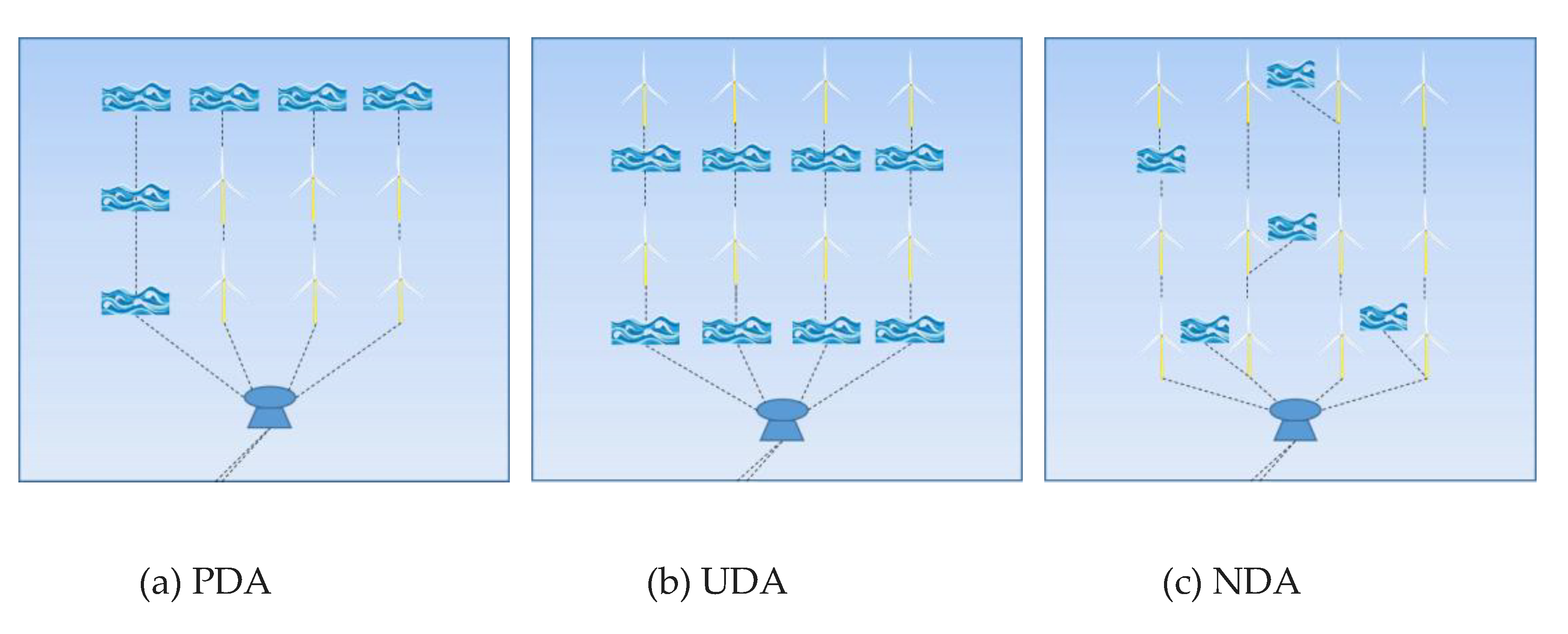
Co-located systems can be further divided into independent arrays (as shown in Figure 2) and combined arrays. Combined arrays are categorized into three types: peripherally distributed array (PDA), uniformly distributed array (UDA), and non-uniformly distributed array (NDA) [81], as illustrated in Figure 1. The PDA places WECs along the outer region of the array, defined according to the prevailing wave propagation direction. The spatial arrangement of WECs creates a wave shielding effect, significantly reducing wave energy flux in the internal area of the array (Figure 3(a)). The UDA features wind turbines and WECs evenly distributed across the entire array. This type represents a typical wind turbine–WEC combined array, where WECs are arranged at regular intervals in the gaps between existing OWTs (Figure 3(b)). Finally, the NDA is characterized by WECs arranged non-uniformly across the entire wind farm. A typical NDA design uses the standard offshore wind farm layout as a framework, considers hydrodynamic interactions among WECs and nearby turbines, and precisely optimizes WEC spatial positions to maximize energy capture (Figure 3(c)).
Figure 1.
Classification of co-located systems.
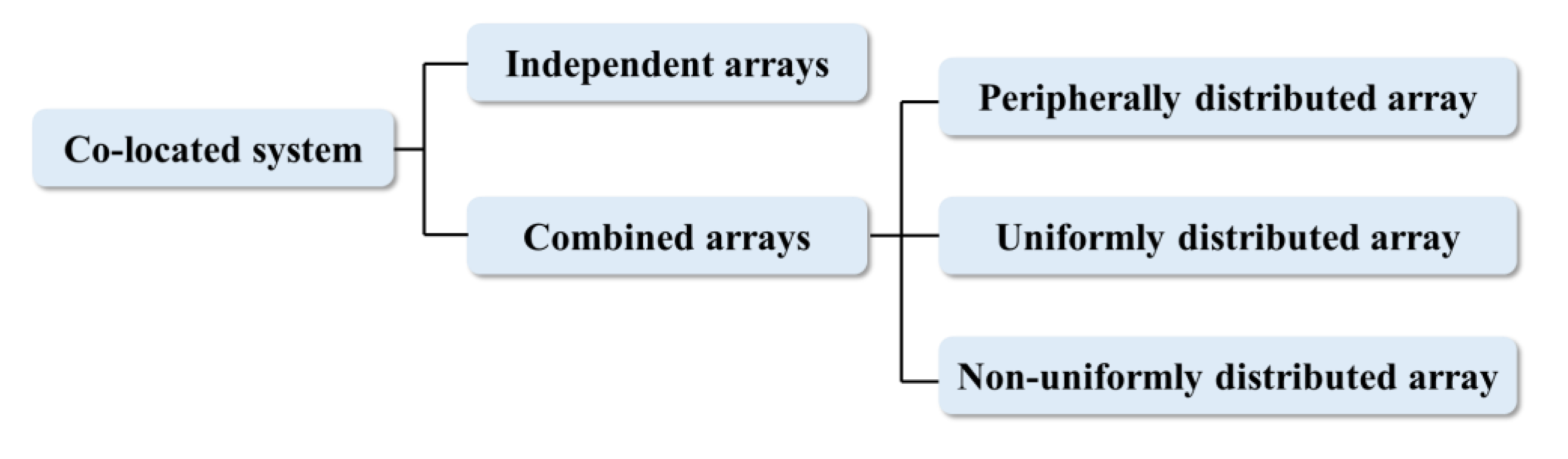
Figure 2.
Independent array.
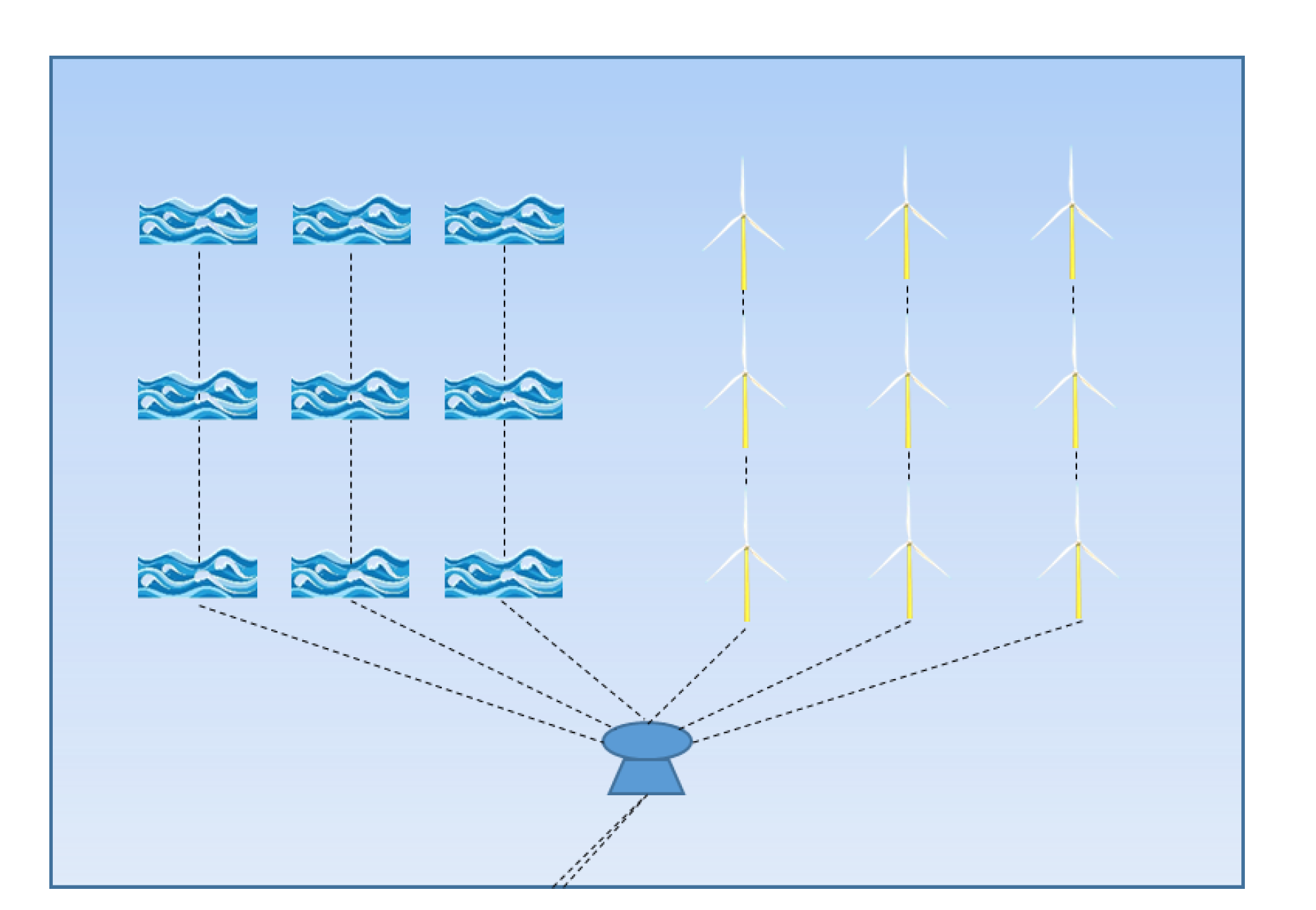
Figure 3.
Combination array.
In shallow and nearshore areas, co-located systems can effectively utilize sea space. The advantages of co-located systems lie in their mature design and operation, high flexibility, and ease of rapid deployment. However, due to the lack of close physical integration, system synergy is limited, spatial utilization is low, and the complementary features of wind and wave energy cannot be fully exploited. In addition, in areas with complex sea states or significant wind–wave interactions, power output may fluctuate, requiring advanced power management strategies to optimize system performance. From a commercialization perspective, co-located systems have gradually achieved small-scale deployment, but large-scale expansion still faces challenges related to sea area occupation, infrastructure investment, and operation and maintenance costs. Therefore, in the short term, co-located systems are more suitable for nearshore pilot projects and technology demonstration stages.
3.2. Island Systems
Island systems are offshore multi-purpose energy platforms. Their core concept is the unified development of wind, wave, and other marine resources on a single large platform. Compared with hybrid systems, island systems are larger in scale and often serve multiple functions, including energy production, storage, research, and operational activities. Island systems can be divided into artificial islands and floating islands [81] (Figure 4).
Artificial energy islands are typically built on large dikes, artificial reefs, or reclaimed bases. They offer high load-bearing capacity and stable foundations, serving as platforms for large-scale energy integration, storage, and other marine activities. The Kema Energy Island concept proposed by Dutch consultancy DNV KEMA is a typical example. This project aims to integrate wind, wave, and large-scale energy storage for multi-energy coordinated development [82]. Artificial islands are suitable for shallow and medium-depth waters, can accommodate complex energy facilities, reduce interference among devices, and improve power output stability. However, they involve high construction costs, long installation periods, and are constrained by seabed conditions and environmental factors.
Floating energy islands are large multi-purpose floating platforms. They are smaller than artificial islands but still much larger than conventional vessels, allowing integration of multiple marine energy sources. Floating islands offer flexibility and suitability for deep-water deployment, making them ideal for offshore wind–wave development [83]. For example, the 50 MW floating energy island project proposed by Energy Island Ltd. in the UK integrates wind turbines and WECs on a floating platform for efficient energy capture and multi-functional use [84]. Floating islands provide mobility and deep-water adaptability but require careful design of buoyancy, stability, mooring systems, and coordinated power control. Island systems enable highly integrated use of marine space and have the potential to become key platforms for offshore multi-energy development. With the advancement of energy storage and smart grid technologies, island systems are expected to serve as important carriers for offshore energy integration and dispatch, providing sustainable, stable, and efficient solutions for hybrid wind–wave power generation.
3.3. Hybrid Systems
WWHSs are currently the most studied and technically diverse offshore energy utilization mode in academia and industry. Their core feature lies in the structural coupling or sharing among different energy conversion devices. By arranging devices jointly, these systems enhance energy capture, reduce structural loads, and lower costs. Compared with co-located systems, hybrid systems are not only spatially interdependent but also achieve multi-level coupling in structure, dynamics, and power output. This makes them a key development direction for future offshore multi-energy platforms. Hybrid systems can be classified by foundation type into (1) bottom-fixed hybrid systems and (2) floating hybrid systems, as shown in Figure 5.
3.3.1. Bottom-Fixed Hybrid Systems
Bottom-fixed hybrid systems are one of the mainstream technical pathways for nearshore wind and wave energy integration. Their core lies in integrating WEC devices with mature fixed OWT support structures, such as gravity, monopile, and jacket foundations. The system achieves shared infrastructure and structural synergy by embedding, attaching, or surrounding WECs on the fixed foundations. This approach offers multiple advantages, including mature construction techniques, convenient operation and maintenance, cost reduction through shared foundations, and high structural stiffness to withstand large loads.
Among various integration schemes, combining OWC devices with fixed foundations is a major research direction. Integration with monopiles mainly appears in two forms: one involves cutting openings in the monopile to use its internal cavity as the OWC chamber [85]; the other installs an independent “hooded” structure around the monopile to form the chamber [86,87,88,89]. Compared to monopiles, jacket foundations provide more flexible integration space for OWC devices. For example, Perez-Collazo et al. proposed placing the OWC device at the central region of the jacket structure to form a compact wind-wave hybrid unit [86,90].
Beyond OWC-based systems, OB WECs exhibit diverse technologies and offer rich integration concepts with wind turbine foundations. Oscillating and pitching buoys derived from mature WEC devices such as WaveBob and WaveStar are the primary forms integrated with wind turbines.
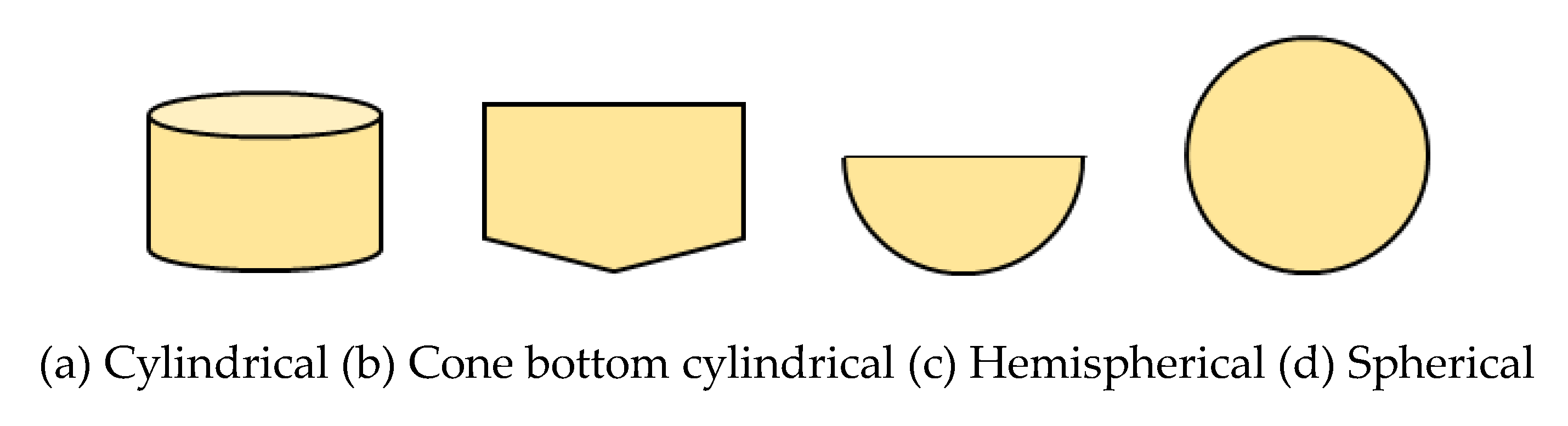
For monopile-supported hybrid systems, a wide range of design concepts exists. OBs are often hollow ring structures placed around the monopile and guided to oscillate vertically (Figure 6(a)), with SEACAP [91] and MWWC [95] as typical examples. Pitching buoys are connected at one end to the monopile via a hinged arm and at the other end to the top of the buoy. These buoys vary in shape, including spherical [96], hemispherical [92], and semi-ring [94,97], with usually more than two units. Innovative concepts continue to emerge. For instance, Li et al. [93] proposed splitting a ring buot into three identical buoys arranged around a monopile turbine, studying hydrodynamic interactions and coupling under different PTO damping (Figure 6(b)). Subsequent studies analyzed wave load characteristics of a 15 MW monopile-ring buoy hybrid system [25] (Figure 6(a)). Multiple studies indicate that arranging several OB WECs around or below a monopile significantly improves power capture [94], with WEC quantity, radial distance, and PTO damping as key design parameters [92]. Integration concepts extend to other foundation types. Pitching buoys can be combined with jacket wind turbines [98]; OBs can be integrated with CBFs (Figure 6(c)) [99]; multiple OBs can also be installed on gravity foundations [100]. These examples demonstrate the technical diversity and adaptability of bottom-fixed hybrid systems.
Figure 6.
Integrated schematic diagram of fixed foundation and OB. (a) Hollow annular buoy integrated with monopile, adapted from [94]; (b) Monopile integrated with segmented buoy, adapted from [93]; (c) CBF integrated with cylindrical buoy, adapted from [99].
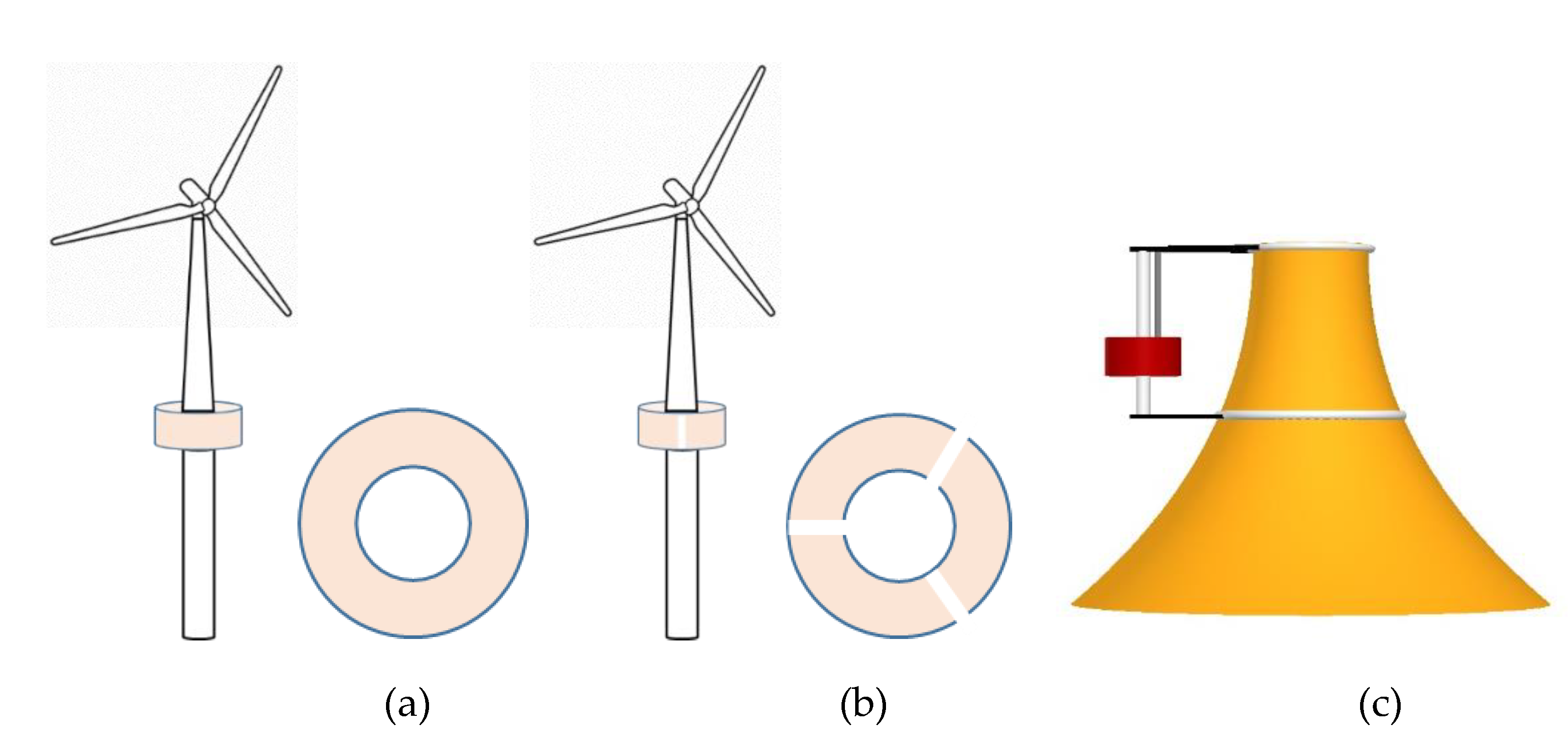
Figure 7.
Buoy shape diagram.
3.3.2. Floating Hybrid Systems
Compared to fixed foundations, floating systems integrated with OWC devices cover nearly all types of floating wind turbine foundations. In these cases, wind turbines are usually single units, while OWC devices are typically two or more, such as three [101] or four [102] OWCs evenly distributed around a monopile, a TLP combined with three OWCs [103], four OWCs installed at the corners of a square barge platform [104,105], and semi-submersible platforms combined with two [106] or three [107,108,109] OWCs.
Although most operational offshore wind farms currently use fixed turbines, floating foundation integration with wave energy devices exhibits more diverse forms than fixed systems. Spar floating wind turbine foundations resemble fixed monopiles in shape. Therefore, the integration of OBs with wind turbines in hybrid units is also similar. Examples include STC [21] and HWNC [110], which consist of ring-type OBs with Spar, and concepts combining conical cylindrical [111] or spherical [96] pitching buoys with Spar turbines. TLP wind turbines combined with OB WECs are less common. Based on buoy quantity, these hybrid units can be divided into single-buoy [112,113] and multi-buoy configurations [114,115]. Compared to Spar floating wind turbines and TLPs, semi-submersible platforms offer a wider range of water depths and lower mooring installation costs [116], making them the most common foundation type for wind-wave hybrid units. OB WECs integrated with semi-submersible turbines are also classified as oscillating [117,118] or pitching [26,116,119,120,121]. Main semi-submersible platforms used for integration include DeepCwind [120,126], WindFloat [117,118], and braceless [116,121], with novel forms such as hexagonal designs [119]. Tian et al. [122], Zhou et al. [123], and Homayoun et al. [124] systematically studied the coupling between semi-submersible platforms and various OB types. They analyzed the relationships among platform motion, PTO damping, and power generation. Results show that buoy quantity, geometry, and damping configuration can optimize system power output and motion response by altering added mass and multi-body interference patterns.
Discussions on combining wave and wind energy began in the 1990s, with projects such as Ocean Surge-driven Renewable Energy (OSPREY), which integrated bottom-mounted OWCs within fixed wind turbine foundations [125,126]. With the rapid development of OWTs in the early 2010s, research on WWHSs expanded [127,128,129]. The goal is to exploit the complementarity of wind and wave resources, where offshore wind provides high-capacity generation, and waves contribute more stable energy. Utilizing both resources is seen as an opportunity to accelerate technological development and harness numerous synergistic effects [80,130]. Design and analysis of WWHSs have been extensively studied, although only a few prototypes have undergone sea trials. Table 2 presents industry-driven hybrid initiatives, including demonstration projects, prototypes, and concept designs. To date, the most successful sea-tested hybrid platform is the P37 prototype developed by Floating Power Plant (FPP) [131]. Similarly, companies such as Ocean Power Systems (DualSub concept [133]), Bombora Wave Power (InSPIRE project [134]), and Pelagic Power (W2Power concept [135]) initially focused on wave energy development but later proposed integrating their technology with FOWTs.
4. Optimization of Hybrid Wind–Wave Energy Systems: Technologies and Layouts
The optimization strategies for WWHSs mainly focus on four core objectives: maximizing energy capture, minimizing structural loads, enhancing system stability and safety, and optimizing life-cycle economics. Wind and wave energy are coupled in spatial, frequency, and load characteristics. Therefore, proper layout design and advanced energy conversion technologies are key to ensuring overall system performance. This section provides a systematic review from two perspectives: technological optimization and layout optimization.
4.1. Technological Optimization
Technological optimization forms the foundation for achieving the four core objectives of WWHSs. It is primarily advanced through three pathways: the integrated adaptation of foundation types with WECs, optimization of energy conversion mechanisms, and innovative design of hybrid foundations. These approaches have led to diverse and targeted technical solutions.
4.1.1. Integrated Design of Foundations and WECs
Monopile foundations, as the mainstream support structure for OWTs, exhibit the most mature and widely studied integration technology with WECs. OWC WECs are good option for monopile integration. Zhou et al. [88] established a 3D time-domain numerical model based on linear potential flow theory and validated it with wave tank experiments, demonstrating that the introduction of OWC can significantly reduce the horizontal forces and overturning moments on the monopile, and that wave steepness has a notable impact on efficiency under OWC resonance. Perez-Collazo et al. [90,137] conducted experiments using 1:40 and 1:37.5 scaled models, further clarifying the dynamic characteristics of OWC-monopile integrated systems, finding that a 0.5% aperture with corresponding turbine damping achieves optimal efficiency, and that the system exhibits two resonance periods of 6 s and 9 s. Beyond OWCs, heaving and pitching WECs also show good integration potential. Gubesch et al. [80], in a 1:13 scaled experiment, demonstrated that actively controlling the motion of heaving WECs can effectively reduce wave loads on the monopile. Khatibani and Ketabdari [92] proposed a dual-pitching WEC-monopile system, achieving a 26% energy gain in the Persian Gulf by optimizing the PTO damping coefficient. Moreover, integration technology has expanded from monopiles to multiple support structure types, reflecting strong technical adaptability. Integration schemes such as pitching buoys with jacket foundations [98], CBF with oscillating buoy [99], and multiple heaving buoys with gravity-based foundations [100] have been validated. Multiple studies indicate that arranging several buoy WECs around or below a monopile can significantly enhance system power capture, forming a diversified technological pathway for hybrid systems [94].
4.1.2. Power Conversion and Performance Enhancement
Optimization of WEC structural parameters is a core approach to enhance energy conversion efficiency. Liu et al. [138] proposed an annular oscillating water column device (OWCD) integrated with a bottom-fixed wind turbine. Using analytical methods to simulate air–water interaction, they found that when the OWCD section width and draft are 1.0 and 1.5 times the monopile radius, respectively, wave energy capture efficiency can exceed 80% of the incident wave energy within a 2B width. The piston-mode resonance of water in the chamber is the key to maximizing efficiency. For buoy WECs, Li et al. [93] proposed decomposing an annular buoy into a three-buoy array coupled with a monopile wind turbine, demonstrating that WEC number, radial spacing, and PTO damping are critical parameters influencing energy capture efficiency. Subsequent studies further revealed the wave load characteristics of a 15 MW wind turbine integrated with an annular buoy system [25]. Ghafari et al. [121] showed that the geometric size of WECs significantly affects energy output; for example, twelve 5.575 m Wavestar WECs produced 12.85% more full-wave directional power than eighteen 5 m WECs.
Precise matching of PTO damping coefficients is also critical to balancing energy conversion efficiency and system stability. Khatibani and Ketabdari [94], using time-domain boundary element method (BEM) modeling, clarified the damping matching relationship between wind turbines and pitching WECs, providing a parameter basis for maximizing wave energy capture. Li et al. [93] further confirmed that under different PTO damping conditions, hydrodynamic coupling between the buoy array and monopile varies significantly, and reasonable damping configuration can substantially improve system power capture.
4.1.3. Innovative Designs of Hybrid Foundation Concepts
To address the increased foundation load demands caused by multi-device integration, Ma et al. [139] proposed a monopile–steel-plate hybrid foundation (as shown in Figure 8). Finite element simulations verified that this scheme can achieve load optimization with the same mechanical response, avoiding an additional 17% embedment depth for the monopile and requiring only a 14 m diameter steel plate. Sensitivity analysis indicated that the system response at the mudline is most sensitive to variations in embedment depth and steel plate diameter. Although the hybrid foundation increases maximum lateral soil stress by up to 18%, it remains within a controllable range. This foundation innovation provides support for integrated multi-energy devices, including wind power, wave energy, and hydrogen production, forming the concept of a hybrid offshore renewable energy harvesting system (HOREHS) centered on wind energy.
4.2. Layout Optimization
Layout optimization coordinates energy capture, load distribution, and system stability by rationally configuring the number, spatial arrangement, and array form of WECs. It is a key step in achieving multi-objective optimization and has established a complete research framework of “parameter optimization–algorithm support–platform adaptation.”
4.2.1. Key Layout Parameters of Hybrid Wind–Wave Arrays
The number of WECs exhibits a significant nonlinear relationship with system power output. Moderate increases in WECs can enhance energy absorption, but overly dense arrangements reduce performance due to radiation–diffraction interference and increase platform added mass, affecting natural frequencies and stability. Ghafari et al. [26] studied the DeepCwind semi-submersible platform and found that as the number of Wavestar WECs increased, the ratio of full-wave-period power to response amplitude operator (RAO) rose synchronously, while the generation difference between 0° and 180° wave directions gradually decreased. For 6, 9, and 12 WEC configurations, the differences decreased by 32%, 26%, and 17%, respectively (schematic of the integrated system shown in Figure 9). Tian et al. [122] further confirmed that installing three WECs on a semi-submersible platform maximized pitch radiation damping, achieving an optimal balance between energy capture and motion suppression.
Spacing and array arrangement directly affect hydrodynamic interference and energy capture efficiency. Regab et al. [145] used numerical simulations to determine that a staggered square layout was the optimal array. When longitudinal and transverse spacings were 5D and 4D (D is the rotor diameter), total system power increased by over 14.4%, while sea area usage decreased by 52.5%. De Backer et al. [140] compared 12 staggered-grid and 21 arranged-grid floating buoy arrays and found that diagonal optimization and individual optimization strategies increased power output by 16%–18%, significantly outperforming single-buoy control schemes.
4.2.2. Layout Optimization Algorithms and Simulation Tools
The application of advanced optimization algorithms has significantly improved the accuracy and efficiency of layout design. Wang et al. [141] employed a GPU-accelerated multi-objective differential evolution algorithm to optimize the layout of a single-pile NREL 5 MW wind turbine–oscillating surge WEC system, achieving a 37.75% increase in energy output and a 43.65% reduction in wave loads. Yang et al. [144] proposed an enhanced serpentine optimizer, which optimized the array of V27-225 kW wind turbines and multiple buoy WECs, achieving a capture power of 144.47 kW, significantly outperforming the original serpentine optimizer.
To address the time-consuming issue of wave wake analysis, Haces-Fernandez et al. [146] proposed a pre-processing method that computes and stores wave wakes prior to recursive layout optimization. By combining 36 years of historical meteorological data, commercially feasible layouts were successfully identified at two different locations in the Gulf of Mexico. Innovations in numerical simulation tools provide critical support for layout optimization. Xu et al. [147] developed the multiphase solver overWaveIsoFoam, integrating the isoAdvector algorithm with overset mesh technology, enabling accurate simulations of the DeepCwind platform with internal oscillating WECs and external Wavestar devices. This provides an efficient tool for optimizing both inner and outer WEC layouts (schematic of the integrated system shown in Figure 10).
4.2.3. Platform Type Adaptation Layout Strategy
The dynamic characteristics vary significantly among different platform types, leading to targeted layout design principles. For barge-type FOWTs, Ding et al. [18] proposed the IFES model, showing that the directional integration of WECs is crucial for suppressing platform rotational motion. When eight WECs are symmetrically distributed, the platform’s roll motion amplitude is reduced by up to 71.52%. Longitudinal WECs dominate energy capture and significantly decrease the tower base roll moment, though increasing WEC numbers may raise the pitch moment due to nonlinear interactions (schematic of the integrated system shown in Figure 11).
For semi-submersible platforms, layout optimization emphasizes multi-parameter coordination. Jin et al. [143] studied the DeepCwind platform integrated with Wavestar WECs and identified a 30° enclosure angle and 22.87 m arm projection as optimal parameters (schematic shown in Figure 12). Xu et al. [147] applied hierarchical optimization to determine a hybrid layout of 12 internal OBWECs and 15 external Wavestar devices, which substantially reduced surge, pitch, and heave motions and enhanced wave diffraction effects. Hu et al. [117] investigated semi-submersible platforms with multiple oscillating WECs, using potential flow theory and frequency-domain viscous corrections to precisely match WEC size and layout to specific sea states, while also mitigating platform pitch motion (schematic shown in Figure 13).
The optimization of WWHSs has developed into a coordinated framework integrating technology and layout design. Technical optimization focuses on foundation–WEC compatibility, energy conversion efficiency enhancement, and hybrid foundation innovation. Layout optimization achieves multi-objective balance through parameter tuning, algorithmic support, and platform adaptation. Existing studies have demonstrated that the integration of OWC and buoy WECs on monopile and multiple foundation types possesses engineering application potential. Layout strategies such as staggered grids and symmetric distributions, combined with algorithmic tools like GPU-accelerated optimization and wave wake pre-processing, significantly improve system performance. Future research should further investigate coupling mechanisms under complex sea states and promote collaborative layout optimization of multiple WEC types, supporting comprehensive improvements in lifecycle economic efficiency and system stability.
5. Conclusions and Suggestions for Future Research
5.1. Conclusion
In recent years, both offshore wind and wave energy technologies have achieved significant progress. The engineering adaptability of wind turbine foundations has steadily improved, while wave energy devices have seen continuous enhancements in energy capture efficiency and reliability. Against this technical backdrop, WWHSs leverage structural sharing, resource complementarity, and dynamic coupling, emerging as a key direction for integrated marine energy development. A review of current advances indicates:
(1) OWT foundation technology is progressing from nearshore to deep and ultra-deep waters. Fixed foundations are relatively mature for nearshore applications, with future development focusing on structural lightweighting, adaptability to complex geotechnical conditions, and improved installation efficiency. For floating foundations, semi-submersible, TLP, and Spar configurations collectively form the main technical pathways for deepwater wind energy, with semi-submersibles being the mainstream choice in demonstration projects due to strong stability and broad water depth adaptability. However, structural reliability, fatigue life assessment, and large-scale cost remain key technical challenges in deepwater environments.
(2) Wave energy technology is developing along multiple parallel pathways. Oscillating-body devices, particularly point absorbers, are a research focus due to their compact structure and adaptability, but engineering deployment is constrained by extreme sea-state loads, corrosion, and biofouling. OWC technology is relatively mature but depends on specific shoreline topographies. Overtopping devices can smooth power output fluctuations, yet their large-scale structures pose deployment challenges. Overall, all three device types face limitations in cost, reliability, and environmental adaptability, which restricts large-scale commercialization.
(3) Hybrid wind–wave system technologies are being explored along diverse approaches. Co-located systems offer flexible deployment and low engineering risk, making them suitable for nearshore demonstrations, though wind–wave coupling effects are limited. Island-type systems (artificial or floating) promote intensive marine space utilization and are a key direction for deepwater multi-energy integration, but they incur high construction costs and system complexity. Hybrid systems enhance energy capture and reduce structural loads through structural integration and dynamic coupling, representing the pathway with the greatest industrialization potential.
(4) System performance improvement relies on the coordinated advancement of structural integration and layout optimization. Foundation–WEC integrated designs enable foundation sharing and load synergy. Through precise PTO damping adjustment and hybrid foundation innovation, energy conversion efficiency and structural stress performance can be further optimized. Layout optimization has gradually formed a multi-objective framework of “parameter modeling—intelligent algorithms—platform scenario adaptation.” By adjusting WEC numbers, spacing, and platform-specific layouts, a balance between energy capture, structural stability, and spatial efficiency can be achieved. Nonetheless, challenges remain in complex sea states, multi-scale dynamic coupling, and real-time adaptability.
Overall, WWHSs are accelerating from conceptual design and laboratory validation toward small-scale demonstration applications. However, industrial deployment and large-scale commercialization still require breakthroughs in foundation–WEC integration, fluid–structure interaction dynamics, intelligent control strategies, lifecycle cost optimization, and grid compatibility.
5.2. Future Research
To address current research gaps and technical bottlenecks, and to advance WWHSs from experimental validation to commercial deployment, future studies should focus on the following directions:
(1) In-depth investigation of structural integration and hydrodynamic coupling mechanisms. Develop refined models of the coupled response between wind turbines and WECs, particularly considering multi-field interactions of wind, waves, and currents on floating platforms. Conduct full-scale or large-system evaluations under realistic sea conditions to capture load spectra, structural responses, and fatigue damage, thereby reducing discrepancies between numerical simulations and practical engineering. These studies will provide reliable foundations for subsequent design methods and standard frameworks.
(2) Collaborative optimization design for multi-energy coupled systems. Future research should establish multi-objective optimization frameworks that account for both wind and wave energy characteristics, encompassing key factors such as foundation type, WEC configuration, layout, and scale parameters. For monopile, jacket, semi-submersible, and Spar foundations, optimal coupling strategies with point absorbers, OWCs, and overtopping devices should be explored to achieve global coordination between energy capture, structural loading, and cost.
(3) Deep integration of intelligent control and digital twin technologies. Intelligent control strategies should be incorporated into PTO systems and platform motion management to achieve efficient real-time adaptation to changing sea states. System-level digital twins enabling virtual-to-physical mapping can support structural health monitoring, fault diagnosis, lifespan prediction, and O&M optimization, representing a critical pathway for improving long-term reliability and economic performance of hybrid systems.
(4) Lifecycle cost modeling and reliability-based design frameworks. Develop LCOE analysis frameworks tailored to WWHSs to quantify cost-saving potential through structural sharing, foundation reuse, and coordinated operation. Strengthen reliability assessments under long-term environmental effects, including corrosion, extreme sea states, and biofouling, and promote maintainable and modular design strategies. Multi-scenario demonstration projects under nearshore fixed and deepwater floating conditions are recommended to validate the feasibility of full-process technologies and commercial models.
(5) Integration of ecological friendliness with engineering design. Investigate the interaction mechanisms between WWHSs and the marine ecosystem to establish cross-scale assessment methods balancing energy development and ecological protection. Optimizing device morphology, foundation structures, and array layouts can reduce disturbances to marine habitats, hydrodynamic conditions, and sediment processes, promoting coexistence of engineering systems and ecological integrity.
Overall, breakthroughs in these directions will lay the foundation for large-scale deployment and commercialization of WWHSs, advancing marine renewable energy toward an efficient, safe, economical, and environmentally sustainable utilization stage.
Data Availability
Data will be made available on request.
Declaration of competing interest
The authors declare that they have no known competing financial interests or personal relationships that could have appeared to influence the work reported in this paper.
| Nomenclature | UN-SDG | United Nations Sustainable Development Goal | |
| Abbreviation | TLP | tension-leg platform | |
| WWHS | Wind–wave hybrid system | OWC | oscillating water column |
| OWT | Offshore wind turbine | PDA | peripherally distributed array |
| FOWT | Floating offshore wind turbine | UDA | uniformly distributed array |
| CBF | Composite bucket foundation | NDA | non-uniformly distributed array |
| OB | Oscillating buoy | OSPREY | Ocean Surge-driven Renewable Energy |
| PTO | Power take-off | OWCD | oscillating water column device |
| WEC | Wave energy converter | BEM | boundary element method |
| RAO | Response amplitude operator | HOREHS | hybrid offshore renewable energy harvesting system |
| NMSC | The National Marine Science Data Center |
Acknowledgments
The National Natural Science Foundation of China (52071304) and the Fundamental Research Funds for the Central Universities (No. 202561073) financially supported this work.
References
- Zhang, Q.; Yu, Z.; Kong, D. The Real Effect of Legal Institutions: Environmental Courts and Firm Environmental Protection Expenditure. Journal of Environmental Economics and Management 2019, 98, 102254. [Google Scholar] [CrossRef]
- Hoppe, T.; Coenen, F.; van den Berg, M. Illustrating the Use of Concepts from the Discipline of Policy Studies in Energy Research: An Explorative Literature Review. Energy Research & Social Science 2016, 21, 12–32. [Google Scholar] [CrossRef]
- Azam, A.; Ahmed, A.; Kamran, M.S.; Hai, L.; Zhang, Z.; Ali, A. Knowledge Structuring for Enhancing Mechanical Energy Harvesting (MEH): An in-Depth Review from 2000 to 2020 Using CiteSpace. Renewable and Sustainable Energy Reviews 2021, 150, 111460. [Google Scholar] [CrossRef]
- Amagai, K.; Takarada, T.; Funatsu, M.; Nezu, K. Development of Low-CO2-Emission Vehicles and Utilization of Local Renewable Energy for the Vitalization of Rural Areas in Japan. IATSS Research 2014, 37, 81–88. [Google Scholar] [CrossRef]
- Li, C. Ranking of Factors Affecting Environmental Pollution. International journal of industrial engineering and operational research 2023, 5, 1–11. [Google Scholar] [CrossRef]
- Piekut, M. The Consumption of Renewable Energy Sources (RES) by the European Union Households between 2004 and 2019. Energies 2021, 14. [Google Scholar] [CrossRef]
- Abdelrahman, M.; Liu, G.; Fan, C.; Zhang, Z.; Ali, A.; Li, H.; Azam, A.; Cao, H.; Mohamed, A.A. Energy Regenerative Shock Absorber Based on a Slotted Link Conversion Mechanism for Application in the Electrical Bus to Power the Low Wattages Devices. Applied Energy 2023, 347, 121409. [Google Scholar] [CrossRef]
- Singh, P.; Singh, S.; Vardhan, S.; Patnaik, A. Sustainability of Maintenance Management Practices in Hydropower Plant: A Conceptual Framework. Materials Today: Proceedings 2020, 28, 1569–1574. [Google Scholar] [CrossRef]
- Scarlat, N.; Dallemand, J.-F.; Monforti-Ferrario, F.; Banja, M.; Motola, V. Renewable Energy Policy Framework and Bioenergy Contribution in the European Union – an Overview from National Renewable Energy Action Plans and Progress Reports. Renewable and Sustainable Energy Reviews 2015, 51, 969–985. [Google Scholar] [CrossRef]
- S.-G. of the E. Commission. Report from the commission to the European parliament, the council, the European economic and social committee and the committee of the regions: EU citizenship report 2020: empowering citizens and protecting their rights. 2020.
- Sun, Y.; Li, Y.; Wang, R.; Ma, R. Assessing the National Synergy Potential of Onshore and Offshore Renewable Energy from the Perspective of Resources Dynamic and Complementarity. Energy 2023, 279, 128106. [Google Scholar] [CrossRef]
- Zhang, H.; Tomasgard, A.; Knudsen, B.R.; Svendsen, H.G.; Bakker, S.J.; Grossmann, I.E. Modelling and Analysis of Offshore Energy Hubs. Energy 2022, 261, 125219. [Google Scholar] [CrossRef]
- Voldsund, M.; Reyes-Lúa, A.; Fu, C.; Ditaranto, M.; Nekså, P.; Mazzetti, M.J.; Brekke, O.; Bindingsbø, A.U.; Grainger, D.; Pettersen, J. Low Carbon Power Generation for Offshore Oil and Gas Production. Energy Conversion and Management: X 2023, 17, 100347. [Google Scholar] [CrossRef]
- Richts, C.; Jansen, M.; Siefert, M. Determining the Economic Value of Offshore Wind Power Plants in the Changing Energy System. Energy Procedia 2015, 80, 422–432. [Google Scholar] [CrossRef]
- Stringer, T.; Joanis, M.; Abdoli, S. Power Generation Mix and Electricity Price. Renewable Energy 2024, 221, 119761. [Google Scholar] [CrossRef]
- Cheng, Y.; Fu, L.; Dai, S.; Collu, M.; Cui, L.; Yuan, Z.; Incecik, A. Experimental and Numerical Analysis of a Hybrid WEC-Breakwater System Combining an Oscillating Water Column and an Oscillating Buoy. Renewable and Sustainable Energy Reviews 2022, 169, 112909. [Google Scholar] [CrossRef]
- Wen, Y.; Kamranzad, B.; Lin, P. Joint Exploitation Potential of Offshore Wind and Wave Energy along the South and Southeast Coasts of China. Energy 2022, 249, 123710. [Google Scholar] [CrossRef]
- Ding, J.; Yang, Y.; Yu, J.; Bashir, M.; Ma, L.; Li, C.; Li, S. Fully Coupled Dynamic Responses of Barge-Type Integrated Floating Wind-Wave Energy Systems with Different WEC Layouts. Ocean Engineering 2024, 313, 119453. [Google Scholar] [CrossRef]
- P Patel, R.; Nagababu, G.; Kachhwaha, S.S.; V V Arun Kumar, S.; M, S. Combined Wind and Wave Resource Assessment and Energy Extraction along the Indian Coast. Renewable Energy 2022, 195, 931–945. [Google Scholar] [CrossRef]
- Nguyen, H.P.; Wang, C.M.; Tay, Z.Y.; Luong, V.H. Wave Energy Converter and Large Floating Platform Integration: A Review. Ocean Engineering 2020, 213, 107768. [Google Scholar] [CrossRef]
- Wan, L.; Gao, Z.; Moan, T.; Lugni, C. Experimental and Numerical Comparisons of Hydrodynamic Responses for a Combined Wind and Wave Energy Converter Concept under Operational Conditions. Renewable Energy 2016, 93, 87–100. [Google Scholar] [CrossRef]
- Astariz, S.; Abanades, J.; Perez-Collazo, C.; Iglesias, G. Improving Wind Farm Accessibility for Operation & Maintenance through a Co-Located Wave Farm: Influence of Layout and Wave Climate. Energy Conversion and Management 2015, 95, 229–241. [Google Scholar] [CrossRef]
- Kalogeri, C.; Galanis, G.; Spyrou, C.; Diamantis, D.; Baladima, F.; Koukoula, M.; Kallos, G. Assessing the European Offshore Wind and Wave Energy Resource for Combined Exploitation. Renewable Energy 2017, 101, 244–264. [Google Scholar] [CrossRef]
- Astariz, S.; Iglesias, G. Output Power Smoothing and Reduced Downtime Period by Combined Wind and Wave Energy Farms. Energy 2016, 97, 69–81. [Google Scholar] [CrossRef]
- Li, Y. , Yan, S., Shi, H., Ma, Q., Dong, X., Cao, F. Wave Load Characteristics on a Hybrid Wind-Wave Energy System. Ocean Engineering 2024, 294, 116827. [Google Scholar] [CrossRef]
- Ghafari, H.R. , Ghassemi, H.; He, G. Numerical Study of the Wavestar Wave Energy Converter with Multi-Point-Absorber around DeepCwind Semisubmersible Floating Platform. Ocean Engineering 2021, 232, 109177. [Google Scholar] [CrossRef]
- Kim, Y.; Lim, J.S.; Kim, H.J.; Choi, S.-W. A Comprehensive Review of Foundation Designs for Fixed Offshore Wind Turbines. International Journal of Naval Architecture and Ocean Engineering 2025, 17, 100643. [Google Scholar] [CrossRef]
- Oh, K.-Y.; Nam, W.; Ryu, M.S.; Kim, J.-Y.; Epureanu, B.I. A Review of Foundations of Offshore Wind Energy Convertors: Current Status and Future Perspectives. Renewable and Sustainable Energy Reviews 2018, 88, 16–36. [Google Scholar] [CrossRef]
- Zhang, P.; Li, J.; Gan, Y.; Zhang, J.; Qi, X.; Le, C.; Ding, H. Bearing Capacity and Load Transfer of Brace Topological in Offshore Wind Turbine Jacket Structure. Ocean Engineering 2020, 199, 107037. [Google Scholar] [CrossRef]
- Tran, T.-T.; Lee, D. Development of Jacket Substructure Systems Supporting 3MW Offshore Wind Turbine for Deep Water Sites in South Korea. International Journal of Naval Architecture and Ocean Engineering 2022, 14, 100451. [Google Scholar] [CrossRef]
- Mathern, A.; Haar, C. von der; Marx, S. Concrete Support Structures for Offshore Wind Turbines: Current Status, Challenges, and Future Trends. Energies 2021, 14. [Google Scholar] [CrossRef]
- Ding, H.; Feng, Z.; Zhang, P.; Le, C. Integrated Towing Transportation Technique for Offshore Wind Turbine with Composite Bucket Foundation. China Ocean Eng 2022, 36, 133–143. [Google Scholar] [CrossRef]
- Zhang, P.; Li, J.; Le, C.; Ding, H. Seismic Responses of Two Bucket Foundations for Offshore Wind Turbines Based on Shaking Table Tests. Renewable Energy 2022, 187, 1100–1117. [Google Scholar] [CrossRef]
- Yu, T.; Song, H.; Bian, X.; Yan, Z.; Zhao, X.; Zhang, Z.; Tong, X. Theoretical Analysis of Wave Run-up on the Composite Bucket Foundation under Wave Action. Ocean Engineering 2024, 308, 118347. [Google Scholar] [CrossRef]
- Chen, J. Research Status and Prospects of In-Situ Installation Technology for Floating Offshore Wind Turbine. Ocean Engineering 2026, 343, 123253. [Google Scholar] [CrossRef]
- Li, H.; Bachynski-Polić, E.E. Analysis of Difference-Frequency Wave Loads and Quadratic Transfer Functions on a Restrained Semi-Submersible Floating Wind Turbine. Ocean Engineering 2021, 232, 109165. [Google Scholar] [CrossRef]
- Wu, H.; Zhao, Y.; He, Y.; Shao, Y.; Mao, W.; Han, Z.; Huang, C.; Gu, X.; Jiang, Z. Transient Response of a TLP-Type Floating Offshore Wind Turbine under Tendon Failure Conditions. Ocean Engineering 2021, 220, 108486. [Google Scholar] [CrossRef]
- Jiang, Z.; Wen, B.; Chen, G.; Xiao, L.; Li, J.; Peng, Z.; Tian, X. Feasibility Studies of a Novel Spar-Type Floating Wind Turbine for Moderate Water Depths: Hydrodynamic Perspective with Model Test. Ocean Engineering 2021, 233, 109070. [Google Scholar] [CrossRef]
- Edwards, E.C.; Holcombe, A.; Brown, S.; Ransley, E.; Hann, M.; Greaves, D. Evolution of Floating Offshore Wind Platforms: A Review of at-Sea Devices. Renewable and Sustainable Energy Reviews 2023, 183, 113416. [Google Scholar] [CrossRef]
- H. Stiesdal. Hywind: the world’s first floating MW-scale wind turbine. Wind directions (Dec. 2009.
- Principle Power. https://www.principlepowerinc.com/. Accessed in 2023.
- Wan, L.; Moan, T.; Gao, Z.; Shi, W. A Review on the Technical Development of Combined Wind and Wave Energy Conversion Systems. Energy 2024, 294, 130885. [Google Scholar] [CrossRef]
- Shadmani, A.; Nikoo, M.R.; Gandomi, A.H.; Chen, M.; Nazari, R. Advancements in Optimizing Wave Energy Converter Geometry Utilizing Metaheuristic Algorithms. Renewable and Sustainable Energy Reviews 2024, 197, 114398. [Google Scholar] [CrossRef]
- Jin, S.; Zheng, S.; Greaves, D. On the Scalability of Wave Energy Converters. Ocean Engineering 2022, 243, 110212. [Google Scholar] [CrossRef]
- Zhao, M.; Ning, D. A Review of Numerical Methods for Studying Hydrodynamic Performance of Oscillating Water Column (OWC) Devices. Renewable Energy 2024, 233, 121177. [Google Scholar] [CrossRef]
- Ghasemipour, N.; Izanlou, P.; Jahangir, M.H. Feasibility Study on Utilizing Oscillating Wave Surge Converters (OWSCs) in Nearshore Regions, Case Study: Along the Southeastern Coast of Iran in Oman Sea. Journal of Cleaner Production 2022, 367, 133090. [Google Scholar] [CrossRef]
- Doyle, S.; Aggidis, G.A. Development of Multi-Oscillating Water Columns as Wave Energy Converters. Renewable and Sustainable Energy Reviews 2019, 107, 75–86. [Google Scholar] [CrossRef]
- Boodoo, A.; Imai, Y. Experimental Investigation of a Novel Adjustable-Slope Onshore Overtopping Wave Energy Converter for Coastal Protection and Energy Generation. Energy Conversion and Management: X 2025, 28, 101400. [Google Scholar] [CrossRef]
- Liu, Z.; Shi, H.; Cui, Y.; Kim, K. Experimental Study on Overtopping Performance of a Circular Ramp Wave Energy Converter. Renewable Energy 2017, 104, 163–176. [Google Scholar] [CrossRef]
- Goulart, M.M.; Martins, J.C.; Gomes, A.P.; Puhl, E.; Rocha, L.A.O.; Isoldi, L.A.; Gomes, M. das N.; dos Santos, E.D. Experimental and Numerical Analysis of the Geometry of a Laboratory-Scale Overtopping Wave Energy Converter Using Constructal Design. Renewable Energy 2024, 236, 121497. [Google Scholar] [CrossRef]
- Li, Y.; Yu, Y.-H. A Synthesis of Numerical Methods for Modeling Wave Energy Converter-Point Absorbers. Renewable and Sustainable Energy Reviews 2012, 16, 4352–4364. [Google Scholar] [CrossRef]
- Azam, A.; Ahmed, A.; Yi, M.; Zhang, Z.; Zhang, Z.; Aslam, T.; Mugheri, S.A.; Abdelrahman, M.; Ali, A.; Qi, L. Wave Energy Evolution: Knowledge Structure, Advancements, Challenges and Future Opportunities. Renewable and Sustainable Energy Reviews 2024, 205, 114880. [Google Scholar] [CrossRef]
- Zheng, S.; Zhang, Y.; Iglesias, G. Concept and Performance of a Novel Wave Energy Converter: Variable Aperture Point-Absorber (VAPA). Renewable Energy 2020, 153, 681–700. [Google Scholar] [CrossRef]
- Madan, D.; Rathnakumar, P.; Marichamy, S.; Ganesan, P.; Vinothbabu, K.; Stalin, B. A Technological Assessment of the Ocean Wave Energy Converters. In Proceedings of the Advances in Industrial Automation and Smart Manufacturing; Arockiarajan, A., Duraiselvam, M., Raju, R., Eds.; Springer: Singapore, 2021; pp. 1057–1072. [Google Scholar]
- Göteman, M. Wave Energy Parks with Point-Absorbers of Different Dimensions. Journal of Fluids and Structures 2017, 74, 142–157. [Google Scholar] [CrossRef]
- Rafiee, A.; Fiévez, J. Numerical Prediction of Extreme Loads on the CETO Wave Energy Converter; 2015.
- Parsa, K.; Mekhiche, M.; Sarokhan, J.; Stewart, D. Performance of OPT’s Commercial PB3 PowerBuoy™ during 2016 Ocean Deployment and Comparison to Projected Model Results.
- Frandsen, J.; doblaré, M.; Rodriguez, P. Preliminary Technical Assessment of the Wavebob Energy Converter Concept; 2012.
- Payne, G.S.; Taylor, J.R.M.; Bruce, T.; Parkin, P. Assessment of Boundary-Element Method for Modelling a Free-Floating Sloped Wave Energy Device. Part 2: Experimental Validation. Ocean Engineering 2008, 35, 342–357. [Google Scholar] [CrossRef]
- Payne, G.S.; Taylor, J.R.M.; Bruce, T.; Parkin, P. Assessment of Boundary-Element Method for Modelling a Free-Floating Sloped Wave Energy Device. Part 1: Numerical Modelling. Ocean Engineering 2008, 35, 333–341. [Google Scholar] [CrossRef]
- Lejerskog, E.; Boström, C.; Hai, L.; Waters, R.; Leijon, M. Experimental Results on Power Absorption from a Wave Energy Converter at the Lysekil Wave Energy Research Site. Renewable Energy 2015, 77, 9–14. [Google Scholar] [CrossRef]
- Renzi, E.; Doherty, K.; Henry, A.; Dias, F. How Does Oyster Work? The Simple Interpretation of Oyster Mathematics. European Journal of Mechanics - B/Fluids 2014, 47, 124–131. [Google Scholar] [CrossRef]
- Liang, C.; Ai, J.; Zuo, L. Design, Fabrication, Simulation and Testing of an Ocean Wave Energy Converter with Mechanical Motion Rectifier. Ocean Engineering 2017, 136, 190–200. [Google Scholar] [CrossRef]
- Liu, C. A Tunable Resonant Oscillating Water Column Wave Energy Converter. Ocean Engineering 2016, 116, 82–89. [Google Scholar] [CrossRef]
- Chen, W.; Gao, F.; Meng, X.; Fu, J. Design of the Wave Energy Converter Array to Achieve Constructive Effects. Ocean Engineering 2016, 124, 13–20. [Google Scholar] [CrossRef]
- Göteman, M.; Engström, J.; Eriksson, M.; Isberg, J. Optimizing Wave Energy Parks with over 1000 Interacting Point-Absorbers Using an Approximate Analytical Method. International Journal of Marine Energy 2015, 10, 113–126. [Google Scholar] [CrossRef]
- Kara, F. Time Domain Prediction of Power Absorption from Ocean Waves with Wave Energy Converter Arrays. Renewable Energy 2016, 92, 30–46. [Google Scholar] [CrossRef]
- Ning, D.-Z.; Shi, J.; Zou, Q.-P.; Teng, B. Investigation of Hydrodynamic Performance of an OWC (Oscillating Water Column) Wave Energy Device Using a Fully Nonlinear HOBEM (Higher-Order Boundary Element Method). Energy 2015, 83, 177–188. [Google Scholar] [CrossRef]
- Ning, D.-Z.; Wang, R.-Q.; Zou, Q.-P.; Teng, B. An Experimental Investigation of Hydrodynamics of a Fixed OWC Wave Energy Converter. Applied Energy 2016, 168, 636–648. [Google Scholar] [CrossRef]
- Wang, R.; Ning, D.; Zhang, C.; Zou, Q.; Liu, Z. Nonlinear and Viscous Effects on the Hydrodynamic Performance of a Fixed OWC Wave Energy Converter. Coastal Engineering 2018, 131, 42–50. [Google Scholar] [CrossRef]
- de, O. Falcão, A.F. Wave-Power Absorption by a Periodic Linear Array of Oscillating Water Columns. Ocean Engineering 2002, 29, 1163–1186. [Google Scholar] [CrossRef]
- De Backer, G.; Vantorre, M.; Frigaard, P.; Beels, C.; De Rouck, J. Bottom Slamming on Heaving Point Absorber Wave Energy Devices. J Mar Sci Technol 2010, 15, 119–130. [Google Scholar] [CrossRef]
- Zhang, D.; Li, W.; Zhao, H.; Bao, J.; Lin, Y. Design of a Hydraulic Power Take-off System for the Wave Energy Device with an Inverse Pendulum. China Ocean Eng 2014, 28, 283–292. [Google Scholar] [CrossRef]
- Ma, Y.; Xie, G.; Liu, S.; Zhao, T.; Zhu, Y.; Zhang, X. Hydrodynamic Performance Investigation of the Multi-Degree of Freedom Oscillating-Buoy Wave Energy Converter. Ocean Engineering 2023, 285, 115345. [Google Scholar] [CrossRef]
- Eriksson, M.; Isberg, J.; Leijon, M. Hydrodynamic Modelling of a Direct Drive Wave Energy Converter. International Journal of Engineering Science 2005, 43, 1377–1387. [Google Scholar] [CrossRef]
- Shi, H.; Cao, F.; Liu, Z.; Qu, N. Theoretical Study on the Power Take-off Estimation of Heaving Buoy Wave Energy Converter. Renewable Energy 2016, 86, 441–448. [Google Scholar] [CrossRef]
- Xiao, X.; Xiao, L.; Peng, T. Comparative Study on Power Capture Performance of Oscillating-Body Wave Energy Converters with Three Novel Power Take-off Systems. Renewable Energy 2017, 103, 94–105. [Google Scholar] [CrossRef]
- Celesti, M.L.; Mattiazzo, G.; Faedo, N. Towards Modelling and Control Strategies for Hybrid Wind-Wave Energy Converters: Challenges and Opportunities. Renewable and Sustainable Energy Reviews 2025, 224, 116080. [Google Scholar] [CrossRef]
- Aristondo, O.; Ulazia, A.; Ezpeleta, H. Modeling Weights for Co-Location Feasibility in Hybrid Wind-Wave Device. Energy 2025, 337, 138548. [Google Scholar] [CrossRef]
- Gubesch, E.; Sergiienko, N.Y.; Nader, J.-R.; Ding, B.; Cazzolato, B.; Penesis, I.; Li, Y. Experimental Investigation of a Co-Located Wind and Wave Energy System in Regular Waves. Renewable Energy 2023, 219, 119520. [Google Scholar] [CrossRef]
- Pérez-Collazo, C.; Greaves, D.; Iglesias, G. A Review of Combined Wave and Offshore Wind Energy. Renewable and Sustainable Energy Reviews 2015, 42, 141–153. [Google Scholar] [CrossRef]
- De Boer WW, Verheij FJ, Zwemmer LBV, R. Das GD. The energy island. An inverse pump accumulation station. In: Proceedings of the European wind energy conference. EWEA: Milan, Italy; 2007. p. 1–5.
- Yin, J.; Fan, Y.; Bashir, M.; Nie, D.; Lai, Y.; Ding, J.; Yu, J.; Li, C.; Yang, Y. Development of a Hybrid Deep Learning Model with HHO Algorithm for Dynamic Response Prediction of Wind-Wave Integrated Floating Energy Systems. Ocean Engineering 2025, 340, 122394. [Google Scholar] [CrossRef]
- Energy Island Ltd. Energy island web page; 2009.
- Li, Y.; Liu, S.; Xu, C.; Li, D.; Shi, H. Experimental Study on the Cylindrical Oscillating Water Column Device. Ocean Engineering 2022, 246, 110523. [Google Scholar] [CrossRef]
- Perez-Collazo, C.; Greaves, D.; Iglesias, G. Hydrodynamic Response of the WEC Sub-System of a Novel Hybrid Wind-Wave Energy Converter. Energy Conversion and Management 2018, 171, 307–325. [Google Scholar] [CrossRef]
- Michele, S.; Renzi, E.; Perez-Collazo, C.; Greaves, D.; Iglesias, G. Power Extraction in Regular and Random Waves from an OWC in Hybrid Wind-Wave Energy Systems. Ocean Engineering 2019, 191, 106519. [Google Scholar] [CrossRef]
- Zhou, Y.; Ning, D.; Shi, W.; Johanning, L.; Liang, D. Hydrodynamic Investigation on an OWC Wave Energy Converter Integrated into an Offshore Wind Turbine Monopile. Coastal Engineering 2020, 162, 103731. [Google Scholar] [CrossRef]
- Cong, P.; Teng, B.; Bai, W.; Ning, D.; Liu, Y. Wave Power Absorption by an Oscillating Water Column (OWC) Device of Annular Cross-Section in a Combined Wind-Wave Energy System. Applied Ocean Research 2021, 107, 102499. [Google Scholar] [CrossRef]
- Perez-Collazo, C.; Greaves, D.; Iglesias, G. A Novel Hybrid Wind-Wave Energy Converter for Jacket-Frame Substructures. Energies 2018, 11. [Google Scholar] [CrossRef]
- Baudry V, Babarit A. Assessment of the annual energy production of a heaving wave energy converter sliding on the mast of a fixed offshore wind turbine. Renewable Energy Congress XI (WREC XI). 2010.
- Gkaraklova, S.; Chotzoglou, P.; Loukogeorgaki, E. Frequency-Based Performance Analysis of an Array of Wave Energy Converters around a Hybrid Wind–Wave Monopile Support Structure. Journal of Marine Science and Engineering 2021, 9, 2. [Google Scholar] [CrossRef]
- Li, Y.; Yan, S.; Shi, H.; Ma, Q.; Li, D.; Cao, F. Hydrodynamic Analysis of a Novel Multi-Buoy Wind-Wave Energy System. Renewable Energy 2023, 219, 119477. [Google Scholar] [CrossRef]
- Khatibani, M.J.; Ketabdari, M.J. Numerical Modeling of an Innovative Hybrid Wind Turbine and WEC Systems Performance: A Case Study in the Persian Gulf. Journal of Ocean Engineering and Science 2022. [CrossRef]
- Ren, N.; Ma, Z.; Fan, T.; Zhai, G.; Ou, J. Experimental and Numerical Study of Hydrodynamic Responses of a New Combined Monopile Wind Turbine and a Heave-Type Wave Energy Converter under Typical Operational Conditions. Ocean Engineering 2018, 159, 1–8. [Google Scholar] [CrossRef]
- Moghimi, M.; Derakhshan, S.; Motawej, H. A Mathematical Model Development for Assessing the Engineering and Economic Improvement of Wave and Wind Hybrid Energy System. Iran J Sci Technol Trans Mech Eng 2020, 44, 507–521. [Google Scholar] [CrossRef]
- Perez C, Iglesias G. Integration of wave energy converters and offshore windmills. Proc Fourth Int Conf Ocean Energy 2012:1–6.
- Gao, R.; Shi, H.; Li, J.; Wei, Z.; Cui, X.; Cao, F. Comparative Study on the Capture Performance of Two Wave Energy Converters Integrated into the Jacket-Frame Foundation. Ocean Engineering 2023, 289, 116226. [Google Scholar] [CrossRef]
- Song, H.; Yu, T.; Shi, H.; Wang, Y.; Zhang, Z. Study on Hydrodynamic Characteristics of a Hybrid Wind-Wave Energy System Combing a Composite Bucket Foundation and Wave Energy Converter. Physics of Fluids 2023, 35, 087136. [Google Scholar] [CrossRef]
- Wei, Y.; Bechlenberg, A.; van Rooij, M.; Jayawardhana, B.; Vakis, A.I. Modelling of a Wave Energy Converter Array with a Nonlinear Power Take-off System in the Frequency Domain. Applied Ocean Research 2019, 90, 101824. [Google Scholar] [CrossRef]
- Haji, M.N.; Kluger, J.M.; Sapsis, T.P.; Slocum, A.H. A Symbiotic Approach to the Design of Offshore Wind Turbines with Other Energy Harvesting Systems. Ocean Engineering 2018, 169, 673–681. [Google Scholar] [CrossRef]
- Abazari, A. Dynamic Response of a Combined Spar-Type FOWT and OWC-WEC by a Simplified Approach. Renewable Energy Research and Applications 2022, 4. [Google Scholar] [CrossRef]
- Konispoliatis, D.N.; Katsaounis, G.M.; Manolas, D.I.; Soukissian, T.H.; Polyzos, S.; Mazarakos, T.P.; Voutsinas, S.G.; Mavrakos, S.A.; Konispoliatis, D.N.; Katsaounis, G.M.; et al. REFOS: A Renewable Energy Multi-Purpose Floating Offshore System. Energies 2021, 14. [Google Scholar] [CrossRef]
- Aboutalebi, P.; M’zoughi, F.; Garrido, I.; Garrido, A.J.; Aboutalebi, P.; M’zoughi, F.; Garrido, I.; Garrido, A.J. Performance Analysis on the Use of Oscillating Water Column in Barge-Based Floating Offshore Wind Turbines. Mathematics 2021, 9. [Google Scholar] [CrossRef]
- Aboutalebi, P.; M’zoughi, F.; Martija, I.; Garrido, I.; Garrido, A.J.; Aboutalebi, P.; M’zoughi, F.; Martija, I.; Garrido, I.; Garrido, A.J. Switching Control Strategy for Oscillating Water Columns Based on Response Amplitude Operators for Floating Offshore Wind Turbines Stabilization. Applied Sciences 2021, 11. [Google Scholar] [CrossRef]
- Aubault A, Alves M, Sarmento A, Roddier D, Peiffer A. Modeling of an Oscillating Water Column on the Floating Foundation WindFloat. Volume 5: Ocean Space Utilization; Ocean Renewable Energy, Rotterdam, The Netherlands: ASMEDC; 2011, p. 235–46.
- Sarmiento, J.; Iturrioz, A.; Ayllón, V.; Guanche, R.; Losada, I.J. Experimental Modelling of a Multi-Use Floating Platform for Wave and Wind Energy Harvesting. Ocean Engineering 2019, 173, 761–773. [Google Scholar] [CrossRef]
- Zhu, H.; Hu, C.; Sueyoshi, M.; Yoshida, S. Integration of a Semisubmersible Floating Wind Turbine and Wave Energy Converters: An Experimental Study on Motion Reduction. J Mar Sci Technol 2020, 25, 667–674. [Google Scholar] [CrossRef]
- Zhou, Y.; Chen, L.; Zhao, J.; Liu, X.; Ye, X.; Wang, F.; Adcock, T.A.A.; Ning, D. Power and Dynamic Performance of a Floating Multi-Functional Platform: An Experimental Study. Energy 2023, 285, 129367. [Google Scholar] [CrossRef]
- Li, L.; Cheng, Z.; Yuan, Z.; Gao, Y. Short-Term Extreme Response and Fatigue Damage of an Integrated Offshore Renewable Energy System. Renewable Energy 2018, 126, 617–629. [Google Scholar] [CrossRef]
- Michailides, C. Hydrodynamic Response and Produced Power of a Combined Structure Consisting of a Spar and Heaving Type Wave Energy Converters. Energies 2021, 14, 225. [Google Scholar] [CrossRef]
- Zhou M-R, Pan Y, Ren N-X, Zhu Y. Operational Performance of a Combined TLP-type Floating Wind Turbine and Heave-type Floating Wave Energy Converter System. Proceedings of the 2nd 2016 International Conference on Sustainable Development (ICSD 2016), Xi’an, China: Atlantis Press; 2017.
- Ren, N.; Ma, Z.; Shan, B.; Ning, D.; Ou, J. Experimental and Numerical Study of Dynamic Responses of a New Combined TLP Type Floating Wind Turbine and a Wave Energy Converter under Operational Conditions. Renewable Energy 2020, 151, 966–974. [Google Scholar] [CrossRef]
- Wright C, Pakrashi V, Murphy J. Numerical modelling of a combined tension moored wind and wave energy convertor system. European Wave and Tidal Energy Conference (EWTEC) Series, 2017.
- Rony, J.S.; Karmakar, D. Performance of a Hybrid TLP Floating Wind Turbine Combined with Arrays of Heaving Point Absorbers. Ocean Engineering 2023, 282, 114939. [Google Scholar] [CrossRef]
- Li, J.; Shi, W.; Zhang, L.; Michailides, C.; Li, X. Wind–Wave Coupling Effect on the Dynamic Response of a Combined Wind–Wave Energy Converter. Journal of Marine Science and Engineering 2021, 9, 1101. [Google Scholar] [CrossRef]
- Hu, J.; Zhou, B.; Vogel, C.; Liu, P.; Willden, R.; Sun, K.; Zang, J.; Geng, J.; Jin, P.; Cui, L.; et al. Optimal Design and Performance Analysis of a Hybrid System Combing a Floating Wind Platform and Wave Energy Converters. Applied Energy 2020, 269, 114998. [Google Scholar] [CrossRef]
- Sun, K.; Yi, Y.; Zheng, X.; Cui, L.; Zhao, C.; Liu, M.; Rao, X. Experimental Investigation of Semi-Submersible Platform Combined with Point-Absorber Array. Energy Conversion and Management 2021, 245, 114623. [Google Scholar] [CrossRef]
- Kamarlouei, M.; Gaspar, J.F.; Calvario, M.; Hallak, T.S.; Mendes, M.J.G.C.; Thiebaut, F.; Guedes Soares, C. Experimental Study of Wave Energy Converter Arrays Adapted to a Semi-Submersible Wind Platform. Renewable Energy 2022, 188, 145–163. [Google Scholar] [CrossRef]
- Si, Y.; Chen, Z.; Zeng, W.; Sun, J.; Zhang, D.; Ma, X.; Qian, P. The Influence of Power-Take-off Control on the Dynamic Response and Power Output of Combined Semi-Submersible Floating Wind Turbine and Point-Absorber Wave Energy Converters. Ocean Engineering 2021, 227, 108835. [Google Scholar] [CrossRef]
- Ghafari, H.R.; Ghassemi, H.; Abbasi, A.; Vakilabadi, K.A.; Yazdi, H.; He, G. Novel Concept of Hybrid Wavestar- Floating Offshore Wind Turbine System with Rectilinear Arrays of WECs. Ocean Engineering 2022, 262, 112253. [Google Scholar] [CrossRef]
- Tian, W. , Wang, Y., Shi, W., Michailides, C., Wan, L., Chen, M. Numerical study of hydrodynamic responses for a combined concept of semisubmersible wind turbine and different layouts of a wave energy converter. Ocean Engineering 2023, 272, 113824. [Google Scholar] [CrossRef]
- Zhou, B. , Hu, J., Jin, P., Sun, K., Li, Y., Ning, D. Power performance and motion response of a floating wind platform and multiple heaving wave energy converters hybrid system. Energy 2023, 265, 126314. [Google Scholar] [CrossRef]
- Homayoun, E. , Panahi, S. , Ghassemi, H., He, G., Liu, P. Power absorption of combined wind turbine and wave energy converter mounted on braceless floating platform. Ocean Engineering 2022, 266, 113027. [Google Scholar] [CrossRef]
- Hagerman, G. Wave power: an overview of recent international developments and potential US projects (1996).
- Brooke, J. Wave energy conversion, Elsevier (2003).
- Veigas, M.; Iglesias, G. Wave and Offshore Wind Potential for the Island of Tenerife. Energy Conversion and Management 2013, 76, 738–745. [Google Scholar] [CrossRef]
- Veigas, M.; Carballo, R.; Iglesias, G. Wave and Offshore Wind Energy on an Island. Energy for Sustainable Development 2014, 22, 57–65. [Google Scholar] [CrossRef]
- Veigas, M.; Iglesias, G. A Hybrid Wave-Wind Offshore Farm for an Island. International Journal of Green Energy 2015, 12, 570–576. [Google Scholar] [CrossRef]
- Karimirad, M. Offshore energy structures: for wind power, wave energy and hybrid marine platforms, Springer (2014).
- Hansen, KE. Floating power plant Poseidon; 2017. https://www.knudehansen.com/wp-content/uploads/2017/10/Floating-Power-Plant-Poseidon-07064_10035.pdf. [[Accessed 11 November 2025].
- Tethys, Poseidon floating power (Poseidon 37), Pacific Northwest National Laboratory; n.d. https://tethys.pnnl.gov/project-sites/poseidon-floating-power-poseidon-37. [Accessed 11 November 2025]. 11 November.
- Marine Power Systems. A front cover for DualSub; n.d. https://www.marinepowersystems.co.uk/a-front-cover-for-dualsub/.[Accessed 11 November 2025]. 11 November.
- Bombora Wave. Testing of a floating hybrid energy platform; n.d. https://bomborawave.com/latest-news/testing-of-a-floating-hybrid-energy-platform/. [Accessed 11 November 2025]. 11 November.
- Pelagic Power. About pelagic power. n.d. http://www.pelagicpower.no/about.html. [Accessed 11 November 2025].
- Noviocean. Noviocean wave energy converter, n.d. Noviocean. Noviocean wave energy converter, n.d. https://noviocean.energy/. [Accessed 11 November 2025].
- Perez-Collazo, C.; Pemberton, R.; Greaves, D.; Iglesias, G. Monopile-Mounted Wave Energy Converter for a Hybrid Wind-Wave System. Energy Conversion and Management 2019, 199, 111971. [Google Scholar] [CrossRef]
- Liu, Z.; Jin, Y.; Cao, L.; Liu, G.; Guo, H. Hydrodynamic Performance of an Oscillating Water Column Integrated into a Hybrid Monopile Foundation. Ocean Engineering 2024, 299, 117062. [Google Scholar] [CrossRef]
- Ma, Y.; Cui, L.; Bhattacharya, S. A Novel Foundation Design for the Hybrid Offshore Renewable Energy Harvest System. Ocean Engineering 2025, 323, 120519. [Google Scholar] [CrossRef]
- De Backer, G.; Vantorre, M.; Beels, C.; De Rouck, J.; Frigaard, P. Power Absorption by Closely Spaced Point Absorbers in Constrained Conditions. IET Renewable Power Generation 2010, 4, 579–591. [Google Scholar] [CrossRef]
- Wang, Y.; Liu, Z.; Wang, H. Proposal and Layout Optimization of a Wind-Wave Hybrid Energy System Using GPU-Accelerated Differential Evolution Algorithm. Energy 2022, 239, 121850. [Google Scholar] [CrossRef]
- Zhou, B.; Zheng, Z.; Wang, Y.; Jin, P.; Cui, L.; Cheng, L. Optimization of an Annular Wave Energy Converter in a Wind-Wave Hybrid System. J Hydrodyn 2023, 35, 338–350. [Google Scholar] [CrossRef]
- Jin, P.; Zheng, Z.; Zhou, Z.; Zhou, B.; Wang, L.; Yang, Y.; Liu, Y. Optimization and Evaluation of a Semi-Submersible Wind Turbine and Oscillating Body Wave Energy Converters Hybrid System. Energy 2023, 282, 128889. [Google Scholar] [CrossRef]
- Yang, B.; Li, M.; Qin, R.; Luo, E.; Duan, J.; Liu, B.; Wang, Y.; Wang, J.; Jiang, L. Extracted Power Optimization of Hybrid Wind-Wave Energy Converters Array Layout via Enhanced Snake Optimizer. Energy 2024, 293, 130529. [Google Scholar] [CrossRef]
- Ragab, A.M.; Shehata, A.S.; Elbatran, A.H.; Kotb, M.A. Numerical Optimization of Hybrid Wind-Wave Farm Layout Located on Egyptian North Coasts. Ocean Engineering 2021, 234, 109260. [Google Scholar] [CrossRef]
- Haces-Fernandez, F.; Li, H.; Ramirez, D. A Layout Optimization Method Based on Wave Wake Preprocessing Concept for Wave-Wind Hybrid Energy Farms. Energy Conversion and Management 2021, 244, 114469. [Google Scholar] [CrossRef]
- Xu, Z.; Liu, Y.; Wei, C.; Wang, D.; Xue, G. Hydrodynamic Analysis and Optimisation of a Novel Wind-Wave Hybrid System Combined with the Semi-Submersible Platform and Various Wave Energy Converters. Energy 2025, 330, 136697. [Google Scholar] [CrossRef]
Figure 4.
Island system classification.
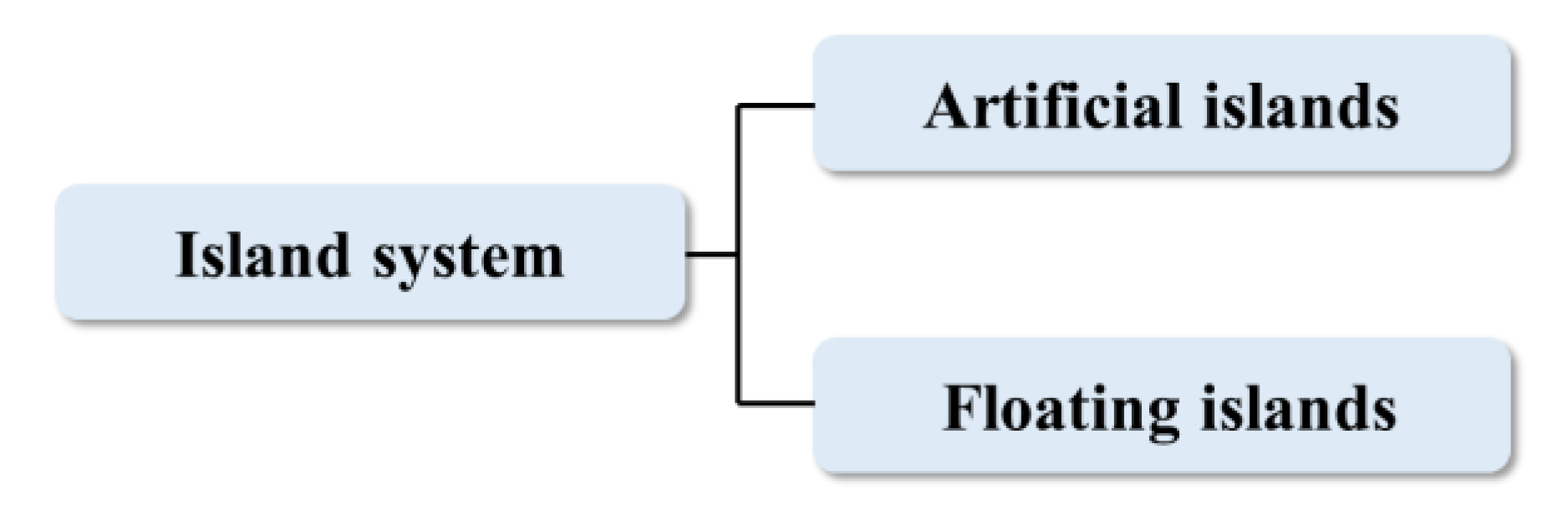
Figure 5.
Hybrid system classification.
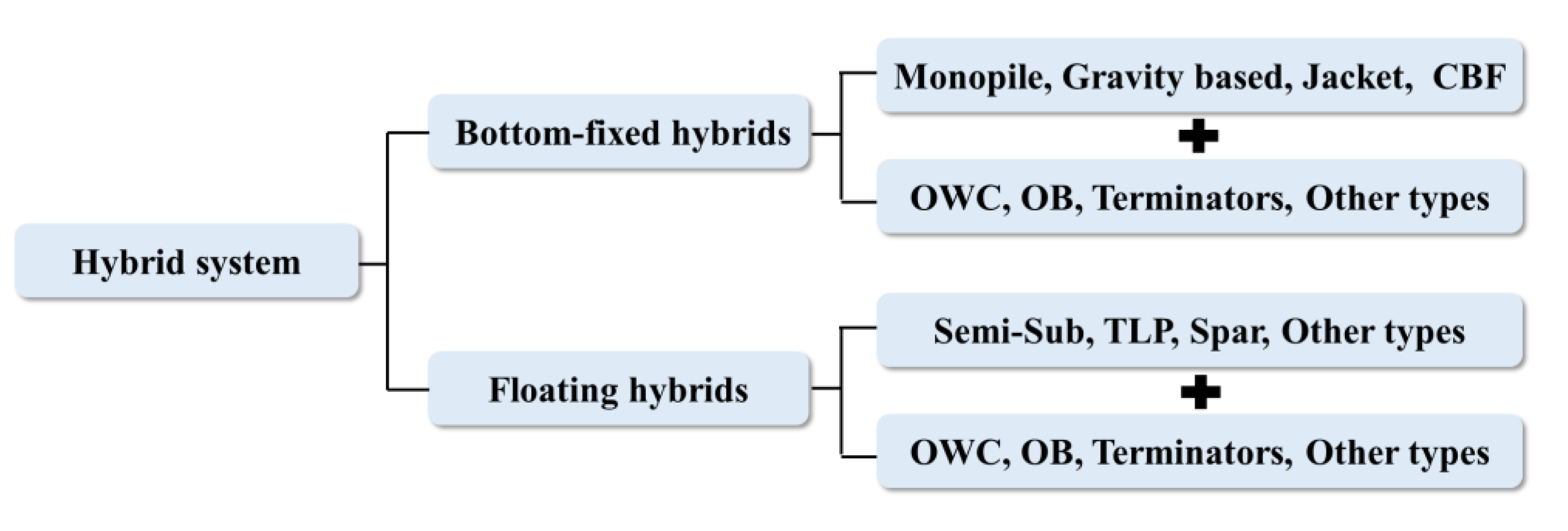
Figure 8.
HOREHS diagram, adapted from [139].
Figure 8.
HOREHS diagram, adapted from [139].
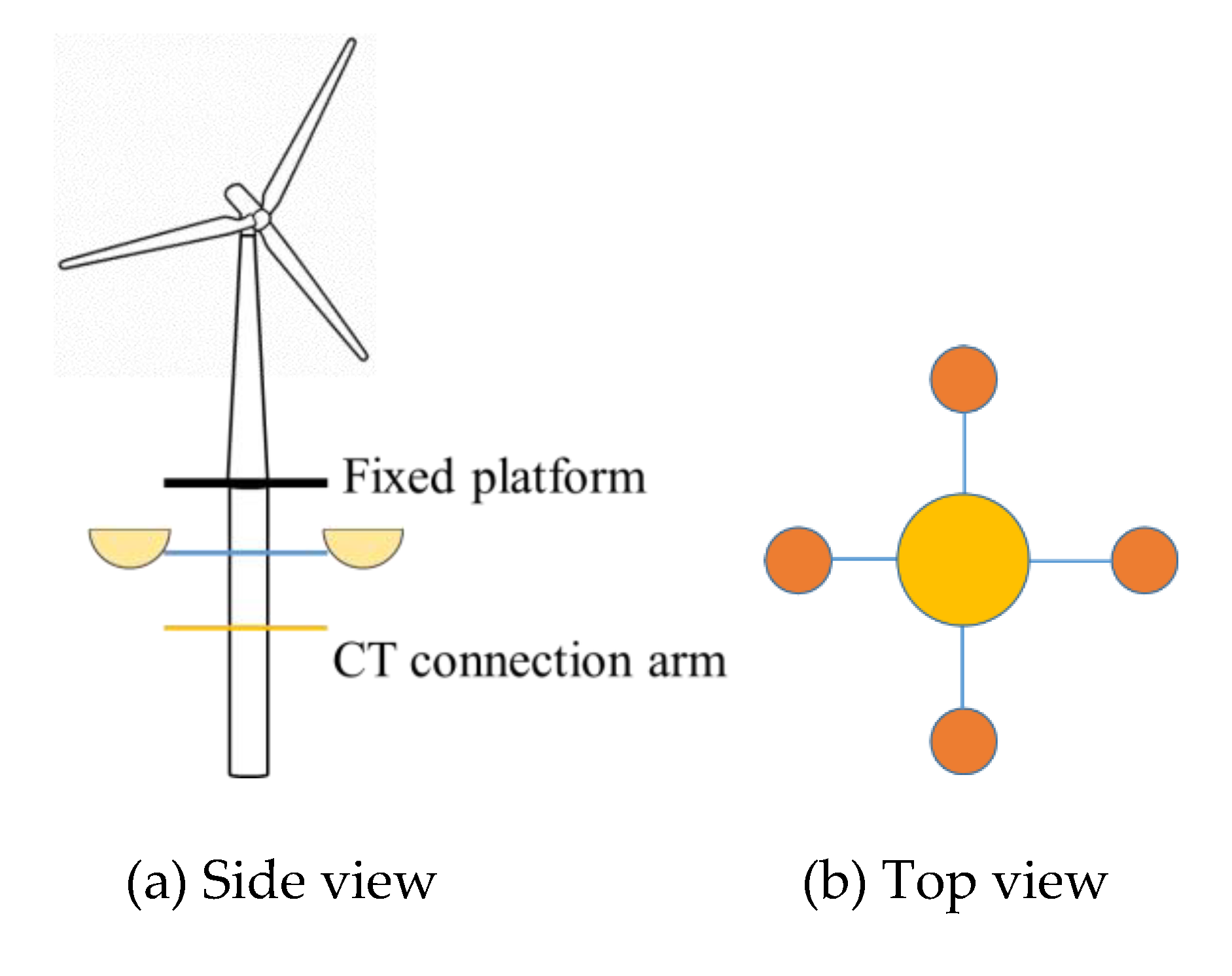
Figure 9.
Integration of the DeepCwind semi-submersible platform with Wavestar WEC, adapted from [26].
Figure 9.
Integration of the DeepCwind semi-submersible platform with Wavestar WEC, adapted from [26].
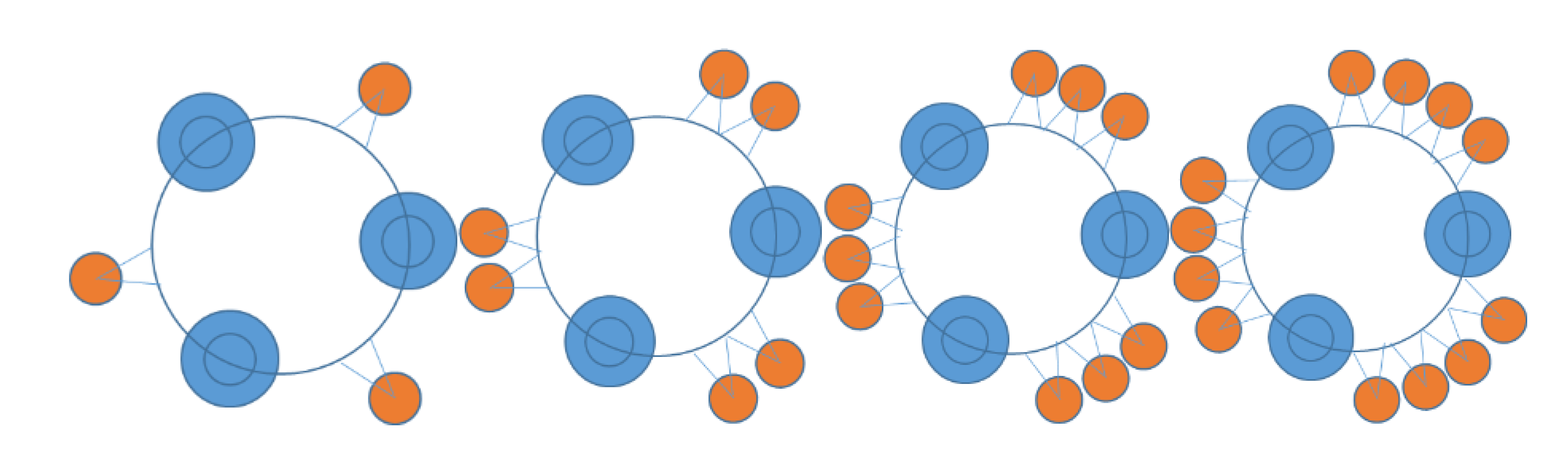
Figure 10.
Integration of semi-submersible platform with multiple WECs (Green: OB WEC, Orange: Wavestar), adapted from [147].
Figure 10.
Integration of semi-submersible platform with multiple WECs (Green: OB WEC, Orange: Wavestar), adapted from [147].
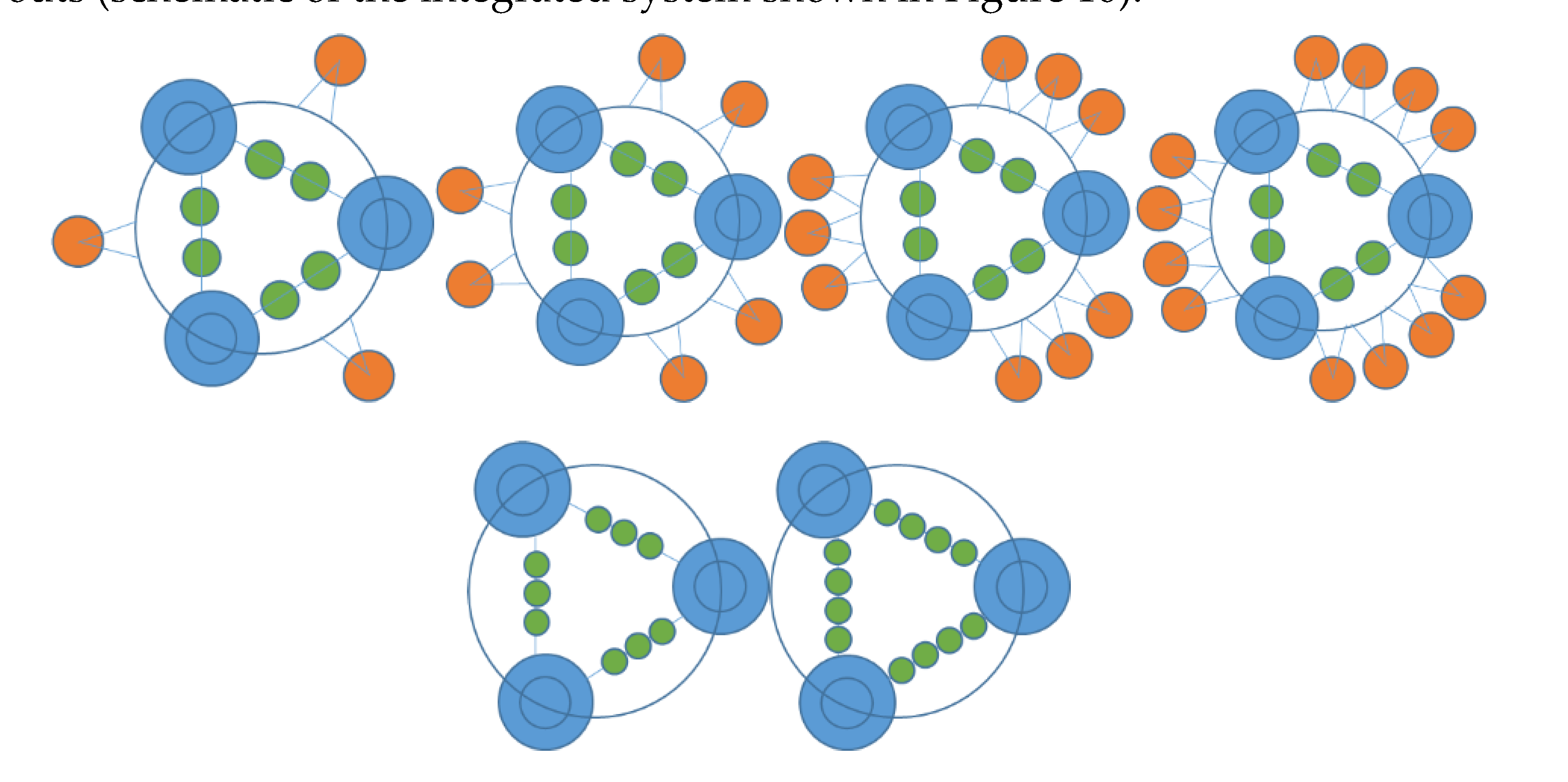
Figure 11.
IFES model composed of barge FOWT and multiple oscillating WECs, adapted from [18].
Figure 11.
IFES model composed of barge FOWT and multiple oscillating WECs, adapted from [18].
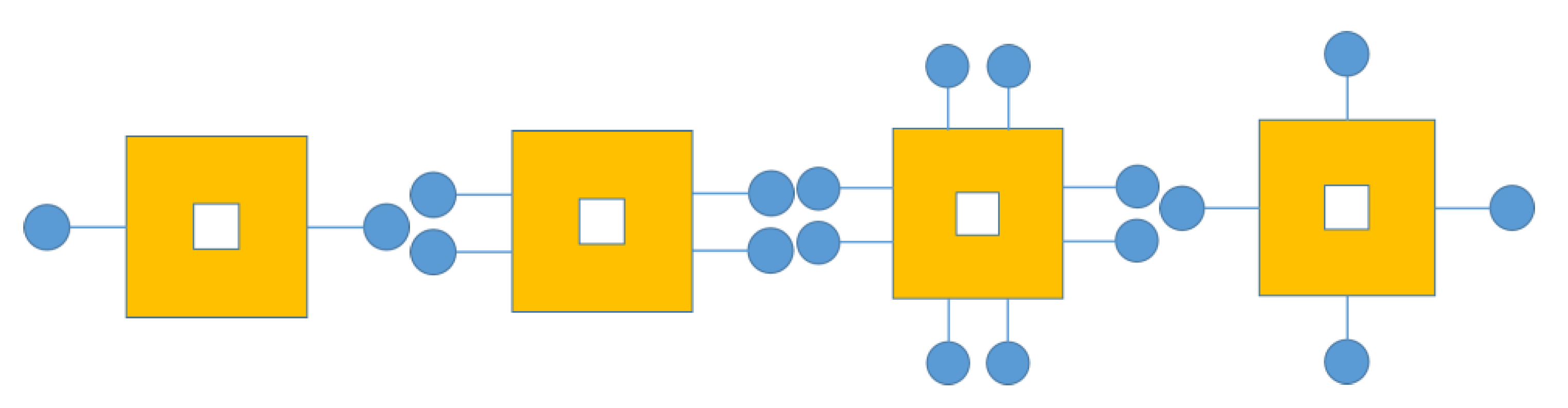
Figure 12.
Integration of the DeepCwind platform with Wavestar WEC, adapted from [143].
Figure 12.
Integration of the DeepCwind platform with Wavestar WEC, adapted from [143].
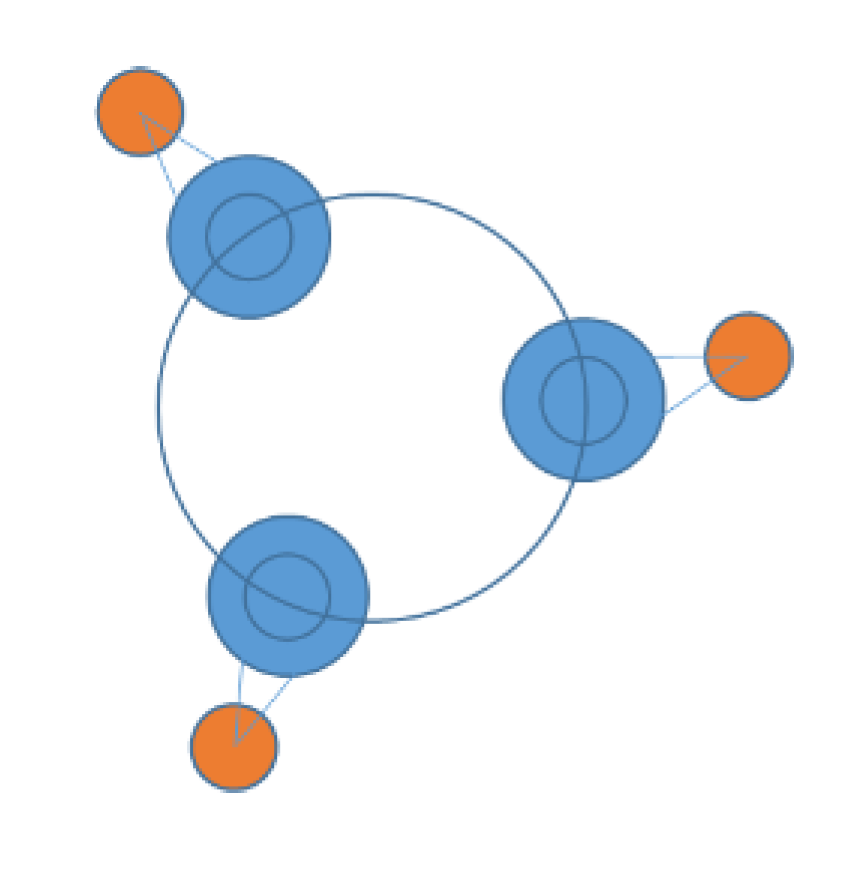
Figure 13.
Semi-submersible platform-multiple heave WEC system, adapted from [117].
Figure 13.
Semi-submersible platform-multiple heave WEC system, adapted from [117].

Table 1.
Classification of WECs.
| WECs | Oscillating Bodies | Oscillating Water Column | Overtopping |
|---|---|---|---|
| Working principle | Utilizing reciprocating body motion of waves | Air turbine driven by air compressed by wave energy | Hydro, air, or hydraulic type turbine driven by wave energy |
Table 2.
Wind-wave hybrid system demonstration project.
| Name | Wind turbine type | Wind turbine power capacity (MW) | WEC type | WEC power capacity (MW) | Status |
| Poseidon P37[131] | Semi-sub | 3*0.011 | Heaving | 10*0.003 | Sea test in 2012-2013 |
| P80[132] | Semi-sub | 4-10 | Heaving | 2-3.6 | 1:30 scale tested in 2022 |
| DualSub[133] | Semi-sub | 2 | Heaving | 0.5 | N/A |
| InSPIRE[134] | Semi-sub | 8-12 | Pressure | 4/6 | Scaled testing in 2022 |
| W2Power[135] | Semi-sub | 2*3.6 | Heaving | 18*0.1 | 1:3 scale tested in 2008 |
| NoviOcean[136] | Barge | 3*0.05 | Heaving | 0.65 | 1:3 scale tested in 2024 |
Disclaimer/Publisher’s Note: The statements, opinions and data contained in all publications are solely those of the individual author(s) and contributor(s) and not of MDPI and/or the editor(s). MDPI and/or the editor(s) disclaim responsibility for any injury to people or property resulting from any ideas, methods, instructions or products referred to in the content. |
© 2025 by the authors. Licensee MDPI, Basel, Switzerland. This article is an open access article distributed under the terms and conditions of the Creative Commons Attribution (CC BY) license (http://creativecommons.org/licenses/by/4.0/).
Copyright: This open access article is published under a Creative Commons CC BY 4.0 license, which permit the free download, distribution, and reuse, provided that the author and preprint are cited in any reuse.


