

Submitted:
03 December 2025
Posted:
04 December 2025
You are already at the latest version
Abstract
Cultured meat is increasingly considered a potential complement to conventional meat, yet the determinants of its acceptance remain unclear. This study examined whether motivations underlying conventional meat purchasing are associated with attitudes and behavioural intentions toward cultured meat among adult Polish meat eaters (n = 425). A cross-sectional online survey assessed attitudes, perceived risks, general acceptance, behavioural intentions and socio-demographic characteristics. Overall attitudes and acceptance were moderately positive, while concerns related to technological risk and naturalness persisted. Four psychographic segments were identified, with cautious optimists (35.9%) and concerned ambivalents (33.3%) representing the largest groups. Associations between conventional meat-purchase motivations and attitudes toward cultured meat were statistically significant but modest, with ethical and environmental motives showing weak positive associations and sensory-oriented motives showing weak negative ones. The correspondence between segmentation based on conventional meat motivations and that based on cultured-meat orientations was limited, indicating only partial structural overlap. Younger, urban and higher-educated respondents were disproportionately represented in the more favourable segments, and prior familiarity increased the likelihood of positive attitudes. Overall, the findings indicate that motivations for purchasing conventional meat explain only a limited share of variability in cultured meat acceptance. Factors related to familiarity, perceived technological characteristics and broader psychosocial orientations appear more influential and should be explored further in future research.
Keywords:
cultured meat
; consumer acceptance
; alternative proteins
; behavioural segmentation
; psychographic segmentation
; technological risk perception
; food technology neophobia
; sustainability attitudes
; cellular agriculture
; Poland
1. Introduction
It is evident that global demand for animal protein has undergone a significant escalation over the past six decades, a phenomenon that can be attributed to a combination of population growth, rising incomes, and rapid urbanisation. As demonstrated by Fu et al. (2023) [1] global meat consumption has increased more than fourfold since 1961, placing substantial pressure on ecosystems, natural resources, and climate stability. This trajectory, when viewed in conjunction with mounting public concern regarding animal welfare, zoonotic disease risks, and the sustainability of conventional livestock systems, has catalysed global interest in alternative protein sources [2]. In this rapidly evolving landscape, cultured meat has emerged as one of the most technologically advanced and potentially transformative solutions.
Cultured meat (CM), also referred to as cultivated, cell-based or lab-grown meat, is produced by proliferating animal cells ex vivo in controlled bioreactor environments, thereby replicating the biological and nutritional characteristics of conventional meat without the need to raise or slaughter animals [3]. In recent years, there has been a substantial acceleration in the progress of cellular agriculture. Documented advances in the field, as outlined by Lee (2025), Xie (2025), Tan (2025) and Olenic (2025) [4,5,6,7], demonstrate that advancements in cell-line development, edible scaffolds, bioprocess optimisation and mechanobiology are contributing to the development of more robust and scalable production systems. These developments are supported by strategic evaluations of industrial feasibility and regulatory frameworks, such as those provided by Zandonadi (2025) [8] and Sun (2025) [9], which highlight both the promise and remaining constraints associated with large-scale bioreactor-based production.
The potential benefits of cultured meat have been extensively articulated. In comparison with traditional livestock farming, cultured meat has the potential to significantly reduce land use, water consumption and greenhouse gas emissions [10], whilst eliminating the necessity for antibiotics and reducing exposure to zoonotic pathogens [11,12]. Furthermore, the advent of cultured meat systems has engendered unparalleled command over nutritional composition and product safety, thereby facilitating the conception of meat with bespoke health profiles [13]. Nevertheless, despite its substantial promise, cultured meat faces considerable technological, sensory and economic challenges. As posited by Bourdez et al. (2022) [14] and Xie (2025) [5], the factors impeding rapid commercial adoption of meat produced through biotechnology include high production costs, uncertainties related to large-scale bioprocessing, and difficulties in replicating the sensory properties of traditionally produced meat. Concerns regarding the naturalness and safety of highly engineered foods further complicate public acceptance.
Recent analyses emphasize that technological innovation and policy instruments alone are insufficient to drive a meaningful protein transition unless consumers are willing to adopt novel protein sources. As highlighted by Bryant et al. (2024) [15], even well-designed policy levers aimed at reducing conventional meat production and consumption may remain ineffective without adequate levels of public acceptance and behavioural readiness. This underscores that consumer attitudes are not a peripheral consideration but a central determinant shaping the feasibility of cellular agriculture and, more broadly, the future of sustainable protein systems. Understanding how individuals evaluate, perceive, and emotionally respond to cultured meat is therefore essential for assessing its market potential and for informing evidence-based communication and policy strategies.
In recent years, there has been a notable increase in research activity concerning consumer attitudes towards cultured meat, particularly during the 2024-2025 period. A multitude of international studies have emphasised that consumer openness varies significantly across a variety of cultural, socio-demographic and psychological contexts. For instance, Rodríguez Escobar et al. (2025) [16] identified significant variations in acceptance between Belgium, Chile and China, while Stanco et al. (2025) [17] documented intricate patterns of ambivalence and curiosity among Italian consumers. Further research from Greece [18], Romania [19], Brazil [20] and the UAE [21] lends further support to the view that acceptance is shaped by distinct cultural norms, dietary traditions and underlying trust in food technologies. It is important to note that the extant evidence base for Poland remains limited, with only a small number of earlier studies examining general attitudes towards cultured meat in the Polish population [22] and none providing an integrated analysis of awareness, attitudinal structures, behavioural intentions or segmentation. This underscores the necessity for the present study. A number of extensive reviews [23,24] have indicated that perceptions of unnaturalness, food-technology neophobia, familiarity with cellular agriculture, and perceived ethical benefits constitute some of the most significant drivers and barriers within this domain. In order to comprehend the phenomenon of consumer acceptance of cultured meat, it is imperative to establish a theoretically grounded set of psychological constructs. Attitudes (ATT) have been shown to constitute the most direct evaluative response and have consistently emerged as a proximal predictor of acceptance across multiple studies [25,26]. Behavioural intentions (INT), as outlined in the Theory of Planned Behaviour, are considered the most immediate antecedent of future consumption behaviour and have been proven to reliably predict willingness to try, purchase and recommend cultured meat [27,28].
The concept of technological risk and naturalness (TRNC) encapsulates concerns pertaining to artificiality, unfamiliarity and process opacity. These factors have been demonstrated to impede the acceptance of cellular agriculture products [29]. In addition to these individual-level factors, the construct of General Acceptance of Cultured Meat (GACM) reflects broader societal and normative evaluations, such as perceived societal need and alignment with values. These have been identified as significant drivers in sustainability-oriented food transitions [30].
Collectively, these four constructs constitute a concise yet comprehensive framework that is fully aligned with current international research on consumer responses to novel protein technologies.
From a theoretical standpoint, the relationship between conventional meat-purchase motivations and openness to cultured meat can be interpreted through several well-established behavioural frameworks. According to dual-attitude models, food-choice behaviour is shaped jointly by reflective evaluations and more automatic affective responses, with ethical, environmental, and health-related motives operating alongside deeply ingrained sensory expectations and habits [31,32]. Ethical and sustainability-oriented consumers may therefore perceive cultured meat as congruent with their existing value structure, whereas consumers whose choices are predominantly driven by taste, sensory reward or tradition may experience greater dissonance and stronger scepticism toward a biotechnological alternative. Complementary perspectives from moralised eating suggest that concerns about animal welfare and environmental protection often operate as stable moral values that generalise across food domains, predicting willingness to reduce conventional meat consumption or adopt animal-friendly alternatives [33,34]. In contrast, the technological-neophobia framework posits that individuals with low tolerance for food-technology interventions react negatively to products perceived as artificial or highly engineered, a pattern repeatedly observed for novel food technologies, including cultured meat [35,36]. Finally, diffusion-of-innovation theory proposed by Everett M. Rogers [37] provides a macro-level lens, indicating that younger, urban and more innovation-oriented individuals typically form the early-adopter segment for disruptive food technologies. Together, these theoretical perspectives offer a coherent explanation for why we should expect to see systematic, albeit not necessarily strong, associations between motivations for purchasing conventional meat and attitudes towards cultured meat, while also providing an explanation as to why such relationships are likely to coexist alongside broader psychosocial and technological risk orientations.
It is important to note that emerging research on alternative protein portfolios indicates that acceptance of cultured meat frequently coincides with openness to plant-based, insect-based, and other novel proteins [38,39,40,41]. The findings suggest that cultured meat should not be conceptualised in isolation, but rather as part of a broader protein transition, wherein consumers construct flexible repertoires of alternative protein sources depending on their ethical values, environmental orientations, sensory expectations and health considerations [42,43]. Concurrently, consumer acceptance remains highly segmented. Recent studies demonstrate that pro-innovation and sustainability-oriented segments differ markedly from sceptical or risk-averse groups in their beliefs, emotional responses and behavioural intentions [44,45].
Despite the rapid growth of the field of cultured-meat scholarship, very limited attention has been devoted to understanding how behavioural patterns embedded in conventional meat purchasing may shape openness to this novel protein technology. Existing studies have typically examined attitudes, intentions and sociodemographic determinants in isolation, without integrating them with consumers' habitual decision strategies for conventional meat. This discrepancy is of conceptual significance: if motivations underlying meat purchases - such as sensory orientation, price sensitivity or ethical engagement - are systematically related to attitudes toward cultured meat, they may serve as powerful behavioural anchors for predicting acceptance. The present study therefore examines whether established motivations for purchasing conventional meat can predict attitudes, acceptance and behavioural intentions toward cultured meat, and whether consumer segments derived from those motivations correspond to psychographic clusters based on attitudes, intentions and technological concerns. Furthermore, the study evaluates how demographic and psychosocial factors strengthen or weaken these associations.
The overarching objective of this study is to ascertain whether the motivations underpinning conventional meat purchasing can serve as meaningful predictors of consumer attitudes, acceptance, and behavioural intentions towards cultured meat. The present study investigates the extent to which established food-choice patterns align with openness to novel protein technologies, and whether behavioural segments derived from meat-purchase motivations correspond to psychographic clusters based on attitudes, intentions and technological concerns relating to cultured meat. Drawing on prior evidence that ethical and sustainability-oriented consumers may be more receptive to emerging protein technologies, while sensory-focused individuals may be more resistant, four hypotheses were formulated:
H1.
Ethical and environmental motivations for purchasing conventional meat are positively associated with favourable attitudes toward cultured meat.
H2.
Sensory-focused purchasing motivations are associated with heightened scepticism and diminished acceptance of cultured meat.
H3.
Segments derived from conventional meat-purchasing motivations demonstrate statistically significant overlap with clusters based on cultured-meat attitudes and behavioural intentions.
H4.
Younger, urban and higher-educated consumers exhibit a stronger alignment between their ethical motivations for purchasing meat and their positive attitudes toward cultured meat.
The hypotheses presented in this study function as a guide for the analytical framework that has been adopted. They establish a direct bridge between the behavioural foundations of traditional meat consumption and the emergent acceptance patterns for cultured meat.
2. Materials and Methods
2.1. Study Design and Sample
The present study was conceived with the objective of examining the determinants of perceptions, attitudes, acceptance and behavioural intentions towards cultured meat among adult Polish consumers who currently consume meat. A cross-sectional online survey was conducted in Poland between May 2024 and June 2025 to assess consumer awareness, attitudes, perceived risks, and acceptance of cultured meat. The distribution of the questionnaire was conducted through SurvGo, utilizing university mailing lists and social media channels. A total of 483 complete responses were collected for the study. The analytical focus on meat eaters reflects the positioning of cultured meat as a substitute for conventional meat, and therefore the primary potential market is composed of individuals who routinely include meat in their diets. The original dataset comprised all respondents who completed the questionnaire, yielding a total of 483 fully completed responses. However, only those who declared that they consume meat with some regularity were retained for further analysis. Individuals who reported never or very rarely consuming meat were excluded to ensure conceptual coherence between the target market of cultured meat and the analytical sample. The final dataset employed in all statistical analyses comprised 425 adult Polish meat eaters.
The questionnaire comprised thematic blocks covering the following areas: The following aspects were considered in this study: awareness of cultured meat (Q1-Q3), meat consumption and purchasing motives (Q4-Q7), attitudes toward cultured meat (Q10-Q16), perceived risks and unnaturalness (Q18.1-Q18.5), behavioral intentions related to cultured meat (Q17.1-Q17.5) and demographic characteristics (Q22-Q28). After answering questions about their knowledge of CM, respondents received a short note containing information about CM - S1, included in the supplementary materials. The complete item wording is presented in the supplementary material (S2).
The sociodemographic variables were employed to characterise the sample and to examine the sociodemographic determinants of awareness of cultured meat. Finally, they were used to profile the consumer segments identified through clustering.
2.2. Psychometric Measures, Construct Operationalisation, and Validation
The operationalisation of several psychometric constructs was achieved through the utilisation of multi-item Likert-type scales. All scoring procedures were performed using listwise deletion within each construct-specific analysis, unless stated otherwise.
Attitudes toward cultured meat (ATT_CM; Q10–Q16) were assessed using a seven-item Likert scale capturing general evaluative dispositions. One item (Q13), which expressed a feeling of disgust toward cultured meat, was reverse-coded to ensure directional consistency before computing the composite score. Behavioural intentions (INT_CM; Q17.1–Q17.5) were measured using a series of five items reflecting willingness to try, purchase and recommend cultured meat. The Technological Risk and Naturalness Concern (TRNC; Q18.1–Q18.5) component was designed to capture perceptions of artificiality, novelty-related apprehension, and perceived risks. As higher original scores represented lower concern, items were reverse-coded to construct an index reflecting neophobia, such that higher scores indicated stronger apprehension. The General Acceptance of Cultured Meat (GACM; Q19–Q21) scale was developed as a three-item measure designed to capture three distinct concepts. Firstly, it gauges the perceived societal need for cultured meat. Secondly, it assesses the relative advantage of cultured meat over other meat alternatives. Thirdly, it determines the degree to which cultured meat aligns with respondents' personal standards and values. The computation of composite scores was conducted as arithmetic means of the corresponding items, under the condition that a sufficient number of item responses were available.
Internal consistency of each multi-item construct was evaluated using Cronbach’s alpha (α) and McDonald’s omega (Ω). Cronbach's alpha is a measure of the average inter-item correlation within a scale. In contrast, McDonald's omega is a more robust reliability estimate under a congeneric measurement model. This makes it particularly informative for constructs that include reverse-coded items. For each scale, alpha, omega, the number of valid cases, the number of items and the mean and standard deviation of the composite score were computed. All reliability analyses were conducted in Python using custom functions that relied on the use of a covariance-based eigen-decomposition for the calculation of omega.
Patterns of missing data were assessed for all questionnaire items prior to analysis. Item-level missingness was low and did not exceed conventional thresholds that would justify the use of imputation-based procedures. Listwise deletion was applied on a model-specific basis, meaning that respondents were excluded only from the particular analysis for which relevant item responses were missing, while remaining available for all other analyses. This approach ensured maximal retention of cases in each analytical step while maintaining internal consistency of the psychometric and regression models.
In order to assess dimensionality and construct validity, a series of exploratory and confirmatory factor analyses were performed. The adequacy of the samples was confirmed by an excellent global Kaiser-Meyer-Olkin value (KMO = 0.932), while Bartlett's test of sphericity was highly significant (χ² = 5543.91, p < 0.001), indicating that the correlation matrix was suitable for factor extraction. Exploratory factor analyses (EFA) were conducted separately for each construct using principal-axis factoring with a one-factor solution and Promax rotation. The four scales exhibited unidimensionality with factor loadings exceeding 0.40 and acceptable uniqueness values.
Subsequent confirmatory factor analyses (CFA) were estimated using maximum-likelihood estimation in semopy, with one-factor models specified for ATT, INT, TRNC, and GACM. The model's fit was evaluated using three different indices: the comparative fit index (CFI), the Tucker-Lewis index (TLI), and the root-mean-square error of approximation (RMSEA). As anticipated for a three-item scale, the GACM model was identified (df = 0), resulting in global fit indices that were deemed to be non-informative. Consequently, its adequacy was evaluated based on factor loadings and theoretical coherence.
2.3. Awareness Assessment and Predictive Modelling
The level of awareness surrounding CM was gauged by querying respondents on their prior familiarity with the concept. In light of the response options comprising "yes", "no" and "I am not sure", it was as a binary indicator. Responses of "yes" were assigned a value of 1 (aware), whereas "no" and "I am not sure" were assigned a value of 0 (not aware). In order to examine the sociodemographic predictors of awareness, a binary logistic regression model was estimated with gender, age, education, residence, employment, parenthood and household income serving as categorical predictors. The estimation of parameters was conducted by maximum likelihood using the Logit function in the statsmodels library. To evaluate multicollinearity, variance inflation factors (VIF) were computed for all predictors; values below 5 were used as the threshold for acceptable collinearity. Model fit was assessed using the likelihood-ratio χ² test, and McFadden’s pseudo-R². Model calibration was additionally evaluated using the Hosmer-Lemeshow goodness-of-fit test (10-group specification). The calculation of odds ratios (OR) and 95% confidence intervals (CI) was undertaken to facilitate interpretation Sensitivity analyses were conducted by confirming that all results were robust to the exclusion of cases with missing demographic information.
2.4. Cluster Analysis and Segment Derivation
Psychographic segmentation was undertaken to identify coherent subgroups of meat-eating consumers differing in their attitudinal, intentional and value-based profiles toward cultured meat. The basis for clustering was four standardised composite variables (ATT_CM, INT_CM, TRNC and GACM). In addition to this psychographic segmentation, a separate clustering procedure was conducted for conventional meat-purchase motivations using the eight Q7 items to derive behavioural segments reflecting how consumers prioritise sensory, ethical, health-related and economic attributes when buying conventional meat. Prior to the selection of the number of clusters, an exploratory evaluation of alternative solutions was conducted. For both the items pertaining to the motivation for purchasing meat (Q7.1–Q7.8) and the psychographic variables associated with cultured meat, candidate solutions ranging from k = 2 to k = 6 were estimated and compared using the silhouette coefficient, the Calinski-Harabasz index and the Davies-Bouldin index. Despite the fact that the two-cluster solutions yielded the highest silhouette values numerically, they lacked interpretative resolution and produced overly coarse partitions that were not aligned with theoretical expectations.
In terms of the motivations underpinning meat purchases, the three-cluster solution was found to offer the most coherent behavioural structure, demonstrating acceptable validity indices and clear differentiation between consumer groups. In the context of cultured-meat psychographics, the four-cluster solution exhibited a balanced statistical adequacy with conceptual differentiation, thus circumventing the instability and disproportionate cluster sizes observed in certain three- and five-cluster solutions. This four-cluster solution was deemed to offer the most meaningful structure for subsequent analyses and was therefore retained for all further work. Following the selection of k, the K-means clustering process was initiated, employing fifty random initialisations and a fixed random seed to ensure replicability. Prior to the implementation of the clustering process, all composite variables underwent a standardisation process that involved the transformation of their values to z-scores. Additionally, a listwise deletion approach was employed to address the presence of missing values. The quality of the clusters was evaluated using the silhouette coefficient, the Calinski-Harabasz index and the Davies-Bouldin index. In order to facilitate interpretation, cluster centroids in original scale units were also computed.
The stability of both clustering solutions was examined using two complementary approaches. The first approach relied on a bootstrap-like subsampling strategy. One hundred random subsamples, each comprising seventy per cent of the analytic dataset, were drawn independently. For each subsample, K-means clustering was re-estimated using the predetermined number of clusters (k = 3 for meat-purchase motivations and k = 4 for cultured-meat psychographics), and the resulting partitions were compared with the reference solution obtained from the full dataset. The adjusted Rand index (ARI) was utilised to quantify the correspondence between partitions. This procedure enabled an evaluation of the robustness of the discovered structures to sampling variability and furnished a distribution of ARI values for each domain. It was hypothesised that k = 2 could be a statistically efficient solution, as indicated by exploratory validity indices. Therefore, emphasis was placed on rigorously assessing the stability of higher-order segment structures. This was done to ensure that the chosen multi-cluster solutions were not artefactual or sensitive to sampling variability. The second approach evaluated stability through classification-based validation. Linear discriminant analysis (LDA) was utilised to predict cluster membership directly from the original variables forming the basis of each segmentation. The ten-fold cross-validation technique was employed to obtain an unbiased estimate of the predictive accuracy and to derive confusion matrices that summarised the separability of the clusters.
3. Results
3.1. Sample Characteristics
The final analytic sample consisted of 425 adult Polish consumers who reported consuming conventional meat. This subsample was derived from an initial dataset comprising 483 completed questionnaires, with individuals who declared never or only very rarely consuming meat being excluded from the analysis. This restriction was applied to ensure conceptual alignment between the target population of cultured meat - positioned as a substitute for conventional meat - and the study sample. This allowed a more valid assessment of behavioural intentions and potential substitution patterns among current meat consumers. The sociodemographic profile of the resulting meat-eating sample is summarised in Table 1.
The sample population was predominantly female, with approximately two-thirds of the subjects being women (66.1%), while the remaining third were male (33.9%). The age distribution of the sample was relatively balanced between younger (18–34 years; 41.9%) and middle-aged adults (35–54 years; 41.1%), while older respondents (>54 years) accounted for 17.0% of the sample. Educational attainment was found to be strongly skewed towards higher education, with nearly three quarters of respondents (73.7%) reporting a high level of education, and only 10.1% and 16.2% in the low and medium categories, respectively. The majority of participants resided in urban areas, with 32.7% living in cities with a population exceeding 500,000 inhabitants and a further 38.0% in smaller cities, while 29.4% lived in rural areas. Household income was most frequently reported in the medium (41.0%) and low (36.7%) categories, with 22.3% of households reporting high-income. The survey revealed that just over half of respondents (54.1%) had children, and 68.0% were in employment. The survey's demographic is characterised by a predominantly urban, relatively well-educated segment of Polish meat consumers, a demographic that is consistent with the typical characteristics of online panel-based surveys. Overall, the sociodemographic profile reflects a broad cross-section of Polish meat consumers, which is appropriate for the aims of the study.
3.2. Awareness of Cultured Meat and Its Sociodemographic Predictors
A binary logistic regression model was estimated to identify socio-demographic determinants of prior awareness (Q1) of cultured meat ( 0 = “no” or “I’m not sure”, 1 = “yes”). The model showed a statistically significant overall fit (likelihood-ratio χ²(12) = 85.82, p < 0.001) and a McFadden pseudo-R² of 0.15, indicating that the predictors accounted for a non-trivial share of variance in awareness. Model calibration was adequate, as suggested by the Hosmer-Lemeshow goodness-of-fit test (χ²(8) = 8.28, p = 0.41).
Relative to the youngest age group (18-34 years), respondents aged 55 years and above were substantially less likely to have heard about cultured meat (OR = 0.19, 95% CI: 0.09-0.42, p < 0.001). In contrast, secondary (OR = 3.43, 95% CI: 1.08-10.87, p = 0.036) and especially university education (OR = 11.90, 95% CI: 2.37-37.38, p < 0.001) were positively associated with awareness compared with primary education. Living in a city with more than 500,000 inhabitants increased the odds of prior awareness (OR = 2.91, 95% CI: 1.02-4.32, p = 0.045), whereas being in full-time employment was associated with lower odds compared with the reference category (OR = 0.48, 95% CI: 0.25-0.90, p = 0.022). Sex, the intermediate age group (35-54 years), residence in smaller cities or villages, parental status and income were not statistically significant predictors (all p > 0.05). Variance inflation factors did not indicate problematic multicollinearity, supporting the stability of the estimated coefficients.
The findings of this study indicate that awareness of cultured meat is concentrated among younger consumers, those with higher levels of education and those residing in urban areas. The complete model estimates can be found in Table S3 (Supplementary Materials).
3.3. Scale Reliability and Descriptive Statistics
The internal consistency statistics for all multi-item constructs utilised in the study are presented in Table 2. The psychometric performance of the scales was satisfactory and aligned with expectations for attitudinal and behavioural measures in food-technology research.
Attitudes toward cultured meat were measured with seven items capturing overall evaluation, perceived appeal and perceived appropriateness of cultured meat as a food product. Behavioural intentions were operationalised as the mean of five items referring to willingness to try, purchase and repeatedly buy cultured meat under realistic market conditions. Technological risk and naturalness concern (TRNC) was captured with five items referring to perceived unnaturalness, worry about technological complexity and discomfort with advanced food technologies; these items were reverse-coded to form a technological risk and naturalness concern (TRNC) index in which higher scores indicate stronger concern. General acceptance of cultured meat was defined as the mean of three items addressing perceived need for cultured meat, its perceived superiority relative to other meat alternatives and its alignment with personal standards and values.
The seven-item attitude scale (ATT_CM) demonstrated acceptable reliability, with Cronbach's α = 0.656 and a substantially higher McDonald's ω = 0.821, indicating that despite modest heterogeneity among items, the underlying latent construct was measured with adequate coherence under a congeneric model. The mean score suggests that respondents expressed moderately positive evaluations of cultured meat, consistent with the positioning of cultured meat as an emerging but conceptually familiar innovation.
Behavioural intentions towards cultured meat (INT_CM) demonstrated excellent internal consistency, with α = 0.917 and ω = 0.938, values significantly above established benchmarks. This high reliability is indicative of the conceptual tightness of willingness-to-try, purchase and recommend items. Descriptively, intentions were moderately positive, aligning with the broader pattern of cautious openness observed in the attitudinal indicators.
The five-item Technological Risk and Naturalness Concern (TRNC) scale demonstrated robust performance, with alpha = 0.821 and omega = 0.878, signifying substantial internal consistency despite the construct encompassing numerous facets of perceived artificiality, technological apprehension, and naturalness-related concerns. While the mean TRNC score was moderate overall, the scale demonstrated a relatively broad dispersion of responses (SD = 0.91). The item means ranged from 2.83 to 3.53, suggesting that respondents varied significantly in their perception of CM as technologically complex or insufficiently natural.
As anticipated for a concise instrument comprising three items, the general acceptance scale (GACM) yielded slightly diminished yet resilient reliability indices (α = 0.771, ω = 0.868), substantiating the adequacy of the items in encapsulating a shared evaluative dimension concerning the perceived societal and personal value of cultured meat. The mean score (M = 3.72, SD = 0.87) places respondents above the neutral midpoint, once more indicating a pattern of measured but genuine openness to the technology.
The multi-item constructs exhibited strong psychometric properties. The overall sampling adequacy was deemed to be excellent (KMO = 0.932), and Bartlett's test of sphericity confirmed that the correlation structure was suitable for factor analysis (χ² = 5543.91, p < 0.001). EFA was then employed to confirm the unidimensionality of each scale, with factor loadings ranging from −0.60 to −0.82 for ATT, −0.88 to −0.92 for INT, −0.65 to −0.77 for TRNC, and −0.41 to −0.86 for GACM.
The factorial validity of the constructs was further supported by CFA model fit indices. The initial model demonstrated an excellent fit (CFI = 0.985; TLI = 0.970; RMSEA = 0.110), followed by the TRNC model (CFI = 0.912; TLI = 0.822; RMSEA = 0.175) and the ATT model (CFI = 0.829; TLI = 0.743; RMSEA = 0.216). For the three-item GACM construct, the model was identified (df = 0), and global fit indices were therefore not applicable. Overall, the psychometric analyses confirmed that all constructs were statistically coherent and appropriate for subsequent analyses.
Across all scales, item-total correlations were consistently within acceptable to strong ranges, providing further evidence of internal coherence. Collectively, the reliability analyses confirm that the psychometric constructs used in the present study are statistically sound, conceptually coherent and suitable for subsequent segmentation and predictive modelling.
3.4. Clustering and Segmentation
3.4.1. Meat-Purchase Motivation Clusters
Segmentation based on conventional meat-purchase motivations used the eight Q7 items, which asked respondents how important specific aspects are when buying meat: price, nutritional value, caloric content, taste, appearance, smell, environmental impact and animal welfare. K-means clustering with k = 3 identified three distinct consumer segments. The clustering validity indices indicated an acceptable structure (silhouette = 0.236; Calinski–Harabasz = 142.63; Davies-Bouldin = 1.47), supporting the retention of the three-segment model. The cluster sizes were found to be uneven but stable, with Cluster 0 comprising 52.1% of respondents, Cluster 1 36.5%, and Cluster 2 11.4%. This finding suggests the presence of one dominant and two more selective consumer groups.
The first and largest segment (n = 197) “High-engagement, quality-and-values driven consumers”, was characterised by generally high importance ratings across almost all aspects. Mean scores for taste, appearance and smell were close to the top of the scale, and nutritional value was also rated as very important (M=4.85). In addition, these consumers attached relatively high importance to environmental impact (M=3.97) and animal welfare (M=4.24). Price and caloric content were evaluated as moderately to highly important but did not dominate the profile. This pattern suggests a group of multi-criteria, quality- and ethics-oriented meat buyers who simultaneously attend to sensory, health-related and ethical attributes when purchasing meat.
The second segment (n = 138) “Sensory-focused, moderately engaged consumers”, showed a more selectively sensory profile. Taste, appearance and smell were again rated as very important (M=4.48, M=4.22 and M=4.24 respectively); however, nutritional value, caloric content, environmental impact and animal welfare all received noticeably lower scores than in the first segment. Price was of moderate importance. This profile corresponds to a group of predominantly sensory-driven meat buyers, for whom the hedonic experience of eating meat is central, whereas health- and ethics-related aspects play a more secondary role.
The third and smallest segment (n = 43) “Low-involvement, indifferent consumers”, exhibited uniformly low importance ratings across all eight aspects (range: 1.93-2.53). Neither sensory attributes, nor price, nor health- and ethics-related considerations stood out as particularly salient. This pattern is consistent with a low-involvement segment, in which meat purchase decisions are less strongly guided by specific evaluative criteria and may be more routine or opportunistic in nature.
As demonstrated in the radar chart (Figure 1), Cluster 1 forms a large, multidimensional polygon, Cluster 2 a narrower sensory-centred shape, and Cluster 3 a small, nearly circular profile, confirming clear visual distinctions among the segments.
A sociodemographic analysis revealed systematic differences between the three segments of consumers with different motivations for purchasing meat (Table 3). The association between gender and cluster membership was found to be statistically significant (χ²(2) = 49.60, p < 0.001, Cramér's V = 0.36). The majority of female respondents (65.3%) were classified into the high-engagement, quality-and-values driven cluster (Cluster 1), whereas only 27.8% of male respondents belonged to this segment. Conversely, a significantly higher proportion of males were observed in the sensory-focused, moderately engaged cluster (Cluster 2; 57.1% of males vs. 25.3% of females). The low-involvement, indifferent cluster (Cluster 3) attracted relatively small proportions of both genders, but again with a slight male predominance (15.0% vs. 9.4%).
Furthermore, an association was observed between age and cluster membership (χ²(4) = 39.76, p < 0.001, Cramér's V = 0.23). The younger consumer demographic (18-34 years) was predominantly distributed between the two more engaged segments, with approximately 57% assigned to Cluster 1 and 38% to Cluster 2, and a mere 4.7% falling into the low-involvement segment. Among respondents within the 35-54 age group, Cluster 1 maintained its position as the predominant category (59.3%), while Cluster 3 exhibited a notable increase in its share (14.5%). In contrast, the 55+ age group exhibited a distinctly divergent pattern, with a mere 21.0% of respondents classified as high-engagement consumers. The remaining majority were predominantly allocated to either the sensory-focused Cluster 2 (56.5%) or the indifferent Cluster 3 (22.6%), suggesting that older consumers of meat were less inclined to attach significant importance to a comprehensive array of meat attributes.
The data demonstrated a similar gradient in educational attainment (χ²(4) = 43.05, p < 0.001, Cramér's V = 0.24). Respondents who had received only primary education were found to be present in low numbers within the high-engagement cluster (7.1%), with the majority of this group being allocated to Cluster 2 (61.9%) or Cluster 3 (31.0%). Amongst those with secondary or university education, Cluster 1 became clearly dominant, encompassing 54.7% and 58.5% of these respondents, respectively, while the indifferent segment shrank to around 9-11%. Consequently, consumers who attach comparatively little importance to meat attributes tend to be less well-educated, whereas the most engaged segment is characterised by higher levels of formal education.
The findings indicate that neither place of residence nor employment status were found to be significantly associated with cluster membership (both p > 0.05). This suggests that urban-rural location and working versus non-working status do not materially differentiate meat-purchase motivation profiles in this sample. The study found a modest yet statistically significant correlation (χ²(2) = 8.61, p = 0.013, Cramér's V = 0.15). The proportion of parents was higher in the low-involvement cluster (15.6% of parents vs. 7.0% of non-parents assigned to Cluster 3), whereas respondents who were childless were somewhat more likely to belong to the sensory-focused Cluster 2. The association between household income and cluster membership was only marginal (χ²(4) = 8.71, p = 0.069, Cramér's V = 0.11). There was a tendency for lower-income respondents to be slightly over-represented in the indifferent segment and higher-income respondents in the high-engagement cluster.
The results of the profiling indicate that consumers who are highly engaged, quality-driven and values-driven are more often female, middle-aged or younger, and better educated. In contrast, sensory-focused consumers and especially those in the low-involvement segment are more prevalent among men, older respondents and those with lower educational attainment.
3.4.2. Cultured Meat Psychographic Clusters
In the context of psychographic segmentation of cultured meat, the k-means clustering method was employed to analyse the four composite indices that encapsulated the following: attitudes (ATT_CM), behavioural intentions (INT_CM), technological risk and naturalness concern (operationalised here as neophobia) and general acceptance (GACM). The four-cluster solution (k = 4) was determined to provide the optimal balance between statistical adequacy and conceptual differentiation, as indicated by the validity indices (silhouette coefficient = 0.25; Calinski-Harabasz index = 222.25; Davies-Bouldin index = 1.32). The distribution of cluster sizes exhibited a moderate imbalance, yet remained interpretable, with segments comprising 24.9%, 32.0%, 36.5%, and 6.6% of the respondents, respectively. The corresponding profiles are visualised in the radar chart in Figure 2, which highlights clear separation between segments along all four psychographic dimensions.
The first segment (n = 106) “Enthusiastic early adopters”. The group in question demonstrated a predominantly positive orientation towards cultured meat. Their radar profile is represented by the broadest polygon in Figure 2, reflecting very high attitudes (M = 5.67), behavioural intentions (M = 4.54) and general acceptance (M = 4.57), combined with the lowest TRNC score (M = 1.83). This segment demonstrates a notable degree of positive emotional, evaluative, and behavioural readiness to adopt cultured meat, accompanied by minimal technological apprehension.
The second segment (n = 136) comprised “concerned ambivalents’. Despite the moderately positive nature of the attitudinal evaluations (M = 4.38), the behavioural intentions exhibited a notable decline (M = 3.16), and the general acceptance was only moderate (M = 3.33). It is noteworthy that this cluster demonstrated elevated TRNC levels (M = 3.43), indicating that discomfort with technological novelty and perceived unnaturalness functions as a significant impediment to the translation of positive attitudes into behavioural readiness. This group therefore embodies a form of evaluative-behavioural inconsistency driven by risk-related concern.
The third and largest segment (n = 155) “Cautious optimists The respondents in this segment demonstrated elevated attitudes towards cultured meat (M = 4.69) and concomitantly robust behavioural intentions (M = 4.25). Furthermore, the level of general acceptance was found to be above the midpoint (M = 3.83). However, their TRNC scores (M = 2.75) were higher than those observed in Cluster 1, indicating a degree of residual technological reservation. The overall profile indicates a group that is favourable towards cultured meat, albeit with a degree of moderation due to a sense of caution.
The fourth segment (n = 28) “Strong sceptics’. This segment was characterised by the lowest attitudinal evaluations (M = 3.15), very low behavioural intentions (M = 1.51), and minimal general acceptance (M = 1.77), combined with the highest TRNC scores (M = 3.84). The respondents to this survey demonstrated a clear reluctance to embrace cultured meat, regardless of its potential benefits. This resistance was further compounded by their concerns regarding the technological aspects of the product. In conclusion, this segment can be regarded as exhibiting a clear rejection orientation.
Finally, Cluster 4 constituted a diminutive yet distinctly delineated collective of pronounced sceptics. This segment was characterised by the lowest attitudinal evaluations (M = 3.15), very low behavioural intentions (M = 1.51), and minimal general acceptance (M = 1.77), combined with the highest TRNC scores (M = 3.84). The respondents to this survey demonstrated a clear reluctance to embrace cultured meat, regardless of its potential benefits. This resistance was further compounded by their concerns regarding the technological aspects of the product. In conclusion, this segment can be regarded as exhibiting a clear rejection orientation.
The four-cluster solution displayed acceptable validity indices. Although the two- and three-cluster solutions yielded slightly higher silhouette values, they produced overly coarse groupings that merged conceptually distinct response patterns. The four-cluster solution maintained adequate separation between segments while providing a richer and more interpretable segmentation structure, particularly by distinguishing between enthusiastic, moderately positive, ambivalent and rejecting consumers. Collectively, these clusters illustrate a well-differentiated psychographic landscape, spanning from high-readiness early adopters through ambivalent and cautiously positive consumers to a minority of strong opponents. This distribution underscores the importance of considering both evaluative dispositions and underlying technological concerns when interpreting consumer responses to cultured meat.
The sociodemographic and awareness profiles of the four psychographic segments were examined using cross-tabulation and chi-square tests (Table 4).
Awareness-related variables demonstrated the strongest associations with segment membership. The respondents' prior awareness of cultured meat (Q1) exhibited a significant correlation with their cluster allocation (χ²(6) = 52.81, p < 0.001, Cramér's V = 0.25). Among those who had already heard of cultured meat, over one third were classified as enthusiastic early adopters (36.6%) and a similar proportion as cautious optimists (37.0%), whereas only 4.8% belonged to the strong sceptics segment. Conversely, among respondents who professed a lack of familiarity with cultured meat, concerned ambivalents constituted the predominant group (41.3%), while the proportion of pronounced sceptics more than doubled to 11.6%. A comparable pattern was observed for self-rated knowledge about cultured meat (Q2; χ²(12) = 64.27, p < 0.001, V = 0.22) and familiarity with the production process (Q3; χ²(6) = 44.66, p < 0.001, V = 0.23). Respondents who self-rated their knowledge as either well-informed or very well-informed were predominantly found among enthusiastic early adopters and cautious optimists. In contrast, those reporting no or poor knowledge were more frequently classified as concerned ambivalents or strong sceptics.
The present study examined the association between cluster membership and the willingness to replace conventional meat with meat substitutes. The latter were defined as plant-based products or edible insect alternatives. The results demonstrated a strong association between these variables (χ²(6) = 81.14, p < 0.001, Cramér's V = 0.31). Among respondents who selected "No" on the basis of complete unwillingness to replace conventional meat with these substitutes, concerned ambivalents represented the largest share (41.2%), while strong sceptics constituted an additional one fifth (20.2%). Conversely, enthusiastic early adopters and cautious optimists were conspicuously under-represented in this category. For those who selected "Yes, but not much," there was a shift in distribution towards the more open segments, with cautious optimists and enthusiastic early adopters playing a more prominent role. The pattern was most pronounced among respondents who answered in the affirmative, indicating a clear readiness to replace conventional meat with plant-based or insect-based substitutes. Within this group, 38.0% of respondents were classified as cautious optimists, while 38.0% were designated as enthusiastic early adopters. Strong sceptics accounted for fewer than 2% of cases. Taken together, these results confirm that the four segments differ not only in attitudinal orientation towards cultured meat but also in their broader behavioural readiness to substitute conventional meat with alternative proteins, spanning both plant-based and insect-based options.
A number of sociodemographic variables were found to be associated with membership of a psychographic segment. The study found no statistically significant associations between gender and place of residence with the clusters (Q22 and Q25, both p > 0.05). Parenthood exhibited a very weak, non-significant association (Q27; p = 0.28). In contrast, age (Q23), educational attainment (Q24), employment status (Q26) and household income (Q28) exhibited meaningful, albeit small-to-moderate, associations (all p < 0.05; Cramér's V between 0.14 and 0.23). In the present study, respondents between the ages of 18 and 54 were found to be more likely to be classified as enthusiastic early adopters or cautious optimists, in contrast to the older age group (55+ years), which was found to be disproportionately represented among concerned ambivalents (63.4%) and, to a lesser extent, among cautious optimists. This suggests that older respondents were less likely to be classified as early adopters. Respondents with a university education were predominantly located in the positive segments (29.7% enthusiastic early adopters and 38.3% cautious optimists, compared with only 4.5% strong sceptics), while those with only primary schooling were most often classified as concerned ambivalents (67.4%) or strong sceptics.
The employment status exhibited a modest yet statistically significant association (χ²(3) = 8.54, p = 0.036, V = 0.14). Amongst non-working respondents, concerned ambivalents constituted the largest group (40.4%), whilst working respondents were more evenly distributed between the three more positive segments, with cautious optimists being the most frequent (36.7%). Furthermore, a correlation was identified between household income and cluster membership (χ²(6) = 25.08, p < 0.001, V = 0.17). Respondents from higher-income households (above 10,000 PLN) were most commonly classified as cautious optimists (41.1%) or enthusiastic early adopters (29.5%), whereas those from the lowest income category (up to 5,000 PLN) were more often concerned ambivalents (44.9%) and less often early adopters (16.7%).
When considered as a whole, these profiles indicate that enthusiastic early adopters and cautious optimists tend to be better informed about cultured meat, more willing to replace conventional meat, and somewhat younger, better educated and more affluent. Concerned ambivalents and strong sceptics, in turn, are characterised by lower awareness and knowledge, reduced willingness to substitute, and particularly in the case of sceptics, less favourable socioeconomic characteristics.
3.4.3. Cluster Stability and Classification-Based Validation
The initial investigation into cluster stability was conducted utilising a bootstrap resampling approach, founded upon the adjusted Rand index (ARI). For the three meat-purchase motivation clusters, ARI values across the 100 bootstrap samples were consistently high, with a mean of 0.86 (median 0.87; range 0.53-1.00). In 84% of the re-samples, the ARI exceeded 0.80, and more than one third of the replications reached values above 0.90. This finding indicates that the three-segment structure for conventional meat motives was highly robust to sampling variation. The four psychographic segments derived from cultured meat exhibited a remarkably consistent pattern, with an average ARI of 0.87 (median 0.91; range 0.43-0.99). In this particular instance, 83% of the bootstrap solutions yielded ARI values greater than 0.80, with nearly 60% achieving values above 0.90. On occasion, lower ARI values were observed for both segmentation schemes. However, these represented isolated reallocations of a small number of boundary cases rather than systematic instabilities in the overall cluster configuration.
A secondary line of evidence was obtained from classification-based validation using linear discriminant analysis (LDA). In the context of the meat-purchase segmentation, 10-fold cross-validation yielded a mean predictive accuracy of 0.94, closely mirroring the overall resubstitution accuracy derived from the confusion matrix (93.7%). The accuracies for the three clusters were 97.9%, 89.9% and 86.0%, respectively. The majority of misclassifications occurred between the two more engaged segments, with only a few cases from the low-involvement cluster being assigned elsewhere. In the context of the cultured-meat psychographic segmentation, LDA attained an even higher mean cross-validated accuracy of 0.96, with cluster-wise accuracies of 94.3%, 94.9%, 97.4% and 92.9% for the four segments. Misclassifications were again rare and predominantly involved neighbouring clusters along the acceptance-concern continuum. When considered as a whole, the results of the bootstrap ARI and LDA demonstrate convergent evidence that both the behavioural (i.e. meat purchase) and psychographic (i.e. cultural meat consumption) segmentations are stable and internally coherent structures, rather than artefacts of a particular sample split.
3.4.4. Overlap Between Meat-Purchase Motivation Clusters and Cultured-Meat Psychographic Segments
A cross-classification of the three meat-purchase motivation clusters with the four cultured-meat psychographic segments revealed a statistically significant but modest association between the two segmentation structures (χ²(6) = 22.39, p = 0.001; Cramér's V = 0.17; Theil's U = 0.025). Despite the non-random nature of the relationship, the finding that U was at a very low value suggests that respondents' conventional meat-purchase profiles only explained a small fraction of the uncertainty surrounding their psychographic orientation towards cultured meat.
When examined from the perspective of the meat-purchase motivation clusters, the majority of respondents across all three groups were classified into the more positive cultured-meat segments. In the high-engagement, quality- and values-driven cluster, 36.5% of respondents were classified as cautiously optimistic CMs, while 32.0% were identified as enthusiastic early adopters. A mere 6.6% of respondents belonged to the strong sceptics category. A similar pattern was observed among sensory-focused consumers, where ambivalent and cautiously optimistic respondents predominated (40.6% and 39.1%, respectively), while the rejectionist segment accounted for just 5.8%. In the low-involvement meat cluster, where overall engagement with meat attributes was weakest, the majority of respondents were distributed across the moderately positive CM segments, and less than 3% were classified as strong sceptics.
Conversely, an examination of the data from the opposite perspective reveals that each cultured-meat segment encompasses members from multiple meat-motivation clusters. This finding serves to substantiate the notion that the psychographic segmentation cannot be reduced to conventional meat-purchase motives. The initial adopters who demonstrated a high level of enthusiasm were predominantly, although not exclusively, drawn from the two clusters that exhibited a greater degree of engagement, with these groups accounting for 36-38% of the sample. Concerned ambivalents and cautious optimists exhibited a balanced distribution across the three meat segments, whereas the strong sceptics - although numerically small - were most likely to originate from the high-engagement or sensory-focused meat clusters and only rarely from the low-involvement cluster.
The overall pattern of the cross-classification is visualised in Figure 3 , which presents the row-wise percentage distribution of cultured-meat segments within each meat-purchase motivation cluster. As demonstrated in Figure 3, the heatmap indicates that all three clusters of meat-purchase motivation are predominantly associated with the more positive segments of cultured meat. The high-engagement cluster demonstrates the strongest alignment with the enthusiastic early-adopter and cautiously optimistic segments, whereas the sensory-focused and low-involvement clusters display a similar pattern, albeit with slightly higher proportions of ambivalent consumers. Across all clusters, the proportion of strong sceptics remains negligible, thereby reinforcing the finding of limited correspondence between conventional meat-purchase motives and psychographic responses to cultured meat.
Taken together, these results demonstrate partial but limited structural correspondence between behavioural meat-purchase motives and psychographic evaluations of cultured meat. Consequently, the propensity for cultural meat is not restricted to consumers who place a lower value on conventional meat attributes; rather, it is pervasive among all categories of meat buyers, particularly those who are already profoundly engaged with meat quality, sensory attributes and ethical considerations.
4. Discussion
The findings of this study provide a comprehensive and empirically grounded picture of how Polish meat-eating consumers perceive, evaluate and position cultured meat within their broader food-choice frameworks. The results of the study indicate a pattern of cautious yet authentic openness. Attitudes towards cultured meat were moderately positive, behavioural intentions were above the scale midpoint, and general acceptance indicated a recognition of the potential societal value of this technology. These findings are consistent with the emerging consensus in recent international research, where consumers tend to express evaluative openness paired with behavioural reservation [16,17,18]. Comparable levels of cautious openness have also been reported in the United States [46], the United Kingdom (Bryant et al., 2020), Belgium (Bryant & Sanctorum, 2021) and Serbia (Stojanović et al., 2023), although cross-country variation remains substantial. The present study contributes to the extant literature on this subject in two ways. Firstly, it provides evidence from a Central European context that is still underrepresented in global cultured-meat scholarship. Secondly, it situates these attitudes within consumers' habitual motivations for purchasing conventional meat.
The results on awareness underscore the significant role of informational and knowledge-related variables in cultured-meat acceptance. Respondents who had previously encountered the concept of cultured meat, or who rated themselves as knowledgeable, were substantially more likely to belong to the positive segments - enthusiastic early adopters and cautious optimists. This finding is consistent with global literature emphasising familiarity as a critical determinant of openness to cellular agriculture technologies [23,24]. Analogous trends have been recorded in China and Belgium [16] and Italy [17], where prior exposure significantly increases the willingness to try cultured meat. The present Polish data thus serve to reinforce the argument that early communication strategies, which include explanations of production methods, safety measures, and potential benefits, may effectively shift consumers away from an uninformed state of scepticism.
The findings further demonstrate that the technological risk and naturalness concern (TRNC) persists as a pivotal impediment to behavioural engagement. These results are further supported by recent evidence from a multinational [35] which compared consumer acceptance of multiple emerging food technologies across several cultural contexts. In that study, cell-cultured meat consistently ranked among the least accepted innovations, primarily due to perceived unnaturalness, technological unfamiliarity, and concerns related to safety and sensory unpredictability. The authors also emphasised that consumers struggled to imagine how such a product could be incorporated into everyday eating practices. This is an interpretative barrier closely aligned with the elevated TRNC scores observed among the concerned ambivalents in our sample. Moreover, the study reported significant cross-cultural variation, with acceptance levels higher in technologically progressive or food-security-oriented regions such as India and Singapore, and lower in countries with strong traditional meat cultures, such as Australia and the United States. This pattern places the Polish consumer landscape within a broader global trajectory, in which cautious interest coexists with deep-rooted reservations about naturalness and technological intervention. Concerned ambivalents constituted over one-third of the sample and exhibited a profile characterised by moderately positive attitudes but comparatively low intentions, driven in part by elevated TRNC scores. This evaluative-behavioural disconnect mirrors the tension observed in recent studies from Romania [19] and Croatia [44], where cultured meat elicits ethical or environmental approval yet triggers discomfort related to technological novelty and the perceived loss of naturalness. Broader socio-cognitive interpretations of cultured meat, as documented by Fasanelli (2025) [47], who argues that CM evokes hybrid representations oscillating between "food" and "technology", help to explain why consumers may support the idea of cultured meat but still hesitate to engage with it at the level of purchase or consumption.
The segmentation analysis provides further insight into this interpretative landscape. A recent systematic review [48] offers a valuable global perspective that aligns closely with the present findings. The review demonstrates that in developed countries, acceptance of cultured meat is primarily shaped by familiarity, perceived naturalness, and food-technology neophobia, whereas in developing regions environmental and food-security motivations are more prominent drivers. This cross-national evidence helps contextualise the Polish consumer landscape observed in this study. Despite moderately positive attitudes and conditional openness among Polish consumers, technological unfamiliarity and concerns about naturalness emerged as central inhibiting factors, mirroring the dominant barriers identified in high-income countries. The convergence between our psychographic segmentation and the global patterns described in the review suggests that Poland follows a typical acceptance trajectory for technologically advanced protein innovations within developed, meat-centric food cultures. The analysis identified four distinct psychographic segments: enthusiastic early adopters, cautious optimists, concerned ambivalents and strong sceptics. Each segment is characterised by unique configurations of attitudes, intentions and technological concerns. These segments bear a strong resemblance to those identified in multinational studies [18,20,21], where pro-innovation consumers consistently contrast with highly sceptical minority groups. It is noteworthy that the proportion of strong sceptics in the present study was minimal (6.6%), a finding that aligns with the South American and Middle Eastern trends documented by Mendes [20] and Khaleel [21], respectively. This figure is marginally lower than the observations recorded in Italy or Western Europe [17]. This may suggest that Polish meat consumers, particularly younger and better-educated adults, are relatively open to alternative proteins when presented with a credible technological narrative.
A pivotal finding of this study is the integration of psychographic segmentation with behavioural segmentation, derived from motivations for purchasing conventional meat. The overlap between the three behavioural meat-purchase clusters and the four cultured-meat psychographic segments was statistically significant but modest, as evidenced by both Cramér's V and Theil's U. This finding suggests that although individuals who prioritise ethical and environmental attributes when purchasing conventional meat are somewhat more likely to be open to cultured meat, the explanatory power of meat-purchase motivations alone is limited. These results call into question the assumptions present in parts of the alternative-protein literature, which often imply that ethical or sustainability-driven omnivores may naturally transition towards cultured meat [39,40,43]. The findings indicate that acceptance of cultured meat cannot be inferred solely from existing meat-choice heuristics. Instead, consumers' responses to cellular agriculture products involve additional psychological dimensions, such as perceptions of technological naturalness, familiarity, trust and affective comfort. These dimensions are not captured by conventional meat-purchase motives.
The integration of cultured meat with other alternative proteins offers further nuance. It was found that respondents who declared a willingness to replace conventional meat with plant-based or insect-based substitutes were disproportionately represented among the two most positive segments of the cultured-meat population. This outcome aligns with international findings that openness to novel proteins tends to generalise across product categories and reflects broader dietary flexibility [38,41,42]. Nevertheless, the present study also demonstrates that a willingness to engage with plant-based or insect-based alternatives does not fully predict openness to cultured meat, indicating that the latter triggers unique concerns and considerations, particularly related to technological unfamiliarity. This underscores the necessity for bespoke communication and consumer education strategies, as opposed to presuming cross-category spillover effects.
The findings of this study demonstrate that sociodemographic factors have a significant impact on the outcomes under investigation. The findings of this study demonstrate that younger consumers, those with higher educational attainment and higher income levels, were more likely to belong to positive segments. This pattern is consistent with the results of studies conducted in China [49], Greece [18], Italy and Brazil [20]. These demographic gradients are probably indicative of differential exposure to technological innovation, varying levels of trust in scientific institutions and diverse motivations related to sustainability and ethical consumption. The findings emphasise the necessity of formulating communication strategies that are tailored to older and less technologically confident consumers. These consumers may necessitate more explicit assurances regarding the naturalness, safety and societal benefits of the technology.
The findings of this study have several practical implications for stakeholders aiming to introduce cultured meat into the Polish market. The most promising early-stage consumer base is constituted by enthusiastic early adopters and cautious optimists, who together represent approximately 60% of the sample. It is recommended that communication strategies which target these groups place emphasis on the environmental benefits of cultured meat, improvements in animal welfare, customisable nutrition, and the role of cultured meat in a broader protein transition portfolio. In the case of individuals who harbour ambivalent feelings, transparent communication regarding technological processes, safety assessments and regulatory oversight may help to allay concerns. It is important to note that strong sceptics are unlikely to be receptive at the early stages of development. Therefore, they should not be considered a primary target market until a greater degree of societal legitimisation has been achieved. These recommendations are in alignment with international insights regarding targeted communication, influencer credibility and emotional framing [45,50,51].
It is imperative to acknowledge the limitations of the present study. The study utilised an online, non-probabilistic sample that exhibited a bias towards younger, urban, and highly educated consumers, thereby constraining the generalisability of the findings to the broader Polish population. It is important to note that behavioural intentions were self-reported and therefore may not directly translate into real purchasing behaviour, particularly in the absence of actual market availability. Furthermore, the cross-sectional design of the study prevents the drawing of inferences regarding causal pathways between motivations, attitudes and acceptance. It is recommended that future research incorporate experimental and longitudinal designs, sensory testing and price-sensitivity assessments, as well as comparative studies across Central and Eastern Europe. In view of the rapid expansion of the extant literature on cultured meat, particularly in 2025, future research should also incorporate emerging insights on regulatory evolution, LCA outcomes, nutrient-profile engineering and industrial-scale production.
When considered as a whole, the findings position Poland within the broader global landscape of emerging cultured-meat markets. It is suggested that while behavioural anchors rooted in conventional meat purchasing provide partial explanatory value, acceptance of cultured meat is best understood as a multidimensional psychological construct shaped by technological perceptions, familiarity, ethical considerations and socio-demographic context. The integration of behavioural and psychographic segmentation, alongside a foundation in the most recent international developments, renders this study a valuable addition to the field. It provides a nuanced and timely contribution to the understanding of the potential trajectory of cultured meat in a nation with a robust meat-eating tradition and a growing interest in sustainable food technologies.
5. Conclusions
This study provides an integrated examination of how Polish meat consumers perceive cultured meat and to what extent these perceptions relate to their established motivations for purchasing conventional meat. The findings reveal a cautiously positive orientation towards cultured meat, with attitudes and general acceptance exceeding the scale midpoint and two favourable psychographic segments - enthusiastic early adopters and cautious optimists – representing the majority of respondents. However, the behavioural basis underlying meat purchases provided only limited predictive value for the acceptance of cultured meat. Despite the modest positive associations observed between ethical and environmental motives, and the negative relationship between sensory-driven motives, the overall explanatory power of conventional meat-purchase motivations remained limited. The statistically significant yet modest structural congruence between behavioural and psychographic segmentation further corroborates the notion that the acceptance of cultured meat does not merely represent a straightforward extension of habitual meat-choice heuristics.
Instead, the propensity to accept cultured meat appears to be more strongly influenced by factors such as familiarity, perceived technological naturalness, ethical orientation and socio-demographic characteristics. It was evident that younger, urban and higher-educated consumers were more open to the concept, while technological risk and naturalness concerns remained significant barriers for those who were ambivalent. These findings underscore the necessity for targeted communication strategies that address informational gaps, clarify production processes and enhance trust in cellular-agriculture technologies. From a market perspective, early adoption is likely to be driven by consumers who already exhibit pro-innovation and sustainability-oriented values. However, broader acceptance will depend on transparent communication, regulatory clarity and sensory performance as products near commercialisation.
The present study makes a empirical contribution to the global cultured-meat literature by integrating behavioural and psychographic segmentation, thus providing stakeholders with actionable insights regarding the introduction of cultivated meat in Central and Eastern Europe. This demonstrates that acceptance is multidimensional and cannot be inferred from conventional meat-purchasing patterns alone. It emphasises the importance of addressing technological perceptions, enhancing familiarity and recognising the heterogeneity of consumer responses in emerging protein markets.
Supplementary Materials
The following supporting information can be downloaded at the website of this paper posted on Preprints.org. Table S1. Overview of cultured meat: definition, benefits, limitations and regulatory status. Table S2. Survey questionnaire. Table S3. Logistic regression model for cultured meat awareness.
Author Contributions
Conceptualization, A.K; Methodology, A.K.; Software, A.K.; Validation, A.K.; Formal Analysis, A.K.; Investigation, A.K.; Resources, A.K.; Data Curation, A.K.; Writing – Original Draft Preparation, A.K.; Writing – Review & Editing, A.K.; Visualization, A.K.; Supervision, A.K.; Project Administration, A.K.
Funding
No funding.
Institutional Review Board Statement
Not applicable.
Informed Consent Statement
Informed consent was obtained from all subjects involved in the study. Participation was entirely voluntary and anonymous, and no identifiable personal data were collected.
Data Availability Statement
A fully anonymised version of the dataset, along with all Python scripts used for data cleaning, psychometric validation, statistical modelling and figure generation, is available from the corresponding author upon reasonable request.
Conflict of Interest
The authors declare no conflicts of interest.
References
- Fu, W.; Zhang, H.; Whaley, J.E.; Kim, Y.K. Do Consumers Perceive Cultivated Meat as a Sustainable Substitute to Conventional Meat? Assessing the Facilitators and Inhibitors of Cultivated Meat Acceptance. Sustain. 2023, 15. [CrossRef]
- Choudhary, F.; Khandi, S.A.; Aadil, R.M.; Hassoun, A.; Bekhit, A.E.D.A.; Abdi, G.; Bhat, Z.F. Understanding Crucial Factors in Cultured Meat Production: A Comprehensive SWOT Analysis. Appl. Food Res. 2024, 4, 100474. [CrossRef]
- Fraeye, I.; Kratka, M.; Vandenburgh, H.; Thorrez, L. Sensorial and Nutritional Aspects of Cultured Meat in Comparison to Traditional Meat: Much to Be Inferred. Front. Nutr. 2020, 7. [CrossRef]
- Lee, D.Y.; Hur, S.J. Gaps and Solutions for Large Scale Production of Cultured Meat: A Review on Last Findings. Curr. Opin. Food Sci. 2025, 61, 101243. [CrossRef]
- Xie, Y.; Cai, L.; Ding, S.; Wang, C.; Wang, J.; Ibeogu, I.H.; Li, C.; Zhou, G. An Overview of Recent Progress in Cultured Meat: Focusing on Technology, Quality Properties, Safety, Industrialization, and Public Acceptance. J. Nutr. 2025, 155, 745–755. [CrossRef]
- Tan, P.L.; Seah, J.S.H.; Koh, A.W.C.; Koh, C.J.Y.; Gu, X.; Shan, T.; Tan, L.P. Potential of Mechanobiology Principles for Cultivated Meat Development: Lessons from Tissue Engineering. Trends Food Sci. Technol. 2025, 166, 105393. [CrossRef]
- Olenic, M.; Deelkens, C.; Heyman, E.; De Vlieghere, E.; Zheng, X.; van Hengel, J.; De Schauwer, C.; Devriendt, B.; De Smet, S.; Thorrez, L. Review: Livestock Cell Types with Myogenic Differentiation Potential: Considerations for the Development of Cultured Meat. Animal 2025, 19, 101242. [CrossRef]
- Zandonadi, R.P.; Ramos, M.C.; Elias, F.T.S.; Guimarães, N.S. Global Insights into Cultured Meat: Uncovering Production Processes, Potential Hazards, Regulatory Frameworks, and Key Challenges—A Scoping Review. Foods 2025, 14, 1–81. [CrossRef]
- Sun, W.; Tang, H.; Wang, L.; Du, G.; Zhou, J.; Chen, J.; Guan, X. Rational Scaling-up Strategy for Cultured Meat Production Based on Bioreactor Micro-Environment Evaluation. Food Biosci. 2025, 63, 105737. [CrossRef]
- Jairath, G.; Mal, G.; Gopinath, D.; Singh, B. An Holistic Approach to Access the Viability of Cultured Meat: A Review. Trends Food Sci. Technol. 2021, 110, 700–710. [CrossRef]
- Bhat, Z.F.; Bhat, H.; Pathak, V. Prospects for In Vitro Cultured Meat - A Future Harvest; Fourth Edi.; Elsevier, 2013; ISBN 9780123983589. [CrossRef]
- Reddy, M.K.; Narayanan, R.; Rao, V.A.; Valli, C.; Sujatha, G. Cultured Meat - A Review Cultured Meat – A Review. Biol. Forum – An Int. J. 2022, 14, 363–367.
- Mateti, T.; Laha, A.; Shenoy, P. Artificial Meat Industry: Production Methodology, Challenges, and Future. Jom 2022, 74, 3428–3444. [CrossRef]
- BOURDREZ, V.; CHRIKI, S. Qualités Nutritionnelle, Organoleptique et Disposition à Payer Pour Les Alternatives à La Viande : Cas Des Analogues Végétaux, de La « viande in Vitro » et Des Insectes. INRAE Prod. Anim. 2022, 35, 217–236. [CrossRef]
- Bryant, C.; Couture, A.; Ross, E.; Clark, A.; Chapman, T. A Review of Policy Levers to Reduce Meat Production and Consumption. Appetite 2024, 203, 107684. [CrossRef]
- Rodríguez Escobar, M.I.; Han, S.; Cadena, E.; De Smet, S.; Hung, Y. Cross-Cultural Consumer Acceptance of Cultured Meat: A Comparative Study in Belgium, Chile, and China. Food Qual. Prefer. 2025, 127, 105454. [CrossRef]
- Stanco, M.; Uliano, A.; Nazzaro, C. Exploring Italian Consumers’ Perceptions of Cultivated Meat: Barriers, Drivers, and Future Prospects. Nutrients 2025, 17, 3061. [CrossRef]
- Melios, S.; Gkatzionis, K.; Liu, J.; Ellies-Oury, M.P.; Chriki, S.; Hocquette, J.F. Potential Cultured Meat Consumers in Greece: Attitudes, Motives, and Attributes Shaping Perceptions. Futur. Foods 2025, 11, 100538. [CrossRef]
- Petrescu, S.-I.; Matei, M.; Radu-Rusu, C.-G.; Ciobanu, A.; Lăpușneanu, D.M.; Pop, I.M. Consumer Acceptance of Cultured Meat in Romania Highlighting Sustainable Perspectives for Both Human and Pet Consumption. Animals 2025, 15, 2867. [CrossRef]
- Mendes, G.; Biscarra-Bellio, J.C.; Heidemann, M.S.; Taconeli, C.A.; Molento, C.F.M. How Much Do Opinions Regarding Cultivated Meat Vary within the Same Country? The Cases of São Paulo and Salvador, Brazil. PLoS One 2025, 20, 1–19. [CrossRef]
- Khaleel, S.; Osaili, T.; Abdelrahim, D.N.; Zeb, F.; Naja, F.; Radwan, H.; Faris, M.A.I.E.; Hasan, H.; Cheikh Ismail, L.; Obaid, R.S.; et al. Attachment to Meat and Willingness Towards Cultured Alternatives Among Consumers: A Cross-Sectional Study in the UAE. Nutr. 2025, 17. [CrossRef]
- Sikora, D.; Rzymski, P. The Heat about Cultured Meat in Poland: A Cross-Sectional Acceptance Study. Nutrients 2023, 15, 1–14. [CrossRef]
- Szendrő, K. Consumer Perceptions of Lab-Grown Cells: Awareness, Barriers, and the Power of Information. A Review. Czech J. Anim. Sci. 2025, 70, 203–222. [CrossRef]
- Raverta, P.; Sandi, I.; Martin, B.; Loera, B. Unfamiliar Familiarity: A Scoping Review on the Role of Familiarity in Consumer Acceptance of Cultivated Meat. Appetite 2025, 211, 108000. [CrossRef]
- Bryant, C.J.; Anderson, J.E.; Asher, K.E.; Green, C.; Gasteratos, K. Strategies for Overcoming Aversion to Unnaturalness: The Case of Clean Meat. Meat Sci. 2019, 154, 37–45. [CrossRef]
- Siegrist, M.; Hartmann, C. Perceived Naturalness, Disgust, Trust and Food Neophobia as Predictors of Cultured Meat Acceptance in Ten Countries. Appetite 2020, 155, 104814. [CrossRef]
- Wilks, M.; Phillips, C.J.C.; Fielding, K.; Hornsey, M.J. Testing Potential Psychological Predictors of Attitudes towards Cultured Meat. Appetite 2019, 136, 137–145. [CrossRef]
- Mancini, M.C.; Antonioli, F. Italian Consumers Standing at the Crossroads of Alternative Protein Sources: Cultivated Meat, Insect-Based and Novel Plant-Based Foods. Meat Sci. 2022, 193, 108942. [CrossRef]
- Bryant, C.; Sanctorum, H. Alternative Proteins, Evolving Attitudes: Comparing Consumer Attitudes to Plant-Based and Cultured Meat in Belgium in Two Consecutive Years. Appetite 2021, 161, 105161. [CrossRef]
- Newton, P.; Blaustein-Rejto, D. Social and Economic Opportunities and Challenges of Plant-Based and Cultured Meat for Rural Producers in the US. Front. Sustain. Food Syst. 2021, 5, 624270. [CrossRef]
- König, L.M.; Giese, H.; Schupp, H.T.; Renner, B. The Environment Makes a Difference: The Impact of Explicit and Implicit Attitudes as Precursors in Different Food Choice Tasks. Front. Psychol. 2016, 7, 196314. [CrossRef]
- Marty, L.; Chambaron, S.; Bournez, M.; Nicklaus, S.; Monnery-Patris, S. Comparison of Implicit and Explicit Attitudes towards Food between Normal- and Overweight French Children. Food Qual. Prefer. 2017, 60, 145–153. [CrossRef]
- De Backer, C.J.S.; Hudders, L. Meat Morals: Relationship between Meat Consumption Consumer Attitudes towards Human and Animal Welfare and Moral Behavior. Meat Sci. 2015, 99, 68–74. [CrossRef]
- Lin-Schilstra, L.; Fischer, A.R.H. Consumer Moral Dilemma in the Choice of Animal-Friendly Meat Products. Sustain. 2020, Vol. 12, Page 4844 2020, 12, 4844. [CrossRef]
- Giacalone, D.; Jaeger, S.R. Consumer Acceptance of Novel Sustainable Food Technologies: A Multi-Country Survey. J. Clean. Prod. 2023, 408, 137119. [CrossRef]
- Siegrist, M.; Hartmann, C. Consumer Acceptance of Novel Food Technologies. Nat. food 2020, 1, 343–350. [CrossRef]
- García-Avilés, J.A. Diffusion of Innovation. Int. Encycl. Media Psychol. 2020, 1–8. [CrossRef]
- Bogueva, D.; Marinova, D. Will Australians Eat Alternative Proteins? Foods 2025, 14. [CrossRef]
- Mariani, A.; Annunziata, A. Young Consumers’ Intention to Consume Innovative Food Products: The Case of Alternative Proteins. Sustain. 2025, 17, 1–20. [CrossRef]
- Pronk, K.; Etter, B.; Michel, F.; Siegrist, M. Consumer Acceptance of Different Protein Sources for Meat Alternatives: A Multinational Study. Appetite 2025, 215, 108246. [CrossRef]
- Stubelj, M.; Gleščič, E.; Žvanut, B.; Širok, K. Factors Influencing the Acceptance of Alternative Protein Sources. Appetite 2025, 210. [CrossRef]
- Fantechi, T.; Marinelli, N.; Casini, L.; Contini, C. Exploring Alternative Proteins: Psychological Drivers behind Consumer Engagement. Br. Food J. 2025. [CrossRef]
- Boaitey, A.; Clark, B.; Tiwasing, P. Sustainability Considerations and Willingness to Try Alternative Proteins: Evidence from the UK. Clean. Responsible Consum. 2025, 18, 100313. [CrossRef]
- Cerjak, M.; Faletar, I. Food Technology Neophobia and Animal Ethics Orientation: Influences on Cultured Meat Acceptance in Croatia. J. Cent. Eur. Agric. 2025, 26, 542–554. [CrossRef]
- Ungaro, V.; Pasca, M.G.; Bisceglia, F.; Di Pietro, L.; Mugion, R.G.; Arcese, G. Driving Sustainable Consumption: Factors Influencing Consumer Acceptance of Cultured Meat. Corp. Soc. Responsib. Environ. Manag. 2025, 7571–7586. [CrossRef]
- Bryant, C.; Dillard, C. The Impact of Framing on Acceptance of Cultured Meat. Front. Nutr. 2019, 6, 464060. [CrossRef]
- Fasanelli, R.; Casella, E.; Foglia, S.; Coppola, S.; Luongo, A.; Amalfi, G.; Piscitelli, A. Is Cultured Meat a Case of Food or Technological Neophobia? On the Usefulness of Studying Social Representations of Novel Foods. Appl. Sci. 2025, 15, 1–30. [CrossRef]
- Simeone, M.; Verneau, F. Lab-Grown Bites: What Drives or Stops the World from Eating Cultured Meat? A Global Perspective on Developed and Developing Countries. Br. Food J. 2025, 1–19. [CrossRef]
- Jin, S.; Zhai, Q.; Yuan, R.; Asioli, D.; Nayga, R.M. Personality Matters in Consumer Preferences for Cultured Meat in China. Food Qual. Prefer. 2025, 123, 105317. [CrossRef]
- Leite, F.P.; Septianto, F.; Pontes, N. ‘Meat’ the Influencers: Crafting Authentic Endorsements That Drive Willingness to Buy Cultured Meat. Appetite 2024, 199, 107401. [CrossRef]
- Lin, J.W.X.; Maran, N.; Lim, A.J.Y.; Ng, S.B.; Teo, P.S. Current Challenges, and Potential Solutions to Increase Acceptance and Long-Term Consumption of Cultured Meat and Edible Insects – A Review. Futur. Foods 2025, 11. [CrossRef]
Figure 1.
Comparative radar chart of attribute importance in meat-purchase decisions across consumer clusters.
Figure 1.
Comparative radar chart of attribute importance in meat-purchase decisions across consumer clusters.
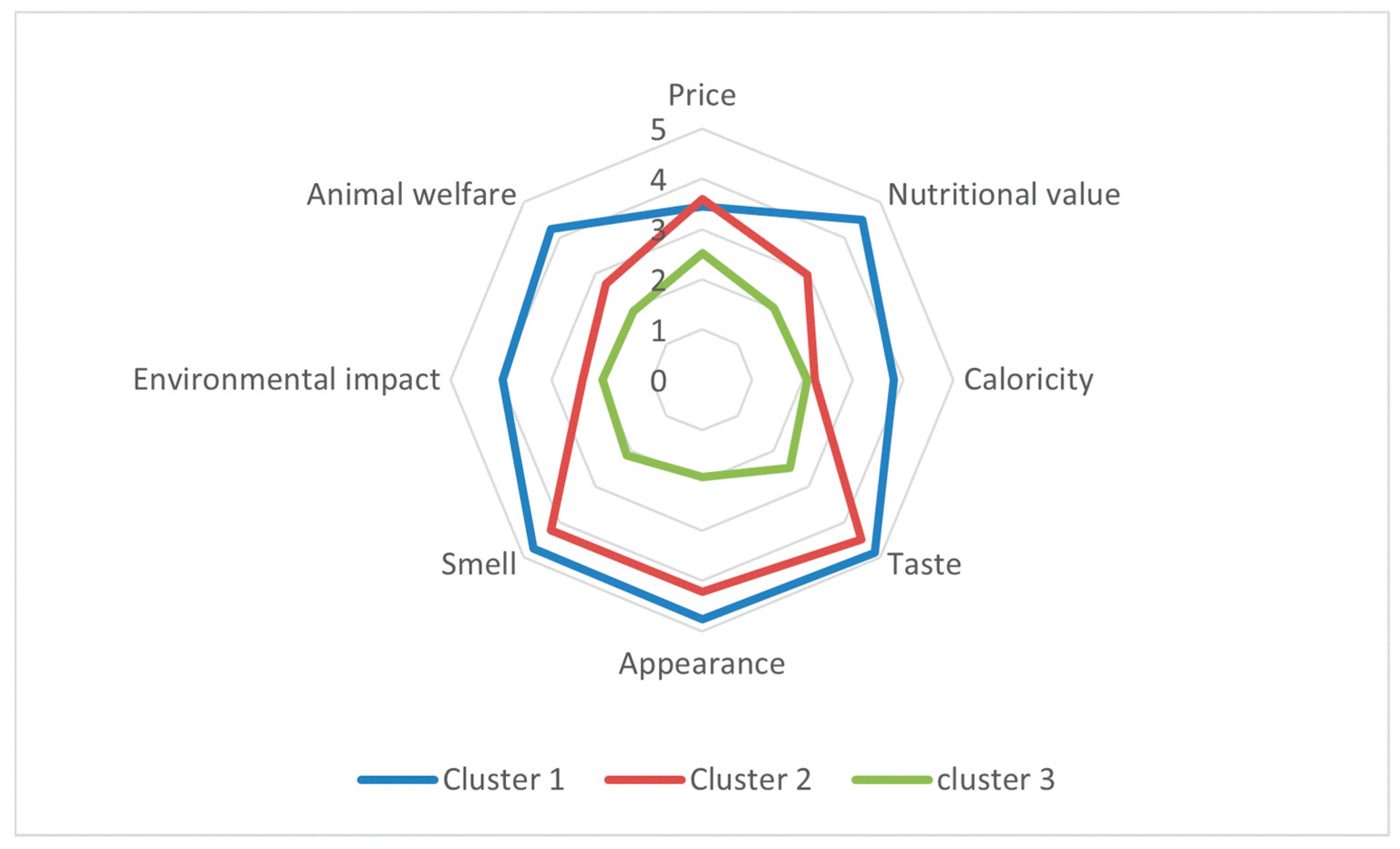
Figure 2.
Psychographic profiles of the four consumer segments across attitudes, behavioural intentions, technological risk and naturalness concern (TRNC), and general acceptance of cultured meat.
Figure 2.
Psychographic profiles of the four consumer segments across attitudes, behavioural intentions, technological risk and naturalness concern (TRNC), and general acceptance of cultured meat.
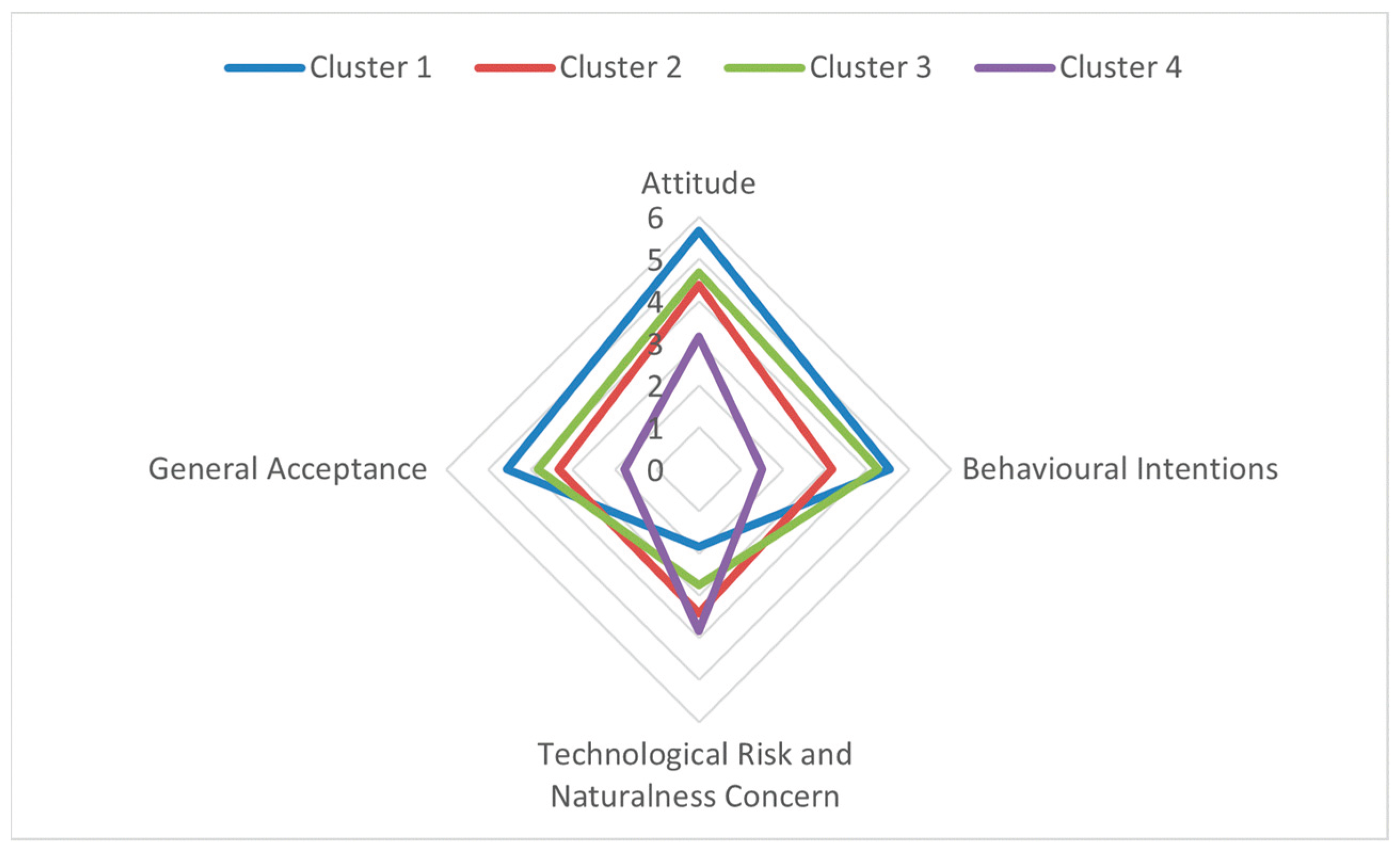
Figure 3.
Heatmap of the overlap between meat-purchase motivation clusters and cultured-meat psychographic segments (row-wise percentages).
Figure 3.
Heatmap of the overlap between meat-purchase motivation clusters and cultured-meat psychographic segments (row-wise percentages).
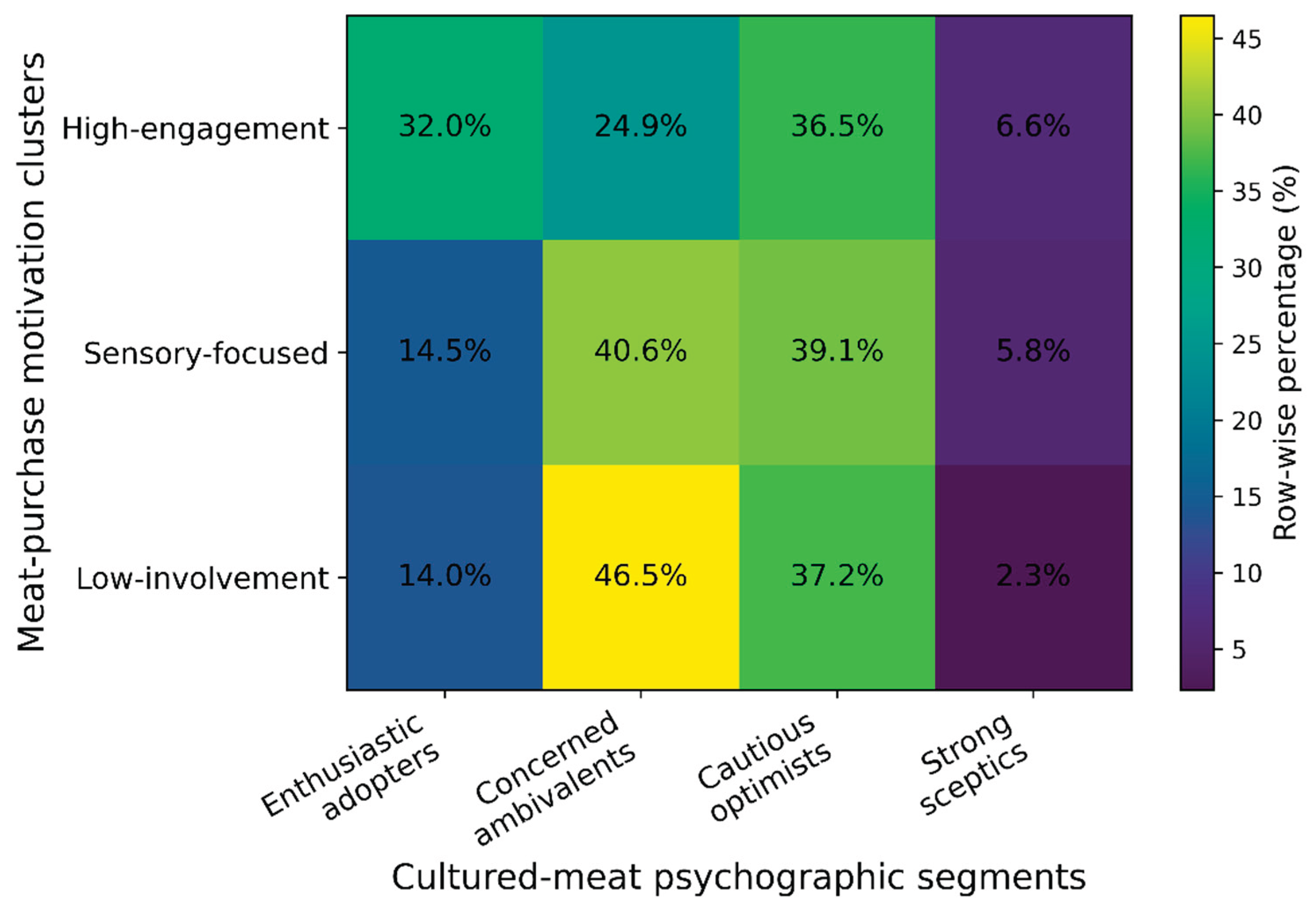

Table 1.
Sociodemographic characteristics of the meat-eating sample (n = 425).
| Demographic | Response format | Number | Percentage |
|---|---|---|---|
| Gender | Female | 281 | 66.1 |
| Male | 144 | 33.9 | |
| Age | 18 – 34 years old | 178 | 41.9 |
| 35 – 54 years old | 176 | 41.1 | |
| > 54 years old | 71 | 17.0 | |
| Education | Low level | 43 | 10.1 |
| Medium level | 69 | 16.2 | |
| High level | 313 | 73.7 | |
| Residence | Village | 125 | 29.4 |
| City up to 100 000 | 90 | 21.2 | |
| City of 100 - 500 000 | 71 | 16.7 | |
| City over 500 000 | 139 | 32.7 | |
| Income | Low income | 156 | 36.7 |
| Medium income | 174 | 41.0 | |
| High income | 95 | 22.3 | |
| Status of having children | No | 195 | 45.9 |
| Yes | 230 | 54.1 | |
| Employment | No | 136 | 32.0 |
| Yes | 289 | 68.0 |
Table 2.
Reliability and descriptive statistics of multi-item scales.
| Scale | Items (n) | Cronbach’s α | McDonald’s ω | Mean | SD |
|---|---|---|---|---|---|
| Attitudes toward cultured meat (ATT_CM) | 7 | 0.656 | 0.821 | 4.73 | 0.84 |
| Intentions toward CM (INT_CM) | 5 | 0.917 | 0.938 | 3.79 | 0.99 |
| Technological risk and naturalness concern (TRNC) | 5 | 0.821 | 0.878 | 3.19 | 0.91 |
| General Acceptance of Cultured Meat (GACM) | 3 | 0.771 | 0.868 | 3.72 | 0.87 |
Table 3.
Sociodemographic characteristics of meat-purchase motivation clusters.
| Variable | Category | Cluster 1 High-engagement, quality-and-values driven |
Cluster 2 Sensory-focused, moderately engaged |
Cluster 3 Low-involvement, indifferent |
|---|---|---|---|---|
| Gender | female | 160 (65.3%) | 62 (25.3%) | 23 (9.4%) |
| male | 37 (27.8%) | 76 (57.1%) | 20 (15.0%) | |
| Age group | 18 - 34 years | 98 (57.3%) | 65 (38.0%) | 8 (4.7%) |
| 35 - 54 years | 86 (59.3%) | 38 (26.2%) | 21 (14.5%) | |
| 55 and more | 13 (21.0%) | 35 (56.5%) | 14 (22.6%) | |
| Education level | primary | 3 (7.1%) | 26 (61.9%) | 13 (31.0%) |
| secondary | 35 (54.7%) | 22 (34.4%) | 7 (10.9%) | |
| university | 159 (58.5%) | 90 (33.1%) | 23 (8.5%) | |
| Place of residence | city of 100 - 500 thousand | 26 (40.0%) | 28 (43.1%) | 11 (16.9%) |
| city over 500 thousand | 69 (58.0%) | 41 (34.5%) | 9 (7.6%) | |
| city up to 100 thousand | 49 (59.0%) | 24 (28.9%) | 10 (12.0%) | |
| village | 53 (47.7%) | 45 (40.5%) | 13 (11.7%) | |
| Employment status | not working | 64 (49.2%) | 50 (38.5%) | 16 (12.3%) |
| working | 133 (53.6%) | 88 (35.5%) | 27 (10.9%) | |
| Parenthood | no | 96 (51.6%) | 77 (41.4%) | 13 (7.0%) |
| yes | 101 (52.6%) | 61 (31.8%) | 30 (15.6%) | |
| Household income | above 10000 PLN | 40 (48.8%) | 32 (39.0%) | 10 (12.2%) |
| from 5000 to 10000 PLN | 91 (61.1%) | 46 (30.9%) | 12 (8.1%) | |
| up to 5000 PLN | 66 (44.9%) | 60 (40.8%) | 21 (14.3%) |
Table 4.
Sociodemographic and awareness characteristics of cultured-meat psychographic segments.
| Variable | Category | Cluster 1 Enthusiastic early adopters | Cluster 2 Concerned ambivalents | Cluster 3 Cautious optimists | Cluster 3 Strong sceptics |
|---|---|---|---|---|---|
| Previously heard of cultured meat | i'm not sure | 6 (7.9%) | 37 (48.7%) | 31 (40.8%) | 2 (2.6%) |
| no | 17 (14.0%) | 50 (41.3%) | 40 (33.1%) | 14 (11.6%) | |
| yes | 83 (36.6%) | 49 (21.6%) | 84 (37.0%) | 11 (4.8%) | |
| Self-rated knowledge about cultured meat | average | 33 (35.1%) | 22 (23.4%) | 33 (35.1%) | 6 (6.4%) |
| no knowledge | 25 (16.7%) | 62 (41.3%) | 49 (32.7%) | 14 (9.3%) | |
| poor | 24 (16.4%) | 48 (32.9%) | 68 (46.6%) | 6 (4.1%) | |
| very well | 6 (85.7%) | 0 (0.0%) | 1 (14.3%) | 0 (0.0%) | |
| well | 18 (64.3%) | 4 (14.3%) | 4 (14.3%) | 2 (7.1%) | |
| Familiarity with production process | i'm not sure | 32 (21.3%) | 52 (34.7%) | 60 (40.0%) | 6 (4.0%) |
| no | 33 (16.7%) | 70 (35.4%) | 77 (38.9%) | 18 (9.1%) | |
| yes | 41 (53.2%) | 14 (18.2%) | 18 (23.4%) | 4 (5.2%) | |
| Willingness to replace conventional meat with meat substitutes | no | 10 (8.8%) | 47 (41.2%) | 34 (29.8%) | 23 (20.2%) |
| Yes, but not much. | 36 (23.5%) | 58 (37.9%) | 56 (36.6%) | 3 (2.0%) | |
| Yes | 60 (38.0%) | 31 (19.6%) | 65 (41.1%) | 2 (1.3%) | |
| Gender | female | 75 (26.7%) | 82 (29.2%) | 104 (37.0%) | 20 (7.1%) |
| male | 31 (21.5%) | 54 (37.5%) | 51 (35.4%) | 8 (5.6%) | |
| Age group | 18 - 34 years | 52 (29.2%) | 46 (25.8%) | 70 (39.3%) | 10 (5.6%) |
| 35 - 54 years | 48 (27.3%) | 45 (25.6%) | 67 (38.1%) | 16 (9.1%) | |
| 55 years and more | 6 (8.5%) | 45 (63.4%) | 18 (25.4%) | 2 (2.8%) | |
| Education level | primary | 1 (2.3%) | 29 (67.4%) | 9 (20.9%) | 4 (9.3%) |
| secondary | 12 (17.4%) | 21 (30.4%) | 26 (37.7%) | 10 (14.5%) | |
| university | 93 (29.7%) | 86 (27.5%) | 120 (38.3%) | 14 (4.5%) | |
| Place of residence | city of 100 - 500 thousand | 13 (18.3%) | 33 (46.5%) | 21 (29.6%) | 4 (5.6%) |
| city over 500 thousand | 36 (25.9%) | 35 (25.2%) | 53 (38.1%) | 15 (10.8%) | |
| city up to 100 thousand | 21 (23.3%) | 32 (35.6%) | 33 (36.7%) | 4 (4.4%) | |
| village | 36 (28.8%) | 36 (28.8%) | 48 (38.4%) | 5 (4.0%) | |
| Employment status | not working | 25 (18.4%) | 55 (40.4%) | 49 (36.0%) | 7 (5.1%) |
| working | 81 (28.0%) | 81 (28.0%) | 106 (36.7%) | 21 (7.3%) | |
| Parenthood | no | 51 (26.2%) | 56 (28.7%) | 78 (40.0%) | 10 (5.1%) |
| yes | 55 (23.9%) | 80 (34.8%) | 77 (33.5%) | 18 (7.8%) | |
| Household income | above 10000 PLN | 28 (29.5%) | 18 (18.9%) | 39 (41.1%) | 10 (10.5%) |
| from 5000 to 10000 PLN | 52 (29.9%) | 48 (27.6%) | 65 (37.4%) | 9 (5.2%) | |
| up to 5000 PLN | 26 (16.7%) | 70 (44.9%) | 51 (32.7%) | 9 (5.8%) |
Disclaimer/Publisher’s Note: The statements, opinions and data contained in all publications are solely those of the individual author(s) and contributor(s) and not of MDPI and/or the editor(s). MDPI and/or the editor(s) disclaim responsibility for any injury to people or property resulting from any ideas, methods, instructions or products referred to in the content. |
© 2025 by the authors. Licensee MDPI, Basel, Switzerland. This article is an open access article distributed under the terms and conditions of the Creative Commons Attribution (CC BY) license (http://creativecommons.org/licenses/by/4.0/).
Copyright: This open access article is published under a Creative Commons CC BY 4.0 license, which permit the free download, distribution, and reuse, provided that the author and preprint are cited in any reuse.


