Preprint
Review

This version is not peer-reviewed.

The Impact of Hemichannel-Mediated Neuroinflammation at Early Stages of CNS Ontogeny in the Development of Adult Neuropsychiatric Diseases

Submitted:

02 December 2025

Posted:

04 December 2025

You are already at the latest version

Abstract

In pathological conditions, elevated activity of connexin and pannexin hemichannels facilitates Adenosine triphosphate (ATP) efflux and Ca2+ influx, activating metabolic pathways of neuroinflammation. While a small insult could result in a protective inflammatory response, more intense and/or prolonged insults induce cell death, causing tissue dysfunction. In the brain, different stressors elevate glucocorticoid (GC) levels that are sensed by mast cells and microglia, and this response persists for a long time, causing continuous inflammasome activation and release of IL-1β and IL-18. These proinflammatory cytokines, together with those released by mast cells, activate astrocytes and oligodendrocytes, which in turn release glutamate and ATP, and altogether reduce neuronal functionality and survival. The extent of neuroinflammation also depends on host features that result in different degrees of alterations during brain ontogeny, consequently changing the brain cytoarchitecture and leading to spectrums of behavioral diseases. Selective hemichannel blockers have been recently discovered and shown to reduce neuroinflammation, as well as neuronal suffering and symptoms linked to adult models of depression and epilepsy. These blockers can serve as tools to dissect the role of neuroinflammation in behavioral diseases. Early treatment during brain ontogeny could reduce detrimental impacts on the brain cytoarchitecture, inducing behavioral alterations elicited in adulthood.

Keywords: 
;  ;  ;  ;  ;  ;  ;  ;  

1. Introduction

In the nervous system, inflammation is called neuroinflammation and can be local, incipient, massive, or chronic, being highly dependent on two main factors: insult and subject characteristics. Insults can be categorized by intensity (quantity or amount), duration (time and frequency), and quality (location and condition where the stimulus is received). There can also be combinations of different insult features that could induce different neuroinflammatory responses in the same individual. Furthermore, the intrinsic characteristics of the individual receiving the insult also influence the outcomes of the neuroinflammatory response. These intrinsic characteristics include age, sex, hormonal and feeding status, preexisting and pharmacological conditions, and phenotypic changes induced by circadian and seasonal rhythms. In addition, during gestation, the mother’s health conditions (e.g., preeclampsia, diabetes) [1] and environmental insults (e.g., viral, bacterial, or parasitic infections; smoke; alcohol; drug abuse; radiation; toxic compounds; psychological and physical abuse) can cause neuroinflammation in the offspring. Notably, neuroinflammation that unfolds during brain ontogeny is directly associated with neuropsychiatric conditions in adults, according to human and animal models [2,3,4]. However, direct cause-and-effect evidence of the role of neuroinflammation in causing tissue dysfunctions remains elusive, and thus far, therapies for even the most chronic brain diseases do not include treatment with anti-neuroinflammatory agents. The ultimate action of inflammation is to restore homeostasis in affected tissues with high regeneration capacity [23]. Otherwise, the outcome would be cell death that could lead to tissue dysfunction when the number of surviving cells is not sufficient to perform proficient tissue functions. To understand the etiopathogenesis of numerous psychiatric conditions, such as neurodevelopmental disorders, it is relevant to identify the developmental stage at which an individual is affected by a specific insult. In theory, the same insult received at different stages of intrauterine life or early postnatal life would have distinct outcomes in the ontogeny of the nervous system. Emerging studies also reveal that the gut microbiome plays a relevant role in modulating neuroinflammatory conditions [24]. These differences could be explained in part by alterations at critical steps of brain development, such as induction, proliferation, migration, or differentiation of glia and neurons that occur at different periods of time (Figure 1 and Figure 2). As a result, the normal developmental program is not achieved correctly. This could explain the multiple functional and structural alterations associated with behavioral changes [25,26]. However, a cause-and-effect relationship remains to be demonstrated. A common factor of different insults is stress, which under physiological conditions is an adaptive response to an environmental stimulus perceived as “threatening.” This stimulus, called a stressor, can have different origins (e.g., psychosocial, physical, chemical, or biological) and can affect an organism individually or jointly. A common response, independent of the stressor, involves glucocorticoids, which promote glial cell activation, causing long-lasting neuroinflammation [27].
In addition, neuroinflammation can be transferred to future generations through epigenetic mechanisms (see Section 6). The therapeutic use of new agents that revert molecular epigenetic signatures in the same generation could prevent their transfer to the following generation. The efficacy of this approach could be complemented with new anti-inflammatory compounds that block nonselective channels (see below).

2. Molecular Aspects of Neuroinflammation and Anti-Inflammatory Agents

Inflammation can be induced by the activation of canonical and/or noncanonical pathways. The canonical pathway responds to stimuli from various immune receptors and leads to rapid but transient activation of NF-κB through the activation of TGFβ-activated kinase 1 (TAK1 or MAP3K7), which activates the trimeric IκB kinase complex (IKK). After several steps, the process culminates with the nuclear translocation of elements such as NF-κB1 p50, RELA, and c-REL, at which they bind to DNA at κB enhancer sites where they exert their action [28].
The noncanonical pathway is based on the processing of p100, which is tightly controlled and inducible. P100, also known as NF-κB2, is a precursor protein that, after processing, becomes the p52 subunit of the NF-κB transcription factor. Processing of p100 induces the translocation of p100-associated NF-κB family members such as RELB and NF-κB p52. One of the characteristics of this pathway is its slow and persistent activation, and its activation is mediated by ligands of tumor necrosis factor receptors (TNFRs), such as TNFα [28].
An overproduction of TNFα has been observed in rats subjected to acute stress by immobilization. TNFα is involved in the expression of inducible nitric oxide synthase (iNOS) through NF-κB-dependent mechanisms [36]. However, these changes are not the same in different brain areas. For instance, rats subjected to chronic stress show an increase in NF-κB activation as well as in the expression of TNFα, IL-1β, and iNOS in the hippocampus, but the opposite occurs in the hypothalamus [37].
Elevated levels of TNFα and ATP in the extracellular lumen have been linked to the assembly of the inflammasome, a 700 kDa protein complex responsible for the activation of the proinflammatory cytokines IL-1β and IL-18 [38,39]. Our interest in this chapter is in the NLRP3 inflammasome, which is composed of the NOD-like receptor family pyrin domain containing 3 (NLRP3) protein as a sensor, the apoptosis-associated speck-like protein containing an activator and recruiter of the caspase domain as an adapter protein (ASC: apoptosis-associated speck-like protein containing a CARD), and the protease caspase-1 as an effector [38,40].
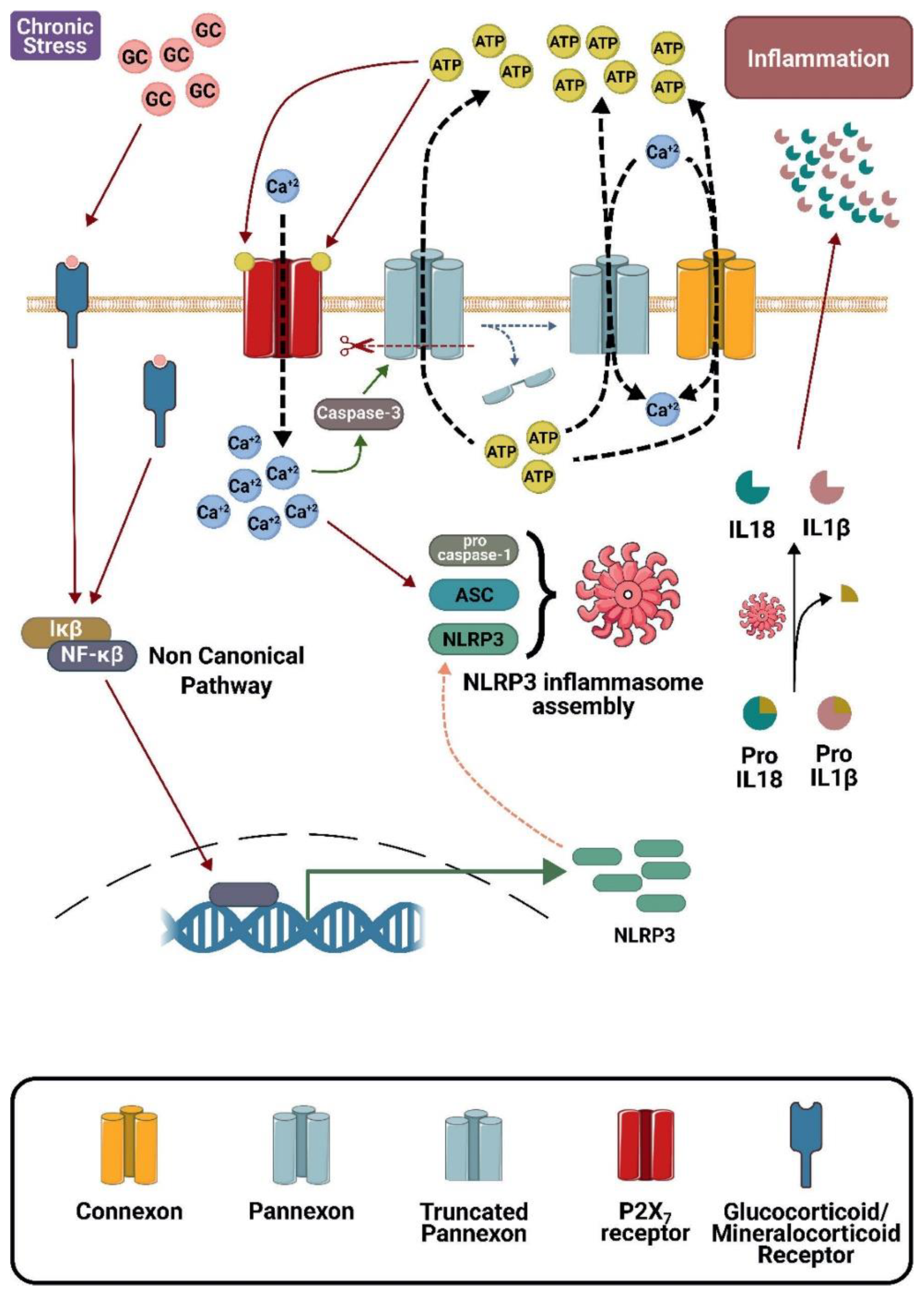
The inflammasome can be activated by several stimuli and ligands, including pathogen-associated molecular patterns (PAMPs) and damage-associated molecular patterns (DAMPs), such as TNFα and ATP. The presence of TNFα in the extracellular lumen activates the TNF receptor (TNFR). This results in the upregulation of inactive NLRP3, which, together with the ASC protein, induces the autocatalysis of caspase-1 from pro-caspase-1, resulting in the cleavage of pro-IL-1β and pro-IL-18 to IL-1β and IL-18 (Figure 3) [38,40,41,42]. Furthermore, IL-1β is known to act in a paracrine/autocrine manner, improving signaling in the hypothalamus-pituitary-adrenal axis during stress, which results in higher cytokine and glucocorticoid (GC) production [41].
The same effect on the activation of the inflammasome is achieved by ATP through the activation of the purinergic receptor P2X ligand-gated ion channel 7 (P2X7 receptor or P2X7R). Elevated levels of extracellular ATP activate the P2X7R, enabling the influx of Ca2+ into the intracellular milieu (Figure 3) [43,44]. This elevation in cytoplasmic Ca2+ leads to two results. First, it activates connexin hemichannels (connexons) and cleavage of the C-terminal of pannexin1 by caspase-3. This generates a truncated pannexin1 hemichannel that, together with connexin and intact pannexin hemichannels, enhances ATP efflux to the extracellular milieu [45,46], thus amplifying the inflammation signal. Second, Ca2+ elevation induces the upregulation of NLRP3, in an analogous manner to TNFα, also resulting in the activation of IL-1β and IL-18 (Figure 3) [38,40,42]. The NLRP3 inflammasome and its activation occur in most cell types of the central nervous system (CNS), including mast cells [42], microglia [47], astrocytes [48], oligodendrocytes [41,49], and neurons [50].
If this inflammatory process occurs during the ontogeny of the nervous system, it can have significant undesired consequences, affecting processes such as microglial infiltration and expansion, neurogenesis, gliogenesis, connection generation, and neuronal pruning (Figure 1 and Figure 2) [10]. Numerous anatomical studies have demonstrated that changes in neuronal structure and function are responsible for many of the stress-induced changes in behavior and cognition [51,52,53], opening a possible explanation for the etiopathogenesis of neuropsychiatric illnesses such as anxiety disorders and depression.

3. Stress and Inflammation

The hypothalamus is involved in stress responses, activating a neuroendocrine response axis involving the pituitary and adrenal glands, called the hypothalamus-pituitary-adrenal axis. This axis receives information from the endocrine, immune, and nervous systems, controlling the physiological responses to stress [54]. The hypothalamus releases corticotropin-releasing hormone (CRH), which acts primarily on the pituitary gland, inducing the release of adrenocorticotropic hormone (ACTH), which ultimately induces the release of GCs from the adrenal cortex (cortisol in humans and corticosterone in rodents) [41,54,55,56].
GCs coordinate the regulation of the circadian rhythm, with elevated levels during the first hours of the day and low points around midnight in humans [57,58,59]. This pattern is reversed in nocturnal organisms such as mice. Due to their lipophilic characteristics, GCs passively cross the plasma membrane of cells, where they can bind to the glucocorticoid receptor (GR) or the mineralocorticoid receptor (MR), with GR being a low-affinity receptor and MR a high-affinity receptor for GCs. The ligand-receptor complex is translocated to the nucleus, where it activates or represses the transcription of multiple genes [54,60,61]. This GC signaling pathway has been estimated to regulate up to 20% of the genome [54,62], and therefore, they have multiple undesired effects on the brain and peripheral tissues.
The regulation of GC at the intracellular level depends on the activity of two 11β-hydroxysteroid dehydrogenase isoenzymes, which have opposite effects. While isoenzyme 2 (11β-HSD2) inactivates cortisol (or corticosterone) in (11β-HSDs), transforming it into cortisone (or 11-dehydrocorticosterone), isoenzyme 1 (11β-HSD1) activates GCs [63,64,65]. At the systemic level, GCs are regulated through corticosteroid-binding globulin, which in humans leaves approximately 5% cortisol circulating in its active form [64]. In addition to the canonical function of GCs, other mechanisms have been described where GCs exert their action, including non-genomic effects of GRs, as well as crosstalk with other transcription factors and GC effects that are receptor-independent [54,66].
GC levels increase in response to stress, heightening the individual’s state of alert and enabling a positive adaptive response to the stressor in cases of acute stress [67]. However, chronic stress happens to be proinflammatory in the CNS, where different cells of the immune system, such as mast cells and microglia, are activated, hence inducing a reactive state in astrocytes and oligodendrocytes. Just 30 minutes of movement restriction is enough for corticosterone to increase and mast cell degranulation to occur [68,69], resulting in the release of proinflammatory agents such as ATP and preformed TNFα.
Stress also occurs during pregnancy as a response to factors impacting both the mother and fetus. In rats, stress induced by movement restriction has been observed to decrease mRNA levels as well as placental 11β-HSD2 activity but has a small or zero effect (depending on the study) on 11β-HSD1 mRNA levels [64,65]. In the mothers, stress caused by food restriction leads to high levels of corticosterone and reduced levels of 11β-HSD2 mRNA expression at the placenta. This could affect the number of active GCs that are transferred from the mother to the fetuses, which would induce changes in their neurodevelopment [65].
Administration of the synthetic GC dexamethasone (DEX) in pregnant mammals induces neuroinflammation, which impacts the ontogeny of neurons and glia in the offspring [41,70]. This synthetic glucocorticoid can cross the placental barrier, but it is not inactivated by 11β-HSD2, which could affect neuronal and glial maturation, as well as myelin synthesis, macrogliogenesis, and other processes in brain development [64,71]. Furthermore, DEX modifies programmed and regulated glucocorticoid secretion and brain plasticity [41].
Diseases of different etiopathologies, such as depression [54,72], schizophrenia [73], asthma [61,74], preeclampsia [75], and Alzheimer’s and Parkinson’s disease [72,76], have been linked to chronic GC release, which could enhance GC-enhanced inflammation. GCs also have many applications in daily life. They are usually used as anti-inflammatory agents [54,61], immunosuppressants, and in chemotherapy [54,60]. The use of GCs as antenatal treatment is directed to reduce or prevent respiratory distress syndrome in premature fetuses. The direct correlation of an early increase in GC levels during development and adverse behavioral outcomes has been extensively described, including hypertension, gestational diabetes, autism, depression, and schizophrenia [77,78,79,80], and can be transmitted epigenetically [81]. The studies in humans are also supported by results obtained in experimental animals, including mice [41,70,82], rats [83,84,85,86], sheep [87,88], and monkeys [89,90]. In addition, the stress-induced changes in neuroanatomy are specific to brain region and sex [91,92].
Elevated levels of GCs increase CRH levels, which in turn induce blood levels of ACTH [93] and the degranulation of mast cells [71]. While chronic stress increases GC levels and promotes the activation of NLRP3 in microglia [94,95], astrocytes [96], and oligodendrocytes [41], it promotes the activation of NLRP1 in neurons [97]. Studies show a direct association between antenatal treatment with GCs and depression-like symptoms in offspring [83,84,85], inflammation [41], and/or changes in the hippocampus that have been associated with depression-like symptoms in adults [70,82,84,86,87,88,89,90]. Examples of the relationship between neuroinflammation induced at prenatal stages and changes in behavior have been linked to toxic levels of lead [98]. Additionally, gossypol, a compound primarily found in the cotton plant, reduces neurogenesis by targeting the proliferation and differentiation of neuronal stem/progenitor cells, cognitive functions, and neuroinflammation [99].

4. Mast Cells, Microglia, and Inflammation

In the brain, mast cells reside in vascularized regions, including the meninges, area postrema, choroid plexus, and the parenchyma of the thalamic-hypothalamic region [100]. They are characterized by granules loaded with proinflammatory molecules such as biogenic amines (histamines, serotonin), cytokines (e.g., IL1 to IL6 and TNFα), enzymes (e.g., phospholipases, tryptase), lipid metabolites (e.g., prostaglandins, leukotrienes), ATP, and growth factors, among others [16,101,102,103,104]. Despite all these possibilities, it should be made clear that not all mast cells produce or maintain all these substances; rather, they depend on the environment and other conditions [103]. Furthermore, if a longer-lasting action is required, they produce de novo and release proinflammatory mediators [101]. Compared to other cell types in the CNS, the number of mast cells under regular conditions is low, but their ability to accumulate inflammatory effectors generates rapid responses to stress (mediated by CRH). The high content of inflammatory effectors and location (associated with the blood-brain barrier and leptomeninges) enables the mast cell degranulation response to be fast, amplified, and prolonged [101], which has been associated with different brain disorders [105].
In mammals, microglia develop in the embryonic sac, and as primitive macrophages, they enter the developing brain, colonizing the CNS parenchyma, where they mature into microglia [15,106]. Microglia are a population distinct from mononuclear phagocytes, characterized by fulfilling multiple functions in the CNS. Their main function is the surveillance and protection of the nervous system, like macrophages, but they have other secondary functions such as maintaining homeostasis, tissue regeneration, removal of cellular debris, synaptogenesis, and production of trophic factors, among others. All this has led to the consideration of microglia as an important cell type within the CNS [15,107,108] in adults and during CNS development.
In response to a proinflammatory environment generated by the degranulation of mast cells, microglia move from their homeostatic state to a responding state, inducing changes in their phenotype and triggering motility toward the inflammatory signal (induced by ATP and/or TNFα in the extracellular milieu). Activating the inflammasome present in the microglia facilitates the inflammatory response [15,107,108], and this has been observed to be implicated in conditions like schizophrenia, major depressive disorder, anxiety, and autism spectrum disorder [109].
Astrocytes are a type of glial cell that play an important role in the regulation, maintenance, and promotion of neuronal synapses. They secrete soluble factors that target pre- and postsynaptic neurons, such as glutamate and L/D-serine, and can recycle neurotransmitters through transporters [14,110]. This close relationship between neurons and astrocytes during the synapse led to the concept of “tripartite synapse.” Increased levels of extracellular glutamate have been associated with depression in patients suffering from major depression and animal models of depression [110].

5. Connexons, Pannexons, and Neuroinflammation

Connexin-based gap junctions are constituted by clusters of intracellular channels that connect the cytoplasm of two contacting cells [50,111]. The most studied gap junction channels are formed by two hemichannels, or connexons, which in turn are formed by six protein subunits called connexins. Most hemichannels are permeable to different ions and small molecules, many of them important for the maintenance of the inflammatory process and the assembly of the inflammasome, enabling the influx of Ca2+ and the efflux of glutamate and ATP [112,113].
Pannexins present a similar membrane topology to connexins and form hemichannels called pannexons. The latter are constituted by seven pannexin protein subunits, which facilitate the release of ATP to the extracellular milieu [114,115]. Recently, it has been reported that high levels of intracellular Ca2+ activate protease caspase-3 that cleaves the C-terminal domains of the pannexon. This increases the radius of the pannexon’s pore, allowing for the influx of Ca2+ and maintaining permeability to ATP [116]. This function, related to the influx of Ca2+ and efflux of ATP (both of which are central in the inflammasome’s activation and autocrine/paracrine inflammatory signaling), makes connexin and pannexin hemichannels potential molecular targets for interrupting stress-induced neuroinflammatory processes. Pannexins have also been reported to form gap junction channels [117], but their possible role in neuroinflammation remains elusive. Accordingly, stress increases the activity of connexons, pannexons, and P2X7Rs in different brain cells [41,69]. In adult male mice, chronic stress increases the activity of connexin43 hemichannels in microglia and astrocytes, as well as that of pannexin1 hemichannels in microglia, astrocytes, and neurons [69]. For example, newborn offspring of mice stressed with DEX during gestation show increased levels of connexin47, pannexin1, and P2X7R in oligodendrocytes that are maintained for several weeks, as well as an activation of the oligodendrocyte inflammasome [41]. Microglia activation has also been observed in the offspring of stressed pregnant rats, which could contribute to behavioral changes observed in adults with depression [118]. The offspring of mothers subjected to acute restraint stress show an increase in the activity of both connexin43 and pannexin1 hemichannels in astrocytes, which is further increased by chronic stress. After acute and chronic stress, pannexin1 hemi- channel activity occurs in microglia and neurons.
Inhibiting glutamate NMDA/P2X7Rs can reduce chronic stress-induced hemi- channel activity, whereas blocking connexin43 and pannexin1 hemichannels would fully reduce ATP and glutamate release, as observed in hippocampal slices from stressed mice. Releasing gliotransmitters through hemichannels has been proposed to participate in the pathogenesis of stress-associated psychiatric disorders [69]. Moreover, the induction of depression through chronic restraint stress and chronic unpredictable mild stress in rats has also been linked to the activation of connexin43 hemichannels and the release of glutamate and ATP [110].
Similarly, emotional or physical neglect due to abandonment is a clear source of stress in the early life of an infant. This type of stressor has been shown to be directly implicated in psychological symptoms such as inclination toward impulsive behavior, anxiety, depression, and others [119]. Dysregulation of astrocytic connexins has been identified in maternal isolation animal models that mimic early life stress [120]. A recent study showed that oligodendrocyte precursor cells have a prominent role in modulating brain function and diseases through the paracrine regulation of astrocyte development. This could provide a possible explanation for previous findings, where the altered morphology of astrocytes in patients with mental disorders was observed to be associated with a reduced number of oligodendroglial lineage cells [119]. Clearly, in adults, neuroinflammation is present in models of social defeat stress [121], but further studies are required to validate the influence of different types of stress, such as psychosocial stress and unpredictable mild stress or social defeat paradigms, on the intensity and duration of neuroinflammation and CNS cytoarchitecture at different ages. Interestingly, chronic unpredictable mild stress has been associated with low expression of NLRP3 [122], strongly suggesting that reduced neuroinflammation renders protection.
Hemichannels belong to the family of large-pore channels, which includes Transient receptor potential (TRP) channels, Piezo channels, CAHLM channels, and P2X receptors, all of which are nonselective channels permeable to small molecules and cations like Ca2+. Some of them, like connexins, truncated pannexin1 hemichannels, and CAHLM1 channels, are expressed in most cell types, sharing structural and pharmacological sensitivity [123]. To show their involvement in any brain disease, it is, thus, critical to demonstrate their selectivity.
The compound D4 ((R)-2-(4-chlorophenyl)-2-oxo-1-phenylethyl quinolone-2-carboxylate, MW: 401.85 g/mol) inhibits the passage of molecules through connexin hemichannels, functioning as a blocker. This small organic molecule does not block connexin gap junction channels [124], CAHLM1 channels [125], or P2X7Rs [126]. Initial studies showed the ability to reduce atrophy in pathological muscle dysfunctions [127], as well as decrease neuroinflammation in temporal lobe epilepsy [128]. D4 has also been shown to inhibit stress-mediated astrogliosis and induce restoration of neural activity at the brain level in adult mice with depression-like symptoms [126]. Likewise, the compounds TAT-Cx43L2 and cacotheline have been studied and linked to blocking connexin43 hemichannels after the induction of depression through chronic stress. Subcutaneous cacotheline has been shown to have antidepressant effects by specifically preventing connexin43 hemichannel activity in a similar fashion as D4 [110]. Other approaches to inhibiting hemichannels include peptides like TAT-Gap 19, which exert an anticonvulsant effect in rodents [129] and protect from cerebral ischemia/reperfusion injury [130,131]. Other small organic molecules, such as CVB2-61, a phenolic diaryl ether, and a curcuminoid analog, have been proposed to inhibit connexin hemichannels [132] and, therefore, might be useful toward reducing neuroinflammation in several brain diseases. The importance of neuroinflammation in the development of epilepsy has also been proposed using other drugs such as lacosamide and amlexanox [133,134], supporting the concept that neuroinflammation plays a relevant role in epilepsy.
One of the most interesting compounds that has been shown to block connexin hemichannels in animal and cell models is Tonabersat, which reduces the effects of damage in the retina of rats [135,136] and the inhibition of ATP release through connexin43 in cell cultures [136,137]. Tonabersat is being tested in clinical trials for other uses (migraines, diabetic macular edema, and long COVID) [138], which can facilitate its use in the future for neuroinflammation in human patients. A different approach could be the use of a polypharmacology agent like boldine, which blocks connexin and pannexin hemichannels and P2X7Rs [125,127,139].
With all the background presented, a neuroinflammatory process in offspring, due to an increase in GCs in the mother during the gestational period, can be expected to have effects that are observed at birth and remain until adulthood. The decrease or increase in dendritic arborization and density, as well as the chronic activation of macroglia, microglia, and the inflammasome, would produce a neuroinflammatory environment in relevant brain areas, which would be reflected in the appearance of symptoms like anxiety disorders or depression in adult mice. This effect could be diminished by blocking connexin hemichannels with the use of the anti-inflamma-tory molecule D4. Reducing these complex disorders to a hemichannel-inflammation axis risks oversimplification. However, it seems to offer an alternative that could be tested in humans because current treatments focusing on neuronal targets appear poorly effective according to a network meta-analysis study [140].

6. Epigenetic Changes Induced by Stress

Epigenetics refers to short- and long-term gene expression variations that are caused by non-DNA-encoded mechanisms. These changes are hereditary and include the methylation of cytosine bases, acetylation, and the methylation of histones and nonhistone proteins, as well as changes in noncoding RNA expression, chromatin remodeling, and RNA modification [141,142].
Conditions such as autism spectrum disorder, depression, anxiety disorders, post-traumatic stress disorder, and schizophrenia present epigenetic modification [3,142,143,144,145]. Chronic stress is known to induce persistent changes in global DNA methylation and gene expression in different brain areas [146]. Several enzymes can reverse epigenetic changes, with key players including histone deacetylases and DNA methyltransferases. Histone deacetylases remove acetyl groups from histones, while DNA methyltransferases remove methyl groups from DNA, effectively undoing these epigenetic modifications. Research on epigenetic therapies suggests strong evidence for normal gene expression restoration linked to inhibitors and modulators of the activity of enzymes involved in epigenetic modifications, like DNA methylation and histone acetylation. This allows for the reversal of abnormal epigenetic patterns and can be used to treat diseases where epigenetic changes are implicated. Pharmacological inhibitors of DNA methylation, such as azacitidine and decitabine, were developed to reverse epigenetic changes via DNA methyltransferase inhibition. It has been proposed that some antidepressant drugs may exert direct epigenetic effects. For instance, tricyclic antidepressants amitriptyline and imipramine have been shown to reduce promoter DNA methylation in rat primary astrocytes, presumably by reducing DNA methyltransferase 1 activity [147,148].
The use of epigenetic drugs can also help to alleviate the symptoms of some neurodegenerative diseases or neurodevelopmental conditions. LSD1, a selective inhibitor of H3K4me2 demethylase, has been shown to reverse some of the most common behaviors of an autistic mouse model, such as social deficits and repetitive movements [149]. Similarly, the use of several drugs used as mood stabilizers, antidepressants, and/or for the treatment of epilepsy, such as valproate, lithium chloride, and clozapine, among others, induces changes in the different histone acetylases in the brain [150]. This network suggests the idea that a combination of drugs targeting connexin and pannexin hemichannels, in conjunction with epigenetic drugs, could generate synergistic effects and favor the recovery of DNA in a condition not associated with behavioral diseases.

7. Concluding Remarks

In the quest to find molecular targets that reduce or block neuroinflammation, connexin hemichannels expressed by glial cells appear to be good candidates. Given that the hemichannels found in the cell membrane are of easy access, they appear to be a good pharmacological target to achieve this goal. In fact, several pharmacological approaches have been tested and have revealed relevant protective action in animal models of human diseases. They include the small organic molecule D4, TAT-Gap 19 peptide, Tonabersat, TAT-CX43L2, cacotheline, and boldine, which could be part of a new generation of anti-inflammatory drugs.
As seen in this chapter, a large body of studies indicates that homeostatic disorders in the developing CNS due to chronic stress during the prenatal stages of the mother or the early life of the offspring can lead to a neuroinflammatory environment that favors changes, some or all of which involve several steps of brain ontogeny (cell migration, proliferation, maturation, and differentiation) being part of the balanced process for the normal development of the CNS. Any change could lead to the first events that, sooner or later, can result in neuropsychiatric diseases or conditions. Different levels or intensities of stress are commonplace in our modern days. It is relevant today more than ever to assess their effects on the development and ontogeny of the CNS and, consequently, on the development and ontogeny of neuroinflammation that can result in neuropsychiatric disorders or conditions. Establishing treatments that reduce or even block neuroinflammation by using hemichannel blockers and/or epigenetic drugs could be a promising start toward reducing the negative effects of neuroinflammation in the ontogeny and development of the CNS. Further studies are required to understand the relative involvement of neuroinflammation in behavioral diseases, as compared to other working hypothesis, such as dysregulation of the dopamine of the neurotransmitter dopamine in certain brain regions in the development and maintenance of depressive symptoms [151].
Although the development of pharmacological tools has provided novel interpretations on the etiopathogenesis of diverse brain malfunctions in different chronic diseases, the development of conditional connexin and pannexin cell-specific knockouts will provide valuable information to strengthen the interpretation of different findings in this area of research. Accordingly, Cx43 K.O in microglia has recently supported the role of connexin hemichannels in neuroinflammation and progression of Alzheimer’s disease [152].

Acknowledgements

This work was partially supported by the Agencia Nacional de Investigación y Desarrollo (ANID) grant 1231523 (to JCS) and the Doctoral thesis support fellow- ship at Valparaíso University (to FJO). The primary proposal was presented by FJO to partially fulfill the requirements for a Doctor of Science degree with a specialization in Neuroscience at the University of Valparaiso.

Conflicts of Interest

The authors declare no conflict of interest.

References

  1. Robinson R, Lähdepuro A, Tuovinen S, et al. Maternal Hypertensive Pregnancy Disorders and Mental and Behavioral Disorders in the Offspring: a Review. Curr Hypertens Rep 2021;23:30. [CrossRef]
  2. Kelly SJ, Day N, Streissguth AP. Effects of prenatal alcohol exposure on social behavior in humans and other species. Neurotoxicol Teratol 2000;22:143–9. [CrossRef]
  3. Cattane N, Richetto J, Cattaneo A. Prenatal exposure to environmental insults and enhanced risk of developing Schizophrenia and Autism Spectrum Disorder: focus on biological pathways and epigenetic mechanisms. Neurosci Biobehav Rev 2020;117:253–78. [CrossRef]
  4. Shin SH, Kim YK. Early Life Stress, Neuroinflammation, and Psychiatric Illness of Adulthood. Adv Exp Med Biol 2023;1411:105–34. [CrossRef]
  5. Penisson M, Ladewig J, Belvindrah R, et al. Genes and Mechanisms Involved in the Generation and Amplification of Basal Radial Glial Cells. Front Cell Neurosci 2019;13:1–21. [CrossRef]
  6. Zhang J, Tabassum S, Jiang J, et al. Optimized Golgi-Cox Staining Validated in the Hippocampus of Spared Nerve Injury Mouse Model. Front Neuroanat 2020;14:1–10. [CrossRef]
  7. Ryan Kissinger. Macrophage. NIAID Visual & Medical Arts 2024. https://bioart.niaid.nih.gov/bioart/310 (accessed May 11, 2025).
  8. Ryan Kissinger. Astrocyte. NIAID Visual & Medical Arts 2024. https://bioart.niaid.nih.gov/bioart/40 (accessed May 11, 2025).
  9. Ryan Kissinger. Immature Organoid Brush. NIAID Visual & Medical Arts 2024. https://bioart.niaid.nih.gov/bioart/251 (accessed May 11, 2025).
  10. Reemst K, Noctor SC, Lucassen PJ, et al. The Indispensable Roles of Microglia and Astrocytes during Brain Development. Front Hum Neurosci 2016;10:1–28. [CrossRef]
  11. Nishiyama A, Shimizu T, Sherafat A, et al. Life-long oligodendrocyte development and plasticity. Semin Cell Dev Biol 2021;116:25–37. [CrossRef]
  12. Li X, Liu G, Yang L, et al. Decoding Cortical Glial Cell Development. Neurosci Bull 2021;37:440–60. [CrossRef]
  13. Vivi E, Di Benedetto B. Brain stars take the lead during critical periods of early postnatal brain development: relevance of astrocytes in health and mental disorders. Mol Psychiatry 2024;29:2821–33. [CrossRef]
  14. Farhy-Tselnicker I, Allen NJ. Astrocytes, neurons, synapses: a tripartite view on cortical circuit development. Neural Dev 2018;13:7–19. [CrossRef]
  15. Nayak D, Roth TL, McGavern DB. Microglia Development and Function. Annu Rev Immunol 2014;32:367–402. [CrossRef]
  16. St. John AL, Rathore APS, Ginhoux F. New perspectives on the origins and heterogeneity of mast cells. Nat Rev Immunol 2023;23:55–68. [CrossRef]
  17. Stagni F, Giacomini A, Guidi S, et al. Timing of therapies for Down syndrome: the sooner, the better. Front Behav Neurosci 2015;9:1–18. [CrossRef]
  18. John Chilton. Mast Cell. SciDrawIo 2024. [CrossRef]
  19. Francis He. Oligodendrocyte progenitor cell. SciDrawIo 2023. [CrossRef]
  20. John Chilton. Astrocyte. SciDrawIo 2020. [CrossRef]
  21. John Chilton. Microglia reactive. SciDrawIo 2020. [CrossRef]
  22. John Chilton. Neuron. SciDrawIo 2020. [CrossRef]
  23. Oronsky B, Caroen S, Reid T. What Exactly Is Inflammation (and What Is It Not?). Int J Mol Sci 2022;23:14905. [CrossRef]
  24. Rea K, Dinan TG, Cryan JF. The microbiome: A key regulator of stress and neuroinflammation. Neurobiol Stress 2016;4:23–33. [CrossRef]
  25. Maras PM, Molet J, Chen Y, et al. Preferential loss of dorsal-hippocampus synapses underlies memory impairments provoked by short, multimodal stress. Mol Psychiatry 2014;19:811–22. [CrossRef]
  26. Chenani A, Weston G, Ulivi AF, et al. Repeated stress exposure leads to structural synaptic instability prior to disorganization of hippocampal coding and impairments in learning. Transl Psychiatry 2022;12:381. [CrossRef]
  27. Aguirre A, Maturana CJ, Harcha PA, et al. Possible Involvement of TLRs and Hemichannels in Stress-Induced CNS Dysfunction via Mastocytes, and Glia Activation. Mediators Inflamm 2013;2013:1–17. [CrossRef]
  28. Sun SC. The non-canonical NF-κB pathway in immunity and inflammation. Nat Rev Immunol 2017;17:545–58. [CrossRef]
  29. Ryan Kissinger. Inflammasome. NIAID Visual & Medical Arts 2024. https://bioart.niaid.nih.gov/bioart/255 (accessed May 11, 2025).
  30. Ryan Kissinger. Receptor. NIAID Visual & Medical Arts 2024. https://bioart.niaid.nih.gov/bioart/429 (accessed May 11, 2025).
  31. Ryan Kissinger. DNA. NIAID Visual & Medical Arts 2024. https://bioart.niaid.nih.gov/bioart/123 (accessed May 11, 2025).
  32. Servier Medical Art. Membrane (Yellow-Orange). Servier Medical Art 2025. https://bioicons.com/?query=membrane-2d-yelloworange%20 (accessed May 11, 2025).
  33. Servier Medical Art. Channel (Yellow). Servier Medical Art 2025. https://smart.servier.com/smart_image/smart-yellow-channel-tubes-overview/ (accessed May 11, 2025).
  34. Servier Medical Art. Channel (Red). Servier Medical Art 2025. https://smart.servier.com/smart_image/smart-red-channel-overview/ (accessed May 11, 2025).
  35. Servier Medical Art. Channel (Blue Sky). Servier Medical Art 2025. https://smart.servier.com/smart_image/blue-sky-channels/ (accessed May 11, 2025).
  36. Madrigal J. The Increase in TNF-α Levels Is Implicated in NF-κB Activation and Inducible Nitric Oxide Synthase Expression in Brain Cortex after Immobilization Stress. Neuropsychopharmacology 2002;26:155–63. [CrossRef]
  37. Sorrells SF, Caso JR, Munhoz CD, et al. The Stressed CNS: When Glucocorticoids Aggravate Inflammation. Neuron 2009;64:33–9. [CrossRef]
  38. Franchi L, Eigenbrod T, Núñez G. Cutting Edge: TNF-α Mediates Sensitization to ATP and Silica via the NLRP3 Inflammasome in the Absence of Microbial Stimulation. The Journal of Immunology 2009;183:792–6. [CrossRef]
  39. Petrilli V, Papin S, Tschopp J. The inflammasome. Current Biology 2005;15:R581. [CrossRef]
  40. Sandhu JK, Kulka M. Decoding mast cell-microglia communication in neurodegenerative diseases. Int J Mol Sci 2021;22:1–22. [CrossRef]
  41. Maturana CJ, Aguirre A, Sáez JC. High glucocorticoid levels during gestation activate the inflammasome in hippocampal oligodendrocytes of the offspring. Dev Neurobiol 2017;77:625–42. [CrossRef]
  42. Chen R, Yin C, Fang J, et al. The NLRP3 inflammasome: an emerging therapeutic target for chronic pain. J Neuroinflammation 2021;18:84. [CrossRef]
  43. Grol MW, Zelner I, Dixon SJ. P2X 7-mediated calcium influx triggers a sustained, PI3K-dependent increase in metabolic acid production by osteoblast-like cells. Am J Physiol Endocrinol Metab 2012;302:561–75. [CrossRef]
  44. Liang X, Samways DSK, Wolf K, et al. Quantifying Ca2+ current and permeability in ATP-gated P2X7 receptors. Journal of Biological Chemistry 2015;290:7930–42. [CrossRef]
  45. Cotrina ML, Lin JH-C, Alves-Rodrigues A, et al. Connexins regulate calcium signaling by controlling ATP release. Proceedings of the National Academy of Sciences 1998;95:15735–40. [CrossRef]
  46. Arcuino G, Lin JH-C, Takano T, et al. Intercellular calcium signaling mediated by point-source burst release of ATP. Proceedings of the National Academy of Sciences 2002;99:9840–5. [CrossRef]
  47. Gustin A, Kirchmeyer M, Koncina E, et al. NLRP3 Inflammasome Is Expressed and Functional in Mouse Brain Microglia but Not in Astrocytes. PLoS One 2015;10:e0130624. [CrossRef]
  48. Albalawi F, Lu W, Beckel JM, et al. The P2X7 Receptor Primes IL-1β and the NLRP3 Inflammasome in Astrocytes Exposed to Mechanical Strain. Front Cell Neurosci 2017;11:1–14. [CrossRef]
  49. Zhang X, Wang R, Hu D, et al. Oligodendroglial glycolytic stress triggers inflammasome activation and neuropathology in Alzheimer’s disease. Sci Adv 2020;6:eabb8680. [CrossRef]
  50. Li D-X, Wang C-N, Wang Y, et al. NLRP3 inflammasome-dependent pyroptosis and apoptosis in hippocampus neurons mediates depressive-like behavior in diabetic mice. Behavioural Brain Research 2020;391:112684. [CrossRef]
  51. Mychasiuk R, Gibb R, Kolb B. Prenatal stress alters dendritic morphology and synaptic connectivity in the prefrontal cortex and hippocampus of developing offspring. Synapse 2012;66:308–14. [CrossRef]
  52. Radley JJ, Rocher AB, Miller M, et al. Repeated stress induces dendritic spine loss in the rat medial prefrontal cortex. Cerebral Cortex 2006;16:313–20. [CrossRef]
  53. Liston C, Miller MM, Goldwater DS, et al. Stress-induced alterations in prefrontal cortical dendritic morphology predict selective impairments in perceptual attentional set-shifting. Journal of Neuroscience 2006;26:7870–4. [CrossRef]
  54. Cain DW, Cidlowski JA. Immune regulation by glucocorticoids. Nat Rev Immunol 2017;17:233–47. [CrossRef]
  55. Habib KE, Gold PW, Chrousos GP. Neuroendocrinology of stress. Endocrinol Metab Clin North Am 2001;30:695–728. [CrossRef]
  56. Kemeny ME. The Psychobiology of Stress. Curr Dir Psychol Sci 2003;12:124–9. [CrossRef]
  57. Chan S, Debono M. Replication of cortisol circadian rhythm: new advances in hydrocortisone replacement therapy. Ther Adv Endocrinol Metab 2010;1:129–38. [CrossRef]
  58. Dickmeis T. Glucocorticoids and the circadian clock. Journal of Endocrinology 2009;200:3–22. [CrossRef]
  59. Liddle GW. Analysis of circadian rhythms in human adrenocortical secretory activity. Arch Intern Med 1966;117:739–43.
  60. Smith LK, Cidlowski JA. Glucocorticoid-induced apoptosis of healthy and malignant lymphocytes. Prog Brain Res 2010;182:1–30. [CrossRef]
  61. Adcock IM, Mumby S. Glucocorticoids. Handb Exp Pharmacol, vol. 237, Springer New York LLC; 2016, p. 171–96. [CrossRef]
  62. Galon J, Franchimont D, Hiroi N, et al. Gene profiling reveals unknown enhancing and suppressive actions of glucocorticoids on immune cells. The FASEB Journal 2002;16:61–71. [CrossRef]
  63. Seckl JR. 11β-hydroxysteroid dehydrogenases: changing glucocorticoid action. Curr Opin Pharmacol 2004;4:597–602. [CrossRef]
  64. Mairesse J, Lesage J, Breton C, et al. Maternal stress alters endocrine function of the feto-placental unit in rats. American Journal of Physiology-Endocrinology and Metabolism 2007;292:E1526–33. [CrossRef]
  65. Jensen Peña C, Monk C, Champagne FA. Epigenetic Effects of Prenatal Stress on 11β-Hydroxysteroid Dehydrogenase-2 in the Placenta and Fetal Brain. PLoS One 2012;7:e39791. [CrossRef]
  66. Necela BM, Cidlowski JA. Mechanisms of glucocorticoid receptor action in noninflammatory and inflammatory cells. Proc Am Thorac Soc 2004;1:239–46. [CrossRef]
  67. Sorrells SF, Sapolsky RM. An inflammatory review of glucocorticoid actions in the CNS. Brain Behav Immun 2007;21:259–72. [CrossRef]
  68. Căruntu C, Boda D, Musat S, et al. Stress-Induced Mast Cell Activation in Glabrous and Hairy Skin. Mediators Inflamm 2014;2014:1–9. [CrossRef]
  69. Orellana JA, Moraga-Amaro R, Díaz-Galarce R, et al. Restraint stress increases hemichannel activity in hippocampal glial cells and neurons. Front Cell Neurosci 2015;9:1–12. [CrossRef]
  70. Noorlander CW, Tijsseling D, Hessel EVS, et al. Antenatal Glucocorticoid Treatment Affects Hippocampal Development in Mice. PLoS One 2014;9:e85671. [CrossRef]
  71. Esposito P, Chandler N, Kandere K, et al. Corticotropin-Releasing Hormone and Brain Mast Cells Regulate Blood-Brain-Barrier Permeability Induced by Acute Stress. J Pharmacol Exp Ther 2002;303:1061–6. [CrossRef]
  72. Swaab DF, Bao AM, Lucassen PJ. The stress system in the human brain in depression and neurodegeneration. Ageing Res Rev 2005;4:141–94. [CrossRef]
  73. Ph.D. J. Glucocorticoid Hormones and Early Brain Development in Schizophrenia. Neuropsychopharmacology 2002;27:309–18. [CrossRef]
  74. Panettieri RA, Schaafsma D, Amrani Y, et al. Non-genomic Effects of Glucocorticoids: An Updated View. Trends Pharmacol Sci 2019;40:38–49. [CrossRef]
  75. Vianna P, Bauer ME, Dornfeld D, et al. Distress conditions during pregnancy may lead to pre-eclampsia by increasing cortisol levels and altering lymphocyte sensitivity to glucocorticoids. Med Hypotheses 2011;77:188–91. [CrossRef]
  76. Kline SA, Mega MS. Stress-Induced Neurodegeneration: The Potential for Coping as Neuroprotective Therapy. Am J Alzheimers Dis Other Demen 2020;35:1–13. [CrossRef]
  77. Kay VR, Rätsep MT, Figueiró-Filho EA, et al. Preeclampsia may influence offspring neuroanatomy and cognitive function: A role for placental growth factor†. Biol Reprod 2019;101:271–83. [CrossRef]
  78. Rose’Meyer R. A review of the serotonin transporter and prenatal cortisol in the development of autism spectrum disorders. Mol Autism 2013;4:37. [CrossRef]
  79. Welberg LAM, Seckl JR. Prenatal Stress, Glucocorticoids and the Programming of the Brain. J Neuroendocrinol 2001;13:113–28. [CrossRef]
  80. Harris A, Seckl J. Glucocorticoids, prenatal stress and the programming of disease. Horm Behav 2011;59:279–89. [CrossRef]
  81. Oberlander TF, Weinberg J, Papsdorf M, et al. Prenatal exposure to maternal depression, neonatal methylation of human glucocorticoid receptor gene (NR3C1) and infant cortisol stress responses. Epigenetics 2008;3:97–106. [CrossRef]
  82. Noorlander CW, Visser GHA, Ramakers GMJ, et al. Prenatal corticosteroid exposure affects hippocampal plasticity and reduces lifespan. Dev Neurobiol 2008;68:237–46. [CrossRef]
  83. Vázquez DM, Neal CR, Patel PD, et al. Regulation of corticoid and serotonin receptor brain system following early life exposure of glucocorticoids: Long term implications for the neurobiology of mood. Psychoneuroendocrinology 2012;37:421–37. [CrossRef]
  84. Głombik K, Kukla-Bartoszek M, Curzytek K, et al. The Effects of Prenatal Dexamethasone Exposure on Brain Metabolic Homeostasis in Adulthood: Implications for Depression. Int J Mol Sci 2023;24:1156. [CrossRef]
  85. Hiroi R, Carbone DL, Zuloaga DG, et al. Sex-dependent programming effects of prenatal glucocorticoid treatment on the developing serotonin system and stress-related behaviors in adulthood. Neuroscience 2016;320:43–56. [CrossRef]
  86. Huang C-C, Lin H-R, Liang Y-C, et al. Effects of Neonatal Corticosteroid Treatment on Hippocampal Synaptic Function. Pediatr Res 2007;62:267–70. [CrossRef]
  87. Huang W. Effect of corticosteroids on brain growth in fetal sheep. Obstetrics & Gynecology 1999;94:213–8. [CrossRef]
  88. Huang WL, Harper CG, Evans SF, et al. Repeated prenatal corticosteroid administration delays astrocyte and capillary tight junction maturation in fetal sheep. International Journal of Developmental Neuroscience 2001;19:487–93. [CrossRef]
  89. Uno H, Lohmiller L, Thieme C, et al. Brain damage induced by prenatal exposure to dexamethasone in fetal rhesus macaques. I. Hippocampus. Developmental Brain Research 1990;53:157–67. [CrossRef]
  90. Tauber SC, Schlumbohm C, Schilg L, et al. Intrauterine Exposure to Dexamethasone Impairs Proliferation But Not Neuronal Differentiation in the Dentate Gyrus of Newborn Common Marmoset Monkeys. Brain Pathology 2006;16:209–17. [CrossRef]
  91. Kolb B, Gibb R. Plasticity in the prefrontal cortex of adult rats. Front Cell Neurosci 2015;9:1–11. [CrossRef]
  92. Arnsten AFT. Stress signalling pathways that impair prefrontal cortex structure and function. Nat Rev Neurosci 2009;10:410–22. [CrossRef]
  93. Tauchi M, Zhang R, D’Alessio DA, et al. Role of central glucagon-like peptide-1 in hypothalamo-pituitary-adrenocortical facilitation following chronic stress. Exp Neurol 2008;210:458–66. [CrossRef]
  94. Frank MG, Hershman SA, Weber MD, et al. Chronic exposure to exogenous glucocorticoids primes microglia to pro-inflammatory stimuli and induces NLRP3 mRNA in the hippocampus. Psychoneuroendocrinology 2014;40:191–200. [CrossRef]
  95. Bharti V, Tan H, Zhou H, et al. Txnip mediates glucocorticoid-activated NLRP3 inflammatory signaling in mouse microglia. Neurochem Int 2019;131:104564. [CrossRef]
  96. Yue N, Huang H, Zhu X, et al. Activation of P2X7 receptor and NLRP3 inflammasome assembly in hippocampal glial cells mediates chronic stress-induced depressive-like behaviors. J Neuroinflammation 2017;14:102. [CrossRef]
  97. Zhang B, Zhang Y, Xu T, et al. Chronic dexamethasone treatment results in hippocampal neurons injury due to activate NLRP1 inflammasome in vitro. Int Immunopharmacol 2017;49:222–30. [CrossRef]
  98. Cory-Slechta DA, Sobolewski M, Varma G, et al. Developmental lead and/or prenatal stress exposures followed by different types of behavioral experience result in the divergence of brain epigenetic profiles in a sex, brain region, and time-dependent manner: Implications for neurotoxicology. Curr Opin Toxicol 2017;6:60–70. [CrossRef]
  99. Zhu X, Wu Y, Pan J, et al. Neuroinflammation Induction and Alteration of Hippocampal Neurogenesis in Mice following Developmental Exposure to Gossypol. International Journal of Neuropsychopharmacology 2021;24:419–33. [CrossRef]
  100. Harcha PA, Garcés P, Arredondo C, et al. Mast cell and astrocyte hemichannels and their role in alzheimer’s disease, als, and harmful stress conditions. Int J Mol Sci 2021;22:1–19. [CrossRef]
  101. Dong H, Zhang X, Qian Y. Mast cells and neuroinflammation. Med Sci Monit Basic Res 2014;20:200–6. [CrossRef]
  102. Grootens J, Ungerstedt JS, Nilsson G, et al. Deciphering the differentiation trajectory from hematopoietic stem cells to mast cells. Blood Adv 2018;2:2273–81. [CrossRef]
  103. Galli SJ, Kalesnikoff J, Grimbaldeston MA, et al. Mast cells as “tunable” effector and immunoregulatory cells: Recent advances. Annu Rev Immunol 2005;23:749–86. [CrossRef]
  104. Wang L, Sikora J, Hu L, et al. ATP Release from Mast Cells by Physical Stimulation: A Putative Early Step in Activation of Acupuncture Points. Evidence-Based Complementary and Alternative Medicine 2013;2013:1–7. [CrossRef]
  105. Huang X, Lan Z, Hu Z. Role and mechanisms of mast cells in brain disorders. Front Immunol 2024;15:1445867. [CrossRef]
  106. McGrath KE, Frame JM, Palis J. Early hematopoiesis and macrophage development. Semin Immunol 2015;27:379–87. [CrossRef]
  107. Bolós M, Perea JR, Avila J. Alzheimer’s disease as an inflammatory disease. Biomol Concepts 2017;8:37–43. [CrossRef]
  108. Paolicelli RC, Sierra A, Stevens B, et al. Microglia states and nomenclature: A field at its crossroads. Neuron 2022;110:3458–83. [CrossRef]
  109. Frick LR, Williams K, Pittenger C. Microglial Dysregulation in Psychiatric Disease. Clin Dev Immunol 2013;2013:1–10. [CrossRef]
  110. Duarte Y, Quintana-Donoso D, Moraga-Amaro R, et al. The role of astrocytes in depression, its prevention, and treatment by targeting astroglial gliotransmitter release. Proceedings of the National Academy of Sciences 2024;121:1–12. [CrossRef]
  111. Sáez JC, Brañes MC, Corvalán LA, et al. Gap junctions in cells of the immune system: structure, regulation and possible functional roles. Brazilian Journal of Medical and Biological Research 2000;33:447–55. [CrossRef]
  112. Schalper KA, Sánchez HA, Lee SC, et al. Connexin 43 hemichannels mediate the Ca 2+ influx induced by extracellular alkalinization. American Journal of Physiology-Cell Physiology 2010;299:C1504–15. [CrossRef]
  113. Abudara V, Retamal MA, Del Rio R, et al. Synaptic Functions of Hemichannels and Pannexons: A Double-Edged Sword. Front Mol Neurosci 2018;11:1–24. [CrossRef]
  114. Adamson SE, Leitinger N. The role of pannexin1 in the induction and resolution of inflammation. FEBS Lett, vol. 588, Elsevier; 2014, p. 1416–22. [CrossRef]
  115. Yi WJ, Kim TS. Melatonin protects mice against stress-induced inflammation through enhancement of M2 macrophage polarization. Int Immunopharmacol 2017;48:146–58. [CrossRef]
  116. Salgado M, Márquez-Miranda V, Ferrada L, et al. Ca 2+ permeation through C-terminal cleaved, but not full-length human Pannexin1 hemichannels, mediates cell death. Proceedings of the National Academy of Sciences 2024;121:1–10. [CrossRef]
  117. Palacios-Prado N, Soto PA, López X, et al. Endogenous pannexin1 channels form functional intercellular cell–cell channels with characteristic voltage-dependent properties. Proceedings of the National Academy of Sciences 2022;119:1–11. [CrossRef]
  118. Ślusarczyk J, Trojan E, Głombik K, et al. Prenatal stress is a vulnerability factor for altered morphology and biological activity of microglia cells. Front Cell Neurosci 2015;9:1–14. [CrossRef]
  119. Wang Y, Su Y, Yu G, et al. Reduced Oligodendrocyte Precursor Cell Impairs Astrocytic Development in Early Life Stress. Advanced Science 2021;8:2101181. [CrossRef]
  120. Çalışkan G, Müller A, Albrecht A. Long-term impact of early-life stress on hippocampal plasticity: Spotlight on astrocytes. Int J Mol Sci 2020;21:1–19. [CrossRef]
  121. Bravo-Tobar ID, Fernández P, Sáez JC, et al. Long-term effects of stress resilience: Hippocampal neuroinflammation and behavioral approach in male rats. J Neurosci Res 2021;99:2493–510. [CrossRef]
  122. Yang Y, Xing M-J, Li Y, et al. Reduced NLRP3 inflammasome expression in the brain is associated with stress resilience. Psychoneuroendocrinology 2021;128:105211. [CrossRef]
  123. Siebert AP, Ma Z, Grevet JD, et al. Structural and functional similarities of calcium homeostasis modulator 1 (CALHM1) ion channel with connexins, pannexins, and innexins. Journal of Biological Chemistry 2013;288:6140–53. [CrossRef]
  124. Hernández-Salinas R, Vielma AZ, Arismendi MN, et al. Boldine Prevents Renal Alterations in Diabetic Rats. J Diabetes Res 2013;2013:1–12. [CrossRef]
  125. Toro CA, Johnson K, Hansen J, et al. Boldine modulates glial transcription and functional recovery in a murine model of contusion spinal cord injury. Front Cell Neurosci 2023;17:1–16. [CrossRef]
  126. Li H, Guo A, Salgado M, et al. The connexin hemichannel inhibitor D4 produces rapid antidepressant-like effects in mice. J Neuroinflammation 2023;20:191. [CrossRef]
  127. Cisterna BA, Vargas AA, Puebla C, et al. Active acetylcholine receptors prevent the atrophy of skeletal muscles and favor reinnervation. Nat Commun 2020;11:1073. [CrossRef]
  128. Guo A, Zhang H, Li H, et al. Inhibition of connexin hemichannels alleviates neuroinflammation and hyperexcitability in temporal lobe epilepsy. Proceedings of the National Academy of Sciences 2022;119:1–12. [CrossRef]
  129. Walrave L, Pierre A, Albertini G, et al. Inhibition of astroglial connexin43 hemichannels with TAT-Gap19 exerts anticonvulsant effects in rodents. Glia 2018;66:1788–804. [CrossRef]
  130. Chen B, Yang L, Chen J, et al. Inhibition of Connexin43 hemichannels with Gap19 protects cerebral ischemia/reperfusion injury via the JAK2/STAT3 pathway in mice. Brain Res Bull 2019;146:124–35. [CrossRef]
  131. Chen Y, Wang L, Zhang L, et al. Inhibition of Connexin 43 Hemichannels Alleviates Cerebral Ischemia/Reperfusion Injury via the TLR4 Signaling Pathway. Front Cell Neurosci 2018;12:1–15. [CrossRef]
  132. Dierks A, Vanucci-Bacqué C, Schäfer A-M, et al. The Bioactive Phenolic Agents Diaryl Ether CVB2-61 and Diarylheptanoid CVB4-57 as Connexin Hemichannel Blockers. Pharmaceuticals 2022;15:1173. [CrossRef]
  133. Yang HW, Kho AR, Lee SH, et al. A phosphodiesterase 4 (PDE4) inhibitor, amlexanox, reduces neuroinflammation and neuronal death after pilocarpine-induced seizure. Neurotherapeutics 2024;21:e00357. [CrossRef]
  134. Agarwal S, Vyas P, Nirwan N, et al. Effect of lacosamide on neuroinflammation-mediated seizures comorbid with depression in C57BL/6 mice– Role of kynurenine pathway. Epilepsy & Behavior 2021;123:108262. [CrossRef]
  135. Mat Nor MN, Rupenthal ID, Green CR, et al. Connexin Hemichannel Block Using Orally Delivered Tonabersat Improves Outcomes in Animal Models of Retinal Disease. Neurotherapeutics 2020;17:371–87. [CrossRef]
  136. Kim Y, Griffin JM, Nor MNM, et al. Tonabersat Prevents Inflammatory Damage in the Central Nervous System by Blocking Connexin43 Hemichannels. Neurotherapeutics 2017;14:1148–65. [CrossRef]
  137. Lyon H, Shome A, Rupenthal ID, et al. Tonabersat inhibits connexin43 hemichannel opening and inflammasome activation in an in vitro retinal epithelial cell model of diabetic retinopathy. Int J Mol Sci 2021;22:1–12. [CrossRef]
  138. NIH National Library of Medicine. Tonabersat Clinical Trials. ClinicalTrialsGov 2025. https://www.clinicaltrials.gov/search?intr=Tonabersat (accessed May 13, 2025).
  139. Yi C, Ezan P, Fernández P, et al. Inhibition of glial hemichannels by boldine treatment reduces neuronal suffering in a murine model of Alzheimer’s disease. Glia 2017;65:1607–25. [CrossRef]
  140. Cipriani A, Zhou X, Del Giovane C, et al. Comparative efficacy and tolerability of antidepressants for major depressive disorder in children and adolescents: a network meta-analysis. The Lancet 2016;388:881–90. [CrossRef]
  141. Toth M. Epigenetic Neuropharmacology: Drugs Affecting the Epigenome in the Brain. Annual Review of Pharmacology and Toxicology Annu Rev Pharmacol Toxicol 2021 2025;25:6.
  142. Trerotola M, Relli V, Simeone P, et al. Epigenetic inheritance and the missing heritability. Hum Genomics 2015;9:17. [CrossRef]
  143. Yang R, Gautam A, Getnet D, et al. Epigenetic biotypes of post-traumatic stress disorder in war-zone exposed veteran and active duty males. Mol Psychiatry 2021;26:4300–14. [CrossRef]
  144. Yuan M, Yang B, Rothschild G, et al. Epigenetic regulation in major depression and other stress-related disorders: molecular mechanisms, clinical relevance and therapeutic potential. Signal Transduct Target Ther 2023;8:309. [CrossRef]
  145. Schiele MA, Domschke K. Epigenetics at the crossroads between genes, environment and resilience in anxiety disorders. Genes Brain Behav 2018;17:1–15. [CrossRef]
  146. Mychasiuk R, Muhammad A, Kolb B. Chronic stress induces persistent changes in global DNA methylation and gene expression in the medial prefrontal cortex, orbitofrontal cortex, and hippocampus. Neuroscience 2016;322:489–99. [CrossRef]
  147. Perisic T, Zimmermann N, Kirmeier T, et al. Valproate and amitriptyline exert common and divergent influences on global and gene promoter-specific chromatin modifications in rat primary astrocytes. Neuropsychopharmacology 2010;35:792–805. [CrossRef]
  148. Zimmermann N, Zschocke J, Perisic T, et al. Antidepressants inhibit DNA methyltransferase 1 through reducing G9a levels. Biochemical Journal 2012;448:93–102. [CrossRef]
  149. Rapanelli M, Williams JB, Ma K, et al. Targeting histone demethylase LSD1 for treatment of deficits in autism mouse models. Molecular Psychiatry 2022 27:8 2022;27:3355–66. [CrossRef]
  150. Ookubo M, Kanai H, Aoki H, et al. Antidepressants and mood stabilizers effects on histone deacetylase expression in C57BL/6 mice: Brain region specific changes. J Psychiatr Res 2013;47:1204–14. [CrossRef]
  151. Belujon P, Grace AA. Dopamine system dysregulation in major depressive disorders. International Journal of Neuropsychopharmacology 2017;20:1036–46. [CrossRef]
  152. Su Y, Li H, Zhang W, et al. Connexin43 hemichannel blockade turns microglia neuroprotective and mitigates cognitive deficits in a mouse model of amyloidosis. Nat Commun 2025;16:5621. [CrossRef]
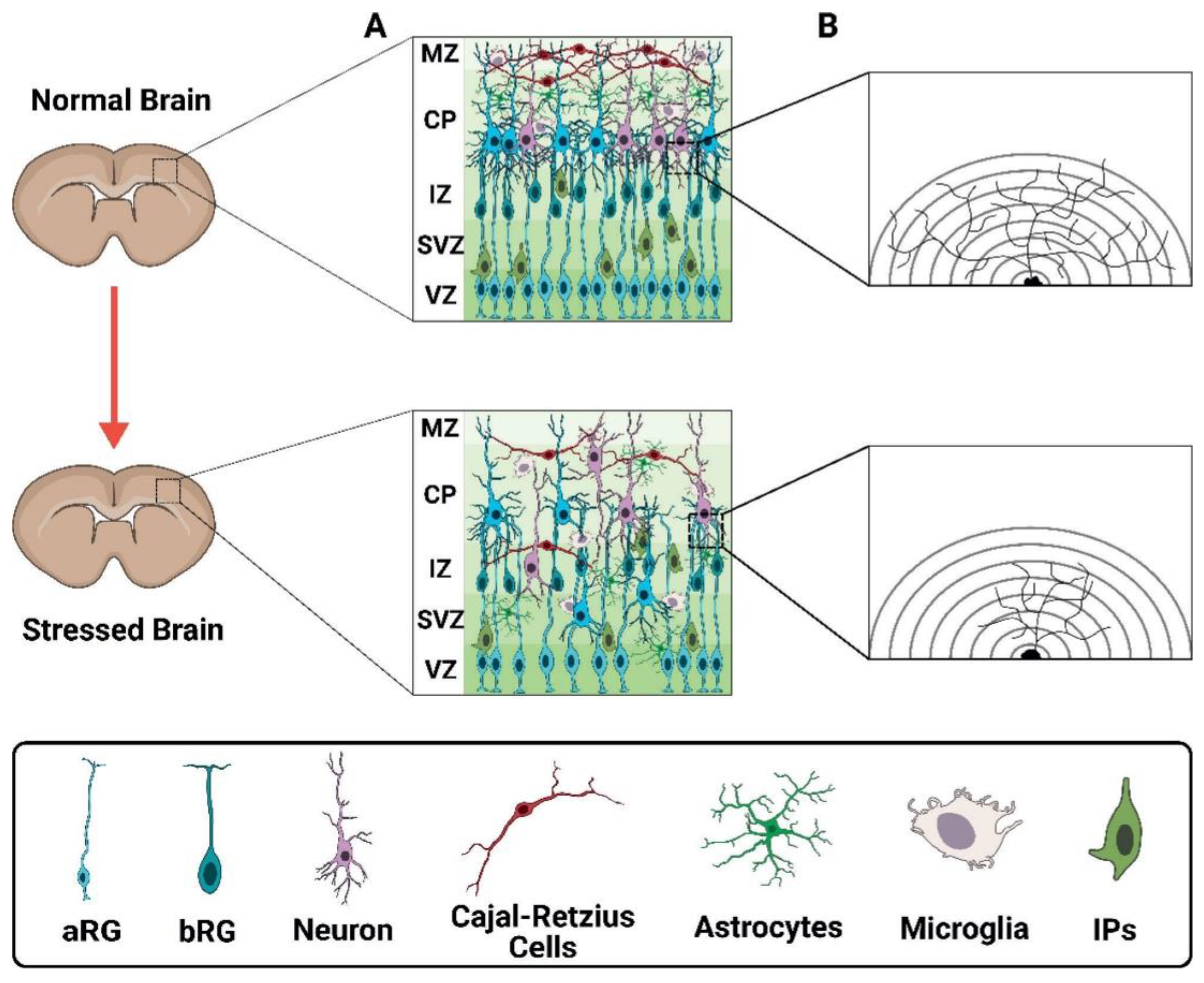
Figure 1. Scheme of cellular distribution in the embryonic neocortex during central nervous system (CNS) development and dendritic arborization of a neuron between a normal and a stressed brain (A) Scheme of the distribution of glia and neurons during brain development in mice; above, illustration of a normal brain and the proper distribution of the different cell types in the ventricular zone (VZ), subventricular zone (SVZ), intermediate zone (IZ), cortical plate (CP), and marginal zone (MZ); below, illustration of the same zones and distribution of the cells in a stressed brain, showing changes in the placement of all types of cells and changes in arborization of neurons [5]. (B) Scheme of dendritic arborization marked with Golgi-Cox staining. The neuron of a stressed brain (below) shows fewer neuronal intersections and shorter dendrite lengths compared to the neuron of a normal brain (above) [6]. Images obtained and adapted from NIH BIOART, Source [7,8,9], and/or created by the authors based on the published bibliography. All images were created, modified, and assembled on Inkscape (https://inkscape.org/).
Preprints 187907 g001
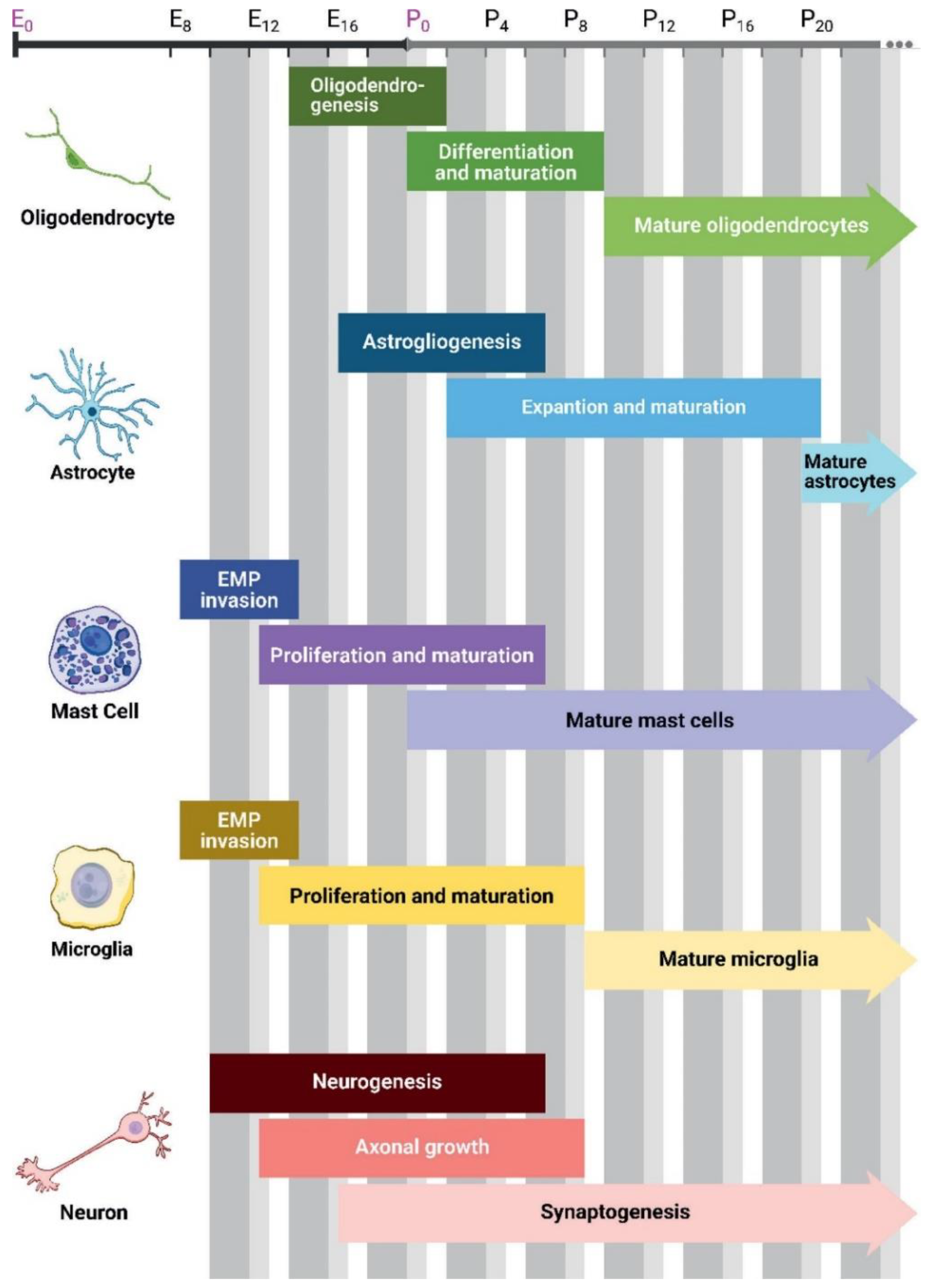
Figure 2. Timeline of the ontogeny of CNS cells. To start from the top, oligodendrocytes start to appear on embryonic day (E) 14; the genesis of the oligodendrocytes lasts until postnatal day (P) 2, and just before this day, P0 initiates the maturation and differentiation of the oligodendrocytes, resulting in mature oligodendrocytes, which emerge around P9 [10,11,12]. Astrocyte genesis starts around E16.5, ending on P7. On day P2, the new astrocytes start to expand and mature, ending around day P21, when the mature astrocytes appear in the CNS [10,12,13,14]. Mast cells and microglia originate from the bone marrow and enter the brain during development, starting with the invasion of the erythroid-myeloid progenitor (EMP) from the yolk sac through the circulatory system that is being generated at the same time. This invasion starts around day E8.5 and ends on day E14 to E15. On day E12.5, the maturation and proliferation of both cell types occur with little difference in the time of ending and the appearance of the mature cell types. In mast cells, the proliferation and maturation phases end around day P7, while microglia extend these processes to about day P9. Mature mast cells appear around day P0, while mature microglia take a little longer, emerging around day P9 [10,15,16]. Finally, neurons in the hippocampus start their ontogeny on day E10, ending on day P7, while axonal growth of new neurons starts almost in conjunction with their genesis, initiating on day E12.5 and ending on day P9. Synaptogenesis starts on day E16.5 and is a continuous process in the CNS [10,14,17]. Images were obtained and adapted from SciDraw [18,19,20,21,22] and/or created by the authors based on the published bibliography. All images were created, adapted, and assembled on Inkscape (https://inkscape.org/).
Preprints 187907 g002
Figure 3. Scheme of inflammasome activation and generation of an inflammatory environment in a cell. From left to right, a stress stimulus induces high levels of glucocorticoids (GCs), which bind to the mineralocorticoid or glucocorticoid receptors (MRs/GRs) in the cell membrane or cell lumen, activating the inflammatory pathway in a neighboring cell through the Iκβ/NF-κβ complex. This complex then induces the transcriptions and elevated levels of NLRP3. GCs also induce the release of ATP from mast cells, which binds to the P2X7 receptor, enabling the influx of Ca2+. Elevated Ca2+ levels in the intracellular milieu enhance the activity of pannexin1 hemichannels (Pannexons), allowing for ATP to be released into the extracellular milieu, where the activity of connexin hemichannels (Connexons) enables the influx of Ca2+ and efflux of ATP. Similar ATP and Ca2+ transmembrane transfer occurs through truncated pannexons. Elevated levels of intracellular free Ca2+ also induce the assembly of NLRP3, ASC, and pro-caspase1, forming the NLRP3 inflammasome. This promotes cleavage of the proinflammatory cytokines pro-IL1β and pro-IL18 to their active forms. The subsequent release of these cytokines induces a local proinflammatory environment. Images above were obtained and adapted from NIH BIOART Source [29,30,31], Servier medical art [32,33,34,35], and/or created by the authors based on the published bibliography. All images were created, modified, and assembled in Inkscape (https://inkscape.org/).
Preprints 187907 g003
Disclaimer/Publisher’s Note: The statements, opinions and data contained in all publications are solely those of the individual author(s) and contributor(s) and not of MDPI and/or the editor(s). MDPI and/or the editor(s) disclaim responsibility for any injury to people or property resulting from any ideas, methods, instructions or products referred to in the content.
Copyright: This open access article is published under a Creative Commons CC BY 4.0 license, which permit the free download, distribution, and reuse, provided that the author and preprint are cited in any reuse.
Prerpints.org logo

Preprints.org is a free preprint server supported by MDPI in Basel, Switzerland.

Subscribe

Disclaimer

Terms of Use

Privacy Policy

Privacy Settings

© 2026 MDPI (Basel, Switzerland) unless otherwise stated