

Submitted:
03 December 2025
Posted:
04 December 2025
You are already at the latest version
Abstract
Verticillium wilt (VW) of cotton caused by the soilborne pathogen Verticillium dahliae is a major disease across cotton production worldwide. The disease can result in yield reductions up to 80% in some occasions. V. dahliae is an asexual fungus and belongs to a relatively small Verticillium genus in the Ascomycota, though both of the mating type idiomorphs are present within some populations. Diversity of V. dahliae is widely associated with vegetative compatibility groups (VCGs), of which six different VCGs are recognised. Of these, isolates belonging to VCGs 1, 2 and 4 are globally distributed and associated with a broad host range including cotton. Approximately 400 plant species have been recorded as hosts of V. dahliae. Pathogenicity and virulence of V. dahliae in many cases are correlated with VCG designations and hosts of origin. Disease risk management of VW of cotton still relies on accurate, rapid detection and quantification of V. dahliae using both conventional and molecular approaches. The use of resistant cultivars is the most effective and economical control strategy; however, no cultivars confer complete resistance to the disease. Control strategies including cultural, biological, chemical and induced resistance approaches have indicated certain degrees of success in minimising disease damage and diminishing the build-up of pathogen inoculum. In this review, we discuss insights into the VW disease of cotton, the associated pathogen and current control approaches, as well as future research perspectives.
Keywords:
Gossypium hirsutum
; wilt diseases
; vascular discoloration
; genomics
; integrated management
; cotton breeding
1. Introduction
Cotton is an economically important fibre crop belonging to the Gossypium genus. There are about 50 species within the Gossypium which can be found in a wide range of ecological niches from arid to semi-arid areas of the tropical and subtropical zones [1]. Due to superior fibre quality and quantity traits, Upland cotton (G. hirsutum) and Pima cotton (G. barbadense) are of the dominant cultivated species worldwide [1]. Cotton contributes approximately 40% of the world’s natural fibre [2], with Upland cotton providing 95% of lint production [1,3].
Cotton is prone to infection with an array of pathogens and parasites, including fungi, bacteria, viruses, phytoplasmas, and nematodes causing more than 40 known diseases [4]. Of these, a vascular disease known as Verticillium wilt (VW) caused by Verticillium dahliae is the most devastating disease in most production countries, including Australia [5], China [6], Turkey [7] and the United States [8]. Occasionally, V. albo-atrum was also isolated from diseased cotton plants [9]. V. dahliae is a soilborne pathogen in a small genus of ascomycete [10]; however, seedborne transmission of the pathogen is also a potential source of pathogen dissemination [11]. During 2016 – 2019, the highest average incidence of VW in New South Wales (NSW) and Queensland (Qld) Australia was 30% and 4%, respectively [12]. In China, the losses of lint cotton yield may be as high as 80% [13]. In Turkey, VW significantly reduced cotton yield by 15.93% [14]. Cotton yield loss due to the VW disease was estimated up to 480 million bales over the period of 1990 - 2014 in the USA [15]. The disease incidence and severity were highly correlated to cultivar genotypes [16,17,18], seeding rates [19], irrigation regimes [20], fertilisation [20,21], soil types [8] and pathogen load [22,23].
Our review aims to provide an overview of significances of the VW disease to cotton production and its population diversity for a better understanding of the causal pathogen. We also summarise effective and reliable approaches for detection and identification of the pathogen. Finally, we discuss current and future perspectives of control strategies, especially focusing on breeding for resistance.
2. Verticillium Wilt Disease
2.1. Symptoms
Cotton infected with V. dahliae often results in characteristic symptoms that allow for identification of the disease in the field. However, VW symptoms may vary depending on developmental stages, genotypes, plant density, pathogen virulence and pathogen load, and environmental conditions [24]. Symptoms such as wilting and yellowing with necrosis of leaf margins often appear first on lower leaves and then progress upwards and to the whole plants (Figure 1A). Early infected plants remain stunted or killed (Figure 1B). In the field, those symptoms could be misdiagnosed with Fusarium wilt caused by Fusarium oxysporum f. sp. vasinfectum (Fov) [25]. However, V. dahliae infection in cotton often incites grey peppery discoloration in vasculature tissue (Figure 1D) that is different to the vascular symptom induced by Fusarium wilt which is often visualised with a profound brown colour (Figure 1F). Vascular discoloration is of the most diagnostic character to differentiate these two wilt diseases with a recently characterised wilt disease associated with novel Eutypella spp. Eutypella spp. infection resulted in reddish grey discoloration occurring in wedges on lower stems (Figure 1E) [26]. In a less occasion, black root rot pathogen, Berkeleyomyces rouxiae can also induce black vascular discoloration restricted at the crown region (Figure 1G) that can be misdiagnosed with other wilt diseases, including VW [27]. Other symptoms, including partly to complete defoliation (Figure 1C) and terminal branch die back are also often observed in cotton plants infected with either V. dahliae or Fov [28]. Due to overlapping of the wilt disease symptoms in the field, pathogen isolation from infected tissue is of the most reliable diagnostic method [29].
2.2. Economic Impacts
VW is a destructive disease and causes significant losses in cotton worldwide [15,30,31] since 95% of commercial cotton is derived from Upland cotton, which is more susceptible to V. dahliae infection than its relative Pima cotton [1]. In Australia, yield losses were not significant in a hot dry 1984/85 season, but losses up to 62% were estimated on some occasions in 2015/16 season [32]. According to CSD [33] VW caused estimated losses in NSW from A$1.9 to A$3.8 M per season from 2006 to 2010. In the latest survey of Australian cotton consultants, Barker and Coggan [34] revealed that 14% growers were severely affected by VW. In China, Wei et al. [22] reported up to 50% of production areas was affected by VW resulting in an estimated economic loss of US $250–310 M annually. In some regions, the loss of lint cotton yield may be as high as 80% [13]. In Alabama and Tennessee, USA, yield losses were also substantial exceeding 29,100 bales across three seasons from 2014 - 2016 [15]. These production losses resulted in an estimated US $11.2 M loss of income due to VW. In Turkey, VW also reduced cotton yield by 15.93%, and reduced fibre length and strength [14].
2.3. Ecological Impacts
V. dahliae is a soilborne pathogen that produces multicellular, melanised resting structures known as microsclerotia inside senescing host plants [35]. Microsclerotia can resist against radiation, mycostasis and remain dormant in soil or plant debris for up to 14 years without the presence of a host plant [35,36,37]. Additionally, V. dahliae has a wide host range, infecting more than 400 plant species, including many weed species that can provide a bridge between cropping seasons [10,38,39,40]. Therefore, it appears that once introduced, V. dahliae could persist indefinitely in soil due to its tough resting microsclerotia [35,36,37] and wide host range nature [10].
3. Verticillium Wilt Pathogens
3.1. Taxonomy and Identification
VW of cotton is primarily associated with V. dahliae [41]; occasionally, V. albo-atrum was also isolated from diseased cotton plants [9]. V. dahliae belongs to a relatively small genus Verticillium, which encompasses ten species [10]. The genus was first erected in 1816 [42] and approximately 190 species have been assigned into the genus since then [43]. However, a significant number of distant related species have been removed from the genus based on systematic examinations of molecular sequences [43]. Morphologically, V. dahliae is distinct from V. albo-atrum and other species by producing its characteristic short conidia and round MS as the only resting structure (Figure 2) [10]. Currently, V. dahliae is clustered in the flavnonexudans group, which does not produce yellow hyphal pigments, while V. albo-atrum is a member of flavexudans group [10]. Following phylogenetic analyses, V. dahliae and V. albo-atrum had clustered in two well-defined groups and both species are now universally recognised as two separate taxa [10,44].
3.2. Population Biology
V. dahliae belongs to the Ascomycota. However, no evidence of sexual combination has been recorded in this species [45,46,47]. Consequently, population structure of V. dahliae appeared highly clonal [48,49,50]. Prior to widespread adoption of molecular markers, population biology of V. dahliae were commonly studied on the basis of VCGs [51,52]. Here we discuss V. dahliae populations recovered from cotton based on VCGs and mating types.
3.2.1. VC Groups
Isolates of V. dahliae recovered from various hosts and geographic locations have been assigned to six different VCGs, including VCG 1 to VCG 6 [53]. VCGs 1, 2 and 4 were subdivided into subgroups A and B based on vigour of their compatibility reactions [54]. These VCGs are globally distributed and associated with a wide host range [29,48,49,55]. Whereas isolates assigned to VCGs 3, 5 and 6 are less commonly encountered [53,54]. VW of cotton worldwide was attributed to isolates of V. dahliae belonging to VCGs 1, 2 and 4 [6,56,57]. In Australia, VCG 1A, VCG 2A and VCG 4B were recorded [56]. Similar VCG profiles were also reported on cotton grown in China, Greece, Spain and USA [6,57,58] Collado-Romero et al. [51] were first to identify VCG 1B isolates from cotton grown in Greece; however, virulence of these isolates on cotton was not assessed. Uncommonly encountered VCG 3 isolates, which were originally obtained from potato in the USA [54], were subsequently reported for the first time on cotton in China [59]. Cotton grown in Israel is known to be infected by isolates within VCGs 2A, 2B and 4 which were assigned to the non-defoliating pathotype [57,60]. A defoliating pathotype VCG 1 was identified from Israeli cotton [61]. Similarly, VW of cotton in Turkey was induced by isolates belonging to VCGs 1A, 2A, 2B and 4B, of which VCG 1A and VCG 2B are more prevalent [62,63]. Discoveries of new VCGs in some cotton growing regions raised concerns whether the pathogen has been introduced recently or if the population diversity was underestimated. It is acknowledged that VCG analyses are laborious and time consuming. Therefore, VCG studies are often limited to a sample range, which limits any comprehensive conclusions drawn on pathogen population [52]. A number of molecular approaches such as amplified fragment length polymorphism (AFLP), microsatellite, multi-genes sequencing and genotyping-by-sequencing were attempted to infer relationship between VCGs and their genetic diversity [49,51,64,65]. However, intraspecific variations were consistently observed among isolates from both within and between VCGs [49,51,64]. Recently, genome-wide data of V. dahliae have become available which will subsequently allow for elucidating a complex relationship between VCGs in V. dahliae and genetic evolution [66,67,68,69]. Indeed genome-wide markers largely support the clonality of the finer VCG groupings but demonstrate that the VCG subgroupings are not indicative of relatedness [70]. That is, for example, VCG2A is not closely related to VCG2B; VCG2A is in fact more closely related to VCG4B. Moreover, molecular data strongly suggested recombination has occurred within and between lineages [70].
3.2.2. Mating Types
Currently, V. dahliae is known for its strictly asexual reproduction, so understanding how genetic diversity is generated within V. dahliae remains unclear [71] although recombination is evident [70]. In V. dahliae, genes of both mating type (MAT) idiomorphs have been identified [45,46,70]. Generally, the ratio of two opposite MAT genes is commonly found at 1:1 in sexually reproducing populations of fungi [46,70]. However, V. dahliae populations predominantly harbour the MAT1-2 idiomorph [45,46,47,65,70,72,73]. To a much lesser extent, the MAT1-1 idiomorph was also detected in V. dahliae isolates [46,72,74]. Although V. dahliae isolates carrying the MAT1-2 gene were overwhelmingly reported in most crops, V. dahliae populations carrying both MAT1-1 and MAT1-2 were also detected in the same ecological niches [45,46,72,74]. Therefore, sexual recombination within V. dahliae populations could occur in nature. Nonetheless, Usami et al. [46] failed to pair up isolates with MAT1-1 and MAT1-2 for sexual reproduction in vitro. Similarly, the clonal V. dahliae population was reported, despite recombination events observed through SNP genotyping analyses of 141 V. dahliae isolates from diverse hosts and geographic origins [70]. Consequently, Milgroom et al. [70] concluded that sexual recombination in V. dahliae may not occur frequently. Regardless of the presence of both MAT idiomorphs in V. dahliae, sexual reproduction has not been detected, so research to elucidate if V. dahliae has lost its sexuality or not remains to be addressed. Additionally, most V. dahliae collections have been recovered from diseased plants, it has been suggested that the high abundance of MAT1-2 isolates may be linked to their virulence, which also warrants further research [45,75].
3.2.3. Pathogenicity
V. dahliae has been reported to infect up to 400 host plant species [76]. On cotton, virulence of V. dahliae was commonly found associated with VCGs [7,61,77,78]. Isolates belonged to VCG 1A and VCG 2B were more virulent than isolates assigned to VCG 2A and VCG 4B. VCG 1A and 2B induced severe chlorotic to necrotic foliar symptoms and eventually defoliation and death, whilst VCG 2A and 4B isolates only caused mild to moderate external symptoms without defoliation [7,61,77,78]. Additionally, VCG 1A isolates were more virulent than VCG 2B isolates. VCG 1A isolates designated to a defoliating pathotype incited complete defoliation of inoculated cotton [7,79]. Whereas VCG 2B isolates induced partial-defoliation of inoculated cotton and thus designated as defoliating-like pathotype [60]. However, in Australia, non-defoliating pathotype (VCG 2A) caused a more widespread and destructive disease in cotton than defoliating pathotype (VCG 1A) [28]. Fields infested with V. dahliae VCG 2A can experience substantial yield loss of up to 50% (Figure 3). Additionally, pathogenicity tests determined that there was significant variability in virulence among isolates characterised as non-defoliating pathotype [80].
Virulence of V. dahliae is likely more related to its host of origin. For example, V. dahliae isolates originally from cotton were more virulent to cotton than to other crop hosts in many cases [77,81,82]. Similar observations were also reported on host crops, including cauliflower [81], peppermint [83] and lettuce [82]. However, many authors reported that the pathogenicity of V. dahliae was irrespective of its host of origin. Bao et al. [77] found V. dahliae isolates originally from cotton and eggplant were equally virulent to both hosts. Defoliating isolates of V. dahliae from cotton and artichoke also displayed comparable virulence to the two hosts [84]. Bhat and Subbarao [82] also found one cotton-V. dahliae isolate expressed host specificity to cotton among the 14 tested host crops. On the other hand, cotton-V. dahliae isolates that were non-pathogenic to cotton were also reported [58,77]. In many cases, isolates of V. dahliae were determined non-pathogenic based on external foliar symptoms and vascular discolouration of woody tissues [85,86]. However, symptomless infection of V. dahliae on some hosts may serve as inoculum reservoirs for subsequent crops [39,87,88].
In all, it is difficult to draw conclusive relationships between virulence of V. dahliae populations and their VCG/pathotype classifications, as well as to its host of origin. Insights into pathogenicity of specific V. dahliae populations will significantly contribute to developing better disease management programs.
4. Detection and Its Advances
4.1. Culture-Based Techniques
Field-based symptoms for detection of VW of cotton can lead to misidentification with Fusarium wilt due to overlapping symptomology. Therefore, isolation of the actual wilt pathogen(s) is always required. Though V. dahliae can be recovered from diseased plants using a common growth medium such as PDA, more than 20 semi selective to selective media have been developed and modified for accurate detection and enumeration of V. dahliae [89]. Only selected media are presented in Table 1. Ethanol agar was first developed by Nadakuvukaren and Hoener [90] for enumeration of V. dahliae in soil, but the medium yielded a low number of microscleotial recovery [89,91,92]. The medium was then modified and recently, Mansoori [92] reported that ethanol potassium amoxicillin agar (EPAA) could recover up to 98% of MS in soil. EPAA is an ethanol based medium with the amendment of potassium salts and replacement of streptomycin with amoxicillin. Soil extract agar was developed by Menzies and Griebel [93] and followed with many modifications. However, Mpofu and Hall [89] found soil extract was not essential for recovery of V. dahliae from soil. Of these, Sorensen’s NP-10 was a common selective medium used for soil enumeration and recovery of V. dahliae from infected materials [7,11,39]. Sorensen’s NP-10 provided very good recovery of propagules that were clearly distinguishable when viewed under the microscope [94]. It was noticed that in all media, altering the components slightly can have significant impacts on the recovery of V. dahliae. For example, Polygalacturonic acid (PGA) was an important component of Sorensen’s NP-10 media for quantifying V. dahliae in soil, but not all types of PGA equally favoured the growth and recovery of V.dahliae [94].
Soil plating, including wet and dry soil plating for quantification of V. dahliae population is laborious and time consuming compared to molecular approaches. However, it does not require expensive molecular equipment. The most effective semi-selective media and techniques should be determined by individual laboratories based on skill level of diagnostic technicians using a microscope and the equipment available in their facility. Important considerations when selecting a method include spatial variation with fields, variability within replicates, and variability within subsamples and colony overlap within Petri plates due to the amount of soil applied to plates.
4.2. Culture-Independent Techniques
Advances in technology have allowed for more rapid and accurate detection of V. dahliae [98,99,100,101,102]. A number of species-specific molecular markers were designed to accurately detect and differentiate V. dahliae from other species [101,103,104,105]. Due to the presence of non-defoliating and defoliating pathotypes, of which the latter has been believed to be more virulent and cause possibly higher yield losses [23,79], additional primers were designed to employ in multiplex PCRs for simultaneous differentiation of the two pathotypes [100,106]. A list of primers is updated Table 2.
In addition to rapid and accurate detection of V. dahliae both in vitro and in planta, some of those markers provide more qualitative information [98,102,112]. To some certain extent, detection and quantification of V. dahliae population will assist in developing risk matrices for disease prediction and management. Paplomatas et al. [114] reported that at the population density as little as 1 microsclerotium per gram of soil, V. dahliae can cause VW symptoms of around 10% of cotton plants in the field. At a density of approximately 19 microsclerotia/g soil, VW incidence of cotton can be as high as 50% [24]. However, with recent soil sampling directly from the cotton rhizosphere, it was estimated that only about 11 microsclerotia/g soil could result in 50% wilt incidence [115]. Wei et al. [22] also found that V. dahliae inoculum thresholds varied depending on susceptibility of cotton cultivar. Therefore, diverse cotton cultivars are grown in different ranges of ecological niches, and it is always desirable to adapt these referring findings for development of regional-specific inoculum thresholds. On cotton, use of certified and V. dahliae-free seeds could prevent V. dahliae introduction into new growing areas [7,11]; however, assessing for V. dahliae-free seeds still relies on laborious and time-consuming plating assays using selective media. Newly developed LAMP-CRISPR/Cas12 and RPA- CRISPR/Cas12 were reported for their ultrasensitive being able to detect a single conidium within 90 min [105,113]. Therefore, these can be deployed for certification of cotton seeds although further research is required.
In-field quantitative cotton VW detection and surveillance are labour-intensive in addition to field expertise requirements. In recent years, remote sensing technology has been developed and validated for rapid field-based monitoring and quantifying of cotton VW severity in large areas [99,116,117,118]. From analyses of aerial images retrieved from narrow-band multispectral, hyperspectral and thermal cameras, Li et al. [117] found significant correlations between VW incidence/severity of cotton crops, chlorophyll content and leaf reflectance. The chlorophyll content and leaf reflectance index decreased as wilt symptoms progressed [99,117,118]. Advances in remote sensing technologies increased confidence and accuracy of cotton VW detection in the field to over 90% [99]. Therefore, the technique could be a practical replacement for early and accurate detection of VW in cotton field. However, the accuracy of the technique is challenged in cotton fields where Fusarium wilt and VW co-occurred [25,31].
5. Control Strategies
5.1. Chemical
Chemicals registered for control of soilborne diseases are very limited, except for a few that can suppress the soilborne pathogen populations. Controlling of VW traditionally relied on soil fumigation to reduce viable inoculum, and subsequently reduced disease incidence and severity. Chemical fumigation is adopted widely to disinfest V. dahliae-infested soils growing high value crops in horticultural and floricultural industries [119,120,121]. However, soil fumigation is not practical for broad acre crops including cotton due to high operation costs associated with the application [120,122]. Other alternative approaches, including soil solarisation, biological control, and organic amendment have also been assessed for their soil disinfestation efficacies against V. dahliae, which will be discussed in later sections. Chemical application to control VW of cotton was evaluated by Kurt et al. [123]. Three applications at 21-day intervals of prochloraz (Sportak 45% EC, 450 g/l) and prochloraz-manganese complex (Sporgon 50 WP, 46% w/w) at high dosages of 506 g/ha and 1250 g/ha, respectively decreased the VW disease severity of cotton grown on naturally infested soil [123]. The findings provide an additional potential approach for integrated disease management.
5.2. Cultural
Cultural practices such as crop rotation, organic amendments, irrigation and nutrient management, and quarantine are commonly deployed in cotton fields to control VW. These practices were designed to: 1) reduce V. dahliae density and improve soil health by altering host crops and soil microbe community and improving organic matter inputs [124]; and 2) contain and minimise further spread of V. dahliae to unaffected fields [125]. It is theorised that in an absence or less frequency of cultivated hosts, soil population of V. dahliae will decrease. However, V. dahliae produces microsclerotia that can survive for many years without the presence of hosts [35,36]. Therefore, the reduction of V. dahliae population will be dependent on many factors, including occurrence frequency of host and non-host crops. Additionally, cotton has a low microsclerotia threshold that can result in VW symptoms and yield loss [22]. Wheeler et al. [126] reported that VW of cotton was managed by short crop rotations for only four years after the first VW symptoms occurred. Similarly, one-year rotation with paddy rice or perennial ryegrass [127], or with maize and broccoli [124] reduced the VW incidence significantly. However, after 11 years of VW, the wilt incidence and yield in every two-year crop rotation plot were comparable to the continuous cotton plot [126]. V. dahliae has a wide host range, including many weed species and on non-hosts [10,38,39,40,128]. Therefore, effectiveness of crop rotation in managing VW of cotton remains highly challenging and dependent on non-host selection and successful weed management [40,129,130]. According to Huisman and Ashworth [131], rotations stretched out the V. dahliae inoculum buildup but were unable to prevent infection. However, rotations did provide some agronomic benefits, including altering soil microbe communities and improving soil physicochemcal properties that can subsequently increase yields [124,131]. Zhao et al. [124] observed that NO3−-N contents were increased in cotton-maize (CM) and cotton-maize-broccoli (CMB) rotations in comparison to cotton-cotton (CC) cropping. Similarly, microbial abundance and composition under the CM and CMB rotations were significantly different to those of the CC cropping system [124,132].
In addition to crop rotation, organic amendments are commonly practised to improve the soil properties that can be suppressive to VW in cotton fields [133]. Huang et al. [133] reported that soil amendments with crab shell (2% w/w), soybean stalk and alfalfa (1% w/w) increased rhizosphere microbes, including significant antagonists against V. dahliae. Subsequently, VW severity reduced up to 72% relative to the control. Similarly, application (1% w/w) of bio-organic fertiliser containing amino acid, manure compost and Bacillus subtilis stimulated the development of unique beneficial fungal groups [134,135]. VW incidence was recorded at 4.4% in comparison to 90% in control [134]. However, the efficacy of organic amendments highly varied depending on soil properties [136]. According to Ochiai et al. [137] organic amendment-based systems for VW management were hardly realistic in broad-acre cropping since it is challenging to achieve and retain an appropriate level of disease suppression.
Along with organic matter inputs, irrigation and nitrogen inputs are also important to achieve targeted yield in cotton crops [8,20,138]. However, it was a trade-off between providing sufficient inputs to maximise yield and profit but at the same time not promoting excessive disease development [20]. Wheeler et al. [20] reported that the highest yield occurred in base irrigation rate where the irrigation was undertaken to meet 80% of the crop needs. Unfortunately, the VW rating was higher in comparison to the irrigation-reduced (half rate) treatment. Increasing irrigation rate to 1.5 times of the base rate resulted in the highest level of VW [20,138]. On the other hand, the impact of nitrogen inputs on VW and yield was unclear [20,139]. However, excessive irrigation and nitrogen inputs may result in more VW and damage in cotton [140].
After harvesting, cotton stubbles were slashed and returned into soil. Zhang et al. [141] demonstrated that stubble return was important in improving soil microbial community as well as C and N contents, which can help to improve soil health. However, in fields where VW occurred, stubble return means returning of the inoculum in the soil and increases risks of VW occurrence in the following years [141]. Zhang et al. [142] reported that number of microsclerotia increased from 0.16 to 8.37 times in rhizosphere soil that received the V. dahliae-infected stubbles. In Australia, cotton stubbles were recommended to be slashed and incorporated as soon as possible after harvesting to provide host free period and stimulate decomposition [143]. To some extent, cultural practices may reduce the VW level and yield impacts. Unfortunately, in cotton fields heavily infested with V. dahliae, the overall profitability was reduced [20].
V. dahliae is a soilborne pathogen and can be introduced from one field to another via movements of soil-infested footwear and farm machinery. In Australian cotton farming systems, a ‘Come Clean Go Clean’ policy was widely adopted to minimise the risk of further spread of soilborne pathogens [144]. Growers rely on disinfectants to wash down and decontaminate their farming equipment. Nguyen et al. [125] reported that efficacy of tested disinfectants was greatly dependent on treatment time and V. dahliae spore types, which were not recommended on the disinfectants’ labels. On-farm hygiene practices must be reinforced and reconsidered to improve effectiveness in decontaminating farming equipment, and subsequently, to minimise risks of further introduction of V. dahliae to new fields and properties.
5.3. Biological
Biocontrol of V. dahliae in cotton is well researched. A number of rhizosphere bacteria and endophytic fungi were recovered and assessed for their biocontrol efficacy against VW of cotton (Table 3). The efficacy of these potential biocontrol agents in protecting cotton from V. dahliae infection varied greatly from 32.5% to 93.6% in pot trials [145,146]. Meanwhile, under field conditions, the protection efficacy varied from 28.4% to 76.4% [147,148]. The control efficacy was dependent on application methods and number of applications. For example, pre-inoculation of Gibellulopsis nigrescens (previously known V. nigrescens) recovered from cotton plants with VW symptoms protected cotton seedlings in pot trials from subsequent inoculation of pathogenic V. dahliae. Disease incidence and severity were reduced by up to 95% and 97%, respectively. However, co-inoculation of the two fungi at the same time reduced the level of protection by G. nigrescens up to 60% [149]. Cotton seedlings (two to three emerging leaf stage) drenched with 109 CFU/ml of Enterobacter cancerogenus HA02 reduced the VW incidence by 80% in pot trial, while the field applications were required to repeat every 15 days to achieve 50% protection [150].
Biological control is believed to be a sustainable and environmentally friendly approach. However, there is yet a registered biocontrol agent against V. dahliae. Successful biocontrol agents at the field scale need to satisfy all of the following criteria: (a) reduce pathogen population in the soil bank; (b) reduce disease incidence on a subsequent crop; (c) improve yields of infected plants to levels comparable with healthy plants or crops grown in pathogen infested soils [160,161,162]. Additionally, some other challenges, including large-scale production, formulation and preservation conditions, and application methods should be considered during a long-term selection process [161].
5.4. Induced Resistance
Control of VW of cotton relies on effective integrated management and adoption of resistant cultivars. However, none of the cultivated cultivars provided complete resistance to V. dahliae [163,164]. In cotton, a number of biological agents and chemistries were reported to enhance natural resistance, known as induced resistance, against V. dahliae [165,166,167]. Hansan [167] found cotton grown from Trichoderma virens coated seeds had significantly lower wilt severity compared to untreated seeds. However, T. virens did not provide direct antagonistic activities towards V. dahliae. Therefore, the protection provided from the T. virens treated seeds was proposed to relate to induced resistance [167,168]. Howell [168] discovered that cotton roots colonised by T. virens induced a higher level of terpenoid synthesis, which was correlated to Verticillium resistance in cotton. A by-product, mycelial mass of Penicillium chrysogenum from pharmaceutical industry, was also reported for its induced resistance capability against VW of cotton [166,169]. Cotton grown in potting mix amended with 2% of dried mycelia of P. chrysogenum had a significantly lower disease severity compared to that of the control. The percentage protection was up to 53%. Similar control efficacy was also observed on cotton drenched with 5% of the water extract of dry mycelia [169]. Neither the dried mycelia nor its water extracts were inhibitory to the growth of V. dahliae. Levels of peroxidase activities, which played roles in wilt resistance [170], were increased significantly in cotton treated with both the dried mycelia and its extract [169,171]. Chen et al. [172] later found that dried mycelia of P. chrysogenum was capable of inducing resistance in treated plants through activating the salicylic acid pathway, which was also cross-talking with the jasmonic acid pathway. Similarly, P. aurantiaca ST-TJ4 and Bacillus altitudinis KRS010 were also discovered to induce VW resistance in cotton [146,173].
Foliar application of benzo (1,2,3)-thiadiazole-7-carbothioc acid S-methyl ester (BTH) after the first wilt symptom appearance reduced the disease severity of field cotton by approximately 35% compared to unsprayed control [165]. BTH is a well-known plant activator and proven to enhance natural resistance on numerous crops [174]. The BTH control efficacy toward VW of cotton was probably due to induced resistance since there was not a direct inhibitory effect of BTH against V. dahliae [165,175]. However, the associated inducing pathways were still uncertain [175]. It is clearly indicated that VW resistance of cotton can be enhanced both under experimental and field conditions by inducing its natural resistance. Therefore, exploiting some other plant activators for their induced resistant potentials against VW of cotton could be valuable, pending discovery of highly or complete resistant cultivars.
5.5. Host Resistance
One of the most effective and economical control measures for VW is the use of resistant cultivars [29]. In the interaction between VW and cotton, as well as with other plant species, the term resistance is preferred instead of tolerance. Molecular and histopathological observations showing that infected plants activate mechanisms to delay and restrict pathogen colonisation in the vascular tissue have shaped current definitions of resistance [176,177,178,179] and have recently been expanded by new insights into signal transduction, immune response pathways, and transcriptional regulation [180].
5.5.1. Mechanisms of Resistance
When cotton plants are infected with V. dahliae, there are a wide range of physical and/or biochemical resistance mechanisms that can be either present constitutively or actively deployed. The interaction with the environment, timing and extent of the deployment will determine the level of resistance of a given cotton genotype. Non-host immune responses to this disease were not found in cotton [52], and therefore resistant plants are also infected but show limited colonisation in their roots or other tissues by the fungus [179,180].
Cotton plants activate physical resistance mechanisms upon infection by V. dahliae. This includes the formation of tyloses in resistant genotypes to block stem vessels, thereby limiting pathogen spread [181]. While some studies note similar defence strengthening (G. barbadense developing callose and cellulose in cell walls) occurring later in susceptible plants [177], other research highlights a rapid, coordinated response. Specifically, resistant genotypes show extensive and rapid accumulation of lignin, phenolics, callose, and reactive oxygen species [179,182]. This accumulation, often linked to increased expression of lignin synthesis genes, underscores that a swift physical response is critical for effective resistance [178].
Physiological and biochemical mechanisms are very important in the defence reaction of cotton plants against V. dahliae, normally in combination and synchronised with the physical mechanisms mentioned before [183]. Antimicrobial compound accumulation, including phytoalexins, phenolics, and tannins, contributes to fungal suppression and vascular discoloration [179]. Recent transcriptomic data show rapid activation of hormone signalling and reactive oxygen species (ROS) regulation upon infection [180]. These cascades are tightly integrated and appear to act synergistically across tissues and time points. Limited work has elucidated the specificity of defence mechanisms against V. dahliae; however, numerous studies have identified the associated resistance genes and pathways [184].
5.5.2. Sources and Inheritance of Resistance
Cultivated upland cotton is generally highly susceptible to VW, and no immunity to the disease exists in this or the other three cultivated species in the Gossypium genus. Among these, G. barbadense remains the most resistant, followed by G. arboreum and G. herbaceum [163,164,185]. Many other wild Gossypium diploid species, such as G. raimondii and G. stuartinum, show high levels of resistance to VW [186,187] although their use remains limited due to reproductive barriers and genetic distance from cultivated lines. The incorporation of resistance traits is a long and sometimes complicated process and can be approached with non-traditional techniques such as the development of synthetic amphiploids [182].
Resistance sources differ in the mechanisms they activate, which may reflect different combinations of physiological and biochemical mechanisms [188,189]. In G. barbadense, resistance is controlled by a few major genes [163,190], while in G. hirsutum, resistance seems to be polygenic with low to moderate heritability, at least controlled by two major genes and some additional ones [191,192,193]. The inconsistency among the different authors classifying resistance and its inheritance was later confirmed with molecular studies (see below) and suggested that VW resistance in cotton is generally a polygenic trait, and therefore highly dependent on factors such as virulence of the V. dahliae pathotypes [193], temperature, growth and development of the plants. These factors, together with the specific plant population used, modify the resistance reaction obtained and therefore the inheritance pattern observed [192,194].
5.5.3. Genetics of Resistance and Mapping of Quantitative Trait Loci
In other crops such as tomato, major genes providing resistance to VW have been identified [195]. This resistance gene also was demonstrated to be effective against the same V. dahliae race 1 in G. hirsutum plants that had the gene via transformation [196]. Using a homologous gene approach, several Ve-like resistance genes have been identified in cotton. GbVe and Gbve1, isolated from G. barbadense, are the closest analogues of a true resistance gene found in cotton, and have been functionally validated in Arabidopsis to confer resistance to both defoliating and non-defoliating isolates [163,197]. A third gene, Gbvdr3, also enhances resistance but specifically to defoliating pathotypes [182]. Another gene, GbaNA1, appears to confer resistance to non-race 1 isolates, suggesting the involvement of recognition pathways independent of Ave1 [198].
Additional genes and gene families contributing to resistance have been identified through transcriptomics, expression analysis, and functional validation. These include candidates involved in hormone signalling, lignin biosynthesis, ROS detoxification, and receptor-like kinases [199,200,201,202,203,204,205]. However, in G. hirsutum, resistance appears to be more polygenic and less reliant on single major genes. While early studies identified some resistance-related genes in specific cultivars such as Sicala V-1 [206], more recent genome-wide studies have greatly expanded this list [184].
Similarly, more than 200 QTLs partially explaining VW resistance have been detected, using different types of markers, in nearly every single cotton chromosome in a range of G. barbadense and G. hirsutum genotypes. However, some ‘hotspots’ with higher occurrence of QTLs were identified in a more reduced number of chromosomes [207,208]. This finding also supports the polygenic and complex nature of VW resistance in cotton, which currently limits the application of the identified QTLs in breeding programs [209]. Nonetheless, there have been some attempts at introgressing VW resistance using marker assisted selection. For example, Li et al. [210] screened a number of SSR markers previously reported to be linked to VW resistance. They found five markers which significantly linked to a higher resistance and a combination of two of them which should be given preference when doing marker assisted selection. In another study, the resistance level of G. hirsutum was successfully increased in controlled conditions by using the gene editing technique to edit two copies of the transcription factor regulator gene Gh14-3-3d [211].
In a GWAS combined with QTL-sequence and transcriptome analysis, Zhao et al. [212] identified eight candidate genes related to basal defence mechanisms, flavonoid biosynthesis, and transcriptional regulation in G. hirsutum. These genes were associated with significant SNPs and validated using KASP markers. Similarly, using four recombinant inbred line (RIL) populations, Wang et al. [213] identified eight QTLs across four chromosomes, including a novel and stable QTL, qVW-A12-5, which contains the Gh_CPR30 gene, functionally validated via gene silencing. Recombinant inbred line (RIL) populations have been used to dissect these resistance loci. A recent study identified major resistance QTLs in RILs derived from a cross between resistant MCU-5 and susceptible Siokra 1–4, with transcriptome analysis revealing 99 differentially expressed genes in these regions [214]. These findings reinforce the polygenic nature of resistance and highlight the importance of integrating genomic tools in breeding programs.
5.5.4. Breeding for Resistance
High resistance to V. dahliae is rarely found in G. hirsutum, and most breeding efforts have therefore focused on introgression from resistant species such as G. barbadense, G. arboreum, and from elite resistant lines. In the early 1900s, the Mexican landrace ‘Acala’ was introduced in the USA to improve fibre quality and became the basis of resistant Acala cultivars. As new V. dahliae pathotypes emerged, resistance was enhanced through backcrossing, reselection, and introgression from G. barbadense [194]. In the 1970s, novel resistance sources were added via the San Joaquin family, derived from G. arboreum and G. thurberi. These and other resistant G. hirsutum sources, including landraces from Mexico, formed the basis for varieties later developed in Australia and the CIS region [52]. Additional resistance from wild diploid species was also incorporated [187]. However, some programs showed limited progress—for instance, varieties released by the Oklahoma Agricultural Research Station during the years 1918-1982 exhibited modest levels of resistance [215].
Over the last 40 years, the level of resistance has been maintained or slightly increased generally by new introgressions from G. barbadense [163], and extensive efforts are being made to increase the level of VW resistance [163,216]. For a long time, plant breeding programs located in areas where the pathogen was widespread have been indirectly breeding for VW resistance and other diseases when breeding for better yield performance [217]. Such is the case for Australia, where all cultivars developed since the release of Sicala V-1 and V-2 in 1991 and 1994 are among the most resistant cultivars worldwide [18]. Recent studies have advanced breeding by identifying candidate defence-related genes in resistant plants [214,218]. These discoveries offer promising targets for marker-assisted and genomic selection in G. hirsutum breeding.
5.5.5. Screening and Selection Methods
The expression of resistance to V. dahliae in cotton results from a complex interplay between genetic background, environmental conditions, and pathogen pressure. While genetic resistance forms the basis of any breeding effort, the reliability of phenotypic assessment is tightly linked to where and how resistance is evaluated—whether in infested field conditions, controlled environments, or through alternative indirect approaches.
Historically, screening for VW resistance in cotton began in the 1940s using heavily infested soils in the United States [52]. These field trials provided a realistic context to observe resistance under natural pathogen populations and climatic variation. However, soil inoculum distribution is often highly variable and symptom expression highly inconsistent [22,115]. For population-level comparisons involving large numbers of plants and replicates, these environments are valuable; yet they prove less effective when attempting to select individual plants. Reference cultivars with known resistance levels become essential to calibrate evaluations across seasons, field sites, and management systems. Typically, resistance assessments rely on visual scoring of vascular browning and foliar symptoms (Figure 4), timed during boll development to avoid confounding disease symptoms with late-season senescence [194,219]. High disease incidence generally leads to yield loss unless infection occurs late in the crop cycle [191], and while yield can serve as an indirect selection trait, comparisons must be limited to genotypes expressing similar symptom levels [18]. Additionally, many factors can modify the level of resistance observed under field conditions. Among them, symptoms and yield loss were reported to increase significantly with higher crop load, lower plant densities [19,220], presence of root-knot nematodes [219], and high irrigation and nitrogen rates applied [20].
To improve precision, resistance screening often shifts to controlled conditions, where inoculation is standardised. In greenhouses or growth chambers, young plants are typically inoculated via root dip or stem injection [163,221]. This approach shortens evaluation cycles and permits high-throughput phenotyping with relatively low resource demand. Still, translating resistance performance across conditions is not always straightforward. While field and greenhouse ratings often correlate [185,216,222], the inoculation method can influence outcomes [221]. In greenhouse studies, a single inoculation using a conidial suspension is typical [194], whereas in the field, infection is continuous and may involve microsclerotia in soil. To bridge this gap, some researchers have employed natural or artificially infested soils in pots, allowing a more field-like infection process [223]. These methods are slower and less scalable but yield insights into the relationship between inoculum density and disease severity.
Other discrepancies are tied to environmental variation. For example, field temperature fluctuations and sun exposure can activate resistance-related compounds like tannins [224]. Some resistance traits, such as the ability to develop extensive root systems that escape infection zones, go undetected in pot-based assays [225]. Likewise, greenhouse-selected lines can show unexpected susceptibility under field nutrient limitations, particularly potassium [226]. In both field and controlled conditions studies, temperature and inoculum (density and virulence), and the interaction between them are the most critical parameters to evaluate cotton genotypes for resistance to VW. Bell and Presley [227] demonstrated that resistance expression shifts markedly with just a 4 °C temperature change. A genotype classified as moderately resistant at 29 °C might appear susceptible at 25 °C.
In parallel with traditional phenotyping, where disease progression is usually monitored using severity scales, new technologies have begun to reshape early-stage screening. For instance, high-resolution hyperspectral imaging coupled with machine learning has shown strong promise in detecting asymptomatic infections in cotton with over 90% accuracy [117,228]. While not a replacement for classical methods, these tools offer non-destructive, scalable alternatives that can accelerate selection, particularly when symptom development is inconsistent.
5.6. Integrated Strategies
There are no completely resistant cultivars available; therefore, control of VW of cotton cannot rely on any single management strategy. Soil solarisation was trialed in fields infested with V. dahliae. This was an expensive approach for soil disinfestation and perhaps impractical for large-scale use in cotton; however, it can be applied for disease suppression in field hotspots [229]. The population of V. dahliae in plots covered with thin transparent plastic film (25 - 37 µm thick) and solarised for 6 - 10 weeks was very low or undetectable and subsequently, incidence of cotton wilt was reduced to 13% compared to 55 - 90% in un-solarised plots. Additionally, VW of cotton was delayed by 2 -7 weeks in treated plots, but this is not an economical and long-term practice since V. dahliae population bounced back sharply in plots followed by planting with susceptible cultivars. This practice was recommended for an integrated approach with crop rotations and use of resistant cultivars [16].
Synergetic effect in reducing V. dahliae viability was observed in a combined treatment of solarisation and metham sodium [230]. Metham sodium alone at 25 ml/m2 reduced the viability of V. dahliae by 70% compared to untreated control after a week of treatment. In comparison, the V. dahliae population was only reduced by 3% in solely solarised plots after a week of solarisation. With the same treatment duration, there was no detection of V. dahliae in plots treated with solarisation plus metham sodium at 25 mL/m2 [230].
Soil populations of V. dahliae were significantly decreased in plots amended with either broccoli or ryegrass biomass and covered with airtight plastic films, compared to untreated, organic amendment only and plastic cover only [231]. This potential approach can be an alternative practice for soil disinfestation where chemical, solarising and flooding not feasible [231]. Anaerobic soil disinfestation manipulated by applying rice bran (17-20 t/ha) and water saturation for 3-6 weeks effectively protected strawberry plants from V. dahliae up to 100% in field conditions. Net economic returns were equivalent to those from chloropirin fumigation. Strawberry farmers are adopting the practice [232].
The potential of Brassica crops to reduce V. dahliae density were evaluated. Nineteen cultivars were selected and screened for their control efficacy against V. dahliae when amended in soils. Mortality of V. dahliae in naturally infested soils varied from 9 - 90% depending on soil type and cultivars tested [233]. MS of V. dahliae in soil amended with 0.4% v/v of defatted seed meals (BioFenceTM) of either B. juncea or B. carinata was completely eliminated in in vitro assays conducted on artificially inoculated soil. However, the efficacy was reduced by 20 - 80% when these were amended into naturally infested soil (4 t/ha). The efficacy was greatly dependent on soil types and better control effect was recorded on sandy soil with low carbon contents [234]. Glucosinolate and isothiocyanate released from the brassica meals were believed to be toxic to V. dahliae [234]. Another individual assay with BioFenceTM derived from B. carinata recorded reduction of V. dahliae density in naturally infested soil by only 27% compared to an untreated control [235]. These provide alternative practices to suppress the V. dahliae population, but they were not sufficient enough to eliminate the VW risk for some of the sensitive crops [235].
6. Future Perspectives
It is no doubt that VW is a disease of significance in cotton worldwide. The disease can be managed, which relies on surveillance and accurate identification using field-based symptoms and further confirmation with molecular techniques such as PCR, RPA and LAMP [101,105]. Currently, a total of 109 genome assemblies is available across 11 Verticillium species, with more than half (i.e. 58 genomes) being V. dahliae. These genomes are of great resources for comparative genomics analyses to identify species-specific genes that could enhance specificity and sensitivity of molecular detection assays of V. dahliae [104,236]. Additionally, high-throughput sequencing (HTS) has become more accessible and cost-effective these days for rapid and accurate identification of plant pathogens, especially those that are emerging [237]. However, HTS datasets and genomic analyses are not universally accessible since they require complex bioinformatic tools and expertise knowledge for meaningful interpretations [237]. Therefore, species-specific markers remain highly important for V. dahliae detection and surveillance. Emerging applications of artificial intelligence in genomic analyses could assist in optimising identification and selection of target genes for marker development [238].
V. dahliae has a wide host range and is mostly associated with its VCG designations and host of origins. Non-pathogenic isolates of V. dahliae were also reported in cotton. However, it was difficult to interpret the relationship between virulence of V. dahliae population and its VCG/pathotype designations on many occasions. Therefore, it is always important to study the pathogenicity of each specific V. dahliae population, and this will facilitate the development of better cropping systems for disease management. The increasing available genomic resources of V. dahliae allowed for identification of biosynthesis gene clusters associated with virulent mechanisms [199,239]. For example, deletion of two mitogen-activated protein kinases showed altered responses to osmotic stress, fungicidal response, and cell wall stressors with virulence completely abolished for one of them (strain ΔVdSte11) due to its failure to penetrate cell wall and form hyphodopia in V. dahliae [240]. These results suggest that genes involved in microsclerotia formation are important for its pathogenicity. Additionally, lineage-specific regions of the V. dahliae genome, that are often enriched with effector genes, appeared to show conserved sequences in both coding and non-coding regions [241]. Genomic survey using short-read sequencing on isolates collected in major potato producing regions of Canada revealed abundant level of genetic variation and two major lineages of V. dahliae strains that infect potato [66]. Comparative genomic studies have shown that extensive genomic rearrangements have occurred during Verticillium evolution, leading to gene losses [199]. Furthermore, systematic search for horizontal gene transfer events in the genome of V. dahliae suggested possible horizontal gene acquisition from Fusarium [199].
Genomics so far have provided insights into effector repertoires and signaling pathways in Verticillium species. This knowledge can accelerate the development of fungicides by targeting specific effectors in Verticillium [242,243,244]. For example, lineage-specific regions in the genomes of different V. dahliae races showed structural variations and through comparative analysis, may explain specific secreted proteins that could determine virulence differences between strains [245]. A virulence factor, VdEPG1, from the Glycoside hydrolase family, was shown to suppress programmed cell death by modulating pathogenesis-related genes in tobacco and its deletion led to reduced pathogenicity of V. dahliae in cotton [246]. V. dahliae transcription factors Som1 and Vta3 have been shown to control microsclerotia formation and participate in root penetration in Arabidopsis [247]. Through transcriptome sequencing, it was shown that Vta3 alters gene expression of other virulence factors and leads to transcriptome reprogramming of certain gene network for late stages of disease progression [248].
Host-induced gene silencing (HIGS) has emerged as a potential strategy for the management of V. dahliae in various plant hosts [249]. Thiamine transporter proteins are important for the pathogenesis of the V. dahliae [249]. By using HIGS to introduce double-stranded RNA (dsRNA) targeting these genes, it was shown that the resulting transgenic cotton plants produced enhanced disease resistance to V. dahliae and yield compared to the WT lines in the field [249]. In a similar study, dsRNA knockout mutant was generated for a chitin deacetylase gene from V. dahliae, and its knockout severely reduced spore production and penetration [250]. This led to the development of an RNAi-based nanopesticide to control V. dahliae, offering a novel strategy to manage VW [250].
To sum up, genomic research will continue to advance our understanding of V. dahliae biology, diversity, evolution and pathogenicity, that consequently assist in disease management and breeding strategies. Until a cotton cultivar with complete resistance to V. dahliae becomes available, management of VW of cotton requires the use of multiple complementary tactics. The on-going research into resistant resources will continue to improve the VW resistant level in cotton [163,216]. Future research may focus on GE-cotton to accommodate VW resistant genes.
Author Contributions
Conceptualisation, D.P.L, C.T., C.P.T.N., T.T.T., D.G. and A.C.; writing—section 1., 2., 3., 4., 5.1., 5.3., and 5.6., D.P.L.; writing—section 5.5., C.T.; writing—section 5.4., T.T.T.; writing—section 5.2., C.P.T.N.; writing—section 6., D.G and A.C.; writing—review and editing, D.P.L, C.T., C.P.T.N., T.T.T., D.G. and A.C. All authors have read and agreed to the published version of the manuscript.
Funding
Part of this research is supported through funding from the Cotton Research and Development Corporation and New South Wales Department of Primary Industries and Regional Development (projects DAN2307).
Data Availability Statement
Data sharing is not applicable.
Acknowledgments
We thank Cotton Research and Development Corporation and New South Wales Department of Primary Industries and Regional Development for supporting our research.
Conflicts of Interest
The authors declare no conflicts of interest.
References
- Wendel, J.F.; Cronn, R.C. Polyploidy and the evolutionary history of cotton. Advances in Agronomy. 2002, 87, 139–186. [Google Scholar]
- Naranjo, S.E. Impacts of Bt transgenic cotton on integrated pest management. Journal of Agricultural and Food Chemistry 2011, 59, 5842–5851. [Google Scholar] [CrossRef]
- Rocha-Munive, M.G.; Soberón, M.; Castañeda, S.; Niaves, E.; Scheinvar, E.; Eguiarte, L.E.; Mota-Sánchez, D.; Rosales-Robles, E.; Nava-Camberos, U.; Martínez-Carrillo, J.L. Evaluation of the impact of genetically modified cotton after 20 years of cultivation in Mexico. Frontiers in Bioengineering and Biotechnology 2018, 6, 82. [Google Scholar] [CrossRef]
- Kirkpatrick, T.L.; Rockroth, C. Compendium of Cotton Diseases; American Phytopathological Society (APS Press). 2001.
- Kirkby, K.; Lonergan, P.; Allen, S. Three decades of cotton disease surveys in NSW, Australia. Crop and Pasture Science 2013, 64, 774–779. [Google Scholar] [CrossRef]
- Zhengjun, X.; Achar, P.; Benkang, G. Vegetative compatibility groupings of Verticillium dahliae from cotton in mainland China. European Journal of Plant Pathology 1998, 104, 871–876. [Google Scholar] [CrossRef]
- Göre, M.E.; Erdoğan, O.; Caner, Ö.K.; Aydın, M.H.; Berk, S. VCG diversity and virulence of Verticillium dahliae from commercially available cotton seed lots in Turkey. European Journal of Plant Pathology 2014, 140, 689–699. [Google Scholar] [CrossRef]
- Land, C.; Lawrence, K.; Burmester, C.; Meyer, B. Cultivar, irrigation, and soil contribution to the enhancement of Verticillium wilt disease in cotton. Crop Protection 2017, 96, 1–6. [Google Scholar] [CrossRef]
- Palmateer, A.; McLean, K.; Morgan-Jones, G.; Van Santen, E. Frequency and diversity of fungi colonizing tissues of upland cotton. Mycopathologia 2004, 157, 303–316. [Google Scholar] [CrossRef] [PubMed]
- Inderbitzin, P.; Bostock, R.M.; Davis, R.M.; Usami, T.; Platt, H.W.; Subbarao, K.V. Phylogenetics and taxonomy of the fungal vascular wilt pathogen Verticillium, with the descriptions of five new species. PloS one 2011, 6, e28341. [Google Scholar] [CrossRef]
- Göre, M.E.; Erdoğan, O.; Altin, N.; Aydın, M.; Caner, Ö.; Filizer, F.; Büyükdöğerlioğlu, A. Seed transmission of Verticillium wilt of cotton. Phytoparasitica 2011, 39, 285–292. [Google Scholar] [CrossRef]
- Smith, L.J.; Scheikowski, L.; Kafle, D.; Le, D.; Gregson, A.; Green, T.; Holman, S. Regional Disease Update In Proceedings of the CSD 2018-19 Variety Trial Results, Wee Waa, NSW Australia, 2019; pp. 100-103. [Google Scholar]
- Wang, Y.; Liang, C.; Wu, S.; Zhang, X.; Tang, J.; Jian, G.; Jiao, G.; Li, F.; Chu, C. Significant improvement of cotton Verticillium wilt resistance by manipulating the expression of Gastrodia antifungal proteins. Molecular plant 2016, 9, 1436–1439. [Google Scholar] [CrossRef] [PubMed]
- Erdogan, O.; Sezener, V.; Ozbek, N.; Bozbek, T.; Yavas, I.; Unay, A. The effects of verticillium wilt (Verticillium dahliae Kleb.) on cotton yield and fiber quality. Asian Journal of Plant Science 2006, 5, 867–870. [Google Scholar] [CrossRef]
- Lawrence, K.; Hagan, A.; Norton, R.; Hu, J.; Faske, T.; Hutmacher, R.; Muller, J.; Small, I.; Grabau, Z.; Kemerait, R. Cotton disease loss estimate committee report, 2015. In Proceedings of the Proceedings of the 2016 Beltwide Cotton Conference, 2016; pp. 113-115.
- Melero--Vara, J.; Blanco--López, M.; Bejarano--Alcázar, J.; Jiménez--Díaz, R. Control of Verticillium wilt of cotton by means of soil solarization and tolerant cultivars in southern Spain. Plant Pathology 1995, 44, 250–260. [Google Scholar] [CrossRef]
- Göre, M.E.; Caner, Ö.K.; Altın, N.; Aydın, M.H.; Erdoğan, O.; Filizer, F.; Büyükdöğerlioğlu, A. Evaluation of cotton cultivars for resistance to pathotypes of Verticillium dahliae. Crop Protection 2009, 28, 215–219. [Google Scholar] [CrossRef]
- Wheeler, T.A.; Woodward, J.E. Field assessment of commercial cotton cultivars for Verticillium wilt resistance and yield. Crop Protection 2016, 88, 1–6. [Google Scholar] [CrossRef]
- Wheeler, T.; Woodward, J.; Mullinix, B., Jr. Effect of seeding rate on Verticillium wilt incidence, yield, and value for three cotton cultivars. Journal of Cotton Science 2010, 14, 173–180. [Google Scholar]
- Wheeler, T.; Bordovsky, J.; Keeling, J.; Mullinix Jr, B. Effects of crop rotation, cultivar, and irrigation and nitrogen rate on Verticillium wilt in cotton. Plant Disease 2012, 96, 985–989. [Google Scholar] [CrossRef]
- DeVay, J.; Weir, B.; Wakeman, R.; Stapleton, J. Effects of Verticillium dahliae infection of cotton plants (Gossypium hirsutum) on potassium levels in leaf petioles. Plant Disease 1997, 81, 1089–1092. [Google Scholar] [CrossRef]
- Wei, F.; Fan, R.; Dong, H.; Shang, W.; Xu, X.; Zhu, H.; Yang, J.; Hu, X. Threshold microsclerotial inoculum for cotton Verticillium wilt determined through wet-sieving and real-time quantitative PCR. Phytopathology 2015, 105, 220–229. [Google Scholar] [CrossRef]
- Bejarano-Alcázar, J.; Melero-Vara, J.; Blanco-López, M.; Jimenez-Diaz, R. Influence of inoculum density of defoliating and nondefoliating pathotypes of Verticillium dahliae on epidemics of Verticillium wilt of cotton in southern Spain. Phytopathology 1995, 85, 1474–1481. [Google Scholar] [CrossRef]
- Pullman, G.; DeVay, J. Epidemiology of Verticillium wilt of cotton: a relationship between inoculum density and disease progression. Phytopathology 1982, 72, 549–554. [Google Scholar] [CrossRef]
- Le, D.P.; Nguyen, C.P.; Kafle, D.; Scheikowski, L.; Montgomery, J.; Lambeth, E.; Thomas, A.; O’Keeffe, K.; Shakeshaft, B.; Young, A. Surveillance, Diversity and Vegetative Compatibility Groups of Fusarium oxysporum f. sp. vasinfectum Collected in Cotton Fields in Australia (2017 to 2022). Pathogens 2022, 11, 1537. [Google Scholar] [CrossRef] [PubMed]
- Le, D.P.; Gregson, A.; Madden, A.; Jackson, R. Occurrence of Eutypella species on cotton (Gossypium hirsutum L.) in New South Wales, Australia. Journal of Plant Pathology 2023, 105, 517–525. [Google Scholar] [CrossRef]
- Le, D.P.; Nguyen, C.P.T.; Manjarrez, M.; Giblot-Ducray, D. A diagnostic guide for Berkeleyomyces rouxiae causing black root rot of cotton. Plant Health Progress 2024. [Google Scholar] [CrossRef]
- Le, D.P.; Gregson, A.; Tran, T.T.; Jackson, R. Co-occurrence of defoliating and non-defoliating pathotypes of Verticillium dahliae in field-grown cotton plants in New South Wales, Australia. Plants 2020, 9, 750. [Google Scholar] [CrossRef] [PubMed]
- Klosterman, S.J.; Atallah, Z.K.; Vallad, G.E.; Subbarao, K.V. Diversity, pathogenicity, and management of Verticillium species. Annual Review of Phytopathology 2009, 47, 39–62. [Google Scholar] [CrossRef]
- Allen, S.J.; McNamara, G. Cotton Pathology 2007/2008. In 2008.
- Li, X.; Zhang, Y.n.; Ding, C.; Xu, W.; Wang, X. Temporal patterns of cotton Fusarium and Verticillium wilt in Jiangsu coastal areas of China. Scientific reports 2017, 7, 12581. [Google Scholar] [CrossRef]
- Holman, S.; Kirkby, K.; Smith, L.; Hartnett, H. Vert update: The latest in Vert research. Factsheet. CottonInfo Australia, Narrabri, NSW Australia, 2016, 5 pp.
- CSD. Seeds for Thought. Verticillium wilt update, Vol 10, Wee Waa, NSW Australia, 2011, 3 pp.
- Barker, J.; Coggan, L. Qualitative report on the 2023-24 cotton season: a survey of consultants. Crop Consultants Australia, 2024; pp. 1-36.
- Hawke, M.A. Studies on the Survival of Microsclerotia of Verticillium dahliae. PhD thesis, The University of Western Ontario, 1994, pp. 1-162.
- Klimes, A.; Amyotte, S.G.; Grant, S.; Kang, S.; Dobinson, K.F. Microsclerotia development in Verticillium dahliae: regulation and differential expression of the hydrophobin gene VDH1. Fungal Genetics and Biology 2008, 45, 1525–1532. [Google Scholar] [CrossRef]
- Wilhelm, S. Longevity of the Verticillium wilt fungus in the laboratory and field. Phytopathology 1955, 45, 180–181. [Google Scholar]
- Frederick, Z.; Cummings, T.; Johnson, D. Susceptibility of weedy hosts from Pacific Northwest potato production systems to crop-aggressive isolates of Verticillium dahliae. Plant Disease 2017, 101, 1500–1506. [Google Scholar] [CrossRef]
- Vallad, G.E.; Bhat, R.G.; Koike, S.T.; Ryder, E.J.; Subbarao, K.V. Weedborne reservoirs and seed transmission of Verticillium dahliae in lettuce. Plant Disease 2005, 89, 317–324. [Google Scholar] [CrossRef]
- Yildiz, A.; Doğan, M.N.; Boz, Ö.; Benlioğlu, S. Weed hosts of Verticillium dahliae in cotton fields in Turkey and characterization of V. dahliae isolates from weeds. Phytoparasitica 2009, 37, 171–178. [Google Scholar] [CrossRef]
- El-Zik, K.M. Integrated control of Verticillium wilt of cotton. Plant Disease 1985, 69, 1025–1032. [Google Scholar] [CrossRef]
- Nees von Esenbeck, C.G. Das system der pilze und schwämme. Ein versuch; In der Stahelschen buchhandlung, 1816.
- Rasoul, Z.; Walter, G. The type species of Verticillium is not congeneric with the plant-pathogenic species placed in Verticillium and it is not the anamorph of ‘Nectria’inventa. Mycological Research 2004, 108, 576–582. [Google Scholar]
- Qin, Q.-M.; Vallad, G.E.; Wu, B.M.; Subbarao, K.V. Phylogenetic analyses of phytopathogenic isolates of Verticillium spp. Phytopathology 2006, 96, 582–592. [Google Scholar] [CrossRef]
- Short, D.P.; Gurung, S.; Hu, X.; Inderbitzin, P.; Subbarao, K.V. Maintenance of sex-related genes and the co-occurrence of both mating types in Verticillium dahliae. PLoS One 2014, 9, e112145. [Google Scholar] [CrossRef]
- Usami, T.; Itoh, M.; Amemiya, Y. Asexual fungus Verticillium dahliae is potentially heterothallic. Journal of General Plant Pathology 2009, 75, 422–427. [Google Scholar] [CrossRef]
- Usami, T.; Itoh, M.; Amemiya, Y. Mating type gene MAT1-2-1 is common among Japanese isolates of Verticillium dahliae. Physiological and Molecular Plant Pathology 2008, 73, 133–137. [Google Scholar] [CrossRef]
- Collado-Romero, M.; Mercado-Blanco, J.; Olivares-García, C.; Jiménez-Díaz, R.M. Phylogenetic analysis of Verticillium dahliae vegetative compatibility groups. Phytopathology 2008, 98, 1019–1028. [Google Scholar] [CrossRef]
- Jiménez-Gasco, M.d.M.; Malcolm, G.M.; Berbegal, M.; Armengol, J.; Jiménez-Díaz, R.M. Complex molecular relationship between vegetative compatibility groups (VCGs) in Verticillium dahliae: VCGs do not always align with clonal lineages. Phytopathology 2014, 104, 650–659. [Google Scholar] [CrossRef] [PubMed]
- Milgroom, M.G.; del Mar Jiménez-Gasco, M.; Olivares-García, C.; Jiménez-Díaz, R.M. Clonal expansion and migration of a highly virulent, defoliating lineage of Verticillium dahliae. Phytopathology 2016, 106, 1038–1046. [Google Scholar] [CrossRef]
- Collado-Romero, M.; Mercado-Blanco, J.; Olivares-García, C.; Valverde-Corredor, A.; Jiménez-Díaz, R.M. Molecular variability within and among Verticillium dahliae vegetative compatibility groups determined by fluorescent amplified fragment length polymorphism and polymerase chain reaction markers. Phytopathology 2006, 96, 485–495. [Google Scholar] [CrossRef]
- Pegg, G.F.; Brady, B.L. Verticillium wilts; CABI Publishing: Wallingford, 2002. [Google Scholar]
- Bhat, R.; Smith, R.; Koike, S.; Wu, B.; Subbarao, K. Characterization of Verticillium dahliae isolates and wilt epidemics of pepper. Plant Disease 2003, 87, 789–797. [Google Scholar] [CrossRef]
- Joaquim, T.R.; Rowe, R. Vegetative compatibility and virulence of strains of Verticillium dahliae from soil and potato plants. Phytopathology 1991, 81, 552–558. [Google Scholar] [CrossRef]
- Martin, F.N. Mitochondrial haplotype analysis as a tool for differentiating isolates of Verticillium dahliae. Phytopathology 2010, 100, 1231–1239. [Google Scholar] [CrossRef]
- Chapman, T.A.; Chambers, G.A.; Kirkby, K.; Jiménez-Díaz, R.M. First report of the presence of Verticillium dahliae VCG1A in Australia. Australasian Plant Disease Notes 2016, 11, 13. [Google Scholar] [CrossRef]
- Korolev, N.; Pérez-Artés, E.; Bejarano-Alcázar, J.; Rodríguez-Jurado, D.; Katan, J.; Katan, T.; Jiménez-Díaz, R.M. Comparative study of genetic diversity and pathogenicity among populations of Verticillium dahliae from cotton in Spain and Israel. European Journal of Plant Pathology 2001, 107, 443–456. [Google Scholar] [CrossRef]
- Elena, K. Genetic relationships among Verticillium dahliae isolates from cotton in Greece based on vegetative compatibility. European Journal of Plant Pathology 1999, 105, 609–616. [Google Scholar] [CrossRef]
- ElSharawy, A.A.; Yang, G.; Hu, X.; Yang, J. Genetic relationships between virulence, vegetative compatibility and ISSR marker of Verticillium dahliae isolated from cotton. Archives of Phytopathology and Plant Protection 2015, 48, 646–663. [Google Scholar] [CrossRef]
- Korolev, N.; Katan, J.; Katan, T. Vegetative compatibility groups of Verticillium dahliae in Israel: their distribution and association with pathogenicity. Phytopathology 2000, 90, 529–536. [Google Scholar] [CrossRef]
- Korolev, N.; Pérez-Artés, E.; Mercado-Blanco, J.; Bejarano-Alcázar, J.; Rodríguez-Jurado, D.; Jiménez-Díaz, R.M.; Katan, T.; Katan, J. Vegetative compatibility of cotton-defoliating Verticillium dahliae in Israel and its pathogenicity to various crop plants. European Journal of Plant Pathology 2008, 122, 603–617. [Google Scholar] [CrossRef]
- Dervis, S.; Kurt, S.; Soylu, S.; Erten, L.; Mine Soylu, E.; Yıldız, M.; Tok, F.M. Vegetative compatibility groups of Verticillium dahliae from cotton in the southeastern Anatolia region of Turkey. Phytoparasitica 2008, 36, 74–83. [Google Scholar] [CrossRef]
- Göre, M.E. Vegetative compatibility and pathogenicity of Verticillium dahliae isolates from the Aegean Region of Turkey. Phytoparasitica 2007, 35, 222–231. [Google Scholar] [CrossRef]
- Rafiei, V.; Banihashemi, Z.; Jiménez--Díaz, R.; Navas--Cortés, J.; Landa, B.; Jiménez--Gasco, M.; Turgeon, B.; Milgroom, M. Comparison of genotyping by sequencing and microsatellite markers for unravelling population structure in the clonal fungus Verticillium dahliae. Plant Pathology 2018, 67, 76–86. [Google Scholar] [CrossRef]
- Rafiei, V.; Banihashemi, Z.; Bautista-Jalon, L.S.; del Mar Jiménez-Gasco, M.; Turgeon, B.G.; Milgroom, M.G. Population genetics of Verticillium dahliae in Iran based on microsatellite and single nucleotide polymorphism markers. Phytopathology 2018, 108, 780–788. [Google Scholar] [CrossRef] [PubMed]
- Arseneault, T.; Lafond-Lapalme, J.; Gonzalez, C.E.Q.; Jordan, K.S.; Yevtushenko, D.; Barrett, R.; Van der Heyden, H.; Chen, D.; Tenuta, M.; Mimee, B. A genome resource for 192 Verticillium dahliae isolates infecting potatoes across Canada. PhytoFrontiers™ 2023, 3, 753–757. [Google Scholar] [CrossRef]
- Gardiner, D.M.; Smith, L.J.; Rusu, A.; Aitken, E.A. The genomes of two Australian isolates of Verticillium dahliae recovered from cotton fields. Australasian Plant Pathology 2024, 53, 435–441. [Google Scholar] [CrossRef]
- Ninkuu, V.; Liu, Z.; Liu, H.; Li, C.; Zhou, Y.; Zhao, Q.; Qin, A.; Li, M.; Gao, P.; Yan, L. Genome sequencing of a novel Verticillium dahliae strain (huangweibingjun). Scientific Reports 2025, 15, 15143. [Google Scholar] [CrossRef]
- Webster, J.; Dadd--Daigle, P.; Chapman, T.A.; Kirkby, K. Investigating the defoliating--like (DL) VCG2A pathotype of Verticillium dahliae through identification and prediction of secreted proteins from genomes of Australian isolates. Plant Pathology 2023, 72, 334–341. [Google Scholar] [CrossRef]
- Milgroom, M.G.; Jimenez-Gasco, M.d.M.; Olivares García, C.; Drott, M.T.; Jimenez-Diaz, R.M. Recombination between clonal lineages of the asexual fungus Verticillium dahliae detected by genotyping by sequencing. PloS one 2014, 9, e106740. [Google Scholar] [CrossRef] [PubMed]
- Huang, X. Horizontal transfer generates genetic variation in an asexual pathogen. PeerJ 2014, 2, e650. [Google Scholar] [CrossRef] [PubMed]
- Gurung, S.; Short, D.; Atallah, Z.; Subbarao, K. Clonal expansion of Verticillium dahliae in lettuce. Phytopathology 2014, 104, 641–649. [Google Scholar] [CrossRef]
- Dung, J.K.; Peever, T.L.; Johnson, D.A. A. Verticillium dahliae populations from mint and potato are genetically divergent with predominant haplotypes. Phytopathology 2013, 103, 445–459. [Google Scholar] [CrossRef]
- Usami, T.; Itoh, M.; Morii, S.; Miyamoto, T.; Kaneda, M.; Ogawara, T.; Amemiya, Y. Involvement of two different types of Verticillium dahliae in lettuce wilt in Ibaraki Prefecture, Japan. Journal of General Plant Pathology 2012, 78, 348–352. [Google Scholar] [CrossRef]
- Zhang, Y.-D.; Ji, X.-B.; Zong, J.; Dai, X.-F.; Klosterman, S.J.; Subbarao, K.V.; Zhang, D.-D.; Chen, J.-Y. Functional analysis of the mating type genes in Verticillium dahliae. BMC biology 2024, 22, 108. [Google Scholar] [CrossRef] [PubMed]
- Inderbitzin, P.; Subbarao, K.V. Verticillium systematics and evolution: how confusion impedes Verticillium wilt management and how to resolve it. Phytopathology 2014, 104, 564–574. [Google Scholar] [CrossRef]
- Bao, J.; Katan, J.; Shabi, E.; Katan, T. Vegetative-compatibility groups in Verticillium dahliae from Israel. European Journal of Plant Pathology 1998, 104, 263–269. [Google Scholar] [CrossRef]
- Dervis, S.; Erten, L.; Soylu, S.; Tok, F.M.; Kurt, S.; Yıldız, M.; Soylu, E.M. Vegetative compatibility groups in Verticillium dahliae isolates from olive in western Turkey. European Journal of Plant Pathology 2007, 119, 437–447. [Google Scholar] [CrossRef]
- Bejarano-Alcázar, J.; Blanco-López, M.; Melero-Vara, J.; Jiménez-Díaz, R.M. Etiology, importance, and distribution of Verticillium wilt of cotton in southern Spain. Plant Disease 1996, 80, 1233–1238. [Google Scholar] [CrossRef]
- Dadd-Daigle, P.; Labbate, M.; Chowdhury, P.R.; Kirkby, K.; Chapman, T. Australian Verticillium dahliae goes against the group–VCG 2A causes severe disease in Australian cotton. Phytopathology 2018, 108, S1.218. [Google Scholar]
- Subbarao, K.; Chassot, A.; Gordon, T.; Hubbard, J.; Bonello, P.; Mullin, R.; Okamoto, D.; Davis, R.; Koike, S. Genetic relationships and cross pathogenicities of Verticillium dahliae isolates from cauliflower and other crops. Phytopathology 1995, 85, 1105–1112. [Google Scholar] [CrossRef]
- Bhat, R.; Subbarao, K. Host range specificity in Verticillium dahliae. Phytopathology 1999, 89, 1218–1225. [Google Scholar] [CrossRef] [PubMed]
- Douhan, L.I.; Johnson, D. Vegetative compatibility and pathogenicity of Verticillium dahliae from spearmint and peppermint. Plant Disease 2001, 85, 297–302. [Google Scholar] [CrossRef]
- Strausbaugh, C.A.; Eujayl, I.A.; Martin, F.N. Pathogenicity, vegetative compatibility and genetic diversity of Verticillium dahliae isolates from sugar beet. Canadian Journal of Plant Pathology 2016, 38, 492–505. [Google Scholar] [CrossRef]
- Bhat, R.; Subbarao, K. Reaction of broccoli to isolates of Verticillium dahliae from various hosts. Plant Disease 2001, 85, 141–146. [Google Scholar] [CrossRef]
- Ikeda, K.; Banno, S.; Furusawa, A.; Shibata, S.; Nakaho, K.; Fujimura, M. Crop rotation with broccoli suppresses Verticillium wilt of eggplant. Journal of General Plant Pathology 2015, 81, 77–82. [Google Scholar] [CrossRef]
- Evans, G. Influence of weed hosts on the ecology of Verticillium dahliae in newly cultivated areas of the Namoi Valley, New South Wales. Annals of Applied Biology 1971, 67, 169–175. [Google Scholar] [CrossRef]
- Demirci, E.; Genc, T. Vegetative compatibility groups of Verticillium dahliae isolates from weeds in potato fields. Journal of Plant Pathology 2009, 671–676. [Google Scholar]
- Mpofu, S.; Hall, R. Accuracy and precision of population estimates of Verticillium dahliae on growth media in quantitative soil assays. Canadian Journal of Botany 2003, 81, 294–306. [Google Scholar] [CrossRef]
- Nadakuvukaren, M.; Hoener, C. An alcohol agar medium selective for determining Verticillium microsclerotia in soil. Phytopathology 1959, 49, 527–528. [Google Scholar]
- Ausher, R.; Katan, J.; Ovadia, S. An improved selective medium for the isolation of Verticillium dahliae. Phytoparasitica 1975, 3, 133–137. [Google Scholar] [CrossRef]
- Mansoori, B. An improved ethanol medium for efficient recovery and estimation of Verticillium dahliae populations in soil. Canadian Journal of Plant Pathology 2011, 33, 88–93. [Google Scholar] [CrossRef]
- Menzies, J.; Griebel, G. Survival and saprophytic growth of Verticillium dahliae in uncropped soil. Phytopathology 1967, 57, 703–709. [Google Scholar]
- Kabir, Z.; Bhat, R.; Subbarao, K.V. Comparison of media for recovery of Verticillium dahliae from soil. Plant Disease 2004, 88, 49–55. [Google Scholar] [CrossRef] [PubMed]
- Hawke, M.A.; Lazarovits, G. Production and manipulation of individual microsclerotia of Verticillium dahliae for use in studies of survival. Phytopathology 1994, 84, 883–890. [Google Scholar] [CrossRef]
- Jordan, V. Estimation of the distribution of Verticillium populations in infected strawberry plants and soil. Plant Pathology 1971, 20, 21–24. [Google Scholar] [CrossRef]
- Christen, A. A Selective medium for isolating Verticillium albo-atrum from soil. Phytopathology 1982, 72, 47–49. [Google Scholar] [CrossRef]
- Atallah, Z.; Bae, J.; Jansky, S.; Rouse, D.; Stevenson, W. Multiplex real-time quantitative PCR to detect and quantify Verticillium dahliae colonization in potato lines that differ in response to Verticillium wilt. Phytopathology 2007, 97, 865–872. [Google Scholar] [CrossRef]
- Li, W.; Liu, L.; Li, J.; Yang, W.; Guo, Y.; Huang, L.; Yang, Z.; Peng, J.; Jin, X.; Lan, Y. Spectroscopic detection of cotton Verticillium wilt by spectral feature selection and machine learning methods. Frontiers in Plant Science 2025, 16, 1519001. [Google Scholar] [CrossRef]
- Mercado-Blanco, J.; Rodríguez-Jurado, D.; Parrilla-Araujo, S.; Jiménez-Díaz, R. Simultaneous detection of the defoliating and nondefoliating Verticillium dahliae pathotypes in infected olive plants by duplex, nested polymerase chain reaction. Plant Disease 2003, 87, 1487–1494. [Google Scholar] [CrossRef]
- Moradi, A.; Almasi, M.A.; Jafary, H.; Mercado--Blanco, J. A novel and rapid loop--mediated isothermal amplification assay for the specific detection of Verticillium dahliae. Journal of Applied Microbiology 2014, 116, 942–954. [Google Scholar] [CrossRef]
- Pasche, J.; Mallik, I.; Anderson, N.; Gudmestad, N. Development and validation of a real-time PCR assay for the quantification of Verticillium dahliae in potato. Plant Disease 2013, 97, 608–618. [Google Scholar] [CrossRef]
- Nazar, R.; Hu, X.; Schmidt, J.; Culham, D.; Robb, J. Potential use of PCR-amplified ribosomal intergenic sequences in the detection and differentiation of Verticillium wilt pathogens. Physiological and Molecular Plant Pathology 1991, 39, 1–11. [Google Scholar] [CrossRef]
- Wang, J.; Wang, Q.; Anchieta, A.G.; Chen, R.; Dai, X.-F.; Klosterman, S.J.; Chen, J.-Y.; Subbarao, K.V.; Zhang, D.-D. Species-specific primers derived from comparative genomics for PCR detection of Verticillium species. Plant Disease 2025, PDIS-10-24-2227-RE. [Google Scholar] [CrossRef]
- Wang, Q.; Qin, M.; Coleman, J.J.; Shang, W.; Hu, X. Rapid and sensitive detection of Verticillium dahliae from complex samples using CRISPR/Cas12a technology combined with RPA. Plant Disease 2023, 107, 1664–1669. [Google Scholar] [CrossRef]
- Triantafyllopoulou, A.; Tzanaki, A.; Balomenou, O.I.; Jiménez--Díaz, R.M.; Tzima, A.; Paplomatas, E. Development of a robust, VdNEP gene--based molecular marker to differentiate between pathotypes of Verticillium dahliae. Plant Pathology 2022, 71, 1404–1416. [Google Scholar] [CrossRef]
- Li, K.; Rouse, D.; German, T. PCR primers that allow intergeneric differentiation of ascomycetes and their application to Verticillium spp. Applied and Environmental Microbiology 1994, 60, 4324–4331. [Google Scholar] [CrossRef] [PubMed]
- Carder, J. Detection and differentiation by PCR of subspecific groups within two Verticillium species causing vascular wilts in herbaceous hosts. In Modern Assays for Plant Pathogenic Fungi: Identification, Detection and Quantification, Schots, A., Dewey, F.M., Oliver, R., Eds.; CAB International.: Oxford, 1994; pp. 91–97. [Google Scholar]
- Mercado--Blanco, J.; Rodríguez--Jurado, D.; Pérez--Artés, E.; Jiménez--Díaz, R.M. Detection of the nondefoliating pathotype of Verticillium dahliae in infected olive plants by nested PCR. Plant Pathology 2001, 50, 609–619. [Google Scholar] [CrossRef]
- Pérez-Artés, E.; García-Pedrajas, M.D.; Bejarano-Alcázar, J.; Jiménez-Díaz, R.M. Differentiation of cotton-defoliating and nondefoliating pathotypes of Verticillium dahliae by RAPD and specific PCR analyses. European Journal of Plant Pathology 2000, 106, 507–517. [Google Scholar] [CrossRef]
- Mercado-Blanco, J.; Rodríguez-Jurado, D.; Pérez-Artés, E.; Jiménez-Díaz, R.M. Detection of the defoliating pathotype of Verticillium dahliae in infected olive plants by nested PCR. European Journal of Plant Pathology 2002, 108, 1–13. [Google Scholar] [CrossRef]
- Tzelepis, G.; Bejai, S.; Sattar, M.N.; Schwelm, A.; Ilbäck, J.; Fogelqvist, J.; Dixelius, C. Detection of Verticillium species in Swedish soils using real-time PCR. Archives of Microbiology 2017, 199, 1383–1389. [Google Scholar] [CrossRef]
- Fang, Y.; Liu, L.; Zhao, W.; Dong, L.; He, L.; Liu, Y.; Yin, J.; Zhang, Y.; Miao, W.; Chen, D. Rapid and sensitive detection of Verticillium dahliae from soil using LAMP-CRISPR/Cas12a technology. International Journal of Molecular Sciences 2024, 25, 5185. [Google Scholar] [CrossRef]
- Paplomatas, E.; Bassett, D.; Broome, J.; DeVay, J. Incidence of Verticillium wilt and yield losses of cotton cultivars (Gossypium hirsutum) based on soil inoculum density of Verticillium dahliae. Phytopathology 1992, 82, 1417–1420. [Google Scholar] [CrossRef]
- Wei, F.; Shang, W.; Yang, J.; Hu, X.; Xu, X. Spatial pattern of Verticillium dahliae microsclerotia and cotton plants with wilt symptoms in commercial plantations. PloS one 2015, 10, e0132812. [Google Scholar] [CrossRef] [PubMed]
- Kang, X.; Huang, C.; Zhang, L.; Yang, M.; Zhang, Z.; Lyu, X. Assessing the severity of cotton Verticillium wilt disease from in situ canopy images and spectra using convolutional neural networks. The Crop Journal 2023, 11, 933–940. [Google Scholar] [CrossRef]
- Li, W.; Guo, Y.; Yang, W.; Huang, L.; Zhang, J.; Peng, J.; Lan, Y. Severity assessment of cotton canopy Verticillium wilt by machine learning based on feature selection and optimization algorithm using uav hyperspectral data. Remote Sensing 2024, 16, 4637. [Google Scholar] [CrossRef]
- Li, X.; Liang, Z.; Yang, G.; Lin, T.; Liu, B. Assessing the severity of Verticillium wilt in cotton fields and constructing pesticide application prescription maps using unmanned aerial vehicle (uav) multispectral images. Drones 2024, 8, 176. [Google Scholar] [CrossRef]
- Cal, A.D.; Martinez-Treceño, A.; Lopez-Aranda, J.; Melgarejo, P. Chemical alternatives to methyl bromide in Spanish strawberry nurseries. Plant Disease 2004, 88, 210–214. [Google Scholar] [CrossRef]
- Duniway, J.M. Status of chemical alternatives to methyl bromide for pre-plant fumigation of soil. Phytopathology 2002, 92, 1337–1343. [Google Scholar] [CrossRef]
- Pecchia, S.; Franceschini, A.; Santori, A.; Vannacci, G.; Myrta, A. Efficacy of dimethyl disulfide (DMDS) for the control of chrysanthemum Verticillium wilt in Italy. Crop Protection 2017, 93, 28–32. [Google Scholar] [CrossRef]
- Atallah, Z.K.; Hayes, R.J.; Subbarao, K.V. Fifteen years of Verticillium wilt of lettuce in America’s salad bowl: a tale of immigration, subjugation, and abatement. Plant Disease 2011, 95, 784–792. [Google Scholar] [CrossRef]
- Kurt, S.; Dervis, S.; Sahinler, S. Sensitivity of Verticillium dahliae to prochloraz and prochloraz–manganese complex and control of Verticillium wilt of cotton in the field. Crop Protection 2003, 22, 51–55. [Google Scholar] [CrossRef]
- Zhao, W.; Li, S.; Dong, L.; Wang, P.; Lu, X.; Zhang, X.; Su, Z.; Guo, Q.; Ma, P. Effects of different crop rotations on the incidence of cotton Verticillium wilt and structure and function of the rhizospheric microbial community. Plant and Soil 2023, 485, 457–474. [Google Scholar] [CrossRef]
- Nguyen, C.P.; Vo, B.; Le, D.P. Efficacy of commercial disinfectants against black root rot (Berkeleyomyces rouxiae) and Verticillium wilt (Verticillium dahliae) pathogens of cotton. Agronomy 2024, 14, 2502. [Google Scholar] [CrossRef]
- Wheeler, T.A.; Bordovsky, J.P.; Keeling, J.W. The effectiveness of crop rotation on management of Verticillium wilt over time. Crop Protection 2019, 121, 157–162. [Google Scholar] [CrossRef]
- Butterfield, E.; DeVay, J.; Garber, R. The influence of several crop sequences on the incidence of Verticillium wilt of cotton and on the populations of Verticillium dahliae in field soil. Phytopathology 1978, 68, 1217–1220. [Google Scholar] [CrossRef]
- Chen, A.; Morrison, S.; Gregson, A.; Le, D.P.; Urquhart, A.S.; Smith, L.J.; Aitken, E.A.; Gardiner, D.M. Fluorescently Tagged Verticillium dahliae to understand the infection process on cotton (Gossypium hirsutum) and weed plant species. Pathogens 2024, 13, 442. [Google Scholar] [CrossRef] [PubMed]
- Allen, S.J. Diseases of Cotton. Final Report (DAN26L); Cotton Research Council, Narrabri, NSW Australia 1989, pp. 1-37.
- Ligoxigakis, E.; Vakalounakis, D.; Thanassoulopoulos, C. Weed hosts of Verticillium dahliae in Crete: Susceptibility, symptomatology and significance. Phytoparasitica 2002, 30, 511–518. [Google Scholar] [CrossRef]
- Huisman, O.; Ashworth, L., Jr. Influence of crop rotation on survival of Verticillium albo-atrum in soils. 1976, 978-981.
- Khan, F.H.; Tie, Z.; Zhang, X.; Ma, Y.; Yu, Y.; Zhao, S.; Zhang, X.; Xi, H. Short-term maize rotation suppresses Verticillium wilt and restructures soil microbiomes in Xinjiang cotton fields. Microorganisms 2025, 13, 1968. [Google Scholar] [CrossRef]
- Huang, J.; Li, H.; Yuan, H. Effect of organic amendments on Verticillium wilt of cotton. Crop Protection 2006, 25, 1167–1173. [Google Scholar] [CrossRef]
- Lang, J.; Hu, J.; Ran, W.; Xu, Y.; Shen, Q. Control of cotton Verticillium wilt and fungal diversity of rhizosphere soils by bio-organic fertilizer. Biology and Fertility of Soils 2012, 48, 191–203. [Google Scholar] [CrossRef]
- Li, R.; Tao, R.; Ling, N.; Chu, G. Chemical, organic and bio-fertilizer management practices effect on soil physicochemical property and antagonistic bacteria abundance of a cotton field: Implications for soil biological quality. Soil and Tillage Research 2017, 167, 30–38. [Google Scholar] [CrossRef]
- Goicoechea, N. To what extent are soil amendments useful to control Verticillium wilt? Pest Management Science: Formerly Pesticide Science 2009, 65, 831–839. [Google Scholar] [CrossRef]
- Ochiai, N.; Powelson, M.; Crowe, F.; Dick, R. Green manure effects on soil quality in relation to suppression of Verticillium wilt of potatoes. Biology and Fertility of Soils 2008, 44, 1013–1023. [Google Scholar] [CrossRef]
- Wheeler, T.A.; Bordovsky, J.P.; Keeling, J.W.; Keeling, W.; McCallister, D. The effects of tillage system and irrigation on Verticillium wilt and cotton yield. Crop Protection 2020, 137, 105305. [Google Scholar] [CrossRef]
- Albers, C. Vertical distribution of Verticillium dahliae and the impact of nitrate nitrogen on cotton growth, yield, quality and disease development. Master Thesis, Texas Tech University, 2013; pp. 1–105.
- Bell, A.A. Verticillium wilt. In Cotton Diseases, J.Hillocks, R., Ed.; CAB International: Wallingford, UK, 1992; pp. 87–122. [Google Scholar]
- Zhang, L.; Su, X.; Meng, H.; Men, Y.; Liu, C.; Yan, X.; Song, X.; Sun, X.; Mao, L. Cotton stubble return and subsoiling alter soil microbial community, carbon and nitrogen in coastal saline cotton fields. Soil and Tillage Research 2023, 226, 105585. [Google Scholar] [CrossRef]
- Zhang, G.; Meng, Z.; Ge, H.; Yuan, J.; Qiang, S.; Jiang, P.a.; Ma, D. Investigating Verticillium wilt occurrence in cotton and its risk management by the direct return of cotton plants infected with Verticillium dahliae to the field. Frontiers in Plant Science 2023, 14, 1220921. [Google Scholar] [CrossRef] [PubMed]
- CRDC. Cotton Pest Management Guide 2019/2020. Cotton Research and Corporation Development: Narrabri, NSW Australia, 2019, pp. 1-152.
- Davis, R.; Colyer, P.; Rothrock, C.; Kochman, J. Fusarium wilt of cotton: population diversity and implications for management. Plant Disease 2006, 90, 692–703. [Google Scholar] [CrossRef]
- Erdogan, O.; Benlioglu, K. Biological control of Verticillium wilt on cotton by the use of fluorescent Pseudomonas spp. under field conditions. Biological Control 2010, 53, 39–45. [Google Scholar] [CrossRef]
- Shan, Y.; Wang, D.; Zhao, F.-H.; Song, J.; Zhu, H.; Li, Y.; Zhang, X.-J.; Dai, X.-F.; Han, D.; Chen, J.-Y. Insights into the biocontrol and plant growth promotion functions of Bacillus altitudinis strain KRS010 against Verticillium dahliae. BMC Biology 2024, 22, 116. [Google Scholar] [CrossRef] [PubMed]
- Xue, L.; Xue, Q.; Chen, Q.; Lin, C.; Shen, G.; Zhao, J. Isolation and evaluation of rhizosphere actinomycetes with potential application for biocontrol of Verticillium wilt of cotton. Crop Protection 2013, 43, 231–240. [Google Scholar] [CrossRef]
- Yang, W.; Zheng, L.; Liu, H.-X.; Wang, K.-B.; Yu, Y.-Y.; Luo, Y.-M.; Guo, J.-H. Evaluation of the effectiveness of a consortium of three plant-growth promoting rhizobacteria for biocontrol of cotton Verticillium wilt. Biocontrol Science and Technology 2014, 24, 489–502. [Google Scholar] [CrossRef]
- Zhu, H.Q.; Feng, Z.L.; Li, Z.F.; Shi, Y.Q.; Zhao, L.H.; Yang, J.R. Characterization of two fungal isolates from cotton and evaluation of their potential for biocontrol of Verticillium wilt of cotton. Journal of Phytopathology 2013, 161, 70–77. [Google Scholar] [CrossRef]
- Li, C.H.; Shi, L.; Han, Q.; Hu, H.L.; Zhao, M.W.; Tang, C.M.; Li, S.P. Biocontrol of verticillium wilt and colonization of cotton plants by an endophytic bacterial isolate. Journal of Applied Microbiology 2012, 113, 641–651. [Google Scholar] [CrossRef]
- Liu, L.; Medison, R.G.; Zheng, T.-w.; Meng, X.-j.; Sun, Z.-x.; Zhou, Y. Biocontrol potential of Bacillus amyloliquefaciens YZU-SG146 from Fraxinus hupehensis against Verticillium wilt of cotton. Biological Control 2023, 183, 105246. [Google Scholar] [CrossRef]
- Tang, Y.; Xue, Q.; Yu, J.; Zhang, Z.; Wang, Z.; Wang, L.; Feng, H. Biocontrol and growth-promoting potential of antagonistic strain yl84 against Verticillium dahliae. Agronomy 2025, 15, 1997. [Google Scholar] [CrossRef]
- Zhao, F.; Wang, D.; Liu, H.; Shan, Y.; Qi, H.Y.; Dai, X.; Chen, J.; Lesueur, D.; Han, D.; Zhang, X. The biocontrol strain Bacillus mojavensis KRS009 confers resistance to cotton Verticillium wilt and improves tolerance to salt stress. New Plant Protection 2024, 1, e20. [Google Scholar] [CrossRef]
- Zhang, L.; Wang, Y.; Lei, S.; Zhang, H.; Liu, Z.; Yang, J.; Niu, Q. Effect of volatile compounds produced by the cotton endophytic bacterial strain Bacillus sp. T6 against Verticillium wilt. BMC Microbiology 2023, 23, 8. [Google Scholar] [CrossRef]
- Song, J.; Wang, D.; Han, D.; Zhang, D.-D.; Li, R.; Kong, Z.-Q.; Dai, X.-F.; Subbarao, K.V.; Chen, J.-Y. Characterization of the endophytic Bacillus subtilis KRS015 strain for its biocontrol efficacy against Verticillium dahliae. Phytopathology 2024, 114, 61–72. [Google Scholar] [CrossRef]
- Zhang, F.; Li, X.-L.; Zhu, S.-J.; Ojaghian, M.R.; Zhang, J.-Z. Biocontrol potential of Paenibacillus polymyxa against Verticillium dahliae infecting cotton plants. Biological Control 2018, 127, 70–77. [Google Scholar] [CrossRef]
- Yuan, Y.; Feng, H.; Wang, L.; Li, Z.; Shi, Y.; Zhao, L.; Feng, Z.; Zhu, H. Potential of endophytic fungi isolated from cotton roots for biological control against Verticillium wilt disease. PLoS One 2017, 12, e0170557. [Google Scholar] [CrossRef] [PubMed]
- Zheng, Y.; Xue, Q.-Y.; Xu, L.-L.; Xu, Q.; Lu, S.; Gu, C.; Guo, J.-H. A screening strategy of fungal biocontrol agents towards Verticillium wilt of cotton. Biological Control 2011, 56, 209–216. [Google Scholar] [CrossRef]
- Wei, F.; Zhang, Y.; Shi, Y.; Feng, H.; Zhao, L.; Feng, Z.; Zhu, H. Evaluation of the biocontrol potential of endophytic fungus Fusarium solani CEF559 against Verticillium dahliae in cotton plant. BioMed Research International 2019, 2019, 3187943. [Google Scholar] [CrossRef]
- Cook, R.J. Biological control of plant pathogens: theory to application. Phytopathology 1985, 75, 25–29. [Google Scholar] [CrossRef]
- Deketelaere, S.; Tyvaert, L.; França, S.C.; Höfte, M. Desirable traits of a good biocontrol agent against Verticillium wilt. Frontiers in Microbiology 2017, 8, 1186. [Google Scholar] [CrossRef]
- Weller, D.M. Pseudomonas biocontrol agents of soilborne pathogens: looking back over 30 years. Phytopathology 2007, 97, 250–256. [Google Scholar] [CrossRef] [PubMed]
- Zhang, J.; Sanogo, S.; Flynn, R.; Baral, J.B.; Bajaj, S.; Hughs, S.; Percy, R.G. Germplasm evaluation and transfer of Verticillium wilt resistance from Pima (Gossypium barbadense) to Upland cotton (G. hirsutum). Euphytica 2012, 187, 147–160. [Google Scholar] [CrossRef]
- Göre, M.E.; Erdoğan, O.; Altın, N. Searching for resistance sources to Verticillium wilt of cotton in seedlings from Gossypium spp. Tropical Plant Pathology 2017, 42, 28–31. [Google Scholar] [CrossRef]
- Colson-Hanks, E.; Allen, S.; Deverall, B. Effect of 2, 6-dichloroisonicotinic acid or benzothiadiazole on Alternaria leaf spot, bacterial blight and Verticillium wilt in cotton under field conditions. Australasian Plant Pathology 2000, 29, 170–177. [Google Scholar] [CrossRef]
- Dong, H.; Zhang, X.; Choen, Y.; Zhou, Y.; Li, W.; Li, Z. Dry mycelium of Penicillium chrysogenum protects cotton plants against wilt diseases and increases yield under field conditions. Crop Protection 2006, 25, 324–330. [Google Scholar] [CrossRef]
- Hanson, L.E. Reduction of Verticillium wilt symptoms in cotton following seed treatment with Trichoderma virens. Journal of Cotton Science 2000, 4, 224–231. [Google Scholar]
- Howell, C.R. Understanding the mechanisms employed by Trichoderma virens to effect biological control of cotton diseases. Phytopathology 2006, 96, 178–180. [Google Scholar] [CrossRef] [PubMed]
- Dong, H.; Cohen, Y. Dry mycelium of Penicillium chrysogenum induces resistance against Verticillium wilt and enhances growth of cotton plants. Phytoparasitica 2002, 30, 147–157. [Google Scholar] [CrossRef]
- Smit, F.; Dubery, I.A. Cell wall reinforcement in cotton hypocotyls in response to a Verticillium dahliae elicitor. Phytochemistry 1997, 44, 811–815. [Google Scholar] [CrossRef]
- Dong, H.; Li, W.; Zhang, D.; Tang, W. Differential expression of induced resistance by an aqueous extract of killed Penicillium chrysogenum against Verticillium wilt of cotton. Crop Protection 2003, 22, 129–134. [Google Scholar] [CrossRef]
- Chen, Z.; Wang, J.; Li, Y.; Zhong, Y.; Liao, J.; Lu, S.; Wang, L.; Wang, X.; Chen, S. Dry mycelium of Penicillium chrysogenum activates defense via gene regulation of salicylic acid and jasmonic acid signaling in Arabidopsis. Physiological and Molecular Plant Pathology 2018, 103, 54–61. [Google Scholar] [CrossRef]
- Ni, H.; Kong, W.-L.; Zhang, Q.-Q.; Wu, X.-Q. Volatiles emitted by Pseudomonas aurantiaca ST-TJ4 trigger systemic plant resistance to Verticillium dahliae. Microbiological Research 2024, 287, 127834. [Google Scholar] [CrossRef]
- Dann, E.; Diers, B.; Byrum, J.; Hammerschmidt, R. Effect of treating soybean with 2, 6-dichloroisonicotinic acid (INA) and benzothiadiazole (BTH) on seed yields and the level of disease caused by Sclerotinia sclerotiorum in field and greenhouse studies. European Journal of Plant Pathology 1998, 104, 271–278. [Google Scholar] [CrossRef]
- McFadden, H.; Chapple, R.; Feyter, R.D.; Dennis, E. Expression of pathogenesis-related genes in cotton stems in response to infection by Verticillium dahliae. Physiological and Molecular Plant Pathology 2001, 58, 119–131. [Google Scholar] [CrossRef]
- Bell, A.A.; Mace, M.E. Biochemistry and physiology of resistance. In Fungal Wilt Diseases of Plants; Elsevier: 1981, pp. 431-486.
- Daayf, F.; Nicole, M.; Boher, B.; Pando, A.; Geiger, J.-P. Early vascular defense reactions of cotton roots infected with a defoliating mutant strain of Verticillium dahliae. European Journal of Plant Pathology 1997, 103, 125–136. [Google Scholar] [CrossRef]
- Xu, L.; Zhu, L.; Tu, L.; Liu, L.; Yuan, D.; Jin, L.; Long, L.; Zhang, X. Lignin metabolism has a central role in the resistance of cotton to the wilt fungus Verticillium dahliae as revealed by RNA-Seq-dependent transcriptional analysis and histochemistry. Journal of Experimental Botany 2011, 62, 5607–5621. [Google Scholar] [CrossRef]
- Zhang, Y.; Wang, X.; Rong, W.; Yang, J.; Li, Z.; Wu, L.; Zhang, G.; Ma, Z. Histochemical analyses reveal that stronger intrinsic defenses in Gossypium barbadense than in G. hirsutum are associated with resistance to Verticillium dahliae. Molecular Plant-Microbe Interactions 2017, 30, 984–996. [Google Scholar] [CrossRef] [PubMed]
- Zhu, Y.; Zhao, M.; Li, T.; Wang, L.; Liao, C.; Liu, D.; Zhang, H.; Zhao, Y.; Liu, L.; Ge, X. Interactions between Verticillium dahliae and cotton: pathogenic mechanism and cotton resistance mechanism to Verticillium wilt. Frontiers in Plant Science 2023, 14, 1174281. [Google Scholar] [CrossRef]
- Mace, M.E. Contributions of tyloses and terpenoid aldehyde phytoalexins to Verticillium wilt resistance in cotton. Physiological Plant Pathology 1978, 12, 1–11. [Google Scholar] [CrossRef]
- Chen, Y.; Wang, Y.; Zhao, T.; Yang, J.; Feng, S.; Nazeer, W.; Zhang, T.; Zhou, B. A new synthetic amphiploid (AADDAA) between Gossypium hirsutum and G. arboreum lays the foundation for transferring resistances to Verticillium and drought. PloS One 2015, 10, e0128981. [Google Scholar] [CrossRef] [PubMed]
- Harrison, N.; Beckman, C. Time/space relationships of colonization and host response in wilt-resistant and wilt-susceptible cotton (Gossypium) cultivars inoculated with Verticillium dahliae and Fusarium oxysporum f. sp. vasinfectum. Physiological Plant Pathology 1982, 21, 193–207. [Google Scholar] [CrossRef]
- Zhang, Y.; Zhao, L.; Li, D.; Li, Z.; Feng, H.; Feng, Z.; Wei, F.; Zhou, J.; Ma, Z.; Yang, J. A comprehensive review on elucidating the host disease resistance mechanism from the perspective of the interaction between cotton and Verticillium dahliae. Journal of Cotton Research 2025, 8, 5. [Google Scholar] [CrossRef]
- Wilhelm, S.; Sagen, J.E.; Tietz, H. Resistance to Verticillium wilt in cotton: sources, techniques of identification, inheritance trends, and the resistance. Phytopathology 1974, 64, 924–931. [Google Scholar] [CrossRef]
- Bell, A.A.; Stipanovic, R.D.; Mace, M.E.; Kohel, R.J. Genetic manipulation of terpenoid phytoalexins in Gossypium: effects of disease resistance. In Genetic Engineering of Plant Secondary Metabolism, Ellis, B.E., Kuroki, G.W., Stafford, H.A., Eds. Ellis, B.E., Kuroki, G.W., Stafford, H.A., Eds.; Springer: 1994, pp. 231-249.
- Egamberdiyev, A.E. Amphidiploids of cotton as a new source of wilt resistance. In Proceedings of the the Fifth International Verticillium Symposium, Leningrad, Russia 1990; p. 69. 69.
- Fradin, E.F.; Thomma, B.P. Physiology and molecular aspects of Verticillium wilt diseases caused by V. dahliae and V. albo--atrum. Molecular Plant Pathology 2006, 7, 71–86. [Google Scholar] [CrossRef]
- Talboys, P. Resistance to vascular wilt fungi. Proceedings of the Royal Society of London. Series B. Biological Sciences 1972, 181, 319–332. [Google Scholar]
- Wilhelm, S.; Sagen, J.; Tietz, H. Resistance to Verticillium wilt transferred from Gossypium barbadense to upland cotton phenotype. Phytopathology 1972, 62, 798–799. [Google Scholar]
- Aguado, A.; De Los Santos, B.; Blanco, C.; Romero, F. Study of gene effects for cotton yield and Verticillium wilt tolerance in cotton plant (Gossypium hirsutum L.). Field Crops Research 2008, 107, 78–86. [Google Scholar] [CrossRef]
- Bolek, Y.; Bell, A.; El--Zik, K.; Thaxton, P.; Magill, C. Reaction of cotton cultivars and an F2 population to stem inoculation with isolates Verticillium dahliae. Journal of Phytopathology 2005, 153, 269–273. [Google Scholar] [CrossRef]
- Mert, M.; Kurt, S.; Gencer, O.; Akiscan, Y.; Boyaci, K.; Tok, F. Inheritance of resistance to Verticillium wilt (Verticillium dahliae) in cotton (Gossypium hirsutum L.). Plant Breeding 2005, 124, 102–104. [Google Scholar] [CrossRef]
- Zhang, J.; Fang, H.; Zhou, H.; Sanogo, S.; Ma, Z. Genetics, breeding, and marker--assisted selection for Verticillium wilt resistance in cotton. Crop Science 2014, 54, 1289–1303. [Google Scholar] [CrossRef]
- Kawchuk, L.M.; Hachey, J.; Lynch, D.R.; Kulcsar, F.; Van Rooijen, G.; Waterer, D.R.; Robertson, A.; Kokko, E.; Byers, R.; Howard, R.J. Tomato Ve disease resistance genes encode cell surface-like receptors. Proceedings of the National Academy of Sciences 2001, 98, 6511–6515. [Google Scholar] [CrossRef]
- Song, Y.; Liu, L.; Wang, Y.; Valkenburg, D.J.; Zhang, X.; Zhu, L.; Thomma, B.P. Transfer of tomato immune receptor Ve1 confers Ave1--dependent Verticillium resistance in tobacco and cotton. Plant Biotechnology Journal 2018, 16, 638–648. [Google Scholar] [CrossRef]
- Zhang, Y.; Wang, X.; Yang, S.; Chi, J.; Zhang, G.; Ma, Z. Cloning and characterization of a Verticillium wilt resistance gene from Gossypium barbadense and functional analysis in Arabidopsis thaliana. Plant Cell Reports 2011, 30, 2085–2096. [Google Scholar] [CrossRef]
- Li, N.Y.; ma, X.F.; Short, D.P.; Li, T.G.; Zhou, L.; Gui, Y.J.; Kong, Z.Q.; Zhang, D.D.; Zhang, W.Q.; Li, J.J. The island cotton NBS--LRR gene GbaNA1 confers resistance to the non--race 1 Verticillium dahliae isolate Vd991. Molecular Plant Pathology 2018, 19, 1466–1479. [Google Scholar] [CrossRef]
- Chen, J.Y.; Liu, C.; Gui, Y.J.; Si, K.W.; Zhang, D.D.; Wang, J.; Short, D.P.; Huang, J.Q.; Li, N.Y.; Liang, Y. Comparative genomics reveals cotton--specific virulence factors in flexible genomic regions in Verticillium dahliae and evidence of horizontal gene transfer from Fusarium. New Phytologist 2018, 217, 756–770. [Google Scholar] [CrossRef]
- Duan, X.; Zhang, Z.; Wang, J.; Zuo, K. Characterization of a novel cotton subtilase gene GbSBT1 in response to extracellular stimulations and its role in Verticillium resistance. PloS one 2016, 11, e0153988. [Google Scholar] [CrossRef]
- Gao, W.; Long, L.; Zhu, L.-F.; Xu, L.; Gao, W.-H.; Sun, L.-Q.; Liu, L.-L.; Zhang, X.-L. Proteomic and virus-induced gene silencing (VIGS) analyses reveal that gossypol, brassinosteroids, and jasmonic acid contribute to the resistance of cotton to Verticillium dahliae. Molecular and Cellular Proteomics 2013, 12, 3690–3703. [Google Scholar] [CrossRef] [PubMed]
- Li, Y.-B.; Han, L.-B.; Wang, H.-Y.; Zhang, J.; Sun, S.-T.; Feng, D.-Q.; Yang, C.-L.; Sun, Y.-D.; Zhong, N.-Q.; Xia, G.-X. The thioredoxin GbNRX1 plays a crucial role in homeostasis of apoplastic reactive oxygen species in response to Verticillium dahliae infection in cotton. Plant Physiology 2016, 170, 2392–2406. [Google Scholar] [CrossRef] [PubMed]
- Mo, H.; Wang, X.; Zhang, Y.; Zhang, G.; Zhang, J.; Ma, Z. Cotton polyamine oxidase is required for spermine and camalexin signalling in the defence response to Verticillium dahliae. The Plant Journal 2015, 83, 962–975. [Google Scholar] [CrossRef] [PubMed]
- Yang, J.; Ma, Q.; Zhang, Y.; Wang, X.; Zhang, G.; Ma, Z. Molecular cloning and functional analysis of GbRVd, a gene in Gossypium barbadense that plays an important role in conferring resistance to Verticillium wilt. Gene 2016, 575, 687–694. [Google Scholar] [CrossRef] [PubMed]
- Zhang, Y.; Wang, X.F.; Ding, Z.G.; Ma, Q.; Zhang, G.R.; Zhang, S.L.; Li, Z.K.; Wu, L.Q.; Zhang, G.Y.; Ma, Z.Y. Transcriptome profiling of Gossypium barbadense inoculated with Verticillium dahliae provides a resource for cotton improvement. BMC Genomics 2013, 14, 637. [Google Scholar] [CrossRef]
- Hill, M.K.; Lyon, K.J.; Lyon, B.R. Identification of disease response genes expressed in Gossypium hirsutum upon infection with the wilt pathogen Verticillium dahliae. Plant Molecular Biology 1999, 40, 289–296. [Google Scholar] [CrossRef]
- Abdelraheem, A.; Liu, F.; Song, M.; Zhang, J.F. A meta-analysis of quantitative trait loci for abiotic and biotic stress resistance in tetraploid cotton. Molecular Genetics and Genomics 2017, 292, 1221–1235. [Google Scholar] [CrossRef]
- Said, J.I.; Lin, Z.; Zhang, X.; Song, M.; Zhang, J. A comprehensive meta QTL analysis for fiber quality, yield, yield related and morphological traits, drought tolerance, and disease resistance in tetraploid cotton. BMC Genomics 2013, 14, 776. [Google Scholar] [CrossRef]
- Bernardo, R. Bandwagons I, too, have known. Theoretical and Applied Genetics 2016, 129, 2323–2332. [Google Scholar] [CrossRef]
- Li, C.-Q.; Liu, G.-S.; Zhao, H.-H.; Wang, L.-J.; Zhang, X.-F.; Liu, Y.; Zhou, W.-Y.; Yang, L.-L.; Li, P.-B.; Wang, Q.-L. Marker-assisted selection of Verticillium wilt resistance in progeny populations of upland cotton derived from mass selection-mass crossing. Euphytica 2013, 191, 469–480. [Google Scholar] [CrossRef]
- Zhang, Z.; Ge, X.; Luo, X.; Wang, P.; Fan, Q.; Hu, G.; Xiao, J.; Li, F.; Wu, J. Simultaneous editing of two copies of Gh14-3-3d confers enhanced transgene-clean plant defense against Verticillium dahliae in allotetraploid upland cotton. Frontiers in Plant Science 2018, 9, 842. [Google Scholar] [CrossRef]
- Zhao, Y.; Chen, W.; Cui, Y.; Sang, X.; Lu, J.; Jing, H.; Wang, W.; Zhao, P.; Wang, H. Detection of candidate genes and development of KASP markers for Verticillium wilt resistance by combining genome-wide association study, QTL-seq and transcriptome sequencing in cotton. Theoretical and Applied Genetics 2021, 134, 1063–1081. [Google Scholar] [CrossRef] [PubMed]
- Wang, Y.; Zhao, J.; Chen, Q.; Zheng, K.; Deng, X.; Gao, W.; Pei, W.; Geng, S.; Deng, Y.; Li, C. Quantitative trait locus mapping and identification of candidate genes for resistance to Verticillium wilt in four recombinant inbred line populations of Gossypium hirsutum. Plant Science 2023, 327, 111562. [Google Scholar] [CrossRef]
- Wilson, I.W.; Moncuquet, P.; Yuan, Y.; Soliveres, M.; Li, Z.; Stiller, W.; Zhu, Q.-H. Genetic mapping and characterization of Verticillium wilt resistance in a recombinant inbred population of upland cotton. International Journal of Molecular Sciences 2024, 25, 2439. [Google Scholar] [CrossRef] [PubMed]
- Bayles, M.B.; Verhalen, L.M.; Johnson, W.M.; Barnes, B.R. Trends over time among cotton cultivars released by the Oklahoma Agricultural Experiment Station. Crop Science 2005, 45, 966–980. [Google Scholar] [CrossRef]
- Zhou, H.; Fang, H.; Sanogo, S.; Hughs, S.E.; Jones, D.C.; Zhang, J. Evaluation of Verticillium wilt resistance in commercial cultivars and advanced breeding lines of cotton. Euphytica 2014, 196, 437–448. [Google Scholar] [CrossRef]
- Liu, S.; Constable, G.; Reid, P.; Stiller, W.; Cullis, B. The interaction between breeding and crop management in improved cotton yield. Field Crops Research 2013, 148, 49–60. [Google Scholar] [CrossRef]
- Ayyaz, M.; Chang, Z.; Ding, S.; Han, P.; Xu, L.; Abudukeyoumu, A.; Siddho, I.A.; Li, Z.; Lin, H.; Xu, J. QTL mapping associated with Verticillium wilt resistance in cotton based on MAGIC population. Journal of Cotton Research 2025, 8, 1–15. [Google Scholar] [CrossRef]
- Katsantonis, D.; Hillocks, R.J.; Gowen, S. Comparative effect of root-knot nematode on severity of Verticillium and Fusarium wilt in cotton. Phytoparasitica 2003, 31, 154–162. [Google Scholar] [CrossRef]
- Wilhelm, S.; Sagen, J.; Tietz, H. Phenotype modification in cotton for control of Verticillium wilt through dense plant population culture. Plant Disease 1985, 69, 283–288. [Google Scholar] [CrossRef]
- Devey, M.; Rosielle, A. relationship between field and greenhouse ratings for tolerance to verticillium wilt on cotton 1. Crop Science 1986, 26, 1–4. [Google Scholar] [CrossRef]
- Khaskheli, M.I.; Sun, J.L.; He, S.P.; Du, X.M. Screening of cotton germplasm for resistance to Verticillium dahlia Kleb. under greenhouse and field conditions. European Journal of Plant Pathology 2013, 137, 259–272. [Google Scholar] [CrossRef]
- Varo, A.; Moral, J.; Lozano-Tóvar, M.D.; Trapero, A. Development and validation of an inoculation method to assess the efficacy of biological treatments against Verticillium wilt in olive trees. BioControl 2016, 61, 283–292. [Google Scholar] [CrossRef]
- Bell, A. Tannin concentrations in VerticiIlium-infected cotton: relationships to strain virulence and cultivar resistance. In Proceedings of the Proceedings of the Beltwide Cotton Production Research Conference, Memphis, Tennessee, 1991, p. 187.
- Phillips, D.J.; Wilhelm, S. Root distribution as a factor influencing symptom expression of Verticillium wilt of Cotton. Phytopathology 1971, 61, 1312–1313. [Google Scholar] [CrossRef]
- Schnathorst, W.; Cooper, J. Anomalies in Field and Greenhouse Reaction of Certain Cotton Cultivars in Fected with Verticillium dahliae. In Proceedings of the Proc. Beltwide Cotton Prod. Conf; 1975; pp. 148–149. [Google Scholar]
- Bell. AA, B.A.; Presley. JT, P.J. Temperature effects upon resistance and phytoalexin synthesis in cotton inoculated with Verticillium albo-atrum. Phytopathology 1969, 59, 1141–1151. [Google Scholar]
- Tan, F.; Gao, X.; Cang, H.; Wu, N.; Di, R.; Yan, J.; Li, C.; Gao, P.; Lv, X. Early detection of Verticillium wilt in cotton by using hyperspectral imaging combined with recurrence plots. Agronomy 2025, 15, 213. [Google Scholar] [CrossRef]
- Bennett, R. Survival of Fusarium oxysporum f. sp. vasinfectum chlamydospores under solarization temperatures. Plant Disease 2012, 96, 1564–1568. [Google Scholar] [CrossRef]
- Ben-Yephet, Y.; Melero-Vera, J.; DeVay, J. Interaction of soil solarization and metham-sodium in the destruction of Verticillium dahliae and Fusarium oxysporum f. sp. vasinfectum. Crop Protection 1988, 7, 327–331. [Google Scholar] [CrossRef]
- Blok, W.J.; Lamers, J.G.; Termorshuizen, A.J.; Bollen, G.J. Control of soilborne plant pathogens by incorporating fresh organic amendments followed by tarping. Phytopathology 2000, 90, 253–259. [Google Scholar] [CrossRef]
- Shennan, C.; Muramoto, J.; Koike, S.; Baird, G.; Fennimore, S.; Samtani, J.; Bolda, M.; Dara, S.; Daugovish, O.; Lazarovits, G. Anaerobic soil disinfestation is an alternative to soil fumigation for control of some soilborne pathogens in strawberry production. Plant Pathology 2018, 67, 51–66. [Google Scholar] [CrossRef]
- Neubauer, C.; Heitmann, B.; Müller, C. Biofumigation potential of Brassicaceae cultivars to Verticillium dahliae. European Journal of Plant Pathology 2014, 140, 341–352. [Google Scholar] [CrossRef]
- Neubauer, C.; Hüntemann, K.; Heitmann, B.; Müller, C. Suppression of Verticillium dahliae by glucosinolate-containing seed meal amendments. European Journal of Plant Pathology 2015, 142, 239–249. [Google Scholar] [CrossRef]
- Wei, F.; Passey, T.; Xu, X. Effects of individual and combined use of bio-fumigation-derived products on the viability of Verticillium dahliae microsclerotia in soil. Crop Protection 2016, 79, 170–176. [Google Scholar] [CrossRef]
- Gharbi, Y.; Barkallah, M.; Bouazizi, E.; Cheffi, M.; Krid, S.; Triki, M.A.; Gdoura, R. Development and validation of a new real-time assay for the quantification of Verticillium dahliae in the soil: A comparison with conventional soil plating. Mycological Progress 2016, 15, 54. [Google Scholar] [CrossRef]
- Nizamani, M.M.; Zhang, Q.; Muhae-Ud-Din, G.; Wang, Y. High-throughput sequencing in plant disease management: a comprehensive review of benefits, challenges, and future perspectives. Phytopathology Research 2023, 5, 1–17. [Google Scholar] [CrossRef]
- Suster, C.J.; Pham, D.; Kok, J.; Sintchenko, V. Emerging applications of artificial intelligence in pathogen genomics. Frontiers in Bacteriology 2024, 3, 1326958. [Google Scholar] [CrossRef]
- Klosterman, S.J.; Subbarao, K.V.; Kang, S.; Veronese, P.; Gold, S.E.; Thomma, B.P.; Chen, Z.; Henrissat, B.; Lee, Y.-H.; Park, J. Comparative genomics yields insights into niche adaptation of plant vascular wilt pathogens. PLoS pathogens 2011, 7, e1002137. [Google Scholar] [CrossRef]
- Yu, J.; Li, T.; Tian, L.; Tang, C.; Klosterman, S.J.; Tian, C.; Wang, Y. Two Verticillium dahliae MAPKKKs, VdSsk2 and VdSte11, have distinct roles in pathogenicity, microsclerotial formation, and stress adaptation. Msphere 2019, 4. [Google Scholar] [CrossRef]
- Depotter, J.R.; Shi--Kunne, X.; Missonnier, H.; Liu, T.; Faino, L.; van den Berg, G.C.; Wood, T.A.; Zhang, B.; Jacques, A.; Seidl, M.F. Dynamic virulence--related regions of the plant pathogenic fungus Verticillium dahliae display enhanced sequence conservation. Molecular Ecology 2019, 28, 3482–3495. [Google Scholar] [CrossRef]
- Wang, H.; Tang, C.; Deng, C.; Li, W.; Klosterman, S.J.; Wang, Y. Septins regulate virulence in Verticillium dahliae and differentially contribute to microsclerotial formation and stress responses. Phytopathology Research 2022, 4, 40. [Google Scholar] [CrossRef]
- Eisermann, I.; Garduño--Rosales, M.; Talbot, N.J. The emerging role of septins in fungal pathogenesis. Cytoskeleton 2023, 80, 242–253. [Google Scholar] [CrossRef]
- Wang, D.; Zhao, Z.; Long, Y.; Fan, R. Protein Kinase C Is Involved in Vegetative Development, Stress Response and Pathogenicity in Verticillium dahliae. International Journal of Molecular Sciences 2023, 24, 14266. [Google Scholar] [CrossRef]
- Wang, D.; Zhang, D.-D.; Usami, T.; Liu, L.; Yang, L.; Huang, J.-Q.; Song, J.; Li, R.; Kong, Z.-Q.; Li, J.-J. Functional genomics and comparative lineage-specific region analyses reveal novel insights into race divergence in Verticillium dahliae. Microbiology Spectrum 2021, 9, e01118–01121. [Google Scholar] [CrossRef] [PubMed]
- Liu, S.; Liu, R.; Lv, J.; Feng, Z.; Wei, F.; Zhao, L.; Zhang, Y.; Zhu, H.; Feng, H. The glycoside hydrolase 28 member VdEPG1 is a virulence factor of Verticillium dahliae and interacts with the jasmonic acid pathway--related gene GhOPR9. Molecular Plant Pathology 2023, 24, 1238–1255. [Google Scholar] [CrossRef] [PubMed]
- Bui, T.T.; Harting, R.; Braus--Stromeyer, S.A.; Tran, V.T.; Leonard, M.; Höfer, A.; Abelmann, A.; Bakti, F.; Valerius, O.; Schlüter, R. Verticillium dahliae transcription factors Som1 and Vta3 control microsclerotia formation and sequential steps of plant root penetration and colonisation to induce disease. New Phytologist 2019, 221, 2138–2159. [Google Scholar] [CrossRef] [PubMed]
- Maurus, I.; Harting, R.; Herrfurth, C.; Starke, J.; Nagel, A.; Mohnike, L.; Chen, Y.-Y.; Schmitt, K.; Bastakis, E.; Süß, M.T. Verticillium dahliae Vta3 promotes ELV1 virulence factor gene expression in xylem sap, but tames Mtf1-mediated late stages of fungus-plant interactions and microsclerotia formation. PLoS Pathogens 2023, 19, e1011100. [Google Scholar] [CrossRef]
- Wang, Q.; Pan, G.; Wang, X.; Sun, Z.; Guo, H.; Su, X.; Cheng, H. Host-induced gene silencing of the Verticillium dahliae thiamine transporter protein gene (VdThit) confers resistance to Verticillium wilt in cotton. Journal of Integrative Agriculture 2024, 23, 3358–3369. [Google Scholar] [CrossRef]
- Tao, Y.; Liu, T.; Cai, L.; You, C.; Lin, H.; Guo, Y.; Dai, T. Controlling verticillium wilt in Acer mollo maxim with a star polycation dsRNA delivery system targeting Verticillium dahliae VDAG_03333. Journal of Cleaner Production 2025, 492, 144827. [Google Scholar] [CrossRef]
Figure 1.
Diagnostic field symptoms to differentiate VW with other diseases in Australian cotton fields. A, foliar symptoms with interveinal chlorosis and marginal necrosis; B, a dead V. dahliae-infected plant; C, completely defoliated cotton plant induced by infection of a V. dahliae defoliating pathotype; D, cross section showing typical peppery grey of vascular discolouration of a V. dahliae-infected plant; E, reddish grey discoloration of vascular tissue occurring in wedges that is characteristic to Eutypella infection; F, profound brown discoloration of vascular tissue associated with Fusarium oxysporum f. sp. vasinfectum infection; G, black necroses of vascular tissue that often restricted at the crown caused by Berkeleyomyces rouxiae infection which was extracted from Le et al. [27].
Figure 1.
Diagnostic field symptoms to differentiate VW with other diseases in Australian cotton fields. A, foliar symptoms with interveinal chlorosis and marginal necrosis; B, a dead V. dahliae-infected plant; C, completely defoliated cotton plant induced by infection of a V. dahliae defoliating pathotype; D, cross section showing typical peppery grey of vascular discolouration of a V. dahliae-infected plant; E, reddish grey discoloration of vascular tissue occurring in wedges that is characteristic to Eutypella infection; F, profound brown discoloration of vascular tissue associated with Fusarium oxysporum f. sp. vasinfectum infection; G, black necroses of vascular tissue that often restricted at the crown caused by Berkeleyomyces rouxiae infection which was extracted from Le et al. [27].

Figure 2.
Morphological characteristics of Verticillium dahliae recovered from Australian cotton. A, diverse colonial appearances of V. dahliae on potato dextrose agar (PDA) do not necessarily correlate to its pathotype designations; B, typical cylindrical, hyaline, smooth-walled conidia produced on PDA; C and D, round and elongate microsclerotia observed when V. dahliae from Australian cotton grown on PDA.
Figure 2.
Morphological characteristics of Verticillium dahliae recovered from Australian cotton. A, diverse colonial appearances of V. dahliae on potato dextrose agar (PDA) do not necessarily correlate to its pathotype designations; B, typical cylindrical, hyaline, smooth-walled conidia produced on PDA; C and D, round and elongate microsclerotia observed when V. dahliae from Australian cotton grown on PDA.
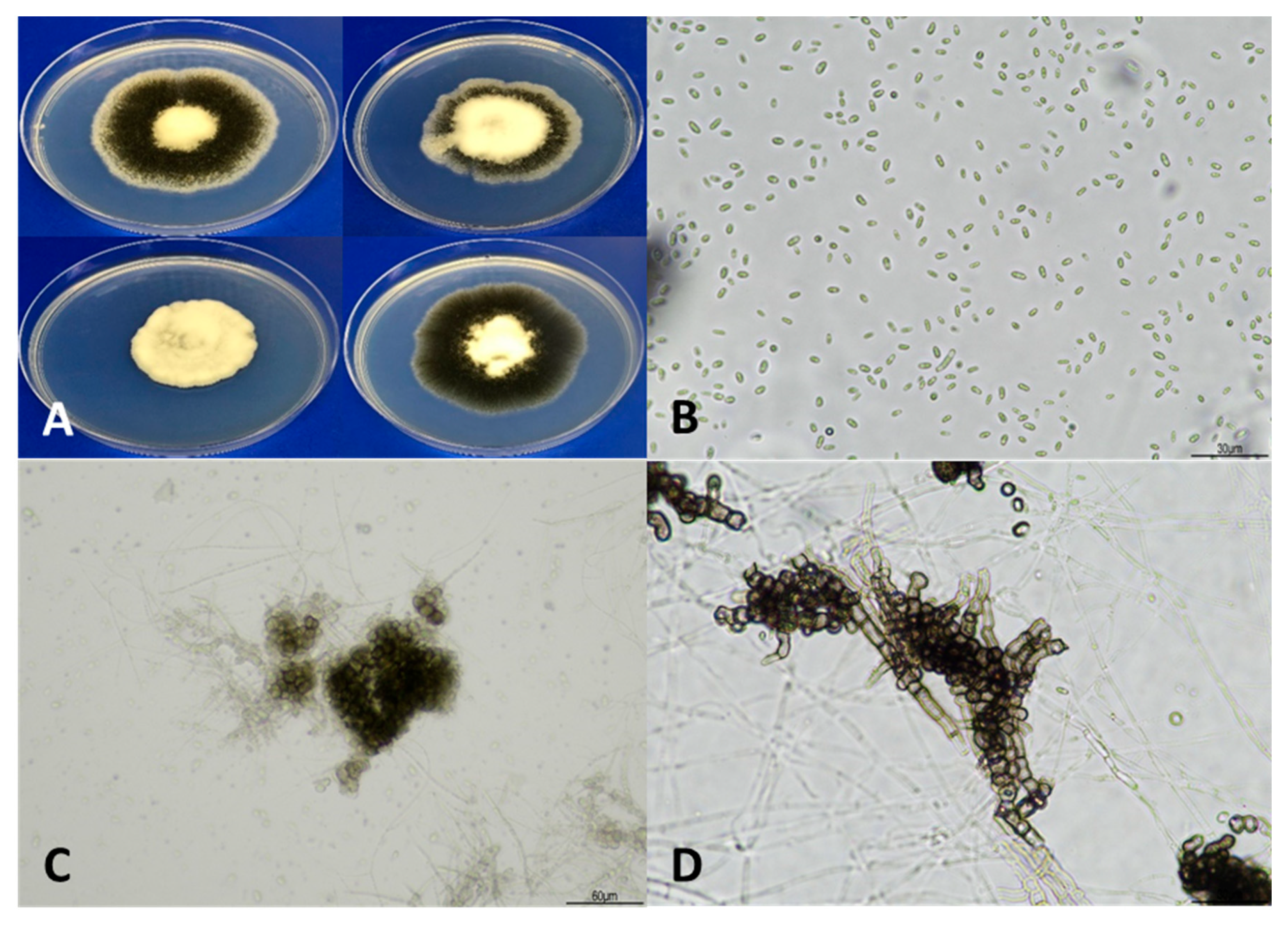
Figure 3.
Cotton field with severe symptoms of Verticillium wilt in NSW, Australia induced by the non-defoliating pathotype.
Figure 3.
Cotton field with severe symptoms of Verticillium wilt in NSW, Australia induced by the non-defoliating pathotype.
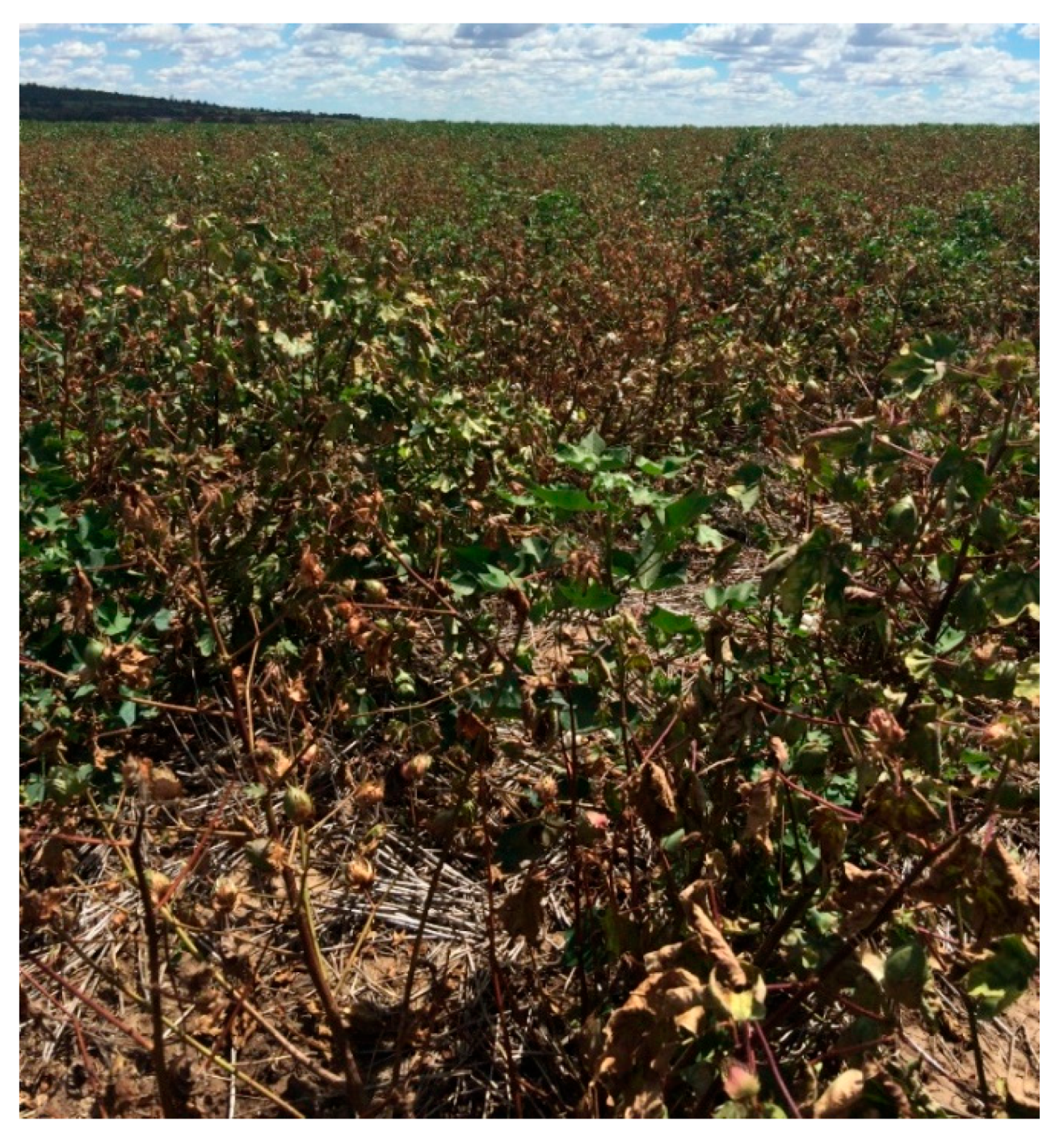
Figure 4.
Evaluation of cotton genotypes for resistance to VW in field conditions. A, experiments with replicated plots showing cultivars with different severity levels of foliar symptoms caused by V. dahliae. B, evaluation of disease incidence by quantifying vascular browning in stems infected by V. dahliae.
Figure 4.
Evaluation of cotton genotypes for resistance to VW in field conditions. A, experiments with replicated plots showing cultivars with different severity levels of foliar symptoms caused by V. dahliae. B, evaluation of disease incidence by quantifying vascular browning in stems infected by V. dahliae.
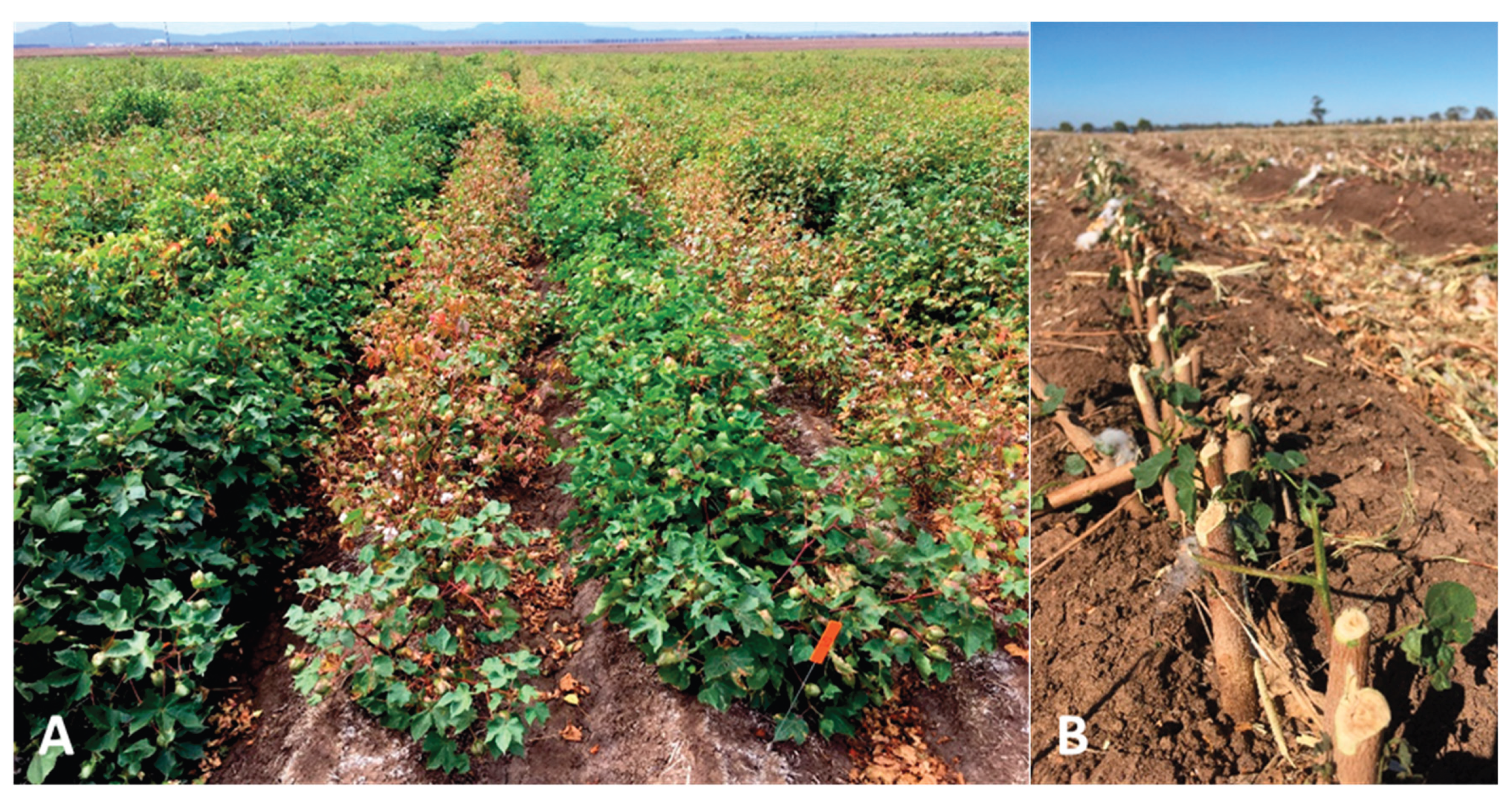

Table 1.
Summary of recipes of some semi-selective and selective media used for isolation and quantification estimation of V. dahliae from infected plant materials and soils.
Table 1.
Summary of recipes of some semi-selective and selective media used for isolation and quantification estimation of V. dahliae from infected plant materials and soils.
| Media | Constituents for 1 L of medium | References |
| Ethanol agar | Ethanol (0.5 mL), streptomycin (100 mg), agar (7.5 g) | [90] |
| Modified ethanol agar | Ethanol (5 mL), sucrose (7.5 g), KCl (0.5 g), K2HPO4 (1 g), NaNO3 (2 g), MgSO2.7H2O (0.5 g), FeSO4. 7H2O (0.01 g), streptomycin (100 mg), chloramphenicol (250 mg), agar (20 g) | [91] |
| Ethanol potassium amoxicillin agar (EPAA) | Ethanol (2 mL), KH2PO4 (1.5 g), K2HPO4 (4 g), amoxicillin (50 mg), agar (15 g) | [92] |
| Soil extract agar | Soil extract1 (25 mL), KH2PO4 (1.5 g), K2HPO4 (4 g), chloramphenicol (50 mg), streptomycin (50 mg), chlorotetracycline (50 mg), agar (15 g) | [93] |
| Modified soil extract agar | Soil extract agar medium, polygalacturonic acid (5 g), ethanol (0.5 mL), tergitol (0.5 g) | [95] |
| Sorbose agar | Sorbose (2 g), streptomycin (0.1 g), agar (10 g) | [96] |
| Sorbose asparagine agar | L-sorbose (2 g), L-asparagine (2 g), K2HPO4 (1 g), MgSO2.7H2O (0.5 g), quintozene (1 g), NaB4O7.10H2O (0.3 g), KCL (0.5 g), Fe-Na-EDTA (0.01 g), oxgall (0.5 g), agar (20 g) | [97] |
| Sorensen’s NP-10 | Tergitol (0.5 mg), KH2PO4 (1 g), KNO3 (0.5 g), MgSO2.7H2O (0.5 g), NaOH (0.025 N), polygalacturonic acid2 (5 g), chloramphenicol (50 mg), streptomycin (50 mg), chlorotetracycline (50 mg), agar (15 g) | [94] |
1 Soil extract was prepared as follows: a mixture of 1 kg soil and 1 L water was steamed for 30 min, decanted the water and filtered. 2 Polygalacturonic acid from orange (P-1879, Sigma-Aldrich) was discontinued and replaced by P-3889 (Sigma-Aldrich).
Table 2.
A number of molecular markers were developed for species-specific detection as well as pathotyping of V. dahliae from infected plant materials and soils.
Table 2.
A number of molecular markers were developed for species-specific detection as well as pathotyping of V. dahliae from infected plant materials and soils.
| Primers | Sequences 5’-> 3’ | Detection assays | Targets1 | References |
| VMSP1 | CATAAAAGACTGCCTAC GCCG | Simplex | V. dahliae | [107] |
| VMSP2 | AAGGGTACTCAAACGGTCAG | |||
| DB19 | CGGTGACATAATACTGAGAG | Simplex | V. dahliae | [108] |
| DB22 | GACGATGCGGATTGAACGAA | |||
| Vd-F | GGGTAGGCTGGCCATATGTG | Simplex | V. dahliae | [104] |
| Vd-R | GTTCTATCCATCGCGGAAAC | |||
| NDf | ATCAGGGGATACTGGTACGAGA | Simplex | ND pathotype | [109] |
| NDr | GAGTATTGCCGATAAGAACATG | |||
| INTND2f | CTCTTCGTACATGGCCATAGATGTGC | Nested | ND pathotype | [109] |
| INTND2r | CAATGACAATGTCCTGGGTGTGCCA | |||
| D1 | CATGTTGCTCTGTTGACTGG | Simplex | D pathotype | [110] |
| D2 | GACACGGTATCTTTGCTGAA | |||
| INTD2f | ACTGGGTATGGATGGCTTTCAGGACT | Nested | D pathotype | [111] |
| INTD2r | TCTCGACTATTGGAAAATCCAGCGAC | |||
| espdef01 | TGAGACTCGGCTGCCACAC | Duplex with DB19/DB22 | D and ND pathotypes | [100] |
| NEP_InPC4 | GGGACTGGGACAGGATGGACA | Duplex | D and ND pathotypes | [106] |
| Dnep286_R | CAAGACCAAATTCGACAGGCAGAG | |||
| NDnep482_R | CCTATTACGAGGTACTTACGGGGACTCTT | |||
| VdUni-F | TCCTAGGCAGGCGAGCAG | qPCR | V. dahliae in soil | [112] |
| VdUni-R | TAGGGCTGTCTGTCGGTGA | |||
| VertBt-F | AAC AAC AGT CCG ATG GAT AAT TC | qPCR | V. dahliae in plant tissue | [98] |
| VertBt-R | GTA CCG GGC TCG AGA TCG | |||
| VTP1-2F | CTC GAT CGT CGT CAA CC | qPCR | V. dahliae in plant tissue | [102] |
| VTP1-2R | TGG TGG TGA GAG TGT TG | |||
| FIP | CGTGATGCTCCGTTTAGGTGGATTTTCGCCATGTTCGGTGCTAG | LAMP | V. dahliae in soil | [101] |
| BIP | TGGCACGTGTGGCGTAAGACTTTTCGATGTCGAGTCTGACACTG | |||
| F3 | TGGCAGCTTCTGATTCAGTT | |||
| B3 | ACAGCGATTTGGATTCCCTC | |||
| LF | CTGACAACCAACGTCTAGATCTCA | |||
| LB | GGCTATTGAGTTCTGCACTCTGTC | |||
| RPA-F | CTTCATTGAGACCAAGTACGCTGTAAGTAACC | RPA-CRISPR/Cas12 | V. dahliae in soil and plant tissue | [105] |
| RPA-R | CAGTTGTCGTGAAGGGGTCATCTTGACTGC | |||
| crRNA1R | GAACCCCAGCACATGATAGAATCTACACTTAGTAGAAATTA | |||
| ssDNA-FQ | 5′FAM-/TTATTATT/-3′DBQ1 | |||
| VD-FIP | TCTCCGTGGATGTTCTCGGGAATAATGGCTGCCGTGACTGTC | LAMP-CRISPR/Cas12 | V. dahliae in soil | [113] |
| VD-BIP | TAGGGACGCAACAATGAGCTGTGCACGGCGCCAAAGTTC | |||
| VD-F3 | AGCGGAAGGGGCACTAG | |||
| VD-B3 | CAAAGACCACGACCATAGGC | |||
| VD-LF | ACGATTGGCAGTCACGGTT | |||
| VD-LB | TTGACGGCTTTACCACAGTCT | |||
| crRNA | UAAUUUCUACUAAGUGUAGAUCCACAGUCUUCUCGGCCAAGU | |||
| ssDNA-1 | (FAM)CCACGGGAGGAATACCAACCCAGTG(BHQ1) |
1 Detection targets of developed assays were specific to V. dahliae and/or to defoliating (D) and non-defoliating (ND) pathotypes.
Table 3.
A list of potential biocontrol agents, including rhizosphere bacteria and endophytic fungi that were recovered and assessed in vitro, glasshouse (GH) and field for their control efficacy against V. dahliae in cotton.
Table 3.
A list of potential biocontrol agents, including rhizosphere bacteria and endophytic fungi that were recovered and assessed in vitro, glasshouse (GH) and field for their control efficacy against V. dahliae in cotton.
| Bio-agents | Isolates | In vitro efficacy | In vivo efficacy (GH and field) | Plant growth promotion | References |
| Bacillus altitudinis | KRS010 | 74-80% | 93.6% (GH) | Yes | [146] |
| B. amyloliquefaciens | YZU-SG146 | 68.2-89.2% | 84.2% (GH) | Yes | [151] |
| B. atrophaeus | YL84 | 72.2-84.1% | 66.7% (GH) | Yes | [152] |
| B. mojavensis | KRS009 | 90.2% | 88.6% (GH) | Yes | [153] |
| B. subtilis | T6 | 63.8% | 92.6% (GH) | Not tested | [154] |
| B. subtilis | KRS015 | 59.2-97.1% | 62% (GH) | Yes | [155] |
| B. subtilis | SM21 | 48.2% | 45.7% (GH) | Not tested | [148] |
| Bacillus cereus | AR156 | 67.3% | 74.3% (GH) | Not tested | [148] |
| Serratia sp. | XY21 | 41.3% | 61% (GH) | Not tested | [148] |
| Consortium | SM21:AR156:XY21 | 77.3% | 86.1% (GH), 43.3-76.9% (field) | yes | [148] |
| Enterobacter cancerogenus | HA02 | Not tested | 72.4% (GH), 45.9% (field) | Yes | [150] |
| Paenibacillus polymyxa | ShX301 | 87% | 40.3-71.1% (GH) | Yes | [156] |
| Penicillium simplicissimum | CEF-818 | Not tested | 41.5-60.7% (GH), 62.4-69.5% (field) | No | [157] |
| Pseudomonas spp. | FP22, FP23, FP30, FP35 | 43.9-56% | 32.5-50% (GH), 22.1-50.9% (field) | Yes | [145] |
| Streptomyces kanamyceticu | B-49 | 68.9-85.6% | 65.8% GH), 28.4% (field) |
No | [147] |
| Acremonium sp. | CEF-193 | Not tested | 52.4-47% (GH), 38.5-54.6% (field) | No | [157] |
| F. oxysporum | By125 | Not tested | 69% (GH) | Yes | [158] |
| F. solani | CEF559 | 75-80% | 60% (GH), 30.1-56.3% (field) |
No | [159] |
| Gibellulopsis nigrescens | CVn-WHg | Not tested | 40.6-95% (GH) | No | [149] |
| Leptosphaeria sp. | CEF-714 | Not tested | 47.6-58.2% (GH), 50.2-69.2% (field) | No | [157] |
| Nectria haematococca | Bx247 | Not tested | 69.8% (GH) | Yes | [158] |
| Phomopsis sp. | By231 | Not tested | 63.4% (GH) | Yes | [158] |
| Talaromyces flavus | CEF-642 | Not tested | 29.5-26% (GH), 23.2-45.7% (field) | No | [157] |
Disclaimer/Publisher’s Note: The statements, opinions and data contained in all publications are solely those of the individual author(s) and contributor(s) and not of MDPI and/or the editor(s). MDPI and/or the editor(s) disclaim responsibility for any injury to people or property resulting from any ideas, methods, instructions or products referred to in the content. |
© 2025 by the authors. Licensee MDPI, Basel, Switzerland. This article is an open access article distributed under the terms and conditions of the Creative Commons Attribution (CC BY) license (http://creativecommons.org/licenses/by/4.0/).
Copyright: This open access article is published under a Creative Commons CC BY 4.0 license, which permit the free download, distribution, and reuse, provided that the author and preprint are cited in any reuse.