

Submitted:
25 November 2025
Posted:
04 December 2025
You are already at the latest version
Abstract
The rapid advancement in Artificial Intelligence (AI) has dramatically impacted the field of marketing, by allowing companies to interact with their customers through automation, to optimize marketing campaigns, and to make better decisions in marketing; yet, there are still many challenges that small businesses face when considering AI-based marketing solutions due to limited resources, capability gaps, and uncertainty about the benefit of using AI in marketing. This review is a synthesis of recent academic research on the adoption of AI-based marketing tools among small businesses in order to identify the key barriers and enablers of adoption. Using existing models of technology acceptance and use, such as the Technology Acceptance Model (TAM), Unified Theory of Acceptance and Use of Technology (UTAUT), and Resource-Based View (RBV), this review found that the adoption of AI-based marketing tools is influenced primarily by how useful a company perceives the tool, whether or not the costs of the tool outweigh the benefits, whether or not a company has the necessary knowledge to implement and use the tool, and whether or not a company trusts the tool to perform as promised. Additionally, incorporating industry-specific information highlighted the importance of third party service providers and developing capabilities to help support the adoption of AI-based marketing tools. This review also presents an integrative conceptual model of the relationships between the technological aspects of AI-based marketing tools, the organizational aspects of a company, the environmental aspects of a company, and the human aspects of a company, and provides a comprehensive way of viewing the adoption of AI-based marketing tools that can be used by both researchers and practitioners.
Keywords:
AI adoption
; digital marketing
; small business
; SMEs
; marketing automation
; Technology Acceptance Model
; diffusion of innovation
1. Introduction
The most powerful force transforming contemporary marketing is Artificial Intelligence (AI). AI-based marketing tools automate customer service and provide predictive analytics for personalizing marketing messages and optimizing sales processes. The increasing number of smaller businesses applying sophisticated AI technology to compete with larger companies demonstrates the desire of all businesses to apply automation and data-driven decision making to improve customer engagement and retention. Although affordable AI marketing tools—such as chatbots, CRM automation, email sequencing engines, and AI-assisted content generation—are becoming available to a wider variety of businesses, the adoption of AI-based marketing tools by smaller businesses is generally much lower and less consistent than that experienced by larger companies.
There are over 90% of all businesses around the world classified as "small," representing the backbone of virtually every economy in the world, including those in Australia, India, Europe and the U.S. The rate at which small businesses can implement new technologies will determine the extent to which innovations are diffused into markets, competition is increased within those markets and national digital transformation objectives are achieved. However, the constraints that limit the ability of smaller business to implement new technologies include limited financial resources, fewer employees, limited technological readiness, and limited structured digital expertise, making the potential benefits of AI-based marketing tools a double-edged sword—offering improved efficiencies, better targeting and enhanced customer experiences but requiring a greater degree of investment, planning and technical knowledge than many small businesses have available.
A great deal of research has been conducted academically on the adoption of digital technologies by small businesses using various theoretical frameworks, such as TAM, DOI, and RBV. However, the adoption of AI-based marketing tools represents a different class of technology from previous forms of marketing software. AI-based marketing tools involve automation, prediction, and decision-making capabilities that may replace or complement human judgment. Therefore, they create a new set of barriers to adoption, such as trust, ethics, algorithmic transparency, and the loss of control, that were not addressed in prior research models. In addition, since the past decade, the marketing landscape has changed dramatically. Many of the marketing functions that small businesses perform today are performed using AI-based marketing platforms, such as customer acquisition funnels, social media strategy and lead management systems. As a result of limited internal expertise, many small businesses are now relying upon external service providers (e.g., marketing agencies, freelancers, and automation consultants).
As a result, there is a gap between academic research and current practices in the field. Despite the large number of AI-based marketing tools that are being rapidly developed, deployed and utilized, there is currently no universally accepted definition of how small businesses perceive and adopt AI-based marketing tools, nor is there a general agreement on what types of barriers they encounter and how specific contextual factors influence their decisions. As a result, the purpose of this review is to synthesize the results of existing research on how small businesses perceive and adopt AI-based marketing tools and to identify a comprehensive framework for developing a more integrated conceptual model of how small businesses perceive and adopt AI-based marketing tools.
2. Methodology
The study uses a narrative literature review methodology. This methodology is well suited to this subject area due to the rapid development of artificial intelligence (AI) in marketing as a discipline with a wide variety of methodologies used by researchers [4] and therefore the lack of consistency in research methodologies in AI marketing. As opposed to systematic reviews which have a primary objective to filter results by their statistical significance and/or size of effect, a narrative review provides opportunities for integrating concepts; providing interpretations; connecting themes in multiple disciplines.
The review employed a flexible but academically rigorous narrative methodology, synthesizing insights from the areas of marketing, information systems, entrepreneurship, and innovation research. The review integrated theoretical perspectives into a unified narrative; identified and discussed previously neglected real world considerations, including vendor lock-in and automation agencies; and provided an updated conceptual model for the adoption of AI in marketing for small businesses.
3. Background: AI in Marketing and the Small-Business Context
Modern marketing has been transformed by the integration of Artificial Intelligence (AI) into the ecosystem of many organizations, including how companies locate potential customers, personalize their communications and manage customer interactions.
Marketing tools based on AI provide small businesses access to marketing capabilities previously available only to major corporations with large budgets.
3.1. The Development of AI-Based Marketing Tools
The development of AI-based marketing tools is divided into four categories of marketing tools:
- Automation Tools – Chatbots, Automated Follow-up Sequences, AI Appointment Schedulers, Lead Scoring Engines, etc.
- Analytics and Prediction Tools – Customer Segmentation Models, Conversion Prediction, Demand Forecasting, etc.
- Creative and Content Tools – Generative AI for Text, Image, Audio; Social Media Content Optimization; Ad Copy Generation, etc.
- Targeting and Personalization Tools – Behavioral Targeting; Real-Time Personalization; Recommendation Systems, etc.
Most often small businesses use these tools via third party platforms like HubSpot, Zoho, Mailchimp, ActiveCampaign, or AI-enabled CRM's that integrate Automation, Segmentation & Content Creation.
3.2. Drivers and Barriers to Implementation
While limited resources create barriers to implementation, Small Businesses view AI as a way to achieve competitive advantages and reduce manual workloads and improve efficiencies in generating leads while providing personalized campaigns at minimal cost. Industry studies have shown that "Quick Wins" which include an example such as using AI to automate appointment setting or generate AI-created ad copy drive the first wave of interest in AI but that the rate of implementation of AI in comparison to larger companies remains relatively low, primarily due to the lack of internal technical expertise, fear of increased complexity, resource constraints and low organizational readiness [6].
4. Theoretical Lenses in AI Adoption Research
The above mentioned four models partially explain why some small businesses are now using AI-based marketing tools.
4.1. Technology Acceptance Model (TAM)
Technology Acceptance Model (TAM) by Davis (1989) has two factors that contribute to the adoption of technology; one being "Perceived Usefulness" (PU) which refers to a belief in an improvement in the function of the tool used (for example, improving quality of leads). The second factor is "Perceived Ease of Use" (PEOU) which defines the ease of use of a technology tool. TAM will be able to define how a company can decide whether to use simple tools such as chatbots, but will fail to address the issues of trust, ethics, and vendor dependence.
4.2. Unified Theory of Acceptance and Use of Technology (UTAUT)
Unified Theory of Acceptance and Use of Technology (UTAUT) expands upon TAM by including "social influence" and "facilitating conditions." Social influence includes the adoption of technology based on the actions of others. For example, a competitor, or agency may encourage you to use certain technology. Facilitating conditions include factors that enable or hinder the use of technology. Both of these factors may be important for small businesses who may choose to use technology due to pressure from a competitor, or agency. However, UTAUT does not assume a structured organization, but rather assumes that the decision to use technology is rational and systematic. Small business decisions are often made under chaos and without a system.
4.3. Diffusion of Innovation (DOI) and Resource-Based View (RBV)
Diffusion of Innovation (DOI) theory, developed by Rogers (1962), describes how innovations are adopted based on factors such as "relative advantage," "complexity," and "trialability" (i.e., the extent to which something can be tested before committing to it). Although this theory provides insight into how innovations spread among individuals, organizations, and communities, it typically overlooks hidden costs associated with using technology and also the potential to become locked into a particular vendor. The Resource-Based View (RBV) of the firm, developed by Barney (1991), views AI capabilities as strategic resources that allow companies to gain competitive advantages over other firms. However, the RBV assumes that firms already possess the necessary resources to leverage AI capabilities, which is often not the case with many small businesses that lack sufficient financial, technological, or human resources to implement and utilize AI capabilities.
4.4. Dynamic Capability Theory (DCT)
Dynamic Capability Theory (DCT), developed by Teece et al. (1997), stresses the importance of a firm's ability to sense and seize new opportunities and reconfigure its internal and external resources. This aspect of DCT is particularly relevant for small businesses that operate in highly dynamic environments and must respond quickly to changes in their markets. Because of their smaller size and greater flexibility, small businesses tend to be more agile than large corporations and are therefore able to adapt to changing market conditions more easily and rapidly. As a result, they are able to develop and capitalize on new opportunities at a much faster rate than larger firms.
5. Thematic Literature Review
Seven key themes (barriers/enablers) to AI adoption in small firms have been identified from current literature.
5.1. Perceived Usefulness & Ease of Use
Perceived usefulness is currently the most important predictor of adoption. Small firm owners want quick, easy-to-spot outcomes sooner rather than later; they do not typically seek the longer term strategic benefits of AI. Therefore, those tools which provide "quick wins" will be adopted much faster than tools requiring predictive analytics with multiple steps to achieve an outcome. Additionally, the lack of digital literacy among many small business owners creates the need for ease-of-use when adopting AI. Therefore, interfaces providing drag-and-drop automation and/or pre-built templates are much more preferred by small business owners compared to complex systems.
5.2. Cost, Resources and Skills
The cost of acquiring and utilizing AI-based technology is one of the main barriers to adoption, especially since it includes subscription fees and advertising budget requirements as well as training costs. In addition, the lack of digital skill sets is another common barrier to adoption. Since small businesses seldom have data analysts or AI engineers employed, this creates a "capability gap" where the tools acquired are not utilized to their full potential.
5.3. Trust, Ethics & Comfort with Automation
Because AI makes decisions (and not just provides information), trust is even more important when adopting AI than when adopting other types of software. Small business owners are concerned with AI sending incorrect messages, and protecting their customers' data privacy. Moreover, the fact that AI uses "black boxes" (algorithms) further exacerbates their concerns and creates "automation anxiety." Owners are worried they may lose control over how they interact with their customers.
6. Industry Insights: Practical Realities
The theory-practice gap has been narrowed by observing the practical implementation of various theoretical models in real world applications that may have otherwise gone unnoticed in academia.
6.1. Problem Driven and Platform Dependent Implementation of Adoption
Adoption of AI technology for small business as described in theoretical models was not based on strategy, but rather due to an urgent need to address a specific problem or issue such as poor quality leads or time constraints. The technology was thus implemented in a piecemeal manner, and its application was also dependent upon the availability of platforms provided by large SaaS vendors (such as HubSpot, Meta) which created vendor lock-in conditions, thereby limiting the effective utilization of available features.
6.2. Agencies and Building Trust
Another area where theoretical models failed to take into account a critical component of actual practice is the agency aspect of technology implementation. In reality it is typically external agencies and consultants that are responsible for the setup, integration, and analysis of technology, and therefore drive the adoption of technology. Trust in AI technology among small businesses is performance driven. Small businesses must first see "small wins", such as a chat bot successfully addressing an inquiry, before they can trust the technology to fully automate their business processes.
7. Discussion and Proposed Framework
7.1. Discrepancies Between Theory and Reality
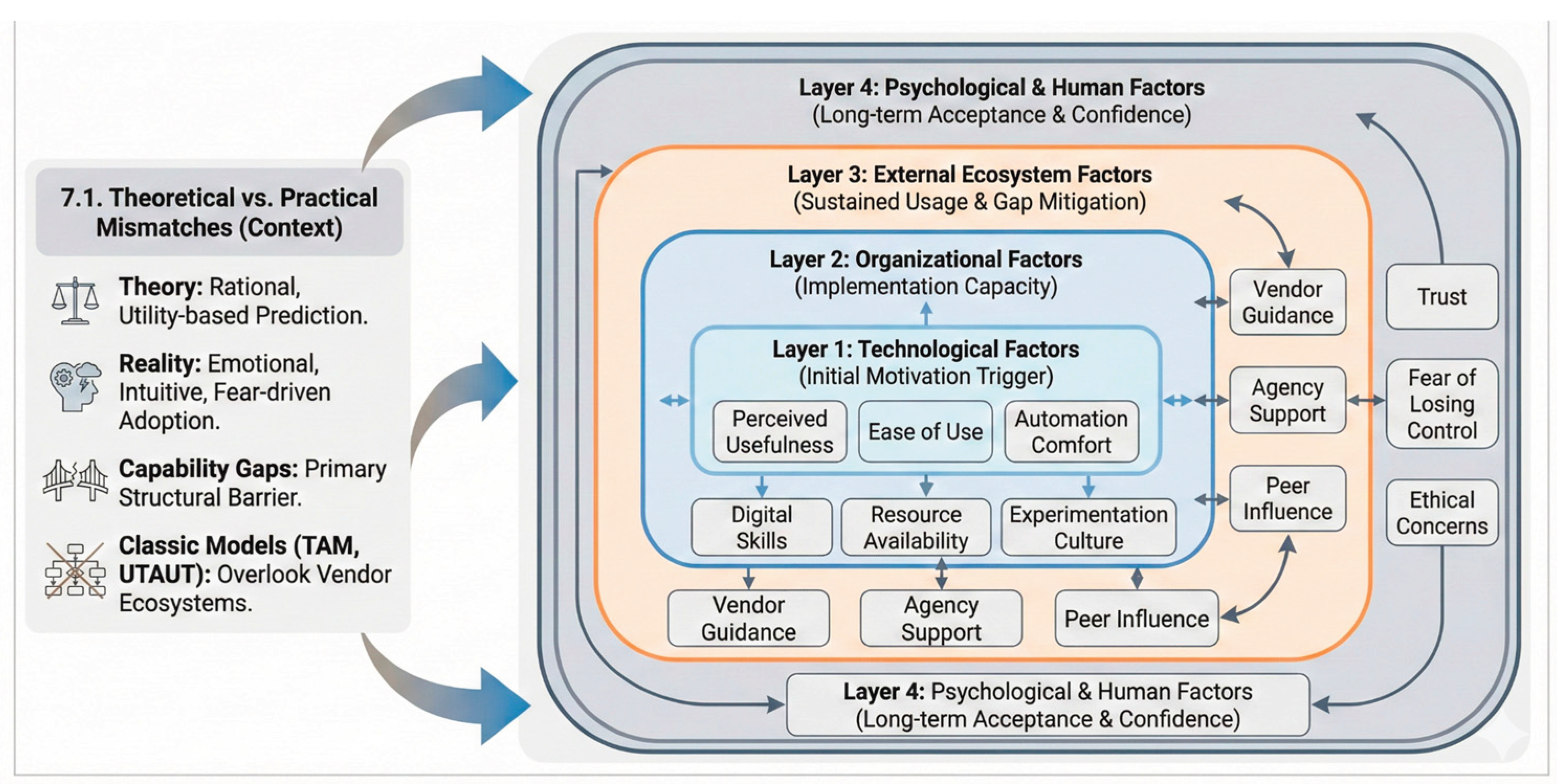
Research has identified a number of discrepancies between what theory says should occur and what actually occurs. According to theory, businesses will make rational decisions about when and how they will adopt technology in order to maximize their benefit or utility. In contrast, actual decision making is much more emotionally driven, intuitive, and fear-based. Capability gaps are not simply one aspect that contributes to the difficulty of adopting technology; rather, they typically represent the most significant structural barriers. Additionally, many of the traditional models (TAM and UTAUT) do not address the important role of the vendor ecosystem in supporting the small business adoption of AI technology.
7.2. An Integrative Model of AI Technology for Small Business Adoption
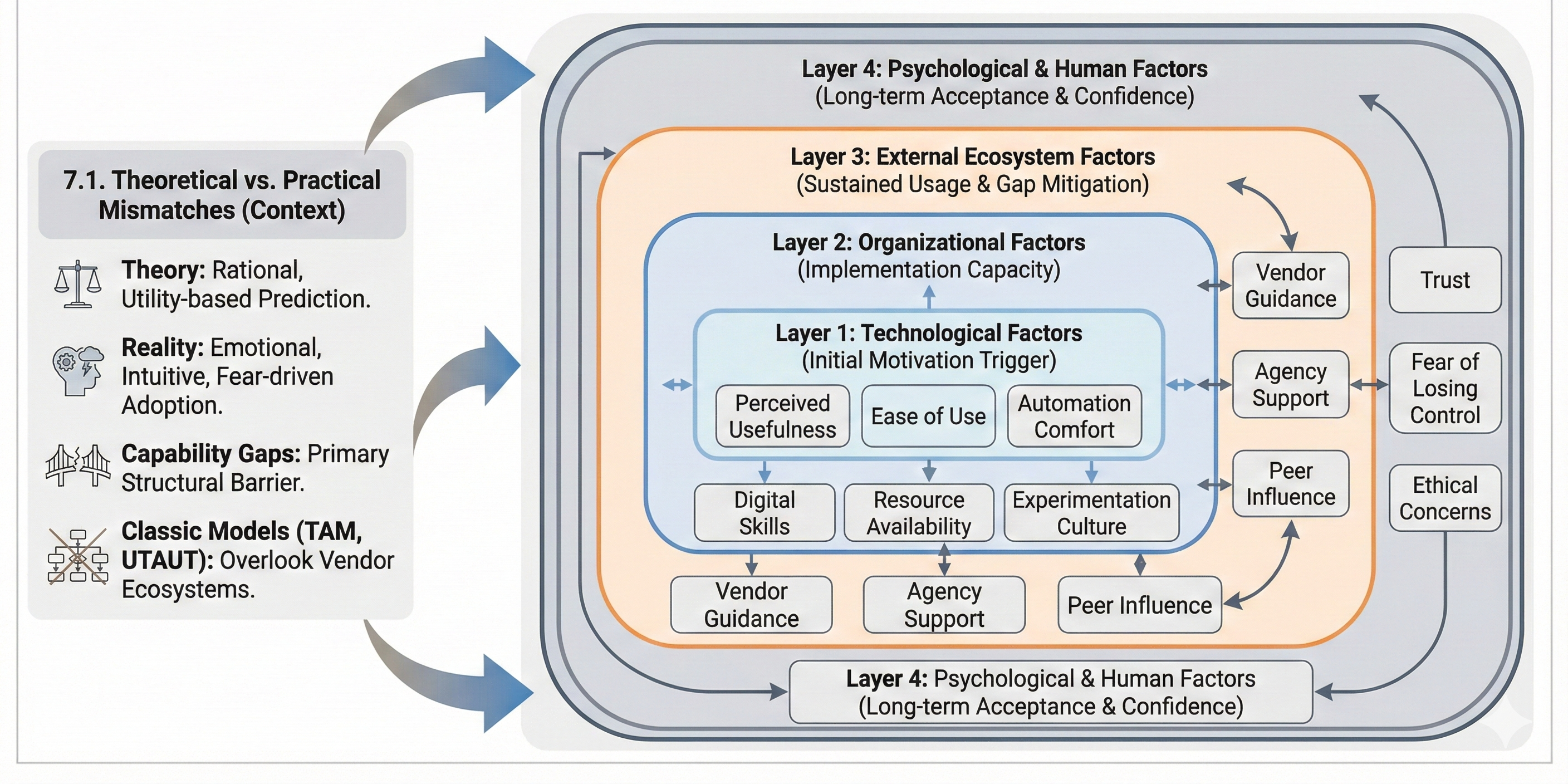
From our synthesis of current literature, we have developed an Integrative Model of AI Technology for Small Business Adoption which includes four interrelated layers:
The technological factors (layer 1) include perceived utility, ease of use, and comfort with automation which motivate the first stage of wanting to try out AI tools.
Organizational factors (layer 2) provide the ability to apply technology as they relate to digital skills, available resources, and an organizational environment that allows experimentation with new tools.
External factors (layer 3), including vendor support, government agencies providing assistance, and peer influence, can help to sustain the use of AI tools over time and to reduce skill gaps.
Psychological and human factors (layer 4), such as trust, fear of losing control and ethical concerns, contribute to whether the use of AI tools becomes long term accepted and if the user becomes confident in its use.
Figure 1.
Integrative Model of AI Technology for Small Business Adoption.
8. Conclusions and Implications
AI-driven marketing tools offer immense potential for small businesses, but adoption is complex and nonlinear. This narrative review highlights that adoption is shaped by a dynamic interplay of technological utility, organizational readiness, external ecosystem support, and human psychological factors.
For researchers, there is a need for multidisciplinary models that integrate emotion, trust, and vendor influence. Future studies should specifically examine post-adoption behavior and the role of intermediaries. For practitioners and business owners, the focus should be on high-impact, low-complexity tools and investing in capability building rather than just software. Technology vendors must simplify interfaces and provide transparency to reduce automation anxiety. Finally, policymakers should support AI literacy initiatives and ensure ethical guidelines protect small firms and consumers alike.
Author Contributions
Conceptualization, A.R.; methodology, A.R.; validation, A.R.; formal analysis, A.R.; investigation, A.R.; resources, A.R.; data curation, A.R.; writing—original draft preparation, A.R.; writing—review and editing, A.R.; visualization, A.R.; project administration, A.R. All authors have read and agreed to the published version of the manuscript.
Funding
This research received no external funding.
Institutional Review Board Statement
Not applicable.
Informed Consent Statement
Not applicable.
Data Availability Statement
No new data were created or analyzed in this study. Data sharing is not applicable to this article.
Conflicts of Interest
The author declares no conflict of interest
References
- Baudier, P.; Ammi, C.; Deboeuf-Rouchon, M. Artificial intelligence in marketing: A systematic review and research agenda. J. Bus. Res. 2021, 133, 252–269. [Google Scholar]
- Baker, J. The technology–organization–environment framework. In Information Systems Theory; Springer: New York, NY, USA, 2012; pp. 231–245. [Google Scholar]
- Barney, J. Firm resources and sustained competitive advantage. J. Manag. 1991, 17, 99–120. [Google Scholar] [CrossRef]
- Chatterjee, S.; Rana, N.P.; Tamilmani, K.; Sharma, A. Adoption of artificial intelligence in SMEs: A review and research agenda. Technol. Forecast. Soc. Change 2023, 190, 122–154. [Google Scholar]
- Chong, A.Y.L.; Ooi, K.B. Adoption of enterprise technology among SMEs. Int. J. Bus. Inf. Syst. 2008, 3, 262–274. [Google Scholar]
- Davis, F.D. Perceived usefulness, perceived ease of use, and user acceptance of information technology. MIS Q. 1989, 13, 318–340. [Google Scholar] [CrossRef]
- Del Giudice, M. Digital technologies in SMEs: Adoption and managerial implications. Small Bus. Econ. 2022, 58, 1657–1672. [Google Scholar]
- Dwivedi, Y.K.; Kshetri, N.; Hughes, L.; Slade, E.L.; Jeyaraj, A.; Kar, A.K.; Baabdullah, A.M.; Koohang, A.; Raghavan, V.; Ahuja, M.; et al. Artificial intelligence adoption in marketing: A research agenda. Int. J. Inf. Manag. 2023, 69, 102–128. [Google Scholar]
- Ivanov, S.; Webster, C. Adoption of AI in service industries. Serv. Ind. J. 2019, 39, 451–474. [Google Scholar]
- Mariani, M.; Borghi, M. AI in digital marketing: Effects and applications. J. Bus. Res. 2020, 129, 120–132. [Google Scholar]
- Nambisan, S.; Lyytinen, K.; Majchrzak, A.; Song, M. Digital innovation management. MIS Q. 2019, 43, 223–238. [Google Scholar]
- Nguyen, T.M.; Le, P.B. External IT support and SME digital transformation. Inf. Manag. 2023, 60, 103–124. [Google Scholar]
- Oke, A.; Walumbwa, F.O.; Myers, A. AI adoption barriers in small firms. J. Small Bus. Manag. 2022, 60, 887–907. [Google Scholar]
- Oliveira, T.; Martins, M.F. Literature review of technology adoption models in SMEs. Ind. Manag. Data Syst. 2011, 111, 1117–1135. [Google Scholar]
- Rialti, R.; Marzi, G.; Ciappei, C.; Busso, D. Digital capabilities and business performance in SMEs. J. Bus. Res. 2020, 123, 259–270. [Google Scholar]
- Rogers, E.M. Diffusion of Innovations, 5th ed.; Free Press: New York, NY, USA, 2003. [Google Scholar]
- Shin, D. The effects of explainability on trust in AI. Comput. Hum. Behav. 2020, 102, 103–114. [Google Scholar]
- Tornatzky, L.; Fleischer, M. The Processes of Technological Innovation; Lexington Books: Lexington, MA, USA, 1990. [Google Scholar]
- Venkatesh, V.; Morris, M.G.; Davis, F.D.; Davis, G.B. User acceptance of information technology: Toward a unified view. MIS Q. 2003, 27, 425–478. [Google Scholar] [CrossRef]
- Wilson, H.J.; Daugherty, P.R. Human + machine: Reimagining work in the age of AI. Harv. Bus. Rev. 2018. [Google Scholar]
Disclaimer/Publisher’s Note: The statements, opinions and data contained in all publications are solely those of the individual author(s) and contributor(s) and not of MDPI and/or the editor(s). MDPI and/or the editor(s) disclaim responsibility for any injury to people or property resulting from any ideas, methods, instructions or products referred to in the content. |
© 2025 by the author. Licensee MDPI, Basel, Switzerland. This article is an open access article distributed under the terms and conditions of the Creative Commons Attribution (CC BY) license (https://creativecommons.org/licenses/by/4.0/).
Copyright: This open access article is published under a Creative Commons CC BY 4.0 license, which permit the free download, distribution, and reuse, provided that the author and preprint are cited in any reuse.


