
Submitted:
02 December 2025
Posted:
02 December 2025
You are already at the latest version
Abstract
A once extensive forest with an abundance of wild fruit trees (progenitors of domestic apple, pear, cherry, apricot and more) once extended from the Tian Shan Mountains of Kazakhstan through Iran, Turkmenistan, Georgia, and Armenia, finally reaching a western limit in Anatolia. Only relict stands remain, which are high priority for conservation. This center of crop ancestral diversity was first recognized by Vavilov as one of his “Centers of Origin” but the full range of this forest type is only recently appreciated as in the book by Spengler. A chance encounter with a stand of this forest in Iran led me to research the composition and extent of this forest, its dispersal, and its fate. This forest, with its abundance of fruit trees, crossed from northern Mesopotamia to the foothills of the Himalayas in ancient times and may have been the source for the mythical Garden of Eden.
Keywords:
wild fruit tree forest
; wild apple
; Malus sieversii
; centers of origin
; Vavilov
; crop domestication
; Garden of Eden
1. Introduction
TheLordGod made all kinds of trees grow out of the ground—treesthat were pleasing to the eye and good for food. In the middle of the garden were the tree of lifeand the tree of the knowledge of good and evil. (Genesis 2:9, New King James Version)
There once were forests dominated by wild fruit trees (apples, cherries, pears, mulberries, almonds and more). At end of last glacial episode (or early in the Holocene), their range extended from the Tian Shan Mountains of China to the Himalayas, northern Iran, southern Turkmenistan, skirting the northern edge of Mesopotamia, continuing across the Black Sea, and reaching their westernmost limit in Anatolia (Spengler 2020, Vavilov 1926, Zohary and Hopf 1994). We do not know how abundant these forest types were in the past. Only isolated relict stands remain, but many archaeobotanists argue that they were once extensive (Spengler 2020) They were the source for domesticated apples, cherries, pears, apricots, and other orchard species. They may also have been the source for the myth of the Garden of Eden.
2. Materials and Methods: Literature Sources and Commentary
Nikolai Vavilov (b1887-1943) was a Russian botanist and geographer, and head of the Lenin All-Union Academy of Agricultural Sciences until 1940. Vavilov was a pioneer in the identification of the prehistoric ranges of the ancestors of the domestic apple, and later of other orchard species. In his 1926 monograph ‘Studies on the origin of cultivated plants’ (1926) Vavilov set out a theory that each agricultural crop comes from a primary center of diversity in the world, where many different wild relatives are found. These he termed ‘centers of origin.’ One such center was located in Central Asia (map, Vavilov 1926).
Figure 1: Vavilov Centers of Origin Fig. 1-Centers of origin of cultivated species, Vavilov (1926).
Legend: (1) China: A total of 136 endemic plants are listed. e.g. Foxtail millet, soybean, bamboo, crucifers, onion, lettuce, tea etc.
(2) India: 117 plants are considered to be endemic, which mainly includes rice, sugarcane, mango,orange, oriental cotton, eggplant, Sesame etc.
(2 a) South East Asia: 55 plants are listed, including rice, banana, coconut, clove, hemp etc.
(3) Central Asia: 43 plants are listed, prominent among which are common wheat, pea, common millet, buckwheat, Alfalfa, Hemp, cotton etc.
(4) Near East: 83 species are included in this region. At least nine species of wheat as well as rye are indigenous to this centre. Many of our subtropical and temperate fruits are native to this region.
(5) Mediterranean: 84 plants are known to have originated here including olives and many cultivated vegetables; forage plants; oil yielding plants (rape, black mustard) and wheats (durum and emmer).
(6) Ethiopia: Previously known as Abyssinian centre. 38 species are native to this region, includes wheat and barley, Sesame, castor bean, coffee etc.
(7) Mesoamerica (South Mexican & Central American Centre): Plants native to this region are extremely varied, and include maize, bean, squash, sweet potato, red peeper, papaya, guava, tobacco, etc.
(8) South America: This region is believed to be the native of potato, tomato, egg plant, pine-apple, rubber tree, cashew nut etc.
(8 a)The Chiloe Centre: It is an island near the coast of Southern chile. It is thought to be region of origin of common potato.
(8 b)The Brazilian – Paraguayan Centre: It is known to be the region of origin of groundnut, cassava, cashew nut, pineapple, peppers, potato, rubber etc.
On visiting the Tian Shan Mountains, Vavilov (1926) concluded that the domestic apple derives from the fruit forests of wild apple Malus sieversii on the slopes of the Tian Shan Mountains. As he extended his research, he noted that the range likely extended to the west as well and that there were variations in the species mixtures in this fruit tree forest across its range. Vavilov described it as dominated by apples. Other wild apple ancestor species are found in Anatolia (Spengler 2020), which probably means this forest type continued westward, reaching its western limit in Anatolia.
Apricots, peaches, walnuts, almonds, and mulberries have also been described as part of these mixed wild fruit tree forests (Spengler 2020). In Anatolia at the western limit of the fruit tree forest, the species included Pyrus pasha (wild pear) confined to rock outcrops (Woldring and Cappers 2001).
Vavilov considered the origin of the domestic cherry to be between the Caspian and Black Sea, which would suggest the fruit tree forests continued westward (Vavilov 1926), to an unknown extent.
Zohary (1973) and Mayer and Aksoy (1986) mentioned the occurrence of Prunus ursina and Celtis tornfortii on rock outcrops in Anatolia and considered them remnants of a formerly extensive forest. According to Woldring and Cappers (2001), archaeobotanical research confirms the presence of various fruit-bearing species of Celtis, Amygdalus, Crataegus, Prunus, Pistacia and others prior to the oakwoodland expansion in Central Anatolia. During the mid-Holocene woodland optimum, the outcrops were among the locations where wild fruit trees could maintain themselves in the absence of oaks. Human activity and/or the end of the warmer Atlantic period seems to have increased oak woodland expansion at the cost of the fruit trees, which were then confined to secondary growth or rock outcrops, and here the “fruit tree forest’ reached its western limit.
Spengler (2020) suggested that nomadic herds and flocks also contributed to the dispersal of wild fruit tree species across Central Asia, by eating the fruit while grazing and eliminating the seeds, acting as dispersal agents.
During the Chalcolithic and Bronze Ages the wild fruit was undoubtedly gathered for food, but domestication began only around 1500 – 1,000 BCE (late Bronze and early Iron Age in this region). Domestication of fruit trees came late, when compared to annual plants (such as wheat, barley and legumes). It is thought that fruit trees were only domesticated in the 1st millennium BCE since this involved more complicated procedures such as grafting (Zohary and Hopf 1994). Zohary and Hopf (1994) also believed that the ecology of domesticated fruit trees did not change much from the wild types, so that modern distribution of these crops would suggest the original natural distribution.
We thus can envision a natural forest of mixed fruit tree species extending from the Tian Shan Mountains to Anatolia and the Black Sea.
3. Methods: New Data
I encountered a fruit tree forest quite accidentally. In the 1990’s I was scouting on the Turkmenian/Iranian border, searching for wild barley seeds for genetic research. My group was unsuccessful in the Turkmenian Kara Kum steppe-desert, so we turned south into the Kopet Dag mountains bordering Iran, not far south from Ashkhabad. I was looking for wild barley, but when I looked up, I was astonished and puzzled. It was a forest of apples, cherries, and Cercis (redbud). I had never seen such a forest before. The trees were all intermingled, it was not an abandoned orchard, but what was it? I noted this but shelved the question.
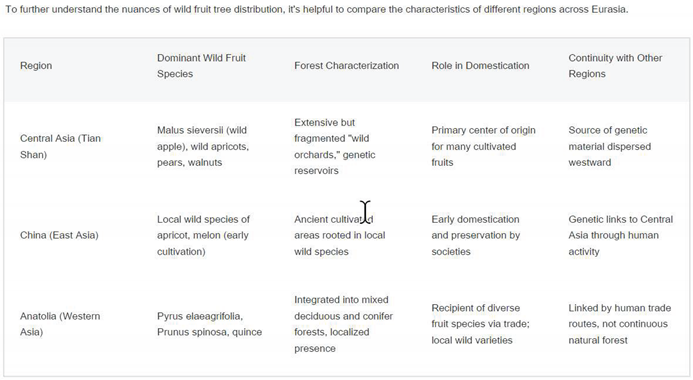
A few years later at Kew Gardens, I checked the library to see whether any record of such a forest existed. It did – the Russian agrobotanist, Nicolai Vavilov described it extending across Central Asia from Turkmenistan to Kazakhstan, and considered this area to be one of the four centers of origin for agricultural crop progenitors in Eurasia (Insert Table 1, Vavilov 1926, Vavilov and Dorofeev 1992) Evidently I stumbled on a patch of Vavilov’s fruit tree forest.
Many years later I met two botanists (Drs Mark Watson and Colin Pendry) from the Edinburgh Botanical Garden, who were surveying western Nepal. They also observed a kind of “fruit tree woodland” in western Nepal near Kuru, with wild pear (Pyrus paschia) as an abundant species. However the area was managed for grazing, and the water system was manipulated, so this seems more a case of a managed woodland with wild fruit trees (Pendry et al 2017). This may often be the fate of such relict stands.
4. Archaeological Observations
Horticultural crops came late in domestication. The earliest evidence for the transition from foraging to food producing lifestyles comes from southeastern Anatolia, the Levant and northern Mesopotamia. The pre-Neolithic terminal Pleistocene (Natufian-related) cultures of the region were sedentary foraging societies (Henry 1985). In the Epipaleolithic, even prior to crop domestication, they constructed large monuments in their settlements and at special locations across the landscape which were used in some cases for several thousand years (e.g., Gobekli Tepe, Karahan Tepe, etc.) (Çelik and Ayaz 2022). Such efforts were done by group efforts of hundreds of individuals who had to be supported by very efficient foragers. Archaeobotanical evidence from such settlements indicates that wild cereals, acorns and fruit species from the type of fruit forests described above were regularly exploited (Notroff et al, 2015).
The subsequent Neolithic sees the appearance of domesticated cereals and legumes (Zohary 1973), but the horticultural fruit still tends to be considered wild in form, still undomesticated (Zohary and Hopf 1994). Yet archaeobotanical evidence shows use of these wild fruits (Rössner et al 2025). In other words, the forest continued to exist into the mid-Holocene (Mueller-Bieniek and Lityńska-Zając 2001)
What happened to the extensive fruit tree forests is not clear. It is estimated that as much as 90% of the wild apple trees that existed in Vavilov’s time around Almaty, Kazakhstan’s largest city, have been lost due to human encroachment. The ancient fruit forests are cleared for housing, deforestation makes way for modern agriculture, trees are felled for wood fuel, and land is overgrazed. As a result, Malus sieversii is now on the international Red List of threatened species. (Anonymous 2021)
This habitat loss may have been aggravated by climate change as well. The fruit tree forest sems to have occupied a belt of open woodland between steppe and forest, mostly in montane areas. Cooler temperatures at the end of the Atlantic Period (about 3,000 BCE) apparently led to expansion of the steppe into woodland areas and may have eliminated this marginal woodland type (Che and Lan 2021)
5. Discussion (Results and Conclusion)
If that is the case, we can envision a Central Asian forest type – or related types - that had their eastern limit in the Tian Shan Mountains, came south through the Western Himalayas, through Afghanistan, Uzbekistan, Turkmenistan, across the Black Sea, skirting northern Mesopotamia, touching Georgia and Armenia and ending in Anatolia, with some changes in the relative abundance of the wild fruit tree species Malus sieversii . The wild apple Malus sieversii and several species of wild pear are still found in Armenia notably in Khosrov Forest State Reserve (Anonymous 2025). It is probable that this forest type was never geographically continuous, but existed in special areas favorable for the fruit tree species. The transfer of seeds by animals and pastoralists would have moved species westward, as suggested by Spengler (2020).
Neighboring Georgia, with the Caucasus Mountains is known as a center of diversity for figs as well as mulberries, grapes, walnuts, apricots, pomegranates, and almonds (Spengler 2020) Thus the bridge from the Caspian to Anatolia is clear. A more or less continuous forest belt dominated by fruit trees once extended from the Tian Shan Mountains in China westward to end in Anatolia.
For people coming from Mesopotamia, where no comparable fruit forests existed, such a forest must have been very impressive. An abundance of reliable food just hanging there for collection. Sumerian had a word for such a place, and so did Akkadian – edinnu, or eden Milliard (1984). It would have been a place where agriculture was hardly needed; the fruit trees would supply a reliable food source for local consumption or trade.
Was this the origin of the Garden of Eden myth? (Or rather the Orchard of Eden, since the bible describes a wooded place, an orchard “pardes” (from which we get the word “paradise”). In the biblical narrative, Eden was at the headwaters of the Tigris and Euphrates. This would fit northern Mesopotamia, in the area of Armenia. The fruit tree forest may well have extended through there. Anyone from Southern Mesopotamia would have been astonished and remembered it.
We can only guess that the Central Asian fruit tree forests were the origin of the Eden myth, but it seems likely. What is certain is that they were also the origin of many domestic fruit tree species. These are now sadly reduced to relict stands across Central Asia due to development, cutting, farming, and grazing.
Figure 2.
Tian Shan Fruit Forest © Dr Gayle Volk USDA (in Apples and people 2010).
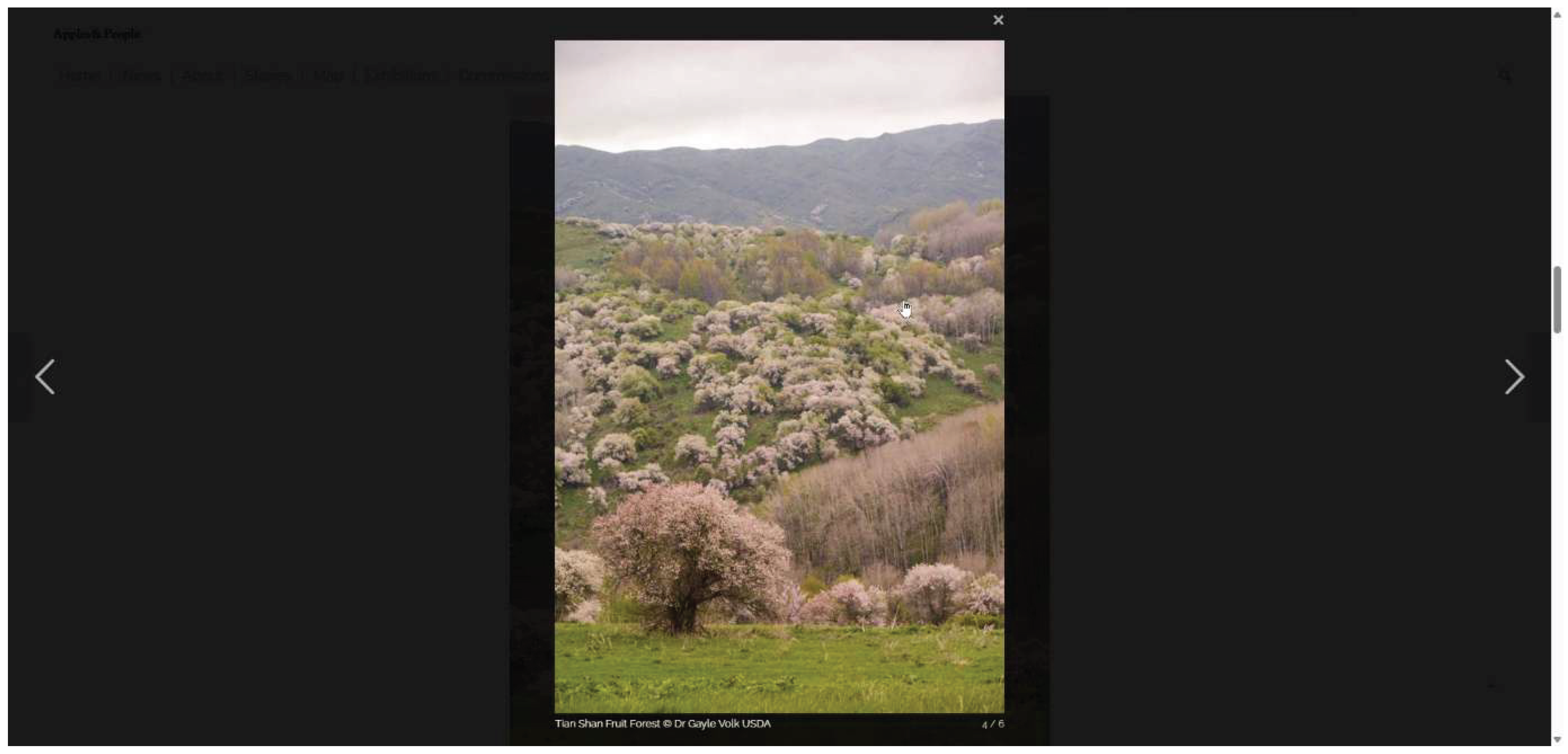
The fruit forests of the Tian Shan, which Vavilov identified as the source of the domestic apple, are themselves under threat. It is estimated that as much as 90% of the wild apple trees that existed in Vavilov’s time around Almaty, Kazakhstan’s largest city, have been lost due to human encroachment. The ancient fruit forests are cleared for housing, deforestation makes way for modern agriculture, trees are felled for wood fuel, and land is overgrazed. As a result, Malus sieversii is now on the international Red List of threatened species. (Anonymous 2021).
What remains of the fruit tree forests is a cultural and agricultural world heritage and should be protected wherever it can still be found. This has been recognized in the Tian Shan Mountains of Kazakhstan and is officially a protected area (Mountain Species Research Institute 2022) but other relict stands in Nepal, Iran, Uzbekistan, Turkmenistan, Armenia, Georgia, and Turkey should also be identified and protected as a world heritage. Eden is real, and it is worth protecting.
The Garden of Eden story in the Bible is an allegory or remnant of a deep historical memory from a time long past. It tells the story of the shift from foraging to food producing society that begin to take place about 10,000 BCE. This shift from foraging to food producing occurs over several thousand years before it is written down in ancient texts (e.g., Sumerian/Akkadian, Hebrew Bible, etc.). The presence of the wild tree fruit forest (with wild apples) where foragers were able to subsist may in fact form the basis for the Garden of Eden story.
Author Contributions
solely the work of the author.
Funding
no external funding used.
Acknowledgments
The author thanks Prof. Haskel Greenfield for encouragement, advice and review comments on this manuscript, and also thanks Prof. Eric Cline for discussion and encouragement to publish these findings.
Conflict of Interest
none.
References
- Anonymous 2021 Apples and People, 2021 https://applesandpeople.org.uk/stories/heavenly-mountains/.
- Anonymous 2025 Khosrov Forest State Reserve Wikipedia modified August 2025. https://en.wikipedia.org/wiki/Khosrov_Forest_State_Reserve.
- Çelik, Bahattin, and Orhan Ayaz. "Rise of Göbekli Tepe Culture:“Hunting Ground Economy” and the Role of Speculative “Knowledge”." Karadeniz Uluslararası Bilimsel Dergi 1.56 (2022): 143-160.
- Che, P. and Lan, J. 2021. Climate Change along the Silk Road and Its Influence on Scythian Cultural Expansion and Rise of the Mongol Empire. Sustainability 13, 2530. [CrossRef]
- Henry, Donald O. "Preagricultural sedentism: the Natufian example." Prehistoric hunters-gatherers. Academic Press, 1985. 365-384.
- Mayer, Hannes, and Hüseyin Aksoy. Wälder der Türkei (1986). G. Fischer, Stuttgart.
- Millard, Alan R.1984 The etymology of Eden. Vetus Testamentum 34.Fasc. 1: 103-106.
- 2022; 8. Mountain Species Research Institute 2022 Preserving Wild Apple Species in Western Tian Shan.
- Mueller-Bieniek, Aldona & Lityńska-Zając, Maria. 2001 New finds of Malus sylvestris Mill. (wild apple) from Neolithic sites in Poland. Vegetation History and Archaeobotany 10: 105-106. [CrossRef]
- Notroff, Jens & Dietrich, Oliver & Peters, Joris & Pöllath, Nadja & Köksal-Schmidt, Çiğdem. (2015). What modern lifestyles owe to Neolithic feast. The early mountain sanctuary at Göbekli Tepe and the onset of food-production.. Actual Archaeology. 32-49.
- Pendry, C.A., Ikeda, H, Pandey, J, Gudkova, P, Hinchliffe, W, and Jackson, M (2017) Plant collecting in Bajura District, far west Nepal, August 2017. Newsletter of Himalayan Botany 50(1) pp 1-10. May 2018.
- Rössner, C., Hristova, I., Riehl, S., & Marinova, E. (2025). Plant subsistence and environment in the Late Bronze Age of the Central Black Sea Region: archaeobotanical remains from Oymaağaç Höyük/Nerik and their Anatolian context. Archaeological and Anthropological Sciences, 17(6), 132.
- Spengler, Robert N. Fruit from the sands: the Silk Road origins of the foods we eat. University of California Press, 2020.
- Leningrad: Bulletin of Applied Botany and Plant Breeding. 1926 ( tDAR id: 125397).
- Vavilov, N. I. (1926). Centres of Origin of Cultivated Plants. Bull. Appl. Bot. Genet. Plant Breed., 16: 1-248.
- Vavilov, Nikolaĭ Ivanovich, and Vladimir Filimonovich Dorofeev. 1992 Origin and Geography of Cultivated Plants. Cambridge University Press, 1992. (translation from Russian of Vavilov’s 1935 publication).
- Woldring, Henk, and Rene Cappers. "The origin of the 'wild orchards' of Central Anatolia." Turkish Journal of Botany 25.1 (2001): 1-9.
- Zohary, Daniel 1973. The origin of cultivated cereals and pulses in the Near East. Chromosomes today, 4, 307-320.
- Zohary, Daniel and Maria Hopf 1994. Domestication of Plants in the Old World:The origin and spread of cultivated plants in West Asia, Europe, and the Nile Valley. Clarendon Press, Oxford.
Figure 1.
Vavilov Centers of Origin Fig. 1-Centers of origin of cultivated species, Vavilov (1926). .
Figure 1.
Vavilov Centers of Origin Fig. 1-Centers of origin of cultivated species, Vavilov (1926). .
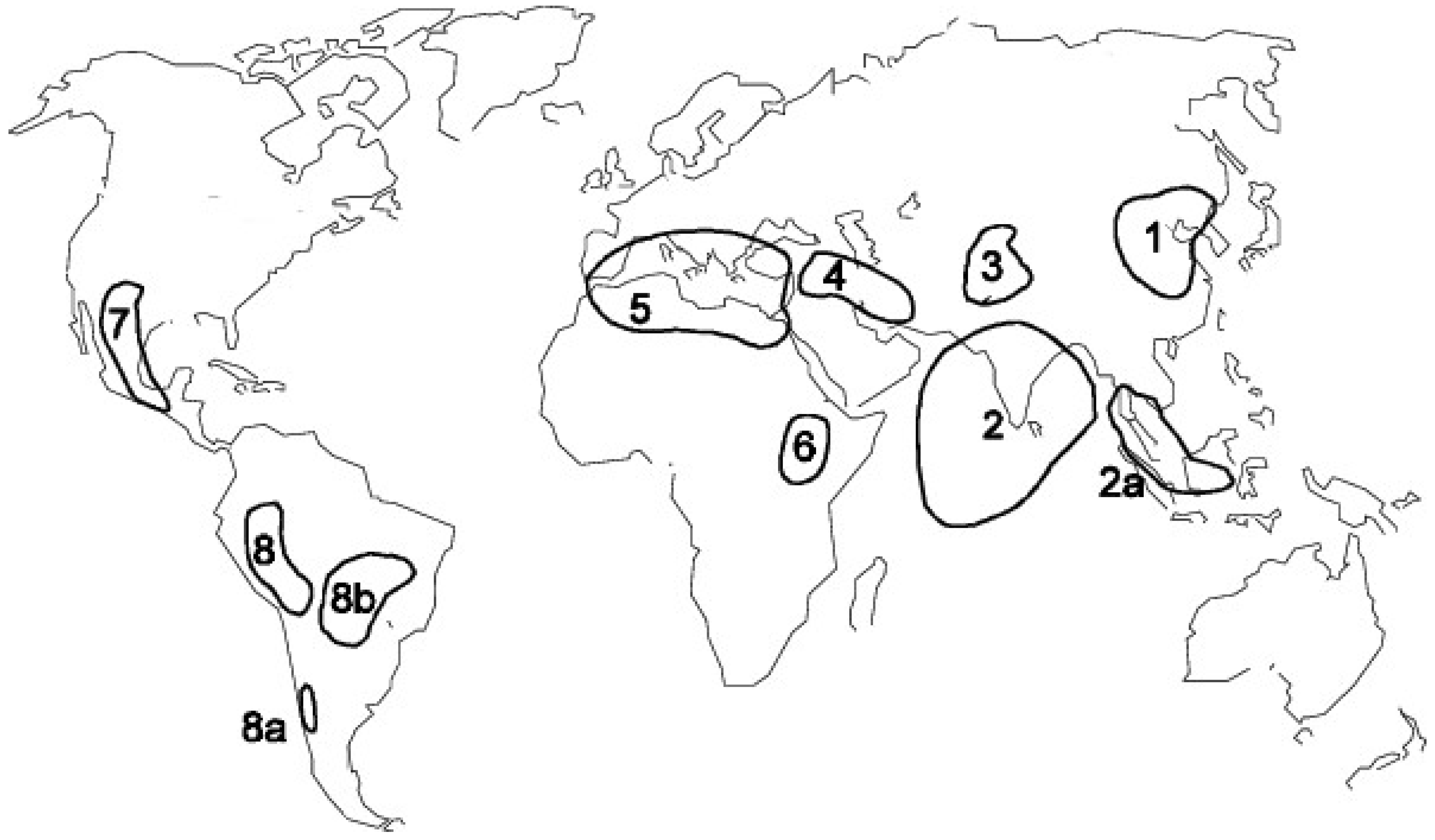

Table 1.
This is a table.
Disclaimer/Publisher’s Note: The statements, opinions and data contained in all publications are solely those of the individual author(s) and contributor(s) and not of MDPI and/or the editor(s). MDPI and/or the editor(s) disclaim responsibility for any injury to people or property resulting from any ideas, methods, instructions or products referred to in the content. |
© 2025 by the authors. Licensee MDPI, Basel, Switzerland. This article is an open access article distributed under the terms and conditions of the Creative Commons Attribution (CC BY) license (http://creativecommons.org/licenses/by/4.0/).
Copyright: This open access article is published under a Creative Commons CC BY 4.0 license, which permit the free download, distribution, and reuse, provided that the author and preprint are cited in any reuse.


