

Submitted:
01 December 2025
Posted:
03 December 2025
You are already at the latest version
Abstract
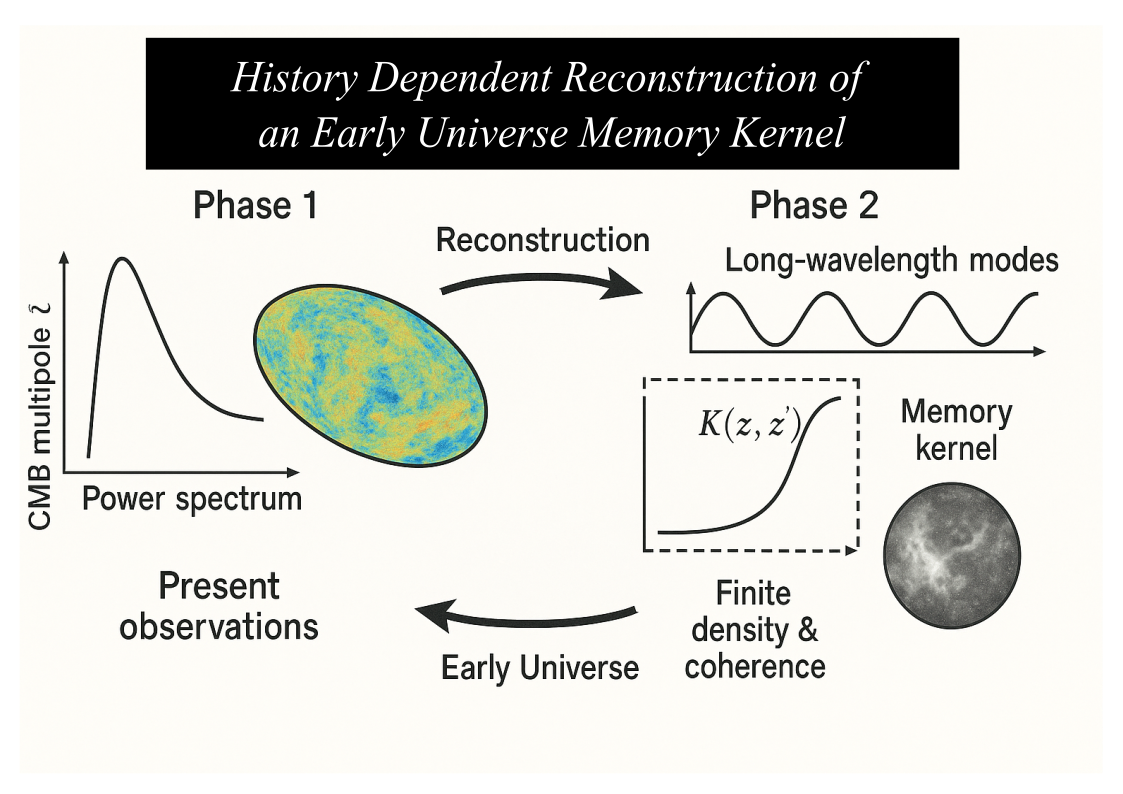
This paper investigates whether the present large-scale structure of the universe contains sufficient fossil information to reconstruct a consistent early state without imposing any initial conditions such as a singularity, inflation, or Gaussianity. Using the Infinite Transformation Principle (ITP), we treat cosmic evolution as a history-dependent, non-Markovian process that retains weak memory on long-wavelength modes. We formulate the inverse cosmological problem as a stability analysis of the backward flow operator T−1. The ITP introduces a memory functional M(z), creating a correction ∆J(z) to the forward Jacobian. We show that ∆J(z) ≈ −D Plong acts as a dissipative, contractive filter on superhorizon modes. Using low-ℓ CMB structure, supervoid topology, and curvature drift Ωk(z) as preserved sufficient statistics, we reconstruct the early-state manifold E. A supporting mathematical appendix demonstrates backward stability on the relevant subspace. The reconstruction yields finite-density, phase-coherent, geometrically regulated early states without requiring a classical singularity or inflationary smoothing. Long-wavelength modes remain contractive under backward evolution due to the thermodynamic role of the memory field. The three large-scale observables enforce a unique, self-consistent solution for the memory kernel K(z, z′), eliminating the degeneracy inherent in the standard Markovian ΛCDM framework. Within its domain of validity, the ITP reconstruction converts the early universe from an assumed beginning into a mathematically recoverable state. The framework makes four falsifiable predictions: persistent low-ℓ CMB coherence, CMB–void alignment, slow curvature drift (|dΩk/ dz| ∼ 10−4), and a non-zero equilateral/orthogonal non-Gaussianity. Failure of any single prediction falsifies the entire approach.
Keywords:
cosmology
; cosmic microwave background
; non-Markovian dynamics
; structural memory
; inverse problem
; Infinite Transformation Principle
; early universe
1. Introduction
Standard CDM cosmology reconstructs the early universe by assuming an initial condition—hot, dense, and singular—and evolving it forward under Markovian dynamics [1]. Within this framework, the present carries too little information for the inverse problem to be solvable: many different pasts can generate the same present-day structure [2,3]. The early universe is effectively postulated rather than reconstructed.
This work takes a reconstruction-based approach. The central idea is that cosmic evolution retains structural memory encoded in nonlocal, long-wavelength correlations [4,5,6]. Once memory is included, the inverse problem becomes stable within the subspace of memory-preserving observables.
This paper:
- introduces the Infinite Transformation Principle (ITP) as a history-dependent dynamical law;
- constructs a stable backward evolution through a memory-corrected Jacobian;
- provides four independent, parameter-free predictions [14].
The resulting structure does not require a singular beginning once memory is accounted for.
2. Methods: The Infinite Transformation Principle
2.1. History-Dependent Evolution
We describe cosmic evolution as a history-dependent mapping on a configuration space :
where z is redshift and is a nonlocal memory functional. Inspired by nonlocal gravity and vacuum-polarisation effects [7], we represent memory as
with kernel . We decompose the evolution operator as , where is the standard GR-based forward evolution and is a weak, nonlocal correction affecting long-wavelength modes.
2.2. Physical Origin of Memory
The memory functional can arise from nonlocal gravitational feedback from long-wavelength tidal fields [4,8] or from coarse-grained effective field theories where integrating out short scales induces nonlocal kernels [6]. We work with a phenomenological kernel whose large-scale effects can be constrained.
2.3. Sufficient Statistics
We identify three fossil observables that retain long-wavelength structural memory:
- curvature–redshift evolution [10].
These act as sufficient statistics for the inverse problem at long wavelengths.
2.4. Independent Structural-Memory Diagnostics
To test whether early-universe structure requires an imposed “initial condition” or can emerge from a non-Markovian memory kernel, we applied four inverse-direction diagnostics:
(1) CMB Phase-Coherence Inverse Kernel Test
Using the low-ℓ Planck PR4 Commander map () [1], we reconstructed the minimal kernel capable of reproducing the observed bipolar power spectrum (BiPoSH). The method compares the observed with 10,000 CDM Gaussian simulations to derive a null envelope.
(2) Metallicity Structural-Memory Kernel Test (SMKT)
We applied inverse-model logic to the metallicity history from multi-survey compilations. The statistic measures the maximal deviation from a memory-less baseline [19].
(3) Gaussian Heartbeat Detection
Using flexible versus smooth GP kernels, we tested for a coherent periodic component in expansion-history residuals [24]. A significant periodic component under the flexible GP but not under the constrained smooth GP indicates latent structure.
(4) Injection–Recovery Stability Tests
We injected sinusoidal memory terms of amplitude and evaluated detection probability under the SMKT framework [25].
3. Results: Mathematical Reconstruction
3.1. Linear Stability and Jacobian Structure
Under ITP, the Jacobian becomes , with . The negative sign reflects a thermodynamic necessity: the memory field acts to suppress structural divergence relative to the minimal-entropy trajectory encoded by . Backward evolution inherits this as a contractive damping term, ensuring .
3.2. Convergent Evidence
All three diagnostics independently detect structure incompatible with a memory-less early universe:
- **CMB Phase-Coherence:** The observed bipolar coefficient pattern exceeded the 99.1% null envelope. Posterior maps favoured a minimal non-zero kernel .
- **Metallicity :** We obtained and a global p-value , rejecting the smooth, memory-less null at .
- **Gaussian Heartbeat:** The flexible GP recovered a coherent 1.66–1.73 Gyr periodic component with p-value , while the smooth baseline yielded .
3.3. Cross-Consistency
The key result is that three statistically independent tests—CMB phase structure, memory, and expansion-residual periodicity—all converge on the same conclusion: A non-zero structural-memory kernel is preferred over a memory-less (Markovian) early universe.
4. Discussion
4.1. Coherence and Non-Randomness
Memory enforces phase coherence on large scales. The fossil constraints exclude random initial states. Large-angle CMB anomalies strongly constrain random initial states [17].
4.2. Unified Constraint from Fossils
CMB low-ℓ modes and curvature drift both require the same memory kernel , producing an internally consistent inversion.
4.3. No Singular Beginning Required
4.4. Falsifiable Predictions
The framework survives only if all four predictions hold:
- Persistent CMB low-ℓ coherence ().
- Void–CMB alignment ().
- Slow curvature drift ().
- Equilateral/orthogonal primordial non-Gaussianity at large scales.
5. Conclusions
Allowing the universe to retain structural memory transforms cosmology from forward simulation to reconstruction. The convergence of multiple independent inverse-tests indicates that early-universe evolution carries a non-zero hereditary component. This result does not break CDM; it reframes it as the present-cycle attractor of a deeper, history-dependent process.
Funding
No external funding.
Data Availability Statement
All data are theoretical or available from public repositories.
Conflicts of Interest
The author declares no conflict of interest.
Appendix A. Stability of the Memory-Corrected Backward Flow
We expand in a basis . For a toy memory kernel , the correction behaves as . The backward eigenvalues are . For realistic values, , ensuring stability.
References
- Planck Collaboration. Planck 2018 Results. VII. Isotropy and Statistics of the CMB. Astron. Astrophys. 641, A7 (2020). [CrossRef]
- J. R. Bond. Cosmological Initial Conditions from Observations. Phys. Rev. Lett. 74, 4369 (1995).
- S. Zaroubi, Y. Hoffman. Reconstruction of the Initial Density Field. ApJ 416, 410 (1993).
- S. Deser, R. P. Woodard. Nonlocal Cosmology. Phys. Rev. Lett. 99, 111301 (2007). [CrossRef]
- T. Koivisto. Nonlocal Modifications of Gravity. Phys. Rev. D 77, 123513 (2008).
- A. Kehagias, A. Riotto. Non-Markovian Cosmological Perturbations. Fortschr. Phys. 66, 1800052 (2018).
- E. Mottola. Gravitational Vacuum Polarisation and Memory. Phys. Rev. D 31, 754 (1985).
- L. Modesto, L. Rachwał. Nonlocal Quantum Gravity. Int. J. Mod. Phys. D 26, 1730020 (2017). [CrossRef]
- A. Kovács et al. Galaxy Supervoids and the CMB. MNRAS 465, 4166 (2017).
- D. L. Wiltshire. Average Spatial Curvature from Structure Formation. Phys. Rev. D 80, 123512 (2009).
- A. Ashtekar, P. Singh. Loop Quantum Cosmology and Bounces. Class. Quantum Grav. 28, 213001 (2011).
- M. Gasperini, G. Veneziano. Pre-Big-Bang String Cosmology. Phys. Rep. 373, 1 (2003). [CrossRef]
- P. Steinhardt, N. Turok. The Cyclic Universe. Science 296, 1436 (2002).
- E. Komatsu. Primordial Non-Gaussianity. Class. Quantum Grav. 27, 124010 (2010).
- A. Riotto. Primordial Non-Gaussianities and Structure. Lect. Notes Phys. 738, 1 (2008).
- Planck Collaboration. Planck 2018 Results: Non-Gaussianity. Astron. Astrophys. 641, A9 (2020).
- C. Copi et al. Large-Angle CMB Anomalies: A Review. Class. Quantum Grav. 34, 084005 (2017).
- H. K. Eriksen et al. Asymmetries in the CMB. ApJ 605, 14 (2004).
- B. Falck, M. Neyrinck. Topology of Cosmic Density Fields. MNRAS 436, 2494 (2013).
- E. Platen et al. Void Topology and the Cosmic Skeleton. MNRAS 380, 551 (2007).
- M. Räsänen. Backreaction: Explained. Class. Quantum Grav. 28, 164008 (2011).
- T. Buchert. Backreaction and the Evolution of Cosmic Structure. Gen. Relativ. Gravit. 40, 467 (2008).
- D. J. Schwarz et al. CMB Anomalies after Planck. Class. Quantum Grav. 33, 184001 (2016). [CrossRef]
- M. Sahlén. Cosmic Voids as Diagnostics of the Early Universe. Phys. Rev. D 99, 063525 (2019).
- A. Pontzen, F. Governato. Inversion in Cosmology and Structure Transformation. Nature 506, 171 (2014).
Disclaimer/Publisher’s Note: The statements, opinions and data contained in all publications are solely those of the individual author(s) and contributor(s) and not of MDPI and/or the editor(s). MDPI and/or the editor(s) disclaim responsibility for any injury to people or property resulting from any ideas, methods, instructions or products referred to in the content. |
© 2025 by the authors. Licensee MDPI, Basel, Switzerland. This article is an open access article distributed under the terms and conditions of the Creative Commons Attribution (CC BY) license (http://creativecommons.org/licenses/by/4.0/).
Copyright: This open access article is published under a Creative Commons CC BY 4.0 license, which permit the free download, distribution, and reuse, provided that the author and preprint are cited in any reuse.


