

Submitted:
01 December 2025
Posted:
03 December 2025
Read the latest preprint version here
Abstract
This paper focuses on algebraic-logical modeling of molecular genetic informatics systems and inherited biostructures. The focus is primarily on the development of a quantum-logical framework for modeling genetically inherited ensembles of coordinated cyclic (biorhythmic) processes characteristic of living organisms. The author develops a quantum-logical modeling approach based on the genetic alphabet of 4 unitary Hadamard matrices and cyclic power groups based on it. The possibilities and prospects of the proposed approach for the development of quantum-logical biology, genomorphic artificial intelligence, and biotechnology are discussed.
Keywords:
quantum logic
; quantum bioinformatics
; algorithms
; cycles
; biorhythms
; probability
; unitary matrices
; tensor product
; systolic processors
; artificial intelligence
; qubits
1. Introduction
All genetically inherited physiological organs are structurally linked to the bio-informational system of genetic texts on DNA and RNA molecules. Understanding the principles of genetic informatics is crucial for the development of biotechnology, artificial intelligence, medicine, and other fields. Information and communication systems are built on the initial introduction of a particular alphabet for the formation of information messages. For example, all computer programs rely on corresponding computer alphabets. Genetic informatics today is based on knowledge of the alphabets of the four nucleotides of DNA and RNA. However, as Nobel laureate in chemistry T. Steitz emphasizes, all knowledge about the biochemical structure of proteins and nucleic acids encoded in the genome will not tell us, for example, how a butterfly flies [23]. Similarly, they won’t tell you how turtles, after hatching from an egg, immediately, without any teaching, begin to crawl toward the water with coordinated movements of their limbs, which requires the logically coordinated activity of millions of their nerve and muscle cells. Such genetically inherited logical forms of collective behavior in biosystems require a search for a corresponding bioinformatics system hidden within living nature, based on a suitable alphabet. This hidden informatics and its alphabet are apparently linked to quantum mechanics and quantum information science, as genetic molecules belong to the microworld of quantum mechanics, and many authors have long suspected that living organisms are quantum-like entities. This article presents the author’s discovery of a genetic alphabet of 4 unitary Hadamard operators and the development of quantum-logical bioinformatics based on it. This should open up possibilities for mathematical modeling of the logical features of the structure and behavior of multicomponent body parts, including the features of multiple, time-coordinated cyclic bioprocesses.
To find the alphabet for such a bioinformatics system, the author turned to a well-known universal rule concerning to the statistical structure of nucleotide sequences of long single-stranded DNAs in higher and lower organisms, which is not deducible from knowledge of the alphabet of four DNA nucleotides. This is Chargaff’s phenomenological second rule, the validity of which has been verified by many authors (see reviews in [5,28]). The use of statistical data corresponding to this rule in genetic matrices, described below, revealed the connection between genetic informatics and the set of four unitary Hadamard matrices proposed by the author as a quantum-logical genetic alphabet for the development of the desired quantum-logical bioinformatics system.
Unitary operators are the foundation of computation in quantum computers, where they serve as logical gates [15]. Therefore, the four unitary Hadamard matrices of the genetic alphabet can also be called “genetic gates” for brevity. This article provides specific examples of modeling known biological phenomena from the perspective of this developing bioinformatics theory, which relies on this alphabet of unitary operators, as well as its algebraic extensions, cyclic groups of unitary operators, and quantum logic formalisms. These and other examples confirm the adequacy of the emerging quantum-logical bioinformatics system, which offers new approaches to modeling inherited biological phenomena.
The founder of quantum information science, Yu. I. Manin, introduced the concept of a quantum computer in his book ([14], p. 15) precisely when analyzing the characteristics of high-speed processing of DNA information in chromosomes by “genetic automata,” prophetically pointing to the important role of unitary operators and tensor products: “A quantum automaton must be abstract: its mathematical model must use only the most general quantum principles, without prejudging physical implementations. Then the evolution model is a unitary rotation in a finite-dimensional Hilbert space, and the model of virtual separation into subsystems corresponds to the decomposition of space into a tensor product. Somewhere in this picture, there must be a place for interaction, traditionally described by Hermitian operators and probabilities.” Thus, the very birth of quantum information science, so promising for the development of artificial intelligence and quantum-logical biology, occurred thanks to the desire to understand the characteristics of genetic information science. The data presented below on the genetic alphabets of unitary operators, their cyclic groups and tensor products in connection with the formalisms of quantum logic and universal rules of probability in the statistical organization of long DNAs are consistent with this prediction of Yu. I. Manin.
The aforementioned second Chargaff’s rule, which is universal for long DNAs (over 100 kbp) of higher and lower organisms, states the following: in long single strands of DNAs, the percentages of adenine and thymine are practically the same (%A ⋍ %T), as are the percentages of cytosine and guanine (%C ⋍ %G). It follows that in long single strands of DNAs, the percentages of purines A and G are practically equal to the percentages of pyrimidines C and T: %A + %G ⋍ %C + %T ⋍ 0.5. Another consequence is the practical equality of the percentages of amino and keto molecules: %C + %A ⋍ %T + %G ⋍ 0.5 (percentages are shown as fractions of a unit). These universal genetic facts are used below.
2. Genetic Matrices of DNA Nucleotide Alphabets and the Genetic Alphabet of Four Unitary Hadamard Operators
Molecular biology views the information messages of DNA genetic molecules as written in an alphabet of 4 nucleotides: adenine A, cytosine C, guanine G, and thymine T. This alphabet carries a system of binary-opposition traits (indicators), which distinguish three types of binary sub-alphabets within it:
- -
- 1) Two of these nucleotides are purines (A and G), having two rings in their molecule, and the other two (C and T) are pyrimidines, containing one ring. This gives a binary representation (binary sub-alphabet) C = T = 0, A = G = 1;
- -
- 2) Two of these nucleotides are keto-molecules (T and G), and the other two (C and A) are amino-molecules, which gives a binary representation C = A = 0, T = G = 1;
- -
- 3) Pairs of complementary nucleotides A-T and C-G are linked by 2 and 3 hydrogen bonds, respectively (called weak and strong hydrogen bonds in genetics), which gives a binary representation C = G = 0, A = T = 1.
For this reason, DNA alphabets of 4 nucleotides, 16 duplets, and 64 triplets can be represented in the form of square genetic matrices, the columns of which are numbered with the binary symbols of one of these sub-alphabets, and the rows with the binary symbols of the other [16,20]. Figure 1 shows an example of the arrangement of the 4 nucleotide alphabet in a genetic (2•2)-matrix, the rows of which are numbered with the binary red symbols of the “amino or keto” sub-alphabet, and the columns with the binary green symbols of the “strong or weak hydrogen bonds” sub-alphabet. In this matrix, pyrimidines C and T are located on the main diagonal (according to Chargaff, their total probability is 0.5 in long single-stranded DNA), and purines A and G are on the second diagonal (according to Chargaff, their total probability is also 0.5). In quantum mechanics, the results of measurements are not predictable and one can only speak about the probabilities of various outcomes. To evaluate them, the concept of mathematical expectation or weighted average of the observed value is traditionally used; due to this, we have the equality of average probabilities 0.5/2 = 0.25 for each nucleotide in a pair of pyrimidines (%C = %T = 0.25) and in a pair of purines (%A = %G = 0.25). Representing each nucleotide in the named matrix in Figure 1 with its average probability of 0.25, we obtain a genetic probability matrix, doubling which gives the shown WD matrix:
The probabilistic genetic matrix WD (Figure 1) is a real Hermitian matrix (coinciding with its transposed version) and a metric tensor. It also represents a projector, since it satisfies the projector condition: the square of a matrix is equal to the matrix itself. It is particularly significant that this genetic Hermitian matrix WD, constructed on the binary sub-alphabets of DNAs and the phenomenological equality of the probabilities of purines and pyrimidines in long single-stranded DNAs, is a doubly stochastic matrix: the sum of the elements in each row and each column of such a matrix is equal to one. However, the following theorem is known regarding doubly stochastic matrices [21]:
- If the matrix V = ||vij||n is unitary, then the matrix W = ||wij||n, where wij = |vij|2, is doubly stochastic.
According to this theorem, the doubly stochastic genetic matrix WD of probabilities (Figure 1) corresponds to four unitary Hadamard genetic matrices, denoted here as HC, HA, HT, and HG (Figure 2): squaring all components of each of these unitary matrices generates the doubly stochastic matrix WD. One should remark that these same four unitary matrices HC, HA, HT, and HG , but taken with a minus sign, are treated as their banal analogue and are not considered separately.
Identifying this connection between the statistical universals of genomic DNAs and these four unitary Hadamard matrices is important due to the significance of unitary transformations (unitary operators) for quantum mechanics, quantum computing, biosystems, signal processing engineering, and other fields. Unitary transformations preserve vector lengths and scalar products (preserve the metric), representing rotation and mirror reflection operators. Unitary matrices satisfy the criterion: the product of a unitary matrix and its transpose is equal to one. Unitary transformations with real components are called orthogonal transformations, but in this article we will use their more general name, “unitary transformations,” under which they are better known in various fields of science. In quantum mechanics, unitary transformations describe the time evolution of isolated quantum systems. In quantum mechanics (unlike classical mechanics), observable quantities are represented not by numbers, but by operators. In quantum computers, all calculations are performed using unitary operators, which act as gates (logical gates), and any unitary operator can be used as a gate in quantum computing [15]. We will call the four unitary operators HC, HA, HT, and HG (Figure 2) genetic Hadamard gates. These genetic gates are four variants of the (2•2) Hadamard matrix with a weighting factor of 2-0.5, which is traditionally used in quantum computing to transform the Hadamard matrix into a unitary operator. By definition, the Hadamard matrix Hn is a square matrix of size n•n, composed of the numbers 1 and -1, whose columns are orthogonal and the relation Hn•HnT = n•En holds, where En is the identity matrix of order n. Among the properties of Hadamard matrices is the fact that permuting any rows and columns of the Hadamard matrix always yields a new Hadamard matrix. In passing, we note that in the general case, Hadamard matrices have many other remarkable properties and applications (see, for example, [1]).
One of these four Hadamard genetic unitary gates — the HT — has long been used in quantum computers for fundamental operations on qubits, serving as a key element in many quantum algorithms, including the Deutsch-Jozsa algorithm and Shor’s algorithm. This Hadamard gate provides quantum algorithms with a superposition principle for dealing with quantum entanglement for demonstrating their quantum superiority—their significantly more efficient operation compared to known classical algorithms [15].
Of the four genetic Hadamard gates, two gates HA and HT are mirror reflection operators. Raising them to integer powers generates the corresponding cyclic groups of unitary operators with period 2. The other two unitary matrices (HC, HG) are rotation operators (HC counterclockwise, HG clockwise) and matrix representations of the complex number Z = (1+i)•2-0.5, where i is the imaginary unit of the complex number (i2 = -1). Raising these unitary matrices HC and HG to integer powers generates cyclic (with period 8) groups of unitary operators, which are matrix representations of the complex numbers (1).
HCn = HCn+8, HGn = HGn+8, HAn = HAn+2, HTn = HTn+2
Moreover, any of the unitary matrices HC and HG can be represented as the product of k unitary matrices, which are their kth roots. In other words, the action of a single unitary operator, for example, HC can be represented as the action of a sequence of k more fractional unitary operators HC1/k. Thus, with the matrix-vector approach, any large transformation in the system from the action of such a whole operator HC can be represented as consisting of a sequence of arbitrarily small transformations from the action of the corresponding sequence of unitary operators HC1/k for modeling quasi-continuous transformations in the simulated cyclic processes. We also note that raising the genetic gate HC or HG to a power representing the cycle-by-cycle cyclic function of time allows modeling quasi-continuous cyclic bioprocesses as vector sequences of their beat-by-beat states.
Projectors (projection operators) play an important role in quantum logic. In light of this, we note that the unitary Hadamard matrices in the HC and HG operators are sums of sparse matrices representing projectors Ps satisfying the projector criterion Ps2 = Ps and shown in parentheses in expression (2):
HC = 2-0.5 • [1 -1; 1 1] = 2-0.5 • ([1, 0; 1, 0] + [0, -1; 0, 1]),
HG = 2-0.5 • [1 1; -1 1] = 2-0.5 • ([1, 0; -1, 0] + [0, 1; 0, 1])
HG = 2-0.5 • [1 1; -1 1] = 2-0.5 • ([1, 0; -1, 0] + [0, 1; 0, 1])
Many genetically inherited biological structures in organisms are clearly linked to unitary transformations of rotations and mirror images. For example, the kinematic schema of the human body and its locomotion is based on unitary transformations of rotations at the joints (the human body has approximately 300 joints) and mirror symmetry of the left and right halves of the body. Human motor activity is reduced to the skillful control by the nervous system of ensembles of these unitary transformations in the kinematics of the body, which is associated with the genetically inherited ability of the nervous system to operate unitary transformations. Moreover, a person’s very concept of their body schema is innate: people with limbs missing from birth and no personal experience using them nevertheless perceive them as truly existing, with phantom pain in them [25,26].
When studying human sensorimotor characteristics, it’s important to consider that the genetically inherited nervous system is structurally related to the genetic system. Humans perceive the world through probabilities in statistical streams of signals from neurons in the retina (containing millions of receptor cells) and other sensory organs. Norbert Wiener, the father of cybernetics, asserted: “Genetic memory—the memory of our genes—is essentially determined by nucleic acid complexes...there are reasons to believe that the memory of the nervous system has a similar nature” [22,27].
Another example of the biological importance of unitary transformations is the construction of complex three-dimensional protein shapes in the body, known as protein folding. These shapes are based on unitary transformations involving the rotation of protein molecule segments relative to each other around relatively strong carbon-carbon bonds. Many bio-technologies rely on knowledge of proteins.
The author proposes to consider and use the family of 4 genetic unitary Hadamard operators HC, HA, HT, HG (Figure 2) as a basic genetic quantum-logical alphabet for the development on its basis of the theory of a quantum-logical information system that allows modeling genetically inherited and logically organized biological structures and phenomena.
Here, the distinctive features of quantum logic should be clarified [3,24]. Quantum logic is an algebraic system for describing, using quantum gates, how qubits operate and interact and how to extract information from them. In quantum logic, “logic” is not contained in reasoning, but in the mathematical description of states and operations. Quantum logic can be formulated as a modified version of propositional logic. For comparison, recall that classical Boolean logic is a set of logical rules (AND, OR, NOT, etc.) describing how bits (0 or 1) can be combined and transformed according to the laws of Boolean algebra with its key principle of distributivity and the statements “true” or “false.” Quantum logic considers not “true/false” statements, but questions to a quantum system. The answer to such a question is provided by the probability value obtained during measurement. Logical operations are replaced by quantum gates (unitary operations): NOT becomes an X gate, and completely new operations emerge that have no analogues in classical logic, such as the Hadamard gate, which creates superposition. Quantum logic operates on qubits, vectors, and matrices, not sets. Its mathematical foundation is the theory of Hilbert spaces, and projective and unitary operators. The state space of a quantum system is described by vectors, and rotations of these vectors serve as logical operations. Quantum logic lacks distributivity, which is considered its key difference from Boolean logic. Quantum logic is a branch of logic necessary for reasoning about propositions that take into account the principles of quantum theory. It was founded in 2036 by the work of G. Birkhoff and J. von Neumann [2], who tried to reconcile the inconsistencies of classical logic with the facts about measurements in quantum mechanics and saw in quantum logic a possible foundation for physics.
Unitary Hadamard matrices of the basic genetic alphabet HC, HA, HT, HG (Figure 2) and many types of their combinations into unitary matrices of higher orders form—when they are repeatedly raised to a power—cyclic groups of operators that have different periods and are used to model cyclic sequences of states of quantum-like systems. The resulting algebraic-geometric apparatus is intended, first of all, for quantum-logical modeling of a variety of genetically inherited cyclic and hypercyclic biostructures. Let us note that the quantum-logical approach developed by the author to inherited cyclic and hypercyclic biostructures based on Hadamard’s alphabet of genetic gates and the mathematical apparatus of quantum logic is fundamentally different from the well-known biochemical concept of catalytic cycles and hypercycles [4].
Worldwide research in the field of genetic informatics is largely based on the basic fact of the existence in the DNAs of all organisms of a molecular alphabet of 4 nucleotides C, G, A, T and its extensions into alphabets of 16 duplets, 64 triplets, etc. In parallel with this molecular alphabet of 4 nucleotides, now in bioinformatics and genetic biomechanics it is possible and necessary to work with the alphabet of 4 genetic Hadamard gates, that is, with the alphabet of a fundamentally new type: the quantum-logical alphabet of 4 unitary operators HC, HA, HT, HG, on the basis of which mutually related sets of unitary operators of higher orders arise. These genetic unitary Hadamard matrices are associated with the corresponding complete orthogonal systems of Walsh functions. The latter are the basis of special spectral analysis of signals in digital information science and are associated with cyclic Gray codes, logical holography, Walsh antennas, as well as the fractal Hilbert curve, which, as is known, corresponds to the spatial packaging of chromatin in the human genome [13]. The connection between Hadamard matrices and the listed areas is described in our works [16,17,20].
The mathematical properties of the alphabet of 4 genetic gates and the sets of unitary operators built on their basis are subject to systematic study. For example, the question of the existence in this set of non-commuting unitary operators whose commutators are not equal to zero is subject to study (in quantum mechanics, the study of pairs of operators characterized by non-zero commutators led to the formulation of the Heisenberg uncertainty principle). Already in the alphabet of 4 Hadamard genetic gates there are three pairs of non-commuting unitary operators characterized by non-zero commutators (3); the values of these commutators are equal in two cases to the Hadamard matrices, and in the third to the matrix representation of the double imaginary unit i of the complex number:
HA•HC - HC•HA = [1, 1; 1, -1],
HC•HT - HT•HC = [-1, 1; 1, 1],
HA•HT - HT•HA = [0, -2; 2, 0]
HC•HT - HT•HC = [-1, 1; 1, 1],
HA•HT - HT•HA = [0, -2; 2, 0]
At this stage of research, the question of the genetic significance and possible interpretation of these and other facts of non-zero commutators among genetic unitary operators remains open for discussion (it is possible that when analyzed from the standpoint of quantum bioinformatics, this question will turn out to be associated with the well-known phenomenon of chirality in biological structures, taking into account the known facts about the existence of chirality in quantum physics of elementary particles).
The next section examines the development of the mathematical apparatus of quantum-logical bioinformatics, which includes an enlarged set of genetic unitary operators and their cyclic groups for modeling genetically inherited cyclic biostructures and biorhythmic processes.
3. Expansion of the Set of Genetic Unitary Operators
The DNA alphabet of 4 nucleotides C, A, T, G is identical in the number of elements to the quantum-logical alphabet of 4 genetic Hadamard gates HC, HA, HT and HG proposed by the author (Figure 2). In matrix genetics, it is known that, based on the genetic (2•2)-matrix of the alphabet of 4 nucleotides, by raising it to tensor powers, genetic (2n•2n)-matrices are formed with a strictly regular arrangement of 16 doublets, 64 triplets, 256 tetraplets, etc., respectively [16,20]. Figure 3 shows examples from these books of genetic matrices of 4 nucleotides, 16 duplets and 64 triplets obtained in this way tensorially.
The tensor product is a critical operation in the quantum mechanics of multicomponent systems and quantum information science [15]. By analogy with the tensor family of genetic matrices based on the alphabet of 4 nucleotides (Figure 3), we construct a tensor family of genetic matrices based on the alphabet of 4 Hadamard genetic gates HC, HA, HT, and HG (Figure 2), for example, by simply replacing the nucleotide symbols C, A, T, and G with similarly indexed symbols of these gates and connecting adjacent gates in a bundle with the tensor multiplication sign ⊗ (Figure 4).
We emphasize that the tensor product of unitary Hadamard operators always yields a unitary Hadamard operator of increased order, conjugate, as noted above, with the corresponding complete orthogonal system of Walsh functions, cyclic Gray codes, the fractal Hilbert curve, logical holography, Walsh antennas, etc. [15,16,17]. Accordingly, the content of each cell in the (2n•2n)-matrices of the tensor family [HC, HA; HT, HG](n) is a unitary Hadamard operator of the corresponding order. Raising each of these Hadamard gates to an integer power generates a cyclic group of unitary operators characterized by a certain period. It can be shown that the periods of all cyclic groups of gates within each of the matrices of this tensor family are interconnected on the basis of multidimensional hypercomplex numbers. Let us demonstrate this using the example of the first two matrices of the tensor family of matrices under consideration, located at the top of Figure 4.
The cyclic groups based on raising the terms of the matrix 4 of the alphabetic gates HC, HA, HT, HG to integer powers n have periods 8 and 2, as indicated above in expression (1). Figure 5 shows a representation of this matrix (from Figure 4) as a matrix of periods D, which indicates the values of the periods of the cyclic groups of each of these genetic gates. It is also shown that this matrix of periods D is the sum of two sparse matrices r0 and r1 with weight coefficients 8 and 2. But the set of these matrices r0 and r1 is closed with respect to multiplication and determines the table of their multiplication (Figure 5 below), which is known in mathematics as the multiplication table of the basis elements of the algebra of 2-dimensional hyperbolic numbers [8,16]. This means that the period matrix D is a matrix representation of the 2-dimensional hyperbolic number 8+2j, where j is the imaginary unit of the hyperbolic number (j2 = +1).
Let us now turn to the matrix of 16 tensor duplets of gates from Figure 4. The cyclic groups based on raising the items of this matrix to integer powers have periods of 2, 4, and 8. Figure 6 shows the (4•4)-matrix D2, representing the named matrix of unitary operators as a matrix of periods of the corresponding cyclic groups of its 16 terms. This matrix D2 is a bisymmetric Hermitian real matrix. The sums of the components in each of its rows and columns are the same (with appropriate normalization, it becomes a doubly stochastic matrix). As shown in Figure 6, the matrix D2 is the sum of 4 sparse matrices s0, s1, s2, s3 (the numbering corresponds to the order of their sequence in Figure 6 from left to right) with weight coefficients 4, 8, 8, 2. The set of these 4 sparse matrices is closed under multiplication and determines the table of their multiplication, known in mathematics as the multiplication table of basis elements of the algebra of 4-dimensional hyperbolic numbers [8,16]. This means that the matrix of periods of the considered cyclic groups of unitary operators D2 is a matrix representation of the 4-dimensional hyperbolic number 4s0 + 8s1 + 8s2 + 2s3, where s0 – is the identity matrix; s1, s2, s3 are matrix representations of imaginary units of 4-dimensional hyperbolic numbers.
In the general case, such a tensor family of (2n•2 )-matrices [HC, HA; HT, HG](n), obtained by raising the original alphabetic matrix of 4 genetic Hadamard gates to the tensor power (n), contains 4n unitary operators, each of which, when raised to an integer power, determines its own cyclic group of unitary operators with a certain period. A detailed analysis of the set of these tensor-generated Hadamard unitary operators is to be carried out in the future, including the study of their transformations under cyclic permutations of their columns and rows, as well as the study of commutators between individual operators, etc. A living organism is an enormous genetically inherited ensemble of coordinated cyclic processes occurring at all levels of biological organization: molecular, subcellular, cellular, supracellular, and organismal [17,18]. Therefore, cyclic groups of unitary operators associated with the structural features of genetic informatics are needed for quantum-logical modeling of these ensembles of cyclic bioprocesses.
In addition to the described tensor generation of new unitary operators based on the genetic alphabet of 4 Hadamard gates, there is also another approach to their formation. It consists of constructing multiblock matrices, the blocks of which are the alphabetic Hadamard gates HC, HA, HT, HG. In this way, unitary matrices are formed, which are, in particular, matrix representations of Hamiltonian quaternions and biquaternions, which are closely related to physics, robotics, artificial intelligence, etc. Thus, thousands of papers in physics have been devoted to quaternions and biquaternions in the 20th century alone [6]. This attention to them is due to the fact that quaternions are closely related to Pauli matrices, the theory of the electromagnetic field, the quantum-mechanical theory of chemical valence, the theory of spins, the rotation of bodies in three-dimensional space, etc. Fig. Figure 7 shows one example of such a construction, which yields a unitary Hadamard matrix Q, which is a matrix representation of a Hamiltonian quaternion.
Indeed, as shown in Figure 8, this matrix Q is the sum of four sparse matrices v0, v1, v2, v3: Q = 0.5(v0 + v1 + v2 + v3), where v0 is the identity matrix. The set of these sparse matrices is closed under multiplication and defines a multiplication table for them, which coincides with the well-known multiplication table of the basis elements of the Hamiltonian quaternion algebra [8]. This means that the matrix Q is a unitary matrix representation of a quaternion, where v1, v2, v3 represent the imaginary units of the quaternion. Quaternions that have unitary matrix representations we call “unitary quaternions” for brevity.
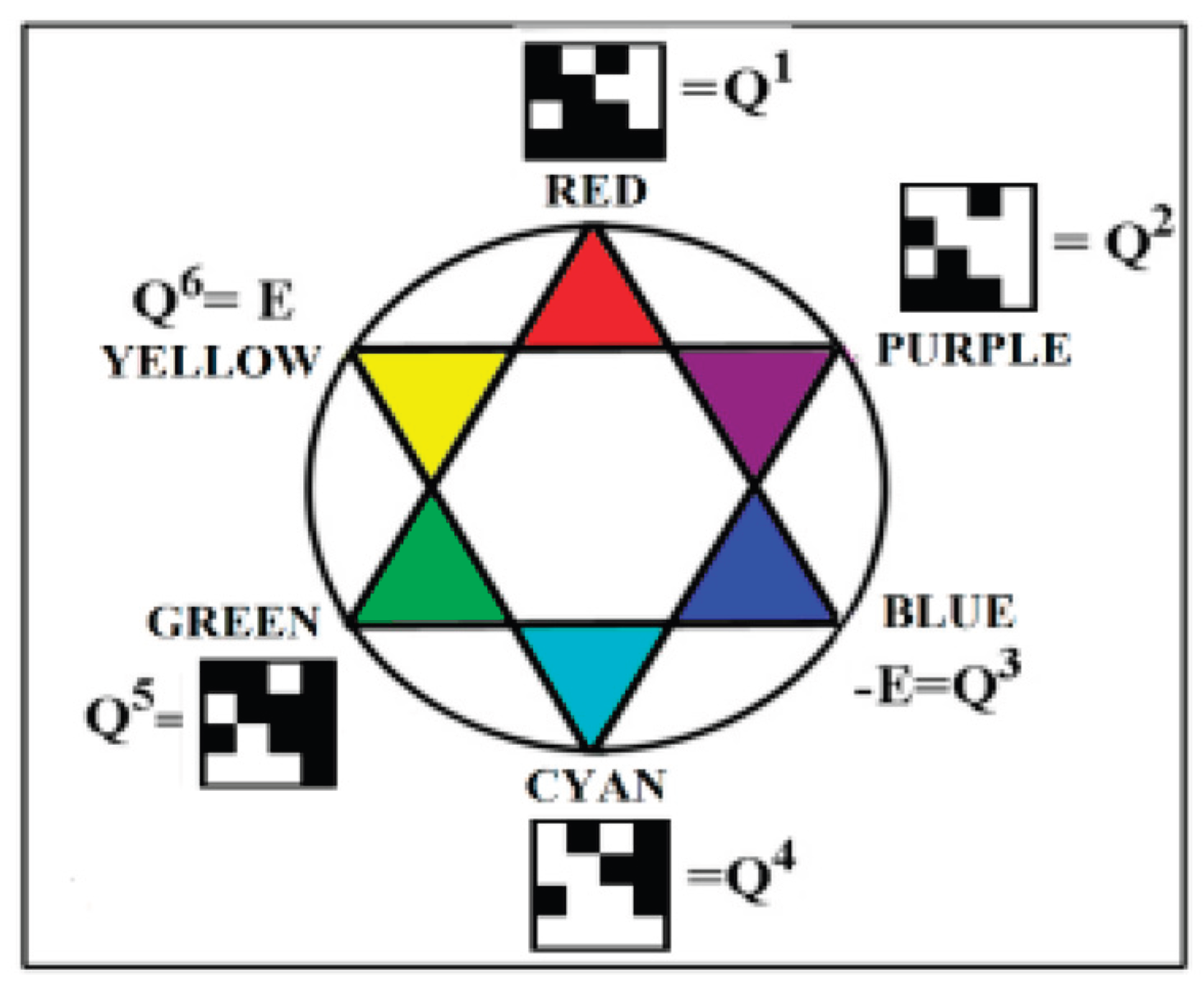
Raising this unitary quaternion to integer powers Qn generates a cyclic group of unitary operators with a period of 6. This cyclic group models a number of genetically inherited biological structures. For example, the regular features of human color perception, represented in Newton’s 6-sector color wheel for the three primary and three complementary colors (Figure 9), correspond to the cyclic group of the unitary quaternion Qn; its period contains 6 terms, the algebraic relationships of which correspond to the relationships of these colors in human color perception:
-1) colors opposite on the color Newton’s wheel cancel each other out when superimposed (just as unitary quaternion matrices opposite on the wheel cancel each other out when added together to form the zero matrix);
-2) each color on the Newton’s wheel is the sum of the two colors on either side of it (the same is true for the corresponding unitary quaternions);
- 3) the three primary colors, as well as the three additional colors located at the vertices of the two triangles of the “Star of David” on the Newton’s wheel, cancel each other out when superimposed (similarly, the sum of the unitary quaternions at the vertices of each of the two triangles of the “Star of David” is equal to zero).
In psychophysics, it is well known that color is not a physical property of an object, but rather a person’s inherited psychophysical response to the light stimuli coming from the object. In modern literature, the characteristics of color perception, like other characteristics of sensory experience, are referred to as “qualia.” The topic of qualia is one of the most pressing and widely discussed in modern philosophy, which sees it as the key to understanding the nature of consciousness. In light of this, it is significant that the described quantum-logical bioinformation system, based on the genetic alphabet of Hadamard unitary operators, allows for the algebraic modeling of the qualia-properties of human color perception.
The limited space of this article does not allow for the presentation of numerous other results and examples of quantum-logical modeling of genetically inherited biostructures based on the alphabet of Hadamard genetic gates HC, HA, HT, HG. These will be discussed by the author later in a comprehensive publication.
Some concluding remarks
In a quantum-logical approach to bioinformatics, taking into account inherited ensembles of the cyclical (or pulsating) structures in living bodies, the author relies on a model of biomechanical environments consisting of interconnected pulsating structures that change in a coordinated manner over time. The theory of such model software environments can be used in the development of artificial intelligence, including in connection with systolic processors and pulsating information lattices (pulsirs) architectures known in computer technology [7,10]. The name “pulsating” reflects the essence of this architecture, traditionally compared to a heartbeat or pulse. The pulsation appears as a wave of data, and the computational process appears as the propagation of waves of activity. Data received at the lattice inputs begins to “pulsate” through it, being transformed at each step. The lattice can be configured so that different data streams collide and interact in specific cells at strictly defined intervals, generating a new “pulse” of results. This architecture is fundamentally different from the von Neumann architecture of conventional processors because it has no central control unit; all cells operate simultaneously and synchronously; data is not written in the classical sense, but continuously “pulses” through the processor structure, like the flow of blood through capillaries. The operation of such a pulsating information grid is compared to the work of the heart: the grid is compared to the muscle tissue of the myocardium; the processing elements are compared to individual muscle cells of the heart (cardiomyocytes); the heartbeat is compared to the electrical impulse from the sinoatrial node; computation is compared to the coordinated contraction of the heart pumping blood; information data is compared to the pumped blood. Moreover, “computation” (blood pumping) is an emergent property of the entire organ, pulsating in a coordinated rhythm; no single cell is responsible for this, but all cells follow the general rhythm and local interactions. Significant problems in programming and hardware have prevented pulsating information grids from becoming widespread. The most famous example of the pulsir concept is the Connection Machine, developed by Thinking Machines Corporation in the 1980s. The pulsir concept is also closely related to a number of modern architectural concepts, for example, the concept of systolic arrays or systolic processors, whose name comes from the analogy of their pulse-like operation with cardiac systoles [11,12]. Biosimilar systolic processors extremely effective in artificial intelligence, image processing, pattern recognition, computer vision, and other tasks that animal brains are particularly good at. An example is Google’s Tensor Processing Unit (TPU), which uses a large two-dimensional systolic array to perform the massive matrix multiplications required for neural networks with high efficiency.
The quantum-logical bioinformatics system presented in this article, based on the alphabets of unitary operators, is useful for explaining why complex organisms evolved so rapidly in biological evolution: complex organs and tissues are formed not so much by the emergence of new genes, but by changes in the ways in which existing genes are used under the influence of quantum-logical bioinformatics operators. This quantum-logical bioinformatics appears to be useful for the analysis of gene networks and related problems [9]. An important component of the formalisms of this quantum-logical informatics are tensor-unitary transformations, which provide an increase in the dimensionality of configurational vector Hilbert spaces in quantum-logical models of growing biosystems [19].
Acknowledgments
The author thanks S.Ya. Kotkovsky, Yu.I. Manin, V.I. Svirin, I.V. Stepanyan, and G.K. Tolokonnikov for their collaboration.
References
- Balonin N. A., Sergeev A. M. Hadamard matrices with symmetries in illustrations // Monograph. SPb.: GUAP, 2024.
- Birkhoff G., von Neumann J. The Logic of Quantum Mechanics. 1936. Vol. 37, P. 823-843.
- Cohen D. An Introduction to Hilbert Space and Quantum Logic. - Springer-Verlag, 1989.
- Eigen M., Schuster P. The Hypercycle. A Principle of Natural Self-Organization // Springer-Verlag Berlin Heidelberg New York, 1979.
- Fimmel E., Gumbel M., Karpuzoglu A., Petoukhov S. On comparing composition principles of long DNA sequences with those of random ones // Biosystems. 2019. Vol. 180. P. 101-108.
- Gsponer A., Hurni J.-P. Quaternions in mathematical physics (2): Analytical bibliography // arXiv:math-ph/0511092v3. 6 July 2008. 124 p. https://doi.org/10.48550/arXiv.math-ph/0511092.
- Guzik V. F., Shmoilov V. I., Kirichenko G. A. Pulsating information grids with matrix switching // News of universities. North Caucasian region. Series: Technical sciences. 2014. No. 6 (181). URL: https://cyberleninka.ru/article/n/pulsiruyuschie-informatsionnye-reshyotki-s-matrichnoy-kommutatsiey.
- Kantor I. L., Solodovnikov A. S. Hypercomplex numbers // Springer-Verlag. 1989.
- Kolchanov N. A., Vishnevsky O. V., Furman D. P., editors. Introduction to Information Biology and Bioinformatics: a textbook // in 5 volumes. Novosibirsk State University. Novosibirsk: RIC NSU. 2015. Vol. 3. 298 p.
- Kukharev G. A., Tropchenko A. Yu., Shmerko V. P. Systolic processors for signal processing // Minsk: Belarus. 1988. 127 p.
- Kung H. T., Leiserson C. E. Algorithms for VLSI Processor Arrays // in Introduction to VLSI Systems, C. Mead and L. Conway (eds.). Addison-Wesley. 1980. Sect. 8.3.
- Li, H., Gao B., Chen Z. et al. A learnable parallel processing architecture towards unity of memory and computing // Sci Rep. 5. 13330. 2015. [CrossRef]
- Lieberman-Aiden E., van Berkum N.L., Williams L., Imakaev M., Ragoczy T., Telling A., Amit I., Lajoie B.R., Sabo P.J., Dorschner M.O., et al. Comprehensive mapping of longrange interactions reveals folding principles of the human genome // Science. 326. 289. 2009.
- Manin Yu. I. Computable and non-computable // M.: Soviet Radio. 1980 (in Russian).
- Nielsen M. A., Chuang I. L. Quantum Computation and Quantum Information // Cambridge Univ. Press. 2010. [CrossRef]
- Petoukhov S. V. Matrix genetics, algebras of the genetic code, noise-immunity. – Moscow: Regular and Chaotic Dynamics. 2008. 316 p. (in Russian), https://petoukhov.com/matrix-genetics-petoukhov-2008.pdf.
- Petoukhov S., V. Genetic code, the problem of coding biological cycles, and cyclic Gray codes // Biosystems. 2024. Vol. 246. 105349. [CrossRef]
- Petoukhov S. V. Cyclic physiology, cyclic codes and algebraic-logical features of the genetic coding system. Quantum bioinformatics and Ancient Indian philosophy // The International Conference on Science and Spirituality for Global Peace and Harmony IAPIC-2025. Hyderabad: Telangana State. India. April 9-12, 2025. Tutorial, P. 1-10. https://www.iapic.net/IAPIC2025-S01.pdf.
- Petoukhov S. V. Genetic intelligence and tensor-unitary transformations // System Informatics. 2025. № 27. P. 1-14, DOI 10.31144/si.2307-6410.2025.n27.p1-14 (https://system-informatics.ru/article/372, https://system-informatics.ru/en/article/372.
- https://petoukhov.com/matrix-genetics-petoukhov-2008.pdf.
- Petoukhov S., V. He M. Algebraic biology, matrix genetics, and genetic intelligence // Singapore: World Scientific. 2023. 616 p. [CrossRef]
- Prasolov V. V. Problems and theorems of linear algebra. 2nd ed. // M.: Regular and Chaotic Dynamics. 2008. 536 p.
- Rebrova I. M., Rebrova O. Yu. Memory devices based on artificial DNA: birth of the idea and first publications. - Questions in the History of Natural Science and Technology. 2020. Vol. 41. No. 4. Pp. 666–676. [CrossRef]
- Steitz T. A. Collecting Butterflies and the Protein Structure Initiative: The Right Questions? // Structure. 2007. Vol. 15, Issue 12. P. 1523–1524. DOI 10.1016/j.str.2007.11.005.
- Vasyukov V. L. Quantum Logic. - M.: PER SE, 2005, 191 p. ISBN 5-9292-0142-0 (in Russian).
- Vetter R. J., Weinstein S. The history of the phantom in congenitally absent limbs // Neuropsychologia. 1967. № 5. P. 335-338.
- Weinstein S., Sersen E. A. Phantoms in cases of congenital absence of limbs // Neurology. 1961. #11. P. 905-911.
- Wiener N. People and Machines. The Last Interview of the “Father of Cybernetics” Norbert Wiener // Izvestia (newspaper). Supplement “Week”. 1964. March 22–28. No. 13 (213). P. 12–13, 20–21 (in Russian).
- Yamagishi M. E. B. Mathematical Grammar of Biology/ / Switzerland: Springer International Publishing AG. 2017.
Figure 1.
The genetic matrix of the DNA alphabet of 4 nucleotides C, A, G, T and its representation as a matrix of average probabilities of these nucleotides based on Chargaff’s second rule. Doubling this phenomenological matrix of average probabilities yields the WD matrix shown on the right.
Figure 1.
The genetic matrix of the DNA alphabet of 4 nucleotides C, A, G, T and its representation as a matrix of average probabilities of these nucleotides based on Chargaff’s second rule. Doubling this phenomenological matrix of average probabilities yields the WD matrix shown on the right.

Figure 2.
Four unitary Hadamard matrices HC, HA, HT, and HG obtained from the doubly stochastic Hermitian matrix WD (Figure 1).
Figure 2.
Four unitary Hadamard matrices HC, HA, HT, and HG obtained from the doubly stochastic Hermitian matrix WD (Figure 1).

Figure 3.
Tensor family of genetic matrices of 4 nucleotides C, A, T, G, 16 duplets, and 64 triplets.
Figure 3.
Tensor family of genetic matrices of 4 nucleotides C, A, T, G, 16 duplets, and 64 triplets.
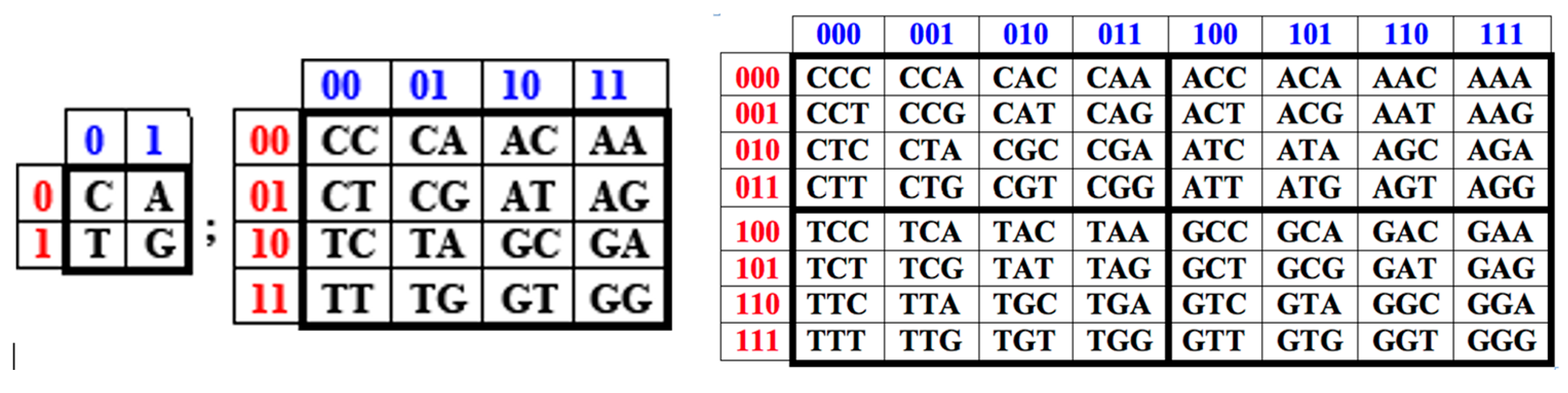
Figure 4.
Tensor family of matrices of 4 genetic gates HC, HA, HT, and HG, 16 duplets, and 64 triplets of these gates.
Figure 4.
Tensor family of matrices of 4 genetic gates HC, HA, HT, and HG, 16 duplets, and 64 triplets of these gates.
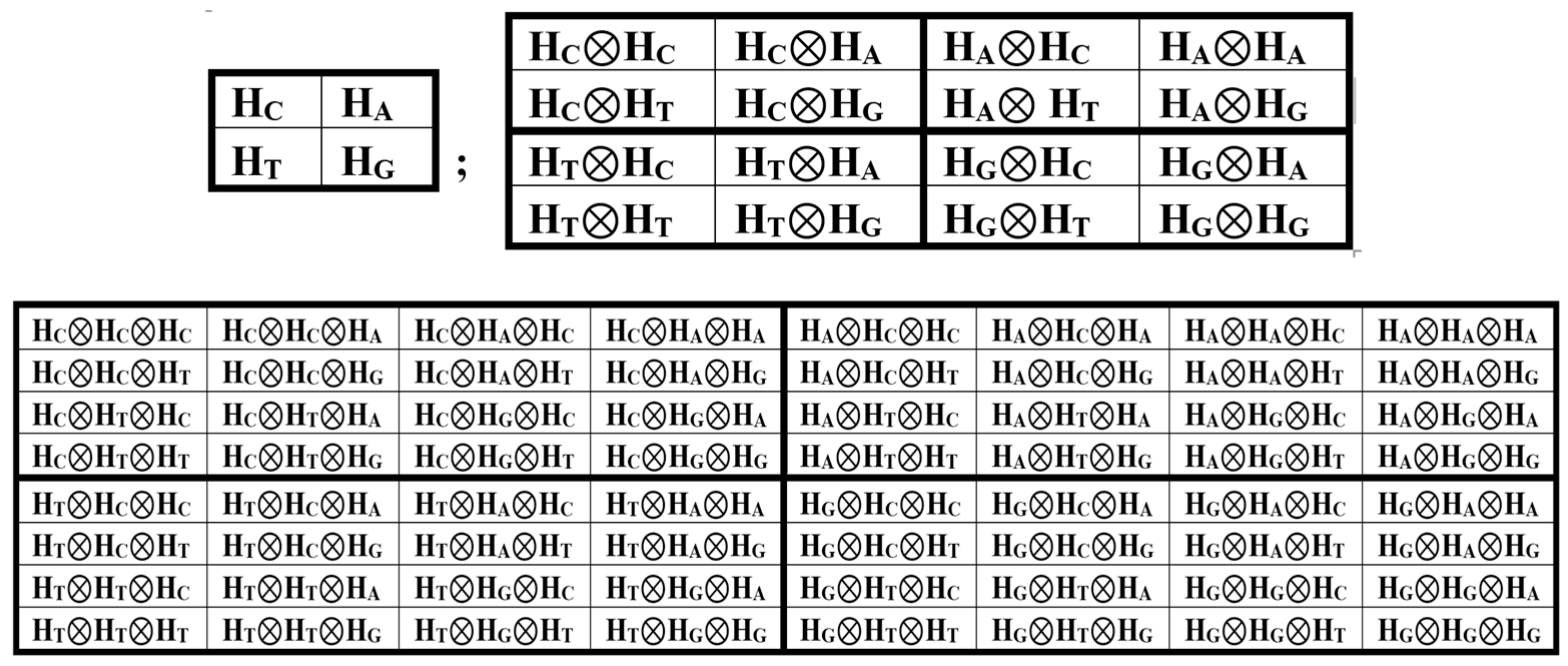
Figure 5.
Representation of the matrix of 4 gates HC, HA, HT, HG from Figure 4 in the form of a matrix D of periods 8 and 2 corresponding cyclic groups based on raising these gates to integer powers n: HCn, HAn, HTn, HGn. Also shown are the decomposition of this matrix D into the sum of two sparse matrices 8r0 + 2r1 and the multiplication table of the matrices r0 and r1, which coincides with the multiplication table of the algebra of 2-dimensional hyperbolic numbers.
Figure 5.
Representation of the matrix of 4 gates HC, HA, HT, HG from Figure 4 in the form of a matrix D of periods 8 and 2 corresponding cyclic groups based on raising these gates to integer powers n: HCn, HAn, HTn, HGn. Also shown are the decomposition of this matrix D into the sum of two sparse matrices 8r0 + 2r1 and the multiplication table of the matrices r0 and r1, which coincides with the multiplication table of the algebra of 2-dimensional hyperbolic numbers.
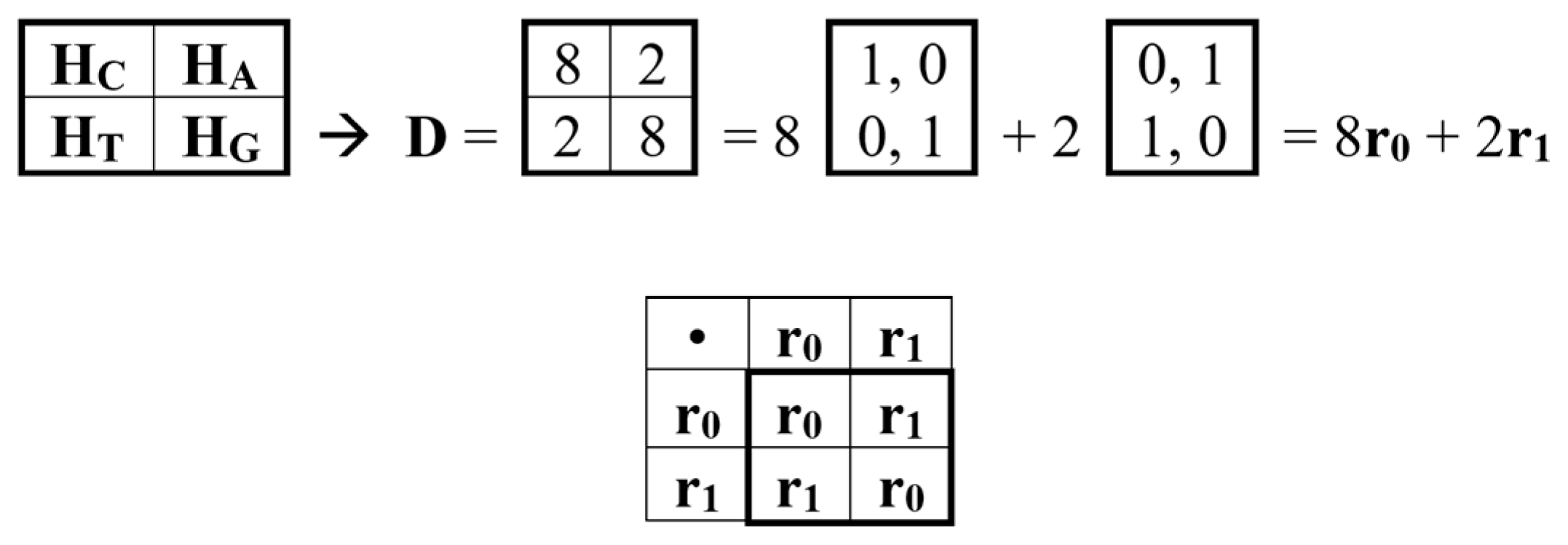
Figure 6.
The period matrix of 16 cyclic groups based on the 16 tensor duplets in the matrix in Figure 4. This period matrix is the sum of the four sparse matrices shown, s0, s1, s2, s3, with their weight coefficients. The multiplication table of these sparse matrices is shown below.
Figure 6.
The period matrix of 16 cyclic groups based on the 16 tensor duplets in the matrix in Figure 4. This period matrix is the sum of the four sparse matrices shown, s0, s1, s2, s3, with their weight coefficients. The multiplication table of these sparse matrices is shown below.
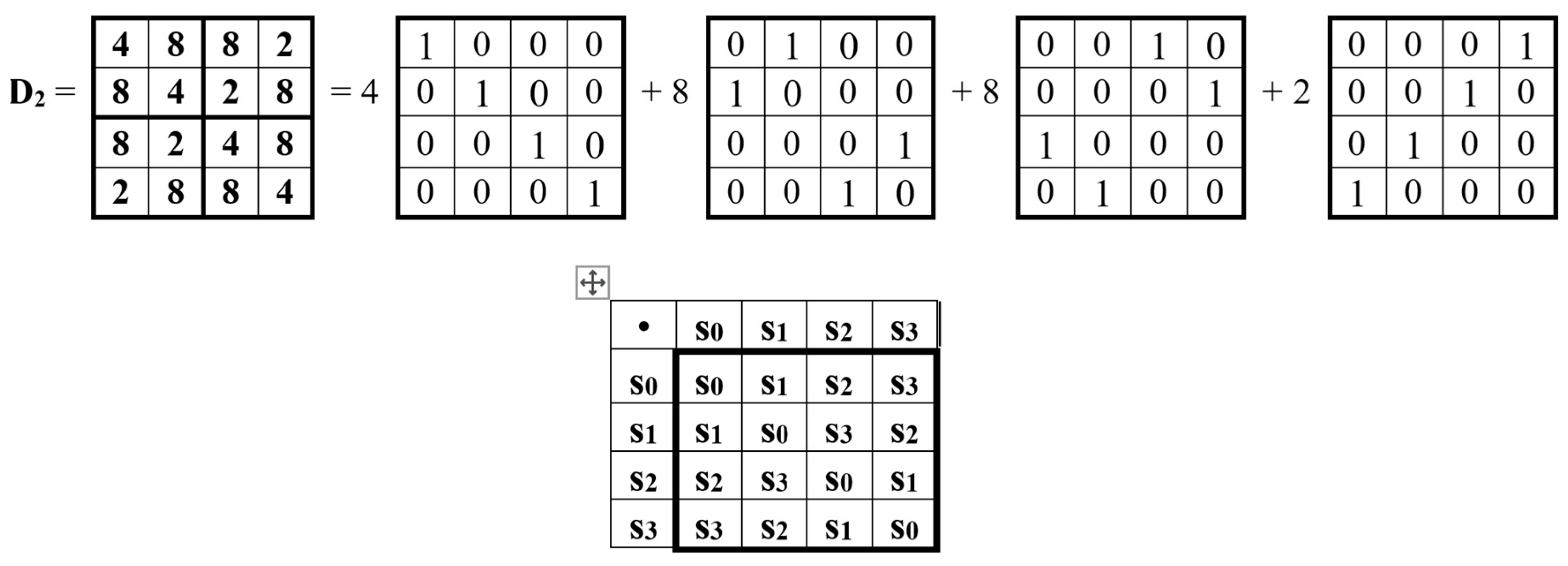
Figure 7.
Unitary matrix representation Q of the Hamiltonian quaternion.
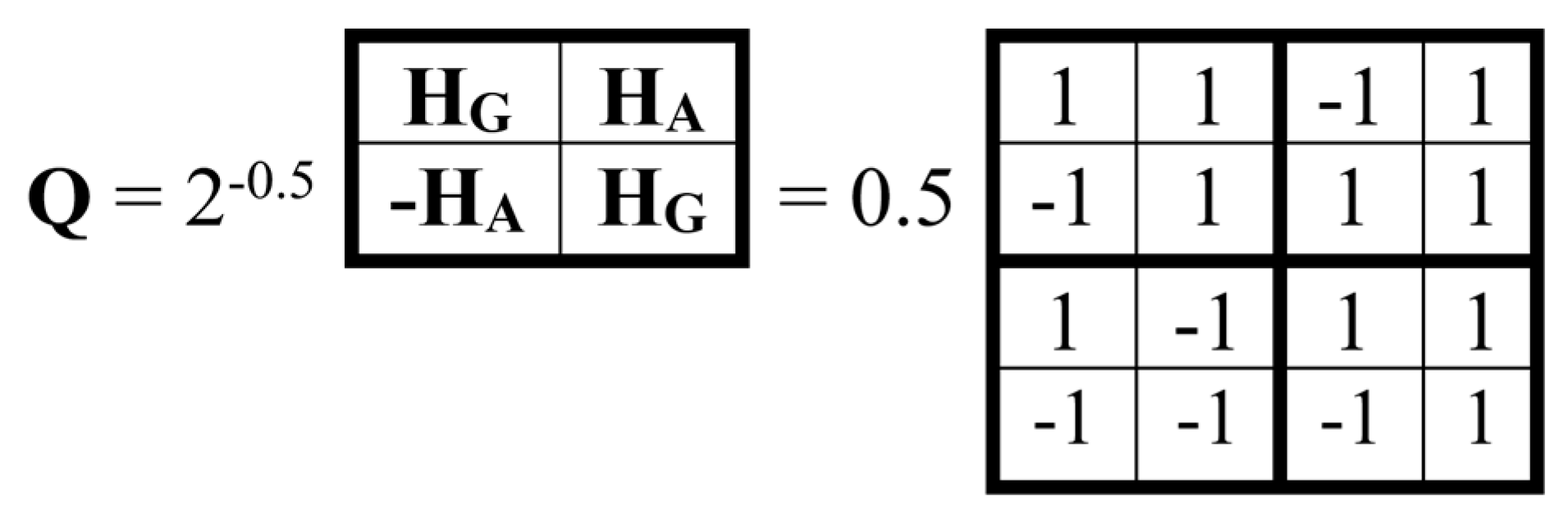
Figure 8.
The unitary Hadamard matrix Q = 0.5(v0 + v1 + v2 + v3) as a sum of four sparse matrices. The multiplication table of this set of sparse matrices, closed under multiplication and corresponding to the multiplication table of the Hamiltonian quaternion algebra, is shown.
Figure 8.
The unitary Hadamard matrix Q = 0.5(v0 + v1 + v2 + v3) as a sum of four sparse matrices. The multiplication table of this set of sparse matrices, closed under multiplication and corresponding to the multiplication table of the Hamiltonian quaternion algebra, is shown.
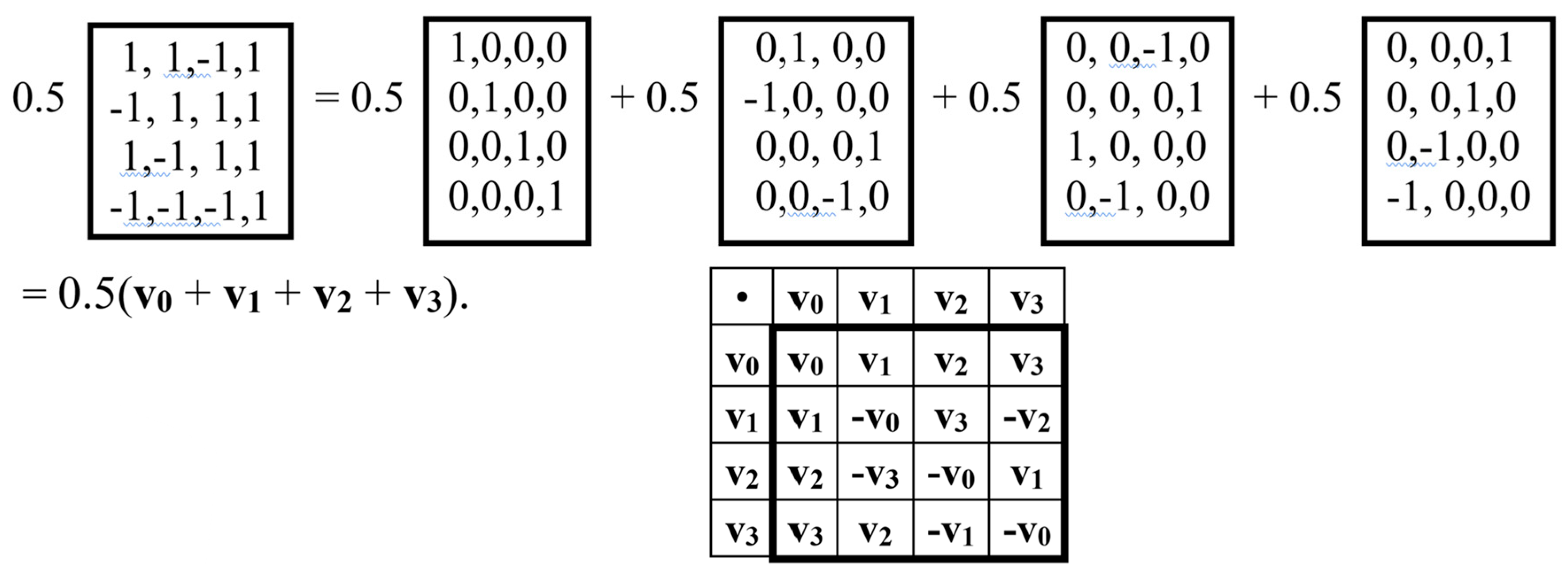
Figure 9.
Newton’s color circle from the psychophysics of color perception and the correspondence to it of the members of the cyclic group of the unitary Hamilton quaternion Qn, the period of which is 6. In each shown unitary matrix, the black cells contain the numbers “+0.5”, and the white ones - “-0.5” (this picture - from the author’s book [20]).
Figure 9.
Newton’s color circle from the psychophysics of color perception and the correspondence to it of the members of the cyclic group of the unitary Hamilton quaternion Qn, the period of which is 6. In each shown unitary matrix, the black cells contain the numbers “+0.5”, and the white ones - “-0.5” (this picture - from the author’s book [20]).
Disclaimer/Publisher’s Note: The statements, opinions and data contained in all publications are solely those of the individual author(s) and contributor(s) and not of MDPI and/or the editor(s). MDPI and/or the editor(s) disclaim responsibility for any injury to people or property resulting from any ideas, methods, instructions or products referred to in the content. |
© 2025 by the authors. Licensee MDPI, Basel, Switzerland. This article is an open access article distributed under the terms and conditions of the Creative Commons Attribution (CC BY) license (http://creativecommons.org/licenses/by/4.0/).
Copyright: This open access article is published under a Creative Commons CC BY 4.0 license, which permit the free download, distribution, and reuse, provided that the author and preprint are cited in any reuse.


