

Submitted:
30 November 2025
Posted:
01 December 2025
You are already at the latest version
Abstract
This study presents a systematic literature review to examine how the axiological values associated with cultured meat influence consumer perception, using the phenomenology of perception as an analytical framework. Fifty-four peer-reviewed qualitative and quantitative studies, identified through the Libraries Worldwide database, were analysed using NVivo 12 software, based on predefined keywords and a rigorous selection grid.
The results highlight several groups of axiological values that shape consumer attitudes, including the previously unexplored “axiological value of co-production” of cultured meat. Specifically, “dogmatic co-production” (e.g., religious or cultural co-production) appears to significantly enhance consumer perception and acceptance of cultured meat.
The main limitation of this study lies in the absence of primary phenomenological field data, which may introduce researcher subjectivity inherent in qualitative paradigms. Nevertheless, the use of existing empirical studies ensures the relevance and reliability of this review. This research offers practical implications for communication strategies, suggesting that aligning messages with key axiological values and their amplifiers, particularly those related to co-production, can strengthen trust in and acceptance of cultured meat. For industry stakeholders, these findings provide guidance for value-driven positioning aimed at increasing consumer confidence. Academically, the study offers a novel perspective by integrating axiological analysis with phenomenology in the context of food technology adoption.
Socially, it helps identify consumer concerns and expectations regarding the axiological values perceived as essential for the acceptance of cultured meat. The study's originality lies in its application of phenomenological analysis to axiological frameworks and in highlighting the central role of co-production, particularly dogmatic co-production, in shaping consumer perception.
Keywords:
phenomenology of perception
; axiology of consumption
; axiology
; perception of cultured meat
; perception of artificial meat
; perception of in vitro meat
; food phenomenology
; axiology and communication
Target journal: Foods
1. Introduction
Cultured meat is known by several names. For example, in vitro meat (IVM), artificial meat, or cultured meat all refer to the same type of meat. Several studies have presented cultured meat as the most realistic and sustainable solution to the problems of current meat production and consumption (Steinfeld et al., 2006; Kouarfaté et Durif, 2023), making it possible to meet the growing needs of humanity (Moritz et al., 2015). According to several authors, cultured meat could provide sustainable solutions not only to ecological problems, but also, and especially, to the current and future nutritional problems of the world's population (Steinfeld et al., 2006; Moritz et al., 2015; Rahmanifar, 2025). Other studies have shown that these problems will increase proportionally to the growth of the world's population, which, according to the UN (2018), will reach 9 billion inhabitants by 2050. Similarly, individual incomes will also experience a sharp increase, leading to a rise in meat consumption (Moritz et al., 2015). This high demand for meat among the population results in increased intensive livestock farming and thus an increase in greenhouse gas emissions. Furthermore, several studies show that the production of animal feed also contributes significantly to deforestation, the massive use of natural resources, and climate change (Steinfeld et al., 2006).
However, several other previous studies, such as those by Steinfeld et al. (2006), Gerber et al. (2013), and Böhm et al., have also shown that these problems will increase proportionally to the growth of the world's population. (2018), estimated that cultured meat would be more environmentally friendly, animal-friendly, healthier, and safer than conventional meat. This is why cultured meat is considered an environmental solution for the planet (Steinfeld et al., 2006; Gerber et al., 2013).
Given these invaluable benefits, cultured meat is generating increasing interest in the research community. To fully understand the advantages and value of cultured meat, on the one hand, and the impact of these values on consumer perception, on the other, a phenomenological study of axiological values appears promising, in accordance with the work of Thompson et al. (1989). Indeed, according to these authors, an epistemological analysis reveals that a phenomenological study can provide an empirically and methodologically rigorous understanding of consumption patterns (Thompson et al., 1989). A phenomenological analysis, or the phenomenology of perception, is a study of the structures of subjective experiences and consciousness (Hok-Eng Tan, 2013; Pavel, 2020). It explores and describes the meaning individuals ascribe to their experiences, without prejudice or preconceived theories, in order to grasp fundamental structures and meanings (Edwards, 2013). For example, in this study, phenomenology would allow for the observation of the cultured meat phenomenon through literature, from production to consumption, including the distribution channels of artificial meat. This type of study is part of the ongoing struggle to claim its rightful place in contemporary research, and the relevance of this study lies in its interdisciplinary investigations of the brain and mind (Hok-Eng Tan, 2013; Edwards, 2013). Moreover, several authors believe that "phenomenological inquiry should be considered a vehicle and method for accessing the food experience" (Hok-Eng Tan, 2013), as is the case with this research, which aims to understand the consumption behavior of cultured meat. Furthermore, studies of consumer perception are still lacking, either from an axiological perspective (an analysis based on the fundamental values of cultured meat) or through the phenomenological method. Yet axiological studies (Nicklas, 2023; Leite, 2024) have also proven effective in consumption studies in general and food consumption studies in particular. Indeed, axiological value refers to the qualities that confer value on something or someone (Heinich, 2012). Defined as a branch of philosophy that studies these values, axiology aims "to examine what is good or worthy of esteem, exploring the nature, origin, and different types of values (moral, aesthetic, epistemic, etc.), as well as how to measure and compare them" (Dankova et al., 2018). Axiological studies can also be defined as a science of values (what has value, what can be the subject of a value judgment) (Heinich, 2021). In the context of cultured meat, for example, the advantages identified by several authors (Alvaro, 2019; Kouarfaté et Durif, 2023) namely, food security, animal welfare, environmental protection, and the nutritional contribution of cultured meat can therefore be linked to this notion of axiological value. Furthermore, the adoption of responsible consumption, the development of vegetarianism and veganism, and ethical behaviors that promote cultured meat are thus aligned with the axiological values of cultured meat. This is why it is important to understand the impact of axiology on consumers' perceptions of cultured meat through a phenomenological analysis of perception.
2. Literature Review
Climate and environmental changes have led researchers to explore various solutions to address these problems. One such solution is the production and consumption of cultured meat as a replacement for conventional meat from traditional livestock farming (Steinfeld et al., 2006; Kouarfaté et Durif, 2023). Indeed, several studies have shown that cultured meat could meet humanity's growing needs (Moritz et al., 2015) while reducing greenhouse gas emissions associated with conventional meat production. Authors such as Moritz et al. (2015) and Verbeke et al. (2015) define cultured meat as a product or outcome obtained by culturing cells in a laboratory using regenerative medicine techniques, starting with stem cells previously harvested from an animal (Moritz et al., 2015; Verbeke et al., 2015). Therefore, it is not a meat substitute, but rather a healthier, more sustainable, or more environmentally friendly meat that utilizes methods to mitigate the effects of climate change (Verbeke et al., 2015). However, consumer perception of this meat remains largely negative. For example, in Canada, cultured meat (as an innovation) faces significant obstacles (Observatoire de la consommation Responsable, 2020) to its adoption and broader social acceptance (Bryant and Barnett, 2019d; Kouarfaté et Durif, 2023; Kouarfaté et al., 2024). Indeed, a survey conducted in Canada in 2020 revealed that only 22% of the population said they were willing to try it (Observatoire de la consommation Responsable, 2020). In this context, public perceptions of cultured meat are diverse (Rahmanifar, 2025). Thus, understanding the axiological values of cultured meat could improve consumer perceptions.
However, several studies in the literature have explored consumer perceptions and/or attitudes toward cultured meat. For example, Pakseresht, Kaliji, and Canavari (2022), Kouarfaté and Durif (2023), Hanan et al. (2024), and Rahmanifar (2025) identified the determinants that influence consumer attitudes toward this meat. In their work, Deliza et al. (2023) reviewed the challenges encountered and the prospects surrounding cultured meat. Other researchers have explored various topics related to this meat, including: the comparison of different meat alternatives and consumer perceptions (Cornelissen and Piqueras-Fiszman, 2023), eco-emotions and their influence on attitudes (Kouarfaté et al., 2024), factors that positively or negatively influence consumption intention (Hwang et al., 2020; Weinrich et al., 2020; Morais-da-Silva et Semprebon, 2021), the likelihood of trying, buying, paying for, and consuming (Wilks et al., 2019), culture-based purchase intention (Bryant et al., 2019; Weinrich, Strack, and Neugebauer, 2020; Chong, Leung, and Lua, 2022), and the influence of received information on purchase intentions (Bekker et al., 2017; Baum, Bröring and Lagerkvist, 2021). Others have studied consumer perceptions of cultured meat according to their diet (Gousset et al., 2022), and according to their place of residence and level of education (Ciobanu et al., 2024).
However, these studies did not explore the impact of the axiological values of this meat on consumer perceptions. Indeed, axiology is a Greek word equivalent to "axia" or "axios," meaning "value" or "quality." Thus, axiology can be defined either as a science of sociological and moral values, or, in philosophy, as "both a theory of values (axios) and a branch of philosophy concerned with the domain of values." The works of Nietzsche (1961 and 2009) on the genealogy of morality and those of Max Scheler (1999) and Agard (2009) have shown that axiology "must be considered as a search to establish a hierarchy among the values" of an object of study, arguing that it could be composed of two parts: ethics and aesthetics. For several authors, these two branches of axiology highlight the values that are both distinct from each other and common to the same object of research (Agard, 2009; Nietzsche, 2009). Based on axiological philosophy, it is shown that the two branches of axiology (ethics and aesthetics) of a subject of study are two axiological domains, each referring to the "world of values." In other words, ethics and aesthetics should be "subject to the necessity of being addressed in terms of value, beginning with the most general: 'good,' 'evil,' 'beautiful,' 'ugly,' and others" (Fleischer, 1968; Verbeeck-Boutin, 2009). Furthermore, these two areas are not the only avenues of analysis, as the question of axiology in its rhetorical aspect was the subject of the philosopher Perelman's work in 1954. Very often, the notion of axiology is used within the logic of value systems with the aim of objectivity. However, the expression "axiological neutrality," advocated by several authors, aims to support a viewpoint by which maximum objectivity can be achieved without using value judgments or critiques of the object of analysis (Max Weber, cited by Verbeeck-Boutin, 2009). This understanding would imply ignoring the existence of a hierarchy between the ethical and aesthetic values of an object of study. In any case, there are several other values that can be taken into account in an axiological study. In fact, several authors have established a list of values called the "register of axiological values" and have determined that each object of study refers to a certain type and number of values that correspond to a specific object of study (Menkhaus et al., 1993; Muatip et Aunurohman, 2012). For example, in the register of axiological values, authors have grouped a number of value categories into a dozen categories: civic, domestic, economic, epistemic, aesthetic, ethical, functional, hermeneutic, legal, pure, and reputational (Verbeeck-Boutin, 2009; Heinich, 2012; Dankova and Dubrovskaya, 2018). These different values vary according to the type of object and product. But several authors agree that aesthetic and ethical values remain permanent, regardless of the type of object (Verbeeck-Boutin, 2009; Heinich, 2012; Dankova et Dubrovskaya, 2018).
In the literature, recent studies have explored various themes from an axiological perspective. For example, Golev (2023) studied the cognitive and communicative axiology of modern virtual educational communication. Similarly, Verbeeck-Boutin (2009) suggests constructing a value grid, or more precisely, a conceptual model of sets of relationships between these values. Based on works of art, he believes that such a model would help to objectify choices and foster interdisciplinary discussion before decision-making (Verbeeck-Boutin, 2009). Thus, for each axiological study, it is advisable to establish a list of the axiological values of the object of study. For example, in studying the axiology of group identity among bikers based on internet communication, Dankova et al. (2018) highlighted the values that govern the group identity of bikers. The authors argue that the social category of "biker" is constructed through the values of "motorcycle," "pleasure," "danger," and "brotherhood" (Dankova et al., 2018). Similarly, Rykała and Żołnierczuk (2017) also studied the axiology of communication space and contemporary trends in the design of a transport hub. In this axiological study, they focused primarily on the aesthetic values of three transport hubs, highlighting the character of these places without emphasizing their ethical value (Rykała and Żołnierczuk, 2017). Therefore, within the framework of this study, a register of values related to cultured meat will be established. Thus, the objective of this study will be twofold: first, to establish a register of the axiological values of cultured meat, and second, to understand the impact of these values on consumer perceptions and their acceptance of cultured meat.
To understand these consumers' perceptions, an analysis of previous studies based on the phenomenology of perception will be conducted. This analysis will allow us to observe, analyze, and understand these perceptions throughout the entire cultured meat value chain (e.g., identifying the axiological values from production to consumption, including distribution). Indeed, according to Hok-Eng Tan (2013), phenomenology is the study of the structures of subjective experiences and consciousness. It is considered a vehicle and method for accessing the food experience (Hok-Eng Tan, 2013). For example, using interpretive phenomenology, Dibsdall et al. (2002) conducted their study to understand the experiences and beliefs related to food among a small group of low-income British women (Dibsdall et al., 2002). In this work, the authors suggested that this type of study lends itself well to in-depth qualitative methods and recommended that data be collected through interviews in a phenomenological study (Dibsdall et al., 2002). Therefore, the phenomenology of perception is seen as a methodological science (Weiss, 2025; Ifland and Brewerton, 2025) ideal for consumer studies. This is why several authors such as Edwards (2013), Bachelard (1994), Ningtyias and Kurrohman (2020), Weiss (2025) and Ifland and Brewerton, (2025) have used this method in their various research on consumer consumption and perceptions. For example, in his exploratory phenomenological study of the lived experience of vegans or vegetarians in a predominantly non-vegetarian society and culture, Edwards (2013) argues that “the use of phenomenological inquiry is well suited to uncovering the lived experience of this phenomenon in a way that no other method of inquiry could” (Edwards, 2013). In this study, the author also drew on his own personal experiences, which allowed him to uncover the phenomenon while supplementing the data. He highlights themes based on the use of Hyppolite’s (1956) and Bachelard’s (1994) “inside versus outside” descriptions. Ningtyias and Kurrohman (2020) conducted a study on the phenomenology of food taboos and recommended foods for pregnant women in Pendhalungan society. They used a phenomenological approach to describe unique consumption patterns. This is a content analysis method (Ningtyias and Kurrohman, 2020). Specifically, the phenomenology of perception allows us to observe and analyze consumer perceptions from production to consumption. The advantage of this type of research is that it allows us to identify the factors influencing consumer perceptions and attitudes at each stage of a product's journey, from its creation to its final use. Thus, through this study, the axiological values of cultured meat likely to influence consumer perceptions will be observed and analyzed through the literature, following its path from production to consumption via the distribution chain.
Conceptual Framework:
The theoretical framework below highlights the relationship between the axiological values of cultured meat (ethical, aesthetic, utilitarian, reputational, hermeneutic, legal, commercial, or economic), their amplifiers, and the perception and acceptance of this meat by consumers. This conceptual framework was defined following a literature review. This relationship is illustrated in Figure 1. Based on this framework, the following research hypotheses were formulated. A relationship exists between the axiological value of cultured meat, the amplifiers of this value, and consumer perception. Indeed, if the values of cultured meat are perceived positively, this could influence consumer perception and acceptance of this meat.
3. Material and Methods
The objective of this systematic literature review is to identify, appraise, and synthesise empirical studies that address the axiological values associated with cultured meat. The paper further seeks to outline a coherent research agenda for the management science literature. The methodological approach follows the protocol of Tranfield et al. (2003), comprising the formulation of the research question, the identification of relevant studies, the assessment of study quality, the selection of eligible articles, the synthesis of evidence, and the interpretation of findings.
3.1. Formulation of the Research Question
The research question addressed in this article is to propose a holistic conceptual framework for understanding the effect of cultured meat axiology on consumer perception and acceptance, using a phenomenological analysis approach. This involves a systematic, multidisciplinary literature review. To this end, several article selection criteria, such as inclusion and exclusion criteria, were applied, as shown in Table 1. The use of these criteria ensures compliance with the conditions established by Tranfield et al. (2003), Littell et al. (2008), and Laroche and Soulez (2012).
3.2. Identification of Relevant Publications
A thorough search was conducted across a wide variety of bibliographic databases using several keywords. Table 1 presents the selection criteria, while Table 2 details not only the different keywords but also the various stages of selection and filtering of these studies. It should be noted that this is a literature search covering all years up to August 2025. The keywords used are: Phenomenology of Perception, Axiology of Consumption, Axiology, Cultured Meat and Perception, Artificial Meat and Perception, In-vitro Meat and Perception, Phenomenology and Food, and Axiology and Communication. These keywords were identified and used based on the study by Bryant and Barnett (2019), which examined the nomenclature of cultured meat and its impact on consumer acceptance, as well as on the concepts of perception, axiology, and phenomenology.
3.3. Evaluation of the Quality of the Selected Studies
Following a step-by-step evaluation, 54 studies were deemed relevant. Based on the article quality assessment criteria recommended by Tranfield et al. (2003) and St-Amand and Saint-Jacques (2013), only peer-reviewed articles were included in this review. Since the objective of this research is to understand and highlight the impact of axiological values on consumer perception through a phenomenological analysis, and thus on the acceptance of cultured meat, studies from all research disciplines were included.
3.4. Selection of Studies
The keywords used in this work were applied precisely to the search in all fields, and then to all article titles appearing in English and French. This analysis demonstrates the quality of the studies included in the systematic review and allows for the organization of this review according to different themes (axiological values). Several elements were introduced to select and filter these articles, as shown in Table 1. The filters used in Table 1 are: peer-reviewed journals, exact wording of keywords in the title, and searches of journals through abstracts and full texts. Finally, duplicates were eliminated. Table 2 presents the different stages of selection and filtering of these studies.
3.5. Data Analysis and Interpretation
All 54 articles were coded to identify those highlighting at least one or more concepts related to the phenomenology, consumer perception, and axiology of consumer goods and the values of cultured meat. This involved an analysis of existing qualitative and quantitative studies in the literature and databases from libraries worldwide, using NVivo 12 software. Table A1 (in the Appendix A) presents only the main studies related to these research themes. The thematic coding process was carried out using NVivo 12 software on selected articles.
4. Results
4.1. Results of the Descriptive Analysis (Profile of the Analyzed Articles)
Although the analysis of all articles took into account all publication years, it appears that these articles are relatively recent. Indeed, 65% of these articles were published after 2010 and two-fifths of them are less than five years old (see Graph 1).
Graph 1.
The number of articles per year of publication.
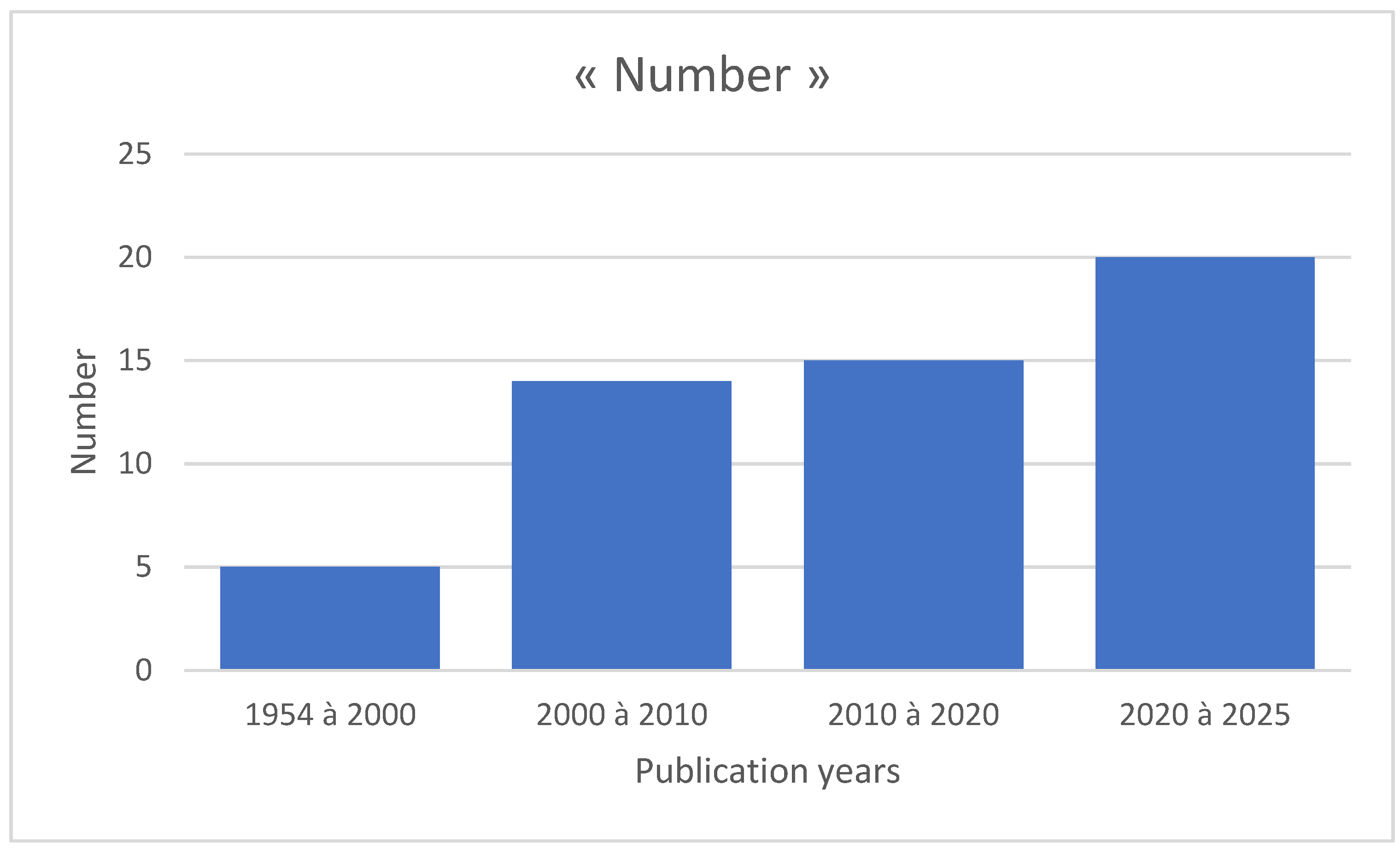
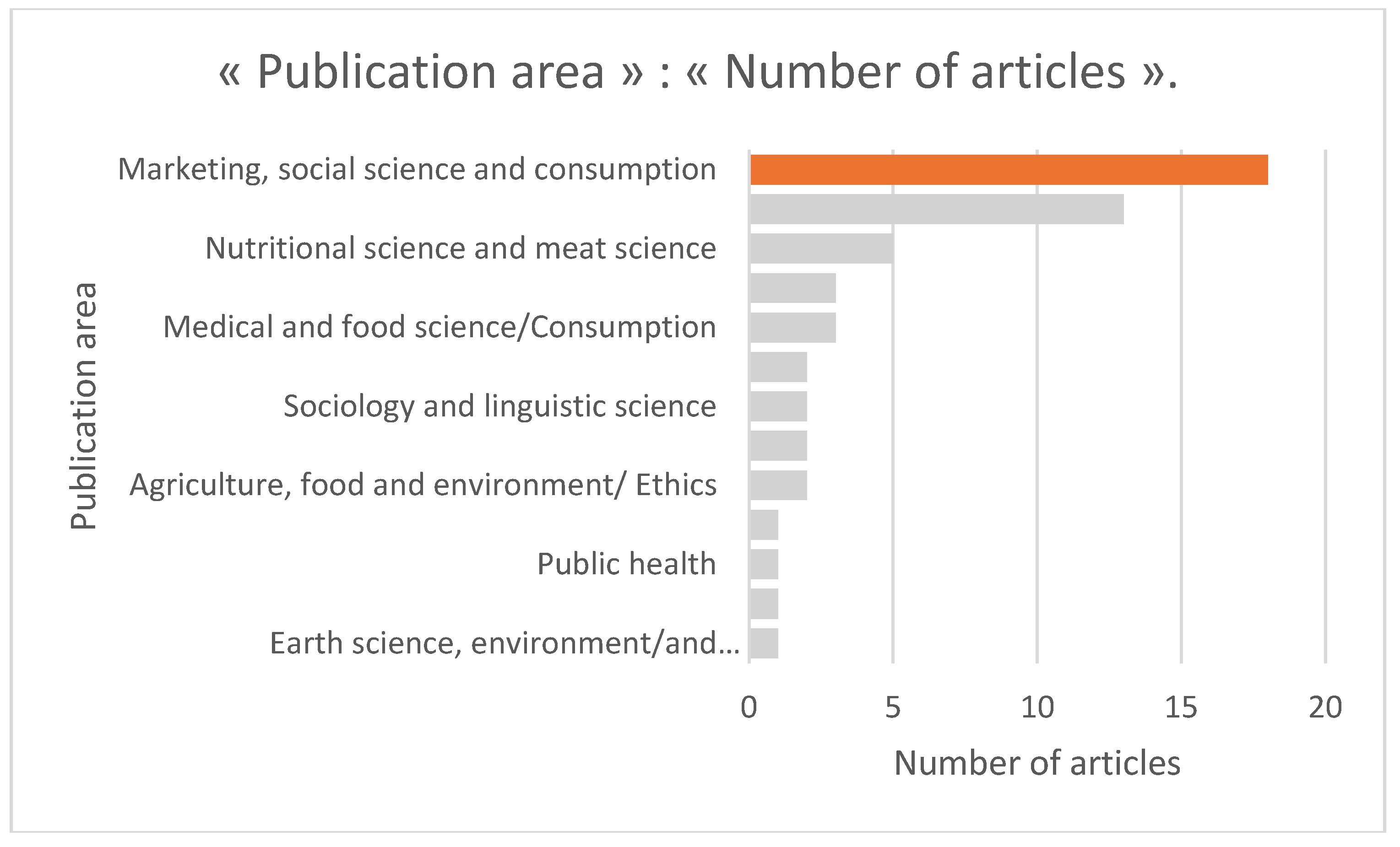
They are primarily published in fields such as: Marketing, social science and consumption (18/54), Philosophy/anthropology (13/54), Nutritional science and meat science (5/54), Psychological and psychiatric science (3/54), Medical and food science/Consumption (3/54) (see Figure 2). Almost all of the selected articles (51/54) are published in journals included in the ranking of scientific journals and countries, notably: 32 in the first quartile (Q1), 5 in the second quartile (Q2), 7 in the third quartile (Q3), and 7 in the fourth quartile (Q4), which testifies to the quality of these articles. The journals in which these articles are published are diverse, including: Journal of Consumer Research (2/54), Frontiers in Sustainable Food Systems (2/54), Appetite (2/54), Foods (1/54), Frontiers in Psychology (1/54), International Journal of Research in Marketing (1/54), and Journal of Consumer Research (1/54). Although almost all of these articles are published in an English-speaking context (45/54), some are published in French (9/54). In terms of analytical methods, the results show that 36/54 of these studies are qualitative (literature reviews and/or document analyses, interviews, and focus groups), 3/54 are mixed methods, and 15/54 are quantitative methods.
Graph 2.
Article publication area.
4.2. Register of Axiological Values of Cultured Meat
The data analysis of this study allowed us to present the results through the lens of the axiological values of cultured meat, using a phenomenological methodology (observation of the cultured meat phenomenon, from production to consumption, including the distributors of artificial meat). Since no systematic literature review exists that explores all articles across the entire cultured meat value chain, based on the axiological values identified in the literature and adapting these values to cultured meat, the analysis identified seven axiological values of cultured meat and their amplifiers.
4.2.1. Aesthetic or Intrinsic Value
For consumers, the aesthetic (or intrinsic) value of meat holds a significant place in their minds (van Vliet, 2017). This aesthetic or intrinsic value thus influences consumers' perceptions of meat. Aesthetics (phenomenology of perception and art theory) therefore plays a central role (Van Vliet, 2017). The intrinsic and aesthetic notion of cultured meat refers to its internal characteristics or attributes (Bhat et al., 2019; Bryant et al., 2019). This is the case, for example, with sensory aspects: the shape, color, and tenderness of cultured meat (Bhat et al., 2019; Bryant et al., 2019). Similarly, other sensory aspects such as texture (Laestadius and Caldwell, 2015 and Wilks and Phillips, 2017) and the aesthetic appearance of cultured meat (its resemblance to conventional meat would positively affect consumer perceptions as well as their acceptance of consuming cultured meat (Mancini and Antonioli, 2019 and 2020; Kouarfate et Durif, 2023a).
4.2.2. Ethical or Extrinsic Values
The first axiological domain within the world of values is the domain of ethics. Indeed, every object of study presents its own values, highlighting ethical value or foundations based on moral values. Cultured meat is no exception to this principle, as several ethical questions arise concerning its production, distribution, and consumption. Several authors agree that the extrinsic or ethical dimensions of cultured meat are more important in its acceptance by consumers (Tuomisto and Teixeira de Mattos, 2011; Schaefer and Savulescu, 2014). The ethical or sustainability concept then highlights several factors, such as the capacity to protect the environment and ensure the well-being of humans and animals following the production and consumption of this meat (Bekker et al., 2017; Mancini and Antonioli, 2019; Kouarfaté and Durif, 2023). Regarding Laestadius (2015), it is the ethical value that encompasses the aspects of a social, ecologically sustainable, healthy and fair diet; and which would have an impact on the perception of cultured meat (Laestadius, 2015).
4.2.3. The Utilitarian Value of Cultured Meat
Utilitarian value refers to the usefulness a good or service provides to a user through its use or functional aspects. In the context of cultured meat, its utilitarian value can be associated with certain sensory aspects such as flavor, taste, and nutritional contribution (Mancini and Antonioli, 2019 and 2020; Kouarfate and Durif, 2023a). Indeed, previous studies have listed characteristics that refer to intrinsic factors of cultured meat, such as Bhat et al. (2019) for nutritional quality, Bryant et al. (2019) for taste, Laestadius and Caldwell (2015), and Wilks and Phillips (2017) for appeal and taste.
4.2.4. Reputational Values/Stakeholders
Reputational values are the fundamental principles perceived by stakeholders that contribute to the overall value of an organization, product, or person. They encompass aspects of governance, social responsibility, and excellence, which strengthen trust and collective esteem. Managing them is crucial because a strong reputation can become a competitive advantage, while a damaged reputation can generate significant risks. For example, analyzing the entire value chain of cultured meat highlights the importance of stakeholders (producers, distributors, retailers, consumers, etc.). Indeed, several studies suggest that consumer perceptions and acceptance of cultured meat could be influenced by stakeholders (Kouarfate and Durif, 2023). For example, Donaldson and Preston (1995), Andriof and Waddock (2002), and Pasquero (2008) suggested that stakeholders play an important role in the acceptance and marketing of new products or services, including cultured meat, which may be associated with GMOs (Genetically Modified Organisms). Furthermore, studies by Böhm et al. (2018) assert that if stakeholders accept cultured meat, its reputation and consumer acceptance could be improved.
4.2.5. Hermeneutic Values
This value is linked to consumers' interpretation of cultured meat. In previous studies, for example, consumers often associated this meat with the notion of novelty. For Siegrist and Sütterlin (2017) and Weinrich et al. (2020), in addition to novelty, the perceived naturalness of cultured meat is also a determining factor. This interpretation can also be influenced by the initial information consumers receive about cultured meat. Indeed, several studies have suggested that the initial information consumers receive elicits their initial reactions to cultured meat (Kouarfate and Durif, 2023). The way a new product is marketed influences these initial reactions. These are particularly important for food products (Hwang et al., 2020). Similarly, Tuorila and Hartmann (2020) emphasized the importance of consumers' first impressions, arguing that they generate food curiosity (which corresponds to the consumer's desire to learn more about the product's production or processing methods). Furthermore, curiosity enhances consumer perceptions since it is often linked to the consumer's learning capacity (Hwang et al., 2020) and also reflects their willingness to try or test a product (Tuorila and Hartmann, 2020).
4.2.6. Legal Values
The legal axiological value of cultured meat is based on the added value of regulating the cultured meat sector, from production to consumption, including the distribution chain. Indeed, previous studies suggest that consumer perceptions of cultured meat could be improved through strict regulation of this sector. For example, studies by Bryant and Dillard (2019) and Kouarfaté and Durif (2023a and 2023b) suggested that regulation would increase consumer confidence and thus promote its acceptance. Furthermore, other studies (Choudhury et al., 2018; 2020) have estimated that "the genetic testing sector and the cultured meat sector require effective regulation to build consumer confidence and improve their perception" (Choudhury et al., 2018; Choudhury et al., 2020).
4.2.7. The Commercial or Economic Value
In their proposed register, several authors have mentioned the economic value of the product (Dankova et al., 2018; Heinich, 2012; Verbeeck-Boutin, 2009). Marketing attributes, including brand, name, packaging, price, and the origin of the meat as indicated on labels, are important elements that can influence consumer perceptions of cultured meat (Hocquette et al., 2016).
4.2.8. The Axiological Value Amplifiers of Cultured Meat
The value amplifiers of an object or product are numerous. In the heritage field, for example, age is a highly significant value amplifier, as is rarity. Age is defined by the criterion of how old the object is, whereas rarity is defined by the object’s unique character. The criterion of age is so important that the construction or renovation date is the first piece of information provided by specialists in works of art (Heinich, 2012). These various value amplifiers serve to increase the value of a product or object. For instance, a work of art or an old and unique (rare) collector’s vehicle will see their value rise (Heinich, 2012). Similarly, the value of an ordinary car will be influenced by its age. In this case, the more recent the vehicle’s year of manufacture, the higher its economic value. In all cases, for each product, there exist axiological value amplifiers specific to that product. As part of this work, a list of value amplifiers for artificial meat is proposed.
The analysis of the work of several authors such as Kouarfaté and Durif (2023), Chriki et al. (2020), Ruzgys et al. (2020), Mancini and Antonioli (2020), Brayant et al. (2019), Browning et al. (2019), Bryant and Barnett (2019), Laestadius (2015), Heinich (2012) and Dibsdall et al. (2002) has made it possible to identify and list a set of axiological amplifiers of artificial meat:
- -
- Egocentric Systems
“Egocentric systems” are linked to the uniqueness of individuals and to the social worlds they inhabit. The egocentric theme encompasses several social and psychological concepts. According to the author, each of these concepts constitutes a distinct field of research. This includes, for example, the importance of life-course factors in consumers’ food choices. The factors mentioned are: health status, education, roles, geographical location, cultural traditions, the food system, resources, and others. These findings are consistent with those of Kombolo Ngahet al. (2023), who suggest that consumers’ place of residence can enhance their perception of cultured meat. Thus, for this type of meat, egocentric systems may also be considered value amplifiers.
- -
- Control Issues
“Control issues” describe the way in which perceptions of control may influence attitudes towards food and health (Dibsdall et al., 2002). Here, the notion of “control issues” refers to the principle that “individuals are less likely to worry about health hazards they perceive as having some personal control over, compared to hazards they consider beyond their control” (Dibsdall et al., 2002). Healthy food choices are therefore generally considered to fall under individual control and consequently generate little concern. The desire to maintain control over one’s diet would constitute a factor in an individual’s consumption decisions. Moreover, several authors confirm that the main fears related to food concern invisible toxic contamination, which can trigger changes in behaviour or experience in relation to food (Ningtyias and Kurrohman, 2020).
- -
- Emotions
For heritage objects, Heinich (2012) demonstrated that consumers’ affect towards an object constitutes part of its axiology. According to him, this emotional value, or “affect,” is a reflection of shared values. These value amplifiers for a heritage object can be expressed through authenticity, presence, and beauty (Heinich, 2012). Moreover, eco-emotions are specific emotions associated with cultured meat. In their work, Kouarfaté et al. (2024) showed that eco-emotions influence both perceptions of and acceptance towards cultured meat.
- -
- The notion of novelty or seniority
The notion of seniority or novelty, previously mentioned in the case of works of art, could also apply to artificial meat. For example, the value amplifiers for this type of meat could include the level of prestige associated with the product, given its new and innovative character. Furthermore, food neophobia defined as the reluctance or distrust to consume or avoid new foods has been identified by several authors as a factor influencing consumers’ acceptance of cultured meat (Browning et al., 2019; Bryant and Barnett, 2019; Mancini and Antonioli, 2020). According to these authors, the perceived lack of naturalness, the spread of conspiracy ideas, a disgust reaction, and fear of unknown risks associated with the new food technology can also influence, and even reduce, consumers’ willingness to eat cultured meat.
- -
- The co-production of value
The object or product (good, service, personality, or other) exists and possesses characteristics as well as a minimum value related to its use. The axiology of consumption is a theory of the forms of value (Marion, 2016). However, considering that the consumer is a co-producer of (use) value implies that it is the consumer who brings value to the object. In other words, it assumes that an object or product (isolated from the consumer-co-producer) has no value. This theory suggests not only that the value of an object is real only when it is integrated into a practice or usage, but also that the consumer remains a regular or habitual producer. Thus, according to Marion (2016), “the emergence of the value of an object results from its interaction with a subject.”
Nevertheless, several authors such as Fleischer (1968), Marion (2016), and Verbeeck-Boutin (2009) agree that co-production allows for taking into account the consumer’s concerns during the design or production of the object. However, co-production does not constitute value in itself, but rather what Verbeeck-Boutin (2009) called an axiological amplifier or value amplifier. Indeed, these amplifiers are the set of factors that contribute to increasing the value of the object of study. For instance, involving consumers in the production of cultivated meat could improve its values (aesthetic, ethical, utilitarian, reputational, hermeneutical, legal, and commercial).
Practically, this study suggests that during the production of cultivated meat, the practices of each religious and/or cultural group should be incorporated in accordance with the laws and dogmas of these different religious or cultural groups. Indeed, meat consumption is part of religious practices: Orthodox Christianity, Judaism, Islam, Christianity more broadly, and others (Faure, 2010). According to Hamdan et al. (2018), for example, the consumption of cultivated meat is strongly influenced by religious considerations, notably the Jewish “kashrut” and the Islamic “halal” precepts. Similarly, the consumption of certain types of meat complies with cultural restrictions and dogmas (e.g., Hinduism: ahimsa, Sikhism, or Jainism) of certain groups (Bekker et al., 2017; Shaw and Mac Con Iomaire, 2019). Therefore, within the framework of this study, the analysis suggests a “dogmatic co-production,” meaning religious or cultural, to satisfy the expectations of all socio-cultural and religious groups regarding meat consumption.
5. Discussion
The results of this study, based on axiological aesthetic values, suggest that the aesthetic (or intrinsic) value of meat occupies an important place in consumers’ minds (van Vliet, 2017) and influences both perceptions and attitudes. These findings are consistent with previous research (Bhat et al., 2019; Bryant et al., 2019). The intrinsic value (or aesthetic value of cultured meat) appears to rely on sensory aspects such as shape, colour, texture, and perceived tenderness of cultured meat (Bhat et al., 2019; Bryant et al., 2019), and positively affects consumer perceptions as well as their willingness to consume cultured meat (Mancini and Antonioli, 2019 and 2020; Kouarfaté and Durif, 2023a).
Regarding the ethical or extrinsic axiological value of cultured meat, analysis of the results indicates that its ethical value impacts consumer perceptions and acceptance. These findings align with those of previous studies (Tuomisto and Teixeira de Mattos, 2011; Schaefer and Savulescu, 2014). Likewise, studies by Bekker et al. (2017), Mancini and Antonioli (2019), and Kouarfaté et Durif (2023) suggest similar results, particularly regarding perceptions of environmentally sustainable and healthy diets. Moreover, Barcellos et al. (2019) showed that beef purchasers are more concerned with extrinsic quality indicators than intrinsic ones, believing that extrinsic factors positively influence the eating experience of beef, while credibility attributes are generally disregarded except for the meat’s expiration date (Barcellos et al., 2019). However, these results do not corroborate those of Zerfu et al. (2016), who found that cultural beliefs may affect nutrition under certain circumstances, such as during pregnancy. According to Laestadius and Caldwell (2015) and Kouarfaté and Durif (2023a and 2023b), the values of cultured meat are associated with environmental and public health motivations, unnaturalness, regulatory considerations, and neophobia, which influence consumer perceptions of this type of meat (Laestadius and Caldwell, 2015).
Cultural values, race, gender, ethnicity, financial situation, and aspects such as quality, variety, balance, and moderation are values that can influence consumers’ perceptions and behaviours regarding meat (Busato et al., 2015). Additionally, according to Teklebrhan (2012), religious and sociocultural taboos are key variables affecting meat preferences and consumption within a given population (Akem and Pemunta, 2020; Teklebrhan, 2020).
Similarly, regarding utilitarian values, the study suggests a relationship between the utilitarian values of cultured meat and consumer perceptions. These results are consistent with previous studies, including Mancini and Antonioli (2019 and 2020) and Kouarfaté and Durif (2023a) for flavour, taste, and nutritional contribution, and Bryant et al. (2019) and Bhat et al. (2019) for nutritional quality and taste.
Although there is very little literature on the reputational values of cultured meat, particularly those assigned by stakeholders, Kouarfaté and Durif (2023) and Böhm et al. (2018) highlight the importance of stakeholders in shaping the reputation of cultured meat among consumers.
Regarding legal values, several studies have suggested that regulation of the cultured meat sector could increase consumer trust in cultured meat (Choudhury et al., 2018; 2020; Bryant and Dillard, 2019). The results of this study therefore support the body of previous findings.
Hermeneutic values of cultured meat (related to perceptions of its naturalness and novelty) have also been studied, with results partially aligning with those of this study. Indeed, due to its similarity to conventional meat, cultured meat is perceived as natural (Hwang et al., 2020; Tuorila and Hartmann, 2020; Kouarfaté and Durif, 2023), corresponding to its hermeneutic axiological value. However, food neophobia (Bryant et al., 2019; Mancini and Antonioli, 2020; Weinrich and Elshiewy, 2019; Tuorila and Hartmann, 2020) represents a negative factor in consumer perceptions of cultured meat.
As with any product, the commercial or economic value of cultured meat influences consumer perceptions. For example, as confirmed by this study, the literature shows that brand, name, packaging, price, and origin of meat can improve consumer perceptions (Hocquette et al., 2016; Dankova et al., 2018; Heinich, 2012; Verbeeck-Boutin, 2009).
Finally, in terms of amplifiers, egocentric systems associated with the consumer’s state, the need for control over one’s diet (Dibsdall et al., 2002; Ningtyias and Kurrohman, 2020), consumer emotions (Heinich, 2012), and even eco-emotions (Kouarfaté et al., 2024) act as amplifiers of identified axiological values, influencing consumer perceptions. Although studies have not investigated the effect of co-production of cultured meat on consumer perceptions, the results of this study suggest that co-production, particularly “dogmatic co-production” (religious or cultural), could meet the expectations of consumers from each sociocultural and religious group regarding laws and dogmas.
6. Research Avenues
Within the framework of this paper, one potential research direction would be to deepen this analysis by conducting a phenomenological study of consumer behaviour regarding cultured meat in the field through qualitative analyses. Another avenue for research would be to measure the impact of each axiological value amplifier on the acceptance of cultured meat. A further study could focus on understanding the influence of “dogmatic co-production” by culture and religion on consumer perceptions of cultured meat.
It would also be of interest to carry out a study to determine the hierarchy among the various axiological values identified in this review. Research on the most effective communication methods based on axiological semiotics could be explored, as phenomenological studies suggest that messages are appropriated through the consumer’s different senses (Merleau-Ponty, 2009). An epistemological analysis reveals that existential phenomenology can provide an empirically grounded and methodologically rigorous understanding of consumption phenomena (Thompson et al., 1989). In phenomenological analysis, qualitative methods enable a realistic portrayal of the rich diversity of human experiences, which are difficult to capture in purely quantitative studies.
Although several phenomenological studies are conducted using quantitative methods, many authors agree that the epistemological stance in this type of research warrants careful attention (Dibsdall et al., 2002; Dupond, 2007; Tiggemann and Kemps, 2005). For this reason, Dibsdall et al. (2002) argue that qualitative research provides more meaning and understanding than statistical analysis when investigating consumer behaviours. Therefore, it is important to recognise that the epistemological question remains open for this type of research.
In addition to the research directions listed above, an analysis of different studies has allowed the chronological summarisation of other potential research avenues in the field of artificial meat consumption (see Table 3).
7. Theoretical and Managerial Contributions
This article has the merit of proposing a register for the different axiological values of cultured meat. Moreover, it has also identified and provided a list of amplifiers of these values, highlighting their role. This research has further demonstrated the impact of the axiological perspective of artificial meat on consumer perception and on the acceptance of cultured meat.
By exploring the notion of axiological value in the analysis of consumption behaviour, this study enables the adaptation of communication (advertising messages) to emphasise the benefits of cultured meat. Indeed, the register of axiological values identified in this work allows agri-food companies to deploy specific advertising messages capable of enhancing consumer perception based on each of these values.
The research also revealed that co-production particularly “dogmatic co-production” like all other amplifiers, is a factor that enhances the value of cultured meat and its perception in consumers’ minds. Such co-production gives consumers a sense of control over the production of this meat, thereby improving their satisfaction while giving them a more significant role in decision-making. Consequently, participation in production can strengthen their relationship with cultured meat by creating a sense of proximity and reducing feelings of exploitation (El Yaacoubi and El Yamani, 2019).
Finally, by giving consumers the opportunity to contribute to the production of cultured meat (through their opinions and suggestions), the industry can better align the final product with consumer needs, thereby improving satisfaction, reinforcing engagement, and creating value. This, in turn, further enhances the axiological value of cultured meat. Nevertheless, companies should ensure that collaboration between consumers and cultured meat producers is appropriately managed, in accordance with the laws of each country.
8. Limitations of the Research
The main limitation of this study is certainly related to the absence of a phenomenological analysis in the field to take into account consumer opinions. This lack of analysis highlights the subjectivity of the researchers, which is associated with the qualitative research paradigm. However, since this is a systematic literature review, the studies used in this work had already been researched with consumers, and therefore, the relevance of this study cannot be called into question. The grouping of the axiological values of cultured meat was carried out based on 54 articles. This grouping cannot therefore be complete and exhaustive. Indeed, other authors could conduct further studies either to confirm these axiological groupings or to improve them.
9. Conclusions
The axiological values of cultured meat, analyzed from the perspective of phenomenological research methods on perception and consumption, made it possible to establish the register of axiological values as well as their amplifiers. By applying a systematic methodology, this analysis of the articles was conducted using NVIVO12 software, which revealed that the axiological values of cultured meat each influence both consumer perception and acceptance of this meat. Furthermore, by identifying the amplifiers of these different axiological values, the study showed that "dogmatic" co-production (religious or cultural co-production) could significantly improve consumer perceptions and acceptance of cultured meat. Finally, although this study has limitations, it has the merit of summarizing various research avenues and providing original value and contribution, notably by improving communication strategies surrounding cultured meat based on axiological values and amplifiers.
Appendix A

Table A1.
summarizing articles and presenting references.
| Author | Publication date | Full reference (with DOI, ISBN,…) | Discipline and sub-discipline | Research question | Advanced theses | Method | Analyzed empirical material | Personal remarks |
| Agard, O. | (2009) | Agard, O. (2009). La question de l’humanisme chez Max Scheler. Revue germanique internationale, (10), 163-186. doi: 10.4000/rgi.331 |
Philosophy/anthropology | The question of humanism in Max Scheler (understanding man from a phenomenological perspective) | As a real species, humanity is merely one object among other objects, an object in which no (...) |
Documentary analysis and criticism | Critique of the works of Max Scheler, on formalism in ethics and the material ethics of values. | Following a phenomenological study, the author strives to understand what may appear to be a paradox. |
| Akem, E. S. et Pemunta, N. V. | (2020) | Akem, E. S. et Pemunta, N. V. (2020). The bat meat chain and perceptions of the risk of contracting Ebola in the Mount Cameroon region. BMC Public Health, 20(1), 593. doi: 10.1186/s12889-020-08460-8 |
Health/Public Health | The bat meat supply chain and perceptions of the risk of contracting Ebola in the Mount Cameroon region | This study demonstrates that the complexity and nuances of gender, poverty, and Ebola outcomes predispose certain marginalized groups to the risk of infection by zoonotic diseases. | Qualitative analysis | Cameroun, N= 30 entretiens individuels et ethnographiques | Religious and socio-cultural taboos are thought to be the main variables that influence a population's preference for and consumption of meat. |
| Baddeley, A. D. et Andrade, J. | (2000) | Baddeley, A. D. et Andrade, J. (2000). Working memory and the vividness of imagery. Journal of Experimental Psychology: General, 129(1), 126-145. doi: 10.1037/0096-3445.129.1.126 | Psychology/ Experimental Psychology | Working memory and image vividness. Studying the factors that determine the phenomenological vividness of images. | The vividness assessments showed the expected interaction between stimulus modality and concurrent task. | Phenomenological qualitative study based on experimentation | Image-based experiments | In his methodology, the author conducted a well-structured study. |
| Barcellos, V. C., Mottin, C., Prado, R. M. do, Schenkel, T., Viana, C., Vital, A. C. P., Prado, I. N. | (2019). | Barcellos, V. C., Mottin, C., Prado, R. M. do, Schenkel, T., Viana, C., Vital, A. C. P., Prado, I. N. (2019). How the perception of quality for beef evaluated by the buyer at the time of purchase: Study in three Brazilian cities of different sizes – Curitiba, Campo Mourão and Palotina. Acta Scientiarum. Animal Sciences, 41(1), 46533. doi: 10.4025/actascianimsci.v41i1.46533 | Social science (study of consumption) | How does the buyer's perception of beef quality, as assessed at the time of purchase, affect their perception? | The study results showed that beef buyers are more concerned with extrinsic meat quality indicators than intrinsic indicators and believe that these extrinsic factors positively influence the beef dining experience. | Qualitative study (individual interviews) | Individual interviews conducted in Brazil; N= 519 | This is a large-scale study (individual interviews) conducted in Brazil on a sample of N= 519 |
| Browning, C. J., Qiu, Z., Yang, H., Zhang, T. et Thomas, S. A. | (2019). | Browning, C. J., Qiu, Z., Yang, H., Zhang, T. et Thomas, S. A. (2019). Food, Eating, and Happy Aging: The Perceptions of Older Chinese People. Frontiers in Public Health, 7, 73. doi: 10.3389/fpubh.2019.00073 | Social Science\Marketing and Consumption | Comprendre la perception des consommateurs chinois âgés (Nourriture, manger et bien vieillir: les perceptions des Chinois âgés) | Social and economic life experiences continue to impact the eating and food attitudes and practices of older Chinese people. | Qualitative study | (focus groups and interviews) China, n=42 (aged 62 to 83 years) | The study is based on a specific age group |
| Bryant, C. J. et Barnett, J. C. | (2019). | Bryant, C. J. et Barnett, J. C. (2019). What’s in a name? Consumer perceptions of in vitro meat under different names. Appetite, 137, 104-113. doi: 10.1016/j.appet.2019.02.021 | Social Sciences\Marketing and Consumption | What's in a name? Consumer perceptions of in vitro meat under different names | Of the ten or so names initially proposed, the results of this study suggest the use of names such as "clean meat", "animal-free meat", "cultured meat" and "artificial meat" | Experimental study | Experiment on the effect of name manipulation on perceptions, USA, N=185 participants | The study demonstrated the impact of the name on consumer perception. |
| Bryant, C., Szejda, K., Parekh, N., Deshpande, V. et Tse, B. | (2019) | Bryant, C., Szejda, K., Parekh, N., Deshpande, V. et Tse, B. (2019). A Survey of Consumer Perceptions of Plant-Based and Clean Meat in the USA, India, and China. Frontiers in Sustainable Food Systems, 3, 11. doi: 10.3389/fsufs.2019.00011 | Social Sciences\Marketing and Consumption | A survey on consumer perceptions of plant-based meat in the United States, India, and China | For their part, Brayant et al, (2019) emphasized neophobia and believe that it has an effect on artificial meat and its acceptability. | Quantitative studies | (Online survey) China, India and USA (N=3030) | The study took into account the specific characteristics of several countries and cultures |
| Chriki, S., Ellies-Oury, M.-P., Fournier, D., Liu, J. et Hocquette, J.-F. | (2020) | Chriki, S., Ellies-Oury, M.-P., Fournier, D., Liu, J. et Hocquette, J.-F. (2020). Analysis of Scientific and Press Articles Related to Cultured Meat for a Better Understanding of Its Perception. Frontiers in Psychology, 11, 1845. doi: 10.3389/fpsyg.2020.01845 | Psychology/Consumption and Behavior | Understanding consumer perception related to value addition. | Analysis of scientific and press articles related to cultured meat for a better understanding of its perception. | Qualitative study | Analysis of scientific and press articles (Literature review) | The author highlighted the ethical and aesthetic values. |
| Dankova, N. S.et Dubrovskaya, T. V. | (2018). | Dankova, N. S. et Dubrovskaya, T. V. (2018). Axiology of Bikers’ Group Identity (based on the Internet Communication). Nauchnyy dialog, (7), 53-65. doi: 10.24224/2227-1295-2018-7-53-65 | Social Science\ Consumption | The axiology of biker group identity based on internet communication | The authors highlighted the values that govern the identity of a group of motorcyclists: the values of "motorcycle", "pleasure", "danger" and "brotherhood". | Document analysis | Documentary study in russet | The study identified the values of motorcyclists and the amplifiers of these values. |
| Da Silva-Charrak, C. | (2005) | Clara, D. S.-C. (2005). Merleau-Ponty. Le corps et le sens. | Philosophy/anthropology | Explain and critique Merleau-Ponty's work on the phenomenology of perception | Analysis of Merleau-Ponty's works | Qualitative studies | Analysis and critique of literature | The author has provided a good interpretation of Merleau-Ponty's studies on the phenomenology of perception. |
| Dibsdall, L. A., Lambert, N. et Frewer, L. J. | (2002) | Dibsdall, L. A., Lambert, N. et Frewer, L. J. (2002). Using Interpretative Phenomenology to Understand the Food-Related Experiences and Beliefs of a Select Group of Low-Income UK Women. Journal of Nutrition Education and Behavior, 34(6), 298-309. doi: 10.1016/S1499-4046(06)60112-7 | Social science\ consumer behavior | Using interpretive phenomenology to understand the food-related experiences and beliefs of a small group of low-income British women | The results of their studies showed that all the identified themes are grouped into three themes, which appeared to govern women's attitudes and behaviors regarding food choices and health. | In-depth qualitative study | Semi-structured interviews | The study, conducted in the United Kingdom, only involved a group of 14 women (aged 40 to 60). |
| Dreyfus, H. L | (1999) | Dreyfus, H. L. (1999). The Primacy of Phenomenology over Logical Analysis. Philosophical Topics, 27(2), 3-24. | Philosophy/anthropology | The primacy of phenomenology over logical analysis. | Phenomenology offers a new perspective in scientific practices by finding its legitimacy outside of contemporary research practices. | Qualitative study | Documentary review | The authors presented the methodology of a phenomenology |
| Dupond, P. | (2007) | Dupond, Pascal. (2007). Dictionnaire Merleau-Ponty. Paris : Ellipses. Récupéré de http://catalogue.bnf.fr/ark:/12148/cb41178301b | Philosophy/anthropology | Phenomenology of perception | The author shows that Merleau-Ponty provides a broad overview of the advances and dead ends of phenomenology and defines three levels of phenomenological analysis. | Qualitative study | Documentary review | This is an analysis of the thought and works of Merleau-Ponty |
| Edwards, S. | (2013) | Edwards, S. (2013). Living in a Minority Food Culture: A Phenomenological Investigation of Being Vegetarian/Vegan. Phenomenology & Practice, 7(1), 111-125. doi: 10.29173/pandpr20106 | Social Science/ Marketing and Social Consumption | Living in a minority food culture: a phenomenological inquiry into being vegetarian/vegan. | Edwards (2013) highlights the themes based on the use of "inside versus outside" descriptions. | Qualitative (exploratory) study | Exploratory phenomenological study | The study is based on a small sample in the USA (N= 2 vegetarian women and the author's experience) |
| Fleischer, H. | (1968) | Fleischer, H. (1968). Marxismus und axiologie. The Journal of Value Inquiry, 2(4), 249-268. doi: 10.1007/BF00135942 | Philosophy/anthropology | The importance of an axiological study and the notion of value | To develop a philosophical axiology and articulate the meaning of socialism in axiological terms | Qualitative study | Exploratory axiological study | The author developed the axiological notion |
| Heinich, N. | (2012) | Heinich, N. (2012). Les émotions patrimoniales: de l’affect a l’axiologie: les émotions patrimoniales. Social Anthropology, 20(1), 19-33. doi: 10.1111/j.1469-8676.2011.00187.x | Social science / Anthropology | From affect to axiology: heritage emotions | Regarding heritage objects, Heinich (2012) demonstrated that consumers' emotional connection to these objects constitutes a part of their axiology. For him, this emotional value or "affect" reveals shared values. | Qualitative study | Literature review | This concerns heritage-related emotions: from affect to axiology |
| Hok-Eng Tan, F | (2013). | Hok-Eng Tan, F. (2013). Flavours of Thought: Towards A Phenomenology of Food-Related Experiences. Interdisciplinary Description of Complex Systems, 11(4), 400-414. doi: 10.7906/indecs.11.4.5 | Social science / interdisciplinary | Flavors of Thought: Towards a Phenomenology of Food Experiences | The author believes that this type of study is in the ongoing struggle to claim its rightful place in contemporary research and that the relevance of this study lies in the way interdisciplinary investigations of the brain and mind are carried out. | Qualitative study | Qualitative Phenomenological Study | The author presents the methodology of an axiological study |
| Hubeny, A. | (2004) | Hubeny, A. (2004). Le sens de l’histoire dans la philosophie de Merleau-Ponty. École pratique des hautes études, Section des sciences religieuses, 117(113), 415-420. doi: 10.3406/ephe.2004.12396 | Philosophy and religious studies | The meaning of history in the philosophy of Merleau-Ponty. | This phenomenology suggests three levels: the role of physical attributes, the process of skills acquisition, and finally the links between the body and acquired cultural skills. | Qualitative study | Qualitative Phenomenological Study | The author presents Merleau-Ponty's impact on the history of philosophy. |
| Joy, A. | (1994) | Joy, A. (1994). Postmodernism, feminism, and the body: The visible and the invisible in consumer research. International Journal of Research in Marketing - INT J RES MARK, 11, 333-357. doi: 10.1016/0167-8116(94)90011-6 | Marketing/Consumption | Postmodernism, feminism, and the body: the visible and the invisible in the pursuit of consumption | The study shed light on the existing consumer literature on embodiment. The author distinguishes between two levels of consciousness: the conscious, or phenomenological, level, and the unconscious cognitive level. | Experiences | Integrated experiences: a selection review of consumer literature | The author distinguishes between two levels of consciousness: the conscious, or phenomenological, level, and the unconscious cognitive level. |
| Joy, A. et Sherry, Jr., John F. | (2003) | Joy, A. et Sherry, Jr., John F. (2003). Speaking of Art as Embodied Imagination: A Multisensory Approach to Understanding Aesthetic Experience. Journal of Consumer Research, 30(2), 259-282. doi: 10.1086/376802 | Marketing/Consumption | Discussing art as embodied imagination: a multisensory approach to understanding the aesthetic experience | According to these authors, embodiment, movement, and multi-sensory experience are concepts that help to clarify the contours of art appreciation in a museum. | Experiences | Phenomenological Experience and Axiology | Analysis of the consumption histories of 30 museum visitors to understand their behavior |
| Laestadius, L. I. | (2015) | Laestadius, L. I. (2015). Public Perceptions of the Ethics of In-vitro Meat: Determining an Appropriate Course of Action. Journal of Agricultural and Environmental Ethics, 28(5), 991-1009. doi: 10.1007/s10806-015-9573-8 | Agriculture and the environment/ Ethics | Public perceptions of the ethics of in vitro meat: determining an appropriate action plan | PAccording to Laestadius (2015), it is the ethical value that encompasses aspects of socially responsible, ecologically sustainable, healthy, and fair food that would have an impact on the perception of artificial meat. | Qualitative study (nethnography) | a Comment analysis: blog comments. | Study conducted based on blog comments. |
| Laestadius, L. I. et Caldwell, M. A. | (2015) | Laestadius, L. I. et Caldwell, M. A. (2015). Is the future of meat palatable? Perceptions of in vitro meat as evidenced by online news comments. Public Health Nutrition, 18(13), 2457-2467. doi: 10.1017/S1368980015000622 | Social Science/Public Health | Is the future of meat acceptable? Perceptions of in vitro meat as evidenced by online comments | The main themes in commentators' perceptions of IVM included its benefits for the environment and public health, but also negative themes such as IVM's status as an unnatural and unappealing food. | Qualitative analysis | Nethnography (Qualitative analysis of online content) | The authors' work has highlighted the values and amplifiers of artificial meat. |
| Mancini, M. C. et Antonioli, F. | (2020) | Mancini, M. C. et Antonioli, F. (2020). To What Extent are consumers’ Perception and Acceptance of Alternative Meat Production Systems Affected by Information? The Case of Cultured Meat. Animals, 10(4), 656. doi: 10.3390/ani10040656 | Marketing/Culture and Consumption | To what extent are consumer perceptions and acceptances of alternative meat production systems affected by information? The case of cultured meat | Mancini and Antonioli (2020) demonstrated that consumer perception or acceptance of a product like artificial meat is affected by the information made available to them about that product. | Quantitative study | Online survey using questionnaires and measurement scales | The reliability of the measurement scale has not been demonstrated. |
| Marion, G. | (2016) | Marion, G. (2016). Le consommateur coproducteur de valeur. EMS Editions. doi: 10.3917/ems.mario.2016.01 | Sociology of Consumption | Is the consumer a co-producer of value? | Le consommateur coproducteur de valeur : l’axiologie de la consommation. La coproduction apporte une valeur surtout d’usage au produit. | Document analysis | Literary Review | Co-production as an amplifier |
| Merleau-Ponty, M. | (2005) | Merleau-Ponty, M. (2005). Phenomenology of perception (C. Smith, trad.). London: Routledge. | Philosophy/anthropology | Phenomenology of perception | Merleau-Ponty provides a broad overview of the advances and dead ends of phenomenology and defines three levels of phenomenological analysis | The author's thoughts are based on personal analysis. | Literary Review | The author highlights three levels of phenomenological analysis |
| Merleau-Ponty, M. | (2009) | Merleau-Ponty, M. (2009). Phénoménologie de la perception. Paris: Gallimard. | Philosophy/anthropology | La phénoménologie existentielle |
This phenomenology suggests three levels: the role of physical attributes, the process of skills acquisition, and finally the links between the body and acquired cultural skills. | The author's thoughts are based on personal analysis. | Literary Review | The author's existential phenomenology constitutes a relevant research method |
| Nietzsche, F. W. | (2009) | Nietzsche, F. W. (2009). Friedrich Wilhelm Nietzsche 1844-1900: a Lou Andreas-Salomé. Litoral, (248), 132-132. | Philosophy/anthropology | The two parts of axiology allow us to highlight the values that are different from each other, but common to the same object of research. | Nietzsche's work (1961 and 2009) on the genealogy of morality and that of Max Scheler (1999) (cited by Agard, 2009) have shown that axiology "must be considered as a search to establish a hierarchy between the values" of an object of study, thus arguing that it could be composed of two parts, namely ethics and aesthetics. | The author's thoughts are based on personal analysis. | Literary Review | Highlight the hierarchy of axiological values |
| Ningtyias, F. W. et Kurrohman, T. | (2020) | Ningtyias, F. W. et Kurrohman, T. (2020). Food taboos and recommended foods for pregnant women: the study of phenomenology in pendhalungan society. IOP Conference Series: Earth and Environmental Science, 485, 012149. doi: 10.1088/1755-1315/485/1/012149 | Earth and environmental science/ social science and consumption | Food taboos and recommended foods for pregnant women: a phenomenological study in Pendhalungan society | The main concerns regarding food are invisible toxic contaminations that could lead to changes in behavior or experiences with food. | Mixed methods (qualitative and quantitative study) | (Survey and focus group) | Study based on a specific group (Indonesia; N= 11 pregnant women aged 18 to 36 years) |
| Perelman, C. | (1954) | Perelman, Ch. (1954). Introduction au colloque sur la théorie de la preuve. Revue Internationale de Philosophie, 8(27/28 (1/2)), 5-6. | Philosophy/sociology | Virtuality and the theory of perception in Bergson | The importance of the role of the notion of "virtual" in the theory of "pure perception" presented in the first chapter of Matter and Memory. | Experience | Experimental Phenomenological Study | This theory successively introduces the concepts of "virtual perception", "virtual action", and "virtual image". |
| Petracci, M., Soglia, F., Madruga, M., Carvalho, L., Ida, E. et Estévez, M. | (2019) | Petracci, M., Soglia, F., Madruga, M., Carvalho, L., Ida, E. et Estévez, M. (2019). Wooden-Breast, White Striping, and Spaghetti Meat: Causes, Consequences and Consumer Perception of Emerging Broiler Meat Abnormalities: Emerging broiler meat abnormalities…. Comprehensive Reviews in Food Science and Food Safety, 18(2), 565-583. doi: 10.1111/1541-4337.12431 | Food science and safety/Consumption | Wooden breast, white stripes and spaghetti meat: causes, consequences and consumer perception of emerging abnormalities in broiler chicken meat. | Consumers are aware of the occurrence of abnormalities and concerns about animal welfare, and thus they demand efforts to inhibit the onset of myopathies or mitigate the severity of symptoms. | Qualitative study | Document analysis | Consequences and consumer perception of food anomalies. This is a phenomenological methodology. |
| Robert, F. | (2002) | Robert, F. (2002). Phénoménologie et ontologie, Merleau-Ponty lecteur de Husserl et Heidegger. | Philosophy/sociology | Phenomenology and ontology, Merleau-Ponty as a reader of Husserl and Heidegger. | Confirming the existence of Merleau-Ponty's three levels of phenomenological analysis | Critical analysis | Re-reading the works of Merleau-Ponty | The author also emphasizes the ontology of a phenomenological study |
| Ruzgys, S. et Pickering, G. J. | (2020) | Ruzgys, S. et Pickering, G. J. (2020). Perceptions of Cultured Meat Among Youth and Messaging Strategies. Frontiers in Sustainable Food Systems, 4, 122. doi: 10.3389/fsufs.2020.00122 | Social science and consumption | Perceptions of cultured meat among young people and messaging strategies. Boundaries of sustainable food systems | Ruzgys et al (2020) showed that information impacts consumer perception of cultured meat and that this perception also influences ethical (ecological, animal welfare, and environmental concerns) and aesthetic values, which in turn influence both the perception and the acceptability of cultured meat. | Mixed method. | Surveys with questionnaires and Nethnography | The author highlights the different values of artificial meat |
| Rykała, E. A. et Żołnierczuk, M. | (2017) | Rykała, E. A. et Żołnierczuk, M. (2017). Axiology of Communication Space and Contemporary Trends of Design of a Transport Hub. Journal of Transport & Health, 5, S112. doi: 10.1016/j.jth.2017.05.275 | Communication and consumption, logistics | Axiology of communication space and contemporary trends in the design of a transport hub. | In this axiological study, they focused primarily on the aesthetic values of three transport hubs, highlighting the character of these places without emphasizing ethical value. | Experimental study | Information manipulation | A small sample in Poland, N=3 transport hubs were chosen: Kalvina Square, Széll Kálmán Square and Károly Boulevard |
| Steinfeld, H., Gerber, P., Wassenaar, T. D., Castel, V., Rosales M., M. et Haan, C. d. | (2006) | Steinfeld, H., Gerber, P., Wassenaar, T. D., Castel, V., Rosales M., M. et Haan, C. de. (2006). Livestock’s long shadow: environmental issues and options. Rome : Food and Agriculture Organization of the United Nations. | Agriculture and food/ environment | The long shadow of livestock farming: environmental problems and options. | Livestock farming generates a lot of CO2 and constitutes an environmental problem. | Mixed method. | (processual study and qualitative analysis) | The author has managed to roughly quantify the CO2 emissions from livestock farming. |
| Teklebrhan, T. | (2020) | Teklebrhan, T. (2020). consumer perceptions and preferences of meat types in harar and haramaya towns, ethiopia. Journal of Microbiology, Biotechnology and Food Sciences, 2020, 959-969. | Social science\consumption | Consumer perceptions and preferences regarding meat types in the cities of Harar and Hararaya, Ethiopia | Tsegay Teklebrhan (2012) suggests that religious and sociocultural taboos are the main variables influencing meat preference and consumption within a population. | Quantitative study | Surveys with questionnaires | The author also highlights the factors that influence the axiological values of the VA |
| Thompson, C. J., Locander, W. B. et Pollio, H. R. | (1989) | Thompson, C. J., Locander, W. B. et Pollio, H. R. (1989). Putting Consumer Experience Back into Consumer Research: The Philosophy and Method of Existential-Phenomenology. Journal of Consumer Research, 16(2), 133. doi: 10.1086/209203 | Philosophy/Marketing/Consumption | Putting the consumer experience back into consumer research: the philosophy and method of existential phenomenology. | An epistemological analysis reveals that existential phenomenology can provide an empirically and methodologically rigorous understanding of consumption phenomena (Thompson et al., 1989) | Qualitative study | Document analysis | The author proposes a phenomenological methodology in consumption |
| Tiggemann, M. et Kemps, E. | (2005) | Tiggemann, M. et Kemps, E. (2005). The phenomenology of food cravings: The role of mental imagery. Appetite, 45(3), 305-313. doi: 10.1016/j.appet.2005.06.004 | Consumption / social science / marketing | The phenomenology of food cravings: the role of mental imagery. Appetite | It was found that mental imagery was a key element in both the retrospective experience of craving and current food induction. In particular, the intensity of craving was related to the vividness of the food image (r = 0.46). | Experimentation | Use of mental imagery | The phenomenology of cravings: the role of mental imagery |
| Van Vliet, M. (2017). | (2017) | Van Vliet, M. (2017). Phénoménologie de la perception et anthropologie de l’homme en mouvement: L’incorporation du sens de Cassirer à Ingold. Anthropologie et Sociétés, 40(3), 37-57. doi: 10.7202/1038633ar | Philosophy/anthropology/consumption | Phenomenology of Perception and Anthropology of Man in Motion: The Incorporation of Meaning from Cassirer to Ingold | The anthropology and phenomenology of art become decisive, because art plays a revealing role in the paradigms at work to bring about this articulation. | Experimentation | Use of imaging | The author emphasizes the aesthetic values of art objects. |
| Verbeeck-Boutin, M. | (2009) | Verbeeck-Boutin, M. (2009). De l’axiologie: Pour une théorie des valeurs appliquée à la conservation-restauration. CeROArt, (4). doi: 10.4000/ceroart.1298 | Philosophy/ Anthropology/ Museology/ Consumption | Axiology. Ceroart: conservation, exhibition, restoration of works of art | Verbeeck-Boutin (2009) studied the notion of systematic axiology and concluded that understanding the subjectivity of values is considered a path towards objectivity. | Case study | Axiological analysis | The author emphasizes the importance of axiological analysis in the consumption of art objects. |
| Verbeke, W., Marcu, A., Rutsaert, P., Gaspar, R., Seibt, B., Fletcher, D. et Barnett, J. | (2015) | Verbeke, W., Marcu, A., Rutsaert, P., Gaspar, R., Seibt, B., Fletcher, D. et Barnett, J. (2015). ‘Would you eat cultured meat?’: Consumers’ reactions and attitude formation in Belgium, Portugal and the United Kingdom. Meat Science, 102, 49-58. doi: 10.1016/j.meatsci.2014.11.013 | Meat Science (Science de Gestion) | Do you want to eat cultured meat? Consumer reactions and attitude formation in Belgium, Portugal and the United Kingdom | The set of factors that influence consumer attitudes: disgust, considerations of unnaturalness, societal, global, environmental and global food security benefits, food traditions and rural livelihoods. | Qualitative study | analysis of online group discussions. | The authors highlight the axiological values of artificial meat as well as their amplifiers. |
| Pavel, T. | (2020) | Pavel, T. (2020). Corrigendum to: L’Écriture vive: Woolf, Sarraute, une autre phénoménologie de la perception. Par Naomi Toth. French Studies, 74(1), 167. https://doi.org/10.1093/fs/knz233 | French Studies | Corrigendum to: L’Écriture vive: Woolf, Sarraute, une autre phénoménologie de la perception. Par Naomi Toth | Explore the link between the writing of Virginia Woolf and Nathalie Sarraute through the phenomenology of perception, comparing philosophical thought with the literary approach. | Qualitative study | Document analysis | Explore the link between the writing of Virginia Woolf and Nathalie Sarraute through the phenomenology of perception, comparing philosophical thought with the literary approach. |
| Heinich, N | (2021) | Heinich, N. (2021). Axiologie de la franc-maçonnerie. Humanisme, 333(4), 80. https://doi.org/10.3917/huma.333.0080 | Humanism (Human Science) | Axiology of Freemasonry | Critical analysis of the phenomenology of perception of the Freemasonry network | Qualitative study | Phenomenological Qualitative Study | Critical analysis of the phenomenology of perception of the Freemasonry network |
| Leite, T. | (2024) | Leite, T. (2024). Thématisme et axiologie : Bergson, Ruyer. Bergsoniana, 5. https://doi.org/10.4000/12b4d | Bergsoniana (literature) | Thematism and axiology: Bergson, Ruyer | Instinctive behavior is not necessarily mechanical. | Document analysis | Document analysis | Taking up Bergson's thesis, Ruyer considers that animal behavior is therefore not simply a precisely and blindly chained mechanism; instinct is creation and guidance in relation to themes that "overlook" activities. |
| Nicklas, T. | (2023) | Nicklas, T. (2023). « La démocratie uniquement pour les démocrates ! ». L’axiologie de la politique républicaine selon Wilhelm Hoegner. Revue d’Allemagne et Des Pays de Langue Allemande, 55, 185–197. https://doi.org/10.4000/allemagne.3585 | Review of Germany and German-Speaking Countries | "Democracy only for democrats!" The axiology of republican politics according to Wilhelm Hoegner. | To contribute to the establishment of an "improved democracy", drawing lessons from the shortcomings of the Weimar Republic. | Document analysis | Axiological analysis in biographical form | Analysis of political errors to contribute to the establishment of an "improved democracy", drawing lessons from the flaws of the Weimar Republic. |
| Rahmanifar, F. | (2025) | Farhad Rahmanifar. (2025). Impact of Awareness on Attitudes and Behaviors Toward Cultured Meat: A Study of Demographic, Knowledge, and Perception Factors. West Kazakhstan Medical Journal, 67(1). https://doi.org/10.18502/wkmj.v67i1.17043 | West Kazakhstan Medical Journal | Impact of Awareness on Attitudes and Behaviors Toward Cultured Meat | Raising awareness has an impact on attitudes and behaviors towards cultured meat. | Quantitative analysis | Cross-sectional survey n=71 |
These results suggest that targeted educational actions and transparent communication could improve the acceptance of cultured meat. |
| Cornelissen, K., & Piqueras-Fiszman, B. | (2023) | Cornelissen, K., & Piqueras-Fiszman, B. (2023). Consumers’ perception of cultured meat relative to other meat alternatives and meat itself: A segmentation study. Journal of Food Science, 88(S1), A91–A105. https://doi.org/10.1111/1750-3841.16372 | Journal of Food Science | Consumers’ perception of cultured meat relative to other meat alternatives and meat itself: A segmentation study. | Consumers’ perception of cultured meat relative to other meat alternatives and meat itself | Quantitative analysis | Segmentation n=288 | The results suggest that health, sustainability, and respect for animal welfare are factors that generate the most willingness to consume (WTC). |
| Gousset, C., Gregorio, E., Marais, B., Rusalen, A., Chriki, S., Hocquette, J.-F., & Ellies-Oury, M.-P. | (2022) | Gousset, C., Gregorio, E., Marais, B., Rusalen, A., Chriki, S., Hocquette, J.-F., & Ellies-Oury, M.-P. (2022). Perception of cultured “meat” by French consumers according to their diet. Livestock Science, 260. https://doi.org/10.1016/j.livsci.2022.104909 | Livestock Science | Perception of cultured “meat” by French consumers according to their diet | The public with varied diets in order to analyze consumer perceptions regarding cultured meat. | Qualitative analysis | Individual interviews N=118 |
Regular meat consumers are more favorable to this product than vegetarians and vegans, whose convictions prevent them from tasting artificial "meat". |
| Hanan, F., Karim, S., Aziz, Y., Ishak, F., & Sumarjan, N | (2024) | Hanan, F., Karim, S., Aziz, Y., Ishak, F., & Sumarjan, N. (2024). Consumer’s Cultured Meat Perception and Acceptance Determinants: A Systematic Review and Future Research Agenda. International Journal of Consumer Studies, 48(5). https://doi.org/10.1111/ijcs.13088 | International Journal of Consumer Studies | Consumer’s Cultured Meat Perception and Acceptance Determinants: A Systematic Review and Future Research Agenda | What are the factors influencing the adoption of cultured meat? | Qualitative analysis | A Systematic Review | The influencing factors are: (i) attitudes and characteristics, (ii) situational impact, (iii) information and nomenclature, (iv) VC properties, (v) perception of the benefit-risk ratio, (vi) familiarity and awareness, and (vii) competition with other alternative proteins. |
| Kombolo Ngah, M., Chriki, S., Ellies-Oury, M.-P., Liu, J., & Hocquette, J.-F. | (2023) | Kombolo Ngah, M., Chriki, S., Ellies-Oury, M.-P., Liu, J., & Hocquette, J.-F. (2023). Consumer perception of “artificial meat” in the educated young and urban population of Africa. Frontiers in Nutrition, 10, 1127655. https://doi.org/10.3389/fnut.2023.1127655 | Frontiers in Nutrition | Consumer perception of “artificial meat” in the educated young and urban population of Africa. | The wealthiest and most educated countries in Africa are more inclined to try "artificial meat". | Quantitative analysis | Survey N= 12,000 | Significant differences in responses according to country of origin, age and education level of respondents, as well as interactions between these factors regarding willingness to try. |
| Ciobanu, M.-M., Flocea, E.-I., & Boișteanu, P.-C. | (2024) | Ciobanu, M.-M., Flocea, E.-I., & Boișteanu, P.-C. (2024). The Impact of Artificial and Natural Additives in Meat Products on Neurocognitive Food Perception: A Narrative Review. Foods (Basel, Switzerland), 13(23). https://doi.org/10.3390/foods13233908 | Foods | Artificial and Natural Additives in Meat Products on Neurocognitive Food Perception: A Narrative Review. | Shedding light on the impact of artificial and natural additives in meat products on the neurocognitive perception of food | Qualitative analysis | A Narrative Review | The analysis confirms that neurocognitive perception integrates organoleptic sensations to form a complete sensory experience. |
| Weiss, B. | (2025) | Weiss, B. (2025). Wine and fire: a phenomenology of commensality and saturation. Food, Culture & Society, 1–20. https://doi.org/10.1080/15528014.2025.2583825 | Food, Culture & Society | How various qualities materialize in wines and how this process of materialization can be appreciated in very different social contexts and meanings. | Each wine quality has a specific effect linked to the social context of consumption. | Qualitative analysis | A Narrative Review | Each wine quality has a specific effect linked to the social context of consumption. |
| Ifland, J., & Brewerton, T. D. | (2025) | Ifland, J., & Brewerton, T. D. (2025). Binge-type eating disorders and ultra-processed food addiction: phenomenology, pathophysiology and treatment implications. Frontiers in Psychiatry, 16, 1584891. https://doi.org/10.3389/fpsyt.2025.1584891 | Frontiers in Psychiatry | To gather data showing that the characteristics of ED, common to bulimic-type ED and AAT, overlap in many cases, and to examine the impact of these observations on treatment protocols. | To gather data showing that the characteristics of ED, common to bulimic-type ED and AAT, overlap in many cases, and to examine the impact of these observations on treatment protocols. | Quantitative analysis | Document analysis. | The data showing that the characteristics of the TCA, common to bulimic-type TCAs and AAT, overlap in many cases, and to examine the impact of these observations on treatment protocols. |
| Golev, N. | (2023) | Golev, N. (2023). Cognitive and Communicative Axiology of Modern Virtual Pedagogical Communication: Notes for Discussion. Virtual Communication and Social Networks, 2023(4), 204–214. https://doi.org/10.21603/2782-4799-2023-2-4-204-214 | Virtual Communication and Social Networks. | Cognitive and Communicative Axiology of Modern Virtual Pedagogical Communication: Notes for Discussion. | Promote a more informed approach by deconstructing critical or negative attitudes towards virtual pedagogy and the role of social networks in this field. | Qualitative analysis | Document analysis. | The article examines the factors and manifestations of this reluctance on the part of teachers and university staff. |
References
- Agard, O. La question de l’humanisme chez Max Scheler. Revue germanique internationale 2009, (10), 163–186. [Google Scholar] [CrossRef]
- Akem, E. S.; Pemunta, N. V. The bat meat chain and perceptions of the risk of contracting Ebola in the Mount Cameroon region. BMC Public Health 2020, 20(1), 593. [Google Scholar] [CrossRef] [PubMed]
- Andriof, J.; Waddock, S. “Unfolding stakeholder engagement”. In Unfolding Stakeholder Thinking; Andriof, J., Waddock, S., Husted, B., Sutherland Rahman, S., Eds.; Greenleaf Publishing: Sheffield, 2002; Volume Ch. 1: 19-42, p. 320. ISBN 1-874719-52-7. [Google Scholar]
- Baddeley, A. D.; Andrade, J. Working memory and the vividness of imagery. Journal of Experimental Psychology: General 2000, 129(1), 126–145. [Google Scholar] [CrossRef] [PubMed]
- Barcellos, V. C.; Mottin, C.; do Prado, R. M.; Schenkel, T.; Viana, C.; Vital, A. C. P.; Prado, I. N. do. How the perception of quality for beef evaluated by the buyer at the time of purchase: Study in three Brazilian cities of different sizes – Curitiba, Campo Mourão and Palotina. Acta Scientiarum. Animal Sciences 2019, 41(1), 46533. [Google Scholar] [CrossRef]
- Bekker, G.A.; Tobi, H.; Fischer, A.R.H. “Meet meat: an explorative study on meat and cultured meat as seen by Chinese, Ethiopians and Dutch”. Appetite 2017, Vol. 114, 82–92. [Google Scholar] [CrossRef]
- Bhat, Z.F.; Morton, J.D.; Mason, S.L.; Bekhit, A.E.A.; Bhat, H.F. “Technological, regulatory, and ethical aspects of in vitro meat: a future slaughter-free harvest”. Comprehensive Reviews in Food Science and Food Safety 2019, Vol. 18(No. 4), 1192–1208. [Google Scholar] [CrossRef]
- Bohm, I.; Ferrari, A.; Woll, S. Visions of in vitro meat among experts and stakeholders. Nano Ethics 2018, Vol. 12(No. 3), 211–224. [Google Scholar] [CrossRef]
- Browning, C. J.; Qiu, Z.; Yang, H.; Zhang, T.; Thomas, S. A. Food, Eating, and Happy Aging: The Perceptions of Older Chinese People. Frontiers in Public Health 2019, 7, 73. [Google Scholar] [CrossRef]
- Bryant, C. J.; Barnett, J. C. What’s in a name? Consumer perceptions of in vitro meat under different names. Appetite 2019, 137, 104–113. [Google Scholar] [CrossRef]
- Bryant, C.; Szejda, K.; Parekh, N.; Deshpande, V.; Tse, B. A Survey of Consumer Perceptions of Plant-Based and Clean Meat in the USA, India, and China. Frontiers in Sustainable Food Systems 2019, 3, 11. [Google Scholar] [CrossRef]
- Choudhury, D.; Tseng, T.W.; Swartz, E. “The business of cultured meat”. Trends in Biotechnology 2020, Vol. 38(No. 6), 573–577. [Google Scholar] [CrossRef]
- Choudhury, D.; Tun, H.W.; Wang, T.; Naing, M.W. “Organ-derived decellularized extracellular matrix: a game changer for bioink manufacturing?”. Trends in Biotechnology 2018, Vol. 36(No. 8), 787–805. [Google Scholar] [CrossRef]
- Chriki, S.; Ellies-Oury, M.-P.; Fournier, D.; Liu, J.; Hocquette, J.-F. Analysis of Scientific and Press Articles Related to Cultured Meat for a Better Understanding of Its Perception. Frontiers in Psychology 2020, 11, 1845. [Google Scholar] [CrossRef]
- Ciobanu, M.-M.; Flocea, E.-I.; Boișteanu, P.-C. The Impact of Artificial and Natural Additives in Meat Products on Neurocognitive Food Perception: A Narrative Review. Foods (Basel, Switzerland) 2024, 13(23). [Google Scholar] [CrossRef]
- Cornelissen, K.; Piqueras-Fiszman, B. Consumers’ perception of cultured meat relative to other meat alternatives and meat itself: A segmentation study. Journal of Food Science 2023, 88(S1), A91–A105. [Google Scholar] [CrossRef]
- Da Silva- Charrak, C. Merleau-Ponty. Le corps et le sens; 2005. [Google Scholar]
- Dankova, N. S.; Dubrovskaya, T. V. et Penza State University. Axiology of Bikers’ Group Identity (based on the Internet Communication). Nauchnyy dialog 2018, (7), 53–65. [Google Scholar] [CrossRef]
- Dibsdall, L. A.; Lambert, N.; Frewer, L. J. Using Interpretative Phenomenology to Understand the Food-Related Experiences and Beliefs of a Select Group of Low-Income UK Women. Journal of Nutrition Education and Behavior 2002, 34(6), 298–309. [Google Scholar] [CrossRef]
- Donaldson, T.; Preston, L.E. “The stakeholder theory of the corporation: concepts, evidence, and implications”. Academy of Management Review 1995, Vol. 20(No. 1), 65–91. [Google Scholar]
- Dreyfus, H. L. The Primacy of Phenomenology over Logical Analysis. Philosophical Topics 1999, 27(2), 3–24. [Google Scholar] [CrossRef]
- Dupond, Pascal. Dictionnaire Merleau-Ponty; Paris: Ellipses. Récupéré, 2007; Available online: http://catalogue.bnf.fr/ark:/12148/cb41178301b.
- Edwards, S. Living in a Minority Food Culture: A Phenomenological Investigation of Being Vegetarian/Vegan. Phenomenology & Practice 2013, 7(1), 111–125. [Google Scholar] [CrossRef]
- Faure, L. Sens et enjeux d’un interdit alimentaire dans le judaïsme. Anthropology of Food (20101225). 2010. [Google Scholar] [CrossRef]
- Fleischer, H. Marxismus und axiologie. The Journal of Value Inquiry 1968, 2(4), 249–268. [Google Scholar] [CrossRef]
- Golev, N. Cognitive and Communicative Axiology of Modern Virtual Pedagogical Communication: Notes for Discussion. Virtual Communication and Social Networks 2023, 2023(4), 204–214. [Google Scholar] [CrossRef]
- Gousset, C.; Gregorio, E.; Marais, B.; Rusalen, A.; Chriki, S.; Hocquette, J.-F.; Ellies-Oury, M.-P. Perception of cultured “meat” by French consumers according to their diet. Livestock Science 2022, 260. [Google Scholar] [CrossRef]
- Hamdan, M.N.; Post, M.J.; Ramli, M.A.; Mustafa, A.R. “Cultured meat in Islamic perspective”. Journal of Religion and Health 2018, Vol. 57(No. 6), 2193–2206. [Google Scholar] [CrossRef]
- Hanan, F.; Karim, S.; Aziz, Y.; Ishak, F.; Sumarjan, N. Consumer’s Cultured Meat Perception and Acceptance Determinants: A Systematic Review and Future Research Agenda. International Journal of Consumer Studies 2024, 48(5). [Google Scholar] [CrossRef]
- Heinich, N. Les émotions patrimoniales: de l’affect a l’axiologie: Les émotions patrimoniales. Social Anthropology 2012, 20(1), 19–33. [Google Scholar] [CrossRef]
- Heinich, N. Axiologie de la franc-maçonnerie. Humanisme 2021, 333(4), 80. [Google Scholar] [CrossRef]
- Hocquette, J.-F. “Is in vitro meat the solution for the future?”. Meat Science 2016, Vol. 120, 167–176. [Google Scholar] [CrossRef]
- Hok-Eng Tan, F. Flavours of Thought: Towards A Phenomenology of Food-Related Experiences. Interdisciplinary Description of Complex Systems 2013, 11(4), 400–414. [Google Scholar] [CrossRef]
- Hubeny, A. Le sens de l’histoire dans la philosophie de Merleau-Ponty. École pratique des hautes études, Section des sciences religieuses 2004, 117(113), 415–420. [Google Scholar] [CrossRef]
- Hwang, J.; You, J.; Moon, J.; Jeong, J. “Factors affecting consumers’ alternative meats buying intentions: plant-based meat alternative and cultured meat”. Sustainability 2020, Vol. 12(No. 14), 5662. [Google Scholar] [CrossRef]
- Ifland, J.; Brewerton, T. D. Binge-type eating disorders and ultra-processed food addiction: phenomenology, pathophysiology and treatment implications. Frontiers in Psychiatry 2025, 16, 1584891. [Google Scholar] [CrossRef]
- Joy, A. Postmodernism, feminism, and the body: The visible and the invisible in consumer research. International Journal of Research in Marketing - INT J RES MARK 1994, 11, 333–357. [Google Scholar] [CrossRef]
- Joy, A. et Sherry, Jr., John F. Speaking of Art as Embodied Imagination: A Multisensory Approach to Understanding Aesthetic Experience. Journal of Consumer Research 2003, 30(2), 259–282. [CrossRef]
- Kombolo Ngah, M.; Chriki, S.; Ellies-Oury, M.-P.; Liu, J.; Hocquette, J.-F. Consumer perception of “artificial meat” in the educated young and urban population of Africa. Frontiers in Nutrition 2023, 10, 1127655. [Google Scholar] [CrossRef]
- Kouarfaté, B.B.; Durif, F.N. A systematic review of determinants of cultured meat adoption: impacts and guiding insights. British Food Journal 2023. [Google Scholar] [CrossRef]
- Kouarfaté, B. B.; Durif, F.; Pantin-Sohier, G. Cultured Meat Consumer Acceptance: Addressing Issues of Eco-Emotions. Journal of Tourism and Services 2024, 15(29), 248–266. [Google Scholar] [CrossRef]
- Laestadius, L. I. Public Perceptions of the Ethics of In-vitro Meat: Determining an Appropriate Course of Action. Journal of Agricultural and Environmental Ethics 2015, 28(5), 991–1009. [Google Scholar] [CrossRef]
- Laestadius, L. I.; Caldwell, M. A. Is the future of meat palatable? Perceptions of in vitro meat as evidenced by online news comments. Public Health Nutrition 2015, 18(13), 2457–2467. [Google Scholar] [CrossRef]
- Leite, T. (2024). Thématisme et axiologie : Bergson, Ruyer. Bergsoniana, 5. [CrossRef]
- Lipsey, M.W.; Wilson, D.B. Practical Meta- Analysis; Sage Publications: Thousand Oaks, CA, 2001. [Google Scholar]
- Mancini, M.C.; Antonioli, F. “Exploring consumers’ attitude towards cultured meat in Italy”. Meat Science 2019, Vol. 150, 101–110. [Google Scholar] [CrossRef]
- Mancini, M. C.; Antonioli, F. To What Extent Are Consumers’ Perception and Acceptance of Alternative Meat Production Systems Affected by Information? The Case of Cultured Meat. Animals 2020, 10(4), 656. [Google Scholar] [CrossRef]
- Marion, G. Le consommateur coproducteur de valeur; EMS Editions, 2016. [Google Scholar] [CrossRef]
- Merleau-Ponty, M. (2005). Phenomenology of perception (C. Smith, trad.). London : Routledge. Smith, C. (Ed.).
- Merleau-Ponty, M. (2009). Phénoménologie de la perception. Paris : Gallimard.
- Nicklas, T. La démocratie uniquement pour les démocrates ! ». L’axiologie de la politique républicaine selon Wilhelm Hoegner. Revue d’Allemagne et Des Pays de Langue Allemande 2023, 55, 185–197. [Google Scholar] [CrossRef]
- Nietzsche, F. W. Friedrich Wilhelm Nietzsche 1844-1900: a Lou Andreas-Salomé. Litoral 2009, (248), 132–132. [Google Scholar]
- Ningtyias, F. W.; Kurrohman, T. Food taboos and recommended foods for pregnant women: the study of phenomenology in pendhalungan society. IOP Conference Series: Earth and Environmental Science 2020, 485, 012149. [Google Scholar] [CrossRef]
- Pasquero, J. “Entreprise, Développement durable et Théorie des parties prenantes: esquisse d’un arrimage socio-constructionniste”. Management International 2008, Vol. 12(No. 2), 27–47. [Google Scholar] [CrossRef]
- Pavel, T. Corrigendum to: L’Écriture vive: Woolf, Sarraute, une autre phénoménologie de la perception. Par Naomi Toth. French Studies 2020, 74(1), 167. [Google Scholar] [CrossRef]
- Perelman, Ch. Introduction au colloque sur la théorie de la preuve. Revue Internationale de Philosophie 1954, 8(27/28 (1/2)), 5–6. [Google Scholar]
- Petracci, M.; Soglia, F.; Madruga, M.; Carvalho, L.; Ida, E.; Estévez, M. Wooden-Breast, White Striping, and Spaghetti Meat: Causes, Consequences and Consumer Perception of Emerging Broiler Meat Abnormalities: Emerging broiler meat abnormalities…. Comprehensive Reviews in Food Science and Food Safety 2019, 18(2), 565–583. [Google Scholar] [CrossRef]
- Rahmanifar, F. Impact of Awareness on Attitudes and Behaviors Toward Cultured Meat: A Study of Demographic, Knowledge, and Perception Factors. West Kazakhstan Medical Journal 2025, 67(1). [Google Scholar] [CrossRef]
- Robert, F. (2002). Phénoménologie et ontologie, Merleau-Ponty lecteur de Husserl et Heidegger.
- Ruzgys, S.; et Pickering, G. J. Perceptions of Cultured Meat Among Youth and Messaging Strategies. Frontiers in Sustainable Food Systems 2020, 4, 122. [Google Scholar] [CrossRef]
- Rykała, E. A.; et Żołnierczuk, M. Axiology of Communication Space and Contemporary Trends of Design of a Transport Hub. Journal of Transport & Health 2017, 5, S112. [Google Scholar] [CrossRef]
- Schaefer, G.O.; Savulescu, J. “The ethics of producing in vitro Meat”. Journal of Applied Philosophy 2014, Vol. 31(No. 2), 188–202. [Google Scholar] [CrossRef]
- Shaw, E.; Mac Con Iomaire, M. “A comparative analysis of the attitudes of rural and urban consumers towards cultured meat”. British Food Journal 2019, Vol. 121(No. 8), 1782–1800. [Google Scholar] [CrossRef]
- Siegrist, M.; Sutterlin, B. “Importance of perceived naturalness for acceptance of food additives and cultured meat”. Appetite 2017, Vol. 113, 320–326. [Google Scholar] [CrossRef]
- Steinfeld, H., Gerber, P., Wassenaar, T. D., Castel, V., Rosales M., M. et Haan, C. de. (2006). Livestock’s long shadow: environmental issues and options. Rome: Food and Agriculture Organization of the United Nations.
- Teklebrhan, T. Consumer perceptions and preferences of meat types in harar and haramaya towns, ethiopia. Journal of Microbiology, Biotechnology and Food Sciences 2020, 2020, 959–969. [Google Scholar]
- Thompson, C. J.; Locander, W. B.; et Pollio, H. R. Putting Consumer Experience Back into Consumer Research: The Philosophy and Method of Existential-Phenomenology. Journal of Consumer Research 1989, 16(2), 133. [Google Scholar] [CrossRef]
- Tiggemann, M.; et Kemps, E. The phenomenology of food cravings: The role of mental imagery. Appetite 2005, 45(3), 305–313. [Google Scholar] [CrossRef]
- Tranfield, D.; Denyer, D.; Smart, P. “Towards a methodology for developing evidenceinformed management knowledge by means of systematic review”. British Journal of Management 2003, Vol. 14(No. 3), 207–222. [Google Scholar] [CrossRef]
- Tuomisto, H.L.; Teixeira de Mattos, M.J. “Environmental impacts of cultured meat production”. Environmental Science and Technology 2011, Vol. 45(No. 14), 6117–6123. [Google Scholar] [CrossRef]
- Tuorila, H.; Hartmann, C. “Consumer responses to novel and unfamiliar foods”. Current Opinion in Food Science 2020, Vol. 33, 1–8. [Google Scholar] [CrossRef]
- van Vliet, M. Phénoménologie de la perception et anthropologie de l’homme en mouvement: L’incorporation du sens de Cassirer à Ingold. Anthropologie et Sociétés 2017, 40(3), 37–57. [Google Scholar] [CrossRef]
- Verbeeck-Boutin, M. De l’axiologie: Pour une théorie des valeurs appliquée à la conservation-restauration. CeROArt 2009, (4). [Google Scholar] [CrossRef]
- Verbeke, W.; Marcu, A.; Rutsaert, P.; Gaspar, R.; Seibt, B.; Fletcher, D.; Barnett, J. ‘Would you eat cultured meat?’: Consumers’ reactions and attitude formation in Belgium, Portugal and the United Kingdom. Meat Science 2015, 102, 49–58. [Google Scholar] [CrossRef]
- Weiss, B. Wine and fire: a phenomenology of commensality and saturation. Food, Culture & Society 2025, 1–20. [Google Scholar] [CrossRef]
- Weinrich, R.; Strack, M.; Neugebauer, F. “Consumer acceptance of cultured meat in Germany”. Meat Science 2019, 107924. [Google Scholar] [CrossRef]
- Wilks, M.; Phillips, C.J.C. “Attitudes to in vitro meat: a survey of potential consumers in the United States”. PLOS ONE 2017, Vol. 12(No. 2), e0171904. [Google Scholar] [CrossRef]
Figure 1.
Conceptual Framework.
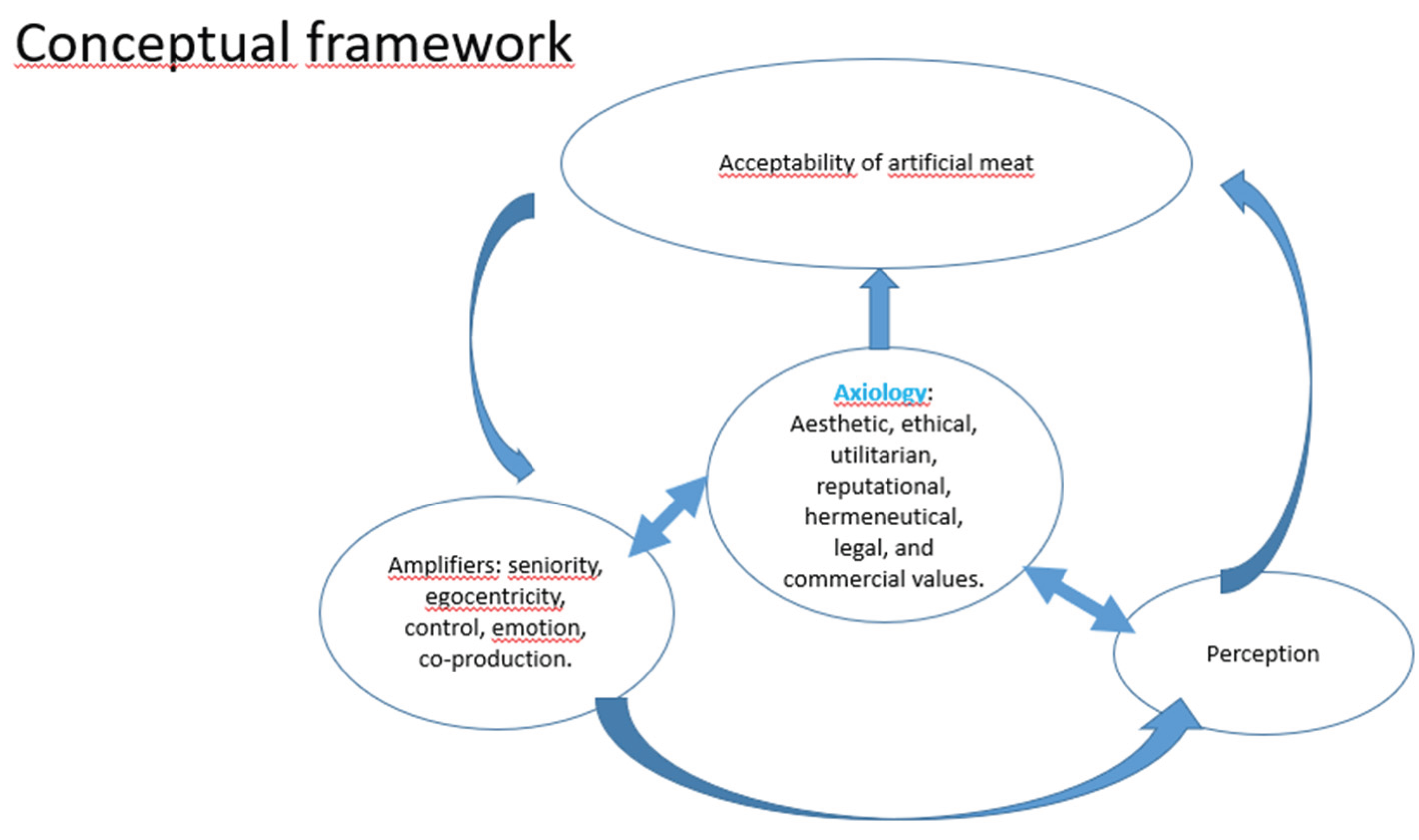
Table 1.
Inclusion and Exclusion Criteria Used for Article Selection.
| Integration or inclusion criterion | Exclusion criterion |
|---|---|
| • Full-text article published in a peer-reviewed journal • Articles that accurately include the keywords in their title • Across all studies (quantitative and/or qualitative) • Downloadable articles • Language: English, French |
• Sources not peer-reviewed • Articles whose titles do not contain keywords. • Incomplete articles and elimination of duplicates • Studies published in languages other than French and English. |
Table 2.
Article selection process.
| Keywords | phenomenology of perception | Axiology of Consumption | axiology | Cultured meat and perception | artificial meat and Perception | In-vitro meat perception | phenomenology and food | Axiology and communication |
| Exact expression in the title of the articles | 126 | 35 | 67 | 59 | 24 | 9 | 22 | 12 |
| Peer-reviewed papers | 89 | 12 | 32 | 46 | 20 | 7 | 17 | 8 |
| Downloadable articles | 6 | 12 | 32 | 42 | 14 | 7 | 12 | 6 |
| Incomplete articles and elimination of duplicates | 3 | 9 | 8 | 38 | 12 | 7 | 9 | 5 |
| Full text (Articles selected for our analysis) | 3 | 5 | 6 | 19 | 5 | 4 | 7 | 5 |
Table 3.
Chronological summary of future research identified in the articles.
| In 2015 |
| Hocquette et al. (2015) suggested that a potential research direction would be to better understand the long-term diversity of consumer opinions regarding the acceptability of artificial meat. Verbeke et al. (2015), for their part, recommended continuing studies on personal and environmental determinants, particularly personal motivations and the effects of information that may shape perceptions, expectations, and the likelihood of consumer acceptance or rejection of cultured meat. These authors also advocate examining the influence of beliefs, ethnicity, acculturation, or specific perceptions on the acceptance of artificial meat. Furthermore, Laestadius (2015) proposed new comparative research on the acceptability of cultured meat relative to other meat alternatives, as well as additional studies on consumer perceptions of cultured meat, focusing on the establishment of a public dialogue regarding cultured meat. |
| In 2019 |
| The work of Bryant et al. (2019) suggested that each country should explore consumer acceptance of plant-based and cultured meat, given that most surveys differ in question wording, response options, and terminology. They recommend conducting studies on the role of regulations in individuals' judgments regarding food safety. For their part, Mancini and Antonioli (2019) suggest the need to better understand whether a positive perception predicts a willingness to try or purchase cultured meat. They also recommend analyzing consumer perceptions and expectations, particularly in countries where culture, tradition, and/or religion might hinder the acceptance of cultured meat. |
| In 2020 |
| According to Mancini and Antonioli (2020), researchers should conduct studies on the impact of information on consumer acceptance of cultured meat. |
| In 2023 |
| For Kouarfaté and Durif (2023), it would be interesting to explore the influence of stakeholders on the acceptance of cultured meat and for Cornelissen and Piqueras-Fiszman (2023), future studies should focus on the segmentation factors of these consumers. |
Disclaimer/Publisher’s Note: The statements, opinions and data contained in all publications are solely those of the individual author(s) and contributor(s) and not of MDPI and/or the editor(s). MDPI and/or the editor(s) disclaim responsibility for any injury to people or property resulting from any ideas, methods, instructions or products referred to in the content. |
© 2025 by the authors. Licensee MDPI, Basel, Switzerland. This article is an open access article distributed under the terms and conditions of the Creative Commons Attribution (CC BY) license (http://creativecommons.org/licenses/by/4.0/).
Copyright: This open access article is published under a Creative Commons CC BY 4.0 license, which permit the free download, distribution, and reuse, provided that the author and preprint are cited in any reuse.


