

Submitted:
04 February 2025
Posted:
05 February 2025
You are already at the latest version
Abstract
Sustainable food consumption plays a vital role in mitigating environmental degradation and promoting social and economic wellbeing. Despite a growing interest in sustainability, significant challenges persist in consumer adoption and market integration. This study employs a systematic literature review (SLR) to identify the dominant motivations, barriers, technological advancements, and corporate initiatives that influence sustainable food consumption. The review synthesizes findings from peer-reviewed research published between 2015 and 2024, analyzing patterns across economic, geographic, and socio-behavioral contexts. The findings revealed that health concerns and environmental awareness are the primary drivers of sustainable food consumption, complemented by ethical values, taste perception, and social norms. However, economic constraints, limited product availability, a lack of awareness, and behavioral inertia significantly hinder widespread adoption. Technological advancements, including digital platforms, AI-driven food safety solutions, blockchains for traceability, and alternative proteins, present opportunities to address these challenges. Corporate initiatives such as Corporate Social Responsibility (CSR), fair-trade programs, and eco-labeling further enhance consumer trust and accessibility. This study highlights key research gaps, including cross-cultural variations, long-term behavioral changes, and the impact of digital interventions. A multi-stakeholder approach involving academia, businesses, and policymakers is crucial for developing comprehensive strategies to facilitate the transition towards a more sustainable and resilient food system.
Keywords:
sustainable food consumption
; consumer behavior
; barriers and motivations
; technological innovations
; corporate sustainability initiatives
1. Introduction
Sustainable food consumption has emerged as a critical issue for addressing environmental and societal challenges. Modern food systems are responsible for about 30% of global greenhouse gas emissions, consume 70% of freshwater resources, and contribute to biodiversity loss and soil degradation [19,105]. The environmental impact of food systems is projected to increase by 50-90% by 2050 without substantial changes in consumption patterns and production methods [82]. Research shows that dietary choices in developed nations have significant environmental footprints, with meat consumption accounting for up to 60% of food-related greenhouse gas emissions [70].
Consumer awareness of sustainable food choices has grown in recent years, driven by environmental concerns and health consciousness [96]. However, translating this awareness into sustained behavioral changes faces barriers. Studies identify price premiums, availability constraints, and habitual consumption as key obstacles [56]. The complexity of sustainability messaging and competing food system priorities often creates confusion among consumers [73].
This study analyzes the interplay between consumer behavior, environmental impact, technology, and social responsibility in sustainable food consumption. We investigate (1) motivations related to sustainable food consumption patterns across consumer segments, (2) barriers impeding the adoption of sustainable dietary choices, (3) key technologies that can facilitate the transition towards sustainable food consumption practices, and (4) trends in corporate initiatives regarding the promotion of sustainable food practices. By examining these aspects from theoretical and empirical perspectives, this research contributes to knowledge on sustainable consumption and provides insights for policymakers, businesses, and consumers.
2. Theoretical Background
To understand the complexities of sustainable food consumption, this study draws on several key theoretical perspectives that address consumer behavior, environmental impact, and social responsibility.
The Theory of planned behavior emphasizes the role of attitudes, social norms, and perceived behavioral control in shaping behavior [2]. Its application to sustainable consumption highlights the influence of environmental attitudes and social pressures [96]. The value-belief-norm theory explains pro-environmental behavior through personal values, environmental beliefs, and moral norms, helping to understand internal motivations for reducing meat consumption or choosing organic food [83,111]. The social practice theory focuses on how social and cultural practices influence food choices, emphasizing habits and routines in consumption patterns [57,79]. Behavioral economics and nudging highlight how cognitive biases and decision-making heuristics shape consumer behavior, with interventions encouraging sustainable choices [3,88].
Sustainable consumption is driven by intrinsic and extrinsic factors. Intrinsic motivations stem from personal values, environmental awareness, and moral responsibility, as outlined in value-belief-norm theory [83]. Studies have highlighted the influence of altruistic and biospheric values on promoting behaviors such as plant-based diets and reduced food waste [27,49]. Extrinsic motivations include social norms, economic incentives, and regulatory frameworks. Social influences affect younger consumers’ choices, while financial incentives encourage sustainable consumption [22,112].
Several barriers have hindered the widespread adoption of sustainable consumption. Limited availability of sustainable food, inadequate infrastructure, and unclear labeling make it difficult for consumers to make informed choices. Greenwashing and inconsistent certification standards further complicate the process [34,61]. High costs of organic and sustainable products pose a challenge, particularly for low-income households. Price sensitivity often outweighs environmental concerns in purchasing decisions [112,113]. Habitual behaviors, lack of knowledge, and perceived inconvenience deter consumers from adopting sustainable practices. Cognitive dissonance, in which values conflict with purchasing behavior, also contributes to unsustainable consumption [13].
Technological advancements enhance transparency, accessibility, and efficiency of sustainable food consumption. Digital platforms like “Too good to go” reduce food waste by connecting consumers with surplus food from restaurants and stores [110]. Blockchain ensures transparency in food supply chains, helping consumers verify sustainability credentials and counteract greenwashing [15,62]. AI-driven crop monitoring and resource optimization improve sustainability in food production by minimizing waste and environmental impact [6,8].
Corporations promote sustainable consumption through various strategies. Many have set ambitious targets, such as achieving net zero emissions by 2040 [28]. Labels like Fair Trade and Rainforest Alliance help consumers make informed choices and build trust in sustainable brands [72,77]. Businesses adopt waste-reducing strategies like upcycling surplus ingredients or using biodegradable packaging [66]. Companies use marketing to educate and encourage sustainable behavior, emphasizing plant-based diets and reducing food waste [95].
This theoretical framework provides a comprehensive understanding of factors influencing sustainable food consumption and offers a foundation for developing effective interventions.
This article is structured around seven key research questions, focusing on motivations, barriers, technology, corporate initiatives, and behavioral drivers.
RQ1: What are the dominant motivations for sustainable food consumption between 2015 and 2024?
RQ2: How have consumer concerns (e.g., environment, health, and ethics) evolved over time?
RQ3: What are the main barriers that limit the adoption of sustainable food consumption?
RQ4: How do barriers vary based on economic, social, and geographical factors?
RQ5: What is the impact of emerging technologies (e.g., blockchain and mobile applications) on educating and adopting sustainable consumption?
RQ6: What political and corporate initiatives support sustainable consumption at the global level?
3. Methodology
This study employs a systematic literature review (SLR) methodology to analyze and synthesize existing research on sustainable food consumption. The SLR approach was chosen for its systematic, transparent, and replicable nature, allowing thorough examination of current knowledge while minimizing bias in literature selection and analysis.
The PRISMA flow diagram illustrates the study selection process:
1. Identification of records through database searches and other sources.
2. Screening of records based on predefined inclusion and exclusion criteria.
3. Assessment of full-text articles for eligibility.
4. Final inclusion of studies in the review.
A literature search was conducted across Web of Science and Scopus databases to ensure comprehensive coverage of peer-reviewed research. The search strategy used keywords related to sustainable food consumption (e.g., “sustainable food consumption” AND “motivations*”; “sustainable food consumption” AND “barriers*”; “Sustainable food consumption” AND “technology”; “corporate responsibility” AND “sustainable food systems). The search was limited to publications between 2015 and 2024 to capture recent developments and trends. Articles were selected based on predefined inclusion criteria: peer-reviewed journal articles in English focusing on sustainable food consumption, motivations, barriers, and corporate or technological aspects. Studies were required to present empirical evidence or significant theoretical contributions. The quality assessment process evaluated articles based on five criteria: Abstract (+1 point), DOI (+1 point), Peer-review (+1 point), Clear methodology (+1 point), Clear objectives (+1 point).
This framework ensures a comprehensive and systematic approach to synthesizing the literature, providing a robust foundation for addressing the research questions.
Figure 1.
PRISMA 2020 flow diagram for new systematic reviews which included searches of databases. (Source: https://www.prisma-statement.org/prisma-2020-flow-diagram).
Figure 1.
PRISMA 2020 flow diagram for new systematic reviews which included searches of databases. (Source: https://www.prisma-statement.org/prisma-2020-flow-diagram).
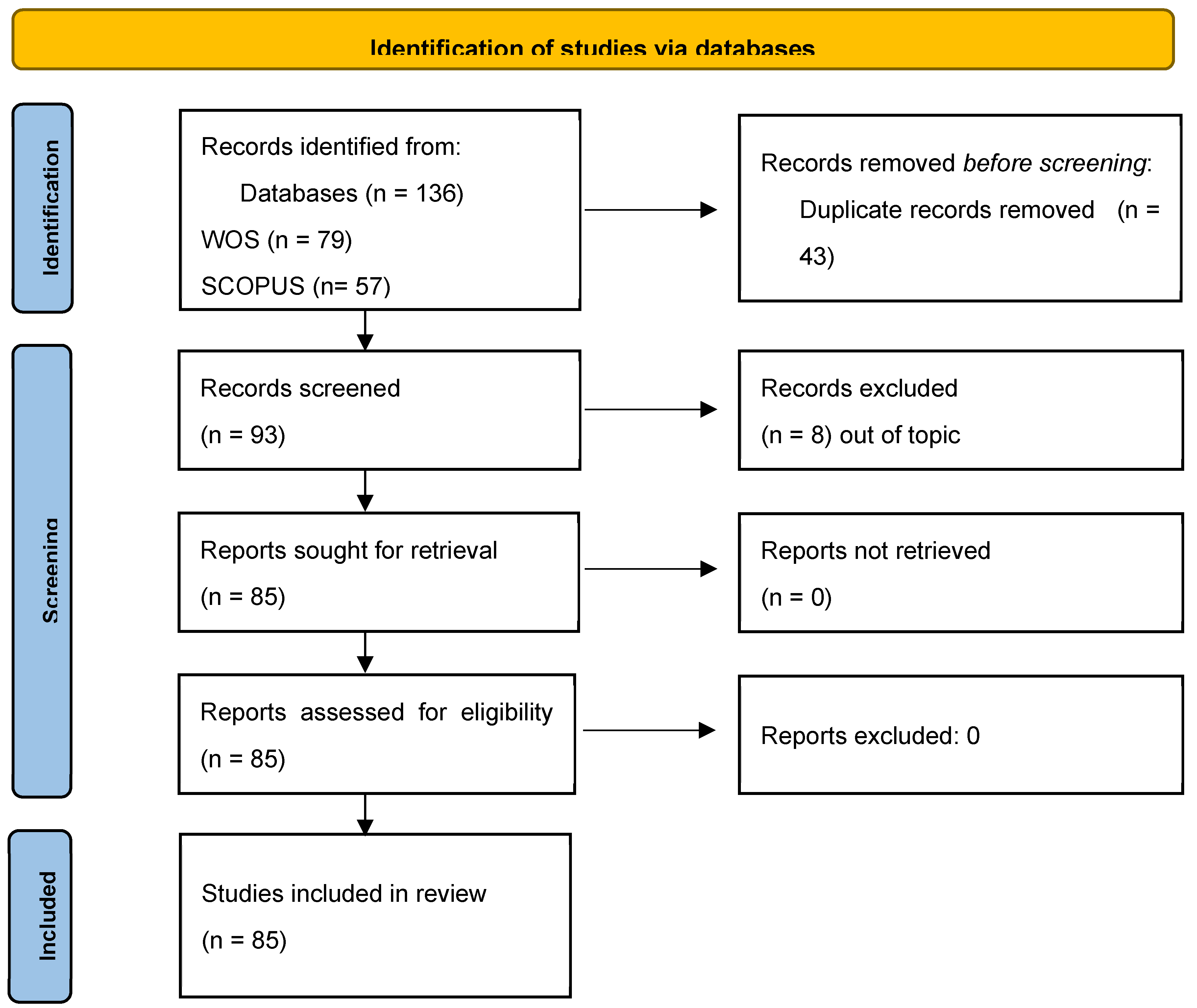
A total of 136 articles were identified across the Web of Science (79) and SCOPUS (57) databases. After removing 43 duplicates, 93 unique articles were screened on the basis of their titles and abstracts. All articles were considered relevant and were moved to the eligibility phase, where 8 were excluded for not meeting the criteria (off-topic). The remaining 85 studies were included in the final analysis.
A comprehensive framework was implemented to analyze the selected articles, focusing on three key dimensions: identifying topics of interest, temporal trends, and theme co-occurrences. Thematic analysis helped to identify patterns, trends, and gaps in sustainable food consumption.
The systematic process followed a structured workflow that integrated reference management and computational analysis.
- 1.
-
Literature Organization in the Zotero Collection
- Motivations (n=26): Consumer drivers and incentives.
- Barriers (n=36): Obstacles and limitations.
- Technology (n=15): Digital solutions and innovations.
- Corporate Initiatives (n=8): business strategies and programs.
- 2.
-
Adobe AI and Python-based Analysis Pipeline
- 1.
- Data extraction via Zotero API.
- 2.
- Automated text and pattern analysis.
- 3.
- Statistical trends and relationship analyses.
- 4.
- Generation of visual representations.
- 3.
-
Results, Visualization and Integration
- Thematic mapping.
- Temporal trend visualization.
- Comparative analysis across collections.
- Cross-theme pattern identification.
This approach allows for a deep individual theme analysis and broad understanding across themes, ensuring methodological consistency and comprehensive insights.
4. Results
4.1. Motivation in Sustainable Food Consumption
4.1.1. Recurring and Co-Occurring Categories of Motivation in Sustainable Food Consumption
Sustainable food consumption is driven by various overlapping motivations, including health, environmental awareness, ethics, social norms, taste and quality, support for local economies, knowledge, religious and cultural factors, emotional fulfillment, and economic considerations (see Table 1).
Health benefits are a significant motivator, with sustainable foods often perceived as healthier, safer, and more nutritious. This theme commonly co-occurs with concerns regarding food quality and safety [36,42,74,97]. Many consumers are motivated by the desire to reduce their environmental footprint and address issues such as global warming, resource depletion, and the ecological impact of food production. Environmental awareness often intersects with ethical beliefs and support for local economies [42,78,93,97].
Ethical considerations, including animal welfare and social justice, play a crucial role in motivating sustainable consumption. These beliefs are frequently linked with social norms and altruistic values [1,20,48,97]. Societal expectations and personal values significantly influence consumer behavior, with social pressure driving individuals towards sustainable choices [1,51,78,97]. The sensory appeal and perceived quality of sustainable food also serve as important motivators [42,47,93,97].
Many consumers are motivated by the desire to support local farmers and economies, often associated with environmental concerns and social responsibility [45,47,93]. Understanding the impact of food choices on sustainability is another key motivator, as education and personal experiences influence consumer behavior [48,97]. Religious beliefs and cultural practices can also drive sustainable consumption, frequently linked with health and ethical considerations [36,97].
Emotional satisfaction and a sense of accomplishment are notable motivators, often intersecting with personal well-being and social connections [45,74]. Affordability and the practical aspects of purchasing sustainable products represent significant motivators, with consumers’ perceived ability to purchase influenced by factors such as cost and convenience [48,78].
From Table 2, we can see that health concerns topped the list with 20 mentions. Health is a priority for many researchers, as explored in the studies by Verain et al. (2015) [97] and Hasan et al. (2024) [36]. Environmental awareness follows closely with 19 mentions, emphasized in studies by Vargas et al. (2021) [93] and Shen et al. (2022) [78]. Ethical and moral beliefs were significant, with 15 mentions. Researchers such as Cooper et al. (2022) [20] and Lema-Blanco et al. (2023) [48] explored how values influence decisions. Social and personal norms were discussed twelve times, reflecting how societal and personal values shape actions, as shown by Aguirre Sánchez et al. (2021) [1] and Lopez-Sintas et al. (2024) [51]. Taste and quality were important topics with 14 mentions, as emphasized in research by Kesse-Guyot et al. (2018) [42] and Lassoued et al. (2023) [47]. Support for local economies has been addressed in ten studies, such as Kovács et al. (2022) [45]. Knowledge and awareness were discussed in eight studies, and religious and cultural factors in five, like Hasan et al. (2024) [36]. Emotional and psychological fulfillment and economic considerations were also presented, with six and seven mentions, respectively. This table provides insights into the current research concerns and interests.
4.1.2. Temporal Analysis of the Evolutions of Various Motivations
The matrix below shows the presence of specific motivations in the sustainable consumption literature across different years, using “✓” to indicate the presence of a motivation topic (Table 3):
The authors have shown interest in health and environmental concerns from 2015 to 2024, focusing on how sustainable consumption affects well-being and the environment. Ethical and moral beliefs have been a constant topic, reflecting concerns for animal welfare, social justice, and ethical consumption. The sensory appeal of sustainable food has been significant for years, influencing consumer choices. Interest in supporting local economies has grown, particularly from 2021, recognizing the importance of local producers and economic sustainability. Societal expectations and personal values have been recurring themes, shaping consumer behavior. The role of knowledge and awareness in sustainable consumption has varied over the years. Religious beliefs have been noted in specific years, relevant to certain consumer groups, reflecting emotional and psychological aspects of sustainable consumption. Practical benefits and economic considerations have become more prominent, indicating growing interest in practical aspects of sustainable consumption.
Recently, sustainable consumption has evolved with emerging topics and motivations. Technological competence is important. Hasan et al. (2024) [36] discuss how mobile apps facilitate sustainable consumption, making organic food delivery easier. Self-management and autonomy are crucial. Lema-Blanco et al. (2023) [48] emphasize consumers’ desire for control over their choices, including cooperative models supporting sustainable practices. Perceived behavioral control plays a vital role. Shen et al. (2022) [78] explore how cost, convenience, and product availability influence decisions, arguing that control over these factors encourages sustainable purchasing. Social influence is a powerful motivator. Wojciechowska-Solis et al. (2022) [106] examine the impact of social media and influencers on shaping sustainable consumption, finding social networks significantly sway behavior. Trust and transparency are important. Kovács et al. (2022) [45] highlight that clear information about food origin and production methods builds trust, encouraging sustainable choices. Novelty and experimentation are also influential. Wojciechowska-Solis et al. (2022) [106] identify that curiosity drives consumers to try new sustainable food experiences. Lastly, sociopolitical ambitions are becoming significant drivers. Lema-Blanco et al. (2023) [48] discussed how consumers view sustainable consumption as a means of transforming economic and political systems. Similarly, Lamarque et al. (2023) [46] explored the political and economic impulses behind sustainable consumption, including activism against neoliberalism, corporatism, and consumerism.
Collectively, these studies provide a robust academic foundation for comprehending the diverse motivations underlying sustainable consumption. They elucidate a transformation in consumer priorities, reflecting broader societal trends towards pragmatic considerations, support for local economies, and emerging topics, such as technological competence and socio-political aspirations.
4.1.3. An in-Depth Examination of Drivers Behind Sustainable Food Consumption
The dataset from these articles examined the factors that affect sustainable food consumption. This analysis investigates these themes and examines the motivations that lead consumers to make sustainable choices based on identified factors.
Health concerns were a predominant motivator in multiple studies. Consumers increasingly focus on health, opting for organic and sustainable food perceived as safer and higher quality. This trend was evident in studies by Verain et al. (2015) [97] and Kesse-Guyot et al. (2018) [42]. These studies highlight that the perceived health benefits of organic food, such as the absence of harmful chemicals and higher nutritional value, drive its popularity. Rahman and Luomala (2021) [74] and Madureira et al. (2021) [52] emphasized that consumers believe organic foods contribute to better health outcomes, influencing their purchasing decisions. Environmental concerns also drive sustainable energy consumption. Awareness of food production’s environmental impacts encourages eco-friendly choices. Verain et al. (2015) [97] and Kesse-Guyot et al. (2018) [42] underscore environmental awareness in shaping consumer behavior. The positive environmental impact of organic farming, such as a reduced ecological footprint and lower greenhouse gas emissions, is a recurring theme. Madureira et al. (2021) [52] and Vargas et al. (2021) [93] highlight that consumers are motivated by the desire to minimize their environmental impact, driving them towards sustainable food. Ethical beliefs, including animal welfare and social justice concerns, strongly motivate sustainable consumption. Research by Verain et al. (2015) [97] and Aguirre Sánchez et al. (2021) [1] highlights that consumers are driven by moral responsibility to make ethical choices. Altruistic motivations, such as addressing social inequalities and supporting fair-trade practices, also play a crucial role. Sodano et al. (2018) [81] and Lema-Blanco et al. (2023) [48] discuss how consumers’ ethical considerations influence their purchasing decisions, reflecting broader societal concerns. The perceived quality and taste of sustainable food are significant motivators. Consumers often associate sustainable foods with superior tastes and sensory appeals. Verain et al. (2015) [97] and Kesse-Guyot et al. (2018) [42] noted that taste remains a primary driver among different consumer profiles. The freshness and higher quality of local and organic foods further drive consumer preference. Vargas et al. (2021) [93] and Lassoued et al. (2023) [47] emphasized that consumers perceive sustainable food as fresher and more nutritious, enhancing its appeal. Social norms and media influence also shape sustainable consumption behavior. Societal and personal expectations significantly affect consumers’ decisions. Verain et al. (2015) [97] and Aguirre Sánchez et al. (2021) [1] discussed how social norms and peer behavior influence sustainable consumption. The role of social media and influencers in promoting sustainable choices was also highlighted. Economic support for local economies and rural job markets is a key motivation for sustainable food choices. Consumers are driven by a desire to support local farmers and economies, as highlighted by Cooper et al. (2022) [20] and Lamarque et al. (2023) [46]. The affordability and accessibility of sustainable products are crucial to their adoption. Lema-Blanco et al. (2023) [48] noted that the availability of affordable organic products makes sustainable consumption more feasible. Political and economic impulses, including activism against neo-liberalism and corporatism, also influence motivation. Lamarque et al. (2023) [46] discuss how consumers’ political and economic beliefs drive their commitment to sustainable consumption.
The ability to use technology like mobile apps for organic food delivery is emerging as a motivator for sustainable consumption. Hasan et al. (2024) [36] highlight how technological advancements facilitate sustainable choices by easing access to organic products. This factor underscores technology’s role in promoting sustainable consumption. Emotional satisfaction and a sense of accomplishment were significant motivators. Consumers derive psychological fulfillment from sustainable choices, enhancing their well-being. Rahman and Luomala (2021) [74] discuss how emotional and psychological benefits contribute to sustainable consumption’s appeal. Cultural factors and community connections play vital roles in sustainable consumption. Consumers value sustainability to support local traditions and build community trust. Vargas et al. (2021) [93] and Kovács et al. (2022) [45] highlight how cultural connections influence consumer behavior. In societies with high uncertainty avoidance, sustainable consumption is considered a way to reduce health and environmental risks, as noted by Shen et al. (2022) [78]. The desire to try new products, often referred to as the “trysumer” attitude, motivates sustainable consumption. Wojciechowska-Solis et al. (2022) [106] discussed how curiosity drives consumers to explore new sustainable food options, reflecting a trend towards experimentation in consumption. Trust in the reliability of organic food producers and sellers is crucial. Consumers seek transparency regarding food origin and production methods, which builds trust and encourages sustainable choice. Kovács et al. (2022) [45] emphasize the importance of trust and transparency in motivating sustainable consumption.
Despite extensive research, several gaps exist in the literature on motivations for sustainable consumption. One gap is the intersectionality of motivation. Many studies focus on individual motivations like health, environmental concerns, and ethical beliefs, but lack research on how these motivations intersect and influence each other. Understanding this interplay could provide a more comprehensive view of consumer behavior. Longitudinal studies are required, as most research provides a snapshot of consumer motivation at a specific point in time. Tracking changes in motivation over time could offer insights into how and why consumer attitudes towards sustainable consumption evolve. Cultural differences also require more in-depth research. Comparing motivations across cultural contexts could help identify universal versus culture-specific motivations. The impact of technological advancements, such as mobile apps for organic food delivery, is another under-researched area. Exploring how technological competence influences sustainable consumption can reveal new motivators and barriers. Socioeconomic factors need detailed analysis. Understanding how different socioeconomic groups perceive and are motivated by sustainable consumption could help tailor strategies for different demographic segments. Behavioral economic principles can be applied more extensively to understand sustainable consumption. Research could explore how cognitive biases, heuristics, and decision-making processes affect consumer choice. The effectiveness of marketing strategies in promoting sustainable consumption is another area of limited research. Studies could investigate which messages and channels are most effective in influencing consumer behavior. The psychological and emotional factors driving sustainable consumption require further exploration. Understanding these factors could help design interventions that resonate at a deeper level. Policy impact is another gap. Research on how different policy measures, such as subsidies for organic farming or taxes on non-sustainable products, influence consumer motivation and behavior could provide valuable insights for policymakers. Finally, more research is needed on the role of education and awareness campaigns in shaping consumer motivation. Evaluating the effectiveness of different educational approaches in promoting sustainable consumption could offer new strategies for encouraging sustainable behavior.
4.2. Barriers in Sustainable Food Consumption
4.2.1. Recurring Categories of Barriers in Sustainable Food Consumption
This analysis compiled the barriers to sustainable food consumption identified in various studies. Barriers are classified into six main categories: Economic, Availability, Knowledge, Social and Cultural, Psychological, and Functional. The occurrence of each barrier type was determined by the number of articles referenced (see Table 4).
Economic barriers such as high prices and financial constraints are commonly cited as obstacles to sustainable food consumption. Various studies have highlighted cost issues associated with natural and organic foods. For example, Elgaar et al. (2024) [24] and Gao et al. (2020) [30] pointed out high cost as a deterrent for consumers. Similarly, Pais et al. (2023) [65] and Hoang et al. (2023) [39] identified economic burden as a significant challenge. This trend is observed in different regions, including Indiana (U.S.) (Waldman et al. 2023), Colombia (Blanco-Murcia and Ramos-Mejía 2019) [11], and Denmark (Reipurth et al. 2019) [75]. The recurring theme of high prices suggests a need for economic measures to make sustainable food more affordable.
Limited availability and variety of sustainable products are significant barriers. Studies conducted in different countries have highlighted these issues. Elgaar et al. (2024) [24] and Gao et al. (2020) [30] note the limited availability in certain regions. Similar findings were reported by Pais et al. (2023) [65] in Portugal, and Hoang et al. (2023) [39] in Vietnam. Yamoah and Acquaye (2019) [109] in the UK and Vittersø and Tangeland (2015) [99] in Norway also emphasized product availability as a critical factor influencing consumer behavior. A consistent mention of availability barriers indicates the need for improved distribution networks and market presence.
A lack of awareness and insufficient information regarding sustainable food options are common barriers. Studies in diverse regions have discussed these issues. Elgaar et al. (2024) [24] and Gao et al. (2020) [30] highlight the lack of consumer awareness and understanding of benefits. Pais et al. (2023) [65] in Portugal and Hoang et al. (2023) [39] in Vietnam raise similar concerns about knowledge gaps. Waldman et al. (2023) [100] in Indiana and Blanco-Murcia and Ramos-Mejía (2019) [11] in Colombia emphasize the need for better consumer education. These findings suggest that educational campaigns and transparent information are crucial in promoting sustainable food consumption.
Social and cultural factors, including family influence and cultural traditions, are significant barriers to sustainable food consumption. Studies from different cultural contexts have identified these influences. Pais et al. (2023) [65] in Portugal and Hoang et al. (2023) [39] in Vietnam highlight family traditions and social pressures. Waldman et al. (2023) [100] in Indiana (U.S.) and Blanco-Murcia and Ramos-Mejía (2019) [11] in Colombia discuss cultural norms and social practices. Reipurth et al. (2019) [65] in Denmark and Yamoah and Acquaye (2019) [109] in the UK illustrate the impact of social and cultural barriers. These findings highlight the need for culturally sensitive approaches to promote sustainable food practices.
Psychological barriers such as skepticism, resistance to change, and traditional habits hinder sustainable food consumption. Elgaar et al. (2024) [24] and Gao et al. (2020) [30] discuss consumer resistance due to skepticism and lack of awareness. Pais et al. (2023) [65] in Portugal and Hoang et al. (2023) [39] in Vietnam highlight psychological barriers like food neophobia and identity incongruence. Waldman et al. (2023) [100] in Indiana (U.S.) and Blanco-Murcia and Ramos-Mejía (2019) [11] in Colombia emphasize the impact of traditional habits and image concerns. Addressing psychological barriers requires targeted interventions to change consumers’ perceptions and behaviors through education and positive reinforcement.
Functional barriers related to the use, value, and perceived risks of sustainable food consumption were significant. Elgaar et al. (2024) [24] and Gao et al. (2020) [30] mention issues related to perceived risk and value. Pais et al. (2023) [65] in Portugal and Hoang et al. (2023) [39] in Vietnam discuss practical difficulties in finding or preparing sustainable meals. Waldman et al. (2023) [100] in Indiana and Blanco-Murcia and Ramos-Mejía (2019) [11] in Colombia illustrate the complexity of environmental impact assessments and perceived effort required for sustainable choices. Addressing functional barriers requires improving the convenience and perceived value of sustainable food.
The analysis revealed that economic, availability, knowledge, social and cultural, psychological, and functional barriers are prevalent in the literature on sustainable food consumption. Each category of barriers has been mentioned in multiple studies, indicating that these issues are widespread and significant across various contexts and regions.
In addition, the analysis of barriers to sustainable food consumption revealed specific key impediments frequently cited in the literature (see Table 5). The most prominent barrier was high price, mentioned in 18 articles, indicating that cost is a significant deterrent to the adoption of sustainable food practices. Lack of knowledge/awareness and lack of availability were also prevalent barriers, appearing in 16 and 14 articles, respectively. These findings highlight the need for enhanced educational efforts and improved distribution networks for sustainable products.
Cultural and social norms and consumer resistance/skepticism were identified as substantial social barriers cited in 12 and 10 articles, respectively. This suggests that altering societal attitudes and increasing consumer trust are crucial for fostering sustainable consumption. Distrust in labels/certifications and perceived quality/taste are notable psychological barriers, indicating that consumer confidence in and satisfaction with sustainable products must be addressed. Habitual behavior and family influence are recurring themes, emphasizing the challenge of modifying established eating patterns and the significant role of family dynamics in food choices.
Economic and marketing factors and environmental and physical contexts suggest that economic conditions and the physical availability of sustainable products are critical factors that influence consumer behavior.
The lack of unified policy/regulation and transparent information indicate that coherent policy frameworks and information transparency are essential for fostering trust and encouraging sustainable consumption. Food safety concerns and greenwashing highlight the need to address consumer concerns regarding the safety and authenticity of sustainable products to build trust.
Lack of collaboration and environmental education point to the need for better cross-sector collaboration and improved environmental education to support sustainable practices. The lack of economies of scale, standards, and benchmarking highlight specific logistical and regulatory challenges that need to be overcome to make sustainable food systems more efficient and reliable.
Digital exclusion, technical complexity, and data security concerns reflect the technological barriers that can hinder the adoption of digital solutions for sustainable food production and consumption. Training, adoption challenges, and resistance to change indicate the need for adequate training and overcoming resistance to new technologies and practices. Economic disparities and a lack of time show that economic inequalities and time constraints can limit consumers’ ability to engage in sustainable practices.
Perceived environmental impact and a lack of sense of responsibility suggest that consumer perceptions and a sense of responsibility play a role in sustainable consumption decisions. Contextual and social factors and sourcing aspects highlight the influence of social context and sourcing practices on consumer behavior. Shopping behaviors, meal planning trends, and insufficient information campaigns highlight the need for better consumer education and planning to reduce food waste and promote sustainable consumption.
4.2.2. Temporal Analysis of the Evolutions of Various Barriers
The analysis of barriers to sustainable consumption over the years reveals a dynamic landscape in which certain challenges persist, while new ones emerge (see Table 6). The authors were interested in examining the evolution of these barriers in order to better understand the dynamics and changes in this field.
In 2015, high prices and a lack of availability were identified as significant barriers to sustainable consumption. Consumers consider sustainable products to be more expensive and less accessible than the conventional options. In addition, a lack of knowledge/awareness and mistrust of labels/certifications were noted as obstacles. Many consumers were not well informed about the benefits of sustainable products or skeptical of the authenticity of labels and certifications. By 2016, lack of knowledge/awareness remained the only identified barrier, indicating a slight shift in focus.
The barriers identified in 2015-2016 continued to be significant in the period 2018-2019. High prices and lack of availability remain major challenges. However, new barriers have emerged during this period. Consumer resistance/skepticism became notable in 2019, reflecting increasing reluctance among consumers to change their purchasing habits. Habitual behavior and cultural and social norms began to be recognized as barriers, indicating that ingrained habits and societal expectations hindered sustainable consumption. Mistrust of labels/certifications and perceived impact on quality/taste were identified as additional barriers along with a lack of information.
In the period 2020-2021, high prices and limited availability remained key obstacles. Lack of knowledge and consumer skepticism persisted. Habitual behavior and cultural and social norms have become more prominent, highlighting the challenge of changing entrenched consumer behaviors and establishing societal norms. Mistrust of labels/certifications and the perceived impact on quality/taste were consistently noted, and the lack of information continued to be a barrier. In addition, psychological barriers were identified in 2021, indicating that mental and emotional factors also play a role in consumer resistance.
During the period 2022-2023, the barriers identified in previous years remained critical. High prices, limited availability, and a lack of knowledge and awareness continue to be major obstacles. Consumer resistance/skepticism, habitual behavior, and cultural and social norms are significant barriers. Mistrust of labels/certifications, perceived impact on quality/taste, and a lack of information were consistently noted. Psychological barriers become more prominent in 2023, suggesting an increasing recognition of the mental and emotional obstacles consumers face when considering sustainable options.
Barriers to sustainable consumption have evolved by 2024, but many challenges persist. High prices, limited availability, and insufficient knowledge and awareness continue to be major obstacles. Consumer resistance, habitual behavior, and cultural norms remain important. Mistrust of labels, perceived impact on quality, and a lack of information were common issues. Psychological barriers remained relevant, indicating that these factors were major obstacles.
Addressing these barriers requires building trust in sustainable products, improving perceived quality, and providing clear and accessible information to consumers.
4.2.3. In-Depth Analysis of Barriers to Sustainable Food Consumption
An extended review of articles on sustainable food consumption highlights the complex factors influencing consumer behavior. Each study offers insights into barriers and opportunities for promoting sustainable food choices.
Across studies, high prices and economic constraints emerged as significant barriers to sustainable food consumption. Elgaar et al. (2024) [24] identified high prices and lack of availability as major obstacles, suggesting economic and geographic factors play a crucial role. Gao et al. (2020) [30] highlighted reduced willingness to pay for sustainable milk due to economic factors and insufficient knowledge. Pais et al. (2023) [65] noted that price perceptions and economic constraints hinder healthier and more sustainable food choices in Portugal.
To address economic barriers, studies recommended strategies like economic incentives, subsidies, and efforts to make sustainable products more affordable. Haider et al. (2022) [33] emphasized the need for economic, quality, and convenience strategies to overcome price concerns and availability issues in Austria. Nguyen et al. (2021) [60] suggested economic and trust-building strategies are essential for increasing organic meat purchase intentions in Vietnam.
Limited availability and accessibility of sustainable food products are recurring barriers identified in many studies. Elgaar et al. (2024) [24] and Yamoah and Acquaye (2019) [109] highlight the significance of product availability in influencing consumer behavior. Theodoridis et al. (2024) [90] point out that availability and affordability are critical barriers in Greece. Improving supply chains, increasing sustainable options, and enhancing infrastructure are recommended strategies. Bååth (2022) [7] suggested economic and geographic strategies to make alternative foods more affordable and accessible. Kociszewski et al. (2023) [44] emphasized addressing bureaucratic and administrative difficulties to improve organic product availability in Poland.
Lack of knowledge, awareness, and information about sustainable food options is a common barrier across studies. Gao et al. (2020) [30] and Özkaya et al. (2021) [64] identified insufficient knowledge and lack of awareness as significant obstacles. Vassallo et al. (2016) [94] highlight the need for a unified sustainable food market policy to address informational barriers in Italy. Educational campaigns, transparent labeling, and better information dissemination are crucial strategies. Liu et al. (2021) [50] recommended educational and collaborative strategies to improve environmental education and responsibility in China. Dogan et al. (2023) [21] suggested informational and health strategies to prevent food waste through mobile applications.
Habitual behavior, consumer resistance, and psychological barriers significantly hinder sustainable food consumption. Pais et al. (2023) [65] identify habitual behavior and food neophobia as major barriers in Portugal. Reipurth et al. (2019) [75] highlighted negative attitudes towards protein content and concerns about satiety as barriers in Denmark. Interventions should focus on changing consumer habits, addressing psychological resistance, and promoting positive behavioral changes. Verfuerth et al. (2021) [98] recommend behavioral, psychological, and contextual strategies to reduce meat consumption at work and home. Terlau and Hirsch (2015) [87] suggest economic, availability, sensory, informational, trust, and behavioral strategies to address the attitude-behavior gap in sustainable consumption.
Cultural beliefs, social norms, and family influences significantly impact sustainable food consumption. Markoni et al. (2023) [53] identify cultural and social norms, health perceptions, and economic factors as barriers in Vietnam and Switzerland. Polyportis et al. (2024) [69] highlighted cultural and social norms as barriers to sustainable food transition. Strategies should include cultural sensitivity, leveraging social norms and engaging community leaders. Parekh and Svenfelt (2022) [67] recommend behavioral, economic, policy, market, cultural, and logistical strategies to adopt sustainable eating practices in Sweden. Ford et al. (2023) [29] suggested informational, economic, social, emotional, safety, and cultural strategies to address barriers among young meat-eaters.
Distrust in labels and certifications is a common barrier identified in several studies. Vittersø and Tangeland (2015) [99] highlighted trust in the labeling system and perceived quality of organic food as critical factors in Norway. Nguyen et al. (2021) [60] identified distrust of certified organic labels as a significant barrier in Vietnam. Building trust through reliable certification systems, transparency, and quality assurance is essential. Kociszewski et al. (2023) [44] emphasize addressing trust issues and improving certification systems to promote organic food consumption in Poland. Yadav et al. (2019) [108] recommend economic, availability, trust, and informational strategies to address barriers in developing nations.
Policy fragmentation, lack of unified market policies, and inadequate legal frameworks are barriers identified in several studies. Vassallo et al. (2016) [94] highlight the need for policy, legal, and psychological interventions in Italy. Liu et al. (2021) [50] emphasized legal, infrastructural, behavioral, economic, educational, and collaborative strategies to promote sustainable food consumption in China. Effective policies, regulations, and government support are necessary to promote sustainable energy consumption. Blanco-Murcia and Ramos-Mejía (2019) [11] recommended policy, nutritional, economic, and cultural interventions to address barriers to sustainable diets in Colombia. Polyportis et al. (2024) [69] suggested informational, behavioral, cultural, industrial, and policy strategies for sustainable food transitions.
Perceived environmental impacts and health benefits are motivators, but food safety and health risks can be barriers. Markoni et al. (2023) [53] identify health perceptions and food safety concerns as barriers in Vietnam and Switzerland. Dogan et al. (2023) [21] highlighted health concerns as barriers to preventing food waste through mobile applications. Addressing these concerns through clear communication and evidence-based information is important. Hansmann et al. (2020) [35] recommend economic, informational, temporal, and environmental strategies to increase organic food consumption. Weinrich and Elshiewy (2023) [103] suggested economic, attitudinal, and informational strategies to address barriers to microalgal consumption.
Several studies identified technical complexity, infrastructure limitations, and resistance to adopting new technologies as barriers. Bocean (2024) [12] highlighted high upfront costs, technical complexity, and data security concerns in the European Union. Liu et al. (2021) [50] identified inadequate infrastructure and lack of investment in advanced equipment/technologies as barriers in China. Solutions include investing in technology, improving infrastructure, and providing training and support. Dogan et al. (2023) [21] recommend informational, health, and perceptual strategies to prevent food waste through mobile applications. Bocean (2024) [12] suggested economic, technical, security, infrastructural, educational, and resistance strategies to address barriers in the European Union.
Emotional attachment, psychological fulfillment, and perceived effort for sustainable consumption are significant factors. Ford et al. (2023) [29] identified emotional challenges and skepticism about certification as barriers among young meat eaters. Verfuerth et al. (2021) [98] highlighted justification strategies and compartmentalization between work and home as psychological barriers. Strategies should address emotional and psychological aspects to encourage sustainable choices. Terlau and Hirsch (2015) [87] recommend economic, availability, sensory, informational, trust, and behavioral strategies to address the attitude-behavior gap in sustainable consumption. Verfuerth et al. (2021) [98] suggested behavioral, psychological, and contextual strategies to reduce meat consumption at work and home.
Existing literature on barriers to sustainable consumption highlights critical gaps. Limited research has examined how these barriers intersect and compound each other. Economic barriers and cultural norms often interact and influence sustainable consumption. Current studies address barriers in isolation, missing their complexity. Understanding this intersectionality is crucial as multiple factors simultaneously affect consumer behavior.
Longitudinal research on tracking changes in barriers over time is lacking. Most studies provide a snapshot of the current situation without considering barrier evolution. This hinders understanding of the dynamic nature of barriers to sustainable consumption. Longitudinal studies are essential for capturing temporal changes in barriers and understanding contributing factors. Economic conditions, technological advancements, and policy changes can significantly alter the barrier landscape over time.
Insufficient research exists on how technological solutions can address barriers to sustainable consumption, such as lack of information and convenience. Although technology has potential to mitigate these barriers, its application remains underexplored. Digital technologies like mobile apps and online platforms can provide information, enhance convenience, and facilitate sustainable choices. However, their potential remains unexplored without targeted research.
More research is needed on the impact of policies and regulations on barriers to sustainable consumption. How do different policy frameworks influence consumer behavior? The literature lacks comprehensive analysis of various policy measures’ effectiveness. Policies and regulations can influence consumer behavior by creating incentives or disincentives for sustainable practices. Understanding different policy frameworks’ impact is crucial for designing effective interventions.
Many studies have focused on specific regions or cultures, leading to a lack of comparative research across different cultural and regional contexts. This restricts understanding of how cultural and regional differences influence barriers to sustainable consumption. Cultural and regional contexts shape consumer behavior and perceptions. Comparative research can identify universal barriers and context-specific challenges, enabling development of tailored strategies.
Limited research exists on how barriers vary across consumer segments such as age group, income level, and educational background. This hinders development of targeted strategies for various demographic groups. Consumer segmentation is essential to understand diverse needs and challenges faced by different groups. Tailored strategies can address specific barriers more effectively, leading to higher adoption rates for sustainable practices.
Most studies have focused on consumer-side barriers, with less attention to barriers within supply chain and production processes. This oversight limits understanding of systemic challenges impacting sustainable consumption. Barriers within supply chain and production processes can significantly affect availability and quality of sustainable food. Addressing these barriers is crucial for ensuring consistent supply of sustainable products.
While some studies mention psychological barriers, there is a need for a deeper exploration of the emotional and psychological factors that influence sustainable consumption. Understanding these factors is essential for developing effective interventions. Psychological and emotional factors such as cognitive biases, emotional attachment, and perceived effort play a significant role in consumer behavior. Addressing these factors can enhance the effectiveness of strategies for promoting sustainable consumption.
Limited research exists on the role of marketing and communication strategies in overcoming the barriers to sustainable consumption. Effective communication is crucial for changing consumer perceptions and behaviors. Marketing and communication strategies can significantly influence consumer attitudes and behaviors towards sustainable consumption. Understanding the effectiveness of different approaches is essential in designing effective campaigns.
4.3. Technologies in Sustainable Food Consumption
4.3.1. Recurring Themes and Categories of Technologies in Sustainable Food Consumption
A diverse range of technologies are being developed and implemented in the rapidly evolving landscape of sustainable food practices to address challenges spanning production, distribution, and consumption. These innovations fall into multiple categories, each offering unique solutions to enhance sustainability and efficiency in the food industry (Table 7).
Alternative Proteins include plant-based alternatives (PBM/S) and lab-grown meat/seafood (CBM/S). These technologies provide sustainable substitutes for traditional animal-based proteins, significantly reducing their environmental impact by lowering greenhouse gas emissions and water usage. Dairy Alternatives use precision fermentation to create dairy-like products without animal involvement. This approach offers a sustainable and ethical alternative to conventional dairy, reducing reliance on livestock, and thereby lowering carbon footprints and resource consumption. Decontamination Technologies ensure food safety and quality by eliminating the harmful contaminants. Methods such as cold plasma, ultrasound, mycotoxin decontamination, and ozone are employed to enhance food preservation without compromising the nutritional value. Preservation Techniques use natural compounds, such as essential oils (EOs), to extend shelf life and incorporate emerging technologies to minimize food spoilage. These methods reduce reliance on chemical preservatives and support clean-label food production. Digital Platforms enhance accessibility to food through mealbox schemes and online shopping. They also utilize social media for consumer engagement and education, improving convenience, and reducing food waste by optimizing purchasing behaviors. Food Literacy technologies improve our understanding of food production, storage, and supply chain transparency. Digital tools and educational programs are used to enhance consumer knowledge, empowering consumers to make informed, sustainable food choices. Smart Technologies incorporate artificial intelligence (AI), GPS, and 3D printing for food production and distribution. These technologies enhance automation and precision in food manufacturing and reduce resource waste through data-driven optimization. Digital Transformation includes smart refrigerators and mobile applications that assist food management. These innovations promote efficiency in tracking and reducing household food waste, and enhance consumer convenience through automation and real-time insights. Digital Technologies encompass artificial intelligence (AI), big data, IoT, and cloud computing in food system operations. They improve supply chain monitoring and efficiency, enabling data-driven decision making for sustainable practices. Waste Management utilizes mobile applications, IoT systems, and digital platforms to track and reduce food waste. Lean management techniques and demand analysis were implemented, focusing on food surplus management and waste forecasting to enhance efficiency. Smart Systems include AI-powered shopping assistants that optimize food purchases. These systems enhance consumer experiences through personalized recommendations and reduce waste by guiding better food consumption decision-making. Educational Tools incorporate virtual reality (VR) and mobile technology for interactive learning. These tools enhance consumer awareness of food sustainability and nutrition and support knowledge sharing to promote responsible food choices. Smart Gardening implements automated gardening systems and chemical test kits for urban agriculture. These technologies support localized food production, reduce transportation emissions, and enhance resource efficiency using data-driven plant care solutions. Traceability uses blockchain and the IoT to ensure transparency in the food supply chain. These technologies prevent food fraud by securely tracking product origins and distribution, and enhancing consumer trust through verifiable sourcing information. ICT in Food Systems leverages information and communication technologies (ICT) to optimize food systems. These technologies facilitate real-time data exchange and monitoring and enhance decision-making for efficiency and sustainability. Green Apps use smartphones to promote sustainable food practices. These apps encourage eco-friendly behavior through digital engagement, supporting the tracking and reduction of carbon footprints in food choices.
The frequency with which these technologies appear in the academic literature underscores their significance in sustainable food practices (see Table 8). Waste management technologies have been highlighted most frequently, emphasizing the urgency of addressing food waste. Decontamination and food literacy technologies are prominent, reflecting the importance of food safety and consumer education. Alternative proteins, preservation techniques, digital platforms, smart technologies, digital technologies, smart systems, and traceability are becoming increasingly relevant, while dairy alternatives, digital transformation, educational tools, and smart gardening represent emerging areas of interest.
The analysis of these technologies reveals a dynamic and multifaceted approach to sustainability in the food industry. The frequent use of waste management technologies highlights the urgent need for innovative solutions to reduce food waste. Similarly, the significance of decontamination and food literacy underscores the focus of the industry on food safety and education. Alternative proteins and dairy alternatives represent significant strides in providing sustainable food options and reducing reliance on traditional animal-based products.
Digital platforms and smart technologies are reshaping consumer interactions with food systems, making sustainable choices more accessible and convenient. The integration of AI, IoT, blockchain, and other digital innovations has revolutionized supply chain management, traceability, and overall efficiency. Educational tools and smart gardening systems foster consumer engagement and active participation in sustainable practices. Collectively, these advancements are paving the way for a more resilient, transparent, and environmentally friendly food system.
4.3.2. Temporal Evolution of Technology Categories in Sustainable Consumption
Regarding the temporal evolution of the field, we observed a clear progression in the interests of authors towards specific technologies (see Table 9). In 2020, the authors focused on Food Literacy, emphasizing environmentally friendly production methods, reducing food waste, and enhancing transparency and traceability in the supply chain [92].
In 2021, the authors’ interest evolved towards preservation techniques with the introduction of essential oils (EOs) and emerging technologies (ETs) to ensure food safety and quality [86]. Additionally, innovations in ICT platforms and mobile apps have been developed to promote eco-friendly products and improve product traceability [17].
The year 2022 saw significant interest from the authors in decontamination technologies, including cold plasma, ultrasound, and ozone for mycotoxin decontamination [32,85]. Digital Platforms such as mealbox schemes and online food shopping have emerged as sustainable options [37]. Smart Technologies, such as AI, GPS, and 3D printing, have begun to revolutionize food production and safety [5]. The concept of Digital Transformation saw the introduction of smart refrigerators and apps to enhance food safety and sustainability [5]. A comprehensive approach to Waste Management was adopted, utilizing mobile applications, digital platforms, IoT systems, and lean management techniques to minimize waste [40]. Smart Systems with AI and smart shopping assistants promote sustainable food choices [41]. Educational Tools such as VR and mobile technologies have been used to raise awareness of food sustainability [41]. Smart Gardening systems and chemical test kits support sustainable agricultural practices [41]. Traceability was enhanced through blockchain technology to ensure compliance with sustainability standards [23]. ICT continues to promote eco-friendly products [10].
In 2023, the authors’ interest shifted towards Alternative Proteins, including plant-based alternative proteins, lab-grown meat/seafood, and precision-fermented dairy products [29]. Digital Platforms and social media play a crucial role in promoting sustainable consumer behavior [107].
By 2024, the authors’ interest in Digital Transformation has advanced further with technologies such as AI, Big Data, IoT, and cloud computing to optimize resource use and reduce waste [12].
The temporal evolution matrix highlighted the progression and diversification of technologies aimed at promoting sustainable food consumption. Early focus areas included food literacy and preservation, with a gradual shift towards advanced decontamination methods, digital platforms, and ICT innovations. In recent years, significant advancements have been made in alternative proteins, smart technologies, and digital transformation, reflecting a comprehensive and integrated approach to achieving sustainability in the food industry. This matrix underscores the importance of continuous innovation and interdisciplinary research to address the complex challenges of sustainable food systems.
4.3.3. In-Depth Analysis of Sustainable Food Consumption Technologies
A deeper analysis of the articles reveals a diverse range of technologies and their applications in promoting sustainable food consumption. Each article focuses on specific technologies, demographic groups, geographic regions, and behavioral aspects, providing a comprehensive understanding of the multifaceted approach required to achieve sustainability in the food industry.
Ford et al. (2023) [29] explored the potential of plant-based alternative proteins (PBM/S), lab-grown meat/seafood (CBM/S), and precision fermented dairy products (PFDs). Their study focused on young meat-eaters and their perceptions of sustainable food consumption, offering insights into consumer habits and attitudes towards current and future protein alternatives. This demographic focus highlights the importance of understanding consumer behavior in driving the adoption of sustainable food technologies. Gavahian et al. (2022) [32] investigated the use of cold plasma and ultrasound for mycotoxin decontamination. Their research emphasized the economic benefits of these technologies, including potential cost savings and efficiency in food processing. Additionally, the study discusses the policy implications of food safety regulations and standards, underscoring the need for regulatory frameworks to support the adoption of innovative decontamination methods. Targino de Souza Pedrosa et al. (2021) [86] examine the use of essential oils (EOs) and emerging technologies (ETs) for food safety and quality. The study highlights the impact of these technologies on the sensory characteristics of foods and their cost-effectiveness as natural preservatives. In addition, it underscores the importance of developing preservation techniques that maintain food quality while reducing the reliance on chemical additives. Heidenstrøm and Hebrok (2022) [37] focused on digital platforms for food supply, including mealbox schemes and online grocery shopping. Their study, set in Norway, explored the economic benefits of reducing transport emissions and promoting local products. This research also examines the influence of digital platforms on consumer purchasing habits, highlighting the potential of these technologies to drive sustainable consumption. Ukraisa et al. (2020) [92] emphasized the importance of food literacy by examining food production, storage, transport, and processing technologies in the Thai context. Their study focused on policy aspects, particularly transparency and traceability in the supply chain, and the behavioral impact of enhancing food literacy to promote informed consumer choices. Ashraf and Alanezi (2022) [5] explored a range of smart technologies including AI, GPS, 3D printing, lab-grown meat, genetic modification (CRISPR/Cas-9), and digital transformation tools such as smart refrigerators and apps. Their research, conducted in Saudi Arabia, highlights the economic benefits of increased productivity and food safety as well as the behavioral impact of adopting smart technologies in food preparation and consumption. Bocean (2024) [12] examined the role of digital technologies such as AI, Big Data, IoT, and cloud computing in optimizing resources and reducing waste in the European Union. The study discusses the economic and policy implications of these technologies for sustainable food production and consumption, emphasizing the need for integrated digital solutions to enhance efficiency and sustainability. Jia and Qiao (2022) [40] focus on digital solutions and innovations, including mobile applications, digital platforms, IoT systems, lean management techniques, and food surplus management. Their research highlights the behavioral benefits of tracking and inventory management to minimize food waste and the economic efficiency gained through waste reduction. Sujayshree et al. (2022) [85] investigate the use of ozone for mycotoxin degradation, emphasizing the economic benefits of improving food safety and reducing food waste. The study also discusses the policy implications of advanced oxidation technology for food safety standards, highlighting the need for regulatory support to facilitate the adoption of these technologies. Kantamaturapoj et al. (2022) [41] explored smart systems and AI, smart shopping assistants, educational and awareness tools (VR and mobile technologies), smart gardening systems, and chemical test kits in Bangkok. Their research focused on policy support for sustainable urban food practices and the behavioral impact of promoting sustainable food choices and practices. Dupont et al. (2022) [23] examined the acceptance of cultured meat and the use of blockchain for traceability in Germany. Their study highlights the behavioral aspects of consumer acceptance and the policy implications of ensuring compliance with sustainability standards through traceability technologies. Betzler et al. (2022) [10] focused on information and communication technologies (ICT) and their role in promoting eco-friendly products and influencing consumer behavior. Their study underscores the importance of ICT innovation in driving sustainable consumption. Xiao et al. (2023) [107] investigated the role of online platforms and social media in promoting sustainable consumer behavior. Their study highlighted the behavioral impact of digital engagement in encouraging sustainable practices. Chen et al. (2021) [17] examine ICT innovations, ICT platforms, IoT, blockchain, and mobile apps, highlighting their role in providing access to information about eco-friendly products, promoting sustainable practices, and improving product traceability.
The comparative analysis highlighted a diverse range of technologies and their applications in promoting sustainable food consumption. Each article focuses on specific technologies, demographic groups, geographic regions, and behavioral aspects, providing a comprehensive understanding of the multifaceted approach required to achieve sustainability in the food industry. This analysis underscores the importance of integrating technological advancements with economic, policy, and behavioral considerations to drive sustainable practices and consumer behavior.
The analysis of gaps in the literature on technologies for sustainable consumption reveals key areas requiring further research. Each gap highlights the need for a more comprehensive approach to understanding and promoting sustainable food practices.
There is a lack of comprehensive studies integrating multiple technologies like AI, IoT, and blockchain to provide a holistic approach to sustainable food consumption. Research is needed to address interoperability issues and explore how different technologies can work together to enhance sustainability. This integration is crucial for developing robust systems that address the complexities of sustainable food production and consumption. Most existing studies have focused on short-term impacts, leaving a gap in long-term studies evaluating sustainability and scalability over extended periods. Research is needed to address challenges of scaling up these technologies from pilot projects to widespread adoption. While some studies address consumer behavior, deeper insight into psychological and social factors influencing acceptance and adoption of sustainable technologies is needed. More research is required to understand how cultural differences affect consumer behavior towards sustainable technologies in different regions. There is a gap in research on economic feasibility and cost-benefit analysis of implementing sustainable technologies on a large scale. Further studies are needed to develop and evaluate policy frameworks supporting adoption of sustainable technologies in the food industry. Comprehensive environmental impact assessments considering the entire lifecycle of sustainable technologies are required. Comparative studies evaluating environmental impact of different technologies are limited and necessary to identify the most sustainable options. Research on emerging technologies such as CRISPR/Cas-9, 3D printing, and precision fermentation is still in its infancy. Further studies are required to explore the potential and limitations of these methods. There is a gap in innovation, particularly in developing new technologies addressing specific sustainability challenges in the food industry. Research is needed to address issues of equity and access to sustainable technologies, ensuring they are affordable and accessible to all segments of the population. More studies are needed to understand the impact of these technologies on small-scale producers, and how they can be supported in adopting sustainable practices. There is a gap in research regarding the effectiveness of educational programs and awareness campaigns in promoting sustainable consumption behaviors. More studies are needed to explore the role of digital tools such as mobile apps and VR in educating consumers about sustainable food choices. Enhancing education and awareness are crucial for empowering consumers to make informed and sustainable decisions.
Addressing these gaps in the literature is crucial for advancing sustainable food consumption. Future research should focus on integrating multiple technologies, evaluating long-term impacts, understanding consumer behavior, assessing economic and policy implications, conducting comprehensive environmental assessments, exploring emerging technologies, addressing socioeconomic factors, and enhancing education and awareness. By filling these gaps, researchers can provide more robust and actionable insights into sustainable practices in the food industry.
4.4. Corporative Initiatives in Sustainable Food Consumption
4.4.1. Recurring Themes and Categories of Corporate Initiatives in Sustainable Food Consumption
An analysis of corporate initiatives in sustainable consumption reveals that businesses employ various strategies to meet consumer expectations, regulatory demands, and ethical standards (see Table 10). Key initiatives include Corporate Social Responsibility (CSR), labeling, and certification, which are crucial for fostering trust and minimizing environmental impact. CSR emerges as the most frequent initiative, underscoring its importance in promoting ethical business practices, reducing carbon footprints, and ensuring sustainable operations [16,55,87]) (see Table 11). This highlights businesses’ commitment to long-term sustainability goals. Labeling and certification are vital for transparency, helping prevent greenwashing, and assuring consumers of ethical sourcing [55,87]. These initiatives have addressed the growing demand for verified sustainability standards.
Although mentioned less frequently, other initiatives, such as consumer education, product availability, promotion and marketing, fairtrade, environmental policies, and stakeholder engagement, play essential roles. Consumer education and awareness bridge the knowledge gap, helping consumers understand the benefits of sustainable choices (reference [109]). Ensuring product availability and diversity allows consumers to access sustainable products (reference [109]). Promotion and marketing integrate sustainable products into mainstream business strategies through discounts and targeted campaigns (reference [87]). Fairtrade and ethical trade promote fair wages and ethical labor practices, addressing supply chain inequalities (reference [84]). Environmental policies and practices reflect corporate responsibility for addressing climate change and promoting sustainable sourcing (reference [91]). Stakeholder engagement and policy development highlight the need for collaborative efforts to manage food safety risks and develop sustainable policies (reference [4]). These diverse initiatives demonstrate that sustainability requires systemic and cross-sectoral cooperation.
Co-occurrence analysis shows CSR as a key aspect of corporate sustainability, often linked to green product development, marketing, and transparency (see Table 11). This indicates that companies with strong CSR commitments tend to adopt a comprehensive approach to sustainability that combines innovation, consumer engagement, and regulatory adherence. However, the lower integration of fair trade, ethical trade, and stakeholder engagement with CSR suggests that some sustainability efforts are still disjointed. CSR’s strong correlation of CSR with green product lines highlights the importance of sustainable product innovation as part of corporate responsibility. Companies are increasingly viewing CSR as encompassing not only ethical practices, but also the creation of eco-friendly products that meet consumer demand. Similarly, the frequent intersection of CSR with promotion and marketing strategies indicates that sustainability is often used to enhance brand positioning and appeal to eco-conscious consumers.
The link between CSR and labeling and certification underscores the vital role of transparency in building consumer trust. Companies investing in CSR are more likely to adopt certification programs to verify their environmental and ethical claims, reflecting a market-driven approach to corporate responsibility. Despite these connections, CSR’s moderate association of CSR with consumer education, product availability, and environmental policies suggests that some sustainability initiatives are still not fully integrated into corporate strategies. Although companies recognize the importance of educating consumers and improving product accessibility, these efforts are not yet deeply embedded within CSR frameworks.
The low co-occurrence of CSR with fair trade and ethical trade indicates that these practices are often managed separately from broader CSR commitments, potentially limiting the creation of holistic sustainability strategies. Additionally, stakeholder engagement remains underdeveloped, indicating that many companies are yet to fully incorporate external collaboration into their sustainability efforts. The lack of strong integration between different sustainability initiatives suggests that while CSR serves as a core sustainability driver, other efforts, such as fair trade, stakeholder engagement, and environmental policies, are still treated as distinct rather than interconnected strategies. This reinforces the need for a more integrated and systemic approach, where corporate initiatives are not just implemented in isolation, but are aligned to maximize impact. Companies that can bridge these gaps by linking CSR, supply chain ethics, consumer education, and regulatory compliance are better positioned to drive meaningful and scalable progress in sustainable consumption.
Although CSR remains the dominant focus, the presence of multiple corporate initiatives illustrates the multifaceted nature of sustainable business strategies. Companies do not rely on a single solution, but rather adopt a combination of ethical, environmental, and consumer-focused approaches to drive sustainability forward. The effectiveness of these efforts depends on integration, consumer trust, and corporate accountability, reinforcing the need for a cohesive and long-term commitment to sustainable consumption.
4.4.2. Temporal Evolution of Corporate Initiatives Categories in Sustainable Consumption
The temporal evolution of corporate initiatives in sustainable consumption reflects the shifting focus of authors over time. Initially, the emphasis was on Corporate Social Responsibility (CSR) and the promotion of eco-friendly products with efforts to obtain sustainability certifications (see Table 12).
In 2015, CSR initiatives involved reducing the carbon footprint and promoting organic products. By 2016, the focus had shifted to fair and ethical trade, acknowledging inequalities in global supply chains. In 2018, there was an increased emphasis on consumer education and accessibility of sustainable products. In 2019, attention was directed towards green product innovation and obtaining sustainability certifications to build trust and transparency. By 2021, the emphasis was on institutionalizing sustainability, highlighting responsible sourcing and ethical labor practices. By 2024, the focus had transitioned to stakeholder engagement and policy development, marking a mature approach to sustainability. The authors recognize the need for systemic change and collaboration to achieve a long-term impact.
The overall trajectory highlights a clear evolution from early CSR and marketing efforts to more sophisticated consumer-driven and policy-integrated approaches. This shift underscores the increasing complexity and depth of corporate sustainability commitments, reflecting a broader movement towards long-term multi-stakeholder strategies that go beyond surface-level eco-branding.
4.4.3. In-Depth Analysis of Sustainable Food Corporate Initiatives
Corporate initiatives in sustainable consumption differ greatly based on the development level, regional context, and quality of life. Developed countries often have advanced CSR programs, focusing on organic products, sustainability certifications, and transparent labeling, driven by high consumer demand and regulatory support [16,87,109]. These regions also prioritize consumer education, empowering individuals to make informed choices.
In contrast, developing countries focus on basic CSR practices, fair labor standards, and ethical sourcing to address fundamental social and environmental concerns [84]. However, challenges such as limited supply chain infrastructure and lower consumer demand for sustainable products persist [109].
Regional differences were significant. Europe leads to regulatory enforcement, promoting organic, local, and seasonal foods [91]. North America focuses on innovation, with investments in eco-friendly products and supply chain transparency [55]. Asia shows uneven CSR implementation due to varying economic development and regulatory enforcement [114].
Quality of life also influences corporate sustainability. Regions with a higher quality of life see greater demand for sustainable products, making advanced CSR programs more feasible [16,91,109]. In regions with lower quality of life, efforts focus on meeting basic needs, with fair trade and ethical trade initiatives ensuring fair wages and improved working conditions [84].
This document provides a comprehensive overview of various corporate initiatives for sustainable consumption in different studies. Several gaps in the literature can be identified, highlighting areas that require further research to provide a holistic understanding of the effectiveness and challenges of these initiatives.
There is limited discussion on the long-term impact of corporate initiatives on consumer behavior and environmental sustainability. Most studies focus on immediate or short-term effects, leaving a gap in understanding how these initiatives influence long-term sustainable practices. Research is needed to evaluate the sustainability and scalability of these initiatives over extended periods.
Studies primarily focus on specific markets, which may not fully address the diversity in consumer behavior across different regions and product categories. Further research is needed to understand how consumer behavior varies globally and across various product types, ensuring that sustainable consumption strategies are effective in diverse contexts.
There is a lack of emphasis on how emerging technologies such as blockchain and AI can enhance transparency and trust in sustainable consumption practices. Research is needed to explore the potential of these technologies in improving supply chain transparency, preventing greenwashing, and building consumer trust.
The economic implications for companies that adopt sustainable practices have not been thoroughly explored. Understanding the cost-benefit analysis of implementing these initiatives on a large scale is crucial for assessing their feasibility. Research should focus on the economic viability of sustainable practices and provide insights into the financial benefits and challenges faced by companies.
While some studies mention policy development, there is a need for a more detailed analysis of how government policies and regulations influence corporate strategies for sustainable consumption. Research should explore the role of policy frameworks in supporting the adoption of sustainable technologies and practices.
Although green skepticism has been mentioned, more research is needed on how to effectively address and overcome consumer skepticism towards sustainable products. Understanding the psychological and social factors that contribute to consumer skepticism is essential for developing strategies to encourage sustainable consumption behaviors.
The role of collaboration between different sectors in promoting sustainable consumption has not been studied extensively. Research should investigate the benefits and challenges of cross-sector collaboration and identify best practices for fostering partnerships that can drive systemic change.
There is a gap in standardized metrics and methodologies for measuring the success and impact of corporate initiatives on sustainable consumption. Developing robust measurement tools is essential for evaluating the effectiveness of these initiatives and providing actionable insights for continuous improvement.
Addressing these gaps in the literature is crucial for advancing sustainable food consumption. Future research should focus on integrating multiple technologies, evaluating long-term impacts, understanding consumer behavior, assessing economic and policy implications, conducting comprehensive environmental assessments, exploring emerging technologies, addressing socioeconomic factors, and enhancing education and awareness. By filling these gaps, researchers can provide more robust and actionable insights into sustainable practices in the food industry.
5. Discussion
Sustainable food consumption is no longer just an ethical or environmental ideal, it is an urgent necessity. However, despite growing awareness, sustainability remains a privileged choice for a few rather than an accessible standard for all. Health and environmental concerns have driven interest, economic constraints, accessibility issues, ingrained habits, and a lack of policy support continue to hinder widespread adoption. The following discussion responds to key research questions, examining the motivations behind sustainable food consumption, its evolution over time, barriers preventing large-scale change, the role of technology, and corporate initiatives shaping the future of sustainable food systems.
RQ1: What are the dominant motivations for sustainable food consumption between 2015 and 2024?
Sustainable food consumption is influenced by multiple intersecting motivations, including health benefits, environmental awareness, ethical considerations, social norms, organoleptic properties, support for local economies, knowledge, religious and cultural beliefs, emotional fulfillment, and economic factors. These motivations frequently converge, shaping consumer choices and behaviors. Health benefits constitute a primary motivator, as sustainable foods are often perceived as more healthful, safer, and more nutritious. Consumers prioritize food safety and nutritional value, viewing sustainable options as a means to promote personal well-being.
Environmental awareness is another key driver, with many consumers seeking to minimize their ecological footprint. Concerns about global warming, resource depletion, and environmental impact encourage individuals to select sustainable alternatives. This motivation often intersects with ethical beliefs and a desire to support local economies. Ethical considerations, including social justice and humane treatment of animals, also play a significant role. Many consumers make purchasing decisions based on moral values and a sense of responsibility toward society and the planet. These ethical motivations are closely linked with social norms and altruistic values.
Organoleptic properties are important factors that drive sustainable food choices. Many consumers associate sustainable foods with superior flavor, freshness, and overall sensory appeal. This perception enhances their willingness to invest in sustainable options. Supporting local farmers and economies is another significant motivation. Consumers who prioritize sustainability often prefer locally sourced foods, believing that purchasing from regional producers benefits both the environment and the community.
Knowledge and awareness of sustainability issues also shape consumer behavior. Education and personal experiences influence purchasing decisions, as informed consumers are more likely to select sustainable food options. Religious beliefs and cultural traditions further contribute to sustainable food consumption. Many dietary choices are influenced by spiritual and cultural values, which often emphasize ethical treatment of animals, natural food sources, and holistic well-being.
Emotional fulfillment and psychological satisfaction also motivate sustainable consumption. Many consumers experience a sense of accomplishment when making choices that align with their values. Social connections and shared sustainability efforts enhance this emotional engagement. Economic considerations, including affordability and practical aspects of purchasing sustainable food, also play a role in decision-making. While sustainable products are sometimes perceived as more expensive, consumers who value sustainability may prioritize cost-effective solutions.
Overall, health and environmental concerns are the most frequently cited motivations for sustainable food consumption, followed by ethical beliefs, social norms, taste and quality, and support for local economies. Knowledge, religious and cultural factors, emotional fulfillment, and economic considerations also play a role, although to a lesser extent. Understanding these motivations helps shape strategies for promoting sustainable food choices and encouraging long-term behavioral change.
RQ2: How have consumer concerns (e.g., environment, health, and ethics) evolved over time?
Between 2015 and 2024, consumer motivation remained stable, but their intensity and visibility shifted. Health and environmental concerns coincide with climate movements, sustainability-focused policies, and increased media discourse. The pandemic intensified concerns about food safety and ethical sourcing, reinforcing the belief that sustainability is not just an environmental responsibility, but a public health necessity.
However, new influences have also emerged. Ethical concerns, such as fair wages, humane farming, and corporate accountability, have become more prominent, reflecting a shift towards social justice in food production. Taste and quality remain consistent factors, but have become more integrated with sustainability messaging, helping to overcome past perceptions that sustainable food is less flavorful or inferior in quality. Social norms have begun to shape food choices, particularly among younger consumers, who view sustainability as part of their identity and peer expectations.
Economic constraints continue to override the ethical and environmental motivations of many consumers. While important, knowledge and awareness rarely translate into action without structural support, highlighting the need for stronger economic incentives, improved access, and cultural integration of sustainability into everyday choices.
RQ3: What are the main barriers that limit the adoption of sustainable food consumption?
The analysis identifies six major barriers to sustainable food consumption: economic, availability, knowledge, social and cultural influences, psychological factors, and functional challenges. Economic barriers, particularly high prices and financial constraints, are among the most frequently cited obstacles. Many consumers perceive sustainable food options as expensive and financially burdensome. This challenge is observed across diverse regions, underscoring the necessity for economic strategies to enhance the affordability and accessibility of sustainable food. Limited availability and variety of sustainable products present another significant barrier. Consumers often encounter difficulties in locating sustainable food options in their local markets, resulting in reduced adoption. This issue is particularly prominent in regions with underdeveloped distribution networks.
Lack of awareness and insufficient information about sustainable food choices further impedes consumer adoption. Many individuals are unaware of the environmental and health benefits associated with sustainable food, leading to low motivation to purchase these products. Consumer education campaigns, transparent labeling, and improved information dissemination can help bridge this knowledge gap and encourage more informed purchasing decisions. Social and cultural influences, including family traditions and societal norms, also play a crucial role. In some cultures, traditional diets and ingrained eating habits limit openness to alternative food options. Family and social pressures can discourage individuals from adopting sustainable food choices. Psychological barriers such as skepticism, resistance to change, and food-related neophobia further restrict sustainable food consumption. Some consumers distrust sustainability claims, while others hesitate to alter their dietary habits.
Functional barriers relate to the perceived risks, usability, and effort required to integrate sustainable food into daily routines. Some consumers struggle with the complexity of preparing sustainable meals or perceive these options as inconvenient. Simplifying sustainable food choices through ready-to-eat options, recipe guidance, and technological solutions can help mitigate these concerns and improve accessibility.
These six barriers are widely recognized as major obstacles to sustainable food consumption. Addressing these challenges requires a multifaceted approach, combining policy interventions, education, market expansion, and behavioral strategies to facilitate the transition toward more sustainable food systems.
RQ4: How do barriers vary based on economic, social, and geographical factors?
Financial constraints and elevated costs hinder sustainable food adoption. Many struggle to afford eco-friendly options, and limited availability worsens the issue. Studies show that price perceptions, economic conditions, and geographical restrictions affect consumer choices. Insufficient knowledge of sustainable foods also impedes adoption, with many unaware or skeptical of benefits. Educational initiatives, clear labeling, and better information dissemination are crucial.
Individual habits, psychological resistance, and cultural factors influence sustainable food consumption. Resistance stems from established preferences, concerns about taste and fullness, or fear of new foods. Societal norms, cultural beliefs, and family influences shape dietary choices. Skepticism towards labels and certifications is another barrier, with doubts about the authenticity of organic and sustainable labels. Strengthening certification processes, ensuring transparency, and building trust are vital. Providing detailed information about food sourcing and sustainability practices can boost confidence in certified products.
Fragmented policies and inadequate legal frameworks obstruct sustainable food consumption. Many regions lack unified policies for sustainability. Effective regulations, policies, and incentives are needed to create a supportive environment. Health and food safety concerns also influence behavior, acting as both motivators and deterrents. While some are drawn to sustainable foods for health benefits, others hesitate due to safety concerns, unfamiliar ingredients, or perceived risks. Technological and infrastructure limitations pose additional challenges. High initial costs, insufficient investment in advanced equipment, and technical complexity hinder sustainable food production. Investing in infrastructure, offering technical support, and providing training programs can help. Digital technologies can streamline sustainability efforts if effectively implemented. Emotional and psychological factors also contribute to consumer resistance. Emotional attachment to traditional diets, skepticism toward sustainability claims, and perceived effort in making sustainable choices can deter consumers. Addressing these through targeted marketing, behavioral nudges, and psychological interventions can encourage sustainable food habits.
The existing literature highlights key gaps in understanding barriers to sustainable food consumption. Most studies focus on individual barriers without considering how they intersect and compound one another. Economic constraints, cultural norms, and psychological resistance often interact, requiring a more integrated approach to research. Longitudinal studies tracking these barriers over time are also lacking, making it difficult to understand how they evolve with changes in economic conditions, technological advancements, and policy shifts.
RQ5: What is the impact of emerging technologies (e.g., blockchain and mobile applications) on educating and adopting sustainable consumption?
The research emphasizes integrating technological advancements with economic, policy, and consumer behavior considerations to encourage sustainable practices. One focus is developing alternative proteins, including plant-based meat, lab-grown meat, and precision fermentation. These innovations present sustainable protein sources while addressing consumer perceptions and adoption barriers. Understanding consumer attitudes is crucial in increasing acceptance of these alternatives. Food safety and preservation technologies contribute to sustainability by improving food quality and reducing waste. Methods like cold plasma, ultrasound, and essential oils are explored for decontaminating and preserving food. These approaches enhance food safety, minimize reliance on chemical additives, and improve cost efficiency in production.
Digital platforms and smart technologies promote sustainable consumption habits. Online grocery platforms, meal delivery services, and smart kitchen appliances help consumers make informed choices and reduce food waste. AI, big data, and blockchain enhance supply chain transparency, efficiency, and food product traceability. Economic and policy implications are critical in adopting sustainable food technologies. Regulatory frameworks are essential for ensuring food safety, supporting standardization of sustainable practices, and encouraging innovation. Policies must balance promoting new technologies with affordability and accessibility.
Future research should prioritize integrating multiple technologies, long-term impact evaluations, consumer behavior studies, economic and policy analyses, environmental assessments, and exploration of emerging technologies. Addressing these gaps will provide stronger insights into sustainable food consumption and drive advancements in the food industry.
RQ6: What political and corporate initiatives support sustainable consumption at the global level?
Corporations are increasingly integrating sustainability into business models; however, challenges remain. CSR initiatives focus on reducing carbon footprint and ethical supply chains. Marketing strategies promote organic, eco-friendly products; however, greenwashing remains an issue. Fair trade and certification programs build consumer trust but require stronger regulation. Climate-conscious policies such as reducing food waste and promoting seasonal/local sourcing are gaining traction. Despite these efforts, corporate sustainability remains fragmented and requires global regulatory coordination to ensure consistency and accountability.
Sustainable food consumption is not just an individual responsibility; it also requires structural transformation. Governments, businesses, and consumers must collaborate to:
- Subsidize sustainable food options to make them affordable.
- Expand accessibility by ensuring mainstream market availability.
- Enforce transparency in food labeling to prevent green washing.
- Leverage technology to empower informed consumer choices.
- Hold corporations accountable through global regulatory frameworks.
Until sustainability is as convenient and affordable as conventional food, it remains a privileged option rather than a universal norm.
6. Contributions, Limits of the Study and Recommendations
6.1. Contributions of the Study
This analysis makes a significant contribution to the existing body of literature on sustainable consumption, particularly in the domain of sustainable food consumption motivations and barriers. An extensive systematic literature review (SLR) and empirical synthesis enhances our understanding of key motivations, evolving consumer concerns, barriers, and contextual variations that shape sustainable consumption behaviors.
A major contribution of this study is its comprehensive categorization of consumer motivations for sustainable food consumption. This consolidates recurring themes from various studies, demonstrating that health concerns and environmental awareness are the two dominant motivations driving sustainable food choices. Ethical and moral considerations, such as animal welfare and fair trade, are also key motivators but appear secondary to health and environmental concerns. Moreover, the analysis reveals taste and quality as emerging motivators, with sustainable products perceived as superior in flavor and freshness. This challenges previous assumptions that sustainable consumption is driven solely by ethical responsibility. Furthermore, social and personal norms, emotional fulfillment, and knowledge awareness play a role, albeit to a lesser extent, in influencing consumers’ choices. The findings indicate that health and environmental motivations have consistently remained at the forefront, driven by an increased awareness of climate change and health crises. Ethical concerns, though stable, have experienced a recent surge, reflecting global discussions on fair-trade and corporate social responsibility. Taste and quality considerations have maintained moderate yet steady importance, implying that consumers are increasingly linking sustainability with product excellence, rather than just moral duty.
The longitudinal perspective is an important contribution, because most prior studies have examined these motivations in isolation or in a cross-sectional manner. This research shows how motivation shifts over time, providing a dynamic view of consumer behavior.
Another major contribution of this study is the detailed classification of barriers to sustainable consumption. The analysis highlights key barriers, with economic constraints, availability, and consumer awareness being the most prominent barriers. By structuring these barriers into a systematic framework, this study contributes to a deeper understanding of why sustainable consumption remains limited, despite increasing consumer interest.
This study provides a comparative analysis of how motivations and barriers vary across economic, geographic, and demographic contexts and adds depth and granularity to existing research by demonstrating how context-specific factors influence sustainable consumption patterns.
The final contribution of this study is its co-occurrence analysis that examines how different motivations and barriers interact.
This study advances the field of sustainable consumption by offering a comprehensive multidimensional analysis that integrates motivations, barriers, temporal trends, and contextual variations. By bridging the knowledge gaps, identifying interconnections, and highlighting policy needs, this study lays the foundation for more effective interventions aimed at promoting sustainable food consumption worldwide.
From our perspective, future studies should build on these findings by exploring the following questions:
- Longitudinal impact of interventions to track behavioral shifts over time.
- The role of digital solutions and AI in overcoming awareness and accessibility barriers.
- Cultural adaptation of sustainability strategies to ensure their effectiveness across diverse populations.
By addressing these issues, researchers, policymakers, and businesses can develop evidence-based solutions that foster a more sustainable global food system.
This analysis significantly enriches the literature on technological advancements and corporate initiatives for sustainable consumption by systematically examining their roles, effectiveness, and evolving trends. By integrating empirical findings with a structured review, this study enhances our understanding of how digital platforms, AI, alternative proteins, food safety innovations, and corporate strategies contribute to the promotion of sustainable consumption.
One of the primary contributions of this analysis is the detailed categorization of technological innovations that facilitate sustainable food consumption. This study identifies the key technological domains that have shaped sustainability efforts. Beyond technology, this analysis makes a significant contribution by examining corporate initiatives for sustainable consumption. It identifies the key strategies that companies employ to integrate sustainability into their business models. This categorization provides a structured understanding of corporate sustainability practices, demonstrating how businesses respond to and shape consumer sustainability trends.
This analysis contributes significantly to the literature by providing a structured, multidimensional view of technology and corporate strategies for sustainable consumption. By highlighting motivations, barriers, corporate efforts, and technological evolution, this study bridges critical research gaps and offers actionable insights for businesses, policymakers, and researchers.
Future research should explore the following aspects.
- Role of AI and automation in driving corporate sustainability.
- How can digital solutions enhance consumer engagement in sustainability?
- Longitudinal Impact of Corporate Policies on Consumer Behavior.
By addressing these issues, future research can provide a strong foundation for the sustainable transformation of food production and consumption.
6.2. Methodological Limitations of the Analysis
Although this analysis offers a comprehensive examination of technological advancements and corporate initiatives in sustainable consumption, several methodological limitations must be acknowledged. These limitations influence the generalizability, depth, and applicability of the findings and suggest areas for future research.
The study relies primarily on the existing literature rather than on primary data collection. Although this approach provides a broad and structured overview, it also introduces several constraints. The findings are limited to the studies included in this review, which may not fully capture the diversity of research on sustainable food consumption.
The absence of first-hand consumer or corporate data means that the study does not account for real-time behavioral changes or recent industry shifts. Some reviewed studies may prioritize specific regions, economic contexts, or industries, potentially skewing the overall conclusions.
6.3. Future Research Direction and Recommandations
As sustainable food consumption evolves, further research is crucial to refining our understanding of its key drivers, persistent barriers, and emerging opportunities. This study offers valuable insights into consumer motivations, corporate sustainability efforts, and the impact of technological advancements; however, several critical gaps must be addressed to develop more effective interventions.
A comprehensive, interdisciplinary approach is needed to fully grasp the complexities of sustainable food adoption and to ensure that sustainability moves beyond niche adoption into widespread consumer behavior. Future research should integrate longitudinal studies to track changes in consumer behavior, policy effectiveness, and corporate strategies over time. Current research often captures a static snapshot of trends; however, understanding long-term shifts is essential for designing effective interventions.
Cross-cultural analyses are also required to examine how regional and cultural factors influence sustainable food choices. Comparing diverse markets will help to identify strategies that work across different economic and social landscapes. The role of digital technologiessuch as blockchain, AI-driven recommendations, and mobile applicationsin overcoming barriers to sustainable consumption should also be explored.
Future studies should also assess the effectiveness of behavioral and policy interventions, including nudges, incentives, and regulatory measures, in driving large-scale consumer adoption. By addressing these research gaps and integrating economic, social, and technological perspectives, future studies can contribute to scalable and effective strategies that embed sustainability in mainstream consumption.
Advancing sustainable food consumption requires targeted action across the academia, business, and policy sectors. Academia must conduct empirical research that delves deeper into evolving dynamics. Businesses must embed sustainability into their strategies, invest in digital innovation, and focus on transparent supply chains. Policymakers must craft regulations and incentives to support sustainable food consumption.
By combining rigorous research, corporate responsibility, and effective policy frameworks, stakeholders can drive meaningful changes and ensure that sustainability becomes an integral part of global food consumption.
Author Contributions
Conceptualization: B.N., L.Z., and L.T..; methodology, B.N.; software, B.N.; validation, B.N., Y.Y., and Z.Z.; formal analysis, B.N., L.Z., L.T.; resources, B.N.; data curation, B.N., L.Z., L.T.; writing—original draft preparation, B.N., L.Z., L.T.; writing—review and editing, B.N., L.Z., L.T.; visualization, B.N.; supervision, B.N. All the authors have read and agreed to the published version of the manuscript.
Funding
This research received no external funding.
Data Availability Statement
The data presented in this study were derived from public domain resources available in Web of Science at https://clarivate.com and Scopus at https://www.elsevier.com.
Conflicts of Interest
The authors declare no conflicts of interest.
References
- Aguirre Sánchez, L.; Roa-Díaz, Z.M.; Gamba, M.; Grisotto, G.; Moreno Londoño, A.M.; Mantilla-Uribe, B.P.; Rincón Méndez, A.Y.; Ballesteros, M.; Kopp-Heim, D.; Minder, B.; Suggs, L.S.; Franco, O.H. What Influences the Sustainable Food Consumption Behaviours of University Students? A Systematic Review. Int. J. Public Health 2021, 66. https://doi.org/10.3389/ijph.2021.1604149. [CrossRef]
- Ajzen, I. The theory of planned behavior. Organ. Behav. Hum. Decis. Process. 1991, 50, 179–211. https://doi.org/10.1016/0749-5978(91)90020-T. [CrossRef]
- Amiri, B.; Jafarian, A.; Abdi, Z. Nudging towards sustainability: A comprehensive review of behavioral approaches to eco-friendly choice. Discov. Sustain. 2024, 5, 444. https://doi.org/10.1007/s43621-024-00618-3. [CrossRef]
- An, J. Structural topic modeling for corporate social responsibility of food supply chain management: Evidence from FDA recalls on plant-based food products. Soc. Responsib. J. 2024, 20, 1089–1100. https://doi.org/10.1108/SRJ-07-2023-0412. [CrossRef]
- Ashraf, M.W.; Alanezi, F. Sustainable Eating Futures: A Case Study in Saudi Arabia. Future Food J. Food Agric. Soc. 2022, 11, 1–8. https://doi.org/10.17170/kobra-202204136024. [CrossRef]
- Assimakopoulos, F.; Vassilakis, C.; Margaris, D.; Kotis, K.; Spiliotopoulos, D. Artificial Intelligence Tools for the Agriculture Value Chain: Status and Prospects. Electronics 2024, 13, 22. https://doi.org/10.3390/electronics13224362. [CrossRef]
- Bååth, J. How alternative foods become affordable: The co-construction of economic value on a direct-to-customer market. J. Rural Stud. 2022, 94, 63–72. https://doi.org/10.1016/j.jrurstud.2022.05.017. [CrossRef]
- Basa, R. AI in Agriculture: Revolutionizing Precision Farming and Sustainable Crop Management. Int. J. Sci. Res. Comput. Sci. Eng. Inf. Technol. 2024, 10, 5. https://doi.org/10.32628/CSEIT241051040. [CrossRef]
- Berghen, B.V.; Vanermen, I.; Vranken, L. Citizen scientists: Unveiling motivations and characteristics influencing initial and sustained participation in an agricultural project. PLoS ONE 2024, 19. https://doi.org/10.1371/journal.pone.0303103. [CrossRef]
- Betzler, S.; Kempen, R.; Mueller, K. Predicting sustainable consumption behavior: Knowledge-based, value-based, emotional and rational influences on mobile phone, food and fashion consumption. Int. J. Sustain. Dev. World Ecol. 2022, 29, 125–138. https://doi.org/10.1080/13504509.2021.1930272. [CrossRef]
- Blanco-Murcia, L.; Ramos-Mejía, M. Sustainable diets and meat consumption reduction in emerging economies: Evidence from Colombia. Sustainability 2019, 11, 6595. https://doi.org/10.3390/su11236595. [CrossRef]
- Bocean, C.G. A Longitudinal Analysis of the Impact of Digital Technologies on Sustainable Food Production and Consumption in the European Union. Foods 2024, 13, 1281. https://doi.org/10.3390/foods13081281. [CrossRef]
- Bosone, L.; Chevrier, M.; Zenasni, F. Consistent or inconsistent? The effects of inducing cognitive dissonance vs. cognitive consonance on the intention to engage in pro-environmental behaviors. Front. Psychol. 2022, 13, 902703. https://doi.org/10.3389/fpsyg.2022.902703. [CrossRef]
- Büyükayman, E.; Shaheen, R.; Ossom, P.-E.O. The Silver Lining of the Pandemic! The Impact of Risk Perception of COVID-19 on Green Foods Purchase Intention. J. Sustain. Mark. 2022, 3, 53–71. https://doi.org/10.51300/jsm-2022-53. [CrossRef]
- Cao, S.; Xu, H.; Bryceson, K.P. Blockchain Traceability for Sustainability Communication in Food Supply Chains: An Architectural Framework, Design Pathway and Considerations. Sustainability 2023, 15, 13486. https://doi.org/10.3390/su151813486. [CrossRef]
- Carfora, V.; Cavallo, C.; Caso, D.; Del Giudice, T.; De Devitiis, B.; Viscecchia, R.; Nardone, G.; Cicia, G. Explaining consumer purchase behavior for organic milk: Including trust and green self-identity within the theory of planned behavior. Food Qual. Prefer. 2019, 76, 1–9. https://doi.org/10.1016/j.foodqual.2019.03.006. [CrossRef]
- Chen, S.; Qiu, H.; Xiao, H.; He, W.; Mou, J.; Siponen, M. Consumption behavior of eco-friendly products and applications of ICT innovation. J. Clean. Prod. 2021, 287. https://doi.org/10.1016/j.jclepro.2020.125436. [CrossRef]
- Chu, M.; Anders, S.; Deng, Q.; Contador, C.; Cisternas, F.; Caine, C.; Zhu, Y.; Yang, S.; Hu, B.; Liu, Z.; Tse, L.; Lam, H. The future of sustainable food consumption in China. Food Energy Secur. 2023, 12. https://doi.org/10.1002/fes3.405. [CrossRef]
- Clark, M.; Tilman, D. Comparative analysis of environmental impacts of agricultural production systems, agricultural input efficiency, and food choice. Environ. Res. Lett. 2017, 12, 064016. https://doi.org/10.1088/1748-9326/aa6cd5. [CrossRef]
- Cooper, K.; Dedehayir, O.; Riverola, C.; Harrington, S.; Alpert, E. Exploring Consumer Perceptions of the Value Proposition Embedded in Vegan Food Products Using Text Analytics. Sustainability 2022, 14, 42075. https://doi.org/10.3390/su14042075. [CrossRef]
- Dogan, S.; Pala, U.; Özcan, N. Mobile applications as a next generation solution to prevent food waste. EGE Acad. Rev. 2023, 23, 1–10. https://doi.org/10.21121/eab.1181830. [CrossRef]
- Duong, C.D.; Nguyen, T.H.; Nguyen, H.L. How green intrinsic and extrinsic motivations interact, balance and imbalance with each other to trigger green purchase intention and behavior: A polynomial regression with response surface analysis. Heliyon 2023, 9, e20886. https://doi.org/10.1016/j.heliyon.2023.e20886. [CrossRef]
- Dupont, J.; Harms, T.; Fiebelkorn, F. Acceptance of Cultured Meat in Germany-Application of an Extended Theory of Planned Behaviour. Foods 2022, 11, 3. https://doi.org/10.3390/foods11030424. [CrossRef]
- Elgaar, N.; Basha, N.K.; Hashim, H. Mapping the Landscape of Natural Food Consumption Barriers: A Bibliometric Analysis of Academic Publications. Int. J. Environ. Impacts 2024, 7, 445–453. https://doi.org/10.18280/ijei.070307. [CrossRef]
- Falcao, D.; Roseira, C. Mapping the socially responsible consumption gap research: Review and future research agenda. Int. J. Consum. Stud. 2022, 46, 1718–1760. https://doi.org/10.1111/ijcs.12803. [CrossRef]
- Feil, A.A.; Cyrne, C.C.D.S.; Sindelar, F.C.W.; Barden, J.E.; Dalmoro, M. Profiles of sustainable food consumption: Consumer behavior towards organic food in southern region of Brazil. J. Clean. Prod. 2020, 258, 120690. https://doi.org/10.1016/j.jclepro.2020.120690. [CrossRef]
- Floress, K.; Shwom, R.; Caggiano, H.; Slattery, J.; Cuite, C.; Schelly, C.; Halvorsen, K.E.; Lytle, W. Habitual food, energy, and water consumption behaviors among adults in the United States: Comparing models of values, norms, and identity. Energy Res. Soc. Sci. 2022, 85, 102396. https://doi.org/10.1016/j.erss.2021.102396. [CrossRef]
- Foerster, A.; Spencer, M. Corporate net zero pledges: A triumph of private climate regulation or more greenwash? Griffith Law Rev. 2023, 32, 110–142. https://doi.org/10.1080/10383441.2023.2210450. [CrossRef]
- Ford, H.; Gould, J.; Danner, L.; Bastian, S.E.P.; Yang, Q. “I guess it’s quite trendy”: A qualitative insight into young meat-eaters’ sustainable food consumption habits and perceptions towards current and future protein alternatives. Appetite 2023, 190, 107025. https://doi.org/10.1016/j.appet.2023.107025. [CrossRef]
- Gao, Z.; Li, C.; Bai, J.; Fu, J. Chinese consumer quality perception and preference of sustainable milk. China Econ. Rev. 2020, 59, 100004. https://doi.org/10.1016/j.chieco.2016.05.004. [CrossRef]
- Gassler, B.; Xiao, Q.; Kühl, S.; Spiller, A. Keep on grazing: Factors driving the pasture-raised milk market in Germany. Br. Food J. 2018, 120, 452–467. https://doi.org/10.1108/BFJ-03-2017-0128. [CrossRef]
- Gavahian, M.; Sheu, S.-C.; Magnani, M.; Mousavi Khaneghah, A. Emerging technologies for mycotoxins removal from foods: Recent advances, roles in sustainable food consumption, and strategies for industrial applications. J. Food Process. Preserv. 2022, 46, 10. https://doi.org/10.1111/jfpp.15922. [CrossRef]
- Haider, V.; Essl, F.; Zulka, K.P.; Schindler, S. Achieving Transformative Change in Food Consumption in Austria: A Survey on Opportunities and Obstacles. Sustainability 2022, 14, 8685. https://doi.org/10.3390/su14148685. [CrossRef]
- Hannay, J. Over half of consumers would boycott companies caught greenwashing. Sustainability News 2023, September 19. Available online: https://sustainability-news.net/greenwashing/over-half-of-consumers-would-boycott-companies-caught-greenwashing/ (accessed on 19 September 2023).
- Hansmann, R.; Baur, I.; Binder, C.R. Increasing organic food consumption: An integrating model of drivers and barriers. J. Clean. Prod. 2020, 275, 123058. https://doi.org/10.1016/j.jclepro.2020.123058. [CrossRef]
- Hasan, M.M.; Al Amin, M.; Arefin, M.S.; Mostafa, T. Green consumers’ behavioral intention and loyalty to use mobile organic food delivery applications: The role of social supports, sustainability perceptions, and religious consciousness. Environ. Dev. Sustain. 2024, 26, 15953–16003. https://doi.org/10.1007/s10668-023-03284-z. [CrossRef]
- Heidenstrøm, N.; Hebrok, M. Towards realizing the sustainability potential within digital food provisioning platforms: The case of meal box schemes and online grocery shopping in Norway. Sustain. Prod. Consum. 2022, 29, 831–850. https://doi.org/10.1016/j.spc.2021.06.030. [CrossRef]
- Hielkema, M.H.; Lund, T.B. Reducing meat consumption in meat-loving Denmark: Exploring willingness, behavior, barriers and drivers. Food Qual. Prefer. 2021, 93, 104257. https://doi.org/10.1016/j.foodqual.2021.104257. [CrossRef]
- Hoang, V.; Saviolidis, N.M.; Olafsdottir, G.; Bogason, S.; Hubbard, C.; Samoggia, A.; Nguyen, V.; Nguyen, D. Investigating and stimulating sustainable dairy consumption behavior: An exploratory study in Vietnam. Sustain. Prod. Consum. 2023, 42, 183–195. https://doi.org/10.1016/j.spc.2023.09.016. [CrossRef]
- Jia, L.; Qiao, G. Quantification, Environmental Impact, and Behavior Management: A Bibliometric Analysis and Review of Global Food Waste Research Based on CiteSpace. Sustainability 2022, 14, 18. https://doi.org/10.3390/su141811293. [CrossRef]
- Kantamaturapoj, K.; McGreevy, S.; Thongplew, N.; Akitsu, M.; Vervoort, J.; Mangnus, A.; Ota, K.; Rupprecht, C.; Tamura, N.; Spiegelberg, M.; Kobayashi, M.; Pongkijvorasin, S.; Wibulpolprasert, S. Constructing practice-oriented futures for sustainable urban food policy in Bangkok. Futures 2022, 139. https://doi.org/10.1016/j.futures.2022.102949. [CrossRef]
- Kesse-Guyot, E.; Baudry, J.; Allès, B.; Péneau, S.; Touvier, M.; Méjean, C.; Amiot, M.-J.; Galan, P.; Hercberg, S.; Lairon, D. Determinants and correlates of consumption of organically produced foods: Results from the BioNutriNet project. Cah. Nutr. Diet. 2018, 53, 43–52. https://doi.org/10.1016/j.cnd.2017.04.001. [CrossRef]
- Khan, K.; Iqbal, S.; Riaz, K.; Hameed, I. Organic food adoption motivations for sustainable consumption: Moderating role of knowledge and perceived price. Cogent Bus. Manag. 2022, 9. https://doi.org/10.1080/23311975.2022.2143015. [CrossRef]
- Kociszewski, K.; Sobocinska, M.; Krupowicz, J.; Graczyk, A.; Mazurek-Lopacinska, K. Changes in the Polish market for agricultural organic products. Ekonomia I Srodowisko-Econ. Environ. 2023, 84, 259–286. https://doi.org/10.34659/eis.2023.84.1.547. [CrossRef]
- Kovács, I.; Lendvai, M.B.; Beke, J. The Importance of Food Attributes and Motivational Factors for Purchasing Local Food Products: Segmentation of Young Local Food Consumers in Hungary. Sustainability 2022, 14, 63224. https://doi.org/10.3390/su14063224. [CrossRef]
- Lamarque, M.; Tomé-Martín, P.; Moro-Gutiérrez, L. Personal and community values behind sustainable food consumption: A meta-ethnography. Front. Sustain. Food Syst. 2023, 7. https://doi.org/10.3389/fsufs.2023.1292887. [CrossRef]
- Lassoued, R.; Music, J.; Charlebois, S.; Smyth, S. Canadian Consumers’ Perceptions of Sustainability of Food Innovations. Sustainability 2023, 15, 86431. https://doi.org/10.3390/su15086431. [CrossRef]
- Lema-Blanco, I.; García-Mira, R.; Muñoz-Cantero, J.-M. Understanding Motivations for Individual and Collective Sustainable Food Consumption: A Case Study of the Galician Conscious and Responsible Consumption Network. Sustainability 2023, 15, 54111. https://doi.org/10.3390/su15054111. [CrossRef]
- Li, P.; Lin, I.-K.; Chen, H.-S. Low Carbon Sustainable Diet Choices—An Analysis of the Driving Factors behind Plant-Based Egg Purchasing Behavior. Nutrients 2024, 16, 2604. https://doi.org/10.3390/nu16162604. [CrossRef]
- Liu, Y.; Wood, L.C.; Venkatesh, V.G.; Zhang, A.; Farooque, M. Barriers to sustainable food consumption and production in China: A fuzzy DEMATEL analysis from a circular economy perspective. Sustain. Prod. Consum. 2021, 28, 1114–1129. https://doi.org/10.1016/j.spc.2021.07.028. [CrossRef]
- Lopez-Sintas, J.; Lamberti, G.; Lopez-Belbeze, P. Heterogenous social mechanisms drive the intention to purchase organic food. Br. Food J. 2024, 126, 378–393. https://doi.org/10.1108/BFJ-12-2023-1085. [CrossRef]
- Madureira, T.; Nunes, F.; Veiga, J.; Saralegui-Diez, P. Choices in sustainable food consumption: How Spanish low intake organic consumers behave. Agriculture 2021, 11, 111125. https://doi.org/10.3390/agriculture11111125. [CrossRef]
- Markoni, E.; Ha, T.M.; Götze, F.; Häberli, I.; Ngo, M.H.; Huwiler, R.M.; Delley, M.; Nguyen, A.D.; Bui, T.L.; Le, N.T.; Pham, B.D.; Brunner, T.A. Healthy or environmentally friendly? Meat consumption practices of green consumers in Vietnam and Switzerland. Sustainability 2023, 15, 11488. https://doi.org/10.3390/su151511488. [CrossRef]
- Matin, A.; Khoshtaria, T.; Todua, N.; Bareja-Wawryszuk, O.; Pajewski, T.; Todua, N. Determinants of Green Smartphone Application Adoption for Sustainable Food Consumption Among University Students. Int. J. Mark. Commun. New Media 2023, 11, 179–212. https://doi.org/10.54663/2182-9306.2023.v11.n21.179-212. [CrossRef]
- Medina, C.; Martínez-Fiestas, M.; Aranda, L.; Sánchez-Fernández, J. Is it an error to communicate CSR Strategies? Neural differences among consumers when processing CSR messages. J. Bus. Res. 2021, 126, 99–112. https://doi.org/10.1016/j.jbusres.2020.12.044. [CrossRef]
- Meijers, M.H.C.; Smit, E.S.; De Wildt, K.; Karvonen, S.-G.; Van Der Plas, D.; Van Der Laan, L.N. Stimulating Sustainable Food Choices Using Virtual Reality: Taking an Environmental vs Health Communication Perspective on Enhancing Response Efficacy Beliefs. Environ. Commun. 2022, 16, 1–22. https://doi.org/10.1080/17524032.2021.1943700. [CrossRef]
- Monterrosa, E.C.; Frongillo, E.A.; Drewnowski, A.; de Pee, S.; Vandevijvere, S. Sociocultural Influences on Food Choices and Implications for Sustainable Healthy Diets. Food Nutr. Bull. 2020, 41, 59S–73S. https://doi.org/10.1177/0379572120975874. [CrossRef]
- Morkunas, M.; Wang, Y.; Wei, J.; Galati, A. Systematic literature review on the nexus of food waste, food loss and cultural background. Int. Mark. Rev. 2024, 41, 683–716. https://doi.org/10.1108/IMR-12-2023-0366. [CrossRef]
- Nascimento, J.; Maria Correia Loureiro, S. Understanding the desire for green consumption: Norms, emotions, and attitudes. J. Bus. Res. 2024, 178. https://doi.org/10.1016/j.jbusres.2024.114675. [CrossRef]
- Nguyen, H.V.; Nguyen, N.; Nguyen, B.K.; Greenland, S. Sustainable food consumption: Investigating organic meat purchase intention by Vietnamese consumers. Sustainability 2021, 13, 20953. https://doi.org/10.3390/su13020953. [CrossRef]
- Nygaard, A. Is sustainable certification’s ability to combat greenwashing trustworthy? Front. Sustain. 2023, 4. https://doi.org/10.3389/frsus.2023.1188069. [CrossRef]
- Nygaard, A.; Silkoset, R. Sustainable development and greenwashing: How blockchain technology information can empower green consumers. Bus. Strategy Environ. 2023, 32, 3801–3813. https://doi.org/10.1002/bse.3338. [CrossRef]
- O’Neill, C.; Hashem, S.; Moran, C.; McCarthy, M. Thou shalt not waste: Unpacking consumption of local food. Sustain. Prod. Consum. 2022, 29, 851–861. https://doi.org/10.1016/j.spc.2021.06.016. [CrossRef]
- Özkaya, F.T.; Durak, M.G.; Doğan, O.; Bulut, Z.A.; Haas, R. Sustainable consumption of food: Framing the concept through Turkish expert opinions. Sustainability 2021, 13, 73946. https://doi.org/10.3390/su13073946. [CrossRef]
- Pais, D.F.; Marques, A.C.; Fuinhas, J.A. How to promote healthier and more sustainable food choices: The case of Portugal. Sustainability 2023, 15, 43868. https://doi.org/10.3390/su15043868. [CrossRef]
- Panou, A.; Karabagias, I.K. Biodegradable Packaging Materials for Foods Preservation: Sources, Advantages, Limitations, and Future Perspectives. Coatings 2023, 13, 7. https://doi.org/10.3390/coatings13071176. [CrossRef]
- Parekh, V.; Svenfelt, Å. Taking sustainable eating practices from niche to mainstream: The perspectives of Swedish food-provisioning actors on barriers and potentials. Sustain. Sci. Pract. Policy 2022, 18, 292–308. https://doi.org/10.1080/15487733.2022.2044197. [CrossRef]
- Petrariu, R.; Sacala, M.; Pistalu, M.; Dinu, M.; Deaconu, M.; Constantin, M. A comprehensive food consumption and waste analysis based on ecommerce behaviour in the case of the AFER community. Transform. Bus. Econ. 2022, 21, 168–187.
- Polyportis, A.; De Keyzer, F.; van Prooijen, A.-M.; Peiffer, L.C.; Wang, Y. Addressing grand challenges in sustainable food transitions: Opportunities through the triple change strategy. Circ. Econ. Sustain. 2024. https://doi.org/10.1007/s43615-024-00457-4. [CrossRef]
- Poore, J.; Nemecek, T. Reducing food’s environmental impacts through producers and consumers. Science 2018, 360, 987–992. https://doi.org/10.1126/science.aaq0216. [CrossRef]
- Possidónio, C.; Prada, M.; Graça, J.; Piazza, J. Consumer perceptions of conventional and alternative protein sources: A mixed-methods approach with meal and product framing. Appetite 2021, 156. https://doi.org/10.1016/j.appet.2020.104860. [CrossRef]
- Potter, C.; Bastounis, A.; Hartmann-Boyce, J.; et al. The Effects of Environmental Sustainability Labels on Selection, Purchase, and Consumption of Food and Drink Products: A Systematic Review. Environ. Behav. 2021, 53, 891–925. https://doi.org/10.1177/0013916521995473. [CrossRef]
- Pozelli Sabio, R.; Spers, E.E. Consumers’ Expectations on Transparency of Sustainable Food Chains. Front. Sustain. Food Syst. 2022, 6. https://doi.org/10.3389/fsufs.2022.853692. [CrossRef]
- Rahman, S.U.; Luomala, H. A Comparison of Motivational Patterns in Sustainable Food Consumption between Pakistan and Finland: Duties or Self-Reliance? J. Int. Food Agribus. Mark. 2021, 33, 459–486. https://doi.org/10.1080/08974438.2020.1816243. [CrossRef]
- Reipurth, M.F.S.; Hørby, L.; Gregersen, C.G.; Bonke, A.; Perez Cueto, F.J.A. Barriers and facilitators towards adopting a more plant-based diet in a sample of Danish consumers. Food Qual. Prefer. 2019, 73, 288–292. https://doi.org/10.1016/j.foodqual.2018.10.012. [CrossRef]
- Scalvedi, M.L.; Saba, A. Exploring local and organic food consumption in a holistic sustainability view. Br. Food J. 2018, 120, 749–762. https://doi.org/10.1108/BFJ-03-2017-0141. [CrossRef]
- Schouteten, J.J.; Gellynck, X.; Slabbinck, H. Do Fair Trade Labels Bias Consumers’ Perceptions of Food Products? A Comparison between a Central Location Test and Home-Use Test. Sustainability 2021, 13, 3. https://doi.org/10.3390/su13031384. [CrossRef]
- Shen, X.; Xu, Q.; Liu, Q. Predicting sustainable food consumption across borders based on the theory of planned behavior: A meta-analytic structural equation model. PLoS ONE 2022, 17. https://doi.org/10.1371/journal.pone.0275312. [CrossRef]
- Shove, E.; Pantzar, M.; Watson, M. The Dynamics of Social Practice: Everyday Life and How It Changes; SAGE Publications: London, UK, 2012.
- Singh, A.; Glinska-Newes, A. Modeling the public attitude towards organic foods: A big data and text mining approach. J. Big Data 2022, 9. https://doi.org/10.1186/s40537-021-00551-6. [CrossRef]
- Sodano, V.; Riverso, R.; Scafuto, F. Investigating the intention to reduce palm oil consumption. Qual. Access Success 2018, 19, 500–505.
- Springmann, M.; Godfray, H. C. J.; Rayner, M.; Scarborough, P. Analysis and valuation of the health and climate change cobenefits of dietary change. Proc. Natl. Acad. Sci. USA 2016, 113, 4146–4151. https://doi.org/10.1073/pnas.1523119113. [CrossRef]
- Stern, P.; Dietz, T.; Abel, T.; Guagnano, G.; Kalof, L. A Value-Belief-Norm Theory of Support for Social Movements: The Case of Environmentalism. Hum. Ecol. Rev. 1999, 6, 81–97.
- Sudbury-Riley, L.; Kohlbacher, F. Ethically minded consumer behavior: Scale review, development, and validation. J. Bus. Res. 2016, 69, 2697–2710. https://doi.org/10.1016/j.jbusres.2015.11.005. [CrossRef]
- Sujayasree, O.J.; Chaitanya, A.K.; Bhoite, R.; Pandiselvam, R.; Kothakota, A.; Gavahian, M.; Mousavi Khaneghah, A. Ozone: An Advanced Oxidation Technology to Enhance Sustainable Food Consumption through Mycotoxin Degradation. Ozone Sci. Eng. 2022, 44, 17–37. https://doi.org/10.1080/01919512.2021.1948388. [CrossRef]
- Targino de Souza Pedrosa, G.; Pimentel, T.C.; Gavahian, M.; Lucena de Medeiros, L.; Pagán, R.; Magnani, M. The combined effect of essential oils and emerging technologies on food safety and quality. LWT 2021, 147. https://doi.org/10.1016/j.lwt.2021.111593. [CrossRef]
- Terlau, W.; Hirsch, D. Sustainable consumption and the attitude-behaviour-gap phenomenon—Causes and measurements towards a sustainable development. Int. J. Food Syst. Dyn. 2015, 6, 159–174. https://doi.org/10.18461/ijfsd.v6i3.634. [CrossRef]
- Thaler, R. H.; Sunstein, C. R. Nudge: Improving decisions about health, wealth, and happiness, Yale University Press: New Haven, CT, USA, 2008; pp. x, 293.
- Thanki, S.; Guru, S.; Shah, B. Analyzing barriers for organic food consumption in India: A DEMATEL-based approach. Br. Food J. 2024, 126, 4459–4484. https://doi.org/10.1108/BFJ-06-2024-0598. [CrossRef]
- Theodoridis, P.; Zacharatos, T.; Boukouvala, V. Consumer behaviour and household food waste in Greece. Br. Food J. 2024, 126, 965–994. https://doi.org/10.1108/BFJ-02-2023-0141. [CrossRef]
- Tjärnemo, H.; Södahl, L. Swedish food retailers promoting climate smarter food choices-Trapped between visions and reality? J. Retail. Consum. Serv. 2015, 24, 130–139. https://doi.org/10.1016/j.jretconser.2014.12.007. [CrossRef]
- Ukraisa, S.; Phlainoi, S.; Phlainoi, N.; Kantamaturapoj, K. Towards a new paradigm on food literacy and learning development in the Thai context. Kasetsart J. Soc. Sci. 2020, 41, 513–520. https://doi.org/10.34044/j.kjss.2020.41.3.09. [CrossRef]
- Vargas, A.; Moura, A.D.; Deliza, R.; Cunha, L. The Role of Local Seasonal Foods in Enhancing Sustainable Food Consumption: A Systematic Literature Review. Foods 2021, 10. https://doi.org/10.3390/foods10092206. [CrossRef]
- Vassallo, M.; Scalvedi, M.L.; Saba, A. Investigating psychosocial determinants in influencing sustainable food consumption in Italy. Int. J. Consum. Stud. 2016, 40, 422–434. https://doi.org/10.1111/ijcs.12268. [CrossRef]
- Venter de Villiers, M.; Cheng, J.; Truter, L. The Shift Towards Plant-Based Lifestyles: Factors Driving Young Consumers’ Decisions to Choose Plant-Based Food Products. Sustainability 2024, 16, Article 20. https://doi.org/10.3390/su16209022. [CrossRef]
- Verain, M. C. D.; Snoek, H. M.; Onwezen, M. C.; Reinders, M. J.; Bouwman, E. P. Sustainable food choice motives: The development and cross-country validation of the Sustainable Food Choice Questionnaire (SUS-FCQ). Food Qual. Prefer. 2021, 93, 104267. https://doi.org/10.1016/j.foodqual.2021.104267. [CrossRef]
- Verain, M.; Dagevos, H.; Antonides, G. Sustainable food consumption. Product choice or curtailment? Appetite 2015, 91, 375–384. https://doi.org/10.1016/j.appet.2015.04.055. [CrossRef]
- Verfuerth, C.; Gregory-Smith, D.; Oates, C.J.; Jones, C.R.; Alevizou, P. Reducing meat consumption at work and at home: Facilitators and barriers that influence contextual spillover. J. Mark. Manag. 2021, 37, 671–702. https://doi.org/10.1080/0267257X.2021.1888773. [CrossRef]
- Vittersø, G.; Tangeland, T. The role of consumers in transitions towards sustainable food consumption. The case of organic food in Norway. J. Clean. Prod. 2015, 92, 91–99. https://doi.org/10.1016/j.jclepro.2014.12.055. [CrossRef]
- Waldman, K.B.; Giroux, S.; Blekking, J.P.; Nix, E.; Fobi, D.; Farmer, J.; Todd, P.M. Eating sustainably: Conviction or convenience? Appetite 2023, 180, 106335. https://doi.org/10.1016/j.appet.2022.106335. [CrossRef]
- Wallnoefer, L.M.; Riefler, P.; Meixner, O. What drives the choice of local seasonal food? Analysis of the importance of different key motives. Foods 2021, 10, 112715. https://doi.org/10.3390/foods10112715. [CrossRef]
- Wang, J.; Pham, T. L.; Dang, V. T. Environmental Consciousness and Organic Food Purchase Intention: A Moderated Mediation Model of Perceived Food Quality and Price Sensitivity. Int. J. Environ. Res. Public Health 2020, 17, 850. https://doi.org/10.3390/ijerph17030850. [CrossRef]
- Weinrich, R.; Elshiewy, O. A cross-country analysis of how food-related lifestyles impact consumers’ attitudes towards microalgae consumption. Algal Res. 2023, 70, 102999. https://doi.org/10.1016/j.algal.2023.102999. [CrossRef]
- Wen, H.; Chen, Y.; Wang, W.; Ding, L. A q-Rung orthopair fuzzy generalized TODIM method for prioritizing barriers to sustainable food consumption and production. J. Intell. Fuzzy Syst. 2023, 45, 5063–5074. https://doi.org/10.3233/JIFS-230526. [CrossRef]
- Willett, W.; Rockström, J.; Loken, B.; Springmann, M.; Lang, T.; Vermeulen, S.; Garnett, T.; Tilman, D.; DeClerck, F.; Wood, A.; Jonell, M.; Clark, M.; Gordon, L. J.; Fanzo, J.; Hawkes, C.; Zurayk, R.; Rivera, J. A.; Vries, W. D.; Sibanda, L. M.; … Murray, C. J. L. Food in the Anthropocene: The EAT–Lancet Commission on healthy diets from sustainable food systems. Lancet 2019, 393, 447–492. https://doi.org/10.1016/S0140-6736(18)31788-4. [CrossRef]
- Wojciechowska-Solis, J.; Kowalska, A.; Bieniek, M.; Ratajczyk, M.; Manning, L. Comparison of the Purchasing Behaviour of Polish and United Kingdom Consumers in the Organic Food Market during the COVID-19 Pandemic. Int. J. Environ. Res. Public Health 2022, 19. https://doi.org/10.3390/ijerph19031137. [CrossRef]
- Xiao, J.; Yang, Z.; Li, Z.; Chen, Z. A review of social roles in green consumer behaviour. Int. J. Consum. Stud. 2023, 47, 2033–2070. https://doi.org/10.1111/ijcs.12865. [CrossRef]
- Yadav, R.; Singh, P.K.; Srivastava, A.; Ahmad, A. Motivators and barriers to sustainable food consumption: Qualitative inquiry about organic food consumers in a developing nation. Int. J. Nonprofit Volunt. Sect. Mark. 2019, 24, 1650. https://doi.org/10.1002/nvsm.1650. [CrossRef]
- Yamoah, F.A.; Acquaye, A. Unravelling the attitude-behaviour gap paradox for sustainable food consumption: Insight from the UK apple market. J. Clean. Prod. 2019, 217, 172–184. https://doi.org/10.1016/j.jclepro.2019.01.094. [CrossRef]
- Yang, L.; Yu, M. Too Good to Go: Combating Food Waste with Surprise Clearance (SSRN Scholarly Paper 4573386). Soc. Sci. Res. Netw. 2023. https://doi.org/10.2139/ssrn.4573386. [CrossRef]
- Yang, Q.; Al Mamun, A.; Long, S.; Gao, J.; Ali, K. A. M. The effect of environmental values, beliefs, and norms on social entrepreneurial intentions among Chinese university students. Humanit. Soc. Sci. Commun. 2024, 11, 1–14. https://doi.org/10.1057/s41599-024-03501-8. [CrossRef]
- Yang, X.; Dai, X.; Zhang, Y. The Government Subsidy Policies for Organic Agriculture Based on Evolutionary Game Theory. Sustainability 2024, 16, Article 6. https://doi.org/10.3390/su16062246. [CrossRef]
- Yue, B.; Sheng, G.; She, S.; Xu, J. Impact of Consumer Environmental Responsibility on Green Consumption Behavior in China: The Role of Environmental Concern and Price Sensitivity. Sustainability 2020, 12, Article 5. https://doi.org/10.3390/su12052074. [CrossRef]
- Zarei, A.; Maleki, F. From Decision to Run: The Moderating Role of Green Skepticism. J. Food Prod. Mark. 2018, 24, 96–116. https://doi.org/10.1080/10454446.2017.1266548. [CrossRef]

Table 1.
Recurring and co-occurring themes and categories of motivation in sustainable food consumption.
Table 1.
Recurring and co-occurring themes and categories of motivation in sustainable food consumption.
| Theme | Description | Co-occurring Themes | Examples from Studies |
|---|---|---|---|
| Health Concerns | Perceived health benefits, safety, and nutrition | Quality, Safety, Nutritional Value | Verain et al. (2015), Kesse-Guyot et al. (2018), Rahman & Luomala (2021), Hasan et al. (2024) |
| Environmental Awareness | Desire to reduce environmental footprint | Ethical Beliefs, Support for Local Economies | Verain et al. (2015), Kesse-Guyot et al. (2018), Vargas et al. (2021), Shen et al. (2022) |
| Ethical and Moral Beliefs | Concerns about animal welfare, social justice | Social Norms, Altruistic Values | Verain et al. (2015), Aguirre Sánchez et al. (2021), Cooper et al. (2022), Lema-Blanco et al. (2023) |
| Social and Personal Norms | Influence of societal expectations and personal values | Social Influence, Community Connection |
Verain et al. (2015), Aguirre Sánchez et al. (2021), Shen et al. (2022), Lopez-Sintas et al. (2024) |
| Taste and Quality | Sensory appeal and perceived quality of sustainable food | Health Benefits, Naturalness | Verain et al. (2015), Kesse-Guyot et al. (2018), Vargas et al. (2021), Lassoued et al. (2023) |
| Support for Local Economies | Desire to support local farmers and economies | Environmental Concerns, Social Responsibility |
Vargas et al. (2021), Kovács et al. (2022), Lassoued et al. (2023) |
| Knowledge and Awareness | Understanding the impact of food choices on sustainability | Education, Personal Experiences | Verain et al. (2015), Lema-Blanco et al. (2023) |
| Religious and Cultural Factors | Influence of religious beliefs and cultural practices | Health, Ethical Considerations | Verain et al. (2015), Hasan et al. (2024) |
| Emotional and Psychological Fulfillment | Emotional satisfaction and sense of accomplishment | Personal Well-being, Social Connections | Rahman & Luomala (2021), Kovács et al. (2022) |
| Economic and Practical Considerations | Affordability and practical aspects of purchasing sustainable products | Perceived Behavioral Control, Economic Status |
Shen et al. (2022), Lema-Blanco et al. (2023) |
Note: the table summarizes key category of motivations for sustainable consumption and co-occurrence with other categories and relevant studies.
Table 2.
Frequency of motivation categories in sustainable consumption.
| Theme | Frequency | Example Studies |
|---|---|---|
| Health Concerns | 20 | Verain et al. (2015), Kesse-Guyot et al. (2018), Rahman & Luomala (2021), Hasan et al. (2024) |
| Environmental Awareness | 19 | Verain et al. (2015), Kesse-Guyot et al. (2018), Vargas et al. (2021), Shen et al. (2022) |
| Ethical and Moral Beliefs | 15 | Verain et al. (2015), Aguirre Sánchez et al. (2021), Cooper et al. (2022), Lema-Blanco et al. (2023) |
| Social and Personal Norms | 12 | Verain et al. (2015), Aguirre Sánchez et al. (2021), Shen et al. (2022), Lopez-Sintas et al. (2024) |
| Taste and Quality | 14 | Verain et al. (2015), Kesse-Guyot et al. (2018), Vargas et al. (2021), Lassoued et al. (2023) |
| Support for Local Economies | 10 | Vargas et al. (2021), Kovács et al. (2022), Lassoued et al. (2023) |
| Knowledge and Awareness | 8 | Verain et al. (2015), Lema-Blanco et al. (2023) |
| Religious and Cultural Factors | 5 | Verain et al. (2015), Hasan et al. (2024) |
|
Emotional and Psychological Fulfillment |
6 | Rahman & Luomala (2021), Kovács et al. (2022) |
|
Economic and Practical Considerations |
7 | Shen et al. (2022), Lema-Blanco et al. (2023) |
Note: Each motivation category is listed alongside its frequency of mention in the literature and specific studies that have discussed it.
Table 3.
Temporal evolution of the categories of motivations.
| Motivation | 2015 | 2018 | 2021 | 2022 | 2023 | 2024 |
|---|---|---|---|---|---|---|
| Health | ✓ | ✓ | ✓ | ✓ | ✓ | ✓ |
| Environmental Concerns | ✓ | ✓ | ✓ | ✓ | ✓ | ✓ |
| Ethical and Moral Beliefs | ✓ | ✓ | ✓ | ✓ | ✓ | ✓ |
| Social and Personal Norms | ✓ | ✓ | ✓ | ✓ | ✓ | |
| Taste and Quality | ✓ | ✓ | ✓ | ✓ | ✓ | |
| Support for Local Economies | ✓ | ✓ | ✓ | ✓ | ||
| Knowledge and Awareness | ✓ | ✓ | ✓ | ✓ | ||
| Religious Beliefs | ✓ | ✓ | ✓ | |||
| Emotional and Psychological Fulfillment | ✓ | ✓ | ✓ | |||
| Economic and Practical Considerations | ✓ | ✓ | ✓ | ✓ |
Note: The table provides a detailed overview of various motivations identified in literature from 2015 to 2024 to promote sustainability and social responsibility. Each year highlights specific categories of motivations.
Table 4.
Categories of barriers, specific barriers, co-occurrence of categories, and example of articles.
Table 4.
Categories of barriers, specific barriers, co-occurrence of categories, and example of articles.
| Categories of Barriers | Specific Barriers | Co-occurrence of Categories | Example of Articles |
|---|---|---|---|
| Economic | High prices, Reduced willingness to pay, Financial constraints | Economic, Availability, Knowledge | Elgaar et al., 2024; Gao et al., 2020; Pais et al., 2023; Hoang et al., 2023; Waldman et al., 2023; Blanco-Murcia & Ramos-Mejía, 2019; Reipurth et al., 2019; Yamoah & Acquaye, 2019; Vittersø & Tangeland, 2015; Vassallo et al., 2016; Bååth, 2022; Özkaya et al., 2021; Parekh & Svenfelt, 2022; Markoni et al., 2023; Liu et al., 2021; Thanki et al., 2024; Haider et al., 2022; Weinrich & Elshiewy, 2023; Wallnoefer et al., 2021; Verfuerth et al., 2021; Hansmann et al., 2020; Hielkema & Lund, 2021; Terlau & Hirsch, 2015; Polyportis et al., 2024; Wen et al., 2023; Ford et al., 2023; Yadav et al., 2019; Nguyen et al., 2021; Bocean, 2024; Morkunas et al., 2024; Dogan et al., 2023; Kociszewski et al., 2023; Petrariu et al., 2022; Gassler et al., 2018; Falcao & Roseira, 2022; Theodoridis et al., 2024 |
| Availability | Lack of availability, Limited variety, Unavailability | Availability, Economic, Knowledge | Elgaar et al., 2024; Hoang et al., 2023; Yamoah & Acquaye, 2019; Vittersø & Tangeland, 2015; Vassallo et al., 2016; Bååth, 2022; Özkaya et al., 2021; Parekh & Svenfelt, 2022; Markoni et al., 2023; Liu et al., 2021; Thanki et al., 2024; Haider et al., 2022; Weinrich & Elshiewy, 2023; Wallnoefer et al., 2021; Verfuerth et al., 2021; Hansmann et al., 2020; Hielkema & Lund, 2021; Terlau & Hirsch, 2015; Polyportis et al., 2024; Wen et al., 2023; Ford et al., 2023; Yadav et al., 2019; Nguyen et al., 2021; Bocean, 2024; Morkunas et al., 2024; Dogan et al., 2023; Kociszewski et al., 2023; Petrariu et al., 2022; Gassler et al., 2018; Falcao & Roseira, 2022; Theodoridis et al., 2024 |
| Knowledge | Lack of awareness, Insufficient information, Misunderstanding | Knowledge, Economic, Availability | Elgaar et al., 2024; Gao et al., 2020; Pais et al., 2023; Hoang et al., 2023; Waldman et al., 2023; Blanco-Murcia & Ramos-Mejía, 2019; Reipurth et al., 2019; Yamoah & Acquaye, 2019; Vittersø & Tangeland, 2015; Vassallo et al., 2016; Bååth, 2022; Özkaya et al., 2021; Parekh & Svenfelt, 2022; Markoni et al., 2023; Liu et al., 2021; Thanki et al., 2024; Haider et al., 2022; Weinrich & Elshiewy, 2023; Wallnoefer et al., 2021; Verfuerth et al., 2021; Hansmann et al., 2020; Hielkema & Lund, 2021; Terlau & Hirsch, 2015; Polyportis et al., 2024; Wen et al., 2023; Ford et al., 2023; Yadav et al., 2019; Nguyen et al., 2021; Bocean, 2024; Morkunas et al., 2024; Dogan et al., 2023; Kociszewski et al., 2023; Petrariu et al., 2022; Gassler et al., 2018; Falcao & Roseira, 2022; Theodoridis et al., 2024 |
| Social and Cultural | Family influence, Cultural traditions, Social norms | Social and Cultural, Economic, Knowledge | Pais et al., 2023; Hoang et al., 2023; Waldman et al., 2023; Blanco-Murcia & Ramos-Mejía, 2019; Reipurth et al., 2019; Yamoah & Acquaye, 2019; Vittersø & Tangeland, 2015; Vassallo et al., 2016; Bååth, 2022; Özkaya et al., 2021; Parekh & Svenfelt, 2022; Markoni et al., 2023; Liu et al., 2021; Thanki et al., 2024; Haider et al., 2022; Weinrich & Elshiewy, 2023; Wallnoefer et al., 2021; Verfuerth et al., 2021; Hansmann et al., 2020; Hielkema & Lund, 2021; Terlau & Hirsch, 2015; Polyportis et al., 2024; Wen et al., 2023; Ford et al., 2023; Yadav et al., 2019; Nguyen et al., 2021; Bocean, 2024; Morkunas et al., 2024; Dogan et al., 2023; Kociszewski et al., 2023; Petrariu et al., 2022; Gassler et al., 2018; Falcao & Roseira, 2022; Theodoridis et al., 2024 |
| Psychological | Resistance to change, Skepticism, Emotional attachment | Psychological, Economic, Knowledge | Elgaar et al., 2024; Gao et al., 2020; Pais et al., 2023; Hoang et al., 2023; Waldman et al., 2023; Blanco-Murcia & Ramos-Mejía, 2019; Reipurth et al., 2019; Yamoah & Acquaye, 2019; Vittersø & Tangeland, 2015; Vassallo et al., 2016; Bååth, 2022; Özkaya et al., 2021; Parekh & Svenfelt, 2022; Markoni et al., 2023; Liu et al., 2021; Thanki et al., 2024; Haider et al., 2022; Weinrich & Elshiewy, 2023; Wallnoefer et al., 2021; Verfuerth et al., 2021; Hansmann et al., 2020; Hielkema & Lund, 2021; Terlau & Hirsch, 2015; Polyportis et al., 2024; Wen et al., 2023; Ford et al., 2023; Yadav et al., 2019; Nguyen et al., 2021; Bocean, 2024; Morkunas et al., 2024; Dogan et al., 2023; Kociszewski et al., 2023; Petrariu et al., 2022; Gassler et al., 2018; Falcao & Roseira, 2022; Theodoridis et al., 2024 |
| Policy and Regulation | Lack of support, Policy fragmentation, Bureaucratic difficulties | Policy and Regulation, Economic, Knowledge | Vittersø & Tangeland, 2015; Vassallo et al., 2016; Parekh & Svenfelt, 2022; Liu et al., 2021; Thanki et al., 2024; Haider et al., 2022; Polyportis et al., 2024; Wen et al., 2023; Kociszewski et al., 2023; Falcao & Roseira, 2022 |
Note: the table summarizes key category of barriers in sustainable consumption and co-occurrence with other categories and relevant studies.
Table 5.
The frequency of the specific of barriers in dataset.
| Specific Barrier | Frequency | Example Articles |
|---|---|---|
| High Price | 18 | Elgaar et al. (2024), Gao et al. (2020), Pais et al. (2023), Hoang et al. (2023) |
| Lack of Availability | 14 | Elgaar et al. (2024), Yamoah & Acquaye (2019), Parekh & Svenfelt (2022) |
| Lack of Knowledge/Awareness | 16 | Gao et al. (2020), Özkaya et al. (2021), Liu et al. (2021) |
| Consumer Resistance/Skepticism | 10 | Elgaar et al. (2024), Nguyen et al. (2021), Ford et al. (2023) |
| Habitual Behavior | 8 | Pais et al. (2023), Hielkema & Lund (2021), Verfuerth et al. (2021) |
| Cultural and Social Norms | 12 | Blanco-Murcia & Ramos-Mejía (2019), Markoni et al. (2023), Parekh & Svenfelt (2022) |
| Distrust in Labels/Certifications | 7 | Vittersø & Tangeland (2015), Nguyen et al. (2021), Ford et al. (2023) |
| Perceived Quality/Taste | 6 | Vittersø & Tangeland (2015), Haider et al. (2022), Weinrich & Elshiewy (2023) |
| Lack of Information | 9 | Pais et al. (2023), Liu et al. (2021), Hansmann et al. (2020) |
| Psychological Barriers | 5 | Elgaar et al. (2024), Ford et al. (2023), Verfuerth et al. (2021) |
| Economic and Marketing Factors | 6 | Hoang et al. (2023), Parekh & Svenfelt (2022), Bååth (2022) |
| Functional Barriers | 4 | Elgaar et al. (2024), Reipurth et al. (2019), Terlau & Hirsch (2015) |
| Family Influence | 5 | Pais et al. (2023), Markoni et al. (2023), Verfuerth et al. (2021) |
| Environmental and Physical Context | 4 | Hoang et al. (2023), Liu et al. (2021), Parekh & Svenfelt (2022) |
| Lack of Unified Policy/Regulation | 4 | Vassallo et al. (2016), Parekh & Svenfelt (2022), Liu et al. (2021) |
| Food Safety Concerns | 3 | Markoni et al. (2023), Ford et al. (2023), Liu et al. (2021) |
| Lack of Motivation | 3 | Haider et al. (2022), Verfuerth et al. (2021), Terlau & Hirsch (2015) |
| Miscommunication | 2 | Hoang et al. (2023), Parekh & Svenfelt (2022) |
| Lack of Transparent Information | 3 | Polyportis et al. (2024), Parekh & Svenfelt (2022), Liu et al. (2021) |
| Greenwashing | 2 | Polyportis et al. (2024), Ford et al. (2023) |
| Lack of Collaboration | 2 | Liu et al. (2021), Parekh & Svenfelt (2022) |
| Lack of Environmental Education | 2 | Liu et al. (2021), Morkunas et al. (2024) |
| Lack of Economies of Scale | 1 | Liu et al. (2021) |
| Lack of Standards and Benchmarking | 1 | Liu et al. (2021) |
| Distrust in Labels | 1 | Haider et al. (2022) |
| Lack of State Support | 1 | Kociszewski et al. (2023) |
| Low Yields and High Production Costs | 1 | Kociszewski et al. (2023) |
| Bureaucratic and Administrative Difficulties | 1 | Kociszewski et al. (2023) |
| Digital Exclusion | 1 | Bocean (2024) |
| Technical Complexity | 1 | Bocean (2024) |
| Data Security Concerns | 1 | Bocean (2024) |
| Training and Adoption Challenges | 1 | Bocean (2024) |
| Resistance to Change | 1 | Bocean (2024) |
| Economic Disparities | 1 | Bocean (2024) |
| Lack of Time | 1 | Hansmann et al. (2020) |
| Perceived Environmental Impact | 1 | Hansmann et al. (2020) |
| Lack of Sense of Responsibility | 1 | Falcao & Roseira (2022) |
| Contextual and Social Factors | 1 | Falcao & Roseira (2022) |
| Sourcing Aspects | 1 | Falcao & Roseira (2022) |
| Shopping Behaviors and Meal Planning Trends | 1 | Theodoridis et al. (2024) |
| Insufficient Information Campaigns | 1 | Theodoridis et al. (2024) |
Note: Each barrier is listed alongside its frequency of mention in the literature and specific studies that have discussed it.
Table 6.
The temporal evolution of the specific barriers in dataset.
| Year | High Price | Lack of Availability | Lack of Knowledge/Awareness | Consumer Resistance/Skepticism | Habitual Behavior | Cultural and Social Norms | Distrust in Labels/Certifications | Perceived Quality/Taste | Lack of Information |
Psychological Barriers |
|---|---|---|---|---|---|---|---|---|---|---|
| 2015 | 1 | 1 | 1 | 1 | 0 | 0 | 1 | 0 | 0 | 0 |
| 2016 | 0 | 0 | 1 | 0 | 0 | 0 | 0 | 0 | 0 | 0 |
| 2018 | 1 | 1 | 0 | 0 | 0 | 0 | 0 | 0 | 0 | 0 |
| 2019 | 4 | 2 | 2 | 2 | 1 | 1 | 1 | 1 | 1 | 0 |
| 2020 | 2 | 1 | 1 | 0 | 0 | 0 | 0 | 0 | 0 | 0 |
| 2021 | 3 | 2 | 2 | 1 | 1 | 1 | 1 | 1 | 1 | 1 |
| 2022 | 2 | 1 | 1 | 1 | 0 | 1 | 0 | 0 | 0 | 0 |
| 2023 | 4 | 3 | 2 | 2 | 2 | 2 | 1 | 1 | 1 | 1 |
| 2024 | 3 | 2 | 2 | 1 | 1 | 1 | 1 | 1 | 1 | 1 |
Note: The table provides a detailed overview of various barriers identified in literature from 2015 to 2024 to promote sustainability and social responsibility.
Table 7.
Categories of technologies, specific technology, co-occurrence of categories, and example of article.
Table 7.
Categories of technologies, specific technology, co-occurrence of categories, and example of article.
| Categories of Technologies | Specific Technology | Example of Article |
|---|---|---|
| Alternative Proteins | Plant-Based Alternative Protein (PBM/S), Lab-grown meat/seafood (CBM/S) | Ford et al. (2023) |
| Dairy Alternatives | Precision fermented dairy products (PFDs) | Ford et al. (2023) |
| Decontamination | Cold plasma and ultrasound, Mycotoxin decontamination, Ozone | Gavahian et al. (2022), Sujayshree et al. (2022) |
| Preservation | Essential oils (EOs), Emerging Technologies (ETs) | Targino de Souza Pedrosa et al. (2021) |
| Digital Platforms | Meal box schemes and online food shopping | Heidenstrøm & Hebrok (2022) |
| Food Literacy | Food production technologies, Storage, transport and processing technologies, Transparency and traceability in the supply chain | Ukraisa et al. (2020) |
| Smart Technologies | AI and GPS, 3D printing | Ashraf & Alanezi (2022 |
| Digital Transformation | Smart refrigerators and apps | Ashraf & Alanezi (2022) |
| Digital Technologies | AI, Big Data, IoT, cloud computing, Monitoring and managing supply chains | Bocean (2024) |
| Waste Management | Mobile applications, digital platforms, IoT systems, Lean management techniques, Food surplus management, Demand analysis and waste forecasting | Jia & Qiao (2022) |
| Smart Systems | AI, Smart shopping assistants | Kantamaturapoj et al. (2022) |
| Educational Tools | VR and mobile technologies | Kantamaturapoj et al. (2022) |
| Smart Gardening | Smart gardening systems and chemical test kits | Kantamaturapoj et al. (2022) |
| Traceability | Blockchain | Dupont et al. (2022) |
| ICT | Information and communication technologies (ICT), ICT innovations, ICT platforms | Betzler et al. (2022), Chen et al. (2021) |
| Digital Platforms | Online platforms and social media | Xiao et al. (2023) |
| Traceability | IoT and blockchain | Chen et al. (2021) |
| Mobile Apps | Mobile apps | Chen et al. (2021) |
Note: the table summarizes key category of technologies in sustainable consumption and relevant studies.
Table 8.
The frequency of the categories of technologies in dataset.
| Categories of Technologies | Frequency of Appearance | Specific Technology |
|---|---|---|
| Alternative Proteins | 2 | Plant-Based Alternative Protein (PBM/S), Lab-grown meat/seafood (CBM/S) |
| Dairy Alternatives | 1 | Precision fermented dairy products (PFDs) |
| Decontamination | 3 | Cold plasma and ultrasound, Mycotoxin decontamination, Ozone |
| Preservation | 2 | Essential oils (EOs), Emerging Technologies (ETs) |
| Digital Platforms | 2 | Meal box schemes and online food shopping, Online platforms and social media |
| Food Literacy | 3 | Food production technologies, Storage, transport and processing technologies, Transparency and traceability in the supply chain |
| Smart Technologies | 2 | AI and GPS, 3D printing |
| Digital Transformation | 1 | Smart refrigerators and apps |
| Digital Technologies | 2 | AI, Big Data, IoT, cloud computing, Monitoring and managing supply chains |
| Waste Management | 4 | Mobile applications, digital platforms, IoT systems, Lean management techniques, Food surplus management, Demand analysis and waste forecasting |
| Smart Systems | 2 | AI, Smart shopping assistants |
| Educational Tools | 1 | VR and mobile technologies |
| Smart Gardening | 1 | Smart gardening systems and chemical test kits |
| Traceability | 2 | Blockchain, IoT and blockchain |
| ICT | 3 | Information and communication technologies (ICT), ICT innovations, ICT platforms |
Note: each row represents a distinct category, detailing the frequency of the categories and examples of specific technologies.
Table 9.
The temporal evolution of the categories of technology in dataset.
| Year | Alternative Proteins | Preservation | Digital Platforms | Food Literacy | Smart Technologies | Digital Transformation | Waste Management | Smart Systems | Educational Tools | Traceability | ICT |
|---|---|---|---|---|---|---|---|---|---|---|---|
| 2020 | √ | ||||||||||
| 2021 | √ | ||||||||||
| 2022 | √ | √ | √ | √ | √ | √ | √ | √ | |||
| 2023 | √ | √ | |||||||||
| 2024 | √ |
Note: The table provides a detailed overview of various technologies identified in literature from 2015 to 2024 to promote sustainability and social responsibility.
Table 10.
The frequency of the categories of corporative initiatives in dataset.
| Category of Corporate Initiatives | Frequency | Specific Initiatives |
|---|---|---|
| Consumer Education and Awareness | 1 | Educating consumers about sustainable products |
| Product Availability and Diversity | 1 | Improving availability and variety of sustainable products |
| Corporate Social Responsibility (CSR) | 3 | Adopting CSR measures, reducing carbon footprint, fair labor practices |
| Promotion and Marketing | 1 | Offering discounts, awareness campaigns for organic products |
| Labeling and Certification | 2 | Supporting certification programs |
| Fairtrade and Ethical Trade | 1 | Promoting Fairtrade, ensuring fair wages and decent working conditions |
| Environmental Policies and Practices | 1 | Addressing climate change, promoting organic/local/seasonal foods, minimizing food waste |
| Stakeholder Engagement and Policy Development | 1 | Engaging stakeholders, developing food safety strategies (An, 2024) |
Note: each row represents a distinct category, detailing the frequency and specific initiatives undertaken by corporations.
Table 11.
Co-occurrence of categories of corporate initiatives.
| Category | CSR | Promotion & Marketing | Labeling & Certification | Consumer Education | Product Availability & Diversity | Fairtrade & Ethical Trade | Green Product Lines | Environmental Policies | Stakeholder Engagement |
|---|---|---|---|---|---|---|---|---|---|
| CSR | 5 | 2 | 2 | 1 | 1 | 1 | 2 | 1 | 1 |
| Promotion & Marketing | 2 | 2 | 1 | 1 | 1 | 0 | 0 | 0 | 0 |
| Labeling & Certification | 2 | 1 | 2 | 0 | 0 | 0 | 0 | 0 | 0 |
| Consumer Education | 1 | 1 | 0 | 2 | 1 | 0 | 0 | 0 | 0 |
| Product Availability & Diversity | 1 | 1 | 0 | 1 | 2 | 0 | 0 | 0 | 0 |
| Fairtrade & Ethical Trade | 1 | 0 | 0 | 0 | 0 | 2 | 0 | 0 | 0 |
| Green Product Lines | 2 | 0 | 0 | 0 | 0 | 0 | 2 | 0 | 0 |
| Environmental Policies | 1 | 0 | 0 | 0 | 0 | 0 | 0 | 2 | 0 |
| Stakeholder Engagement | 1 | 0 | 0 | 0 | 0 | 0 | 0 | 0 | 2 |
Note. Each category represents a different facet of the efforts companies undertake to promote sustainability.
Table 12.
The temporal evolution of the categories of corporate initiatives in dataset.
| Year | Category of Corporate Initiatives | Specific Initiatives |
|---|---|---|
| 2015 | Corporate Social Responsibility (CSR) | Adopting CSR measures, reducing carbon footprint, fair labor practices |
| 2015 | Promotion and Marketing | Offering discounts, awareness campaigns for organic products |
| 2015 | Labeling and Certification | Supporting certification programs |
| 2015 | Environmental Policies and Practices | Addressing climate change, promoting organic/local/seasonal foods, minimizing food waste |
| 2016 | Fairtrade and Ethical Trade | Promoting Fairtrade, ensuring fair wages and decent working conditions |
| 2018 | Consumer Education and Awareness | Educating consumers about sustainable products |
| 2018 | Product Availability and Diversity | Improving availability and variety of sustainable products |
| 2018 | Improving Corporate Skills | Building green procurement intentions and information seeking |
| 2019 | Corporate Social Responsibility (CSR) | Engaging in CSR activities, reducing carbon footprint, using sustainable materials |
| 2019 | Green Product Lines | Development and promotion of organic products |
| 2019 | Sustainability Certifications | Obtaining certifications to assure sustainability |
| 2021 | Corporate Social Responsibility (CSR) | Adopting ethical and sustainable practices, reducing carbon footprint, fair labor practices |
| 2024 | Stakeholder Engagement and Policy Development | Engaging stakeholders, developing food safety strategies |
Note: The table provides a detailed overview of various corporate initiatives identified in literature from 2015 to 2024 to promote sustainability and social responsibility. Each year highlights specific categories of initiatives and the actions associated with those categories.
Disclaimer/Publisher’s Note: The statements, opinions and data contained in all publications are solely those of the individual author(s) and contributor(s) and not of MDPI and/or the editor(s). MDPI and/or the editor(s) disclaim responsibility for any injury to people or property resulting from any ideas, methods, instructions or products referred to in the content. |
© 2025 by the authors. Licensee MDPI, Basel, Switzerland. This article is an open access article distributed under the terms and conditions of the Creative Commons Attribution (CC BY) license (http://creativecommons.org/licenses/by/4.0/).
Copyright: This open access article is published under a Creative Commons CC BY 4.0 license, which permit the free download, distribution, and reuse, provided that the author and preprint are cited in any reuse.


