

Submitted:
27 November 2025
Posted:
28 November 2025
You are already at the latest version
Abstract
Heavy metal (HM) toxicity is one of the most underestimated food contaminant. Its trace presence in the food is the major reason of considering it as a non-threatening which makes it potentially dangerous and wide spread. Post-Green revolution, production and thereafter nutrition were given attention but in the present decade HM toxicity, its uptake, physiological impact and mitigation are the present research interest. Cereals are the potent food materials that holds a huge consumer market. Presence of these HMs in cereals in higher concentration than the standard makes them toxic to consume and has caused a global crisis. This toxicity is silently impacting the genetic homeostasis of the ecosystem and most importantly the human body. Frequent occurrence of carcinoma, genetic disorders and phenotypic deformities are the major outcome of this contamination. Its presence in the soil threatens the microflora and fauna of the ecosystem and thus interrupting the complete natural process of energy exchange between the system and the surroundings. It is therefore utmost important to understand the uptake, physiological mobilization of these HMs and their mitigation strategies for a sustainable & green ecosystem. The present review comprehensively analyses the biological and ecological losses due to these HMs and its mitigation in plants with special reference to cereals.
Keywords:
wheat
; heavy metals
; cadmium
; mercury
; lead
; soil
; mitigation
1. Introduction
One of the most significant environmental problems of the 21st century is heavy metal contamination, which is mostly brought on by fast industrialization, mining, intensified agricultural activities, and urbanization [1]. The background load increases through natural sources, such as weathering of rock and volcanic activity, while anthropogenic activities, including the application of fertilizer and pesticides, wastewater irrigation, livestock manure, and emissions of industrial processes, result in high levels of toxic metal enrichment in soils [2]. Heavy metals, which include the extremely hazardous elements such as cadmium (Cd), arsenic, lead, mercury, and chromium [4,5], are inorganic pollutants with high density (>5 g/cm3) [3], high atomic weight [30], and most importantly, an exceptional capability of bioaccumulation. These contaminants can linger in the soil ecosystem for several decades, reducing fertility, disturbing microbial communities, and endangering the sustainability of agricultural production because they are not biodegradable like other organic pollutants [20]. The National Toxicology Program, WHO (World Health Organization), and the IARC (International Agency for Research on Cancer) [19] have ranked some heavy metals in food, especially Cr and Cd, as group 1 carcinogens because of the risk they pose to human health [10,11]. HMs immediately act on plant roots upon addition to soil, representing the main entrance into the food chain. Upon uptake, metals may be immobilized in root tissue and transported via phyto-extraction, phyt0stabilization, or rhizo-filtration, respectively [6]. This transport leads to serious consequences: heavy metals act by disrupting photosynthesis [9], respiration, and enzymatic processes, and, via their excessive accumulation, oxidative stress and production of ROS [9] can be induced to bring about growth, reproductive potential, and productivity inhibition in plants [7]. Besides the issues of agriculture, heavy metal absorption has adverse effects on the integrity of the environment and human health. Toxic metals are harmful to both humans and animals since they are deposited in the tissue of edible plants and enter the food web [16,17]. Upon entry into this cycle, they take part in biomagnification at successively higher trophic degrees [18]. Thus, long-term exposure to contaminated food sources has been linked with various health disorders, including delayed brain development, several types of cancer, cardiovascular diseases, and renal failure [8]. The influence of heavy metal poisoning also extends to the economic and societal sector. Thus, there is a critical need for a holistic understanding of sources, flow, and impacts of heavy metals in the soil-plant-human continuum. This review tends to summarize information on sources of HMs, their uptake and transport, and their eventual consequence on the health of soil and productivity of agriculture, with a focus on holistic mitigation strategy to support the protection and creation of sustainable food systems.
2. Origin and Distribution of the HMs in Agroecosystems
The two main categories of heavy metal sources identified by the scientists are anthropogenic and natural. Agricultural soil is one significant natural resource that is easily polluted by both natural and anthropogenic factors. Anthropogenic sources include mining, industry, agriculture, and household wastewater, whereas natural sources include sedimentary rock, weathering of rock that bears metals by atmospheric deposition and rainwater, and volcanic eruptions [21,22,23,24]. Nevertheless, the continuous addition of heavy metal to cropland can produce soil that is too toxic to sustain plant development and productivity, regardless of the source of contamination [24]. The subsequent subsections mainly examine how probable agricultural activities can contaminate farmlands with HMs, among other factors.
2.1. Geogenic Sources and Natural Input of HMs
Sedimentary and igneous rocks are thought to be the most prevalent natural sources of HMs. The type of rock and the ecological parameters of the surrounding area can be used to determine the concentration ranges (ppm) of heavy metals [12,25]. For example, Cd has a range (ppm) of 0.006-0.6 in basaltic igneous, 0.003-0.18 in granite igneous, and <0.3-8.4 in black shales; Pb has a range of 30-160 in basaltic igneous, 4-30 in granite igneous, and 20-200 in black shales; and Zn has a range of 2-18 in basaltic igneous, 6-30 in granite igneous, 7-150 in black shales, and 2-41 in sandstones [12,26]. Furthermore, aside from river sediments, soil formation is thought to be one of the primary causes of heavy metal buildup.
2.2. Anthropogenic Sources of HMs
Mining, wastewater, industries, and agriculture are all categorized under anthropogenic sources of HMs. For example, smelting results in the release of As, Cu, and Zn, and pesticides result in the release of As, greatly increasing the concentration of HMs in the ecosystem [12,27]. Furthermore, routine human endeavours like farming, industrial operations, and manufacturing disrupt the biosphere’s equilibrium [12].
2.3. Agricultural Sources
A number of contaminants, including agriculture toxins—also referred to as biotic and abiotic consequences of farming practices—typically have an impact on ecosystems associated with agriculture. The surrounding agroecosystems are typically contaminated and degraded by these pollutants. The most prevalent agriculture sources of HMs are fertilizers, insecticides, sewage sludge, etc.
2.3.1. Fertilizers as Heavy Metal Inputs
They increase the amount of organic matter in the soil and provide various nutrients that plants need to develop and grow. However, HMs in soil can be generated by fertilizers, which include both organic and inorganic components [12]. Chemical fertilizers, particularly inorganic ones, are critical for increasing crop output because they provide key macronutrients, including potassium (K), phosphorous (P), and nitrogen (N). Phosphorus, which has extensive use in the manufacturing of fertilizers, leads to the accumulation of heavy metals in soils [34], and the largest amounts of heavy metal (HM) pollutants, such as Cd, Co, Cu, Pb, Zn, Cr, and Ni, are found in phosphorus (P) fertilizers [13,31,32,33]. The water-insoluble phosphatic fertilizers result in the production of phosphate rocks that precipitate metals in the form of metal phosphates [12,35]. The excessive and repetitive use of fertilizers leads to the fixation of metals like Cu, Zn, and Cd, making the soils barren and less productive for crops [36,37].
2.3.2. Pesticides as a Source of Soil Contamination
Since they prevent an estimated 40 percent of the world’s food production from declining, pesticides are essential to contemporary agriculture [13], averting around one-third of all agricultural losses worldwide [38]. The current estimate of the world’s yearly pesticide usage is 2 million tons, of which 47.5% are herbicides, 29.5% are insecticides, 17.5% are fungicides, and 5.5% are additional kinds [12,39,40]. These products include harmful organic or inorganic substances. Copper sulphate (Bordeaux mixture), lead arsenate, and copper acetoarsenite were among the historically used insecticides that introduced heavy metals (HMs) like Hg, Cr, As, Cu, Pb, and Zn to soils [13,41]. Further, it has been discovered that HM impurities such as Cd, Hg, As, Cu, Zn, and Pb are present in many contemporary pesticide formulations, either inadvertently added during manufacture or purposefully added in nano-form to increase performance [13,42,43].
2.3.3. Compost and Livestock Manure as Contaminant Carrier
Poultry, cattle, and pigs are the primary sources of livestock manures, which are used as organic fertilizers but also include significant amounts of heavy metals (HMs) such as Ni, Cr, As, Cu, Pb, Zn, Cd, and Hg [13,44,45,46]. Growth-promoting minerals and organic arsenicals are among the commercial feed additives that are primarily responsible for these pollutants [42,44,45]. These metals are excreted in manure by animals because they are unable to metabolize them, and because they do not break down, they remain after composting [47]. Soil accumulation of harmful heavy metals (HM) might result from frequent applications of compost or manure, endangering crop productivity and growth [48,49].
2.3.4. Irrigation with Contaminated Water
Another major source of HM penetration into soils, especially in developing nations, is irrigation using contaminated groundwater or surface water [50,51,52,53]. The pollutants come from anthropogenic sources such as industrial waste discharge and agricultural runoff, as well as natural processes like weathering and air deposition [53,54,55]. Metals including Cd, As, Hg, Ni, Cr, Zn, and Cu are carried into the soils via runoff and leaching, which ultimately reduces agricultural production and soil quality [56]. The degree of contamination effects in irrigation water is determined by factors such as pH, metal solubility, and redox potential.
3. Impact of Heavy Metal Accumulation on Soil Health
Even though heavy metals are believed to be part of the soil, high concentrations of these metals can have detrimental effects on both the soil and plants. As a result, they are regarded as toxicants [12,57]. The lack of macronutrient availability and the acidity of the soil are two of the main problems associated with the buildup of heavy metal toxicity [12].
Among the heavy metals, cadmium accumulation in soil is a pervasive issue with the rapid industrial development, economic revolution, and current agriculture technologies [12]. Generally, the two most prevalent factors affecting Cd accumulation are soil pH and organic matter content. With an increase in the decline of soil pH, Cd bioavailability increased, reflecting a disturbance in the properties of soil [12]. A study by Raisei and Sadeghi [28] focused on the interactive effects of salinity and Cd on soil microorganisms and enzymatic activity. According to their findings, salinity and Cd act synergistically to adversely affect the properties of soil, as well as affect the microorganisms that are useful for the soil health by inhibiting their activity and altering the physiochemical traits [26,29].
Pb poisoning mainly affects Eisenia fetida, which results in earthworm mortality [12]. In the findings of Kumar et al. [60], a negative association between soil pH and Pb solubility was discovered, suggesting that Pb buildup in the soil results in a flaw in the plant absorption mechanism. Pb shows high toxic effects towards soil fertility and microbial activity even at low concentrations [58,59]. According to [61], Pb also has an impact on the soil’s humic acid concentration and sorption capability. Pb’s and Cd’s individual and combined impacts on soil microbial populations and some enzyme activities were investigated by Khan et al. [62], and the results demonstrated that the contamination had a significant impact on the microbial communities [12].
Cu, being an important component of the soil, is also a crucial micronutrient required by the plants [12]. An instance of poisoning associated with Cu toxicity results in a flaw in any system where the levels are higher than supra-optimal [63]. Cu toxicity has been shown in numerous studies to considerably reduce soil microbial activity. Additionally, Cu poisoning can denature microbial proteins and damage cell membranes. Cu’s harmful effects on soil microorganisms and microbial biomasses were investigated by Wang et al. [64]. The organism most severely impacted was bacteria followed by actinomycetes and fungi [12,64].
Zinc is another crucial microelement that supports plant development hormones and proteins [65]. It actively participates in the metabolic physiological processes of plants due to its involvement in sugar absorption. However, because zinc poisoning negatively impacts soil microorganisms that enhance soil fertility and structure, it is a hazard [66]. It also affects active sites of soil enzymes as it replaces some cations that are required for cell function [67]. The ultimate result of the accumulation of HMs includes reduced fertility, lower biological activity, and degradation of soil, which affects the ultimate capacity of soil to support crop development healthily and sustainably [12,13].
4. Heavy Metal Dynamics in Cereals
Crops absorb HMs like arsenic and cadmium from contaminated soils, but uptake varies by species [68,69] and soil conditions such as organic content and pH [70,71,72,73]. For example, barley and rice tend to accumulate more metals than corn [74,75,76,77]. After absorption through root systems, metals move to different parts of the plant through phloem and then sequestrates into the grain bringing its several toxic impacts (Figure 1). Long-term exposure to these metals through staple foods like wheat can cause severe health issues, including cardiovascular diseases, cancer, and organ damage, highlighting the need for careful monitoring and management [78,79]. Acknowledging how HMs impact crops is a way to improve farming and sustainability. The toxicity of heavy metals in cereal crops depends on factors like organic content, soil pH, metal levels, and exposure duration (Table 1). These variables influence how heavy metals affect plant growth, highlighting the challenges faced in growing productive and safe cereals.
A number of complex physiological and molecular processes influence the absorption, transport, and accumulation of heavy metals in plants. Root epidermal and cortical cells subsequently absorb the accessible metal ions via a variety of particular membrane transporters and channels, which are frequently shared with vital nutrients like Fe, Zn, and Mn. After being absorbed, metals are moved to aerial tissues through the xylem and phloem, where they may be stored, detoxified, or integrated into cellular structures. To understand how plants, especially wheat, a model species in heavy metal studies and a major cereal crop, manage metal homeostasis and deal with metal-induced stress under contaminated soil conditions, it is essential to comprehend these coordinated systems.
4.1. Cadmium Uptake and Transport Pathways in Wheat
Cd is a highly toxic soil pollutant, and it primarily originates from sewage sludge disposal, pesticides, fungicides, and the use of phosphorus-based fertilizers, i.e., industrial and agricultural manufacturing. Cd has the potential to inflict extensive harm to root systems of plants and influence normal growth and development of plants. Cd also has the tendency to easily accumulate in crops and, in doing so, may also enter the food chain and become a hazard to human health [95]. Therefore, it is important to understand the mechanism and pathway of transport of cadmium from soil to roots to grains to humans in the food chain.
4.1.1. Root Absorption of Cadmium
Among other things mentioned in Table 1, soil acidification mainly increases the bioavailability of Cd to plants, and root exudates make it more soluble. Both Cd2+ and Cd chelates are forms of cadmium that are present in soil solutions [96]. In plants, cadmium can move through the apoplastic and symplastic pathways (more complex due to the role of transmembrane transport proteins) in the leaves, stems, and roots [96,97]. Cd can reach the root cells through various transporters, which move different forms of Cd. For example, the natural resistance-associated macrophage proteins (NRAMP), like the AtNRAMP6; the zinc/iron-regulated transporter-like protein (ZIP), such as the TcZIP4/TcZNT1 transporter; and the low-affinity calcium transporters are responsible for the transport of cadmium in Cd2+ form. Cd chelates reach the roots over yellow stripe 1-like (YSL) proteins. Cation channels are also involved in the transport of Cd to root cells. Table 2 depicts various channels associated with the entry of Cd into the roots.
4.1.2. Translocation of Cadmium to the Xylem
Cadmium may likely enter the xylem through the symplastic transport and possibly through the apoplastic transport under intense exposure. Through all the barriers from the surface of the root to the root cortex, which include apoplasmic barriers, like the Casparian strip of the endodermis, metal ions move into the symplast and are carried to the stele and xylem elements [103,104]. Apoplastic routes allow solutes to move along the extracellular fluid and the gaseous interstitial spaces between and among cell walls, whereas symplastic routes involve solutes and water moving intracellularly, moving from cell to cell through tubular structures called plasmodesmata [104]. Regardless of the method, the most important stage for Cd transport is loading into the root xylem [104]. The apoplastic and symplastic pathways get regulated at certain locations in the root cortex, where cells in charge of loading Cd into root xylem are present [104]. Now the translocation of Cd is related to its retention in the roots along with proper loading into the xylem vessels. Retention is done via Cd-chelating molecules (phytochelatins), apoplastic barriers, and vacuolar sequestration [104,105].
4.1.3. Systemic Movement of Cadmium to Shoots and Grains
There are three mechanisms responsible for metal transport from the root to the stem after metal uptake by the root symplast: metal sequestration by root cells, symplastic transport to the stele, and the delivery of metals into the xylem [104,106]. The process of loading of stem xylem is stringently regulated and mediated by membrane transport proteins yet to be characterized [104]. In hyperaccumulators, the coordination between metals and low molecular mass chelators increases the transpiration-mediated transport of these metals to the shoot, while in non-hyperaccumulating conditions, the increased cation exchange capacity of xylem cell walls arrests further metal ion transport [104]. Either after remobilization from leaves or after root uptake, xylem loading, and fast accumulation at the shoot base, Cd enters and exits growing grains directly through the phloem [104,107]. Xylem-to-phloem transfer is an important process in Cd uptake by leaves and grains [104,108]. Heavy metal ATPases (HMAs) play a crucial role in the translocation of Cd/Zn between the plant root and the shoots and can power the transport of heavy metals along the membranes [95]. These critical membrane-bound proteins transport metals across membranes with the help of the energy derived from the hydrolysis of ATP [109]. The main way that Cd enters grains is through the phloem. The unknown 13 kDa protein and SH-compounds in the phloem sap may be the sites of Cd binding [98]. The metal trafficking takes place within each plant cell, regulating the concentrations’ existence of these molecules inside the specified range of physiology for each organelle, and the metal delivery to the proteins requiring them [97,110]. The type of cells in which these metals are deposited varies depending on the metal type and plant species. In response, plants show a range of defense mechanisms to manage the cadmium toxicity once it has reached the cells [12,104]. Table 3 discusses the effect of cadmium toxicity observed on cereals.
4.2. Toxicological Effects of HMs on Cereals
4.2.1. Cadmium Toxicity
In plants, cadmium competes with essential nutrients, disrupting physi0logical function, and damages key processes like water uptake and ph0tosynthesis, which ultimately results in reduced growth and poor crop productivity [26,80]. Cadmium, being a carcinogenic and toxic metal, harms plant gr0wth as well as human health [26].
4.2.2. Chromium Toxicity
Toxicity symptoms induced by Cr exposure include: (i) wilting, (ii) chlorosis of leaves, and (iii) reduced shoot and root growth [76]. Upon invasion of plant tissue by Cr, it disturbs the structure of lamella and affects the growth as well as yield of Triticum aestivum [120]. The occurrence of chromium toxicity reduces the active reacti0n centers of Ph0tosystem II, reduces the rate of electron transport, and changes the heterogeneity of Ph0tosystem II [76,120]. Cr modifies the activity of enzymes and initiates the creation of reactive oxygen species (ROS), resulting in oxidative damage [122], which in turn interferes with the synthesis of lipids and the function of membranes, resulting in the oxidation of proteins and nucleic acid, causing damage to cellular components and, in certain situations, cell death [123]. Additionally, Cr, when accumulated in higher amounts, has been reported [121] to have a severe impact on the germination of seeds and growth of shoots and roots, which impacts the total yield and biomass [121]. Physiologically it reduces water potential, nutrient uptake, and transpiration [11].
4.2.3. Lead Toxicity
Even at low doses, Pb toxic exposure is detrimental to plants, impeding normal plant growth and lowering crop production and output [11]. Reduced nutrient absorption and deactivated cell membrane permeability are clear signs of Pb poisoning in plants [11]. Lead, being a key heavy metal contaminant, is able to inhibit a range of enzymes and metabolic processes critical to chlorophyll biosynthesis [80]. A progressive yellowing of plant leaves is the result of lead-induced chlorosis interfering with the delicate balance of chlorophyll production. Chlorosis typically starts in mature cereal leaves, as HMs are taken up from the soil into the roots and subsequently moved upwards to the leaves [80]. With increasing levels of HMs in the leaves, chlorophyll levels decline, resulting in a progressive yellowing of the leaf tissue. Under severe HM poisoning, the condition of chlorosis can evolve into necrosis, where yellow leaves wilt and die [80,111]. Necrosis in cereals has serious implications for plant productivity and health [80]. Necrotic tissue loses its function, leading to decreased photosynthetic activity, water transport, and nutrient uptake [80]. Decreased functional photosynthetic tissue lowers carbohydrate content for grain formation, resulting in shriveled and poorly developed grains, ultimately influencing crop yield. Therefore, necrosis is a serious implication of heavy metal toxicity in cereals, which is the killing of plant tissues through oxidative stress and cell injury [80,117]. A detailed insight on the effect of lead toxicity is discussed in Table 4.
4.2.4. Mercury Toxicity
Mercury (Hg) is another important environmental contaminant that remains in terrestrial soils and, therefore, is a huge worldwide concern [124]. Hg occurs mostly in solid form, with the ionic form (Hg2+) being the most prevalent in agricultural soil matrices [125]. Plant biological system-Hg interaction is of extreme importance, considering the fact that mercury has been used in the past as a seed disinfectant, as well as for the production of fertilizers and herbicides [125]. After interaction with plants, mercury has been reported to induce the formation of reactive oxygen species (ROS) like hydroxyl radicals, superoxide radicals, and hydrogen peroxide (H2O2) [124,126]. In toxicity, mercury exerts substantial inhibitory effects on root elongation, seed germination, and coleoptile and hypocotyl elongation in wheat compared to other HMs [126,127].
5. Mechanistic Insights into HM-Induced Growth Constraints in Plants
Heavy metals (HMs) are mostly absorbed by plants through their roots from the soil solution, where they are found as ionic species. They can move through various cellular compartments with the help of a variety of transporter proteins and ion channels, such as ATP-binding cassette transporters, HM ATPases, and cation diffusion facilitators [127,128]. In addition to disrupting water balance, nutrient absorption, and mineral transport to aerial plant parts, heavy metals (HMs) that adversely affect root development ultimately impede overall growth, biomass accumulation, and productivity [13]. Additionally, when the internal concentrations of HMs exceed the plant’s tolerance limit, HMs harm vital macromolecules like proteins, lipids, carbohydrates, and nucleic acids as well as the structure and function of the organelles, including mitochondria, chloroplasts, nuclei, and vacuoles [129,130,131,132]. It has been demonstrated that elevated HM levels change the ultrastructure of chloroplasts, lower chlorophyll a/b ratios, interfere with the manufacture of photosynthetic pigments, and suppress the activity of both catalytic and non-catalytic proteins that are essential to plant growth and metabolism [13]. According to published research, the reactivity and concentration of heavy metals (HMs) in leaves determine how they affect photosynthetic machinery, which in turn impacts the basic mechanisms of photochemistry during the light-dependent stage of photosynthesis, electron transport, and the activities of photosynthetic enzymes like RuBisCO [13,133,134,135]. An overview of the principal mechanisms of heavy metal-induced growth inhibition and the corresponding adaptive responses is presented in Table 5, providing a comprehensive depiction of how plants perceive and mitigate heavy metal toxicity.
Heavy metal affects the structural and functional dynamics of plant stomata in addition to these internal physiological and biochemical disturbances. Numerous investigations of heavy metal-induced plant stomatal closure have been carried out, and the effects of heavy metals on various plants vary. Black gram, tobacco, and soybean plants can all have their stomata closed by lead [154,155,156]. Brassica juncea, rice, cowpea, Pennisetum sp. and Hordeum vulgare can all have their stomata closed by cadmium [157,158,159]. Zn can cause cowpea plants’ stomata to close [160]; Hg can cause spruce stomata to close [156]. These findings imply that stomatal closure, which is probably one of the compensatory mechanisms by which plants react to heavy metal stress, might result from varying heavy metal exposures in various plant species. Another significant crucial marker of heavy metal stress is stomatal density [156]. Heavy metals have been demonstrated to alter plant stomatal density in a variety of ways. For instance, it has been demonstrated that plants under Cd stress have lower stomatal density [161]. Water hyacinth leaves with low concentrations of lead have been shown to have more stomata, while leaves with high concentrations of lead have fewer stomata [156,162]. In pea plants, Cd causes the guard cells’ radius to diminish, their length to decrease, and their width to rise [163,164]. Similar to this, Pb causes soybean plants’ stomatal guard cells to shrink in diameter, which results in the guard cell plastids producing a lot of starch grains and plastid globules [156,165]. Rice guard cells have been reported to be damaged severely due to Cd and Pb buildup [166,167]. It disrupts the stomatal function and damages the plant reproductive system [167]. Acknowledging the defense mechanisms that plants employ to defend themselves from the impact of various heavy metal toxicities is important for developing metal-tolerant crops and improving phytoremediation for sustainable agriculture.
6. Bioavailability and Bioaccumulation of Heavy Metals
Bioavailability is the amount of HMs in soil that is available for uptake by the plants or organisms [168]. Cereals are capable of absorbing heavy metals into their grains, thereby serving as vectors for human exposure [168,169]. Heavy metal bioavailability in cereals is a process that starts at the root-soil interface. Through their roots, cereals take in water and nutrients from the soil; heavy metals are not an exception.
Bioavailability is affected by numerous factors such as the chemical form of metals, interaction between nutrients, and interindividual differences [170,171]. Wheat, for example, has high cadmium adsorption capacity, which constitutes a serious issue where wheat forms a high percentage of the diet. Cadmium ionic species (Cd2+) is very bioavailable, while precipitated or complexed metal species would most likely have limited availability to plant roots [172]. Lead is deposited in outer regions of grains of lead-contaminated soils. It is absorbed by root-cereal crops mainly by active uptake processes [80]. Transport proteins are involved in the uptake of lead ions into root cells and also in the transport of necessary minerals like magnesium (Mg) and calcium (Ca) into root cells at the same time. Lead can go to above-ground plant parts, including leaves, grains, and stems, after being absorbed by the roots [80]. For less toxic and less mobile Cr(III), transport proteins embedded within the root cell membranes are said to be crucial in the uptake process. The transporters are assumed to allow the influx of Cr(III) ions into root cells. Cr(VI), being more soluble, is also linked with increased toxicity. Whilst the entire Cr(VI) uptake mechanism is known, it is believed to entail the uptake of chromate ions (CrO42−) by particular anion transporters present in the membranes of the root cells. Translocation of chromium ions into other plant structures, such as leaves, grains, and stems, is controlled by plant physiological processes as well as by the specific chemical form of chromium [80,173].
The bioaccumulation characteristic of heavy metals tends to produce more harmful impacts on human health at low exposure levels [174]. Bioaccumulation is the mechanism by which living things, including animals and plants, absorb and store substances, in this case HMs, in amounts higher than in their surrounding environment. The chemical structure, also known as speciation, of heavy metals is a key factor in their bioaccumulation in soil systems [80]. Some of these metals are easier to be incorporated into plants than others. Cereals, for instance, are often more accessible to heavy metals in soluble or exchangeable forms than insoluble or complexed forms [80]. Some types of wheat have been found to be able to sequester lead and cadmium, particularly in the grain. Some types of wheat, however, can accumulate to varying degrees. The degree of bioaccumulation varies according to different cultivars. Heavy metals can cause oxidative stress, inhibit enzyme activity, and interfere with cellular processes through bioaccumulation, which can eventually cause a number of health problems in the long run [175,176].
7. Approaches to Control HM Bioaccumulation in Agroecosystems
The protection of agricultural viability and food safety requires measures to stop heavy metal accumulation in cereal crops that grow in the fields. Scientists have developed diverse methods to minimize the availability of heavy metals like cadmium, chromium, and lead in cereal crops through modifications in both soil management and plant genetics [80]. These methods present promising strategies to either alleviate or mitigate the toxicity in plants (Figure 1).
7.1. Soil-based Mitigation Approaches
One of the most widely employed remedies in the mitigation field is soil amendments. Liming is an effective way to raise soil pH levels by applying calcium carbonate, which reduces the solubility and mobility of hazardous metals [71,167]. HMs in the soils that become immobile when organic materials, such as compost and manure, are added because they form permanent organic material complexes. Supplements lower crop metal absorption rates through microbial support and structural improvement of organic matter. In addition to having metal-binding qualities that restrict their availability to plants, biochar, a carbon-based substance derived from biomass pyrolysis, shows promise in enhancing soil quality [177,178].
7.2. Genetic and Breeding-Based Strategies
Genetic techniques, which aim to produce plants that reduce their capacity to absorb heavy metals and prevent them from entering their tissues, provide support for soil-based products. Through breeding programs and genetic testing, scientists discovered wheat varieties that naturally deposit less cadmium in their grains [179]. Cadmium-safe cultivars have previously been screened in durum wheat and sunflower [180]. Also, to lessen the harmful effects of chromium on both humans and plants, breeding activities targeted at creating crop types with high chromium resistance or tolerance are crucial. For example, regular corn cultivars do not exhibit excessive metal buildup, while sweet corn cultivars do [180]. Similarly, ZS 758 and Zheda 622 were cultivars of B. napus that accumulate chromium at low and high levels, respectively [181]. The new cultivars provide farmers with a practical solution for growing in polluted areas without compromising their agricultural output or yield possibilities [186]. The most cutting-edge and effective technique in contemporary agriculture is the use of the CRISPR/Cas system to increase crop resistance to Cr stress. While its growth in heavy metal stress tolerance is still in the experimental stage, applications of CRISPR/Cas9-related technologies are currently being used to edit the genomes of several crop plants to tolerate various biotic and abiotic stresses [182,183,184,185]. Integrating all of these methods, it is possible to build a cereal production system that is sustainable and ensure the future of food security.
7.3. Chemical Priming for Enhanced Metal Tolerance
An alternative strategy to these methods is the use of chemical priming as a method for enhancing plant resistance to metal-induced oxidative stress. Chemicals such as ABA, glutathione, cysteine, sulphur and melatonin has been observed to improve antioxidant defense systems, thus lessening Cr-induced damage [187,188]. Other compounds (e.g., MTs and H2S) induce metal chelation and detoxification involving the upregulation of stress response genes [189,190,191]. Moreover, 5-aminolevulinic acid (ALA), nitric oxide (NO), taurine, and mannitol would enhance photosynthesis osmolyte regulation and ROS scavenging under Cr stress [191,192,193,194]. In particular, glutathione is a key player, as it forms Cr–GSH complexes, offering lower metal mobility and protection of chlorophyll structure [195,196]. A brief outline of the crucial priming agents that are used and their mechanisms and impact on Cr stress tolerance is discussed in Table 6.
7.4. Monitoring and Regulatory Framework
Soil testing on a regular basis is fundamental for guiding interventions and choosing suitable crops for cultivation. Effective methods for monitoring allow for swift action and compliance with food safety standards, as national and international regulations set strict limits on heavy metals in cereals [80]. Enforcement through routine inspections also helps protect public health and maintain consumer trust in agricultural products [80,81].
7.5. Agronomic and Phytoremediation Practices
Agronomic methods like crop rotation and the inclusion of legumes play an essential role in reducing heavy metal buildup in agricultural soils. Farmers can limit the accumulation of metal over time by alternating cereal crops with non-cereal crops [205]. The use of hyperaccumulator species (like Helianthus annuus and Brassica juncea) for phytoremediation is another practical strategy, helping to extract metals from contaminated fields before cereals are planted [206,207,208].
8. Conclusions
HM pollution from elements like Cd, Cr, Pb, and Hg is a serious challenge to agricultural sustainability and food security, resulting from present human activity and leading to hazardous effects on crop productivity and safety of consumers. The absorption, transport, and accumulation of these HMs in cereals depend on a complex interplay between soil characteristics, plant genetics, and environmental factors. Toxicity from HMs disrupts plant physiological processes, reducing photosynthesis and nutrient uptake, and damages DNA, causing symptoms such as stunted growth of the plant and poor grain quality. Plants utilize adaptive defenses—including metal sequestration and hormonal modulation—but comprehensive solutions require integrating soil, plant, and microbial strategies. Breeding, biotechnological innovations, soil amendments, and agronomic practices can limit metal accumulation in crops and restore soil health. However, success lingers on robust policy, regular monitoring, and international cooperation. Future progress demands combining genetics, molecular biology, and biotechnology to create resilient cereals and effective remediation methods. By implementing interdisciplinary approaches and sound management, it’s possible to protect ecosystem health and food security against the risk of heavy metal contamination.
Author Contributions
Conceptualization, P.V.; Methodology, K.S. C.N. and P.V.; Investigation, K.S. C.N., P. V.; Resources, P.V.; A.K., and N.C.; Figure curation, C.N.; Writing—original draft preparation, K.S., C.N. and P.V.; Writing—review and editing, P.V., and A.K., and N. C.; Visualization, C.N., and P.V.; Supervision, P.V. All authors have read and agreed to the published version of the manuscript.
Acknowledgments
All authors acknowledge their respective institutes for providing support to carry out this work.
Conflicts of Interest
The authors declare no conflicts of interest.
Abbreviations
| HM | Heavy Metal. |
| NRAMP | Natural Resistance-Associated Macrophage Protein. |
| YSL | Yellow Stripe Like. |
| IRT | Iron regulated transporter. |
| DACC | Depolarization-activated Ca2+ channels. |
| WHO | World Health Organization. |
| IAA | Indole acetic acid. |
| JA | Jasmonic Acid. |
| ALA | δ-aminolaevulinic acid. |
| ABA | Abscisic acid. |
| HACC | Hyperpolarization-activated Ca2+ channels. |
| VICC | Voltage-independent Ca2+ channels. |
| ZNT | Zinc Transporter. |
| ZIP | Zn-Iron regulated protein. |
| LCT | Low affinity Cation Transporter. |
References
- Neilson, S.; Rajakaruna, N. Phytoremediation of agricultural soils: Using plants to clean Metal-Contaminated arable land. In Phytoremediation; 2014; pp 159–168. [CrossRef]
- Ali, H.; Khan, E.; Sajad, M.A. Phytoremediation of heavy metals—Concepts and applications. Chemosphere 2013, 91, 869–881. [Google Scholar] [CrossRef] [PubMed]
- Boyd, R.S.; Rajakaruna, N. Heavy metal tolerance. Oxford Bibliographies Online Datasets 2013. [Google Scholar] [CrossRef]
- Li, Z.; Ma, Z.; Van Der Kuijp, T.J.; Yuan, Z.; Huang, L. A review of soil heavy metal pollution from mines in China: Pollution and health risk assessment. The Science of the Total Environment 2013, 468–469, 843–853. [Google Scholar] [CrossRef]
- Shelar, M.; Gawade, V.; Bhujbal, S. A Review on Heavy Metal Contamination in Herbals. JPRI 2021, 7–16. [Google Scholar] [CrossRef]
- Cho-Ruk, K.; Kurukote, J.; Supprung, P.; Vetayasupo, S. Perennial plants in the phytoremediation of lead-contaminated soils. Biotechnology(Faisalabad) 2005, 5, 1–4. [Google Scholar] [CrossRef]
- Tangahu, B.V.; Abdullah, S.R.S.; Basri, H.; Idris, M.; Anuar, N.; Mukhlisin, M. A Review on Heavy Metals (As, Pb, and Hg) Uptake by Plants through Phytoremediation. International Journal of Chemical Engineering 2011, 2011. [Google Scholar] [CrossRef]
- Ying, L.; Shaogang, L.; Xiaoyang, C. Assessment of heavy metal pollution and human health risk in urban soils of a coal mining city in East China. Human and Ecological Risk Assessment an International Journal 2016, 22, 1359–1374. [Google Scholar] [CrossRef]
- Hayat, S.; Khalique, G.; Irfan, M.; Wani, A.S.; Tripathi, B.N.; Ahmad, A. Physiological changes induced by chromium stress in plants: an overview. PROTOPLASMA 2011, 249, 599–611. [Google Scholar] [CrossRef]
- Achterbosch, T.J.; Berkum, S.; Meijerink, G.W. Cash crops and food security: Contributions to Income, Livelihood Risk and Agricultural Innovation; 2014. [Google Scholar]
- Ali, S.; Mir, R.A.; Tyagi, A.; Manzar, N.; Kashyap, A.S.; Mushtaq, M.; Raina, A.; Park, S.; Sharma, S.; Mir, Z.A.; Lone, S.A.; Bhat, A.A.; Baba, U.; Mahmoudi, H.; Bae, H. Chromium toxicity in plants: Signaling, mitigation, and future perspectives. Plants 2023, 12, 1502. [Google Scholar] [CrossRef]
- Alengebawy, A.; Abdelkhalek, S.T.; Qureshi, S.R.; Wang, M.-Q. Heavy Metals and pesticides Toxicity in agricultural soil and plants: ecological risks and human health implications. Toxics 2021, 9, 42. [Google Scholar] [CrossRef]
- Rashid, A.; Schutte, B.J.; Ulery, A.; Deyholos, M.K.; Sanogo, S.; Lehnhoff, E.A.; Beck, L. Heavy metal contamination in agricultural soil: Environmental pollutants affecting crop health. Agronomy 2023, 13, 1521. [Google Scholar] [CrossRef]
- Riyazuddin, R.; Nisha, N.; Ejaz, B.; Khan, M.I.R.; Kumar, M.; Ramteke, P.W.; Gupta, R. A comprehensive review on the heavy metal toxicity and sequestration in plants. Biomolecules 2021, 12, 43. [Google Scholar] [CrossRef]
- Tangahu, B.V.; Abdullah, S.R.S.; Basri, H.; Idris, M.; Anuar, N.; Mukhlisin, M. A Review on Heavy Metals (As, Pb, and Hg) Uptake by Plants through Phytoremediation. International Journal of Chemical Engineering 2011, 2011. [Google Scholar] [CrossRef]
- Swanston, J.S. Cereal Grains: Properties, Processing and Nutritional Attributes. By S. O. Serna-Salvidar. Boca Raton, Fl, USA: CRC Press (2010), pp. 747, US$99.00. ISBN 978-1-4398-1560-1. Experimental Agriculture 2011, 47, 413–414. [Google Scholar] [CrossRef]
- Clemens, S.; Feng, J., MA. Toxic heavy metal and metalloid accumulation in crop plants and foods. Annual Review of Plant Biology 2016, 67, 489–512. [Google Scholar] [CrossRef]
- Hafeez, A.; Rasheed, R.; Ashraf, M.A.; Qureshi, F.F.; Hussain, I.; Iqbal, M. Effect of heavy metals on growth, physiological and biochemical responses of plants. In Elsevier eBooks; 2023; pp 139–159. [CrossRef]
- IARC monographs on the evaluation of the carcinogenic risk of chemicals to humans. Food and Chemical Toxicology 1987, 25, 717. [CrossRef]
- Nagajyoti, P.C.; Lee, K.D.; Sreekanth, T.V.M. Heavy metals, occurrence and toxicity for plants: a review. Environmental Chemistry Letters 2010, 8, 199–216. [Google Scholar] [CrossRef]
- Hasnine, M.T.; Huda, M.E.; Khatun, R.; Saadat, A.H.M.; Ahasan, M.; Akter, S.; Uddin, M.F.; Monika, A.N.; Rahman, M.A.; Ohiduzzaman, M. Heavy metal contamination in agricultural soil at DEPZA, Bangladesh. Environment and Ecology Research 2017, 5, 510–516. [Google Scholar] [CrossRef]
- Obinna, I.B.; Ebere, E.C. A review: Water pollution by heavy metal and organic pollutants: Brief review of sources, effects and progress on remediation with aquatic plants. Analytical Methods in Environmental Chemistry Journal 2019, 2, 5–38. [Google Scholar] [CrossRef]
- Kumar, V.; Singh, J.; Kumar, P. Heavy metals accumulation in crop plants: Sources, response mechanisms, stress tolerance and their effects. In Agro Environ Media—Agriculture and Ennvironmental Science Academy, Haridwar, India eBooks; 2019; pp 38–57. [CrossRef]
- Khatun, R.; Rana, M.; Ahasan, M.; Akter, S.; Uddin, F.; Monika, A.N.; Ohiduzzaman, M. Site planning of a newly installed LINAC at BAEC, Bangladesh. Universal Journal of Medical Science 2017, 5, 8–12. [Google Scholar] [CrossRef]
- Biological effects of heavy metals: an overview. PubMed. https://pubmed.ncbi.nlm.nih.gov/16334259/.
- Filby, R.; Shah, K.; Hunt, M.; Khalil, S.; Sautter, C. Solvent Refined Coal (SRC) Process: Trace Elements. Research and Development Report No. 53; Interim Report No. 26. Volume III. Pilot Plant Development Work. Part 6. The Fate of Trace Elements in the SRC Process for the Period August 1, 1974--July 31, 1976. 1978. [Google Scholar] [CrossRef]
- Masindi, V.; Muedi, K.L. Environmental contamination by heavy metals. In InTech eBooks; 2018. [CrossRef]
- Raiesi, F.; Sadeghi, E. Interactive effect of salinity and cadmium toxicity on soil microbial properties and enzyme activities. Ecotoxicology and Environmental Safety 2018, 168, 221–229. [Google Scholar] [CrossRef] [PubMed]
- An, Y.-J. Soil ecotoxicity assessment using cadmium sensitive plants. Environmental Pollution 2003, 127, 21–26. [Google Scholar] [CrossRef]
- Zhang, W.; Liu, M.; Li, C. Soil heavy metal contamination assessment in the Hun-Taizi River watershed, China. Scientific Reports 2020, 10, 8730. [Google Scholar] [CrossRef] [PubMed]
- Mar, S.S.; Okazaki, M.; Motobayashi, T. The influence of phosphate fertilizer application levels and cultivars on cadmium uptake by Komatsuna (Brassica rapaL. var.perviridis). Soil Science & Plant Nutrition 2012, 58, 492–502. [Google Scholar] [CrossRef]
- Wei, B.; Yu, J.; Cao, Z.; Meng, M.; Yang, L.; Chen, Q. The Availability and Accumulation of Heavy Metals in Greenhouse Soils Associated with Intensive Fertilizer Application. International Journal of Environmental Research and Public Health 2020, 17, 5359. [Google Scholar] [CrossRef]
- Wuana, R.A.; Okieimen, F.E. Heavy Metals in Contaminated Soils: A review of sources, chemistry, risks and Best available Strategies for remediation. ISRN Ecology 2011, 2011, 1–20. [Google Scholar] [CrossRef]
- Chen, X.-X.; Liu, Y.-M.; Zhao, Q.-Y.; Cao, W.-Q.; Chen, X.-P.; Zou, C.-Q. Health risk assessment associated with heavy metal accumulation in wheat after long-term phosphorus fertilizer application. Environmental Pollution 2020, 262, 114348. [Google Scholar] [CrossRef]
- Bolan, N.S.; Adriano, D.C.; Naidu, R. Role of Phosphorus in (Im)mobilization and Bioavailability of Heavy Metals in the Soil-Plant System. Reviews of Environmental Contamination and Toxicology 2003, 177, 1–44. [Google Scholar] [CrossRef]
- Ai, P.; Jin, K.; Alengebawy, A.; Elsayed, M.; Meng, L.; Chen, M.; Ran, Y. Effect of application of different biogas fertilizer on eggplant production: Analysis of fertilizer value and risk assessment. Environmental Technology & Innovation 2020, 19, 101019. [Google Scholar] [CrossRef]
- Wang, X.; Liu, W.; Li, Z.; Teng, Y.; Christie, P.; Luo, Y. Effects of long-term fertilizer applications on peanut yield and quality and plant and soil heavy metal accumulation. Pedosphere 2017, 30, 555–562. [Google Scholar] [CrossRef]
- Pimentel, D. Pesticides and Pest Control. In Integrated Pest Management: Innovation-Development Process; Peshin, R., Dhawan, A.K., Eds.; Springer Netherlands: Dordrecht, 2009; pp. 83–87. [Google Scholar] [CrossRef]
- Sharma, A.; Kumar, V.; Shahzad, B.; Tanveer, M.; Sidhu, G.P.S.; Handa, N.; Kohli, S.K.; Yadav, P.; Bali, A.S.; Parihar, R.D.; Dar, O.I.; Singh, K.; Jasrotia, S.; Bakshi, P.; Ramakrishnan, M.; Kumar, S.; Bhardwaj, R.; Thukral, A.K. Worldwide pesticide usage and its impacts on ecosystem. SN Applied Sciences 2019, 1. [Google Scholar] [CrossRef]
- De, A.; Bose, R.; Kumar, A.; Mozumdar, S. Targeted delivery of pesticides using biodegradable polymeric nanoparticles; 2013. [Google Scholar] [CrossRef]
- Lewis, K.A.; Tzilivakis, J.; Warner, D.J.; Green, A. An international database for pesticide risk assessments and management. Human and Ecological Risk Assessment an International Journal 2016, 22, 1050–1064. [Google Scholar] [CrossRef]
- Priyanka, P.; Kumar, D.; Yadav, A.; Yadav, K. Nanobiotechnology and its Application in Agriculture and Food Production. In Nanotechnology in the life sciences; 2020; pp. 105–134. [Google Scholar] [CrossRef]
- Alnuwaiser, M.A. An analytical survey of trace heavy elements in insecticides. International Journal of Analytical Chemistry 2019, 2019, 1–9. [Google Scholar] [CrossRef]
- Zhuang, Z.; Mu, H.-Y.; Fu, P.-N.; Wan, Y.-N.; Yu, Y.; Wang, Q.; Li, H.-F. Accumulation of potentially toxic elements in agricultural soil and scenario analysis of cadmium inputs by fertilization: A case study in Quzhou county. Journal of Environmental Management 2020, 269, 110797. [Google Scholar] [CrossRef]
- Liu, W.-R.; Zeng, D.; She, L.; Su, W.-X.; He, D.-C.; Wu, G.-Y.; Ma, X.-R.; Jiang, S.; Jiang, C.-H.; Ying, G.-G. Comparisons of pollution characteristics, emission situations, and mass loads for heavy metals in the manures of different livestock and poultry in China. The Science of the Total Environment 2020, 734, 139023. [Google Scholar] [CrossRef]
- Kumar, V.; Singh, J.; Kumar, P. Heavy metals accumulation in crop plants: Sources, response mechanisms, stress tolerance and their effects. In Agro Environ Media—Agriculture and Ennvironmental Science Academy, Haridwar, India eBooks; 2019; pp. 38–57. [Google Scholar] [CrossRef]
- Jensen, J.; Larsen, M.M.; Bak, J. National monitoring study in Denmark finds increased and critical levels of copper and zinc in arable soils fertilized with pig slurry. Environmental Pollution 2016, 214, 334–340. [Google Scholar] [CrossRef]
- Zhao, Y.; Yan, Z.; Qin, J.; Xiao, Z. Effects of long-term cattle manure application on soil properties and soil heavy metals in corn seed production in Northwest China. Environmental Science and Pollution Research 2014, 21, 7586–7595. [Google Scholar] [CrossRef] [PubMed]
- Yang, X.; Li, Q.; Tang, Z.; Zhang, W.; Yu, G.; Shen, Q.; Zhao, F.-J. Heavy metal concentrations and arsenic speciation in animal manure composts in China. Waste Management 2017, 64, 333–339. [Google Scholar] [CrossRef] [PubMed]
- Rai, P.K.; Lee, S.S.; Zhang, M.; Tsang, Y.F.; Kim, K.-H. Heavy metals in food crops: Health risks, fate, mechanisms, and management. Environment International 2019, 125, 365–385. [Google Scholar] [CrossRef]
- Assessment of Heavy Metal Contamination of Agricultural Soil around Dhaka Export Processing Zone (DEPZ), Bangladesh: Implication of Seasonal Variation and Indices. In Apple Academic Press eBooks; 2014; pp. 253–278. [CrossRef]
- Berihun, B.T.; Amare, D.E.; Raju, R.; Ayele, D.T.; Dagne, H. Determination of the level of metallic contamination in irrigation vegetables, the soil, and the water in Gondar City, Ethiopia. Nutrition and Dietary Supplements 2021, 13, 1–7. [Google Scholar] [CrossRef]
- Ahmed, M.; Matsumoto, M.; Ozaki, A.; Thinh, N.; Kurosawa, K. Heavy Metal Contamination of Irrigation Water, Soil, and Vegetables and the Difference between Dry and Wet Seasons Near a Multi-Industry Zone in Bangladesh. Water 2019, 11, 583. [Google Scholar] [CrossRef]
- Mohankumar, K.; Hariharan, V.; Rao, N.P. Heavy Metal Contamination in Groundwater around Industrial Estate vs. Residential Areas in Coimbatore, India. JOURNAL OF CLINICAL AND DIAGNOSTIC RESEARCH 2016, 10, BC05-7. [Google Scholar] [CrossRef]
- Huq, Md. E.; Su, C.; Li, J.; Sarven, M.S. Arsenic enrichment and mobilization in the Holocene alluvial aquifers of Prayagpur of Southwestern Bangladesh. International Biodeterioration & Biodegradation 2018, 128, 186–194. [Google Scholar] [CrossRef]
- Ashfaque, F.; Inam, A.; Sahay, S.; Iqbal, S. Influence of heavy metal toxicity on plant growth, metabolism and its alleviation by phytoremediation - a promising technology. Journal of Agriculture and Ecology Research International 2016, 6, 1–19. [Google Scholar] [CrossRef]
- Khan, M.S.; Zaidi, A.; Goel, R.; Musarrat, J. Biomanagement of Metal-Contaminated soils; 2011. [Google Scholar] [CrossRef]
- Qi, X.; Xu, X.; Zhong, C.; Jiang, T.; Wei, W.; Song, X. Removal of Cadmium and Lead from Contaminated Soils Using Sophorolipids from Fermentation Culture of Starmerella bombicola CGMCC 1576 Fermentation. International Journal of Environmental Research and Public Health 2018, 15, 2334. [Google Scholar] [CrossRef]
- Dotaniya, M.L.; Dotaniya, C.K.; Solanki, P.; Meena, V.D.; Doutaniya, R.K. Lead contamination and its dynamics in Soil–Plant system. In Radionuclides and heavy metals in environment; 2019; pp 83–98. [CrossRef]
- Kumar, A.; Kumar, A.; MMS, C.-P.; Chaturvedi, A.K.; Shabnam, A.A.; Subrahmanyam, G.; Mondal, R.; Gupta, D.K.; Malyan, S.K.; Kumar, S.S.; Khan, S.A.; Yadav, K.K. Lead toxicity: health hazards, influence on food chain, and sustainable remediation approaches. International Journal of Environmental Research and Public Health 2020, 17, 2179. [Google Scholar] [CrossRef]
- Placek, A.; Grobelak, A.; Kacprzak, M. Improving the phytoremediation of heavy metals contaminated soil by use of sewage sludge. International Journal of Phytoremediation 2015, 18, 605–618. [Google Scholar] [CrossRef]
- Khan, S.; Hesham, A.E.-L.; Qiao, M.; Rehman, S.; He, J.-Z. Effects of Cd and Pb on soil microbial community structure and activities. Environmental Science and Pollution Research 2009, 17, 288–296. [Google Scholar] [CrossRef]
- Vlček, V.; Pohanka, M. Adsorption of Copper in Soil and its Dependence on Physical and Chemical Properties. Acta Universitatis Agriculturae Et Silviculturae Mendelianae Brunensis 2018, 66, 219–224. [Google Scholar] [CrossRef]
- Wang, L.; Xia, X.; Zhang, W.; Wang, J.; Zhu, L.; Wang, J.; Wei, Z.; Ahmad, Z. Separate and joint eco-toxicological effects of sulfadimidine and copper on soil microbial biomasses and ammoxidation microorganisms abundances. Chemosphere 2019, 228, 556–564. [Google Scholar] [CrossRef]
- Njinga, R.L.; Moyo, M.N.; Abdulmaliq, S.Y. Analysis of essential elements for plants growth using instrumental neutron activation analysis. International Journal of Agronomy 2013, 2013, 1–9. [Google Scholar] [CrossRef]
- Mertens, J.; Degryse, F.; Springael, D.; Smolders, E. Zinc Toxicity to Nitrification in Soil and Soilless Culture Can Be Predicted with the Same Biotic Ligand Model. Environ. Sci. Technol. 2007, 41, 2992–2997. [Google Scholar] [CrossRef] [PubMed]
- Łukowski, A.; Dec, D. Influence of Zn, Cd, and Cu fractions on enzymatic activity of arable soils. Environmental Monitoring and Assessment 2018, 190, 278. [Google Scholar] [CrossRef]
- Awino, F.B.; Maher, W.; Lynch, A.J.J.; Fai, P.B.A.; Otim, O. Comparison of metal bioaccumulation in crop types and consumable parts between two growth periods. Integrated Environmental Assessment and Management 2021, 18, 1056–1071. [Google Scholar] [CrossRef]
- Shahid, M.; Dumat, C.; Khalid, S.; Schreck, E.; Xiong, T.; Niazi, N.K. Foliar heavy metal uptake, toxicity and detoxification in plants: A comparison of foliar and root metal uptake. Journal of Hazardous Materials 2016, 325, 36–58. [Google Scholar] [CrossRef]
- Cataldo, D.A.; Wildung, R.E. Soil and plant factors influencing the accumulation of heavy metals by plants. Environmental Health Perspectives 1978, 27, 149–159. [Google Scholar] [CrossRef]
- Abedi, T.; Gavanji, S.; Mojiri, A. Lead and zinc uptake and toxicity in maize and their management. Plants 2022, 11, 1922. [Google Scholar] [CrossRef]
- Khan, I.U.; Qi, S.-S.; Gul, F.; Manan, S.; Rono, J.K.; Naz, M.; Shi, X.-N.; Zhang, H.; Dai, Z.-C.; Du, D.-L. A green approach used for heavy metals ‘Phytoremediation’ via invasive plant species to mitigate environmental pollution: a review. Plants 2023, 12, 725. [Google Scholar] [CrossRef]
- Thomas, M. A comparative study of the factors affecting uptake and distribution of Cd with Ni in barley. Plant Physiology and Biochemistry 2021, 162, 730–736. [Google Scholar] [CrossRef]
- Zhao, F.-J.; Wang, P. Arsenic and cadmium accumulation in rice and mitigation strategies. Plant and Soil 2019, 446, 1–21. [Google Scholar] [CrossRef]
- Carrijo, D.R.; LaHue, G.T.; Parikh, S.J.; Chaney, R.L.; Linquist, B.A. Mitigating the accumulation of arsenic and cadmium in rice grain: A quantitative review of the role of water management. The Science of the Total Environment 2022, 839, 156245. [Google Scholar] [CrossRef]
- Zhou, M.; Zheng, S. Multi-Omics Uncover the Mechanism of Wheat under Heavy Metal Stress. International Journal of Molecular Sciences 2022, 23, 15968. [Google Scholar] [CrossRef] [PubMed]
- Rizvi, A.; Zaidi, A.; Ameen, F.; Ahmed, B.; AlKahtani, M.D.F.; Khan, M.S. Heavy metal induced stress on wheat: phytotoxicity and microbiological management. RSC Advances 2020, 10, 38379–38403. [Google Scholar] [CrossRef]
- Antisari, L.V.; Orsini, F.; Marchetti, L.; Vianello, G.; Gianquinto, G. Heavy metal accumulation in vegetables grown in urban gardens. Agronomy for Sustainable Development 2015, 35, 1139–1147. [Google Scholar] [CrossRef]
- Zhou, H.; Yang, W.-T.; Zhou, X.; Liu, L.; Gu, J.-F.; Wang, W.-L.; Zou, J.-L.; Tian, T.; Peng, P.-Q.; Liao, B.-H. Accumulation of heavy metals in vegetable species planted in contaminated soils and the health risk assessment. International Journal of Environmental Research and Public Health 2016, 13, 289. [Google Scholar] [CrossRef]
- Vasilachi, I.C.; Stoleru, V.; Gavrilescu, M. Analysis of heavy metal impacts on cereal crop growth and development in contaminated soils. Agriculture 2023, 13, 1983. [Google Scholar] [CrossRef]
- Zeng, F.; Ali, S.; Zhang, H.; Ouyang, Y.; Qiu, B.; Wu, F.; Zhang, G. The influence of pH and organic matter content in paddy soil on heavy metal availability and their uptake by rice plants. Environmental Pollution 2010, 159, 84–91. [Google Scholar] [CrossRef] [PubMed]
- Zhang, Z.; Chen, X.; Qin, X.; Xu, C.; Yan, X. Effects of Soil pH on the Growth and Cadmium Accumulation in Polygonum hydropiper (L.) in Low and Moderately Cadmium-Contaminated Paddy Soil. Land 2023, 12, 652. [Google Scholar] [CrossRef]
- Neenan, M. The effects of soil acidity on the growth of cereals with particular reference to the differential reaction of varieties thereto. Plant and Soil 1960, 12, 324–338. [Google Scholar] [CrossRef]
- Riaz, M.; Kamran, M.; Fang, Y.; Wang, Q.; Cao, H.; Yang, G.; Deng, L.; Wang, Y.; Zhou, Y.; Anastopoulos, I.; Wang, X. Arbuscular mycorrhizal fungi-induced mitigation of heavy metal phytotoxicity in metal contaminated soils: A critical review. Journal of Hazardous Materials 2020, 402, 123919. [Google Scholar] [CrossRef]
- Usman, M.; Zia-Ur-Rehman, M.; Rizwan, M.; Abbas, T.; Ayub, M.A.; Naeem, A.; Alharby, H.F.; Alabdallah, N.M.; Alharbi, B.M.; Qamar, M.J.; Ali, S. Effect of soil texture and zinc oxide nanoparticles on growth and accumulation of cadmium by wheat: a life cycle study. Environmental Research 2022, 216 Pt 1. [Google Scholar] [CrossRef] [PubMed]
- Pedroli, G.B.M.; Maasdam, W.A.C.; Verstraten, J.M. Zinc in poor sandy soils and associated groundwater. A case study. The Science of the Total Environment 1990, 91, 59–77. [Google Scholar] [CrossRef]
- Yu, E.; Wang, W.; Yamaji, N.; Fukuoka, S.; Che, J.; Ueno, D.; Ando, T.; Deng, F.; Hori, K.; Yano, M.; Shen, R.F.; Feng, J., MA. Duplication of a manganese/cadmium transporter gene reduces cadmium accumulation in rice grain. Nature Food 2022, 3, 597–607. [Google Scholar] [CrossRef]
- Li, K.; Yu, H.; Li, T.; Chen, G.; Huang, F. Cadmium accumulation characteristics of low-cadmium rice (Oryza sativa L.) line and F1 hybrids grown in cadmium-contaminated soils. Environmental Science and Pollution Research 2017, 24, 17566–17576. [Google Scholar] [CrossRef] [PubMed]
- Murtaza, G.; Javed, W.; Hussain, A.; Qadir, M.; Aslam, M. Soil-applied zinc and copper suppress cadmium uptake and improve the performance of cereals and legumes. International Journal of Phytoremediation 2016, 19, 199–206. [Google Scholar] [CrossRef]
- Mahar, A.; Wang, P.; Ali, A.; Awasthi, M.K.; Lahori, A.H.; Wang, Q.; Li, R.; Zhang, Z. Challenges and opportunities in the phytoremediation of heavy metals contaminated soils: A review. Ecotoxicology and Environmental Safety 2015, 126, 111–121. [Google Scholar] [CrossRef]
- Rizvi, A.; Ahmed, B.; Zaidi, A.; Khan, M.S. Heavy metal mediated phytotoxic impact on winter wheat: oxidative stress and microbial management of toxicity byBacillus subtilisBM2. RSC Advances 2019, 9, 6125–6142. [Google Scholar] [CrossRef]
- Khan, Z.S.; Rizwan, M.; Hafeez, M.; Ali, S.; Adrees, M.; Qayyum, M.F.; Khalid, S.; Rehman, M.Z.U.; Sarwar, M.A. Effects of silicon nanoparticles on growth and physiology of wheat in cadmium contaminated soil under different soil moisture levels. Environmental Science and Pollution Research 2019, 27, 4958–4968. [Google Scholar] [CrossRef]
- Kormoker, T.; Proshad, R.; Islam, Md. S.; Shamsuzzoha, Md.; Akter, A.; Tusher, T.R. Concentrations, source apportionment and potential health risk of toxic metals in foodstuffs of Bangladesh. Toxin Reviews 2020, 40, 1447–1460. [Google Scholar] [CrossRef]
- Minhas, P.S.; Saha, J.K.; Dotaniya, M.L.; Sarkar, A.; Saha, M. Wastewater irrigation in India: Current status, impacts and response options. The Science of the Total Environment 2021, 808, 152001. [Google Scholar] [CrossRef]
- Qiao, K.; Wang, F.; Liang, S.; Wang, H.; Hu, Z.; Chai, T. Improved Cd, Zn and Mn tolerance and reduced Cd accumulation in grains with wheat-based cell number regulator TaCNR2. Scientific Reports 2019, 9, 870. [Google Scholar] [CrossRef]
- Lux, A.; Martinka, M.; Vaculik, M.; White, P.J. Root responses to cadmium in the rhizosphere: a review. Journal of Experimental Botany 2010, 62, 21–37. [Google Scholar] [CrossRef]
- Song, Y.; Jin, L.; Wang, X. Cadmium absorption and transportation pathways in plants. International Journal of Phytoremediation 2016, 19, 133–141. [Google Scholar] [CrossRef]
- Abedi, T.; Mojiri, A. Cadmium Uptake by Wheat (Triticum aestivum L.): An Overview. Plants 2020, 9, 500. [Google Scholar] [CrossRef]
- Huang, X.; Duan, S.; Wu, Q.; Yu, M.; Shabala, S. Reducing cadmium accumulation in plants: Structure–Function Relations and Tissue-Specific Operation of transporters in the spotlight. Plants 2020, 9, 223. [Google Scholar] [CrossRef]
- Uraguchi, S.; Fujiwara, T. Cadmium transport and tolerance in rice: perspectives for reducing grain cadmium accumulation. Rice 2012, 5, 5. [Google Scholar] [CrossRef] [PubMed]
- Jammes, F.; Hu, H.; Villiers, F.; Bouten, R.; Kwak, J.M. Calcium-permeable channels in plant cells. FEBS Journal 2011, 278, 4262–4276. [Google Scholar] [CrossRef] [PubMed]
- Araki, R.; Murata, J.; Murata, Y. A novel Barley Yellow Stripe 1-Like transporter (HVYSL2) localized to the root endodermis transports Metal–Phytosiderophore complexes. Plant and Cell Physiology 2011, 52, 1931–1940. [Google Scholar] [CrossRef]
- Akhter, M.F.; Omelon, C.R.; Gordon, R.A.; Moser, D.; Macfie, S.M. Localization and chemical speciation of cadmium in the roots of barley and lettuce. Environmental and Experimental Botany 2013, 100, 10–19. [Google Scholar] [CrossRef]
- Wang, X.; Chen, C.; Wang, J. Cadmium phytoextraction from loam soil in tropical southern China by Sorghum bicolor. International Journal of Phytoremediation 2016, 19, 572–578. [Google Scholar] [CrossRef]
- Nocito, F.F.; Lancilli, C.; Dendena, B.; Lucchini, G.; Sacchi, G.A. Cadmium retention in rice roots is influenced by cadmium availability, chelation and translocation. Plant Cell & Environment 2011, 34, 994–1008. [Google Scholar] [CrossRef]
- Hu, P.-J.; Qiu, R.-L.; Senthilkumar, P.; Jiang, D.; Chen, Z.-W.; Tang, Y.-T.; Liu, F.-J. Tolerance, accumulation and distribution of zinc and cadmium in hyperaccumulator Potentilla griffithii. Environmental and Experimental Botany 2009, 66, 317–325. [Google Scholar] [CrossRef]
- Rodda, M.S.; Li, G.; Reid, R.J. The timing of grain Cd accumulation in rice plants: the relative importance of remobilisation within the plant and root Cd uptake post-flowering. Plant and Soil 2011, 347, (1–2). [Google Scholar] [CrossRef]
- Wong, C.K.E.; Cobbett, C.S. HMA P-type ATPases are the major mechanism for root-to-shoot Cd translocation in Arabidopsis thaliana. New Phytologist 2008, 181, 71–78. [Google Scholar] [CrossRef]
- Padilla-Benavides, T.; McCann, C.J.; Argüello, J.M. The mechanism of CU+ transport ATPAses. Journal of Biological Chemistry 2012, 288, 69–78. [Google Scholar] [CrossRef] [PubMed]
- Clemens, S. Toxic metal accumulation, responses to exposure and mechanisms of tolerance in plants. Biochimie 2006, 88, 1707–1719. [Google Scholar] [CrossRef]
- Chandwani, S.; Kayasth, R.; Naik, H.; Amaresan, N. Current status and future prospect of managing lead (Pb) stress through microbes for sustainable agriculture. Environmental Monitoring and Assessment 2023, 195, 479. [Google Scholar] [CrossRef]
- Aslam, M.M.; Okal, E.J.; Waseem, M. Cadmium Toxicity Impacts Plant Growth and Plant Remediation Strategies. Plant Growth Regul 2023, 99, 397–412. [Google Scholar] [CrossRef]
- Gill, R.A.; Kanwar, M.K.; Rodrigues Dos Reis, A.; Ali, B. Editorial: Heavy Metal Toxicity in Plants: Recent Insights on Physiological and Molecular Aspects. Front. Plant Sci. 2022, 12, 830682. [Google Scholar] [CrossRef]
- Shahid, M.; Dumat, C.; Khalid, S.; Schreck, E.; Xiong, T.; Niazi, N.K. Foliar Heavy Metal Uptake, Toxicity and Detoxification in Plants: A Comparison of Foliar and Root Metal Uptake. Journal of Hazardous Materials 2017, 325, 36–58. [Google Scholar] [CrossRef] [PubMed]
- Tang, Y.; Zhang, J.; Wang, L.; Wang, H.; Long, H.; Yang, L.; Li, G.; Guo, J.; Wang, Y.; Li, Y.; Yang, Q.; Shi, W.; Shao, R. Water Deficit Aggravated the Inhibition of Photosynthetic Performance of Maize under Mercury Stress but Is Alleviated by Brassinosteroids. Journal of Hazardous Materials 2023, 443, 130365. [Google Scholar] [CrossRef]
- Abhinandan, K.; Skori, L.; Stanic, M.; Hickerson, N.M.N.; Jamshed, M.; Samuel, M.A. Abiotic stress signaling in wheat – An inclusive overview of hormonal interactions during abiotic stress responses in wheat. Frontiers in Plant Science 2018, 9, 734. [Google Scholar] [CrossRef]
- Jaishankar, M.; Tseten, T.; Anbalagan, N.; Mathew, B.B.; Beeregowda, K.N. Toxicity, Mechanism and Health Effects of Some Heavy Metals. Interdisciplinary Toxicology 2014, 7, 60–72. [Google Scholar] [CrossRef] [PubMed]
- Islam, M.; Sandhi, A. Heavy Metal and Drought Stress in Plants: The Role of Microbes—A Review. Gesunde Pflanzen 2023, 75, 695–708. [Google Scholar] [CrossRef]
- Gallego, S.M.; Pena, L.B.; Barcia, R.A.; Azpilicueta, C.E.; Iannone, M.F.; Rosales, E.P.; Zawoznik, M.S.; Groppa, M.D.; Benavides, M.P. Unravelling Cadmium Toxicity and Tolerance in Plants: Insight into Regulatory Mechanisms. Environmental and Experimental Botany 2012, 83, 33–46. [Google Scholar] [CrossRef]
- Mathur, S.; Kalaji, H.M.; Jajoo, A. Investigation of Deleterious Effects of Chromium Phytotoxicity and Photosynthesis in Wheat Plant. Photosynt. 2016, 54, 185–192. [Google Scholar] [CrossRef]
- Dotaniya, M.L.; Thakur, J.K.; Meena, V.D.; Jajoria, D.K.; Rathor, G. Chromium Pollution: A Threat to Environment-A Review. Agri. Rev. 2014, 35, 153. [Google Scholar] [CrossRef]
- Dotaniya, M.L.; Meena, M.D.; Meena, M.K.; Choudhary, R.L.; Doutaniya, R.K.; Kumar, K.; Dotaniya, C.K.; Meena, H.M.; Yadav, D.K.; Meena, A.; Jat, R.S.; Rai, P.K. Chromium: Path from Economic Development to Environmental Toxicity. In Research Advances in Environment, Geography and Earth Science Vol. 1; Yousef, Prof. A. F., Ed.; B P International, 2024; pp 110–123. [CrossRef]
- Wakeel, A.; Ali, I.; Wu, M.; Raza Kkan, A.; Jan, M.; Ali, A.; Liu, Y.; Ge, S.; Wu, J.; Liu, B.; Gan, Y. Ethylene Mediates Dichromate-Induced Oxidative Stress and Regulation of the Enzymatic Antioxidant System-Related Transcriptome in Arabidopsis Thaliana. Environmental and Experimental Botany 2019, 161, 166–179. [Google Scholar] [CrossRef]
- Patra, M.; Sharma, A. Mercury Toxicity in Plants. Bot. Rev 2000, 66, 379–422. [Google Scholar] [CrossRef]
- Han, F.X.; Su, Y.; Monts, D.L.; Waggoner, C.A.; Plodinec, M.J. Binding, Distribution, and Plant Uptake of Mercury in a Soil from Oak Ridge, Tennessee, USA. Science of The Total Environment 2006, 368, (2–3). [Google Scholar] [CrossRef]
- Israr, M.; Sahi, S.; Datta, R.; Sarkar, D. Bioaccumulation and Physiological Effects of Mercury in Sesbania Drummondii. Chemosphere 2006, 65, 591–598. [Google Scholar] [CrossRef]
- Kaur, G.; Singh, H.P.; Batish, D.R.; Kohli, R.K. Lead (Pb)-Induced Biochemical and Ultrastructural Changes in Wheat (Triticum Aestivum) Roots. Protoplasma 2013, 250, 53–62. [Google Scholar] [CrossRef] [PubMed]
- Yu, G.; Ma, J.; Jiang, P.; Li, J.; Gao, J.; Qiao, S.; Zhao, Z. The Mechanism of Plant Resistance to Heavy Metal. IOP Conf. Ser.: Earth Environ. Sci. 2019, 310, 052004. [Google Scholar] [CrossRef]
- Bashir, K.; Rasheed, S.; Kobayashi, T.; Seki, M.; Nishizawa, N.K. Regulating Subcellular Metal Homeostasis: The Key to Crop Improvement. Front. Plant Sci. 2016, 7. [Google Scholar] [CrossRef] [PubMed]
- De Caroli, M.; Furini, A.; DalCorso, G.; Rojas, M.; Di Sansebastiano, G.-P. Endomembrane Reorganization Induced by Heavy Metals. Plants 2020, 9, 482. [Google Scholar] [CrossRef]
- Xu, H.; Martinoia, E.; Szabo, I. Organellar Channels and Transporters. Cell Calcium 2015, 58, 1–10. [Google Scholar] [CrossRef]
- Pichhode, M.; Asati, A.; Katare, J.; Gaherwal, S. Assessment of Heavy Metal, Arsenic in Chhilpura Pond Water and Its Effect on Haematological and Biochemical Parameters of Catfish, Clarias Batrachus. NEPT 2020, 19, 1879–1886. [Google Scholar] [CrossRef]
- Latif, U.; Farid, M.; Rizwan, M.; Ishaq, H.K.; Farid, S.; Ali, S.; El-Sheikh, M.A.; Alyemeni, M.N.; Wijaya, L. Physiological and Biochemical Response of Alternanthera Bettzickiana (Regel) G. Nicholson under Acetic Acid Assisted Phytoextraction of Lead. Plants 2020, 9, 1084. [Google Scholar] [CrossRef]
- Malar, S.; Shivendra Vikram, S.; Jc Favas, P.; Perumal, V. Lead Heavy Metal Toxicity Induced Changes on Growth and Antioxidative Enzymes Level in Water Hyacinths [Eichhornia Crassipes (Mart.)]. Bot Stud 2016, 55, 54. [Google Scholar] [CrossRef]
- Najafpour, M.M.; Shen, J.-R.; Allakhverdiev, S.I. Natural and Artificial Photosynthesis: Fundamentals, Progress, and Challenges. Photosynth Res 2022, 154, 229–231. [Google Scholar] [CrossRef]
- Badr, A.; El-Shazly, H.H.; Mohamed, H.I. Plant Responses to Induced Genotoxicity and Oxidative Stress by Chemicals. In Induced Genotoxicity and Oxidative Stress in Plants; Khan, Z., Ansari, M.Y.K., Shahwar, D., Eds.; Springer Singapore: Singapore, 2021. [Google Scholar] [CrossRef]
- Morales, M.E.; Derbes, R.S.; Ade, C.M.; Ortego, J.C.; Stark, J.; Deininger, P.L.; Roy-Engel, A.M. Heavy Metal Exposure Influences Double Strand Break DNA Repair Outcomes. PLoS ONE 2016, 11, e0151367. [Google Scholar] [CrossRef]
- Dutta, S.; Mitra, M.; Agarwal, P.; Mahapatra, K.; De, S.; Sett, U.; Roy, S. Oxidative and Genotoxic Damages in Plants in Response to Heavy Metal Stress and Maintenance of Genome Stability. Plant Signaling & Behavior 2018, 1–49. [Google Scholar] [CrossRef] [PubMed]
- Qin, X.-J.; Liu, W.; Li, Y.-N.; Sun, X.; Hai, C.-X.; Hudson, L.G.; Liu, K.J. Poly(ADP-Ribose) Polymerase-1 Inhibition by Arsenite Promotes the Survival of Cells With Unrepaired DNA Lesions Induced by UV Exposure. Toxicological Sciences 2012, 127, 120–129. [Google Scholar] [CrossRef] [PubMed]
- Singh, S.; Parihar, P.; Singh, R.; Singh, V.P.; Prasad, S.M. Heavy Metal Tolerance in Plants: Role of Transcriptomics, Proteomics, Metabolomics, and Ionomics. Front. Plant Sci. 2016, 6. [Google Scholar] [CrossRef] [PubMed]
- Gwóźdź, E.A.; Przymusiński, R.; Rucińska, R.; Deckert, J. Plant Cell Responses to Heavy Metals: Molecular and Physiological Aspects. Acta Physiol Plant 1997, 19, 459–465. [Google Scholar] [CrossRef]
- Rashid, A. Defense Responses of Plant Cell Wall Non-Catalytic Proteins against Pathogens. Physiological and Molecular Plant Pathology 2016, 94, 38–46. [Google Scholar] [CrossRef]
- Geng, A.; Wang, X.; Wu, L.; Wang, F.; Wu, Z.; Yang, H.; Chen, Y.; Wen, D.; Liu, X. Silicon Improves Growth and Alleviates Oxidative Stress in Rice Seedlings (Oryza Sativa L.) by Strengthening Antioxidant Defense and Enhancing Protein Metabolism under Arsanilic Acid Exposure. Ecotoxicology and Environmental Safety 2018, 158, 266–273. [Google Scholar] [CrossRef]
- Asami, T.; Nakagawa, Y. Preface to the Special Issue: Brief Review of Plant Hormones and Their Utilization in Agriculture. Journal of Pesticide Science 2018, 43, 154–158. [Google Scholar] [CrossRef]
- Sharma, A.; Sidhu, G.P.S.; Araniti, F.; Bali, A.S.; Shahzad, B.; Tripathi, D.K.; Brestic, M.; Skalicky, M.; Landi, M. The Role of Salicylic Acid in Plants Exposed to Heavy Metals. Molecules 2020, 25, 540. [Google Scholar] [CrossRef] [PubMed]
- Verma, V.; Ravindran, P.; Kumar, P.P. Plant Hormone-Mediated Regulation of Stress Responses. BMC Plant Biol 2016, 16, 86. [Google Scholar] [CrossRef]
- Bücker-Neto, L.; Paiva, A.L.S.; Machado, R.D.; Arenhart, R.A.; Margis-Pinheiro, M. Interactions between Plant Hormones and Heavy Metals Responses. Genet. Mol. Biol. 2017, 40, 373–386. [Google Scholar] [CrossRef]
- Hu, B.; Deng, F.; Chen, G.; Chen, X.; Gao, W.; Long, L.; Xia, J.; Chen, Z.-H. Evolution of Abscisic Acid Signaling for Stress Responses to Toxic Metals and Metalloids. Front. Plant Sci. 2020, 11, 909. [Google Scholar] [CrossRef] [PubMed]
- Mohamed, H.I.; Sofy, M.R.; Almoneafy, A.A.; Abdelhamid, M.T.; Basit, A.; Sofy, A.R.; Lone, R.; Abou-El-Enain, M.M. Role of Microorganisms in Managing Soil Fertility and Plant Nutrition in Sustainable Agriculture. In Plant Growth-Promoting Microbes for Sustainable Biotic and Abiotic Stress Management; Mohamed, H.I., El-Beltagi, H.E.-D. S., Abd-Elsalam, K.A., Eds.; Springer International Publishing: Cham, 2021. [Google Scholar] [CrossRef]
- Shah, K.K.; Tripathi, S.; Tiwari, I.; Shrestha, J.; Modi, B.; Paudel, N.; Das, B.D. Role of Soil Microbes in Sustainable Crop Production and Soil Health: A Review. AST 2021, 13, 109–118. [Google Scholar] [CrossRef]
- Wang, Y.; Narayanan, M.; Shi, X.; Chen, X.; Li, Z.; Natarajan, D.; Ma, Y. Plant Growth-Promoting Bacteria in Metal-Contaminated Soil: Current Perspectives on Remediation Mechanisms. Front. Microbiol. 2022, 13, 966226. [Google Scholar] [CrossRef]
- González Henao, S.; Ghneim-Herrera, T. Heavy Metals in Soils and the Remediation Potential of Bacteria Associated With the Plant Microbiome. Front. Environ. Sci. 2021, 9, 604216. [Google Scholar] [CrossRef]
- Xie, Y.; Fan, J.; Zhu, W.; Amombo, E.; Lou, Y.; Chen, L.; Fu, J. Effect of Heavy Metals Pollution on Soil Microbial Diversity and Bermudagrass Genetic Variation. Front. Plant Sci. 2016, 7. [Google Scholar] [CrossRef] [PubMed]
- Alkhatib, R.; Mheidat, M.; Abdo, N.; Tadros, M.; Al-Eitan, L.; Al-Hadid, K. Effect of Lead on the Physiological, Biochemical and Ultrastructural Properties of Leucaena Leucocephala. Plant Biol J 2019, 21, 1132–1139. [Google Scholar] [CrossRef]
- Alkhatib, R.; Maruthavanan, J.; Ghoshroy, S.; Steiner, R.; Sterling, T.; Creamer, R. Physiological and Ultrastructural Effects of Lead on Tobacco. Biologia plant. 2012, 56, 711–716. [Google Scholar] [CrossRef]
- Guo, Z.; Gao, Y.; Yuan, X.; Yuan, M.; Huang, L.; Wang, S.; Liu, C.; Duan, C. Effects of Heavy Metals on Stomata in Plants: A Review. IJMS 2023, 24, 9302. [Google Scholar] [CrossRef]
- Yang, S.; Zhang, J.; Chen, L. Growth and Physiological Responses of Pennisetum Sp. to Cadmium Stress under Three Different Soils. Environ Sci Pollut Res 2021, 28, 14867–14881. [Google Scholar] [CrossRef]
- Pereira, A.S.; Cortez, P.A.; De Almeida, A.-A. F.; Prasad, M.N.V.; França, M.G.C.; Da Cunha, M.; De Jesus, R.M.; Mangabeira, P.A.O. Morphology, Ultrastructure, and Element Uptake in Calophyllum Brasiliense Cambess. (Calophyllaceae J. Agardh) Seedlings under Cadmium Exposure. Environ Sci Pollut Res 2017, 24, 15576–15588. [Google Scholar] [CrossRef]
- Sadeghipour, O. Cadmium Toxicity Alleviates by Seed Priming with Proline or Glycine Betaine in Cowpea ( Vigna Unguiculata (L.) Walp.). Egypt. J. Agron. 2020, 0, 0–0. [Google Scholar] [CrossRef]
- Khudsar, T.; Arshi, A.; Siddiqi, T.O.; Mahmooduzzafar; Iqbal, M. Zinc-Induced Changes in Growth Characters, Foliar Properties, and Zn-Accumulation Capacity of Pigeon Pea at Different Stages of Plant Growth. Journal of Plant Nutrition 2008, 31, 281–306. [Google Scholar] [CrossRef]
- Ying, R.-R.; Qiu, R.-L.; Tang, Y.-T.; Hu, P.-J.; Qiu, H.; Chen, H.-R.; Shi, T.-H.; Morel, J.-L. Cadmium Tolerance of Carbon Assimilation Enzymes and Chloroplast in Zn/Cd Hyperaccumulator Picris Divaricata. Journal of Plant Physiology 2010, 167, 81–87. [Google Scholar] [CrossRef] [PubMed]
- Pires-Lira, M.F.; De Castro, E.M.; Lira, J.M.S.; De Oliveira, C.; Pereira, F.J.; Pereira, M.P. Potential of Panicum Aquanticum Poir. (Poaceae) for the Phytoremediation of Aquatic Environments Contaminated by Lead. Ecotoxicology and Environmental Safety 2020, 193, 110336. [Google Scholar] [CrossRef]
- Tran, T.A. Cadmium-Induced Structural Disturbances in Pea Leaves Are Alleviated by Nitric Oxide. Turk J Bot 2013. [Google Scholar] [CrossRef]
- Hills, A.; Chen, Z.-H.; Amtmann, A.; Blatt, M.R.; Lew, V.L. OnGuard, a Computational Platform for Quantitative Kinetic Modeling of Guard Cell Physiology. Plant Physiology 2012, 159, 1026–1042. [Google Scholar] [CrossRef]
- Weryszko-Chmielewska, E.; Chwil, M. Lead-Induced Histological and Ultrastructural Changes in the Leaves of Soybean ( Glycine Max (L.) Merr.). Soil Science and Plant Nutrition 2005, 51, 203–212. [Google Scholar] [CrossRef]
- Stancheva, I.; Geneva, M.; Markovska, Y.; Tzvetkova, N.; Mitova, I.; Todorova, M.; Petrov, P. A Comparative Study on Plant Morphology, Gas Exchange Parameters, and Antioxidant Response of Ocimum Basilicum L. and Origanum Vulgare L. Grown on Industrially Polluted Soil. Turk J Biol 2014, 38, 89–102. [Google Scholar] [CrossRef]
- Hamid, Y.; Tang, L.; Sohail, M.I.; Cao, X.; Hussain, B.; Aziz, M.Z.; Usman, M.; He, Z.; Yang, X. An Explanation of Soil Amendments to Reduce Cadmium Phytoavailability and Transfer to Food Chain. Science of The Total Environment 2019, 660, 80–96. [Google Scholar] [CrossRef]
- Liu, B.; Ai, S.; Zhang, W.; Huang, D.; Zhang, Y. Assessment of the Bioavailability, Bioaccessibility and Transfer of Heavy Metals in the Soil-Grain-Human Systems near a Mining and Smelting Area in NW China. Science of The Total Environment 2017, 609, 822–829. [Google Scholar] [CrossRef] [PubMed]
- Yang, G.; Zhu, G.; Li, H.; Han, X.; Li, J.; Ma, Y. Accumulation and Bioavailability of Heavy Metals in a Soil-Wheat/Maize System with Long-Term Sewage Sludge Amendments. Journal of Integrative Agriculture 2018, 17, 1861–1870. [Google Scholar] [CrossRef]
- Kim, R.-Y.; Yoon, J.-K.; Kim, T.-S.; Yang, J.E.; Owens, G.; Kim, K.-R. Bioavailability of Heavy Metals in Soils: Definitions and Practical Implementation—a Critical Review. Environ Geochem Health 2015, 37, 1041–1061. [Google Scholar] [CrossRef] [PubMed]
- Feszterová, M.; Porubcová, L.; Tirpáková, A. The Monitoring of Selected Heavy Metals Content and Bioavailability in the Soil-Plant System and Its Impact on Sustainability in Agribusiness Food Chains. Sustainability 2021, 13, 7021. [Google Scholar] [CrossRef]
- European Food Safety Authority (EFSA). Cadmium in Food - Scientific Opinion of the Panel on Contaminants in the Food Chain. EFS2 2009, 7. [Google Scholar] [CrossRef]
- Aslam, M.; Aslam, A.; Sheraz, M.; Ali, B.; Ulhassan, Z.; Najeeb, U.; Zhou, W.; Gill, R.A. Lead Toxicity in Cereals: Mechanistic Insight Into Toxicity, Mode of Action, and Management. Front. Plant Sci. 2021, 11, 587785. [Google Scholar] [CrossRef]
- Thielecke, F.; Nugent, A.P. Contaminants in Grain—A Major Risk for Whole Grain Safety? Nutrients 2018, 10, 1213. [Google Scholar] [CrossRef] [PubMed]
- Chandravanshi, L.; Shiv, K.; Kumar, S. Developmental Toxicity of Cadmium in Infants and Children: A Review. Environ Anal Health Toxicol 2021, 36, e2021003. [Google Scholar] [CrossRef] [PubMed]
- Suhani, I.; Sahab, S.; Srivastava, V.; Singh, R.P. Impact of Cadmium Pollution on Food Safety and Human Health. Current Opinion in Toxicology 2021, 27, 1–7. [Google Scholar] [CrossRef]
- Ahmad, I.; Akhtar, M.J.; Zahir, Z.A.; Mitter, B. Organic Amendments: Effects on Cereals Growth and Cadmium Remediation. Int. J. Environ. Sci. Technol. 2015, 12, 2919–2928. [Google Scholar] [CrossRef]
- Diacono, M.; Montemurro, F. Olive Pomace Compost in Organic Emmer Crop: Yield, Soil Properties, and Heavy Metals’ Fate in Plant and Soil. J Soil Sci Plant Nutr 2019, 19, 63–70. [Google Scholar] [CrossRef]
- Kärenlampi, S.; Schat, H.; Vangronsveld, J.; Verkleij, J.A.C.; Van Der Lelie, D.; Mergeay, M.; Tervahauta, A.I. Genetic Engineering in the Improvement of Plants for Phytoremediation of Metal Polluted Soils. Environmental Pollution 2000, 107, 225–231. [Google Scholar] [CrossRef]
- Guo, J.; Tan, X.; Fu, H.-L.; Chen, J.-X.; Lin, X.-X.; Ma, Y.; Yang, Z.-Y. Selection for Cd Pollution-Safe Cultivars of Chinese Kale ( Brassica Alboglabra L. H. Bailey) and Biochemical Mechanisms of the Cultivar-Dependent Cd Accumulation Involving in Cd Subcellular Distribution. J. Agric. Food Chem. 2018, 66, 1923–1934. [Google Scholar] [CrossRef]
- Gill, R.A.; Zang, L.; Ali, B.; Farooq, M.A.; Cui, P.; Yang, S.; Ali, S.; Zhou, W. Chromium-Induced Physio-Chemical and Ultrastructural Changes in Four Cultivars of Brassica napus L. Chemosphere 2015, 120, 154–164. [Google Scholar] [CrossRef]
- Tyagi, A.; Sharma, S.; Vats, S.; Ali, S.; Kumar, S.; Gulzar, N.; Deshmukh, R. Translational Research Using CRISPR/Cas. In CRISPR/Cas Genome Editing; Bhattacharya, A., Parkhi, V., Char, B., Eds.; Springer International Publishing: Cham, 2020; pp. 165–191. [Google Scholar] [CrossRef]
- Mushtaq, M.; Ahmad Dar, A.; Skalicky, M.; Tyagi, A.; Bhagat, N.; Basu, U.; Bhat, B.A.; Zaid, A.; Ali, S.; Dar, T.-U.-H.; Rai, G.K.; Wani, S.H.; Habib-Ur-Rahman, M.; Hejnak, V.; Vachova, P.; Brestic, M.; Çığ, A.; Çığ, F.; Erman, M.; El Sabagh, A. CRISPR-Based Genome Editing Tools: Insights into Technological Breakthroughs and Future Challenges. Genes 2021, 12, 797. [Google Scholar] [CrossRef]
- Mushtaq, M.; Dar, A.A.; Basu, U.; Bhat, B.A.; Mir, R.A.; Vats, S.; Dar, M.S.; Tyagi, A.; Ali, S.; Bansal, M.; Rai, G.K.; Wani, S.H. Integrating CRISPR-Cas and Next Generation Sequencing in Plant Virology. Front. Genet. 2021, 12, 735489. [Google Scholar] [CrossRef] [PubMed]
- asu, U.; Riaz Ahmed, S.; Bhat, B.A.; Anwar, Z.; Ali, A.; Ijaz, A.; Gulzar, A.; Bibi, A.; Tyagi, A.; Nebapure, S.M.; Goud, C.A.; Ahanger, S.A.; Ali, S.; Mushtaq, M. A CRISPR Way for Accelerating Cereal Crop Improvement: Progress and Challenges. Front. Genet. 2023, 13, 866976. [Google Scholar] [CrossRef]
- Sharma, J.K.; Kumar, N.; Singh, N.P.; Santal, A.R. Phytoremediation Technologies and Their Mechanism for Removal of Heavy Metal from Contaminated Soil: An Approach for a Sustainable Environment. Front. Plant Sci. 2023, 14, 1076876. [Google Scholar] [CrossRef] [PubMed]
- Bamagoos, A.A.; Mallhi, Z.I.; El-Esawi, M.A.; Rizwan, M.; Ahmad, A.; Hussain, A.; Alharby, H.F.; Alharbi, B.M.; Ali, S. Alleviating Lead-Induced Phytotoxicity and Enhancing the Phytoremediation of Castor Bean ( Ricinus Communis L.) by Glutathione Application: New Insights into the Mechanisms Regulating Antioxidants, Gas Exchange and Lead Uptake. International Journal of Phytoremediation 2022, 24, 933–944. [Google Scholar] [CrossRef]
- Cheng, L.; Pu, L.; Li, A.; Zhu, X.; Zhao, P.; Xu, X.; Lei, N.; Chen, J. Implication of Exogenous Abscisic Acid (ABA) Application on Phytoremediation: Plants Grown in Co-Contaminated Soil. Environ Sci Pollut Res 2022, 29, 8684–8693. [Google Scholar] [CrossRef]
- Huang, G.-Y.; Wang, Y.-S.; Ying, G.-G. Cadmium-Inducible BgMT2, a Type 2 Metallothionein Gene from Mangrove Species (Bruguiera Gymnorrhiza), Its Encoding Protein Shows Metal-Binding Ability. Journal of Experimental Marine Biology and Ecology 2011, 405, (1–2). [Google Scholar] [CrossRef]
- Chen, L.; Ren, F.; Zhong, H.; Jiang, W.; Li, X. Identification and Expression Analysis of Genes in Response to High-Salinity and Drought Stresses in Brassica Napus. ABBS 2010, 42, 154–164. [Google Scholar] [CrossRef]
- Hu, Y.; Ge, Y.; Zhang, C.; Ju, T.; Cheng, W. Cadmium Toxicity and Translocation in Rice Seedlings Are Reduced by Hydrogen Peroxide Pretreatment. Plant Growth Regul 2009, 59, 51–61. [Google Scholar] [CrossRef]
- Basit, F.; Bhat, J.A.; Hu, J.; Kaushik, P.; Ahmad, A.; Guan, Y.; Ahmad, P. Brassinosteroid Supplementation Alleviates Chromium Toxicity in Soybean (Glycine Max L.) via Reducing Its Translocation. Plants 2022, 11, 2292. [Google Scholar] [CrossRef] [PubMed]
- Ahmad, R.; Ali, S.; Abid, M.; Rizwan, M.; Ali, B.; Tanveer, A.; Ahmad, I.; Azam, M.; Ghani, M.A. Glycinebetaine Alleviates the Chromium Toxicity in Brassica Oleracea L. by Suppressing Oxidative Stress and Modulating the Plant Morphology and Photosynthetic Attributes. Environ Sci Pollut Res 2020, 27, 1101–1111. [Google Scholar] [CrossRef]
- Asif, M.; Jamil, H.M.A.; Hayat, M.T.; Mahmood, Q.; Ali, S. Use of Phytohormones to Improve Abiotic Stress Tolerance in Wheat. In Wheat Production in Changing Environments; Hasanuzzaman, M., Nahar, K., Hossain, Md. A., Eds.; Springer Singapore: Singapore, 2019. [Google Scholar] [CrossRef]
- Askari, S.H.; Ashraf, M.A.; Ali, S.; Rizwan, M.; Rasheed, R. Menadione Sodium Bisulfite Alleviated Chromium Effects on Wheat by Regulating Oxidative Defense, Chromium Speciation, and Ion Homeostasis. Environ Sci Pollut Res 2021, 28, 36205–36225. [Google Scholar] [CrossRef]
- Nakamura, S.; Suzui, N.; Yin, Y.-G.; Ishii, S.; Fujimaki, S.; Kawachi, N.; Rai, H.; Matsumoto, T.; Sato-Izawa, K.; Ohkama-Ohtsu, N. Effects of Enhancing Endogenous and Exogenous Glutathione in Roots on Cadmium Movement in Arabidopsis Thaliana. Plant Science 2020, 290, 110304. [Google Scholar] [CrossRef]
- Mumtaz, M.A.; Hao, Y.; Mehmood, S.; Shu, H.; Zhou, Y.; Jin, W.; Chen, C.; Li, L.; Altaf, M.A.; Wang, Z. Physiological and Transcriptomic Analysis Provide Molecular Insight into 24-Epibrassinolide Mediated Cr(VI)-Toxicity Tolerance in Pepper Plants. Environmental Pollution 2022, 306, 119375. [Google Scholar] [CrossRef]
- Husain, T.; Suhel, M.; Prasad, S.M.; Singh, V.P. Ethylene and Hydrogen Sulphide Are Essential for Mitigating Hexavalent Chromium Stress in Two Pulse Crops. Plant Biol J 2022, 24, 652–659. [Google Scholar] [CrossRef]
- Kamran, M.; Wang, D.; Alhaithloul, H.A.S.; Alghanem, S.M.; Aftab, T.; Xie, K.; Lu, Y.; Shi, C.; Sun, J.; Gu, W.; Xu, P.; Soliman, M.H. Jasmonic Acid-Mediated Enhanced Regulation of Oxidative, Glyoxalase Defense System and Reduced Chromium Uptake Contributes to Alleviation of Chromium (VI) Toxicity in Choysum (Brassica Parachinensis L.). Ecotoxicology and Environmental Safety 2021, 208, 111758. [Google Scholar] [CrossRef]
- Xie, C.; Pu, S.; Xiong, X.; Chen, S.; Peng, L.; Fu, J.; Sun, L.; Guo, B.; Jiang, M.; Li, X. Melatonin-Assisted Phytoremediation of Pb-Contaminated Soil Using Bermudagrass. Environ Sci Pollut Res 2021, 28, 44374–44388. [Google Scholar] [CrossRef]
- Wang, Z.; Li, H.; Li, X.; Xin, C.; Si, J.; Li, S.; Li, Y.; Zheng, X.; Li, H.; Wei, X.; Zhang, Z.; Kong, L.; Wang, F. Nano-ZnO Priming Induces Salt Tolerance by Promoting Photosynthetic Carbon Assimilation in Wheat. Archives of Agronomy and Soil Science 2020, 66, 1259–1273. [Google Scholar] [CrossRef]
- Jia, H.; Wang, X.; Shi, C.; Guo, J.; Ma, P.; Ren, X.; Wei, T.; Liu, H.; Li, J. Hydrogen Sulfide Decreases Cd Translocation from Root to Shoot through Increasing Cd Accumulation in Cell Wall and Decreasing Cd2+ Influx in Isatis Indigotica. Plant Physiology and Biochemistry 2020, 155, 605–612. [Google Scholar] [CrossRef]
- Fang, Z.; Hu, Z.; Yin, X.; Song, G.; Cai, Q. Exogenous Glutathione Alleviation of Cd Toxicity in Italian Ryegrass (Lolium Multiflorum) by Modulation of the Cd Absorption, Subcellular Distribution, and Chemical Form.
- Jan, S.; Alyemeni, M.N.; Wijaya, L.; Alam, P.; Siddique, K.H.; Ahmad, P. Interactive Effect of 24-Epibrassinolide and Silicon Alleviates Cadmium Stress via the Modulation of Antioxidant Defense and Glyoxalase Systems and Macronutrient Content in Pisum Sativum L. Seedlings. BMC Plant Biol 2018, 18, 146. [Google Scholar] [CrossRef]
- Tang, L.; Luo, W.; Chen, W.; He, Z.; Gurajala, H.K.; Hamid, Y.; Deng, M.; Yang, X. Field Crops (Ipomoea Aquatica Forsk. and Brassica Chinensis L.) for Phytoremediation of Cadmium and Nitrate Co-Contaminated Soils via Rotation with Sedum Alfredii Hance. Environ Sci Pollut Res 2017, 24, 19293–19305. [Google Scholar] [CrossRef]
- Rehman, A.; Farooq, M.; Ozturk, L.; Asif, M.; Siddique, K.H.M. Zinc Nutrition in Wheat-Based Cropping Systems. Plant Soil 2018, 422, 283–315. [Google Scholar] [CrossRef]
- Sánchez-Navarro, A.; Salas-Sanjuan, M.D.C.; Blanco-Bernardeau, M.A.; Sánchez-Romero, J.A.; Delgado-Iniesta, M.J. Medium-Term Effect of Organic Amendments on the Chemical Properties of a Soil Used for Vegetable Cultivation with Cereal and Legume Rotation in a Semiarid Climate. Land 2023, 12, 897. [Google Scholar] [CrossRef]
- Mazarji, M.; Bayero, M.T.; Minkina, T.; Sushkova, S.; Mandzhieva, S.; Tereshchenko, A.; Timofeeva, A.; Bauer, T.; Burachevskaya, M.; Kızılkaya, R.; Gülser, C.; Keswani, C. Realizing United Nations Sustainable Development Goals for Greener Remediation of Heavy Metals-Contaminated Soils by Biochar: Emerging Trends and Future Directions. Sustainability 2021, 13, 13825. [Google Scholar] [CrossRef]
Figure 1.
Sources of HMs contamination in soil, their uptake by plants roots, translocation in various plant parts and sequestration in the edible grain. The higher HM concentration has adverse effect on plant growth and quality and their presence in the food grain further intoxicates the food chain. Mitigation of these HMs through several modes helping in eradicating their toxicity from the food materials and ecosystem.
Figure 1.
Sources of HMs contamination in soil, their uptake by plants roots, translocation in various plant parts and sequestration in the edible grain. The higher HM concentration has adverse effect on plant growth and quality and their presence in the food grain further intoxicates the food chain. Mitigation of these HMs through several modes helping in eradicating their toxicity from the food materials and ecosystem.
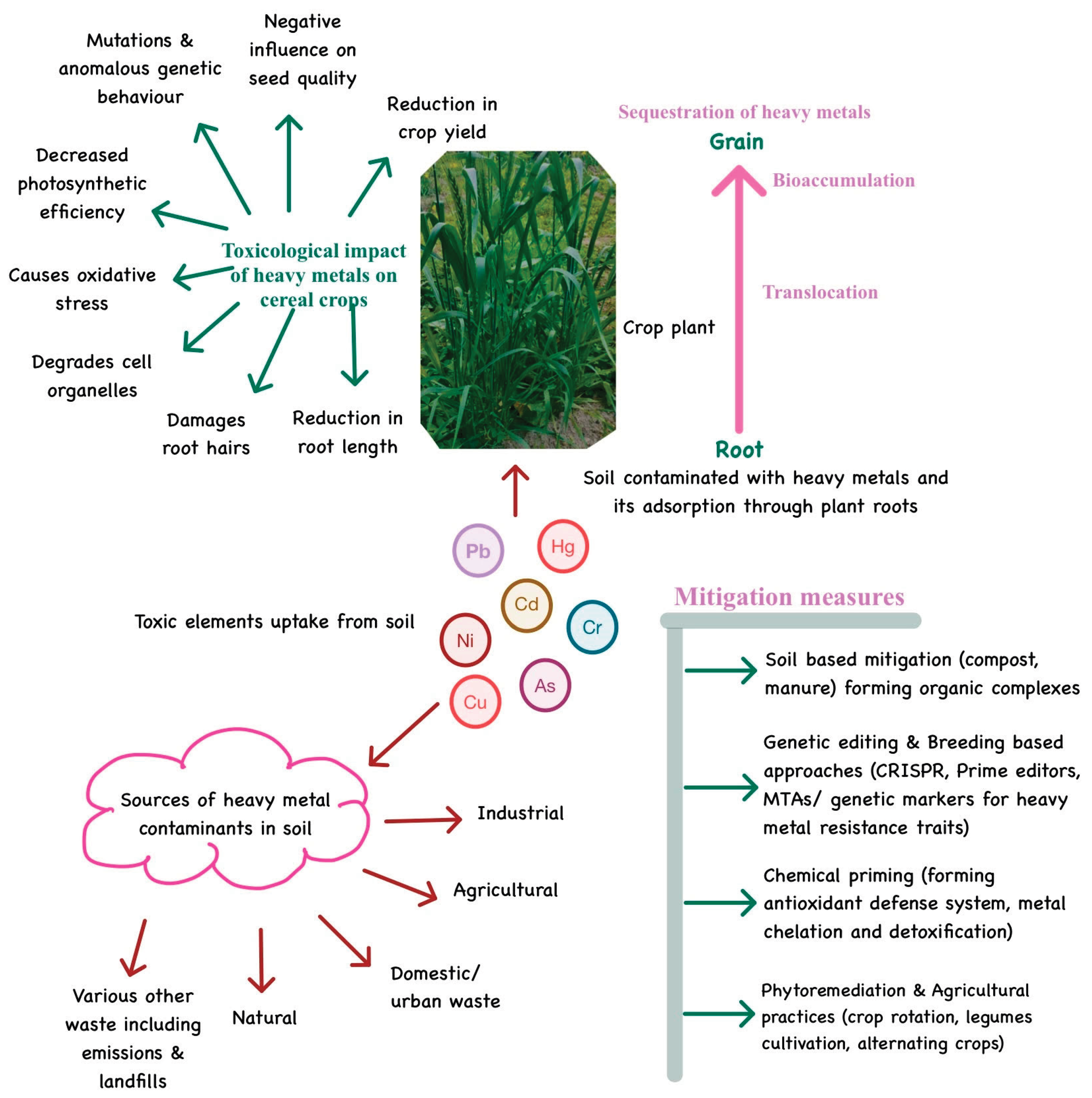

Table 1.
Factors Influencing Heavy Metal Uptake and Toxicity.
| Factors | Features | Impact on HM Toxicity | References |
|---|---|---|---|
| Soil pH | Soil acidity/alkalinity affects the metal solubility. Acidic soils (pH < 7) increase solubility and bioavailability of metals like Cd, Al, Mn, etc. Alkaline soil reduces the solubility by precipitating metals. | Acidic soil increases metal uptake; alkaline soil reduces uptake but may cause nutrient deficiencies. | [80,81,82,83] |
| Soil organic matter | Decomposed plant and animal residues bind with metal ions (chelation). Humic and fulvic acids form stable complexes with metals. Supports beneficial microorganisms like mycorrhizae. | Reduces heavy metal mobility and uptake; improves soil structure and microbial health. | [80,81,84] |
| Soil texture | Texture (proportions of sand, silt, and clay) affects retention/release of metals. Clay soils adsorb metals strongly; sandy soils have low absorption, causing higher mobility. | Clay limits uptake via immobilization; sandy soils increase uptake due to leaching and mobility. | [80,85,86] |
| Plant species & varieties | Various species differ in heavy metal tolerance and detoxification. Examples: Barley and rye show higher tolerance. Low-cadmium rice varieties b[80,92,93red to limit Cd in grains. Root hair and exudates also play roles. | Tolerant variety limit translocation; breeding can reduce grain contamination. | [80,87,88] |
| Soil metal concentration | Higher metal concentration increases uptake and toxicity. Exceeding toxicity threshold affects plants growth and food safety. Interactions between metals (synergistic effects) can intensify toxicity. | Elevated metal levels cause tissue damage and grain contamination; metal synergy worsens toxicity. | [80,89,90] |
| Temperature | High temperatures increase metal solubility and uptake by crops. Heatwaves enhance mobility of metals like Cd and Pb. | Increased risk of uptake and toxicity during high-temperature periods. | [80,91] |
| Humidity | High humidity may cause waterlogging and increase metal diffusion. Low humidity reduces water uptake, intensifying toxicity. | Waterlogged soils promote uptake; dry conditions exacerbate stress from existing heavy metal presence. | [80,92,93] |
| Water availability | Influences dilution or concentration of heavy metal in soil solutions. Adequate water reduces toxicity; drought increases risk. | Water scarcity heightens metal uptake; proper irrigation reduces availability of toxic metals. | [80,94] |
Table 2.
Transporters and Channels Involved in Cadmium Entry into Plant Roots.
| Transporter/Channel | Function | Specificity/Substrate | Additional Description | References |
|---|---|---|---|---|
| AtIRT1 | Plasma membrane metal transporter | Broad specificity for divalent metals (e.g., Fe2+, Zn2+, Cd2+) | Present in the outer root layer; absorbs metals from the soil | [98,99] |
| TcZNT1/TcZIP4 | Zn transporter; low-affinity Cd uptake | High-affinity for Zn; low-affinity for Cd | Mediates Cd and Zn uptake when expressed in roots | [98] |
| OsNRAMP1/OsNRAMP5 | Cd and Fe influx transporter | Fe2+, Cd2+ | Plasma membrane localized; involved in Cd uptake | [98,100] |
| AtNRAMP6 | Intracellular metal transporter | Cd2+ | Functions inside the cell rather than at plasma membrane | [98] |
| TaLCT1 |
Influx cation transporter |
Ca2+, Cd2+, K+ | Broad substrate specificity; Cd transport inhibited by high Ca2+ or Mg2+ | [98] |
| DACCs (Depolarization-activated Ca2+ channels) | Ca2+ influx channel | Non-selective for cations (including Cd2+) | Activated at −80 mV; unstable and appear infrequently | [98,101] |
| HACCs (Hyperpolarization-activated Ca2+ channels) | Ca2+ influx; guard cell signalling | Non-selective (includes Cd2+) | Involved in response to ABA, light, and elicitors | [98] |
| VICCs (Voltage-independent Ca2+ channels) | Ca2+ and Cd2+ influx | Likely overlap with DACCs and HACCs functions | [98] | |
| YSL (Yellow Stripe-Like) | Transport of nicotinamide (NA)-metal chelates | NA–Fe, NA–Cd complexes | Oligopeptide transporter; induced under Fe deficiency | [98,102] |
Table 3.
Heavy Metal—Cadmium Toxicity.
| Category | Effect of Cadmium Toxicity | Mechanism/Detail | References |
|---|---|---|---|
| Chlorosis | Yellowing of leaves | Disrupts chlorophyll synthesis by inhibiting enzymes like δ-aminolaevulinic [80,111,112acid dehydratase (ALAD) and protoporphyrinogen oxidase (PPO) | [80,111,112] |
| Stunted Growth | Reduced plant size and growth | Impairs root elongation and nutrient uptake, and interferes with growth hormone (auxins and gibberellin) synthesis | [80,113] |
| Reduced Root Growth | Inhibited root elongation and branching | Causes ROS accumulation in roots, disrupts cell division and elongation | [80,114] |
| Nutrient Uptake Interference | Leads to deficiencies in essential elements like zinc | Competes with zinc for uptake, reducing zinc availability | [80,114] |
| Leaf Deformities | Twisting, curling, and irregular leaf shapes | Interferes with gibberellin biosynthesis and causes oxidative stress | [80,115] |
| Reduced Flowering | Delayed flowering | Disrupts cytokinin signalling | [80,116] |
| Reduced Fruit Development | Smaller and malformed fruits | Competes with zinc, impacting zinc-dependent processes essential for fruit development | [80] |
| Necrosis | Formation of necrotic lesions and tissue death | Induces ROS accumulation, causing oxidative damage to proteins, lipids, and DNA | [80,117] |
| Water Stress | Wilting and reduced water uptake | Restricts root elongation, disrupts root cell membranes, and affects water transport mechanisms | [80,118,119] |
Table 2.
Heavy Metal—Lead Toxicity.
| Category | Effect of Lead Toxicity | Mechanism/Detail | References |
|---|---|---|---|
| Chlorosis | Yellowing of leaves | Inhibits chlorophyll biosynthesis by disrupting enzymes and metabolic pathways | [80,111] |
| Stunted Growth | Reduced plant height and biomass | Interferes with elongation in roots and shoots and cell division, and disrupts nutrient/water uptake | [80,113] |
| Hormonal Disruption | Impaired growth regulation | Inhibits synthesis of growth hormones like auxins and gibberellins | [80] |
| Reduced Flowering | Decreased flower development and elongation of flower stalks | Inhibits gibberellin biosynthesis | [80,116] |
| Necrosis | Formation of necrotic lesions in leaves and tissues | Leads to ROS production, oxidative stress, and subsequent cell death | [80,117] |
Table 3.
Overview of Key Mechanisms of Plant Growth Inhibition By Heavy Metals.
| Mechanism | Physiological/molecular effects | Heavy metals involved | Effects/observation | References |
|---|---|---|---|---|
| DNA metabolism disruption | Causes DNA strand breaks, chromosomal aberrations, and inhibition of replication and repair enzymes; leads to genomic instability. | Cr, Cd, Pb, As, Hg | Arsenic inhibits poly-(ADP-ribose) polymerase-1; Cd and Pb induce double-strand break in Vicia faba; Hg binds covalently to DNA causing sister chromatid exchange and mitotic disruptions. | [36,137,138,139] |
| Altered gene expression | Modifies expression of metal transporters (HMA, ZIP, NRAMP, ABC), signalling genes (MAPKs), and transcription factors; disrupts metabolic and defense gene regulation. | Cd, Zn, Hg, Cu, Pb | Cd interferes with Zn-finger TFs; barley overexpresses dehydration-related TFs under Cd and Hg stress; gene overexpression enhances metal uptake and phytoremediation potential. | [140,141,142,143] |
| Hormonal deregulation | Disrupts balance of growth and stress hormones (auxins, gibberellins, cytokinin, ABA, JA); alters signalling pathways affecting growth and defense. | Cd, Pb, Hg, Cu, Zn, Ni | Exogenous kinetin reduces Cd toxicity (Pisum sativum); GA3 alleviates Pb/Cd stress (Vicia faba, Lupinus albus); IAA and SA restore antioxidant activity in wheat; BSs mitigate Cd stress in tomato; ABA accumulation restricts metal translocation but inhibits growth. | [144,145,146,147,148] |
| Inhibition of soil microorganism | Reduces microbial biomass, diversity, and enzymatic activity essential for nutrient cycling; disturbs rhizosphere balance and soil fertility. | Zn, Cu, Pb, Cd, Hg | Inhibition of CO2 evolution due to impaired microbial respiration; decline in dehydrogenase activity and basal respiration; molecular analysis (16S/18S rRNA) reveals shifts in microbial community structure. | [149,150,151,152,153] |
| Overall impact on plant growth | Combined disruption of genetic stability, hormonal signalling, and soil microbial support leads to stunted growth, reduced photosynthesis, and poor yield quality. | Majority of heavy metals | Integrative stress effects on plant physiology, metabolism, and soil–plant–microbe interactions. | [13,147,150,152,153] |
Table 4.
Chemical Priming Agents and Their Role in Alleviating Cr Toxicity in Plants.
| Priming Agent/Compound | Mode of Action/Mechanism | Plant Species Studied | Overall Impact on Cr Stress | References |
|---|---|---|---|---|
| ABA, Glutathione (GSH), Cysteine, Sulphur, Melatonin | Enhance detoxification processes, stimulate antioxidant enzyme systems, and limit Cr uptake | Various crops | Reduced oxidative stress and improved tolerance to Cr toxicity | [11,187,200] |
| Metallothioneins (MTs) | Chelate and immobilize Cr ions via thiol-rich ligands; upregulation of MT-related genes under stress | Brassica napus | Enhanced Cr detoxification and protection of cellular components | [11,189] |
| Hydrogen Sulphide (H2S) | Boosts antioxidant activity, upregulates MT genes, increases chlorophyll and thiol content, and promotes Cr-binding peptide synthesis | B. napus, Barley, Arabidopsis | Reduced lipid peroxidation, enhanced photosynthesis, and improved metal tolerance | [11,191,201,202] |
| 5-Aminolevulinic Acid (ALA) | Stimulates chlorophyll synthesis, improves metabolism, and decreases Cr accumulation | B. napus | Enhanced growth and photosynthetic efficiency under Cr exposure | [11,190] |
| Taurine | Protects lipid membranes, enhances ROS scavenging, improves nutrient assimilation and osmolyte accumulation | Triticum aestivum | Increased biomass, membrane stability, and stress tolerance | [11,193] |
| Mannitol (M) | Acts as an Osmo protectant, decreases Cr translocation, and activates antioxidant enzymes | Triticum aestivum | Lowered Cr content and improved photosynthetic pigment levels | [11,194] |
| Glutathione (GSH) | Forms Cr–GSH complexes, neutralizes ROS via the ASA–GSH cycle, and limits Cr translocation | Glycine max | Maintained chlorophyll, higher biomass, and effective detoxification | [11,195,203] |
| Indole Acetic Acid (IAA) | Modulates antioxidant enzymes and hormonal signalling to minimize oxidative injury | Pisum sativum | Reduced ROS accumulation and improved stress resistance | [11,197,198] |
| Jasmonic Acid (JA) | Strengthens antioxidant and glyoxalase systems, maintains Ca2+ balance, and limits Cr uptake | Brassica parachinensis, P. sativum | Improved mineral homeostasis and lower Cr accumulation | [11,199,204] |
Disclaimer/Publisher’s Note: The statements, opinions and data contained in all publications are solely those of the individual author(s) and contributor(s) and not of MDPI and/or the editor(s). MDPI and/or the editor(s) disclaim responsibility for any injury to people or property resulting from any ideas, methods, instructions or products referred to in the content. |
© 2025 by the authors. Licensee MDPI, Basel, Switzerland. This article is an open access article distributed under the terms and conditions of the Creative Commons Attribution (CC BY) license (http://creativecommons.org/licenses/by/4.0/).
Copyright: This open access article is published under a Creative Commons CC BY 4.0 license, which permit the free download, distribution, and reuse, provided that the author and preprint are cited in any reuse.


