

Submitted:
05 January 2026
Posted:
06 January 2026
You are already at the latest version
Abstract
Information on the breeding of the Pinto’s Spinetail Synallaxis infuscata, an endangered Brazilian Furnariid, is scarce. This study aims to complement it, by looking at nest and clutch parameters, breeding period, and nest success. Once nests were found, they were closely monitored from a hide. Between 1986 and 2018, 33 nests were found in the Pedra Talhada Forest near Quebrangulo. Nests were found year-round, except in middle of the dry season. Nests were of the closed/retort type, weighing 552.1 g, and measuring 37.6 x 28.8 cm, with a side arm of 30.6 x 4.9 cm., on average. The clutch size averaged 2.10 eggs, which measured 22.3 x 17.2 mm and weighed 3.2 g. They were white and had an oval to pointed-oval shape. Mean incubation period was 21.5 days and mean nestling period 14.71 days. The apparent nest success was 27.3%, while Mayfield’s was 21.8%. Predation was the main cause of nest failure, accounting for 81% of cases. The breeding data we collected on S. infuscata falls within the range of observations of a comprehensive analysis on other Synallaxis species. This breeding information is important for conservation, as rates of nest loss are a key factor in evaluating population viability.
Keywords:
nest success
; neotropical bird
; avian reproduction
; life history
1. Introduction
Life history studies are important because they help us understand population dynamics and they allow us to make useful comparisons between species [1]. For example, slower life history traits are exhibited by tropical birds than by birds in temperate regions, with greater investment in survival than reproduction being favoured [2]. In terms of reproduction, longer breeding seasons are experienced by tropical birds [3,4], which are associated with a higher number of clutches and a high re-nesting potential [1,5,6,7]. Moreover, smaller clutch sizes [8,9,10,11], lengthier incubation and nestling periods [1,10,12,13,14,15,16], and extended post-fledging care [17,18,19] are typical of these species. In terms of species survival, they exhibit reduced mortality [20,21], as well as lower basal and metabolic rates [22,23,24] and low thermogenic heat production [23]. They also show later sexual maturation [12,18] and delayed senescence [25,26]. Data on the life histories of birds is useful for planning accurate conservation strategies [27,28,29] and inferring phylogenies [30,31]. However, such data remain scarce for a large number of Neotropical bird species [1].
The Synallaxis genus [32] is part of the Furnariidae family and comprises 37 species from the Neotropics [33]. The Pinto’s Spinetail Synallaxis infuscata (Pinto, 1950) was initially described as a subspecies of Synallaxis ruficapilla [34], but Vaurie, 1980 [35], described it as a distinct species, a classification that has been followed by subsequent authors [36]. Recent morphological and molecular studies indicate that S. infuscata is closely related to a group consisting of the species S. ruficapilla, S. whitneyi, S. macconnelli, S. cabanisi and S. moesta [37,38,39,40]. However, the precise position of S. infuscata within this group remains to be clarified. Morphological and whole-genome sequencing analyses reveal that S. infuscata is more closely related to S. ruficapilla and S. whitneyi ([38,39,40], even if Stopiglia [40] consider S. whitneyi to be part of S. ruficapilla), but a mitochondrial genetic analysis suggests that S. infuscata is more closely related to S. moesta [37].
Synallaxis species build nests of closed/retort shape (according to Simon & Pacheco [41]), made of plant and animal materials [42]. These nests are located at a low height from the ground [42]. The clutch size varies from two to five eggs [42]. Incubation lasts between 15 and 25 days [43,44], and the nestling period varies lasts between 13 and 22 days [43,44,45]. Information on the breeding biology of the closely related species is only available for S. moesta and S. ruficapilla [46,47,48]. Both species lay clutches of two to three white eggs in nests made of sticks, dry leaves, bark, and snake and lizard skin [46,48]. The incubation and nestling periods are unknown for both species.
S. infuscata is endemic to the north-east of Brazil, in the states of Alagoas, Pernambuco and Paraíba [36,42]. This species is typically found in tropical lowland evergreen forests and thrives in woodland edges, scrubby forest and early second growth, at altitudes of up to 500 meters [42]. It is classified as endangered on the IUCN Red List, as well as the Red List of Brazilian Birds, due to its small, fragmented and declining habitat and decreasing population trend [49,50]. Indeed, this species is confined to the Pernambuco Endemism Centre [51], a region that has been significantly impacted by deforestation, with only 12.1% of the initial vegetation remaining [52]. Moreover, it is estimated that the total population comprises fewer than 2,500 mature individuals, with no more than 250 individuals in each subpopulation [50]. The populations are severely fragmented, and the number of individuals continues to decline. The main threat to this species is the reduction of its habitat due to the conversion of forests into pastures and sugarcane plantations [50]. S. infuscata is an arthropod-consuming species that forages for prey in low-lying vegetation, such as foliage, dead leaves and small branches, at ground level. It forages either alone or in pairs [53]. There is no sexual dimorphism in this species [42].
The available literature on the breeding biology of S. infuscata is extremely limited, the only description refers to a personal communication made by the author Anita Studer to the editors of the Handbook of the Birds of the World [42]. This study therefore aims to describe key aspects of the breeding biology of this species, including nest form, clutch and egg size, breeding period, and nest success. The knowledge acquired about this species’ natural history will be helpful to elaborate accurate conservation plans [36,50].
2. Materials and Methods
The study was conducted in and around the Pedra Talhada Biological Reserve (09°11’-09°16’ S, 36°22’-36°28’ W, Figure 1), which is located in the states of Alagoas and Pernambuco, Brazil [54]. The area is characterised by significantly higher humidity levels in comparison to the surrounding lowland regions [54]. The mean annual precipitation at the Quebrangulo pluviometric station between 1986 and 2011 was 1,586 mm per year [(computed from [55]). The rainy season generally extends from April to August, though can vary from year to year. The area’s vegetation is characterised by diverse woodlands on both flatland and slopes, as well as rocky terrain. These woodlands include evergreen and deciduous trees reaching up to 35 metres in height. Open vegetation can be found in a variety of settings, including rocky outcrops, clearings, and marshes. [54]. The forest’s pristine vegetation has been extensively logged, and today it is surrounded by private cattle ranches (Figure 2).
The study period ran from 1986 to 2018, but sampling efforts were inconsistent throughout. Indeed, no nests were observed in the years 1987 to 1989, 2003 to 2004 and 2006 to 2016.
Nests were located either by observing adult behaviour or by chance [56]. Once an active nest had been located, it was visited every three to four days, or every other day near hatching or fledging. In instances where the precise date of hatching or fledging could not be ascertained, it was recorded as the median date of the two most recent visits [57]. Observations were made from a concealed position, situated between six and eight metres away from the nest, using binoculars. Photographic and video recordings were also made each time activity around the nest was observed. Opportunistic behavioural observations were also conducted from the hide. During 100-minute observation periods, the presence of an adult at the nest was noted, along with feeding events and preys brought to the nestlings, when identifiable.
The eggs were weighed using a Pesola Spring scale with a 0.1 g accuracy, and their width and length were measured using a calliper with 0.1 mm accuracy. Egg volume was calculated as 0.51*Egg length*(Egg width)2 [58] The nest dimensions were measured with a ruler with a precision of 0.5 cm, and the mass was measured with a spring scale with a precision of 0.5 g. The nest was accessed to take these measurements right after the fledglings had left or the nest failed, in order to minimise disturbance. Nests were measured directly on the field and were not dried before taking the measurements. All nest components were collected for weighing, including pieces that fell on the ground during collection. Data on nest measurements were only collected when possible, i.e., when the nest was accessible and without causing too much disturbance. Therefore, not all nests were measured, and not all measurements were possible for those that were. The number of nests for which measurements were taken is indicated in parentheses after each measured value in the results section.
The incubation period was defined as the time between the complete laying of the clutch and the hatching date of the first chick. The nestling period was defined as the time between the hatching of the first egg and the fledging of the last offspring. The breeding season was determined as the period from the earliest date that an active nest was found to the latest date of fledging across all nests found. It was determined that predation was the cause of nest failure when eggs or nestlings disappeared before the expected date of hatching or fledging, respectively. A nest was considered successful if at least one nestling fledged. The Mayfield method was used to calculate nest success [59].
Statistical analysis was performed in R [60] using the RStudio software [61]. To reveal whether a factor had a significant impact on the fate of a nest, Firth logistic-exposure regression models were fitted, using the logistf function from the logistf package [62]. These models reduce bias in small samples and provide accurate estimates in cases of rare events (here, the low number of successful nests) [63,64]. The response variable was the nest fate, coded binomially as 1 = nest success and 0 = nest failure. To avoid overfitting, we coded five different models, one for each predictor (egg volume, month, nest height, nest location and nest environment) [65]. We accounted for unequal monitoring periods by including the logarithm of exposure days as covariate [66,67]. Continuous predictors (egg volume, month and nest height) were standardised (mean-centred and scaled by their standard deviation) prior to analysis [68].
3. Results
Between 1986 and 2018, 33 nests of Synallaxis infuscata were found in the Pedra Talhada Forest near Quebrangulo. Nests were found year-round, with the exception of December and January, which correspond to the middle of the dry season. The highest number of nests were recorded in April and October, just before and after the rainy season.
The nests were of the closed/retort type (according to Simon & Pacheco [41]), generally taller than wide, with an average weight of 552.1 g (± 205.2, n = 14), height of 37.6 cm (± 8.9, n = 15) and width of 28.8 cm (± 12.4, n = 17), respectively (Figure 3). A side arm housed a corridor that provided access to the interior of the nest. The average length of this side arm was 30.6 cm (± 4.4, n = 7), with an internal diameter of 4.9 cm (± 3.4, n = 4). The incubation chamber itself measured 10.9 cm (± 7.6, n = 12) and was lined with a cluster of woolly green leaves (Asteraceae) glued together with webs and spider nests, which gave it the appearance of a thick piece of felt. The nests are usually well concealed under tangles of vines and bromeliads, at an average height of 2.16 metres (±1.14, n = 33) above ground level. Nests were constructed using a variety of materials, including smooth and thorny sticks, dry and green leaves, other vegetation, snake skins and spider webs both internally and externally, with an addition of dry grass, plant fibres and small pieces of wood on the outside (Figure 4). Nests were predominantly located in bushes (n = 21), with some also being found in lianas (n = 5), piles of leaves/branches (n = 2), high grass (n = 1) and trees (n = 4). The nests were primarily located in forested areas (n = 25), but also in semi-open spaces (n = 2), such as edges and clearings, and in semi-closed spaces (n = 6), such as capoeira and cerrado.
The clutch size was 2.10 eggs (± 0.76, n=30). The eggs had an average length of 22.3 mm (± 0.9, n = 44) and an average width of 17.2 mm (± 0.7, n = 44). Their average weight was 3.2 g (± 0.4, n = 44). Mean egg volume was 3362.4 mm3 (± 327.8, n= 44). Eggs are white in colour and have an oval to pointed-oval shape (Figure 5). Hatchlings are characterised by greyish skin on their heads and pink skin on their bodies, as well as yellow colouring on the corners of their beaks, black eyes and brown legs. At 12 days old, it is already possible to see brown plumage on the upper part of the nestlings’ bodies and small grey wings, although their bellies remain bare and purplish. At this age, the first change in the nestlings’ beaks become visible, which darken in colour with a white outline. The legs exhibit a pale yellowish-pink colour, with white nails on the toes.
Of the 33 nests observed, nine (27.3%) were successful, 21 (63.6%) failed and the fate of three (9.1%) nests is unknown. Predation was the main cause of nest failure, accounting for 81% of cases (Table 1). Nests failed more frequently during the egg stage (66.7%) than during the nestling stage (33.3%, Table 1). The five predictors (egg volume, month, nest height, nest location and nest environment) had no statistically significant effect on whether a nest was successful or failed. The incubation period was 21.5 days (± 2.1, n = 2), and the mean nestling period was 14.7 days (± 0.8, n = 7). The complete nest cycle length was 36 days (± 2.8, n = 2). The daily survival rate during the incubation period was 0.956, whereas during the nestling period it was 0.963. Therefore, the Mayfield survival rate for the mean incubation period of 21.5 days was 0.382, and for the mean nestling period of 14.71 days it was 0.570. The Mayfield nest success rate was thus 21.8%.
We observed two pairs that took up to 60 days to complete their nests. During the egg incubation and chick feeding phases, S. infuscata adults continue to collect leaves that they incorporate into the external structure of the nest, and sometimes also into the internal structure. Pairs commonly renovate and reuse their first nest. Sometimes, they build a second one nearby, often reusing material from the original structure. It is important to note that the pair does not lay a second clutch in locations that are distant from the nest of the first clutch. Both adults were observed feeding the nestlings with dragonflies, beetles, caterpillars, worms and frog tadpoles (Figure 6). In observations of one nest, parents fed 4-day-old nestlings eight times over a 100-minute interval, while 7-day-old nestlings from another nest were fed six times during a period of the same length. Both parents were also observed to remove the faecal sacs.
4. Discussion
Synallaxis infuscata breeds throughout the year, with the exception of the driest months of December and January. This pattern of year-round breeding has also been observed in other bird species in the Pedra Talhada Biological Reserve, with either a break at the peak of the dry season, or at the peak of the rainy season [69,70].
The closed/retort form of the nest of S. infuscata is typical of Synallaxis nests [43,45,46,47,48,71,72]. The only weighted nest of S. moesta falls within the range of measured S. infuscata nests (Figure 7), but its value is slightly below the mean (Table 2). The weight of the only measured S. ruficapilla nest is considerably higher than the values measured for S. infuscata (Figure 7, Table 2). Indeed, this nest weighed 4,210 g, which is 7.6 times higher than the mean value found for S. infuscata. We should ask ourselves whether this value is correct, or whether the decimal point was misplaced. The mean value for all measured Synallaxis nests is also higher than S. infuscata distribution (Figure 7, Table 2). This is probably due to S. ruficapilla measurement pulling up the Synallaxis species average. S. infuscata nests had an average height of 37.6 cm and width of 28.8 cm, which is higher but thinner than the Synallaxis mean (Table 2) . The nest arm of S. infuscata was 30.6 cm long and 4.9 cm wide. The tunnel is thinner than the ones of S. moesta and S. ruficapilla, but of similar length (Table 2). It is longer and thinner than the mean of Synallaxis nests (Table 2). The incubation chamber of S. infuscata nests measured 10.9 cm, which is similar to S. moesta and S. ruficapilla nests, but smaller than the mean of Synallaxis nests (Table 2). Nest material of S. infuscata, which consist of a mix of plant (sticks, leaves, grass, wood) and animal (snake skin, spider webs) materials, is also similar to what has been found in other Synallaxis species (Table A1). S. albescens and S. moesta also had man-made materials (e. g. pieces of canvas, plastic, candy wrappers) in their nests [45,46]. Nests of S. infuscata were mainly found being close to the ground, which is similar to nest of S. ruficapilla and the mean of Synallaxis species (Table 2).
The clutch size of S. infuscata was 2.10. This is similar to clutch size of S. moesta and S. ruficapilla, but slightly below the mean clutch size for Synallaxis species (Table 3). The eggs of S. infuscata measured on average 22.25 mm x 17.18 mm. They are similar to eggs of S. moesta and S. ruficapilla, but they are larger than the average size for Synallaxis species (Table 3). The mean weight of S. ruficapilla eggs and the only weighted S. moesta egg fall within the range of measured S. infuscata eggs (Figure 8). The mean value for all measured Synallaxis eggs falls within the lower part of the S. infuscata distribution range (Figure 8, Table 3). Eggs of S. infuscata are white with an oval to pointed-oval shape, which is similar to eggs of S. albilora, S. azarae, S. moesta and S. ruficapilla [43,46,48,73]. Eggs of S. candei, however, vary from turquoise blue to light-green tones [71]. Eggs of S. albescens and S. frontalis vary from white to greenish-white [[45,74,75,76], Studer unpub.], and eggs of S. erythrothorax are white to pale blue. Eggs of S. subpudica are white with a few brown spots [42].
Nestlings of S. infuscata have a pink skin, brown plumage and yellow beak, which turn darker when they get older. Their appearance is similar to nestlings of S. moesta, which have pink skin, dark grey plumage and bill in the yellow tones [46], and to S. candei nestling, which have orange flesh-coloured skin, greyish plumage and yellow bill [71].
The incubation and nestling periods of S. infuscata were 21.5 days and 14.71 days, respectively. The incubation period is longer than what has been observed for most Synallaxis species and the general mean (Table 3, Table A2), except for S. subpudica (25 days, n = 1, [42]). Nestling period, however, is in the lower range of what has been observed for Synallaxis species and is slightly under the general mean (Table 3, Table A2). However, it is important to note that not all authors used the same definition of the length of the two periods. While authors agree that the incubation period should start on the date that the las egg is laid [43,44,45,74,76], they disagree on when it should end. Some use the date when the first egg hatches [43,45], whereas others use the date when the last egg hatches [44,74,76]. Similarly, some authors start the nestling periods with the hatching of the first egg [43,45,74], while others start it with the hatching of the last one [44,76]. They all agree, however, that the period ends with the fledging of the last offspring [43,44,45,74,76]. The differences observed here may merely be due to variations in how the length of both periods was measured in the different studies. Therefore, it could be useful to create a consensus in the way these periods are measured, to facilitate comparisons between studies.
The apparent success rate of S. infuscata was 27.3%, and the Mayfield’s one was 21.8%. This result aligns closely with the 25% success rate documented for S. albescens [45]. Predation was the main cause of nest failure (81% of failed nests), as has been found for S. albescens (91.7% of failed nests [45]) and for several other tropical bird species [63,64,74,75,76,77,78]. Nests of S. infuscata experienced higher failure rates during the egg stage (66.7%) compared to the nestling stage (33.3%), while S. albescens demonstrated a different pattern: 45% of eggs were predated during the egg stage, and 55% during the nestling stage [45]. Some authors have hypothesised that predation rates may be higher during the nestling period, due to the presence of parents around the nest and the begging of the offspring, which may attract predators [82,83,84]. However, the present study did not find such results. The selection of a particular nest site also exerts an influence on the predation rate [83]. Indeed, when considering nests located in areas easily accessible to predators, the predation rate is higher during the incubation period. Furthermore, as S. infuscata reuse their nests, predators may already be aware of the nest’s location and be able to predate the eggs more rapidly. Moreover, most vulnerable nests are typically detected by predators during the initial six days of incubation [85]. Parents minimise their investment during this critical period but will invest more intensively in incubation if the eggs survive that period. Our study could not determine whether the egg volume, the breeding month, the nest height from the ground, the nest location or the nest environment affected the fate of a nest. This is mainly because our dataset was small, comprising 33 nests, of which only nine were successful. Further studies compiling a greater number of nests could help to identify the factors involved in nest success.
Overall, the breeding data we collected on S. infuscata falls within the range of observations made on other Synallaxis species (Table A1, Table A2). The majority of the data is closely similar to those of the two closely related species S. ruficapilla and S. moesta [[46,48], Studer, unpub.]. However, we were unable to find breeding information for the other closely related species S. whitneyi, S. macconnelli and S. cabanisi. Our analysis indicates that the available information on the breeding biology of Synallaxis species is still fragmented. There is a lack of information on the breeding biology of several species, and for those for which information is available, it is often incomplete. Further studies are required on the breeding biology of Synallaxis species, in order to obtain a comprehensive set of data. This could help to clarify phylogenetic uncertainties, such as those surrounding S. infuscata, and contribute to the better protection of these species. Indeed, information on breeding biology and particularly nest success is important for conservation, as rates of nest loss are a key factor in evaluating population viability [28].
Conservation aspects are of particular importance for S. infuscata, which is an endangered species [49]. It is endemic to the Atlantic Forest of the Pernambuco Endemism Centre [51], a region that has been heavily degraded [52]. S. infuscata has been identified as endangered, primarily due to its exclusive presence within this disturbed geographical area [49,53]. Consequently, priority must be given to the protection and conservation of the remaining Atlantic Forest patches. Anita Studer has followed this initiative by establishing the Pedra Talhada Biological Reserve in 1984 (Presidential Decree n°98.524 of 13 December 1984). This National Reserve, spanning 4,469 hectares, is home to a rich biodiversity, supporting over 2,100 species, including S. infuscata [54]. Initiatives of this kind are essential for ensuring the protection of both this species and others in the Atlantic Forest.
Author Contributions
Conceptualization, A.S.; methodology, A.S.; validation, A.S. and L.P.; formal analysis, L.P.; investigation, A.S.; resources, A.S.; data curation, A.S. and L.P.; writing—original draft preparation, L.P.; writing—review and editing, L.P.; visualization, L.P.; supervision, A.S.; project administration, A.S.; funding acquisition, A.S. All authors have read and agreed to the published version of the manuscript.
Funding
This research was funded by NORDESTA Reforestation & Education.
Institutional Review Board Statement
This observational study involved no capture, restraint, marking or experimental manipulation of individuals. Handling of eggs was limited to brief measurements of egg size, and did not involve removal, damage or alteration of the clutch. Fieldwork was conducted in accordance with the accepted ethical standards for avian field research set out in the Ornithological Council’s Guidelines to the Use of Wild Birds in Research [86], which provide comprehensive recommendations on minimising disturbance and harm in wild bird studies. Brazil’s formal regulatory framework for the ethical use of animals in scientific research was established by Law No 11.794 on 8 October 2008, which created the National Council for the Control of Animal Experimentation (CONCEA) and institutional animal ethics committees (CEUAs) [87]. As much of the present study was conducted prior to the enactment of this legislation and the establishment of CONCEA/CEUAs, formal institutional ethical approval and research permits were therefore not required at the time of data collection.
Data Availability Statement
The original data presented in the study are openly available in OSF at https://doi.org/10.17605/OSF.IO/D4V72.
Acknowledgments
Thanks to Nordesta Reforestation & Education for financial and technical support for the research. Thanks to Felino Pedro Celestino, Luis Batista de Freitas and Flávio dos Santos Pereira for their valuable assistance with fieldwork. In memoriam of Dr Anita Studer who sadly passed away before seeing this paper published.
Conflicts of Interest
The authors declare no conflicts of interest. The funders had no role in the design of the study; in the collection, analyses, or interpretation of data; in the writing of the manuscript; or in the decision to publish the results.
Appendix A
Appendix A.1

Table A1.
Nest parameters for different Synallaxis species. “–“ Indicates that the information was not found within the mentioned reference.
Table A1.
Nest parameters for different Synallaxis species. “–“ Indicates that the information was not found within the mentioned reference.
| Species | Nest weight (g) | Nest height (cm) | Nest width (cm) | Nest arm length (cm) | Nest arm diameter (cm) | Height of incubation chamber (cm) | Nest height from ground (m) | Nest materials |
|---|---|---|---|---|---|---|---|---|
|
S. infuscata (this study) |
552.1 ± 205.2 (n = 14) | 37.6 ± 8.9 (n = 15) | 28.8 ± 12.4 (n = 17) | 30.6 ± 4.4 (n = 7) | 4.9 ± 3.4 (n = 4) | 10.9 ± 7.6 (n = 12) | 2.16 ±1.14 (n = 33) | Smooth and thorny sticks, dry and green leaves, snake skins and spider webs both internally and externally, with an addition of dry grass, plant fibres and small pieces of wood on the outside |
| S. albescens [45] | – | 16 (n = 7) | 17 (n = 6) | 11 (n=7) | – | – | 0.3 ± 0.2 (n = 30) | Sticks, inner chamber lined with soft plant material, snake skin, human-made materials (pieces of canvas, plastic tape, candy wrappers) |
| S. albescens [75] | – | 34.5 ± 1.3 (n = 11) | 18.3 ± 0.6 (n = 10) | 23.6 ± 1.3 (n = 9) | 8.5 ± 0.3 (n = 8) | – | 1.6-2.4 | Thorny sticks, mainly from carob and chañar trees; a base of plant debris on which a cup of soft materials is built. |
| S. albescens [74] | – | – | – | – | – | – | 0.6-9.1 | Twigs, egg chamber floored with pad of plant-down, snakeskin in entrance passage |
| S. albigularis [42] | – | – | 40-50 | – | – | – | 1-2 | – |
| S. albilora [43] | 1243 ± 244.6 (n=5) | 29 ± 3.7 | 11 ± 5.5 (n=5) | 26 ± 4.5 | 0.8 (n=5) | 24 ± 4.2 (n = 5) | 1.5 ± 0.48 (n = 64) | Sticks, bark chips, thorns, green leaves |
| S. azarae [42] | – | – | – | 30-40 | – | – | – | Sticks, interior chamber lined with soft plant material, snake skin |
| S. brachyura [42] | – | 20-40 | 40-50 | 30-40 | – | – | 0.5-5 | Twigs and sticks, often thorny, reptile skins, floor of chamber lined with pad of soft green or pubescent leaves, spider webs, snake and lizard skin |
| S. candei [71] | – | 70-75 | 35-48 (n=2) | 30 | 5-6 | 10-13 | 1.3-2.5 (n = 6) | Dry spinescent or thorny twigs and sticks, bark, green leaves, cactus thorns, shed lizards, snake skin |
| S. cinerascens [47] | – | – | – | 25 | – | 12.5 | On ground | Small sticks |
| S. cinerascens [88] | 3740-3930 (n = 2) | – | 28-30 (n = 2) | 24-28 (n = 2) | 4.5-5 (n = 2) | 8-9 (n = 2) | On ground | Dry sticks, bark, wood chips, fresh leaves |
| S. cinnamomea [42] | – | 40 | 25 | 15 | – | – | 3 | Thick twigs and dead leaves |
| S. erythrothorax [72] | – | 47.7 (n = 1) | 25.4 (n=1) | – | – | – | 1.20 (n = 1) | Twigs |
| S. erythrothorax [89] | – | 48 | 73 | 35 | – | 12 | 0.76-9.14 | Sticks, grass, fine twigs, bark, weed stalks, dry cecropia petioles, broad leaf base of shell-flowers, heliconias, large herbs, Solanum foliage, reptile skin |
| S. frontalis [76] | – | – | – | – | – | – | 0.7-2.5 (n = 46) | Made of sticks and lined with soft plant debris |
| S. frontalis [Studer, unpub.] | 350 (n = 1) | 25-50 (n=2) | 25 (n = 1) | – | – | 17-18 (n = 2) | 2.63 ± 2.39 (n = 17) | Internal: smooth sticks, dry and green leaves, feathers, snake skins, spider webs, animal hair and wool External: smooth and thorny sticks, green leaves, snake skins, animal hair and wool, bark |
| S. gujanensis [42] | – | 25 | 65 | – | – | 25 | 1-2 | – |
| S. gujanensis [Studer, unpub.] | 470 (n = 1) | 23 (n = 1) | 33 (n = 1) | – | 8 (n = 1) | 5 (n = 1) | 1.3-1.8 (n = 2) | Smooth sticks, dry leaves, bark |
| S. hypospodia [Studer, unpub.] | 310 (n = 1) | 28 (n = 1) | 28 (n = 1) | – | 6 (n = 1) | 25 (n = 1) | 0.65 (n = 1) | Dry and green leaves, spider webs, feathers, snake skins |
| S. kollari [90] | – | – | 20 | – | – | 10 | 1.5 | Twigs. Incomplete |
| S. moesta [46] | 292 | – | – | 30 | 15 | 12.5 | – | Sticks, vine tendrils, dead dicotyledon leaves, palm leaf strips, skeletonized leaves, bark strips, snake skin. Lining made of dried green leaves, plastic, mushroom fragments, orthopteran wings, spider egg sacs and lepidopteran cocoon silk. |
| S. ruficapilla [48] | 4210 | – | – | 23-40 | 14-16 | 10.5-12 | 1-2.5 | Dry leaves and sticks, wood bark, lizard skin. Lining consists of soft leaves, moss, lizard skin. |
| S. ruficapilla [Studer, unpub.] | – | – | – | – | – | – | 3.30 | – |
| S. scutata [42] | – | 35-60 | 45-65 | 20-25 | – | 10 | On ground | Twigs, roots, dead leaves |
| S. scutata [Studer, unpub.] | – | 37 (n = 1) | 57 (n = 1) | – | 6 (n = 1) | 42 | – | Internal: dry and green leaves, spider webs External: smooth and thorny sticks, dry leaves |
| S. spixi [47] | – | 20 | – | – | – | – | 0.6 | Small sticks |
| S. spixi [42] | – | 25-30 | 20-30 | 25 | – | – | 1-2 | Sticks, usually thorny, snake and lizard skin, occasionally wire, bark, leaves, mosses, hair |
| S. stictothorax [44] | – | 15-40 (mean = 27.2) | 24-55 (mean = 35.8) | – | – | 5.5-7.5 (mean = 6.6) | 2-12 (mean = 5.8) | Spiny sticks, inside lined with feathers and soft seed down |
| S. subpudica [42] | – | 50-60 | 30-40 | – | – | – | 2 | Sticks, nest-chamber lined with moss and twigs |
| S. tithys [91] | – | 40 (n=1) | 30 (n = 1) | – | – | – | – | – |
| S. tithys [42] | – | 30 | 30 | – | – | – | 3-7 | Sticks |
| S. zimmeri [92] | – | – | 26 | 20 | 4 | 20 | 3.5-4.2 (n = 3) | Thorny twigs and sticks, with spines. Inside of chamber lined with old leaf veins |
| Mean | 1407.8 | 35.86 | 34.33 | 26.32 | 7.13 | 15.54 | 2.01 | – |
| N | 8 | 21 | 24 | 16 | 11 | 17 | 28 | – |
Appendix A.2
Table A2.
Breeding parameters for different Synallaxis species. “–“ Indicates that the information was not found within the mentioned reference.
Table A2.
Breeding parameters for different Synallaxis species. “–“ Indicates that the information was not found within the mentioned reference.
| Species | Clutch size | Egg size (mm) | Egg weight (g) | Egg colour | Incubation period (days) | Nestling period (days) | Breeding season |
|---|---|---|---|---|---|---|---|
|
S. infuscata (this study) |
2.10 ± 0.76 (n = 30) | 22.25 ± 0.9 (n = 63) x 17.18 ± 0.7 (n = 63). | 3.17 ± 0.4 (n = 63) | white | 21.5 ± 2.12 (n = 2) | 14.71 ± 0.76 (n = 7) | Feb.-Nov. |
| S. albescens [45] | 2.6 ± 0.6 (n = 16) | 19.7 ± 0.1 x 14.4 ± 0.1 (n = 2) | 1.8 ± 0.2 (n = 2) | white | 18.1 ± 0.6 (n = 5) | 13.6 ± 2.9 (n = 4) | Sep.-Jan. |
| S. albescens [75] | 2.7 ± 0.3 (n = 3) | – | – | white-greenish | – | – | Nov.-Jan. |
| S. albescens [74] | 2-3 | 20.5 x 15.5 (n = 6) | – | white | 18 | 16 | Dec.-Sep. |
| S. albescens [93] | 2.3 | – | 2.31 | – | – | – | – |
| S. albescens [76] | 3.8 ± 0.63 | 18.83 ± 0.73 x 14.68 ± 0.41 (n = 89) | 2.3 ± 0.17 (n = 64) | Greenish-white | 16-18 | 14-18 | Oct.-Mar. |
| S. albigularis [42] | – | – | – | – | – | – | Jun.-Jul. |
| S. albilora [43] | 3.35 ± 0.4 (n = 20) | 20.5 x 16.4 | 2.8 ± 0.2 | white | 15.3 ± 0.7 (n = 8) | 13.6 ± 1.1 (n = 5) | Aug.-Dec. |
| S. azarae [42] | 2-4 | – | – | – | – | – | Throughout year in Colombia, Feb.-Apr. in Ecuador, Oct.-Nov. in Argentina. |
| S. azarae [73] | 2 (n = 2) | – | – | white | – | – | Mar.-Apr. |
| S. brachyura [42] | 2-3 | – | – | – | 18-19 | 17 | Jan.-Feb. and Apr.-Oct. in Costa Rica |
| S. brachyura [93] | 2.5 | – | 2.90 | – | 18.5 | 17.0 | – |
| S. brachyura [94] | – | 21.5 x 17.0 (n = 6) | – | – | 18 (n=2) | 14-15 (n = 2) | – |
| S. candei [71] | 3-4 | 20.0 ± 0.7 x 15.9 + 0.5 (n = 7) | 2.5 ± 0.1 (n = 7) | turquoise blue to light-green tones | – | – | Oct.-Dec. |
| S. cinerascens [47] | – | – | – | – | – | – | Sep. |
| S. cinerascens [90] | – | – | – | – | – | – | Nov. |
| S. cinnamomea [42] | 3 | – | – | – | – | – | Mar.-Aug. in Tobago |
| S. erythorthorax [91] | 2-4 | 21.8-19.8 x 17.5-16.7 (n = 19) | – | White to pale blue | 17-18 | – | Aug.-Sep. |
| S. erythrothorax [93] | 3.0 | – | 2.94 | – | 17.5 | 16 | – |
| S. erythrothorax [94] | – | 21.1 x 16.7 (n = 19) | – | – | 17 (n = 4) | 14-15 (n = 1) | – |
| S. frontalis [76] | 3.4 ± 0.49 (n = 46) | 19.71 ± 0.86 x 15.16 ± 0.52 (n = 58) | 2.6 ± 0.23 (n = 49) | Greenish-white | 16-18 | 15-16 | Oct.-Mar. |
| S. frontalis [95, Studer, unpub.] | 2.93 ± 1.33 (n = 17) | 19.56 ± 2.04 x 15.46 ± 0.91 (n = 14) | 2.05 ± 0.53 (n = 14) | white | – | 18-20 (n=2) | Apr.-May in Alagoas and Sep.-Mar. in Minas Gerais, Brazil |
| S. frontalis [47] | – | – | – | – | – | – | Nov. |
| S. gujanensis [42] | 2-3 | – | – | – | – | – | Jan., Mar., May-Sep. and Dec. in Suriname |
| S. gujanensis [Studer, unpub.] | 3 (n = 1) | 20.43 ± 0.59 x 17.57 ± 0.25 (n = 3) | 2.90 ± 0.1 (n =3) | – | – | – | Dec. |
| S. gujanensis [96] | 2-3 | – | – | – | – | – | – |
| S. hypospodia [95] | 2 (n = 1) | 20.1-20.5 x 15.3-15.5 (n = 2) | 2.3-2.5 (n = 2) | – | – | – | Feb. |
| S. moesta [46] | 2 (n = 1) | 24.1 x 16.5 (n = 1) | 3.3 (n = 1) | white | – | – | Feb. |
| S. ruficapilla [48] | 2-3 (n = 3) | 21.1 x 16.2 (n = 7) | 3.1 (n = 2) | white | – | – | Nov.-Jan. |
| S. ruficapilla [Studer, unpub.] | 3 (n = 1) | – | – | – | – | – | Oct. |
| S. ruficapilla [47] | – | – | – | – | – | – | Oct.-Nov. |
| S. rutilans [42] | 3-4 | – | – | – | – | – | – |
| S. scutata [42] | 2-3 | – | – | – | – | – | Apr. in Brazil, Nov. in Argentina |
| S. scutata [Studer, unpub.] | 2-3 | 20.24 ±1.40 x 15.82 ± 0.53 (n = 5) | 2.42 ± 0.34 | – | – | 14 | Nov.-Dec. in Maranhão and Jun.-Jul. in Alagoas, Brazil |
| S. spixi [47] | – | – | – | – | – | – | Feb. |
| S. spixi [42] | 3-5 | – | – | – | – | – | Nov.-Jan. in Argentina |
| S. stictothorax [44] | 3-4 (mean = 3.2) | 16.5 x 13.5 | – | White with a few brown spots | 25 | 16-22 | Feb.-Mar. |
| S. tithys [42] | – | – | – | – | – | – | Jan.-Apr. |
| S. zimmeri [92] | 2 | – | – | – | – | – | May |
| Mean | 2.77 | 20.42 x 15.91 | 2.63 | – | 18.38 | 15.74 | – |
| N | 29 | 17 | 15 | – | 13 | 14 | – |
References
- Martin, T.E. Life History Evolution in Tropical and South Temperate Birds: What Do We Really Know? J Avian Biol 1996, 27, 263–272. [Google Scholar] [CrossRef]
- Hille, S.M.; Cooper, C.B. Elevational trends in life histories: revising the pace-of-life framework. Biol Rev 2015, 90, 204–213. [Google Scholar] [CrossRef] [PubMed]
- Hau, M.; Perfito, N.; Moore, I.T. Timing of breeding in tropical birds: mechanisms and evolutionary implications. Ornitol Neotrop 2008, 19, 39–59. [Google Scholar] [CrossRef]
- Wyndham, E. Length of Birds’ Breeding Seasons. Am Nat 1986, 128, 155–164. [Google Scholar] [CrossRef]
- Halupka, L.; Halupka, K. The effect of climate change on the duration of avian breeding seasons: a meta-analysis. Proc R Soc B Biol Sci 2017, 284, 1–10. [Google Scholar] [CrossRef]
- Møller, A.P.; Flensted-Jensen, E.; Klarborg, K.; Mardal, W.; Nielsen, J.T. Climate change affects the duration of the reproductive season in birds. J Anim Ecol 2010, 79, 777–784. [Google Scholar] [CrossRef] [PubMed]
- Sutton, A.O.; Freeman, N.E. The biotic and abiotic drivers of timing of breeding and the consequences of breeding early in a changing world. Ornithology 2023, 140, 1–17. [Google Scholar] [CrossRef]
- Klomp, H. The Determination of Clutch-Size in Birds A Review. Ardea 1970, 55, 1–124. [Google Scholar] [CrossRef]
- Murray, B.G. Evolution of Clutch Size in Tropical Species of Birds. Ornithol Monogr 1985, 36, 505–519. [Google Scholar] [CrossRef]
- Ricklefs, R.E. Patterns of growth in birds. Ibis 1968, 110, 419–451. [Google Scholar] [CrossRef]
- Ricklefs, R.E. Geographical Variation in Clutch Size among Passerine Birds: Ashmole’s Hypothesis. The Auk 1980, 97, 38–49. [Google Scholar] [CrossRef]
- Austin, S.H.; Robinson, W.D.; Robinson, T.R.; Ellis, V.A.; Ricklefs, R.E. Development syndromes in New World temperate and tropical songbirds. PLoS ONE 2020, 15, 1–21. [Google Scholar] [CrossRef] [PubMed]
- Martin, T.E. A new view of avian life-history evolution tested on an incubation paradox. Proc R Soc Lond B Biol Sci 2002, 269, 309–316. [Google Scholar] [CrossRef]
- Martin, T.E.; Auer, S.K.; Bassar, R.D.; Niklison, A.M.; Lloyd, P. Geographic Variation in Avian Incubation Periods and Parental Influences on Embryonic Temperature. Evolution 2007, 61, 2558–2569. [Google Scholar] [CrossRef]
- Ricklefs, R.E. Growth Rates of Birds in the Humid New World Tropics. Ibis 1976, 118, 179–207. [Google Scholar] [CrossRef]
- Robinson, W.D.; Styrsky, J.D.; Payne, B.J.; Harper, R.G.; Thompson, C.F. Why Are Incubation Periods Longer in the Tropics? A Common-Garden Experiment with House Wrens Reveals It Is All in the Egg. Am Nat 2008, 171, 532–535. [Google Scholar] [CrossRef] [PubMed]
- Russell, E.M. Avian life histories: is extended parental care the southern secret? Emu 2000, 100, 377–399. [Google Scholar] [CrossRef]
- Russell, E.M.; Yom-Tov, Y.; Geffen, E. Extended parental care and delayed dispersal: northern, tropical, and southern passerines compared. Behav Ecol 2004, 15, 831–838. [Google Scholar] [CrossRef]
- Styrsky, J.N.; Brawn, J.D.; Robinson, S.K. Juvenile Mortality Increases with Clutch Size in a Neotropical Bird. Ecology 2005, 86, 3238–3244. [Google Scholar] [CrossRef]
- Peach, W.J.; Hanmer, D.B.; Oatley, T.B. Do southern African songbirds live longer than their European counterparts? Oikos 2001, 93, 235–249. [Google Scholar] [CrossRef]
- Snow, D.W.; Lill, A. Longevity Records for Some Neotropical Land Birds. The Condor 1974, 76, 262–267. [Google Scholar] [CrossRef]
- Tieleman, I.B.; Williams, J.B.; Ricklefs, R.E.; Klasing, K.C. Constitutive innate immunity is a component of the pace-of-life syndrome in tropical birds. Proc R Soc B Biol Sci 2005, 272, 1715–1720. [Google Scholar] [CrossRef]
- Wiersma, P.; Muñoz-Garcia, A.; Walker, A.; Williams, J.B. Tropical birds have a slow pace of life. Proc Natl Acad Sci 2007, 104, 9340–9345. [Google Scholar] [CrossRef]
- Wikelski, M.; Spinney, L.; Schelsky, W.; Scheuerlein, A.; Gwinner, E. Slow pace of life in tropical sedentary birds: a common-garden experiment on four stonechat populations from different latitudes. Proc R Soc Lond B Biol Sci 2003, 270, 2383–2388. [Google Scholar] [CrossRef]
- Holmes, D.J.; Flückiger, R.; Austad, S.N. Comparative biology of aging in birds: an update. Exp Gerontol 2001, 36, 869–883. [Google Scholar] [CrossRef] [PubMed]
- Møller, A.P. Senescence in relation to latitude and migration in birds. J Evol Biol. 2007, 20, 750–757. [Google Scholar] [CrossRef] [PubMed]
- Boyce, M.S. Population Viability Analysis. Annu Rev Ecol Evol Syst 1992, 23, 481–497. [Google Scholar] [CrossRef]
- Etterson, M.A.; Bennett, R.S. On the Use of Published Demographic Data for Population-Level Risk Assessment in Birds. Hum Ecol Risk Assess Int J 2006, 12, 1074–1093. [Google Scholar] [CrossRef]
- Reed, J.M.; Elphick, C.S.; Oring, L.W. Life-history and viability analysis of the endangered Hawaiian stilt. Biol Conserv 1998, 84, 35–45. [Google Scholar] [CrossRef]
- Miller, E.T.; Greeney, H.F. Clarifying the Nest Architecture of the Silvicultrix Clade of Ochthoeca Chat-tyrants (Tyrannidae). Ornitol Neotrop 2008, 19, 361–370. [Google Scholar]
- Zyskowski, K.; Prum, R.O. Phylogenetic Analysis of the Nest Architecture of Neotropical Ovenbirds (Furnariidae). The Auk 1999, 116, 891–911. [Google Scholar] [CrossRef]
- Vieillot, L.J.P. Nouveau dictionnaire d’histoire naturelle, appliquée aux arts, à l’agriculture, à l’économie rurale et domestique, à la médecine, etc. Par une Société de naturalistes et d’agriculteurs - Nouvelle édition; Chez Deterville: Paris, France, 1818; Vol. 24, p. 606 p. [Google Scholar] [CrossRef]
- Winkler, D.W.; Billerman, S.M.; Lovette, I.J. Ovenbirds and Woodcreepers (Furnariidae), version 1.0. In Birds of the World; Billerman, S. M., Keeney, B. K., Rodewald, P. G., Schulenberg, T. S., Eds.; Cornell Lab of Ornithology: Ithaca, NY, USA, 2020. [Google Scholar] [CrossRef]
- Pinto, O. Descrição de uma nova subespécie nordestina em Synallaxis ruficapilla Vieillot (Fam. Furnariidae). Pap Avulsos Zool 1950, 9, 361–365. [Google Scholar] [CrossRef]
- Vaurie, C. Taxonomy and geographical distribution of the Furnariidae (Aves, Passeriformes). Bull Am Mus Nat Hist 1980, 166, 1–357. [Google Scholar]
- Gussoni, C.O.A; Remsen, J.; Sharpe, C.J. Pinto’s Spinetail (Synallaxis infuscata), version 2.0. In Birds of the World; Schulenberg, T. S., Keeney, B. K., Eds.; Cornell Lab of Ornithology: Ithaca, NY, USA, 2021. [Google Scholar] [CrossRef]
- Batalha-Filho, H.; Irestedt, M.; Fjeldså, J.; Ericson, P.G.P.; Silveira, L.F.; Miyaki, C.Y. Molecular systematics and evolution of the Synallaxis ruficapilla complex (Aves: Furnariidae) in the Atlantic Forest. Mol Phylogenet Evol 2013, 67, 86–94. [Google Scholar] [CrossRef]
- Harvey, M.G.; Bravo, G.A.; Claramunt, S.; Cuervo, A.M.; Derryberry, G.E.; Battilana, J.; et al. The evolution of a tropical biodiversity hotspot. Science 2020, 370, 1343–1348. [Google Scholar] [CrossRef] [PubMed]
- Pacheco, J.F.; Gonzaga, L.P. A new species of Synallaxis of the ruficapilla/infuscata complex from eastern Brazil (Passeriformes: Furnariidae). Rev Bras Ornitol 2013, 3, 3–11. [Google Scholar]
- Stopiglia, R.; Raposo, M.A.; Teixeira, D.M. Taxonomy and geographic variation of the Synallaxis ruficapilla Vieillot, 1819 species-complex (Aves: Passeriformes: Furnariidae). J Ornithol 2013, 154, 191–207. [Google Scholar] [CrossRef]
- Simon, J.E.; Pacheco, S. On the standardization of nest descriptions of neotropical birds. Rev Bras Ornitol 2005, 13, 143–154. [Google Scholar]
- Remsen, J.V. Family Furnariidae (Ovenbirds). In Broadbills to Tapaculos, Handbook of the Birds of the World; del Hoyo, J., Elliott, A., Christie, D.A., Eds.; Lynx Edicions: Barcelona, Spain, 2003; Volume 8, pp. 162–357. [Google Scholar]
- Rubio, T.C.; de Pinho, J.B. Biologia reprodutiva de Synallaxis albilora (aves: Furnariidae) no Pantanal de Poconé, Mato Grosso. Papéis Avulsos Zool 2008, 48, 181–197. [Google Scholar] [CrossRef]
- Knowlton, J. Breeding Records of Birds from the Tumbesian Region of Ecuador. Ornitol Neotrop 2010, 21, 109–129. [Google Scholar]
- Marini, M.Â.; Rodrigues, S.S.; Silveira, M.B.; Greeney, H.F. Reproductive biology of Synallaxis albescens (Aves: Furnariidae) in the cerrado of central Brazil. Biota Neotropica 2012, 12, 266–269. [Google Scholar] [CrossRef]
- Greeney, H.F. The Nest, Egg, and Nestling of the Dusky Spinetail (Synallaxis moesta) in Eastern Ecuador. Ornitol Neotrop 2009, 20, 153–156. [Google Scholar]
- Belton, W. Birds of Rio Grande do Sul, Brazil. Part 1, Rheidae through Furnariidae. Bull Am Mus Nat Hist 1984, 178, 369–636. [Google Scholar]
- Simon, J.E.; Pacheco, S.; da Silva, N.F. Descrição do ninho de Synallaxis ruficapilla Vieillot, 1819 (Aves:Furnariidae). Ararajuba 1999, 7, 145–148. [Google Scholar]
- BirdLife International. Synallaxis infuscata. In The IUCN Red List of Threatened Species; 2025. [Google Scholar] [CrossRef]
- Instituto Chico Mendes de Conservação da Biodiversidade. Livro Vermelho da Fauna Brasileira Ameaçada de Extinção: Volume III – Aves; ICMBio: Brasília, Brazil, 2018; p. 709 p. [Google Scholar]
- Silveira, L.F.; Olmos, F.; Long, A.J. Birds in Atlantic Forest fragments in north-east Brazil. Cotinga 2003, 20, 32–46. [Google Scholar]
- Ribeiro, M.C.; Metzger, J.P.; Martensen, A.C.; Ponzoni, F.J.; Hirota, M.M. The Brazilian Atlantic Forest: How much is left, and how is the remaining forest distributed? Implications for conservation. Biol Conserv 2009, 142, 1141–1153. [Google Scholar] [CrossRef]
- Collar, N.J.; Gonzaga, L.P.; Krabbe, N.; Madroño-Nieto, A.; Naranjo, L.G.; Parker, T.A.; et al. Threatened Birds of the Americas. The ICBP/IUCN red data book, 3rd ed; BirdLife International: Cambridge, England, 1992. [Google Scholar]
- Biodiversidade da Reserva Biológica de Pedra Talhada, Alagoas, Pernambuco - Brasil; Studer, A., Nusbaumer, L., Spichiger, R., Eds.; Boissiera: Geneva, Switzerland, 2015; p. 818 p. [Google Scholar]
- Agência Nacional de Águas e Saneamento Básico (ANA). HidroWeb – Séries Históricas de Estações. Available online: https://www.snirh.gov.br/hidroweb/serieshistoricas (accessed on 16.12.2025).
- Martin, T.E.; Geupel, G.R. Nest-Monitoring Plots: Methods for Locating Nests and Monitoring Success. J Field Ornithol 1993, 64, 507–519. [Google Scholar]
- Dudley, J.; Saab, V. A field protocol to monitor cavity-nesting birds. US Dep Agric For Serv Rocky Mt Res Stn 2003, 44, 1–16. [Google Scholar] [CrossRef]
- Hoyt, D.F. Practical methods of estimating volume and fresh weight of bird eggs. The Auk 1979, 96, 73–77. [Google Scholar]
- Mayfield, H.F. Suggestions for Calculating Nest Success. Wilson Bull 1975, 87, 456–466. [Google Scholar]
- R_Core_Team. R: a language and environment for statistical computing. R Foundation for Statistical Computing; Vienna, Austria, 2025. Available online: https://www.R-project.org/.
- RStudio_Team. RStudio: integrated development for R. RStudio, PBC; Boston, MA, USA, 2024. Available online: https://www.rstudio.com/.
- Heinze, G.; Ploner, M.; Dunkler, D.; Southworth, H.; Jiricka, L.; Steiner, G. logistf: Firth’s Bias-Reduced Logistic Regression. 2025. Available online: https://cran.r-project.org/package=logistf.
- Firth, D. Bias reduction of maximum likelihood estimates. Biometrika 1993, 80, 27–38. [Google Scholar] [CrossRef]
- Heinze, G.; Schemper, M. A solution to the problem of separation in logistic regression. Stat Med 2002, 21, 2409–2419. [Google Scholar] [CrossRef] [PubMed]
- Babyak, M.A. What You See May Not Be What You Get: A Brief, Nontechnical Introduction to Overfitting in Regression-Type Models. Psychosom Med 2004, 66, 411–421. [Google Scholar]
- Rotella, J.J.; Dinsmore, S.J.; Shaffer, T.L. Modeling nest–survival data: a comparison of recently developed methods that can be implemented in MARK and SAS. Anim Biodivers Conserv 2004, 27, 187–205. [Google Scholar] [CrossRef]
- Shaffer, T.L. A Unified Approach to Analyzing Nest Success. The Auk 2004, 121, 526–540. [Google Scholar] [CrossRef]
- Schielzeth, H. Simple means to improve the interpretability of regression coefficients. Methods Ecol Evol 2010, 1, 103–113. [Google Scholar] [CrossRef]
- Studer, A.; de Sousa, M.C.; Barcena-Goyena, B. The breeding biology and nest success of the Short-tailed Antthrush Chamaeza campanisona (Aves: Formicariidae) in the Atlantic rainforest of northeastern Brazil. Zoologia 2018, 35, 1–8. [Google Scholar] [CrossRef]
- Studer, A.; de Sousa, M.C.; Barcena-Goyena, B. Breeding biology and nesting success of the endemic Black-cheeked Gnateater (Conopophaga melanops). Stud Neotropical Fauna Environ 2019, 54, 157–162. [Google Scholar] [CrossRef]
- Bosque, C.; Lentino, M. The Nest, Eggs, and Young of the White-whiskered Spinetail (Synallaxis [poecilnrus] candei). Wilson Bull 1987, 99, 104–106. [Google Scholar]
- Lea, R.B.; Edwards, E.P. A Nest of the Rufous-breasted Spinetail in Mexico. Wilson Bull 1951, 63, 337–338. [Google Scholar]
- Miller, A. The Slaty Spinetail. Condor 1960, 62, 413. [Google Scholar] [CrossRef]
- Ffrench, R. A guide to the birds of Trinidad and Tobago; Comstock Pub. Associates: Ithaca, NY, USA, 1991; p. 526 p. [Google Scholar]
- Mezquida, E.T. La reproducción de algunas especies de Dendrocolaptidae y Furnariidae en el desierto del Monte central, Argentina. El Hornero 2001, 16, 23–30. [Google Scholar] [CrossRef]
- Salvador, S. Reproducción de los Furnariidae en el departemento general San Martín, Córdoba, Argentina. Hist Nat 2013, 3, 61–85. [Google Scholar]
- Marini, M.Â. Nesting success of birds from Brazilian Atlantic Forest fragments. Rev Bras Ornitol 2017, 25, 77–83. [Google Scholar] [CrossRef]
- Ricklefs, R.E. An Analysis of Nesting Mortality in Birds. Smithson Contrib Zool 1969, 9, 1–56. [Google Scholar] [CrossRef]
- Skutch, A.F. Clutch Size, Nesting Success, and Predation on Nests of Neotropical Birds, Reviewed. Ornithol Monogr 1985, 36, 575–594. [Google Scholar] [CrossRef]
- Studer, A.; Barcena-Goyena, B. Nesting biology of Squirrel Cuckoo Piaya cayana at two localities in eastern Brazil. Bull BOC 2018, 138, 238–243. [Google Scholar] [CrossRef]
- Studer, A.; Crozariol, M.A. Breeding ecology of Rufous Casiornis Casiornis rufus in south-east Brazil. Bull BOC 2021, 141, 169–178. [Google Scholar] [CrossRef]
- Haff, T.M.; Magrath, R.D. Calling at a cost: elevated nestling calling attracts predators to active nests. Biol Lett 2011, 7, 493–495. [Google Scholar] [CrossRef]
- Martin, T.E.; Scott, J.; Menge, C. Nest predation increases with parental activity: separating nest site and parental activity effects. Proc R Soc Lond B Biol Sci 2000, 267, 2287–2293. [Google Scholar] [CrossRef]
- Skutch, A.F. Do Tropical Birds Rear as Many Young as They Can Nourish ? Ibis 1949, 91, 430–455. [Google Scholar] [CrossRef]
- Rompré, G.; Robinson, W. D. Predation, nest attendance, and long incubation period of two neotropical antbirds. Ecotropica 2008, 14, 81–87. [Google Scholar]
- Brasil. Lei no 11.794, de 8 de outubro de 2008. Regulamenta o inciso VII do § 1o do art. 225 da Constituição Federal, estabelecendo procedimentos para o uso científico de animais; revoga a Lei no 6.638, de 8 de maio de 1979; e dá outras providências. Diário Oficial da União, Brasilia. 2008. Available online: https://www.planalto.gov.br/ccivil_03/_Ato2007-2010/2008/Lei/L11794.htm (accessed on 17.12.2025).
- Guidelines to the Use of Wild Birds in Research, 4th ed.; Fair, J., Paul, J.J., Bies, L., Eds.; Ornithological Council: Washington D. C, USA, 2023. [Google Scholar]
- Simon, J.E.; Pacheco, S. Nidificação de Synallaxis cinerascens Temnick, 1823 (Aves, Furnariidae) no estado de Minas Gerais, Brasil. Rev Bras Biol 1996, 56, 585–590. [Google Scholar]
- Gulson, E.R. Rufous-breasted Spinetail (Synallaxis erythrothorax), version 1.1. In Birds of the World; Schulenberg, T. S., Smith, M. G., Eds.; Cornell Lab of Ornithology: Ithaca, NY, USA, 2024. [Google Scholar] [CrossRef]
- Grosset, A.; Minns, J. Hoary-throated Spinetail Poecilurus kollari. Cotinga 2002, 18, 114,116. [Google Scholar]
- Balchin, C.S. The nest of Blackish-headed Spinetail Synallaxis tithys. Bull BOC 1996, 116, 126–127. [Google Scholar]
- Franke, I.; Salinas, L. Notes on the distribution, behaviour and first description of the nest of Russet-bellied Spinetail Synallaxis zimmeri. Cotinga 2001, 16, 90–93. [Google Scholar]
- Geffen, E.; Yom-Tov, Y. Are incubation and fledging periods longer in the tropics? J Anim Ecol 2000, 69, 59–73. [Google Scholar] [CrossRef]
- Skutch, A. Incubation and Nestling Periods of Central American Birds. The Auk 1945, 62, 8–37. [Google Scholar] [CrossRef]
- Studer, A.; Crozariol, M.A. New breeding information on Brazilian birds. 2: Columbidae and Cuculidae. Bull BOC 2023, 143, 485–553. [Google Scholar] [CrossRef]
- Snethlage, E. Beiträge zur Brutbiologie brasilianischer Vögel. J Für Ornithol 1935, 83, 1–24. [Google Scholar] [CrossRef]
Figure 1.
Location of the study area in the Pedra Talhada Biological Reserve over the states of Alagoas and Pernambuco, Brazil. (Map is a screenshot from OpenStreetMap, available under Open Database License at openstreetmap.org/copyright, accessed on 05.01.2026).
Figure 1.
Location of the study area in the Pedra Talhada Biological Reserve over the states of Alagoas and Pernambuco, Brazil. (Map is a screenshot from OpenStreetMap, available under Open Database License at openstreetmap.org/copyright, accessed on 05.01.2026).
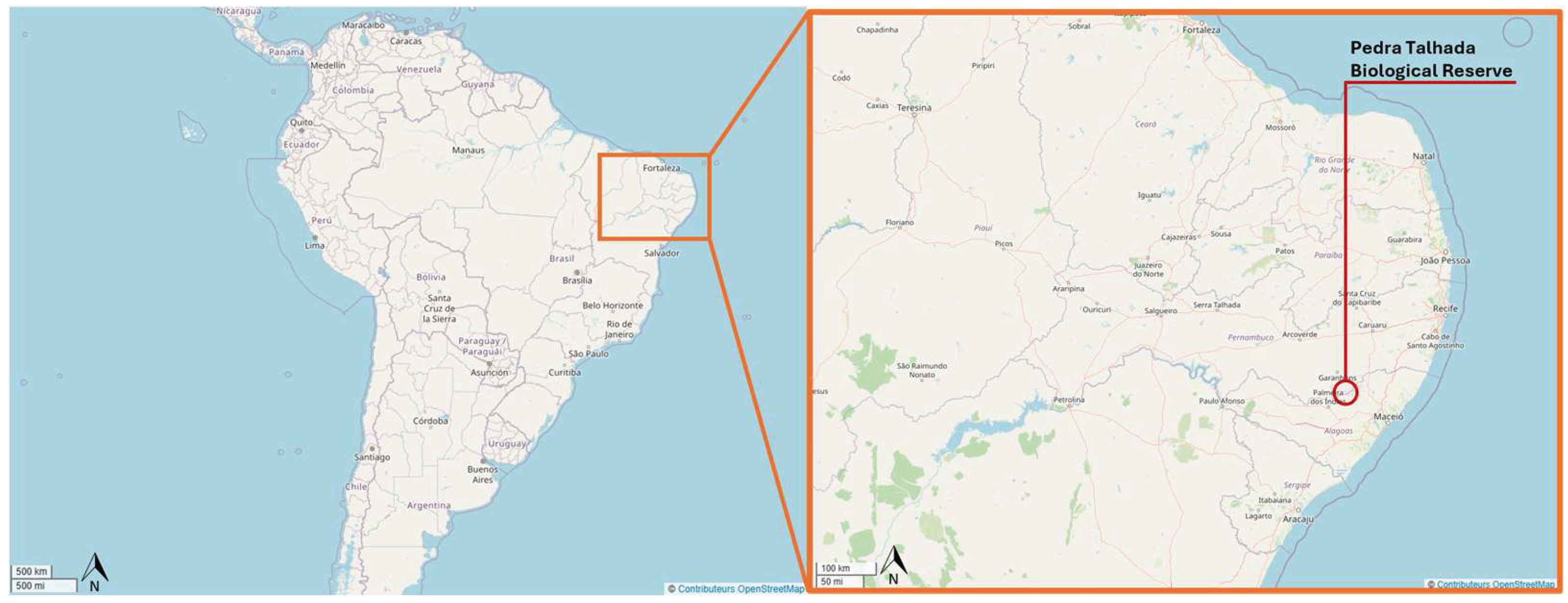
Figure 2.
Change in land use around the Pedra Talhada Biological Reserve between 1986 and 2018. The black plain line shows the boundaries of the Pedra Talhada Biological Reserve. The brown striped line shows the border between the states of Alagoas (bottom of the map) and Pernambuco (top of the map). Light green represents savanna, dark green represents forest, beige represents pasture, blue represents rivers and lakes, and red represents urban areas. (Maps are screenshots from MapBiomas Brasil, available under Creative Commons CC-BY license at plataforma.brasil.mapbiomas.org, accessed on 05.01.2026).
Figure 2.
Change in land use around the Pedra Talhada Biological Reserve between 1986 and 2018. The black plain line shows the boundaries of the Pedra Talhada Biological Reserve. The brown striped line shows the border between the states of Alagoas (bottom of the map) and Pernambuco (top of the map). Light green represents savanna, dark green represents forest, beige represents pasture, blue represents rivers and lakes, and red represents urban areas. (Maps are screenshots from MapBiomas Brasil, available under Creative Commons CC-BY license at plataforma.brasil.mapbiomas.org, accessed on 05.01.2026).
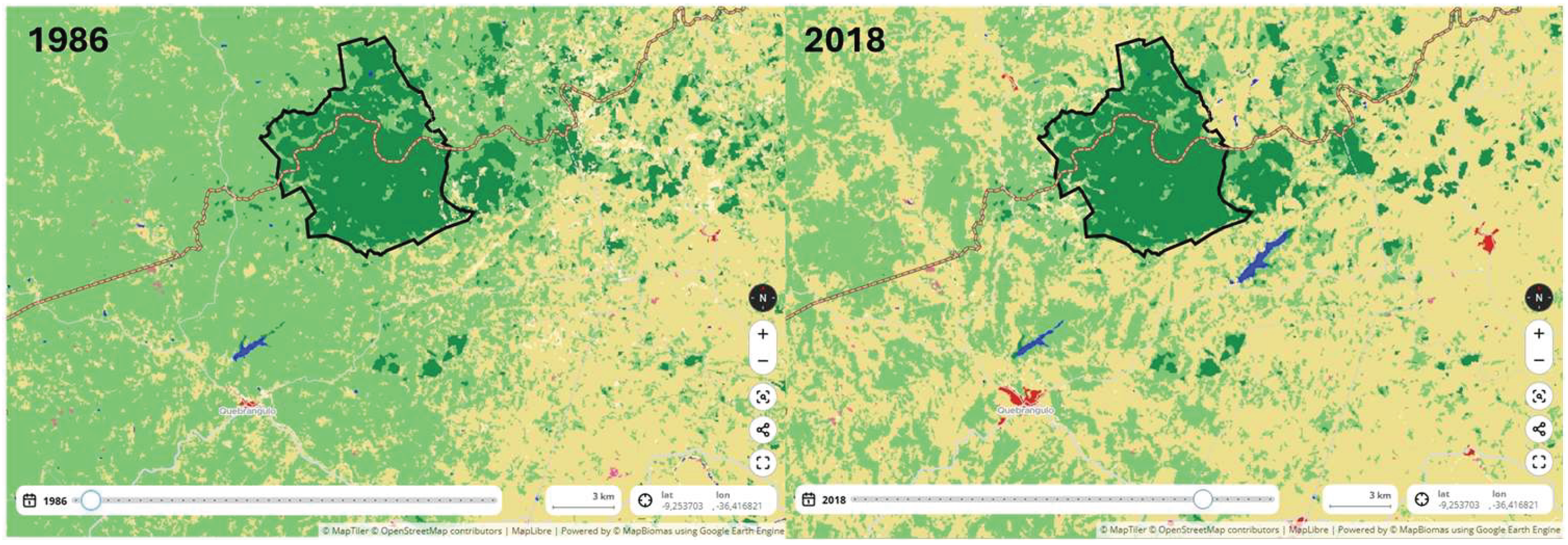
Figure 3.
Schematic diagram of a Synallaxis infuscata nest. 1) Main part of the nest. 2) Side arm. 3) Incubation chamber. a) Nest height. b) Nest width. c) Side arm length. d) Internal diameter of the side arm. e) Height of incubation chamber. See the text for the values. The proportions are maintained from the mean values. White denotes the external part of the nest and grey denotes the internal part. (Scheme created by Leïla Perroulaz).
Figure 3.
Schematic diagram of a Synallaxis infuscata nest. 1) Main part of the nest. 2) Side arm. 3) Incubation chamber. a) Nest height. b) Nest width. c) Side arm length. d) Internal diameter of the side arm. e) Height of incubation chamber. See the text for the values. The proportions are maintained from the mean values. White denotes the external part of the nest and grey denotes the internal part. (Scheme created by Leïla Perroulaz).
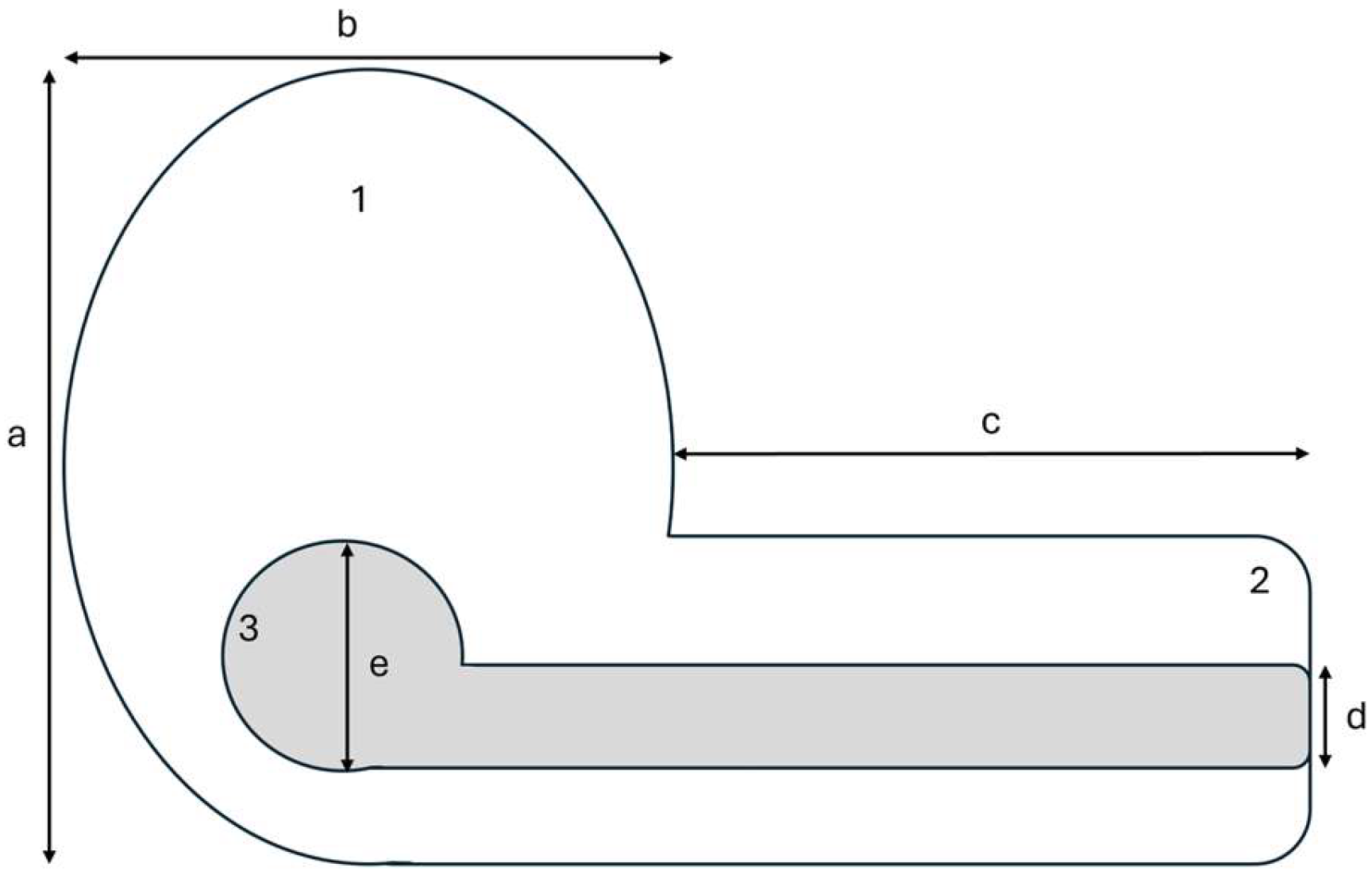
Figure 4.
Nest of Synallaxis infuscata (Anita Studer, June 2018).
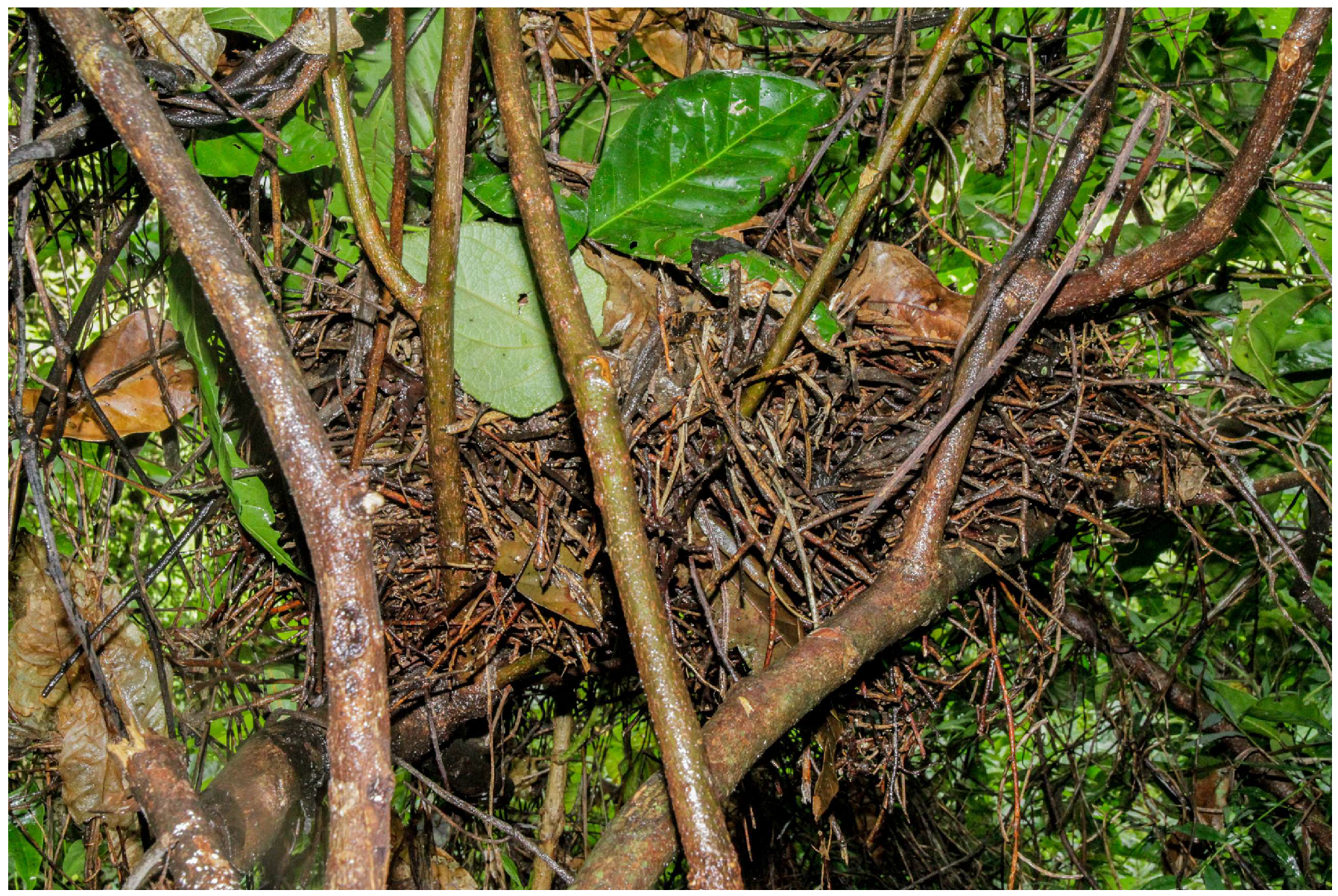
Figure 5.
A white egg of Synallaxis infuscata in the nest (Anita Studer, May 2017).
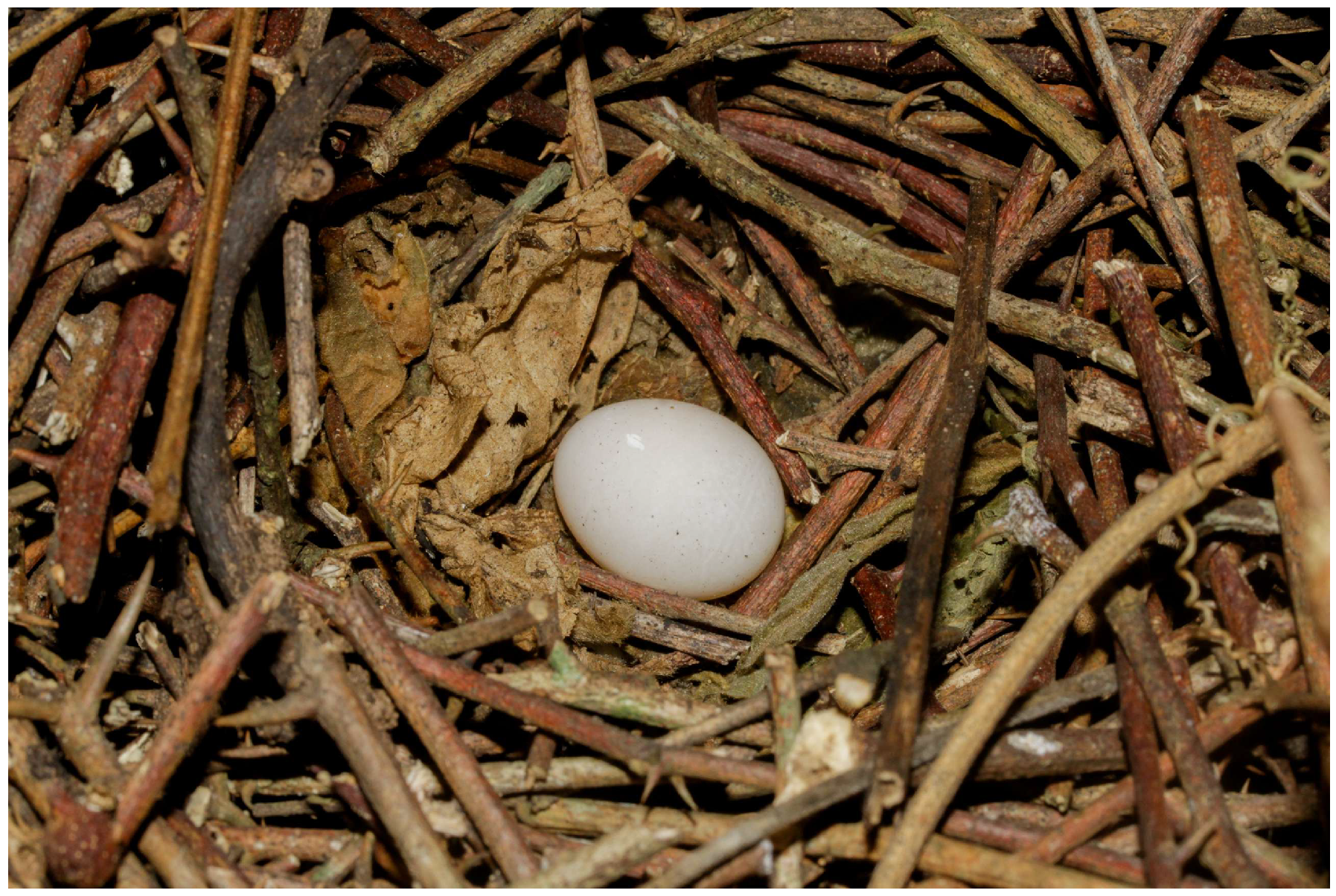
Figure 6.
An adult Synallaxis infuscata bringing a prey to the nestlings (Anita Studer, March 1992).
Figure 6.
An adult Synallaxis infuscata bringing a prey to the nestlings (Anita Studer, March 1992).
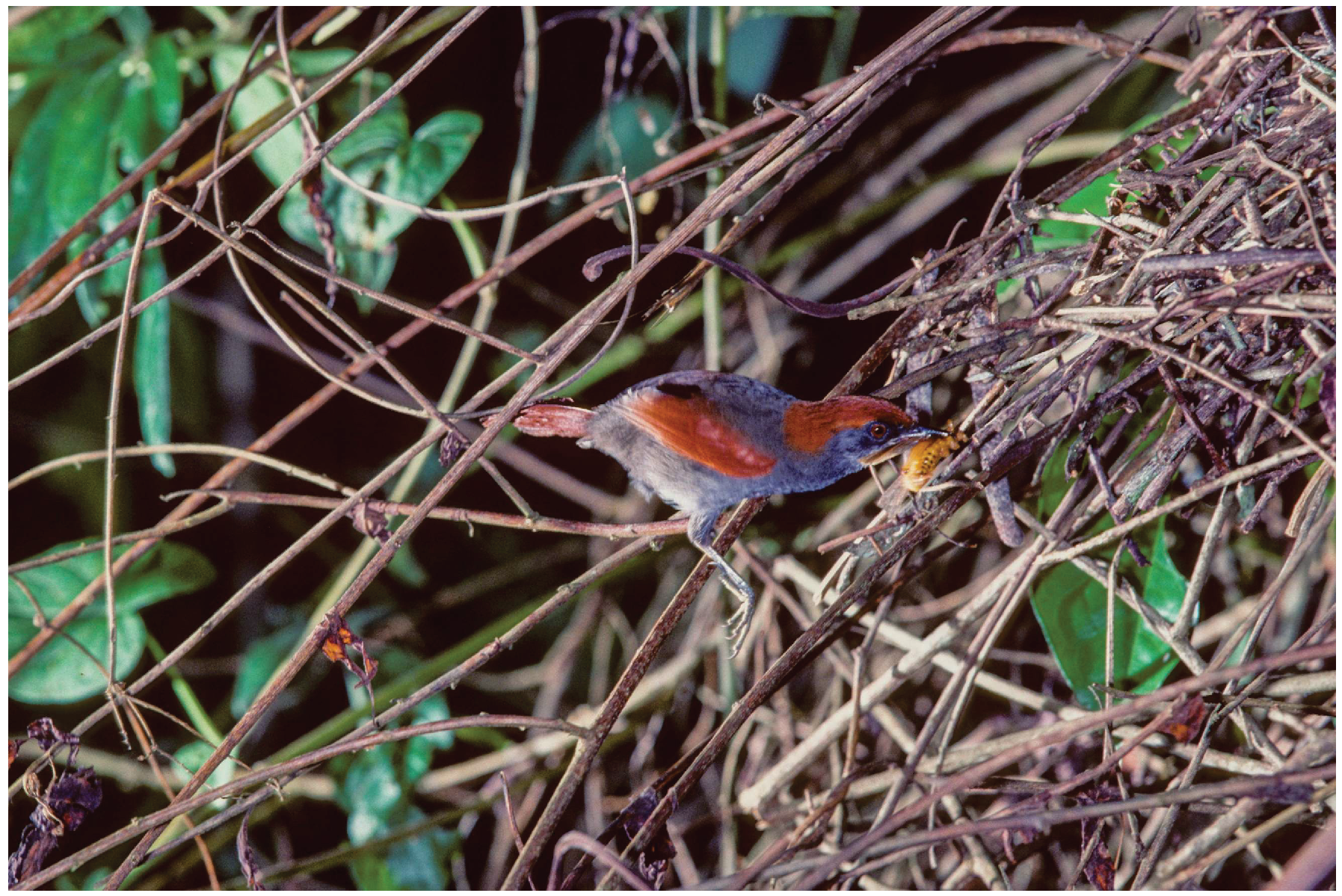
Figure 7.
Comparison of nest weight between S. infuscata, S. moesta, S. ruficapilla, and the mean for Synallaxis species. The violin and boxplot represent the distribution of values for S. infuscata. The bottom point represents the only nest value for S. moesta, and the top point represents the only nest value for S. ruficapilla. The horizontal line represents the mean for Synallaxis species.
Figure 7.
Comparison of nest weight between S. infuscata, S. moesta, S. ruficapilla, and the mean for Synallaxis species. The violin and boxplot represent the distribution of values for S. infuscata. The bottom point represents the only nest value for S. moesta, and the top point represents the only nest value for S. ruficapilla. The horizontal line represents the mean for Synallaxis species.
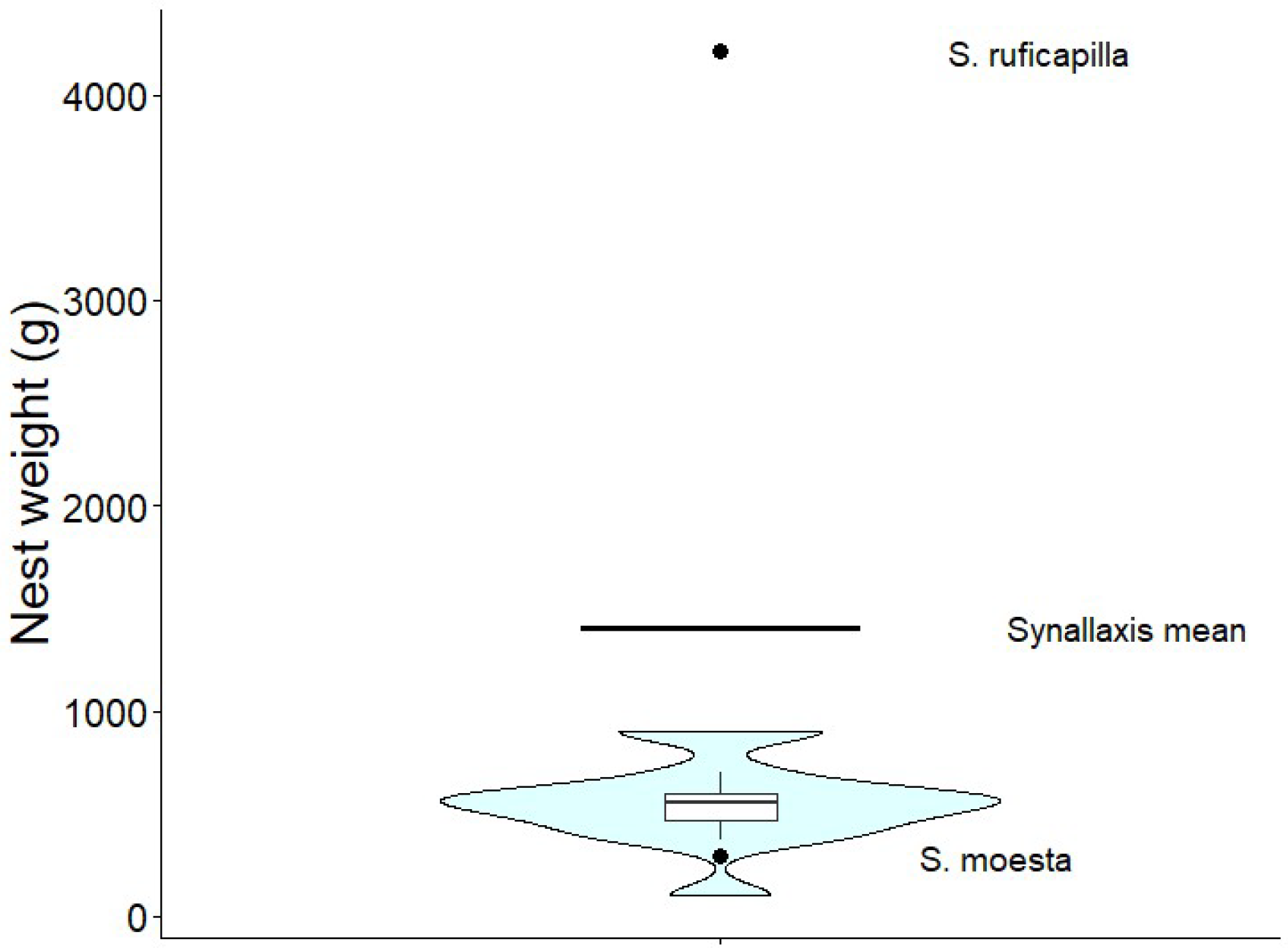
Figure 8.
Comparison of egg weight between S. infuscata, S. moesta, S. ruficapilla, and the mean for Synallaxis species. The violin and boxplot represent the distribution of values for S. infuscata. The top point represents the only egg value for S. moesta. The central horizontal line represents the mean for S. ruficapilla, and the bottom horizontal line represents the mean for Synallaxis species.
Figure 8.
Comparison of egg weight between S. infuscata, S. moesta, S. ruficapilla, and the mean for Synallaxis species. The violin and boxplot represent the distribution of values for S. infuscata. The top point represents the only egg value for S. moesta. The central horizontal line represents the mean for S. ruficapilla, and the bottom horizontal line represents the mean for Synallaxis species.
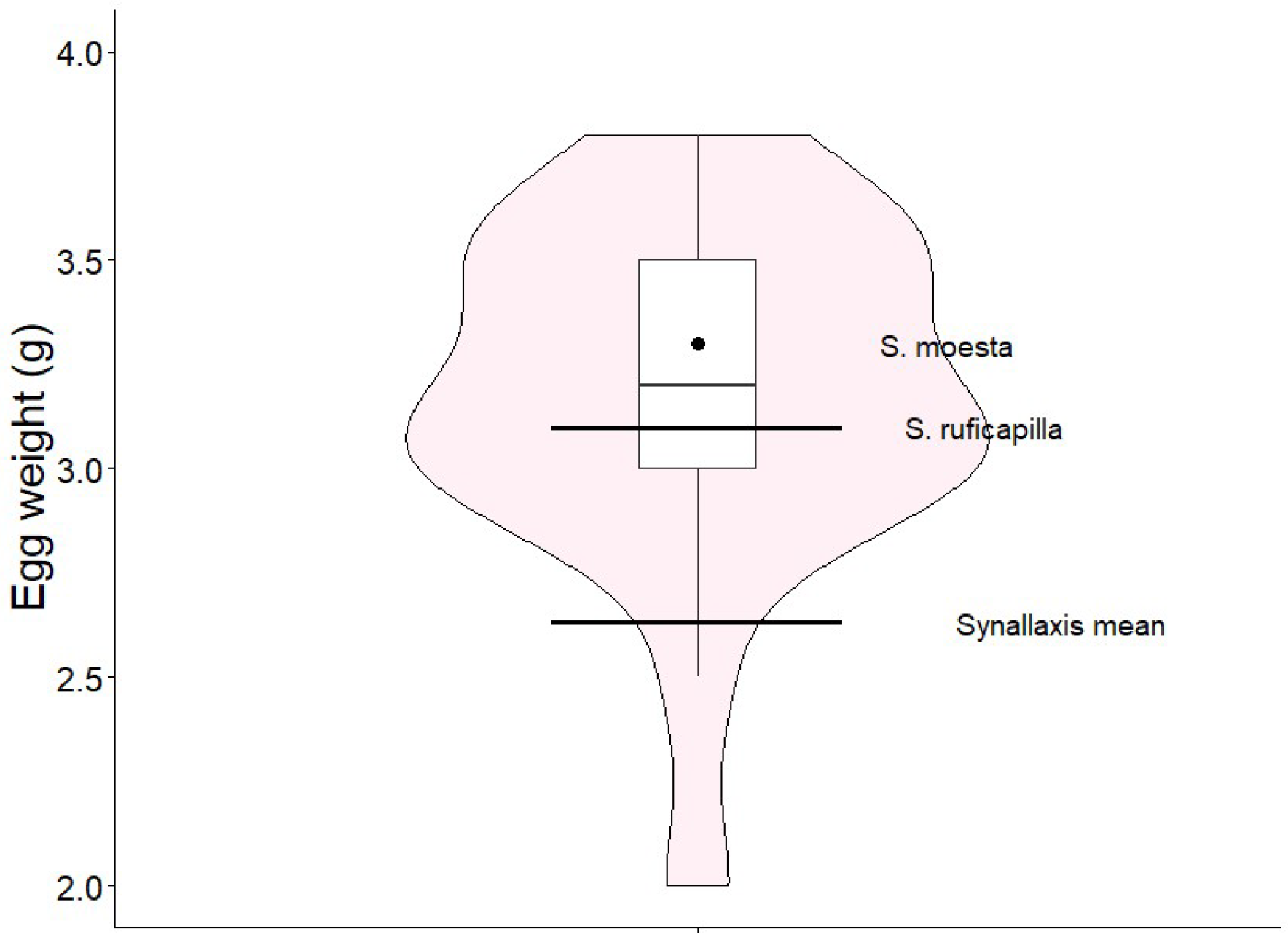
Table 1.
Causes and periods of nest failure for 21 Synallaxis infuscata nests. The percentages represent the proportion of failed nests.
Table 1.
Causes and periods of nest failure for 21 Synallaxis infuscata nests. The percentages represent the proportion of failed nests.
| Predation | Abandonment | Human | Total | |
|---|---|---|---|---|
| Egg | 11 (52.4%) | 2 (9.5%) | 1 (4.8%) | 14 (66.7%) |
| Nestling | 6 (28.6%) | 0 | 1 (4.7%) | 7 (33.3%) |
| Total | 17 (81%) | 2 (9.5%) | 2 (9.5%) | 21 (100%) |
Table 2.
Comparative table of nest characteristics for S. infuscata, S. moesta, S. ruficapilla and the mean for Synallaxis species. See Table A1 for the full Synallaxis species data. “–“ Indicates that the information was not found within the mentioned reference.
Table 2.
Comparative table of nest characteristics for S. infuscata, S. moesta, S. ruficapilla and the mean for Synallaxis species. See Table A1 for the full Synallaxis species data. “–“ Indicates that the information was not found within the mentioned reference.
| Species | Nest weight (g) | Nest height (cm) | Nest width (cm) | Nest arm length (cm) | Nest arm diameter (cm) | Height of incubation chamber (cm) | Nest height from ground (m) |
|---|---|---|---|---|---|---|---|
|
S. infuscata (this study) |
552.1 ± 205.2 (n = 14) | 37.6 ± 8.9 (n = 15) | 28.8 ± 12.4 (n = 17) | 30.6 ± 4.4 (n = 7) | 4.9 ± 3.4 (n = 4) | 10.9 ± 7.6 (n = 12) | 2.16 ±1.14 (n = 33) |
| S. moesta [46] | 292 (n=1) | – | – | 30 | 15 | 12.5 | – |
| S. ruficapilla [48, Studer unpub.] | 4210, (n = 1) | – | – | 23-40 | 14-16 | 10.5-12 | 1-3.3 |
|
Synallaxis mean (Table A1) |
1407.8 (n = 8) | 35.86 (n = 21) | 34.33 (n = 24) | 26.32 (n = 16) | 7.13 (n = 11), | 15.54 (n = 17) | 2.01 (n= 28) |
Table 3.
Table 3. Comparative table of breeding parameters for S. infuscata, S. moesta, S. ruficapilla and the mean for Synallaxis species. See Table A1 for the full Synallaxis species data. “–“ Indicates that the information was not found within the mentioned reference.
Table 3.
Table 3. Comparative table of breeding parameters for S. infuscata, S. moesta, S. ruficapilla and the mean for Synallaxis species. See Table A1 for the full Synallaxis species data. “–“ Indicates that the information was not found within the mentioned reference.
| Species | Clutch size | Egg size (mm) | Egg weight (g) | Egg colour | Incubation period (days) | Nestling period (days) |
|---|---|---|---|---|---|---|
|
S. infuscata (this study) |
2.10 ± 0.76 (n = 30) | 22.25 ± 0.9 (n = 63) x 17.18 ± 0.7 (n = 63). | 3.17 ± 0.4 (n = 63) | white | 21.5 ± 2.12 (n = 2) | 14.71 ± 0.76 (n = 7) |
| S. moesta [46] | 2 (n = 1) | 24.1 x 16.5 (n = 1) | 3.3 (n = 1) | white | – | – |
| S. ruficapilla [[48], Studer unpub.] | 2-3 (n = 4) | 21.1 x 16.2 (n = 7) | 3.1 (n = 2) | white | – | – |
|
Synallaxis mean (Table A1) |
2.77 (n = 29) | 20.42 x 15.91 (n = 17) | 2.63 (n = 15) | - | 18.38 (n = 13) | 15.74 (n = 14) |
Disclaimer/Publisher’s Note: The statements, opinions and data contained in all publications are solely those of the individual author(s) and contributor(s) and not of MDPI and/or the editor(s). MDPI and/or the editor(s) disclaim responsibility for any injury to people or property resulting from any ideas, methods, instructions or products referred to in the content. |
© 2026 by the authors. Licensee MDPI, Basel, Switzerland. This article is an open access article distributed under the terms and conditions of the Creative Commons Attribution (CC BY) license (http://creativecommons.org/licenses/by/4.0/).
Copyright: This open access article is published under a Creative Commons CC BY 4.0 license, which permit the free download, distribution, and reuse, provided that the author and preprint are cited in any reuse.


