
Submitted:
26 November 2025
Posted:
27 November 2025
You are already at the latest version
Abstract
It is a common phenomenon that the stairs of modern historical brick and wood buildings can not meet the existing fire protection specifications, which has become a difficulty in the repair. Based on this, this paper proposes two different repair strategies for the Chinese Baroque "Hui" shaped building in Harbin, and uses the computer fire evacuation performance simulation as the method to explore the influence of the changes of stair width, number, location and building size on the safety movement duration and number of individuals who failed to evacuate in the two repair strategies, and compares the effectiveness of common fire prevention measures. It is found that the fire development laws of the two building repair methods are similar when corre-sponding to the same stair state and building volume; When the width of stairs in-creased from 900mm to 1100mm, the evacuation effect was not significantly improved; Increasing the number of existing interior staircases from one to two increases the proportion of safely evacuated occupants from 68% to 91%.; The exterior corridor staircase shows the highest evacuation efficiency, with a single staircase sufficient to ensure the safe evacuation of all occupants; Given the same increment in total area, the increase in evacuation movement time caused by adding stories is approximately twice that caused by expanding the building footprint.; The fire prevention effect of automatic sprinkler and mechanical smoke exhaust is more obvious.
Keywords:
brick and wood building
; Chinese Baroque
; fire evacuation performance simulation
; stairs
1. Introduction
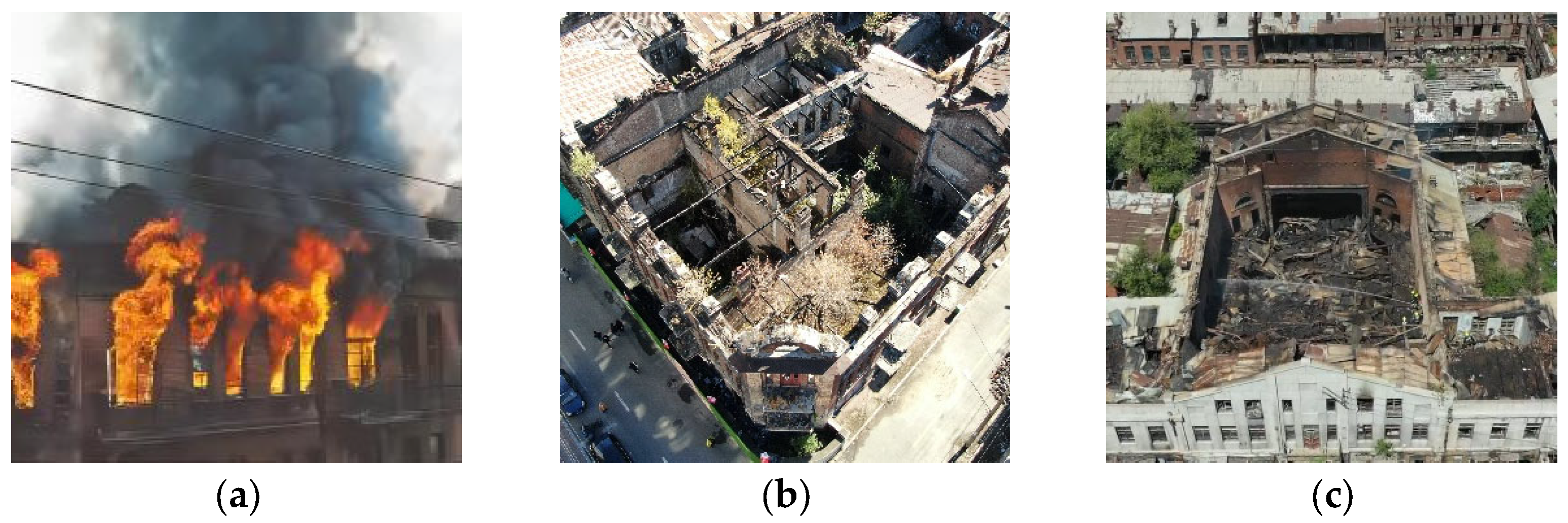
According to existing research statistics, about 70% of Chinese modern historical buildings are built with wood or brick wood structures, of which about 55% are seriously damaged due to lack of effective protection[1]. At the same time, most modern brick and wood buildings generally have the problem that the width and number of stairs can not meet the existing fire protection specifications. The repair design is faced with the difficult contradiction between retention and demolition, which requires fire experts to conduct performance-based demonstration for the scheme. However, it is often difficult to choose because of the lack of effective experiments or scientific data. The Chinese Baroque building block is one of the only three historical conservation blocks in Harbin. There are more than 280 modern brick and wood buildings in the block. In the past, fires occurred frequently (Figure 1). Obviously, the fire protection design is the top priority of the current repair design. Similar to most modern brick and wood buildings, the number and width of stairs in the Chinese Baroque buildings generally do not conform to the current fire protection code. Therefore, fire protection design has become the focus and difficulty of its repair work. Figure
The theoretical research on building fire evacuation has been carried out since the 19th century. At the beginning, the research methods for fire focused on the summary of cases and combustion experiments[2]. The combustion characteristics and pyrolysis data of materials can be accurately obtained by combustion experiments, but it is not suitable for the study of fire evacuation of the whole building. After the 1900s, a revolutionary breakthrough was made in research methods. In 1983, Kumar proposed the field model of fire, which has become a widely accepted mathematical model for fire simulation[3]. On this basis, the fire simulation software has been developed and widely used in the fire evacuation research of public buildings such as commerce, high-rise office buildings and hospitals[4,5,6]. The fire engineering manual, the first systematic guidance book on fire protection engineering completed by the American Association of Fire Engineers in 1988, makes a detailed summary of the basic data of personnel evacuation in fire, the combustion parameters of common combustibles, and the fire based characteristics, laying a foundation for future research. In the early days, the National Institute of standards and technology proposed an empirical model for the development of fire smoke based on the measured data. Later, Emmons of Harvard University proposed a regional model, but these models have limitations[4,5]. Among them, some scholars applied it to the research on the fire evacuation performance of single or group historical buildings. Chorlton et al. Studied the fire protection performance of cultural heritage and contemporary wood, and found that the fire protection performance of historical building wood was not as good as that of Glulam, and the carbonization rate of historical wood was 20% faster than that of Glulam. The research focused on the pyrolysis of historical building materials when fire occurred[7]. For example, Hu et al. Used Pathfinder to simulate the evacuation of the disabled when they encounter fire hazards in historical buildings[8]. Liminghai et al. Simulated the fire of the ancient building hall through FDS simulation[9]. The rest of the research focuses on fire risk assessment, fire evacuation from the perspective of blocks, and fire hazard factors of historical buildings. The coupled method of pyrosim and Pathfinder has been widely used in the study of fire evacuation in large public buildings such as commercial buildings and super high-rise buildings[10,11]. However, in the study of fire evacuation of historical buildings, the application of coupling the real-time development process of fire products with evacuation routes is still relatively limited, especially the comparative study of different repair methods.
To sum up, this paper takes the most representative "Hui" shaped (enclosed courtyard) brick and wood structure building in the Chinese Baroque block as the research object, and uses the computer fire evacuation performance simulation method to explore the influence of different stair widths, numbers and locations on the duration of personnel safety movement and the number of evacuation failures in two typical repair strategies under fire scenarios, and to compare the effectiveness of common fire prevention measures.
2. Materials and Methods
2.1. Main characteristics of Chinese Baroque architecture
The historical buildings in Harbin's Chinese Baroque block were built between the 1900s and 1950s. Because their facades are decorated with Western Baroque and traditional Chinese symbols, Japanese architect Takehiko Nishazawa called them "Chinese Baroque" buildings for the first time when he came here for research[12].
- Facade form
The whole building inherits the Western three-stage facade composition method. The entrance is mostly decorated with columns, the waist line of the building is decorated with layers of progressive moldings, the lower part of the cornice is set with scroll shaped decorative components, and the parapet is mostly in the form of vase columns and bars with Art Nouveau Movement symbols. Figure
Figure 2.
Typical building facade overall form: (a) Tailai Ren Shoes and Hats Store; (b) current status of Zhong Hua Inn Daowai District People's Hospital.
Figure 2.
Typical building facade overall form: (a) Tailai Ren Shoes and Hats Store; (b) current status of Zhong Hua Inn Daowai District People's Hospital.
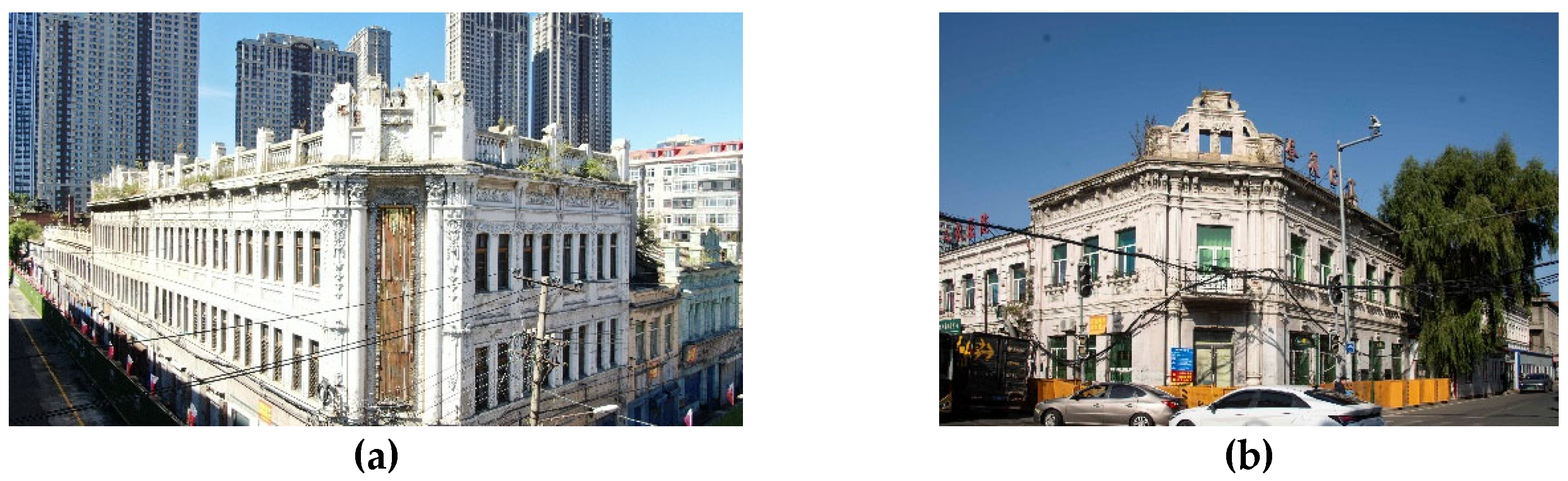
In terms of detail decoration, a large number of forms of combination of China and the West are adopted, of which the western style is dominated by the Russian traditional wood decorative geometry, brick geometric geometry and arc arch in the Art Nouveau movement, while the Chinese style is a decorative symbol with beautiful symbolic meaning. Figure
Figure 3.
Detail decoration: (a) Traditional symbolic decoration; (b) Art Nouveau Movement Decoration; (C) Brick geometric decoration; (d) Wooden geometric decoration.
Figure 3.
Detail decoration: (a) Traditional symbolic decoration; (b) Art Nouveau Movement Decoration; (C) Brick geometric decoration; (d) Wooden geometric decoration.

- 2.
- Characteristics of building structure
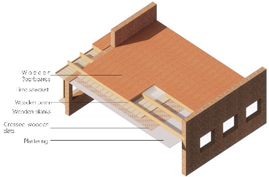
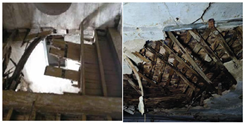
The Chinese Baroque architecture in Harbin Daowai historic district adopts the Western brick and wood structure, using brick walls as vertical load-bearing components and wood as horizontal load-bearing components. This structural system can increase the number of floors of the building and enrich the facade forms. The doors and windows are mostly built with brick arches, making the building more elegant as a whole. The roof adopts galvanized iron slope roof design, which effectively avoids rain and snow accumulation and leakage, and significantly improves the durability of the building. At the same time, the closed roof space formed by the roof can block the cold air in winter and improve the comfort of use.

Table 1.
Roof and floor structure.
| Roof structure | Floor structure | |
|---|---|---|
| Construction model | 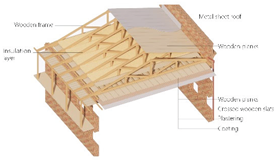 |
 |
| Actual photos | 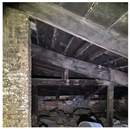 |
 |
- 3.
- Spatial layout features
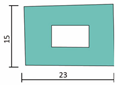
At the beginning of its construction, Harbin Chinese Baroque was mainly used for business and living. Most of the builders were ethnic industrialists and businessmen in the south. Most of the buildings adopted the "Hui" layout of front stores and back factories. These courtyard style buildings formed a courtyard group of 257 courtyard buildings[13]. The "Hui" shaped building space has become the most representative layout form in the block. Therefore, the text selects the "Hui" shaped building as the research object. Figure
Figure 4.
extraction of typical spatial styles in blocks.
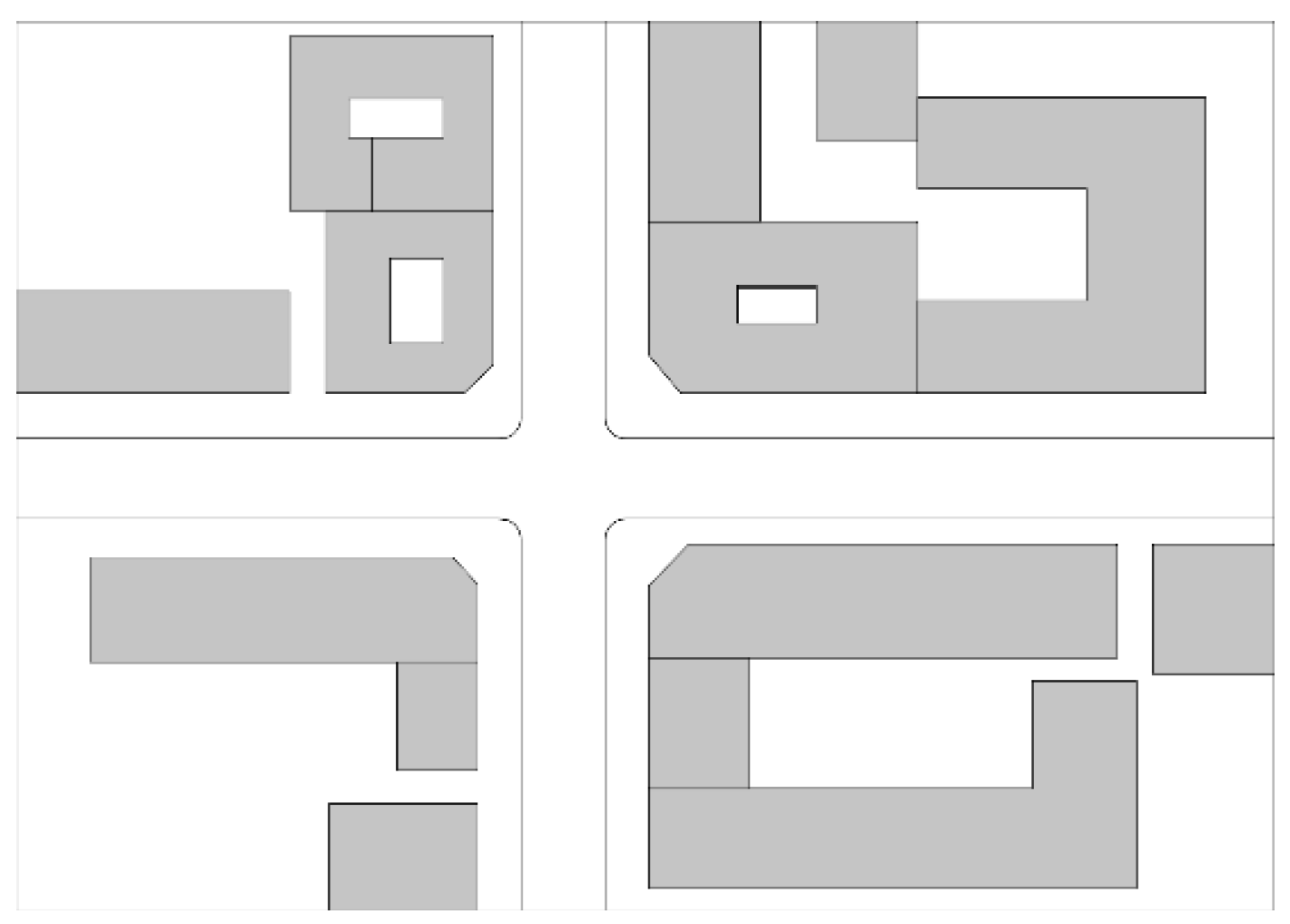
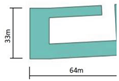
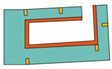
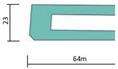
Among these buildings, there are single buildings in the shape of "Hui", as well as the "Hui" layout formed by the combination of "I", "L" and "concave" in the later stage. In this paper, the buildings with the initial layout of "Hui" shape are selected for research. Table
Table 2.
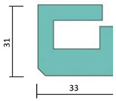
Typical single "Hui" shaped buildings in the block.
| Representative building | floor plan style | evacuation style | Number of layers | |||
|---|---|---|---|---|---|---|
| Typical volume "Hui" shaped building build |
Yanshou Tang Pharmacy |  |
 |
 |
Outdoor corridor evacuation | 2F |
| Name Unknown | Under Renovation | 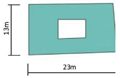 |
 |
Open stairwell | 2F | |
| Da Dong Bookstore | 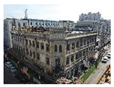 |
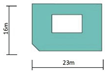 |
 |
Outdoor corridor evacuation | 3F | |
| Inn | 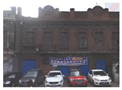 |
 |
 |
Open stairwell | 2F | |
| increased base area "Hui"shape building build |
Global pharmacy | 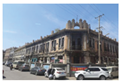 |
 |
 |
Open stairwell | 2F |
| Taihua pharmacy | 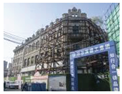 |
 |
 |
Open stairwell | 3F | |
2.2. Building Fire Hazards
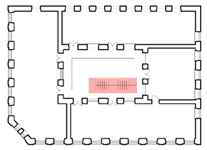
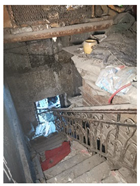
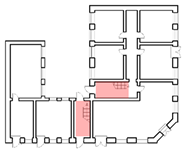
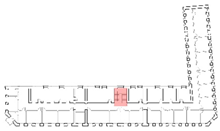
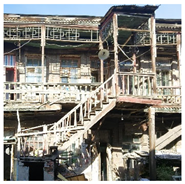
There are many hidden dangers in the safety of historical buildings in Harbin Zhonghua Baroque block, and it is common that they do not meet the existing fire protection design specifications, which are mainly reflected in the insufficient evacuation of regional roads, flammable wood materials, narrow width and small number of stairs, etc. Among them, the repair design of stairs is the most difficult choice under the current principle of emphasizing the protection of historical buildings. According to incomplete statistics, the main fire hazards of the remaining stairs in the block are as follows. Table
Table 3.
fire hazards of remaining stairs in the block.
| Insufficient quantity | Narrow space | Poor location |
|---|---|---|
 |
 |
 |
 |
 |
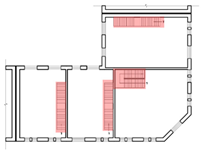 |
| Some buildings only have one step of stairs or no stairs. | The clear width of building stairs in the block is about 900mm. | The two staircases are close to each other and arranged randomly. |
2.3. Typical Building Repair Methods
There are three main directions for the repair of modern historical buildings: first, for important buildings that are well preserved, attention should be paid to maintaining the original appearance and spatial structure, such as the renovation of the Bund in Shanghai; The second is to show the original structural characteristics of the building by exposing masonry, truss and other structures; The third is to use contemporary technology and reversible means to appropriately update on the basis of retaining historical elements, such as decoration, lighting or door and window reconstruction[14].
According to the spatial characteristics of the Chinese Baroque architecture in Harbin, with the purpose of making efficient use of modern brick and wood buildings, this paper puts forward the repair methods of "fine-tuning space" and "courtyard capping" on the basis of inheriting the characteristics of the Chinese Baroque architecture.
- “Space fine tuning” mode
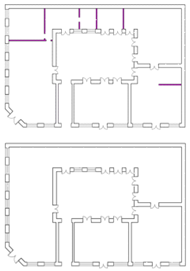
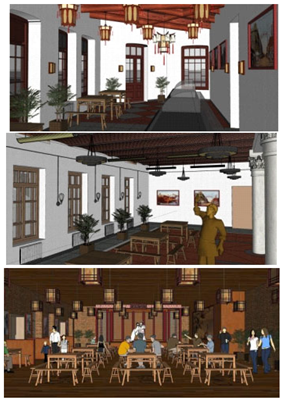
At present, there are a large number of privately built partition walls on the first floor of historical buildings in the block. The second floor and above are mainly for office or residential functions, and the space division is relatively fragmented. After the repair, the function is mainly commercial, and the business format may change at any time, so an open and flexible spatial layout is required. Therefore, the most reasonable and effective repair method is to dismantle the existing light partition wall to form a large-scale variable space. Table
Table 4.
measures and effects of "space fine tuning" mode.
| Operation measures | Effect after repair |
|---|---|
 |
 |
| Demolition of partition wall | Regular and open space is conducive to commercial applications |
- 2.
- "Courtyard capping" mode
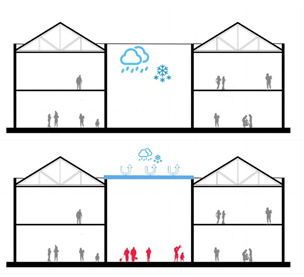
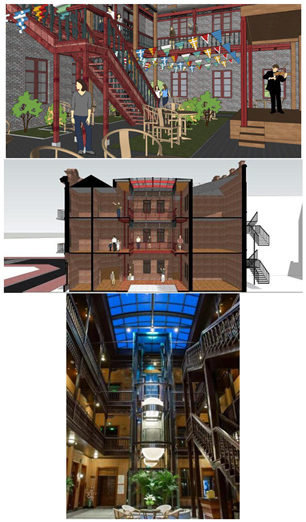
Due to the limitation of climate conditions, the building courtyard is not conducive to outdoor operation in winter, and the utilization rate is low. Therefore, under the "space fine-tuning" mode, the courtyard with appropriate scale and allowable conditions is equipped with a daylighting roof, which makes the courtyard space half indoor, thus increasing the use frequency of the courtyard in winter. Table
Table 5.
measures and effects of "courtyard capping".
| Operation measures | Effect after repair |
|---|---|
 |
 |
| Add skylight outdoor courtyard indoor | Suitable for winter use |
2.4. Key Points of Safe Evacuation
2.4.1. Key Fire Products
High temperature burns the human body, low visibility causes people to stay at the fire site for a long time, and serious physiological reactions caused by toxic gas inhalation are the main reasons for fire evacuation failure. The height of smoke, temperature, concentration of carbon monoxide and visibility of evacuees are the main factors affecting safety[15,16,17]. In previous studies on fire evacuation, the criteria for determining the failure of personnel evacuation also focus on the above indicators, so this paper selects the temperature, visibility and carbon monoxide concentration in the fire environment as the indicators for safe evacuation.
2.4.2. Safety Evacuation Conditions
The real fire evacuation process is complex, divided into multiple stages, and there are many emergencies[18] (Figure 3). The study assumes that all personnel in the building are awake and there are no emergencies. Due to the small building volume, the ignition duration of the fire source itself is not considered. Therefore, the evacuation movement time and its corresponding fire growth stage are selected for research. Coupling the evacuation process with the development process of the fire, and combining with the boundary conditions, it is confirmed that the fire products affect the time required for the safe evacuation (Teffect). The time from the start of personnel movement to the Teffect is the safe movement time. If the movement time is less than the Teffect, the evacuation is successful, otherwise, the evacuation fails. Figure
Figure 5.
Illustration of the Safety Evacuation Assessment Process.
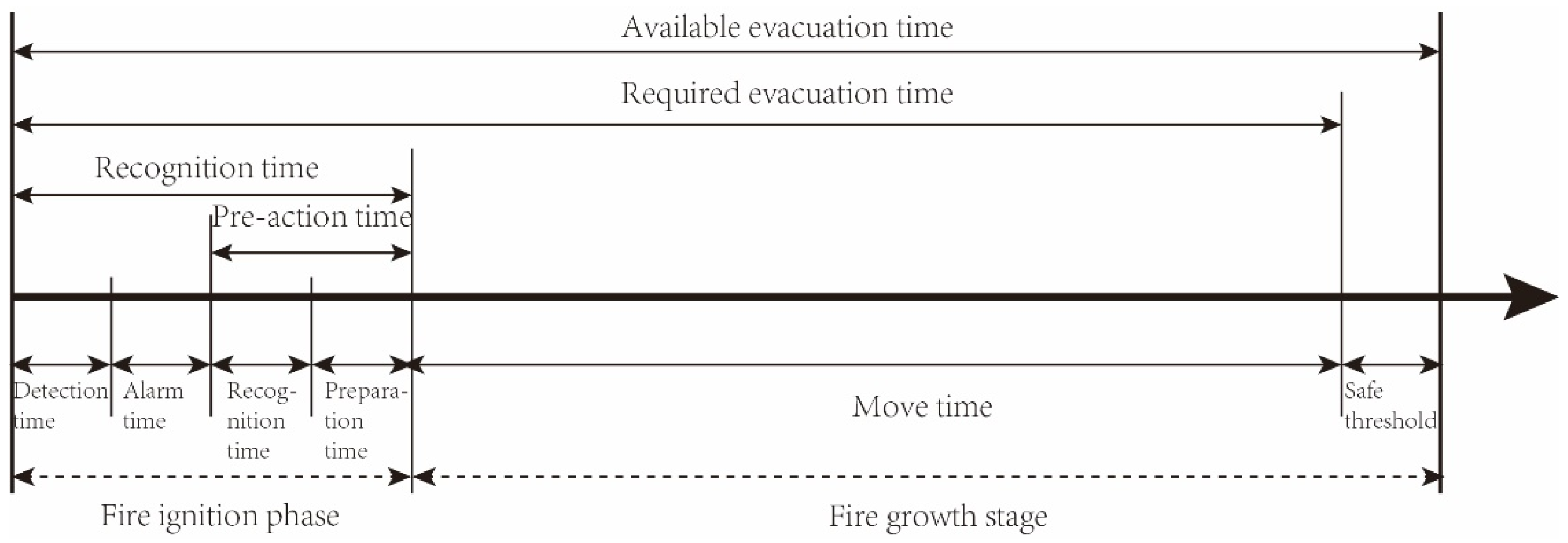
According to the existing research and relevant fire prevention codes, the boundary conditions of evacuation failure under the influence of various fire products are established. Table
Table 6.
boundary conditions for safe evacuation.
| Key fire products | Establishment basis | Boundary conditions for safe evacuation | |
|---|---|---|---|
| temperature | Australian fire engineering guidelines | When the height of human head exceeds 60℃ at 1.7m and exceeds 200℃ at 3.7m under the ceiling, evacuation will fail. | |
| visibility | In the basic principle of the impact of visibility on evacuees in fire, it is pointed out that personnel will not lose the ability to evacuate immediately due to reduced visibility[19]. According to existing research and calculation, when the visibility is 2m, the evacuation speed will drop to 0.91m/s, which will have a great impact on people[20]. | If the visibility of personnel crossing is less than 2m and lasts for 10s or more, the evacuation will fail. | |
| CO concentration | Use Stewart equation to calculate the time to reach different carboxyhemoglobin concentrations and the 1400ppm concentration specified in sfpe[21]. | 100ppm | 300s and above |
| 300ppm | 96s and above | ||
| 500ppm | 60s and above | ||
| 1400ppm | Immediate failure | ||
2.4.3. Simulation Method and Software Selection
This paper studies the fire evacuation of buildings by coupling the real-time development process of fire products generated by pyrosim with the evacuation process of Pathfinder. Both results can be displayed in the form of animation, and can generate real-time slices and probe data of different fire products, which is conducive to observing the law of fire development and the impact of fire on evacuation.
Pyrosim is a fire simulation software based on fire dynamics simulator (FDS). The FDS model has been extensively verified by experts from the National Institute of standards and Technology (NIST) and other organizations in the United States, and its reliability for fire simulation has been fully confirmed[22]. Pathfinder is an agent-based simulator, which uses steering behavior to simulate human movement, and has passed the IEEE standard. The simulation results of the two can be coupled with each other.
2.5. simulation Scheme
2.5.1. Establishment of Technical Route
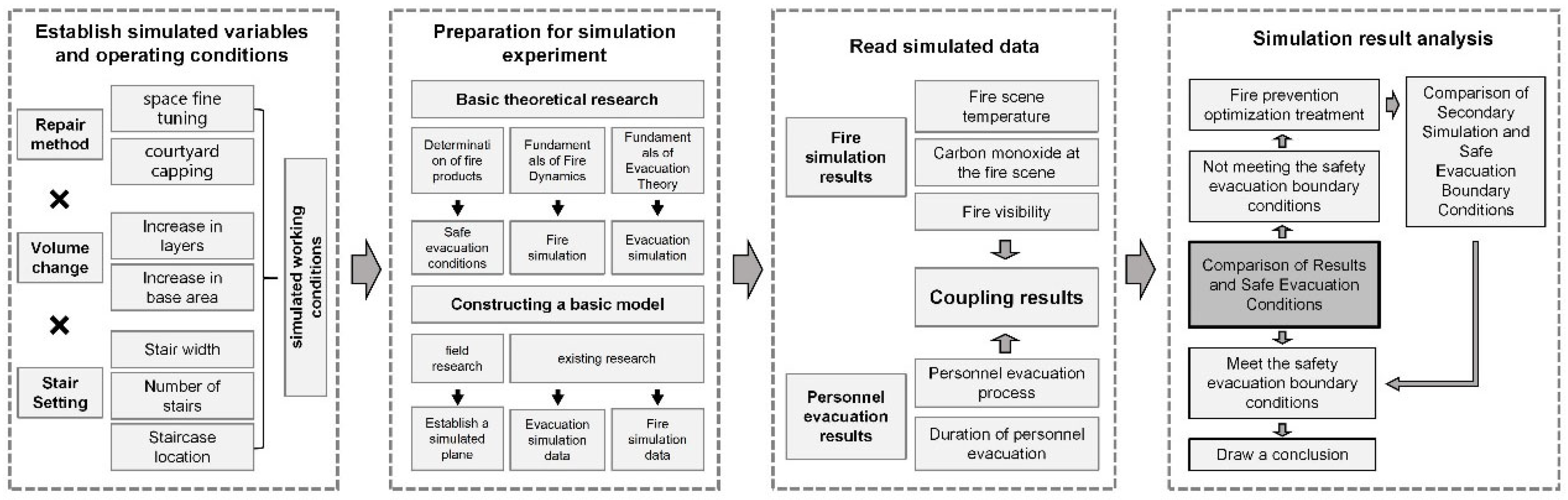
The technical route of the simulation experiment is mainly divided into four stages: the preparation stage, which summarizes the building structure, materials and spatial forms in the block; In the experimental stage, the boundary conditions of the simulation are established based on the existing research; In the data reading stage, the fire simulation data and evacuation simulation data are coupled respectively; In the result analysis stage, by comparing the coupling results with the boundary conditions, we can determine whether the working conditions can be safely evacuated. The specific process is as follows. Figure
Figure 6.
Technology Roadmap.
2.5.2. Establishment of Simulated Working Conditions
To address the fire-evacuation challenges encountered in the restoration of the Harbin Chinese Baroque buildings, this study employs computer-based simulation to achieve the following objectives:
(1) To examine the fire development patterns and their differences under two restoration approaches: “micro-adjusted space” and “courtyard roofing.”
(2) For both restoration approaches, to investigate the influence of the existing staircase widths on fire evacuation performance, and to further assess the impact when the widths are increased to the minimum code requirement of 1100 mm.
(3) For both restoration approaches, to analyze how different numbers of staircases affect fire evacuation.
(4) For both restoration approaches, to explore the effects of different staircase locations on fire evacuation.
(5) For both restoration approaches, to evaluate how changes in building volume—considered in both the horizontal and vertical dimensions—affect the performance of staircase configurations during fire evacuation.
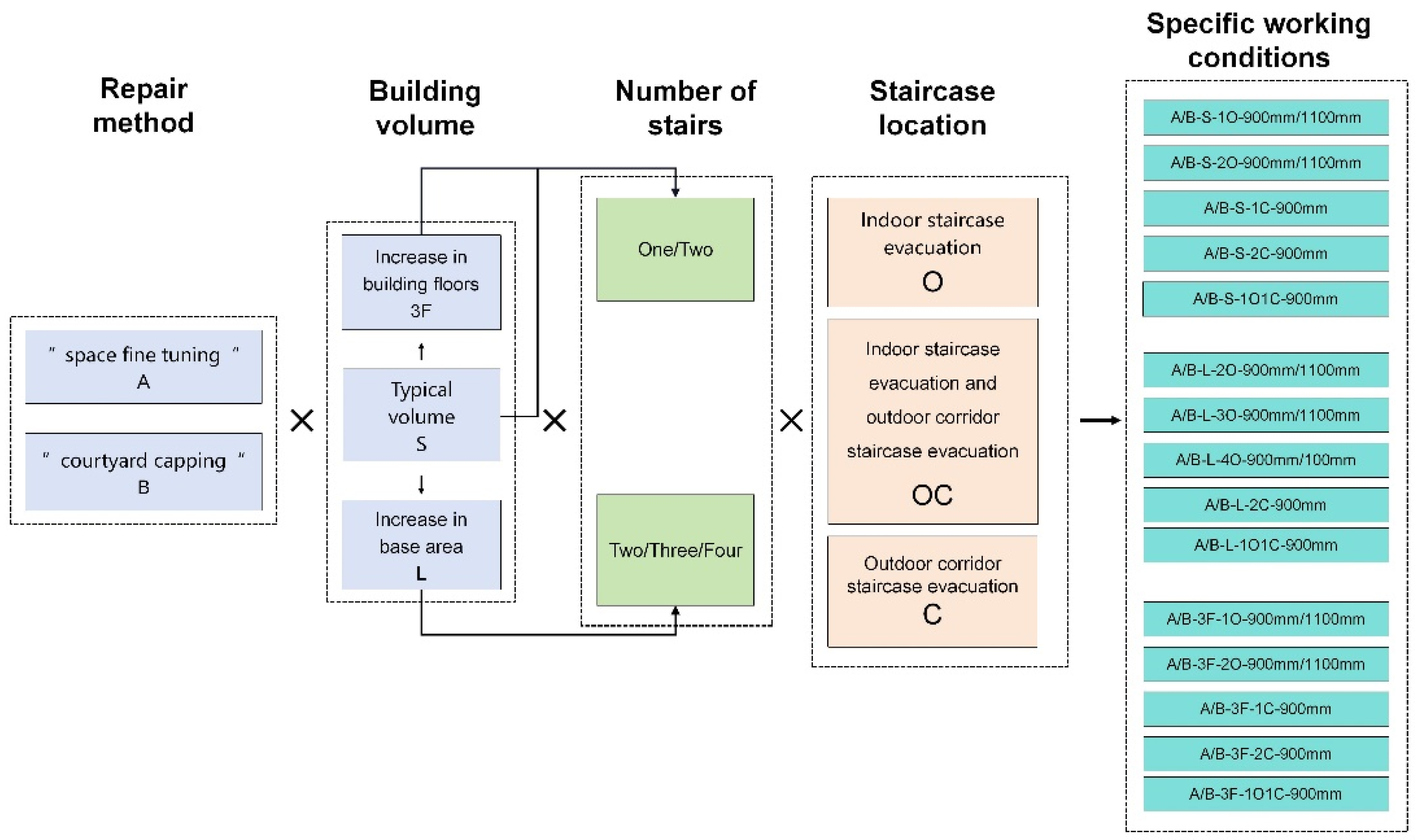
Based on these objectives, the study selects restoration approach, building volume, and staircase width, number, and location as variables, resulting in a total of 44 fundamental simulation scenarios. Figure In the case of large-volume buildings using indoor staircases for evacuation, scenarios A-L-2O-900 mm, A-L-3O-900 mm, and A-L-4O-900 mm serve as the baseline, with corresponding sub-scenarios developed to examine variations in staircase locations.
Figure 7.
Establishment of simulated working conditions.
2.5.3. Determination of Simulation Plane
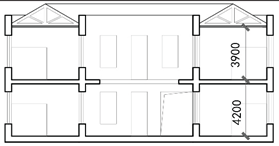
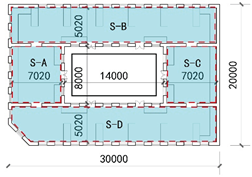
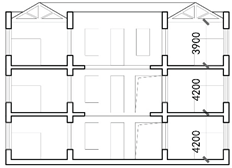
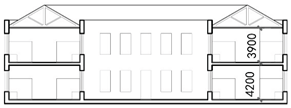
By analyzing typical small-scale “Hui” shaped buildings within the block, their length-to-width ratios generally range from 1:1 to 3:2. The long side measures approximately 23–33 meters, while the short side ranges from 13–31 meters. The distance between the street-facing exterior wall and the courtyard-facing interior walls is between 4–10 meters.
For larger “Hui” shaped buildings formed by increasing the base area, the length-to-width ratios tend to fall between 3:2 and 2:1. The long side measures around 60 meters, the short side ranges from 23–33 meters, and the distance between the street-facing exterior wall and the courtyard-facing interior walls is between 6–13 meters.
Considering that the primary post-restoration function is commercial use, and referencing nearby commercial buildings, the area occupied by obstacles is calculated as 20% of the usable floor area of the building and represented in the form of counters. Table
Table 7.
basic simulation model.
| Building volume | Plan | Section |
|---|---|---|
| Typical volume foundation model | 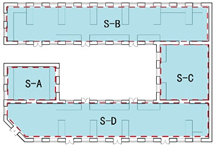 |
 |
| First floor plan | Section-2F | |
 |
 |
|
| Second/Third floor plan | Section -3F | |
| Basic model with increased base area | 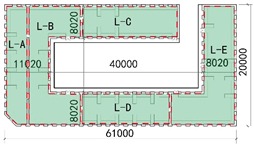 |
 |
| First/Second floor plan | Section -2F |
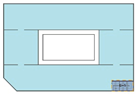
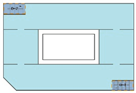
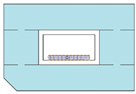
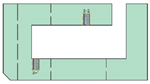
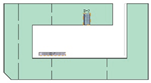
Determine the position of stairs in each simulated working condition on the foundation plane. Table
Table 8.
stair location
| Number of stairs | Corridor evacuation | Open stairwell evacuation | Combination of two ways of evacuation |
|---|---|---|---|
| One step staircase | 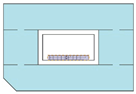 |
 |
|
| Two step staircase | 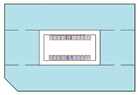 |
 |
 |
| Two step staircase | 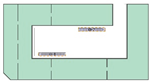 |
 |
 |
| Three step staircase | 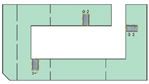 |
||
| Four step staircase | 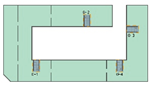 |
2.6. Establishment of Fire Simulation Model
- 1.
- Simulated fire source
The fire source is assumed to originate from the ignition of accumulated miscellaneous materials, with an ignition area of 1 m × 1 m. The heat release rate per unit area is set to 550 kW/m², and the growth rate of the heat release follows the system’s default settings [17].
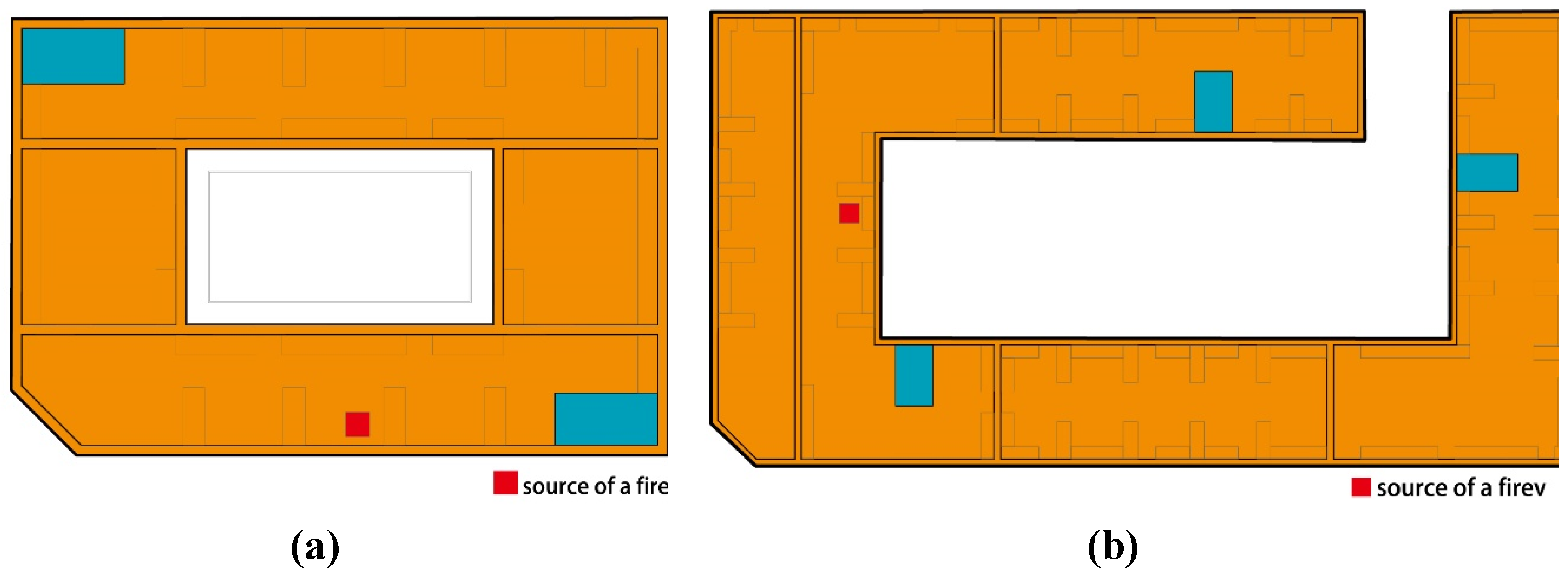
The fire locations are selected at positions near the shelves in the central areas of the largest spaces on the first and second floors. These locations affect the greatest number of occupants, contain evacuation staircases, and provide spacious conditions conducive to observing the fire development process, thereby offering strong representativeness. Figure
Figure 8.
(a) Fire source location of typical volume building; (b) Location of fire source of increased base area building.
Figure 8.
(a) Fire source location of typical volume building; (b) Location of fire source of increased base area building.
- 2.
- Combustion material setting
The exterior walls of the building are constructed of load-bearing red brick, while all horizontal load-bearing components are made of timber. Due to the age of the wooden structural elements and the building’s commercial function—where interior shelves accumulate large quantities of combustible goods and decorative materials—an ultra-fast fire growth rate is selected to simulate the worst-case fire scenario. Based on existing research, the following parameters are adopted.[17]. Table
Table 9.
combustion material parameters.
| combustion material | Heat release rate | Ignition temperature | Time required for full combustion |
|---|---|---|---|
| Horizontal bearing member | 390kw/㎡ | 270℃ | 45s |
| obstacle | 550kw/㎡ | 300℃ | 54s |
- 3.
- Simulated environment
The simulated fires and combustibles are mainly concentrated in the building interior and are less affected by the outdoor wind environment, so the indoor wind speed is set as 0m/s in the fire simulation. The number of open doors and windows of the building is set to 30% of the total number. The indoor temperature, visibility and CO concentration before the fire adopt the default values in the software. Table
Table 10.
indoor basic environment.
| indoor temperature | visibility | CO concentration |
|---|---|---|
| 20℃ | 30m | 0ppm |
- 4.
- Simulation Grid
Referring to the existing research, when the research object is the local space or components in the building, the grid division is usually 0.1m-0.3m. When the space of the research object is simple and the volume is large, the grid division is between 0.3m-0.5m. The research object of this paper is the brick and wood structure building with relatively simple internal space, which does not include complex details. The window opening size is 1.2m × 2.4m, the door opening size is 1.2m × 3.3m, the wall thickness is 0.49m, and the amount of obstacles is large. Considering the balance between simulation accuracy and calculation time, 0.4m × 0.4m × 0.4m is selected as the basic simulation grid for simulation[23,24,25].
- 5.
- Slice and probe location
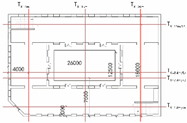
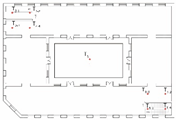
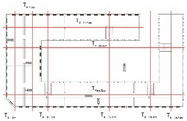
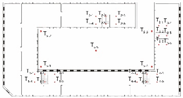
Determine the location of slices and probe points according to the boundary conditions of personnel safety evacuation and pre simulation. T represents temperature, D represents visibility, and co represents carbon monoxide. The temperature slices and probe points are taken as examples in the table. Among them, the location of the location of slices and probing points on the third floor is the same as the relative position of the second floor. Indoor probe points are set at the projection position, 0.5m, 1.7m, 3.7m away from the indoor floor of each floor, and courtyard probe points are set at the projection position, 1.7m, 3.7m, 5.7m, 7.7m away from the outdoor floor. Table
Table 11.
location map of sections and probe points.
| Slice layout | Probe point layout | ||
|---|---|---|---|
| Typical volume shape building | 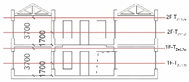 |
 |
 |
| Building with enlarged base area | 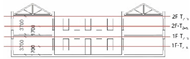 |
 |
 |
2.7. Establishment of Evacuation Simulation Model
A reasonable evacuation simulation model can truly reflect the evacuation time and movement characteristics of people inside the building. The model is first built based on specific scenario assumptions, and the number of people can be estimated according to the building function, city level and geographical location. The personnel attribute parameters are determined by integrating relevant domestic and foreign specifications, research literature and local actual conditions.
- basic assumptions of evacuation simulation
The actual evacuation situation in fire is complex and changeable, so assumptions and limitations should be made before simulation.
(1)The research object is a historical district with a strong business atmosphere. Only those who have the ability to evacuate independently are considered, excluding those who need assistance from others.
(2)The walking speed of personnel is determined according to the existing literature, assuming that the speed of all evacuees is consistent. When the traffic density increases or the passage is narrow, congestion may occur and affect the speed and route of subsequent personnel.
(3)In the simulation, sudden behaviors such as retrograde and panic are not considered, and it is assumed that all personnel evacuate to the nearest exit.
(4)It is assumed that the fire alarm system is activated manually by occupants upon the onset of the fire, initiating evacuation throughout the entire building. The movement time during the evacuation phase is calculated without considering potential device failure.
- 2.
- Evacuation parameters
According to the research on the density of people in business rooms and the walking speed of people during evacuation, and in combination with the characteristics of the block itself, the basic characteristics of evacuees are set as follows [17,26,27,28]. Table 1
Table 1.
personnel characteristic parameters.
| Evacuation speed at walkway | Evacuation speed of staircase | Male shoulder width | female shoulder width |
|---|---|---|---|
| 1.25m/s | 1.0m/s | 0.41m | 0.39m |
When determining the specific number and density of users inside the building, the main factors to be considered include the function of the building, users, urban grade, location, etc. Referring to the existing research on the density of people in business rooms, and comparing with the same type of blocks in the city, it is determined that the peak density of building personnel is 0.25 people/m2. People are randomly distributed in each zone, and there are no evacuees on the stairs. The total number of people evacuated under different schemes is shown in the table below[29,30]. Table
Table 13.
total number of evacuees under different schemes.
| Two storey typica volume building | Three storey typica volume building | increased base area volume building | |
|---|---|---|---|
| Total number | 154 | 233 | 461 |
3. Results
3.1. Impact of Typical Scale Staircase Setting on Safe Evacuation
3.1.1. Influence of Stair Width on Safe Evacuation
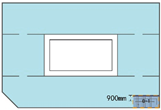
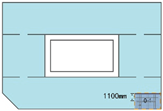
First, based on the two-story typica volume building, a one open staircase is set indoors, and two different widths of 900mm and 1100mm are selected for simulation. Table
Table 14.
simulated working conditions of different stair widths.
| Typical volume | Working condition A-S-1O-900mm | Working condition A-S-1O-1100mm |
 |
 |
When the stair width increases from 900mm to 1100mm, the duration of evacuation movement decreases by 7.1%, and the optimization effect is not obvious. Figure
Figure 9.
evacuation duration under different stair widths.
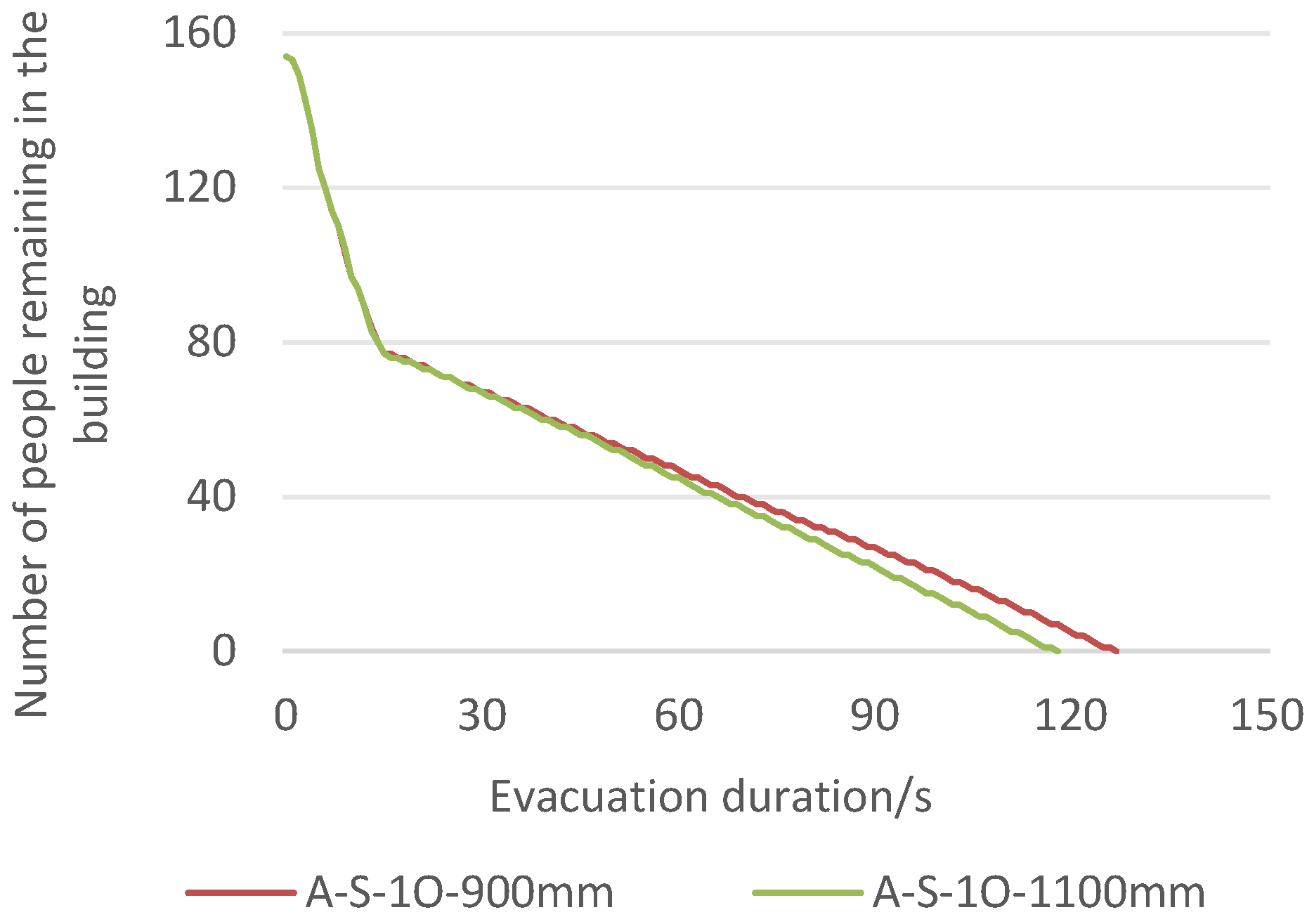
The reason for this phenomenon is that when the width of the staircase is 900mm, only one stream of people can be evacuated, and when the width is 1100mm, it can be increased to two streams of people in case of congestion, thus slowing down the evacuation time. Because the simulation does not consider the emergencies in the fire, such as slow evacuation speed, falling, pushing and shoving, the evacuation efficiency under the two widths is close. When the above conditions exist, it will be difficult to continue the evacuation when the stair width is 900mm. When the stair width is increased to 1100mm and local congestion occurs, whether it can meet the continuous evacuation of a stream of people needs the test and certification of the fire department.
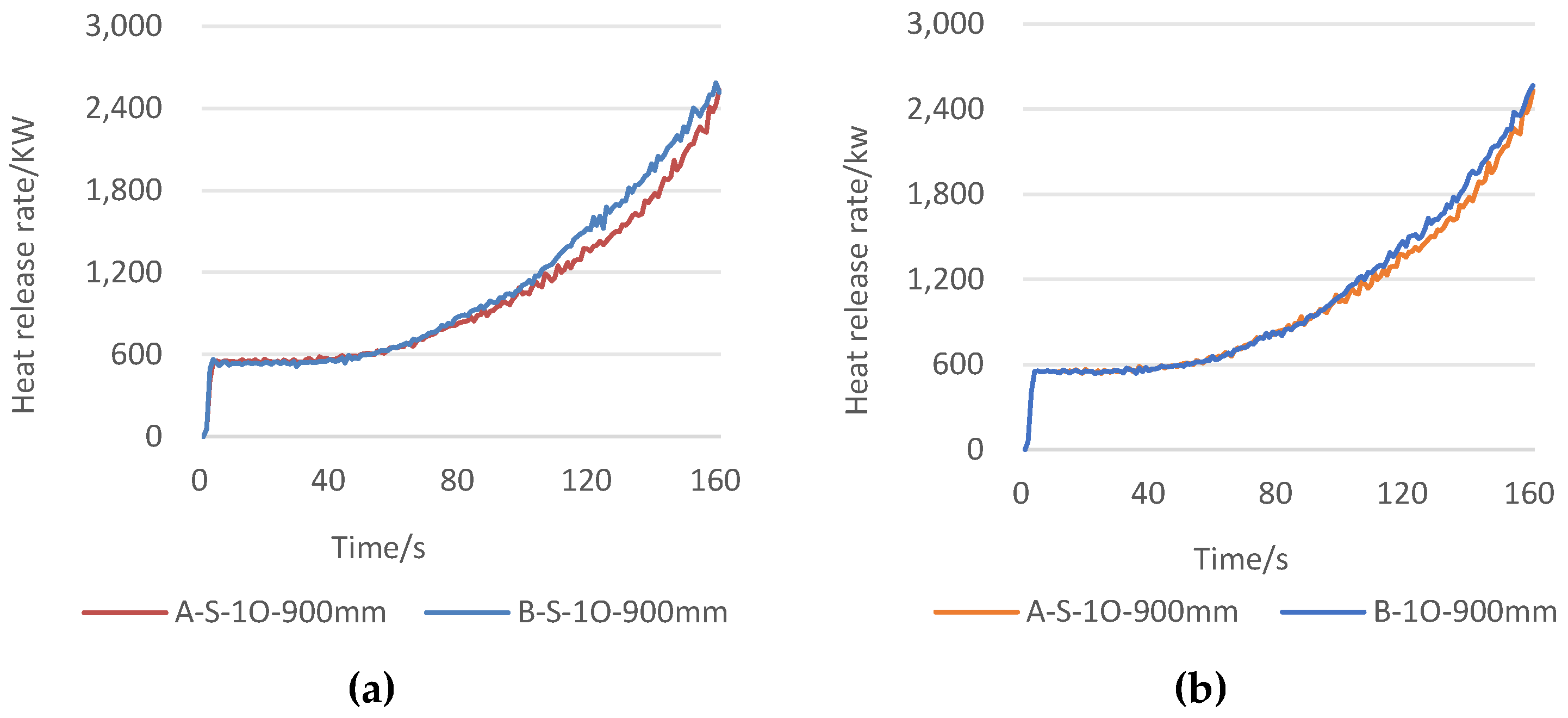
By comparing the impact of fire products on evacuation under the two repair methods, it can be seen that only B-S-1O-900mm Teffct was advanced after adding skylights in the courtyard, which led to a slight increase in the number of evacuation failures. Table
Table 15.
comparison of the number of evacuation failures under the two repair methods.
| A-S-O-900mm | B-S-O-900mm | ||
|---|---|---|---|
| Temperature effect | Teffect | 111s | 109s |
| Number of evacuation failures | 3 | 4 | |
| Temperature effect | Teffect | 95s | 91s |
| Number of evacuation failures | 11 | 13 | |
This is because the law of indoor fire development of the two repair methods basically converges. The fire development rate of the "courtyard covered" repair method is slightly faster than that of the "fine-tuning space" repair method after 80s (Figure 11). As a result, the working condition of Teffect>80s is advanced, and the number of evacuation failures is increased compared with the fine-tuning space division path. When the stairs are increased to two, the effect of visibility is 41s, less than 80s. Therefore, the "courtyard capping" repair method does not add people who fail to evacuate.
Figure 10.
(a) The fire source is located on the first floor; (b) The fire source is located on the second floor.
Figure 10.
(a) The fire source is located on the first floor; (b) The fire source is located on the second floor.
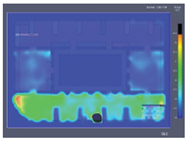
In both restoration schemes, the impact range of visibility is greater than that of temperature. When the fire source is located on the first floor, temperature poses a more significant threat. Under these conditions, the number of evacuation failures caused by visibility issues on a staircase with a width of 1100mm is approximately three times that of a staircase with a width of 900mm. This is because widening the staircase also accelerates the spread and upward movement of smoke to the second floor. Table
Table 16.
Coupling results of temperature and evacuation process.
| Working Condition A-S-1O-900mm | Working CCondition A-S-1O-1100mm | |
|---|---|---|
| The fire source is located on the first floor |  |
 |
| 2F-S-TY=1.8m | 2F-S-TY=2.0m | |
| This working condition is affected by temperature, Teffect=111s, and 3 people failed to evacuate. | All personnel were evacuated from the second floor at 99s, and a high temperature area of 60℃ appeared in the stairwell at 121s. No evacuation failed under this condition. | |
| The fire source is located on the second floor | 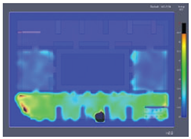 |
 |
| 2F-S-TZ=1.7m | 2F-S-TZ=1.7m | |
| When people evacuate the second floor, more than 85% of the temperature in the S-D area is 30 ℃ -40 ℃. The temperature in the gable area on both sides is mainly 40 ℃ -45 ℃. | When personnel evacuate the second floor, more than 85% of the temperature in SD area is 30 ℃ -35 ℃. The temperature in the gable area on both sides is mainly 35 ℃ -45 ℃. There is no high temperature zone greater than 60 ℃. |
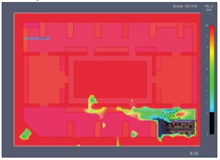
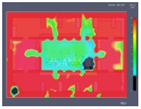
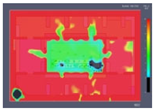
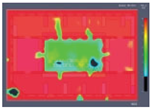
When the fire source is located on the second floor, the visibility is more threatening. This is because the area with visibility less than 2m first gathers on the gables on both sides, resulting in the failure of evacuation of a large number of people waiting here. Table
Table 17.
Coupling results of visibility and evacuation process.
| Working Condition A-S-1O-900mm | Working Condition A-S-1O-1100mm | |
|---|---|---|
| The fire source is located on the first floor | 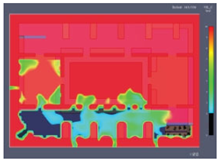 |
 |
| 2F-S-DZ=1.7m | 2F-S-DZ=1.7m | |
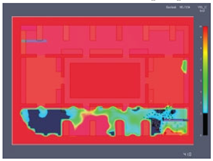
| This condition is affected by visibility, Teffect=95, 11 people failed to evacuate. | This condition is affected by visibility, Teffect=61, Evacuation of 30 people failed. | |
| The fire source is located on the second floor | 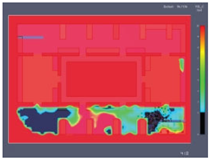 |
 |
| 2F-S-DZ=1.7m | 2F-S-DZ=1.7m | |
| The most unfavorable conditions of the two working conditions are at the O-1 stairwell. At 31s, the visibility of the waiting area of the second floor stairwell and the belt formed by the stairwell and the gable decreased to less than 2m. Affected by the visibility, the effect was 41s, and 50 and 43 people failed to evacuate under the working conditions A-sS-1O-900mm and A-S-1O-1100mm, respectively. | ||
The overall distribution of CO is similar to that of high temperature and low visibility. The high concentration area is mainly distributed in the higher space. The CO concentration at the 1.7m section is mainly distributed in the range of 30ppm-150ppm. The evacuees in all working conditions are not affected by CO.
3.1.2. Impact of the Number of Stairs on Safe Evacuation
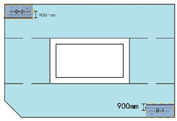
Based on the situation in 4.1.1, an identical stairwell is added indoors to explore the impact of the number of stairwells on the duration of evacuation. Table 2
Table 2.
simulation conditions of different number of stairs.
| Typical volume | Working Condition A-S-2O-900mm | Working Condition A-S-2O-1100mm |
 |
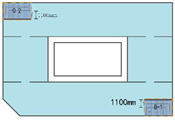 |
After adding an additional staircase, the evacuation movement time of occupants was reduced by approximately 40% under both conditions. When two staircases were used, increasing the staircase clear width from 900 mm to 1100 mm further reduced the evacuation movement time by about 10%. Figure
Figure 11.
evacuation movement duration with different number of stairs.
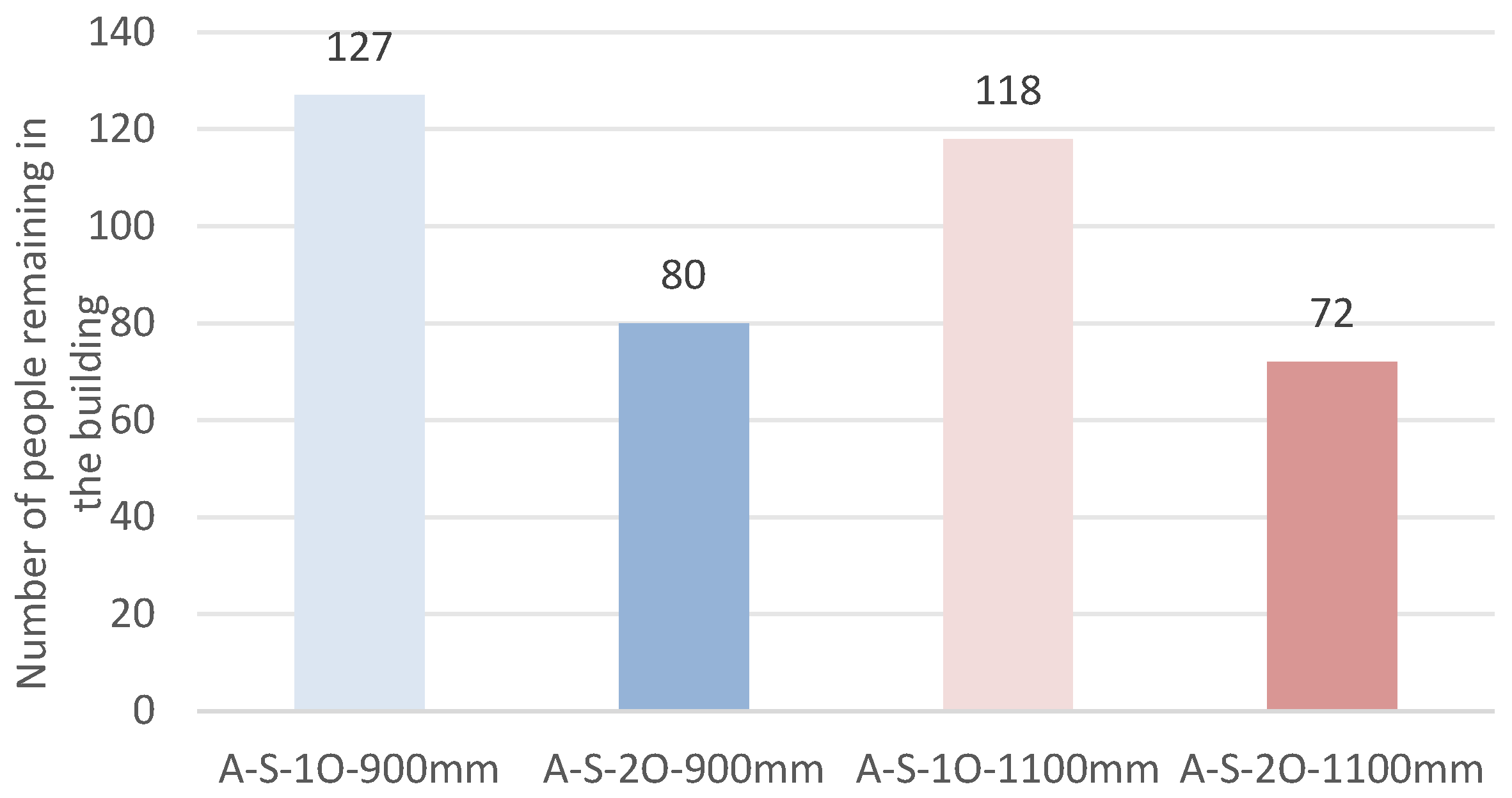
By comparing the impact of fire products on evacuation under the two repair methods, it can be seen that after the number of stairs increases, the evacuation duration of each width does not exceed 80s. Therefore, the fire heat release rate within the evacuation time under the two repair methods is close, and no evacuation failure personnel are added. When evacuating with two staircases, all working conditions can be protected from the influence of temperature on personnel evacuation, but the fire source is located on the second floor. Under the influence of visibility, 22 people failed to evacuate under the simulated working conditions of two staircases with different widths, which is 73.2% less than that of one staircase. Table
Table 19.
coupling results of visibility and evacuation process.
| Working Condition A-S-2O-900mm | Working Condition A-S-2O-900mm | |
|---|---|---|
| The fire source is located on the second floor | 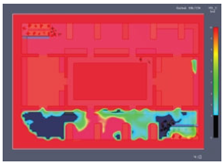 |
 |
| S-DZ=1.7m | S-DZ=1.7m | |
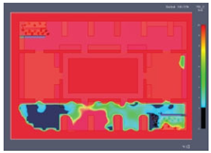
| The most unfavorable conditions of the two conditions are at the O-1 stairwell. At 31s, the visibility of the waiting area of the second floor stairwell and the belt formed by the stairwell and the gable decreased to less than 2m, and the effect affected by visibility was 41s. Under the condition a-s-2o-900mm, 14 people failed to evacuate due to visibility, and under the condition A-S-2O-1100mm, 8 people failed to evacuate due to visibility. | ||
- impact of stair location on safe evacuation
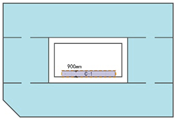
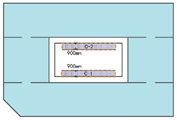
When the width of the stair is 900mm, the different positions of the stair are simulated. Table
Table 20.
simulation conditions of different number of stairs.
| Typical volume | A-S-1C-900mm | A-S-2C-900mm | A-S-1C1O-900mm |
 |
 |
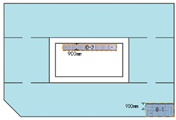 |
The results indicate that when only one staircase is provided, its location has little effect on the evacuation time. However, when two staircases are used, adopting exterior corridor staircases can reduce the evacuation time by approximately 8.6%–11.2%. This is because the exterior corridor staircases are more centrally located, offering better accessibility and allowing the staircases to be utilized more efficiently. Figure
Figure 12.
Duration of evacuation movement under different stair positions.
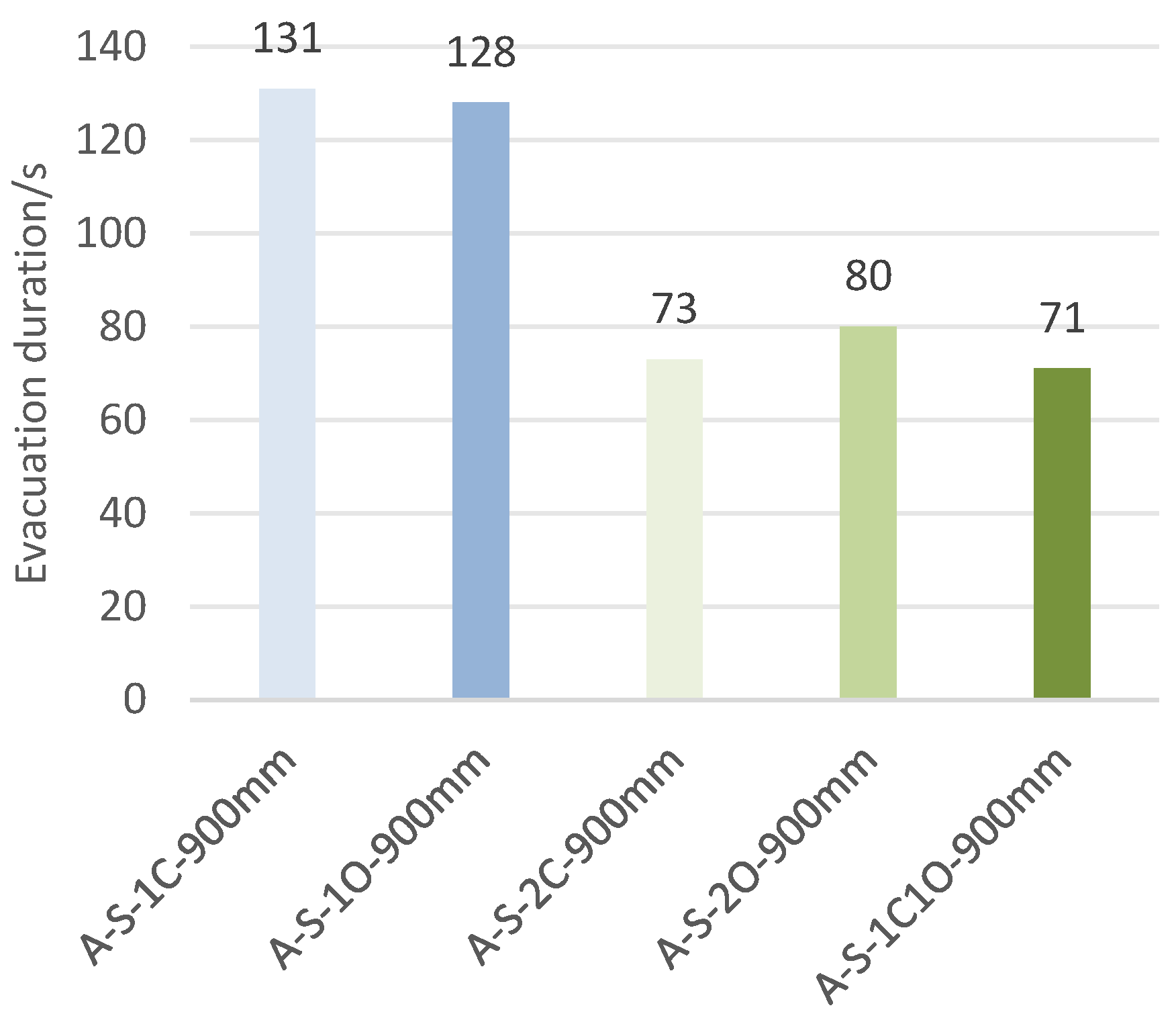
When using corridor stairs for evacuation, the impact of indoor fire products on personnel evacuation can be well avoided. When there are two forms of evacuation, exterior corridor stairs and open staircases, people should be guided to use exterior corridor stairs for evacuation as far as possible to avoid the impact of fire products.
After the staircase position changes, the personnel evacuated through the indoor open staircase shall evacuate the building within 80s. The repairer of "courtyard capping" did not increase the number of people who failed to evacuate.
3.2. Impact of Stair Setting After Scale Increase on Safe Evacuation
3.2.1. Influence of Base Area on Safe Evacuation
- Influence of stair width after base area increase on evacuation
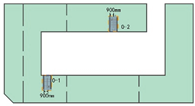
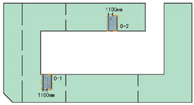
After the base area was increased, the building’s total floor area became approximately 2.7 times that of a prototypical building. Using the staircase arrangement of the prototypical building as a reference, simulations were carried out. Table Simulations were conducted based on the staircase distribution of the typical-scale building. The evacuation movement time was found to be 1.4 times that of the smaller building. When the staircase width increased from 900 mm to 1100 mm, the evacuation movement time decreased by 8.3%. Although the enlarged base area led to a longer evacuation time, the expanded internal space allowed the heat generated by the fire to dissipate more easily, thereby slowing the overall fire development and significantly reducing the number of evacuees who failed due to low visibility. Therefore, it can be concluded that an increase in base area is beneficial to the evacuation process.
Table 21.
simulated working conditions of different stair widths.
| Increased base area | A-S-1C-900mm | A-S-2C-900mm |
 |
 |
- 2.
- impact of increasing the base area and the number of stairs on evacuation
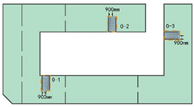
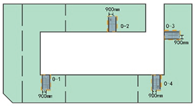
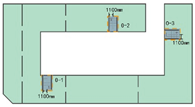
The number of stairs is increased from two to three and four to explore the impact of changes in the number of stairs on evacuation. Table
Table 22.
simulation conditions of different number of stairs.
| Increased base area | Three stairs | Four stairs |
 |
 |
|
| A-L-3O-900mm | A-L-4O-900mm | |
 |
 |
|
| A-L-3O-1100mm | A-L-4O-1100mm |
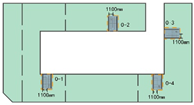
When the number of stairs increased from two to three, the evacuation movement time decreased by about 25%, which was more obvious; When the number of stairs increased from three to four, the evacuation movement time was not significantly reduced, and the reduction was within 10%.
The above reasons are mainly due to the fact that when the stairs are increased from two to three, the evacuation pressure of the original stairs is greatly relieved and the overall evacuation efficiency is improved; When the stairs are increased from three to four, the use efficiency of O3 and O4 is not high, which leads to the overall efficiency improvement is not obvious.
- 3.
- Influence of stair position on evacuation after increasing base area
Staircases with a clear width of 900mm were selected for simulation under conditions with two, three, and four staircases, respectively, to analyze the impact of different staircase locations. Table
Table 23.
simulation conditions of different number of stairs.
| Stair position change condition | |||||
|---|---|---|---|---|---|
| Two stairs | 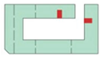 |
 |
 |
 |
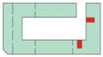 |
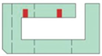
| A-L-2O-1 | A-L-2O-2 | A-L-2O-900mm | A-L-2O-3 | A-L-2O-4 | |
 |
 |
 |
 |
||
| A-L-2O-5 | A-L-2O-6 | A-L-2C-900mm | A-L-1C1O-900mm | ||
| Three stairs |  |
 |
 |
 |
 |
| A-L-3O-1 | A-L-3O-900mm | A-L-3O-2 | A-L-3O-3 | A-L-3O-4 | |
| Four stairs |  |
 |
 |
||
| A-L-4O-900mm | A-L-4O-1 | A-L-4O-2 | |||
- (1)
- Two stairs
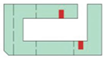
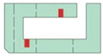
When the two stairs are located at the end of the long side, the evacuation time is the shortest; When the distance between the two stairs is within 25m, and one of them is less than 15m from the end of the corridor, the evacuation movement duration is the longest, which is not conducive to evacuation; When the distance between the two staircases' exits is between 35m and 90m, the evacuation time is close. Unlike smaller buildings, when the base area increases, the evacuation time for exterior corridor staircases becomes longer than that of open staircases located in the same position. Figure
Figure 13.
evacuation duration at different locations.
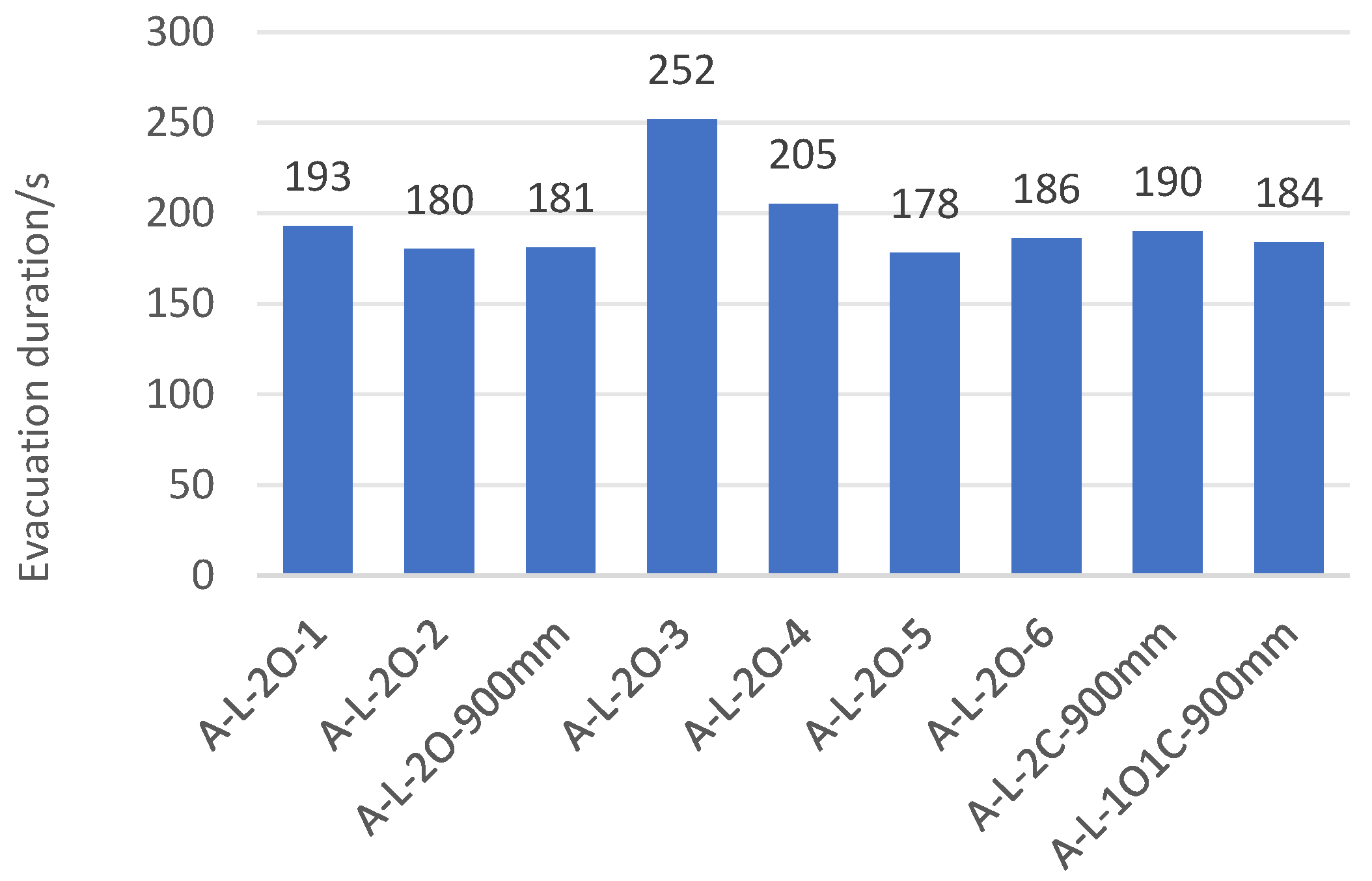
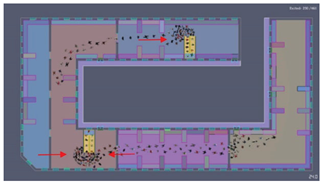
This is due to, when the corridor is used for evacuation, there are too many directions for evacuees at the entrance of the corridor, resulting in a certain amount of congestion, which will prolong the evacuation time. Table
Table 24.
comparison of evacuation between open stairs and corridor stairs.
| A-L-2O-900mm | A-L-2C-900mm |
|---|---|
 |
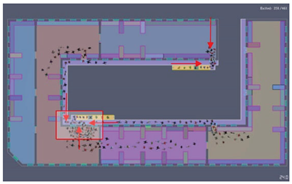 |
| When an open staircase is used for evacuation, there are at most people from two directions at the entrance of a single staircase. | When the corridor stairs are used for evacuation, there are at most people from three directions at the entrance of a single staircase. |
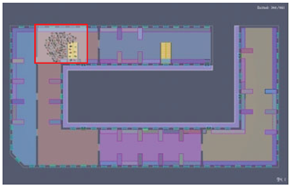
When the distance between the exits of two staircases is less than 25m, and one of the exits is less than 15m from the end of the corridor, congestion or arching is easy to occur, which is 29.6% longer than the working condition with the shortest evacuation time. If the fire occurs in the area where the stairs are located, it will cause a large number of casualties. Table
Table 25.
evacuation in case 4 and 9.
| A-L-2O-3 | A-L-2O-5 |
|---|---|
 |
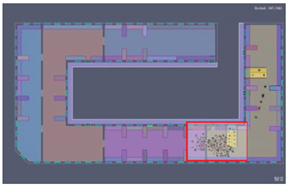 |
| As the base area increases, the number of evacuees will increase. When the stairs are arranged in an area, the people in front will crowd into the stairwell, and the people in the rear will not be able to choose other evacuation exits. | |
In order to form a comparison with small-scale buildings, working conditions a-l-2c-900mm and a-l-1o1c-900mm were selected to couple with the occurrence laws of different fire products. It was found that the fire products did not affect the personnel when the corridor stairs were used for evacuation. However, one of the two staircases is an indoor open stairway and is located in the area where the fire source is located, so people need to avoid evacuating from this stairway.
In the repair mode of "courtyard capping", the evacuation duration of the two working conditions increased by about 20%, which is due to the fact that after evacuating to the first floor through the corridor stairs, it also needs to evacuate from the first floor to the outside, thus prolonging the evacuation duration of the corridor.
- (2)
- Three staircases
when the number of staircases is three, the evacuation duration is similar except for condition a-l-3o-1. This is because a staircase in working condition a-l-3o-1 is arched, resulting in personnel congestion, and the staircase near the gable is not used.
- (3)
- Four staircases
when the number of staircases is four, and the staircases are evenly distributed and located on the long side as far as possible, the evacuation movement duration is the smallest. Compared with other working conditions, the evacuation movement duration of A-L-3O-1 is reduced by about 20%.
- 4.
- Effects of fire products on evacuation under two repair methods
When the base area of the building increases, the heat release rate per unit area of the fire becomes lower, and the evacuation is not affected by the high temperature in each working condition, but only affected by the visibility. When only the fire source is located on the first floor after the skylight is added, due to the visibility, the number of people who failed to evacuate under condition b-l-2o-900mm increased by 4, and the number of people who failed to evacuate under condition b-l-2o-1100mm increased by 13, and the number of people who failed to evacuate under condition b-l-2o-1100mm increased by 20s. This is because the heat release rate of the two repair methods is basically the same, but the skylight will prevent the smoke from spreading outward in the stairwell on the second floor. However, the speed of spreading from the stairwell on the first floor to the stairwell on the second floor is not affected.
3.2.2. Influence of building floors on safe evacuation
- 1.
- impact of stair width on evacuation after the increase of building floors
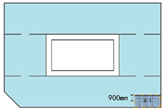
Keep the position of stairs under typical mass buildings unchanged, increase the number of floors by one, and explore the influence of stair width on fire evacuation after the number of floors increases. Table
Table 26.
simulated working conditions of different stair widths.
| Typical volume | A-S-3F-1O-900mm | A-S-3F-1O-1100mm |
 |
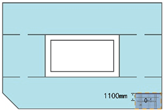 |
After the base area of the building was expanded by 2.7 times, the evacuation duration under various conditions increased by about 1.4 times; When the number of floors increased from two to three, the building area increased by 1.5 times, but the evacuation time increased by about 1.8 times. It can be seen that the increase of building floors has a more significant impact on the evacuation time. The main reason is that the stairway entrance and stairwell are easy to form congestion, the travel speed of people in this area is low, and the increase in the number of floors leads to the extension of the vertical evacuation path, which significantly prolongs the overall evacuation time.
In addition, when the clear width of stairs in a three story building increases from 900mm to 1100mm, the reduction of evacuation time is about 2.5 times that of two stories. This shows that with the increase of the number of floors, the increase of the width of stairs has more obvious effect on the improvement of evacuation efficiency.
- 1.
- Influence of the number of stairs after the increase of building floors on evacuation.
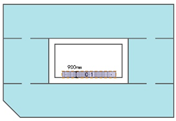
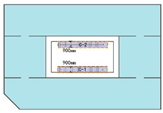
In the typical-scale building, one additional floor was added to investigate the effect of staircase location on fire evacuation as the number of building stories increases. Table
Table 27.
simulated working conditions of different stair positions.
| Typical volume | A-S-3F-1C-900mm | A-S-3F-1C-1100mm | A-S-3F-1C1O-900mm |
 |
 |
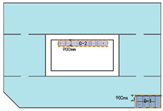 |
In the “space fine-tuning” restoration strategy, when a single staircase was used, the evacuation movement time through the open staircase was slightly shorter than that through the exterior corridor staircase, with only a 6.9% difference. When two stairs are used, one of which is corridor stairs or both are corridor stairs, the evacuation time is reduced by 8.3% compared with the open stairwell. It can be seen that the open stairwell can shorten the safe movement time, but the effect is not obvious.
The main reason for the above phenomenon is that when one step staircase is used, the corridor staircase will cause congestion at the corridor for evacuees; When two stairs are used for evacuation, the corridor stairs are located in the center of the building, which can improve the efficiency of the stairs.
The indoor courtyard prolongs the evacuation time by using the veranda, especially when there are two kinds of evacuation methods. The simulation results show that in the indoor courtyard scheme, people prefer to use the indoor open stairwell for evacuation, which prolongs the evacuation time by 43% compared with the case of fine-tuning the space division.
- 2.
- Effects of fire products on evacuation under two repair methods
After the number of floors increased, the fire heat release rate of the "courtyard cover" repair method was basically the same as that of the "fine-tuning space" repair method. After the courtyard is covered, the speed of high temperature invading into the open stairwell will be slowed down, but the total number of people who fail will still increase under the influence of visibility. This is because the chimney effect of the open stairwell in the three-story building is more obvious. When the skylight is added, the chimney effect of the stairwell is slowed down when the fire source is located on the first floor, and then the time when the temperature reaches the boundary conditions is delayed. However, the rate of gas flow decreases, which will also make it difficult to exhaust the smoke in the stairwell, thus increasing the number of people who fail to evacuate under the influence of visibility. Table
Table 28.
Compare and fine tune the change of evacuation failure number under the space repair mode.
Table 28.
Compare and fine tune the change of evacuation failure number under the space repair mode.
| B-S-1O-900mm | B-S-1O-1100mm | B-S-2O-900mm | B-S-2O-1100mm | B-S-1C-900mm | ||
|---|---|---|---|---|---|---|
| Temperature effect | Teffect | +6s | +4s | +6s | +4s | -1S |
| Number of evacuation failures | -4 | -3 | -4 | -2 | +2 | |
| Visibility impact | Teffect | +2s | 0 | +2s | 0 | -28S |
| Number of evacuation failures | +5 | 0 | -2 | 0 | +6 | |
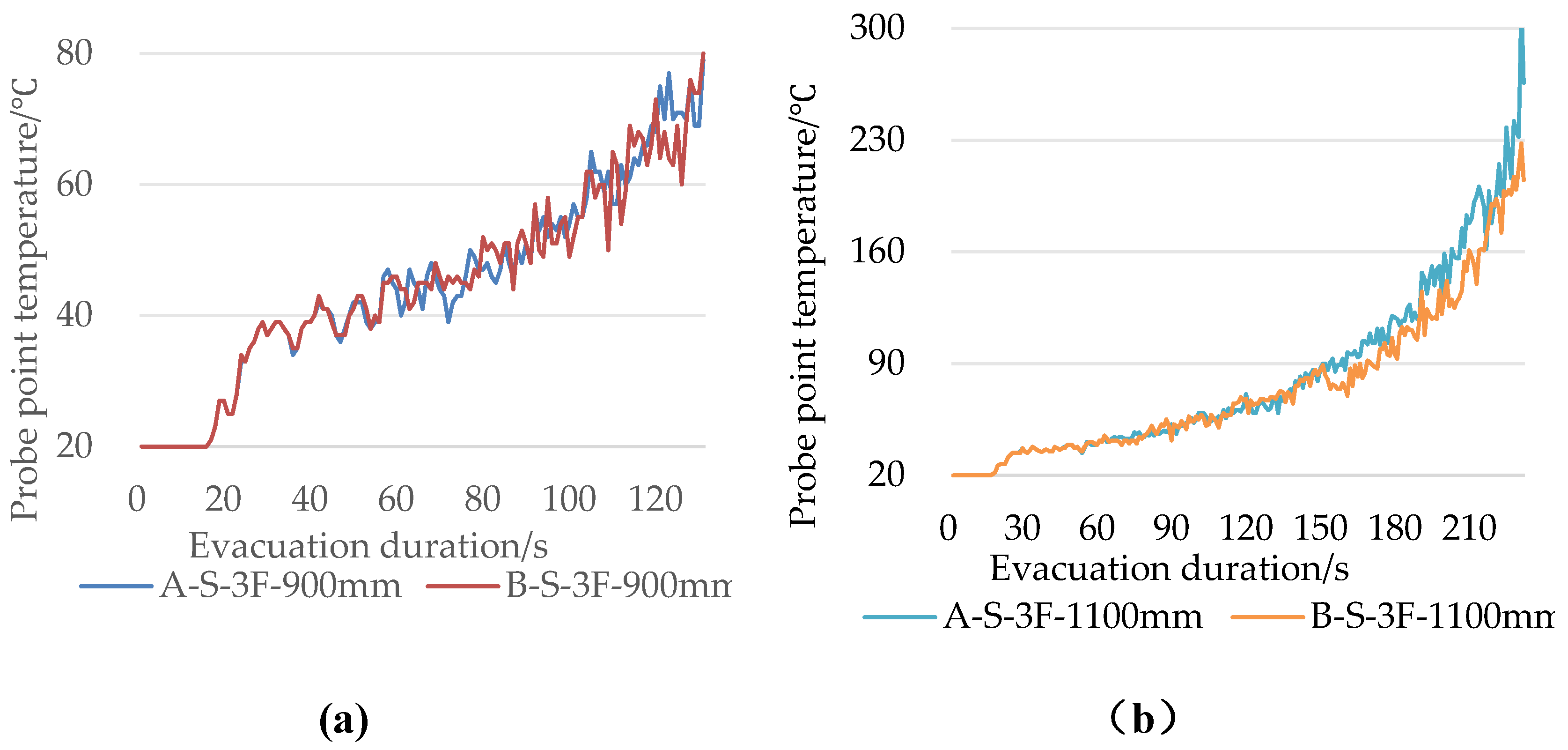
By comparing with the number of people who failed to evacuate under the "fine-tuning space" mode, it can be seen that although the addition of skylights will delay the effect time under the influence of visibility, the number of people who failed to evacuate under condition b-s-10-900mm has increased, which is due to the delay of the emergence time of the visibility area less than 2m on the third floor due to the weakening of the chimney effect, but the evacuation time is too long when one step of stairs is taken. After the addition of skylights, the smoke in the stairwell on the second floor cannot be discharged in time, further increasing the number of people who failed to evacuate on the second floor.
It can be seen from the exploration that with the development of fire, the "courtyard covering" method can effectively slow down the chimney effect of the open stairwell in the fire, and slow down the rate of temperature rise in the stairwell. Figure
Figure 14.
probe temperature in stairwell under different working conditions:(a) Probe point temperature when staircase is 900mm wide; (b) Probe point temperature when staircase is1000mm wide.
Figure 14.
probe temperature in stairwell under different working conditions:(a) Probe point temperature when staircase is 900mm wide; (b) Probe point temperature when staircase is1000mm wide.
3.3. Effectiveness Analysis of Measures to Improve Personnel Safety Evacuation
The gables on both sides of the building and the belt formed by stairs and gables should gather fire products, which will lead to the failure of personnel evacuation waiting here. When the fire source is located on the first floor, the fire products invading the stairwell will lead to the failure of personnel evacuation. In view of the above problems, taking the unfavorable conditions A-S-1O-900mm, A-L-2O-900mm and B-S-3f-1C-900mm as the objects, five common fire prevention methods, namely, changing the form of stairwell, adding smoke retaining vertical wall, adding automatic sprinkler, adding mechanical smoke exhaust and natural ventilation, are proposed to optimize the two repair modes, and their effectiveness is analyzed.
3.3.1. Optimization Measures for Indoor Fire Protection
- Use enclosed staircase
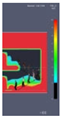
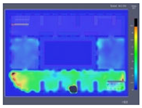
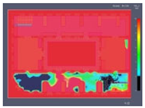
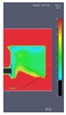
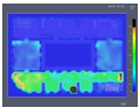
The optimization effects of the two repair methods are consistent. In typica volume buildings, only when the fire source is located on the first floor, the addition of closed stairs has a significant barrier effect on fire products. When the fire source is located on the second floor, the effect is weak, and only an additional 6S safe evacuation time is provided. Table Adding closed staircases in large-scale buildings has obvious effect.
Table 29.
comparison between open staircase and closed staircase.
| The fire source is located on the first floor | The fire source is located on the second floor | |||
|---|---|---|---|---|
| Before optimization | 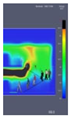 |
 |
 |
 |
| After optimization | 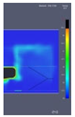 |
 |
 |
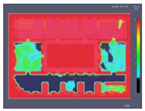 |
| The effect of blocking high temperature gas is obvious. | Some smoke intruded into the stairwell, but the visibility was more than 2m, which had no impact on personnel evacuation. | The effect of blocking high temperature gas is obvious. | There was no smoke intrusion inside the stairwell, but a large amount of smoke still accumulated in the waiting area, causing personnel evacuation failure. | |
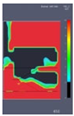
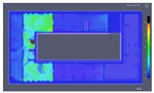
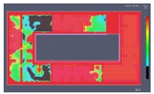
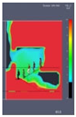
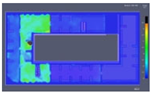
Under condition A-L-2O-900mm, the use of closed staircases can meet the safe evacuation of all people in the building, and the effect is better than that of setting closed staircases in small buildings. Table
Table 30.
comparison between open staircases and closed staircases in increased base area volume buildings.
Table 30.
comparison between open staircases and closed staircases in increased base area volume buildings.
| The fire source is located on the first floor | The fire source is located on the second floor | |||
|---|---|---|---|---|
| Before optimization | 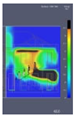 |
 |
 |
 |
| After optimization | 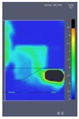 |
 |
 |
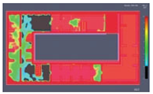 |
| Up to 181s, the effect of blocking high temperature gas is obvious | As of 165S, when people were evacuated from the second floor, the visibility in the stairwell was mainly distributed at 3M, which had no impact on personnel evacuation. | The effect of blocking high temperature gas is obvious. | There is no smoke intrusion inside the stairwell, and there is smoke accumulation in the waiting area, but it does not cause personnel evacuation failure. | |
- 2.
- Adding smoke retaining vertical wall in staircase
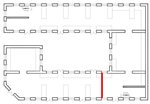
The stairwell and the gable are the key areas for high-temperature gas and flue gas accumulation. 500mm, 1000mm and 1500mm high smoke retaining vertical arms are set in the walkway and stairwell near the gable for simulation. Take A-S-1O-900mm working condition as an example to explore the effect of smoke retaining vertical wall on fire product optimization at different heights and positions. Table
Table 31.
position of smoke retaining vertical wall.
| Layout at staircase | Walkway layout | Arrangement of staircases and walkways | |
|---|---|---|---|
| Layout location | 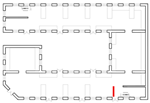 |
 |
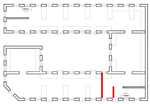 |
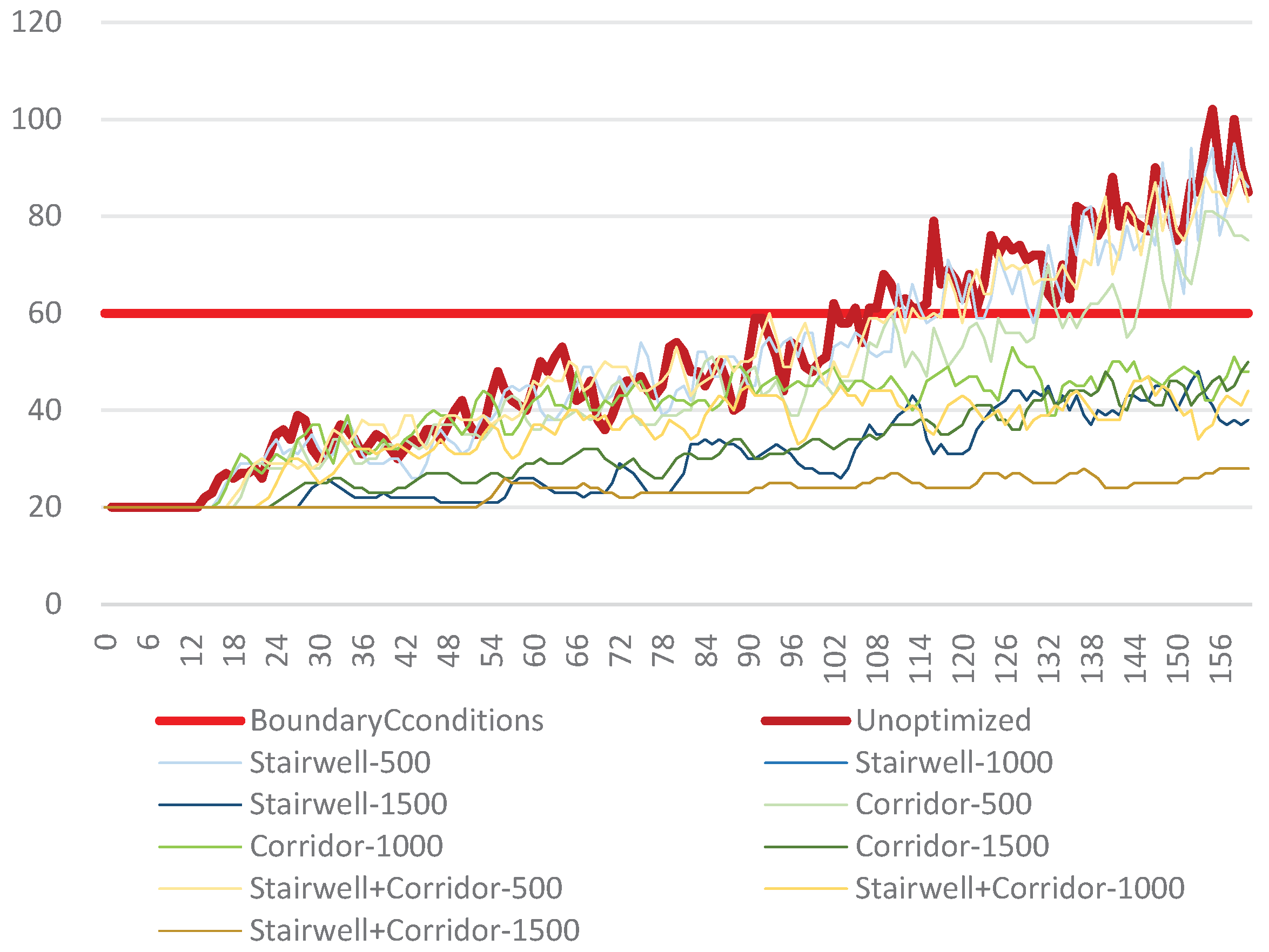
The simulation found that the optimization effect of the two repair methods was basically the same, and the smoke retaining vertical wall had obvious optimization effect on high-temperature gas, and the safe movement time under the influence of temperature could be extended by 10s-25s when the height was 500mm (FIG. 13). However, the optimization effect of visibility is weak. Only 1500mm high smoke retaining vertical walls are set in staircases and corridors at the same time, which can effectively block smoke. Figure
Figure 15.
Temperature time curve under different smoke retaining vertical wall optimization schemes.
Figure 15.
Temperature time curve under different smoke retaining vertical wall optimization schemes.
- 3.
- Add automatic sprinkler system
According to the characteristics of the building, the moderate risk level I in the specification is selected to arrange the spray [28]. The simulation shows that the optimization effect of adding automatic sprinkler system is good, and the fire source has not spread by 160S. In fact, the fire source can be extinguished to fundamentally solve the fire, and the building itself can also be well protected.
- 4.
- Add mechanical smoke exhaust
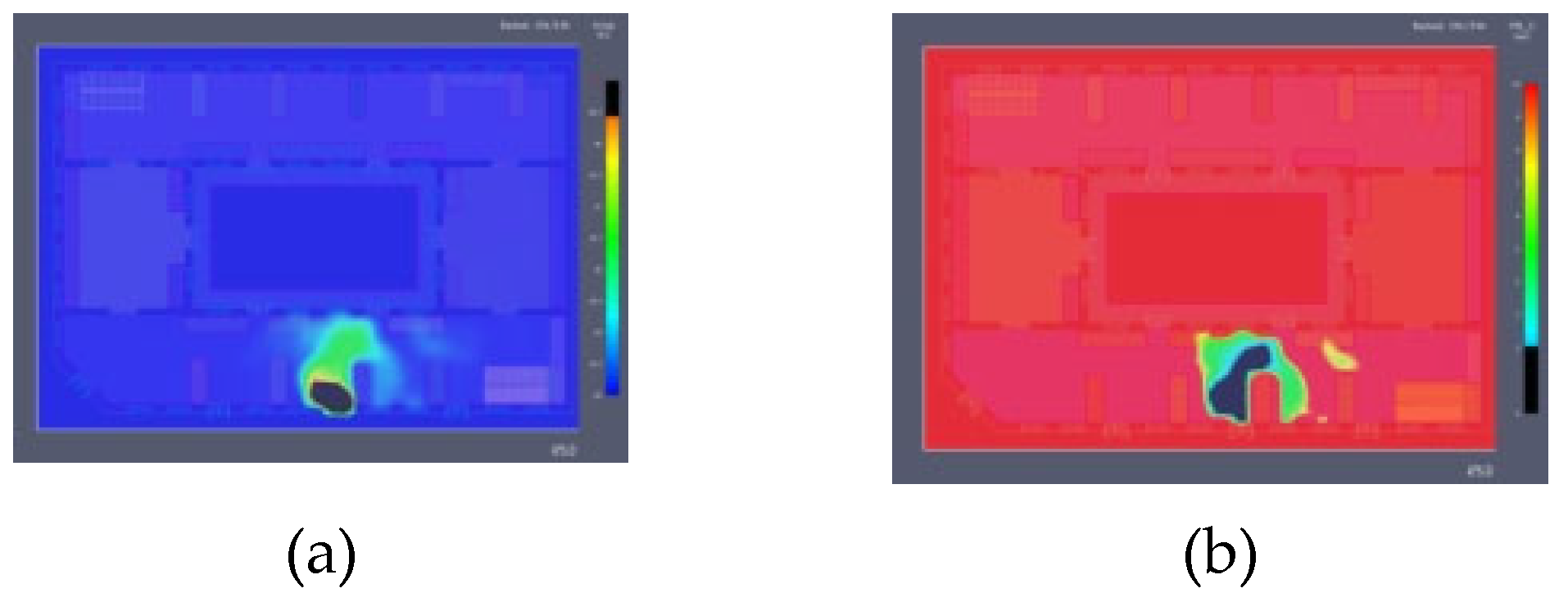
The smoke exhaust outlet is set according to the minimum value of the current building smoke control code and the cross-sectional area of the chimney, and the maximum allowable wind speed is 10m/s for simulation [29]. The results show that the optimization effect of mechanical smoke exhaust is obvious, which can ensure the safe evacuation under any working condition. Figure
Figure 16.
Temperature visibility slice at 1.7m after adding mechanical smoke exhaust: (a) Temperature slice; (b) Visibility slice.
Figure 16.
Temperature visibility slice at 1.7m after adding mechanical smoke exhaust: (a) Temperature slice; (b) Visibility slice.
3.3.2. Courtyard fire optimization measures
- 1.
- Natural ventilation and smoke exhaust
In the building interior, the existing flue and other decorations can be used to hide the smoke exhaust system, but adding mechanical smoke exhaust in the courtyard will greatly affect the original artistic atmosphere of the historical building. Therefore, the skylight is set at the corner of the skylight for natural ventilation and smoke exhaust, and three different sizes of the same area, 1m2, 2m2 and 3m2, respectively, are selected to explore the most suitable window size. Figure
Figure 17.
Natural ventilation and smoke exhaust scheme.
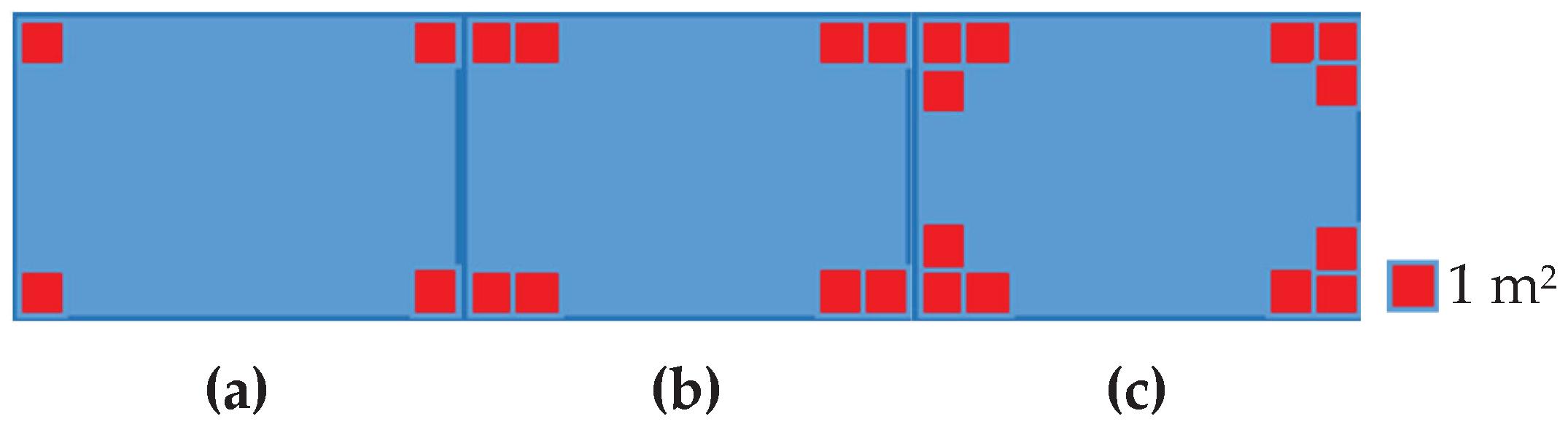
The simulation shows that when the single area of the natural vent is more than 2m2, the waiting personnel on the third floor can avoid the visibility from affecting the evacuation failure, but it does not affect the change of fire products on the second floor. When the personnel are evacuated to the second floor, the evacuation failure will still be affected by the temperature. Table
Table 32.
effect of different window opening methods on visibility.
| Not optimized | Mode 1 | Mode 2 | Mode 3 |
|---|---|---|---|
 |
 |
 |
 |
4. Conclusions
Through the fire evacuation simulation of the modern Chinese Baroque brick and wood buildings in Harbin, this paper draws the following conclusions.
(1) Both repair methods are feasible, corresponding to the same stair state, the development of indoor fire is similar, and the same fire prevention measures can be adopted.
(2) The change of stair location and number has the most significant impact on the evacuation performance, while the change of stair width has a relatively small impact on the evacuation performance. The corridor staircase has good evacuation effect, and even if only a 900mm wide corridor staircase remains in a small building, it can still meet the safety evacuation requirements of all people; When using indoor open stairs for evacuation, it is necessary to set two. When using one residual staircase for evacuation in small-scale buildings, only 65% of the people can be safely evacuated, but when the number of stairs is increased to two, at least 91% of the people can be evacuated. Without considering the emergency, the two stairs can meet the safe evacuation under all working conditions with reasonable guidance; Increasing from 900mm to 1100mm of the remains does not significantly improve the evacuation performance. The reduction of evacuation duration under various conditions is mainly within 10%, and the number of evacuation failures has not been reduced under some conditions.
(3) The increase of base area can slow down the aggregation rate of fire products in the room, which is conducive to the safe evacuation of people. However, the increase of building floors will significantly reduce the safe evacuation performance of stairs. For a three story small building, it can be considered to add active fire-fighting optimization measures or add corridor stairs as evacuation stairs when repairing, so as to improve the fire prevention and evacuation effect.
(4) Among the common safety evacuation measures, automatic sprinkler shows the best fire prevention effect and can extinguish the fire source; The optimization effect of mechanical smoke exhaust is obvious, which can extend the safe movement time to the end of evacuation; The optimization effect of smoke retaining vertical wall on fire products invading into the staircase is greatly affected by its location and height. When it is set at the lower part of the inner and outer corridors of the courtyard, the height of 1000mm has obvious optimization effect, which can make the evacuation of people using the corridor stairs from the impact of fire products fail; The optimization effect of closed staircase is not obvious in small-scale buildings, but it is obvious in large-scale buildings.
The above research conclusions will provide a reference for the determination of the special provisions and methods for fire protection in building repair, but can not be directly used as the basis for designers to break through the fire protection code.
References
- Kaiyang. - Dilemma and Countermeasures of historical building protection in China. 2021.
- Jones Jr, A.M. Fire Protection Systems includes Navigate Advantage Access; Jones & Bartlett Learning: 2019.
- liang,Cai, S.; Lan fang, D. - Simulation display of fire field inside buildings. 2009, - 26.
- Sahebi, A.; Jahangiri, K.; Alibabaei, A.; Khorasani-Zavareh, D. - Using Artificial Intelligence for Predicting the Duration of Emergency Evacuation During Hospital Fire. 2022, - 17. [CrossRef]
- Darkhanbat, K.; Heo, I.; Han, S.-J.; Cho, H.-C.; Kim, K.S. - Real-Time Egress Model for Multiplex Buildings under Fire Based on Artificial Neural Network. 2021, - 11. [CrossRef]
- Lyu, H.-F.; Wang, C.-P.; Deng, J.; Xiao, Y.; Wang, W.-F. - Human behaviour and evacuation time for large underground comprehensive buildings during fire risk process. 2023, - 84. [CrossRef]
- Chorlton, B.; Gales, J. - Fire performance of cultural heritage and contemporary timbers. 2019, - 201. [CrossRef]
- Hu, J.-J.; Wu, H.-Y.; Chou, C.-C. - Evacuation Simulation in a Cultural Asset Fire: Impact of Fire Emergency Evacuation Facilities for People with Disabilities on Evacuation Time. 2023, - 6. [CrossRef]
- Yi fan, Y.; Juan, L.; Tong, C. - Study on fire spreading law of ancient building hall with brick and wood structure. 2023.
- ting,Yang, Y. - Simulation Research on fire and safe evacuation of commercial complex based on pyrosim and Pathfinder. 2018.
- Tong tong, Z.; Di, C. - Evacuation simulation and space optimization strategy for standard floor of super high rise building in fire environment. 2022.
- You bin, H.; Ze tai yan, X.; Fu he, Z.; Song shen, C. Overview of modern Chinese architecture Harbin; China Construction Industry Press: Beijing, 1992.2.
- Xing ning, Z.; Hong lin, L.; Ying, Z. - Wai Yuan Sheng Xing -- space regeneration of Chinese Baroque historic district in Daowai District of Harbin. 2018.
- Ki, M.C.; 최하나. - The Study on the Renovation for Active Use of Modern Architecture in Incheon -Focused on the Registered Cultural Properties. 2009, - 27.
- Yu, H. - Research on fire safety evacuation of subway station based on fire dynamics and crowd evacuation simulation. 2020.
- Zarboutis, N.; Marmaras, N. - Searching efficient plans for emergency rescue through simulation: the case of a metro fire. 2004, - 6. [CrossRef]
- Hurley, M.J.; Gottuk, D.T.; Hall, J.R.; Harada, K.; Kuligowski, E.D.; Puchovsky, M.; Torero, J.L.; Watts, J.M.; WIECZOREK, C.J. SFPE Handbook of Fire Protection Engineering; Springer New York: 2015.
- General Administration of quality supervision, i.a.Q.o.t.p.s.R.o.C.; Committee, C.N.S.A. - Fire safety engineering Part 9: guidelines for Evacuation AssessmentGB/T 31593.9-2015.
- Milke, J.A.; Hoskins, B.L.; Carroll, J.P.; Hugue, D.E. - Overview of tenability analysis in smoke management applications. 2006, - 112.
- Fridolf, K.; Nilsson, D.; Frantzich, H.; Ronchi, E.; Arias, S. Walking speed in smoke: Representation in life safety verifications. In Proceedings of the Proceedings of the 12th International Performance-Based Codes and Fire Safety Design Methods Conference, Oahu, HI, USA, 2018; pp. 23-27.
- Engineers, S.o.F.P. SFPE Guide to Human Behavior in Fire; Springer International Publishing: 2018.
- McGrattan, K.; Baum, H.; Rehm, R.; Hamins, A.; Forney, G.; Floyd, J.; Hostikka, S. Fire Dynamics Simulator (Version 3): Technical Reference Guide (NISTIR 6783). 2001. [CrossRef]
- Jing, C.; Ze nan, X. - Application of improved frame method in fire risk assessment of historic buildings. 2022, - 38.
- Guo xia, Z. - Research on evacuation of subway fire based on pyrosim+Pathfinder. 2019.
- Jing, Y. - Numerical simulation and safety evacuation of underground commercial street fire. 2016.
- Stanton, R.J.C.; Wanless, G.K. - Pedestrian movement. 1995, - 18.
- Predtechenskii, V.M.; Milinskiĭ, A.I. Planning for foot traffic flow in buildings; National Bureau of Standards, US Department of Commerce, and the National …: 1978.
- Li mao, Z.; Xian guo, W.; Bo wen , L.; Ya wei, T.; Wei, Z. Evacuation of subway station based on fire simulator and Pathfinder. Science, technology and Engineering 2018, 18, 203-209.
- Xing, L.; Guo qing, Z.; Yao, F. Investigation on the number of evacuees in commercial complex. Fire science and technology 2015, 34, 1092-1094.
- Yu, W. - Study on dynamic density model of indoor staff in urban commercial buildings. 2019.
Figure 1.
The Chinese Baroque buildings damaged by fire: (a) Fire scene at Zhong Hua Inn; (b) current status of Zhong Hua Inn; (C) current status of Song Guang Cinema.
Figure 1.
The Chinese Baroque buildings damaged by fire: (a) Fire scene at Zhong Hua Inn; (b) current status of Zhong Hua Inn; (C) current status of Song Guang Cinema.
Disclaimer/Publisher’s Note: The statements, opinions and data contained in all publications are solely those of the individual author(s) and contributor(s) and not of MDPI and/or the editor(s). MDPI and/or the editor(s) disclaim responsibility for any injury to people or property resulting from any ideas, methods, instructions or products referred to in the content. |
© 2025 by the authors. Licensee MDPI, Basel, Switzerland. This article is an open access article distributed under the terms and conditions of the Creative Commons Attribution (CC BY) license (http://creativecommons.org/licenses/by/4.0/).
Copyright: This open access article is published under a Creative Commons CC BY 4.0 license, which permit the free download, distribution, and reuse, provided that the author and preprint are cited in any reuse.


