

Submitted:
25 November 2025
Posted:
26 November 2025
You are already at the latest version
Abstract
Background: The relationship between the dimensions of selfie addiction and narcissism in students at the Universidad Autónoma de Zacatecas (UAZ, Autonomous University of Zacatecas), Mexico, was analysed. The aim of this study was to identify the factors of narcissism associated with students' addictive behaviour towards selfies. Methods: To identify the relationship between narcissism and selfie addiction, the NPI-40 Narcissistic Personality Inventory and the Psychometric Selfie Addiction Scale (PSAS) were used. This was done using a Structural Equation Modelling (SEM). Exploratory factor analysis (EFA) and confirmatory factor analysis (CFA) were used to carry out the structural validation process. EFA and CFA confirmed adequate fit and reliability indicators regarding the robust multidimensional structure of the Selfie Addiction Scale. Results: SEM indicated that narcissistic traits predict selfie addiction. It also indicated that there is body objectification and appearance comparison through social media. This research provides important findings on recent structural and psychometric evidence in the Mexican student population, as it integrates the NPI-40 and PSAS, as well as a parsimonious explanatory Structural Equation Modelling that demonstrates the relationship between narcissistic traits and social media practices. Conclusions: The results provide a basis for developing digital literacy interventions for young people and future cross-validations.
Keywords:
narcissism
; selfie addiction
; social networks
; structural equation modelling
; exploratory factor analysis
; confirmatory factor analysis
; NPI-40
; PSAS
1. Introduction
The use of social media has increased exponentially, making it more sought after by individuals around the world [62]. These consist of blogs, virtual gaming worlds, the internet, and social media sites for creating, collaborating and sharing content online, and can have a considerable influence on people's sociability, habits and mental health [12,51]. What's more, they feed users key metrics to keep them engaged with the number of “likes”, followers and comments from other users [13]. In line with the above, [42] point out that one social media-related activity offered in innovative photo and video sharing applications is taking selfies, which have become a symbol of self-expression in the last decade.
In line with the above, selfies can be characterised by three interrelated components: (1) a self-photograph and visual reproduction; (2) a portrait of the human face; and (3) created for the purpose of sharing. They are also self-portraits that people take to admire their appearance excessively. They are also photos of oneself taken usually with a smartphone or webcam using a selfie stick or by hand and shared on social media [34,41,58,59]. It should be noted that one of the most common activities on social media is taking selfies and sharing them, as they satisfy the need for communication, self-exploration, seeking favourable comments and attention from peers and strangers alike. Similarly, as teenagers receive more feedback (e.g. 'comments' and 'likes') through the selfies they post, this is associated with spending more time using and checking their social media accounts. Therefore, social media can have a dual psychological influence, capable of generating positive or negative effects on mental health [12,15,61]. However, [18] warn that social media use can affect young people's mental health, generating problems of self-discrepancy, loneliness, and narcissistic characteristics of vanity, as well as grandiose exhibitionism, which are observed as adaptive evolutionary self-promotion mechanisms and are reflected in the posting of selfies.
It is important to note that narcissism is a pattern of need for admiration, grandiosity, and lack of empathy; similarly, narcissists show fear of discovering their imperfections and flaws; in addition to being simplistic, exploitative, superficial, lacking in empathy, and stubborn [4]. They also reflect an inflated and grandiose concept of themselves, and even more so, they tend to focus on their feelings and think they are superior to others [10,24]. They do not prioritise warmth, interpersonal intimacy or long-term positive relationships, but they often initiate them to appear successful, popular and have high status in the short term [10]. There is grandiose narcissism, which is associated with egocentricity, manipulation, interpersonal dominance, insensitivity, and lack of modesty. On the other hand, there is also vulnerable narcissism, which is related to reactive anger, hostility, psychological distress, distrust, negative affectivity (e.g., shame, anxiety), egocentricity, and low self-esteem [60)]. Similarly, egocentricity, vanity, and theatrical social behaviour characterise grandiose exhibitionism; the willingness to manipulate for personal gain, coupled with the belief that one deserves privileges and respect, are characteristics of exploitation, selfishness, dominance, and narcissistic entitlement; the particularities of authority and leadership are associated with social skills, a belief in superior leadership, a sense of dominance, and an exaggerated view of oneself [26,27]. Regarding the above, there are studies that link narcissistic characteristics with the use of social media, such as that by [24], who revealed the existence of high levels of narcissistic characteristics related to high levels of problematic social media use in adolescents.
Based on previous evidence, there is a relationship between the presence of narcissism and the use of social media. Therefore, previous research has determined that self-compassion and narcissism are mediators between self-esteem and the body image that women perceive on social media; likewise, adolescents tend to use social media excessively or show addiction to it [31,37]. Other studies have found that both young men and women reported using Instagram daily, but women reported spending more time on Instagram and making more comparisons related to appearance. It should be added that posting selfies on Instagram is not related to body-shame, but rather is associated with comparing appearance [26,49]. It is important to mention that in the research by [17], they concluded that most adolescents share meaningless or funny videos, filtered photos, especially selfies to attract more attention from their peers. Therefore, it should be noted that there is a presence of narcissism in selfies. In this way, individuals with narcissistic characteristics may use smartphones to present themselves on social networks such as Instagram and Facebook, as they seek a positive change in mood and thus satisfy their desired gratification [50]. For this reason, [46] suggest that the effects of extroversion, as well as a person's exhibitionist traits in their behaviour when posting selfies, are significant.
Consequently, selfies and the relationship with narcissism are not isolated, since individuals who take selfies usually see themselves from an outside observer's perspective, that is, being more concerned with their physical appearance; in such a way that people deliberately choose and edit the selfie before consciously posting it. At the same time, a selfie is an extension of the self, a personal mode of expression, and it should be added that it is related to the media and social networks, which are accompanied by glamour, as well as the best possible version of the self [44,57]. At the same time, posting selfies is related to predictors of psychological needs for competence and relatedness in individuals with a high level of exhibitionism; thus, when one presents oneself in a more glorified way, one tends to fall in love with the self, in addition to the importance of a dual personality and the development of a social image [2,44]. Similarly, selfies have a self-reinforcing effect, along with a process of reciprocity that can contribute to increased levels of narcissism [1]. At the same time, [55] determined that there is a relationship between social media use and narcissism, and even more so, a strong effect of social media use on envy.
Given that the phenomenon of taking selfies is growing, as there are currently discussions in the press, everyday conversations, and academic circles about the value and implications of social media, it is therefore recommended that the motives and addiction to selfies be investigated in greater depth. It is also important to address social media addiction in adolescents [16,29,37]. Similarly, it is significant to study the effect of social media on psychological processes to find possible ways to mitigate the negative consequences on personal self-assessments [31]. At the same time, there is a lack of studies on the effects of the ideal of internationalisation on thinness in problematic social media use and the mediators that articulate it [61]. In addition, [6] suggest that not only should the general use of social media be investigated, but it is also significant to delve deeper into the relationship between social media use and appearance, motivations, and the importance of body image through social media.
In this context, the aim of this study was to analyse, using a Structural Equation Modelling (SEM), the relationship between the dimensions of selfie addiction and narcissism in a sample of 264 students from the Universidad Autónoma de Zacatecas (UAZ, Autonomous University of Zacatecas). The aim was to identify the factors of narcissism that may be associated with addictive behaviour towards selfies.
2. Materials and Methods
The effect of different aspects of narcissism on selfie addiction was analysed using Structural Equation Modelling (SEM) with a sample of 264 students from the UAZ, Mexico. The sample consisted mainly of late adolescents and emerging adults, aged between 13 and 35 years (M = 17.86, SD = 2.97). The Narcissistic Personality Inventory NPI-40 and the Psychometric Selfie Addiction Scale (PSAS) [3,45] were used to analyse and identify the factorial structure. Data collection took place between September and November 2024. Exploratory factor analysis (EFA) and confirmatory factor analysis (CFA) were used as part of the structural validation process; information was obtained through questionnaires in Google Forms, as in previous studies [19,23]. The statistical programme JASP 0.19.2 was used to perform the SEM analysis. The PSAS and NPI-40 were customised using only a Likert scale of 1=Strongly disagree, 2=Disagree, 3=Neither disagree nor agree, 4=Agree, and 5=Strongly agree, following previous protocols [5,19,23].
As a first step, reliability was assessed using Cronbach's alpha (α= 0.896), as in previous research [7,28,33]. Subsequently, to verify the suitability of the data for conducting the CFA, it was checked using the Kaiser-Mayer-Olkin (KMO) test, which yielded a value of 0.832, and Bartlett's sphericity test with a p ≤ 0.001, replicating reported methods [19,25]. In addition to the above, the CFA was performed with an oblimin oblique rotation, as this allows for better interpretation of the correlations between factors. Likewise, the least squares factorisation method was used after determining whether the data met the normality assumption using the Shapiro-Wilk test. It was also decided to eliminate 25 items from the NPI-40 and 1 from the PSAS that had a factor loading of less than 0.3, all of the above as recommended in previous studies [9,14,25,53,56]. Subsequently, a confirmatory factor analysis (CFA) was carried out within the Structural Equation Modelling (SEM) methodology.
3. Results
3.1. EFA Results
EFA analysis was used to describe how the PSAS and NPI-40 items are organised. All PSAS statements load heavily on factor 1 (Fc1) with factor loadings between 0.828 and 0.552. This indicates possible behaviour linked to selfie addiction (Table 1). Fc1 suggests that there is internal consistency, which clearly measures a single latent variable, such as the impulse to take and post selfies on social media.
Regarding narcissism, it does not behave as a single construct, but rather is fragmented into three factors. Factor 2 (Fc2) has moderate loadings between 0.729 and 0.412, indicating narcissism of authority, superiority, and being admired (Table 1). The statements on exploitation make up factor 3 (Fc3). Complementarily, the items have higher loadings of 0.793 to 0.723 (Table 1). Items NPI_23 and NPI_25, with loadings above 0.700, ranging from 0.983 to 0.799, make up factor 4 (Fc4), which may be detecting a very specific characteristic of narcissism, such as exhibitionism (Table 1). However, it should be noted that there are only two statements, which does not allow us to be certain that this is a stable factor.
3.2. Total Variance Explained
The CFA also identified that the four factors together explain 50.3% of the total cumulative variance of the statements, which is acceptable in social sciences [20,21,53]. The variance suggests that half of the differences in respondents' answers can be attributed to the identified latent dimensions, which are associated with selfie addiction and different characteristics of narcissism. Factor 1 (selfie addiction) accounts for 18.7% of the total explained variance; factor 2 (authority, superiority, and the need for admiration) explains 13.9%; factor 3 (narcissistic exploitation) accounts for 10.3%; and factor 4 (exhibitionism) represents 7.3% (Table 2). The results appear to be well-supported by eigenvalues greater than 1, thus justifying the retention of the four factors, as in previous studies [43,54].
3.3. Adjustment Indices
Another notable observation that emerges from the analysis of the data is that there are multiple fit indices (Table 3). For example, the Comparative Fit Index (CFI) is 0.958, and the Tucker-Lewis Index (TLI) is 0.953. Both indices exceed the suggested threshold [22,30], indicating an excellent fit of the data to the model. Furthermore, the value of 0.070 for the Root Mean Square Error of Approximation (RMSEA), which is within the acceptable range of ≤ 0.08, reflects a moderate discrepancy between the covariance matrix and the hypothetical model, which is consistent with previous research [30,47]. Thus, the 90% confidence interval of the RMSEA is 0.063 to 0.077, which implies that it is within acceptable limits and reaffirms the adequacy of the model. Similarly, the Standardised Root Mean Square Residual (SRMR) was calculated, obtaining a value of 0.084, which is slightly above the ideal value of ≤ 0.08. Therefore, our result suggests a slight discrepancy in the standardised residuals, but it is considered acceptable [48,52]. Additionally, with a Goodness-of-Fit Index (GFI) value of 0.979, it far exceeds the threshold of 0.90, confirming a fairly satisfactory model accuracy that is similar to other results [22,40]. This suggests that the variance-covariance matrix is adequately reproduced. Therefore, the results of the SEM indices support the relationship between the Selfie Addiction Psychometric Scale (PSAS) factor and the dimensions of the Narcissistic Personality Inventory (NPI-40).
At a theoretical level, the constructs suggested in the Structural Equation Modelling show a possible link between different expressions of narcissism and selfie addiction (Table 3). This approach demonstrates the significant structural existence between the various dimensions of narcissism, such as superiority, exploitation, authority, exhibitionism, and the need to be admired, which are factors measured by the NPI-40, regarding selfie addiction behaviour measured by the PSAS. This indicates that the SEM provides stable empirical evidence of the functional relationship between the two scales.
3.4. Relationship Between Factors
The SEM (Figure 1) represents in factor 1 (Fc1) the grouping of nine PSAS statements. These evaluate behaviour related to taking and posting selfies. The high saturation of the factor loadings of the items in Fc1 (λ₁₁ to λ₁₉) shows that there is a single latent dimension related to addictive behaviour. Factor 2 (Fc2) includes statements of superiority, need for admiration, and authority from the NPI-40; with factor loadings (λ₂₀ to λ₃₀) showing a moderate but consistent incidence of the items on the construct. The traits of exploitation, which is a facet of pathological narcissism, group together three statements that are linked to large loadings (λ₃₁ to λ₃₃) in factor 3 (Fc3). Factor 4 (Fc4), with only two statements (λ₄₁ and λ₄₂) from the NPI-40, indicates narcissistic exhibitionism. Although the loadings are large, the fact that there are only two items suggests caution when interpreting Fc4 as a stable dimension.
The latent correlations between the dimensions are represented by bidirectional arcs between the factors (Figure 1). This indicates that addiction to taking and posting selfies (Fc1) shares variance with different facets of narcissism (Fc2, Fc3, and Fc4). This demonstrates the existence of a relationship between the narcissistic traits of need for admiration, superiority, authority, exploitation, exhibitionism, and taking and sharing selfies on social media. Therefore, the SEM provides empirical evidence of factorial validity that supports the idea that selfie addiction behaviour is not an isolated phenomenon; on the contrary, it is related to specific characteristics of narcissism. Thus, our findings are consistent with the results of [32], who determined the existence of a significant positive relationship between narcissism and selfie addiction, as well as a negative relationship between the dimensions of psychological well-being and narcissism.
4. Discussion
The Structural Equation Modelling used to analyse the effect of different aspects of narcissism on selfie addiction in 264 students at the UAZ, Mexico, was the focus of this research. As a result, our CFA technique revealed that Factor 1 (Fc1) only has PSAS items, with large factor loadings (0.828 to 0.552). Fc1 explains 18.7% of the total variance and represents a clear and consistent dimension of the impulse to take and post selfies. This finding is in line with other previous research, which has shown a significant relationship between various indicators of psychological distress in adolescents and problematic social media use. For example, it has been observed that a positive body image can reduce psychological distress; however, it has also been found that with a more positive assessment of one's own body, there is an increase in taking and posting selfies, indicating a search for validation and reaffirmation of identity measured by the feedback received through social media [39]. Similarly, it has been documented that frequent posting of selfies causes narcissistic personality disorders, which share a correlation with factors such as selfies in their role as creators of a dual personality and the construction of social image [44]. Our results support this line of evidence, given that selfie-related behaviour responds to a complex dynamic of compensation mechanisms, emotional vulnerability, and self-affirmation needs. In the same vein, [8] point out that both women and men with narcissistic traits (whether grandiose or vulnerable) tend to share photographs of their bodies through selfies, hoping to improve their self-esteem. Complementarily, selfies are not only a means of self-expression, but also a means of developing and maintaining an externally validated image, which may be related to socialisation processes that fuel social comparison and body surveillance.
The dynamics of emotional compensation through selfies take on different nuances depending on the facets of narcissism. While Factor 1 of the PSAS was one-dimensional, narcissism was multidimensional, divided into three factors. The need for admiration, superiority, and authority of the NPI-40 formed Fc2 with 13.9% of the total variance explained. The statements on exploitation are grouped in Fc3 with 10.3% of the variance. Finally, with two items and less stable, are the narcissistic characteristics of exhibitionism in Fc4, accounting for 7.3% of the variance. Therefore, our findings support the idea that narcissism is a complex and multifaceted construct rather than an isolated trait. These results are consistent with the framework of [38], who suggest that narcissists with a self-concept of interdependence seek to post large numbers of selfies on social media to gain attention and admiration. Thus, taking and posting selfies is an appropriate arena for narcissists to satisfy their needs for authority, superiority, admiration, exhibitionism, and exploitation. To complement this perspective, previous research, such as that by [35], proposes that narcissists with high levels of leadership and authority prioritise validation through 'likes' on selfies posted on social media over having balanced relationships. Similarly, our results are also consistent with those recommended by [36], who explain that the behaviour of taking and posting selfies significantly predicts self-esteem, as well as narcissism and exhibitionism positively. Consequently, narcissists use selfies as a means of obtaining reliable social validation without the need to resort to real-world social relationships, which require reciprocity and sacrifice.
Selfies as a source of validation are a resource for narcissists to obtain controlled and immediate validation, without the need for empathy, emotional sacrifice, or reciprocity. About the above, the Structural Equation Modelling showed a good fit with values of CFI=0.958, TLI=0.953, and RMSEA=0.070. Therefore, our results provide empirical evidence of the relationship between narcissism and selfie addiction. Thus, our research reinforces the results of previous studies regarding the need for external validation and digital exhibitionism, such as that of [11], who comment that Facebook is an attractive space for grandiose and vulnerable narcissists, who are also more likely to have problematic Facebook use. They also support the findings of [46], who suggest in their results the existence of extroversion and social exhibitionism in the significant behaviour of taking and posting selfies. Similarly, the results of our study contribute to the hypothesis that exhibitionism is a moderator in the relationship between the behaviour of taking and posting selfies and psychological needs [2]. In addition to the above, our findings strengthen the theory that narcissists take and post selfies for the purpose of reinforcing their psychological needs for exploitation, authority, admiration, superiority, and exhibitionism.
While it is true that the results of our research provide theoretical and empirical evidence that selfies play a compensatory role in satisfying narcissistic needs, despite these contributions, our study has several limitations. First, although Fc4 presented large loadings between 0.983 and 0.799, there are only two items, so its factorial stability may be questionable. Therefore, it is suggested that this result be taken as exploratory. It should be added that, for future research, the sample should be expanded and not dismissed as potentially relevant. Second, as this was a cross-sectional study, it is recommended that other studies be longitudinal. Moreover, the sample consisted only of students from the Autonomous University of Zacatecas, which limits the generalisation of the findings to other cultural contexts, educational levels, or populations. Furthermore, the results are interpreted mainly within the framework of late adolescent development and emerging adulthood. Similarly, although a psychometric scale was used to evidence selfie addiction, this is still a construct that is under development and measurement, so there is still a lack of consensus in the scientific literature. Therefore, it is recommended that research on selfie addiction and narcissism continue, using predictor variables such as the time and frequency of social media use, the importance of “likes” and negative comments on posts, jealousy, and self-perception of image on social media.
5. Conclusions
We have described the relationship between narcissistic traits and selfie addiction in 264 UAZ students using a Structural Equation Modelling. We can therefore conclude that selfie addiction is a well-defined construct, since the EFA confirmed a variance of 18.7% in a single dimension with PSAS statements. This may indicate an impulse to take and post selfies hastily. Our results even suggest that narcissism is multifaceted and is related to different motives for posting selfies. Thus, the EFA presented a first dimension with NPI-40 items of authority, superiority, and the need for admiration; a second with statements of narcissistic exploitation; and a third, less stable dimension of exhibitionism. Therefore, we can conclude that narcissism is a construct with complex facets that are differently associated with the impulse to post selfies. Taken together, these results suggest that selfies serve the function of obtaining quick and controlled validation, thus avoiding the emotional sacrifice and reciprocity demanded by narcissists in face-to-face interactions. For this reason, our findings reinforce theories about the need for self-affirmation and digital exhibitionism in people with narcissistic traits.
Our results indicate that people with narcissistic traits have an addictive behaviour towards taking and posting selfies. Since the SEM showed an excellent fit of CFI=0.958, TLI=0.953, RMSEA=0.070, this confirms that the different facets of narcissism significantly predict addictive behaviour towards taking and posting selfies. Consequently, we consider that these findings have implications for research, given that the results indicate that variables such as time spent on social media, comments received, as well as psycho-emotional variables such as emotional regulation, self-esteem, and anxiety should be incorporated. This is to better describe how selfie addiction and narcissism are related in influencing people's psychological well-being. For this reason, future research should include longitudinal studies, as well as a more in-depth study of exhibitionism and the expansion of samples to other cultural contexts.
Author Contributions
Conceptualization, A.S.D. and L.R.A.; methodology, L.R.A., and L.C.R.R.; software, J.B.E. and L.R.A.; validation, J.D.T.R., and F.E.L.M.; formal analysis, A.S.D., and L.R.A.; investigation, A.C.M., and A.G.N.E.; data curation, J.D.T.R., and F.E.L.M.; writing—original draft preparation, L.R.A., and L.C.R.R.; writing—review and editing, J.B.E., A.C.M., and A.G.N.E.; Supervision, L.R.A. All authors have read and agreed to the published version of the manuscript.
Funding
This research received no external funding.
Institutional Review Board Statement
The study was conducted in accordance with the Declaration of Helsinki and approved by the Council of the Academic Unit of Higher Education (UADS) of the Autonomous University of Zacatecas (protocol code UAZ-2024-39072; approval date: 7 May 2024).
Informed Consent Statement
Informed consent for participation was obtained from all subjects involved in the study. Participants were informed that the data would be used solely for academic purposes and that no personally identifying information would be collected.
Data Availability Statement
The data presented in this study are available on reasonable request from the corresponding author. The data are not publicly available due to institutional restrictions and privacy considerations.
Acknowledgments
During the preparation of this manuscript, the authors used DeepL Pro and LanguageTool Premium for language editing and ChatGPT 5.1 (OpenAI, San Francisco, CA, USA) to assist in checking citations and references. The authors have reviewed and edited the output and take full responsibility for the content of this publication.
Conflicts of Interest
The authors declare no conflict of interest.
Abbreviations
The following abbreviations are used in this manuscript:
| UAZ | Universidad Autónoma de Zacatecas (Autonomous University of Zacatecas) |
| PSAS | Psychometric Selfie Addiction Scale |
| NPI-40 | Narcissistic Personality Inventory |
| SEM | Structural Equation Modelling |
| EFA | Exploratory factor analysis |
| CFA | Confirmatory Factor Analysis |
| CFI | Comparative Fit Index |
| TLI | Tucker-Lewis Index |
| RMSEA | Root Mean Square Error of Approximation |
| SRMR | Standardised Root Mean Square Residual |
| GFI | Goodness-of-Fit Index |
| Fc1 | Factor 1 |
| Fc2 | Factor 2 |
| Fc3 | Factor 3 |
| Fc4 | Factor 4 |
References
- Aguilo, V., Gerente, A., & Marasigan, P. (2022). Selfie-taking Behavior and Narcissistic Tendencies of College Students. International Review of Social Sciences Research, 2(2), 1-20. [CrossRef]
- Arpaci, I., Tak, P., & Shekhawat, H. (2023). The moderating role of exhibitionism in the relationship between psychological needs and selfie-posting behavior. Current Psychology, 42(5), 3610-3616. [CrossRef]
- Arumugam, B., & Nagalingam, S. (2015). Validation of Psychometric Scale on Selfie Addition. International Journal of Contemporary Medical Research, 2(4), 941-946. [CrossRef]
- Asociación Americana de Psiquiatría. (2014). Manual diagnóstico y estadístico de los trastornos mentales (DSM-5®), (Quinta). Editorial Médica Panamericana. https://www.federaciocatalanatdah.org/wp-content/uploads/2018/12/dsm5-manualdiagnsticoyestadisticodelostrastornosmentales-161006005112.pdf.
- Barelds, D. P. H., & Dijkstra, P. (2010). Narcissistic Personality Inventory: Structure of the adapted Dutch version. Scandinavian Journal of Psychology, 51(2), 132-138. [CrossRef]
- Beos, N., Kemps, E., & Prichard, I. (2025). Relationships between social media, body image, physical activity, and anabolic-androgenic steroid use in men: A systematic review. Psychology of Men & Masculinities, 26(1), 105-128. [CrossRef]
- Boggero, A., Puente, G. D., & Bragazzi, N. L. (2022). Selfie takers are Nomophobic? A Correlational Study Between Selfie Addiction, Nomophobia, Locus of Control and Validation of Selfie-Liking Scale in Italian Language. Biomedical Journal of Scientific & Technical Research, 42(3), 33752-33761. [CrossRef]
- Boursier, V., Gioia, F., & Griffiths, M. D. (2020). Selfie-engagement on social media: Pathological narcissism, positive expectation, and body objectification – Which is more influential? Addictive Behaviors Reports, 11, 100263. [CrossRef]
- Brown, T. A. (2015). Confirmatory Factor Analysis for Applied Research: Second Edition (Second, Vol. 1). Guilford Press. https://www.guilford.com/books/Confirmatory-Factor-Analysis-for-Applied-Research/Timothy-Brown/9781462515363.
- Buffardi, L. E., & Campbell, W. K. (2008). Narcissism and Social Networking Web Sites. Personality and Social Psychology Bulletin, 34(10), 1303-1314. [CrossRef]
- Casale, S., & Banchi, V. (2020). Narcissism and problematic social media use: A systematic literature review. Addictive Behaviors Reports, 11, 100252. [CrossRef]
- Chen, Y. (2024). How Do Social Media Affect Social Appearance Anxiety of Chinese High School Students—Take Little Red Book for an Example. Communications in Humanities Research, 38, 144-152. [CrossRef]
- Cornell, S., Brander, R., & Peden, A. (2023). Selfie-Related Incidents: Narrative Review and Media Content Analysis. Journal of Medical Internet Research, 25(1), e47202. [CrossRef]
- Costello, A. B., & Osborne, J. (2005). Best practices in exploratory factor analysis: Four recommendations for getting the most from your analysis. Practical Assessment, Research, and Evaluation, 10(1), 1-9. [CrossRef]
- Di Pomponio, I., & Cerniglia, L. (2024). Exploring the Mental Health Frontier: Social Media, the Metaverse and Their Impact on Psychological Well-Being. Adolescents, 4(2), 226-230. [CrossRef]
- Fam, J. Y. (2024). Why selfie? Gender invariance in motives for taking and posting selfies. Psychological Thought, 17(2), 359-373. [CrossRef]
- Fidan, M., Debbağ, M., & Fidan, B. (2021). Adolescents Like Instagram! From Secret Dangers to an Educational Model by its Use Motives and Features: An Analysis of Their Mind Maps. Journal of Educational Technology Systems, 49(4), 501-531. [CrossRef]
- Fs, A., Mia, A. K., & F, D. (2021). A Systematic Review of Immersive Social Media Activities and Risk Factors for Sexual Boundary Violations among Adolescents. IIUM Medical Journal Malaysia, 20(1), 159-170. [CrossRef]
- Gioia, F., McLean, S., Griffiths, M. D., & Boursier, V. (2023). Adolescents’ selfie-taking and selfie-editing: A revision of the photo manipulation scale and a moderated mediation model. Current Psychology, 42(5), 3460-3476. [CrossRef]
- Hair, J. F., Black, W. C., Babin, B. J., & Anderson, R. E. (2019). Multivariate Data Analysis (Octava). Cengage Learning, EMEA. chrome-extension://efaidnbmnnnibpcajpcglclefindmkaj/https://eli.johogo.com/Class/CCU/SEM/_Multivariate%20Data%20Analysis_Hair.pdf.
- Henson, R. K., & Roberts, J. K. (2006). Use of Exploratory Factor Analysis in Published Research: Common Errors and Some Comment on Improved Practice. Educational and Psychological Measurement, 66(3), 393-416. [CrossRef]
- Hu, L., & and Bentler, P. M. (1999). Cutoff criteria for fit indexes in covariance structure analysis: Conventional criteria versus new alternatives. Structural Equation Modeling: A Multidisciplinary Journal, 6(1), 1-55. [CrossRef]
- Huang, P.-C., Latner, J. D., O’Brien, K. S., Chang, Y.-L., Hung, C.-H., Chen, J.-S., Lee, K.-H., & Lin, C.-Y. (2023). Associations between social media addiction, psychological distress, and food addiction among Taiwanese university students. Journal of Eating Disorders, 11(1), 43. [CrossRef]
- Jiang, L., Lu, A., Lin, Y., Liu, S., Li, J., Song, T., Li, C., Huang, X., Wang, X., Luo, J., Ye, L., Jian, Y., & Zhong, W. (2023). Fear of missing out as a mediator and social capital as a moderator of the relationship between the narcissism and the social media use among adolescents. Psihologija, 56(4), 451-474. [CrossRef]
- Juárez Velarde, M. F., & Valdez, E. A. (2024). Adaptación y validación de una escala de actitudes incluyentes hacia personas trans en Sonora. Entreciencias: Diálogos en la Sociedad del Conocimiento, 12(26), Article 26. [CrossRef]
- Legkauskas, V., & Kudlaitė, U. (2022). Gender Differences in Links between Daily Use of Instagram and Body Dissatisfaction in a Sample of Young Adults in Lithuania. Psihologijske Teme, 31(3), 709-719. [CrossRef]
- Leota, J., Faulkner, P., Mazidi, S., Simpson, D., & Nash, K. (2024). Neural rhythms of narcissism: Facets of narcissism are associated with different neural sources in resting-state EEG. European Journal of Neuroscience, 60(5), 4907-4921. [CrossRef]
- Li, J.-B., Wu, A. M. S., Feng, L.-F., Deng, Y., Li, J.-H., Chen, Y.-X., Mai, J.-C., Mo, P. K. H., & Lau, J. T. F. (2020). Classification of probable online social networking addiction: A latent profile analysis from a large-scale survey among Chinese adolescents. Journal of Behavioral Addictions, 9(3), 698-708. [CrossRef]
- Martingano, A. J., Konrath, S., Zarins, S., & Okaomee, A. A. (2022). Empathy, narcissism, alexithymia, and social media use. Psychology of Popular Media, 11(4), 413-422. [CrossRef]
- McDonald, R. P., & Ho, M.-H. R. (2002). Principles and practice in reporting structural equation analyses. Psychological Methods, 7(1), 64-82. [CrossRef]
- Mosanya, M., Uram, P., & Kocur, D. J. (2024). Social media: Does it always hurt? Self-compassion and narcissism as mediators of social media’s predicting effect on self-esteem and body image and gender effect: A study on a Polish community sample. Polish Psychological Bulletin, 55, 11-55. [CrossRef]
- Mubeen, B., Ashraf, M., & Ikhlaq, S. (2022). Selfie Addiction and Narcissism as Correlates and Predictors of Psychological Well-being among Young Adults. FWU Journal of Social Sciences, 16(3), 83-93. [CrossRef]
- Mustafa, K. I., Abdullah, Z. D., Abdulrahman, R. O., & Ismail, A. A. (2021). Factors Underlie Selfie Addiction: Developing and Validating a Scale. International Journal of Research in Education and Science, 7(1), 82-92. [CrossRef]
- Nagalingam, S., Arumugam, B., & Preethy, S. P. T. (2019). Selfie addiction: The prodigious self-portraits. International Journal of Research in Medical Sciences, 7(3), 694-698. [CrossRef]
- Nash, K., Johansson, A., & Yogeeswaran, K. (2019). Social Media Approval Reduces Emotional Arousal for People High in Narcissism: Electrophysiological Evidence. Frontiers in Human Neuroscience, 13. https://www.frontiersin.org/articles/10.3389/fnhum.2019.00292.
- Nasir A., J., & Azhar, M. (2022). Predicting selfie-posting behavior through self-esteem, narcissism and exhibitionism among Indian Young Youth. Journal of Content Community and Communication, 15(8), 14-31. [CrossRef]
- Netrawati, N. (2022). The Appropriateness of Cognitive Behavior Therapy to Reduce Adolescent’s Social Media Addiction. Jurnal Neo Konseling, 4(3), 31-38. [CrossRef]
- Omori, K., & Allen, M. R. (2021). Narcissism as a predictor of number of selfies: A cross-cultural examination of Japanese and American postings. Communication Research Reports, 38(3), 186-194. [CrossRef]
- Oppong, D., Adjaottor, E. S., Addo, F.-M., Nyaledzigbor, W., Ofori-Amanfo, A. S., Chen, H.-P., & Ahorsu, D. K. (2022). The Mediating Role of Selfitis in the Associations between Self-Esteem, Problematic Social Media Use, Problematic Smartphone Use, Body-Self Appearance, and Psychological Distress among Young Ghanaian Adults. Healthcare, 10(12), 2500. [CrossRef]
- Ornelas, M., Rodríguez-Villalobos, J. M., Viciana, J., Guedea, J. C., Blanco, J. R., & Mayorga-Vega, D. (2021). Composition Factor Analysis and Factor Invariance of the Physical Appearance State and Trait Anxiety Scale (PASTAS) in Sports and Non-Sports Practitioner Mexican Adolescents. Journal of Sports Science and Medicine, 20(3), 525-534. https://www.jssm.org/jssm-20-525.xml%3EFulltext .
- Oxford University. (2025). Selfie [Académica]. Oxford Learner’s Dictionaries. https://www.oxfordlearnersdictionaries.com/us/definition/english/selfie?q=selfie.
- Petekkaya, E., Dokur, M., & Günay Budagova. (2021). The neurocognitive basis of selfie-related behaviors in adolescents. Kastamonu Medical Journal, 1(1), 27-30. [CrossRef]
- Rahayu, K. M. D., Mahadewi, N. M. E., & Susianti, W. (2024). Push and pull factors of foreign tourists in choosing tirta empul spiritual tourism attraction, Gianyar Regency, Bali. Jurnal Kepariwisataan, 23(2), 14-26. [CrossRef]
- Rashmi, C. P., & Sood, R. S. (2021). Selfie creating dual personalities: A study of selfie, narcissism and social media. Journal of Content, Community & Communication, 13(7), 360-371.
- Raskin, R., & Terry, H. (1988). A principal-components analysis of the Narcissistic Personality Inventory and further evidence of its construct validity. Journal of Personality and Social Psychology, 54(5), 890-902. [CrossRef]
- Richa, M., Nidhi, S., & Chhavi, T. (2021). Selfies, Individual Traits, and Gender: Decoding the Relationship. Trends in Psychology, 29(2), 261-282. [CrossRef]
- Ruvalcaba Arredondo, L., Ríos Rodríguez, L. del C., Carmona, E. A., & López González, A. J. (2023). Transversalidad, WhatsApp, smartphone y redes sociales en el trabajo, la socialización y la individualidad. Revista Colombiana de Ciencias Sociales, 14(1), 80-105. [CrossRef]
- S, S., & Mohanasundaram, T. (2024). Fit Indices in Structural Equation Modeling and Confirmatory Factor Analysis: Reporting Guidelines. Asian Journal of Economics, Business and Accounting, 24(7), 561-577. [CrossRef]
- Schettino, G., Fabbricatore, R., & Caso, D. (2023). “To be yourself or your selfies, that is the question”: The moderation role of gender, nationality, and privacy settings in the relationship between selfie-engagement and body shame. Psychology of Popular Media, 12(3), 268-278. [CrossRef]
- Servidio, R., Griffiths, M. D., & Demetrovics, Z. (2021). Dark Triad of Personality and Problematic Smartphone Use: A Preliminary Study on the Mediating Role of Fear of Missing Out. International Journal of Environmental Research and Public Health, 18(16), 8463. [CrossRef]
- Shannon, H., Bush, K., Shvetz, C., Paquin, V., Morency, J., Hellemans, K. G., & Guimond, S. (2024). Longitudinal Problematic Social Media Use in Students and Its Association with Negative Mental Health Outcomes. Psychology Research and Behavior Management, 17, 1551-1560. [CrossRef]
- Shi, D., DiStefano, C., Maydeu-Olivares, A., & Lee, T. (2022). Evaluating SEM Model Fit with Small Degrees of Freedom. Multivariate Behavioral Research, 57(2-3), 179-207. [CrossRef]
- Tanzilli, A., Colli, A., Del Corno, F., & Lingiardi, V. (2016). Factor structure, reliability, and validity of the Therapist Response Questionnaire. Personality Disorders: Theory, Research, and Treatment, 7(2), 147-158. [CrossRef]
- Tasgin, A., & Korucuk, M. (2018). Development of Foreign Language Lesson Satisfaction Scale (FLSS): Validity and Reliability Study. Journal of Curriculum and Teaching, 7(2), 66-77. [CrossRef]
- Taylor, D. G. (2020). Putting the “self” in selfies: How narcissism, envy and self-promotion motivate sharing of travel photos through social media. Journal of Travel & Tourism Marketing, 37(1), 64-77. [CrossRef]
- Thurstone, L. L. (1947). Multiple-factor analysis. Chicago: The University Chicago Press.
- Veldhuis, J., Alleva, J. M., Bij de Vaate, A. J. D. (Nadia), Keijer, M., & Konijn, E. A. (2020). Me, my selfie, and I: The relations between selfie behaviors, body image, self-objectification, and self-esteem in young women. Psychology of Popular Media, 9(1), 3-13. [CrossRef]
- Vijayan, D., Ghuhato, T., Rajkumar, E., George, A., John, R., & Abraham, J. (2024). Exploring the Reasons for Selfie-Taking and Selfie-Posting on Social Media with Its Effect on Psychological and Social Lives: A Study among Indian Youths. International Journal of Mental Health Promotion, 26(5), 389-398. [CrossRef]
- Walsh, M. J., & Baker, S. A. (2017). The selfie and the transformation of the public–private distinction. Information, Communication & Society, 20(8), 1185-1203. [CrossRef]
- Weiss, B., Campbell, W. K., Lynam, D. R., & Miller, J. D. (2019). A Trifurcated Model of Narcissism: On the pivotal role of trait Antagonism. En J. D. Miller & D. R. Lynam (Eds.), The Handbook of Antagonism (pp. 221-235). Academic Press. [CrossRef]
- Zeng, W., Luo, Y., & Chen, H. (2024). Does Thin-Ideal Internalization Increase Adolescent Girls’ Problematic Social Media Use? The Role of Selfie-Related Behaviors and Friendship Quality. Youth & Society, 56(3), 447-474. [CrossRef]
- Zurafa, Z., & Dewi, F. I. R. (2021). Social-Media Addiction Among Late Adolescents: Self-Esteem and Narcissism as Predictor. 1444-1449. [CrossRef]
Figure 1.
Structural Equation Modelling. Source: own elaboration.
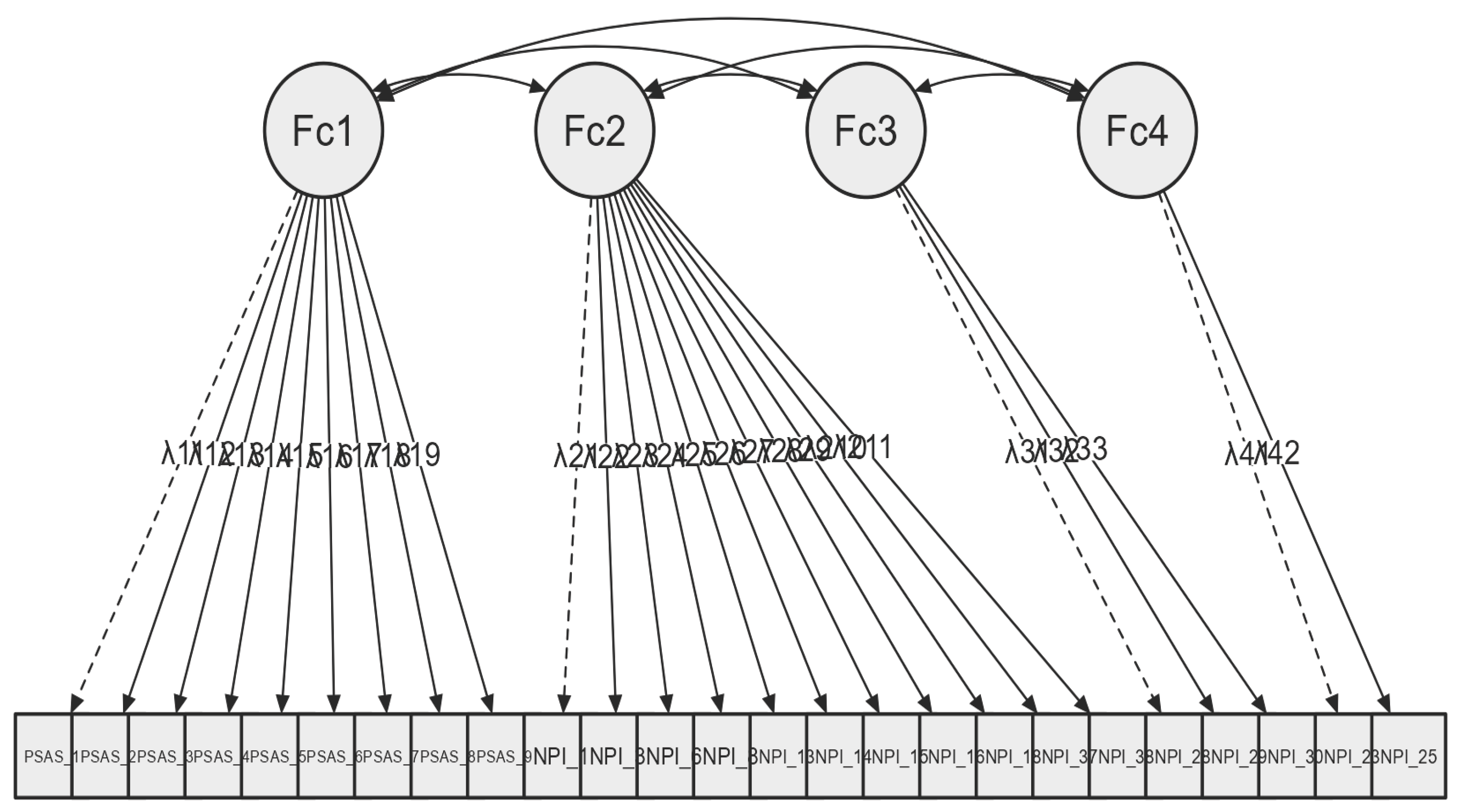

Table 1.
Exploratory Factor Analysis.
| Factor 1 (Fc1) | Factor 2 (Fc2) | Factor 3 (Fc3) | Factor 4 (Fc4) | Uniqueness | |
|---|---|---|---|---|---|
| PSAS_4 | 0.828 | 0.345 | |||
| PSAS_3 | 0.802 | 0.354 | |||
| PSAS_5 | 0.734 | 0.47 | |||
| PSAS_9 | 0.714 | 0.496 | |||
| PSAS_2 | 0.668 | 0.508 | |||
| PSAS_6 | 0.665 | 0.491 | |||
| PSAS_8 | 0.651 | 0.603 | |||
| PSAS_7 | 0.631 | 0.594 | |||
| PSAS_1 | 0.552 | 0.578 | |||
| NPI_15 | 0.729 | 0.467 | |||
| NPI_14 | 0.723 | 0.498 | |||
| NPI_18 | 0.619 | 0.606 | |||
| NPI_3 | 0.54 | 0.678 | |||
| NPI_37 | 0.511 | 0.691 | |||
| NPI_38 | 0.5 | 0.592 | |||
| NPI_6 | 0.484 | 0.616 | |||
| NPI_1 | 0.431 | 0.688 | |||
| NPI_8 | 0.43 | 0.617 | |||
| NPI_16 | 0.412 | 0.636 | |||
| NPI_29 | 0.792 | 0.349 | |||
| NPI_28 | 0.761 | 0.339 | |||
| NPI_30 | 0.723 | 0.422 | |||
| NPI_23 | 0.983 | 0.038 | |||
| NPI_25 | 0.799 | 0.26 |
Note. The rotation method applied is oblimin. Source: own elaboration.
Table 2.
Characteristics of the Factors.
| Factor | Eigenvalues | Rotated solution | ||
|---|---|---|---|---|
| Sums of squared loads | Proportion var. | Cumulative | ||
| Factor 1 | 5.755 | 4.493 | 0.187 | 0.187 |
| Factor 2 | 4.535 | 3.329 | 0.139 | 0.326 |
| Factor 3 | 2.275 | 2.48 | 0.103 | 0.429 |
| Factor 4 | 1.19 | 1.763 | 0.073 | 0.503 |
Source: own elaboration.
Table 3.
Adjustment indices.
| Index | Valor |
|---|---|
| Comparative Adjustment Index (CFI) | 0.958 |
| Tucker-Lewis Index (TLI) | 0.953 |
| Mean square error of approximation (RMSEA) | 0.07 |
| RMSEA 90 % IC lower limit | 0.063 |
| RMSEA 90 % IC upper limit | 0.077 |
| Root mean square error (SRMR) | 0.084 |
| Goodness-of-fit index (GFI) | 0.979 |
Source: own elaboration.
Disclaimer/Publisher’s Note: The statements, opinions and data contained in all publications are solely those of the individual author(s) and contributor(s) and not of MDPI and/or the editor(s). MDPI and/or the editor(s) disclaim responsibility for any injury to people or property resulting from any ideas, methods, instructions or products referred to in the content. |
© 2025 by the authors. Licensee MDPI, Basel, Switzerland. This article is an open access article distributed under the terms and conditions of the Creative Commons Attribution (CC BY) license (http://creativecommons.org/licenses/by/4.0/).
Copyright: This open access article is published under a Creative Commons CC BY 4.0 license, which permit the free download, distribution, and reuse, provided that the author and preprint are cited in any reuse.


