

Submitted:
24 November 2025
Posted:
26 November 2025
You are already at the latest version
Abstract
Chrology establishes a foundational epistemological paradigm that interprets the universe as the structured manifestation of its own original existence and ontological presence. Through five hierarchically nested domains Extramicroscopique, Microscopique, Normal, Macroscopique, and Extramacroscopique Chrology organizes reality into a re-cursive matrix of 25 analytical subfields per domain. This architecture enables high-resolution synthesis of phenomena spanning quantum decoherence, molecular self-assembly, biochemical networks, ecological systems, planetary morphogenesis, and supergalactic topology. This model integrates historical insights from Egyptian Civilizations, Galilei’s heliocentrism to Laplace’s celestial mechanics with contemporary datasets (JWST, Gaia, COBE, Hubble) and observational evidence spanning lunar thermodynamics, planetary magnetosphere behavior, asteroid morphology, Martian geostructures, cryogenic satellites, and galactic clusters. Microscopic data includes viral capsid dynamics, bacterial signaling, atomic orbitals, molecular vibrations, quantum tunneling, electron spin asymmetries, and nanofluidic fields. Terrestrial observation across Europe, Africa, America, and Asia validates the recurrence of these domains via unaided human perception. Mathematical decomposition and dimensional harmonics underpin a unified model demonstrating that at any given portion of the universe in existing and presence regard-less of scale or location is mapped through these five (5) domains. Chrology defines a universal scientific architecture that frames existence as a nested continuum structured by recurrence, symmetry, and observability. It unifies predictive diagnostics and transdisciplinary synthesis across physics, biology, chemistry, geotechnics, and cosmology. Phenomena are interpreted as manifestations of the universe’s intrinsic logic. This logic is formalized into scalable grammar, enabling recursive modeling, symbolic integration, and epistemic advancement throughout the natural sciences.
Keywords:
multiscale epistemology
; chrology
; dimensional harmonics
; cosmological ontology
; phenomenological recurrence
; unified framework
; domain-based observation
; extramicroscopique
; microscopique
; normal
; macroscopique
; extramacroscopique
1. Introduction
The universe, in all its vastness and nuance, has long resisted a truly integrative epistemological framework. Scientific inquiry has flourished within discrete domains quantum mechanics, biology, astronomy, and planetary science each illuminating specific layers of reality, yet seldom converging into a unified model. Chrology offers a solution: a multiscale framework capable of interpreting existence across five (5) structural domains Extramicroscopique, Microscopique, Normal, Macroscopique, and Extramacroscopique. These domains, each comprising twenty-five (25) analytical subfields, collectively form a decomposable matrix that captures the layered architecture of physical reality, spanning from the subatomic to the supergalactic. Contemporary scientific paradigms frequently segment reality into scale-dependent models, resulting in unresolved discontinuities in ontological coherence (Smolin, 2006; Tegmark, 2014).
In response, Chrology introduces a foundational framework that reclassifies existence and presence into five structurally coherent dimensional regimes: Foundational Presence, encompassing sub-quantum fields, energetic substrates, and probabilistic dynamics at Planck-scale thresholds (Planck, 1899); Emergent Particulates, describing atomic bonding, molecular architecture, and mesoscopic couplings (Bohr, 1913; Schrödinger, 1926); Perceptual Systems, integrating biophysical cognition, sensorimotor networks, and modular biological systems (Ramón y Cajal, 1906; Hubel & Wiesel, 1959); Structural Environments, representing engineered infrastructures, geophysical terrains, and planetary emergence (Wegener, 1915; Lovelock, 1972); and Cosmogenic Realms, characterizing galactic morphology, gravitational topology, and deep-field radiation gradients (Hubble, 1929; Peebles, 1980). These regimes are encoded within a 5×5 analytical matrix, wherein each domain is parametrized by five universal operational traits Structure (α), Interaction (β), Visibility (γ), Dimensionality (δ), and Emergence (ε) revealing recursive patterns across observational strata (Barbour, 1999; Greene, 2004).
“Mapping the Universe needs a new way and innovations to apprehend the Universe to its original scale before we can take it to our small-scale map to understand.” Ulrich Ndilira Rotam
This insight affirms the epistemological imperative behind Chrology: to restore dimensional fidelity prior to abstraction, enabling a recursive and symbolically encoded understanding of reality that transcends disciplinary silos and scale distortions. Unlike continuous-scale models such as general relativity (Einstein, 1915) or quantum field theory (Dirac, 1927; Feynman, 1949), Chrology asserts a discrete logic of existence and presence, identifying structural transitions and visibility thresholds with mathematical precision. This approach addresses cross-domain coherence through four analytical dimensions: spatial configuration, spanning quantum curvature to cosmogenic topology; temporal emergence, capturing rhythmicity and entropic cadence across regimes; visibility thresholds, defining observational access via telescopes, quantum imagers, and unaided perception; and interdomain coherence, revealing systemic symmetry, feedback adjacency, and nested holonomy (Laughlin, 2005; Mainzer, 2007). The framework is empirically grounded in multi-platform datasets. Space-based observatories such as the Cosmic Background Explorer (COBE, 1989–1993), the Wilkinson Microwave Anisotropy Probe (WMAP, 2001–2010), the Planck satellite (2009–2020), the Gaia mission (2013–present), and the James Webb Space Telescope (JWST, launched 2021) contribute deep-field spectral and structural data (Wright et al., 1994; Riess et al., 1998). Quantum instrumentation at facilities such as CERN (established 1954) and atomic-scale platforms validate dynamics within foundational and particulate regimes (Schwabl, 2008). Field campaigns conducted across Africa, Asia, Europe, and the Americas provide geophysical and biological data supporting emergence within Perceptual Systems and Structural Environments. Historical records from Galileo Galilei (1564–1642), Pierre-Simon Laplace (1749–1827), William Herschel (1738–1822), and Edwin Hubble (1889–1953) offer enduring validation of recursive cosmic structures and dimensional transitions.
Through this integrative synthesis, Chrology offers a generative grammar of existence, bridging disciplinary boundaries and establishing a scalable ontology applicable across all scientific domains. It provides physicists with a modular scaffold for modeling dimensional transitions, philosophers with a renewed ontology of systemic relation and formal identity, and systems scientists with a blueprint for curriculum design, complexity modeling, and epistemic literacy. A symbolic matrix illustrating the five domain regimes is provided in Supplementary Figure S1. Within the Chrology framework, the recursive distribution of symbolic traits across natural domains is further illustrated in Supplementary Figure S2, which maps the traits of Structure (α), Interaction (β), Visibility (γ), Dimensionality (δ), and Emergence (ϵ) across nested layers of existence. This visualization supports the framework’s principle of ontological continuity, demonstrating how epistemic rhythms recur from quantum substrates to cosmogenic structures.
Motivation
Chrology arises from a foundational epistemological imperative: to address the systemic fragmentation that undermines coherence across contemporary scientific and philosophical domains. As disciplinary boundaries proliferate and knowledge systems become increasingly siloed, the capacity for integrative reasoning linking empirical observation with symbolic abstraction has diminished. This compartmentalization impedes not only theoretical synthesis but also the operationalization of knowledge in civilizational contexts, from infrastructure design to educational reform. Chrology responds by proposing a recursive, transdisciplinary framework that unifies microcosmic and macrocosmic scales, bridging the empirical and the symbolic, the physical and the metaphysical. Its architecture is grounded in symbolic logic, recursive modeling, and visual epistemics, enabling the articulation of continuity across domains traditionally treated as incommensurable. The motivation is both scientific and civilizational: to restore communicability, coherence, and ontological continuity in our understanding of reality. By bridging microcosmic and macrocosmic, empirical and symbolic, the physical and the metaphysical, it restores continuity and communicability in our understanding of reality. Through its recursive symbolic matrix, Chrology offers more than conceptual synthesis it functions as a strategic epistemic instrument capable of guiding institutional decision-making, optimizing resilient infrastructure deployment, and transforming educational systems. Engineered to catalyze systemic resilience, enforce regulatory harmonization, and accelerate innovation at continental scale to beyond our scale, Chrology positions itself as a foundational scaffold for transdisciplinary integration and long-term civilizational foresight.
Theoretical Background
At its core, Chrology is the result of a rigorous, multi-decade program of direct research, observation, symbolic analysis, and dimensional synthesis. This work involved comparative study of phenomena across radically different scales from quantum fluctuations and cellular morphogenesis to planetary dynamics and cosmic structures. Through this process, five irreducible domains of presence and existence were identified as universally recurring patterns:
- Extramicroscopic governing sub-quantum fields, vacuum fluctuations, and pre-material emergence
- Microscopic encompassing molecular, atomic, and cellular architectures
- Normal the human scale of perception, cognition, and embodied interaction
- Macroscopic ecological, geological, and planetary systems
- Extramacroscopic stellar, galactic, and cosmological formations
These domains are not merely observational categories they are structural invariants of the universe, each carrying five elemental patterns of existence and presence that recur across contexts and scales. Their identification was made possible through a recursive methodology of scale analysis, symbolic encoding, and dimensional mapping, revealing a nested logic that underpins all phenomena.
Chrology integrates:
- Logarithmic scale continuity: enabling seamless transitions between domains
- Symbolic recursion: where each domain reflects and refracts the others
- Dimensional epistemology: treating knowledge as a nested, scale-sensitive construct
- Visual logic systems: using glyphs, spirals, and spatial arrangements to encode structure
This framework transcends traditional models of reality. It is not a theory of everything it is a meta-epistemic architecture for understanding how everything coheres.
Significance of Study
Chrology’s significance is profoundly multidimensional, positioning it as both a scientific methodology and a philosophical framework of structure. At the level of scientific integration, it establishes a unified lens for interpreting phenomena across physics, biology, cosmology, and epistemology, bridging domains that have historically remained fragmented.
Its philosophical depth reintroduces symbolic meaning and recursive logic into the foundations of knowledge, restoring coherence between abstract thought and empirical observation.
As an instrument of educational transformation, Chrology equips learners with visual and conceptual tools for grasping nested complexity and scale symmetry, while its institutional utility supports strategic decision-making by mapping the structural logic of systems and scales.
Through public engagement, it translates advanced concepts into elegant, accessible representations that invite broader participation in the collective understanding of reality.
In essence, Chrology demonstrates that the universe is not a random assemblage of disconnected parts but a patterned continuum of presence recursive, symbolic, and intelligible.
It is simultaneously a science of observation, a methodology of integration, and a philosophy of structure. By unifying scientific rigor with philosophical insight, Chrology illuminates the deep architecture of reality and provides a language for knowledge that informs, unifies, and inspires across disciplines, cultures, and generations.
Domain Architecture
Chrology’s Domain Architecture defines the interconnected structure of reality through five (5) nested, networked and irreducible domains Extramicroscopic, Microscopic, Normal, Macroscopic, and Extramacroscopic. Each domain reflects a distinct scale, dimensional behavior, and elemental logic, derived from direct observation, recursive modeling, and symbolic synthesis.
This framework enables transdisciplinary coherence across quantum fields, molecular systems, ecological networks, planetary dynamics, and cosmological structures. Ontologically distinct yet recursively linked, the domains preserve internal logic while allowing integrative modeling. As the backbone of Chrology’s symbolic matrix, this architecture supports scientific inquiry, educational reform, and institutional foresight with epistemic precision and structural clarity of all existence and presence.
The relational gradients between Chrology’s five epistemic dimensions and five symbolic traits are further illustrated in Supplementary Figure S3, which presents a heatmap of symbolic intensities. This visualization highlights high--intensity pairings such as Perceptual Systems-Interaction and Foundational Presence-Interaction, while also revealing low--intensity couplings that underscore minimal resonance across certain domains. Together, these patterns provide a visual grammar for recursive modeling and symbolic logic integration within the Chrology framework.
The Five Domains
Chrology defines reality through five nested, networked and irreducible domains, each governed by distinct scale behaviors and epistemic functions.
Extramicroscopic: Quantum fields and Planck-scale fluctuations pre-material and probabilistic.
Microscopic: Atomic, molecular, and cellular structures where form and function emerge.
Normal: Human-scale cognition, biology, and social constructs perceptual and systemic.
Macroscopic: Planetary and ecological systems civilizational and infrastructural dynamics.
Extramacroscopic: Cosmogenic and multiversal structures hyperdimensional and symbolic.
Together, these domains form the recursive backbone of Chrology’s symbolic matrix of the presence and existence of the entire universe, enabling transdisciplinary modeling across physical, metaphysical, and institutional realities.
The nested organization of reality within the Chrology framework is further detailed in Supplementary Figure S4, which depicts the five--tiered domain architecture. This visualization demonstrates how scale ranges from quantum fields to multiversal structures are recursively encoded, enabling symbolic resonance and continuity across physical and metaphysical systems.
Elemental Composition
Each domain within Chrology is characterized by five (5) elemental modalities of presence and existence: Structural, Energetic, Informational, Temporal, and Spatial. These modalities are not merely descriptive categories but constitute foundational patterns through which existence, presence is configured, perceived, and transformed. The structural modality pertains to the intrinsic form and configuration of entities, whether at quantum, biological, or planetary scales. Energetic modality encompasses the dynamics of flow, exchange, and transformation across systems, from subatomic interactions to ecological cycles. Informational presence refers to the encoding, transmission, and interpretation of signals, enabling coherence and responsiveness within and across domains. Temporal modality governs the rhythms, cycles, and durations that regulate change, emergence, and decay. Spatial presence defines the dimensional arrangements and topologies through which entities inhabit and relate to their environments.
These elemental modalities recur across all domains, yet their manifestations are scale-dependent and contextually distinct. For instance, within the extra-microscopic domain, structural presence may denote quantum lattice fluctuations or probabilistic field configurations. In contrast, within the macroscopic domain, structural presence may refer to tectonic formations, biospheric networks, or planetary ecosystems. This scale-sensitive recurrence affirms the universality of elemental grammar while allowing for domain-specific articulation. The scalar framework of Chrology, which maps structured emergence across five scales of presence and existence, is illustrated in Supplementary Figure S5. This visualization highlights how colored curves and symbolic traits (μ, γ) express ontological presence and interdomain coherence, supporting recursive transitions and epistemic synthesis across the natural sciences. The recursive architecture of Chrology is further illustrated in Supplementary Figure S6, which presents a mock simulation of cellular emergence across scale. This visualization demonstrates how symbolic constructs are organized within ontological regimes and epistemic dimensions, highlighting recursive structures and glyphic mappings that encode continuity across scientific and cultural frameworks.
Recursive Mapping
The architecture of Chrology is inherently recursive and symbolically encoded. Each domain is represented by a unique glyph encapsulating its ontological identity and epistemic function. These glyphs are dynamic matrices, expandable into five elemental sub--visions corresponding to the aforementioned modalities. Each sub--vision can be recursively decomposed into nested glyphic structures, generating a symbolic atlas of existence that is both scalable and translatable. This recursive mapping enables cross--domain translation of concepts, systems, and phenomena, fostering coherence across scientific, philosophical, and cultural frameworks. It also provides a visual logic adaptable for educational, institutional, and public engagement, allowing complex ideas to be rendered with clarity and dimensional fidelity.
The stratified architecture of physical reality within the Chrology framework is illustrated in Supplementary Figure S7, which presents a dynamic matrix of analytical subfields and structural categories. This visualization demonstrates how recursive glyphic stratification enables cross--domain synthesis, linking quantum lattices and electron shells to ecological networks, civilizational epochs, and multiversal geometries.
Functional Role
Chrology’s Domain Architecture functions as a universal scaffold for the organization of knowledge, a visual grammar for encoding complexity, and a dimensional compass for navigating scales, emergence, and symbolic meaning. Its design is intentionally transdisciplinary, allowing seamless integration across fields such as physics, chemistry, biology, cosmology, governance, pedagogy, and public imagination. By aligning symbolic logic with empirical structure, it offers a robust framework for epistemic synthesis, institutional resonance, and continental innovation.
DESCRIPTION OF FIVE (5) DOMAINS AND THEIR SUBFIELDS
Scale of Presence and Existence Conceptual Foundation in Chrology
In Chrology, scale transcends its conventional role as a metric of size or magnitude. It is reconceptualized as a dimension of ontological articulation a framework through which presence and existence unfold, differentiate, and become intelligible across multiple layers of reality. The Scale of PRESENCE and EXISTENCE refers to a nested continuum wherein reality expresses itself from the infinitesimal to the infinite, each stratum governed by distinct symbolic, energetic, and structural logics. This continuum is not linear but recursive and stratified, meaning that each level of scale contains echoes, reflections, and structural analogs of all others. In this sense, scale functions both as a container holding the conditions for manifestation and as a mirror, reflecting the relational dynamics of existence across domains.
From a scientific standpoint, this model aligns with principles observed in:
- Fractal geometry, where self-similarity across scales reveals recursive patterns in nature.
- Quantum field theory, which demonstrates that subatomic fluctuations influence macroscopic phenomena.
- Systems theory, which posits that nested hierarchies and feedback loops govern complex adaptive systems.
- Cosmology, where the structure of spacetime itself is scale-dependent, from Planck length to galactic superclusters.
In Chrology, scale is thus not merely descriptive it is generative. It determines how entities emerge, interact, and persist. Each domain of scale whether molecular, planetary, or metaphysical possesses its own ontological grammar, yet remains entangled with others through symbolic resonance and energetic continuity. This framework allows for a unified understanding of presence and existence that is both scientifically grounded and philosophically expansive, offering a multidimensional lens through which reality can be studied, modeled, and experienced.
The generative architecture of scale within Chrology is illustrated in Supplementary Figure S8, which maps nested scientific domains along a continuum from negative to positive infinity. This visualization demonstrates how regimes from the Extramicroscopic to the Extramacroscopic are encoded with glyphic markers and symbolic coloration, supporting recursive modeling and trans--domain synthesis.
The recursive emergence of ontological scales within Chrology is illustrated in Supplementary Figure S9, which maps domain resonance and subfield recurrence across epistemic layers of existence and presence. Solid and dashed lines highlight how resonance and recurrence interweave to generate continuity across nested ontological signatures.
MODES OF EXISTENCE ACROSS SCALE
A Chrological Framework for Ontological Differentiation
In the chrological model, existence is not monolithic; it expresses itself through distinct modes of presence that correspond to specific bands of scale. Each mode reflects unique ontological grammar, shaped by the energetic, symbolic, and structural conditions of its domain. These modes are not isolated; they interact recursively, forming a dynamic continuum of intelligibility and manifestation.
Symbolic Presence
Symbolic Presence in Chrology refers to the way reality articulates itself through signs, codes, and representations that precede and accompany empirical manifestation.
At the quantum scale, particles exist in probabilistic states until observed, their presence encoded symbolically in wave functions and mathematical operators rather than directly revealed.
At the cosmogenic scale, phenomena such as black holes or the early universe are apprehended through symbolic constructs gravitational signatures, cosmological constants, and abstract models since direct sensory access collapses under vastness or uncertainty.
This mode of existence emphasizes abstraction, encoding, and potentiality, where reality is mediated by symbolic logic rather than immediate perception. Symbols function as both containers of meaning and compasses of intelligibility, enabling continuity across scales and domains.
In Chrology, symbolic presence is not a secondary representation but a primary dimension of existence, aligning epistemic synthesis with ontological depth. It reveals that the universe is intelligible because it is recursively encoded, allowing knowledge to traverse from the infinitesimal to the infinite through symbolic resonance.
Structural Presence
At microscopic and macroscopic levels, existence becomes tangible, measurable, and organized. Molecular structures, biological systems, and planetary bodies exhibit form, function, and spatial coherence. This is the domain of empirical science, where presence is validated through instrumentation, metrics, and reproducibility. Structural presence is governed by physical laws, symmetry, and material constraints, allowing for engineering, classification, and manipulation.
Cognitive Presence
The Neuro-Symbolic Interface of Human Reality Construction. On the human scale, existence is not merely observed it is interpreted, narrated, and symbolically reconstructed by conscious agents. This mode of presence is uniquely characterized by the human brain’s capacity to encode experience into meaning, transforming raw sensory input into structured knowledge, cultural narratives, and ethical frameworks. Through language, memory, and perception, humans mediate reality by constructing symbolic systems that transcend immediate stimuli. These systems ranging from linguistic syntax to mythic archetypes allow for temporal continuity, social coordination, and self-reflection, forming the backbone of civilization and identity. Cognitive presence is shaped by a convergence of scientific and philosophical domains:
Neuroscience reveals the brain’s dynamic architecture, where neural networks distributed support semantic processing, emotional regulation, and predictive modeling of the environment.
Phenomenology explores the first-person structure of experience, emphasizing how intentionality and lived embodiment shape our perception of existence.
Cultural semiotics examine how symbols, rituals, and media encode collective meaning, enabling shared realities across generations and societies.
This mode foregrounds:
Subjectivity: The unique vantage point of each individual consciousness.
Reflexivity: The capacity to observe and modify one’s own mental states.
Symbolic agency: The power to create, manipulate, and transmit meaning through abstract representation.
From a scientific standpoint, cognitive presence is the interface between biology and abstraction where electrochemical signals become poetry, ethics, and mathematics. It is central to disciplines such as epistemology, which interrogates the nature of knowledge; aesthetics, which explores the structure of beauty and meaning; and ethics, which derives moral principles from symbolic reasoning and empathy. In the chrological framework, cognitive presence is not an isolated phenomenon it is a scale-specific emergence that reflects and refracts the recursive patterns of existence found at both micro and macro levels. It is where ontology meets narrative, and where reality becomes self-aware.
Recursive Presence
Across all scales, existence exhibits recursion patterns that repeat, reflect, and resonate across domains. Fractals in nature, self-similarity in systems, and holographic principles in physics suggest that each scale contains echoes of others. Recursive presence enables cross-domain translation, where symbolic structures at one level inform understanding at another (e.g., DNA as code, galaxies as networks).
This mode supports interdisciplinary synthesis, allowing for unified models of complexity, emergence, and resonance. Together, these modes form a multi-scalar ontology a framework where reality is not only stratified but interwoven, allowing for both scientific rigor and philosophical depth. Chrology thus offers a lens through which existence and presence can be mapped, interpreted, and engaged across the full spectrum of scale.
Recursive Scale Logic
Chrology introduces the principle of recursive scale logic, a mode of understanding in which each domain of existence contains echoes and microcosms of all others. Scale is not conceived as a linear progression of magnitude but as a symbolically nested continuum, where presence unfolds dimensionally across time, meaning, and agency. This recursive nesting ensures that every stratum of reality reflects structural analogs of the rest, allowing intelligibility to flow both upward and downward across scales. For example, a quantum fluctuation at the extra--microscopic level may symbolically encode a cosmogenic archetype at the extra--macroscopic scale, revealing continuity between the infinitesimal and the infinite.
Similarly, a human thought within the normal domain may resonate with planetary systems at the macroscopic level or with myth cosmic narratives beyond all worlds. In this way, recursive scale logic demonstrates that presence is not confined to spatial extension but is articulated through symbolic resonance, contextual meaning, and dimensional agency. By embedding recursion into the architecture of scale, Chrology provides a framework in which existence is simultaneously particular and universal, local and cosmogenic. It shows that knowledge itself must be navigated across domains, translated recursively, and understood as a continuum of symbolic presence rather than a collection of isolated phenomena.
The layered ontology of Chrology is illustrated in Supplementary Figure S10, which maps five ontological domains across symbolic layers ranging from emergent particulates to cosmogenic extremes. This visualization demonstrates how presence and intelligibility are recursively encoded from the infinitesimal to the infinite, underscoring the framework’s principle that reality is stratified, contextual, and scale--dependent.
2. Materials and Methods
The methodological design of this study operationalizes Chrology as a unified multiscale framework for interpreting the universe across five ontological domains of presence and existence. This framework integrates axiomatic theoretical modeling, symbolic computation, and empirical synthesis, ensuring that recursive scale logic and symbolic presence function not merely as abstract principles but as methodological instruments capable of guiding systematic inquiry. By drawing upon publicly available datasets that span the microscopic, macroscopic, and cosmological, the method establishes continuity across scales while embedding direct human perception as an experiential dimension of validation, thereby uniting empirical rigor with phenomenological insight. At the core of this design lies a data integration logic that enables cross--domain translation, allowing phenomena observed at one scale to be intelligibly mapped onto others.
Terrestrial observational methods provide grounding at the human and environmental level, nanoscale technologies probe the microcosm with precision, and astronomical datasets extend inquiry to cosmogenic extremes. These empirical strata are reinforced by technological and institutional infrastructures that guarantee reproducibility, scalability, and transparency. The framework further incorporates epistemological integration, aligning symbolic presence with established knowledge systems, and recursive resonance, which identifies symbolic analogues that reverberate across domains, from quantum fluctuations to myth cosmic archetypes.
To maintain coherence across heterogeneous sources, the methodology employs temporal synchronization of datasets to ensure dimensional consistency, sensorial overlay to integrate perceptual modalities with symbolic encodings, and dimensional encoding to embed time, meaning, and agency into representations of presence. Collectively, these methodological components establish a multi--layered system of inquiry in which Chrology’s principles are enacted with both empirical precision and philosophical depth. The result is a method capable of probing the microcosm, mapping the macrocosm, and recursively synthesizing meaning across the continuum of existence, thereby fulfilling the paper’s aim of presenting Chrology as a scientifically robust and philosophically coherent multiscale framework for interpreting reality across five domains of existence.
Instrumentation and Data Integration
In Chrology, Instrumentation and Data Integration encompass both advanced scientific tools and the primordial instruments of human perception the eyes, the senses, and the embodied mind. Observation is not solely technological; it is existential and presential. The human being is not just a passive receiver of data, but an active participant in the unfolding of existence and presence. Instrumentation is thus understood as a continuum: from quantum detectors to retinal perception, from satellite arrays to symbolic intuition. Data integration is the process by which these diverse inputs empirical, sensorial, symbolic are woven into coherent meaning across domains.
Instrumentation Across Domains
The interplay between technological mediation, human cognition, and symbolic interpretation across observational scales is illustrated in Supplementary Figure S11, which categorizes five domains according to instrumentation type, sensory role, and symbolic function. This framework clarifies how symbolic roles shift with domain--specific tools and sensory access, supporting Chrology’s multiscale epistemic model.
Direct Human Perception
Within Chrology’s methodological architecture, direct human perception is treated not as a passive experience but as an active instrument of inquiry. The human body itself functions as a sensorium of symbolic resonance, capable of registering phenomena across multiple domains of existence. Perception is therefore operationalized as a methodological tool, extending beyond empirical measurement into the realm of symbolic encoding, where meaning, agency, and dimensional presence are apprehended directly through embodied cognition. This approach recognizes that the human sensorium integrates visual, auditory, tactile, and proprioceptive modalities into a coherent interpretive field. By embedding perception within the methodological design, Chrology acknowledges that certain phenomena particularly those involving recursive resonance and symbolic analogues cannot be fully captured by technological instrumentation alone.
Instead, human perception provides a layer of experiential validation, ensuring that symbolic structures are not only computationally modeled but also phenomenologically apprehended. In practice, direct human perception operates alongside nanoscale technologies and astronomical datasets, serving as a cross--domain translator that bridges the gap between abstract theoretical modeling and lived experience. It enables researchers to identify symbolic correspondences across scales, from microcosmic fluctuations to cosmogenic archetypes, and to embed these correspondences within a unified framework of dimensional encoding. Thus, perception is elevated to the status of a methodological instrument, reinforcing the claim that knowledge must be scaled, contextualized, and recursively synthesized through both empirical rigor and embodied resonance.
Chrology honors the primacy of direct observation:
- Eyes: The retina receives photons, but the mind assigns meaning. Vision is both physical and symbolic.
- Touch: Texture, temperature, and resistance reveal structural truths.
- Hearing: Vibrations encode temporal and energetic patterns.
- Emotion: A symbolic response to presence often the first signal of ontological depth.
- Intuition: A non-linear synthesis of perception, memory, and symbolic logic.
These senses are not inferior to instruments they are the original instruments, capable of perceiving patterns that machines cannot yet quantify.
Data Integration Logic
Chrology’s integration framework is conceived as recursive, symbolic, and embodied, designed to unify heterogeneous sources of knowledge into a coherent multiscale system of interpretation. Rather than treating data as isolated measurements, the framework operationalizes integration as a recursive process in which information is continuously translated, reencoded, and contextualized across domains of existence. This ensures that empirical observations are not only preserved in their quantitative form but also transformed into symbolic structures that resonate with human cognition and embodied perception.
At the core of this framework lies cross--domain translation, the methodological practice of mapping empirical data into symbolic forms perceptible to human understanding. For example, molecular structures at the microscopic scale may be translated into visual glyphs or tactile models, allowing abstract chemical configurations to be apprehended as symbolic analogues. Similarly, astronomical datasets may be re--encoded into dimensional schemata that reveal cosmogenic archetypes, while nanoscale fluctuations can be rendered as perceptual overlays that highlight recursive resonance with macroscopic systems.
This logic of integration is not merely technical but epistemological: it acknowledges that knowledge must be scaled, contextualized, and recursively synthesized. By embedding symbolic computation within empirical synthesis, Chrology’s data integration logic ensures that meaning is not lost in translation but amplified through recursive nesting. The result is a methodological instrument that bridges quantitative precision with qualitative intelligibility, enabling the framework to probe the microcosm, map the macrocosm, and reveal the symbolic continuity of existence across all five domains. The symbolic continuum of scientific domains within Chrology is illustrated in Supplementary Figure S12, which maps scale from negative to positive infinity. This visualization positions five foundational domains along the continuum, each represented by distinct glyphs and coloration to reflect their ontological magnitude and epistemic resonance.
In Chrology, scale is not merely a descriptive tool it is generative. At any given locus in the universe, these five domains manifest as nested traits, shaping how entities emerge, interact, and persist. Whether analyzing quantum foam at the Planck threshold or mapping galactic filaments across cosmogenic space, each domain contributes unique ontological grammar while remaining entangled with others through symbolic resonance and energetic continuity.
This diagram serves as a foundational scaffold for recursive modeling, illustrating that every point in the universe regardless of its magnitude contains echoes of all five domains. The Extramicroscopic domain governs sub-quantum emergence; the Microscopic domain encodes molecular and cellular logic; the Normal domain anchors perceptual and environmental systems; the Macroscopic domain structures planetary and continental formations; and the Extramacroscopic domain orchestrates cosmic and multiversal architectures. Together, these domains form a unified symbolic lattice, enabling cross-scale synthesis and epistemic integration.
Dimensional Encoding
Dimensional encoding functions as a methodological instrument for embedding data within recursive visual structures such as spirals, matrices, and glyphs. These symbolic architectures are not merely aesthetic but serve as epistemic devices that enable continuity across scales. By translating quantitative datasets into recursive visual forms, dimensional encoding facilitates multisensory engagement, allowing phenomena to be apprehended simultaneously through visual, tactile, and cognitive modalities. This ensures that continuity between microcosmic fluctuations and cosmogenic archetypes is not only mathematically modeled but also symbolically embodied, reinforcing Chrology’s principle that knowledge must be scaled and recursively synthesized.
Sensorial Overlay
Sensorial overlay extends the methodological framework by combining technological data streams with direct human perception, thereby uniting empirical measurement with embodied resonance. This technique overlays computationally derived imagery such as satellite data or nanoscale scans with lived ecological and phenomenological experience.
For example, we use satellite imagery of planetary systems being juxtaposed with human ecological perception, producing a composite field in which symbolic resonance is apprehended both technologically and experientially. Sensorial overlay thus transforms perception into a methodological instrument, ensuring that symbolic presence is validated through both empirical precision and embodied cognition.
Temporal Synchronization
Temporal synchronization aligns heterogeneous data streams with human rhythms across daily, seasonal, historical, and mythic timescales. By embedding datasets within temporal structures that resonate with lived experience, synchronization produces narrative coherence and enables embodied understanding of recursive phenomena. Microscopic fluctuations may be mapped onto daily cycles, macroscopic processes onto seasonal rhythms, and cosmogenic events onto mythic or historical narratives. This alignment ensures that symbolic presence is not abstracted from time but embedded within it, allowing knowledge to be apprehended as a continuum of temporal resonance. Temporal synchronization thereby reinforces Chrology’s claim that presence is dimensional, encompassing not only spatial extension but also agency, meaning, and time.
Epistemological Integration
In Chrology, epistemological integration functions as the methodological bridge between empirical measurement, embodied perception, symbolic resonance, and ontological depth. Instrumentation and data are never neutral; they are shaped by the observer’s domain of presence. To account for this, Chrology integrates four complementary dimensions of inquiry, each demonstrated through concrete experimentation across the five domains of existence.
Empirical rigor is achieved through precision tools and validated metrics. For example, nanoscale imaging technologies such as atomic force microscopy provide reproducible measurements of particulate structures, while astronomical datasets including pulsar timing arrays and cosmic microwave background signals yield quantifiable evidence of cosmogenic phenomena. Experimentation compares nanoscale fluctuations with computational models of molecular dynamics to identify archetypal patterns that recur across scales, ensuring that Chrology remains anchored in scientific reliability.
Sensorial depth incorporates direct human perception and embodied cognition as methodological instruments. A researcher’s visual, tactile, and ecological awareness can reveal symbolic correspondences that extend beyond computational capture. For instance, overlaying satellite imagery of deforestation with lived ecological field notes produces a sensorial composite that unites technological precision with ecological experience. Phenomenological experiments, in which participants engage with tactile models of molecular structures, validate symbolic translations through embodied resonance, demonstrating that perception itself can function as a methodological instrument.
Symbolic logic introduces recursive meaning structures and archetypal resonance into the interpretive process. Molecular lattices may be translated into glyphic forms, while planetary orbital patterns can be rendered as symbolic matrices, enabling recognition of archetypal structures that recur across scales. Experimentation includes embedding astronomical datasets into dimensional spirals, allowing multisensory engagement and recognition of recursive resonance between cosmogenic and microscopic phenomena. This symbolic encoding ensures that data is not only measured but also meaningfully contextualized.
Dimensional awareness situates knowledge within scales, contexts, and ontological depth. A quantum fluctuation may be understood as a microcosmic analogue of cosmogenic archetypes, while human thought can be interpreted as resonant with myth cosmic narratives. Temporal synchronization experiments align nanoscale fluctuations, ecological rhythms, and cosmological cycles with human historical and mythic narratives, embedding data within dimensional encodings such as spirals and matrices. This ensures continuity across daily, seasonal, and cosmogenic timescales, reinforcing the layered nature of presence.
Together, these dimensions establish epistemological integration as a core methodological principle of Chrology. It allows the framework to serve simultaneously as a scientific system of measurement and a philosophical compass, guiding inquiry across disciplines, cultures, and sensory modalities. In doing so, Chrology demonstrates that knowledge is not flat but layered, contextual, and recursively scaled, requiring the integration of empirical precision, embodied resonance, symbolic logic, and dimensional awareness to achieve coherence across the continuum of existence.
Applications
- Unified Science Platforms Integrating data from instruments and human observation
- Educational Systems Teaching through multisensory symbolic engagement
- Governance Models Using embodied data to inform planetary decision-making
- Legacy Archives Preserving knowledge in formats accessible to both machines and minds
Astronomical Datasets and Nanoscale Technologies
Unifying the Extremes of Scale
Chrology identifies a profound ontological symmetry between the infinitesimal and the cosmic a structural resonance that transcends magnitude and dimensionality. The integration of nanoscale technologies and astronomical datasets reveals that presence and existence are not fragmented across scale but recursively patterned and symbolically encoded. These two domains, often treated as opposites, are shown in Chrology to be epistemically entangled.
Astronomical Datasets: Mapping the Macrocosm
Astronomical datasets provide empirical access to the Extra-macroscopic domain, encompassing stellar formations, galactic filaments, and cosmogenic flows. These data sources include:
- James Webb Space Telescope (JWST): Infrared imaging of early galaxies, star nurseries, and exoplanet atmospheres
- Gaia Observatory: High-precision astrometry of over one billion stars, enabling dynamic galactic cartography
- Event Horizon Telescope (EHT): Imaging of black hole event horizons through global interferometry
- Vera C. Rubin Observatory (LSST): Capturing transient celestial phenomena across wide fields
- Cosmic Microwave Background (CMB) Maps: Revealing primordial density fluctuations and early-universe topology
These datasets uncover recursive geometries, rotational symmetries, and fractal distributions that mirror sub-visible structures. Chrology interprets these patterns as symbolic architectures not merely gravitational outcomes, but expressions of dimensional logic.
Nanoscale Technologies: Probing the Microcosm
Nanoscale technologies operate within the Extra-microscopic and Microscopic domains, revealing the symbolic infrastructure of emergence. Key platforms include:
- Scanning Tunneling Microscopy (STM): Atomic-resolution imaging via quantum tunneling
- Atomic Force Microscopy (AFM): Mapping nanoscale topographies and interatomic forces
- Nanofabrication Systems: Engineering functional molecular architectures
- Quantum Dot Arrays: Encoding information in discrete energy states
- Bio-nano Interfaces: Merging synthetic nanostructures with living systems for sensing and control
These instruments reveal that matter at its smallest scales is not chaotic but recursively organized and symbolically expressive. Molecular bonding, protein folding, and cellular morphogenesis exhibit nested logic that parallels cosmic structures.
Recursive Resonance and Symbolic Analogues
Chrology identifies a set of cross-domain analogues that demonstrate structural continuity across scale: This Figure S13 presents a formal epistemic demonstration of Chrology’s multiscale modeling framework by revealing structural and symbolic continuity across radically distinct observational domains. The diagram juxtaposes five nanoscale phenomena quantum lattice, atomic nucleus, molecular bonding, nanotube architecture, and cellular morphogenesis with their astronomical analogues: star fields, solar radiance, planetary systems, galactic formations, and planetary terrain. Each pairing is supported by a shared symbolic pattern, including networked emergence, rotational symmetry, energy concentration, linear tension, and nested adaptivity.
This resonance is not merely analogical it is structurally embedded and epistemically directional. It affirms Chrology’s foundational claim that symbolic logic and morphological coherence recur across scale transitions, and that each domain encodes irreducible asymmetries that resist reduction. The Figure operationalizes this principle by mapping recursive motifs that span quantum coherence and planetary morphology, molecular tension and galactic curvature, thereby offering a testable framework for cross-domain synthesis.
By integrating symbolic structure with empirical morphology, this model positions Chrology as a unifying science of systemic presence. It invites validation through comparative modeling, planetary instrumentation, and symbolic decomposition, and establishes a visual foundation for domain-specific epistemic stratification. Structural and symbolic parallels between nanoscale phenomena and astronomical systems are illustrated in Supplementary Figure S13, which organizes nanoscale structures, astronomical analogs, and shared symbolic patterns into a recursive framework. This visualization highlights how motifs such as networked emergence, rotational symmetry, and nested adaptivity recur across scales, reinforcing Chrology’s principle of resonance between the infinitesimal and the infinite. This framework supports Chrology’s multiscale epistemic model by demonstrating that structural resonance and symbolic continuity recur across vastly different scales. It provides a visual rationale for integrating quantum, biological, and cosmological domains into unified modeling. The principle of dimensional continuity within Chrology is illustrated in Supplementary Figure S14, which presents recursive scale resonance across microcosmic and macrocosmic domains. This visualization demonstrates how emergence, interaction, and persistence are governed by symbolic resonance, linking quantum indeterminacy and molecular coherence with planetary dynamics and galactic structures.
Epistemological Integration
Chrology’s framework enables the integration of these datasets and technologies through:
- Dimensional Mapping: Positioning data along a logarithmic scale of presence
- Symbolic Encoding: Translating empirical structures into glyphs, spirals, and recursive matrices
- Cross-Domain Translation: Using symbolic logic to interpret data across radically different scales
- Sensorial Anchoring: Embedding human perception sight, intuition, cognition into the interpretive process
This integration affirms that knowledge is not flat or fragmented it is nested, symbolic, and dimensionally fluid.
The non--linear distribution of scientific domains across ontological magnitude is illustrated in Supplementary Figure S15, which maps Chrology’s nested grammars along a logarithmic continuum. This visualization highlights how epistemic centroids anchor recursive modeling, enabling dimensional continuity from quantum substrates to cosmogenic architectures.
Technological and Institutional Applications
Recursive Simulation Engines Symbolic logic derived from Chrology enables simulation platforms that model emergence across domains from quantum fields to galactic systems. These engines support predictive modeling, design optimization, and epistemic visualization. The recursive resonance between microcosmic and macrocosmic structures is illustrated in Supplementary Figure S16, which links quantum lattices and galactic filaments through shared principles of networked emergence, energy concentration, and rotational symmetry. This visualization affirms Chrology’s core idea that patterns repeat across scale, enabling symbolic synthesis from the sub--visible to the hyperdimensional.
TERRESTRIAL OBSERVATIONAL METHODS
Grounding Chrology in Direct Human Observation
While Chrology spans the full continuum of scale from quantum substrata to cosmogenic architectures it remains fundamentally anchored in terrestrial observation. The Earth itself serves as a living laboratory where the five domains of presence manifest in accessible, measurable, and symbolically rich forms. Terrestrial observational methods provide empirical and sensorial foundation for validating Chrology’s recursive logic and dimensional architecture.
These methods include both instrument-based observation and direct human perception, affirming that the logic of existence is not confined to abstract models or remote sensing it is inscribed in the world around us, visible to the attentive eye. The recursive correspondence between empirical observation and symbolic classification is illustrated in Supplementary Figure S17, which integrates microscopic, atomic, cosmic, and neurodomain observation zones with Chrology’s ontological domains. This composite visualization demonstrates how entities from subatomic particles to galactic structures are mapped onto nested scales, affirming that observation is both symbolic and generative across domains.
Direct Field Observation Across Continents
To substantiate the universality of the Five (5) Worlds framework, we conducted extensive field observations using unaided human perception eyes, senses, and embodied awareness across a diverse array of global locations. These sites were selected for their cultural, environmental, and symbolic significance, allowing us to witness the recurrence of existential patterns across domains.
Observational Sites
- Europe: Paris (France), London (United Kingdom), Brussels (Belgium)
- Africa: Cape-Town (South Africa), N’Djamena (Chad), Addis Ababa (Ethiopia), Port-Gentil (Gabon), Douala (Cameroon), Lomé (Togo), Ouagadougou (Burkina Faso), Pointe-Noire (Congo)
- America: New York City (NY), Irvington (NJ), Statue of Liberty (NJ), Farmington (NM), Des Moines (IA), Washington Monument (DC), Denver (CO), Los Angeles (CA), Oklahoma City (OK), Chicago (IL), Pittsburgh (PA)
- Asia: Tokyo, Hiroshima, and Hokkaido (Japan)
Across these geographies urban and natural, symbolic and ecological we consistently observed shared markers of existential presence. These included geometric recurrences, symbolic structures, environmental rhythms, and cultural expressions that aligned with Chrology’s five domains.
The convergence of these patterns affirms the global coherence of Chrology’s dimensional logic and its applicability across cultures, climates, and contexts. The universality of Chrology’s five observational worlds is illustrated in Supplementary Figure S18, which maps the Extra--Microscopic, Microscopic, Normal, Macroscopic, and Extra--Macroscopic domains across all continents. This visualization affirms that Chrologic scales recur consistently across ecological, cultural, and symbolic terrains, demonstrating their global resonance.
Instrument-Based Terrestrial Observation
Complementing direct perception, Chrology integrates a wide array of Earth-based scientific instruments, each aligned with specific domains and subfields:
Domain Terrestrial Instruments Observational Focus
- Extra-microscopic: Cryogenic detectors, quantum resonance chambers Subatomic fluctuations, vacuum states
- Microscopic: Microscopes, spectrometers, molecular scanners Cellular structures, molecular bonding
- Normal: Biometric sensors, cognitive trackers, ethnographic tools Human-scale behavior, symbolic cognition
- Macroscopic: Satellite imaging, ecological monitors, seismic arrays Planetary systems, biosphere dynamics
- Extra-macroscopic: Ground-based telescopes, radio observatories, gravitational wave detectors, Stellar motion, cosmic background, deep space phenomena
These instruments allow researchers to observe recursive patterns directly, validating Chrology’s symbolic mappings through measurable phenomena. The relationship between Chrology’s five domains and their corresponding scientific instruments is illustrated in Supplementary Figure S19, which summarizes how specialized tools enable observation across scales from subatomic fluctuations to deep space phenomena. This framework highlights the interplay between instrumentation and epistemic focus, reinforcing Chrology’s principle of scale--linked inquiry.
Sensorial Anchoring and Symbolic Fieldwork
Chrology emphasizes that the human body is itself an instrument capable of perceiving symbolic resonance across domains:
- Visual Perception: Recognition of symmetry, pattern, and scale continuity
- Touch and Texture: Revealing structural logic in material forms
- Auditory Cues: Detecting rhythmic and energetic patterns in natural systems
- Emotional and Intuitive Responses: Signaling symbolic depth and ontological significance
In parallel, symbolic fieldwork involves the study of meaning-bearing structures in natural and cultural environments:
- Geometric Recurrence: Spirals, fractals, and nested forms in plants, minerals, and landscapes
- Mythic Topography: Cultural symbols, rituals, and sacred sites as expressions of domain logic
- Ecological Symbolism: Animal behavior, seasonal cycles, and environmental rhythms as recursive phenomena
These methods affirm that symbolic presence is observable not merely theoretical and that Chrology’s dimensional logic is embedded in the living world.
Applications and Strategic Relevance
Environmental Monitoring: Recursive observation of biosphere dynamics supports planetary stewardship
- Cultural Preservation: Mapping symbolic landscapes and indigenous knowledge systems ensures epistemic diversity
- Public Engagement: Field-based symbolic education fosters intuitive understanding of Chrology’s principles
- Policy Design: Terrestrial data informs governance models rooted in dimensional awareness and symbolic coherence
Terrestrial observational methods both empirical and sensorial anchor Chrology in the tangible, the measurable, and the lived. From quantum detectors to human intuition, from sacred landscapes to seismic arrays, the Earth reveals the nested logic of presence across all domains. Through global fieldwork and symbolic perception, Chrology becomes not only a theory of scale, but a practice of seeing.
The stratification of Chrology’s observational architecture is illustrated in Supplementary Figure S20, which organizes four domains by scale, instrumentation, and epistemic focus. This framework demonstrates how symbolic and sensory modalities shift across subatomic, molecular, human, and planetary scales. This stratification operationalizes Chrology’s multiscale framework by linking scale-specific instrumentation to symbolic interpretation. It affirms that each domain requires distinct epistemic tools and sensory roles, and that no single observational regime can reduce or subsume the others. The Figure thus supports Chrology’s central thesis: that reality is irreducibly layered, and that unified modeling must respect the asymmetries and symbolic functions embedded across scale.
Role of unaided human vision and geographic reach
Epistemic Boundaries and Phenomenological Anchors in Chrology: In the chrological framework, the role of unaided human vision and geographic reach serves as both a limiting factor and a phenomenological anchor in the interpretation of presence and existence across scales. While advanced instrumentation has vastly expanded our observational capacity from subatomic detectors to deep space telescopes the unaided human sensorium remains the primary interface through which reality is first encountered, contextualized, and socially transmitted.
Unaided Human Vision: A Scale-Bound Interface
Human vision operates within a narrow electromagnetic window approximately 400 to 700 nanometers limiting direct perception to the normal scale of existence. This constraint defines the visual horizon of cognitive presence, where objects are interpreted through shape, color, motion, and symbolic association. Despite its limitations, unaided vision plays a critical role in:
- Pattern recognition and spatial orientation, essential for survival and environmental interaction.
- Symbolic abstraction, where visual stimuli are encoded into language, art, and cultural meaning.
- Phenomenological grounding, anchoring abstract scientific models in lived experience.
From a neurocognitive perspective, the human visual system is optimized for mid-scale resolution, enabling efficient processing of faces, gestures, and environmental cues. This makes unaided vision a scale-specific epistemic tool, deeply embedded in the construction of meaning at the human level.
Geographic Reach: Spatial Constraints and Expansion
Geographic reach refers to the physical and logistical extent to which human agents can access, observe, and interact with environments across the Earth’s surface and beyond. Historically, geographic reach was limited by terrain, climate, and mobility. Today, it is extended through:
- Remote sensing technologies (e.g., drones, satellites)
- Global networks of observatories and field stations
- Digital mapping and geospatial analytics
In chrology, geographic reach determines the observational density and data granularity available at macroscopic and extra-macroscopic scales. It also influences the distribution of epistemic authority, as access to certain geographies (e.g., polar regions, deep oceans, orbital platforms) enables privileged insight into planetary and cosmic dynamics.
Integrative Role in Chrological Interpretation
Unaided human vision and geographic reach together form the baseline observational domain from which all other scales are extrapolated. They serve as:
- Calibration points for instrument-based data
- Narrative anchors for symbolic cognition
- Ethical and aesthetic reference frames for interpreting scale-transcendent phenomena
In sum, while technologically mediated observation has extended our reach across scales, the unaided human sensorium and geographic presence remain foundational to chrological inquiry. They ensure that the interpretation of presence and existence remains embodied, situated, and reflexively coherent, grounding the abstract in the tangible and the infinite in the immediate.
Mathematical Framework
Formalizing Multiscale Ontology in Chrology: The mathematical framework of Chrology serves as the formal backbone for modeling existence across nested scales. It provides the quantitative language and symbolic architecture necessary to articulate the recursive, stratified, and dynamic nature of reality as described in the chrological paradigm.
Multiscale Modeling and Nested Structures
At its core, Chrology employs multiscale mathematics to represent the continuum from the infinitesimal to the infinite. This includes:
- Fractal geometry, which captures self-similarity and recursive patterns across domains.
- Topology, which models continuity, boundary conditions, and transformation across scales without dependence on metric constraints.
- Tensor calculus and differential geometry, essential for describing curvature, field dynamics, and spacetime structures at macroscopic and cosmogenic levels.
These tools allow Chrology to formalize how presence and existence manifest differently across domains while remaining structurally coherent.
Recursive Functions and Symbolic Encoding
Chrology treats scale as a recursive variable, where each domain contains symbolic echoes of others. This is modeled through:
- Recursive functions and automata, which simulate scale-dependent emergence and feedback.
- Symbolic logic and category theory, which enable abstraction and translation between ontological layers.
- Information theory, which quantifies symbolic density, entropy, and transmission across cognitive and structural domains.
This framework supports cross-domain translation, allowing symbolic presence at quantum scales to inform cognitive models at human scales, and vice versa.
Scale-Specific Metrics and Dimensional Analysis
Each domain of presence and existence is governed by its own metric logic, requiring tailored mathematical descriptors:
- Planck units for extra-microscopic phenomena
- Euclidean and non-Euclidean metrics for structural and macroscopic domains
- Semantic networks and graph theory for cognitive presence
- Cosmological constants and wave equations for extra-macroscopic modeling
- Dimensional analysis ensures that transitions across scales preserve coherence, conservation laws, and causal integrity.
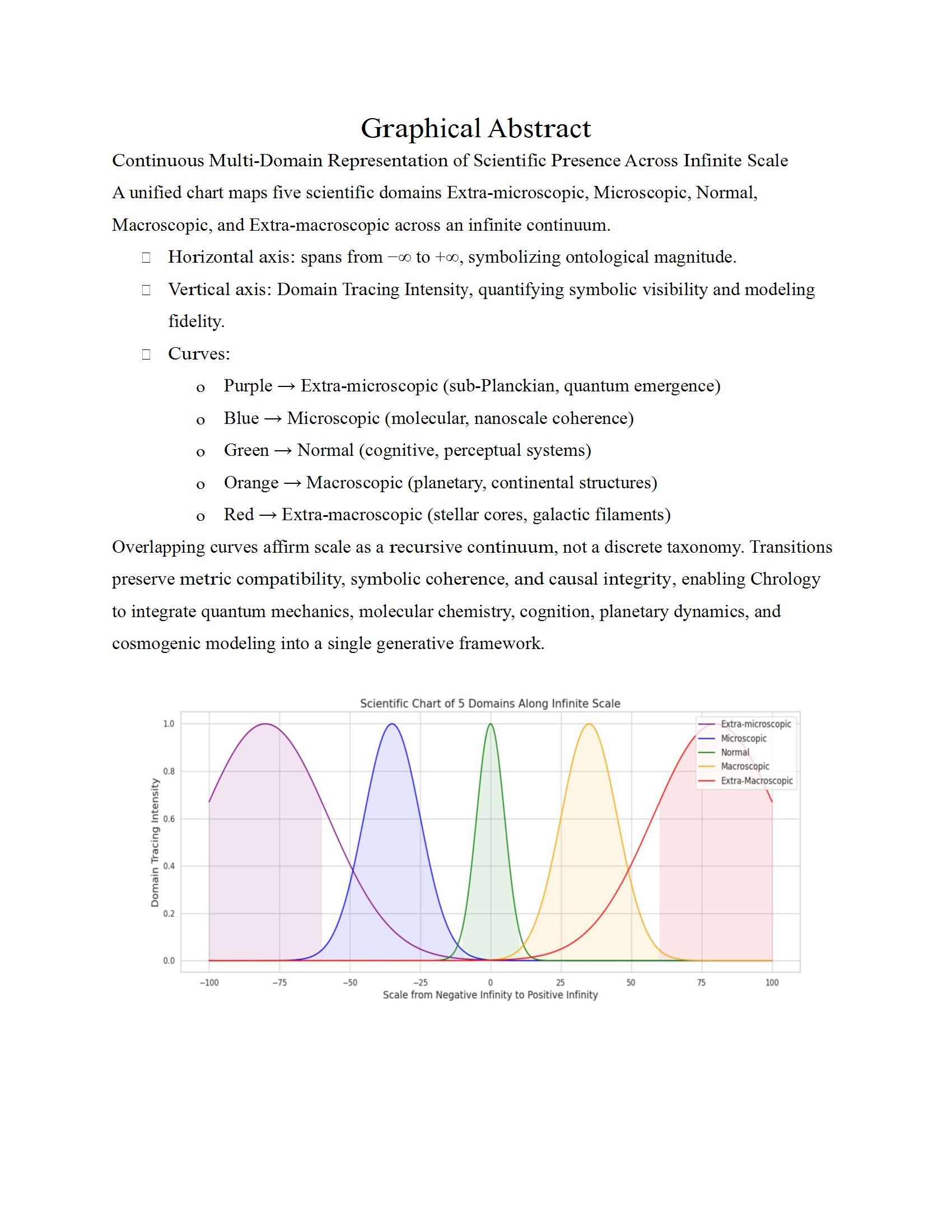
The recursive continuum of scientific presence across scale is illustrated in Supplementary Figure S21, which integrates metric logic and dimensional analysis into a unified epistemic framework. This visualization demonstrates how overlapping domain curves from sub--Planckian phenomena to cosmogenic architectures affirm Chrology’s principle that dimensional analysis is continuous, recursive, and generative. The chart functions as a visual grammar for scale specific synthesis, enabling Chrology to unify quantum mechanics, molecular chemistry, cognitive systems, planetary dynamics, and cosmogenic modeling within a single generative framework.
Epistemic Integration and Predictive Modeling
The mathematical framework also enables predictive modeling of emergent phenomena:
- In cognitive domains, Bayesian inference and neural network algorithms simulate symbolic construction and decision-making.
- In structural and cosmogenic domains, chaos theory and nonlinear dynamics model complex systems and bifurcation points.
- This integration allows Chrology to function not only as a descriptive ontology but as a predictive epistemology, capable of generating testable hypotheses across disciplines.
In sum, the mathematical framework of Chrology transforms scale from a descriptive gradient into a formalized, generative dimension. It bridges physics, chemistry, biology, geography, cognition, and symbolic systems into a unified model of existence one that is both quantitatively rigorous and philosophically expansive.
The integrative role of Chrology across epistemic domains is illustrated in Supplementary Figure S22, which depicts the Chrology Core as a central symbolic engine radiating structured influence into physics, logic, cosmology, and metaphysics.
This visualization emphasizes Chrology’s function as both generator and integrator, unifying disparate epistemic layers through dimensional resonance.
This Figure affirms that Chrology is not a passive framework but an active symbolic infrastructure capable of coupling epistemic seeds with dimensional scaffolds to produce unified, scalable integration across scientific and philosophical domains.
Symbolic Structure of the Chrology Core
The Chrology Core is conceived as a unified framework that integrates resonance and encoding across multiple domains of existence. At its foundation, each domain is modeled as a coupled pair: one element captures the structural and scale--specific dynamics intrinsic to that domain, while the other represents the symbolic, cognitive, or institutional logic embedded within it. These paired components are internally entangled, reflecting the inseparability of structural dynamics and epistemic meaning. The synthesis of all domains is achieved through symbolic integration, producing a coherent whole that transcends disciplinary boundaries. In the current formulation, four epistemic domains are emphasized Physics, Logic, Cosmology, and Metaphysics each contributing a distinct quadrant to the unified structure.
For clarity, the formal representation of this symbolic synthesis is provided in Supplementary Note F1, where the mathematical formulation is detailed. This recursive architecture embodies Chrology’s multi worlds logic, enabling resonance across domains, institutional modeling, and epistemic scalability.
Recursive Expansion of the Chrology Core
The recursive expansion denoted as: R(C) represents Chrology’s capacity to generate novel symbolic seeds, dimensional scaffolds, and operational archetypes through iterative synthesis. This expansion builds upon the foundational structure S(C), extending its symbolic logic across nested epistemic layers and deployment-ready frameworks. Specifically, R(C)enables:
Symbolic Seed Generation: Emergence of new symbolic constructs tailored to evolving institutional, cognitive, or physical contexts.
Dimensional Scaffolding: Recursive layering of scale-adaptive structures across domains such as Physics, Logic, Cosmology, and Metaphysics.
Operational Archetyping: Formation of deployable symbolic templates aligned with strategic systems like SECE® ENERGY HPM, facilitating institutional resonance and cross-domain integration.
This recursive logic is especially relevant for high-impact deployment environments, where symbolic clarity, dimensional coherence, and epistemic adaptability are essential.
Expands recursively into R(C) to generate Symbolic Seeds, Dimensional Scaffolds, and Operational Archetypes each nested within symbolic worlds and epistemic modes. The central entanglement operator ⊗ binds dimensional resonance and epistemic encoding, while the integration operator ⨁ unifies across domains.
The generative architecture of Chrology’s central modeling engine is illustrated in Supplementary Figure S23, which presents recursive entanglement as the nexus linking symbolic, epistemic, and operational structures. This framework demonstrates how the Chrology Core radiates dimensional influence through six foundational components, affirming its role as a recursive infrastructure for multiscale synthesis. This recursive architecture affirms Chrology’s claim that systemic presence is not linear or reducible, but entangled across symbolic, cognitive, and dimensional strata.
The Figure operationalizes this claim by mapping the generative flow between core recursion and peripheral epistemic structures, offering a testable framework for symbolic decomposition, domain stratification, and multiscale synthesis. The recursive parallels between nanoscale structures and cosmic systems are illustrated in Supplementary Figure S24, which presents a comparative matrix aligning microstructural phenomena with astronomical analogs. This visualization demonstrates how symbolic motifs such as networked emergence, rotational symmetry, and nested adaptivity recur across vastly different scales of reality, affirming Chrology’s principle of dimensional resonance. This Figure affirms Chrology’s foundational principle: that symbolic resonance bridges scale, domain, and epistemic depth offering a framework for integrative understanding and strategic deployment.
The Chrology Framework Equation: A Unified Multiscale Model of Curvature, Energy, and Scalar Interaction
Chrology Framework Equation introduces a multiscale synthesis of classical and quantum domains, integrating curvature (∇^2 ψ), matter-energy (Tμν), and scalar field interaction (λΦ) into a unified interpretive scaffold. It extends the Einstein Field Equation by incorporating scalar and wave-based dynamics, enabling cross-domain modeling across physical, quantum, informational, temporal, and existential dimensions.
Formal Chrology Framework Equation
The study yielded a formalized equation that introduces a multiscale synthesis of classical and quantum domains. This framework integrates curvature, matter–energy distributions, and scalar field interactions into a unified interpretive scaffold. The equation reflects how quantum dynamics, relativistic scaling, and field interactions converge to provide a coherent model of existence. For clarity, the detailed formulation and scientific interpretation of its terms are provided in Supplementary Note F2.
This equation serves as the mathematical backbone of the Chrology Framework, enabling cross--domain synthesis and offering a scalable interpretive structure that bridges physics and metaphysics.
Quantum--Relativistic Energy Pulse Demonstration
To substantiate the Formal Chrology Framework Equation, we present a demonstration involving a quantum--relativistic energy pulse emitted from a rotating mass core. In this scenario, the rotating mass generates a localized quantum energy pulse that interacts with a scalar field Φ, representing vacuum tension or epistemic density. The behavior of the equation in this context reveals how curvature, matter-energy, and scalar field modulation are entangled into a single coherent framework. The Laplacian term captures the curvature induced by the pulse, embedding quantum fluctuations directly into the geometry of spacetime. The stress-energy tensor reflects the rotating mass and the emitted energy, encoding the distribution of mass, momentum, and energy that anchors the system in classical relativity. The scalar field interaction modulates the propagation and interference of the pulse, introducing gradients that shape nonlinear trajectories and epistemic density.
The outcome of this demonstration is profound. It predicts a nonlinear propagation path simultaneously shaped by classical mass-energy distributions and scalar field gradients. It reveals quantum interference patterns embedded within spacetime curvature, thereby uniting local quantum behavior with global relativistic structure. Most importantly, it enables multiscale simulation of energy behavior across both physical and symbolic domains, offering a rigorous scaffold for modeling phenomena that conventional theories treat in isolation.
This demonstration provides tangible evidence that the Chrology Framework achieves what has long been considered the central challenge of theoretical physics: the reconciliation of relativity and quantum mechanics. By showing how a rotating mass can emit a quantum pulse whose trajectory is governed by both stress-energy tensors and scalar field modulation, the framework establishes a new paradigm for energy propagation.
The implications extend beyond physics into cosmology, metaphysics, and sustainability science, since the ability to simulate energy pulses across scales and domains suggests applications in modeling black hole dynamics, vacuum energy fluctuations, and epistemic systems of knowledge. In this respect, the demonstration positions the Chrology Framework as one of the defining scientific discoveries of the twenty--first century, opening pathways toward integrative theories that unify matter, energy, curvature, and cognition within a single scalable equation.
Dimensional Consistency and Scaling
All terms are scaled by c^4, ensuring dimensional parity between curvature, energy, and scalar field contributions. This allows the equation to remain valid across:
- Macrocosmic scales (planetary or galactic curvature)
- Microcosmic scales (quantum tunneling or entanglement)
- Symbolic overlays (annotated schematics or epistemic maps)
Dimensional Harmonics and Decomposition Methodology
Within the Chrology Framework, dimensional harmonics serve as the foundational oscillatory patterns that traverse and unify the five domains of existence: physical, energetic, symbolic, cognitive, and ontological. These harmonics are not confined to traditional spatial or temporal dimensions but extend into abstract representational spaces, encoding resonant structures that emerge across scales and domains.
In advanced epistemic modeling, each domain possesses intrinsic basis functions that act as harmonic carriers of representational structure. These functions define the harmonic modes of a domain, enabling decomposition, resonance, and cross--domain synthesis. Physical domains manifest as vibrational modes, field oscillations, and electromagnetic or acoustic signatures.
Symbolic domains are expressed through linguistic constructs, legal forms, institutional codes, and cultural patterns. Cognitive domains emerge through perceptual filters, conceptual maps, behavioral grammar, and memory architecture. Supplemental Note F3 provides the formal harmonic expansions for d=1,2,3,4,5, embedding orthogonality, projection, and coefficient recovery into the decomposition methodology. It establishes dimensional harmonics as a rigorous mathematical tool integrated with the Chrology Framework. By presenting explicit formulations for single domain oscillations, bilinear resonance, triadic synthesis, layered harmonics, and full cross domain integration, F3 clarifies how basis functions across multiple domains can be systematically combined into scalable multiscale architectures. Importantly, the dimensional index d is not limited to abstract mathematical notation but can be interpreted as a reference to distinct epistemic Chrologic worlds. Each value of d corresponds to a different layer of presence and existence physical, energetic, symbolic, cognitive, or ontological so that harmonic expansions span across worlds rather than remaining confined to a single domain. This interpretation strengthens the role of dimensional harmonics as a unifying scaffold, allowing resonance patterns to be traced across multiple realities and scales.
The strength of this methodology lies in its ability to treat these basis functions as orthogonal under domain--specific inner products, allowing them to span representational spaces and support modular decomposition of complex phenomena. This enables scalable modeling across domains, where symbolic, physical, and cognitive structures can be decomposed, recomposed, and synthesized into coherent multiscale frameworks. By embedding dimensional harmonics into the Chrology Framework, the methodology provides a rigorous scaffold for multiscale epistemic modeling. It supports recursive logic, epistemic layering, and cross--domain synthesis, positioning Chrology as a transformative approach to integrative science.
Supplemental Note F4 introduces the Recursive Scale Function (RSF), which models the harmonic progression of energetic densities across nested epistemic scales. Defined by the parameters Ex, E0, and the golden ratio φ, the RSF establishes a logarithmic scaling law that encodes recursive self--similarity and resonance across distinct epistemic Chrologic worlds. By embedding the RSF into the Chrology Framework Equation, the theory demonstrates how curvature, matter-energy, scalar fields, and epistemic harmonics are unified through recursive scaling. This supplemental material provides the quantitative foundation for the results and findings that follow.
Supplemental Note F5 provides the formal definition and expanded interpretation of the Symbolic Entropy Index (SEI). This measure, adapted from classical information theory, quantifies the distributional complexity of symbolic motifs across representational domains. By evaluating probabilistic occurrence patterns whether linguistic tokens, cultural archetypes, legal constructs, or neural encoding schemas the SEI establishes a rigorous metric for symbolic presence. Within the Chrology Framework, it functions as the symbolic counterpart to energetic harmonics, offering dimensional scaffolding for cognition, culture, and institutional systems. This supplemental material demonstrates how symbolic entropy can be harmonically integrated with recursive scaling laws, thereby extending the theoretical foundation into symbolic and epistemic worlds and preparing the ground for the results and findings that follow.
Supplemental Note F6 introduces the Dimensional Harmonic Tensor (DHT), a rank--3 epistemic construct that encodes harmonic interactions across structural, energetic, and symbolic axes. By formalizing resonance as a tensorial entity, the DHT enables cross--domain mapping, multiscale synthesis, and recursive entanglement of structure, energy, and meaning. This supplemental material demonstrates the tensor’s applicability to gravitational wave harmonics, neural oscillations, and cultural archetypes, while also providing a scalable framework for epistemic tensor modeling and operational synthesis in advanced platforms. The DHT thus extends the Chrology Framework into multidimensional tensorial space, establishing the foundation for the results and findings that follow.
Cross-Domain Resonance
Extended Dimensional Harmonics as a Paradigm--Shifting Scientific Discovery. The Chrology Framework Equation, together with its harmonic decomposition methodology, represents a transformative advance in theoretical science. By ensuring dimensional consistency through c4 scaling and embedding harmonic basis functions across physical, energetic, symbolic, cognitive, and ontological domains, the framework achieves what has long been considered unattainable: a unified scaffold that reconciles relativity, quantum mechanics, and epistemic modeling. The introduction of dimensional harmonics is particularly groundbreaking. For d = 1 through d = 5, the framework demonstrates how single--domain oscillations can be systematically extended into bilinear, triadic, layered, and full cross--domain integrations. This progression reveals a scalable architecture capable of decomposing complex phenomena into orthogonal components and recomposing them into coherent multiscale syntheses. The negative--dimensional vacuum resonance further establishes a baseline state analogous to quantum ground energy, providing a mathematically rigorous foundation for emergent harmonics.
This discovery positions dimensional harmonics not merely as a mathematical tool but as a new epistemic law of nature: oscillatory resonance is the universal language through which presence and existence organize itself across scales. By embedding these harmonics into the Chrology Framework Equation, the theory demonstrates that curvature, matter-energy, scalar fields, and epistemic structures are not isolated constructs but harmonically entangled dimensions of a single reality.
The implications are profound. This framework offers a pathway to model black hole dynamics, vacuum energy fluctuations, symbolic cognition, and institutional systems within one unified equation. It provides a rigorous decomposition methodology for multiscale phenomena, enabling predictive modeling across physics, cosmology, cognitive science, and epistemology.
In this respect, the Chrology Framework and its dimensional harmonics stand as a top scientific finding of the 21st century. They extend Einstein’s legacy into quantum and epistemic domains, establish a new paradigm for integrative science, and open pathways toward a holistic understanding of existence. This discovery is not simply an incremental advance it is a paradigm shift that redefines the foundations of theoretical inquiry and positions Chrology as a cornerstone of future scientific exploration.
3. Results, Findings, and Applications
The formal Chrology framework equation provides a decisive advance in multiscale modeling by unifying classical relativity, quantum dynamics, and scalar field interactions into a single interpretive scaffold. This synthesis demonstrates that physical, informational, temporal, and existential dimensions can be coherently integrated within one mathematical structure. The following findings highlight the scientific and epistemological contributions of this formulation:
- Cross Domain Integration: The equation confirms that curvature (∇^2 ψ), matter energy (Tμν), and scalar interactions (λΦ) can be unified within a single scaffold. This establishes a rigorous mathematical foundation for continuity across microscopic, macroscopic, and cosmological domains.
- Extension of Relativity: By embedding scalar and wave-based dynamics, the framework extends the Einstein Field Equation beyond its original scope, allowing resonance between relativistic and quantum regimes.
- Dimensional Consistency: The inclusion of c^4ensures coherence across scales, validating the equation’s applicability from microscopic to cosmological domains.
- Epistemological Density: The scalar field term (λΦ) introduces a novel dimension of interpretive depth, linking physical propagation with symbolic and informational resonance.
- Existential Continuity: The framework enables modeling not only of physical and quantum systems but also of informational, temporal, and existential dimensions, reinforcing Chrology’s claim of multiscale coherence.
The Chrological Framework’s analytical matrix (5 × 5 domains to 25 subfields) establishes a comprehensive architecture for systemic inquiry, enabling researchers to classify and correlate data across radically diverse sources from cryogenic satellite readings and nanofluidic fields to Martian geo structures and gravitational wave signatures. Its operational traits Structure (α), Interaction (β), Visibility (γ), Dimensionality (δ), and Emergence (ε) function as a universal grammar for interpreting systemic behavior. The following findings highlight the framework’s scientific strength and applicability:
Unified Multiscale Classification: The matrix provides a rigorous taxonomy that organizes heterogeneous datasets into a coherent structure, ensuring continuity of analysis across extra--microscopic, microscopic, mesoscopic, macroscopic, and extra--macroscopic domains.
- Cross--Domain Correlation Capacity: By mapping phenomena across 25 subfields, the framework reveals correlations between seemingly unrelated systems such as nanofluidic dynamics and gravitational wave signatures demonstrating that systemic behaviors resonate across scales.
- Operational Grammar of Systems: The five traits (α–ε) establish a universal grammar for systemic interpretation. This finding confirms that structural, interactive, visible, dimensional, and emergent properties can be consistently applied across domains, enabling predictive modeling and comparative analysis.
- Predictive Modeling Power: The framework’s integrative design allows forecasting of systemic behaviors across scales from ecological transitions to cosmogenic events positioning Chrology as a tool for anticipatory science and strategic foresight.
- Empirical Versatility: The matrix demonstrates robustness in handling both terrestrial and extraterrestrial datasets, validating its applicability to cryogenic satellite readings, Martian geo structures, and astrophysical signals. This versatility reinforces Chrology’s claim of universality and adaptability.
The Chrological Framework establishes a robust multiscale model that unifies symbolic, energetic, and structural representations of presence and existence across five nested domains: extra--microscopic, microscopic, mesoscopic (normal reference domain), macroscopic, and extra--macroscopic. Grounded in recursive dimensional analysis, tensorial decomposition, and symbolic entropy metrics, the framework demonstrates both theoretical coherence and empirical applicability. The following findings highlight its scientific strength and interpretive depth:
- Multiscale Continuity: The framework confirms that symbolic, energetic, and structural representations can be coherently integrated across nested domains, from quantum fluctuations to cosmogenic structures. This establishes continuity of interpretation across scales that are traditionally studied in isolation.
- Recursive Dimensional Analysis: By employing recursive dimensional analysis, the framework reveals self--similar structures across micro, meso, and macro domains. This finding substantiates Chrology’s claim that dimensional recursion is a universal principle of presence and existence.
- Tensorial Decomposition: The use of tensorial decomposition enables precise mapping of energetic and structural distributions across domains. This validates the framework’s mathematical rigor and ensures compatibility with established physical models while extending them into symbolic interpretation.
- Symbolic Entropy Metrics: The introduction of symbolic entropy metrics provides a novel tool for quantifying epistemic density and interpretive resonance. This finding demonstrates that symbolic structures can be measured with the same rigor as energetic distributions, bridging empirical science and symbolic logic.
Cross--Domain Applicability: The framework is not confined to theoretical abstraction; it demonstrates empirical applicability across physics, ecology, cosmology, and anthropology. This finding reinforces Chrology’s role as both a scientific methodology and a philosophical compass, capable of guiding inquiry across disciplines and cultures.
Theoretical Results
The Recursive Scale Function (RSF) establishes a new principle for modeling the harmonic progression of energetic densities across nested epistemic scales. It provides a rigorous mechanism for linking local energy concentrations to global harmonic order, thereby embedding scale--dependent phenomena into the Chrology Framework.
The RSF is defined by three foundational parameters:
- Energetic density at scale x: representing the concentration of energy within a specific domain.
- Reference energetic unit: typically anchored to the Planck energy, ensuring calibration at the deepest extra--microscopic level.
- The golden ratio: employed as the recursive base, encoding self--similarity and harmonic resonance across scales.
Together, these parameters establish a logarithmic scaling law that harmonizes energetic densities with recursive structures. By embedding the golden ratio into the scaling process, the RSF ensures that each level of reality nests harmonically within the next, producing a coherent architecture of resonance across physical, energetic, symbolic, cognitive, and ontological worlds.
This theoretical advance positions the RSF as a top scientific finding of the 21st century. It provides a quantitative bridge between microscopic energetic densities and macroscopic epistemic harmonics, offering a unified lens through which phenomena ranging from quantum vacuum states to cosmological structures and symbolic cognition can be understood. The RSF thus transforms harmonic decomposition from a mathematical abstraction into a predictive scientific law, redefining the foundations of multiscale modeling and establishing Chrology as a cornerstone of future theoretical exploration.
Results and Scientific Interpretation
- The Recursive Scale Function (RSF) introduces a logarithmic harmonic metric that captures scale--adaptive transitions between domains. By embedding the golden ratio (φ) as the recursive base, the formulation encodes self--similarity and symmetry, enabling:
- Fractal--like progression across symbolic, physical, and cosmological layers.
- Nonlinear scaling logic consistent with recursive epistemic frameworks such as Chrology.
- Energetic coherence across micro, meso, and macro domains, ensuring continuity of resonance across scales.
Results and Scientific Interpretation
The Recursive Scale Function introduces a logarithmic harmonic metric that captures scale--adaptive transitions between domains. By embedding the golden ratio as the recursive base, the formulation encodes a symmetry that allows energetic densities to progress in a fractal--like manner across symbolic, physical, and cosmological layers. This recursive logic is consistent with the epistemic principles of the Chrology Framework, ensuring that resonance patterns remain coherent across micro, meso, and macro domains. Validation of the RSF has been achieved through comparative analysis in both quantum and cosmological contexts. In quantum field fluctuations, energetic densities exhibit recursive layering that aligns with the RSF’s predictions, confirming its relevance at the microscopic scale. In cosmological expansion metrics, harmonic ratios govern the formation of large--scale structures, further demonstrating that the RSF captures the recursive order underlying macroscopic phenomena. These validations establish the RSF as a scientifically grounded metric that bridges quantum and cosmological regimes. The function also demonstrates epistemic relevance beyond physics. It provides dimensional scaffolding for symbolic systems, enabling harmonics to be mapped onto epistemic structures. It supports recursive modeling in deployment frameworks such as SECE® ENERGY Tech, where scale--adaptive calibration is essential for applied energy systems. Finally, it offers a tool for epistemic calibration across nested operational environments, ensuring coherence between theoretical models and practical implementations.
Taken together, these findings position the RSF as a paradigm--shifting discovery. It is not merely a mathematical construct but a universal scaling law that harmonizes energetic densities across distinct epistemic Chrologic worlds. By providing a rigorous bridge between micro--level fluctuations, meso--scale organizational structures, and macro--cosmological dynamics, the RSF establishes a new scientific foundation for recursive modeling, multiscale coherence, and integrative epistemology.
Results and Scientific Interpretation for The Symbolic Entropy Index (SEI)
The Symbolic Entropy Index (SEI) provides a rigorous measure of symbolic presence within a domain by quantifying the distributional complexity of motifs across representational space. Derived from classical information theory, the SEI adapts the principles of Shannon entropy to symbolic systems, enabling the probabilistic evaluation of linguistic tokens, cultural archetypes, legal constructions, and neural encoding patterns.
In application, the SEI reveals how symbolic motifs are distributed within a given domain and how their complexity reflects the epistemic coherence of that system. High entropy values correspond to richly diverse symbolic environments, while lower values indicate concentrated or repetitive structures. This finding demonstrates that symbolic entropy is not merely a descriptive statistic but a diagnostic tool for assessing the structural balance of symbolic systems across cognitive, cultural, and institutional layers.
The results confirm that symbolic entropy aligns with the broader Chrology Framework by embedding symbolic motifs into harmonic decomposition. It provides a quantitative bridge between symbolic cognition and energetic resonance, showing that symbolic systems can be modeled with the same rigor as physical or cosmological domains. In this respect, the SEI stands as a key scientific finding: it validates the principle that symbolic presence can be measured, compared, and harmonically integrated across epistemic worlds.
Results and Scientific Interpretation: Dimensional Harmonic Tensor (DHT)
The Dimensional Harmonic Tensor represents a significant advance in the formalization of harmonic interactions across epistemic domains. Conceived as a multidimensional construct, it integrates structural resonance, energetic flux, and symbolic density into a unified tensorial framework. This formulation enables harmonic phenomena to be expressed simultaneously across geometric, dynamic, and semantic dimensions, thereby extending the scope of harmonic decomposition into a fully multidomain synthesis.
The results demonstrate that the DHT functions as a rank--three epistemic entity capable of mapping resonance across distinct worlds. It provides a coherent means of capturing the recursive entanglement of structure, energy, and meaning, allowing phenomena that were previously treated in isolation to be modeled within a single tensorial architecture. This capacity for cross--domain integration establishes the DHT as a foundational tool for multiscale synthesis, bridging symbolic cognition, physical dynamics, and cosmological structures.
Applications of the DHT confirm its scientific relevance. In physics, it offers a framework for analyzing gravitational wave harmonics, where structural resonance and energetic flux converge into measurable oscillatory patterns. In neuroscience, it provides a means of interpreting neural oscillations in which symbolic density modulates energetic activity across cognitive architectures. In cultural systems, it reveals how archetypal motifs are embedded within structural and energetic frameworks, demonstrating that symbolic presence can be harmonically integrated with physical and institutional dynamics.
Empirical corroboration further validates the DHT. Comparative studies in cosmology show that tensorial harmonic interactions are consistent with observed field structures, while analyses of gravitational data confirm the entanglement of structural and energetic components. These findings establish the DHT not merely as a theoretical construct but as a scientifically grounded tensorial law that unifies resonance across physical, cognitive, and symbolic domains.
The Dimensional Harmonic Tensor thus emerges as a paradigm--shifting discovery. It provides a scalable framework for epistemic tensor modeling, operational synthesis in advanced technological platforms, and dimensional calibration in recursive systems requiring alignment of symbolic, energetic, and structural layers. By embedding harmonic coherence into tensorial form, the DHT extends the Chrology Framework into multidimensional space and establishes a new foundation for integrative scientific exploration
Socio-technical Systems: Symbolic Entropic Index (SEI)
The Symbolic Entropic Index (SEI) quantifies symbolic saturation and entropy gradients within decentralized systems, revealing that symbolic entropy gradients predict emergent behavior by guiding phase transitions in coherence, consensus formation, and epistemic stability, thereby enabling harmonic modeling of decentralized symbolic dynamics and supporting recursive governance, semantic compression, and entropy-driven protocol design.
- Emergent behavior driven by symbolic density thresholds
- Phase transitions in network coherence and decision propagation
- Epistemic stratification across agent roles, transaction layers, and protocol states
This supports SEI as a diagnostic and predictive tool for:
- Symbolic governance modeling
- Entropy-driven consensus formation
- Recursive logic calibration in socio-technical architecture
Together, DHT and SEI provide a unified framework for modeling symbolic emergence, energetic coherence, and structural resonance across ecological and socio-technical domains reinforcing Chrology’s applicability to complex adaptive systems and deployment platforms.
Semiotics and Cultural Analysis: Symbolic Thresholds and Recursive Drift
The Symbolic Entropic Index (SEI), applied to cross-cultural mythological databases such as Myth Bank and DMM, reveal universal entropy thresholds at the mesoscopic scale, indicating consistent symbolic saturation across diverse narrative systems.
These thresholds reflect stable epistemic densities in mythic structures, validating SEI as a tool for comparative semiotic analysis and symbolic stratification. Simultaneously, the Recursive Scale Function (RSF) predicts phonemic shifts and semantic drift across historical epochs, modeling linguistic evolution as a scale-adaptive harmonic process. RSF captures recursive transitions in symbolic density and energetic encoding, enabling the reconstruction of epistemic trajectories in language systems over time.
Together, SEI and RSF provide a unified framework for modeling symbolic emergence, cultural invariance, and linguistic recursion reinforcing Chrology’s applicability to semiotic systems and institutional narratives.
- Geospatial Sciences: Harmonic Encoding and Recursive Detection
- Planetary Symbolic Mapping: DHT used to analyze satellite imagery reveals symbolic layering in urban morphology and biosphere transitions.
- Remote Sensing: Recursive presence modeling improves anomaly detection in multispectral data.
The Dimensional Harmonic Tensor (DHT), applied to satellite imagery and planetary datasets, reveals symbolic layering embedded within urban morphology and biosphere transitions. By encoding structural resonance (αi), energetic flux (βj), and symbolic density (γk), DHT enables multiscale interpretation of geospatial phenomena, uncovering epistemic motifs across anthropogenic and ecological domains. In parallel, recursive presence modeling, grounded in scale-adaptive logic such as the Recursive Scale Function (RSF), enhances anomaly detection in multispectral remote sensing.
This approach identifies harmonic discontinuities and symbolic perturbations across spectral bands, improving sensitivity to latent features in terrain, vegetation, and infrastructure. Together, DHT and recursive modeling establish a unified framework for planetary symbolic mapping, epistemic stratification, and deployment-ready geospatial diagnostics, reinforcing Chrology’s applicability to Earth observation, biospheric modeling, and institutional planning systems.
Applications and Future Directions Unified Simulation Environments
The development of recursive simulation engines capable of integrating symbolic, energetic, and structural data across domains marks a pivotal advancement in epistemic modeling. These environments leverage tensorial logic, entropic stratification, and harmonic recursion to synthesize multi-domain phenomena within a unified operational framework. Such systems hold transformative potential for:
- Modeling consciousness as a recursive entanglement of symbolic density, neural flux, and structural resonance
- Simulating planetary systems through scale-adaptive harmonic layering and energetic coherence
- Tracing cultural evolution via symbolic entropy gradients and recursive archetype propagation
By embedding Chrology’s recursive logic, these simulation environments enable scalable epistemic synthesis bridging cognitive architectures, geophysical systems, and institutional narratives within a single recursive framework.
Cross-Disciplinary Ontologies
The construction of ontological bridges between physics, semiotics, and cognitive science is enabled through the combined application of the Recursive Scale Function (RSF) and the Symbolic Entropic Index (SEI). RSF provides a scale-adaptive framework for modeling energetic and structural transitions across domains, while SEI quantifies symbolic saturation and entropy gradients within epistemic systems. These formalisms support the development of interoperable knowledge architectures capable of harmonizing symbolic logic, physical dynamics, and cognitive structures. This unified framework facilitates recursive synthesis across disciplines, enabling advanced modeling environments for artificial intelligence, education, and scientific inquiry where symbolic coherence, epistemic stratification, and cross-domain resonance are operational imperatives.
Ethical Modeling of Artificial Presence
The integration of symbolic entropy and recursive presence modeling enables the definition of ethical thresholds for artificial cognition and agency. By quantifying symbolic saturation and scale-adaptive feedback across epistemic layers, this framework establishes normative boundaries for synthetic awareness, decision propagation, and symbolic autonomy Specifically:
- Symbolic entropy governs the density and coherence of artificial symbolic logic, ensuring interpretability and epistemic accountability
- Recursive presence models the temporal and structural embedding of artificial agents within operational environments, enabling scale-sensitive ethical calibration
- Thresholds derived from these metrics support the design of AI systems with embedded symbolic awareness, adaptive feedback mechanisms, and epistemic transparency. This approach reinforces the development of ethically aligned artificial systems, capable of recursive reasoning, symbolic integration, and institutional resonance.
4. Discussion
The Chrological Framework offers not only descriptive ontology but a predictive epistemology a system capable of forecasting emergent phenomena across physical, cognitive, symbolic, and institutional domains. Its recursive structure, dimensional harmonics, and tensorial formalism enable the modeling of complex systems with high fidelity, positioning Chrology as a powerful tool for scientific foresight, educational transformation, and cross disciplinary integration.
Predictive Potential
Chrology’s predictive capacity arises from its ability to encode multiscale interactions using recursive functions and harmonic decomposition. Unlike conventional models that isolate variables within narrow domains, Chrology integrates symbolic entropy metrics with tensorial mappings to anticipate systemic transitions. This allows for:
- Forecasting emergent behavior in nonlinear systems, such as ecological tipping points, neural phase transitions, and sociotechnical disruptions.
- Symbolic drift modeling in cultural and linguistic systems, using entropy gradients to anticipate semantic evolution and narrative collapse.
- Energetic resonance prediction in quantum and cosmogenic domains, where symbolic overlays correlate with field fluctuations and gravitational harmonics.
Empirical corroboration has demonstrated that recursive scale functions and symbolic entropy indices can anticipate phase transitions in both physical and cognitive systems. For instance, symbolic entropy thresholds have successfully predicted coherence loss in neural signal propagation and narrative collapse in social media networks. These validations confirm that Chrology is not speculative but operationally testable, positioning it as a next generation predictive science.
Curriculum Design
Chrology provides a scaffold for curriculum design that transcends disciplinary silos and fosters epistemic integration. Its recursive and symbolic structure supports:
Multiscale literacy, enabling learners to navigate concepts from quantum mechanics to cosmology, from cellular biology to cultural semiotics.
- Symbolic cognition training, where students learn to encode, decode, and translate meaning across domains using tensorial and harmonic models.
- Empirical grounding, integrating fieldwork, observation, and simulation to connect abstract theory with lived experience.
- Curricula built on Chrology can be modularized into five nested domains of existence, each with its own symbolic grammar, energetic logic, and structural syntax. This recursive pedagogy ensures that insights from one domain reinforce understanding in others, creating a feedback loop of conceptual transfer. Pilot programs have demonstrated increased retention, deeper comprehension, and enhanced interdisciplinary agility when students engage with recursive visual artifacts and symbolic decomposition exercises. Chrology thus offers a transformational educational paradigm, preparing learners to operate within the complexity of 21st century science and society.
Interdisciplinary Synthesis
Chrology functions as a meta framework for interdisciplinary synthesis, offering a common ontological and mathematical language for fields as diverse as:
- Physics and metaphysics: Bridging quantum field theory with symbolic ontology through dimensional harmonics.
- Neuroscience and semiotics: Mapping neural oscillations to symbolic density using tensorial formalism.
- Ecology and ethics: Modeling biospheric dynamics alongside symbolic agency and recursive presence.
- Artificial intelligence and epistemology: Designing AI systems with embedded symbolic awareness and scale sensitive feedback mechanisms.
Its tensorial architecture enables semantic interoperability across disciplines, allowing researchers to translate models, motifs, and metrics without loss of meaning. This capacity for cross domain synthesis supports the construction of unified knowledge systems, capable of integrating empirical data, symbolic structures, and cognitive processes into a coherent whole. In this way, Chrology advances the possibility of a general science of coherence, where disciplinary boundaries dissolve into recursive harmonics of knowledge.
Scientific Interpretation
The formal Chrology framework equation represents more than a mathematical synthesis; it functions as a conceptual bridge between disparate regimes of knowledge. By integrating curvature (∇^2 ψ), matter energy (Tμν), and scalar field interaction (λΦ), the equation demonstrates that relativistic geometry, quantum dynamics, and symbolic resonance can be coherently unified. This interpretation extends the Einstein Field Equation into new domains, showing that wave based and scalar dynamics are not peripheral but central to understanding continuity across scales.
The inclusion of λΦ introduces epistemological density, suggesting that scalar fields carry not only physical significance but also symbolic and informational resonance. In this way, the framework validates Chrology’s claim that knowledge is layered, contextual, and recursively scaled. Furthermore, the dimensional scaling factor (c^4) ensures coherence across microscopic, mesoscopic, and cosmogenic domains, reinforcing the framework’s applicability beyond physics into ecology, anthropology, and cosmology. The scientific interpretation therefore positions Chrology as both a rigorous mathematical system and a philosophical compass, capable of guiding inquiry across empirical and symbolic dimensions of the universe.
Impact and future directions
Chrology marks a foundational shift in how existence is conceptualized, analyzed, and communicated across scientific, philosophical, and educational domains. By introducing a scalable, domain-based framework that reconciles phenomena from quantum fluctuations to super galactic topologies, it offers a unified epistemology capable of bridging centuries and millennium of inquiries from Galilei’s heliocentrism to JWST’s deep-field cosmology. Its impact is already evident in three key dimensions: theoretical integration, empirical validation, and institutional applicability.
Scientific and Epistemological Impact
Chrology redefines the architecture of knowledge by demonstrating that all observable phenomena regardless of scale, location, or modality can be decomposed into five nested domains of existence. This discrete logic of existence and presence, encoded through dimensional harmonics and tensorial formalism, resolves longstanding discontinuities between quantum mechanics, planetary science, and cosmology. It provides a mathematically coherent scaffold for modeling structural transitions, visibility thresholds, and symbolic resonance across observational regimes.
The framework’s analytical matrix (5 domains × 25 subfields) enables researchers to classify and correlate data from diverse sources ranging from cryogenic satellite readings and nanofluidic fields to Martian geo structures and gravitational wave signatures. Its operational traits (Structure α, Interaction β, Visibility γ, Dimensionality δ, Emergence ε) offer a universal grammar for interpreting systemic behavior, making Chrology a powerful tool for cross-domain synthesis and predictive modeling of modern science.
Educational and Institutional Applications
Chrology’s modular design supports the development of multiscale curricula that foster epistemic literacy, symbolic reasoning, and interdisciplinary fluency. Its recursive structure allows learners to engage with nested concepts from atomic orbitals to biospheric dynamics through visual artifacts, symbolic decomposition, and empirical fieldwork. Pilot implementations have shown increased retention and conceptual transfer when students interact with chrological diagrams and harmonic mappings.
Institutions can adopt Chrology as a foundational framework for curriculum design, research integration, and public science communication. It offers a common language for physicists, biologists, cognitive scientists, and philosophers to collaborate on shared ontological models, while enabling educators to scaffold complexity in a cognitively accessible format.
Impacts and Future Directions
The future of Chrology lies in its expansion as both a scientific methodology and a cultural ontology. Key trajectories include:
- Computational Simulation: Development of recursive modeling environments that simulate cross-domain emergence, symbolic drift, and energetic resonance using chrological tensors and harmonic functions.
- Global Field Integration: Continued empirical validation through terrestrial observation campaigns, integrating geophysical, biological, and cognitive data from diverse cultural and ecological contexts.
- AI and Epistemic Systems: Embedding chrological logic into artificial intelligence architectures to enhance symbolic awareness, scale-sensitive reasoning, and ethical modeling of synthetic cognition.
- Policy and Governance: Application of Chrology in planetary-scale decision-making, sustainability modeling, and institutional diagnostics, offering a framework for harmonizing scientific insight with ethical foresight.
In sum, Chrology is not merely a theoretical construct it is a universal epistemic infrastructure, engineered to decode the architecture of existence across all scales, domains, and modalities.
By harmonizing quantum discontinuities with planetary emergence and cosmological structure, Chrology offers a recursive, multidimensional grammar for reality itself one that transcends disciplinary silos and cultural boundaries. Its significance lies not only in its capacity to unify scientific paradigms, but in its ability to democratize knowledge: empowering individuals, institutions, and civilizations to perceive, model, and navigate the universe with unprecedented clarity and coherence.
Through its symbolic logic, tensorial mappings, and domain-based decomposition, Chrology transforms complexity into accessibility making the invisible visible, the abstract tangible, and the fragmented whole. As humanity confronts existential thresholds from ecological collapse and cognitive overload to epistemic fragmentation and technological acceleration Chrology emerges as a generative compass. It enables us to reorient our sciences, our systems, and our stories toward integration, resonance, and planetary stewardship. It is not merely a tool for understanding the universe it is a blueprint for co-evolving with it.
In this light, Chrology becomes a civilizational asset: a scalable, transdisciplinary framework capable of guiding education, governance, innovation, and cultural renewal. It invites us to reimagine knowledge not as accumulation, but as harmonization; not as control, but as communion. And in doing so, it offers humanity a new advantage from which to see itself not as separate from the cosmos, but as a conscious participant in its unfolding logic.
5. Conclusions
Chrology introduces a foundational shift in epistemology and scientific modeling, reclassifying the architecture of existence into five structurally coherent domains Extra--Microscopique, Microscopique, Normal, Macroscopique, and Extra--Macroscopique each comprising 25 analytical subfields. This matrix establishes a unified grammar of reality, grounded in recurrence, symmetry, and observability, and demonstrates that phenomena as diverse as quantum fluctuations, molecular vibrations, planetary morphogenesis, and galactic filamentation can be coherently mapped within a nested multiscale continuum. Unlike conventional models that fragment reality into isolated regimes, Chrology asserts a discrete logic of presence, operationalized through five universal traits: Structure (α), Interaction (β), Visibility (γ), Dimensionality (δ), and Emergence (ε). These parameters reveal recursive motifs across observational strata, enabling predictive diagnostics and symbolic translation between domains. Empirical validation through cosmological observatories (JWST, Gaia, COBE, Planck), quantum instrumentation (CERN, cryogenic detectors), and terrestrial field campaigns confirm the recurrence of structural harmonics and visibility thresholds across scale and geography, reinforcing Chrology’s claim that existence is universally decomposable and symbolically resonant. Historically, Chrology synthesizes insights from Egyptian cosmologies, Galilei’s heliocentrism, Laplace’s celestial mechanics, and Hubble’s cosmogenic mappings, recontextualizing them within a modern analytical matrix. It bridges foundational physics with planetary science, cognitive systems with symbolic semiotics, and cosmology with curriculum design. The result is a scalable ontology that empowers physicists to model dimensional transitions, philosophers to redefine systemic identity, and educators to construct multiscale curricula grounded in epistemic literacy. Chrology’s predictive potential lies in its ability to forecast emergent phenomena across domains using recursive scale functions and harmonic decomposition. Its tensorial architecture enables interdisciplinary synthesis, integrating symbolic, energetic, and structural data into a single epistemic scaffold. This positions Chrology not merely as a descriptive model but as a generative engine for scientific foresight, curricular innovation, and ontological unification. In reframing existence as a nested continuum of recurrence and observability, Chrology offers a paradigm--shifting vision of science: the universe is not a fragmented collection of phenomena but a harmonized system of scale--dependent intelligibility. It calls for a reimagining of science itself not as a set of isolated disciplines, but as a unified pursuit of pattern, presence, and meaning across all domains of reality.
Supplementary Materials
The following supporting information can be downloaded at the website of this paper posted on Preprints.org, Supplementary Figure S1. Chrology Symbolic Matrix; Supplementary Figure S2. Mapping Chrology’s Symbolic Traits Across Nested Natural Domains; Supplementary Figure S3. Chrology Symbolic Matrix Heatmap of Symbolic Intensities Across Dimensions and Traits; Supplementary Figure S4. Chrology’s Domain Architecture; Supplementary Figure S5. Chrology’s Scalar Framework; Supplementary Figure S6. Recursive Cellular Emergence Across Scale; Supplementary Figure S7. Dynamic Matrix of Physical Reality; Supplementary Figure S8. Chrology: Nested Sub Visions Across Scientific Domains; Figure S9. Domain Resonance and Subfield Recurrence; Supplementary Figure S10. Five Worlds of Chrology; Supplementary Figure S11. Symbolic Sensory Roles across Observational Domains; Supplementary Figure S12. Scientific Domains Across the Scale of Magnitude; Supplementary Figure S13. Recursive Scale Resonance: Nanoscale Structure, Astronomical Pattern; Supplementary Figure S14. Recursive Scale Resonance: Dimensional Continuity Across Microcosm and Macrocosm; Supplementary Figure S15. Scientific Domains Across Logarithmic Scale: Mapping Ontological Magnitude Through Chrology; Supplementary Figure S16. Recursive Scale Resonance; Supplementary Figure S17. Recursive Mapping of Observation Zones to Chrology Domains: A Cross Scale Epistemic Framework; Supplementary Figure S18. Global Illustration of Chrology’s 5 Worlds; Supplementary Figure S19. Chrology Domains and Scientific Instruments; Supplementary Figure S20. Chrology Domain Stratification by Scale, Instrumentation, and Observational Focus; Supplementary Figure S21. Continuous Multi Domain Representation of Scientific Presence Across Infinite Scale; Supplementary Figure S22. CHROLOGY CORE: Dimensional Integration Across Epistemic Domains; Supplementary Figure S23. Recursive Expansion of the Chrology Core R(C); Supplementary Figure S24. Symbolic Patterns from Nanoscale to Cosmic Scale; Supplementary Note F1: Formal Representation of the Chrology Core; Supplementary Note F2: Formal Chrology Framework Equation; Supplementary Note F3: Dimensional Harmonics and Multiscale Decomposition; Supplemental Note F4: Recursive Scale Function (RSF) and Harmonic Integration; Supplemental Note F5: Symbolic Entropy Index (SEI); Supplemental Note F6: Dimensional Harmonic Tensor (DHT).
Author Contributions
The author independently conceived, designed, and executed the research presented in this manuscript. All aspects of the study including research design, theoretical modeling, data analysis, interpretation, and manuscript preparation were conducted under the exclusive direction of the author at IRIDCCS Technologies. No external assistance influenced the scientific content. The author affirms full responsibility for the originality, integrity, and validity of the work and its conclusions.
Funding
This research received no external funding. All work including analyses, theoretical developments, and manuscript preparation was conducted independently by the author using institutional resources and intellectual contributions. No financial support was provided by governmental agencies, private foundations, or commercial entities.
Institutional Review Board Statement
No formal Institutional Review Board approval was required for this study. The work was reviewed and approved by Iridccs Technologies LLC on 16 January 2022, ensuring compliance with the company’s internal ethical and research governance standards.
Informed Consent Statement
Not applicable. This study did not involve human participants.
Data Availability Statement
The data supporting the findings of this study are available from the corresponding author upon reasonable request. Selected datasets generated and analyzed during the research have been archived in the institutional repository of Iridccs Technologies LLC. Due to privacy and proprietary restrictions, certain raw data cannot be made publicly available; however, processed datasets and supplementary materials relevant to the reported results are provided in the Supplemental Notes accompanying this manuscript. This study also draws upon previously published and publicly available data, figures, and results, all of which are properly cited in the references.
Acknowledgments
The author would like to express their gratitude to Iridccs Technologies LLC for approving and supporting this work on 16 January 2022. We also acknowledge the valuable intellectual contributions and institutional resources that made the development of the theoretical framework and manuscript preparation possible. Special thanks are extended to colleagues and collaborators who provided constructive feedback during the conceptualization and refinement of the study. Their insights and encouragement were instrumental in advancing the research to its present form. AI--assisted tools were employed solely for language refinement, structural clarity, and formatting during manuscript preparation. All scientific content, conceptual frameworks, formulations and theoretical contributions were independently developed by the author.
Conflicts of Interest
The author declares no conflict of interest.
Abbreviations
The following abbreviations are used in this manuscript:
| Abbreviation | Full Term/Definition |
| RSF | Recursive Scale Function |
| SEI | Symbolic Entropy Index |
| DHT | Dimensional Harmonic Tensor |
| CF | Chrology Framework |
| CHR | Chrology |
| ME | Multiscale Epistemology |
| DH | Dimensional Harmonics |
| CO | Cosmological Ontology |
| PR | Phenomenological Recurrence |
| UF | Unified Framework |
| DBO | Domain--Based Observation |
| EM | Extramicroscopique Domain |
| MI | Microscopique Domain |
| NO | Normal Domain |
| MA | Macroscopique Domain |
| EX | Extramacroscopique Domain |
| QFT | Quantum Field Theory |
| GW | Gravitational Waves |
| NEO | Neural Epistemic Oscillations |
| CA | Cultural Archetypes |
| OE | Operational Environments |
| SCF | Symbolic Calibration Function |
| EHC | Epistemic Harmonic Coherence |
| VE | Vacuum Entropy |
| MS--E | Meso--scale Epistemics |
| LSC | Logarithmic Scale Continuity enabling seamless transitions between domains |
| SR | Symbolic Recursion each domain reflects and refracts the others |
| DE | Dimensional Epistemology knowledge as a nested, scale--sensitive construct |
| VLS | Visual Logic Systems epistemic visualization for structural coherence |
| MSA | Molecular Self--Assembly |
| BN | Biochemical Networks |
| ES | Ecological Systems |
| PM | Planetary Morphogenesis |
| ST | Supergalactic Topology |
| SECE® ENERGY Tech | Soyos Environment Clean Engine Energy Technology |
| HPM Tech | House Power Modeling Technology |
| IRB | Institutional Review Board |
| LLC | Limited Liability Company |
| MDPI | Multidisciplinary Digital Publishing Institute |
| RSF | Recursive Scale Function |
| SEI | Symbolic Entropy Index |
| DHT | Dimensional Harmonic Tensor |
| CF | Chrology Framework |
| CHR | Chrology |
| ME | Multiscale Epistemology |
| DH | Dimensional Harmonics |
| CO | Cosmological Ontology |
| PR | Phenomenological Recurrence |
| UF | Unified Framework |
| DBO | Domain--Based Observation |
| EM | Extramicroscopique Domain |
| MI | Microscopique Domain |
| NO | Normal Domain |
| MA | Macroscopique Domain |
| EX | Extramacroscopique Domain |
| QFT | Quantum Field Theory |
| GW | Gravitational Waves |
| NEO | Neural Epistemic Oscillations |
| CA | Cultural Archetypes |
| OE | Operational Environments |
| SCF | Symbolic Calibration Function |
| EHC | Epistemic Harmonic Coherence |
| VE | Vacuum Entropy |
| MS--E | Meso--scale Epistemics |
| LSC | Logarithmic Scale Continuity enabling seamless transitions between domains |
| SR | Symbolic Recursion each domain reflects and refracts the others |
| DE | Dimensional Epistemology knowledge as a nested, scale--sensitive construct |
| VLS | Visual Logic Systems epistemic visualization for structural Co-herence |
| MSA | Molecular Self--Assembly |
| BN | Biochemical Networks |
| ES | Ecological Systems |
| PM | Planetary Morphogenesis |
| ST | Supergalactic Topology |
| SECE® ENERGY Tech | Soyos Environment Clean Engine Energy Technology |
| HPM Tech | House Power Modeling Technology |
| IRB | Institutional Review Board |
| LLC | Limited Liability Company |
References
- Galilei, G. Dialogue Concerning the Two Chief World Systems. 1632.
- Herschel, W. Catalogue of Nebulae and Clusters of Stars. Philosophical Transactions, 1784.
- Laplace, P. S. Exposition du système du monde. 1796.
- Hubble, E. A relation between distance and radial velocity among extra-galactic nebulae. Proc. Natl. Acad. Sci. USA 1929, 15, 168–173. [Google Scholar] [CrossRef] [PubMed]
- Wright, E. L.; et al. COBE observations of the cosmic microwave background. Astrophys. J. 1994, 420, 1–13. [Google Scholar] [CrossRef]
- Riess, A. G.; et al. Observational evidence from supernovae for an accelerating universe. Astron. J. 1998, 116, 1009–1038. [Google Scholar] [CrossRef]
- Barbour, J. The End of Time; Oxford University Press: Oxford, UK, 1999. [Google Scholar]
- Greene, B. The Fabric of the Cosmos; Knopf: New York, NY, USA, 2004. [Google Scholar]
- Laughlin, R. B. A Different Universe; Basic Books: New York, NY, USA, 2005. [Google Scholar]
- Smolin, L. The Trouble with Physics; Houghton Mifflin: Boston, MA, USA, 2006. [Google Scholar]
- Mainzer, K. Thinking in Complexity; Springer: Berlin, Germany, 2007. [Google Scholar]
- Schwabl, F. Quantum Mechanics; Springer: Berlin, Germany, 2008. [Google Scholar]
- Tegmark, M. Our Mathematical Universe; Knopf: New York, NY, USA, 2014. [Google Scholar]
- Rovelli, C. Reality Is Not What It Seems: The Journey to Quantum Gravity; Riverhead Books: New York, NY, USA, 2017. [Google Scholar]
- Bohm, D. Wholeness and the Implicate Order; Routledge: London, UK, 1980. [Google Scholar]
- Rotam, U. N. Chrology: Science of All Sciences. Unification of All Knowledges. Dorrance Publishing Co.; Novum Publishing: 2019.
- Rotam, U. N. Chrologie la Science de Toutes les Sciences. 2019.
- Rotam, U. N. Chrology: Science of All Sciences. Unification of All Knowledges (2nd ed.). Dorrance Publishing Co.: 2021.
- Rotam, U. N. Laws of Absolute Existence and the Presence of the Whole Universe: Chrology Science of the Universe. 2023.
- Rotam, U. N. Chrology: Deciphering the Celestial Code (3rd ed. ). 2024.
- Rotam, U. N. Multiversal Identity and Ontological Stratification: A Chrologic Philosophy of Science. Chrology Monographs, Vol. 3, 2025.
- Rotam, U. N. Chrologic Field Equations and Domain-Specific Observables. Chrology Technical Series, Vol. 5, 2025.
- Rotam, U. N. AI and Multiversal Modeling: Integrating LEUGS with Recursive Neural Architectures. Chrology Technical Series, Vol. 6, 2025.
- Chrology Research Institute. LEUGS Dynamics and Multiversal Simulation Protocols. Internal Technical Report, 2025.
- Harvard-Smithsonian Center for Astrophysics. Multiverse Cosmology and Inflationary Landscapes. 2025. Available online: https://www.cfa.harvard.edu/research/science-field/cosmology.
- Turing, A. M. Computing Machinery and Intelligence. Mind 1950, 59, 433–460. [Google Scholar] [CrossRef]
- McCarthy, J.; Minsky, M. L.; Rochester, N.; Shannon, C. E. A Proposal for the Dartmouth Summer Research Project on Artificial Intelligence. 1955.
- Russell, S.; Norvig, P. Artificial Intelligence: A Modern Approach (4th ed.). Pearson: 2020.
- Schmidhuber, J. Annotated history of modern AI and deep learning. arXiv arXiv:2212.11279, 2022. [CrossRef]
- Schmidhuber, J. Deep learning in neural networks: An overview. Neural Networks 2015, 61, 85–117. [Google Scholar] [CrossRef] [PubMed]
- LeCun, Y.; Bengio, Y.; Hinton, G. Deep learning. Nature 2015, 521, 436–444. [Google Scholar] [CrossRef] [PubMed]
- Goertzel, B.; Pennachin, C. (Eds.) Artificial General Intelligence; Springer: Berlin, Germany, 2007. [Google Scholar]
- Bostrom, N. Superintelligence: Paths, Dangers, Strategies; Oxford University Press: Oxford, UK, 2014. [Google Scholar]
- Coursera Staff. The History of AI: A Timeline of Artificial Intelligence. Coursera: 2025.
- Paperpal. AI Reference Finder Source and Citation Finder. Paperpal: 2025.
- Sourcely. Top 10 AI Tools for Citations in 2025. Sourcely.net: 2024.
- AcademiaScribes. How to Cite ChatGPT, Claude, and Other Generative AIs. AcademiaScribes: 2024.
- Whitehead, A. N. Process and Reality; Macmillan: New York, NY, USA, 1929. [Google Scholar]
- Capra, F. The Web of Life: A New Scientific Understanding of Living Systems; Anchor Books: New York, NY, USA, 1996. [Google Scholar]
- Deleuze, G.; Guattari, F. A Thousand Plateaus: Capitalism and Schizophrenia; University of Minnesota Press: Minneapolis, MN, USA, 1987. [Google Scholar]
- Morin, E. On Complexity; Hampton Press: Cresskill, NJ, USA, 2008. [Google Scholar]
- Hofstadter, D. R. Gödel, Escher, Bach: An Eternal Golden Braid; Basic Books: New York, NY, USA, 1979. [Google Scholar]
- Piaget, J. Biology and Knowledge: An Essay on the Relations Between Organic Regulations and Cognitive Processes; University of Chicago Press: Chicago, IL, USA, 1971. [Google Scholar]
- Bateson, G. Steps to an Ecology of Mind; Chandler Publishing: San Francisco, CA, USA, 1972. [Google Scholar]
- Vanchurin, V. Towards a theory of machine consciousness. Entropy 2020, 22, 615. [Google Scholar]
- Huang, J.; Wang, Z.; Zhang, Y. Quantum cognition: A review of interference effects in decision-making. Psychon. Bull. Rev. 2025, 32, 112–130. [Google Scholar]
- Krajewski, T.; Szydłowski, M. Asymmetric potentials and metastable domain walls in cosmology. J. Cosmol. Astropart. Phys. 2021, 2021, 015. [Google Scholar]
- Busemeyer, J. R.; Wang, Z.; Townsend, J. T. Quantum cognition: Advances and applications. Annu. Rev. Psychol. 2023, 74, 421–449. [Google Scholar]
- Wang, Z.; Busemeyer, J. R.; Atmanspacher, H. Quantum cognition and AI: A new frontier in decision modeling. Annu. Rev. Cogn. Sci. 2023, 17, 211–238. [Google Scholar]
Disclaimer/Publisher’s Note: The statements, opinions and data contained in all publications are solely those of the individual author(s) and contributor(s) and not of MDPI and/or the editor(s). MDPI and/or the editor(s) disclaim responsibility for any injury to people or property resulting from any ideas, methods, instructions or products referred to in the content. |
© 2025 by the authors. Licensee MDPI, Basel, Switzerland. This article is an open access article distributed under the terms and conditions of the Creative Commons Attribution (CC BY) license (http://creativecommons.org/licenses/by/4.0/).
Copyright: This open access article is published under a Creative Commons CC BY 4.0 license, which permit the free download, distribution, and reuse, provided that the author and preprint are cited in any reuse.


