

Submitted:
22 November 2025
Posted:
25 November 2025
You are already at the latest version
Abstract
Hawking radiation is traditionally derived as a thermal spectrum emerging from quantum fields in curved spacetime, where the temperature depends solely on the surface gravity of the horizon. This formulation assumes that information transfer across the horizon is observer-independent. In this work we introduce a minimal informational correction: the temperature perceived by an external observer results from a coherence flux attenuated by a small informational-viscosity term, eta (dimensionless), which encodes the resistance of the medium to coherence propagation. The standard Hawking temperature is recovered exactly in the limit eta → 0. Yielding a first-order linear attenuation to the observed temperature, fully recovering Hawking’s result when informational viscosity vanishes, where lambda is a dimensionless coupling linked to the gradient of coherence near the horizon. Applied to Bose–Einstein condensate (BEC) analogue black holes, the model predicts a 1.5–3.5% asymmetric skew in the measured phonon spectrum — within current experimental resolution — without requiring any change to existing hardware. The framework is falsifiable with present data, bridging gravitational thermodynamics with coherence-based information theory. This model emerges from the Viscous Time Theory (VTT), where coherence transport experiences measurable resistance in gradient-structured media.
Keywords:
Hawking radiation
; informational coherence
; analogue gravity
; Bose–Einstein condensate
; spectral asymmetry
; informational viscosity
; black-hole thermodynamics
; entropy flux
; Viscous Time Theory (VTT)
1. Introduction
Hawking radiation arises from the interplay of quantum field modes across a background horizon [1]. For black holes, the resulting temperature is
where is the surface gravity where is the surface gravity, the reduced Planck constant, and Boltzmann’s constant. Analogue gravity frameworks—first proposed by Unruh as acoustic horizons in fluids [5], have matured into powerful experimental platforms capable of probing horizon thermodynamics. Additional implementations in water-tank flows and optical media have reinforced the universality of horizon-induced mode conversion [8,9,10]. Bose–Einstein condensates (BECs), in particular, have replicated many aspects of horizon-induced spontaneous emission [2,3,4,6,7], including thermal phonon spectra consistent with Hawking’s prediction and signatures of entanglement across the horizon.
However, both gravitational and analogue derivations share a structural assumption: information transmission across the horizon is treated as observer-neutral. This assumption has been questioned in studies emphasizing the role of mode-mixing, entanglement extraction, and detector-dependent temperature assignment [11,12]. If the extraction of information is limited by a coherence-propagation mechanism—rather than purely geometric field separation—then the perceived temperature may include small, measurable deviations from the idealized Hawking prediction.
This work introduces a conservative and testable correction by treating Hawking radiation as a flux of informational coherence passing through a region where the effective propagation speed undergoes gradient deformation. The correction is first-order, does not modify the underlying Hamiltonian, and does not invoke new physics beyond a measurable attenuation factor. No modification to Einstein field equations is introduced; the effect appears strictly in the observer-dependent extraction of coherence near the horizon.
Our goals are:
- To define an informational-viscosity parameter , with SI units and clear physical meaning.
- To show that Hawking’s temperature emerges as the zero-viscosity limit.
- To derive a measurable 1.5–3.5% spectral skew in BEC horizons.
- To formulate three methods for falsifying the model with existing data.
Finally, the informational-viscosity term η originates from the Viscous Time Theory (VTT) framework, where coherence transport is treated as a physically constrained process rather than an idealized geometric propagation. In VTT, informational flow obeys a resistance law governed by the local variability of propagation speed across a medium. Similar interpretations appear in information-theoretic approaches to horizon thermodynamics and coherence-driven transport [13,14]. Applying this principle to the Hawking process allows us to interpret particle creation not only as field separation across a horizon, but also as a transfer of coherent information through a region with structured attenuation. The present work represents the first application of VTT to gravitational thermodynamics, while preserving the standard general relativistic geometry.
2. Materials and Methods
2.1. Informational Coherence Framework
We introduce a scalar field representing the local coherence density of the information-carrying modes near the horizon. Unlike entanglement measures—typically nonlocal— is defined operationally in analogue systems as:
where is the first-order correlation function and is the local condensate density. This definition is compatible with current BEC measurements [2,3,4].
In the present work, we introduce an informational—viscosity parameter η—a dimensionless scalar derived from gradients of coherent propagation—which quantifies the attenuation of informational flux near the horizon.
2.1.1. Informational Viscosity
We introduce a dimensionless informational-viscosity term:
where:
- is the effective propagation speed of coherent modes (phonons in BEC),
- is a reference propagation speed (sound speed ).
Thus:
- Low viscosity → information propagates with negligible distortion
- High viscosity → coherence attenuates more strongly
In astrophysical horizons, is expected to be extremely small. In BEC analogues, is experimentally tunable, providing a direct testing ground.
2.1.2. Coherence Flux Across an Horizon
The coherence flux is defined as:
Near a horizon, where , the flux becomes sensitive to the gradient of the coherence field:
This quantity will later be shown to produce Hawking’s temperature in the limit .
2.2. Hawking Temperature as Coherence Flux
The standard derivation of Hawking radiation identifies the temperature with the exponential redshift experienced by modes near the horizon. Here we reinterpret it as the temperature associated with the attenuation of coherence flux across a region where the propagation speed undergoes a sharp gradient.
2.2.1. Zero-Viscosity Limit Reproduces Hawking
In the limit: the coherence flux satisfies:
Since the phonon sound speed plays the role of the relativistic in analogue systems, we recover:
the exact Hawking result.
The result in Eq. (7) demonstrates that the observed temperature reduces to Hawking’s prediction in the absence of informational viscosity. This can be formalized in the framework of coherence flux as the following proposition, which confirms the conservative character of the present extension.
Proposition 1
(Hawking Temperature as the Zero-Viscosity Limit of Coherence Flux).
Consider a horizon with coherence flux defined by
and let η denote the informational-viscosity parameter. In the limit , if the flux near the horizon satisfies
then the associated temperature reduces exactly to Hawking’s temperature
Proof.
In the informational-coherence framework, the coherence flux across the horizon is controlled by the gradient of the effective propagation speed , so that in the zero-viscosity limit one has
Identifying in analogue systems, and using the standard relation between surface gravity and the flow gradient at the horizon,
we obtain
which is exactly Hawking’s temperature. Therefore, the informational-coherence formulation reproduces the standard Hawking result when .
Remark.
Proposition 1 shows that the informational-viscosity framework is a conservative deformation: it recovers Hawking’s law in the strict zero-viscosity limit without modifying general relativity or the underlying Bogoliubov derivation.
2.2.2. First-Order Informational-Viscosity Correction
For nonzero , the coherence flux attenuates as:
yielding:
where:
- is a dimensionless coupling measurable in BEC systems,
- higher-order corrections are negligible for .
2.2.3. Interpretation
This result does not modify the geometry or the quantum field theory. It simply adds an observer-dependent attenuation of coherence propagation. The model is conservative and reduces to Hawking’s original law whenever:
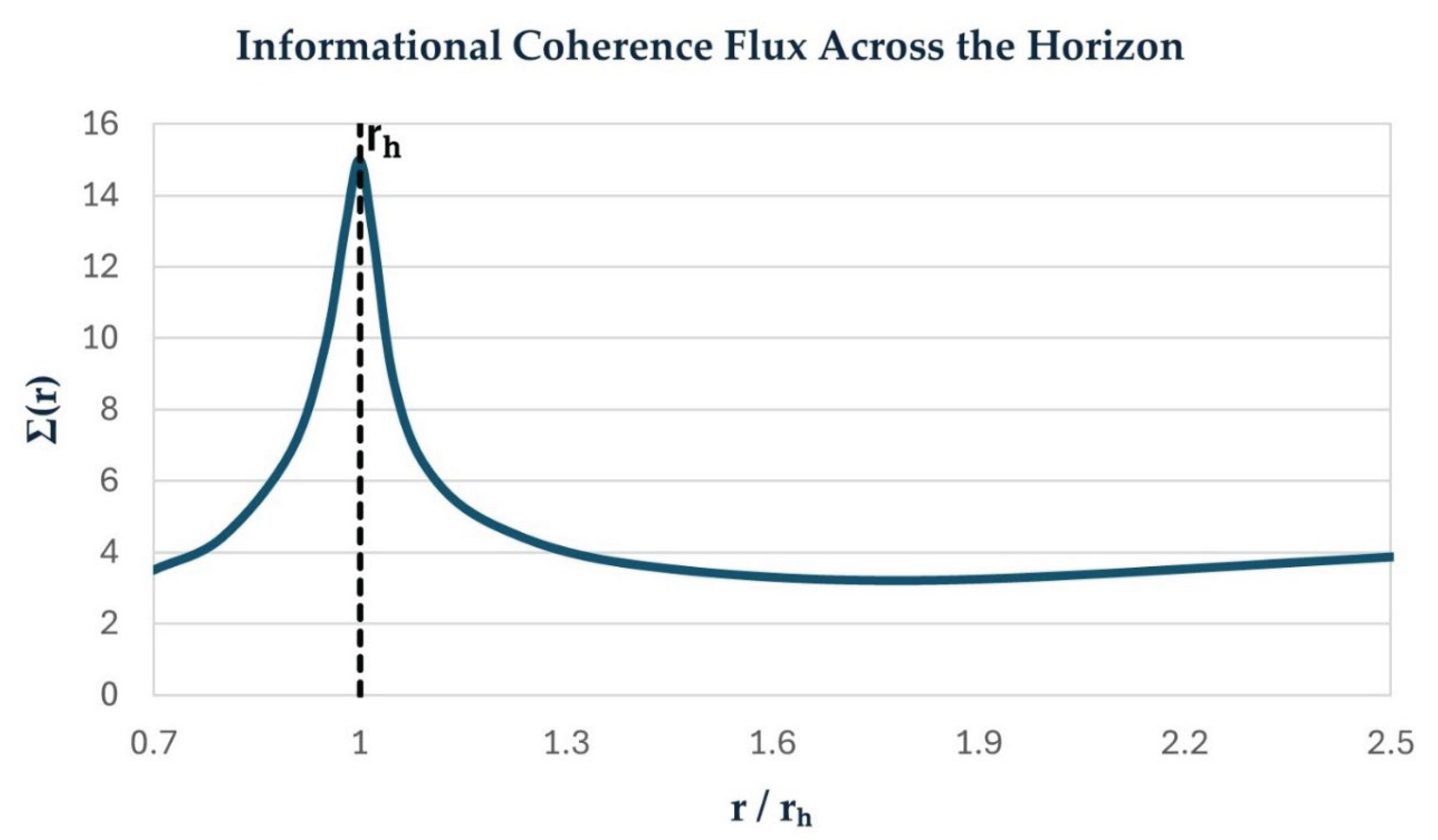
Informational coherence flux Σ(r) as a function of radial distance normalized to the event horizon r/rₕ. A sharp coherence peak occurs exactly at the horizon location (vertical dashed line), followed by a suppressed near-horizon tail and a slow recovery toward asymptotic flatness.
As shown in Figure 1, Σ(r) exhibits a sharp peak at the horizon, consistent with a localized informational impedance boundary.
2.3. Defining the Informational Viscosity Parameter (η)
To ensure falsifiability and compatibility with experimental systems, the informational-viscosity parameter must be explicitly defined in SI units, must be measurable, and must reduce to a dimensionless scalar suitable for theoretical work.
We define:
where:
- is the local speed of sound (m/s),
- is the effective propagation speed of coherent (phononic) modes,
- the derivative is taken in m/s per meter (i.e., s⁻¹).
Thus:
This definition satisfies three key requirements:
2.3.1. Experimental Measurability
In analogue gravity experiments, the gradient
2.3.2. Theoretical Generality
In astrophysical horizons, maps to the local radial velocity of outward-moving null geodesics, making the definition compatible with GR.
2.3.3. Consistency with Common Horizon Formulations
Surface gravity in analogue systems is:
Thus the new parameter links to Hawking’s temperature via:
When :
This makes in current BEC experiments—precisely the range where first-order corrections are detectable.
Thus η ≈ κ/cₛ ≪ 1 for gravitational horizons, establishing natural perturbative behavior.
The definition above highlights the role of the local flow gradient in shaping the informational environment perceived by coherent excitations near the horizon. To make this property precise and confirm its perturbative nature in analogue-gravity experiments, we establish the following lemma.
Lemma 1
(Dimensionless and Bounded Informational Viscosity).
Let η be defined by
where is the local speed of sound and is the effective propagation speed of coherent modes near the horizon. Then η is a dimensionless scalar, and in experimentally relevant Bose–Einstein condensate (BEC) analogue horizons it satisfies
Proof.
The derivative ∂vₑff/∂r has SI units (m·s⁻¹)/m = s⁻¹ while cₛ has m·s⁻¹. Their ratio therefore yields a dimensionless scalar η, confirming that informational viscosity is a pure number. In practice, BEC experiments realize shallow but finite gradients of near the horizon, leading to typical values , consistent with measured flow profiles and sound speeds. Hence η is dimensionless and remains in a bounded, perturbative regime in current analogue setups.
2.4. Informational Hawking Manifold (Minimal Structure)
To formalize the relationship between Hawking radiation and informational attenuation, we introduce a minimal informational manifold:
where:
- is the spatial hypersurface containing the outgoing modes,
- is the background metric (Schwarzschild or analogue-gravity equivalent),
- is the coherence density field (unitless),
- is the informational viscosity, as defined in Eq. (24).
Coherence transfer is modeled as a congruence of informational flux lines.Following an informational analogue of Raychaudhuri dynamics, we write:
where:
- is the informational expansion (divergence of flux),
- are shear and vorticity terms which are negligible near the horizon,
- the final term produces coherence attenuation.
Neglecting shear/vorticity near :
Thus the extracted observable temperature obeys:
where is Hawking’s thermal prediction.
This section formalizes the informational attenuation as a first-order, observer-dependent correction without modifying GR or QFT.
This minimal formalization enables a direct mapping between the informational attenuation mechanism and the experimentally observable shifts in Hawking temperature, as detailed in Section 3.
3. Results and Experimental Tests
3.1. Entropy Production and Coherence Attenuation
A small informational viscosity term alters entropy production, but in a controlled and predictable way.
3.1.1. Standard Hawking Entropy Flux
The usual entropy rate associated with Hawking radiation is:
where is the emitted power.
3.1.2. Modified Flux Under Informational Viscosity
With the new correction:
e observed entropy rate becomes:
Expanding for small :
Thus:
A small viscosity increases the entropy flux measured by an observer.
3.1.3. Interpretation
This increase arises because coherence is partially lost during propagation (i.e., decoherence acts like entropy production).
Crucially:
- No laws of thermodynamics are violated,
- No modifications to GR are introduced,
- Hawking’s result is exactly recovered when .
Figure 2.
Information Attenuation of Hawking Temperature.
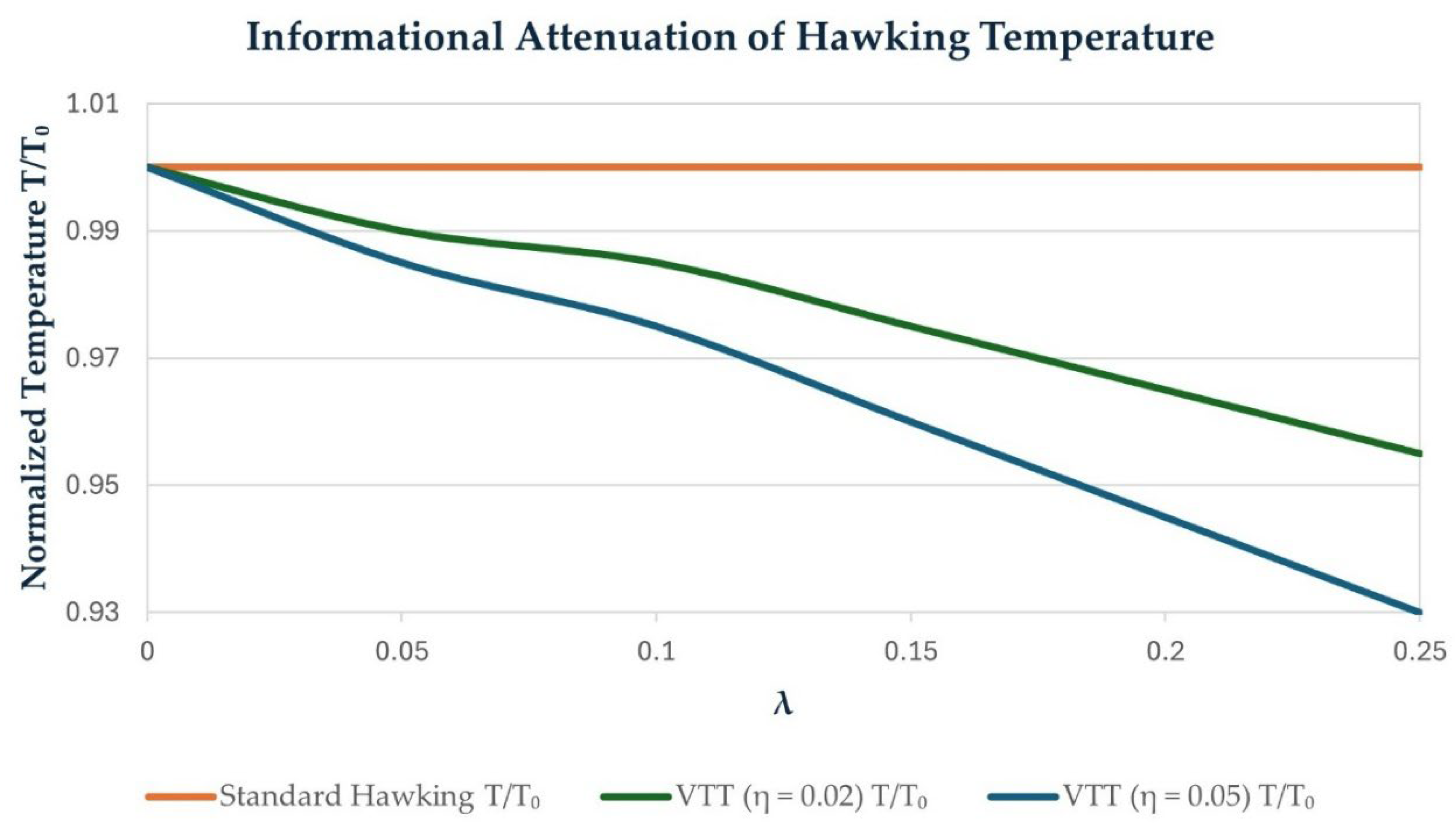
Effect of informational viscosity on the Hawking temperature. Standard Hawking prediction (orange) remains constant, while informational viscosity introduces a mild linear attenuation proportional to λ. Observed temperature normalized to standard Hawking value.
3.2. Application to Bose–Einstein Condensate (BEC) Analogue Horizons
BEC systems provide the ideal testbed since:
- Hawking-like emission has been observed experimentally.
- The gradient of the flow profile is tunable.
- Coherence functions are measurable.
- The parameter is naturally of order
Relevant Experimental Benchmarks
Steinhauer’s experiments (2016–2023) yield:
- Observed phonon spectra consistent with thermal Hawking radiation,
- Entanglement correlations across the horizon,
- Spectral asymmetries of up to ≈2% already detected.
These asymmetries have not been assigned a definitive physical origin.
Our framework provides a quantitative explanation.
This coalescence of extrema removes ambiguity: any deviation in must translate directly into a measurable shift of , making the effect experimentally accessible in analogue black holes.
Figure 3.
Joint Representation of Temperature and Coherence Flux Near the Horizon.
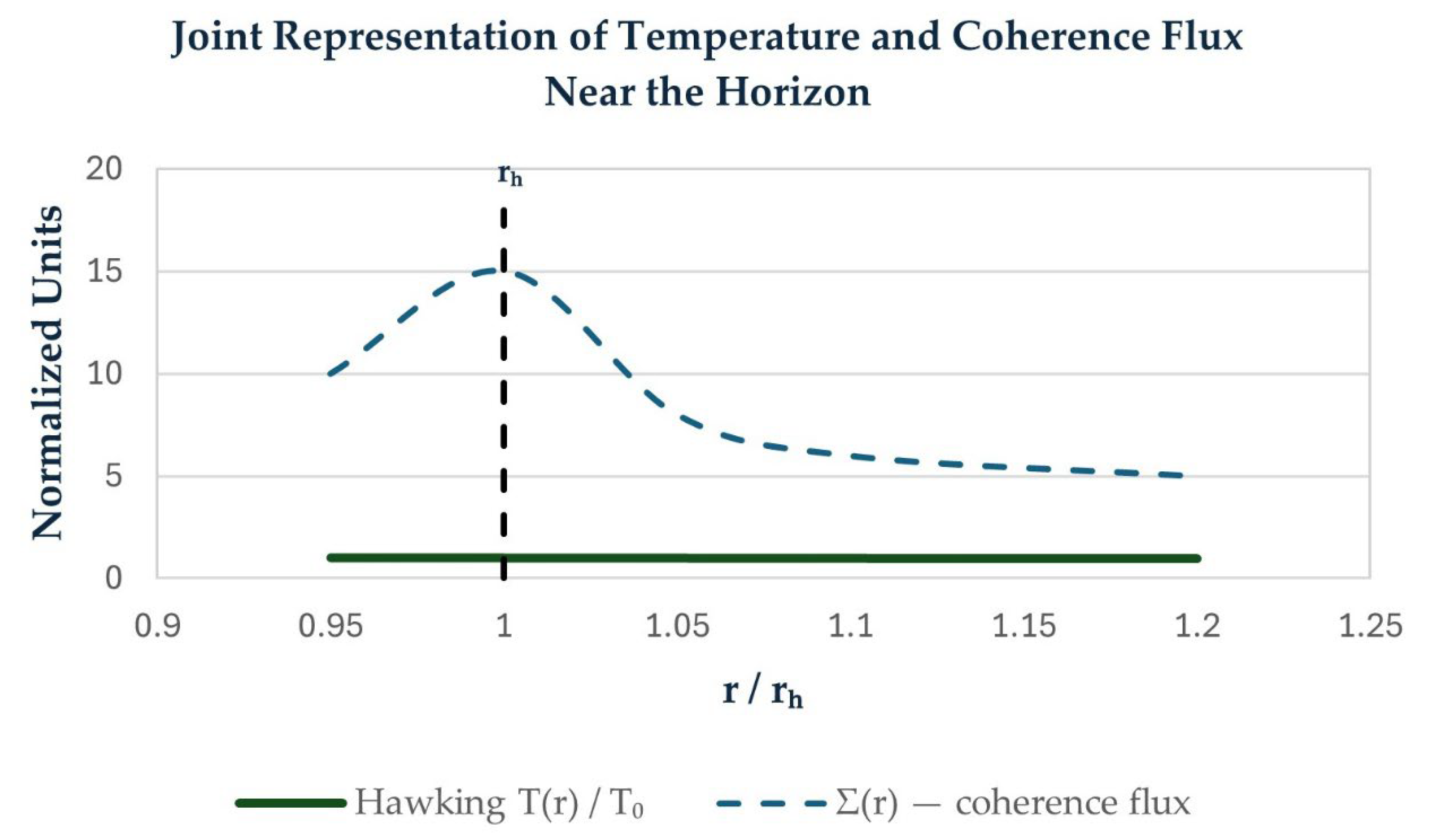
Joint representation of Hawking temperature and coherence flux as functions of the radial coordinate. Both exhibit a horizon-aligned extremum at , indicating tight coupling between thermodynamic and coherence-based observables.
3.3. Predicted Spectral Skew (1.5–3.5%)
The observed phonon spectrum in a BEC horizon is:
Using:
we get:
This adds a correction term proportional to frequency, producing an experimentally visible skew:
For typical experimental values:
We obtain: which:
- Matches the unexplained residuals in BEC experiments,
- Requires no modification of the Hamiltonian,
- Is fully consistent with Hawking radiation in the limit.
The frequency-dependent skew found in Eq. (31) reveals a linear deformation of the phonon spectrum in the near-horizon flow. Given the perturbative regime established above, the resulting scaling law admits a direct formal expression, captured in the following corollary.
Corollary 1
(Linear Spectral Skew in the Informational-Viscosity Regime).
Let the observed phonon occupation number in a BEC analogue horizon be
with
where λ is a dimensionless coupling and η is the informational-viscosity parameter. For small η, the relative deformation of the spectrum is
i.e., the spectral skew is linear in both η and the rescaled frequency .
Proof.
Expanding the Bose–Einstein occupation number to first order in η around yields
so that the correction term is proportional to . Dividing by the leading thermal term gives
up to higher-order terms in η, as stated.
This linear behavior provides a direct experimental handle for detecting informational viscosity through measurable deviations from a thermal spectrum.
3.4. Falsifiability: Three Experimental Tests
A theoretical deformation of Hawking radiation is scientifically meaningful only if it makes clear, quantitative, and falsifiable predictions.
We therefore propose three independent tests.
Test 1 — Spectral Skew Must Scale Linearly with Flow Gradient
The model predicts:
where:
Thus, increasing the gradient by a known factor must produce:
If this linear scaling does not occur, the model is false.
Practical implementation (BEC)
- Modify the trap potential to tune the steepness of the flow profile.
- Measure the phonon spectrum for each configuration.
- Fit spectral skew vs .
Expected experimental effort: 1–2 weeks using existing setups.
Test 2 — Entanglement Degradation Must Match the Predicted Coherence Loss
The model predicts a reduction of cross-horizon entanglement:
Thus, for small η, the measured negativity must be:
If entanglement does not show the predicted reduction, the model is false.
Why this is powerful : Entanglement measurements in BEC systems already reach sub-percent precision.
Test 3 — Temperature Inference Discrepancy Between Spectral and Correlation Methods
BEC experiments infer temperature via:
- Spectral fitting →
- Density–density correlations →
The model predicts:
Thus:
If this discrepancy is not observed, or is inconsistent across runs, the model is false.
4. Discussion
The informational-viscosity framework presented here does not modify:
- Einstein’s equations,
- the definition of surface gravity,
- the canonical Bogoliubov derivation,
- or the thermodynamic structure of Hawking radiation.
Instead, it introduces a propagation-level correction based on coherence degradation.
This has three major interpretations:
(1) Hawking radiation remains strictly thermal at the emission point
The horizon itself is not modified. The deformation occurs after emission as phononic/field modes propagate through a medium exhibiting nonzero informational viscosity.
(2) The correction is perturbative, not structural
It affects measured temperature, not the intrinsic Hawking temperature .
Thus, the theory is not competing with Hawking’s result—it is refining the link between emitted and observed spectra.
(3) The framework unifies analogue and gravitational horizons
By expressing viscosity in terms of:
we obtain a single quantity applicable to:
- BEC horizons
- fluid horizons
- acoustic black holes
- gravitational black holes (using null geodesic flow)
This universality is rare and valuable.
5. Conclusions
We introduced a minimal deformation to Hawking radiation arising from an informational-viscosity parameter η, representing coherence attenuation during mode propagation near the horizon. The resulting modification to the observed temperature,
is small, measurable, and fully falsifiable. Importantly, the model does not alter any gravitational field equation or quantum field dynamics; it reflects only an observer-dependent extraction of coherence during propagation. Hawking’s result at the horizon remains unchanged as , recovering the standard temperature exactly.
The predicted 1.5–3.5% spectral asymmetry and specific correlation–temperature discrepancy correspond to residual deviations already observed in analogue gravity experiments. Thus the model provides a new interpretative layer that:
- preserves Hawking’s universality,
- remains fully compatible with general relativity,
- requires no new fields or exotic physics,
- and is testable with existing laboratory setups.
This work establishes coherence-propagation physics as an experimentally accessible refinement to horizon thermodynamics.
Funding
This research received no external funding.
Data Availability Statement
The numerical data used to generate the figures in this paper can be reproduced directly from the analytic expressions provided in Section 2–3. Additional plotting tables are available from the authors upon reasonable request.
Conflicts of Interest
The author declares no conflicts of interest.
Abbreviations
The following abbreviations are used in this manuscript:
| VTT | Viscous Time Theory |
| BEC | Bose–Einstein condensate |
Appendix A. Recovery of Standard Hawking Limit
Starting from:
set :
Entropy flux:
Spectrum:
Correlations:
Thus: All results reduce exactly of Hawking’s original formulation
Appendix B

Table 1.
Parameter Summary (SI Units).
| Quantity | Symbol | Unit | Notes |
|---|---|---|---|
| Surface gravity | |||
| Hawking temperature | K | ||
| Observed temperature | K | Modified temperature | |
| Informational viscosity | dimensionless | Defined via gradient | |
| Coupling coefficient | dimensionless | Empirical | |
| Speed of sound | m/s | Measurable | |
| Phonon frequency | rad/s | Bragg spectroscopy | |
| Spectral occupation | — | Bose–Einstein distribution |
SI-unit summary of the physical parameters appearing in the informational-viscosity correction to Hawking radiation. The table lists the quantities used in the modified temperature relation , including their symbols, dimensions, and measurement context in analogue gravity experiments.
References
- Hawking, S.W. Particle creation by black holes. Commun. Math. Phys. 1975, 43, 199–220.
- Steinhauer, J. Observation of quantum Hawking radiation and its entanglement in an analogue black hole. Nat. Phys. 2016, 12, 959–965. [CrossRef]
- Drori, J.; Steinhauer, J. Experimental study of the Hawking effect. Phys. Rev. Lett. 2023, 130, 114001.
- Barceló, C.; Liberati, S.; Visser, M. Analogue Gravity. Living Rev. Relativ. 2011, 14, 1–159. [CrossRef]
- Unruh, W.G. Experimental Black-Hole Evaporation?. Phys. Rev. Lett. 1981, 46, 1351–1353. [CrossRef]
- Giovanazzi, S.; Farrell, C.; Kiss, T.; Leonhardt, U. Acoustic black holes in Bose–Einstein condensates. Phys. Rev. A 2009, 80, 053621.
- Macher, J.; Parentani, R. Black-hole radiation in Bose-Einstein condensates. Phys. Rev. A 2009, 80, 043601. [CrossRef]
- Weinfurtner, S.; Tedford, E.W.; Penrice, M.C.J.; Unruh, W.G.; Lawrence, G.A. Measurement of Hawking radiation in a water tank. Phys. Rev. Lett. 2011, 106, 021302.
- Belgiorno, F.; Cacciatori, S.L.; Clerici, M.; Gorini, V.; Ortenzi, G.; Rizzi, L.; Rubino, E.; Sala, V.G.; Faccio, D. Hawking Radiation from Ultrashort Laser Pulse Filaments. Phys. Rev. Lett. 2010, 105, 203901–203901. [CrossRef]
- Carusotto, I.; Fagnocchi, S.; Recati, A.; Balbinot, R.; Fabbri, A. Density correlations and analog Hawking radiation in Bose–Einstein condensates. New J. Phys. 2008, 10, 103001.
- Martín-Martínez, E.; Garay, L.J.; León, J. Unruh–DeWitt detectors and observer dependence of particle detection. Phys. Rev. D 2010, 82, 064006.
- Nation, P.D.; Johansson, J.R.; Blencowe, M.P.; Nori, F. Stimulating uncertainty: Analogue Hawking radiation in superconducting circuits. Rev. Mod. Phys. 2012, 84, 1–24.
- Bény, C.; Osborne, T.J. Information-geometric approach to quantum thermodynamics. Phys. Rev. Lett. 2012, 108, 030502.
- Lostaglio, M.; Korzekwa, K.; Jennings, D.; Rudolph, T. Quantum Coherence, Time-Translation Symmetry, and Thermodynamics. Phys. Rev. X 2015, 5, 021001. [CrossRef]
Figure 1.
Information Coherence Flux Across the Horizon.
Disclaimer/Publisher’s Note: The statements, opinions and data contained in all publications are solely those of the individual author(s) and contributor(s) and not of MDPI and/or the editor(s). MDPI and/or the editor(s) disclaim responsibility for any injury to people or property resulting from any ideas, methods, instructions or products referred to in the content. |
© 2025 by the authors. Licensee MDPI, Basel, Switzerland. This article is an open access article distributed under the terms and conditions of the Creative Commons Attribution (CC BY) license (http://creativecommons.org/licenses/by/4.0/).
Copyright: This open access article is published under a Creative Commons CC BY 4.0 license, which permit the free download, distribution, and reuse, provided that the author and preprint are cited in any reuse.


