

Submitted:
22 November 2025
Posted:
24 November 2025
You are already at the latest version
Abstract
In July 2023, the suicide of a Seoi Elementary School teacher spurred nationwide outrage and a grassroots teacher movement in South Korea. Central to this was Indischool, the country’s largest online teacher community for elementary teachers, which became a hub for protests, collective grief, and professional solidarity. Using digital ethnography, this study examines how Indischool fostered collective resistance and agency, contesting legal and institutional constraints on teachers. Framed through Durkheim’s suicide typology, the Seoi incident is interpreted as a systemic failure from excessive regulation and weak integration, contributing to scholarship on digital counterpublics and teacher activism.
Keywords:
Online teacher community
; Indischool
; collective teacher resistance
1. Background and Purpose
The position that nobody desires—first-grade homeroom teacher—is left vacant until it inevitably falls to the newest teacher. In 2023, that position ended in tragedy when a first-year teacher was found dead in the supply room.
The tragic death of a public school teacher at Seoi Elementary School in Seoul, South Korea, in 2023 sent shockwaves through the Korean education system and ignited a wave of collective resistance and public action among teachers (Teo, 2023; Yeung et al., 2023). The deceased, a first-grade homeroom teacher, had reportedly been subjected to relentless and malicious complaints from several parents. Ultimately, she took her own life in the school’s supply room. What initially appeared to be an individual act of suicide was soon recognized as a case of what Friedrich Engels (2009) called social murder, exposing deep-rooted systemic failures and the lack of institutional support for teachers within South Korea’s education system. Her death came to symbolize the collapse of public education (Kim, 2025) and laid bare the harsh realities faced by Korean teachers—marked by the erosion of professional authority and increasing restrictions on instructional practices due to laws that prioritize students’ rights over teachers’, such as the Child Abuse Prevention Act (Sung et al., 2023). Teachers across the nation expressed deep anger and frustration over these conditions, and the teacher’s death became a powerful catalyst for their collective call for change. In the aftermath, hundreds of thousands of teachers mobilized both online and offline, calling for legal protection, institutional reform, and renewed respect for their profession. Durkheim (1897/2002) reminds us that suicide is a social fact, shaped by a breakdown in integration and regulation—conditions clearly reflected in the Seoi teacher’s death.
Central to this movement was Indischool, which has emerged as a vital hub for protest organization, collective grieving, and the reaffirmation of professional identity. As the most widely used online community for elementary teachers in South Korea, Indischool has long provided a platform for sharing teaching materials, pedagogical resources, and professional insights (Flanigan, 2011; Seo, 2010). As of 2021, approximately 80 percent of Korean elementary teachers were registered members. Access is granted only to certified teachers through a rigorous verification process, and the platform is both technologically and financially managed by teachers themselves (Indischool Archive Team, 2021).
In relation to the Seoi Elementary School incident, Indischool went beyond its traditional role of sharing information and instructional materials to assume a new function: organizing and supporting collective resistance. This study investigates how online teacher communities can serve as platforms for such resistance, evolving beyond the conventional roles of teacher communities or communities of practice. Focusing on the case of Indischool in the aftermath of the Seoi Elementary School incident, the study employs digital ethnography to analyze posts and interactions on the platform, examining the meanings and functions of these communities during periods of teacher mobilization. Drawing on our dual positionalities—one as a participant in the teacher protests through Indischool and both researchers as long-time users of the platform and former elementary teachers in South Korea—we also incorporate elements of autoethnographic reflection to deepen our understanding of how collective grief, resistance, and professional identity are negotiated in online spaces.
Research Questions
- How did teachers organize and carry out collective resistance through online communities following the Seoi Elementary School incident?
- What specific roles did Indischool play in supporting teachers’ collective actions?
- How are online teacher communities evolving beyond the traditional model of Communities of Practice (CoP)?
Despite growing interest in teacher activism and online communities, limited research has examined how closed and professional platforms like Indischool facilitate grassroots resistance. Most scholarship focuses on content-sharing and emotional support (Carpenter & Krutka, 2015; Loving et al., 2007; Pittard, 2017; Seo, 2011a), leaving underexplored the political and mobilizational potential of such communities. This study addresses that gap by analyzing how Indischool supported teacher mobilization in the wake of the Seoi Elementary School incident. It offers a transnational lens that expands the theoretical and empirical boundaries of both online teacher community research and teacher activism. In doing so, it sheds light on the shifting contours of teachers’ professional lives and the future of public education across global contexts.
2. Literature Review
2.1. Context of the Seoi Incident and the Lives of Elementary Teachers in Korea
Teaching in South Korea has traditionally been regarded as a prestigious and highly respected profession (Moore, 2024). Teachers were seen as figures of authority and moral guidance, and the profession has long been one of the most popular and desirable career paths due to its financial stability as a public service position, job security through tenure, generous vacation time, and the high level of social respect it commands. There is even a traditional saying: “Don’t step on the shadow of your passing teacher”, reflecting the deep cultural reverence for educators rooted in Confucian values. Reflecting this status, admission to the country’s eleven university-based elementary teacher education programs has been highly competitive. For example, admitted students typically rank in the top one to ten percent of their high school class in both overall GPA and K-SAT scores.
However, this perception has significantly declined in recent years due to shifting social values and evolving educational policies (Shim et al., 2024). Neoliberal reforms have reshaped education in Korea, reframing teacher-parent relationships within a consumer-provider model (Kweon & Kim, 2015). For instance, the widespread participation of students in shadow education—including private learning centers (hagwons) and private tutoring (gwa-oe)—has contributed to the decline of public school authority and has reframed education as a consumer-driven service (Bray, 2021). Approximately 80 percent of Korean students participate in shadow education, spending an average of 7.6 hours per week and at a cost of $351 per month (Statistics Korea, 2024). Parents have come to show greater respect for hagwon teachers than for public school teachers, and public education is increasingly seen as just one of many educational services available to students and their families (Kang, 2018).
A series of legal reforms, including the Korean Child Welfare Act (2014, amended 2025) and Child Abuse Prevention Act, which bans corporal punishment and strengthens child protection measures, have, in practice, been weaponized by some parents to intimidate teachers. Though intended to protect children, these laws are frequently employed by parents to file vague or unsubstantiated complaints, reinforcing the judicialization of education and making teachers vulnerable (Kim, 2025). As teachers are regarded as service providers, even routine classroom management is misinterpreted as abuse, placing them in a precarious position where their authority and well-being are constantly threatened (Mackenzie, 2023a, 2023b; Rashid, 2023; Son, 2023).
This shift reflects the ideology of parentocracy (Brown, 1990), where educational outcomes are determined less by student merit and more by parental capital. While originally used to describe Western contexts, the concept is becoming relevant in South Korea, where educational governance is driven by parental demands over professional expertise.
In this context, parents are framed as educational consumers, and teachers are expected to provide customized services (Kim, 2025; Kweon & Kim, 2015). Their responsibilities have expanded beyond instruction to include caregiving, emotional nurturing, behavioral management, conflict resolution, and aspects of child-rearing traditionally handled at home. These pressures are compounded by helicopter parenting, where parents monitor and intervene in nearly all aspects of their children’s school lives (Hwang et al., 2023). This constant oversight erodes professional autonomy, as teachers must negotiate parental demands that often conflict with their pedagogical practices and beliefs (LeMoyne & Buchanan, 2011).
This system reached a breaking point in July 2023, when a newly appointed teacher at Seoi Elementary School in Seoul’s affluent Gangnam district was found dead in the supply room of the school. The deceased teacher left a memo stating that she had struggled greatly due to parents’ constant phone calls to her personal phone. Gangnam, viewed as the epicenter of Korea’s parentocratic education culture, symbolizes the extreme convergence of academic competition and hyper-involved parenting. While parental pressure affects all grade levels, the first-grade homeroom position, which is particularly burdensome, requiring constant emotional care, close communication with guardians, is often assigned to the most junior staff. The Seoi teacher reportedly faced overwhelming non-teaching responsibilities and emotionally charged interactions, all without sufficient legal or administrative support.
The Seoi incident brought long-simmering tensions in Korean education to the surface. Her death catalyzed a nationwide reckoning with teacher rights, emotional labor, and systemic failure. Teachers across the country identified the tragedy as a reflection of eroded professional authority, intensified emotional burdens, and the absence of institutional safeguards. Since then, educators have mobilized in protest, demanding reforms to restore teacher dignity, clarify legal protections, and address the unsustainable pressures increasingly placed on the profession. Indischool was at the center of teacher activism.
2.2. Indischool: The Most Popular Online Teacher Community for South Korean Elementary Teachers
Indischool has long been one of the most prominent online teacher communities for Korean elementary teachers, with approximately 150,000 registered members, representing 78% of all elementary school teachers nationwide (Jang, 2025).
Indischool is a nonprofit organization that has been autonomously developed and sustained—both technologically and financially—by Korean elementary teachers. The platform receives no financial support from the government or private corporations; instead, teachers voluntarily donate their time and money to keep the site running. Access to the platform is restricted to elementary teachers and requires a strict verification process. Indischool has played a key role in supporting elementary school teachers by facilitating the sharing of instructional resources, pedagogical knowledge, and professional development opportunities (Flanigan, 2011; Hwang, 2023; Seo, 2011).
What distinguishes Indischool is its longstanding role as the primary resource hub for Korean elementary teachers since 2000. This stands in contrast to trends in many other countries, where teacher communities have increasingly migrated to social media platforms operated by large tech corporations. In the United States, for example, the most popular websites among teachers have shifted over time. In 2014, 91% of American teachers used online platforms for lesson planning, favoring sites such as Scholastic.com, YouTube, Pinterest, and PBS.org. By 2019, Teachers Pay Teachers (TPT) emerged as the most frequently visited source for instructional materials. In light of these shifts, it is particularly notable that a large number of Korean elementary teachers continue to rely on Indischool for curriculum development and professional learning, despite the rise of newer social media alternatives.
2.3. Traditional Roles of Online Teacher Communities
Online teacher communities have played an essential role in supporting teachers’ professional learning and development. Prior research highlights their value as platforms for exchange of content knowledge and pedagogical strategies (Carpenter et al., 2019; Greenhalgh & Koehler, 2017; Vangrieken et al., 2017; Loving et al., 2007), sharing practical classroom know-how (Seo, 2010), and disseminating effective instructional techniques (Al-Balushi & Al-Abdali, 2015). Additionally, they offer guidance on broader non-content areas, such as classroom management and information curation (Davis, 2015).
Importantly, online teacher communities facilitate the cross-border circulation of curriculum resources and instructional materials (Pittard, 2017; Seo, 2011a). Teachers use platforms like Teachers Pay Teachers to distribute lesson plans, worksheets, presentations, and motivational visuals. (Pittard, 2017). In addition to pedagogical benefits, these communities foster emotional support, collegiality, and a sense of belonging that enhance teachers’ resilience and well-being (Davis, 2015; Evans, 2015; Kelly & Antonio, 2016; Tsiotakis & Jimoyiannis, 2016). Collectively, these findings affirm that online teacher communities are spaces of sustained and meaningful professional growth (Barab et al., 2004; Farooq et al., 2007; Shulman & Shulman, 2004).
2.4. Contemporary Teacher Activism
Schools have long been contested sites of struggle, serving as battlegrounds for debates over issues such as the reproduction of social class through education (Bourdieu, 1977), the imposition of universal standards (Greene, 1995; Kincheloe, Steinberg, & Tippins, 1999; Ohanian, 1999), and more recently, inclusive education. The latter includes, but is not limited to, contentious topics surrounding race, class, gender, immigration, religious tolerance, ability/disability, and LGBTQ identities—making schools enduring arenas of ideological and sociopolitical conflict (Margolin, 2017; Stolberg, 2017).
Teacher unions have historically exemplified what is often deemed an “acceptable” form of teacher activism. Since the establishment of the National Education Association in 1857 (Moe, 2011), unions have played a central role in organizing strikes, advocating for gender equity, and championing student welfare. Prominent examples include the 2012 Chicago Teachers’ Strike, which emphasized both labor and student concerns (Naison, 2014), and the 2018–2019 strikes in West Virginia, Oklahoma, and Chicago, where teachers demanded increased school funding and better working conditions (Bidgood, 2018; Goldstein & Dias, 2018; Smith & Davey, 2019; Buchanan, 2012; Catone, 2017; Urban, 1982; Warren, 1989).
In recent years, teacher activism in the United States has increasingly leveraged social media to build grassroots, teacher-led movements. These include the rise of the Black Lives Matter in Education campaign, the formation of the Badass Teachers Association (BAT) via Facebook in 2013 in response to educational inequities (Kilfoyle & Tomlinson, 2015), the Women’s March and #MeToo movement in 2016, the March for Science in 2017, and teacher walkouts in 2018–2019 in states like West Virginia, Arizona, Colorado, and Kentucky—organized largely through Facebook pages by rank-and-file educators advocating for higher salaries and increased funding (Will, 2018).
While these studies have richly theorized teacher activism within North America and Western contexts (Alderfer, 2020; Barab et al., 2004; Howe & Stubbs, 2003; Pittard, 2017), a significant gap remains regarding the motivations and mechanisms of teacher activism in non-Western contexts, such as South Korea. Moreover, whereas open platforms like Facebook have been instrumental in U.S.-based activism, the case of Indischool reveals a distinct model: a secure and long-standing teacher-only platform that combines professional support with emerging political mobilization.
2.5. The Seoi Incident and Durkheim’s Theory of Suicide
Émile Durkheim’s theory of suicide provides a useful lens for interpreting the suicide case of the Seoi Elementary School teacher. Émile Durkheim (1897/2002), one of the founding figures of sociology, argued that suicide is not merely a personal or psychological act but a profoundly social phenomenon. In his landmark work Le Suicide, Durkheim challenged the dominant assumption that suicide is purely the result of individual pathology, instead asserting that it is shaped by broader patterns of social integration and social regulation. He introduced the idea of suicide as a "social fact"—a pattern of behavior that exists outside the individual but exerts influence on them. Durkheim’s theoretical model identified four types of suicide based on the interplay between how connected individuals are to their communities (integration) and how controlled or regulated their lives are by social norms and institutions (regulation): egoistic suicide, altruistic suicide, anomic suicide, and fatalistic suicide. Durkheim’s analysis typology underscores that suicide, though enacted individually, is deeply embedded in social structures, cultural values, and institutional conditions. It reflects the broader moral and organizational fabric of society. This sociological lens resonates with Friedrich Engels’ (2009) notion of social murder, where systemic violence and chronic disregard for human dignity render some lives precarious and disposable. Durkheim’s theory helps illuminate how failures of social support, excessive regulatory constraints, and the disintegration of professional solidarity can create conditions in which life becomes unbearable. In this frame, suicide is understood not merely as a personal loss but as a mirror held up to a society that failed to protect its members. We interpret the suicide of the Seoi teacher as the result of an interplay of three of the types of suicide that Durkheim suggests.
3. Method
This study adopted a digital ethnographic approach to examine how the online teacher community Indischool functioned in the aftermath of the Seoi Elementary School incident as a space of collective grief, resistance, and professional identity formation in the aftermath of the Seoi Elementary School incident in South Korea. Digital ethnography allows us to explore the interactions, discourses, and shared practices that emerge within online environments. Our methodological framework is informed by both digital ethnography (Hine, 2020; Kozinets, 2020; Markham, 1998; Miller & Slater, 2000; Salmons, 2016) and reflexive autoethnographic inquiry. Reflexivity plays a significant role in situating the researcher’s positionality within the field (Cresswell, 2013). As researchers with prior engagement in the events and platforms under study, we acknowledge our positionalities not merely as observers but as situated participants. Both of us are insider researchers with lived experience in the Korean education system, having backgrounds as elementary teachers in South Korea. One of the authors was actively teaching during the Seoi Elementary School incident and participated in the post-Seoi teacher protests in 2023 through the Indischool online community, while the other was an active user of Indischool during his own teaching career. These lived experiences offer critical insider perspectives that enhance our interpretation of the data. Also, this dual perspective allowed for both contextual depth and real-time insight into the emotional, professional, and digital responses of teachers.
While we analyzed these digital artifacts through ethnographic coding and thematic analysis (Braun & Clarke, 2006), we also interwove autoethnographic experiences and reflections to situate ourselves within the social world we study. These reflections allowed us to critically examine how our identities as former teachers and participants influenced our reading of the data, cross check on the authenticity and validation of the data we’ve collected, and deepen our understanding of the emotional and professional terrain teachers navigated during this critical moment. By combining digital ethnography with reflexive and autoethnographic elements, we aimed to offer a layered analysis that honors both the collective voices within the online community and the lived experiences that shape our engagement with them.
Data Sources
Data collection included screenshots and archived posts from Indischool during the months following the Seoi incident from July 18, 2023 to October 30, 2023. These posts—ranging from personal narratives and expressions of grief to strategic calls for protest and solidarity—were selected for their relevance to emerging themes. We collected a total of 145 postings and their accompanying comments.
Ethical considerations were addressed by anonymizing user data and analyzing only content accessible to registered members. Indischool is a platform restricted to certified elementary school teachers in South Korea. One of the researchers was able to access the site through their legal status as an elementary school teacher currently on study abroad leave, retaining valid teaching credentials. Additionally, we obtained research consent from the Indischool administrative team and IRB approval from one of the researchers’ affiliated institution.
All data were originally in Korean. They were translated into English by two Korean-speaking researchers with the assistance of ChatGPT and subsequently double-checked for accuracy.
4. Findings
- Rest in Peace, Rise in Power: Mourning and Mobilizing on Indischool
| To the Teacher of Seoi Elementary Though I do not know your name and we have never met, I feel I have grown closer to you in my heart. On that summer day, so unbearably hot, my heart felt unbearably cold. Before you even had the chance to bloom, you left us— a sorrowful farewell. That parting became the courage that bloomed within us, becoming black dots on the asphalt. And those dots— we came to realize— were bruises left on our hearts. To comfort you, to remember you, 300,000 gathered, each a dot that became a black petal— forming the hottest flower that bloomed in summer, which we now offer to you. We do not know if our voices reached the sky today, but wherever you are, we hope you rest in peace and know only happiness. A Tribute Poem to the Seoi Elementary School Teacher, Shared by a Teacher on Indischool (September 2, 2023) |
Following the Seoi Elementary School tragedy on July 18, 2023, Indischool assumed a new role, providing a space for teachers to express sorrow, anger, and empathy, engaging in collective tributes to the deceased teacher, and empathizing with the teacher’s death through their own experiences.
Teachers wrote comments on Indischool like the following (July 19, 2023):
“May the deceased rest in peace. I pray that she is in a warm and peaceful place, wherever and whatever faith it may be.”
“May she rest in peace. Knowing how much pain she must have endured, my heart breaks.”
“My heart aches because I can imagine how she must have felt in her final moments. It’s heartbreaking to see the current reality teachers face, and I’m filled with anger and sorrow at a society that drove someone so young and full of life to make such a tragic choice.”
Teachers expressed empathy for the deceased through comments such as “Knowing how much pain she must have endured” or “I can imagine how she must have felt,” drawing from their own experiences. As slogans like “We are not alone” and “Transforming solidarity into the hope of public education” (both from September 4, 2023) revealed, teachers across Korea immediately recognized that this was not an isolated incident but one that “could have happened to any of us” (MBC, 2023.08.22).
One teacher’s comment on Indischool offers deeper insight into how teachers empathized with the deceased:
“May the deceased rest in peace. Only in her second year… As a more experienced teacher, I feel deeply sorry and heartbroken that I couldn't protect her. The reason I’ve been able to endure each day in this profession is thanks to the warm words, comfort, and empathy of fellow teachers I've met along the way. Simple expressions of concern—like, ‘Are you okay, teacher?’ or ‘How’s that student doing these days?’—spoken in passing, helped me release the heavy emotions I carried and made things a little more bearable. Looking back on my own second year of teaching, I remember thinking that every problem—whether it involved a difficult student or parent—was my fault, caused by my own shortcomings. But there were teachers who reassured me that wasn’t the case, who comforted me, and because of them, I was able to keep going.” (A quote from a post on Indischool, dated July 19, 2023)
As this teacher noted, what enabled them to endure difficult times with challenging students and parents was the support of fellow teachers and their warm, caring reassurance that the teacher was not to blame for the problems.
Teachers on Indischool attributed one of the causes of the young teacher’s death at Seoi Elementary School to a lack of care and support from fellow educators, as well as from administrators, including principals and vice principals. Many expressed feelings of guilt and deep sorrow, not only as fellow educators but also as potential witnesses to similar harm. In fact, after the incident, the second author—who had also suffered from parental complaints during her first year of teaching first grade—received multiple messages from a former colleague expressing regret and a sense of responsibility for not being able to help at the time.
In numerous posts, teachers described being accused of child abuse simply for asking students to follow classroom rules or correcting disruptive behavior. One teacher, for example, recounted being reported to the police for child abuse by a parent after serving as a homeroom teacher for just one hour. The following is a condensed version, posted on July 20, 2023:
“On the first day, I asked a student to open a textbook, repeating the instruction several times as the student didn’t follow. The student then messaged a parent, who subsequently reported me to the police for child abuse. The parents came to the school crying and shouting for an apology. The police arrived and took my personal information. I was treated like a criminal. After the investigation, the vice principal told me that my temporary teaching contract would be terminated. In front of me, the principal also said the school should wash its hands of the case. He added that the parent was knowledgeable about the law and that if I had done nothing wrong, the case would be dismissed anyway. I remember them clearly. No matter what excuses those cowardly people make, the heavens will know the truth. They are the ones who killed me. For the next three months, I went through hell—visiting the Child Protection Agency, the police station, the prosecutor’s office—until I was finally cleared due to insufficient evidence.”
Although the teacher was eventually cleared of all charges, the harm lay not in the final verdict but in the process itself: being treated like a criminal, navigating the police and other authorities without institutional support, and enduring months of psychological distress and abandonment, despite having done nothing wrong. The teacher described the ordeal as “hell,” exposing how systems intended to educate children can, in practice, criminalize teachers and strip them of their dignity. Throughout this experience, the teacher felt no sense of social integration and received no community support—neither from fellow teachers nor from school leadership. In particular, the teacher blamed the principal and vice principal, describing them as cowardly individuals who failed to protect the teacher.
Having gone through a similar experience as the deceased teacher, the teacher wrote in a post:
“When I saw the news that the teacher had passed away, I was heartbroken. The thought that she was also 23 years old, faced the same types of complaints from parents, and suffered under the same self-serving behavior of administrators fills me with tears of anger.”
Durkheim (1897/2002) conceptualized suicide as a social fact shaped by varying degrees of social integration and regulation. His typology includes egoistic suicide, altruistic suicide, anomic suicide, and fatalistic suicide[1]. Among them, egoistic suicide occurs when individuals are insufficiently integrated and experience profound social isolation. Teachers on Indischool empathized deeply with the deceased teacher at Seoi Elementary School, recognizing her profound social isolation. Her death was not seen as someone else’s tragedy; it was perceived as their own. It was their story.
Some leading members of Indischool guided others in how to participate in the collective tribute. As shown in the post below (Figure 1), teachers who wished to take part were encouraged to send condolence wreaths to Seoi Elementary School or the district office, attend the memorial gathering in front of the school, and wear black to work on July 20 in solidarity.
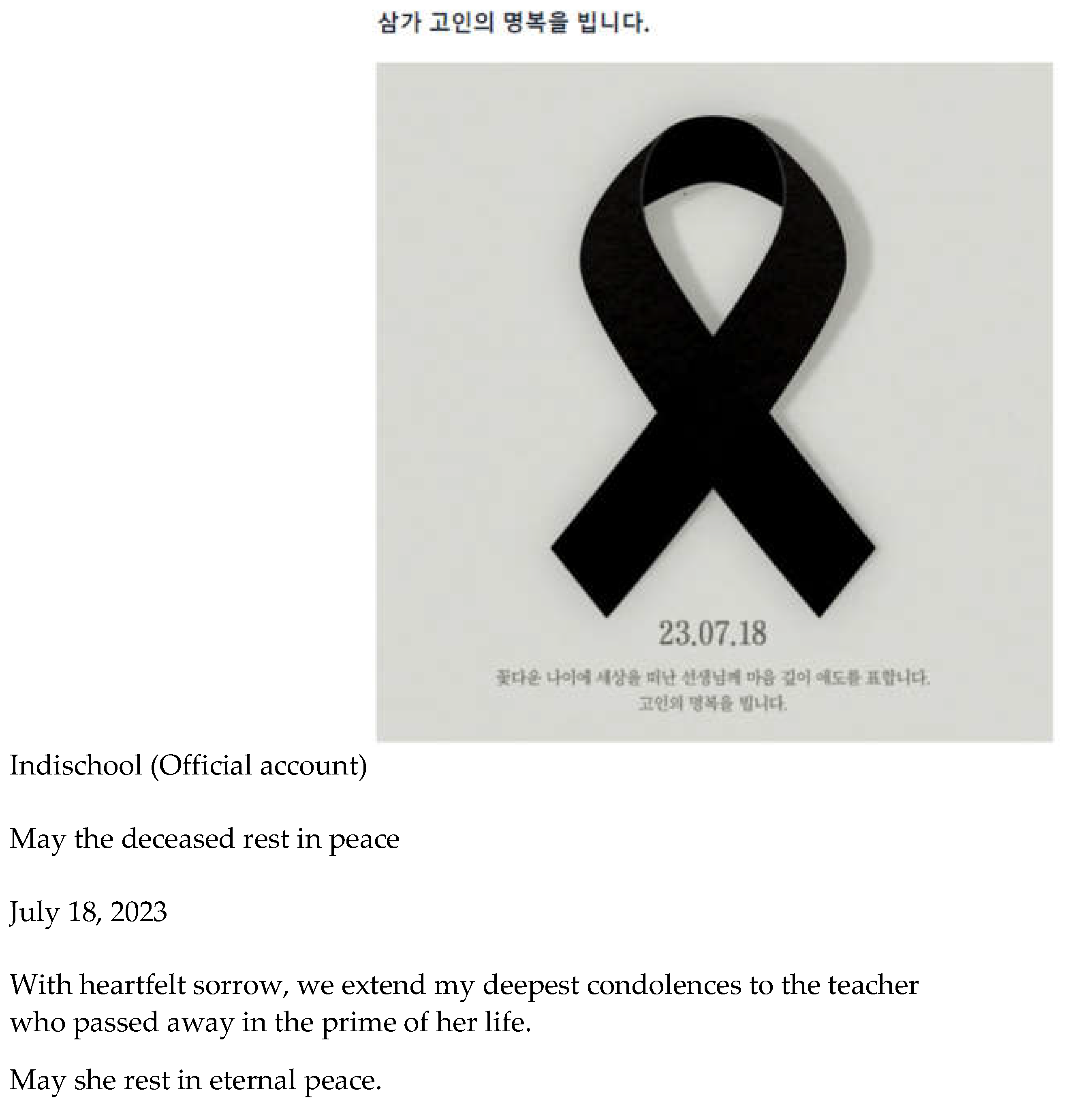
Teachers also organized an online tribute space where students across the nation could express their condolences using KakaoTalk, the most popular messaging app in South Korea. In addition, teachers were asked to change their chat app or social media profile photo to a memorial image (Figure 2). The black ribbon symbolizes condolences for the deceased teacher, and teachers across the nation and beyond changed their profile photos in tribute. Researchers have highlighted how minor actions on social media can have significant ripple effects, sparking meaningful change. As Vie (2014) explains, “seemingly insignificant moves such as adopting a logo and displaying it online can serve to combat microaggressions,” and gestures like “changing one’s Facebook status to a memetic image” can powerfully convey solidarity. Far from being trivial, such digital activism, Vie argues, “can build awareness of crucial issues, which can lead to action.”
Indischool offered a space where teachers could share their grief and anger, rebuild a sense of collective identity, and strengthen their social integration. Teachers came to recognize that the teacher's death was, in part, a result of profound isolation and a lack of community support as Durkheim pointed out in his description of egoistic suicide. In response, many teachers expressed feelings of guilt and a strong desire to foster a more supportive professional community, in which collective care and solidarity become a form of resistance against the type of structural conditions that contributed to her death.
- 2.
- We Must Protect Ourselves: Teacher-Led Protest and Reform Through Indischool
“Within weeks, hundreds of thousands of teachers took to the streets in black attire to mourn, protest, and declare solidarity”
(Education Media Window, 2023.09.02).
Indischool also served as a central platform for organizing collective teacher-led protests aimed at protecting and restoring teachers’ rights, reaffirming professional authority, and advocating for revisions to the Child Abuse Punishment Act at both legal and institutional levels. The post below stating, “When neither the schools, nor the school district offices, nor the Ministry of Education protect us, we must protect ourselves,” reflects teachers’ critique of and anger toward the education system—particularly the entities expected to safeguard their right to teach, such as school administrators, district offices, and the Ministry of Education. It signifies their realization that the tragedy was not solely an individual act of despair but a consequence of institutional failure by the very administrative bodies that were supposed to safeguard teachers' rights and wellbeing. According to Durkheim (1897/2002), anomic suicide results from insufficient regulation and typically occurs during periods of social and moral disruption, often linked to rapid change or the breakdown of established norms. Through Indischool, teachers shared realizations about the systemic challenges they faced—such as the lack of support from schools and government institutions, particularly in dealing with overly demanding parents and their legal actions. In contrast, fatalistic suicide stems from excessive regulation and institutional control.
Teachers on Indischool also recognized the erosion of their professional autonomy and the infringement of their rights caused by excessive regulation (associated with fatalistic suicide, according to Durkheim)—particularly under laws that prioritize students’ rights over those of teachers, such as the Act on the Prevention of Child Abuse (Sung et al., 2023). In response, they organized grassroots, teacher-led protests and collectively rose to demand reforms to the legal and institutional structures that constrained their profession and subordinated their right to teach to the rights of students.
“Fellow teachers,when neither the schools, nor the school district offices, nor the Ministry of Education protect us, we must protect ourselves.”
(2023.07.19)
In response to the lack of support from schools and government institutions, a total of eleven protests were held between July 22, 2023, and October 28, 2023, at various locations in Seoul, including areas near the National Assembly and the Gwanghwamun Government Complex (Sung et al., 2024). Throughout this period, Indischool remained at the heart of the teacher movement. Teachers voluntarily gave up their summer break and weekends to attend a series of protests—many of which were initiated and amplified through Indischool’s digital infrastructure (Sohn, 2023).
“It’s time we gather. This frustration is unbearable.”
(A quote from a teacher’s post on Indischool, July 19, 2023)
The first wave of collective teacher protests began with this single post on Indischool on July 19, 2023—the one quoted above. One teacher’s call for solidarity became the catalyst for a series of nationwide movements involving hundreds of thousands of educators. The follow-up announcement for the first teacher protest, shown below, was posted on Indischool.
|
Protest Registration Submitted. This is the First Protest Notice. I would like to hold a protest as follows to advocate for the protection of teachers' rights to live and work with dignity. Purpose:
|
Following the post, teachers across the nation responded with cheering messages like:
“Thank you for taking action, teacher. There are many of us ready to join forces. Not for ourselves but to restore the integrity of school education. I became a teacher because I truly love children, and though I’m still relatively new to the profession, I know we can’t continue like this. I sincerely thank you for stepping up. See you on Saturday.”
“While restoring teachers’ authority is important, I think it would also be meaningful to frame the protest around restoring normalcy to schools and education in general. The current climate is such that not just professional authority but basic human rights are being disregarded. Schools are collapsing, and not only teachers but also well-meaning students are suffering. Once again, thank you so much for taking action, teacher.”
For the first protest on July 22, 2023, teachers from across the nation gathered at Jonggak Station in Seoul, wearing black and calling for legal and institutional reforms. During the protest, they delivered open speeches like the ones below.
Teacher A, a newly appointed teacher, spoke out against the abusive behaviors of certain parents, citing incidents such as demanding that a child who had bullied their own be completely ostracized, secretly following the teacher during field trip planning visits to film them without consent, and barging into the principal’s office claiming their child was being bullied. Teacher A pleaded, “Please protect teachers from the psychological harm caused by parental abuse of power, and severely punish those who submit malicious complaints. Children should be educated to fulfill their duties and responsibilities as members of society.”
Teacher B, who has been teaching in Seoul for six years, described repeated violations of teacher rights, including frequent psychological pressure from complaints, verbal abuse, and even physical violence. Teacher B emphasized, “Situations inevitably arise where we must discipline and guide students, but there is no system in place to protect teachers in these circumstances.”
During the series of teacher protests, teachers called for a thorough investigation into the death of the Seoi Elementary School teacher, revisions to the excessive regulations that prioritized students’ rights over teachers’, such as the Child Abuse Punishment Act, the legal guarantee of teachers’ authority in student guidance, and amendments to laws protecting teachers' rights.
The leaders of the teacher protests deliberately avoided political affiliation, maintaining independence from the political activities of South Korea’s six major teacher unions (Han, 2023; B. Hwang, 2023). Rather than relying on the unions that offered to sponsor the protests, teachers from across the nation contributed personal donations to support the movement, organizing without affiliation to any specific union (B. Hwang, 2023).
However, as the protests gained momentum, teachers increasingly recognized the need for structural change at both legal and institutional levels (Han, 2023; Hyun, 2023; Jeong, 2023). What began as a response to a single tragedy evolved into a broader movement demanding systemic reforms to protect educators and restore the integrity of the teaching profession. For instance, during the fourth teacher protest on August 12, 2023, the six major teacher organizations issued a joint resolution, calling for legislative reforms to ensure a safe educational environment.
Although supporting the teacher unions that engaged in direct negotiations with the Ministry of Education was not the original goal, the protests were seen as having laid the groundwork for teaching legal reform negotiations. The continued wave of teacher protests contributed to mounting pressure and fatigue within the Ministry of Education, further prompting institutional responses (Sung et al., 2024).
Notably, unlike many cases of teacher activism in the United States, which are led by unions or formal organizations (Bidgood, 2018; Goldstein & Dias, 2018; Smith & Davey, 2019; Buchanan, 2012; Catone, 2017), the movement was initially driven largely by individual teachers on Indischool. However, the protests, which began without the involvement of teacher unions, eventually evolved to include union engagement—highlighting both the potential and the limitations of grassroots teacher protests organized solely by individuals through an online teacher community.
- 3.
- After Seoi: Teacher Solidarity and the Unfinished Journey Toward Protection
In the wake of these collective actions, the aftermath of the Seoi Elementary School incident continued to shape teachers’ activism. While the government and National Assembly belatedly moved to amend the Five Teacher Rights Protection Laws (Lee & Lee, 2024; Yu, 2024), schools and districts began revising procedures for handling parental complaints, expanding counseling support for teachers, and creating formal channels that no longer ignored educators’ suffering (Ahn, 2024; Cho, 2024; Jang, 2025; S. Kim, 2023). Teachers increasingly raised their voices against violations of their professional rights, signaling a growing movement for systemic reform and identity restoration (D. Kim, 2024). Parents, too, began exercising greater caution in lodging complaints. Yet despite heightened public awareness, institutional safeguards remain insufficient (Kang, 2025; Kim et al., 2025).
This reality was underscored on May 22, 2025, when another teacher—this time a middle school teacher in Jeju—died at school, with his phone reportedly inundated with messages from parents (Choi, 2025). In June 2025, just sixteen months after the Seoi tragedy, teachers once again came together in remembrance and solidarity through Indischool, joined by members of the National Assembly (Kang, 2025). Three major teacher unions—the Korean Federation of Teachers’ Associations, the Korean Federation of Teachers’ Unions, and the Korean Teachers and Education Workers Union—collaborated to organize and lead the protest, while Indischool acted as a space to announce the event. They called for: (1) a thorough investigation into the Jeju teacher’s death and recognition of it as a death in the line of duty, (2) a complete overhaul of the school grievance system and stronger measures against malicious complaints, (3) protection of teachers from false or retaliatory child abuse allegations, and (4) the guarantee of teachers’ basic political rights to ensure realistic and responsive education policy reform. These demands underscored that, while progress has been made, the path toward meaningful protection and lasting reform remains unfinished.
Discussion and Implications
From School to Society: Reading the Seoi Elementary Tragedy as a Collapse of Public Schooling and Society
The Seoi Elementary School tragedy offers more than a national moment of mourning—it serves as a stark lens through which we can observe the broader collapse of public schooling and the erosion of societal cohesion in South Korea. But we must ask: Is this phenomenon unique to South Korea? Or is it symptomatic of a wider global crisis?
Across the world, teaching is no longer a respected or desirable profession, despite its foundational role in shaping future generations (citation). Once considered a high-status, intellectually rigorous calling, teaching has been systematically devalued under neoliberal regimes. As in Korea, the U.S. teaching profession faces similar pressures: diminishing autonomy, punitive accountability systems, increased bureaucratic demands, and a consumerist model of education that repositions families as clients rather than partners.
Joel Spring (2016) highlights the rise of the shadow education government in the United States—a network of transnational and non-state actors, including testing companies such as ETS and Pearson, private foundations like the Gates Foundation, international organizations such as the OECD and the World Bank, for-profit education providers, and curriculum and ed-tech corporations. These actors work together behind the scenes, operating outside national governments, to exert significant influence over educational policy and practice. This shift often redefines students and families as consumers and education as a commodity, rather than a public good.
Demonstrating Teachers’ Agency in the Face of the Collapse of Public Schooling
The tragic death of the young teacher at Seoi Elementary School did more than trigger a wave of national mourning—it marked a turning point in how Korean teachers assert their professional agency in the face of institutional failure and collapse of public schooling that undermine their authority and rights. Traditionally regarded as implementers of government educational policy and bound by rigid administrative hierarchies due to their status as public servants, teachers in South Korea have long operated within a highly regulated, accountability-driven system. Yet, in the aftermath of the incident, educators began to view themselves not as passive actors, but as autonomous professionals with the right to advocate for safe working conditions and their right to teach.
Through platforms like Indischool, teachers mobilized in collective and organized ways. What began as posts of grief and solidarity quickly evolved into organized calls for protest, legal reform, and the reclaiming of professional authority. These acts of digital and physical mobilization reflect a profound exercise of teacher agency, characterized by intentional, collective action grounded in ethical conviction and professional integrity.
As teachers engage in activism, they often reflect on how their identities evolve through the development of agency, which in turn fuels their continued involvement in activism (Montaño et al., 2002). This agency encompasses both personal and collective aspects and operates not only within the confines of schools and classrooms but also in broader societal contexts. Teachers came to recognize that meaningful transformation does not stem from the isolated efforts of one committed educator but rather from the collective, organized actions of communities united in addressing wider social, political, and economic injustices (Montaño et al., 2002, p. 271). Through engagement in teacher activism mediated by Indischool, teachers had the opportunity to reflect on their sense of identity and agency.
Beyond Information Exchange: The Power of Digital spaces in Building Collective Identities and Organizing Resistance
This study also demonstrates that online teacher communities can serve as more than traditional platforms for exchanging information and instructional materials—they can also become sites of social solidarity and resistance against the collapse of public schooling. The case of Indischool in the aftermath of the Seoi tragedy illustrates how Korean teachers used a digital space to raise their voices and take collective action to reclaim their right to teach and demand institutional and systemic support. This offers important insights for future research on teacher communities and educational policy. In particular, Indischool became a space where emotional solidarity was collectivized, grassroots resistance and mobilization were organized (B. Hwang, 2023; Sohn, 2023), and professional identity was renegotiated—transforming the platform from a resource-sharing site into a space for healing and collective action.
Funding details
There is no funding associated with this research.
Disclosure statement
The authors declare that there are no competing financial or non-financial interests related to this research. This study was conducted without any external funding or institutional influence. The authors report there are no conflicts of interest to disclose.
Data availability statement
The participants of this study did not give written consent for their data to be shared publicly, so due to the sensitive nature of the research supporting data is not available.
References
- Ahn, C. (2024, July 19). [뉴스A/S] 서이초 사건 이후 1년…교육현장 얼마나 달라졌나 [[News A/S] One year after the Seoi Elementary School incident… How much has the education field changed?]. Yonhap News, 19 July. Available online: https://www.yna.co.kr/view/MYH20240719019900641.
- Al-Balushi, S. , & Al-Abdali, N. Using a Moodle-based professional development program to train science teachers to teach for creativity and its effectiveness on their teaching practices. Journal of Science Education and Technology 2015, 24, 461–475. [Google Scholar] [CrossRef]
- Barbagli, M. (2015). Farewell to the world: A history of suicide (L. Byatt, Trans.; 1st ed.). Polity Press.
- Barab, S. , Kling, R., & Gray, J. (Eds.). (2004). Designing for virtual communities in the service of learning. Cambridge University Press.
- Booth, S. Cultivating knowledge sharing and trust in online communities for educators. Journal of Educational Computing Research 2012, 47, 1–31. [Google Scholar] [CrossRef]
- Braun, V. , & Clarke, V. Using Thematic Analysis in Psychology. Qualitative Research in Psychology 2006, 3, 77–101. [Google Scholar]
- Bray, M. (2021). Shadow education in Asia: Private supplementary tutoring and its policy implications (2nd ed.). UNESCO Publishing.
- Brown, P. The ‘Third Wave’: Education and the ideology of parentocracy. British Journal of Sociology of Education 1990, 11, 65–86. [Google Scholar] [CrossRef]
- Carpenter, J. P. , & Krutka, D. G. Engagement through microblogging: Educator professional development via Twitter. Professional Development in Education 2015, 41, 707–728. [Google Scholar] [CrossRef]
- Cho, Y. (2024, February 21). “서이초 교사 순직 인정, 50만 교원의 명예 회복입니다” [“Recognizing the Seoi Elementary teacher’s death as line-of-duty restores the honor of 500,000 teachers”]. Kuki News, 21 February. Available online: https://v.daum.net/v/20240221060219059.
- Choi, C.-I. (2025, May 22). Teacher found dead on middle school premises in Jeju. Korea JoongAng Daily. https://koreajoongangdaily.joins.com/news/2025-05-22/national/socialAffairs/Teacher-found-dead-on-middle-school-premises-in-Jeju/2313739.
- Cresswell, J. W. (2013). Qualitative inquiry and research design: Choosing among five approaches (3rd ed.). SAGE Publications.
- Davis, K. Teachers' perceptions of Twitter for professional development. Disability and Rehabilitation 2015, 37, 1551–1558. [Google Scholar] [CrossRef]
- Durkheim, É. (2002). Suicide: A study in sociology (J. A. Spaulding & G. Simpson, Trans.; G. Simpson, Ed.). Taylor & Francis. (Original work published 1897).
- Engels, F. (2009). The condition of the working class in England (D. McLellan, Ed.; New ed.). Oxford University Press.
- Evans, P. Open online spaces of professional learning: Context, personalization and facilitation. TechTrends 2015, 59, 31–36. [Google Scholar] [CrossRef]
- Fraser, N. Rethinking the public sphere: A contribution to the critique of actually existing democracy. Social Text 1990, 25/26, 56–80. [Google Scholar] [CrossRef]
- Hine, C. (2000). Virtual ethnography. Sage.
- Howe, A. C. , & Stubbs, H. S. From science teachers to teacher leader: Leadership development as meaning making in a community of practice. Science Teacher Education 2003, 87, 281–297. [Google Scholar] [CrossRef]
- Hwang, B. (2023, August 29). 교사들의 분노, 구심이 된 ‘인디스쿨’ [Teachers’ anger and Indischool as a unifying force] [Column]. Hankyoreh, 29 August. Available online: https://www.hani.co.kr/arti/opinion/column/1106254.html.
- Hwang, W. , Fu, X., Kim, S., Jung, E., & Zhang, Y. A multidimensional construct of helicopter parenting and college students’ game and social media addictive behaviors: A cross-cultural study in South Korea and China. Frontiers in Psychology 2023, 13, 1022914. [Google Scholar] [CrossRef]
- Indischool Archive Team (2021). Today Again, Indischool. Ginger T Project.
- Jackson, S. J. , & Foucault Welles, B. Hijacking #myNYPD: Social media dissent and networked counterpublics. Journal of Communication 2015, 65, 932–952. [Google Scholar] [CrossRef]
- Jang, J. (2025, March 5). 인디스쿨, 현장교사 7명이 쓴 ‘인디스콜라’ 연구 결과 발표. Edupress. https://www.edupress.kr/news/articleView.html?idxno=20434.
- Jang, J. (2025, March 13). 수업방해 학생 일시 분리 가능 .. 전문상담교사 배치 확대 [Students who disrupt classes can be temporarily removed… Expansion of professional counseling teacher placement]. Edupress. https://www.edupress.kr/news/articleView.html?idxno=20460.
- Kang, J. Y. The erosion of public teacher authority and the rise of private education in South Korea. Comparative Education Review 2018, 62, 532–552. [Google Scholar] [CrossRef]
- Kang, S. (2025, June 14). 다시 광장에 모인 1만 교사들...“서이초 사건 이후에도 달라진 게 없다” [Ten thousand teachers gather again in the square… “Nothing has changed since the Seoi Elementary School incident”]. EduHope. https://news.eduhope.net/27142.
- Kelly, N. , & Antonio, A. Teacher peer support in social network sites. Teaching and Teacher Education 2016, 56, 138–149. [Google Scholar] [CrossRef]
- Kim, D. (2024, July 18). 서이초 사건 이전과 이후를 돌아보다 [Looking back on the Seoi Elementary School incident: Before and After]. EduHope, 18 July. Available online: https://news.eduhope.net/26283.
- Kim, H. , Jekal, M., & Lim, C. 초등교사의 교권보호 경험과 인식에 관한 근거이론 연구: 교권보호 4법 개정 전후의 흐름을 중심으로 [A Grounded Theory Study of Elementary School Teachers’ Perceptions and Experiences of Educational Rights Before and After the Revision of the Four Protection Laws]. Journal of Education & Culture 2025, 31, 403–429. [Google Scholar] [CrossRef]
- Kim, J. , & Lee, H. Changing teacher authority and student rights in Korean schools: A policy and discourse analysis. Korean Journal of Educational Policy 2023, 20, 45–67. [Google Scholar]
- Kim, K. An analysis of the juridification of education before and after the Seoi Elementary School incident: The paradox of rights and the dilemma of juridification. Korean Journal of Sociology of Education 2025, 35, 33–70. [Google Scholar] [CrossRef]
- Kim, S. (2023, August 14). 학부모가 교사 전화로 연락 못한다…교권침해 학부모도 특별교육(종합) [Parents cannot directly call teachers: Parents who violate teachers’ rights will also receive special education (Comprehensive)]. Yonhap News, 14 August. Available online: https://www.yna.co.kr/view/AKR20230814070651530.
- Kozinets, R. (2020). Netnography: The Essential Guide to Qualitative Social Media Research. Sage.
- Kweon, M. K. , & Kim, C. G. The parents’ attitude of consumer sovereignty and the subsequent teachers’ withdrawal with identity change as the point of view of teachers. The Journal of Educational Research 2015, 13, 83–109. [Google Scholar]
- Lee, S. H. , & Lee, G.-E. 교권보호 5법 개정 이후 교권보호 정책의 변화와 과제: 초등교원의 인식을 중심으로 [The Changes and Challenges in Teachers Rights Protection Policies Following the Amendment of the Five Teachers Rights Laws: Focusing on the perceptions of Elementary School Teachers]. The Journal of Elementary Education 2024, 37, 139–168. [Google Scholar] [CrossRef]
- LeMoyne, T. , & Buchanan, T. Does “hovering” matter? Helicopter parenting and its.
- effect on well-being. Sociological Spectrum 2011, 31, 399–418. [CrossRef]
- Loving, C.C. , Schroeder, C., Kang, R., Shimek, C. & Herbert, B. Blogs: Enhancing Links in a Professional Learning Community of Science and Mathematics Teachers. Contemporary Issues in Technology and Teacher Education 2007, 7, 178–198. [Google Scholar]
- Mackenzie, J. (2023a, September 3). Teacher suicide exposes parent bullying in S Korea. BBC. https://www.bbc.com/news/world-asia-66655572.
- Mackenzie, J. (2023b, September 21). S Korea passes new law to protect teachers from bullying parents. BBC. https://www.bbc.com/news/world-asia-66877389.
- Markham, A. (1998). Researching Real Experience in Virtual Space. AltaMira Press.
- Ministry of Health and Welfare. (2025). Child Welfare Act (Act No. 20885, amended April 1, 2025). Korea Legislation Research Institute, Ministry of Government Legislation. https://www.law.go.kr/LSW/lsInfoP.do?lsId=000190&ancYnChk=0#0000.
- Miller, D. & Slater, D. (2000). The Internet: An Ethnographic Approach. Berg.
- Moore, B. (2024). Collapsing education and teacher rights in South Korea: Exploring Korean teacher, student, and parent relationships (Honors thesis No. 931). Bowling Green State University. https://scholarworks.bgsu.edu/honorsprojects/931.
- Papacharissi, Z. The virtual sphere: The internet as a public sphere. New Media & Society 2002, 4, 9–27. [Google Scholar] [CrossRef]
- Papacharissi, Z. (2014). Affective publics: Sentiment, technology, and politics. Oxford University Press. [CrossRef]
- Pittard, E. A. Getting’ a little crafty: Teachers Pay Teachers©, Pinterest© and neo- liberalism in new materialist feminist research. Gender and Education 2017, 29, 28–47. [Google Scholar] [CrossRef]
- Rashid, R. (2023, September 7). Abused, traumatised and powerless: South Korea’s teachers on why they are protesting. The Guardian. https://www.theguardian.com/world/2023/sep/08/south-korea-teacher-protest-why-are-teachers-protesting.
- Renninger, K. A. , & Shumar, W. (2002). Community Building with and for Teachers at The Math Forum. In Renninger, K. A., & Shumar, W. (Eds.), Building Virtual Communities (pp. 60-95). Cambridge University Press.
- Salmons, J. (2016). Doing Qualitative Research Online. Sage Publications.
- Seo, K. Teacher Community’s Practical Knowledge. The Journal of Korean Teacher Education. 2010, 27, 121–148. [Google Scholar]
- Seo, K. Teacher Communities Developing Instructional Materials through Online Collaboration. The Journal of Educational Studies 2011, 42, 25–53. [Google Scholar]
- Seo, K. Collaborative Professional Development of Online Teacher Community: A Case Study of Indischool. The Journal of Korean Teacher Education 2011, 28, 133–161. [Google Scholar]
- Seo, K. , Choi, Y., & Kim, S. Sharing Instructional Materials Online: A Case Study of Online Teacher Community. The Journal of Elementary Education 2011, 24, 257–284. [Google Scholar] [CrossRef]
- Shim, T. , Jun, M., & Lee, S. Y. How do Korean secondary school teachers perceive psychological burnout in their teaching careers? Behavioral Sciences 2024, 14, 1210. [Google Scholar] [CrossRef]
- Sohn, H. (2023, August 21). 교권운동 중심에 전교조 아닌 인디스쿨… 방학인데 80명 뭉쳐 300쪽 보고서도. Hankookilbo. https://www.hankookilbo.com/News/Read/A2023082013230001869.
- Son, J. (2023, July 30). Teachers demand protections against unfair child abuse claims. The Korea Herald. Available online: https://www.koreaherald.com/article/3180534.
- Sung, Y. , An, S., & Lee. J. 서이초 사건 이후 형성된 담론 프레임의 특징 및 한계. [The Characteristics and Constraints of Discourse Frames Formed after the incident of Seoi Elementary School]. The Journal of Korean Education 2024, 51, 69–94. [Google Scholar]
- Teo, W. (2023, September 5). Scolded by parents, hit by students: Teachers in South Korea face mental health crisis. The Straits Times. Available online: https://www.straitstimes.com/asia/east-asia/mental-health-crisis-of-s-korean-teachers-may-lead-to-collapse-of-education-system-doctors-warn.
- Tsiotakis, P. , & Jimoyiannis, A. Critical factors towards analysing teachers’ presence in online learning communities. The Internet and Higher Education 2016, 28, 45–58. [Google Scholar] [CrossRef]
- Underberg, M. N. , & Zorn, E. (2013). Digital Ethnography: Anthropology, Narrative, and New Media. University of Texas Press.
- Vie, S. In defense of “slacktivism”: The Human Rights Campaign Facebook logo as digital activism. First Monday 2014, 19. [Google Scholar] [CrossRef]
- Wenger, E. (1998). Communities of practice: Learning, meaning, and identity (1st ed.). Cambridge University Press. [CrossRef]
- Yeung, J. , Seo, Y., & Bae, G. (2023, September 5). South Korean teachers hold mass protests after suicide highlights pressures from parents. CNN. Available online: https://www.cnn.com/2023/09/05/asia/south-korea-teachers-protest-suicide-intl-hnk.
- Yu, S. M. ‘교권 보호 5법’ 개정 과정 분석: Kingdon의 정책흐름모형을 중심으로 [A Study on the Revision Process of ‘Five Laws to Protect Teachers’ Education Rights’: Based on Kingdon’s Policy Stream Model]. The Journal of Korean Teacher Education 2024, 41, 281–310. [Google Scholar] [CrossRef]
Figure 1.
Indischool Post on How to Engage in Collective Tribute (original image and English translation).
Figure 1.
Indischool Post on How to Engage in Collective Tribute (original image and English translation).
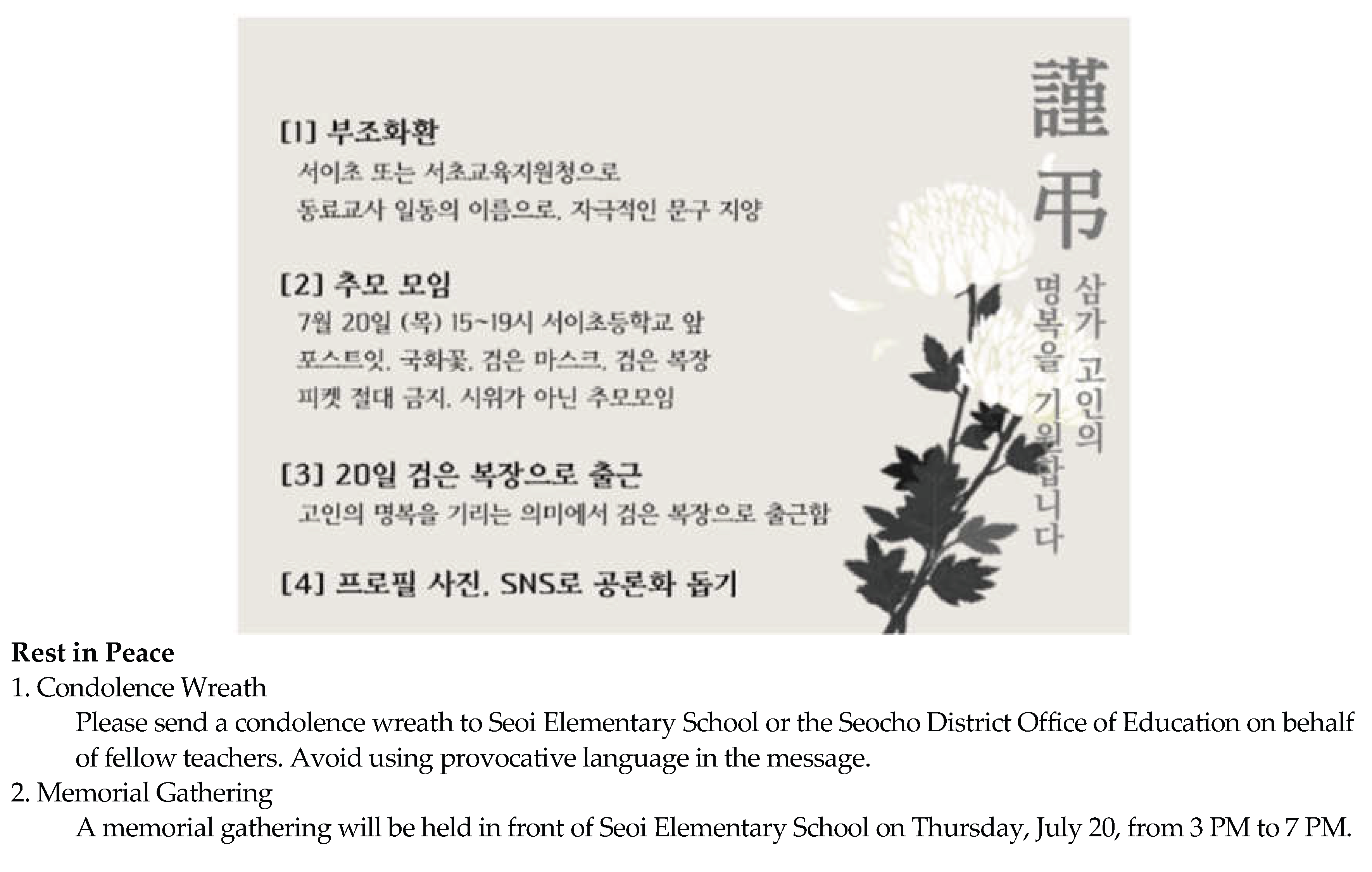
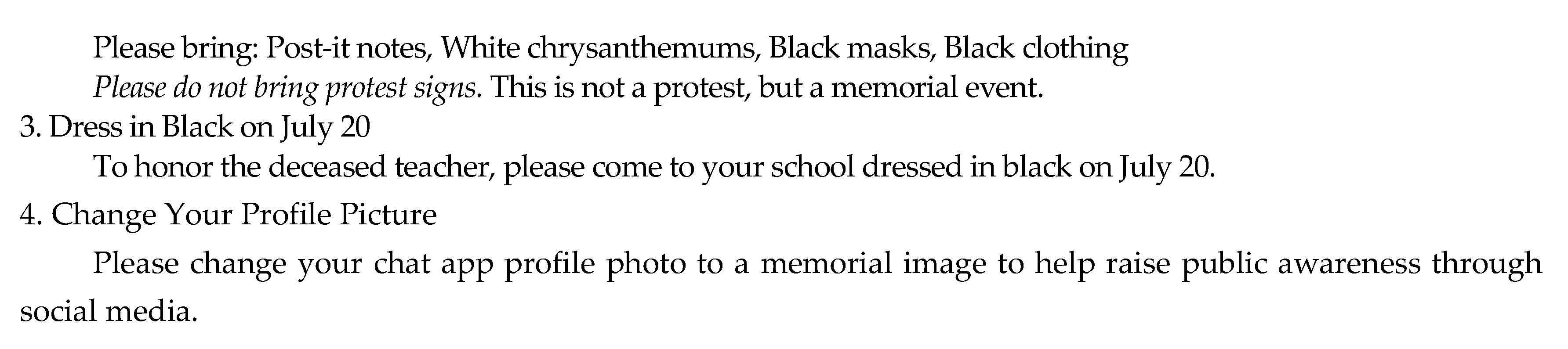
Figure 2.
Indischool Post Featuring a Memorial Photo and Message (original image and English translation).
Figure 2.
Indischool Post Featuring a Memorial Photo and Message (original image and English translation).
| 1 | Durkheim (1897/2002) primarily elaborated on three types of suicide—egoistic, altruistic, and anomic—in his original work (Le Suicide: Étude de sociologie, first published 1897). While he only briefly mentioned fatalistic suicide, this study includes it to account for contemporary institutional contexts such as the overregulation and diminished autonomy faced by Korean public school teachers. For extended sociological and historical engagement with related patterns, see Barbagli's (2015) cross-cultural analysis, which broadens Durkheim’s framework by incorporating cultural and structural dimensions of suicide across time and region. We interpret the Seoi incident as relating to three types of suicide conceptualized by Durkheim, excluding altruistic suicide. |
|
Additional Web Sources (no clear author or publication date)
CNN. (2023, September 5). South Korea teachers protest after colleague's suicide. CNN. https://www.cnn.com/2023/09/05/asia/south-korea-teachers-protest-suicide-intl-hnk
The Straits Times. (2023). Mental health crisis of S. Korean teachers may lead to collapse of education system, doctors warn. https://www.straitstimes.com/asia/east-asia/mental-health-crisis-of-s-korean-teachers-may-lead-to-collapse-of-education-system-doctors-warn
Yonhap News TV. (2023, September 23). https://www.yonhapnewstv.co.kr/news/MYH20230923000800641
Network for Education and Rights. (n.d.). https://www.network-re.org/QNA/?bmode=view&idx=17417902&utm_source=chatgpt.com
Namu Wiki
https://namu.wiki/w/2023%EB%85%84%20%EA%B5%90%EC%82%AC%20%EC%A7%91%ED%9A%8C/%EC%A0%84%EA%B0%9C
|
Disclaimer/Publisher’s Note: The statements, opinions and data contained in all publications are solely those of the individual author(s) and contributor(s) and not of MDPI and/or the editor(s). MDPI and/or the editor(s) disclaim responsibility for any injury to people or property resulting from any ideas, methods, instructions or products referred to in the content. |
© 2025 by the authors. Licensee MDPI, Basel, Switzerland. This article is an open access article distributed under the terms and conditions of the Creative Commons Attribution (CC BY) license (http://creativecommons.org/licenses/by/4.0/).
Copyright: This open access article is published under a Creative Commons CC BY 4.0 license, which permit the free download, distribution, and reuse, provided that the author and preprint are cited in any reuse.


