

Submitted:
30 December 2025
Posted:
31 December 2025
You are already at the latest version
Abstract
The Supra-Omega Resonance Theory (SORT) is presented as a closed structural architecture that unifies multiple scientific domains under an invariant mathematical core. The framework is constructed around a finite and closed set of 22 idempotent resonance operators, a global consistency projector, and a calibrated projection kernel. Together, these elements define a mathematically frozen architecture that admits no arbitrary extensions and precedes empirical integration by design. Version 6 of SORT establishes architectural completion. The operator algebra is closed under composition, global consistency is enforced via a light-balance condition, and validation bounds are defined as invariant thresholds. The same mathematical core is realized across distinct domains, including cosmology, artificial intelligence systems, quantum systems, and complex systems, each interpreting the invariant structure through domain-specific semantics while preserving algebraic identity. Empirical confrontation is positioned as a subsequent phase rather than a present objective. The decision to complete the architecture prior to data integration is methodological, ensuring that future empirical validation is reproducible, unambiguous, and structurally grounded. The MOCK v4 environment enforces deterministic execution, cryptographic reproducibility, and layered consistency verification as architectural features rather than auxiliary tooling. This article constitutes a programmatic statement for the SORT research program. It documents a structurally complete theory architecture prepared for empirical validation while remaining independent of any specific phenomenological application.
Keywords:
structural theory
; operator algebra
; projection framework
; invariant architecture
; cross-domain consistency
; pre-empirical closure
; resonance operators
; global projector
; kernel-based structure
; SORT
1. Framing: Structural Theory, Not Framework Proposal
The Supra-Omega Resonance Theory (SORT) is presented in this article as a closed structural theory architecture rather than as an open-ended framework proposal. The distinction is methodological. SORT does not aim to iteratively adapt its mathematical core in response to empirical discrepancies, nor does it position itself as a phenomenological model awaiting calibration. Instead, the theory is constructed to reach architectural completion prior to empirical confrontation, establishing a fixed invariant structure that defines the admissible space of future validation.
This framing reflects a deliberate shift from exploratory theory building toward structural finalization. The present work therefore does not introduce new operators, kernels, or consistency conditions. It documents the completion and internal coherence of an already frozen architecture, whose elements are treated as invariant across domains and applications. Empirical validation is consequently understood as a subsequent phase acting on a fixed theoretical object, rather than as a co-evolutionary driver of the theory itself.
1.1. Architectural Closure as Methodological Decision
Architectural closure in SORT is not an emergent outcome but an explicit methodological decision. The theory is defined by a finite set of idempotent resonance operators, a global consistency projector, and a calibrated projection kernel whose parameters are fixed by internal stability and consistency requirements. Once these elements satisfy algebraic closure, consistency constraints, and numerical tolerance bounds, the architecture is considered complete.
This pre-empirical closure serves multiple purposes. First, it prevents retrospective structural adjustment driven by empirical pressure, thereby preserving falsifiability at the level of the architecture itself. Second, it ensures that empirical validation, when performed, targets a uniquely specified theoretical object rather than a family of tunable models. Third, it enables reproducibility by decoupling theoretical definition from computational or observational contingencies.
The decision to complete the architecture prior to data integration does not imply indifference to empirical adequacy. Rather, it reflects the view that empirical confrontation is meaningful only once the underlying structure is fixed. Within SORT, empirical discrepancies cannot be absorbed through parameter proliferation or operator extension, but must be interpreted as structural tension with the closed architecture, to be assessed at the level of consistency rather than fit.
1.2. Position Within Contemporary Structural Approaches
SORT belongs to a class of contemporary approaches that prioritize structural and algebraic consistency over phenomenological completeness. Its emphasis on operator algebra, projection structure, and global consistency aligns it with structural perspectives in mathematical physics, information theory, and complex systems analysis, while remaining independent of any single domain-specific formalism.
Unlike empirically driven effective theories, SORT does not originate from observed regularities that are subsequently abstracted into mathematical form. Instead, it proceeds from the construction of an invariant mathematical core whose realizations across domains preserve algebraic identity while differing in semantic interpretation. Cosmological structure, artificial intelligence systems, quantum systems, and complex systems are treated as distinct semantic projections of the same underlying architecture, as discussed in Section 3.
This positioning avoids both reductionist unification and ad hoc generalization. SORT does not seek to subsume existing theories by approximation or limit, nor does it claim empirical priority over established models. Its contribution lies in defining a closed structural space within which diverse systems can be analyzed under a shared set of invariants, thereby providing a common language for cross-domain structural comparison without requiring domain-specific reformulation.
2. The Invariant Mathematical Core
The mathematical core of the Supra-Omega Resonance Theory is defined as an invariant, frozen architecture whose components are fixed prior to any empirical application. This core consists of a finite operator algebra, a global consistency projector, and a calibrated projection kernel. Together, these elements define a closed structural space that admits no arbitrary extensions, parameter tuning, or post hoc modification. All domain-specific realizations discussed in later sections are strict semantic interpretations of this invariant core rather than independent theoretical constructions.
The role of the invariant core is not to encode phenomenology, but to delimit the space of structurally admissible descriptions. As a consequence, mathematical consistency, algebraic closure, and numerical stability are treated as primary criteria, while empirical confrontation is deferred to a later validation phase acting on an already fixed structure. Table 1 summarizes the principal components and their structural roles.
2.1. Closed Resonance Operator Algebra
At the foundation of SORT lies a finite set of twenty-two resonance operators , , defined on a common operator space [11,12]. Each operator is idempotent,
and represents a structurally irreducible mode of resonance within the theory. Idempotency ensures that repeated application of an operator does not generate new states, thereby preventing uncontrolled operator growth and enforcing structural finiteness [13].
The operator set is closed under composition and linear combination subject to the constraints imposed by the global projector introduced in Section 2.2. No additional operators can be consistently added without violating closure, idempotency, or global consistency conditions. This finite operator algebra therefore defines the complete structural basis of the theory.
Importantly, the operators are not associated with physical observables at the level of the core architecture. Their interpretation is strictly structural. Semantic meaning arises only when the invariant algebra is instantiated within a specific domain, as discussed in Section 3.
2.2. Global Projector and Light-Balance Condition
Global consistency of the operator algebra is enforced by a distinguished projector , referred to as the global consistency projector. This operator acts on admissible operator configurations and enforces a light-balance condition that constrains the relative weights of the resonance operators within any valid realization [18].
Formally, is defined as an idempotent projector,
which selects a globally consistent subspace of the full operator space. Only configurations invariant under are considered structurally admissible.
The light-balance condition associated with imposes a global normalization constraint on operator contributions. This condition ensures that no subset of operators can dominate or decouple from the global structure, thereby preventing both trivial collapse and uncontrolled amplification. As a result, structural consistency is enforced at the level of the full operator ensemble rather than through pairwise constraints alone.
2.3. Projection Kernel and Calibrated Parameters
The interaction between the invariant operator algebra and its domain-specific realizations is mediated by a projection kernel . The kernel governs how structural information encoded in the operator space is projected into a semantic space appropriate to a given domain.
The kernel is defined by a Gaussian form,
where denotes the Hubble length and is the structural regularization scale. This form ensures controlled nonlocality and smooth spectral suppression of high-k modes while preserving long-range structure.
The kernel depends on a small number of calibrated parameters, most notably the structural regularization scale , fixed in SORT v6 to
This parameter is not interpreted as a physical scale. It is determined solely by internal stability, convergence, and consistency requirements of the operator–kernel system.
Once calibrated, the kernel parameters are treated as invariant. No domain-specific recalibration is permitted. This ensures that differences between domains arise exclusively from semantic interpretation rather than from structural retuning. The kernel therefore functions as a universal projection mechanism, preserving algebraic identity across all realizations.
2.4. Algebraic Closure and Validation Bounds
The invariant core of SORT is completed by explicit algebraic closure conditions and numerical validation bounds. Closure requires that all admissible operator compositions remain within the span of the original operator set when projected through and . In particular, consistency conditions analogous to Jacobi-type constraints are imposed to exclude anomalous operator combinations.
Numerical validation bounds define acceptable tolerances for deviations arising from finite-precision computation. These bounds are treated as structural invariants rather than implementation details. A configuration that violates tolerance constraints is considered structurally inconsistent, independent of empirical performance.
By elevating numerical stability and algebraic consistency to defining criteria, SORT establishes a theory architecture that is both mathematically closed and computationally well-posed. This invariant core constitutes the sole object subjected to empirical validation in later phases, ensuring that any confrontation with data addresses the architecture itself rather than adjustable subcomponents.
3. Domain Architecture
The invariant mathematical core introduced in Section 2 is not tied to a single scientific domain. Instead, SORT is explicitly designed to admit multiple domain realizations that preserve algebraic identity while differing in semantic interpretation. The domain architecture formalizes this separation by distinguishing between core structure, domain semantics, and application-specific instantiations. This modular decomposition ensures that theoretical consistency is maintained across domains while allowing each field to interpret and operationalize the invariant structure according to its own observational, computational, or operational context.
3.1. Core–Domain–Application Separation
SORT is organized into three strictly separated architectural layers: the invariant core, domain realizations, and application layers (Figure 1). The invariant core comprises the closed operator algebra, global projector, and projection kernel defined in Section 2. This layer is immutable and identical across all domains.
Domain realizations map the invariant core into a semantic space appropriate to a given scientific field. This mapping does not alter the algebraic structure, operator relations, or kernel parameters. Instead, it assigns domain-specific meaning to structurally defined quantities. Applications constitute a further layer in which domain realizations are instantiated within concrete computational, observational, or diagnostic settings.
This separation is enforced programmatically through clearly defined interfaces. No application-level construct is permitted to modify domain semantics, and no domain-level interpretation may alter the invariant core. As a result, architectural drift is structurally excluded, and cross-domain comparability is preserved by construction.
3.2. SORT-COSMO: Cosmological Structure
In the cosmological domain, the SORT architecture is realized as a projection-based structural framework for large-scale cosmology [37,38]. The invariant operator core is interpreted in terms of scale-dependent structural relations, with the projection kernel governing how invariant structure manifests across observational scales. Phenomena such as apparent expansion rates, early structure formation, and large-scale coherence are treated as emergent properties of the projection process rather than as independent dynamical inputs.
This realization has been developed in detail within the SORT-COSMO framework, where scale-dependent drift and projection-induced structure provide a unified structural interpretation of several observational tensions, including discrepancies in inferred expansion parameters [5,6,19,20]. Importantly, these results do not introduce new cosmological degrees of freedom. They arise entirely from the domain-specific interpretation of the invariant SORT core.
3.3. SORT-AI: Structural Stability in AI Systems
Within artificial intelligence systems, SORT is instantiated as a structural diagnostic framework for alignment stability, distributional drift, and systemic coherence [27]. The invariant operator algebra is interpreted as a space of structural constraints acting on model states, training dynamics, and inference behavior. The global projector enforces consistency across subsystems, while the projection kernel mediates the translation between abstract structural relations and concrete system observables.
SORT-AI focuses on identifying structural instabilities that are not detectable through performance metrics alone [25]. These include latent drift, alignment degradation, and incoherent subsystem interaction. The framework has been applied to retrieval-augmented generation systems and other modular AI architectures as a diagnostic testbed, demonstrating how structural signals can precede observable failure modes [7,8].
3.4. SORT-QS: Quantum System Diagnostics
In the domain of quantum systems, SORT provides a structural diagnostic perspective on error propagation, noise filtering, and operator coherence [29]. The invariant operator core is interpreted in terms of abstract operator relations rather than physical observables, allowing the framework to remain agnostic with respect to specific quantum hardware implementations.
SORT-QS emphasizes structural properties of quantum systems that persist across physical realizations, such as coherence preservation and error-correction capacity [30,32]. Projection through the kernel maps invariant structure onto experimentally accessible diagnostics without introducing system-specific tuning. This approach complements existing quantum information frameworks by focusing on algebraic consistency rather than dynamical optimization [9].
3.5. SORT-CX: Emergence in Complex Systems
For complex systems, SORT is realized as a structural framework for analyzing emergence, network stability, and critical transitions [33,34]. The invariant core is interpreted as a space of relational constraints acting on interacting components, independent of the specific nature of those components. This enables the analysis of biological, social, technological, and economic systems within a shared structural language.
SORT-CX focuses on identifying invariant signatures of emergent stability and systemic fragility. Projection-induced structure reveals how local interactions give rise to global coherence or instability without invoking domain-specific dynamical assumptions. Applications include network robustness analysis and early-warning diagnostics for critical transitions [10,36].
3.6. Cross-Domain Invariance
Across all domains, the defining feature of SORT is the preservation of algebraic identity. While the semantic interpretation of operators, projections, and kernel outputs varies by domain, the underlying mathematical relations remain unchanged. This cross-domain invariance distinguishes SORT from frameworks that rely on domain-specific adaptations or parameter retuning (Figure 2).
As a consequence, structural insights obtained in one domain can be translated into another without loss of consistency. This property does not imply reduction or unification at the level of phenomenology. Instead, it establishes a shared structural basis that enables comparative analysis across otherwise disparate systems. The invariant core thus functions as a common reference frame for structural reasoning, independent of domain-specific content.
4. Empirical Positioning
The empirical positioning of SORT follows directly from its architectural design. Empirical analysis is not treated as a co-equal driver of theoretical development, but as a temporally subsequent phase acting on a fixed and invariant structure. This sequencing reflects the distinction between structural definition and structural validation. The present article therefore does not report empirical fits or quantitative comparisons. Instead, it specifies the conditions under which such comparisons become meaningful once applied to a closed theoretical object.
4.1. Pre-Empirical Closure as Design Principle
Pre-empirical closure constitutes a central design principle of SORT. The invariant mathematical core described in Section 2 is completed, frozen, and internally validated prior to any confrontation with observational or experimental data. This approach departs from model-building strategies in which empirical discrepancies are absorbed through parameter extension or structural modification.
Within SORT, empirical adequacy cannot be achieved by structural adjustment. The closed operator algebra, global projector, and projection kernel admit no post hoc extensions without violating closure or consistency conditions. As a result, empirical evaluation targets the architecture itself rather than a tunable family of models. This preserves falsifiability at the structural level and ensures that empirical outcomes are interpretable as statements about the validity of the architecture rather than about the success of parameter optimization.
Pre-empirical closure also establishes a clear separation between theoretical definition and computational implementation. Structural properties are fixed independently of available data volume, observational precision, or computational resources. Empirical analysis is therefore constrained only by external capabilities, not by theoretical indeterminacy.
4.2. Validation Sequence and Phase Structure
The development of SORT is organized into a sequence of clearly delineated phases (Figure 3). Version 6 establishes architectural completion, including algebraic closure, parameter calibration, and numerical validation bounds. The present framework article documents this completion and its implications across domains.
The subsequent validation phase, designated as version 7, is reserved for quantitative empirical confrontation. This phase will implement the invariant architecture within high-performance computational environments and evaluate its predictions against domain-specific datasets. No modifications to the theoretical core are anticipated during this phase. Empirical results will therefore directly assess structural adequacy rather than model flexibility.
A further phase, provisionally designated version 8, may address extended empirical programs or comparative structural analysis across domains. Such extensions, if pursued, will operate strictly within the invariant architecture defined in version 6 and documented in this work.
4.3. Conditions for Quantitative Comparison
Quantitative comparison within SORT is contingent upon a set of explicitly defined conditions. First, empirical datasets must admit a mapping to the structural quantities defined by the invariant core without introducing auxiliary parameters or domain-specific corrections. Second, computational implementations must satisfy the numerical validation bounds specified in Section 2.4, ensuring that deviations reflect structural tension rather than numerical instability.
Third, sufficient computational resources must be available to evaluate the projection kernel and operator relations at the resolution required by the target domain. These requirements are organizational and technical rather than theoretical. Large-scale empirical evaluation is scheduled for phase v7; the present focus on architectural completion reflects methodological design rather than theoretical incompleteness.
Once these conditions are met, quantitative comparison proceeds as a direct test of the closed architecture. Agreement or disagreement with data cannot be mitigated by structural modification and must be interpreted as evidence for or against the validity of the theory at the architectural level.
5. Outlook: Toward Unified Structural Description
The completion of the invariant SORT architecture marks a transition from structural construction to structural testing. The outlook of the research program is therefore not characterized by further theoretical expansion, but by controlled empirical confrontation and comparative analysis across domains. This section outlines the next phase of development and clarifies the broader architectural implications that follow from cross-domain invariance, without advancing phenomenological claims beyond what the closed structure itself entails.
5.1. Phase v7: Empirical Validation Program
Phase v7 is defined as the first systematic empirical validation program of the closed SORT architecture. Its primary objective is not parameter estimation or model fitting, but the quantitative assessment of structural adequacy. Empirical datasets will be mapped onto the invariant quantities defined by the operator algebra, global projector, and projection kernel, following the conditions specified in Section 4.3.
Validation will be conducted within high-performance computational environments capable of resolving the numerical precision required by the projection kernel and operator relations. The scope of v7 includes domain-specific datasets in cosmology, artificial intelligence systems, quantum system diagnostics, and complex systems analysis. In each case, the same invariant core will be evaluated without structural modification or parameter retuning.
The empirical program is explicitly constrained. No extensions to the operator set, kernel structure, or calibration parameters are permitted during v7. Empirical results will therefore constitute direct tests of the closed architecture. Agreement with data will support the structural hypothesis encoded in SORT, while systematic deviations will indicate the limits of applicability of the invariant core.
5.2. Architectural Implications
The defining implication of the SORT framework lies in its cross-domain invariance. A single closed mathematical structure admits coherent realizations across domains that are traditionally treated as conceptually independent. This property does not establish unification at the level of phenomenology or dynamics. Instead, it suggests the existence of a shared structural substrate underlying diverse systems.
Such a substrate functions as a reference architecture rather than as a reductionist theory. Domain-specific laws, models, and observables remain intact, but are situated within a common structural space defined by invariant relations and consistency constraints. The persistence of algebraic identity across domains implies that structural insights obtained in one context may inform analysis in another without translation at the level of dynamics or interpretation.
Whether this invariant structure constitutes a viable candidate for a unified structural description is an empirical question reserved for subsequent phases. The present work establishes the necessary precondition for such an assessment by defining a closed and testable architecture. Any claims of unification, if warranted, must emerge from empirical performance rather than from theoretical assertion.
6. Conclusion
This article has presented the Supra-Omega Resonance Theory (SORT) as a closed structural architecture rather than as an open or exploratory framework. The primary contribution of this work is not the introduction of new mathematical constructs, empirical results, or domain-specific models, but the explicit documentation and positioning of an invariant theory structure that has reached architectural completion. SORT is advanced here as a well-defined theoretical object, prepared for empirical confrontation without further internal modification.
The defining methodological decision underlying this work is the separation of structural definition from empirical validation. By completing and freezing the operator algebra, global projector, and projection kernel prior to data integration, SORT establishes a clear and falsifiable hypothesis at the level of structure. Empirical evaluation, when undertaken, will therefore assess the adequacy of the architecture itself rather than the flexibility of an adjustable model. This decision entails risk, but it is a necessary condition for theoretical seriousness and interpretability.
The framework is intentionally presented without defensive qualification and without claims of phenomenological supremacy. Its scope and limits are determined by its invariant structure, not by rhetorical positioning. At the same time, the cross-domain coherence demonstrated across cosmology, artificial intelligence systems, quantum systems, and complex systems indicates that SORT captures structural regularities that are not confined to a single field of application. This coherence motivates, but does not assert, the possibility that a shared structural substrate underlies diverse classes of systems.
SORT therefore functions as a programmatic statement. It articulates a hypothesis about the existence and relevance of a closed structural layer that precedes domain-specific dynamics and phenomenology. The mathematical foundations, formal derivations, and validation protocols supporting this hypothesis are documented in the associated whitepapers and archival materials. The present article consolidates these elements into a single architectural position and defines the conditions under which it can be tested.
Whether the invariant structure identified by SORT constitutes an adequate description of nature, computation, or complex organization is ultimately an empirical question. By fixing the architecture and deferring empirical confrontation to subsequent phases, this work establishes a clear basis on which such a question can be meaningfully addressed. In this sense, the contribution of SORT at its present stage lies not in explanatory closure, but in structural clarity and methodological commitment.
Data Availability Statement
The complete SORT v6 framework, including operator definitions, validation protocols, and reproducibility manifests, is archived at Zenodo under DOI 10.5281/zenodo.18094128. The MOCK v4 validation environment is available at 10.5281/zenodo.18050207 and GitHub. Domain-specific preprints are accessible via the MDPI Preprints server.
Acknowledgments
The author acknowledges the structural foundations established in SORT versions 4 and 5, which enabled the architectural completion presented in this work.
Conflicts of Interest
The author declares no conflicts of interest.
Use of Artificial Intelligence
Editorial language refinement and LaTeX formatting assistance were supported by automated tools. All scientific content, mathematical structures, theoretical developments, and validations are the sole work of the author.
References
- Wegener, G. H. (2025). The Supra-Omega Resonance Theory (SORT): A Mathematically Hardened Projection Framework for Large-Scale Cosmological Structure. Preprints 2024111783. [CrossRef]
- Wegener, G. H. (2025). Supra-Omega Resonance Theory (SORT): A Modular Operator-Projection Framework for Structural Analysis (Whitepaper v6). Zenodo. [CrossRef]
- Wegener, G. H. (2025). MOCK v4 — SORT v6 Public Skeleton. Zenodo/GitHub. [CrossRef]
- Wegener, G. H. (2025). Supra-Omega Resonance Theory (SORT): An Operatoric Model of Cosmological Self-Coherence (includes MOCK v3). Zenodo. [CrossRef]
- Wegener, G. H. (2025). SORT-COSMO: A Projection-Based Structural Framework for Cosmology. Preprints 2024121574. [CrossRef]
- Wegener, G. H. (2025). Resolving the Hubble Tension as a Scale-Dependent Projection Effect in the Supra-Omega Resonance Framework (SORT). Preprints 2024120727. [CrossRef]
- Wegener, G. H. (2025). SORT-AI: A Projection-Based Structural Framework for AI Safety—Alignment Stability, Drift Detection, and Scalable Oversight. Preprints 2024121334. [CrossRef]
- Wegener, G. H. (2025). SORT-AI: RAG as a Diagnostic Testbed. Preprints 2024121345. [CrossRef]
- Wegener, G. H. (2025). SORT-QS: A Projection-Based Structural Framework for Quantum Systems—Error Correction, Noise Filtering, and Operator Diagnostics. Preprints 2024122178. [CrossRef]
- Wegener, G. H. (2025). SORT-CX: A Projection-Based Structural Framework for Complex Systems—Operator Geometry, Non-Local Kernels, and Emergent Stability. Preprints 2024121431. [CrossRef]
- Reed, M., & Simon, B. (1980). Methods of Modern Mathematical Physics I: Functional Analysis (Rev. ed.). Academic Press. ISBN 978-0-12-585050-6.
- Conway, J. B. (2000). A Course in Operator Theory. American Mathematical Society. ISBN 978-0-8218-2065-0.
- Halmos, P. R. (1982). A Hilbert Space Problem Book (2nd ed.). Springer. ISBN 978-0-387-90685-0.
- Kadison, R. V., & Ringrose, J. R. (1997). Fundamentals of the Theory of Operator Algebras, Vol. I. American Mathematical Society. ISBN 978-0-8218-0819-1.
- Dunford, N., & Schwartz, J. T. (1988). Linear Operators, Part II: Spectral Theory. Wiley-Interscience. ISBN 978-0-471-60847-3.
- Kato, T. (1995). Perturbation Theory for Linear Operators. Springer. ISBN 978-3-540-58661-6.
- Blyth, T. S., & Santos, M. F. (2005). Idempotent-Generated Algebras. World Scientific.
- Bousso, R. (2002). The Holographic Principle. Rev. Mod. Phys. 74, 825–874. [CrossRef]
- Riess, A. G., et al. (2022). A Comprehensive Measurement of the Local Value of the Hubble Constant with 1 km/s/Mpc Uncertainty from the Hubble Space Telescope and the SH0ES Team. Astrophys. J. Lett. 934, L7. [CrossRef]
- Planck Collaboration (2020). Planck 2018 results. VI. Cosmological parameters. Astron. Astrophys. 641, A6. [CrossRef]
- Di Valentino, E., et al. (2021). In the Realm of the Hubble Tension—A Review of Solutions. Class. Quantum Grav. 38, 153001. [CrossRef]
- Labbé, I., et al. (2023). A Population of Red Candidate Massive Galaxies ∼600 Myr after the Big Bang. Nature 616, 266–269. [CrossRef]
- Bogdán, Á., et al. (2024). Evidence for Heavy-Seed Origin of Early Supermassive Black Holes from a z≈10 X-ray Quasar. Nat. Astron. 8, 126–133. [CrossRef]
- Schwarz, D. J., et al. (2016). CMB Anomalies after Planck. Class. Quantum Grav. 33, 184001. [CrossRef]
- Amodei, D., et al. (2016). Concrete Problems in AI Safety. arXiv:1606.06565.
- Ngo, R., et al. (2022). The Alignment Problem from a Deep Learning Perspective. arXiv:2209.00626.
- Goodfellow, I., Bengio, Y., & Courville, A. (2016). Deep Learning. MIT Press. ISBN 978-0-262-03561-3.
- Vaswani, A., et al. (2017). Attention Is All You Need. NeurIPS 30.
- Nielsen, M. A., & Chuang, I. L. (2010). Quantum Computation and Quantum Information (10th Anniversary ed.). Cambridge University Press. ISBN 978-1-107-00217-3.
- Shor, P. W. (1995). Scheme for Reducing Decoherence in Quantum Computer Memory. Phys. Rev. A 52, R2493–R2496. [CrossRef]
- Gottesman, D. (1997). Stabilizer Codes and Quantum Error Correction. Ph.D. thesis, California Institute of Technology.
- Zurek, W. H. (2003). Decoherence, Einselection, and the Quantum Origins of the Classical. Rev. Mod. Phys. 75, 715–775. [CrossRef]
- Bar-Yam, Y. (1997). Dynamics of Complex Systems. Addison-Wesley. ISBN 978-0-201-55748-1.
- Newman, M. (2010). Networks: An Introduction. Oxford University Press. ISBN 978-0-19-920665-0.
- Albert, R., & Barabási, A.-L. (2002). Statistical Mechanics of Complex Networks. Rev. Mod. Phys. 74, 47–97. [CrossRef]
- Scheffer, M., et al. (2009). Early-Warning Signals for Critical Transitions. Nature 461, 53–59. [CrossRef]
- Weinberg, S. (2008). Cosmology. Oxford University Press. ISBN 978-0-19-852682-7.
- Dodelson, S., & Schmidt, F. (2020). Modern Cosmology (2nd ed.). Academic Press. ISBN 978-0-12-815948-4.
- Springel, V., et al. (2005). Simulations of the Formation, Evolution and Clustering of Galaxies and Quasars. Nature 435, 629–636. [CrossRef]
- Mo, H., van den Bosch, F., & White, S. (2010). Galaxy Formation and Evolution. Cambridge University Press. ISBN 978-0-521-85793-2.
- Stodden, V., Leisch, F., & Peng, R. D. (2014). Implementing Reproducible Research. CRC Press. ISBN 978-1-4665-6159-5.
- Wilson, G., et al. (2014). Best Practices for Scientific Computing. PLoS Biol. 12, e1001745. [CrossRef]
- Sandve, G. K., et al. (2013). Ten Simple Rules for Reproducible Computational Research. PLoS Comput. Biol. 9, e1003285. [CrossRef]
- Einstein, A. (1917). Kosmologische Betrachtungen zur allgemeinen Relativitätstheorie. Sitzungsber. Königl. Preuß. Akad. Wiss. Berlin, 142–152.
- Dirac, P. A. M. (1930). The Principles of Quantum Mechanics. Oxford University Press. ISBN 978-0-19-852011-5.
Figure 1.
SORT architectural stack. The invariant core is immutable across all domains. Domain modules provide semantic interpretation without altering algebraic structure. Applications instantiate domain realizations within specific operational contexts.
Figure 1.
SORT architectural stack. The invariant core is immutable across all domains. Domain modules provide semantic interpretation without altering algebraic structure. Applications instantiate domain realizations within specific operational contexts.
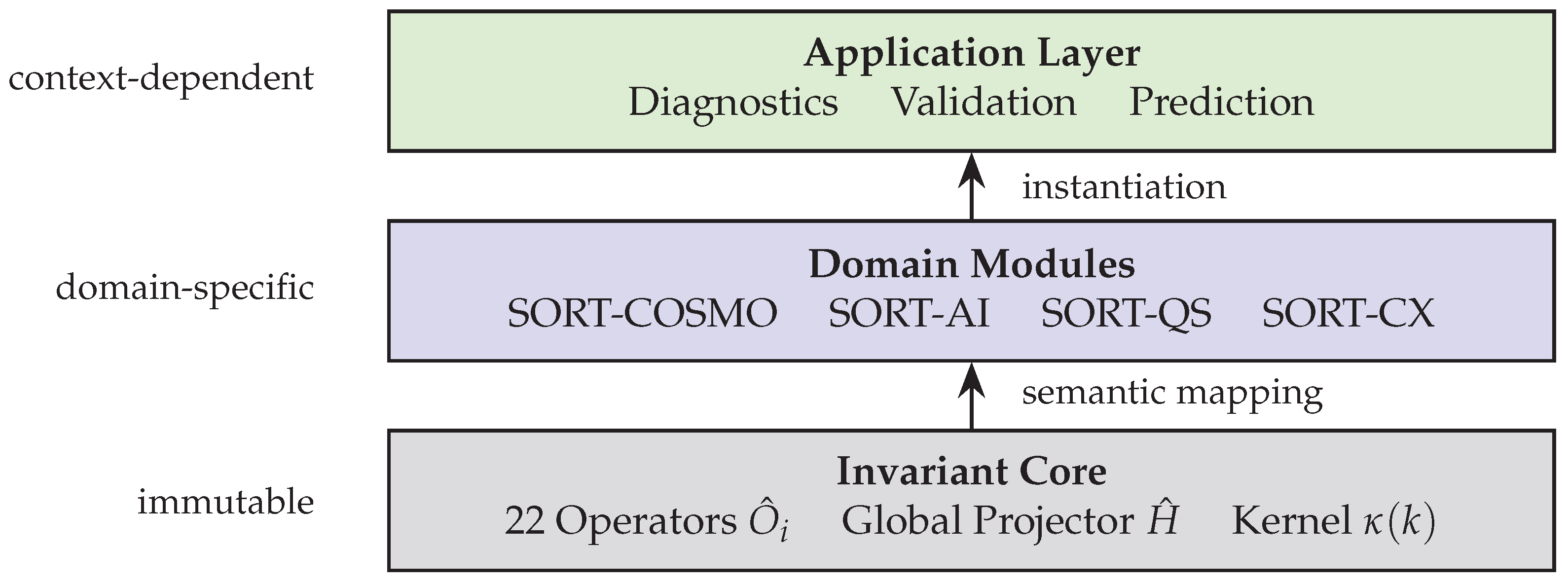
Figure 2.
Cross-domain invariance in SORT. The same invariant core—comprising operators , global projector , and kernel —admits distinct semantic realizations across domains while preserving algebraic identity.
Figure 2.
Cross-domain invariance in SORT. The same invariant core—comprising operators , global projector , and kernel —admits distinct semantic realizations across domains while preserving algebraic identity.
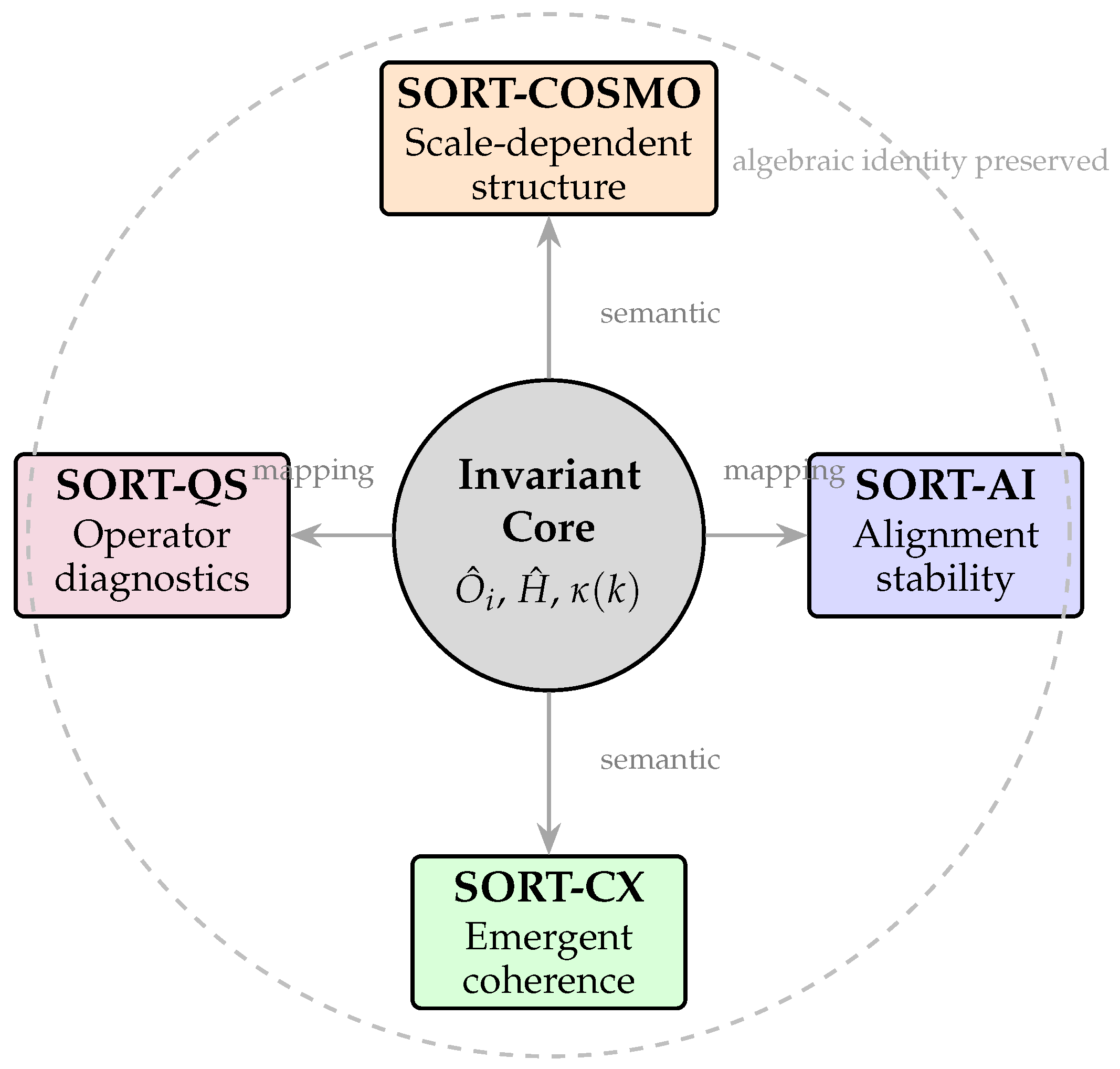
Figure 3.
SORT validation phase structure. Architectural closure (v6) precedes empirical validation (v7). The invariant core remains unchanged throughout all phases.
Figure 3.
SORT validation phase structure. Architectural closure (v6) precedes empirical validation (v7). The invariant core remains unchanged throughout all phases.
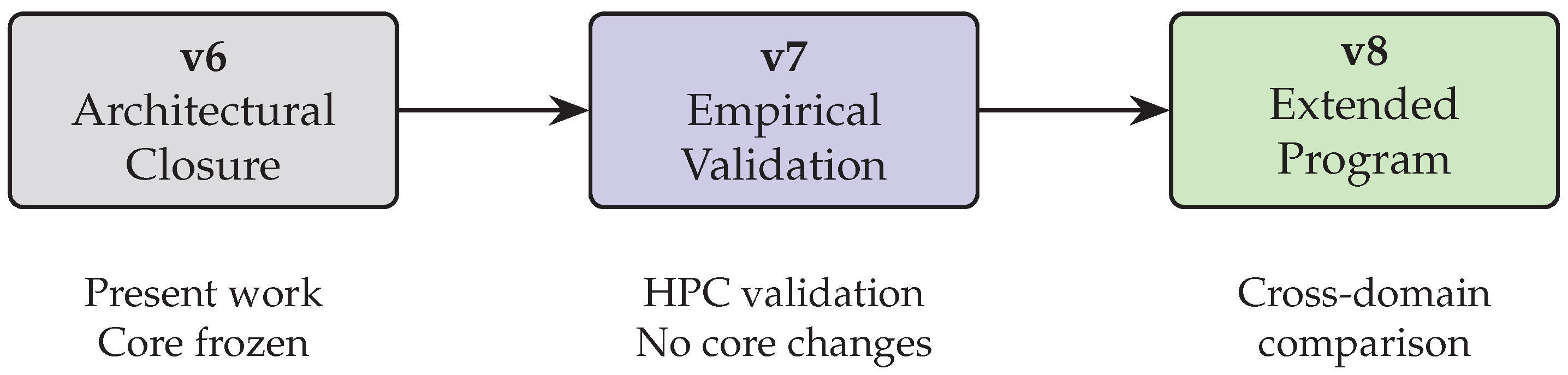

Table 1.
Overview of the invariant core components defining the closed SORT architecture.
| Component | Role | Status |
|---|---|---|
| Resonance Operators | Structural basis (22 elements) | Closed |
| Global Projector | Consistency enforcement | Invariant |
| Projection Kernel | Domain projection mechanism | Calibrated |
| Light-Balance Condition | Weight constraint | Enforced |
| Validation Bounds | Numerical tolerances | Fixed |
Disclaimer/Publisher’s Note: The statements, opinions and data contained in all publications are solely those of the individual author(s) and contributor(s) and not of MDPI and/or the editor(s). MDPI and/or the editor(s) disclaim responsibility for any injury to people or property resulting from any ideas, methods, instructions or products referred to in the content. |
© 2025 by the author. Licensee MDPI, Basel, Switzerland. This article is an open access article distributed under the terms and conditions of the Creative Commons Attribution (CC BY) license.
Copyright: This open access article is published under a Creative Commons CC BY 4.0 license, which permit the free download, distribution, and reuse, provided that the author and preprint are cited in any reuse.


