1. Introduction
Paradoxes are always interesting because they push us to question the theory that leads to the paradox. Until now, special relativity has caused two famous paradoxes: Ehrenfest’s paradox [
1] and the twin paradox [
2]. In this paper, a new paradox is studied in two stages. For the first stage, solving the paradox will require some interesting reasoning. With that reasoning we will revise the example that Einstein used to demonstrate the loss of simultaneity. The second stage is the application of the solution of the paradox to our reasoning while observing the universe. This may explain why some fully formed galaxies are observed soon after the big bang with the new space telescope [
3].
The problem presented in this paper is an old, well-known problem; it is unclear why it hasn’t been applied to the universe.
2. The Solution to the New Paradox
A spaceship is traveling towards a planet. When the distance is 10ly, the spaceship and the planet send a light signal to each other. When and where do the light signals meet? The place where the light signals meet will be called ‘meeting point’. We will ignore gravitation for this exercise as it is solely about special relativity.
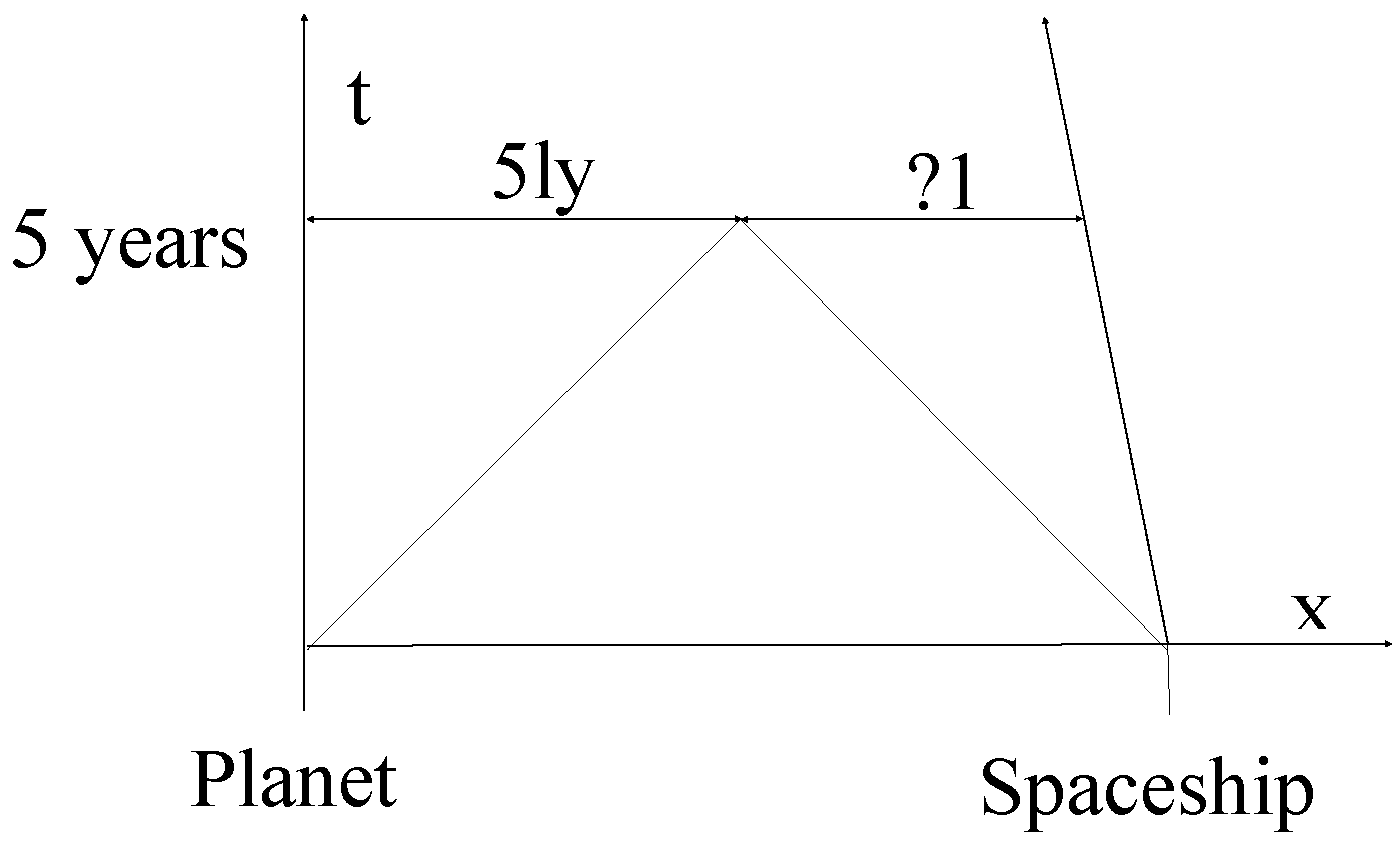
The planet is immobile, both signals leave ‘at the same time for the planet’ when the distance is 10ly for the planet. The signals meet after 5 years for the planet, therefore at 5ly of the planet (see
Figure 1). That is the application of special relativity. Meanwhile the spaceship will have moved and the distance ‘meeting point’ - spaceship is smaller than 5ly (distance marked ?1).
Please note that I am not using Minkowski spacetime: the moving frame is not represented, only the motion of the spaceship is represented (world line) in a Cartesian coordinate. The spaceship’s coordinates are not represented, but the distance ‘meeting point’ - spaceship is smaller than 5ly seen from the planet. It sounds wrong, which implies a possible paradox (in V1 of this preprint).
On
Figure 1, the speed of light is correct for the planet but doesn’t look correct for the spaceship. That is the genius of Einstein, time-flow and length of measuring rod of the spaceship
seen from the planet are not identical to the time-flow and measuring rod of the planet itself; so the speed of light is respected for the spaceship as well, even if the angle is not 45º.
Figure 1 represents what the planet sees, and cannot be directly applied to the spaceship because of those changes of time-flow and length contraction. What is the unknown distance marked ‘?1’ with the spaceship’s measurements?
One path would be to draw the same story with the spaceship as reference because, with special relativity, any reference should give the same result. But that path is incorrect, as I will explain later. So, it is time to determine what the spaceship is seeing
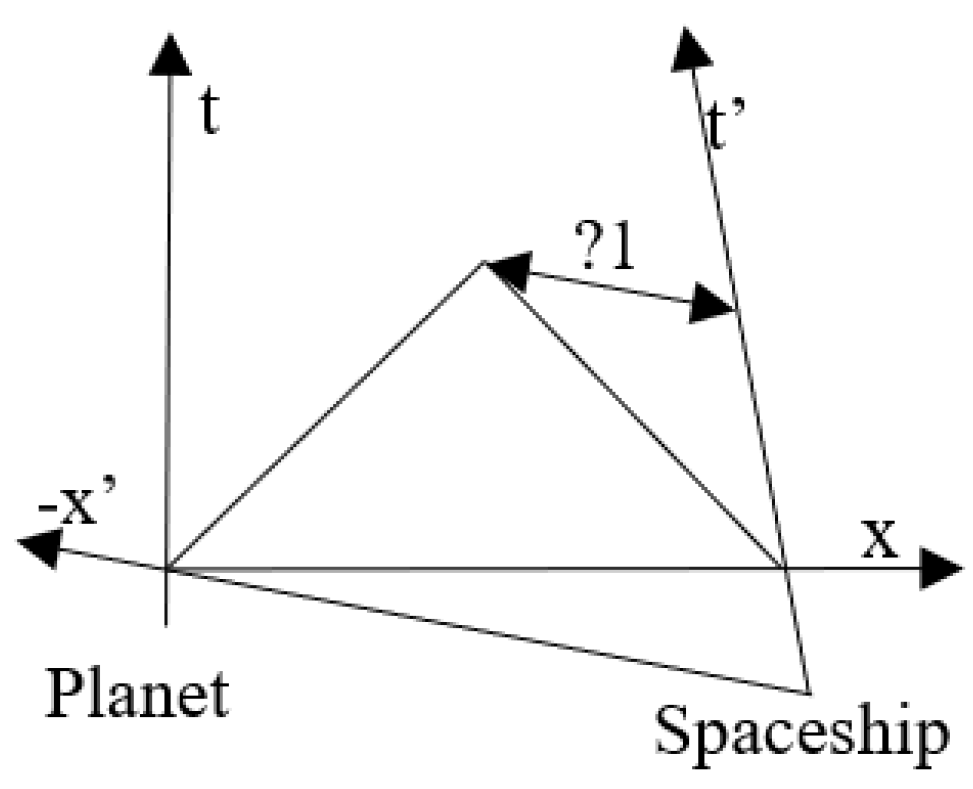
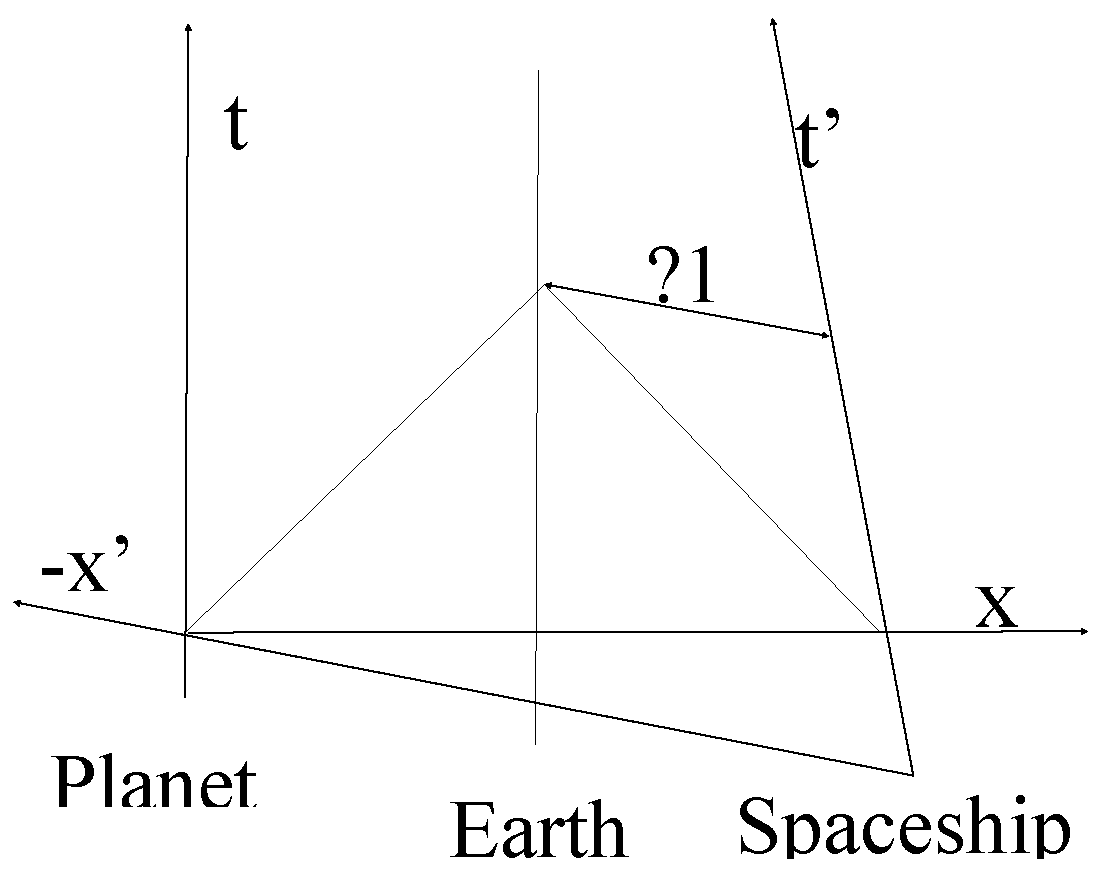
from the observation of the planet. Therefore, we should add the coordinates of the moving spaceship as in
Figure 2.
If the coordinates of the planet are Cartesian, the coordinates of the spaceship are not. We notice that the departure of the signals simultaneous for the planet are not simultaneous for the spaceship (because the start of both dash lines/signals are not on a line parallel to x’ axis). The origin of the spaceship coordinate is when the spaceship is at 10ly from the planet. Hence, the spaceship is closer to the planet when it sends the signal. For the spaceship, the signal has left the planet and started to travel towards the spaceship before its signal leaves the spaceship. Those are two reasons why the meeting point cannot be in the middle seen from the spaceship. The expectation of reaching 5 years and 5ly from the spaceship has disappeared. An additional detail, the arrow for the distance ‘?1’ is no longer horizontal; we shouldn’t use x but x’ axis to measure the distance as seen from the spaceship.
So the distance ‘meeting point’ - spaceship is indeed smaller than 5ly. And despite that smaller distance, special relativity is respected for the spaceship. An exact result could be calculated but is irrelevant for this paper. The point is that there is an explanation to the “paradox”.
3. Two Stories
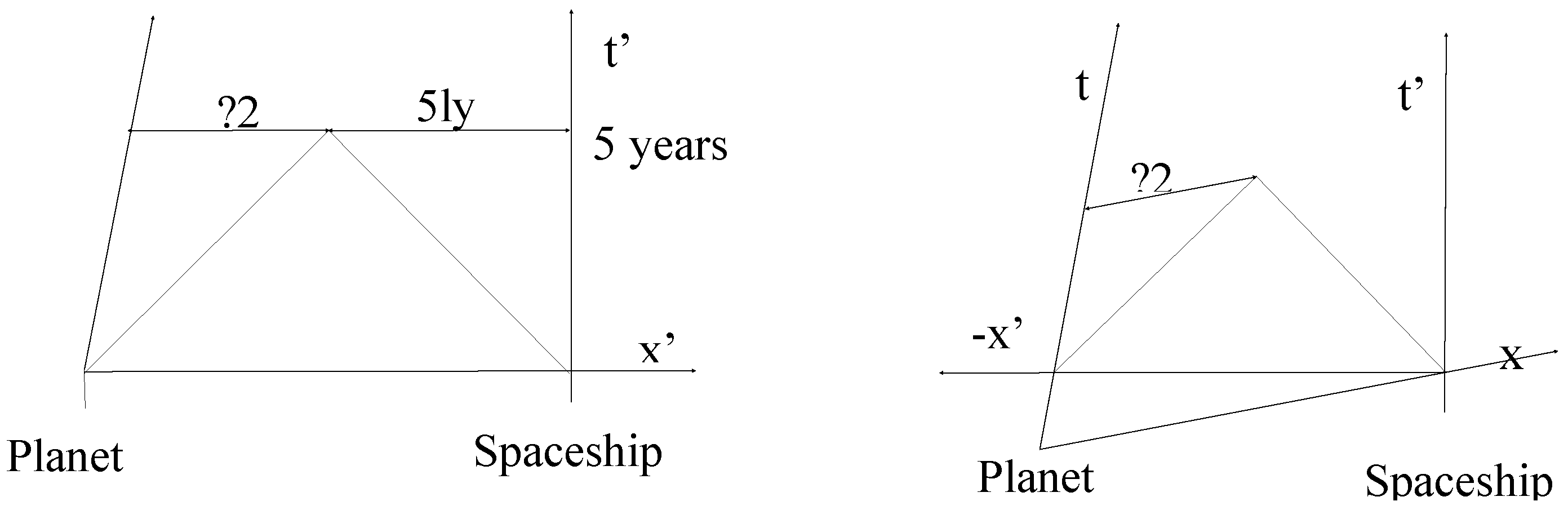
Now, the principle of relativity on which special relativity is based, is telling us that the spaceship can be considered immobile and become the reference. Thus, both signals leave ‘at the same time for the spaceship’ when the distance is 10ly for the spaceship etc.
With
Figure 3 you recognise
Figure 1 and
Figure 2 but as in a mirror. With
Figure 1 and
Figure 2 we concluded that the meeting point is 5ly away from the planet and at a smaller distance from the spaceship. With
Figure 3 we conclude that the meeting point is at 5ly away from the spaceship and at a smaller distance from the planet. But those two conclusions are contradictory. Is it a paradox?
Check very carefully and you will realize that signals of
Figure 1 and
Figure 2 are not the signals of
Figure 3. The signals leave from the origin of the immobile reference but not from the origin of the moving reference. Using the planet as a reference and the spaceship as a reference are two different stories because what is simultaneous for one reference is not simultaneous for the other. In the text of the “paradox” there are two stories with two different results; so there is no paradox.
Will you be able to see the “two stories” in the next section?
4. Einstein’s Train and Embankment with the Relativity of Simultaneity
We will start with a condensed presentation of a previous study [
4] of Section 9 of Einstein’s
Relativity which is called
the relativity of simultaneity. Here we will see how and why I reached a false conclusion.
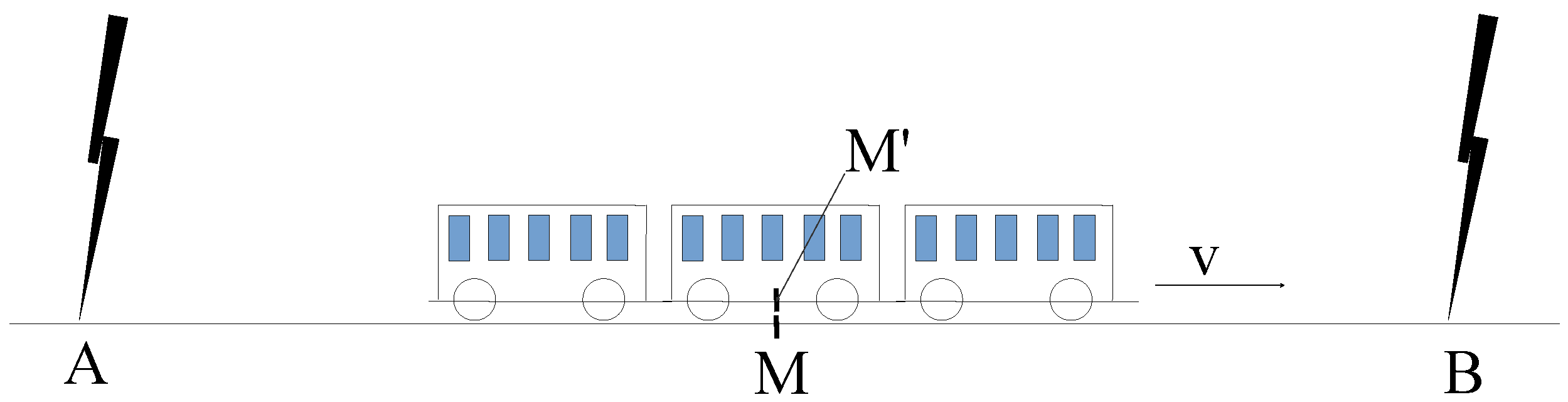
Figure 4 represents the example that Einstein gave us in his
Relativity [
5] to show the loss of simultaneity; he gave a similar figure. Lightning bolts A and B are simultaneous and for Einstein, only observer M can detect the simultaneity. Please read Einstein’s section 9 and you will realize that Einstein used the old way of thinking where one reference is preferred to the other one. But as he was reaching the correct conclusion, Einstein didn’t realise his mistake. Correcting his mistake is not difficult. As the speed of light is constant for M and M’, as the distance AM’ equals M’B, it means that M’ also reaches the conclusion of simultaneity.
I hope it is now obvious that, from
Figure 4, M and M’ both reach the conclusion of simultaneity. In my previous study, I was blocked at that point and wrongly re-instated simultaneity [
4].
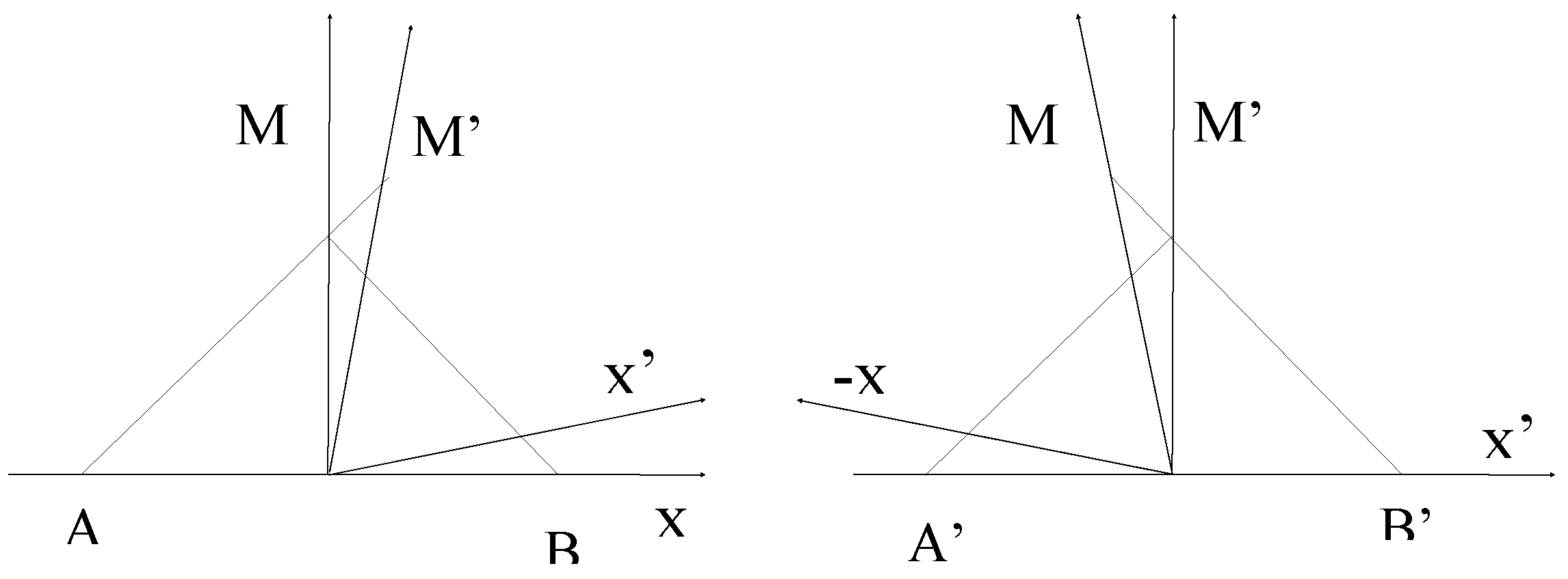
As with the paradox above, there are two stories: one for the simultaneity of the embankment (left diagram of
Figure 5) and one for the train (right diagram of
Figure 5). If lightnings A and B are simultaneous for the embankment (left diagram) they are not simultaneous for the train and they don’t reach M’ at the same time.
Figure 4 is confusing because A and B look the same for the train and the embankment; a Minkowski spacetime diagram (
Figure 5) is necessary to understand
Figure 4; a diagram which is not presented in Einstein’s book. Each story reaches simultaneity contrary to Einstein’s text.
In 1916 when he wrote his book, less than a year after his general relativity solution, Einstein wanted to present general relativity to the public and he accepted, without checking, what had previously been written about special relativity.
This Section 9 of Einstein should be annotated with a big warning, instead, my
Relativity version has a preface criticising Einstein’s choice of the word “mollusc” for a non-rigid reference as confusing. I read (many, many times) Einstein’s
Relativity [
5], but also A.P. French’s
Special Relativity and L. Susskind’s
Special relativity and Classical Field Theory. I couldn’t detect the two stories in Einstein’s section 9. However, as soon as someone pointed out that A and A’ are not the same, everything fell into place. The “mollusc” is a detail compared to that confusing section 9. If after French and Susskind, I couldn’t see the two stories, it is probably because something is missing in the teaching of special relativity: a warning on how
Figure 4 can be misleading. That is not the subject of this paper, but it is included because I had just realised my mistake in [
4].
5. New Question
We must go back to the new paradox because there is something strange. The new question is: why do we have to consider the planet’s measurement on the planet side of the meeting point and the spaceship’s measurement on the spaceship side of the meeting point? In other words, to satisfy special relativity why do we have to mix the measuring rods?
Please be aware that the new question is also a fact needed to explain the new paradox. The mixing of the measuring rods that solves the paradox leads to a question on the age of the universe. We have to make the paradox of
Section 2 a bit more complex. We add the earth, with us as observers of the universe, at the meeting point of
Figure 2 as in
Figure 6.
The conclusion of
Figure 2 adapted to
Figure 6 is that, with the earth measurements, the when and where the photon leaves the spaceship is 5ly away 5 years ago (the right part of the isosceles triangle). But to agree with special relativity, we saw that the earth measuring rod shouldn’t be used in the right part of the meeting point. From the spaceship viewpoint/measurement, the spaceship is sending the signal at a distance from the meeting point smaller than 5ly and the meeting time is not 5 years; spaceship viewpoint and its measurements are the only measurements in agreement with special relativity. So the 5ly and 5 years measured from the earth are wrong and the smaller distance and age measured with the spaceship are correct. You can only solve the paradox if you accept that result.
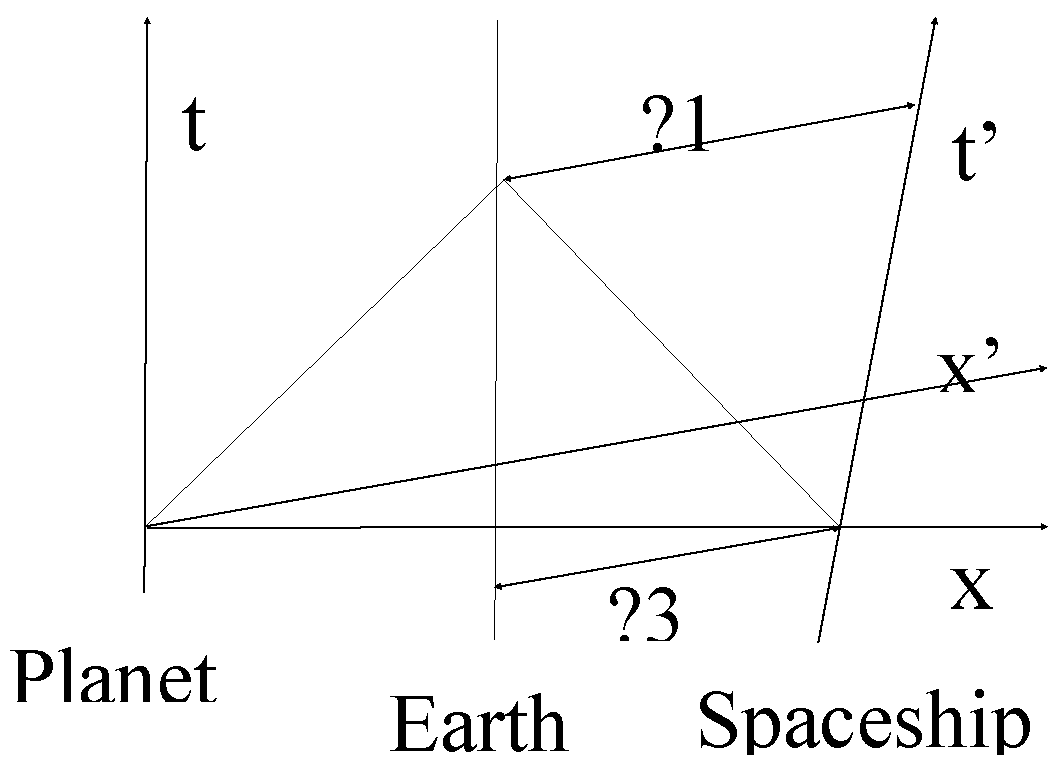
Similarly, if the spaceship is going away from the earth (
Figure 7), we can see that, for the spaceship, the spaceship sends the signal first, then the planet sends the signal. We can guess that the distance ‘?1’ is larger than 5ly.
What’s going on if we replace the spaceship with one galaxy at the edge of our visible universe? So we replace 5ly by 13,000,000,000ly = 13bly. The earth is simply receiving the signal which is the photons of a galaxy, so it is comparable to the right part of
Figure 7. From the earth, the distance is 13bly and the time is 13 billion years (right half of the isosceles triangle). But we have just seen that earth’s measurements are wrong as they contradict special relativity. What is the time and the distance for the galaxy?
We must bear in mind that the measuring rod of the galaxy seems contracted for us immobile. It is contracted by Lorentz factor. On
Figure 7, the speed of the spaceship is 0.1c; for a speed of 0.9c (speed of galaxies at 13bly away as it seems from the earth), the x’ axis is nearly at 45° and Lorentz factor is 2.3. So the distance labeled ‘?3’ would be 3.3 times longer. The 13bly would become 40bly. That is a big claim but if you disagree, how do you explain the new paradox?
This point is particularly important because the new space telescope is finding fully formed galaxies where the age of the universe is believed to be about 200 million years (and its speed is above 0.99c) [
3]. 200 million years is a very short time to form galaxies. This study is telling us that the 200 million years could be wrong, vastly wrong because the faster galaxies, the bigger the factor as it is a function of Lorentz factor. With v=0.99c, Lorentz factor is 7; the length would be 130bly.
This is obviously a big claim with a huge impact. I present it as a fact, but please do check everything. If you think that I am wrong, please share your reasoning. Your reasoning needs to be capable of solving the “new paradox”.
This exercise is one side of the twin paradox. A twin is traveling, and seen from the earth, the traveling clock is running slowly. Seen from the traveling twin, the earth clock is running slowly. With the twin paradox, there is a break of symmetry when the twin does a U-turn. That break of symmetry justifies why the earth has the correct clock: the traveling twin returns younger than the earth twin. You can replace the traveler with the galaxy, now there is no breaking of symmetry, no U-turn. So either the traveling clock is running slowly or the earth clock is running slowly. Special relativity cannot tell us which one is correct; in fact special relativity is telling us that both are correct. You add the solution to the paradox and this time you know that 13 billion years is the wrong age. It is probably time to sort out that twin paradox and the age of the universe.
6. conclusions
It seems that some details of special relativity have been overlooked. Reference [
4] is far from perfect; it was a start and it raised questions that haven’t been answered. Reference [
6] raises the question of time reference which is an old question still unanswered. Those are questions that an amateur can think of; how many questions on special relativity are known to specialists and ignored? Why has nobody admitted that Einstein’s section 9 is confusing? Please don’t take it that I think special relativity is wrong; but problems have to be faced, not ignored.
Figure 2 with the corresponding reasoning is only a start which is ad hoc. A reason why one age is correct and not the other has to be found; simply choosing the correct result is not a reason. Please don’t limit yourself to the reasoning attached to
Figure 2; it may be completely wrong. My own belief is that special relativity is correct locally and wrong over big distances as presented in ref [
4]; so the reasoning of
Figure 2 would be wrong, but the math of the reasoning could be correct.
Acknowledgments
Thanks to Caitriona MacDonalds for putting a question on Quora that led to the “new paradox”. Thanks to Andreas for pointing out that A and A’ are not the same.
References
- Ehrenfest, P. Gleichförmige Rotation starrer Körper und Relativitätstheorie. Phys. Zeits. 10 1909, 918. [Google Scholar]
- Langevin, P. The evolution of space and time. In Scientia;L’évolution de l’espace et du temps; 1973 from the original French; Sykes, J. B., Translator; 1911; Volume X, pp. 31–54. [Google Scholar]
- Naidu, R. P.; et al. A Cosmic Miracle: A Remarkably Luminous Galaxy at z=14.44 Confirmed with JWST. arXiv e-prints 2025, arXiv:2505.11263. [Google Scholar]
- Danis, F. Limit and potentials of special relativity. Applied Physics Research 2024, 16(2), 112. [Google Scholar] [CrossRef]
- Einstein, A. Relativity: The Special and the General Theories; The folio society: London, 1916. [Google Scholar]
- Danis, F. Inertial Potential From the Equivalence Principle. Applied Physics Research 2025, Vol. 17(2), 120. [Google Scholar] [CrossRef]
|
Disclaimer/Publisher’s Note: The statements, opinions and data contained in all publications are solely those of the individual author(s) and contributor(s) and not of MDPI and/or the editor(s). MDPI and/or the editor(s) disclaim responsibility for any injury to people or property resulting from any ideas, methods, instructions or products referred to in the content. |
© 2026 by the authors. Licensee MDPI, Basel, Switzerland. This article is an open access article distributed under the terms and conditions of the Creative Commons Attribution (CC BY) license (http://creativecommons.org/licenses/by/4.0/).