

Submitted:
23 April 2025
Posted:
23 April 2025
You are already at the latest version
Abstract
The theory of relativity must be reworked. Quite simply because it does not properly address the question of time. It avoids confronting it, taking its object for granted, hidden as it is in punctual clocks that don't exist. However, it's not a question of getting rid of it, nor fundamentally modifying its mathematical formalism. We should even consider it as expressing the general structure of our understanding of space and time, extending beyond the realm of physics and into the human and social sciences. It points the way to a close relationship between time and space. But it remains at the level of measurements (the links between time and space are those of clock and ruler readings). It does not go deeper into concepts. In the current situation, the weight of relativity has isolated physics from the human and social sciences; it has created a damaging disconnect, to the point where we sometimes struggle to find a common meaning for physical time and human time. We need to re-read relativity theory, open it up to other ways of reasoning (complex reason and its circularities), and modify the mental images on which it is built. It must accompany the development of the concept of time, associating it with space and movement (as first perceived and inhabited by man), rather than taking it as already established. It must therefore be independent of a pre-existing framework, or background independent. This re-reading offers solutions to the more or less significant difficulties (of a mathematical or interpretative nature) that have arisen since its foundation. It makes it capable of fulfilling new functions and restoring the link between the physical sciences and the human and social sciences on the question of time.
Keywords:
relativity theory
; relational rationality
; substantial rationality
; embodied cognition
; space
; time
; motion
; speed of light
; aporias of time
; human and social sciences
; physical sciences
; rereading
Summary: The theory of relativity must be reworked. Quite simply because it does not properly address the question of time. It avoids confronting it, taking its object for granted, hidden as it is in punctual clocks that don't exist. However, it's not a question of getting rid of it, nor fundamentally modifying its mathematical formalism. We should even consider it as expressing the general structure of our understanding of space and time, extending beyond the realm of physics and into the human and social sciences. It points the way to a close relationship between time and space. But it remains at the level of measurements (the links between time and space are those of clock and ruler readings). It does not go deeper into concepts. In the current situation, the weight of relativity has isolated physics from the human and social sciences; it has created a damaging disconnect, to the point where we sometimes struggle to find a common meaning for physical time and human time. We need to re-read relativity theory, open it up to other ways of reasoning (complex reason and its circularities), and modify the mental images on which it is built. It must accompany the development of the concept of time, associating it with space and movement (as first perceived and inhabited by man), rather than taking it as already established. It must therefore be independent of a pre-existing framework, or background independent. This re-reading offers solutions to the more or less significant difficulties (of a mathematical or interpretative nature) that have arisen since its foundation. It makes it capable of fulfilling new functions and restoring the link between the physical sciences and the human and social sciences on the question of time.
1. Introduction
The theory of relativity must be revisited1. Quite simply because it does not properly address the question of time. It avoids confronting it, taking its object for granted, hidden as it is in punctual clocks that don't exist. However, it's not a question of getting rid of it, nor fundamentally modifying its mathematical formalism: it has proved its effectiveness, having been constructed, polished and used by so many researchers. We should even consider it as expressing the general structure of our understanding of space and time, extending beyond the realm of physics and into the humanities and social sciences. It points the way to a close relationship between time and space. But it remains at the level of measurements (the links between time and space are those of clock and ruler readings), and we need speeds close to that of light to have effects that count. It is not more profoundly situated at the level of concepts. In the current situation, the weight of relativity has isolated physics from the human and social sciences; it has created a damaging disconnect, to the point where we sometimes struggle to find a common meaning for physical and human time.
We need to reread the theory of relativity, open it up to other ways of reasoning, and modify the mental images on which it is built. It must accompany the development of the concept of time, associating it with space and movement, rather than taking it as already established. It must therefore be independent of any pre-existing framework, or background independent2. This re-reading offers solutions to the more or less significant difficulties (of a mathematical or interpretative nature) that have arisen since its foundation. It makes it capable of fulfilling new functions and restoring the link between the physical sciences and the human and social sciences on the question of time.
We shall adopt the following plan. In the first part, we will list the reasons why we need to get back to the drawing board in the field of physics. In a parallel approach for the time being, we'll take a look at the humanities and social sciences, highlighting some of their own difficulties, or aporias, when it comes to time. We will then propose (Part 2) two major solutions to the problems posed: one that emphasizes a relational rationality, undeveloped at the time of the founding of relativity (we used a substantial rationality); the other based on the conviction that theoretical developments cannot free themselves from embodied cognition, as phenomenology reminds us. We then turn (Part 3) to our approach to relativity, with the concept of motion at its core, and briefly touch on the status of the "speed" of light. In the fourth part, we review some of the solid contributions of our re-reading of relativity theory (validated by peers in peer-reviewed journals), or currently being examined by the scientific community, in the various fields cited, from both the natural sciences and the human and social sciences (the details of these contributions will be deferred to two appendices3 ). We will then put our approach into perspective (Part 5): others have proposed different approaches (scale relativity, constructivism): do they answer the questions we are asking? What original insights do they offer? We conclude (part 6) with a few concluding words. Given the pivotal role of the theory of relativity, we will tend to identify the two expressions - rereading relativity and - deepening the links between time and space, without necessarily mentioning physical theory.
2. Why It's Worth Revisiting the Theory of Relativity and Its Understanding of Time and Space
2.1. Reminder: The Theory of Relativity as We Know It
In a few words, the theory of relativity goes beyond the Newtonian use of absolute space and time. By defining spatial reference frames, and under the constraint of various postulates, it associates space and time variables with each reference frame, and shows the relations of transition from one to the other (Lorentz transformations), thereby demonstrating the loss of absolute character. Special relativity is limited to the case without gravitation, while general relativity extends the results of the former to any case, subject to the use of non-Euclidean spaces (the metric is a function of the local mass-energy content). Depending on the author, the various postulates may change (identity of laws in different reference frames, constancy of the speed of light, group structure, etc.), none of them going so far as to call into question the initial use of spatial and temporal variables, which are there without discussion. For example, the4 mental image that the researcher creates within the standard framework when writing his equations comprises two elements (Figure 1): - a regular grid defining the spatial reference frame (in general relativity, this grid can be deformed by the bodies immersed in it); - punctual clocks, often assumed to be synchronized (from all eternity?) located at the various nodes of this grid and enabling the (mysterious) flow of time to be evaluated (the caption to the figure provides further details on the foundations of this representation).
Let's now review a number of points that appear to us to be unsatisfactory in the current handling of relativity theory. For further details, please refer to our work (e.g. Guy, 2011, 2019a), as well as that of the many authors cited therein.
2.2. Relativity Takes Time for Granted
The overriding reason for taking things up again is that the theory does not address the question of the existence of time. Yet this concept is not self-evident. It is the subject of much debate, among philosophers and physicists alike. Without denying the useful operation of equations containing the parameter t, which is meaningful in its own right, we need to try to move upstream and co-construct the corresponding concept. When it comes to answering the question of time, a symptom of this overlooked difficulty is the "circular" appeal to clocks ("time is what you read on a good clock"). And clocks are considered to be punctual. Proper time is also widely used ("it's the time read on a clock attached to the object under study"). None of this corresponds to anything concrete. What's inside a clock? If you open it up, you'll find that the time you read on it is a point of view on a movement.
Another way for physicists to answer the question of time is to refer to a frequency, offered by a particular atom5 , as isolated from the rest and measuring pure time (and not drifting over billions of years!). This approach is equally unsatisfactory. H. Poincaré pointed out the circular nature of the definition (who decides the constancy of the frequency defining time?). And how can we consider the atom as a point, whose "vibrations" involve interactions between its components (electrons, protons and neutrons)? Predicting the frequencies that define time involves solving Schrödinger's equation, where spatial and temporal variables are associated. Frequency is not "alone" and then transmitted (after it has been "made") by a wave. It is the frequency of the wave associated with the photon that recovers the energy of the electron passing from one level of the atom to another (via the relationship between frequency and energy E = hν). This frequency is therefore inseparable from the wave's propagation (motion) at speed c. The energy levels Ei are among the first results of solving Schrödinger's equation, and involve the quantum numbers associated with the various wave functions (principal, secondary quantum number, etc.). Atomic clocks also take account of possible Doppler effects, another way of saying that atomic motion and its variations are taken into account. All in all, the separation of frequency from the propagation of the wave that transmits it to us is a pure convenience of the mind that corresponds to nothing possible. It's like creating a fictional time6 that's useful for thinking, but that doesn't do away with the concrete time that's always associated with movement...
In short, we'd say: no, it's not a trivial approximation to consider punctual clocks and continue on our way as if nothing had happened. It's a convenient way of avoiding the question of time.
2.3. Relativity Maintains Two Distinct Concepts of Space and Time
The previous comment extends to space. Relativity postulates the existence of graduated rulers, whose constituent points are rigidly linked to one another. They are used to define a three-dimensional grid of points in space. In so doing, we are once again relying on objects that correspond to nothing concrete: who knows of a rigid graduated ruler 150 million kilometers long? Talking about rigidity implies situations in which it would not be satisfied. - In which space can we observe the rigidity, or non-rigidity, of the scaffolding that defines space? We need to imagine a second scaffolding, encompassing the first (the fictional character of which is revealed...). - How can we avoid appealing to time when examining a possible deformation of the rulers? The property of rigidity doesn't exist (any more than the punctuality of clocks); it refers to a conventional space of reference whose status needs to be clarified, in association with that of time.
When relativity announces the study of a space-time continuum, it links the values of the associated quantities, but keeps two concepts separate, supported by two distinct types of tools, rulers and clocks7 . A more appropriate approach would unite the two concepts in the concept of motion (as announced). The punctuality of clocks and the rigidity of rulers: it's true that, at some point, we have to create a fictional representation of the world; but the fiction must be an outcome, not an a priori statement. If we fail to identify our assumptions correctly, we risk missing the real world altogether.
2.4. Relativity Does not Address the Questions and Objections of Critical Physicists
From the earliest days of the formulation of the theory of relativity, some physicists, known as critics, expressed reservations and pointed out the difficulties they saw in its exposition and development. Dingle (1972) was one of the first; he was well known as a physicist, having initially espoused the theory, before departing from it for reasons set out in his book8 . Today, there are countless researchers, associations, seminars, congresses, magazines, books, blogs and press releases disputing various points of the theory and its variants. There is no unanimity, with some calling for relativity to be rejected outright, and others calling for it to be modified along lines that may be considered more or less sensible. A full-time job wouldn't be enough to explore this constellation! The few we know of include: the PIRT (Physical Interpretations of the Relativity Theory) conferences, the NPA (Natural Philosophy Alliance) association and its epigones, the journal Galilean Electrodynamics, compilations of "alternative" theories by various researchers, and so on.
The general public is unaware of these families of thought. Institutional physicists are sometimes aware of them, but look the other way and pretend there's no problem. Without underestimating the effort it would take to examine these works, and get an idea of their value, we feel that their total ignorance is unsatisfactory. For one thing, it's not in line with scientific ethics, or ethics at all: we're dealing with men of good faith. Certainly, some are old, acrimonious, aggressive and, to put it bluntly, impossible: should we imitate them? On the other hand, ignorance leads us to deprive ourselves of the potential contributions of researchers who have given the question some thought; in return, they can reinforce our truths or make us look at this or that point in a new way (knowledge needs contradictory debate; let's remember Blaise Pascal: "look at the opposite truth").
There's a long list of topics discussed in the forums we've mentioned. In a nutshell: the twins paradox, the paradox of non-Galilean velocity addition relations, the difficulties posed by the composition of non-collinear Lorentz transformations... to name just a few of the points we know about; this is just the tip of the iceberg. We'll take up some of the points below, claiming that we can seek an overhanging point of view that could reconcile the essentials of the standard development and the criticisms it elicits, sometimes with slight modifications to the formalism and/or its interpretation. We're in favor of deepening and consolidating the theory (in the sense of saying space = time...), not rejecting it and returning to a supposed Galilean golden age.
2.5. Difficulties Encountered in the Humanities and Social Sciences When It Comes to Time
In the humanities and social sciences, various difficulties, or aporias, of time are enunciated, a priori independent of the physical side. In his "Aporetics of temporality", Paul Ricoeur (1985) lists three of them. The first is the split between an external time, found in the world (the time of the cosmos), and an internal time, seen by the subject, whose reason would be the true locus of the construction of time (cf. also Saint Augustine). The second is the totalization of the past/present/future trilogy into a single concept: time. The third is the irrepresentability of time: we can only use metaphors. We should also mention Plato, Aristotle, Husserl, Heidegger and many others when discussing time and its difficulties (see Dubar, 2008, for a discussion of temporalities). In our work (Guy, 2019a), we have spoken of the "dilation" of Poincaré - Bergson - Boscovich ("the world could swell while the velocities of movements would increase in proportion: we would see nothing of it"). We could also mention the proposition that time stops and then starts again, without this being detected either...
Discussing the embarrassments of thinking about time in the humanities (including philosophy) is a continent we can only see from a distance. But we believe that a renewed understanding of the whole, based on a fresh look at the theory of relativity, will lead to solutions. Physical theory, by seeing as incomparable scientific time, supported by proven instruments, declared objective, and human time, referring to the experience of consciousness difficult to control, declared subjective (why the same word for time?) has made the cut damaging.
3. Two Thinking Tools to Put Movement First
We seek to highlight an approach in which neither time nor space is acquired from the outset, but, on the contrary, is constructed as scholarly knowledge progresses, starting from the movement to which we give a foundational value. The revival we propose (Guy, 2021b, referring to numerous authors9 ) is founded on two pillars: - embodied cognition s.l.; - relational rationality (movement is relationship; comparisons of movements help define space and time). We present these two essential dimensions graphically (Figure 2a,b); both argue for the primacy of movement over space and time. Let's take a closer look.
The first dimension, along a vertical axis, opposes two poles, which epistemologists, psychologists, etc., have identified in our appropriation of the world. We take this duality for granted here; among many references, see for example Dahan-Gaida (2020), Lobo (2021)10, Merleau-Ponty (1945), Vaihinger (1923), Virole (2009), and those cited in Guy (2020b, 2021b). On the one hand, towards the bottom, we're talking about apprehension through the body, gestures, images and the imaginary, before words; a mode that includes, by extension, experimental devices and their implementation in measures11. And on the other, upwards, the use of words, concepts and all discursive formalism and its processes of abstraction and fiction, right up to mathematics. This dimension, contrasting images with words, is just as much that which opposes the singular to the universal, the part to the whole, the proper noun to the common noun, the physical to the philosophical, World 3.0 to World 3.1 (in the sense of Karl Popper, 1984, revisited, cf. Guy, 2021a12), and so on. For example, is the movement (space, time, etc.) we're talking about shown, experienced, etc., or defined by a mathematical formula? There is continuity between the two extremes (with a whole series of stages: gestures, sign language, ideograms, emoticons13 ! ...), with the words time, space and movement moving along the axis, gradually changing meaning as the context changes.
Highlighting the first dimension means asserting, against what we are sometimes tempted to think (and the temptation always comes back), that there are no pure and true concepts in physics, in good correspondence with reality, that would be cut off from knowledge of the body and its movements, before they are stated as such.
The second dimension is marked by a horizontal axis featuring the relational mode of rationality, fundamental to our business: we are inside the world, we can only compare phenomena (another name for movements) with each other, without stepping out of it or qualifying its objects in themselves in any substantial way14 (on the relational aspect see, for example: Morin, 1990, 2013; Pascal, 1662; Poincaré, 1905; in his own way Granger, 1992). We will thus contrast mobility with immobility: these words have a concrete character, without prejudging the existence, or meaning, of concepts such as time and space15. The last two terms themselves do not appear to be paired, unlike the mobility/immobility pair. The latter can be grasped on the basis of human experience, extended in various ways by conceptual generalizations. Mobility and immobility are described as relative, to underline, if need be, the comparative point of view, at a certain scale of speeds. In a given context, we speak of movements of lower mobility, lower speed (let's call speed a way of comparing movements) or stopped, as the basis for constructing concrete space; and, by comparison, movements of higher mobility, higher speed, or continued, as the basis for constructing concrete time. A whole domain stretches out where to put the limit between the "concrete" times and spaces envisaged, variable according to what we can or want to look at (cf. Guy, 2019a).
Highlighting the second dimension means asserting, against what we often tend to think (and the temptation always comes back!), that reality doesn't impose words on us to describe it; we can't avoid going round in circles and making conventions (such as that of dividing concrete time and space along the horizontal axis). Words have relative meanings, depending on context, etc., with inevitable uncertainties and fragilities.
Certainly, along both the first and second dimensions, there are aspects of circularity16, according to Morin's "complex circle" (show ↔ tell). They can be visualized graphically here: in the ascending path, meaning goes from things to words. Words are not given a priori; they arrive a posteriori, having already been elaborated from the body, etc., passing from proper nouns to common nouns. To "close" the circle, we need to mention another, descending path, which goes from words to things: after having been made, words go back down, as the tools of thought they have become, and enable us to name things, experiences, etc., as we commonly do.
The independence of the two dimensions is not perfect, and is accompanied by shifts in meaning (Figure 2a,b): the further you "climb" away from the body, the more substantial the expression of thought, in words, appears to be, and the further it moves away from its relational character (it separates more and unites less); and the full meaning of concepts also depends on the boundary that has been decided between concrete time and space (the relational aspect has more weight in the lower, more "human" part of the diagram). But in this representation, everything remains relational, both above and below, by definition of the horizontal axis (valid for all space). What is substantial (abstract, fictional in the strict sense) escapes the figure; the escape is from the top, made possible by words that are isolated from one another. At the top, we write relational rationality. In the lower part, we can still use the word relational by "redescending" the words; but, to mark a differentiation, without speaking of rationality, and by insisting on the rooting in knowledge of the body, we could use other terms: play of oppositions, synaptic thought (with a meaning close to physiology). Substantiality is less important to us in the lower part, as this is the level of concrete reality, before words, where everything is connected (but it's still hidden in the relational, see comments in Appendix 3). As for the shift in meaning of the word movement, we can underline it, using for the most elementary (bottom), the term motility17 (in a primary biological sense).
To promote these two dimensions is, in essence, to say that relativity has not taken them on board, and has not followed a sound path of rationality. This overall criticism will become clearer later on. It's that of insufficient hindsight on the proportion, in any theory, between elements in direct correspondence with reality, and those which are tools of thought, constructed by means of a certain leap from reality: correspondence with it is no longer guaranteed. Their justification is their effectiveness. Every theory makes use of fictions, but these must be created in the course of the research process, not parachuted in from the outset. They must be accounted for in a way that rises above concrete experience.
As a partial conclusion to this second part, we feel it is essential to take up the question of time and space in relativity theory, and place it within a broader problematic in which motion is central.
4. An Interpretation of the Theory of Relativity
4.1. A New Mental Image: A Space of Comparative Movements
In short, we need to use a new paradigm, based on new mental images, founded on comparisons of movements (Figure 3). So, to replace the image of the grid (more or less distorted) and punctual clocks, we imagine a space of movements from which we construct, by means of revisable conventions stopping endless regressions, space markers (points whose relative movements are negligible/neglected) and clocks (a moving point whose movement is taken as a standard). We understand the genesis of fictional space-time from the first representation (cf. Figure 1 and Section 1.1), at the limit, at the end of the road, but still rooted in the body and relational thought. To speak of a single time, we needed to agree on a standard movement of social value. In physics, the quantitative approach was expressed in Lorentz transformations. In the humanities and social sciences, the consequences of this pre-eminence of motion are expressed in a qualitative relativity that doesn't need excessive speeds! In short, a theory of relativity, whether understood from the perspective of the "hard" sciences or that of the humanities and social sciences, combines the construction of a framework of space and time, anchored in comparative motion, with the choice of a standard mobile to fix this framework (for a minimum of quantitative coordination).
4.2. Lorentz Transformation in the New Frame
The Lorentz transformation is the basis of the theory of relativity. In the present context of "rereading", we can ask a few questions18 . - How can we derive the Lorentz transformation following a relational rationality, especially if space and time don't pre-exist and have to be understood in the process, on the basis of compared movements? - Can we express the Second Postulate in terms of the speed of light, as we usually do, given that the latter is used to define space and time standards? - Can we write the Lorentz transformation simply in terms of comparisons of v/c ratios (c is the speed of light; v denotes other, non-electromagnetic speeds, such as gravitational)? - More fundamentally, what do we want to express, what need do we have to formalize in equations the progress of phenomena envisaged in reference frames in relative motion? How can we do this, and on what basis?
The answer to this last question is rooted in the need for communication between observers with different points of view on the world; it translates into saying that the laws of physics must be the same in all frames of reference (first postulate). To achieve this, we need to properly define such reference frames, and use one or more phenomena as a point of comparison, or standard(s), for a quantitative approach. This is the meaning of the second postulate, usually particularized by taking light and its "speed" as the basis. We can reformulate the latter in a broader way, encompassing the first: "only comparisons of phenomena (comparisons of movements) between themselves are our point of solidity"? This is in line with Poincaré's remarks (1902, 1905). Lee & Kalotas (1975) and Lévy-Leblond (1976) have each, in their own way, proposed a coalescence of the two postulates. The relational aspect encompasses laws, speeds, confrontations of phenomena, etc. (see Guy 2010a, 2015, 2019b). To discuss quantitatively the various movements offered to our investigation, everything derives from the relational necessity of momentarily (provisionally) choosing a basis of comparison to speak from, deciding to fix the numerator or denominator of a v/c ratio. To the question "Is c constant?", we answer: "We don't know, but we're obliged to assert it, at least locally".
From a technical point of view, are we going to be able to derive the Lorentz transformation without time nor space, simply by relying on a motion ratio of the v/c type? No, not directly. Because, from the moment we formulate discursive propositions or equations, we dissociate space from time. So we're obliged to go through the process several times, in recursions that we can't escape during derivation. We begin by acting as if we had separated space from time, focusing on one of the two terms in a v/c relationship. We give it a fictional meaning in m/s, proclaiming "c = cst". We then realize that space and time are linked, and that c is not the only factor involved in the v/c relationship. In short, we retrace our steps to interpret what we've done: "no, they were just v/c ratios". In the standard derivation, the v/c appears early and we're embarrassed when the test light ray is perpendicular to the vector v of the relative motion of the two reference frames (Guy, 2019a). The γ factor of the Lorentz transformation is expressed in terms of v/c: in Guy (2019b), we express motion ratios vectorially, after opening the clocks that were themselves hiding motion of particular direction. In short, the Lorentz transformation captures the moment when we separate space from time, linked in the comparison of movements.
In addition to, and thanks to, its algebraic aspects, only just mentioned, the theory of relativity (with or without a renewed interpretation), and its expression in the equations of space-time transformations, brings a number of essential qualitative results to mind: - physical quantities are expressed in pairs, such as {electric field, magnetic field} or {energy, momentum}, formalized in four-vectors, or pairs of 3D vectors; - transformations of these coupled quantities enable mass and energy quantities to be linked; - space and time, in the pair (r, t), can be put on the same plane as other physical quantities (cf. Guy, 2016a); etc.
4.3. What Status for the Speed of Light?
What first changes is the meaning given to the word speed: it's a ratio of movements, one of which is chosen as the standard. The speed of light is no exception to this rule, the other motions being gravitational in nature (see historical measurements of the speed of light). The speed c is often taken as a structural constant, but this is in a second stage that does not dispense with its initial construction. Today, this "speed" is no longer a "speed" in the sense that we already have independent space and time standards with which to measure it. On the contrary, it's the propagation of light that today provides the standards of space and time (which return to the same standard via the postulate c = cst). Compared with earlier practices, there is thus a twofold change: 1) a change in order of priority: the propagation of light "precedes" the space and time standards; 2) a change in the number of standards: we move from two standards (space and time) to a single one. Is there continuity between these practices? Yes, and to demonstrate this, we can equate the meter and the second in their ancient definition with portions of light's movement, thus evaluating two quantities of a priori different natures by the same gauge. The "speed" of light then has two values: 299,792,458 m/s, expressing the ratio (fixed by decree) between the two old standards, as two particular "objects" of our world and designated as such; and c = 1, frequently used in physics, expressing today that it has no number, it's what allows us to measure. To speak of the "constancy of the speed of light" is to express a tautology, but to be able to "observe" the latter reassures us as to the remarkable know-how of physicists, and the efficiency of the loop between practices and the choices made in writing equations. In this context, it's more appropriate to say that there are no longer any standards of space or time, and that the second is the standard of motion. And to say that a velocity is the ratio of a movement to the standard of movement (there is still continuity between the old and new definitions of velocity)19 .
Finally, let's come back to the relationships r = v/c in a slightly different way: we've mentioned their founding role in relation to the two terms v and c that seem to make them up, in particular with regard to the Lorentz transformation and its derivation. Qualitatively speaking, these ratios express, first and foremost, the confrontation or comparison of two phenomena perceived as dissimilar by our senses: we would like to assign them different values from a quantitative point of view (giving one the value v, the other the value c). But what we need to add is that r numbers are not generally obtained by algebraically dividing two other numbers v and c already available to us, as measured separately. In reality, the r value is obtained by a single measurement. And it's only at a later stage that we allow ourselves to "cut" it in two and express it as a ratio (taking one of the two phenomena involved as a reference, or possibly reducing it to a third phenomenon...). It's this inevitable duality of moments that we expressed in our "trial and error" with the Lorentz transformation. To be able to say, we need to separate through fiction what was united in reality. This nuances our view of the concept of "relation", omnipresent in this work: it can mean the facing of entities defined independently of each other, or, more profoundly, the expression of a link such that it contributes to the definition of each of the two terms it unites (Th. Berns, pers. comm. 2023). While we have received it as established on concepts acquired once and for all, the theory of relativity must be placed in this circular movement: it presents itself as using concepts of time and space that are already there, but it produces an operation that shakes up their starting points and opens up a field of novelty.
5. First Fruits?
The previous interpretative framework unites the physical sciences in the broadest sense of the term, on the one hand, and the humanities and social sciences on the other, saying: there is an identity between spatial and temporal relations; space and time are comparisons of movements. To put knowledge into words, we need conventions of a social nature (such as the assumption that a standard is constant). We find this necessity on both sides. Let's take a look at the fruits of our re-reading on both sides. They demonstrate the fruitfulness of the mental representations described in Section 2 and Section 3, and the interest of the announced revival.
5.1. Fruits in Physics
Several physics questions seem to us to be illuminated by a better coupling between the concepts of time and space, and by the primacy of motion. They constitute so many chapters of what could be called a physical theory based on the identity of spatial and temporal relations, or even on the single category of "motion" (cf. Guy, 2016a). A slightly more detailed review is offered in Appendix 1 (with useful references). Let's take a look at a few.
In thermodynamics, the coupling between gradients of quantities (in space) and their temporal derivatives is a way of looking at the fundamental association between space and time, giving the arrow of time a character that is not restricted to this parameter alone: it reflects the tendency of systems left to their own devices to achieve spatial homogeneity. The boundaries between equilibrium and disequilibrium, reversibility and irreversibility, heat and work, and the opening and closing of systems, are not provided by nature, but are determined by where the observer places the boundary between time and space. The entropy function appears naturally in the description of systems at a given scale, freezing their organization at a smaller scale in its most probable state (Guy, 2020d).
The composition of non-collinear Lorentz transformations is a place where our proposals provide a solution to problems that appeared inextricable: the time parameter, constructed from the position of a moving body, is affected by geometric transformations (rotations), brought into play in compositions, in the same way as spatial coordinates. This re-establishes a symmetry between spatial and temporal variables, the lack of which was responsible for a number of difficulties.
As far as the twin paradox is concerned, the important point is to understand time as given by the position of a mobile: the assumption of constancy in the speed of light translates into the decision to attribute the same behavior to a single moving point seen from two different reference points. The result is a variability of possible situations in terms of which twin comes back younger or older than the other, and by how much. We can see the role of interpretation, in this case the choice of direction of movement marking time in clocks.
This is a way of looking at the γ factor of the Lorentz transformation, and its expression as a function of the direction of photon motion in the atomic clocks in use today. We have opened the clocks located in each of the two reference frames in relative displacement, and discovered such motions. We propose new equations where the factor γ depends not only on the velocity ratio β = v/c (v velocity of the relative displacement of the markers, c "speed" of light) but on an angle δ between motions. They relate to various results in the literature.
In other work, we highlight basic physics relations. We call them degree-zero relations, combining temporal and spatial derivatives, and Lorentz invariants. We can add or derive from them relations of epistemic uncertainty (we don't know the standards!) or a-certainty.
If we look at chance and its relational understanding, we can say: we don't know what is random, we contrast what is more certain with what is less certain. Probabilities are given by measures of spatial and temporal amplitudes. Time and space are themselves subject to uncertainty in composition with the various physical quantities. The relationship between quantum mechanics and general relativity is therefore very close, although the former does not have a monopoly on quantization (it must be understood in terms of the comparison of two classes of phenomena in a probabilistic vision), nor does the latter have a monopoly on space and time: we must see their possible composition and not their opposition in terms of space and time (the former would be dependent on the external space-time frame, whereas the latter would not), taking space and time as a pair of associated quantities in composition with the pairs of other physical quantities.
Finally, in cosmology, we emphasize the role of v/c ratios in determining the speed of distant objects20 (a general "relational" necessity). On this basis, we are encouraged to postulate a slower speed of light on the cosmological scale: this avoids the need for dark matter and dark energy, while at the same time extending the age of the universe (a way of getting around the problem of impossible galaxies discovered by the James Webb Space Telescope?).
What did we do to achieve all these results? What recipes did we use? There are many, and they all reflect a relational approach to comparing movements. For example, the variable t refers to a movement and can be understood as the position of a standard mobile. Under these conditions, passing through a point with three coordinates can render a happy symmetry between spatial and temporal variables. These variables can also be balanced by symmetrizing the derivatives and and expressing the basic equations as conservation relations. This can also be seen, as we said, by noting that the pair (r, t), where r and t are a priori two vectors of dimension 3, is to be placed on the same footing as the pairs of conjugate quantities in physics. Light is no exception to the relational approach, and we generalize the apprehension of v/c ratios.
5.2. Fruits in the Humanities and Social Sciences
In the humanities and social sciences, a deeper connection between time and space seems fruitful. We spoke earlier of the aporias of time enumerated by Paul Ricoeur; what can we say about them? Is the duality between cosmic time and human time unsurpassable? No, they're merely comparative movements, with the sky having no pre-eminence over the movements of nerve impulses that follow consciousness. With regard to the fusion of past, present and future into a single "time", there are two possible answers. According to the first, it would be a mistake to try to apprehend time alone; language deals with the whole, which is the association of space + time. Time is just one part of it. And according to the second, we're reminded of the relational nature of the space/time tandem, each defined by the negation of the other. The present is as much in the cloud that makes and breaks, as in the peaceful mountain that never changes. Time passes beside the mountain (we're not going to say that the mountain constantly disappears and reappears, that's absurd; see Guy 2011; see also our reflections on the "specious present", Guy, 2019c). The present is particular, not that it constantly flees, but it is not on the same footing as the past and the future: it is underpinned by the direct experience of all the senses in a presence of space, unlike the past and the future, which are embedded in an intellectual fiction21. Finally, as regards the need for images, we would say: yes, they have a foundational role, as underlined above, prior to the formulation of discursive knowledge.
In Guy (2019a) we discussed other issues, such as the motor of time (time has no motor because it doesn't exist!), ancestrality (time didn't exist 100 million years ago, but it doesn't exist today either): history is a gear of movements. The division between space and time can take place in different places, depending on the movements we perceive or attach importance to in a given context. There is a multiplicity of spaces and times, with the physicists' unique time and space playing a special role in accommodating broad communication within the social group. The space and time (spaces and times) we construct are based on what makes up our world, from the stones and markers of our monuments and streets, to the men and women with whom we live. In certain situations, the separation between space and time, linked in movement, is not made, or is made more difficult.
How do these first elements manifest themselves in the diversity of the humanities and social sciences? Rather than taking a tedious tour of these sciences, or at least the ones we've tackled or simply come into contact with, we've taken another angle of attack in Guy (2020a): one directly linked to our approach, consisting of identifying which new articulations between space and time are made possible by our point of view, and finding them in the various disciplines. We follow the progression of thought and formulations, from the "original" situation where time and space are welded together in movement, to that where a single, separate time and space are proposed as the reference bases for society. We can distinguish, more or less artificially, several stages, like so many original reading keys, punctuated by digressions on the various modalities of spatio-temporal assemblages (see details in Appendix 2).
The first stage is the nomadic moment, when we wander without seeing a clear separation between space and time, apprehended in movement. You don't look back. In a second stage, we see the beginnings of a separation, with the first conventions, the first hypotheses; but we retain a multiplicity of times (and spaces). The time of each person's story lies somewhere between the first two stages, demonstrating the importance of space in the construction of identity, and not just time (cf. Abravanel, 2013). The next step is to choose a unique time and space of broad social value.
To separate space from time is to artificially separate man from the world: with Descartes, the time elaborated/situated in consciousness is opposed to the expanse of the world around the subject. Separated from the world, his identity lies in his thought (cogito ergo sum). On the contrary, we understand that man's identity is constructed by all the movements (all the relationships) that link him to the world, space and time forming an indissociable whole.
New points of view on the arrangements of space and time shed light on the workings of different areas of the humanities and social sciences. The stages and stops on our journey are another way of looking at the variety of the humanities and social sciences, and the possibility of classifying them: today's accepted boundaries are questionable or subject to variation, such as that between history and geography (or anthropology and sociology).
5.3. Comparison of Contributions from Both Fields (Physics, Humanities and Social Sciences)
In general, what we bring to the table, and what favors a rapprochement between physics and the humanities and social sciences from the point of view of space and time, is first and foremost a motivation to change interpretation: to recognize complexity, to set thought and knowledge in motion, to accept a loss of stability, to dare to go round in circles, to resolve to stop endless regressions at the cost of a lack, of an unknown remainder (cf. Vaudène, 2021). This leads to new, "trans-scientific" mental representations. The link between time, space and movement brings us back to the concrete, offering us new angles of attack for the study of time, but also of space, and concerns all sciences.
One might have wondered a priori how work that cultivates the theory of relativity in physics could also apply to fields whose practitioners don't particularly move around like photons of light! Reconciling the humanities and social sciences with physics! Some will object: "What link do you see between the Lorentz transformation, the mainstay of the theory of relativity (one of the fundamental aspects of the scientific revolution of the early 20th century), and common experience? This is the acute question posed by American pragmatists, in particular Mead (2012) (see also Leclerc-Olive, 2012). For these philosophers, the task was to link science to life, to find "ordinary notions of ordinary people" (Mead), to bring the humanities and social sciences into dialogue with physics. This was at a time when scientific discoveries (in this case, relativity) seemed counter-intuitive. It had worked for Newton, but we had to find a way through for Einstein.
In our work (Guy, 2015b, 2019a), we have proposed a situation where the mathematical structure of Lorentz transformations can be found (somewhat hidden!) in human experience. This is what we call the Phileas Fogg effect (Jules Verne's hero). Let's imagine that the only clock we have is a sundial; to measure time, we rely on the sun's movements; for days, we count the sun's passages at its culmination point in the sky at midday (a way of attributing to the star a movement of constant "speed"). A similarly equipped twin travels east-west or west-east around the earth, while his brother remains sedentary. When they are reunited, there will be a discrepancy in the way they count time. The problem is the same if we replace the sun with a photon in an atomic clock. Time (and space) lose their absolute character. This is not just a thought experiment: Phileas Fogg certainly experienced it (to his advantage) after long tribulations; but today, with the development of air travel, time shifts are felt without waiting 80 days. Depending on the speed of the plane in relation to the path of the sun, time speeds up, slows down or even stops in relation to that of our friends on the ground (see the correspondence with relativistic formulation in the works cited22 ).
All in all, we have noted the omnipresent interest of the23 relational approach to knowledge, another way of saying that the discussion on space and time is to be conducted, not in terms of ontologies, but of "dynamics"24 . The fruits are somewhat different between physics on the one hand, and the humanities and social sciences on the other, but they do contribute to reviewing, or even contesting, their boundaries, by giving full scope to the co-construction of concepts of space and time. Because movement is first and foremost human, and the construction of concepts is rooted in human experience, it is on the SHS side that the stages of this construction are best followed. This is where we come face to face with the multiplicity of time and space. By contrast, in physics, we go straight to the single social time that has proved its effectiveness in the duality of time (variable t) / space (variables x, y, z). Without radically contesting this duality in this field (that's not the first subject), we're now becoming more lucid about the parameter t: it doesn't refer to a unique substance of the world, it requires conventions; there are possible transformations between space and time depending on points of view, etc. The spatial representation of time is made more lucid by the fact that it's not just a question of time, but also of space. Spatial representation of time is made easier by rebalancing with space coordinates. As shown in Appendix 1, new avenues are opening up.
6. Let's Look Elsewhere
Let's conclude with a few remarks on two ways, among countless others that we don't pretend to know, of taking the theory of relativity, represented by two articles in the current issue of Intentio.
6.1. Scale Relativity
What we have to say about this is based solely on a reading of Nottale (1998). The rationale behind this author's proposal lies mainly in a generalization of the principle of relativity to characteristics of reference frames that go beyond their mere relative velocity, and in the solution it may provide to the disjunction between quantum mechanics and general relativity. In the light of the foregoing developments, let us make a few remarks, tempered by our widespread ignorance of L. Nottale's work.
The first concerns the relative or relational aspect consistently emphasized by this author in his book (op. cit.): we don't know things in themselves, we only know relationships or differences. It doesn't seem to us that this primordial aspect has been pushed to the limit in current physical theory, nor in scale relativity. For example, we could have pointed out that the principle of relativity itself, if restricted to saying c = cst, escapes the relational mindset: what are we comparing the speed of light to? So too it seems to us that the relational mind must be applied in quantum mechanics to explain quantization (or discretization) as we did in Guy (2016a).
It remains interesting to compare the uncertainties of space and time, Feynman's stories and the possible fractal character of space-time. The extension of the principle of relativity to qualities such as the gauge (cf. the fractal character) could be similar to what we say about the convention of separation between space and time: we place ourselves at a scale where we decide, in sum, the precision of space and time measurements (we don't try to find out what happens below this scale).
In contrast to the relativity of scale, we can see that, in the field of thermodynamics, for example, the laws are not the same at different scales (Newton's laws at particle scale; Fick's or Fourier's laws at population scale). The question of the existence and universality of laws is related to the previous ones.
Finally, and quite fundamentally, neither the concept of time nor that of space is criticized by L. Nottale, who takes them for granted, at least at the stage of scale relativity. Yet he speaks of a beyond?
6.2. A Constructivist Approach
A constructivist approach applied to some of the above questions (relations between relativity theory and quantum mechanics, the place of time, etc.) is outlined by Giorgio Quadranti (2023). It leads him to some original results. For example, the primacy given to quantum mechanics and the second nature of relativity, as deduced from the former. Or the pre-eminent place given to time, with space appearing to be derived from it. Or the importance given to processes. We won't comment on these results in detail: they are part of a fundamental reflection on the construction of any theory from reality (with his book Le monde comme texte, 2020, G. Quadranti presents himself in the wake of J. Piaget). There appear to be numerous points of articulation with our own work, such as the convergence of diagnoses on the symmetry problems posed by the Lorentz transformation when the displacements of landmarks and clock-photons are of any direction (Guy, 2019a; G. Quadranti, pers. com. 2021).
Without claiming to have understood everything there is to know about the constructivist approach, let us nonetheless note, with regard to G. Quadranti's work, a few possible points for discussion in relation to our own reflections: - in the constructivist approach, what place is there for complex thinking that confronts circularities and conventions? - How can we take time as a given, without trying to define or construct it? - And how can we accept that clocks are already there?
7. A Few Concluding Words
In the title of our text, we wanted to refresh the theory of relativity. For us, this means reviving its full colors, breathing life into it, humanizing it. Let's turn for a moment to Kurt Gödel: after a life-long quest to lay the foundations of mathematics independently and autonomously, this author came to the conclusion: mathematics cannot do without man and his intuition (Cassou-Noguès, 2004). In a similar way, by giving full rein to movement, as it is first perceived and inhabited by man, we give relativity theory a new openness and its ability to bring together the two branches of the hard sciences and the human and social sciences25 . We can lessen the divide between them; the question of time was a major point of division.
Acknowledgements
These lines constitute a version of a text written at the invitation of the journal Intentio (Centre Gilles Gaston Granger, CNRS, Aix-en-Provence); the definitive version differ somewhat. I would like to thank Carlos Lobo for his interest and trust. I would also like to thank all the people with whom, over the years, I have discussed the issues raised in this text and who have given me encouragement. I can't name them all. I note here, for recent exchanges: Nicolas Berns (Brussels), Philippe Dujardin (Lyon; the latter made it possible to rectify various imperfections in an earlier version, and the discussion is continuing), David Lacoste (Paris), Pierre Mathieu (Charleroi), Peter Van (Budapest).
Conflicts of Interest
The author declares no conflict of interest.
Appendix A. The Fruits of a Re-Reading of Relativity Theory and of Our Understanding of the Time-Space Links in the Physical Sciences
Equipped with the keys presented in the main text, we have been studying numerous problems over the last fifteen years. Here we present the abstracts of unpublished articles, mainly published in the HAL archives (but also a few in peer-reviewed journals or in the proceedings of international conferences).
Arrows of time and space. The question of the link between space and time arises in thermodynamics, where a priori it's a matter of macroscopic time associated with sets of particles. The usual formulations of the second law link entropy and time in a narrow, quasi-exclusive way: the entropy of an isolated system increases. And this is true whether the statement is historical (Carnot, Clausius) or statistical (Boltzmann, Gibbs). This does not provide an intuitive understanding of entropy, which remains a mystery. What's more, we fail to see the conceptual unity behind two apparently very different contents, one dealing with heat exchange, the other with the probabilities of a macroscopic state as a function of microscopic states. In our view, these difficulties can be alleviated by insisting on the role of the spatial variable and its gradients. The two usual formulations can be taken up in this sense, the first by saying that "heat goes from hot to cold" (already proposed by Clausius), and the second by saying that a heterogeneous system is more likely to evolve towards homogeneity, taking care to define the probabilities of trajectories leading towards more or less probable states. This shows the conceptual unity of the second law: it expresses the fact that, in an isolated system, heterogeneities, whether of temperature or other parameters, tend to soften, increasing the probability of the corresponding microscopic states. It can be said that the arrow of time is closely related to the arrows of space, i.e. the gradients in the properties of the system, both time and space being supported by matter and its grains. A number of issues can be discussed in this context. - The notion of equilibrium: this means invariance of the system with respect to time, but time itself is defined by the phenomena and a function of the scale at which they are considered; the boundary between equilibrium and disequilibrium is ultimately a matter of choice. - The question of scales of time and space is another way of looking at the previous question: a smaller scale is one where we ignore (or decide to ignore) the movements of possible smaller (sub)particles. - The concept of entropy follows logically: when we decide to freeze movements at a smaller scale, the question arises: in what situation of the system are we going to do this operation? The most reasonable answer is: in its most probable situation; entropy is the function that allows us to find this configuration. - Assigning entropy to an individual particle is understandable if we consider that this particle is constructed from smaller particles whose most probable configuration is taken. - The notions of heat, internal energy and all the functions derived from them, which are characteristic of thermodynamics, also derive from the preceding considerations: the energy balance of mechanics is completed by taking into account the energies associated with the movement of particles on the lower scale. - The distinction between work and heat: not intrinsic, but also a question of scale. Still other questions can be discussed in this way (the inside/outside distinction for a system, the use of the expressions diS and deS, the definition or otherwise of entropy production depending on the scale chosen, and the understanding of a whole hierarchy of "thermodynamics" and writings of the second law)26 . The problem of time in thermodynamics, i.e. the irreversibility of macroscopic laws in contrast to the reversibility of mechanical laws, brings together a number of these ideas. To the pragmatic understanding of irreversibility already proposed by various authors (perturbations push the system into its most probable state27) is linked a more fundamental understanding linked to the indeterminacy of the boundary between space and time and that of the position of particles. The boundary between reversibility and irreversibility is the result of a choice made in relation to the scales of interest.
Composition of non-collinear Lorentz transformations. A more technical question concerns Lorentz transformations, the mainstay of relativity theory; they show us how space and time variables are transformed when we move from one reference frame to another in relative motion. Difficulties arise in situations involving transitions between three reference frames whose relative velocities are non-collinear, i.e. non-parallel. It is then difficult to correlate the direct transition from the first to the third frame of reference with the succession of transitions from the first to the second, then from the second to the third frame of reference. We don't simply have T13 = T12 ° T23 where Tij is the Lorentz transformation from frame i to frame j, and ° is the composition or multiplication of the corresponding linear operators. To understand this difficulty, it is useful to take a closer look at the two main classes of Lorentz transformations defined in the literature and which are used in different ways in this problem: - special transformations, or boosts (in the case of parallel displacement of the reference frames), and - general transformations in the case of non-parallel displacement. To define the latter, we need to perform rotations: first, we perform a special transformation by positioning one axis of the moving reference frame parallel to the relative displacement speed; then, after Lorentz transformation, we return to the initial arrangement by the inverse rotation. The difficulties mentioned above are related to the fact that general transformations lose the symmetry between spatial and temporal variables present in special transformations by restricting them to a single coordinate axis. According to the standard understanding, space variables are involved in a different way from the time scalar in the rotations just mentioned. Symmetry is restored by using a time parameter associated with a displacement, of given direction in space, and having a vector character. The axis rotations we make to adjust, step by step, the general transformations (relative velocities of any direction) to the special transformations (where we manipulate a single pair of duality temporal and spatial coordinates) will then have identical effects on the spatial variables and on the intermediate position variables used to define the scalar time. This understanding makes it possible to simplify the composition of non-collinear Lorentz transformations, whereas the classical discussion leads to inextricable situations; the latter, well analyzed by critical physicists, are not resolved, either mathematically or in terms of physical meaning, by the new rotations, known as Wigner-Thomas, that must be added. For standard formulations of relativity, in admittedly rare situations of little practical consequence, this shows the value of a technical reworking of the formalism along the lines we have proposed28.
On the comparative age and aging of two twins. The discussion of the so-called twins paradox gives us another opportunity to put our proposals to the test. More than a century after it was first put forward by Langevin in 1911, the twins paradox continues to provoke passionate debate in the physics community. It's not that we're still looking for errors of calculation or reasoning that disqualify some rather than others; or for discriminating experiments that allow us to attribute one age rather than another to such and such an entity, different from its twin, as if this had to be imposed by reality. For us, this situation reveals that the problem remains poorly posed. Admittedly, with the theory of relativity, the idea of an absolute time that would be the same everywhere has been abandoned; but, by wanting to give it its own local value, by wanting to attach it to such and such a particle of matter (to such and such a twin), we continue to absolutize time. Time does not have a substantial value that needs nothing else to be defined. Its value is relational: it is defined by abstraction from the mutual relations of objects to each other in space (why else would it change with motion?). In practical terms, as we've said on several occasions, measuring time comes down to agreeing on the displacement of a standard mobile). In this process, conventions left to free will are always necessary, and open up a plurality of interpretations. We can show the variety of age differences (in one direction or the other; or the absence of difference; in line with the different points of view encountered) that can be attributed to twins, depending on the conventions made to measure time, i.e. in particular those concerning the direction of movement corresponding to it in clocks, and the type of physical modeling adopted. Relativistic formalism in the broadest sense is present in these situations. The equations used can only be interpreted in such a way as to bring to light different choices for the marking of time. This is not the case when time defines itself without the need to choose (show) a movement. We need to distinguish between age (in relation to a simple reference point) and aging (in relation to phenomena to be discussed in each case). It seems to us that a single conceptual framework can be defined, unifying the discussion of standard relativity on the one hand, and our understanding of space and time on the other, and not dismissing the point of view of critical physicists on the subject29. It also goes some way to bridging the gap of misunderstanding between Einstein and Bergson on these issues.
Zero degree relations. On several occasions in our work, we have evoked the interest of considering formulations of physical laws involving, at the fundamental level, a better coupling between space variables and time variables. We call these laws or relations of degree zero; we can already see them working in physics. Indeed, quantities often appear in pairs (for example, the pairs {electric field, magnetic field}, {energy, momentum}, {charge, current} etc.); and we find these quantities in physical laws also manifesting themselves in pairs (Maxwell's equations go in pairs; energy and momentum are found in two types of equations, expressing conservations on the one hand and force laws on the other, etc.). These findings reveal fundamental qualities of our possible representations of the world, to be understood in a relational thinking: no meaning to a quantity alone, but to a duality of quantities, or better still to linked variations of two quantities; and the possible points of view (spatial / temporal) on these variations can themselves be exchanged. For time and space, the observation is the same: there is no meaning to a single space or time variable, but to their duality and associated variations. On this basis, we propose that an elementary law of physics links the partial derivatives of two quantities in duality, with respect to time and space respectively. Because of space-time symmetry, exchanging temporal and spatial variables, or the two duality quantities, in the law equation yields another admissible law. This approach allows us to understand, as two forms of the same law, pairs of a priori distinct laws of physics, each linking combinations of temporal and spatial derivatives of quantities in duality: thus laws expressing conservations on the one hand, and those expressing force functions on the other, linking spatial derivatives (in divergences in the first case, in gradients in the second), to temporal derivatives. So we can interpret Newton's second law (the time derivative of momentum is equal to the gradient of energy) and the law of conservation of energy (the divergence of momentum is equal to the time derivative of energy) as two forms of the same law. Maxwell's various equations can be read in the same way. In their elementary form, the proposed laws are invariant by Lorentz transformation, and the quantities in duality are transformed by relations analogous to those for space-time coordinates (we could conversely speak of time and space as functions of the fields of quantities in duality)30.
A-certainty relations. The dualities encountered in the zero degree relations will manifest themselves in a particular way with regard to the numerical values attributed to physical quantities; these values are subject to various sources of variability which seem to limit their correct knowledge. We already know the uncertainties or errors associated with the measurement process. Then there is the indeterminacy attributable to the fact that a given physical quantity is not in itself likely to have a precise value, but shows a spectrum of values. A third source of uncertainty, called a-certainty to distinguish it from the first two, can be distinguished31. It relates to the properties of solidity that we are forced to attribute, without being certain, to the various elements of the frame of reference according to which representations are constructed: standards (to which the quantities to be measured are compared to obtain numerical values), constants, laws, space-time reference points, the very words used. A-certainty is the declaration of a certainty that denies itself in its fragility. Concrete consequences are derived from this: - a-certainty relations, involving quantities that are known not separately but in composition with one another: ignorance of the reference frame, a source of variability, is simulated by a small displacement in a Lorentz transformation; - discussion of the dimensionality of representations. The positive side of this is the recognition of the provisional nature of theories, and the freedom to make certain choices, associated with designations, on which we base the formulation of our laws and the implementation of our measurements. Thus, the postulate of the constancy of the speed of light in a vacuum enables us to construct our representations of space and time within the theory of relativity; the a-certainty associated with it encourages us to step back from this construction and accept more serenely the phenomena of non-locality (or non-separability) and non-temporality, studied today within the framework of quantum mechanics; it also opens up the possibility of nine degrees of freedom for physical models (a number also required by supersymmetry and superstring theories). A-certainty is a consequence of relational thinking.
Randomness, space, time. The "measurement" aspect of probabilities always refers concretely, for a given problem, to comparisons of pieces of space and/or time occupied by the various events under discussion. And we know that measurements of space and time are established through the confrontation of different physical phenomena, and presuppose arbitrary choices as to the definition of standards. A relational approach to the notion of probability can thus be envisaged, with the relational character of some (space, time) necessarily having an impact on others (chance, probabilities)32. The probabilistic model attached to such a series of events, which we call "apparent", is built in opposition to, or in composition with, another probabilistic model, concerning a set of "hidden" events; these serve as a gauge and their law is uniform (the probabilities of their different events are equal). The two points of view can be exchanged, using the initial events of the non-uniform probability model to define the gauge: we then grant them a uniform law, and, by comparison, define new measures for the initially uniform hidden model. Let's talk about a dual formulation of the problem, as opposed to its initial primal formulation. Depending on circumstances and history, we may have to change the standard. We can thus see the inescapable recursive nature of the approach: there is a relational, revisable aspect to the discussion and choice of standards within probability itself. This makes it possible to contribute to the debate between frequentists and Bayesians (there is no intangible probability without the need for any choice) and to formulate some general considerations on randomness, which is indefinable in a substantial way: we can only oppose more hazardous situations, equally open to a set of eventualities (to which we revisibly attach a standard character in a uniform law), to less hazardous situations where this or that eventuality has more weight (or, at the limit, remains alone). One potential application relates to the conceptual reconciliation of general relativity and quantum mechanics, involving functions of a probabilistic nature (see next section). The jumps observed here are understood as intervals of values of magnitudes of low probability, i.e. of low occupation of space and time.
About quantum gravity. For many reasons, general relativity and quantum mechanics have an uneasy coexistence, which is still being worked out. What is striking about the work of physicists trying to bring the two theories together in one way or another is the high degree of mathematical technicality involved. Without being completely able to judge them, for want of following them in all their developments, we formulate the act of faith that this undertaking lacks a new conceptual outlook; it is by reformulating the very bases of our intellection that we will be able to move forward. More precisely, the two theories have different representations of space and time, and it seems interesting to us to reformulate the question by referring to our understanding of these concepts, built in opposition to each other on the basis of physical phenomena, and not constituting an a priori external framework. Within the framework of relational thinking, we can only compare phenomena with other phenomena, and from this confrontation arise space-time frames, drawn by the trajectories of certain phenomena considered arbitrarily in a privileged way. It is within this framework that we need to think about the possible association of general relativity (which does not have a monopoly on space and time) and quantum mechanics (which does not have a monopoly on quantization, the latter being understood as the comparison of two classes of phenomena within a probabilistic vision). The general question to be asked is that of possible exchanges between the different points of view, based on the various possible phenomena, i.e. those on which space and time are defined, and the others. It's not space and time that disappear, but points of view that are interchanged. These exchanges are made possible by representing space and time, like other phenomena, by a pair of fields (r, t); r and t are vectors in a three-dimensional space (time is marked by the position of a moving point in the same space as that defining the position of the points), as opposed to the pairs of fields (f, g) associated with other phenomena (as is the pair of electric and magnetic fields). Ultimately, we can envisage the quantization of space and time; we can also envisage the definition of time and space by quantum mechanics alone. These few ideas open up a preliminary, qualitative framework as a basis for future quantitative research33.
Factor γ of the Lorentz transformation34. Returning to the Lorentz transformation, we need to examine how it relates to the very construction of the concept of time. The latter does not exist ready-made, waiting to be enrolled in the equations of mathematical physics. However, when the transformation is derived, the existence of time is not contested. Under these conditions, the notion of a clock is not the subject of any special discussion. We'd like to criticize this classic approach, because if we want to go deeper and challenge the very existence of time, we're led to "open" the clocks and look at what's going on inside them... We realize that we're always transforming a movement into time (a clock is a point of view on a movement). Under these conditions, it's a matter of taking up in a concrete way, i.e. by looking at a particular clock, what's going on about time. In the case of an atomic clock like today's, we're talking about the movement of light. In this context, we are led to compare the relationship of the same photon to two reference frames (at rest/moving; this is how we define the two clocks), while assigning it the same velocity (second postulate of relativity). The new approach involves studying how to write the transformation as a function of the orientation of the time-defining motion. We broaden the meaning of the γ factor in relativity, making it depend not only, as in the standard case, on the ratio β = v/c of the moduli of the velocities (of the relative motion of the reference points and of light), but also on the angle δ between these two motions. A general relationship γ = γ (β, δ ) is proposed, which enables us to find in the same framework various transformations already known, including the Lorentz transformation (the understanding of the word transformation is renewed in the sense of accommodating a particular movement of light, and not all possible movements).
Review of some cosmological problems35. In the recent past, we have discussed cosmological problems. The dark matter problem does not seem to us to be a matter problem (a problem of particles, gravity, energy...). It is primarily a problem of overestimated velocities v of celestial objects. An α factor of around 2.4 is observed compared with what is expected; translated into masses, squaring, (2.4)2 ≈ 6, this is the ratio between postulated dark matter and baryonic matter. We think it appropriate to revisit our understanding of space and time standards, and the role given to the speed of light c. The latter has no meaning on its own; it is evaluated in comparison with other motions. Symmetrically, the speeds of the motions we investigate are ultimately evaluated by v/c ratios (in particular, for distant celestial objects, by the Doppler effect). We end up in a circle of endless regressions, in which v/c ratios are compared with each other, a circle stopped by 'provisionally' giving c a standard value (in a Vaihinger-like fictional status). It's important not to look away from these circularities. Respecting the v/c ratios, which alone are 'real', we wish to reduce the numerators, in order to tune them to the speeds expected in a proven theoretical framework. We are then encouraged to postulate, on the cosmological scale of millions to billions of light-years, a speed of light lower by a factor α ≈ 2.4 than its value on the local scale (solar system). Interactions of a gravitational nature result in a lower 'macroscopic' speed, as in refractive media. A Shapiro effect extended to the scale of the universe, modeled with the Schwarzschild metric for an average density ρu and equivalent gravitational radius Ru accounts for this. Remarkably, universes with indices greater than two are entirely conceivable, and their properties are close to those we determine for our own universe. This proposal brings a fresh perspective to the whole range of cosmological problems. It leads to a lengthening of the universe's history: it could be some 33 billion years old (i.e. the age currently announced of 13.8 billion years, multiplied by 2.4), without compromising the sequence of stages defined by physicists; nor the foundations of the theory of relativity. The powers of the parameter α, i.e. α1 = α, α2 and α4, enable us to recover the hierarchy and the correct proportions for the baryonic matter/dark matter/dark energy trilogy, the last two terms being the names of the corrections needed to compensate for the 'error' of assessment concerning the speed of light on the cosmological scale (one within the framework of Newtonian mechanics, the other within that of general relativity). The James Webb Space Telescope has highlighted the issue of "impossible" galaxies. The greater age of the universe would enable it to accommodate in its relatively young phases objects that are already old and structured in relation to the time scales established for them elsewhere.
Appendix B. The Results of a Re-Reading of Relativity Theory and Time-Space Relationships in the Humanities and Social Sciences
As with Appendix A, we have included some unpublished texts in the HAL open archive. Articles have also appeared in peer-reviewed journals such as Philosophia scientiae, Parcours anthropologiques, Cosmopolis and Plastir. All of this makes it possible to evoke the different stages in our discovery of human time and space.
First stage: a moment of nomadism. The first stage of our journey is that of a primary movement, even before the dissociated grasp of space and time36 . As we have pointed out on several occasions in our work, this stage can barely be said: it is apprehended by Bergsonian intuition (cf. Bergson, 1938), by comprehensive thought through images. It's the stage of the impulse that pushes us forward, without any thought of turning back: the movement of the nomad who sets off in search of new territories, of the migrant who leaves his homeland without security; the movement of thought that guesses things before being able to say them, without already solid words to do so, old words being unsuitable. It is also the performance of the artist who creates in an outpouring of herself; of the person who discovers the work of art in a co-creative movement. Among the human and social sciences, anthropology (the subject in movement in the multitude of possible situations offered by existence: Cerclet, 2011, 2014; Pagni, 2015), ethnology (peoples have dispensed with separate concepts of time and/or space and relied on the movements of nature: Leenhardt, 1947; Jullien, 2001), the arts and aesthetic reflection (from the plastic arts, painting, sculpture, to dance, via architecture); not forgetting literature, which accounts for the subject's internal motions in relation to a changing environment (cf. Bergsonian duration). In the various discourses that can be used to analyze these situations, the "key to primary movement" underlines in its own way the link between the unfolding of time and the apprehension of a landscape that reveals itself to be new and previously unthought-of. We certainly use words, to which we attribute a minimal stability, that of their outdated meaning perhaps (which is to some extent contradictory to what we've just said, and already refers to step two below); but all the talent of the poet, the writer, the artist, the researcher, is to propose, in the absence of new words, new combinations of old words to designate new things.
Linguistics is also concerned with this first step. It enables us to understand the convergence of words for space and words for time (Naïm, 2006), so often identified without any real explanation (other than that space precedes time, with the latter calling on words from the former for want of a better explanation - we're being rather schematic here!) A series of positions in space is always associated with the stages of a journey, like so many temporal landmarks. Here, too, lies the possibility, already offered by language, of using a single register to talk about our relationships with the world, and describing everything in terms of either space or time.
The beginnings of a separation between space and time: the foundations. The second stage of our journey, well underway in the foregoing, focuses on the separation between space and time, or the beginning of a separation, insofar as space and time simply have a local, and therefore multiple, value (before the social conventions that define a single common space-time). Disjunction is achieved by going backwards, based on a fragile but fruitful hypothesis: that which assumes a certain stability of the points constructing space (of the words constituting language) and a possible return on one's steps (relational opposition between what is more mobile and what is less mobile...). Reflection on this stage in the establishment of entities deemed solid, concerns all fields of the human and social sciences in the construction of their foundations. In each case, we can examine the nature of the assumptions made, their limits of application, their possible revision; this key also gives us an overhanging point of view, enabling us to better understand the possible contradictions between various choices. In each case, we must renounce the invisibility of time (there are only movements, nothing more) and its supposedly strictly constrained nature (there are still choices to be made). The question of the cut-off point that enables us to define an object of study as separate from other objects, and that of the scales of relative movement, can be found both in sociology, anthropology and political science (construction of social groups37), and in reflection on the evolution of human societies, as well as in the development of abstract thought (appearance of dualities, foundation of provisional ontologies; contemplation of incompleteness, emptiness, the inevitable blanks suspended behind these choices, etc.). In concrete terms, this is the foundation of sedentarism as opposed to nomadism (Guy, 2015a).
During this second stage, we note the possible multiplicity of spaces and times (without yet, as we said, privileging within it a single social space-time). This observation establishes one of the important contributions of our approach. It provides an initial liberation from the monopolistic time of physicists, which we must certainly take into account. This multiplicity speaks to literature and anthropology: the subject is in the midst of a multitude of times and spaces that he or she can "weave" as he or she pleases, or that more or less erupt along the path of his or her inner life38. Put another way, it's the multitude of movements, both internal and external to the subject, that are compared / composed with one another (this confrontation is another name for space and time). All the disciplines of psychology in the broadest sense are involved: psychology, psychiatry, psychomotricity (movement precedes psychology; perception and action are two sides of the same coin), neuroscience, cognition... The subject himself changes through the movements he makes in space.
Here, we can speak preliminarily about what is called "time perception" in the human subject (Guy, 2019c). A better understanding of this issue is useful for two reasons: - the search for an appropriate model of the internal processes at work when the subject performs various tasks, particularly sports. Specialists are quick to point out their embarrassment: we don't know precisely where, or how, in the brain the "sense of time" that drives the subject's behavior operates. For us, the question has to be turned on its head: there's no need to look for time, it doesn't exist. It is constructed (in opposition to space and in duality with it), by comparing movements in a relational rationality. The subject is likely to construct several times according to the social, psychological, physical and biological circumstances in which he finds himself. The physical time measured by external clocks and the time(s) internal to the subject have the same legitimacy and the same qualitative properties. They have different quantitative properties, and must be related to each other. The analysis of the specious present provides an angle of attack for this.
In a mirror image, words and concepts themselves are defined by sums of movements: multiplicity of objects, multiplicity of space-time. In this connection, we have spoken of "spatio-temporal pragmatics" (or movement pragmatics, Guy, 2015a): here, we define any object by the (infinite) sum of the movements we can make in relation to it or about it. It's not first: "we apprehend the object"; then: "we set it in motion"; it's: "the movements of / around the object precede and help to define it". This way of seeing permeates the various human and social sciences: thinking about the circular economy is not the last place to see it.
Within the multiplicity of spaces and times, it's the boundary or boundaries between what we designate in one way or another (space/time) that we can shift, by choosing what is or isn't considered negligible in terms of relative movements. This is an opportunity to talk about the changing relationship between history and geography (we'll talk about the confrontation of historical-geographical waves), to insist on the embodiment in space of the memory of history, heritage, politics and so on. We can also "push back" space and time as inaccessible pure poles, and envisage intermediate concepts between them. All kinds of disciplines (anthropology, ethnology, history, geography, linguistics, etc.) are concerned by this opportunity.
Conventions for socially valuable time and space. The third stage sees the choice of a single, socially valuable time and space, indispensable for a minimum of communication and coordination within the human group. This is where the tools of scientists and physicists come into play, as they carefully observe the movements of the sun and stars, of matter particles and even photons, and work to bring them into coherence. This is also where the relationship between the so-called hard sciences and the humanities and social sciences comes into play in a new way, with the former offering the latter a solid framework within which to find their bearings, but one that must be agreed at a collective level (choice of standard); the latter orchestrating this discussion and no longer seeing the boundaries of the former as a straitjacket to which to adhere at all costs. This stage enables the production of quantitative measurements, by comparison with the standard movement. All the human and social sciences are affected to a greater or lesser extent by this quantification, which must be viewed with serenity, i.e. not based on an ultimate, inaccessible truth.
At this stage, we are in possession of several ways of identifying space and time, one of which has a particular role (that proposed by the so-called hard sciences), and we are naturally led to position ourselves in relation to the latter especially. Many of the humanities and social sciences discuss this confrontation with the path defined by the physical sciences, with its inevitable, if sometimes excessive, abstraction from phenomena, and the different ways of grasping the latter in the variety of objects of study. Linguistics, for example, where we understand the tenses and aspects of verbs by placing ourselves in a space combining social time on the one hand, and a particular time/space opposition on the other (a boundary separating, on the one hand, the mobility associated with the object under study: setting in motion, dispersion, disaggregation; and, on the other, the immobility associated with this same object: stoppage, aggregation, etc.). We also return to anthropology, philosophy and literature, seeking to understand the continuous or discontinuous perception of human time, the specious present (cf. also Ancori, 2020), the past-present-future trilogy, etc., by relating different ways or scales of apprehending space and time. Mesology is not far off either, concerned as it is with the rooting of our concepts in the movements of nature.
Following on from the preceding reflections, we can consider space and time more generally on the same level as all the phenomena offered to our investigation: they are the name of the comparison between certain of them that seem more important to us, and their apparent uniqueness when we name them as such ("time, space"), is only due to their place in this hierarchy. This is as true of the natural sciences as it is of the humanities and social sciences. From this point of view, we can put all the sciences, from both poles, on the same level: there is a multiplicity of times and spaces on both sides, and always the need, in a relational approach, to have several registers to compare.
The following sections are not equally linked to the thread we've just unfolded, from the strong association between space and time to the definition of a single social space and time. We present each of them with a brief title.
Separating time from space also means cutting man off from the world. Mesology (Berque, 1987) proposes a critique of abstract space, and studies humanity's relationship with a concrete space, specific to each individual, the “milieu” (as opposed to a simply geometric location in a space identical for all, which would be the environment39). As a science of relationships, it proposes a reflection on the impasses and difficulties into which the paradigm of Western thought has led us, by separating the world and thought. The latter cannot be said outside the context of the living being's palpable geography. All the human and social sciences are concerned by this importance of space, which they have often disdained (in favor of time). Conversely, we should note the constant presence of time in spatial relationships, and more generally the spatio-temporal character of all relationships. This can be expressed by using, instead of milieu alone, the duality (milieu, narrative); we add to milieu, each person's own space, narrative, personal apprehension of time, in a slightly broader sense than that of Paul Ricoeur (1983). Each of the two terms can be transformed into the other, depending on the spatio-temporal scales envisaged. The discussion of mesology also allows for more technical analogies between the physical sciences and the humanities and social sciences.
Man and rhythms. Let's pause for a moment to consider the division into rhythms that can be found throughout the human and social sciences (Guy, 2020e). Rhythms are already imposed by nature, first and foremost by the movements of stars, which always combine portions of space and portions of time, in proportion to their speeds. Man, subject to these rhythms, establishes and modifies the time/space correspondences of the sky according to the speeds he can reach, and according to the natural starting rhythms he must take into account. For example, it has been said that the rhythm offered by the succession of days and the speed of transport on horseback dictated the size of a French department; the new administrative regions accommodate faster transport. The spatialities and temporalities studied by the human and social sciences speak to us of these rhythms, which always combine time and space in their own way.
A properly relativistic effect in the humanities and social sciences? In Guy (2020f), we give some indications of how we understand the experiments of Caruso et al. (2013). The human subject estimates a greater proximity for future events, compared to past events at the same temporal distance, if he himself is in motion. This result is discussed in the light of our understanding of space and time, defined solely by comparing movements with each other: time perception amounts to comparing invisible internal neural movements with visible external ones. We assume that, in the course of our upbringing, standard internal time has been calibrated in relation to standard external movement. So it's as if the image of time passing, of the future to come, actually refers to the unfolding of events that happen to us in space at a certain speed c, which by "education" we take to be constant (e.g. the walk of a "standard" man; we take the notation c, it's not the speed of light). It is therefore conceivable (cf. Caruso et al.'s experiments) that, if the human subject is moving at speed v, or if he experiences, in one way or another, a movement at speed v, while continuing to declare that the future is coming towards him at the same speed c, there is a relativistic effect in the flow of his time t' compared to the flow t when he is at rest. If, through experiments, we can measure the new t' relative to t, as a function of v, then we can determine the value of c using the γ(v/c) factor of the Lorentz transformation (relativity theory); the conceptual structure is the same.
Time and sport physiology. We can report our contribution to a work on "slackline" in Gabel et al. (2021). The slackline is an activity used for recreational purposes, but it is also adopted in rehabilitation. Derived from rope walking or "Funambulus", it has a long history, but published research is limited, particularly with regard to clinical interventions and models describing neuro-mechanical control strategies. These imperfections should be overcome by providing a model encompassing the wider circumstances of slackline use. This details the individual's ability to employ control strategies to achieve stability during functional movement. It takes into account classical mechanical forces governed by Newton's laws of physics, influenced by biopsychosocial health factors and from the perspective of the multiple facets of time. Our contribution lies at this level, involving the use of multiple times, associated with different physiological processes, to be correlated with external clocks. Further research is needed to study and mathematically define the proposed model and provide a better understanding of human functional movement.
Two perspectives on the geosciences. As we finish writing this text, new publications have been added to those already mentioned. Without lengthening the previous bibliographic list, let us mention here: - an "offbeat" book on psychoanalysis written in collaboration with T. Brachet (Visitez le karst de la psychanalyse. Plongez dans l'inconscient, Penta Editions Paris, 2023): the structure/history duality (Lacan/Piaget) present in this discipline is understood as two sides of the same coin. Or - a text to be published (2024) in the work of Cofrhigeo (Comité français d'histoire de la géologie): From deep time to physics: the contribution of geology to the understanding of some fundamental concepts. It recalls geology's founding experience of the link between time and space. The consequences for the displacement of certain concepts are described: while rock provides the archetype of stability for the average person, it must now be seen more as an arrested process...
Appendix C. On the Duality of the Relational and the Substantial
Figure A2a and its underlying developments have their limits40. We won't go into them in detail here (there's an abundance of literature devoted to them, on the vast subject of relations); what's important to us in our demonstration is to be able to say at a given moment: we construct time and space by comparing movements. These movements are the name of relations between s.l. objects, and not with an already existing time and space that would have acquired a "substantial" character. To avoid the epistemological problem that would see the three terms space, time and movement competing solely in the field of words (wanting to give the third a foundational character without going through the other two), we have invoked embodied knowledge. At this level, the relational aspect is expressed in the concreteness of biological processes. But if we give this relational functioning an enlightening role (even choosing it as the axis of representation), the substantial aspect is never completely absent.
Rather than one or the other, there is always both, in a polarity that includes opposites or complements. Substantiality relates to the activity of thinking that isolates and categorizes. Language is a substantial practice insofar as words are detached from one another and correspond to a dictionary entry. But the process of language, and thus the production of meaning, involves a relational linking of terms. Instead of the relational/substantial pair, we can also speak of: continuous/discontinuous, joined/disjoined, connected/separated, included/excluded, inside/outside, asymmetrical/symmetrical, close/away... It's as if there were a hidden movement within words, stirring and connecting them together in human cognition41. We've highlighted what's most important to us in the overall explanation: the relational; and we've pushed out what's substantial, fictional, abstract, which leads, to the point of absurdity, to the separation of words from their concrete substrate, leaving them as the only (effective) tools of thought.
Figure A1.
Received space-time.
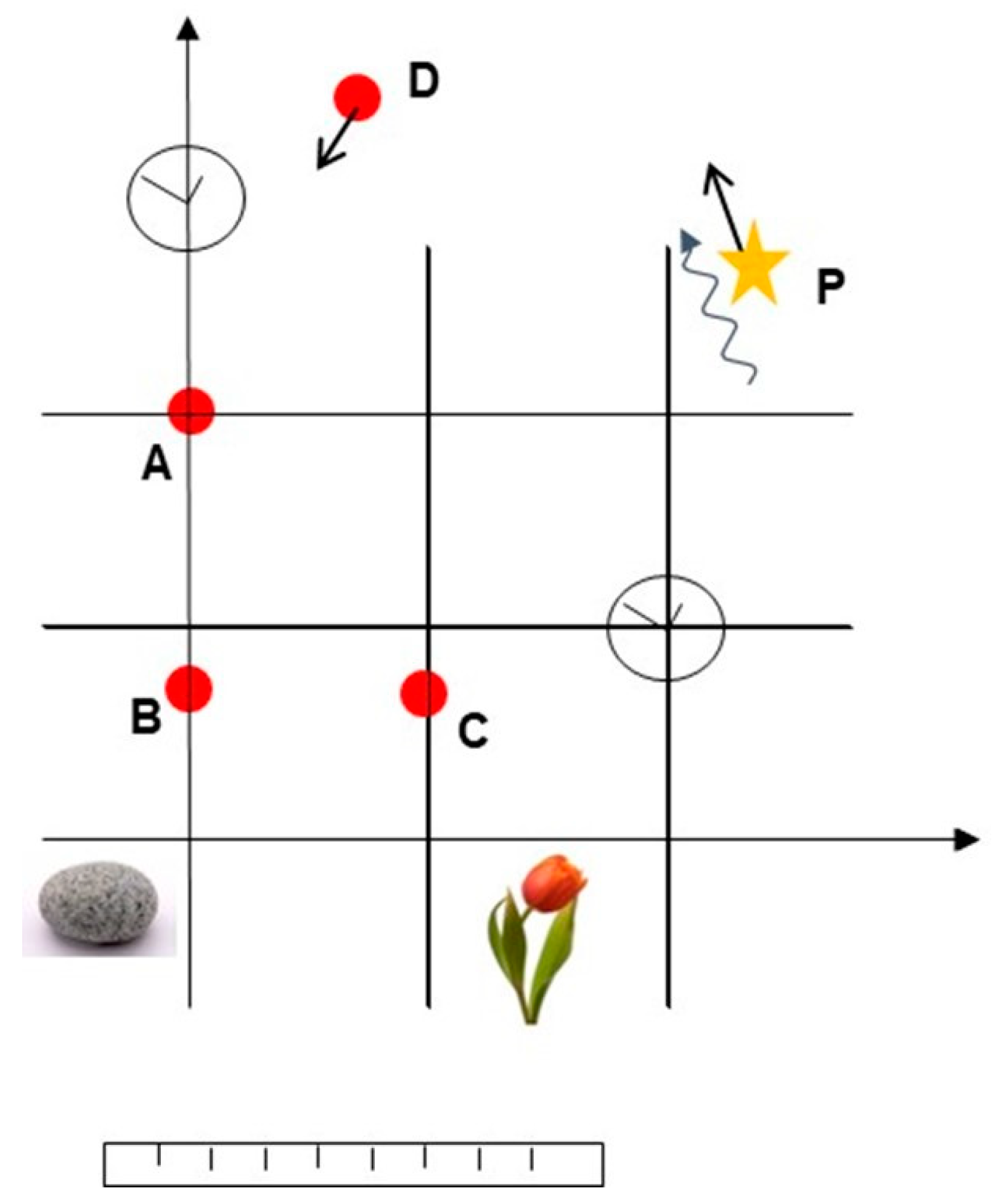
In the context of a substantial way of thinking (as if we could contemplate the world from the outside), we imagine a space-time reference frame as composed, on the one hand, of a grid surveyed by rigid rulers (where points such as A, B, C are positioned independently of one another), and, on the other hand, of a set of synchronized point clocks arranged at the nodes of this grid. The motions and velocities of various motions (such as D), including photons (P), are secondarily defined by the ratios of spaces traversed to times taken to traverse them (read off on the grid's graduations and clocks). The links between space and time measurements for two reference points in relative displacement are given by the Lorentz transformations (see text). More generally, the various objects of thought are considered independently of each other, and defined by qualities to be taken from a reservoir of words "above" the world (the pebble on one side, the flower on the other).
Figure A2.
(a) Two dimensions of thinking to put motion first. (b) A tentative nomenclature of the different stages in the construction of space and time concepts and words.
Figure A2.
(a) Two dimensions of thinking to put motion first. (b) A tentative nomenclature of the different stages in the construction of space and time concepts and words.
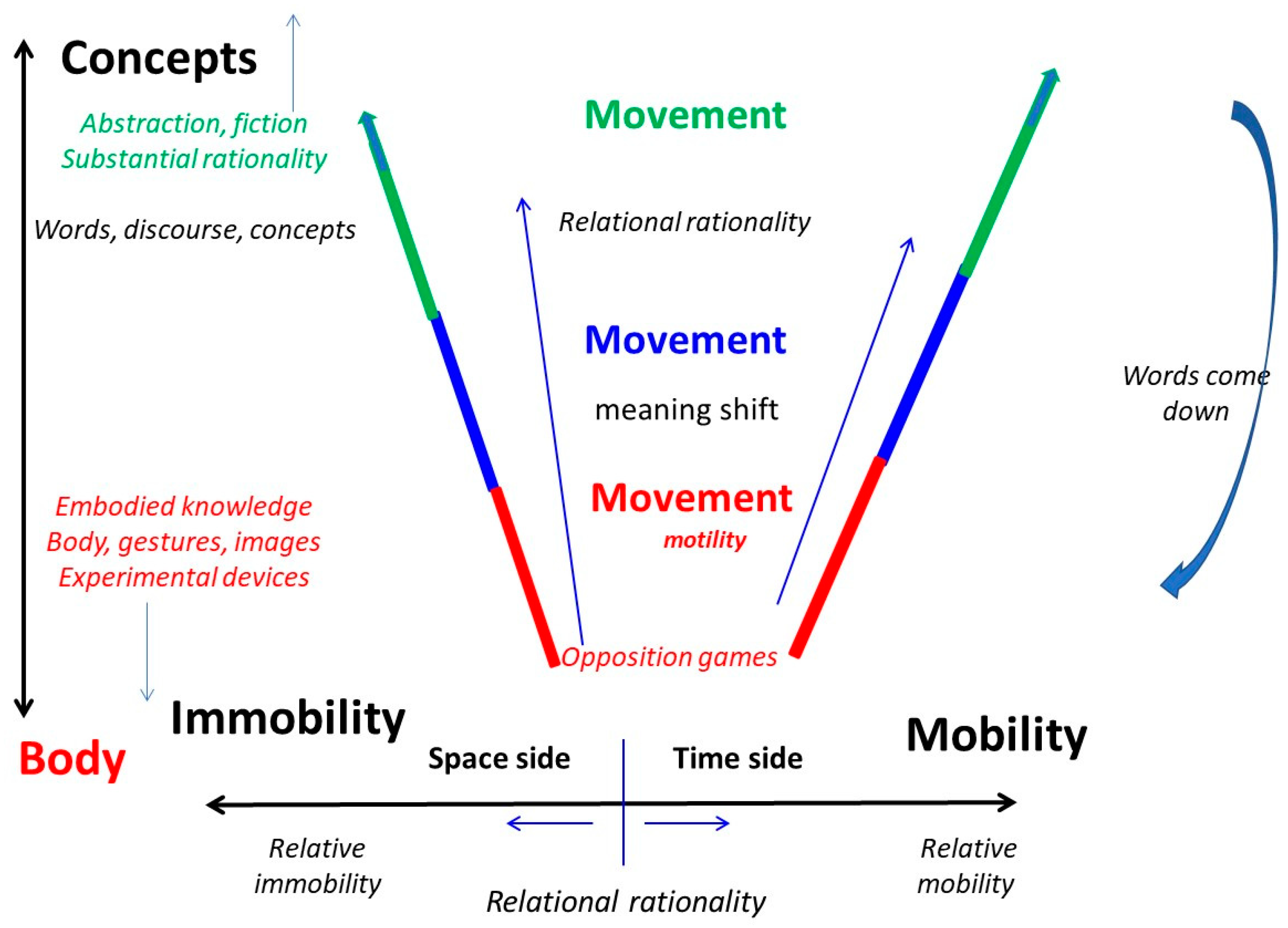
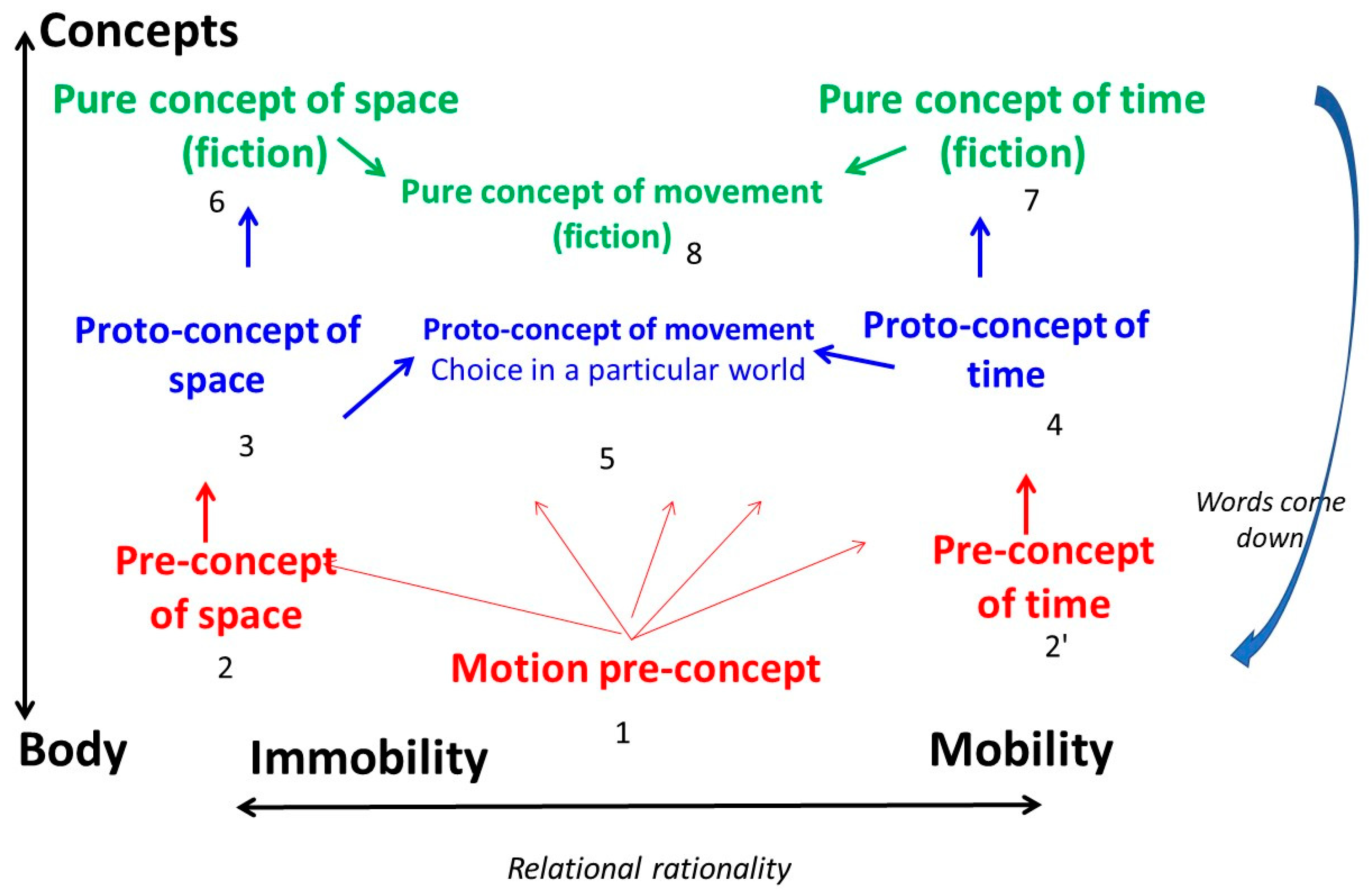
The horizontal dimension reflects a relational rationality that opposes mobility on the right (time side) to immobility on the left (space side). The boundary between the two is variable, chosen by the observer according to what he or she is willing or able to observe. The vertical dimension contrasts embodied cognition (how the body works) at the bottom with discursive knowledge (how concepts work) at the top. Words slide from bottom to top and from top to bottom, changing "value" according to the situation in the plane (represented by a change of color). Movement is first shown (bottom), then named in a particular context (middle position), and finally named more generally in reference to a separate fictional space and time. The arrow drawing the words back down expresses that the words made in the upper part are used to designate what was only shown in the lower part; shifts in meaning follow these "displacements" of words (please refer to the text and Appendix 3 for further precautions regarding the duality of the relational and the substantial).
At the bottom of the plane, pre-concepts are "barely" said: they are understood in embodied knowledge (named by the words that will come down once formed in the upper part of the plane). In the middle position, proto-concepts correspond to choices made in a particular world. In the upper position, "pure" concepts are detached from the world and correspond to a separate, fictitious space and time. The different numbers (from 1 to 8) correspond to the different stages of construction.
Figure A3.
A field of compared movements.
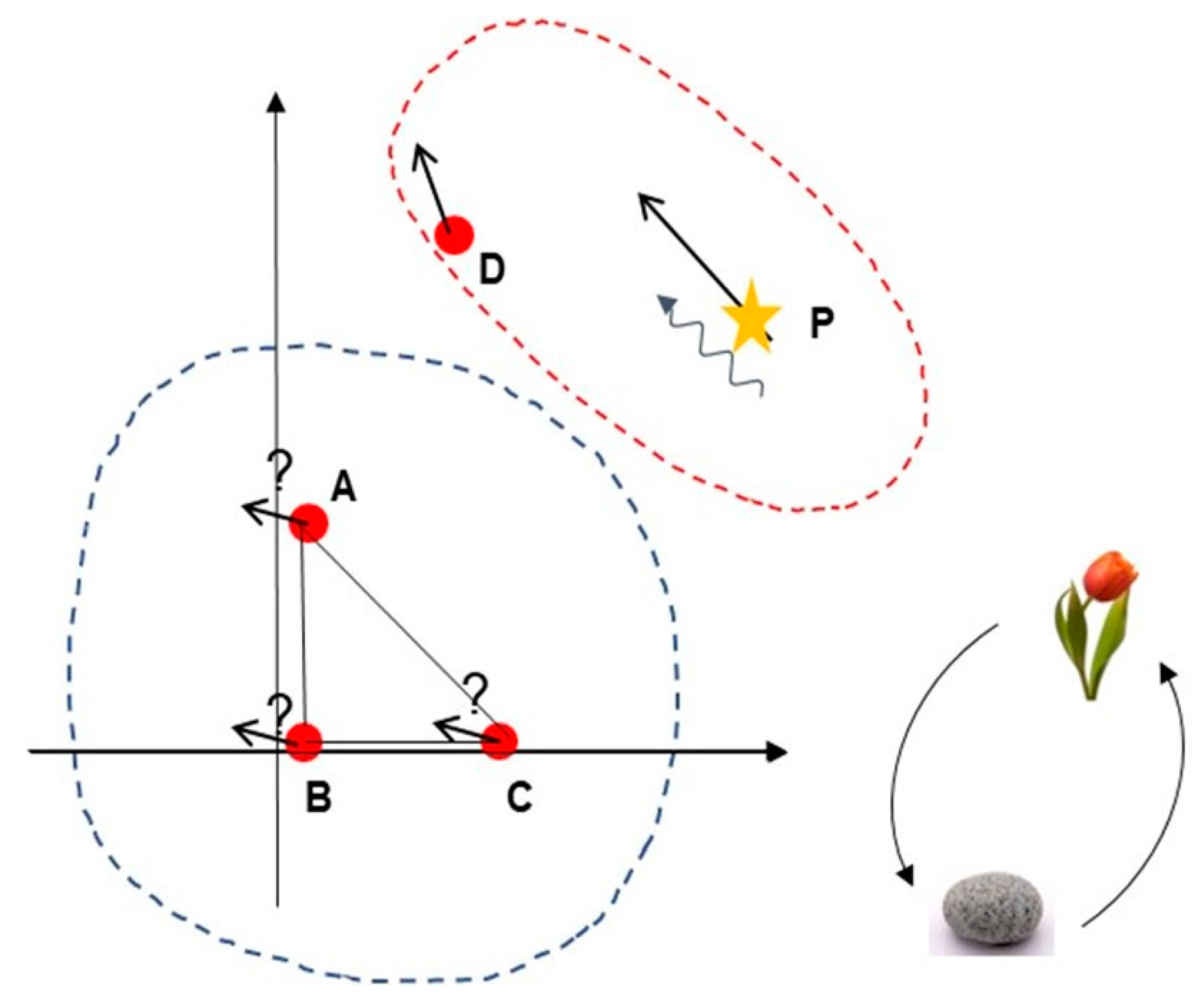
We face a world where neither rulers nor clocks are given a priori. We choose to base the space and the rulers on points (such as A, B, C) assumed / decided to be less mobile than those on which we base the definition of clocks (a mobile elected from the mobile points of type D, and to which we assign a role of standard, such as P). The Lorentz transformation is initially written in (3 + 3) dimensions, before being written in (3 + 1) dimensions. In contrast to what we have shown in Figure A1, the objects of the world are defined in relation to each other: we can't consider one independently of the other: a flower is not a pebble, a pebble is not a flower.
| 1 | We include both special and general versions. |
| 2 | General relativity, while offering a certain latitude in the choice of mathematical variables for space and time, remains backgound dependent when it comes to the concepts of space and time. It takes them from here. |
| 3 | Extracts, more or less transformed, of texts already deposited will be given. There are a large number of these: on the one hand, this shows that the approaches proposed have multiple applications; on the other hand, for texts deposited on the HAL archives, it's an admission that not all the paths opened up have yet been tested by peer review in peer-reviewed journals. |
| 4 | With phenomenology, we say (and will say again) that even the purest concepts of physics cannot be separated from full human experience. |
| 5 | The time standard, the second, is defined from the frequency associated with the transition between the two hyperfine levels of the Cesium atom. These are revealed by the action of a magnetic field (Zeeman effect). |
| 6 | We'll come back later to fictional space and time, obtained by leaping from concrete space and time, based on material entities: fictional objects are detached from any material support, but are an extension or trace of it. In the case of space, for example, having based the shape of the earth on the material markers planted on it, we define an abstract geometric grid: it is an extension of it, but becomes independent of it to the point where the material points used to define it can in turn be traced on it in the event of a displacement. The circularity hidden in this process remains mostly implicit. And so, after basing the space of the universe on galaxies, we come to speak of a (fictional) space containing galaxies that expands "all by itself". |
| 7 | This famous continuum becomes fully apparent when we try to link two reference frames in relative motion; in the "reference frame at rest", time and space are perfectly separate. But in the spirit of good sense, we'd say that, for us, time and space are indeed associated, right from the stage of the reference frame at rest... |
| 8 | Peter Van recently pointed out the book by the Hungarian L. Janossy (1971). We agree with him that, while the mathematics of relativity theory are one thing, the theory does not shed any light on what time and space are... |
| 9 | The following lines borrow extracts from the unpublished text deposited in the HAL archives: Guy (2021b). We leave aside here all the development that would allow us to document in greater detail the passage between the various aspects of human mobility and language. |
| 10 | This author evokes Husserl's thought: "once formalization has taken place, the subjective operations implemented are put aside, so to speak, as a simple provisional scaffolding, even though they continue to condition the understanding (appropriation) of the symbolism produced (its interpretation, application, learning, etc.)". Physicists think they can do without phenomenology: no! And it's not dishonorable to admit the role of the body, of subjectivity... |
| 11 | It also includes the social or pragmatic dimension associated with the word time... |
| 12 | Karl Popper distinguishes between World 1 of physical-chemical phenomena, World 2 of subjective experience and World 3 of objective knowledge; we propose to divide the latter into two sub-sections: World 3.0 of embodied knowledge, and World 3.1 of formulated knowledge (Guy, 2021a). |
| 13 | We leapfrog over various fields of research that enable us to move from mobility (or motility, see below) to language. |
| 14 | These two modes of rationality can be given various names: substantial or categorical; relational or complex, contradictory, antagonistic, enantiomorphic, or synaptic thinking (Ph. Dujardin). |
| 15 | It's interesting to note that Piaget (1967) contrasts constancy and variation without first mentioning space or time. |
| 16 | We speak of circularity when, to ensure a proposition, or a definition, or a designation, we need to rely on one of the elements of the proposition itself; recursivity has a similar meaning, and insists on the generation of an endless series of propositions, each needing the next or previous one to hold. |
| 17 | This term (which is more general than motricity) refers to a large number of words about the functioning of the human body, from the cells to the whole body's posture and visible movements: lymphocytes, gametes, but also proprioception, postural function, muscular tension, emotions... |
| 18 | The following lines are taken from the unpublished text Guy (2022). |
| 19 | Text extracted from Guy (2013). |
| 20 | By Doppler effect in the broadest sense. |
| 21 | This question of the present pits the humanities and social sciences against physics: the former sees its weight in the experience of consciousness, while the latter ignores it and misses the point. |
| 22 | A spaceship hurtling through the cosmos is not required! Nor do we need to invoke Michelson and Morley's experiment to admit the necessity of the Lorentz transformation. |
| 23 | Not far from Mead's notion of movement, the American pragmatists Whitehead and Dewey developed the notion of event to talk about space and time in a relational way. Thinking of space and time together as "acts" among others ties in with what we said earlier (end of section 3.2), putting the two parameters on the same footing as other dualistic physical quantities. |
| 24 | Cf. the seminar led with Denis Cerclet as part of UMR 5600 EVS (Environnement, Ville, Société) during the 2015-2019 period. |
| 25 | Which we call azure sciences and purple sciences respectively (see Guy, 2019a). |
| 26 | Text extracted from Guy (2016c and 2017a). |
| 27 | This requires us to study the randomness of these perturbations and their consequences on particle trajectories; random perturbations always tend to erase heterogeneities. |
| 28 | Text extracted from Guy B. (2010). |
| 29 | Text extracted from Guy B. (2015b). |
| 30 | Texts extracted from Guy B. (2012). |
| 31 | Extracted from Guy B. (2014). |
| 32 | Text extracted from Guy B. (2017b). |
| 33 | Extracted from Guy B. (2016a). |
| 34 | Extract from Guy B. (2020c). |
| 35 | Extract from Guy (2022, 2023, 2024). |
| 36 | We can also speak of "primary" space and time. The reference Guy (2020a) was used for these passages. |
| 37 | See Dujardin Ph. and Guy B. (2012) and the definition of "invariant operations of thought". |
| 38 | See issue 12 of Parcours anthropologiques (2017). |
| 39 | See Guy (2016b), where the analogies between mesology and various fields of the so-called hard sciences are shown in more detail. The current lines are derived from these. |
| 40 | Thanks to Philippe Dujardin for the discussion and suggestions that have informed these lines. |
| 41 | The cinematographic process, in which cognition connects what is separate, has its imperfections: we pretend to start with "fixed" images (so space is separated from time), which we then move (so time is separated from space). |
References
- Abravanel N. (2013) L'historicité en milieu sépharade, ou le primat de la spatialité, Vingtième siècle, revue d'histoire, 117, janvier-mars 2013, 125-137.
- Ancori B. (2020) Le manège du temps, ISTE, London, 310 p.
- Bergson H. (1938) La pensée et le mouvant, Presses Universitaires de France, Paris, 294 p., reprinted 1998.
- Berque A. (1987) Ecoumène, Introduction à l'étude des milieux humains, Belin, Paris, 448 p. Reissued in 2015.
- Caruso E. M., Van Boven, L., Chin, M., & Ward, A. (2013) The temporal Doppler effect: When the future feels closer than the past, Psychological Science, 24 (4), 530-536.
- Cassou-Noguès P. (2004) Gödel, Belles Lettres, 190 p.
- Cerclet D. (2011) Les corps en mouvement comme lieu de constitution du temps? in: Le corps en acte, centenaire Merleau Ponty, coord. A. Berthoz and B. Andrieu, Presses universitaires de Nancy, 171-185.
- Cerclet D. (2014) Marcel Jousse: à la croisée de l'anthropologie et des neurosciences, le rythme des corps, Parcours anthropologiques, 9, 24-38.
- Dahan-Gaida L. (2020) Visual imagination in scientific invention: schemas, images of thought, diagrams. In: Imaginarios Tecnoscientificos, organizadores Juliana Michelli S. Oliveira, Rogério de Almeida, David Sierra G., FEUSP Faculdade de Educação da Universidade de São Paulo, São Paulo, vol 1, 17-36.
- Dingle H. (1972) Science at the crossroads, Martin Brian & O'Keeffe, London.
- Dubar C. (2008) Temporalité, temporalités : philosophie et sciences sociales, in Temporalités, 8.
- Dujardin Ph. and Guy B. (2012) Vers une pensée de la relation, échanges entre un politologue et un physicien, Actes des deuxièmes ateliers sur la contradiction, coordination B. Guy, Presses des mines, Paris, 77-87.
- Gabel C.P., Guy B., Mokhtarinia H. R., and Melloh M. (2021) Slacklining: An explanatory multi-dimensional model considering classical mechanics, biopsychosocial health and time, World Journal of Orthopedics, Mar 18; 12(3): 102-118.
- Granger G.G. (1992) La vérification, Odile Jacob, 320 p.
- Guy B. (2010) Lorenz relations and time: proposed use of a three-dimensional time parameter defined by displacement. The question of time in physics. Internet Archive, 41 p.
- Guy B. (2011) Thinking time and space together, Philosophia Scientiae, 15, 3, 91-113.
- Guy B. (2012) Zero degree of physical laws, heuristic considerations <hal-00723183>.
- Guy B. (2013) Sur la "vitesse" de la lumière et sa mesure: disparition des étalons d'espace et de temps; l'étalon de mouvement; <hal-00814874>; et communication au 22° Congrès général de la société française de physique, Marseille, Juillet 2013 (P082).
- Guy B. (2014) For a principle of "a-certainty" in physics, <hal-01062731>.
- Guy B. (2015a) Ruptures urbaines, une pragmatique spatio-temporelle, Parcours Anthropologiques, 10, 46-64. Online: https://pa.revues.org/422. [CrossRef]
- Guy B. (2015b) On the comparative age and aging of two twins (relativity theory), <hal-01196320>.
- Guy B. (2016a) Relating quantum mechanics and general relativity? Reflections and proposals, <hal-00872968>.
- Guy B. (2016b) Mesology and thinking about the relationships between space, time and movement: convergences. Online at ecoumene.blogspot.
- Guy B. (2016c) Space, time, entropy, European University Publishing, 120 p.
- Guy B. (2017a) What can a better coupling between space and time concepts bring to thermodynamics? <hal-01529570>.
- Guy B. (2017b) Chance, space, time: introduction to a relational approach to probability, <hal-01468456>.
- Guy B. (2018) On the identity of spatial and temporal relations: a key to taking up problems in physics, <hal-01870027 >.
- Guy B. (2019a) SPACE = TIME. Dialogue on the world system. Paris: PENTA Editions, 232 p.
- Guy B. (2019b) The Lorentz transformation, time and space. Generalization of the gamma factor as a function of the direction of motion hidden in clocks, <hal-02068970>.
- Guy B. (2019c) Remarks on what is called "time perception" in psychology and neurophysiology, <hal-02195919>.
- Guy B. (2020a) Les sciences humaines et sociales et la trilogie temps / espace / mouvement, Cosmopolis magazine, 2020, 1-2. And <hal-01870014>, 2018.
- Guy B. (2020b) Quelles images pour sortir de l'espace et du temps? in: Imaginarios Tecnoscientificos, organizadores Juliana Michelli S. Oliveira, Rogério de Almeida, David Sierra G., FEUSP Faculdade de Educação da Universidade de São Paulo, São Paulo, vol 1, 92-121.
- Guy B. (2020c) The Lorentz transformation, time and space. Generalization of the gamma factor as a function of hidden motion in clocks, communication congrès général Société française de Physique, Nantes, <hal-02068970>.
- Guy B. (2020d) Arrows of time and space. An understanding of the second principle of thermodynamics. Entropie, 1, 1, 27 p.
- Guy B. (2020e) Le rythme à la croisée des mouvements de l'homme et des mouvements de la nature. Revue Plastir n° 57, 03 2020.
- Guy B. (2020f) Are there relativistic effects (in the sense of the relativity theory) in the perception of time? Elements for interpreting the experiments of Caruso et al. (2013), <hal- 02509750>.
- Guy B. (2021a) Movement precedes space and time. Where to show it? How to say it? <hal- 03364629>, 23 p.
- Guy B. (2021b) Eléments d'histoire des concepts d'espace et de temps: la place du mouvement, les glissements de sens, <hal-03442268>.
- Guy B. (2022) Revisiting the status of the "speed of light" and examining some cosmological problems, <hal-03860051>.
- Guy B. (2023) A diamond universe, <hal- 04233549>.
- Guy B. (2024) A diamond universe, Int. J. Fund. Phys. Sci., 14, 2, 22-40.
- Janossy L. (1971) Theory of relativity based on physical reality. Akademiai Kiado, Budapest. [CrossRef]
- Jullien F. (2001) Du temps. Eléments d'une philosophie du vivre. Grasset, Paris, 214 p.
- Leclerc Olive M. (2012) Introduction, in: La philosophie du temps en perspective(s), Georges Herbert Mead. Editions de l'EHESS, volume 3, texts collected and translated by M. Leclerc-Olive and C. Soudan.
- Lee A.R. and Kalotas T.M. (1975) Lorentz transformations from the first postulate, Am. J. Phys. 43, 5, 434-437.
- Leenhardt M. (1947) Do Kamo, la personne et le mythe dans le monde mélanésien, 1976, Gallimard, Paris, 314 p.
- Lévy-Leblond J.M. (1976) One more derivation of the Lorentz transformation, Am. J. Phys. 44, 3, 271-277.
- Lobo C. (2021) Locus communis. From the crisis of science to the analytics of technical evidence. Pour une critique de la raison logique élargie et approfondie. Academia Vivarium Nostrum, Frascati, Rome, In defesa dell'uomo, 25 p.
- Mead G.H. (2012) La philosophie du temps en perspective(s), Georges Herbert Mead. Editions de l'EHESS, volume 3, texts collected and translated by M. Leclerc-Olive and C. Soudan.
- Merleau-Ponty M. (1945) Phénoménologie de la perception, Gallimard 2020, 540 p.
- Morin E. (1990) Introduction à la pensée complexe. Paris: Le Seuil.
- Morin E (2013) Mes philosophes, Fayard/Pluriel, 192 p.
- Naïm S. (2006) sous la direction de, La rencontre du temps et de l'espace, approches linguistique et anthropologique, Peeters, Paris, 268 p.
- Nottale L. (1998) La relativité dans tous ses états, Hachette littératures, 320 p.
- Pagni E. (2015) Il corpo come fondamento epistemologico: Bergson, Merleau-Ponty, Patocka, Encontro National de Epistemologia e Metafisica da UFJF, 9-11 Dezembro 2015, unpublished, 28 p.
- Pascal B. (1662) Pensées. Text prepared by Louis Lafuma. Point, 2018.
- Piaget J. (1967) La construction du réel chez l'enfant, Delachaux et Niestlé, Neuchatel, 342 p.
- Poincaré (1902) Science and hypothesis, Flammarion.
- Poincaré (1905) La valeur de la science, Flammarion, Champs sciences 2011, 190 p.
- Popper K. (1984) L'univers irrésolu, plaidoyer pour l'indéterminisme, published by Hermann.
- Quadranti G. (2020) Le monde comme texte, Intentio, Les Cahiers, CREALP, Toulon, 260 p.
- Quadranti G. (2023) Canevas de la théorie de la relativité, unpublished, 2 p.
- Ricoeur P. (1983) Temps et récit, tome 1, L'intrigue et le récit historique, Editions du Seuil, Paris, 406 p.
- Ricoeur P. (1985) Temps et récit, III. Ricoeur Paul, 1985. Temps et récit 3, Le temps raconté, Paris, Seuil.
- Vaihinger H. (1923) La philosophie du comme si. Preface and translation by Christophe Bouriau. Nancy: Philosophia Scientiae, Cahier spécial 8, 2013.
- Vaudène D. (2021) De l'information à l'écriture, Revue Intelligibilité du numérique, 2, online.
- Virole B. (2009) Surdité et sciences humaines. L'Harmattan, Paris.
Disclaimer/Publisher’s Note: The statements, opinions and data contained in all publications are solely those of the individual author(s) and contributor(s) and not of MDPI and/or the editor(s). MDPI and/or the editor(s) disclaim responsibility for any injury to people or property resulting from any ideas, methods, instructions or products referred to in the content. |
© 2025 by the author. Licensee MDPI, Basel, Switzerland. This article is an open access article distributed under the terms and conditions of the Creative Commons Attribution (CC BY) license (https://creativecommons.org/licenses/by/4.0/).
Copyright: This open access article is published under a Creative Commons CC BY 4.0 license, which permit the free download, distribution, and reuse, provided that the author and preprint are cited in any reuse.


